1. Introduction
Climate-related environmental changes are closely linked to global food systems and dietary habits [
1]. Food production and consumption contribute substantially to environmental pressures [
2,
3,
4] and rising global demand, particularly for resource-intensive foods, is expected to intensify these impacts [
5,
6]. Sustainable eating is, therefore, an important behavioural domain, yet progress at the individual level remains inconsistent, especially among adolescents, whose food choices are shaped by limited autonomy and by social, cultural, and financial conditions [
7].
The transition from late childhood into adolescence is a period in which young people increasingly reflect on who they are, who they want to become, and how they fit within the social world around them [
8,
9,
10]. Identity formation during this period involves the exploration, maintenance, and revision of commitments over time, through which adolescents gradually develop a more coherent sense of self [
8,
9]. Food choice represents one everyday domain in which developing autonomy becomes visible and food-related decisions become increasingly self-relevant. At the same time, studies from Ireland and the United States show that adolescents’ food choices remain embedded in home, school, peer, and out-of-home contexts, with availability, convenience, family routines, school food options, and opportunities for independent choice structuring what adolescents can realistically choose [
11,
12]. This makes sustainable food consumption a meaningful topic for ESD: school-based learning can provide structured opportunities to examine, evaluate, and potentially revise food-related choices while adolescents’ autonomy and self-related commitments are still developing. These developmental and contextual dynamics make the lower secondary school years a relevant educational context for examining how psychological predictors and school settings jointly contribute to sustainable dietary intentions.
Schools represent a central setting in this regard. Educational background is associated with sustainable dietary behaviour [
7], and schooling provides structured opportunities for students to engage with sustainability themes through curricular and pedagogical practices aligned with Education for Sustainable Development (ESD) [
13]. As education reaches learners across developmental stages, it can support the development of values, attitudes, and agency relevant for pro-environmental behaviour [
14,
15]. However, the implementation of ESD remains inconsistent [
16], limiting its potential in behavioural domains, such as food, where personal habits and institutional structures intersect [
7].
Yet prior TPB research on sustainable dietary intentions has rarely examined lower secondary students aged 12 to 15, particularly when affective–ecological extensions, such as nature relatedness and environmental concern, are considered alongside the core TPB components. Existing studies have mainly focused on older adolescents, young adults, or pre-service teachers, leaving unclear whether these extended TPB assumptions also apply in early secondary education, where dietary agency is still embedded in family routines, school contexts, and available food options [
17,
18]. The present study addresses this gap by analysing psychological and contextual correlates of sustainable dietary intentions among 12- to 15-year-old students in compulsory education.
1.1. Theoretical Framework
To understand climate-friendly eating in this age group, a theoretical framework is needed that captures the cognitive, social, and contextual factors shaping their intentions to eat sustainably. Prior research provides substantial evidence that the Theory of Planned Behaviour (TPB) is well suited for nutrition-related and pro-environmental behaviours.
The TPB [
19] explains behavioural intentions through three components: attitude toward behaviour, subjective norm, and perceived behavioural control. Attitude reflects how favourable a behaviour is perceived to be, given one’s evaluations of its likely outcomes; subjective norm captures perceived social pressure from important social referents; and perceived behavioural control indicates how easy or difficult the behaviour is perceived to be, accounting for internal and external enablers or barriers [
19]. Behavioural intention increases with more favourable attitudes, stronger perceived social norms, and greater perceived behavioural control, a pattern consistently supported by meta-analytic evidence [
20] and validated for nutrition-related behaviours in a comprehensive review by Riebl et al. [
21].
Several empirical studies have used the TPB in both environmental and dietary contexts. Across studies, attitude most frequently emerges as the strongest predictor of sustainable dietary intention, as shown in a nutrition-focused meta-analysis by Riebl et al. [
21] and supported by more recent work (e.g., [
22,
23,
24]). Some studies, however, have reported a stronger influence of perceived behavioural control [
17] in line with evidence from broader sustainable consumption research [
25,
26]. In contrast, subjective norm tends to exert the weakest influence on dietary behavioural intention, a finding observed in recent studies (e.g., [
17,
24]) and supported by earlier meta-analytic evidence [
20]. Despite some variation in findings, previous studies have consistently demonstrated that the TPB is useful for explaining nutrition-related intentions.
At the same time, a long-standing line of critique argues that the TPB, as a model focused on deliberate reasoning, pays limited attention to emotional, moral, and identity-related motives, which are especially important in taking environmental action [
27,
28,
29]. Affective orientations toward nature, such as emotional connection and concern, can meaningfully shape adolescents’ intentions [
30] and motivate sustainability-oriented behaviour [
22]. Extensions of the TPB further illustrate this point. Studies have expanded the model with additional affective, normative, or habitual components to capture influences beyond deliberate reasoning, for example, descriptive norms and empathic concern [
31], self-efficacy and perceived barriers [
32], habitual tendencies [
24], or climate-related appraisals, such as ambivalence and worry [
22]. Overall, these findings indicate that cognitive evaluations alone cannot account for sustainable dietary intentions, and that affective–ecological dimensions may strengthen TPB-based explanations. Two such dimensions are environmental concern and nature relatedness, which are conceptually relevant for understanding sustainable dietary intentions in adolescence [
17].
Environmental concern refers to the awareness that environmental conditions are threatened by human activity and includes the perception and personal evaluation of environmental problems [
29,
33]. Stern et al. [
33] described it as being organised around three categories of valued objects: consequences for oneself, for others, and for the biosphere. Ecological crises, such as climate change, can weigh heavily on young people’s mental health and evoke strong negative affects, including worry, frustration, anger, helplessness, and grief [
34,
35]. Because environmental concern reflects evaluative judgements about environmental conditions and their personal and moral significance, a strong relationship with the TPB’s attitude component is expected. Moreover, a close relationship with nature relatedness, the second expansion, is expected, as environmental concern relates directly to the degree to which individuals see themselves as part of the natural world [
36].
Nature relatedness, in turn, reflects a relatively enduring, identity-linked orientation towards the natural world and is associated with ecological responsibility and pro-environmental action [
37]. It is understood as a stable human–nature relationship at the conceptual level [
38]. It captures the extent to which an individual identifies with nature, including cognitive, affective, and experiential dimensions [
37]. Higher nature relatedness is associated with stronger awareness of the environmental consequences of one’s behaviour, greater internalised responsibility for ecological outcomes, and more ecologically oriented lifestyles [
37]. Opportunities for nature experiences in childhood play an important role in developing nature relatedness later in life [
39], and high nature relatedness supports the development of environmental competence and action competence [
40]. In the present study, it is operationalised using the NR-6, a validated short scale developed by Nisbet and Zelenski [
41]. Nature relatedness provides an insight into how students may treat the environment, as high nature relatedness points towards low estrangement from the environment.
Previous studies have suggested that environmental orientations are not uniform across age and gender during the school years covered by lower secondary education. Liefländer et al. [
42] found lower connectedness scores among older children and adolescents compared with younger children and university students, while Richardson et al. [
30] reported lower nature-related orientations among boys than girls. Similar gender-related patterns have also been described for environmental concern and ecological values [
33,
43]. These findings indicate that age- and gender-related differences may be relevant when examining sustainable dietary intentions among lower secondary students. Accordingly, the present study considers grade level and gender as sociodemographic variables alongside the psychological components of the extended TPB model. In general, developmental research has highlighted that affective and identity-related orientations function as key drivers of environmental action, including care for nature and particular places, concern for others affected by environmental issues, and the development of an identity of connection to the natural world [
44].
Although environmental concern and nature relatedness are conceptually related, they capture different dimensions of students’ environmental orientation. Environmental concern refers to evaluative concern about environmental degradation, whereas nature relatedness refers to a broader and more stable human–nature relationship that reflects how strongly nature is integrated into their self-understanding and everyday orientation. In the context of sustainable eating, Fiebelkorn and Weber [
17] integrated both constructs into a TPB-based model with prospective biology teachers and showed that these affective–ecological dimensions contributed to the explanation of sustainable dietary intentions. Following this line of work, the present study examines environmental concern and nature relatedness as theoretically relevant extensions of the TPB among lower secondary students.
1.2. Research Questions
Building on the theoretical considerations outlined above, the present study examines how psychological and demographic factors are associated with lower secondary students’ intentions to eat sustainably. We hypothesise that integrating nature relatedness and environmental concern will increase the explanatory power of the TPB among students aged 12 to 15, as these affective and ecological dimensions capture emotional and identity-related influences highlighted in prior research [
27,
29,
45]. Given established patterns, including higher environmental concern and nature-related orientations among girls [
30,
33,
43] and declining ecological values across early adolescence [
42], we further consider gender and grade level.
Therefore, this study asks the following research questions:
RQ1: To what extent do students in lower secondary education report intentions to eat sustainably, and how do they score on the core TPB components, nature relatedness, and environmental concern?
RQ2: How are the core TPB components and the extension constructs, namely nature relatedness and environmental concern, associated with lower secondary students’ sustainable dietary intentions?
RQ3: To what extent do the core TPB components account for variance in lower secondary students’ sustainable dietary intentions, and how are nature relatedness, environmental concern, gender, and grade level associated with intention within an extended TPB framework?
3. Results
3.1. RQ1: To What Extent Do Students in Lower Secondary Education Report Intentions to Eat Sustainably, and How Do They Score on the Core TPB Components, Nature Relatedness, and Environmental Concern?
The average intention to eat sustainably was moderately high (M = 3.47, SD = 0.79) on the 5-point Likert scale. Attitude towards sustainable nutrition showed a high mean value (M = 4.82, SD = 1.09), as did perceived behavioural control (M = 4.77, SD = 1.27) on the 7-point Likert scale. Subjective norm was lower but still positive (M = 3.90, SD = 1.49).
Looking at the components of the TPB more closely, students reported consistently positive attitudes across items. The highest agreement was found for items emphasising that sustainable eating is desirable and worthwhile, while fewer students fully endorsed more effort-related aspects (e.g., that it is always easy or convenient). Concerning perceived behavioural control (PBC), across the four items, mean values ranged from 4.69 to 4.93 (
SD = 1.54–1.78). The students agreed most strongly that eating sustainably is possible (PBC3) and least strongly that achieving a sustainable diet is easy (PBC4). Overall, the means indicate generally high perceived behavioural control, with moderate variability across items (see
Appendix A,
Table A1). Subjective norm showed greater variation across items: family expectations to eat sustainably received the highest agreement, followed by teachers’ opinions, whereas peers and friends were perceived as less relevant.
In the two environmental extension constructs, nature relatedness was moderate (
M = 3.13,
SD = 0.84) on the 5-point Likert scale, with noticeable interindividual variation. Higher scores on everyday nature relatedness (NR4) contrasted with lower and more variable scores on identity-related items (NR1, NR5, and NR6) and preference- or reflection-based items (NR2 and NR3). Environmental concern (EC) was comparatively high (
M = 3.83,
SD = 0.82) on the 5-point scale. Items describing threats, such as dying oceans (EC2) or major ecological catastrophes (EC1), reached the highest agreement, whereas the reversed item, suggesting that environmental problems are exaggerated, showed a lower mean value (EC4). For further details, see
Table A2 in
Appendix A.
3.2. RQ2: How Are the Core TPB Components and the Extension Constructs, Namely Nature Relatedness and Environmental Concern, Associated with Lower Secondary Students’ Sustainable Dietary Intentions?
To explore associations between the study variables and to examine whether predictors were strongly interrelated, a correlation matrix was computed (see
Table 2). Overall, the positive associations among the TPB constructs were consistent with the theoretical assumptions of the model. However, as these analyses are correlational, the results should be interpreted as descriptive associations rather than as evidence of causal relationships.
The strongest associations with the intention to eat sustainably were observed for attitude (r = 0.50, p < 0.001) and perceived behavioural control (r = 0.45, p < 0.001). Subjective norm was also positively associated with intention, although this association was weaker (r = 0.27, p < 0.001). Nature relatedness showed a similar pattern to the core TPB constructs. It was positively associated with intention (r = 0.44, p < 0.001), attitude (r = 0.43, p < 0.001), and perceived behavioural control (r = 0.36, p < 0.001), suggesting that students aged 12–15 with stronger nature relatedness tended to report more favourable TPB-related beliefs and stronger sustainable dietary intentions.
Environmental concern was also positively associated with intention (r = 0.28, p < 0.001), perceived behavioural control (r = 0.38, p < 0.001), subjective norm (r = 0.21, p = 0.004), and attitude (r = 0.21, p = 0.005). However, its associations were less consistent than those of nature relatedness. Notably, environmental concern showed its strongest association with perceived behavioural control, whereas its association with attitude was weaker than expected based on the theoretical framing.
Both grade level and age were negatively associated with the intention to eat sustainably. Grade level showed the stronger association (r = −0.24, p < 0.001), whereas age showed a weaker but still significant association (r = −0.20, p = 0.007). These findings indicate lower sustainable dietary intentions among students in higher grades and older students in this sample. Gender was positively associated with intention (r = 0.27, p < 0.001) and environmental concern (r = 0.19, p = 0.008), indicating that girls tended to report higher scores on these variables than boys. No significant association emerged between environmental concern and age or grade level, whereas nature relatedness was negatively associated with both age (r = −0.21, p = 0.003) and grade level (r = −0.22, p = 0.002). Given the cross-sectional design and modest sample size, these bivariate associations should be interpreted as exploratory.
3.3. RQ3: To What Extent Do the Core TPB Components Account for Variance in Lower Secondary Students’ Sustainable Dietary Intentions, and How Are Nature Relatedness, Environmental Concern, Gender, and Grade Level Associated with Intention Within an Extended TPB Framework?
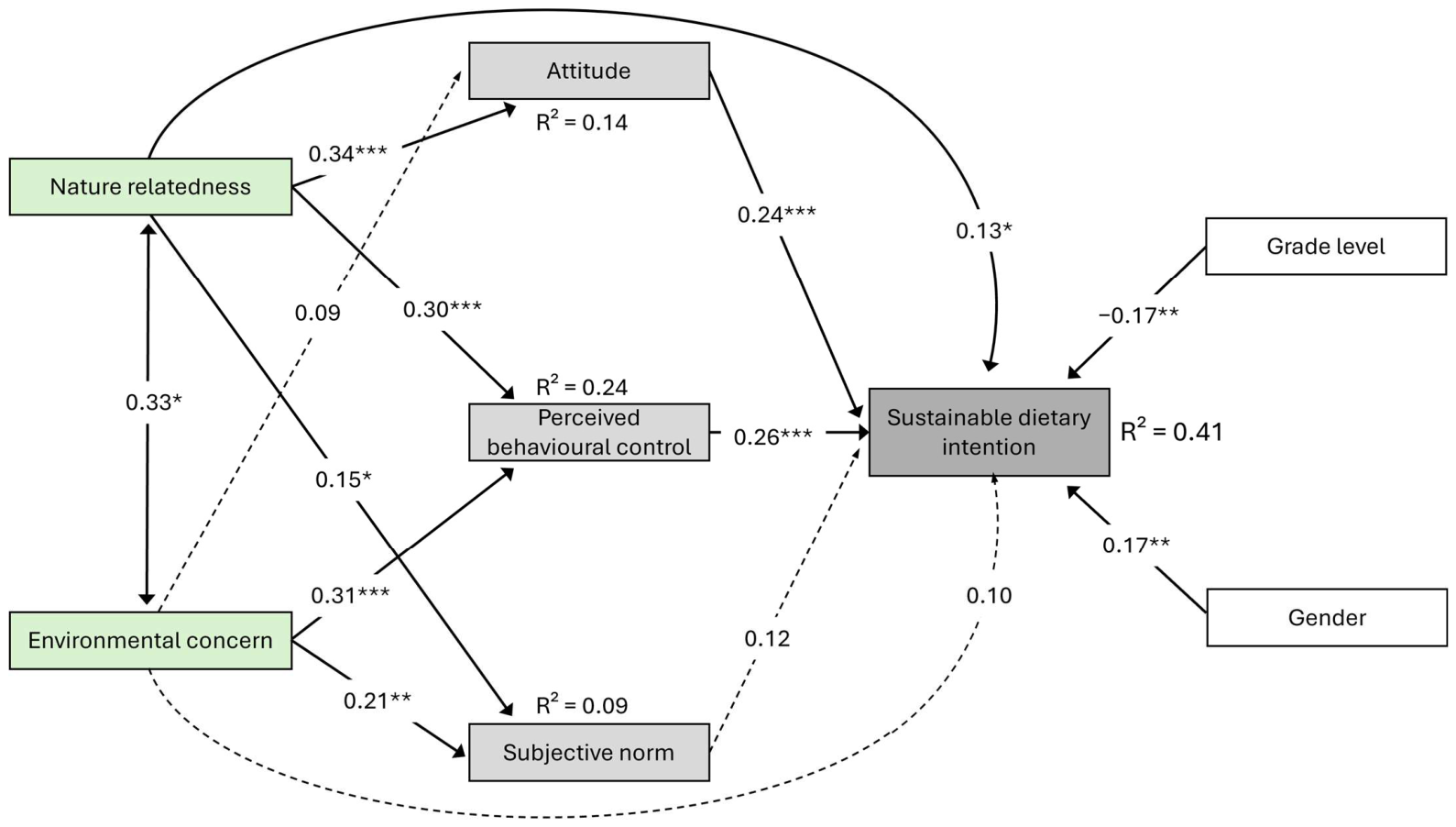
Based on the model specifications described in
Section 2, the final path model included nature relatedness and environmental concern as antecedents of the TPB components, see
Figure 1. Both constructs were also included as direct predictors of lower secondary students’ intention to eat sustainably. Because nature relatedness and environmental concern were conceptualised as related affective–ecological constructs, their covariance was freely estimated. Gender and grade level were included as sociodemographic predictors of intention.
The extended TPB path model showed an acceptable to mixed fit to the data, with χ2(10) = 20.61, p = 0.024, CFI = 0.950, RMSEA = 0.078, and SRMR = 0.074. Thus, while the CFI and SRMR indicated acceptable fit, the RMSEA suggested some limitations. Given the modest sample size, the model results should, therefore, be interpreted with appropriate caution.
Nature relatedness was positively associated with attitude (β = 0.344, p < 0.001), perceived behavioural control (β = 0.296, p < 0.001), and intention (β = 0.134, p = 0.046). Its association with subjective norm was marginally significant (β = 0.148, p = 0.050). These findings suggest that nature relatedness may be related to lower secondary students’ sustainable eating intentions both through TPB-related constructs and through a small direct association with intention.
Environmental concern showed a selective pattern of associations. It was positively associated with perceived behavioural control (β = 0.306, p < 0.001) and subjective norm (β = 0.213, p = 0.004), but was not significantly associated with attitude (β = 0.085, p = 0.250) or intention directly (β = 0.101, p = 0.122). Nature relatedness and environmental concern were moderately correlated (β = 0.326, p < 0.001), indicating shared variance between the two affective–ecological constructs.
Among the core TPB components, perceived behavioural control and attitude were positively associated with students’ intention to eat sustainably. Perceived behavioural control showed the strongest association among the TPB predictors (β = 0.256, p < 0.001), followed closely by attitude (β = 0.244, p < 0.001). Subjective norm showed only a marginal association with intention (β = 0.120, p = 0.058). Thus, in this sample, intention appeared to be more strongly related to perceived control and attitudes than to perceived social norms.
Among the sociodemographic variables, gender was positively associated with intention (β = 0.168, p = 0.006), suggesting that the female students aged 12–15 reported somewhat stronger intentions to eat sustainably than the male students. Grade level was negatively associated with intention (β = −0.166, p = 0.005), suggesting lower sustainable dietary intentions among the students in the higher grade level in this sample.
Overall, the model explained 41.3% of the variance in the students’ intention to eat sustainably, with R2 = 0.413, SE = 0.054, and p < 0.001. This indicates that the extended TPB model accounts for a considerable proportion of variance in intention; however, given the modest sample size and mixed fit indices, the magnitude and stability of individual path estimates should be examined in future studies with larger samples.
4. Discussion
The findings of this study are best understood when considered in relation to previous research and the theoretical assumptions guiding the model.
RQ1. The consistently favourable evaluations of sustainable eating align with earlier TPB applications, showing positive attitudes toward sustainable consumption among both university and older students [
17,
18]. At the same time, recent studies have shown that adolescents often equate “sustainable” with “healthy” or “organic” [
49,
50], a pattern that likely shaped responses in our sample, as well. Such conceptual overlap can elevate attitude scores, particularly when students draw on familiar health-related meanings of the term [
51].
Previous research has highlighted the decisive role of perceived behavioural control in shaping dietary intentions [
52], a pattern that is particularly relevant for older children and adolescents because their food-related choices are strongly shaped by structures outside their control. Earlier studies have emphasised that sustainable eating in this age group is constrained by external factors, such as parental purchasing routines or the availability of options at school, which shape young people’s perceived ability to act [
19,
53]. The high perceived behavioural control values in our sample, therefore, reflect students’ perceived, not actual, ability to act sustainably within these structural constraints. Although attitude and perceived behavioural control showed relatively high mean values, inspection of the scale-level distributions did not indicate a pronounced ceiling effect.
In contrast, subjective norm showed more variability. The stronger agreement with family expectations than with those of peers or teachers corresponds with the students’ everyday circumstances, in which eating habits are primarily shaped within the household. Similar tendencies have been reported by Weber et al. [
18], where the family emerged as the most influential referent group for sustainable food intentions for older students and pre-service biology teachers. Chawla and Derr [
44] also reported the strong influence of relatives and family on students’ pro-environmental behaviour. This supports the idea that subjective norm, while weaker than attitude or perceived behavioural control, still operates meaningfully through the immediate family context during late childhood and adolescence, though lacks the predictive power of perceived behavioural control or attitude [
52], especially in this domain.
Turning to the affective–ecological component, nature relatedness appeared moderate, with marked differences between items, suggesting that students in this age group differ in how far everyday nature contact has developed into a stable nature-related identity. From an ESD perspective, this heterogeneity underscores the importance of providing structured opportunities for nature experiences and reflective engagement in school, as these can strengthen emerging orientations that support agency and sustainable decision-making [
44].
Environmental concern, by contrast, was comparatively high and focused strongly on concrete and curriculum-relevant threats, such as marine pollution. This supports earlier findings that students respond more strongly to tangible and vividly framed risks than to abstract global change [
22,
29]. The comparatively high environmental concern scores, alongside some endorsement of items downplaying environmental problems, may indicate that the students’ responses were not entirely consistent across items. One possible interpretation is a degree of ambivalence, which would be broadly consistent with recent work on mixed emotional responses associated with eco-anxiety among adolescents [
35].
Taken together, the item-level frequencies highlight a profile in which lower secondary students hold very positive attitudes and feel capable of acting sustainably, perceive family expectations more strongly than those of teachers and peers, and show a blend of ecological concern and only moderate emotional relatedness to nature.
RQ2. In the analysis of associations among constructs, nature relatedness showed the most coherent pattern across the TPB components. It correlated strongly with attitude and perceived behavioural control, and it also showed a substantial association with sustainable dietary intention. This suggests that nature relatedness is closely linked to those cognitive determinants that were most strongly associated with intention in this sample. From an ESD perspective, this pattern is relevant because it points to the motivational role of human–nature relationships in early to mid-adolescence, particularly when sustainability education aims to support emerging environmental identities.
Environmental concern showed a different, more selective bivariate pattern than nature relatedness. It was positively associated with all of the TPB components and with sustainable dietary intention, but its strongest association emerged with perceived behavioural control. Thus, environmental concern was not generally weak in the present sample. However, compared with nature relatedness, it appeared less consistently aligned with the central intention-related constructs, particularly attitude and intention. This pattern partly corresponds with Weber et al. [
18], who reported significant bivariate associations between students’ sustainable dietary intention and egoistic, altruistic, and biospheric environmental concern, with the strongest association for biospheric concern. In the present study, however, environmental concern was more closely associated with perceived behavioural control than with attitude or intention. This suggests that, among lower secondary students, concern about environmental problems may be more closely tied to perceived feasibility than to a favourable evaluation of sustainable eating itself. This interpretation is consistent with adolescent TPB research, showing that perceived control and underlying control beliefs play a central role in pro-environmental intentions and behaviour [
31].
Regarding gender, the higher sustainable dietary intentions reported by girls in the present sample may be interpreted against this broader gender-related pattern in food-related sustainability orientations. Prior research has suggested that women and girls sometimes show more positive attitudes towards vegan and vegetarian diets [
54,
55] and more favourable orientations toward sustainable food choices more generally [
50]. These findings provide a plausible context for understanding why the female students in the present study reported stronger intentions to eat sustainably. Gender was also significantly associated with environmental concern, with the girls reporting greater concern than the boys. This aligns with research showing that women and girls often report stronger environmental concern and pro-environmental orientations [
7,
33,
43,
56]. In the present sample, this gender-related association with environmental concern was more pronounced than in Weber et al. [
18], who examined upper secondary students (
Mage = 16.63,
SD = 1.15; 49% female) and pre-service biology teachers (
Mage = 22.86,
SD = 2.77; 69% female) and did not report clear gender-related associations with the three environmental concern dimensions among students. This comparison should be interpreted cautiously, however, because Weber et al. [
18] differentiated between egoistic, altruistic, and biospheric concern, whereas the present study used an overall environmental concern scale. In contrast, gender was not significantly associated with nature relatedness in the present sample. This differs from studies reporting gender-related differences in nature-related orientations, although the direction of these differences is not consistent across studies. For example, Otto and Pensini [
57] and Richardson et al. [
30] reported higher nature-related orientations among girls, whereas Weber et al. [
18] found a small negative association between gender and nature relatedness among students, indicating lower nature relatedness among girls. Thus, the gender-related differences in the present study were most evident for sustainable dietary intention and environmental concern, but not for the broader human–nature relationship captured by nature relatedness.
A similar caution applies to the negative associations between age, grade level, and nature relatedness. These correlations indicate lower nature relatedness among the older students and the students in the higher grade level within this sample, but they do not allow conclusions about developmental change.
RQ3. The extended TPB model provides a differentiated picture of sustainable dietary intentions among students in lower secondary education. Overall, the model accounted for a considerable proportion of variance in intention, but the mixed fit indices and the small sample size call for cautious interpretation. The findings should, therefore, be understood as a structured account of associations within a cross-sectional model, rather than as evidence of causal pathways.
The clearest pattern in the path model concerns the central role of perceived behavioural control and attitude. The students’ intentions to eat sustainably were most closely associated with whether they perceived sustainable eating as feasible and evaluated it favourably, whereas subjective norm showed no significant direct association. This pattern is consistent with previous applications of the TPB in nutrition-related contexts, where perceived behavioural control and attitude often showed stronger links with intention than subjective norm [
23,
24,
52,
58], as well as meta-analytic findings identifying subjective norm as the weakest component of the TPB [
20].
Perceived behavioural control may carry particular weight because it captures both perceived capability and perceived opportunity to act [
59]. This dual function is especially relevant in adolescence, where sustainable eating depends not only on students’ motivation but also on the conditions under which food choices are made. In this age group, reported control may reflect students’ perceived agency, while the translation of intentions into behaviour remains dependent on external conditions, such as family purchasing routines, home food availability, school food environments, time constraints, convenience, and available food options [
11,
12].
The two model extensions add further nuance to the model because nature relatedness and environmental concern occupied different positions within the extended TPB framework. This differentiated role is consistent with, but also extends, Fiebelkorn and Weber’s [
17] model with pre-service biology teachers, where nature relatedness was associated with both attitude and intention, whereas environmental concern was associated with intention but not with attitude. In the present lower secondary student sample, a clear difference between the two constructs was also evident: nature relatedness appeared more closely linked to favourable evaluations of sustainable eating and perceived feasibility, whereas environmental concern was linked mainly to perceived feasibility and social expectations, the latter of which showed no significant direct association with sustainable dietary intention, in contrast to Fiebelkorn and Weber’s [
17] findings.
In our sample, nature relatedness was more consistently embedded in the extended TPB framework than environmental concern. Its role can be interpreted in line with Fiebelkorn and Weber’s [
17] argument that nature relatedness reflects a relatively stable, trait-like orientation towards the natural world and may, therefore, be more closely connected to evaluations of sustainable eating than environmental concern. Weber et al. [
18] pointed in a similar direction, suggesting that nature relatedness, as a positive and connection-oriented construct, may be more closely linked to sustainable dietary intention than concern-oriented environmental constructs.
Weber et al. [
18] examined sustainable dietary intentions among older students and pre-service biology teachers using multiple regression rather than path modelling. Their student sample nevertheless provides a useful complementary comparison, as it included the same model extensions and involved an age group closer to the present sample. Their model explained 41% of the variance in intention. In their student sample, perceived behavioural control showed the strongest direct association with intention among the variables included in their regression model (β = 0.31,
p < 0.001), mirroring the pattern observed in the present study. However, attitude, which was similarly important and constituted an additional central factor in our sample, was not included in Weber et al.’s student regression. Additionally, subjective norm was directly associated with intention in Weber et al.’s [
18] student sample, whereas it was not significantly associated with intention in the present model. Nature relatedness was directly associated with intention in both studies, although the association was stronger in Weber et al.’s student sample than in the present sample of 12- to 15-year-old students. Environmental concern showed no direct association with intention in either study, although Weber et al. (2022) [
18] differentiated between egoistic, altruistic, and biospheric concern, whereas the present study used a broader environmental concern construct. Overall, the comparison suggests that perceived behavioural control and nature relatedness are relevant correlates of sustainable dietary intention, whereas the direct role of environmental concern appears limited. At the same time, the absence of attitude in Weber et al.’s (2022) regression model means that conclusions about the relative contribution of the TPB components cannot be directly transferred to the present path model [
18].
Beyond the TPB components and affective–ecological extensions, our model also points to small group differences that may be relevant for interpreting sustainable dietary intentions in school contexts. In the final model, the female students reported slightly stronger sustainable dietary intentions than male students. Weber et al. [
18] reported a partly different pattern: gender was not significantly associated with intention in their student sample but showed a significant association among pre-service biology teachers. Gender effects align with broader evidence that girls and women tend to report stronger pro-environmental orientations and nature-related tendencies [
30,
33,
57], a pattern echoed by Fiebelkorn and Weber [
17]. However, the association was small and should be interpreted as a group difference within this sample rather than as a general explanation of sustainable dietary intentions. The students in the higher grade reported lower sustainable dietary intentions. Given the cross-sectional design, this finding should not be interpreted as evidence of developmental change, but as a group-specific difference whose origin remains unclear. Weber et al. [
18] did not support this pattern in their multiple regression analysis, where grade level showed no significant association with intention (β = −0.05). By contrast, Fiebelkorn and Weber [
17] reported a small positive association between age and intention (β = 0.15,
p < 0.05) in their model. Together, these inconsistent findings suggest that age- or grade-related differences in sustainable dietary intention may be context-dependent and require further investigation.
5. Conclusions and Implications
This study examined sustainable dietary intentions among Austrian lower secondary students using an extended Theory of Planned Behaviour framework. The findings show that students reported moderately high intentions to eat sustainably, favourable attitudes, and relatively high perceived behavioural control. In the path model, perceived behavioural control showed the strongest association with intention, closely followed by attitude. Subjective norm showed only a marginal association with intention, whereas nature relatedness retained a weak but significant direct association. Nature relatedness was also associated with the TPB components, particularly attitude and perceived behavioural control. Environmental concern showed a more selective pattern: it was associated with perceived behavioural control and subjective norm, but not directly with intention or attitude. Overall, the model explained a considerable proportion of variance in sustainable dietary intentions, while also indicating small but relevant differences by gender and grade level.
Although attitude was associated with intention, the present findings do not suggest that attitude-focused educational approaches alone would be sufficient. This is particularly relevant because established evaluations can be resistant to change, especially when they are embedded in prior beliefs, social contexts, or value-related commitments [
60]. Defensive information processing and motivated reasoning can further reinforce existing views when new information conflicts with prior beliefs or valued social positions [
61,
62]. ESD should, therefore, address sustainable eating not only through information provision, but also through opportunities for reflection, participation, and feasible action [
63].
In light of the central role of perceived behavioural control, students’ sustainable dietary intentions appear closely tied to whether sustainable choices are perceived as feasible within everyday contexts. Schools may, therefore, support students not only through knowledge provision, but also by creating structural and pedagogical conditions relevant to perceived behavioural control. At the structural level, this includes increasing the accessibility and affordability of healthy and sustainable food options in school cafeterias, while reducing the availability of less sustainable alternatives [
53,
64,
65]. At the pedagogical level, it includes opportunities for participation and environmental agency [
44], as well as forms of sustainability education that foster reflection, negotiation, and informed judgement rather than prescribing a single correct behaviour [
63,
66]. Yet, within school structures, it remains crucial to recognise that students “without the ability to act on their choice, they in effect have no choice” [
67] (p. 143). Against this background, the present findings caution against framing sustainable eating as a prescriptive educational outcome. Instead, ESD can be understood as creating conditions in which students encounter meaningful and feasible options for sustainable food practices within the everyday context of schools.
From an educational perspective, nature relatedness may represent one relevant lever within ESD, particularly when addressed through regular, meaningful, and participatory encounters with nearby nature. Evidence from secondary school students suggests that nature relatedness can be strengthened when outdoor biodiversity learning includes student agency, self-guided inquiry, expert exchange, and personal engagement with local places, rather than outdoor exposure alone [
68]. Experimental work with university students further indicates that even brief positive contact with nearby nature can enhance state nature relatedness [
69]. Although this evidence does not directly refer to lower secondary students, it supports the broader educational relevance of meaningful nature contact in school contexts. Research on pathways into environmental action further highlights the relevance of meaningful nature experiences, social support, and environmental education in childhood and youth [
44,
70]. Providing regular opportunities for reflective and participatory outdoor experiences may, therefore, support the emotional and identity-based foundations of sustainable dietary orientations.
Environmental concern should not be interpreted as irrelevant, but as a less proximal and more context-dependent construct. As a broad concern about environmental problems, it may require links to perceived feasibility, coping, hope, or social support to become relevant for action-oriented engagement [
67,
71]. Thus, schools may need to connect environmental concern with feasible and socially supported forms of action, rather than treating concern itself as a sufficient basis for sustainable dietary intention.
Finally, given the observed school year-level differences in sustainable dietary intentions and nature relatedness, schools should avoid assuming that students across year levels experience the same barriers, opportunities, or forms of support. As possible levers, schools could strengthen continuity in sustainability education across year levels [
16], increase opportunities for direct and meaningful nature contact to counteract declining opportunities for first-hand nature experiences [
40], and foster students’ sense of agency to mitigate growing feelings of powerlessness in the face of global crises [
34].
Limitations
Several limitations must be considered. First, the sample was regionally restricted to rural Austrian lower secondary schools, which limits generalisability beyond this specific context. In addition, no systematic school-level data were collected on socioeconomic composition, existing ESD programmes, or school food environments. These contextual factors may have shaped the students’ perceived behavioural control, subjective norms, and sustainable dietary intentions, but could not be examined as potential moderators in the present study.
Second, the effective sample size for the path model was modest. Although the sensitivity power analysis indicated that this study was sufficiently powered to detect effects of approximately f2 = 0.085 or larger, very small effects may have remained undetected. Consequently, non-significant and marginally significant paths should be interpreted with caution and require replication in larger samples.
Third, this study used different response formats across constructs because the original validated instruments were retained. Although standardised coefficients were used for the interpretation of the path model, it cannot be fully excluded that differences in response formats influenced the distributional properties of individual variables.
Fourth, all of the data relied on self-reported intentions rather than observed behaviour, and the concept of sustainable eating may have been interpreted differently by the lower secondary students, introducing interpretive variability. Perceived behavioural control was assessed as part of the TPB framework and, therefore, reflects the students’ subjective appraisal of feasibility and control. This points to a broader limitation of applying the TPB to behaviours that are not fully under individual volitional control: perceived behavioural control may not fully capture the actual opportunities and constraints that shape behaviour. The present study did not include independent measures of actual control, such as household food purchasing practices, school food provision, affordability, or the concrete availability of sustainable options. Therefore, it remains unclear whether the students’ perceived control corresponded to the external conditions needed to translate sustainable dietary intentions into behaviour, which reflects a known limitation of the TPB model.
Fifth, the cross-sectional design does not allow causal conclusions or conclusions about developmental change. The observed school year-level differences in sustainable dietary intentions and nature relatedness should, therefore, be interpreted as group differences within this sample, not as evidence of developmental trajectories. Longitudinal designs are needed to examine whether such differences reflect developmental change, cohort effects, contextual school-related factors, or measurement differences. Future studies should also test measurement invariance across school year levels before interpreting such differences developmentally.
Finally, environmental concern was assessed as a broad construct. Future studies should examine whether more differentiated dimensions of environmental concern, such as egoistic, altruistic, and biospheric concern, show distinct associations with TPB components and sustainable dietary intention in this age group.