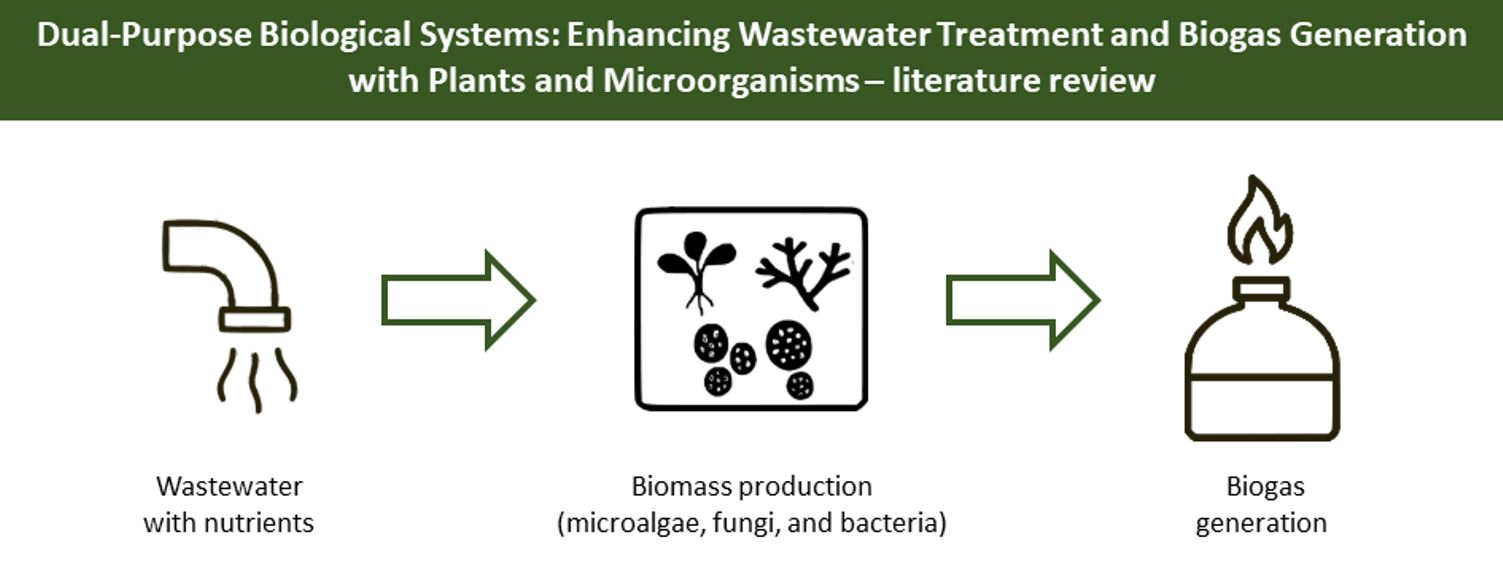
Dual-Purpose Biological Systems: Enhancing Wastewater Treatment and Biogas Generation with Duckweed and Microorganisms—A Systematic Review

 , , , and
Abstract
1. Introduction
2. Methodology
2.1. Selection Process (Inclusion and Exclusion Criteria)
- (1)
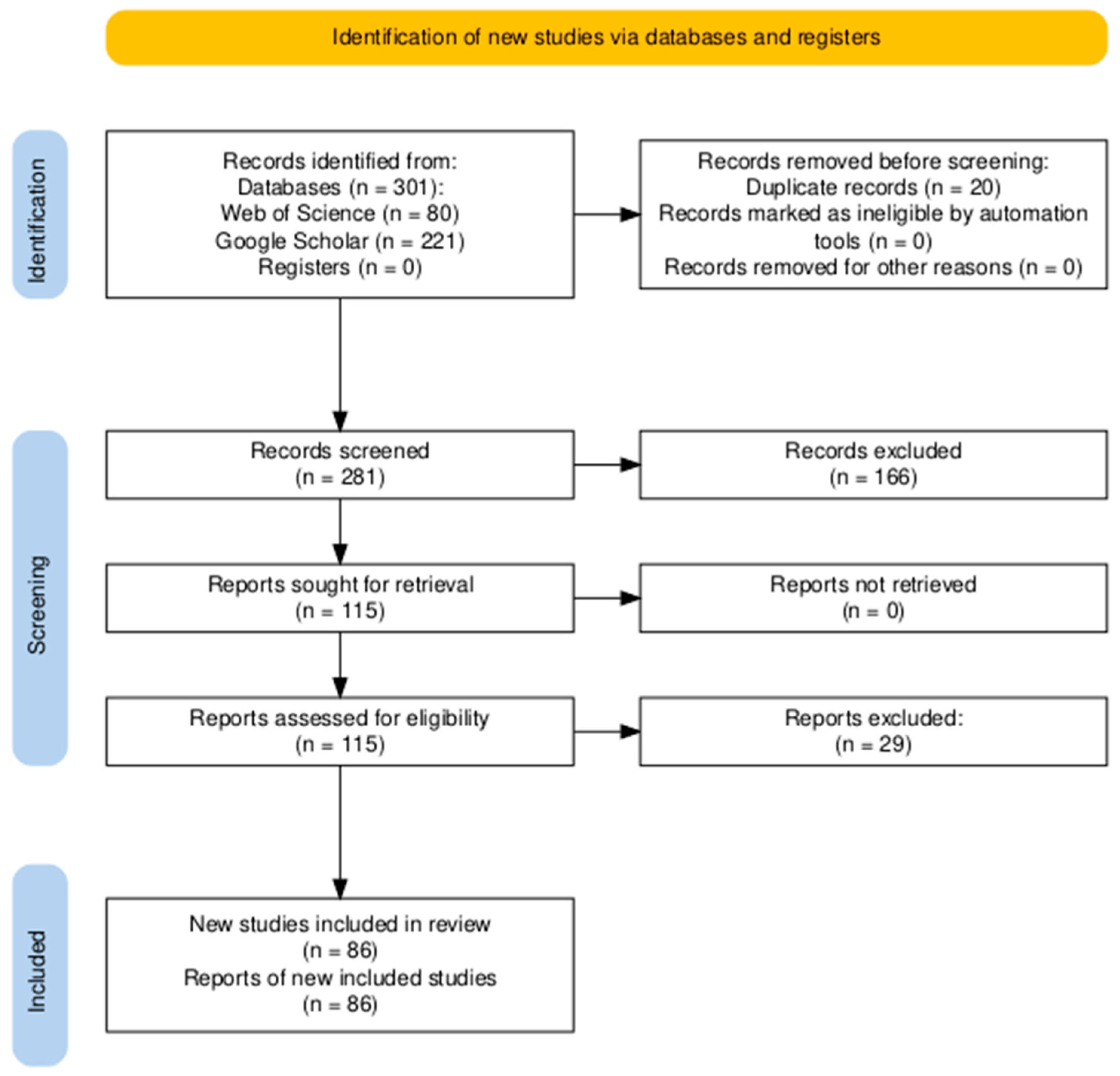
- Initial Title and Abstract Screening: First, articles were identified based on their titles. At this stage, 281 records were comprehensively screened. A total of 166 papers were excluded because they did not focus on biological processes or biomass-related treatments, the full text was not available, or they lacked technical alignment with the scope of this study.
- (2)
- Full-Text Eligibility Assessment: The remaining 115 articles were retrieved for a full-text review to assess their suitability and compatibility with the article scope. After 29 papers were excluded due to incomplete data, the final selection of 86 studies was established. Articles were included if they provided empirical data on treatment efficiency, biomass growth, biogas yield or essential parameters describing the fundamental mechanisms and parameters of the treatment process.
- Studies focusing solely on strictly chemical or mechanical treatment methods.
- Papers where the full text was unavailable or lacked peer-review validation, or failed to provide clear descriptive insights into the core process mechanisms.
- Outdated studies that have been superseded by more recent, comprehensive research (focus was placed on the last 10 years). Selected landmark papers or foundational methodological studies older than 10 years (e.g., Abdel-Raouf et al., 2012 [27]) were exceptionally included due to their critical relevance to the field.
2.2. Data Synthesis
3. Plant and Microbial Candidates for Wastewater Treatment Characterization
3.1. Microalgae General Objectives
3.1.1. Contaminants’ Removal
3.1.2. Biomass Production
3.1.3. Energy Production
3.1.4. Advantages/Disadvantages
3.2. General Objectives with Duckweed
3.2.1. Contaminants Removal
3.2.2. Biomass Production
3.2.3. Advantages/Disadvantages
3.3. Fungi General Objectives
- pH—depending on the fungi type, different pH values are desired for the most efficient performance. Generally, fungi need to have the ability to grow in a pH over 7,
- Temperature—this plays an important role in fungal growth, metabolism, and electricity generation using fungal cells. It facilitates the cell’s metabolism and enzymatic reactions. The majority of fungi are mesophiles and thrive at temperatures between 20 and 40 °C.
- Ionic strength—a higher ionic conductivity influences the fungal cell.
- Salinity—about 90% of fungi can grow at a salinity between 3 and 6; fungi species can grow better in a salty environment.
- The occurrence of contamination or genetic instability within the fungal population influences wastewater hydrolysis, fungal production, and finally the overall product yield.
3.3.1. Contaminants Removal
3.3.2. Biomass Production
3.3.3. Energy Production
3.3.4. Advantages/Disadvantages
3.4. Bacteria General Objectives
Contaminants Removal
3.5. Hybrid Systems’ (Co-Cultures) General Objectives
3.5.1. Contaminants Removal
3.5.2. Biomass Production
3.5.3. Advantages/Disadvantages
4. Discussion
5. Challenges and Future Directions
6. Conclusions
Supplementary Materials
Author Contributions
Funding
Institutional Review Board Statement
Informed Consent Statement
Data Availability Statement
Conflicts of Interest
References
- Crini, G.; Lichtfouse, E. Advantages and Disadvantages of Techniques Used for Wastewater Treatment. Environ. Chem. Lett. 2019, 17, 145–155. [Google Scholar] [CrossRef]
- Voigt, M.; Wirtz, A.; Hoffmann-Jacobsen, K.; Jaeger, M. Prior Art for the Development of a Fourth Purification Stage in Wastewater Treatment Plant for the Elimination of Anthropogenic Micropollutants-a Short-Review. AIMS Environ. Sci. 2020, 7, 69–98. [Google Scholar] [CrossRef]
- Zagklis, D.P.; Bampos, G. Tertiary Wastewater Treatment Technologies: A Review of Technical, Economic, and Life Cycle Aspects. Processes 2022, 10, 2304. [Google Scholar] [CrossRef]
- Razzak, S.A. Recent Advances in Sustainable Biological Nutrient Removal from Municipal Wastewater. Clean. Water 2024, 2, 100047. [Google Scholar] [CrossRef]
- Matesun, J.; Petrik, L.; Musvoto, E.; Ayinde, W.; Ikumi, D. Limitations of Wastewater Treatment Plants in Removing Trace Anthropogenic Biomarkers and Future Directions: A Review. Ecotoxicol. Environ. Saf. 2024, 281, 116610. [Google Scholar] [CrossRef] [PubMed]
- Zahmatkesh, S.; Bokhari, A.; Karimian, M.; Zahra, M.M.A.; Sillanpää, M.; Panchal, H.; Alrubaie, A.J.; Rezakhani, Y. A Comprehensive Review of Various Approaches for Treatment of Tertiary Wastewater with Emerging Contaminants: What Do We Know? Environ. Monit. Assess. 2022, 194, 884. [Google Scholar] [CrossRef] [PubMed]
- de Boer, S.; González-Rodríguez, J.; Conde, J.J.; Moreira, M.T. Benchmarking Tertiary Water Treatments for the Removal of Micropollutants and Pathogens Based on Operational and Sustainability Criteria. J. Water Process Eng. 2022, 46, 102587. [Google Scholar] [CrossRef]
- Carey, R.O.; Migliaccio, K.W. Contribution of Wastewater Treatment Plant Effluents to Nutrient Dynamics in Aquatic Systems. Environ. Manage. 2009, 44, 205–217. [Google Scholar] [CrossRef] [PubMed]
- Chevalier, P.; Proulx, D.; Lessard, P.; Vincent, W.F.; De La Noüe, J. Nitrogen and Phosphorus Removal by High Latitude Mat-Forming Cyanobacteria for Potential Use in Tertiary Wastewater Treatment. J. Appl. Phycol. 2000, 12, 105–112. [Google Scholar] [CrossRef]
- Villarín, M.C.; Merel, S. Paradigm Shifts and Current Challenges in Wastewater Management. J. Hazard. Mater. 2020, 390, 122139. [Google Scholar] [CrossRef] [PubMed]
- Solcova, O.; Dlaskova, M.; Kastanek, F. Challenges and Advances in Tertiary Waste Water Treatment for Municipal Treatment Plants. Processes 2024, 12, 2084. [Google Scholar] [CrossRef]
- Tarigan, M.; Raji, S.; Al-Fatesh, H.; Czermak, P.; Ebrahimi, M. The Occurrence of Micropollutants in the Aquatic Environment and Technologies for Their Removal. Processes 2025, 13, 843. [Google Scholar] [CrossRef]
- Jurík, J.; Jankovičová, B.; Zakhar, R.; Šoltýsová, N.; Derco, J. Quaternary Treatment of Urban Wastewater for Its Reuse. Processes 2024, 12, 1905. [Google Scholar] [CrossRef]
- Mishra, A.; Goel, D.; Shankar, S. Bisphenol A Contamination in Aquatic Environments: A Review of Sources, Environmental Concerns, and Microbial Remediation. Environ. Monit. Assess. 2023, 195, 1352. [Google Scholar] [CrossRef] [PubMed]
- Jassal, S.; Warmoota, R.; Goyal, D.; Mittal, I.; Sharma, A.; Gupta, N. Sustainable Waste Water Treatment: Opportunities and Challenges. Braz. Arch. Biol. Technol. 2023, 66, e23220546. [Google Scholar]
- Xu, H.; de Koning, J.; Geng, Y. Reliability and Efficiency of an Advanced Tertiary Treatment Process for Wastewater Reclamation. J. Water Reuse Desalination 2019, 9, 385–395. [Google Scholar] [CrossRef]
- de Morais, E.G.; Sampaio, I.C.F.; Gonzalez-Flo, E.; Ferrer, I.; Uggetti, E.; García, J. Microalgae Harvesting for Wastewater Treatment and Resources Recovery: A Review. N. Biotechnol. 2023, 78, 84–94. [Google Scholar] [CrossRef] [PubMed]
- de Lima Barizão, A.C.; de Oliveira Gomes, L.E.; Brandão, L.L.; Sampaio, I.C.F.; de Moura, I.V.L.; Gonçalves, R.F.; de Oliveira, J.P.; Cassini, S.T. Microalgae as Tertiary Wastewater Treatment: Energy Production, Carbon Neutrality, and High-Value Products. Algal Res. 2023, 72, 103113. [Google Scholar] [CrossRef]
- Mainardis, M.; Ferrara, C.; Cantoni, B.; Di Marcantonio, C.; De Feo, G.; Goi, D. How to Choose the Best Tertiary Treatment for Pulp and Paper Wastewater? Life Cycle Assessment and Economic Analysis as Guidance Tools. Sci. Total Environ. 2024, 906, 167598. [Google Scholar] [CrossRef] [PubMed]
- Silva, J.A. Wastewater Treatment and Reuse for Sustainable Water Resources Management: A Systematic Literature Review. Sustainability 2023, 15, 10940. [Google Scholar] [CrossRef]
- Shanmugam, K.; Gadhamshetty, V.; Tysklind, M.; Bhattacharyya, D.; Upadhyayula, V.K.K. A Sustainable Performance Assessment Framework for Circular Management of Municipal Wastewater Treatment Plants. J. Clean. Prod. 2022, 339, 130657. [Google Scholar] [CrossRef]
- European Union Directive (EU). 2024/3019 of the European Parliament and of the Council of 27 November 2024 Concerning Urban Wastewater Treatment (Recast). Off. J. Eur. Union 2024, 3019, 2024. [Google Scholar]
- Kardos, M.K.; Patziger, M.; Jolánkai, Z.; Clement, A. The New Urban Wastewater Treatment Directive from the Perspective of the Receiving Rivers’ Quality. Environ. Sci. Eur. 2025, 37, 10. [Google Scholar] [CrossRef]
- Satiro, J.; dos Santos Neto, A.G.; Marinho, T.; Sales, M.; Marinho, I.; Kato, M.T.; Simões, R.; Albuquerque, A.; Florencio, L. The Role of the Microalgae–Bacteria Consortium in Biomass Formation and Its Application in Wastewater Treatment Systems: A Comprehensive Review. Appl. Sci. 2024, 14, 6083. [Google Scholar] [CrossRef]
- Srimongkol, P.; Sangtanoo, P.; Songserm, P.; Watsuntorn, W.; Karnchanatat, A. Microalgae-Based Wastewater Treatment for Developing Economic and Environmental Sustainability: Current Status and Future Prospects. Front. Bioeng. Biotechnol. 2022, 10, 904046. [Google Scholar] [CrossRef] [PubMed]
- Page, M.J.; McKenzie, J.E.; Bossuyt, P.M.; Boutron, I.; Hoffmann, T.C.; Mulrow, C.D.; Shamseer, L.; Tetzlaff, J.M.; Akl, E.A.; Brennan, S.E.; et al. The PRISMA 2020 statement: An updated guideline for reporting systematic reviews. BMJ 2021, 372, n71. [Google Scholar] [CrossRef] [PubMed]
- Abdel-Raouf, N.; Al-Homaidan, A.A.; Ibraheem, I.B.M. Microalgae and Wastewater Treatment. Saudi J. Biol. Sci. 2012, 19, 257–275. [Google Scholar] [CrossRef] [PubMed]
- Liu, X.-Y.; Hong, Y. Microalgae-Based Wastewater Treatment and Recovery with Biomass and Value-Added Products: A Brief Review. Algal Res. 2022, 62, 102614. [Google Scholar] [CrossRef]
- Sharma, M.; Agarwal, S.; Agarwal Malik, R.; Kumar, G.; Pal, D.B.; Mandal, M.; Sarkar, A.; Bantun, F.; Haque, S.; Singh, P.; et al. Recent Advances in Microbial Engineering Approaches for Wastewater Treatment: A Review. Bioengineered 2023, 14, 2184518. [Google Scholar] [CrossRef] [PubMed]
- Nguyen, L.N.; Aditya, L.; Vu, H.P.; Johir, A.H.; Bennar, L.; Ralph, P.; Hoang, N.B.; Zdarta, J.; Nghiem, L.D. Nutrient Removal by Algae-Based Wastewater Treatment. Curr. Pollut. Rep. 2022, 8, 369–383. [Google Scholar] [CrossRef]
- Molazadeh, M.; Ahmadzadeh, H.; Pourianfar, H.R.; Lyon, S.; Rampelotto, P.H. The Use of Microalgae for Coupling Wastewater Treatment with CO2 Biofixation. Front. Bioeng. Biotechnol. 2019, 7, 42. [Google Scholar] [CrossRef] [PubMed]
- Kong, W.; Kong, J.; Feng, S.; Yang, T.T.; Xu, L.; Shen, B.; Bi, Y.; Lyu, H. Cultivation of Microalgae–Bacteria Consortium by Waste Gas–Waste Water to Achieve CO2 Fixation, Wastewater Purification and Bioproducts Production. Biotechnol. Biofuels Bioprod. 2024, 17, 3–21. [Google Scholar] [CrossRef] [PubMed]
- Mathew, M.M.; Khatana, K.; Vats, V.; Dhanker, R.; Kumar, R.; Dahms, H.U.; Hwang, J.S. Biological Approaches Integrating Algae and Bacteria for the Degradation of Wastewater Contaminants—A Review. Front. Microbiol. 2022, 12, 801051. [Google Scholar] [CrossRef] [PubMed]
- Kumar, M.S.; Hwang, J.H.; Abou-Shanab, R.A.I.; Kabra, A.N.; Ji, M.K.; Jeon, B.H. Influence of CO2 and Light Spectra on the Enhancement of Microalgal Growth and Lipid Content. J. Renew. Sustain. Energy 2014, 6, 063107. [Google Scholar] [CrossRef]
- Liberti, D.; Pinheiro, F.; Simões, B.; Varela, J.; Barreira, L. Beyond Bioremediation: The Untapped Potential of Microalgae in Wastewater Treatment. Water 2024, 16, 2710. [Google Scholar] [CrossRef]
- Abdelfattah, A.; Ali, S.S.; Ramadan, H.; El-Aswar, E.I.; Eltawab, R.; Ho, S.H.; Elsamahy, T.; Li, S.; El-Sheekh, M.M.; Schagerl, M.; et al. Microalgae-Based Wastewater Treatment: Mechanisms, Challenges, Recent Advances, and Future Prospects. Environ. Sci. Ecotechnology 2023, 13, 100205. [Google Scholar] [CrossRef]
- Dinh, N.T.; Thu, L.P.; Dat, N.T.; Khanh Toan, N.; Le Anh, P. The Roles of Microalgae and Bacteria in Wastewater Treatment. Vietnam. J. Biotechnol. 2022, 20, 573–588. [Google Scholar] [CrossRef]
- Khairuddin, N.F.M.; Khan, N.; Sankaran, S.; Farooq, W.; Ahmad, I.; Aljundi, I.H. Produced Water Treatment by Semi-Continuous Sequential Bioreactor and Microalgae Photobioreactor. Bioresour. Bioprocess. 2024, 11, 56. [Google Scholar] [CrossRef] [PubMed]
- Vaz, S.; Martins, R.; Pinheiro, H.M.; Monteiro, L. Effect of Hydraulic Retention Time on Nutrient Removal in a Microalgae-Based Tertiary Treatment: A Pilot-Scale Study in Winter Conditions. Sustainability 2025, 17, 7553. [Google Scholar] [CrossRef]
- Wrede, D.; Taha, M.; Miranda, A.F.; Kadali, K.; Stevenson, T.; Ball, A.S.; Mouradov, A. Co-Cultivation of Fungal and Microalgal Cells as an Efficient System for Harvesting Microalgal Cells, Lipid Production and Wastewater Treatment. PLoS ONE 2014, 9, e113497. [Google Scholar] [CrossRef] [PubMed]
- Sar, T.; Marchlewicz, A.; Harirchi, S.; Mantzouridou, F.T.; Hosoglu, M.I.; Akbas, M.Y.; Hellwig, C.; Taherzadeh, M.J. Resource Recovery and Treatment of Wastewaters Using Filamentous Fungi. Sci. Total Environ. 2024, 951, 175752. [Google Scholar] [CrossRef] [PubMed]
- Padri, M.; Boontian, N.; Piasai, C.; Tamzil, M.S. Construction of Co-Culture of Microalgae with Microorganisms for Enhancing Biomass Production and Wastewater Treatment: A Review. In Proceedings of the IOP Conference Series: Earth and Environmental Science; IOP Publishing Ltd.: Bristol, UK, 2021; Volume 623, pp. 1–6. [Google Scholar]
- Wollmann, F.; Dietze, S.; Ackermann, J.U.; Bley, T.; Walther, T.; Steingroewer, J.; Krujatz, F. Microalgae Wastewater Treatment: Biological and Technological Approaches. Eng. Life Sci. 2019, 19, 860–871. [Google Scholar] [CrossRef] [PubMed]
- Larsdotter, K. Wastewater Treatment With Microalgae—A Literature Review. Vatten 2006, 62, 31–38. [Google Scholar]
- Wang, C.; Wang, C.; Sun, W.; Li, Z. Chlorella vulgaris Auto-Flocculation in Wastewater Treatment. Preface to Granulation. Environ. Prot. Eng. 2023, 49, 45–56. [Google Scholar] [CrossRef]
- Pagliuso, D.; Grandis, A.; Fortirer, J.S.; Camargo, P.; Floh, E.I.S.; Buckeridge, M.S. Duckweeds as Promising Food Feedstocks Globally. Agronomy 2022, 12, 796. [Google Scholar] [CrossRef]
- Wendeou, S.P.H.; Aina, M.P.; Crapper, M.; Adjovi, E.; Mama, D. Influence of Salinity on Duckweed Growth and Duckweed Based Wastewater Treatment System. J. Water Resour. Prot. 2013, 5, 993–999. [Google Scholar] [CrossRef]
- Zhou, Y.; Stepanenko, A.; Kishchenko, O.; Xu, J.; Borisjuk, N. Duckweeds for Phytoremediation of Polluted Water. Plants 2023, 12, 589. [Google Scholar] [CrossRef] [PubMed]
- Körner, S.; Vermaat, J.E.; Veenstra, S. The Capacity of Duckweed to Treat Wastewater: Ecological Considerations for a Sound Design. Rev. Anal. 2003, 32, 1583–1590. [Google Scholar] [CrossRef] [PubMed]
- El Hawary, A.; Shaban, M. Improving Drainage Water Quality: Constructed Wetlands-Performance Assessment Using Multivariate and Cost Analysis. Water Sci. 2018, 32, 301–317. [Google Scholar] [CrossRef]
- Calicioglu, O.; Femeena, P.V.; Mutel, C.L.; Sills, D.L.; Richard, T.L.; Brennan, R.A. Techno-Economic Analysis and Life Cycle Assessment of an Integrated Wastewater-Derived Duckweed Biorefinery. ACS Sustain. Chem. Eng. 2021, 9, 9395–9408. [Google Scholar] [CrossRef]
- Fasaei, F.; Bitter, J.H.; Slegers, P.M.; van Boxtel, A.J.B. Techno-Economic Evaluation of Microalgae Harvesting and Dewatering Systems. Algal Res. 2018, 31, 347–362. [Google Scholar] [CrossRef]
- Roman, B.; Brennan, R.A. A Beneficial By-Product of Ecological Wastewater Treatment: An Evaluation of Wastewater-Grown Duckweed as a Protein Supplement for Sustainable Agriculture. Ecol. Eng. X 2019, 1, 100004. [Google Scholar] [CrossRef]
- Iqbal, J.; Javed, A.; Baig, M.A. Growth and Nutrient Removal Efficiency of Duckweed (Lemna minor) from Synthetic and Dumpsite Leachate under Artificial and Natural Conditions. PLoS ONE 2019, 14, e0221755. [Google Scholar] [CrossRef] [PubMed]
- Allam, A.; Tawfik, A.; Negm, A.; Yoshimura, C.; Fleifle, A. Treatment of Drainage Water Containing Pharmaceuticals Using Duckweed (Lemna gibba). Energy Procedia 2015, 74, 973–980. [Google Scholar] [CrossRef]
- Habaki, H.; Thyagarajan, N.; Li, Z.; Wang, S.; Zhang, J.; Egashira, R. Removal of Antibiotics from Pharmaceutical Wastewater Using Lemna aoukikusa (Duckweed). Sep. Sci. Technol. 2023, 58, 1491–1501. [Google Scholar] [CrossRef]
- Yang, J.; Zhao, X.; Wang, X.; Xia, M.; Ba, S.; Lim, B.L.; Hou, H. Biomonitoring of Heavy Metals and Their Phytoremediation by Duckweeds: Advances and Prospects. Environ. Res. 2024, 245, 118015. [Google Scholar] [CrossRef] [PubMed]
- Al-Khafaji, M.S.; Al-Ani, F.H.; Ibrahim, A.F. Removal of Some Heavy Metals from Industrial Wastewater by Lemmna minor. KSCE J. Civ. Eng. 2018, 22, 1077–1082. [Google Scholar] [CrossRef]
- Sablii, L.; Zhukova, V.; Drewnowski, J. The Strategies of Nutrient Removal Compounds from Wastewater by Using Aquatic Plants in the Green Deal Implementation. Desalination Water Treat. 2025, 321, 100954. [Google Scholar] [CrossRef]
- Ali Al-Hashimi, M.; Azeez Joda, R. Treatment of Domestic Wastewater Using Duckweed Plant. J. King Saud Univ. 2010, 22, 11–19. [Google Scholar] [CrossRef]
- Ahmadi, A.W.; Dursun, S. Assessing the Efficiency and Role of Duckweed (Lemna minor) in the Removal of Pollutants from Wastewater Treatment Plant Secondary Clarifier Tanks: A Comprehensive Review. Cent. Asian J. Water Res. 2024, 10, 115–125. [Google Scholar] [CrossRef]
- Chen, G.; Fang, Y.; Huang, J.; Zhao, Y.; Li, Q.; Lai, F.; Xu, Y.; Tian, X.; He, K.; Jin, Y.; et al. Duckweed Systems for Eutrophic Water Purification through Converting Wastewater Nutrients to High-Starch Biomass: Comparative Evaluation of Three Different Genera (Spirodela polyrhiza, Lemna minor and Landoltia punctata) in Monoculture or Polyculture. RSC Adv. 2018, 8, 17927–17937. [Google Scholar] [CrossRef] [PubMed]
- Liu, C.; Dai, Z.; Sun, H. Potential of Duckweed (Lemna minor) for Removal of Nitrogen and Phosphorus from Water under Salt Stress. J. Environ. Manage. 2017, 187, 497–503. [Google Scholar] [CrossRef] [PubMed]
- Calicioglu, O.; Sengul, M.Y.; Femeena, P.V.; Brennan, R.A. Duckweed Growth Model for Large-Scale Applications: Optimizing Harvesting Regime and Intrinsic Growth Rate via Machine Learning to Maximize Biomass Yields. J. Clean. Prod. 2021, 324, 129120. [Google Scholar] [CrossRef]
- Sankaran, S.; Khanal, S.K.; Jasti, N.; Jin, B.; Pometto, A.L.; Van Leeuwen, J.H. Use of Filamentous Fungi for Wastewater Treatment and Production of High Value Fungal Byproducts: A Review. Crit. Rev. Environ. Sci. Technol. 2010, 40, 400–449. [Google Scholar] [CrossRef]
- Pereira, J.C.V.; Serbent, M.P.; Skoronski, E. Application of Immobilized Mycelium-Based Pellets for the Removal of Organochlorine Compounds: A Review. Water Sci. Technol. 2021, 83, 1781–1796. [Google Scholar] [CrossRef] [PubMed]
- Chuppa-Tostain, G.; Hoarau, J.; Watson, M.; Adelard, L.; Sing, A.S.C.; Caro, Y.; Grondin, I.; Bourven, I.; Francois, J.M.; Girbal-neuhauser, E.; et al. Production of Aspergillus niger Biomass on Sugarcane Distillery Wastewater: Physiological Aspects and Potential for Biodiesel Production. Fungal Biol. Biotechnol. 2018, 5, 1. [Google Scholar] [CrossRef] [PubMed]
- Umar, A.; Smółka, Ł.; Gancarz, M. The Role of Fungal Fuel Cells in Energy Production and the Removal of Pollutants from Wastewater. Catalysts 2023, 13, 687. [Google Scholar] [CrossRef]
- Umar, A.; Mubeen, M.; Ali, I.; Iftikhar, Y.; Sohail, M.A.; Sajid, A.; Kumar, A.; Solanki, M.K.; Kumar Divvela, P.; Zhou, L. Harnessing Fungal Bio-Electricity: A Promising Path to a Cleaner Environment. Front. Microbiol. 2023, 14, 1291904. [Google Scholar] [CrossRef] [PubMed]
- Souza Filho, P.F.; Zamani, A.; Taherzadeh, M.J. Edible Protein Production by Filamentous Fungi Using Starch Plant Wastewater. Waste Biomass Valorization 2019, 10, 2487–2496. [Google Scholar] [CrossRef]
- Lin, W.; Chen, L.; Tan, Z.; Deng, Z.; Liu, H. Application of Filamentous Fungi in Microalgae-Based Wastewater Remediation for Biomass Harvesting and Utilization: From Mechanisms to Practical Application. Algal Res. 2022, 62, 102614. [Google Scholar] [CrossRef]
- Espinosa-Ortiz, E.J.; Rene, E.R.; Pakshirajan, K.; van Hullebusch, E.D.; Lens, P.N.L. Fungal Pelleted Reactors in Wastewater Treatment: Applications and Perspectives. Chem. Eng. J. 2016, 283, 553–571. [Google Scholar] [CrossRef]
- Das, S.; Santra, S.C. Simultaneous Biomass Production and Mixed-Origin Wastewater Treatment by Five Environmental Isolates of Cyanobacteria. Biologija 2010, 56, 9–13. [Google Scholar] [CrossRef]
- Muradov, N.; Taha, M.; Miranda, A.F.; Wrede, D.; Kadali, K.; Gujar, A.; Stevenson, T.; Ball, A.S.; Mouradov, A. Fungal-Assisted Algal Flocculation: Application in Wastewater Treatment and Biofuel Production. Biotechnol. Biofuels 2015, 8, 24. [Google Scholar] [CrossRef] [PubMed]
- Dong, H.; Liu, W.; Zhang, H.; Wang, Z.; Feng, F.; Zhou, L.; Duan, H.; Xu, T.; Li, X.; Ma, J. Enhanced Biomass Production and Wastewater Treatment in Attached Co-Culture of Chlorella pyrenoidosa with Nitrogen-Fixing Bacteria Azotobacter beijerinckii. Bioprocess Biosyst. Eng. 2023, 46, 707–716. [Google Scholar] [CrossRef] [PubMed]
- Qi, F.; Jia, Y.; Mu, R.; Ma, G.; Guo, Q.; Meng, Q.; Yu, G.; Xie, J. Convergent Community Structure of Algal–Bacterial Consortia and Its Effects on Advanced Wastewater Treatment and Biomass Production. Sci. Rep. 2021, 11, 21118. [Google Scholar] [CrossRef] [PubMed]
- Plöhn, M.; Spain, O.; Sirin, S.; Silva, M.; Escudero-Oñate, C.; Ferrando-Climent, L.; Allahverdiyeva, Y.; Funk, C. Wastewater Treatment by Microalgae. Physiol. Plant. 2021, 173, 568–578. [Google Scholar] [CrossRef] [PubMed]
- Adams, M.; Issaka, E.; Chen, C. Anammox-Based Technologies: A Review of Recent Advances, Mechanism, and Bottlenecks. J. Environ. Sci. 2024, 148, 151–173. [Google Scholar] [CrossRef] [PubMed]
- Cao, Y.; van Loosdrecht, M.C.M.; Daigger, G.T. Mainstream Partial Nitritation–Anammox in Municipal Wastewater Treatment: Status, Bottlenecks, and Further Studies. Appl. Microbiol. Biotechnol. 2017, 101, 1365–1383. [Google Scholar] [CrossRef] [PubMed]
- Lackner, S.; Gilbert, E.M.; Vlaeminck, S.E.; Joss, A.; Horn, H.; van Loosdrecht, M.C.M. Full-Scale Partial Nitritation/Anammox Experiences—An Application Survey. Water Res. 2014, 55, 292–303. [Google Scholar] [CrossRef] [PubMed]
- Xie, S. Biosorption of Heavy Metal Ions from Contaminated Wastewater: An Eco-Friendly Approach. Green Chem. Lett. Rev. 2024, 17, 2357213. [Google Scholar] [CrossRef]
- George, B.; Nirmal Kumar, J.I.; Kumar, R.N.; Sajish, P.R. Biosorption Potentiality of Living Aspergillus niger Tiegh in Removing Heavy Metal from Aqueous Solution. Bioremediat. J. 2012, 16, 195–203. [Google Scholar] [CrossRef]
- Farooq, W. Sustainable Production of Microalgae Biomass for Biofuel and Chemicals through Recycling of Water and Nutrient within the Biorefinery Context: A Review. GCB Bioenergy 2021, 13, 914–940. [Google Scholar] [CrossRef]
- Mahmud, R.; Moni, S.M.; High, K.; Carbajales-Dale, M. Integration of Techno-Economic Analysis and Life Cycle Assessment for Sustainable Process Design—A Review. J. Clean. Prod. 2021, 317, 128247. [Google Scholar]
- De Morais, E.G.; Amaro Marques, J.C.; Cerqueira, P.R.; Dimas, C.; Sousa, V.S.; Gomes, N.; Ribau Teixeira, M.; Nunes, L.M.; Varela, J.; Barreira, L. Tertiary Urban Wastewater Treatment with Microalgae Natural Consortia in Novel Pilot Photobioreactors. J. Clean. Prod. 2022, 378, 134521. [Google Scholar] [CrossRef]
- Hollender, J.; Zimmermann, S.G.; Koepke, S.; Krauss, M.; Mcardell, C.S.; Ort, C.; Singer, H.; Von Gunten, U.; Siegrist, H. Elimination of Organic Micropollutants in a Municipal Wastewater Treatment Plant Upgraded with a Full-Scale Post-Ozonation Followed by Sand Filtration. Environ. Sci. Technol. 2009, 43, 7862–7869. [Google Scholar] [CrossRef] [PubMed]
- Gupta, R.; Mishra, N.; Singh, G.; Mishra, S.; Lodhiyal, N. Microalgae Cultivation and Value-Based Products from Wastewater: Insights and Applications. Blue Biotechnol. 2024, 1, 20. [Google Scholar] [CrossRef]


| Microalgae | Wastewater Type | Pollutant | Removal Efficiency, % | Reference |
|---|---|---|---|---|
| Chlorella sp. | Municipal | COD | ≤90.8 | [28] |
| ≤93.9 | ||||
| TN * | ≤89.1 | |||
| TP ** | ≤90.6 | |||
| Chlorella vulgaris | Agricultural | COD | ≤96.0 | [28] |
| ≤81.2 | ||||
| TN * | ≤91 | |||
| TP ** | ≤85.3 | |||
| Scenedesmus sp. | Agricultural | COD | 96.2 | [38] |
| TN * | 88.2 | |||
| TP ** | 71.5 | |||
| Chrococcus sp. | Sewage treatment plant, municipal, slaughterhouse | COD | 45–72 | [38] |
| 90–98 | ||||
| Chlorella vulgaris | Factory wastewater Municipal wastewaters | N | 81.5–92.6 | [37] |
| P | 80.5–94.1 | |||
| N | 90.2 | |||
| P | 85.5 | |||
| C. sorokiniana | Municipal Mixture of municipal and piggery wastewater | N | 35–93 | [37] |
| P | 65–100 | |||
| N | 100 | |||
| P | 40–60 | |||
| Chlorella vulgaris, Scenedesmus obliquus, Consortium C. | Urban wastewater | N | 84–98 | [37] |
| P | 92–100 | |||
| Nannochloropsis gaditana Chlorella Scendesmus Tetradesmus | Real wastewater (COD = 498 mg/L) (laboratory scale) | COD | 54 | [24] |
| 47 | ||||
| Chlorella sorokiniana | Real wastewater (laboratory scale) COD = 49 mg/L = 34.1 mg/L = 4.9 mg/L | COD | 37 | [24] |
| 70 | ||||
| Chlorella sp. Scendesmus sp. | Real wastewater (laboratory scale) COD = 249 mg/L TN = 63 mg/L TP = 6.7 mg/L | COD | 97 | [24] |
| TN * | 88 | |||
| TP ** | 88 | |||
| Cyanobacteria Diatoms Green algae | Real wastewater COD = 593 mg/L = 72 mg/L = 16 mg/L | COD | 91 | [24] |
| 99 | ||||
| TP | 49 | |||
| Chlorella and Diatoms | Real wastewater (laboratory scale) COD = 517 mg/L = 86 mg/L = 43 mg/L | COD | 95 | [24] |
| 99 | ||||
| TP | 46 | |||
| Chlamydomonas sp. | Municipal wastewater (secondary effluent) (laboratory scale) | TN * | 77.57 | [33] |
| TP ** | 100 | |||
| Coelastrum microporum | Municipal wastewater (laboratory scale) | TN * | 88 | [33] |
| TP ** | 89 | |||
| Mucidosphaerium pulchellum | Domestic wastewater (laboratory scale) | TN | 79 | [33] |
| TP ** | 49 |
| Wastewater Type | Microalgae | Biomass Yield/Productivity | Additional Information | Reference |
|---|---|---|---|---|
| Aquaculture wastewater | Parachlorella kessleri | 0.015 g/(L·d) | Nutrient uptake (mg/L/d) -3, 0.14, TP–0.7 | [30] |
| Anaerobic digestate | Chlorphyceae | 0.06 g/(L·d) | Nutrient uptake (mg/L/d) 20, TP − 4 | [30] |
| Municipal wastewater | Scendeesmus obliquus | 0.08 g/(L·d) | Nutrient uptake (mg/L/d) TN–4.4, TP–0.9 | [30] |
| Agro-industrial wastewater | Chlamydomonas sp. | 0.3 g/(L·d) | Nutrient uptake (mg/L/d) 19.2, 1.5, TP–4.5 | [30] |
| The Cleveland Bay municipal WWTP | Oedognium | 3.57 t/ha (after 49 d) | - | |
| Domestic wastewater | Chlorella variabilis | 1.72 g/L | - | [36] |
| Domestic wastewater | Scenedesmus abundans | 3.55 g/L | - | [36] |
| Municipal wastewater | Scenedesmus obliquus | 0.22 g/L | - | [36] |
| Domestic wastewater | Chlorella sp. | 0.73–1.38 mg/(L·d) | - | [36] |
| Municipal wastewater | Scenedesmus sp. | 1.81 g/L | - | [36] |
| Municipal wastewater | Scenedesmus sp. | 1.1 g/L | - | [36] |
| Municipal wastewater | Chlorella sorokiniana | 1 g/L | - | [36] |
| - | Mucidosphaerium pulchellum | 0.1889 kg/m3/d | - | [33] |
| - | Chlamydomonas sp. | 0.0552 kg/(m3·d) | - | [33] |
| - | Chlorella zofingiensis | 0.29616 kg/(m3·d) | - | [33] |
| - | Coelastrum microporum | 0.044 kg/(m3·d) | - | [33] |
| - | Oocystis sp. | 0.02525 kg/(m3·d) | - | [33] |
| Pollutant | Removal Efficiency, % | Scale Maturity | Reference |
|---|---|---|---|
| 59 | Laboratory scale | [60] | |
| BOD | 50–95 | Laboratory-scale | [49] |
| 80–90 | Full-scale | [61] | |
| 54 | Laboratory scale | [60] | |
| COD | 50–95 | Laboratory scale | [49] |
| 60–80 | Full-scale | [61] | |
| TSS | 63 | Laboratory scale | [60] |
| 80–90 | Full-scale | [57] | |
| TDS | 9 | Laboratory scale | [60] |
| EC | 5 | Laboratory scale | [60] |
| NH3 − N | 63 | Laboratory scale | [60] |
| 80–90 | Full-scale | [61] | |
| NO2 − N | 64 | Laboratory scale | [60] |
| NO3 − N | 63 | Laboratory scale | [60] |
| TN **** | 63 | Laboratory scale | [60] |
| 60–90 | Full-scale | [61] | |
| TP ***** | 65 | Laboratory scale | [60] |
| 9–61 | Laboratory scale | [49] | |
| 70–95 | Full-scale | [61] | |
| Fecal coliform bacteria | 96 | Laboratory scale | [60] |
| Total bacteria count | 98 | Laboratory scale | [60] |
| HMs | 38–80 | Full-scale | [61] |
| Conductivity, µS/cm | Duckweed Growth, g/d | COD Removal, mg/m2d | Removal, mg/m2d | TKN * Removal, mg/m2d |
|---|---|---|---|---|
| 200 | 2.92 | 84.67 | 12.66 | 9.73 |
| 600 | 4.74 | 577.77 | 30.26 | 64.99 |
| 1000 | 4.82 | 642.74 | 31.58 | 77.99 |
| 1400 | 3.14 | 413.19 | 25.37 | 69.63 |
| 1800 | 3.44 | 275.46 | 22.38 | 77.99 |
| 2200 | 2.56 | 91.82 | 26.86 | 75.2 |
| 2600 | 2.36 | 137.73 | 23.38 | 77.99 |
| 300 | 1.50 | 137.73 | 17.90 | 77.99 |
| S. polyrhiza | L. minor | L. punctata | Polyculture | |
|---|---|---|---|---|
| Average biomass production *, g of dry mass/m2 | 25.95 | 33.42 | 38.02 | 35.94 |
| Pollutant | Removal Efficiency, % | Reference |
|---|---|---|
| COD | 0–72 | [65] |
| BOD | 53–72 | [65] |
| TN | 22–93 | [65] |
| 27–90 | [65] | |
| 49–77 | [65] | |
| 12–100 | [65] | |
| 34–77 | [65] |
| Fungi | Pollutant | Wastewater Type |
|---|---|---|
| Aspergillus niger, Rhizopus oryzae, Saccharomyces cerevisiae, Penicillum chrysogenum | Cr | Industrial |
| Candida sphaerica | Fe, Zn, Pb | Industrial |
| Candia sp. | Cu, Ni | Industrial |
| Candida porapsilosis | Hg | Industrial |
| Sphaerotilusnatans Gloephyllumsepiarium | Cr | Industrial |
| Aspergillus niger | Fe | Industrial |
| Trametes versicolor | Salicylic acid, codeine, ceflalexine, acridone, ciprofloxacine, propanolol | Urban wastewater |
| Penicillumcorylophilum | Suspended solids | Domestic wastewater |
| Bacteria | Contaminant | Removal Mechanism |
|---|---|---|
| Bacillus sp. | RED HE78 (dye) | Enzymatic degradation by azoreductase and laccase |
| Aeromonas sp. | Methyl orange (dye) | Enzymatic degradation by laccase, azoreductase and NADH-DCIP |
| Escherichia coli | Methyl orange (dye) | Enzymatic degradation |
| Micrococcus sp. | Reactive Red–120 (dye) | Enzymatic degradation by azoreductase and laccase |
| Bacillus sp. | Ponceau 4 R (dye) | Enzymatic degradation by azoreductase |
| Anoxybacillus sp. | Direct Black G (dye) | Enzymatic Azoreductase, pyruvate kinase, quinone reductase |
| Acinetobacter sp., Bacillus sp. Pseudomonas aeruginosa, Cellulosimicrobium sp. | Cd | - |
| Bacillus sfirmus, Staphylococcus sp. | Pb | - |
| Enterobacter cloacae, Klebsiella pneumoniae, Bacillus licheniformis | Hg | - |
| Lysinibacillus sphaericus, Bacillus safensis | Co, Cu, Cr, Pb, Cd | - |
| Geobacter sp., Pseudomonas fluorescens, Vibrio harveyi, Pseudomonas aeurigonsa | Mn, Fe, Cu, U, Zn | |
| Pseudomonas aeruginosa, Aeromonas sp. | Cu, Ni, Cr, U |
| Microalgae/Bacteria | Effect |
|---|---|
| Microalgae, aerobic granular sludge enriched by Nitrospirae and Bacilliarophyceae | Improved N and C removal. |
| Lobomonas rostrata and Mesorhizobium loti | The secretion of vitamin B12 allows for the growth of dependent microalgae. |
| C. vulgaris, B. licheniformis, G. lucidum | Fast growth performance. COD, TN, and TP removal >80%. |
| C. vulgaris, A. beijerinckii | Microalgae biomass production increased by 71.8%. COD, and removal rates increased by 20.8, 18.5 and 8.9%, respectively. |
| Organisms | Pollutant | Removal Efficiency, % | Reference |
|---|---|---|---|
| Fungal and bacterial biomass | COD | 34 (pH = 3.5) | [65] |
| 80 (pH = 4.0) | |||
| 68 (pH = 4.5) | |||
| Aspergillus sp. Chlorella sp. | COD | 70.68 | [71] |
| TN | 67.09 | ||
| TP | 88.39 | ||
| Aspergillus fumigatus Chlorella protothecoides | 73.71 | [71] | |
| 55.56 | |||
| Ganoderma lucidum Chlorella vulgaris | COD | 79.74 | [71] |
| TN | 74.28 | ||
| TP | 85.37 | ||
| Chlorella pyrenoidosa and landfill leachate | TN | 90 | [42] |
| Chlorella vulgaris and Ganoderma lucidum (fungus) | COD | 79 | [42] |
| TN | 76 | ||
| TP | 85 |
| Organisms | Wastewater Type | Biomass Yield or Productivity | Reference |
|---|---|---|---|
| Aspergillus sp. Chlorella sp. | Molasses wastewater | 4.215 g/L | [71] |
| Aspergillus fumigatus Chlorella protothecoides | Swine manure wastewater (25% dilution) | ~2 g/L | [71] |
| Ganoderma lucidum Chlorella vulgaris | Biogas slurry (CO2 initial concentration 55%) | 0.174 g/(L·d) | [71] |
| Chlorella pyrenoidosa and landfill leachate bacteria | Municipal wastewater and landfill leachate | 1.58 g/L | [42] |
| C. vulgaris and Ganoderma lucidum (fungus) | Anaerobically digested swine wastewater | 4.77 g/L | [42] |
Disclaimer/Publisher’s Note: The statements, opinions and data contained in all publications are solely those of the individual author(s) and contributor(s) and not of MDPI and/or the editor(s). MDPI and/or the editor(s) disclaim responsibility for any injury to people or property resulting from any ideas, methods, instructions or products referred to in the content. |
© 2026 by the authors. Licensee MDPI, Basel, Switzerland. This article is an open access article distributed under the terms and conditions of the Creative Commons Attribution (CC BY) license.
Share and Cite
Grzegorzek, M.; Jurga, A.; Rodziewicz, T.; Zimoch, I.; Kalka, J.; Łobos-Moysa, E.; Kaźmierczak, B. Dual-Purpose Biological Systems: Enhancing Wastewater Treatment and Biogas Generation with Duckweed and Microorganisms—A Systematic Review. Sustainability 2026, 18, 6372. https://doi.org/10.3390/su18126372
Grzegorzek M, Jurga A, Rodziewicz T, Zimoch I, Kalka J, Łobos-Moysa E, Kaźmierczak B. Dual-Purpose Biological Systems: Enhancing Wastewater Treatment and Biogas Generation with Duckweed and Microorganisms—A Systematic Review. Sustainability. 2026; 18(12):6372. https://doi.org/10.3390/su18126372
Chicago/Turabian StyleGrzegorzek, Martyna, Anna Jurga, Tomasz Rodziewicz, Izabela Zimoch, Joanna Kalka, Ewa Łobos-Moysa, and Bartosz Kaźmierczak. 2026. "Dual-Purpose Biological Systems: Enhancing Wastewater Treatment and Biogas Generation with Duckweed and Microorganisms—A Systematic Review" Sustainability 18, no. 12: 6372. https://doi.org/10.3390/su18126372
APA StyleGrzegorzek, M., Jurga, A., Rodziewicz, T., Zimoch, I., Kalka, J., Łobos-Moysa, E., & Kaźmierczak, B. (2026). Dual-Purpose Biological Systems: Enhancing Wastewater Treatment and Biogas Generation with Duckweed and Microorganisms—A Systematic Review. Sustainability, 18(12), 6372. https://doi.org/10.3390/su18126372