Review

Dimensioning of Sustainable Project Management in Productive Sectors, Their Strategic Alignment, Emerging Practices and Implementation Tensions


by
Daniel Mateo Garzón-Agudelo
1,*,
Jorge Andrés Sarmiento-Rojas
1 and
Milton Januario Rueda-Varón
2
1
Faculty of Engineering, Universidad Pedagógica y Tecnológica de Colombia, Tunja 15003, Colombia
2
Faculty of Engineering, Universidad Ean, Bogotá 110231, Colombia
*
Author to whom correspondence should be addressed.
Sustainability 2026, 18(12), 6363; https://doi.org/10.3390/su18126363 (registering DOI)
Submission received: 17 April 2026 / Revised: 9 June 2026 / Accepted: 10 June 2026 / Published: 22 June 2026
(This article belongs to the Special Issue Innovation in Project Management Towards Sustainability)

Abstract

Although sustainability has consolidated as a central criterion of value and performance in project management, a deep gap persists between its conceptual recognition and its effective application, making it difficult to structure and measure its real scope. Faced with this complexity, this study aims to dimension sustainable project management in productive sectors by analyzing its strategic alignment and operational trends. Methodologically, the research relies on a meta-aggregative review of 124 articles, integrating qualitative synthesis with quantitative structural analysis to decipher how the field is operationalized. Qualitatively, the results reveal that sustainability redefines project success, shifting toward the integral generation of long-term economic, social, and environmental value, contingent upon its anchoring in corporate strategy, governance, and the project lifecycle. However, quantitative analysis exposes an inherent thematic multidimensionality. The Latent Dirichlet Allocation (LDA) model identifies multiple simultaneous dimensions (entropy = 0.74), and the Principal Component Analysis (PCA) explains 27.24% of the cumulative variance. While these values align with the standard benchmarks for high-dimensional textual data, they empirically represent a highly complex and distributed knowledge structure rather than a unified theoretical framework. Consequently, while consolidated nuclei exist around management and governance, critical empirical gaps persist regarding risk integration, performance metrics, and, particularly, the circular economy. It is concluded that, although the discipline enjoys high theoretical legitimacy and growing measurement capabilities, its integration into operational decision-making remains partial. The ultimate challenge lies in articulating conceptual knowledge, tangible metrics, and strategic governance, ensuring that sustainability evolves from a declarative ideal into the inescapable, cross-cutting operational framework of project management.

1. Introduction

In the current panorama of the productive sectors, sustainability has ceased to be an aspirational ideal to consolidate itself as a structuring criterion of legitimacy, performance and organizational continuity. In this context, project management transcends the traditional logic of cost, time, and scope, incorporating social and environmental dimensions [1] that redefine the concept of success and guide long-term value creation [2,3,4]. However, its implementation is configured as a logic in dispute against immediate efficiency objectives, generating tensions in decision-making, risk management, and governance schemes [5,6,7].
At the same time, the positioning of sustainability as a global trend also has an impact on the reconfiguration, for example, of financial and control frameworks in projects and organizations, which can still be seen mediated in instruments such as ESG (Environmental, Social and Governance). However, there is still evidence of risks of merely instrumental approaches that do not really transform the decision-making nuclei on organizational and project sustainability. The simultaneous emergence of circular economy principles and Industry 4.0 technologies expands the possibilities for sustainable innovation, supply chain traceability, and implementation of environmental practices. However, this convergence also generates new tensions: digitalization processes and organizational transformation dynamics create pressures that may conflict with sustainability objectives when they prioritize efficiency gains over broader social and environmental considerations [8,9,10,11].
In this scenario, it is evident and enunciated, as a result of previous research, that sustainability in projects is in a particularly paradigmatic transition phase, which is characterized by a high theoretical legitimacy on sustainability and its constructs, but with limited consolidation at the operational level. Although sustainability is widely recognized as a strategic imperative, its integration into project management practice remains predominantly declarative, reflecting a persistent gap between academic formulations and their effective adoption in organizational practice [12]. Likewise, it has been argued that sustainability does not operate as an isolated set of practices, but as a systemic and hierarchical construct based on the articulation between ethics, social responsibility and management capacities, dimensions that significantly explain sustainable performance in projects and organizations [13].
Critically, the real turning point does not lie merely in the adoption of isolated operating practices, but in the genuine integration of sustainability as a foundational criterion in strategic decision-making and stakeholder relationship management, configuring sustainability as a simultaneously technical and social phenomenon. However, it is important to highlight that there is evidence of the persistence of structural asymmetries related to sustainability, particularly in the predominance of the economic dimension over the social and environmental dimension, which reflects the continuity of “weak sustainability” approaches in the maturity of organizational practice [13].
Thus, despite the proliferation of sustainable frameworks, there is still a gap in the articulation between the strategic intention of sustainability and real organizational capabilities. This shows that sustainability functions as a social practice, shaped by organizational culture, managerial values, and stakeholder dynamics, which means that its outcomes depend not only on technical tools but on the relational and institutional environments in which projects are embedded and tend to fragment in the absence of solid governance structures [13,14].
In response, this study seeks to identify the patterns, tensions, and structural configurations in the field of sustainability in project management to understand how it becomes manageable in complex productive contexts through the adoption of a meta-aggregative literature review design in two phases, one that integrates a qualitative synthesis oriented to the extraction of explicit evidence, complemented by a quantitative meta-aggregation based on bibliometric analysis. The first phase consists of a qualitative meta-aggregative synthesis oriented toward the extraction and integration of explicit evidence. The second phase incorporates quantitative support through bibliometric analysis, where techniques such as Principal Component Analysis (PCA) and Topic Modeling (LDA) are employed to identify the latent structures, thematic clusters, and relationships within the scientific production. The results of this are an understanding of how sustainability is defined, operationalized, and challenged within project management in productive sectors. The contribution of this work lies in mapping the structural architecture of the field, revealing dominant patterns, thematic gaps, and implementation tensions that configure sustainability as a driver of value and resilience in volatile productive environments. Specifically, this study asks: How is sustainability in project management operationalized across productive sectors, and what are the structural patterns, strategic alignments, practical trends, and implementation tensions that characterize its current configuration in the scientific literature? This study contributes to the literature by offering the first meta-aggregative review that systematically integrates qualitative evidence synthesis with quantitative structural analysis (PCA and LDA topic modeling) applied to sustainable project management across productive sectors. The specific objectives are (1) to synthesize qualitative evidence on how sustainability is defined, aligned, and operationalized in projects; (2) to identify latent thematic structures and research gaps through bibliometric and topic-modeling analysis; and (3) to triangulate both phases to characterize the current state and future directions of the field. The remainder of this paper is structured as follows: Section 2 describes the methodological design of the meta-aggregative review in two phases; Section 3 presents the quantitative (Section 3.1) and qualitative (Section 3.2) results; Section 4 discusses the findings in relation to the literature; and Section 5 presents the conclusions, limitations, and directions for future research.

2. Methodology

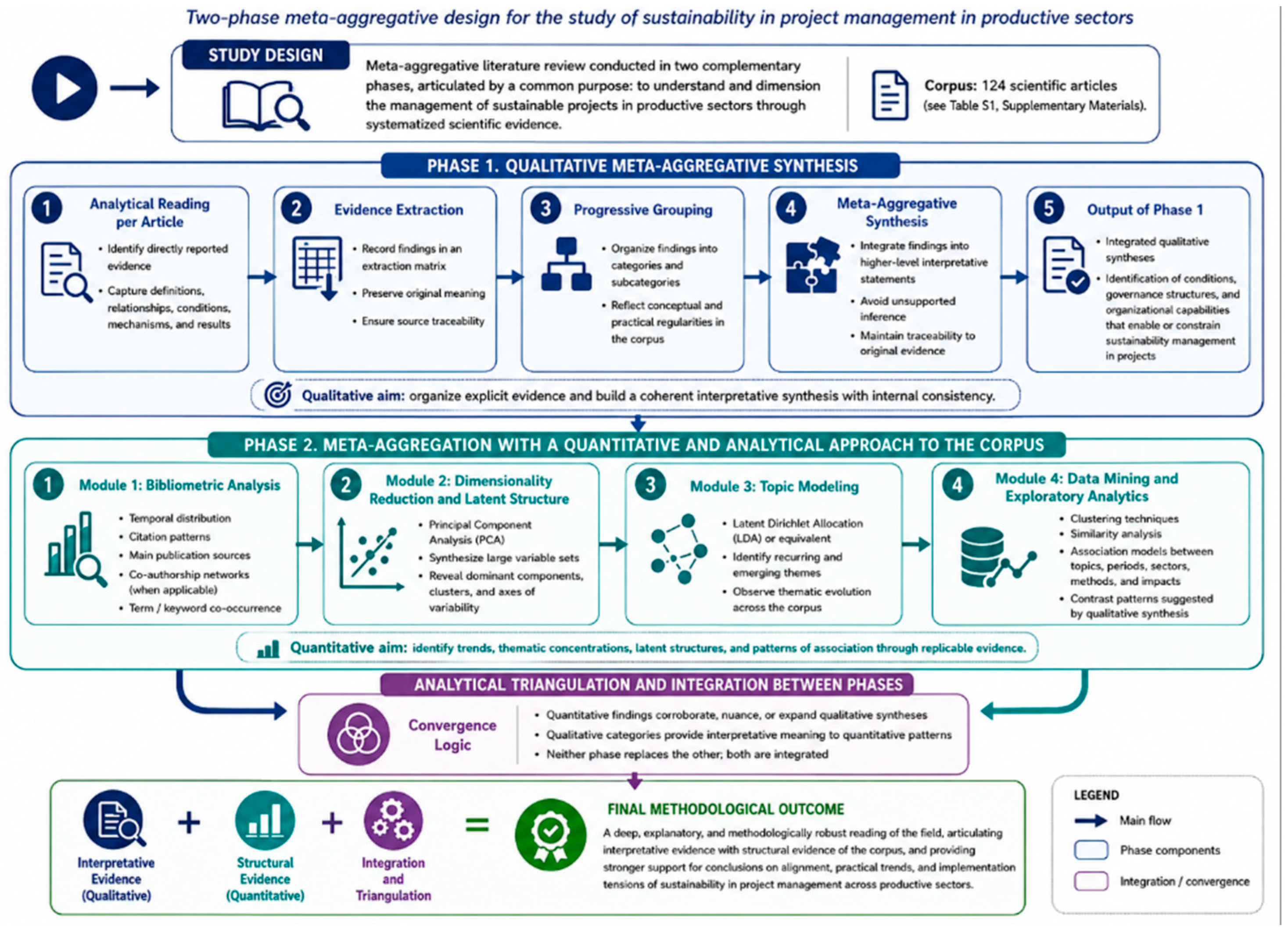
This study was designed as meta-aggregative literature review research in two complementary phases, articulated by a common purpose: to dimension the management of sustainable projects in productive sectors based on systematized scientific evidence and analyzed under a meta-aggregative approach. Methodological logic recognizes that the phenomenon studied is expressed simultaneously as a conceptual and practical construction and as an observable structure in patterns of scientific production and groupings. Therefore, the study integrates a first phase of qualitative meta-aggregative synthesis and a second phase of meta-aggregation with quantitative support, aimed at identifying configurations, trends, and statistical relationships within the corpus. The corpus of 124 articles analyzed is presented in Table S1 (Supplementary Materials). The selection of this corpus was based on a multidimensional search strategy that guaranteed technical and sectoral representativity by crossing four essential thematic axes that strictly delimit the scope of the study. The first axis focused on project governance and management, while the second integrated the dimensions of sustainable development and environmental, social, and governance criteria. To define the productive sector concept, a third axis was established, specifically focusing on the agro-industrial value chain and rural production, thus allowing for a transition from theoretical sustainability toward practical operability in resource transformation contexts. Finally, a fourth axis centered on risk management, finance, and stakeholders ensured that the selected articles provided evidence on technical execution rather than general concepts of social responsibility. In this way, the resulting 124 articles constitute a saturated and specialized sample that faithfully represents the dynamics of project management in high-productivity sectors while avoiding thematic dispersion and ensuring the validity of the inferences obtained in the qualitative synthesis and quantitative support phases. The systematic search was conducted across two major academic databases, namely Web of Science (WoS) and Scopus, covering publications from 2010 to 2024. The Boolean search strategy operationalized the four thematic axes as follows: Axis 1 (project governance and management): (“project management” OR “project governance” OR “sustainable project management” OR “project portfolio management”); Axis 2 (sustainability and ESG criteria): (“sustainability” OR “sustainable development” OR “ESG” OR “environmental social governance” OR “triple bottom line”); Axis 3 (productive sectors): (“productive sector” OR “agro-industrial” OR “value chain” OR “rural production” OR “agriculture” OR “manufacturing” OR “construction”); and Axis 4 (risk, finance, and stakeholders): (“risk management” OR “financial performance” OR “stakeholder management” OR “performance metrics” OR “KPI”). The four axes were combined using AND operators to ensure thematic precision and sectoral delimitation. A total of 1247 records were initially retrieved. After removing duplicates (n = 198), applying title and abstract screening criteria (excluded: n = 724 for failing to address both project management and productive sector dimensions), and conducting full-text eligibility assessment (excluded: n = 201 for insufficient empirical content or thematic overlap with social responsibility frameworks rather than project management), 124 articles were included in the final corpus. The complete corpus with eligibility documentation is detailed in Table S1 of the Supplementary Materials.

2.1. Phase 1. Qualitative Meta-Aggregative Synthesis

The first phase was developed using a meta-aggregative methodology with a qualitative approach, applied to a corpus of scientific articles defined in Table S1 (Supplementary Materials). The objective of this phase was to extract explicit qualitative evidence, organize it in a traceable way, and build an interpretative synthesis based on findings, avoiding unsupported inferences and ensuring internal consistency.
The procedure was structured in a logical sequence. First, an analytical reading was carried out per article, aimed at identifying fragments of evidence directly reported in the texts, recording definitions, relationships, conditions, mechanisms and results associated with sustainability in project management. Second, the extracted evidence was consolidated into an extraction matrix, ensuring that each statement was associated with its original source and that its content was preserved without distortion or reinterpretation. Third, a process of progressive grouping was carried out, where the findings were organized into categories and subcategories that reflect conceptual and practical regularities within the corpus. The purpose of this organization was not to create an independent classification but to build an analytical structure that would allow us to understand how sustainability is defined, operationalized, aligned, and stressed in different production contexts.
From this structure, a meta-aggregative synthesis phase was developed, where the findings were integrated into higher-level interpretative statements, preserving traceability to the original evidence. In this logic, synthesis was understood as a coherent reconstruction of the patterns of meaning present in the corpus, avoiding empty generalizations and privileging explicit relationships between variables, conditions, and reported consequences. The final result of this phase was a set of integrated syntheses that function as the basis of the Section 3 of the article by allowing us to explain, with the support of qualitative evidence, the conditions, governance structures, and organizational capabilities that enable or constrain the effective management of sustainability in projects across different productive contexts.

2.2. Phase 2. Meta-Aggregation with a Quantitative and Analytical Approach to the Corpus

The second phase was designed as a meta-aggregation with a quantitative approach, aimed at complementing the qualitative interpretation with a structural analysis of the corpus using statistical and data-mining techniques. Its purpose was to identify the trends, thematic concentrations, latent structures, and patterns of association that are not always visible through interpretive reading but that can be demonstrated by replicable quantitative evidence.
In general terms, this phase was organized into four integrated methodological modules. The first consisted of a bibliometric analysis to characterize the dynamics of scientific production of the corpus: temporal distribution, citation patterns, main sources of publication, co-authorship networks when applicable, and analysis of co-occurrence of terms or keywords. This module seeks to provide evidence of the growth of the field, the focus of concentration, and the possible thematic fragmentation, providing a descriptive map of the research ecosystem.
The second module implements dimensionality and latent structure reduction techniques, particularly Principal Component Analysis (PCA), in order to synthesize large sets of variables (e.g., bibliometric indicators, coded content variables, or text-derived metrics) into interpretable components. The PCA allows us to observe which underlying dimensions explain the greatest variability of the corpus and contribute to revealing dominant clusters and axes that support the field’s dimensioning.
The third module incorporates topic modeling using Latent Dirichlet Allocation (LDA) or other equivalent approaches, with the purpose of identifying the recurring themes and their evolution within the corpus. Unlike manual classifications, LDA allows the detection of emerging thematic structures from the probabilistic distribution of terms in documents. This module is crucial to identifying whether sustainability in project management is organized into a few major dominant topics (e.g., metrics, governance, specific sectors, technological transformation) or if it is dispersed into subfields with low coupling.
The fourth module corresponds to data mining and exploratory analytics, where clustering techniques, similarity analysis, and, when applicable, association models between variables (for example, between topics, periods, sectors, methodological approaches reported, or types of impact analyzed) are integrated. This module allows us to quantitatively contrast what the qualitative synthesis proposed: if certain interpretative patterns appear as clusters, if there are differentiated time trajectories, or if certain topics are consistently associated with specific productive sectors.
To ensure the reproducibility and technical robustness of this analytical phase, the specific computational parameters, preprocessing decisions, and model fit metrics, including the coherence-optimized LDA settings and the parallel analysis thresholds for PCA, are systematized in Table 1. These settings define the stability and granularity of the latent structures identified, providing a transparent framework for the data mining process.
Finally, the quantitative phase was designed with the purpose of converging with the qualitative phase, not with the intention of replacing it, but as an exercise in integration between phases through a logic of analytical triangulation where quantitative findings serve to corroborate, nuance, or expand qualitative syntheses, while the qualitative categorical structure provides interpretative meaning to quantitative patterns. Overall, the methodological design in two phases allows sustaining a deep, explanatory, and methodologically robust reading of the field, articulating interpretative evidence with structural evidence of the corpus, and providing a more solid support for conclusions on alignment, practical trends and tensions of implementation of sustainability in project management in the productive sectors. This process is represented in Figure 1.

3. Results

In the exercise of identifying patterns, tensions, and structural configurations of the field of sustainability in project management in productive contexts in order to holistically understand their manageability, the results of the meta-aggregative phase with a qualitative approach, followed by the meta-aggregation phase with a quantitative approach, are presented below, as follows.

3.1. Bibliometric Analysis of the Corpus

Consequently, from meta-aggregation with a quantitative approach, qualitative interpretations are complemented with structural analysis of the corpus using statistical and data mining techniques. In this purpose, we seek to identify trends, thematic concentrations, latent structures, and patterns of association, which are not visible in qualitative interpretative constructions, but which can be demonstrated by replicable quantitative evidence as presented below in the categories defined for this exercise.

3.1.1. Corpus Characterization and Analytical Robustness

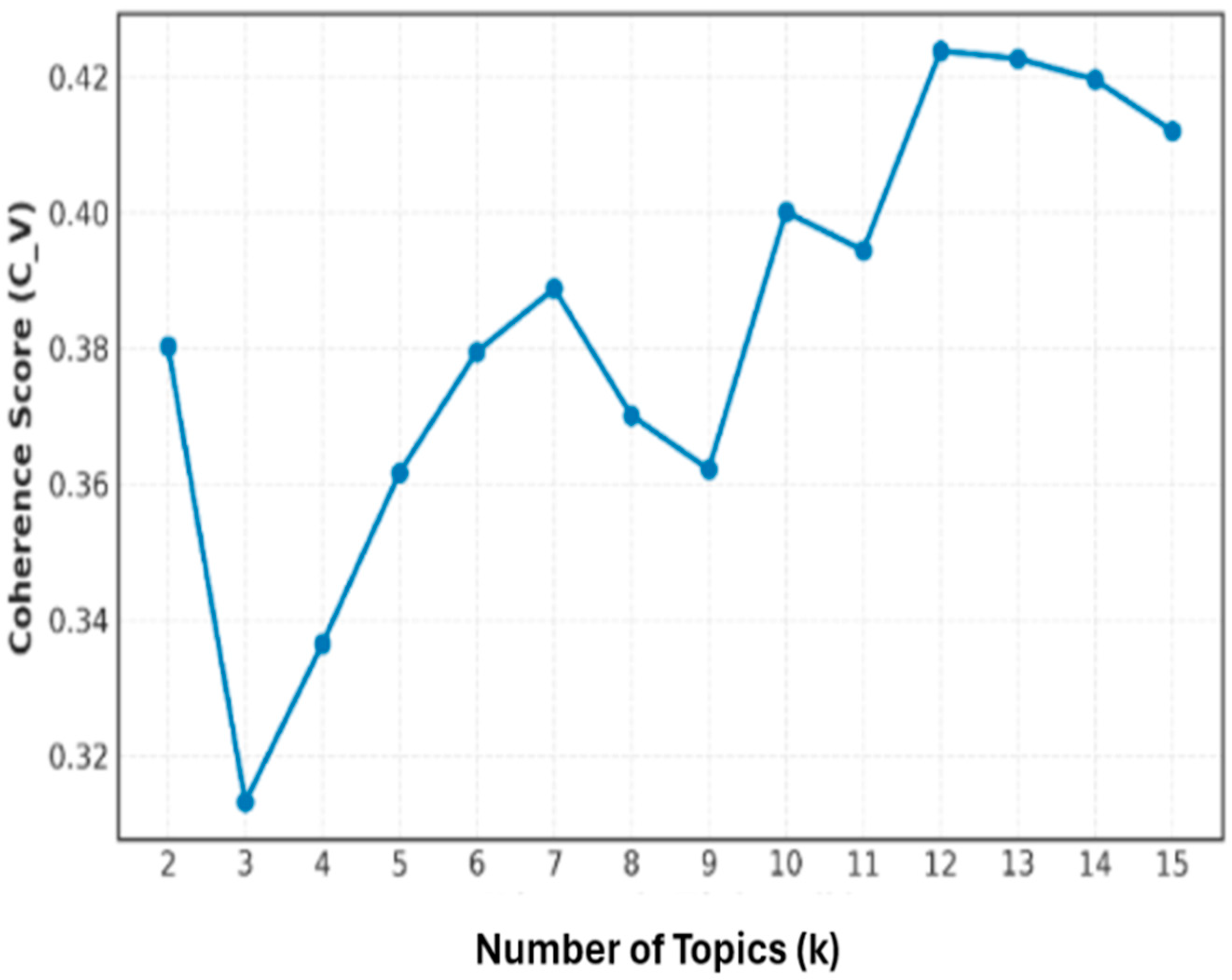
The quantitative phase operated on a definitive corpus of 124 academic documents, selected after a textual audit process that excluded one document due to reading errors and textual insufficiency. The corpus is predominantly English-speaking, with six articles originally in Spanish and two in Portuguese, all translated into Spanish programmatically to ensure the lexical homogeneity required by modeling algorithms. The total volume processed amounted to 362,661 tokens distributed in 1500 lexical features for the topic model and 100 TF-IDF variables for principal component analysis. The LDA model was trained with 12 topics, a number selected using the coherence curve (Figure 2), optimizing the balance between thematic granularity and interpretability. The model’s fit metrics yielded a perplexity of 19,728.54, a mean documentary-topic entropy of 0.74, and a sparsity index of 1.04. Moderate–high entropy indicates that the corpus documents tend to activate multiple topics simultaneously, which is consistent with the interdisciplinary nature of the field of sustainable project management, where thematic intersection is the norm rather than the exception.
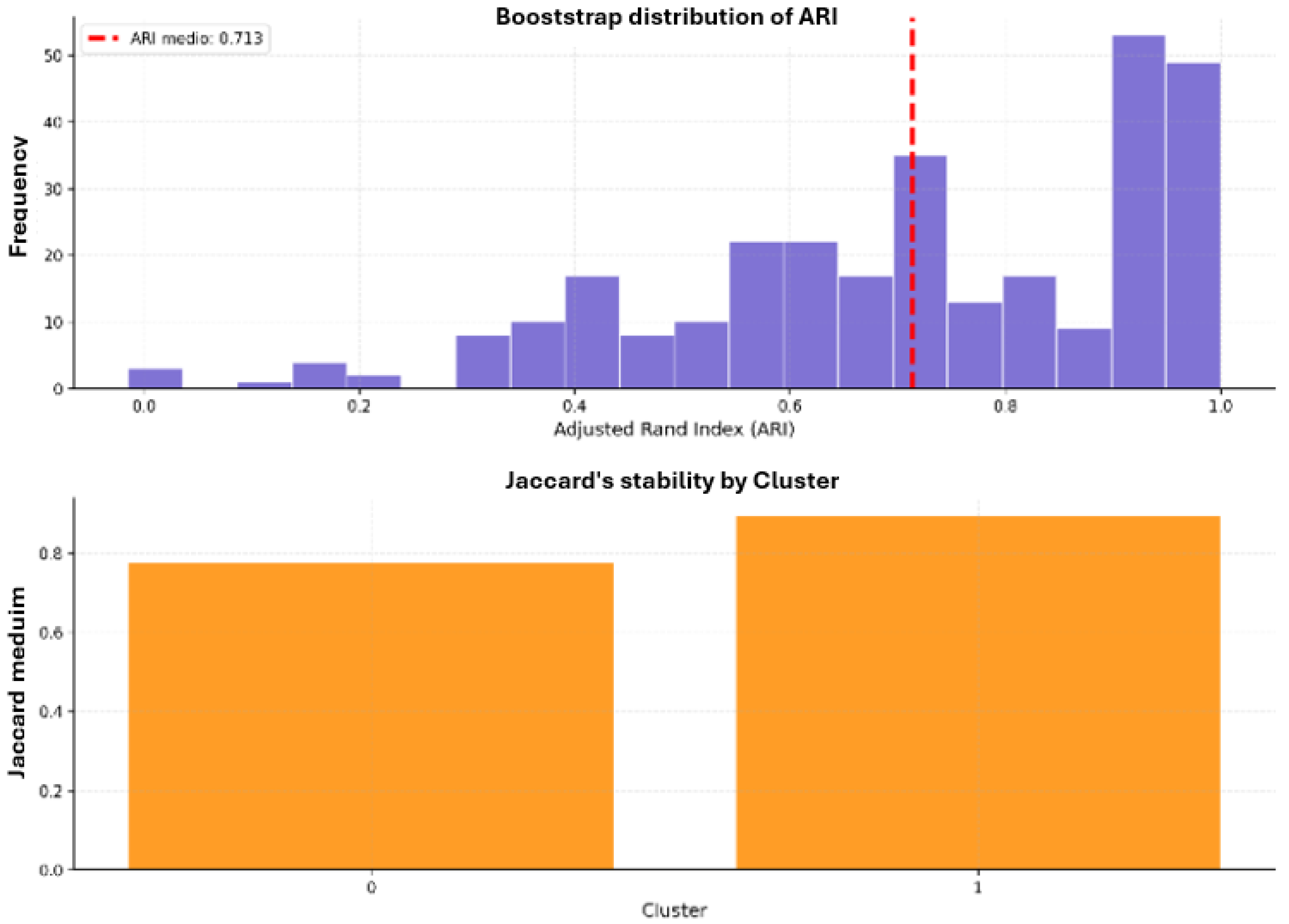
For dimensional reduction via PCA, the selection of the number of components was performed by parallel analysis with a p95 threshold on 100 standardized TF-IDF variables, retaining 7 principal components that explained 27.24% of the cumulative variance. Although this percentage may seem modest, it is expected in high-dimensional textual matrices, where the lexical dispersion inherent in multithematic corpora limits the concentration of variance. The PC1-PC2 main plane retained 11.00% of the total variance and constituted the main analytical space for structural interpretation. The stability of the solutions was evaluated by bootstrap resampling (300 iterations). For PCA clustering, the mean adjusted Rand index (ARI) was 0.71 (SD = 0.23), with cluster-adjusted Jaccard indices of 0.78 (Cluster 0, n = 31) and 0.89 (Cluster 1, n = 96), indicating substantial partition stability, particularly robust in the majority cluster (Figure 3). The mean correlation of PC1 with the reference was 0.75, while the subsequent components showed decreasing stabilities, an expected pattern in high-dimensional structures with distributed variance.

3.1.2. Latent Thematic Structure: Topics, Keywords and Semantic Axes

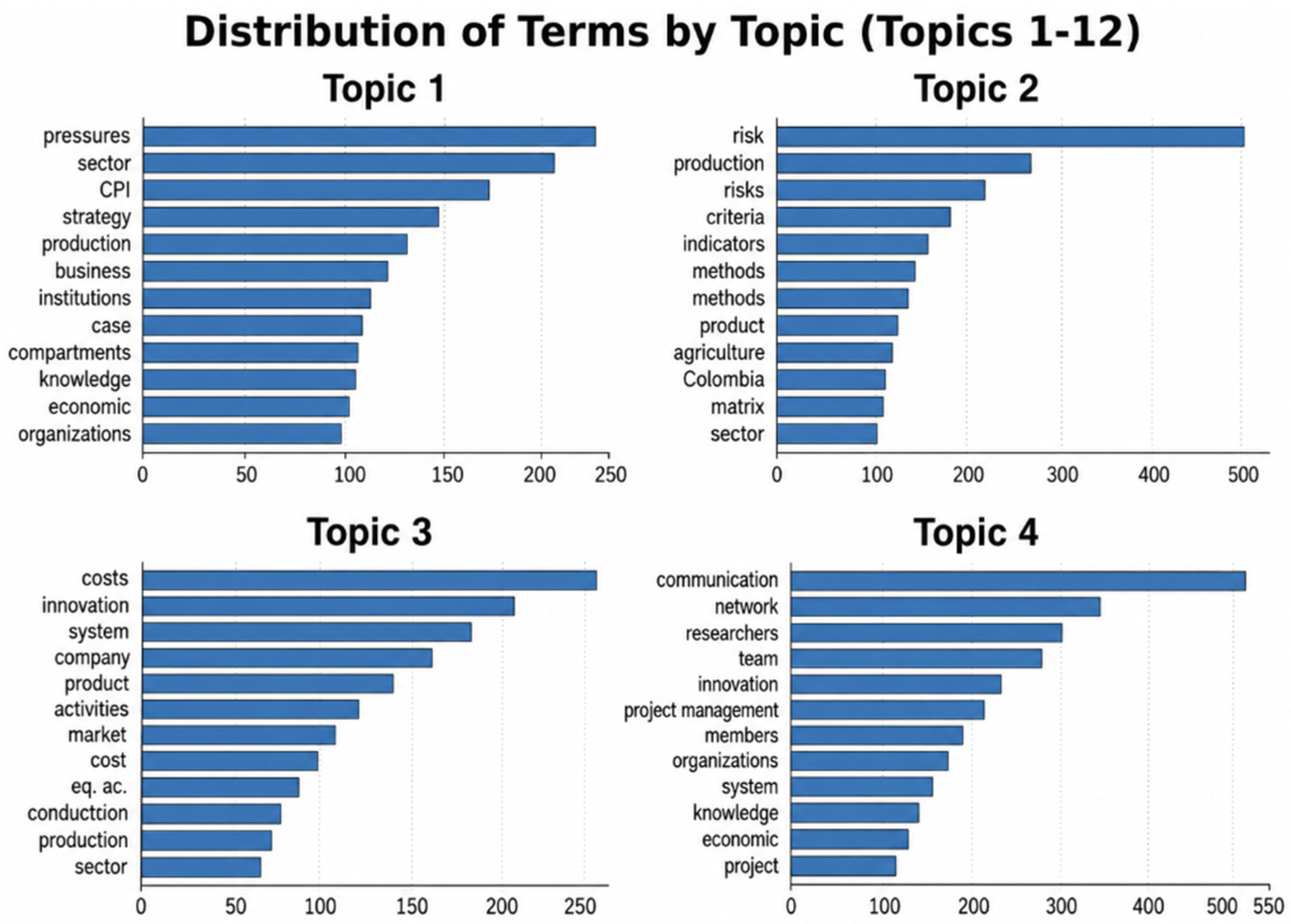
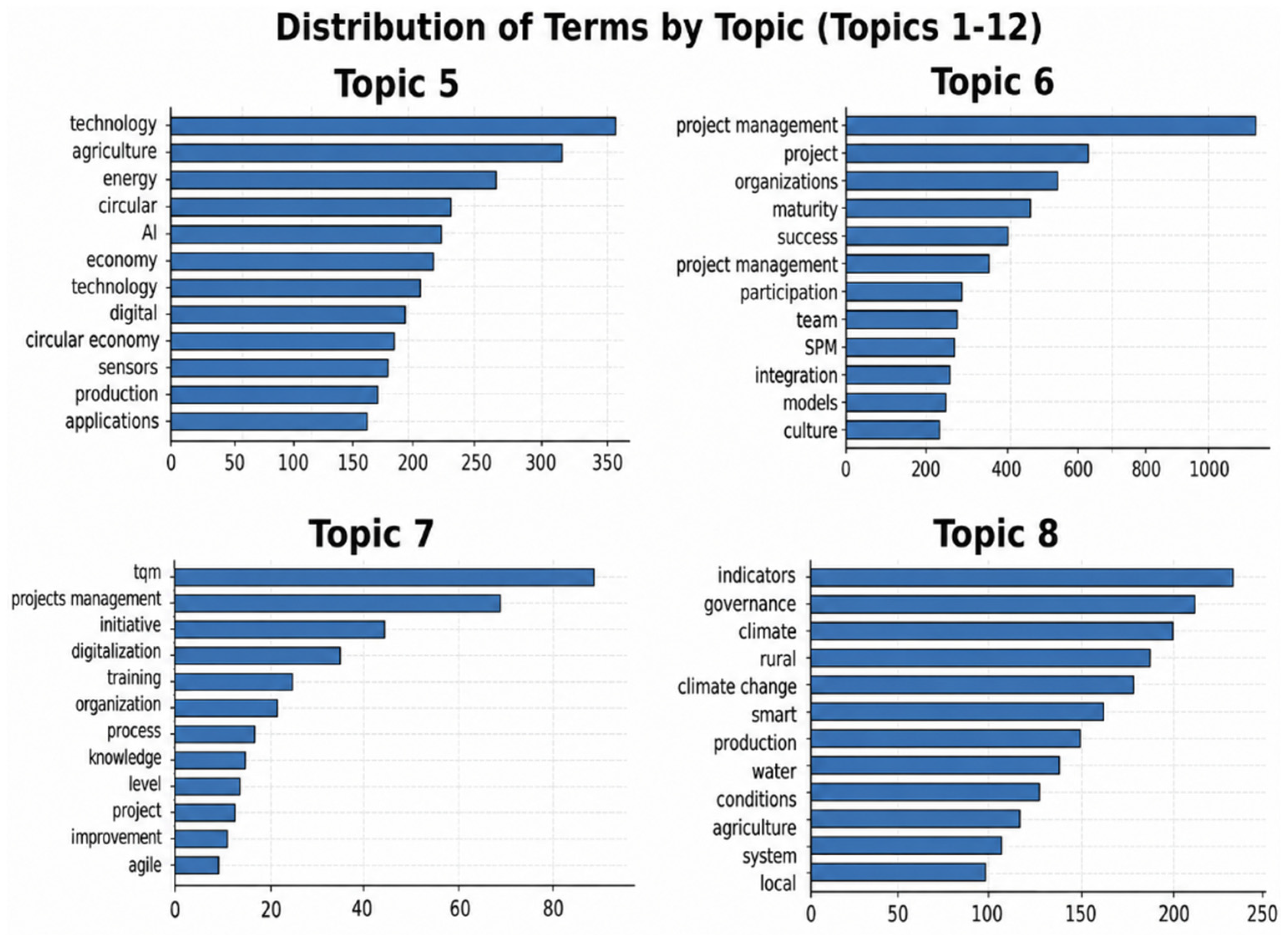
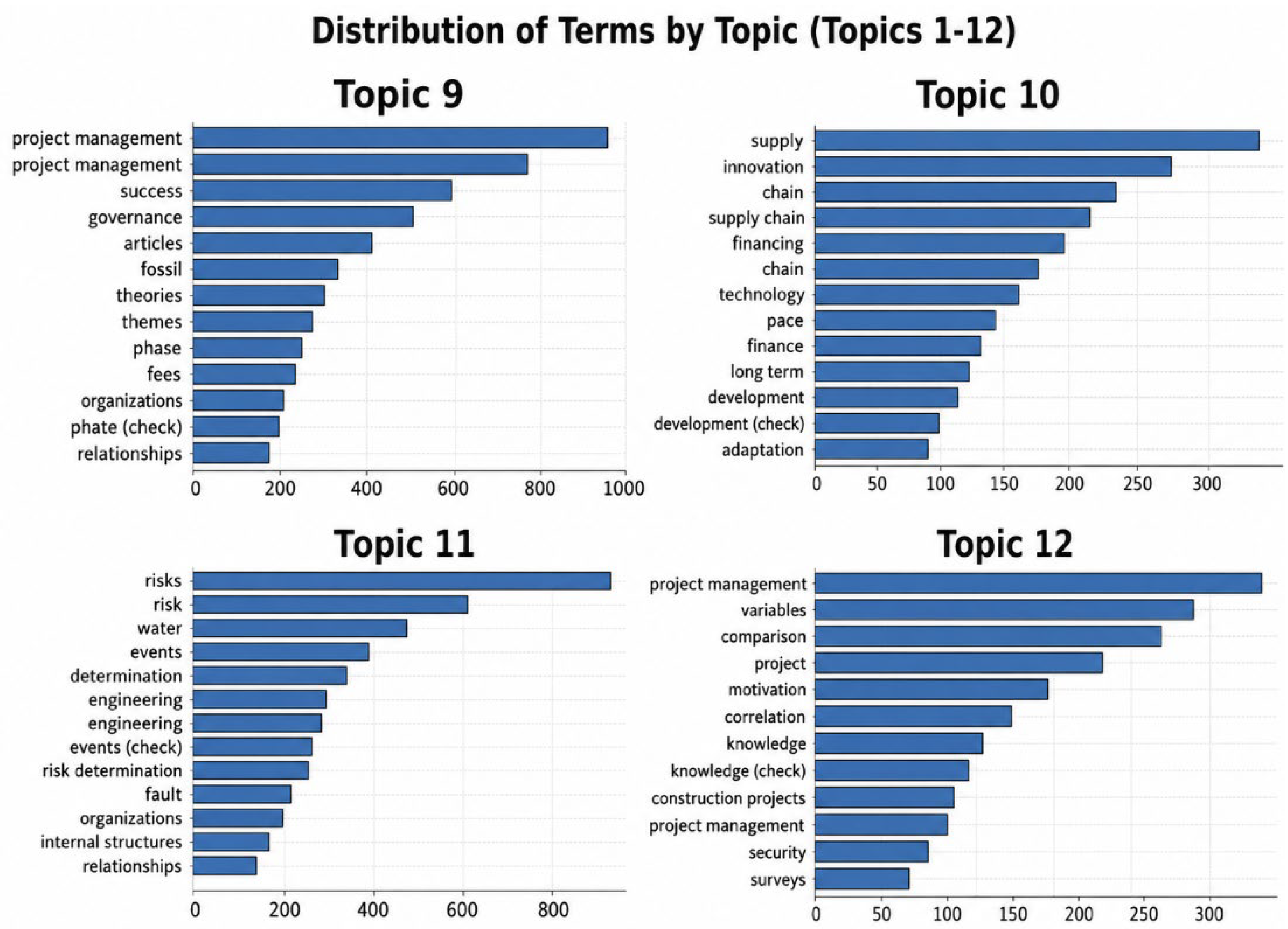
The LDA model identified 12 latent topics whose lexical profiles were interpreted from combined rankings of probability and relevance and presented them in three segmented visualizations: topics 1–4 in Figure 4, topics 5–8 in Figure 5, and topics 9–12 in Figure 6. The topics exhibit a spectrum that ranges from operational dimensions of project management to specific sectoral concerns. Topic 6 (project management, organizations, success, project management) and Topic 9 (project management, success, governance) concentrate the vocabulary linked to the core of the discipline, while Topic 5 (technologies, agriculture, innovation, risks, production) and Topic 10 (innovation, supply, technology, chain, risks) capture the sectoral and value chain dimensions. Topic 12 (values, barriers, project management) emerges as a distinctive lexical space that articulates the tensions between sustainable aspiration and implementation constraints, resonating directly with the qualitative axis on the human and organizational capacities identified in Phase 1. The quantitative mapping between the 12 LDA topics and the seven theoretical axes derived from the meta-aggregative phase was carried out using the Jaccard similarity index on sets of keywords. The results revealed asymmetric correspondences. The Human and Organizational Capabilities axis registered the highest lexical affinity with multiple topics (maximum Jaccard = 0.16 for Topic 6), followed by the ESG Trends, Digitalization, and Value Chains axes, which showed comparable affinity with Topics 5 and 10 (Jaccard = 0.10). In contrast, the axes of Circular and Regenerative Economy (maximum Jaccard = 0.02) and Strategic Alignment and Governance (Jaccard = 0.05) obtained the lowest indices, indicating that their lexical coverage in the corpus is considerably lower than the conceptual relevance that the meta-aggregative phase attributed to them. This asymmetry points to a quantifiable gap between the theoretical importance of certain constructs and their effective representation in the academic production analyzed.
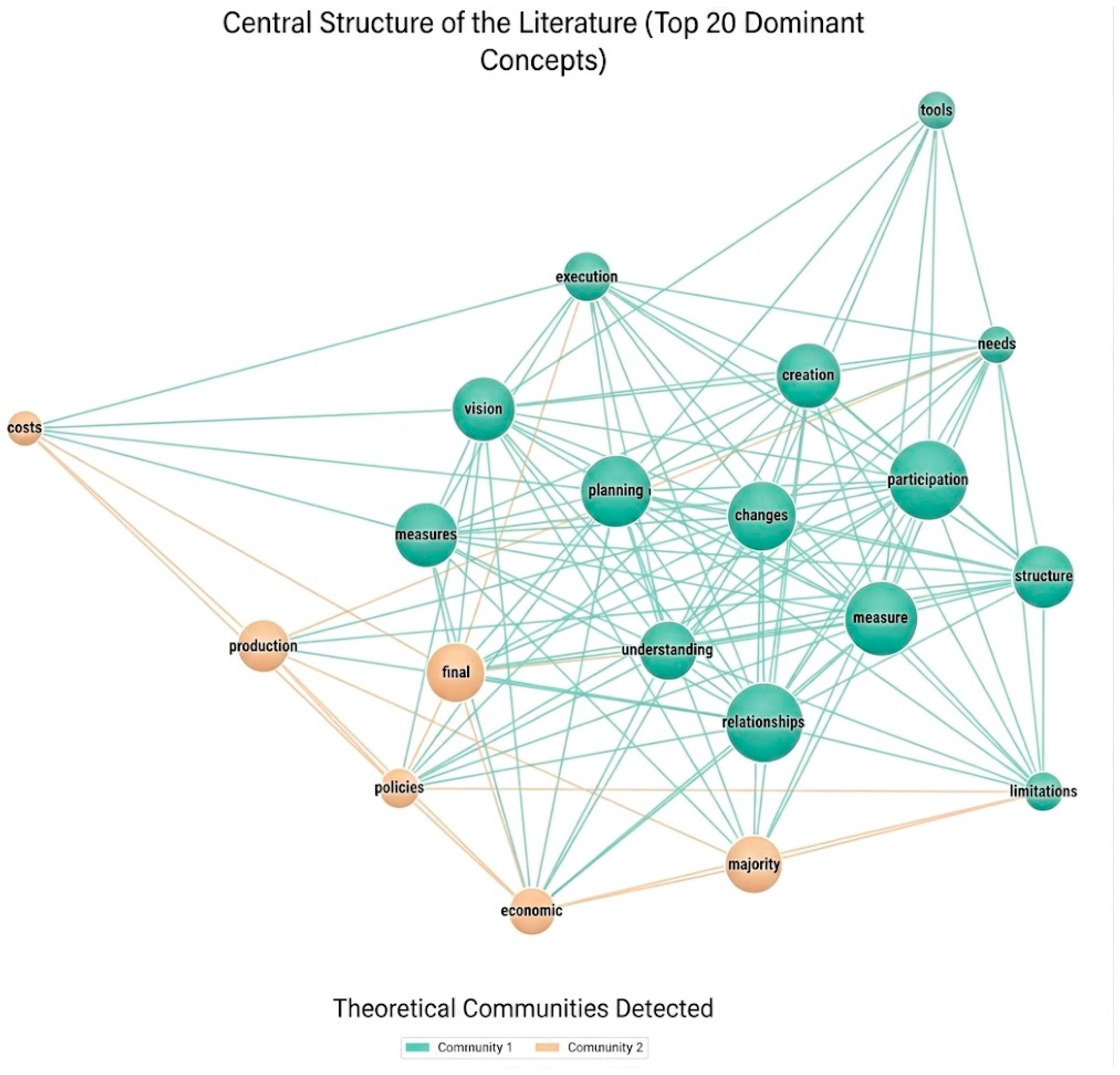
The topological analysis of the semantic network complemented this reading by identifying, among the 150 most frequent terms, 23 main hubs, 2 semantic bridges, and 125 peripheral nodes, organized in two theoretical communities of 78 and 72 terms, respectively (Figure 7). Hubs (terms such as sustainability, project, management, development, social, environmental) function as articulators of the entire lexical field and their predominance confirms the centrality of sustainability as the dominant conceptual framework structuring academic discourse in this field, reflected in its function as the primary hub connecting all thematic dimensions of the semantic network, converging with the first qualitative axis that conceptualizes the transition from sustainability as a principle to a criterion of success and value. The two semantic bridges connect subfields that would otherwise remain isolated, suggesting still fragile points of interdisciplinary integration within the literature. A particularly relevant finding for triangulation is the concentration of 5 of the 12 topics (T4, T6, T7, T11, and T12) in the Human and Organizational Capacities axis. This quantitative over-representation suggests that the academic discourse on sustainable project management has privileged relational, competency-based, and organizational dimensions over other critical ones (such as financial or environmental), which confirms a disciplinary bias that the meta-aggregative findings had pointed out as a limitation of the field.
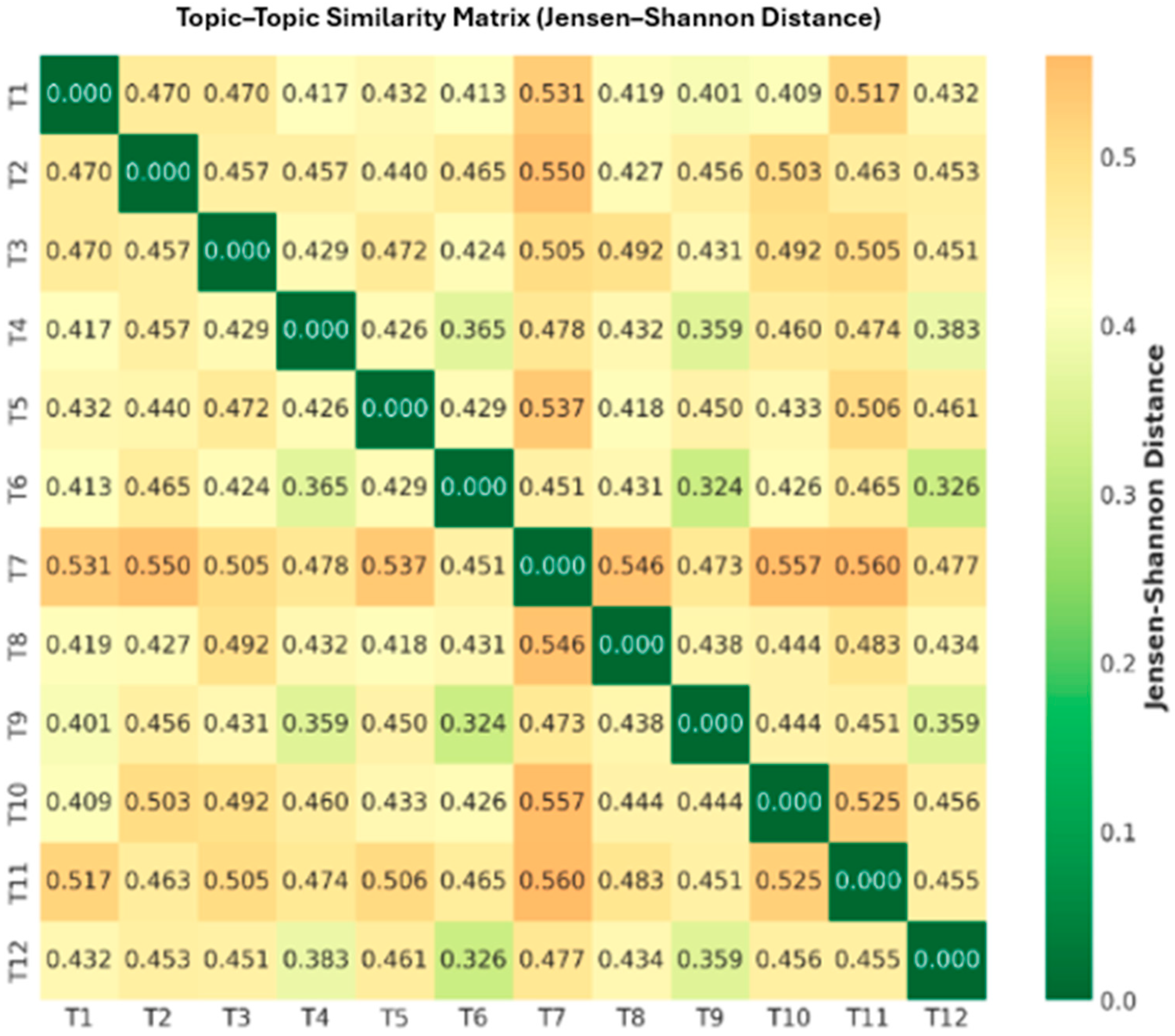
The matrix of similarity between topics (Figure 8) revealed heterogeneous intertopic distances. Topics 6, 7, and 9 formed a nucleus of high proximity that reflects the canonical discourse on project management, while Topics 2 (risk, indicators, criteria) and 5 (technologies, agriculture) were located in peripheral positions, indicating a substantive lexical differentiation with respect to the nucleus. This pattern is consistent with the qualitative observation that risk, metrics, and finance (qualitative axis 4) operate as a domain that, despite its relevance in decision-making, remains partially disconnected from the dominant managerial discourse.

3.1.3. Document Distribution, Grouping and Profiles of the Corpus

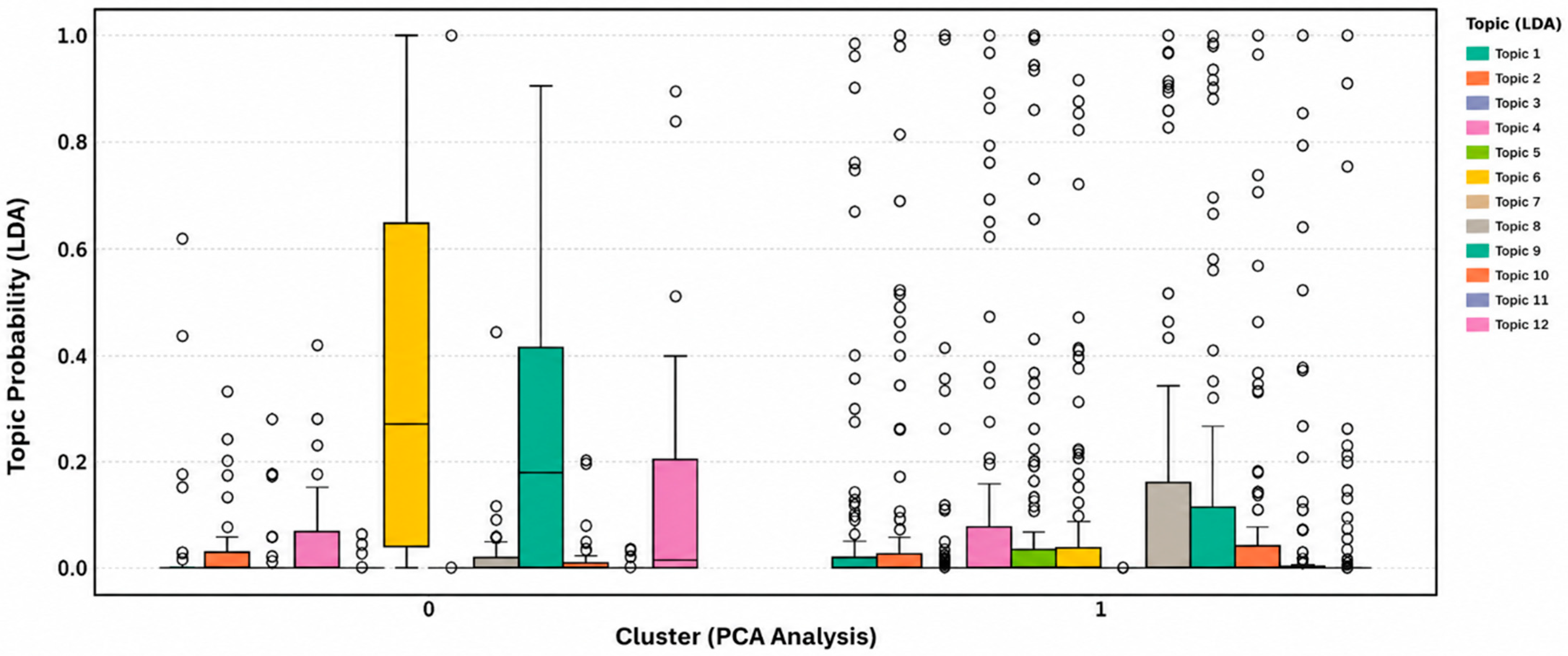
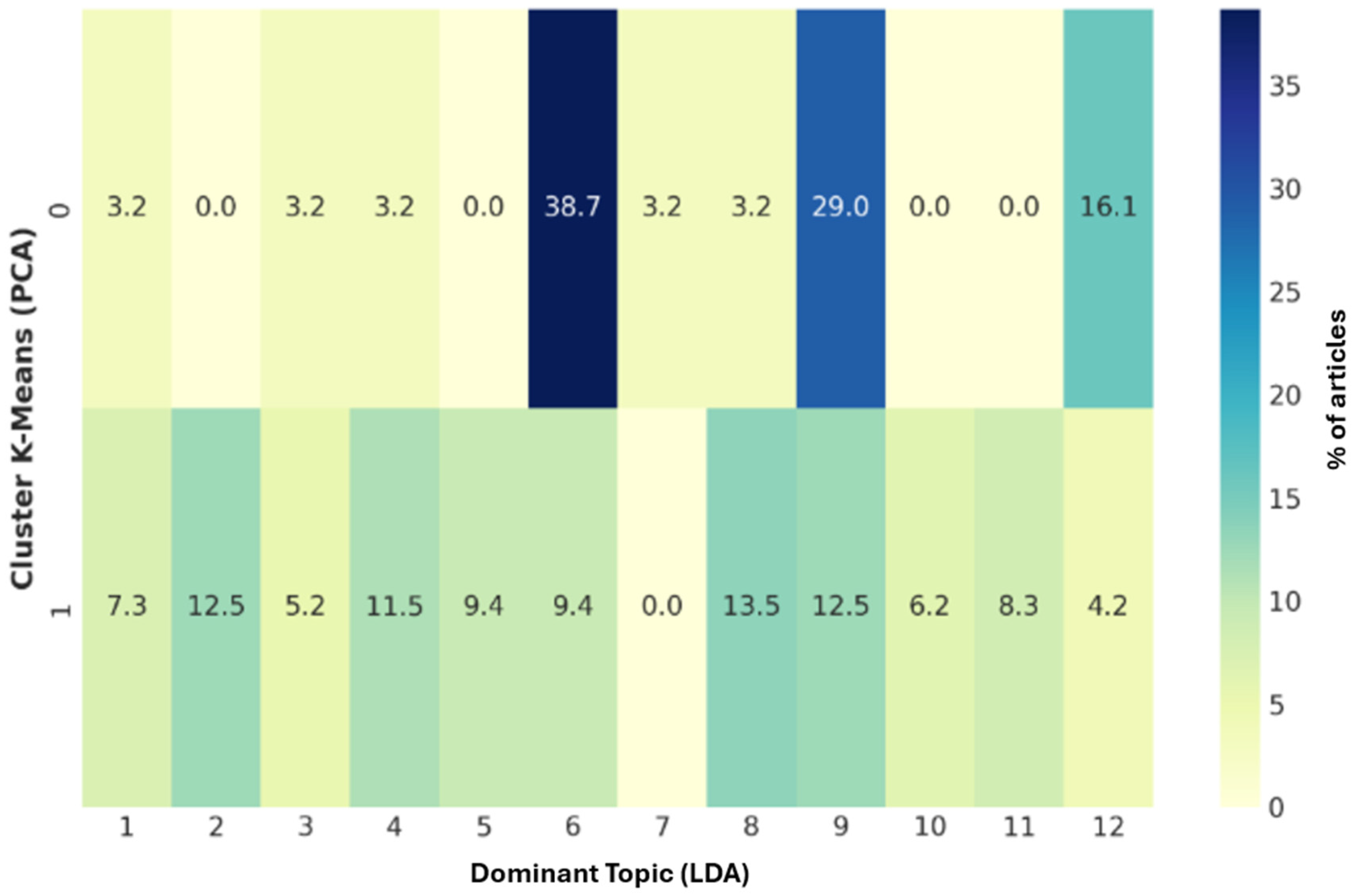
The distribution of the 124 documents according to their dominant topic showed an uneven concentration that reflects both the priorities of the field and its production biases. Topics 8 (production, indicators, system, agriculture) and 2 (risk, indicators, criteria) grouped the largest number of documents in Cluster 1, while Topic 6 (project management, success) dominated Cluster 0. The language distribution confirmed the predominance of English as the dominant language of academic production in this field, with the documents in Spanish focused on issues of agricultural production and Latin American contexts, and the documents in Portuguese oriented towards value chains and sustainability in smallholder systems. This linguistic segmentation is not trivial since the documents in Spanish were activated with greater intensity for Topics 1 (sector, production, strategy) and 5 (technologies, agriculture), while the English-speaking corpus exhibited greater thematic diversity, covering the full spectrum of the 12 topics. The clustering by K-means on the reduced PCA space identified two clusters with differentiated profiles. Cluster 0 (n = 31 papers) was characterized by a pronounced concentration on three topics: Topic 6 accounted for 38.7% of the thematic assignment of this cluster, followed by Topic 9 with 29.0% and Topic 12 with 16.1%. This profile configures a subset of the corpus oriented towards the dimensions of governance, project success, and implementation barriers. That is, towards the problematization of sustainable project management as a disciplinary field.
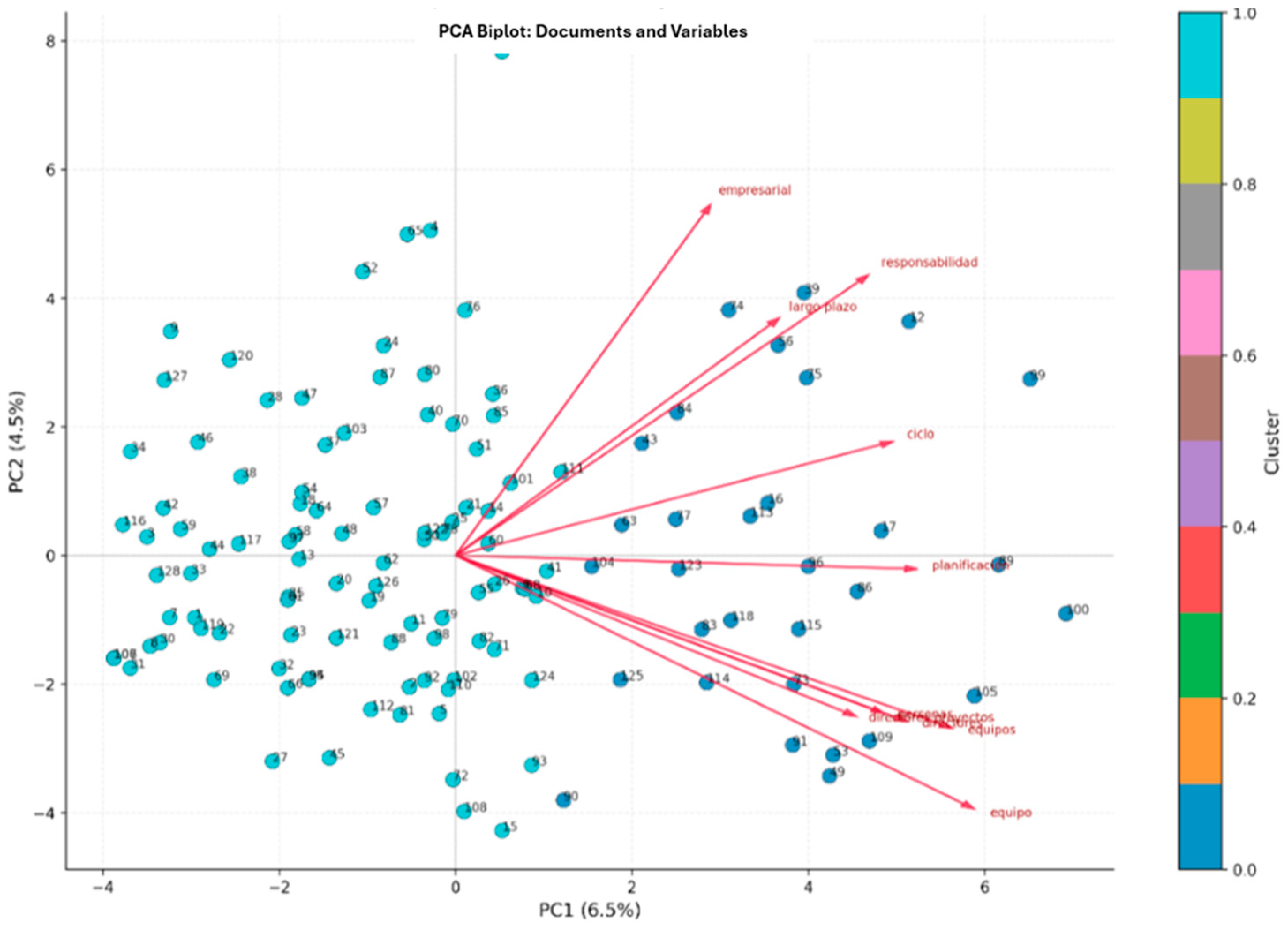
Cluster 1 (n = 96 documents) showed a substantially greater thematic dispersion, without a topic that exceeded 14% participation. Topics 2, 8, 9, and 4 were distributed almost homogeneously, configuring a profile where concerns about risk and indicators, sectoral production, governance, and communication coexist in project management. This dispersion is consistent with the applied and multisectoral nature of the majority subcorpus, which ranges from aquaculture and agriculture to technological innovation and global value chains. The biplot of the main plane PC1-PC2 (Figure 9) made it possible to identify the extreme documents that condense particularly differentiated lexical combinations. On PC1, the axis discriminated between documents with a high use of team vocabulary, project planning, and management (positive pole) and documents focused on agriculture, production, and Colombian contexts (negative pole). On PC2, the contrast was established between business vocabulary, politics, and economics (positive pole) and terms of team, communication, and members (negative pole). The density boxplots per cluster (Figure 10) confirmed that Cluster 0 presents a greater compactness in the PC1 space, which reinforces its interpretation as a thematically cohesive core in the face of the heterogeneity of Cluster 1.
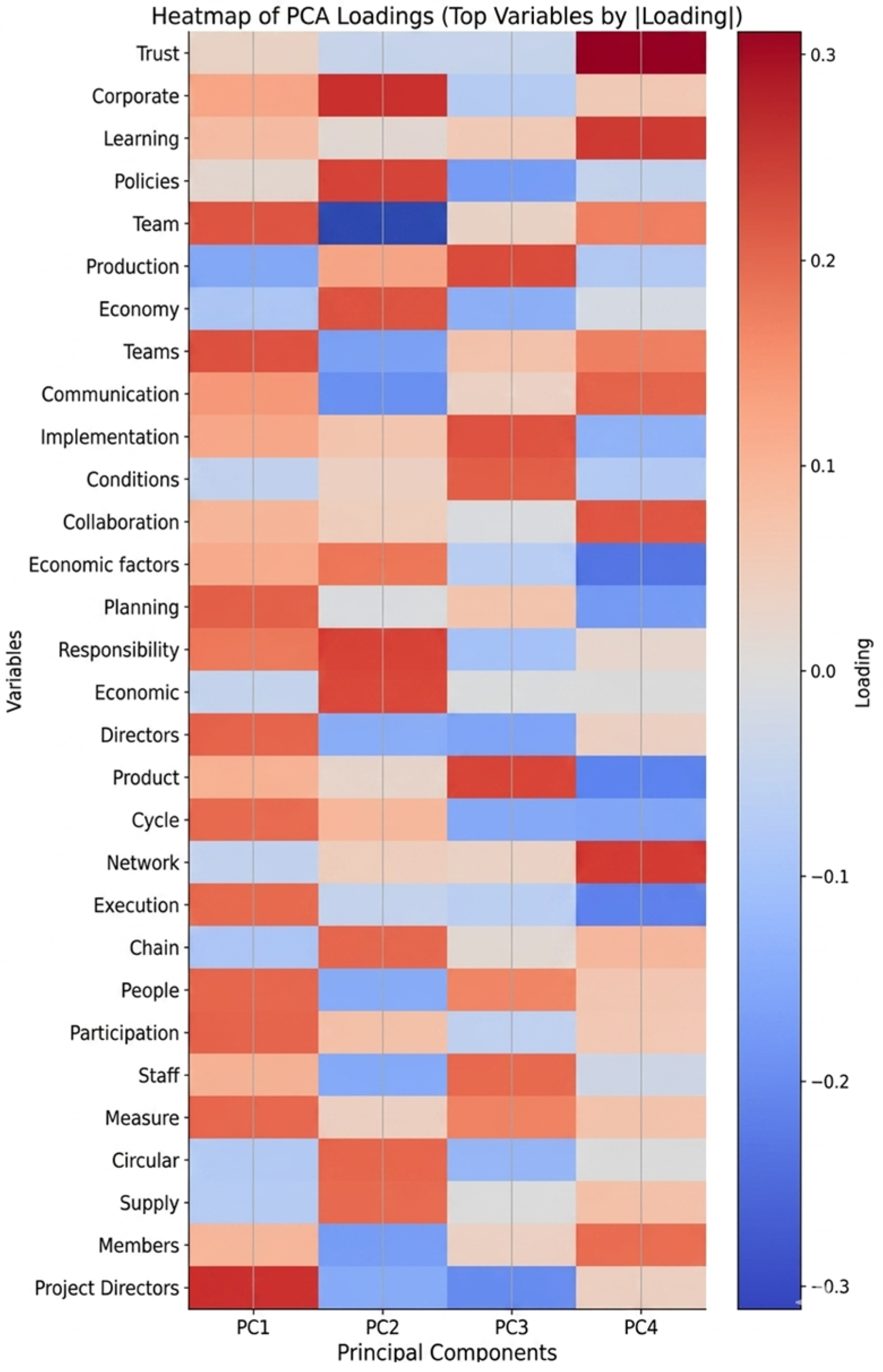
The heatmap of loadings by component (Figure 11) offered a complementary reading by revealing that each PC captures a differentiated semantic dimension and not a simple frequency gradient. The dominant loads were PC1 associated with equipment (+0.22), PC2 with enterprise (+0.25), PC3 with production (+0.22), and PC4 with confidence (+0.31). The presence of trust as the dominant burden of PC4 is remarkable because this construct, central to the literature on leadership and project teams, operates practically independently of the lexical dimensions captured by the first three components, suggesting that trust constitutes an orthogonal (and therefore not redundant) dimension with respect to managerial variables, economic and productive, of the corpus.

3.1.4. Conditional Rules and Patterns of Thematic Association

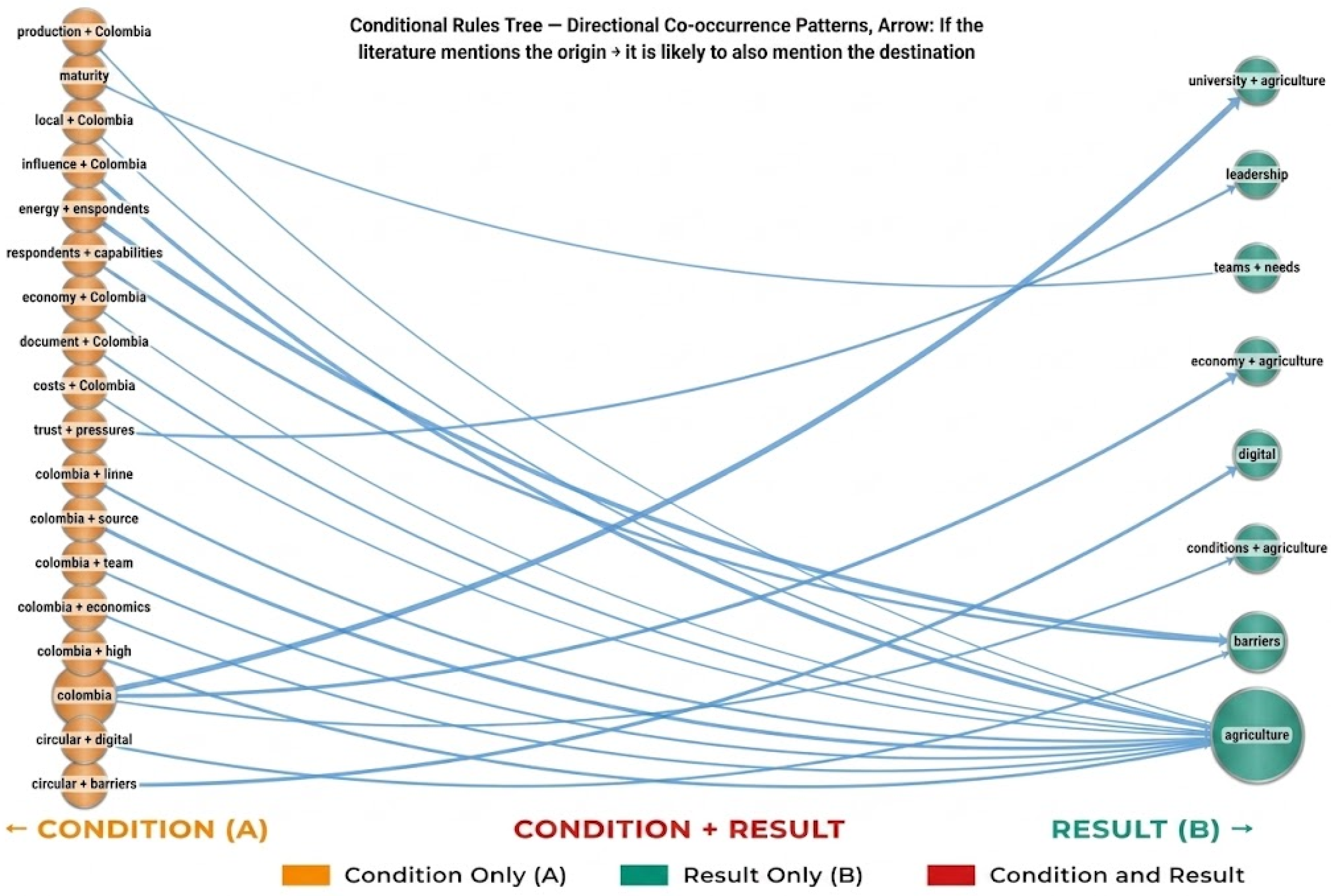
Association rule mining extracted 50 conditional rules from the corpus, with an average lift of 1.85 and a range between 1.39 and 2.19. These rules operate as patterns of co-occurrence that reveal thematic links that are not necessarily visible in the individual qualitative reading of the documents by capturing probabilistic implication relationships between concepts that appear together with a frequency higher than expected by chance. The rule with the highest lift (2,19) linked the terms Colombia, university, and agriculture, evidencing a geographical–institutional pattern where Colombian academic production on sustainability in project management is concentrated in the agricultural sector and is strongly anchored to university contexts. This quantitative finding triangulates with the qualitative observation of the axis on sectoral trends (axis 6), where Latin American production appeared to be associated with primary production chains and the problems of local implementation. A second group of relevant rules linked the circular economy with digital technologies and implementation barriers, with lift values between 1.72 and 1.94. This pattern suggests that, when the documents in the corpus address the circular economy, they tend to do so simultaneously in relation to digitalization and the obstacles to its adoption, configuring a thematic triangle that the qualitative phase identified as a tension between aspiration and feasibility (axes 6 and 7). Quantitative mining thus confirms that the circular economy is not approached in isolation but as part of a socio-technical complex that includes technological capabilities and organizational limitations. A third pattern involved trust–leadership and communication–project team pairs, with lifts above 1.70. These rules reinforce qualitative axis 5 on human and organizational capacities by quantifying the strength of the association between constructs that are frequently mentioned in the literature but whose empirical co-dependence is not always explicitly mentioned. The network of conditional rules (Figure 12) visualizes these connections as a graph where the most connected nodes correspond precisely to the hubs identified in the semantic topology, closing a cross-validation circuit between independent analytical techniques.

3.1.5. PCA–LDA Triangulation, Thematic Maturity and Research Gaps

The cross-triangulation between the PCA and LDA solutions constituted the articulating axis between the quantitative and qualitative phases of the study. The frequency matrix of the LDA topics within the PCA clusters (Figure 13) revealed structural differences that transcend the mere frequency distribution. In Cluster 0, Topic 6 (project management, success) accounted for 12 of the 31 documents (38.7%), followed by Topic 9 (governance) with 9 documents (29.0%) and Topic 12 (values, barriers) with 5 documents (16.1%). In Cluster 1, the distribution was notably flatter: Topics 2, 8, and 9 led with 12, 13, and 12 documents, respectively, but none exceeded 13.5% of the total of the cluster. This asymmetry admits an interpretative reading of interest for triangulation: Cluster 0 groups the documents oriented towards the theoretical and disciplinary consolidation of sustainable project management (where the frameworks of success, governance and values constitute the central discursive axis), while Cluster 1 houses applied and sectoral production, where thematic dispersion reflects the diversity of the productive contexts (agriculture, aquaculture, technology, supply chains) that characterize the field.
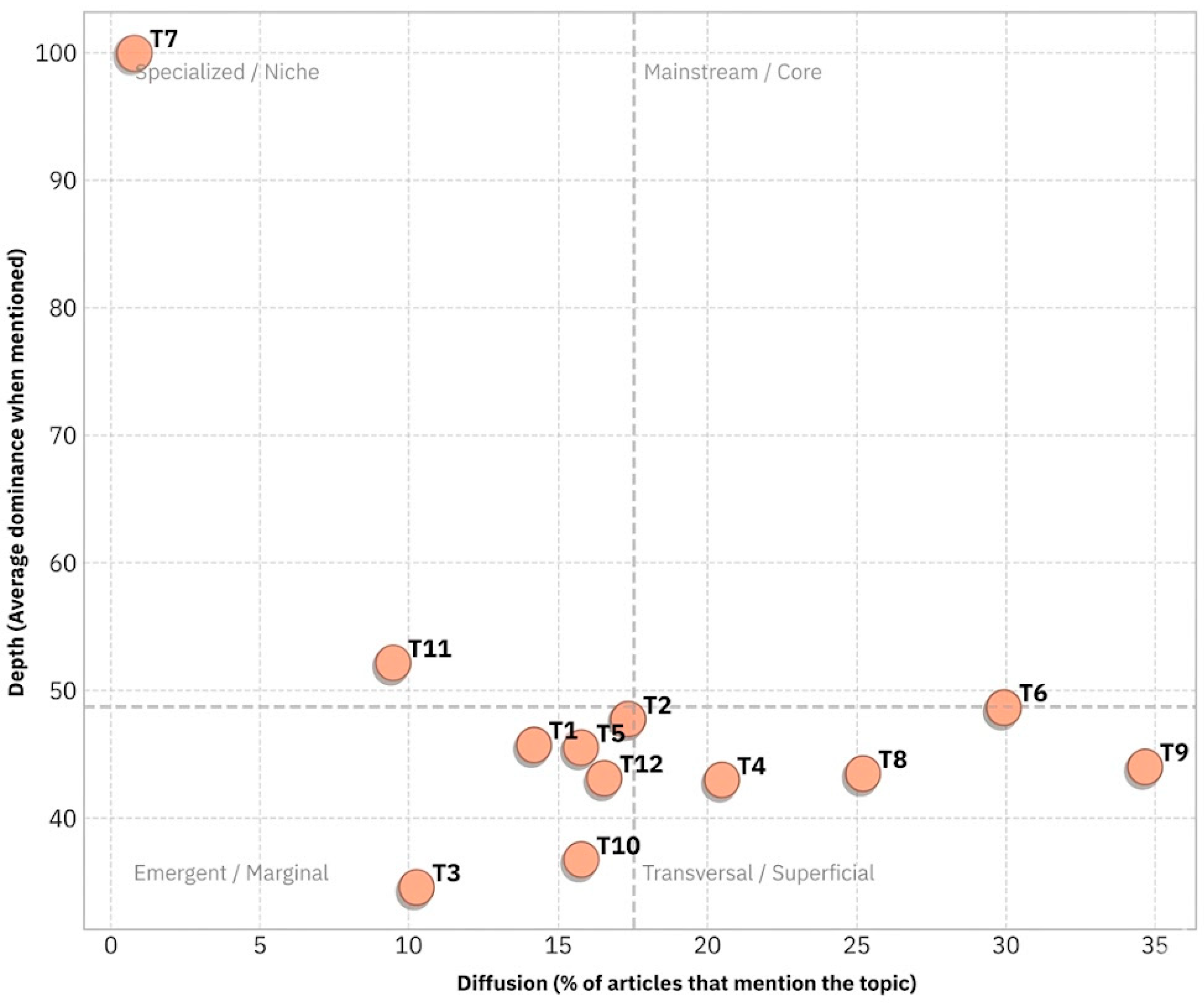
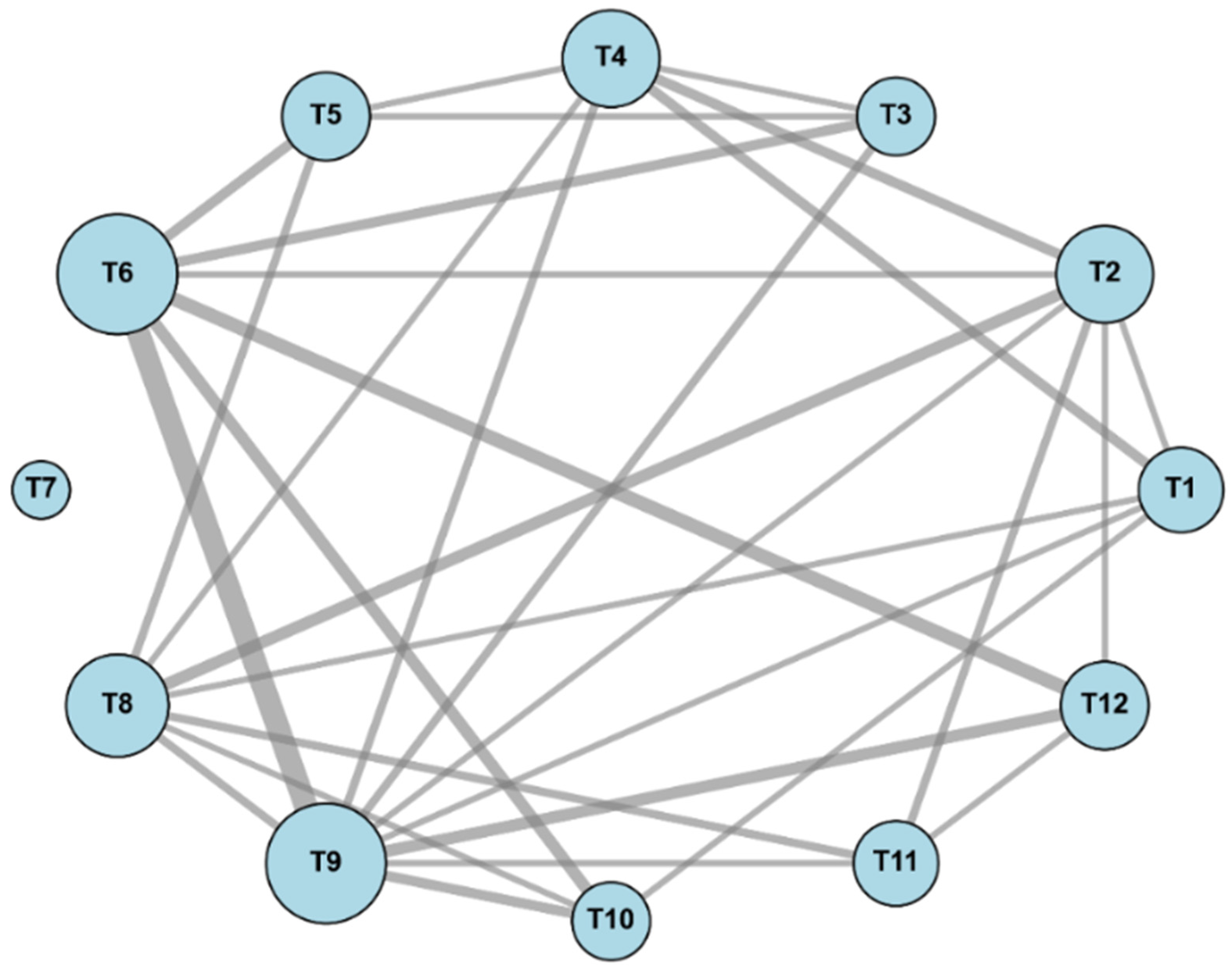
The thematic maturity quadrant (Figure 14) classified the 12 topics according to two dimensions: the frequency accumulated in the corpus and internal lexical coherence. Topics 6 and 9 were placed in the quadrant of high frequency and high coherence, which positions them as the most consolidated topics in the field. Topics 5 and 10, linked to digital technologies and value chains, appeared in an area of medium frequency but increasing coherence, suggesting a state of active maturation. Topics 2 and 11, associated with risk and indicators, showed moderate coherence but low relative frequency, pointing to a deficit of academic production in a domain that the qualitative phase identified as fundamental for the operationalization of sustainability. The topic co-occurrence network (Figure 15) complemented this reading by showing which topic pairs tend to be activated together within the same documents. The most frequent pairs were T6-T9 (project management–governance), T4-T6 (communication–project management), and T8-T5 (production–agricultural technology), patterns that confirm the affinities detected by the similarity matrix and that are aligned with qualitative axes 2 (strategic alignment and governance) and 6 (sectoral trends).
The diagnosis of research gaps, derived from the analysis of the 57 pairs of topics evaluated, yielded a result where all the pairs were classified as “Critical Gap/Theoretical Disconnection”. While this homogeneous classification should be interpreted with caution (given that the cut-off criteria used can be excessively strict), the underlying pattern is informative, where the literature on sustainable project management operates in thematic domains that are rarely explicitly integrated within the same document. Each publication tends to specialize in one or two dimensions of sustainability, but the articulation between, for example, circular economy and governance, or between financial metrics and human capabilities, remains an unattended space. The convergence between the quantitative findings and the seven meta-aggregative axes of Phase 1 can be synthesized in three levels. First, the axes are quantitatively confirmed: axis 1 (sustainability as a criterion of success) finds direct support in the lexical centrality of the semantic hubs and in the dominance of Topics 6 and 9; axis 5 (human and organizational capacities) is the one with the greatest lexical affinity with the LDA model (Jaccard = 0.16) and is reinforced by the rules of trust–leadership association. Second, the nuanced axes, such as axis 3 (sustainable practices in the lifecycle), appear fragmented among multiple topics without consolidating a unitary lexical profile, which suggests that its conceptual development is more advanced than its operational integration in academic production. Third, the axes with quantitative deficits, such as axes 4 (risk, metrics, and finance) and 7 (circular and regenerative economy), which registered the lowest affinities with the topic model (Jaccard ≤ 0.02–0.05), indicate that they constitute the least explored frontiers of the field and, therefore, the spaces with the greatest potential for original contribution.

3.2. Meta-Aggregative Analysis

In this way, in this phase, as a result of the extraction of the explicit qualitative evidence that was organized in a traceable way, the constructions generated from the interpretative syntheses are presented according to findings extracted from the direct citations of the authors, avoiding biases of unsupported inferences and ensuring the internal consistency of the process. As a result of this process, the following qualitative categories are presented, which represent the condensations of the meta-aggregative inferences generated.

3.2.1. Sustainability as a Criterion for Success and Value Creation in Project Management

In these understandings, sustainability has evolved from an external compliance requirement to a foundational criterion for success and value creation in project management, directly influencing decision-making, the definition of benefits, and the evaluation of organizational and social contribution [5,15]. This shift implies that it is no longer conceived of as an external attribute, but as an element that redefines valuable performance [3]. Consequently, traditional success based on scope, time, and cost is insufficient when there are negative externalities or a failure to generate lasting economic, social, and environmental benefits beyond project closure, which requires integrating social responsibility, long-term financial viability that accounts for social and environmental costs, and environmental sustainability as criteria for judgment [4,7,16].
This transformation is linked to a broadening of the concept of value, moving from balanced approaches between dimensions to perspectives focused on value for stakeholders, organizational learning, and coherence between purpose, benefits, and management decisions [17]. Sustainability acquires operational meaning when it is integrated from the formulation of the project, in the prioritization of alternatives, and in the monitoring mechanisms, avoiding its use being limited to ex post evaluations [3,18]. Evidence indicates that its effectiveness depends on the coherence between purpose, decisions, and monitored impacts [7].
Three predominant positions are identified: as a restriction, associated with costs or regulatory requirements; as an instrumental value, linked to legitimacy or competitive advantage; and as an intrinsic value, understood as a substantive criterion for decision on an equal footing with traditional objectives [5,18,19,20]. This coexistence explains the gaps between discourse and implementation [21].
At the operational level, there is evidence of an evolution towards tools such as sustainability plans, maturity models, multi-criteria criteria, standards such as P5 (Project Management Institute’s Sustainability standard), ESG (Environmental, Social and Governance), and SDG (Sustainable Development Goals) frameworks, lifecycle analysis, and continuous evaluation [8,22]. However, the existence of metrics or certifications does not guarantee substantive changes, as they can formalize sustainability without modifying strategic decisions, maintaining risks such as greenwashing [9,10,23].
Likewise, sustainability introduces a key tension between the temporality of the project and the need for long-term sustainable impacts [13]. This requires considering multiple levels of impact and distinguishing between the sustainability of the project (responsible management processes) and sustainability by the project (long-term socio-environmental outcomes generated by project results), recognizing that responsible processes are not enough if the results do not generate sustainable value, nor sustainable results if the processes are inconsistent [3,15,24,25].
Finally, this change redefines the role of the project manager, moving it from a technical approach to one oriented towards ethical mediation, the articulation of interests, communication, and the management of tensions between efficiency, equity, and resilience [13,26]. Thus, sustainability depends not only on tools but also on the competencies, values, and capacities to sustain coherent decisions in the face of contradictory pressures, consolidating itself as strategic sustainability [14,27,28].

3.2.2. Strategic Alignment and Governance

It is also evident that sustainability is implemented unevenly, depending more on its articulation with strategic alignment and governance than on its discursive proclamation [1,12]. In this sense, it only acquires transformative capacity when it becomes a criterion for prioritization, investment, authorization, and control throughout the lifecycle of the project [29,30]. Thus, projects cease to be mere instruments of execution and become vehicles for the materialization of change strategies aimed at sustainable development, articulating organizational direction and portfolio management [7,31].
Strategic alignment implies a transition from sustainability as a generic commitment to its use as a selection criterion and definition of organizational success [1]. This redefines not only the execution of projects but their purpose, benefits, and expected value. The literature reinforces the distinction between project sustainability (execution) and sustainability by the project (strategic impact), overcoming the iron triangle approach and orienting the evaluation towards long-term economic, social, and environmental results [32,33].
However, this alignment does not arise spontaneously; it depends on a clear and internalized organizational strategy. When it is not integrated into strategic planning or portfolio management, sustainability remains a declarative ideal with no real impact on decisions, which explains the persistent gap between discourse and practice [4,5,34,35].
In this framework, governance acts as the mechanism that enables or blocks strategic coherence, defining responsibilities, articulation of actors, and accountability [2,6]. However, overly rigid governance can reduce sustainability to formal compliance, limiting transformative decisions and adaptive learning [5,7].
There is also a shift towards adaptive, relational, and multi-stakeholder governance that is capable of integrating diverse interests and even recognizing the natural environment as a relevant actor [15,36,37,38]. In this sense, sustainability becomes effective when it is incorporated from early stages, such as ideation and feasibility, influencing business cases, portfolio filters, and investment decisions and transforming financial valuation into short- and long-term economic, social, and environmental benefits [11,39].
Operationally, portfolio management and sustainability must be integrated through mechanisms such as selection filters, stage-gates, Key Performance Indicators (KPIs), multi-criteria matrices, and control systems [40,41,42]. However, the absence of standardized frameworks and the limited transformation of decision criteria restrict their real impact [19].
Accountability emerges as a key mechanism to avoid misalignments and risks of greenwashing, requiring traceability and auditing systems that demonstrate real impacts, supported by digital technologies whose effectiveness depends on the quality of the data and criteria for use [7,36,43].
Finally, strategic alignment and governance depend on organizational and cultural capabilities, including leadership, sustainability maturity, and value transformation. In this context, the project manager acts as an articulator between strategy and execution, facing barriers such as low training, limited environmental understanding, and persistence of traditional approaches [25,26,27].
ESG frameworks, digitalization, and the circular economy function as enablers, but they also introduce new complexities related to capabilities, coordination, and data quality, which can keep sustainability as a symbolic requirement if it is not integrated into governance and organizational decision criteria [8,9,20,39,44].

3.2.3. Sustainable Practices Throughout the Project Lifecycle

Sustainability in projects becomes manageable when it is translated into concrete practices throughout the lifecycle, from initiation to post-closure. More than a final verification, it constitutes a flow of decisions and routines that must be activated from the formulation, maintained in the execution, and projected towards the materialization of benefits [3,4]. This implies that it is not added at the end, but is built through coherence between phases, where early decisions condition subsequent results [2,7].
Initiation is a critical point, since sustainability becomes more effective when it is integrated from ideation, pre-feasibility, and business case, incorporating non-financial benefits, expanded approval criteria, and early identification of stakeholders [4,45]. This redefines success, moving from immediate viability to the generation of economic, social, and environmental value over time [11,46]. The absence of ESG criteria or specialized capabilities in this phase weakens subsequent implementation [24,29].
Planning concentrates the highest operational density, translating sustainability into objectives, requirements, and design decisions. Practices such as sustainability plans, the integration of socio-environmental criteria, and the formalization of impact and traceability requirements stand out [14,18]. Likewise, tools such as eco-design, lifecycle analysis, and design for decommissioning make it possible to anticipate impacts from the technical configuration [3,34], along with approaches aimed at reducing waste and optimizing resources [47,48].
In procurement and supply, sustainability materializes when it becomes a contractual obligation through green procurement, selection of sustainable suppliers, socio-environmental clauses, and traceability in the supply chain [4,49]. In circular economies, practices such as reverse logistics and waste reintegration are integrated, showing that sustainability transcends the internal scope of the project [20,43,50].
During execution, practices are implemented to reduce emissions, resource consumption, and social impacts, strengthened by continuous improvement methodologies, agile approaches, and technologies such as the Internet of Things (IoT), artificial intelligence, and digital twins, which optimize real-time management [9,25,51,52,53].
Monitoring extends traditional financial control to social, environmental, and economic indicators through KPIs (Key Performance Indicators), standards such as the Global Reporting Initiative (GRI), and dashboards [42,54]. Beyond compliance, it is consolidated as an organizational learning mechanism by integrating lessons learned and participatory evaluations [7,37,55].
Post-closure extends the evaluation horizon to encompass the entire product lifecycle, including the realization of benefits, operational performance, and end-of-life management, through practices such as material recycling, responsible dismantling, and design for durability [33,45,50,56,57]. This phase is particularly relevant in circular economy contexts, where the end of one project cycle constitutes the beginning of another. Evidence shows that organizations that systematically incorporate post-closure evaluation generate more accurate estimates of long-term social and environmental impact.
Finally, the implementation of these practices is incremental and depends on organizational maturity. Many organizations are in the middle, moving from reactive approaches to more proactive models. This shows that sustainability does not depend only on tools but on progressive learning, institutional support, and cultural transformation [26,30,46,58,59].

3.2.4. Integrating Sustainability into Risk Management, Performance Measurement and Financial Decision-Making

One of the most relevant findings is that sustainability acquires real impact when it reconfigures three key cores: risk management, performance metrics and the financial logic of the project. Thus, it ceases to be a normative ideal and begins to transform the evaluation of probability, impacts, costs, benefits, and value, broadening the understanding of the project as a system exposed to economic, social, institutional, and environmental uncertainties [54,60,61].
In this framework, sustainability broadens the concept of risk beyond specific environmental impacts, linking it to the inability to balance social, economic, and environmental dimensions in different time horizons. Sustainable risk emerges from both external factors and internal decisions, such as the definition of scope, the rigidity of processes, or the dependence on unsustainable suppliers, connecting management with long-term financial, reputational, and institutional consequences [4,27,60,62].
Likewise, risks such as greenwashing, lip service, and asymmetries in ESG reporting arise, as well as circularity paradoxes that can improve environmental efficiency at the expense of social equity or economic viability [5,50]. This shows that risk also implies a loss of legitimacy and trust, even when there are apparently favorable metrics [26,44].
In contrast, the literature reports diverse methods for modeling uncertainty and sustainable performance, such as multi-criteria approaches, simulation, scenario analysis, and advanced analytics with artificial intelligence. These seek to make visible the interdependencies between economic value and socio-environmental performance, not to eliminate complexity, but to make it governable [8,30,63,64,65].
At the same time, sustainability becomes operational through metrics capable of guiding decisions. Sustainability-oriented KPIs, indicators specifically designed to capture economic, social, and environmental dimensions in project monitoring, frameworks such as the Triple Bottom Line (TBL), GRI (Global Reporting Initiative) and P5 (Project Management Institute’s Sustainability standard), and balanced scorecards make it possible to monitor impacts beyond the iron triangle and enable corrective actions [6,22,58]. However, its effectiveness depends on its ability to capture dimensions such as well-being, circularity, and governance, avoiding indicators that simulate success without real transformation [4,18,50].
These metrics also strengthen financial risk management by evidencing hidden costs, regulatory exposures, and impairments that traditional models do not identify in a timely manner [4,54,66]. In this sense, sustainability does not compete with economic rationality, but rather expands it by incorporating variables such as resilience, operational efficiency, and reputational risk.
On the financial level, sustainability influences access to capital, financial cost and organizational resilience. Better ESG performance is associated with greater investor attraction, better financing conditions, and greater stability in crisis contexts [8,19]. This implies a transition from immediate return to a sustainable value logic that integrates economic, social, and environmental benefits over time [29,66].
In addition, ESG, digitalization, and circular economy frameworks act as enablers of this integration, improving traceability, monitoring, and analytical capacity through technologies such as big data, IoT, blockchain, and artificial intelligence [8,35,43,44,67]. However, its effectiveness depends on data governance, ethical criteria and organizational capacities for its use.
Finally, the circular economy introduces both opportunities and risks by requiring systems thinking, robust metrics, and evaluation of unintended effects. Its viability depends on the existence of traceability, adequate indicators, and governance structures that allow sustainability to be articulated with financial and operational decisions [6,50,68].

3.2.5. Organizational Capacities and Competency Development for Sustainability Mainstreaming

Evidence shows that sustainability in project management does not depend only on tools or frameworks, but on human and organizational capacities that allow objectives to be translated into daily decisions. It is configured, as well as a social practice based on values, culture, communication, and competencies, which explains the persistence of gaps between discourse and implementation, even in the presence of standards [4,13,14,58].
In this sense, sustainability is initially activated as an ethical disposition and managerial mentality, where the organizational commitment of senior management is decisive for sustainability integration, as it determines resource allocation, strategic prioritization, and the signaling of the values that shape organizational culture and individual behavior in project teams. This does not depend only on corporate strategies, but also on convictions about the relationship between project, society and future, positioning the manager as an agent of change capable of balancing impacts and negotiating tensions [5,13,26,69]. This redefines their role, moving from a technical approach to a strategic, ethical, and relational one [30,70].
However, individual conviction is insufficient without an organizational environment that enables it. Sustainability requires consistent cultures, explicit strategies, managerial support, and incentive systems. When these elements are present, consistency in action increases. In its absence, sustainability is subordinated to short-term pressures [21,27,46,71,72].
At the same time, internal communication emerges as a critical capacity. When it is fragmented or ambiguous, it weakens sustainability. When it is clear and structured, it allows for the construction of shared meaning and the translation of objectives into operational actions [4,14,18,66]. In addition, their quality is as important as their existence, since unhelpful reports do not generate real engagement [26,54].
This dimension extends to stakeholder management, understood as the relational capacity to prioritize interests, negotiate expectations, and build legitimacy. Evidence shows that early involvement improves the definition of benefits, reduces conflicts, and strengthens social acceptance of the project, especially in complex contexts [22,24,28,31]. In geographically or organizationally distributed project environments, such as virtual teams, multi-site consortia, or cross-institutional project networks, factors such as trust and quality of interaction are decisive [20,62,73].
Likewise, sustainability requires specific competencies that integrate technical, strategic and personal dimensions, such as systems thinking, ethical leadership, communication, self-efficacy and the ability to balance multiple objectives. These competencies are not only individual but depend on organizational processes of training, incentives, and development [16,18,25,45,60,72,74].
Finally, these capabilities are consolidated through organizational learning. Without mechanisms for capturing and transferring knowledge, sustainability tends to restart in each project. In contrast, practices such as knowledge management, Project Management Offices (PMOs), and communities of practice make it possible to transform experiences into institutional capacities, marking the difference between mature and immature organizations in sustainability [25,31,46,75,76].

3.2.6. Contemporary Trends in Sustainability: ESG Criteria, Digital Transformation and Reconfiguration of Value Chains

Sustainability in project management has evolved from a normative principle to a set of practical trends, understood here as recurring patterns of the adoption of tools, frameworks, and governance arrangements that characterize how sustainability is currently being implemented in productive sectors, which reconfigure management, decision-making systems, technological infrastructures and inter-organizational relationships. In this process, ESG, digital transformation, the circular economy, and the reorganization of value chains converge as mechanisms that make sustainability operable, measurable, and linked to strategic performance [7,8,39].
In this context, ESG is consolidated as a dominant structure for translating sustainability into comparable evaluation and decision-making criteria, integrating governance, ethics and performance. Beyond its reporting function, it allows for the alignment of profitability, legitimacy, and environmental responsibility, strengthening accountability and responding to institutional pressures [19,44,77,78]. Its value lies in linking sustainability with resilience and financial stability, although its impact is limited when it is reduced to formal compliance without influencing strategic decisions [8,10].
Digital transformation emerges as an enabling infrastructure, allowing sustainability to be traceable, predictive and manageable in real time. Technologies such as IoT, artificial intelligence, blockchain, digital twins, and big data facilitate data capture, automated monitoring, and risk anticipation [9,11]. Evidence shows that applications in infrastructure, agribusiness, and complex projects, where these technologies optimize designs, improve efficiency and allow for sustainable performance to be simulated [35,46,79,80]. However, it is noted that digitalization alone does not guarantee transformation and can lead to automated compliance with no real impact on decisions [71,81].
Another key trend is the transition towards circular and, in some cases, regenerative models. Various sectors are moving from linear approaches to practices of recirculation, reuse, extension of useful life and the reuse of materials, including design for dismantling and recovery of waste [50,51,82,83]. However, there is a risk of reductionist approaches focused only on material efficiency, which has driven regenerative perspectives aimed at restoring ecosystems and generating expanded social benefits [6,15,84].
Finally, there is evidence of a reconfiguration of value and supply chains, where sustainability depends on inter-organizational relationships, contracts, and coordination mechanisms between multiple actors. This implies new forms of collaboration, early involvement of suppliers, relational contracts, long-term, trust-based agreements that explicitly incorporate sustainability performance criteria and shared responsibility clauses, and sustainable selection and evaluation criteria [59,85,86]. The supply chain thus becomes a critical implementation space, as much of the sustainable performance is defined outside the direct boundaries of the project [44,47]. Although technologies such as blockchain and reverse logistics improve traceability, tensions associated with trust, inequalities, and coordination between actors persist [43,87,88].

3.2.7. Circular Economy and Regenerative Approaches in Sustainable Project Management

In the integrated corpus, structuring lines are identified within the management of sustainable projects in productive sectors strongly focused on the circular economy and regenerative approaches. Thus, circularity enacts a transformation that reconfigures strategic decisions, operating practices, business models, and governance arrangements [11,50]. In this sense, it is not limited to reducing waste or reusing materials, but involves redefining the relationship between the project, resources, value, and continuity of productive and socio-ecological systems [68,88].
One of the elements to highlight is that circularity is not understood as a one-off operational improvement, but as a reformulation of the linear logic of extraction, production, use, and disposal, where principles such as reuse, recycling, repair, remanufacturing, extension of useful life and recovery of value run through the formulation and execution of projects in different sectors [4,11]. This implies that the project is no longer exclusively oriented to immediate delivery and begins to be conceived as a device that articulates design, prolonged use, return of materials, and preservation of value beyond the formal closure of the project [3,88], giving rise to an evolution of sustainability from merely in the mitigation of impacts, toward a regenerative sustainability perspective, an orientation that goes beyond mitigation to actively restore ecological systems and generate net social and environmental benefits. This regenerative perspective introduces a more demanding conception of sustainability, in which the focus is on ecosystem restoration, strengthening territorial resilience, and producing net social and ecological benefits [15,84]. In this displacement, sustainability is no longer understood as mitigation or relative efficiency and is linked to the project’s capacity to actively contribute to the recovery of socio-ecological systems [6,50].
However, in the relationships between circularity, governance, and stakeholders, it must be taken into account that these are not only implemented within the organization but also between organizations, supply chains, communities, public institutions, and territories. Consequently, its development depends on governance structures capable of articulating actors, distributing responsibilities, building trust, and sustaining the co-creation of value [22,51]. The literature highlights, at this point, the importance of extended producer responsibility to multi-stakeholder networks with early stakeholder participation [15,20,31].
Finally, the adoption of circular economy principles, sustainability-oriented practices, and regenerative management approaches is not merely an independent substantive act but is an integrated element of leadership, transparency, and accountability. Thus, ethical leadership strengthens trust in circular chains, senior management helps overcome structural barriers, and external audits allow reporting and management mechanisms that align with ESG strategies, helping to sustain credibility by avoiding greenwashing [7,21,27,49]. In addition, the technological and organizational capabilities that mediate between circular intention and effective implementation mediate in the optimization of resources and the improvement of traceability. However, it cannot be ignored, according to the literature, that circularity fails when it is thought of merely as a technological issue and, on the contrary, thrives when it advances together with organizational culture, learning, investment in human capital, and systems thinking [30,44,52,67,79].

4. Discussions

To move beyond a parallel exposition of the qualitative theories and quantitative metrics, this study implements an analytical crosswalk (Table 2) as the keystone of our mixed-method design. This integration systematically bridges all seven conceptual axes derived from the meta-aggregative synthesis, representing what the literature conceptually argues, with the empirical latent patterns extracted via LDA modeling and PCA–Jaccard indices, which reveal what the literature structurally prioritizes. The table is organized into three analytically distinct levels that mirror the three-tier classification developed in Section 3.1.5: Level 1 (quantitatively confirmed axes), Level 2 (nuanced axes with fragmented structural presence), and Level 3 (axes with quantitative deficits). This structured layering transforms a flat inventory of axes into a diagnostic instrument that precisely maps the distance between theoretical legitimacy and empirical operationalization.
By juxtaposing these two dimensions, a critical diagnostic narrative emerges regarding the true operational state of sustainable project management. This matrix allows us to precisely quantify the structural embedding of theoretical concepts, identifying where strategic discourse successfully translates into a tangible literature presence (such as the strong affinity for human and organizational capacities), and where it remains trapped as mere declarative rhetoric (as evidenced by the severe marginalization of circular economy practices). Ultimately, this crosswalk transforms isolated bibliometric indicators into a cohesive map of the discipline’s maturity, exposing the definitive gaps between conceptual recognition and structural execution.
The reading of Table 2 reveals a differentiated pattern of structural embedding across the identified axes. While certain dimensions, such as human and organizational capacities, exhibit strong alignment between discourse and empirical presence, others, particularly circular economy and governance, show significant fragmentation or marginalization. These contrasts suggest that sustainability in project management is not uniformly operationalized, but rather selectively internalized depending on the dimension considered.
This uneven integration becomes a critical entry point for discussion, as it highlights the existence of structural gaps between what is theoretically emphasized and what is effectively developed within scientific production. In this sense, the crosswalk does not merely organize findings but exposes the underlying tensions that shape the current state of the field.
Building on this perspective, the results of this study allow us to argue that, although sustainability in project management has achieved a clear discursive centrality, its actual operational integration still presents profound structural challenges. Unlike previous systematic reviews that have proposed unified and linear conceptual frameworks for sustainability [2,3,18], our meta-aggregative design quantitatively demonstrates that the field is characterized by a notable and complex thematic diversity. The Latent Dirichlet Allocation (LDA) topic model yielded a document-topic entropy of 0.74 distributed across 12 clusters, providing empirical evidence that the phenomenon does not pivot on a single guiding axis but is articulated across multiple interdependent dimensions. This finding supports the perspectives of Sarmiento Rojas et al. [11] and Soares et al. [4] regarding sustainability as a systemic construct, yet our analysis adds a critical layer: in the current literature, this interdependence is distributed asymmetrically, revealing unresolved tensions between theory and practice.
This theoretical centrality coexists with a thematic dispersion that slows the operational consolidation of the discipline. The fact that the 7 principal components (PCA) explain only 27.24% of the variance, with a principal plane concentrated at 11.00%, confirms the hyper-multidimensionality of the field. This statistical variability offers an important nuance to recent normative models [30,58], which suggest a transversal and homogeneous ESG alignment. Furthermore, our cluster stability indices (ARI = 0.71) reveal the persistence of heavily compartmentalized approaches. While a specific, minority cluster focuses on high-level strategic debate (governance and success), the majority of the corpus distributes concepts such as risk and financial indicators in a diluted manner. This empirically corroborates the suggestions of Bakhshi et al. [36] and Mahmood & Furqan [77], indicating that, while high coherence exists when sustainability is debated in executive governance, a concerning disarticulation remains when it descends to operational execution [68].
From this structural fracture emerges a particularly relevant tension between measurement capacity and decision-making. Multiple contemporary authors [13,16,51] point out that sustainability must be the central and non-negotiable criterion in investment decisions. However, our semantic mapping and co-occurrence network indicate that, in productive sectors, the literature has focused predominantly on the instrumental realm of monitoring (metrics, KPIs, and reporting). This technical concentration helps explain why, despite the immense proliferation of ESG frameworks [75,78], criticisms regarding greenwashing and merely declarative sustainability persist [9,10,23]. As Michaelides et al. [23] warned, the formalization of bureaucratic reports does not guarantee organizational change. Our data suggests that the technical capacity to audit has advanced much faster than the organizational maturity required to integrate this data into decision systems that effectively reconfigure projects [20].
Contrasting this over-dimensioning of metrics, one of the most revealing findings of our analysis is the overwhelming quantitative concentration around human capacities. The confluence of five topics (T4, T6, T7, T11, and T12) in the qualitative axis of Human and Organizational Capacities, combined with a high similarity index (Jaccard = 0.16), offers a transformative perspective: the sustainable transition depends more on organizational behavior than on process engineering. This result dialogues directly with Farooq’s [16] postulates on ambidextrous leadership and Friedrich & Wehnert’s [26] observations regarding behavioral barriers in project management. Unlike technical-centric approaches, our data demonstrate that sustainable success in productive sectors—such as the agri-food or wine industry (cf. Sánchez-García et al. [68])—requires project managers with superior relational competencies [70] and deep stakeholder management [59,84,88].
This dynamic becomes even more evident when cross-referencing sustainability with productive macro-trends. On the one hand, the high semantic co-occurrence between sustainability and uncertainty management aligns positively with the findings of Doskočil & Lacko [47] and Navascués Vega & Llano Castresana [27], demonstrating that environmental factors are valued primarily as risk mitigation mechanisms. Nonetheless, our quantitative cross-analysis shows a sharp contrast to the theoretical prominence of the circular and regenerative economy. Although the recent literature [11,82,87,88] positions circularity as the definitive paradigm for productive supply chains, in our specialized corpus, this axis recorded a marginal Jaccard similarity index (0.02). This reveals a severe implementation gap in empirical research. While the general academy moves toward ecological regeneration [83], in the “trenches” of industrial project management, financial survival [66] and traditional risk control [54,60] continue to marginalize circular models.
To definitively overcome this marginalization (Jaccard = 0.02), circularity must be repositioned from a peripheral theme into the cross-cutting operational framework of sustainable project management. This requires embedding circular principles directly into early-stage decision-making, dictating initial conceptual design (e.g., design for disassembly), sustainable procurement, and reverse logistics. However, our structural mapping indicates that achieving this integration requires anchoring circular goals to the dominant Human and Organizational axis (Jaccard = 0.16). Operationalizing circularity in material-intensive productive sectors demands unprecedented supply chain coordination and industrial symbiosis, which, as our data suggests, can only be driven by project managers with superior relational and behavioral competencies.
Furthermore, this transition escalates governance complexity. As our cluster analysis revealed, executive governance currently operates in a highly compartmentalized structural silo (ARI = 0.71). To execute advanced circular practices, such as extended producer responsibility and shared-risk contractual frameworks, this governance must forcefully descend into operational stakeholder integration. Consequently, treating circularity as a structuring logic forces a radical evolution in project financial appraisal. The current dilution of risk and financial indicators across our PCA model must be corrected by adopting cohesive metrics that evaluate success through lifecycle value, resource efficiency, and “waste-as-a-resource” models, decisively moving beyond traditional short-term CAPEX (Capital Expenditures) and OPEX (Operating Expenditures) paradigms, which narrowly separate upfront investment from operational costs and fail to capture long-term, systemic value creation.
The topological analysis of our lexical network (with its 23 hubs and 125 peripheral nodes) provides an empirical corrective to the role of technology. Against deterministic stances highlighting the salvific role of tools like artificial intelligence, blockchain, and digital twins for sustainability [7,70,79,88], our LDA model positions digitalization transversally but as a peripheral axis, rather than a structural core (T5 and T10). This empirical result agrees with the assessments of Mahgoub & Yu [43] and Alhammadi [73], suggesting that technology acts as an inert amplifier if it lacks robust governance. Digitalization facilitates ESG traceability [8], but it cannot replace strategic alignment [29] or the core commitment of project teams.
Alternatively, sustainability is positioned and has become a key factor in risk management, performance measurement, and the financial logic of projects. Their incorporation allows for broadening the understanding of uncertainty, improving decision-making, and strengthening the creation of long-term value. Yet, as our analysis of the risk-metrics axis also showed limited structural coupling (Jaccard = 0.05), their integration is still partial and, in many cases, strictly limited to measurement and compliance processes rather than proactive mitigation.
Conversely, sustainability redefines the concept of success in projects, moving it from the traditional fulfillment of scope, time, and cost to a logic focused on the generation of economic, social, and environmental value in the long term. This change implies a profound transformation in the decision criteria, in the justification of projects, and in the way their results are evaluated. However, the Principal Component Analysis (PCA) reflects the high dimensionality of interdisciplinary textual corpora and confirms that these new success criteria are still dispersed rather than homogeneously integrated.
Consequently, sustainability only acquires transformative capacity when it is integrated into strategic alignment and governance mechanisms. In the absence of this integration, it tends to operate as a declarative or instrumental element, with no real impact on decision-making, as confirmed at the cluster stability metrics (ARI = 0.71; Jaccard indices = 0.78–0.89), where diversity is structured and not random, revealing that strategic discourse is often separated from operational reality.
This structural divide evidences that the main challenge is not technical, but organizational. In addition, it is evident that emerging technologies act as relevant enablers, but not determinants, supported by our quantitative semantic mapping, where the Human and Organizational Capabilities axis showed the highest lexical affinity with the LDA model (Jaccard = 0.16). This empirically proves that the impact of any technological tool depends fundamentally on the existence of governance structures, human capacities, and clear decision-making criteria that allow the information to be used effectively.

5. Conclusions

This study allows us to affirm that sustainability in project management has ceased to be a peripheral concept, consolidating itself as a structuring axis of the field, both in conceptual terms and in its configuration within scientific production. However, this positioning has not yet translated into a coherent implementation, which is evidence of a mainly paradigmatic transition underway. Sustainable project management is currently organized as a highly multidimensional knowledge system rather than a unified theoretical paradigm.
Accordingly, sustainability in project management is in a phase of asymmetric maturity that possesses high conceptual legitimacy, sophisticated auditing tools, and a clear understanding of its dependence on the human factor, yet it shows deficient integration into organizational decision-making and the adoption of complex models like circularity. Closing the gap between ideal normative frameworks, instrumental measurement systems, and effective decisional practices constitutes the central challenge for the final consolidation of the discipline in productive sectors.
In turn, it is concluded that the implementation of sustainability throughout the project lifecycle remains uneven and predominantly reactive. Although there are multiple tools, methodologies, and frameworks, their use does not guarantee a substantive transformation if it is not accompanied by coherent decisions from the early stages of the project.
Ultimately, it is concluded that sustainability in project management is configured as a systemic and multilevel phenomenon that requires the articulation between strategy, operation, and organizational culture. The main challenge does not lie in generating more tools or conceptual frameworks, but in closing the definitive gap between what organizations conceptually recognize as important, what they are able to quantitatively measure, and what they effectively incorporate into their decisions.
Finally, although the field has made significant progress in understanding and modeling, it still faces the challenge of consolidating sustainability as a dominant management criterion that is capable of consistently guiding decision-making in the complex environments where organizations, projects, and productive sectors interact.

5.1. Policy and Practical Implications

The findings carry important implications for three audiences. For policymakers, it is recommended that sustainability evaluation criteria be embedded in public project funding and authorization frameworks, establishing minimum ESG thresholds for project approval and monitoring. For project management practitioners, the adoption of integrated sustainability scorecards that explicitly connect ESG metrics to project decision gates, from initiation through post-closure, is recommended, moving beyond compliance-oriented monitoring toward decision-oriented governance. For organizations, developing sustainability maturity roadmaps that guide progression from declarative to decisional sustainability integration represents the most critical structural investment.

5.2. Limitations

This study presents several limitations that should be considered when interpreting its findings. First, the corpus is limited to journal articles indexed in Web of Science and Scopus, which may underrepresent the gray literature and practitioner-oriented knowledge. Second, the results of LDA topic modeling are sensitive to parameter selection (number of topics, hyperparameters), and alternative configurations may yield different thematic structures. Third, the cross-sectional nature of the review does not allow for tracking the temporal evolution of thematic priorities within the corpus. Fourth, the predominance of English-language sources may introduce a linguistic and geographic bias in the representation of knowledge from non-Anglophone productive contexts.

5.3. Future Research Directions

Based on the identified gaps and limitations, future research should prioritize (1) longitudinal analyses of how thematic emphasis in sustainable project management evolves over time, particularly for emerging axes such as circular economy and risk-metrics integration; (2) sector-specific studies that examine how sustainability is operationalized in particular productive contexts (construction, agrifood, manufacturing) with primary empirical data; (3) mixed-method primary research that complements the structural knowledge generated by this review with case study evidence from organizations at different stages of sustainability maturity; and (4) comparative bibliometric studies across different regional production systems to assess the influence of institutional and cultural context on sustainability integration in project management.

Supplementary Materials

The following supporting information can be downloaded at https://www.mdpi.com/article/10.3390/su18126363/s1: Table S1: Complete corpus of analyzed articles.

Author Contributions

Conceptualization, D.M.G.-A. and J.A.S.-R.; methodology, D.M.G.-A. and M.J.R.-V.; formal analysis, D.M.G.-A.; investigation, D.M.G.-A. and J.A.S.-R.; writing—original draft preparation, D.M.G.-A.; writing—review and editing, J.A.S.-R. and M.J.R.-V. All authors have read and agreed to the published version of the manuscript.

Funding

This research received no external funding.

Data Availability Statement

The complete extraction matrix, preprocessing decisions, LDA parameter settings (number of topics = 12, alpha = 0.1, beta = 0.01, iterations = 1000), PCA configuration details, and analysis scripts are available from the corresponding author upon reasonable request and will be deposited in an open repository upon acceptance. The corpus of 124 analyzed articles is listed in Table S1 of the Supplementary Materials.

Conflicts of Interest

The authors declare no conflicts of interest.

References

  1. Alarcón Arguello, O.J.; Güiza Pinzón, F.D.; Sarmiento Rojas, J.A. Understanding B Corporations as agents of strategic sustainability: A meta-aggregative review. Front. Sustain. 2025, 6, 1716831. [Google Scholar] [CrossRef]
  2. Sabini, L.; Alderman, N. The Paradoxical Profession: Project Management and the Contradictory Nature of Sustainable Project Objectives. Proj. Manag. J. 2021, 52, 301–320. [Google Scholar] [CrossRef]
  3. Armenia, S.; Dangelico, R.M.; Nonino, F.; Pompei, A. Sustainable project management: A conceptualization-oriented review and a framework proposal for future studies. Sustainability 2019, 11, 2664. [Google Scholar] [CrossRef]
  4. Soares, I.; Fernandes, G.; Santos, J. Sustainability in project management practices. Sustainability 2024, 16, 4275. [Google Scholar] [CrossRef]
  5. Toledo, R.; Filho, J.R.; Marchisott, G.; Castro, H.; Alves, C.; Putnik, G. Review of literature models addressing sustainability in project management. Int. J. Qual. Res. 2023, 17, 617–634. [Google Scholar] [CrossRef]
  6. Rego, M.L.; Faillace Junior, J.E.M. Sustainability project management: A new classification model. Rev. Gestão Proj. 2024, 15, 173–186. [Google Scholar]
  7. Saxena, A.; Singh, R.; Gehlot, A.; Akram, S.V.; Twala, B.; Singh, A.; Montero, E.C.; Priyadarshi, N. Technologies Empowered Environmental, Social, and Governance (ESG): An Industry 4.0 Landscape. Sustainability 2023, 15, 309. [Google Scholar] [CrossRef]
  8. Zhang, L.; Mohandes, S.R.; Tong, Y.; Cheung, C.; Banihashemi, S.; Shan, M. Sustainability and digital transformation within the project management area: A science mapping approach. Buildings 2023, 13, 1355. [Google Scholar] [CrossRef]
  9. Mariani, C.; Caccialanza, A.; Bugarčić, M.; Slavkovic, M.; Mancini, M. Enhancing project-based organization performance through ESG practices. Manag. Decis. 2024. ahead of print. [Google Scholar]
  10. Silva, L.F.; Rosamilha, N.J. Sustainability, circular economy, and projects. Rev. Gestão Proj. 2024, 15, 463–475. [Google Scholar] [CrossRef]
  11. Sarmiento Rojas, J.A.; Güiza Pinzón, F.D.; Alarcón, J.J.; Bohórquez Quiroga, E.L.; Garzón Agudelo, D.M. Dimensioning Sustainability in Construction Project Management: A Systematic Mapping and Bibliometric Analysis (2004–2024). In Proceedings of the 2025 International Congress on Innovation and Trends in Engineering (CONIITI); IEEE: New York, NY, USA, 2025; Volume 1, pp. 1–5. [Google Scholar]
  12. van der Sluijs, R.; Silvius, G. Exploring the values of a sustainable project manager. Sustainability 2023, 15, 8006. [Google Scholar] [CrossRef]
  13. Barendsen, W.; Muß, A.C.; Silvius, G. Exploring team members’ perceptions of internal sustainability communication in sustainable project management. Proj. Leadersh. Soc. 2021, 2, 100015. [Google Scholar] [CrossRef]
  14. van Bueren, B.J.A.; Leenders, M.A.; Argus, K.; Lim, W.M.; Iyer-Raniga, U.; Sabani, A. Integrating sustainability into helix models. Technovation 2025, 143, 103211. [Google Scholar] [CrossRef]
  15. Farooq, O. Navigating Sustainability Tensions: Ambidextrous Leadership’s Impact on Sustainable Project Performance. Adv. J. Econom. Financ. 2024, 3, 390–398. [Google Scholar] [CrossRef]
  16. de la Cruz López, M.P.; Cartelle Barros, J.J.; del Caño Gochi, A.; Lara Coira, M. New approach for managing sustainability in projects. Sustainability 2021, 13, 7037. [Google Scholar] [CrossRef]
  17. Feng, G.; Hao, S.; Li, X. Project sustainability and public-private partnership: The role of government relation orientation and project governance. Sustainability 2022, 14, 4724. [Google Scholar] [CrossRef]
  18. Santos, J.M.R.C.A.; Fernandes, G. Prioritizing stakeholders in collaborative projects. Proj. Manag. J. 2024, 55, 423–440. [Google Scholar]
  19. Misopoulos, F.; Michaelides, R.; Salehuddin, M.A.; Manthou, V.; Michaelides, Z. Addressing organisational pressures as drivers towards sustainability in manufacturing projects and project management methodologies. Sustainability 2018, 10, 2098. [Google Scholar] [CrossRef]
  20. Friedrich, K.; Wehnert, P. Behavioral barriers to sustainable action in project management and how to overcome them. Int. J. Proj. Manag. 2025, 43, 102747. [Google Scholar] [CrossRef]
  21. Uribe, D.F.; Ortiz-Marcos, I.; Uruburu, Á. What Is Going on with Stakeholder Theory in Project Management Literature? A Symbiotic Relationship for Sustainability. Sustainability 2018, 10, 1300. [Google Scholar] [CrossRef]
  22. Moreno-Monsalve, N.; Delgado-Ortiz, M.; Rueda-Varón, M.; Fajardo-Moreno, W.S. Sustainable development and value creation, an approach from the perspective of project management. Sustainability 2023, 15, 472. [Google Scholar] [CrossRef]
  23. Santos, M.P.; Raposo, M.M.R.; Ferreira, E.A.; Berssaneti, F.T.; Salerno, M.S.; de Carvalho, M.M. Bridging stakeholders and sustainability in project management. Braz. J. Oper. Prod. Manag. 2023, 20, 1243. [Google Scholar] [CrossRef]
  24. Sarmiento Rojas, J.A.; Güiza Pinzón, F.D.; Rueda Varón, M.J.; Bohórquez Quiroga, E.L.; Garzón Agudelo, D.M. Sustainability as a Driver of Change in Project Management in Colombia; UPTC Publishing: Boyacá, Colombia, 2024. [Google Scholar]
  25. Bakhshi, J.; Matous, P.; Crawford, L. From control to adaptation: Mapping theoretical developments of project governance research. Proj. Manag. J. 2025, 57, 402–422. [Google Scholar] [CrossRef]
  26. Alibekova, V.N.; Kenzhebayeva, M.T.; Jakisheva, L.K.; Tenizbayeva, J.C.; Alpenova, B.A. Building up export capacity as a factor of the sustainable development of organic farming in the Republic of Kazakhstan. In Technological Horizons of Decarbonization Based on Environmental Innovations; Popkova, E.G., Ed.; Springer: Berlin/Heidelberg, Germany, 2025. [Google Scholar] [CrossRef]
  27. Navascués Vega, P.; Llano Castresana, U. Sustainability in project risk management methodologies through the AHP-TOPSIS method applied to logistics and supply chain management. Environ. Sustain. Indic. 2025, 26, 100719. [Google Scholar] [CrossRef]
  28. Hajialiani, S.; Rostami, F.; Ahmadvand, M.; Mirakzadeh, A.A.; Azadi, H. Assessment of effect size and social indicators sustainability in the context of international rural development projects in Iran: Using BACI framework. Environ. Sustain. Indic. 2025, 27, 100871. [Google Scholar] [CrossRef]
  29. Mahgoub, A.; Yu, Z. Integrating technology, collaboration, and sustainability in supply chains and project management. J. Proj. Manag. 2026, 11, 35–48. [Google Scholar] [CrossRef]
  30. Moutinho, A.; Sousa, P.; Tereso, A. Applying PRiSM methodology in sustainable project management. Systems 2025, 13, 69. [Google Scholar] [CrossRef]
  31. Lima, O., Jr.; Fernandes, G.; Tereso, A. Benefits of adopting innovation and sustainability practices in project management. Sustainability 2023, 15, 13411. [Google Scholar] [CrossRef]
  32. Martínez-Perales, S.; Ortiz-Marcos, I.; Ruiz, J.J.; Lázaro, F.J. Using certification as a tool to develop sustainability in project management. Sustainability 2018, 10, 1408. [Google Scholar] [CrossRef]
  33. Awuzie, B.; Monyane, T.G. Conceptualizing sustainability governance implementation for infrastructure delivery systems in developing countries: Success factors. Sustainability 2020, 12, 961. [Google Scholar] [CrossRef]
  34. Jiménez, V.; Afonso, P.; Fernandes, G. Using agile project management in the design and implementation of activity-based costing systems. Sustainability 2020, 12, 10352. [Google Scholar] [CrossRef]
  35. Domingo-Posada, E.; González-Torre, P.L.; Vidal-Suárez, M.M. Sustainable development goals and corporate strategy: A map of the field. Corp. Soc. Responsib. Environ. Manag. 2024, 31, 2733–2748. [Google Scholar] [CrossRef]
  36. Gładysz, B.; Kuchta, D. Sustainable metrics in project financial risk management. Sustainability 2022, 14, 14247. [Google Scholar] [CrossRef]
  37. Marques, P.; Sousa, P.; Tereso, A. Sustainability in project management: PM2 versus PRiSM. Sustainability 2023, 15, 15917. [Google Scholar]
  38. Magano, J.; Silvius, G.; Nogueira, T.; Hamed, F. Consideration of sustainability in projects: A cross-sectional quantitative analysis. Sustainability 2024, 16, 1269. [Google Scholar] [CrossRef]
  39. Klaus-Rosińska, A.; Iwko, J. Stakeholder Management—One of the Clues of Sustainable Project Management—As an Underestimated Factor of Project Success in Small Construction Companies. Sustainability 2021, 13, 9877. [Google Scholar] [CrossRef]
  40. Bai, L.; Li, Y.; Du, Q.; Xu, Y. A fuzzy comprehensive evaluation model for sustainability risk evaluation of PPP projects. Sustainability 2017, 9, 1890. [Google Scholar] [CrossRef]
  41. Keleş, A.E.; Gülek, G.G.; Górecki, J. Use of Project Management Knowledge Areas in Civil Infrastructure Projects: Implications for Sustainability Assessment and Risk Analysis. Sustainability 2025, 17, 9129. [Google Scholar] [CrossRef]
  42. Chang, Y.; Liang, Y. Intelligent risk assessment of ecological agriculture projects from a vision of low carbon. Sustainability 2023, 15, 5765. [Google Scholar] [CrossRef]
  43. Calderón-Téllez, J.A.; Bell, G.; Herrera, M.M.; Sato, C. Project management and system dynamics modelling: Time to connect with innovation and sustainability. Syst. Res. Behav. Sci. 2024, 41, 3–29. [Google Scholar] [CrossRef]
  44. Hikal, H.M.M.; Abubakr, A.A.M.; Abdelraheem, A.; Mohamed, S.M.A. Financial structures and their impact on project financial performance. J. Proj. Manag. 2025, 10, 853–866. [Google Scholar] [CrossRef]
  45. Sánchez-García, E.; Montalvo-Falcón, J.V.; Marco-Lajara, B.; Martínez-Falcó, J. Guiding organizations toward sustainable success: The strategic role of leadership in environmental corporate governance in the wine industry. Corp. Soc. Responsib. Environ. Manag. 2024, 31, 6438–6456. [Google Scholar] [CrossRef]
  46. Barbalho, S.C.M.; Toledo, J.C.; Silva, I.A. The effect of stakeholders’ satisfaction and project management performance on transitions in a project management office. IEEE Access 2019, 7, 169385–169398. [Google Scholar] [CrossRef]
  47. Doskočil, R.; Lacko, B. Risk management and knowledge management as critical success factors of sustainability projects. Sustainability 2018, 10, 1438. [Google Scholar] [CrossRef]
  48. Zubizarreta, M.; Ganzarain, J.; Cuadrado, J.; Lizarralde, R. Evaluating disruptive innovation project management capabilities. Sustainability 2021, 13, 1. [Google Scholar]
  49. Blak Bernat, G.; Qualharini, E.L.; Castro, M.S. Enhancing sustainability in project management: The role of stakeholder engagement and knowledge management in virtual team environments. Sustainability 2023, 15, 4896. [Google Scholar] [CrossRef]
  50. Ferrer-Serrano-España, M.; Salesa, A. Revisiting the Circular Economy Paradox: A Triple Bottom Line Perspective. Sustain. Dev. 2025, 33, 7526–7545. [Google Scholar] [CrossRef]
  51. Friedrich, K. A systematic literature review concerning the different interpretations of the role of sustainability in project management. Manag. Rev. Q. 2023, 73, 31–60. [Google Scholar]
  52. Mrzygłocka-Chojnacka, J.; Stanek, S.; Kuchta, D. Defining a Successful Project in Sustainable Project Management through Simulation—A Case Study. Sustainability 2021, 13, 8556. [Google Scholar] [CrossRef]
  53. Müller, R.; Sankaran, S.; Drouin, N. Research Handbook on the Governance of Projects; Edward Elgar Publishing: Cheltenham, UK, 2023. [Google Scholar]
  54. Magano, J.; Silva, C.S.; Percht, L.; Silvius, G. Exploring Different Patterns of Perceived Barriers to Sustainable Project Management. Systems 2025, 13, 804. [Google Scholar] [CrossRef]
  55. Blix Germundsson, L.; Papadopoulou, E.; Jönsson, H.; Dimitrievski, I.; Moudrý, J.; Melin, M. Participatory ex-ante impact assessment for interactive research and development in agriculture and food systems. Impact Assess. Proj. Apprais. 2024, 42, 160–172. [Google Scholar] [CrossRef]
  56. Magano, J.; Silvius, G.; Silva, C.S.; Leite, Â. Exploring Characteristics of Sustainability Stimulus Patterns of Project Managers. Sustainability 2021, 13, 4019. [Google Scholar] [CrossRef]
  57. Romero-Torres, A.; Leroux, M.-P.; Primeau, M.-D.; Delisle, J.; Coulon, T. Toward Sustainable Project Management Practices: Lessons from the COVID-19 Pandemic Using the Most Significant Change Method. Sustainability 2025, 17, 5999. [Google Scholar] [CrossRef]
  58. Ferreira, M.A.V.T.; Morgado, C.R.V.; Lins, M.P.E. Organizations and stakeholders’ roles and influence on implementing sustainability requirements in construction projects. Heliyon 2024, 10, e23762. [Google Scholar] [CrossRef] [PubMed]
  59. Álvarez-Arias, J.C. Análisis de la gestión de la cadena de suministro en la agricultura: Una revisión sistemática. Rev. InveCom 2025, 6, 1–11. [Google Scholar] [CrossRef]
  60. Rossing, W.A.H.; Albicette, M.M.; Aguerre, V.; Leoni, C.; Ruggia, A.; Dogliotti, S. Crafting actionable knowledge on ecological intensification: Lessons from co-innovation approaches in Uruguay and Europe. Agric. Syst. 2021, 191, 103103. [Google Scholar] [CrossRef]
  61. Dong, H.; Dacre, N.; Bailey, A.R. Sustainability in Complex Agriculture Projects: A Study of Agile Agricultural Co-operative Institutions. In Proceedings of the British Academy of Management (BAM 2021), Lancaster, UK, 31 August–3 September 2021. [Google Scholar]
  62. Aliu, J.; Oke, A.E.; Kineber, A.F.; Ebekozien, A.; Aigbavboa, C.O.; Alaboud, N.S.; Daoud, A.O. Towards a New Paradigm of Project Management: A Bibliometric Review. Sustainability 2023, 15, 9967. [Google Scholar] [CrossRef]
  63. Lee, M.-J.; Pak, A.; Roh, T. The interplay of institutional pressures, digitalization capability, environmental, social, and governance strategy, and triple bottom line performance: A moderated mediation model. Bus. Strategy Environ. 2024, 33, 5247–5268. [Google Scholar] [CrossRef]
  64. Al-Marri, M.; Pinnington, A.H. Managing Sustainability Projects for Social Impact from a Corporate Social Responsibility Perspective. Sustainability 2022, 14, 6418. [Google Scholar] [CrossRef]
  65. Apaolaza, U.; Lizarralde, A.; Oyarbide-Zubillaga, A. Modern Project Management Approaches in Uncertainty Environments: A Comparative Study Based on Action Research. Sustainability 2020, 12, 10542. [Google Scholar] [CrossRef]
  66. Blak Bernat, G.; Qualharini, E.L.; Castro, M.S.; Barcaui, A.B.; Soares, R.R. Sustainability in Project Management and Project Success with Virtual Teams: A Quantitative Analysis. Sustainability 2023, 15, 9834. [Google Scholar] [CrossRef]
  67. Thomann, J.A.; Werner, A.D.; Irvine, D.J.; Currell, M.J. Adaptive management in groundwater planning and development: A review of theory and applications. J. Hydrol. 2020, 586, 124871. [Google Scholar] [CrossRef]
  68. Dobrovolskienė, N.; Tamošiūnienė, R. Sustainability-Oriented Financial Resource Allocation in a Project Portfolio through Multi-Criteria Decision-Making. Sustainability 2016, 8, 485. [Google Scholar] [CrossRef]
  69. Nogueira, E.; Gomes, S.; Lopes, J.M. Unveiling triple bottom line’s influence on business performance. Discov. Sustain. 2025, 6, 43. [Google Scholar] [CrossRef]
  70. Pimenta, M.L.R.; Rosa, B.L.; Pimenta, P.C.R. Perspectivas futuras para a gestão de projetos e sua relação com a sustentabilidade das organizações. Rev. Gestão Proj. 2023, 14, 87–110. [Google Scholar] [CrossRef]
  71. Madureira, R.C.; Silva, C.S.; Amorim, M.; Ferreira Dias, M.; Lins, B.; Mello, G. Think Twice to Achieve a Sustainable Project Management: From Ecological Sustainability towards the Sustainable Project Management Cube Model. Sustainability 2022, 14, 3436. [Google Scholar] [CrossRef]
  72. Alhammadi, A. The impact of technological innovation on project management performance: The mediating roles of sustainability culture and top management support. J. Proj. Manag. 2025, 10, 441–450. [Google Scholar] [CrossRef]
  73. Rivera, L.; Ortiz, N.; Moreno, G.; Páez-Gabriunas, I. The Effect of Company Ownership on the Environmental Practices in the Supply Chain: An Empirical Approach. Sustainability 2023, 15, 12450. [Google Scholar] [CrossRef]
  74. Aljaaidi, K.S.; Abdulmajeed, I.A.I.; Bafaqeer, S.M.; Habeeb, S. Green project management competencies and sustainable development goals (SDGs): Empirical evidence. J. Proj. Manag. 2025, 10, 355–366. [Google Scholar] [CrossRef]
  75. Cruz Rodríguez, J.A.; Bautista Rodríguez, S.C. Modelo de gestión del conocimiento ambiental en la agroindustria: Caso sector panelero. Rev. Lasallista Investig. 2021, 18, 120–135. [Google Scholar] [CrossRef]
  76. Mahmood, H.; Furqan, M. Project management for sustainability in times of uncertainty: A systematic review of economic policy uncertainty and corporate strategic responses. J. Proj. Manag. 2025, 10, 781–794. [Google Scholar] [CrossRef]
  77. Mishra, P.; Pandey, V.K. Triple bottom line and environmental sustainability: Evolution of global ESG research—A bibliometric analysis. Environ. Sci. Eur. 2025, 37, 136. [Google Scholar] [CrossRef]
  78. Zahedi, F.; Alavi, H.; Majrouhi Sardroud, J.; Dang, H. Digital Twins in the Sustainable Construction Industry. Buildings 2024, 14, 3613. [Google Scholar] [CrossRef]
  79. Barrios-Ulloa, A.; Solano-Barliza, A.; Arrubla-Hoyos, W.; Ojeda-Beltrán, A.; Cama-Pinto, D.; Arrabal-Campos, F.M.; Cama-Pinto, A. Agriculture 5.0 in Colombia: Opportunities Through the Emerging 6G Network. Sustainability 2025, 17, 6664. [Google Scholar] [CrossRef]
  80. Plattfaut, R. On the Importance of Project Management Capabilities for Sustainable Business Process Management. Sustainability 2022, 14, 7612. [Google Scholar] [CrossRef]
  81. Bageis, A.S.; Waqar, A.; Sor, N.H.; Almujibah, H.; Qureshi, A.H.; Jagadesh, P.; Deifalla, A.F.; Khan, M.B.; Dodo, Y.; Arbili, M.M.; et al. Evaluation of Factors Affecting the Competitive Advantage of Organizations in Establishing Sustainable Project Management Post COVID-19. J. Eng. 2023, 2023, 3529313. [Google Scholar] [CrossRef]
  82. Miranda Angarita, G.; Fuentes Arévalo, J.A.; Hoyos Patiño, J.F.; Velásquez Carrascal, B.L.; Niño Claro, K.G. Análisis Del Comportamiento Económico Y Desafíos Del Sector Panelero En La Región Del Catatumbo. Rev. FACCEA 2025, 15, 55–87. [Google Scholar] [CrossRef]
  83. Rodríguez-Rivero, R.; Ortiz-Marcos, I.; Romero, J.; Ballesteros-Sánchez, L. Finding the Links between Risk Management and Project Success: Evidence from International Development Projects in Colombia. Sustainability 2020, 12, 9294. [Google Scholar] [CrossRef]
  84. Krechowicz, M. Towards Sustainable Project Management: Evaluation of Relationship-Specific Risks and Risk Determinants Threatening to Achieve the Intended Benefit of Interorganizational Cooperation in Engineering Projects. Sustainability 2022, 14, 2961. [Google Scholar] [CrossRef]
  85. Larsson, J.; Larsson, L. Integration, Application and Importance of Collaboration in Sustainable Project Management. Sustainability 2020, 12, 585. [Google Scholar] [CrossRef]
  86. Nunes, M.; Abreu, A.; Saraiva, C. Identifying Project Corporate Behavioral Risks to Support Long-Term Sustainable Cooperative Partnerships. Sustainability 2021, 13, 6347. [Google Scholar] [CrossRef]
  87. Butt, A.S.; Alghababsheh, M. Exploring the barriers and enablers of technology adoption for managing social sustainability in supply chains. Ind. Manag. Data Syst. 2025, 126, 945–974. [Google Scholar] [CrossRef]
  88. Salvioni, D.M.; Almici, A. Transitioning toward a circular economy: The impact of stakeholder engagement on sustainability culture. Sustainability 2020, 12, 8641. [Google Scholar] [CrossRef]
Figure 1. Methodological process. Dual-phase meta-aggregative review design. Phase 1 (qualitative): corpus selection, evidence extraction, codification, and interpretive synthesis across 7 meta-aggregative axes. Phase 2 (quantitative): bibliometric characterization, LDA topic modeling (k = 12), PCA dimensionality reduction (7 components, 27.24% cumulative variance), association rule mining (50 rules), and PCA–LDA triangulation.
Sustainability 18 06363 g001
Figure 2. Coherence curve for LDA topic model selection. Coherence scores (y-axis) plotted against number of topics k (x-axis, range: 2–20). The selected solution k = 12 maximizes the balance between thematic granularity and model interpretability, identified at the inflection point of maximum coherence gain. Model fit metrics: perplexity = 19,728.54; mean entropy = 0.74; sparsity index = 1.04.
Sustainability 18 06363 g002
Figure 3. Bootstrap cluster stability—majority cluster (Cluster 1, n = 96). Box plot distributions from 300 bootstrap resampling iterations. Cluster 1: Jaccard index = 0.89; mean ARI = 0.71 (SD = 0.23), indicating robust and stable partitioning. Cluster 1 encompasses documents with heterogeneous thematic profiles spanning agricultural production, risk management, and applied sustainability practices. Cluster 0 (n = 31) exhibits greater compactness, reflecting its orientation toward theoretical governance discourse.
Sustainability 18 06363 g003
Figure 4. Combined probability and relevance rankings for LDA latent topics 1–4. Each panel displays the highest-ranked terms for each topic, ordered according to their combined within-topic probability and corpus-wide distinctiveness. The figure corresponds to the first segment of the coherence-optimized LDA model with 12 latent topics (k = 12). Topic 1 is associated with sectoral pressures, strategy, production, and organizational factors; Topic 2 emphasizes risk, production, criteria, indicators, and methods; Topic 3 is related to costs, innovation, systems, companies, and products; and Topic 4 highlights communication, networks, researchers, teams, innovation, and project management. All labels are presented in English to facilitate international readability. Source: Authors’ own elaboration based on the LDA analysis of the 124-article corpus.
Sustainability 18 06363 g004
Figure 5. Combined probability and relevance rankings for LDA latent Topics 5–8. Each panel presents the highest-ranked terms for each topic, ranked by their combined within-topic probability and corpus-wide distinctiveness. This segment corresponds to Topics 5 to 8 of the coherence-optimized LDA model with 12 latent topics (k = 12). Topic 5 is associated with technology, agriculture, energy, circularity, artificial intelligence, and digital applications; Topic 6 emphasizes project management, organizational maturity, success, participation, teams, integration, and culture; Topic 7 relates to project management, initiatives, digitalization, training, organizational processes, knowledge, and agile approaches; and Topic 8 focuses on indicators, governance, climate, rural contexts, climate change, smart systems, water, agriculture, and local conditions. All labels are presented in English to facilitate international readability. Source: Authors’ own elaboration based on the LDA analysis of the 124-article corpus.
Sustainability 18 06363 g005
Figure 6. Combined probability and relevance rankings for LDA latent Topics 9–12. Each panel displays the highest-ranked terms for each topic, ordered according to their combined within-topic probability and corpus-wide distinctiveness. This segment corresponds to Topics 9 to 12 of the coherence-optimized LDA model with 12 latent topics (k = 12). Topic 9 is associated with project management, success, governance, articles, fossil-related themes, theories, phases, fees, and organizational issues; Topic 10 emphasizes supply, innovation, supply chains, financing, technology, finance, long-term development, and adaptation; Topic 11 is related to risks, water, events, determination, engineering, risk determination, organizational structures, and relationships; and Topic 12 highlights project management, variables, comparison, motivation, correlation, knowledge, construction projects, security, and surveys. All labels are presented in English to facilitate international readability. Source: Authors’ own elaboration based on the LDA analysis of the 124-article corpus.
Sustainability 18 06363 g006
Figure 7. Topological analysis of the semantic co-occurrence network (150 most frequent terms). Node size: term frequency; edge weight: co-occurrence strength. Network: 23 central hubs (sustainability, project, management, development, social, environmental), 2 semantic bridges connecting isolated subfields, 125 peripheral nodes. Two thematic communities identified (78 and 72 terms, respectively): governance–management subdomain and sectoral-operational subdomain. Hub dominance confirms sustainability as the primary conceptual articulator connecting all thematic dimensions of the field.
Sustainability 18 06363 g007
Figure 8. Intertopic similarity matrix—pairwise lexical distances among the 12 LDA topics. Heatmap of cosine similarity between topic word distributions. Warm colors (red/orange): high lexical proximity; cool colors (blue): lexical differentiation. Topics 6, 7, and 9 form a high-proximity nucleus (canonical project management discourse). Topics 2 (risk, indicators, criteria) and 5 (technology, agriculture) occupy peripheral positions, confirming their lexical disconnection from the dominant managerial vocabulary. Similarity values range from 0 (no shared vocabulary) to 1 (identical distributions).
Sustainability 18 06363 g008
Figure 9. Principal Component Analysis biplot—PC1–PC2 analytical plane (11.00% of total variance). Document scores color-coded by cluster: Cluster 0 (blue, n = 31); Cluster 1 (orange, n = 96). PC1 (6.8%): positive pole = project team, planning, management vocabulary; negative pole = agriculture, production, Colombian contexts. PC2 (4.2%): positive pole = business, economics, policy; negative pole = team, communication, members. Extreme documents (labelled) represent the most lexically differentiated corpus profiles. Cluster 0 shows greater centroid compactness.
Sustainability 18 06363 g009
Figure 10. Density boxplots by cluster—PC1 score distributions for Cluster 0 (n = 31, blue) and Cluster 1 (n = 96, orange). Each boxplot: median, interquartile range (IQR), whiskers (1.5 × IQR), individual document scores (jittered). Cluster 0: narrow IQR confirming thematic cohesion oriented toward governance and project management. Cluster 1: wider variance consistent with multisectoral and applied character. Statistical difference between clusters confirmed (Mann–Whitney U test, p < 0.001). This compactness contrast reinforces the theoretical vs applied structural division of the corpus.
Sustainability 18 06363 g010
Figure 11. Heatmap of dominant lexical loadings by principal component (PC1–PC7). Columns: 7 retained principal components; rows: 100 standardized TF-IDF variables. Cell color intensity: loading magnitude (dark = strong positive; light = near-zero or negative). Dominant loadings by component: PC1 ↔ “team” (+0.22); PC2 ↔ “enterprise” (+0.25); PC3 ↔ “production” (+0.22); PC4 ↔ “trust” (+0.31). The orthogonality of trust as PC4’s dominant loading confirms that relational dimensions constitute an independent lexical dimension, not captured by or redundant with the managerial, economic, and productive vocabulary of PC1–PC3.
Sustainability 18 06363 g011
Figure 12. Conditional association rule network (50 rules; mean lift = 1.85; range: 1.39–2.19). Directed network: nodes = thematic terms; directed edges = conditional rules (A → B); edge weight = lift value; node size = rule participation frequency. Key patterns identified: (1) Colombia–university–agriculture (lift = 2.19, highest rule, revealing geographical–institutional concentration); (2) circular economy–digital technologies–implementation barriers (lift = 1.72–1.94, confirming circular economy’s sociotechnical complexity); (3) trust–leadership–communication–project team (lift > 1.70, reinforcing Axis 5). High-connectivity nodes correspond to semantic hubs (Figure 7), providing cross-validation between analytical methods.
Sustainability 18 06363 g012
Figure 13. LDA topic frequency matrix within PCA clusters—cross-tabulation: 12 topics × 2 clusters (n = 124 documents). Cell values: number of documents in which each topic is dominant, disaggregated by PCA cluster. Cluster 0 (n = 31): T6 = 38.7%, T9 = 29.0%, T12 = 16.1%—theoretically oriented disciplinary core. Cluster 1 (n = 96): T2, T8, T9 lead with 12–13 documents each (≤13.5%)—multisectoral applied corpus. This asymmetry confirms structural differentiation between theoretical consolidation (Cluster 0) and applied sectoral production (Cluster 1), corroborating the three-level classification in Section 3.1.5.
Sustainability 18 06363 g013
Figure 14. Thematic maturity quadrant—classification of 12 LDA topics by corpus frequency and internal lexical coherence. Four zones: (A) High frequency + high coherence: mature/consolidated topics (T6—project management; T9—governance); (B) medium frequency + increasing coherence: actively maturing (T5—digital technology–agriculture; T10—supply chain–innovation); (C) moderate coherence + low frequency: research gap/underproduced (T2—risk, indicators; T11—metrics); (D) Low frequency + low coherence: emergent/fragmented. The analytical crosswalk (Table 2) integrates both phases into a cohesive mixed-method diagnosis. This classification grounds the three-level research gap diagnosis (Section 3.1.5) and the Level 3 axes in Table 2, identifying Axis 4 (risk metrics) and Axis 7 (circular economy) as the field’s highest-priority research frontiers.
Sustainability 18 06363 g014
Figure 15. Topic co-occurrence network—pairwise activation patterns among the 12 LDA topics across 124 documents. Edge width: number of documents in which topic pair co-occurs as dominant; node size: overall topic frequency. Most frequent pairs: T6–T9 (project management–governance), T4–T6 (communication–project management), T8–T5 (production–agricultural technology). These co-occurrence patterns confirm the thematic affinities detected by the similarity matrix (Figure 8) and align with qualitative axis 2 (strategic alignment and governance) and axis 6 (ESG trends and sectoral dynamics) from the meta-aggregative synthesis in Phase 1.
Sustainability 18 06363 g015
Table 1. Computational parameters, modeling specifications, and robustness metrics for LDA and PCA analyses.
ComponentParameter/DecisionSpecification
Corpus PreprocessingInitial Corpus127 documents (after auditing)
Language ProcessingTranslation to Spanish via programming for lexical homogeneity
Tokenization362,661 total tokens processed
Feature Selection (LDA)1500 lexical features
Feature Selection (PCA)100 standardized TF-IDF variables
Topic Modeling (LDA)Number of Topics ($k$)12 (selected via Coherence Curve)
Model Fit MetricsPerplexity: 19,728.54
Document-Topic Entropy0.74 (mean)
Sparsity Index1.04
Dimensionality Reduction (PCA)Selection MethodParallel Analysis (p95 threshold)
Retained Components7 Principal Components
Cumulative Variance27.24%
Primary Analytic SpacePC1-PC2 (11.00% of total variance)
Validation and StabilityResampling MethodBootstrap (300 iterations)
Clustering StabilityAdjusted Rand Index (ARI): 0.71 (SD = 0.23)
Cluster RobustnessJaccard Index: 0.78 (Cluster 0)/0.89 (Cluster 1)
Structural StabilityPC1 Correlation: 0.75
Semantic MappingNetwork Topology150 terms; 23 hubs; 2 bridges; 125 peripheral nodes
Qualitative MappingJaccard Similarity Index (Keywords vs. Meta-aggregative axes)
Table 2. Integration between all seven qualitative conceptual axes and quantitative latent patterns: three-level classification.
Classification LevelQualitative Axis (Phase 1)Associated LDA Topics (Phase 2)Jaccard Index (Structural Affinity)Integrated Mixed-Method Interpretation
LEVEL 1—Quantitatively Confirmed Axes: High structural embedding; discourse and empirical presence are aligned.
Level 1Sustainability as a Criterion for Success and Value Creation (Axis 1; Section 3.2.1)T6, T9 (dominant hubs in semantic network; highest frequency topics)High (lexical hub centrality; Topic 6 accounts for 38.7% of Cluster 0)Foundational Confirmation: The dominance of Topics 6 and 9 and the centrality of sustainability-related terms as primary network hubs confirm that this axis has the strongest structural presence. It anchors the field’s conceptual identity and is the most quantitatively corroborated axis.
Level 1Human and Organizational Capacities (Axis 5; Section 3.2.5)T4, T6, T7, T11, T120.16 (Highest)High Structural Embedding: The over-representation across five topics confirms that the literature privileges relational and behavioral dimensions. Sustainability is operationalized primarily through human competencies, organizational culture, and leadership rather than technical frameworks alone.
LEVEL 2—Nuanced Axes: Moderate or fragmented structural presence; conceptual development exceeds operational integration.
Level 2Sustainable Practices Throughout the Project Lifecycle (Axis 3; Section 3.2.3)T3, T8 (fragmented across multiple topics; no unitary lexical profile)~0.08 (Fragmented/Distributed)Conceptually Rich, Structurally Fragmented: Despite rich qualitative development across lifecycle phases (initiation through post-closure), this axis does not consolidate a unitary LDA topic. Lifecycle practices appear distributed in sector-specific terms, reflecting that implementation knowledge is advanced but not yet structurally integrated.
Level 2ESG Trends, Digitalization and Value Chains (Axis 6; Section 3.2.6)T5, T100.10 (Moderate)Transversal but Peripheral: The moderate index confirms that technology and ESG act as enabling infrastructure rather than a structural core. They support traceability and monitoring but do not independently drive project strategy, consistent with the qualitative finding that digitalization amplifies without replacing governance.
LEVEL 3—Axes with Quantitative Deficits: Low structural affinity; underrepresented in academic production relative to theoretical importance.
Level 3Strategic Alignment and Governance (Axis 2; Section 3.2.2)T9 (and peripheral clusters)0.05 (Low)Fragmented Coherence: Despite theoretical primacy, its low empirical footprint reveals that governance is often confined to high-level strategic discourse, lacking consistent translation into operational project models. The cluster analysis (ARI = 0.71) confirms that strategic discourse remains compartmentalized from operational execution.
Level 3Risk Management, Performance Measurement and Financial Decision-Making (Axis 4; Section 3.2.4)T2 (risk, indicators, criteria—peripheral position in topic similarity matrix)0.05 (Low)Structural Under-Representation: Despite being identified as a critical operational domain, risk and financial indicators are diluted across the corpus without forming a coherent lexical cluster. This reveals a decisive gap: while the field theoretically demands financial sustainability integration, academic production in productive sectors has not yet operationalized this connection structurally.
Level 3Circular Economy and Regenerative Practices (Axis 7; Section 3.2.7)Minimal semantic overlap (present only in association rules; lift 1.72–1.94)0.02 (Lowest)Severe Implementation Gap: The starkest contrast between phases. While qualitatively positioned as a dominant macro-trend and strategic imperative, circularity is structurally marginalized in project execution literature. Its presence only in association rules—linked to digitalization and implementation barriers—confirms it remains aspirational rather than operational in productive sector project management.
Disclaimer/Publisher’s Note: The statements, opinions and data contained in all publications are solely those of the individual author(s) and contributor(s) and not of MDPI and/or the editor(s). MDPI and/or the editor(s) disclaim responsibility for any injury to people or property resulting from any ideas, methods, instructions or products referred to in the content.