1. Introduction
Sustainability has undergone a range of conceptual developments over time, reflecting both its complexity and its evolving significance for global human and environmental well-being. As these understandings have expanded, sustainability education workshops and trainings have become ubiquitous within higher education. Despite its growing prominence, the implementation of sustainability education continues to present challenges related to both conceptualization and practice. Central among these challenges are the diversity of definitions and interpretations, the inherent complexity of sustainability as a concept, and the disciplinary structures within academia, which often limit engagement with the interdisciplinary topics that sustainability encompasses.
This study examines how sustainability is understood and implemented across three distinct disciplines, engineering (ENG), nursing (NURS), and environmental and sustainability studies (ENVST), at a large research-intensive (R1) university in the Rocky Mountain region. In doing so, it situates these disciplinary perspectives within the broader evolution of sustainability education, while also considering persistent barriers to its effective integration. By examining these differences, the study offers insights for those committed to shaping a sustainable future through education and in alignment with global sustainability frameworks such as the United Nations Sustainable Development Goals (SDGs).
In this manuscript, we first review the evolution of sustainability education and known barriers to its effective implementation. We then present our study methods, examine disciplinary perspectives on and barriers to sustainability education, and discuss the implications of our findings for advancing sustainability across curricula.
1.1. Evolution of Sustainability Education
Since the 1960s, environmental education has undergone significant evolution within higher education. Rachel Carson’s
Silent Spring [
1] helped catalyze widespread environmental awareness and contributed to the emergence of environmental science as an academic field. During this same period, institutions of higher education began introducing environmental science and environmental education courses, largely emphasizing ecological systems, scientific knowledge, and environmental protection [
2]. Early environmental education efforts were therefore rooted primarily in biophysical understandings of human–environment relationships.
Throughout the 1980s, the focus of environmental education expanded toward the broader concept of sustainable development, reflecting growing recognition that environmental challenges are inseparable from economic systems, public policy, and social conditions. A key milestone in this transition was the publication of
Our Common Future by the World Commission on Environment and Development (WCED) [
3], which formally defined sustainable development as “meeting the needs of today without compromising the needs of future generations.” While often treated as a singular or settled definition, the WCED report articulated a more complex and layered understanding of sustainability. It emphasized that even a narrow notion of physical sustainability implies concern for social equity between generations, a concern that must logically be extended to equity within generations and asserted that “a world in which poverty and inequity are endemic will always be prone to ecological and other crises.” [
3].
This more expansive understanding was reinforced at the 1992 United Nations Conference on Environment and Development (the Earth Summit), where Agenda 21 explicitly called on institutions of higher education to assume a leadership role in advancing sustainability through teaching, research, and institutional practice [
4]. The role of education was further elevated during the United Nations Decade of Education for Sustainable Development (2005–2014) [
5], which encouraged the integration of sustainability principles across all levels of education and contributed to the growth of sustainability-focused initiatives and administrative structures within higher education institutions [
5].
Following the adoption of the United Nations Sustainable Development Goals (SDGs) in 2015, higher education institutions further strengthened their engagement with sustainability by embedding it within curricula, research agendas, campus operations, and co-curricular activities [
6]. Collectively, these developments position higher education as having a central role in advancing sustainability at local, national, and global scales. Yet, the disciplinary organization of higher education presents obstacles to fully integrating sustainability across curricula and research. These obstacles are further compounded by practical barriers frequently noted in the literature, including limited faculty time, rigid curricular structures, and variations in faculty knowledge and expertise related to sustainability.
1.2. Definitional Challenges and Frameworks
Despite this sustained institutional and international commitment, sustainability remains a concept characterized by significant definitional ambiguity [
7]. While the definition introduced by the WCED and embedded in the SDGs recognizes the interdependence of environmental, social, and economic systems, sustainability is most often invoked in practice through partial or simplified definitions. These simplified definitions tend to emphasize intergenerational continuity or a functional, future-oriented capacity for maintenance, while remaining ambiguous about social and ethical dimensions [
7]. At its most reductive, sustainability is interpreted as the capacity to maintain production, efficiency, or profit over time. And this selective reliance on simplified definitions has important implications for sustainability education.
Students frequently conflate sustainability with what Leonard [
8] described as “good moral hygiene”, individualized actions such as recycling or green consumption, rather than engaging its structural and systemic dimensions [
9]. Evidence suggests that educational programs rarely achieve meaningful integration across sustainability’s social, ecological, and economic dimensions [
9]. For example, Ward et al. [
10] note that business students often interpret sustainability primarily in terms of long-term profitability, whereas engineering students tend to frame it as system efficiency. These reductive and siloed framings constrain integrative thinking and ultimately compromise the transferability and real-world applicability of sustainability concepts.
In response to this simplification, scholars have framed sustainability as a set of separable parts which can unintentionally position equity and quality of life in tension with environmental health rather than as interdependent concerns [
11]. Others have increasingly emphasized the importance of engaging with sustainability’s foundational concepts, often referred to as the “big ideas” of sustainability [
7,
9,
12]. These include respect for limits, interdependence, economic restructuring, fair distribution, intergenerational perspectives, cultural diversity, Indigenous and traditional knowledge, true cost accounting, and systems thinking. Collectively, these overlapping and multifaceted concepts resist reductionist interpretations and situate sustainability within the complex realities of social, ecological, and economic interdependence [
9]. Cachelin et al. [
13] sought to preserve the more integrated conception originally articulated by the WCED and the United Nations, emphasizing that sustainability was never intended to be environmentally singular or conceptually narrow. More specifically, Agyeman, Bullard, and Evans argue that sustainability cannot be understood solely as a “green” concern, but rather requires attention to social needs, welfare, and economic opportunity as integral to environmental limits imposed by supporting ecosystems [
14].
The emergence of frameworks such as Just Sustainability and Critical Sustainability reflects ongoing efforts to grapple with these conceptual tensions. Just Sustainability emphasizes quality of life, justice, and equity within ecological limits [
14], while critical sustainability applies a critical theory lens to examine how social and economic systems—particularly those associated with global capitalism—shape both ecological degradation and social outcomes [
10]. Although these perspectives acknowledge the necessity of integrating environmental, social, and economic vitality, they also highlight the difficulty of doing so coherently. Sustainability is frequently portrayed as a conceptual “sweet spot”, despite the profound challenges involved in reconciling its multiple dimensions across theory, practice, and pedagogy.
1.3. Barriers
Aside from definitional struggles, sustainability education in higher education faces additional challenges. These include limited resources, low SDG understanding, lack of long-term coordination across institutions, and difficulty in translating global SDGs into different disciplines [
15,
16,
17]. Another significant challenge faculty face is time constraints, given that the faculty would need to learn unfamiliar content and/or co-teach to redesign courses [
10].
In this sense, sustainability education can be understood as being at a crossroads. These challenges raise critical questions about how sustainability is conceptualized, interpreted, and enacted within higher education, particularly across disciplinary contexts that bring distinct epistemologies, professional norms, and pedagogical priorities to the concept. For this study, sustainability education is understood as a curricular process through which students engage the ecological, social, economic, ethical, and systemic dimensions of sustainability. This definition guides the analysis by allowing faculty responses to be interpreted not only as content choices, but also as disciplinary constructions of sustainability.
Although prior research has identified general barriers to sustainability education in higher education, less is known about how faculty across professional and disciplinary fields define sustainability, connect it to the Sustainable Development Goals (SDGs), and interpret barriers within shifting sociopolitical contexts. This study addresses that gap by comparing faculty perspectives in engineering, nursing, and environmental and sustainability studies. Specifically, it examines: (1) how faculty across disciplines conceptualize and implement sustainability education, and (2) how their views on curricular content and barriers differ. These data will provide insights into how large universities can more effectively advance institution-wide sustainability education initiatives.
2. Methods
2.1. Participant Recruitment
Participants were recruited through the Sustainability Education Advisory Committee (SEAC), an interdisciplinary group of faculty supporting sustainability integration across the university. SEAC members identified three disciplines (NURS, ENVST, ENG) from different Colleges on campus where a SEAC member was able to help with participant recruitment. For recruitment, a digital flyer was created with a QR code and RSVP link and circulated to the faculty email list for that unit. The RSVP list allowed us to control for a maximum number of registrants, up to ten for each focus group. For each focus group, there was some amount of attrition by the day of the actual focus group. Researchers then worked with the SEAC member from that unit to invite faculty to organize and participate in separate focus groups. Focus groups were then held in the following units: nursing, engineering, and environmental and sustainability studies.
2.2. Data Collection
Focus groups were conducted by research assistants from the Environmental and Sustainability Studies (ENVST) program; these students were trained in the context of a research capstone class focused on Environmental Education, with half of the coursework over the semester focused on training and implementation. All sessions were conducted in English and lasted 40–60 min, depending on faculty responses. At the start of each focus group, interviewers introduced themselves, shared project goals, and notified participants that the study was waived of needing informed consent. Semi-structured interviews addressed topics including faculty perspectives on the public purpose of their disciplines, alignment of their disciplines with the SDGs, and barriers to integrating sustainability into their courses. Sessions were transcribed and imported into ATLAS.ti (
https://atlasti.com/ (accessed on 1 May 2026)) for analysis. It is important to note that two of these focus groups (ENVST and NURS) were conducted following a national political shift and, as will be discussed, may have had an impact on the results.
2.3. Data Analysis
Reflexive thematic analysis guided the process: researchers familiarized themselves with the data, developed codes, generated initial themes, reviewed and refined them, and defined and named the final themes [
18]. The research team included two research assistants with direct experience in the Environmental and Sustainability Studies program and prior engagement with literature on sustainability education in higher education. We approached thematic analysis from a reflexive perspective, understanding themes as interpretive constructions shaped through researchers’ engagement with the data rather than as objective discoveries. Given this positionality, we engaged in ongoing reflexive dialogue throughout the analytic process, including iterative discussions of coding decisions and consideration of alternative interpretations of the data until consensus was reached. Specifically, the team first reviewed transcripts independently, compared preliminary codes, resolved interpretive differences through discussion, and refined the codebook before comparing themes across disciplines. The involvement of current and former Faculty Directors of Sustainability Education further contributed additional perspectives that supported critical examination of emerging themes and enhanced the transparency of the analytic process. This approach allowed the team to combine inductive exploration with sensitivity to existing theoretical and empirical insights resulting from the expertise of the Sustainability Directors.
3. Results
The results of this study highlight key patterns and differences in faculty interpretations of sustainability and elucidate new and interesting sociopolitical constraints on the teaching of sustainability.
Analysis of the faculty responses identified patterns in how sustainability was described and implemented. Two overarching themes emerged from the analysis: meanings and barriers to teaching sustainability content. Within these broad thematic areas, nine subthemes were identified and are described in
Table 1.
3.1. Meanings
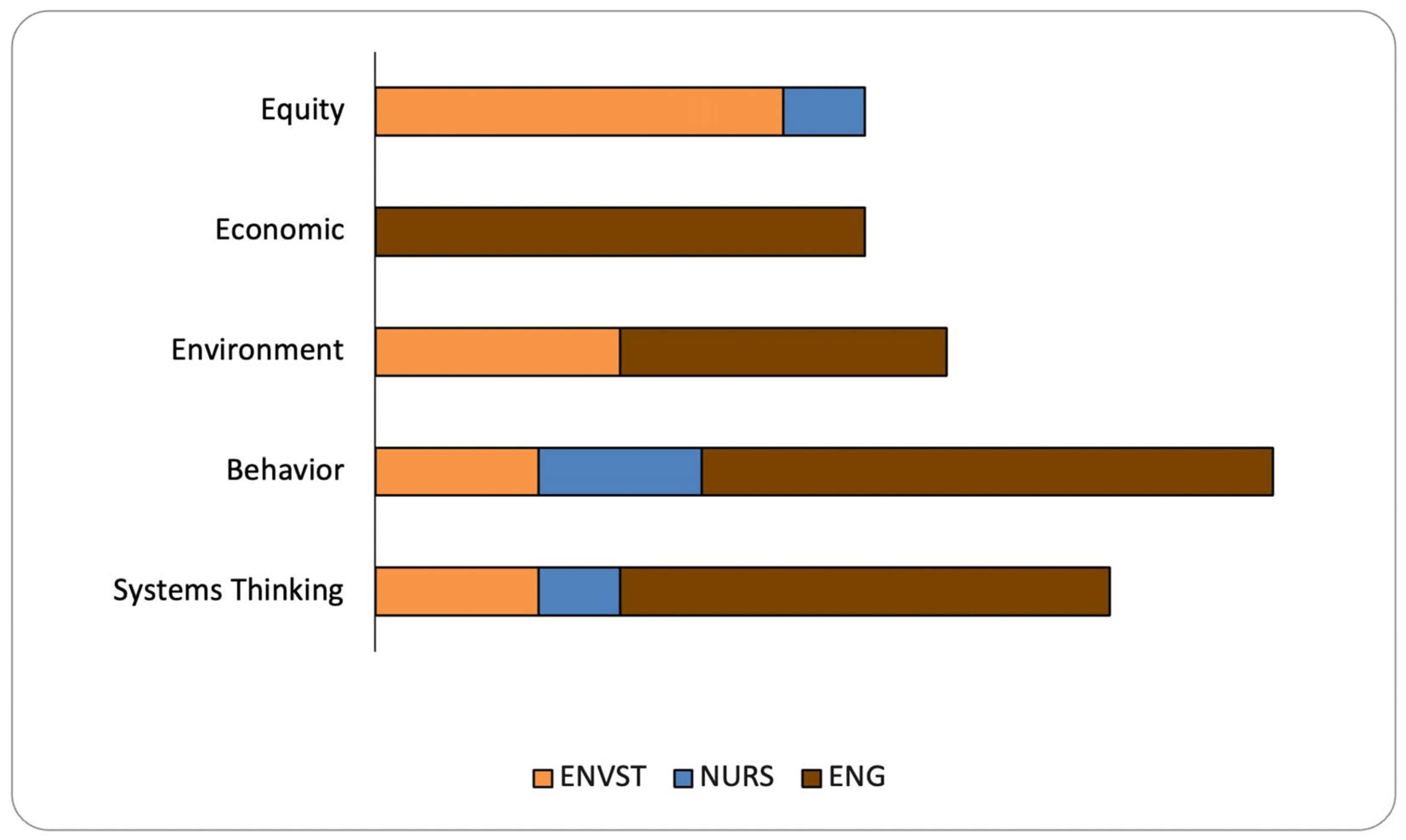
To better illustrate the relative frequency of each theme and subtheme by discipline, the results are displayed in
Figure 1 (
meanings) and
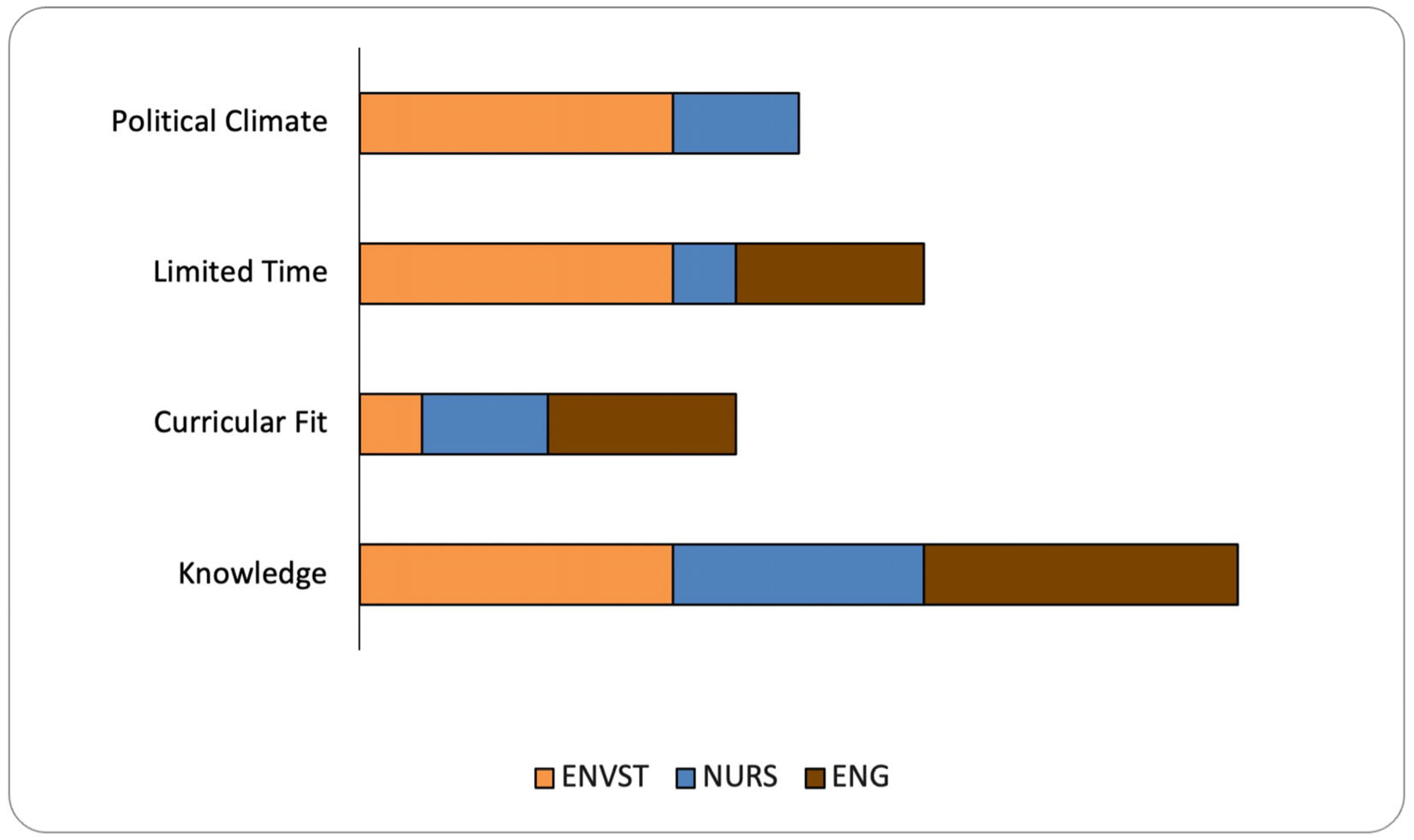
Figure 2 (
barriers). The relative frequencies reported in
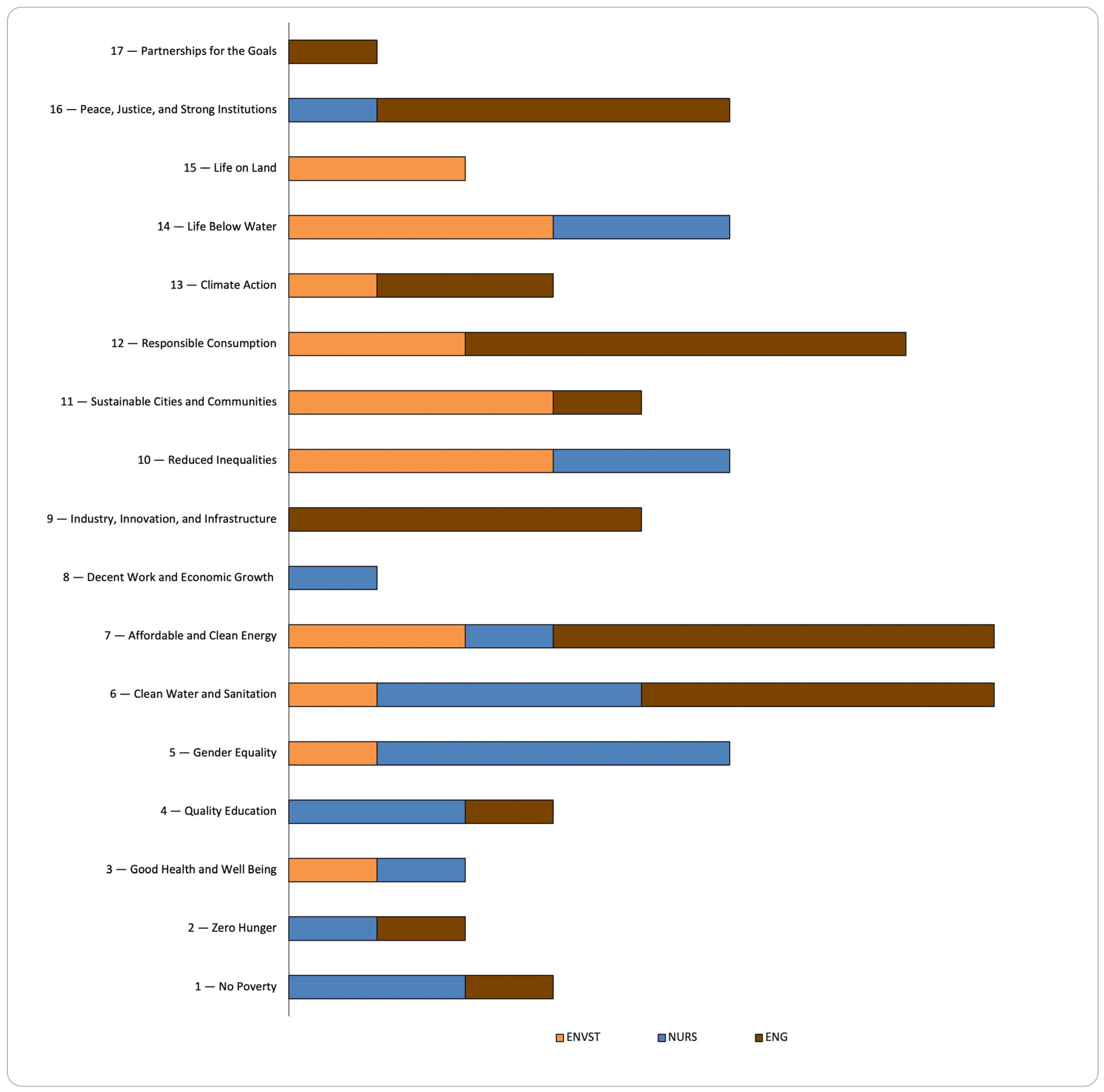
Figure 1,
Figure 2 and
Figure 3 refer to coded mentions rather than the number of participants endorsing each theme; therefore, they should be interpreted as indicators of thematic emphasis within the focus group discussions, not as measures of prevalence among faculty. Engineering (ENG) faculty mentioned the different
meaning themes more overall, relative to nursing (NURS) and environmental and sustainability studies (ENVST). NURS faculty mentioned
meaning subthemes fewer times relative to both other disciplines. Only ENG faculty discussed the economic subtheme. ENVST and NURS faculty both mentioned equity, but ENG faculty did not.
3.2. Barriers
ENVST faculty mentioned the different types of barriers more frequently than ENG or NURS faculty. Both NURS and ENG faculty viewed curricular fit as more of a barrier, relative to the ENVST faculty. The ENG faculty did not mention the political climate as a barrier, whereas both ENVST and NURS faculty did identify this as a barrier.
Figure 2.
Relative frequency of sustainability barriers by discipline as measured by coded mentions.
Figure 2.
Relative frequency of sustainability barriers by discipline as measured by coded mentions.
Figure 3.
Relative frequency of expressed sustainable development goals (SDGs) by discipline.
Figure 3.
Relative frequency of expressed sustainable development goals (SDGs) by discipline.
3.3. Sustainable Development Goals (SDGs)
Faculty in all focus groups were asked to identify the SDGs they currently thought they included in their courses. There were seven SDGs that ENVST faculty did not mention: SDG 1 (No Poverty), SDG 2 (Zero Hunger), SDG 4 (Quality Education), SDG 8 (Decent Work and Economic Growth), SDG 9 (Industry, Innovation and Infrastructure), SDG 16 (Peace, Justice and Strong Institutions), and SDG 17 (Partnership for the Goals). There were six SDGs that ENG faculty did not list: SDG 3 (Good Health and Well Being), SDG 5 (Gender Equality), SDG 8 (Decent Work and Economic Growth), SDG 10 (Reduced Inequalities), SDG 14 (Life Below Water), and SDG 15 (Life on Land). NURS faculty did not identify six SDGs (a different six than ENG) as already being included in their curriculum: SDG 9 (Industry, Innovation and Infrastructure), SDG 11 (Sustainable Cities and Communities), SDG 12 (Responsible Consumption), SDG 13 (Climate action), SDG 15 (Life on Land), and SDG 17 (Partnership for the Goals).
4. Discussion
Teaching sustainability in higher education presents distinct challenges, particularly regarding disciplinary structures. Universities are organized, conceptualized, and funded along disciplinary lines, with each discipline subject to specific accreditation standards that shape curricular content and determine the allocation of credit and instructional emphasis. Faculty are typically trained within a single disciplinary tradition, which can constrain their perspectives and limit their capacity to engage with inherently interdisciplinary content. In addition to structural and epistemological constraints, sustainability as a field is often inherently place-based, which complicates efforts to create and maintain a relevant knowledge base in institutions where faculty are trained in one geographical context but work in another.
Against this backdrop, this case study compares faculty responses across engineering (ENG), nursing (NURS), and environmental and sustainability studies (ENVST) to a common set of questions. By examining these three disciplinary contexts, the study fills a gap in the literature on discipline-specific approaches to sustainability education and offers guidance for sustainability education directors and advocates seeking to tailor strategies to the unique needs of each field.
4.1. Meanings Subthemes
As expected, different disciplines interpret sustainability with both shared and discipline-specific understandings. For example, faculty from each program recognized systems thinking as a core element of sustainability, noting:
“… we help educate students in multiple systems that affect the environment and human wellbeing… helps students to become critical thinkers” (ENVST Faculty).
OR
“I think it’s important… first off, to understand what sustainability actually means… because things are already changing, right… when we interfere with something, it’s going to have some [system-level or chemical] reaction…” (ENG Faculty).
While these perspectives emphasize systems thinking as central to faculty understanding, they stand in contrast to more behaviorally oriented pedagogical approaches, such as:
“So, it’s these kinds of things where you can do an analysis saying, ‘okay, if you buy a cloth shopping bag or something… how many plastic bags do you displace from landfills, and what’s the cost benefit of this?’” (ENG Faculty)
The quote above may reinforce a common misconception that sustainability is primarily a set of learned behaviors, rather than a set of broader conceptual understandings that may, in part, be reflected through cost–benefit analyses. As Sherman et al. [
9] note, the risk of this reducing conceptual understandings with learned behaviors is the potential for limiting the transferability of foundational ideas, e.g., ecological limits, to other contexts where such understanding might inform engagement with complex systems in different ways.
It is important to note, however, that this approach—embedding students in active analysis—is not inherently problematic, as it can support systems thinking, though this can be difficult:
“You can do toy problems where you say, well here’s one example: our objective is to remove CO2, right? In absence or in isolation without any other considerations, you can analyze that. But it’s hard when you realize that these are really big, interconnected systems that have societal implications.” (ENG Faculty).
This reference to “toy” problems highlights a key issue: limited analytical assignments, when presented without broader context, can be problematic. Moreover, it underscores the pedagogical challenge of conveying the scale of interconnected systems and their wider implications.
In many ways, the frequency of the subtheme
behavior emerging in the ENG focus group (
Figure 1) resonates with the list of SDGs they most frequently engage (
Figure 3), including: SDG 12 (Responsible Consumption), SDG 7 (Affordable and Clean Energy), SDG 9 (Industry, Innovation and Infrastructure), and SDG 6 (Clean Water and Sanitation).
In terms of the more traditionally identified pillars or dimensions of sustainability [
11], we see that both ENVST faculty and ENG faculty were prone to incorporate the environmental dimensions of sustainability in their discussions, whereas this dimension was less frequently identified in discussions with NURS faculty. Economic dimensions were only explored by ENG faculty; they did not bring up equity. Equity dimensions were only discussed by ENVST faculty and NURS faculty. (
Figure 1).
4.2. Barriers Subthemes
Several key barriers to integrating and teaching sustainability across disciplines were identified. Across all focus groups, participants reported challenges in defining sustainability, due in part to its evolving nature and the need for place-based understanding. These challenges are further compounded by the structure of academic training and hiring, through which new faculty often enter institutions from different geographic and cultural contexts, limiting their familiarity with locally specific knowledge regarding sustainability issues and regional ecological systems. For example, faculty noted things like:
“I think I am still feeling a little unsure because I feel like the resources and our state of knowledge is constantly changing so I personally I still feel like I’m learning so I just try and relay what I’ve learned and when I’m actively learning with students and just trying to sit in this place where it’s like things are constantly going to change.” (ENVST Faculty)
and
“…sustainability is local so it takes time to get acclimated to what’s going on in the state” (ENVST Faculty)
Both of these ideas, that key understandings within sustainability are place-based and that there is discomfort with limited and dynamic knowledge, have been widely cited in the literature [
19].
Integrating sustainability into existing courses requires substantial coordination across departments and a multi-step institutional process [
20], making it not only a lengthy endeavor but also extremely challenging for faculty. This challenge is compounded by the fact that faculty involved in interdisciplinary teaching often rely on their primary disciplinary expertise. For example:
“Another structural issue is… we are all individuals who have… different areas of expertise, and team teaching might be a way to allow us to hear maybe more accurate or more in depth information from experts.” (ENVST Faculty)
Relatedly, the complexity of sustainability topics and the core content prescribed by degree accreditation standards require a level of knowledge that is sufficiently deep to effectively integrate sustainability across mandated curricula, as reflected here:
“So we have a list of like 356… of these concepts that we have to introduce and evaluate and reevaluate… and so we try to weave in… content that’s really important. I think so much of this does align but when there are things that it’s like I can’t see clearly or easily how it would tie into what we’re doing then it’s like I don’t have time for it…” (NURS Faculty)
This quote represents both the issue of curricular fit and time.
The political climate has recently emerged as a topic in conversations around sustainability. For example:
“I think the political climate too plays a role, even the local changes we had last year with ya know, diversity, equity, and inclusion, and some of that also makes it kind of weird, like what stuff to include, what stuff we can’t include, are we going to offend somebody, so that makes it also hard.” (NURS Faculty)
And relatedly,
“Even hearing about mass deportation in the news [has] a lot of connection to many of the sustainability goals I think I think about it and almost any topic that’s going on… that’s the lens by which I read the world so that colors how I teach…” (ENVST Faculty)
And,
“So, I think, especially when there are sustainability topics related to kind of like policies… I would say that that is a challenge, especially right now, not really knowing like…our place in terms of environmental goals are anymore” (ENVST Faculty)
Understanding the way the political climate impacts sustainability across topics, we believe, will become increasingly important given that shifts in the political context can create additional uncertainty for faculty when determining how to teach sustainability. Similar observations have also been noted in other studies, such as [
21], stating that sustainability is an ethical and political challenge already, which can make it complicated for faculty to determine how these topics should be taught. These findings suggest that sustainability education requires an anticipatory institutional approach, in which faculty development is designed not only to add SDG content, but also to prepare educators to navigate political uncertainty, disciplinary boundaries, and long-term sustainability responsibilities [
22].
4.3. Sustainable Development Goals (SDGs)
Patterns in how faculty referenced the SDGs in their classes revealed how uneven the integrations of these goals are across disciplines. Some goals were confined to specific fields, for example, SDG 9 (Industry, Innovation, and Infrastructure) was only mentioned by ENG faculty, while SDG 10 (Reduced Inequalities) was only mentioned by ENVST and NURS faculty members. This finding resonates with the frequency of ENG faculty discussions of economic factors and behavior and ENVST faculty discussions of equity; it suggests a divide between social and technical understanding of sustainability.
Ultimately, in looking at the SDGs by disciplines, our team of researchers felt that a deeper understanding would be gained through different methodologies. We retain this information here with the recognition that it does not adequately capture the complexity of how the SDGs are conceptualized and applied across disciplines. However, in looking at the SDGs, the results appear to align with expectations around how each discipline taught and framed the SDGs in class.
4.4. Limitations
This study should be interpreted while considering several limitations that provide interesting opportunities of future research. First, focus groups were conducted at different points within the same year, with some occurring before and others after a major political transition, including a change in the federal government and new state legislation redefining the scope of diversity, equity, and inclusion activities on campus. These changes may have influenced the faculty’s responses.
Notably, the engineering focus group was conducted prior to the administration change, whereas the nursing and environmental and sustainability studies focus groups took place afterward. This temporal variation may have influenced participant responses. The data suggest that political context tends to be more salient in disciplines such as environmental and sustainability studies and nursing, while it is less explicitly engaged within engineering, though this response pattern may be more about the timing of the focus groups than the importance of the political climate for ENG faculty. Second, the study included only three academic disciplines—engineering, nursing, and environmental and sustainability studies—which limits the generalizability of findings. In addition, data regarding faculty teaching experience and courses may add depth to these findings though these data were not an element of this study. These fields do not fully represent the diversity of perspectives across the broader university context. Finally, drawing context from departmental learning outcomes may provide for a deeper exploration of SDG use by discipline. These limitations present opportunities for future research, in that inclusion of other disciplinary perspectives would undoubtedly lead to broader insights. In addition, while we look at the ways faculty of these disciplines interpret sustainability and how they perceive political challenges, we cannot know the impacts of their interpretations on students.
5. Conclusions
The research findings presented in this paper illustrate the diversity of sustainability conceptions across three disciplines, nursing, engineering, and environmental and sustainability studies, adding an important element to existing literature. “Although these findings are based on three disciplines within one university, they suggest that faculty development for sustainability education should be discipline-sensitive, locally grounded, and attentive to the sociopolitical conditions that shape teaching.”
These findings may also inform broader institutional efforts to strengthen sustainability education across the curriculum. By helping faculty recognize both the unique strengths of their disciplines and the value of interdisciplinary perspectives, training and workshops can cultivate a shared language around sustainability without erasing disciplinary differences. Over time, this may contribute to more coordinated educational strategies and a stronger culture of sustainability across the university.
At the same time, the place-based nature of sustainability education suggests caution in translating these findings into highly prescriptive recommendations. While broad principles may be transferable across contexts, sustainability challenges and opportunities are shaped by local environmental conditions, community priorities, cultural histories, and institutional realities. As a result, faculty development initiatives may be most effective when they provide flexible frameworks for reflection and adaptation rather than a fixed set of practices to be implemented uniformly. Such an approach is consistent with the goals of place-based education, which emphasize responsiveness to context and encourage educators to engage critically with the specific sustainability issues most relevant to their communities.
Together, these findings underscore that sustainability education does not occur in a vacuum; rather, it is deeply shaped by disciplinary norms and an increasingly complex political climate. As sustainability is inherently ethical and political, faculty must navigate not only differences in how their fields conceptualize these issues but also external pressures that influence what and how they teach. By illuminating both the variations across disciplines and the shared challenges educators face, this study highlights the need for adaptable, context-sensitive approaches to sustainability education. Moving forward, institutions and educators must remain attentive to shifting political dynamics while actively working to strengthen and integrate sustainability across curricula in ways that are both meaningful and resilient.
Author Contributions
Conceptualization, J.W., A.C. and D.R.W.; methodology, J.W., A.C. and D.R.W.; software, A.C., R.R. and K.D.; validation, J.W., A.C., R.R. and K.D.; formal analysis, J.W., A.C., R.R. and K.D.; investigation, J.W., A.C., R.R. and K.D.; resources, J.W. and A.C.; data curation, A.C., R.R. and K.D.; writing—original draft preparation, J.W., A.C., R.R. and K.D.; writing—review and editing, J.W., A.C., R.R. and K.D.; visualization, J.W., A.C., R.R. and K.D.; supervision, J.W. and A.C.; project administration, J.W. and A.C.; funding acquisition, D.R.W. and J.W. All authors have read and agreed to the published version of the manuscript.
Funding
This research was funded by the Lemelson Foundation, grant number 23–2330.
Institutional Review Board Statement
The study was conducted in accordance with the Declaration of Helsinki, and approved by the University of Utah IRB (#00176192, 19 February 2025).
Informed Consent Statement
Informed consent was obtained from all subjects involved in the study.
Data Availability Statement
The datasets presented in this article are not readily available because the data are part of an ongoing study.
Acknowledgments
We would like to thank Julie Johnsson for her efforts on this project, organizing focus groups, rooms, snacks, and then managing the recordings and transcriptions. We would not have been able to organize all of that without her help. We would also like to thank the many students from the Ecosystem Education Capstone course that facilitated the focus groups.
Conflicts of Interest
The authors declare no conflicts of interest.
Abbreviations
The following abbreviations are used in this manuscript:
| SDGs | Sustainable Development Goals |
| ENVST | Environmental and Sustainability Studies |
| NURS | Nursing |
| ENG | Engineering |
| R1 | Research Intensive |
| IRB | Institutional Review Board |
References
- Carson, R. Silent Spring; Houghton Mifflin: Boston, MA, USA, 1969. [Google Scholar]
- Hoffmann, A.H. The Intergovernmental Conference on Environmental Education, Held in Tbilisi, USSR, 14–26 October 1977. Environ. Conserv. 1978, 5, 153–154. [Google Scholar] [CrossRef]
- United Nations Secretary-General; World Commission on Environment and Development. Report of the World Commission on Environment and Development: Note/by the Secretary-General; United Nations Digital Library System: New York, NY, USA, 1987. [Google Scholar]
- United Nations Secretary General; The United Nations Conference on Environment and Development. Report of The United Nations Conference on Environment and Development. In Proceedings of the UN Conference on Environment and Development (DHLAUTH)159064, Rio de Janeiro, Brazil, 3–14 June 1992. [Google Scholar]
- Combes, B.P.Y. The United Nations Decade of Education for Sustainable Development (2005–2014): Learning to Live Together Sustainably. Appl. Environ. Educ. Commun. 2005, 4, 215–219. [Google Scholar] [CrossRef]
- UNHCR. Transforming Our World: The 2030 Agenda for Sustainable Development; UNHCR: Geneva, Switzerland, 2015. [Google Scholar]
- Sze, J. (Ed.) Sustainability: Approaches to Environmental Justice and Social Power; New York University Press: New York, NY, USA, 2018. [Google Scholar]
- Leonard, A. The Story of Stuff. In Proceedings of the Association for the Advancement of Sustainability in Higher Education Conference, Portland, OR, USA, 26–29 October 2014. [Google Scholar]
- Sherman, D.J. Research and Solutions: Sustainability: What’s the Big Idea? A Strategy for Transforming the Higher Education Curriculum. Sustain. J. Rec. 2008, 1, 188–195. [Google Scholar] [CrossRef]
- Ward, M.; Bowen, B.; Burian, S.; Cachelin, A.; McCool, D. Institutionalizing Interdisciplinary Sustainability Curriculum at a Large, Research-Intensive University: Challenges and Opportunities. J. Environ. Stud. Sci. 2016, 6, 425–431. [Google Scholar] [CrossRef]
- Purvis, B.; Mao, Y.; Robinson, D. Three Pillars of Sustainability: In Search of Conceptual Origins. Sustain. Sci. 2019, 14, 681–695. [Google Scholar] [CrossRef]
- Capra, F.; Luisi, P.L. The Systems View of Life: A Unifying Vision, 1st ed.; Cambridge University Press: Cambridge, UK, 2014. [Google Scholar]
- Cachelin, A.; Darling, A.; Clark, B.; Hackford-Peer, K. Weaving Equity and Sustainability into the Fabric of Higher Education: The University of Utah Experience. Sustainability 2019, 12, 304–309. [Google Scholar] [CrossRef]
- Agyeman, J.; Evans, B. ‘Just Sustainability’: The Emerging Discourse of Environmental Justice in Britain? Geogr. J. 2004, 170, 155–164. [Google Scholar] [CrossRef]
- Hansen, B.; Stiling, P.; Uy, W.F. Innovations and Challenges in SDG Integration and Reporting in Higher Education: A Case Study from the University of South Florida. Int. J. Sustain. High. Educ. 2021, 22, 1002–1021. [Google Scholar] [CrossRef]
- Serafini, P.G.; Moura, J.M.D.; Almeida, M.R.D.; Rezende, J.F.D.D. Sustainable Development Goals in Higher Education Institutions: A Systematic Literature Review. J. Clean. Prod. 2022, 370, 133473. [Google Scholar] [CrossRef]
- Mori Junior, R.; Fien, J.; Horne, R. Implementing the UN SDGs in Universities: Challenges, Opportunities, and Lessons Learned. Sustain. J. Rec. 2019, 12, 129–133. [Google Scholar] [CrossRef]
- Denzin, N. The SAGE Handbook of Qualitative Research, 6th ed.; SAGE Publications Inc.: Thousand Oaks, CA, USA, 2023. [Google Scholar]
- Ontong, K.; Le Grange, L. The Role of Place-based Education in Developing Sustainability as a Frame of Mind. S. Afr. J. Environ. Educ. 2014, 30, 27–38. [Google Scholar]
- Hill, L.M.; Wang, D. Integrating Sustainability Learning Outcomes into a University Curriculum: A Case Study of Institutional Dynamics. Int. J. Sustain. High. Educ. 2018, 19, 699–720. [Google Scholar] [CrossRef]
- Van Poeck, K.; Östman, L.; Öhman, J. (Eds.) Sustainable Development Teaching: Ethical and Political Challenges, 1st ed.; Series: Routledge Studies in Sustainability; Routledge: Abingdon, UK; New York, NY, USA, 2019. [Google Scholar]
- Velez Martell, J.E. Strategic Foresight and Its Contribution to Improving Corporate Social Responsibility Practices: A Systematic Review. Ceniiac 2025, 1, e0007. [Google Scholar] [CrossRef]
| Disclaimer/Publisher’s Note: The statements, opinions and data contained in all publications are solely those of the individual author(s) and contributor(s) and not of MDPI and/or the editor(s). MDPI and/or the editor(s) disclaim responsibility for any injury to people or property resulting from any ideas, methods, instructions or products referred to in the content. |