When Tax Avoidance Meets Sustainability: ESG Disclosure and Firms’ Cost of Debt
Abstract
1. Introduction
2. Egyptian Institutional Context and Research Relevance
3. Theoretical Background, Literature Review, and Hypotheses Development
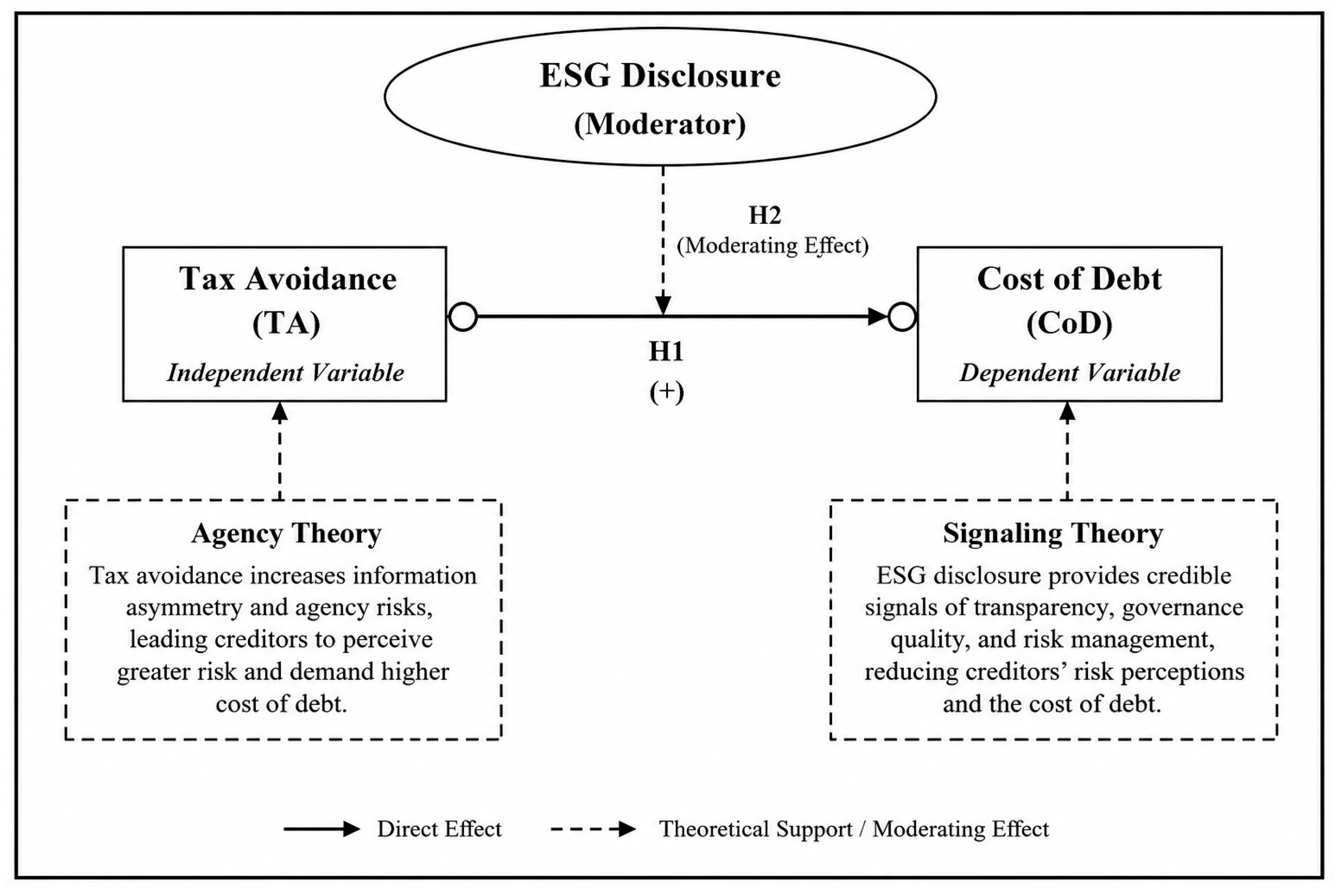
3.1. The Impact of TA on the CoD
3.2. The Moderating Impact of ESG Disclosure
4. Research Methodology
4.1. Data Set
4.2. Variable Measurements
4.2.1. The Cost of Debt (CoD) (Dependent Variable)
4.2.2. Tax Avoidance (TA) (Independent Variable)
4.2.3. ESG Disclosure (ESG) (Moderating Variable)
4.2.4. Control Variables
4.3. The Study Models
5. Main Results
5.1. Descriptive Statistics
5.2. Correlation Matrix
5.3. Baseline Regression Results
5.3.1. Test of H1: TA and CoD
5.3.2. Test of H2: ESG Disclosure Act as Moderator
6. Robustness Tests
6.1. CoD Alternative Measurement
6.2. TA Alternative Measurement
6.3. ESG-Sensitive and Non-ESG-Sensitive Industries
6.4. Lagged ESG Disclosure Analysis
6.5. Lagged TA Analysis
6.6. Alternative Estimation Method
6.7. Endogeneity Test
6.8. Using Driscoll–Kraay Standard Errors
7. Conclusions
7.1. Summary
7.2. Limitations and Future Research
Author Contributions
Funding
Institutional Review Board Statement
Informed Consent Statement
Data Availability Statement
Conflicts of Interest
References
- Sánchez-Ballesta, J.P.; Yagüe, J. Tax avoidance and the cost of debt for SMEs: Evidence from Spain. J. Contemp. Account. Econ. 2023, 19, 100362. [Google Scholar] [CrossRef] [Scilit]
- Ladhari, H.; Lakhal Slimane, F.M.B. Studying nonlinear dynamics of tax avoidance and the cost of debt. Rev. Account. Financ. 2025, 24, 401–426. [Google Scholar] [CrossRef] [Scilit]
- Medhioub, N.; Boujelbene, S. Tax avoidance and cost of debt: Does integrated report assurance matter? J. Account. Emerg. Econ. 2023, 14, 75–98. [Google Scholar] [CrossRef] [Scilit]
- Apergis, N.; Poufinas, T.; Antonopoulos, A. ESG scores and cost of debt. Energy Econ. 2022, 12, 106186. [Google Scholar] [CrossRef] [Scilit]
- Darsono, D.; Ratmono, D.; Tujori, A.; Clarisa, T.Y. The relationship between ESG, financial performance, and cost of debt: The role of independent assurance. Cogent Bus. Manag. 2025, 12, 2437137. [Google Scholar] [CrossRef] [Scilit]
- Eliwa, Y.; Aboud, A.; Saleh, A. ESG practices and the cost of debt: Evidence from EU countries. Crit. Perspect. Account. 2021, 79, 102097. [Google Scholar] [CrossRef] [Scilit]
- Malik, N.; Kashiramka, S. Impact of ESG disclosure on firm performance and cost of debt: Empirical evidence from India. J. Clean. Prod. 2024, 448, 141582. [Google Scholar] [CrossRef] [Scilit]
- Trinh, H.H. ESG profile, innovation investment, and cost of debt financing: Global evidence from uncertainty episodes. Strateg. Bus. Res. 2026, 2, 100079. [Google Scholar] [CrossRef] [Scilit]
- Hanlon, M.; Heitzman, S. A review of tax research. J. Account. Econ. 2010, 50, 127–178. [Google Scholar] [CrossRef] [Scilit]
- Huseynov, F.; Klamm, B.K. Tax avoidance, tax management and corporate social responsibility. J. Corp. Financ. 2012, 18, 804–827. [Google Scholar] [CrossRef] [Scilit]
- Lim, Y. Tax avoidance, cost of debt and shareholder activism: Evidence from Korea. J. Bank. Financ. 2011, 35, 456–470. [Google Scholar] [CrossRef] [Scilit]
- Dhaliwal, D.S.; Lee, H.S.; Pincus, M.; Steele, L.B. Taxable Income and Firm Risk. J. Am. Tax. Assoc. 2017, 39, 1–24. [Google Scholar] [CrossRef] [Scilit]
- Beladi, H.; Chao, C.C.; Hu, M. Does tax avoidance behavior affect bank loan contracts for Chinese listed firms? Int. Rev. Financ. Anal. 2018, 58, 104–116. [Google Scholar] [CrossRef] [Scilit]
- Desai, M.A.; Dharmapala, D. Corporate tax avoidance and high-powered incentives. J. Financ. Econ. 2006, 79, 145–179. [Google Scholar] [CrossRef] [Scilit]
- Hasan, I.; Hoi, C.K.; Wu, Q.; Zhang, H. Beauty is in the eye of the beholder: The effect of corporate tax avoidance on the cost of bank loans. J. Financ. Econ. 2014, 113, 109–130. [Google Scholar] [CrossRef] [Scilit]
- Guedrib, M.; Hamdi, Z. Investigating tax risk’s influence on tax avoidance and debt costs: Evidence from France. J. Financ. Crime 2024, 32, 321–336. [Google Scholar] [CrossRef] [Scilit]
- Gabrielli, A. Tax Avoidance and Debt Covenant Violation: Does Corporate Life Cycle Matter? In Tax Avoidance and Capital Structure Empirical Evidence on Debt Covenants; Gabrielli, A., Ed.; Springer Nature: Cham, Switzerland, 2023; pp. 57–88. [Google Scholar]
- Graham, J.R.; Tucker, A.L. Tax shelters and corporate debt policy. J. Financ. Econ. 2006, 81, 563–594. [Google Scholar] [CrossRef] [Scilit]
- Richardson, G.; Lanis, R.; Taylor, G. Financial distress, outside directors and corporate tax aggressiveness spanning the global financial crisis: An empirical analysis. J. Bank. Financ. 2015, 52, 112–129. [Google Scholar] [CrossRef] [Scilit]
- Shevlin, T.; Urcan, O.; Vasvari, F.P. Corporate Tax Avoidance and Debt Costs. J. Am. Tax. Assoc. 2020, 42, 117–143. [Google Scholar] [CrossRef] [Scilit]
- Lakhal, N.; Swayah, B.; Slimane, M.B.; Hamza, M. Tax avoidance and cost of debt: Evidence from French listed firms. J. Appl. Account. Res. 2025, 26, 1067–1085. [Google Scholar] [CrossRef] [Scilit]
- Kovermann, J.H. Tax avoidance, tax risk and the cost of debt in a bank-dominated economy. Manag. Audit. J. 2018, 33, 683–699. [Google Scholar] [CrossRef] [Scilit]
- Sánchez-Ballesta, J.P.; Yagüe, J. Tax avoidance and debt maturity in SMEs. J. Int. Financ. Manag. Account. 2024, 35, 429–464. [Google Scholar] [CrossRef] [Scilit]
- Cen, W.; Tong, N.; Sun, Y. Tax avoidance and cost of debt: Evidence from a natural experiment in China. Account. Financ. 2017, 57, 1517–1556. [Google Scholar] [CrossRef] [Scilit]
- Wang, W.; Sun, Z.; Dong, Y.; Zhang, L. Cost of debt financing, stock returns, and corporate strategic ESG disclosure: Evidence from China. Bus. Ethics Environ. Responsib. 2025, 34, 1787–1812. [Google Scholar] [CrossRef] [Scilit]
- You, X.; Chen, C.; Peng, K.; Li, Y. ESG disclosure quality and cost of debt. Emerg. Mark. Rev. 2025, 64, 101219. [Google Scholar] [CrossRef] [Scilit]
- Firmansyah, A.; Arham, A.; Qadri, R.A.; Wibowo, P.; Irawan, F.; Kustiani, N.A.; Wijaya, S.; Andriani, A.F.; Arfiansyah, Z.; Kurniawati, L.; et al. Investment opportunity sets, tax avoidance: Does corporate social responsibility disclosure in Indonesia have a role? Heliyon 2022, 8, e10155. [Google Scholar] [CrossRef] [Scilit] [PubMed]
- Jiang, H.; Hu, W.; Jiang, P. Does ESG performance affect corporate tax avoidance? Evidence from China. Financ. Res. Lett. 2024, 61, 105056. [Google Scholar] [CrossRef] [Scilit]
- Davis, A.K.; Guenther, D.A.; Krull, L.K.; Williams, B.M. Do Socially Responsible Firms Pay More Taxes? Account. Rev. 2016, 91, 47–68. [Google Scholar] [CrossRef] [Scilit]
- Elamer, A.A.; Boulhaga, M.; Ibrahim, B.A. Corporate tax avoidance and firm value: The moderating role of environmental, social, and governance (ESG) ratings. Bus. Strategy Environ. 2024, 33, 7446–7461. [Google Scholar] [CrossRef] [Scilit]
- Lanis, R.; Richardson, G. Corporate social responsibility and tax aggressiveness: A test of legitimacy theory. Account. Audit. Account. J. 2012, 26, 75–100. [Google Scholar] [CrossRef] [Scilit]
- Alomair, M.; Metwally, A.B. Does ESG Disclosure Matter for the Tax Avoidance–Firm Value Relationship? Evidence from an Emerging Market. Sustainability 2025, 17, 3836. [Google Scholar] [CrossRef] [Scilit]
- Metwally, A.B.M.; Elsharkawy, A.A.M.; Salem, M.I. The impact of corporate social responsibility on operating cash flow opacity: The moderating role of tax avoidance. Cogent Bus. Manag. 2024, 11, 2390692. [Google Scholar] [CrossRef] [Scilit]
- Metwally, A.B.M.; Montash, A.A.; Ali, S.A.; Yassin, M. Board characteristics and tax avoidance: The moderating effect of ESG disclosure. Cogent Bus. Manag. 2025, 12, 2588063. [Google Scholar] [CrossRef] [Scilit]
- Poornima, S.; Gopalakrishna, B.V.; Samanta, M. Impact of environmental, social, and governance disclosures on debt financing decisions: Evidence from India. Environ. Dev. Sustain. 2025, 1–37. [Google Scholar] [CrossRef] [Scilit]
- Gerwanski, J. Does it pay off? Integrated reporting and cost of debt: European evidence. Corp. Soc. Responsib. Environ. Manag. 2020, 27, 2299–2319. [Google Scholar] [CrossRef] [Scilit]
- Raimo, N.; Caragnano, A.; Zito, M.; Vitolla, F.; Mariani, M. Extending the benefits of ESG disclosure: The effect on the cost of debt financing. Corp. Soc. Responsib. Environ. Manag. 2021, 28, 1412–1421. [Google Scholar] [CrossRef] [Scilit]
- Oikonomou, I.; Brooks, C.; Pavelin, S. The Effects of Corporate Social Performance on the Cost of Corporate Debt and Credit Ratings. Financ. Rev. 2014, 49, 49–75. [Google Scholar] [CrossRef] [Scilit]
- Almulhim, A.; Metwally, A.B. The Impact of Tax Avoidance on Earnings Management: The Moderating Role of Board Governance Characteristics. Int. J. Financ. Stud. 2025, 13, 225. [Google Scholar] [CrossRef] [Scilit]
- Pradana, A.F. The Effect of Environmental, Social, & Governance (ESG) Disclosure and Tax Avoidance on Cost of Capital with Firm Size as a Moderating Variable. Devot. J. Res. Community Serv. 2024, 5, 1238–1251. [Google Scholar] [CrossRef] [Scilit]
- Nebie, M.; Cheng, M.-C. Corporate tax avoidance and firm value: Evidence from Taiwan. Cogent Bus. Manag. 2023, 10, 2282218. [Google Scholar] [CrossRef] [Scilit]
- Desai, M.A.; Dharmapala, D. Corporate tax avoidance and firm value. Rev. Econ. Stat. 2009, 91, 537–546. Available online: http://www.jstor.org/stable/25651357 (accessed on 18 April 2026). [CrossRef] [Scilit]
- Ma, L.; Ma, S.; Tian, G. Corporate Opacity and Cost of Debt for Family Firms. Eur. Account. Rev. 2017, 26, 27–59. [Google Scholar] [CrossRef] [Scilit]
- Al-Refiay, H.A.; Barrak, J.I.; Al-Tameemi, A.I.E.; Pazhohi, M. Tax Risk and Cost of Debt: The Role of Tax Avoidance—Evidence from the Iraqi Stock Market. Risks 2025, 13, 29. [Google Scholar] [CrossRef] [Scilit]
- Jensen, M.C.; Meckling, W.H. Theory of the firm: Managerial behavior, agency costs and ownership structure. J. Financ. Econ. 1976, 3, 305–360. [Google Scholar] [CrossRef] [Scilit]
- Almulhim, A.; Metwally, A.B.M. ESG disclosure and firm performance: Do gender diversity and sustainability committee matter? Cogent Bus. Manag. 2025, 12, 2545610. [Google Scholar] [CrossRef]
- Ross, S.A. The Determination of Financial Structure: The Incentive-Signalling Approach. Bell J. Econ. 1977, 8, 23–40. [Google Scholar] [CrossRef] [Scilit]
- Donkor, A.; Djajadikerta, H.G.; Roni, S.M.; Trireksani, T. Integrated reporting quality and corporate tax avoidance practices in South Africa’s listed companies. Sustain. Account. Manag. Policy J. 2022, 13, 899–928. [Google Scholar] [CrossRef] [Scilit]
- Glova, J.; Panko, M. The Effects of Environmental, Social, and Governance Factors on Financial Performance and Market Valuation in the European Automotive Industry. Int. J. Financ. Stud. 2025, 13, 82. [Google Scholar] [CrossRef] [Scilit]
- Huyghebaert, N.; Kang, S.; Wang, L.; Wu, W. Multiple Large Shareholders, Identity, and Corporate Tax Avoidance. Manag. Organ. Rev. 2024, 20, 235–264. [Google Scholar] [CrossRef] [Scilit]
- Nicolò, G.; Raimo, N.; Rella, A.; Vitolla, F. Visualizing environmental, social, and governance disclosure in non-financial reports: Does it matter for lenders? A machine-supported approach. VINE J. Inf. Knowl. Manag. Syst. 2025. [Google Scholar] [CrossRef] [Scilit]
- Gallemore, J.; Maydew, E.L.; Thornock, J.R. The Reputational Costs of Tax Avoidance. Contemp. Account. Res. 2014, 31, 1103–1133. [Google Scholar] [CrossRef] [Scilit]
- Hanlon, M.; Slemrod, J. What does tax aggressiveness signal? Evidence from stock price reactions to news about tax shelter involvement. J. Public Econ. 2009, 93, 126–141. [Google Scholar] [CrossRef] [Scilit]
- El-Dyasty, M.M.; Elamer, A. Multiple audit mechanism, audit quality and cost of debt: Empirical evidence from a developing country. Int. J. Discl. Gov. 2022, 19, 264–281. Available online: https://EconPapers.repec.org/RePEc:pal:ijodag:v:19:y:2022:i:3:d:10.1057_s41310-022-00143-7 (accessed on 18 April 2026). [CrossRef] [Scilit]
- Obiedallah, Y.R.; El Mahdy, A.H.A.M. Accounting conservatism and firm value in Egypt: The mediating role of tax avoidance. Future Bus. J. 2025, 11, 177. [Google Scholar] [CrossRef] [Scilit]
- Spence, M. 18—Job Market Signaling. In Market Signaling: Information Transfer in Hinng and Related Screening Processes; Harvard Economic Studies Series; Harvard University Press: Cambridge, MA, USA, in press; The essay is based on the author’s doctoral dissertation “Market Signalling: The Informational Structure of Job Markets and Related Phenomena. Ph.D. Thesis, Harvard University, Cambridge, MA, USA, 1972; The aim here is to present the outline of the signaling model and some of its conclusions; Generalizations of the numerical examples used for expositional purposes here are found in ibid, and elsewhere, “Uncertainty in Economics; Diamond, P., Rothschild, M., Eds.; Academic Press: Cambridge, MA, USA, 1978; pp. 281–306”.
- Goh, B.W.; Lee, J.; Lim, C.Y.; Shevlin, T. The Effect of Corporate Tax Avoidance on the Cost of Equity. Account. Rev. 2016, 91, 1647–1670. [Google Scholar] [CrossRef] [Scilit]
- Cormier, D.; Ledoux, M.J.; Magnan, M. The informational contribution of social and environmental disclosures for investors. Manag. Decis. 2011, 49, 1276–1304. [Google Scholar] [CrossRef] [Scilit]
- Muttakin, M.B.; Mihret, D.; Lemma, T.T.; Khan, A. Integrated reporting, financial reporting quality and cost of debt. Int. J. Account. Inf. Manag. 2020, 28, 517–534. [Google Scholar] [CrossRef] [Scilit]
- Serafeim, G. Integrated Reporting and Investor Clientele. J. Appl. Corp. Financ. 2015, 27, 34–51. [Google Scholar] [CrossRef] [Scilit]
- Kandpal, V.; Jaswal, A.; Gonzalez, E.D.R.S.; Agarwal, N. Corporate Social Responsibility (C.S.R.) and E.S.G. Reporting: Redefining Business in the Twenty-First Century. In Sustainable Energy Transition: Circular Economy and Sustainable Financing for Environmental, Social and Governance (ESG) Practices; Kandpal, V., Jaswal, A.E.D.R., Santibanez, G., Agarwal, N., Eds.; Springer Nature: Cham, Switzerland, 2024; pp. 239–272. [Google Scholar]
- El Ghoul, S.; Guedhami, O.; Kwok, C.C.Y.; Mishra, D.R. Does corporate social responsibility affect the cost of capital? J. Bank. Financ. 2011, 35, 2388–2406. [Google Scholar] [CrossRef] [Scilit]
- Rostamicheri, P.; Popescu, V.; Birau, R.; Bărbăcioru, I.C. ESG Score and Firm Performance: A Comparative Analysis of Nordic and European Companies. Sustainability 2026, 18, 1707. [Google Scholar] [CrossRef] [Scilit]
- Goss, A.; Roberts, G.S. The impact of corporate social responsibility on the cost of bank loans. J. Bank. Financ. 2011, 35, 1794–1810. [Google Scholar] [CrossRef] [Scilit]
- Houqe, M.N.; Ahmed, K.; Richardson, G. The Effect of Environmental, Social, and Governance Performance Factors on Firms’ Cost of Debt: International Evidence. Int. J. Account. 2020, 55, 2050014. [Google Scholar] [CrossRef] [Scilit]
- ElHawary, E.; Elbolok, R. The implications of COVID-19 on ESG performance and financial reporting quality in Egypt. J. Financ. Report. Account. 2024, 24, 1142–1173. [Google Scholar] [CrossRef] [Scilit]
- Metwally, A.B.; Abdalla, G.S.; Aly, S.A.; Ali, M.A. ESG Disclosure and Firm Value: Do Audit Committee Characteristics and Sustainability Committee Matter? Int. J. Financ. Stud. 2025, 13, 188. [Google Scholar] [CrossRef] [Scilit]
- Khaw, K.L.-H.; Zainudin, R.; Rashid, R.M. Cost of debt financing: Does political connection matter? Emerg. Mark. Rev. 2019, 41, 100632. [Google Scholar] [CrossRef] [Scilit]
- Shailer, G.; Wang, K. Government ownership and the cost of debt for Chinese listed corporations. Emerg. Mark. Rev. 2015, 22, 1–17. [Google Scholar] [CrossRef] [Scilit]
- Tee, C.M. Political connections, institutional monitoring and the cost of debt: Evidence from Malaysian firms. Int. J. Manag. Financ. 2018, 14, 210–229. [Google Scholar] [CrossRef] [Scilit]
- Gontara, H.; Khlif, H. Tax avoidance and audit report lag in South Africa: The moderating effect of auditor type. J. Financ. Crime 2021, 28, 732–740. [Google Scholar] [CrossRef] [Scilit]
- Dyreng, S.D.; Hanlon, M.; Maydew, E.L. The Effects of Executives on Corporate Tax Avoidance. Account. Rev. 2010, 85, 1163–1189. [Google Scholar] [CrossRef] [Scilit]
- Laguir, I.; Staglianò, R.; Elbaz, J. Does corporate social responsibility affect corporate tax aggressiveness? J. Clean. Prod. 2015, 107, 662–675. [Google Scholar] [CrossRef] [Scilit]
- Abdelfattah, T.; Aboud, A. Corporate governance, and corporate social responsibility: The case of the Egyptian capital market. J. Int. Account. Audit. Tax. 2020, 38, 100304. [Google Scholar] [CrossRef] [Scilit]
- S&P. S&P Methodology for S&P/EGX ESG Index. 2025. Available online: https://www.egx.com.eg/getdoc/fdd6f085-d88e-4072-a753-fa540d136442/SP%20_ESG_Index_en.aspx (accessed on 26 July 2025).
- Eliwa, Y.; Haslam, J.; Abraham, S. The association between earnings quality and the cost of equity capital: Evidence from the UK. Int. Rev. Financ. Anal. 2016, 48, 125–139. [Google Scholar] [CrossRef] [Scilit]
- Erragragui, E. Do creditors price firms’ environmental, social and governance risks? Res. Int. Bus. Financ. 2018, 45, 197–207. [Google Scholar] [CrossRef] [Scilit]
- Hasan, I.; Hoi, C.K.; Wu, Q.; Zhang, H. Social Capital and Debt Contracting: Evidence from Bank Loans and Public Bonds. J. Financ. Quant. Anal. 2017, 52, 1017–1047. [Google Scholar] [CrossRef] [Scilit]
- Aman, H.; Nguyen, P. Does good governance matter to debtholders? Evidence from the credit ratings of Japanese firms. Res. Int. Bus. Financ. 2013, 29, 14–34. [Google Scholar] [CrossRef] [Scilit]
- Arena, M.P. Corporate litigation and debt. J. Bank. Financ. 2018, 87, 202–215. [Google Scholar] [CrossRef] [Scilit]
- Ge, W.; Liu, M. Corporate social responsibility and the cost of corporate bonds. J. Account. Public Policy 2015, 34, 597–624. [Google Scholar] [CrossRef] [Scilit]
- Carey, P.; Khan, A.; Mihret, D.G.; Muttakin, M.B. Voluntary sustainability assurance, capital constraint and cost of debt: International evidence. Int. J. Audit. 2021, 25, 351–372. [Google Scholar] [CrossRef] [Scilit]
- Hoechle, D. Robust Standard Errors for Panel Regressions with Cross-Sectional Dependence. Stata J. 2007, 7, 281–312. [Google Scholar] [CrossRef] [Scilit]
- Reed, W.R.; Ye, H. Which panel data estimator should I use? Appl. Econ. 2011, 43, 985–1000. [Google Scholar] [CrossRef] [Scilit]
- Chan, K.H.; Mo, P.L.L.; Tang, T. Tax Avoidance and Tunneling: Empirical Analysis from an Agency Perspective. J. Int. Account. Res. 2016, 15, 49–66. [Google Scholar] [CrossRef] [Scilit]
- Duhoon, A.; Singh, M. Corporate tax avoidance: A systematic literature review and future research directions. LBS J. Manag. Res. 2023, 21, 197–217. [Google Scholar] [CrossRef] [Scilit]
- Almutairi, A. The Impact of Climate Change Disclosure on Cost of Debt: The Moderating Effect of Political Connections and ESG Disclosure. Int. J. Financ. Stud. 2026, 14, 123. [Google Scholar] [CrossRef] [Scilit]
- Delane, D.N. The impact of environmental, social, and governance disclosure on credit risk: Evidence from South African firms. S. Afr. J. Econ. Manag. Sci. 2026, 29, 6459. [Google Scholar] [CrossRef] [Scilit]
- Ahmed, A.H.; Mardini, G.H.; Burton, B.M.; Dunne, T.M. Is internet reporting useful? Evidence from Egypt. J. Appl. Account. Res. 2018, 19, 574–591. [Google Scholar] [CrossRef] [Scilit]
- Friske, W.; Hoelscher, S.A.; Nikolov, A.N. The impact of voluntary sustainability reporting on firm value: Insights from signaling theory. J. Acad. Mark. Sci. 2023, 51, 372–392. [Google Scholar] [CrossRef] [Scilit]
- Arifin, T.; Hasan, I.; Kabir, R. Transactional and relational approaches to political connections and the cost of debt. J. Corp. Financ. 2020, 65, 101768. [Google Scholar] [CrossRef] [Scilit]
- Shi, Y.; Zheng, S.; Xiao, P.; Zhen, H.; Wu, T. ESG performance and cost of debt. China J. Account. Res. 2024, 17, 100390. [Google Scholar] [CrossRef] [Scilit]
- Elgharbawy, A.; Aladwey, L.M.A. ESG performance, board diversity tax avoidance: Empirical evidence from the U.K. J. Financ. Report. Account. 2025; ahead of print. [CrossRef] [Scilit]
- Chava, S. Environmental Externalities and Cost of Capital. Manag. Sci. 2024, 60, 2223–2247. Available online: https://EconPapers.repec.org/RePEc:inm:ormnsc:v:60:y:2014:i:9:p:2223-2247 (accessed on 18 April 2026).
- Dhaliwal, D.S.; Li, O.Z.; Tsang, A.; Yang, Y.G. Voluntary Nonfinancial Disclosure and the Cost of Equity Capital: The Initiation of Corporate Social Responsibility Reporting. Account. Rev. 2011, 86, 59–100. [Google Scholar] [CrossRef] [Scilit]
- Khan, J.; Rehman, S.U.; Khan, I. Impact of board attributes on stock liquidity: Evidence from Pakistani panel data. J. Account. Emerg. Econ. 2022, 13, 118–134. [Google Scholar] [CrossRef] [Scilit]
- Reguera-Alvarado, N.; de Fuentes, P.; Laffarga, J. Does Board Gender Diversity Influence Financial Performance? Evidence from Spain. J. Bus. Ethics 2017, 141, 337–350. [Google Scholar] [CrossRef] [Scilit]


| Industry | Companies | Observations | % |
|---|---|---|---|
| Trade and Distributors | 5 | 30 | 4.55 |
| Paper and Packaging | 4 | 24 | 3.64 |
| Travel and Leisure | 7 | 42 | 6.36 |
| Basic Resources | 10 | 60 | 9.09 |
| Textile and Durables | 7 | 42 | 6.36 |
| IT, Media and Communication Services | 4 | 24 | 3.64 |
| Real Estate | 16 | 96 | 14.55 |
| Healthcare and Pharmaceuticals | 4 | 24 | 3.64 |
| Food, Beverages, and Tobacco | 20 | 120 | 18.18 |
| Building Materials | 13 | 78 | 11.82 |
| Industrial Goods, Services, and Automobiles | 10 | 60 | 9.09 |
| Contracting and Construction Engineering | 10 | 60 | 9.09 |
| Total | 110 | 660 | 100 |
| Variable | Measurement |
|---|---|
| Dependent variable | |
| Cost of Debt (CoD) | CoDit = Interest expensesit ÷ Average (short-term debtit + long-term debtit) |
| Independent variable | |
| Tax avoidance (TA) | TAit = −1 × (Income tax ÷ Pre-tax income). |
| Moderating variable | |
| ESG disclosure (ESG) | A composite score of the three factors (environmental, social, and governance), where the S&P/EG X ESG Index provides the ESG ratings that are used to calculate the ESG disclosure. |
| Control variables | |
| Firm Size (Size) | =log (total assets) |
| Leverage (Lev) | |
| profitability (ROA) | |
| Firm loss (L) | A dummy variable that, if a company reported negative earnings during the fiscal year, is equal to 1, and if not, it is equal to 0. |
| Current Ratio (CR) | |
| Variables | N | Min | Max | Mean | S.D |
|---|---|---|---|---|---|
| CoD | 660 | 0.02 | 0.12 | 0.07 | 0.02 |
| TA | 660 | −3.02 | −0.03 | −0.15 | 0.39 |
| ESG | 660 | 0.41 | 1.00 | 0.60 | 0.17 |
| Size | 660 | 10.84 | 17.56 | 13.93 | 1.83 |
| ROA | 660 | −0.17 | 0.28 | 0.053 | 0.08 |
| Lev | 660 | 0.05 | 0.98 | 0.52 | 0.29 |
| CR | 660 | 0.83 | 2.763 | 1.837 | 0.86 |
| L | 660 | 0.00 | 1.00 | 0.20 | 0.38 |
| Variables | CoD | TA | ESG | Size | ROA | Lev | CR | L | VIF |
|---|---|---|---|---|---|---|---|---|---|
| CoD | 1 | ---- | |||||||
| TA | 0.106 *** | 1 | 1.04 | ||||||
| ESG | −0.084 ** | −0.159 *** | 1 | 1.05 | |||||
| Size | −0.069 * | −0.089 ** | 0.093 ** | 1 | 1.25 | ||||
| ROA | −0.097 ** | 0.010 | 0.042 | 0.055 | 1 | 1.94 | |||
| Lev | −0.045 | 0.002 | 0.031 | 0.352 *** | −0.464 *** | 1 | 1.58 | ||
| CR | −0.104 *** | 0.046 | −0.057 | 0.076 * | 0.061 | 0.055 | 1 | 1.02 | |
| L | 0.017 | 0.023 | −0.055 | −0.038 | −0.316 *** | 0.338 *** | −0.004 | 1 | 1.64 |
| Variables | Model-1 Direct Effect | Model-2 Moderating Effect | ||
|---|---|---|---|---|
| Coef. | Z | Coef. | Z | |
| TA | 0.0062 *** | 4.14 | 0.0078 *** | 3.39 |
| ESG | ---- | ---- | −0.0067 ** | −2.20 |
| TA × ESG | ---- | ---- | −0.0123 ** | −2.36 |
| Size | −0.0018 ** | −2.24 | −0.0016 ** | −2.10 |
| ROA | −0.0075 ** | −2.16 | −0.0115 ** | −2.25 |
| Lev | −0.0012 | −0.15 | −0.0017 | −0.35 |
| CR | −0.0013 ** | −2.12 | −0.0014 ** | −1.96 |
| L | 0.0014 | 0.46 | 0.0016 | 0.52 |
| Constant | 0.0992 *** | 6.32 | 0.1012 *** | 6.62 |
| Industry and Year | Included | |||
| Adj. R2 | 0.424 | 0.443 | ||
| Chi2 | 33.417 *** | 45.219 *** | ||
| Variables | Model-1A Direct Effect | Model-2A Moderating Effect | ||
|---|---|---|---|---|
| Coef. | Z | Coef. | Z | |
| TA | 0.0097 *** | 3.18 | 0.0108 *** | 3.22 |
| ESG | ---- | ---- | −0.0123 ** | −2.17 |
| TA × ESG | ---- | ---- | −0.0194 ** | −2.22 |
| Size | −0.0029 ** | −2.10 | −0.0027 ** | −1.92 |
| ROA | −0.0149 ** | −2.38 | −0.0226 ** | −2.05 |
| Lev | 0.0087 | 0.11 | 0.0025 | 0.35 |
| CR | −0.0020 * | −1.88 | −0.0023 * | −1.82 |
| L | 0.0022 | 0.43 | 0.0026 | 0.52 |
| Constant | 0.0331 | 1.33 | 0.0293 | 1.24 |
| Industry and Year | Included | |||
| Adj. R2 | 0.256 | 0.274 | ||
| Chi2 | 32.721 *** | 42.738 *** | ||
| Variables | Model-1B Direct Effect | Model-2B Moderating Effect | ||
|---|---|---|---|---|
| Coef. | Z | Coef. | Z | |
| BTD | 0.0026 *** | 2.74 | 0.0022 ** | 2.16 |
| ESG | ---- | ---- | −0.0115 ** | −2.20 |
| BTD × ESG | ---- | ---- | −0.0149 ** | −2.35 |
| Controls | Included | |||
| Industry and Year | Included | |||
| Adj. R2 | 0.419 | 0.414 | ||
| Chi2 | 28.950 *** | 27.830 *** | ||
| Variables | ESG-Sensitive Industries Moderating Effect | Non-ESG-Sensitive Industries Moderating Effect | ||
|---|---|---|---|---|
| Coef. | Z | Coef. | Z | |
| TA | 0.0074 ** | 2.19 | 0.0054 *** | 3.08 |
| ESG | −0.0022 ** | −2.24 | −0.0008 ** | −1.98 |
| TA × ESG | −0.0104 ** | −2.12 | −0.0078 ** | −2.08 |
| Controls | Included | |||
| Industry and Year | Included | |||
| Adj. R2 | 0.403 | 0.468 | ||
| Chi2 | 22.220 *** | 93.061 *** | ||
| Variables | Lagged ESG Moderating Effect | |
|---|---|---|
| Coef. | Z | |
| TA | 0.0016 ** | 2.15 |
| ESG | −0.0067 ** | −2.07 |
| TA × ESG | −0.0541 *** | −2.79 |
| Controls | Included | |
| Industry and Year | Included | |
| Adj. R2 | 0.442 | |
| Chi2 | 43.090 *** | |
| Variables | Lagged TA Direct Effect | Lagged TA Moderating Effect | ||
|---|---|---|---|---|
| Coef. | Z | Coef. | Z | |
| TA | 0.0043 ** | 2.08 | 0.0030 * | 1.88 |
| ESG | ----- | ----- | −0.0069 ** | −2.17 |
| TA × ESG | ----- | ----- | −0.0736 *** | −2.27 |
| Controls | Included | |||
| Industry and Year | Included | |||
| Adj. R2 | 0.406 | 0.436 | ||
| Chi2 | 34.02 *** | 38.93 *** | ||
| Variables | Model-1C Direct Effect | Model-2C Moderating Effect | ||
|---|---|---|---|---|
| Coef. | Z | Coef. | Z | |
| TA | 0.0037 *** | 3.22 | 0.0088 ** | 2.36 |
| ESG | ---- | ---- | −0.0085 ** | −2.05 |
| TA × ESG | ---- | ---- | −0.0138 ** | −2.18 |
| Controls | Included | |||
| Industry and Year | Included | |||
| Adj. R2 | 0.158 | 0.177 | ||
| F-statistics | 11.950 *** | 9.753 *** | ||
| Variables | Model-1D Direct Effect | Model-2D Moderating Effect | ||
|---|---|---|---|---|
| Coef. | Z | Coef. | Z | |
| CoD lag (1) | 0.4935 *** | 5.08 | 0.4463 *** | 4.06 |
| TA | 0.0206 ** | 2.18 | 0.0311 ** | 1.98 |
| ESG | ------- | ------- | −0.0132 ** | −2.03 |
| TA × ESG | ------- | ------- | −0.1109 ** | −2.33 |
| Controls | Included | |||
| Industry and Year | Included | |||
| Chi2 | 3698.01 *** | 3653.82 *** | ||
| Hansen test (p-value) | 0.231 | 0.346 | ||
| AR1 (p-value) | 0.000 | 0.001 | ||
| AR2 (p-value) | 0.143 | 0.157 | ||
| Number of instruments | 12 | 14 | ||
| Variables | Model-1B Direct Effect | Model-2B Moderating Effect | ||
|---|---|---|---|---|
| Coef. | Z | Coef. | Z | |
| TA | 0.0017 *** | 2.02 | 0.0028 * | 1.98 |
| ESG | ---- | ---- | −0.0085 ** | −2.12 |
| TA × ESG | ---- | ---- | −0.0135 *** | −5.13 |
| Controls | Included | |||
| Industry and Year | Included | |||
| Adj. R2 | 0.116 | 0.125 | ||
| F | 81.82 *** | 84.16 *** | ||
| Robustness Test | Objective | Alternative Specification | Main Result |
|---|---|---|---|
| Alternative CoD Measure (Table 6) | Verify sensitivity to CoD measurement. | Financial Expenses/Total Liabilities | Coefficient signs and significance remain unchanged. |
| Alternative TA Measure (Table 7) | Verify sensitivity to TA measurement. | Book-Tax Difference (BTD) | Findings remain consistent with baseline results. |
| Industry Heterogeneity (Table 8) | Examine industry differences. | ESG-sensitive vs. non-ESG-sensitive industries | ESG moderation remains significant in both groups and is stronger in ESG-sensitive industries. |
| Lagged ESG Disclosure (Table 9) | Address reverse causality concerns. | ESG t − 1 | Interaction term remains significantly negative. |
| Fixed Effects Estimation (Table 10) | Control for unobserved firm heterogeneity. | FE regression | Findings remain unchanged. |
| Dynamic Panel GMM (Table 11) | Address endogeneity concerns. | System GMM | Main coefficients remain significant; diagnostic tests are satisfied. |
Disclaimer/Publisher’s Note: The statements, opinions and data contained in all publications are solely those of the individual author(s) and contributor(s) and not of MDPI and/or the editor(s). MDPI and/or the editor(s) disclaim responsibility for any injury to people or property resulting from any ideas, methods, instructions or products referred to in the content. |
© 2026 by the authors. Licensee MDPI, Basel, Switzerland. This article is an open access article distributed under the terms and conditions of the Creative Commons Attribution (CC BY) license.
Share and Cite
Ellelly, N.N.A.M.; Aladwey, L.; Metwally, A.B.M. When Tax Avoidance Meets Sustainability: ESG Disclosure and Firms’ Cost of Debt. Sustainability 2026, 18, 6337. https://doi.org/10.3390/su18126337
Ellelly NNAM, Aladwey L, Metwally ABM. When Tax Avoidance Meets Sustainability: ESG Disclosure and Firms’ Cost of Debt. Sustainability. 2026; 18(12):6337. https://doi.org/10.3390/su18126337
Chicago/Turabian StyleEllelly, Nouran Nabil Abdelsalam Mahmoud, Laila Aladwey, and Abdelmoneim Bahyeldin Mohamed Metwally. 2026. "When Tax Avoidance Meets Sustainability: ESG Disclosure and Firms’ Cost of Debt" Sustainability 18, no. 12: 6337. https://doi.org/10.3390/su18126337
APA StyleEllelly, N. N. A. M., Aladwey, L., & Metwally, A. B. M. (2026). When Tax Avoidance Meets Sustainability: ESG Disclosure and Firms’ Cost of Debt. Sustainability, 18(12), 6337. https://doi.org/10.3390/su18126337