A Systematic Literature Review on Addressing Challenges in Operations Management Considering Industry 3.0–6.0 Based on PRISMA Framework




Abstract
1. Introduction
2. Materials and Methods
2.1. Data Source
2.2. Data Screening and Exclusion Criteria
3. Summary and Discussion
4. Conclusions
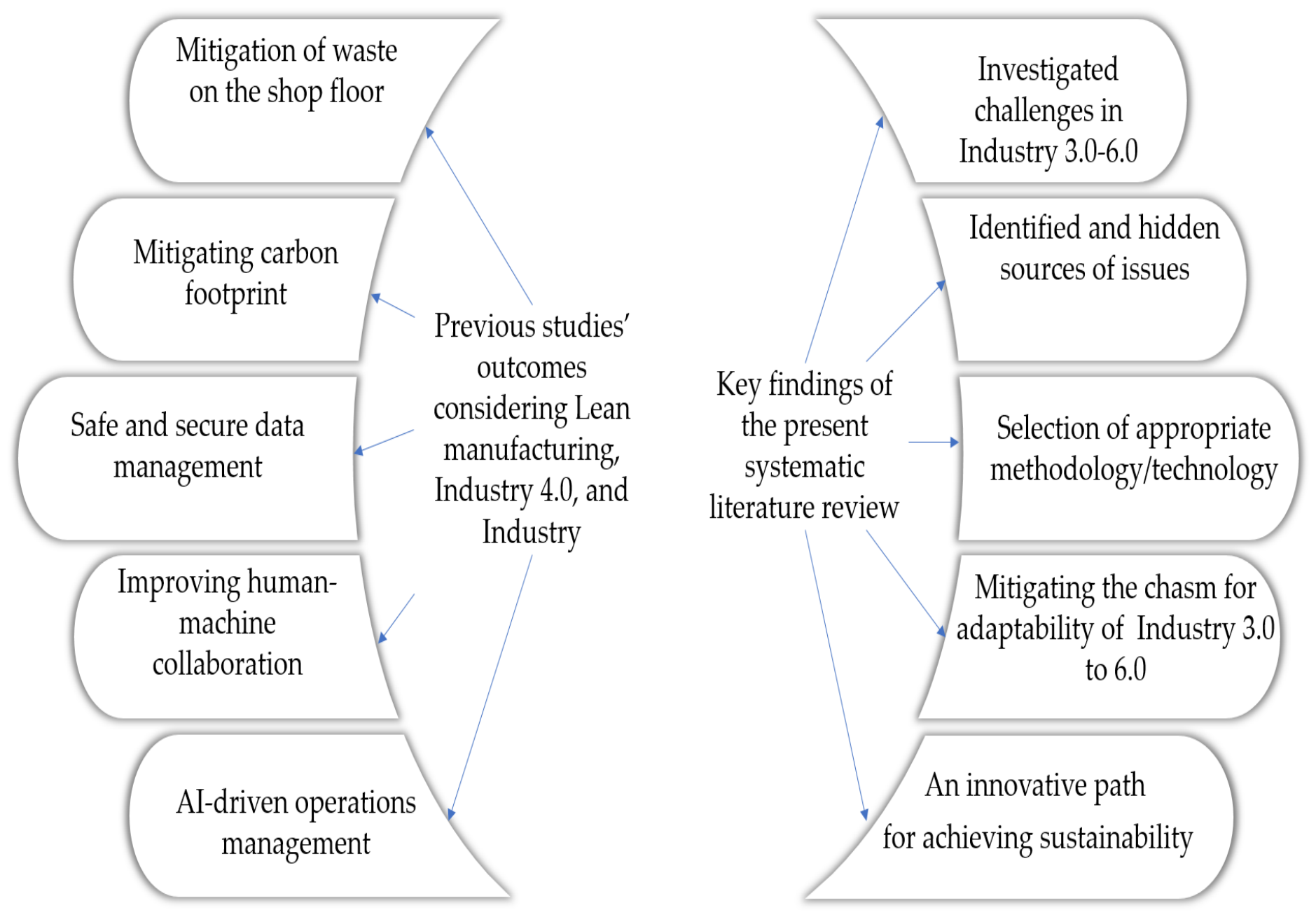
- Operations management needs innovative ways for real-time tracking and tackling the operations management issues. The studies revealed that the integrated approaches worked efficiently in flexible shop-floor settings.
- It has been revealed that the suitable methodology enhances the competency of process improvement approaches in operations management. The analysis showed that concurrent and data-driven approaches were highly coveted for root causes encountered in operations management in Industry 3.0–6.0.
- The operations management professionals seek innovative and AI-driven shop-floor management, where the amendment can be implemented according to the operations management-related obstacles present in real-world scenarios.
- The integration of lean, smart, green, circular economy and emerging principles proved its competency in controlling operations management performance in hybrid industry revolutions-driven work environments.
- There is a need to develop an innovative path to resolve the challenges in Industry 3.0–6.0. It empowers excellence in resources and operations management and enhances operational, environmental, economic, and social sustainability.
- There is a need to mitigate the chasm between Industry 3.0–6.0 feasibility and adaptability in the real-world scenario.
5. Future Research Direction
Supplementary Materials
Author Contributions
Funding
Institutional Review Board Statement
Informed Consent Statement
Data Availability Statement
Conflicts of Interest
References
- Nshirim, E.S.; Nwagwu, U. Integrated approach for process improvement: Value engineering, lean methodology, SIPOC, and value stream mapping. Int. J. Appl. Nat. Sci. 2023, 1, 58–66. [Google Scholar]
- Tarafdar, R. Human-AI Collaboration in Workflow Optimization: A Framework for Hybrid Decision Systems in Automation-Heavy Industries. Int. J. Sci. Res. Comput. Sci. Eng. Inf. Technol. 2025, 11, 3594–3613. [Google Scholar] [CrossRef] [Scilit]
- Mittal, A.; Gupta, P.; Kumar, A.; Mahlawat, S.; Singh, S. The performance improvement analysis using Six Sigma DMAIC methodology: A case study on Indian manufacturing company. Heliyon 2023, 9, e14625. [Google Scholar] [CrossRef] [Scilit] [PubMed]
- Mauri, F.; Garetti, M.; Gandelli, A. A structured approach to process improvement in manufacturing systems. Prod. Plan. Control 2010, 21, 695–717. [Google Scholar] [CrossRef] [Scilit]
- Goni, F.A.; Chofreh, A.G.; Orakani, Z.E.; Klemeš, J.J.; Davoudi, M.; Mardani, A. Sustainable business model: A review and framework development. Clean Technol. Environ. Policy 2021, 23, 889–897. [Google Scholar] [CrossRef] [Scilit]
- Mwanza, B.G.; Mbohwa, C. Design of a Total Productive Maintenance Model for Effective Implementation: Case Study of a Chemical Manufacturing Company. Procedia Manuf. 2015, 4, 461–470. [Google Scholar] [CrossRef] [Scilit]
- Chien, C.-F.; Chen, C.-C. Data-Driven Framework for Tool Health Monitoring and Maintenance Strategy for Smart Manufacturing. IEEE Trans. Semicond. Manuf. 2020, 33, 644–652. [Google Scholar] [CrossRef] [Scilit]
- Saqlain, M.; Piao, M.; Shim, Y.; Lee, J.Y. Framework of an IoT-based Industrial Data Management for Smart Manufacturing. J. Sens. Actuator Netw. 2019, 8, 25. [Google Scholar] [CrossRef] [Scilit]
- Das, B.; Venkatadri, U.; Pandey, P. Applying lean manufacturing system to improving productivity of airconditioning coil manufacturing. Int. J. Adv. Manuf. Technol. 2014, 71, 307–323. [Google Scholar]
- Mittal, S.; Khan, M.A.; Purohit, J.K.; Menon, K.; Romero, D.; Wuest, T. A smart manufacturing adoption framework for SMEs. Int. J. Prod. Res. 2020, 58, 1555–1573. [Google Scholar] [CrossRef] [Scilit]
- Masuti, P.M.; Dabade, U.A. Lean manufacturing implementation using value stream mapping at excavator manufacturing company. Mater. Today 2019, 19, 606–610. [Google Scholar] [CrossRef] [Scilit]
- Singh, B.; Sharma, S. Value stream mapping as a versatile tool for lean implementation: An Indian case study of a manufacturing firm. Meas. Bus. Excell. 2009, 13, 58–68. [Google Scholar] [CrossRef] [Scilit]
- Bertolini, M.; Romagnoli, G. Lean manufacturing in the valve pre-assembly area of a bottling lines production plant: An Italian case study. In Proceedings of the 2013 International Conference on Industrial Engineering and Systems Management (IESM), Agdal, Morocco, 28–30 October 2013. [Google Scholar]
- Sahoo, A.K.; Singh, N.K.; Shankar, R.; Tiwari, M.K. Lean philosophy: Implementation in a forging company. Int. J. Adv. Manuf. Technol. 2008, 36, 451–462. [Google Scholar]
- Liao, W.; Wang, T. A Novel Collaborative Optimization Model for Job Shop Production–Delivery Considering Time Window and Carbon Emission. Sustainability 2019, 11, 2781. [Google Scholar] [CrossRef] [Scilit]
- Jeyaraj, K.L.; Muralidharan, C.; Mahalingam, R.; Deshmukh, S.G. Applying Value Stream Mapping Technique for Production Improvement in a Manufacturing Company: A Case Study. J. Inst. Eng. Ser. C 2013, 94, 43–52. [Google Scholar] [CrossRef] [Scilit]
- Esa, M.M.; Rahman, N.A.A.; Jamaludin, M. Reducing High Setup Time in Assembly Line: A Case Study of Automotive Manufacturing Company in Malaysia. Procedia—Soc. Behav. Sci. 2015, 211, 215–220. [Google Scholar] [CrossRef] [Scilit]
- Rahman, N.A.A.; Sharif, S.M.; Esa, M.M. Lean Manufacturing Case Study with Kanban System Implementation. Procedia Econ. Financ. 2013, 7, 174–180. [Google Scholar] [CrossRef] [Scilit]
- Frankó, A.; Vida, G.; Varga, P. Reliable identification schemes for asset and production tracking in industry 4.0. Sensors 2020, 20, 3709. [Google Scholar] [CrossRef] [Scilit] [PubMed]
- Chen, J.C.; Cheng, C.-H.; Huang, P.B.; Wang, K.-J.; Huang, C.-J.; Ting, T.-C. Warehouse management with lean and RFID application: A case study. Int. J. Adv. Manuf. Technol. 2013, 69, 531–542. [Google Scholar] [CrossRef] [Scilit]
- Garre, P.; Bharadwaj, V.N.; Shashank, P.S.; Harish, M.; Dheeraj, M.S. Applying lean in aerospace manufacturing. Mater. Today Proc. 2017, 4, 8439–8446. [Google Scholar] [CrossRef] [Scilit]
- dos Santos, Z.G.; Vieira, L.; Balbinotti, G. Lean Manufacturing and Ergonomic Working Conditions in the Automotive Industry. Procedia Manuf. 2015, 3, 5947–5954. [Google Scholar] [CrossRef] [Scilit]
- Priya, S.K.; Jayakumar, V.; Kumar, S.S. Defect analysis and lean six sigma implementation experience in an automotive assembly line. Mater. Today Proc. 2020, 22, 948–958. [Google Scholar] [CrossRef] [Scilit]
- Gaspar, P.D.; Fernandez, C.M.; Soares, V.N.G.J.; Caldeira, J.M.L.P.; Silva, H. Development of technological capabilities through the internet of things (Iot): Survey of opportunities and barriers for iot implementation in Portugal’s agro-industry. Appl. Sci. 2021, 11, 3454. [Google Scholar] [CrossRef] [Scilit]
- Tripathi, V.; Saraswat, S.; Gautam, G.D. Development of a Systematic Framework to Optimize the Production Process in Shop Floor Management; Springer: Singapore, 2022. [Google Scholar] [CrossRef] [Scilit]
- Kenyon, G.N.; Meixell, M.J.; Westfall, P.H. Production outsourcing and operational performance: An empirical study using secondary data. Int. J. Prod. Econ. 2016, 171, 336–349. [Google Scholar] [CrossRef] [Scilit]
- Ibrahim, W.M.K.b.W.; Rahman, M.A.; bin Abu Bakar, M.R. Implementing lean manufacturing in Malaysian small and medium startup pharmaceutical company. In IOP Conference Series: Materials Science and Engineering; IOP Publishing: Bristol, UK, 2017; Volume 184, p. 012016. [Google Scholar]
- Badhotiya, G.K.; Gurumurthy, A.; Marawar, Y.; Soni, G. Lean manufacturing in the last decade: Insights from published case studies. J. Manuf. Technol. Manag. 2024, 35, 766–798. [Google Scholar] [CrossRef] [Scilit]
- Schmitt, T.; Wolf, C.; Lennerfors, T.T.; Okwir, S. Beyond “Leanear” production: A multi-level approach for achieving circularity in a lean manufacturing context. J. Clean. Prod. 2021, 318, 128531. [Google Scholar] [CrossRef] [Scilit]
- Stanisavljev, S.; Ćoćkalo, D.; Kavalić, M.; Gluvakov, V.; Bakator, M.; Djordjević, L.; Ugrinov, S. Development and application of a stochastic model for optimizing production cycles aimed at sustainable production. Systems 2025, 13, 628. [Google Scholar] [CrossRef] [Scilit]
- Chen, T.C.T.; Wang, Y.C. AI applications to shop floor management in lean manufacturing. In Artificial Intelligence and Lean Manufacturing; Springer International Publishing: Cham, Switzerland, 2022; pp. 75–90. [Google Scholar]
- Plathottam, S.J.; Rzonca, A.; Lakhnori, R.; Iloeje, C.O. A review of artificial intelligence applications in manufacturing operations. J. Adv. Manuf. Process. 2023, 5, e10159. [Google Scholar] [CrossRef] [Scilit]
- Fózer, D.; Tóth, A.J.; Varbanov, P.S.; Klemeš, J.J.; Mizsey, P. Sustainability assessment of biomethanol production via hydrothermal gasification supported by artificial neural network. J. Clean. Prod. 2021, 318, 128606. [Google Scholar] [CrossRef] [Scilit]
- Kaur, K.; Kaur, R.; Prajapati, P. Big Data for Optimized and Sustainable Industrial Operations in Industry 6.0: Challenges, Opportunities, and Best Practices. In International Conference on Next-Generation Networks and Deployable Artificial Intelligence; Springer Nature: Cham, Switzerland, 2025; pp. 427–440. [Google Scholar]
- Mofokeng, P.N.; Babalola, L.O.; Nenzhelele, T. Unleashing the Future of Manufacturing: A Journey into Industry 5.0’s Human-Machine Synergy for Enhanced Railway Manufacturing. In International Conference on Flexible Automation and Intelligent Manufacturing; Springer Nature: Cham, Switzerland, 2025; pp. 648–662. [Google Scholar]
- Susilawati, A.; Tan, J.; Bell, D.; Sarwar, M. Fuzzy logic based method to measure degree of lean activity in manufacturing industry. J. Manuf. Syst. 2015, 34, 1–11. [Google Scholar] [CrossRef] [Scilit]
- Page, M.J.; McKenzie, J.E.; Bossuyt, P.M.; Boutron, I.; Hoffmann, T.C.; Mulrow, C.D.; Shamseer, L.; Tetzlaff, J.M.; Akl, E.A.; Brennan, S.E.; et al. The PRISMA 2020 statement: An updated guideline for reporting systematic reviews. BMJ 2021, 372, 71. [Google Scholar] [CrossRef] [Scilit] [PubMed]
- Liu, L.; Lee, L.S.; Seow, H.V.; Chen, C.Y. Logistics center location-inventory-routing problem optimization: A systematic review using PRISMA method. Sustainability 2022, 14, 15853. [Google Scholar] [CrossRef] [Scilit]
- Braglia, M.; Carmignani, G.; Zammori, F. A new value stream mapping approach for complex production systems. Int. J. Prod. Res. 2006, 44, 3929–3952. [Google Scholar] [CrossRef] [Scilit]
- Hsu, S.Y.; Sha, D.Y. The integration of shop floor control in wafer fabrication. J. Manuf. Technol. Manag. 2007, 18, 598–619. [Google Scholar] [CrossRef] [Scilit]
- Hodge, G.L.; Ross, K.G.; Joines, J.A.; Thoney, K. Adapting lean manufacturing principles to the textile industry. Prod. Plan. Control 2011, 22, 237–247. [Google Scholar] [CrossRef] [Scilit]
- Gurumurthy, A.; Kodali, R. Design of lean manufacturing systems using value stream mapping with simulation. J. Manuf. Technol. Manag. 2011, 22, 444–473. [Google Scholar] [CrossRef] [Scilit]
- Jasti, N.V.K.; Sharma, A. Lean manufacturing implementation using value stream mapping as a tool: A case study from auto components industry. Int. J. Lean Six Sigma 2011, 5, 89–116. [Google Scholar]
- Lu, J.-C.; Yang, T. Implementing lean standard work to solve a low work-in-process buffer problem in a highly automated manufacturing environment. Int. J. Prod. Res. 2015, 53, 2285–2305. [Google Scholar]
- Sharma, V.; Dixit, A.R.; Qadri, M.A. Impact of lean practices on performance measures in context to Indian machine tool industry. J. Manuf. Technol. Manag. 2015, 26, 1218–1242. [Google Scholar] [CrossRef] [Scilit]
- Al-Refaie, A.; Chen, T.; Al-Athamneh, R.; Wu, H.-C. Fuzzy neural network approach to optimizing process performance by using multiple responses. J. Ambient. Intell. Humaniz. Comput. 2016, 7, 801–816. [Google Scholar] [CrossRef] [Scilit]
- Kesharwani, R.; Dagli, C.; Sun, Z. Application of Neural Network in Shop Floor Quality Control in a Make to Order Business. Procedia Comput. Sci. 2016, 95, 209–216. [Google Scholar] [CrossRef] [Scilit]
- Alaskari, O.; Ahmad, M.M.; Pinedo-Cuenca, R. Development of a methodology to assist manufacturing SMEs in the selection of appropriate lean tools. Int. J. Lean Six Sigma 2016, 7, 62–84. [Google Scholar] [CrossRef] [Scilit]
- Sagnak, M.; Kazancoglu, Y. Integration of green lean approach with six sigma: An application for flue gas emissions. J. Clean. Prod. 2016, 127, 112–118. [Google Scholar] [CrossRef] [Scilit]
- Méndez, J.D.M.; Rodriguez, R.S. Total productive maintenance (TPM) as a tool for improving productivity: A case study of application in the bottleneck of an auto-parts machining line. Int. J. Adv. Manuf. Technol. 2017, 92, 1013–1026. [Google Scholar] [CrossRef] [Scilit]
- Kumar, S.; Dhingra, A.K.; Singh, B. Process improvement through Lean-Kaizen using value stream map: A case study in India. Int. J. Adv. Manuf. Technol. 2018, 96, 2687–2698. [Google Scholar] [CrossRef] [Scilit]
- Sreedharan, V.R.; Raju, R.; Rajkanth, R.; Nagaraj, M. An empirical assessment of Lean Six Sigma Awareness in manufacturing industries: Construct development and validation. Total. Qual. Manag. Bus. Excel. 2018, 29, 686–703. [Google Scholar] [CrossRef] [Scilit]
- Gijo, E.V.; Palod, R.; Antony, J. Lean Six Sigma approach in an Indian auto ancillary conglomerate: A case study. Prod. Plan. Control 2018, 7287, 761–772. [Google Scholar] [CrossRef] [Scilit]
- Garza-Reyes, J.A.; Kumar, V.; Chaikittisilp, S.; Tan, K.H. The effect of lean methods and tools on the environmental performance of manufacturing organisations. Int. J. Prod. Econ. 2018, 200, 170–180. [Google Scholar] [CrossRef] [Scilit]
- Kumar, S.; Dhingra, A.K.; Singh, B. Kaizen selection for continuous improvement through VSM-Fuzzy-TOPSIS in Small-Scale enterprises: An Indian case study. Adv. Fuzzy Syst. 2018, 2018, 2723768. [Google Scholar] [CrossRef] [Scilit]
- Kumar, B.; Parameshwaran, R. Fuzzy integrated QFD, FMEA framework for the selection of lean tools in a manufacturing organisation. Prod. Plan. Control 2018, 29, 403–417. [Google Scholar] [CrossRef] [Scilit]
- Buddala, R.; Mahapatra, S.S. An integrated approach for scheduling flexible job-shop using teaching–learning-based optimization method. J. Ind. Eng. Int. 2019, 15, 181–192. [Google Scholar] [CrossRef] [Scilit]
- Benda, F.; Braune, R.; Doerner, K.F.; Hartl, R.F. A machine learning approach for flow shop scheduling problems with alternative resources, sequence-dependent setup times, and blocking. OR Spectr. 2019, 41, 871–893. [Google Scholar] [CrossRef] [Scilit]
- Dadashnejad, A.A.; Valmohammadi, C. Investigating the effect of value stream mapping on overall equipment effectiveness: A case study. Total. Qual. Manag. Bus. Excel. 2019, 30, 466–482. [Google Scholar]
- Sana, S.S.; Ospina-Mateus, H.; Arrieta, F.G.; Chedid, J.A. Application of genetic algorithm to job scheduling under ergonomic constraints in manufacturing industry. J. Ambient. Intell. Humaniz. Comput. 2019, 10, 2063–2090. [Google Scholar] [CrossRef] [Scilit]
- Chiarini, A.; Kumar, M. Lean Six Sigma and Industry 4.0 integration for Operational Excellence: Evidence from Italian manufacturing companies. Prod. Plan. Control 2020, 32, 1084–1101. [Google Scholar] [CrossRef] [Scilit]
- Chiarini, A.; Belvedere, V. Industry 4.0 strategies and technological developments. An exploratory research from Italian manufacturing companies. Prod. Plan. Control 2020, 31, 1385–1398. [Google Scholar] [CrossRef] [Scilit]
- Leong, W.D.; Teng, S.Y.; How, B.S.; Ngan, S.L.; Rahman, A.A.; Tan, C.P.; Ponnambalam, S.; Lam, H.L. Enhancing the adaptability: Lean and green strategy towards the Industry Revolution 4.0. J. Clean. Prod. 2020, 273, 122870. [Google Scholar] [CrossRef] [Scilit]
- Caiado, R.G.G.; Scavarda, L.F.; Gavião, L.O.; Ivson, P.; Nascimento, D.L.d.M.; Garza-Reyes, J.A. A fuzzy rule-based industry 4.0 maturity model for operations and supply chain management. Int. J. Prod. Econ. 2021, 231, 107883. [Google Scholar] [CrossRef] [Scilit]
- Shao, X.F.; Liu, W.; Li, Y.; Chaudhry, H.R.; Yue, X.G. Multistage implementation framework for smart supply chain management under industry 4.0. Technol. Forecast. Soc. Change 2021, 162, 120354. [Google Scholar] [CrossRef] [Scilit] [PubMed]
- Liao, M.-H.; Wang, C.-T. Using enterprise architecture to integrate lean manufacturing, digitalization, and sustainability: A lean enterprise case study in the chemical industry. Sustainability 2021, 13, 4851. [Google Scholar] [CrossRef] [Scilit]
- Schoeman, Y.; Oberholster, P.; Somerset, V. Value stream mapping as a supporting management tool to identify the flow of industrial waste: A case study. Sustainability 2021, 13, 91. [Google Scholar] [CrossRef] [Scilit]
- Buer, S.-V.; Semini, M.; Strandhagen, J.O.; Sgarbossa, F. The complementary effect of lean manufacturing and digitalisation on operational performance. Int. J. Prod. Res. 2021, 59, 1976–1992. [Google Scholar] [CrossRef] [Scilit]
- Tortorella, G.L.; Narayanamurthy, G.; Thurer, M. Identifying pathways to a high-performing lean automation implementation: An empirical study in the manufacturing industry. Int. J. Prod. Econ. 2021, 231, 107918. [Google Scholar] [CrossRef] [Scilit]
- Logesh, B.; Balaji, M. Experimental Investigations to Deploy Green Manufacturing through Reduction of Waste Using Lean Tools in Electrical Components Manufacturing Company. Int. J. Precis. Eng. Manuf.—Green Technol. 2021, 8, 365–374. [Google Scholar] [CrossRef] [Scilit]
- Khanzode, A.G.; Sarma, P.; Mangla, S.K.; Yuan, H. Modeling the Industry 4.0 adoption for sustainable production in Micro, Small & Medium Enterprises. J. Clean. Prod. 2021, 279, 123489. [Google Scholar] [CrossRef] [Scilit]
- Benbarrad, T.; Salhaoui, M.; Kenitar, S.B.; Arioua, M. Intelligent machine vision model for defective product inspection based on machine learning. J. Sens. Actuator Netw. 2021, 10, 7. [Google Scholar] [CrossRef] [Scilit]
- Salwin, M.; Pszczółkowska, K.; Pałęga, M.; Kraslawski, A. Value-Stream mapping as a tool to improve production and energy consumption: A case study of a manufacturer of industrial hand tools. Energies 2023, 16, 7292. [Google Scholar] [CrossRef] [Scilit]
- Mendes, D.; Gaspar, P.D.; Charrua-Santos, F.; Navas, H. Enhanced real-time maintenance management model—A step toward Industry 4.0 through Lean: Conveyor belt operation case study. Electronics 2023, 12, 3872. [Google Scholar] [CrossRef] [Scilit]
- Hien, D.N.; Duc, M.L.; Tuan, T.D. Integrating six Sigma into an industry 4.0 system for enhanced productivity: A case study in CNC processes. Manag. Prod. Eng. Rev. 2024, 15, 44–62. [Google Scholar] [CrossRef] [Scilit]
- Lorente-Leyva, L.L.; Alemany, M.M.E.; Peluffo-Ordóñez, D.H. A conceptual framework for the operations planning of the textile supply chains: Insights for sustainable and smart planning in uncertain and dynamic contexts. Comput. Ind. Eng. 2024, 187, 109824. [Google Scholar] [CrossRef] [Scilit]
- Sagawa, J.K.; Mušič, G.; Borges, R.F.S. A hybrid model for shop floor simulation and work-in-process feedback control. Comput. Ind. Eng. 2024, 193, 110309. [Google Scholar] [CrossRef] [Scilit]
- Komkowski, T.; Sony, M.; Antony, J.; Lizarelli, F.L.; Garza-Reyes, J.A.; Tortorella, G.L. Operational practices for integrating lean and industry 4.0–a dynamic capabilities perspective. Int. J. Prod. Res. 2025, 63, 1517–1537. [Google Scholar]
- Skalli, D.; Cherrafi, A.; Charkaoui, A.; Chiarini, A.; Shokri, A.; Antony, J.; Foster, M. Integrating Lean Six Sigma and Industry 4.0: Developing a design science research-based LSS4. 0 framework for operational excellence. Prod. Plan. Control 2025, 36, 1060–1086. [Google Scholar]
- Benitez, G.B.; Biondo, D.; Seelent, J.F.C.; Kai, D.A. Investigating the effect of Industry 4.0 technologies on Lean bundles: A stakeholder perspective for quality improvement. J. Manuf. Technol. Manag. 2025, 36, 961–984. [Google Scholar] [CrossRef] [Scilit]
- Azli, A.D.; Abu, F.; Rusli, M.H.M.; Goh, J.; Kah, G.W.; Ching, M.L.; Salleh, N.A.M. Design and Development of Industry 4.0 Smart Lean Kaizen Manufacturing: A Case Study on Extrusion Line of Vacuum Hose. Int. J. Integr. Eng. 2024, 16, 39–53. [Google Scholar] [CrossRef] [Scilit]
- Tanane, B.; Bentaha, M.L.; Dafflon, B.; Moalla, N. Bridging the gap between Industry 4.0 and manufacturing SMEs: A framework for an end-to-end Total Manufacturing Quality 4.0’s implementation and adoption. J. Ind. Inf. Integr. 2025, 45, 100833. [Google Scholar] [CrossRef] [Scilit]
- Kumar, R.; Dutta, G.; Phanden, R.K. Digitalization adoption barriers in the context of sustainability and operational excellence: Implications for SMEs. Eng. Manag. J. 2025, 37, 355–371. [Google Scholar]
- Brunner, S.; Yuching, C.K.; Bengler, K. Streamlining operations management by classifying methods and concepts of Lean and Ergonomics within a sociotechnical framework. Oper. Manag. Res. 2024, 17, 1172–1196. [Google Scholar] [CrossRef] [Scilit]
- Xu, B.; Song, X.; Cai, Z.; Lim, E.; Tan, C.W.; Yu, J. Artificial intelligence or augmented intelligence: A case study of human-AI collaboration in operational decision making. In Proceedings of the Pacific Asia Conference on Information Systems, Dubai, United Arab Emirates, 20–24 June 2020. [Google Scholar]
- Virmani, N.; Salve, U.R. Significance of human factors and ergonomics (HFE): Mediating its role between industry 4.0 implementation and operational excellence. IEEE Trans. Eng. Manag. 2021, 70, 3976–3989. [Google Scholar] [CrossRef] [Scilit]
- Rusli, M.H.M.; Hassan, M.K.; Muhamud-Kayat, S.; Michael, E. Development of IoT Kaizen system for smart lean raw material inventory management: A case study at an SME factory in Malaysia. J. Kejuruter. 2024, 36, 1585–1598. [Google Scholar] [CrossRef] [Scilit] [PubMed]
- Ulhe, P.P.; Dhepe, A.D.; Shevale, V.D.; Warghane, Y.S.; Jadhav, P.S.; Babhare, S.L. Flexibility management and decision making in cyber-physical systems utilizing digital lean principles with brain-inspired computing pattern recognition in industry 4.0. Int. J. Comput. Integr. Manuf. 2024, 37, 708–725. [Google Scholar]
- Jamwal, A.; Agrawal, R.; Sharma, M. Challenges and opportunities for manufacturing SMEs in adopting industry 4.0 technologies for achieving sustainability: Empirical evidence from an emerging economy. Oper. Manag. Res. 2025, 18, 718–743. [Google Scholar] [CrossRef] [Scilit]
- Mehmood, K.; Kautish, P.; Rashid, M.; Joshi, Y.; Iftikhar, Y. Digitalization in the circular economy: Synergistic impact of big data analytics, green internet of things, and ambidextrous green innovation. J. Clean. Prod. 2025, 509, 145610. [Google Scholar] [CrossRef] [Scilit]
- Lu, H.; Zhao, G.; Liu, S. Integrating circular economy and Industry 4.0 for sustainable supply chain management: A dynamic capability view. Prod. Plan. Control 2024, 35, 170–186. [Google Scholar] [CrossRef] [Scilit]
- Kumar, A.; Choudhary, S.; Garza-Reyes, J.A.; Kumar, V.; Khan, S.A.R.; Mishra, N. Analysis of critical success factors for implementing Industry 4.0 integrated circular supply chain–moving towards sustainable operations. Prod. Plan. Control 2023, 34, 984–998. [Google Scholar]
- Tsolakis, N.; Harrington, T.S.; Srai, J.S. Digital supply network design: A Circular Economy 4.0 decision-making system for real-world challenges. Prod. Plan. Control 2023, 34, 941–966. [Google Scholar]
- Zhang, A.; Venkatesh, V.G.; Wang, J.X.; Mani, V.; Wan, M.; Qu, T. Drivers of industry 4.0-enabled smart waste management in supply chain operations: A circular economy perspective in China. Prod. Plan. Control 2023, 34, 870–886. [Google Scholar] [CrossRef] [Scilit]
- Kazancoglu, Y.; Ozkan-Ozen, Y.D.; Sagnak, M.; Kazancoglu, I.; Dora, M. Framework for a sustainable supply chain to overcome risks in transition to a circular economy through Industry 4.0. Prod. Plan. Control 2023, 34, 902–917. [Google Scholar]
- Issa, I.; Orazbayev, B.; Tuleuova, R.; Makhatova, V. Mathematical Models for Oil Production Optimization in Fuzzy Environments: Well Stock Forecasting and Regulation. Math. Model. Eng. Probl. 2024, 11, 340–348. [Google Scholar] [CrossRef] [Scilit]
- Chang, M.J.; Lin, G.F.; Lee, F.Z.; Wang, Y.C.; Chen, P.A.; Wu, M.C.; Lai, J.S. Outflow sediment concentration forecasting by integrating machine learning approaches and time series analysis in reservoir desilting operation. Stoch. Environ. Res. Risk Assess. 2020, 34, 849–866. [Google Scholar] [CrossRef] [Scilit]
- Lao, S.I.; Choy, K.L.; Ho, G.T.; Yam, R.C.; Tsim, M.Y.; Poon, T.C. Achieving quality assurance functionality in the food industry using a hybrid case-based reasoning and fuzzy logic approach. Expert Syst. Appl. 2012, 39, 5251–5261. [Google Scholar] [CrossRef] [Scilit]
- Sami, M.A.; Zhang, Z.; Waseem, M.; Kemell, K.K.; Rasheed, Z.; Herda, T.; Abrahamsson, P. Bridging Humans and LLMs: Investigating Human-AI Collaboration in Multi-agent Requirements Analysis for Organizational AI Adoption. e-Inform. Softw. Eng. J. 2026, 20, 1–27. [Google Scholar] [CrossRef] [Scilit]
- Pattanaik, S.; Mohammed, M.; Sood, V. Artificial intelligence and machine learning in Industry 6.0. In Industry 6.0; CRC Press: Boca Raton, FL, USA, 2024; pp. 37–54. [Google Scholar]
- Oliva, R.; Watson, N. Managing functional biases in organizational forecasts: A case study of consensus forecasting in supply chain planning. Prod. Oper. Manag. 2009, 18, 138–151. [Google Scholar] [CrossRef] [Scilit]
- Nikolakis, N.; Catti, P.; Chaloulos, W.; Coy, M.P.; Alexopoulos, K. A methodology to assess circular economy strategies for sustainable manufacturing using process eco-efficiency. J. Clean. Prod. 2024, 445, 141289. [Google Scholar] [CrossRef] [Scilit]
- Lim, M.K.; Lai, M.; Wang, C.; Lee, Y. Circular economy to ensure production operational sustainability: A green-lean approach. Sustain. Prod. Consum. 2022, 30, 130–144. [Google Scholar] [CrossRef] [Scilit]
- Abdul-Hamid, A.Q.; Ali, M.H.; Osman, L.H.; Tseng, M.L. The drivers of industry 4.0 in a circular economy: The palm oil industry in Malaysia. J. Clean. Prod. 2021, 324, 129216. [Google Scholar] [CrossRef] [Scilit]
- Hu, J.; Xiao, Z.; Zhou, R.; Deng, W.; Wang, M.; Ma, S. Ecological utilization of leather tannery waste with circular economy model. J. Clean. Prod. 2011, 19, 221–228. [Google Scholar] [CrossRef] [Scilit]
- Byrne, B.; McDermott, O.; Noonan, J. Applying Lean Six Sigma Methodology to a Pharmaceutical Manufacturing Facility: A Case Study. Processes 2021, 9, 550. [Google Scholar] [CrossRef] [Scilit]
- Costa, L.B.M.; Filho, M.G.; Fredendall, L.D.; Ganga, G.M.D. Lean six sigma in the food industry: Construct development and measurement validation. Int. J. Prod. Econ. 2020, 231, 107843. [Google Scholar] [CrossRef] [Scilit]
- Pacheco, D.A.D.J.; Pergher, I.; Antunes Junior, J.A.V.; Roehe Vaccaro, G.L. Exploring the integration between Lean and the Theory of Constraints in Operations Management. Int. J. Lean Six Sigma 2019, 10, 718–742. [Google Scholar] [CrossRef] [Scilit]
- Amjad, M.S.; Rafique, M.Z.; Khan, M.A. Leveraging Optimized and Cleaner Production through Industry 4.0. Sustain. Prod. Consum. 2021, 26, 859–871. [Google Scholar] [CrossRef] [Scilit]
- Modgil, S.; Sharma, S. Total productive maintenance, total quality management and operational performance: An empirical study of Indian pharmaceutical industry. J. Qual. Maint. Eng. 2016, 22, 353–377. [Google Scholar] [CrossRef] [Scilit]
- Yadav, G.; Luthra, S.; Huisingh, D.; Mangla, S.K.; Narkhede, B.E.; Liu, Y. Development of a lean manufacturing framework to enhance its adoption within manufacturing companies in developing economies. J. Clean. Prod. 2020, 245, 118726. [Google Scholar] [CrossRef] [Scilit]
- Paez, O.; Dewees, J.; Genaidy, A.; Tuncel, S.; Karwowski, W.; Zurada, J. The lean manufacturing enterprise: An emerging sociotechnological system integration. Hum. Factors Ergon. Manuf. Serv. Ind. 2004, 14, 285–306. [Google Scholar] [CrossRef] [Scilit]
- Suhardi, B.; Anisa, N.; Laksono, P.W. Minimizing waste using lean manufacturing and ECRS principle in Indonesian furniture industry. Cogent Eng. 2019, 6, 1567019. [Google Scholar] [CrossRef] [Scilit]
- Zhang, Z.; Wang, X.; Wang, X.; Cui, F.; Cheng, H. A simulation-based approach for plant layout design and production planning. J. Ambient Intell. Humaniz. Comput. 2019, 10, 1217–1230. [Google Scholar]
- Aghdasinia, H.; Hosseini, S.S.; Hamedi, J. Improvement of a cement rotary kiln performance using artificial neural network. J. Ambient. Intell. Humaniz. Comput. 2020, 12, 7765–7776. [Google Scholar] [CrossRef] [Scilit]
- Amrani, A.; Ducq, Y. The Management of Operations Lean practices implementation in aerospace based on sector characteristics: Methodology and case study methodology and case study. Prod. Plan. Control. 2020, 31, 1313–1335. [Google Scholar] [CrossRef] [Scilit]
- Prasad, S.; Khanduja, D.; Sharma, S.K. A study on implementation of lean manufacturing in Indian foundry industry by analysing lean waste issues. Proc. Inst. Mech. Eng. Part B J. Eng. Manuf. 2016, 232, 371–378. [Google Scholar] [CrossRef] [Scilit]
- Sutharsan, S.; Prasad, M.; Vijay, S. Productivity enhancement and waste management through lean philosophy in Indian manufacturing industry. Mater. Today 2020, 33, 2981–2985. [Google Scholar] [CrossRef] [Scilit]
- Sivaraman, S.; Nithyanandhan, T.; Lakshminarasimhan, S.; Manikandan, S.; Saifudheen, M. Productivity enhancement in engine assembly using lean tools and techniques. Mater. Today 2020, 33, 201–207. [Google Scholar] [CrossRef] [Scilit]
- Irfan, M.T.H.; Rafiquzzaman, M.; Manik, Y.A. Productivity improvement through lean tools in cement industry—A case study. Heliyon 2025, 11, e42057. [Google Scholar] [CrossRef] [Scilit] [PubMed]
- Shou, W.; Wang, J.; Wu, P.; Wang, X. Lean management framework for improving maintenance operation: Development and application in the oil and gas industry. Prod. Plan. Control 2020, 32, 585–602. [Google Scholar] [CrossRef] [Scilit]
- Jayanth, B.V.; Prathap, P.; Sivaraman, P.; Yogesh, S.; Madhu, S. Implementation of lean manufacturing in electronics industry. Mater. Today 2020, 33, 23–28. [Google Scholar] [CrossRef] [Scilit]
- Marodin, G.A.; Saurin, T.A.; Tortorella, G.L.; Denicol, J. How context factors influence lean production practices in manufacturing cells. Int. J. Adv. Manuf. Technol. 2015, 79, 1389–1399. [Google Scholar] [CrossRef] [Scilit]
- Li, D.; Zheng, L. Optimizing Information Flow in Manufacturing Operations Management Through Lean–Industry 4.0 Integration. Eng. Manag. J. 2025, 1–25. [Google Scholar] [CrossRef] [Scilit]
- Schönberger, M. Artificial intelligence for small and medium-sized enterprises: Identifying key applications and challenges. J. Bus. Manag. 2023, 21, 89–112. [Google Scholar] [CrossRef] [Scilit]
- Zheng, P.; Wang, H.; Sang, Z.; Zhong, R.Y.; Liu, Y.; Liu, C.; Xu, X. Smart manufacturing systems for Industry 4.0: Conceptual framework, scenarios, and future perspectives. Front. Mech. Eng. 2018, 13, 137–150. [Google Scholar] [CrossRef] [Scilit]
- Nara, E.O.B.; da Costa, M.B.; Baierle, I.C.; Schaefer, J.L.; Benitez, G.B.; Santos, L.M.A.L.D.; Benitez, L.B. Expected impact of industry 4.0 technologies on sustainable development: A study in the context of Brazil’s plastic industry. Sustain. Prod. Consum. 2021, 25, 102–122. [Google Scholar] [CrossRef] [Scilit]
- Cadavid, J.P.U.; Lamouri, S.; Grabot, B.; Pellerin, R.; Fortin, A. Machine learning applied in production planning and control: A state-of-the-art in the era of industry 4.0. J. Intell. Manuf. 2020, 31, 1531–1558. [Google Scholar] [CrossRef] [Scilit]
- Billey, A.; Wuest, T. Energy digital twins in smart manufacturing systems: A case study. Robot. Comput.-Integr. Manuf. 2024, 88, 102729. [Google Scholar] [CrossRef] [Scilit]
- Qiu, F.; Kumar, A.; Hu, J.; Sharma, P.; Tang, Y.B.; Xiang, Y.X.; Hong, J. A review on integrating IoT, IIoT, and Industry 4.0: A pathway to smart manufacturing and digital transformation. IET Inf. Secur. 2025, 2025, 9275962. [Google Scholar] [CrossRef] [Scilit]
- Varalakshmi, S.; Sajitha, M.; Pandi, V.S.; Ravi, S.; Giri, P.; Samhan, A.A.A. Improving Industrial IoT Systems with AI to Support Smart Factory Operations, Predictive Maintenance, and Real-Time Monitoring. In 2025 Global Conference in Emerging Technology (GINOTECH); IEEE: New York, NY, USA, 2025; pp. 1–6. [Google Scholar]
- Sundaram, S.; Zeid, A. Smart prognostics and health management (SPHM) in smart manufacturing: An interoperable framework. Sensors 2021, 21, 5994. [Google Scholar] [CrossRef] [Scilit] [PubMed]
- Helo, P.; Hao, Y. Artificial intelligence in operations management and supply chain management: An exploratory case study. Prod. Plan. Control 2022, 33, 1573–1590. [Google Scholar]
- Sankaran, G.; Palomino, M.A.; Knahl, M.; Siestrup, G. A modeling approach for measuring the performance of a human-AI collaborative process. Appl. Sci. 2022, 12, 11642. [Google Scholar] [CrossRef] [Scilit]
- Krause, F.; Paulheim, H.; Kiesling, E.; Kurniawan, K.; Leva, M.C.; Estrada-Lugo, H.D.; Moser, B.A. Managing human-AI collaborations within Industry 5.0 scenarios via knowledge graphs: Key challenges and lessons learned. Front. Artif. Intell. 2024, 7, 1247712. [Google Scholar] [CrossRef] [Scilit] [PubMed]
- Sauer, C.R.; Burggräf, P. Hybrid intelligence–systematic approach and framework to determine the level of Human-AI collaboration for production management use cases. Prod. Eng. 2025, 19, 525–541. [Google Scholar]
- Süße, T.; Kobert, M.; Kries, C. Human-AI interaction in remanufacturing: Exploring shop floor workers’ behavioural patterns within a specific human-AI system. Labour Ind. 2023, 33, 344–363. [Google Scholar] [CrossRef] [Scilit]
- Yilmaz, A.; Dora, M.; Hezarkhani, B.; Kumar, M. Lean and industry 4.0: Mapping determinants and barriers from a social, environmental, and operational perspective. Technol. Forecast. Soc. Change 2022, 175, 121320. [Google Scholar] [CrossRef] [Scilit]
- Rad, F.F.; Oghazi, P.; Palmié, M.; Chirumalla, K.; Pashkevich, N.; Patel, P.C.; Sattari, S. Industry 4.0 and supply chain performance: A systematic literature review of the benefits, challenges, and critical success factors of 11 core technologies. Ind. Mark. Manag. 2022, 105, 268–293. [Google Scholar] [CrossRef] [Scilit]
- Narkhede, G.; Naranje, V.; Mahajan, S. Tri-dimensional review on integrating industry 4.0 and Lean Six Sigma for manufacturing excellence. Discov. Sustain. 2026, 7, 618. [Google Scholar] [CrossRef] [Scilit]
- Chang, X.; Jia, X.; Ren, J. A reinforcement learning enhanced memetic algorithm for multi-objective flexible job shop scheduling toward Industry 5.0. Int. J. Prod. Res. 2025, 63, 119–147. [Google Scholar]
- Peruzzini, M.; Prati, E.; Pellicciari, M. A framework to design smart manufacturing systems for Industry 5.0 based on the human-automation symbiosis. Int. J. Comput. Integr. Manuf. 2024, 37, 1426–1443. [Google Scholar]
- Bashatah, J.A.; Elnaggar, G.R. Enhancing Warehouse Picking Efficiency Through Integrated Allocation and Routing Policies: A Case Study Towards Sustainable and Smart Warehousing. Appl. Sci. 2025, 15, 11186. [Google Scholar] [CrossRef] [Scilit]
- Cannas, V.G.; Ciano, M.P.; Saltalamacchia, M.; Secchi, R. Artificial intelligence in supply chain and operations management: A multiple case study research. Int. J. Prod. Res. 2024, 62, 3333–3360. [Google Scholar]
- Badulescu, Y.; Cañas, F.; Cheikhrouhou, N. Judgmental adjustment of demand forecasting models using social media data and sentiment analysis within industry 5.0 ecosystems. Int. J. Inf. Manag. Data Insights 2024, 4, 100272. [Google Scholar] [CrossRef] [Scilit]
- Gala, D.; Kurowski, M.; Szudra, P. Ergonomics of the TMS system in the context of the efficiency of the freight forwarder work–the example of TMS AndSoft. Acta Logist. 2025, 12, 63–76. [Google Scholar] [CrossRef] [Scilit]
- Soewardi, H.; Taufiq, A.; Pradipta, T. Ergonomic Analysis of the Work Condition in Aluminum Crafts Industry. In IOP Conference Series: Materials Science and Engineering; IOP Publishing: Bristol, UK, 2017; Volume 277, p. 012018. [Google Scholar]
- Shehadeh, A.; Abuaddous, M.A.; Nimer, H.F. Dynamic SCGE–NEG for Construction Reliability: Probabilistic Decision Support for Transport Upgrades, Work-Zone Operations, and Regional Labor Mobility. Reliab. Eng. Syst. Saf. 2026, 271, 112268. [Google Scholar] [CrossRef] [Scilit]
- Poskart, B.; Iskierka, G.; Krot, K.; Telesiński, B.; Husár, J. Forecasting the Feasibility of Autonomous Mobile Robots Performing Tasks Using AutoML. In International Conference Innovation in Engineering; Springer Nature: Cham, Switzerland, 2024; pp. 409–419. [Google Scholar]
- Filz, M.A.; Bosse, J.P.; Herrmann, C. Digitalization platform for data-driven quality management in multi-stage manufacturing systems. J. Intell. Manuf. 2024, 35, 2699–2718. [Google Scholar]
- Kamsu-Foguem, B.; Rigal, F.; Mauget, F. Mining association rules for the quality improvement of the production process. Expert Syst. Appl. 2013, 40, 1034–1045. [Google Scholar] [CrossRef] [Scilit]
- Wellsandt, S.; Foosherian, M.; Bousdekis, A.; Lutzer, B.; Paraskevopoulos, F.; Verginadis, Y.; Mentzas, G. Fostering human-AI collaboration with digital intelligent assistance in manufacturing SMEs. In IFIP International Conference on Advances in Production Management Systems; Springer Nature: Cham, Switzerland, 2023; pp. 649–661. [Google Scholar]
- Kumar, N.; Kumar, R.R. Human–AI collaboration in operations and supply chain management: A systematic literature review. Manag. Rev. Q. 2025, 1–34. [Google Scholar] [CrossRef] [Scilit]
- Vatse, A.K. A Framework for Human-AI Collaboration in Operational Teams: Applications in Manufacturing and Supply Chain. Int. J. AI BigData Comput. Manag. Stud. 2026, 287–294. [Google Scholar]
- Torres, D.; Pimentel, C.; Duarte, S. Shop floor management system in the context of smart manufacturing: A case study. Int. J. Lean Six Sigma 2020, 11, 823–848. [Google Scholar]
- Peng, Y.; Xiao, Y.; Li, Z.; Hu, T.; Wen, J. Application of BIM+ VR+ UAV Multi-Associated Bridge Smart Operation and Maintenance. In International Conference on Cognitive based Information Processing and Applications (CIPA 2021); Springer: Singapore, 2021; Volume 1, pp. 544–551. [Google Scholar]
- Florescu, A.; Barabas, S. Development trends of production systems through the integration of lean management and industry 4.0. Appl. Sci. 2022, 12, 4885. [Google Scholar] [CrossRef] [Scilit]
- Mahmood, A. Smart lean in ring spinning—A case study to improve performance of yarn manufacturing process. J. Text. Inst. 2020, 111, 1681–1696. [Google Scholar] [CrossRef]
- Hudaifah, H.; Saleh, H.; Alghazi, A.; Kolus, A.; Alturki, U.; Elferik, S. Human-aware scheduling for sustainable manufacturing: A review of dynamic job shop scheduling in the era of Industry 5.0. Robot. Comput.-Integr. Manuf. 2026, 98, 103143. [Google Scholar] [CrossRef] [Scilit]
- Ramadan, M.; Salah, B.; Othman, M.; Ayubali, A.A. Industry 4.0-Based Real-Time Scheduling and Dispatching in Lean Manufacturing Systems. Sustainability 2020, 12, 2272. [Google Scholar] [CrossRef] [Scilit]
- Fiorello, M.; Gladysz, B.; Corti, D.; Wybraniak-Kujawa, M.; Ejsmont, K.; Sorlini, M. Towards a smart lean green production paradigm to improve operational performance. J. Clean. Prod. 2023, 413, 137418. [Google Scholar] [CrossRef] [Scilit]
- Forno, A.J.D.; Pereira, F.A.; Forcellini, F.A.; Kipper, L.M. Value Stream Mapping: A study about the problems and challenges found in the literature from the past 15 years about the application of Lean tools. Int. J. Adv. Manuf. Technol. 2014, 72, 779–790. [Google Scholar] [CrossRef] [Scilit]
- Prashar, A.; Tortorella, G.L.; Fogliatto, F.S. Production scheduling in Industry 4.0: Morphological analysis of the literature and future research agenda. J. Manuf. Syst. 2022, 65, 33–43. [Google Scholar] [CrossRef] [Scilit]
- Levshun, D.; Levshun, D.; Kotenko, I. ForecaState: Framework for industrial Internet of Things state forecasting using recurrent neural networks with hyperparameters optimization. Eng. Appl. Artif. Intell. 2025, 159, 111627. [Google Scholar] [CrossRef] [Scilit]
- Naranjo, J.E.; Mora, C.A.; Bustamante Villagómez, D.F.; Mancheno Falconi, M.G.; Garcia, M.V. Wearable sensors in industrial ergonomics: Enhancing safety and productivity in industry 4.0. Sensors 2025, 25, 1526. [Google Scholar] [CrossRef] [Scilit] [PubMed]
- Citybabu, G.; Yamini, S. Lean six sigma 4.0—A framework and review for lean six sigma practices in the digital era. Benchmarking Int. J. 2024, 31, 3288–3326. [Google Scholar]
- Nikiforidis, K.; Kyrtsoglou, A.; Vafeiadis, T.; Kotsiopoulos, T.; Nizamis, A.; Ioannidis, D.; Sarigiannidis, P. Enhancing transparency and trust in AI-powered manufacturing: A survey of explainable AI (XAI) applications in smart manufacturing in the era of industry 4.0/5.0. ICT Express 2025, 11, 135–148. [Google Scholar] [CrossRef] [Scilit]
- Wang, T.; Zheng, P.; Li, S.; Wang, L. Multimodal human–robot interaction for human-centric smart manufacturing: A survey. Adv. Intell. Syst. 2024, 6, 2300359. [Google Scholar]
- Elmarzouki, M.; Jiuhe, W. Hybrid innovation models for productivity growth: The role of Lean, Six Sigma and Industry 4.0 integration. Int. J. Lean Six Sigma 2026, 17, 71–117. [Google Scholar]
- Wang, H.-N.; He, Q.-Q.; Zhang, Z.; Peng, T.; Tang, R.-Z. Framework of automated value stream mapping for lean production under the Industry 4.0 paradigm. J. Zhejiang Univ. Sci. A 2021, 22, 382–395. [Google Scholar] [CrossRef] [Scilit]
- Krishnanmoorthy, G.; Rampal, S.; Karuthan, S.R.; Baharudin, F.; Krishna, R. Effectiveness of Participatory Ergonomic Interventions on Work-Related Musculoskeletal Disorders, Sick Absenteeism, and Work Performance Among Nurses: Systematic Review. JMIR Hum. Factors 2025, 12, e68522. [Google Scholar] [CrossRef] [Scilit] [PubMed]
- Huang, Z.; Kim, J.; Sadri, A.; Dowey, S.; Dargusch, M.S. Industry 4.0: Development of a multi-agent system for dynamic value stream mapping in SMEs. J. Manuf. Syst. 2019, 52, 1–12. [Google Scholar] [CrossRef] [Scilit]
- Geminarqi, E.R.; Purnomo, H. Improving operational management efficiency in the food and beverage industry: A systematic literature review. Open Access Indones. J. Soc. Sci. 2023, 6, 1143–1149. [Google Scholar] [CrossRef] [Scilit]
- Eichenseer, P.; Winkler, H. A data-oriented shopfloor management in the production context: A systematic literature review. Int. J. Adv. Manuf. Technol. 2024, 134, 4071–4097. [Google Scholar] [CrossRef] [Scilit]
- MShahin, M.; Chen, F.F.; Bouzary, H.; Krishnaiyer, K. Integration of Lean practices and Industry 4.0 technologies: Smart manufacturing for next-generation enterprises. Int. J. Adv. Manuf. Technol. 2020, 107, 2927–2936. [Google Scholar] [CrossRef] [Scilit]
- McKnight, T.; Ward, T.; Jenab, K. Data-driven quality improvement for sustainability in automotive packaging. Appl. Sci. 2024, 14, 5723. [Google Scholar] [CrossRef] [Scilit]
- Ngwu, C.; Liu, Y.; Wu, R. Reinforcement learning in dynamic job shop scheduling: A comprehensive review of AI-driven approaches in modern manufacturing. J. Intell. Manuf. 2026, 37, 1093–1108. [Google Scholar]




| Expected Condition | Author |
|---|---|
| Machinery malfunction | Mwanza et al. [6]; Chien et al. [7] |
| Lack of layout | Saqlain et al. [8] |
| Poor design | Das et al. [9]; Mittal et al. [10] |
| Higher inventory level | Masuti et al. [11]; Singh et al. [12] |
| Defect | Bertolini et al. [13]; Sahoo et al. [14] |
| Higher lead time | Liao et al. [15] |
| Lack of workers’ skills | Jeyraj et al. [16]; Esa et al. [17] |
| Unexpected Condition | Author |
| Lack of worker contribution | Rahman et al. [18] |
| Poor material handling system | Frankó et al. [19] |
| Lack of workload distribution | Chen et al. [20]; Garee et al. [21] |
| Ergonomics issues | Santos et al. [22] |
| Error in production planning | Priya et al. [23]; Gaspar et al. [24] |
| Service outsourcing | Tripathi et al. [25]; Kenyon et al. [26] |
| Congestion on the shop floor | Das et al. [9] |
| Keywords | Engineering | Journal | Conferences | English | Total |
|---|---|---|---|---|---|
| Operations management, Industry 3.0 | 310 | 199 | 80 | 256 | 922 |
| Operations management, Industry 4.0 | 1581 | 696 | 585 | 1214 | 3136 |
| Operations management, Industry 5.0 | 403 | 223 | 108 | 308 | 1096 |
| Operations management, Industry 6.0 | 164 | 107 | 49 | 144 | 527 |
| Operations management, process improvement approaches | 1743 | 832 | 713 | 1461 | 4096 |
| Authors | Year | Keywords | Method/Tool/Technique |
|---|---|---|---|
| Braglia et al. [39] | 2006 | Process improvement | Value stream mapping |
| Hsu et al. [40] | 2007 | Process improvement | Shop-floor control strategies |
| Hodge et al. [41] | 2011 | Process improvement | Lean manufacturing- |
| Gurumurthy et al. [42] | 2011 | Process improvement | Value stream mapping |
| Jasti et al. [43] | 2011 | Process improvement | Value stream mapping |
| Lu et al. [44] | 2015 | Process improvement | Lean practices |
| Sharma et al. [45] | 2015 | Process improvement | Lean practices |
| Al-Refaie et al. [46] | 2016 | Process improvement | Fuzzy logic |
| Kesharwani et al. [47] | 2016 | Process improvement | Neural network |
| Askari et al. [48] | 2016 | Process improvement | Lean tool |
| Sagnak et al. [49] | 2016 | Process improvement | Green lean and lean six sigma |
| Méndez et al. [50] | 2017 | Process improvement | Total Productive Maintenance |
| Kumar et al. [51] | 2018 | Process improvement | Lean-kaizen, value stream mapping |
| Sreedharan et al. [52] | 2018 | Process improvement | Lean Six Sigma |
| Gijo et al. [53] | 2018 | Process improvement | Lean Six Sigma |
| Garza-Reyes et al. [54] | 2018 | Process improvement | Lean methods |
| Kumar et al. [55] | 2018 | Process improvement | Kaizen, value stream mapping, and Fuzzy TOPSIS |
| Kumar et al. [56] | 2018 | Process improvement | Fuzzy Quality function deployment, Fuzzy failure mode and effect analysis |
| Buddala et al. [57] | 2019 | Process improvement | Teaching-learning-based optimization |
| Benda et al. [58] | 2019 | Process improvement | Machine learning |
| Dadashnejad et al. [59] | 2019 | Process improvement | Value stream mapping |
| Sana et al. [60] | 2019 | Process improvement, Industry 4.0 | Genetic algorithm |
| Chiarini et al. [61] | 2020 | Process improvement | Lean Six Sigma and Industry 4.0 technologies |
| Chiarini et al. [62] | 2020 | Process improvement | Industry 4.0 strategies |
| Leong et al. [63] | 2020 | Process improvement | Lean and green manufacturing, Industry 4.0 |
| Caiado et al. [64] | 2021 | Process improvement | Fuzzy logic-based Industry 4.0 maturity model |
| Shao et al. [65] | 2021 | Process improvement | Smart principle |
| Liao et al. [66] | 2021 | Process improvement | Lean manufacturing, digitization |
| Schoeman et al. [67] | 2021 | Process improvement | Value stream mapping |
| Buer et al. [68] | 2021 | Process improvement | Lean manufacturing, digitization |
| Tortorella et al. [69] | 2021 | Process improvement | Lean manufacturing |
| Logesh et al. [70] | 2021 | Process improvement | Lean and green manufacturing |
| Khanzode et al. [71] | 2021 | Process improvement | Industry 4.0 technologies |
| Benbarrad et al. [72] | 2021 | Process improvement | Machine learning |
| Salwin et al. [73] | 2023 | Process improvement | Value stream mapping |
| Mendes et al. [74] | 2023 | Process improvement, Industry 4.0 | Lean principle, total productive management and real-time maintenance management |
| Hien et al. [75] | 2024 | Process improvement, Industry 4.0 | Six sigma, Industry 4.0 technologies |
| Lorente-Leyva et al. [76] | 2024 | Process improvement | Smart and sustainable plan |
| Sagawa et al. [77] | 2024 | Process improvement | Simulation modeling, MATLAB |
| Komkowski et al. [78] | 2025 | Process improvement | Lean and Industry 4.0 technologies |
| Skalli et al. [79] | 2025 | Process improvement | Lean Six Sigma and Industry 4.0 technologies |
| Benitez et al. [80] | 2025 | Process improvement, Industry 4.0 | Lean bundles, Industry 4.0 technologies |
| Source | Keywords | Number of Articles | Reference |
|---|---|---|---|
| SCOPUS | Operations Management, Industry 3.0 | 1 | [30] |
| Operations Management, Industry 4.0 | 26 | [27,30,35,73,74,77,78,79,81,82,83,84,85,86,87,88,89,90,91,92,93,94,95,96,97,98] | |
| Operations Management, Industry 5.0 | 2 | [35,99] | |
| Operations Management, Industry 6.0 | 1 | [100] | |
| Operations Management, process improvement approaches | 8 | [82,97,101,102,103,104,105,106] | |
| Google Scholar | Operations Management, Industry 3.0 | 53 | [1,3,4,6,9,12,13,14,16,17,18,21,22,23,29,36,39,40,41,42,43,45,48,49,50,52,53,55,59,60,67,68,69,70,72,107,108,109,110,111,112,113,114,115,116,117,118,119,120,121,122,123,124] |
| Operations Management, Industry 4.0 | 39 | [2,7,8,10,15,19,20,24,31,33,40,46,47,58,61,63,64,80,85,89,99,110,125,126,127,128,129,130,131,132,133,134,135,136,137,138,139,140,141] | |
| Operations Management, Industry 5.0 | 4 | [142,143,144,145] | |
| Operations Management, Industry 6.0 | 1 | [34] | |
| Operations Management, process improvement approaches | 2 | [4,51] |
| Challenges Reported | Action Plan | Activities | References |
|---|---|---|---|
| Recognition of need | Forecasting | Data integrity and implementing suitable process improvement approaches | [97,98,149] |
| Ergonomics issues | Eliminate non-utilized skill-related waste | Establishing a cleaner and more esthetic work environment | [86,87,89] |
| Quality-related issues | Adaptability of emerging technologies | Strategic assessment for trends, issues, and organizing awareness programs | [83,111,117,151] |
| Limitations | Assessment of operations management settings | Suitable process improvement approaches | [80,85,97,98,102] |
| Laggard thinking | Employee performance management | Organize training and awareness programs with the benefits of advancements achieved | [80,98,112] |
| Methodology | Description | Outcomes |
|---|---|---|
| Traditional approach | Conventional process improvement approach | Mitigation of manual operations management-related issues |
| Concurrent approach | Integration of different process improvement approaches according to the department and sections present in the concerned organization. | Enhance operations management excellence in Flexible and dynamic operational settings |
| Data-driven assessment approach | Investigation of revised/modified/innovative platforms in a real-world scenario. | Improvement in the concerned operations management |
| Real-life assessment approach | Assessment of process improvement approaches, feasibility and awareness. | Providing a suitable and competent key for operations management. |
| Sustainable approach | Systematic path to minimize adverse consequences in operations management | Achieving operational, economic, and environmental sustainability |
| Reference | Year | Methodology | Operations Management | Outcomes |
|---|---|---|---|---|
| [42] | 2011 | Traditional approach, data-driven, and sustainable approaches | Industry 3.0 | Developed a framework for significant improvement in organizations’ performance, achieved improvements, and met increasing demand without additional resources. |
| [13,20] | 2013 | Traditional approach, concurrent approaches, data-driven approaches | Industry 3.0 and 4.0 | Developed systems using hybrid and smart techniques for operations management and enhanced organizations outcomes. |
| [9] | 2014 | Traditional approach | Industry 3.0 | Developed a system using lean manufacturing and enhanced the outcomes of the concerned manufacturing unit. |
| [6,17,22,36,44] | 2015 | Traditional approach, data-driven approaches, and real-life assessment | Industry 3.0 and 4.0 | The developed frameworks were efficient at monitoring and tracking waste performance, reducing machinery malfunctions, work-in-progress buffer issues, ergonomics issues, and setup times. |
| [26,46,47,48,49] | 2016 | Data-driven approaches, Concurrent approaches, and real-life assessment | Industry 3.0 | Integration of approaches enhanced operational performance, shop-floor quality, and environmental efficiency. |
| [21,27] | 2017 | Traditional approach, data-driven approaches | Industry 3.0 | Improved the operational outcomes by mitigating waste activities. |
| [51,52] | 2018 | Traditional approach, data-driven approaches, and real-life assessment | Industry 3.0 | Process improvement using suitable traditional approaches improved the concerned organizations’ performance. |
| [8,11,15,60] | 2019 | Concurrent approaches, traditional approach, data-driven approaches, and sustainable approach | Industry 3.0 and 4.0 | Improved the operational outcomes by improving data management and reducing shop- floor waste, time, and cost, and enhancing consumer satisfaction. |
| [7,19,61,63] | 2020 | Concurrent approaches, data-driven approaches, the traditional approach, and real-life assessment | Industry 3.0 and 4.0 | Hybrid approaches have demonstrated their effectiveness in addressing issues across different operations management settings. |
| [24,29,33,64,65,66,67,68,70,71,72] | 2021 | Data-driven approaches, real-life assessment, traditional approach, sustainable approach, concurrent approaches, and data-driven approaches | Industry 3.0 and 4.0 | Emerging technology-driven operations management effectively tracks waste and addresses the associated challenges. |
| [157] | 2022 | Concurrent approach and data-driven approaches | Industry 4.0 | Improved the agility and quality of the concerned organizations’ decision-making process in inventory management. |
| [93,94,95] | 2023 | Concurrent approach, real-life assessment, and sustainable approach | Industry 3.0 and 4.0 | Revealed that the advanced and integrated approaches effectively control operations management efficiency. |
| [75,91,102] | 2024 | Concurrent, data-driven, and sustainable approaches | Industry 3.0, 4.0 and 5.0 | Developed a smart system that promoted human–machine collaboration, including automation, robotics, and artificial intelligence systems. The integrated approach enhanced productivity by mitigating waste in the concerned small and medium enterprises. |
| [30,34,35,90,141] | 2025 | Concurrent approaches and the sustainable approach | Industry 3.0, 4.0, 5.0 and 6.0 | Developed systems that effectively control operations management attributes and enhance excellence across different work environments. |
Disclaimer/Publisher’s Note: The statements, opinions and data contained in all publications are solely those of the individual author(s) and contributor(s) and not of MDPI and/or the editor(s). MDPI and/or the editor(s) disclaim responsibility for any injury to people or property resulting from any ideas, methods, instructions or products referred to in the content. |
© 2026 by the authors. Licensee MDPI, Basel, Switzerland. This article is an open access article distributed under the terms and conditions of the Creative Commons Attribution (CC BY) license.
Share and Cite
Tripathi, V.; Di Bona, G.; Silvestri, A. A Systematic Literature Review on Addressing Challenges in Operations Management Considering Industry 3.0–6.0 Based on PRISMA Framework. Sustainability 2026, 18, 6286. https://doi.org/10.3390/su18126286
Tripathi V, Di Bona G, Silvestri A. A Systematic Literature Review on Addressing Challenges in Operations Management Considering Industry 3.0–6.0 Based on PRISMA Framework. Sustainability. 2026; 18(12):6286. https://doi.org/10.3390/su18126286
Chicago/Turabian StyleTripathi, Varun, Gianpaolo Di Bona, and Alessandro Silvestri. 2026. "A Systematic Literature Review on Addressing Challenges in Operations Management Considering Industry 3.0–6.0 Based on PRISMA Framework" Sustainability 18, no. 12: 6286. https://doi.org/10.3390/su18126286
APA StyleTripathi, V., Di Bona, G., & Silvestri, A. (2026). A Systematic Literature Review on Addressing Challenges in Operations Management Considering Industry 3.0–6.0 Based on PRISMA Framework. Sustainability, 18(12), 6286. https://doi.org/10.3390/su18126286