Article

Evaluation of Salinity Tolerance and Alleviation Potential in Sweet Sorghum (Sorghum bicolor L.) and Switchgrass (Panicum virgatum L.)

1
Department of Biosystem, Faculty of Agriculture and Nature Sciences, Bilecik Seyh Edebali University, Gulumbe, Bilecik 11000, Türkiye
2
Department of Field Crops, Faculty of Agriculture and Nature Sciences, Bilecik Seyh Edebali University, Gulumbe, Bilecik 11000, Türkiye
*
Author to whom correspondence should be addressed.
Sustainability 2026, 18(12), 6272; https://doi.org/10.3390/su18126272
Submission received: 5 May 2026 / Revised: 4 June 2026 / Accepted: 16 June 2026 / Published: 18 June 2026

Abstract

This study assesses the phytoremediation potential and biomass production of sweet sorghum (Sorghum bicolor L.) and switchgrass (Panicum virgatum L.) under saline field conditions in 2024 and 2025. Salinity was defined based on electrical conductivity (EC), and phytoremediation performance was evaluated in this study. Sweet sorghum consistently produced high biomass (56.700–78.600 kg/ha), yet saline irrigation decreased its yield by 6% in 2024 and 11% in 2025, alongside a 19% reduction in plant height in 2025. Conversely, saline irrigation promoted switchgrass growth, increasing biomass yield from 2548 to 3643 kg ha−1 (43%) in 2024 and from 4503 to 5812 kg ha−1 (29%) in 2025. Plant height also increased by up to 35% in 2025 under saline conditions. In this study, when the Na+ (me/L) results at 10 cm of irrigated soil under saline conditions were examined, sorghum and switchgrass plants produced statistically significant differences in their saline-irrigated plots compared to their plots irrigated with non-saline water. In contrast, no significant differences were observed between sorghum and switchgrass in terms of soil Na removal under either saline or non-saline irrigation conditions. Therefore, both plants have a similar sodium reduction capacity.

1. Introduction

Soil salinization and sodicity have become one of the most critical constraints to global agricultural productivity, affecting more than 20% of irrigated lands [1]. Excessive accumulation of Na+ disrupts soil physicochemical properties by inducing slaking, swelling, and clay dispersion, which severely deteriorates soil structure, reduces hydraulic conductivity, and restricts aerational porosity [2]. Consequently, these structural hazards inhibit root penetration, induce osmotic stress, limit nutrient availability, and ultimately impair both plant growth and soil health microbiome functions [2]. Because conventional soil reclamation practices—such as the application of chemical amendments (e.g., gypsum), excessive leaching, and deep ripping—are increasingly restrictive due to high operational costs, scarcity of fresh water resources, and potential risk of secondary groundwater salinization, phytoremediation has emerged as a sustainable, ecologically non-disruptive, and cost-effective biological alternative for marginal land rehabilitation [3,4].
High-biomass C4 grasses—specifically Switchgrass (Panicum virgatum L.) and sorghum (Sorghum bicolor L.)—are increasingly recognized for their potential to extract, stabilize, or exclude sodium while simultaneously providing substantial volumes of economic forage or bioenergy feedstock [5,6]. Both species exhibit extensive and deep root systems, strong osmotic adjustment capacity, and high ion—toxicity tolerance, making them suitable candidates for targeted sodium phytoremediation programs. Recent field studies have demonstrated significant Na+ removal by halophytic and salt-tolerant species such as Atriplex, Panicum antidotale, Sesbania aculeata, and sorghum under highly saline conditions [7,8,9]. Moreover, physiological investigations reveal that sorghum exhibits enhanced antioxidative enzyme responses (such as superoxide dismutase and peroxidase) under moderate salt stress, facilitating efficient vacuolar ion compartmentalization and oxidative stress mitigation [10,11]. Switchgrass has similarly displayed distinctive salt-exclusion mechanisms, accumulating minimal Na+ in photosynthetically active shoot tissues despite increasing soil salinity regimes, thereby preserving its carbon assimilation capacity [6].
Despite these documented traits, evaluating the absolute remediation performance of these crops remains challenging due to complex environmental fluctuations across consecutive cultivation years. Given these advantages, the integration of genotype main effects and genotype × environment interaction (GGE) biplot analysis provides an advanced multivariate framework for evaluating genotype × environment interactions. While typical statistical approaches fail to reveal the dual relationship between stability and productivity under fluctuating salt stress, GGE biplot analysis enables precise assessment of phytoremediation efficiency, ion uptake behavior, biomass responses, and treatment stability across contrasting sodium conditions. By partitioning the structural multi-environment field data, this method visualizes “which-won-where” dynamics, allowing researchers to discern whether a crop’s sodium extraction potential is a stable genetic trait or highly dependent on seasonal precipitation and localized soil heterogeneity. This study uses GGE biplot analysis to evaluate the phytoremediation performance of switchgrass and sorghum under sodium-affected agricultural soils, aiming to (i) quantify Na+ extraction potential and biomass yield variations, (ii) identify high-performing plant–environment combinations, and (iii) support sustainable soil remediation strategies suitable for semi-arid regions such as Türkiye.
This study is significant in advancing sustainable land use and the rehabilitation of saline agroecosystems increasingly affected by soil salinization, while providing a comprehensive evaluation of both biomass yield and sodium removal efficiency. The scope of the study is comprehensive, encompassing multi-environment field trials conducted over two growing seasons, different irrigation treatments (saline vs. non-saline), genotypic variation, and multiple soil and plant parameters. The novelty of this study lies in the integrated field-scale assessment of sweet sorghum and switchgrass for both biomass production and sodium phytoremediation under saline and non-saline irrigation conditions over two consecutive growing seasons. Unlike conventional studies that focus solely on agronomic yield or soil properties independently, this study simultaneously examines biomass productivity, juice quality indicators (BRIX), longitudinal sodium uptake, and dynamic soil improvement, establishing a direct empirical link between cash-crop production and biological soil reclamation.

2. Materials and Methods

2.1. Study Sites

During the growing seasons of 2024 and 2025, field experiments were conducted at the Agricultural Research and Application Station of Bilecik Şeyh Edebali University located in the transitional zone of Turkiye East Marmara (40°08′ N, 30°02′ E). The region represents a transitional agroecological zone influenced simultaneously by the Mediterranean, Black Sea, and Central Anatolian climates. The annual precipitation ranges between 520 and 630 mm, and the arithmetic mean temperatures fluctuate from 0 °C in winter to 30 °C in summer [12]. The study landscape includes undulating plateaus and alluvial–colluvial sediments of the Middle Sakarya Basin. Dominant soils are brown forest, alluvial, and colluvial, derived from limestone and flysch materials, characterized by moderate organic matter, slightly alkaline pH (6.5–8.0), and favorable hydraulic properties suitable for forage and industrial crops. The soil properties of the experimental plot were classified as sandy loam and exhibited moderately alkaline conditions (pH: 8.04). Organic matter and CaCO3 contents were 1.85% and 8.95%, respectively, while the EC was measured at 0.25 dS m−1. The concentrations of available P2O5 and exchangeable K2O were low, with values of 35.34 and 110.24 kg ha−1, respectively.

2.2. Experimental Design and Crop Management

Soil samples were collected at a depth of 10 cm for baseline characterization. Saline water was prepared and applied to plots 2, 4, and 6 in Table 1. The applied saline irrigation water falls into the C4–S1 [13] class, indicating very high salinity and low sodium hazard.
Experimental Layout: A randomized complete block design (RCBD) with three replications was used. Treatments combined two plant species and saline vs. non-saline treatments, supplemented with bare-soil controls to quantify background salinity dynamics: Sorghum + saline irrigation, Sorghum + non-saline irrigation, Switchgrass + saline irrigation, Switchgrass + non-saline irrigation, bare soil + saline irrigation, and bare soil + non-saline irrigation. Each plot had a plot width of 1.5 m, a row length of 4 m, a row spacing of 60 cm, and an intra-row spacing of 25 cm. Saline irrigation water had an electrical conductivity of 2400 µS cm−1. Drip irrigation used 4 L min−1 emitters. The non-saline plots were irrigated with well water. Irrigation scheduling was performed according to an irrigation interval of 7 days. Crop materials: Switchgrass (Panicum virgatum L., cv. Alamo): a perennial C4 grass with deep rooting and high salinity tolerance. Sorghum (Sorghum bicolor L., cv. Gülşeker): a salt- and drought-tolerant cereal with high BRIX potential. Agronomic practices: Switchgrass—30 cm row spacing, 10 cm plant spacing, 2–3 cm sowing depth, 10–15 kg ha−1 seed rate; Sorghum—50 cm row spacing, 15 cm plant spacing, 3–5 cm sowing depth, 20–25 kg ha−1 seed rate. Sowing dates: 10 July 2024 and 10 June 2025. Manual weed control was performed biweekly.

2.3. Measurement and Laboratory Analysis Results

Soil samples were collected three times during each growing season from a depth of 0–10 cm within the root zone using a composite sampling approach. The soil EC and Na+ concentrations were determined. Irrigation water samples were collected twice per season and analyzed for EC, Ca, Mg, and Na+. Plant samples were collected at harvest at the end of each growing season and analyzed for EC and Na+ contents. All analyses were performed in triplicate. The parameters of the soil, water, and plants were determined according to the standard methods [14,15,16,17].

2.3.1. Soil Analysis

Soil samples from 10-cm depths were analyzed for EC and Na+. EC was measured using an EC meter. Na+ content was determined according to the procedure described by Tüzüner [18]. The analysis involved the extraction of soluble sodium from the soil samples, followed by Na+ quantification using a flame photometer (AF-201, IVSLab, Hamilton, New Zealand). In this method, a precision balance and a vacuum filtration system were also used.

2.3.2. Plant Growth, Biomass, and BRIX Analysis

Five representative plants per plot were sampled to determine the following: fresh and dry biomass, plant height, stem diameter, leaf/stem ratio, and 1000-grain weight (sorghum). The dry biomass was measured after oven drying at 80 °C.
Traits root depth and mass were visually assessed at the flowering stage. At physiological maturity, the two central rows of each plot are harvested. The fresh biomass yield (t ha −1) is calculated based on the total fresh weight per harvested area, whereas the dry biomass yield is obtained by drying sub—samples to the constant weight specified by the Association of Official Analytical Chemists [19] at 80 °C.
The sorghum stem juice was extracted using a three—roll hydraulic press, filtered through a coarse cotton cloth, and the total soluble sugar content (° Brix) was measured at 20 °C using a portable digital refractometer [19].
Plant samples were washed with distilled water, and oven-dried at 80 °C until constant weight. Na+ content was determined according to the procedure described by Kaçar and İnal [15]. Briefly, dried plant material was subjected to wet digestion using a nitric acid. Sodium concentrations in the digested extracts were then measured using the flame photometer (AF-201, IVSLab). In this wet digestion method, a precision balance, a hot plate, and a vacuum filtration system were also used.

2.4. Statistical Analysis

Statistical analyses were performed using R (version 4.3.2) and Python (version 3.11) in the Google Colaboratory environment. A joint analysis of variance was conducted across years (2024–2025) and irrigation water salinity treatment, crop types, and their interactions as fixed effects; nested blocks within years were considered random effects.

2.4.1. ANOVA and Post—Hoc Tests

Before conducting an ANOVA, the homogeneity assumption of variances among groups is assessed using Levene’s test, as ANOVA assumes equal variances across the groups being compared. If Levene’s test yields non-significant results (p > 0.05), the homogeneity assumption is satisfied, and a standard ANOVA can be applied.
As described in Duncan [20] and Permanasari et al. [21], differences among groups were evaluated using one-way and two-way ANOVA. The dependent variables included biomass, BRIX, plant traits, and soil salinity parameters. Mean comparisons were used for LSD or Tukey HSD (p < 0.05).

2.4.2. Correlation Test

Spearman correlations were used to examine the relationships between soil EC, Na+, and plant yield. The models quantified yield responses to salinity level, irrigation water salinity treatment, and biomass—Na+ uptake interactions.

2.4.3. GGE Biplot

GGE biplot analysis was used to visualize genotype performance, stability across saline and non-saline environments, and “which-won-where” patterns for biomass yield and Na-removal capacity. Additive main effects were fitted to partition genotype × environment interactions and identify stable, high-performing genotypes under contrasting salinity regimes. Biplots were generated and interpreted to assess multi-year treatment performance and phytoremediation potential.

3. Results and Discussion

3.1. Statistical Analysis of Soil Na+ (meq/L) at 0–10 cm Depth: Effects of Crop Variety and Saline Irrigation

Prior to ANOVA, the homogeneity of variances was assessed using Levene’s test. Assuming that the assumption was satisfied (p > 0.05), one-way and two-way ANOVA tests were performed, followed by Duncan’s multiple range test to compare treatment means. According to Levene’s test, the p-values were greater than 0.05 for 2024 and 2025, indicating that the variances of Na+ values among the plots were homogeneous. Therefore, the assumption of homogeneity of variances was satisfied, and parametric tests (ANOVA) were considered appropriate.
Results of one-way ANOVA: The results of the one-way ANOVA showed that the p-values were 0.51 for 2024 and 0.93 for 2025 (p ≥ 0.05), indicating no significant differences in Na+ concentrations among the plots. Therefore, no post—hoc test (Duncan) was required.
Results of two-way ANOVA: The effect of year on Na+ concentration was statistically significant (p = 0.008). The mean Na+ concentration in 2025 (2.83 meq/L) was significantly higher than that in 2024 (1.22 meq/L). This significant interannual increase suggests a cumulative salt loading effect in the topsoil due to repeated saline irrigation, a trend that underscores the challenges of long-term irrigation management in semi-arid regions. Similar temporal salt accumulations have been reported in various semi-arid agroecosystems where evaporative demand exceeds leaching fractions [7,13]. The absence of statistically significant differences between crop plots may be attributed to high within-group variability. However, the observation that planted plots buffered Na+ dispersion more effectively than bare soil suggests that both sorghum and switchgrass provide vital surface stability, preventing the formation of salt crusts and maintaining soil porosity [2].
The plot type had no significant effect on Na+ concentration (p = 0.78), and the year × plot type interaction was also not significant (p = 0.98), indicating that the effect of year was consistent across all plot types. No post—hoc test (Duncan) was performed because a significant difference was observed only for the year factor, which included two levels (2024 and 2025). Therefore, the difference between years was directly interpreted from the ANOVA results (p < 0.05).
The two-way ANOVA revealed that the effect of year on soil Na+ concentration was statistically significant (p = 0.008), whereas the effect of treatment and the interaction between treatment and year were not significant (p > 0.05). The absence of statistically significant differences may be attributed to the high within-group variability, relatively small effect sizes, and strong temporal fluctuations in Na+ concentrations. Additionally, potential interaction effects and soil heterogeneity may have masked treatment differences.
Table 2 presents the mean biomass production (kg ha−1) of sweet sorghum and switchgrass grown under saline and non-saline irrigation conditions during the 2024 and 2025 growing seasons, together with their associated 95% confidence intervals. Across both years, biomass production varied with crop species, saline treatment, and year, indicating an interaction between environmental conditions and plant physiological responses.
In 2024, sweet sorghum exhibited substantially higher biomass compared to switchgrass under both irrigation treatments, reflecting its greater growth potential and adaptability to irrigated systems. This result is consistent with previous reports indicating that sweet sorghum possesses moderate salinity tolerance due to its efficient osmotic adjustment and ion regulation mechanisms [22,23]. Compared to the findings of Aydinşakir et al. [9], our sorghum yield results confirm that C4 bioenergy crops can maintain high productivity despite moderate Na+ loads, provided that the plants can regulate the root-to-shoot translocation of toxic ions.
Reduced biomass in switchgrass under saline conditions may be attributed to impaired nutrient uptake, ionic imbalance, and reduced photosynthetic efficiency, which have been widely reported for perennial grasses exposed to elevated salinity levels [24].
In 2025, year-to-year variability was pronounced, particularly for sweet sorghum under non-saline irrigation, as reflected by the wider confidence intervals. Such variability may be linked to differences in climatic conditions, soil salinity dynamics, and cumulative salt effects from previous seasons. Notably, switchgrass under saline irrigation exhibited a substantial increase in biomass in 2025 compared to that in 2024, suggesting possible acclimation or improved soil conditions, a phenomenon previously observed in perennial bioenergy crops under long-term management [25]. The adaptation potential demonstrated in 2025 constitutes a critical finding of this study, indicating that switchgrass may play an important role in the long-term stabilization and biological reclamation of degraded saline lands, particularly in environments where annual crops are vulnerable to failure under increasing seasonal stress conditions.
Overall, the results demonstrate that irrigation salinity significantly influences biomass production, with crop species showing differential tolerance and adaptive capacity. The inclusion of 95% confidence intervals provides a robust statistical representation of treatment variability and supports reliable comparison among years, species, and irrigation water salinity treatments.
The present results highlight the importance of distinguishing between relative salinity tolerance and absolute biomass productivity. Although switchgrass exhibited greater tolerance to saline conditions, its overall biomass yield was generally lower than that of sweet sorghum in 2025. In contrast, sweet sorghum showed a greater response to salinity stress but consistently produced substantially higher biomass under most conditions, particularly in 2024. These findings suggest that both relative tolerance and absolute productivity should be considered when selecting plant species for the reclamation of saline soils (Table 2).
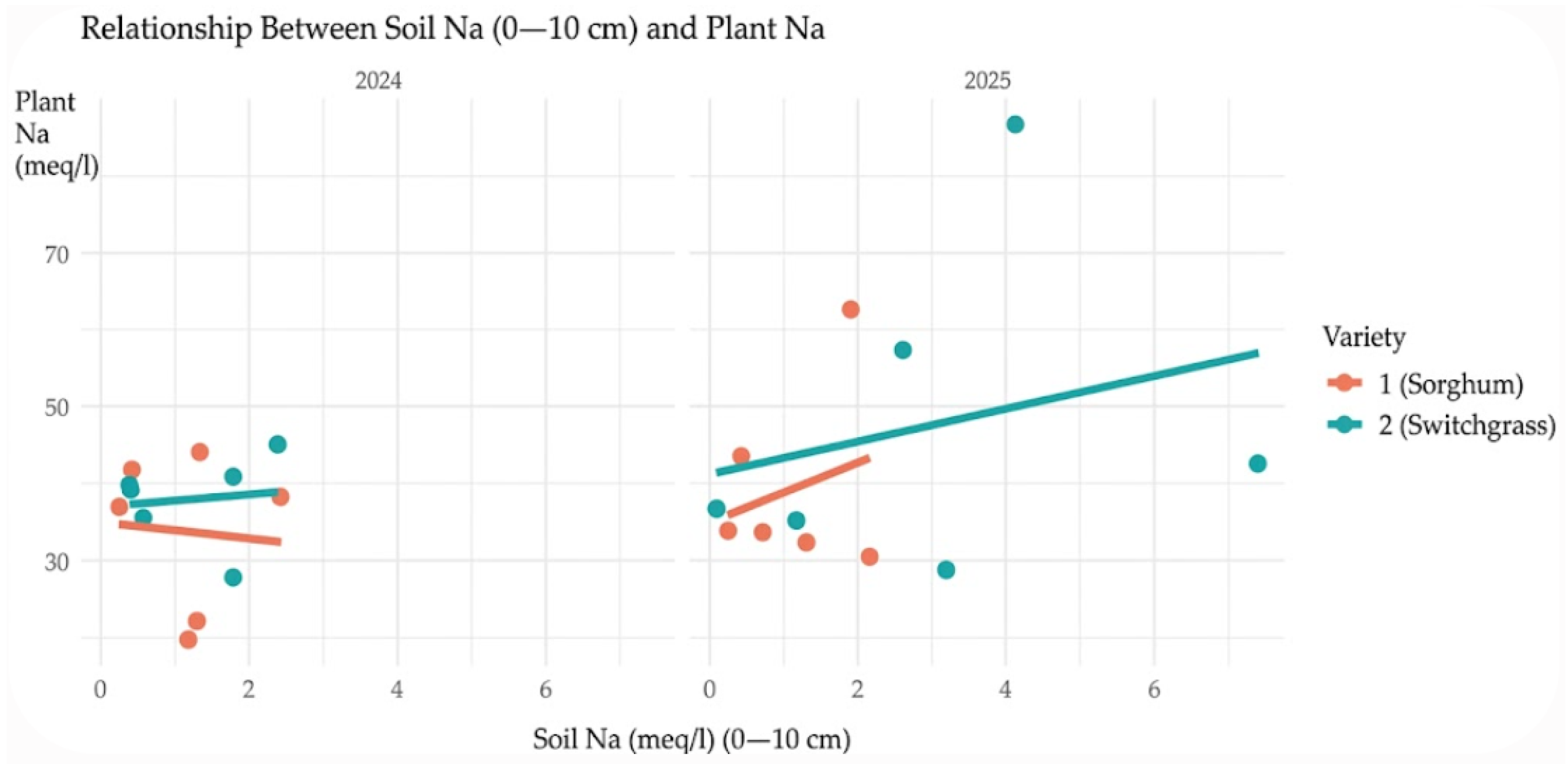
Figure 1 shows the relationship between soil Na+ concentration and plant Na+ accumulation for two varieties across 2024 and 2025. In 2024, soil Na+ concentrations remained relatively low, ranging approximately between 0 and 4 units, while plant Na+ concentrations for both varieties were clustered within a narrower interval of roughly 20–50 units. Regression analyses indicate only weak associations between soil and plant Na+ at these low soil Na+ levels. Specifically, Variety 2 (switchgrass) exhibited a slight positive slope, whereas Variety 1 (sorghum) showed a near-flat or marginally negative trend, suggesting minimal responsiveness of plant Na+ accumulation to soil Na+ availability during this season and only subtle varietal differences in Na+ uptake dynamics. In contrast, during 2025, soil Na concentrations extended to higher values (up to ~6 units), accompanied by a markedly broader range of plant Na+ concentrations (approximately 30–80 units). Under these conditions, Variety 2 displayed a substantially steeper positive regression slope, indicating a stronger increase in plant Na+ concentration with rising soil Na+. This divergence aligns with the findings of Dehnavi et al. [11], who reported that tolerant sorghum genotypes utilize restricted Na+ translocation as a primary defense mechanism. Variety 1 also showed a positive relationship; however, the slope was comparatively modest, and several observations remained below ~40 units of plant Na+ even at elevated soil Na+ levels. This divergence suggests differential regulation of Na+ uptake and/or translocation between the two varieties under higher salinity exposure. Collectively, these patterns provide evidence of genotypic variation in sodium handling. Variety 2 appears to behave as a stronger Na+ “includer,” accumulating greater amounts of Na+ in aboveground tissues as soil Na+ increases, particularly evident in 2025. In contrast, Variety 1 maintains relatively lower tissue Na+ concentrations, consistent with partial exclusion or restricted root-to-shoot translocation mechanisms. Such exclusion-based strategies are widely associated with enhanced salinity tolerance in many crop species [26,27].
The overall positive relationship between soil Na+ availability and plant Na+ concentration observed across years aligns with general physiological principles, whereby plant Na+ content increases proportionally with external Na+ supply under saline conditions, albeit at rates that vary among taxa and genotypes [28]. Nevertheless, the strength of this relationship and the absolute levels of plant Na+ differed substantially between years and varieties, likely reflecting the influence of environmental factors such as precipitation patterns, evapotranspiration demand, and irrigation management, all of which can modulate soil salt accumulation and bioavailability. The higher plant Na+ concentrations observed in 2025, particularly in Variety 2, may indicate greater exposure to saline stress during that season, potentially resulting from reduced leaching or enhanced evaporative concentration of salts in the soil profile. From a physiological perspective, such elevated tissue Na+ levels are agronomically significant. Although some genotypes can tolerate high Na+ concentrations through intracellular compartmentalization (e.g., sequestration into vacuoles), excessive Na+ accumulation is frequently associated with ionic toxicity, osmotic stress, and declines in growth and yield [29]. The tendency of Variety 1 to maintain lower plant Na+ concentrations suggests more effective Na+ exclusion from the xylem stream. The implication here is that for regions with high soil Na+, selecting excluder genotypes like our sorghum variety is crucial to ensure biomass quality and prevent tissue necrosis [30,31].
In summary, the results demonstrate pronounced interannual variability in soil–plant Na+ relationships and clear varietal differences in Na+ accumulation strategies. Variety 1 appears to possess more favorable exclusion or restriction mechanisms for cultivation under saline or salinity-prone conditions, whereas Variety 2 shows greater Na+ accumulation and, potentially, higher sensitivity to salinity stress. These findings underscore the importance of genotype-specific ion regulation strategies in crop improvement and management under variable saline environments [31,32,33]. Future work incorporating formal statistical testing (e.g., analysis of variance for variety × year interactions) and complementary physiological indicators (such as K+/Na+ ratios and tissue-specific Na+ compartmentalization) would further strengthen inferences regarding salinity tolerance mechanisms.
Sorghum is known to exhibit effective partial Na+ exclusion and limited root-to-shoot translocation [34]. In contrast, switchgrass has been reported to show higher sensitivity to salinity stress [35]. Variety 1 (Sorghum) consistently maintained higher biomass and moderate plant Na+ concentrations, even under high salinity conditions, indicating the presence of effective Na+ exclusion or regulated translocation mechanisms. This pattern aligns with strategies commonly associated with enhanced salinity tolerance in crops, where tissue Na+ is restricted to avoid ionic toxicity [36]. Variety 2 (Switchgrass) exhibited higher plant Na+ concentrations with reduced biomass under elevated salinity, indicating greater sensitivity to saline stress. This behavior is consistent with “Na+ includer” genotypes, which accumulate more sodium in aboveground tissues, leading to osmotic imbalance and growth reduction [37].
The observed year-to-year differences suggest that environmental factors—such as precipitation, evapotranspiration, and soil salt dynamics—modulate the extent of salinity stress and plant response. Higher soil Na+ appears to intensify Na+ uptake in sensitive genotypes, whereas tolerant genotypes maintain biomass by restricting Na+ accumulation. Such genotype × environment interactions are critical for breeding and management strategies under saline conditions, emphasizing the importance of selecting varieties with efficient Na+ exclusion and stable performance across years [38,39].
Planted treatments generally showed reduced soil Na+ dispersion compared with no-plant treatments, especially at higher application levels. This stabilization effect may be attributed to plant-mediated processes such as increased water uptake, reduced surface evaporation, and ion redistribution within the soil profile. Similar buffering effects of vegetation on surface soil salinity have been reported in salt-affected agroecosystems [28,33,34,40,41]. It is widely associated with enhanced salinity tolerance in many crop species, as they limit toxic Na+ accumulation in photosynthetic tissues, preserving functions such as photosynthesis and membrane integrity [42]. For example, root-specific modulation of Na+ transporters (e.g., HKT1;1 in Arabidopsis) reduces shoot Na+ by 37–64% and improves tolerance by restricting root-to-shoot transfer [26]. In crops such as maize, wheat, and rice, Na+ exclusion is a key trait linked to better photosynthetic efficiency, chlorophyll retention, and membrane stability under salinity [43]. The includer-like pattern of Variety 2 may align with tissue tolerance mechanisms, including vacuolar compartmentalization for osmotic adjustment, as seen in some tolerant genotypes [44]. However, excessive shoot Na+ can elevate toxicity risk at high levels.
Exclusion strategies, which reduce toxic Na+ buildup in photosynthetic tissues, are widely linked to enhanced salinity tolerance in crops, preserving photosynthesis, membrane integrity, and overall growth [45]. For example, in maize, Na+ excluder genotypes (e.g., ‘SY Sincero’) restrict leaf Na+ accumulation via lower translocation indices, maintaining better photosynthetic efficiency and membrane stability under prolonged salinity compared to includes [46]. Similarly, in Vigna species, Na+ excluder lines limit shoot Na+ while includers accumulate more, with unique Quantitative Trait Loci (QTLs) contributing to tolerance differences [47].
The includer-like accumulation of Variety 2 (Switchgrass) may support osmotic adjustment through vacuolar compartmentalization (tissue tolerance), as observed in some tolerant halophytes or genotypes (e.g., certain Solanum or Vigna lines), but at higher levels, it risks ion toxicity [48].
The dual—benefit of high biomass and Na+ exclusion in sorghum highlights its potential as a profitable bioenergy crop during the phytoremediation process, providing an economic incentive for land reclamation. Our findings are consistent with the results of Kiremit et al. [49], who emphasized that restricting Na+ to roots is a hallmark of salt-tolerant C4 grasses. Furthermore, the ability of switchgrass to increase biomass under saline stress (+43% in 2024) suggests it can thrive in environments typically considered marginal. This niche-specific application allows farmers to choose between rapid biomass/sugar production (Sorghum) and long-term ecological stabilization (Switchgrass) depending on the specific remediation goal.

3.2. Results of the Correlation Analysis Between Crop Yields and Selected Soil Properties

When the correlation between EC values at 10 cm soil depth and crop yields in 2024 was evaluated using Spearman’s rho test, the result for sorghum was rho = −0.89 with p = 0.017 (p < 0.05, significant). This indicates that as EC increased, sorghum yield significantly decreased. For switchgrass, rho = −0.29 with p = 0.57 (p > 0.05, not significant), indicating that the yield reduction associated with increasing EC is not statistically significant.
For 2025, the correlation between EC values at 10 cm soil depth and crop yields showed that for sorghum, rho = −0.68 with p = 0.13 (p > 0.05, not significant), suggesting a non-significant decrease in yield with increasing EC. In contrast, for switchgrass, rho = −0.88 with p = 0.021 (p < 0.05, significant), indicating that switchgrass yield significantly decreased as EC increased. This shift in correlation significance over two years suggests that as salts accumulate, even the more tolerant switchgrass begins to show yield sensitivity, emphasizing the need for strategic irrigation management even in phytoremediation-based systems.
When the correlation between Na+ values at 10 cm soil depth and crop yields in 2024 was evaluated using Spearman’s rho test, the result for sorghum was rho = −0.68 with p = 0.013 (p < 0.05, significant). This indicates that as Na+ increased, the sorghum’s yield significantly decreased. For switchgrass, rho = −0.59 with p = 0.21 (p > 0.05, not significant), indicating that the reduction in yield associated with increasing Na+ concentration is not statistically significant.
For 2025, the correlation between Na+ values at 10 cm soil depth and crop yields showed that for sorghum, rho = −0.49 with p = 0.33 (p > 0.05, not significant), suggesting a non-significant decrease in yield with increasing Na+. For switchgrass, rho = −0.29 with p = 0.57 (p > 0.05, not significant), indicating that the reduction in yield associated with increasing Na+ is not statistically significant.

3.3. Results of Selected Parameters of the Crops

While the plants were harvested on 26 November 2024 and 7 October 2025, length, diameter, weight and BRIX sugar ratio (bx) values were measured and listed in the tables below.
According to the 2024 results, saline water irrigation caused an increase in plant height in both sorghum and switchgrass plants compared to the non-saline treatment. The rate of height increase was 8% for sorghum and 9.6% for switchgrass. According to the 2025 results, saline water irrigation caused a 35% increase in plant height for switchgrass compared with the non-saline treatment, whereas saline irrigation resulted in a 19% decrease in plant height for sorghum (Table 3). The divergent height and diameter responses further confirm the “includer” vs. “excluder” dynamic; sorghum sacrifices vegetative volume to maintain osmotic balance, whereas switchgrass utilizes salt uptake to stimulate structural growth, a halophytic response described by Rengasamy [1] and Qadir et al. [2].
In 2024, saline water irrigation reduced the stem diameter of sorghum, while it increased the stem diameter of switchgrass compared with the non-saline treatment. The stem diameter decreased by 5% in sorghum, and increased by 14% in switchgrass. In 2025, saline water irrigation again reduced the stem diameter of sorghum but increased that of switchgrass compared with the non-saline treatment. The stem diameter decreased by 23% in sorghum and increased by 33% in switchgrass (Table 3).
Table 3 presents the mean and standard error for ‘Height (m)’ and ‘Stem diameter (cm)’ for different treatments (Non-saline Sorghum, Non-saline Switchgrass, Saline Sorghum, Saline Switchgrass) for both years. For 2024, there are no statistically significant differences marked. For 2025, ‘Height (m)’ for ‘Saline Sorghum’ shows a*, indicating a significant difference compared to ‘Non-saline Sorghum’ height in 2025 (Table 3).
In 2024, compared to the non-saline treatment, saline water irrigation decreased the yield of sorghum, while it increased the yield of switchgrass. The yield decreased by 6% in sorghum, whereas it increased by 43% in switchgrass. In 2025, compared to the non-saline treatment, saline water irrigation again decreased the yield of sorghum but increased that of switchgrass. The yield decreased by 11% in sorghum and increased by 29% in switchgrass (Table 4).
According to the results from 2024 and 2025, switchgrass exhibited greater salinity tolerance than sorghum. Saline water irrigation increased the height, stem diameter, and yield of switchgrass (Table 5).
When the average BRIX sugar content (Bx) values of the 2nd, 4th, 6th, and 8th nodes of sorghum (based on five replicated measurements) were examined, it was found that the value was 10.3 under non-saline irrigation and 11.4 under saline irrigation in 2024. In other words, sorghum increased its sugar content by 11% under saline conditions in 2024.
In 2025, the BRIX values were 13.6 under non-saline irrigation and 14.45 under saline irrigation, indicating that sorghum increased its sugar content by 6% under saline conditions (Table 5).
As a result, sorghum increased its sugar content under saline conditions. The observed BRIX increase confirms that sorghum utilizes soluble sugars as primary osmotica to counteract external saline pressure. This finding has profound economic implications: saline stress, while slightly reducing total biomass, actually enhances the quality of the juice for bioethanol production. This “stress-induced quality enhancement” addresses a key implication of this study: the economic feasibility of using saline lands for high-value bioenergy production.
Observed decreases in sorghum height, stem diameter, and plant yield under saline irrigation observed in this study are consistent with the findings of Kiremit et al. [49], who reported that soil salinity reduces all growth parameters of sorghum. Furthermore, this study corroborates the findings of Rengasamy [1] and Qadir et al. [1], who reported that salinity and sodium levels adversely affect crop yield.

4. Conclusions

In this study, an analysis of the soil sodium (Na+, meq/L) concentrations at a 10 cm depth revealed that saline irrigation resulted in statistically significant differences in soil Na+ concentrations for both sorghum and switchgrass plots compared to their respective plots irrigated with non-saline water. Statistical analysis indicated that sorghum and switchgrass exhibited equivalent capacities for soil sodium removal, with no statistically significant differences observed between the two species regarding their sodium reduction efficiency.
Switchgrass was observed to be more tolerant of salinity than sweet sorghum under the conditions of this study. However, although switchgrass showed greater salinity tolerance, sweet sorghum produced considerably higher biomass. From a phytoremediation perspective, this suggests that sweet sorghum may remove greater amounts of salt from the soil due to its superior biomass production.
Over two growing seasons, sweet sorghum (Variety 1) demonstrated superior economic viability for immediate cultivation, maintaining consistently high biomass yields (up to 78.6 t/ha/78,600 kg/ha) and high stem juice BRIX levels through active Na+ exclusion and restricted root-to-shoot translocation. Although saline stress slightly reduced sorghum’s vegetative growth and biomass, it induced an osmotic adjustment response that enhanced its sugar concentration—representing a critical “stress-induced quality enhancement” for bioethanol production. Conversely, switchgrass (Variety 2) exhibited a classic halophytic “includer” behavior; while showing early sensitivity, it adapted remarkably well by the second year, demonstrating a 29% to 43% biomass increase under saline irrigation. These findings indicate that while sweet sorghum maximizes immediate agricultural and bioenergy returns under moderate stress, switchgrass offers a more resilient, long-term pioneer crop option for stabilizing degraded, highly saline lands.
From an environmental reclamation perspective, both crops demonstrated statistically equivalent overall capacities for soil sodium reduction under identical irrigation treatments, highlighting their shared potential to prevent surface salt crusting and buffer topsoil porosity compared to bare fallow land. However, their efficiency varied dynamically depending on the irrigation context: sweet sorghum was more effective in reducing soil salinity under non-saline conditions, whereas switchgrass excelled under saline irrigation regimes, especially as cumulative soil Na+ levels increased. Ultimately, the choice between these two crops should be guided by specific reclamation objectives: sweet sorghum should be deployed for rapid biomass harvesting and sugar extraction on moderately saline soils, whereas switchgrass should be selected for long-term soil structure stabilization, environmental buffering, and sustainable forage production using low-quality, saline water resources. Future research should focus on the multi-year cumulative effects of these phytoremediation cycles on deeper soil profiles and the metabolic pathways governing their divergent sodium handling mechanisms.

Author Contributions

Conceptualization, Ç.A.; Methodology, Ç.A.; Software, Ç.A.; Validation, Ç.A. and A.D.; Formal analysis, Ç.A.; Investigation, Ç.A. and A.D.; Data curation, Ç.A.; Writing—original draft, Ç.A. and A.D.; Writing—review & editing, Ç.A. and A.D.; Visualization, Ç.A. and A.D.; Supervision, Ç.A.; Project administration, Ç.A. All authors have read and agreed to the published version of the manuscript.

Funding

This research received no external funding.

Institutional Review Board Statement

Not applicable.

Informed Consent Statement

Not applicable.

Data Availability Statement

The original contributions presented in the study are included in the article; further inquiries can be directed to the corresponding authors.

Acknowledgments

The authors would like to express their sincere gratitude to Ramazan Meral and Abdulbaki Bilgiç for their valuable guidance, constructive suggestions, and technical support provided throughout the development of this study. Their contributions significantly improved the quality of the research. The authors also acknowledge that all interpretations, results, and conclusions presented in this study remain solely the responsibility of the authors.

Conflicts of Interest

The authors declare no conflicts of interest.

References

  1. Rengasamy, P. Soil processes affecting crop production in salt-affected soils. Funct. Plant Biol. 2010, 37, 613–620. [Google Scholar] [CrossRef]
  2. Qadir, M.; Schubert, S.; Ghafoor, A.; Murtaza, G. Amelioration strategies for sodic soils: A review. Land Degr. Dev. 2001, 12, 357–386. [Google Scholar] [CrossRef]
  3. Ghosh, M.; Singh, S.P. A review on phytoremediation of heavy metals and utilization of it’s by products. Asian J. Energy Environ. 2005, 6, 18. [Google Scholar]
  4. Shahid, S.A.; Zaman, M.; Heng, L. Guidelines for Salinity Assessment, Mitigation and Adaptation Using Nuclear and Related Techniques; Springer: Cham, Switzerland, 2018. [Google Scholar]
  5. Netondo, G.W.; Onyango, J.C.; Beck, E. Sorghum and salinity: II. Gas exchange and chlorophyll fluorescence of sorghum under salt stress. Crop Sci. 2004, 44, 806–811. [Google Scholar] [CrossRef]
  6. Ganjegunte, G.; Ulery, A.; Niu, G.; Wu, Y. Organic carbon, nutrient, and salt dynamics in saline soil and switchgrass (Panicum virgatum L.) irrigated with treated municipal wastewater. Land Degr. Dev. 2018, 29, 80–90. [Google Scholar] [CrossRef]
  7. Flowers, T.J.; Colmer, T.D. Salinity tolerance in halophytes. New Phytol. 2008, 179, 945–963. [Google Scholar] [CrossRef] [PubMed]
  8. Er, H.; Elibol, S. Improvement of Saline Soils by Phytoremediation Method by Applying Purslane (Portulaca oleracea) and Reed Fescue (Festuca arundinacea) Plants at Different Salt Concentrations. Eur. J. Sci. Technol. 2022, 34, 70–74. [Google Scholar]
  9. Aydinşakir, K.; Erdurmuş, C.; Karaca, C. The effect of salinity on evapotranspiration, some growth parameters and ion uptake of sweet sorghum. MAYDICA 2024, 67, 1–8. [Google Scholar]
  10. Kiremit, M.S. Effects of Different Groundwater Depths and Salinities on Evapotranspiration, Yield and Quality Parameters of Wheat. Ph.D. Thesis, Ondokuz Mayıs University Institute of Graduate Studies, Samsun, Turkey, 2023. [Google Scholar]
  11. Dehnavi, A.R.; Zahedi, M.; Piernik, A. Understanding salinity stress responses in sorghum: Exploring genotype variability and salt tolerance mechanisms. Front. Plant Sci. 2024, 14, 1296286. [Google Scholar] [CrossRef] [PubMed]
  12. TSMS-Turkish State Meteorological Service. Climatological Data for Bilecik Province. Ankara, Türkiye. Available online: https://www.mgm.gov.tr/eng/forecast-cities.aspx?m=BILECIK (accessed on 12 December 2023).
  13. USSL (United States Salinity Laboratory). Diagnosis and Improvement of Saline and Alkali Soils; U.S Department of Agriculture Handbook No. 60; USSL (United States Salinity Laboratory): Riverside, CA, USA, 1954. [Google Scholar]
  14. APHA (American Public Health Association). Standard Methods for the Examination of Water and Wastewater, 23rd ed.; APHA: Washington, DC, USA, 2017; p. 1546. [Google Scholar]
  15. Kaçar, B.; İnal, A. Plant Analyses, 2nd ed.; Nobel Academic Publishing: Ankara, Türkiye, 2010; p. 912. [Google Scholar]
  16. Ayyıldız, M. Irrigation Water Quality and Salinity Problems; Ankara University Agriculture Faculty Publications 879/244; Ankara University Agriculture Faculty: Ankara, Türkiye, 1983; p. 282. [Google Scholar]
  17. Ayers, R.S.; Westcot, D.W. Water Quality for Agriculture, 29th ed.; Irrigation and Drainage Paper No. 29; FAO: Rome, Italy, 1989. [Google Scholar]
  18. Tüzüner, A. Soil and Water Analysis Laboratories Handbook; General Directorate of Rural Services, Ministry of Agriculture, Forestry and Rural Affairs: Ankara, Türkiye, 1990. [Google Scholar]
  19. Association of Official Analytical Chemists. Official Methods of Analysis of AOAC International, 18th ed.; Association of Official Analytical Chemists: Gaithersburg, MD, USA, 2005. [Google Scholar]
  20. Duncan, D.B. Multiple range and multiple F tests. Biometrics 1955, 11, 1–42. [Google Scholar] [CrossRef]
  21. Permanasari, A.E.; Rambli, D.R.A.; Dominic, P.D.D. Forecasting method selection using ANOVA and Duncan multiple range tests on time series dataset. In Proceedings of the International Symposium on Information Technology; IEEE: Kuala Lumpu, Malaysia, 2010; Volume 2, pp. 941–945. [Google Scholar]
  22. Sun, W.; He, Z.; Liu, B.; Ma, D.; Si, R.; Li, R.; Wang, S.; Malekian, A. Changes in Photosynthetic Efficiency, Biomass, and Sugar Content of Sweet Sorghum Under Different Water and Salt Conditions in Arid Region of Northwest China. Agriculture 2024, 14, 2321. [Google Scholar] [CrossRef]
  23. Silva, R.R.D.; Queiroz, G.C.M.D.; Sousa, A.C.D.P.; Souto, A.G.D.L.; Andrade, F.H.A.D.; Morais, F.M.D.S.; da Silva Marcelino, R.M.O.; Ferreira, F.N.; da Silva, A.A.; Clemente, M.I.B.; et al. Tolerance of Sweet Sorghum (Sorghum bicolor) to Water Deficit and Irrigation Water Salinity: Water Relations and Production. Phyton 2025, 94, 2797–2814. [Google Scholar] [CrossRef]
  24. Zhang, J.; Meng, Q.; Yang, Z.; Zhang, Q.; Yan, M.; Hou, X.; Zhang, X. Humic Acid Promotes the Growth of Switchgrass under Salt Stress by Improving Photosynthetic Function. Agronomy 2024, 14, 1079. [Google Scholar] [CrossRef]
  25. Ranjbar, G.H.; Ghadiri, H.; Razzaghi, F.; Sepaskhah, A.R.; Edalat, M. Evaluation of the SALTMED model for sorghum under saline conditions in an arid region. Int. J. Plant Prod. 2015, 9, 373–392. [Google Scholar] [CrossRef]
  26. Møller, I.S.; Gilliham, M.; Jha, D.; Mayo, G.M.; Roy, S.J.; Coates, J.C.; Haseloff, J.; Tester, M. Shoot Na+ exclusion and increased salinity tolerance engineered by cell type-specific alteration of Na+ transport in Arabidopsis. Plant Cell 2009, 21, 2163–2178. [Google Scholar] [CrossRef] [PubMed]
  27. Liu, T.Y.; Chen, M.X.; Zhang, Y.; Zhu, F.Y.; Liu, Y.G.; Tian, Y.; Fernie, A.R.; Ye, N.; Zhang, J. Comparative metabolite profiling of two switchgrass ecotypes reveals differences in drought stress responses and rhizosheath weight. Planta 2019, 250, 1355–1369. [Google Scholar] [CrossRef] [PubMed]
  28. Tester, M.; Davenport, R. Na+ tolerance and Na+ transport in higher plants. Ann. Bot. 2003, 91, 503–527. [Google Scholar] [CrossRef] [PubMed]
  29. Almodares, A.; Hadi, M.R.; Kholdebarin, B.; Samedani, B.; Kharazian, Z.A. The response of sweet sorghum cultivars to salt stress and accumulation of Na+, Cl- and K+ ions in relation to salinity. J. Environ. Biol. 2014, 35, 733–739. [Google Scholar] [PubMed]
  30. Zanetti, F.; Zegada-Lizarazu, W.; Lambertini, C.; Monti, A. Salinity effects on germination, seedlings and full-grown plants of upland and lowland switchgrass cultivars. Biomass Bioenergy 2019, 120, 273–280. [Google Scholar] [CrossRef]
  31. Cordero, A.; Garmendia, I.; Osborne, B.A. Interspecific Variations in the Growth, Water Relations and Photosynthetic Responses of Switchgrass Genotypes to Salinity Targets Salt Exclusion for Maximising Bioenergy Production. Agriculture 2019, 9, 205. [Google Scholar] [CrossRef]
  32. Li, Y.; Liu, Q.; Kang, L.; Zhang, K.; Li, Q.; Ai, F. The Mechanisms of Soil Conditioner and Switchgrass in Improving Saline-Alkali Soil: A Field Study in a Semi-Arid Area. Biology 2025, 14, 1788. [Google Scholar] [CrossRef] [PubMed]
  33. Xue, W.; Yang, S.; Liu, X.; Qian, M.; Wang, H.; Yang, H.; Liu, X.; Shen, Y.; Li, J.; Sun, Z. Enhanced Sweet Sorghum Growth and Soil Quality in Coastal Saline–Alkali Soils Through Organic Acid-Containing Bio-Based Materials and Microbial Synergy. Agronomy 2025, 15, 56. [Google Scholar] [CrossRef]
  34. Zhang, L.M.; Leng, C.Y.; Luo, H.; Wu, X.Y.; Liu, Z.Q.; Zhang, Y.M.; Zhang, H.; Xia, Y.; Shang, L.; Liu, C.M.; et al. Sweet Sorghum Originated through Selection of Dry, a Plant-Specific NAC Transcription Factor Gene. Plant Cell 2018, 30, 2286–2307. [Google Scholar] [CrossRef] [PubMed]
  35. Mazarei, M.; Al-Ahmad, H.; Rudis, M.R.; Joyce, B.L.; Stewart, C.N. Switchgrass (Panicum virgatum L.) cell suspension cultures: Establishment, characterization, and application. Plant Sci. 2011, 181, 712–715. [Google Scholar] [CrossRef] [PubMed]
  36. Yang, Z.; Li, J.L.; Liu, L.N.; Xie, Q.; Sui, N. Photosynthetic Regulation Under Salt Stress and Salt-Tolerance Mechanism of Sweet Sorghum. Front. Plant Sci. 2020, 10, 1722. [Google Scholar] [CrossRef] [PubMed]
  37. Wang, J.; Zhang, L.; Wang, X.; Liu, L.; Lin, X.; Wang, W.; Qi, C.; Cao, Y.; Li, S.; Ren, S.; et al. PvNAC1 increases biomass and enhances salt tolerance by decreasing Na+ accumulation and promoting ROS scavenging in switchgrass (Panicum virgatum L.). Plant Sci. 2019, 280, 66–76. [Google Scholar] [CrossRef] [PubMed]
  38. Shrestha, S.L.; Sams, C.; Allen, F. Genotypic Variation for Salt Tolerance within and between ‘Alamo’ and ‘Kanlow’ Switchgrass (Panicum virgatum L.) Cultivars. Agronomy 2022, 12, 973. [Google Scholar] [CrossRef]
  39. Yücel, C.; Yücel, D.; Hatipoğlu, R.; Dweikat, I. Research on the potential of some sweet sorghum genotypes as bioethanol source underMediterranean conditions. Turk. J. Agric. For. 2022, 46. [Google Scholar] [CrossRef]
  40. Zhao, C.; Zhang, H.; Song, C.; Zhu, J.K.; Shabala, S. Mechanisms of plant responses and adaptation to soil salinity. Innovation 2020, 1. [Google Scholar] [CrossRef] [PubMed]
  41. Zhao, C.; Hou, X.; Guo, Q.; Yue, Y.; Wu, J.; Cao, Y.; Wang, Q.; Li, C.; Wang, Z.; Fan, X. Switchgrass Establishment Can Ameliorate Soil Properties of the Abandoned Cropland in Northern China. Agriculture 2022, 12, 1138. [Google Scholar] [CrossRef]
  42. Atta, K.; Mondal, S.; Gorai, S.; Singh, A.P.; Kumari, A.; Ghosh, T.; Roy, A.; Hembram, S.; Gaikwad, D.J.; Mondal, S.; et al. Impacts of salinity stress on crop plants: Improving salt tolerance through genetic and molecular dissection. Front. Plant Sci. 2023, 14, 1241736. [Google Scholar] [CrossRef] [PubMed]
  43. Saleem, M.A.; Khan, A.; Tu, J.; Huang, W.; Liu, Y.; Feng, N.; Zheng, D.; Xue, Y. Salinity Stress in Rice: Multilayered Approaches for Sustainable Tolerance. Int. J. Mol. Sci. 2025, 26, 6025. [Google Scholar] [CrossRef] [PubMed]
  44. Nayak, S.; Bhandari, H.; Pantalone, V.; Saha, M.C.; Ali, S.; Sams, C. Genomic regions associated with salinity tolerance in lowland switchgrass. Crop Sci. 2021, 61, 4022–4037. [Google Scholar] [CrossRef]
  45. Mbarki, S.; Sytar, O.; Cerda, A.; Zivcak, M.; Rastogi, A.; He, X.; Zoghlami, A.; Abdelly, C.; Brestic, M. Strategies to Mitigate the Salt Stress Effects on Photosynthetic Apparatus and Productivity of Crop Plants. In Salinity Responses and Tolerance in Plants; Kumar, V., Wani, S., Suprasanna, P., Tran, L.S., Eds.; Springer: Cham, Switzerland, 2018; Volume 1. [Google Scholar] [CrossRef]
  46. Rizik, M.S.; Assaha, D.V.M.; Mekawy, A.M.M.; Shalaby, N.E.; Ramadan, E.A.; El-Tahan, A.M.; Ibrahim, O.M.; Metwelly, H.I.F.; Okla, M.K.; Maridueña-Zavala, M.G.; et al. Comparative analysis of salinity tolerance mechanisms in two maize genotypes: Growth performance, ion regulation, and antioxidant responses. BMC Plant Biol. 2024, 24, 818. [Google Scholar] [CrossRef] [PubMed]
  47. Ogiso-Tanaka, E.; Chankaew, S.; Yoshida, Y.; Isemura, T.; Marubodee, R.; Kongjaimun, A.; Baba-Kasai, A.; Okuno, K.; Ehara, H.; Tomooka, N. Unique Salt-Tolerance-Related QTLs, Evolved in Vigna riukiuensis (Na+ Includer) and V. nakashimae (Na+ Excluder), Shed Light on the Development of Super-Salt-Tolerant Azuki Bean (V. angularis) Cultivars. Plants 2023, 12, 1680. [Google Scholar] [CrossRef] [PubMed]
  48. Ye, J.; Fan, Y.; Zhang, H.; Teng, W.; Teng, K.; Wu, J.; Fan, X.; Wang, S.; Yue, Y. Octoploids Show Enhanced Salt Tolerance through Chromosome Doubling in Switchgrass (Panicum virgatum L.). Plants 2024, 13, 1383. [Google Scholar] [CrossRef] [PubMed]
  49. Kiremit, M.S.; Öztürk, E.; Arslan, H.; Subrata, B.A.G.; Akay, H.; Bakirova, A. Effects of melatonin, proline, and salicylic acid on seedling growth, photosynthetic activity, and leaf nutrients of sorghum under salt stress. Plant Direct 2024, 8, e574. [Google Scholar] [CrossRef] [PubMed]
Figure 1. Genotypic differences in plant Na+ concentration in response to varying soil Na+ levels (0–10 cm) in 2024 and 2025.
Sustainability 18 06272 g001
Table 1. Plot features.
Plot NoFeatures
1 (P1W1)Non-saline—irrigated sorghum plot, 10 cm depth
2 (FW2)Saline—irrigated fallow plot, 10 cm depth
3 (FW1)Non-saline—irrigated fallow plot, 10 cm depth
4 (P1W2)Saline—irrigated sorghum plot, 10 cm depth
5 (P2W1)Non-saline—irrigated switchgrass plot, 10 cm depth
6 (P2W2)Saline—irrigated switchgrass plot, 10 cm depth
7 (T)Non-irrigated fallow land (control), 10 cm depth
Table 2. Mean biomass (kg ha−1) of sweet sorghum and switchgrass under salt-irrigated and non-salt-irrigated conditions in 2024 and 2025, with 95% confidence intervals.
YearCrop SpeciesIrrigation TreatmentMean Biomass (kg ha−1)SDSE95% CI (Lower)95% CI (Upper)
2024Sweet sorghumNon-saline8368.33826.84477.377432.689303.99
2024Sweet sorghumSaline6916.67478.04275.996375.717457.62
2024SwitchgrassNon-saline2547.67343.94198.572158.462936.87
2024SwitchgrassSaline1353.33374.34216.13929.721776.94
2025Sweet sorghumNon-saline2540.002116.071221.71145.444934.56
2025Sweet sorghumSaline5920.00163.7194.525734.756105.25
2025SwitchgrassNon-saline1055.67164.2194.81869.841241.49
2025SwitchgrassSaline5811.671079.31623.144590.317033.02
Table 3. Average (±standard error) height and diameter of the plants.
Properties of PlantHarvest DateNon-Saline SorghumNon-Saline SwitchgrassSaline SorghumSaline Switchgrass
Average plant height (meter)26 November 20242.25 ± 0.141.36 ± 0.052.43 ± 0.061.49 ± 0.05
7 October 20252.43 ± 0.041 ± 0.091.98 ± 0.04 a*1.35 ± 0.10
Average plant diameter (cm) (Average of 1st–7th node diameters)26 November 20242.09 ± 0.160.49 ± 0.041.99 ± 0.170.56 ± 0.04
7 October 20251.64 ± 0.120.30 ± 0.041.26 ± 0.230.40 ± 0.05
Note: Symbol of a* indicates a statistically significant difference between saline and non-saline conditions for the given parameter and species, as determined by an independent samples t-test (p < 0.05).
Table 4. Average plant yield (kg/da).
Harvest DatePlotYield (kg/da)
26 November 2024Non-saline sorghum6040
Saline sorghum5670
Non-saline switchgrass370
Saline switchgrass530
7 October 2025Non-saline sorghum8870
Saline sorghum7860
Non-saline switchgrass720
Saline switchgrass930
Table 5. Average BRIX sugar ratio (bx) values (average of the 2nd, 4th, 6th, 8th nodes).
Harvest DateNon-Saline SorghumSaline Sorghum
26 November 202410.311.4
7 October 202513.614.45
Disclaimer/Publisher’s Note: The statements, opinions and data contained in all publications are solely those of the individual author(s) and contributor(s) and not of MDPI and/or the editor(s). MDPI and/or the editor(s) disclaim responsibility for any injury to people or property resulting from any ideas, methods, instructions or products referred to in the content.