Designing for Repair and Extended Lifespan: Consumer Expectations and Economic Constraints


Abstract
1. Introduction
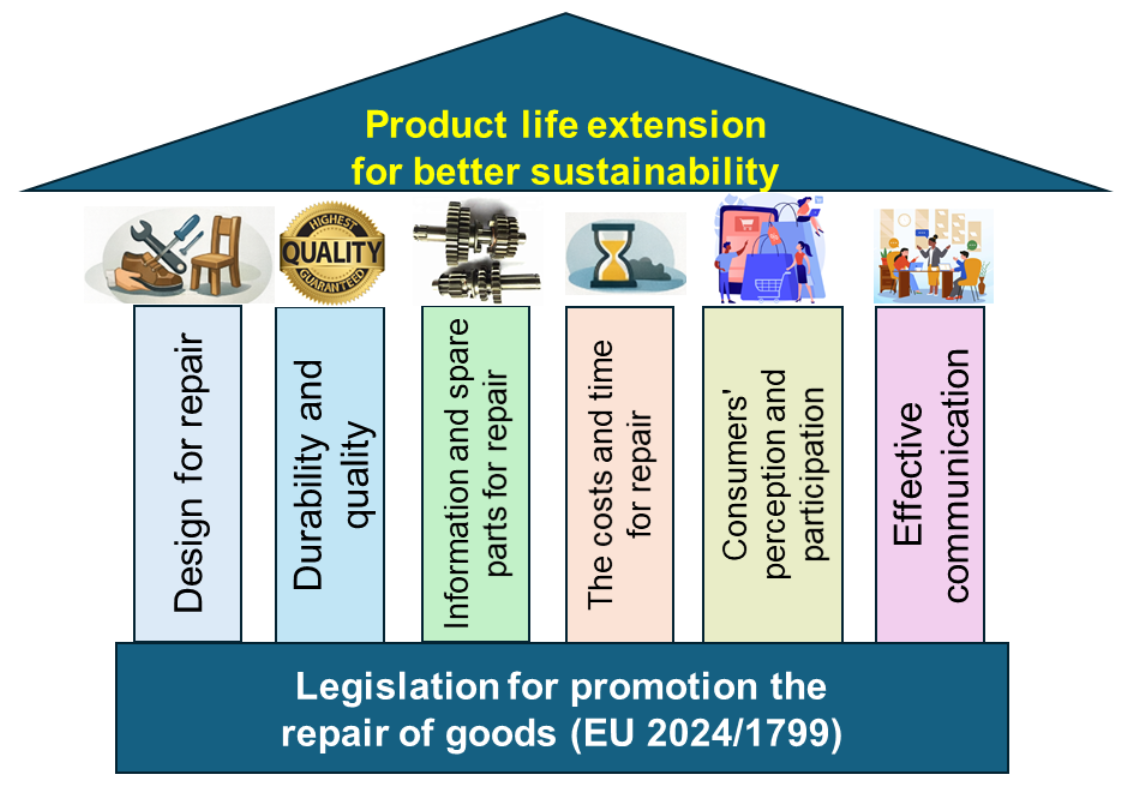
1.1. Behavioral, Economic and Functional Factors for Repair
- Behavioral factors relate to users’ personal values, attitudes, environmental awareness and repair habits, including willingness to repair.
- Economic factors include cost-related aspects of repair, such as the price of spare parts, the perceived value of the product after repair and the financial trade-off between repairing and buying a new product.
- Functional factors refer to technical characteristics that influence repair decisions, including the expected lifetime of the product, inherent reparability (e.g., ease of disassembly, modular design), the quality standards users expect after repair, and any technological limitations that may impede or prevent effective repair.
1.2. Research Aim
2. Methodology
2.1. Survey Design and Data Collection
2.2. Participants
2.3. Data Analysis
3. Results
3.1. Sample Characteristics and Contextual Behavioral Findings
3.2. RQ1—Consumer Attitudes Toward Recycled Materials and Repairability
3.2.1. Descriptive Findings (Q2, Q3, Q6)
3.2.2. Correlation Analysis (RQ1)
3.2.3. Within-Person Differences in Attitudes: Repeated Measures ANOVA (RQ1a)
3.3. RQ2—Behavioral, Economic, and Functional Factors Affecting Repair Decisions
3.3.1. Behavioral Factors
3.3.2. Economic Factors
3.3.3. Functional Factors
3.3.4. Correlation Analysis for Purchase Intentions and Awareness (RQ2a)
3.3.5. Within-Person Differences in Purchase Intentions: Repeated Measures ANOVA (RQ2a)
3.4. Summary: Evidence for Research Questions
3.5. Open-Ended Responses: Enablers of Sustainable Purchasing (Q16)
4. Discussion
4.1. Positive Attitudes Toward Repairability and the Attitude–Behavior Gap
4.2. The Knowledge–Intention Gap and Its Implications for Informational Intervention
4.3. Economic Barriers as the Primary Constraint on Repair Behavior
4.4. Functional Factors: Product-Specific Repair Confidence and Design Complexity
4.5. Design Implications: Durability-First, Repairability-Integrated
4.6. Policy Implications
4.7. Limitations
5. Conclusions
Author Contributions
Funding
Institutional Review Board Statement
Informed Consent Statement
Data Availability Statement
Conflicts of Interest
Abbreviations
| ANOVA | Analysis of Variance |
| CE | Circular Economy |
| DfR | Design for Repair |
| DIY | Do-It-Yourself |
| EU | European Union |
| PRI | Product Repairability Index |
Appendix A
References
- Mont, O. Innovative approaches to optimising design and use of durable consumer goods. Int. J. Prod. Dev. 2008, 6, 227. [Google Scholar] [CrossRef]
- Cooper, T. (Ed.) Longer Lasting Products, 1st ed.; Routledge: New York, NY, USA, 2016. [Google Scholar] [CrossRef]
- Van Der Velden, M. ‘Fixing the World One Thing at a Time’: Community repair and a sustainable circular economy. J. Clean. Prod. 2021, 304, 127151. [Google Scholar] [CrossRef]
- Ruiz-Pastor, L.; Mesa, J.A. Proposing an integrated indicator to measure product repairability. J. Clean. Prod. 2023, 395, 136434. [Google Scholar] [CrossRef]
- Roskladka, N.; Jaegler, A.; Miragliotta, G. From ‘right to repair’ to ‘willingness to repair’: Exploring consumer’s perspective to product lifecycle extension. J. Clean. Prod. 2023, 432, 139705. [Google Scholar] [CrossRef]
- Balkenende, R.; Bakker, C.; Blondel, E.; Henneberry, Y. (Eds.) Repair in the Circular Economy; TU Delft OPEN Publishing: Delft, The Netherlands, 2024. [Google Scholar] [CrossRef]
- Hernandez, R.J.; Miranda, C.; Goñi, J. Empowering Sustainable Consumption by Giving Back to Consumers the ‘Right to Repair’. Sustainability 2020, 12, 850. [Google Scholar] [CrossRef]
- Ackermann, L.; Schoormans, J.P.L.; Mugge, R. Measuring consumers’ product care tendency: Scale development and validation. J. Clean. Prod. 2021, 295, 126327. [Google Scholar] [CrossRef]
- Brusselaers, J.; Bracquene, E.; Peeters, J.; Dams, Y. Economic consequences of consumer repair strategies for electrical household devices. J. Enterp. Inf. Manag. 2020, 33, 747–767. [Google Scholar] [CrossRef]
- Jaeger-Erben, M.; Frick, V.; Hipp, T. Why do users (not) repair their devices? A study of the predictors of repair practices. J. Clean. Prod. 2021, 286, 125382. [Google Scholar] [CrossRef]
- Parajuly, K.; Green, J.; Richter, J.; Johnson, M.; Rückschloss, J.; Peeters, J.; Kuehr, R.; Fitzpatrick, C. Product repair in a circular economy: Exploring public repair behavior from a systems perspective. J. Ind. Ecol. 2024, 28, 74–86. [Google Scholar] [CrossRef]
- Smith, R.B.; Smith, N.N. Right-to-Repair, Product Durability and Obsolescence: A Legal Perspective. J. Indones. Leg. Stud. 2024, 9, 767–798. [Google Scholar] [CrossRef]
- Svensson-Hoglund, S.; Russell, J.D.; Richter, J.L. A Process Approach to Product Repair from the Perspective of the Individual. Circ. Econ. Sustain. 2023, 3, 1327–1359. [Google Scholar] [CrossRef]
- Moalem, R.M.; Mosgaard, M.A. A Critical Review of the Role of Repair Cafés in a Sustainable Circular Transition. Sustainability 2021, 13, 12351. [Google Scholar] [CrossRef]
- Van Oudheusden, A.; Bolaños Arriola, J.B.; Faludi, J.; Flipsen, B.; Balkenende, R. 3D Printing for Repair: An Approach for Enhancing Repair. Sustainability 2023, 15, 5168. [Google Scholar] [CrossRef]
- Chang, W.; Tai, H. A Study of the Factors Affecting Product Values and Preferences–Using Vacuum Cleaner as an Example. In Human Interface and the Management of Information. Information and Knowledge Design and Evaluation; Yamamoto, S., Ed.; Lecture Notes in Computer Science; Springer International Publishing: Cham, Switzerland, 2014; Volume 8521, pp. 561–571. [Google Scholar] [CrossRef]
- Mitra, A. Warranty parameters for extended two-dimensional warranties incorporating consumer preferences. Eur. J. Oper. Res. 2021, 291, 525–535. [Google Scholar] [CrossRef]
- Spreafico, C. An analysis of design strategies for circular economy through life cycle assessment. Environ. Monit. Assess. 2022, 194, 180. [Google Scholar] [CrossRef] [PubMed]
- Bisenebit, L.Y.; Chankov, S.M. The Value of Product Repairability: A Choice-based Conjoint Analysis on Smartphone Preference. In Proceedings of the 2023 IEEE International Conference on Industrial Engineering and Engineering Management (IEEM), Singapore, 18–21 December 2023; pp. 1103–1108. [Google Scholar] [CrossRef]
- European Commission. Directive 2024/1799 on Common Rules Promoting the Repair of Goods. Eur. Parliam. Counc. Off. J. Eur. Union 2024. Available online: https://eur-lex.europa.eu/legal-content/EN/TXT/?uri=CELEX:32024L1799 (accessed on 10 June 2026). [CrossRef]
- Cole, C.; Gnanapragasam, A. Community Repair: Enabling Repair as Part of the Movement Towards a Circular Economy. Nottingham Trent University for The Restart Project. 2017. Available online: https://irep.ntu.ac.uk/id/eprint/30462/ (accessed on 10 June 2026).
- Korsunova, A.; Heiskanen, E.; Vainio, A. Consumer decision-making on repair in a circular economy: A process model based on experiences among young adults and stakeholders in Finland. J. Clean. Prod. 2023, 405, 137052. [Google Scholar] [CrossRef]
- Sandez, S.; Ibáñez-Forés, V.; Pérez-Belis, V.; Juan, P.; Bovea, M.D. Consumer practices regarding the purchase, use, willingness to repair, and disposal of small electric and electronic equipment: A Spanish survey on kettles. J. Ind. Ecol. 2023, 27, 1613–1625. [Google Scholar] [CrossRef]
- Marikyan, D.; Papagiannidis, S. Exercising the ‘Right to Repair’: A Customer’s Perspective. J. Bus. Ethic 2023, 193, 35–61. [Google Scholar] [CrossRef]
- Van Den Berge, R.; Magnier, L.; Mugge, R. Enhancing consumers’ willingness to repair electronic products: How design can nudge sustainable behaviour. In Proceedings of the DRS2022, Bilbao, Spain, 25 June 2022. [Google Scholar] [CrossRef]
- Consumer Expectation. Consumer Expectation on The Re-Use and Repair of Consumer Products in the United States in 2019. 2019. Available online: https://www.statista.com/statistics/1092686/us-consumers-willingness-to-fix-broken-products-for-re-use/ (accessed on 10 June 2026).
- Cullbrand, M.; Levén, L. Spare Parts Pricing-Setting the Right Prices for Sustainable Profit at Atlet. Chalmers University of Technology, Sweden. 2012. Available online: https://scispace.com/pdf/spare-parts-pricing-setting-the-right-prices-for-sustainable-4hb8hsmftr.pdf (accessed on 10 June 2026).
- McQueen, R.H.; Jain, A.; McNeill, L.S.; Kozlowski, A. The role of resources in repair practice: Engagement with self, paid and unpaid clothing repair by young consumers. Text. Res. J. 2023, 93, 576–591. [Google Scholar] [CrossRef]
- Dalhammar, C.; López Dávila, M.; Milios, L.; Luth Richter, J. Circularity and repair policy in the European Union. Ökol. Wirtsch. Fachz. 2022, 37, 26–27. [Google Scholar] [CrossRef]
- Terzioğlu, N. Repair motivation and barriers model: Investigating user perspectives related to product repair towards a circular economy. J. Clean. Prod. 2021, 289, 125644. [Google Scholar] [CrossRef]
- Arredondo-Soto, K.C.; Jiménez-Zaragoza, A.; Miranda-Ackerman, M.A.; Blanco-Fernández, J.; García-Lechuga, A.; Hernández-Escobedo, G.; García-Alcaraz, J.L. Design and Repair Strategies Based on Product–Service System and Remanufacturing for Value Preservation. Sustainability 2022, 14, 8560. [Google Scholar] [CrossRef]
- Salvia, G.; Cooper, T.; Fisher, T.; Harmer, L.; Barr, C. What Is Broken? Expected Lifetime, Perception of Brokenness and University; Nottingham Trent University: Nottingham, UK, 2015. [Google Scholar]
- Kollmuss, A.; Agyeman, J. Mind the Gap: Why do people act environmentally and what are the barriers to pro-environmental behavior? Environ. Educ. Res. 2002, 8, 239–260. [Google Scholar] [CrossRef]
- Visser, M.; Schoormans, J.; Vogtländer, J. Consumer buying behaviour of sustainable vacuum cleaners—Consequences for design and marketing. J. Clean. Prod. 2018, 195, 664–673. [Google Scholar] [CrossRef]
- Sabbaghi, M.; Esmaeilian, B.; Cade, W.; Wiens, K.; Behdad, S. Business outcomes of product repairability: A survey-based study of consumer repair experiences. Resour. Conserv. Recycl. 2016, 109, 114–122. [Google Scholar] [CrossRef]
- Svensson, S.; Richter, J.L.; Maitre-Ekern, E.; Pihlajarinne, T.; Maigret, A.; Dalhammar, C. The Emerging ‘Right to Repair’ Legislation in the EU and the U.S. Going Green CARE INNOVATION 2018, Vienna, Austria, 2018. Available online: https://lup.lub.lu.se/search/ws/files/63585584/Svensson_et_al._Going_Green_CARE_INNOVATION_2018_PREPRINT.pdf (accessed on 10 June 2026).
- Terzioğlu, N.; Wever, R. Integrating Repair into Product Design Education: Insights on Repair, Design and Sustainability. Sustainability 2021, 13, 10067. [Google Scholar] [CrossRef]
- Bobba, S.; Ardente, F.; Mathieux, F. Environmental and economic assessment of durability of energy-using products: Method and application to a case-study vacuum cleaner. J. Clean. Prod. 2016, 137, 762–776. [Google Scholar] [CrossRef]
- Gallego-Schmid, A.; Mendoza, J.M.F.; Jeswani, H.K.; Azapagic, A. Life cycle environmental impacts of vacuum cleaners and the effects of European regulation. Sci. Total. Environ. 2016, 559, 192–203. [Google Scholar] [CrossRef] [PubMed]
- European Commission. Implementing Directive 2009/125/EC of the European Parliament and of the Council with Regard to Ecodesign Requirements for Vacuum Cleaners; No 666/2013; The European Parliament and the Council: Strasbourg, France, 2013. [Google Scholar]


| Q1: How often do you purchase recycled or upcycled products? | 1-Never 2-Rarely (less than once every three months) 3-Occasionally (once a month) 4-Frequently (more than once a week) |
| Q2: Do you believe that products made from recycled materials are less durable than those made from new materials? * Q2-recoded: I do NOT believe recycled products are less durable | 1-Strongly disagree 2-Disagree 3-Neutral 4-Agree 5-Strongly agree |
| Q3: How do you feel about using products made from recycled materials? | 1-Very negative 2-Somewhat negative 3-Neutral 4-Somewhat positive 5-Very positive |
| Q4: Would you be willing to pay more for a product if you knew it could be easily repaired? | 1-Yes 2-No 3-Maybe 4-Other |
| Q5: Cost range of the product I am willing to repair: | 0–30 EUR 30–100 EUR 100–500 EUR 500+ EUR |
| Q6: How important are environmental impacts when you make a purchase decision? | 1-Not at all important 2-Not important 3-Slightly important 4-Somewhat important 5-Very important |
| Q7: How likely are you to buy a product specifically because it has an extendable lifecycle (e.g., can be easily repaired or upgraded)? | 1-Very unlikely 2-Unlikely 3-Somewhat likely 4-Very likely |
| Q8: Given a choice, would you prefer to repair a product rather than replace it, if the costs were comparable? | 1-Yes 2-No |
| Q9: Which of these products do you feel comfortable fixing? (Several options are possible) | 1-Sports equipment 2-Electronics 3-Small home appliance 4-Large home appliance 5-Vehicles 6-Clothing 7-Furniture |
| Q10: Have you ever chosen to repair a product rather than replace it? | 1-Yes 2-No |
| If you answered “yes”, please describe your experience | 1-I have had positive experiences 2-I have had negative experiences 3-Neutral 4-It depends on the individual case (please describe), Other: _____________________ |
| Q11: How do you balance cost with sustainable choices in your purchasing decisions? | 1-Cost is more important 2-Sustainability is more important 3-They are equally important 4-It depends on the product type |
| Q12: What are the main barriers you face when considering repairing a product? (Select all that apply) | 1-Cost of repairs 2-Availability of repair services 3-Time it takes to get something repaired 4-Lack of information about how to repair 5-Other: |
| Q13: How well informed do you feel about the benefits of purchasing recycled and repairable products? | 1-Not informed at all 2-Not very informed 3-Somewhat informed 4-Very well informed |
| Q14: Are you aware of the new EU regulations requiring products to be repairable? | 1-Yes 2-No 3-Somewhat |
| Q15: Given the shift towards more sustainable products, how likely are you to consider repairability as a factor in future purchases? | 1-Very unlikely 2-Unlikely 3-Somewhat likely 4-Very likely |
| Q16: What would encourage you to purchase more recycled or repairable products in the future? | Open question |
| Item | Mean (M) | SD | Scale/Response Options |
|---|---|---|---|
| Q2—Perceived durability of recycled materials | 3.19 | 0.89 | 1 (Strongly disagree)– 5 (Strongly agree) |
| Q3—Affective response toward recycled products | 4.28 | 0.79 | 1 (Very negative)– 5 (Very positive) |
| Q6—Importance of environmental impact | 3.54 | 1.14 | 1 (Not at all important)– 5 (Very important) |
| Q7—Purchase likelihood (extendable lifecycle) | 3.29 | 0.58 | 1 (Very unlikely)– 4 (Very likely) |
| Q13—Awareness of benefits of recycled/repairable products | 2.76 | 0.72 | 1 (Not informed at all)– 4 (Very well informed) |
| Q15—Future repairability consideration | 3.28 | 0.54 | 1 (Very unlikely)– 4 (Very likely) |
| Pair | Pearson r | Spearman ρ | 95% CI (ρ) | p | Kendall τb | p |
|---|---|---|---|---|---|---|
| Q2—Q3 | 0.393 *** | 0.414 *** | [0.212, 0.600] | <0.001 | 0.362 *** | <0.001 |
| Q2—Q6 | 0.206 | 0.161 | [−0.093, 0.399] | 0.189 | 0.139 | 0.188 |
| Q3—Q6 | 0.177 | 0.180 | [−0.059, 0.413] | 0.148 | 0.159 | 0.185 |
| Variable | M (SE) | 95% CI | vs. Q2 Δ | vs. Q3 Δ | vs. Q6 Δ | F (df) | η2p |
|---|---|---|---|---|---|---|---|
| Q2—Perceived durability | 3.19 (0.11) | [2.98, 3.41] | — | −1.09 *** | −0.35 † | F(2, 134) = 30.5 | 0.313 |
| Q3—Affective response | 4.28 (0.10) | [4.09, 4.47] | 1.09 *** | — | 0.74 *** | ||
| Q6—Environmental importance | 3.54 (0.14) | [3.27, 3.82] | 0.35 † | −0.74 *** | — |
| Pair | Pearson r | Spearman ρ | 95% CI (ρ) | p | Kendall τb | p |
|---|---|---|---|---|---|---|
| Q7—Q15 | 0.307 * | 0.286 * | [0.059, 0.496] | 0.018 | 0.275 * | 0.019 |
| Q7—Q13 | −0.063 | −0.070 | [−0.230, 0.120] | 0.569 | −0.063 | 0.578 |
| Q15—Q13 | 0.275 * | 0.291 * | [0.070, 0.470] | 0.016 | 0.270 * | 0.018 |
| Variable | M (SE) | 95% CI | vs. Q7 Δ | vs. Q13 Δ | vs. Q15 Δ | F (df) | η2p |
|---|---|---|---|---|---|---|---|
| Q7—Purchase likelihood (lifecycle) | 3.29 (0.07) | [3.16, 3.43] | — | 0.56 *** | 0.01 | F(1.71, 114.31) = 21.9 | 0.246 |
| Q13—Benefits awareness | 2.74 (0.09) | [2.56, 2.91] | −0.56 *** | — | −0.54 *** | ||
| Q15—Repairability consideration | 3.28 (0.07) | [3.15, 3.41] | −0.01 | 0.54 *** | — |
| Research Question | Evidence from Descriptive and Inferential Results |
|---|---|
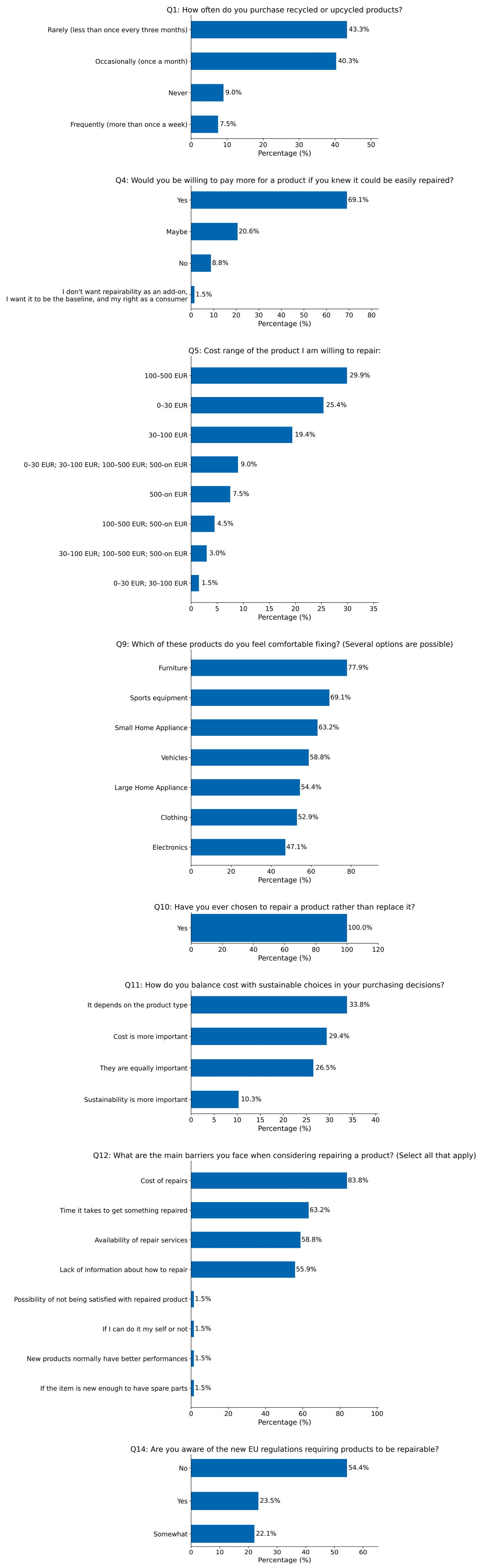
| RQ1—Do end users have a positive attitude toward reparability? | Confirmed. 80.9% of respondents held a positive or very positive affective response toward using recycled products (Q3, M = 4.28); 69.1% were willing to pay more for repairable products; 94% would consider lifecycle extendability in purchase decisions; and 70.1% had already chosen repair over replacement. Model-based means confirmed that affective response (Q3) was rated significantly higher than both durability confidence (Q2, recoded) and environmental importance (Q6), F(2, 134) = 30.5, p < 0.001, η2p = 0.313 (RQ1a). |
| RQ1a—Do consumers’ affective responses toward recycled products differ from their beliefs about durability and their environmental concern, and in what direction? | Confirmed. Affective response (Q3, M = 4.28) significantly exceeded durability confidence (Q2, M = 3.19, Δ = 1.09 ***) and environmental importance (Q6, M = 3.54, Δ = 0.74 ***), indicating that positive affect toward recycled products outpaces durability confidence, which remains only moderately established (Q2, M = 3.19, marginally above midpoint on recoded scale). Strengthening durability confidence is therefore a key lever for consolidating positive consumer orientations. |
| RQ2—What behavioral, economic, and functional factors impact reparability and service lifetime? | Confirmed across all three dimensions. Behavioral: knowledge gaps persist (52.9% only somewhat informed; 32.4% not informed). Economic: cost and time are the leading barriers (cited by over 66% of respondents). Functional: comfort with repair varies by product type (furniture 77.9% vs. electronics 47.1%); design complexity and spare-part availability remain deterrents. |
| RQ2a—Are purchase intentions for extendable-lifecycle products associated with repairability consideration and awareness, and does awareness predict current vs. future behavior differently? | Confirmed. Q7 and Q15 were significantly correlated (r = 0.307 *, ρ = 0.286 *, τb = 0.275 *) and statistically indistinguishable in mean level (M = 3.29 vs. 3.28). Awareness (Q13, M = 2.74) was significantly lower than both (Δ ≈ 0.55, p < 0.001) and correlated with Q15 (ρ = 0.291 *) but not Q7 (ρ = −0.070, ns), confirming that awareness influences future intentions more than immediate purchase behavior. |
| Category | Summary of Responses |
|---|---|
| 1. Cost and Affordability (dominant theme) | Repairable or refurbished products must be less expensive than new ones. Lower repair costs, affordable spare parts, reduced taxes, and incentives (e.g., EU funding) were considered essential. |
| 2. Repairability and DIY Support | The ability to repair products independently, supported by tools, tutorials, and affordable parts. Simplicity and practicality of repairs were cited as important motivators. |
| 3. Spare Parts and Infrastructure | Easier and long-term access to spare parts and a widespread repair network. Availability and affordability of parts and services were considered crucial. |
| 4. Legislation, Incentives, and Regulation | Clearer and stricter regulations on repairability and material transparency, along with legislative support and incentives to encourage sustainable choices. |
| 5. Environmental Awareness and Education | More education on environmental impact, reduction of greenwashing, and increased awareness of resource scarcity and material sustainability. |
| 6. Quality and Durability | Durable, high-quality products with longer warranties are more attractive when considering repairability, as they are more likely to justify repair efforts and costs. |
Disclaimer/Publisher’s Note: The statements, opinions and data contained in all publications are solely those of the individual author(s) and contributor(s) and not of MDPI and/or the editor(s). MDPI and/or the editor(s) disclaim responsibility for any injury to people or property resulting from any ideas, methods, instructions or products referred to in the content. |
© 2026 by the authors. Licensee MDPI, Basel, Switzerland. This article is an open access article distributed under the terms and conditions of the Creative Commons Attribution (CC BY) license.
Share and Cite
Čok, V.; Rihtaršič, J.; Warell, A.; Tavčar, J. Designing for Repair and Extended Lifespan: Consumer Expectations and Economic Constraints. Sustainability 2026, 18, 6270. https://doi.org/10.3390/su18126270
Čok V, Rihtaršič J, Warell A, Tavčar J. Designing for Repair and Extended Lifespan: Consumer Expectations and Economic Constraints. Sustainability. 2026; 18(12):6270. https://doi.org/10.3390/su18126270
Chicago/Turabian StyleČok, Vanja, Janez Rihtaršič, Anders Warell, and Jože Tavčar. 2026. "Designing for Repair and Extended Lifespan: Consumer Expectations and Economic Constraints" Sustainability 18, no. 12: 6270. https://doi.org/10.3390/su18126270
APA StyleČok, V., Rihtaršič, J., Warell, A., & Tavčar, J. (2026). Designing for Repair and Extended Lifespan: Consumer Expectations and Economic Constraints. Sustainability, 18(12), 6270. https://doi.org/10.3390/su18126270