Article

Hydromorphological Restoration and Macroinvertebrate Response in a Mountain River: A Case Study from the Upper Raba River


by
Renata Kędzior
* and
Natalia Michnowska
Department of Ecology, Climatology and Air Protection, University of Agriculture in Krakow, Aleja Mickiewicza 21, 31-120 Krakow, Poland
*
Author to whom correspondence should be addressed.
Sustainability 2026, 18(12), 6266; https://doi.org/10.3390/su18126266
Submission received: 19 April 2026 / Revised: 6 June 2026 / Accepted: 15 June 2026 / Published: 18 June 2026
(This article belongs to the Special Issue Sustainable Environmental Analysis of Soil and Water—2nd Edition)

Abstract

River restoration is increasingly promoted as a nature-based solution, but evidence of its ecological effectiveness in mountain gravel-bed rivers remains limited. Macroinvertebrate responses to hydromorphological restoration are variable and are still rarely evaluated using an integrated approach combining taxonomic, biotic index, and trait-based components. This study examined whether the hydromorphological restoration of the upper Raba River was associated with measurable environmental and ecological differences between the restored and unrestored sections. Six river sections were analyzed, including three restored and three unrestored sections. The environmental characterisation included hydromorphological and physicochemical variables. Benthic macroinvertebrates were sampled in shallow marginal and main-current habitats, and the analyses included assemblage metrics, biotic indices, taxonomic composition, indicator taxa, and functional traits. The restored sections showed greater channel complexity, including a larger active channel zone, a larger number of active channels, and a coarser substrate. These differences were accompanied by higher Shannon diversity, higher values of the Polish Biological Monitoring Working Party index (BMWP-PL), a higher percentage of individuals of Ephemeroptera, Plecoptera and Trichoptera (%EPT), distinct assemblage composition, and shifts in indicator taxa and selected functional traits. The results highlight the value of multidimensional assessment frameworks to evaluate the effects of restoration on mountain rivers.

1. Introduction

Freshwater ecosystems are among the most threatened ecosystem types globally, despite their disproportionate importance for biodiversity, ecological processes, and human well-being. In response to widespread channelization, flow regulation, habitat loss, and declining ecological integrity, river restoration has become a central component of contemporary water management. Many earlier restoration projects were small in scale, weakly targeted toward ecological goals, and insufficiently monitored. Current approaches place greater emphasis on restoring hydrogeomorphological processes and ecosystem functioning rather than on reproducing a fixed channel form [1,2,3]. In this context, restoration is increasingly framed as a key element of sustainable river management, particularly where it contributes to biodiversity conservation, ecosystem resilience, and the recovery of river processes.
Hydromorphology is a central link between physical river conditions and ecological status. Channelization typically reduces lateral mobility, simplifies the channel pattern, constrains floodplain interaction, and homogenizes hydraulic and substrate conditions [4]. In mountain and gravel-bed rivers, such transformations are especially important because ecological quality is strongly related to active channel dynamics, multi-thread morphology, substrate diversity, and the spatial mosaic of habitats [5,6]. Studies from Central European and Carpathian rivers have shown that multi-channel sections differ markedly from single-thread. Previous studies have shown that restoration may increase habitat complexity, stimulate ecosystem functioning, and promote the occurrence of taxa associated with fast flow and coarse substrate, but they have also highlighted important limitations, including weak or delayed biological responses, inconsistent taxonomic recovery, and divergence between taxonomic and functional responses regulated reaches in channel width, shoreline complexity, feature diversity, and substrate heterogeneity, and that hydromorphological assessment is therefore essential for restoration planning and evaluation [7,8,9,10]. From this perspective, restoration of mountain rivers should not be understood solely as local channel reshaping, but as the re-establishment of the physical processes and spatial complexity that sustain ecological functioning.
Although increasing habitat heterogeneity is often treated as a central expectation of river restoration, biological responses remain variable and are not always proportional to visible physical change. Many studies have questioned whether restoration practice delivers the biodiversity gains predicted by restoration theory. Research has shown that ecological responses depend on the response variable considered, the organism group studied, the spatial context, and the extent to which restoration reactivates river processes [2,11,12]. Hydromorphological restoration may stimulate ecosystem functioning and expand habitat availability, but comparative studies also indicate that taxonomic and functional responses can diverge and may remain weaker in aquatic biota than in terrestrial groups if stressors persist or if physical change is insufficient [13,14,15]. Previous studies have shown that restoration may increase habitat complexity, stimulate ecosystem functioning, and promote the occurrence of taxa associated with fast flow and coarse substrate, but they have also highlighted important limitations, including weak or delayed biological responses, inconsistent taxonomic recovery, and divergence between taxonomic and functional responses [12,13,14,15]. These findings indicate that restoration success cannot be assessed reliably using a single biological metric or a single structural habitat descriptor. For this reason, the ecological effectiveness of river restoration should be assessed using an integrated framework that links environmental change with taxonomic, biotic-index, and trait-based responses. This is particularly relevant for macroinvertebrates, which are strongly associated with habitat structure and widely used in river assessment, but are still rarely evaluated jointly with hydromorphological complexity, indicator taxa, and functional traits in restored mountain rivers [16]. Current research trends increasingly emphasize process-based restoration and multidimensional biological assessment. However, a key challenge remains that macroinvertebrate responses are often context-dependent, delayed, and uneven across taxonomic and functional dimensions.
Benthic macroinvertebrates are a particularly informative indicator group because they respond sensitively to both physicochemical degradation and hydromorphological alteration, while integrating environmental conditions over time due to their relatively limited mobility and life-cycle characteristics [17,18]. They also play key roles in freshwater ecosystem functioning, including organic-matter breakdown, nutrient cycling, secondary production, and energy transfer across trophic levels [19,20]. Consequently, changes in macroinvertebrate assemblages can be interpreted not only as indicators of ecological condition, but also as signals of broader changes in river ecosystem functioning and ecological integrity [17,19].
Despite the increasing implementation of river restoration, robust evidence of its ecological effectiveness in mountain gravel-bed rivers remains limited, particularly when hydromorphological change is evaluated together with macroinvertebrate assemblage structure, biotic indices, indicator taxa, and functional traits. This gap is especially relevant in Carpathian rivers, where long-term channelization has reduced habitat heterogeneity and ecological functioning, while process-based restoration is increasingly promoted as a nature-based solution to enhance river resilience and sustainability. The aim of this study was to evaluate whether hydromorphological restoration of the upper Raba River was associated with measurable differences in habitat structure and macroinvertebrate assemblages between restored and unrestored sections. Specifically, we tested whether restored sections exhibited greater hydromorphological complexity, whether section type and habitat type influenced macroinvertebrate assemblage metrics and composition, and whether restoration was linked to shifts in indicator taxa and selected functional traits. We hypothesized that restored sections would be characterized by a wider active channel zone, more frequent multi-thread channel patterns, and coarser substrate, and that these changes would be accompanied by differences in macroinvertebrate assemblage condition, reflected in higher diversity, higher values of the Polish Biological Monitoring Working Party index (BMWP-PL), a higher percentage of Ephemeroptera, Plecoptera, and Trichoptera individuals (%EPT), and distinct taxonomic and functional structure. By integrating hydromorphological, taxonomic, biotic-index, and trait-based perspectives, this study provides a multidimensional evaluation of restoration outcomes and contributes to a stronger ecological basis for the sustainable management of mountain river systems. The main contribution of this study lies in the joint assessment of hydromorphological structure, assemblage metrics, biotic indices, indicator taxa, and functional traits within restored and unrestored sections of a Carpathian gravel-bed river, which allows restoration effects to be interpreted more comprehensively than in studies based on a single biological response variable.

2. Materials and Methods

2.1. Study Area

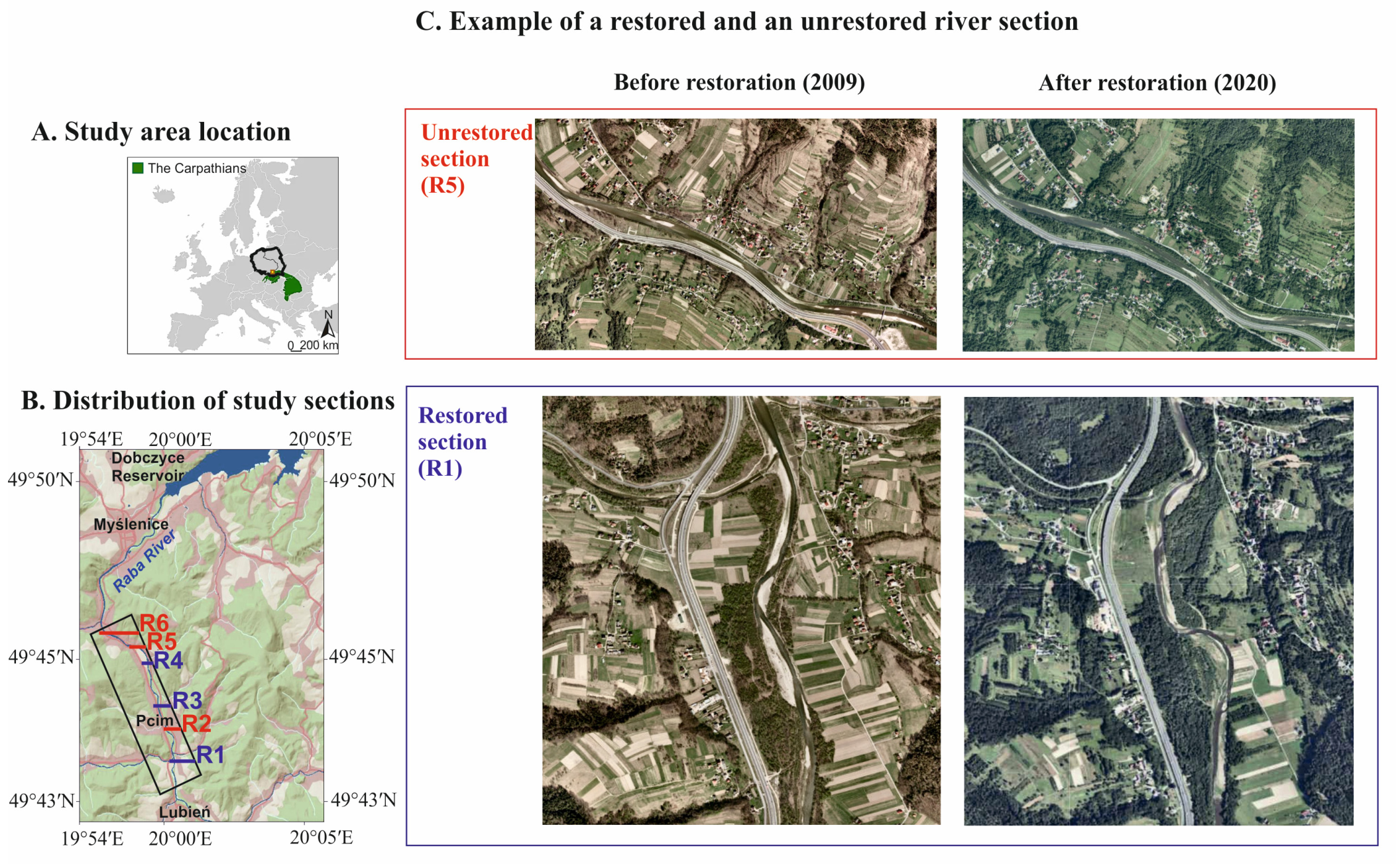
The study was conducted in the upper Raba River, a gravel-bed mountain river located in the Polish Flysch Carpathians (Figure 1). The catchment upstream of the study reach is characterized by moderately high relief, with elevations reaching 1311 m a.s.l., whereas the studied river segment is situated at approximately 330–340 m a.s.l. The low retention capacity of flysch bedrock contributes to high flow variability and pronounced channel dynamics during flood events.
Under natural conditions, the Raba developed a multi-thread, gravel-bed channel pattern with high geomorphic complexity and a heterogeneous mosaic of aquatic and riparian habitats. During the twentieth century, this pattern was progressively altered by channelization, bank reinforcement, sediment extraction, and infrastructure development within the valley floor. In particular, channel regulation associated with the expansion of the national road corridor led to valley narrowing, bank stabilization, and local relocation of the channel. These modifications also contributed to the simplification of channel morphology and increased channel incision in parts of the system.
Restoration in the study area was associated with process-based restoration measures implemented in the upper Raba River as part of the project “The upper Raba River spawning grounds” in 2011–2016. According to [21], maintenance of channelization structures had already been abandoned in a 2.3 km reach in the late 2000s. In the project area, restoration did not rely on constructing a fixed new channel geometry, but on restoring space for fluvial adjustment and reducing direct channel confinement. On the main stem of the Raba, the key measures included redirecting the main using a coarse-rock deflector to promote multi-thread activity and reinforcing the boundary of the free-migration corridor at a distance from the active channel. This measure was intended to protect local infrastructure while allowing continued lateral channel adjustment. Project documentation further indicates that, within the analysed restoration reach, shoreline length increased from 4.8 km to 7.12 km, reflecting a marked increase in channel-planform complexity. An important pre-restoration stage in channel adjustment was the flood of May 2010, which caused substantial channel widening, locally up to threefold [21]. The present study was carried out along a 14 km segment of the upper Raba River, where six river sections were selected for analysis (Figure 1). The study followed a comparative field design based on two section types: restored (ZR) and unrestored (NZR). Three sections represented restored conditions (R1, R3, and R4), whereas three represented unrestored conditions (R2, R5, and R6). The distinction between these two groups was based on the presence or absence of restoration-related channel modifications and the resulting differences in channel form. In general, restored sections were characterized by a wider active channel zone and a more complex channel pattern, including side channels and gravel bars, whereas unrestored sections retained a more confined single-thread morphology. All six sections were located within the same river segment and did not differ markedly in terms of local tributary inputs or surrounding land-use context. This reduced large-scale environmental heterogeneity and allowed the comparison to focus primarily on hydromorphological differences between restored and unrestored sections. This contrast is also illustrated in Figure 1, which includes orthophotographic examples of a restored section (R1) and an unrestored section (R5) in 2009 and 2020.
Within this comparative design, two habitat types were distinguished in each section: shallow marginal habitat (B) and main-current habitat (GN). Six sampling points were established in each section (three per habitat type), yielding a total of 36 macroinvertebrate samples. Hydromorphological and physicochemical variables were recorded at the same sampling points, and all biological sampling was conducted during one standardized late-spring field campaign in May 2020.

2.2. Environmental Variables

Environmental characterization included hydromorphological and physicochemical variables describing habitat conditions at the established sampling locations in each section. Local habitat descriptors recorded at each sampling point included substrate class, active channel width, and plant cover. Given the limited within-section variation in these variables, point-level values were averaged and used to characterize each river section. The number of active channels was recorded at the section scale to characterize single-thread versus multi-thread channel morphology. Physicochemical variables included water temperature (°C), pH, total suspended solids (mg/L), conductivity (µS/cm), chlorides (mg/L), dissolved oxygen (mg/L), five-day biochemical oxygen demand (BOD5, mg O2/L), total nitrogen (mg/L), and total phosphorus (mg/L). Water samples were collected at the macroinvertebrate sampling points in clean polyethylene bottles rinsed with river water, transported under cooled conditions, and analyzed shortly after collection according to standard laboratory procedures. Water temperature, pH, and dissolved oxygen concentration were measured with an ELMETRON CPO-401 multifunction meter (ELMETRON, Zabrze, Poland). pH was measured using an ERH-111 pH electrode (ELMETRON, Zabrze, Poland), and dissolved oxygen concentration was measured using a COG-1 oxygen electrode (ELMETRON, Zabrze, Poland). Total suspended solids were determined gravimetrically using glass fiber filters in accordance with PN-EN 872:2007 [22]. BOD5wfd was determined using the Hg-free OxiTop® system (WTW/Xylem Analytics, Weilheim, Germany) in accordance with PN-EN 1899-1:2002 [23]. Conductivity was determined electrometrically using a Hydromet conductivity electrode and a CX-401 conductivity meter (ELMETRON, Zabrze, Poland), whereas chlorides were determined titrimetrically using silver nitrate. Total nitrogen and total phosphorus were determined colorimetrically after appropriate sample preparation, following laboratory procedures applied for water-quality analyses. For the descriptive presentation in Table 1, point-based measurements were averaged at the section level. Field measurements were preceded by routine calibration of the CPO-401 meter (ELMETRON, Zabrze, Poland) in accordance with the manufacturer’s recommendations. The pH measurements were calibrated using standard buffer solutions, and dissolved oxygen measurements were preceded by sensor calibration. Laboratory analyses were carried out according to standard analytical procedures and reference standards routinely applied in water-quality analyses. Duplicate determinations were used as part of routine analytical quality control.
Table 1. Mean values of hydromorphological and physicochemical characteristics of the six studied river sections.
River Section TypeRestoredUnrestoredExploratory Mann–Whitney U Test
ZRNZR
134256
Hydromorphological habitat parameters
Width (m)204.521615058.56341.5<0.0001
Substrate class4.8355.0834.53.75<0.0001
Plant cover class3.92.12.92.753.252.60.574
Physicochemical water parameters
Temperature (°C)8.18.59.29.49.79.10.0006
pH8.28.28.218.28.198.20.483
Total suspended solids (mg/L)11.41110.811.311.511.70.103
Conductivity (µS/cm)3643633653643643650.837
Chlorides (mg/L)14.214.313.914.114.014.10.715
Dissolved oxygen (mg/L)12.2312.1212.1611.9211.8511.770.006
BOD5 (mg O2/L)1.921.91.91.91.80.196
Total nitrogen (mg/L)1.71.71.81.81.81.70.329
Total phosphorus (mg/L)0.220.210.230.220.220.230.75
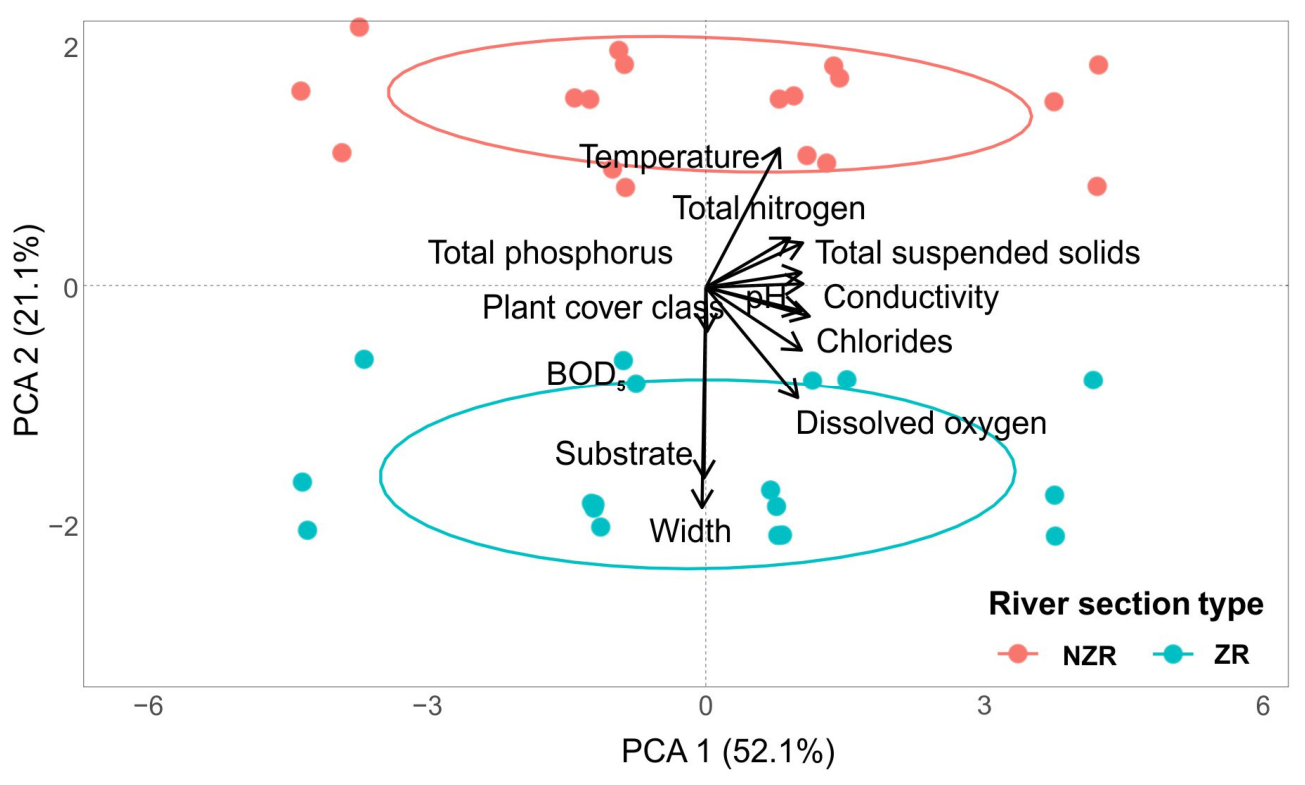
Footnote: Width = active channel width; Substrate class = mean class of sediment size at the study sites; Plant cover class = mean class of plant cover at the study sites. p-values refer to exploratory Mann–Whitney U comparisons between restored and unrestored groups, p < 0.05 are shown in bold. The Mann–Whitney U test indicates significantly lower water temperature and higher dissolved oxygen concentration in restored than in unrestored sections, whereas the remaining physicochemical variables show only limited differentiation between section types (Table 1). Thus, the physicochemical analyses indicate that broad differences in general water-quality conditions are limited, and that the main contrast between section types concerns channel configuration and substrate-related habitat structure. The PCA ordination indicates clear environmental differentiation among the studied sections (Figure 2). The first two axes explain 73.2% of the variation in the environmental dataset. The ordination shows a separation between restored and unrestored sections, with restored sections associated mainly with greater channel width, coarser substrate, and higher dissolved oxygen concentration, whereas unrestored sections are more closely associated with higher water temperature.
Figure 2. PCA ordination of environmental variables measured in the six studied river sections (ZR and NZR) of the upper Raba River. Ellipses indicate 95% confidence intervals for restored (ZR) and unrestored (NZR) sections.
Sustainability 18 06266 g002

2.3. Macroinvertebrate Sampling and Trait Data

Benthic macroinvertebrates were sampled in late spring (mid-May 2020), during a period without recent flood events or intense rainfall, in accordance with standard recommendations for benthic macroinvertebrate sampling. In each river section, a representative 100 m reach was selected. Six quantitative samples were collected per section: three from shallow marginal habitats (B), with water depth up to 0.3 m, and three from main-current habitats (GN), where water depths exceeded 0.6 m. To reduce spatial dependence among samples, sampling points were distributed along the section at intervals of at least 20 m. Habitat types were defined a priori by depth thresholds; therefore, water depth was used only to assign samples to habitat categories. These two habitat categories represented the two main hydraulic settings present in the studied sections and were used consistently in both biological and environmental assessments. Macroinvertebrates were collected from 1 m2 plots using a standard hydrobiological hand net (0.25 × 0.25 m frame, 500 µm mesh size), following procedures commonly applied in Polish Water Framework Directive (WFD)-oriented biomonitoring [24]. Samples were preserved in 70% ethanol, sorted in the laboratory, and identified to the family level using standard European keys [24,25]. Physicochemical and local hydromorphological measurements were recorded at the same six sampling points within each section. For each sample, abundance, taxa richness, and Shannon diversity (H′) were calculated. Two biotic indices were also used: %EPT and BMWP-PL. %EPT was calculated as the percentage contribution of Ephemeroptera, Plecoptera, and Trichoptera to the total assemblage. BMWP-PL was calculated as the sum of family scores reflecting tolerance to environmental degradation and was used as an index of ecological quality in accordance with Polish river bioassessment practice [24].
Trait-based analysis included six groups: rheophilic affinity, coarse substrate affinity, fine sediment affinity, clinging habit, predatory habit, and filter-feeding habit. Trait assignments were based on published European trait resources, primarily [25] and the freshwaterecology.info database [26]. Trait affinities were assigned at the family level and expressed on a 0–1 scale, reflecting the strength of association of each taxon with a given ecological category. For each sample, community-weighted means (CWMs) were calculated by weighting family-level trait affinities by relative abundances [27]. Family-level identification was considered appropriate because it is consistent with Polish WFD-based assessment and is commonly used for detecting broad ecological gradients in freshwater bioassessment and trait-based analyses [28,29].

2.4. Statistical Analysis

Environmental variables were measured at macroinvertebrate sampling points and summarized at the section level to characterize differences between restored and unrestored river sections. Mann–Whitney U tests were used as exploratory comparisons [30], and the results were interpreted as background information supporting the environmental characterization of the study sites. In this study, physicochemical variables were included primarily to verify whether broad differences in general water-quality conditions were present between section types. These analyses were performed in STATISTICA version 13 [31]. Principal component analysis (PCA) was used to identify the main gradients of environmental variation and to visualize multivariate separation between section types. PCA was performed in Canoco version 5.0 [32]. The effects of section type, habitat type, and their interaction on macroinvertebrate assemblage metrics were evaluated using linear mixed models (LMMs). The response variables included abundance, taxa richness, Shannon diversity, BMWP-PL, and %EPT. In each model, section type, habitat type, and their interaction were treated as fixed effects, whereas section identity was included as a random effect to account for the hierarchical structure of the sampling design. The same modeling framework was applied to selected CWM trait variables. These analyses were performed in R version 4.5.3 [33]. Differences in assemblage composition were analyzed using non-metric multidimensional scaling (NMDS) based on Bray–Curtis dissimilarities [34]. The significance of compositional differences between section types and habitat types was tested using permutational multivariate analysis of variance (PERMANOVA) [35]. PERMANOVA may be influenced by differences in within-group dispersion. Homogeneity of multivariate dispersion was further evaluated using a permutational test for homogeneity of multivariate dispersions (PERMDISP) [36]. These multivariate analyses were also conducted in R version 4.5.3 [33]. To complement the community-level analyses, taxonomic beta diversity was partitioned into turnover and nestedness components [37]. Mean values of turnover, nestedness, and total beta diversity were calculated for comparisons within restored sections (ZR), within unrestored sections (NZR), and between ZR and NZR sections, and were used descriptively. Indicator value analysis (IndVal) with 999 permutations was then applied to identify taxa significantly associated with restored or unrestored sections [38].

3. Results

3.1. Environmental Characteristics of Freshwater Habitats

Environmental conditions differ between restored (ZR) and unrestored (NZR) river sections (Table 1, Figure 2). Restored sections are characterized by a higher number of active channels, greater mean channel width, and coarser substrate than unrestored sections. Plant cover class shows less consistent differentiation between section types (Table 1).

3.2. Variation in Macroinvertebrate Communities

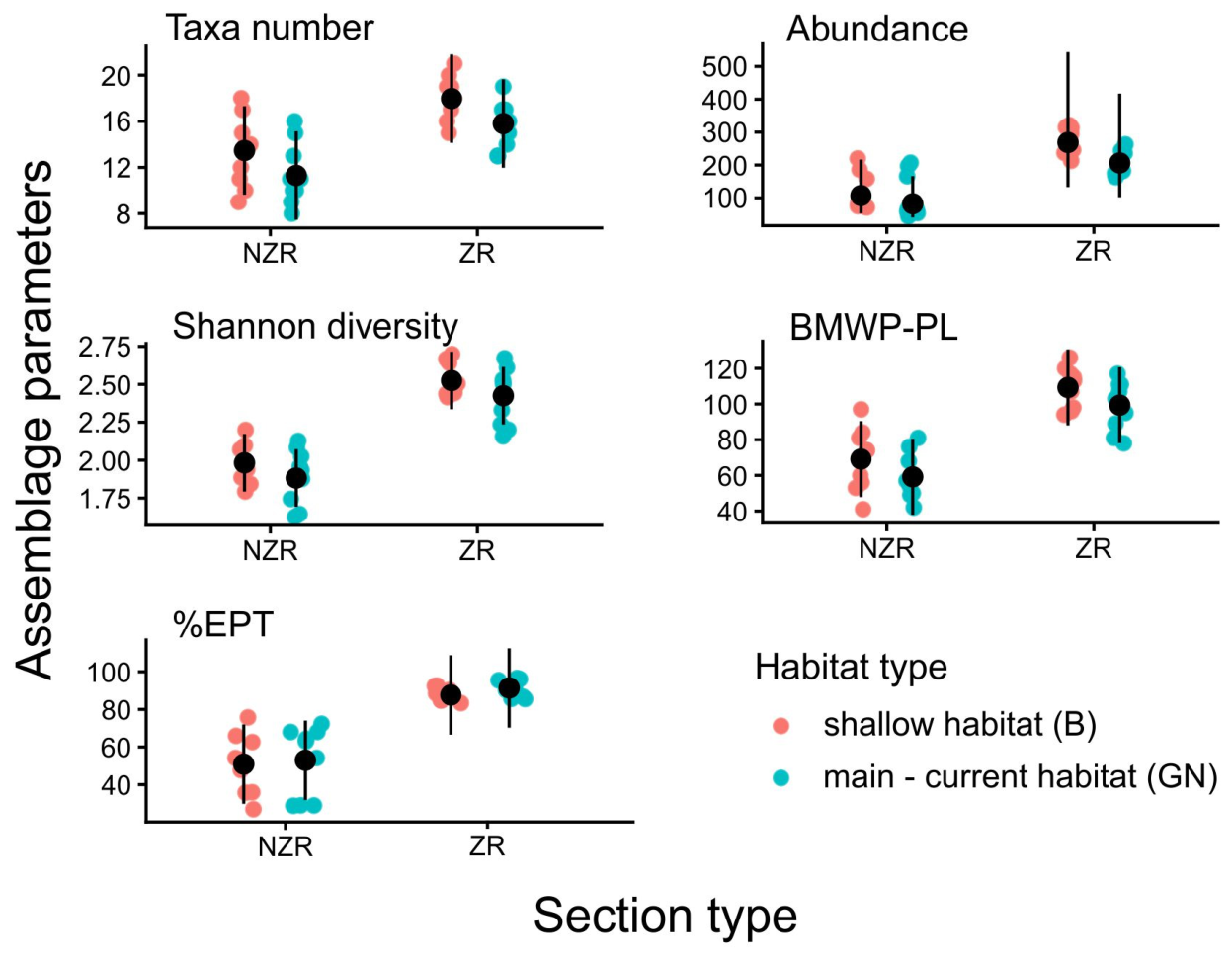
In total, 6290 macroinvertebrate individuals representing nine orders and 26 families were collected (Table S1). The most abundant taxa are Chironomidae (16%), Heptageniidae (11%), and Hydropsychidae (10%). Macroinvertebrate assemblage metrics vary differently in relation to section type, habitat type, and their interaction (Table 2, Figure 3).
Linear mixed models indicate that the analyzed assemblage metrics differ in their response to section type and habitat type (Table 2, Figure 3). Shannon diversity is significantly affected by both section type and habitat type, with higher values in restored sections (ZR) than in unrestored sections (NZR), and slightly higher values in shallow habitats (B) than in main-current habitats (GN). A similar pattern is observed for BMWP-PL. %EPT is significantly affected only by section type, with higher values in restored than in unrestored sections, whereas differences between habitat types within section types are small. The number of taxa is significantly related to habitat type, but not to section type. In both restored and unrestored sections, shallow habitats support more taxa than main-current habitats. Abundance is significantly affected by section type, habitat type, and their interaction. Values are higher in restored than in unrestored sections and, within both section types, are higher in shallow than in main-current habitats. The magnitude of this habitat-related difference varies between restored and unrestored sections, consistent with the significant interaction term.
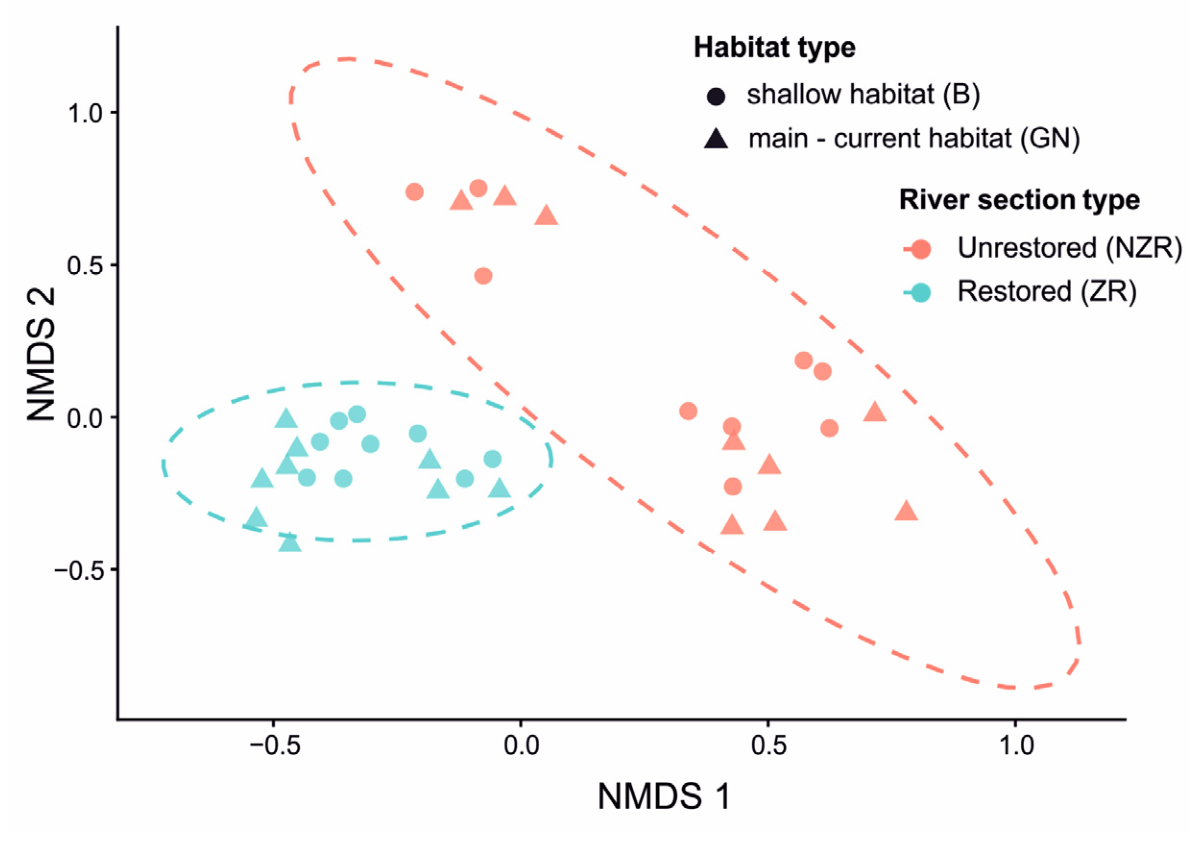
NMDS based on Bray–Curtis dissimilarities reveals a separation between assemblages from restored and unrestored sections (stress = 0.118; Figure 4).
PERMANOVA indicates that the model including section type and habitat type significantly explains variation in assemblage composition (F = 14.533, R2 = 0.4683, p = 0.001). Marginal tests show a significant effect of section type (F = 27.120, R2 = 0.4370, p = 0.001), whereas habitat type is not significant after accounting for section type (F = 1.945, R2 = 0.0313, p = 0.109). Multivariate dispersion also differs significantly between section types (PERMDISP: F = 25.848, p = 0.001). Accordingly, the multivariate separation should be interpreted as reflecting both differences in assemblage composition and differences in within-group dispersion.
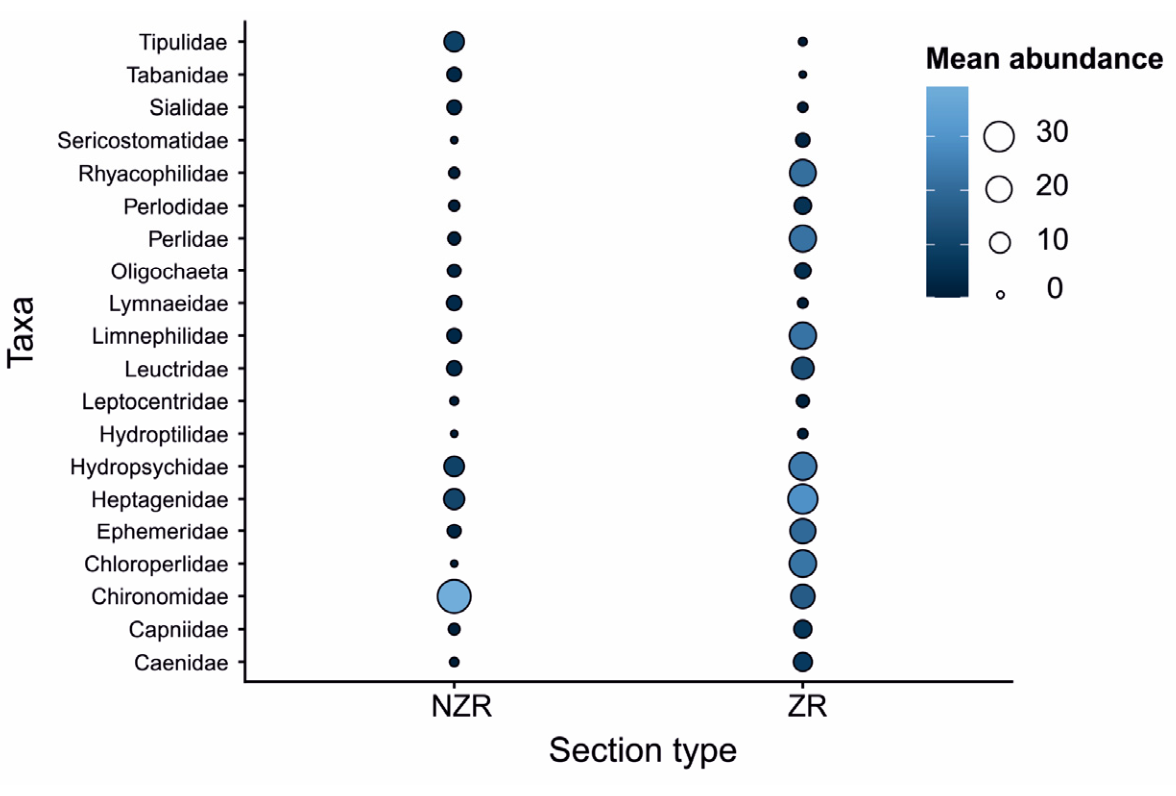
Descriptive decomposition of pairwise taxonomic beta diversity shows that, for comparisons between restored and unrestored sections, mean turnover (0.144) exceeds mean nestedness (0.083). This indicates that compositional differences are more strongly associated with taxon replacement than with nestedness. Mean total beta diversity is lower within restored sections (mean pairwise β = 0.105) than within unrestored sections (mean pairwise β = 0.154), indicating lower taxonomic heterogeneity among restored sections. These values are presented descriptively. Indicator value analysis identifies several taxa significantly associated with either restored (ZR) or unrestored (NZR) sections (Table 3, Figure 5).
NZR sections are associated with Chironomidae, Lymnaeidae, Sialidae, Tipulidae, and Tabanidae. In contrast, ZR sections are associated with a broader group of taxa, many of which are typical of fast-flowing and coarse-substrate habitats (Figure 5).

3.3. Functional Trait Responses to Hydromorphological Restoration

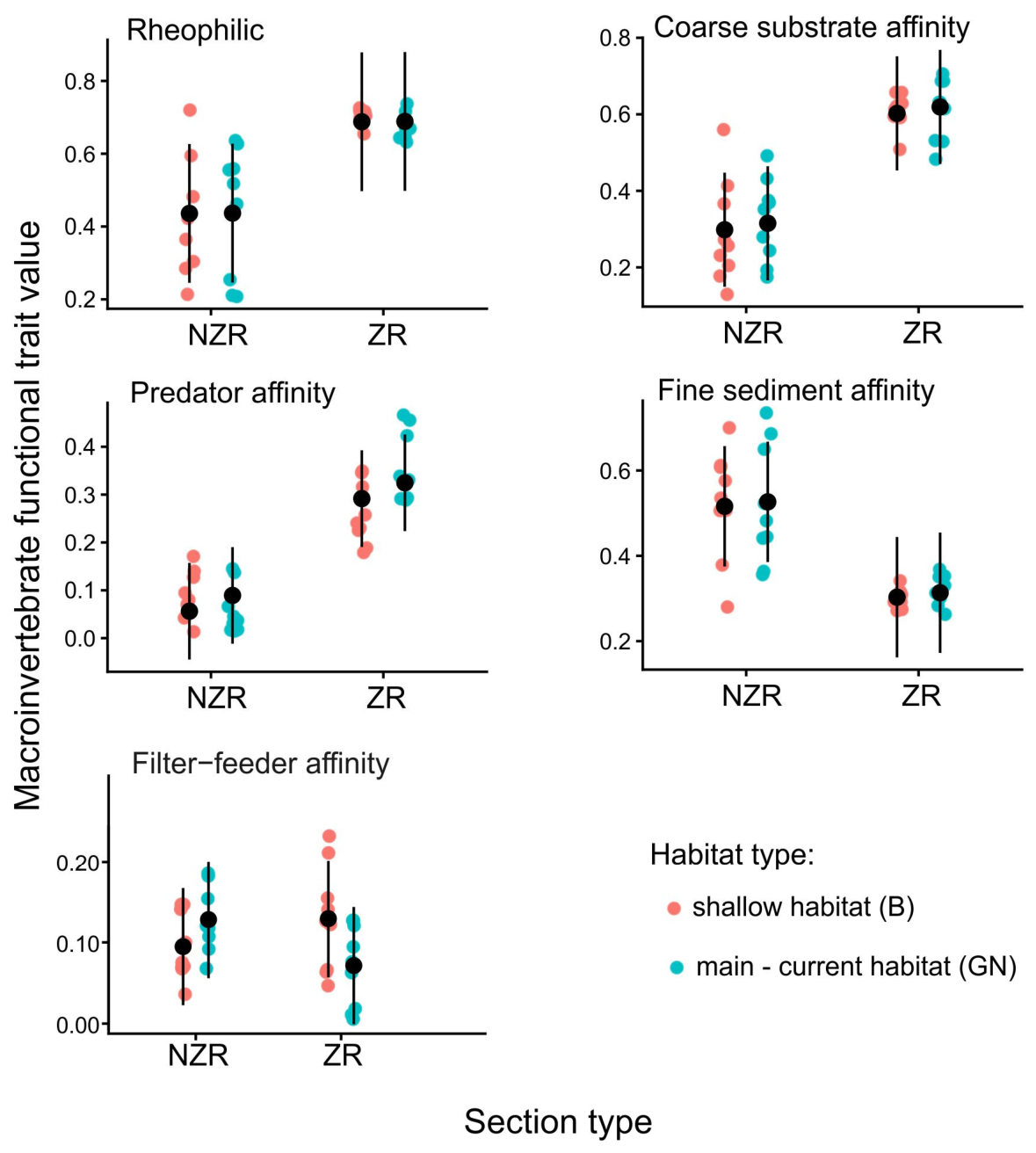
Linear mixed models show that the analyzed functional traits differ in their response to section type and habitat type (Table 4, Figure 6). Rheophilic affinity is significantly affected by section type, whereas habitat type and the interaction term are not significant. Values are higher in restored sections (ZR) than in unrestored sections (NZR), while differences between shallow (B) and main-current (GN) habitats within each section type remain small. A similar pattern is observed for coarse-substrate affinity, which is also significantly related only to section type (Figure 6).
Fine sediment affinity shows the opposite response pattern. It is significantly affected by section type, with higher values in unrestored than in restored sections, whereas neither habitat type nor the interaction term is significant. Both habitat types within NZR are characterized by consistently higher values than the corresponding habitats within ZR (Figure 6).
Predator affinity shows a more complex response, as it is significantly influenced by section type, habitat type, and their interaction. Values are low in both habitats of unrestored sections, but higher in restored sections. Within ZR, predator affinity is higher in the main-current habitat (GN) than in the shallow habitat (B), whereas in NZR the difference between habitats is smaller, consistent with the significant interaction term (Figure 6). Filter-feeder affinity shows no significant main effects of section type or habitat type, but the interaction between these factors is significant. In unrestored sections, values are higher in the main-current habitat than in the shallow habitat, whereas in restored sections the pattern is reversed, with higher values in shallow habitats and lower values in main-current habitats (Figure 6). This pattern indicates that the effect of habitat type on filter-feeder affinity differs between restored and unrestored sections.

4. Discussion

Hydromorphological restoration in the upper Raba River was associated with differences in macroinvertebrate assemblage structure and biotic indices reflecting ecological status, whereas its effect on taxonomic richness was weaker. Higher Shannon diversity, BMWP-PL scores, and %EPT values in restored sections suggest that the biological response involved not only the number of recorded taxa, but also assemblage structure and a greater contribution of taxa characteristic of less altered river conditions. This interpretation should be viewed primarily in the context of hydromorphological differentiation between restored and unrestored sections. The physicochemical component of the study served as background environmental information and was included to verify whether broad differences in general water-quality conditions could provide an alternative explanation for the observed biological patterns. As most measured physicochemical variables showed only limited differentiation between section types, the main interpretative contrast in this study concerns habitat heterogeneity and hydromorphological processes rather than general water-quality conditions. This is consistent with the view that restoration effectiveness should be evaluated primarily through its capacity to re-establish habitat heterogeneity and hydromorphological processes. These processes determine the development of more complex and ecologically typical aquatic communities [2,3,12].
The biological differences observed in the present study should be interpreted in the context of the hydromorphological differentiation between restored and unrestored sections. A wider active channel zone, a higher frequency of multi-thread channel patterns, and coarser substrate in restored sections indicate greater variability in hydraulic and substrate conditions and, consequently, higher habitat heterogeneity [3,16]. In gravel-bed mountain rivers, such channel configuration increases the availability of microsites and may favor the co-occurrence of taxa with different ecological requirements, including forms associated with fast flow and coarse substrate [7,8]. The stronger response of diversity metrics and biotic indices, relative to taxonomic richness alone, suggests that restoration-related differences were expressed more clearly in assemblage structure and ecological quality than in the number of recorded families. This pattern is consistent with previous studies showing that biological responses to restoration depend not only on the increase in physical complexity itself, but also on the extent to which fluvial processes and habitat heterogeneity are effectively re-established [12,15].
Multivariate analyses further indicate that section type was the main factor associated with differences in assemblage composition, whereas habitat type played a weaker role at the assemblage level. This suggests that restoration-related channel adjustment and the resulting reorganization of habitat conditions were more strongly associated with taxonomic structure than local differences between the analyzed habitat types [4,15]. At the same time, the significant PERMDISP result indicates that differences between restored and unrestored sections concerned not only compositional separation, but also within-group heterogeneity. Accordingly, the PERMANOVA results should be interpreted with caution and not as evidence of differences in group centroids alone. Nevertheless, the descriptive beta-diversity analysis supports the view that differences between section types were associated primarily with taxon replacement rather than with simple loss or gain of taxa [37]. In this sense, restoration was associated with assemblage reorganization rather than with a uniform increase in richness, which is consistent with the view that restoration effects should be evaluated not only through synthetic metrics, but also through changes in community structure and ecological organization [12,15,29,39].
The indicator taxa analysis clarifies the direction of this reorganization. Restored sections were associated with a broader set of taxa typical of fast-flowing habitats and coarse substrate, whereas unrestored sections were associated with taxa more frequently occurring under simplified channel conditions. This pattern is consistent with the interpretation that restoration-related channel adjustment increased the availability of habitats typical of dynamic mountain rivers [7,8]. It is also in line with observations from restored Carpathian rivers, where the biological response to restoration was closely linked to the degree of recovery of fluvial processes and channel forms [21]. Rather than indicating a simple increase in faunal abundance or taxonomic richness, the results suggest a shift in assemblage composition toward taxa more closely associated with heterogeneous gravel-bed channel conditions.
A similar pattern emerged from the functional analysis. Restored sections were characterized by a greater contribution of rheophilic taxa and taxa associated with coarse substrate, whereas fine sediment affinity was higher in unrestored sections. These results indicate that restoration-related increases in channel complexity were associated with changes not only in taxonomic composition, but also in the functional organization of the assemblages. At the same time, the responses of predatory and filter-feeding taxa depended more strongly on habitat configuration, indicating that not all functional components responded uniformly to restoration status. This is ecologically relevant because benthic macroinvertebrates contribute to organic matter processing, nutrient cycling, and trophic transfer within river ecosystems [19,20]. In this respect, trait-based analysis complements taxonomic metrics and biotic indices by capturing additional dimensions of ecological response that may be less apparent when assessment is based solely on compositional measures [4,29].
The results indicate that evaluation of restoration effects in mountain rivers should integrate hydromorphological parameters with multiple dimensions of biological response. In the upper Raba River, restored sections differed from unrestored sections not only in physical channel structure, but also in assemblage metrics, taxonomic composition, indicator taxa, and selected functional traits. The concordance between hydromorphological and biological differentiation suggests that restoration-related increases in channel complexity may support ecological reorganization of benthic communities. From a practical perspective, however, such patterns should be verified within a long-term ecological monitoring framework. Monitoring should be repeated across different hydrological seasons and flow conditions to assess the persistence and stability of post-restoration changes. [3,7,39].
These findings should be interpreted within the scope of the adopted study design. The analyses were conducted within a single mountain river system, which reduced variability related to catchment setting, surrounding land use, and background water chemistry; however, the transferability of the observed relationships to other gravel-bed mountain rivers should be verified in broader comparative studies. This study is based on a space-for-time comparison between restored and unrestored sections rather than on a before–after design; therefore, restoration effects are inferred from section-type contrasts and not from direct temporal trajectories within the same sections. In addition, the number of analyzed sections was necessarily limited, which is typical of field-based restoration studies but constrains statistical generalization. As macroinvertebrates were sampled during one defined sampling season, the results reflect differences between section types under standardized temporal conditions rather than the full seasonal dynamics of assemblage composition. The physicochemical component of the study was intentionally limited to background environmental context and was not designed as a dedicated analysis of chemical drivers of assemblage structure. The functional analysis was based on family-level trait classification, which is commonly used in freshwater biomonitoring [28,29], although this level of taxonomic resolution may not capture all species-level trait variation, and finer taxonomic resolution could provide additional ecological detail. Long-term monitoring repeated across different hydrological seasons and flow conditions would be necessary to evaluate the persistence and stability of post-restoration ecological changes more fully. Within these analytical boundaries, the results indicate that increased hydromorphological complexity in restored sections was associated with shifts in the taxonomic and functional organization of benthic macroinvertebrate assemblages.

5. Conclusions

This study compared three restored and three unrestored sections of the upper Raba River and showed that hydromorphological restoration was associated with differences in both physical habitat structure and benthic macroinvertebrate assemblages.
Restored sections were characterized by greater channel complexity, including a wider active channel zone, more frequent multi-thread channel patterns, and coarser substrate. These hydromorphological differences were accompanied by higher macroinvertebrate diversity, higher BMWP-PL scores and EPT (%) values, distinct assemblage composition, and shifts in selected functional traits. A key strength of this study is that restoration effects were assessed jointly using hydromorphological variables, assemblage metrics, biotic indices, indicator taxa, and functional traits, which allowed for a multidimensional interpretation of ecological response. The results should be interpreted in the context of the study’s limitations. The analyses were conducted within a single mountain river system and during one standardized sampling season. The physicochemical component of the study was intended primarily as background environmental characterization rather than as a separate analysis of chemical drivers. Therefore, the results provide clear evidence of section-level differences within the studied system, but their broader generalization requires caution.
From a practical perspective, the findings indicate that evaluation of restoration outcomes in mountain rivers should not rely on a single sampling campaign or a single biological metric. Instead, restoration monitoring should integrate hydromorphological and biological assessment and be repeated across different hydrological seasons and flow conditions. Future research should test whether the patterns observed here are persistent over time and whether similar responses occur in other restored gravel-bed mountain rivers.

Supplementary Materials

The following supporting information can be downloaded at: https://www.mdpi.com/article/10.3390/su18126266/s1, Table S1: Macroinvertebrate taxa recorded in the studied river sections, with their abundances and functional trait classification.

Author Contributions

Conceptualization, R.K.; methodology, R.K.; software, R.K.; validation, R.K.; formal analysis, R.K.; investigation, R.K. and N.M.; resources, R.K.; data curation, R.K.; writing—original draft preparation, R.K. and N.M.; writing—review and editing, R.K. and N.M.; visualization, R.K.; supervision, R.K.; project administration, R.K.; funding acquisition, R.K. All authors have read and agreed to the published version of the manuscript.

Funding

This research received no external funding.

Institutional Review Board Statement

Not applicable.

Informed Consent Statement

Not applicable.

Data Availability Statement

The data are available from the corresponding author on reasonable request.

Acknowledgments

The study was supported by a subsidy from the Ministry of Science and Higher Education in Poland for the University of Agriculture in Krakow in 2026. During the preparation of this work, the authors used ChatGPT 5.2 for language editing and grammar correction. After using this tool, the authors reviewed and edited the output and take full responsibility for the content of this publication.

Conflicts of Interest

The authors declare no conflicts of interest.

References

  1. Bernhardt, E.S.; Palmer, M.A.; Allan, J.D.; Alexander, G.; Barnas, K.; Brooks, S.; Carr, J.; Clayton, S.; Dahm, C.; Follstad-Shah, J.; et al. Synthesizing U.S. river restoration efforts. Science 2005, 308, 636–637. [Google Scholar] [CrossRef] [PubMed]
  2. Palmer, M.A.; Hondula, K.L.; Koch, B.J. Ecological restoration of streams and rivers: Shifting strategies and shifting goals. Annu. Rev. Ecol. Evol. Syst. 2014, 45, 247–269. [Google Scholar] [CrossRef]
  3. Wohl, E.; Lane, S.N.; Wilcox, A.C. The science and practice of river restoration. Water Resour. Res. 2015, 51, 5974–5997. [Google Scholar] [CrossRef]
  4. Kędzior, R.; Skalski, T. Combined effects of river hydromorphological disturbances on macroinvertebrate communities: Multispatial scales analysis of central European rivers. J. Environ. Manag. 2024, 360, 120990. [Google Scholar] [CrossRef] [PubMed]
  5. Borek, L. The impact of the geographical environment on the hydromorphological conditions of watercourses in southern Poland. Geol. Geophys. Environ. 2024, 50, 93–112. [Google Scholar] [CrossRef]
  6. Woś, A.; Książek, L. Hydrodynamics of the instream flow environment of a gravel-bed river. Sustainability 2022, 14, 15330. [Google Scholar] [CrossRef]
  7. Hohensinner, S.; Hauer, C.; Muhar, S. River morphology, channelization, and habitat restoration. In Riverine Ecosystem Management; Schmutz, S., Sendzimir, J., Eds.; Springer: Cham, Switzerland, 2018; pp. 41–65. [Google Scholar] [CrossRef]
  8. Jähnig, S.C.; Lorenz, A.W.; Hering, D. Hydromorphological parameters indicating differences between single- and multiple-channel mountain rivers in Germany, in relation to their modification and recovery. Aquat. Conserv. Mar. Freshw. Ecosyst. 2008, 18, 1200–1216. [Google Scholar] [CrossRef]
  9. Wyżga, B.; Amirowicz, A.; Radecki-Pawlik, A.; Zawiejska, J. Hydromorphological conditions, potential fish habitats and the fish community in a mountain river subjected to variable human impacts, the Czarny Dunajec, Polish Carpathians. River Res. Appl. 2009, 25, 517–536. [Google Scholar] [CrossRef]
  10. Hajdukiewicz, H.; Wyżga, B.; Zawiejska, J.; Amirowicz, A.; Oglęcki, P.; Radecki-Pawlik, A. Assessment of river hydromorphological quality for restoration purposes: An example of the application of RHQ method to a Polish Carpathian river. Acta Geophys. 2017, 65, 423–440. [Google Scholar] [CrossRef][Green Version]
  11. Borek, Ł.; Kowalik, T. Hydromorphological inventory and evaluation of the upland stream: Case study of a small ungauged catchment in Western Carpathians, Poland. Land 2022, 11, 141. [Google Scholar] [CrossRef]
  12. Palmer, M.A.; Menninger, H.L.; Bernhardt, E. River restoration, habitat heterogeneity and biodiversity: A failure of theory or practice? Freshw. Biol. 2010, 55, 205–222. [Google Scholar] [CrossRef]
  13. Kupilas, B.; Hering, D.; Lorenz, A.W.; Knuth, C.; Gücker, B. Hydromorphological restoration stimulates river ecosystem metabolism. Biogeosciences 2017, 14, 1989–2002. [Google Scholar] [CrossRef]
  14. O’Briain, R.; Corenblit, D.; Garófano-Gómez, V.; O’Leary, C. Towards biogeomorphic river restoration: Vegetation as a critical driver of physical habitat. River Res. Appl. 2024, 40, 1087–1105. [Google Scholar] [CrossRef]
  15. Pilotto, F.; Tonkin, J.D.; Januschke, K.; Lorenz, A.W.; Jourdan, J.; Sundermann, A.; Hering, D.; Stoll, S.; Haase, P. Diverging response patterns of terrestrial and aquatic species to hydromorphological restoration. Conserv. Biol. 2019, 33, 132–141. [Google Scholar] [CrossRef] [PubMed]
  16. Kędzior, R.; Kłonowska-Olejnik, M.; Dumnicka, E.; Woś, A.; Wyrębek, M.; Książek, L.; Grela, J.; Madej, P.; Skalski, T. Macroinvertebrate habitat requirements in rivers: Overestimation of environmental flow calculations in incised rivers. Hydrol. Earth Syst. Sci. 2022, 26, 4109–4124. [Google Scholar] [CrossRef]
  17. Bonada, N.; Prat, N.; Resh, V.H.; Statzner, B. Developments in aquatic insect biomonitoring: A comparative analysis of recent approaches. Annu. Rev. Entomol. 2006, 51, 495–523. [Google Scholar] [CrossRef] [PubMed]
  18. Kędzior, R.; Dacewicz, E.; Chmielowski, K.; Ziernicka-Wojtaszek, A. Freshwater biodiversity crisis: Macroinvertebrates’ response along the downstream gradient to receiving effluent from a wastewater treatment plant. J. Elem. 2023, 28, 1311–1328. [Google Scholar] [CrossRef]
  19. Wallace, J.B.; Webster, J.R. The role of macroinvertebrates in stream ecosystem function. Annu. Rev. Entomol. 1996, 41, 115–139. [Google Scholar] [CrossRef]
  20. Covich, A.P.; Palmer, M.A.; Crowl, T.A. The role of benthic invertebrate species in freshwater ecosystems: Zoobenthic species influence energy flows and nutrient cycling. BioScience 1999, 49, 119–127. [Google Scholar] [CrossRef]
  21. Wyżga, B.; Amirowicz, A.; Bednarska, A.; Bylak, A.; Hajdukiewicz, H.; Kędzior, R.; Kukuła, K.; Liro, M.; Mikuś, P.; Oglęcki, P.; et al. Scientific monitoring of immediate and long-term effects of river restoration projects in the Polish Carpathians. Ecohydrol. Hydrobiol. 2021, 21, 244–255. [Google Scholar] [CrossRef]
  22. PN-EN 872:2007; Water Quality—Determination of Suspended Solids—Method by Filtration Through Glass Fibre Filters. Polish Committee for Standardization: Warsaw, Poland, 2007.
  23. PN-EN 1899-1:2002; Water Quality—Determination of Biochemical Oxygen Demand after n Days (BODn)—Part 1: Dilution and Seeding Method with Allylthiourea Addition. Polish Committee for Standardization: Warsaw, Poland, 2002.
  24. Bis, B.; Mikulec, A. Guidelines to the Ecological Status Assessment of Rivers Based on Benthic Macroinvertebrates; Biblioteka Monitoringu Środowiska: Warsaw, Poland, 2013. [Google Scholar]
  25. Tachet, H.; Richoux, P.; Bournaud, M.; Usseglio-Polatera, P. Invertebres d’Eau Douce. Systematique, Biologie, Ecologie; CNRS Editions: Paris, France, 2010. [Google Scholar]
  26. Schmidt-Kloiber, A.; Hering, D. www.freshwaterecology.info—An online tool that unifies, standardises and codifies more than 20,000 European freshwater organisms and their ecological preferences. Ecol. Indic. 2015, 53, 271–282. [Google Scholar] [CrossRef]
  27. Garnier, E.; Cortez, J.; Billès, G.; Navas, M.-L.; Roumet, C.; Debussche, M.; Laurent, G.; Blanchard, A.; Aubry, D.; Bellmann, A.; et al. Plant functional markers capture ecosystem properties during secondary succession. Ecology 2004, 85, 2630–2637. [Google Scholar] [CrossRef]
  28. Jones, F.C. Taxonomic sufficiency: The influence of taxonomic resolution on freshwater bioassessments using benthic macroinvertebrates. Environ. Rev. 2008, 16, 45–69. [Google Scholar] [CrossRef]
  29. Menezes, S.; Baird, D.J.; Soares, A.M.V.M. Beyond taxonomy: A review of macroinvertebrate trait-based community descriptors as tools for freshwater biomonitoring. J. Appl. Ecol. 2010, 47, 711–719. [Google Scholar] [CrossRef]
  30. Mann, H.B.; Whitney, D.R. On a test of whether one of two random variables is stochastically larger than the other. Ann. Math. Stat. 1947, 18, 50–60. [Google Scholar] [CrossRef]
  31. StatSoft. STATISTICA—Data Analysis Software System, Version 13; StatSoft Inc.: Tulsa, OK, USA, 2013.
  32. ter Braak, C.J.F.; Šmilauer, P. Canoco Reference Manual and User’s Guide: Software for Ordination, Version 5.0; Microcomputer Power: Ithaca, NY, USA, 2012.
  33. R Core Team. R: A Language and Environment for Statistical Computing; R Foundation for Statistical Computing: Vienna, Austria, 2026. [Google Scholar]
  34. Bray, J.R.; Curtis, J.T. An ordination of the upland forest communities of southern Wisconsin. Ecol. Monogr. 1957, 27, 325–349. [Google Scholar] [CrossRef] [PubMed]
  35. Anderson, M.J. A new method for non-parametric multivariate analysis of variance. Austral Ecol. 2001, 26, 32–46. [Google Scholar] [CrossRef]
  36. Anderson, M.J. Distance-based tests for homogeneity of multivariate dispersions. Biometrics 2006, 62, 245–253. [Google Scholar] [CrossRef] [PubMed]
  37. Baselga, A. Partitioning the turnover and nestedness components of beta diversity. Glob. Ecol. Biogeogr. 2010, 19, 134–143. [Google Scholar] [CrossRef]
  38. Dufrêne, M.; Legendre, P. Species assemblages and indicator species: The need for a flexible asymmetrical approach. Ecol. Monogr. 1997, 67, 345–366. [Google Scholar] [CrossRef]
  39. Tickner, D.; Opperman, J.J.; Abell, R.; Acreman, M.; Arthington, A.H.; Bunn, S.E.; Cooke, S.J.; Dalton, J.; Darwall, W.; Edwards, G.; et al. Bending the curve of global freshwater biodiversity loss: An emergency recovery plan. BioScience 2020, 70, 330–342. [Google Scholar] [CrossRef] [PubMed]
Figure 1. Study area location (A), distribution of the six restored and unrestored sections in the upper Raba River basin (B), and orthophotograph examples of restored section R1 and unrestored section R5 in 2009 and 2020 (C). The red dot in panel (A) indicates the study area, and the black frame in panel (B) delineates the studied river segment. Blue labels indicate restored sections (R1, R3, and R4), whereas red labels indicate unrestored sections (R2, R5, and R6). Source: Authors’ elaboration based on Geoportal.gov.pl (https://www.geoportal.gov.pl/).
Sustainability 18 06266 g001
Figure 3. Raw values (colored points) and model-estimated means (black points), and ±95% confidence intervals (error bars) for macroinvertebrate assemblage parameters in restored (ZR) and unrestored (NZR) sections, shown separately for shallow (B) and main-current (GN) habitats.
Sustainability 18 06266 g003
Figure 4. NMDS ordination of macroinvertebrate assemblages based on Bray–Curtis dissimilarities. Samples are colored by section type (ZR, NZR) and distinguished by shallow (B) and main-current (GN) habitats. Ellipses indicate the group-specific dispersion of samples according to river section type. Stress = 0.118.
Sustainability 18 06266 g004
Figure 5. Bubble plot showing mean abundance of taxa significantly associated with restored (ZR) and unrestored (NZR) river sections according to indicator value analysis (IndVal). Bubble size represents mean abundance in each section type.
Sustainability 18 06266 g005
Figure 6. Raw values (colored points) and model-estimated means (black points) with 95% confidence intervals (error bars) for selected functional traits of macroinvertebrate assemblages in restored (ZR) and unrestored (NZR) river sections, shown separately for shallow (B) and main-current (GN) habitats.
Sustainability 18 06266 g006
Table 2. Effects of section type, habitat type, and their interaction on macroinvertebrate assemblage metrics based on linear mixed models with section identity as a random effect.
Response VariableEffectNumDFDenDFFp
AbundanceSection type148.650.042
Habitat type12938.72<0.001
Section type × Habitat type12822.61<0.001
Number of taxaSection type145.220.084
Habitat type12921.03<0.001
Section type × Habitat type1280.340.565
Shannon diversitySection type1430.410.005
Habitat type1295.950.021
Section type × Habitat type1280.170.686
BMWP-PLSection type1413.490.021
Habitat type12911.970.002
Section type × Habitat type1280.030.865
%EPTSection type1413.980.020
Habitat type1291.920.176
Section type × Habitat type1280.000.992
Footnote: NumDF—numerator degrees of freedom; DenDF—denominator degrees of freedom. Significant effects (p < 0.05) are shown in bold.
Table 3. Macroinvertebrate taxa significantly associated with restored (ZR) and unrestored (NZR) river sections according to IndVal analysis.
Macroinvertebrate TaxaAssociated River Section TypeIndValp
ChironomidaeNZR0.8400.015
LymnaeidaeNZR0.8170.001
SialidaeNZR0.6910.014
TipulidaeNZR0.5740.041
TabanidaeNZR0.5770.021
ChloroperlidaeZR1.0000.001
RhyacophilidaeZR0.9800.001
PerlidaeZR0.9620.001
CaenidaeZR0.9550.001
EphemeridaeZR0.9410.001
LimnephilidaeZR0.9370.001
LeuctridaeZR0.8870.001
HeptagenidaeZR0.8570.001
CapniidaeZR0.8440.001
HydropsychidaeZR0.8420.003
PerlodidaeZR0.8200.003
SericostomatidaeZR0.8160.002
OligochaetaZR0.7730.045
LeptocentridaeZR0.7480.004
HydroptilidaeZR0.6240.007
Footnote: IndVal—indicator value. Only taxa with significant associations (p < 0.05) are shown.
Table 4. Effects of section type, habitat type, and their interaction on selected functional traits of macroinvertebrate assemblages based on linear mixed models with section identity included as a random effect.
Functional TraitEffectNumDFDenDFFp
RheophilicSection type146.630.046
Habitat type1290.000.968
Section type × Habitat type1280.990.327
Coarse substrate affinitySection type1415.770.017
Habitat type1290.770.387
Section type × Habitat type1280.730.4
ClingerSection type140.070.799
Habitat type1290.150.701
Section type × Habitat type1280.770.387
Filter feederSection type140.090.781
Habitat type1290.830.370
Section type × Habitat type12818.220.0002
PredatorSection type1420.550.011
Habitat type1295.190.030
Section type × Habitat type12863.23<0.001
Fine sediment affinitySection type148.610.043
Habitat type1290.260.615
Section type × Habitat type1280.370.545
Footnote: NumDF—numerator degrees of freedom; DenDF—denominator degrees of freedom. Significant effects (p < 0.05) are shown in bold.
Disclaimer/Publisher’s Note: The statements, opinions and data contained in all publications are solely those of the individual author(s) and contributor(s) and not of MDPI and/or the editor(s). MDPI and/or the editor(s) disclaim responsibility for any injury to people or property resulting from any ideas, methods, instructions or products referred to in the content.