


Abstract
The transition toward sustainable power systems requires load forecasting methods that can support renewable integration under increasing uncertainty. However, many deep learning models mix historical load, temporal priors, and external drivers in black-box structures, and often assume that true future driver values are available. To address these issues, this study proposes ADDF (Automatic Driver Discovery and Fusion), a semi-explicit self-driven framework for multi-step load interval forecasting. ADDF organizes historical load, calendar priors, and external drivers into three functional branches to distinguish load inertia, temporal regularity, and external forcing. The Driver Branch estimates future driver states under practical information constraints and uses dynamic gating to screen useful driving information. The three branch representations are adaptively integrated through Three-Way Fusion, followed by bounded residual correction to generate multi-step quantile forecasts. Experiments on the Panama electricity load dataset and ETTh1 dataset under one-step and 24-step settings show that ADDF achieves competitive point accuracy and interval prediction performance. Mechanism analyses indicate that the proposed branch-level structure provides clearer interpretability than post-hoc black-box explanations. The framework offers uncertainty-aware forecasting support for sustainable power system operation, including day-ahead scheduling, reserve planning, and energy management.
1. Introduction
As the share of renewable energy sources such as wind and photovoltaic generation continues to increase, the operation of modern power grids is changing. Compared with conventional controllable generation, renewable generation is more strongly affected by weather conditions, seasonal patterns, and operating environments, and therefore shows greater variability and uncertainty [1]. At the same time, end-user load also changes with time, temperature, holidays, and social activities. These factors make it more difficult for power systems to maintain supply-demand balance, arrange reserve capacity, and prepare operational schedules [2]. Load forecasting is therefore used to estimate future electricity demand in advance and provide useful information for unit commitment, economic dispatch, energy storage allocation, and demand response [3].
Artificial intelligence methods are increasingly used for load forecasting because they can learn nonlinear relationships between load variations and external factors from historical data, rather than relying only on manually specified formulas. However, practical scheduling requires not only an expected load value, but also an understanding of the possible range of forecasting errors. Conventional point forecasting usually provides a single predicted value and is insufficient to describe the accumulation of uncertainty in multi-step forecasting [4]. Interval forecasting can therefore provide more useful uncertainty bounds for reserve planning, day-ahead scheduling, and risk-aware energy management [5]. Meanwhile, directly concatenating multiple information sources may improve fitting capacity, but it can also mix their functional roles and reduce interpretability. Therefore, a multi-step load interval forecasting framework with predictive accuracy, structural clarity, and uncertainty representation capability is needed.
1.1. Literature Review
Forecasting tasks involving unit output, wind power, photovoltaic power, and end-user load can all be regarded, in essence, as time-series modeling problems. Early studies mainly relied on statistical methods such as ARIMA [6] and ARCH/GARCH [7], which perform forecasting by characterizing sequence trends, correlations, and volatility patterns. As data volumes and feature dimensions have increased, machine learning models including support vector regression (SVR) [8], k-nearest neighbor regression (KNN), random forest (RF) [9], gradient boosting regression trees (GBRT), XGBoost [10], and LightGBM have been increasingly applied to energy forecasting tasks. Compared with traditional statistical models, these methods are more flexible in handling multivariable inputs and complex nonlinear mappings.
To improve the predictive performance of machine learning models, existing studies have explored sequence decomposition, model optimization, and ensemble learning. Li-Ling Peng et al. [11] used differential empirical mode decomposition (DEMD) to separate load series into high- and low-frequency components, and combined this strategy with a quantum particle swarm optimization (QPSO)-based SVR model to improve the fitting of highly fluctuating sequences. Shaohua Yu et al. [12] incorporated a multi-head self-attention mechanism into N-BEATS, employed XGBoost to characterize the nonlinear effects of external variables, and achieved model integration through an optimized weighted averaging strategy. Xuzhi Deng et al. [13] further introduced the Bagging strategy into XGBoost to reduce output variance and improve generalization capability. These studies indicate that feature reconstruction, parameter optimization, and model ensembling can contribute to improved load forecasting performance and provide useful data-driven tools for energy-system prediction tasks.
With advances in computing hardware and deep learning, neural networks have gradually become important tools for complex time-series forecasting. RNNs and their variants, including LSTM [14], GRU, and BiLSTM [15], are well suited to modeling sequential dependencies. CNNs are effective in extracting local patterns and multi-scale features [16], and have further evolved into temporal convolutional networks (TCNs) for time-series tasks [17]. Building on these developments, Yuanyuan Xu et al. [18] introduced an attention mechanism into BiLSTM to strengthen the extraction of long-range temporal dependencies and multidimensional feature relationships. Xinjian Xiang et al. [19] applied CEEMDAN to decompose load series into high- and low-frequency components, and then used TCN and SMA-optimized SF-TCN for separate prediction, thereby improving the modeling of load series with complex fluctuations.
Transformer [20], built on the self-attention mechanism, further strengthens the modeling of long-range dependencies and has promoted the development of time-series forecasting toward long-horizon structural representation. To improve long-sequence forecasting efficiency, trend-periodicity decomposition, and frequency-domain information utilization, Informer [21], Autoformer [22], and FEDformer [23] were successively proposed. Informer reduces the computational cost of long-sequence modeling through sparse attention, Autoformer introduces series decomposition and an autocorrelation mechanism, and FEDformer enhances long-term dependency extraction using frequency-domain representations. Further, Long Ma et al. [24] integrated Kolmogorov–Arnold Networks (KANs) with Transformer and optimized expert weight allocation through a load-balancing loss, thereby improving feature extraction while enhancing model interpretability. Kaiyu Yang et al. [25] quantitatively characterized external variables and developed a hybrid forecasting framework based on an improved Informer, demonstrating the benefits of external-information modeling and long-sequence structural optimization for forecasting performance.
Although existing deep learning methods have achieved considerable progress in load forecasting, several limitations remain. First, many methods concatenate historical load, meteorological variables, event information, and temporal features as unified network inputs. This strategy can enhance nonlinear fitting capacity, but it may also lead to overlapping information roles, blurred functional boundaries, and difficulty in explaining the specific contribution of each information source. Second, some studies use true future values of driving variables as known inputs, which is not always consistent with practical forecasting conditions. Third, point forecasting alone cannot adequately characterize future load fluctuation or prediction risk. These limitations become more pronounced in multi-step forecasting, where uncertainty may accumulate as the prediction horizon extends.
1.2. Aim of the Work
Deep learning models are effective in learning nonlinear mappings from multivariate time-series data, but many load forecasting methods still feed heterogeneous information into a unified black-box network. Although this mixed modeling strategy may improve fitting capacity, it blurs the functional boundaries among historical load, temporal priors, and external drivers. As a result, the model can generate forecasts but provides limited insight into which information sources dominate load variation and how they contribute to prediction.
To address this issue, this study aims to develop a semi-explicit self-driven framework for multi-step load interval forecasting under realistic information constraints. The proposed framework retains the nonlinear representation ability of neural networks while organizing heterogeneous information according to functional roles. Rather than pursuing a fully mechanistic explanation, it makes the roles of different information sources more traceable through typed information organization, branch-specific modeling, and dynamic fusion, thereby supporting driver identification, branch contribution analysis, and interval forecasting interpretation.
Following this design logic, ADDF avoids assuming that true future driver values are known in advance and extends point forecasting to uncertainty-aware quantile prediction. Historical load, calendar priors, and external drivers are modeled by the History, Calendar, and Driver branches, respectively. The Driver Branch distinguishes continuous and event-type drivers, estimates future driver states, and applies dynamic gating to screen useful external information. The branch representations are then integrated by Three-Way Fusion and refined by bounded residual correction to generate multi-step quantile forecasts.
2. Materials and Methods
2.1. Problem Definition and Modeling Overview
Based on the research objective described above, multi-step load interval forecasting is formulated as a structured prediction task under practical information constraints. Given historical load observations, available candidate driver variables, and future calendar priors, the goal is to estimate future load uncertainty over multiple prediction steps through quantile outputs rather than a single point forecast. Since true future load values and future external drivers are not assumed to be directly available, the model needs to infer useful driver patterns from historical observations and deterministic calendar information. The following subsections introduce the main components of ADDF, including branch-specific feature modeling, future driver estimation, dynamic gating, adaptive fusion, and bounded residual correction.
2.2. Construction of the History Branch
The historical load sequence provides the most direct temporal information for characterizing load evolution. Load inertia between adjacent time points, local upward and downward trends, and short-term fluctuation patterns can all be characterized from the historical sequence itself. Accordingly, the History Branch is used to extract the temporal structure of historical load and to generate an independent multi-step quantile forecast, thereby providing a history-based prediction path for subsequent three-branch dynamic fusion.
Let the historical load sequence of length L prior to time t be defined as:
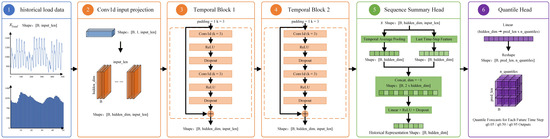
After batch-wise input, is expanded to , where B denotes the batch size. It is then expanded along the channel dimension to . A 1 × 1 convolution is used for input channel projection, mapping the single-channel load sequence into a hidden feature space , where d is the hidden channel dimension.
After input projection, the History Branch sequentially applies two Temporal Blocks to extract temporal load features. Each Temporal Block consists of two one-dimensional convolutional layers, nonlinear activation, dropout, and residual connections. The hidden features obtained after the two Temporal Blocks are denoted as , where represents the hidden feature corresponding to the i-th historical time point. To construct a fixed-dimensional historical representation for later branch fusion, the branch extracts both the temporal mean feature and the terminal feature . The mean feature reflects the overall load state over the historical window, whereas characterizes the local state and short-term inertia at the most recent time point. The two features are concatenated and mapped nonlinearly to obtain the historical branch representation:
Here, denotes a mapping function composed of a linear layer, ReLU activation, and dropout. Once the historical representation is formed, the model uses a quantile prediction head to directly output historical-path forecasts for the next H time points. In this study, . The historical representation is linearly projected into an H × Q output space to produce:
The History Branch therefore outputs independent quantile forecasts for multiple future time points and passes to the subsequent Three-Way Fusion and Residual Branch modules, where it is used to compute three-path fusion weights and to participate in bounded residual correction. Figure 1 illustrates the detailed implementation of the History Branch.
Figure 1.
Detailed workflow of the History Branch.
In this study, hidden representations refer to the latent feature vectors generated by neural network encoders after mapping the original inputs into a higher-dimensional feature space, and hidden dimension denotes the vector length of these latent representations.
2.3. Construction of the Calendar Prior Branch
Unlike candidate driver variables, calendar information for future time points is available in advance as a prior condition. Examples include the hour of day, day of week, month of year, and weekend status, all of which can be obtained directly from timestamps before load forecasting begins. Although such information does not reflect real-time external disturbances in the load system, it can characterize relatively stable periodic and rhythmic patterns in load variation. Therefore, the Calendar Branch is designed to encode calendar priors step by step over the future forecasting window and to generate an independent calendar-path prediction, thereby supplying temporal periodic information to the overall model.
Let the calendar feature sequence corresponding to the future H forecasting steps be:
Here, denotes the dimension of calendar features. In this study, the calendar input is constructed from cyclical encodings of hour, weekday, and month, together with a weekend indicator:
2.3.1. Stepwise Calendar Feature Encoding
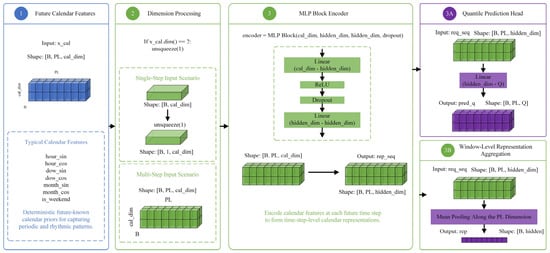
The Calendar Branch applies a multilayer perceptron to map the calendar features of each future time point. Since fully connected layers can act directly on the last tensor dimension, stepwise encoding can be completed without disrupting the forecasting-horizon dimension. For a batch of samples, the future calendar input is denoted as . Through a calendar encoder composed of a linear layer, ReLU activation, dropout, and a second linear layer, the stepwise calendar representation is obtained. It can be written as , where denotes the calendar prior representation for the h-th future time point. This representation does not simply preserve the original periodic encoding. Instead, it maps temporal priors from multiple calendar dimensions into a unified hidden space, allowing the model to use differences in temporal positions across future forecasting steps.
2.3.2. Calendar-Path Quantile Prediction
After the stepwise calendar representation is obtained, the Calendar Branch maps it to quantile forecasts for the future H time points through a linear prediction head:
Here, denotes the linear transformation from the hidden dimension to the quantile dimension, and Q is the number of quantiles. Based solely on future calendar priors, the Calendar Branch outputs independent quantile forecasts for multiple future time points, denoted as:
These outputs are subsequently combined with the predictions of the History Branch and Driver Branch in the three-way dynamic fusion module.
2.3.3. Construction of a Window-Level Calendar Representation
In addition to stepwise quantile prediction, the model requires a branch-level representation that summarizes the calendar state of the entire forecasting window for subsequent dynamic fusion and residual correction. To this end, the Calendar Branch applies average pooling over the forecasting-horizon dimension of the stepwise representation:
Unlike , no longer preserves fine-grained differences among individual future time points. Instead, it summarizes the overall calendar background of the forecasting window. For instance, when the forecasting window primarily falls within weekday daytime, weekend nighttime, or a seasonal transition period, can provide a corresponding window-level temporal prior summary. This representation is used together with the historical and driver representations to compute Three-Way Fusion weights and to participate in bounded correction in the Residual Branch.
In summary, the Calendar Branch maps future calendar priors to a calendar-path prediction and calendar representations as follows:
Here, represents the calendar background of the entire forecasting window; provides independent multi-step quantile forecasts for the calendar path; and preserves stepwise calendar features for each future forecasting step while also supporting the state estimation and dynamic screening of event-type drivers. This branch enables the model to explicitly use calendar priors that are available in advance, without relying on future load observations or future true driver values, thereby improving the structured representation of rhythmic multi-step load variation. Figure 2 presents the detailed workflow of the Calendar Branch.
Figure 2.
Detailed workflow of the Calendar Branch.
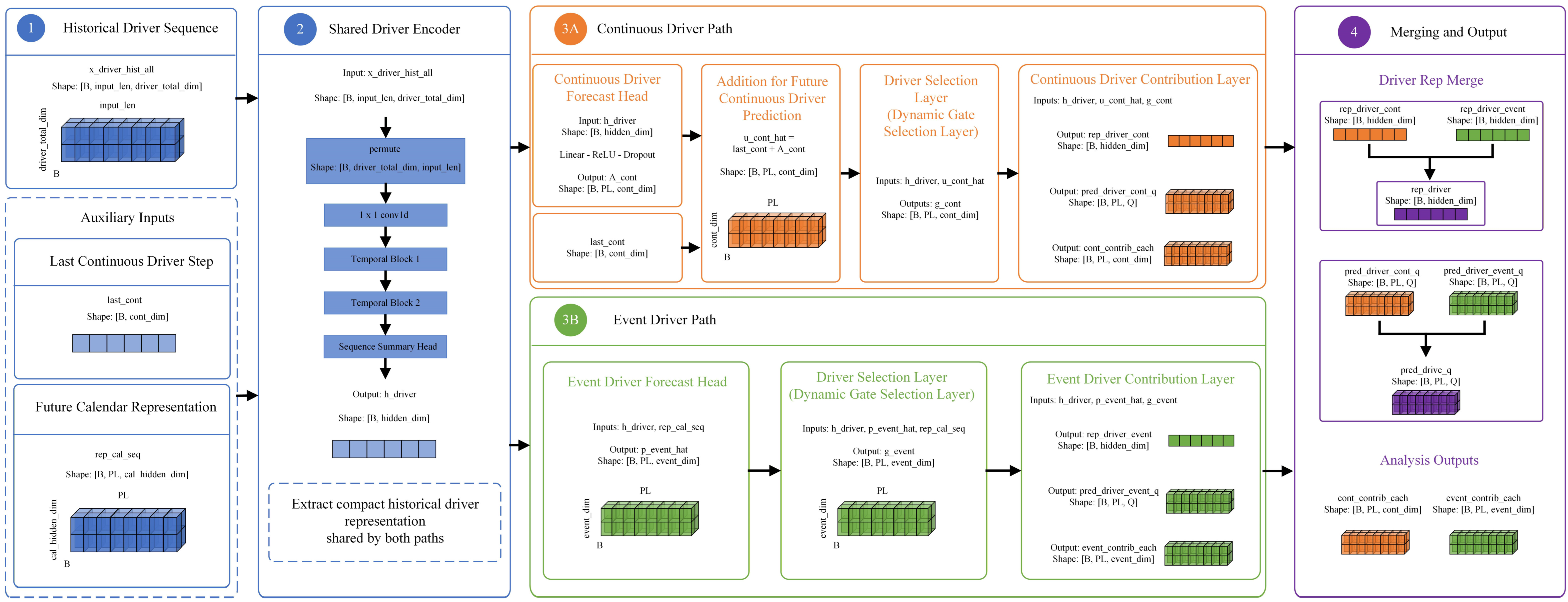
2.4. Construction of the Driver Variable Branch
In load forecasting, external driver variables provide information beyond historical load. Meteorological conditions, operating states, and event-related factors such as holidays may all alter future load trajectories. Unlike calendar information, the true future values of candidate drivers are generally not directly available during forecasting. Treating them as known inputs may therefore create a mismatch between training assumptions and actual forecasting conditions. For this reason, the Driver Branch does not rely on true future driver values. Instead, it estimates their future states from historical driver sequences and further determines the effectiveness of different drivers for the current forecasting task.
Continuous drivers and event-type drivers have clearly different data characteristics. The former usually exhibit continuous variation or short-term shifts, such as temperature, humidity, and wind speed. The latter correspond to discrete states or occurrence probabilities, such as holidays, weekends, and activity states. To avoid weakening these type-specific distinctions through a unified mapping, the Driver Branch divides candidate driver variables into continuous and event-type groups. Each group separately performs future-state prediction, dynamic gating selection, and contribution mapping, before being merged into a unified driver-branch representation and driver-path prediction.
2.4.1. Historical Driver State Encoding
Let the historical candidate driver sequence of length L be:
Here, D denotes the total dimension of candidate drivers. For a batch of samples, the input tensor is written as . To accommodate one-dimensional convolution, it is rearranged as . A 1 × 1 convolution is then used for channel mapping, projecting the candidate driver variables into the hidden feature space . Following the same path as in the historical load branch, the mean feature and terminal feature are extracted, concatenated, and then projected to obtain the historical driver representation:
This representation jointly characterizes the overall state, recent changes, and local temporal structure of candidate drivers within the historical window, thereby providing a shared context for future-state estimation of both continuous and event-type drivers.
2.4.2. Future-State Prediction and Dynamic Screening of Continuous Drivers
Let denote the historical sequence of continuous driver variables, where is the number of continuous drivers. The continuous driver state at the last historical time point is denoted by . To avoid directly learning the absolute values of future continuous variables, the continuous driver prediction head adopts a residual estimation form based on the terminal state plus a learned variation term:
Here, is obtained by mapping through a fully connected layer and reshaping the result over the future H forecasting steps:
After the future continuous driver estimate is obtained, the model constructs a dynamic selection gate. First, is expanded across future forecasting steps to form . Gating weights are then generated jointly from the historical driver representation and the estimated future continuous drivers:
Here, is the lower bound of the continuous-driver gate, denotes the Sigmoid function, and denotes the corresponding gating weights. The gated continuous driver signal is computed as , where ⊙ denotes element-wise multiplication. This signal reflects the effective input strength of continuous drivers after dynamic screening.
2.4.3. Future-State Prediction and Dynamic Screening of Event-Type Drivers
Event-type drivers often have a more direct connection with future calendar priors. Variables such as weekends, holidays, and vacation states are closely related to specific dates and temporal positions. Therefore, future-state estimation of event-type drivers depends not only on the historical driver representation but also on the stepwise calendar representation provided by the Calendar Branch.
Let denote the number of event-type drivers, and let be the stepwise calendar representation generated by the Calendar Branch. The event-driver prediction head combines the historical driver representation and the stepwise calendar representation to produce future event-state estimates:
is formed in the same way as by expanding over the future forecasting steps. For binary event variables, this output can be interpreted as the probability that the future event state occurs; for non-binary event variables, it represents a normalized state estimate. It should be emphasized that true future event drivers are used only as auxiliary supervision signals during training and are not directly fed into the model during forward propagation. Thus, the practical usability of the forecasting task is not compromised.
The dynamic gating of event-type drivers further accounts for the historical driver representation, future event estimates, and calendar priors:
Here, is the lower bound of the event-driver gate, and denotes the corresponding gating weights. The gated event-driver signal is . Compared with continuous drivers, the estimation and screening of event-type drivers explicitly incorporate calendar context, allowing the model to more reasonably express the association between temporal priors and event states.
2.4.4. Driver Contribution Mapping and Driver-Branch Output
After future driver estimation and dynamic screening are completed, the Driver Branch further maps the gated driver signals into driver-path prediction results. For continuous drivers, the historical driver representation, future continuous driver estimate, continuous gating weights, and gated signals are concatenated as . Through the continuous-driver contribution mapping layer, the continuous driver-path quantile forecast is obtained as . In parallel, a separate projection branch constructs the stepwise continuous-driver representation , which is averaged along the forecasting-horizon dimension to form the window-level continuous-driver representation .
Similarly, for event-type drivers:
The continuous and event-type paths each produce a quantile forecast and a hidden representation. The Driver Branch prediction is obtained by summing the two paths:
For the driver-branch representation, when both continuous and event-type drivers are present, their representations are concatenated and mapped into a unified representation:
Thus, the Driver Branch implements the following mapping:
Compared with directly mixing external variables into the main network, this branch first estimates future driver states, then dynamically screens effective driver signals, and finally maps them into driver-path predictions. This design preserves nonlinear modeling capacity while enhancing the structural analyzability of how external variables are utilized. Figure 3 presents the detailed implementation process of the Driver Branch.
Figure 3.
Detailed workflow of the Driver Branch.
2.5. Three-Way Dynamic Fusion and Bounded Residual Correction
Through the branch-specific modeling described above, the History Branch, Calendar Branch, and Driver Branch generate the corresponding representations , , and , together with their respective branch predictions , , and .
If the three branch predictions were combined through fixed-proportion averaging, multi-source information could be retained, but the model would be unable to adapt to sample-dependent changes in the forecasting basis. In actual load evolution, the relative importance of historical inertia, external drivers, and calendar priors is not constant. When load variation is smooth, the historical sequence typically provides a more stable forecasting basis; when external conditions change substantially, the Driver Branch may become more influential; and when periodic patterns dominate, the Calendar Branch may be more informative. Therefore, the three types of information should not be fused statically. Instead, their participation strengths should be dynamically allocated according to the current sample state.
Based on this consideration, Three-Way Fusion retains the independent predictions of the three branches and uses their branch-level hidden representations to generate adaptive fusion weights. The three representations are concatenated as . A gating network consisting of a linear layer, ReLU, dropout, and a final linear mapping then produces three fusion logits. After Softmax normalization, the fusion weights corresponding to the history, driver, and calendar branches are obtained as:
Here, , , and belong to and satisfy .
2.5.1. Weighted Fusion Based on Branch Predictions
After the three fusion weights are obtained, the quantile predictions of the three branches are stacked along the branch dimension:
The second dimension corresponds to the three branch paths. The fusion weights are then expanded to match the dimensions of the branch predictions, and a weighted sum is applied:
Three-Way Fusion preserves the relatively independent modeling outcomes of the three paths, ensuring that the base prediction is still jointly formed by historical inertia, external drivers, and calendar priors. At the same time, the fusion weights adapt to the information state of each sample and, to a certain extent, reflect the relative participation of different information sources in the current forecast. This avoids treating the three information types as equally important in all cases.
2.5.2. Bounded-Amplitude Residual Correction
After dynamic fusion through Three-Way Fusion, the model produces the base quantile prediction , which is jointly formed by historical inertia, external drivers, and calendar priors and serves as the main body of the overall output. Although integrates the principal information sources required for multi-step load forecasting, local deviations may still remain insufficiently captured by the three branches. If a highly flexible correction network were introduced to regenerate the final output, the main role of the preceding three-branch structure would be weakened, and the model would again become dominated by a terminal black-box module. To avoid this outcome, a Residual Branch is constructed to perform bounded residual correction on top of the base prediction. Its role is to provide limited compensation for local errors in the fused result and thereby improve the final prediction output.
The Residual Branch receives the three branch representations and the base prediction simultaneously, namely , , , and . The three branch representations are duplicated and expanded along the forecasting-horizon dimension and then concatenated with the base prediction to construct the residual-correction input:
This input retains both the internal information states of the three main branches and the current base prediction, allowing the residual module to correct local deviations while remaining aware of how the main prediction has been formed.
The residual-correction input is processed through a mapping function consisting of a linear layer, ReLU activation, dropout, and a linear transformation. A final linear prediction head then produces the raw residual correction term . To constrain the influence of the Residual Branch, the output is compressed by a hyperbolic tangent function and multiplied by the maximum residual-scale coefficient :
Because , the residual correction satisfies .
After the base prediction and bounded residual term are obtained, additive correction is first applied: . Since quantile forecasting models may generate quantile crossing during training, such as a lower-quantile prediction exceeding a median prediction or a median prediction exceeding an upper-quantile prediction, the model reorders the last quantile dimension to preserve the monotonic relationship among quantiles. The final prediction is therefore expressed as:
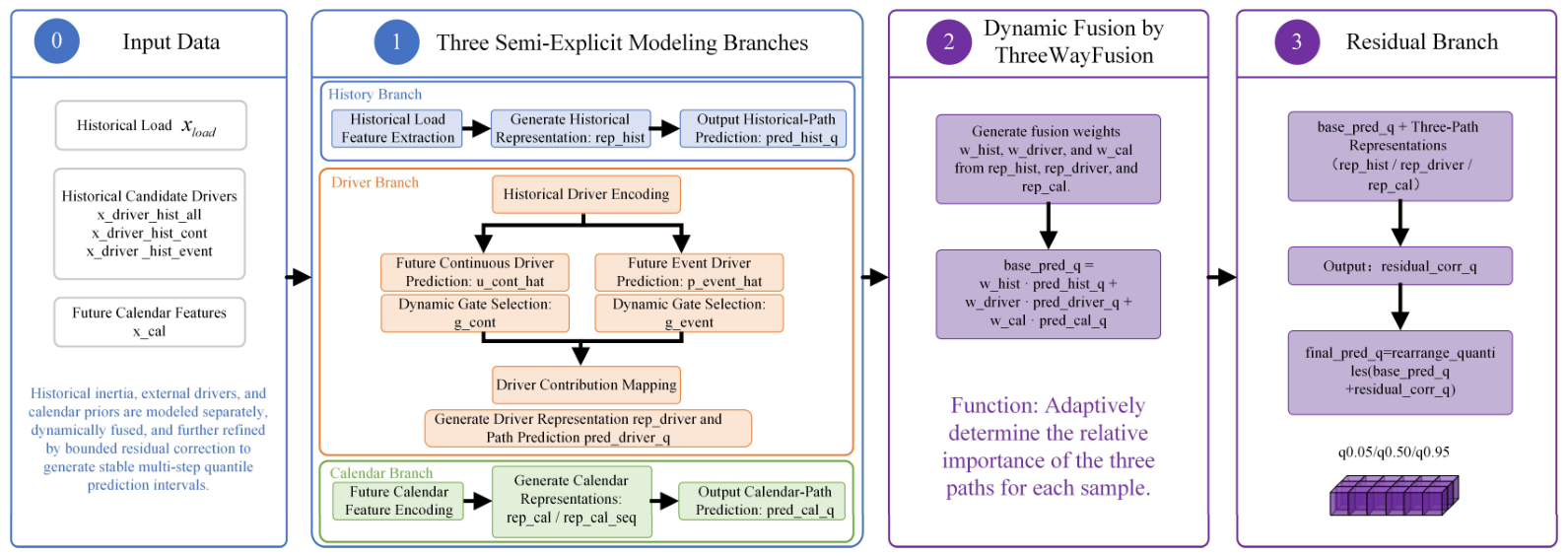
represents multi-step load forecasts over H future time points and Q quantiles. Taking as an example, the model outputs , , and for each future time point. Among them, serves as the median load forecast, while forms the corresponding prediction interval. Figure 4 shows the overall workflow of the final model.
Figure 4.
Overall workflow of the proposed model.
In summary, to address information-mixing modeling in multi-step load interval forecasting and the practical unavailability of future driver values, this study proposes a semi-explicit self-driven multi-step load interval forecasting model. The History Branch captures historical inertia and short-term evolution of load; the Calendar Branch provides future temporal priors that are available in advance; and the Driver Branch estimates, dynamically screens, and maps external driver states without relying on true future driver values. Three-Way Fusion then adaptively integrates the three branch predictions according to the sample information state, and the Residual Branch performs limited compensation for the fused result. The model ultimately outputs quantile forecasts for multiple future time points. This design retains the nonlinear fitting capacity of deep models while establishing relatively clear functional roles for historical information, temporal priors, and external drivers within a unified forecasting framework. It thereby provides a model basis for alleviating blurred functional boundaries in mixed multi-source modeling and for improving the practical usability of future driver information and the structural analyzability of interval forecasting results.
3. Results
To validate the proposed model, comparative experiments are conducted on multiple datasets under two forecasting horizons. All experiments are performed on a 64-bit Windows operating system. The hardware configuration includes an Intel Core i5-14600K CPU and an NVIDIA GeForce RTX 5060Ti GPU, and the software environment uses Python 3.10.
3.1. Evaluation Metrics
To comprehensively evaluate forecasting performance, evaluation metrics are selected from two perspectives: point forecasting accuracy and interval forecasting quality. For point forecasting, root mean square error (RMSE), coefficient of determination (R2), and mean absolute error (MAE) are adopted. Suppose that the test set contains N prediction points, with denoting the true value, the point forecast, and the mean of the true values. The three metrics are defined as follows:
RMSE reflects the overall dispersion of forecasting errors, MAE reflects the overall error level, and R2 measures how well the model fits the true load variation. For interval forecasting results, prediction interval coverage probability (PICP), prediction interval normalized average width (PINAW), and coverage width-based criterion (CWC) are used. Let and denote the lower and upper bounds of the prediction interval for the i-th sample. If , then ; otherwise, . PICP is defined as:
This metric represents the proportion of true load observations that fall within the prediction interval and is used to measure the reliability of interval coverage. However, a higher PICP alone does not necessarily imply better interval quality, because excessively wide intervals may also yield high coverage. To evaluate interval compactness, PINAW is introduced:
Here, denotes the range of true load values in the test set. A smaller PINAW indicates a narrower interval and therefore a more informative interval forecast. To jointly account for interval coverage and interval width, CWC is further adopted:
where is the preset confidence level, is the penalty coefficient, and:
When the interval coverage reaches the target confidence level, CWC reduces to PINAW. When the coverage falls below the target requirement, the penalty term is activated and the metric value increases markedly. Therefore, PICP focuses on interval reliability, PINAW focuses on interval compactness, and CWC evaluates the balance between the two. Together, these three metrics form the interval forecasting quality evaluation system.
3.2. Dataset Description
This study uses the Panama electricity load dataset as the primary energy-system case for evaluating the proposed method under practical load forecasting conditions. The dataset contains 48,048 hourly records from 3 January 2015 to 27 June 2020 and includes 16 variables covering load, meteorological factors, and holiday-related information. The forecasting target is nat_demand, and the complete dataset is denoted as Panama_H. Since this dataset contains both load observations and external contextual variables, it is suitable for assessing whether the proposed model can organize multi-source information and provide uncertainty-aware forecasting results for day-ahead energy management.
To further examine the adaptability of the model to non-load multivariate time-series tasks, the ETTh1 dataset is used as a supplementary validation dataset. This dataset contains 17,420 hourly samples and 7 variables from 00:00 a.m. on 1 July 2016 to 19:00 p.m. on 26 June 2018. The forecasting target is oil temperature OT, and the complete dataset is denoted as ETTh1_H. Unlike Panama_H, ETTh1_H is not used as the main energy-system case in this study, but rather as an auxiliary dataset for testing the model’s ability to capture multivariate temporal dependencies under different data characteristics.
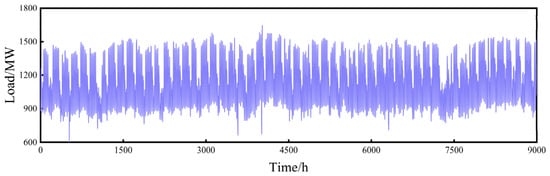
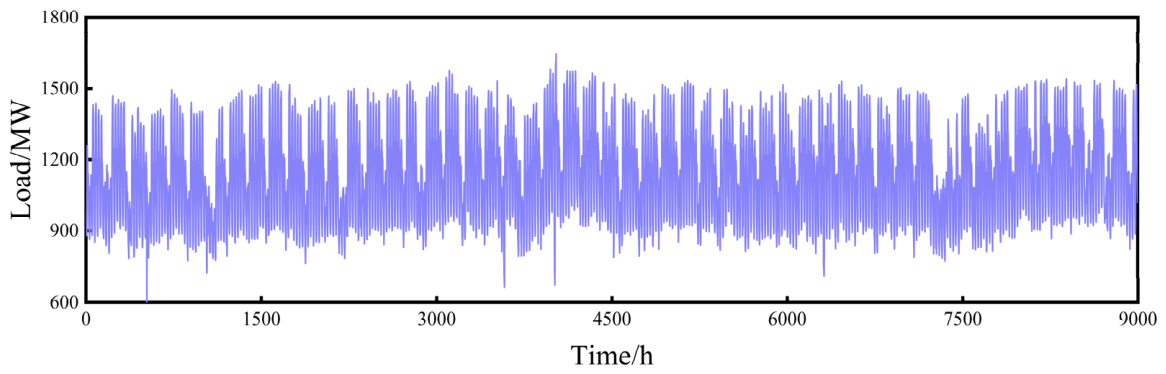
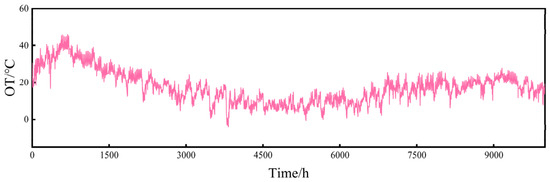
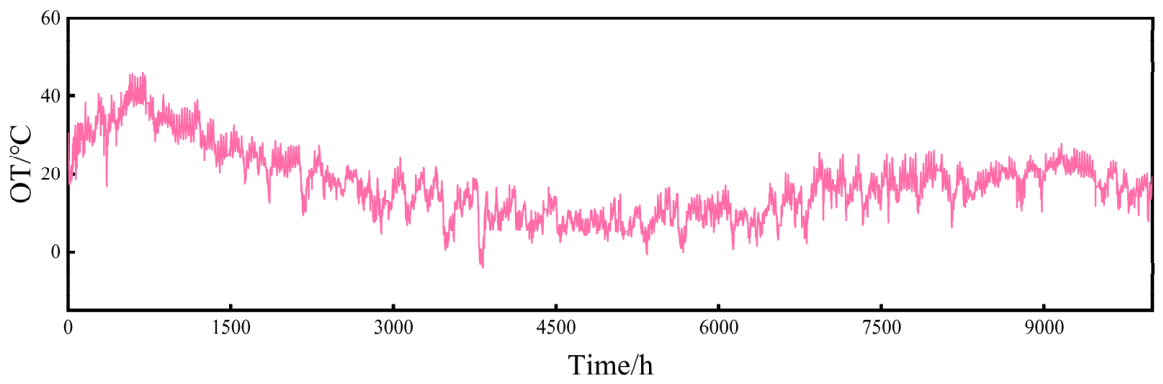
Figure 5 and Figure 6 present representative temporal trends of the two datasets. Panama_H exhibits pronounced periodic oscillations together with local spikes and abrupt drops, making it suitable for evaluating multi-step load forecasting under practical energy-system conditions. ETTh1_H contains stagewise trend changes and persistent local fluctuations, and is mainly used to examine whether the model can jointly characterize medium- to long-term evolution and short-term disturbances. This dataset arrangement allows the proposed ADDF framework to be evaluated from both an energy-system forecasting perspective and a broader multivariate time-series modeling perspective.
Figure 5.
Load variation trend in the Panama_H dataset.
Figure 6.
OT variation trend in the ETTh1_H dataset.
3.3. Comparative Experiments
Table 1 and Table 2 report the forecasting results of all models under a prediction horizon of 1, while Table 3 and Table 4 present comparative performance under a prediction horizon of 24. The analysis focuses mainly on R2, PICP, and PINAW, which respectively evaluate point forecasting fit, interval coverage reliability, and interval compactness. RMSE, MAE, and CWC are used as supplementary criteria. Single-step forecasting mainly reflects the model’s ability to capture short-term local changes, whereas 24-step forecasting requires the model to describe the continuous evolution of multiple future time points over the next day. The latter setting is more closely related to day-ahead forecasting, reserve planning, and uncertainty-aware energy management, and is therefore particularly relevant for sustainable power system operation.
Table 1.
Forecasting performance on ETTh1_H when the prediction horizon is 1.
Table 2.
Forecasting performance on Panama_H when the prediction horizon is 1.
Table 3.
Forecasting performance on ETTh1_H when the prediction horizon is 24.
Table 4.
Forecasting performance on Panama_H when the prediction horizon is 24.
As shown in Table 1, on the ETTh1_H dataset, ADDF achieves an R2 of 0.9641, the highest among all models, while its RMSE decreases to 0.6522. This indicates a stronger ability to characterize oil-temperature variation trends. In terms of interval forecasting, ADDF attains a PICP of 0.9882, also the highest value, suggesting that its prediction intervals provide the most comprehensive coverage of the true observations. Although ETTh1_H is used as a supplementary validation dataset, these results indicate that the proposed framework maintains stable point and interval forecasting capability under non-load multivariate time-series conditions.
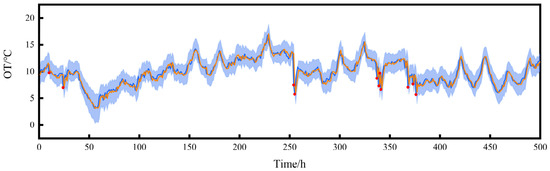
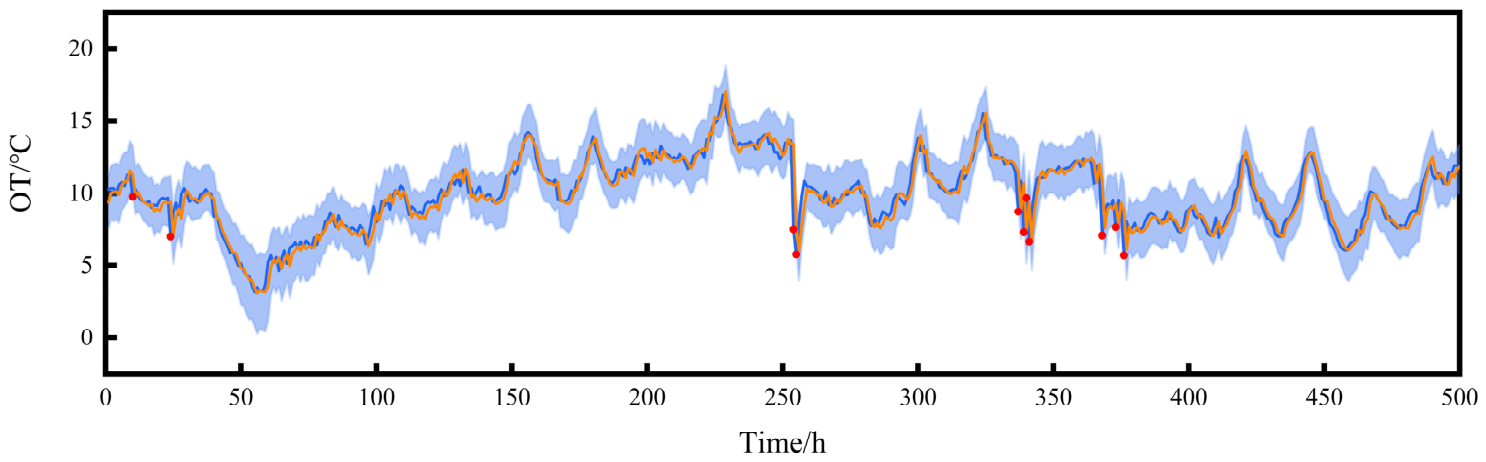
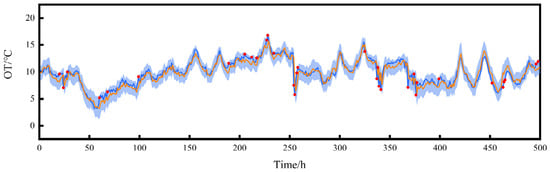
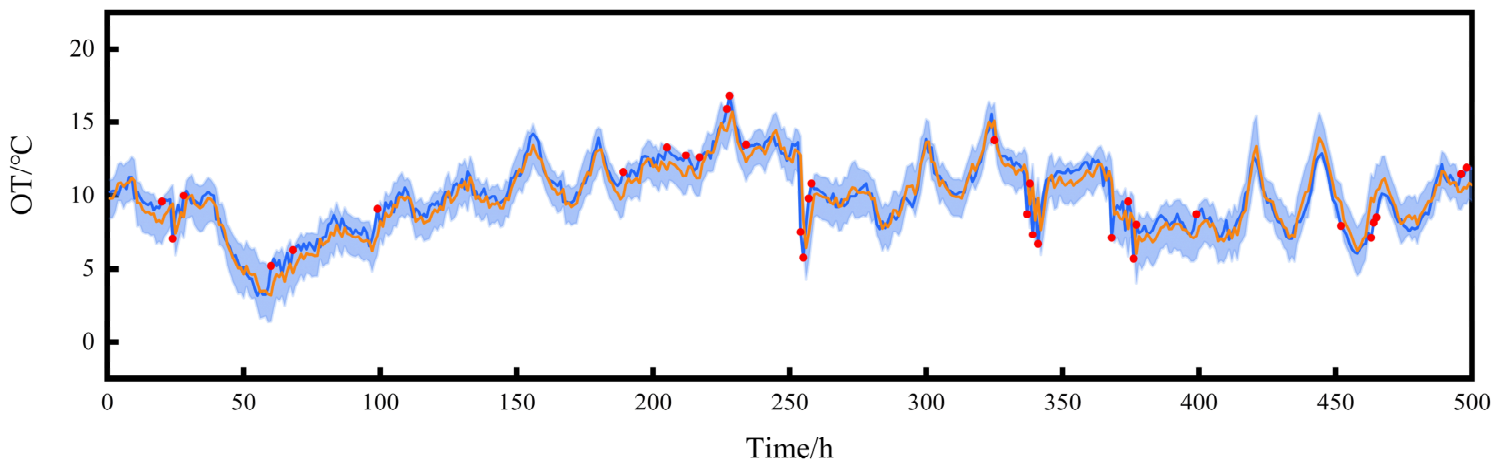
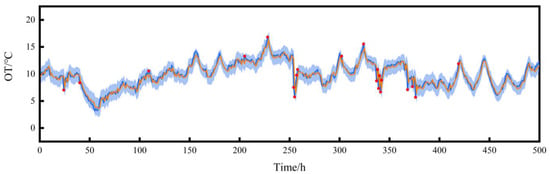
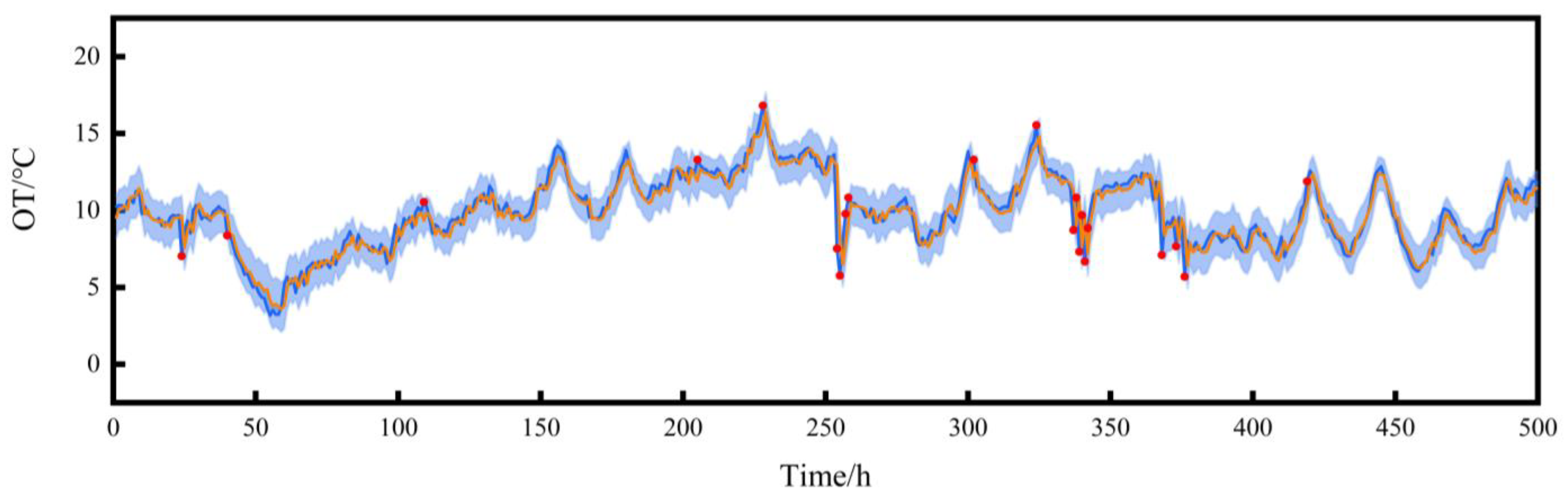
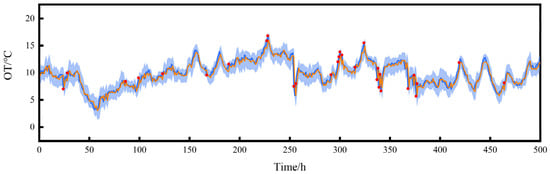
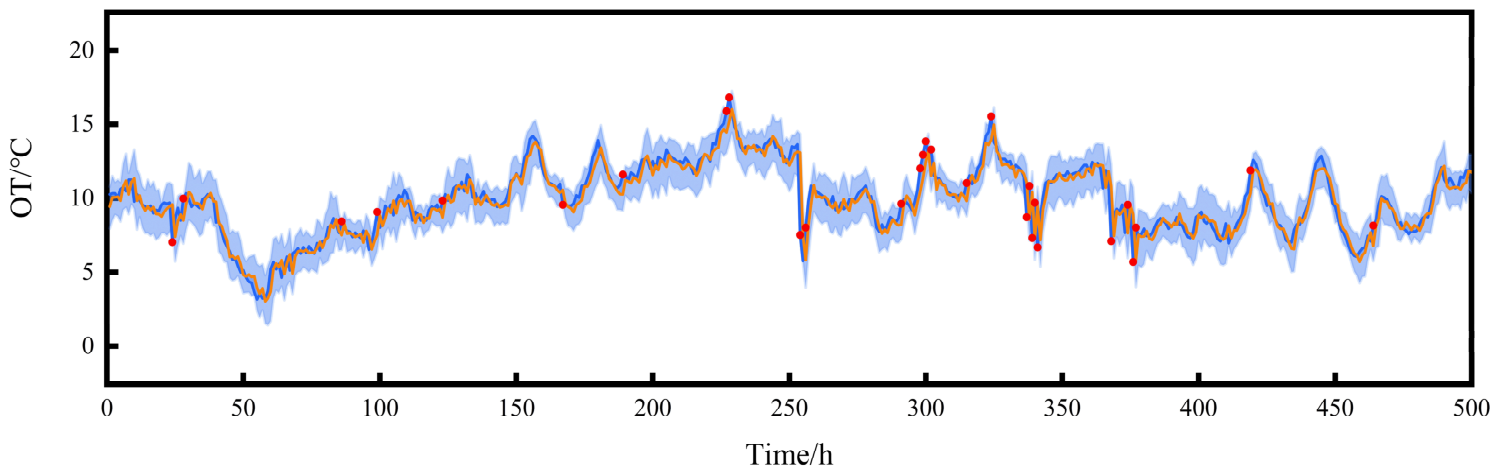
Figure 7, Figure 8, Figure 9 and Figure 10 presents representative fitting results of ADDF, Informer, BiLSTM, and TCN under the single-step forecasting scenario on ETTh1_H. In these plots, the blue curve denotes the true value, the orange curve denotes the predicted median, and the light-blue shaded region denotes the interval between the predicted lower and upper bounds. Red markers indicate points where the true values fall outside the prediction interval. These visualizations provide an intuitive comparison of point tracking capability and interval-envelope performance across models.
Figure 7.
One-Step-Ahead Interval Forecasting Results of ADDF on the ETTh1_H Dataset.
Figure 8.
One-Step-Ahead Interval Forecasting Results of Informer on the ETTh1_H Dataset.
Figure 9.
One-Step-Ahead Interval Forecasting Results of BiLSTM on the ETTh1_H Dataset.
Figure 10.
One-Step-Ahead Interval Forecasting Results of TCN on the ETTh1_H Dataset.
The plots show that under the ETTh1_H single-step forecasting setting, ADDF produces prediction intervals that continuously envelop the true sequence across steady fluctuations, rising and falling trends, and most local variations, with only a small number of out-of-interval points near sharp peaks and rapid jumps. Informer follows the overall trend but displays denser out-of-interval points, especially near rapid increases, rapid decreases, and peak-valley transitions, indicating relatively weaker coverage of short-term abrupt changes.
The interval-envelope effects of BiLSTM and TCN fall between those of ADDF and Informer. Both models cover most routine fluctuations, although a certain number of out-of-interval points remain in rapidly changing segments. BiLSTM provides comparatively stable interval coverage, whereas TCN produces median predictions that are closely aligned with the true values but still exhibits interval violations at some abrupt transition points.
On the Panama_H dataset, ADDF reaches an R2 of 0.9808, with an RMSE and MAE of 25.7468 and 19.0425, respectively. Its point forecasting performance is therefore close to the best overall result. Although TCN slightly outperforms ADDF in RMSE, MAE, and R2, its PICP is only 0.7991 and does not reach the target coverage level of 0.90. The remaining comparison models also exhibit varying degrees of insufficient coverage. By contrast, ADDF achieves a PICP of 0.9058 and is the only method that satisfies the target coverage requirement. Its PINAW remains only 0.0851, indicating that it maintains relatively compact intervals while ensuring coverage reliability. Since the coverage rate reaches the preset requirement, the CWC of ADDF equals its PINAW at 0.0851 and is markedly better than the values of the other models, which are penalized for under-coverage.
Overall, ADDF achieves both the best point forecasting fit and the highest interval coverage on ETTh1_H. On Panama_H, it maintains high point forecasting accuracy while providing a more balanced trade-off between coverage reliability and interval width. These results suggest that ADDF can provide more informative forecasting outputs than point prediction alone, especially when uncertainty boundaries are needed for load-related decision-making.
It should be noted that the original TCN, BiLSTM, and BiGRU structures do not directly support continuous 24-step output. To ensure comparability in multi-step forecasting, this study preserves their main structures and adopts a recursive stepwise strategy to generate forecast sequences for the next 24 time points, thereby adapting them to the 24-step forecasting task.
On ETTh1_H, ADDF achieves RMSE, R2, and MAE values of 0.7056, 0.9129, and 0.5018, respectively, all of which are the best among the compared models. This indicates a stronger point forecasting ability in the 24-step setting. In terms of interval forecasting, ADDF reaches a PICP of 0.9808, also the highest value, indicating the most complete coverage of true observations. Because its coverage exceeds the target level, its CWC equals its PINAW at 0.3939. It should be noted that ADDF produces relatively wider intervals. Although Transformer, BiGRU, and TCN form narrower intervals, both their coverage rates and point forecasting accuracy are lower than those of ADDF. Overall, ADDF demonstrates a stronger ability to combine high-accuracy point forecasting with reliable interval coverage on ETTh1_H.
On Panama_H, ADDF obtains RMSE, R2, and MAE values of 38.1759, 0.9558, and 27.2930, respectively, all of which are the best among the compared models. This reflects stronger 24-step multi-source load forecasting performance. In terms of interval forecasting, ADDF achieves the lowest PINAW of 0.0835 among all models, indicating the most compact interval results; however, its PICP is 0.7045, showing that coverage reliability still leaves room for improvement. Overall, the advantage of ADDF on this dataset is mainly reflected in point forecasting accuracy and interval-width control. Although the interval coverage under the 24-step Panama_H setting is not yet sufficient for fully reliable risk-boundary estimation, the improved point accuracy and compact intervals still indicate that ADDF can provide useful day-ahead load reference information for sustainable energy management. Further calibration of interval coverage will be needed when the forecasting results are directly used for reserve allocation or uncertainty-aware dispatch.
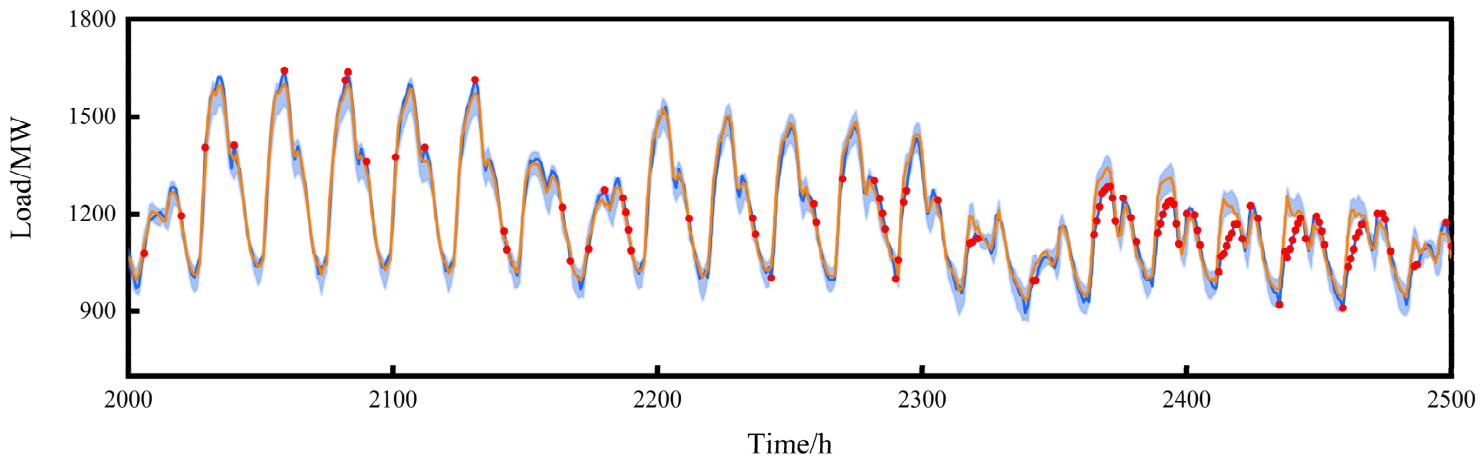
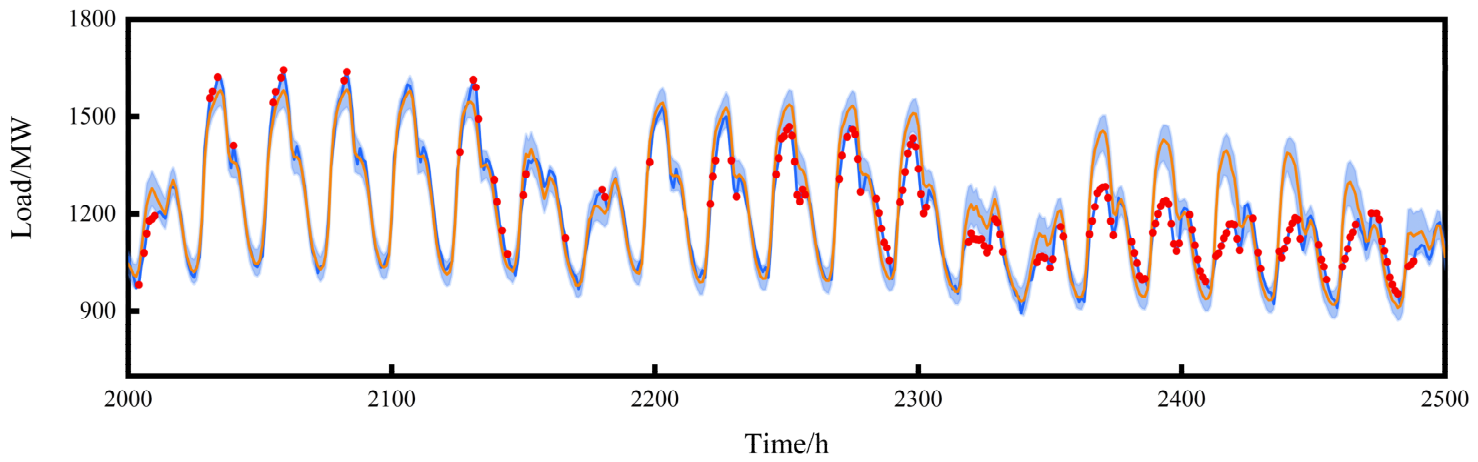
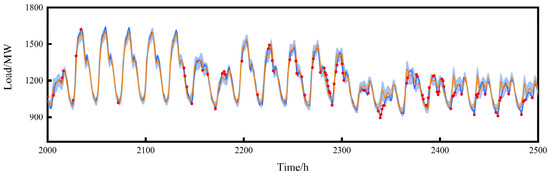
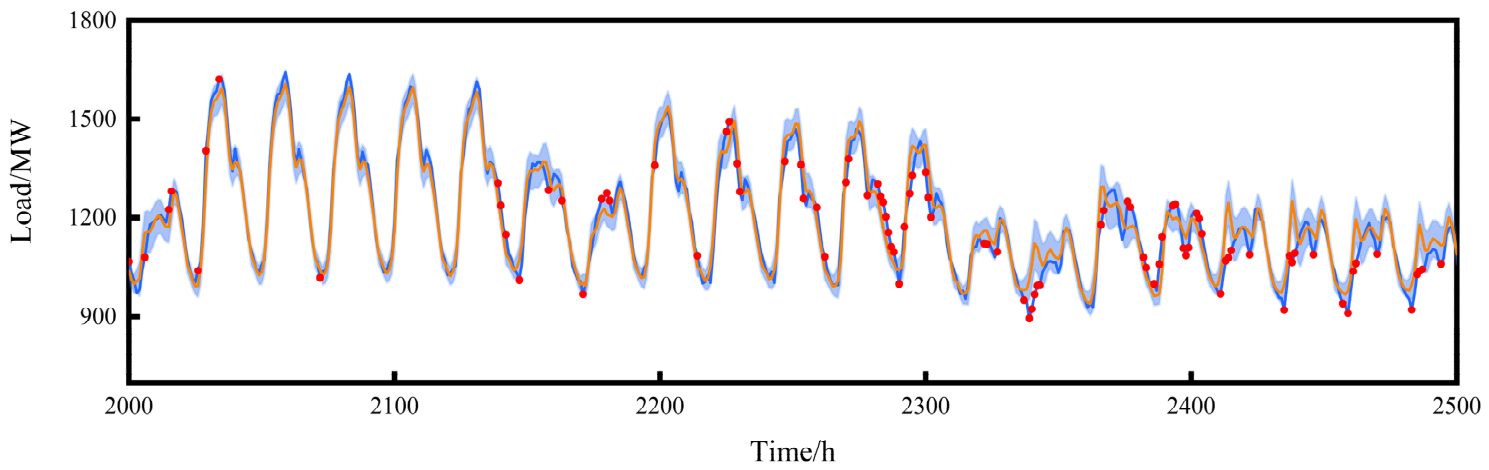
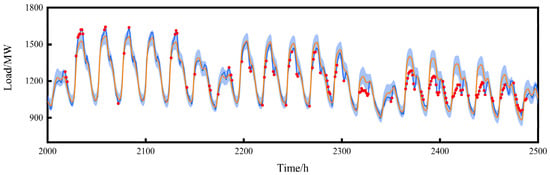
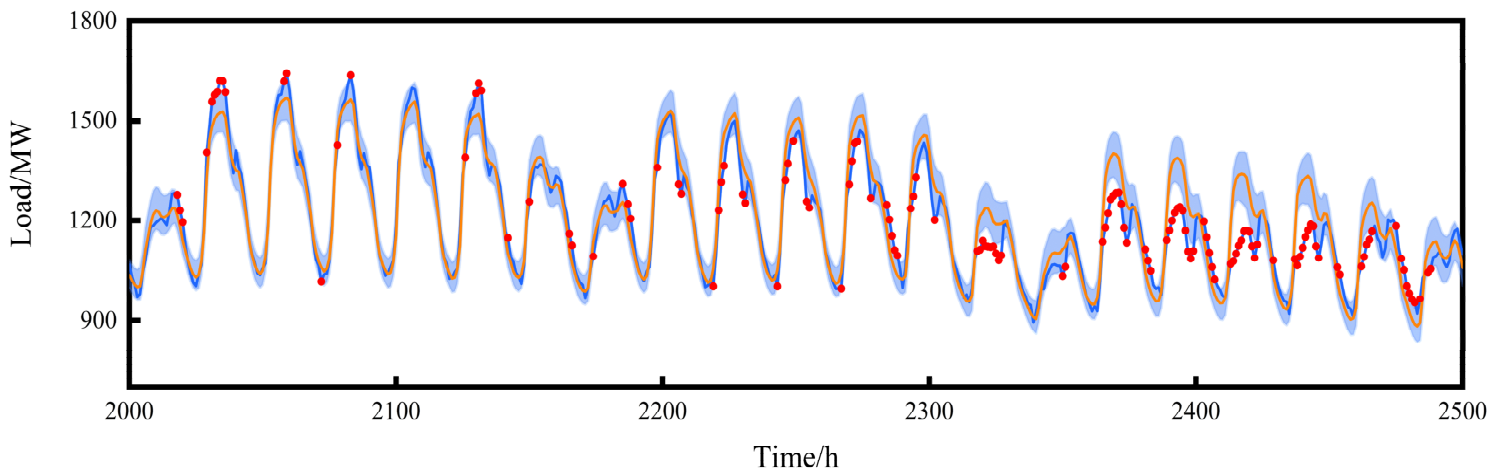
Because the 24-step forecasting results on Panama_H correspond to the next day’s load evolution and are directly related to day-ahead scheduling, reserve arrangement, and operational risk assessment, representative predictions of ADDF, Informer, BiLSTM, and TCN are further plotted in addition to the quantitative results in Table 4. These plots provide an intuitive comparison of how different models characterize intra-day peak-valley changes, local fluctuations, and interval-envelope states. Figure 11, Figure 12, Figure 13 and Figure 14 present the prediction fitting and interval coverage effects of the four models in this scenario.
Figure 11.
Twenty-Four-Step-Ahead Interval Forecasting Results of ADDF on the Panama_H Dataset.
Figure 12.
Twenty-Four-Step-Ahead Interval Forecasting Results of Informer on the Panama_H Dataset.
Figure 13.
Twenty-Four-Step-Ahead Interval Forecasting Results of BiLSTM on the Panama_H Dataset.
Figure 14.
Twenty-Four-Step-Ahead Interval Forecasting Results of TCN on the Panama_H Dataset.
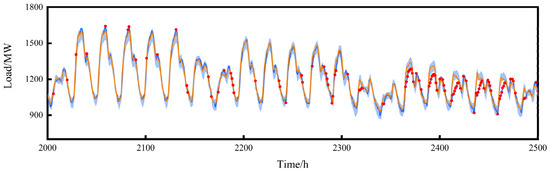
The plots show that, under the 24-step forecasting scenario on Panama_H, ADDF’s prediction curve remains broadly aligned with the true load series and maintains relatively stable tracking in both regular peak-valley changes and the more complex fluctuation region in the latter part of the sequence. For the displayed local segment, its interval band is comparatively compact and covers the true values during many periods, with out-of-interval points mainly appearing near several peaks, valleys, and rapid turning points. Informer exhibits a denser distribution of out-of-interval points, particularly during rapid load increases and decreases and in the latter portion where fluctuations become stronger, indicating weaker envelope stability.
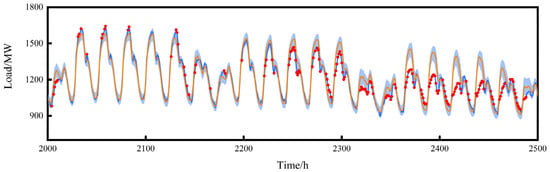
BiLSTM and TCN both capture the main periodic structure, but still show a considerable number of out-of-interval points near local peaks, valleys, and turning points. BiLSTM provides better interval coverage in smoother periods, while mismatches increase in complex fluctuation intervals. TCN preserves periodic patterns relatively well, but its envelope around locally irregular changes remains insufficient. Overall, the 24-step setting substantially increases the difficulty of interval coverage, and ADDF shows relatively stronger performance in both curve tracking and interval-envelope stability. From an operational perspective, such multi-step interval forecasts can help characterize possible intra-day load variation ranges, which are relevant for day-ahead scheduling, reserve planning, and risk-aware energy management in sustainable power systems.
3.4. Analysis of the Semi-Explicit Structure and Self-Driven Mechanism of ADDF
3.4.1. Dynamic Division of Labor, Predictive Contribution, and Module Ablation
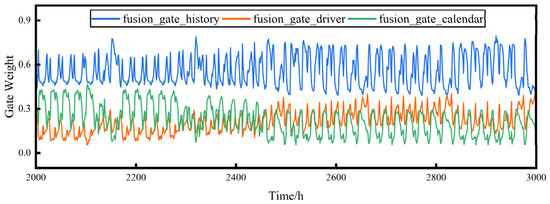
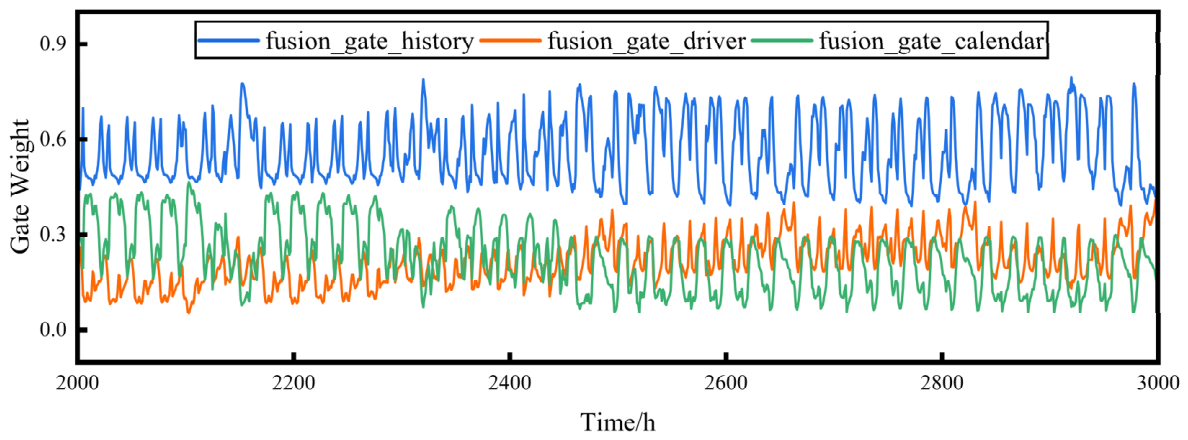
To examine whether ADDF establishes a dynamic division of labor among historical information, external drivers, and calendar priors, the fusion weights and path contributions of the three branches are analyzed using the 24-step prediction results on the Panama dataset. As shown in Figure 15, the three fusion weights vary dynamically over time. The History Branch generally maintains the largest weight, indicating that historical load remains the primary basis for multi-step prediction. The Calendar Branch shows clear periodic fluctuations, reflecting the role of temporal priors in regular load variation. The Driver Branch has a lower average weight but increases in several specific stages, suggesting that ADDF can adaptively strengthen the use of external driver information according to the sample state.
Figure 15.
Dynamic fusion weights of the History, Driver, and Calendar branches.
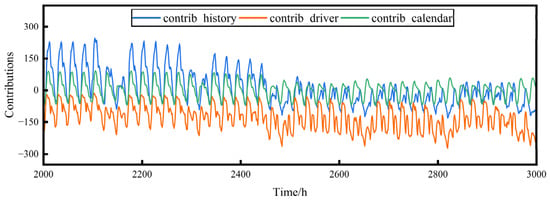
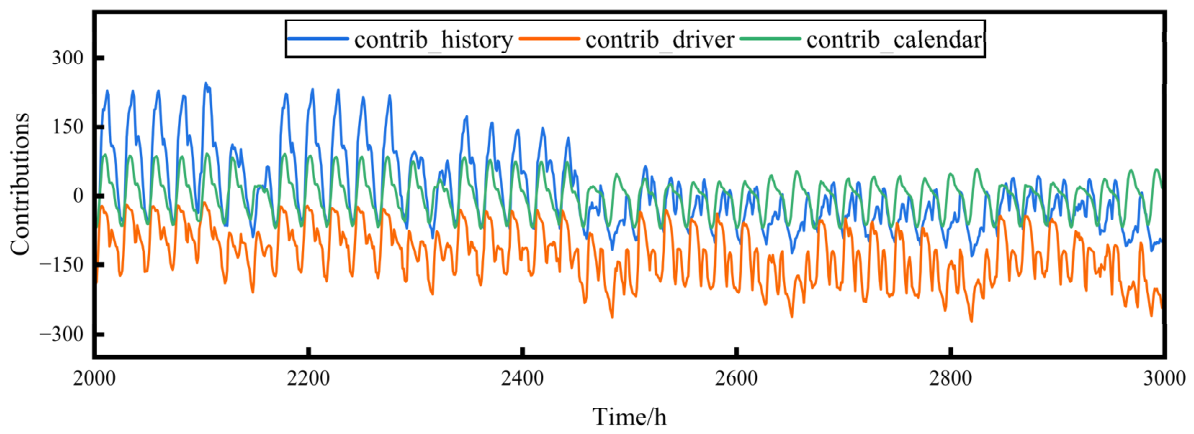
Figure 16 further shows that the three branches produce distinguishable predictive contributions rather than homogeneous outputs after fusion. The History contribution forms the main body of the prediction, the Calendar contribution provides relatively stable rhythmic information, and the Driver contribution exhibits independent stagewise adjustments.
Figure 16.
Contribution variations in the History, Driver, and Calendar paths.
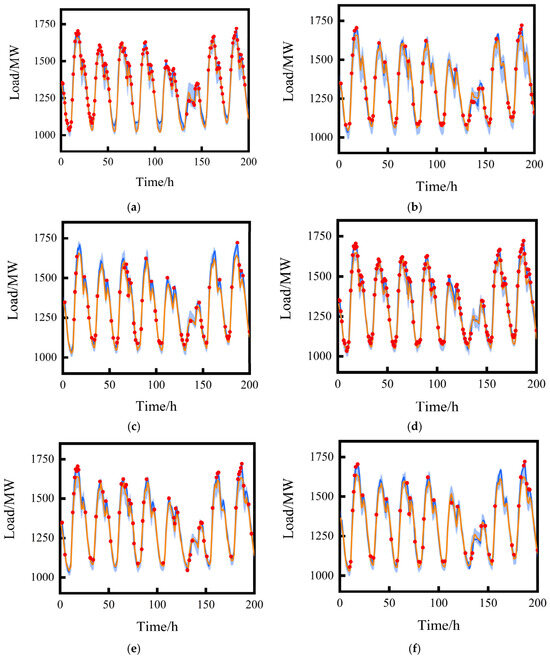
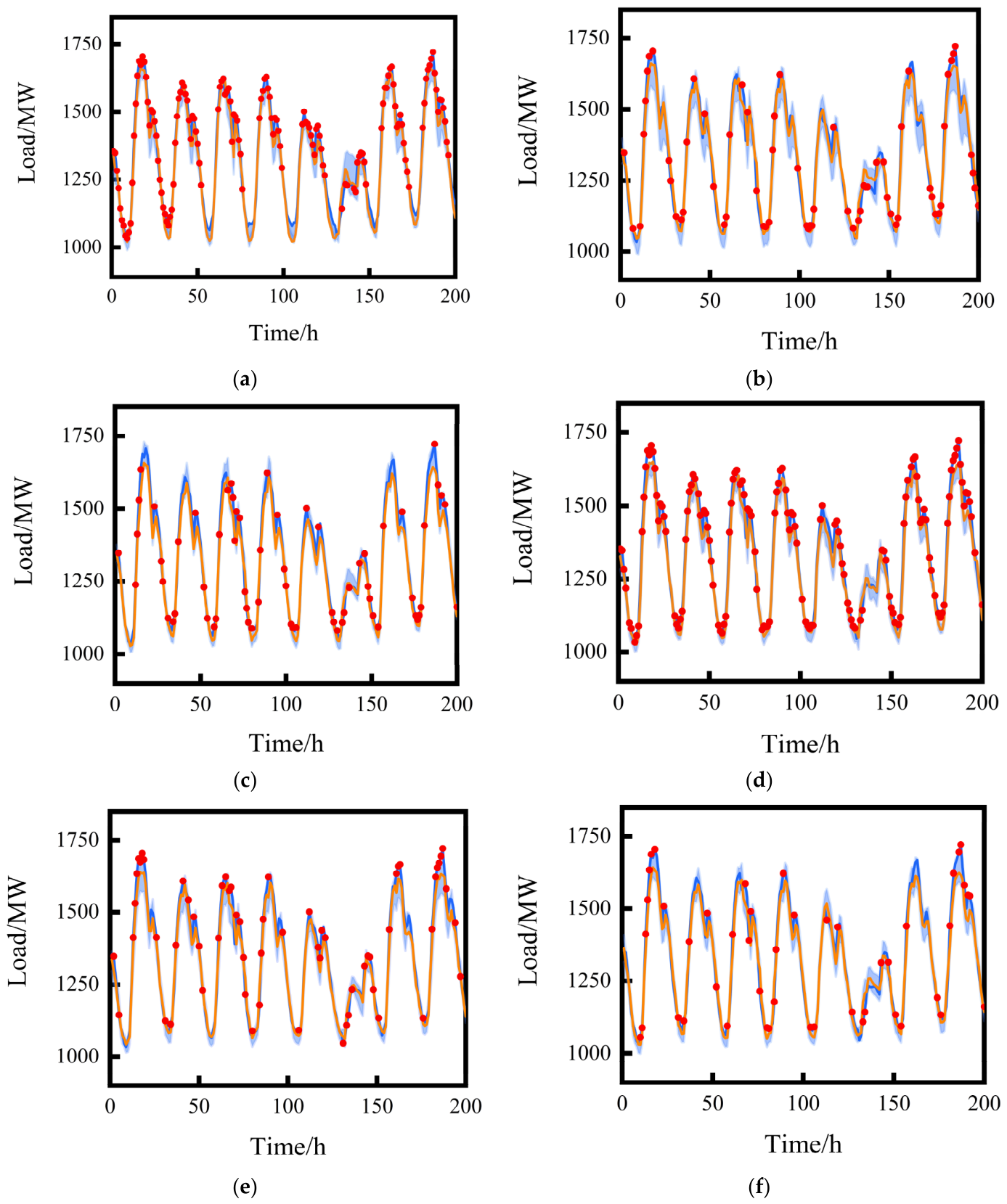
To verify the independent contribution of each key module, an ablation study was conducted on adaptive three-way fusion, driver-state estimation, dynamic driver gating, hard-threshold driver screening, and bounded residual correction. The complete model is denoted as Full. Five degraded variants are constructed: wo_fusion_equal replaces adaptive three-way fusion with equal-weight fusion; wo_driver_gate removes dynamic driver gating and retains all candidate drivers; wo_driver_state_estimation removes the learnable future driver-state estimation module and uses a last-observed persistence proxy instead; gate_threshold_050 replaces dynamic soft gating with fixed hard-threshold screening at 0.50; and wo_residual_lambda0 removes bounded residual correction by setting the residual constraint coefficient to zero. The quantitative results are reported in Table 5, and the corresponding prediction intervals are visualized in Figure 17.
Table 5.
Ablation results of the key modules in the proposed model.
Figure 17.
Prediction interval results of the ablated model variants: (a) Equal-weight three-way fusion variant (wo_fusion_equal); (b) Variant without dynamic driver gating (wo_driver_gate); (c) Hard-threshold driver screening variant with threshold = 0.50 (gate_threshold_050); (d) Variant without bounded residual correction (wo_residual_lambda0); (e) Variant without driver-state estimation (wo_driver_state_estimation); (f) Full ADDF model.
The ablation results show that removing or replacing each key module leads to different degrees of degradation in interval-oriented performance. Compared with the Full model, all degraded variants obtain lower PICP values and much higher CWC values, indicating weaker interval reliability. In particular, wo_driver_state_estimation achieves point prediction accuracy comparable to that of the Full model, with similar RMSE and R2 values. However, its PICP decreases from 0.7662 to 0.6967, while its CWC increases from 64.9588 to 1853.2643. This result suggests that the driver-state estimation module mainly contributes to constructing reliable future driver information for interval forecasting, rather than simply improving point prediction accuracy.
It is also observed that some variants, such as wo_driver_gate, gate_threshold_050, and wo_residual_lambda0, achieve slightly lower RMSE or MAE values than the Full model. Nevertheless, their PICP and CWC deteriorate markedly, showing that better point fitting does not necessarily produce more reliable prediction intervals. Therefore, interval forecasting performance should be evaluated by jointly considering point accuracy, coverage reliability, and interval compactness. The visualization results in Figure 17a–e further show that the ablated variants tend to produce insufficient coverage or less balanced interval behavior, whereas the Full model in Figure 17f maintains a more stable prediction interval pattern. Overall, these results confirm that adaptive three-way fusion, driver-state estimation, dynamic driver gating, and bounded residual correction are complementary components for improving the reliability of multi-step load interval prediction.
3.4.2. Variable-Level Gating Selection Analysis of the Driver Branch
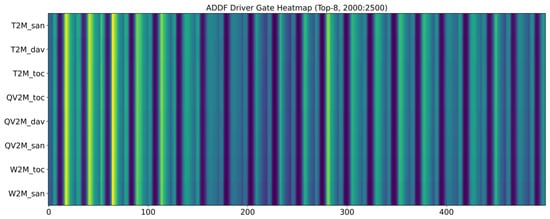
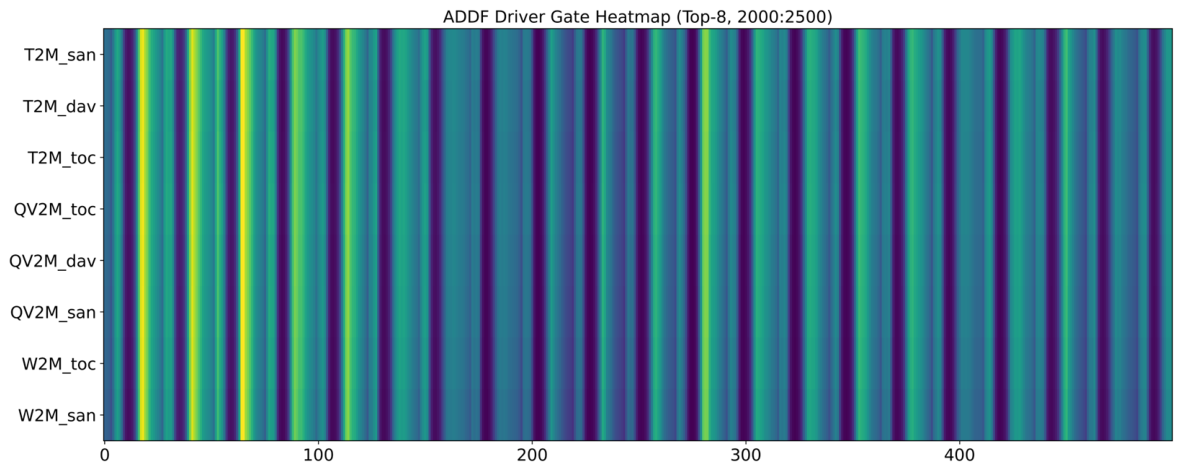
On the basis of the dynamic division of labor among the three main paths, the internal adjustment mechanism of the Driver Branch for candidate driver variables is further analyzed. Figure 18 shows the gate-activation heatmap of the Top-8 external driver variables over a local time interval. The gate intensity of each driver is not fixed; instead, it exhibits stagewise strengthening or weakening over time. This indicates that the model does not feed all external variables into the forecasting network as a whole with equal weights, but dynamically adjusts their participation through variable-level gating.
Figure 18.
Heatmap of variable-level gating intensities for the Top-8 external drivers.
A closer inspection shows that different drivers display some synchronous changes within the same time segment, yet their gating intensities still preserve differences. During certain periods, multiple driver variables are simultaneously strengthened, whereas in other stages their overall activation levels decline. This result indicates that the Driver Branch performs dynamic screening of external driver information before contribution mapping, thereby avoiding indiscriminate use of candidate variables. The gating intensity reflects the model’s internal information-adjustment outcome and reveals the structured utilization process of driver information.
3.4.3. Verifiability Analysis of Future Driver State Estimation
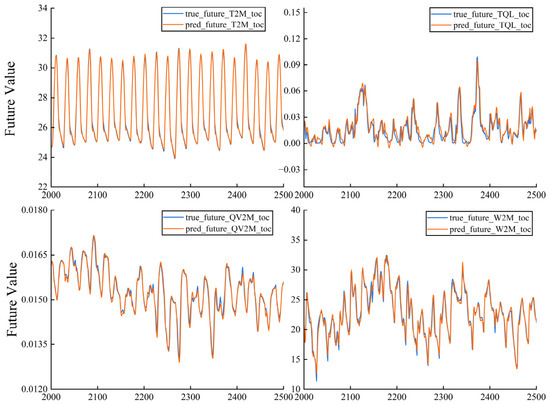
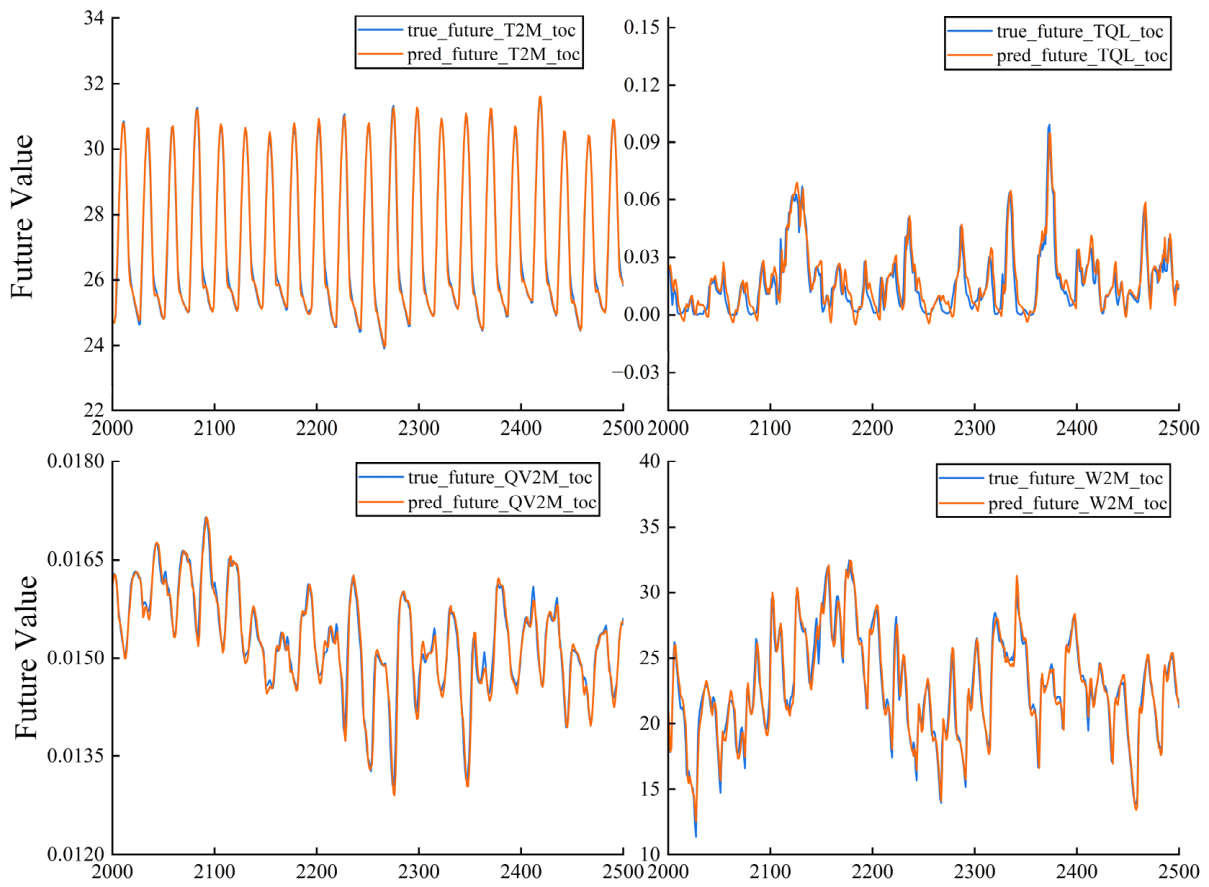
Another key design of the Driver Branch is that it does not directly assume future driver values to be known. Instead, it estimates future driver states from historical driver information and uses these estimates in subsequent forecasting. Figure 19 compares the true future values and model estimates for several representative drivers. The periodic peaks and troughs of T2M_toc are well reproduced, while the abrupt increases in TQL_toc are effectively tracked. The stagewise rises and declines, as well as the main fluctuation structures, in QV2M_toc and W2M_toc are also largely preserved. Although some local peak values still show deviations, the overall trends and key turning points are well characterized.
Figure 19.
Comparison between true future driver values and model estimates for representative drivers.
These results indicate that the Driver Branch does not simply map historical external variables directly to the final load output. Instead, it constructs a verifiable intermediate process through future driver state estimation. This mechanism provides a structured route for using driver information that is not directly available under practical forecasting conditions. Together with the preceding analyses of fusion weights, path contributions, and variable-level gating, the self-driven design of ADDF is concretely reflected through observable internal processes.
3.4.4. Branch Response Under Representative Load Fluctuation Scenarios
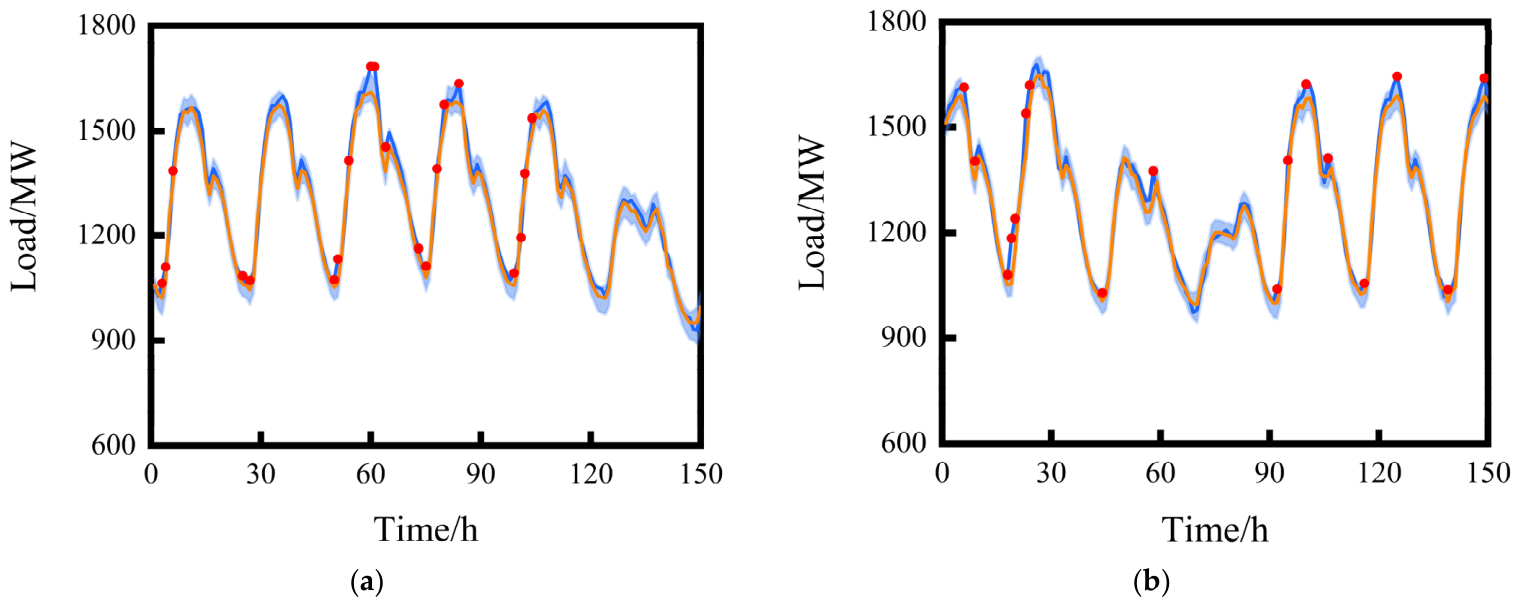
To examine branch responses under different load variation states, three representative weekly segments were selected from the testing set: a sudden load drop case, a load surge case, and a relatively stable case. The selection was based on load fluctuation intensity, characterized by load range and mean absolute step change (MASC). The drop and surge cases represent stronger weekly variations, while the stable case is used as a low-fluctuation reference for comparing branch allocation rather than as a performance benchmark.
The statistical characteristics of the selected segments are summarized in Table 6. The surge and drop cases show clear load variations, with load ranges of 704.9105 and 756.0648 and MASC values of 48.4747 and 43.6296, respectively. Their PICP values reach 0.8810 and 0.8750, with compact PINAW values of 0.1044 and 0.1016, indicating that most observations can be covered by relatively narrow intervals. The average fusion weights further show that the history branch remains dominant, while the driver and calendar branches receive higher weights in the surge and drop cases than in the stable reference case.
Table 6.
Statistics of representative weekly load scenarios and corresponding fusion weights.
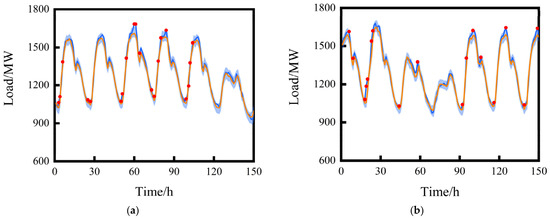
The prediction intervals under the sudden load drop and load surge scenarios are shown in Figure 20. In the sudden load drop case (Figure 20a), the predicted median generally follows the daily fluctuation and the decreasing trend over the selected weekly segment. In the load surge case (Figure 20b), the model also captures the main periodic pattern and the rising load level. Although several uncovered points appear around local peaks and transition regions, most observations remain within or close to the prediction intervals. This indicates that the proposed model still performs well in interval forecasting under sudden load variation scenarios, while rapid local changes remain more challenging than regular periodic fluctuations.
Figure 20.
Prediction intervals under sudden load drop and surge scenarios: (a) sudden load drop scenario; (b) load surge scenario.
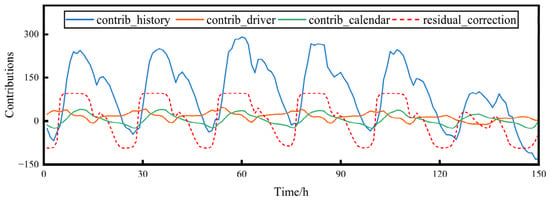
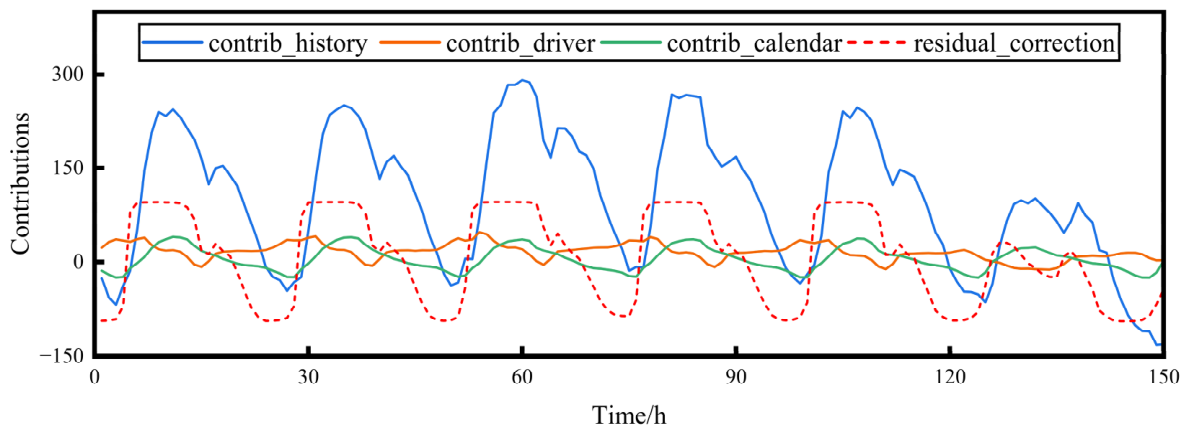
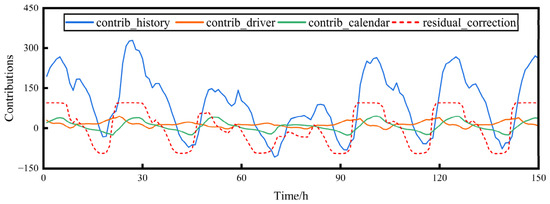
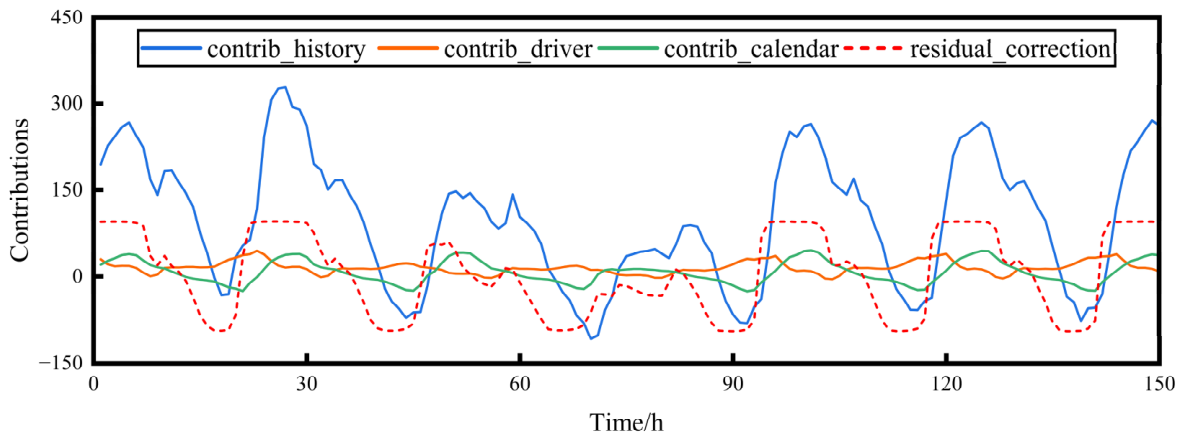
Figure 21 and Figure 22 further show the branch contributions under the sudden load drop and load surge scenarios. In both cases, the history branch exhibits the largest response amplitude and follows the main periodic load pattern, providing the baseline support for tracking the drop and surge processes. The driver and calendar branches provide smoother auxiliary corrections, while the residual branch introduces bounded adjustments around local peaks and transition regions. These coordinated responses help the model maintain good tracking ability under sudden load decrease and increase conditions, which is consistent with the interval forecasting performance shown in Figure 20.
Figure 21.
Branch contributions under the sudden load drop scenario.
Figure 22.
Branch contributions under the load surge scenario.
3.4.5. Sensitivity Analysis of the Bounded Residual Correction Coefficient
The bounded residual correction coefficient controls the maximum correction amplitude of the residual branch after three-way fusion. To clarify its influence on interval forecasting performance, a sensitivity analysis was conducted by varying from 0.0 to 0.8. The results are reported in Table 7.
Table 7.
Sensitivity analysis of the bounded residual correction coefficient .
When , the residual correction is removed. In this case, the model obtains a PICP of 0.6748, indicating that removing the residual branch weakens interval coverage and greatly degrades the interval-oriented performance. This result confirms the necessity of bounded residual correction.
For nonzero values of , the model shows different trade-offs among point accuracy, interval coverage, and interval compactness. When , the model achieves the lowest RMSE and MAE and the highest R2, suggesting better point fitting and a compact interval. However, its PICP remains relatively low, leading to a larger CWC. In contrast, , 0.6, and 0.8 improve PICP to 0.7662, 0.7831, and 0.7850, respectively. Among them, and 0.8 achieve the lowest CWC values, indicating better interval-oriented performance.
Overall, acts as a key control parameter for balancing point prediction accuracy, interval coverage, and interval compactness. In practical applications, the value of can be selected according to the forecasting objective. A smaller value, such as , is preferable when point accuracy and R2 are prioritized, whereas values in the range of 0.5–0.8 are more suitable when interval reliability and comprehensive interval-oriented performance are emphasized.
4. Discussion
4.1. Rationale for the Semi-Explicit Branch Design
The proposed ADDF framework adopts a semi-explicit structure to organize heterogeneous inputs according to their functional roles. The History Branch captures load inertia and short-term autocorrelation, the Calendar Branch represents deterministic temporal priors such as daily and weekly rhythms, and the Driver Branch models external factors that may introduce additional load fluctuations. This separation allows the model to distinguish historical dependence, temporal regularity, and external forcing before dynamic fusion.
The three-branch design is adopted because merging these information sources would blur their functional boundaries. Combining calendar priors with external drivers may mix deterministic temporal patterns with uncertain external disturbances, while combining historical load with drivers may obscure the distinction between load inertia and external forcing. In addition, driving variables are divided into continuous and event types because they have different statistical properties: continuous drivers usually evolve smoothly and contain numerical physical meanings, whereas event-type drivers are discrete or trigger-related. Separating them helps preserve these differences and avoids weakening event-triggered effects through continuous smoothing.
4.2. Robustness of Dynamic Gating and Residual Correction
Dynamic gating is introduced to regulate the participation of driving variables according to the sample state. Compared with retaining all drivers or using fixed hard-threshold screening, the proposed soft-gating mechanism assigns adaptive weights to driver representations instead of abruptly excluding information with a manually fixed threshold. The ablation results support this design: removing dynamic gating or replacing it with fixed hard-threshold screening degrades interval-oriented performance, especially PICP and CWC. This indicates that retaining all drivers may introduce redundant information, whereas hard screening may discard useful driver signals in some samples. Dynamic gating therefore provides a smoother and more reliable driver screening strategy for interval forecasting.
Bounded residual correction further helps balance point accuracy and interval reliability. The coefficient controls the correction amplitude of the residual branch after three-way fusion. When , residual correction is removed and interval coverage decreases. For nonzero values, reflects the trade-off between point fitting and interval reliability: smaller values tend to favor point accuracy, while values in the range of 0.5–0.8 are more coverage-oriented. Thus, can be regarded as a turning point between point prediction accuracy and interval reliability rather than a universally fixed optimal value.
4.3. Analysis of Long-Horizon Coverage Degradation
Although the proposed model achieves competitive performance in most settings, the PICP on the Panama dataset under the 24-step setting is relatively lower than the target confidence level. This reflects a common challenge of long-horizon interval forecasting on highly fluctuating load series, rather than a model-specific failure.
In long-horizon forecasting, uncertainty accumulates across future steps, making stable interval coverage more difficult than in one-step prediction. This difficulty is further amplified when the load series contains large peak-to-valley variations, abrupt transitions, or local pattern shifts. The Panama dataset exhibits these characteristics: the later test segment shows local behavior inconsistent with earlier patterns, and uncovered points mainly appear around peaks and transition regions. Similar difficulties are also observed in comparison models, suggesting that the lower PICP is mainly associated with long-horizon uncertainty accumulation and data distribution variation.
Future work may consider horizon-wise uncertainty calibration for long-horizon interval forecasting, so that interval width can be adjusted according to the uncertainty level of different prediction steps.
4.4. Sustainability-Oriented Engineering Implications and Future Work
For sustainable power systems with increasing renewable energy penetration, load forecasting should not only describe future demand trends but also support uncertainty-aware operation. Compared with point forecasting, interval forecasting provides possible load variation ranges, which are useful for day-ahead scheduling, reserve planning, demand response, and energy management, where decisions depend on both expected load levels and uncertainty-related risks.
From this perspective, ADDF improves the structure and usability of forecasting information. By avoiding direct dependence on true future driver values, the model is closer to practical forecasting conditions. By organizing historical load, calendar priors, and external drivers into functional paths, it also provides a clearer understanding of how different information sources contribute to prediction. Therefore, ADDF can support uncertainty-aware forecasting in renewable-integrated power systems, especially under stronger load variability and external disturbances.
A promising future direction is to couple interval load forecasting with day-ahead scheduling. The predicted upper and lower bounds can provide uncertainty margins for scheduling models, helping to balance economy and security. Future work may embed ADDF intervals into robust optimization, stochastic scheduling, energy storage dispatch, or demand response frameworks, and further investigate how interval confidence levels affect scheduling cost, reserve margin, and operational security.
5. Conclusions
This study developed ADDF, a semi-explicit and self-driven framework for multi-step load interval forecasting under practical information constraints. The main conclusions are summarized as follows:
First, ADDF organizes historical load, calendar priors, and external drivers into three functional branches. This design avoids the indiscriminate mixing of heterogeneous information within a unified network and improves the structural analyzability of the forecasting process.
Second, the Driver Branch estimates future driver states without relying on true future driver values. Combined with the dynamic gating mechanism, this branch can screen useful external information according to the current forecasting context.
Third, the Three-Way Fusion module and bounded residual correction are integrated to generate multi-step quantile forecasts. Experiments on the Panama electricity load dataset and the ETTh1 dataset show that ADDF achieves competitive point forecasting accuracy and interval forecasting performance under both one-step and 24-step settings.
Fourth, the analyses of fusion weights, path contributions, variable-level gating, and future driver state estimation indicate that different information pathways are not simply superimposed. Instead, they show distinguishable participation patterns during forecasting, which supports a clearer interpretation of the model behavior.
Overall, ADDF provides more structured and usable forecasting information for power systems with increasing renewable energy penetration and stronger load variability. By generating uncertainty-aware load forecasts under realistic information constraints, the proposed framework can support sustainable power system operation, especially in day-ahead scheduling, reserve planning, demand response, and risk-aware energy management.
Author Contributions
Conceptualization, J.M. and H.H.; methodology, J.M. and H.H.; software, J.M.; validation, H.H.; formal analysis, J.M.; data curation, H.H. and H.L.; writing—original draft preparation, J.M.; writing—review and editing, J.M. and H.H.; visualization, J.M.; supervision, J.P. and L.S.; project administration, J.P. All authors have read and agreed to the published version of the manuscript.
Funding
This research received no external funding.
Institutional Review Board Statement
Not applicable.
Informed Consent Statement
Not applicable.
Data Availability Statement
The datasets used in this study are publicly available on Kaggle. The Panama electricity load dataset is available at [https://www.kaggle.com/datasets/saurabhshahane/electricity-load-forecasting] (accessed on 10 October 2025), and the ET dataset is available at [https://www.kaggle.com/datasets/fluentn/etdataset-main] (accessed on 10 October 2025).
Conflicts of Interest
The authors declare no conflicts of interest.
References
- Zhou, P.; Lv, Y.; Wen, W. The low-carbon transition of energy systems: A bibliometric review from an engineering management perspective. Engineering 2023, 29, 147–158. [Google Scholar] [CrossRef] [Scilit]
- Bessa, R.; Moreira, C.; Silva, B.; Matos, M. Handling renewable energy variability and uncertainty in power system operation. In Advances in Energy Systems: The Large-Scale Renewable Energy Integration Challenge; John Wiley & Sons: Hoboken, NJ, USA, 2019; pp. 1–26. [Google Scholar] [CrossRef] [Scilit]
- Ahmed, A.; Khalid, M. A review on the selected applications of forecasting models in renewable power systems. Renew. Sustain. Energy Rev. 2019, 100, 9–21. [Google Scholar] [CrossRef] [Scilit]
- Pinheiro, M.G.; Madeira, S.C.; Francisco, A.P. Short-term electricity load forecasting—A systematic approach from system level to secondary substations. Appl. Energy 2023, 332, 120493. [Google Scholar] [CrossRef] [Scilit]
- Wu, B.; Wang, J.; Li, Q.; Fu, D.; Wang, L. A comprehensive review for agricultural product prices forecasting: Architectural diversity and open challenges. Expert Syst. 2026, 43, e70254. [Google Scholar] [CrossRef] [Scilit]
- Karamolegkos, S.; Koulouriotis, D.E. Advancing short-term load forecasting with decomposed Fourier ARIMA: A case study on the Greek energy market. Energy 2025, 325, 135854. [Google Scholar] [CrossRef] [Scilit]
- Kantar, L. ARCH models and an application on exchange rate volatility: ARCH and GARCH models. In Handbook of Research on Emerging Theories, Models, and Applications of Financial Econometrics; Springer: Berlin/Heidelberg, Germany, 2021; pp. 287–300. [Google Scholar] [CrossRef] [Scilit]
- Cortes, C.; Vapnik, V. Support-vector networks. Mach. Learn. 1995, 20, 273–297. [Google Scholar] [CrossRef] [Scilit]
- Breiman, L. Random forests. Mach. Learn. 2001, 45, 5–32. [Google Scholar] [CrossRef] [Scilit]
- Chen, T.; Guestrin, C. Xgboost: A scalable tree boosting system. In Proceedings of the 22nd Acm Sigkdd International Conference on Knowledge Discovery and Data Mining; Association for Computing Machinery: New York, NY, USA, 2016; pp. 785–794. [Google Scholar] [CrossRef] [Scilit]
- Peng, L.-L.; Fan, G.-F.; Huang, M.-L.; Hong, W.-C. Hybridizing DEMD and quantum PSO with SVR in electric load forecasting. Energies 2016, 9, 221. [Google Scholar] [CrossRef] [Scilit]
- Yu, S.; Yang, X.; Ye, H.; Tang, D.; Arasteh, H.; Guerrero, J.M. An Ensemble Model of Attention-Enhanced N-BEATS and XGBoost for District Heating Load Forecasting. Energies 2025, 18, 3984. [Google Scholar] [CrossRef] [Scilit]
- Deng, X.; Ye, A.; Zhong, J.; Xu, D.; Yang, W.; Song, Z.; Zhang, Z.; Guo, J.; Wang, T.; Tian, Y. Bagging–XGBoost algorithm based extreme weather identification and short-term load forecasting model. Energy Rep. 2022, 8, 8661–8674. [Google Scholar] [CrossRef] [Scilit]
- Hochreiter, S.; Schmidhuber, J. Long Short-Term Memory. Neural Comput. 1997, 9, 1735–1780. [Google Scholar] [CrossRef] [Scilit] [PubMed]
- Graves, A.; Schmidhuber, J. Framewise phoneme classification with bidirectional LSTM and other neural network architectures. Neural Netw. 2005, 18, 602–610. [Google Scholar] [CrossRef] [Scilit] [PubMed]
- LeCun, Y.; Bengio, Y.; Hinton, G. Deep learning. Nature 2015, 521, 436–444. [Google Scholar] [CrossRef] [Scilit] [PubMed]
- Katholnigg, M.; Goebel, C. The Impact of Load Forecasting Model Choice on the Economic Operation of Industrial Energy Storage. In Proceedings of the 12th ACM International Conference on Systems for Energy-Efficient Buildings, Cities, and Transportation; Association for Computing Machinery: New York, NY, USA, 2025; pp. 12–22. [Google Scholar] [CrossRef] [Scilit]
- Xu, Y.; Yang, J.; Cai, X. Intelligent analysis algorithm for power engineering data based on improved BiLSTM. Sci. Rep. 2025, 15, 15320. [Google Scholar] [CrossRef] [Scilit] [PubMed]
- Xiang, X.; Yuan, T.; Cao, G.; Zheng, Y. Short-term electric load forecasting based on signal decomposition and improved tcn algorithm. Energies 2024, 17, 1815. [Google Scholar] [CrossRef] [Scilit]
- Vaswani, A.; Shazeer, N.; Parmar, N.; Uszkoreit, J.; Jones, L.; Gomez, A.N.; Kaiser, Ł.; Polosukhin, I. Attention is all you need. In Advances in Neural Information Processing Systems 2017; NIPS: San Diego, CA, USA, 2017; Volume 30. [Google Scholar]
- Zhou, H.; Zhang, S.; Peng, J.; Zhang, S.; Li, J.; Xiong, H.; Zhang, W. Informer: Beyond efficient transformer for long sequence time-series forecasting. In Proceedings of the AAAI Conference on Artificial Intelligence; AAAI: Washington, DC, USA, 2021; pp. 11106–11115. [Google Scholar] [CrossRef] [Scilit]
- Wu, H.; Xu, J.; Wang, J.; Long, M. Autoformer: Decomposition transformers with auto-correlation for long-term series forecasting. Adv. Neural Inf. Process. Syst. 2021, 34, 22419–22430. [Google Scholar]
- Zhou, T.; Ma, Z.; Wen, Q.; Wang, X.; Sun, L.; Jin, R. Fedformer: Frequency enhanced decomposed transformer for long-term series forecasting. In Proceedings of the International Conference on Machine Learning; PMLR: New York, NY, USA, 2022; pp. 27268–27286. [Google Scholar]
- Ma, L.; Guo, C.; Wang, Y.; Zhang, Y.; Zhang, B. KAN+ Transformer: An Explainable and Efficient Approach for Electric Load Forecasting. Sustainability 2026, 18, 1677. [Google Scholar] [CrossRef] [Scilit]
- Yang, K.; Shi, F. Medium-and long-term load forecasting for power plants based on causal inference and informer. Appl. Sci. 2023, 13, 7696. [Google Scholar] [CrossRef] [Scilit]

Disclaimer/Publisher’s Note: The statements, opinions and data contained in all publications are solely those of the individual author(s) and contributor(s) and not of MDPI and/or the editor(s). MDPI and/or the editor(s) disclaim responsibility for any injury to people or property resulting from any ideas, methods, instructions or products referred to in the content. |
© 2026 by the authors. Licensee MDPI, Basel, Switzerland. This article is an open access article distributed under the terms and conditions of the Creative Commons Attribution (CC BY) license.