Article

Farmers’ Perceptions of Policy Support, Ecological Agriculture Adoption, and Green Development in Xinjiang Under China’s Rural Revitalization Strategy: A Sequential Explanatory Mixed-Methods Study

1
School of Marxism, Nanjing Normal University, Nanjing 210098, China
2
School of Teacher Education, Nanjing Normal University, Nanjing 210098, China
*
Author to whom correspondence should be addressed.
Sustainability 2026, 18(12), 6254; https://doi.org/10.3390/su18126254
Submission received: 4 March 2026 / Revised: 11 June 2026 / Accepted: 12 June 2026 / Published: 17 June 2026
(This article belongs to the Section Sustainable Agriculture)

Abstract

This study examines farmers’ perceptions of how policy support is associated with ecological agriculture adoption and perceived green development outcomes in Xinjiang under China’s Rural Revitalization Strategy. A sequential explanatory mixed-methods design was used, in which the qualitative phase was deliberately connected to the quantitative phase through a shared sampling frame and a construct-aligned interview guide, and the two strands were integrated using a joint display and meta-inferences. In the quantitative phase, survey data from 300 farmers were analyzed using partial least squares structural equation modelling (PLS-SEM) to test the relationships among perceived policy support, ecological agriculture adoption, and green development. In the qualitative phase, semi-structured interviews with 30 participants drawn from the same respondent pool were thematically analyzed to explain, qualify, and contextualize the statistical relationships. The quantitative findings show a strong positive association between perceived policy support and ecological agriculture adoption (β = 0.659, p < 0.001), a strong positive association between ecological agriculture adoption and green development (β = 0.689, p < 0.001), and a smaller but significant direct association between perceived policy support and green development (β = 0.324, p < 0.001). The indirect effect of perceived policy support on green development through ecological agriculture adoption (β = 0.454) indicates partial mediation. The model explains 43.4% of the variance in ecological agriculture adoption and 47.4% of the variance in green development. The integrated joint display shows that technical training, policy clarity, and extension support helped farmers translate policy support into ecological practices, whereas high initial costs, financing constraints, and market uncertainty limited adoption and created uneven outcomes. The integrated findings suggest that policy effectiveness depends not only on the availability of support instruments but also on farmers’ practical capacity, economic security, and confidence in market returns. The study contributes perception-based mixed-method evidence on the policy–adoption–green development nexus in an ecologically vulnerable agricultural region.

1. Introduction

Sustainable agricultural transformation has become a central policy concern because food production systems are now expected to improve environmental quality, protect natural resources, and sustain rural livelihoods simultaneously [1,2,3,4]. In China, this challenge is especially visible in ecologically fragile regions where agricultural modernization must proceed under water scarcity, land pressure, and uneven rural development conditions. Xinjiang is a particularly important case because agricultural production remains economically strategic while the region also faces aridity, ecological vulnerability, and wide variation in farmers’ access to public support [5].
Although ecological agriculture is widely promoted as a pathway toward sustainable rural development, actual adoption remains uneven. Previous research consistently identifies financing constraints, limited technical knowledge, weak extension support, and uneven policy implementation as major barriers to practice change [6,7,8,9,10]. These barriers are not merely technical; they shape how farmers interpret the usefulness, credibility, and feasibility of policy support in their everyday production decisions. In that sense, adoption is a behavioural and institutional process rather than an automatic response to policy announcements alone.
Existing studies have generated important knowledge on agricultural green development, eco-efficiency, digital agriculture, and policy incentives [11,12,13,14,15], yet much of that literature is either macro-level, regionally aggregated, or focused on single policy instruments. Less attention has been paid to the micro-level mechanism through which perceived policy support is translated into on-farm ecological adoption and, in turn, into perceived green development outcomes. This gap is especially important in Xinjiang, where contextual constraints may strengthen or weaken the practical effect of policy interventions.
Against this background, the present study develops and tests a parsimonious three-construct model linking perceived policy support, ecological agriculture adoption, and green development. A sequential explanatory mixed-methods design is used so that the qualitative phase can do more than merely accompany the survey: it explicitly identifies contextual barriers and facilitators that help explain the quantitative relationships. By combining PLS-SEM with thematic analysis of interviews, the study seeks to offer a more policy-relevant account of how support measures are interpreted, enacted, and constrained at the farm level.

1.1. Research Aim, Theoretical Context, and Contribution

The main aim of this study is to examine farmers’ perceptions of how policy support is associated with ecological agriculture adoption and perceived green development outcomes in Xinjiang, and to use qualitative interview evidence to explain the practical conditions under which policy support is translated into ecological farming behaviour. The study is grounded in the broader sustainable development paradigm, which views agricultural transformation as a process that must balance environmental protection, resource efficiency, economic viability, and rural livelihood sustainability. It also draws on policy implementation scholarship, particularly the idea that policy outcomes depend not only on formal policy design but also on communication, administrative capacity, local delivery, target-group response, and the ability of actors to operationalize policy instruments in practice.
Within this theoretical context, perceived policy support is treated as a farmer-level assessment of whether subsidies, training, extension services, infrastructure, and regulatory guidance are accessible and useful. Ecological agriculture adoption is conceptualized as the behavioural mechanism through which institutional support may be converted into sustainability-oriented farming practices. Green development is treated as a perceived outcome that includes environmental improvement, efficient resource use, income stability, and broader ecological awareness. The novelty of the study lies in shifting the analysis from macro-level agricultural green development indicators to a perception-based micro-level mechanism, while using qualitative interviews not merely to confirm the survey results but to explain why the relationships are strengthened, weakened, or unevenly realized in practice.
The study therefore addresses one integrated research question: how do farmers perceive the relationship between policy support, ecological agriculture adoption, and green development in Xinjiang, and what implementation conditions explain this relationship?

1.2. Paper Organization

The manuscript is organized into seven sections. Section 1 introduces the research background, problem context, objectives, and research question. Section 2 reviews the literature, develops the theoretical perspectives, identifies the research gap, and presents the conceptual model and hypotheses. Section 3 describes the methodology, including the mixed-methods design, instrument development, sampling strategy, and data-collection procedures. Section 4 explains the analysis strategy for the quantitative and qualitative phases and the integration procedure. Section 5 reports the quantitative results, the qualitative results, and the integrated joint display. Section 6 discusses the integrated findings, policy implications, and interpretation boundaries. Section 7 concludes the study by summarizing the main contributions, limitations, and future research directions.

2. Background and Conceptual Basis

2.1. Policy Support and Ecological Agriculture

A first strand of literature shows that policy architecture matters for agricultural sustainability, but studies differ considerably in analytical level and outcome focus. Adaptive and regionally responsive policy frameworks can generate ecosystem and productivity co-benefits, yet these analyses usually remain at the macro or regional scale and rarely explain how farmers themselves interpret support measures in practice [16].
Research on the reform of the Common Agricultural Policy similarly emphasizes that institutional design, incentive intensity, and governance coherence shape environmental performance [17,18]. However, this work largely evaluates policy regimes or implementation architectures rather than the behavioural mechanism through which farmers translate public support into concrete ecological practices.
Policy-oriented studies of land management, technological innovation, and agricultural eco-efficiency also suggest that subsidies, infrastructure, regulation, and extension services can improve sustainability performance [19,20,21]. The limitation is that these studies often infer adoption from aggregate outcomes rather than measuring farmers’ own reported engagement with ecological agriculture.
The present study therefore treats policy support as a farm-level perceptual construct. This move is analytically important because policy implementation is experienced through communication quality, training access, regulatory clarity, and the availability of practical assistance. Measuring perceived policy support allows the study to connect institutional intent with farmer-level behavioural response.

2.2. Ecological Agriculture Adoption and Green Development

A second body of scholarship links ecological agriculture to broader green development outcomes, including environmental improvement, resource efficiency, and rural socio-economic resilience [22,23,24]. Studies of digital agriculture and green finance further indicate that supportive institutional environments can strengthen agricultural green development, but they do not always isolate ecological adoption as the behavioural pathway through which those gains emerge [25,26].
Recent work on agricultural green development also points to strong regional variation in environmental performance, suggesting that the benefits of ecological transition depend heavily on local structural conditions [27,28,29,30]. This is important for Xinjiang, where ecological vulnerability and uneven access to policy resources may alter the practical effect of otherwise similar support measures.
Much of the existing evidence is based on regional panels, spatial analysis, or policy evaluation at aggregate level [31,32,33]. While valuable, such approaches do not adequately capture how individual farmers perceive policy support, what motivates or constrains ecological adoption, and how they assess the resulting development outcomes. That micro-level perspective is essential when policy implementation depends on behavioural change.
Recent research on agricultural carbon emissions in China further underscores the importance of regional heterogeneity when interpreting green transition processes [34]. This strengthens the case for a context-sensitive analysis that connects local policy support, adoption behaviour, and perceived green development outcomes.
Accordingly, the present study focuses on farmer-level perceptions and practices rather than only on aggregate regional indicators. This choice allows the analysis to speak more directly to the behavioural mechanism linking policy support and green development.

2.3. Theoretical Perspectives

This study draws on two complementary perspectives rather than a single unified theory. The first is the sustainable development perspective, which interprets agricultural transformation as a multidimensional process involving ecological protection, efficient resource use, economic resilience, and social well-being. In the context of rural revitalization, this perspective frames green development as a multidimensional outcome that includes environmental quality, efficient resource use, and the longer-term resilience of rural livelihoods, and it treats ecological agriculture as a practical route through which farmers can align production with these objectives [35].
The second is the policy implementation perspective, used as a conceptual lens rather than a formal theory. It explains why public support should not be assessed only in terms of the formal existence of subsidies or regulations. What matters is whether subsidies, training, extension services, infrastructure, and regulatory guidance are accessible and usable from the farmer’s point of view. This makes perceived policy support, rather than the nominal presence of policy instruments, the meaningful explanatory construct in a farm-level behavioural model [36,37,38].
Combining these two perspectives, the study assumes that policy support may contribute to green development partly by encouraging farmers to adopt ecological practices. Ecological agriculture adoption is therefore positioned as the behavioural pathway linking institutional support with perceived sustainability-oriented outcomes. A direct policy-support-to-green-development path is also retained, because some policy effects may operate through infrastructure, information, or governance improvements that are not fully captured by adoption behaviour alone [39]. This combined logic explains why the model focuses on three first-order constructs: perceived policy support, ecological agriculture adoption, and green development.

2.4. Research Gap

Despite growing interest in agricultural green development, three gaps remain. First, the literature still lacks sufficient farm-level evidence on how perceived policy support is associated with ecological adoption behaviour. Second, few studies jointly examine direct and mediated links among policy support, ecological agriculture adoption, and green development using primary survey data. Third, mixed-methods studies are scarce: qualitative evidence is often appended descriptively rather than used to explain why particular statistical relationships emerge or weaken in practice. Building on recent work that emphasizes regional heterogeneity in agricultural green transformation [34], this study addresses these gaps through a sequential explanatory mixed-methods design focused on Xinjiang. This gap is consistent with recent collaborative-governance scholarship showing that existing frameworks often under-specify the behavioural dynamics through which consensus is translated into collective action in practice [40].

2.5. Conceptual Model and Hypotheses

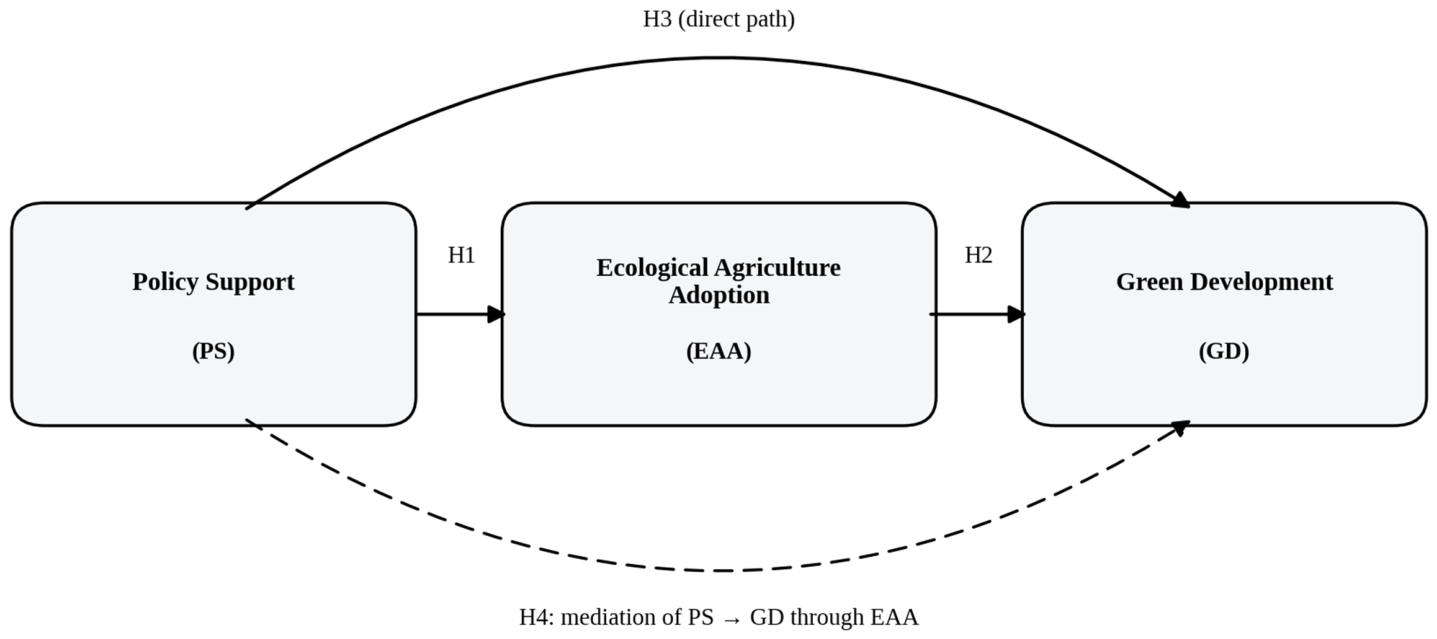
Building on the literature and the theoretical perspectives above, the study specifies a three-construct, perception-based model. Perceived policy support is the independent construct and refers to farmers’ assessment of the accessibility and usefulness of policy instruments such as subsidies, training, extension services, infrastructure support, and environmental guidance. Ecological agriculture adoption is the mediating construct and refers to farmers’ reported use of environmentally oriented practices, including organic or low-chemical inputs, reduced pesticide and fertilizer use, water-saving irrigation, soil conservation, crop rotation, and biodiversity-supporting practices. Green development is the dependent construct and refers to farmers’ perceived environmental, resource-use, and socio-economic improvements associated with ecological agricultural transformation.
The model assumes that perceived policy support is associated with ecological agriculture adoption because farmers are more likely to adopt ecological practices when policy instruments reduce uncertainty, increase knowledge, and improve implementation capacity. Ecological agriculture adoption is expected to be associated with green development because ecological practices can improve soil and water quality, resource efficiency, long-term sustainability, and rural ecological awareness. A direct path from perceived policy support to green development is also retained, because policy support may influence green development through infrastructure, governance, and resource-management improvements that are not fully captured by individual adoption behaviour.
Accordingly, the following hypotheses are tested:
H1. 
Perceived policy support is positively associated with ecological agriculture adoption.
H2. 
Ecological agriculture adoption is positively associated with green development.
H3. 
Perceived policy support is positively associated with green development.
H4. 
Ecological agriculture adoption mediates the association between perceived policy support and green development.
The hypothesized relationships are summarized in Figure 1, and the estimated model with the corresponding path coefficients is reported in Section 5.

3. Methodology

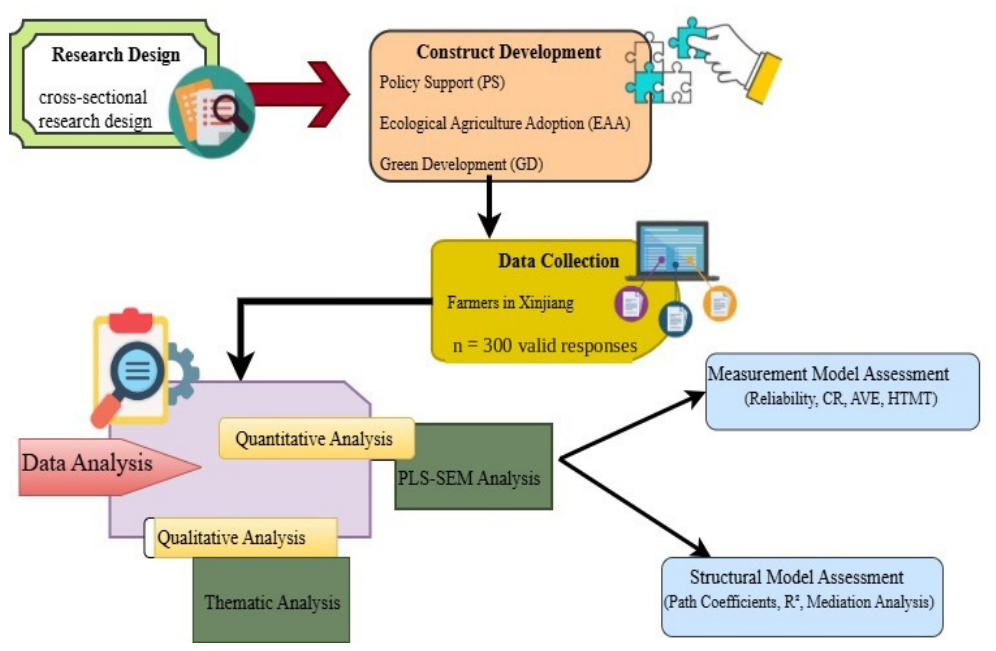
This study employed a sequential explanatory mixed-methods design. The quantitative phase tested the proposed three-construct model using survey responses from 300 farmers in Xinjiang, while the qualitative phase used semi-structured interviews with 30 purposively selected participants to explain and qualify the quantitative findings. This design was selected because the study aimed not only to estimate associations among perceived policy support, ecological agriculture adoption, and green development, but also to understand the practical implementation conditions that shape those associations at farm level.
The two strands were deliberately connected rather than conducted in parallel. The 30 interview participants were drawn from the same pool of 300 survey respondents, so that the qualitative sample was linked to the quantitative sample through a shared sampling frame. The interview guide was organized around the same three constructs measured in the survey. Integration was therefore planned at three levels: at the design level, through the explanatory sequential structure; at the methods level, through connecting the two samples; and at the interpretation and reporting level, through a joint display that aligns each quantitative path with the corresponding qualitative themes and the resulting meta-inferences (Section 5.3).

3.1. Research Design

A mixed-methods strategy was adopted to combine statistical estimation with contextual explanation. The integrated research design and analytical framework are illustrated in Figure 2. The design was sequential explanatory because the qualitative phase was explicitly intended to interpret and qualify the quantitative findings rather than to operate as an unrelated parallel component. This design improves interpretive depth, reduces overreliance on a single method, and strengthens the policy relevance of the results.

3.1.1. Quantitative Research Design

The quantitative phase used a structured questionnaire administered to 300 farmers in Xinjiang. The survey measured three reflective latent constructs—Policy Support (PS), Ecological Agriculture Adoption (EAA), and Green Development (GD)—using five-point Likert items coded from 1 = strongly disagree to 5 = strongly agree.
PLS-SEM was selected because it is appropriate for predictive modelling, mediation analysis, and the estimation of relationships among latent constructs measured through multiple indicators. The quantitative analysis followed three steps: (1) measurement-model assessment, (2) structural-model assessment, and (3) mediation analysis.
(1)
Evaluation of the measurement model (i.e., reliability, convergent validity, and discriminant validity);
(2)
Evaluation of the structural model (i.e., path coefficients; the significance of path coefficients through bootstrapping; coefficients of determination (R2));
(3)
Mediation analysis.
Because the study relies on cross-sectional self-reported survey data, the quantitative analysis is interpreted in associative rather than strictly causal terms.

3.1.2. Qualitative Research Design

The qualitative phase consisted of semi-structured interviews with 30 participants purposively selected from the broader respondent pool to reflect variation in farm size, farming experience, and ecological-adoption intensity. The interview guide focused on three issues: how farmers understood policy support, what barriers and facilitators shaped ecological adoption, and what environmental or socio-economic changes they associated with those practices.
The interview evidence was not used to test separate hypotheses. Instead, it was analyzed thematically so that it could explain why some quantitative relationships were strong, why others were weaker, and what contextual mechanisms conditioned implementation on the ground.

3.2. Instrument Development

The questionnaire was developed from the literature on sustainable agriculture, rural revitalization, and policy implementation, and then adapted to the Xinjiang context. Policy Support was measured with five reflective items (PS1–PS5) covering subsidy availability, technical training, extension access, infrastructure support, and regulatory clarity. Ecological Agriculture Adoption was measured with five items (EAA1–EAA5) covering organic fertilizer use, reduced chemical inputs, water-saving irrigation, soil-conservation practices, and crop-rotation/biodiversity practices. Green Development was measured with five items (GD1–GD5) covering perceived soil and water improvement, resource-use efficiency, income stability, long-term sustainability, and community ecological awareness. All items used the same five-point agreement scale. Expert review and pilot testing were used to improve wording clarity and contextual relevance before full data collection.

3.3. Sampling Strategy

3.3.1. Target Population

The target population comprised farmers in Xinjiang who were actively engaged in agricultural production and had practical familiarity with agricultural support measures linked to rural revitalization. To improve representation, the study considered farm size, farming experience, age, and education when recruiting respondents. The demographic profile of the respondents is summarized in Table 1.

3.3.2. Sampling Technique

To enhance the coverage of heterogeneous groups of farmers in Xinjiang, a purposive sampling approach was employed with stratification objectives, according to farm size, experience in farming, age, and education, to the quantitative phase. The respondents had to be involved in agricultural production and had to be practically familiar with agricultural support measures in relation to rural revitalization. This method was suitable as the research aimed at gathering information-based participants, who could assess the policy support, ecological agriculture adoption, and green development in their own farming environment. In the qualitative phase, purposive selection was once again adopted to include variation in the intensity of adoption, farm characteristics and farming experience such that the interviews may be able to explain variation in the results of the survey.
The sufficiency of the quantitative sample is also statistically justified by a post hoc argument because a sample of 300 respondents is sufficiently large to be mentioned as a minimum requirement in PLS-SEM mediation models, and is large enough to provide adequate information to estimate path coefficients, construct reliability, and indirect effects.Table 2 summarizes the sampling strategy and sample characteristics.

3.4. Data Collection Procedure

The data were gathered within two weeks with the help of a structured questionnaire which was distributed both in the field and online. All respondents were made aware of the study goal, voluntary nature of participation, and confidentiality of their answers and informed consent was obtained. Questionnaires were filtered to check completeness and internal consistency, and then quantitative analysis was done. After the survey stage, a purposely selected subsample of 30 participants was interviewed using semi-structured interviews to give a contextual explanation to the quantitative results. Interviews were anonymized and analyzed thematically and mixed with a method.

4. Data Analysis and Model Evaluation

4.1. Analytical Strategy

PLS-SEM was used to analyze the survey data because the model includes multiple latent variables and a mediating relationship. The analysis proceeded from measurement quality to structural relationships and then to mediation. To avoid overstating what cross-sectional self-reported data can establish, the results are interpreted as statistically supported associations and predictive relationships rather than definitive causal effects.

4.2. Quantitative Analysis Procedure

The quantitative analysis focused on the relationships among Policy Support, Ecological Agriculture Adoption, and Green Development. It assessed whether the measurement model was reliable and valid, whether the structural paths were statistically meaningful, and whether Ecological Agriculture Adoption mediated the association between Policy Support and Green Development.

4.2.1. Measurement Model Assessment

The measurement model was evaluated to ensure the reliability and validity of the reflective constructs.
1. 
Indicator Reliability
Indicator reliability was assessed using outer loadings. Loadings above 0.70 were treated as acceptable, indicating that the indicators adequately represent their respective constructs.
2. 
Internal Consistency Reliability
Internal consistency reliability was examined using:
  • Cronbach’s Alpha (α ≥ 0.70);
  • Composite Reliability (CR ≥ 0.70);
These statistics evaluate the consistency of items within each construct.
3. 
Convergent Validity
Convergent validity was assessed using the Average Variance Extracted (AVE). An AVE above 0.50 indicates that a construct explains more than half of the variance in its indicators.
A V E =   λ i 2 n
where λ represents indicator loadings and n is the number of indicators.

4.2.2. Structural Model Evaluation

After confirming the adequacy of the measurement model, the structural model was evaluated.
1. 
Collinearity Assessment
VIF values were examined to detect multicollinearity. Values below 5 indicate that collinearity is unlikely to bias the regression estimates.
2. 
Path Coefficients and Hypothesis Testing
The significance of path coefficients was assessed using bootstrapping. The retained structural paths were PS → EAA, EAA → GD, and PS → GD.
3. 
Coefficient of Determination (R2)
The coefficient of determination (R2) was used to evaluate the explanatory power of the endogenous constructs. Values of 0.25, 0.50, and 0.75 are commonly interpreted as weak, moderate, and substantial, respectively.
4. 
Effect Size (f2)
Effect size was calculated to determine the individual contribution of exogenous constructs.
f 2 = R included   2 R excluded   2 1 R included   2
Values of 0.02, 0.15, and 0.35 indicate small, medium, and large effects, respectively.
5. 
Predictive Relevance (Q2)
The Stone–Geisser Q2 statistic was calculated using blindfolding procedures. Values above zero indicate predictive relevance.

4.2.3. Mediation Analysis

To test the mediating role of EAA, the indirect effect of PS on GD was examined using bootstrapping. Mediation was inferred when the indirect effect was statistically meaningful and interpreted alongside the direct effect.
The total effect was decomposed into direct and indirect components.
Total   Effect   =   Direct   Effect   +   Indirect   Effect
If both direct and indirect effects are meaningful, partial mediation is indicated; if only the indirect effect remains meaningful, full mediation is suggested. Because the model is estimated from cross-sectional self-reported data, the mediation results are interpreted as evidence of an indirect statistical association rather than definitive proof of a causal transmission mechanism.

4.2.4. Common Method Considerations

Since the study is based on cross-sectional self-reported information, which is obtained through the same respondents and a similar response format, it is impossible to exclude the possibility of common method bias. The three-construct model that was retained still reported satisfactory reliability, convergent validity, discriminant validity, and low structural collinearity. Nonetheless, the relationships that have been noted are to be viewed with caution since tendencies toward shared responses may have reinforced certain relationships. This problem should be more directly tackled in future research, either with multi-source designs, temporal separation, marker variables or formal common-method-bias diagnostics.

4.3. Qualitative Analysis

The qualitative interview data were analyzed thematically to explain and contextualize the quantitative findings. Interview transcripts were first read repeatedly to gain familiarity with the data. Initial open codes were then assigned to meaningful text segments related to policy support, adoption barriers, adoption facilitators, perceived environmental outcomes, and socio-economic effects. Similar codes were grouped into broader categories, and these categories were refined into themes aligned with the quantitative model.
The coding procedure followed three stages. First, descriptive codes were used to identify recurring statements about training, extension support, subsidy access, policy clarity, financing pressure, market uncertainty, environmental improvement, and income stability. Second, related codes were grouped into higher-order categories corresponding to policy-support mechanisms, adoption constraints, and perceived green-development outcomes. Third, the themes were compared with the PLS-SEM results to identify whether the interview evidence explained, qualified, or challenged the quantitative associations.
The qualitative scores reported in the results represent the frequency of coded references within each thematic category. They should therefore be interpreted as indicators of thematic emphasis in the interviews, not as statistical measures equivalent to survey means. This approach allowed the qualitative phase to clarify which implementation conditions were most frequently emphasized by participants when explaining the policy–adoption–green development relationship.
In addition to analyzing each strand, an explicit integration step was carried out. Following the explanatory sequential logic, the quantitative paths and the qualitative themes were brought together in a joint display of the statistics-by-themes type. For each structural path, the relevant quantitative result was placed alongside the qualitative theme or themes that addressed the same relationship, and a meta-inference was then formulated to express the combined interpretation. This procedure is reported in Section 5.3 and ensures that the two strands are connected analytically rather than only juxtaposed in the discussion.

5. Results

Results are reported for the parsimonious three-construct model, including Policy Support, Ecological Agriculture Adoption, and Green Development. Throughout this section, the survey results are interpreted as statistically supported associations among self-reported constructs rather than as definitive causal effects.

5.1. Respondent Profile

Before testing the structural model, the demographic profile of the 300 survey respondents was examined to describe the sample characteristics (Table 1). The sample included farmers across different age groups, education levels, farming experience, and farm sizes, which provided useful variation for examining perceptions of policy support, ecological agriculture adoption, and green development.

PLS-SEM Analysis Results

The PLS-SEM analysis was conducted in two stages: evaluation of the measurement model and evaluation of the structural model. The revised specification excludes the exploratory higher-order “Relationship” construct and reports only the theoretically justified three-construct model. The measurement items, coding, and descriptive statistics are reported in Table 3.
The descriptive statistics indicate that respondents generally reported moderately positive perceptions across the three constructs. Within Policy Support, the highest mean was observed for training availability and usefulness (PS2; M = 3.93, SD = 0.71), while within Ecological Agriculture Adoption, the highest mean was reported for the use of organic or low-chemical inputs (EAA1; M = 3.82, SD = 0.76). For Green Development, the highest mean was recorded for support for environmentally sustainable rural development (GD4; M = 3.92, SD = 0.78). Overall, the item-level results suggest adequate variation and support the continued evaluation of the three-construct measurement model.
Table 4 summarizes the estimation settings used in the PLS-SEM procedure. The algorithm was run with a path-weighting scheme, standardized results, and a maximum of 3000 iterations. These settings are appropriate for estimating the mediation model linking policy support, ecological agriculture adoption, and green development.
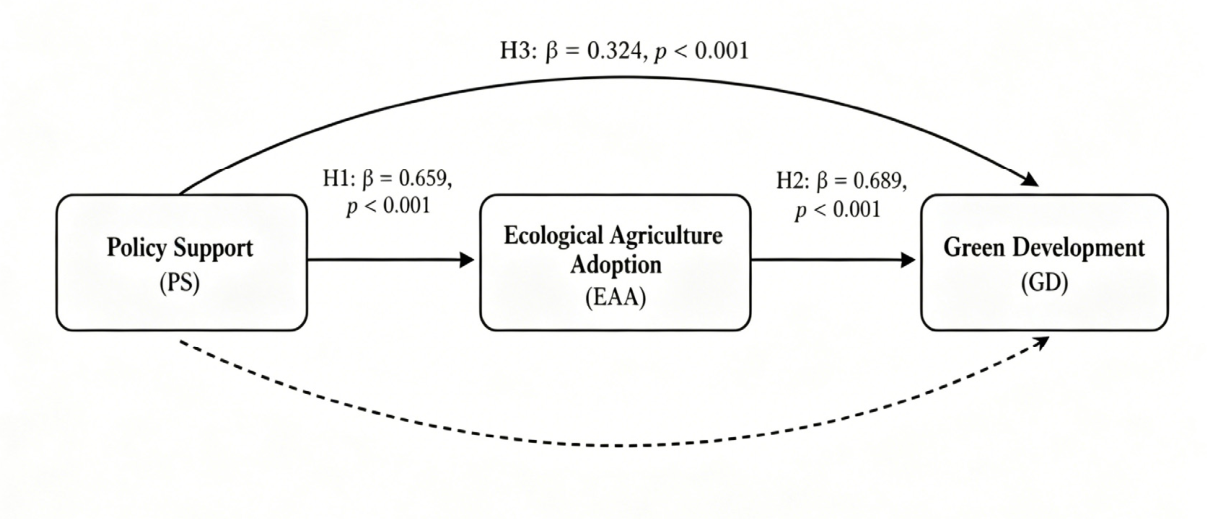
Table 5 shows that all three hypothesized paths were statistically significant. Policy Support was positively associated with Ecological Agriculture Adoption (β = 0.659, p < 0.001), Ecological Agriculture Adoption was positively associated with Green Development (β = 0.689, p < 0.001), and Policy Support also showed a smaller direct association with Green Development (β = 0.324, p < 0.001). These findings support the proposed mediation framework while remaining consistent with an associative interpretation of cross-sectional data.
Table 6 reports the coefficient of determination (R2) values for the endogenous constructs.
The coefficient of determination values indicate moderate explanatory power for the retained endogenous constructs. Policy Support explains 43.4% of the variance in Ecological Agriculture Adoption (R2 = 0.434), while Policy Support together with Ecological Agriculture Adoption explain 47.4% of the variance in Green Development (R2 = 0.474). These values suggest that the model captures a meaningful portion of the variation in the two key outcomes without overstating predictive precision.
Table 7 presents the effect-size (f2) assessment of the structural model.
The results of the effect-size suggest that Policy Support is a significant contributor to Ecological Agriculture Adoption (f2 = 0.767), Ecological Agriculture Adoption is a significant contributor to Green Development (f2 = 0.902), and Policy Support is a significant contributor to Green Development (f2 = 1.739). These estimates show that there are good substantive relationships in the retained model. Simultaneously, due to the fact that all three constructs were assessed based on self-reported perceptions gathered at one time among the same respondents, the extent of those effects should be viewed with reservations. The findings thus confirm the presence of strong associations in the model, but they cannot be interpreted as conclusive evidence of the strength of one-way causality.
Table 8 presents the predictive relevance (Q2) assessment of the structural model.
The Stone–Geisser Q2 statistics indicate positive predictive relevance for all retained paths (Table 9). The predictive relevance is strong for Policy → Ecology (Q2 = 0.467) and Ecology → Green (Q2 = 0.483), and moderate for Policy → Green (Q2 = 0.318). Together, these values suggest that the model has acceptable out-of-sample predictive usefulness.
The retained constructs demonstrate satisfactory internal consistency and convergent validity. Cronbach’s alpha values range from 0.807 to 0.828, composite reliability (ρc) values range from 0.874 to 0.886, and all AVE values exceed 0.50. These results support the adequacy of the revised three-construct measurement model.
Table 10 summarizes the discriminant validity assessment using the HTMT criterion.
For the retained constructs, the HTMT ratios remain below the commonly used thresholds, supporting discriminant validity among Policy Support, Ecological Agriculture Adoption, and Green Development. The previously reported higher-order “Relationship” construct was excluded from the revised model because its HTMT values suggested insufficient distinctness from the core constructs.
Table 11 reports the collinearity assessment for the structural model.
Multicollinearity was evaluated using VIF values for the retained structural paths. All reported values range from 1.000 to 1.437, which is well below the usual threshold of concern. The low VIF values indicate that the predictors make distinct contributions to the endogenous constructs.
Table 12 summarizes the model fit assessment for the saturated and estimated models.
The model-fit measures show that the model fits well in a PLS-SEM application that focuses on prediction. Both the saturated model (SRMR = 0.070) and the estimated model (SRMR = 0.078) have values less than the standard 0.08. The NFI of 0.639 is lower than traditional benchmarks of covariance and thus needs to be viewed with caution. But in PLS-SEM the focus is laid more on predictive performance than on precise global fit. Combined, the fit statistics indicate that the revised three-construct model is to be interpreted cautiously and not to state that it fits exactly.
Figure 3 presents the estimated structural model linking perceived policy support, ecological agriculture adoption, and green development. The model shows that perceived policy support is strongly associated with ecological agriculture adoption, while ecological agriculture adoption is strongly associated with green development. The direct path from perceived policy support to green development remains positive but smaller than the indirect pathway through ecological agriculture adoption. This pattern supports partial mediation and suggests that farmers’ adoption behaviour is a central mechanism through which perceived policy support is connected with green development outcomes.
Table 13 reports the indirect effect and mediation results.
The mediation analysis indicates that Policy Support influences Green Development both directly and indirectly through Ecological Agriculture Adoption. The indirect effect (β = 0.454) is larger than the direct effect (β = 0.324), which suggests that behavioural adoption is the principal pathway through which perceived policy support is linked to green development outcomes (Table 14). Because both components remain meaningful, the pattern is consistent with partial mediation.
When the direct and indirect components are considered together, the total association of Policy Support with Green Development equals 0.778. This result highlights the central role of policy support in the overall model while also confirming that much of its influence operates through ecological agriculture adoption rather than through a purely direct pathway.

5.2. Qualitative Interview Results

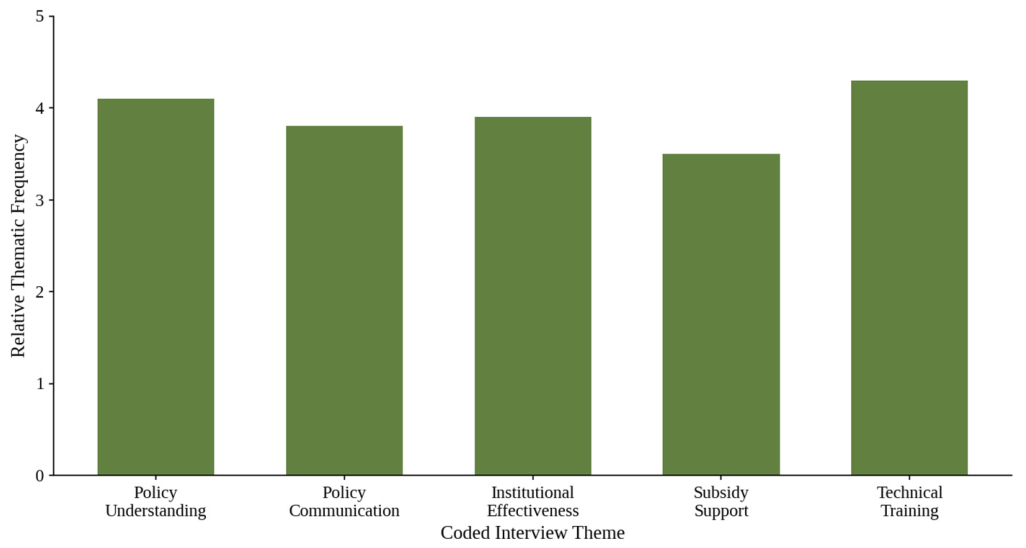
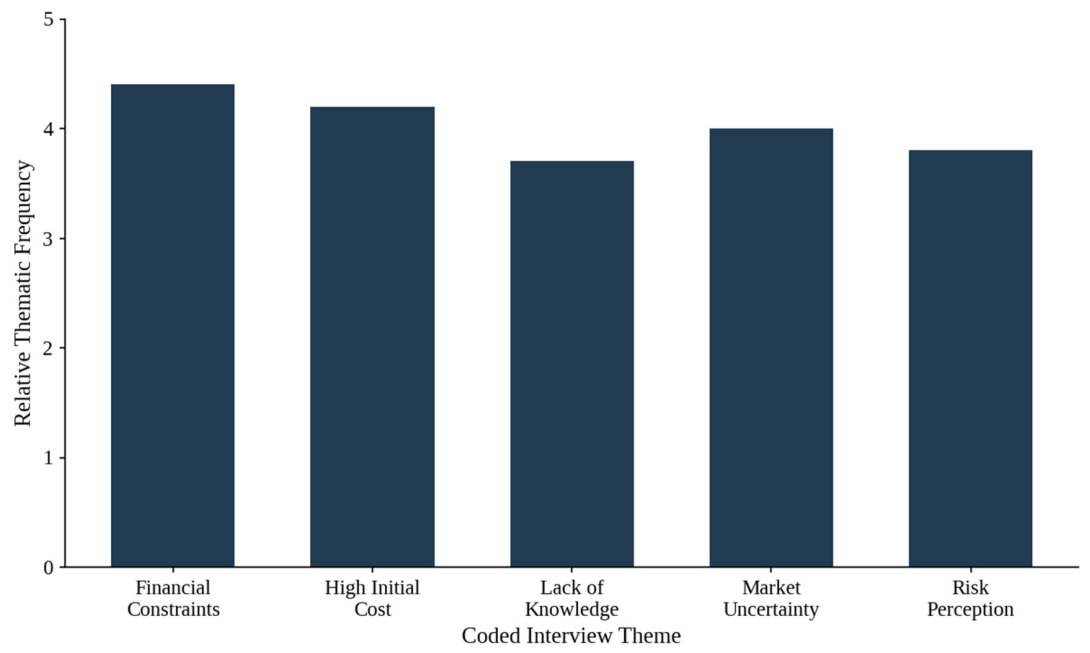
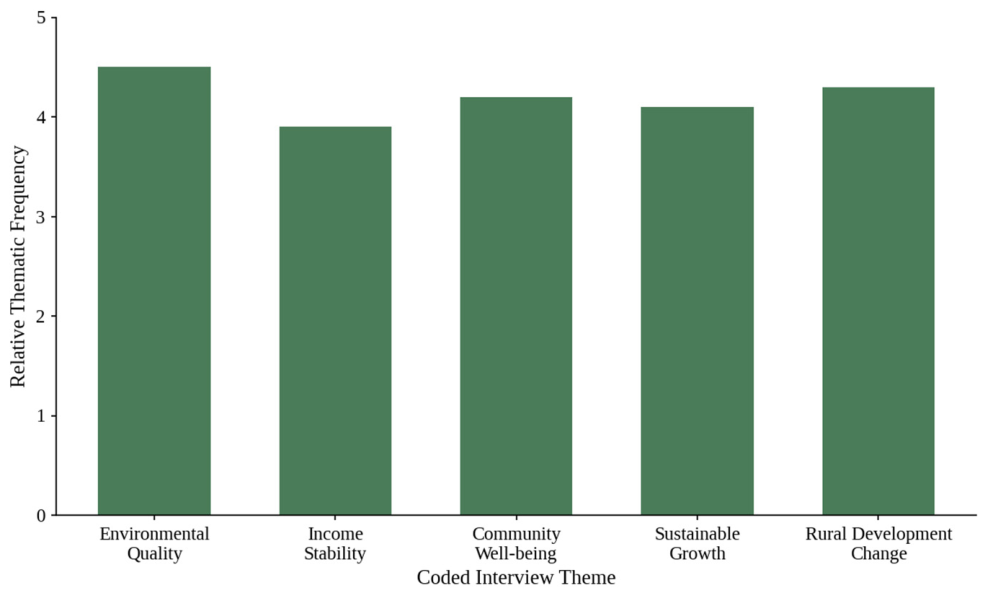
The qualitative phase was used to explain and qualify the quantitative relationships identified through PLS-SEM. Interview data were organized into three main thematic categories: policy-support mechanisms, barriers to ecological agriculture adoption, and perceived green-development outcomes. The scores shown in Figure 4, Figure 5 and Figure 6 represent the relative frequency of coded interview references within each thematic category. They do not represent Likert-scale means; rather, they indicate how often particular themes appeared across the interview material.

5.2.1. Policy-Support Mechanisms

The first thematic category concerned the forms of policy support that farmers considered most useful for ecological agriculture adoption. The strongest theme was technical training, followed by policy clarity, extension support, subsidy access, and infrastructure support. This pattern helps explain the strong quantitative association between perceived policy support and ecological agriculture adoption. Farmers did not describe policy support only in financial terms. Instead, they emphasized that support became useful when it improved their practical understanding of ecological techniques and reduced uncertainty about implementation.
Figure 4 suggests that knowledge-based support was viewed as more influential than purely financial support. Technical training emerged as the most salient facilitator, followed by policy understanding and institutional effectiveness. Subsidies were still relevant, but interviewees generally described them as insufficient when not accompanied by guidance, demonstration, and follow-up support.
This finding adds nuance to the quantitative model. Although perceived policy support was statistically associated with adoption, the interviews suggest that the relationship depends on the quality and usability of support. Subsidies alone were not always sufficient. Participants indicated that training, demonstration, and follow-up guidance were necessary for converting formal policy support into actual ecological farming behaviour.

5.2.2. Barriers to Ecological Agriculture Adoption

The second thematic category concerned the constraints that weakened or delayed ecological agriculture adoption. The most frequently coded barriers were high initial costs, limited access to finance, market uncertainty, implementation risk, and uneven technical guidance. These barriers qualify the positive quantitative relationship between policy support and adoption by showing why policy support does not translate into uniform adoption across all farms.
Figure 5 shows that the most prominent barriers were financial constraints and high initial costs. Market uncertainty and perceived implementation risk also weakened willingness to adopt ecological practices at scale. These qualitative findings help explain why policy support, although statistically important, may not translate uniformly into adoption without mechanisms that reduce financial exposure.
This finding is important because it prevents an overly causal interpretation of the survey results. Even when farmers perceived policy support positively, they were less likely to adopt ecological practices at scale if the expected costs were high, if market premiums for ecological products were uncertain, or if technical support was irregular. The qualitative evidence therefore shows that perceived policy support is associated with adoption, but this association is conditioned by financial capacity, market confidence, and implementation support.

5.2.3. Perceived Green-Development Outcomes

The third thematic category focused on farmers’ perceptions of green-development outcomes. Participants most frequently associated ecological agriculture with improved soil and water quality, better resource-use efficiency, stronger ecological awareness, and long-term sustainability. However, income stability was discussed more cautiously than environmental improvement. Some farmers believed ecological practices could improve long-term farm resilience, but others noted that financial returns were uncertain in the short term.
Figure 6 indicates that participants most strongly associated ecological agriculture with environmental quality improvement, followed by rural development change and community well-being. Income stability was viewed positively but less strongly than environmental gains, suggesting that economic returns may lag behind ecological or social perceptions in the early stages of transition.
This finding explains the strong association between ecological agriculture adoption and green development while also adding an important qualification. Farmers perceived ecological benefits more clearly than immediate economic benefits. Therefore, the relationship between adoption and green development should be interpreted as a perceived sustainability association rather than definitive evidence of objectively measured environmental or income improvement. This supports a cautious interpretation of the quantitative results and strengthens the mixed-method integration.

5.2.4. Integration with Quantitative Results

The qualitative findings explain the quantitative model in three ways. First, they support the Policy Support → Ecological Agriculture Adoption path by showing that training, extension access, and policy clarity made ecological practices more understandable and feasible. Second, they qualify this relationship by showing that financial pressure, implementation cost, and market uncertainty limited adoption even when policy support was viewed positively. Third, they explain the Ecological Agriculture Adoption → Green Development path by showing that farmers associated ecological practices mainly with environmental improvement and resource-use efficiency, while economic benefits were perceived as less immediate and less certain.
Thus, the qualitative phase does not merely confirm the quantitative results. It explains why the statistical relationships appear strong, why they may vary across farmers, and why the findings should be interpreted as perception-based associations rather than direct causal effects.

5.3. Integrated Findings: Joint Display and Meta-Inferences

To make the connection between the quantitative and qualitative strands explicit, the two sets of findings are brought together in a joint display (Table 15). Each row links a structural relationship from the PLS-SEM model to the qualitative theme or themes that address the same relationship, and states the meta-inference that follows from reading the two strands together. This display shows that the qualitative evidence does not stand apart from the quantitative model; it explains, qualifies, and bounds each estimated path.
Reading across the joint display, three meta-inferences emerge. First, the strong Policy Support to Ecological Agriculture Adoption path is explained by the qualitative emphasis on knowledge-based support. Technical training and policy understanding received the highest thematic emphasis, while subsidy support received the lowest, which indicates that support is converted into adoption mainly when it is usable and clear rather than purely financial. Second, the strong Ecological Agriculture Adoption to Green Development path is qualified by the finding that farmers associated adoption more clearly with environmental quality and rural-development change than with income stability. The adoption-to-green-development relationship is therefore best read as a perceived environmental association whose economic component is slower to appear. Third, the mediation pattern, in which the indirect effect through adoption exceeds the direct effect, is bounded by the barrier themes. Financial constraints, high initial costs, and market uncertainty received high thematic emphasis and explain why a positive policy-adoption association can still produce uneven implementation across farms.
Taken together, the joint display supports a single integrated interpretation rather than two separate accounts. Perceived policy support is linked to green development chiefly because it encourages ecological agriculture adoption, but the strength and evenness of this pathway depend on the usability of support and on farmers’ financial capacity and market confidence.

6. Discussion

6.1. Integration of Quantitative and Qualitative Findings

The main contribution of this study is not simply that policy support, ecological agriculture adoption, and green development are positively related. This relationship is theoretically expected. Rather, the contribution lies in showing how this relationship is perceived and operationalized by farmers in a region where ecological vulnerability, implementation capacity, and market uncertainty shape the practical effect of policy support. The mixed-method results show that policy support matters most when it becomes usable support: training, clear guidance, extension contact, and implementation assistance. At the same time, the interview evidence challenges a simple policy-to-adoption interpretation by showing that high costs and uncertain market returns may weaken adoption even under supportive policy conditions.
The mixed-method findings converge on a consistent interpretation: perceived policy support is associated with green development chiefly because it encourages ecological agriculture adoption. The quantitative model shows a strong positive association between Policy Support and Ecological Agriculture Adoption, and the interview evidence helps explain why this relationship emerged. Farmers consistently described technical training, extension access, and policy clarity as the most useful aspects of policy support because these mechanisms reduced uncertainty and made ecological practices more feasible in day-to-day farming decisions.
The qualitative evidence also clarifies why the positive association between Ecological Agriculture Adoption and Green Development should not be interpreted as frictionless or automatic. Although respondents linked ecological agriculture with visible environmental improvements, better resource use, and broader rural-development benefits, they also emphasized high initial costs, financing pressure, and market uncertainty. These barriers help explain why policy support may be positively associated with adoption while still producing uneven implementation across farms. In this sense, the qualitative strand does not merely repeat the quantitative results; it specifies the practical conditions under which institutional support is more likely to translate into sustained ecological adoption and reported green development outcomes.

6.2. Policy Implications

The findings suggest both short-term and long-term implications for rural revitalization and ecological agriculture policy in Xinjiang.
In the short term, policy support should focus on improving farmers’ practical capacity to adopt ecological agriculture. This requires localized technical training, demonstration farms, farmer-to-farmer learning, and more regular extension support. The qualitative findings show that farmers value policy support most when it is understandable and directly applicable to their production conditions. Therefore, policy communication should be simplified, and extension officers should provide concrete guidance on input reduction, water-saving irrigation, soil conservation, and crop diversification.
Short-term policy measures should also reduce the financial risks of adoption. High initial costs and financing constraints were important barriers in the interview data. Targeted subsidies, low-interest green credit, phased cost-sharing arrangements, and transition support for small-scale farmers would make ecological practices more feasible. These measures are especially important because farmers may recognize the environmental value of ecological agriculture but remain hesitant if the economic return is uncertain.
In the long term, policy should move from fragmented support instruments toward an integrated ecological agriculture support system. This includes stable green-product markets, certification mechanisms, cooperative marketing channels, ecological compensation, and stronger monitoring of environmental outcomes. Long-term strategy should also connect ecological agriculture with rural livelihood resilience, so that farmers do not experience green transition as an additional burden but as a viable development pathway. Such an approach would strengthen the link between policy support, adoption behaviour, and green development outcomes.

6.3. Interpretation Boundaries and Endogeneity

Because the study is based on cross-sectional self-reported data, the structural paths should be interpreted as associations and predictive relationships rather than definitive one-way causal effects. Reverse causality remains possible: farmers who are already more engaged in ecological practices may be more likely to notice, seek out, or positively evaluate policy support. Likewise, farms with stronger pre-existing resources may be better positioned both to adopt ecological agriculture and to report more favourable green-development outcomes.
Potential endogeneity may also arise from omitted contextual factors such as market access, cooperative participation, local administrative quality, and variation in implementation intensity across localities. These possibilities do not invalidate the findings, but they do require interpretive caution. Future research should therefore test the model with longitudinal, multi-source, or quasi-experimental designs to strengthen causal inference.

7. Conclusions and Future Research

This study examined farmers’ perceptions of the relationship among policy support, ecological agriculture adoption, and green development in Xinjiang. The findings show that perceived policy support is positively associated with ecological agriculture adoption, and that ecological agriculture adoption is positively associated with perceived green development outcomes. Perceived policy support also has a smaller direct association with green development, while the indirect association through ecological agriculture adoption is stronger. These results indicate that ecological agriculture adoption is a key behavioural pathway through which policy support is linked to green development.
The qualitative findings further show that this relationship is not automatic. Training, policy clarity, and extension support help farmers translate policy support into ecological practices, whereas high initial costs, financing constraints, and market uncertainty weaken adoption. Therefore, policy effectiveness depends not only on the presence of support instruments but also on their practical usability, economic feasibility, and alignment with farmers’ local production conditions.

7.1. Limitations

This study has several limitations. First, it relies on cross-sectional self-reported data, so the findings should be interpreted as associative rather than definitively causal. Second, the core constructs capture farmers’ reported perceptions and reported outcomes rather than externally audited objective environmental performance. Third, the study is region-specific to Xinjiang, which limits broader generalization. Fourth, because the principal constructs were measured from the same respondents using similar response formats, common method bias cannot be ruled out completely. These limitations do not negate the contribution of the study, but they define the boundaries within which the results should be interpreted.

7.2. Future Research

Future research should extend the model using longitudinal or panel designs, objective environmental indicators, and richer measures of market and institutional context. Comparative studies across provinces could test whether similar policy–adoption mechanisms operate in other regions, while future mixed-method work could investigate how credit access, extension quality, and cooperative organization moderate the transition to ecological agriculture.

Author Contributions

Conceptualization, X.L. and Y.Z.; Methodology, X.L. and Y.Z.; Validation, X.L. and G.S.; Formal analysis, X.L. and G.S.; Investigation, X.L. and G.S.; Data curation, Y.Z.; Writing—original draft, X.L. and G.S.; Writing—review & editing, Y.Z.; Visualization, X.L.; Supervision, Y.Z. All authors have read and agreed to the published version of the manuscript.

Funding

This research received no external funding.

Institutional Review Board Statement

In accordance with Chapter 3, Article 39 of China’s "Measures for the Ethical Review of Biomedical Research Involving Humans" (2023), research involving anonymous questionnaires, observations, or interviews that: do not collect identifiable personal information, do not involve sensitive topics (e.g., illegal behavior, violence, sexual behavior, drug use), and pose no more than minimal risk to participants, may be exempt from formal ethical review by an Institutional Review Board (IRB).

Informed Consent Statement

Participation in the study was voluntary, informed consent was obtained from all participants, and responses were anonymized before analysis to protect confidentiality.

Data Availability Statement

The survey instrument and archived study materials are available from the corresponding author upon reasonable request.

Conflicts of Interest

The authors declare no conflict of interest.

References

  1. Rehman, A.; Farooq, M.; Lee, D.-J.; Siddique, K.H.M. Sustainable agricultural practices for food security and ecosystem services. Environ. Sci. Pollut. Res. 2022, 29, 84076–84095. [Google Scholar] [CrossRef] [PubMed]
  2. Mehrabi, Z.; Delzeit, R.; Ignaciuk, A.; Levers, C.; Braich, G.; Bajaj, K.; Amo-Aidoo, A.; Anderson, W.; Balgah, R.A.; Benton, T.G.; et al. Research priorities for global food security under extreme events. One Earth 2022, 5, 756–766. [Google Scholar] [CrossRef] [PubMed]
  3. Shao, Q.; Jiang, C.; Li, G.; Xie, G. Influencing Factors of Sustainable Rural Entrepreneurship: A Four-Dimensional Evaluation System Encompassing Entrepreneurs, Economy, Society, and Environment. Systems 2024, 12, 387. [Google Scholar] [CrossRef]
  4. Yang, Z.; Solangi, Y.A. Analyzing the relationship between natural resource management, environmental protection, and agricultural economics for sustainable development in China. J. Clean. Prod. 2024, 450, 141862. [Google Scholar] [CrossRef]
  5. Shengwu, Z.; Juan, H. Impact of interprovincial pairing assistance policies on sustainable agricultural development in Xinjiang of China. Sci. Rep. 2025, 15, 8372. [Google Scholar] [CrossRef] [PubMed]
  6. Aghabeygi, M.; Strauss, V.; Paul, C.; Helming, K. Barriers of adopting sustainable soil management practices for organic and conventional farming systems. Discov. Soil 2024, 1, 11. [Google Scholar] [CrossRef]
  7. Lawal, T.O.; Abdulsalam, M.; Mohammed, A.; Sundararajan, S. Economic and Environmental Implications of Sustainable Agricultural Practices in Arid Regions: A Cross-disciplinary Analysis of Plant Science, Management, and Economics. Int. J. Membr. Sci. Technol. 2023, 10, 3100–3114. [Google Scholar] [CrossRef]
  8. Dinis, I. Examining disparities in common agriculture policy direct payments among farming systems: Evidence from Portugal. Agric. Food Econ. 2024, 12, 7. [Google Scholar] [CrossRef]
  9. Bless, A.; Davila, F.; Plant, R. A genealogy of sustainable agriculture narratives: Implications for the transformative potential of regenerative agriculture. Agric. Hum. Values 2023, 40, 1379–1397. [Google Scholar] [CrossRef]
  10. Sharma, P.; Sharma, P.; Thakur, N. Sustainable farming practices and soil health: A pathway to achieving SDGs and future prospects. Discov. Sustain. 2024, 5, 250. [Google Scholar] [CrossRef]
  11. Li, C.; Guo, G. The Influence of Large-Scale Agricultural Land Management on the Modernization of Agricultural Product Circulation: Based on Field Investigation and Empirical Study. Sustainability 2022, 14, 13967. [Google Scholar] [CrossRef]
  12. Fan, M.; Yang, P.; Li, Q. Impact of environmental regulation on green total factor productivity: A new perspective of green technological innovation. Environ. Sci. Pollut. Res. 2022, 29, 53785–53800. [Google Scholar] [CrossRef] [PubMed]
  13. Wang, W.; Li, K.; Liu, Y.; Lian, J.; Hong, S. A system dynamics model analysis for policy impacts on green agriculture development: A case of the Sichuan Tibetan Area. J. Clean. Prod. 2022, 371, 133562. [Google Scholar] [CrossRef]
  14. Tan, H.; Qi, X. Synergistic Interconstruction of the Green Development Concept in Chinese Rural Ecological Agriculture. Sustainability 2023, 15, 3961. [Google Scholar] [CrossRef]
  15. Shao, J. Green industrial policy and green development of agriculture—Quasi-natural experiment based on the Yangtze River Economic Belt in China. PLoS ONE 2024, 19, e0308307. [Google Scholar] [CrossRef] [PubMed]
  16. Jiang, C.; Wang, Y.; Yang, Z.; Zhao, Y. Do adaptive policy adjustments deliver ecosystem-agriculture-economy co-benefits in land degradation neutrality efforts? Evidence from southeast coast of China. Environ. Monit. Assess. 2023, 195, 1215. [Google Scholar] [CrossRef] [PubMed]
  17. Cuadros-Casanova, I.; Cristiano, A.; Biancolini, D.; Cimatti, M.; Sessa, A.A.; Angarita, V.Y.M.; Dragonetti, C.; Pacifici, M.; Rondinini, C.; Di Marco, M. Opportunities and challenges for Common Agricultural Policy reform to support the European Green Deal. Conserv. Biol. 2023, 37, e14052. [Google Scholar] [CrossRef] [PubMed]
  18. Guyomard, H.; Détang-Dessendre, C.; Dupraz, P.; Delaby, L.; Huyghe, C.; Peyraud, J.-L.; Reboud, X.; Sirami, C. How the Green Architecture of the 2023–2027 Common Agricultural Policy could have been greener. Ambio 2023, 52, 1327–1338. [Google Scholar] [CrossRef] [PubMed]
  19. Fayet, C.M.J.; Reilly, K.H.; Van Ham, C.; Verburg, P.H. The potential of European abandoned agricultural lands to contribute to the Green Deal objectives: Policy perspectives. Environ. Sci. Policy 2022, 133, 44–53. [Google Scholar] [CrossRef]
  20. Zhang, Y.; Ji, M.; Zheng, X. Digital Economy, Agricultural Technology Innovation, and Agricultural Green Total Factor Productivity. Sage Open 2023, 13, 21582440231194388. [Google Scholar] [CrossRef]
  21. Wang, Y.; Yang, S.; Ahmad, F.; Chandio, A.A. Agricultural eco-efficiency and sustainable agricultural development influential factors and heterogeneities: Exclusive evidence from Chinese cities. Environ. Dev. Sustain. 2025, 27, 30035–30059. [Google Scholar] [CrossRef]
  22. Li, H.; Zhang, W.; Xiao, X.; Lun, F.; Sun, Y.; Sun, N. Temporal and Spatial Changes of Agriculture Green Development in Beijing’s Ecological Conservation Developing Areas from 2006 to 2016. Sustainability 2024, 16, 219. [Google Scholar] [CrossRef]
  23. Chengjun, S.; Renhua, S.; Zuliang, S.; Yinghao, X.; Jiuchen, W.; Zhiyu, X.; Shangbin, G. Construction process and development trend of ecological agriculture in China. Acta Ecol. Sin. 2022, 42, 624–632. [Google Scholar] [CrossRef]
  24. Zhang, Q.; Qu, Y.; Zhan, L. Great transition and new pattern: Agriculture and rural area green development and its coordinated relationship with economic growth in China. J. Environ. Manag. 2023, 344, 118563. [Google Scholar] [CrossRef] [PubMed]
  25. Jiang, Q.; Li, J.; Si, H.; Su, Y. The Impact of the Digital Economy on Agricultural Green Development: Evidence from China. Agriculture 2022, 12, 1107. [Google Scholar] [CrossRef]
  26. Du, Y.; Wang, W. The role of green financing, agriculture development, geopolitical risk, and natural resource on environmental pollution in China. Resour. Policy 2023, 82, 103440. [Google Scholar] [CrossRef]
  27. Zhou, F.; Wen, C. Research on the Level of Agricultural Green Development, Regional Disparities, and Dynamic Distribution Evolution in China from the Perspective of Sustainable Development. Agriculture 2023, 13, 1441. [Google Scholar] [CrossRef]
  28. Zou, Y.; Cheng, Q.; Jin, H.; Pu, X. Evaluation of Green Agricultural Development and Its Influencing Factors under the Framework of Sustainable Development Goals: Case Study of Lincang City, an Underdeveloped Mountainous Region of China. Sustainability 2023, 15, 11918. [Google Scholar] [CrossRef]
  29. Rudnicki, R.; Biczkowski, M.; Wiśniewski, Ł.; Wiśniewski, P.; Bielski, S.; Marks-Bielska, R. Towards Green Agriculture and Sustainable Development: Pro-Environmental Activity of Farms under the Common Agricultural Policy. Energies 2023, 16, 1770. [Google Scholar] [CrossRef]
  30. Niu, K.; He, W.; Qiu, L. Symbiosis coordination between industrial development and ecological environment for sustainable development: Theory and evidence. Sustain. Dev. 2023, 31, 3052–3069. [Google Scholar] [CrossRef]
  31. Liu, Y.; Lu, C.; Chen, X. Dynamic analysis of agricultural green development efficiency in China: Spatiotemporal evolution and influencing factors. J. Arid Land 2023, 15, 127–144. [Google Scholar] [CrossRef]
  32. Zhong, R.; He, Q.; Qi, Y. Digital Economy, Agricultural Technological Progress, and Agricultural Carbon Intensity: Evidence from China. Int. J. Environ. Res. Public Health 2022, 19, 6488. [Google Scholar] [CrossRef] [PubMed]
  33. Xu, L.-Y.; Jiang, J.; Du, J.-G. How do environmental regulations and financial support for agriculture affect agricultural green development? The mediating role of agricultural infrastructure. J. Environ. Plan. Manag. 2025, 68, 557–584. [Google Scholar] [CrossRef]
  34. Huang, J.; Lu, H.; Du, M. Regional Differences in Agricultural Carbon Emissions in China: Measurement, Decomposition, and Influencing Factors. Land 2025, 14, 682. [Google Scholar] [CrossRef]
  35. World Commission on Environment and Development. Our Common Future; Oxford University Press: Oxford, UK, 1987. [Google Scholar]
  36. Pressman, J.L.; Wildavsky, A. Implementation: How Great Expectations in Washington Are Dashed in Oakland; University of California Press: Berkeley, CA, USA, 1973. [Google Scholar]
  37. Mazmanian, D.A.; Sabatier, P.A. Implementation and Public Policy; Scott, Foresman: Glenview, IL, USA, 1983. [Google Scholar]
  38. Lipsky, M. Street-Level Bureaucracy: Dilemmas of the Individual in Public Services; Russell Sage Foundation: New York, NY, USA, 1980. [Google Scholar]
  39. Rogers, E.M. Diffusion of Innovations, 5th ed.; Free Press: New York, NY, USA, 2003. [Google Scholar]
  40. Zhou, C.; Richardson-Barlow, C. A new framework for collaborative climate governance: Linking consensus building and collective action. Policy Politics 2026, 54, 1–22. [Google Scholar] [CrossRef]
Figure 1. Conceptual Model of Policy Support, Ecological Agriculture Adoption, and Green Development.
Sustainability 18 06254 g001
Figure 2. Integrated Research Design and Analytical Framework.
Sustainability 18 06254 g002
Figure 3. Structural Model of the Policy Support–Ecological Agriculture Adoption–Green Development Framework.
Sustainability 18 06254 g003
Figure 4. Institutional Policy Support and Capacity Development. Note: The vertical axis represents the relative thematic frequency of coded interview references within each theme; bar heights are relative indicators and do not represent measured or Likert-scale scores.
Sustainability 18 06254 g004
Figure 5. Economic and Market Barriers to Ecological Agriculture Adoption. Note: The vertical axis represents the relative thematic frequency of coded interview references within each theme; bar heights are relative indicators and do not represent measured or Likert-scale scores.
Sustainability 18 06254 g005
Figure 6. Perceived Environmental and Socio-Economic Impacts of Ecological Agriculture. Note: The vertical axis represents the relative thematic frequency of coded interview references within each theme; bar heights are relative indicators and do not represent measured or Likert-scale scores.
Sustainability 18 06254 g006
Table 1. Demographic Profile of Respondents (N = 300).
Demographic VariableCategoryNumber (N)Percentage (%)
Age18–306020.0
31–409030.0
41–508026.7
51–605016.7
Above 60206.6
GenderMale19063.3
Female11036.7
Education LevelPrimary School8026.7
Secondary School12040.0
Diploma6020.0
Bachelor’s or above4013.3
Farming Experience<5 years5016.7
5–10 years9030.0
11–20 years10033.3
>20 years6020.0
Farm SizeSmall-scale14046.7
Medium-scale11036.7
Large-scale5016.6
Table 2. Sampling Strategy and Sample Characteristics.
Research ComponentSampling TechniqueSample SizePurpose
Quantitative StudyPurposive Sampling300 farmersTest the associations among Policy Support, EAA, and Green Development using PLS-SEM.
Qualitative StudyPurposive Sampling30 participantsExplain contextual facilitators, barriers, and perceived outcomes that help interpret the survey relationships.
Table 3. Measurement Items, Coding, and Descriptive Statistics (N = 300).
ConstructCodeItem DescriptionMeanSD
Policy SupportPS1Government subsidies for ecological farming are accessible to farmers in my area.3.920.72
Policy SupportPS2Training opportunities related to ecological agriculture are available and useful.3.930.71
Policy SupportPS3Technical extension services support the adoption of ecological agriculture.3.910.68
Policy SupportPS4Public infrastructure supports environmentally sustainable farming practices.3.930.70
Policy SupportPS5Environmental regulations and policy guidance encourage ecological agriculture adoption.3.920.69
Ecological Agriculture AdoptionEAA1I use organic or low-chemical inputs in my farming practices.3.820.76
Ecological Agriculture AdoptionEAA2I have reduced the use of chemical pesticides and fertilizers.3.800.74
Ecological Agriculture AdoptionEAA3I apply water-saving irrigation or other resource-efficient techniques.3.790.78
Ecological Agriculture AdoptionEAA4I use soil-conservation practices in farm management.3.740.73
Ecological Agriculture AdoptionEAA5I adopt crop rotation, diversification, or biodiversity-supporting practices.3.780.77
Green DevelopmentGD1Ecological farming practices have improved soil and/or water quality.3.870.76
Green DevelopmentGD2Ecological farming practices have improved resource-use efficiency.3.900.78
Green DevelopmentGD3Ecological farming practices have contributed to more stable long-term farm outcomes.3.890.75
Green DevelopmentGD4Ecological farming practices support environmentally sustainable rural development.3.920.78
Green DevelopmentGD5Ecological farming practices contribute to broader community ecological awareness.3.880.76
Note: All items were measured on a five-point Likert scale ranging from 1 = strongly disagree to 5 = strongly agree.
Table 4. PLS-SEM Algorithm Configuration and Estimation Settings.
ParametersSetting
Max. number of iterations3000
Stop criterion10−7
Use Lohmoeller settings?No
Initial weights1.0
Weighting schemePath
Type of resultsStandardized
Vary copula by binary categoriesyes
Table 5. Structural Model Path Coefficient Results.
HypothesisStructural PathPath Coefficient (β)p-ValueSignificance LevelDecision
H1Policy Support → Ecological Agriculture Adoption0.659<0.001p < 0.01 (Highly Significant)Supported
H2Ecological Agriculture Adoption → Green Development0.689<0.001p < 0.01 (Highly Significant)Supported
H3Policy Support → Green Development0.324<0.001p < 0.01 (Highly Significant)Supported
Table 6. Coefficient of Determination (R2) Results.
Endogenous ConstructR2Adjusted R2
Ecological Agriculture Adoption (EAA)0.4340.432
Green Development (GD)0.4740.472
Table 7. Effect Size (f2) Assessment of the Structural Model.
Structural Pathf-Square
Policy Support → Ecological Agriculture Adoption0.767
Ecological Agriculture Adoption → Green Development0.902
Policy Support → Green Development1.739
Table 8. Predictive Relevance (Q2) of the Structural Model.
Hypothesized PathQ2 ValuePredictive Relevance
Policy Support → Ecological Agriculture Adoption0.467Strong
Ecological Agriculture Adoption → Green Development0.483Strong
Policy Support → Green Development0.318Moderate
Table 9. Measurement Model Reliability and Convergent Validity Assessment.
ConstructCronbach’s AlphaComposite Reliability (rho_a)Composite Reliability (rho_c)AVE
Policy Support (PS)0.8070.8080.8740.633
Ecological Agriculture Adoption (EAA)0.8280.8280.8860.660
Green Development (GD)0.8150.8180.8780.644
Table 10. Discriminant Validity Assessment (HTMT Criterion).
Construct PairHeterotrait-Monotrait Ratio (HTMT)
Policy Support ↔ Ecological Agriculture Adoption0.805
Policy Support ↔ Green Development0.679
Ecological Agriculture Adoption ↔ Green Development0.835
Table 11. Structural Model Collinearity Assessment (VIF).
Structural PathVIF
Policy Support → Ecological Agriculture Adoption1.000
Policy Support → Green Development1.437
Ecological Agriculture Adoption → Green Development1.437
Table 12. Model Fit Assessment.
ModelSaturated ModelEstimated Model
SRMR0.0700.078
d_ULS0.5160.645
d_G1.5521.800
Chi-square1417.0831428.646
NFI0.6420.639
Table 13. Indirect Effect and Mediation Results.
Effect ComponentCoefficient
Direct effect: Policy Support → Green Development0.324
Indirect effect: Policy Support → Ecological Agriculture Adoption → Green Development0.454
Total effect0.778
Table 14. Total Effects Analysis.
PathTotal Effects
Policy Support → Ecological Agriculture Adoption0.659
Ecological Agriculture Adoption → Green Development0.689
Policy Support → Green Development (total effect)0.778
Table 15. Joint Display of the Integration of Quantitative and Qualitative Findings.
Structural Relationship (Hypothesis)Quantitative ResultConnected Qualitative Theme(s) and EmphasisMeta-Inference (Integrated Interpretation)
Policy Support → Ecological Agriculture Adoption (H1)β = 0.659, p < 0.001; R2 (EAA) = 0.434; Q2 = 0.467 (strong)Policy-support mechanisms: technical training and policy understanding most emphasized; subsidy support least emphasizedSupport is converted into adoption mainly when it is usable and knowledge-based, through training and clear guidance, rather than when it is purely financial.
Ecological Agriculture Adoption → Green Development (H2)β = 0.689, p < 0.001; R2 (GD) = 0.474; Q2 = 0.483 (strong)Perceived outcomes: environmental quality and rural-development change most emphasized; income stability least emphasizedAdoption is linked to perceived environmental gains more clearly than to immediate economic returns; the economic component appears later.
Policy Support → Green Development, direct path (H3)β = 0.324, p < 0.001; Q2 = 0.318 (moderate)Policy-support mechanisms: policy communication and institutional effectiveness moderately emphasizedA smaller direct channel operates through governance, information, and infrastructure, beyond individual adoption behaviour.
Policy Support → EAA → Green Development, mediation (H4)Indirect β = 0.454 > direct β = 0.324; total = 0.778; partial mediationBarriers: financial constraints and high initial cost most emphasized; market uncertainty also prominentAdoption is the principal pathway, but financial and market barriers explain why the pathway is realized unevenly across farms.
Note: Qualitative emphasis is reported in relative terms (most or least emphasized), based on the relative thematic frequency of coded interview references within each theme (Figure 4, Figure 5 and Figure 6); it does not represent Likert-scale scores.
Disclaimer/Publisher’s Note: The statements, opinions and data contained in all publications are solely those of the individual author(s) and contributor(s) and not of MDPI and/or the editor(s). MDPI and/or the editor(s) disclaim responsibility for any injury to people or property resulting from any ideas, methods, instructions or products referred to in the content.