Article

The Tourism–Energy–Trade Openness Nexus and Transport CO2 Emissions in the Middle East: Evidence from an ARDL Approach


Department of Economics, College of Business Administration, Princess Nourah Bint Abdulrahman University, P.O. Box 84428, Riyadh 11671, Saudi Arabia
*
Author to whom correspondence should be addressed.
Sustainability 2026, 18(12), 6245; https://doi.org/10.3390/su18126245
Submission received: 13 May 2026 / Revised: 10 June 2026 / Accepted: 15 June 2026 / Published: 17 June 2026

Abstract

Environmental degradation has intensified alongside rising carbon emissions driven by economic expansion, energy consumption, and transport activities. In recent decades, Middle Eastern economies have experienced substantial growth in tourism, trade openness, and energy use, raising concerns about their environmental consequences. This study investigates the impact of tourism activity, energy consumption, and trade openness on transport-related CO2 emissions in ten Middle Eastern countries over the period 2000–2020. Data were obtained from the World Development Indicators (WDI) database of the World Bank. Using a panel autoregressive distributed lag (ARDL) framework, the analysis captures both short-run dynamics and long-run equilibrium relationships. To improve measurement robustness, tourism activity is proxied using two alternative indicators: international tourism expenditures (TEs) and international tourism receipts (TRs). The empirical results indicate that tourism activity and energy consumption significantly increase transport-related CO2 emissions in both the short and long run, while trade openness does not exert a statistically significant long-run effect. These findings suggest that tourism expansion and energy-intensive transport systems are key contributors to environmental pressure In the region, whereas the environmental impact of trade may be indirect or conditional. The study highlights the importance of integrating sustainable tourism policies and improving energy efficiency. In addition, it underscores the need to develop low-carbon transport strategies to support environmentally sustainable economic development in Middle Eastern economies.

1. Introduction

Environmental degradation and climate change have become among the most pressing global challenges in recent decades. Global carbon dioxide (CO2) emissions have increased substantially due to rapid industrialization, economic expansion, and rising energy demand across countries. The continuous growth in greenhouse gas emissions, particularly CO2, has significantly contributed to global warming and environmental deterioration. Consequently, environmental sustainability and carbon emission mitigation have become central concerns for policymakers and researchers worldwide [1,2,3]. Energy consumption is widely recognized as a key determinant of CO2 emissions. Rising energy demand driven by economic activity, industrial production, and transportation has intensified environmental pressures across economies. In many countries, energy consumption remains heavily dependent on fossil fuels such as oil, coal, and natural gas, which are major contributors to environmental degradation.
Empirical studies consistently show that increased energy use leads to higher carbon emissions and environmental strain [1,2,4,5,6]. At the same time, tourism has emerged as one of the fastest-growing sectors of the global economy and plays a significant role in promoting economic growth, employment generation, and infrastructure development. Tourism activities stimulate economic development through transportation services, accommodation industries, and tourism-related infrastructure, contributing significantly to national economies [7,8,9]. However, tourism development is closely associated with increased transportation demand and energy consumption, which may lead to higher carbon emissions. Increased mobility through air travel, road transport, and tourism infrastructure intensifies fossil fuel use and environmental pressure. Empirical evidence indicates that tourism expansion can significantly increase CO2 emissions due to rising demand for transportation and tourism-related services [9,10,11]. In addition to tourism and energy consumption, trade openness has become an important factor influencing environmental outcomes in the era of global economic integration. Trade liberalization facilitates the movement of goods and services, promotes economic growth, and expands industrial production. However, increased trade openness may also intensify environmental pressure through higher production levels, expanded supply chains, and increased transportation activities.
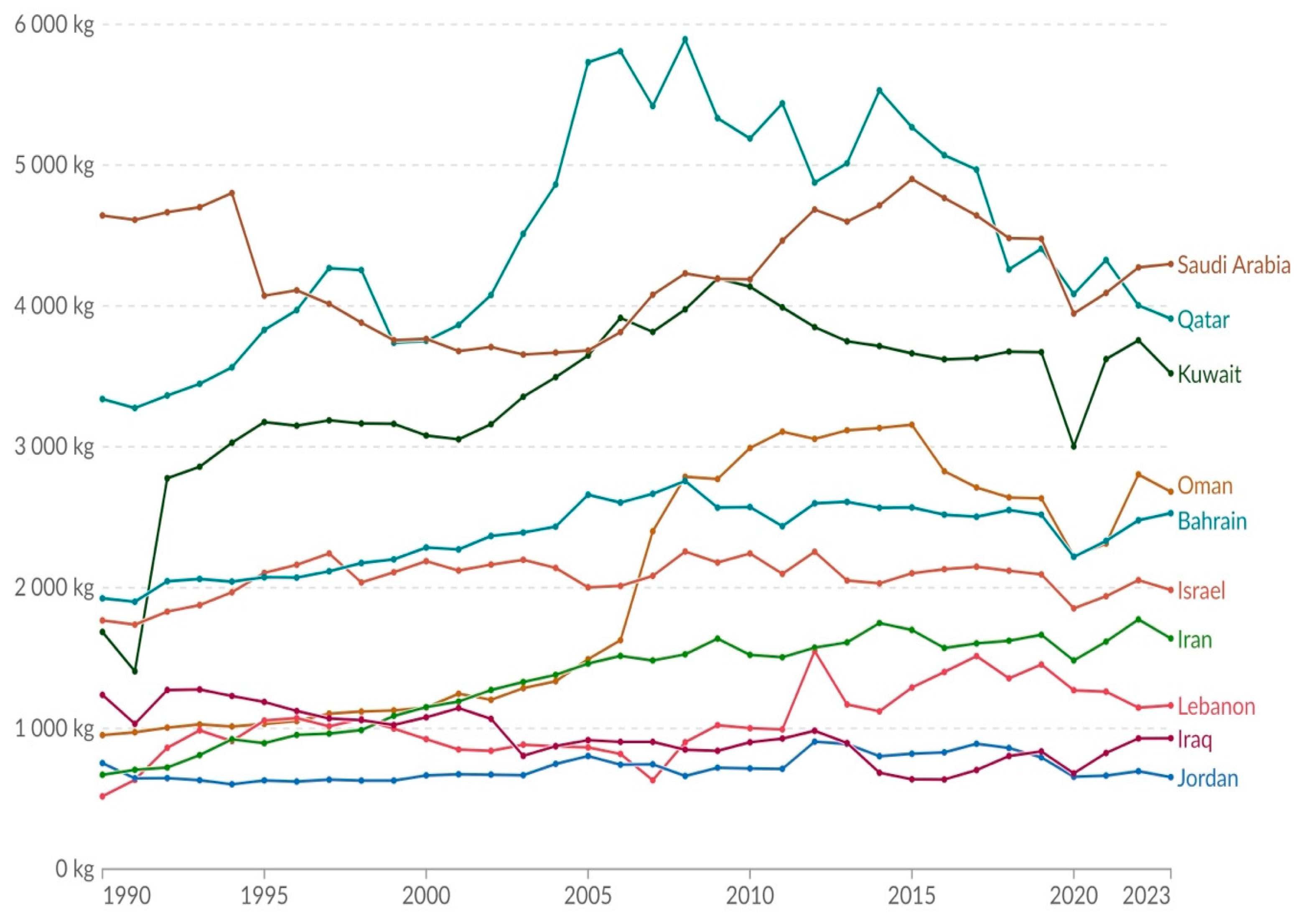
While carbon emissions originate from multiple sectors, the transport sector represents one of the largest and fastest-growing sources of greenhouse gas emissions worldwide [12,13]. In the Middle East, rising tourism activity, expanding trade integration, and increasing energy consumption have intensified transport demand, making transport-related CO2 emissions an increasingly important environmental concern. As economies become more integrated into global markets, trade-related activities can significantly influence carbon emission levels [14,15,16]. The expansion of global supply chains and cross-border production activities often leads to increased fossil fuel consumption and higher carbon emissions [14,17,18]. Despite the growing literature examining the relationships between tourism development, energy consumption, trade openness, and CO2 emissions, empirical findings remain mixed across countries and regions. Some studies indicate that tourism and energy consumption significantly contribute to environmental degradation, while others suggest that the impact of trade openness depends on country-specific conditions, including economic structure and environmental policies [19]. Figure 1 illustrates the trends of transport-related CO2 emissions across Middle Eastern countries, showing considerable variation in emission levels and highlighting increasing environmental pressure associated with transportation activities in the region.
In light of these considerations, this study investigates the impact of tourism activity, energy consumption, and trade openness on transport-related CO2 emissions in Middle Eastern countries using panel data and an autoregressive distributed lag (ARDL) framework. This study contributes to the literature in several ways. First, it examines Middle Eastern economies, a region that has received relatively limited empirical attention despite its growing economic importance. Second, it focuses specifically on transport-related CO2 emissions, providing a more precise assessment of the environmental impact of tourism and mobility. Third, tourism activity is measured using two alternative indicators, tourism expenditure and tourism receipts, to capture its multidimensional nature. Finally, the ARDL approach is employed to estimate both short-run and long-run relationships among the variables.
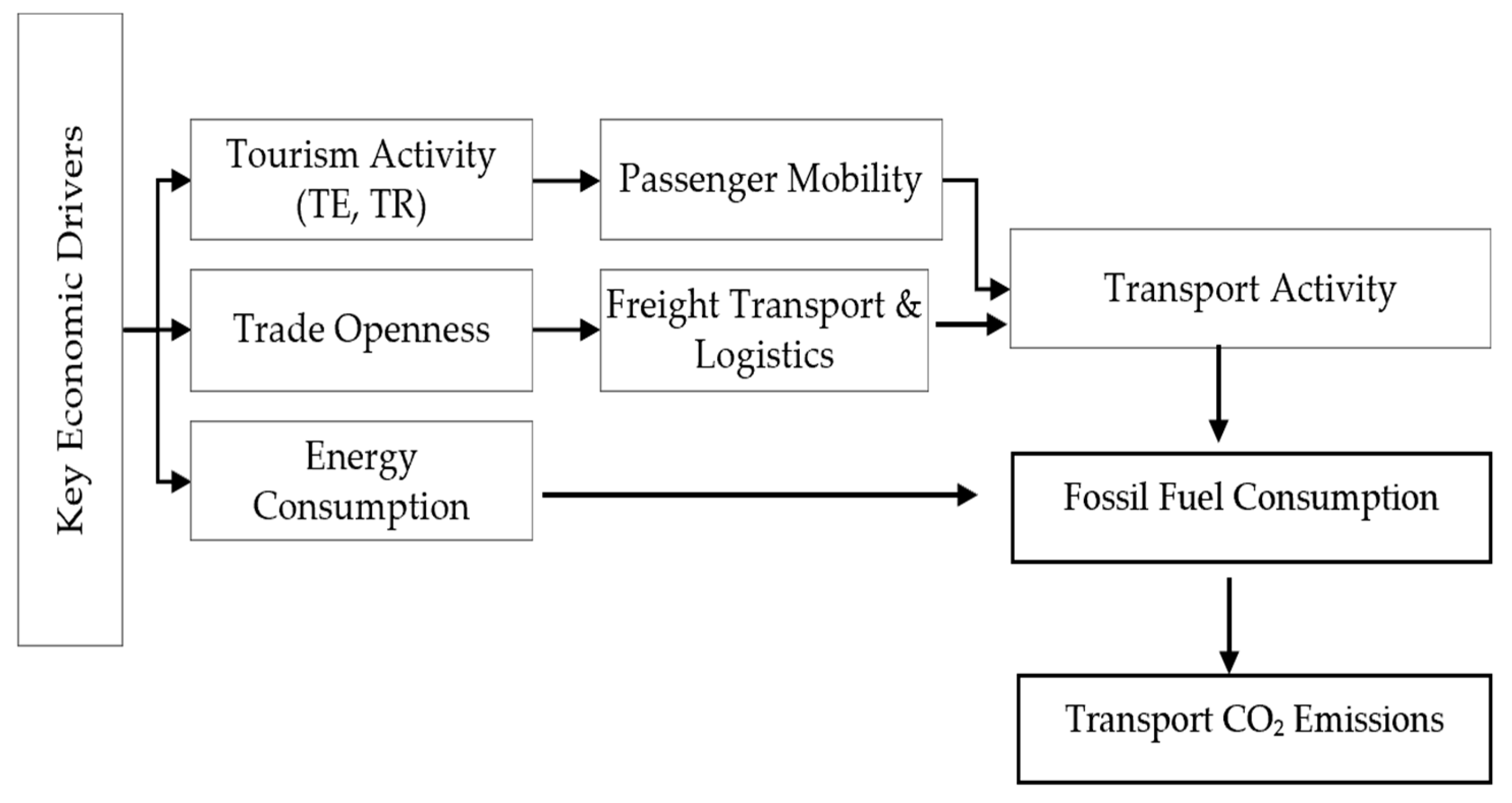
From a theoretical perspective, this study contributes to the environmental and transport economics literature by developing a conceptual framework that links tourism activity, trade openness, and energy consumption to transport-related CO2 emissions through distinct transmission channels. Specifically, tourism activity is expected to increase passenger mobility, trade openness is associated with greater freight transport and logistics activities, and energy consumption reflects the intensity of fossil fuel use within transport systems. By focusing specifically on transport-related emissions rather than aggregate CO2 emissions, the study provides a more nuanced understanding of the sector-specific mechanisms through which economic activities affect environmental sustainability in Middle Eastern economies. Accordingly, this study seeks to answer the following research question: What are the short-run and long-run effects of tourism activity, energy consumption, and trade openness on transport-related CO2 emissions in Middle Eastern countries? The remainder of the paper is structured as follows. Section 2 presents the literature review, Section 3 describes the data and methodology, Section 4 presents the empirical results and discusses the findings. Section 5 concludes the study with policy implications and directions for future research.

2. Literature Review

An increasing body of empirical research investigates environmental quality by analyzing the factors influencing carbon emissions across various economic sectors. Empirical evidence substantiates a long-term feedback link between tourism development and CO2 emissions [20]. The swift growth of international trade elevates the demand for fossil fuels and the corresponding environmental hazards [18]. Simultaneously, energy production reliant on fossil fuels continues to be the principal source of carbon dioxide emissions across several industries [21]. Unlike previous studies that focus on aggregate CO2 emissions, this study specifically examines transport-related CO2 emissions because transportation constitutes the primary channel affecting environmental outcomes.

2.1. CO2 Emissions from Transportation and Tourism

The rise in tourism is increasingly associated with carbon emissions from transportation, owing to the sector’s significant reliance on mobility and fossil-fuel-dependent transport systems. Evidence indicates that the tourism sector predominantly depends on fossil-fuel-based transportation, including airplanes and automobiles, which generates substantial emissions and exacerbates environmental strain due to energy consumption associated with transport [22,23]. In the Egyptian context, tourism is associated with markedly increased demand for transportation fuel and ancillary services, which is expected to harm the environment and exacerbate CO2 emissions from transport-related activities [24]. At a regional level, empirical evidence from Mediterranean nations demonstrates causal relationships between carbon dioxide emissions and energy consumption, reinforcing the notion that tourist-related mobility and energy demand might exacerbate environmental challenges in destinations reliant on tourism [25].
Recent research from Saudi Arabia demonstrates a unidirectional causality from tourism to carbon emissions, emphasizing tourist-driven mobility as a factor in emissions dynamics within energy-dependent economies [26]. These studies collectively demonstrate that the rise of tourism, due to its dependence on transport-intensive activities and fossil-fuel mobility, is a significant contributor to transport-related CO2 emissions. The reviewed literature consistently suggests that tourism expansion increases transport demand, passenger mobility, and fossil fuel consumption, thereby contributing to higher transport-related CO2 emissions. Based on these arguments, the following hypothesis is proposed:
H1. 
Tourism activity positively affects transport-related CO2 emissions.

2.2. CO2 Emissions from Transportation and Energy Consumption

Energy consumption is widely recognized as a primary driver of carbon emissions, especially in fuel-intensive industries like transportation. Empirical studies repeatedly indicate that heightened energy consumption correlates with elevated CO2 emissions, affirming that fossil-fuel-based energy systems are a significant factor in environmental degradation. Cross-country studies demonstrate that energy-driven economic growth frequently exacerbates emissions when reliant on conventional energy sources, hence underscoring the environmental consequences of energy-intensive growth patterns [27,28]. Prior empirical investigations investigating the correlation between economic development, energy use, and emissions affirm both energy consumption and economic activities can collectively exacerbate environmental pressure. Research utilizing panel estimation and time-series methodologies indicates that energy consumption significantly contributes to carbon emissions, reinforcing the notion that energy demand is a crucial factor in determining environmental sustainability results [29].
Likewise, comparative data from other areas underscores the significance of energy composition in influencing emissions pathways. Research differentiating renewable from non-renewable energy sources indicates that fossil fuel usage significantly adds to emissions, whereas the adoption of renewable energy helps alleviate environmental degradation. The results indicate that the environmental impact of energy consumption is contingent not only upon its scale but also its content [30]. Recent empirical research utilizing advanced econometric methods further substantiates both short-run and long-run correlations between energy use and carbon emissions. The findings demonstrate that heightened energy consumption substantially elevates emission levels, underscoring that energy-intensive developmental paths persist in exacerbating environmental strain in emerging nations. These studies collectively illustrate that energy consumption is a crucial factor influencing transport-related emissions and environmental results, especially in countries reliant on fossil fuels for their energy supply [21]. Existing evidence indicates that higher energy consumption, particularly from fossil-fuel sources, contributes significantly to transport-related emissions. Therefore, the following hypothesis is proposed:
H2. 
Energy consumption positively affects transport-related CO2 emissions.

2.3. CO2 Emissions from Transportation and Trade Openness

Firstly, the evidence suggests that trade openness is a significant structural predictor of carbon emission patterns. Long-term econometric analyses indicate that trade liberalization can substantially affect CO2 levels by modifying economic activity patterns, resource distribution, and consumption habits. These findings indicate that the environmental ramifications of trade surpass production processes, suggesting wider macroeconomic adjustments that influence emission trajectories over time [31]. Empirical research from Saudi Arabia suggests that trade openness may indirectly exacerbate environmental strain via the transportation sector [18]. As commerce proliferates, the need for air transport services escalates, resulting in increased carbon emissions. Furthermore, the findings indicate that escalations in trade activity and air transportation correlate with heightened CO2 emissions in both the short and long term, underscoring the transportation channel as a pivotal mechanism connecting globalization to environmental consequences [15,18].
Empirical research indicates that trade openness affects environmental consequences via many mechanisms. While international trade can enhance access to greener technology, it concurrently promotes industry growth and transportation operations, potentially elevating carbon emissions. The results demonstrate that increased trade openness fosters economic growth and elevates the demand for transportation services, therefore leading to heightened CO2 emissions [18,32]. Nonetheless, trade openness may facilitate a reduction in carbon emissions, as more linked economies frequently adopt more sustainable technologies and more stringent environmental regulations. This indicates that the environmental consequences of trade are influenced not solely by industrial growth but also by technical advancements and regulatory modifications linked to international integration [33]. The literature suggests that trade openness may influence transport-related emissions through increased freight transport, logistics activities, and cross-border trade flows. Therefore, the following hypothesis is proposed:
H3. 
Trade openness positively affects transport-related CO2 emissions.
The theoretical mechanism underlying this study is based on the premise that tourism activity, energy consumption, and trade openness affect transport-related CO2 emissions through distinct but interconnected channels. Tourism activity increases passenger mobility and transportation demand, thereby increasing fuel consumption and transport emissions. Energy consumption reflects the intensity of fossil-fuel use within transportation systems, while trade openness may influence emissions through increased freight transportation, logistics activities, and cross-border trade flows. The hypothesized relationships and transmission channels examined in this study are summarized in Figure 2.

2.4. Research Gap

Current scholarship emphasizes the intricate relationship among tourism, economic development, trade liberalization, and environmental sustainability. Previous research highlights that “the relationship among tourism, economic growth, trade openness, and the environment is multifaceted and intricate” [20,34,35]. The literature indicates that policymakers must reconcile conflicting objectives, since it is essential for them to evaluate the trade-offs among tourism development, economic growth, trade openness, and environmental sustainability [36,37]. These findings suggest that environmental outcomes are influenced by interrelated economic forces rather than independent elements. Nevertheless, empirical research is constrained in its structural breadth and geographical reach. Prior studies have predominantly depended on single-country time-series analyses, whereas panel investigations are very infrequent and typically confined to subnational regions.
The literature offers little empirical coverage of Mediterranean and developing regions, indicating a necessity for more extensive regional assessments to accurately reflect cross-country environmental dynamics [25,38,39]. Moreover, current transport-energy research predominantly emphasizes singular factors influencing emissions, such as energy consumption or technical advancements, while failing to concurrently integrate other economic channels [40,41]. Although this research validates that energy consumption and technological factors affect transport-related emissions, they seldom integrate tourism into a cohesive empirical framework [42,43,44]. Collectively, these constraints indicate a distinct research deficiency. The existing literature is deficient in complete empirical models that concurrently analyze transport emissions, tourism dynamics, energy consumption, and trade openness within a regional context, especially in the Middle East. Moreover, limited research employs dynamic econometric methods that can elucidate both short- and long-term interactions among these variables [45,46,47].
This study examines the interrelated impacts of tourism, transportation activity, energy consumption, and trade openness on carbon emissions in Middle Eastern countries, utilizing the ARDL modelling framework. The ARDL approach is particularly suitable for this analysis as it accommodates mixed integration orders, captures both short-run and long-run dynamics, and performs well with relatively small sample sizes [48,49]. This research enhances the literature by adopting a regional perspective and combining several transmission channels within a dynamic model. This offers a more thorough understanding of how globalization and sectoral dynamics collectively influence environmental outcomes in the Middle East.

3. Data and Methodology

3.1. Data

The objective of this study is to examine the impact of tourism activity, energy consumption, and trade openness on transport-related CO2 emissions in Middle Eastern countries. Drawing on theoretical and empirical literature, transport-related CO2 emissions are modeled as a function of tourism activity, energy consumption, and trade openness. In addition, economic growth is included as a control variable to account for its potential influence on emissions dynamics. The empirical analysis is conducted using annual panel data covering the period 2000–2020, subject to data availability, for a sample of Middle Eastern countries including Saudi Arabia, Bahrain, Kuwait, Oman, Qatar, Jordan, Iraq, Lebanon, Israel, and Iran. All data are obtained from the World Bank’s World Development Indicators (WDI) database [50]. The WDI is widely recognized as one of the most reliable and comprehensive international databases, providing standardized and internationally comparable economic, environmental, and social indicators. The use of a single, consistent data source enhances data reliability, reduces measurement inconsistencies across countries, and ensures comparability throughout the study period.
To address the research question and test the proposed hypotheses, this study employs a panel ARDL framework. The panel ARDL approach is particularly suitable because it enables the simultaneous estimation of short-run dynamics and long-run equilibrium relationships among transport-related CO2 emissions, tourism activity, energy consumption, and trade openness. Specifically, the model is used to examine whether tourism activity (H1), energy consumption (H2), and trade openness (H3) exert statistically significant effects on transport-related CO2 emissions in both the short and long run across Middle Eastern countries. Table 1 summarizes the testable hypotheses developed from the prior empirical findings.
Panel data analysis is used to examine each of the hypotheses listed in Table 1. Table 2 delineates the explanatory factors alongside the main variable utilized in the econometric analysis. Transport-related CO2 emissions (CO2) serve as the dependent variable and measure carbon emissions generated by transportation activities, expressed in metric tons per capita. Tourism activity is represented by two alternative indicators: international tourism expenditures (TEs), which capture spending by residents traveling abroad, and international tourism receipts (TRs), which measure revenues generated from international visitors. Using both indicators enhances the robustness of the tourism–emissions relationship. Tourism activity can be measured through several indicators. This study employs tourism receipts and tourism expenditures because they capture the economic scale and intensity of tourism activity rather than merely the number of visitors. Tourism receipts reflect revenues generated by inbound tourism, whereas tourism expenditures capture spending associated with international tourism activities. Using both indicators allows for a more comprehensive assessment of the tourism–environment relationship and serves as a robustness check for the estimated results.
Energy consumption (EC) is measured as energy use in kilograms of oil equivalent per capita and reflects the intensity of energy utilization within the economy, including energy demand associated with transportation activities. Trade openness (TRADE) is measured as total trade (exports plus imports) as a percentage of GDP and captures the degree of a country’s integration into international markets. Finally, GDP per capita (GDP) is included as a control variable to account for the level of economic development, measured as gross domestic product per capita in constant U.S. dollars.
To capture the effect of tourism activity more comprehensively, two separate models are estimated to use alternative tourism indicators. The first model incorporates tourism expenditure (TE), while the second model employs tourism receipts (TRs). In both specifications, energy consumption (EC) and trade openness (TRADE) are included as key explanatory variables, while GDP per capita (GDP) is incorporated as a control variable.

3.2. Methodology

This study examines the relationship between transport-related CO2 emissions and key economic indicators using the panel cross-sectionally augmented autoregressive distributed lag (CS-ARDL) approach. The CS-ARDL model, developed by Chudik and Pesaran [51], extends the conventional ARDL framework by incorporating cross-sectional averages of both dependent and independent variables, along with their lagged values, to account for cross-sectional dependence (CSD). The CS-ARDL approach offers several advantages. First, it allows for slope heterogeneity across cross-sectional units, capturing country-specific dynamics. Second, it addresses potential endogeneity arising from omitted variables and dynamic feedback effects. Third, it can be applied irrespective of the order of integration, making it suitable for variables that are either stationary or integrated of order one. Moreover, the CS-ARDL method provides consistent and reliable estimates in the presence of cross-sectional dependence, which is common in macro-panel data.
Recent empirical studies have increasingly employed the CS-ARDL framework to analyze economic and environmental relationships in panel settings characterized by cross-sectional dependence [3,52,53]. To ensure comparability across variables and facilitate interpretation, all variables are transformed into natural logarithms. This transformation allows the estimated coefficients to be interpreted as elasticities and helps reduce potential heteroskedasticity [54]. The log-linear specification of the econometric model enables the analysis of both short-run and long-run effects on transport-related CO2 emissions:
l n C O 2 i t = β 0 + β 1 l n T E i t + β 2 l n E C i t + β 3 l n T R A D E i t + β 4 l n G D P i t + ε i t
l n C O 2 i t = β 0 + β 1 l n T R i t + β 2 l n E C i t + β 3 l n T R A D E i t + β 4 l n G D P i t + ε i t
where: i = Middle Eastern, t = time (year). Consequently, the CS-ARDL model from Equations (1) and (2) can be articulated as:
C O 2 { i t } = j = 1 p δ i j C O 2 i t j + j = 0 q ϕ i j X i t j + j = 0 r ϑ i j Z t j + ω t + μ { i t }
where Z t j   = ( C O 2 i t j ,   X i t j ) represents the cross-sectional averages of the dependent and independent variables, which are included to account for cross-sectional dependence. X i t j denotes the vector of explanatory variables, including the core regressors (TE, TR, EC and TRADE). The symbols p and q are the lag lengths of the dependent variable and the regressors, respectively. Furthermore, the term ω t   signifies the fixed effects. δ i j represents the coefficients of the lagged dependent variable; ϕ i j   denotes the coefficients associated with the lagged regressors; and μ i t   indicates the error term.
Prior to estimating the ARDL model, several diagnostic tests are conducted, including unit root tests, correlation analysis, and the ARDL bounds test. Unit root testing is essential to determine the order of integration of the variables and to ensure that none of the series is integrated of order two or higher, which would invalidate the ARDL approach.
The stationarity properties of the variables are examined using standard unit root tests, while the ARDL bounds test is employed to assess the existence of a long-run relationship among the variables.
Table 3 presents the descriptive statistics of the study variables, including the mean, standard deviation, skewness, and kurtosis. The dataset consists of 210 panel observations covering the period from 2000 to 2020. The mean values reflect the average levels of the variables across countries and over time, while the standard deviations indicate moderate variability within the sample. The minimum and maximum values further highlight cross-country differences, supporting the use of panel data techniques. The skewness values are generally close to zero, indicating that the variables are approximately symmetrically distributed, while the kurtosis values suggest acceptable levels of normality [55].
Table 4 presents the correlation matrix used to examine the linear relationships among the study variables. The results show that most correlation coefficients are below the commonly accepted threshold of ±0.80, indicating the absence of severe multicollinearity among the explanatory variable [54,55]. The findings also reveal that tourism activity (lnTE and lnTR) is positively correlated with transport-related CO2 emissions, while trade openness (lnTRADE) exhibits a negative correlation with emissions. However, these correlations reflect only pairwise associations and do not imply causal relationships. Overall, the correlation analysis suggests that the variables are suitable for inclusion in the regression model without multicollinearity concerns. Furthermore, to assess multicollinearity among the explanatory variables, Variance Inflation Factors (VIFs) are calculated in Table 5. The results indicate that multicollinearity is not a concern, as all VIF values are well below the commonly accepted threshold of 10, ranging from 1.23 to 2.53, with a mean VIF of 1.72.
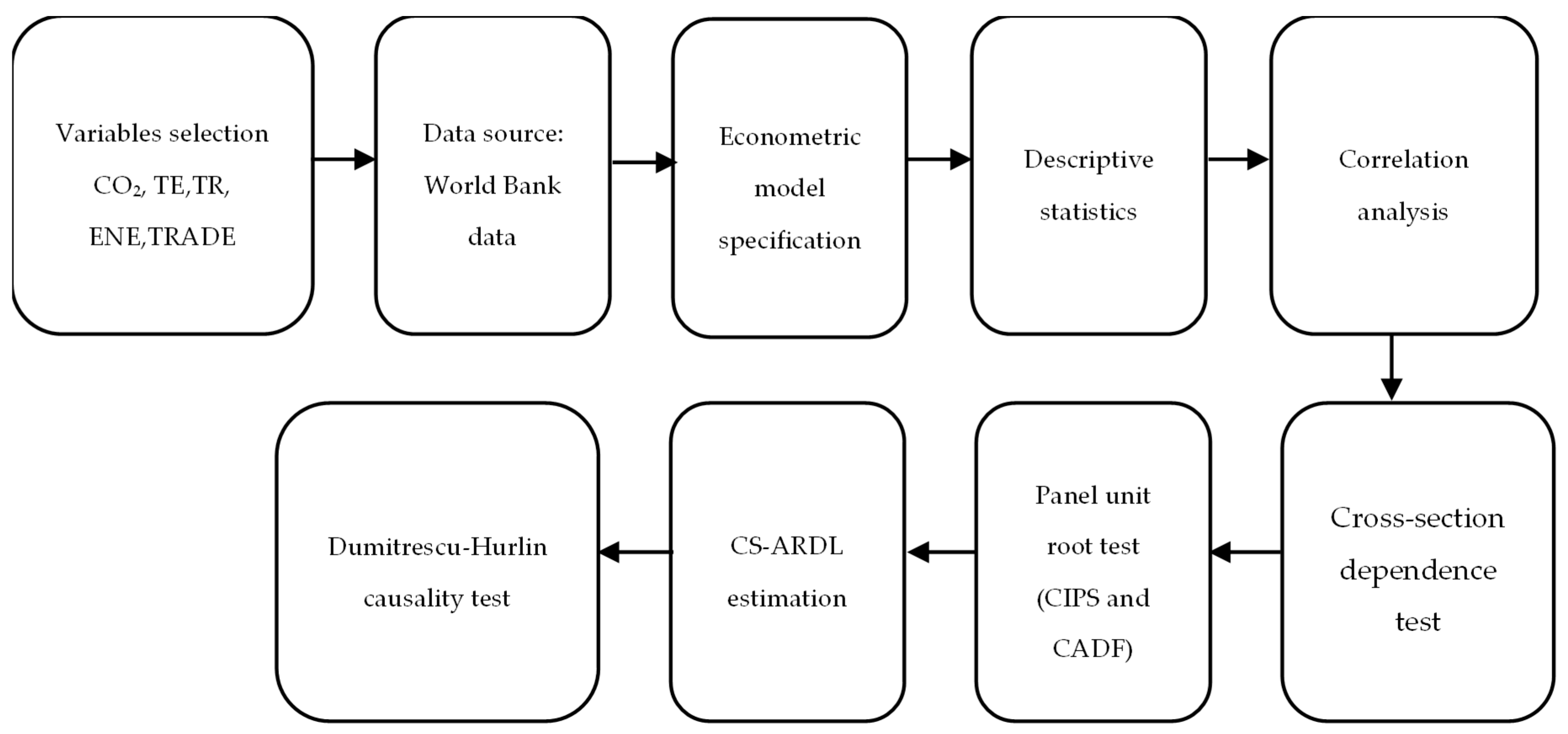
To provide a clear overview of the empirical strategy used in this study, Figure 3 illustrates the sequence of econometric procedures applied in the analysis.
Table 6 presents the results of the cross-sectional dependence (CSD) test for the study variables. The findings indicate that most variables exhibit statistically significant CSD statistics at the 5% level, as reflected by p-values below 0.05. However, energy consumption does not show significant cross-sectional dependence, with a p-value above the conventional significance threshold. The presence of cross-sectional dependence among the majority of variables suggests that shocks affecting one country may also influence others within the panel. Therefore, the use of second-generation panel unit root tests, which account for cross-sectional dependence, is appropriate for further analysis.

4. Results and Discussion

4.1. Results

Prior to estimating the ARDL model, it is necessary to examine the stationarity properties of the variables to determine their order of integration. To this end, second-generation panel unit root tests are employed. Specifically, the study utilizes the Cross-sectionally Augmented Dickey–Fuller (CADF) and Cross-sectionally Augmented IPS (CIPS) tests developed by Pesaran [56], which account for cross-sectional dependence among panel units.
These tests are conducted to ensure that none of the variables are integrated at orders higher than one, which is a key requirement for the validity of the ARDL approach. Table 7 presents the results of the unit root tests. The findings indicate that lnCO2, lnTE, and lnTR are stationary at levels, implying that they are integrated at order zero, I (0). In contrast, lnGDP, lnEC, and lnTRADE are non-stationary at levels but become stationary after first differencing, indicating that they are integrated at order one, I (1).The presence of variables integrated at both I (0) and I (1) confirms a mixed order of integration, thereby supporting the suitability of the CS-ARDL framework for the empirical analysis.
Upon confirming the stationarity properties of the variables, long-run relationships are estimated using the CS-ARDL methodology. The results are presented in Table 8. The findings indicate that tourism activity exerts a positive and statistically significant effect on transport-related CO2 emissions. Specifically, a 1% increase in tourism expenditures (TEs) leads to a 0.0389% increase in emissions, while a 1% increase in tourism receipts (TRs) increases emissions by 0.0270%. These results suggest that tourism expansion contributes to higher transportation-related carbon emissions. Energy consumption also has a positive and statistically significant effect in both models. A 1% increase in energy use raises CO2 emissions by approximately 0.2658% in Model 1 and 0.1126% in Model 2, confirming that energy demand is a key driver of environmental pressure in the region. In contrast, GDP per capita and trade openness do not exhibit statistically significant effects in the long run, indicating that their impact on transport-related emissions is limited or indirect within the sample period.
Table 9 presents the short-run dynamics obtained from the CS-ARDL model. The results show that tourism activity has a positive and statistically significant effect on CO2 emissions in the short run. A 1% increase in tourism expenditures (TEs) increases emissions by 0.0649%, while a similar increase in tourism receipts (TRs) leads to a 0.0487% rise in emissions. Energy consumption also exerts a positive and statistically significant effect in both models, with relatively larger coefficients compared to the long run, indicating a stronger immediate impact of energy use on emissions. Conversely, GDP per capita and trade openness remain statistically insignificant in the short run, consistent with the long-run findings. The error correction term (ECT) is negative and statistically significant in both models, confirming the existence of a long-run equilibrium relationship among the variables. The magnitude of the coefficients indicates the speed of adjustment toward equilibrium, suggesting that deviations from the long-run path are corrected over time.
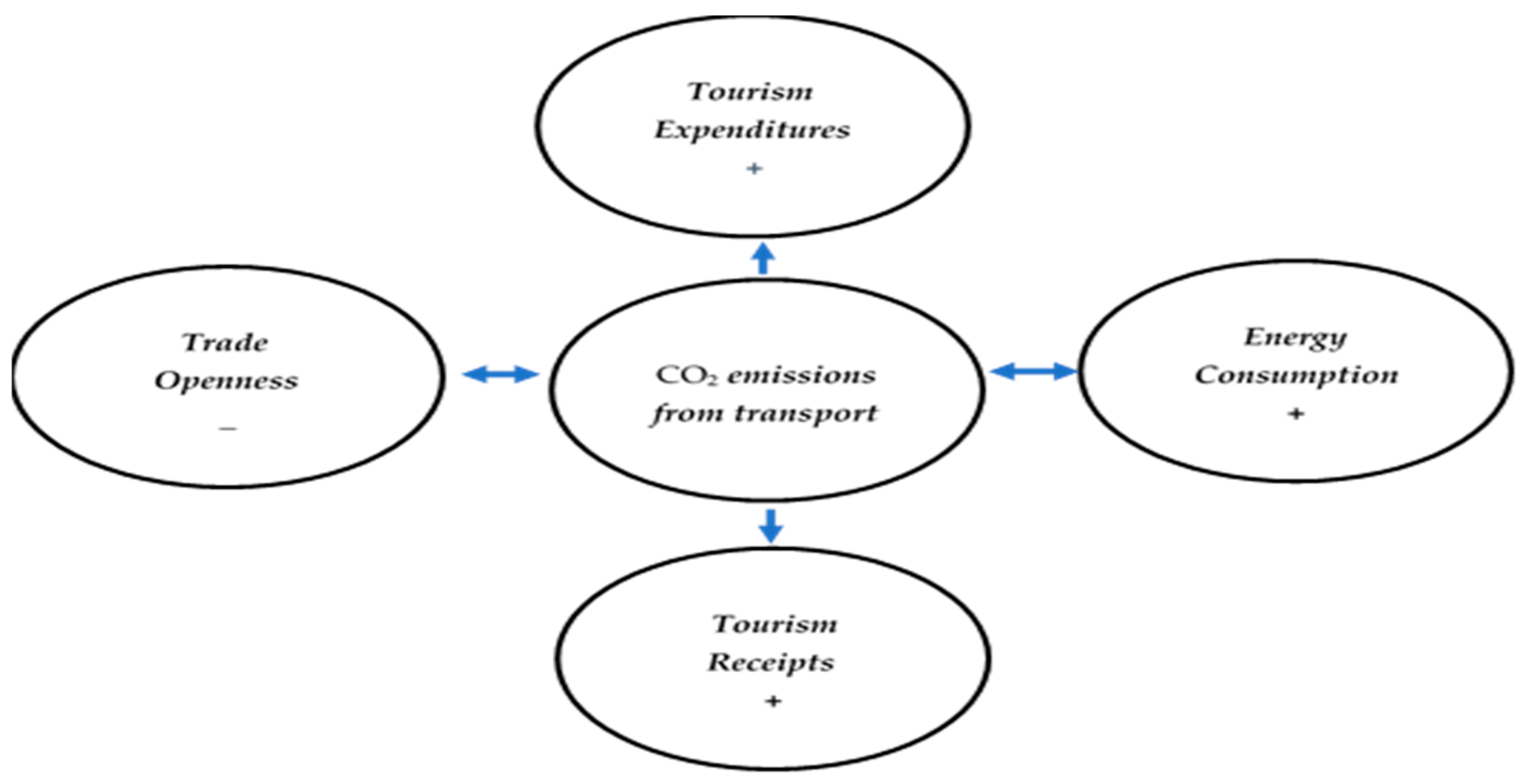
To examine the direction of relationships among the variables, the Dumitrescu–Hurlin panel causality test is employed following Dumitrescu and Hurlin [57]. This approach extends the traditional Granger causality framework to panel data settings and accounts for heterogeneity across cross-sectional units. The test is based on bootstrap procedures and Monte Carlo simulations to generate test statistics and corresponding p-values, ensuring reliable inference in panel data contexts. The results of the causality analysis are presented in Table 10 and summarized graphically in Figure 4.
The findings reveal a unidirectional causal relationship running from transport-related CO2 emissions to tourism activity, as measured by both tourism expenditures and tourism receipts. This suggests that changes in environmental conditions may influence tourism dynamics, possibly through environmental quality, policy responses, or destination attractiveness. In addition, the results indicate bidirectional causality between transport-related CO2 emissions and energy consumption, implying a feedback relationship. This suggests that increased energy use drives emissions, while emissions-related factors may also influence energy demand.
Similarly, a bidirectional causal relationship is observed between CO2 emissions and trade openness, indicating that trade activities contribute to emissions while environmental changes may, in turn, affect trade patterns.
An interesting finding from the Dumitrescu–Hurlin causality test is the presence of a unidirectional causal relationship running from transport-sector CO2 emissions to tourism activity. Although this result may appear counterintuitive, it can be explained by the close association between tourism development and transportation infrastructure. In Middle Eastern economies, investments in air transport, road networks, and tourism-supporting infrastructure often increase mobility and accessibility, which can stimulate tourism growth while simultaneously generating higher transport-related emissions. Therefore, transport-sector CO2 emissions may reflect the intensity of tourism-related transport activities and infrastructure expansion, leading emissions to precede tourism development in the causality framework.

4.2. Discussion

The findings of this study provide a direct answer to the research question concerning the short-run and long-run effects of tourism activity, energy consumption, and trade openness on transport-related CO2 emissions in Middle Eastern countries. Regarding H1, the results support the hypothesis that tourism activity increases transport-related CO2 emissions. The empirical results indicate that tourism activity has a positive and statistically significant impact on transport-related CO2 emissions in Middle Eastern countries. This finding suggests that the expansion of tourism increases mobility demand, particularly through transportation services such as aviation, road travel, and tourism-related infrastructure, which consequently intensifies environmental pressure. Tourism development is closely associated with increased transportation activities and higher energy demand, both of which contribute to rising carbon emissions. Tourism activities require substantial energy consumption for transportation, accommodation, and tourism services, thereby increasing environmental pressure and environmental degradation [58]. These findings are consistent with previous empirical studies highlighting the environmental implications of tourism development [24,25,26,59].
Regarding H2, the empirical findings confirm that energy consumption exerts a positive and statistically significant effect on transport-related CO2 emissions. Energy consumption also exhibits a positive and statistically significant effect on CO2 emissions from the transportation sector. This result indicates that increased energy usage amplifies environmental strain and contributes to environmental deterioration. Economic expansion, increased transportation demand, and tourism development all lead to higher energy consumption, which in turn results in greater carbon emissions. Energy consumption, particularly from fossil fuel sources, remains a primary contributor to environmental degradation and greenhouse gas emissions. The combustion of fossil fuels for transportation, industrial processes, and energy generation significantly increases CO2 emissions and intensifies climate change [30,60]. Empirical evidence from GCC countries further demonstrates that energy consumption significantly influences CO2 emissions in the transportation sector [28,29].
In contrast, regarding H3, the empirical findings reveal that trade openness has a statistically insignificant effect on transport-related CO2 emissions in the long run. This suggests that international trade does not necessarily lead to environmental deterioration, as its environmental impact largely depends on trade structures, energy sources, and environmental regulations across countries. Previous studies report mixed findings regarding the relationship between trade openness and CO2 emissions. Some studies argue that increased trade openness can intensify environmental degradation due to higher industrial production and transportation activities that increase fossil fuel consumption and greenhouse gas emissions [18,32,61]. However, other studies emphasize the potential environmental benefits of trade openness, as trade integration can facilitate the diffusion of cleaner technologies, improve production efficiency, and promote environmentally friendly practices through international competition [31,33,62]. The statistically insignificant relationship observed in this study may partly reflect the heterogeneous trade structures of Middle Eastern economies. While several countries in the region are highly dependent on hydrocarbon exports, others rely more heavily on imports, services, or diversified economic activities. Consequently, the aggregate trade openness indicator may not fully capture these structural differences, which could weaken the average long-run effect estimated across the panel.
Importantly, the insignificant long-run coefficient of trade openness should not be interpreted as inconsistent with the causality results reported in Table 8. While the CS-ARDL estimates indicate that trade openness does not exert a statistically significant long-run equilibrium effect on transport-related CO2 emissions, the Dumitrescu–Hurlin causality test reveals significant bidirectional causal interactions between the two variables. This suggests that trade openness and transport-related CO2 emissions may influence each other through short-run adjustments and dynamic interactions, even in the absence of a stable long-run equilibrium relationship. Furthermore, differences in export composition, import dependence, and trade-related transport activities across Middle Eastern economies may weaken the average long-run effect while preserving causal linkages over time.
Overall, the findings highlight the complex relationship between tourism development, energy consumption, trade openness, and environmental quality. Tourism activities and energy consumption significantly contribute to increased CO2 emissions from the transportation sector, reflecting the environmental pressure associated with tourism-related mobility and energy demand. In contrast, trade openness does not appear to exert a statistically significant effect on emissions, suggesting that its environmental impact may depend on the structure of trade and the adoption of cleaner technologies. These results emphasize the importance of implementing sustainable tourism strategies, improving energy efficiency, and promoting cleaner energy sources to mitigate environmental pressures while supporting economic development.

5. Conclusions

This study examines the relationship between tourism activity, energy consumption, trade openness, and transport-related CO2 emissions in Middle Eastern countries. The analysis is based on panel data obtained from the World Development Indicators (WDI) database for the period 2000–2020. The study employs the CS-ARDL model to estimate both short-run and long-run relationships among the variables. A key advantage of the ARDL framework is its ability to estimate long-run relationships when variables are integrated at different orders, making it particularly suitable for models with mixed stationarity properties.

5.1. Theoretical Contributions

This study makes several theoretical contributions to the environmental economics, tourism economics, and transport sustainability literature. First, it develops and empirically validates a conceptual framework linking tourism activity, energy consumption, and trade openness to transport-related CO2 emissions through distinct transmission channels. Unlike much of the existing literature that focuses on aggregate carbon emissions, this study specifically examines transport-related emissions, thereby providing a more sector-specific understanding of environmental degradation.
Second, the study extends previous research by integrating tourism activity, energy consumption, and trade openness within a unified dynamic framework. This approach captures the interconnected nature of economic globalization, transport demand, and environmental outcomes and contributes to a more comprehensive understanding of the determinants of transport-related emissions in Middle Eastern economies. Third, the use of the CS-ARDL framework allows for the estimation of both short-run and long-run dynamics, providing deeper insight into the interactions among tourism development, energy consumption, and environmental sustainability. The empirical findings indicate that tourism activity has a positive and statistically significant impact on transport-related CO2 emissions. This suggests that the expansion of tourism increases transportation demand, enhances mobility, and promotes tourism-related infrastructure, thereby intensifying environmental pressure. Energy consumption is also found to significantly increase emissions in the transportation sector, particularly in economies that rely heavily on fossil fuel-based energy systems. In contrast, trade openness does not exert a statistically significant effect on CO2 emissions in the long run within the selected sample of countries.

5.2. Practical and Policy Implications

The findings provide important implications for policymakers seeking to balance economic growth with environmental sustainability. Since tourism activity and energy consumption were found to increase transport-related CO2 emissions, governments should promote sustainable tourism strategies, encourage low-carbon transportation systems, and improve energy efficiency within the transport sector. The results also suggest that trade openness alone does not necessarily increase transport-related emissions in the long run. Therefore, policymakers should focus on improving transport efficiency and technological innovation rather than restricting trade integration.
From a policy perspective, the results suggest that tourism expansion in Middle Eastern countries should be accompanied by investments in sustainable transport infrastructure to mitigate its environmental consequences. Given the region’s increasing reliance on tourism as a pillar of economic diversification strategies, particularly under initiatives such as Saudi Vision 2030 and similar national development programs, policymakers should prioritize low-emission transport systems, sustainable aviation practices, and the expansion of electric mobility infrastructure. The significant positive effect of energy consumption on transport-related CO2 emissions further highlights the need to accelerate the integration of renewable energy into transportation systems and improve energy efficiency across transport networks. In addition, governments may consider implementing digital carbon-monitoring systems, carbon-offset mechanisms for tourism activities, and targeted incentives for adopting cleaner transport technologies. These measures would help balance tourism-led economic growth with environmental sustainability objectives across the region.

5.3. Limitations and Directions for Future Research

Despite these contributions, several limitations should be acknowledged. The analysis focuses on a limited set of variables tourism activity, energy consumption, and trade openness while excluding other relevant factors such as renewable energy consumption, technological innovation, and environmental policy indicators due to data constraints. In addition, the study is limited to Middle Eastern countries, which may restrict the generalizability of the findings to other regions with different economic structures and environmental conditions. Future research could extend this analysis to other regions or conduct comparative studies between Middle Eastern economies and other developing countries. Moreover, subsequent studies may incorporate additional environmental indicators, such as renewable energy use, ecological footprint, or green technological innovation, to provide a more comprehensive assessment of sustainability. Finally, future research could employ more advanced econometric techniques to further explore the complex relationships among tourism development, energy consumption, and carbon emissions.
This study employed the Dumitrescu–Hurlin panel causality test to examine directional relationships among the variables. While this approach provides useful insights into causality patterns, it is primarily designed to identify predictive causal relationships within a heterogeneous panel framework. Future research may extend the analysis using multivariate causality techniques, such as VECM-based approaches, to further assess the robustness of the identified causal relationships. In addition, future studies may incorporate alternative tourism indicators, such as international tourist arrivals, overnight stays, or tourism intensity measures, to provide a more comprehensive assessment of tourism-related environmental impacts and to compare the effects of different dimensions of tourism activity on transport-related CO2 emissions.

Author Contributions

Conceptualization, F.B.S., J.B. and E.A.; methodology, F.B.S. and J.B.; software, J.B.; validation, F.B.S., J.B. and E.A.; formal analysis, F.B.S. and J.B.; investigation, F.B.S., J.B. and E.A.; resources, E.A.; writing—original draft preparation, F.B.S., J.B. and E.A.; writing—review and editing, F.B.S., J.B. and E.A.; funding acquisition, E.A. All authors have read and agreed to the published version of the manuscript.

Funding

This research was funded by Princess Nourah bint Abdulrahman University Researchers Supporting Project number (PNURSP2026R961), Princess Nourah bint Abdulrahman University, Riyadh, Saudi Arabia.

Institutional Review Board Statement

Not applicable.

Informed Consent Statement

Not applicable.

Data Availability Statement

The data that support the findings of this study are openly available to the public.

Acknowledgments

The authors extend their appreciation to Princess Nourah bint Abdulrahman University Researchers Supporting Project number (PNURSP2026R961), Princess Nourah bint Abdulrahman University, Riyadh, Saudi Arabia.

Conflicts of Interest

The authors declare no conflicts of interest.

References

  1. Shi, H.; Li, X.; Zhang, H.; Liu, X.; Li, T.; Zhong, Z. Global difference in the relationships between tourism, economic growth, CO2 emissions, and primary energy consumption. Curr. Issues Tour. 2020, 23, 1122–1137. [Google Scholar] [CrossRef]
  2. Raihan, A.; Tuspekova, A. Dynamic impacts of economic growth, energy use, urbanization, agricultural productivity, and forested area on carbon emissions: New insights from Kazakhstan. World Dev. Sustain. 2022, 1, 100019. [Google Scholar] [CrossRef]
  3. Ahmad, M.; Dai, J.; Mehmood, U.; Abou Houran, M. Renewable energy transition, resource richness, economic growth, and environmental quality: Assessing the role of financial globalization. Renew. Energy 2023, 216, 119000. [Google Scholar] [CrossRef]
  4. González-Álvarez, M.A.; Montañés, A. CO2 emissions, energy consumption, and economic growth: Determining the stability of the 3E relationship. Econ. Model. 2023, 121, 106195. [Google Scholar] [CrossRef]
  5. Saqib, N.; Duran, I.A.; Hashmi, N. Impact of Financial Deepening, Energy Consumption and Total Natural Resource Rent on CO2 Emission in the GCC Countries: Evidence from Advanced Panel Data Simulation. Int. J. Energy Econ. Policy 2022, 12, 400–409. [Google Scholar] [CrossRef]
  6. Osobajo, O.A.; Otitoju, A.; Otitoju, M.A.; Oke, A. The impact of energy consumption and economic growth on carbon dioxide emissions. Sustainability 2020, 12, 7965. [Google Scholar] [CrossRef]
  7. Balli, E.; Sigeze, C.; Manga, M.; Birdir, S.; Birdir, K. The relationship between tourism, CO2 emissions and economic growth: A case of Mediterranean countries. Asia Pac. J. Tour. Res. 2019, 24, 219–232. [Google Scholar] [CrossRef]
  8. Salahodjaev, R.; Sharipov, K.; Rakhmanov, N.; Khabirov, D. Tourism, renewable energy and CO2 emissions: Evidence from Europe and Central Asia. Environ. Dev. Sustain. 2022, 24, 13282–13293. [Google Scholar] [CrossRef]
  9. Farooq, U.; Tabash, M.I.; Saleh Al-Faryan, M.A.; Işık, C.; Dogru, T. The Nexus between tourism-energy-environmental degradation: Does financial development matter in GCC countries? Tour. Econ. 2024, 30, 680–701. [Google Scholar] [CrossRef]
  10. Hanvoravongchai, P.; Paweenawat, J. Economic and Environmental Dynamics in Southeast Asia: The Impact of Tourism, Gross Domestic Product, Foreign Direct Investment, and Trade Openness on Carbon Dioxide Emissions. JEEPO 2025, 8, 51. [Google Scholar] [CrossRef]
  11. Mihajlović, V.; Tubić-Ćurčić, T.; Lojanica, N.; Mihajlović, N. Impact of tourism on economic growth and CO2 emissions in the EU: A dynamic panel threshold analysis. Hotel. Tour. Manag. 2025, 13, 9–24. [Google Scholar] [CrossRef]
  12. Lamb, W.F.; Wiedmann, T.; Pongratz, J.; Andrew, R.; Crippa, M.; Olivier, J.G.; Wiedenhofer, D.; Mattioli, G.; Khourdajie, A.A.; House, J. A review of trends and drivers of greenhouse gas emissions by sector from 1990 to 2018. Environ. Res. Lett. 2021, 16, 073005. [Google Scholar] [CrossRef]
  13. Gu, J.; Jiang, S.; Zhang, J.; Jiang, J. An analysis of the decomposition and driving force of carbon emissions in transport sector in China. Sci. Rep. 2024, 14, 30177. [Google Scholar] [CrossRef] [PubMed]
  14. Zamil, A.M.A.; Furqan, M.; Mahmood, H. Trade openness and CO2 emissions Nexus in Oman. Entrep. Sustain. Issues 2019, 7, 1319–1329. [Google Scholar] [CrossRef] [PubMed]
  15. A’Yun, I.Q.; Khasanah, U. The Impact of Economic Growth and Trade Openness on Environmental Degradation: Evidence from A Panel of ASEAN Countries. J. Ekon. Studi Pembang. 2022, 23, 81–92. [Google Scholar] [CrossRef]
  16. Ghazouani, T.; Maktouf, S. Impact of natural resources, trade openness, and economic growth on CO2 emissions in oil-exporting countries: A panel autoregressive distributed lag analysis. Nat. Resour. Forum 2024, 48, 211–231. [Google Scholar] [CrossRef]
  17. Raihan, A. The interrelationship amid carbon emissions, tourism, economy, and energy use in Brazil. Carbon Res. 2024, 3, 11. [Google Scholar] [CrossRef]
  18. Aldegheishem, A. The impact of air transportation, trade openness, and economic growth on CO2 emissions in Saudi Arabia. Front. Environ. Sci. 2024, 12, 1366054. [Google Scholar] [CrossRef]
  19. Tabassum, N.; Rahman, S.U.; Zafar, M.; Ghaffar, M. Institutional Quality, Employment, Trade Openness on Environment (CO2) Nexus From Top CO2 Producing Countries; Panel ARDL Approach. Rev. Educ. Adm. Law 2023, 6, 211–225. [Google Scholar] [CrossRef]
  20. Meșter, I.; Simuț, R.; Meșter, L.; Bâc, D. An Investigation of Tourism, Economic Growth, CO2 Emissions, Trade Openness and Energy Intensity Index Nexus: Evidence for the European Union. Energies 2023, 16, 4308. [Google Scholar] [CrossRef]
  21. Pachiyappan, D.; Ansari, Y.; Alam, M.S.; Thoudam, P.; Alagirisamy, K.; Manigandan, P. Short and long-run causal effects of CO2 emissions, energy use, GDP and population growth: Evidence from India using the ARDL and VECM approaches. Energies 2021, 14, 8333. [Google Scholar] [CrossRef]
  22. Kumail, T.; Ali, W.; Sadiq, F.; Wu, D.; Aburumman, A. Dynamic linkages between tourism, technology and CO2 emissions in Pakistan. Anatolia 2020, 31, 436–448. [Google Scholar] [CrossRef]
  23. Deng, Z.; Zhou, M.; Xu, Q. How to decouple tourism growth from carbon emissions? A spatial correlation network analysis in China. Sustainability 2022, 14, 11961. [Google Scholar] [CrossRef]
  24. Raihan, A.; Ibrahim, S.; Muhtasim, D.A. Dynamic impacts of economic growth, energy use, tourism, and agricultural productivity on carbon dioxide emissions in Egypt. World Dev. Sustain. 2023, 2, 100059. [Google Scholar] [CrossRef]
  25. Aslan, A.; Altinoz, B.; Özsolak, B. The nexus between economic growth, tourism development, energy consumption, and CO2 emissions in Mediterranean countries. Environ. Sci. Pollut. Res. 2020, 28, 3243–3252. [Google Scholar] [CrossRef] [PubMed]
  26. Faisal, S.; Khan, A.M.; Zulfikar, Z.; Bafaqeer, S.M. Saudi Arabia’s Green Vision: Examining the Kingdom’s Path to Sustainability, Covering Energy, Economy, Tourism, and Carbon Dynamics. Int. J. Energy Econ. Policy 2024, 14, 154–161. [Google Scholar] [CrossRef]
  27. Abid, L.; Kacem, S.; Saadaoui, H. The impacts of economic growth, corruption, energy consumption and trade openness upon CO2 emissions: West African countries case. Arab Gulf J. Sci. Res. 2024, 42, 464–480. [Google Scholar] [CrossRef]
  28. Binsuwadan, J.; Alotaibi, L.; Almugren, H. The Role of Agriculture in Shaping CO2 in Saudi Arabia: A Comprehensive Analysis of Economic and Environmental Factors. Sustainability 2025, 17, 4346. [Google Scholar] [CrossRef]
  29. Binsuwadan, J. Transport Sector Emissions and Environmental Sustainability: Empirical Evidence from GCC Economies. Sustainability 2024, 16, 10760. [Google Scholar] [CrossRef]
  30. Al Shammre, A. Investigating the Impact of Energy Consumption and Economic Activities on CO2 Emissions from Transport in Saudi Arabia. Energies 2024, 17, 4448. [Google Scholar] [CrossRef]
  31. Hdom, H.A.D.; Fuinhas, J.A. Energy production and trade openness: Assessing economic growth, CO2 emissions and the applicability of the cointegration analysis. Energy Strategy Rev. 2020, 30, 100488. [Google Scholar] [CrossRef]
  32. Xuan, V.N. An ARDL approach to investigating the relationship between FDI, renewable energy, economic growth, trade openness, and CO2 emissions in Australia. Results Eng. 2025, 27, 105668. [Google Scholar] [CrossRef]
  33. Mebrek, N.; Louail, B.; Riache, S. Do trade openness and foreign direct investment affect CO2 emissions in the MENA region? New evidence from a panel ARDL regression. Econ. Environ. 2024, 91, 972. [Google Scholar] [CrossRef]
  34. Balsalobre-Lorente, D.; Leitão, N.C. The role of tourism, trade, renewable energy use and carbon dioxide emissions on economic growth: Evidence of tourism-led growth hypothesis in EU-28. Environ. Sci. Pollut. Res. 2020, 27, 45883–45896. [Google Scholar] [CrossRef] [PubMed]
  35. Chikezie Ekwueme, D.; Lasisi, T.T.; Eluwole, K.K. Environmental sustainability in Asian countries: Understanding the criticality of economic growth, industrialization, tourism import, and energy use. Energy Environ. 2023, 34, 1592–1618. [Google Scholar]
  36. Leitão, N.C.; Lorente, D.B. The linkage between economic growth, renewable energy, tourism, CO2 emissions, and international trade: The evidence for the European Union. Energies 2020, 13, 4838. [Google Scholar] [CrossRef]
  37. Khan, I.; Lei, H.; Ali, I.; Ji, X.; Sharif, A.; Elkhrachy, I.; Khan, I. Striving for carbon neutrality and economic prosperity in the top ten emitting countries: Testing N shape Kuznets curve hypothesis. J. Clean. Prod. 2023, 429, 139641. [Google Scholar] [CrossRef]
  38. Ulucak, R.; Erdogan, F.; Bostanci, S.H. A STIRPAT-based investigation on the role of economic growth, urbanization, and energy consumption in shaping a sustainable environment in the Mediterranean region. Environ. Sci. Pollut. Res. 2021, 28, 55290–55301. [Google Scholar] [CrossRef] [PubMed]
  39. Çitil, M.; Barut, A.; Brika, S.K. Economic Policy and Environmental Sustainability: Analyzing Macroeconomic Determinants Across the Emission Distribution in Mediterranean Countries. Sustain. Dev. 2026, 34, 1118–1134. [Google Scholar]
  40. Ozcan, B. The nexus between carbon emissions, energy consumption and economic growth in Middle East countries: A panel data analysis. Energy Policy 2013, 62, 1138–1147. [Google Scholar] [CrossRef]
  41. Alkasasbeh, O.M.; Alassuli, A.; Alzghoul, A. Energy consumption, economic growth and CO2 emissions in Middle East. Int. J. Energy Econ. Policy 2023, 13, 322–327. [Google Scholar] [CrossRef]
  42. Bhowmik, R.; Rahut, D.B.; Syed, Q.R. Investigating the impact of climate change mitigation technology on the transport sector CO2 Emissions: Evidence from panel quantile regression. Front. Environ. Sci. 2022, 10, 916356. [Google Scholar] [CrossRef]
  43. Ben Jebli, M.; Hadhri, W. The dynamic causal links between CO2 emissions from transport, real GDP, energy use and international tourism. Int. J. Sustain. Dev. World Ecol. 2018, 25, 568–577. [Google Scholar]
  44. Hussain, S.; Ullah, A.; Khan, N.U.; Syed, A.A.; Han, H. Tourism, transport energy consumption, and the carbon dioxide emission nexus for the USA: Evidence from wavelet coherence and spectral causality approaches. Int. J. Sustain. Transp. 2024, 18, 168–183. [Google Scholar]
  45. Wani, M.J.G.; Alamir, I.A.; Ghazwani, M.; Ahmed, I.; Alkaraan, F.; Khan, M.A. Asymmetric effect of green energy and economic growth on the environmental deterioration and the environmental Kuznets curve validation in MENA countries. Int. J. Financ. Econ. 2025, 30, 3553–3568. [Google Scholar]
  46. Satari Yuzbashkandi, S.; Mehrjo, A.; Eskandari Nasab, M.H. Exploring the dynamic nexus between urbanization, energy efficiency, renewable energies, economic growth, with ecological footprint: A panel cross-sectional autoregressive distributed lag evidence along Middle East and North Africa countries. Energy Environ. 2024, 35, 4386–4407. [Google Scholar]
  47. Michailidis, M.; Kantartzis, A.; Arabatzis, G.; Zafeiriou, E. Decarbonization pathways in selected MENA countries: Panel evidence on transport services, renewable energy, and the EKC hypothesis. Energies 2025, 18, 5571. [Google Scholar] [CrossRef]
  48. Nazir, M.I.; Nazir, M.R.; Hashmi, S.H.; Ali, Z. Environmental Kuznets Curve hypothesis for Pakistan: Empirical evidence form ARDL bound testing and causality approach. Int. J. Green Energy 2018, 15, 947–957. [Google Scholar] [CrossRef]
  49. Khan, D.; Ullah, A. Testing the relationship between globalization and carbon dioxide emissions in Pakistan: Does environmental Kuznets curve exist? Environ. Sci. Pollut. Res. 2019, 26, 15194–15208. [Google Scholar] [CrossRef] [PubMed]
  50. World Bank. World Development Indicators; World Bank: Washington, DC, USA, 2020. [Google Scholar]
  51. Chudik, A.; Pesaran, M.H. Common correlated effects estimation of heterogeneous dynamic panel data models with weakly exogenous regressors. J. Econom. 2015, 188, 393–420. [Google Scholar] [CrossRef]
  52. Baydoun, H.; Aga, M. The effect of energy consumption and economic growth on environmental sustainability in the GCC countries: Does financial development matter? Energies 2021, 14, 5897. [Google Scholar] [CrossRef]
  53. Ebaidalla, E.M. The impact of taxation, technological innovation and trade openness on renewable energy investment: Evidence from the top renewable energy producing countries. Energy 2024, 306, 132539. [Google Scholar] [CrossRef]
  54. Wooldridge, J.M. Introductory Econometrics: A Modern Approach, 5th ed.; Cengage Learning: Belmont, CA, USA, 2013. [Google Scholar]
  55. Gujarati, D.N.; Porter, D.C. Basic Econometrics, 5th ed.; McGraw-Hill: New York, NY, USA, 2009. [Google Scholar]
  56. Pesaran, M.H. A simple panel unit root test in the presence of cross-section dependence. J. Appl. Econom. 2007, 22, 265–312. [Google Scholar] [CrossRef]
  57. Dumitrescu, E.I.; Hurlin, C. Testing for Granger non-causality in heterogeneous panels. Econ. Model. 2012, 29, 1450–1460. [Google Scholar] [CrossRef]
  58. Begum, R.A.; Raihan, A.; Pereira, J.J.; Ahmed, F.; Tam, V.W.Y. Impacts of economic growth, energy use, population, urbanisation, and tourism on CO2 emissions in Malaysia: An empirical analysis of ARDL approach. Environ. Dev. Sustain. 2025. [Google Scholar] [CrossRef]
  59. Pata, U.K.; Dam, M.M.; Kaya, F. How effective are renewable energy, tourism, trade openness, and foreign direct investment on CO2 emissions? An EKC analysis for ASEAN countries. Environ. Sci. Pollut. Res. 2023, 30, 14821–14837. [Google Scholar] [CrossRef]
  60. Edoja, P.E.; Aye, G.C.; Gupta, R. Effects of Energy Consumption, Agricultural Trade, and Productivity on Carbon Emissions in Nigeria: A Quantile Regression Approach. Commodities 2024, 3, 494–511. [Google Scholar] [CrossRef]
  61. Derindag, O.F.; Maydybura, A.; Kalra, A.; Wong, W.K.; Chang, B.H. Carbon emissions and the rising effect of trade openness and foreign direct investment: Evidence from a threshold regression model. Heliyon 2023, 9, e17448. [Google Scholar] [CrossRef] [PubMed]
  62. Yang, X.; Ramos-Meza, C.S.; Shabbir, M.S.; Ali, S.A.; Jain, V. The impact of renewable energy consumption, trade openness, CO2 emissions, income inequality, on economic growth. Energy Strategy Rev. 2022, 44, 101003. [Google Scholar] [CrossRef]
Figure 1. CO2 emissions from transport in Middle Eastern countries. Source: Climate Watch (2023), https://ourworldindata.org/ (Access 8 March 2026).
Sustainability 18 06245 g001
Figure 2. Conceptual framework of the determinants of transport-related CO2 emissions.
Sustainability 18 06245 g002
Figure 3. Flowchart of econometric methodology.
Sustainability 18 06245 g003
Figure 4. Graphical results of the empirical analysis. Source: author’s presentation.
Sustainability 18 06245 g004
Table 1. Paper hypotheses.
Hypothesis NumberHypothesis
H1Tourism activity has a positive effect on transport-related CO2 emissions.
H2Energy consumption has a positive effect on transport-related CO2 emissions.
H3Trade openness is expected to influence transport-related CO2 emissions.
Table 2. Variables clarification.
VariableVariable NameDefinitionData PeriodData Source
CO2Transport-related CO2 emissionsCO2 emissions from transport (metric tons per capita)2000–2020WDI
TETourism expendituresInternational tourism,
expenditures (current US$)
2000–2020WDI
TRTourism receiptsInternational tourism,
receipts (current US$)
2000–2020WDI
ECEnergy consumptionEnergy use (kg of oil
equivalent per capita)
2000–2020WDI
TRADETrade opennessThe total trade (% of GDP)2000–2020WDI
GDPGDP per capitaGross domestic product
per capita (constant US$)
2000–2020WDI
Table 3. Descriptive statistics.
VariableObsMeanStd. Dev.SkewnessKurtosisMinMax
ln CO22102.6151.240.5322.2660.422 4.990
ln TE21021.6831.349−0.9244.47816.01323.906
ln TR21021.2321.339 −1.2005.58814.50923.522
Ln GDP2109.5850.956−0.1591.6587.71911.310
ln EC2104.8060.357−0.1551.9533.9895.411
Ln TRADE2104.4260.334−0.1552.6413.0648 5.218
Source: Author calculations.
Table 4. Correlation matrix.
Variableln CO2ln TRLn TEln GDPln ENELn TRADE
ln CO21.0000
ln TR0.26111.0000
ln TE0.56350.60791.0000
ln GDP−0.2174−0.02490.24141.0000
ln EC0.0331−0.2848−0.01180.26061.0000
Ln TRADE−0.6692 −0.3378−0.51730.1974 0.20091.0000
Source: Author calculations.
Table 5. Variance inflation factors.
VariableVIF1/VIF
TE2.530.394808
TR1.870.536145
EC1.230.815706
TRADE1.660.603365
GDP1.340.744458
Mean VIF1.72-
Source: Author calculations.
Table 6. Cross-section dependence.
VariableCSD Statisticp-ValueMean ρ
ln CO224.9980.0000.81
ln TE21.750.0000.71
ln TR240.0000.78
ln GDP5.4040.0000.18
ln EC−1.4910.136−0.05
ln TRADE9.0330.0000.29
Source: Author calculations.
Table 7. Unit root test results.
VariableLevel (CIPS)First Difference (CIPS)Level (CADF)First Difference (CADF)
ln CO2−1.767−3.385 ***−2.185 ***−2.844 ***
ln TE−2.616 ***−3.632 ***−2.135 ***−3.266 ***
ln TR−2.820 ***−4.498 ***−2.063 ***−3.569 ***
ln GDP−1.259−2.518 **0.467−2.169 ***
ln EC−1.888−4.125 ***−0.841−5.343 ***
ln TRADE−1.694−4.197 ***0.789−2.686 ***
Note: *** p < 0.01, ** p < 0.05. Source: Author calculations.
Table 8. Long-run estimation results (CS-ARDL).
VariableModel 1 (TE)Model 2 (TR)
ln TE0.0389 ***__
ln TR__0.0270 ***
ln GDP0.10840.2542
ln EC0.2658 ***0.1126 ***
ln TRADE−0.0130−0.0412
Note: *** p < 0.01. Source: Author calculations.
Table 9. Short-run estimation (CS-ARDL).
VariableModel 1 (TE)Model 2 (TR)
ln TE0.0649 ***__
ln TR__0.0487 **
ln GDP0.17960.4565
ln EC0.4757 ***0.1952 ***
ln TRADE−0.013272−0.056446
ECT (−1)−0.67896 ***−1.70905 ***
Note: *** p < 0.01, ** p < 0.05. Source: Author calculations.
Table 10. Dumitrescu–Hurlin panel causality test.
Null HypothesisW-StatZbar-Statp-ValueDirection of CausalityDecision
Tourism expenditures do not Granger-cause CO2
CO2 does not Granger-cause tourism expenditures
1.456
2.938
1.020
4.334
0.307
0.000
CO2 → Tourism expendituresUnidirectional causality
Tourism receipts do not Granger-cause CO2
CO2 does not Granger-cause tourism receipts
1.437
5.392
0.978
9.822
0.328
0.000
CO2 → Tourism receiptsUnidirectional causality
Energy consumption does not Granger-cause CO2
CO2 does not Granger-cause energy consumption
7.358
2.623
14.217
3.630
0.000
0.000
EC ↔ CO2Bidirectional causality
Trade openness does not Granger-cause CO2
CO2 does not Granger-cause trade openness
3.649
2.334
5.923
2.984
0.000
0.002
TRADE ↔ CO2Bidirectional causality
Source: Author calculations.
Disclaimer/Publisher’s Note: The statements, opinions and data contained in all publications are solely those of the individual author(s) and contributor(s) and not of MDPI and/or the editor(s). MDPI and/or the editor(s) disclaim responsibility for any injury to people or property resulting from any ideas, methods, instructions or products referred to in the content.