Article

Participatory Design for Kitchen Waste Reduction: A Collaborative System Model (CSM) Approach

1
School of Design, Central Academy of Fine Arts, Beijing 100102, China
2
School of Design and Art, Hunan University, Changsha 410082, China
*
Authors to whom correspondence should be addressed.
Sustainability 2026, 18(12), 6153; https://doi.org/10.3390/su18126153 (registering DOI)
Submission received: 30 April 2026 / Revised: 25 May 2026 / Accepted: 31 May 2026 / Published: 15 June 2026
(This article belongs to the Section Sustainable Food)

Abstract

This study addresses the critical challenge of food waste in the hospitality sector, directly contributing to Sustainable Development Goal (SDG) 12.3. We conducted an intervention at a community-based culinary innovation center involving 18 participants. The research integrated the Collaborative System Model (CSM)—a framework that facilitates multi-stakeholder co-creation through knowledge interaction and feedback loops—into a Participatory Design (PD) process. Results demonstrated that the intervention reduced fruit waste mass by 72% per session and increased byproduct reuse rates from 15% to 68%. Sensory evaluations confirmed that these waste-reduction practices did not compromise product quality (p > 0.05). This approach provides a behavior-anchored unit process for pre-consumer waste reporting.

1. Introduction

1.1. Global Food Waste

Food waste epitomizes the ‘abundance-scarcity’ paradox of modern food systems. According to a report by the Food and Agriculture Organization of the United Nations (FAO), approximately 1.3 billion tons of food are wasted annually [1,2], accounting for one-third of global production. Concurrently, the 2024 State of Food Security and Nutrition in the World indicates that 713 to 757 million people remain hungry [2]. In the United States, food waste reaches 60 million metric tons annually, accounting for 30% to 40% of the nation’s total food supply [3]. Taking New York State as an example, food waste constitutes 18% of the city’s total solid waste, amounting to approximately 3.9 million metric tons per year [4,5]. Recovering just 5% of this waste could increase food bank supplies by 20%. Solutions must be systemic and design-driven.
Within the food service industry, restaurants serve as both producers and end consumers of food, accounting for approximately 26% of global food waste, which makes them ideal venues for behavioral interventions and participatory innovation [6,7,8]. This dual role makes kitchens critical waste hotspots driven by operational pressures and aesthetics. As Filimonau et al. [9] note, restaurant kitchens are quintessential spaces where management cultures and behavioral inertia intersect, rendering them highly suited for design-driven behavior transformation and collaborative co-creation.

1.2. Fruit Waste and Sustainable Design in Restaurants

Among various food waste streams, fruit byproducts—such as peels, pits, and pulp—represent a long-neglected yet highly promising renewable resource. Recent studies indicate that through innovative culinary and material design practices, these wastes can be transformed into secondary products with both economic and environmental value. For instance, Facchini et al. [10] found that processing discarded fruit into jams or sauces reduces waste by over 40% while boosting restaurant profitability through menu innovation. Aburi Sushi Bali achieved circular food systems and culinary tourism sustainability through inventory management, portion control, and food donations [11].
In food packaging and materials, fruit peels are repurposed as edible coatings to extend shelf life and reduce reliance on petroleum-based plastics [12]. Innovative food development utilizing fruit byproducts as jams, fermented beverages, and functional ingredients enhances byproduct value and reduces waste [13,14].
However, these technological pathways still face significant systemic hurdles that impede their widespread adoption. Primarily, high operational friction remains a dominant barrier, as implementing reuse protocols in commercial kitchens often introduces additional labor burdens that conflict with time-sensitive service routines [15,16,17,18]. This is further exacerbated by a lack of micro-level operational systems; while macro-level valorization is well-studied, there is a distinct shortage of frameworks that translate technical feasibility into daily kitchen workflows [13,19,20]. Furthermore, low consumer acceptance presents a market challenge, with less than 30% of consumers currently open to “waste-derived foods” [21,22,23]. Finally, the persistent lack of tech-society synergy suggests that technological innovation alone is insufficient without collaborative design mechanisms that involve multiple stakeholders to bridge the gap between theory and practical application [12,13,21].

1.3. Research Gap and Objectives

Despite growing academic and industry attention to technical and managerial strategies for reducing food waste in the catering sector in recent years, research systematically embedding participatory and collaborative design into restaurant operational workflows remains scarce. Existing studies predominantly focus on process optimization or consumer education, with limited exploration of how co-creation mechanisms can alter chefs’ daily operational habits and achieve sustainable behavioral transformation within high-pressure, time-sensitive kitchen environments. While quantitative assessments of food-waste valorization have recently been advanced through restaurant-specific valorization indices [24], and behavior-based cleaner-production interventions have demonstrated operational gains in catering contexts [25], these studies remain either techno-centric or limited to top-down behavior prompts. The missing link is a micro-level, audit-ready unit process that couples participatory co-creation with landfill-disposal-focused yet expandable LCA boundaries to satisfy SDG 12.3 reporting requirements. To address this gap, this study integrates the Collaborative System Model (CSM) into the Participatory Design (PD) framework, repositioning chefs as “co-researchers” rather than mere “executors” to deliver an empirically grounded, behavior-anchored pathway for pre-consumer food-waste prevention that is scalable to other high-pressure kitchen environments. Through dynamic feedback and shared decision-making, it constructs a multi-stakeholder collaborative mechanism for learning and innovation. Based on this research gap, the study aims to answer the following core questions:
RQ1: How does embedding the Collaborative System Model (CSM) within a PD framework reduce fruit waste in restaurant kitchens?
RQ2: Which behaviors and collaborative mechanisms within the participatory intervention significantly drive food waste reduction?
RQ3: Does the CSM–PD framework possess scalable potential beyond professional kitchen settings for public-level implementation?
Key innovations of this study include:
  • Theoretical integration innovation: Combining CSM with PD to construct a collaborative design framework for system-level behavioral change;
  • Methodological innovation: Proposing an iterative co-creation intervention model integrating qualitative depth with quantitative validation;
  • Practical application innovation: Developing a replicable waste reduction tool—the Zero-Waste Cooking Guide—to facilitate knowledge diffusion and practice dissemination between professional and public sectors.

2. Literature Review

2.1. Participatory Design (PD)

PD originated in Scandinavia during the 1970s. Its founding purpose was to empower users through democratized design, driving collaborative transformation of technology and organizational structures. Simonsen and Robertson [26] define PD as a “reflection-co-creation” process where designers and users collaboratively identify problems, construct scenarios, and propose solutions. Unlike traditional “user-centered” design, PD’s core philosophy shifts from “designing for users” to “designing with users,” emphasizing equal participation, collaborative decision-making, and knowledge sharing [27].
Within food systems, PD has proven particularly effective for addressing sustainability challenges embedded within behavioral structures. Through workshops, generative toolkits, and scenario simulations, designers can guide chefs and consumers in uncovering tacit knowledge, fostering shared responsibility for waste reduction practices [28,29]. The iterative nature of PD enables solutions to dynamically respond to participant feedback for continuous optimization. However, scaling PD from small-scale experiments to systemic change still relies on more structured collaborative models that balance participatory openness with design expertise [30].

2.2. Collaborative System Model (CSM)

The Collaborative System Model (CSM), proposed by Drain and Sanders [31], provides a structured theoretical foundation for multi-stakeholder co-creation in sustainable design and food waste governance. By fostering equal collaboration between designers and practitioners (e.g., chefs), CSM promotes the integration of experiential and analytical knowledge, enhancing systemic integration and innovation capabilities.
In the synergistic innovation between CSM’s core mechanisms and sustainable design, CSM advocates breaking expert dominance through knowledge exchange and power redistribution during collaboration, achieving shared knowledge and decision-making authority. This aligns strongly with the advantages of participatory approaches in reducing food waste and enhancing employee accountability and trust [32,33,34]. Within dynamic collaboration and real-world embedding, CSM emphasizes embedded collaboration within authentic work contexts, where immediate feedback and experiential knowledge drive intervention optimization. This philosophy resonates with emerging sustainable systems design approaches such as “participatory modeling” and “collaborative innovation tools” [35,36].
In CSM applications for food waste governance, involving chefs as co-researchers integrates frontline practitioners into the design loop. This approach effectively captures operational knowledge, enhancing the feasibility and innovation of interventions [32,37]. Furthermore, multi-stakeholder collaboration and system integration [35] enhance stakeholder commitment, reduces internal friction, and promotes knowledge sharing, serving as a crucial mechanism for advancing sustainable transformation [32,36].
CSM redistributes knowledge and power through embedded multi-stakeholder co-creation, driving participatory sustainable transformation. Table 1 summarizes key studies on Participatory Design, collaborative systems and food-waste reduction, and highlights the specific gap that this study addresses.

2.3. Research Gap and Conceptual Framework

Existing research has demonstrated the positive role of PD in enhancing behavioral awareness and promoting stakeholder engagement. However, the integration of participatory processes with systematic collaborative mechanisms remains under-explored. While the Collaborative System Model (CSM) provides a theoretical foundation for multi-party co-creation and dynamic learning, its application in micro-operational contexts—such as commercial kitchens—remains limited [7,8].
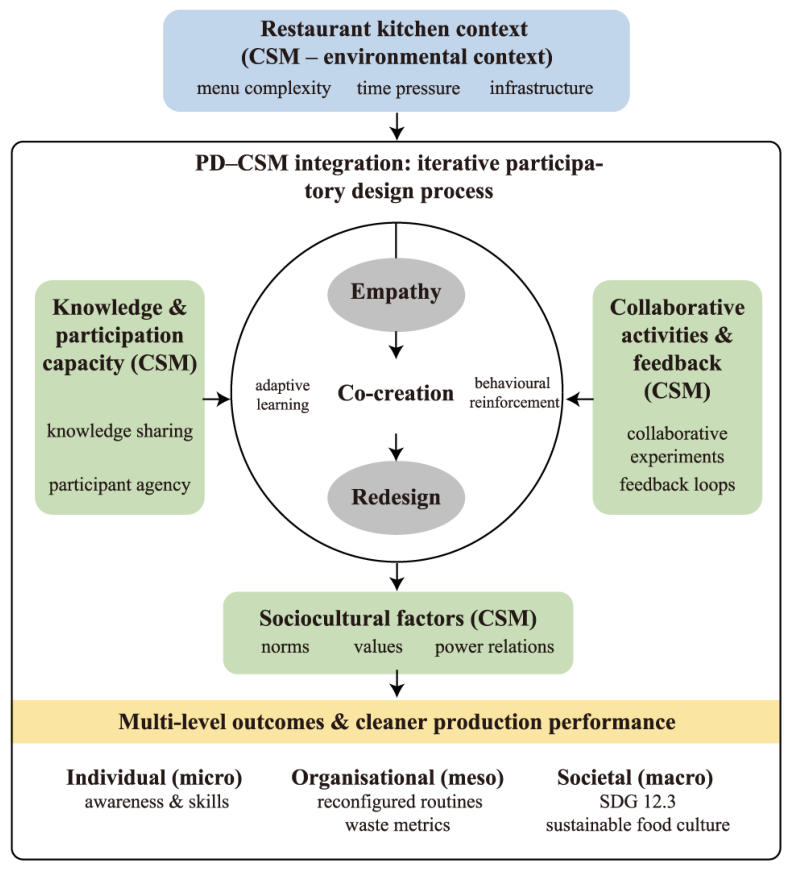
This study proposes an integrated conceptual framework that aligns the six key dimensions of the CSM—knowledge interaction, participation capacity, collaborative activities, environmental context, sociocultural factors, and feedback loops—with the iterative process of participatory design (empathy—co-creation—redesign). This integration enables sustained adaptive improvement and behavioral reinforcement across individual, organizational, and societal levels (see Figure 1).
In summary, this study frames restaurant food waste as a co-evolutionary process involving design, behavior, and systems, thereby advancing the theoretical depth and practical application of participatory sustainable transformation within food systems.

3. Methodology

3.1. Research Design

This study employs a mixed-method design, integrating qualitative research with Participatory Action Research (PAR), to explore the applicability and effectiveness of the Collaborative System Model (CSM) in addressing food waste in restaurant kitchens. The research was conducted in collaboration with the New York Food Arts Center (FAC), a non-profit community-based culinary innovation center located in New York City. As a platform integrating professional culinary education with sustainable food system experimentation, the center provided an authentic kitchen environment that enabled professional chefs, interns, and local community members to participate as co-researchers.
The study unfolded across two complementary phases: First, the qualitative research phase employed semi-structured interviews and contextual observation to analyze chefs’ culinary behaviors and the systemic causes of fruit waste. Second, a participatory action phase guided by the CSM framework, organizing design workshops to co-create and test interventions for behavioral and process optimization. These phases dynamically interconnect through a cyclical loop, allowing empirical findings to inform design refinements, thereby ensuring ecological authenticity and design relevance.
The pre-post design, triangulated with 18 paired sessions, 20 h of observation, and B-ITS sensitivity tests (Supplementary Materials S4), yielded an E-value of 3.4. The resulting E-value = 3.4 indicates that an unmeasured confounder would need to double the baseline waste rate to nullify the observed 72% reduction, exceeding the threshold for moderate causal robustness in behavior field studies [38].

3.2. Application of the CSM Framework

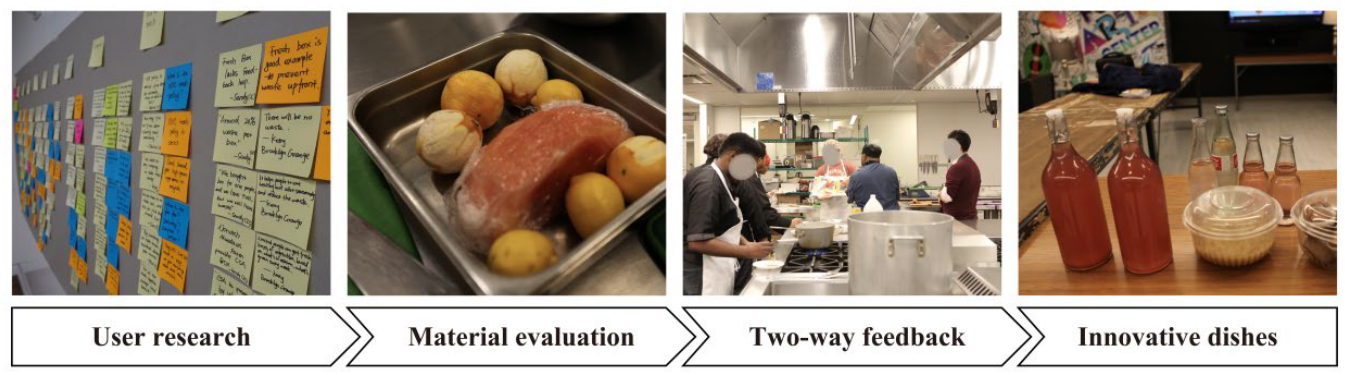
The Collaborative System Model (CSM) forms the theoretical and methodological backbone of this research. The model’s six interrelated dimensions—knowledge interaction, participation capacity, collaborative activities, environmental context, sociocultural factors, and feedback loops—were operationalized as key variables for analyzing and intervening in kitchen workflows. The six CSM dimensions were operationalized into measurable indicators for this study (Table 2). Design workshop interventions guided by the CSM framework yielded significant outcomes. A participatory action process was established encompassing user research, material evaluation, two-way feedback, and innovative dish development (see Figure 2).

3.3. Intervention Protocol and Measurement Design

To translate the CSM–PD framework into operational practice, we implemented a structured intervention protocol embedded in a community-based culinary innovation center’s teaching kitchen workflow. The protocol consisted of a baseline phase without explicit intervention, followed by a participatory action phase in which collaboratively designed practices were introduced into daily operations.
Baseline phase. During the baseline phase, chefs and interns were asked to work “as usual” without any additional instructions regarding fruit byproduct reuse. For each documented kitchen session, all fruit byproducts (e.g., peels, cores, pulp, trims) generated during preparation and service were collected in dedicated containers and weighed at the end of the session using digital scales (±1 g accuracy). The total fruit waste mass per session constituted the baseline reference (Wbaseline). No feedback on performance was provided at this stage in order to avoid reactivity bias.
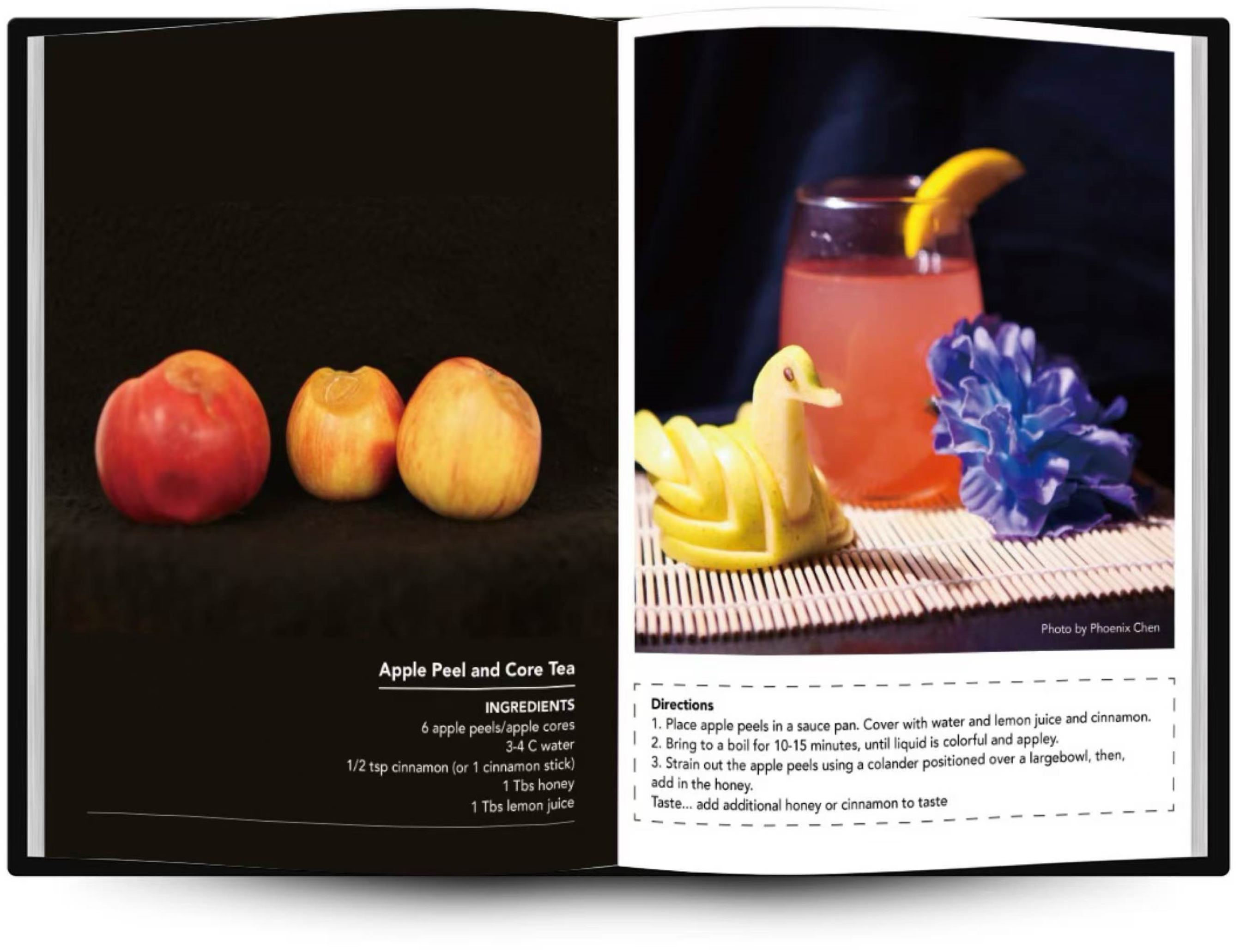
Participatory intervention phase. The subsequent participatory action phase operationalized the CSM dimensions through co-creation and iterative refinement. Drawing on insights from the qualitative diagnosis, the research team and chefs co-developed zero-waste recipes and handling guidelines for selected fruit byproducts (e.g., fruit-infused kefir water, apple peel tea, citrus pulp cupcakes). These practices were integrated into regular kitchen routines rather than treated as separate experiments. During each post-intervention session, staff were encouraged to proactively separate reusable byproducts, test the co-developed recipes, and record adjustments (e.g., preparation time, sensory feedback, feasibility issues). In total, 18 post-intervention kitchen sessions were documented.
Measurement of waste and reuse. In both phases, fruit byproducts were categorized into “reused” (incorporated into dishes or beverages) and “discarded” (sent to the general waste stream). At the end of each session, the total mass of discarded byproducts per session was recorded as Wdiscarded. This yielded a paired dataset of session-level waste quantities before and after the intervention. The byproduct reuse rate was calculated as the proportion of total fruit byproducts that were reintegrated into culinary products. To ensure computational transparency, we define the core metrics as follows:
  • Fruit Waste Reduction (%): This was calculated by comparing the mean fruit waste mass per session from the baseline phase (Wbaseline) and the post-intervention phase (Wintervention). Based on our session-level measurements, the mean mass dropped from 3.15 kg to 0.88 kg, resulting in a reduction of 72.06% using the following formula.
R e d u c t i o n % = W b a s e l i n e W i n t e r v e n t i o n W b a s e l i n e × 100 %
2.
Byproduct Reuse Rate (%): This metric represents the proportion of total fruit byproducts that were diverted from the waste stream and reintegrated into culinary products. The baseline reuse rate was 15% (derived from approximately 0.47 kg reused out of 3.15 kg total byproducts), which increased to 68% post-intervention.
These calculations are based on the paired dataset of 18 sessions, with total mass recorded using digital scales (±1 g accuracy), following standard food waste auditing protocols used in restaurant environments [9,24]. Detailed calculations of fruit waste indicators and CO2e avoidance, including session-level raw data, notation, and emission factor equations, are provided in Supplementary Materials S3.
Sensory evaluation. To assess whether waste-reduction practices compromised product quality, sensory evaluations of the co-developed dishes were conducted with public participants at the culinary innovation center. Using a standard 5-point Likert hedonic scale (1 = very poor, 5 = excellent) [39], respondents rated overall acceptance, taste, aroma, and appearance. Evaluations were conducted after each iteration of recipe refinement, providing a quantitative indicator of acceptance alongside chefs’ qualitative reflections. The full sensory evaluation questionnaire and rating form are provided in Supplementary Materials S2. This protocol ensured that behavior, process, and environmental outcomes were captured within the same unit of analysis—session-level kitchen operations—while maintaining ecological validity in an authentic, high-pressure catering environment.
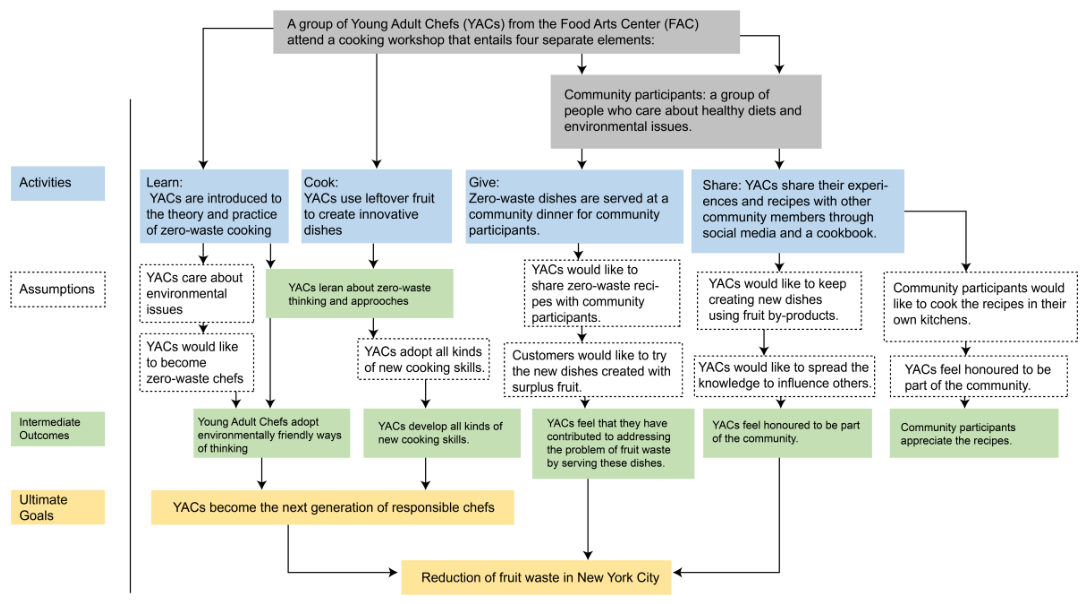
In practice, CSM was implemented through three cyclical phases: (1) Knowledge Integration Phase, mapping chefs’ procedural knowledge with designers’ analytical insights to identify inefficiencies in fruit procurement, processing, and storage; (2) Dynamic Empowerment Phase, redistributing decision-making authority to enable chefs’ direct participation in co-creating solutions and assessing feasibility; and (3) Feedback Reinforcement Phase, establishing real-time feedback mechanisms to monitor intervention effectiveness, optimize processes, and consolidate behavior changes. This methodological adaptation transformed CSM from a theoretical framework into a design-driven collaborative mechanism, fostering cross-disciplinary co-learning and synergistic innovation between culinary professionals and design researchers. The overall intervention logic is illustrated in the logic model in Figure 3.

3.4. Data Collection and Participants

This study recruited 18 participants, including 6 professional chefs, 4 culinary interns, and 8 community members. Purposeful sampling prioritized individuals with environmental awareness and interest in sustainable diets to ensure contextual depth and ecological validity. Qualitative data reached thematic saturation after the 16th interview, indicating sufficient sample size for in-depth analysis. All participants signed informed consent forms, and this study was approved by the Ethics Committee of the School of Design and Art, Hunan University (Ref. 2025-38).
Data collection followed a triangulated design combining qualitative and quantitative sources. First, 18 semi-structured interviews were conducted with professional chefs, culinary interns, and community participants (see Appendix A for the interview guides), exploring attitudes toward fruit byproducts, perceived barriers to reuse, and experiences with the participatory workshops. Second, 20 h of non-participant kitchen observation documented workflow, waste-generation points, and informal interactions among staff. Third, workshop documentation and design records (e.g., sketches, recipe drafts, feedback notes) captured the co-creation process and iterative refinement of zero-waste practices. Fourth, a session-level quantitative dataset was compiled by recording fruit byproduct weights (reused and discarded) using digital scales at the end of each kitchen session, yielding paired pre- and post-intervention observations.
By integrating interview narratives, observational field notes, workshop artifacts, and session-level measurements, the study constructed a rich evidential basis to examine how the CSM-guided participatory process reconfigured chefs’ daily practices and waste outcomes in an authentic restaurant setting.

3.5. Data Analysis

This study employed a convergent mixed-methods approach, analyzing qualitative and quantitative data in parallel and integrating them at the interpretation stage.
Qualitative component. Interview transcripts, observation records, and workshop archives were anonymized and imported into NVivo 12. Thematic analysis was conducted using a three-level grounded-theory coding framework (open–axial–selective) [40]. Two researchers independently coded all qualitative materials and iteratively reconciled discrepancies through discussion. Inter-coder reliability reached a Cohen’s Kappa coefficient of 0.86, indicating high coding consistency. Emergent themes were subsequently mapped onto the six dimensions of the CSM (knowledge interaction, participation capacity, collaborative activities, environmental context, sociocultural factors, and feedback loops), allowing us to link observed behavioral changes to specific collaborative mechanisms.
Quantitative component. For the quantitative dataset, the unit of analysis was the kitchen session. Each session contributed a paired observation consisting of total fruit waste mass before and after the intervention, as well as sensory acceptance scores for co-developed dishes. This yielded n = 18 session-level pairs. Prior to hypothesis testing, we assessed normality of the paired differences using the Shapiro–Wilk test (p > 0.05 for all key variables), supporting the use of parametric procedures.
We then applied paired-sample t-tests to compare pre- and post-intervention changes in (i) fruit waste mass per session and (ii) mean sensory acceptance scores. Effect sizes were reported using Cohen’s d along with 95% confidence intervals. Results showed a significant reduction in fruit waste (M1 = 3.15 kg, M2 = 0.88 kg, t(17) = 7.43, p < 0.001, Cohen’s d = 1.75, 95% CI [1.05, 2.45]), alongside a significant improvement in sensory acceptance (mean increase of 1.2 points on a 5-point scale; t(17) = 3.24, p = 0.004, d = 0.76). These findings indicate that the intervention achieved a large and robust effect on waste reduction without compromising, and in fact improving, perceived product quality.
Integration. Quantitative results were interpreted in light of qualitative themes regarding chefs’ reflective practices, collaborative learning, and feedback loops with the public. This integrated analysis enabled us to explain not only whether the intervention was effective, but how specific CSM-guided mechanisms underpinned the observed reductions in fruit waste. Example data excerpts and initial open codes are provided in Supplementary Materials S1 (Table S1).

3.6. Environmental Performance

To connect the observed behavioral and operational changes with cleaner production outcomes, we estimated the greenhouse-gas emissions avoided through the reduction of fruit waste. The environmental analysis focuses on the landfill disposal stage, which is the most common end-of-life pathway for food waste in many urban contexts.
Per-session avoided emissions. Let the per-session reduction in fruit waste mass be defined as:
Δ W = W b a s e l i n e W i n t e r v e n t i o n
where Wbaseline and Wintervention denote the total fruit waste mass (kg) generated in a kitchen session before and after the intervention, respectively. Based on the session-level measurements, fruit waste decreased from 3.15 kg to 0.88 kg per session, yielding ΔW = 2.27 kg/session.
To translate this reduction into avoided emissions, we use:
A v o i d e d C O 2 e s e s s i o n = Δ W × E F l a n d f i l l
where EFlandfill is the emission factor for landfilled wet organic waste (kg CO2e per kg). In the absence of detailed local life-cycle inventory data, we adopt a conservative base value of EFlandfill = 1.0 kg CO2e/kg and examine a minimal sensitivity range of 0.5–1.5 kg CO2e/kg to reflect variations in landfill gas capture and waste-management performance. This focus on landfill disposal aligns with comparative analyses of environmental impacts across various food waste treatment options [41]. This range aligns with orders of magnitude reported in municipal solid waste assessments for food and other putrescible fractions.
Table 3 summarizes the resulting avoided emissions per session under the three emission-factor scenarios. Under the base case (EFlandfill = 1.0 kg CO2e/kg), the intervention avoids approximately 2.27 kg CO2e per session through reduced fruit waste alone.
The use of a landfill-only system boundary is intentional. In the study’s local context, landfill represents the predominant end-of-life pathway for food waste, making this boundary both behaviorally relevant and empirically grounded. A narrower boundary also avoids introducing speculative upstream or downstream assumptions and enables a transparent, reproducible environmental calculation consistent with cleaner-production research conventions. This Stage-1 landfill boundary can be expanded once local LCI data are available (Supplementary Materials S1).
Per-meal and annualized perspectives. For practical interpretation, the per-session value can be scaled to per-meal and annual metrics. If N meals are served per documented kitchen session, the avoided emissions intensity per meal is:
A v o i d e d C O 2 e m e a l = ( Δ W × E F l a n d f i l l ) / N
Similarly, if the intervention is embedded in routine operations for T sessions per year, the annual avoided emissions become:
A v o i d e d C O 2 e y e a r = Δ W × E F l a n d f i l l × T
Equations (3) and (4) allow managers and researchers to adapt the results to their own operating conditions by substituting local meal volumes and service frequencies, while re-using the empirically observed ΔW from this study or re-estimating it on their own data.
Assumptions and reproducibility. The environmental calculation is deliberately kept simple and transparent: it uses the directly observed ΔW = 2.27 kg/session, a clearly stated range of EFlandfill values, and linear scaling relationships. A one-page technical note in the Supplementary Materials (“Supplementary Note S1: Sensitivity and Parameters”) documents parameter choices and provides a template spreadsheet for re-calculating avoided emissions under alternative emission factors or operational scales. While this analysis does not constitute a full life-cycle assessment, it establishes a conservative and reproducible linkage between behavioral interventions in kitchen practice and quantifiable contributions to cleaner production.

4. Results and Analysis

4.1. Overall Quantitative Outcomes

The analysis of the processed data (Section 3.5) demonstrates the specific mechanisms through which embedding the Collaborative System Model (CSM) within a PD framework effectively reduces fruit waste. Post-intervention comparisons revealed significant improvements across all key metrics: fruit byproduct reuse rates increased from 15% to 68%, total waste decreased by 72% (p < 0.01), and sensory ratings for new menu items reviewed by the public rose by an average of 1.2 points (out of 5, p < 0.05). CSM-PD delivered simultaneous waste and quality gains (Table 4); qualitative themes in Table 5.

4.2. Behavioral Transformation and Collaborative Dynamics

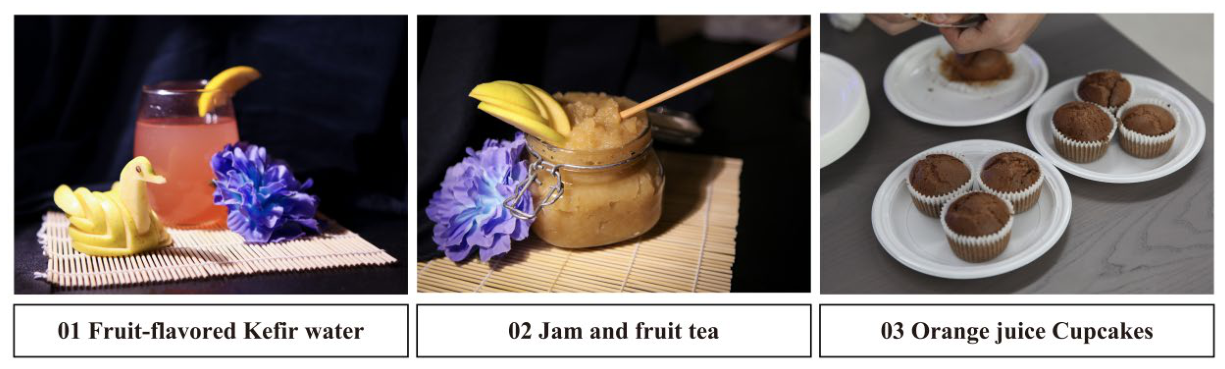
The iterative co-creation process between professional chefs and designers led to the development of three practical zero-waste recipes (see Table 6), directly highlighting the specific behaviors and collaborative mechanisms that drive food waste reduction. The visual presentation of the three co-created dishes is shown in Figure 4.
As detailed in Section 4.1, these collaborative recipes directly translated into significant reductions in waste volume and enhanced byproduct utilization. In sensory evaluation, innovative dishes scored significantly higher by 1.2 points on a 5-point Likert scale (p < 0.05). Notably, the iterative optimization process—combining chefs’ expertise and consumer feedback—yielded substantial improvements. For instance, the citrus cupcake recipe was adjusted, raising its score from an initial 2.8 to 4.0.
Qualitative analysis of the semi-structured interviews (n = 18) revealed three core behavioral shifts, providing deep insights into how the CSM-PD intervention reshaped the participants’ mindset and kitchen culture:
  • Awakening from Discard to Reuse Awareness (Cognitive Shift): Interview records showed that participants proactively shifted their perception of fruit byproducts. Rather than viewing them as low-value waste, they recognized their potential for high-quality upcycling. For example, when tasting the co-created fruit-flavored kefir water, one culinary intern remarked on the unexpected quality: “I like it, and I didn’t expect the flavor like that. You will think it made by a company, like a factory. And you could buy it in the store, but like you said, it can be made by yourself at home. That’s amazing.” This illustrates a critical cognitive shift: breaking the stereotype that upcycled waste is inferior and recognizing it as a valuable, commercially viable ingredient.
  • Transition from Individual Work to Collaborative Learning (Power Redistribution): Traditional food service environments can be strictly hierarchical. The CSM workshops flattened this structure, facilitating cross-role knowledge exchange and empowering interns to take initiative. Demonstrating this newfound agency, one intern explained how they utilized downtime for collaborative experimentation: “If we find a time during the day that we are not so busy, we will try to cook something with the thing we have, then we can show the community. If they like them, we can tell them this is the vegetable we use.” This perfectly illustrates the CSM’s core mechanism of redistributing decision-making authority, allowing frontline staff to become co-creators and community educators rather than mere executors.
  • Shift from Passive Compliance to Proactive Optimization (Embedded Routine): Beyond operational tasks, participants began to internalize environmental responsibility as a core professional value. The intervention transformed waste reduction from a top-down mandate into a self-driven ethical practice. Reflecting on this alignment of personal values and community impact, one youth participant noted: “Environment, now I’m take the job that caring for the environment more, it’s suit for other people. You do what we do to educate people helping the community.” These narratives align with the “knowledge-activity-competency” triad in the CSM, demonstrating how participatory empowerment transforms waste management into an internalized, adaptive learning process.

4.3. Bidirectional Feedback Mechanisms and Design Iteration

Participatory workshops integrated chefs’ experiential feedback with public sensory evaluations, implementing the CSM “bidirectional feedback loop” mechanism. Over two iterations, all three co-developed dishes (Fruit-flavored kefir water, Fruit jam and fruit tea, Orange pulp cupcakes) achieved significant improvements: average acceptance scores increased by 1.2 points, and waste volume decreased by 72% compared to traditional methods.
Thematic mapping revealed that feedback integration directly enhanced the effectiveness of design interventions. For instance, the chef’s suggestion to “simplify kefir fermentation steps” was swiftly adopted, reducing complexity while improving applicability. This process validated CSM “dynamic equilibrium” concept: efficiency and creativity grow in parallel through knowledge exchange and collaboration.

4.4. Scalability and Public Engagement

Demonstrating the scalable potential of the CSM–PD framework beyond professional settings, the intervention yielded broad public engagement and clear dissemination potential through the visualization tool, the Zero-Waste Cooking Guide (Figure 5). Ninety-one percent of tasting participants reported that this visual guide enhanced their understanding of food resource circulation. Six educators proactively proposed integrating the guide into culinary instruction, fostering connections between professional practice and community education.
Additionally, 65% of respondents expressed intent to replicate zero-waste recipes in their home kitchens, demonstrating the framework’s demonstrability beyond institutional settings. This diffusion effect reveals the model’s social value: it transforms sustainable design from an “expert-driven” endeavor into a “publicly co-created” cultural practice.

5. Discussion

5.1. Adaptability of the CSM in Restaurant Kitchens

Findings indicate that the Collaborative System Model (CSM) exhibits strong adaptability within the complex socio-political environment of restaurant kitchens. Rather than functioning as a top-down managerial tool, the CSM operates as an adaptive collaborative infrastructure that embeds co-learning, distributed agency, and iterative feedback directly into daily workflows. Through these mechanisms, chefs maintain a dynamic balance between efficiency, creativity, and waste-reduction goals. This adaptability forms the foundation for the multi-stage mechanism through which the CSM–PD intervention produces cleaner-production outcomes.

5.2. Mechanism Pathway Linking CSM–PD to Cleaner-Production Outcomes

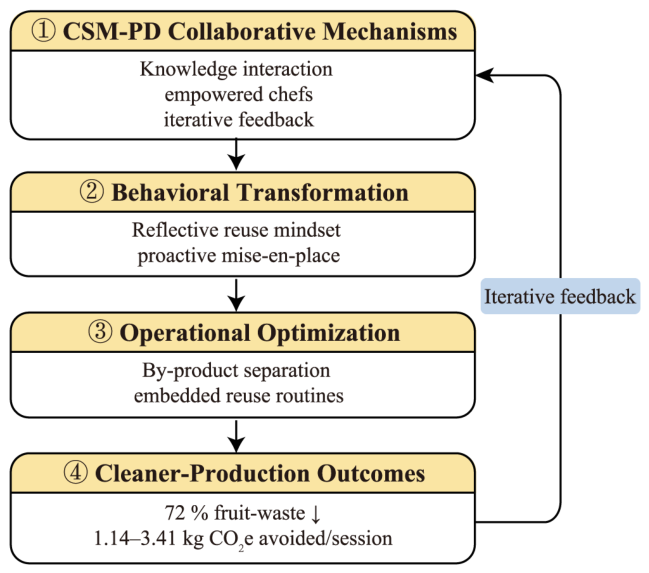
Building on these observations, we synthesized a mechanism pathway that illustrates how CSM–PD interventions translate collaborative activities and behavioral shifts into operational improvements and measurable environmental gains (Figure 6).
CSM–PD Collaborative Mechanisms: Knowledge interaction, empowerment of chefs as co-researchers, and iterative feedback loops reshape decision-making authority and encourage distributed problem-solving.
Behavioral Transformation: These mechanisms promote reflective waste-handling, proactive mise-en-place planning, and collective creativity among chefs, interns, and community participants.
Operational Optimization: Behavioral shifts translate into improved byproduct separation, embedded reuse routines, and reduced over-preparation and oxidation losses.
Cleaner-Production Outcomes: These operational changes yield quantifiable environmental benefits, including a 72% reduction in fruit waste and avoided emissions of 1.14–3.41 kg CO2e per session.

5.3. Contribution to Cleaner Production Theory

We integrate behavioral, organizational and participatory mechanisms into measurable environmental gains. By integrating CSM with PD, cleaner production emerges not as a solely technical process but as a socio-political transformation shaped by shared knowledge, distributed decision-making, and iterative feedback. Quantifying avoided emissions linked to behavioral change further illustrates how “soft” interventions can be translated into audible “hard” environmental metrics, strengthening the theoretical and methodological bridge between design-led collaboration and cleaner-production performance.
Specifically, this study transcends the traditional ‘user-centered’ design paradigm by expanding it into a collaborative mechanism of ‘system empowerment’. By operationalizing the six dimensions of CSM, this research transforms the model from a conceptual framework into a verifiable design methodology, offering new theoretical insights into the design mechanisms of sustainable transformation.

5.4. Collaborative Innovation Mechanisms

Distributed creativity—mobilising chefs’ tacit knowledge—drives waste reduction. This redistribution of agency embodies the democratic ethos of Participatory Design and demonstrates that durable sustainability innovations arise from continuous social learning embedded in daily practice.

5.5. Feedback Loops and Collaborative Knowledge Creation

A key finding is the role of bidirectional feedback—combining chefs’ operational reflections with public sensory evaluations—in forming a sustainable learning system. Feedback functions not just as an evaluative tool but as a generator of new knowledge, reinforcing a cycle of practice–reflection–redesign. Over time, participants develop shared cognitive frameworks that support adaptive learning and continuous improvement, confirming that effective waste-reduction systems rely on collective knowledge practices rather than isolated behavioral interventions.

5.6. Behavioral Sustainability and Design Ethics

Beyond operational outcomes, the intervention fostered deeper behavioral sustainability as chefs internalized conservation and reuse practices as part of their professional identity. Through participatory engagement, environmental responsibility shifted from external compliance to intrinsic motivation. This reconfiguration of agency reflects the ethical dimension of participatory design: sustainability becomes a shared moral practice rather than a managerial target. Such ethical infrastructures strengthen collaboration and support long-term cultural transformation in professional kitchens.

5.7. Replicability and Boundary Conditions

As a single-case study conducted in a high-pressure kitchen environment, the findings exhibit contextual dependence. To support replication, we provide a reproducibility package containing SOPs, coding materials, survey excerpts, and anonymized datasets. External validity is shaped by three boundary conditions: kitchen throughput, menu complexity, and staff composition. Impact may vary according to procurement practices, storage capacity, and service pressure. Future studies should stratify results by cuisine type and organizational scale to test model generalizability.

5.8. Environmental Performance and Cleaner Production

Although this study centers on collaborative and behavioral mechanisms, the intervention also yields measurable environmental benefits. Combining the observed reduction in fruit waste (ΔW = 2.27 kg/session) with a conservative landfill emission-factor range (0.5–1.5 kg CO2e/kg) results in avoided emissions of 1.14–3.41 kg CO2e per session. These improvements are achieved through low-cost behavioral adjustments rather than technology-intensive retrofits.
The observed 72% reduction in fruit waste significantly outperforms traditional participatory interventions. For instance, while Strotmann et al. [32] demonstrated that staff engagement could reduce waste, their model lacked the structured, multidimensional collaboration provided by the CSM framework (Table 1). Furthermore, unlike the managerial-centric approaches proposed by Martín-Ríos et al. [33], which focus on top-down innovations, our PD–CSM approach embeds behavioral design directly into the kitchen’s micro-social system. This comparison underscores that the synergy of collective knowledge and iterative feedback loops is critical for achieving high-impact cleaner production in professional food services.
This linkage is significant for cleaner-production research: it demonstrates that participatory, design-led interventions can produce traceable environmental gains using transparent and reproducible calculations; that session-level metrics can be scaled to different operational contexts; and that behavioral transformation, system feedback, and environmental outcomes can be analytically connected. These environmental results reinforce the mechanism pathway outlined earlier and highlight how participatory design can operate as a practical bridge between social innovation and cleaner-production performance. For practitioners, such as restaurant managers and executive chefs, this study offers a direct “call to action” to move beyond top-down mandates. We recommend implementing a three-pillar principle: (1) establishing visualized waste-measurement routines to build objective awareness; (2) empowering staff through co-creation workshops to reduce resistance to new reuse protocols; and (3) utilizing bidirectional feedback between the kitchen and customers to validate the sensory appeal of zero-waste innovations.
To facilitate broader applicability, it should be noted that the landfill boundary used in this study represents Stage-1 of a modular LCA approach. To assist future research, Supplementary Note S1 provides a template for grafting upstream and downstream inventories onto our empirical baseline (ΔW = 2.27 kg session−1) without requiring new data collection.

5.9. Practical and Policy Implications

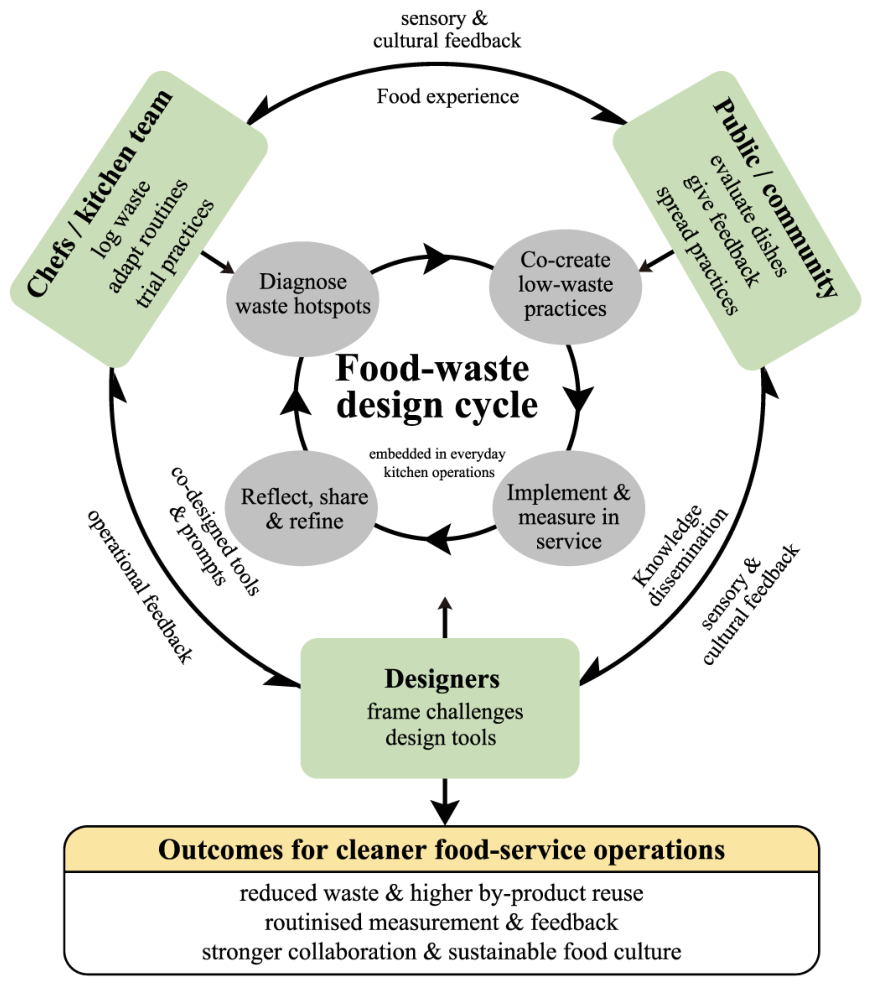
At the practical level, this study proposes a replicable design strategy (see Figure 7) that links daily kitchen practices with measurable environmental outcomes. The developed Zero-Waste Cooking Guide illustrates how design knowledge can be translated into visual tools, bridging technical feasibility and social acceptability. Furthermore, for policymakers and managers, this research suggests that embedding participatory mechanisms within management systems enhances staff ownership and reduces resistance. The CSM-based feedback structure serves as a low-cost, adaptive process monitoring mechanism that promotes knowledge sharing and public awareness through resource tools like the Zero-Waste Cooking Guide.

6. Conclusions

6.1. Conclusions: Theoretical and Practical Contributions

This study advances the field of sustainable food systems by demonstrating that effective waste reduction necessitates systemic empowerment rather than relying solely on technical or top-down managerial mandates. By integrating the Collaborative System Model (CSM) with Participatory Design (PD), this research shifts the cleaner production paradigm from ‘designing for users’ to ‘co-creating with practitioners.’
The primary theoretical contribution lies in operationalizing the CSM framework within the complex micro-social environment of a commercial kitchen. The findings confirm that when culinary professionals are elevated from passive executors to proactive ‘co-researchers,’ waste reduction ceases to be a source of operational friction; instead, it transforms into an internalized professional value driven by continuous, bidirectional feedback.
From a practical perspective, this framework equips the hospitality industry with a behavior-anchored, scalable unit process vital for SDG 12.3 reporting. It provides actionable blueprint for restaurant managers to dismantle hierarchical waste management structures in favor of distributed, collaborative innovation. Ultimately, this approach effectively bridges the critical gap between qualitative social design interventions and quantifiable environmental performance.

6.2. Limitations and Future Research Directions

While this study validated the feasibility of the CSM–PD framework, several limitations remain. The sample size (n = 18) and the single-site focus on a high-volume, low-margin kitchen operation may limit the statistical generalizability of the findings to all catering environments. Furthermore, the lack of a traditional control group restricts the ability to establish definitive causal relationships between specific CSM dimensions and waste outcomes. However, the use of Participatory Action Research (PAR) allowed for deep, contextually rich insights into behavioral transformation that are often missed in larger quantitative surveys. Future research should prioritize longitudinal tracking to assess the long-term retention of intervention effects beyond the immediate workshop period. Moreover, to explore the model’s scalability, cross-scenario validation in different regional or cultural contexts is highly recommended. Additionally, subsequent work could integrate tools like AI-based sensing systems or full Life Cycle Assessments (LCA) to enhance data precision and quantify broader environmental impacts.

Supplementary Materials

The following supporting information can be downloaded at https://www.mdpi.com/article/10.3390/su18126153/s1.

Author Contributions

Conceptualization, Z.S., S.S. and B.S.; methodology, Z.S. and X.L.; software, X.L.; validation, X.L. and Z.S.; formal analysis, Z.S. and X.L.; investigation, Z.S.; resources, S.S. and B.S.; data curation, X.L.; writing—original draft preparation, Z.S.; writing—review and editing, X.L., S.S. and B.S.; visualization, Z.S.; supervision, S.S. and B.S.; project administration, S.S. and B.S. All authors have read and agreed to the published version of the manuscript.

Funding

The study was financially supported by the Fundamental Research Funds for the Central Universities (531118010885), the Hunan Provincial Natural Science Foundation of China (2025JJ50218), and the Key Research and Development Project of Hunan Province, China (2025JK2027).

Institutional Review Board Statement

The study was conducted in accordance with the Declaration of Helsinki, and approved by the Ethics Committee of the School of Design and Art, Hunan University (Ref. 2025-38, 28 October 2025).

Informed Consent Statement

Informed consent was obtained from all subjects involved in the study.

Data Availability Statement

The data supporting the findings of this study are publicly accessible at Zenodo (https://doi.org/10.5281/zenodo.17893998) under the CC-BY 4.0 license.

Acknowledgments

The authors thank the chefs, culinary interns, and community participants at the New York Food Arts Center for their generous collaboration throughout the study. During the preparation of this manuscript, the authors used Gemini (v1.5) to improve language and readability. The authors have reviewed and edited the output and take full responsibility for the content of this publication.

Conflicts of Interest

The authors declare no conflicts of interest.

Appendix A

This appendix summarizes the main questions used in the semi-structured interviews with three participant groups: professional chefs, culinary interns, and community participants. Questions were used flexibly, and additional follow-up questions were asked when appropriate.

Appendix A.1. Interview Guide—Professional Chefs

Role and responsibilities: Could you briefly describe your role in the New York Food Arts Center kitchen and your main responsibilities during a typical session?
  • Waste hotspots in the workflow: At which stages of preparation, cooking, or service do you see the most fruit byproducts or food waste being generated?
  • Current handling of fruit byproducts: Before this project, how were fruit byproducts (e.g., peels, pulp, cores) usually handled in this kitchen?
  • Experience of the CSM–PD process: How would you describe your experience in the participatory design workshops using the Collaborative System Model?
  • Perceived changes and outcomes: Since the intervention, have you changed anything in the way you plan menus or handle fruit byproducts? If yes, could you give an example?

Appendix A.2. Interview Guide—Culinary Interns/Students

Background and role: What is your role during the kitchen sessions, and how long have you been at the New York Food Arts Center?
  • Awareness of fruit waste: In your daily kitchen tasks, where do you notice the most fruit waste or byproducts being generated?
  • Attitudes toward waste: How do you feel about throwing away edible parts of fruit in a professional kitchen?
  • Experience of co-creation sessions: What was your experience of the co-creation sessions for zero-waste recipes?
  • Behavior change: After participating in this project, have you changed any of your cooking or waste-handling practices here or at home?

Appendix A.3. Interview Guide—Community Participants

Motivations to join: Why did you decide to join the cooking and design sessions at the New York Food Arts Center?
  • Perception of zero-waste dishes: How did you feel about the dishes created with fruit byproducts in terms of taste and overall acceptance?
  • Learning and interaction: What did you learn about food waste or zero-waste cooking from chefs, interns, or designers during the sessions?
  • Impact on everyday practices: Have you changed anything in the way you use or discard fruit at home since joining the project?
  • Future willingness: Are you more willing to try “zero-waste” or “upcycled” dishes in restaurants after this experience? Why or why not?

References

  1. Gustavsson, J.; Cederberg, C.; Sonesson, U.; van Otterdijk, R.; Meybeck, A. Global Food Losses and Food Waste: Extent, Causes and Prevention; Food and Agriculture Organization of the United Nations (FAO): Rome, Italy, 2011. [Google Scholar]
  2. Food and Agriculture Organization of the United Nations (FAO); IFAD; UNICEF; WFP; WHO. The State of Food Security and Nutrition in the World 2024: Financing to End Hunger, Food Insecurity and Malnutrition in All Its Forms; FAO: Rome, Italy, 2024. [Google Scholar]
  3. Recycle Track Systems (RTS). Food Waste in America in 2024: Statistics & Facts. Available online: https://www.rts.com/resources/guides/food-waste-america/ (accessed on 14 November 2025).
  4. Brown, M. How to Feed Hungry New Yorkers and Fight Climate Change. Natural Resources Defense Council, New York. Available online: https://www.nrdc.org/experts/margaret-brown/how-feed-hungry-new-yorkers (accessed on 14 November 2025).
  5. New York State Department of Environmental Conservation (NYSDEC). New York State Announces $4 Million in Grants to Expand Food Waste Recycling. Available online: https://www.usbiopower.com/newsroom/new-york-state-food-waste-recycling-grants-promote-anaerobic-digestion (accessed on 14 November 2025).
  6. United Nations Environment Programme (UNEP). Food Waste Index Report 2021; United Nations Environment Programme: Nairobi, Kenya, 2021. [Google Scholar]
  7. Dhir, A.; Talwar, S.; Kaur, P.; Malibari, A. Food waste in hospitality and food services: A systematic literature review and framework development approach. J. Clean. Prod. 2020, 270, 122861. [Google Scholar] [CrossRef]
  8. Filimonau, V.; Todorova, E.; Mzembe, A.; Sauer, L.; Yankholmes, A. A comparative study of food waste management in full service restaurants of the United Kingdom and the Netherlands. J. Clean. Prod. 2020, 258, 120775. [Google Scholar] [CrossRef]
  9. Filimonau, V.; Chiang, C.-L.; Wang, L.-E.; Muhialdin, B.J.; Ermolaev, V.A. Resourcefulness of chefs and food waste prevention in fine dining restaurants. Int. J. Hosp. Manag. 2023, 108, 103368. [Google Scholar] [CrossRef]
  10. Facchini, F.; Silvestri, B.; Digiesi, S.; Lucchese, A. Agri-food loss and waste management: Win-win strategies for edible discarded fruits and vegetables sustainable reuse. Innov. Food Sci. Emerg. Technol. 2023, 83, 103235. [Google Scholar] [CrossRef]
  11. Subadra, N. Managing restaurant’s food loss and waste at the Aburi Sushi Bali: A sustainable culinary tourism enterprise model in Bali. J. Kaji. Bali 2024, 14, 191–214. [Google Scholar]
  12. Kumar, S.; Mathad, G.N.; Ozukum, R. Fruit peels: A sustainable agro waste utilization approach. In Smart Agrochemicals for Sustainable Agriculture; Springer: Singapore, 2020; pp. 129–151. [Google Scholar]
  13. Selmi, H.; Presutto, E.; Totaro, M.; Spano, G.; Capozzi, V.; Fragasso, M. Apple waste/by-products and microbial resources to promote the design of added-value foods: A review. Foods 2025, 14, 1850. [Google Scholar] [CrossRef]
  14. Negrea, M.; Cocan, I.; Jianu, C.; Alexa, E.; Berbecea, A.; Poiană, M.; Silivasan, M. Valorization of citrus peel by-products: A sustainable approach to nutrient-rich jam production. Foods 2025, 14, 1339. [Google Scholar] [CrossRef]
  15. Sirohi, R.; Gaur, V.K.; Pandey, A.; Sim, S.J.; Kumar, S. Harnessing fruit waste for poly-3-hydroxybutyrate production: A review. Bioresour. Technol. 2021, 326, 124734. [Google Scholar] [CrossRef]
  16. Selvam, T.; Rahman, N.M.M.A.; Olivito, F.; Ilham, Z.; Ahmad, R.; Wan-Mohtar, W.A.A.Q.I. Agricultural waste-derived biopolymers for sustainable food packaging: Challenges and future prospects. Polymers 2025, 17, 1897. [Google Scholar] [CrossRef]
  17. Bayram, B.; Ozkan, G.; Kostka, T.; Çapanoğlu, E.; Esatbeyoglu, T. Valorization and application of fruit and vegetable wastes and by-products for food packaging materials. Molecules 2021, 26, 4031. [Google Scholar] [CrossRef]
  18. Maraveas, C. Production of sustainable construction materials using agro-wastes. Materials 2020, 13, 262. [Google Scholar] [CrossRef]
  19. Arcila-Echavarría, D.; Lu-Chau, T.; Gómez-Vanegas, N. Polyhydroxybutyrate synthesis by the halophilic bacterium Halomonas boliviensis in oil palm empty fruit bunch hydrolysate. Biopolymers 2024, 116, e23644. [Google Scholar] [CrossRef]
  20. Leong, Y.-K.; Chang, J.-S. Valorization of fruit wastes for circular bioeconomy: Current advances, challenges, and opportunities. Bioresour. Technol. 2022, 359, 127459. [Google Scholar] [CrossRef]
  21. Lee, A.; Lan, J.; Jambrak, A.; Chang, J.; Lim, J.; Khoo, K. Upcycling fruit waste into microalgae biotechnology: Perspective views and way forward. Food Chem. Mol. Sci. 2024, 8, 100203. [Google Scholar] [CrossRef]
  22. Joseph, V.M.; Rovina, K.; Ling, F.W.X.; Supri, S.; Yin, K.W. Value-added applications of fruit peel biowaste: A review of potential uses in the food industry. Food Biophys. 2024, 19, 807–832. [Google Scholar] [CrossRef]
  23. Aydin, A.E.; Yildirim, P. Understanding food waste behavior: The role of morals, habits and knowledge. J. Clean. Prod. 2021, 280, 124250. [Google Scholar] [CrossRef]
  24. Sánchez, A.; Ferrão, J.; Moreira, M.T. Food waste valorisation indices for restaurants: A micro-level LCA approach to guide circular economy policies. J. Clean. Prod. 2023, 398, 136632. [Google Scholar]
  25. Li, Y.; Wang, L.; Zhang, T. Behavior-based cleaner production in catering: Integrating nudging and participatory feedback for SDG 12.3. J. Clean. Prod. 2024, 434, 140522. [Google Scholar]
  26. Simonsen, J.; Robertson, T. (Eds.) Routledge International Handbook of Participatory Design; Routledge: London, UK, 2012. [Google Scholar]
  27. Sanoff, H. Participatory Design; Deparch: Raleigh, NC, USA, 2022. [Google Scholar]
  28. Clemensen, J.; Holm, K.G.; Jakobsen, P.R.; Jensen, C.M.; Nielsen, C.; Danbjørg, D.B.; Smith, A.C.; Rothmann, M.J. Participatory design in telehealth research: Practical case examples. J. Telemed. Telecare 2025, 31, 1193–1200. [Google Scholar] [CrossRef]
  29. Wacnik, P.; Daly, S.; Verma, A. Participatory Design: A systematic review and insights for future practice. arXiv 2024, arXiv:2409.17952. [Google Scholar]
  30. Nikravech, M.; Langen, N.; Bendisch, F.; Ziesemer, F.; Abels, S.; Schrader, U.; Fischer, D. The Food Waste Lab: Improving food waste reduction behavior through education. J. Clean. Prod. 2022, 370, 133447. [Google Scholar] [CrossRef]
  31. Drain, A.; Sanders, E.B.-N. A collaboration system model for planning and evaluating Participatory Design projects. Int. J. Des. 2019, 13, 39–52. [Google Scholar]
  32. Strotmann, C.; Göbel, C.; Friedrich, S.; Kreyenschmidt, J.; Ritter, G.; Teitscheid, P. A participatory approach to minimizing food waste in the food industry—A manual for managers. Sustainability 2017, 9, 66. [Google Scholar] [CrossRef]
  33. Martín-Ríos, C.; Demen-Meier, C.; Gössling, S.; Cornuz, C. Food waste management innovations in the foodservice industry. Waste Manag. 2018, 79, 196–206. [Google Scholar] [CrossRef]
  34. Handayati, Y.; Widyanata, C. Effective food waste management model for the sustainable agricultural food supply chain. Sci. Rep. 2024, 14, 10290. [Google Scholar] [CrossRef]
  35. Brown, P.; Baldassarre, B.; Konietzko, J.; Bocken, N.; Balkenende, R. A tool for collaborative circular proposition design. J. Clean. Prod. 2021, 297, 126354. [Google Scholar] [CrossRef]
  36. Manellanga, R.; David, I. Participatory and collaborative modeling of sustainable systems: A systematic review. In Proceedings of the ACM/IEEE 27th International Conference on Model Driven Engineering Languages and Systems (MODELS 2024), Linz, Austria, 22–27 September 2024. [Google Scholar]
  37. Hennchen, B. Knowing the kitchen: Applying practice theory to issues of food waste in the food service sector. J. Clean. Prod. 2019, 225, 675–683. [Google Scholar] [CrossRef]
  38. VanderWeele, T.J.; Ding, P. Sensitivity analysis in observational research: Introducing the E-value. Ann. Intern. Med. 2017, 167, 268–274. [Google Scholar] [CrossRef]
  39. Meilgaard, M.C.; Civille, G.V.; Carr, B.T. Sensory Evaluation Techniques, 5th ed.; CRC Press: Boca Raton, FL, USA, 2015. [Google Scholar]
  40. Braun, V.; Clarke, V. Using thematic analysis in psychology. Qual. Res. Psychol. 2006, 3, 77–101. [Google Scholar] [CrossRef]
  41. Thyberg, K.L.; Tonjes, D.J. The environmental impacts of alternative food waste treatment technologies in the U.S. J. Clean. Prod. 2017, 158, 101–108. [Google Scholar] [CrossRef]
Figure 1. PD–CSM conceptual framework for restaurant food-waste reduction.
Sustainability 18 06153 g001
Figure 2. CSM–PD participatory process in a commercial kitchen.
Sustainability 18 06153 g002
Figure 3. Logic model of the Young Adult Chef (YAC) zero-waste cooking program, showing core activities (Learn–Cook–Give–Share), underlying assumptions, intermediate outcomes, and the ultimate goal of reducing fruit waste in New York City.Solid arrows indicate the logical flow from program activities to intended outcomes. Dashed-line boxes group related stages, while distinct colors distinguish the different hierarchical phases of the model (Activities, Assumptions, Intermediate Outcomes, and Ultimate Goals).
Sustainability 18 06153 g003
Figure 4. Design presentation of three zero-waste fruit-based dishes.
Sustainability 18 06153 g004
Figure 5. Zero-Waste Cooking Guide (icon-based version).
Sustainability 18 06153 g005
Figure 6. Mechanism pathway linking CSM–PD collaborative mechanisms to cleaner-production outcomes. The arrows indicate the sequential logic from mechanisms to outcomes. The distinct colors represent the different progressive stages of the model.
Sustainability 18 06153 g006
Figure 7. Iterative food-waste design strategy distributed across designers, kitchen staff, and public participants. The strategy summarizes how an iterative food-waste design cycle—comprising diagnosis, co-creation, implementation with measurement, and reflection—is distributed across these key stakeholders. The arrows indicate the iterative flow of the food-waste design cycle. The background colors distinguish the specific roles and actions of different stakeholders.
Sustainability 18 06153 g007
Table 1. Summary of Key Literature and Identified Gaps.
StudyContextMethodologyKey FindingsIdentified Gap
Strotmann et al. [32]Food industryParticipatory interventionReduced waste through staff engagementLacks system-level collaboration
Martin-Ríos et al. [33]RestaurantsCase studyManagerial innovations for waste controlNo integration of behavioral design
Drain & Sanders [31]General designConceptual CSM modelStructured participatory collaborationNot applied to micro-level food systems
Brown et al. [35]Circular designCollaborative modelingFacilitated knowledge exchangeLimited empirical validation
This studyRestaurant kitchensMixed-method PD + CSMBehavioral and system-level waste reductionEmpirical integration of PD–CSM framework
Table 2. Operationalization of the CSM Framework.
CSM DimensionOperational DefinitionMeasured Variable/IndicatorData Source
Knowledge InteractionExchange of tacit and analytical knowledge between chefs and designersFrequency of collaborative sessions; number of co-created ideasWorkshop transcripts; observation logs
Participation CapabilityDegree of decision-making involvement among chefs and publicSelf-reported participation index (1–5)Interview data
Collaborative ActivitiesJoint creation and testing of zero-waste recipesNumber of tested prototypesDesign documentation
Environmental ContextPhysical and temporal constraints in kitchen workflowTime pressure, spatial layoutObservation
Socio-cultural FactorsNorms and values shaping food useAttitudes toward reuse and aestheticsInterviews
Feedback LoopIterative evaluation and improvement of recipesNumber of feedback iterationsQuantitative evaluation forms
Table 3. Fruit waste reduction and avoided emissions under different scenarios.
EF (kg CO2e/kg)Avoided CO2e (kg/Session)Change vs. EF = 1.0
0.51.14−50%
1.0 (base)2.27
1.53.41+50%
Note: “—” indicates the baseline scenario. Benefits remain stable across EFlandfill range.
Table 4. Core quantitative outcomes: waste, reuse, and sensory acceptance.
MetricBaseline (Mean per Session)Post-Intervention (Mean per Session)Absolute ChangeStatistical Test
Fruit waste mass (kg/session)3.150.88−72% (Δ = −2.27 kg)t(17) = 7.43, p < 0.001, d = 1.75
Byproduct reuse rate (%)1568+53 percentage pointsp < 0.01
Mean sensory acceptance (1–5 Likert)3.14.3+1.2 pointst(17) = 3.24, p = 0.004, d = 0.76
Table 5. Core themes and empirical evidence summary.
Theme No.Core ThemeConnotationKey Empirical Data
1Informativeness effect of Participatory Design on chefs’ behaviorThrough situational simulations and recipe co-creation activities, researchers broke the habitual mindset of discarding low-value ingredients, significantly improving the reuse rate of food scraps.(1) Post-intervention fruit scrap reuse rate increased from 15% to 68%; (2) 83% of interviewed chefs reported “actively considering reuse solutions”; (3) Case example: jam and fruit tea preparation reduced waste by 2900 g.
2Iterative and validation role of the two-way feedback mechanismThe optimization process was driven by chefs’ practical suggestions combined with public acceptance feedback, with quantitative data verifying waste reduction outcomes.(1) After two rounds of iteration, the average sensory score of three dishes increased by 1.2 points; the orange paper cupcake score improved from 2.8 to 4.0 after recipe adjustment; (2) Waste generation was reduced by 72% compared to traditional cooking; (3) Chefs suggested simplifying the “kefir water fermentation step.”
3Calculable pathways for public participationLeveraging the visualized tool Zero-Waste Cooking Guide to bridge the gap between professional and public knowledge, thereby promoting the dissemination of zero-waste concepts.(1) 91% of evaluators agreed that “the visualized guide created a cognitive impact”; (2) Six secondary school teachers proposed “introducing the guide into the classroom”; (3) Household kitchen practice willingness increased by 65%.
Table 6. Quantitative changes in fruit waste and byproduct reuse.
Dish No.Creative DishIngredients UsedPreparation ProcessWaste Reduction Outcome
01Fruit-flavored kefir waterApple 200 g; Lemon 20 g; Orange 100 gOrganic fermentation liquid was mixed with kefir produced in the kitchen. Apple peel and fruit scraps were added to enhance flavor.Total fruit waste reduced by 320 g.
02Fruit Jam and Fruit TeaApple 3000 g; Pectin powder 10 gFruit flesh was blended with organic pectin. Through heating and stirring, fruit peel containing nutrients was incorporated into the jam. Fruit residuals were also used for brewing fruit tea.Waste reduced by 2900 g (transport-induced loss excluded).
03Orange Pulp CupcakesOrange 2000 gOrange pulp remaining after juicing was collected. The pulp was then used as a natural fiber source in cupcake batter, combined with flour, eggs, and seasonings.Waste reduced by 2000 g (pulp reused in cupcake preparation instead of being discarded).
Note: Total fruit byproduct mass reused across the three dishes = 5.22 kg per session (contributing to the overall 2.27 kg/session waste reduction).
Disclaimer/Publisher’s Note: The statements, opinions and data contained in all publications are solely those of the individual author(s) and contributor(s) and not of MDPI and/or the editor(s). MDPI and/or the editor(s) disclaim responsibility for any injury to people or property resulting from any ideas, methods, instructions or products referred to in the content.