Article

Mapping the Social–Ecological Nexus to Determine System Properties That Maintain Sustainability and Productivity in Village Tank Cascade Systems of Sri Lanka


1
Department of Geography and Planning, University of New England, Armidale, NSW 2351, Australia
2
Ministry of Environment, Sri Jayawardenepura Kotte 10100, Sri Lanka
3
Alliance of Bioversity International and CIAT, Via di San Domenico, 1, 00153 Rome, Italy
4
Australian Centre for Pacific Islands Research, University of the Sunshine Coast, Sippy Downs, QLD 4556, Australia
5
School of Engineering and Technology, Central Queensland University, Rockhampton, QLD 4701, Australia
6
Corangamite Catchment Management Authority, Colac, VIC 3250, Australia
7
School of Environmental and Rural Science, University of New England, Armidale, NSW 2351, Australia
*
Author to whom correspondence should be addressed.
Sustainability 2026, 18(12), 6151; https://doi.org/10.3390/su18126151 (registering DOI)
Submission received: 5 April 2026 / Revised: 25 May 2026 / Accepted: 3 June 2026 / Published: 15 June 2026
(This article belongs to the Section Social Ecology and Sustainability)

Abstract

The social–ecological nexus (SEN) offers a framework to capture the complex and dynamic interactions and interdependencies between human communities and the natural systems that support them. This study analyzed the SENs within a village tank cascade system (VTCS), a social–ecological system (SES) located in the dry zone of Sri Lanka. The study adopted a participatory approach, combining fuzzy cognitive mapping (FCM) to determine key SES properties of the VTCS. The FCM process identified 49 nodes (elements) and 434 edges (connections) within the study landscape that contribute to system performance. Network graphs were generated using centrality metrics—degree, betweenness, and eigenvector centrality—to identify the most influential nodes and edges contributing to system sustainability and productivity. The study identified nine nodes as the most influential elements in the SEN which are critical for balancing trade-offs between sustainability and productivity in the VTCS. Three distinct clusters of elements influencing sustainability and productivity emerged from the SEN graph: (i) ecological cluster, (ii) social–ecological cluster, and (iii) social cluster. Understanding the role of SES elements and their positions in the SEN is crucial for identifying gaps within the system and informing tailored management interventions. These findings offer a theoretical basis for optimizing sustainability strategies aimed at enhancing the overall productivity and resilience of SES. Consequently, this approach exposes the complexities of the SEN, making it widely applicable to similar SESs globally.

1. Introduction

Social–ecological systems (SESs) represent integrated frameworks in which human societies and the ecosystems that support them are highly interconnected [1]. SES landscapes are continuously shaped by repeated interactions between people and nature, creating long-term, complex interdependencies that determine their overall sustainability and productivity [2,3]. The concept of the social–ecological nexus (SEN) emerged in the early 1980s as a framework for addressing the complex interactions and interdependencies among resource systems and their connections to human and ecological well-being. It has become a widely used and promising approach in human–environment and sustainability sciences and is crucial in addressing present sustainability challenges [4,5]. Because SESs operate as complex adaptive systems, evaluating sustainability and productivity metrics—such as risk, vulnerability, adaptive capacity, and resilience—requires model-based analyses utilizing network science tools [6]. SEN modeling enables the analysis of social and biophysical elements including processes and functions as an integrated system [7]. Thus, the SEN approach is a powerful tool for characterizing complex interdependencies and examining the outcomes of human–nature interactions that produce ecosystem goods and services [1]. Most ecosystem goods and services are generated in SESs through the complex interactions of ecological processes and human actions. This reflects the foundational principle of systems theory and ecology that all components of the environment are fundamentally interdependent—‘everything is connected to everything else’ [8,9,10,11,12,13].
Dating back to the 4th century BCE, Sri Lanka’s village tank cascade systems (VTCSs) are among the oldest, most resilient SESs designed to combat dry zone water scarcity against climatic uncertainty. These interconnected networks of tanks positioned along watersheds capture, store, and reuse monsoon rains, ensuring that surplus water from one reservoir flows into the next rather than being wasted. For two millennia, this sustainable system has maintained ecological balance, securing both livelihoods and biodiversity. Although many systems were abandoned after the 13th century due to climate shifts and changing power dynamics, many village tanks were later rehabilitated by the British and the Department of Agrarian Development. Today, however, several systems are threatened by global environmental changes, imperiling rural food security. Urgent resilience strategies are needed to protect these vital systems. At present, approximately, 16,500 active village tanks function as clustered VTCSs, sustained through a blend of traditional community engagement and management by farmer organizations and government agencies [14].
Village tank cascade system (VTCS) landscapes comprise a diverse mosaic of land use and land cover types shaped by centuries of human–environment interaction. Furthermore, their structural and spatial patterns support high levels of agricultural and biocultural diversity, playing a vital role in sustaining local food production and rural livelihoods [15]. VTCSs operate as interconnected networks comprising multifunctional resource systems (e.g., food, water, ecological, and socio-cultural production), resource units (e.g., farmlands, livestock, irrigation water, forests, and ecotourism entities), and the users interacting within them. Moreover, VTCS elements interact with external socioeconomic and political settings (e.g., markets and policies) and related environmental factors, including climate variability, pollution, and ecosystem service flows [16].
Assessing the interconnectedness between social and ecological elements of the system facilitates understanding of the relative importance of these relationships in terms of sustainability and productivity of the landscape [17]. Thus, mapping the SEN within a SES helps to uncover system properties and bridge the gap between humans and ecosystems, allowing for a holistic understanding of how these interconnected components influence each other and determine system sustainability and productivity [18].
Mapping the social–ecological nexuses (SENs) also enables the quantification of interconnectedness between system properties, such as land, water, biodiversity, energy, traditional knowledge, biocultural diversity, and governance [4,19]. Some SENs may negatively affect ecosystem integrity, leading to degradation of system properties and interconnectedness and damaging ecological functions that are essential for maintaining system resilience [18,20]. Systematic identification of SENs is essential for assessing adaptive capacity, resilience, and vulnerabilities in the system and for promoting systems thinking for sustainable solutions. Thus, the SEN approach allows detailed mapping of how social and ecological elements interact. Visualizing these relationships helps identify key drivers of change, feedback loops, and potential leverage points for sustainability, rather than considering social or ecological issues in isolation [21].
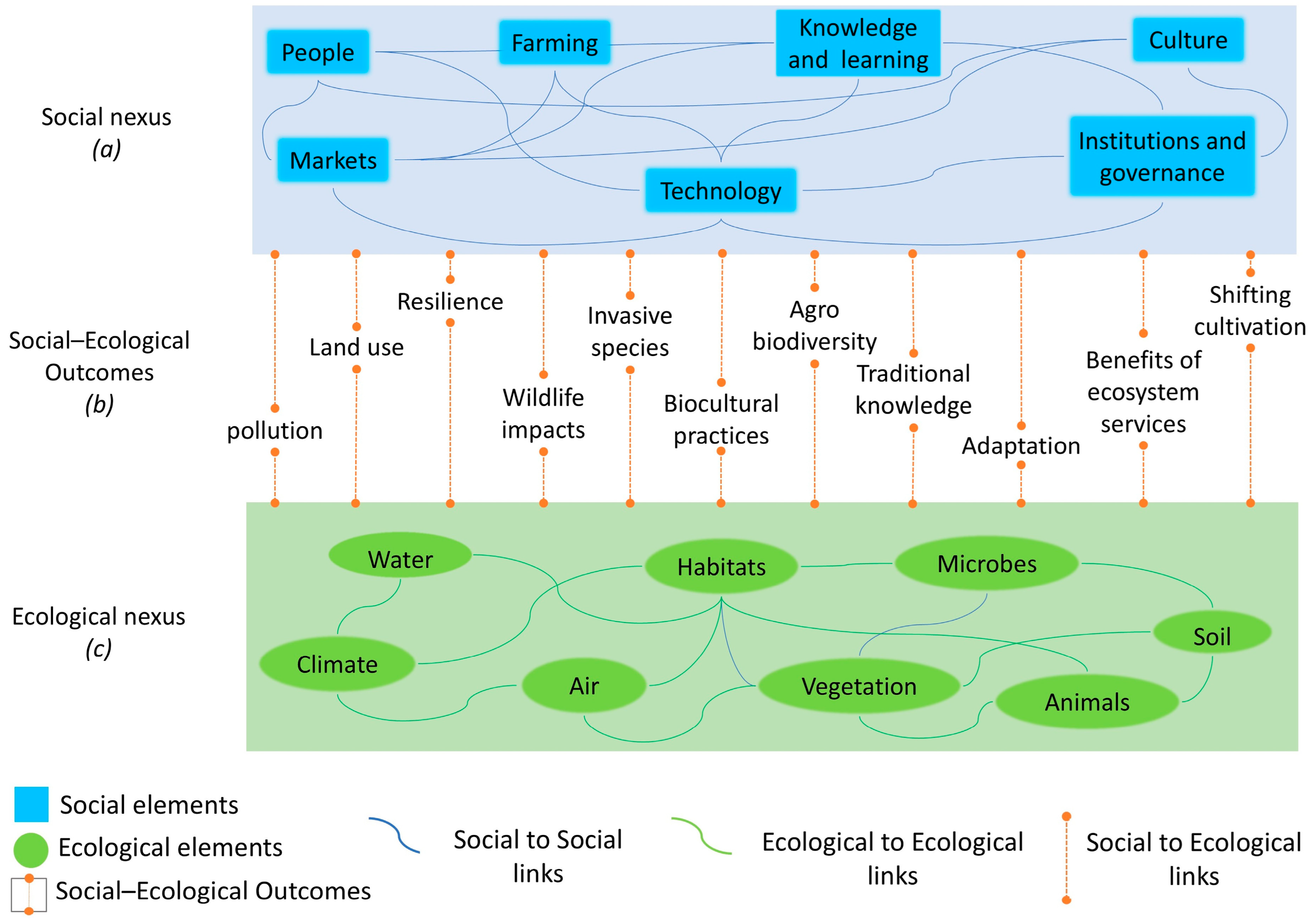
Contemporary SEN research increasingly conceptualizes human and environmental systems as complex adaptive systems [22]. Furthermore, the SES framework proposed by Ostrom [23] offers a useful theoretical foundation for identifying system elements and relationships between social and ecological components, analyzing these interactions and external influences within critical biophysical limits. The framework also supports SEN mapping and enhances the interpretation of systems dynamics and interactions [1]. From this perspective, a VTCS can be understood as an integrated people-in-nature system, underscoring that human communities exist as a part of the natural environment rather than separate from it. Both external factors and internal mechanisms can also influence human–nature relationships (Figure 1).
Over the past decade, SEN research has grown significantly, yet several gaps and underrepresentations remain. A major blind spot is the strong geographic bias toward Europe, North America, and China, which leaves vulnerable regions, such as South Asia, critically underrepresented in SEN literature [25]. Specifically, SEN analyses within the context of Sri Lankan social–ecological systems are severely lacking [19,26]. Furthermore, facilitating genuine stakeholder participation in SEN research remains methodologically challenging. To address these challenges, future investigations should prioritize multi-source, unbiased data collection methods and technologies to better explore the complex interactions between social and ecological components [27,28].
This study aims to advance understanding of the social–ecological nexus within a VTCS in Sri Lanka using a participatory systems approach. The specific objectives are to (i) identify and characterize the key social and ecological components of the system and map the interactions among them in order to determine the most influential elements shaping system sustainability and productivity; and (ii) identify clusters of strongly interconnected social and ecological components that contribute to maintaining overall system performance of the VTCS. By bridging participatory data collection with quantitative network analysis, this research fills critical knowledge gaps and provides fresh, actionable insights into the functioning of coupled social–ecological systems in traditional cascade landscapes.
Understanding SES elements and their relationships within a SEN enables policy makers to design tailored adaptive co-governance strategies that are more effective than uniform, top-down approaches [29]. Achieving long-term sustainability outcomes of an SES requires aligning the attributes of resource systems, resource units, and actors to generate goods and services, and to obtain desired economic outputs (productivity) while maintaining system structure and function in the face of disturbances (resilience) [30,31]. The SEN approach therefore provides a vital tool for managing social–ecological productivity in a sustainable manner.

2. Materials and Methods

2.1. The Study Landscape

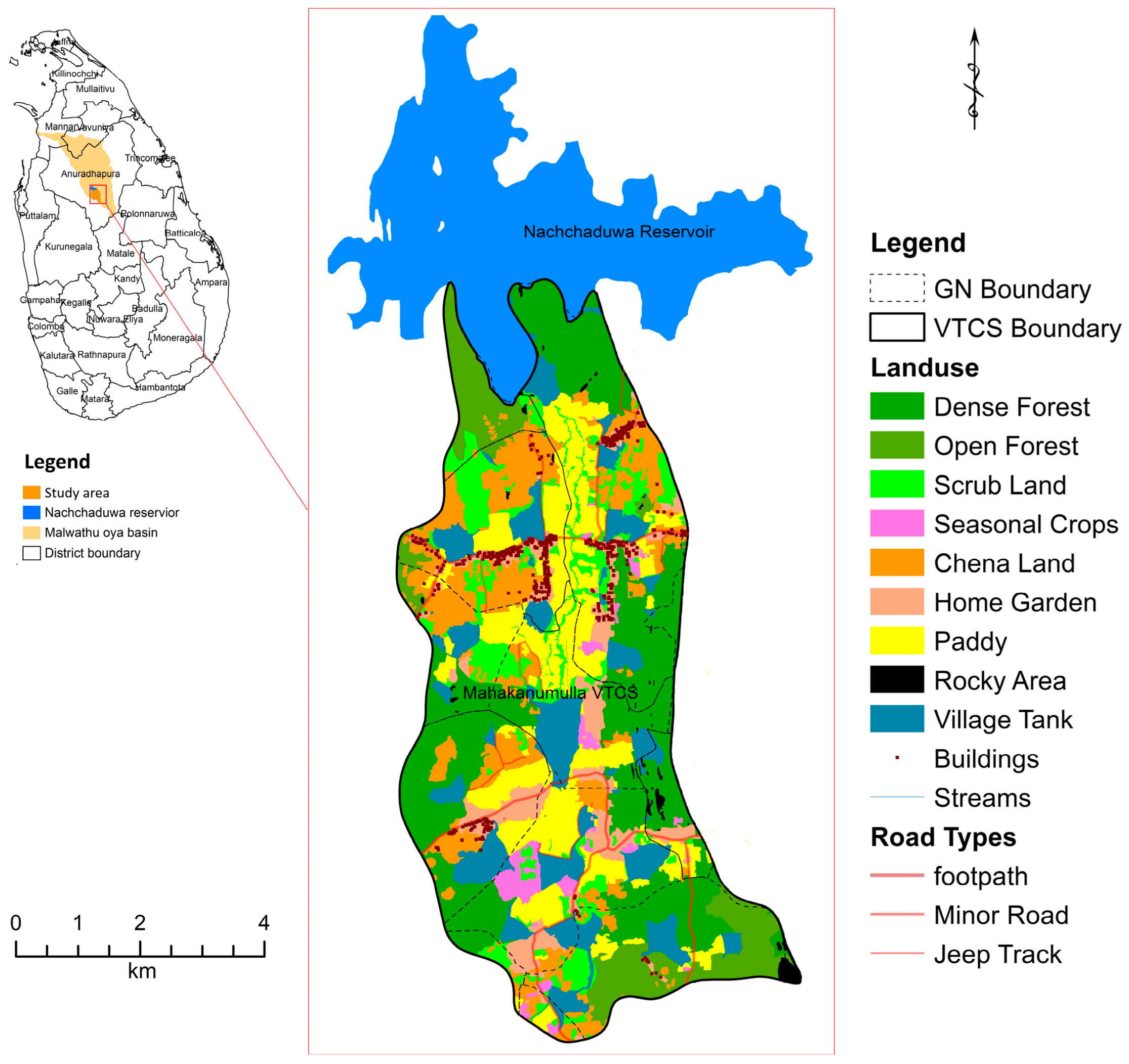
The Mahakanumulla village tank system (MVTCS) is situated in the Anuradhapura District of Sri Lanka, within the Malwathuoya river basin in the country’s North Central province in Sri Lanka. The MVTCS landscape was selected for this study because of its unique GIAHS characteristics, including rich biocultural diversity integrated with traditional knowledge and multifunctional land use systems. The MVTCS adequately represents the socio-economic and social–ecological relationships among diverse resources systems that sustain livelihoods and well-being [19]. The system comprises 28 village tanks, covering 4450 ha. The study area supports a population of 3432 (47.8% male and 52.2% female) distributed across 1193 households, and ten farmer organizations operate within the landscape. Using a 1:10,000 digital land use map produced by the Land Use Policy Planning Department (LUPPD) of Sri Lanka, six major land use system categories and fifteen associated major and micro land use types were identified [32] (Figure 2).
Species-based ecosystem services are highly prominent in the MVTCS landscape. Across its various land use types, the system supports 276 plant species (including shrubs, small plants, and trees) and 191 faunal species, comprising mammals, reptiles, birds, amphibians, land snails, butterflies, and dragonflies [32]. Baseline survey findings reveal that the MVTCS harbors exceptionally high levels of agrobiodiversity, encompassing 150 actively cultivated crop species. A significant proportion of this diversity is represented by traditional crop landraces, with local farming communities sustaining 110 distinct landraces and varieties [34].
Three traditional farming systems, namely, lowland paddy cultivation, rainfed upland crops, and homestead farming form the core agricultural practices within the MVTCS. The area contains three major soil groups: reddish-brown earths—rhodustalfs (60%), low humic gley—tropaqualfs (30%), and alluvials (10%). These soils create distinct drainage conditions that enable farmers to adopt and maintain the three traditional farming systems. Lowland paddy cultivation, which occupies roughly 20% of the total land area, remains the dominant agricultural activity in the landscape [35,36]. Farming in the MVTCS has been historically dependent on close interactions with local biodiversity, traditional ecological knowledge, and long-standing cultural practices that support food production and community well-being [35]. A food security survey revealed that 13 food groups are available in the MVTCS. However, on average, only 6–7 out of 13 food groups and around 9 individual food items are consumed daily by the community [33].
Agricultural lands within the MVTCS are highly fragmented with many individual farms occupying less than 2 ha [37]. Over the past three decades, changes in land use, land cover, and landscape configuration across VTCSs have altered key ecological functions and reduced the capacity of these systems to supply ecosystem services, thereby increasing challenges for sustainable food production [26,36]. Long-term assessments reveal substantial shifts in the MVTCS landscape between 1910 and 2019 [38]. These include a 27-fold increase in population and a seven-fold expansion in home gardens, alongside marked declines in forest (79%) and scrubland (49%) cover. Collectively, these trends indicate rising vulnerability within the MVTCS, largely driven by intensified human activities and landscape pressures [36,39].
The study area experiences a tropical monsoonal climate with a well-defined bi-modal rainfall pattern. The annual average rainfall is 1320 mm (with intra-annual variation ranging from 798 to 2483 mm), enabling farmers to cultivate during two major seasons driven by monsoonal and inter-monsoonal cycles. Historical data from the local meteorological station located in Anuradhapura indicate that average monthly rainfall varied from 24.1 mm to 261.5 mm between 1870 and 1970 (non-global warming period), and from 13.7 mm to 258.4 mm between 1971 and 2020 (global warming period) [40,41]. Furthermore, the 50-year average daily temperature (1971–2020) is 28 °C (ranging from 27 °C to 29 °C) [42]. Evaporation ranges from 3.5 to 7.5 mm/day (peaking between May and September), while annual evapotranspiration ranges from 1000 to 1400 mm [43]. Consequently, local farming practices, agricultural production, and community livelihoods are fundamentally shaped by these climatic conditions.
Collectively, the social, ecological, hydrological, and geomorphological characteristics of the MVTCS play a vital role in buffering climate stresses and sustaining food production. However, long-term land use and increasing intra-annual climate variability have significantly reduced the system’s capacity to provide ecosystem services [19,35]. Unpredictable rainfall patterns and the growing frequency of extreme events, such as droughts, floods and heatwaves, have severely disrupted agricultural production and local livelihoods [44]. Furthermore, recent research indicates that ongoing climate variability over the past three decades, combined with projected climate change impacts on paddy production in traditional cascade regions, will further intensify future challenges for maintaining farming productivity and food security [42].

2.2. Nexus Mapping Process

SEN mapping was conducted through a workshop that adopted a three-step process: (i) ‘identify’, (ii) ‘connect’, and (iii) ‘reflect’ [17,45]. Twenty local experts selected as key informants from within the study landscape were involved in the mapping process. In addition, five external experts were invited from academia and research organizations to participate and facilitate the three-step mapping process. The workshop used the Fuzzy Cognitive Mapping (FCM) technique to capture the associations between landscape elements identified by local experts regarding landscape social and ecological context [46]. FCMs consist of ‘nodes’ representing a well-defined set of variables describing system characteristics (e.g., elements, actions, processes, functions, values, or events) and ‘edges’, which specify the connections between factors (i.e., links among nodes). While the associations identified in this study indicate a correlation between nodes, they do not establish causality. These findings therefore reflect patterns of association rather than a cause-and-effect relationship [47].
The study defines local expertise as deep, site-specific knowledge of the landscape, encompassing ecosystem services, biodiversity, agroecology, traditional knowledge, food systems, land use, climate, livelihoods, and community practices. Academic and research experts involved in the mapping brought expertise in from a wide range of social–ecological disciplines and practices, such as social anthropology, livelihood studies, agrobiodiversity, conservation, wildlife, ecology, land resources managements, forestry, food security, ecotourism, ecology, policy, and governance. They selected key academic and research partners for this exercise, including Wayamba University of Sri Lanka and the Natural Resources Management Center of the Department of Agriculture, both of which have extensive experience in landscape-level studies of VTCS sustainability and productivity. Combining these types of transdisciplinary expertise is essential to capture the holistic nature of the ‘identify’, ‘connect’, and ‘reflect’ processes in SEN mapping. This systems-thinking approach has long been used to understand complex system dynamics, such as food–biodiversity–water–energy nexuses, and to simulate them over time and space [48].
During the first step, participants identified SES elements (nodes) that influence landscape sustainability and productivity. In the second step, they mapped relationships (edges) among these elements. In the final step, participants justified the selected SES elements and their relationships in relation to SES attributes. Before starting the mapping process, the physical boundaries of the study landscape were defined. The elements and their dynamics were explained at the landscape level using the SES framework proposed by Ostrom (2009) [23] that comprises of three key domains (social, ecological, and social–ecological outcome) and the linkages among them. Through the use of this structure, participants were able to identify SES elements embedded within each domain and mapped their relationships for SEN analysis (Figure 3).

2.2.1. Identification of Nodes

Participants commenced the mapping process by identifying the nodes to be included in the nexus map. Each node was written on a ‘sticky’ note and placed on a wall. Participants validated the identified nodes by explaining their importance for maintaining livelihoods and landscape sustainability.

2.2.2. Connecting Nodes

Participants established connections between nodes based on a broad definition of association, specifically representing perceived cognitive relationships among them. To ensure conceptual rigor and avoid trivial connections, participants were required to justify each association. Consequently, the participants frequently discussed and challenged the rationale behind the connections, deciding on their appropriateness through group consensus. These connections were non-directional, excluding any assumption causality. Insights from these deliberations were systematically documented.

2.2.3. Reflection of the Nodes and Connections

The final step involved interpretation of the landscape context, ensuring the integration of a diverse set of identified nodes and contextualizing network interactions. Accurate reflection depended on appropriate assumptions regarding interacting elements, the nature of their interactions, and the spatiotemporal scale at which these interactions occur [7]. Some reflection processes emerged during the previous step as experts established connections between nodes. The reflection process enabled the participants and researchers to contextualize the network by developing a coherent narrative that captured the intricacy of the SEN, challenges, and opportunities for maintaining sustainability, productivity, and resilience. These discussions were also recorded in note form.

2.3. Modeling SES Nexus Properties

Identified edges were manually drawn and converted into a numerical data file by assigning unique identifiers to each edge (connection) and node (element). These data were stored in a Comma-Separated Value (CSV) file. The nodes and edges were modeled and visualized using the ‘igraph’ social network analysis (SNA) package in R statistical software version 4.1.2 [17,49,50,51,52,53,54,55].

2.3.1. Centrality Measures

Centrality measures are used in SNA to evaluate the relative importance or influence of nodes in a network structure, using different algorithms based on graph theory to assess their position and connections [56]. Three SNA metrics were used to visualize and analyze the structure of the network, revealing patterns of connections and relationships that included (i) degree centrality (DC), (ii) betweenness centrality (BWC), and (iii) eigenvector centrality (EVC). Understanding these network structures and relationships helps identify the most influential elements that contribute to system sustainability and productivity [57].
DC is the simplest of the three centrality measures and is used to compute and represent a node’s degree. It is a count of the number of social–ecological connections associated with a node. DC is used to identify dominant nodes in a network. It indicates the relative importance and connectivity of a node within a network. In graph theory, the normalized number of connections associated with a node v i in an undirected network, known as its degree centrality, is defined as follows [45]:
D C v i = d v i N 1
where N is the number of nodes and d v i is the number of edges of the node v i [58].
BWC in SNA is a measure of a node’s importance within the system. It measures the frequency with which a node lies on the shortest paths connecting other nodes in the network. In other words, BWC estimates the extent to which the removal of a node would disrupt social–ecological connections among other nodes in the network. As such, BWC is an important indicator of network connectivity, and the removal of nodes with high BWC can significantly affect network stability. Therefore, BWC can be considered a proxy indicator of SES resilience. Nodes with high BWC scores act as bridges, controlling the flow of energy and information between different elements of the network. Consequently, these nodes exert greater influence, as many shortest paths pass through them. The BWC of a node v is defined as follows [58,59]:
B W C v = j < k p j k v p j k
  • p j k = Total number of shortest paths between nodes j and k
  • p j k v = Total number of shortest paths between nodes j and k that pass through node v
Eigenvector centrality (EVC) provides a quantitative assessment of a node’s influence within a network. It evaluates a node’s importance based on the centrality of its neighboring nodes; thus, each node’s centrality score depends on the scores of the nodes to which it is connected. Unlike simpler centrality measures, EVC considers not only the number of connections a node has but also the significance of those connections. As a result, a node may achieve a high EVC score even with relatively few connections, provided those connections are to highly influential nodes [60,61]. EVC x for a node v as follows:
E V C x v = 1 λ t G a v , t x t
where G represents the set of nodes in the network, a v , t denotes the value in the adjacency matrix corresponding to nodes v and t, x t represents the eigenvector centrality of node t, and λ denotes the eigenvalue of the adjacency matrix.

2.3.2. Prioritizing the Most Influential Nodes

Centrality measures provide a quantitative means of assessing the relative importance of social–ecological elements and the relationships that link them, with each metric capturing different dimensions of influence within the network [62]. In this study, BWC was used to estimate how the removal of a node would disrupt the social–ecological connections between other nodes in the SEN. BWC is often preferred over DC and EVC for analyzing SENs because it proxies for resilience and sustainability [63]. It highlights critical bridges and bottlenecks that facilitate the flow of social–ecological processes between distinct social and ecological components [64]. Thus, BWC often identifies the most vulnerable nodes that contribute to system resilience. These nodes are capable of maintaining social–ecological functions despite disturbances, and also potential leverage points for sustainability interventions [65]. Therefore, BWC scores are critical for evaluating system stability and functionality, as they identify nodes that facilitate the flow of resources and energy across communities [45].
In addition to BWC, the study identifies maximal cliques, which represent densely connected and cohesive subgroups within the network. A maximal clique is a set of nodes in which every node is directly connected to all the others. These cliques can function relatively independently and facilitate efficient internal information transfer, thereby enhancing the network’s capacity to withstand disturbances and adapt to change—key aspects of resilience and sustainability. Furthermore, maximal cliques introduce redundancy into the network, contributing to overall system resilience [66]. Identifying all meaningful subgroups in the network is more informative than focusing solely on the single largest (maximum) clique, making maximal cliques particularly useful for decision-making. To identify and plot maximal cliques, the study used the ‘igraph’ package in R (version 4.1.2) [17,49,50,51,52,53,54,55].

2.3.3. Clustering of Nodes

Network graphs typically exhibit strong clustering characteristics that represent numerous interconnected sub-groups that are more densely linked internally to the rest of the network. Such clusters are often referred to as communities. In essence, nodes within a community are more strongly linked to one another than to nodes outside the community. Clustering thus provides a useful means of simplifying and visualizing complex interactions by grouping similar entities [67].
Prior to detecting clusters or groups, the graph substructure must be simplified. This involves removing edge loops—edges that connect a node to itself—and multiple edges between the same pair of nodes. Since the analysis focuses only on whether two nodes are connected, redundant nodes do not affect the results and can be removed without loss of meaningful information [68]. The study employed the ‘Fast Greedy’ algorithm for community detection using the Fast_Greedy function in the igraph package in R (version 4.1.2) [17]. Analyzing SEN using the Fast Greedy algorithm is often preferred over methods like the ‘Louvain’ and ‘Walktrap’ algorithms. The Fast Greedy algorithm maps clear, scale-dependent boundaries and generates perfectly nested dendrograms. This hierarchical approach is computationally efficient and uniquely suited for identifying nested ecological interdependencies. Consequently, it enables researchers to visualize not only the final community structure but also the stepwise clustering of individual social and ecological elements into larger functional groups—a process critical for assessing SES resilience. The resulting communities were visualized using both network graphs and dendrograms. In addition, the analysis reports the modularity score, which indicates how effectively the network is divided into distinct communities by comparing the density of intra-community and inter-community connections [58,69,70].

3. Results

3.1. Nexus Properties

During the nexus mapping workshop, the participants identified a total of 49 nodes and 434 edges representing the social–ecological nexus of the study landscape. Of these, seventeen nodes were identified as social properties; fourteen nodes related to ecological properties, and eighteen nodes were identified as social–ecological properties. The centrality measures for each node in the SEN—DC, BWC, and EVC were calculated to quantitatively assess their influence in the SEN of the study landscape. The mean number of connections per node was 17.71 (SD = 7.98, variance = 63.70); that of social–ecological nodes was 20 (SD = 7.55, variance = 57); and that of ecological nodes was 17.58 (SD = 7.90, variance = 62.51). The mean for social nodes was 13.25 (SD = 8.10, variance = 65.64). The social–ecological nodes had an average of 2.42 and 6.75 more edges than ecological nodes and social nodes, respectively.
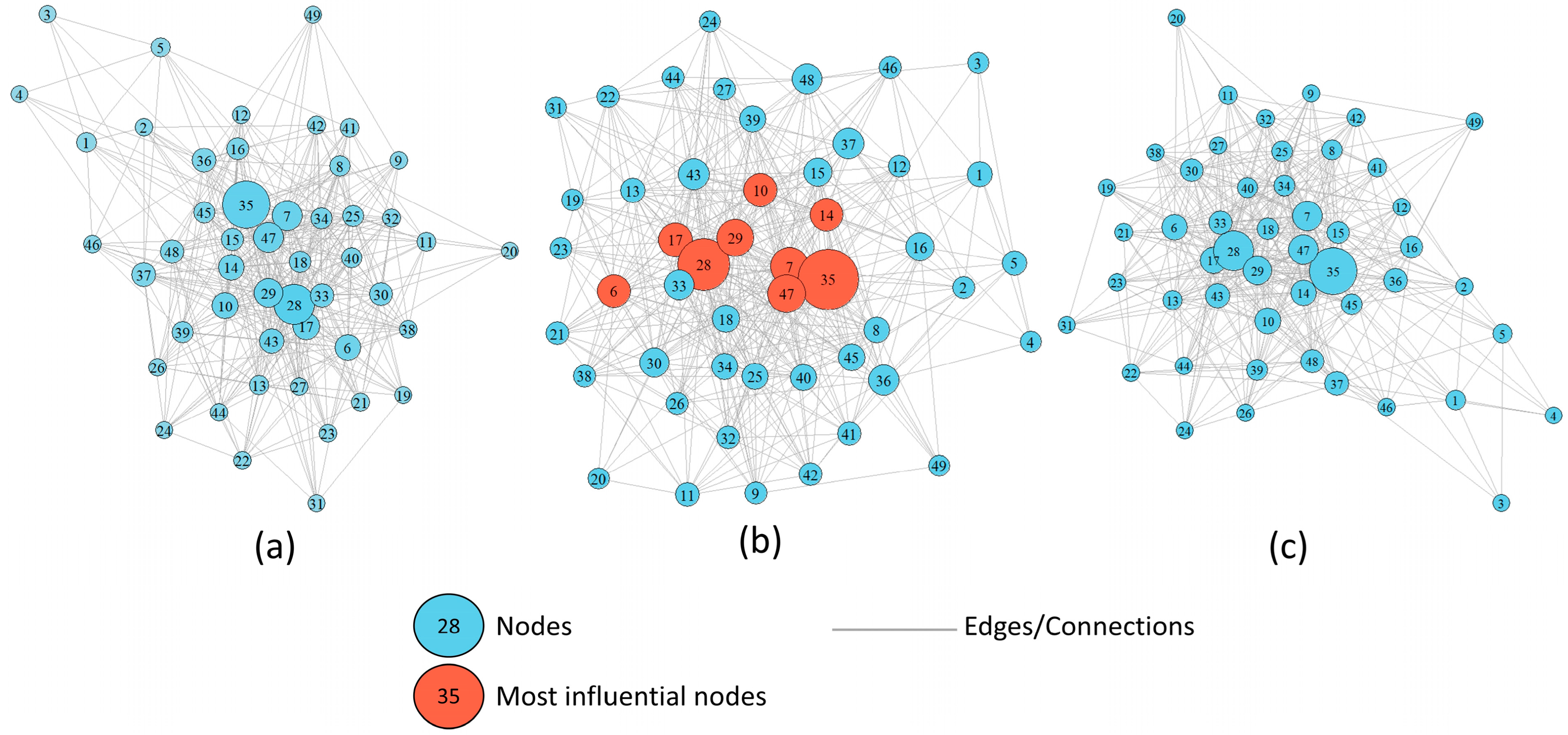
In terms of BWC, social and social–ecological nodes were ranked consistently higher than ecological nodes. The mean betweenness was determined to be 15.53 (SD = 18.37, variance = 337.77); for social nodes it was 19.6 (SD = 25.16, variance = 633.14); for social–ecological nodes the mean was 19.0 (SD = 22.14, variance = 490.2); and for ecological nodes the mean was 11.71 (SD = 11.88, variance = 141.24). Nodes were ranked from highest to lowest importance based on the BWC scores (Table 1). The SEN plots generated based on the centrality measures DC, BWC, and EVC are presented in Figure 4.

3.2. Most Influential Nodes

BWC scores were used to identify and prioritize the most influential nodes in this SEN. Nodes were ranked from highest to lowest based on their BWC values. The cumulative sum of BWC scores was calculated, and a subset comprising the highest-ranked nodes—accounting for just over 50% of the total cumulative BWC—was selected. By setting a cumulative BWC threshold of 50–55%, we ensured that the analysis remained strictly focused on the core nodes and edges that drive the VTCS nexus, preventing peripheral data from skewing the results. Extending the threshold beyond 55% primarily introduces lower-scoring nodes that have a little effect on network modularity or information flow. Conversely, reducing the threshold below 50% risks excluding vital secondary intermediaries that maintain the stability of the SEN. Experts conclude that the 50–55% cutoff strikes the optimal balance between comprehensive SEN coverage and analytical precision [5]. The nine top-ranked nodes contributed 53% of the cumulative score. These nodes include (i) food crops (#35), (ii) flora and fauna (#28), (iii) paddy farming (#7), (iv) land use (#47), (v) climate (#29), (vi) traditional knowledge (#17), (vii) village tanks (#10), (viii) knowledge and attitudes (#14), and (ix) village forest (#6). Therefore, these were identified as the most influential nodes in the SEN graph.
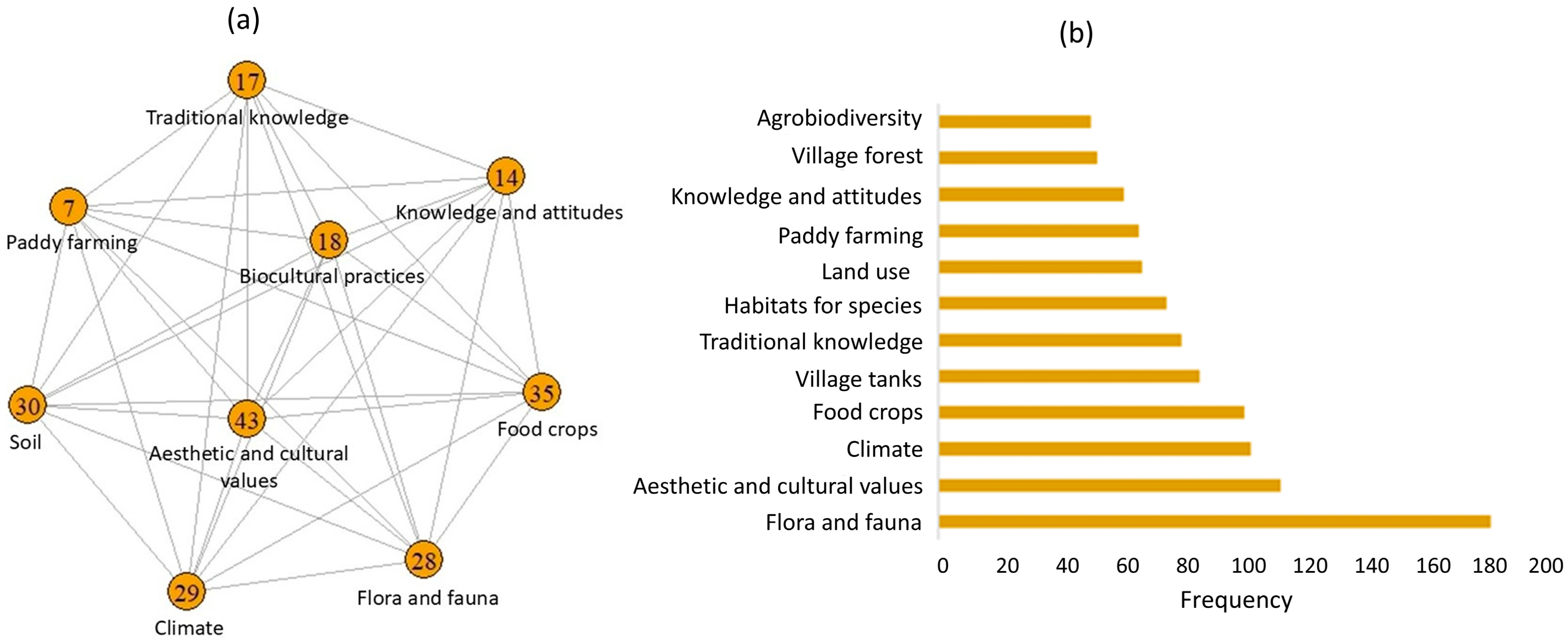
The analysis identified 299 maximal cliques, ranging in size from two to nine nodes. Across all cliques, the ‘flora and fauna’ node appeared most frequently (184 times), whereas ‘carbon sequestration’ appeared the least (3 times) out of 49 nodes. Figure 5a illustrates one of the largest maximal cliques, which consists of nine nodes. This group includes six ’most influential’ nodes excluding ‘land use’, ‘village tanks’, and ‘village forest’. Furthermore, the cumulative frequency of each node was ranked, revealing that a subset of 12 nodes accounted for approximately 60% of the total cumulative frequency. These 12 nodes are ‘#28-flora and fauna’, ‘#43-aesthetic and cultural values’, ‘#29-climate’, ‘#35-food crops’, ‘#6-village tanks’, ‘#17-traditional knowledge’, ‘#33-habitats for species’, ‘#47-land use’, ‘#7-paddy farming’, ‘#14-knowledge and attitudes’, ‘#10-village forest’, and ‘#34-agrobiodiversity’ (Figure 5b). Notably, nine of the “most influential” nodes, identified by BWC scores, were also present in this top-tier subset.

3.3. Network Clusters

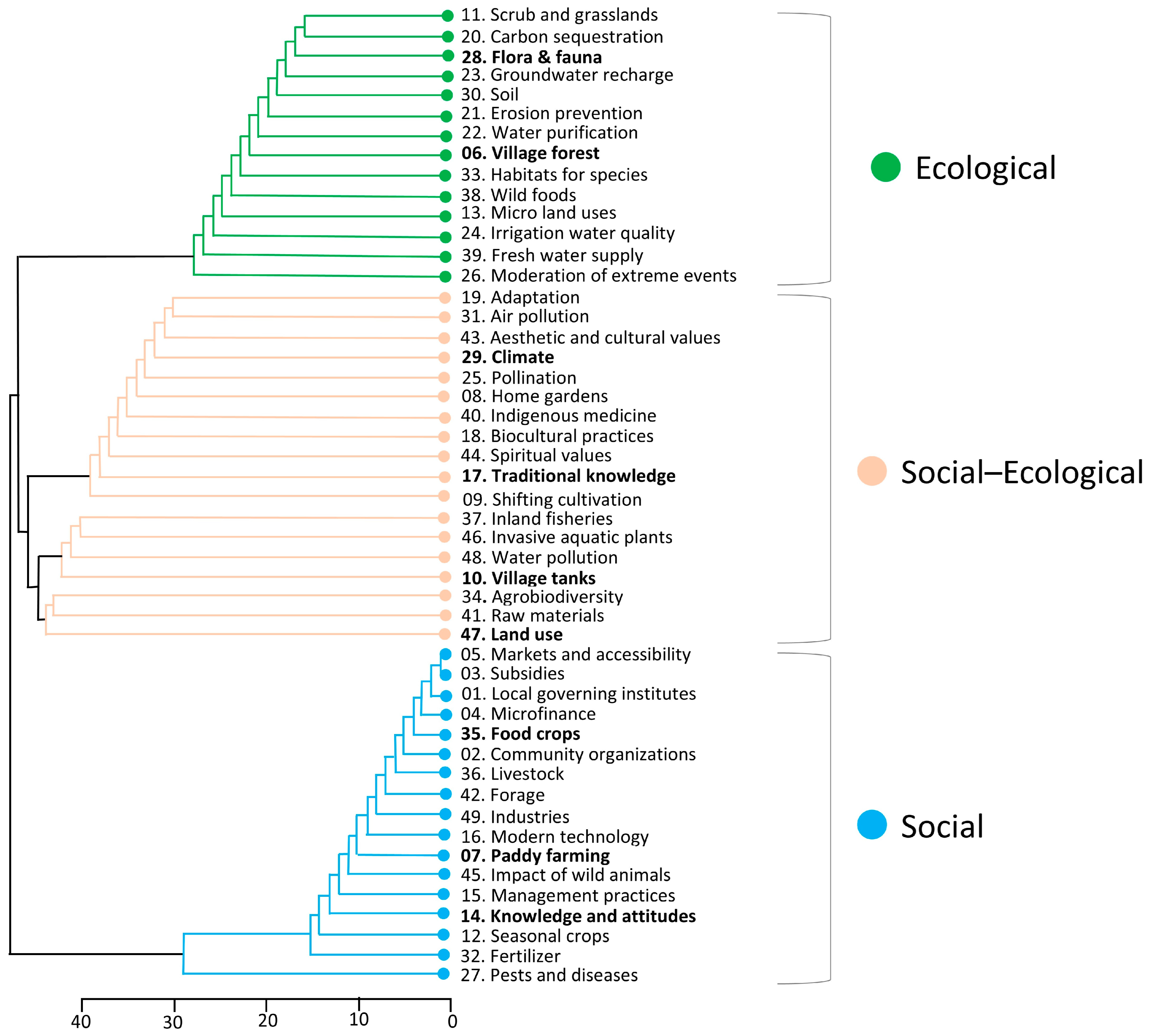
Community detection analysis grouped the nodes into three distinct clusters based on the Fast Greedy algorithm (modularity score = 0.135) within the SEN of 49 nodes and 434 edges. The resulting communities were visualized both as a network and a dendrogram, with clusters represented by different-colored branches. This combined visualization illustrates how social and ecological elements of the MVTCS are organized into clusters based on their similarities, interactions, and, in some cases, dissimilarities. Experts interpreted and labeled these clusters based on their influence on overall system performance. Accordingly, the clusters were categorized as (i) ecological, (ii) social–ecological, and (iii) social (Figure 6).
Each cluster contained a mixture of a previously identified ecological, social, and social–ecological nodes. In the dendrogram, the distance at which branches merge indicates the degree of similarity or dissimilarity between clusters: shorter vertical linkages represent higher similarity; longer linkages indicate greater differences between clusters. The key characteristics of each cluster, based on their properties and interconnections, are synthesized below.

3.3.1. Ecological Cluster

This cluster comprises interconnected biotic and abiotic elements that underpin ecological resilience, including soil, water, climate, air, flora, fauna, and habitat areas. Together, these components shape the environmental thresholds and adaptive capacity of the system [71]. Thus, the role of this cluster is to maintain ecological resilience and provide the foundation for system sustainability [72]. The nodes within this cluster represent functional ecological units, such as micro land uses that support water filtration, forests that conserve biodiversity, and vegetation that regulates clean air and buffers extreme weather events [73,74]. These units are interconnected through natural corridors, including stream networks, cascades of village tanks, grasslands, rivers, and wildlife corridors, which facilitate the flow of energy, materials, and species. As a result, this cluster strengthens the system’s capacity to absorb, adapt to, and reorganize following disturbances (e.g., floods, or extreme climate events) while maintaining structural and functional integrity [72,75].
Ecological resilience within SESs forms the basis for food security, disaster risk reduction, and sustained ecosystem service provision [75,76]. Accordingly, this cluster plays a critical role in supporting year-round food production, including paddy and seasonal crops. Participants emphasized the importance of maintaining ecological infrastructure to ensure reliable water availability for agriculture and livelihoods. They also identified major internal and external stressors such as climate change, habitat loss and fragmentation, biodiversity decline, pollution, and invasive species that interact with other clusters and may act synergistically to weaken ecological resilience and adaptive capacity [77].

3.3.2. Social–Ecological Cluster

This cluster represents social–ecological outcomes (SEOs) that emerge from intertwined, combined results within both human (social) and natural (ecological) systems caused by their continuous interactions—often characterized by interdependencies and feedback loops across society and nature that shape sustainability and productivity outcomes [78]. It encompasses both positive and negative SEOs [79], ranging from enhanced community resilience to adverse conditions, such as social–ecological traps, where poverty, environmental degradation, and hidden economic externalities reinforce one another [80,81]. The nodes in this cluster reflect integrated processes that support social–ecological production functions and generate benefits for communities [11]. Examples include (a) shifting cultivation in forest areas that support food production during dry seasons, (b) beekeeping in home gardens, which enhances pollination and fruit production, (c) indigenous medical practices that rely on medicinal plant species, (d) biocultural practices linking biodiversity, traditional knowledge and cultural values, (e) cultivation of traditional varieties and landraces that enhance agrobiodiversity and food security, (f) aesthetic values that promote recreational opportunities, mental and physical well-being, and (g) spiritual values that foster cultural identity and spiritual well-being. Collectively, these SEOs contribute to quality of life and community resilience in the face of global change [79].
This cluster also captures the complex feedback loops between social and ecological subsystems [11,79]. Examples include reinforcing degradation through (a) pollution from land use change, (b) invasive species spread from upstream pollution, and (c) climate impacts reducing ecological resilience, as well as stabilizing responses through (d) nature-based solutions like tank wetlands, forests, and grasslands that enhance system resilience.

3.3.3. Social Cluster

The social cluster comprises nodes associated with social production outcomes that support livelihoods, food security, and human well-being. It encompasses three key dimensions of productivity: (i) physical accessibility—technology, institutions, and infrastructure), (ii) human—modern knowledge, community organizations, farming, and management practices, and (iii) financial—monetary resources such as subsidies, micro-finance, markets, and livelihood activities including agriculture and industry, as well as fertilizer inputs, pesticides inputs, and cost of wildlife impacts [78]. These three dimensions collectively enhance the adaptive capacity and resilience of the system, while bridging the gap between social and ecological clusters through adaptive co-management processes—an essential component of system sustainability [82,83]. Furthermore, the social cluster promotes shared values, traditions, and collaboration across clusters, which are vital for the governance and sustainable management of the system [84].

4. Discussion

4.1. SEN Approach

Since the introduction of Ostrom’s SES framework [23], substantial research has sought to understand SES dynamics and drivers of change (Figure 1 and Figure 3) [85,86]. In recent years, SEN research has advanced significantly, particularly in analyzing the intricate interactions and interdependencies among system components that shape ecosystem functions [5,87]. By mapping these relationships, SEN approaches enable a deeper understanding of the feedback mechanisms between social and ecological systems. These linkages can either sustain system functionality or lead to conditions where sustainability and productivity are compromised [29,88]. By applying the SEN approach, these interdependencies can be analyzed and modeled as nodes and edges (Figure 4 and Figure 5), allowing for the analysis of connectivity patterns that influence system performance across scales [5,89]. This study demonstrates that integrating Ostrom’s SES framework with the SEN approach provides a robust methodology for mapping complex interrelationships within social and ecological systems within a highly integrated micro land use zoning context. Consequently, this methodological approach can be adapted to other VTCSs in Sri Lanka, as well as to comparable, highly diverse social–ecological landscapes globally [14].

4.2. Most Influential Nodes

SEN metrics provide a systematic means to analyze SES interactions and interdependencies and identify the relative importance of SEN components against sustainability and productivity [55,90]. In this study, centrality metrics identified the nine most influential nodes in the MVTCS nexus which are vital for maintaining system performance [45]. The most influential nodes with high BWC scores act as critical bridges and gatekeepers that control the flow of information, resources, and ecological processes. Thus, they are not merely popular or abundant; rather, they serve as vital communication channels linking human activities (e.g., knowledge, farming) to the physical landscape (e.g., village tanks, forests) and natural processes (e.g., climate, flora, and fauna). Altering these keystone elements would severely degrade or fragment the entire network [91].
Understanding the roles and positions of these elements within the SEN is crucial for identifying system resilience, vulnerabilities, and opportunities for strengthening connections through tailored co-management strategies [92]. Ecological elements help absorb disturbances, while social elements enhance adaptive capacity and help prevent undesirable system transformations [87,93]. However, interdependencies on social–ecological interaction can produce negative outcomes, such as environmental pollution and degradation, which reduce productivity and increase system vulnerability [79]. Thus, SEN mapping provides a useful framework for visualizing these critical relationships and enables the development of strategies that enhance sustainability and productivity.

4.3. Community Detection

Community detection in MVTCS reveals how actors, resources, and institutions are organized into clusters. Cluster analysis of the MVTCS revealed a relatively low modularity score (0.135), indicating a highly integrated, interconnected system in which socioeconomic and ecological components are strongly coupled [94,95]. Such systems may exhibit strong resilience or, conversely, a rigidity that limits adaptability and increases the risk of social–ecological traps [96]. In contrast, higher modularity typically reflects distinct, semi-independent clusters that can enhance adaptability and resilience (e.g., in certain urban systems [70,95,97]. The MVTCS clusters exhibit strong internal cohesion (many links within) but limited external connectivity (few connections to the outside). Strong internal ties imply that stakeholders, resources, and institutions within the system are closely linked, sharing information, managing resources collaboratively, and creating a unified identity, while lack of external connectivity among communities creates a monolithic structure incapable of reconfiguration, rendering them vulnerable to catastrophic shifts that internal cooperation cannot overcome [98,99]. To effectively identify clusters where human and natural systems are tightly coupled, SEN mapping is essential. It transforms intricate, multi-layered social–ecological data into manageable, comparable units, highlighting critical areas of vulnerability or resilience for targeted sustainability interventions [5,29,100,101].

4.4. Policy and Management Interventions

Despite the deeply intertwined nature of key elements (e.g., biodiversity, soil, water, air, food security, health, energy and climate) that ensure SES productivity, governance and management decisions are frequently made in isolation. Such fragmented approaches result in institutional misalignment, unquantified trade-offs, and unintended consequences. To address this, the SEN assessment in this study provides insights for strategic interventions that foster coherent, integrated decision-making. By overcoming systemic trade-offs and capitalizing on cross-social–ecological synergies, the SEN framework supports transformative pathways toward long-term social–ecological sustainability in VTCSs [102].
Since key nodes bridge different parts of the SEN, they serve as the most efficient leverage points for targeted policy and management interventions. Any policy aimed at sustainability and productivity—such as investing in the maintenance of small irrigation reservoirs (village tanks), protecting catchment forests, climate adaptation, or water conservation—will have a ripple effect, enhancing the entire interconnected system to achieve maximum impact. Another vital aspect of these interventions is knowledge transfer. Because variables like traditional knowledge and farmer attitudes connect the ecosystem to agriculture, education and capacity-building programs are the most effective strategies to address broader challenges, such as the impacts of climate and land use change [50,103,104].

4.5. Balancing Sustainability and Productivity for Optimizing SES Performance

Optimizing the performance of SESs requires maintaining a careful balance between socioeconomic productivity and ecosystem sustainability [23]. The long-term success of an SES is fundamentally measured by its ability to deliver goods and services without degrading the underlying natural capital [105]. While human well-being relies heavily on the continuous flow of ecosystem services, ecological integrity depends upon the sustainable management of these extractions. Prioritizing productivity in isolation often precipitates the ’tragedy of the commons’, wherein overexploitation drives environmental degradation [106]. Pushing an ecosystem to its maximum limits for short-term economic gain frequently jeopardizes long-term ecological health and risks systemic collapse. Conversely, prioritizing strict ecological conservation at the expense of productivity can induce severe economic hardship and food insecurity for dependent populations [107].
SES performance is shaped by a combination of micro-scale practices such as local farming methods and macro-scale drivers including technological innovation, market incentives, and policy framework. The complexity necessitates multi-scale governance approaches that carefully evaluate trade-offs between economic output and natural capital conservation [108]. Ultimately, SES success lies at the at the intersection of sustainability and productivity, with resilience serving as its foundational attribute. This enables systems to absorb shocks, adapt, and transform, and long-term viability in SESs is cultivated through strong networks of people, landscapes, and ecosystems that facilitate the exchange of resources, knowledge, and trust [109]. Building resilience in rapidly changing SESs requires sustained investments in these complex social–ecological relationships and the maintaining of system diversity, including diverse knowledge systems, cultures, and practices [110].

4.6. Limitations

While SEN analysis utilizing participatory FCM combined with centrality measures and cluster detection provides valuable insights into the management of SESs, it carries inherent methodological limitations. Primarily, understanding the complex nature of human–nature interactions is susceptible to observational errors, potential biases (e.g., the dominance of specific voices), and incomplete data [111,112]. When data are collected through participatory methods such as FCM, subjective choices and potential inaccuracies often lead to uncertain datasets, which can ultimately affect the validity and utility of SEN model outcomes [113]. Furthermore, centrality metrics are highly sensitive to misjudged or missing nodes and edges. Therefore, accurately capturing the relational dynamics of the system (’who connects to what’) necessitates both highly experienced local informants who understand the dynamic, temporal, and qualitative aspects of social–ecological interactions and a transdisciplinary expert team to rigorously validate the data [114].
Although the participatory mapping process in this study does not inherently establish causality between nodes/edges, incorporating directed and weighted edges yields more precise representations of ecological and social processes, which intrinsically vary in strength and flow. Furthermore, while the study calculated DC and EVC, the interpretation of these metrics was excluded when selecting the most influential nodes. Given the exceptional complexity of SESs, combining the BWC (shortest path) metric with DC (total connections) and EVC (systemic influence) significantly enhances the model’s predictive capacity [62,115].

5. Conclusions

Adopting a social–ecological systems perspective, this study identified key properties for optimizing sustainability and productivity within the VTCS landscape. Utilizing an SEN approach, we highlighted nine influential elements grouped into three crucial clusters: ecological, social, and social–ecological. The findings indicate that maximizing outcomes requires simultaneous, integrated action across these three domains: maintaining ecosystem resilience (ecological), fostering community adaptation (social), and supporting relational and intrinsic values (social–ecological). Ultimately, this research emphasizes the need to synchronize social and ecological processes, offering a framework to bridge these aspects in both theory and practice and moving beyond traditional, simple framing approaches. By highlighting the complexities of this specific SEN, this approach provides valuable insights that can be adapted to other SESs globally.

Author Contributions

Conceptualization, S.S.R.; Methodology, S.S.R.; Software, S.S.R.; Data validation, S.S.R., C.S.K.; Analysis, S.S.R.; Visualization, S.S.R.; Investigation, S.S.R.; Data curation, S.S.R.; Writing—original draft preparation, S.S.R.; Writing—review and editing, S.S.R., M.R., D.H., T.B., B.K., C.H., C.S.K.; Principal supervision, M.R.; External supervision, D.H. All authors have read and agreed to the published version of the manuscript.

Funding

This research was funded by an Australian Government Research Training Program (RTP), the Destination Australia Program (DAP), and Deputy Vice-Chancellor (DVC) Research Scholarships through the University of New England (UNE), Australia to the first author.

Institutional Review Board Statement

The participatory assessment undertaken in this study was conducted in accordance with the guideline approval provided by the Human Research Ethics Committee of the University of New England, Australia (approval no: HE22-030, dated 3 May 2022).

Informed Consent Statement

Informed consent for participation was obtained from all subjects involved in the study.

Data Availability Statement

Data are contained within the article.

Acknowledgments

The first author thankfully acknowledges the Alliance of Bioversity International and the International Center for Tropical Agriculture (CIAT), Italy, for providing support for publishing this article. In addition, special thanks goes to the Natural Resources Management Center of the Department of Agriculture, Sri Lanka and Wayamba University of Sri Lanka for facilitation of the expert discussions.

Conflicts of Interest

The authors declare no conflicts of interest.

References

  1. Ghodsvali, M.; Dane, G.; De Vries, B. The nexus social-ecological system framework (NexSESF): A conceptual and empirical examination of transdisciplinary food-water-energy nexus. Environ. Sci. Policy 2022, 130, 16–24. [Google Scholar] [CrossRef]
  2. Jiao, Y.; Liang, L.; Okuro, T.; Takeuchi, K. Ecosystem services and biodiversity of traditional agricultural landscapes: A case study of the hani terraces in Southwest China. In Biocultural Landscapes; Springer: Berlin/Heidelberg, Germany, 2014; pp. 81–88. [Google Scholar]
  3. Gu, H.; Sbramanian, S. Socio-Ecological Production Landscapes: Relevance to the Green Economy Agenda UNU-IAS Policy Report; United Nations University Institute of Advanced Studies (UNU-IAS): Yokohama, Japan, 2012; p. 66. [Google Scholar]
  4. Estoque, R.C. Some key considerations for implementing the nexus approach in biodiversity conservation research and practice. Sci. Prog. 2024, 107, 00368504231223023. [Google Scholar] [CrossRef]
  5. Sayles, J.S.; Mancilla Garcia, M.; Hamilton, M.; Alexander, S.M.; Baggio, J.A.; Fischer, A.P.; Ingold, K.; Meredith, G.R.; Pittman, J. Social-ecological network analysis for sustainability sciences: A systematic review and innovative research agenda for the future. Environ. Res. Lett. 2019, 14, 093003. [Google Scholar] [CrossRef] [PubMed]
  6. Linkov, I.; Trump, B.D. The Science and Practice of Resilience; Springer: Berlin/Heidelberg, Germany, 2019. [Google Scholar]
  7. Yletyinen, J.; Perry, G.; Stahlmann-Brown, P.; Pech, R.; Tylianakis, J. Multiple social network influences can generate unexpected environmental outcomes. Sci. Rep. 2021, 11, 9768. [Google Scholar] [CrossRef]
  8. Hamann, M.; Biggs, R.; Reyers, B. An exploration of human well-being bundles as identifiers of ecosystem service use patterns. PLoS ONE 2016, 11, e0163476. [Google Scholar] [CrossRef] [PubMed]
  9. Hamann, M.; Biggs, R.; Reyers, B. Mapping social–ecological systems: Identifying ‘green-loop’and ‘red-loop’dynamics based on characteristic bundles of ecosystem service use. Glob. Environ. Change 2015, 34, 218–226. [Google Scholar] [CrossRef]
  10. Huntsinger, L.; Oviedo, J.L. Ecosystem services are social–ecological services in a traditional pastoral system: The case of California’s Mediterranean rangelands. Ecol. Soc. 2014, 19, 8. [Google Scholar] [CrossRef]
  11. Reyers, B.; Biggs, R.; Cumming, G.S.; Elmqvist, T.; Hejnowicz, A.P.; Polasky, S. Getting the measure of ecosystem services: A social—Ecological approach. Front. Ecol. Environ. 2013, 11, 268–273. [Google Scholar] [CrossRef]
  12. Palomo, I.; Felipe-Lucia, M.R.; Bennett, E.M.; Martín-López, B.; Pascual, U. Disentangling the pathways and effects of ecosystem service co-production. Adv. Ecol. Res. 2016, 54, 245–283. [Google Scholar]
  13. FAO. Globally Important Agricultural Heritage Systems (GIAHS). 2021. Available online: http://www.fao.org/giahs/en/ (accessed on 25 January 2021).
  14. Ratnayake, S. Assessing the Impacts of Climate and Land Use Change on Sustainability and Productivity in the Village Tank Cascade Systems of Sri Lanka. Ph.D. Thesis, University of New England, Armidale, NSW, Australia, 2024. [Google Scholar]
  15. Mitchell, N.J.; Barrett, B. Exploring Agricultural Heritage Landscapes: A Journey Across “Terra Incognita”. In Proceedings of the The George Wright Forum; George Wright Society: Hancock, MI, USA, 2017; pp. 180–194. [Google Scholar]
  16. Navaratne, W.M.U. Contribution of small tanks to upkeep the village community. In Proceedings of the Food Security and Small Tank Systems in Sri Lanka; National Science Foundation (NSF): Colombo, Sri Lanka, 2000; pp. 79–92. [Google Scholar]
  17. French Collier, N.; Sayer, J.; Boedhihartono, A.K.; Hanspach, J.; Abson, D.; Fischer, J. System properties determine food security and biodiversity outcomes at landscape scale: A case study from West Flores, Indonesia. Land 2018, 7, 39. [Google Scholar] [CrossRef]
  18. Maass, M. Integrating food-water-energy research through a socio-ecosystem approach. Front. Environ. Sci. 2017, 5, 48. [Google Scholar]
  19. Ratnayake, S.S.; Kumar, L.; Dharmasena, P.B.; Kadupitiya, H.K.; Kariyawasam, C.S.; Hunter, D. Sustainability of Village Tank Cascade Systems of Sri Lanka: Exploring Cascade Anatomy and Socio-Ecological Nexus for Ecological Restoration Planning. Challenges 2021, 12, 24. [Google Scholar] [CrossRef]
  20. Nishi, M.; Subramanian, S.M.; Gupta, H. Synthesis: Concept, methodologies, and strategies to address the Nexus in SEPLS. In Biodiversity-Health-Sustainability Nexus in Socio-Ecological Production Landscapes and Seascapes (SEPLS); Springer: Berlin/Heidelberg, Germany, 2022; pp. 267–286. [Google Scholar]
  21. Coletta, V.R.; Pluchinotta, I.; Pisinaras, V.; Panagopoulos, A.; Giordano, R.; Pagano, A.; Fratino, U.; Montanari, A. Leverage Points and Cascading Impacts Analysis in Nexus Systems Using System Dynamics Modeling. Earth’s Futur. 2025, 13, e2025EF006190. [Google Scholar] [CrossRef]
  22. Endo, A.; Tsurita, I.; Burnett, K.; Orencio, P.M. A review of the current state of research on the water, energy, and food nexus. J. Hydrol. Reg. Stud. 2017, 11, 20–30. [Google Scholar] [CrossRef]
  23. Ostrom, E. A general framework for analyzing sustainability of social-ecological systems. Science 2009, 325, 419–422. [Google Scholar] [CrossRef]
  24. Berkes, F.; Folke, C. Linking social and ecological systems for resilience and sustainability. In Linking Social and Ecological Systems: Management Practices and Social Mechanisms for Building Resilience; Cambridge University Press: Cambridge, UK, 1998; Volume 1, p. 4. [Google Scholar]
  25. Cho, M.A.; Ramoelo, A.; Sibanda, L.M. Exploring the integration of the land, water, and energy nexus in sustainable food systems research through a socio-economic lens: A systematic literature review. Sustainability 2023, 15, 16528. [Google Scholar] [CrossRef]
  26. Ratnayake, S.S.; Reid, M.; Larder, N.; Kariyawasam, C.S.; Hunter, C.; Hunter, D.; Dharmasena, P.B.; Pushpakumara, G.; Kogo, B. Sustainability and Productivity of Village Tank Cascade Systems: A Bibliometric Analysis and Knowledge Mapping. Sustainability 2024, 16, 3360. [Google Scholar] [CrossRef]
  27. Yang, Z.; Liu, G.; Guo, Y.; Liang, S.; Zhang, L. Environmental Nexus Paradigm: Toward a Unified Framework for Sustainable Governance. Environ. Nexus 2026, 1, 100008. [Google Scholar] [CrossRef]
  28. Wang, Y.; Gong, J.; Yang, Z.; Zhu, Y. Social-ecological system research in a changing world: State of the art and future challenges. J. Clean. Prod. 2025, 489, 144725. [Google Scholar] [CrossRef]
  29. Bodin, Ö.; Alexander, S.M.; Baggio, J.; Barnes, M.L.; Berardo, R.; Cumming, G.S.; Dee, L.E.; Fischer, A.P.; Fischer, M.; Mancilla Garcia, M. Improving network approaches to the study of complex social–ecological interdependencies. Nat. Sustain. 2019, 2, 551–559. [Google Scholar] [CrossRef]
  30. Schwenke, T.; Holzkamper, E. Social (-ecological) network analysis in environmental governance: Central publications, important concepts, and areas of application. Hum. Ecol. Rev. 2021, 26, 103–145. [Google Scholar] [CrossRef]
  31. Thonicke, K.; Bahn, M.; Lavorel, S.; Bardgett, R.D.; Erb, K.; Giamberini, M.; Reichstein, M.; Vollan, B.; Rammig, A. Advancing the understanding of adaptive capacity of social-ecological systems to absorb climate extremes. Earth’s Futur. 2020, 8, e2019EF001221. [Google Scholar]
  32. Ratnayake, S.S.; Khan, A.; Reid, M.; Dharmasena, P.B.; Hunter, D.; Kumar, L.; Herath, K.; Kogo, B.; Kadupitiya, H.K.; Dammalage, T.; et al. Land Use-Based Participatory Assessment of Ecosystem Services for Ecological Restoration in Village Tank Cascade Systems of Sri Lanka. Sustainability 2022, 14, 10180. [Google Scholar] [CrossRef]
  33. HLP-BLA (South Asia Co-operative Environment Programme (SACEP) and Alliance of Bioversity International and CIAT). Baseline Assessment Report of the Healthy Landscapes Project (UNEP-GEF): Managing Agricultural Landscapes in Socio-Ecologically Sensitive Areas to Promote Food Security, Well-Being and Ecosystem Health; South Asia Co-operative Environment Programme (SACEP) and Alliance of Bioversity International and CIAT: Colombo, Sri Lanka, 2020; p. 243. [Google Scholar]
  34. Mendonce, S.; Ratnayake, S.; Borelli, T.; Hunter, D.; Silva, K.; Cutrin, A. Tank Cascade Systems of Sri Lanka: Resilient Rural Landscapes for People, Food and Nature; Bioversity International and International Center for Tropical Agriculture (CIAT): Rome, Italy, 2024; p. 69. [Google Scholar]
  35. Dharmasena, P. Cascaded Tank-Village System: Present Status and Prospects. In Agricultural Research for Sustainable Food Systems in Sri Lanka; Springer: Berlin/Heidelberg, Germany, 2020; pp. 63–75. [Google Scholar]
  36. Wickramasinghe, M.R.C.P.; Dayawansa, N.D.K.; Jayasiri, M.M.J.G.C.N.; Silva, R.P.D. A study on external pressures of an ancient irrigation cascade system in Sri Lanka. Agric. Syst. 2023, 205, 103593. [Google Scholar] [CrossRef]
  37. Anuradha, J.; Fujimura, M.; Inaoka, T.; Sakai, N. The role of agricultural land use pattern dynamics on elephant habitat depletion and human-elephant conflict in Sri Lanka. Sustainability 2019, 11, 2818. [Google Scholar] [CrossRef]
  38. Lasanthika, K.A.G.A.; Vitharana, U.W.A. Land use and land cover change in the Kapriggama Tank Cascade System during 2010 to 2020. In Proceedings of the Proceedings of Cascade Ecology and Management, Peradeniya, Sri Lanka, 17–18 September 2021; pp. 132–138. [Google Scholar]
  39. Kadupitiya, H.K.; Ratnayake, S.S.; Hearth, K.; Dharmasena, P.B. Chapter Two—Land degradation baseline assessment. In Baseline Assessment of the UNEP-GEF Managing Agricultural Landscapes in Socio-Ecologically Sensitive Areas to Promote Food Security, Well-Being and Ecosystem Health—Healthy Landscapes Project; South Asia Co-operative Environment Programme (SACEP): Colombo, Sri Lanka, 2020; pp. 151–219. [Google Scholar]
  40. GISTEMP_Team. GISS Surface Temperature Analysis (GISTEMP), Version 4; NASA Goddard Institute for Space Studies (GISS): New York, NY, USA, 2022. [Google Scholar]
  41. Joshi, M.K.; Rai, A.; Kulkarni, A.; Kucharski, F. Assessing changes in characteristics of hot extremes over India in a warming environment and their driving mechanisms. Sci. Rep. 2020, 10, 2631. [Google Scholar] [CrossRef]
  42. Ratnayake, S.S.; Reid, M.; Hunter, D.; Larder, N.; Silva, R.; Kadupitiya, H.; Pushpakumara, G.; Borelli, T.; Mendonce, S.; Liyanage, A. Exploring Social-Ecological Systems for Mainstreaming Neglected and Underutilised Plant Foods: Local Solutions to Food Security Challenges in Sri Lanka. In Neglected Plant Foods Of South Asia: Exploring and Valorizing Nature to Feed Hunger; Springer: Berlin/Heidelberg, Germany, 2023; p. 186. [Google Scholar]
  43. Dharmasena, P. Soil Erodibility and Rainfall Erosivity in the Dry Zone of Sri Lanka: Chapter 5-Soil Erosion Control Measures for Rain-Fed Farming in the Dry Zone of Sri Lanka; University of Peradeniya: Peradeniya, Sri Lanka, 1992. [Google Scholar]
  44. Muthuwatta, L.; Perera, H.; Eriyagama, N.; Upamali Surangika, K.; Premachandra, W. Trend and variability of rainfall in two river basins in Sri Lanka: An analysis of meteorological data and farmers’ perceptions. Water Int. 2017, 42, 981–999. [Google Scholar] [CrossRef]
  45. Santoro, S.; Pagano, A.; Francesconi, W.; Mello, D.; Giordano, R. Biodiversity-Climate-Society Nexus assessment through Participatory System Dynamics Model. The case study of Amazon forest-based value chain. Sci. Total Environ. 2025, 991, 179893. [Google Scholar] [CrossRef]
  46. Penn, A.S.; Knight, C.J.; Lloyd, D.J.; Avitabile, D.; Kok, K.; Schiller, F.; Woodward, A.; Druckman, A.; Basson, L. Participatory development and analysis of a fuzzy cognitive map of the establishment of a bio-based economy in the Humber region. PLoS ONE 2013, 8, e78319. [Google Scholar] [CrossRef]
  47. Sarmiento, I.; Cockcroft, A.; Dion, A.; Belaid, L.; Silver, H.; Pizarro, K.; Pimentel, J.; Tratt, E.; Skerritt, L.; Ghadirian, M.Z. Fuzzy cognitive mapping in participatory research and decision making: A practice review. Arch. Public Health 2024, 82, 76. [Google Scholar] [CrossRef]
  48. Vargas, D.C.M.; Hoyos, C.d.P.Q.; Manrique, O.L.H. The water-energy-food nexus in biodiversity conservation: A systematic review around sustainability transitions of agricultural systems. Heliyon 2023, 9, e17016. [Google Scholar] [CrossRef]
  49. Amin, M.N.; Hossain, M.S.; de Bruyn, L.L.; Wilson, B. A systematic review of soil carbon management in Australia and the need for a social-ecological systems framework. Sci. Total Environ. 2020, 719, 135182. [Google Scholar] [CrossRef]
  50. Hansen, D.L.; Shneiderman, B.; Smith, M.A.; Himelboim, I. Social network analysis: Measuring, mapping, and modeling collections of connections. In Analyzing Social Media Networks with NodeXL; Morgan Kaufmann: Burlington, MA, USA, 2020; pp. 31–51. [Google Scholar]
  51. Csardi, G.; Nepusz, T. The igraph software package for complex network research. InterJournal Complex. Syst. 2006, 1695, 862049. [Google Scholar]
  52. Golbeck, J. Network Structure and Measures; O’Reilly Media, Inc.: Sebastopol, CA, USA, 2013; pp. 25–44. [Google Scholar]
  53. Parau, P.; Lemnaru, C.; Dinsoreanu, M.; Potolea, R. Opinion leader detection. In Sentiment Analysis in Social Networks; Elsevier: Amsterdam, The Netherlands, 2017; pp. 157–170. [Google Scholar]
  54. McKnight, W. Graph databases: When relationships are the data. In Information Management: Strategies for Gaining a Competitive Advantage with Data; Morgan Kaufmann: San Francisco, CA, USA, 2014; pp. 120–131. [Google Scholar]
  55. de Juan, S.; Ospina-Álvarez, A.; Villasante, S.; Ruiz-Frau, A. A Graph Theory approach to assess nature’s contribution to people at a global scale. Sci. Rep. 2021, 11, 9118. [Google Scholar] [CrossRef]
  56. Bendahman, N.; Lotfi, D. Unveiling influence in networks: A novel centrality metric and comparative analysis through graph-based models. Entropy 2024, 26, 486. [Google Scholar] [CrossRef]
  57. Grando, F.; Noble, D.; Lamb, L.C. An analysis of centrality measures for complex and social networks. In Proceedings of the 2016 IEEE Global Communications Conference (GLOBECOM), Washington, DC, USA, 4–8 December 2016; pp. 1–6. [Google Scholar]
  58. Li, Z.; Huang, Y.; Pan, M.; Pei, Y.; Li, X. Revealing the Priorities for Rural Infrastructure Maintenance Through Complex Network Analysis: Evidence from 98 Counties in China. Land 2025, 14, 1688. [Google Scholar] [CrossRef]
  59. Perez, C.; Germon, R. Graph creation and analysis for linking actors: Application to social data. In Automating Open Source Intelligence; Elsevier: Amsterdam, The Netherlands, 2016; pp. 103–129. [Google Scholar]
  60. Peng, S.; Zhou, Y.; Cao, L.; Yu, S.; Niu, J.; Jia, W. Influence analysis in social networks: A survey. J. Netw. Comput. Appl. 2018, 106, 17–32. [Google Scholar] [CrossRef]
  61. Fatima, U.; Hina, S.; Wasif, M. Dangling centrality highlights critical nodes by evaluating network stability through link removal. Sci. Rep. 2025, 15, 41078. [Google Scholar] [CrossRef]
  62. Dudzic-Gyurkovich, K. Study of centrality measures in the network of green spaces in the city of Krakow. Sustainability 2023, 15, 13458. [Google Scholar] [CrossRef]
  63. Barrera, M.G.; Ibarra, J.T. Seed exchange networks: Metrics for examining the resilience of social-ecological agricultural systems. Ecosyst. People 2024, 20, 2424333. [Google Scholar] [CrossRef]
  64. de Juan, S.; Ospina-Alvarez, A.; Castro, A.J.; Fernández, E.; Méndez-Martínez, G.; Molina, J.; Pita, P.; Ruiz-Frau, A.; de Abreu, G.; Villasante, S. Understanding socioecological interaction networks in Marine Protected Areas to inform management. Ocean Coast. Manag. 2023, 245, 106854. [Google Scholar] [CrossRef]
  65. Ausiello, G.; Firmani, D.; Laura, L. The (betweenness) centrality of critical nodes and network cores. In Proceedings of the 2013 9th International Wireless Communications and Mobile Computing Conference (iwcmc), Sardinia, Italy, 1–5 July 2013; pp. 90–95. [Google Scholar]
  66. Conte, A.; De Virgilio, R.; Maccioni, A.; Patrignani, M.; Torlone, R. Finding all maximal cliques in very large social networks. In Advances in Database Technology-EDBT; Springer: Berlin/Heidelberg, Germany, 2016; Volume 2016, pp. 173–184. [Google Scholar]
  67. Mall, R.; Langone, R.; Suykens, J.A. Netgram: Visualizing communities in evolving networks. PLoS ONE 2015, 10, e0137502. [Google Scholar] [CrossRef]
  68. Boyko, N.; Tkachyk, O. Hierarchical clustering algorithm for dendrogram construction and cluster counting. Inform. Math. Methods Simul. 2023, 13, 5–15. [Google Scholar] [CrossRef]
  69. Rustamaji, H.C.; Kusuma, W.A.; Nurdiati, S.; Batubara, I. Community detection with greedy modularity disassembly strategy. Sci. Rep. 2024, 14, 4694. [Google Scholar] [CrossRef]
  70. Tipton, J.; Langston, J. A Stochastic Approach to Generalized Modularity Based Community Detection. Entropy 2025, 27, 554. [Google Scholar] [CrossRef]
  71. Key, I.B.; Smith, A.C.; Turner, B.; Chausson, A.; Girardin, C.A.; Macgillivray, M.; Seddon, N. Biodiversity outcomes of nature-based solutions for climate change adaptation: Characterising the evidence base. Front. Environ. Sci. 2022, 10, 905767. [Google Scholar] [CrossRef]
  72. Shinderman, M.J. Introduction to Sustainability as a Distinct Worldview with Emphasis on the Ecological Domain, Reference Module in Earth Systems and Environmental Sciences; Elsevier: Amsterdam, The Netherlands, 2015. [Google Scholar] [CrossRef]
  73. Chambers, J.C.; Allen, C.R.; Cushman, S.A. Operationalizing ecological resilience concepts for managing species and ecosystems at risk. Front. Ecol. Evol. 2019, 7, 241. [Google Scholar] [CrossRef]
  74. Timpane-Padgham, B.L.; Beechie, T.; Klinger, T. A systematic review of ecological attributes that confer resilience to climate change in environmental restoration. PLoS ONE 2017, 12, e0173812. [Google Scholar] [CrossRef]
  75. Paudel, P.K.; Dhakal, S.; Sharma, S. Pathways of ecosystem-based disaster risk reduction: A global review of empirical evidence. Sci. Total Environ. 2024, 929, 172721. [Google Scholar] [CrossRef]
  76. Varyvoda, Y.; Taren, D. Considering ecosystem services in food system resilience. Int. J. Environ. Res. Public Health 2022, 19, 3652. [Google Scholar] [CrossRef]
  77. Côté, I.M.; Darling, E.S.; Brown, C.J. Interactions among ecosystem stressors and their importance in conservation. Proc. R. Soc. B Biol. Sci. 2016, 283, 20152592. [Google Scholar] [CrossRef]
  78. Thapa, A.; Muthuprakash, S.; Damani, O.; Isaac, M.E. Social-ecological outcomes of agroecological transitions: A case study from natural farming systems in central India. PLoS Sustain. Transform. 2026, 5, e0000212. [Google Scholar] [CrossRef]
  79. Rasmussen, L.V.; Coolsaet, B.; Martin, A.; Mertz, O.; Pascual, U.; Corbera, E.; Dawson, N.; Fisher, J.A.; Franks, P.; Ryan, C.M. Social-ecological outcomes of agricultural intensification. Nat. Sustain. 2018, 1, 275–282. [Google Scholar] [CrossRef]
  80. Eriksson, H.; Blythe, J.L.; Österblom, H.; Olsson, P. Beyond social-ecological traps: Fostering transformations towards sustainability. Ecol. Soc. 2021, 26, 13. [Google Scholar] [CrossRef]
  81. Yang, Z.; Yang, D.; Sun, D.; Zhong, L. Ecological and social poverty traps: Complex interactions moving toward sustainable development. Sustain. Dev. 2023, 31, 853–864. [Google Scholar] [CrossRef]
  82. Olsson, P.; Folke, C.; Berkes, F. Adaptive comanagement for building resilience in social–ecological systems. Environ. Manag. 2004, 34, 75–90. [Google Scholar] [CrossRef]
  83. Kekulandala, B.; Cunningham, R.; Jacobs, B. Exploring social networks in a small tank cascade system in Northcentral Sri Lanka: First steps to establishing adaptive governance. Environ. Dev. 2023, 46, 100847. [Google Scholar] [CrossRef]
  84. Kekulandala, B. Adaptive Co-Management of Small Tank Cascade Systems in Sri Lanka in a Changing Climate; University of Technology Sydney: Sydney, Australia, 2021. [Google Scholar]
  85. Bousquet, F.; Anderies, J.M.; Antona, M.; Bassett, T.J.; Benjaminsen, T.A.; Bonato, O.; Castro, M.; Gautier, D.; Gunderson, L.; Janssen, M.A. Socio-Ecological Theories and Empirical Research. Comparing Social-Ecological Schools of Thoughts in Action; Agricultural Reserach For Development—CIRAD-GREEN: Lyon, France, 2015; p. 106. [Google Scholar]
  86. del Mar Delgado-Serrano, M.; Ramos, P. Making Ostrom’s framework applicable to characterise social ecological systems at the local level. Int. J. Commons 2015, 9, 808–830. [Google Scholar] [CrossRef]
  87. Cinner, J.E.; Barnes, M.L. Social dimensions of resilience in social-ecological systems. One Earth 2019, 1, 51–56. [Google Scholar] [CrossRef]
  88. Bodin, Ö.; Barnes, M.L.; McAllister, R.R.; Rocha, J.C.; Guerrero, A.M. Social–ecological network approaches in interdisciplinary research: A response to Bohan et al. and Dee et al. Trends Ecol. Evol. 2017, 32, 547–549. [Google Scholar] [CrossRef]
  89. Andriollo, E.; Secco, L.; Caimo, A.; Pisani, E. Probabilistic network analysis of social-ecological relationships emerging from EU LIFE projects for nature and biodiversity: An application of ERGM models in the case study of the Veneto region (Italy). Environ. Sci. Policy 2023, 148, 103550. [Google Scholar] [CrossRef]
  90. Lanlan, J.; Sarker, M.N.I.; Ali, I.; Firdaus, R.R.; Hossin, M.A. Vulnerability and resilience in the context of natural hazards: A critical conceptual analysis. Environ. Dev. Sustain. 2024, 26, 19069–19092. [Google Scholar] [CrossRef]
  91. Petsas, P.; Almpanidou, V.; Mazaris, A.D. Landscape connectivity analysis: New metrics that account for patch quality, neighbors’ attributes and robust connections. Landsc. Ecol. 2021, 36, 3153–3168. [Google Scholar] [CrossRef]
  92. Hutagalung, S.S.; Yulianto, Y.; Rosalia, F. Global trends in social-ecological systems and disaster research: Bibliometric insights. Jàmbá-J. Disaster Risk Stud. 2025, 17, 1874. [Google Scholar] [CrossRef]
  93. Sasaki, T.; Furukawa, T.; Iwasaki, Y.; Seto, M.; Mori, A.S. Perspectives for ecosystem management based on ecosystem resilience and ecological thresholds against multiple and stochastic disturbances. Ecol. Indic. 2015, 57, 395–408. [Google Scholar] [CrossRef]
  94. Grilli, J.; Rogers, T.; Allesina, S. Modularity and stability in ecological communities. Nat. Commun. 2016, 7, 12031. [Google Scholar] [CrossRef]
  95. Schiff, R.; Arnold, K.; Wilkinson, A. Using social network analysis to understand the impact of systems integration efforts: A case study from Thunder Bay. Cogent Soc. Sci. 2024, 10, 2320463. [Google Scholar] [CrossRef]
  96. Carpenter, S.R.; Brock, W.A. Adaptive capacity and traps. Ecol. Soc. 2008, 13, 40. [Google Scholar] [CrossRef]
  97. Newman, M.E. Modularity and community structure in networks. Proc. Natl. Acad. Sci. 2006, 103, 8577–8582. [Google Scholar] [CrossRef]
  98. Wang, Z.; Fu, B.; Wu, X.; Li, Y.; Wang, S.; Lu, N. Escaping social–ecological traps through ecological restoration and socioeconomic development in China’s Loess Plateau. People Nat. 2023, 5, 1364–1379. [Google Scholar] [CrossRef]
  99. Folke, C.; Hahn, T.; Olsson, P.; Norberg, J. Adaptive governance of social-ecological systems. Annu. Rev. Environ. Resour. 2005, 30, 441–473. [Google Scholar] [CrossRef]
  100. Labeyrie, V.; Ouadah, S.; Raimond, C. Social network analysis: Which contributions to the analysis of agricultural systems resilience? Agric. Syst. 2024, 215, 103832. [Google Scholar] [CrossRef]
  101. Janssen, P.; Walther, C.; Lüdeke, M.K. Cluster Analysis to Understand Socio-Ecological Systems: A Guideline; Potsdam-Institut für Klimafolgenforschung: Potsdam, Germany, 2012. [Google Scholar]
  102. IPBES. Summary for Policymakers of the Thematic Assessment Report on the Interlinkages Among Biodiversity, Water, Food and Health of the Intergovernmental Science-Policy Platform on Biodiversity and Ecosystem Services; IPBES secretariat: Bonn, Germany, 2024; p. 64. [Google Scholar]
  103. Bizikova, L.; Nijnik, M.; Nijnik, A. Exploring institutional changes in agriculture to inform adaptation planning to climate change in transition countries. Mitig. Adapt. Strateg. Glob. Change 2015, 20, 1385–1406. [Google Scholar] [CrossRef]
  104. Kourtellis, N.; Alahakoon, T.; Simha, R.; Iamnitchi, A.; Tripathi, R. Identifying high betweenness centrality nodes in large social networks. Soc. Netw. Anal. Min. 2013, 3, 899–914. [Google Scholar] [CrossRef]
  105. Folke, C.; Biggs, R.; Norström, A.V.; Reyers, B.; Rockström, J. Social-ecological resilience and biosphere-based sustainability science. Ecol. Soc. 2016, 21, 41. [Google Scholar] [CrossRef]
  106. Hardin, G. The tragedy of the commons: The population problem has no technical solution; it requires a fundamental extension in morality. Science 1968, 162, 1243–1248. [Google Scholar] [CrossRef] [PubMed]
  107. Adams, W.M.; Aveling, R.; Brockington, D.; Dickson, B.; Elliott, J.; Hutton, J.; Roe, D.; Vira, B.; Wolmer, W. Biodiversity conservation and the eradication of poverty. Science 2004, 306, 1146–1149. [Google Scholar] [CrossRef]
  108. Cinner, J.E.; Huchery, C.; MacNeil, M.A.; Graham, N.A.; McClanahan, T.R.; Maina, J.; Maire, E.; Kittinger, J.N.; Hicks, C.C.; Mora, C. Bright spots among the world’s coral reefs. Nature 2016, 535, 416–419. [Google Scholar] [CrossRef] [PubMed]
  109. Walker, B.; Holling, C.S.; Carpenter, S.R.; Kinzig, A. Resilience, adaptability and transformability in social-ecological systems. Ecol. Soc. 2004, 9, 5. [Google Scholar] [CrossRef]
  110. Norström, A.; Queiroz, C.; Nyström, M.; Jiménez-Aceituno, A.; Jonsson, A.; McFadden, A.; Milton, N.; Peterson, G.; Barnes, M.; Béné, C. Resilience Science Must-Knows: Nine Things Every Decision-Maker Should Know About Resilience; Stockholm Resilience Centre, Global Resilience Partnership, Future Earth: Stockholm, Sweden, 2025. [Google Scholar]
  111. Landherr, A.; Friedl, B.; Heidemann, J. A critical review of centrality measures in social networks. Bus. Inf. Syst. Eng. 2010, 2, 371–385. [Google Scholar] [CrossRef]
  112. Mester, A.; Pop, A.; Mursa, B.-E.-M.; Greblă, H.; Dioşan, L.; Chira, C. Network analysis based on important node selection and community detection. Mathematics 2021, 9, 2294. [Google Scholar] [CrossRef]
  113. Straka, T.; Bodin, Ö.; Teodoro, J.; Rickowski, F.; Kluger, L.; Porro, Z.; Coleman, J.; Lokatis, S.; Cilliers, S.; Dobbs, C. The potential of social-ecological networks for urban ecology. NPJ Urban Sustain. 2026, 6, 68. [Google Scholar] [CrossRef]
  114. Koskinen, J.H.; Robins, G.L.; Wang, P.; Pattison, P.E. Bayesian analysis for partially observed network data, missing ties, attributes and actors. Soc. Netw. 2013, 35, 514–527. [Google Scholar] [CrossRef]
  115. Banitz, T.; Hertz, T.; Johansson, L.-G.; Lindkvist, E.; Martinez Pena, R.; Radosavljevic, S.; Schluter, M.; Wennberg, K.; Ylikoski, P.; Grimm, V. Visualization of causation in social-ecological systems. Ecol. Soc. 2022, 27, 31. [Google Scholar] [CrossRef]
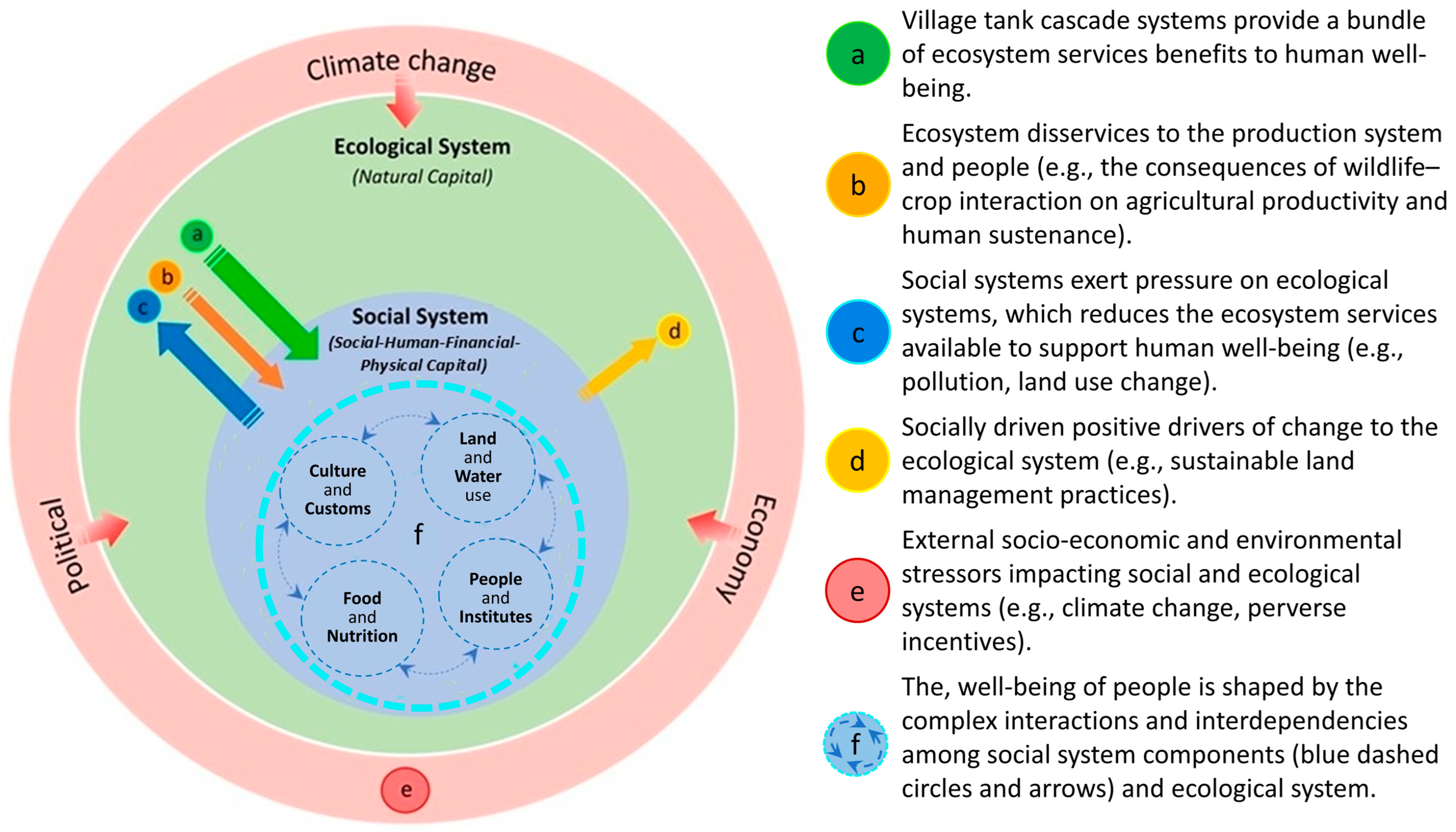
Figure 1. Conceptual illustration of the interconnectedness among social and ecological components and external influences within a VTCS, based on the SES elements proposed by Ostrom [23] and Berkes and Folke [24] Source: Prepared by the authors.
Sustainability 18 06151 g001
Figure 2. Study area location and main land use systems. Land use data source: [33].
Sustainability 18 06151 g002
Figure 3. Conceptual framework illustrating the multi-level social–ecological nexus of a VTCS (ac), highlighting the diverse interactions and interdependencies between social and ecological domains that generate ecosystem services and disservices. Source: Prepared by the authors.
Sustainability 18 06151 g003
Figure 4. Social–ecological nexus maps of MVTCS illustrating (a) degree centrality, (b) betweenness centrality, and (c) eigenvector centrality. Node sizes are proportional to the centrality scores.
Sustainability 18 06151 g004
Figure 5. Maximal cliques and node frequencies in the SEN of MVTCS. (a) The SEN map of one of the largest maximal cliques. (b) Frequencies of the most important nodes across all maximal cliques identified in the SEN.
Sustainability 18 06151 g005
Figure 6. Social–ecological nexus in the MVTCS, represented as a dendrogram with distinct community clusters. Highlighted nodes indicate the nine most influential nodes.
Sustainability 18 06151 g006
Table 1. Nodes and the important centrality metrics of the MVTCS social–ecological nexuses.
Node
(#)
Experts’ ReflectionsCentrality MeasureCluster
DCBWCCum.Sum BWCEVC
Food crops
(35)
Support food availability while providing cash income to purchase food not produced locally. Serve as core livelihood component of the system3394.6294.620.85S
Flora and fauna
(28)
Plant and animal species that contribute to the landscape’s unique biodiversity. This ensures ecological processes and functions of the system3873.87168.491E
Paddy farming
(7)
Rice production lands in command areas2841.38209.870.78S
Land use
(47)
Land use and its consequences (positive or negative) on both society and the ecological system.2841.03250.90.73SE
Climate
(29)
Optimal rainfall, temperature, humidity, solar radiation, and relative humidity contributing to maintaining ecological processes and functions to ensure provision of ecosystem services for humans, plants, and animals3137.74288.640.86SE
Traditional knowledge
(17)
Use of traditional knowledge for farming, human health (Ayurveda), and management of biodiversity, including agrobiodiversity3031.29319.930.86SE
Village tanks
(10)
An ancient, interconnected network of small, man-made tanks (reservoirs) built to capture and store rainwater for irrigation, primarily in the dry zone2829.42349.350.79SE
Knowledge and attitudes
(14)
Local people’s knowledge and attitude toward natural resources, agricultural practices, and sustainable utilization2628.87378.220.73S
Village forest
(6)
Catchment forest located in upstream areas of the VTCS protected by community or local institutions to ensure continued supply of forest-based ecosystem services2628.3406.520.71E
Aesthetic and cultural values
(43)
Aesthetic and cultural appreciation generated through the ecosystem and cultural practices of the landscape2823.78430.30.84SE
Inland fisheries (37)Sustainable inland fisheries associated with tanks supports food and nutrition security and livelihoods1823.58453.880.49SE
Livestock
(36)
Animal husbandry within the system supports food and nutrition, farming operations, and livelihoods1822.81476.690.47S
Habitats for species
(33)
Maintenance of habitat quality increase ecological productivity and habitat connectivity2721.87498.560.79E
Water pollution
(48)
Pollution of natural water bodies due to various anthropogenic activities. Application of nature-based solutions for prevention and mitigation1920.64519.20.54SE
Soil
(30)
Soil microorganisms and soil properties that support ecological processes and functions to maintain the ecological productivity of farming lands2319.85390.66E
Management practices
(15)
Maintenance of ecological commons such as village tanks, micro land uses, and other socio-economic infrastructure2216.92555.920.61S
Technology
(16)
Use of modern technology for agriculture, livelihoods, and ecosystem management. Improved agronomical practices for maintaining and increasing efficiency of the agriculture systems1916.73572.650.5S
Biocultural practices
(18)
Use of biodiversity, cultural elements, and traditional knowledge for farming practices and social well-being2315.33587.980.69SE
Impact of wild animals
(45)
Human–elephant conflicts, wild animal attack effects on farming and livelihoods1913.71601.690.56S
Pollination
(25)
Social–ecological habitats provide favorable conditions for the survival of pollinators and production of their services2213.65615.340.67SE
Fresh water supply
(39)
Ecosystems provide clean water for irrigation, drinking, and the sustenance of flora and fauna2013.52628.860.57E
Agrobiodiversity
(34)
Maintenance of economically and ecologically important species and crop genetic diversity2213.37642.230.66SE
Indigenous medicine
(40)
Indigenous medicine-associated practices and plant species1912.86655.090.58SE
Home gardens
(8)
Production of horticultural food crops, spices, and medicinal plants1912.3667.390.59SE
Local governing institutions
(1)
Act as the primary interface between community needs, administrative action, and natural resource management109.74677.130.22S
Micro land uses
(13)
Ecological common land parcels associated with tank environs that mostly provide regulating ecosystem services189.3686.430.54E
Markets and accessibility
(5)
Better access to agricultural markets and supply chains beyond the landscape98.97695.40.18S
Scrub and grasslands
(11)
Land cover with low trees, bushes, shrubs, and grasses. Support both human and animal well-being and land environmental stability137.53702.930.34E
Raw materials
(41)
Timber, fuelwood, and raw materials for the cottage industry. Important livelihood component of the system136.01708.940.4SE
Fertilizer
(32)
Maintains soil fertility that supports the economic productivity of farming lands165.29714.230.51S
Erosion prevention
(21)
Vegetation cover and micro land uses help to reduce runoff and stabilize soil134.67718.90.4E
Forage
(42)
Grasses and fodder for livestock144.23723.130.45S
Community organizations
(2)
Farmer associations, such as paddy, livestock, fisheries, focus on agricultural productivity113.79726.920.29S
Water purification
(22)
Rich vegetation and soil help to purify water and ensure freshwater flow for human and animal well-being133.74730.660.39E
Wild foods
(38)
Foods from wild flora and fauna to improve dietary diversity and human health163.44734.10.55E
Invasive aquatic plants
(46)
Act as a disruptive force that alters both ecological functions and the human and animal communities that depend on aquatic ecosystem113.43737.530.32SE
Shifting cultivation
(9)
Upland rainfed shifting cultivation lands123.37740.90.4SE
Spiritual values (44)Elements for spiritual practices and sense of place133.3744.20.43SE
Pests and diseases
(27)
Pest and disease control in farming lands143.21747.410.48S
Moderation of extreme events
(26)
Mitigate the impacts of extreme climate events such as droughts, floods, and air pollution to protect vulnerable communities122.69750.10.38E
Seasonal crops (12)Seasonal food crops based on climatic seasons122.37752.470.38S
Groundwater recharge
(23)
Forests and tanks help to recharge ground water aquifers to ensure a freshwater supply for domestic use and farming112.21754.680.37E
Adaptation
(19)
Ecosystem-based adaptation to manage disaster situation such as climate extremes112.02756.70.37SE
Industries
(49)
Small- and medium-scale industries that support livelihoods. Also contribute to air pollution70.95757.650.21S
Irrigation water quality
(24)
Micro land uses help the purification of irrigation water by reducing toxins and salinity in the water flow100.92758.570.32E
Microfinance
(4)
Provides small loans for local farming, small business, and cottage industries50.73759.30.1S
Subsidies
(3)
Government subsidies for fertilizer and disaster events40.6759.90.09S
Carbon sequestration
(20)
Absorption of carbon dioxide by plants for net primary production contributes to ecosystem-based greenhouse gas mitigation60.58760.480.19E
Air pollution
(31)
Health, environmental, and economic impacts of deterioration of both ambient and indoor air quality80.55761.030.28SE
DC, degree centrality; BWC, betweenness centrality; EVC, eigenvector centrality; C, cluster; VTCS, Village Tank Cascade System; Cum.Sum, cumulative sum; E, Ecological; S, Social; SE, Social–Ecological.
Disclaimer/Publisher’s Note: The statements, opinions and data contained in all publications are solely those of the individual author(s) and contributor(s) and not of MDPI and/or the editor(s). MDPI and/or the editor(s) disclaim responsibility for any injury to people or property resulting from any ideas, methods, instructions or products referred to in the content.