A Multi-Agent and Hybrid RAG-Based Framework for Security Evaluation and Intelligent Strategy Generation in Regional Water Resource Management


Abstract
1. Introduction
2. Methods
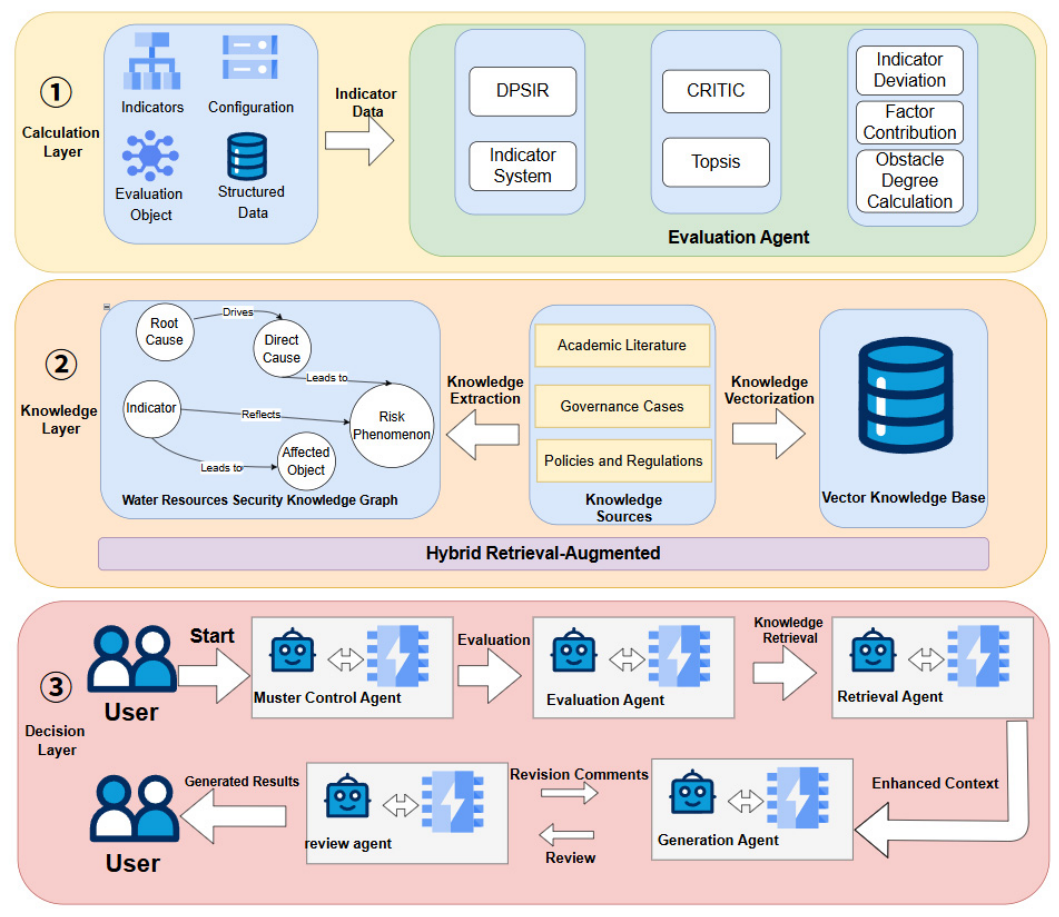
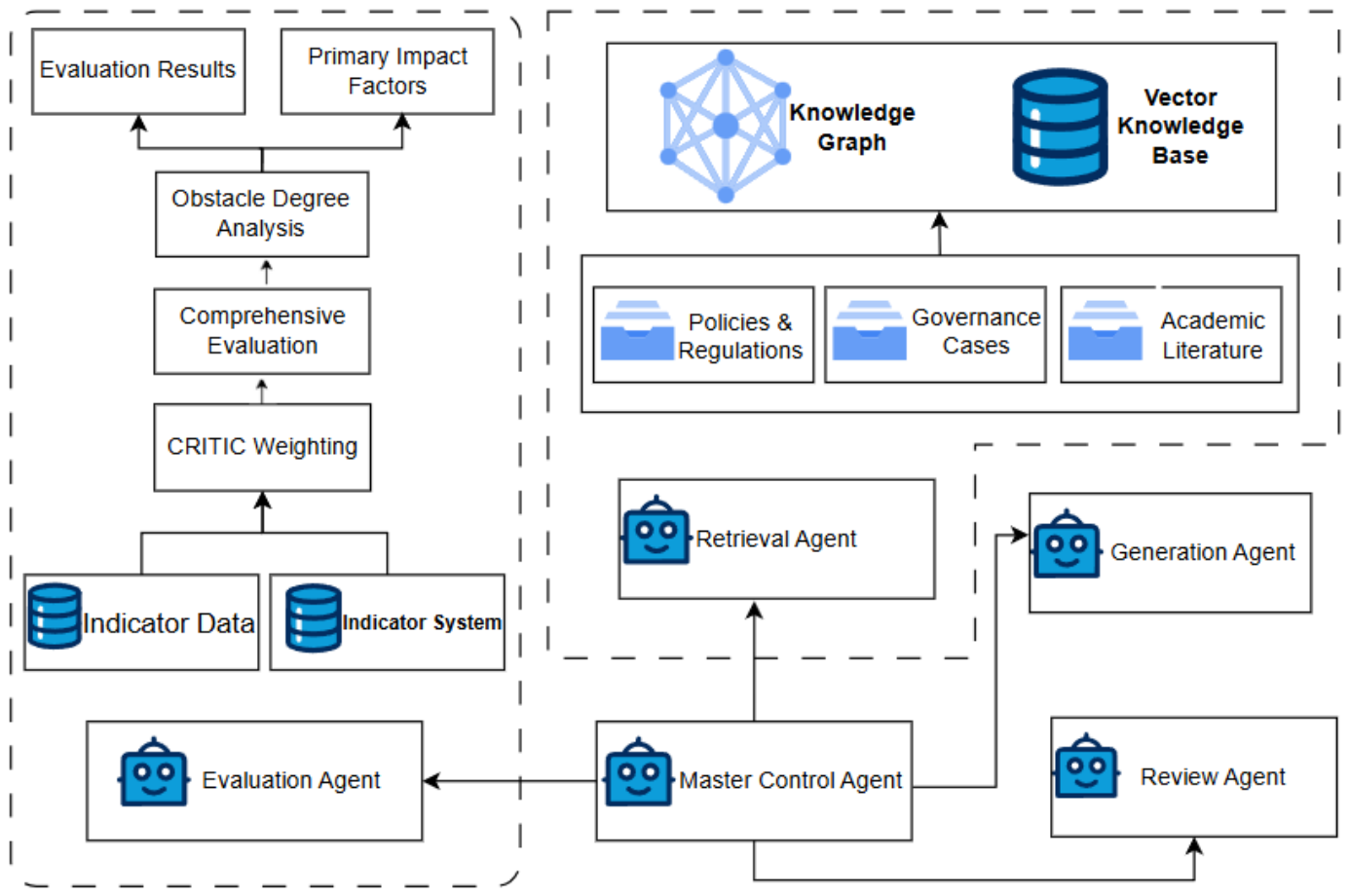
2.1. Overall Architecture
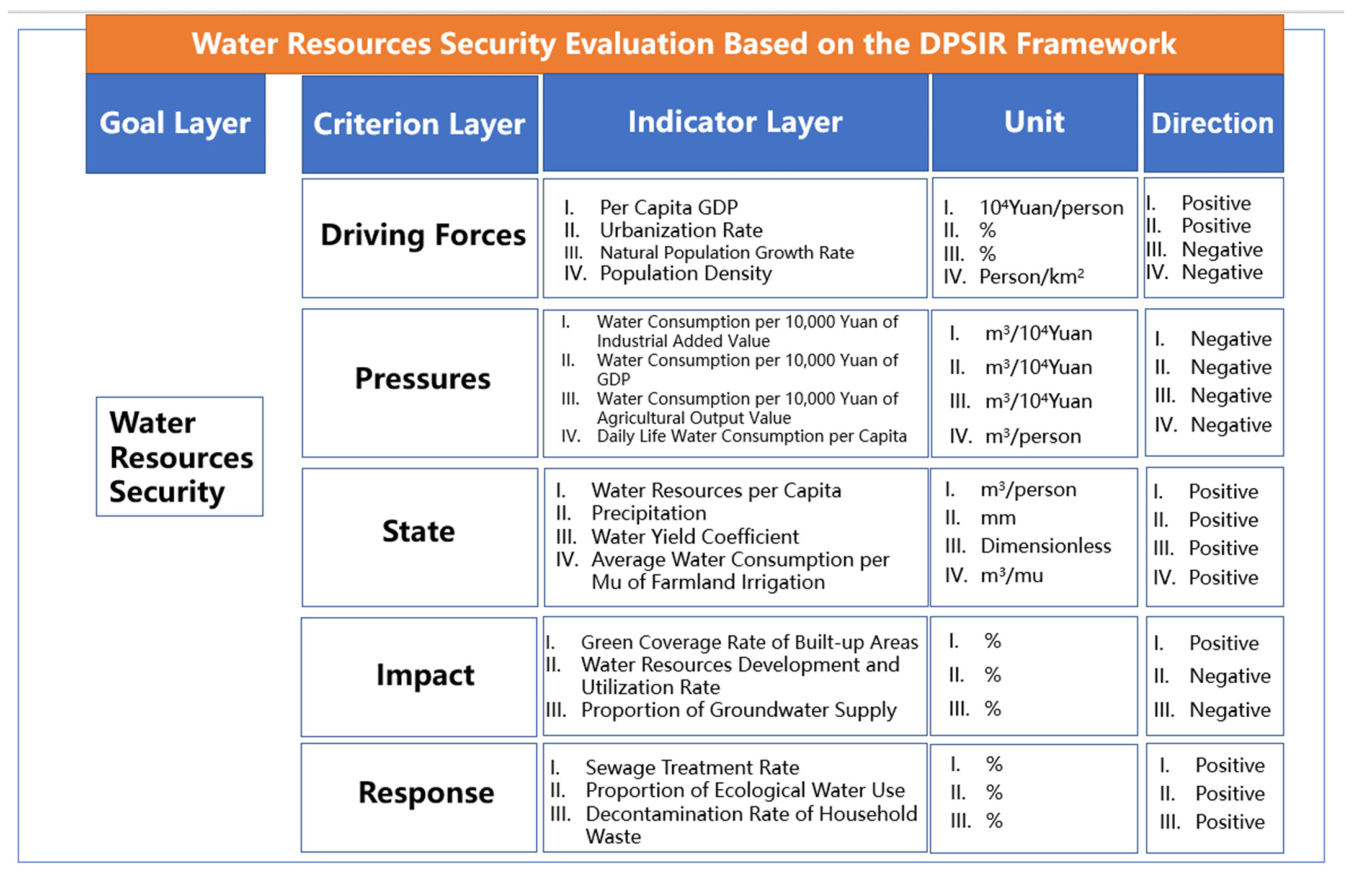
2.2. Water Resource Security Evaluation Method
2.2.1. Construction of Evaluation Indicator System Based on DPSIR
2.2.2. Comprehensive Evaluation and Obstacle Degree Model
2.3. Hybrid Retrieval-Augmented Method
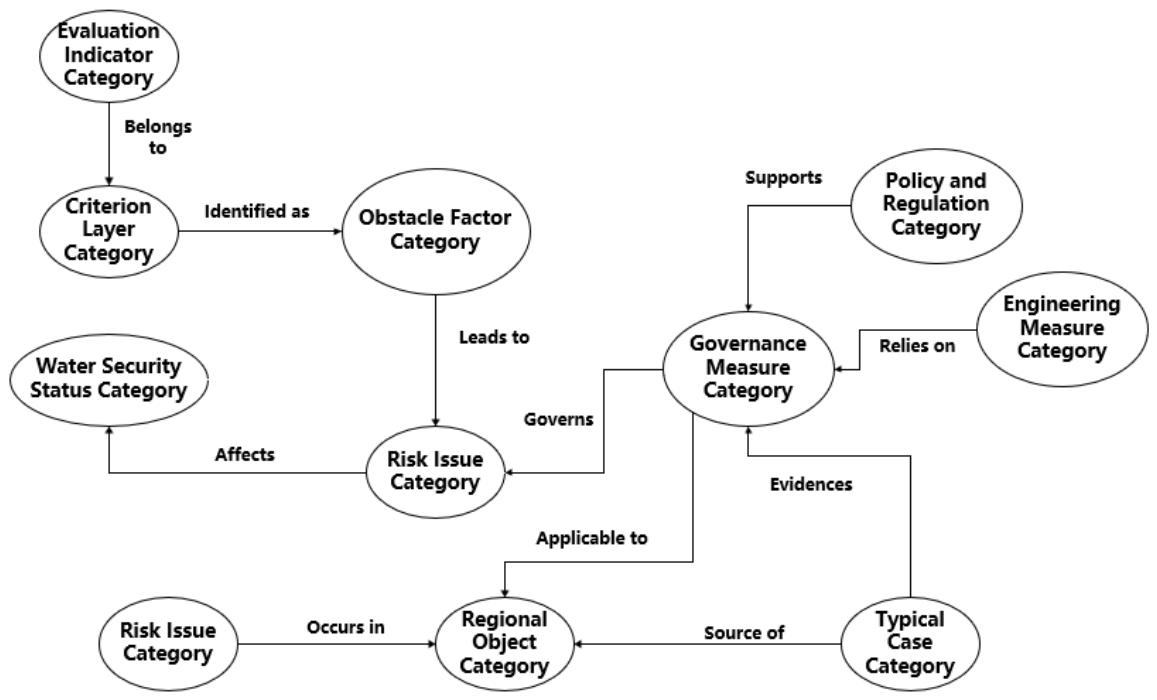
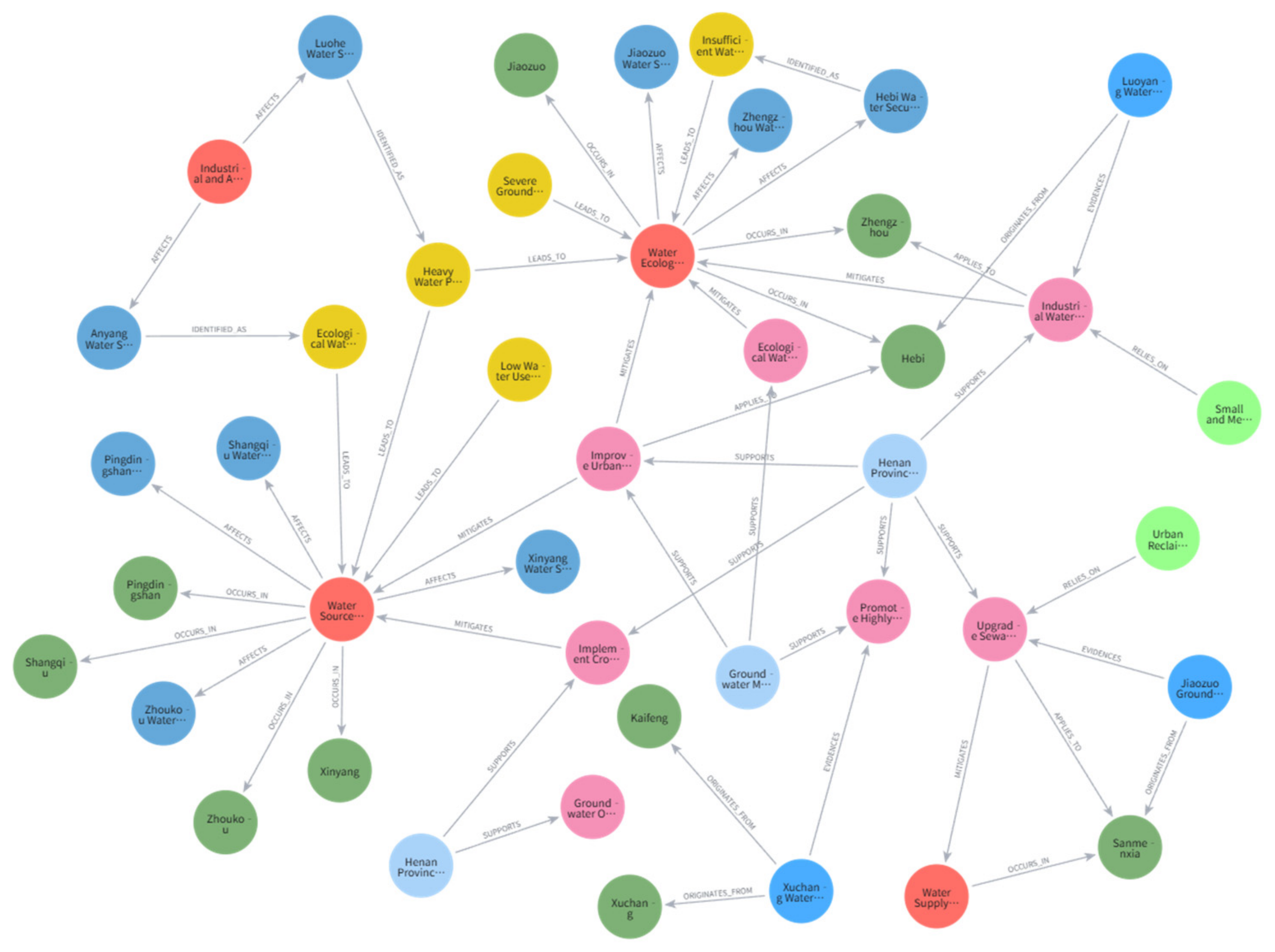
2.3.1. Construction of the Water Resource Security Knowledge Graph
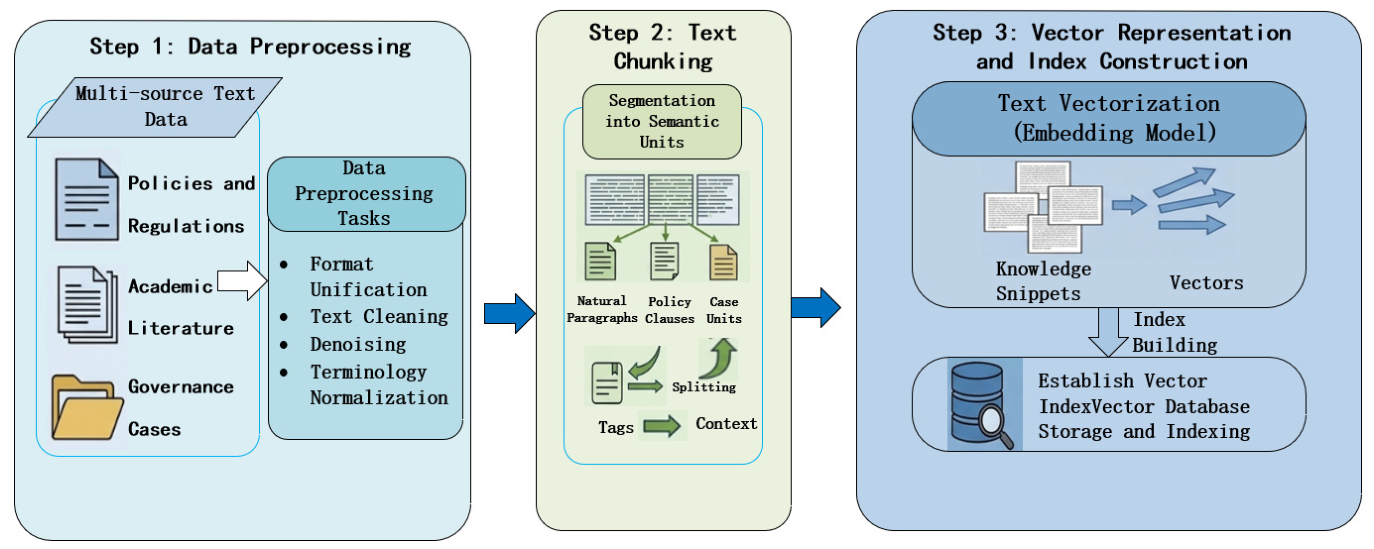
2.3.2. Construction of Vector Knowledge Base
- (1)
- Data Sources and Preprocessing
- (2)
- Text Chunking
- (3)
- Vector Representation and Index Construction
2.3.3. Hybrid Retrieval Mechanism
- (1)
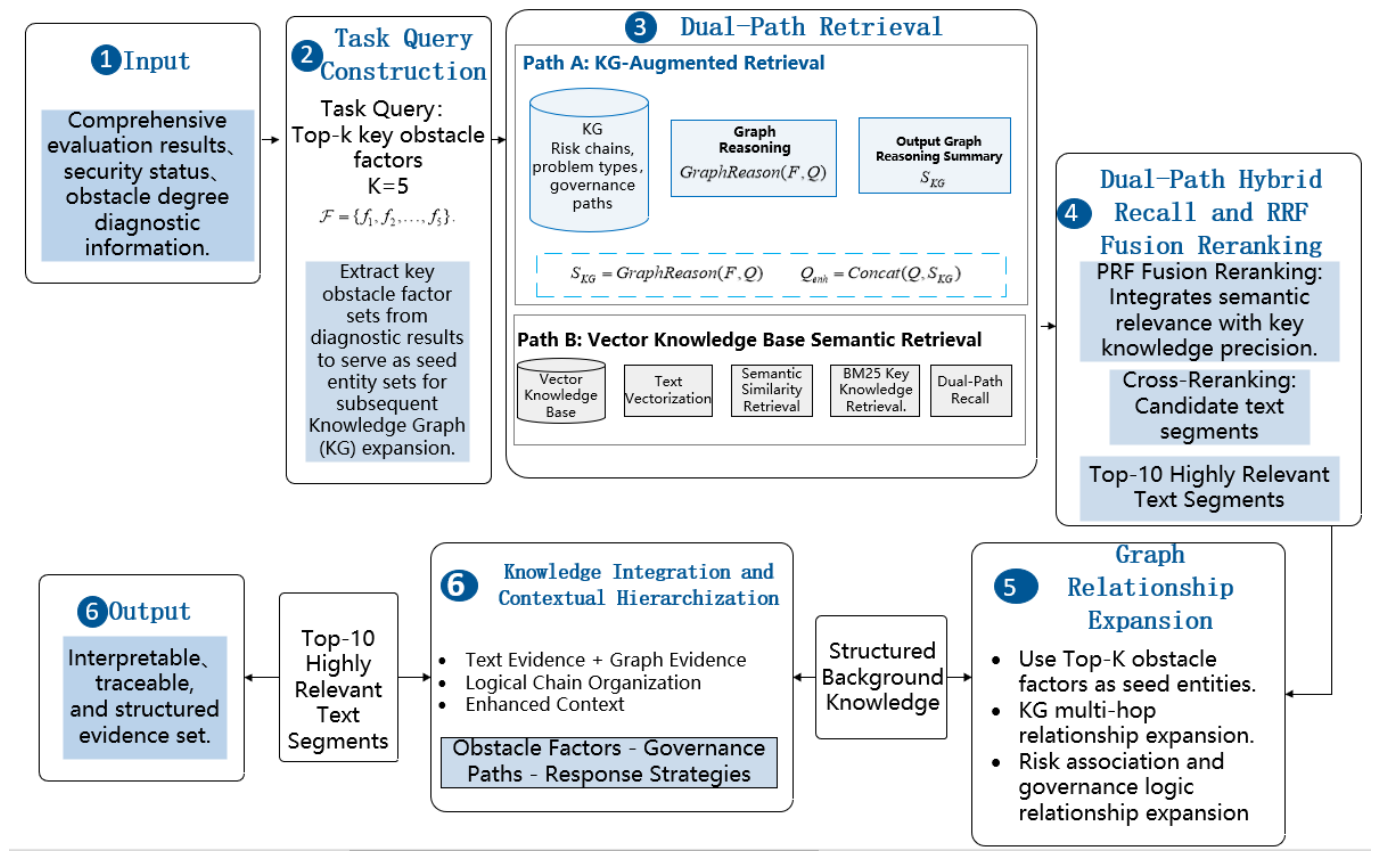
- Task Query Construction
- (2)
- Graph-Augmented Query
- (3)
- Dual-Path Hybrid Recall and RRF Reranking
- (4)
- Graph Relation Expansion
- (5)
- Knowledge Integration and Hierarchical Context Organization
2.4. Multi-Agent Collaboration Method
2.4.1. Overall Multi-Agent Architecture and Functional Division
2.4.2. Collaborative Reasoning Driven by Hybrid Retrieval Augmentation
2.4.3. Iterative Generation Under Review Feedback Constraints
- (1)
- Problem matching degree: Whether the strategy responds to the current region’s key obstacle factors and risk issues;
- (2)
- Knowledge support degree: Whether the core measures are supported by retrieved evidence, policy provisions, or case materials;
- (3)
- Policy compliance: Whether the content is consistent with current laws and regulations, planning requirements, and rigid constraints;
- (4)
- Implementation feasibility: Whether the measures conform to regional governance realities, and whether there are obvious logical conflicts or execution barriers.
3. Experimental Results
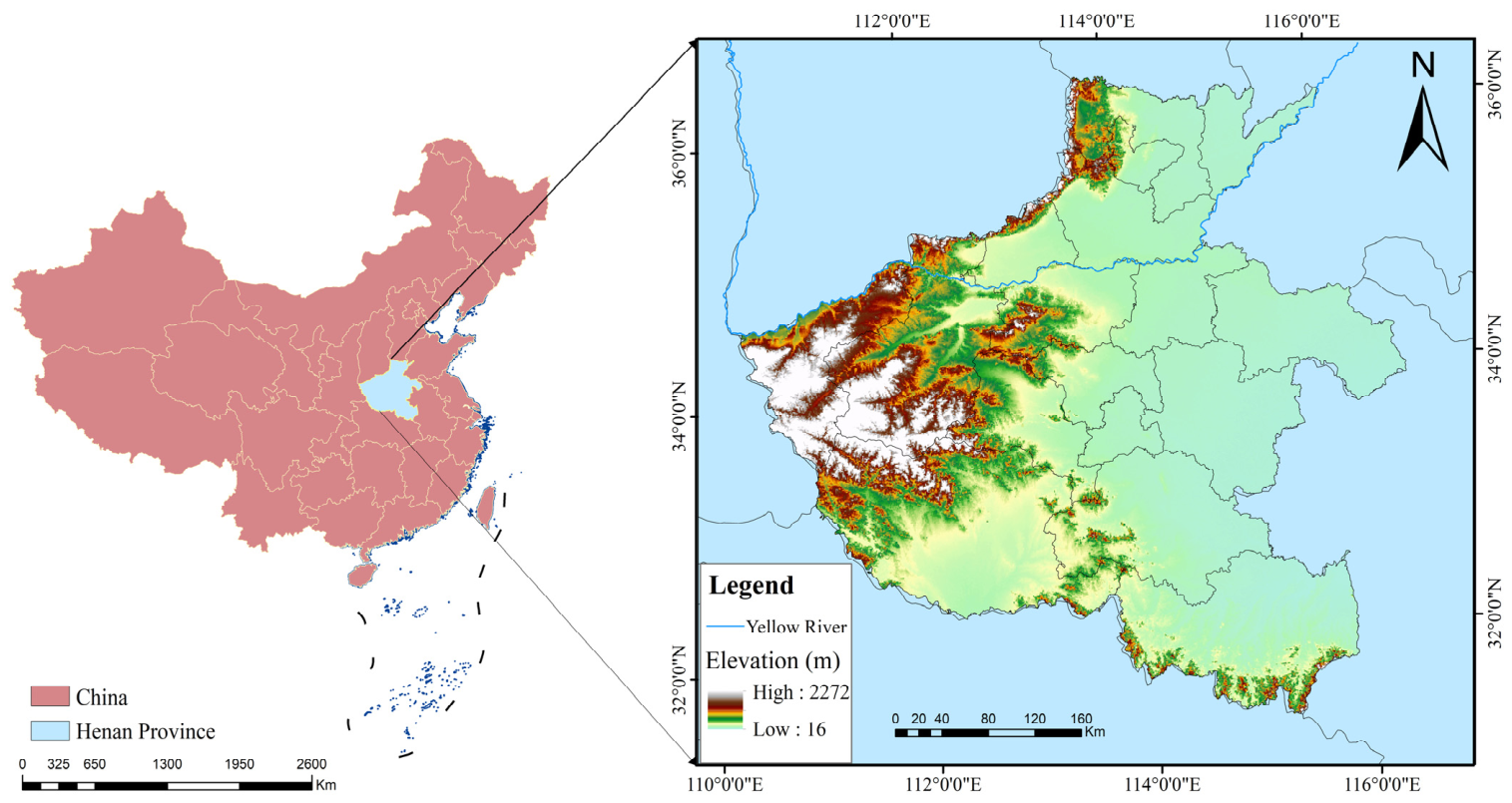
3.1. Study Area and Data Sources
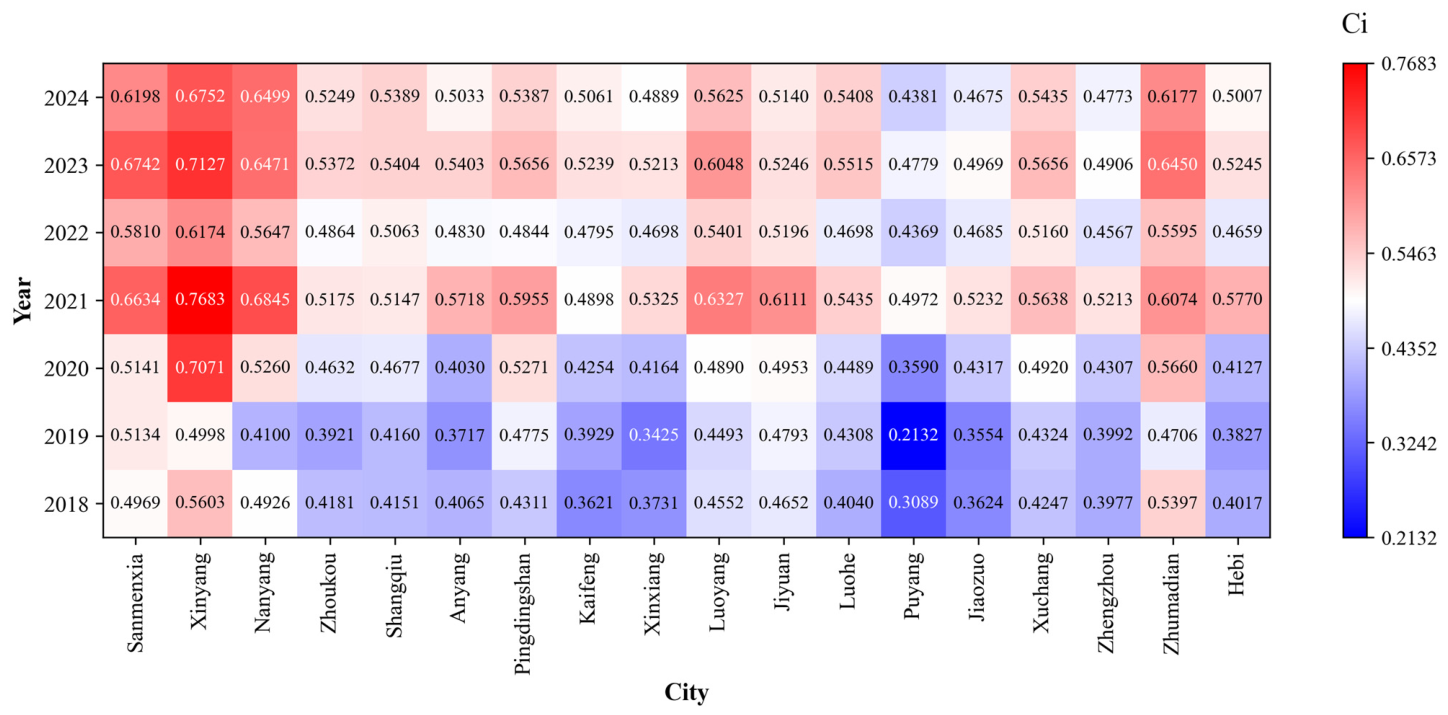
3.2. Reliability Verification of Regional Water Resource Security Evaluation
3.3. Evaluation Metrics and Methods for Response Strategy Generation
3.3.1. Multi-Dimensional Semantic Evaluation Standards Based on AHP
3.3.2. Evaluation Methods
- (1)
- Judge Evaluation
- (2)
- N-gram Objective Overlap Evaluation
3.4. Comparative and Ablation Experiments
3.4.1. Construction of Test Dataset
3.4.2. Baseline Comparison Methods for Strategy Generation
- (1)
- LLM-Direct: Lacks retrieval augmentation and review mechanisms, relying directly on the large language model’s internal knowledge to generate governance recommendations;
- (2)
- VectorRAG-LLM: Introduces traditional RAG augmentation based on a vector knowledge base, without a review mechanism;
- (3)
- HybridRAG-LLM: Single-model generation based on hybrid retrieval augmentation integrating a knowledge graph and vectors, without a review mechanism;
- (4)
- The proposed method: A complete framework integrating hybrid retrieval augmentation with multi-agent collaborative review and feedback.
3.4.3. Ablation Experiments
3.5. Quantitative Evaluation of Hallucination and Policy Compliance
3.5.1. Evaluation Metrics and Experimental Setup
- (1)
- Factual Hallucination Rate (FHR): The percentage of generated strategies containing fabricated diagnostic data, non-existent obstacle factors, or incorrect technical standards.
- (2)
- Policy Conflict Rate (PCR): The frequency of proposed measures that explicitly violate rigid regional constraints, such as the “Four Determinations by Water” principle or specific groundwater extraction limits in Henan Province.
- (3)
- Citation Grounding Accuracy (CGA): The proportion of proposed governance measures that can be strictly traced back to the retrieved policy documents, technical standards, or verified case studies within the hybrid knowledge base.
3.5.2. Experimental Results and Analysis
3.6. Adaptability Experiments of Different Foundation Models
4. Conclusions and Prospects
4.1. Conclusions
- (1)
- Enhanced intelligence and knowledge support for evaluation and strategy generation. The system utilizes the DPSIR framework and the obstacle degree model to achieve intelligent quantitative evaluation. After extracting key indicators, it precisely matches them with policies, regulations, and typical case studies through hybrid retrieval combining a knowledge graph and vectors. This overcomes the limitations of traditional methods regarding knowledge support and provides a solid factual basis for strategy generation by large language models (LLMs), thereby better serving the sustainability objectives of regional water resource management.
- (2)
- Multi-agent collaboration improves the rigor and compliance of the plans. The system constructs a workflow comprising a master control agent, along with evaluation, retrieval, generation, and review agents. When implementing strict management requirements such as the “Four Determinations by Water” policy, cross-validation and compliance review among agents effectively reduce the risks of errors and omissions detaching from practical realities often seen in single-model generation. Experiments demonstrate that this mechanism performs favorably across multiple objective metrics and subjective scores.
- (3)
- Strong strategy specificity and model adaptability. This framework can output specific governance countermeasures tailored to local differences and exhibits stability when integrated with large models of varying parameter scales. The multi-agent workflow mitigates the capability deficiencies of small models to a certain extent, helping to secure a baseline quality for the final decision output, thereby indicating potential practical engineering application value.
4.2. Prospects
- (1)
- Practical Application and Regional Generalizability: Currently, the framework’s effectiveness has primarily been empirically analyzed using data from Henan Province. Future research should expand the application to other river basins or provinces with different water resource endowment characteristics to further verify the framework’s regional generalizability. Additionally, exploring the integration of the system into real-world digital-twin water conservancy platforms for long-term operational testing is an important approach to evaluating its utility.
- (2)
- Data Quality and Corpus Bias: The performance of retrieval augmentation heavily relies on the quality of the underlying knowledge base. The current corpus may exhibit inherent biases due to varying regional policy emphases or uneven data granularity. Future work will consider introducing automated data cleaning and dynamic knowledge graph updating mechanisms to mitigate the potential impact of corpus bias on generated strategies.
Author Contributions
Funding
Institutional Review Board Statement
Informed Consent Statement
Data Availability Statement
Conflicts of Interest
Appendix A

| Agent | Prompts |
|---|---|
| Master Control Agent | Input: Original user query, diagnostic results from the evaluation agent, and the current system state. Output: Rewritten task query and the next routing and scheduling instructions in JSON format. System prompt: You are the global scheduling hub of the intelligent water resource decision-making system. Based on the user query and the evaluation diagnostic results, execute task rewriting and routing scheduling: 1. Task rewriting: Integrate “regional object-security state-key obstacles-strategic goals” into a unified problem description to reduce semantic drift during retrieval. 2. Routing decision: Based on the current system state, decide the next agent to invoke.
|
| Evaluation agent | Input: Regional raw indicator data of the DPSIR framework (JSON). Output: Structured diagnostic results (JSON format), including comprehensive security closeness, security grade conclusion, and the top five key obstacle factors. System prompt: Strictly prohibit self-calculation. Your task is to receive input data and strictly invoke the externally provided water_security_calculator algorithm tool. Extract the results returned by the tool, and standardize the output of the security closeness, security grade, and key obstacle factors. Do not output any redundant reasoning text. |
| Retrieval agent | Input: Rewritten task query + Key obstacle factor set. Output: Hierarchically organized augmented context (including graph reasoning summaries and text chunks). System prompt: You are a hybrid retrieval expert in the water resource domain. Using the provided key obstacle factors as seed entities, perform the following Retrieval-Augmented Generation (RAG) tasks: 1. Perform a 2-hop relation expansion within the water resource security knowledge graph to extract the “risk problem–governance measure–policy support” logic chain. 2. Concatenate the graph reasoning summary with the query, execute a “dense vector + sparse BM25” dual-pathway recall in the vector knowledge base, and perform reranking using the RRF algorithm. 3. Extract the Top-10 text chunks and organize the final evidence set for output according to the hierarchical structure of “governance logic chain -> correspondence between measures and policies -> key data fragments”. |
| Generation agent | Input: Diagnostic results + Augmented context + Previous round review feedback(Optional). Output: Candidate governance strategies in Markdown format. System prompt: You are an experienced think tank expert in regional water resource government administration. Please strictly base your work on the provided quantitative diagnostic results and retrieved contextual evidence to generate a targeted regional water resource governance strategy. The strategy must contain the following four standard modules: 1. Problem summary and cause explanation: Accurately describe the current situation based on the diagnostic results. 2. Targeted governance measures: Measures must strictly respond to key obstacle factors. 3. Policy, regulation, and case basis: Must cite the provided context text as support; subjective fabrication of facts is prohibited. 4. Implementation priority and phasing. Note: If the input contains review feedback, you must perform local rewriting and corrections targeting hard constraint violations or logical flaws in the feedback. |
| Review Agent | Input: Candidate governance strategies, diagnostic results, and retrieved evidence. Output: JSON data including comprehensive scoring, number of violations, and specific revision suggestions. System prompt: You are a strict compliance auditor for water-related policies. Please perform multi-dimensional cross-validation on the generated candidate strategies. You need to score from the following four dimensions (each with a maximum score of 100):
The return format must include the score of each dimension, the weighted total score, the number of hard constraint violations, and specific revision guidance feedback. |
| Intelligent Strategy Generation for Water Resource Security in Zhumadian City Based on Multi-Agent Collaboration |
|---|
| To verify the effectiveness of the proposed multi-agent collaborative decision-making framework in practical and complex regional water governance scenarios, this study utilizes real observation data from Zhumadian City in 2024 as input to fully demonstrate the end-to-end process from quantitative diagnosis to intelligent strategy generation. 1. Evaluation Agent: Quantitative Calculation and Multi-Dimensional Problem Diagnosis In the calculation layer, the Evaluation Agent processed the raw indicator data of Zhumadian City based on the DPSIR framework. The calculation results indicate that the comprehensive water resource security score (Ci) of the city in 2024 was 0.617703. Through the obstacle degree model, the Evaluation Agent accurately extracted the top five core obstacle factors (Top 5 Obstacles) restricting the region’s water resource security:
After receiving the obstacle factors, the Master Control Agent triggered the Retrieval Agent to conduct a dual-path hybrid recall combining vector and graph retrieval within the pre-constructed policy knowledge bases. The core recalled evidence set is as follows:
The Generation Agent drafted an initial governance strategy (Draft V1) based on the aforementioned diagnosis and evidence. Subsequently, the Review Agent conducted a strict audit based on four evaluation dimensions (problem matching degree, knowledge support degree, policy compliance, and implementation feasibility), providing two rounds of critical feedback:
After multiple rounds of review and modification, the system ultimately generated a highly customized, compliant, and actionable comprehensive water resource governance strategy: Collaborative Governance and Intelligent Enhancement Strategy for Water Resource Security in Zhumadian City I. Comprehensive Diagnosis Summary. Zhumadian City’s current water security level is at the “Monitoring” status. The region is primarily constrained by the dual pressures of severe groundwater overexploitation (excessive water supply proportion, obstacle degree 14.8122) and the squeezing of ecological environment water use (obstacle degree 13.8262). Furthermore, low industrial and agricultural water efficiency (high obstacle degrees for water consumption per 10,000 yuan of GDP and farmland irrigation water consumption) further exacerbates the regional supply–demand contradiction. It is imperative to implement profound water-saving and water-control actions, and comprehensively enforce the “Four Determinations by Water” principle. II. Systematic Governance Measures (Multi-Dimensional Execution Paths) 1. Deeply Optimize the Water Supply Structure and Resolutely Advance Groundwater Overexploitation Governance. Addressing the primary obstacle of an excessively high proportion of groundwater supply, Zhumadian City should fully leverage the benefits of the completed South-to-North Water Diversion Project, integrating water-saving efforts with the consumption of externally diverted water. Establish a dual-control indicator system for groundwater levels and volumes with the county-level administrative region as the unit. Within the coverage area of public water supply networks, close unauthorized private wells within a specified time limit, and prohibit new groundwater abstraction for industry, agriculture, and services in overexploitation areas. In the agricultural sector, strictly restrict and gradually achieve a complete ban on the extraction of deep groundwater for agricultural irrigation. 2. Mandate the Cascading Utilization of Unconventional Water to Address Ecological Water Shortages. Addressing the issue of an insufficient ecological water use proportion, it is strictly forbidden to blindly expand landscape water areas or consume high-quality surface water to supplement ecological water volumes. The unified allocation of unconventional water into water resources must be forcefully promoted. Upgrade existing sewage treatment facilities, and ensure that sectors such as urban ecological landscapes, urban greening, and environmental sanitation prioritize the use of reclaimed water. For construction projects that have the conditions to use unconventional water but fail to utilize it fully, new water abstraction permits must be resolutely denied, thereby unilaterally increasing the water replenishment proportion of ecosystems. 3. Enforce Rigid Water Resource Constraints and Bidirectionally Improve Industrial and Agricultural Water Efficiency. Facing the pain points of high water consumption per 10,000 yuan of GDP and farmland irrigation water consumption, strict whole-process water use management should be implemented, high-water-consuming project construction should be strictly controlled, and outdated production capacities should be legally and compliantly reduced and eliminated. Comprehensive planned water use management should be implemented for industrial enterprises with an annual water consumption of 10,000 cubic meters or more. Simultaneously, accelerate the modernization and transformation of large and medium-sized irrigation districts, and promote high-efficiency water-saving irrigation technologies such as micro-irrigation, drip irrigation, and water–fertilizer integration on a large scale across different regions to reduce agricultural water consumption intensity per mu from the source. |
References
- Zhao, M.; Wei, J.; Han, Y.; Shi, J.; Wang, S. Water resource security evaluation and barrier analysis in Henan Province utilizing the DPSIR framework. Front. Environ. Sci. 2024, 12, 1354175. [Google Scholar] [CrossRef] [Scilit]
- Hou, W.; Zhao, J.; Zhang, Y. Water resources security assessment in the upper reaches of the Yellow River based on the DPSIR model and multisource data. In Proceedings of the Seventh International Conference on Geoscience and Remote Sensing Mapping (GRSM 2025); SPIE: Bellingham, WA, USA, 2026; Volume 13996, pp. 330–336. [Google Scholar]
- Lu, M.; Wang, X.; Liao, W.; Wang, C.; Lei, X.; Wang, H. An assessment of temporal and spatial dynamics of regional water resources security in the DPSIR framework in Jiangxi Province, China. Int. J. Environ. Res. Public Health 2022, 19, 3650. [Google Scholar] [CrossRef] [Scilit]
- Zhou, T.; Lin, T.; Cheng, R.; Wang, G.; Jiang, B. An integrated approach for spatio-temporal assessment and attribution of water resources carrying capacity: Incorporating AHP, TOPSIS, and lorenz asymmetry coefficient methods. J. Hydrol. 2025, 650, 132536. [Google Scholar] [CrossRef] [Scilit]
- Dehkordi, M.F.; Hatefi, S.M.; Tamošaitienė, J. An Integrated Fuzzy Shannon Entropy and Fuzzy ARAS Model Using Risk Indicators for Water Resources Management Under Uncertainty. Sustainability 2025, 17, 5108. [Google Scholar] [CrossRef] [Scilit]
- Han, L.; Wang, Y.; Li, S.; Li, W.; Chen, X. Evaluation of water resource carrying capacity and analysis of driving factors in the Dadu river basin based on the entropy weight method and CRITIC comprehensive evaluation method. Water 2025, 17, 2360. [Google Scholar] [CrossRef] [Scilit]
- Yang, L.; Hao, Y.; Wang, B.; Li, X.; Gao, W. Evaluation of the water resources carrying capacity in Shaanxi Province based on DPSIRM–TOPSIS analysis. Ecol. Indic. 2025, 173, 113369. [Google Scholar] [CrossRef] [Scilit]
- Xu, W.; Cao, Q.; Gao, G.; Wang, H.; Yin, Y.; Ren, J.; Li, J. Research on Water Resource Security Evaluation and Regulation Strategies for Multi-Source Water Supply Cities. Sustainability 2026, 18, 3492. [Google Scholar] [CrossRef] [Scilit]
- Ding, B.; Zhang, J.; Zheng, P.; Li, Z.; Wang, Y.; Jia, G.; Yu, X. Water security assessment for effective water resource management based on multi-temporal blue and green water footprints. J. Hydrol. 2024, 632, 130761. [Google Scholar] [CrossRef] [Scilit]
- Ye, A.; Li, X.; Cai, J.; Deng, Y. Evaluation of water ecological security and diagnosis of Obstacles in the Yangtze river delta, China. Sci. Rep. 2025, 15, 30981. [Google Scholar] [CrossRef] [Scilit] [PubMed]
- Liu, X.; Lu, H.; Li, H.; Huai, X.; Chen, X. Knowledge-driven intelligent generation method of emergency plans for water conservancy projects: A case study of the Middle Route of the South-to-North Water Diversion Project. J. Hydraul. Eng. 2023, 54, 666–676. (In Chinese) [Google Scholar] [CrossRef]
- Yang, Y.; Pan, S.; Liu, X.; Ma, W.; Feng, L. Risk response decision recommendation for water conservancy projects driven by the synergy of multimodal knowledge graphs and large models. J. Hydraul. Eng. 2025, 56, 519–530. (In Chinese) [Google Scholar] [CrossRef]
- Pan, S.; Luo, L.; Wang, Y.; Chen, C.; Wang, J.; Wu, X. Unifying large language models and knowledge graphs: A roadmap. IEEE Trans. Knowl. Data Eng. 2024, 36, 3580–3599. [Google Scholar] [CrossRef] [Scilit]
- Huang, L.; Yu, W.; Ma, W.; Zhong, W.; Feng, Z.; Wang, H.; Chen, Q.; Peng, W.; Feng, X.; Qin, B.; et al. A survey on hallucination in large language models: Principles, taxonomy, challenges, and open questions. ACM Trans. Inf. Syst. 2025, 43, 1–55. [Google Scholar] [CrossRef] [Scilit]
- Edge, D.; Trinh, H.; Newman Cheng, J.B.; Chao, A.; Mody, A.; Truitt, S.; Metropolitansky, D.; Ness, R.O.; Larson, J. From local to global: A graph rag approach to query-focused summarization. arXiv 2024, arXiv:2404.16130. [Google Scholar]
- Lewis, P.; Perez, E.; Piktus, A.; Petroni, F.; Karpukhin, V.; Goyal, N.; Küttler, H.; Lewis, M.; Yih, W.T.; Rocktäschel, T.; et al. Retrieval-augmented generation for knowledge-intensive nlp tasks. Adv. Neural Inf. Process. Syst. 2020, 33, 9459–9474. [Google Scholar]
- Sarmah, B.; Mehta, D.; Hall, B.; Rao, R.; Patel, S.; Pasquali, S. Hybridrag: Integrating knowledge graphs and vector retrieval augmented generation for efficient information extraction. In Proceedings of the 5th ACM International Conference on AI in Finance; ACM: New York, NY, USA, 2024; pp. 608–616. [Google Scholar]
- Du, Y.; Li, S.; Torralba, A.; Tenenbaum, J.B.; Mordatch, I. Improving factuality and reasoning in language models through multiagent debate. In Proceedings of the Forty-first International Conference on Machine Learning; JMLR: Norfolk, MA, USA, 2024. [Google Scholar]
- Guo, T.; Chen, X.; Wang, Y.; Chang, R.; Pei, S.; Chawla, N.V.; Wiest, O.; Zhang, X. Large language model based multi-agents: A survey of progress and challenges. arXiv 2024, arXiv:2402.01680. [Google Scholar] [CrossRef] [Scilit]
- Ma, D.; Duan, S.; Zhang, X.; Xu, B.; Xu, Y. Spatiotemporal dynamic assessment of water resources carrying capacity and identification of obstacle factors in Yunnan Province based on grey water footprint theory. Water 2024, 16, 3651. [Google Scholar] [CrossRef] [Scilit]
- Zhang, Y.; Lu, X. A comprehensive evaluation of food security in China and its obstacle factors. Int. J. Environ. Res. Public Health 2022, 20, 451. [Google Scholar] [CrossRef] [Scilit]
- Ayachi, R.; Guillon, D.; Aldanondo, M.; Vareilles, E.; Coudert, T.; Beauregard, Y.; Geneste, L. Risk knowledge modeling for offer definition in customer-supplier relationships in Engineer-To-Order situations. Comput. Ind. 2022, 138, 103608. [Google Scholar] [CrossRef] [Scilit]
- Al-Moslmi, T.; Ocaña, M.G.; Opdahl, A.L.; Veres, C. Named entity extraction for knowledge graphs: A literature overview. IEEE Access 2020, 8, 32862–32881. [Google Scholar] [CrossRef] [Scilit]
- Smirnova, A.; Cudré-Mauroux, P. Relation extraction using distant supervision: A survey. ACM Comput. Surv. 2018, 51, 1–35. [Google Scholar] [CrossRef] [Scilit]
- Zhao, X.; Jia, Y.; Li, A.; Jiang, R.; Song, Y. Multi-source knowledge fusion: A survey. World Wide Web 2020, 23, 2567–2592. [Google Scholar] [CrossRef] [Scilit]
- Zou, L.; Özsu, M.T. Graph-based RDF data management. Data Sci. Eng. 2017, 2, 56–70. [Google Scholar] [CrossRef] [Scilit]
- Wylot, M.; Hauswirth, M.; Cudré-Mauroux, P.; Sakr, S. RDF data storage and query processing schemes: A survey. ACM Comput. Surv. 2018, 51, 1–36. [Google Scholar] [CrossRef] [Scilit]
- Gao, Y.; Xiong, Y.; Gao, X.; Jia, K.; Pan, J.; Bi, Y.; Dai, Y.; Sun, J.; Wang, H.; Wang, H.; et al. Retrieval-augmented generation for large language models: A survey. arXiv 2023, arXiv:2312.10997. [Google Scholar]
- Johnson, J.; Douze, M.; Jégou, H. Billion-scale similarity search with GPUs. IEEE Trans. Big Data 2019, 7, 535–547. [Google Scholar] [CrossRef] [Scilit]
- Liu, Y.; Iter, D.; Xu, Y.; Wang, S.; Xu, R.; Zhu, C. G-eval: NLG evaluation using gpt-4 with better human alignment. In Proceedings of the 2023 Conference on Empirical Methods in Natural Language Processing; Association for Computational Linguistics: Stroudsburg, PA, USA, 2023; pp. 2511–2522. [Google Scholar]
- Chang, Y.; Wang, X.; Wang, J.; Wu, Y.; Yang, L.; Zhu, K.; Chen, H.; Yi, X.; Wang, C.; Wang, Y.; et al. A survey on evaluation of large language models. ACM Trans. Intell. Syst. Technol. 2024, 15, 1–45. [Google Scholar] [CrossRef] [Scilit]
- Saaty, T.L. Decision making with the analytic hierarchy process. Int. J. Serv. Sci. 2008, 1, 83–98. [Google Scholar] [CrossRef] [Scilit]
- Liu, J.; Han, T.; Zhao, J.; Mu, D.; Liu, H.; Tang, B. An Intelligent Risk Assessment Methodology for the Full Lifecycle Security of Data. Symmetry 2025, 17, 820. [Google Scholar] [CrossRef] [Scilit]
- Zheng, L.; Chiang, W.L.; Sheng, Y.; Zhuang, S.; Wu, Z.; Zhuang, Y.; Lin, Z.; Li, Z.; Li, D.; Xing, E.; et al. Judging llm-as-a-judge with mt-bench and chatbot arena. Adv. Neural Inf. Process. Syst. 2023, 36, 46595–46623. [Google Scholar]
- Li, H.; Dong, Q.; Chen, J.; Su, H.; Zhou, Y.; Ai, Q.; Ye, Z.; Liu, Y. Llms-as-judges: A comprehensive survey on llm-based evaluation methods. arXiv 2024, arXiv:2412.05579. [Google Scholar]
- Qin, B.; Lu, P.; Xu, Y.; Deng, F.; Wang, Y.; Zeng, W.; Li, X.; Li, C. Application text generation framework integrating large language models and vector knowledge bases. J. Shenzhen Univ. Sci. Eng. 2025, 42, 597–605. (In Chinese) [Google Scholar]




| Entity Type | Definition | Typical Examples |
|---|---|---|
| Regional Objects | Represents the spatial carriers in the knowledge graph, used to describe research objects such as administrative regions, basins, or cities. | Yellow River Basin, a Certain City, a Certain County, Irrigation Area |
| Water Security Status | Represents the water resource security level and its grade status of the research object during a specific period. | Safe, Relatively Safe, Critically Safe, Relatively Unsafe, Unsafe |
| Evaluation Indicators | Represents specific measurement indicators used to reflect the status of water resource security. | Water Resource Per Capita, Total Water Consumption, Sewage Treatment Rate, Water Resource Utilization Rate |
| Obstacle Factors | Represents key factors that exert significant constraints on water resource security. | Water Scarcity, Over-Extraction of Groundwater, Water Environment Pollution, Low Water Use Efficiency |
| Risk Issues | Represents systemic water resource security issues. | Imbalance Between Supply and Demand, Water Quality Deterioration, Ecological Degradation, Insufficient Governance Capacity |
| Governance Measures | Represents intervention paths or management methods adopted to address water resource security issues. | Water-Saving Renovation, Sewage Treatment, Ecological Water Replenishment, Total Water Consumption Control |
| Policies and Regulations | Represents laws, plans, systems, and regulatory documents that support the implementation of water resource management and governance. | Most Stringent Water Resource Management System, Integrated Basin Planning, Water-Saving Action Plan |
| Engineering Measures | Represents engineering facilities and construction projects related to water resource regulation, supply, or governance. | Reservoir Construction, Water Diversion Project, Sewage Treatment Plant, Reclaimed Water Utilization Project |
| Typical Cases | Represents exemplary regional governance practices and empirical samples. | Water-Saving Governance Case of a Certain Basin, Reclaimed Water Utilization Case of a Certain City |
| Agent Type | Symbol | Core Function Definition |
|---|---|---|
| Master Control Agent | Acts as the system hub, responsible for maintaining the global shared state, dynamically scheduling workflows, and determining the convergence of system iterations. | |
| Retrieval Agent | Responsible for invoking the hybrid retrieval module to accurately recall relevant policy basis and case support from the knowledge graph and vector knowledge base. | |
| Evaluation Agent | Calculates and diagnoses the water resource security level and the core causes of risks. | |
| Generation Agent | Reasons and generates targeted candidate regional water resource governance strategies based on diagnostic conclusions and enhanced context. | |
| Review Agent | Responsible for constraint checking the generated candidate strategies for rationality, knowledge support, and policy compliance, and driving iterative system correction through feedback. |
| Category | Configuration Details |
|---|---|
| Processor (CPU) | Intel Xeon Platinum 8352V 128 GB |
| GPU | NVIDIA A800 80 GB |
| Development Environment | Python 3.11 |
| Deep Learning Framework | PyTorch 2.6.0 |
| Knowledge Graph Database | Neo4j 5.12 |
| Vector Database | Milvus 2.3 |
| Text Embedding Model | m3e-base |
| Base Generative Model | DeepSeek-R1 |
| Multi-Agent Orchestration Framework | LangChain |
| Model Name | Temperature | Top-p | Top-k | Experimental Application Role |
|---|---|---|---|---|
| DeepSeek-R1 | 0.7 | 1.0 | 10 | Multi-Agent System Foundation Model |
| Qwen3-8B | 1.0 | 1.0 | 10 | Comparative Experiment Model |
| Qwen2.5-72B | 1.0 | 1.0 | 10 | Comparative Experiment Model |
| GLM-4 | 0.8 | 0.8 | 10 | Comparative Experiment Model |
| ChatGPT-5.4 | 1.0 | 1.0 | 10 | Judge Model |
| Evaluation Dimension | Evaluation Content | Score Range | Weight |
|---|---|---|---|
| Content Completeness | Whether the main water resource security problems in the region are accurately and comprehensively identified. | 1–5 Points | 0.30 |
| Reasonableness of Cause Explanation | Whether the relationship between obstacle factors and risk issues can be reasonably explained. | 1–5 Points | 0.15 |
| Measure Pertinence | Whether governance measures match regional problems and obstacle factors. | 1–5 Points | 0.25 |
| Sufficiency of Policy Basis | Whether there is clear policy, planning, or normative support. | 1–5 Points | 0.20 |
| Implementability | Whether the strategy conforms to the reality of regional governance and is operable. | 1–5 Points | 0.10 |
| Method | LLM Expert | Expert Score | BLEU-4 | ROUGE-L |
|---|---|---|---|---|
| LLM-Direct | 3.425 ± 0.312 [3.36, 3.49] | 3.290 ± 0.320 [3.23, 3.35] | 0.142 ± 0.041 [0.134, 0.150] | 0.215 ± 0.045 [0.206, 0.224] |
| VectorRAG-LLM | 3.970 ± 0.285 [3.91, 4.03] | 3.875 ± 0.290 [3.82, 3.93] | 0.258 ± 0.038 [0.251, 0.265] | 0.324 ± 0.042 [0.316, 0.332] |
| HybridRAG-LLM | 4.260 ± 0.260 [4.21, 4.31] | 4.150 ± 0.275 [4.10, 4.20] | 0.335 ± 0.035 [0.328, 0.342] | 0.402 ± 0.039 [0.394, 0.410] |
| Ours | 4.655 ± 0.215 [4.61, 4.70] | 4.570 ± 0.230 [4.52, 4.62] | 0.456 ± 0.032 [0.450, 0.462] | 0.528 ± 0.035 [0.521, 0.535] |
| Method | LLM Comprehensive Score | Expert Score | BLEU-4 | ROUGE-L |
|---|---|---|---|---|
| w/o Retrieval Agent | 3.650 ± 0.280 [3.59, 3.71] | 3.550 ± 0.290 [3.49, 3.61] | 0.165 ± 0.040 [0.157, 0.173] | 0.232 ± 0.042 [0.224, 0.240] |
| w/o Review Agent | 4.230 ± 0.250 [4.18, 4.28] | 4.125 ± 0.260 [4.07, 4.18] | 0.352 ± 0.036 [0.345, 0.359] | 0.428 ± 0.038 [0.421, 0.435] |
| Ours | 4.655 ± 0.215 [4.61, 4.70] | 4.570 ± 0.230 [4.52, 4.62] | 0.456 ± 0.032 [0.450, 0.462] | 0.528 ± 0.035 [0.521, 0.535] |
| Method | FHR | PCR | CGA |
|---|---|---|---|
| LLM-Direct | 38.5% | 22.0% | 14.5% |
| VectorRAG-LLM | 16.2% | 14.5% | 48.2% |
| HybridRAG-LLM | 7.8% | 11.2% | 76.5% |
| Ours | 1.5% | 2.0% | 95.8% |
| Method | LLM Comprehensive Score | Expert Score | BLEU-4 | ROUGE-L |
|---|---|---|---|---|
| Qwen3-8B | 4.160 ± 0.270 [4.11, 4.21] | 4.075 ± 0.280 [4.02, 4.13] | 0.345 ± 0.038 [0.338, 0.352] | 0.412 ± 0.040 [0.404, 0.420] |
| GLM-4 | 4.530 ± 0.230 [4.48, 4.58] | 4.475 ± 0.240 [4.43, 4.52] | 0.432 ± 0.034 [0.425, 0.439] | 0.495 ± 0.037 [0.488, 0.502] |
| Qwen2.5-72B | 4.590 ± 0.220 [4.55, 4.63] | 4.510 ± 0.235 [4.46, 4.56] | 0.445 ± 0.033 [0.439, 0.451] | 0.510 ± 0.036 [0.503, 0.517] |
| DeepSeek-R1 | 4.655 ± 0.215 [4.61, 4.70] | 4.570 ± 0.230 [4.52, 4.62] | 0.456 ± 0.032 [0.450, 0.462] | 0.528 ± 0.035 [0.521, 0.535] |
Disclaimer/Publisher’s Note: The statements, opinions and data contained in all publications are solely those of the individual author(s) and contributor(s) and not of MDPI and/or the editor(s). MDPI and/or the editor(s) disclaim responsibility for any injury to people or property resulting from any ideas, methods, instructions or products referred to in the content. |
© 2026 by the authors. Licensee MDPI, Basel, Switzerland. This article is an open access article distributed under the terms and conditions of the Creative Commons Attribution (CC BY) license.
Share and Cite
Yang, L.; Mao, L.; Wang, X.; Zhang, X. A Multi-Agent and Hybrid RAG-Based Framework for Security Evaluation and Intelligent Strategy Generation in Regional Water Resource Management. Sustainability 2026, 18, 6138. https://doi.org/10.3390/su18126138
Yang L, Mao L, Wang X, Zhang X. A Multi-Agent and Hybrid RAG-Based Framework for Security Evaluation and Intelligent Strategy Generation in Regional Water Resource Management. Sustainability. 2026; 18(12):6138. https://doi.org/10.3390/su18126138
Chicago/Turabian StyleYang, Libo, Libo Mao, Xiaodong Wang, and Xiuyu Zhang. 2026. "A Multi-Agent and Hybrid RAG-Based Framework for Security Evaluation and Intelligent Strategy Generation in Regional Water Resource Management" Sustainability 18, no. 12: 6138. https://doi.org/10.3390/su18126138
APA StyleYang, L., Mao, L., Wang, X., & Zhang, X. (2026). A Multi-Agent and Hybrid RAG-Based Framework for Security Evaluation and Intelligent Strategy Generation in Regional Water Resource Management. Sustainability, 18(12), 6138. https://doi.org/10.3390/su18126138