1. Introduction
Digital finance has emerged as a core component of contemporary economic development, propelled by the global economy’s ongoing digital transformation and profound structural changes in financial systems. It overcomes the temporal, spatial, and informational constraints inherent to traditional financial services, thereby reshaping the corporate financing environments and the underlying logic of asset allocation [
1]. By dismantling geographical and information flow barriers, digital finance broadens the coverage and depth of financial services and offers viable solutions for enterprises to mitigate financing frictions [
2]. Additionally, it strengthens the inclusiveness, operational efficiency, and risk management capacity of the financial system. Existing research has examined the economic and social consequences of digital finance across multiple dimensions. To clarify, this section groups the literature from the macro to industry level and then to the micro-firm level. At the macro level, a large body of work shows that digital finance can significantly enhance regional productivity and economic resilience. For instance, Tranos et al. [
3], using UK data, found that early digital adoption leads to lasting productivity gains. These findings from a developed economy provide a useful benchmark. In a different institutional setting, Du et al. [
4] found that digital finance also strengthens China’s urban economic resilience, mainly by easing financing constraints and boosting consumption and technological progress.
At the industry level, digital finance is widely seen as a driver of high-quality industrial growth. Ma et al. [
5] applied a coupling coordination model to examine the co-evolution of digital finance and advanced manufacturing across China. Their findings revealed an overall trend of increasing synergy between the two sectors, yet substantial regional disparities remain across the country’s eastern, central, and western regions. In the agricultural sector, Mapanje [
6] emphasized the supportive function of digital finance in fostering sustainable smallholder farming practices across sub-Saharan Africa. Similarly, Lin & Miao [
7] found that digital finance improves industrial chain resilience by raising agricultural productivity, with stronger effects in the east and west. In the cultural sector, Jiang & Zhao [
8] reported that digital finance significantly boosts high-quality development, especially in regions with more advanced marketization. Ni et al. [
9] argued that digital finance helps address transformation barriers faced by asset-light cultural enterprises by improving and streamlining the institutional environment. In addition, digital finance supports sustainable development by fostering green technological innovation and facilitating industrial upgrading [
10,
11,
12].
At the corporate level, existing studies suggest that digital finance can improve investment efficiency by mitigating information asymmetry and financing constraints. Li & Chu [
13] and Xue et al. [
14] demonstrated that digital finance exerted a significantly negative impact on inefficient investment, especially in private firms and highly marketized areas. This study follows this research paradigm and adopts an environmental spillover perspective to interpret the empirical results. Nevertheless, digital finance may also bring potential risks. Peng et al. [
15] argued that inadequate financial regulation may cause digital finance to exacerbate investment distortion and reduce investment efficiency, suggesting that regulatory quality may serve as a moderating variable for digital finance’s effect on corporate investment.
Beyond investment efficiency, a growing body of research has connected digital finance to corporate financialization and capital structure dynamics. Botta [
16] shows that debt overhang pushes firms toward financial assets rather than productive investment, especially during crises. Botta and Colombo [
17] further find that capital structure affects corporate investment nonlinearly, and such impacts are intensified by macroeconomic conditions and national institutions. Feng et al. [
2] find that digital finance eases financing constraints but also encourages firms to hold more speculative financial assets. Flannery and Öztekin [
18] demonstrate that working capital balances—receivables, inventories, and payables—are key determinants of financial leverage. In the Chinese context, Jiang P. and Jiang L. [
19] find that digital finance promotes corporate financialization by alleviating financing constraints, with stronger effects in non-state-owned and small firms. Gao et al. [
20] demonstrate that digital finance promotes corporate leverage by alleviating financing constraints, with stronger effects in eastern regions and non-state-owned enterprises. Chen et al. [
21] find that digital finance shortens corporate debt maturity by reducing liquidity risk, an effect particularly pronounced in firms with less overconfident managers. Together, these findings suggest that digital finance affects corporate financial decisions through financing constraints, managerial behavior, and capital structure adjustments—mechanisms that align closely with our theoretical framework.
A systematic review of the above literature reveals that prior research on digital finance and corporate investment has largely focused on real investment efficiency, such as R&D and fixed asset investment. Far less attention has been paid to financial investment efficiency—a distinct but equally important dimension of capital allocation. To address this gap, this study focuses on how regional digital financial inclusion affects corporate financial investment efficiency. To avoid conceptual confusion, core definitions are clarified below: The Peking University Digital Financial Inclusion Index (PKU-DFII) is employed to measure regional digital financial inclusion. This index mainly reflects digital financial services for residents and small and medium-sized merchants, excluding exclusive digital financial services tailored for large listed enterprises. Financial investment efficiency refers to the degree of deviation between firms’ actual financial asset allocation and the optimal level; a larger deviation indicates lower efficiency. This concept differs from physical capital investment efficiency and corporate financialization. The latter merely describes the trend of enterprises shifting from the real economy to the virtual economy, without evaluating the efficiency of asset allocation.
Building on these definitions, this study departs from the firm-centric view and adopts an environmental spillover perspective, positing that regional digital financial inclusion first improves the external regional financial ecosystem, which in turn drives firms’ internal decision-making and behavioral adjustments, thereby affecting corporate financial investment efficiency. Accordingly, this paper interprets empirical results as environmental spillover effects of the regional digital financial ecosystem on corporate investment decisions, instead of direct effects brought by firm-level digital finance application. Against this backdrop, this paper seeks to address the identified research gap through three core research questions:
(1) Does regional digital financial inclusion improve corporate financial investment efficiency?
(2) What are the underlying mechanisms through which regional digital financial inclusion affects financial investment efficiency?
(3) Do the impacts and mechanisms of regional digital financial inclusion on corporate financial investment efficiency exhibit heterogeneous effects across firm, regional, and industry characteristics?
This study has three main contributions. First, we take corporate financial investment efficiency as the research subject, extending the research boundary from the well-documented real investment efficiency to the less-discussed financial investment efficiency dimension. Second, we theoretically propose and empirically test three influence channels: alleviating corporate financing constraints, restraining managerial over-optimism, and facilitating corporate digital transformation. All empirical results are interpreted under the environmental spillover perspective of the regional digital financial ecosystem, clarifying how regional digital financial externalities shape corporate financial investment behavior. Third, this paper provides empirical evidence and policy implications for leveraging regional digital financial inclusion to serve the real economy and improve the efficiency of social capital allocation.
This study also has several limitations that need to be noted. First, the baseline model follows a classic linear empirical framework and does not conduct extended tests on the nonlinear relationship between capital structure, debt overhang, and financial investment behavior, which can be further explored in future research. Second, although we adopt the instrumental variable method to mitigate potential reverse causality, the complex bidirectional endogenous relationship between corporate financialization and digital transformation cannot be completely eliminated. Third, this study mainly analyzes the overall impact of regional digital financial inclusion and does not clearly distinguish between rational financial asset allocation and excessive speculative financialization. More targeted research can be carried out in follow-up studies.
The paper’s structure is as follows.
Section 2 builds the theoretical foundation and states the hypotheses.
Section 3 covers data sources, sample construction, and model specification.
Section 4 reports baseline findings, tackles endogeneity, and presents robustness tests.
Section 5 explores the underlying mechanisms.
Section 6 discusses heterogeneity effects.
Section 7 concludes by summarizing the main results and outlining policy implications.
2. Theoretical Analysis and Research Hypotheses
Traditional theory links inefficiencies in corporate financial investments to two main sources of friction: financing constraints arising from information asymmetries [
22] and managerial self-interest stemming from principal-agent problems that lead to suboptimal investment choices [
23]. These two sources of inefficiency correspond to two types of investment inefficiency: financing constraints tend to lead to under-investment, while agency problems tend to lead to over-investment.
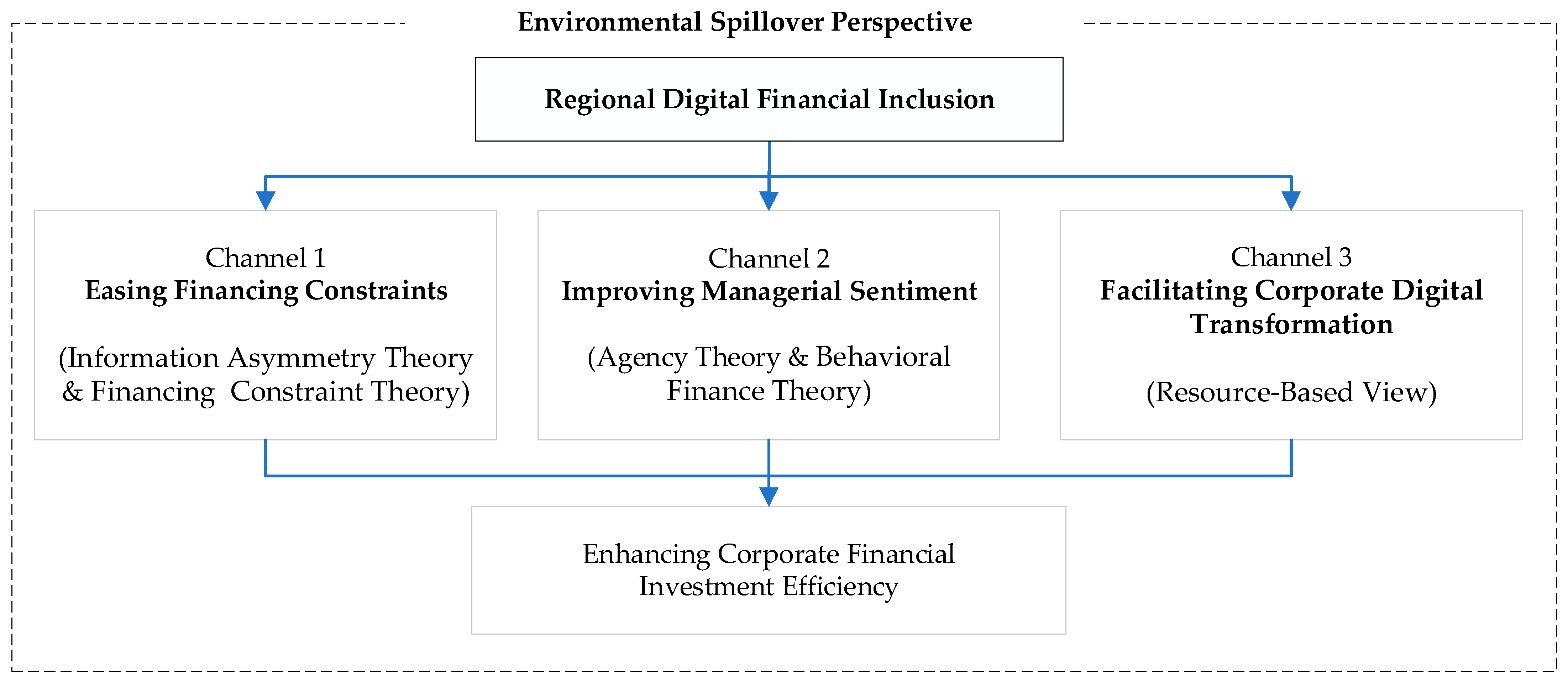
Building on these classical insights, this study further integrates financing constraint theory, behavioral finance theory, and the resource-based view (RBV) to construct a unified environmental spillover framework. Financing constraint theory explains how regional digital financial inclusion alleviates external financing frictions. Behavioral finance theory explains how it improves managerial decision-making through enhanced transparency and external monitoring. The RBV explains how it fosters digital transformation capabilities through ecosystem spillovers. Together, these theories jointly support the environmental spillover perspective: regional digital financial inclusion improves the local financial ecosystem, which in turn enhances corporate financial investment efficiency through multiple channels.
Figure 1 illustrates this conceptual framework.
Leveraging big data and artificial intelligence, regional digital financial inclusion improves the regional information environment and mitigates information asymmetry between capital providers and firms [
24]. As a result, credit becomes more accessible, the cost of finance is reduced, and greater transparency and higher external monitoring pressure discourage managerial opportunism. Consequently, regional digital financial inclusion is expected to enhance corporate financial investment efficiency in two ways: by alleviating underinvestment through improved financing access and by limiting overinvestment through stricter discipline in resource allocation. This leads to the following hypothesis (H1):
H1: Regional digital financial inclusion is positively associated with corporate financial investment efficiency via environmental spillover effects.
This study hypothesizes that the influence of regional digital financial inclusion operates through multiple layers. It functions not only as part of the external financial environment that shapes firms’ access to resources, but also as a factor that reshapes managerial cognition and decision-making by improving the information environment. On a more fundamental level, it may also drive changes in corporate organizational structures and capabilities.
Financing constraint theory suggests that external funds are costlier than internal resources, making firms reliant on internal cash flow and prone to under-investment [
25]. From the environmental spillover perspective, regional digital financial inclusion improves the local financial service system and lowers the cost of information processing, thereby easing external financing constraints for local enterprises. This leads to the following hypothesis (H2):
H2: Regional digital financial inclusion is associated with higher corporate financial investment efficiency by easing financing constraints.
For corporate internal decision-making, behavioral corporate finance theory indicates that cognitive biases of managers, especially over-optimism, are the main cause of corporate overinvestment [
26]. Over-optimistic managers are more likely to overestimate the expected return on investment projects and underestimate risks, which leads to excessive investment. Regional digital financial inclusion may help mitigate these biases in two ways. First, they may be minimized via the information provision effect: the regional digital financial inclusion ecosystem generates substantial amounts of high-frequency, real-time market information and peer reference information, which provides managers with a more comprehensive and objective source of information for decision-making and helps moderate their optimism bias [
27]. Second, they may be minimized via the enforcement effect: digitized financing and investment activities create a trail of information, increasing their visibility to external stakeholders such as analysts, institutional investors, and the media. This increased visibility strengthens agency-theoretic enforcement mechanisms such as monitoring, reputation, and career concerns. In turn, this raises the cost of self-serving managerial actions [
28].
Therefore, by improving the information environment and strengthening external monitoring, regional digital financial inclusion is associated with more rational managerial sentiment. In turn, such sentiment is expected to reduce overinvestment and improve financial investment efficiency. This leads to the following hypothesis (H3):
H3: Regional digital financial inclusion is associated with higher corporate financial investment efficiency by improving managerial sentiment.
From the perspective of organizational design and internal competencies, the resource-based view (RBV) suggests that digital transformation can create an advantage by enhancing firms’ abilities to capture, process, and exploit internal and external information [
29]. Regional digital financial inclusion is more than a technology and serves as a catalyst for firms’ digital transformation [
30]. Engagement with digital financial services often leads firms to upgrade financial systems and data management practices—a process that involves both internal IT system upgrades and decision-system integration—thereby enhancing information processing capabilities and overall operational intelligence. These improvements strengthen firms’ ability to assess investment risk and expected returns [
31], identify viable opportunities, and reduce irrational investment through more disciplined decision-making. This leads to the following hypothesis (H4):
H4: Regional digital financial inclusion is associated with higher corporate financial investment efficiency by facilitating corporate digital transformation.
In addition, based on institutional theory and the RBV, the magnitude of the above environmental spillover effect may vary systematically with firms’ institutional contexts and internal resource endowments, laying the foundation for heterogeneity analysis [
32,
33].
4. Empirical Analysis
4.1. Variable Distributions
Table 2 reports the descriptive statistics of all major variables. Consistent with the discussion in
Section 3.1, all continuous variables are winsorized at the 1st and 99th percentiles to mitigate the interference of outliers. The dependent variable
AbsFin has a mean of 2.335 and a median of 1.366, with a numerical range of 0.025 to 23.025. The mean being higher than the median suggests a right-skewed distribution: most firms show only small deviations from optimal financial investment, while a small subset exhibits much greater inefficiency. Its standard deviation of 3.199 points to substantial cross-firm variation in investment efficiency. This heterogeneity implies that a nontrivial proportion of firms face considerable inefficiency, creating a meaningful empirical context to explore the factors shaping financial investment behavior. It also underpins the heterogeneity analysis in
Section 6, which examines whether the effects of regional digital financial inclusion differ across ownership types and regions.
The core explanatory variable, DF, averages 245.592 with a median of 263.884, spanning from 59.090 to 363.217. A standard deviation of 80.466 reflects notable regional differences in the development of digital financial inclusion, with some areas far more advanced than others. The DF values indicate that our sample is skewed toward prefectures with relatively advanced digital finance development. This selection characteristic should be kept in mind when interpreting the results, as it may limit the generalizability of our findings to less digitally developed regions.
For the control variables, most show relatively close mean and median values, pointing to broadly symmetric distributions. For instance, firm size (Size) has a mean of 22.200 and a median of 22.022, while leverage (Lev) averages 0.412 with a median of 0.405. Firm growth (Growth) has a mean of 0.284 and a median of 0.121, consistent with the typical right-skewed pattern of corporate growth rates. Overall, the control variables exhibit suitable statistical properties for regression analysis.
Table 3 reports the variance inflation factors (VIF) for all independent variables. The highest individual VIF is under 2.05, with an average value of 1.45 across the set. Both figures fall comfortably below common critical thresholds, indicating that multicollinearity is not a major concern in the regression models.
4.2. Baseline Regression Analysis
Table 4 reports the estimated link between regional digital financial inclusion and corporate financial investment efficiency. In columns (1) through (4), the
DF coefficient remains consistently negative and statistically significant across all specifications, at the 1% or 5% level. These estimates imply that regional digital financial inclusion is associated with more efficient investment in financial assets.
Column (1) presents the baseline model without control variables. Here, the DF coefficient stands at −0.002 (p < 0.05), meaning each one-unit rise in DF is associated with a 0.002 drop in AbsFin. Including control variables in Column (2) amplifies this negative coefficient to −0.003 (p < 0.01), pointing to a more pronounced inverse relationship.
In Columns (3) and (4), the inclusion of firm fixed effects increases the absolute values of the DF coefficients to −0.010 and −0.008, respectively (both p < 0.01). These estimates are notably larger in magnitude than those reported in Columns (1) and (2), suggesting that controlling for time-invariant unobserved firm-specific heterogeneity reinforces the negative relationship between regional digital financial inclusion and inefficient financial asset investment. Concurrently, the R2 rises sharply to over 0.38 following the incorporation of firm fixed effects, which reflects a substantial improvement in the model’s explanatory power. Collectively, these empirical results provide robust support for H1.
4.3. Endogeneity Tests
Potential endogeneity issues in this analysis mainly stem from omitted variables, reverse causality, and sample selection bias. To improve the reliability of our empirical findings, we adopt several identification strategies, namely interactive fixed effects, lagged regional digital financial inclusion measures, and instrumental variable estimation.
4.3.1. Interactive Fixed Effects
To address omitted variable bias from time-varying unobserved heterogeneity across industries and regions, we incorporate province-year interactive fixed effects into the baseline specification. City-year fixed effects are infeasible because DF is measured at the city-year level, and including them would absorb the DF variable due to perfect multicollinearity.
Province-year fixed effects capture time-varying provincial shocks, such as changes in regional financial regulation and macroeconomic conditions [
41].
Table 5 presents the corresponding estimation results. The
DF coefficients stay negative and statistically significant at the 1% level in both columns, further confirming that the inhibitory effect of regional digital financial inclusion remains robust after accounting for detailed time-varying heterogeneity.
4.3.2. Regional Digital Financial Inclusion Lagged Terms
To address reverse causality concerns, we replace the contemporaneous
DF variable with its first-, second-, and third-period lags. This approach assumes that current corporate financial investment efficiency cannot affect past regional digital financial inclusion [
42].
Table 6 reports the regression results. The coefficient on the first lag is negative but statistically insignificant, whereas the coefficients on the second and third lags are both negative and significant at the 1% level.
These results imply that the influence of regional digital financial inclusion on corporate financial investment efficiency is not instantaneous, but tends to accumulate over time and remains fairly persistent. Such a lagged effect can be explained by the gradual spread of digital financial services and the inertial investment behavior typically observed among enterprises. The significant coefficients on lagged terms confirm that regional digital financial inclusion helps curb inefficient investment activities and enhance investment efficiency. The insignificant first lag may reflect the gradual diffusion of digital financial services and the inertial investment behavior typically observed among enterprises. However, we acknowledge that it could also be driven by mean-reversion noise in the index. Regardless of the interpretation, the significant coefficients on the second and third lags confirm that regional digital financial inclusion is associated with reduced inefficient financial investment over a multi-year horizon, and the use of lagged indicators helps address potential reverse causality concerns.
4.3.3. Instrumental Variable Approach
To further address potential endogeneity concerns—particularly reverse causality and omitted variable bias—we adopt an instrumental variable (IV) approach. Following Nunn and Qian [
43] and Huang et al. [
44], we construct our main IV as the interaction between the number of fixed-line telephones per 10,000 persons in 1984 (at the prefecture-city level) and the national internet user penetration rate in the previous year. The 1984 fixed-line telephone data predate our sample period by nearly three decades and are historically determined, so they cannot be directly affected by contemporary corporate investment decisions. National internet user penetration is an aggregate macro trend independent of individual firm activities. Cities with superior historical communication infrastructure faced lower costs for digital development, making them more likely to develop advanced regional digital financial inclusion ecosystems.
As shown in Column (1) of
Table 7, the IV exerts a strong positive effect on
DF (coefficient = 0.00009,
p < 0.001). The first-stage R
2 is 0.996, a figure that requires further explanation. This high value does not compromise our identification strategy. Given that the instrument and
DF are both measured at the city-year level, combined with year, industry, and firm fixed effects, shared time trends naturally drive high explanatory power. In addition, the PKU-DFII has strong temporal persistence and spatial correlation with historical infrastructure endowments, which is exactly the valid relevance we utilize. The Cragg–Donald Wald F statistic stands at 3053.19, well above the critical value of 10, ruling out the weak instrument problem. A high R
2 itself does not imply a violation of the exclusion restriction. The Anderson canonical correlation LM statistic (2718.045) further verifies instrument relevance.
A remaining concern relates to whether historical fixed-line telephone density influences corporate financial investment efficiency via channels beyond regional digital financial inclusion, such as long-term regional economic conditions, institutional quality, and industrial agglomeration. Our specification incorporates comprehensive firm-level controls and multi-dimensional fixed effects to absorb observable regional heterogeneity, which mitigates the bias that historical infrastructure may proxy for persistent local advantages. Admittedly, similar to most IV applications in corporate finance, our identification builds on the assumption that historical telecommunications infrastructure affects corporate financial investment efficiency solely through regional digital financial inclusion.
Table 7 reports the 2SLS estimation results. The second-stage coefficient of
DF is −0.025 (
p < 0.001), suggesting a causal link between regional digital financial inclusion and corporate financial investment efficiency. The control variables yield results consistent with the baseline regressions, reinforcing the robustness of our main findings.
4.4. Robustness Tests
To assess the stability and reliability of the baseline findings, this study implements four robustness checks: substituting the main explanatory variable with alternative measures, adjusting the clustering level of standard errors, incorporating lagged dependent variables, and performing subsample analysis based on city classification. The results from all specifications are consistent with the baseline estimates, indicating that the negative association between regional digital financial inclusion and corporate financial investment inefficiency is robust.
4.4.1. Replacing the Core Explanatory Variable
To examine the robustness of the baseline findings, we replace the aggregate
DF index with three sub-dimensions: coverage breadth, usage depth, and digitalization degree [
12].
Table 8 presents the corresponding regression outcomes. The results show that usage depth (
DF_D) and digitalization degree (
DF_Dig) yield significantly negative coefficients, consistent with the baseline results based on the composite index. This confirms that the documented effect is not biased by the construction of the aggregate index. By comparison, coverage breadth (
DF_B) lacks statistical significance, indicating that the influence of regional digital financial inclusion is heterogeneous across its dimensions. Instead, its role in curbing inefficient financial investments is largely linked to service usage depth and quality, namely the convenience, accessibility and reliability of digital financial services. The reason is that expanding coverage breadth merely enables more users to access basic digital financial services (e.g., opening a payment account), whereas curbing speculative financial investment requires deeper services such as real-time risk monitoring, data-driven credit assessment, and automated portfolio rebalancing. These deeper functions are captured by usage depth and digitalization degree rather than by coverage breadth alone.
4.4.2. Adjusting the Clustering Level of Standard Errors
To assess the robustness of our main results, we change the clustering of standard errors from the firm level (baseline) to the industry level and the city level. This allows us to test whether the estimated coefficients are sensitive to different assumptions about the error correlation structure [
45]. As shown in
Table 9, the
DF coefficient remains negative and statistically significant at the 1% level under both the industry-level and city-level clustering specifications.
4.4.3. Controlling for the Lagged Dependent Variable
The persistence of corporate financial investment efficiency is generally high, suggesting that the current efficiency of corporate financial investment is partly explained by past performance. To control for the dynamics and potential estimation bias, the first lag of the dependent variable (
L. AbsFin) is included in the baseline model [
46].
As shown in Column (1) of
Table 10, the coefficient of the lagged dependent variable is significantly positive. This outcome reveals obvious persistence in corporate financial investment efficiency, implying the presence of path dependence. Meanwhile, the core explanatory variable
DF carries a negative coefficient and remains statistically significant at the 1% level. This further indicates that the inhibitory effect of regional digital financial inclusion still holds strongly and significantly even after accounting for dynamic inertial characteristics.
4.4.4. Municipalities/Provincial Capitals vs. Ordinary Cities
Due to the significant regional differences in regional digital financial inclusion and corporate financial environments in China [
4], we divide the sample into two subsamples: municipalities and provincial capitals, and ordinary cities. Subsample regressions are then performed to examine the possibility of regional differences in the baseline results. As shown in Column (2) and (3) of
Table 10, the coefficient of
DF is negative and significant at the 1% level for ordinary cities, suggesting the effect of regional digital financial inclusion in enhancing corporate financial investment efficiency is greater in these cities. However, the
DF coefficient for municipalities and provincial capitals is not significant.
This pattern suggests that digital finance’s effect is statistically significant only in ordinary cities, where financial resources are more limited, while it is absent in municipalities and provincial capitals that already have more developed financial systems.
5. Mechanism Tests
The above analysis shows that regional digital financial inclusion enhances corporate financial investment efficiency, but the channels through which this effect operates remain to be explored. To better understand these mechanisms, we employ the mediation effect model of Baron & Kenny [
47] and examine three potential pathways: financing constraints, managerial sentiment, and digital transformation.
5.1. Financing Constraints
This study adopts the SA index developed by Hadlock & Pierce [
48] to gauge firm-level financing constraints. We use its absolute value, with larger value indicating more severe financing frictions. Unlike conventional indicators such as the KZ and WW indices, which depend heavily on cash flow and leverage, the SA index is constructed solely based on firm size and age. This feature makes it less susceptible to endogeneity bias and yields greater empirical robustness. The relevant estimation results are presented in
Table 11.
Column (1) shows that the regression coefficient of DF on the SA index is negative and statistically significant at the 10% level. This suggests that regional digital financial inclusion effectively alleviates corporate financing constraints. In Column (2), the SA index is positively correlated with AbsFin, with a coefficient of 0.620 (p < 0.01). This indicates that tighter financing constraints are associated with higher inefficient financial investment. Meanwhile, the coefficient of DF remains negative but declines in magnitude.
To further validate the financing constraints channel, we supplement our main analysis with direct balance-sheet-based working capital indicators. We construct three firm-level operational measures: accounts receivable turnover (operating revenue/accounts receivable), accounts payable turnover (operating cost/accounts payable), and borrowing cost (financial expenses/total liabilities). These measures follow the standard definitions widely adopted in the working capital management literature.
We use turnover ratios rather than turnover days because the former directly capture the velocity of cash conversion, which aligns more closely with our focus on corporate treasury efficiency. Regarding borrowing cost, due to data limitations (firms do not disclose the breakdown of interest expenses between short-term and long-term debt), we use the overall borrowing cost as a proxy. As shown in
Table 12, regional digital financial inclusion is significantly associated with higher accounts receivable turnover (coefficient = 0.193,
p < 0.05), higher accounts payable turnover (coefficient = 0.020,
p < 0.05), and lower borrowing cost (coefficient = −0.0001,
p < 0.05). These findings indicate that regional digital financial inclusion improves corporate treasury efficiency by accelerating cash collection, optimizing payment cycles, and reducing financing costs, providing convergent evidence for the financing constraints channel.
Collectively, the above empirical findings are consistent with the underlying mechanism. Specifically, regional digital financial inclusion is associated with mitigated financing constraints and reduced inefficient financial investment, providing suggestive evidence consistent with H2.
5.2. Managerial Optimism
Based on Zeng et al. [
49], managerial sentiment (
MngSentiment) is measured through textual analysis of the Management Discussion and Analysis (MD&A) sections of firms’ annual reports. Owing to limited textual data, this mechanism analysis relies on a reduced sample size, which is typical for text-based measures and does not affect the validity of the empirical results.
As shown in Column (3) of
Table 11, the
DF coefficient on
MngSentiment is 0.014 (
p < 0.1), suggesting that regional digital financial inclusion is associated with more rational managerial sentiment by reducing information asymmetry. Column (4) reports a negative coefficient of −0.007 for
MngSentiment on
AbsFin (
p < 0.1), indicating that improved managerial sentiment is associated with reduced inefficient financial investment (since a lower
AbsFin implies higher efficiency). Overall, these results are consistent with the proposed channel by showing that regional digital financial inclusion is associated with improved managerial sentiment, which in turn is associated with reduced inefficient financial investment, providing suggestive evidence consistent with H3.
5.3. Digital Transformation
Following Wu et al. [
50], this study develops a corporate digital transformation index (
Dig) based on textual analysis of listed firms’ annual reports. The index is constructed using word frequency analysis, in which key technology terms—such as artificial intelligence, big data, and cloud computing—are systematically identified and categorized. This approach captures the extent to which firms engage with and adopt digital technologies.
As shown in Column (5) of
Table 11, the coefficient of
DF on
Dig is 0.005 (
p < 0.01), indicating that regional digital financial inclusion is associated with corporate digital transformation. In Column (6), the coefficient of
Dig on
AbsFin is −0.057 (
p < 0.05), suggesting that digital transformation is associated with reduced inefficient financial investment through enhanced decision-making and operational efficiency. The diminished
DF coefficient is consistent with a sequential mechanism: regional digital financial inclusion is associated with corporate digital transformation, and this transformation is in turn associated with reduced inefficient financial investment. Collectively, these results provide suggestive evidence consistent with H4.
5.4. Bootstrap Mediation Tests
To address concerns about the distributional assumptions of the indirect effects in the traditional Baron and Kenny approach, we re-estimated the mediation models using bootstrap standard errors with 1000 replications. As shown in
Table 13, these tests confirm significant partial mediation for all three channels.
The indirect effects for all three channels are statistically significant, with 95% bias-corrected confidence intervals excluding zero. The direct effects remain significant, indicating partial mediation. Specifically, for financing constraints, the indirect effect is −0.00028 (p < 0.001, 95% CI [−0.00041, −0.00002]); for managerial sentiment, it is −0.00038 (p < 0.001, 95% CI [−0.00052, −0.00024]); and for digital transformation, it is −0.00018 (p < 0.05, 95% CI [−0.00034, −0.00002]).
We acknowledge that the textual measures for managerial sentiment and digital transformation have inherent limitations. Both are derived from analysis of annual report text and may share common measurement errors. In addition, the timing of the textual measures relative to investment periods could raise concerns about reverse causality. Despite these limitations, the bootstrap results provide further evidence for the robustness of our mediation findings and are consistent with the interpretation that financing constraints, managerial sentiment, and digital transformation act as partial mediating channels, with the findings for managerial sentiment and digital transformation interpreted as suggestive evidence.
6. Heterogeneity Analysis
To examine how the impact of regional digital financial inclusion on corporate financial investment efficiency varies across different contexts, a heterogeneity analysis is conducted based on firm ownership, regional development, and industry characteristics. Ownership structure is an important institutional feature in China, as state-owned enterprises (SOEs) and non-SOEs differ significantly in terms of financing conditions, governance mechanisms, and policy support. These differences may lead to heterogeneous effects. Moreover, regional development levels shape digital infrastructure, financial market maturity, and the broader business environment. Given China’s large regional disparities, the penetration and use of regional digital financial inclusion vary widely, which may further influence its effect on investment efficiency. In addition, industries differ greatly in data intensity, transaction patterns, and reliance on digital financial services. Sectors with high consumer interaction and frequent online transactions are more likely to capture digital finance dividends, whereas asset-intensive and B2B-dominated industries exhibit distinct responses. Therefore, we further examine sectoral heterogeneity to clarify the boundary conditions of the baseline effect.
6.1. Heterogeneity by Ownership Type: SOEs vs. Non-SOEs
Firms differ substantially in financing channels, internal governance structures, and resource acquisition capabilities, which may lead to heterogeneous impacts of regional digital financial inclusion on corporate investment efficiency.
Table 14 reports the subsample regression results. For state-owned enterprises (SOEs), the
DF coefficient is −0.004 and statistically insignificant. By contrast, the coefficient of
DF reaches −0.012 (
p < 0.01) among non-SOEs. This suggests that the negative association between regional digital financial inclusion and inefficient financial investment is statistically significant for non-state-owned enterprises, but not for state-owned enterprises.
These findings are consistent with theoretical predictions. Non-SOEs are generally subject to more severe financing frictions and information asymmetry. Accordingly, regional digital financial inclusion performs a significant function in mitigating such constraints and lifting investment efficiency. By contrast, SOEs enjoy better financing access and greater policy support, and are therefore less reliant on regional digital financial inclusion, which yields an insignificant effect on investment efficiency improvement.
6.2. Heterogeneity by Regional Development: Eastern vs. Central vs. Western Regions
Regional economic conditions and the maturity of local financial systems can lead to heterogeneous outcomes of regional digital financial inclusion across areas.
Table 15 presents grouped regression results by region. For the eastern region (Column 1), the
DF coefficient is −0.008 (
p < 0.05). In contrast, while the coefficient remains negative for central China (Column 2) and western China (Column 3), it is not statistically significant. This finding indicates that the association between regional digital financial inclusion and higher financial investment efficiency is statistically significant only in the eastern region. Eastern China, with stronger digital infrastructure, more advanced digital finance, and richer application scenarios, enables local enterprises to make better use of digital financial services. Meanwhile, central and western regions lag in digital finance development, with lower market penetration and weaker institutional capacity, which limits its impact on corporate investment efficiency.
6.3. Sectoral Heterogeneity: High-Contact vs. Low-Contact Industries and Manufacturing vs. Non-Manufacturing
To further explore the boundary conditions of the baseline effect, we conduct two sectoral heterogeneity analyses across different industries.
First, guided by the environmental spillover perspective, we classify industries as high- or low-contact sectors based on their interaction intensity with the Alipay ecosystem. High-contact industries include wholesale and retail, transportation, warehousing and postal services, accommodation and catering, information transmission, software and IT services, leasing and business services, as well as culture, sports, and entertainment. These consumer-oriented sectors feature frequent transactions and abundant online payment scenarios, enabling firms to generate abundant digital footprints. In comparison, low-contact industries (all other sectors) are mostly asset-heavy, production-oriented B2B businesses that depend heavily on traditional credit and long-term capital.
Table 16 (Columns 1–2) reports the subsample results. The
DF coefficient is negative and significant only in low-contact industries (−0.007,
p < 0.01), whereas it is insignificant in high-contact industries (−0.009,
p > 0.10). We discuss three plausible interpretations for this discrepancy.
First, intuitively, high-contact industries are closely linked to the Alipay ecosystem that the PKU-DFII is built upon. If this index merely captures firms’ direct interactions with the platform, a stronger effect should be observed in these industries. Our contrary findings demonstrate that the PKU-DFII is not a direct measure of firm-level digital finance adoption.
Second, our results validate the complementary function of regional digital financial inclusion. Low-contact industries face severe information asymmetry due to their asset-heavy characteristics, and thus benefit greatly from the alternative credit assessment tools delivered by regional digital financial inclusion. This finding defines a clear boundary for the construct validity of the PKU-DFII: the index’s explanatory capacity for corporate financial decisions differs substantially across industries. Accordingly, scholars should interpret relevant mechanisms prudently and refrain from equating this regional indicator with firm-specific digital finance usage.
Third, the insignificant outcome for high-contact industries is partially attributed to its smaller sample size (N = 5274 versus N = 24,412), which weakens statistical power. Nevertheless, the complementary financial mechanism remains our dominant explanation, supported by consistent results across multiple industry classifications.
Next, we split the full sample into manufacturing and non-manufacturing firms based on CSRC industry codes, where C-coded industries refer to manufacturing sectors. As shown in
Table 16 (Columns 3–4), the
DF coefficient is significantly negative for manufacturing firms (−0.007,
p < 0.05) and insignificant for non-manufacturing firms (−0.006). This pattern aligns with the results of low-contact industries: manufacturing firms have large capital spending needs, long investment cycles, and high dependence on external funding. Hence, they are more responsive to the financing relief provided by regional digital financial inclusion.
6.4. Reconciliation of Heterogeneity Findings
Taken together, the heterogeneity analyses reveal a consistent pattern that can be explained through the three theoretical lenses underlying our conceptual framework: financing constraint theory, behavioral finance theory, and the resource-based view (RBV).
Ownership heterogeneity. The finding that regional digital financial inclusion is associated with a statistically significant reduction in inefficient financial investment for non-state-owned enterprises (non-SOEs) but not for SOEs can be understood from both financing constraint theory and behavioral finance theory. Non-SOEs typically face more severe information asymmetry and have limited access to conventional bank credit, making them more responsive to the alternative credit assessment channels provided by the digital finance ecosystem (e.g., transaction data, digital footprints). In addition, non-SOEs are subject to weaker external monitoring compared to SOEs, which often benefit from closer scrutiny by government agencies and state-owned banks. The increased transparency and real-time information enabled by digital finance thus has greater scope to discipline managerial sentiment in non-SOEs, where baseline agency problems are more pronounced.
Regional and urban heterogeneity. The observed pattern—significant effects in eastern China and ordinary cities, but insignificant effects in central/western regions and provincial capitals/municipalities—reflects the interaction between digital infrastructure threshold effects and traditional finance substitution effects, which aligns with the RBV and financing constraint theory, respectively. From the RBV perspective, firms can only absorb technological spillovers from regional digital finance if the local environment possesses a minimum threshold of digital infrastructure (e.g., internet penetration, data processing capacity). Eastern China has crossed this infrastructure threshold, whereas central and western regions lag behind, limiting the digital transformation channel. From the financing constraint perspective, ordinary cities suffer from inadequate traditional financial supply, creating substantial room for digital finance to play a substitution or complementary role. In contrast, provincial capitals and municipalities already have well-developed traditional financial systems, leaving little marginal benefit for digital finance to add. Therefore, the strongest restraining effect on inefficient financial investment is observed precisely where both conditions are met: adequate digital infrastructure (eastern region) and limited traditional financial access (ordinary cities).
Sectoral heterogeneity. The finding that the negative association is statistically significant in low-contact industries and manufacturing firms—both of which rely heavily on external financing—is consistent with financing constraint theory. These sectors face higher capital expenditure needs, longer investment cycles, and greater dependence on external credit. Traditional financial institutions often struggle to assess the creditworthiness of firms in these sectors due to information frictions (e.g., lack of collateral, opaque cash flows). The regional digital financial inclusion ecosystem, by providing alternative data sources and real-time monitoring, is associated with alleviating these frictions. In contrast, high-contact industries (e.g., wholesale, retail, IT services) already generate rich digital footprints through their routine transactions with consumers and online platforms, making them less dependent on the incremental information provided by regional digital finance. The lack of statistical significance for high-contact industries may also be partly attributable to their substantially smaller sample size (N = 5274) compared to low-contact industries (N = 24,412), which reduces statistical power.
Summary. Overall, the heterogeneity analysis demonstrates that the statistically significant negative association between regional digital financial inclusion and inefficient financial investment concentrates among non-state-owned enterprises, eastern-region firms, ordinary cities, low-contact industries, and manufacturing firms. These patterns are not arbitrary but follow a coherent theoretical logic: regional digital financial inclusion serves as a complementary rather than a pure substitute financial ecosystem, is associated with stronger restraining effects on inefficient financial investment precisely where traditional finance is least effective and where digital infrastructure thresholds are met.
7. Conclusions and Implications
Using panel data on Chinese A-share-listed firms from 2011 to 2023 (29,868 firm-year observations), this paper examines how regional digital financial inclusion, interpreted as an external environmental spillover, is associated with corporate financial investment efficiency and identifies the channels through which it operates. To support causal claims, endogeneity is addressed using interactive fixed effects, lagged regressors, instrumental variable estimation, and multiple robustness checks. The results suggest that the regional digital financial inclusion environment is associated with reduced inefficient investment (improved efficiency). Three pathways are uncovered: easing financing constraints, improving managerial sentiment, and accelerating digital transformation. Heterogeneity analysis further indicates that the positive association is statistically significant and concentrated among non-state-owned enterprises, firms in eastern China, low-contact industries (those with limited traditional financial access), and manufacturing firms, while it is statistically insignificant for state-owned enterprises, firms in central and western regions, high-contact industries, and non-manufacturing firms. These cross-ownership, cross-regional, and cross-sectoral patterns collectively highlight that regional digital financial inclusion exhibits a stronger association where traditional financial services are less accessible, and its benefits depend on adequate digital infrastructure and industry characteristics.
This paper delivers two main theoretical contributions. First, it contextualizes information asymmetry and financing constraint theories within the regional digital financial inclusion setting, suggesting that such development is associated with reduced information frictions and eased financing pressure, thereby associated with improved corporate financial investment efficiency. Second, by identifying three transmission pathways and demonstrating heterogeneous effects across ownership, region, and industry, the study extends existing research on the drivers of investment efficiency in the digital economy, shifting the focus from physical to financial investment and uncovering the boundary conditions under which regional digital financial inclusion exhibits the strongest association with investment efficiency. Notably, while the adopted index primarily captures the regional financial service environment for consumers and small merchants rather than firm-level digital finance adoption, the combination of theoretical mechanisms and empirical identification strategies supports reasonable inferences.
From the corporate perspective, listed firms may leverage the spillover effects of regional digital financial inclusion to alleviate financing difficulties, standardize investment decision-making, and accelerate internal digital upgrading. Non-state-owned enterprises can leverage inclusive digital financial resources to realize rational capital allocation. State-owned enterprises and firms in central and western regions need to overcome institutional constraints and operational inertia to narrow efficiency gaps. For firms in low-contact industries and manufacturing sectors that rely heavily on external financing, actively engaging with digital financial services may be particularly beneficial in overcoming traditional credit constraints.
For policymakers, promoting high-quality development of regional digital finance requires strengthening digital infrastructure, especially in central and western areas, while maintaining a balanced regulatory framework that supports innovation without compromising systemic stability. Targeted interventions—such as credit guarantees, digital lending platforms, and subsidy schemes—should prioritize SMEs and economically lagging regions. Given the heterogeneous effects across industries, policymakers may consider providing tailored support for digital finance adoption in manufacturing and low-contact sectors (e.g., wholesale, logistics, IT services), where dependence on external financing is high. In addition, improving the institutional environment for non-SOEs and encouraging financial institutions to design customized products can further enhance the inclusiveness and coordination of digital finance, ultimately supporting sustainable economic growth.