1. Introduction
Infrastructure development in developing countries is heavily dependent on public finance, primarily overseas development aid. This dependence has led to several challenges, including severe investment gaps, inadequate maintenance, threats to sovereignty, and other issues. Increased private-sector investment is crucial for addressing these challenges, and the need to reconsider innovative financing and new investment models has become increasingly evident. In this context, this study explores how developing countries can attract private investment in infrastructure development.
For Pacific Island countries (PICs) facing the catastrophic impacts of the climate crisis, infrastructure development constitutes an urgent and critical policy priority. Additionally, several PICs are nearing their maximum debt capacity. Therefore, PICs must adopt proactive approaches and develop innovative solutions to address the vulnerabilities and challenges they confront.
As a global trend, investors have begun to incorporate environmental, social, and governance (ESG) issues into their investment decision-making processes. In particular, the environmental pillar has received significant attention. Accordingly, companies are strengthening their efforts to address ESG issues, particularly greenhouse gas (GHG) emissions, and disclose their approaches and actions in this area to raise funds from investors.
In January 2013, the Japanese government introduced the joint credit mechanism (JCM), under which the government encourages Japanese companies to invest in projects aimed at reducing or removing GHG emissions through the transfer of advanced low-carbon technologies, systems, and infrastructure to partner countries. This mechanism offers subsidies, primarily from the Japanese government, covering up to 50 per cent of the initial investment costs for Japanese companies. The JCM scheme may be further vitalised by the dissemination and expansion of ESG concepts.
The JCM provides an institutional framework for international cooperation that renders technology deployment both practically feasible and economically viable. In this sense, the innovativeness of the JCM lies not only in the technologies themselves but also in the institutional design of cooperation enabling their deployment. However, the JCM has not yet been widely used, especially in the Pacific Islands region. To unlock its full potential, revisions to both its institutional design and operational implementation are indispensable.
Against the backdrop of a growing need for new frameworks to attract private investment in infrastructure development in developing countries, this study examines the challenges facing the current JCM and explores how this mechanism can be revised. We argue that JCM-driven innovation through the expanded application of ESG principles has the potential to serve as a catalyst for mobilising private-sector investment in infrastructure development.
Methodologically, this study adopts a conceptual and policy-analytical approach, drawing on a qualitative comparative institutional assessment of the current and revised JCM. Rather than employing formal economic modelling, it relies on document-based institutional analysis to achieve the study’s objectives. The analysis is based on a purposive selection of official policy documents, government reports, institutional materials and relevant secondary literature directly related to the design, implementation, and reform of the JCM. These sources were synthesised through a qualitative comparison of the current and revised JCM, with particular attention to institutional arrangements, implementation constraints, financing implications, and the conditions under which the mechanism may function more effectively.
The remainder of this paper is organised as follows. The following section discusses the challenges of public financing for infrastructure development in developing countries, including the investment gap and lack of maintenance.
Section 3 outlines the issues faced by PICs in relation to the climate crisis.
Section 4 explains global ESG trends, and
Section 5 explores the current JCM and proposes a revised JCM scheme to boost utilisation by companies. In these sections, by examining how linking ESG and the JCM can promote the expansion of private capital into infrastructure development, a new framework to accelerate private investment is developed.
Section 6 concludes this paper by summarising how the proposed framework provides benefits for all stakeholders.
2. Challenges of Infrastructure Development in Developing Countries
2.1. Investment Gap
The Organisation for Economic Co-operation and Development (OECD) indicates that an annual investment of USD 6.9 trillion in sustainable infrastructure development is required globally by 2030 [
1]. This organisation also notes that the estimated annual investment gap in infrastructure development ranges from USD 2.5 trillion to USD 3.5 trillion [
2], while the United Nations Conference on Trade and Development (UNCTAD) states that the global infrastructure investment gap is projected to surpass USD 15 trillion by 2040 [
3].
According to the Asian Development Bank’s (ADB’s) latest comprehensive region-wide estimate [
4], all 45 developing member countries require infrastructure investment (climate-adjusted estimate, including costs of climate mitigation and adaptation) of USD 26.2 trillion (22.6 trillion without climate-related investment) between 2016 and 2030, or approximately USD 1.7 trillion (1.5 trillion without climate-related investment) per year. The total investment must increase dramatically, as 32 of the 45 developing member countries require infrastructure investment of USD 17.4 trillion between 2016 and 2030, or approximately USD 1.2 trillion a year [
4] while the total investment requirement between 2010 and 2020 was estimated to be USD 8.2 trillion or approximately USD 750 billion a year [
5]. The World Bank also notes that total investment requirements (including both development and climate-related requirements) in emerging markets and developing countries other than China are projected to rise from approximately USD 1 trillion per year by 2025 to USD 2 to 2.8 trillion by 2030 [
6].
Overall, current investment in infrastructure development is insufficient. According to the ADB [
7], 25 developing countries with adequate data faced an annual investment (climate-adjusted) gap in infrastructure development of approximately USD 459 billion between 2016 and 2020. The actual investment amount was USD 881 billion in 2015, while annual needs were USD 1340 billion between 2016 and 2020. Excluding the People’s Republic of China, which has a massive economy, the gap for the remaining 24 countries was approximately USD 308 billion between 2016 and 2020 (
Table 1). The actual investment amount was USD 195 billion in 2015, while the annual requirements were USD 503 billion between 2016 and 2020 (
Table 1).
The UNCTAD reported that the investment gap in key sustainable development goal (SDG) sectors in developing countries increased from USD 2.5 trillion in 2015 to USD 4 trillion in 2023 and USD 4.3 trillion in 2025, and this gap continues to expand due to geopolitical instability, macroeconomic uncertainty, and fiscal pressures [
3,
8]. This organisation has indicated that infrastructure development has become imperative for achieving the SDGs in developing countries [
9].
OECD data indicate that the percentage of the financial gap in investment requirements ranges from 36.2 per cent to 50.7 per cent worldwide [
1,
2], while ADB data reveal that the percentage of the financial gap in investment requirements in 24 developing countries is 61.1 per cent [
4]. Accordingly, developing countries have suffered disproportionately from a lack of financial investment for infrastructural development.
In these 24 countries, public finance, consisting of both tax and non-tax revenues, borrowings via bonds and loans, ODA from donor countries, and support from multilateral development banks, is central to investment in infrastructure development, as approximately 67.9 per cent of investment (USD 132.5 billion out of USD 195 billion) was financed by the public sector in 2015 [
7]. The ADB assumed that through public finance reforms, the public sector would be able to increase financing to USD 253.5 billion from 2016 to 2020, representing an increase of USD 121 billion (
Table 1). Based on this figure, the private sector would be required to increase its investment dramatically from USD 62.5 billion to USD 250 billion to meet the annual requirement of USD 503.5 billion (
Table 1). The ADB expects private-sector finance, including debt (borrowing from commercial banks and issuing corporate bonds and project bonds), equity (public and private equity), and foreign direct investment, to bridge approximately 60.8 per cent of the gap (USD 187.5 billion out of USD 308.5 billion) going forward (
Table 1).
The UNCTAD also stated that unreasonable expectations for public finance must be avoided and that an increase in private-sector investment would be essential to fill any financial gaps in infrastructure development in developing countries [
9]. The ADB notes that traditional sources of government financing alone are insufficient to meet the growing demand for infrastructure financing and that innovative financing mechanisms are required to attract private and institutional capital, in addition to public funds, to fund critical infrastructure [
10]. The OECD states that although public finance remains crucial, private finance must fill the bulk of the gap [
11].
Infrastructure development is also a critical priority for the Pacific Islands region, given its essential role in promoting resilient development and addressing climate vulnerability. Climate change has been recognised as the single greatest threat to the livelihoods, security, and well-being of the peoples of the Pacific [
12]. In this context, the Pacific Islands Forum has emphasised the importance of infrastructure development in advancing the 2050 Strategy for the Blue Pacific Continent through the adoption of the Pacific Quality Infrastructure Principles [
13]. These principles aim to enhance the quality of regional infrastructure investment and development, in line with Pacific-identified priorities. Development partners are also central to this effort. For example, the Japan International Cooperation Agency supports the Pacific Region Infrastructure Facility (PRIF), which is a multi-partner coordination mechanism, aimed at advancing infrastructure development and policy reform across PICs.
Between 2008 and 2021, the official development finance (ODF), including grants, concessional loans, and non-concessional loans, allocated to infrastructure investments in the Pacific Islands totalled USD 9.2 billion, with annual flows averaging approximately USD 663 million [
14]. Infrastructure development accounted for more than a quarter of all ODF disbursed in the region, making it the second-largest category after governance and civil society projects [
15]. Notably, ODF for infrastructure development has increased dramatically in recent years [
14,
15], reflecting the significance of development assistance from external partners.
Regardless, the region continues to face immense infrastructure investment needs, estimated at USD 2.8 billion annually until 2030, with an additional USD 300 million per year required for climate mitigation and adaptation [
16]. The International Finance Corporation states that USD 46 billion in investment is required from 2016 to 2030 to overcome the Pacific’s infrastructure deficit [
17]. Consequently, PICs are experiencing severe financing shortfalls for infrastructure development.
The average debt-to-GDP ratio for ADB’s Pacific Developing Member Countries, which stood at 35 per cent in 2018, was projected to rise to 44 per cent by 2024; however, none of the 15 members was reported to be in debt distress based on International Monetary Fund (IMF) ratings [
16]. Furthermore, with 60 per cent of infrastructure financing in the Pacific being loan-funded [
14], the urgency of improving debt sustainability has intensified. Although PICs have pursued reforms such as improved expenditure management and strengthening revenue generation, the small and vulnerable nature of their economies suggests that these measures alone are unlikely to create sufficient fiscal space to absorb significantly more debt.
The level of infrastructure aid from donor countries continues to fall short of meeting recipient countries’ needs, creating a substantial financing gap. Simultaneously, many PICs appear to be reaching the limits of their debt absorption capacity. These dual constraints from both the supply and demand sides underscore the growing difficulty of relying solely on public financing for infrastructure development. Consequently, mobilising greater private-sector investment has become crucial for closing the financing gap and achieving sustainable infrastructure development. The Pacific Quality Infrastructure Principles explicitly highlight the importance of promoting private-sector-led investment, supported, where appropriate, by the prudent use of public funds, and encourage the consideration of a wide range of financing models and tools [
13].
2.2. Lack of Maintenance
In developing countries, the infrastructure developed through public finance often lacks maintenance. Several roads have holes, and there are numerous non-operational facilities, including wharves and halls. Several countries have witnessed cases in which individuals who previously received electricity or clean water through facilities established by public finance developmental assistance in the past no longer receive these resources.
These maintenance problems are largely attributable to a lack of funding. Governments in developing countries do not have sufficient financial resources, meaning that they cannot afford to maintain infrastructure. The Public Investment Management Assessment (PIMA), which is a comprehensive framework developed by the IMF for assessing infrastructure governance practices, evaluates the available budget for maintenance (i.e., can expenditures pertaining to routine maintenance and major improvements be identified in the budget?) [
18]. The scores of advanced economies, emerging markets, low-income developing countries, and fragile states in the evaluation of the budget for maintenance are 2.00, 1.59, 1.27, and 1.24, respectively. In this assessment, three possible scores are assigned (1: not met; 2: partially met; 3: fully met) [
18].
Additionally, the PIMA demonstrates that developing countries have failed to establish methodologies for estimating routine maintenance needs and budget funding and for determining major improvements to existing infrastructure. Regarding the former issue (i.e., is there a standard methodology for estimating routine maintenance needs and budget funding?), the scores of advanced economies and low-income developing countries are 1.67 and 1.13, respectively, while for the latter issue (i.e., is there a standard methodology for determining major improvements, such as renovations, reconstructions, and enlargements, to existing assets, and are such improvements included in national and sectoral investment plans?), the scores are 2.33 and 1.31, respectively [
18].
Beyond a lack of funding, some researchers have offered different perspectives on why infrastructure maintenance has often been neglected in developing countries. In most developing countries, infrastructure development has traditionally been heavily dependent on funds from donor countries and support from multilateral development banks. Although donors are expected to play a role in promoting maintenance, similar to the governments of developing countries, they prefer to build new infrastructure, rather than maintain existing infrastructure. The governments of developing countries are also eager to build new infrastructure owing to their specific interests (e.g., the state believes that new infrastructure will draw votes and attract the attention of the media) [
19,
20]. Dornan explained that the construction of new infrastructure, which is typically reported by the media, has political and social impacts and provides donors with a means of spending money effectively [
21]. Du Preez stated that it is often easier for governments in developing countries to receive foreign aid for the construction of new infrastructure than for the maintenance of existing infrastructure [
22]. This pattern is closely linked to the concept of performative development, which views development in its current form as akin to a carefully choreographed dance performed to tunes (agendas) defined elsewhere. The performance centres on the donors, in this case, the state [
23], and projects prescriptive imagery supporting a master narrative of friendship and generosity [
24], which is unconsciously accepted without significant thought or critique. This approach deprives more effective development strategies, such as the maintenance of previously established infrastructure, of essential resources.
Mitigating the effects of ageing and preserving the quality of infrastructure is essential, as neglecting to do so will result in substantial fiscal costs. When maintenance activities are insufficient, infrastructure will begin deteriorating quickly, resulting in higher costs for repairs and replacements [
25]. For example, the World Bank stated that timely road maintenance through the spending of USD 12 billion in Africa would have saved reconstruction costs of USD 45 billion [
26], while the US Department of Transportation demonstrated that each dollar spent on preventative maintenance early in airfield pavement life is equivalent to four or five dollars spent later for the same purpose [
27].
A PRIF study on maintenance across the Pacific outlines the importance of adequately budgeting and managing ‘whole-of-life’ infrastructure costs to ensure that infrastructure assets achieve their maximum potential life [
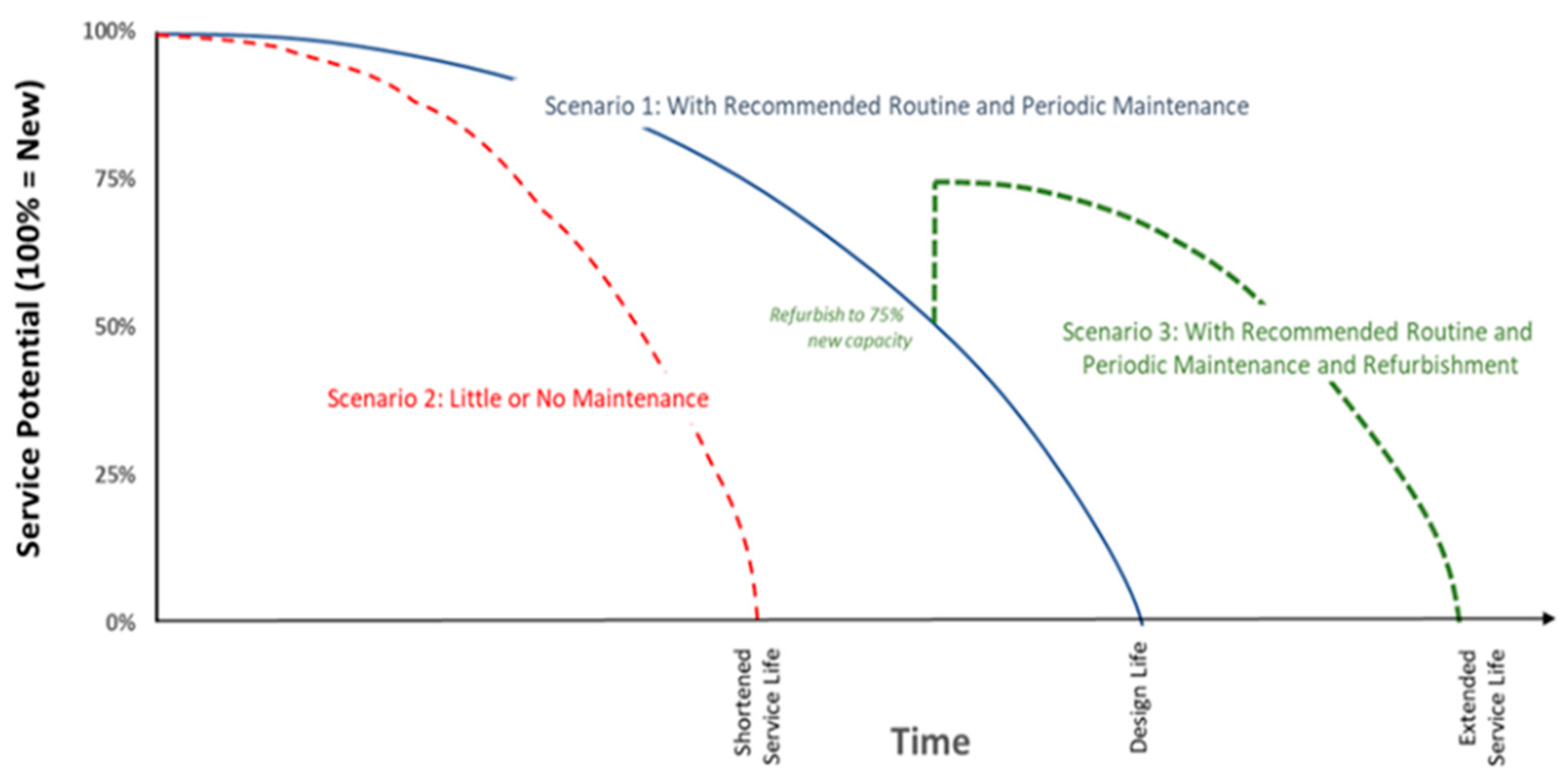
28]. When new infrastructure is built, it is typically assigned a ‘design life’, based on which its economic viability is assessed. To achieve this design life, asset managers must adhere to manufacturers’ recommended maintenance regimes or accepted best practices. When maintenance regimes are not followed, assets will fail to meet service standards (e.g., pumping capacity and in-service hours), requiring replacement before their design life has been realised. In this situation the ‘service life’ of the asset will be less than its design life (Scenario 2 in
Figure 1). ‘Capital maintenance’ in the form of rehabilitation or refurbishment can restore an asset’s service potential and extend its service life beyond its original design life (Scenario 3 in
Figure 1). The Maintenance Benchmarking Report promotes a shift towards Scenario 3, whereby a greater volume of planned capital maintenance is conducted to extend the service life of infrastructure assets beyond their original design life, resulting in overall lower whole-of-life costs to infrastructure entities.
Furthermore, neglecting maintenance leads to negative environmental impacts, hampering the achievement of SDGs. For example, in developing countries, a lack of maintenance causes daily water leakage of approximately 45 million cubic metres, which is equivalent to the needs of 200 million people [
29]. Wang demonstrated that extending the life of pavement through preventive maintenance could reduce GHG emissions by up to 2 per cent [
30].
3. Climate Crisis in the Pacific Islands Region
Reliable and resilient infrastructure is essential for supporting a stable and prosperous economy. However, PICs face significant challenges associated with climate change, and the nature and extent of these challenges vary across countries according to governance conditions, institutional capacity, and economic circumstances. These impacts are wide-ranging, affecting housing, hospitals, utilities, water systems, and energy infrastructure through both rapid-onset events (e.g., cyclones, floods) and slow-onset changes (e.g., sea level rise, coastal erosion) [
31,
32]. These threats undermine community resilience, habitability, and access to essential services [
33].
PICs are particularly vulnerable owing to their geographic location in the Pacific ‘Ring of Fire’, exposing them to earthquakes, tsunamis, and volcanic eruptions, which are further intensified by climate change. Extreme weather events, such as Tropical Cyclone Winston (2016) in Fiji (causing USD 1.4 billion in damage) and Cyclone Pam (2015) in Vanuatu, demonstrate the devastating economic and social consequences of the climate crisis, which disproportionately affect marginalised communities [
34]. Rising urbanisation, especially in coastal areas, exacerbates risks, with poor planning leading to increased flooding [
35]. Various studies have projected severe economic losses. For example, Fiji could face annual losses of USD 34.7 million owing to flooding [
36], while Kiribati may lose USD 430 million by 2050 as a result of land and infrastructure inundation [
37].
Governance challenges, including transparency and accountability issues, hinder the ability of PICs to secure financing for climate-resilient infrastructure. Several PICs rely on external aid, but funding remains insufficient, creating a financing gap. Innovative adaptation measures, such as seawalls and desalination plants, are costly, leading some to explore alternatives such as geobags for coastal protection [
38]. ‘No-regret’ or ‘low-regret’ strategies, which prioritise long-term resilience over short-term gains, are increasingly being adopted [
39].
Insurance mechanisms, such as parametric micro-insurance (e.g., the Pacific Insurance and Climate Adaptation Programme), offer some degree of protection, but coverage remains low. Only 3 per cent of businesses and 1 per cent of households in low-income countries have disaster insurance, compared with 30 per cent in developed countries [
40]. Ultimately, PICs must balance financial constraints with urgent infrastructure needs, often relying on international support. Therefore, further discussion is needed to explore financing and policy solutions in greater depth.
4. The Mainstreaming of Environmental Consideration in Investor and Corporate Behaviour
ESG is a multidimensional framework for evaluating the sustainability and ethical impact of a company’s operations. The environmental pillar focuses on a company’s impact on the planet, including GHG emissions, resource use, and climate change mitigation, while the social pillar examines how a company manages relationships with employees, suppliers, customers, and communities, addressing issues such as diversity, labour rights, and community engagement. The governance pillar evaluates corporate transparency and shareholder rights. ESG has served as a practical tool to achieve the global objectives of the United Nations’ SDGs and has become a cornerstone for businesses, investors, and governments seeking to address global challenges such as climate change, social inequality, and corporate accountability. Investors, banks, insurance companies, and asset managers increasingly use ESG criteria in their decisions, recognising that companies with strong ESG performance are better positioned for sustainable growth. In this sense, ESG has evolved from a niche concept into a mainstream framework that shapes corporate practices, investment strategies, and government policies.
The modern ESG framework began to take shape in 2004, when the Swiss Federal Department of Foreign Affairs and the United Nations published the ‘Who Cares Wins’ report [
41], which encouraged financial institutions to integrate ESG factors into investment decisions. This report was followed by the launch of the Principles for Responsible Investment (PRI) in 2006, further institutionalising ESG practices. Over the past decade, an increasing number of institutional investors have emphasised the incorporation of ESG issues into their investment decision-making processes. The number of signatories to the PRI has increased from 63 in 2006 to 4902 in 2022 and 5261 in 2025, while the total assets under management of signatories rose from USD 6.5 trillion in 2006 to USD 121.3 trillion in 2022 and USD 139.6 trillion in 2025 [
42,
43,
44]. Similarly, the Global Sustainable Investment Alliance reported that the amount of global sustainable investment of its members increased from USD 22.8 trillion in 2016 to USD 35.3 trillion in 2020, while their sustainable investment assets under management (AUM) accounted for 35.9 per cent of the total AUM in 2020 [
45]. These developments indicate that ESG is no longer peripheral to investment practice but has become increasingly embedded in the institutional behaviour of major financial actors.
Within this broader institutionalisation of ESG, the environmental pillar has attracted significant attention in recent years because of the escalating impacts of climate change and resource scarcity. This is reflected in developments as net-zero commitments, bio-diversity preservation, the circular economy, and climate risk disclosure. Several countries and corporations have pledged to achieve net-zero carbon emissions through renewable energy, energy efficiency, carbon capture technologies, and, in some cases, the use of carbon credits. Simultaneously, governments and corporations have increasingly promoted climate risk disclosures to strengthen transparency and accountability. This trend has been driven in large part by frameworks such as the Task Force on Climate-related Financial Disclosures (TCFD), which provided a standardised method for companies and financial institutions to disclose financial risks and opportunities related to climate change. Nearly 60 per cent of the world’s 100 largest public companies supported the TCFD, while over 1500 organisations, including over 1340 companies with a market capitalisation of USD 12.6 trillion and financial institutions responsible for assets amounting to USD 150 trillion, expressed their support for its recommendations [
46].
The expansion of climate-related disclosure frameworks is important because it promotes transparency as a general principle and makes firms’ environmental commitments more visible and comparable to investors. Since 2022, companies listed on the Tokyo Stock Exchange Prime Market have been required to disclose climate-related financial information based on TCFD recommendations or equivalent frameworks, and sustainability-related information has been integrated into securities reports. More broadly, the number of stock exchanges providing guidance on ESG disclosure rules increased from 13 of 49 in 2015 to 56 of 102 in 2020 and 71 of 120 in 2023, while the number of exchanges with mandatory ESG disclosure rules has increased from 2 in 2010 to 25 in 2020 and 28 in 2023 [
47]. As these disclosure frameworks have spread, investors have become more attentive to environmental performance and climate-related commitments when assessing firms. This tendency is also reflected in recent empirical research showing that institutional investors increasingly value climate-risk disclosure and regard climate risks as financially material [
48,
49].
Against this backdrop, environmental sustainability and climate-related risk have become especially salient concerns for investors, with important implications for corporate behaviour. BlackRock’s 2020 survey indicated that 88 per cent of respondents placed climate-related risks at the top of their portfolio concerns [
50], while FTSE Russell’s 2025 global asset owner survey found that 85 per cent of respondents regarded climate risk as a major concern [
51]. In this context, companies have come under growing pressure to strengthen their environmental commitments and disclose related actions. Corporations worldwide are announcing goals and efforts regarding climate change mitigation and integrating environmental considerations into their business strategies to enhance sustainability and competitiveness, while climate-risk disclosure has become an increasingly important subject of engagement between firms and institutional investors [
48]. As environmental considerations become more firmly embedded in investor and corporate behaviour, participation in environmentally oriented activities may increasingly contribute to corporate value, improve the visibility of firms’ climate-related commitments, and increase the attractiveness of carbon-credit acquisition. In this respect, the significance of the environmental pillar lies not only in regulatory compliance or reputational management but also in its growing relevance to firms seeking to position themselves favourably within an investment environment that increasingly rewards credible climate-related action.
Against this backdrop, the following section turns to the current JCM framework, which provides the institutional basis for examining how such environmental considerations may be linked to infrastructure investment and carbon-credit allocation in practice.
5. JCM as a Booster of Private Investment
5.1. Current JCM Concept
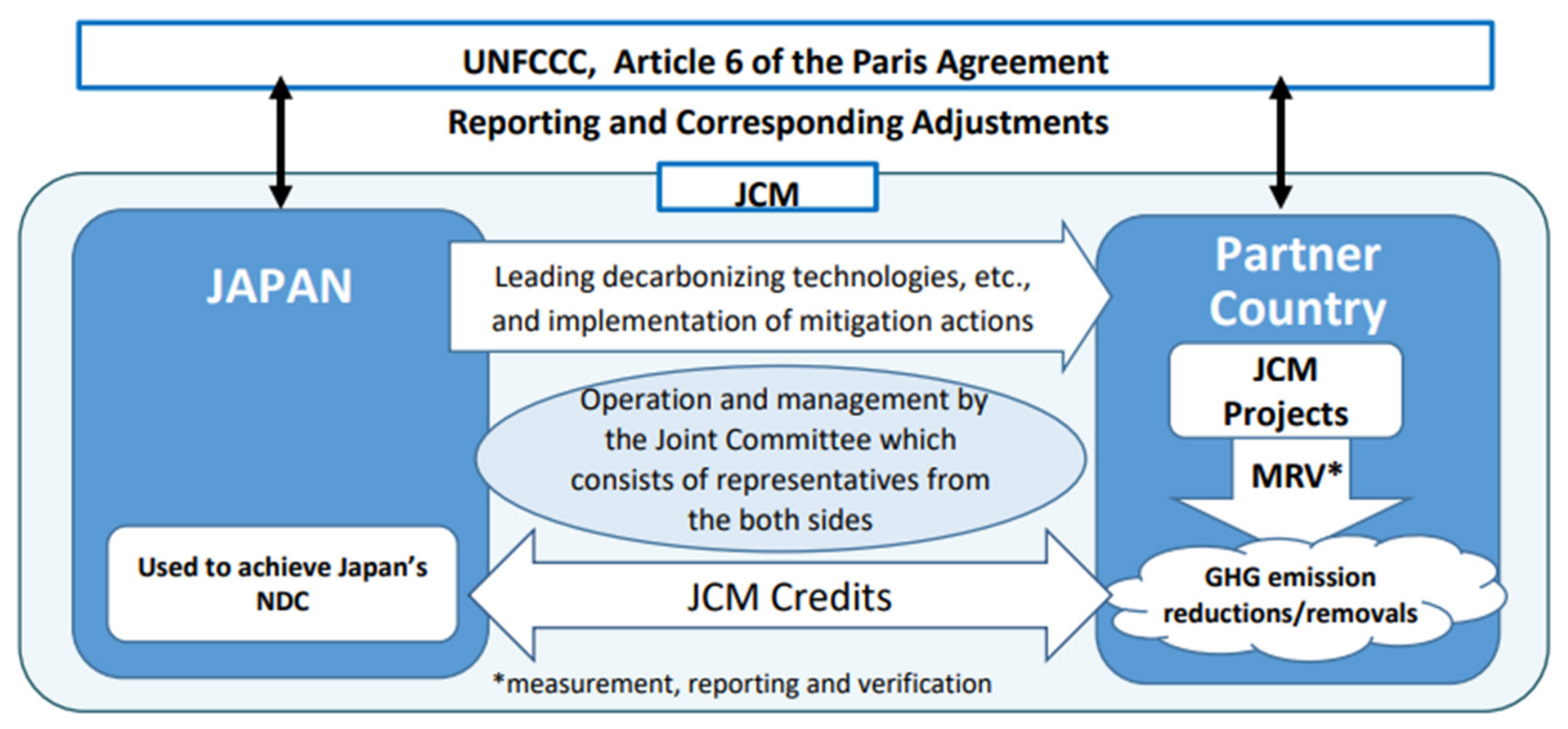
The JCM is a bilateral framework through which Japan collaborates with developing countries to implement projects aimed at reducing or removing GHG emissions. Under this mechanism, Japan facilitates the transfer of advanced low-carbon technologies, systems, and infrastructure to partner countries. The resulting GHG emission reductions are quantified, and the corresponding carbon credits are shared between Japan and the partner countries. Aligned with Article 6.2 of the Paris Agreement, which allows countries to engage in international cooperation to achieve their nationally determined contributions (NDCs), these credits are then utilised by the Japanese government to contribute to achieving Japan’s NDCs under the Paris Agreement [
52]. The JCM represents a significant innovation in international climate cooperation.
Under Article 6.2, which also mandates corresponding adjustments to prevent the double-counting of emission reductions between parties engaged in international carbon market mechanisms, emission reductions accruing to Japan through the JCM framework are systematically excluded from the partner country’s NDC accounting. To eliminate any further risk of double-counting, the Japanese government ensures that all credits assigned to it are retired before being incorporated into Japan’s NDC accounting.
The Japanese government has solicited participation from Japanese companies in JCM projects. To incentivise participation and facilitate the implementation of JCM projects, the mechanism offers financial subsidies, primarily from the Japanese government, covering up to 50 per cent of the initial investment costs for Japanese companies. These subsidies apply to the installation of decarbonisation equipment and the implementation of measurement, reporting, and verification (MRV) processes related to GHG emission reductions in JCM partner countries. An overview of this type of relationship is presented in
Figure 2.
Consultations for the implementation of the JCM framework were initiated in 2011, and since its official introduction in 2013, the JCM has supported 270 decarbonisation projects (as of September 2025) in 31 partner countries across Asia, the Middle East, Africa, Latin America, and the Pacific region. These projects span various sectors, including renewable energy, energy efficiency, waste management, and carbon capture. While 270 projects have been implemented, in the Pacific Islands region, there have been only eight projects: seven in Palau and one in Papua New Guinea. Six projects in Palau are aimed at the installation of solar photovoltaic systems to reduce reliance on imported fossil fuels [
52].
By participating in JCM projects, Japanese companies anticipate opportunities to disseminate their technologies, enhance their technological capabilities, and strengthen their brand recognition. Regardless, the geographical disadvantages of PICs, including small territorial size, limited market scale, and geographic isolation, make it challenging for companies to increase global visibility, expand business operations, and secure new commercial opportunities.
Although companies can generate revenue from electricity sales, particularly in renewable energy generation projects, the small scale of the projects in PICs constrains potential revenues. In addition to limited available land owing to small territorial sizes, the predominance of customary land tenure poses a significant barrier. Under traditional communal land ownership systems, which govern the majority of land, acquiring large land areas for JCM projects is substantially more challenging. Customary land accounts for 85 per cent of the total land area in the Solomon Islands, 98 per cent in Vanuatu, 97 per cent in Papua New Guinea, and 91 per cent in Fiji.
Companies engaging in JCM projects in Southeast Asia note that project development efforts and costs remain relatively constant, regardless of project scale. Consequently, smaller projects generate insufficient profit margins to warrant commercial investment [
53]. Furthermore, securing large land areas in these countries is extremely difficult, which inevitably constrains the scale of solar power generation projects and renders revenue generation through electricity sales unviable.
Indeed, none of the six JCM solar system installation projects in Palau can be regarded as having generated substantial profits from electricity sales. In two of the six cases, the Japanese participants were solar panel manufacturers, and the projects were structured such that profits were generated through the use of their own products. In three other cases, all project implementation costs not covered by the Japanese government’s equipment subsidy were financed by local partners. Consequently, the Japanese participants derived no revenue from electricity sales and instead earned income through consultancy fees paid by the local partners. Therefore, these five projects relied on revenue streams other than electricity sales. However, given the small scale of the projects, the number of panels deployed was limited, and the consultancy fees paid by local partners were also minimal. These results make it challenging to conclude that these JCM projects have become highly profitable ventures. The remaining project involved a Japanese electric utility company as the project participant and was not originally intended to generate substantial profits. These challenges persist even when the Japanese government subsidises up to 50 per cent of initial investment costs, underscoring the structural barriers to project profitability in the region. Overall, under the current JCM framework, there is little prospect for further expansion in the Pacific Islands region.
5.2. Revised JCM Proposal
By revising the current JCM credit allocation system, it should be possible to secure a certain level of profitability for participating companies. Under the existing JCM framework, the allocation of credits generated from GHG emission reductions is determined through bilateral negotiations between Japan and the partner country, and credits are issued by the governments of the two countries. In practice, however, the majority, and in some cases all, of the credits issued on the Japanese side are ultimately assigned to the Japanese government, rather than to the companies implementing the projects. The Agreement on the Allocation of JCM Credits indicates that prior to credit issuance, project participants must agree to deliver the issued credits to the Japanese government according to the percentage determined by the Ministry of the Environment of Japan [
54]. As a result, the amount of credits obtained by Japanese companies remains relatively limited [
55]. Indeed, the share of credits allocated to Japanese companies accounts for only approximately 10 per cent of the total [
56].
In response to this limitation, we propose a revised allocation system under which carbon credits generated by the JCM projects and attributed to Japan would be fully allocated to participating Japanese companies, rather than to the Japanese government. Under this arrangement, corporate participants would be able to monetise these credits through market transactions, thereby generating additional revenue streams. This financial incentive structure is expected to encourage greater private-sector participation in JCM projects (
Table 2), consequently accelerating infrastructure development in partner developing countries. Simultaneously, however, the operationalisation of such a framework would require substantial institutional development.
Given that one of the primary objectives of the JCM is to enable Japan to utilise emission reductions towards its NDC, the proposed system must incorporate provisions ensuring that credits allocated to Japanese companies remain eligible exclusively for accounting towards Japan’s NDC. If such credits are transferred internationally, they could cease to contribute to Japan’s NDC. Consistent with Article 6.2, which mandates the implementation of corresponding adjustments, if Japanese companies transfer credits to foreign entities, the corresponding emission reductions would also be transferred and would therefore be counted towards the acquiring country’s NDC, rather than Japan’s NDC. Accordingly, credits sold outside Japan would no longer be eligible to contribute to Japan’s NDC.
To address this challenge, a domestic circulation scheme would need to be established in which JCM credits allocated to Japan are restricted to circulation exclusively within the Japanese domestic market. By combining such restrictions with the provisions of Article 6 of the Paris Agreement, it becomes feasible to ensure that credits transferred to Japanese corporations can only be accounted for towards Japan’s NDC, thereby effectively preventing their attribution to foreign NDCs.
Under this proposed institutional framework, the following operational sequence is envisioned for JCM credits acquired by Japanese companies. Japanese companies engage in domestic credit transactions, selling credits and generating profits, while the Japanese government would count the corresponding emission reductions towards its NDC once those credits were retired through corporate offsetting activities. This mechanism enables JCM credits to generate corporate profits while simultaneously contributing to the fulfilment of Japan’s NDC.
5.2.1. Criticism of Double-Claiming
Nevertheless, this framework may be subject to criticism on the grounds that it constitutes double-claiming, where the same emission reduction is claimed by both corporations (for commercial of offsetting purposes) and by the government (for NDC accounting), potentially representing a form of greenwashing [
57,
58]. Such concerns are increasingly reflected in recent policy and institutional literature. Carbon Market Watch explicitly argues that allowing both governments and corporations to claim the same mitigation results enables greenwashing [
59]. This concern is also echoed by Joel [
57], who warns that parallel government and corporate claims over the same emission reduction may weaken credibility and investor confidence. Similarly, the Science-Based Targets Initiative identifies double-claiming between corporate buyers and governments as a systemic risk associated with offset claims [
58]. Under the revised JCM, even where credits are confined to domestic circulation and corresponding adjustments prevent international double-counting, the use of the same mitigation outcomes to support corporate offsetting claims by Japanese corporations may still be perceived by investors, regulators, and civil society actors as overstating climate performance. There is the possibility that participation in the revised JCM could generate reputational costs associated with allegations of greenwashing.
It should be noted that this issue is distinguishable from double-counting, and the avoidance of double-claiming is not explicitly mentioned in the Paris Agreement and Article 6. Voluntary Carbon Market Integrity argues that instances of double-claiming are common between government and corporate accounts and are not strictly prohibited by the Paris Agreement accounting rules [
60]. Although two domestic actors may refer to the same reductions, such reductions are counted towards Japan’s NDC only once, in accordance with the corresponding adjustments mechanism under Article 6.2. Therefore, this practice does not amount to international double-counting.
The primary institutional requirement of the JCM remains the avoidance of double-counting through corresponding adjustments under Article 6.2. Simultaneously, the significance of Article 6.2 lies not merely in ensuring accounting consistency but should be understood in light of the broader rationale of Article 6, as reflected in Article 6.1, which frames voluntary cooperation among Parties as a means of promoting higher ambition in mitigation and adaptation, as well as sustainable development and environmental integrity [
61]. Furthermore, the JCM itself has been conceived not only as a crediting mechanism but also as a cooperative framework that supports the institutional conditions necessary for the diffusion of decarbonisation technologies and mobilisation of investment. Against this background, the revised JCM should not be categorically rejected solely because of potential criticism concerning double-claiming.
Contemporary debates on Article 6 governance suggest that this issue cannot be reduced to the distinction between double-claiming and double-counting alone. Increasingly, Article 6 governance is concerned with how authorisation, corresponding adjustments, registry design, disclosure, and claims governance should be coordinated in order to preserve environmental integrity while enabling cross-border climate finance [
61,
62,
63]. Since the Article 6 rulebook was adopted at COP26, subsequent technical guidance and negotiations have progressively clarified party-level accounting, reporting, and authorisation requirements, while leaving the treatment of corporate claims only partially resolved [
62,
64,
65,
66,
67]. In this sense, a revised JCM framework under which Japanese companies monetise or retire credits domestically while the underlying mitigation outcomes continue to support Japan’s NDC may be regarded as falling within the current party-level accounting framework under Article 6.2.
An alternative interpretation of claiming the same emission reductions by corporations and the government may be derived from the conceptual approach of nested accounting, under which corporations and the government within the same nation constitute a unified entity, where corporate claims represent sub-components of the government’s overarching national claims [
68]. Consequently, under this interpretation, the arrangement would not necessarily constitute double-claiming. However, operational practice has not yet produced a universally accepted solution. The legitimacy of parallel corporate claims over those same mitigation outcomes remains politically and normatively contested.
This ambiguity is also reflected in the Japanese domestic context. The Ministry of the Environment stipulates that carbon offset initiatives must avoid the double-claiming of GHG emission reductions by multiple parties [
69]. By contrast, the Ministry of Economy, Trade, and Industry (METI) adopts a different interpretation, arguing that when corporations retire carbon credits for offsetting purposes and the government simultaneously counts those reductions towards its NDC, no double-claiming occurs because corporate emissions constitute a portion of national emissions reductions [
70]. This divergence reveals that Japan has not adopted a unified position rejecting the incorporation of corporate offset credits into its NDC.
The unresolved status of parallel corporate claims has become more significant in light of growing scrutiny of corporate reliance on carbon credits more generally. Although JCM credits attributed to Japan are analytically distinct from overseas voluntary-market credits, integrity debates in voluntary carbon markets remain relevant as a broader reference point for evaluating claims based on carbon credits. Recent controversies relating to over-crediting, weak additionality, inadequate MRV, and ambiguous offset claims have heightened scrutiny of all forms of corporate reliance on carbon credits [
58,
62]. In this respect, the credibility of the revised JCM framework will depend on clear domestic rules governing the use and retirement of credits and transparent communication regarding the relationship between corporate offset claims and Japan’s NDC accounting. Accordingly, the revised JCM framework should continue to be examined.
The implications of Japan’s eventual policy choice extend beyond the domestic context. Japan occupies a dominant position in Article 6.2 bilateral crediting, with JCM projects accounting for 133 of 163 projects, or 82 per cent of total. Given this leadership role, should governance-related risks be adequately addressed, Japanese implementation of a hierarchical framework would carry significant implications for climate finance and infrastructure development in developing countries.
5.2.2. Prospects for the Revised JCM
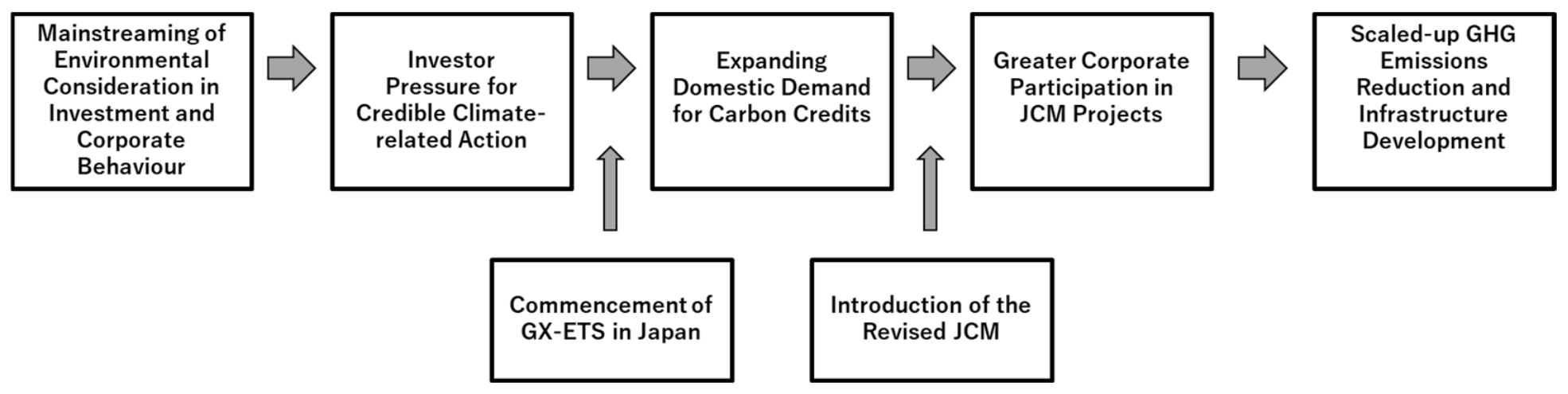
In countries where ESG initiatives are progressing, the acquisition of carbon credits by companies serves as a source of revenue through credit trading and a critical factor that may enhance corporate value. Accordingly, the dissemination and expansion of ESG frameworks and the evolution of the JCM scheme have the potential to create synergies that stimulate greater private-sector investment in infrastructure, thereby enabling the scaling up of emission reductions, supporting Japan’s progress towards its NDC, and contributing to infrastructure development in partner countries. As shown in
Figure 3, this relationship operates through the interaction of several factors, including the mainstreaming of environmental considerations, growing investor pressure for climate-related action, the commencement of GX-ETS, and the resulting expansion of domestic demand for carbon credits. Together, these developments are expected to strengthen corporate incentives to participate in JCM projects.
In April 2026, the Japanese government formally commenced the Green Transformation Emissions Trading Scheme following the amended GX Promotion Act. This scheme covers approximately 300 to 400 companies whose average direct CO
2 emissions over the three fiscal years up to the previous fiscal year exceeded 100,000 tons, accounting for roughly 60 per cent of Japan’s total GHG emissions [
71,
72]. These companies are required to have their annual emissions verified by an independent third-party body, report those emissions to the government, and surrender, by 31 January of the following fiscal year, emission allowances equivalent to their verified emissions each year [
71,
72]. Allowances may be traded among companies depending on whether they face a surplus or shortfall. In cases of non-compliance with the surrender obligation, a levy corresponding to the shortfall is imposed [
71,
72]. Fiscal year 2026 is designated as the period during which companies calculate their emissions and related data. Based on these results, the initial allocation of allowances will be carried out in fiscal year 2027, and emissions trading is expected to commence around October 2027 [
73]. Under this scheme, the use of overseas voluntary credits is not permitted in emissions trading; only two types of government-administered credits are eligible: J-Credits, Japan’s domestic carbon credit system for certifying GHG emission reductions and removals, and JCM credits [
73]. Domestic demand for JCM credits is expected to increase in the future, and under the revised JCM, it is highly likely that JCM credits acquired by Japanese companies will contribute more likely to corporate profitability. Consequently, the synergies illustrated in
Figure 3 are expected to function effectively.
From an ESG perspective, the geographic constraints faced by PICs, particularly the limitation of implementing only small-scale JCM projects, can be reinterpreted as a strategic opportunity. The relatively modest scale of these projects enables more accessible participation for mid-sized enterprises, providing them with the opportunity to acquire carbon credits that effectively demonstrate their commitment to reducing GHG emissions. In addition, under the revised JCM framework, even such small-scale projects may become relatively more commercially attractive, since participating companies would be able to retain and use the credits attributed to Japan, thereby compensating, at least in part, for the limited profitability of electricity sales.
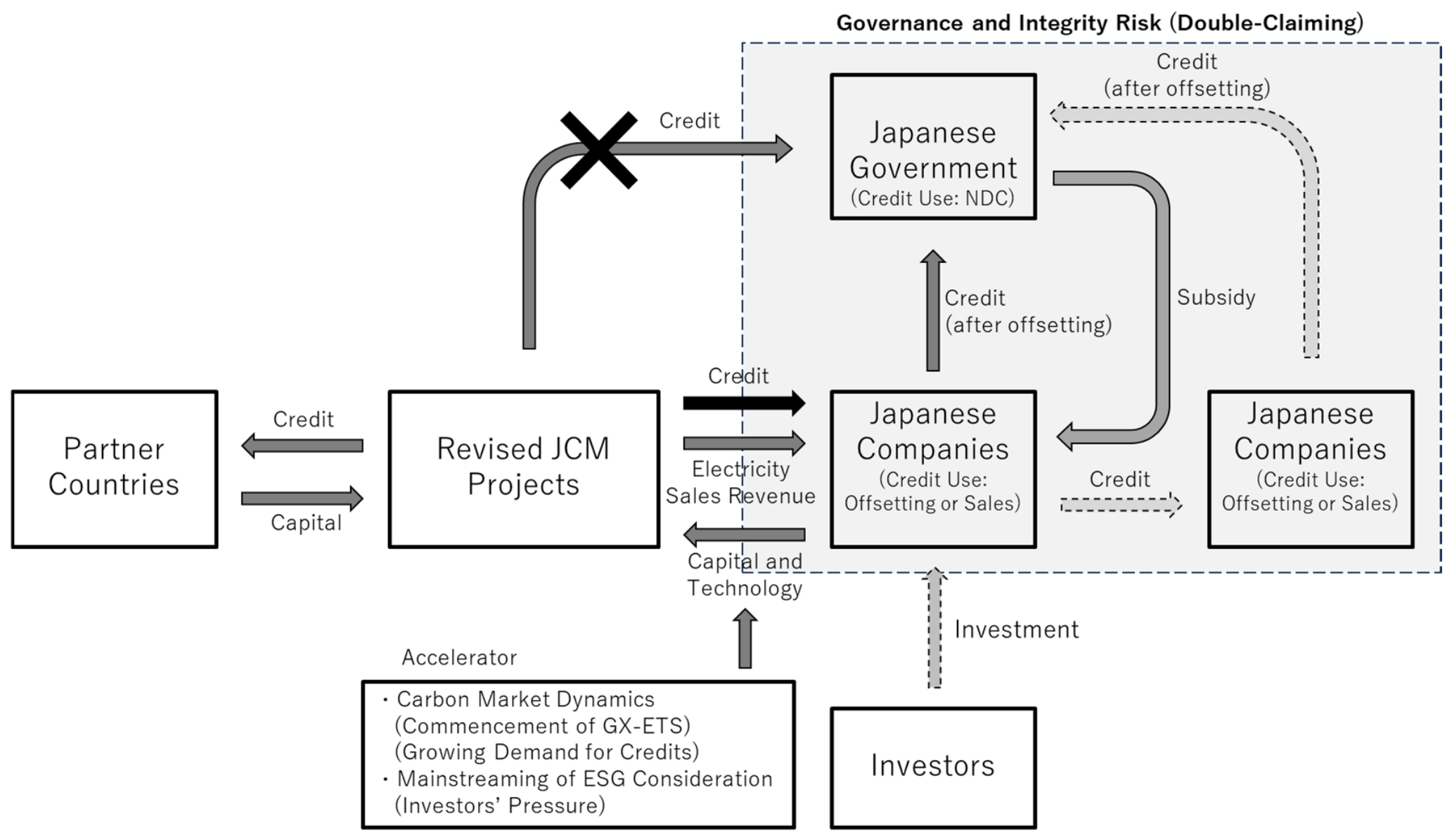
Figure 4 illustrates the logic of the revised JCM as an institutional framework designed to align corporate incentives, ESG-driven investment behaviour, and Japan’s climate policy objectives. Under the revised JCM, Japanese firms undertake infrastructure development projects in developing countries with financial support from the Japanese government. The electricity sales revenue generated by these JCM projects constitutes a direct source of corporate profit. In addition, the credits issued through such projects are allocated to Japanese firms, thereby creating further economic incentives: these credits may be used for their own carbon offsetting purposes or sold to other Japanese firms, generating additional revenue. From an ESG perspective, corporate participation in GHG reduction projects is also expected to enhance firms’ attractiveness to investors and to facilitate capital inflows into participating firms. Considered together, these elements suggest that the revised JCM could function not only as a climate mechanism but also as a framework for making low-carbon infrastructure investment more financially viable for Japanese firms.
The figure further shows how broader structural changes may accelerate corporate participation in JCM projects. The mainstreaming of ESG, growing investor pressure, the commencement of GX-ETS, and the resulting expansion in demand for carbon credits are expected to reinforce incentives for firms to participate in JCM projects. Simultaneously, the revised framework is designed so that, after corporate use of credits for offsetting purposes, the Japanese government may also use the underlying mitigation outcomes for its NDC accounting, thereby creating a structure in which all major Japanese stakeholders can potentially benefit. Nevertheless, this arrangement may still be exposed to criticism on the grounds of double-claiming and may generate governance risks for the Japanese government. As discussed above, however, the viability of this framework will depend in part on Japan’s diplomatic efforts to secure broader international recognition of such an institutional arrangement.
6. Conclusions
Despite significant donor assistance, infrastructure financing gaps in developing countries remain substantial, with annual deficits estimated at USD 2.5 to 3.5 trillion globally. Traditional aid mechanisms have also proven insufficient to meet investment and maintenance needs. Therefore, attracting additional private investment has become essential to bridging investment gaps and ensuring sustainable infrastructure development. These challenges are particularly acute in regions such as the Pacific Islands, which face existential threats posed by the climate crisis.
This study examined how the convergence of ESG expansion and JCM reform can address infrastructure financing gaps and maintenance challenges in developing countries, particularly in PICs. Our analysis demonstrates that a revised JCM framework, which allocates carbon credits to participating Japanese corporations, rather than the government, creates compelling economic incentives for private-sector engagement in infrastructure development.
The revised JCM framework operates through a dual-benefits mechanism. Corporations can monetise credits through domestic markets, enhancing commercial returns, while the Japanese government counts corresponding emission reductions towards its NDC commitments following credit retirement. Additionally, in ESG-advanced markets, credits serve as strategic instruments for corporate value enhancement beyond mere revenue generation.
Critically, this revised framework with expanded ESG principles addresses financing gaps and infrastructure maintenance challenges. Companies operating in rigorous ESG environments must continuously acquire credits to maintain investor confidence, creating sustained incentives for infrastructure maintenance throughout operational phases. This ongoing engagement contrasts with traditional donor-financed models, where maintenance often receives insufficient attention.
The synergistic development of ESG principles and revised JCM architecture offers substantial potential to mobilise private capital for infrastructure development while ensuring infrastructure sustainability. As ESG considerations increasingly shape investment decisions, a revised JCM framework that aligns corporate incentives with development needs represents a promising approach to climate infrastructure finance.
While the present study focuses on the incentive structure required to mobilise greater private-sector participation, future research should examine the institutional conditions that may affect implementation in practice—such as the institutional readiness of Pacific Island countries, MRV implementation capacity, regulatory constraints, land tenure governance barriers, and broader political economy conditions—and empirical outcomes of a revised framework, including its distributional effects across stakeholder groups and its replicability in other bilateral climate mechanisms. Understanding how these innovations perform across diverse institutional and market contexts will be essential for scaling effective approaches to climate infrastructure finance.
Ultimately, this study suggests that effective climate cooperation in PICs requires moving beyond traditional models. By integrating market dynamics and private incentives into bilateral mechanisms, the international community can unlock substantial private capital for climate infrastructure while advancing both mitigation objectives and SDGs.