1. Introduction
The increasing demand for food, water, and limited natural resources is putting pressure on planetary boundaries. Food systems, as one of the most significant sources of human-related environmental impacts, account for 70% of freshwater withdrawals [
1], 34% of global greenhouse gas (GHG) emissions [
2], and 15–20% of global energy demand [
3]. Food production and supply have significant environmental impacts, yet over one-third of food is lost or wasted globally. Of this, 19% of available food is wasted in households, food service, and retail sectors [
4]. In the US in 2025, 31% of food produced for human consumption was not utilized, resulting in surplus food, of which 85% constituted food waste [
5]. Most avoidable waste, known as food waste (FW), originates from the consumer level (FAO, 2019); it represents the largest contributor (17%) to total food loss and waste (FLW) in both high- and low-income settings [
4]. If current trends persist, global FLW in food supply chains is projected to increase by 52% by 2050 under the continuation of historical trends [
6]. As a result, stakeholders, including policymakers, industry, and consumer organizations, identified FW reduction and management as top priorities to improve food system sustainability.
Reducing and managing FW requires not only a clear understanding of the drivers related to consumer behavior and food environments but also accurate measurement of weight, composition, and spatial and temporal characteristics. National-level estimates can be harmonized by leveraging data availability across various consumer groups and regions. Although region or city-specific FW measurement studies are currently available (e.g., [
7], the task of portraying a meaningful combination and assessment leading to federal-level policies and widespread adoption is complicated. Data varies over time, across boundaries, and by reporting source, thereby limiting comparability [
8]. Other challenges in cross-study comparisons include varying objectives, contexts (e.g., specific FW products), FLW definitions, life-cycle assumptions, and waste processing routes [
9]. However, comparable, evidence-based time-series data are crucial for designing, testing, and implementing potential FW mitigation measures.
Currently, there is no coherent, detailed estimate of FW in the US. A significant portion of existing FLW quantification studies relies on secondary, dated data [
10]. The inconsistencies across data sources, methods, and outcomes highlight the aggregated uncertainties in the currently available estimates. Hence, there is a critical need for in-depth analysis and primary data collection related to FW [
11]. Due to the growing number of FLW estimation studies and the need to track progress against local, national, and global goals, the need for standardized quantification arises.
Motivated by the need for additional frameworks for improved FLW prediction, decision-making, and data-driven interventions, this research presents a novel agent-based model (ABM) that simulates the generation of household food waste (HFW) through shopping, meal preparation, cooking, and disposal activities. To contextualize the need for such an approach, we discuss the literature on the limitations of existing FW quantification methods and the complexity of HFW behaviors. Measurement inconsistencies, reporting biases, and data gaps make large-scale quantification challenging, while waste behaviors are shaped by interconnected factors that traditional methods struggle to capture. By integrating systems modeling, this study addresses the gaps and offers a more comprehensive approach to understanding and mitigating HFW.
1.1. Challenges in Household Food Waste Measurement
Accurate measurement of HFW is essential for global FW reduction efforts and sustainable food systems, but current quantification methods face significant challenges. The lack of standardized methodologies leads to inconsistencies between studies, making it difficult to compare HFW patterns. Common approaches, including kitchen diaries, surveys, waste audits, and secondary data estimates, each have limitations such as self-reporting biases, inconsistencies in measurement units, and difficulty distinguishing between edible and inedible food waste [
12].
Reporting biases also affect self-reported methods such as surveys and kitchen diaries, where under-reporting is prevalent due to social desirability bias and memory limitations [
12,
13]. The unconscious nature of food disposal contributes to inaccurate recall, leading to lower reported waste levels than actual measurements [
14,
15]. Kitchen diaries, although more structured, often result in underestimation due to participant fatigue and inconsistent recording [
12]. Less frequently, overestimation can occur in visual assessments in which coders misjudge waste amounts, particularly for liquids, meats, and raw vegetables [
16]. Survey design, recording duration, and use of visual aids significantly affect data accuracy, necessitating methodological refinements. Strategies such as triangulating multiple methods, training coders, and applying correction factors can improve the reliability of HFW quantification [
12,
15].
Cost and logistical constraints also influence the feasibility of HFW measurement. Direct methods like waste composition analysis, while more objective, require specialized equipment and personnel, making them resource-intensive [
17]. Consumer questionnaires and diaries are more affordable but prone to bias, while surveys, although cost-effective, can become expensive when compensating participants [
12,
13]. The complexity of sampling further increases expenses, although simpler approaches, such as using waste collection vehicles, can reduce effort [
17]. Coding photographs for visual assessments is labor-intensive, limiting large-scale application [
15], and waste audits, despite their precision, require significant time and resources [
12]. As a result, many local and regional governments rely on estimates and extrapolations rather than direct measurements, raising concerns about data reliability [
18].
Given these constraints, direct measurements alone are impractical for large-scale HFW quantification due to scalability, cost, and data consistency issues. Limited transparency and accessibility of HFW data further complicate efforts to track and compare waste patterns across populations and regions [
19]. A systems approach, which accounts for the interconnections between individual and group behaviors influencing HFW, such as shopping, food preparation, cooking, storage, food safety perceptions, socioeconomic conditions, and external influences is essential for developing a comprehensive understanding of dynamics and designing effective mitigation strategies.
1.2. The Complexity of Food Waste Decisions
Understanding and measuring FW drivers is complex due to numerous interactions between behavioral, psychological, social, environmental, and material elements. On average, people make more than 221 food-related decisions per day, and most are unaware of how personal or external factors influence their decisions [
20]. These decisions involve choices related to purchasing, storage, leftover use, utilization of perishables, and others influenced by a variety of factors, both internal and external. Consumers’ choices are shaped by individual, social, and environmental factors. The key determinants of food choice include sensory and perceptual characteristics of food, social and physical environment, biological needs, psychological components, knowledge and skills, anticipated consequences, personal identity, and sociocultural factors [
21]. The Food Choice Questionnaire (FCQ) reveals that motivations for food choice include health, mood, convenience, sensory appeal, natural content, price, weight control, familiarity, and ethical concerns [
22]. Personal values can guide attitudes toward food and ultimately affect food choices [
23]. Vanity, physical health, and perceived body image are also major factors that influence food purchase and consumption decisions [
24].
Connecting the factors that influence food-related decisions with the issues in estimating and measuring FW, we see that decisions about food purchasing, storage, and use have direct implications for FW generation. The FW dynamics of the consumer differ depending on individual choices, food characteristics, and food environments [
25]. Personal food choices, guided by taste, health, cost, and environmental cues, often lead to over-purchasing or improper storage, which increases FW [
21]. Cultural and psychological aspects, such as materialism and ethical norms, further shape attitudes toward FW, with the size, composition, and income level of the household also playing a role [
26,
27]. Bigger families tend to produce a greater total amount of waste, even though the waste generated per individual tends to be lower. Furthermore, factors such as age and income levels lead to different effects between various groups [
7,
28]. Additionally, limited meal planning and storage skills increase waste, as consumers often misinterpret food labeling, discarding otherwise safe food [
25,
29,
30].
Paradoxically, healthier diets can lead to increased FW due to the perishable nature of fresh produce [
31]. Purchasing behaviors at the household level, shaped by retail promotions and convenience-driven decisions, frequently result in over-purchasing, although increased awareness of waste may counteract some of these effects [
32,
33]. Retail factors, including multi-buy offers, can drive stockpiling behaviors that exacerbate FW [
34]; however, waste-conscious households can purchase more mindfully [
35]. Awareness of FW’s environmental, social, and economic impacts can reduce wasteful behaviors, although younger and more educated individuals tend to make unplanned purchases [
26,
36]. External disruptions, like the pandemic, demonstrate that shocks to purchasing habits may initially increase FW through panic buying, though adaptive behaviors over time may encourage waste reduction [
37,
38].
Given these interdependencies, applying a complex systems perspective to the FW enables the development of solutions that account for interdependencies, feedback loops, and adaptation. Since HFW assessment involves numerous dynamic factors, traditional measurement methods alone are insufficient. Addressing this challenge requires tools that capture system-wide interactions, allowing stakeholders to visualize, understand, and intervene effectively. Hence, effectively addressing HFW requires moving beyond isolated consumer behaviors to consider broader, interconnected elements of the food system. Managing consumer-centric value chains is particularly challenging, as businesses, farmers, and policymakers must balance consumer demands, profitability, and sustainability goals while navigating supply chain disruptions.
Decision-making tools, such as the US EPA Wasted Food Scale, help prioritize reduction strategies, including prevention, donation, upcycling, composting, incineration, and landfilling [
39]. Prevention, the most effective strategy highlighted on the EPA’s Wasted Food Scale, depends on understanding household behaviors and the influence of food system environments. Waste management operations also vary by material type, destination (for example, landfill vs. composting), seasonal fluctuations, and regional factors, all of which are shaped by consumer purchasing, consumption, and disposal patterns.
1.3. Modeling as a Systems Analysis Tool
Currently, there is a notable lack of systems thinking in addressing FW. Structured modeling methods, as detailed by [
40,
41], can represent, analyze, and simulate complex systems over time using mathematical and data science techniques. These models, which can be qualitative or quantitative, offer conceptual insights or numerical predictions, and when integrated into FW monitoring frameworks, can enhance predictive accuracy and inform management strategies. This approach has proven useful in fields with dynamic, interdependent systems, including environmental management [
42], public health [
43], urban planning [
44], and socioeconomic studies [
45].
In FW management, system modeling allows stakeholders to identify root causes, forecast waste, and evaluate intervention impacts by simulating complex adaptive interactions within the food system. These models offer a comprehensive view of interconnected components, highlighting how changes in one part of the system influence the entire system, particularly in dynamic, non-linear contexts where intervention outcomes and resilience are crucial considerations [
46]. However, the application of systems modeling to FW remains limited, with only a few models focusing on specific aspects such as behavioral economics, consumption habits, or regional waste patterns. Examples include a Bayesian network model that analyzes behavior and demographics in Europe to guide FW reduction strategies [
47] and a system dynamics model for FW recovery and donation practices [
48].
The growing adoption of model-based decision-making in policy reflects a broader shift toward evidence-based governance, particularly in healthcare and environmental policy. Even imperfect models provide valuable insights for navigating complex decisions, making them increasingly central to policy development [
49,
50]. Despite this, FW models remain scarce, with only a handful addressing behavioral, consumption, and waste management decisions at product- or region-specific levels. As policymakers recognize their potential, the integration of systems models into FW management strategies will be crucial to developing effective, scalable solutions.
1.4. Agent-Based Modeling
Agent-based modeling (ABM) has been increasingly recognized as a valuable tool for analyzing complex systems, including the bioeconomy, due to its ability to capture dynamic interactions and emergent behaviors. Unlike traditional modeling approaches that rely on fixed structures, ABMs enable researchers to simulate the transformation of economic and social systems by representing individual decision-making processes and adaptive behaviors. This is particularly important for studying bioeconomic transitions, as these transformations involve evolving consumer preferences, technological innovations, and policy changes that impact sustainability and resource management [
51].
As a systems-based modeling approach, ABMs have proven particularly effective for simulating scenarios in research and policymaking across fields such as agriculture, land use, natural resource management, and public health [
52]. ABMs are computational models that simulate the actions and interactions of individual agents within a defined environment [
53,
54]. Such models excel at capturing the heterogeneity of agent behaviors and how these behaviors drive system dynamics, revealing how local rules and interactions can shape complex global patterns. This provides a robust framework for hypothesis testing and scenario analysis. ABMs inform policymaking through three key modalities: prospective models to forecast policy impacts, retrospective models to analyze existing interventions, and indirect models to uncover system dynamics that can indirectly guide policy decisions [
52].
ABMs can also integrate both qualitative and quantitative data, making them well-suited for modeling the socio-environmental dimensions of food systems and waste management. They enable bottom-up simulations in which autonomous agents interact according to simple behavioral rules, resulting in emergent global patterns that are difficult to predict with conventional models. Furthermore, ABMs can account for true uncertainty [
51], enabling policymakers and researchers to explore the long-term, non-linear effects of interventions, making them a powerful tool for forecasting and scenario planning in food waste mitigation and broader bioeconomy applications. Successful implementation, however, depends on careful design, ensuring that model inputs are robust and assumptions are well-aligned with real-world conditions. ABMs offer an additional layer of granularity by modeling the actions and interactions of autonomous agents, which can represent individuals, groups, or entities within a system.
To date, a limited number of ABMs have been developed to address FW issues at various levels, including household FW disposal, the analysis of the impact of sharing social opinions on FW, the prediction of policy effectiveness, and the reduction in FW in restaurants. For example, ABMs were developed based on the diffusion of innovation with FW-reducing technologies in retail environments in the Netherlands and Italy [
38,
55]; the impact of plate size on FW in restaurants was evaluated [
56]; and ABM-guided scenario planning was presented to evaluate FW policy outcomes [
57]. Yang et al. simulated the evolution of residents’ waste classification behavior in Wuhan, China. Other studies have modeled the effectiveness of various policies [
58]. Researchers [
59] also simulated the recycling nudge policy while sharing beliefs within the neighborhood. Several studies have focused on the impact of social interactions [
47,
60,
61], while Skeldon et al. predicted the impact of different policies, considering historical factors that influence them [
57]. In addition, Zhu et al. modeled the interactions among regulatory government department agents, restaurant agents, and waste disposal companies as an evolutionary game [
62]. Anggraeni et al. [
63] simulated the interaction between the retailer and the consumer.
Despite progress in using ABMs to study FW dynamics, key gaps remain. To our knowledge, no existing model estimates household FW generation while accounting for individual behaviors, activities, and demographics. To address this, we developed IFWASTE, an ABM that incorporates simplified purchasing, storage, preparation, disposal, and demographic factors for a more comprehensive analysis. IFWASTE extends existing research by simulating large sample sizes across diverse parameter values, providing both detailed household-level insights and aggregated FW estimates.
The IFWASTE model introduces several novel approaches that advance HFW modeling beyond existing approaches. To our knowledge, IFWASTE is the first ABM to simultaneously quantify household food waste by weight and composition (e.g., meat, dairy, produce). Previous ABMs have primarily focused on recycling or disposal behaviors without detailed compositional analysis [
57]. IFWASTE operationalizes the Theory of Planned Behavior (TPB), a widely studied social behavioral theory, within an ABM framework, translating attitudes, subjective norms, and perceived behavioral control into decision rules for shopping, cooking, and disposal. While TPB has been applied in other environmental ABMs [
64] and studied for the empirical analysis of food waste constructs [
65], its use in food waste modeling is novel and enhances behavioral realism. An earlier example integrates Bayesian Belief Networks and ABMs [
65], assessing the socio-economic drivers of FW at the consumer and retailer levels for the diffusion of innovation. The overarching goal of IFWASTE is to track and assess food flows at item-level granularity across the shopping, preparation, consumption, and disposal stages to support HFW estimations. This enables detailed analysis of waste drivers and intervention points, which is rarely implemented in prior models. IFWASTE is fully open source, with versions available in public repositories, allowing researchers and policymakers to adapt and extend the model across diverse contexts. This transparency supports reproducibility and collaborative improvement.
Beyond its foundational contributions, IFWASTE advances research on food system and environmental management ABMs in theoretical structure, behavioral mechanisms, and output dimensions. The model’s theoretical framework integrates the TPB with demographic variability, enabling a nuanced representation of household decision-making that captures both psychological drivers and socio-economic diversity. The first IFWASTE version uses a reduced set of factors: family size, gender, and Level of Concern (LoC). Its behavioral mechanism simulates household-level choices such as shopping frequency, leftover use, and disposal, allowing emergent patterns to arise from dynamic activities at the household level rather than static assumptions. In terms of output, IFWASTE provides a dual-level breakdown of food waste by type (plate waste, spoilage, inedible portions) and by food group (e.g., meat, dairy, produce), delivering actionable insights for targeted interventions. This level of granularity, combined with item-level food flow tracking and open-source accessibility, positions IFWASTE as an early example of a next-generation ABM of bridging behavioral theory with high-resolution simulation to inform circular food system strategies and evidence-based policy development.
2. Materials and Methods
The IFWASTE ABM simulates HFW by capturing interactions between food purchasing, consumption, and disposal behaviors. Operating on a daily time step, the model integrates household demographics, individual behaviors, and food management practices to provide a detailed representation of waste generation. By incorporating variables such as food storage, preparation routines, and waste categorization, IFWASTE V1 enables a detailed analysis of the factors driving waste patterns.
2.1. Model Overview
The model tracks household food flows through each stage of the food lifecycle, from grocery purchase to preparation, consumption, and disposal. The model records detailed metrics for each item, including monetary value (USD), caloric content (kcal), number of servings, weight (kg), and composition of food groups at each stage. Waste is categorized into three types: plate waste (uneaten food), spoilage (food that perishes before consumption), and inedible parts (e.g., peels, bones). This classification helps identify the origin of the waste and the behavioral patterns that contribute to HFW.
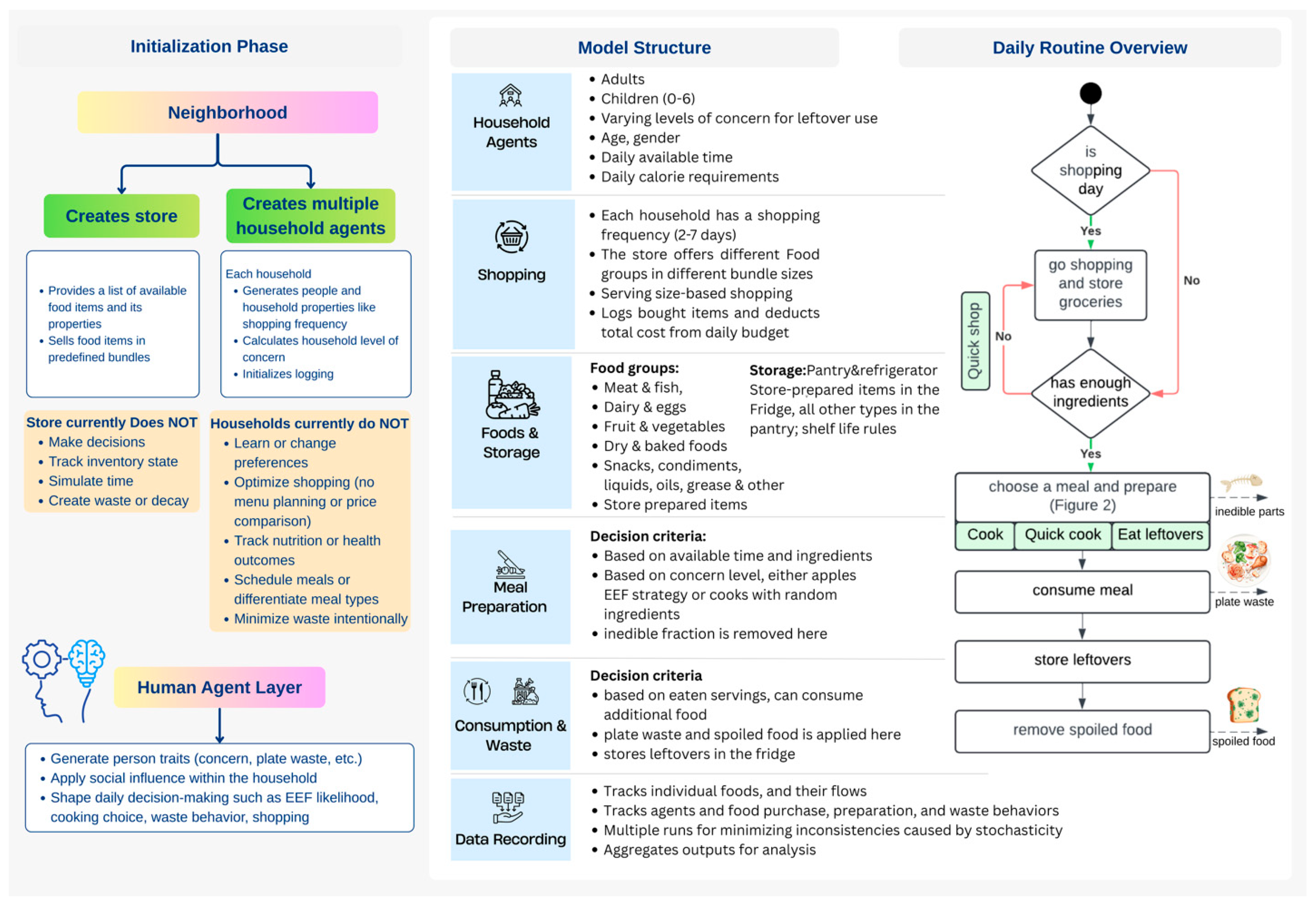
Figure 1 provides an overview of the IFWASTE model’s architecture. The model is implemented as a series of interconnected modules that together represent households’ daily food-related behaviors. At the beginning of each simulation, the model initializes a non-spatial neighborhood structure, constructs a single store entity, and generates a population of household agents. The store contains a fixed, predefined catalog of purchasable food bundles organized into major food groups (e.g., grains, vegetables, dairy, meat, snacks, and store-prepared foods). Each item is instantiated with properties including caloric density, edible and inedible fractions, serving equivalents, price, and a stochastically assigned expiration date. Storage for each household (pantry and refrigerator) is also initialized and begins empty at the time “
”.
Each household is represented as an autonomous decision-making agent comprising two adults and zero to four children. Individuals within each household are assigned demographic attributes (age, gender, required servings or calories) and a three-dimensional vector of concern values reflecting environmental, economic, and health considerations. These values are defined at the individual level and subsequently aggregated into a household-level Level of Concern (LoC) score through a social-influence mechanism described in
Section 2.3. Household-level attributes such as weekly shopping frequency and daily available cooking time are also assigned during initialization.
Households shop independently of one another, following a regular shopping schedule based on their assigned shopping frequency. On scheduled shopping days, households purchase the set of food bundles required to meet their anticipated serving needs. When insufficient ingredients are available to prepare a fully cooked meal, the household may perform a “quick shop,” which purchases only items needed for immediate consumption, with a higher likelihood of including store-prepared foods. The store itself does not optimize, respond, or adapt to past household behavior; it simply supplies items from the available catalog.
All purchased foods enter either the pantry or the refrigerator, depending on the food type. The model tracks each food item individually and decrements its time-to-expiration daily. Items whose expiration date has passed are removed and logged as spoilage waste. Because consumption schedules differ across households, and because larger households draw down inventories more rapidly, storage turnover varies as an emergent property of household size, composition, and behavior.
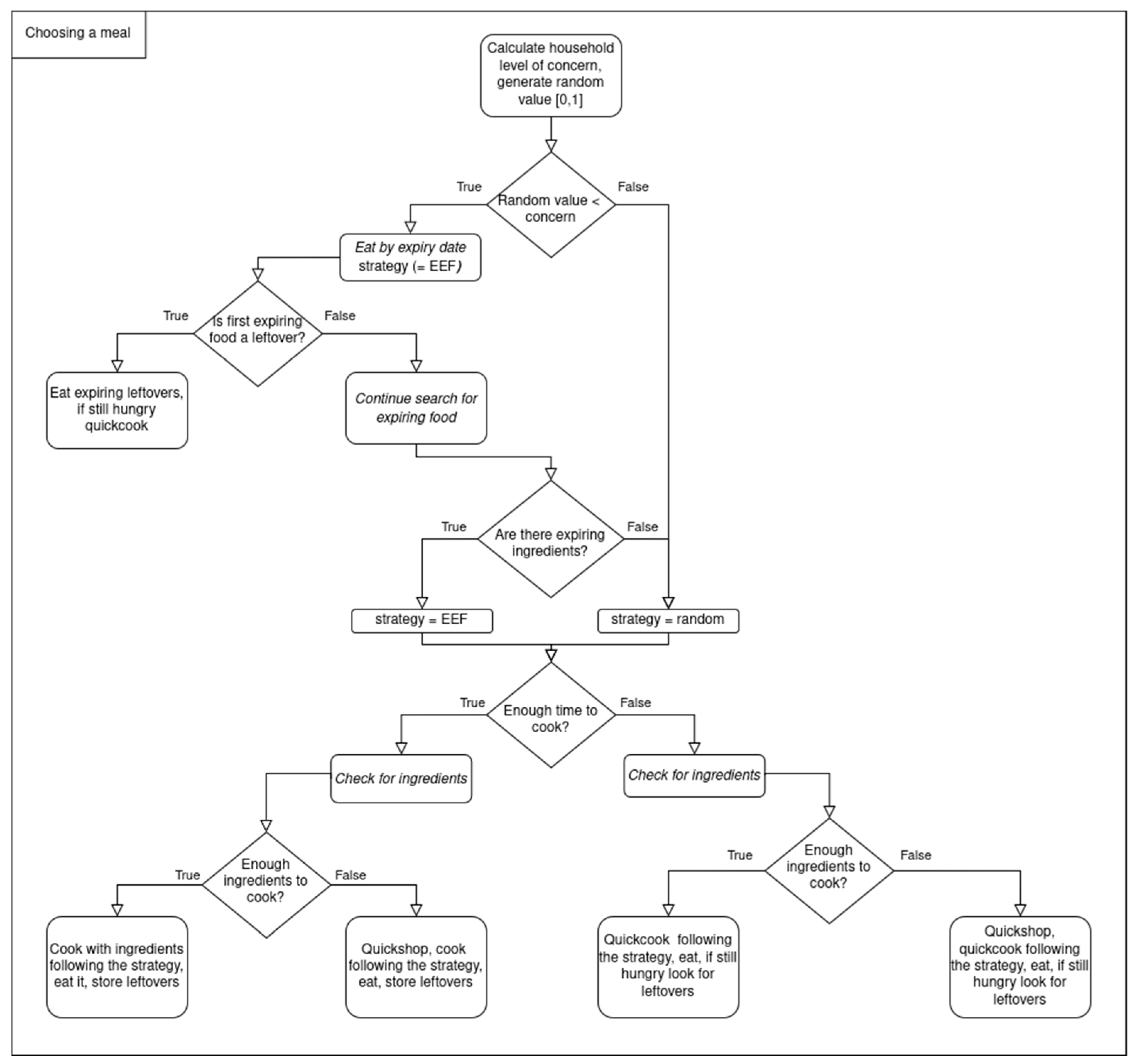
Each day, households evaluate meal options based on available time, ingredient availability, leftover stocks, and their LoC. The model includes three preparation modes: full cooking, quick cooking, and consumption of leftovers or store-prepared items. The selection among these modes is implemented through a decision process that considers both time constraints and LoC-driven behaviors. If the EEF (Eat-Expiring-First) strategy is activated, a probabilistic event determined by the household LoC, the model prioritizes food items with the shortest remaining shelf life when preparing or consuming meals. When sufficient ingredients and cooking time are available, the household prepares a fully cooked meal; otherwise, the model selects a quick-cook option that requires fewer ingredients or consumes leftovers if available.
After meal preparation, the model allocates food to household members based on their caloric needs or the required food servings. Prepared and unconsumed food becomes leftovers, which are stored for future use and can spoil if not consumed. Waste is generated through three pathways: inedible parts removed during preparation, plate waste from uneaten food portions, and spoilage of stored items. In the current version of the model, plate waste and leftover reuse behaviors are controlled by empirically informed fixed parameters and are not influenced by the LoC value, whereas spoilage-related outcomes respond directly to LoC via the EEF mechanism. This design choice preserves interpretability and avoids introducing behavioral couplings unsupported by empirical data.
Throughout the simulation, the model records all food items purchased, consumed, stored, and discarded. These data allow for fine-grained reconstruction of waste flows by food group, waste type, household composition, and behavioral profile. The full simulation output forms the basis for the aggregated daily and weekly indicators.
2.2. Agent Overview
The IFWASTE model simulates a population of varying household agents living in a larger neighborhood with access to a grocery store. The store entity can sell all of the following simplified food groups adapted from [
66]. The food groups include: “Meat & Fish”, “Dairy & Eggs”, “Fruits & Vegetables”, “Dry Foods & Baked Goods”, “Snacks, Condiments, Liquids, Oils, Grease & Other”, and “Store-prepared items”. Each of these food groups varies in price (USD/kg), weight (kg), kilocalories (kcal/kg), and expiration date (days). Additionally, the “Store-prepared items” food type refers to pre-cooked, ready-to-eat foods or meals that are typically purchased in a store or at a food service business. All food types are stored internally within the “Pantry” and “Refrigerator” objects within a household agent for subsequent preparation or consumption. All types of food purchased, along with their attributes, are tracked throughout the simulation for analysis of purchase, preparation, consumption, and waste activities. Each household agent consists of a number of adults and children, who are further defined by age, gender, and their LoC for FW. To ensure uniform terminology, we refer to the six food items (e.g., meat and fish) as food groups. Similarly, “inedible parts,” “spoiled food,” and “plate waste” are considered waste types. In this case, spoilage occurs only after the expiration date. The expiration date of newly cooked meals is randomly assigned with a four to seven-day range.
The collective actions of household agents are modeled on the well-established theory of planned behavior [
67], which posits that household behavior during food purchase, preparation, consumption, and disposal is influenced by attitudes, subjective norms, and perceived behavioral control. These aspects were summarized into the LoC as initially proposed by [
68]. These values reflect the emphasis on the attitudes of households towards (a) environmental implications, (b) economic implications, and (c) health concerns about FW. The overall LoC reflects the likelihood that a household will consume ingredients nearing expiration or leftovers. Furthermore, each household agent has a varying amount of time each day (i.e., hours) to cook. Household food consumption is based on the total number of servings required, as referenced in the USDA dietary guidance [
66].
2.3. Parameterization and Data Sources
The model parameters are derived from a combination of empirical data, literature-based estimates, and calibrated values for a realistic representation of household food consumption and waste behaviors.
Table 1 summarizes the IFWASTE parameters.
2.3.1. Neighborhood and Household Parameters
At the neighborhood level, the default configuration of 10,000 households provides sufficient statistical power for robust analysis while remaining computationally tractable, and the serving-based consumption mode (rather than calorie-based) reflects the more intuitive way households typically plan and consume meals. In ABMs, sufficiently large populations improve the stability of emergent patterns, and ABM scoping reviews discuss model design choices or behavioral assumption sourcing. The current household composition parameters (2 adults, 0, 2, 4, and 6 children) represent a common family structure, enabling an analysis of how household size and composition affect food waste patterns.
2.3.2. Behavioral Decision-Making Parameters
The model implements the TPB through a multi-level concern mechanism that captures individual attitudes, social influences, and behavioral intentions related to reducing food waste. At the individual level, each household member (adult or child) has a three-dimensional concern vector representing their attitudes toward the environmental, economic, and health aspects of food waste, with each dimension ranging from 0 to 1, where higher values indicate greater concern.
Although the conceptual LoC index ranges from 0 to 1, the empirical implementation uses conservative subranges to reflect observed differences in household autonomy and food-management behaviors. Children are assigned LoC values in the 0.0–0.3 range, representing minimal engagement in expiration checking, inventory rotation, or other waste-avoidance actions. Adults score in the 0.3–0.7 range, reflecting moderate to high proactive behavior, including attention to expiration dates, awareness of meal planning, and consistent use of eat-expiring-first strategies. The LoC value is not an absolute probability but a relative behavioral intensity parameter that modulates the likelihood of selecting waste-reducing options in the model’s decision rules.
These individual concerns are aggregated into a household-level concern score through a social influence mechanism that accounts for the differential influence of household members: adults carry an influence weight of 0.75, and children carry a weight of 0.25, reflecting the hierarchical nature of household decision-making. However, it is important to note that these parameters can be updated as new literature becomes available.
The aggregation process calculates each person’s final concern as a weighted combination of their intrinsic concern and the influence of other household members, with the influence proportional to the number of other adults or children in the household. This ensures that social norms within the household context shape individual attitudes. The resulting household concern value, normalized to a range of 0–1, serves as the behavioral intention component of TPB and directly determines the probability that a household will adopt the “Eat Expiring First” (EEF) strategy, a food waste reduction behavior where households prioritize consuming food items closest to their expiration date. EEF operationalizes a household analogue of First–In–First–Out (FIFO), a well-established perishable management principle that prioritizes items with the shortest remaining shelf life to reduce spoilage losses (i.e., a priority queue); we translate this intention into a daily probability of applying the prioritization rule [
69,
70].
In the current model version, LoC affects inventory-management behaviors only, specifically by prioritizing the consumption of items nearing expiration through the EEF rule and increasing attention to expiration dates during meal preparation. LoC does not presently influence leftover reuse behaviors or plate-waste generation, which are governed by fixed, age-specific plate waste ratios and leftover storage rules. This modeling choice was intentional in order to avoid overparameterization in the absence of strong empirical evidence linking concern levels to reductions in plate waste or increased leftover utilization.
Specifically, the model implements this behavioral translation through a probabilistic decision rule where the household concern value equals the probability of EEF activation on any given day, such that households with higher aggregated concern levels are more likely to engage in waste-reducing behaviors, thereby creating a direct pathway from attitudes (individual concerns) through subjective norms (social influence within the household) and perceived behavioral control (constraints such as time availability, ingredient availability, and budget) to behavioral intention (household concern level) and ultimately to behavior (EEF strategy implementation).
This implementation captures the core TPB framework by mapping individual attitudes to the three concern dimensions, subjective norms to the social influence mechanism between household members, perceived behavioral control to the various constraints that affect meal planning and preparation decisions, intention to the aggregated household concern score, and behavior to the EEF strategy that directly reduces food spoilage waste, thereby providing a theoretically grounded mechanism for understanding how household-level psychological and social factors influence food waste generation patterns.
The LoC range for adults (0.3–0.7) and children (0.0–0.3) is calibrated to reflect the generally higher awareness and engagement with food waste issues among adults, while acknowledging that children’s concerns are typically lower but not absent, and these ranges ensure sufficient variation across households to observe differential behavioral responses. Children’s environmental awareness and perceived behavioral control were lower than those of adults, resulting in weaker TPB predictive power in children [
44]. Because population surveys indicate that adults exhibit nontrivial but heterogeneous awareness and attitudes toward wasted food [
71,
72], adult concern was initialized from a moderate-range prior distribution. Children’s initial concern is set lower to reflect the understanding that food waste and sustainability develop with age and are strongly shaped by schooling and household context.
The selected social influence weights (adults: 0.75, children: 0.25) reflect the hierarchical nature of household decision-making, where adults typically have greater influence over food-related choices, though children’s preferences and concerns are not completely ignored. Household food decisions are commonly parent-led because adults control budgets, logistics, and meal preparation [
73,
74]. Meanwhile, children still exert partial influence through preference signaling and ‘pester power’ [
75]. Accordingly, the model uses asymmetric influence weights (adult-dominant but nonzero child influence) as a calibrated representation of documented family decision dynamics.
2.3.3. Individual-Level Parameters
Caloric requirements are based on standard dietary guidelines, with adult requirements following a normal distribution centered around 2000 kcal/day (adjusted for gender), and children’s requirements increasing with age from approximately 1200 kcal/day for toddlers to adult-like levels for older adolescents. Serving requirements by food type and gender are derived from the USDA’s dietary guidelines and nutritional recommendations, with gender-specific differences reflecting documented variations in food preferences and portion sizes [
75,
76,
77].
2.3.4. Food and Storage Parameters
The expiration threshold of 4 days represents a reasonable time window for households to prioritize expiring food items, balancing between being too restrictive (which might not capture realistic behavior) and too lenient (which would not effectively reduce waste), while the minimum cooking time of 0.8 h (48 min) reflects typical meal preparation times for home-cooked meals. Because time availability is a key control constraint in household food management, the model’s minimum cooking-time parameter is set in the range of observed daily meal preparation and cleanup time for adults (often ~40–60 min, varying by subgroup) [
76,
77,
78].
All parameters are designed to be configurable through the ‘config.json’ file and ‘globals.py’ module, allowing for parameter adjustments, sensitivity analysis, and scenario exploration, and the parameterization approach balances between capturing realistic household behaviors and maintaining model tractability for large-scale simulations as presented earlier [
79].
2.3.5. Shopping Process
Each household agent regularly purchases food types according to their shopping frequency (i.e., the number of days) and the number of family members. In the current first version of the IFWASTE, we assume that the store has an unlimited supply of each food type available, and food items are purchased randomly without budget constraints. Food items are purchased in servings of 6,12, or 20, depending on the household’s food serving needs. Additionally, if the total food items within a household do not provide enough servings for the family’s meal, an additional shopping event (i.e., a “Quick Shop”) can be initiated to purchase a smaller number of food types or ready-to-eat (i.e., “Store-Prepared”) items to fulfill more immediate household food requirements.
The shopping frequency parameter (randomly sampled between 2 and 7 days) captures the variability in household shopping behaviors observed in empirical studies. Households exhibit substantial heterogeneity in grocery shopping frequency across demographic segments and contexts [
80,
81]; sampling shopping intervals over a multi-day range captures this empirically observed variability while avoiding an unrealistically fixed routine.
2.3.6. Cooking and Meal Preparation Process
The IFWASTE model meal preparation and related decision processes are presented in
Figure 2. Each household prepares food items each day for future consumption. Depending on the LoC and the available cooking time per day as well as the available ingredients, households make choices of (a) cooking a full meal, (b) eating leftovers or store-prepared food from the refrigerator, or (c) performing a “Quick cook” (i.e., based on the concept of making a sandwich) with a limited number of food items. During cooking, the FW is calculated based on the inedible parts of ingredients, depending on the food group. The model assigns a 10% inedible fraction to vegetables and meat to represent unavoidable waste components such as peels, skins, bones, and trimming losses. This value is consistent with the classification logic used in the NRDC food waste characterization methodology [
80], which treats food items as fully edible when ≤10% of their mass consists of inedible parts, such as peels or bones, and distinguishes them from mixed or prepared foods only when inedible or other components exceed this threshold. Even though the inedible portions are highly variable across food categories and sub-categories, the assumption of 10% as the inedible fraction represents a conservative upper bound for unavoidable waste embedded in otherwise edible food items, while avoiding overestimation of inedible losses.
2.4. Consumption and Waste Process
After meal preparation, every household participates in food consumption, leading to waste equal to the amount of food consumed by individual members, commonly referred to as “Plate Waste”. Any servings of the meal that are not consumed (i.e., “Leftovers”) are then returned to the refrigerator for possible later consumption. At the end of each day, all food items in the refrigerator or pantry that have reached their expiration date are discarded as spoiled.
Adult and child plate waste parameters were informed by empirical evidence synthesized in the [
82] which compiles plate waste estimates across household, cafeteria, buffet, and institutional settings. Across adult-focused studies, reported plate waste typically ranges from approximately 3.3–18%, with values near 8–14% commonly observed in buffet and cafeteria environments [
72,
83] and approximately 7–10% reported under buffets with promotions [
84]. Based on this evidence, the IFWASTE model assumes and adopts an approximate conservative adult plate waste range of 3–12% to represent routine household meals rather than higher-waste institutional contexts.
Although the compiled studies primarily examine adults, evidence from school and institutional feeding contexts shows that children waste a higher proportion of served food than adults, due to portion-size mismatches, preference variability, and lower perceived cost of waste [
85]. Accordingly, children are assumed to have a slightly higher plate waste range (6–15%), reflecting an empirical directionality. Plate waste is implemented stochastically within these bounds, reflecting the heterogeneity in food preferences, portion size estimation, and eating behaviors among age groups [
82,
86].
3. Simulation Results
The IFWASTE model captures the dynamics of HFW through simulations that illustrate both individual household behaviors and general trends in waste generation. The key results highlight household-level patterns. All comparisons presented are descriptive summaries of simulation outcomes; no inferential statistical tests were conducted in the present version.
3.1. IFWASTE Simulation Settings
For the simulations, we constructed a simplified neighborhood of one food store designed to sell all food types defined earlier without limitations. The simulated neighborhood consists of 10,000 households of varying sizes. Each household consists of two adults and zero, two, four, or six children, with varying time availability, shopping frequency, levels of concern, and plate waste ratios. Each household agent conducts its essential operations (i.e., shopping, food preparation, consumption, and waste) independently of other households in the neighborhood. The entire neighborhood, comprising 10,000 households, was simulated for 100 days with a time step of 1 day (
Table 2).
3.2. Individual Households Vary in Their Waste Composition Regarding Food Groups and Waste Types
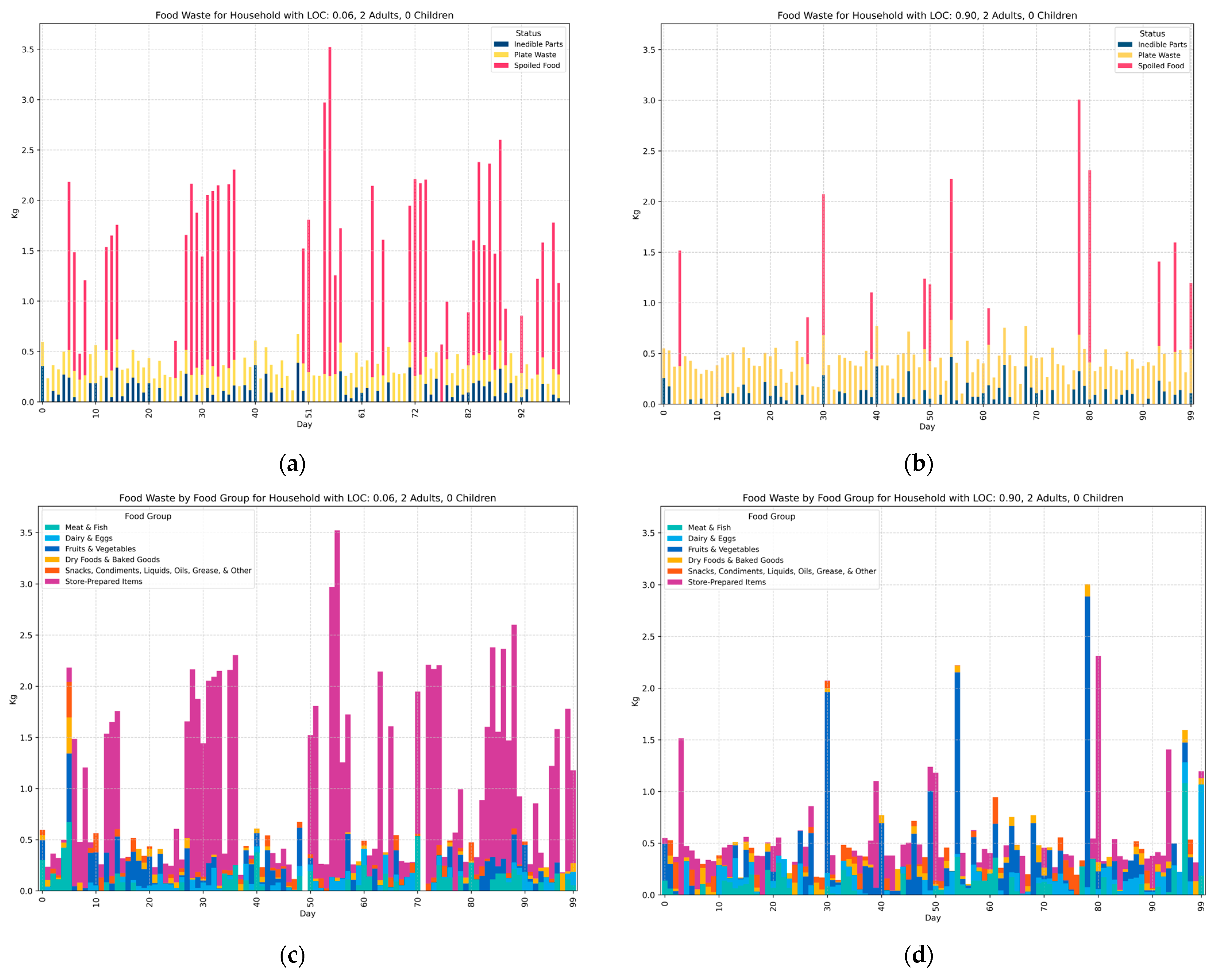
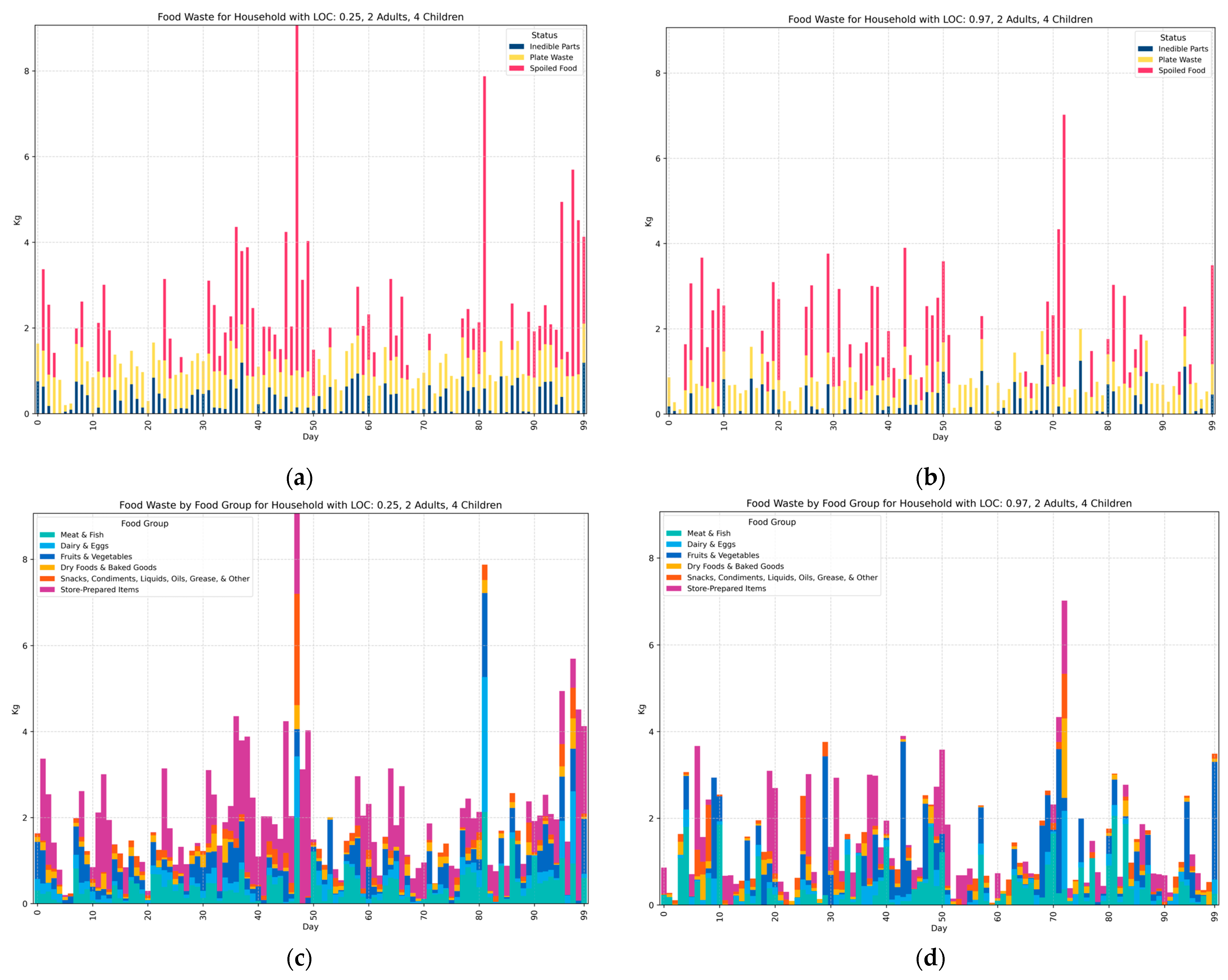
Figure 3 and
Figure 4 illustrate food waste patterns over 100 days, selected from 10,000 simulated household food waste patterns, highlighting variations in waste composition across different family sizes and levels of concern for households with zero and four children, respectively. The data comes from four households, each with two adults and varying numbers of children, reflecting corresponding concern levels. These results are based on IFWASTE agent-based simulations designed to mimic overall behavioral patterns. The model can record these details over 100 days, which is not economically or logistically feasible for empirical assessments using surveys, diaries, and other methodologies. This capability is one of the core advantages of agent-based simulation: the ability to explore variability and emergent patterns while minimizing the limitations inherent in self-reported or observational data.
Simulated food waste exhibits significant temporal variability, influenced by factors such as family size and concern levels. Spoiled food appears as intermittent spikes due to expiration dates, while plate waste occurs daily from meal consumption. Inedible portions remain relatively stable throughout the period. While inedible portions and plate waste are consistent, spoiled food is less frequent but emerges in larger quantities during periods of increased spoilage.
These examples illustrate how behavioral factors and demographics (e.g., the number of kids in a household) interact to shape food waste outcomes. In the selected households, higher concern levels result in reduced total waste, primarily by lowering spoilage, while plate waste and inedible portions remain relatively stable due to the model’s use of standard inedible fractions and plate waste ratios. Spikes in waste generation often correspond to store-prepared items, which the model also uses as a proxy for all items prepared outside the household, including food service and restaurants, which have shorter shelf lives and a higher risk of spoilage. This highlights the role of convenience-driven purchasing behaviors in exacerbating food waste.
On the other hand, plate waste occurs daily as simulated households consume food and leave uneaten portions, whereas spoiled-food spikes occur as a function of expiration dates. However, food waste from inedible portions also occurs at a much lower rate than spoiled food or plate waste. This is because fruits, vegetables, and meat products have a small portion of their weight that is considered inedible. As the model progresses, the frequency and numerical percent value of the waste types are expected to change; however, the overall dynamics of consistent inedible portions of FW are expected to be preserved.
3.3. More Overall and Less per Capita Food Waste in Families with More Children
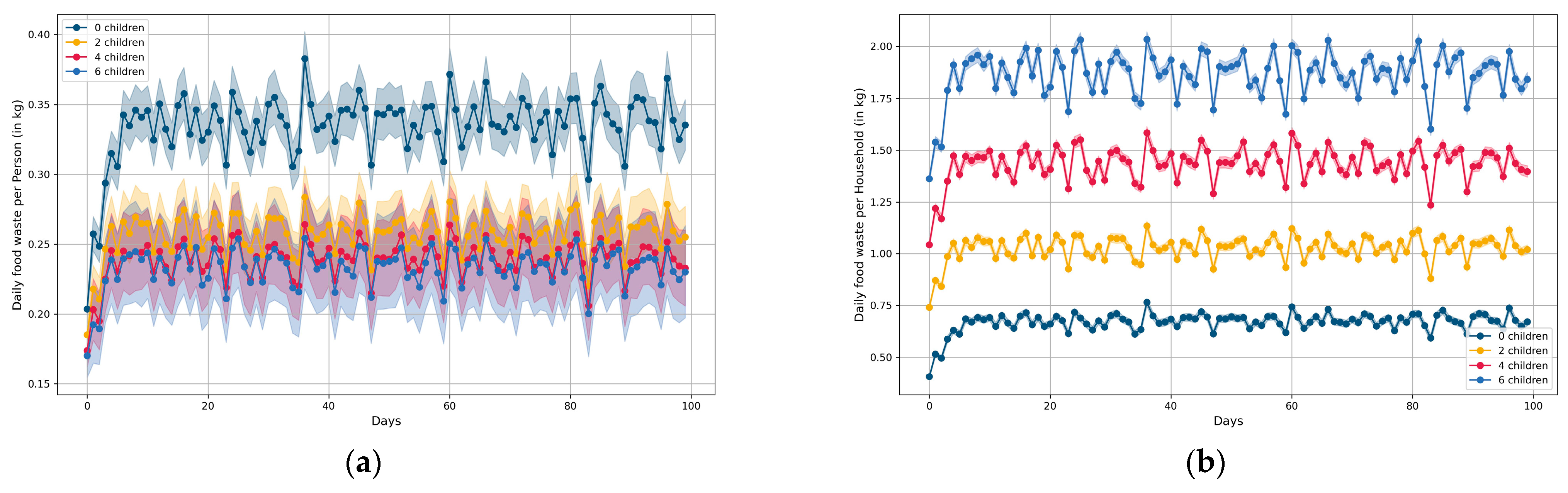
In addition to individual interpretations of household food waste, it is possible to examine broader trends in food waste. The average HFW and its standard deviation, per capita and per household, are shown in
Table 3. These values summarize larger trends across simulated households, showing that per-person waste ranges from approximately 230 g to 330 g per day. The relatively high SD compared to the mean indicates substantial variability among individual households, reflecting differences in behaviors and demographic factors captured by the IFWASTE model.
Figure 5 demonstrates the changes in overall and per capita food waste for all simulation households over time. The results reveal two contrasting trends: overall household food waste increases with the number of children, while per capita waste decreases as household size grows. This pattern suggests economies of scale in food utilization, where larger families distribute meals more efficiently, resulting in reduced individual waste despite higher aggregate quantities. These findings are consistent with previous studies, which report that larger families tend to produce more total waste but exhibit lower per capita waste due to shared consumption and improved resource utilization [
86,
87]. The relatively high standard deviations across all groups indicate substantial variability in household behaviors, reinforcing the importance of modeling at scale to capture demographic and behavioral diversity. This trend is driven by several components in the IFWASTE model, including household composition parameterization, plate waste ratios by age group, serving-based consumption mode, and behavioral mechanisms through the LoC.
The model explicitly simulates households with varying numbers of children (0, 2, 4, 6). Larger households require more servings per day, which increases total food purchased and prepared, leading to higher aggregate waste. This is reflected in the shopping and cooking algorithms that scale food acquisition based on household size.
Children have higher plate waste rates (6–15%) than adults (3–12%), contributing to increased total waste in larger families. However, because the total food is shared among more individuals, the per capita waste decreases; an emergent property of the model’s serving-based consumption logic. Although total household waste increases with the number of household members, per capita waste decreases. This pattern is driven almost entirely by spoilage dynamics rather than plate waste behavior. Larger households exhibit higher absolute levels of plate waste, but the per capita share of spoilage waste declines substantially because food inventories cycle more quickly and fewer items reach expiration. Thus, increased turnover offsets the additional plate waste generated by more individuals.
Although descriptive patterns show lower per capita waste in households with children than in households without, differences among households with varying numbers of children are relatively small. These differences should therefore be interpreted cautiously, as no statistical significance testing on the simulation results has been conducted at this stage.
IFWASTE uses a serving-based approach rather than a calorie-based one, which means meal preparation scales with household size. This creates economies of scale: while more food is cooked for larger families, waste is distributed across more people, reducing individual-level waste.
Concern levels influence spoilage-reduction behaviors (Eat Expiring First strategy), but this effect applies uniformly across households. Larger households still experience more plate waste due to more meals served, even when concern towards leftover use and food waste is great.
3.4. Household Size and Level of Concern Impact FW Amounts and Waste Types
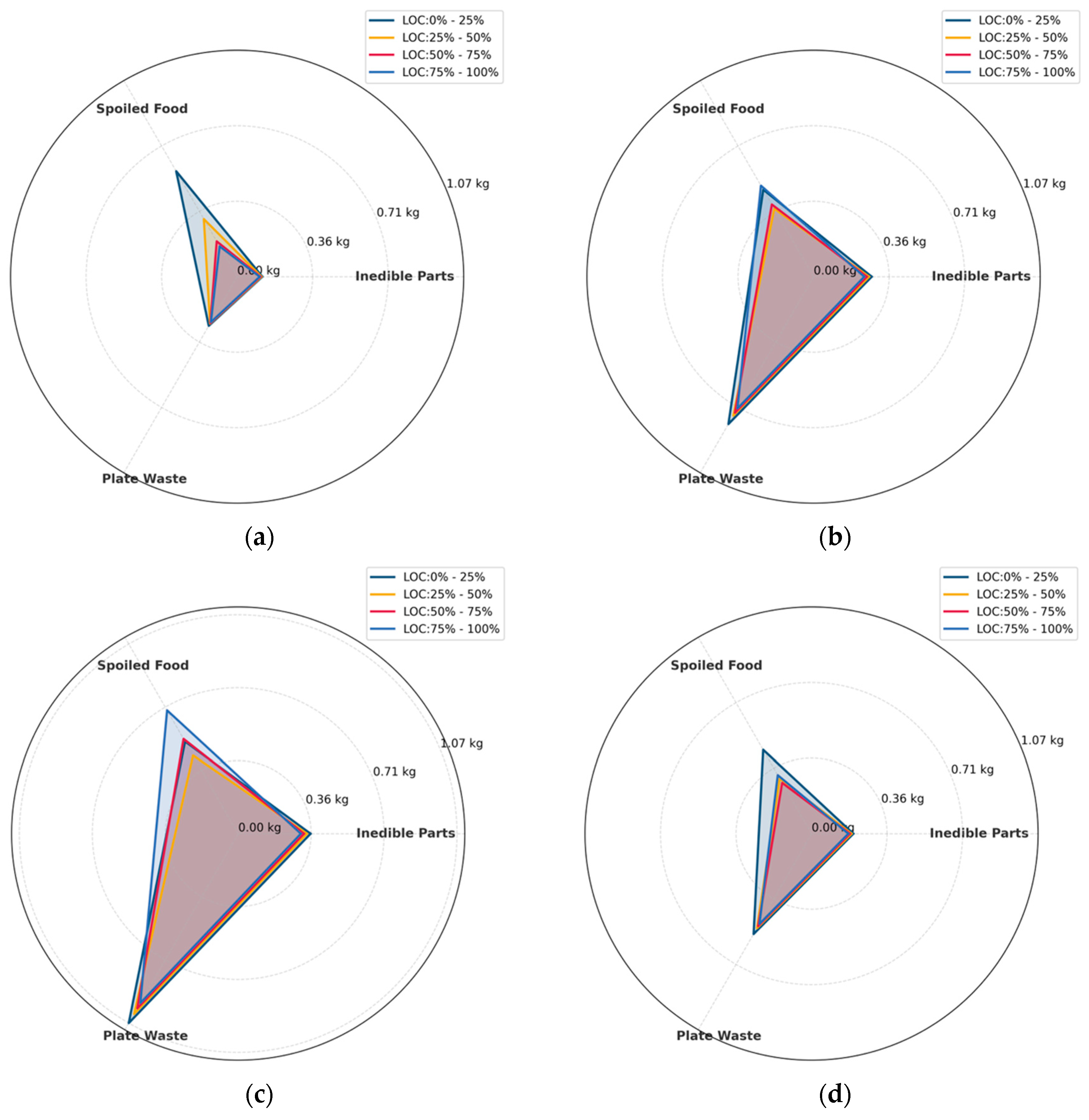
When all households are aggregated and visualized (
Figure 6), the impact of the LOC and the number of kids in a household becomes even more apparent.
Figure 6 illustrates the composition of FW across households of different sizes and levels of concern, divided into 25% intervals. Larger households tend to produce more waste overall, with a noticeable shift from spoiled food to increased plate waste. For households without children and low levels of concern, spoiled food is the leading contributor. As concern levels rise, spoiled food waste decreases, though this does not significantly affect plate waste or inedible portions. In larger households, plate waste increases while spoiled and inedible food portions remain relatively stable. This is due to the higher number of people eating food and generating FW in each household on each simulated day.
Table 4 presents the per capita percentages of food waste weight for food waste types and food groups across all 10,000 simulated households over a 100-day period. Approximately 50% of FW is attributed to plate waste, 32% to spoilage, and 17% to inedible parts. In all simulated households, the percentage of food by weight is distributed mainly among items prepared at the store, as well as meat and fish, dairy and eggs, and fruits and vegetables. The current model does not account for preferences for specific food groups, leading agents to purchase equal quantities across all groups. During quick shopping trips, agents tend to buy more store-prepared items. Consequently, variation in food waste across food groups is influenced by two main factors. First, the conversion from kilograms to single servings differs among food groups, so even if agents purchase the same number of servings, the mass varies by group. Additionally, differences in product expiration dates increase the likelihood of discarding certain items more frequently, particularly meats and fish, dairy and eggs, fruits and vegetables, and store-prepared foods.
4. Discussion
Food waste is a phenomenon that is equally familiar and foreign. We maintain that the context of FW generation in households is a complex system, comprising multiple drivers, scales, and feedback mechanisms, yet it is also a familiar issue with which most people interact daily. However, food waste patterns in daily life are not directly observable, and available data are often biased. Despite these challenges, it remains important to validate the models to capture the observed patterns, as described in the research. A pattern-oriented and external validation of the IFWASTE model’s results is presented, along with a discussion of its limitations and research gaps.
4.1. Model Validation
Although this research focuses on presenting a novel approach to estimating household food waste, model validation will become increasingly relevant for using this tool to support policy decision-making. In general, our approach is pattern-oriented, meaning that instead of using, for example, direct data sources, our agent design is based on the overarching behavioral patterns identified in the literature [
87,
88]. ABMs are usually evaluated through verification and validation. While verification ensures that the model itself works as intended and specified (i.e., without bugs), validation ensures that the model sufficiently replicates the real-world excerpt [
89].
This version of IFWASTE focuses primarily on the model development phase and therefore does not include household data collection, which would improve direct calibration against primary household food waste audit data. To ensure credibility within these constraints, we applied pattern-oriented validation, comparing emergent behavioral trends from the simulation with patterns reported in the recent literature and the US and the EU databases on household food waste generation and consumer behavior. This approach verifies that the model reproduces key qualitative dynamics, such as variability in spoilage and plate waste across household sizes and concern levels.
To verify the IFWASTE model, the ODD model description [
90] is provided in the
Supplementary Materials. The IFWASTE source code has been tested to the best of our knowledge. For transparency, as a feedback opportunity, and for future open-source development, the source code is available. We also use version control to share different development stages with other researchers.
Validation of ABM models is typically performed through results validation or face validation. Although results validation involves comparing simulation results with real-world data, face validation also involves subject matter experts reviewing the results for reasonableness [
91]. Furthermore, a sensitivity analysis, or a global sensitivity and uncertainty analysis, can show the impact of different parameter values and distributions on the model outcome [
92,
93]. For validation, we compared existing data with the model results. Similarly, we investigated general trends in the food waste literature and assessed whether the model replicated these behaviors.
4.1.1. Weight Comparisons
The average per capita food waste ranged from 230 g to 330 g per day. These FW weights are similar to those of previous imports, which used, for example, dairy products and daily measurements. The National Resources Defense Council report stated that the average food waste per person per week is 3.5 pounds, or approximately 230 g per day [
7]. Eurostat found that the per capita household food waste is 72 kg per year (approximately 197 g per day) [
94]. The nationally representative MITRE-Gallup study reported an average of 8.8 cups of FW per household per week [
28]. This study also reported an average of 9.13 cups (SD = 12) and 1714.78 g (SD = 2201.35) of FW per household per week, using kitchen diaries. Another study reports that 422 g of waste food is generated per US consumer [
31]. Another recent study that used different techniques (diaries, kitchen caddy) and levels of awareness of waste tracking reported 0.69 to 0.83 kg of FW per household member per week [
95].
In addition to the weight of food waste, IFWASTE is replicating a broader trend in household size and the number of children. Larger households tend to generate more food waste, but per capita waste is smaller for larger families [
96]. Two and six-family members wasted around 5.1 and 8.5 cups per week in the MITRE-Gallup study, respectively [
28].
Table 5 summarizes national estimates from the US and the EU, as well as the IFWASTE ABM prediction.
4.1.2. Waste Type
The National Resources Defense Council report [
7] presented FW percentages per reasons as follows: inedible parts (44%), moldy or spoiled (20%), unwanted leftovers (11%), left out too long (7%), poor taste (5%), and past-date items (4%). Similarly, Aitken et al. identified FW reasons as inedible (32.9%), spoiled, expired, or rotten (24.6%), excess (21.2%), small remnants (8.5%), other reasons (8.2%), and dislike (4.7%) [
28]. While the spoilage proportions are comparable, our model’s inedible portion is lower, likely because it currently assigns inedible fractions only to meat, fish, fruits, and vegetables. This means items like coffee grounds or FW from other groups, such as eggshells, are not yet included.
Neither of the studies mentioned above directly captures plate waste, but both include it through different categories. Our model is currently parameterized with a plate waste ratio between 3 and 12% for adults and 6–15% for children. Studies conducted in schools found that children waste 37% of canned fruits and 34% of fresh fruits and vegetables in elementary school, and 43% of fruits, 19% of entrees, 31% of vegetables, and 21% of milk in fourth and fifth grade [
85]. Another study observed plate waste portions and found that adults waste 3.3% of all food in free-living conditions and 39.1% when eating laboratory-based meals [
82]. In public catering services, the total waste was 23% by weight, with 64% leftovers from serving, 33% plate waste and 3% other waste [
97]. However, the setting in which the measurement is performed can be an important factor in established data ranges. For example, food waste in structured food service environments (e.g., schools, restaurants, etc.) is often easier to measure and manage compared to household settings. Households often exhibit more variability due to lifestyle and behavioral factors, as highlighted earlier.
The observed reduction in per capita waste as household size increases is primarily a function of spoilage reduction rather than improved consumption efficiency. Larger households do not waste less per person at the point of consumption; instead, they experience fewer spoilage events because purchased foods are used more rapidly. These results highlight the importance of inventory dynamics when designing household-level interventions. Strategies that effectively increase turnover (e.g., meal planning, right-sizing purchases, shared consumption, or community-based food sharing) may yield waste reductions even in smaller households that do not benefit from natural economies of scale.”
4.1.3. Food Groups
The ReFED Insights Engine [
98] reports the composition of residential food waste as follows: produce (27.5%), dairy & eggs (17.8%), dry goods (16.9%), prepared foods (12.7%), frozen items (6.6%), fresh meat & seafood (5.8%), ready-to-drink beverages (5.8%), and breads & bakery (3.1%). Similarly, the NRDC report [
7] categorizes waste by combining food groups and waste types, highlighting the primary groups as fruits, vegetables, prepared foods, and leftovers. Their distribution includes inedible parts (31%), edible fruits and vegetables (27%), prepared foods and leftovers (19%), liquids, oils, and grease including beverages (6%), dairy & eggs (5%), meat & fish (4%), baked goods (4%), snacks & condiments (2%), and dry foods (1%). Both studies indicate lower waste for meat, likely due to higher consumption incentives tied to consumer preference and the higher cost of these food groups.
4.1.4. Challenges in Model Validation
Models simplify real-world dynamics, usually capturing them at an appropriate level of detail. As a result, the outcomes can often be less detailed. Counterintuitively, IFWASTE provides a more comprehensive insight into food waste than many existing real-world studies, primarily because accurately observing practices and collecting relevant data is complex.
There are two reasons: First, we track the flow of each food item through the system, capturing the type of waste, the food group, weight, and calories in FW at each stage. This level of detail is difficult to provide using traditional methods. Secondly, we are observing artificial household members, which helps avoid behavioral reactivity, misreporting, or underestimation. Furthermore, the model, though also an approximation, does not introduce additional measurement or selection bias.
However, because the level of detail is high, it is more difficult to compare the results with existing studies, especially when detailed information about the family is missing. Regional, cultural, and sociodemographic factors are also challenging to track in both scenarios, further impeding the comparison. Differences in survey methods, measurement metrics, and techniques also affect the findings and raise doubts about the validity of the collected data [
16]. In addition, the definitions of FW terminology and the categorization of food types are often unclear and insufficient to facilitate in-depth comparison, as our analysis shows.
Lastly, even though results validation is essential, it is important to be aware of the bias in the collected real-world data to avoid replicating errors in the model. Face validation can be a tool to mitigate this.
4.2. Limitations and Future Work
Although the IFWASTE model provides valuable insight into HFW dynamics, it has certain limitations that present opportunities for further refinement. The current shopping algorithm does not differentiate between store types (e.g., upscale grocery stores, convenience stores, budget grocery stores) or account for factors such as impulse purchases. Additionally, agents do not currently incorporate time and budget constraints during shopping and meal preparation, nor do they reflect specific food preferences or dietary habits.
A current limitation of the model is that LoC influences only inventory-management and expiration-related processes, but not plate-waste or leftover-reuse behaviors. While concern levels likely shape these behaviors in real households, incorporating additional psychological or behavioral mechanisms without strong empirical grounding risks overparameterization and reduced model identifiability. Future versions will explore extending LoC effects to plate-waste and leftover-management pathways as more robust empirical estimates become available.
Also, the distinction between households with and without children appears more pronounced than the differences among households with different numbers of children. However, these patterns are based solely on descriptive trends; we have not yet conducted statistical tests to determine significance. As such, interpretations of household-size effects should be viewed as preliminary rather than conclusive.
Future improvements will focus on improving the model’s ability to represent diverse food environments and consumption behaviors. Efforts are also underway to increase model transparency and reliability through a global sensitivity and uncertainty analysis. A more detailed technical description of the model, including its agent and algorithm design, will be addressed in a subsequent publication.
While pattern-oriented validation provides initial confidence in the model’s structure and logic, we acknowledge that quantitative calibration is essential for robust predictive accuracy. Future work will incorporate calibration using primary food waste audit datasets and conduct a global sensitivity analysis to assess the influence and uncertainty of parameters. These steps are prioritized in the ongoing development roadmap and will strengthen the empirical validity of IFWASTE for policy and planning applications.
Empirical data from household food waste audits and longitudinal studies remain essential for calibration and validation, ensuring predictive accuracy and strengthening the credibility of the model for policy and planning applications. Future work will prioritize integrating food waste audits, surveys, and systematic literature reviews on HFW drivers, which is essential to refining the model’s parameterization. such data to refine parameterization and improve realism. Establishing standardized definitions and categorizations of food waste types would also improve comparability between studies and improve the applicability of the model to research and policy analysis. Future work will incorporate seasonal and regional factors to enhance realism.
5. Conclusions
This study introduces IFWASTE, an open-source agent-based model designed to estimate household food waste with detailed behavioral and compositional resolution, with several key contributions to the field of household food waste. First, we emphasize that effectively addressing HFW requires both accurate quantification and a deeper understanding of the behavioral, social, and economic drivers that influence waste generation. Second, we highlight the importance of continuous data collection while acknowledging its inherent challenges, including underreporting, behavioral reactivity, misreporting, and biases related to measurement and sample selection. Finally, to complement existing approaches, we developed IFWASTE, a novel open-source agent-based model that simulates the dynamics of daily household food activities. This model serves as a prototype for exploring new HFW quantification methods, enhancing the understanding of HFW behaviors, and supporting future policy development aimed at waste reduction. The model contributes to advancing food waste research through the following key dimensions:
Regarding the theoretical contributions, IFWASTE integrates the Theory of Planned Behavior, operationalizing attitudes, subjective norms, and perceived behavioral control as dynamic drivers of household decisions. This approach enhances behavioral realism and bridges the gap between psychological theory and computational modeling.
From a methodological perspective, the model tracks food flows at the item-level granularity across the shopping, preparation, consumption, and disposal stages, enabling a detailed analysis of waste drivers and intervention points. It also provides dual-level outputs, by waste type (plate waste, spoilage, and inedible portions) and by food group (e.g., meat, dairy, and produce), which, to our knowledge, has not been implemented in prior ABMs. The IFWASTE model simplifies the assessment of HFW by integrating the shopping, preparation, consumption, and disposal behaviors. It enables a detailed evaluation of food waste from multiple perspectives, including economic (monetary value), landfill management (quantity and composition), and nutritional loss (caloric content). By tracking the provenance of FW, whether from spoilage, inedibility, or plate waste, the model enables an in-depth analysis of household waste trends based on social, economic, and demographic characteristics. Although the model provides higher-resolution data than many traditional studies, it is important to recognize that no model can fully capture the complexity of human decision-making and external influences in FW.
In terms of policy implications, IFWASTE supports evidence-based interventions, such as awareness campaigns aimed at reducing spoilage, strategies to minimize plate waste, and programs tailored to household demographics and behavioral profiles. These insights can inform municipal food waste management and national sustainability policies.
The model’s open-source and modular design allows researchers, practitioners, and policymakers to adapt and extend IFWASTE for diverse contexts, including urban planning, retail supply chain optimization, and circular food system strategies.
Key findings of the current version of the IFWASTE model include:
Simulated households generate an estimated 230–330 g of food waste per day, aligning with reported values in the literature.
Larger families generate more total FW but exhibit lower per capita waste.
The size of the household and the levels of concern for FW not only affect the total amount of waste but also influence its composition, distinguishing between inedible portions, plate waste, and spoiled food.
This pioneering work is the first to complement existing studies with an agent-based modeling approach. The IFWASTE model helps to fill a critical need for in-depth, high-accuracy, and low-cost measurement, modeling, and monitoring approaches to FW assessment strategies.
Future directions should first focus on improved realism supported by robust empirical and quantitative approaches. In addition, household and individual decision-making algorithms for shopping, preparation, storage, and disposal can be enhanced by integrating advanced methodologies, including artificial intelligence and surrogate models or multi-model approaches. Such advanced models need to acknowledge the inherent limitations associated with data collection, quality, and accessibility in various research fields. This is particularly important in human and social studies, such as those examining household food waste. These areas of research are complex and multifaceted, often requiring a nuanced understanding of behavioral patterns, social influences, and environmental factors. Therefore, it is crucial for future research to consider these limitations to ensure its findings accurately reflect the realities of food waste behavior.
In this study, pattern-oriented validation was applied using literature-based behavioral trends. Future work will incorporate quantitative calibration with primary food waste audit data and conduct a global sensitivity analysis to strengthen predictive accuracy and empirical validity. The current simulation excludes changes resulting from seasonal and holiday adjustments in behaviors. Future versions will incorporate seasonal variability and holiday effects to better reflect real-world dynamics.
By combining behavioral theory, demographic variability, and detailed compositional analysis, IFWASTE positions itself as a next-generation ABM for household food waste modeling, offering actionable insights for sustainability and circular economy initiatives.



 ,
,