1. Introduction
Tourism destination planning has long struggled to reconcile economic growth with environmental responsibility. As visitor numbers return to pre-pandemic levels, planners are confronting resource pressures that existing tools were never designed to handle. Overtourism, sustainability policy failures, and carbon and water footprints far larger than official estimates suggest are becoming the norm [
1,
2,
3]. The problem is not a lack of commitment to sustainability. It is a lack of tools capable of making material flows visible, measurable, and actionable.
Tourism planning and management research has developed sophisticated frameworks for analysing destination governance, stakeholder coordination, policy processes, and institutional design [
4,
5,
6]. Despite these advances, existing tourism planning frameworks remain predominantly institutional and demand-oriented, often overlooking the material and energy flows that ultimately determine environmental outcomes. As a result, plans that cannot quantify resource throughput are unable to set credible reduction targets, identify resource hotspots, or anticipate the unintended consequences of single-domain interventions. This limitation constitutes a critical planning gap that the present study seeks to address. Recent empirical work underscores the scale of what existing planning frameworks leave insufficiently measured. Global tourism emissions reached 5.2 Gt CO
2-equivalent by 2019 and grew by approximately 3.5% annually between 2009 and 2019, roughly twice the rate of the wider economy, as demand growth continued to outpace efficiency gains [
7]. Resource-footprint studies have quantified tourism’s water, carbon, and ecological burdens in considerable detail, while also showing persistent problems of data availability, system-boundary definition, and methodological comparability [
8]. The material dimension is therefore increasingly documented as an impact, but it remains insufficiently integrated as an operational planning variable within destination governance and demand-management frameworks. Closing this gap requires an analytical perspective grounded in the methodological traditions of systems-level resource accounting rather than governance reform alone. The analytical logic of the framework is grounded in industrial ecology. This is not a metaphor borrowed from tourism sustainability discourse; it is a methodological tradition with established quantification tools, system boundary conventions, and material accounting protocols. Its application to tourism destination systems represents the core contribution of this study.
Industrial ecology offers the conceptual and methodological resources needed to close this gap. Developed initially in manufacturing and extended to urban and regional systems, industrial ecology analyses the material and energy flows of socio-economic systems with a rigour that tourism planning research has not yet adopted [
9,
10]. Its core tools, namely material flow analysis (MFA), life cycle assessment (LCA), and industrial symbiosis mapping, are well-validated in other application domains but have been rarely operationalised in tourism destination planning contexts. Tourism destinations are, in practical terms, large-scale systems that consume energy, water, food, and materials while generating waste and emissions. Their environmental impacts are produced through exactly the kinds of material flows that industrial ecology was built to analyse. Seasonal demand swings, dense clusters of firms, fragmented governance, and high visitor-to-resident ratios actually make destinations well-suited to this kind of analysis. Yet systematic attempts to integrate industrial-ecology-style resource accounting into destination planning remain limited, and existing footprint-based explorations are scattered across water, carbon, and ecological footprint applications rather than consolidated into a destination planning framework [
8]. This paper does exactly that. It reconceptualises tourism destinations as industrial ecosystems: bounded, actor-rich systems where materials, energy, and capital flow continuously among interconnected agents. The framework is built for planners, destination management organisations (DMOs), municipal authorities, and policymakers who need to act on resource problems, not just describe them.
This paper proposes such a framework by reconceptualising tourism destinations as industrial ecosystems—spatially bounded, actor-diverse systems in which heterogeneous agents are interconnected through continuous flows of materials, energy, information, and capital. The framework is designed to serve destination planners, DMOs, municipal authorities, and tourism policymakers. It addresses three planning questions that existing approaches leave unanswered: which actors and flows generate the greatest resource throughput; where in the destination are resource intensities highest; and which interventions are most likely to reduce metabolic pressure efficiently. The framework is conceptual-analytical in nature, consistent with an established tradition of framework development in planning and sustainability research in which conceptual architecture precedes empirical operationalisation [
9,
11]. Empirical validation is an explicit next step rather than a limitation of the present contribution. In doing so, the paper contributes to the tourism planning literature by providing destination-scale analytical architecture that supports the translation of sustainability intent into evidence-based planning action.
The aim of this paper is therefore to develop a multi-scale resource-flow framework that reconceptualises tourism destinations as industrial ecosystems and to demonstrate, through worked operationalisation protocols, how its analytical tools can support destination-scale sustainability planning.
2. Literature Review and Conceptual Background
2.1. Industrial Ecology and Resource-Flow Accounting
Industrial ecology emerged in the late 1980s as a response to the limitations of linear production-consumption models [
10]. Drawing inspiration from natural ecosystems, it conceptualises industrial systems as networks of interconnected processes in which material and energy flows circulate, accumulate, and transform over time [
9]. The field rests on the premise that closed-loop resource cycling can in principle be achieved: the waste output of one process becomes the material input of another. This logic applies directly to the spatially concentrated, multi-actor systems that constitute tourism destinations. This transfer is not unqualified, however. Tourism destinations differ from conventional industrial ecosystems in three respects that complicate the closed-loop assumption. First, their actors are highly heterogeneous, ranging from micro-enterprises to multinational chains, so the stable, long-term inter-firm relationships on which industrial symbiosis depends cannot be assumed [
12,
13]. Second, seasonal volatility means that by-product supply and demand may not coincide in time, weakening the year-round economic self-sustainability associated with cases such as Kalundborg [
13]. Third, visitor-driven demand is largely exogenous to the destination, so metabolic intensity is shaped by external markets rather than by internally optimisable production schedules [
2,
3]. These differences do not invalidate the industrial-ecology lens. Rather, they specify why the framework proposed here is an adaptation rather than a direct application, and why temporal and governance variables must be treated as core analytical dimensions.
A central strand of industrial ecology examines industrial symbiosis: how geographically proximate organisations exchange by-products, energy, and services to achieve mutual environmental and economic benefits [
12]. Complementary tools—MFA and LCA—provide systematic methods for quantifying resource inputs, outputs, and environmental impacts across defined system boundaries [
14]. MFA and LCA have proven their value in industrial and urban settings, from city metabolism studies [
15] to agricultural supply chains and regional industrial clusters. Yet neither has been seriously applied to tourism destinations, despite the obvious fit. Tourism destinations are resource-intensive systems. Their environmental impacts are driven by exactly the material flows these tools are designed to trace. Bringing them into the tourism domain extends the urban metabolism tradition into a context shaped by seasonal volatility, dispersed ownership, and visitor-driven resource demand [
16,
17].
2.2. Tourism Destination Planning and Its Material Limits
Tourism destination planning has evolved progressively from a blueprint-oriented technical discipline toward a more adaptive, governance-informed systems practice [
4,
5]. Scholars have long recognised that destinations are complex adaptive systems whose sustainability outcomes emerge from nonlinear interactions among multiple stakeholders operating across spatial and temporal scales [
6,
11]. More recently, the tourism planning literature has engaged with circular economy models [
18], regenerative development frameworks [
19], and low-carbon transition pathways [
3,
20]. Parallel debates in geography conceptualise land as a foundational resource for high-quality regional development [
21]. This perspective is relevant to destination metabolism because tourism planning decisions are also land-use decisions that organise spatial concentrations of infrastructure, resource demand, and environmental pressure, yet this land-resource perspective has rarely been connected to tourism resource-flow accounting. These approaches invoke systems thinking explicitly but remain analytically limited by the absence of material flow accounting. This trajectory is documented across edited volumes that survey the future of sustainable tourism practice [
22].
While circular economy frameworks have gained traction in tourism sustainability research [
18], they provide a design principle for closing material loops without the material accounting methodology needed to identify where those loops are open, at what scale, or at what cost. The industrial ecosystem framework proposed here operationalises the measurement infrastructure that circular economy aspirations require but do not supply. This limitation is consequential for planning practice. Sustainability targets set without reference to quantified material flows cannot be monitored rigorously. Infrastructure investment decisions made without resource hotspot analysis cannot be allocated efficiently. Governance reforms designed without modelling the structural determinants of resource flows cannot reliably produce the systemic changes they intend. The integration of industrial ecology tools into destination planning frameworks is therefore not merely a theoretical extension; it is a practical necessity for the next generation of destination sustainability planning.
2.3. The Bridging Problem Between Industrial Ecology and Tourism Planning
Industrial ecology and tourism planning have developed in parallel around complementary but disconnected analytical strengths. Part of the reason is disciplinary: industrial ecology has developed largely within engineering and environmental-science traditions, whereas tourism planning has developed within geography, management, and policy traditions, so the two literatures have rarely been brought into direct contact. Each field has consequently optimised for the problems most visible within its own tradition rather than for the integration the two domains jointly require. Industrial ecology provides established tools for defining system boundaries and quantifying material and energy flows, particularly through MFA, LCA, and industrial symbiosis mapping [
9,
12,
14]. Tourism planning, by contrast, has developed sophisticated approaches to governance, stakeholder coordination, destination management, and adaptive planning [
4,
5,
6,
11]. The problem is that each tradition leaves a gap when applied to the other domain. Industrial ecology tools were developed mainly for manufacturing, industrial clusters, urban metabolism, and regional production systems, where actor relationships and demand cycles are often more stable than in tourism systems. Tourism destinations, however, are shaped by seasonal volatility, fragmented ownership, visitor-driven demand, and high variation in resource intensity across space and time [
2,
3,
7,
8].
Conversely, tourism planning frameworks recognise institutional complexity but rarely translate that complexity into quantified resource-flow accounts. They can identify stakeholders, policy instruments, and governance arrangements, but they do not systematically measure how energy, water, food, materials, waste, and emissions move through the destination system. This creates a governance-material disconnect: the institutions that govern destinations are not linked to the material flows that produce environmental outcomes. The bridging contribution of the present framework is therefore not the invention of new industrial ecology methods. Rather, it adapts established industrial ecology tools to the tourism destination scale and connects them to the governance structures, actor categories, seasonal dynamics, and feedback loops that define tourism planning practice.
Seasonal volatility is the point at which this bridging problem becomes most visible. Urban metabolism frameworks have generally been applied to cities, industrial clusters, and regional systems in ways that assume relatively stable flows across the year [
15,
16,
17]. Tourism destinations operate differently. In coastal and island destinations, accommodation occupancy, water demand, wastewater generation, and solid waste volumes can shift sharply between peak and off-season periods. Studies of hotel water consumption and Mediterranean tourism-water systems show that tourism demand often peaks when water scarcity is also most severe, while recent work on tourism-related waste generation shows that tourist and resident populations create different waste-generation patterns across time [
23,
24,
25]. For this reason, seasonality cannot be treated as a background condition in tourism resource accounting. It must be modelled as a core analytical variable.
2.4. Research Gap: The Underdeveloped Material Dimension in Destination Planning
Despite significant advances in destination governance and sustainability research, a structural analytical gap persists that limits planning effectiveness. Tourism planning research has developed strong tools for analysing institutional arrangements, stakeholder networks, and policy processes [
4,
5,
6]. What remains underdeveloped is an equivalent rigour for the material dimension of destination systems: the flows of energy, water, food, and waste whose magnitude, spatial distribution, and compositional character determine the actual environmental outcomes of destination tourism activity.
This gap has real planning consequences. Governance strategies that prioritise stakeholder coordination without measuring material flows cannot define what resource reduction actually looks like. They cannot say how progress would be measured, or which changes to supply chains, land use, or infrastructure would produce the biggest gains [
4,
18,
20]. The disconnect between how destinations are governed and how they consume resources is not a technical oversight. It is a structural problem. Similar governance-material disconnects have been identified in adjacent sustainability fields. Circular economy policy, for example, increasingly promotes waste reduction, reuse, and secondary material markets, yet implementation studies show that circular strategies often remain difficult to translate into measurable material-flow change across sectors [
26]. Infrastructure and urban metabolism research likewise demonstrates that planning decisions shape resource throughput, but that governance reforms do not automatically produce measurable reductions unless they are linked to material baselines and monitoring systems [
15,
27]. This wider literature reinforces the central claim of the present study: sustainability governance becomes operational only when institutional design is connected to quantified resource flows.
Industrial ecology has the analytical tools to address this gap. The challenge is that those tools were designed for industrial systems, not for the complex, multi-actor, seasonally volatile environments that tourism destinations represent [
2,
3]. Bridging the two is the core contribution of this paper. The gap is well documented. Governance frameworks, sustainability indicators, carrying capacity tools, and spatial planning approaches have each been developed in depth [
18,
20,
28]. What is missing is a framework that connects these governance efforts to the material flows they are supposed to manage. Without that connection, sustainability targets remain aspirational rather than operational [
29].
3. Materials and Methods: Conceptual Framework Development
This study uses a conceptual research design. Its purpose is to develop an analytical framework rather than to report primary empirical data, so the methodology consists of structured conceptual development rather than data collection and statistical testing.
The framework was developed in three steps. First, an integrative review of two largely separate literatures was conducted: the industrial ecology literature on material flow analysis, life cycle assessment, and industrial symbiosis, and the tourism planning literature on destination governance, systems thinking, and sustainability management. Second, the analytical strengths and limitations of each tradition were compared in order to identify what each contributes and what each omits when applied to tourism destinations. Third, the two traditions were synthesised into a multi-scale framework that represents a tourism destination as an industrial ecosystem with four analytical components, namely actors, flows, structural configurations, and feedback mechanisms, operating across macro, meso, and micro scales.
To illustrate how the framework would be operationalised, three established industrial ecology tools, namely material flow analysis, life cycle assessment, and industrial symbiosis mapping, are presented as worked operationalisation protocols. For each tool, the system boundaries, data sources, analytical outputs, and resulting planning decisions are specified. The illustrative figures used in the material flow analysis example are not primary measurements; they are indicative bands derived from official destination-volume statistics and from published resource-use coefficients reported in comparable Mediterranean and high-intensity tourism studies, used only to demonstrate the order of magnitude and the analytical logic of the framework. No primary firm-level data were collected, and empirical validation is identified as the next research step.
4. Results and Discussion
4.1. Conceptual Basis
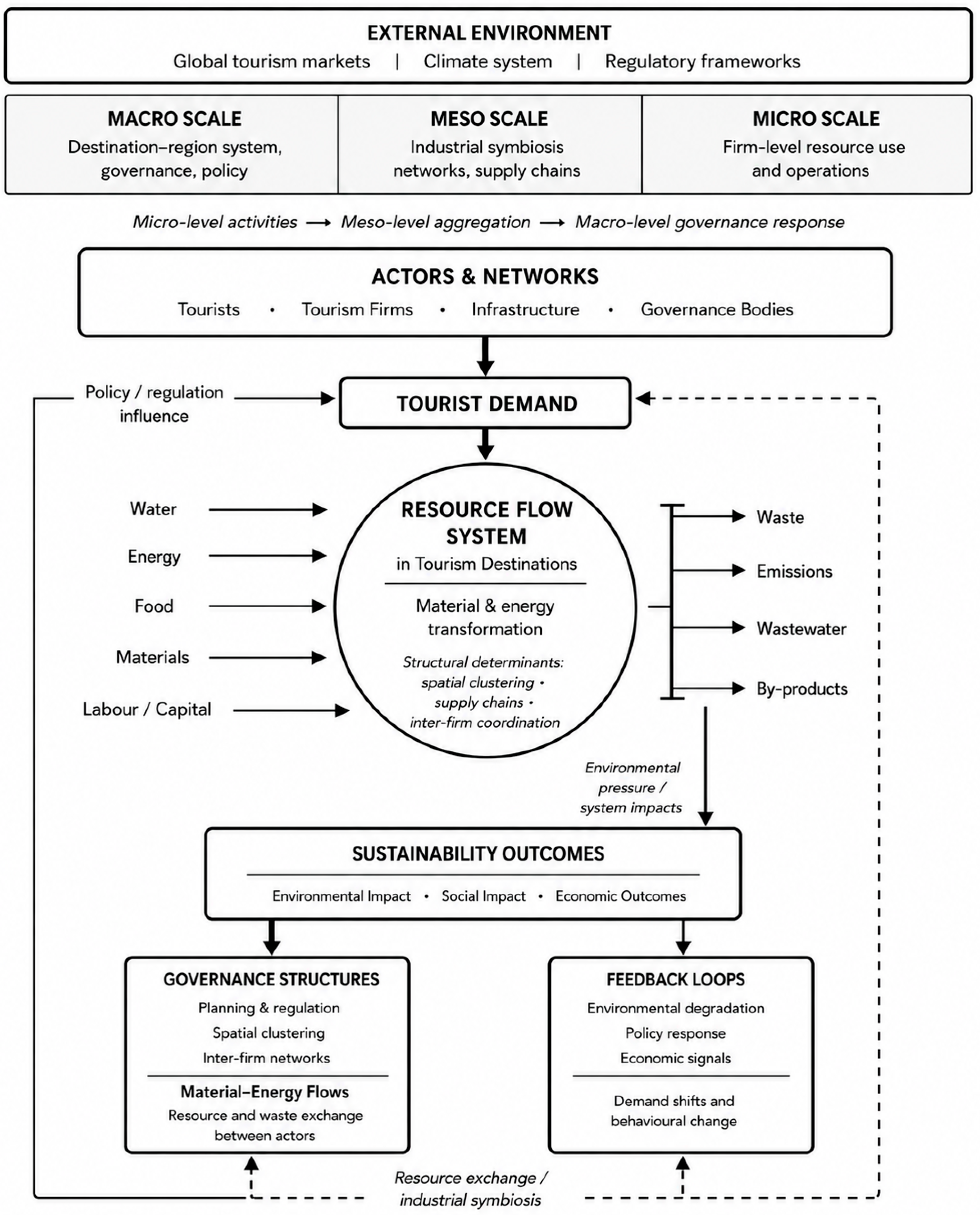
Figure 1 provides an overview of the framework, showing how its four components relate to one another across the micro, meso, and macro scales. Tourism destinations are treated here as industrial ecosystems: spatially defined systems in which diverse actors are linked through continuous flows of materials, energy, information, and capital [
9,
10,
15]. This reconceptualisation serves a planning purpose. By applying the analytical logic of industrial ecology to destination systems, it generates knowledge that existing frameworks do not: knowledge about the material causes of environmental impacts, the spatial distribution of resource intensities, and the structural levers through which planning interventions can most efficiently reduce metabolic pressure.
The reconceptualisation also reframes the object of destination planning in practically significant ways. A hotel room is not only a space of comfort; it is a node in a system drawing energy from regional grids, water from local aquifers, and food from regional and global supply chains, while generating solid waste, wastewater, and carbon emissions as metabolic by-products [
30]. A tour route is not only a sequence of experiences; it is a mobility pattern that consumes fuel, generates emissions, and exerts localised pressure on ecological and infrastructural systems [
3,
4,
5]. Making these material realities analytically visible is the first step in making them plannable.
The concept of destination metabolism—the total throughput of materials and energy processed by a tourism destination system over a defined period—extends urban metabolism theory into the tourism domain. Its theoretical antecedents lie in Gössling’s [
31] early framing of tourism’s global resource consequences as a metabolic phenomenon, and in the broader recognition that spatially bounded socio-economic systems can be characterised through material accounting frameworks [
15]. This aligns with the wider urban metabolism literature, which has demonstrated the analytical value of such frameworks for understanding how cities and regions consume and transform resources [
16,
17,
32]. Tourism destinations extend this tradition into a domain where seasonal demand volatility, multi-ownership governance, and visitor-driven metabolic intensity create modelling challenges absent from urban metabolism applications.
The framework works across three scales, and the connections between them are explicit. At the micro level, firms generate the raw data: energy bills, water records, waste logs, procurement figures. These feed upward into meso-level accounts covering accommodation clusters, transport routes, and food supply chains. Meso-level findings then inform macro-level decisions about infrastructure, zoning, and regulation. Governance signals flow back down through the same chain. This two-way architecture is what allows the framework to connect firm-level behaviour to destination-scale sustainability outcomes.
This architecture builds on complex adaptive systems theory [
6,
11] but departs from it in one specific way. Whereas complex adaptive systems accounts explain emergence, adaptation, and nonlinear interaction in largely relational and qualitative terms, the present framework adds a material accounting layer that is operationalised through measurable flows. Its purpose is therefore not only to describe destination complexity, but to make the resource consequences of that complexity quantifiable for planning analysis.
Concretely, data move upward through three steps. Micro-level firms supply metered records such as utility billing, waste-collection logs, and procurement invoices through standardised reporting templates. These records are aggregated at the meso level into sector accounts covering accommodation clusters, transport corridors, and food supply chains. The meso accounts then populate a macro-level destination metabolic dashboard maintained by the DMO. Governance signals such as standards, incentives, and zoning rules propagate back down the same channel, closing the bidirectional loop.
4.2. Core Components
4.2.1. Actors
The actor layer encompasses four principal categories whose activities generate, transform, or absorb material and energy flows within the destination system. Each category presents distinctive planning leverage points.
Tourists: The primary demand-side actors. Mobility patterns, accommodation choices, food consumption, and recreational activities generate the resource demands that drive destination metabolism [
1,
2,
3]. Tourist heterogeneity in origin, travel mode, length of stay, and consumption behaviour produces significant variation in per-visitor resource throughput. Planning currently lacks systematic tools to quantify or spatially disaggregate this variation.
Tourism firms: Accommodation providers, food service operators, transport companies, tour operators, and attraction managers who transform resource inputs into tourism services [
30]. Firm-level resource efficiency decisions are the primary operational lever for destination metabolism management, and their collective behaviour is the primary target of most existing sustainability planning instruments.
Infrastructure systems: Energy grids, water supply and sanitation networks, transport infrastructure, waste management systems, and digital communications [
14,
15]. Infrastructure mediates the relationship between tourism demand and environmental impact; its planning and design determines baseline material efficiency and the structural feasibility of industrial symbiosis arrangements at the destination scale.
Governance bodies: DMOs, municipal authorities, national tourism agencies, and regulatory bodies [
4,
5,
6]. The framework positions governance actors not merely as external regulators but as embedded system participants whose decisions about infrastructure investment, spatial zoning, and firm certification directly shape resource flow patterns and constrain or enable symbiosis opportunities.
4.2.2. Flows
The flow layer is the analytical centrepiece of the framework and the dimension most consistently underdeveloped in current destination planning practice. Five primary flow categories constitute destination metabolism.
Energy: Electricity and thermal energy consumed across accommodation, food service, transport, attractions, and public spaces, plus the embodied energy in construction and infrastructure. Energy flows are the primary driver of tourism’s carbon footprint and the most amenable to planning intervention through renewable energy mandates, building performance standards, and transport electrification strategies.
Water: Direct consumption in accommodation, food service, and recreation (particularly in water-intensive amenities such as pools, spas, and golf courses), plus the indirect water embedded in food supply chains. In water-stressed destinations, tourism water demand frequently displaces agricultural and domestic uses, creating resource conflicts that planning frameworks have been underprepared to anticipate [
2].
Food: One of the most complex material streams in tourism destinations, involving the importation of commodities from regional, national, and global supply chains, their transformation through food service operations, and the generation of organic waste. The spatial and economic organisation of destination food systems is a planning decision with direct implications for both carbon and water footprints. This connection is one that existing planning frameworks rarely make explicit.
Waste: Solid waste and wastewater generated by tourism impose direct pressures on destination infrastructure whose capacity is typically designed for residential rather than peak tourism loads. Seasonal demand peaks produce waste generation rates that frequently exceed management capacity. The framework addresses this planning failure by making seasonal flow dynamics an explicit analytical variable. Critically, the framework treats waste not as a terminal output but as a potential input within destination symbiosis networks: organic waste from hotel food service can serve as feedstock for biogas production; greywater can supply irrigation demand; heat rejected by air-conditioning systems can be recovered for laundry or pool heating. This by-product valorisation logic, operationalised through the structural layer’s network architecture component, is the mechanism through which industrial symbiosis reduces destination metabolism without requiring individual firm-level investment beyond what coordinated exchange makes economically feasible.
Emissions: Greenhouse gas emissions and local air pollutants from tourism transport, energy use, and food systems. Full-scope emissions accounting has been rarely operationalised at destination scale. Tourist-origin transport typically constitutes the largest share of destination-associated carbon footprints, yet it is systematically excluded from firm-level sustainability assessments [
3] and is precisely the analytical capacity that the framework is designed to support.
Together, these five flow categories constitute the metabolic foundation of tourism destinations, directly linking consumption patterns to environmental outcomes. By tracing them systematically, the framework makes visible the causal connections that existing planning tools register only partially.
4.2.3. Structures
The structure layer captures the spatial, economic, and relational configurations that organise actor interactions and shape resource flow patterns. This is the layer most directly informing planning decisions about infrastructure design, land use, and inter-firm coordination.
Spatial clustering: The geographic concentration of tourism activities produces localised intensities of resource demand and waste generation [
12,
33]. Spatial planning decisions about where development is permitted are therefore simultaneously decisions about resource flow concentrations and about the feasibility of industrial symbiosis, since proximity is a necessary condition for most inter-firm resource exchange arrangements.
Supply chains: The supply chains connecting destinations to regional and global markets for food, energy, and goods constitute the primary channels through which external resource flows enter the destination system [
2,
34,
35]. Supply chain configuration, encompassing the length, geographic reach, and sourcing strategies of destination firms, is a major determinant of material efficiency and a primary lever for carbon and water footprint reduction that destination planning frameworks currently overlook.
Networks: Formal and informal networks among tourism firms, infrastructure operators, and governance bodies shape the possibilities for coordinated resource management [
6,
12]. Network density, coordination capacity, and the presence of bridging actors with cross-sector relationships are structural variables that planning can influence through institutional design. This is a lever that the framework makes systematically visible within a tourism planning context.
Industrial symbiosis within destination networks does not emerge spontaneously. It requires three enabling conditions: spatial proximity sufficient to make by-product exchange logistically feasible; coordination mechanisms, whether formal or informal, capable of matching supply and demand profiles across firm boundaries; and regulatory alignment that permits waste reclassification, energy trading, and water reuse within existing environmental compliance frameworks [
36]. Destination planning authorities are uniquely positioned to address all three conditions simultaneously. This is a governance capacity that firm-level sustainability initiatives cannot replicate. These structural configurations determine not only how flows are organised within the destination system, but also where planning intervention is likely to be most efficient. This targeting logic is one that aggregate sustainability indicators cannot provide.
4.2.4. Feedback Mechanisms
The feedback layer captures the dynamic processes through which the material outputs of destination metabolism modify actor behaviour, governance responses, and demand patterns over time. This dynamic enables the framework to support adaptive rather than static planning.
Environmental degradation: Progressive deterioration of the natural and cultural assets on which tourism demand depends constitutes a negative feedback loop [
2,
20,
37]. Without metabolic monitoring, this process operates below the threshold of planning visibility until damage is severe and costly to reverse [
14,
15]. The framework supports early detection by making resource throughput measurable against environmental threshold indicators.
Policy response: Governance bodies respond to evidence of degradation and resource conflict through regulatory instruments, economic incentives, and planning reforms [
4,
5]. The framework supports this feedback loop by providing the metabolic monitoring baseline without which policy response is necessarily reactive rather than anticipatory. This distinction has significant consequences for planning effectiveness and resource cost [
14,
15].
Demand shifts: Changes in tourist preferences, market composition, and trip design in response to environmental quality signals, sustainability reputation, and evolving mobility costs constitute demand-side feedback that modifies resource flow volumes and patterns [
4,
5]. Destination plans that model this feedback can shape, rather than merely respond to, demand transitions. This is a key advantage for long-cycle infrastructure planning.
These feedback mechanisms highlight the dynamic nature of tourism destination systems, where environmental, policy, and economic signals continuously reshape resource flow volumes and patterns—and where anticipatory planning, grounded in metabolic monitoring, is systematically more effective than reactive management.
Table 1 summarises the four-component architecture of the framework by organising resource inputs, actor and structural layers, metabolic outputs, and feedback mechanisms in a single planning-oriented schema.
4.3. What the Framework Adds to Destination Planning Practice
The four components of the framework are not simply a classification scheme. What matters is what they make possible. The framework’s contribution is best understood by comparing it to what existing approaches can and cannot do. Three planning capabilities emerge that are genuinely new relative to current practice.
First, the framework supports supply-chain-complete environmental accounting at the destination scale. Existing destination sustainability assessments typically measure operational energy and water use within the boundaries of individual firms, systematically omitting the embodied impacts of food procurement, construction, furniture manufacture, and logistics [
30]. Defining the destination system boundary to include all material and energy flows crossing it enables the full-scope accounting needed to set credible reduction targets and track progress against them [
14].
Second, the framework enables resource hotspot detection at the intersection of actor type, flow type, and spatial location. This planning intelligence capacity is largely underdeveloped in current approaches [
2,
15]. Knowing that a destination’s aggregate water consumption is high is insufficient for planning intervention. Identifying which actor cluster, in which spatial zone, driving which flow type, at which seasonal intensity is the kind of targeted intelligence that allows infrastructure investment and regulatory effort to be allocated with an evidence base that aggregate indicators cannot provide [
3,
35].
Third, the framework supports policy design across the full causal chain from structural arrangement to environmental outcome. Because it explicitly models supply chain configuration, network architecture, and spatial clustering as structural determinants of resource flows, it identifies the systemic mechanisms through which flows are organised and therefore the systemic levers through which they can be changed [
9,
12]. This distinguishes the framework from actor-level approaches that can only target behavioural change, and from aggregate monitoring systems that record outcomes without illuminating their structural causes [
4,
11]. Taken together, these three capabilities represent a shift from managing tourism impacts to actively designing resource-efficient destination systems. The framework therefore generates analytically observable expectations regarding where resource intensities are likely to concentrate and where planning interventions are likely to be most effective.
Each capability is operationally testable. Supply-chain-complete accounting can be validated against existing destination carbon inventories; hotspot detection can be verified through spatial analysis of firm-level resource data; and structural policy design can be evaluated through before-and-after comparison of intervention outcomes. The framework is therefore not merely conceptual: it generates specific, falsifiable predictions about where resource intensities will be highest and where interventions will be most effective. Because these capabilities are defined in terms of measurable flows, the framework yields testable propositions that future empirical work can examine and potentially refute. First, in coastal mass-tourism destinations, accommodation clusters are expected to exhibit higher seasonal water, energy, and waste intensities than dispersed development of equivalent visitor volume; this proposition would be refuted if disaggregated firm-level metering showed no spatial concentration of resource intensity. Second, lifecycle and supply-chain accounting is expected to reveal material impacts that are not captured by operational firm-level indicators, particularly in relation to food procurement, construction, and logistics; this proposition would be refuted if lifecycle inventories showed that these upstream and embodied impacts were negligible relative to direct operational use. Third, destinations served by an active coordinating intermediary are expected to realise more by-product exchange opportunities than equally proximate destinations without such coordination; this proposition would be refuted if symbiosis uptake proved independent of coordination capacity. Testing these propositions would require firm-level metered resource data, lifecycle inventories for representative facilities, spatially disaggregated destination accounts, and longitudinal records of symbiosis arrangements. Specifying the framework in this form gives its claim to falsifiability concrete meaning while preserving the conceptual nature of the present study.
Table 2 summarises the novelty boundaries of the proposed framework by comparing existing industrial ecology tools, existing tourism planning frameworks, and the proposed tourism-specific framework across system boundaries, actor categories, temporal modelling, feedback mechanisms, symbiosis feasibility, governance role, planning output, empirical validation, and implementation burden.
4.4. Analytical Applications for Destination Planning Practice
Three analytical applications illustrate how the industrial ecosystem framework can be operationalised in destination planning contexts. Each is grounded in published evidence or documented precedent, and each is developed with the specificity needed to support planning implementation rather than abstract illustration. The three tools are not selected arbitrarily. Material flow analysis addresses the supply-chain-complete accounting gap. Life cycle assessment targets hotspot detection at the firm and sector level. Industrial symbiosis mapping operationalises structural policy design. Each tool corresponds to one of the three planning capabilities the framework claims to advance. The following applications should therefore be read as worked operationalisation protocols rather than empirical case-study results. They specify the system boundaries, data sources, analytical outputs, and planning decisions that would be required in a pilot application. This positioning preserves the conceptual nature of the present paper while responding to the need for clearer empirical operationalisability.
4.4.1. Material Flow Analysis: Resource Accounting as a Planning Baseline Tool
Material flow analysis provides a systematic methodology for quantifying the stocks and flows of materials through a defined system over a defined period [
14]. As a planning tool, destination-scale MFA performs the function of a resource audit: it establishes the quantitative baseline without which performance targets cannot be set, progress cannot be monitored, and investment priorities cannot be rationally established. DMOs and municipal planning authorities that commission biennial destination MFA reports would gain access to the supply-chain-complete resource accounts that evidence-based sustainability planning requires. To avoid presenting the example as a destination-specific empirical case study, the Antalya illustration is used here as an indicative scaling exercise. Its purpose is to show the type of analytical output that a destination-scale MFA could produce when official destination-volume indicators are combined with published resource-use coefficients. It does not claim to provide a measured metabolic account of Antalya. A full pilot application would replace these indicative ranges with primary records collected from accommodation providers, food suppliers, utility companies, waste operators, transport providers, and municipal planning authorities.
Consider, for illustrative purposes, a large coastal mass-tourism destination comparable in scale to the Antalya region of southern Turkey, which official sources describe as receiving more than 17 million visitors in 2024 [
38], the latest complete annual figures available, and which holds the largest certified accommodation capacity of any Turkish province, with more than 304,000 rooms in Ministry-certified establishments [
39]. A destination-scale MFA for a system of this character would reveal several resource dimensions. Direct energy consumption would likely fall in the range of 3 to 5 million MWh per year, driven primarily by hotel cooling, heated pools, and food service. Freshwater withdrawal would approximate 150 to 350 litres per tourist-night once accommodation operations, food supply chains, and landscape irrigation are combined. Solid waste generation would run to approximately 1.0 to 1.5 kg per tourist-night, with organic material accounting for 40 to 60 per cent of that total. Greenhouse gas emissions, when tourist-origin transport is included, would likely fall between 0.7 and 1.2 tonnes of CO
2-equivalent per international tourist-stay. These ranges are illustrative rather than measured. They are constructed from benchmark values and sectoral evidence reported in comparable Mediterranean and high-intensity tourism studies [
2,
3,
30,
34,
35], and scaled to the approximate order of magnitude of a large coastal destination system. They are therefore expressed as bands that reflect variation across the source studies rather than as destination-specific estimates. The purpose is to demonstrate the type of analytical output the framework can produce, not to characterise any specific destination. Precise values, confidence intervals, and seasonal disaggregation would require primary firm-level data collection, which constitutes the explicit empirical agenda set out in the Conclusions. In such a pilot, the relevant data streams would include monthly utility consumption by accommodation type, water and wastewater records, waste collection volumes by district and season, procurement data for food and material inputs, and transport passenger or vehicle movement records. These streams would allow the framework to identify which actor-flow-location combinations generate the highest metabolic pressure.
Methodological challenges in destination-scale MFA should be acknowledged. Actor heterogeneity complicates system boundary definition and data collection; seasonal volatility requires multiple measurement periods to capture the full range of destination metabolism states; and the attribution of tourist-origin transport emissions to destination accounts requires methodological standardisation across the planning community. These challenges constitute a research and governance agenda, specifically the development of standardised destination metabolic accounting protocols, to which the framework is intended as a foundational contribution.
4.4.2. Life Cycle Assessment: Decision Support for Hotel Planning and Investment
LCA traces the environmental impact of a service system across its entire life—from raw material extraction through to end-of-life disposal [
40,
41]. When applied to hotel operations, it produces a full-scope impact profile that goes well beyond what energy bills and utility meters can tell you. Investors, operators, and planners all make consequential decisions about renovations, sourcing, and management without this kind of analysis. The framework makes it available.
Existing hotel LCA research, synthesised by Styles et al. [
30], consistently reveals that operational energy use accounts for a considerably smaller share of total lifecycle environmental impact than hotel sustainability programmes typically assume, once the embodied impacts of construction, furniture manufacture, and food procurement are included. Food procurement alone typically contributes 20 to 35% of a hotel’s total lifecycle greenhouse gas emissions [
30]. For planning authorities, this finding implies a reallocation of sustainability investment priorities: building envelope retrofit and supply chain localisation may yield larger environmental returns per unit of investment than further marginal improvement in operational energy management. This priority reversal is one that lifecycle-scope analysis makes visible and that is currently underdeveloped in destination planning practice.
Situating hotel LCA within the destination-level MFA account enables aggregation across accommodation sub-sectors and comparison of lifecycle impact profiles across facility types, ownership models, and locational contexts within the destination. This integration of building-scale and destination-scale analysis is a planning intelligence capacity that neither tool provides independently but that the industrial ecosystem framework renders systematically achievable. A pilot LCA application would select representative accommodation facilities by size, category, ownership model, and location within the destination. Facility-level data would include energy and water use, food procurement, linen and laundry services, construction and renovation materials, furniture replacement cycles, and waste outputs. The analytical comparison would distinguish direct operational impacts from embodied and supply-chain impacts. The resulting planning decision would not be a generic recommendation to improve hotel efficiency, but a prioritisation of interventions such as food sourcing, retrofit timing, renewable energy procurement, or renovation versus rebuild decisions according to their lifecycle contribution.
4.4.3. Industrial Symbiosis: A Coordination Tool for Destination Planners
Industrial symbiosis is about turning one firm’s waste into another firm’s input [
12]. In a tourism destination, this means hotel food waste becoming biogas feedstock, rejected heat from air conditioning going to laundry operations, or treated greywater irrigating golf courses. It is not simply a green ambition. It is a practical mechanism for reducing the total volume of resources a destination consumes [
36]. By closing material loops, it cuts costs and infrastructure pressure at the same time.
The Kalundborg industrial symbiosis network in Denmark is the field’s foundational empirical case. It demonstrates that coordinated by-product exchange among geographically proximate firms is technically feasible and economically self-sustaining without requiring external subsidy [
13]. Tourism destinations share the structural characteristics that made Kalundborg viable: geographic concentration of diverse resource-intensive actors, heterogeneous waste and energy profiles, and governance capacity capable of facilitating inter-firm agreements. This parallel should not be overstated. Kalundborg’s symbiosis matured among a small number of large, year-round industrial actors bound by long-term contracts and operating within a stable regulatory environment [
13]. Tourism destinations differ on all three counts: their actor base is fragmented and seasonally active, firm turnover is higher, and the regulatory conditions governing waste reclassification and energy trading are often more uncertain. These differences imply that tourism symbiosis will likely require stronger coordinating intermediaries, together with seasonal storage or buffering solutions that the original Kalundborg case did not need. This is not a peripheral efficiency measure: in destination systems characterised by spatial concentration and actor diversity, symbiosis represents the primary mechanism through which metabolic throughput can be reduced at system scale without requiring firm-level behavioural change alone.
Applying the framework systematically identifies several high-priority symbiosis configurations applicable to a coastal mass tourism destination. Organic waste from hotel food service can serve as feedstock for anaerobic digestion systems producing biogas for heat and power, with digestate as fertiliser for local food production. This configuration has established technical feasibility in spatially concentrated hospitality clusters [
12,
33]. Thermal energy rejected by hotel air-conditioning systems can be recovered for laundry operations, pool heating, or district heating networks serving adjacent residential and commercial properties. Greywater from hotel facilities can, following appropriate treatment, supply the irrigation demands of golf courses, public parks, and landscaped urban spaces, thereby displacing freshwater withdrawals from stressed local sources [
2,
35]. Surplus food from hotel buffet operations can be redirected to local food banks or municipal composting facilities.
The planning implications are concrete. Realising these symbiosis potentials requires DMOs and municipal authorities to perform three functions that current destination planning frameworks do not systematically support. The first is mapping the spatial distribution and resource profiles of potential exchange partners to identify symbiosis opportunities. The second is providing or commissioning a coordination intermediary to negotiate and formalise exchange agreements. The third is addressing the regulatory requirements—waste reclassification, energy trading authorisation, water reuse licensing—that determine whether technically feasible exchanges are legally permissible. The industrial ecosystem framework provides the analytical architecture needed to perform the first function systematically and to identify where the second and third functions are most urgently required. A pilot symbiosis application would begin by mapping the spatial proximity of waste producers and potential resource users, such as hotels, laundries, food processors, golf courses, wastewater treatment facilities, and energy providers. It would then compare by-product supply and demand profiles across peak and off-season periods, identify technical compatibility, and screen regulatory requirements for waste reclassification, water reuse, and energy exchange. The planning output would be a ranked list of feasible exchange opportunities, identifying which require only coordination, which require infrastructure investment, and which are blocked by regulatory constraints.
4.5. Planning and Management Implications by Actor Type
The practical implications of the framework differ by actor type, and they are specific enough to be operationalisable within existing institutional arrangements.
Table 3 maps these implications by actor category, identifying both the framework capability each actor can activate and the concrete planning or management action that flows from doing so.
4.6. Scope, Boundaries, and Implementation Conditions
Boundaries of This Contribution. The contribution of this framework should be understood as a bridging and adaptation contribution rather than as a methodological innovation in industrial ecology itself. It is not novel in the sense of inventing MFA, LCA, or industrial symbiosis mapping, all of which are established tools in industrial ecology. It is also not novel in the sense of introducing governance analysis to tourism planning, where stakeholder coordination, multi-level governance, and adaptive planning are already well developed. Nor is it novel in its use of circular-economy principles, since closed-loop and by-product-exchange thinking is well established in that literature. Its novelty lies in four specific areas. First, it integrates material-flow accounting with destination governance structures in a tourism-specific context. Second, it operationalises destination-scale system boundaries and actor categories adapted to seasonal volatility, fragmented ownership, and visitor-driven demand. Third, it combines three planning capabilities that existing approaches do not bring together: supply-chain-complete accounting, resource hotspot detection, and structural policy design. Fourth, it incorporates demand-side feedback loops as drivers of destination metabolism. The framework is therefore best understood as a tourism-specific adaptation and integration framework.
Scope and Scalability of the Framework. The framework was developed primarily with reference to large-scale coastal mass-tourism destinations. This scope is a deliberate boundary rather than a weakness. Large destinations generate sufficient material throughput to justify investment in MFA, LCA, and symbiosis mapping, and they contain enough actor diversity to make destination-scale coordination analytically meaningful. Focusing framework development on these high-impact systems is also strategically efficient, because tourism activity is highly concentrated in space: a disproportionate share of global visitor flows and their associated resource pressures is borne by a relatively small number of high-volume destinations, which makes them the systems where destination-scale material accounting yields the greatest environmental return per unit of planning effort [
42]. The full framework is most appropriate for destinations with high visitor volumes, spatially concentrated accommodation and service clusters, measurable pressure on water, energy, waste, or transport systems, and a governance body capable of coordinating data collection across firms and infrastructure operators. Where these conditions are absent, the framework should be applied selectively rather than in full. In water-stressed Mediterranean or arid destinations, water and wastewater flows should receive analytical priority, whereas in cold-climate destinations heating-related energy demand may become the dominant flow; climate context should therefore guide which flows are analysed first. Climate also conditions which structural interventions are viable: waste-heat recovery and energy-cascading exchanges are most valuable in destinations with high heating or cooling loads, whereas water reuse and greywater exchange are most valuable where freshwater is scarce, so the symbiosis opportunities worth mapping first differ systematically across climate zones. The framework further assumes a coordinating actor able to organise data collection and inter-firm arrangements; where a destination is managed primarily through private-sector management companies rather than a public destination authority, this coordinating role must be located explicitly within the dominant management structure rather than presumed to rest with a public DMO. The framework also remains conceptual at this stage. The development of a coherent analytical architecture is a necessary step prior to large-scale empirical operationalisation, particularly in research areas where system boundaries, actor relationships, and material flow structures remain theoretically underdefined. Its claims therefore rest on methodological plausibility and published precedent from adjacent fields, while also providing a structure capable of guiding future comparative and destination-scale empirical applications. In addition, destination-scale material flow analysis requires firm-level resource data whose collection exceeds the current reporting capacity of most DMOs and municipal planning authorities, an implementation barrier that standardised metabolic accounting protocols must address before the framework can be operationalised at scale. Data availability and system boundary definition remain, in this respect, as much governance challenges as methodological ones. Four implementation barriers are especially important. First, destination-scale MFA requires firm-level reporting systems that many tourism firms do not currently maintain in standardised form. Utility bills, waste collection logs, procurement invoices, and transport records exist, but they are usually fragmented across firms and operators rather than integrated into destination-level accounts. Second, governance fragmentation can make implementation difficult where a destination spans multiple municipalities, infrastructure providers, water authorities, or waste-management regimes. Third, seasonal volatility creates a measurement problem because peak-season and off-season flows must be measured separately before credible annual baselines can be constructed. Fourth, institutional incentives may be misaligned: individual firms may not invest in by-product exchange or data sharing when the benefits appear mainly at destination scale. These barriers do not invalidate the framework, but they define the governance and data conditions required for its operationalisation.
From a practical perspective, the framework does not require destinations to implement all analytical tools simultaneously. A phased application strategy may begin with simplified material flow inventories and progressively integrate life cycle assessment and industrial symbiosis mapping as institutional data capacity develops. This staged approach increases the practical feasibility of operationalising the framework within existing destination governance systems. Governance structure also conditions how the framework should be introduced. Destinations with a unified municipal authority or a strong coordinating DMO may be able to implement the full framework directly, whereas fragmented multi-jurisdictional destinations, or those managed primarily by private-sector companies, may need to begin with voluntary firm-level reporting, pilot clusters, or single-flow material flow analysis before broader symbiosis mapping is attempted. Type-specific adaptation is also required. In urban heritage destinations, the framework should prioritise spatial hotspot mapping and resident-tourist flow separation, because accommodation is dispersed and infrastructure intervention is constrained by heritage protection rules. In rural and ecotourism destinations, the full architecture may need to be simplified into material flow inventories focused on water, waste, transport, and local supply chains, because actor density and symbiosis opportunities are often limited. In island micro-destinations, the framework should prioritise supply-chain dependency, waste-disposal constraints, freshwater scarcity, and port or airport logistics, because material flows are shaped by constrained land area and external supply systems. These adaptations define a comparative research agenda for testing which elements of the framework are transferable across destination types and which require scale-specific redesign.
5. Conclusions
This paper has proposed an industrial ecosystem framework for tourism destinations, integrating industrial ecology principles with tourism planning and systems research to produce an analytical model oriented toward planning practice. The framework’s four components—actors, flows, structures, and feedback mechanisms—together render the material metabolism of tourism destinations tractable for planning analysis, while preserving the governance complexity that makes destinations distinctive as socio-ecological systems.
The framework integrates actors, flows, structures, and feedback mechanisms into a single analytical architecture, making visible the system-level relationships that existing destination planning tools address only partially. The contribution is positioned at the intersection of two research traditions that have remained largely isolated from each other despite their complementary strengths. The tourism planning literature has built sophisticated institutional and governance models but has lacked the material rigour to quantify the flows those institutions govern. Industrial ecology has developed precisely that rigour but has not produced frameworks appropriate for the governance-rich, actor-diverse, seasonally dynamic systems that tourism destinations represent. The industrial ecosystem reconceptualisation proposed here offers a bridging architecture that makes both traditions more analytically productive for destination planning purposes.
This represents a shift from managing tourism impacts reactively to actively designing resource-efficient destination systems. The industrial ecosystem framework makes this reorientation analytically feasible at destination scale. Three specific claims distinguish this contribution from existing sustainability frameworks in the tourism planning literature. First, the framework enables supply-chain-complete environmental accounting at the destination scale. This is a capability that is underdeveloped in current destination planning practice yet essential for setting and monitoring credible sustainability targets. Second, it enables resource hotspot detection at the intersection of actor type, flow type, and spatial location, providing the targeted intelligence that planning authorities need for efficient infrastructure investment and regulatory allocation. Third, it supports policy design across the full causal chain from structural arrangement to environmental outcome, identifying the systemic mechanisms through which resource flows are organised and through which they can be most efficiently changed.
The urgency of this agenda is not abstract. Destination planners worldwide are confronting the consequences of resource systems they cannot currently see clearly enough to manage: depleted aquifers, overwhelmed waste infrastructure, exceeded carbon budgets, and degraded natural and cultural assets. By reframing tourism destinations as industrial ecosystems, this study provides a foundation for integrating sustainability into the core logic of tourism planning itself. The analytical architecture proposed here makes this integration practically achievable: destinations can be understood as metabolic systems, measured through material accounts, and managed through structurally targeted interventions rather than governance aspirations alone. The industrial ecosystem framework proposed here is offered as a contribution to the planning knowledge base needed to address these challenges with the analytical rigour their scale demands.
6. Limitations and Further Research
This study has several limitations that define the scope of its contribution. First, the framework is conceptual-analytical and has not yet been validated through primary destination-level data collection. It is therefore offered as an analytical architecture for future empirical operationalisation rather than as a measured destination metabolism account. Second, the framework was developed primarily with reference to large-scale coastal mass-tourism destinations, and its applicability to urban heritage, rural ecotourism, or island micro-destinations requires further testing. Third, destination-scale material flow analysis requires firm-level resource data whose systematic collection may exceed the current reporting capacity of many destination management organisations and municipal planning authorities. Fourth, seasonal measurement remains a practical challenge, since peak-season and off-season resource flows must be captured separately before credible annual baselines can be constructed.
Future research should prioritise pilot destination applications that test the propositions specified in the Results and Discussion section. Such pilots should combine firm-level metered resource data, lifecycle inventories for representative facilities, spatially disaggregated destination accounts, and longitudinal records of symbiosis arrangements. Comparative applications across mass coastal, urban heritage, rural ecotourism, and island destinations would allow the framework to be calibrated for different tourism system conditions. Integration with geographic information systems would enable higher-resolution spatial analysis of destination metabolism at the sub-destination level. Longitudinal analysis of feedback dynamics would also clarify how environmental degradation, policy response, and demand shifts interact across planning cycles of different durations.