Article

Long-Term Conservation Agriculture Training Improves Maize Yields and Soil Health Knowledge Among Smallholder Farmers in Ghana

1
School of Earth, Environment and Sustainability, University of Iowa, Iowa City, IA 52242, USA
2
Ashley School of Global Development and the Environment, Cornell University, Ithaca, NY 14853, USA
3
Ostrom Workshop, Indiana University, Bloomington, IN 47408, USA
*
Author to whom correspondence should be addressed.
Sustainability 2026, 18(12), 6068; https://doi.org/10.3390/su18126068 (registering DOI)
Submission received: 30 April 2026 / Revised: 29 May 2026 / Accepted: 8 June 2026 / Published: 12 June 2026
(This article belongs to the Section Sustainable Agriculture)

Abstract

Environmental degradation caused by unsustainable farming practices has depleted soil resources across sub-Saharan Africa. Conservation agriculture (CA) has been promoted to reverse this damage, yet outcomes remain variable, and the role of long-term training is underexplored. Using propensity score matching with 238 smallholder households across five communities in Ghana, we examine the impacts of long-term CA training. Specifically, we assess whether participation in a training program characterized by repeated engagement and follow-up workshops improves yields, farmer knowledge of soil health, and soil indicators (nitrogen and carbon). Farmers receiving long-term CA training did not exhibit significantly better soil chemical metrics. However, they demonstrated significantly more accurate knowledge of soil health (nitrogen, p < 0.001; carbon, p < 0.05), produced a 10.7% higher maize yield (kg/acre) (p < 0.001), and reported fewer soil problems, including fertilizer runoff, top-soil erosion, and waterlogging, compared to conventional farmers (all p < 0.05). We conclude that long-term CA training enhances farmer knowledge and maize yields, suggesting it is a critical intervention for improving productivity and farm management resilience, even where direct improvements in measured soil metrics are not immediately detectable. These findings highlight the need for training programs to emphasize the full suite of CA principles and for evaluation timeframes of 5–10 years to capture soil regeneration.

1. Introduction

Soil degradation is a wicked environmental problem central to the well-being and food security of smallholder farmers [1]. Driven by chronic poverty, food insecurity, and population pressure, unsustainable practices, including deforestation, continuous cropping, and improper use of chemical fertilizers, have led to widespread nutrient depletion, erosion, and loss of biodiversity [2,3] Globally, an estimated 34% of cropland and pasture is degraded, threatening the food systems of some 3.2 billion people [4]. In sub-Saharan Africa (SSA), poor soil health limits fertilizer response and contributes to significant yield gaps, incurring economic costs estimated at up to 18% of GDP in some regions [5,6]. Addressing this crisis requires the widespread adoption of sustainable land management practices that can restore soil functions, sequester carbon, and enhance resilience [7,8].
Conservation Agriculture (CA), a system built on minimum tillage, permanent soil cover, and crop rotation, has been widely promoted as a key sustainable intensification practice to regenerate degraded land and improve rainfed agriculture in SSA [9,10]. Proponents argue it offers essential tools to counter soil deterioration and climate change impacts [11,12]. For instance, many farmers in resource-scarce regions of Ghana adopt CA principles as a resilience strategy against the negative impacts of climate change [13]. However, a persistent paradox exists: despite decades of research and institutional promotion, CA adoption rates among smallholders remain strikingly low, often below 5% of cultivated area, and agronomic outcomes are highly variable [14,15,16]. In Ghana, for example, only about a quarter of smallholders routinely practice CA [17]. Key barriers include labor intensity, biomass shortages, a long period to realize benefits, and context-specific biophysical constraints such as soil crusting or poor germination on certain soils [12,18,19].
Training and sustained technical support are consistently identified as critical factors influencing both the adoption and effective practice of CA [20,21]. Knowledge dissemination helps farmers adapt CA principles using available resources and is synergistically enhanced by access to credit and inputs [22]. Consequently, there have been repeated calls for investment in long-term farmer training and field demonstration to bridge the adoption gap and improve outcomes [23]. While existing research has extensively analyzed CA’s biophysical potentials and adoption challenges, and compared short-term yields between CA and conventional fields, a significant evidence gap remains regarding the integrated impact of structured, long-term training programs.
Specifically, there is limited empirical evidence isolating how participation in a long-term CA training program characterized by repeated engagement and follow-up support influences the interconnected triad of (1) farmer knowledge of soil health, (2) crop productivity, and (3) measurable soil health indicators. This study addresses that gap by investigating whether smallholder farmers in Ghana who have received consistent CA training and support for at least five years demonstrate significant improvements in maize yield, the accuracy of soil health knowledge, and key soil physicochemical indicators (soil organic carbon and nitrogen), compared to their conventional-farming counterparts. We hypothesize that long-term CA training leads to higher yields, more accurate soil health knowledge, and improved soil carbon and nitrogen levels.

2. Materials and Methods

2.1. Study Design and Conceptual Framework

This study employed a quasi-experimental, cross-sectional design to estimate the impact of a long-term CA training program on smallholder farmers in Ghana. We defined ‘long-term CA training’ as participation in an initial CA training workshop, followed by consistent engagement via follow-up workshops and extension support for a minimum of five years. This threshold follows the Natural Resources Conservation Service’s guidelines, which indicate that five years of improved management is sufficient for observable changes in soil organic matter dynamics [24].
To address the non-random assignment of training, we used propensity score matching (PSM) to construct a statistically comparable control group, thereby mitigating selection bias and strengthening causal inference regarding the training’s effects on yield, knowledge, and soil health [25,26].

2.2. Study Area and Context

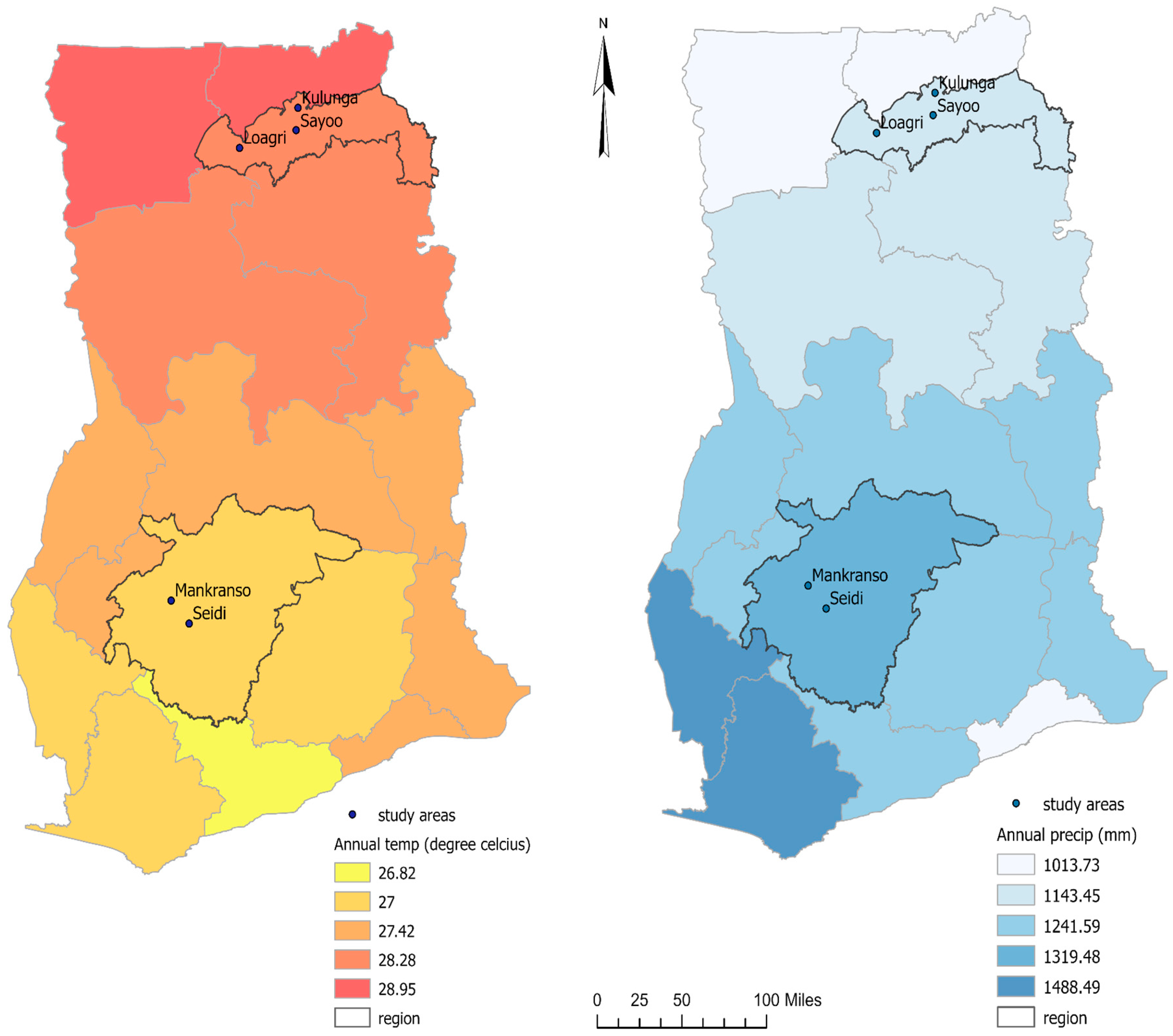
To capture variation in rainfall and temperature, we selected five farming communities spanning two of Ghana’s primary agroecological zones (Figure 1). In the southern part of the country, two communities—Seidi and Mankranso—fall within the Ashanti Region’s deciduous forest belt. This zone receives bimodal annual rainfall ranging from 1100 to 1500 mm, with average yearly temperatures between 26 and 27 °C. The remaining three communities—Kulunga, Saayoo, and Loagri—are situated in the northern Guinea savanna zone (North-East Region), where rainfall is unimodal and averages 1000–1200 mm per year, and mean temperatures range from 27 to 28 °C [27]. This geographical spread allowed us to assess CA performance across distinctly wet (southern) and dry (northern) climatic conditions.

2.3. The Training Program and Participant Selection

The training intervention was implemented by the Center for No-Till Agriculture (CNTA), an organization founded in 2012 to advance conservation agriculture principles in Ghana, including minimal soil disturbance, permanent soil cover, and intercropping. CNTA’s training model involves initial intensive workshops, on-site practical demonstrations, and, crucially, long-term follow-up through community visits and refresher workshops, constituting the sustained engagement central to this study. The training curriculum emphasizes minimum tillage and mulching as entry points for CA adoption. Cover cropping and crop rotation are introduced in advanced modules; however, adopting these practices requires farmers to purchase cover crop seeds, such as Bush Mucuna and Canavalia. The first training cohorts in our specific study communities (Ashanti and North-East regions) began in 2019. No farmers in these communities had received CNTA training prior to 2019. Thus, the 2019–2023 period represents the maximum treatment duration available for analysis in this study. Farmers from Seidi (South, n = 83), Saayoo (North, n = 43), and Loagri (North, n = 12) were selected as the Treatment group, having participated in CNTA’s program since 2019. Farmers from Mankranso (South, n = 33) and Kulunga (North, n = 67) were selected as the Control group and employed conventional farming practices without prior CA training. The total sample comprised 238 farm households.

2.4. Data Collection

Primary data were collected during the post-harvest season (September to November) of 2023 via a structured household survey and concurrent soil sampling. The survey was administered in local languages by trained enumerators using a digital questionnaire on the Qualtrics platform. It captured three core domains: (1) household demographics and productive assets, including the age, education, and gender of the household head, as well as farm labor, land size, and equipment ownership; (2) detailed farm management practices, such as the use of cover cropping, tillage intensity, residue management, and fertilizer application; and (3) farmers’ subjective perception and self-reported knowledge of their soil’s health. To minimize social desirability bias towards the concept of CA, questions focused on specific, individual practices rather than naming ‘CA’ as a system. Soil sampling was conducted on each participating farm to obtain objective physicochemical data. All farmers selected for the study completed the household survey as interviews were conducted in person with farmers who had consented to participate. Following a standardized protocol, three composite soil samples were collected from random points at a depth of 10 cm using a 55 cm soil auger. Sampling was restricted to the 10 cm depth interval because this layer is where most nutrient cycling and organic matter accumulation occurs under CA practices, particularly no-tillage and surface mulching [28]. This depth is also standard for assessing immediate changes in soil health following management interventions [29], although carbon may sometimes accumulate beyond the surface layers [28]. These samples were subsequently analyzed at the University of Ghana Ecological Laboratory for two key indicators of soil health: soil organic carbon (SOC) and total nitrogen (N), both expressed in percentages.
Soil organic carbon was determined using the Walkley–Black dichromate oxidation method [30]. Total nitrogen was analyzed using the Kjeldahl digestion method [31].

2.5. Variable Definition and Measurement

The study examined one primary treatment variable and three key outcome variables. The treatment was defined as a binary indicator where 1 was assigned to farmers in the Long-term CA Training group and 0 for control farmers—who, for the purpose of the study, are referred to as conventional farmers. The outcome variables were operationalized as follows: First, maize yield was calculated as the total harvest weight (in kilograms) from the 2023 major season divided by the cultivated area (in acres), resulting in a continuous metric (kg/acre). Soil health knowledge was derived from the farmers’ self-assessment. Farmer knowledge of soil health was assessed by examining the relationship between farmers’ subjective perceptions and objective laboratory measurements. Farmers rated the health of their soil with respect to nitrogen and organic carbon on a five-point Likert scale ranging from −2 (very poor) to +2 (very good). These ratings were contextualized by asking farmers about on-farm problems they experienced and the frequency with which they practiced sustainable farm methods. Farmers’ perceptions were then compared against laboratory-measured values of soil nitrogen and organic carbon (expressed as percentages) using correlation analysis. A positive and significant correlation would indicate that farmers possess accurate knowledge of their soil’s nutrient status. Soil health indicators were the direct laboratory measurements of soil organic carbon (SOC) and total nitrogen (N) from soil samples collected on each farm, both expressed as percentages.
A suite of covariates, selected based on literature identifying drivers of agricultural practice adoption [32,33], was used for propensity score matching. These included demographic characteristics of the household head (age, gender, education), household and farm structure (household size, farm labor, distance to farm and input dealers), regional location (North/South), and ownership of key farm assets such as tractors, plows, and sprayers. The asset index was constructed using principal component analysis (PCA) based on household ownership of farm equipment, including tractors, plows, sprayer pumps, and other relevant machinery. The first principal component was retained as the asset index, with higher values indicating greater asset wealth [34].

2.6. Propensity Score Matching and Regression

To estimate the causal effect of long-term CA training, we employed a two-step analytical process using propensity score matching (PSM) followed by regression adjustment, a method robust to confounding in observational studies.
Step 1: Propensity Score Estimation and Matching.
The propensity score, defined as the conditional probability of receiving treatment given observed covariates, was estimated for each farmer i using a logistic regression model:
e(Xi) = Pr (Ti = 1|Xi),
where e = propensity score; Pr = probability of a subject treatment determined as the function of the covariates; Ti = treatment variable; and Xi = the vector of pre-treatment covariates. Given the larger size of the treatment group (n = 138) relative to the control (n = 100), we performed nearest-neighbor matching with replacement using a caliper width of 0.1 standard deviations of the logit of the propensity score. This approach minimizes bias by ensuring each treated farmer is matched to the most statistically similar control farmer while allowing controls to be used more than once to improve match quality. The original sample size (N = 238) was reduced to 146 following the matching procedure. PSM typically excludes observations that lack suitable counterparts, retaining only treatment and control units with closely comparable propensity scores. Consequently, the analytical sample becomes smaller than the initial dataset.
The success of the matching procedure was assessed by evaluating the balance of covariates between the matched treatment and control groups. Balance was quantified using Standardized Mean Differences (SMD), with a criterion of SMD < 0.1 or a variance ratio close to 1 but not <0.5 or >2 for all covariates considered indicative of adequate balance [35,36]. Despite matching, some residual imbalance may persist, particularly with smaller samples. To diagnose this, we conducted independent two-sample t-tests on all covariates between the treatment and control groups in the matched sample. Any covariate remaining significantly unbalanced (p < 0.05) was retained for adjustment [37].
Step 2: Outcome Analysis with Double Adjustment.
The impact of the training on outcome variables was estimated using Ordinary Least Squares (OLS) regression on the matched sample. This ‘double-adjustment’ method controls for any residual confounding after matching by including the treatment indicator and the subset of unbalanced covariates (Xi′) in the model. The general specification is:
Yi = α + βTi + γXi′ + εi
where α is the intercept, β is the coefficient for the treatment effect (the parameter of interest), γ is a vector of coefficients for the unbalanced covariates, and εi is the idiosyncratic error term, assumed to be independently and identically distributed. To account for potential correlation of errors within communities, standard errors were clustered at the community level [38]. All analyses were conducted using the MatchIt and stats packages in R software (version 4.3.0).

2.7. Sensitivity Analysis for Unobserved Confounding

To assess the robustness of our findings to potential unobserved confounding, we conducted a sensitivity analysis following the framework proposed by [39] using the sensemakr package in R. This approach quantifies how strong unobserved confounders would need to be to either (1) completely nullify the estimated treatment effect, or (2) reduce the statistical significance below conventional thresholds (p > 0.05). The robustness value (RV) was calculated, representing the minimum proportion of residual variation that unobserved confounders would need to explain in both treatment assignment and the outcome to overturn the conclusions. Higher RVs indicate greater robustness to hidden bias. Based on prior recommendations [40], RVs exceeding 0.10 are considered moderately robust, while values above 0.20 indicate strong robustness.

3. Results

3.1. Sample Characteristics After Matching

Of the original 238 households, 92 observations were discarded during propensity score matching because they lacked suitable matches within the caliper distance (0.1 standard deviations of the logit of the propensity score). This resulted in a matched analytical sample of 146 households (108 treated, 38 control). Thus, propensity score matching yielded a balanced analytical sample of 146 smallholder farmers, comprising 108 who received long-term CA training and 38 conventional farmers serving as the control group (Supplementary Table S1). The matching procedure discarded 92 observations that lacked suitable matches, leaving a sample with comparable observable characteristics between the two groups.

3.2. Covariates Balance After Matching

The quality of the matching procedure was assessed by examining the balance of covariates between treatment and control groups in the matched sample. Standardized Mean Differences (SMD) and variance ratios for all covariates are presented in Supplementary Figure S1. Acceptable balance was defined as SMD < 0.1 and variance ratios between 0.5 and 2.0 [35,36]. While most covariates achieved adequate balance, four variables (family members who work on the farm, total household members, assets, and age of household head) showed SMD values outside the −0.1 to 0.1 and between 0.5 and 2.0 SMD and variance ratio thresholds, respectively. Based on variance ratios, two variables (labour hired and asset) fell outside the acceptable range.
To identify any residual imbalance requiring statistical adjustment, we conducted independent two-sample t-tests comparing all covariates (both balanced and unbalanced) between the treatment and control groups in the matched sample (Table 1). Only one variable, distance to agricultural dealer, remained significantly different between groups (p < 0.001). Following [37], this variable was included as a covariate in the final OLS model to control for potential confounding. This double-adjustment approach effectively mitigates bias from observed confounders without overfitting the model.

3.3. Adoption of Sustainable Farm Practices

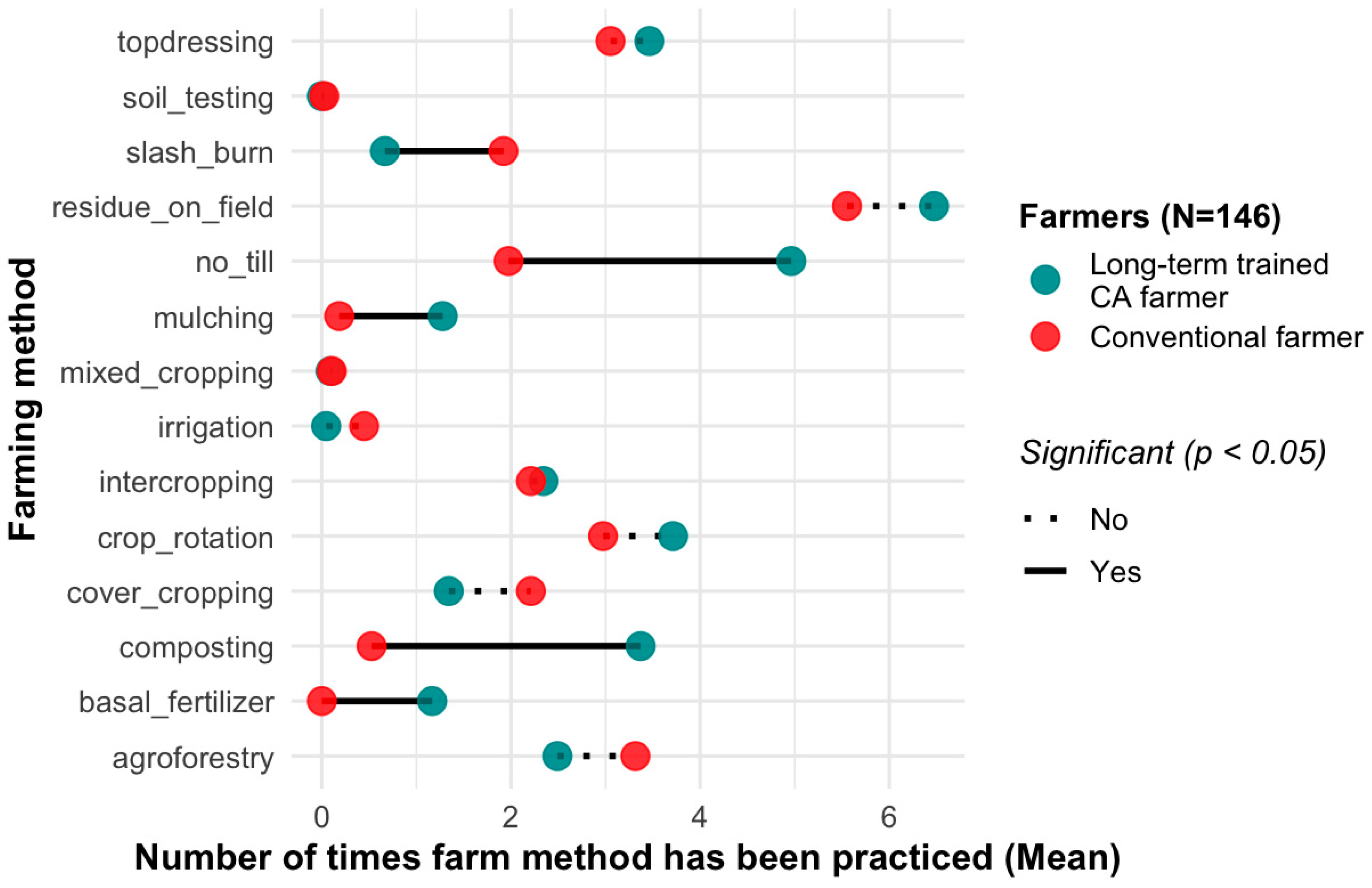
Farmers who received long-term CA training reported more frequent use of several sustainable practices from 2019 to 2023 compared to conventional farmers (Figure 2). Statistically significant differences were observed for core CA practices: long-term CA-trained farmers practiced no-tillage (p < 0.05), mulching (p < 0.05), and composting (p < 0.05) more frequently. They also applied basal chemical fertilizer more frequently (p < 0.05). Conversely, conventional farmers practiced slash-and-burn significantly more frequently than their trained counterparts (p < 0.05). No significant differences were found between groups for practices such as crop rotation, intercropping, cover cropping, or agroforestry.

3.4. Impact on Maize Yield

To estimate the effect of long-term CA training on maize yield, we fitted an Ordinary Least Squares (OLS) regression model on the matched sample, including the treatment indicator and the unbalanced covariate (distance to agricultural dealer). The results are presented in Table 2.
After controlling for distance to agricultural dealer, receiving long-term CA training was associated with a statistically significant increase in maize yield. Long-term CA-trained farmers harvested an average of 1.61 additional 100-kg bags per acre (approximately 160 kg/acre) compared to conventional farmers (β = 1.61, p < 0.001). Relative to the national average maize yield of 15, 100-kg bags per acre in Ghana [41], this represents a 10.7% increase in yield. The covariate distance to agricultural dealer was not a significant predictor of yield in the model (p = 0.572), indicating that the observed yield difference can be attributed to the long-term training program rather than differential access to input markets.
Sensitivity analysis (Supplementary Figure S2) revealed that unobserved confounders would need to explain at least 24.4% of the residual variation in both treatment assignment and yield to completely nullify the estimated CA treatment effect (RV = 0.244). To render the effect statistically non-significant (p > 0.05), unobserved confounders would need to explain 10.9% of the residual variation (RV= 0.109).

3.5. Farmer Knowledge of Soil Health

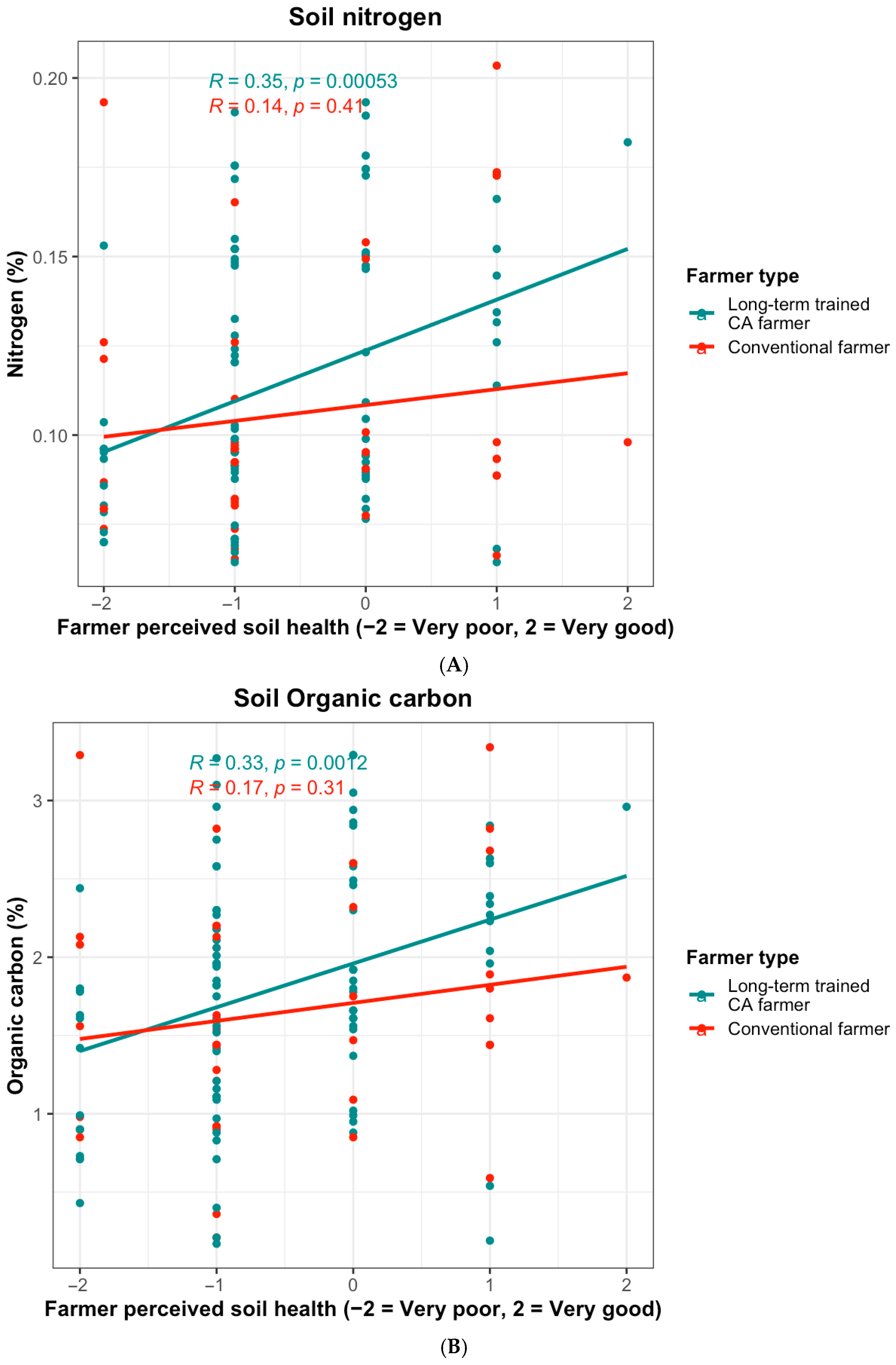
Farmers’ subjective ratings of their soil’s nitrogen and organic carbon status (on a −2 to +2 Likert scale) were correlated with laboratory-measured values of these nutrients to assess the accuracy of farmer knowledge (Figure 3A,B). Positive correlations were observed for both groups, indicating that better soil health ratings were generally associated with higher measured nutrient levels. However, the correlations were statistically significant only for farmers who had received long-term CA training (Nitrogen: R = 0.35, 95% CI [0.01, 0.02] p < 0.001; Organic carbon: R = 0.33, 95% CI [0.11, 0.45], p < 0.05). These coefficients indicate a modestly significant positive relationship, with long-term CA-trained farmers’ perceptions explaining approximately 12% of the variance in measured nitrogen and 11% of the variance in organic carbon. Conventional farmers showed no significant correlation between their perceptions and measured soil nutrients, suggesting that long-term CA-trained farmers possess relatively higher knowledge of their soil’s condition.

3.6. Measured Soil Health Indicators

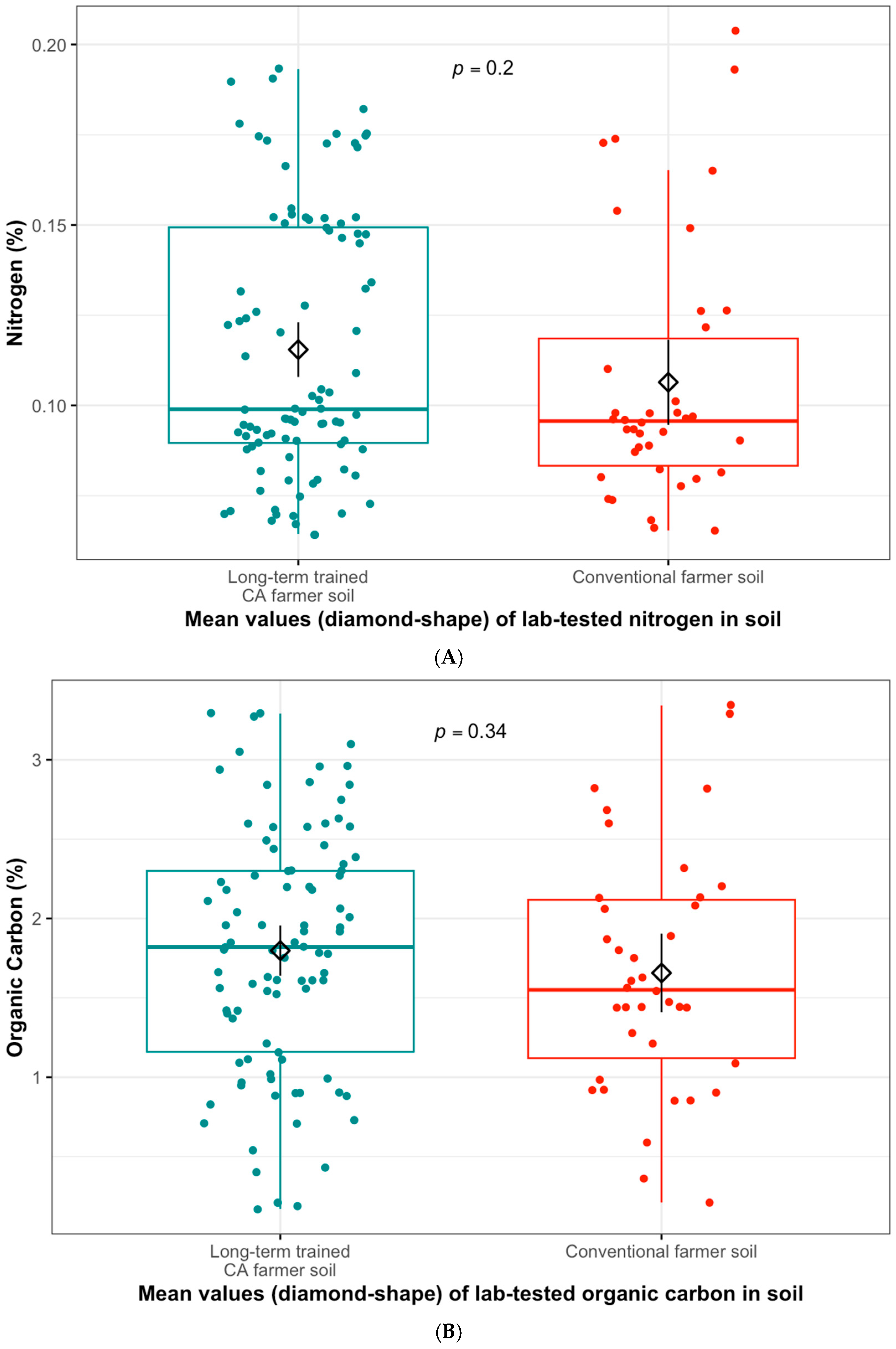
Despite their somewhat more accurate knowledge, soils of the farmers in the long-term CA training group did not exhibit significantly higher levels of nitrogen or organic carbon compared to conventional farmers (Figure 4A,B). Mean nitrogen values were 0.12% (SD = 0.04, 95% CI [0.11, 0.12]) for long-term CA-trained farmers versus 0.11% (SD = 0.04, 95% CI [0.09, 0.12]) for conventional farmers. Mean organic carbon values were 1.80% (SD = 0.77, 95% CI [1.64, 1.96]) for long-term CA-trained farmers versus 1.66% (SD = 0.76, CI [1.41, 1.90]) for conventional farmers. While both soil nutrients were slightly higher in long-term CA-trained farmers’ fields, these differences were not statistically significant (p > 0.05 for both soil nutrients).

3.7. Farmer-Reported Soil Problems

Farmers were asked about their experience of common on-farm problems that negatively affect soil health. A significantly lower proportion of long-term CA-trained farmers reported experiencing fertilizer runoff (p < 0.05), topsoil erosion (p < 0.05), and waterlogging (p < 0.05) compared to conventional farmers (Table 3). Long-term CA-trained farmers also reported lower incidence of soil compaction, dryness, and weed pressure, although these differences were not statistically significant.

4. Discussion

4.1. Long Term CA Training Reduces On-Farm Challenges and Boosts Yields

4.1.1. Training Promotes Adoption of CA Practices

Compared to conventional farmers, those who participated in long-term CA training reported using no-tillage methods, mulching, composting, and basal fertilizer more frequently over the five years preceding the survey (Figure 2). This pattern is consistent with prior work showing that ongoing training and sustained contact encourage farmers to both adopt and continue using CA methods [21]. We interpret this finding as evidence that repeated engagement builds farmers’ awareness, serves as a reminder of proper techniques, and provides reassurance—factors that together reinforce continued practice.
Farmers often struggle to follow through on their intentions [42], but follow-up workshops appear to nudge them toward commitment to the methods they have learned. Similar behavioral interventions have been shown to encourage farmers in Kenya to follow through with fertilizer application decisions [43]. Interestingly, while long-term CA-trained farmers adopted several CA practices more frequently, they did not differ significantly from conventional farmers in practices such as crop rotation, intercropping, cover cropping, or agroforestry (Figure 2). This suggests that while CNTA’s training covers the full suite of CA principles, including cover cropping and crop rotation, farmers may face some constraints—specifically accessing and purchasing cover crop seeds—that may limit adoption of these practices. Training programs may therefore need to be complemented with seed subsidies or revolving credit schemes to translate knowledge into practice [16].

4.1.2. CA Practices Reduce On-Farm Challenges

Long-term CA-trained farmers reported significantly lower incidence of fertilizer runoff, topsoil erosion, and waterlogging compared to conventional farmers (Table 3). These perceived benefits are consistent with the documented effects of CA practices across sub-Saharan Africa. For example, in Cameroon and Mali, no-tillage practices lowered runoff by 20% and reduced soil susceptibility to erosion by approximately one-third relative to conventionally managed systems [44]. Similarly, mulching has been found to enhance soil moisture retention by minimizing evaporation and improving water infiltration in semi-arid regions of Kenya [45] and South Africa [46], while also suppressing weed incidence by as much as 51% in Zimbabwe [47].
The reduction in fertilizer runoff reported by long-term CA-trained farmers (Table 3) is particularly noteworthy, as it suggests that CA practices may enhance fertilizer use efficiency, a critical consideration in contexts where access to inorganic fertilizer is limited and costly [48]. This may partially explain the yield gains observed among trained farmers.

4.1.3. Yield Gains from Long-Term CA Training

After controlling for distance to agricultural dealer—the only covariate showing residual imbalance after matching—long-term CA training was associated with a significant increase in maize yield of 1.61 100-kg bags per acre (approximately 160 kg/acre), representing a 10.7% increase relative to the national average (Table 2). The robustness value of 0.244 exceeds conventional benchmarks for strong robustness [40], suggesting that substantial hidden bias would be required to eliminate the observed effect. This increases confidence in the causal interpretation of our findings. This result is consistent with previous studies documenting yield benefits from CA in sub-Saharan Africa, particularly under conditions of seasonal rainfall variability where CA’s moisture-conserving properties confer advantage [49,50,51,52]. The maize yield gain in Ghana’s variable climatic conditions also aligns with higher maize yield increase under CA than conventional systems across variable climatic regions across China [53].
The timing of these yield benefits is also consistent with previous research. [54] found that CA can be profitable within the first five years of adoption, while other studies in SSA and south-eastern Australia suggest that benefits may increase further after eight or more years [12,55]. Scholars have noted that CA often requires higher labor inputs in the early years for land preparation, planting, and weeding, with labor demands decreasing as farmers gain experience and soils improve [56]. Our finding that long-term CA-trained farmers achieved significant yield gains within five years suggests that the CNTA training model may accelerate the trajectory of benefits, likely through improved practice implementation rather than simply adoption status.

4.2. Long-Term CA Training Improves Farmer Knowledge of Soil Health

Beyond direct agronomic benefits, our results reveal an important indirect effect: long-term CA training significantly improved farmers’ ability to accurately assess their soil’s nutrient status. Long-term CA-trained farmers’ subjective ratings of soil nitrogen and organic carbon were significantly correlated with laboratory-measured values whereas conventional farmers showed no significant correlation between perception and measurement (Figure 3A,B). This indicates that long-term CA-trained farmers have a modestly better perception of their soil’s condition, though the correlation explains only approximately 11–12% of the variance in measured values. This finding aligns with research from Tanzania, Ethiopia, and Kenya, where farmers practicing conservation agriculture evaluated their soils more positively than conventional farmers, particularly regarding visible characteristics such as smell, surface crusting, and soil compaction [57]. Enhanced knowledge can be attributed to two mechanisms. First, as demonstrated in Section 4.1.2, long-term trained farmers experience fewer soil problems (fertilizer runoff, erosion, waterlogging), which may provide direct sensory feedback about soil condition. Second, the training itself, particularly its emphasis on soil health principles, likely equips farmers with conceptual frameworks for interpreting observable soil characteristics [21].
The practical significance of this knowledge gain is evident in farmers’ management decisions. Long-term CA-trained farmers applied basal fertilizer significantly more frequently than their conventional counterparts (Figure 2), suggesting they are more mindful of nutrient absorption and timing practices that facilitate efficient nutrient uptake, reduce runoff, and minimize weed competition. Our result supports [58] argument that education and capacity-building equip farmers with the know-how and understanding necessary to deliberately implement agricultural innovations, rather than merely replicating practices without comprehending their foundational concepts.

4.3. Knowledge–Yield–Soil Paradox: Improved Knowledge and Yields Do Not Translate into Measurable Soil Health Gains

The most intriguing finding of this study is the disjuncture between long-term CA-trained farmers’ improved knowledge and yields, on one hand, and the absence of detectable improvements in soil nitrogen and organic carbon, on the other (Figure 4A,B). Despite significantly greater knowledge and a 10.7% yield advantage, long-term CA-trained farmers’ fields showed only slightly higher, but statistically insignificant levels of these key soil health indicators.
This paradox may reflect adoption barriers rather than training gaps. While CNTA’s curriculum includes cover cropping and crop rotation—practices critical for nitrogen and soil carbon building—long-term CA-trained farmers did not adopt these practices at significantly higher rates than conventional farmers (Figure 2). This may be due to inadequate access to cover crop seeds such as Bush Mucuna, Canavalia and Green Gram that must be purchased, and many smallholders in SSA lack upfront capital to invest in these seeds despite understanding their long-term soil health benefits [16]. The gap between knowledge and practice observed here is not unique to Ghana. Globally, CA adoption studies have documented similar ‘know-do’ gaps, where farmers understand the benefits of cover cropping but fail to adopt due to economic or institutional constraints [59]. Our explanation that seed costs constrain cover crop adoption echoes research from South Asia and Latin America, where subsidized seed distribution or community seed banks have proven effective in bridging the knowledge-adoption gap [60]. Thus, knowledge transmission alone is insufficient; complementary interventions that address input costs are needed to translate training into full adoption in practice.
Methodological factors may also play a role. Shallow-depth, single-time-point sampling may miss carbon gains in deeper layers or specific microsites [61], and detecting subtle soil changes may require larger samples or longer timeframes. The absence of detectable soil nutrient gains in five years is consistent with meta-analyses showing that significant accumulation under CA in SSA often requires 8–10 years [12,54]. Soil carbon increases have been found to be time-dependent, requiring 5–10 years to be noticeable in Northern America (USA and Canada), Southern America (Brazil), Australia, and Europe (Spain and Switzerland) [62]. Our study captures the early trajectory: yield and knowledge benefits precede soil regeneration. Training should therefore be complemented with explicit soil-building interventions and investments, such as promoting subsidized cover crops and crop rotation, and evaluated over longer periods.

4.4. Limitations

Our research has certain constraints that should be taken into account when evaluating its results. First, despite employing propensity score matching, unobserved factors like farmer social networks or prior experience with sustainable practices may confound the results. Our knowledge measure, while innovative, captures only one dimension of knowledge; it does not reveal how farmers conceptualize soil health, what observable indicators they use, or how knowledge translates into management decisions across different contexts. Also, we could not ascertain the exact completion rate of the training program, as all farmers attended the in-person training organized by CNTA but there was variability in how much farmers engaged with CNTA following that. Qualitative research would enrich the understanding of these social and behavioral processes. Also, future research should examine how training completion rates moderate outcomes.
Second, the sample size, while adequate for detecting yield differences, may be underpowered for subtle soil changes. A post hoc power analysis was conducted to assess the study’s ability to detect differences in soil metrics given the matched sample (treatment n = 108, control n = 38) (Supplementary Table S2). Using Cohen’s d effect size conventions, the achieved power was 18.4% for a small effect (d = 0.2), 75% for a medium effect (d = 0.5), and 98.8% for a large effect (d = 0.8). These results indicate that our study had sufficient power to detect large differences in soil carbon and nitrogen but was underpowered for small or moderate effects. Therefore, while the absence of large soil improvements is credible, we cannot rule out small-to-moderate gains that may become detectable with a larger sample or a longer time frame. Future studies should aim for larger control groups (n > 60) to achieve 80% power for medium effects.
Third, we acknowledge that unobserved factors such as maize variety, micro-climatic conditions, and baseline soil heterogeneity may influence yield outcomes. However, the propensity score matching procedure balanced observed covariates across treatment and control groups, and the random selection of farmers within communities mitigates concerns about systematic unobserved confounding.
Lastly, the findings are geographically limited to five Ghanaian communities in two agroecological zones. While this provides valuable comparative insights across wet and dry contexts, it may not generalize to other contexts with different soils, crops, or institutional arrangements. Despite these limitations, this study demonstrates that long-term CA training can deliver significant productivity and knowledge benefits, even where measurable soil improvements lag, highlighting the need for patient, long-term perspectives on soil regeneration.

5. Conclusions

This study examined whether long-term farmer training in CA improves maize yields, farmer knowledge of soil health, and measurable soil indicators among smallholder farmers in Ghana. The findings reveal a nuanced picture: farmers who received sustained training achieved significantly higher maize yields (a 10.7% increase) and demonstrated a more accurate understanding of their soil’s nitrogen and organic carbon status compared to conventional farmers. They also reported fewer on-farm problems, including reduced fertilizer runoff, topsoil erosion, and waterlogging.
However, these productivity and knowledge gains did not translate into detectable improvements in measured soil nitrogen or organic carbon within the five-year study period. This knowledge–yield–soil paradox suggests that, while training effectively promoted tillage reduction and mulching, adoption of cover cropping and crop rotation remained low despite these practices being taught in the CNTA curriculum. This gap appears driven by accessibility barriers—farmers must purchase cover crop seeds, which many smallholders cannot afford. Methodological factors, including single-depth sampling, may also mask subtle changes occurring below the surface. The findings demonstrate that long-term, sustained engagement can yield significant productivity and knowledge benefits, even where measurable soil improvements lag, and underscore that soil regeneration is a slow process requiring patient, long-term perspectives.
Based on these findings, there is initial evidence of the value of long-term CA training programs being sustained over multi-year periods. Crucially, training should be complemented with accessibility interventions—such as seed subsidies or revolving credit schemes—to address barriers to purchasing cover crop seeds and adopting the full suite of CA principles. Monitoring and evaluation frameworks should track both productivity outcomes and soil health indicators over longer time horizons (8–10 years) to capture the slower dynamics of soil regeneration. Complementary interventions, such as support for biomass production and access to cover crop seeds, may also be needed to address constraints limiting farmers’ ability to implement soil-building practices. Long-term CA training delivers clear benefits, but realizing the full potential of CA for soil health regeneration requires patience, persistence, and a commitment to the complete suite of principles. From a sustainability perspective, our findings demonstrate that long-term CA training delivers immediate productivity and knowledge gains—supporting economic and social sustainability—while soil regeneration (environmental sustainability) requires longer time horizons and a broader set of practices. Agricultural extension systems must therefore balance short-term farmer needs with long-term soil health goals.

Supplementary Materials

The following supporting information can be downloaded at: https://www.mdpi.com/article/10.3390/su18126068/s1. Supplementary Figure S1: Covariate balance between long term trained CA and conventional farmer groups. Balanced covariates have SMD < 0.1 or variation ratios of As shown in Supplementary Figure S1, four covariates (family members who work on the farm, total household members, asset, and age of household head) exceeded the SMD threshold of 0.1, and two covariates (labour hired and asset) exceeded the variance ratio threshold of 2.0. Supplementary Figure S2: Sensitivity analysis. Unobserved confounders would need to explain at least 24.4% of the residual variation in both treatment assignment and yield to completely nullify the estimated CA treatment effect (RV = 0.244). To render the effect statistically non-significant (p > 0.05), unobserved confounders would need to explain 10.9% of the residual variation (RV = 0.109). Supplementary Table S1: Matched and unmatched farmers. Supplementary Table S2: Post-hoc power analysis for soil metric comparisons.

Author Contributions

Conceptualization, D.F.; Methodology, D.F. and K.B.W.; Software, D.F.; Validation, D.F. and K.B.W.; Formal Analysis, D.F. and K.B.W.; Investigation, D.F.; Data Curation, D.F.; Writing—Original Draft Preparation, D.F.; Writing—Review & Editing, D.F. and K.B.W.; Visualization, D.F.; Supervision, K.B.W. All authors have read and agreed to the published version of the manuscript.

Funding

This research did not receive any specific grant from funding agencies in the public, commercial, or not-for-profit sectors.

Institutional Review Board Statement

The study was conducted in accordance with the Declaration of Helsinki, and approved by the Institutional Review Board of Indiana University Bloomington (protocol code 17890 and approved on 8 May 2023).

Informed Consent Statement

Informed consent was obtained from all subjects involved in the study.

Data Availability Statement

Data is available upon reasonable request from the authors.

Acknowledgments

The authors sincerely thank the Center for No-Till Agriculture (CNTA) for its assistance in connecting the research team with trained farmers and facilitating field data collection. This support was instrumental to the successful completion of the study.

Conflicts of Interest

The authors declare no conflicts of interest.

References

  1. Bouma, J.; McBratney, A. Framing soils as an actor when dealing with wicked environmental problems. Geoderma 2013, 200, 130–139. [Google Scholar] [CrossRef]
  2. Nayakekorale, H.B. Soil degradation. In The Soils of Sri Lanka; Springer International Publishing: Cham, Switzerland, 2020; pp. 103–118. [Google Scholar]
  3. Jocien, S.K.; Frederick, N. Unsustainable agricultural practices as a driver of soil degradation in Santa sub-division, north west region of Cameroon. Asian Soil Res. J. 2023, 7, 19–33. [Google Scholar] [CrossRef]
  4. FAO. The State of the World’s Land and Water Resources for Food and Agriculture—Systems at Breaking Point; Main report; FAO: Rome, Italy, 2022. [Google Scholar] [CrossRef]
  5. Hillocks, R.J. Addressing the yield gap in Sub-Saharan Africa. Outlook Agric. 2014, 43, 85–90. [Google Scholar] [CrossRef]
  6. Masso, C.; Nziguheba, G.; Mutegi, J.; Galy-Lacaux, C.; Wendt, J.; Butterbach-Bahl, K.; Wairegi, L.W.I.; Datta, A. Soil fertility management in sub-Saharan Africa. In Sustainable Agriculture Reviews; Springer International Publishing: Cham, Switzerland, 2017; pp. 205–231. [Google Scholar]
  7. Highfield, R. Boosting Soil Health to Curb Climate Change. Science Museum Group. 2022. Available online: https://www.sciencemuseumgroup.org.uk/blog/boosting-soil-health-to-curb-climate-change/ (accessed on 5 June 2022).
  8. Grin, J.; Rotmans, J.; Schot, J. Transitions to Sustainable Development: New Directions in the Study of Long-Term Transformative Change; Routledge: London, UK, 2010. [Google Scholar]
  9. Cárceles Rodríguez, B.; Durán-Zuazo, V.H.; Soriano Rodríguez, M.; García-Tejero, I.F.; Gálvez Ruiz, B.; Cuadros Tavira, S. Conservation agriculture as a sustainable system for soil health: A review. Soil Syst. 2022, 6, 87. [Google Scholar] [CrossRef]
  10. Strauss, J.A.; Swanepoel, P.A.; Laker, M.C.; Smith, H.J. Conservation agriculture in rainfed annual crop production in South Africa. S. Afr. J. Plant Soil 2021, 38, 217–230. [Google Scholar] [CrossRef]
  11. Marambanyika, V. The Role of Conservation Agriculture in Improving Smallholder Farmers’ Crop Yields in Malawi. Master’s Thesis, Norwegian University of Life Sciences, Ås, Norway, 2022. [Google Scholar]
  12. Giller, K.E.; Witter, E.; Corbeels, M.; Tittonell, P. Conservation agriculture and smallholder farming in Africa: The heretics’ view. Field Crops Res. 2009, 114, 23–34. [Google Scholar] [CrossRef]
  13. Yiridomoh, G.Y.; Dayour, F.; Aasoglenang, T.A.; Tseer, T.; Dapilah, F. Conservation agriculture as a response strategy to climate change in resource-scarce settings in North Western Ghana. Front. Sustain. Food Syst. 2026, 10, 1802248. [Google Scholar] [CrossRef]
  14. Corbeels, M.; Thierfelder, C.; Rusinamhodzi, L. Conservation agriculture in sub-Saharan Africa. In Conservation Agriculture; Springer: Cham, Switzerland, 2015; pp. 443–476. [Google Scholar]
  15. Stevenson, J.R.; Serraj, R.; Cassman, K.G. Evaluating conservation agriculture for small-scale farmers in Sub-Saharan Africa and South Asia. Agric. Ecosyst. Environ. 2014, 187, 1–10. [Google Scholar] [CrossRef]
  16. Araya, T.; Ochsner, T.E.; Mnkeni, P.N.; Hounkpatin, K.O.L.; Amelung, W. Challenges and constraints of conservation agriculture adoption in smallholder farms in sub-Saharan Africa: A review. Int. Soil Water Conserv. Res. 2024, 12, 828–843. [Google Scholar] [CrossRef]
  17. Opoku-Acheampong, K.; Tham-Agyekum, E.K.; Ankuyi, F.; Okorley, E.L.; Bakang, J.E.A.; Nimoh, F. Effect of adoption of conservation agriculture on household food security of smallholder maize farmers in Ghana. Environ. Sustain. Indic. 2024, 23, 100436. [Google Scholar] [CrossRef]
  18. Thierfelder, C.; Rusinamhodzi, L.; Ngwira, A.R.; Mupangwa, W.; Nyagumbo, I.; Kassie, G.T.; Cairns, J.E. Conservation agriculture in Southern Africa: Advances in knowledge. Renew. Agric. Food Syst. 2015, 30, 328–348. [Google Scholar] [CrossRef]
  19. Baudron, F.; Tittonell, P.; Corbeels, M.; Letourmy, P.; Giller, K.E. Comparative performance of conservation agriculture and current smallholder farming practices in semi-arid Zimbabwe. Field Crops Res. 2012, 132, 117–128. [Google Scholar] [CrossRef]
  20. Nyanga, P.H. Factors influencing adoption and area under conservation agriculture: A mixed methods approach. Sustain. Agric. Res. 2012, 1, 27. [Google Scholar] [CrossRef]
  21. Kansanga, M.M.; Kerr, R.B.; Lupafya, E.; Dakishoni, L.; Luginaah, I. Does participatory farmer-to-farmer training improve the adoption of sustainable land management practices? Land Use Policy 2021, 108, 105477. [Google Scholar]
  22. Wafula, L.; Oduol, J.; Oluoch-Kosura, W.; Muriuki, J.; Okello, J.; Mowo, J. Does strengthening technical capacity of smallholder farmers enhance adoption of conservation practices? The case of conservation agriculture with trees in Kenya. Agrofor. Syst. 2016, 90, 1045–1059. [Google Scholar] [CrossRef]
  23. Ngoma, H.; Marenya, P.; Tufa, A.; Alene, A.; Matin, M.A.; Thierfelder, C.; Chikoye, D. Too fast or too slow: The speed and persistence of adoption of conservation agriculture in southern Africa. Technol. Forecast. Soc. Change 2024, 208, 123689. [Google Scholar] [CrossRef]
  24. Natural Resources Conservation Science (NRSC). Your Soil Health Journey: What to Look for Along the Way! 2022. Available online: https://www.nrcs.usda.gov/sites/default/files/2023-03/NRCS%20Soil%20Health%20Journey%20factsheet_FINAL%202.pdf (accessed on 5 October 2022).
  25. Rubin, D.B. Using multivariate matched sampling and regression adjustment to control bias in observational studies. J. Am. Stat. Assoc. 1979, 74, 318–328. [Google Scholar] [PubMed]
  26. Sainani, K.L. Propensity scores: Uses and limitations. Phys. Med. Rehabil. 2012, 4, 693–697. [Google Scholar] [CrossRef] [PubMed]
  27. Fage, J.D.; Maier, D.J.; Davies, O.; Amano, E. Ghana. In Encyclopaedia Britannica; Encyclopædia Britannica, Inc.: London, UK, 2023; Available online: https://www.britannica.com/place/Ghana (accessed on 8 April 2024).
  28. Angers, D.A.; Eriksen-Hamel, N.S. Full-inversion tillage and organic carbon distribution in soil profiles: A meta-analysis. Soil Sci. Soc. Am. J. 2008, 72, 1370–1374. [Google Scholar] [CrossRef]
  29. Dominguez-Bohorquez, J.D.; Wittling, C.; Felix-Faure, J.; Brauman, A.; Bouarfa, S. Early-stage impacts of conservation agriculture on soil health in a French Mediterranean irrigated system. Arch. Agron. Soil Sci. 2025, 71, 1–23. [Google Scholar] [CrossRef]
  30. Nelson, D.W.; Sommers, L.E. A rapid and accurate procedure for estimation of organic carbon in soils. In Proceedings of the Indiana Academy of Science; Indiana Academy of Science: Indianapolis, IN, USA, 1974; Volume 84, pp. 456–462. [Google Scholar]
  31. Bremner, J.M. Determination of nitrogen in soil by the Kjeldahl method. J. Agric. Sci. 1960, 55, 11–33. [Google Scholar] [CrossRef]
  32. Chichongue, O.; Pelser, A.; Tol, J.V.; du Preez, C.; Ceronio, G. Factors influencing the adoption of conservation agriculture practices among smallholder farmers in Mozambique. Int. J. Agric. Ext. 2020, 7, 277–290. [Google Scholar] [CrossRef]
  33. Njeru, E.K. Factors Influencing Adoption of Conservation Agriculture by Small Holder Farmers in Kenya a Case of Laikipia East Sub-County: Kenya. Master’s Thesis, University of Nairobi, Nairobi, Kenya, 2016. [Google Scholar]
  34. Filmer, D.; Pritchett, L.H. Estimating wealth effects without expenditure data—Or tears: An application to educational enrollments in states of India. Demography 2001, 38, 115–132. [Google Scholar] [CrossRef] [PubMed]
  35. Austin, P.C. An introduction to propensity score methods for reducing the effects of confounding in observational studies. Multivar. Behav. Res. 2011, 46, 399–424. [Google Scholar] [CrossRef] [PubMed]
  36. Rubin, D.B. Using propensity scores to help design observational studies: Application to tobacco litigation. Health Serv. Outcomes Res. Methodol. 2001, 2, 169–188. [Google Scholar] [CrossRef]
  37. Nguyen, T.L.; Collins, G.S.; Spence, J.; Daurès, J.P.; Devereaux, P.J.; Landais, P.; Le Manach, Y. Double-adjustment in propensity score matching analysis: Choosing a threshold for considering residual imbalance. BMC Med. Res. Methodol. 2017, 17, 78. [Google Scholar] [CrossRef]
  38. Cameron, A.C.; Gelbach, J.B.; Miller, D.L. Robust inference with multiway clustering. J. Bus. Econ. Stat. 2011, 29, 238–249. [Google Scholar] [CrossRef]
  39. Cinelli, C.; Hazlett, C. Making sense of sensitivity: Extending omitted variable bias. J. R. Stat. Soc. Ser. B Stat. Methodol. 2020, 82, 39–67. [Google Scholar] [CrossRef]
  40. Oster, E. Unobservable selection and coefficient stability: Theory and evidence. J. Bus. Econ. Stat. 2019, 37, 187–204. [Google Scholar] [CrossRef]
  41. Balu, M. Sesame and soybean overtaking maize farming in Sissala. Ghana News Agency. 2023. Available online: https://gna.org.gh/2023/11/sesame-and-soybean-overtaking-maize-farming-in-sissala/ (accessed on 25 April 2024).
  42. Dessart, F.J.; Barreiro-Hurlé, J.; Van Bavel, R. Behavioural factors affecting the adoption of sustainable farming practices: A policy-oriented review. Eur. Rev. Agric. Econ. 2019, 46, 417–471. [Google Scholar] [CrossRef]
  43. Duflo, E.; Kremer, M.; Robinson, J. Nudging farmers to use fertiliser: Theory and experimental evidence from Kenya. Am. Econ. Rev. 2011, 101, 2350–2390. [Google Scholar] [CrossRef]
  44. Diallo, D.; Boli, Z.; Roose, E. Influence of no-tillage on soil conservation, carbon sequestration and yield of intensive rotation maize-cotton: Research on sandy soils of Cameroon and Mali. In No-Till Farming Systems; World Association of Soil and Water Conservation (WASWC): Bangkok, Thailand, 2007. [Google Scholar]
  45. Gicheru, P.T. Effects of residue mulch and tillage on soil moisture conservation. Soil Technol. 1994, 7, 209–220. [Google Scholar] [CrossRef]
  46. Stelli, S.; Hoy, L.; Hendrick, R.; Taylor, M. Effects of different mulch types on soil moisture content in potted shrubs. Water SA 2018, 44, 495–503. [Google Scholar] [CrossRef]
  47. Mtambanengwe, F.; Nezomba, H.; Tauro, T.; Chagumaira, C.; Manzeke, M.G.; Mapfumo, P. Mulching and fertilization effects on weed dynamics under conservation agriculture-based maize cropping in Zimbabwe. Environments 2015, 2, 399–414. [Google Scholar] [CrossRef]
  48. Nakachew, K.; Yigermal, H.; Assefa, F.; Gelaye, Y.; Ali, S. Review on enhancing the efficiency of fertilizer utilization: Strategies for optimal nutrient management. Open Agric. 2024, 9, 20220356. [Google Scholar] [CrossRef]
  49. Sithole, N.J.; Magwaza, L.S.; Mafongoya, P.L. Conservation agriculture and its impact on soil quality and maize yield: A South African perspective. Soil Tillage Res. 2016, 162, 55–67. [Google Scholar] [CrossRef]
  50. Rusinamhodzi, L.; Corbeels, M.; Van Wijk, M.T.; Rufino, M.C.; Nyamangara, J.; Giller, K.E. A meta-analysis of long-term effects of conservation agriculture on maize grain yield under rain-fed conditions. Agron. Sustain. Dev. 2011, 31, 657–673. [Google Scholar] [CrossRef]
  51. Thierfelder, C.; Wall, P.C. Effects of conservation agriculture techniques on infiltration and soil water content in Zambia and Zimbabwe. Soil Tillage Res. 2009, 105, 217–227. [Google Scholar] [CrossRef]
  52. Pretty, J.N.; Noble, A.D.; Bossio, D.; Dixon, J.; Hine, R.E.; Penning de Vries, F.W.; Morison, J.I. Resource-conserving agriculture increases yields in developing countries. Environ. Sci. Technol. 2006, 40, 1114–1119. [Google Scholar] [CrossRef]
  53. Zheng, C.; Jiang, Y.; Chen, C.; Sun, Y.; Feng, J.; Deng, A.; Song, Z.; Zhang, W. The impacts of conservation agriculture on crop yield in China depend on specific practices, crops and cropping regions. Crop J. 2014, 2, 289–296. [Google Scholar] [CrossRef]
  54. Pittelkow, C.M.; Linquist, B.A.; Lundy, M.E.; Liang, X.; Van Groenigen, K.J.; Lee, J.; van Gestel, N.; Six, J.; Venterea, R.T.; Van Kessel, C. When does no-till yield more? A global meta-analysis. Field Crops Res. 2015, 183, 156–168. [Google Scholar] [CrossRef]
  55. Bissett, M.J.; Oleary, G.J. Effects of conservation tillage and rotation on water infiltration in two soils in south-eastern Australia. Soil Res. 1996, 34, 299–308. [Google Scholar] [CrossRef]
  56. Mazvimavi, K. Socio-Economic Analysis of Conservation Agriculture in Southern Africa; Network Paper No. 2; FAO Regional Emergency Office for Southern Africa (REOSA): Johannesburg, South Africa, 2011. [Google Scholar]
  57. Entz, M.H.; Stainsby, A.; Riekman, M.; Mulaire, T.R.; Kirima, J.K.; Beriso, F.; Ngotio, D.; Salomons, M.; Nicksy, J.; Mutinda, M.; et al. Farmer participatory assessment of soil health from Conservation Agriculture adoption in three regions of East Africa. Agron. Sustain. Dev. 2022, 42, 97. [Google Scholar] [CrossRef]
  58. Kilpatrick, S. Education and training: Impacts on farm management practice. J. Agric. Educ. Ext. 2000, 7, 105–116. [Google Scholar] [CrossRef]
  59. Knowler, D.; Bradshaw, B. Farmers’ adoption of conservation agriculture: A review and synthesis of recent research. Food Policy 2007, 32, 25–48. [Google Scholar] [CrossRef]
  60. Erenstein, O.; Sayre, K.; Wall, P.; Hellin, J.; Dixon, J. Conservation agriculture in maize-and wheat-based systems in the (sub) tropics: Lessons from adaptation initiatives in South Asia, Mexico, and Southern Africa. J. Sustain. Agric. 2012, 36, 180–206. [Google Scholar] [CrossRef]
  61. Olson, K.R.; Al-Kaisi, M.M. The importance of soil sampling depth for accurate account of soil organic carbon sequestration, storage, retention and loss. CATENA 2015, 125, 33–37. [Google Scholar] [CrossRef]
  62. Luo, Z.; Wang, E.; Sun, O.J. Can no-tillage stimulate carbon sequestration in agricultural soils? A meta-analysis of paired experiments. Agric. Ecosyst. Environ. 2010, 139, 224–231. [Google Scholar] [CrossRef]
Figure 1. Annual average temperature (left) and rainfall (right) from 1991 to 2020 in the study areas: Mankranso and Seidi (Ashanti region) and Loagri, Kulunga and Sayoo (North-East region). Note: Map boundaries are for study purposes only and do not represent official national borders.
Sustainability 18 06068 g001
Figure 2. Dot plot showing the number of times the farm method was practiced from 2019 to 2023.
Sustainability 18 06068 g002
Figure 3. (A) (Nitrogen) & (B) (Organic carbon): Relationship between farmer perception and soil health indicators.
Sustainability 18 06068 g003
Figure 4. (A,B) Boxplot showing mean nitrogen and organic carbon content on CA and conventional farms. Mean values shown as diamond-shaped marker.
Sustainability 18 06068 g004
Table 1. t-statistics of covariates on long-term CA training.
Covariate on Long Term CA Trainingt-Valuep-Value
Geography (North = 0/South = 1)−0.680.498
Gender (0 = female; 1 = male)−0.320.748
Family members who work
the farm (number of people)
−0.0510.959
Labor hired (number of people)−0.670.506
Distance to primary
farm (in minutes)
−0.380.707
Distance to agricultural
dealer (in minutes)
3.710.000 ***
Total household members
(number of people)
0.180.858
Education (0 = no education,
7 = post-secondary)
0.350.729
Asset (farm machines
and technology support)
−1.050.296
Age (years)−1.180.241
Significant. codes: 0 ‘***’.
Table 2. OLS regression coefficients between yield (outcome) and long-term CA training and minutes to agricultural dealer covariate.
Yield (Bag/Acre)
PredictorsEstimateStandardizedStd. Errort ValuePr (>|t|)
(Intercept)1.8840.5353.5180.000584 ***
Long term CA training1.6120.2790.4803.3620.000994 ***
Distance to Agricultural dealer (minutes)−0.002−0.0460.003−0.5600.576
Note: *** represent statistical significance at 1% level, respectively.
Table 3. On-farm problems reported by long-term CA-trained and conventional farmers.
Total Number of Farmers (N = 146)
Strongly agree or AgreeNeutralStrongly disagree or DisagreeTwo sample t-test (p-value),
alpha = 0.05
Fertilizer run-offCA-trained (108)12 (11.11%)13 (12.04%)83 (76.85%)−2.07 (0.005) **
Conventional (38)12 (31.58%)7 (18.42%)19 (50%)
Soil compactCA-trained (108)49 (45.37%)17 (15.74%)42 (38.89%)−1.58 (0.118)
Conventional (38)24 (63.16%)3 (7.89%)11 (28.95%)
Soil drynessCA-trained (108)73 (67.59%)25 (23.15%)10 (9.26%)−0.74 (0.464)
Conventional (38)28 (73.68%)8 (21.05%)2 (5.26%)
Topsoil erosionCA-trained (108)26 (24.07%)15 (13.89)67 (62.04%)−2.80 (0.007) **
Conventional (38)15 (39.47%)8 (21.05%)15 (13.89%)
WaterloggingCA-trained (108)18 (16.67%)10 (9.26%)80 (74.07%)−2.44 (0.018) *
Conventional (38)11 (28.95%)8 (28.95%)19 (50%)
Weed pressureCA-trained (108)76 (70.37%)11 (10.19%)21 (19.44%)−0.42 (0.676)
Conventional (38)28 (73.68%)6 (15.79%)4 (10.53%)
* = p < 0.05, ** = p < 0.01.
Disclaimer/Publisher’s Note: The statements, opinions and data contained in all publications are solely those of the individual author(s) and contributor(s) and not of MDPI and/or the editor(s). MDPI and/or the editor(s) disclaim responsibility for any injury to people or property resulting from any ideas, methods, instructions or products referred to in the content.