Data Centre Waste Heat for Building Heating: A Comparative Energy Analysis in Italy




Abstract
1. Introduction
1.1. European Targets of Decarbonisation and the Role of the Building Sector
1.2. The Building Heating Sector
1.3. The Data Centre Sector: Energy Challenge and Opportunity
1.4. Waste Heat Recovery from Data Centres for Building Heating
1.5. Novelty and Contributions of the Present Study
2. Materials and Methods
2.1. General Considerations About the Study
- Scenario S0: It is the baseline scenario, i.e., the actual configuration in which the data centre and buildings are totally independent. The data centre has its own cooling system, while the heating system of the two buildings is fuelled by a gas-fired condensing boiler.
- Scenario S1: The data centre and the buildings are still totally independent, but the heating system of the buildings is supplied by electric heat pumps.
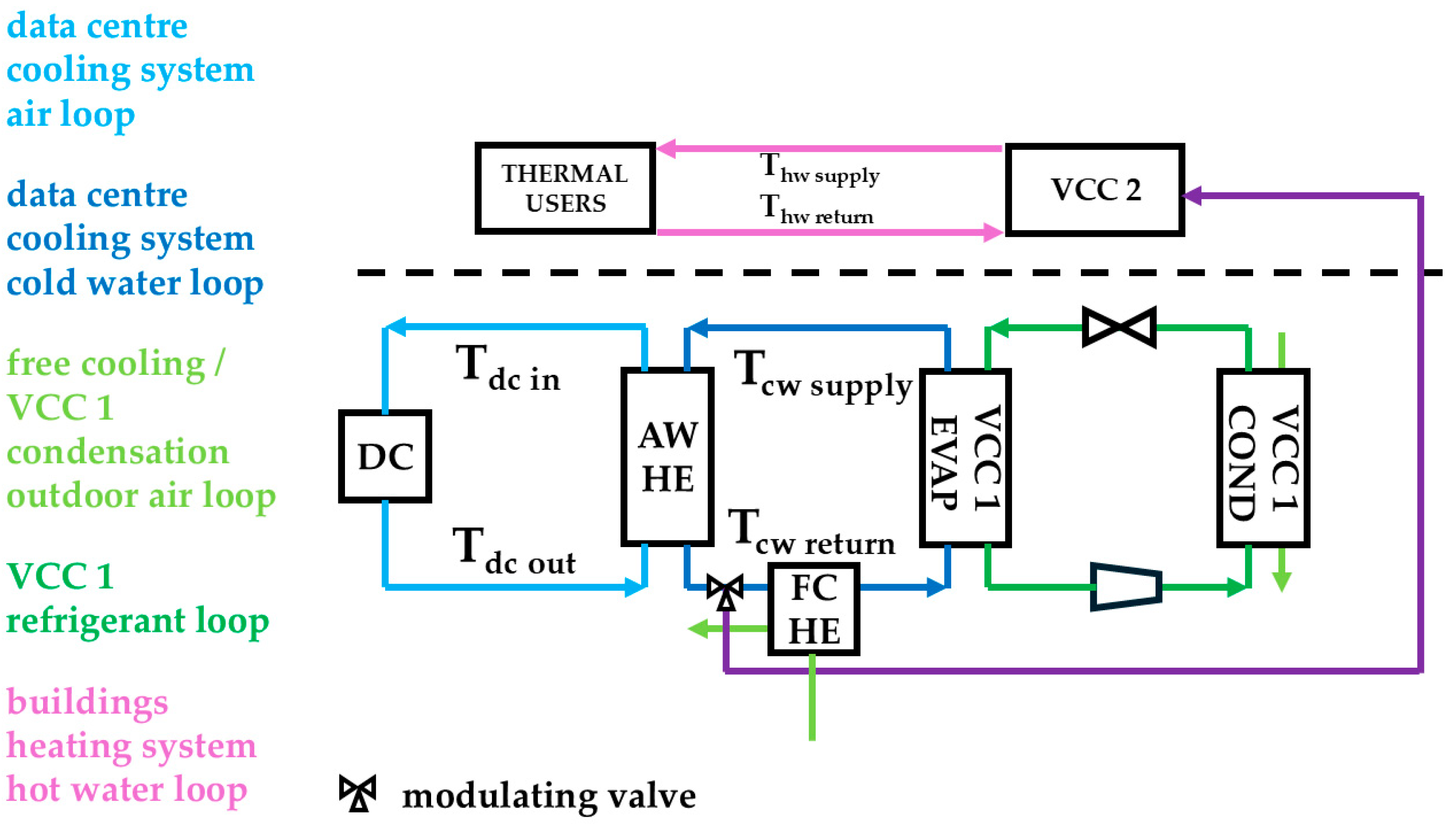
- Scenario S2: It is the integrated scenario, which considers the coupling between the building and the data centre.
- The electrical consumption of the IT equipment is assumed to be constant throughout the year, representing a typical base-load operation. This assumption is consistent with literature findings, which highlight that data centres operate under quasi-continuous load conditions due to their 24/7 operation [26,38,39].
2.2. General Description of the Two Buildings
2.2.1. Public Residence
2.2.2. School
2.3. Modelling and Energy Analysis of the Two Buildings
2.4. Heat Pump Performance Modelling and Performance Map Generation
2.5. Energy and Environmental Assessment Criteria for the Two Buildings
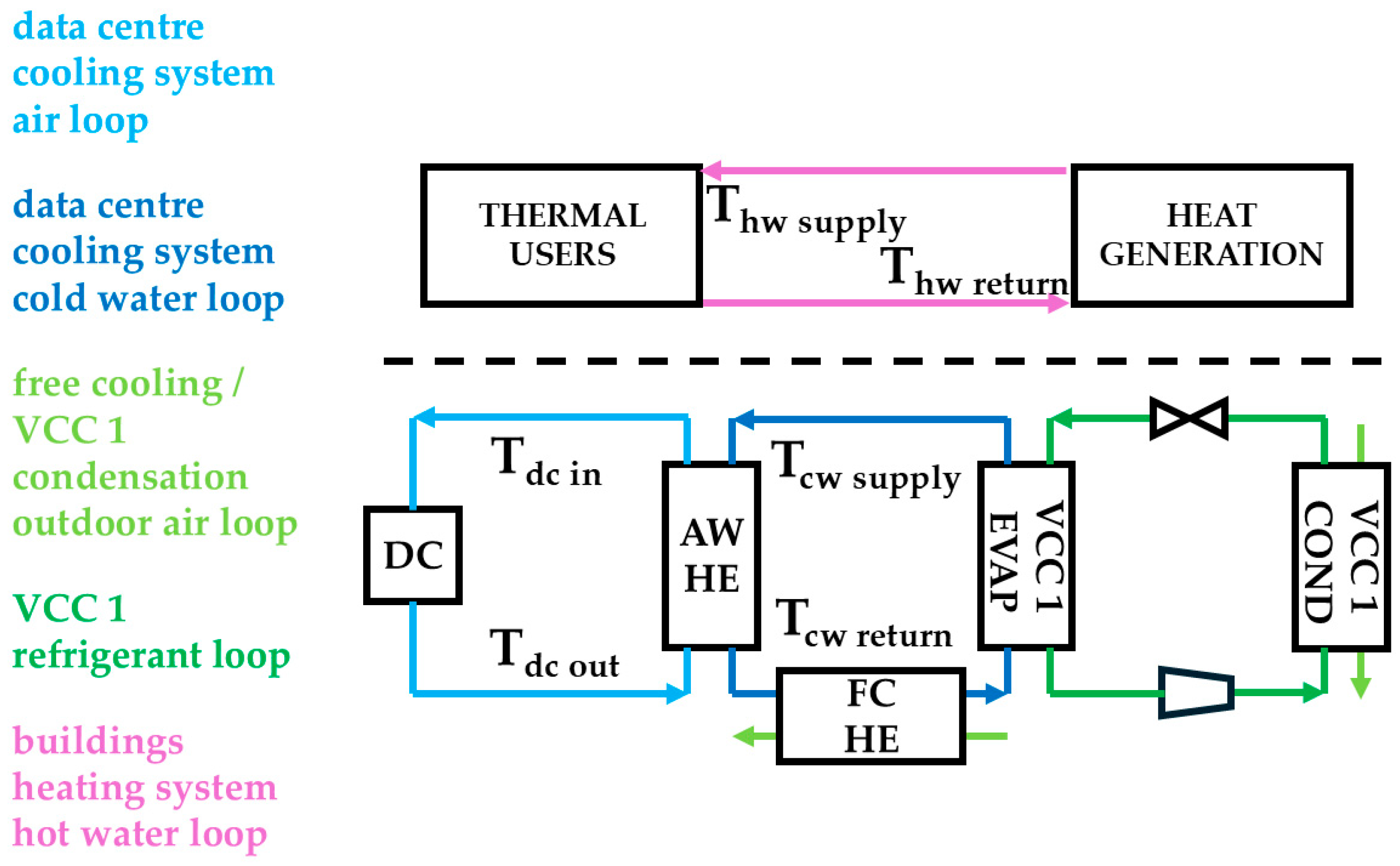
2.6. Scenarios S0 and S1: No Integration Between DC and Buildings
2.6.1. DC with Non-Integrated Cooling System
- -
- The air loop, which cools the data centre, and is cooled at the Air-to-Water Heat Exchanger (AWHE).
- -
- The cold-water loop, which is cooled at the Free Cooling Heat Exchanger (FCHE) by outdoor air or at the evaporator of Vapour Compression Cycle 1 (VCC 1).
- -
- The refrigerant loop of Vapour Compression Cycle 1 (VCC 1).
2.6.2. Buildings with Non-Integrated Heating Systems, Boilers
2.6.3. Buildings with Non-Integrated Heating Systems, Heat Pumps
2.7. Scenario S2: Integration Between the Data Centre and the Buildings
2.7.1. DC Integrated Cooling
2.7.2. Buildings Integrated Heating Systems, Heat Pumps
2.7.3. Control Strategy of the Integrated System
3. Results and Discussion
3.1. Data Centre
3.1.1. Non-Integrated Scenarios
3.1.2. Integrated Scenario
3.2. Residential Building
3.2.1. Non-Integrated Scenarios
3.2.2. Integrated Scenario
3.3. School
3.3.1. Non-Integrated Scenarios
3.3.2. Integrated Scenario
3.4. Final Summary on Building Heating Systems: Energy and Environmental Performances
3.4.1. Residential Building
- -
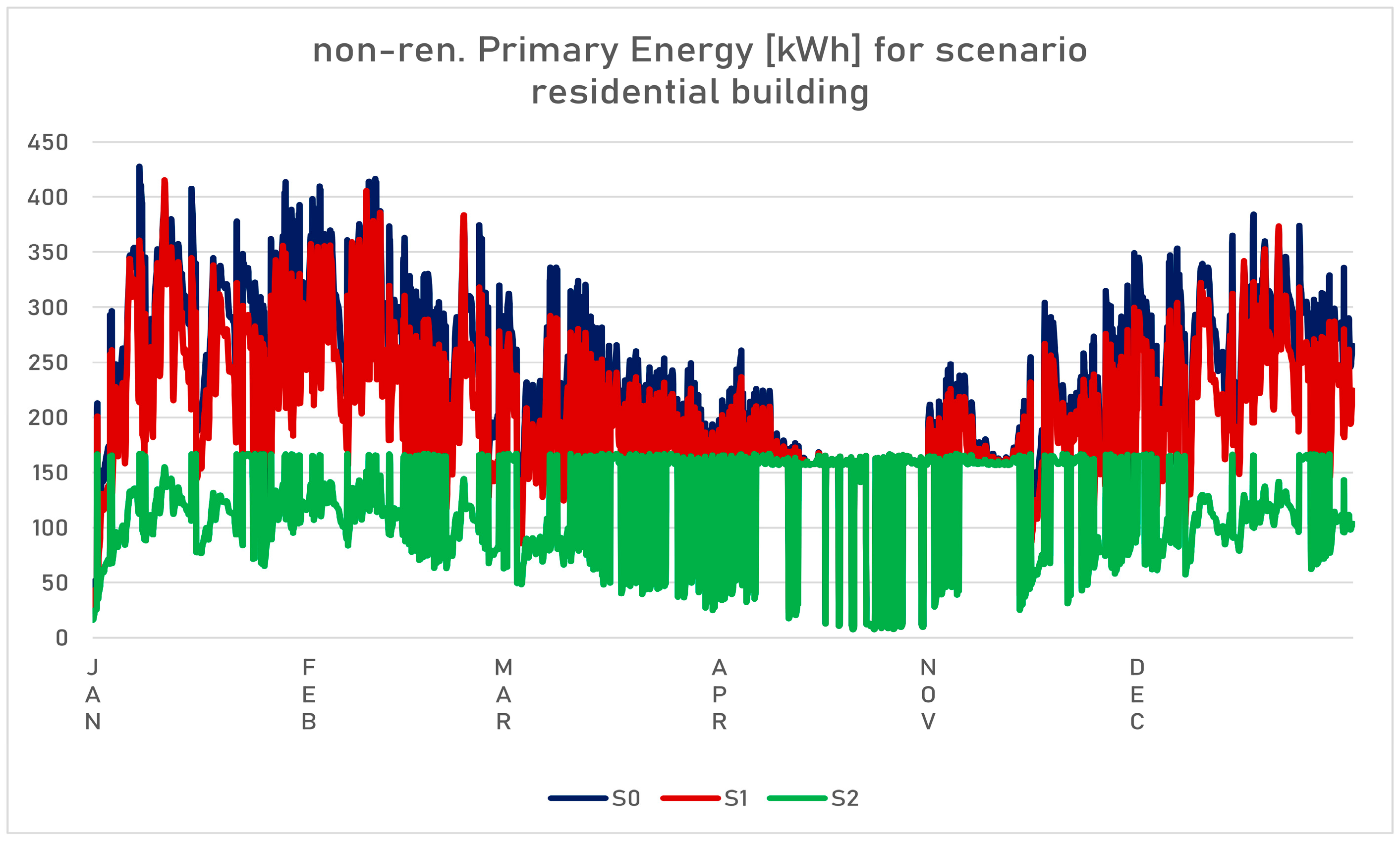
- Baseline scenario (S0), EP = 1,667,687.0 kWh;
- -
- Stand-alone heat pump scenario (S1), EP = 1,555,505.0 kWh;
- -
- Heat pump with waste heat recovery scenario (S2), EP = 1,201,792.0 kWh.
3.4.2. School
- -
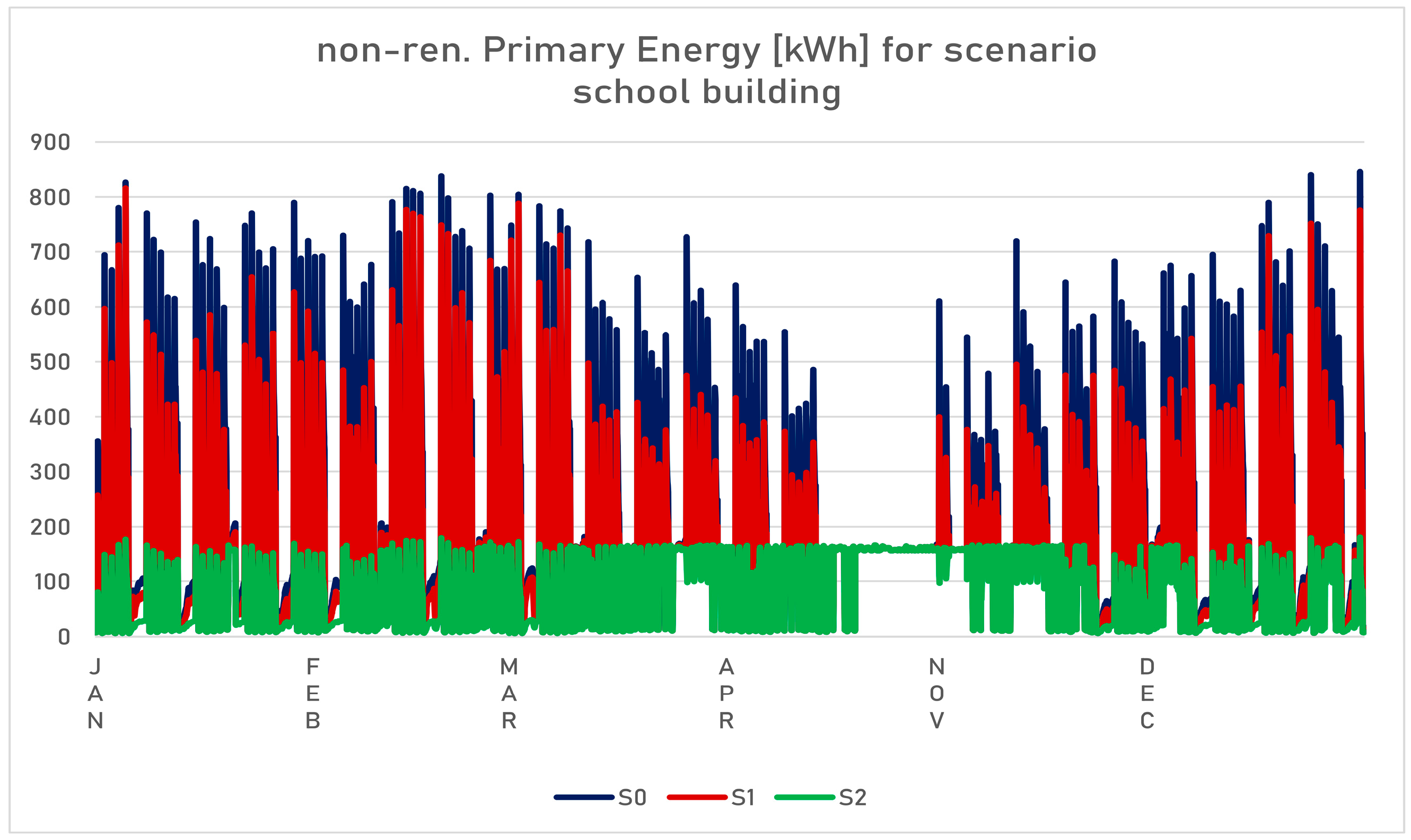
- Baseline scenario (S0), EP = 1,433,402 kWh;
- -
- Stand-alone heat pump scenario (S1), EP = 1,289,840 kWh;
- -
- Heat pump with waste heat recovery scenario (S2), EP = 1,031,108 kWh.
3.5. Final Considerations on Building Typology
4. Conclusions
- -
- Data centre waste heat can be effectively reused as a local thermal source, significantly improving the overall efficiency of building heating systems when coupled with heat pump technologies.
- -
- The integrated configuration S2 leads to a substantial increase in system performance with respect to the non-integrated configuration S1, with the seasonal COP rising from 2.15 to 4.50 in the residential case and from 2.51 to 8.00 in the school case, due to the reduced temperature lift.
- -
- Energy consumption is markedly reduced in the integrated scenario S2 with respect to the non-integrated scenario S1, with electricity demand decreasing by more than 50% in the residential building and by approximately 70% in the school building.
- -
- The environmental benefits are significant, with reductions in non-renewable primary energy demand of up to 63% and 79% for the residential and school buildings, respectively, compared to the baseline boiler scenario S0, confirming the strong decarbonisation potential of the approach.
- -
- Building typology and load profiles strongly influence system effectiveness, with lower-temperature systems and more favourable demand patterns enabling higher efficiency gains, as observed in the school case.
Author Contributions
Funding
Data Availability Statement
Acknowledgments
Conflicts of Interest
Nomenclature
| General abbreviations | ||
| AC | Active cooling mode | |
| AW | Air-to-water heat exchanger | |
| COMP | Compressor of VCC | |
| COND | Condenser of VCC | |
| DC | Data centre | |
| DHN | District heating network | |
| EP | Primary energy demand | |
| EVAP | Evaporator of VCC | |
| FC | Free cooling mode | |
| HE | Heat exchanger | |
| IT | Information technology equipment | |
| VCC | Vapour compression cycle | |
| Thermodynamics | ||
| COP | Coefficient of performance (seasonal) | |
| cp | Specific heat at constant pressure of air | kJ/kg/K |
| d | Density of air | kg/m3 |
| DP | Pressure drop | Pa |
| DT | Temperature difference | °C |
| EER | Energy efficiency ratio | |
| eff | Efficiency | |
| m | Mass flow | kg/s |
| Q | Thermal power | kW |
| T | Temperature | °C |
| W | Work | kW |
| Subscripts | ||
| cold | Referred to cold effect of VCC | |
| f | Fan | |
| H | Referred to high temperature of VCC | |
| he | Heat exchanger | |
| in | Inlet | |
| L | Refers to low temperature of VCL (from context) | |
| lim FC | Outdoor air maximum temperature for FC activation | |
| max | Maximum | |
| min | Minimum | |
| out | Outlet | |
| pp | Pinch point | |
| ref | Refrigerant of VCC cycle | |
| ren/nren | Renewable/non-renewable energy | |
| return | Return line | |
| supply | Supply line | |
References
- European Union. European Directive 2023/1791. 2023. Available online: https://eur-lex.europa.eu/eli/dir/2023/1791/oj (accessed on 15 April 2026).
- Euroheat & Power. DHC Market Outlook Insight Trends 2023. 2023. Available online: https://api.euroheat.org/uploads/DHC_Market_Outlook_Insights_Trends_2023_81498577a7.pdf (accessed on 15 April 2026).
- Santos-Herrero, J.M.; Lopez-Guede, J.M.; Flores, I. Analysis of New Strategies to Reach Nearly Zero Energy Buildings (nZEBs). Proceedings 2018, 2, 1437. [Google Scholar] [CrossRef]
- Borowski, M.; Rathnayake, C.M.; Zwolińska-Glądys, K. Nearly Zero-Energy Buildings (NZEBs): A Systematic Review of the Current Status of Single-Family Houses in the EU. Energies 2025, 18, 3215. [Google Scholar] [CrossRef]
- Iavorschi, E.; Milici, L.D.; Ifrim, V.C.; Ungureanu, C.; Bejenar, C. A Literature Review on the European Legislative Framework for Energy Efficiency, Nearly Zero-Energy Buildings (nZEB), and the Promotion of Renewable Electricity Generation. Energies 2025, 18, 1436. [Google Scholar] [CrossRef]
- European Commission. Directorate General for Energy, Euroheat & Power, Celsius. In Advancing District Heating & Cooling Solutions and Uptake in European Cities: Overview of Support Activities and Projects of the European Commission on District Heating & Cooling; Publications Office: Luxembourg, 2023. [Google Scholar]
- International Energy Agency. Net Zero by 2050. 2021. Available online: https://www.iea.org/reports/net-zero-by-2050 (accessed on 15 April 2026).
- International Energy Agency. Net Zero Roadmap: A Global Pathway to Keep the 1.5 °C Goal in Reach. 2023. Available online: https://www.iea.org/reports/net-zero-roadmap-a-global-pathway-to-keep-the-15-c-goal-in-reach (accessed on 15 April 2026).
- International Energy Agency. World Energy Outlook 2022. Available online: https://www.iea.org/reports/world-energy-outlook-2022 (accessed on 15 April 2026).
- International Energy Agency. World Energy Outlook 2023. Available online: https://www.iea.org/reports/world-energy-outlook-2023 (accessed on 15 April 2026).
- Zuffi, C.; Mongibello, L.; Sinicropi, A.; Parisi, M.L. Cradle-to-Grave LCA and Cost Assessment of Next-Generation Low-Temperature District Heating Networks. Processes 2025, 14, 8. [Google Scholar] [CrossRef]
- Euroheat & Power. Large Heat Pumps in District Heating & Cooling Systems. 2022. Available online: https://www.euroheat.org/news/new-report-large-heat-pumps-in-district-heating-and-cooling-systems (accessed on 15 April 2026).
- Euroheat & Power. DHC MarketOutlook Insights &Trends. 2023. Available online: https://www.euroheat.org/data-insights/outlooks/market-outlook-2023 (accessed on 15 April 2026).
- European Union. EPBD. Available online: https://energy.ec.europa.eu/topics/energy-efficiency/energy-performance-buildings/energy-performance-buildings-directive_en?utm_source=chatgpt.com (accessed on 15 April 2026).
- Martinopoulos, G.; Papakostas, K.T.; Papadopoulos, A.M. A comparative review of heating systems in EU countries, based on efficiency and fuel cost. Renew. Sustain. Energy Rev. 2018, 90, 687–699. [Google Scholar] [CrossRef]
- Mitterrutzner, B.; Callegher, C.Z.; Fraboni, R.; Wilczynski, E.; Pezzutto, S. Review of heating and cooling technologies for buildings: A techno-economic case study of eleven European countries. Energy 2023, 284, 129252. [Google Scholar] [CrossRef]
- Ebrahimi, K.; Jones, G.F.; Fleischer, A.S. A review of data center cooling technology, operating conditions and the corresponding low-grade waste heat recovery opportunities. Renew. Sustain. Energy Rev. 2014, 31, 622–638. [Google Scholar] [CrossRef]
- Capozzoli, A.; Primiceri, G. Cooling Systems in Data Centers: State of Art and Emerging Technologies. Energy Procedia 2015, 83, 484–493. [Google Scholar] [CrossRef]
- Habibi Khalaj, A.; Halgamuge, S.K. A Review on efficient thermal management of air- and liquid-cooled data centers: From chip to the cooling system. Appl. Energy 2017, 205, 1165–1188. [Google Scholar] [CrossRef]
- Alkrush, A.A.; Salem, M.S.; Abdelrehim, O.; Hegazi, A.A. Data centers cooling: A critical review of techniques, challenges, and energy saving solutions. Int. J. Refrig. 2024, 160, 246–262. [Google Scholar] [CrossRef]
- Daraghmeh, H.M.; Wang, C.-C. A review of current status of free cooling in datacenters. Appl. Therm. Eng. 2017, 114, 1224–1239. [Google Scholar] [CrossRef]
- Oró, E.; Depoorter, V.; Garcia, A.; Salom, J. Energy efficiency and renewable energy integration in data centres. Strategies and modelling review. Renew. Sustain. Energy Rev. 2015, 42, 429–445. [Google Scholar] [CrossRef]
- Oró, E.; Depoorter, V.; Pflugradt, N.; Salom, J. Overview of direct air free cooling and thermal energy storage potential energy savings in data centres. Appl. Therm. Eng. 2015, 85, 100–110. [Google Scholar] [CrossRef]
- Ni, J.; Jin, B.; Zhang, B.; Wang, X. Simulation of Thermal Distribution and Airflow for Efficient Energy Consumption in a Small Data Centers. Sustainability 2017, 9, 664. [Google Scholar] [CrossRef]
- He, Z.; Ding, T.; Liu, Y.; Li, Z. Analysis of a district heating system using waste heat in a distributed cooling data center. Appl. Therm. Eng. 2018, 141, 1131–1140. [Google Scholar] [CrossRef]
- Yuan, X.; Liang, Y.; Hu, X.; Xu, Y.; Chen, Y.; Kosonen, R. Waste heat recoveries in data centers: A review. Renew. Sustain. Energy Rev. 2023, 188, 113777. [Google Scholar] [CrossRef]
- Socci, L.; Rocchetti, A.; Verzino, A.; Zini, A.; Talluri, L. Enhancing third-generation district heating networks with data centre waste heat recovery: Analysis of a case study in Italy. Energy 2024, 313, 134013. [Google Scholar] [CrossRef]
- Verzino, A.; Talluri, L.; Rocchetti, A.; Socci, L. Smart Reuse of Waste Heat from Data Centres: Energy and Exergy Analysis for a District-Heating Network in Bulgaria. Energies 2026, 19, 800. [Google Scholar] [CrossRef]
- Lu, T.; Lü, X.; Clements-Croome, D.; Yuan, Y.; Martinkauppi, B. Developing an active heat recovery system to boost data centre waste heat utilization: A novel and cost-effective solution for building decarbonisation. Energy 2025, 341, 139324. [Google Scholar] [CrossRef]
- Lu, T.; Lü, X.; Välisuo, P.; Zhang, Q.; Clements-Croome, D. Innovative approaches for deep decarbonization of data centers and building space heating networks: Modeling and comparison of novel waste heat recovery systems for liquid cooling systems. Appl. Energy 2024, 357, 122473. [Google Scholar] [CrossRef]
- Bai, J.; Wu, X.; Chen, X.; Zhang, Z.; Fu, L.; Zhao, C.; Qing, K.; Luo, Q.; Gong, S.; Shen, B. Combined space cooling/heating and domestic hot water supply driven by data center waste heat: Complementary energy conservation, economic capacity optimization and generic analysis framework. Build. Environ. 2025, 283, 113402. [Google Scholar] [CrossRef]
- Sun, D.; Zhou, C.; Zhao, R.; Li, Z.; Han, D.; Chen, Y.; Wang, P.; Zhang, W.; Yu, B. Simulation and optimization research of coupled heating system using data center waste heat and solar energy based on seasonal soil heat storage. Energy 2025, 338, 138723. [Google Scholar] [CrossRef]
- Zachary Woodruff, J.; Brenner, P.; Buccellato, A.P.C.; Go, D.B. Environmentally opportunistic computing: A distributed waste heat reutilization approach to energy-efficient buildings and data centers. Energy Build. 2014, 69, 41–50. [Google Scholar] [CrossRef]
- Presidenza della Repubblica Italiana. DECRETO DEL PRESIDENTE DELLA REPUBBLICA 26 Agosto 1993, n. 412. 1993. Available online: https://www.normattiva.it/uri-res/N2Ls?urn:nir:presidente.repubblica:decreto:1993-08-26;412 (accessed on 15 April 2026).
- ASHRAE TC 9.9. 2021 Equipment Thermal Guidelines for Data Processing Environments. 2021. Available online: https://www.ashrae.org/file%20library/technical%20resources/bookstore/supplemental%20files/therm-gdlns-5th-r-e-refcard.pdf (accessed on 15 April 2026).
- Musilli, J.; Ellison, B. Facilities Design for High-Density Data Centers. 2012. Available online: https://www.intel.cn/content/dam/www/public/us/en/documents/best-practices/data-center-facilities-paper.pdf (accessed on 15 April 2026).
- SolarTech. How Much Electricity Does a Data Center Use? Complete 2025 Analysis. IAEI Magazine. 2026. Available online: https://iaeimagazine.org/electrical-fundamentals/how-much-electricity-does-a-data-center-use-complete-2025-analysis/ (accessed on 15 April 2026).
- Wahlroos, M.; Pärssinen, M.; Manner, J.; Syri, S. Utilizing data center waste heat in district heatin—Impacts on energy efficiency and prospects for low-temperature district heating networks. Energy 2017, 140, 1228–1238. [Google Scholar] [CrossRef]
- Miškić, J.; Dorotić, H.; Pukšec, T.; Soldo, V.; Duić, N. Optimization of data centre waste heat integration into the low-temperature district heating networks. Optim. Eng. 2024, 25, 63–91. [Google Scholar] [CrossRef]
- UNI/TR 10349-2; Riscaldamento e Raffrescamento Degli Edifici—Dati Climatici—Parte 2: Dati di Progetto. UNI—Ente Italiano di Normazione: Milano, Italy, 2016. Available online: https://store.uni.com/uni-tr-10349-2-2016 (accessed on 15 April 2026).
- UNI EN 12831; Energy Performance of Buildings—Method for Calculation of the Design Heat Load—Part 1: Space Heating Load, Module M3-3. UNI—Ente Italiano di Normazione: Milano, Italy, 2018. Available online: https://www.uni.com/ (accessed on 15 April 2026).
- Balocco, C.; Leoncini, L. Energy Cost for Effective Ventilation and Air Quality for Healthy Buildings: Plant Proposals for a Historic Building School Reopening in the Covid-19 Era. Sustainability 2020, 12, 8737. [Google Scholar] [CrossRef]
- Malevolti, G.; Leoncini, L.; Magnani, V. Energy refurbishment of a public indoor swimming pool. E3S Web Conf. 2026, 710, 02002. [Google Scholar] [CrossRef]
- Starke, A.R.; Cardemil, J.M.; Escobar, R.; Colle, S. Thermal analysis of solar-assisted heat pumps for swimming pool heating. J. Braz. Soc. Mech. Sci. Eng. 2017, 39, 2289–2306. [Google Scholar] [CrossRef]
- Cardemil, J.M.; Schneider, W.; Behzad, M.; Starke, A.R. Thermal analysis of a water source heat pump for space heating using an outdoor pool as a heat source. J. Build. Eng. 2021, 33, 101581. [Google Scholar] [CrossRef]
- Bordignon, S.; Emmi, G.; Zarrella, A.; De Carli, M. Energy analysis of different configurations for a reversible ground source heat pump using a new flexible TRNSYS Type. Appl. Therm. Eng. 2021, 197, 117413. [Google Scholar] [CrossRef]
- UNI EN ISO 52000-1; Energy Performance of Buildings—Overarching EPB Assessment—Part 1: General Framework and Procedures. UNI—Ente Italiano di Normazione: Milano, Italy, 2018. Available online: https://www.uni.com/ (accessed on 15 April 2026).
- UNI/TS 11300-5; Prestazioni Energetiche Degli Edifici—Parte 5: Calcolo Dell’Energia Primaria e Della Quota di Energia da Fonti Rinnovabili. UNI—Ente Italiano di Normazione: Milano, Italy, 2016. Available online: https://store.uni.com/uni-ts-11300-5-2016 (accessed on 15 April 2026).
- Danfoss. CoolSelector2 Software; Danfoss: Nordborg, Denmark, 2016. [Google Scholar]
- Rocchetti, A.; Socci, L. Study of a novel Humidification-Dehumidification Desalination system hybridised with Indirect Evaporative Cooling and Vapour Compression Refrigeration. Therm. Sci. Eng. Prog. 2025, 61, 103513. [Google Scholar] [CrossRef]
- Tecniche Nuove. Manuale Degli Impianti di Climatizzazione; Tecniche Nuove: Milano, Italy, 2008. [Google Scholar]
- Zuffi, C.; Rossi, F.; Fiaschi, D.; Manfrida, G. Energy modeling and Life Cycle Assessment of the Italian electricity grid and energy storage system: Comparison of current state and forecast to 2030. Int. J. Life Cycle Assess. 2025, 30, 1827–1843. [Google Scholar] [CrossRef]




| Energy Vector | Total Factor | Ren. Factor | Non-Ren. Factor |
|---|---|---|---|
| Gas | 1.05 | 0 | 1.05 |
| Electricity from the grid | 2.42 | 0.47 | 1.95 |
| Sun/Wind | 1.00 | 1.00 | 0 |
| Air/Water/Ground | 1.00 | 1.00 | 0 |
| Energy Vector | Emission Factor kgCO2/kWh |
|---|---|
| Gas | 0.21 |
| Electricity from the grid | 0.47 |
| Sun/Wind | 0 |
| Air/Water/Ground | 0 |
| Value °C | Description |
|---|---|
| 70.0 | Supply of water loop, residential building |
| 60.0 | Return of water loop, residential building |
| 50.0 | Supply of water loop, school |
| 40.0 | Return of water loop, school |
| 40.0 | Return of air loop, data centre |
| 35.0 | Return of water loop, data centre |
| 25.0 | Supply of air loop, data centre |
| 20.0 | Supply of water loop, data centre |
| 15.0 | Outdoor air limit for free cooling, theoretical |
| 10.0 | Outdoor air limit for free cooling, calculation |
| FC Operations, Air and Water Loops | VCC Cycle (AC Mode) | ||||
| effhe | 0.8 | 5.0 | °C | ||
| DP exch. [51] | Pa | 150.0 | 10.0 | °C | |
| efff | 0.6 | 10.0 | °C | ||
| Thermophysical properties | |||||
| cp | kJ/kg/K | 1.0 | d | kg/m3 | 1.2 |
| Heat IT | Electricity FC | Electricity AC | Electricity Tot | Waste Heat FC | Waste Heat AC | Waste Heat Tot |
|---|---|---|---|---|---|---|
| MWh | MWh | MWh | MWh | MWh | MWh | MWh |
| 2628.0 | 12.4 | 495.7 | 508.2 | 846.0 | 2290.2 | 3136.2 |
| Building | Electricity FC | Electricity AC | Electricity Tot | Waste Heat FC | Waste Heat AC | Waste Heat Tot |
|---|---|---|---|---|---|---|
| MWh | MWh | MWh | MWh | MWh | MWh | |
| Residential | 12.4 | 475.0 | 487.4 | 469.3 | 2195.0 | 2664.3 |
| School | 13.4 | 466.3 | 479.7 | 663.8 | 2152.8 | 2816.6 |
| Building | Waste Heat Cooling DC→Environment MWh | Waste Heat DC→VCC 2 MWh | Building Heating Demand MWh | Additional Heat from VCC 2 MWh |
|---|---|---|---|---|
| Residential | 2664.3 | 451.2 | 580.1 | 128.9 |
| School | 2816.6 | 291.2 | 332.8 | 41.6 |
| Scenario | EP nren | Differ. | CO2 | Differ. |
|---|---|---|---|---|
| Non-integrated, boiler (S0) | 188.0 | / | 38 | / |
| Non-integrated, heat pump (S1) | 157.0 | −16% | 37 | 0% |
| Integrated (S2) | 70.0 | −63% | 16 | −58% |
| Scenario | EP nren | Differ. | CO2 | Differ. |
|---|---|---|---|---|
| Non-integrated, boiler (S0) | 139 | / | 28 | / |
| Non-integrated, heat pump (S1) | 95 | −32% | 21 | −20% |
| Integrated (S2) | 29 | −79% | 7 | −75% |
Disclaimer/Publisher’s Note: The statements, opinions and data contained in all publications are solely those of the individual author(s) and contributor(s) and not of MDPI and/or the editor(s). MDPI and/or the editor(s) disclaim responsibility for any injury to people or property resulting from any ideas, methods, instructions or products referred to in the content. |
© 2026 by the authors. Licensee MDPI, Basel, Switzerland. This article is an open access article distributed under the terms and conditions of the Creative Commons Attribution (CC BY) license.
Share and Cite
Socci, L.; Leoncini, L.; Zini, A.; Mazzoni, S.; Rocchetti, A. Data Centre Waste Heat for Building Heating: A Comparative Energy Analysis in Italy. Sustainability 2026, 18, 6061. https://doi.org/10.3390/su18126061
Socci L, Leoncini L, Zini A, Mazzoni S, Rocchetti A. Data Centre Waste Heat for Building Heating: A Comparative Energy Analysis in Italy. Sustainability. 2026; 18(12):6061. https://doi.org/10.3390/su18126061
Chicago/Turabian StyleSocci, Luca, Lorenzo Leoncini, Andrea Zini, Serena Mazzoni, and Andrea Rocchetti. 2026. "Data Centre Waste Heat for Building Heating: A Comparative Energy Analysis in Italy" Sustainability 18, no. 12: 6061. https://doi.org/10.3390/su18126061
APA StyleSocci, L., Leoncini, L., Zini, A., Mazzoni, S., & Rocchetti, A. (2026). Data Centre Waste Heat for Building Heating: A Comparative Energy Analysis in Italy. Sustainability, 18(12), 6061. https://doi.org/10.3390/su18126061