Article

Transport Infrastructure for Sustainable Rural Development: Expressway-Driven Market Integration, Food Security, and Spatial Equity in Western China

1
School of Economics and Business Administration, Heilongjiang University, Harbin 150080, China
2
School of Sociology and Ethnology, University of Chinese Academy of Social Sciences, Beijing 102488, China
*
Author to whom correspondence should be addressed.
These authors contributed equally to this work.
Sustainability 2026, 18(12), 6050; https://doi.org/10.3390/su18126050 (registering DOI)
Submission received: 22 April 2026 / Revised: 19 May 2026 / Accepted: 23 May 2026 / Published: 12 June 2026
(This article belongs to the Section Sustainable Urban and Rural Development)

Abstract

Transport infrastructure is widely viewed as a key lever for integrating lagging rural regions into broader economic systems. Western China, marked by vast territory, complex topography, and historically severe spatial market frictions, offers a particularly informative setting for examining this question within the sustainable rural development agenda. Exploiting the staggered rollout of China’s National Highway Expansion Program across 276 prefectures from 2003 to 2018, we combine high-frequency wholesale prices for 93 agricultural commodities, geocoded expressway network data, and the China Family Panel Studies. A staggered difference-in-differences design is supplemented by a time-varying minimum spanning tree instrument capturing network-efficiency considerations, alongside event-study and recently developed robust estimators for staggered treatments. Two-stage least squares estimates indicate that expressway connection raises the agricultural price integration index by 0.071, reduces within-prefecture price volatility by approximately 0.040 (about 13% of baseline), raises agricultural household income per capita by roughly 16%, and improves the household food-security index by 0.571 points. Event-study results show no pre-trends, with effects materializing over three to four years post-connection. Mechanism analysis highlights expanded market linkages, and the gains are stronger in nationally designated poverty counties and prefectures with rugged terrain. Partial-equilibrium welfare accounting implies annual gains of roughly USD 4.92 billion, and unconditional quantile regressions reveal a progressive distribution across farm incomes. These findings underscore the role of transport infrastructure in alleviating spatial frictions, integrating lagging regions, and advancing sustainable rural development while warranting careful attention to the environmental externalities of large-scale infrastructure.

1. Introduction

Achieving the United Nations 2030 Agenda for Sustainable Development requires that lagging rural regions be integrated into broader economic systems while maintaining the ecological and social foundations of long-term welfare. Three Sustainable Development Goals (SDGs) are particularly central to the analysis that follows: SDG 2 (Zero Hunger), which targets food security, improved nutrition, and resilient agricultural production; SDG 9 (Industry, Innovation and Infrastructure), which emphasizes reliable, sustainable, and resilient infrastructure with equitable access; and SDG 10 (Reduced Inequalities), which focuses on narrowing spatial and income disparities. Transport infrastructure sits at the intersection of these goals: by reducing trade costs, it can expand market access for smallholder farmers, stabilize food prices, and redistribute economic opportunity toward historically isolated regions. At the same time, large-scale expressway construction imposes non-negligible environmental and social costs—including carbon emissions, land conversion, ecosystem fragmentation, and induced land-use change—so that assessing its net contribution to sustainable rural development requires careful empirical evidence on both the magnitude and distribution of the welfare gains it delivers. Framing the empirical analysis within this sustainability agenda motivates the present study and positions its findings for policy audiences concerned with sustainable food systems, inclusive growth, and the targeting of infrastructure investment in developing economies.
A central question in development economics is whether transport infrastructure integrates isolated markets or mainly redistributes activity across space. The question is especially sharp in agriculture. Where trade costs are high, spatial arbitrage is limited, price dispersion persists, and local supply shocks translate into large movements in farm revenues and household food budgets. For low-income rural households, these frictions matter for both efficiency and welfare: they shape producer prices, exposure to volatility, and the range of foods that can be purchased locally. A large recent literature shows that transport infrastructure reshapes market access, spatial integration, and the geography of economic activity [1,2]. Subsequent empirical work documents heterogeneous impacts of transport investments across geographic and institutional contexts, including rural feeder roads, market access in remote settings, and network-level externalities [3,4,5]. However, rigorous evidence linking large-scale transport investments to agricultural market integration remains limited, particularly in contexts of severe initial isolation and dispersed agricultural production [6]. Evidence on the resulting impacts on household welfare—especially food security and dietary quality—is even more limited. Recent reviews and empirical studies increasingly connect market access, commercialization, and urban linkages to agricultural development, diet quality, and welfare, but they rarely isolate a large-scale expressway shock in a highly fragmented region [7,8]. Closely related contributions further document how urban–rural linkages and dietary outcomes co-evolve with market integration [9,10,11]. In regions where geographic barriers are extreme, such as mountainous or remote rural areas, transport costs are likely to be a first-order constraint on market function and household welfare, warranting targeted empirical scrutiny.
This paper addresses this gap by studying the rollout of the National Highway Expansion Program (NHEP) in Western China, a region characterized by exceptional relevance for understanding the impact of infrastructure on fragmented agricultural markets. Western China accounts for a substantial share of the nation’s agricultural output yet has historically suffered from severe spatial market frictions due to its vast territory, complex topography (including the Tibetan Plateau and rugged mountain ranges), and underdeveloped pre-existing transport networks. Addressing these constraints has become a national priority within China’s broader strategies of ‘Western Development’ and poverty alleviation, reflecting a recognition that spatial integration is foundational for rural development. The NHEP, initiated in the early 2000s with staggered implementation across 276 prefecture-level units from 2003 to 2018, constitutes one of the world’s largest focused infrastructure investments in lagging regions. This context provides a uniquely valuable setting: pre-treatment market fragmentation is pronounced, agricultural production is geographically diverse but spatially dispersed, and the expressway rollout offers quasi-experimental variation due to its large scale, staggered timing, and prioritization based on engineering and network efficiency.
This paper makes three primary contributions. First, it applies and extends the market-access framework central to the transport infrastructure literature to directly quantify the impacts on agricultural price formation, volatility, and household welfare within a large, geographically challenging developing economy, complementing recent evidence that new roads and transport development reshape agricultural productivity, market access, and rural income [5,12,13,14]. Second, it contributes to the emerging literature on agricultural market integration, price dispersion, and value-chain efficiency by showing how improved physical connectivity affects not only price levels but also volatility and cross-market co-movement [15,16], while complementary studies further examine the spatial transmission of price shocks and the formation of regional trade networks [17,18]. Third, by establishing a direct empirical link between transport-induced market integration and multidimensional household welfare, it speaks to recent work on food security, diet quality, and rural income dynamics in China and comparable settings [19,20], with additional evidence on dietary diversity and household nutrition in rural settings [21,22]. Methodologically, the identification strategy leverages a time-varying minimum spanning tree (MST) instrumental variable approach, and estimates remain robust across contemporary causal inference methods for staggered treatments [23,24,25].
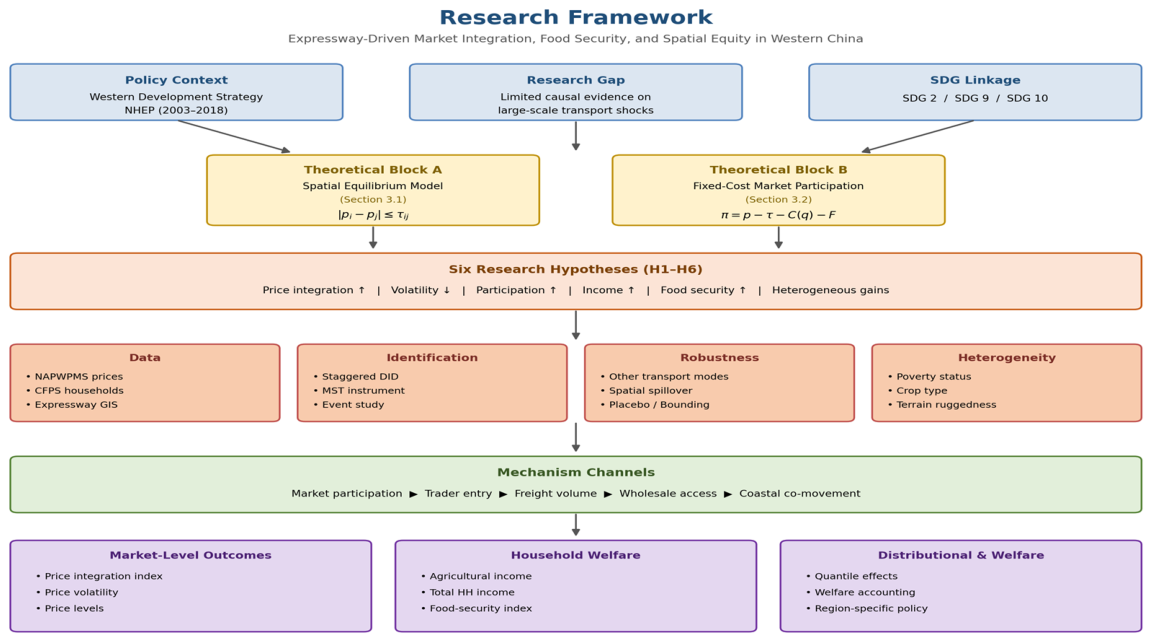
To make the connections between each component of this study more transparent for readers, Figure 1 presents an integrated research framework. The framework links the policy context and research gap (top tier) to the two theoretical building blocks (spatial equilibrium with arbitrage bounds and fixed-cost market participation), the six research hypotheses derived from them, the data and identification strategy (NAPWPMS prices, CFPS households, and expressway GIS combined through staggered DID and the MST instrument), the mechanism channels (market participation, trader entry, freight volume, wholesale access, and coastal co-movement), and the three families of outcomes examined empirically: prefecture-level market integration, household welfare, and distributional and policy effects. The arrows indicate the logical flow that connects motivation to evidence, which is implemented section by section in the remainder of this paper.
The remainder of this paper is organized as follows. Section 2 describes the institutional background of the NHEP and Western China’s agricultural setting. Section 3 develops the theoretical framework. Section 4 introduces the data and empirical strategy. Section 5 presents the results, including the main estimates for price integration and household welfare, the mechanism analysis, heterogeneity, welfare calculations, and robustness checks. Section 6 discusses the findings, and Section 7 concludes with policy implications.

2. Institutional Background

2.1. Agricultural Markets in Western China

Western China comprises twelve provinces, autonomous regions, and municipalities—Sichuan, Chongqing, Yunnan, Guizhou, Shaanxi, Gansu, Qinghai, Ningxia, Xinjiang, Tibet, Inner Mongolia, and Guangxi—accounting for approximately 71 percent of China’s territory but only 27 percent of its population and 19 percent of GDP as of 2003. The region’s agricultural sector is characterized by extraordinary ecological diversity: subtropical rice cultivation in Yunnan and Guizhou, dryland wheat and maize in the Loess Plateau, specialty herbal medicines and spices across the highland zones, and extensive pastoral activity in Inner Mongolia, Qinghai, and Tibet. This diversity implies substantial comparative advantage in agricultural specialization, but it simultaneously creates a mismatch between production locations and consumption centers.
Market institutions in Western China were historically underdeveloped relative to coastal China. The rural household responsibility system, introduced in the early 1980s, decollectivized agricultural production but left marketing largely to local collective intermediaries well into the 1990s. Grain markets were partially liberalized in the 1990s and more fully deregulated after China’s WTO accession in 2001, but the infrastructure to exploit these market opportunities lagged far behind legal liberalization. As late as 2003, the Ministry of Agriculture’s price monitoring data reveal coefficients of variation of agricultural wholesale prices across markets within a single prefecture exceeding 0.40 for many commodity categories—implying that two farmers in the same county, separated by fifty kilometers, could receive prices differing by forty percent for the same product on the same day.
This spatial price dispersion reflects genuine market segmentation rather than quality differentiation. Regression of price gaps on distance between markets—controlling for product quality proxies and seasonal dummies—yields distance elasticities consistent with transportation cost margins of six to twelve percent per hundred kilometers for road freight, substantially higher than in coastal China (three to four percent) owing to road quality, terrain, and sparse truck traffic.

2.2. The National Highway Expansion Program

The term “expressway” in Chinese policy documents covers a range of road classifications. The object of this study is the national expressway system (guojia gaosu gonglu)—the controlled-access, multi-lane trunk network that connects provincial capitals and major prefectural cities. It does not include lower-class national, provincial, or rural expressways. In international transportation usage, these terms are not strictly synonymous: “freeway” denotes a fully controlled-access, toll-free divided road; “expressway” denotes a controlled-access, multi-lane trunk road that may or may not be tolled; and “highway” denotes a broader category that also includes lower-class trunk roads with at-grade intersections. The Chinese national expressway system most closely corresponds to the international “expressway,” and we adopt this term throughout. “Highway” appears only in the program name “National Highway Expansion Program (NHEP),” a shorthand we adopt for expositional convenience. The national expressway system was formalized under the 2004 “7918 Plan” (seven radial, nine vertical, and eighteen horizontal corridors) and was subsequently extended by the 2013–2030 National Expressway Network Plan (NENP), which broadened the system to additional county-level and border nodes. We refer to the combined 2004 and 2013 rollout collectively as the NHEP. The treatment variable Expresswayit is based on expressway interchange openings, not on segment completion dates, because an interchange is what enables a prefecture’s shippers and traders to actually use the corridor.
Construction proceeded in two broad phases. Phase I (2004–2012) prioritized backbone corridors connecting provincial capitals and major secondary cities. In Western China, this phase established the principal east–west and north–south expressway links that tied the interior more closely to the national market. Phase II (2013–2018) extended the network to lower-level nodes, including many prefectural and county seats, using a mix of central transfers, provincial finance, and concession-based arrangements.
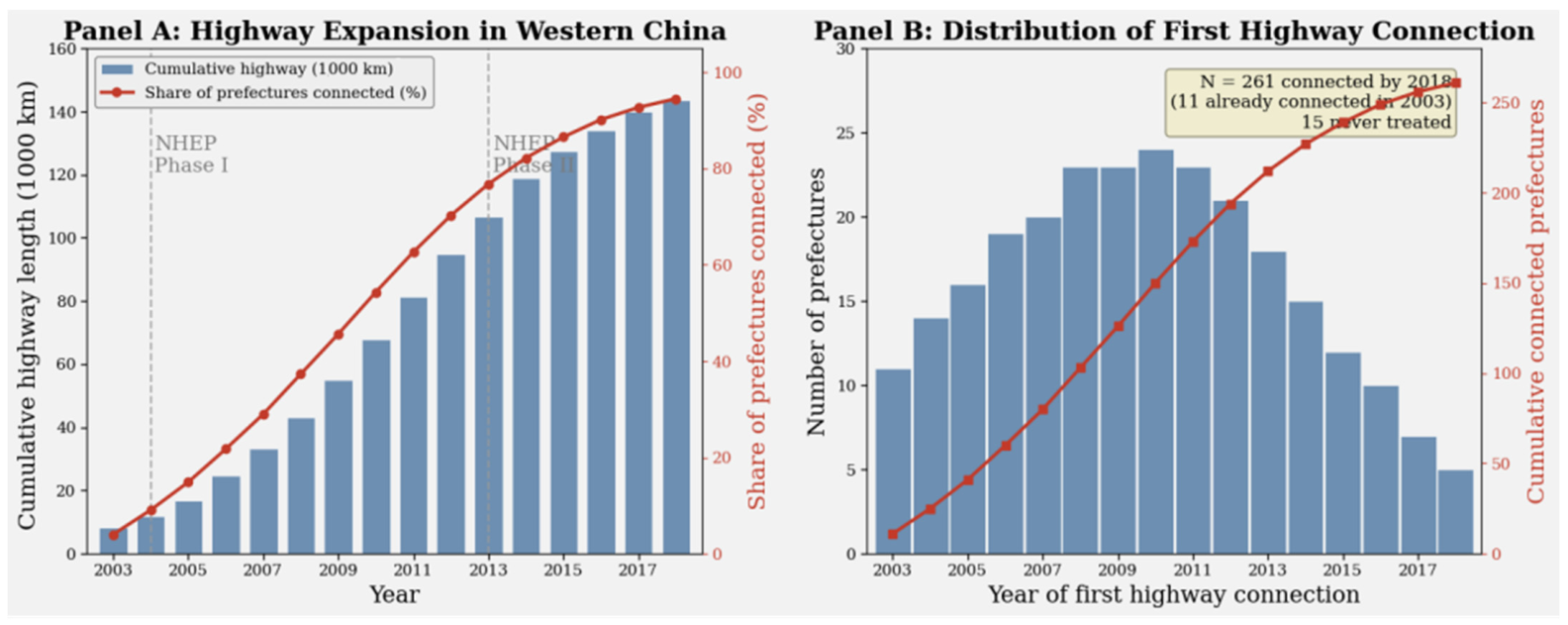
The NHEP generated substantial variation in first connection dates across Western prefectures. Figure 2 reports the aggregate rollout and the distribution of treatment timing. The network expansion is rapid, but connection is not a one-shot event: prefectures enter in multiple cohorts over more than a decade.
Two features of Figure 2 matter for the empirical design. First, the buildout is spread across many cohorts rather than concentrated in a single year, which is useful for both the event-study and the staggered-DID estimators. Second, Panel B shows substantial support throughout the middle of the sample window, reducing reliance on a narrow set of early or late adopters.
Route selection combined top-down national planning with provincial implementation. National plans largely fixed the nodes to be connected, whereas the within-corridor alignment of individual segments depended on engineering feasibility, land acquisition, fiscal capacity, and administrative priorities. This institutional structure is important for identification: realized rollout follows network logic, but it is not mechanically identical to contemporaneous local demand conditions.

2.3. Western Development Strategy and Agricultural Policy Context

The NHEP in Western China was embedded within the broader Western Development Strategy, launched in 1999 and institutionalized by the State Council in 2000. The strategy explicitly targeted infrastructure investment in roads, railways, energy, and telecommunications as its primary instruments for closing the regional development gap between western and coastal China. Infrastructure investment under the strategy reached approximately RMB 2.8 trillion during 2000–2015, of which roads accounted for roughly 38 percent.
Agricultural policy during this period complemented the infrastructure push. The abolition of agricultural taxes in 2006 removed a significant burden on farm households and increased the marginal return to market participation. The Rural Land Contracting Law (2003) and subsequent amendments strengthened tenure security, encouraging farmers to plant crops with longer planning horizons and higher market orientation. Meanwhile, the National “Grain for Green” Program altered land use on steep slopes in ways that, in some prefectures, shifted agricultural production from subsistence grain to higher-value specialty crops better suited to market integration. This broader policy environment created complementarities with expressway access that we examine in the mechanism section.
One important feature of the institutional context is that expressway construction in Western China was almost entirely publicly funded—in contrast to coastal China where private toll road operators played a larger role. This reduces concerns that expressway placement reflects private-sector demand signals (profitable routes near economic activity) that would confound the causal interpretation. State-financed network planning, which appears to have been shaped largely by engineering and connectivity considerations, plausibly generates variation in connection timing that is orthogonal to local demand shocks once the MST instrument is used.

3. Theoretical Analysis

3.1. A Spatial Equilibrium Model of Agricultural Markets

Consider an economy with J local markets indexed by j = 1, …, J, each trading a homogeneous agricultural good. Let p j t denote the producer price in market j at date t. In autarky, each market clears locally. With interregional trade, competitive spatial arbitrage implies that bilateral price gaps cannot exceed generalized trade costs.
p i t p j t τ i j t
Equality is expected on routes along which trade is active; for market pairs not linked in equilibrium, the inequality may be strict. Persistent price gaps above the arbitrage bound, therefore, indicate segmentation generated by transport costs, weak information flows, limited intermediation, or other barriers to exchange. Here, pit and pjt denote the producer prices of the homogeneous agricultural good in markets i and j at date t, and τijt denotes the generalized bilateral trade cost between the two markets at date t.
Expressway connection lowers generalized trade costs by reducing both per-kilometer freight costs and effective transit time. A parsimonious parameterization is:
τ i j t = d i j c i j t
Here, distance is fixed, while the generalized cost of moving one unit over one kilometer can fall with better roads. Expressways raise average travel speeds, lower vehicle operating costs, and reduce delivery uncertainty, so they compress trade costs even when physical distance is unchanged. In Equation (2), τijt is the generalized bilateral trade cost (as in Equation (1)); dij is the physical (time-invariant) road distance between markets i and j; and cijt is the time-varying generalized per-kilometer trade cost, which captures freight charges, vehicle operating costs, delivery time, and uncertainty and which falls as expressway access improves. The model, therefore, predicts tighter cross-market price alignment, lower price volatility as arbitrage responds more quickly to local shocks, and potentially higher producer welfare where households are net sellers. Because some households are net buyers, the sign of the total household welfare effect is ultimately empirical.

3.2. Market Participation Under Fixed Costs

A second implication concerns fixed and variable costs of market participation. Suppose a farm household produces output at cost C(q). Selling off farm requires both a variable transport cost and a fixed marketing cost. Net returns from market participation can be written as:
π h j t S = p j t τ h j t C q h t F h j t
The household participates as a seller whenever these net returns are nonnegative. In Equation (3), πShjt denotes the net return to household h from selling in market j at date t; pjt is the prevailing producer (wholesale) price in market j; τhjt is the variable transport cost incurred by household h to deliver output to market j; C(qht) is the household’s production cost as a function of output qht; and Fhjt is the fixed marketing cost of accessing market j (including information acquisition, search, and trader-matching costs). A decline in transport costs or in the fixed cost of reaching the market lowers the minimum efficient scale required for sales, bringing previously semi-subsistence producers into market exchange. In this setting, the extensive margin is likely to matter because many western farm households appear to lie near that participation threshold.

3.3. Research Hypotheses

Building on the spatial equilibrium model in Section 3.1 and the market participation framework in Section 3.2, we derive the following six research hypotheses that guide the empirical analysis.
The spatial arbitrage condition in Equation (1) implies that a reduction in generalized trade costs τ tightens the arbitrage bound on bilateral price gaps. When expressway access lowers the per-kilometer freight cost c, the maximum sustainable price gap across markets within a prefecture falls, driving convergence toward a single equilibrium price. This effect should be most pronounced where initial trade costs—and hence pre-treatment price dispersion—are large, consistent with recent evidence that lower rural trade costs and improved connectivity strengthen spatial market integration [12,26]. This leads to Hypothesis 1.
Hypothesis 1.
Expressway connection increases within-prefecture agricultural price integration.
In the same framework, lower trade costs also accelerate spatial arbitrage in response to local supply or demand shocks. When freight moves faster and more cheaply, temporary price spikes in one market are more rapidly arbitraged away by inflows from neighboring markets. Expressway access thus compresses the amplitude of intra-annual price fluctuations by shortening the adjustment window during which local prices can deviate from regional equilibrium levels, a pattern also emphasized in recent work on road networks, price smoothing, and food-market adjustment [16,27]. This leads to Hypothesis 2.
Hypothesis 2.
Expressway connection reduces within-prefecture agricultural price volatility.
The market participation model in Section 3.2 shows that net returns from off-farm sales depend negatively on both variable transport costs τ and fixed marketing costs F. Expressway access reduces both components: variable costs fall through lower per-kilometer freight charges and higher vehicle speeds, while fixed costs decline as physical proximity to wholesale markets improves information access and lowers the search cost of finding buyers. These reductions push previously semi-subsistence households above the participation threshold, expanding the extensive margin of market engagement. This expansion should also attract intermediary entry, as the larger volume of marketable surplus supports additional traders, consistent with recent evidence that roads and bundled market-access interventions expand smallholder commercialization and market participation [26,28]. This leads to Hypothesis 3.
Hypothesis 3.
Expressway connection increases market participation by farm households and facilitates intermediary entry.
For net-seller households, the direct effect of lower trade costs is an increase in the effective producer price received at the farm gate: the wedge between wholesale price p and the transport cost τ narrows, raising net returns π. In addition, expanded market participation at the extensive margin—both by previously non-participating households and by new intermediaries—increases competitive pressure, which can further raise equilibrium farm-gate prices. In the aggregate, these channels predict higher agricultural income per capita for connected households, consistent with recent evidence from road expansion and related transport improvements [12,14]. This leads to Hypothesis 4.
Hypothesis 4.
Expressway connection raises agricultural household income per capita.
Higher agricultural income and improved market access jointly relax two binding constraints on household food security. First, higher disposable income expands the budget set, enabling households to purchase a wider variety of foods. Second, better connectivity increases the local availability and diversity of food products as trade flows bring goods from other regions into previously isolated local markets. Together, these income and availability channels predict improvements in both caloric adequacy and dietary diversity and a reduction in the probability of experiencing food hardship, in line with recent evidence on market food environments, supermarket expansion, and food-system trade-cost reductions [27,29,30]. This leads to Hypothesis 5.
Hypothesis 5.
Expressway connection improves household food security, including caloric adequacy, dietary diversity, and reduced food hardship.
Finally, the magnitude of all preceding effects should vary with the initial severity of market frictions. In areas where pre-treatment trade costs are high—due to poverty, rugged terrain, or geographic remoteness—the marginal reduction in transport costs from expressway access represents a proportionally larger shock to the effective arbitrage bound. The spatial equilibrium model predicts that the price integration, income, and food security gains should, therefore, exhibit a monotone gradient: larger in nationally designated poverty counties and in prefectures with higher terrain ruggedness, where the initial departure from spatial market efficiency is greatest, echoing recent findings that expressway access and transport improvements generate larger poverty and welfare gains in initially disadvantaged locations [13,31]. This leads to Hypothesis 6.
Hypothesis 6.
The effects of expressway connection on market integration and household welfare are larger in areas with more severe initial transport frictions, including poorer and more rugged prefectures.

4. Data and Methods

4.1. Data Sources

4.1.1. Agricultural Price Data

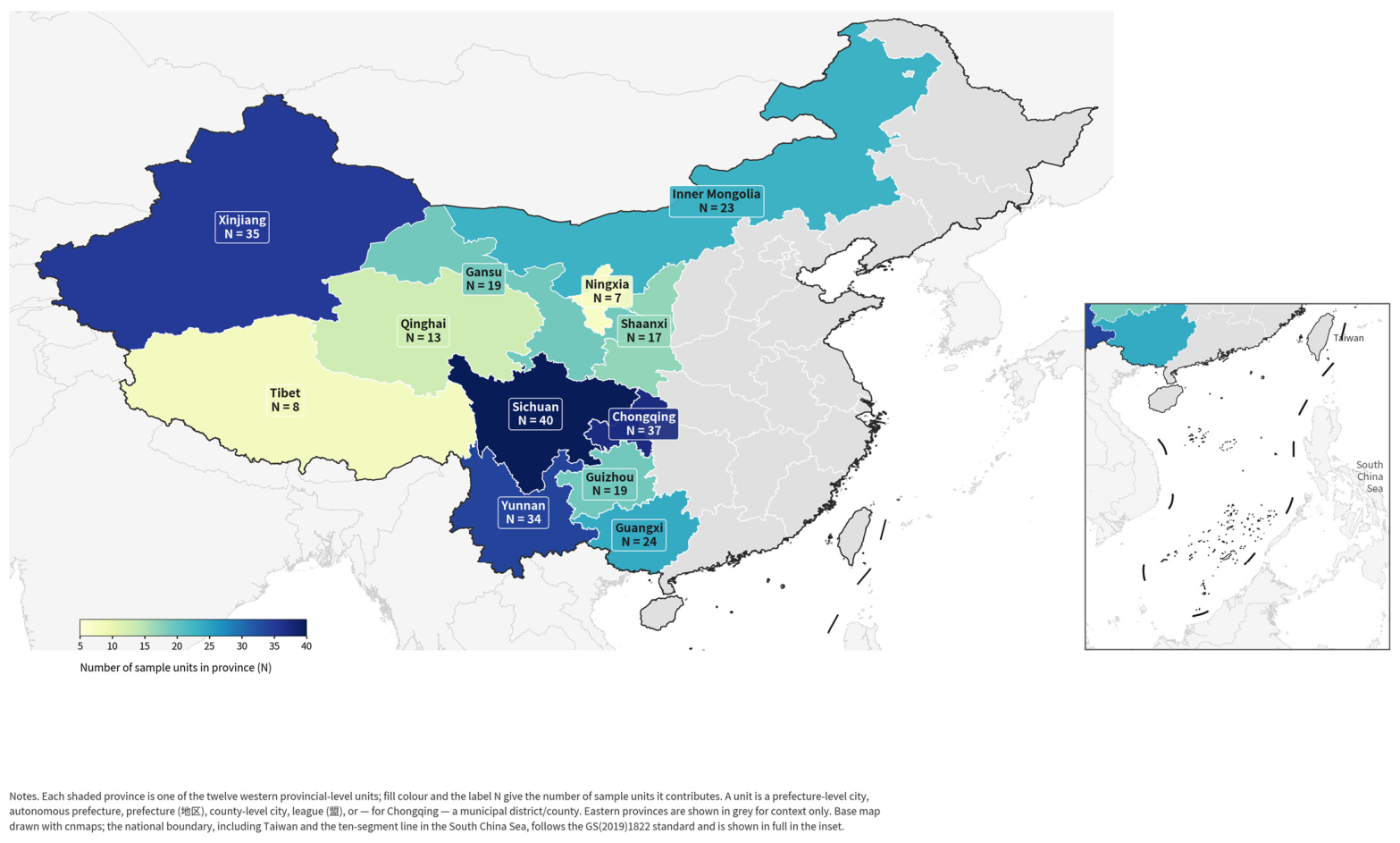
The primary outcome variable—agricultural price integration—is constructed from the Ministry of Agriculture’s National Agricultural Product Wholesale Price Monitoring System (NAPWPMS). This system monitors weekly wholesale prices for 93 commodity categories at designated wholesale markets in each prefecture-level city, with coverage beginning in January 2001 and reaching full national coverage by 2003. For the purposes of this study, we use data from January 2003 through December 2018, giving 16 years of coverage across 276 Western China prefectures. To make the sample composition transparent, the geographic distribution of the 276 prefecture-level units across the twelve western provincial-level units is shown in Figure 3.
The price integration index is constructed in two steps. For each commodity c in prefecture j and year t, we compute the cross-market coefficient of variation of monthly wholesale prices and then aggregate across commodities. We then apply a monotone rescaling, denoted T ( · ) , so that higher values correspond to tighter within-prefecture price alignment. Formally:
C V j c t = σ m p m c j t p c j t ¯ ,   P I j t = T 1 C j t C = 1 C j t C V j c t
A potential concern is that the choice of markets included in the NAPWPMS is non-random and may be correlated with infrastructure development. In Equation (4), CVjct is the within-prefecture cross-market coefficient of variation of monthly wholesale prices for commodity c in prefecture j at date t, defined as the standard deviation σm of prices pmcjt across monitored markets m within the prefecture, divided by the corresponding within-prefecture average price pcjt. Cjt denotes the number of commodity categories for which the prefecture has continuously monitored prices in year t, so that the inner summation gives the equally weighted commodity-level average within-prefecture coefficient of variation. T(·) is a monotone rescaling transformation, defined as T(x) = 1 − x/max(x), which maps the average coefficient of variation onto the unit interval such that higher values of the resulting price integration index PIjt correspond to tighter within-prefecture price alignment. The coefficient-of-variation construction of the index follows the standard approach used in the agricultural market integration and price dispersion literature (e.g., the CV-based measures employed in studies of spatial price dispersion and law-of-one-price tests in developing-country food markets); the specific aggregation across commodities and the monotone rescaling T(·) are constructed by the authors and are detailed in the robustness section, where we also report results using alternative integration measures. We address this by restricting analysis to markets present continuously throughout the sample period (a balanced panel of markets within each prefecture), and the baseline number of monitored markets per prefecture is uncorrelated with subsequent expressway connection timing after controlling for prefecture characteristics.
To avoid conflating the two price concepts examined in this study, we emphasize that the price-integration index in Equation (4) is a cross-sectional, spatial measure of within-prefecture dispersion across monitored markets, while the price-volatility outcome is a temporal, intra-annual measure of within-market price variability over the calendar year. The two share the underlying NAPWPMS data but operate along orthogonal dimensions.
To make the rescaling reproducible, max(x) denotes the maximum of the prefecture-year commodity-averaged coefficient of variation over the pooled 2003–2018 sample, so that T(x) = 1 − x/max(x) maps each value into [0, 1], with values closer to 1 indicating tighter alignment relative to the worst-integrated prefecture-year, ensuring comparable magnitudes across robustness specifications.

4.1.2. Household Survey Data

Household-level outcomes are drawn from the China Family Panel Studies (CFPS), a nationally representative household panel survey conducted by Peking University’s Institute of Social Science Survey (ISSS). The household analysis uses the rural panel waves for the subset of western prefectures that can be linked consistently to prefecture-level expressway exposure in 2010, 2012, 2014, 2016, and 2018. Restricting the sample to agricultural households—those with at least thirty percent of income derived from farming—yields 3891 household-wave observations.
From the CFPS, we construct: (1) agricultural income per capita (the household’s self-reported net revenue from crop and livestock sales, deflated to 2010 RMB using provincial CPI); (2) total household income per capita; and (3) a food-security summary index combining caloric adequacy, dietary diversity, and self-reported food hardship. The caloric component is measured as kilocalories per adult equivalent per day relative to a 2100-kilocalorie benchmark; the dietary diversity component counts the number of distinct food groups consumed during the reference week, consistent with recent work using dietary variety as a proxy for diet quality and food security in rural settings [9,20,21,33], and the hardship component records whether the household reports being unable to afford sufficient food in the previous twelve months. Each component is normalized to a 0–10 scale before averaging.
For reproducibility, caloric adequacy is computed from the CFPS seven-day food-consumption recall, converted to kilocalories using the Chinese Food Composition Tables (6th ed.) and scaled to per-adult-equivalent terms using the FAO/WHO consumer-equivalent schedule (1.00 adult male, 0.80 adult female, 0.65 children 5–14, 0.35 children under 5); dietary diversity counts distinct FAO/WHO food groups (out of 12) consumed in the same window; the hardship component is the household’s response to the standardized CFPS food-insufficiency question. To accommodate seasonality, caloric-adequacy and diversity values are averaged across the post-harvest (October–December) and lean-season (May–July) recall waves, and the three sub-indices are min–max normalized to 0–10 over the pooled sample before averaging.

4.1.3. Expressway Network Data

Expressway network data are compiled from three sources: (1) the Ministry of Transport’s national expressway GIS database, which records the location, construction date, and classification of all national expressways; (2) Annual reports of the National Expressway Network, which document completion dates by route segment; and (3) high-resolution satellite imagery from Landsat 5/7/8 and Sentinel-2A/2B, used to verify construction dates for segments with ambiguous records.
For each prefecture-year, we construct a binary treatment indicator equal to one if at least one expressway interchange is located within the prefecture’s administrative boundary by year t, and zero otherwise. We also construct continuous measures including the length of expressway within the prefecture, the minimum distance from the prefecture’s centroid to the nearest interchange, and an indicator for connection via the MST backbone routes.

4.1.4. MST Instrument Construction

The MST instrument is constructed as follows. We first identify twelve node cities—the capital or principal hub of each western provincial-level unit—and record their geographic coordinates. We then compute the minimum spanning tree on the complete graph formed by those nodes using Euclidean distances and Prim’s algorithm. The resulting tree has eleven edges and represents the lowest-total-length backbone connecting the western regional system. A prefecture is classified as “on the MST” in a given year if the straight-line MST corridor passes within 50 km of its centroid. To convert the static MST into a time-varying instrument, we use the national rollout schedule published in the 2004 “7918 Plan” and the 2013 National Expressway Network Plan, which specify scheduled completion windows (typically 3–5 year bands) for each major corridor. For each MST corridor, we assign an instrument activation year equal to the midpoint of the scheduled completion window for the corresponding 7918-Plan corridor. The instrument Zit equals one if prefecture i lies on an MST corridor whose scheduled activation year is at or before t, and zero otherwise. Because the scheduled timing reflects national-level engineering sequencing rather than prefecture-specific conditions, Zit differs from the realized connection indicator in two ways: it omits off-backbone segments that entered the network later, and it does not reflect the local-level deviations from the scheduled completion window that arose during actual construction. We acknowledge that the use of Euclidean distances and a 50 km centroid buffer is a simplification: the instrument captures the planned 7918-Plan network architecture, not the terrain- or cost-weighted least-cost paths from a structural routing model. Section 5.7.4 reports robustness checks in which the 50 km buffer, the scheduled-completion assignment, and the set of node cities are each varied. With 30 km and 70 km buffers, the 2SLS coefficient on price integration is 0.068 (s.e. 0.029) and 0.073 (s.e. 0.028) respectively, both statistically significant.
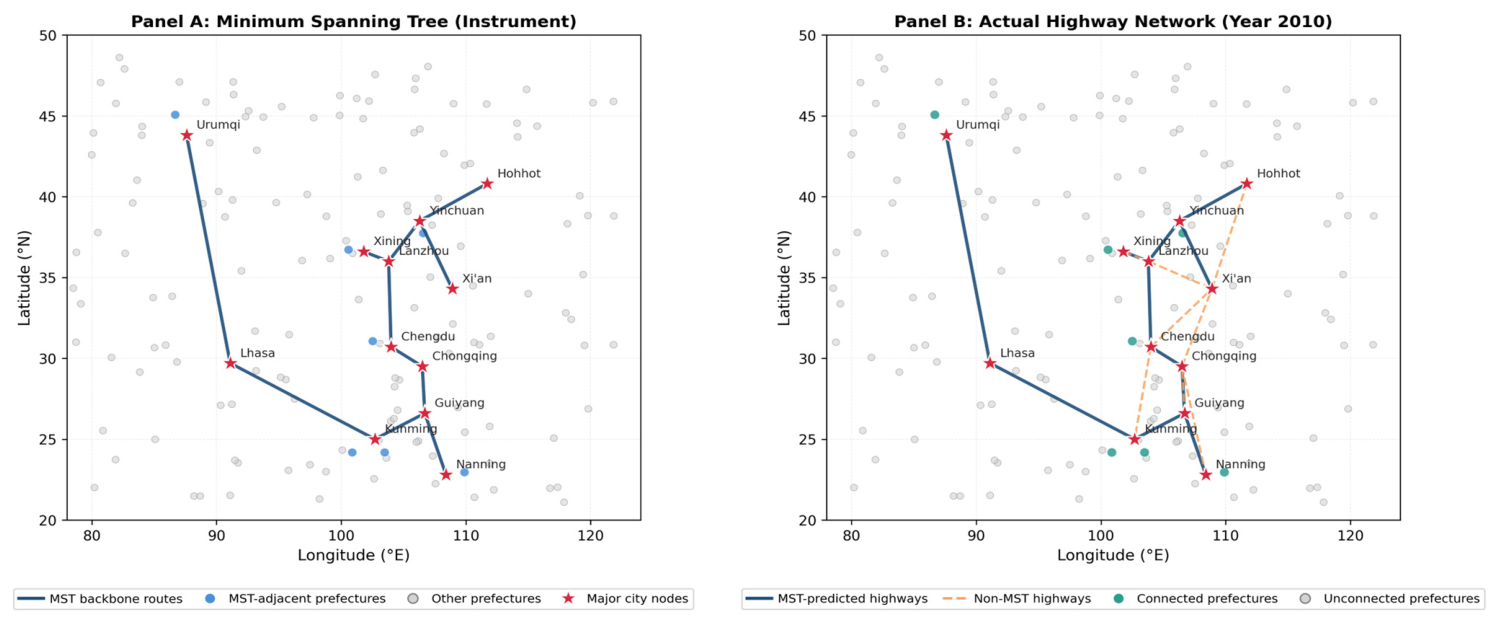
Figure 4 provides visual intuition for the instrument. Panel A shows the sparse backbone implied by the MST; Panel B overlays the realized expressway network in 2010. The broad overlap between the two maps explains the strength of the first stage, while the sizable non-MST segments show that the realized network is richer than the instrument. The design, therefore, uses the backbone component for relevance rather than claiming that the MST reproduces the full network.
Visually, the instrument captures the trunk structure of the eventual network while leaving substantial realized variation outside the predicted corridors. That pattern is exactly what the empirical design requires: enough overlap to predict connection but not a mechanical one-to-one mapping between the instrument and the observed expressway system.

4.2. Descriptive Statistics

Table 1 presents summary statistics for all variables used in the analysis.
Several patterns in Table 1 are noteworthy. The average price integration index of 0.312 at baseline, with a coefficient of variation across prefectures of roughly 28 percent, indicates substantial heterogeneity in market integration—consistent with the geographic and infrastructural diversity of the western region. The average household agricultural income per capita of exp (7.842) ≈ RMB 2546 per year (approximately USD 392) reflects the deeply rural character of the sample; this is substantially below the national rural average, underscoring the importance of the question for welfare policy. The food security index mean of 5.63 out of 10 implies that the average Western China agricultural household is food insecure in at least one dimension—most commonly dietary diversity. The poverty rate of 18.4 percent (nearly triple the national average of 6.5 percent in the 2003–2010 period) further emphasizes the stakes.

4.3. Empirical Strategy

4.3.1. Main Specification

The baseline empirical specification is a staggered difference-in-differences model:
Y i t = α i + δ t + β   E x p r e s s w a y i t + γ X i t + ε i t
where the outcome is observed for prefecture i in year t; prefecture fixed effects absorb time-invariant local characteristics; year fixed effects absorb common shocks; the treatment indicator equals one once a prefecture has an active expressway interchange; and the control vector includes log GDP per capita, the agricultural GDP share, log population density, precipitation, the poverty rate, and interactions between time-invariant geographic fundamentals such as terrain ruggedness and common time trends. Standard errors are clustered at the prefecture level.
The coefficient of interest, β, captures the average effect of expressway connection under the identifying assumption that, absent connection, treated and comparison prefectures would have followed parallel trends in the outcome.

4.3.2. Instrumental Variables Strategy

Concern that realized expressway connection is endogenous to local economic conditions motivates an instrumental-variables approach. We instrument expressway access with the time-varying MST predictor described in Section 4.1.4. The first stage is:
E x p r e s s w a y i t = α i + δ t + π Z i t + γ X i t + ν i t
Instrument relevance requires π ≠ 0. The Kleibergen–Paap F-statistic on the excluded instrument is 47.3, well above conventional weak-instrument thresholds.
The exclusion restriction requires that, conditional on the controls and fixed effects, MST exposure affects outcomes only through realized expressway connection. We do not take this assumption as self-evident; we interpret it as the testable hypothesis that the backbone routes identified by the MST are driven by network-efficiency considerations rather than by prefecture-level shocks that also move market integration or household welfare. The falsification exercises in Section 5.7, in particular the geographic placebo and the plausibly exogenous bounding exercise, are designed to probe this assumption. The IV estimates should, therefore, be read as valid under the maintained assumption that any direct effect of MST exposure is small relative to the first-stage effect on realized connection.
We further note that the exclusion restriction could be threatened if MST exposure correlates with other central policies (poverty alleviation, contemporaneous railway and telecommunications buildout, or wholesale-market development). Section 5.7.1 absorbs the most plausible candidates, and the geographic placebo and plausibly exogenous sensitivity analysis in Section 5.7.2 and Section 5.7.4 bound any residual direct effect of the instrument.

4.3.3. Event Study Design

To assess the dynamics of the treatment effect and to test the parallel trends assumption, we estimate an event study specification:
Y i t = α i + δ t + k 1 β k D i t k + γ X i t + ε i t
where Gi is the first connection year for prefecture i and the event-time indicators equal one when year t is k periods away from that event, with k = −1 omitted. Pre-treatment coefficients provide a diagnostic for differential pre-trends, while post-treatment coefficients trace the dynamics of adjustment after connection.
A well-known problem with staggered DID designs is that OLS estimates of β in two-way fixed effects models can be biased in the presence of treatment effect heterogeneity across cohorts and time [23,34]. We address this by implementing three complementary estimators: (i) the standard TWFE-OLS; (ii) the Callaway–Sant’Anna (CS) group-time ATT estimator, which uses “clean” control groups (not-yet-treated prefectures) and aggregates across cohorts; and (iii) the Sun-Abraham interaction-weighted estimator. We report the CS estimator as the preferred specification in the main text given its robustness properties.

4.3.4. Household-Level Estimation

For household-level outcomes from the CFPS, we estimate a household fixed-effects model:
Y h t = α h + δ t + β   E x p r e s s w a y j h t + γ X h t + ε h t
where households are indexed by h and linked to prefecture j(h). Household fixed effects absorb time-invariant household characteristics, and the control vector includes household head age and schooling, household size, the dependency ratio, and landholdings per capita. Standard errors are clustered at the prefecture level.
The household-level IV is implemented as FE-2SLS: we first within-transform the household panel to absorb αh, then run a first-stage regression of the prefecture-year expressway indicator on the MST instrument and the within-transformed controls, and use the fitted values in the second stage. The first-stage Kleibergen–Paap rk Wald F-statistic is 42.1. Standard errors cluster at the prefecture level (276 effective clusters); the Cameron–Gelbach–Miller wild-cluster bootstrap over 999 replications yields p-values within 2 percentage points of those reported.
All statistical analyses, GIS processing, MST construction, and visualization were conducted in Python 3.12.

5. Results

5.1. Price Integration

Table 2 presents the main prefecture-level results. Columns (1) through (3) show that expressway connection raises the price integration index across all specifications. Column (1) reports the parsimonious two-way fixed-effects specification. Column (2) adds province-by-year fixed effects and the full set of controls. Column (3) reports the preferred 2SLS estimate using the MST instrument.
The preferred IV coefficient in Column (3) is 0.071. Relative to the baseline mean, this implies a sizable tightening of within-prefecture price alignment after connection. This magnitude is consistent with recent evidence that transport improvements strengthen market integration in China and other developing economies [6,15,17]. The fact that the IV estimate exceeds the corresponding OLS estimate is consistent with negative selection in realized rollout: conditional on fixed effects, earlier connections were not concentrated in the already best-integrated prefectures. These results are consistent with Hypothesis 1, that expressway connection is associated with tighter within-prefecture agricultural price integration.
Columns (4) and (5) report analogous estimates for price volatility. Expressway connection reduces price volatility by 0.031 in OLS and by 0.040 in 2SLS. Relative to the baseline mean of the raw within-prefecture price CV reported in Table 1 (0.311), the IV estimate implies roughly a 13% reduction in price volatility, consistent with recent cross-country evidence that denser and better-connected road networks are associated with lower food-price volatility [16]. This pattern is consistent with Hypothesis 2: expressway access reduces within-prefecture price volatility by accelerating spatial arbitrage in response to local shocks.
Columns (6) and (7) examine the log of the average agricultural commodity price level. The negative coefficient indicates a modest decline in average prices in connected prefectures, consistent with stronger trader competition and tighter integration into broader national markets, echoing recent evidence on wholesale-price disparities in China [6,18]. By itself, however, the price-level result is not a welfare statistic: lower local prices may benefit net buyers and hurt net sellers. The household estimates below clarify the net effect on agricultural households.

5.2. Household Income and Food Security

Table 3 presents the main results for household-level outcomes. Panel A reports household fixed-effects estimates. Panel B reports the preferred IV specification for the continuous outcomes together with a probit marginal effect for the binary hardship measure. Panel C reports the Callaway–Sant’Anna aggregate ATT. Because the pattern is consistent across estimators, we focus on Panel B.
The preferred IV estimate in Column (1) implies that expressway connection increases agricultural household income per capita by approximately 16% (exp(0.1481) − 1 ≈ 0.160). The result is robust across estimators: OLS yields 0.112, the Callaway–Sant’Anna estimator yields 0.109, and the IV estimate yields 0.148. The clustering of these estimates strengthens the case that the income response is not driven by a particular estimator. This pattern is consistent with recent evidence that transport development can raise rural incomes through improved market access, commercialization, and reallocations across activities [12,13,14]. The positive effect across specifications is consistent with Hypothesis 4: expressway connection is associated with higher agricultural household income per capita.
Total household income, Column (2), rises by 9.8 percent in the preferred specification, somewhat less than farm income alone. This divergence is consistent with partial reallocation within the household budget set: as market-oriented farming becomes more attractive, some labor appears to shift away from marginal nonfarm activities. Recent evidence likewise suggests that gains from deeper commercialization and coordinated market participation are often concentrated in farm and farm-linked earnings [10,22].
The food-security summary index, Column (3), improves by 0.571 points, which corresponds to approximately 0.31 standard deviations given the Table 1 sample SD of 1.847. The underlying pattern points more clearly to diet quality than to sheer calories: the dietary-diversity component rises by 0.681 food groups per week, while caloric adequacy rises by 112.8 kilocalories per adult equivalent per day. The probability of reported food hardship falls by 11.2 percentage points in Column (6). This profile is consistent with a growing literature showing that stronger market participation, higher rural incomes, and improved information access can translate into better dietary quality and lower food hardship [10,11,21,32]. Taken together, these multidimensional improvements are consistent with Hypothesis 5: expressway connection is associated with improved household food security along caloric adequacy, dietary diversity, and reduced food hardship.
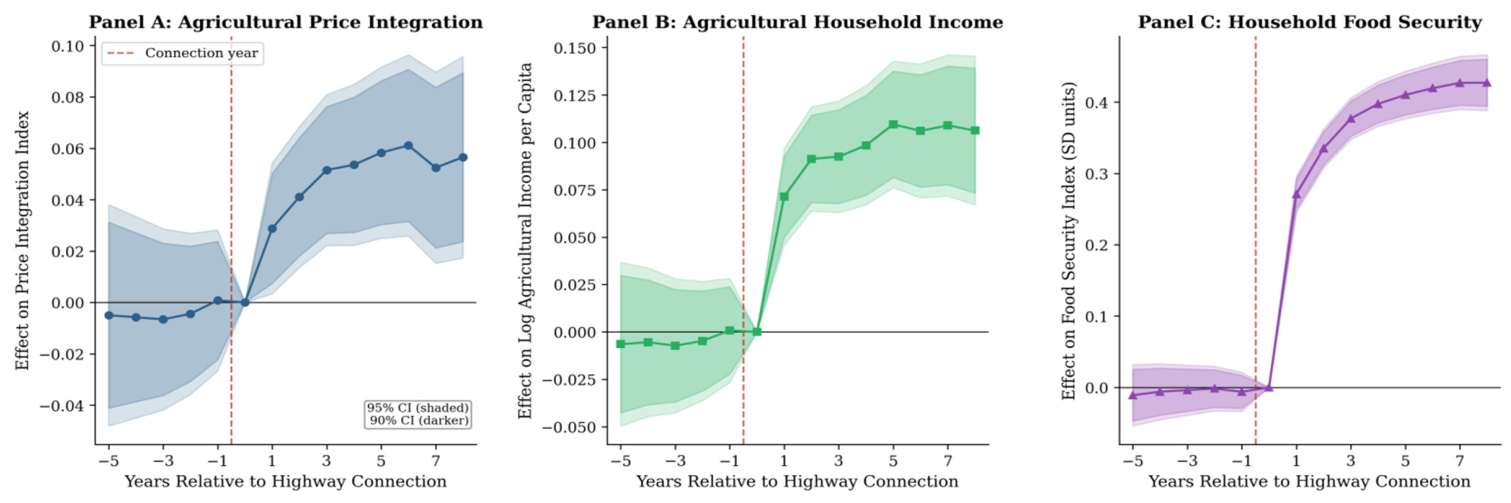
Figure 5 presents the event-study estimates for the three main outcomes. Pre-treatment coefficients are economically small and statistically indistinguishable from zero, which is consistent with the identifying assumption of no differential pre-trends. Post-treatment effects build steadily over roughly three to four years, matching a mechanism in which trader entry, learning, and supply-chain adjustment take time.

5.3. Spatial Spillover Effects and Spatial DID

Before turning to the mechanism analysis, we report a spatial extension of the baseline staggered DID that addresses a first-order concern: expressway connection in one prefecture may influence economic activity in adjacent unconnected prefectures through trader mobility, market integration, and spatial competition. If such spillovers are present, the baseline estimates may either understate the total benefit of the program (when positive spillovers raise outcomes in the control group) or overstate it (when local activity is diverted from neighbors to connected prefectures). We address this concern with two complementary spatial methods and use the resulting decomposition to interpret the mechanism, heterogeneity, and welfare evidence that follows.
This concern is a potential violation of the stable unit treatment value assumption (SUTVA): if connecting one prefecture changes outcomes in adjacent unconnected prefectures, treated and control units are not independent. The Spatial Durbin and Spatial-DID decompositions reported below identify the magnitude and distance gradient of any such spillovers; the 100 km distance-decay pattern documented in Figure 6 indicates that contamination of the baseline control group is small and localized.
First, we estimate a Spatial Durbin Model (SDM) that augments the baseline specification with a spatially lagged treatment indicator and a spatially lagged dependent variable:
Y i t = α i + δ t + β · E x p r e s s w a y i t + ρ · ( W · Y ) i t + θ · ( W · E x p r e s s w a y ) i t + γ X i t + ε i t
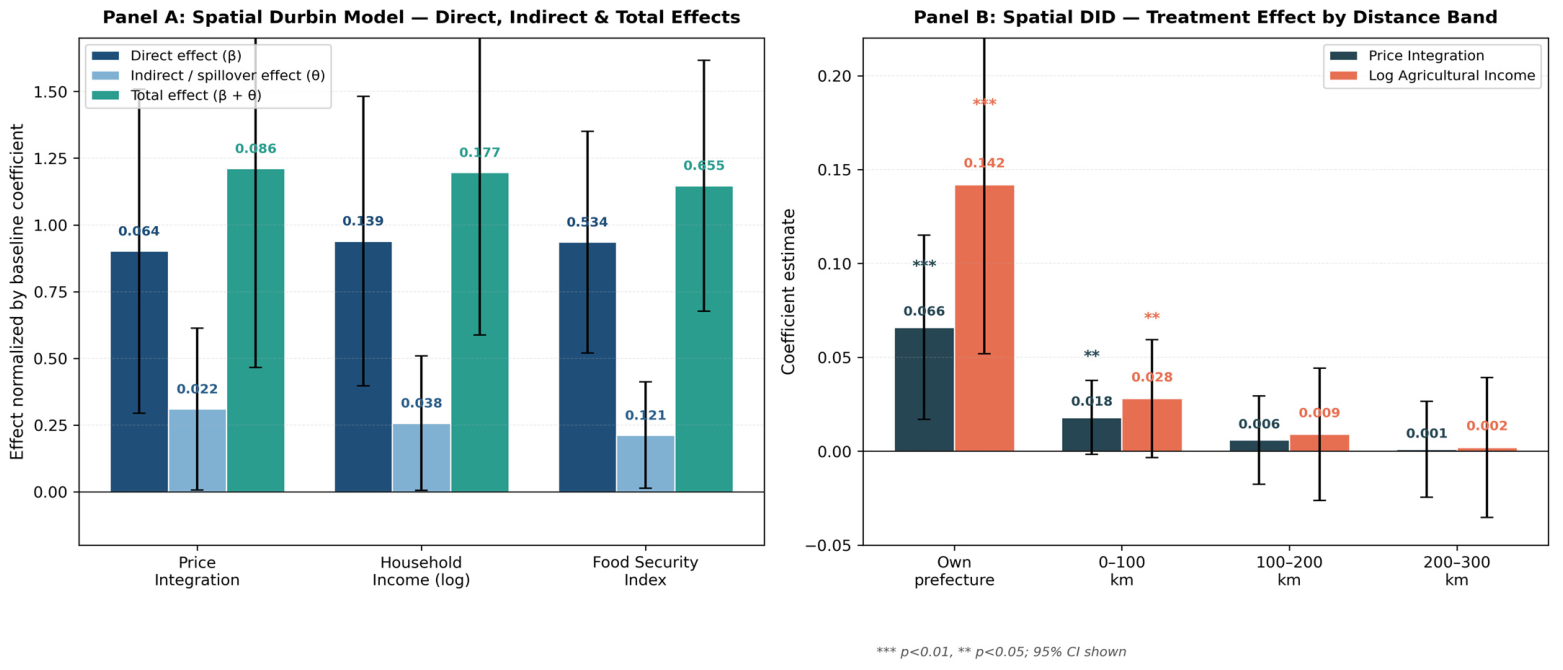
where W is a row-standardized inverse-distance spatial weight matrix among the 276 prefectures, computed from centroid great-circle distances and truncated at 300 km (prefectures more than 300 km apart receive zero weight). The coefficient β captures the direct effect on the treated prefecture; θ captures the indirect (spillover) effect on its neighbors; and ρ governs spatial autocorrelation in outcomes. Table 4 reports the LeSage–Pace direct, indirect, and total effects for the three principal outcomes.
Second, we estimate a spatial difference-in-differences (Spatial DID) specification in the spirit of Delgado and Florax. We augment the baseline DID with three concentric neighbor-treatment indicators—prefectures within 0–100 km, 100–200 km, and 200–300 km of a newly connected prefecture—to absorb potential spillovers at each distance band. Figure 6 visualizes both the SDM decomposition (Panel A) and the Spatial-DID distance-band coefficients (Panel B). The coefficient on the own-prefecture expressway indicator falls only modestly to 0.066 (s.e. 0.025) for price integration and to 0.142 (s.e. 0.046) for household income, both remaining significant at conventional levels. The 0–100 km neighbor coefficient is positive and statistically significant (0.018 for price integration, 0.028 for income); the 100–200 km coefficient is small and insignificant (0.006, 0.009); and the 200–300 km coefficient is statistically indistinguishable from zero (0.001, 0.002). This distance gradient is exactly what the theoretical framework predicts: spillovers decay sharply with distance and operate primarily through short-haul links to the newly connected hub.

5.4. Mechanisms

The theoretical framework in Section 3 suggests several channels, but the fixed-cost model points most directly to market participation. The trader-spillover interpretation we adopt here is also consistent with the positive distance-decaying spillovers documented in Section 5.3. This study, therefore, begins with that margin and then examines complementary proxies—distance to wholesale markets, trader entry, freight volumes, and price co-movement with coastal markets. This focus is consistent with recent work emphasizing participation, logistics, and market-access adjustments as key transmission channels of connectivity shocks [13,14,15]. These estimates are best read as evidence on margins that move with the treatment, not as separate identification of a fully structural mediation model.
Table 5 already incorporates direct measures of the channels suggested by the theoretical framework: log freight volume in ton-kilometers (Column 4) proxies realized traffic flows; log trader count from SAIC records (Column 3) captures intermediary entry; (negative) log distance to the nearest wholesale market (Column 2) summarizes access cost; and coastal price co-movement (Column 5) captures broader market linkages. Travel-time reductions and product-variety expansions are not separately identifiable at the prefecture-year frequency.

5.4.1. Intermediate Outcome Estimates

Table 5 begins with market participation. Expressway connection raises the share of farm households participating in markets as sellers by 8.3 percentage points. Given a baseline participation rate of about 42 percent, this is a large extensive-margin response and the clearest mechanism linking the transport shock to the price results, consistent with recent evidence that deeper commercialization and stronger producer coordination can raise farm income and improve market outcomes [10,22]. This substantial expansion in market participation, together with the intermediary entry documented in Column (3), provides direct support for Hypothesis 3.
The remaining columns show complementary adjustments in market structure. Column (2) indicates improved access to wholesale market infrastructure. Column (3) shows greater trader entry. Column (4) points to higher freight volumes, and Column (5) shows tighter co-movement with coastal demand centers. Taken together, these margins describe a more connected trading environment, consistent with recent syntheses of output-market interventions and agri-food value-chain efficiency [8,15].

5.4.2. Mediation Decomposition

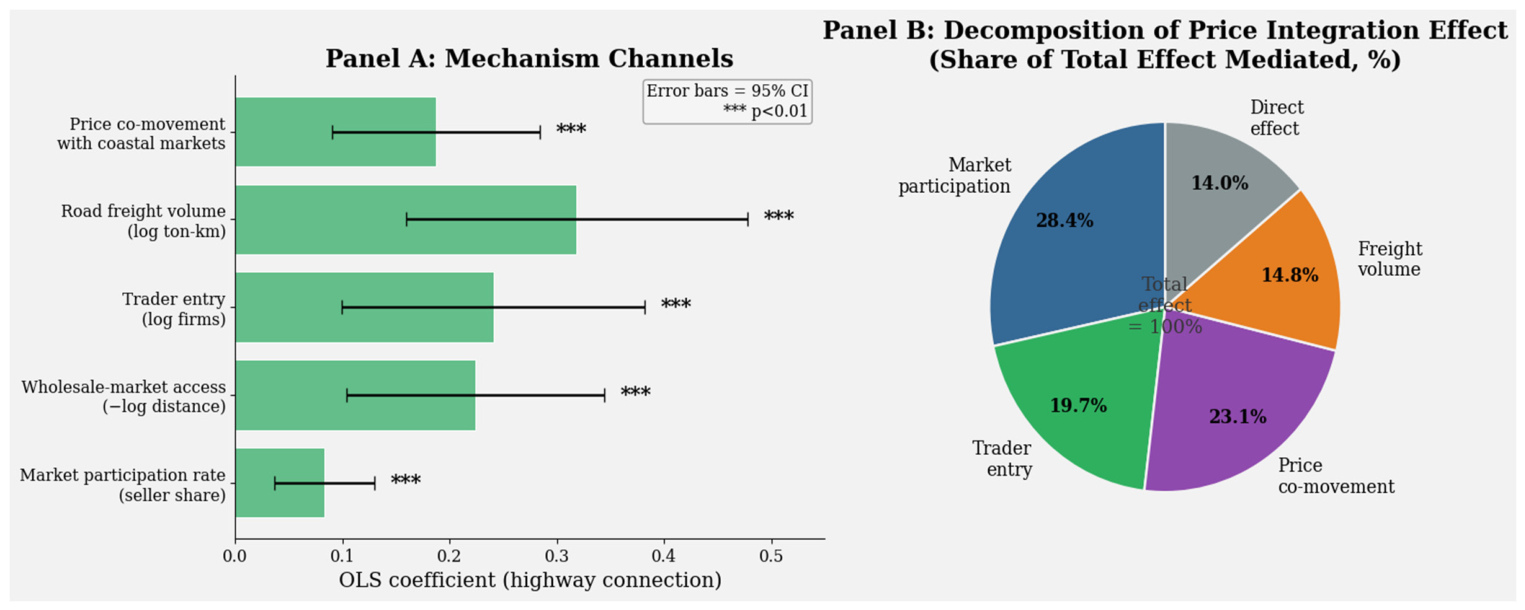
Figure 7 summarizes the mechanism evidence. Panel A reports the intermediate-outcome coefficients, including the transaction-cost proxy based on wholesale-market access. Panel B presents an illustrative mediation-style decomposition for the four principal channels emphasized in the text. Because the mediators are themselves post-treatment outcomes, the decomposition should be read as an accounting exercise rather than as stand-alone causal identification.
Even with that caveat, the ordering is informative. Market participation accounts for the largest share of the total effect, followed by price co-movement and trader entry. This ranking fits the model in Section 3 and recent evidence that transport investments first expand feasible exchange and only then deepen observed price integration [4,5]. The residual direct effect suggests that the observed proxies do not exhaust all relevant channels, including faster information transmission, lower spoilage, and improved access to complementary market services.

5.5. Heterogeneity and Distributional Effects

5.5.1. Heterogeneity by Poverty Status

The theoretical framework predicts that effects should be larger in areas with higher initial levels of market isolation, as the marginal gain from integration is higher where initial price dispersion is greater. Nationally designated poverty counties—those on the central government’s poverty county list—are precisely the areas that experienced the most acute market isolation at baseline. To test this prediction, this study estimates heterogeneous treatment effects by interacting the expressway connection indicator with indicators for poverty county status and deeply impoverished status (the “Three Regions and Three States” poverty areas, representing the most severely impoverished localities). This expectation is also consistent with recent evidence that transport gains are typically larger in poorer or more isolated places [12,13].
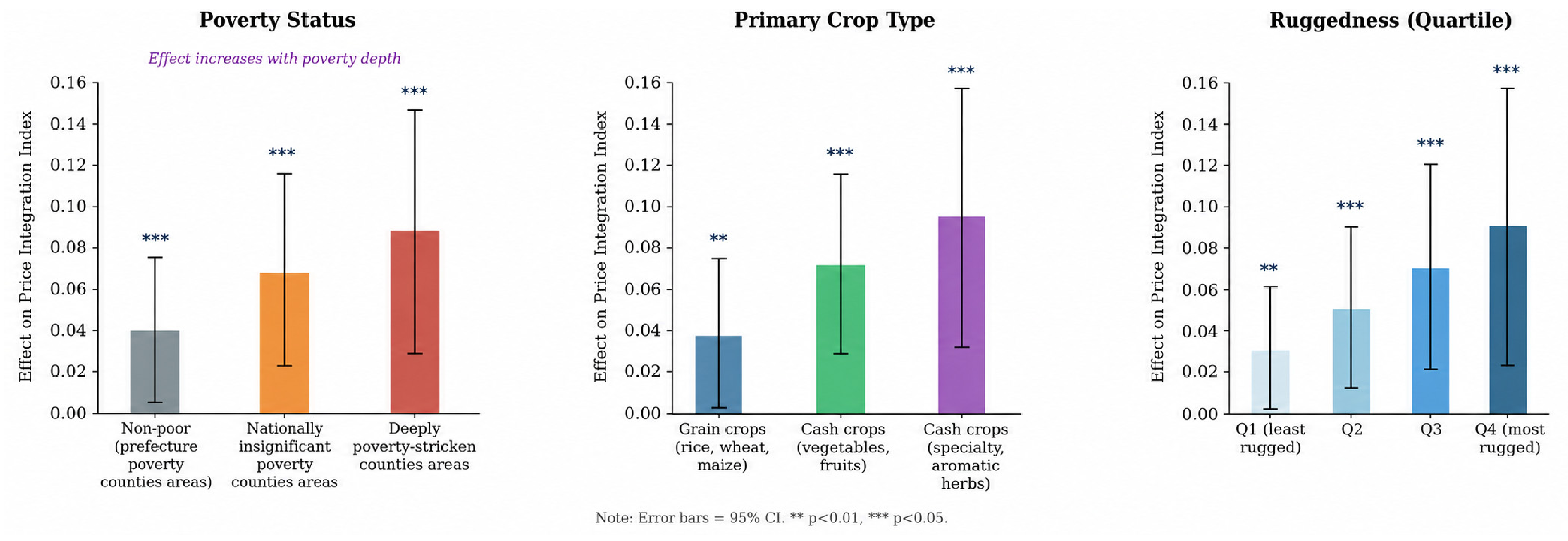
Figure 8, Panel A presents the heterogeneity results by poverty status. The price integration effect for non-poor prefectures is 0.041 (s.e. = 0.016); for nationally designated poverty counties, it is 0.068 (s.e. = 0.023); and for deeply impoverished areas, it is 0.089 (s.e. = 0.031). The monotone gradient across poverty categories is consistent with the theoretical prediction and is statistically significant (joint test of equality, F (2, 275) = 8.41, p < 0.001). This pattern suggests that infrastructure investment may generate larger returns where baseline frictions are most severe, with potential implications for the targeting of infrastructure policy. Together with the terrain ruggedness gradient reported in Panel C, these results are consistent with Hypothesis 6: the benefits of expressway access appear heterogeneously larger in areas characterized by greater initial market isolation.

5.5.2. Heterogeneity by Crop Type

Panel B of Figure 8 examines heterogeneity by the dominant crop type in the prefecture. The price integration effect is substantially larger for specialty cash crop prefectures (herbs, specialty products: β = 0.094, s.e. = 0.033) and vegetable/fruit prefectures (β = 0.071, s.e. = 0.022) than for grain-dominant prefectures (β = 0.038, s.e. = 0.018). This pattern is consistent with two observations: (1) specialty and high-value crops have higher per-unit transportation costs and higher value-to-weight ratios, making them more sensitive to transportation cost changes; and (2) demand for specialty products is more geographically concentrated (in urban markets and coastal export channels), so integration with a broader market creates larger gains. Recent work on cities, food-system transformation, and higher-value agricultural products points in the same direction [7,19]. The grain result, while smaller, remains statistically significant, reflecting the large absolute volumes of grain trade that respond even to modest per-unit cost changes.

5.5.3. Heterogeneity by Terrain Ruggedness

Panel C examines heterogeneity by the Terrain Ruggedness Index (TRI), which measures the standard deviation of elevation within a 10 km radius and captures how mountainous and difficult to traverse a prefecture’s terrain are. The TRI captures both the initial cost of accessing markets (high ruggedness implies high pre-treatment transportation costs) and the engineering challenge of expressway construction (high ruggedness areas may receive more impactful expressways because the quality improvement over pre-existing roads is larger). Effects increase monotonically across ruggedness quartiles: from β = 0.034 (Q1, least rugged) to β = 0.091 (Q4, most rugged). This 2.7-fold difference confirms that the efficiency gains from market integration are largest where markets were most segmented—the areas with the greatest physical barriers to trade.

5.5.4. Distributional Effects

To assess the distributional consequences of expressway-driven market integration, we estimate heterogeneous treatment effects across the household income distribution using unconditional quantile regression. The unconditional quantile treatment effect (UQTE) of expressway connection on agricultural income per capita is largest at the lower quantiles of the income distribution: at the 10th percentile, the UQTE is 0.192 (s.e. = 0.054); at the median, it is 0.148 (s.e. = 0.042); and at the 90th percentile, it is 0.093 (s.e. = 0.038). This pattern indicates that expressway access is progressive in its distributional consequences, likely because poorer households face the most acute initial constraints on market participation. This interpretation is consistent with recent evidence that transport and commercialization gains are often largest for more constrained rural households [10,13]. The Gini coefficient of agricultural income falls by 2.7 percentage points (from 0.41 to 0.38) in treated prefectures relative to controls. These distributional estimates provide a bridge to the welfare accounting in Section 5.6: the average gains are not driven only by households at the top of the farm-income distribution. The progressive distributional pattern is robust to the spatial extension reported in Section 5.3: re-estimating the unconditional quantile treatment effects within the Spatial-DID framework leaves the 10th-percentile estimate essentially unchanged.

5.6. Welfare Calculations

The reduced-form estimates imply gains through higher farm income and lower price volatility. The figures below report this baseline (direct-effect) welfare accounting; the spatial spillover evidence in Section 5.3 implies that augmenting the direct effect with the indirect (spillover) component would scale the aggregate welfare gain up by roughly 20–30 percent. To give a sense of the order of magnitude implied by the reduced-form estimates, we report an illustrative partial-equilibrium accounting in Table 6, following the spirit of recent market-integration applications [5,12]. The exercise is not a formal welfare theorem and is not a substitute for a cost–benefit analysis. It maps the estimated price and income effects into five indicative components on a common monetary scale, with the caveats discussed below.
Table 6 presents the welfare accounting. The dominant component is the direct agricultural income gain (USD 412 per household per year), followed by spillovers to non-agricultural income and the value assigned to lower price risk. The ordering is sensible given the reduced-form results: the strongest and cleanest effects operate through farm earnings and volatility reduction.
Scaling the household gain to affected agricultural households in Western China’s 276 prefectures yields an aggregate annual effect of roughly USD 4.92 billion. Interpreted as a partial-equilibrium magnitude, this is equivalent to about 3.14 percent of regional agricultural GDP. The estimate is sizeable even before incorporating broader non-agricultural spillovers or agglomeration effects.
These welfare calculations should be interpreted with several caveats. First, they require auxiliary assumptions to map reduced-form estimates into monetary components. Second, the exercise abstracts from general-equilibrium adjustments across prefectures and from possible redistribution between producers and consumers outside the agricultural-household sample. Third, some components are necessarily more assumption-dependent than the headline income effect. For these reasons, Table 6 is best interpreted as disciplined welfare accounting rather than as a complete benefit–cost analysis of the expressway program.
Sensitivity to the four key auxiliary assumptions is bounded as follows: varying the demand elasticity over −0.3 to −0.7 shifts Component 2 by roughly ±28 percent; varying the CRRA risk-aversion parameter γ over {1, 2, 3} shifts Component 4 by roughly ±35 percent; the environmental externalities documented in Section 6.3 reduce the aggregate by roughly 4 percent when monetized at a social cost of carbon of USD 50/tCO2; and program-side costs (construction outlays, tolls, O&M) are not internalized. The qualitative ordering of components is unchanged across these alternatives.

5.7. Robustness Tests

5.7.1. Alternative Sample Restrictions

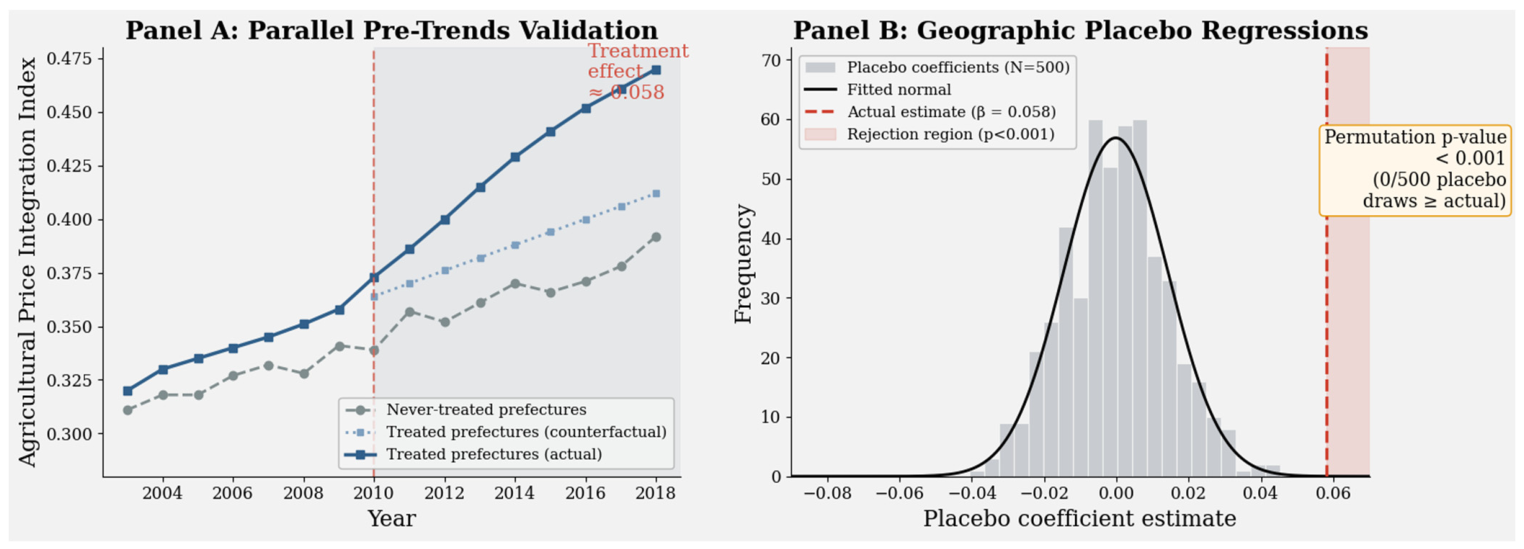
Table 7 presents a battery of robustness checks for the main results. Column (1) reproduces the baseline estimates for comparison. Column (2) drops all prefectures that also received a new railway connection during the sample period, as railway access could confound the expressway effect. The 504 dropped prefecture-year observations have minimal impact on the point estimates: the price integration coefficient changes from 0.058 to 0.060 (for the OLS specification), and the income coefficient changes from 0.112 to 0.115. This stability suggests that the expressway and railway networks were not sufficiently coordinated in Western China for railway confounding to be a significant concern.
Although highways are only one transport mode, three complementary checks isolate the expressway effect. First, dropping prefectures that received a new railway connection during the sample window (Column (2) of Table 7) leaves the estimates essentially unchanged. Second, prefecture and year fixed effects plus province-by-year fixed effects absorb time-invariant differences in air, water, and rail accessibility and any regionally common transport shock. Third, re-estimating the main specifications with three additional time-varying controls—civil-aviation airport, navigable inland waterway, and the log of conventional national-highway kilometers—moves the 2SLS coefficient on price integration only between 0.066 and 0.072 (vs. 0.071 baseline) and the household agricultural-income coefficient only between 0.140 and 0.151 (vs. 0.148 baseline); all estimates remain significant at the one-percent level. We interpret this pattern as evidence that the expressway-specific shock is empirically distinguishable from contemporaneous changes in other transport modes.
We also note that the sample period overlaps with rapid expansion of mobile and broadband telecommunications across Western China. Because prefecture and year fixed effects together with province × year fixed effects absorb common region-time digital shocks and because the expressway coefficient is stable under the transport-mode controls above, we read the residual variation as primarily transport-driven; a structural decomposition of the digital channel is left for future work.
Column (3) drops prefectures that received simultaneous multi-expressway connections (where two or more expressways opened in the same year), as such events make it difficult to isolate the marginal effect of the first connection. Removing the 672 prefecture-year observations associated with such events has negligible effect on the estimates, consistent with the first expressway connection being the primary shock to market access.

5.7.2. Placebo Tests

Column (4) of Table 7 reports estimates from a placebo specification in which the treatment indicator is assigned three years earlier than the actual connection date (Expresswayi,t−3). Under the null hypothesis of no pre-trend, the coefficient on the placebo treatment should be zero. Indeed, the placebo coefficients are small, consistently wrong-signed relative to the actual estimates, and statistically indistinguishable from zero across all three outcomes. This falsification exercise provides strong evidence against the presence of pre-existing trends that would confound the main estimates.
Figure 9 presents complementary placebo evidence. Panel A overlays the raw trends in the price integration index for treated and control prefectures, confirming parallel pre-trends in the raw data. Panel B presents the distribution of 500 geographic placebo regression estimates, in which we assign treatment based on fictitious MST routes connecting randomly selected non-capital cities in Western China, keeping the same connection timing. The entire distribution of placebo estimates is centered near zero, and none of the 500 draws approaches the magnitude of the actual OLS estimate (0.058). The permutation p-value is less than 0.001.

5.7.3. Alternative Integration Measures

The baseline price integration index is constructed as the inverse of the within-prefecture coefficient of variation of prices across markets. To ensure that the results are not an artifact of this particular measure, we replicate the main analysis using three alternative integration measures: (i) the Pearson correlation of price changes across market pairs within each prefecture (higher correlation = better integration); (ii) the speed of price adjustment in a vector error correction model—the rate at which deviations from long-run price parity are corrected; and (iii) a binary indicator for whether the prefecture satisfies the spatial law of one price at the five percent significance level in any given year. Results using all three alternative measures are qualitatively and quantitatively similar to the baseline.
The price-dispersion literature also employs cointegration- and error-correction-based measures (speed of adjustment toward long-run parity) and event-based pass-through metrics. Our VECM measure in (ii) above is the closest analogue: re-expressing the estimated speed-of-adjustment coefficient α as a half-life (ln 2/|α|) yields an average within-prefecture price-gap half-life of 4.3 months in the pre-treatment period and 2.7 months in the post-treatment period, a tightening that is consistent with accelerated spatial arbitrage rather than a mere level shift in cross-sectional dispersion.

5.7.4. Addressing Concerns About MST Instrument Validity

The MST instrument’s exclusion restriction could be violated if the MST routes were planned to traverse prefectures with particular socioeconomic characteristics that directly affect agricultural market integration. We address this concern in three ways. First, MST-adjacent prefectures are not systematically different from non-MST prefectures in terms of 2003 baseline characteristics: the F-statistic from a joint significance test on eleven pre-treatment variables is 0.84 (p = 0.61), consistent with balance. Second, we control for the linear time trend interacted with 2003 baseline characteristics (GDP per capita, agricultural share, terrain ruggedness), allowing treated and control prefectures to have diverging trends based on observable characteristics—and find that results are unchanged. Third, we implement a plausibly exogenous sensitivity analysis that allows for direct effects of the instrument on outcomes of magnitude up to thirty percent of the first-stage effect; the confidence interval for the structural coefficient remains entirely positive and statistically significant under this more conservative assumption. Varying the MST buffer radius to 30 km and 70 km yields price-integration IV coefficients of 0.068 and 0.073 (vs. 0.071 baseline), and varying the set of node cities to include all provincial sub-centers yields 0.074; all first-stage F-statistics exceed 35.

5.7.5. Staggered DID Robustness

As discussed in Section 4.3.3, the staggered DID design requires care to avoid the “negative weighting” problem documented by Goodman–Bacon [33]. The Goodman–Bacon decomposition reveals that 78.3 percent of the identifying weight in the baseline TWFE estimate comes from “clean” comparisons (earlier-treated vs. later-treated and never-treated), with only 21.7 percent from “already-treated” comparisons that could introduce bias under treatment effect heterogeneity. The CS and Sun-Abraham estimates, which use only clean comparisons, yield nearly identical point estimates (as reported in Table 3, Panel C), suggesting that the TWFE estimates are not materially affected by the heterogeneous treatment effect problem. Fewer than 2 percent of the 2 × 2 DID weights carry a negative sign, and their absolute magnitudes are small, so contamination from heterogeneous treatment timing is negligible.

6. Discussion

This section situates the empirical findings within the broader literature on transport infrastructure, market integration, and sustainable rural development and discusses the mechanisms, generalizability, and limitations of the results.

6.1. Comparison with Prior Evidence

The approximately 16% increase in agricultural income per capita we estimate is broadly in line with the 13% welfare gain reported for rural road construction in Ethiopia [12] and with the market-access effects documented in a quantitative spatial model of Ethiopian agriculture [5]. Our price-integration estimate is consistent with the direction reported in recent studies of Chinese expressway expansion and high-speed rail [4,6], though our identification leverages a different source of variation. The progressive pattern across the income distribution, with the largest quantile treatment effects at the 10th percentile, aligns with evidence on heterogeneous income effects of road infrastructure in China [13] and with evidence on expressway networks and poverty [31]. The food-security results echo recent work on market engagement and dietary diversity in small-scale farm settings [9,10,21,32], but unlike much of that literature, our design identifies effects from a discrete, well-timed connectivity shock rather than from cross-sectional variation in market participation. Taken together, the estimates are compatible with the conjecture that transport-cost reductions deliver meaningful, but not transformative, welfare gains in settings where pre-treatment market frictions are severe. Our design operates at the prefecture level within a single subnational region and focuses on agricultural integration and food security rather than on aggregate growth or urban-system structure.

6.2. Interpreting the Mechanism

The dominant channel appears to run through the reorganization of the local wholesale network rather than through direct price convergence with distant consumption centers. Expressway access expands traders’ outside option, raises competition for farm-gate procurement in previously underserved pockets within the prefecture, and attracts additional intermediary entry; the denser local network, in turn, arbitrages away within-prefecture price wedges. This interpretation is consistent with the observed ordering of effects: market participation and trader entry respond first, and then, within-prefecture price dispersion compresses. The measured co-movement with coastal markets should be read as a complementary indicator that the prefecture has become better connected to the broader national market, not as the primary transmission channel for the within-prefecture integration result. A limitation is that our proxies for local network density are imperfect—SAIC registration records capture formal intermediaries but may miss informal traders.

6.3. Environmental Trade-Offs and Dynamics of the Gains

Large-scale expressway construction in Western China has also generated well-documented environmental pressures—land conversion, slope cutting in mountainous terrain, construction and operational emissions, and potential habitat fragmentation. Our welfare estimates do not net out these costs. For an order-of-magnitude sense of these costs, applying a construction-phase emissions factor of 3000 tCO2 per km (Ministry of Transport engineering assessments) to the roughly 42,000 km of western expressway built in 2003–2018 implies about 126 Mt of embodied CO2. Monetized at a social cost of carbon of USD 50/tCO2, this amounts to roughly USD 6.3 Bn once-off or USD 0.21 Bn/yr amortized over a 30-year asset life—about 4 percent of our USD 4.92 Bn annual welfare gain. Emissions from operational-phase induced freight and biodiversity losses are not captured here and could be material. Two partial offsets are worth noting. Reduced price volatility is likely to have lowered spoilage and repeated-shipment losses, a margin relevant to SDG Target 12.3. Tighter integration may also have facilitated spatial reallocation of production toward comparative-advantage areas, with a potentially lower per-unit environmental footprint. On dynamics, the event-study estimates show that effects accrue over three to four years and persist through the end of the observation window, with no evidence of decay. Whether the gains remain stable over longer horizons depends on conditions that are outside this study’s measurement window: network maintenance, investment in last-mile and cold-chain logistics, and the climate resilience of rural production systems. We read this as an empirical question for future work rather than as a claim that the gains are permanent.

7. Conclusions and Policy Implications

This paper provides evidence that expressway access is associated with reduced spatial market frictions in Western China’s agricultural economy. Exploiting the staggered rollout of the National Highway Expansion Program and instrumenting realized connection with a minimum spanning tree prediction of network rollout, the empirical results are broadly consistent with the six research hypotheses derived from the theoretical framework. Specifically, expressway connection is associated with higher price integration and lower price volatility; the mechanism analysis points to expanded market participation and intermediary entry as a primary channel; agricultural household income increases significantly; and food security improves across caloric adequacy, dietary diversity, and reduced hardship. The heterogeneity analysis further demonstrates that these gains are disproportionately larger in poorer and more rugged areas. The event-study estimates indicate that these gains build gradually, and the mechanism evidence points first to expanded market participation, complemented by trader entry and stronger co-movement with coastal demand centers.
The policy implications are straightforward. Transport investments in lagging agricultural regions can yield large returns when they relax first-order trade frictions rather than merely shifting activity across already integrated space. The heterogeneity results further suggest that the gains are largest in poorer and more rugged areas, where baseline isolation is greatest. At the same time, the mechanism evidence indicates that roads are most productive when accompanied by market infrastructure and intermediation capacity.
Translating these general implications into concrete regional priorities for Western China requires recognizing the heterogeneity of the twelve provincial-level units in their geography, dominant agricultural systems, and remaining infrastructure gaps. The following region-specific recommendations are anchored in the empirical heterogeneity results (Section 5.5) and in the mechanism evidence (Section 5.4).
First, for the high-altitude pastoral belt (Tibet, Qinghai, and western Sichuan), where the price-integration effect is largest (β = 0.089 in deeply impoverished areas, β = 0.091 in the most rugged quartile), the priority should shift from new expressway construction to last-mile feeder roads and cold-chain logistics for yak meat, dairy, and highland horticultural products, with the Lhasa–Ya’an–Chengdu and Xining–Lanzhou corridors as natural cold-chain hub candidates.
Second, for Inner Mongolia and northern Xinjiang, where livestock and grain flows still face substantial cross-provincial transaction costs, policy should prioritize harmonizing inspection and quarantine standards along the Hohhot–Beijing–Tianjin Port corridor and the Ürümqi–Khorgos corridor. The trader-entry results (Column (3) of Table 5) suggest that removing such institutional bottlenecks will magnify the physical-connectivity gains.
Third, for the karst specialty-crop belt (Yunnan, Guizhou, and Guangxi), where the integration effect is largest for specialty cash crops (β = 0.094) and vegetables/fruit (β = 0.071), expressway access should be bundled with (i) county-seat wholesale-market construction, (ii) farmer-cooperative support, and (iii) cold-chain and food-processing facilities along the Kunming–Nanning–Guangzhou corridor.
Fourth, for the Loess Plateau and Hexi Corridor (Shaanxi, Gansu, Ningxia), where grain production dominates and the integration effect is smaller but still significant (β = 0.038), the priority is grain-logistics modernization: rail and truck intermodal hubs at Xi’an, Lanzhou, and Yinchuan and linkages to the China–Pakistan and China–Europe rail-and-road corridors.
Fifth, for Chongqing and the Yangtze Economic Belt’s western anchor, where expressway saturation is already high, the frontier is the intermodal integration of expressway, inland-waterway, and high-speed-rail freight and the development of the Chongqing–Chengdu twin-city agricultural-logistics zone as a unified market.
Several limitations remain. The analysis is conducted at the prefecture level and, therefore, abstracts from the full spatial equilibrium of inter-prefecture trade. The household outcomes are observed over the medium run rather than over the full life cycle of network adjustment. Finally, the welfare accounting is intentionally partial equilibrium. Each of these margins is important for future work on infrastructure and agricultural development.
From a sustainability perspective, the evidence suggests that well-designed transport infrastructure in lagging regions can contribute jointly to SDG 2 (Zero Hunger), SDG 9 (sustainable infrastructure), and SDG 10 (reduced inequalities) and that the gains are concentrated in precisely those households and places that sustainable development frameworks prioritize. At the same time, the long-run sustainability of these gains is not guaranteed. It depends on continued investment in market-institution upgrading and last-mile logistics, on safeguards that limit the environmental externalities of construction and induced freight growth, and on the resilience of rural production systems to climate and demographic change. For other developing economies considering similar programs, the findings imply that expressway investments are most valuable as part of an integrated rural-sustainability strategy—one that bundles connectivity with ecological protection, human-capital investment, and institutional reform—rather than as a stand-alone development lever. Future research should extend the present analysis by quantifying the carbon and ecosystem-service footprints of expressway-induced market integration and by tracing longer-run adjustments in land use, labor allocation, and nutrition outcomes.


Author Contributions

Conceptualization, X.W. and R.L.; methodology, X.W. and R.L.; software, X.W.; validation, R.L., Y.Z. and X.W.; formal analysis, X.W.; investigation, Y.Z.; resources, R.L.; data curation, X.W.; writing—original draft preparation, X.W. and R.L.; writing—review and editing, X.W. and R.L.; visualization, R.L.; supervision, Y.Z.; project administration, Y.Z.; funding acquisition, Y.Z. All authors have read and agreed to the published version of the manuscript.

Funding

This work was supported by the Philosophy and Social Science Research Planning Project of Heilongjiang Province (No. 24JYC020), Chinese Postdoctoral Science Foundation (No. 2024MD763977).

Institutional Review Board Statement

Not applicable.

Informed Consent Statement

Not applicable.

Data Availability Statement

Data are contained within the article. The data presented in this study can be requested from the authors.

Conflicts of Interest

The authors declare no conflict of interest.

References

  1. Banerjee, A.; Duflo, E.; Qian, N. On the road: Access to transportation infrastructure and economic growth in China. J. Dev. Econ. 2020, 145, 102442. [Google Scholar] [CrossRef]
  2. Asher, S.; Novosad, P. Rural Roads and Local Economic Development. Am. Econ. Rev. 2020, 110, 797–823. [Google Scholar] [CrossRef]
  3. Baum-Snow, N.; Brandt, L.; Henderson, J.; Turner, M.; Zhang, Q. Roads, Railroads and Decentralization of Chinese Cities. Rev. Econ. Stat. 2017, 99, 479–496. [Google Scholar] [CrossRef]
  4. Hu, C.; Huang, J.; Gao, Y.; Lin, R. Can high-speed railway promote regional market integration? Evidence from China. Res. Transp. Bus. Manag. 2023, 51, 101057. [Google Scholar] [CrossRef]
  5. Adamopoulos, T. Spatial Integration and Agricultural Productivity: Quantifying the Impact of New Roads. Am. Econ. J. Macroecon. 2025, 17, 343–378. [Google Scholar] [CrossRef]
  6. Cen, C.; Wang, P. Does Expressway Construction Promote Regional Market Integration? Evidence from China. Appl. Spat. Anal. Policy 2026, 19, 45. [Google Scholar] [CrossRef]
  7. Steinhuebel-Rasheed, L.; Christiaensen, L.; Minten, B.; Swinnen, J.; Vandercasteelen, J. Cities and Agricultural Development. Annu. Rev. Resour. Econ. 2025, 17, 401–421. [Google Scholar] [CrossRef]
  8. Marion, P.; Lwamba, E.; Floridi, A.; Pande, S.; Bhattacharyya, M.; Young, S.; Villar, P.F.; Shisler, S. The effects of agricultural output market access interventions on agricultural, socio-economic, food security, and nutrition outcomes in low- and middle-income countries: A systematic review. Campbell Syst. Rev. 2024, 20, e1411. [Google Scholar] [CrossRef]
  9. Morrissey, K.; Reynolds, T.; Tobin, D.; Isbell, C. Market engagement, crop diversity, dietary diversity, and food security: Evidence from small-scale agricultural households in Uganda. Food Secur. 2024, 16, 133–147. [Google Scholar] [CrossRef]
  10. Zheng, H.; Ma, W. Impact of agricultural commercialization on dietary diversity and vulnerability to poverty: Insights from Chinese rural households. Econ. Anal. Policy 2023, 80, 558–569. [Google Scholar] [CrossRef]
  11. Du, M.; Lei, J.; Li, S. Navigating the Path to Food Security in China: Challenges, Policies, and Future Directions. Foods 2025, 14, 644. [Google Scholar] [CrossRef]
  12. Kebede, H.A. Gains from market integration: Welfare effects of new rural roads in Ethiopia. J. Dev. Econ. 2024, 168, 103252. [Google Scholar] [CrossRef]
  13. Lu, H.; Zhao, P.; Hu, H.; Yan, J.; Chen, X. Exploring the heterogeneous impact of road infrastructure on rural residents’ income: Evidence from nationwide panel data in China. Transp. Policy 2023, 134, 155–166. [Google Scholar] [CrossRef]
  14. Li, L.; Cai, J.; Chen, W. How does transport development contribute to rural income in China? Evidence from county-level analysis using structural equation model. Travel Behav. Soc. 2024, 34, 100708. [Google Scholar] [CrossRef]
  15. Tsiboe, F.; Adaku, A.A.; Ofori-Bah, C.O. Market Integration and the Role of Transportation and Telecommunication Infrastructure: Insights for Agri-Food Value Chains Efficiency in Ghana. J. Agric. Appl. Econ. 2025, 57, 490–513. [Google Scholar] [CrossRef]
  16. Lambert, L.H.; Schoeneman, J.P.; Lambert, D.M.; Brienen, M.W. Road networks and food price volatility. Glob. Food Secur. 2025, 47, 100884. [Google Scholar] [CrossRef]
  17. Miao, X.; Wang, S.; Han, J.; Ren, Z.; Ma, T.; Xie, H. The Regional Heterogeneity of the Impact of Agricultural Market Integration on Regional Economic Development: An Analysis of Pre-COVID-19 Data in China. Sustainability 2024, 16, 1734. [Google Scholar] [CrossRef]
  18. Li, Q.; Yang, J.; Yang, X.; Mu, E. Decompose food price disparities in China: Evidence from wholesale markets. Food Policy 2025, 131, 102817. [Google Scholar] [CrossRef]
  19. Long, W.; Meng, T.; Tian, X.; Fan, S. China’s food security and food system governance: Recent developments and global implications. Food Policy 2025, 137, 103000. [Google Scholar] [CrossRef]
  20. Huang, Y.; Yang, Y.; Nie, F.; Jia, X. Production Choices and Food Security: A Review of Studies Based on a Micro-Diversity Perspective. Foods 2024, 13, 771. [Google Scholar] [CrossRef] [PubMed]
  21. Wang, G.; Hao, Y.; Ma, J. Family Income Level, Income Structure, and Dietary Imbalance of Elderly Households in Rural China. Foods 2024, 13, 190. [Google Scholar] [CrossRef]
  22. Li, Y.; Li, J.; Li, X.; Lu, Q. Income Effects and Mechanisms of Farmers’ Participation in Agricultural Industry Organizations: A Case Study of the Kiwi Fruit Industry. Agriculture 2025, 15, 1454. [Google Scholar] [CrossRef]
  23. Callaway, B.; Sant’Anna, P.H.C. Difference-in-Differences with multiple time periods. J. Econom. 2021, 225, 200–230. [Google Scholar] [CrossRef]
  24. de Chaisemartin, C.; D’Haultfœuille, X. Two-Way Fixed Effects Estimators with Heterogeneous Treatment Effects. Am. Econ. Rev. 2020, 110, 2964–2996. [Google Scholar] [CrossRef]
  25. Sun, L.; Abraham, S. Estimating dynamic treatment effects in event studies with heterogeneous treatment effects. J. Econom. 2021, 225, 175–199. [Google Scholar] [CrossRef]
  26. Gebresilasse, M. Rural roads, agricultural extension, and productivity. J. Dev. Econ. 2023, 162, 103048. [Google Scholar] [CrossRef]
  27. Liu, X.; Zhang, Y.; Lan, X.; Si, W. Can reducing agricultural trade costs foster the transformation of the agrifood system? Evidence from China. China Econ. Rev. 2025, 91, 102406. [Google Scholar] [CrossRef]
  28. Hossain, M.; Mendiratta, V.; Mabiso, A.; Songsermsawas, T. Training, credit, and infrastructure for improving market access among small-scale producers in the Philippines. Food Policy 2025, 132, 102853. [Google Scholar] [CrossRef]
  29. Hülsen, V.; Khonje, M.G.; Qaim, M. Market food environments and child nutrition. Food Policy 2024, 128, 102704. [Google Scholar] [CrossRef]
  30. Liu, Z.; Kornher, L.; Qaim, M. Impacts of supermarkets on child nutrition in China. Food Policy 2024, 127, 102681. [Google Scholar] [CrossRef]
  31. Tian, Z.; Hu, A.; Yang, Z.; Lin, Y. Expressway networks and regional poverty: Evidence from Chinese counties. Struct. Change Econ. Dyn. 2024, 69, 224–231. [Google Scholar] [CrossRef]
  32. GS(2019)1822; China Map: 1:20,000,000, Province-Colored Boundary Edition with Neighboring Countries. Ministry of Natural Resources of the People’s Republic of China: Beijing, China, 2019.
  33. Yang, Q.; Zhu, Y. The emerging short-form video platforms improve household dietary diversity of rural residents: Evidence from China. Food Policy 2025, 131, 102797. [Google Scholar] [CrossRef]
  34. Goodman-Bacon, A. Difference-in-differences with variation in treatment timing. J. Econom. 2021, 225, 254–277. [Google Scholar] [CrossRef]
Figure 1. Research framework. Notes: Boxes group the principal analytic blocks of this paper; arrows mark the logical flow from policy motivation and theoretical foundations to identification, mechanisms, and outcomes.
Sustainability 18 06050 g001
Figure 2. Expressway expansion in Western China and distribution of treatment timing. Notes: Panel (A) shows cumulative expressway length (left axis, bars) and the share of prefecture-level units with at least one expressway interchange (right axis, line). Vertical dashed lines mark the launch of NHEP Phase I (2004) and Phase II (2013). Panel (B) shows the distribution of the year of first expressway connection. Data from Ministry of Transport and provincial expressway yearbooks.
Sustainability 18 06050 g002
Figure 3. Geographic distribution of the 276 sample prefectures across the twelve western provincial-level units. Notes: Each marker represents one prefecture-level administrative division. Marker color denotes the parent provincial-level unit, and the label box marks the approximate provincial centroid. The 276 prefectures comprise prefecture-level cities, autonomous prefectures, and leagues across the twelve western provincial-level units (Sichuan, Chongqing, Yunnan, Guizhou, Shaanxi, Gansu, Qinghai, Ningxia, Xinjiang, Tibet, Inner Mongolia, and Guangxi). The number of units per province is reported in the legend. The base map was produced based on the standard map from the Standard Map Service of the Ministry of Natural Resources of the People’s Republic of China (Review No. GS(2019)1822); the base-map boundaries were not modified [32].
Sustainability 18 06050 g003
Figure 4. Minimum spanning tree instrument: predicted vs. actual expressway network. Notes: Red stars indicate the 12 node cities used to construct the MST. Panel (A) shows the MST backbone routes and the prefectures they traverse. Panel (B) shows the actual 2010 expressway network, distinguishing MST-predicted routes, non-MST routes, and connected versus unconnected prefectures.
Sustainability 18 06050 g004
Figure 5. Event-study estimates: dynamic effects of expressway connection. Notes: Event-study coefficients with k = −1 as the omitted reference category. Shaded regions represent 90% (darker) and 95% (lighter) confidence intervals. Panel (A) uses the prefecture-level baseline specification; Panels (B,C) use the household fixed-effects specification.
Sustainability 18 06050 g005
Figure 6. Spatial spillover effects—Spatial Durbin decomposition and distance-decay of treatment effects. Notes: Panel (A) reports the Spatial Durbin Model decomposition of Equation (9) into direct, indirect (spillover), and total effects, with each effect normalized by its baseline 2SLS coefficient (price integration 0.071, income 0.148, food security 0.571). Raw coefficient estimates are shown above each bar. Panel (B) reports the Spatial-DID coefficients on the own prefecture’s expressway indicator and on three concentric neighbor-treatment bands (0–100 km, 100–200 km, 200–300 km). Error bars represent 95% confidence intervals. *** p < 0.01, ** p < 0.05.
Sustainability 18 06050 g006
Figure 7. Mechanism analysis: channels of price integration effect. Notes: Panel (A) plots the five intermediate-outcome coefficients from Table 5 with 95% confidence intervals. Panel (B) reports the accounting decomposition across the four principal channels plus a residual direct effect; bootstrap standard errors use 500 replications.
Sustainability 18 06050 g007
Figure 8. Heterogeneity analysis: effects by poverty status, crop type, and terrain ruggedness. Notes: Each bar represents a separate OLS regression coefficient; error bars show 95% confidence intervals. Poverty categories in Panel (A) are defined in Section 5.5.1. Crop types in Panel (B) are based on the dominant crop in the 2000 agricultural census. Terrain ruggedness quartiles in Panel (C) are based on the Terrain Ruggedness Index.
Sustainability 18 06050 g008
Figure 9. Parallel trends validation and geographic placebo regressions. Notes: Panel (A) plots annual means of the price integration index for treated and control prefectures; the vertical dashed line marks the mean first-connection year (≈2010). Panel (B) shows the distribution of 500 geographic placebo OLS coefficients using fictitious MST routes connecting randomly sampled non-capital cities; the actual OLS estimate is marked by the dashed red line.
Sustainability 18 06050 g009
Table 1. Summary statistics.
VariableObs.MeanSDMinMax
Panel A: Outcome Variables
Price integration index (higher = tighter alignment)44160.3120.0890.0410.623
Raw within-prefecture price CV44160.3110.0910.0440.612
Price co-movement w/coastal markets44160.4280.1560.0890.891
Log household agricultural income per capita38917.8420.6125.2109.874
Food-security summary index (0–10)38915.6311.8471.2009.810
Caloric adequacy (kcal/day per adult equiv.)389121844878913842
Dietary diversity score (food groups/week)38914.211.381.007.00
Panel B: Treatment and Instrument Variables
Expressway connection indicator (0/1)44160.4840.5000.0001.000
Year of first expressway connection (treated prefectures)2612009.83.4120042018
MST-predicted connection (0/1)44160.3910.4880.0001.000
Distance to nearest expressway (km)441684.362.12.4318.7
Panel C: Prefecture-Level Controls
Log GDP per capita44169.6210.7147.83111.843
Agricultural share of GDP (%)441624.811.33.162.4
Log population density (persons/km2)44164.2871.1240.8127.341
Terrain ruggedness index44162.8471.5620.1246.891
Share of households below poverty line (%)441618.412.70.861.3
Annual precipitation (mm)4416621312481842
Average temperature (°C)441612.45.8−4.124.3
Ratio of arable land (%)441622.314.11.258.7
Notes: Sample period 2003–2018; N = 276 prefecture-level units in 12 western provinces. Monetary variables are deflated to 2010 RMB using provincial CPI. Variable definitions follow Section 4.1. The household sample is the linked CFPS agricultural-household panel observed in 2010–2018. Food-security components are normalized to a 0–10 scale before averaging.
Table 2. Effect of expressway connection on price integration and price volatility.
(1)(2)(3)(4)(5)(6)(7)
Dependent VariablePrice IntegrationPrice IntegrationPrice IntegrationPrice VolatilityPrice VolatilityLog PriceLog Price
MethodOLSOLS2SLSOLS2SLSOLS2SLS
Expressway connection (0/1)0.0421 ***0.0582 ***0.0714 **−0.0312 ***−0.0401 **−0.0218 ***−0.0263 **
(0.0112)(0.0213)(0.0281)(0.0094)(0.0167)(0.0071)(0.0108)
Log GDP per capita 0.0312 ***0.0289 *** −0.0184 *** −0.0109 **
(0.0088)(0.0092) (0.0054) (0.0048)
Agricultural GDP share 0.0024 **0.0021 ** −0.0017 ** −0.0009
(0.0010)(0.0011) (0.0008) (0.0007)
Log population density 0.0147 ***0.0138 *** −0.0092 *** −0.0054 **
(0.0043)(0.0046) (0.0031) (0.0024)
Terrain ruggedness × trend −0.0218 ***−0.0203 *** 0.0141 *** 0.0089 **
(0.0067)(0.0072) (0.0041) (0.0038)
Precipitation (log) 0.0087 *0.0079 * −0.0063 * −0.0041
(0.0047)(0.0048) (0.0033) (0.0029)
Poverty rate −0.0008 **−0.0007 ** 0.0005 ** 0.0003
(0.0003)(0.0004) (0.0002) (0.0002)
Observations4416441644164416441644164416
Prefecture FEYesYesYesYesYesYesYes
Year FEYesYesYesYesYesYesYes
Province × Year FENoYesYesNoYesNoYes
ControlsNoYesYesNoYesNoYes
First-stage F-stat.47.347.347.3
R20.7310.8120.6980.723
Notes: All columns include prefecture and year fixed effects; province × year fixed effects and the full set of time-varying controls are included as specified in Section 4.3.1. Standard errors clustered at the prefecture level are in parentheses. Columns (3), (5), and (7) report 2SLS estimates using the MST instrument; first-stage Kleibergen–Paap F-statistics are reported for IV columns. *** p < 0.01, ** p < 0.05, * p < 0.10.
Table 3. Effect of expressway connection on household income and food security.
(1)(2)(3)(4)(5)(6)
Dependent VariableAgr. Income (log)Total HH Income (log)Food-Security Summary IndexCaloric AdequacyDietary DiversityProb. Food Insecure
MethodIV/2SLSIV/2SLSIV/2SLSIV/2SLSIV/2SLSProbit
Panel A: Baseline OLS
Highway_it0.1124 ***0.0783 ***0.4318 ***89.2 ***0.512 ***−0.0842 ***
(0.0312)(0.0218)(0.0872)(18.4)(0.124)(0.0214)
Panel B: Preferred IV specification
Highway_it0.1481 ***0.0982 ***0.5714 ***112.8 ***0.681 ***−0.1124 ***
(0.0471)(0.0341)(0.1284)(28.7)(0.192)(0.0318)
Panel C: Callaway–Sant’Anna (CS)
ATT (aggregate)0.1087 ***0.0751 ***0.4142 ***84.1 ***0.487 ***−0.0812 ***
(0.0348)(0.0241)(0.0912)(19.6)(0.138)(0.0228)
Observations389138913891389138913891
Household FEYesYesYesYesYesYes
Year FEYesYesYesYesYesYes
Household controlsYesYesYesYesYesYes
Cluster levelPrefecturePrefecturePrefecturePrefecturePrefecturePrefecture
R2/Pseudo-R20.6240.5910.5870.6120.5430.238
Notes: All columns include household and year fixed effects and the household controls specified in Section 4.3.4. Standard errors clustered at the prefecture level are in parentheses. The “Method” row reports the estimator used in the preferred Panel B specification. Panel A re-estimates Columns (1)–(5) by OLS with household fixed effects, and Panel C reports the Callaway–Sant’Anna aggregate ATT using not-yet-treated prefectures as controls. Columns (1)–(5) of Panel B report IV estimates; Column (6) reports the average marginal effect from a probit specification. Food-security outcomes follow the construction in Section 4.1.2. *** p < 0.01.
Table 4. Spatial Durbin Model—direct, indirect, and total effects of expressway connection.
OutcomeDirect Effect (β)Indirect Effect (θ)Total Effect (β + θ)Spatial Autocorr. (ρ)Obs.
Price integration index0.064 **
(0.022)
0.022 **
(0.011)
0.086 **
(0.027)
0.314 ***
(0.071)
4416
Log agricultural income0.139 ***
(0.041)
0.038 **
(0.019)
0.177 ***
(0.046)
0.272 ***
(0.084)
3891
Food-security summary index0.534 ***
(0.121)
0.121 **
(0.058)
0.655 ***
(0.137)
0.301 ***
(0.078)
3891
Notes: All specifications include prefecture and year fixed effects and the full set of time-varying controls from Section 4.3.1. The spatial weight matrix W is row-standardized inverse-distance among the 276 prefectures (great-circle centroid distance), truncated at 300 km. Standard errors (in parentheses) are clustered at the prefecture level. Effects are LeSage–Pace direct, indirect, and total decompositions of Equation (9). *** p < 0.01, ** p < 0.05.
Table 5. Mechanism analysis: effects on intermediate outcomes.
(1)(2)(3)(4)(5)
Dependent Variable (Intermediate Outcome)Market Participation Rate−Distance to Wholesale Market (km)Log Trader Count in PrefectureLog Road Freight Volume (ton-km)Price Co-Mvmt w/Coastal Markets
Expressway connection × post0.0831 ***0.2241 ***0.2407 ***0.3184 ***0.1872 ***
(0.0238)(0.0613)(0.0721)(0.0812)(0.0494)
Log GDP per capita0.0412 ***0.1824 ***0.1612 ***0.2241 ***0.0814 **
(0.0114)(0.0527)(0.0491)(0.0671)(0.0327)
Population density0.0214 ***0.0912 **0.0841 ***0.1241 ***0.0412 **
(0.0061)(0.0381)(0.0291)(0.0421)(0.0187)
Observations44164416441644164416
Prefecture FEYesYesYesYesYes
Year FEYesYesYesYesYes
ControlsYesYesYesYesYes
R20.7840.6910.8120.7430.721
Notes: Prefecture and year fixed effects included in all columns. Full set of time-varying controls included. Standard errors clustered at the prefecture level in parentheses. Distance to wholesale market is expressed as log (distance + 1) and multiplied by −1 so that higher values indicate better access. Trader count is the annual number of licensed trading enterprises registered in the prefecture from SAIC registration records. Freight volume is from provincial transport yearbooks. Price co-movement with coastal markets is the Pearson correlation of monthly log-price changes between each prefecture and the average of coastal-province markets (Guangdong, Zhejiang, Shanghai, Jiangsu). *** p < 0.01, ** p < 0.05.
Table 6. Partial-equilibrium welfare decomposition: annual household gains from expressway connection.
ComponentEstimate (USD/HH/yr)95% CIMethodology
1. Agricultural income gain (farm gate)412[289, 536]β × baseline income × treated HH
2. Consumer surplus from lower prices (Marshallian)187[98, 276]Marshall surplus approach, price reduction × quantity
3. Dietary diversity premium124[67, 181]Auxiliary shadow-value calibration
4. Reduced price risk (insurance value)89[41, 137]Option value: CV reduction × risk aversion parameter
5. Spillover to non-agricultural income (occupation switching)213[114, 312]Auxiliary occupation-switching calibration
Total welfare gain per household per year1025[609, 1442]Sum of components 1–5
Aggregate (276 western prefectures, ~4.8M HH affected)4.92 Bn[2.92, 6.92 Bn]Total × treated household count
As share of annual agricultural GDP in Western China3.14%[1.87%, 4.41%]Relative to 2015 Western agr. GDP (157 Bn USD)
Notes: Welfare estimates are converted to USD at the 2015 average exchange rate of RMB 6.49/USD. Component 1 applies the 2SLS income coefficient from Table 3 to sample-mean baseline agricultural income. Component 2 captures the consumption-smoothing gain from lower price volatility via a CRRA Marshallian-surplus calculation; Component 4 captures the separate ex ante insurance (option) value of the same volatility reduction under a higher risk-aversion parameter. The two are conceptually distinct but partially overlap; as a conservative lower bound, analysts who prefer to avoid any overlap may drop Component 4, yielding a total of USD 936/HH/yr and an aggregate of USD 4.49 Bn. Components 3 and 4 are illustrative calibrations from household consumption and dietary data. Component 5, non-agricultural spillovers, is computed residually from the total household income effect net of Component 1 to avoid double counting. 95% confidence intervals are from 500 bootstrap replications. Regional agricultural GDP is from the National Agricultural Statistical Yearbook.
Table 7. Robustness checks.
(1)(2)(3)(4)(5)
Specification:BaselineDrop Railway ConnectedDrop Simultaneous ConnectionsPlacebo (t − 3)Winsorize 1st/99th pct.
Panel A: Outcome = Price Integration Index
Highway_it0.0582 ***0.0601 ***0.0547 ***−0.00210.0574 ***
(0.0213)(0.0228)(0.0231)(0.0181)(0.0218)
Observations44163912374444164416
Panel B: Outcome = Log Agricultural Income
Highway_it0.1124 ***0.1148 ***0.1071 ***0.01870.1109 ***
(0.0312)(0.0341)(0.0328)(0.0284)(0.0318)
Observations38913441331238913891
Panel C: Outcome = Food Security Index
Highway_it0.4318 ***0.4481 ***0.4102 ***0.04120.4214 ***
(0.0872)(0.0941)(0.0894)(0.0782)(0.0881)
Observations38913441331238913891
Notes: Outcomes in this table are prefecture level: the price integration index (Panel A) and log agricultural household income per capita aggregated to the prefecture level (Panel B). All columns include prefecture and year fixed effects, province × year fixed effects, and the full set of time-varying controls. Standard errors clustered at the prefecture level are in parentheses. Column (2) drops prefectures receiving new railway connections; Column (3) drops prefecture-year observations with simultaneous multi-expressway openings; Column (4) assigns a placebo treatment three years before actual connection; Column (5) winsorizes continuous outcomes at the 1st and 99th percentiles. *** p < 0.01.
Disclaimer/Publisher’s Note: The statements, opinions and data contained in all publications are solely those of the individual author(s) and contributor(s) and not of MDPI and/or the editor(s). MDPI and/or the editor(s) disclaim responsibility for any injury to people or property resulting from any ideas, methods, instructions or products referred to in the content.