1. Introduction
Achieving the United Nations 2030 Agenda for Sustainable Development requires that lagging rural regions be integrated into broader economic systems while maintaining the ecological and social foundations of long-term welfare. Three Sustainable Development Goals (SDGs) are particularly central to the analysis that follows: SDG 2 (Zero Hunger), which targets food security, improved nutrition, and resilient agricultural production; SDG 9 (Industry, Innovation and Infrastructure), which emphasizes reliable, sustainable, and resilient infrastructure with equitable access; and SDG 10 (Reduced Inequalities), which focuses on narrowing spatial and income disparities. Transport infrastructure sits at the intersection of these goals: by reducing trade costs, it can expand market access for smallholder farmers, stabilize food prices, and redistribute economic opportunity toward historically isolated regions. At the same time, large-scale expressway construction imposes non-negligible environmental and social costs—including carbon emissions, land conversion, ecosystem fragmentation, and induced land-use change—so that assessing its net contribution to sustainable rural development requires careful empirical evidence on both the magnitude and distribution of the welfare gains it delivers. Framing the empirical analysis within this sustainability agenda motivates the present study and positions its findings for policy audiences concerned with sustainable food systems, inclusive growth, and the targeting of infrastructure investment in developing economies.
A central question in development economics is whether transport infrastructure integrates isolated markets or mainly redistributes activity across space. The question is especially sharp in agriculture. Where trade costs are high, spatial arbitrage is limited, price dispersion persists, and local supply shocks translate into large movements in farm revenues and household food budgets. For low-income rural households, these frictions matter for both efficiency and welfare: they shape producer prices, exposure to volatility, and the range of foods that can be purchased locally. A large recent literature shows that transport infrastructure reshapes market access, spatial integration, and the geography of economic activity [
1,
2]. Subsequent empirical work documents heterogeneous impacts of transport investments across geographic and institutional contexts, including rural feeder roads, market access in remote settings, and network-level externalities [
3,
4,
5]. However, rigorous evidence linking large-scale transport investments to agricultural market integration remains limited, particularly in contexts of severe initial isolation and dispersed agricultural production [
6]. Evidence on the resulting impacts on household welfare—especially food security and dietary quality—is even more limited. Recent reviews and empirical studies increasingly connect market access, commercialization, and urban linkages to agricultural development, diet quality, and welfare, but they rarely isolate a large-scale expressway shock in a highly fragmented region [
7,
8]. Closely related contributions further document how urban–rural linkages and dietary outcomes co-evolve with market integration [
9,
10,
11]. In regions where geographic barriers are extreme, such as mountainous or remote rural areas, transport costs are likely to be a first-order constraint on market function and household welfare, warranting targeted empirical scrutiny.
This paper addresses this gap by studying the rollout of the National Highway Expansion Program (NHEP) in Western China, a region characterized by exceptional relevance for understanding the impact of infrastructure on fragmented agricultural markets. Western China accounts for a substantial share of the nation’s agricultural output yet has historically suffered from severe spatial market frictions due to its vast territory, complex topography (including the Tibetan Plateau and rugged mountain ranges), and underdeveloped pre-existing transport networks. Addressing these constraints has become a national priority within China’s broader strategies of ‘Western Development’ and poverty alleviation, reflecting a recognition that spatial integration is foundational for rural development. The NHEP, initiated in the early 2000s with staggered implementation across 276 prefecture-level units from 2003 to 2018, constitutes one of the world’s largest focused infrastructure investments in lagging regions. This context provides a uniquely valuable setting: pre-treatment market fragmentation is pronounced, agricultural production is geographically diverse but spatially dispersed, and the expressway rollout offers quasi-experimental variation due to its large scale, staggered timing, and prioritization based on engineering and network efficiency.
This paper makes three primary contributions. First, it applies and extends the market-access framework central to the transport infrastructure literature to directly quantify the impacts on agricultural price formation, volatility, and household welfare within a large, geographically challenging developing economy, complementing recent evidence that new roads and transport development reshape agricultural productivity, market access, and rural income [
5,
12,
13,
14]. Second, it contributes to the emerging literature on agricultural market integration, price dispersion, and value-chain efficiency by showing how improved physical connectivity affects not only price levels but also volatility and cross-market co-movement [
15,
16], while complementary studies further examine the spatial transmission of price shocks and the formation of regional trade networks [
17,
18]. Third, by establishing a direct empirical link between transport-induced market integration and multidimensional household welfare, it speaks to recent work on food security, diet quality, and rural income dynamics in China and comparable settings [
19,
20], with additional evidence on dietary diversity and household nutrition in rural settings [
21,
22]. Methodologically, the identification strategy leverages a time-varying minimum spanning tree (MST) instrumental variable approach, and estimates remain robust across contemporary causal inference methods for staggered treatments [
23,
24,
25].
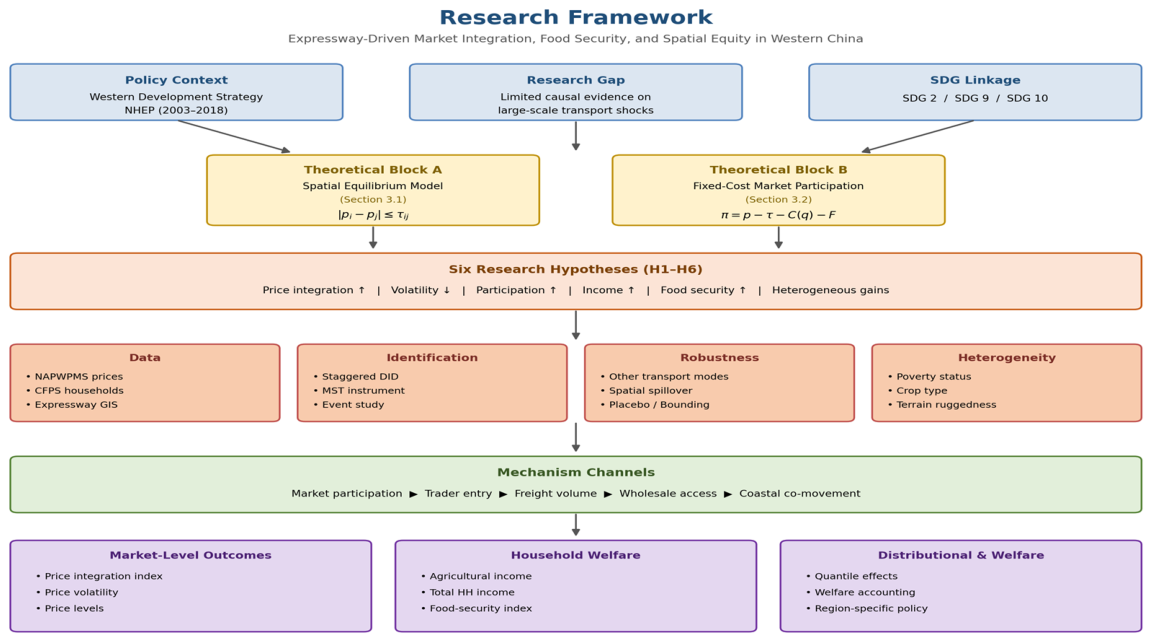
To make the connections between each component of this study more transparent for readers,
Figure 1 presents an integrated research framework. The framework links the policy context and research gap (top tier) to the two theoretical building blocks (spatial equilibrium with arbitrage bounds and fixed-cost market participation), the six research hypotheses derived from them, the data and identification strategy (NAPWPMS prices, CFPS households, and expressway GIS combined through staggered DID and the MST instrument), the mechanism channels (market participation, trader entry, freight volume, wholesale access, and coastal co-movement), and the three families of outcomes examined empirically: prefecture-level market integration, household welfare, and distributional and policy effects. The arrows indicate the logical flow that connects motivation to evidence, which is implemented section by section in the remainder of this paper.
The remainder of this paper is organized as follows.
Section 2 describes the institutional background of the NHEP and Western China’s agricultural setting.
Section 3 develops the theoretical framework.
Section 4 introduces the data and empirical strategy.
Section 5 presents the results, including the main estimates for price integration and household welfare, the mechanism analysis, heterogeneity, welfare calculations, and robustness checks.
Section 6 discusses the findings, and
Section 7 concludes with policy implications.
2. Institutional Background
2.1. Agricultural Markets in Western China
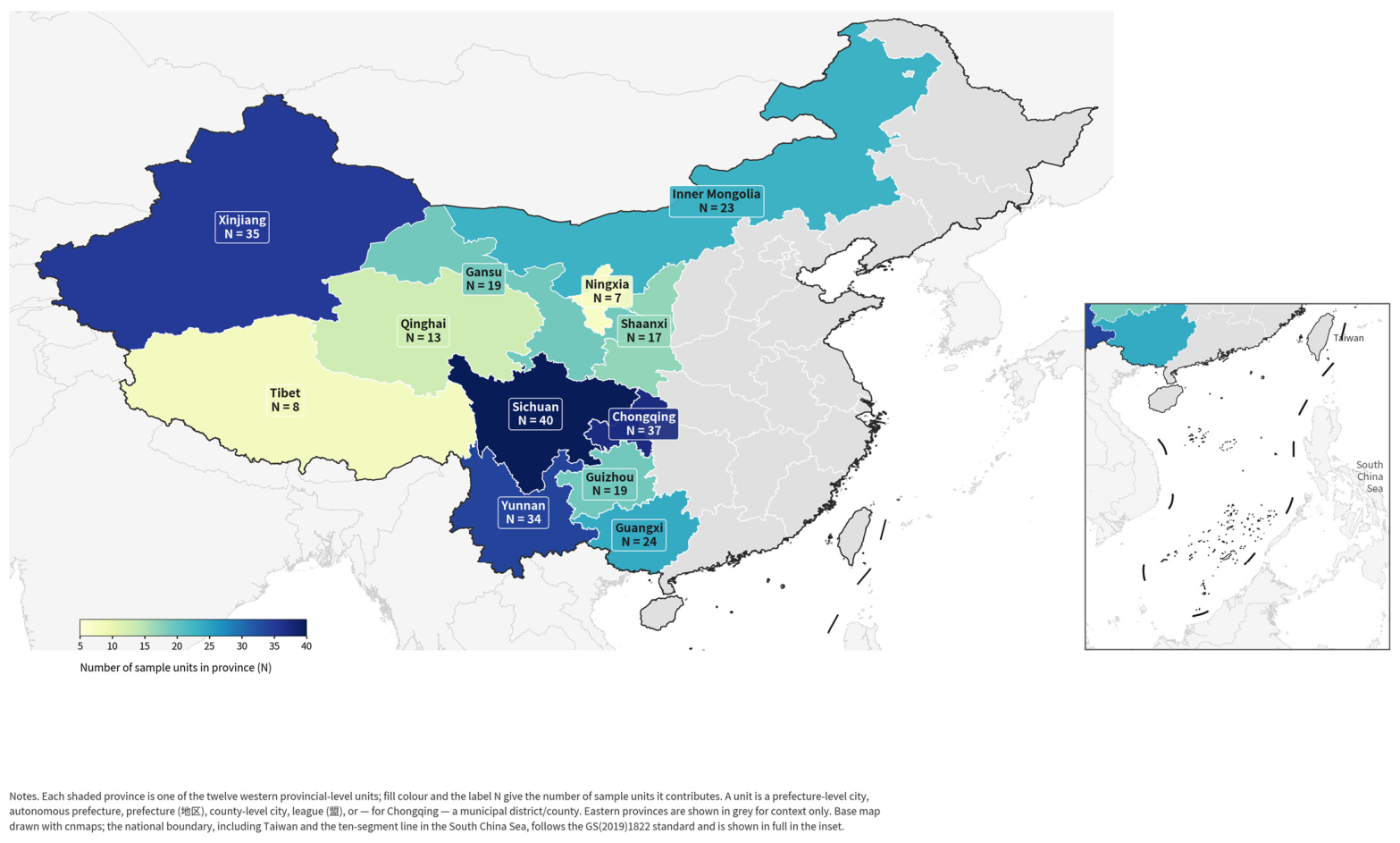
Western China comprises twelve provinces, autonomous regions, and municipalities—Sichuan, Chongqing, Yunnan, Guizhou, Shaanxi, Gansu, Qinghai, Ningxia, Xinjiang, Tibet, Inner Mongolia, and Guangxi—accounting for approximately 71 percent of China’s territory but only 27 percent of its population and 19 percent of GDP as of 2003. The region’s agricultural sector is characterized by extraordinary ecological diversity: subtropical rice cultivation in Yunnan and Guizhou, dryland wheat and maize in the Loess Plateau, specialty herbal medicines and spices across the highland zones, and extensive pastoral activity in Inner Mongolia, Qinghai, and Tibet. This diversity implies substantial comparative advantage in agricultural specialization, but it simultaneously creates a mismatch between production locations and consumption centers.
Market institutions in Western China were historically underdeveloped relative to coastal China. The rural household responsibility system, introduced in the early 1980s, decollectivized agricultural production but left marketing largely to local collective intermediaries well into the 1990s. Grain markets were partially liberalized in the 1990s and more fully deregulated after China’s WTO accession in 2001, but the infrastructure to exploit these market opportunities lagged far behind legal liberalization. As late as 2003, the Ministry of Agriculture’s price monitoring data reveal coefficients of variation of agricultural wholesale prices across markets within a single prefecture exceeding 0.40 for many commodity categories—implying that two farmers in the same county, separated by fifty kilometers, could receive prices differing by forty percent for the same product on the same day.
This spatial price dispersion reflects genuine market segmentation rather than quality differentiation. Regression of price gaps on distance between markets—controlling for product quality proxies and seasonal dummies—yields distance elasticities consistent with transportation cost margins of six to twelve percent per hundred kilometers for road freight, substantially higher than in coastal China (three to four percent) owing to road quality, terrain, and sparse truck traffic.
2.2. The National Highway Expansion Program
The term “expressway” in Chinese policy documents covers a range of road classifications. The object of this study is the national expressway system (guojia gaosu gonglu)—the controlled-access, multi-lane trunk network that connects provincial capitals and major prefectural cities. It does not include lower-class national, provincial, or rural expressways. In international transportation usage, these terms are not strictly synonymous: “freeway” denotes a fully controlled-access, toll-free divided road; “expressway” denotes a controlled-access, multi-lane trunk road that may or may not be tolled; and “highway” denotes a broader category that also includes lower-class trunk roads with at-grade intersections. The Chinese national expressway system most closely corresponds to the international “expressway,” and we adopt this term throughout. “Highway” appears only in the program name “National Highway Expansion Program (NHEP),” a shorthand we adopt for expositional convenience. The national expressway system was formalized under the 2004 “7918 Plan” (seven radial, nine vertical, and eighteen horizontal corridors) and was subsequently extended by the 2013–2030 National Expressway Network Plan (NENP), which broadened the system to additional county-level and border nodes. We refer to the combined 2004 and 2013 rollout collectively as the NHEP. The treatment variable Expresswayit is based on expressway interchange openings, not on segment completion dates, because an interchange is what enables a prefecture’s shippers and traders to actually use the corridor.
Construction proceeded in two broad phases. Phase I (2004–2012) prioritized backbone corridors connecting provincial capitals and major secondary cities. In Western China, this phase established the principal east–west and north–south expressway links that tied the interior more closely to the national market. Phase II (2013–2018) extended the network to lower-level nodes, including many prefectural and county seats, using a mix of central transfers, provincial finance, and concession-based arrangements.
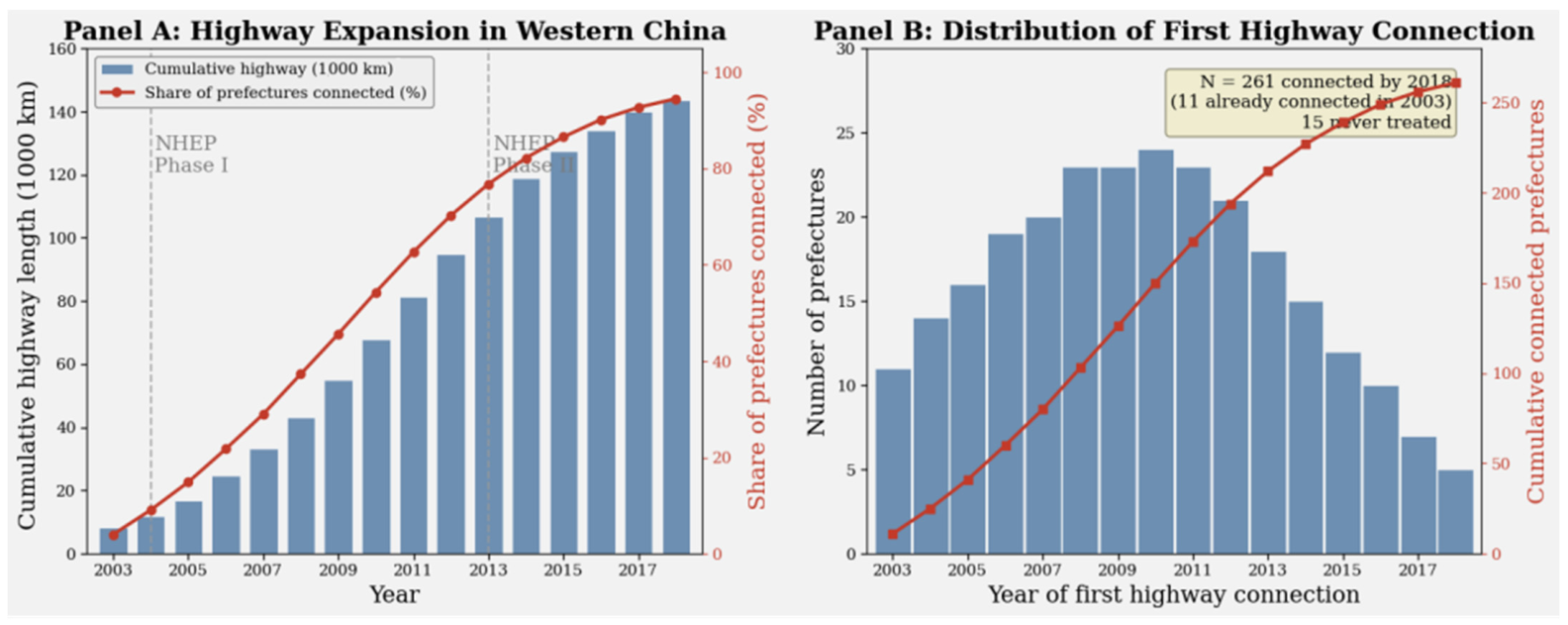
The NHEP generated substantial variation in first connection dates across Western prefectures.
Figure 2 reports the aggregate rollout and the distribution of treatment timing. The network expansion is rapid, but connection is not a one-shot event: prefectures enter in multiple cohorts over more than a decade.
Two features of
Figure 2 matter for the empirical design. First, the buildout is spread across many cohorts rather than concentrated in a single year, which is useful for both the event-study and the staggered-DID estimators. Second, Panel B shows substantial support throughout the middle of the sample window, reducing reliance on a narrow set of early or late adopters.
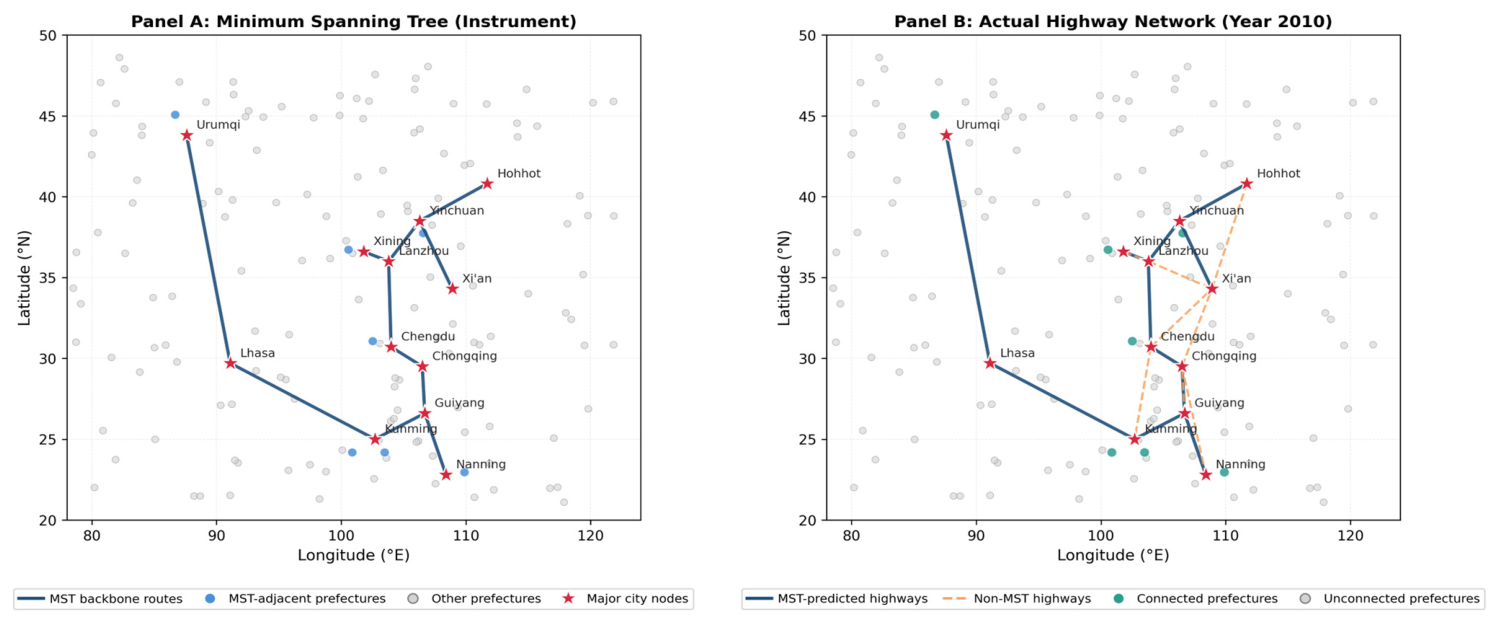
Route selection combined top-down national planning with provincial implementation. National plans largely fixed the nodes to be connected, whereas the within-corridor alignment of individual segments depended on engineering feasibility, land acquisition, fiscal capacity, and administrative priorities. This institutional structure is important for identification: realized rollout follows network logic, but it is not mechanically identical to contemporaneous local demand conditions.
2.3. Western Development Strategy and Agricultural Policy Context
The NHEP in Western China was embedded within the broader Western Development Strategy, launched in 1999 and institutionalized by the State Council in 2000. The strategy explicitly targeted infrastructure investment in roads, railways, energy, and telecommunications as its primary instruments for closing the regional development gap between western and coastal China. Infrastructure investment under the strategy reached approximately RMB 2.8 trillion during 2000–2015, of which roads accounted for roughly 38 percent.
Agricultural policy during this period complemented the infrastructure push. The abolition of agricultural taxes in 2006 removed a significant burden on farm households and increased the marginal return to market participation. The Rural Land Contracting Law (2003) and subsequent amendments strengthened tenure security, encouraging farmers to plant crops with longer planning horizons and higher market orientation. Meanwhile, the National “Grain for Green” Program altered land use on steep slopes in ways that, in some prefectures, shifted agricultural production from subsistence grain to higher-value specialty crops better suited to market integration. This broader policy environment created complementarities with expressway access that we examine in the mechanism section.
One important feature of the institutional context is that expressway construction in Western China was almost entirely publicly funded—in contrast to coastal China where private toll road operators played a larger role. This reduces concerns that expressway placement reflects private-sector demand signals (profitable routes near economic activity) that would confound the causal interpretation. State-financed network planning, which appears to have been shaped largely by engineering and connectivity considerations, plausibly generates variation in connection timing that is orthogonal to local demand shocks once the MST instrument is used.
3. Theoretical Analysis
3.1. A Spatial Equilibrium Model of Agricultural Markets
Consider an economy with J local markets indexed by
j = 1, …,
J, each trading a homogeneous agricultural good. Let
denote the producer price in market
j at date
t. In autarky, each market clears locally. With interregional trade, competitive spatial arbitrage implies that bilateral price gaps cannot exceed generalized trade costs.
Equality is expected on routes along which trade is active; for market pairs not linked in equilibrium, the inequality may be strict. Persistent price gaps above the arbitrage bound, therefore, indicate segmentation generated by transport costs, weak information flows, limited intermediation, or other barriers to exchange. Here, pit and pjt denote the producer prices of the homogeneous agricultural good in markets i and j at date t, and τijt denotes the generalized bilateral trade cost between the two markets at date t.
Expressway connection lowers generalized trade costs by reducing both per-kilometer freight costs and effective transit time. A parsimonious parameterization is:
Here, distance is fixed, while the generalized cost of moving one unit over one kilometer can fall with better roads. Expressways raise average travel speeds, lower vehicle operating costs, and reduce delivery uncertainty, so they compress trade costs even when physical distance is unchanged. In Equation (2), τijt is the generalized bilateral trade cost (as in Equation (1)); dij is the physical (time-invariant) road distance between markets i and j; and cijt is the time-varying generalized per-kilometer trade cost, which captures freight charges, vehicle operating costs, delivery time, and uncertainty and which falls as expressway access improves. The model, therefore, predicts tighter cross-market price alignment, lower price volatility as arbitrage responds more quickly to local shocks, and potentially higher producer welfare where households are net sellers. Because some households are net buyers, the sign of the total household welfare effect is ultimately empirical.
3.2. Market Participation Under Fixed Costs
A second implication concerns fixed and variable costs of market participation. Suppose a farm household produces output at cost
C(
q). Selling off farm requires both a variable transport cost and a fixed marketing cost. Net returns from market participation can be written as:
The household participates as a seller whenever these net returns are nonnegative. In Equation (3), πShjt denotes the net return to household h from selling in market j at date t; pjt is the prevailing producer (wholesale) price in market j; τhjt is the variable transport cost incurred by household h to deliver output to market j; C(qht) is the household’s production cost as a function of output qht; and Fhjt is the fixed marketing cost of accessing market j (including information acquisition, search, and trader-matching costs). A decline in transport costs or in the fixed cost of reaching the market lowers the minimum efficient scale required for sales, bringing previously semi-subsistence producers into market exchange. In this setting, the extensive margin is likely to matter because many western farm households appear to lie near that participation threshold.
3.3. Research Hypotheses
Building on the spatial equilibrium model in
Section 3.1 and the market participation framework in
Section 3.2, we derive the following six research hypotheses that guide the empirical analysis.
The spatial arbitrage condition in Equation (1) implies that a reduction in generalized trade costs
τ tightens the arbitrage bound on bilateral price gaps. When expressway access lowers the per-kilometer freight cost
c, the maximum sustainable price gap across markets within a prefecture falls, driving convergence toward a single equilibrium price. This effect should be most pronounced where initial trade costs—and hence pre-treatment price dispersion—are large, consistent with recent evidence that lower rural trade costs and improved connectivity strengthen spatial market integration [
12,
26]. This leads to Hypothesis 1.
Hypothesis 1. Expressway connection increases within-prefecture agricultural price integration.
In the same framework, lower trade costs also accelerate spatial arbitrage in response to local supply or demand shocks. When freight moves faster and more cheaply, temporary price spikes in one market are more rapidly arbitraged away by inflows from neighboring markets. Expressway access thus compresses the amplitude of intra-annual price fluctuations by shortening the adjustment window during which local prices can deviate from regional equilibrium levels, a pattern also emphasized in recent work on road networks, price smoothing, and food-market adjustment [
16,
27]. This leads to Hypothesis 2.
Hypothesis 2. Expressway connection reduces within-prefecture agricultural price volatility.
The market participation model in
Section 3.2 shows that net returns from off-farm sales depend negatively on both variable transport costs
τ and fixed marketing costs
F. Expressway access reduces both components: variable costs fall through lower per-kilometer freight charges and higher vehicle speeds, while fixed costs decline as physical proximity to wholesale markets improves information access and lowers the search cost of finding buyers. These reductions push previously semi-subsistence households above the participation threshold, expanding the extensive margin of market engagement. This expansion should also attract intermediary entry, as the larger volume of marketable surplus supports additional traders, consistent with recent evidence that roads and bundled market-access interventions expand smallholder commercialization and market participation [
26,
28]. This leads to Hypothesis 3.
Hypothesis 3. Expressway connection increases market participation by farm households and facilitates intermediary entry.
For net-seller households, the direct effect of lower trade costs is an increase in the effective producer price received at the farm gate: the wedge between wholesale price
p and the transport cost
τ narrows, raising net returns
π. In addition, expanded market participation at the extensive margin—both by previously non-participating households and by new intermediaries—increases competitive pressure, which can further raise equilibrium farm-gate prices. In the aggregate, these channels predict higher agricultural income per capita for connected households, consistent with recent evidence from road expansion and related transport improvements [
12,
14]. This leads to Hypothesis 4.
Hypothesis 4. Expressway connection raises agricultural household income per capita.
Higher agricultural income and improved market access jointly relax two binding constraints on household food security. First, higher disposable income expands the budget set, enabling households to purchase a wider variety of foods. Second, better connectivity increases the local availability and diversity of food products as trade flows bring goods from other regions into previously isolated local markets. Together, these income and availability channels predict improvements in both caloric adequacy and dietary diversity and a reduction in the probability of experiencing food hardship, in line with recent evidence on market food environments, supermarket expansion, and food-system trade-cost reductions [
27,
29,
30]. This leads to Hypothesis 5.
Hypothesis 5. Expressway connection improves household food security, including caloric adequacy, dietary diversity, and reduced food hardship.
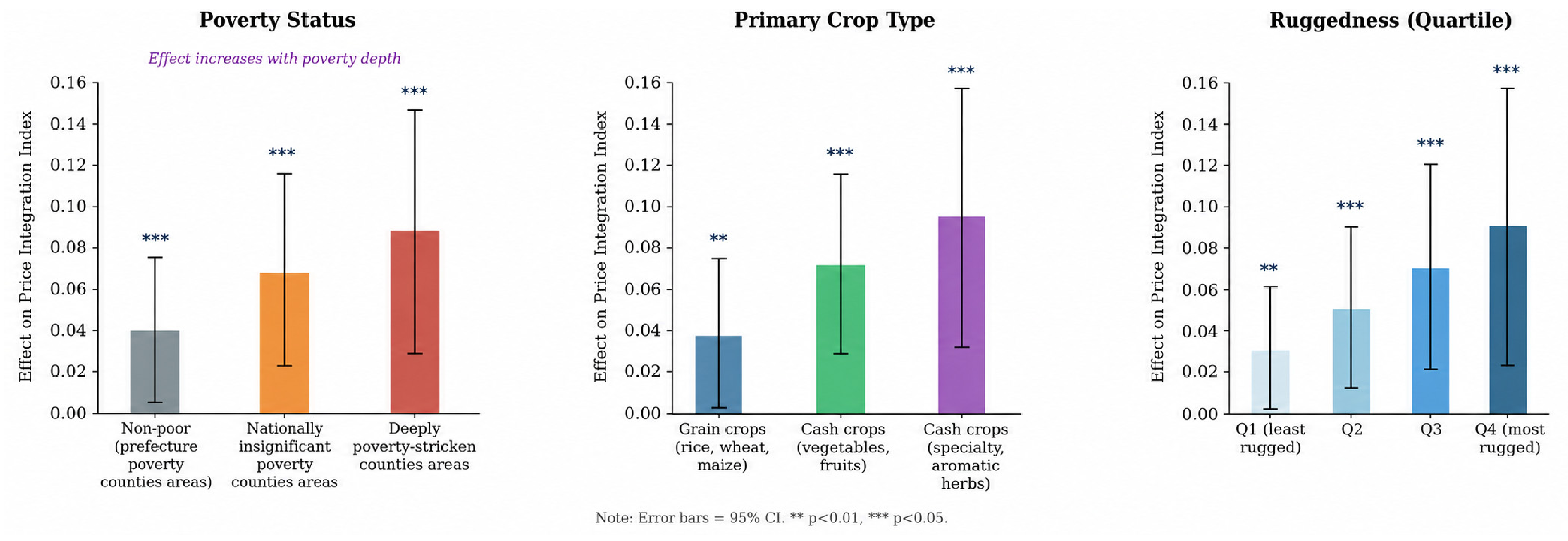
Finally, the magnitude of all preceding effects should vary with the initial severity of market frictions. In areas where pre-treatment trade costs are high—due to poverty, rugged terrain, or geographic remoteness—the marginal reduction in transport costs from expressway access represents a proportionally larger shock to the effective arbitrage bound. The spatial equilibrium model predicts that the price integration, income, and food security gains should, therefore, exhibit a monotone gradient: larger in nationally designated poverty counties and in prefectures with higher terrain ruggedness, where the initial departure from spatial market efficiency is greatest, echoing recent findings that expressway access and transport improvements generate larger poverty and welfare gains in initially disadvantaged locations [
13,
31]. This leads to Hypothesis 6.
Hypothesis 6. The effects of expressway connection on market integration and household welfare are larger in areas with more severe initial transport frictions, including poorer and more rugged prefectures.
6. Discussion
This section situates the empirical findings within the broader literature on transport infrastructure, market integration, and sustainable rural development and discusses the mechanisms, generalizability, and limitations of the results.
6.1. Comparison with Prior Evidence
The approximately 16% increase in agricultural income per capita we estimate is broadly in line with the 13% welfare gain reported for rural road construction in Ethiopia [
12] and with the market-access effects documented in a quantitative spatial model of Ethiopian agriculture [
5]. Our price-integration estimate is consistent with the direction reported in recent studies of Chinese expressway expansion and high-speed rail [
4,
6], though our identification leverages a different source of variation. The progressive pattern across the income distribution, with the largest quantile treatment effects at the 10th percentile, aligns with evidence on heterogeneous income effects of road infrastructure in China [
13] and with evidence on expressway networks and poverty [
31]. The food-security results echo recent work on market engagement and dietary diversity in small-scale farm settings [
9,
10,
21,
32], but unlike much of that literature, our design identifies effects from a discrete, well-timed connectivity shock rather than from cross-sectional variation in market participation. Taken together, the estimates are compatible with the conjecture that transport-cost reductions deliver meaningful, but not transformative, welfare gains in settings where pre-treatment market frictions are severe. Our design operates at the prefecture level within a single subnational region and focuses on agricultural integration and food security rather than on aggregate growth or urban-system structure.
6.2. Interpreting the Mechanism
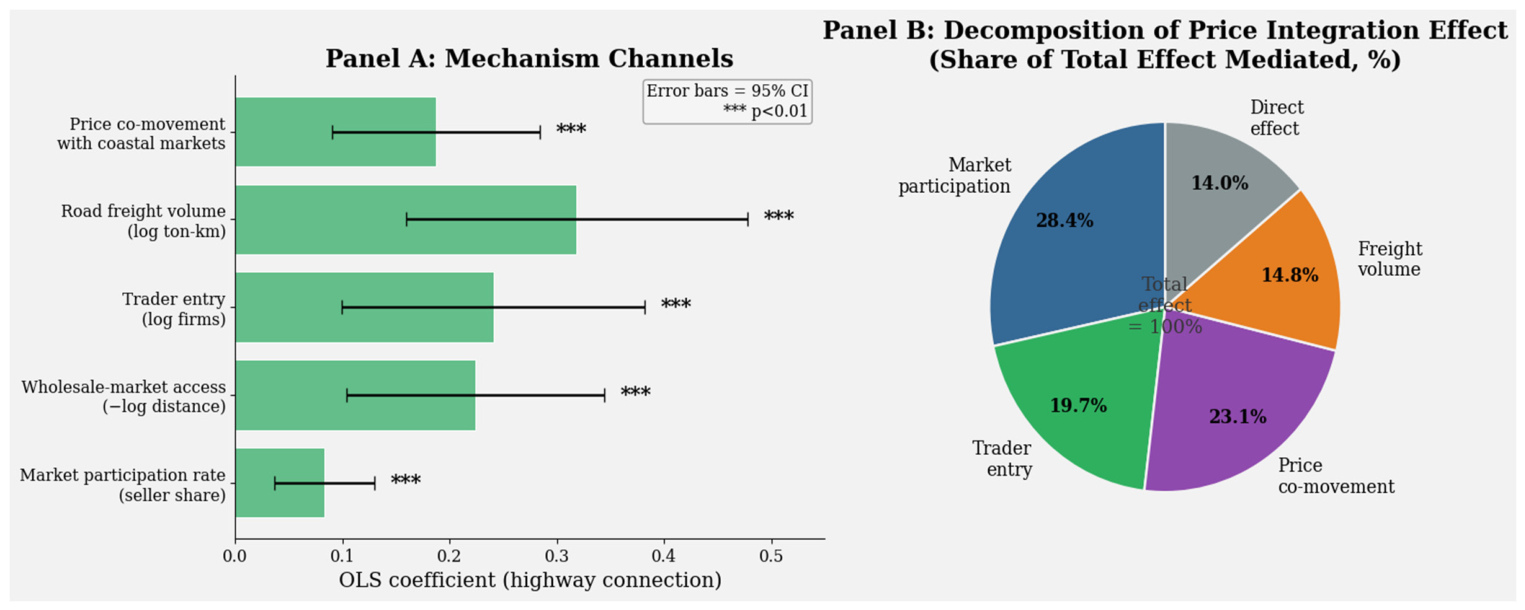
The dominant channel appears to run through the reorganization of the local wholesale network rather than through direct price convergence with distant consumption centers. Expressway access expands traders’ outside option, raises competition for farm-gate procurement in previously underserved pockets within the prefecture, and attracts additional intermediary entry; the denser local network, in turn, arbitrages away within-prefecture price wedges. This interpretation is consistent with the observed ordering of effects: market participation and trader entry respond first, and then, within-prefecture price dispersion compresses. The measured co-movement with coastal markets should be read as a complementary indicator that the prefecture has become better connected to the broader national market, not as the primary transmission channel for the within-prefecture integration result. A limitation is that our proxies for local network density are imperfect—SAIC registration records capture formal intermediaries but may miss informal traders.
6.3. Environmental Trade-Offs and Dynamics of the Gains
Large-scale expressway construction in Western China has also generated well-documented environmental pressures—land conversion, slope cutting in mountainous terrain, construction and operational emissions, and potential habitat fragmentation. Our welfare estimates do not net out these costs. For an order-of-magnitude sense of these costs, applying a construction-phase emissions factor of 3000 tCO2 per km (Ministry of Transport engineering assessments) to the roughly 42,000 km of western expressway built in 2003–2018 implies about 126 Mt of embodied CO2. Monetized at a social cost of carbon of USD 50/tCO2, this amounts to roughly USD 6.3 Bn once-off or USD 0.21 Bn/yr amortized over a 30-year asset life—about 4 percent of our USD 4.92 Bn annual welfare gain. Emissions from operational-phase induced freight and biodiversity losses are not captured here and could be material. Two partial offsets are worth noting. Reduced price volatility is likely to have lowered spoilage and repeated-shipment losses, a margin relevant to SDG Target 12.3. Tighter integration may also have facilitated spatial reallocation of production toward comparative-advantage areas, with a potentially lower per-unit environmental footprint. On dynamics, the event-study estimates show that effects accrue over three to four years and persist through the end of the observation window, with no evidence of decay. Whether the gains remain stable over longer horizons depends on conditions that are outside this study’s measurement window: network maintenance, investment in last-mile and cold-chain logistics, and the climate resilience of rural production systems. We read this as an empirical question for future work rather than as a claim that the gains are permanent.
7. Conclusions and Policy Implications
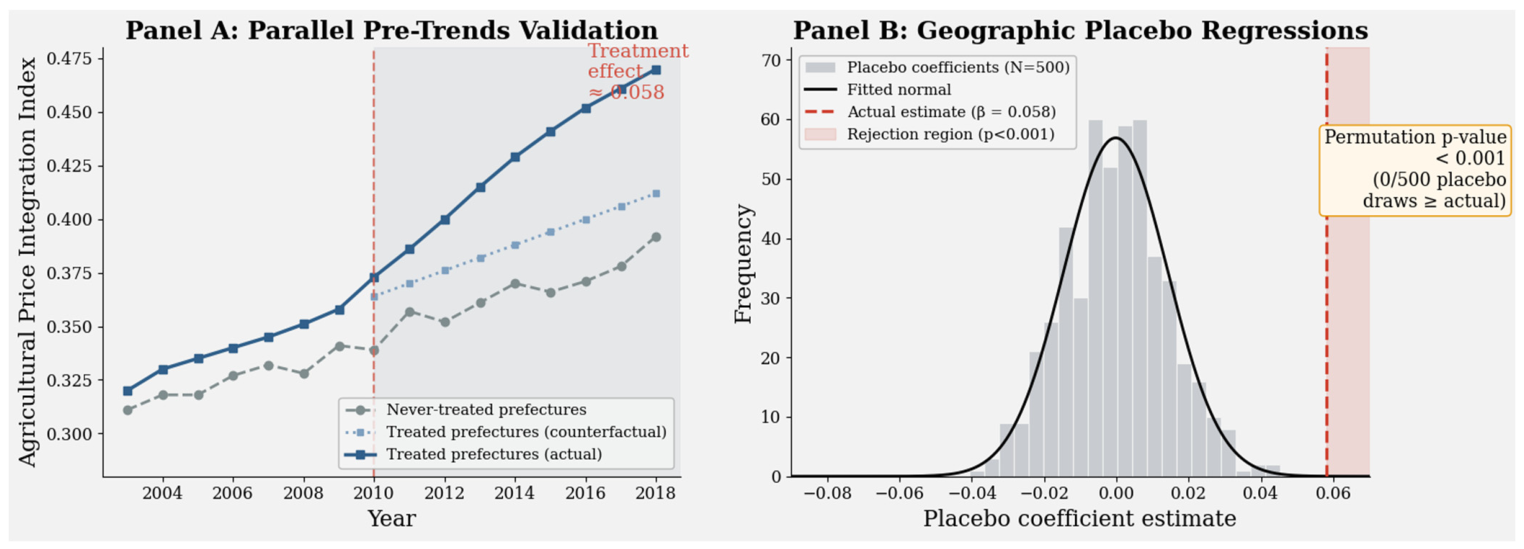
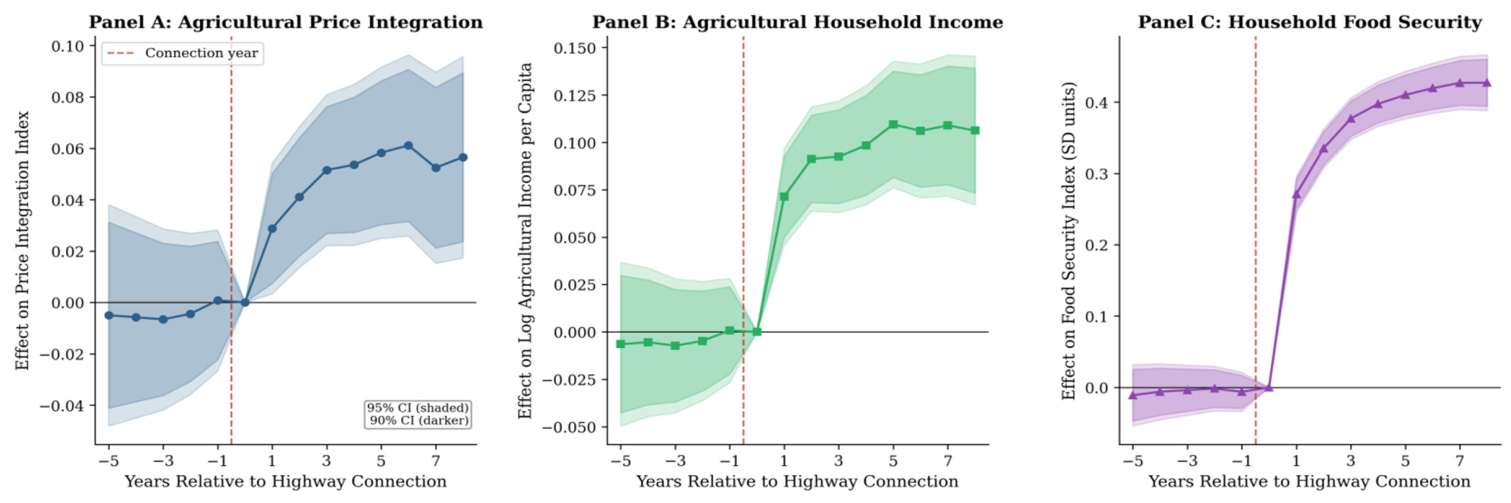
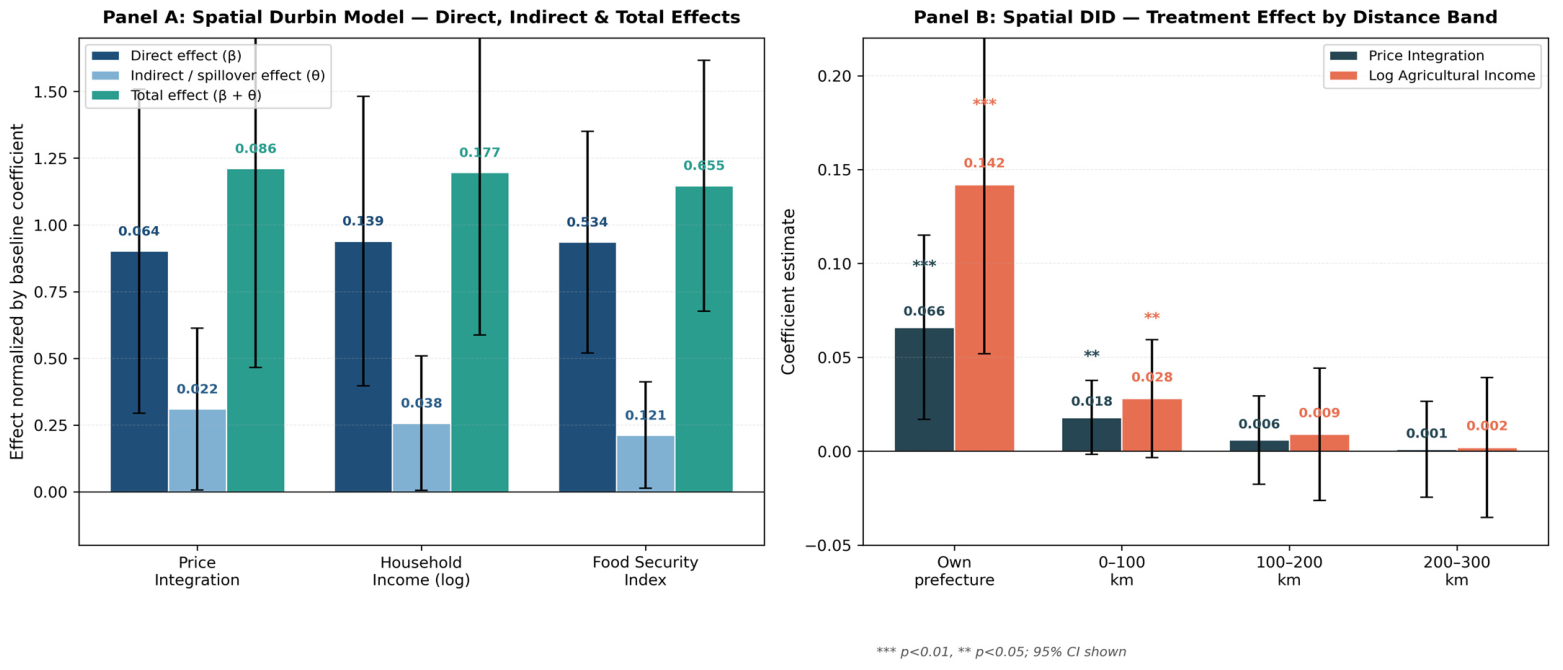
This paper provides evidence that expressway access is associated with reduced spatial market frictions in Western China’s agricultural economy. Exploiting the staggered rollout of the National Highway Expansion Program and instrumenting realized connection with a minimum spanning tree prediction of network rollout, the empirical results are broadly consistent with the six research hypotheses derived from the theoretical framework. Specifically, expressway connection is associated with higher price integration and lower price volatility; the mechanism analysis points to expanded market participation and intermediary entry as a primary channel; agricultural household income increases significantly; and food security improves across caloric adequacy, dietary diversity, and reduced hardship. The heterogeneity analysis further demonstrates that these gains are disproportionately larger in poorer and more rugged areas. The event-study estimates indicate that these gains build gradually, and the mechanism evidence points first to expanded market participation, complemented by trader entry and stronger co-movement with coastal demand centers.
The policy implications are straightforward. Transport investments in lagging agricultural regions can yield large returns when they relax first-order trade frictions rather than merely shifting activity across already integrated space. The heterogeneity results further suggest that the gains are largest in poorer and more rugged areas, where baseline isolation is greatest. At the same time, the mechanism evidence indicates that roads are most productive when accompanied by market infrastructure and intermediation capacity.
Translating these general implications into concrete regional priorities for Western China requires recognizing the heterogeneity of the twelve provincial-level units in their geography, dominant agricultural systems, and remaining infrastructure gaps. The following region-specific recommendations are anchored in the empirical heterogeneity results (
Section 5.5) and in the mechanism evidence (
Section 5.4).
First, for the high-altitude pastoral belt (Tibet, Qinghai, and western Sichuan), where the price-integration effect is largest (β = 0.089 in deeply impoverished areas, β = 0.091 in the most rugged quartile), the priority should shift from new expressway construction to last-mile feeder roads and cold-chain logistics for yak meat, dairy, and highland horticultural products, with the Lhasa–Ya’an–Chengdu and Xining–Lanzhou corridors as natural cold-chain hub candidates.
Second, for Inner Mongolia and northern Xinjiang, where livestock and grain flows still face substantial cross-provincial transaction costs, policy should prioritize harmonizing inspection and quarantine standards along the Hohhot–Beijing–Tianjin Port corridor and the Ürümqi–Khorgos corridor. The trader-entry results (Column (3) of
Table 5) suggest that removing such institutional bottlenecks will magnify the physical-connectivity gains.
Third, for the karst specialty-crop belt (Yunnan, Guizhou, and Guangxi), where the integration effect is largest for specialty cash crops (β = 0.094) and vegetables/fruit (β = 0.071), expressway access should be bundled with (i) county-seat wholesale-market construction, (ii) farmer-cooperative support, and (iii) cold-chain and food-processing facilities along the Kunming–Nanning–Guangzhou corridor.
Fourth, for the Loess Plateau and Hexi Corridor (Shaanxi, Gansu, Ningxia), where grain production dominates and the integration effect is smaller but still significant (β = 0.038), the priority is grain-logistics modernization: rail and truck intermodal hubs at Xi’an, Lanzhou, and Yinchuan and linkages to the China–Pakistan and China–Europe rail-and-road corridors.
Fifth, for Chongqing and the Yangtze Economic Belt’s western anchor, where expressway saturation is already high, the frontier is the intermodal integration of expressway, inland-waterway, and high-speed-rail freight and the development of the Chongqing–Chengdu twin-city agricultural-logistics zone as a unified market.
Several limitations remain. The analysis is conducted at the prefecture level and, therefore, abstracts from the full spatial equilibrium of inter-prefecture trade. The household outcomes are observed over the medium run rather than over the full life cycle of network adjustment. Finally, the welfare accounting is intentionally partial equilibrium. Each of these margins is important for future work on infrastructure and agricultural development.
From a sustainability perspective, the evidence suggests that well-designed transport infrastructure in lagging regions can contribute jointly to SDG 2 (Zero Hunger), SDG 9 (sustainable infrastructure), and SDG 10 (reduced inequalities) and that the gains are concentrated in precisely those households and places that sustainable development frameworks prioritize. At the same time, the long-run sustainability of these gains is not guaranteed. It depends on continued investment in market-institution upgrading and last-mile logistics, on safeguards that limit the environmental externalities of construction and induced freight growth, and on the resilience of rural production systems to climate and demographic change. For other developing economies considering similar programs, the findings imply that expressway investments are most valuable as part of an integrated rural-sustainability strategy—one that bundles connectivity with ecological protection, human-capital investment, and institutional reform—rather than as a stand-alone development lever. Future research should extend the present analysis by quantifying the carbon and ecosystem-service footprints of expressway-induced market integration and by tracing longer-run adjustments in land use, labor allocation, and nutrition outcomes.