1. Introduction
Electric vehicles (EVs) have emerged as a central component of global decarbonization strategies, particularly within the transport sector. Governments have adopted a range of policy instruments—including purchase subsidies, zero-emission vehicle mandates, and internal combustion engine phase-out targets—to accelerate their adoption. At the same time, corporate climate governance frameworks increasingly emphasize the measurement and management of greenhouse gas (GHG) emissions across organizational boundaries, particularly under Scope 3 accounting principles, which capture emissions embedded within value chains [
1].
Despite growing attention to emissions disclosure, Scope 3 emissions remain both quantitatively dominant and institutionally difficult to govern. Empirical and conceptual studies show that Scope 3 emissions often constitute the largest share of corporate carbon footprints, yet their governance is constrained by indirect control, fragmented accountability, and methodological challenges [
2,
3]. As a result, recent scholarship has increasingly focused on identifying indirect governance mechanisms through which organizations may influence emissions beyond their direct operational boundaries.
Within the expanding literature, financial institutions have been recognized as important indirect climate actors. Through lending and investment decisions, banks and asset managers influence emissions-intensive activities, giving rise to the concept of financed emissions and portfolio alignment frameworks [
4,
5]. These developments reflect a broader understanding of financial intermediation, whereby financial actors shape real economy outcomes through pricing, access, and conditionality rather than direct operational control [
6].
However, this line of research has focused predominantly on capital-based activities such as lending and investment, while the role of insurance has received comparatively limited attention. This suggests a potential gap in the existing literature. Unlike capital providers, insurers operate through underwriting, pricing, and claims management, shaping the conditions under which economic activities are sustained, repaired, or replaced. From an institutional perspective, insurance can therefore be understood as a form of risk-based governance that influences asset utilization and lifecycle outcomes indirectly [
7].
Existing research on insurance and climate change has primarily focused on insurers’ roles in risk transfer, resilience, and adaptation, rather than emissions mitigation [
8,
9]. At the same time, industry initiatives such as the Principles for Sustainable Insurance (PSI) have begun to recognize underwriting as a channel for integrating sustainability considerations into insurance practices, although these frameworks remain largely qualitative and lack operational emissions attribution mechanisms [
10].
In parallel, lifecycle assessment (LCA) studies on EVs demonstrate that their overall climate performance is highly sensitive to manufacturing emissions, particularly those associated with lithium-ion battery production, as well as to vehicle longevity and replacement cycles [
11,
12]. Premature vehicle replacement or battery-intensive repairs can significantly increase cumulative emissions, highlighting the importance of lifecycle extension in achieving net emissions reductions.
Electric vehicles provide a particularly relevant context for examining insurance-mediated lifecycle emissions because their climate performance is highly sensitive to manufacturing intensity, battery production, repairability, and replacement pathways. Compared with conventional internal combustion vehicles, EVs involve higher embodied manufacturing emissions, especially in battery systems, making premature replacement and battery-intensive repair decisions comparatively more consequential from a lifecycle perspective [
11,
12]. In addition, EV repair processes often involve specialized components, structural battery integration, and elevated repair costs, increasing the practical relevance of insurance claims decisions in determining whether vehicles are repaired or declared total losses [
13,
14,
15]. These characteristics make EV insurance an analytically appropriate case for exploring how insurance-mediated decision structures may influence modeled lifecycle emissions exposure.
Taken together, these strands of the literature suggest an overlooked intersection. While EV lifecycle emissions are sensitive to repair and replacement decisions, and while insurers play a central role in mediating such decisions through claims management, the emissions implications of insurance activities remain largely absent from Scope 3 governance frameworks. Existing approaches to financial emissions accounting, including the Partnership for Carbon Accounting Financials (PCAF), provide limited guidance on how insurance-related exposures should be interpreted, particularly in relation to claims-driven lifecycle outcomes. Moreover, existing Scope 3 research has focused predominantly on lending, investment, and asset-ownership channels, while insurance-mediated pathways remain comparatively underexplored. This study addresses that gap by examining how insurance-related underwriting and claims management decisions may influence attributed lifecycle emissions exposure within insured EV portfolios and by providing a conceptual framework for incorporating insurance-mediated pathways into broader discussions of Scope 3 emissions governance.
Accordingly, the present study pursues three primary objectives. First, it develops a conceptual and decision-analytical framework linking insurance-mediated underwriting and claims management structures with modeled lifecycle emissions exposure within EV systems. Second, it examines how alternative governance-oriented insurance configurations may influence attributed emissions outcomes under stylized scenario environments. Third, it evaluates the relative sensitivity of modeled lifecycle emissions exposure to repair-versus-replacement pathways, including conditional total-loss and battery-replacement dynamics, within EV insurance portfolios.
To guide the analytical framework and scenario analysis, the present study addresses the following research questions:
RQ1: How can EV insurance claims and underwriting decisions be conceptually represented within an exposure-based lifecycle emissions framework?
RQ2: Which insurance-related decision parameters most strongly influence modeled lifecycle emissions exposure under different governance scenarios?
RQ3: How sensitive are modeled emissions outcomes to variations in accident frequency, total-loss rates, battery replacement tendencies, and portfolio-scale assumptions?
The contribution of this study is threefold. First, it extends Scope 3 governance discourse by incorporating insurance underwriting as a distinct form of financial intermediation with emissions influence. Second, it proposes an exposure-based attribution logic tailored to the operational characteristics of insurance, complementing existing capital-based accounting approaches. Third, it provides a scenario-based portfolio analysis to evaluate how alternative underwriting and claims strategies may affect emissions exposure within EV insurance portfolios.
This study adopts a decision-analytical approach to examine how insurance-mediated decision parameters may structurally influence modeled lifecycle emissions outcomes under specified assumptions.
2. Literature Review
2.1. Scope 3 Emissions and Indirect Climate Governance
Scope 3 greenhouse gas (GHG) emissions—those occurring across an organization’s upstream and downstream value chain—have become a central challenge in sustainability governance. Compared with Scope 1 and Scope 2 emissions, Scope 3 emissions are often more difficult to measure, verify, and manage because they arise outside direct operational control. Yet they frequently represent the largest share of organizational climate impact, making them increasingly important for both corporate strategy and disclosure [
1,
2,
3].
The growing importance of Scope 3 accounting has shifted attention from direct emitters alone to the broader institutional arrangements through which emissions-intensive activities are enabled, structured, and reproduced. In this sense, the governance challenge of Scope 3 does not simply comprise measurement hurdles; rather, it involves difficulties in identifying where meaningful influence exists despite the absence of ownership or operational control. This has encouraged a wider investigation in the sustainability literature on indirect forms of climate governance, particularly in finance, supply chains, and value chain coordination.
2.2. Financial Institutions as Indirect Climate Actors
One of the clearest developments in this literature has been the treatment of financial institutions as indirect climate actors. Banks and investors influence emissions trajectories through lending, investing, and portfolio allocation decisions, even though they do not directly operate the underlying emitting assets. This logic underpins financed emissions frameworks and has become increasingly institutionalized through climate alignment methodologies and disclosure initiatives [
4,
5].
This development is consistent with broader theories of financial intermediation, which emphasize that financial institutions shape real economy outcomes through access conditions, pricing, and risk allocation rather than direct production decisions [
6]. However, most of this discussion has focused on capital-based relationships such as lending and investment. Insurance remains less fully integrated into this conversation, even though insurers also structure economic activity through underwriting, risk selection, pricing, and claims settlement.
2.3. Insurance, Climate Change, and Sustainability Governance
The mainstream literature on insurance and climate change has focused primarily on insurers’ roles in risk transfer, resilience, adaptation, and catastrophe recovery. This work shows that insurance can influence behavior through premium differentiation, contract design, and risk-prevention incentives, but the dominant analytical lens remains one of managing physical and transition risks rather than mitigating lifecycle emissions [
8,
9].
At a more institutional level, insurance has also been theorized as a governance mechanism rather than merely a financial service. Ericson et al. [
7] argue that insurance functions as a form of governance because it classifies risk, disciplines conduct, and shapes organizational and household decisions through contractual and economic mechanisms. This perspective is especially relevant for sustainability research because it provides a theoretical basis for analyzing insurers as actors that can influence the trajectories of insured assets even without owning or operating them.
Industry-level sustainability frameworks further support the relevance of underwriting as a governance channel. The Principles for Sustainable Insurance (PSI), launched by the United Nations Environment Programme Finance Initiative (UNEP FI), explicitly call on insurers to embed environmental, social, and governance considerations into decision making across their insurance business, including underwriting and claim-related processes [
10]. At the same time, these frameworks remain largely principle-based and do not provide a detailed operational method for linking specific insurance decisions to emissions outcomes.
This gap is beginning to narrow in part. PCAF’s Part C standard for insurance-associated emissions is the first industry-led attempt to provide standardized methods for measuring emissions associated with (re)insurance underwriting portfolios. Importantly, however, PCAF itself distinguishes insurance-associated emissions from financed emissions and notes that insurance does not involve ownership or direct operational control over the insured activity [
16]. That distinction is highly relevant for this study: it suggests that any emissions framework for insurance must be grounded in exposure, enablement, and influence rather than ownership-based attribution alone. IFRS S2 similarly emphasizes disclosure of climate-related risks, opportunities, governance, strategy, and risk-management processes, but it does not itself specify a claims-level accounting method for insurance-mediated lifecycle effects [
17]. Taken together, these frameworks support the relevance of insurance to climate governance while leaving an unresolved methodological question about how underwriting and claims decisions should be interpreted in emissions terms.
2.4. Electric Vehicle Lifecycle Emissions: Beyond Manufacturing Alone
A second major body of literature concerns the lifecycle emissions of electric vehicles (EVs). Early and influential lifecycle assessment (LCA) studies established that EVs can offer lower total greenhouse gas emissions than internal combustion engine vehicles, but that the scale of this advantage depends heavily on system boundaries, electricity mix, vehicle lifetime, and battery production assumptions [
12,
18,
19].
This point is critical for the present study. EV climate performance is not determined solely by zero tailpipe emissions. It is shaped by a combination of manufacturing emissions, use-phase electricity emissions, and end-of-life treatment. Later work has reinforced this broader systems view. Ellingsen et al. [
11] show that battery size and vehicle range materially affect lifecycle emissions. Huo et al. [
20] show that use-phase emissions depend strongly on regional electricity carbon intensity [
21]. Wu et al. [
21] similarly find that the GHG-reduction potential of battery electric vehicles varies with changes in the electricity mix and energy system context. In short, the literature does not support a simplistic view of EVs as uniformly low-carbon; rather, it shows that EV emissions outcomes are highly sensitive to decisions that affect manufacturing intensity, utilization, repair, replacement timing, and electricity conditions.
2.5. Repair, Replacement, and Circularity in EV Systems
More recent studies also highlight the importance of durability, repairability, and circularity in EV sustainability. A narrow focus on first-life manufacturing can miss the emissions implications of battery longevity, replacement pathways, second-life use, and recycling. Etxandi-Santolaya et al. [
22] argue that EV batteries may be “underused” when end-of-life is defined too rigidly, and they emphasize the importance of circular strategies that extend useful life and avoid unnecessary material turnover. This matters because premature replacement—whether of the battery or the vehicle as a whole—can erase part of the climate benefit otherwise achieved in the use phase.
For the purposes of insurance research, the key implication is not that insurers determine the entire lifecycle outcome, but that post-accident decisions can interact with this lifecycle sensitivity. If claims practice, economic thresholds, or repair protocols increase the probability of early scrappage or full replacement, they may indirectly increase embedded manufacturing emissions. Conversely, where safe and technically feasible repair extends the useful life of the vehicle or battery, insurance decisions may help preserve lifecycle carbon advantages. Existing EV LCA and circularity studies therefore indicate that repair-versus-replacement decisions are environmentally material, even if they do not yet focus specifically on insurance claims as the mediating factor.
2.6. Research Gap
Taken together, the literature reveals three linked gaps.
First, Scope 3 and financial–climate governance research has developed much further for lending and investment than for insurance. Although PCAF Part C now provides an important starting point for insurance-associated emissions, the methodology remains focused at a relatively high level and does not specifically address claims-driven lifecycle events such as repair, battery replacement, or total-loss settlement [
16].
Second, the insurance literature has recognized underwriting and contract design as governance mechanisms, but most insurance–climate research still emphasizes adaptation, catastrophe risk, and resilience rather than the emissions consequences of underwriting and claims decisions [
8,
9].
Third, the EV lifecycle literature clearly shows that emissions outcomes depend on manufacturing intensity, electricity mix, battery size, durability, and end-of-life pathways, yet it rarely treats insurance as a meaningful institutional mediator of those lifecycle outcomes. The intersection between insurance operations and EV lifecycle carbon management therefore remains underdeveloped in both sustainability theory and applied emissions accounting.
This study addresses that intersection. It does so not by claiming that insurers directly control EV lifecycle emissions, but by examining whether insurance underwriting and claims practices can be conceptualized as a bounded form of indirect climate governance within Scope 3-oriented sustainability analysis. Accordingly, the present study develops a conceptual and decision-analytical framework to examine how insurance-mediated claims and underwriting structures may influence modeled lifecycle emissions exposure within EV insurance systems.
3. Conceptual Framework: Insurance as a Scope 3 Climate Level in EV Underwriting
3.1. Conceptual Rationale
Building on the literature on Scope 3 emissions governance and financial institutions’ indirect climate impacts, this study proposes a conceptualization of electric vehicle (EV) insurance underwriting as a potential Scope 3 climate level within the sustainability transition. Scope 3 frameworks emphasize emissions arising along value chains where organizations lack direct operational control but retain the capacity to influence outcomes through contractual, financial, or institutional relationships [
1].
Within this logic, insurance represents a distinct form of indirect influence on modeled lifecycle emissions pathways. Unlike lending or investment, insurance does not provide capital ownership or direct financing to assets. Instead, insurers operate through underwriting, pricing, and claims management, shaping the economic and contractual conditions under which assets are maintained, repaired, or replaced. From an institutional perspective, this aligns with the view of insurance as a form of governance that structures behavior through risk classification, pricing signals, and contractual arrangements [
7].
The theoretical logic underlying the present framework combines perspectives from financial intermediation theory and governance-oriented approaches to insurance. Financial intermediation theory suggests that financial institutions influence real economy outcomes not only through direct ownership, but also through pricing structures, contractual conditions, and risk allocation mechanisms [
6]. Building on this logic, insurance governance theory further conceptualizes insurance as an institutional mechanism that shapes behavior and decision environments through underwriting standards, claims procedures, and economic incentives [
7]. Within the present study, these perspectives jointly support the proposition that insurers may indirectly influence lifecycle emissions exposure by affecting the probability distribution of repair-versus-replacement outcomes following vehicle accidents. The framework therefore conceptualizes insurance influence as probabilistic and institutionally mediated rather than technologically deterministic or ownership-based.
Within the present framework, the expected functional relationship operates through a sequence of insurance-mediated decision channels. Insurance products establish underwriting conditions, coverage structures, and claim-settlement procedures that shape how damaged vehicles are assessed following accidents. These institutional arrangements may influence the probability that a vehicle is repaired rather than declared a total loss, as well as the likelihood that damaged batteries are repaired instead of replaced when technically feasible. Because vehicle replacement and battery replacement are associated with differing lifecycle emissions consequences, changes in these claims management pathways may alter the level of attributed lifecycle emissions exposure generated within the insurance portfolio. Accordingly, the framework conceptualizes insurance influence as operating indirectly through decision structures and settlement mechanisms rather than through direct control of emissions sources.
In the context of electric vehicles (EVs), this perspective is particularly relevant. EV lifecycle emissions are highly sensitive to manufacturing intensity, battery production, and vehicle longevity [
11,
12]. Decisions that affect whether a damaged vehicle is repaired, partially rebuilt, or replaced can therefore influence cumulative lifecycle emissions. Conceptualizing insurance as a Scope 3 lever thus requires shifting attention from emissions causation to emissions influence.
Importantly, this study does not assume that insurers exercise unilateral control over lifecycle outcomes. Rather, insurance influence is conceptualized as bounded and conditional, operating within a broader system of regulatory constraints, technical feasibility, and policyholder decision making.
The present study distinguishes among several related but non-identical concepts, including corporate Scope 3 emissions, financed emissions, insurance-associated emissions, and modeled lifecycle emissions exposure. While these frameworks are conceptually connected through broader carbon accounting and climate governance discussions, they are not interchangeable accounting categories. Accordingly, the present analysis does not attempt to directly measure insurer-reported Scope 3 inventories, but rather develops an exploratory framework for examining how insurance-mediated decision structures may influence modeled lifecycle emissions exposure under specified operational assumptions. For conceptual consistency, the term “Scope 3 climate lever” in the present study refers to an insurance-mediated decision structure operating through underwriting, claims management, and settlement processes. The framework therefore conceptualizes insurance influence as an indirect governance mechanism affecting modeled lifecycle emissions exposure rather than as direct control over emissions outcomes.
3.2. System Boundary and Actor Positioning
The proposed framework situates insurers within a broader EV sustainability system that includes vehicle manufacturers, policyholders, repair networks, and regulators. While manufacturers and users are typically treated as primary emissions actors in lifecycle assessments, insurers occupy an intermediary position, interacting with other actors through contractual and financial relationships.
Accordingly, the system boundary extends beyond insurers’ operational emissions to include insured activities whose lifecycle outcomes may be influenced by insurance-mediated decisions. This boundary is consistent with Scope 3 accounting principles, which recognize emissions relevance based on value chain relationships and influence rather than direct ownership [
1,
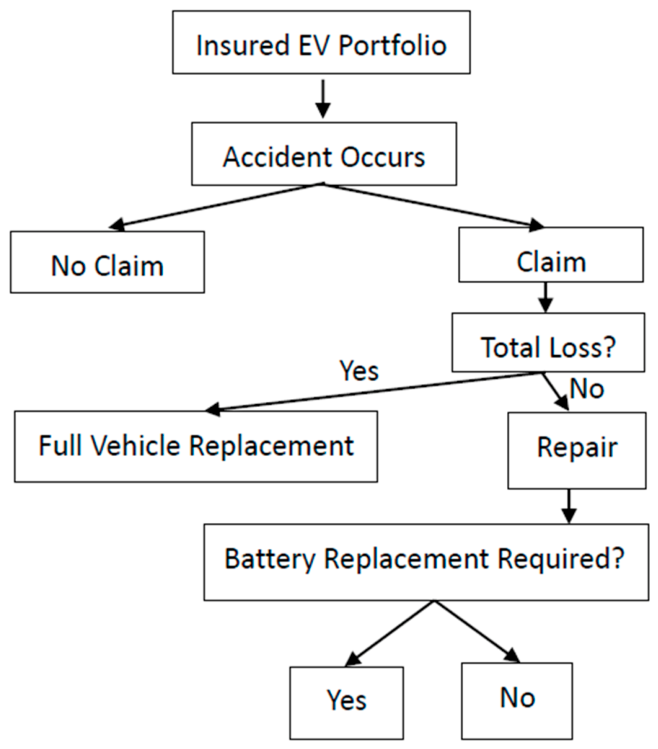
16]. The figure illustrates the mutually exclusive claims pathways incorporated into the scenario-based attribution framework, including no-claim outcomes, total-loss replacement, repair without battery replacement, and repair with battery replacement (please view
Figure 1).
At the same time, the framework explicitly recognizes that insurers are not sole decision-makers in lifecycle outcomes. Repair-versus-replacement decisions typically involve multiple actors:
The insurer (coverage and claims decision);
The policyholder (acceptance of settlement and repair choice);
Repair providers (technical feasibility);
Regulatory standards (safety and write-off rules).
This multi-actor structure implies that insurance influence operates through decision environments rather than direct control, shaping probabilities of outcomes rather than deterministically setting them.
3.3. Insurance Decision Points with Emissions Relevance
Within this system boundary, the framework identifies three insurance decision domains through which insurers may influence EV lifecycle emissions.
3.3.1. Underwriting Criteria
Underwriting determines which vehicles and risk profiles are accepted into the insurance portfolio. Insurers assess characteristics such as vehicle type, battery configuration, repair cost profiles, and usage patterns. These criteria may indirectly influence technology adoption and asset utilization by shaping insurance availability and pricing conditions.
Although underwriting does not directly determine emissions outcomes, it contributes to portfolio composition effects, which, in aggregate, influence lifecycle emissions exposure.
3.3.2. Pricing and Premium Differentiation
Insurance pricing translates risk assessment into economic signals. Premium structures may vary based on expected loss severity, repair costs, or vehicle characteristics. Prior research shows that insurance pricing can influence behavior through cost incentives and contract design [
9].
In the EV context, pricing may indirectly affect decisions such as vehicle selection, coverage choices, and repair preferences. However, these pricing-related effects are behaviorally mediated and depend on consumer responsiveness, market competition, regulatory conditions, and insurance-demand elasticity, making their relationship to lifecycle emissions comparatively indirect and uncertain. Accordingly, the present framework treats pricing mechanisms as secondary pathways of influence, while assigning greater analytical emphasis to claim-related decisions that more directly affect repair-versus-replacement outcomes and the associated manufacturing emissions.
3.3.3. Claims Management and Settlement Practices
Claims management represents the most direct point at which insurance decisions intersect with lifecycle emissions outcomes. Following an accident, insurers assess damage, estimate repair costs, and determine whether a vehicle should be repaired or declared a total loss.
In practice, these decisions are subject to several constraints:
Economic thresholds (repair cost relative to vehicle value);
Regulatory requirements (write-off classifications and safety standards);
Technical feasibility (battery integrity and structural damage);
Policyholder preferences (acceptance of repair vs. replacement).
As a result, insurers do not have unrestricted discretion to mandate repair over replacement. Importantly, the framework does not assume that insurers can prioritize emissions considerations over engineering integrity, regulatory compliance, or vehicle safety. Where structural damage, battery instability, or thermal-runaway risks render repair technically unsafe or legally impermissible, replacement remains necessary, regardless of the potential lifecycle emissions implications. Instead, they influence outcomes by setting assessment thresholds, repair standards, and settlement structures within these constraints.
The lifecycle assessment literature indicates that premature vehicle replacement and battery production significantly increase emissions due to the carbon intensity of manufacturing processes [
11,
12]. Consequently, claims practices that extend vehicle lifetimes—where technically feasible and compliant with safety standards—may reduce lifecycle emissions exposure.
The present framework therefore focuses primarily on the embodied manufacturing and battery-related emissions implications associated with repair-versus-replacement decisions within EV systems rather than on direct comparison of operational emissions between EVs and conventional internal combustion engine vehicles. Government incentives, subsidy structures, depreciation dynamics, and broader consumer replacement behavior may also influence replacement decisions in practice, but these factors are not explicitly modeled within the present analytical structure. Instead, the scenario framework isolates insurance-mediated governance pathways in order to examine their potential directional influence on modeled lifecycle emissions exposure under specified assumptions.
The environmental relevance of repair-versus-replacement pathways within EV systems arises primarily from the embodied emissions associated with vehicle manufacturing and lithium-ion battery production. Within the present framework, conditional total-loss outcomes and battery replacement pathways are treated as environmentally material because they may trigger additional manufacturing-related lifecycle emissions associated with new vehicle production or battery system replacement. The framework does not assume that repaired battery systems necessarily perform worse than original batteries; rather, the analytical emphasis concerns the emissions implications of replacement-induced manufacturing activity within EV lifecycle structures.
3.4. Exposure-Based Scope 3 Attribution Logic
To operationalize insurance as a Scope 3 climate level, the framework introduces an exposure-based attribution logic. Existing financial emissions accounting approaches are typically based on ownership or capital allocation, which are not directly applicable to insurance activities [
5].
Under an exposure-based approach, emissions are interpreted as those associated with insured activities whose lifecycle outcomes are influenced by insurance decisions. Attribution is therefore linked to insured exposure (e.g., vehicle-years, claims incidence) rather than ownership.
Importantly, this approach is not intended to produce precise emissions inventories. Instead, it functions as a decision-analytical framework that allows insurers to evaluate how changes in underwriting and claims parameters may affect their indirect emissions exposure.
3.5. Conceptual Pathways from Insurance Decisions to Emissions Outcomes
The framework identifies three pathways through which insurance decisions may influence lifecycle emissions:
Risk steering—underwriting and pricing shape portfolio composition and technology exposure.
Lifecycle extension—claims decisions affect repair, replacement, and asset longevity.
Portfolio aggregation—cumulative effects of underwriting decisions shape emissions exposure at scale.
These pathways operate probabilistically and are mediated by external constraints, rather than representing direct causal control.
3.6. Contribution to Sustainability Governance
By conceptualizing insurance underwriting as a Scope 3 climate level, this framework extends sustainability governance beyond ownership-based models. It highlights how contractual, pricing, and claims-based mechanisms can influence emissions outcomes indirectly.
At the same time, the framework maintains a clear distinction between influence and control, ensuring consistency with both insurance operational realities and existing emissions accounting principles [
16,
17].
This positioning enables insurers to incorporate lifecycle emissions considerations into decision making without implying direct emissions ownership, thereby aligning sustainability governance with the institutional characteristics of insurance.
The literature reviewed in the preceding sections highlights an important research gap. Existing studies have examined EV lifecycle emissions, insurance risk management, and climate-related financial governance largely as separate domains. However, insurer-level empirical datasets linking underwriting decisions, claims management pathways, battery replacement outcomes, and attributed Scope 3 emissions are currently limited. Consequently, direct empirical estimation of these relationships remains difficult. Under such conditions, a scenario-based analytical approach provides a useful methodological tool for exploring structurally plausible relationships and evaluating how alternative insurance decision configurations may influence modeled lifecycle emissions outcomes under specified assumptions. The purpose of the present framework is therefore not to estimate realized causal effects, but to examine the sensitivity of attributed emissions exposure to alternative governance and claims management structures.
4. Methodology
4.1. Methodological Positioning and Research Design
This study adopts a decision-analytical, scenario-based portfolio modeling approach to examine how insurance underwriting and claims decisions may influence lifecycle emissions associated with electric vehicles (EVs). The methodological objective is to examine structural relationships between insurance decision parameters and emissions outcomes under alternative scenario conditions.
This positioning reflects the current state of both data availability and methodological development. While existing frameworks such as the Partnership for Carbon Accounting Financials (PCAF) provide guidance for measuring insurance-associated emissions during the use phase, they do not address emissions arising from claims-mediated lifecycle events, including repair, battery replacement, or premature vehicle replacement [
16]. As a result, empirical estimation of these effects using large-scale insurance datasets remains limited.
Accordingly, the scenario framework is used to compare alternative governance configurations under uncertainty. Scenario analysis is widely used in sustainability and climate finance research to evaluate how alternative assumptions or governance configurations may affect outcomes in systems characterized by uncertainty and limited observational data [
4]. Within this context, the present study examines how insurance-mediated decision structures may influence emissions exposure at the portfolio level.
Importantly, the governance mechanisms modeled in this study operate within technical feasibility, regulatory compliance, and policyholder acceptance constraints, which are incorporated into the scenario framework through bounded parameter assumptions governing repair-versus-replacement tendencies.
4.2. Unit of Analysis
The unit of analysis is the insurer-level EV underwriting portfolio, defined as the set of EV insurance policies in force within a given period. This portfolio is characterized by the following factors:
Insured vehicle count;
Accident frequency;
Claims outcomes (repair vs. total loss);
Battery replacement probability;
Manufacturing-related emissions associated with replacement.
This portfolio-level perspective is consistent with insurance practice, where risk is managed and evaluated in aggregate rather than at the level of individual assets.
4.3. Parameter Selection and Empirical Plausibility
The parameterization of the model is designed to reflect literature-informed and scenario-based parameter ranges derived from evidence in the existing literature and industry, as shown in
Table 1. The objective is not to replicate a specific insurer’s dataset, but to ensure that modeled values fall within plausible operational, technical, and regulatory boundaries. Accordingly, parameters are interpreted as scenario inputs representing structurally plausible conditions, enabling comparative analysis of how insurance decision variables may influence lifecycle emissions exposure.
The parameter values adopted in this study serve two related but distinct purposes. First, central reference values are informed by publicly available insurance and transportation literature and are used to construct baseline scenarios. Second, broader parameter corridors are employed for sensitivity analysis and stress-testing purposes to evaluate model responsiveness under alternative operating conditions. Accordingly, the parameters should not be interpreted as jurisdiction-specific actuarial forecasts, but rather as literature-informed reference values combined with exploratory scenario assumptions within the analytical framework.
4.3.1. Annual Accident Probability (8–10%)
The annual accident probability of 8–10% lies within the observed range of private passenger vehicle claim frequencies in developed insurance markets, which commonly fall between 6% and 12% depending on exposure mix and jurisdiction [
23,
24]. Within the present framework, the 8–10% interval is treated as a literature-informed central reference range for baseline scenario construction, while the broader 6–12% range is used as a sensitivity analysis corridor. These values are generalized scenario assumptions derived primarily from developed automobile insurance markets rather than globally harmonized or jurisdiction-specific actuarial forecasts.
4.3.2. Conditional Total-Loss Rate (20% Budget EV; 30% Premium EV)
The assumed total-loss rates reflect documented differences in repair economics and vehicle valuation across electric vehicle segments. Premium EVs are assigned comparatively higher conditional total-loss assumptions because higher vehicle valuation, integrated battery architecture, specialized repair requirements, and elevated component replacement costs may increase the likelihood that repair costs exceed insurer economic total-loss thresholds following severe collision events. Industry analyses and emerging insurance research indicate that EVs may involve higher repair costs due to battery systems, specialized labor requirements, limited aftermarket parts availability, and structural battery integration, which may increase the likelihood that repair costs exceed insurer total-loss thresholds [
13,
14].
Recent insurance datasets report EV total-loss frequencies of approximately 7–10% in publicly available U.S. and Canadian claims data, although these values vary across vehicle age, market conditions, repair infrastructure, and accident severity environments. To evaluate structural sensitivity under uncertainty, the present study adopts an expanded exploratory scenario corridor extending beyond currently observed market-average frequencies. The higher-range assumptions are not intended to represent empirical actuarial averages, but rather to examine how lifecycle emissions exposure may respond under comparatively adverse claims environments characterized by structural battery integration, elevated repair costs, severe collision conditions, rapid depreciation, or constrained repair feasibility [
13,
14,
15]. Accordingly, the expanded parameter ranges function as exploratory stress-testing assumptions within the scenario framework rather than as predictive estimates of real-world insurer outcomes.
4.3.3. Conditional Battery Replacement Probability (10–15%)
Battery replacement probabilities conditional on repair are modeled at 10–15% based on engineering evidence indicating that battery pack integration, module architecture, and crash severity significantly affect EV repairability outcomes [
25,
26,
27,
28]. Because crash damage can range from localized module deformation to full pack compromise, replacement likelihood varies substantially across impact scenarios, and the selected interval represents a structurally plausible modeling assumption rather than an empirically observed frequency.
4.3.4. Replacement Manufacturing Emissions (8–10 tCO2e)
Lifecycle assessment literature indicates that electric vehicle manufacturing emissions are substantially higher than those of conventional vehicles due primarily to battery production and energy-intensive material processing. Within the scenario framework, premium EVs are assumed to involve comparatively higher embodied manufacturing and battery-related emissions than budget EVs due to larger battery capacities, higher material intensity, and more complex vehicle architectures. Accordingly, the upper ranges of the manufacturing and battery emissions corridors are interpreted as more representative of premium EV segments, whereas lower-range values are associated with smaller or budget-oriented EV configurations. Hawkins et al. [
12] estimate production-phase emissions of approximately 87–95 g CO
2-eq/km for EVs, roughly twice the 43 g CO
2-eq/km associated with internal combustion vehicles, with battery manufacturing accounting for 35–41% of the EV production impact. When converted to total vehicle manufacturing emissions across typical lifetime assumptions used in LCA studies, this corresponds broadly to estimates of roughly 8–12 tCO
2e for mid-size battery electric vehicles depending on battery capacity and electricity mix. The 8–10 tCO
2e range adopted here therefore represents a central estimate consistent with contemporary production conditions while avoiding both high-emission outliers and highly decarbonized manufacturing scenarios.
4.3.5. Battery Replacement Emissions (3–4 tCO2e)
Battery production represents a substantial share of electric vehicle lifecycle emissions. Lifecycle assessments indicate that battery manufacturing accounts for a large portion of EV production-related greenhouse gas emissions, with Hawkins et al. [
12] estimating that battery systems contribute approximately 35–41% of total EV manufacturing impacts. More recent battery-specific lifecycle studies report manufacturing emissions typically ranging from about 2.5 to 5 tCO
2e for lithium-ion battery packs in the 50–75 kWh capacity range, depending on cell chemistry, production efficiency, and electricity sources used in manufacturing [
26,
27]. The 3–4 tCO
2e interval adopted in this study therefore represents a mid-range estimate consistent with existing literature and provides a conservative assumption for modeling battery replacement emissions.
4.3.6. Budget–Premium Portfolio Composition (60/40 Baseline)
Electric vehicle market composition varies substantially across regions due to differences in policy incentives, price structures, and consumer preferences. Global EV adoption patterns show strong geographic variation, with markets such as China characterized by a large share of relatively affordable models, while North American and some European markets remain more concentrated in higher-priced vehicle segments [
28,
29]. Policy frameworks, subsidy schemes, and domestic manufacturing capacity further influence the distribution of vehicle segments within regional EV markets [
30]. To avoid implicitly representing the structure of any particular jurisdiction, this study adopts a simplified 60/40 budget–premium portfolio assumption as a neutral diversified baseline for scenario comparison. This midpoint structure prevents systematic bias toward either entry-level or high-cost vehicles while acknowledging heterogeneity in global EV market compositions. The assumed composition therefore functions solely as a comparative modeling baseline rather than a representation of any specific regional market distribution, with alternative regional structures explored through sensitivity analysis.
4.3.7. Coverage Intensity Multiplier (0.90–1.15)
The coverage intensity multiplier (0.90–1.15) captures plausible variation in claim realization associated with differences in insurance coverage breadth and deductible structures. Insurance economics research demonstrates that contract design—including deductibles, co-insurance, and pricing mechanisms—affects policyholder incentives and claims behavior through moral hazard and reporting responses [
31]. Empirical studies further show that higher deductibles can reduce claim frequency by increasing the insured’s cost-sharing exposure and discouraging marginal claim reporting [
32]. The selected interval therefore represents moderate variation in realized claims associated with insurance contract heterogeneity while holding underlying accident risk constant. By adjusting claim realization rather than structural accident probabilities, the multiplier preserves actuarial coherence while capturing plausible exposure differences across insurance contract designs.
4.3.8. Policy Duration (1–5 Years)
Auto insurance contracts are typically written annually; however, portfolio-level emissions attribution may span multi-year horizons. The 1–5 years range reflects exposure scaling consistent with financial carbon accounting practices [
5] and functions purely as a temporal aggregation parameter without modifying event probabilities.
4.3.9. Claims Frequency Sensitivity (6–12%)
The 6–12% sensitivity corridor reflects empirically observed variation in automobile claim frequencies across developed insurance markets. Cross-country insurance statistics compiled by regulators and industry organizations show that claim frequencies and loss experience differ meaningfully across jurisdictions due to variations in driving exposure, traffic density, regulatory frameworks, and vehicle fleets [
33,
34]. Empirical modeling studies also emphasize that claim frequency varies substantially across insurance portfolios and risk segments, requiring statistical models that account for dispersion and heterogeneity in claims data [
35,
36]. Incorporating a moderate sensitivity range therefore strengthens robustness testing by ensuring that comparative scenario outcomes are not driven by narrow accident assumptions while maintaining consistency with empirically observed variation in motor insurance claims.
Table 1.
Empirical plausibility and literature support for scenario and sensitivity parameters.
Table 1.
Empirical plausibility and literature support for scenario and sensitivity parameters.
| Parameter | Value Used in Model | Reported Market/Literature Range | Citation Support | Justification of Reasonableness |
|---|
| Annual accident probability | 8–10% | 6–12% annual private passenger vehicle claim frequency (developed markets). | [23,24] | Falls within standard actuarial auto insurance claim frequency range |
| Conditional total-loss rate | 20% (Budget EV); 30% (Premium EV) | 15–35% depending on repair cost ratio and vehicle value. | [15] | EVs show elevated write-off rates due to high repair costs and battery integration |
| Conditional battery replacement (given repair) | 10–15% | 5–20% depending on battery configuration and impact severity. | [25,37,38,39] | Reflects structural battery complexity and replacement cost sensitivity |
| Replacement manufacturing emissions | 8–10 tCO2e per vehicle | 8–12 tCO2e for EV production (mid-size vehicles). | [12] | Within mid-range LCA estimates for EV manufacturing |
| Battery replacement emissions | 3–4 tCO2e per event | 2.5–5 tCO2e depending on battery capacity (50–75 kWh). | [12,26,27] | Consistent with lithium-ion battery production emissions ranges |
| Budget vs. premium portfolio split | 60/40 baseline | Market dependent (40/60–70/30 observed across regions). | [31,32,33] | Represents neutral midpoint composition for diversified EV portfolio |
| Coverage intensity multiplier | 0.90–1.15 | Claim exposure may vary by coverage type; industry data show observable differences in claim frequency across coverages (e.g., collision vs. comprehensive) and actuarial research indicates risk-classified models capture exposure differences without structural probability distortion. | [31,32] | Model exposure differences without distorting structural probabilities |
| Policy duration | 1–5 years | 1-year standard contracts; multi-year exposure modeling common in portfolio analysis. | [5] | Used for exposure scaling rather than frequency manipulation |
| Claims frequency sensitivity | 6–12% | Match with developed market auto claims variability. | [33,34,35,36] | Enables robustness testing across accident environments |
4.4. Construction of the Scope 3 Attribution Formula
The portfolio-level attributed emissions are calculated as the sum of emissions components that are sensitive to insurance-mediated decisions, particularly total-loss replacement and battery replacement.
The generalized attribution formula is defined as follows:
where
N is insured vehicle count;
Pacc is annual accident probability;
Mcov is the coverage intensity multiplier;
j indexes EV segment;
wj is the portfolio share of segment
j;
PTL,j,
j is the conditional total-loss probability;
Eveh,j,
j is full vehicle manufacturing emissions;
Pbat,j,
j is the conditional battery replacement probability given repair;
Ebat,j,
j is battery replacement emissions; and
D is policy duration. The term (1 −
PTL,j) ensures that battery replacement emissions are counted only in repair pathways and are not double-counted in total-loss/full-replacement cases. Within the analytical structure, accident probability, portfolio composition, governance-related claims parameters, coverage intensity, and policy duration function as primary input variables, while attributed lifecycle emissions represent the modeled output variable. The framework evaluates how changes in governance-sensitive repair-versus-replacement pathways influence emissions outcomes across alternative exposure environments and scenario configurations.
While PCAF provides an essential foundation for attributing greenhouse gas emissions to insurers based on insured activities, its current methodology is limited to emissions associated with the normal use of insured assets. It does not provide guidance on how to account for emissions arising from insurance claims, such as repair decisions, battery replacement, or early vehicle replacement following accidents. These claim-related events can materially alter asset lifecycles and associated emissions trajectories. Accordingly, the scenario-based extension proposed in this study is intended to complement, rather than replace, existing PCAF guidance by addressing this currently unaccounted-for dimension of insurance-mediated emissions influence.
This formulation is intended as a structural representation of emissions sensitivity to insurance-mediated decisions, rather than a complete lifecycle accounting model. It focuses specifically on emissions components that are directly affected by claims outcomes, particularly total-loss replacement and battery replacement events.
4.5. Dual-Dimension Scenario Framework and Interaction Structure
This study adopts a dual-dimension scenario architecture that combines underwriting governance regimes U and exposure scale environments S. The formulation additionally incorporates coverage intensity, vehicle segment composition, and policy duration as multiplicative or segment-weighted parameters affecting attributed emissions exposure under different governance configurations. This structure enables identification of the interaction effect between governance intensity and portfolio scale rather than treating scenario differences as purely additive adjustments.
4.5.1. Underwriting Governance Regimes (U ∈ {U0, U1, U2})
The governance dimension consists of three underwriting governance regimes:
(U0) = neutral underwriting;
(U1) = EV-prioritized underwriting;
(U2) = carbon-adjusted underwriting.
Operationally, the three governance mechanisms differ through their assumed treatment of repair-versus-replacement decision tendencies within technically feasible and regulatory compliant conditions. The neutral (U0) mechanism represents conventional insurance practice without explicit EV-oriented or emissions-oriented adjustment. The EV-biased (U1) mechanism assumes a moderate repair-oriented adjustment, operationalized through relatively lower total-loss and conditional battery replacement tendencies compared with the neutral baseline. The carbon-adjusted (U2) mechanism further incorporates lifecycle emissions sensitivity into claims evaluation by assuming greater preference for repair retention and reduced replacement intensity where safety, engineering integrity, and regulatory feasibility permit. These mechanisms are implemented through differentiated parameter settings rather than through autonomous insurer discretion outside technical and legal constraints.
The governance regimes are operationalized through parameter adjustments representing alternative insurance-mediated decision structures in claims management and settlement practices. Specifically, the model assumes that governance structures emphasizing repair feasibility, battery diagnostics, and lifecycle-oriented claims assessment may reduce the likelihood that damaged vehicles are declared total losses and may increase the probability that batteries are repaired rather than replaced when technically feasible. Accordingly, the transition from U0 (neutral) to U1 (EV-prioritized) and U2 (carbon-adjusted) is represented through progressively lower conditional total-loss probabilities (PTL) and battery replacement probabilities (Pbat). These parameter adjustments are not derived from observed insurer-level behavioral elasticities but are scenario-based assumptions designed to examine how alternative governance approaches may influence modeled lifecycle emissions outcomes under comparable accident conditions.
4.5.2. Exposure Scale Scenarios (S ∈ {S1, S2, S3})
Here, (S1) represents a smaller-scale and comparatively lower-accident exposure environment, (S2) represents a moderate baseline exposure environment, and (S3) represents a larger-scale and comparatively higher-accident exposure environment.
Within the present framework, these scenario corridors are intended as stylized sensitivity analysis environments rather than formal actuarial classifications. More specifically, (S1) corresponds to conditions toward the lower portion of the modeled accident-probability sensitivity range, (S2) reflects the central reference environment, and (S3) corresponds to conditions approaching the upper sensitivity corridor. These scenarios are further combined with differing governance assumptions, vehicle segment compositions, and claim-related parameter structures to evaluate the structural responsiveness of attributed emissions under alternative operational conditions.
Annual attributed emissions under scenario
S,
U are formally defined as:
Governance effects are evaluated as:
This formulation makes explicit that emission outcomes scale with both exposure volume, N, and accident intensity, , thereby generating a multiplicative interaction between governance intensity and portfolio scale.
The marginal emission effects of decision parameters are:
These derivatives show that governance leverage increases proportionally with exposure scale and accident intensity, providing the theoretical basis for the scale amplification observed in
Section 3.
The scenario framework is designed to represent plausible variations within operational and regulatory constraints, rather than unconstrained insurer decision making. Changes in total-loss and battery replacement parameters should therefore be interpreted as reflecting shifts within feasible decision ranges, influenced by economic thresholds, safety requirements, and repair feasibility.
4.6. Sensitivity Analysis
The purpose of the sensitivity analysis is not to identify precise parameter values, but rather to evaluate whether the relative importance of decision variables remains stable across plausible parameter ranges.
Sensitivity analysis evaluates the robustness of comparative scenario outcomes under empirically plausible variation in key emissions determinants, including vehicle segment distribution, battery production emissions intensity, claims frequency variation, coverage intensity variation, and policy duration. Coverage intensity is operationalized as a multiplicative exposure-adjustment factor reflecting differences in insured protection scope and claims exposure across policy configurations.
Beyond parameter stress testing, sensitivity analysis serves a structural validation function within the dual-dimension interaction model. Because governance effects scale multiplicatively with exposure size and accident intensity, parameter perturbations should preserve three core structural properties: (i) dominance of total-loss elasticity relative to battery elasticity; (ii) proportional reduction rates across exposure scales; and (iii) positive amplification of absolute emission reductions as portfolio size increases.
By varying parameters within empirically supported corridors, the analysis confirms that observed differences across underwriting configurations are not artifacts of narrow calibration assumptions. Instead, results reflect stable structural relationships between insurance-mediated decision levers and lifecycle emissions exposure.
To improve transparency and clarify the multidimensional structure of the analytical framework,
Table 2 summarizes the principal sensitivity dimensions incorporated into the scenario analysis, including accident probability, total-loss probability, battery replacement probability, coverage intensity, vehicle segment composition, manufacturing emissions, battery-related emissions, and policy duration. These parameters are evaluated as exploratory scenario corridors intended to assess directional stability and relative parameter influence under uncertainty rather than probabilistic forecasts of real-world insurer outcomes.
The parameter adjustments applied within the Carbon-Adjusted (U2) governance regime are intended as stylized exploratory assumptions rather than empirically estimated insurer behaviors. Specifically, the reduced conditional total-loss and battery replacement probabilities are introduced to simulate comparatively repair-oriented claims management environments in which insurers adopt stricter repair prioritization or more conservative replacement thresholds where technically feasible and safety-compliant. The magnitude of these reductions is therefore designed to support comparative sensitivity analysis under alternative governance conditions rather than to represent actuarial forecasts or observed market-average operational practices.
Collectively, these sensitivity dimensions are intended to evaluate the relative directional influence and structural interaction of key insurance-mediated parameters within the exploratory attribution framework.
4.7. Methodological Limitations
This study develops a structural accounting framework designed to compare relative differences in attributed Scope 3 emissions exposure under alternative underwriting configurations. The model therefore functions as a decision-analytical framework intended to illuminate emissions sensitivity to governance levers within EV insurance portfolios.
The multiplicative interaction identified in this study reflects structural scaling properties of the attribution formula rather than empirically estimated behavioral elasticities. Accident probability is treated as exogenous, and underwriting configuration changes are modeled as institutional adjustments rather than demand-side responses to premium differentiation. Competitive market dynamics, insurer heterogeneity, and regulatory feedback mechanisms are not endogenously modeled. In addition, the framework does not explicitly model insurer-level heterogeneity across jurisdictions, market structures, underwriting strategies, or institutional risk preferences. In practice, EV insurance portfolios and product characteristics vary substantially across countries and insurers, reflecting differences in regulation, repair infrastructure, market maturity, and risk tolerance. These factors may materially influence the operational applicability and emissions implications of insurance-mediated decision structures. Accordingly, the present framework should be interpreted as a generalized exploratory abstraction rather than an insurer-specific operational accounting model.
The model does not incorporate behavioral responses such as moral hazard or adverse selection, nor does it simulate competitive market dynamics. These factors may influence real-world outcomes and represent important directions for future research.
The present framework also does not separately model repair cost dynamics, vehicle depreciation behavior, consumer replacement preferences, or comparative lifecycle structures between EVs and conventional internal combustion engine vehicles. These factors may materially influence claims management outcomes and replacement decisions in practice. To maintain analytical tractability, the study adopts a simplified governance-oriented scenario structure focused primarily on insurance-mediated repair-versus-replacement pathways within EV systems. Future research may extend the framework through multi-level comparative modeling capable of integrating repair economics, depreciation-sensitive behavioral responses, and cross-technology lifecycle calibration.
Accordingly, results should be interpreted as institutional scenario comparisons rather than empirical market forecasts. Future research may incorporate insurer-level microdata, repair-level technical validation, and behavioral demand modeling to empirically evaluate the magnitude of governance-induced emissions effects.
In practice, operational implementation of insurer-level lifecycle emissions evaluation would require substantially more granular datasets than those available for the present study, including claims-level repair records, battery replacement outcomes, vehicle-specific repair costs, accident severity indicators, and model-level lifecycle assessment data. Moreover, EV models differ materially in battery chemistry, manufacturing intensity, repairability, and embodied emissions characteristics. To maintain analytical tractability, the present framework adopts a simplified segment-level representation (e.g., budget versus premium EV categories) rather than vehicle-model-specific lifecycle accounting. Future research may incorporate insurer microdata and model-specific lifecycle datasets to examine heterogeneous EV characteristics more precisely. The present study adopts a stylized scenario-based analytical structure rather than a continuous dynamic simulation framework. As a result, the model does not estimate continuous functional relationships among governance variables, accident conditions, and lifecycle emissions outcomes using stochastic simulation or engineering system approaches such as Monte Carlo analysis or MATLAB/Simulink modeling. A continuous simulation framework would require substantially more granular empirical calibration data, including insurer-level claims distributions, repair-level outcomes, and battery replacement probabilities, which are not currently available within the scope of the present study. Under these conditions, the scenario-based approach was selected to provide transparent exploration of structural relationships while avoiding unwarranted precision in model estimation. Future research may extend the framework through insurer-level microdata calibration, continuous variable sensitivity analysis, or system dynamics simulation techniques capable of modeling nonlinear interactions and probabilistic pathway evolution more precisely.
5. Results and Scenario Analysis
This section implements the dual-dimension attribution framework developed in
Section 4 and reports scenario outcomes across governance regimes and exposure-scale environments. The numerical results are derived from the formal attribution model and parameter corridors specified in the methodology and are interpreted as comparative scenario outcomes rather than market forecasts.
Table 3 summarizes the parameterization of the dual-dimension scenario framework across three exposure-scale environments (
S1)–(
S3) and three underwriting governance regimes (
U0)–(
U2). The exposure-scale scenarios represent increasing portfolio size and accident intensity, ranging from 20,000 to 300,000 insured vehicles and accident rates from 6% to 12%. Simultaneously, portfolio composition shifts from a budget-heavy structure in (
S1) toward a premium-dominant mix in (
S3), reflecting structurally different EV portfolio environments. The governance regimes are operationalized through progressively lower total-loss and battery replacement probabilities under EV-prioritized (
U1) and carbon-adjusted (
U2) configurations relative to the neutral baseline (
U0). These parameter differences represent imposed exploratory scenario assumptions within technically feasible and regulatorily compliant conditions rather than empirically observed causal effects. Importantly, governance structures are held systematically consistent across exposure-scale environments, allowing identification of the interaction between governance intensity and portfolio scale without introducing arbitrary cross-scenario parameter distortions.
Table 4 reports annual attributed emissions under neutral and carbon-adjusted governance regimes, along with emission reductions, reduction rates, and policy elasticities. Elasticity is defined as the proportional sensitivity of attributed emissions (AE) to changes in a given decision parameter:
where:
εx = elasticity with respect to parameter x;
AE = attributed emissions;
x = the relevant governance parameter (e.g., total-loss probability or battery replacement probability).
In this study:
Total-loss elasticity measures the proportional responsiveness of attributed emissions to changes in conditional total-loss probability;
Battery elasticity measures the proportional responsiveness of attributed emissions to changes in conditional battery replacement probability.
Table 4.
Emission results and elasticities under governance scenarios.
Table 4.
Emission results and elasticities under governance scenarios.
| Scale Scenario (S) | AE Neutral (tCO2e/Year) | AE Carbon-Adjusted (tCO2e/Year) | ΔAE (tCO2e/Year) | Reduction Rate (%) | Budget EV TL Elasticity (εTL,B) | Premium EV TL Elasticity (εTL,p) | Battery Elasticity (εbat) |
|---|
| (S1) | 2726 | 2079 | 648 | 23.76 | 0.474 | 0.380 | 0.111 |
| (S2) | 22,205 | 16,973 | 5232 | 23.56 | 0.372 | 0.463 | 0.125 |
| (S3) | 102,096 | 78,322 | 23,774 | 23.29 | 0.213 | 0.597 | 0.140 |
The elasticity estimates indicate that attributed emissions are substantially more sensitive to changes in conditional total-loss probabilities than to changes in conditional battery replacement probabilities across all exposure-scale scenarios. In particular, premium EV total-loss elasticity becomes increasingly dominant in the large-scale environment (S3), reflecting the interaction between higher embodied manufacturing emissions and elevated premium-vehicle portfolio share.
The elasticity differences reported in
Table 4 further suggest that total-loss-related governance mechanisms exert comparatively greater influence on attributed emissions than battery-replacement pathways within the modeled framework. This result reflects the substantially larger embodied manufacturing emissions associated with full vehicle replacement relative to battery replacement alone. In addition, the influence of premium EV total-loss elasticity becomes more pronounced in the large-scale scenario (
S3), where higher manufacturing intensity and greater premium-vehicle portfolio share amplify the emissions implications of replacement decisions.
Three principal findings emerge from the scenario analysis.
(1) Scale amplification of governance effects;
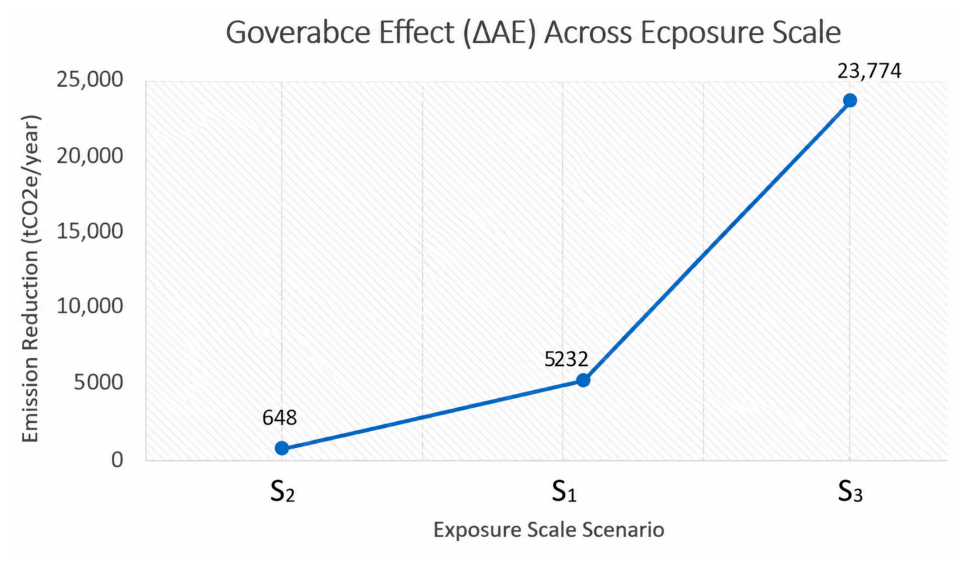
Absolute emission reductions (ΔAE) increase substantially with portfolio scale, rising from 648 tCO2e/year in (S1) to 23,774 tCO2e/year in (S3). This pattern reflects the multiplicative interaction between governance intensity, portfolio size, and accident frequency embedded within the attribution framework. As insurer exposure expands, the absolute emissions implications associated with claim-related governance correspondingly increase.
(2) Stability of proportional reduction effects
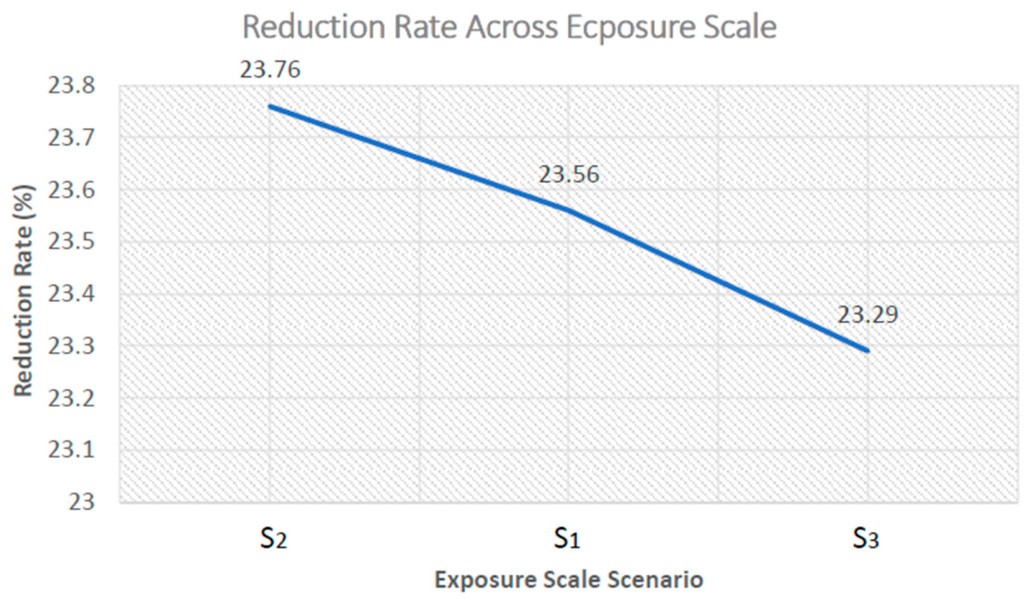
Despite substantial differences in portfolio size and accident intensity, proportional emission reduction rates remain relatively stable across scenarios at approximately 23–24%. This stability suggests that governance effects operate proportionally rather than additively within the analytical structure. The consistency of reduction rates across exposure-scale environments supports the internal coherence of the framework and indicates that relative governance influence remains structurally persistent under varying portfolio conditions.
(3) Dominance of total-loss elasticity over battery elasticity
The elasticity analysis indicates that attributed emissions are substantially more sensitive to changes in conditional total-loss probability than to changes in conditional battery replacement probability across all scenarios. In particular, premium EV total-loss elasticity becomes increasingly dominant in the large-scale environment (S3), reflecting the interaction between higher embodied manufacturing emissions and greater premium-vehicle portfolio share. Although battery replacement elasticity increases moderately with scale, it remains secondary relative to full vehicle replacement effects within the modeled governance structure.
Taken together, the scenario results suggest that insurance-mediated claims decisions may influence modeled lifecycle emissions exposure through structurally persistent relationships between portfolio scale, accident intensity, and repair-versus-replacement pathways within the analytical framework. Although the numerical outcomes depend on the selected parameter assumptions, the relative relationships among governance variables remain broadly stable across the examined sensitivity corridors.
Figure 2 illustrates the absolute emission reduction (ΔAE) generated by carbon-adjusted governance across the selected exposure-scale scenarios. The relationship increases nonlinearly across the modeled scenarios, with reductions rising from hundreds to tens of thousands of tCO
2e annually as portfolio scale expands.
This pattern is consistent with the governance–scale interaction predicted by the analytical framework. Because (ΔAE) scales with both portfolio size and accident intensity, governance interventions generate progressively larger absolute emissions effects in larger portfolios. The figure therefore illustrates that insurers with larger exposure bases may possess comparatively greater Scope 3 governance leverage within the modeled framework.
Figure 3 presents the percentage reduction in emissions across scale scenarios. Unlike
Figure 2, which shows absolute magnitudes, this figure reveals the structural proportionality of governance effects.
Reduction rates remain stable at approximately 23–24% across all scales. This stability indicates that governance intensity operates multiplicatively rather than additively, preserving proportional impact regardless of exposure size. The consistency reinforces the model’s internal coherence and supports the comparative statics results derived in
Section 3.
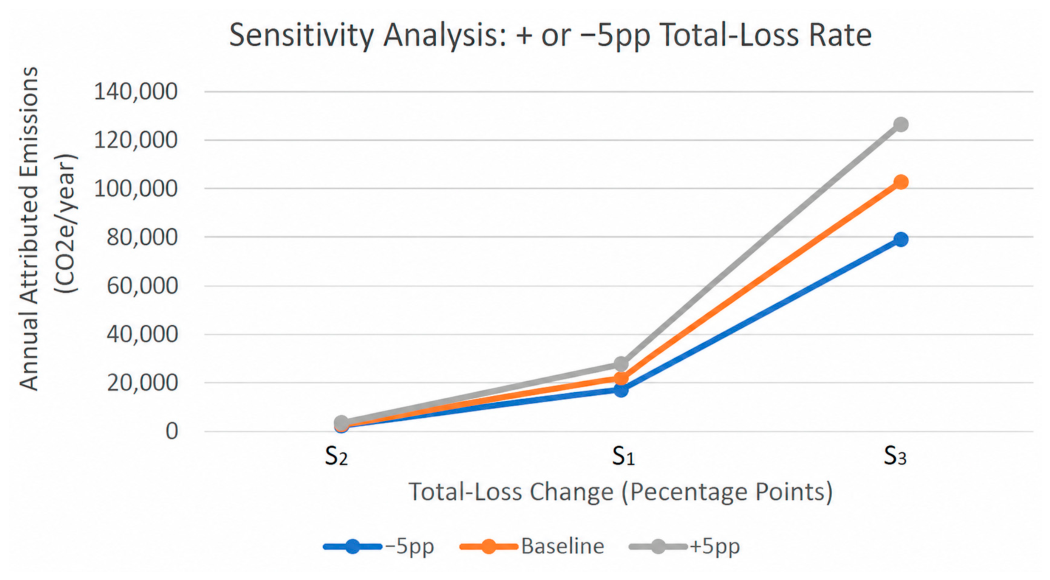
Figure 4 examines the robustness of emission outcomes to ±5 percentage-point shifts in total-loss probability. Across all scale scenarios, emissions respond strongly and approximately linearly to total-loss adjustments.
Two insights follow from our findings:
1. Emissions are highly sensitive to total-loss assumptions, reinforcing the finding that total-loss probability constitutes a comparatively influential governance parameter within the analytical framework.
2. The slope of the sensitivity curves steepens with scale, illustrating how governance errors or estimation uncertainty become increasingly material in larger portfolios.
The sensitivity analysis demonstrates that while numerical outcomes vary with parameter perturbations, the qualitative findings—particularly the dominance of total-loss governance and scale amplification—remain relatively stable within the examined parameter corridors. The consistency of relative outcomes across parameter variations suggests that the model captures structurally persistent relationships rather than results driven solely by specific parameter choices.
Nevertheless, the present sensitivity analysis remains limited to structured parameter perturbations within predefined scenario corridors and does not fully capture joint stochastic uncertainty, insurer heterogeneity, or alternative model structures. These areas remain important directions for future methodological development and empirical validation.
Taken together, the numerical and graphical evidence demonstrates that insurance governance affects Scope 3 emissions through a structurally multiplicative mechanism rather than a purely additive adjustment. Because attributed emissions scale with both exposure volume and accident intensity, the carbon consequences of claims decisions expand proportionally with portfolio size. This implies that governance intensity and exposure scale interact systematically: larger insurers possess disproportionately greater governance influence within the analytical framework within their underwriting portfolios. Consequently, total-loss management emerges not merely as an operational efficiency tool, but as a strategically material climate governance instrument within insurance-based Scope 3 accounting frameworks.
6. Discussion and Implications
This study conceptualizes electric vehicle (EV) insurance underwriting as a form of indirect climate governance within a Scope 3 emissions framework. By linking insurance decision structures—particularly claim-related outcomes—to lifecycle emissions associated with vehicle and battery replacement, the analysis extends existing approaches to financial emissions accounting beyond capital-based relationships.
6.1. Theoretical Implications
The findings contribute to the growing literature on indirect climate governance by highlighting insurance as a distinct institutional mechanism through which emissions outcomes may be influenced. While prior research has focused primarily on lending and investment as channels of financial influence [
4,
11], this study demonstrates that insurance operates through different but complementary pathways, including underwriting criteria, pricing structures, and claims management processes.
From a theoretical perspective, the results are consistent with the view of insurance as a form of governance that shapes behavior through risk classification and contractual arrangements [
7]. However, the present analysis extends this perspective by linking insurance operations to lifecycle emissions outcomes, thereby integrating insurance into the broader discourse on Scope 3 emissions and value chain governance.
Importantly, the study distinguishes between emissions causation and emissions influence. Insurance does not directly generate emissions, nor does it exercise full control over lifecycle outcomes. Instead, it operates within a system of bounded influence, where decision parameters affect the probability distribution of repair, replacement, and asset longevity outcomes. This distinction is critical for aligning insurance-based emissions analysis with existing accounting frameworks, which emphasize attribution based on relationships and exposure rather than ownership [
1,
16].
6.2. Interpretation of Model Results
The model results suggest that claim-related decision parameters—particularly total-loss probability—have a substantial influence on lifecycle emissions exposure within EV insurance portfolios. This finding is consistent with lifecycle assessment literature showing that vehicle and battery manufacturing are major contributors to EV emissions [
11,
12].
The magnitude of emissions differences observed across scenarios reflects the assumptions embedded in the model and the defined parameter ranges.
In particular, the identification of total-loss decisions as a dominant factor does not imply direct insurer control over such outcomes, which are shaped by regulatory, technical, and behavioral constraints. As discussed in the methodological framework, total-loss determinations are subject to regulatory requirements, safety standards, technical feasibility, and policyholder preferences. The results therefore highlight potential leverage points within existing decision structures, rather than actionable levers under unconstrained insurer control.
6.3. Implications for Insurance Practice
The analysis suggests that insurance operations may have previously under-recognized relevance for lifecycle emissions outcomes, particularly in contexts where repair-versus-replacement decisions are economically and technically feasible. Within existing regulatory and operational constraints, the analysis indicates that insurers may influence emissions exposure through the following avenues:
The design of claims assessment frameworks;
Repair standards and evaluation protocols;
Consideration of lifecycle impacts in underwriting and portfolio analysis.
These implications should be interpreted cautiously. The study does not suggest that insurers can unilaterally prioritize emissions outcomes over safety, regulatory compliance, or contractual obligations. Rather, it highlights the potential for incremental integration of lifecycle considerations into existing decision processes.
From an industry perspective, emerging frameworks such as the Principles for Sustainable Insurance [
10] and insurance-associated emissions accounting [
16] provide initial foundations for integrating sustainability into insurance operations. The present study contributes by suggesting how these frameworks might be operationalized at the level of claim-related decision making.
6.4. Implications for Policy and Sustainability Governance
From a policy and governance perspective, the findings indicate that insurance may represent an additional channel through which lifecycle emissions can be influenced, complementing existing approaches focused on manufacturers, consumers, and investors.
However, realizing this potential would require alignment across multiple dimensions, including:
Regulatory frameworks governing vehicle repair and write-off standards;
Technical development of safe and cost-effective repair methods, particularly for batteries;
Data availability and transparency for lifecycle emissions assessment;
Coordination between insurers, regulators, and repair networks.
These considerations underscore that insurance should be viewed as part of a broader governance ecosystem, rather than as an independent or dominant driver of emissions outcomes. Consistent with the theoretical framework developed in
Section 3.1, these policy and sustainability implications should be interpreted as consequences of insurance-mediated decision structures operating through underwriting and claims management processes rather than as evidence of direct control over emissions outcomes. The framework therefore highlights a potential governance pathway through which insurance-related decisions may influence modeled lifecycle emissions exposure under specified assumptions.
6.5. Limitations and Future Research Directions
Several limitations of the present study should be noted. First, the analysis is based on a scenario-driven modeling framework. Future research may incorporate insurer-level empirical data to evaluate the practical applicability of the proposed framework. Second, behavioral responses such as moral hazard, adverse selection, and consumer decision making are not explicitly modeled. Third, the framework does not incorporate competitive market dynamics or regulatory heterogeneity across jurisdictions.
Future research may address these limitations by incorporating empirical datasets, case studies of insurance practice, and behavioral modeling approaches. In particular, further work is needed to evaluate how claims decisions are made in practice across different regulatory environments, and how lifecycle emissions considerations may be integrated into those processes.
7. Conclusions
This study examines the role of electric vehicle (EV) insurance underwriting as a potential mechanism of indirect climate governance within a Scope 3 emissions framework. By linking insurance decision structures—particularly claim-related outcomes—to lifecycle emissions associated with vehicle and battery replacement, the analysis contributes to an emerging discussion on how financial institutions may influence emissions beyond direct ownership or operational control.
The findings suggest that insurance may influence modeled lifecycle emissions pathways indirectly through underwriting, claims management, and settlement decisions rather than through direct control of emissions sources. Within the model framework, variations in these decision parameters are associated with meaningful differences in emissions exposure at the portfolio level. These results highlight the relevance of claims management as a previously underexplored interface between insurance operations and sustainability outcomes.
From a conceptual perspective, the study extends existing approaches to climate governance by incorporating insurance underwriting into the analysis of Scope 3 emissions. While prior work has focused primarily on lending and investment as channels of financial influence, this research demonstrates that insurance operates through distinct mechanisms, including underwriting criteria, pricing, and claim-settlement processes. In doing so, it contributes to a more comprehensive understanding of how financial systems interact with lifecycle emissions dynamics.
At the same time, the analysis underscores that insurance influence is inherently bounded. Claims decisions are shaped by regulatory requirements, safety considerations, technical feasibility, and policyholder preferences. As such, insurers should be understood as intermediaries within a broader governance system, rather than as autonomous decision-makers capable of directly optimizing emissions outcomes.
The study also highlights implications for the further development of sustainability frameworks in the insurance sector. Existing initiatives, including the Principles for Sustainable Insurance and emerging approaches to insurance-associated emissions accounting, provide important foundations but remain limited in their treatment of claims-driven lifecycle events. The framework developed in this study offers one possible pathway for extending these approaches to better reflect the operational realities of insurance.
Several limitations should be acknowledged. The framework does not incorporate insurer-level empirical data, behavioral responses, or competitive market dynamics. In addition, differences in regulatory environments and insurer characteristics across jurisdictions are not explicitly modeled. Future research may incorporate insurer-level datasets, claims records, and behavioral analyses to further evaluate the practical applicability of the proposed framework across different insurance markets.
Future research may build on this work by incorporating empirical datasets, case-based analysis, and behavioral modeling to further assess the role of insurance in lifecycle emissions management. In particular, examining how claims decisions are implemented in practice and how regulatory frameworks shape repair and replacement outcomes would provide valuable insights into the feasibility and impact of integrating emissions considerations into insurance operations.
In conclusion, this study proposes a scenario-based analytical framework for examining how insurance underwriting and claim-related decision structures may influence modeled lifecycle emissions exposure within EV insurance systems. The framework is intended as an exploratory tool for analyzing potential emissions exposure associated with insurance-mediated repair, replacement, and battery-related pathways in EV systems.