Configurational Pathways to Digital Traceability Success in International Trade: An fsQCA Study of Trade-Corridor Cases


Abstract
1. Introduction
2. Literature Review
Research Gap and Study Positioning
3. Theoretical Framework
3.1. Digital Traceability as a Socio-Technical Capability
3.2. The Role of Institutional Readiness and Market Pressure
3.3. Technological Architecture and Blockchain-Enabled Traceability
3.4. Cross-Border Coordination and Relational Governance
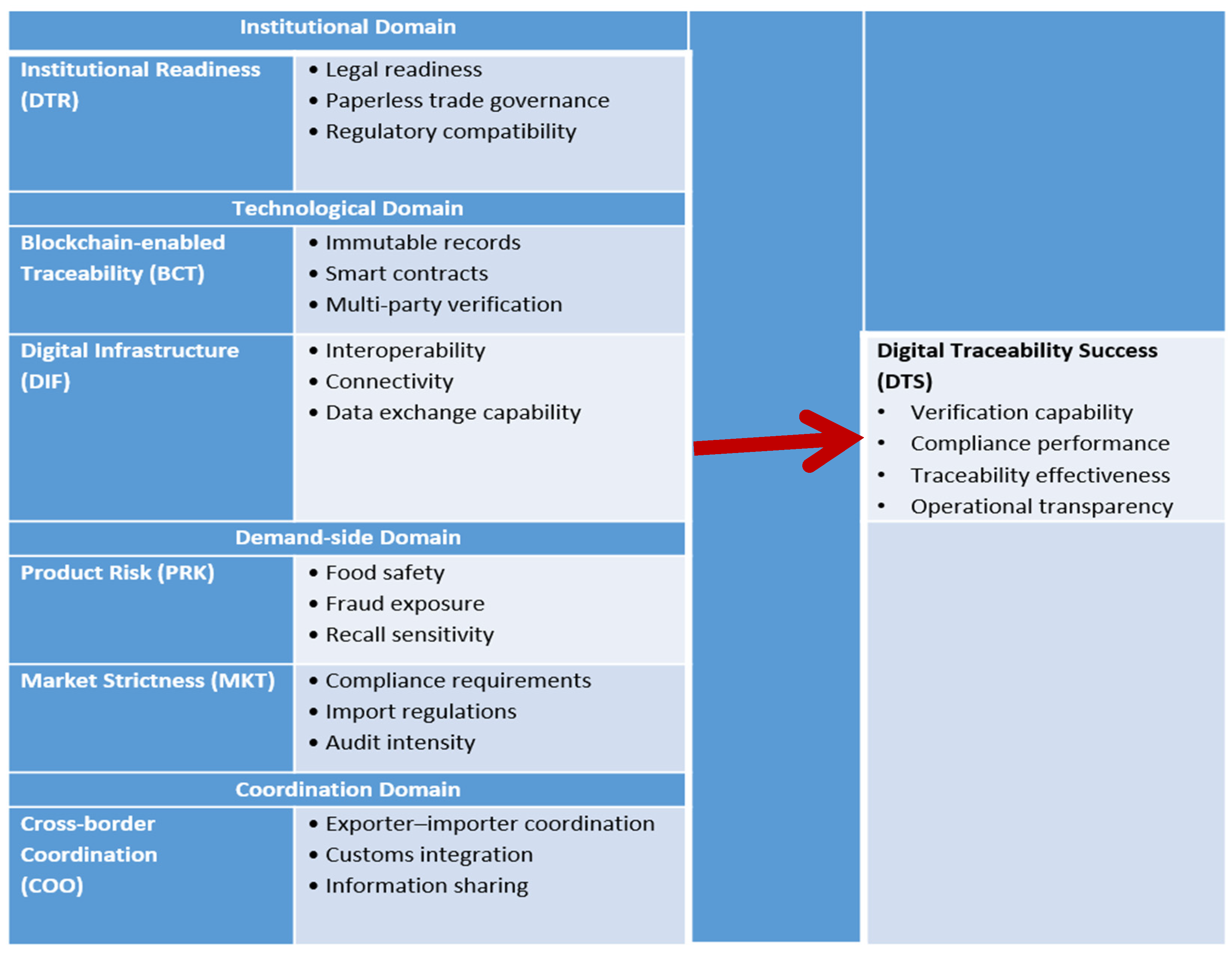
3.5. A Layered Configurational Model of Digital Traceability Success
3.6. Theoretical Proposition
4. Research Methods
4.1. Research Design and Unit of Analysis
4.2. Data Sources and Case Evidence
4.3. Outcome and Causal Conditions
4.4. Calibration Strategy
- Full membership: 0.95;
- Crossover point: 0.50;
- Full non-membership: 0.05.
4.5. Necessity Analysis
4.6. Sufficiency Analysis
4.7. Robustness and Sensitivity Checks
4.8. Methodological Positioning
5. Results
5.1. Calibration of the fsQCA Conditions and Outcome
5.2. Descriptive Statistics of the Calibrated Sets
5.3. Necessary Conditions for DTS
5.4. Sufficient Conditions for DTS
5.5. Robustness Checks
6. Discussions
6.1. Configurational Causality and the Limits of Single-Factor Explanations
6.2. Layered Causal Structure: Necessary Context vs. Sufficient Activation
6.3. Convergence Rather than Equifinality
6.4. Implications for Trade Corridors and Development Strategies
7. Conclusions
Author Contributions
Funding
Institutional Review Board Statement
Informed Consent Statement
Data Availability Statement
Conflicts of Interest
Appendix A

| Abbreviation | Full Variable Name | Definition |
|---|---|---|
| DTS | Digital Traceability Success | The realized performance of a trade corridor’s traceability system, reflected in its ability to capture, verify, disseminate, and use product- and transaction-level information across the trade process. This construct is outcome-oriented and is assessed as a composite of traceability performance dimensions rather than as a bundle of enabling conditions. |
| DTR | Digital Trade Readiness | The extent to which a country or trade corridor is institutionally, legally, and technically prepared to support digital trade. This includes the recognition of electronic documents and signatures, implementation of paperless trade systems, operation of national single window mechanisms, and alignment with international digital trade frameworks and standards. |
| BCT | Blockchain-enabled Traceability | Extent to which blockchain-enabled traceability systems are embedded in cross-border trade processes, including immutable record-keeping, decentralized data governance, smart-contract execution, multi-party verification, and integrity-enhancing traceability functions across supply-chain actors. |
| PRK | Product Risk | The level of inherent risk associated with the traded product, including food safety concerns, susceptibility to counterfeiting, regulatory sensitivity, perishability, and the likelihood of recalls or compliance violations, thereby increasing the demand for robust traceability mechanisms. |
| MKT | Market Strictness | The degree of regulatory stringency imposed by the destination market, including sanitary and phytosanitary (SPS) measures, technical barriers to trade (TBT), ESG-related requirements, traceability mandates, and the intensity of regulatory enforcement. |
| DIF | Digital Infrastructure | The availability, quality, and integration of digital and logistics infrastructure supporting data exchange and traceability, including internet connectivity, digital platforms, customs information systems, interoperability standards, and the deployment of enabling technologies such as IoT and RFID. |
| COO | Cross-border Coordination | The extent of coordination and integration among cross-border supply-chain actors, including data-sharing practices, institutional collaboration, standards alignment, inter-organizational trust, and the degree of integration among exporters, logistics providers, customs authorities, and technology platforms. |
| Cases | DTS | DTR | BCT | PRK | MKT | DIF | COO |
|---|---|---|---|---|---|---|---|
| Vietnam seafood → EU | 0.85 | 0.80 | 0.60 | 0.95 | 0.95 | 0.65 | 0.80 |
| Vietnam seafood → Japan | 0.80 | 0.78 | 0.50 | 0.85 | 0.80 | 0.65 | 0.80 |
| Vietnam seafood → US | 0.85 | 0.80 | 0.65 | 0.95 | 0.95 | 0.65 | 0.80 |
| Thailand fruit → EU | 0.82 | 0.82 | 0.55 | 0.85 | 0.95 | 0.75 | 0.80 |
| Thailand fruit → Japan | 0.78 | 0.80 | 0.50 | 0.75 | 0.80 | 0.75 | 0.80 |
| Vietnam seafood → ASEAN | 0.60 | 0.60 | 0.30 | 0.60 | 0.50 | 0.55 | 0.60 |
| Thailand fruit → China | 0.70 | 0.75 | 0.45 | 0.65 | 0.70 | 0.80 | 0.70 |
| Indonesia palm-oil → India | 0.65 | 0.65 | 0.40 | 0.80 | 0.60 | 0.60 | 0.60 |
| Brazil agro → Middle East | 0.70 | 0.75 | 0.45 | 0.60 | 0.60 | 0.70 | 0.70 |
| India pharma → ASEAN | 0.72 | 0.70 | 0.50 | 0.95 | 0.60 | 0.65 | 0.60 |
| Peru produce → China | 0.70 | 0.72 | 0.45 | 0.70 | 0.70 | 0.70 | 0.70 |
| India pharma → EU | 0.90 | 0.85 | 0.70 | 0.98 | 0.98 | 0.75 | 0.90 |
| Vietnam garments → EU | 0.82 | 0.80 | 0.55 | 0.80 | 0.95 | 0.65 | 0.85 |
| Vietnam garments → US | 0.82 | 0.80 | 0.55 | 0.85 | 0.95 | 0.65 | 0.85 |
| Bangladesh garments → EU | 0.78 | 0.70 | 0.50 | 0.85 | 0.95 | 0.60 | 0.80 |
| Vietnam electronics → EU | 0.85 | 0.82 | 0.60 | 0.65 | 0.85 | 0.80 | 0.90 |
| Vietnam furniture → US | 0.75 | 0.75 | 0.45 | 0.60 | 0.85 | 0.65 | 0.70 |
| Malaysia electronics → Japan | 0.90 | 0.88 | 0.65 | 0.60 | 0.80 | 0.90 | 0.95 |
| Vietnam garments → ASEAN | 0.65 | 0.60 | 0.30 | 0.50 | 0.50 | 0.60 | 0.60 |
| Vietnam electronics → ASEAN | 0.68 | 0.62 | 0.35 | 0.45 | 0.50 | 0.65 | 0.65 |
| Indonesia manuf → ASEAN | 0.60 | 0.60 | 0.30 | 0.40 | 0.50 | 0.55 | 0.55 |
| Turkey furniture → Middle East | 0.70 | 0.70 | 0.40 | 0.50 | 0.55 | 0.70 | 0.65 |
| Mexico automotive → LatAm | 0.80 | 0.78 | 0.55 | 0.60 | 0.65 | 0.75 | 0.85 |
| Poland industrial → E. Europe | 0.85 | 0.85 | 0.60 | 0.50 | 0.70 | 0.85 | 0.90 |
| DTS Data-Collection Sheet for fsQCA | ||
| Case | DTS (to Be Coded as a Composite of Depth, Width, Auditability, Interoperability, Compliance Effectiveness, and Verification Speed) | Main Official Inputs to Collect |
| Vietnam seafood → EU | DTS_i = calibrated fuzzy-set composite | UNTF economy page for Viet Nam and the EU market; World Bank LPI 2023; DTRR; corridor documents |
| Vietnam seafood → Japan | DTS_i = calibrated fuzzy-set composite | UNTF economy page for Viet Nam and Japan; World Bank LPI 2023; DTRR; corridor documents |
| Vietnam seafood → US | DTS_i = calibrated fuzzy-set composite | UNTF economy page for Viet Nam and the US; World Bank LPI 2023; DTRR; corridor documents |
| Thailand fruit → EU | DTS_i = calibrated fuzzy-set composite | UNTF economy page for Thailand and the EU market; World Bank LPI 2023; DTRR; corridor documents |
| Thailand fruit → Japan | DTS_i = calibrated fuzzy-set composite | UNTF economy page for Thailand and Japan; World Bank LPI 2023; DTRR; corridor documents |
| Vietnam seafood → ASEAN | DTS_i = calibrated fuzzy-set composite | UNTF economy page for Viet Nam and ASEAN-related grouping; World Bank LPI 2023; DTRR; corridor documents |
| Thailand fruit → China | DTS_i = calibrated fuzzy-set composite | UNTF economy page for Thailand and China; World Bank LPI 2023; DTRR; corridor documents |
| Indonesia palm-oil chain → India | DTS_i = calibrated fuzzy-set composite | UNTF economy pages for Indonesia and India; World Bank LPI 2023; DTRR; corridor documents |
| Brazil agro-products → Middle East | DTS_i = calibrated fuzzy-set composite | UNTF economy page for Brazil and destination-market economy/region; World Bank LPI 2023; DTRR; corridor documents |
| India pharmaceuticals → ASEAN | DTS_i = calibrated fuzzy-set composite | UNTF economy pages for India and ASEAN grouping; World Bank LPI 2023; DTRR; corridor documents |
| Peru fresh produce → China | DTS_i = calibrated fuzzy-set composite | UNTF economy pages for Peru and China; World Bank LPI 2023; DTRR; corridor documents |
| India pharmaceuticals → EU | DTS_i = calibrated fuzzy-set composite | UNTF economy pages for India and EU market; World Bank LPI 2023; DTRR; corridor documents |
| Vietnam garments → EU | DTS_i = calibrated fuzzy-set composite | UNTF economy page for Viet Nam and EU market; World Bank LPI 2023; DTRR; corridor documents |
| Vietnam garments → US | DTS_i = calibrated fuzzy-set composite | UNTF economy page for Viet Nam and the US; World Bank LPI 2023; DTRR; corridor documents |
| Bangladesh garments → EU | DTS_i = calibrated fuzzy-set composite | UNTF economy page for Bangladesh and EU market; World Bank LPI 2023; DTRR; corridor documents |
| Vietnam electronics components → EU | DTS_i = calibrated fuzzy-set composite | UNTF economy page for Viet Nam and EU market; World Bank LPI 2023; DTRR; corridor documents |
| Vietnam furniture → US | DTS_i = calibrated fuzzy-set composite | UNTF economy page for Viet Nam and the US; World Bank LPI 2023; DTRR; corridor documents |
| Malaysia electronics components → Japan | DTS_i = calibrated fuzzy-set composite | UNTF economy pages for Malaysia and Japan; World Bank LPI 2023; DTRR; corridor documents |
| Vietnam garments → ASEAN | DTS_i = calibrated fuzzy-set composite | UNTF economy page for Viet Nam and ASEAN-related grouping; World Bank LPI 2023; DTRR; corridor documents |
| Vietnam electronics components → ASEAN | DTS_i = calibrated fuzzy-set composite | UNTF economy page for Viet Nam and ASEAN-related grouping; World Bank LPI 2023; DTRR; corridor documents |
| Indonesia manufactured goods → ASEAN | DTS_i = calibrated fuzzy-set composite | UNTF economy page for Indonesia and ASEAN-related grouping; World Bank LPI 2023; DTRR; corridor documents |
| Turkey furniture → Middle East | DTS_i = calibrated fuzzy-set composite | UNTF economy page for Türkiye and destination-market economy/region; World Bank LPI 2023; DTRR; corridor documents |
| Mexico automotive components → Latin America | DTS_i = calibrated fuzzy-set composite | UNTF economy page for Mexico and Latin America/Caribbean grouping; World Bank LPI 2023; DTRR; corridor documents |
| Poland industrial parts → Eastern Europe | DTS_i = calibrated fuzzy-set composite | UNTF economy page for Poland and Eastern Europe grouping; World Bank LPI 2023; DTRR; corridor documents |
| BCT Case Table (24 Cases) | ||
| Case | BCT (to Be Coded as Fuzzy-Set Composite) | Main Evidence Sources to Collect |
| Vietnam seafood → EU | BCT_i = calibrated adoption & integration score | Pilot blockchain seafood traceability projects (EU IUU compliance, QR traceability, platform providers) |
| Vietnam seafood → Japan | BCT_i = calibrated adoption & integration score | Export platform use, traceability digitization, limited blockchain pilots |
| Vietnam seafood → US | BCT_i = calibrated adoption & integration score | FDA traceability rules, private blockchain pilots (retailer-driven) |
| Thailand fruit → EU | BCT_i = calibrated adoption & integration score | Agro-blockchain pilots, certification traceability platforms |
| Thailand fruit → Japan | BCT_i = calibrated adoption & integration score | Digital traceability, limited blockchain deployment |
| Vietnam seafood → ASEAN | BCT_i = calibrated adoption & integration score | Mostly non-blockchain traceability (QR/ERP-based systems) |
| Thailand fruit → China | BCT_i = calibrated adoption & integration score | E-commerce-driven traceability, some blockchain pilots |
| Indonesia palm-oil chain → India | BCT_i = calibrated adoption & integration score | Sustainability traceability initiatives, partial blockchain use |
| Brazil agro-products → Middle East | BCT_i = calibrated adoption & integration score | Agro-export traceability platforms, emerging blockchain pilots |
| India pharmaceuticals → ASEAN | BCT_i = calibrated adoption & integration score | Serialization systems, limited blockchain integration |
| Peru fresh produce → China | BCT_i = calibrated adoption & integration score | Export traceability platforms, QR-based, limited blockchain |
| India pharmaceuticals → EU | BCT_i = calibrated adoption & integration score | Strong serialization + emerging blockchain pilots for compliance |
| Vietnam garments → EU | BCT_i = calibrated adoption & integration score | ESG traceability platforms, some blockchain adoption |
| Vietnam garments → US | BCT_i = calibrated adoption & integration score | Buyer-driven traceability systems, partial blockchain use |
| Bangladesh garments → EU | BCT_i = calibrated adoption & integration score | Sustainability traceability pilots, blockchain pilots (limited scale) |
| Vietnam electronics components → EU | BCT_i = calibrated adoption & integration score | Supply chain traceability, limited blockchain but high digitization |
| Vietnam furniture → US | BCT_i = calibrated adoption & integration score | Certification traceability, mostly non-blockchain |
| Malaysia electronics components → Japan | BCT_i = calibrated adoption & integration score | High-tech supply chain, some blockchain integration |
| Vietnam garments → ASEAN | BCT_i = calibrated adoption & integration score | Low blockchain adoption, mostly traditional systems |
| Vietnam electronics components → ASEAN | BCT_i = calibrated adoption & integration score | Low blockchain adoption |
| Indonesia manufactured goods → ASEAN | BCT_i = calibrated adoption & integration score | Minimal blockchain usage |
| Turkey furniture → Middle East | BCT_i = calibrated adoption & integration score | Limited blockchain traceability |
| Mexico automotive components → Latin America | BCT_i = calibrated adoption & integration score | Automotive supply chain digitization, some blockchain pilots |
| Poland industrial parts → Eastern Europe | BCT_i = calibrated adoption & integration score | Industrial traceability systems, emerging blockchain pilots |
| PRK Case Table (24 Cases) | ||
| Case | PRK (Fuzzy-Set Score to Be Calibrated) | Risk Profile (Evidence-Based Interpretation) |
| Vietnam seafood → EU | PRK_i | Very high (IUU fishing, food safety, EU strict SPS) |
| Vietnam seafood → Japan | PRK_i | High (strict but slightly less than EU) |
| Vietnam seafood → US | PRK_i | Very high (FDA FSMA, traceability rule) |
| Thailand fruit → EU | PRK_i | High (pesticide residues, SPS) |
| Thailand fruit → Japan | PRK_i | Medium–high |
| Vietnam seafood → ASEAN | PRK_i | Medium (lower regulatory pressure) |
| Thailand fruit → China | PRK_i | Medium (growing SPS enforcement) |
| Indonesia palm-oil → India | PRK_i | High (sustainability + certification controversy) |
| Brazil agro-products → Middle East | PRK_i | Medium |
| India pharmaceuticals → ASEAN | PRK_i | Very high (counterfeit + safety risk) |
| Peru fresh produce → China | PRK_i | Medium–high |
| India pharmaceuticals → EU | PRK_i | Extremely high (GMP, anti-counterfeit) |
| Vietnam garments → EU | PRK_i | Medium–high (ESG, forced labor scrutiny) |
| Vietnam garments → US | PRK_i | High (Uyghur Forced Labor Prevention Act logic) |
| Bangladesh garments → EU | PRK_i | High (labor + ESG compliance) |
| Vietnam electronics → EU | PRK_i | Medium (technical compliance, RoHS) |
| Vietnam furniture → US | PRK_i | Medium (legality of timber, Lacey Act) |
| Malaysia electronics → Japan | PRK_i | Medium–low |
| Vietnam garments → ASEAN | PRK_i | Low–medium |
| Vietnam electronics → ASEAN | PRK_i | Low |
| Indonesia manufactured goods → ASEAN | PRK_i | Low |
| Turkey furniture → Middle East | PRK_i | Low–medium |
| Mexico automotive → Latin America | PRK_i | Medium (safety standards) |
| Poland industrial parts → Eastern Europe | PRK_i | Low–medium |
| MKT (Destination-Market Strictness) | ||
| Case | MKT (to Be Calibrated) | Market Strictness Profile |
| Vietnam seafood → EU | MKT_i | Very high (strict SPS, IUU, ESG, traceability regulations) |
| Vietnam seafood → Japan | MKT_i | High (strict food safety, quality standards) |
| Vietnam seafood → US | MKT_i | Very high (FDA FSMA, traceability rule, import controls) |
| Thailand fruit → EU | MKT_i | Very high (pesticide limits, SPS, certification) |
| Thailand fruit → Japan | MKT_i | High |
| Vietnam seafood → ASEAN | MKT_i | Low–medium (heterogeneous, weaker enforcement) |
| Thailand fruit → China | MKT_i | Medium–high (rapidly tightening SPS controls) |
| Indonesia palm-oil → India | MKT_i | Medium (less strict but politically sensitive) |
| Brazil agro-products → Middle East | MKT_i | Medium |
| India pharmaceuticals → ASEAN | MKT_i | Medium (varying regulatory quality) |
| Peru fresh produce → China | MKT_i | Medium–high |
| India pharmaceuticals → EU | MKT_i | Extremely high (GMP, serialization, anti-counterfeit) |
| Vietnam garments → EU | MKT_i | Very high (ESG, due diligence, sustainability rules) |
| Vietnam garments → US | MKT_i | Very high (forced labor regulation, compliance audits) |
| Bangladesh garments → EU | MKT_i | Very high |
| Vietnam electronics components → EU | MKT_i | High (RoHS, CE marking, technical standards) |
| Vietnam furniture → US | MKT_i | High (Lacey Act, legality requirements) |
| Malaysia electronics components → Japan | MKT_i | Medium–high |
| Vietnam garments → ASEAN | MKT_i | Low–medium |
| Vietnam electronics components → ASEAN | MKT_i | Low |
| Indonesia manufactured goods → ASEAN | MKT_i | Low |
| Turkey furniture → Middle East | MKT_i | Low–medium |
| Mexico automotive components → Latin America | MKT_i | Medium |
| Poland industrial parts → Eastern Europe | MKT_i | Medium–low |
| DIF (Digital Infrastructure) | ||
| Case | DIF (to Be Calibrated) | Digital Infrastructure Profile |
| Vietnam seafood → EU | DIF_i | Medium–high (Vietnam moderate, EU very high → constraint from exporter side) |
| Vietnam seafood → Japan | DIF_i | Medium–high |
| Vietnam seafood → US | DIF_i | Medium–high |
| Thailand fruit → EU | DIF_i | High (Thailand relatively strong + EU very high) |
| Thailand fruit → Japan | DIF_i | High |
| Vietnam seafood → ASEAN | DIF_i | Medium (heterogeneous ASEAN digital gap) |
| Thailand fruit → China | DIF_i | High (China strong digital systems) |
| Indonesia palm-oil → India | DIF_i | Medium |
| Brazil agro-products → Middle East | DIF_i | Medium–high |
| India pharmaceuticals → ASEAN | DIF_i | Medium |
| Peru fresh produce → China | DIF_i | Medium–high |
| India pharmaceuticals → EU | DIF_i | High |
| Vietnam garments → EU | DIF_i | Medium–high |
| Vietnam garments → US | DIF_i | Medium–high |
| Bangladesh garments → EU | DIF_i | Medium (infrastructure constraint) |
| Vietnam electronics components → EU | DIF_i | High (sector-specific digital capability strong) |
| Vietnam furniture → US | DIF_i | Medium |
| Malaysia electronics components → Japan | DIF_i | Very high (Malaysia + Japan both advanced) |
| Vietnam garments → ASEAN | DIF_i | Medium |
| Vietnam electronics components → ASEAN | DIF_i | Medium |
| Indonesia manufactured goods → ASEAN | DIF_i | Medium–low |
| Turkey furniture → Middle East | DIF_i | Medium–high |
| Mexico automotive components → Latin America | DIF_i | Medium–high |
| Poland industrial parts → Eastern Europe | DIF_i | High |
| COO (Cross-Border Coordination/Partner Integration) | ||
| Case | COO (to Be Calibrated) | Cross-Border Coordination Profile |
| Vietnam seafood → EU | COO_i | High (strong buyer–supplier integration, certification, traceability compliance chains) |
| Vietnam seafood → Japan | COO_i | High (stable long-term partnerships, coordinated standards) |
| Vietnam seafood → US | COO_i | High (retailer-driven integration, compliance coordination) |
| Thailand fruit → EU | COO_i | High (export-oriented coordination + certification bodies) |
| Thailand fruit → Japan | COO_i | High |
| Vietnam seafood → ASEAN | COO_i | Medium (less formalized coordination) |
| Thailand fruit → China | COO_i | Medium–high (platform-driven coordination) |
| Indonesia palm-oil → India | COO_i | Medium (fragmented supply chain, partial coordination) |
| Brazil agro-products → Middle East | COO_i | Medium–high |
| India pharmaceuticals → ASEAN | COO_i | Medium |
| Peru fresh produce → China | COO_i | Medium–high |
| India pharmaceuticals → EU | COO_i | Very high (strict GMP coordination, multi-actor compliance integration) |
| Vietnam garments → EU | COO_i | High (buyer-driven supply chain governance, ESG monitoring) |
| Vietnam garments → US | COO_i | High |
| Bangladesh garments → EU | COO_i | High (compliance-driven coordination) |
| Vietnam electronics components → EU | COO_i | Very high (deep integration in global value chains) |
| Vietnam furniture → US | COO_i | Medium–high |
| Malaysia electronics components → Japan | COO_i | Very high (highly integrated production networks) |
| Vietnam garments → ASEAN | COO_i | Medium |
| Vietnam electronics components → ASEAN | COO_i | Medium |
| Indonesia manufactured goods → ASEAN | COO_i | Medium–low |
| Turkey furniture → Middle East | COO_i | Medium |
| Mexico automotive components → Latin America | COO_i | High (regional production networks) |
| Poland industrial parts → Eastern Europe | COO_i | High (EU-integrated supply chains) |
| Robustness Scenario | Frequency Threshold | Consistency Threshold | PRI Consistency | Resulting Solution | Solution Consistency | Solution Coverage | Interpretation |
|---|---|---|---|---|---|---|---|
| Baseline model | 1 | 0.80 | 0.70 | Same core configuration retained | 1.000 | 0.742 | Original solution supported |
| Higher consistency threshold | 1 | 0.85 | 0.70 | Same configuration retained | 1.000 | 0.721 | Results remain stable |
| Higher PRI threshold | 1 | 0.80 | 0.75 | Same configuration retained | 1.000 | 0.713 | No contradictory configuration observed |
| Increased frequency threshold | 2 | 0.80 | 0.70 | Core pathway retained | 1.000 | 0.695 | Solution remains empirically robust |
| Conservative specification | 2 | 0.85 | 0.75 | Core configuration retained with reduced peripheral coverage | 1.000 | 0.668 | Findings remain substantively consistent |
References
- Aung, M.M.; Chang, Y.S. Traceability in a food supply chain: Safety and quality perspectives. Food Control 2014, 39, 172–184. [Google Scholar] [CrossRef]
- Casino, F.; Kanakaris, V.; Dasaklis, T.K.; Moschuris, S.; Stachtiaris, S.; Pagoni, M.; Rachaniotis, N.P. Blockchain-based food supply chain traceability: A case study in the dairy sector. Int. J. Prod. Res. 2021, 59, 5758–5770. [Google Scholar] [CrossRef]
- Centobelli, P.; Cerchione, R.; Del Vecchio, P.; Oropallo, E.; Secundo, G. Blockchain technology for bridging trust, traceability and transparency in circular supply chain. Inf. Manag. 2022, 59, 103508. [Google Scholar] [CrossRef]
- Saberi, S.; Kouhizadeh, M.; Sarkis, J.; Shen, L. Blockchain technology and its relationships to sustainable supply chain management. Int. J. Prod. Res. 2019, 57, 2117–2135. [Google Scholar] [CrossRef]
- Agrawal, T.K.; Kumar, V.; Pal, R.; Wang, L.; Chen, Y. Blockchain-based framework for supply chain traceability: A case example of textile and clothing industry. Comput. Ind. Eng. 2021, 154, 107130. [Google Scholar] [CrossRef]
- Ahmed, W.A.H.; MacCarthy, B.L. Blockchain-enabled supply chain traceability: How wide? How deep? Int. J. Prod. Econ. 2023, 263, 108963. [Google Scholar] [CrossRef]
- Kittipanya-ngam, P.; Tan, K.H. A framework for food supply chain digitalization: Lessons from Thailand. Prod. Plan. Control 2020, 31, 158–172. [Google Scholar] [CrossRef]
- Lohmer, J.; Lasch, R. Blockchain in operations management and manufacturing: Potential and barriers. Comput. Ind. Eng. 2020, 149, 106789. [Google Scholar] [CrossRef]
- Treiblmaier, H. The impact of the blockchain on the supply chain: A theory-based research framework and a call for action. Supply Chain Manag. Int. J. 2018, 23, 545–559. [Google Scholar] [CrossRef]
- APEC. A Path to Paperless Trade: Analysing the Legal Gaps and Pathways for Electronic Transferable Records and Digitised Trade Documents in International Trade; Asia-Pacific Economic Cooperation: Singapore, 2025. [Google Scholar]
- Ferracane, M.F.; González-Ugarte, S.; Rogaler, T. Global trends in digital trade policies and practices: Evidence from the Digital Trade Integration Database. World Trade Rev. 2025, 25, 127–151. [Google Scholar] [CrossRef]
- International Monetary Fund; Organisation for Economic Co-Operation and Development; United Nations Conference on Trade and Development; World Trade Organization. Handbook on Measuring Digital Trade, 2nd ed.; International Monetary Fund: Washington, DC, USA, 2023. [Google Scholar] [CrossRef]
- Organisation for Economic Co-Operation and Development. The Digitalisation of Trade Documents and Processes: Going Paperless Today, Going Paperless Tomorrow; OECD Trade Policy Paper No. 297; OECD Publishing: Paris, France, 2025. [Google Scholar]
- United Nations. UN Global Survey on Digital and Sustainable Trade Facilitation 2025; United Nations: Geneva, Switzerland, 2025. [Google Scholar]
- World Trade Organization. World Trade Report 2025: Making Trade and AI Work Together to the Benefit of All; World Trade Organization: Geneva, Switzerland, 2025. [Google Scholar]
- Abobassier, A.; Khadem, A.; Aljuhmani, H.Y.; Alzubi, A.B. Unlocking sustainable supply chains through blockchain traceability: The strategic roles of transparency, collaboration, and environmental orientation. Sustainability 2026, 18, 4138. [Google Scholar] [CrossRef]
- Agrawal, N.; Modgil, S.; Kaliyan, M. Role of blockchain toward supply chain finance in circular economy: A review and future agenda. Benchmarking Int. J. 2026, ahead of print. [Google Scholar] [CrossRef]
- Asante-Darko, D.; Osei, V.; Aryee, R. Pharmaceutical supply chain blockchain adoption barriers and drivers in developing countries: A DEMATEL approach. Benchmarking Int. J. 2026, ahead of print. [Google Scholar] [CrossRef]
- Bekkouche, S.; de-Magistris, T. Digitalization in the European agri-food supply chain: A scoping review of traceability, transparency, and sustainability. Front. Blockchain 2025, 8, 1701872. [Google Scholar] [CrossRef]
- Duong, C.D.; Tran, T.V.H.; Nguyen, T.H.; Ngo, T.V.N.; Vu, T.N. Blockchain-based food traceability system and pro-environmental consumption: A moderated mediation model of technology anxiety and trust in organic food products. Digit. Bus. 2024, 4, 100095. [Google Scholar] [CrossRef]
- Duong, C.D.; Dao, T.T.; Vu, T.N.; Ngo, T.V.N.; Nguyen, M.H. Blockchain-enabled food traceability system and consumers’ organic food consumption: A moderated mediation model of blockchain knowledge and trust in the organic food chain. Sustain. Futures 2024, 8, 100316. [Google Scholar] [CrossRef]
- Karaduman, Ö.; Gülhas, G. Blockchain-enabled supply chain management: A review of security, traceability and data integrity amid evolving systemic demand. Appl. Sci. 2025, 15, 5168. [Google Scholar] [CrossRef]
- Nguyen, H.T.M.; Dang, H.B.; Nguyen, A.V.T.; Nguyen, H.N.; Nguyen, P.V. Evaluating digital transformation risks in logistics and supply chain management with PLS-SEM-ANN-fsQCA. Emerg. Sci. J. 2025, 9, 3288–3318. [Google Scholar] [CrossRef]
- Rani, P.; Gaba, P.; Bhawana. TOU: Dynamic pricing model and traceability for blockchain-based water supply chain. Peer-to-Peer Netw. Appl. 2026, 19, 77. [Google Scholar] [CrossRef]
- Sharma, M.; AlNuaimi, B.K.; Khan, M.; Alghafes, R.; Pandey, R. Blockchain-enabled dynamic capabilities for supply chain ambidexterity: Empirical evidence from manufacturing firms for enhanced competence and flexibility. Technol. Forecast. Soc. Change 2026, 226, 124467. [Google Scholar] [CrossRef]
- Xie, S.; Gong, Y.; Kunc, M.; New, S. Blockchain as information processing: Experiences in recycling chains. Supply Chain Manag. Int. J. 2026, ahead of print. [Google Scholar] [CrossRef]
- Pappas, I.O.; Woodside, A.G. Fuzzy-set qualitative comparative analysis (fsQCA): Guidelines for research practice in information systems and marketing. Int. J. Inf. Manag. 2021, 58, 102310. [Google Scholar] [CrossRef]
- Ragin, C.C. Redesigning Social Inquiry: Fuzzy Sets and Beyond; University of Chicago Press: Chicago, IL, USA, 2008. [Google Scholar]
- Saridakis, C.; Zaefarian, G.; Ganotakis, P.; Angelidou, S. A step-by-step guide of fuzzy-set qualitative comparative analysis: From theory to practice via an implementation in a B2B context. Ind. Mark. Manag. 2022, 107, 92–107. [Google Scholar] [CrossRef]
- Schneider, C.Q.; Wagemann, C. Set-Theoretic Methods for the Social Sciences: A Guide to Qualitative Comparative Analysis; Cambridge University Press: Cambridge, UK, 2012. [Google Scholar]
- Ganne, E.; Nguyen, H. Standards Toolkit for Cross-Border Paperless Trade: Accelerating Trade Digitalisation Through the Use of Standards; World Trade Organization and International Chamber of Commerce: Geneva, Switzerland; Paris, France, 2022. [Google Scholar]
- Kshetri, N. Blockchain’s roles in meeting key supply chain management objectives. Int. J. Inf. Manag. 2018, 39, 80–89. [Google Scholar] [CrossRef]
- Ahmed, W.A.H.; MacCarthy, B.L. Blockchain-enabled supply chain traceability in the textile and apparel supply chain: A case study of the fiber producer, Lenzing. Sustainability 2021, 13, 10496. [Google Scholar] [CrossRef]
- Romeo, E.; Virglerova, Z.; Giampaola, V. Cultural and organizational challenges of adopting technology, traceability and blockchain in the Italian agri-food supply chain: A qualitative study. Br. Food J. 2025, ahead of print. [Google Scholar] [CrossRef]
- Sahoo, S. Blockchain-enabled traceability systems for supply chain quality management: Empirical insights from pharmaceutical manufacturers. Int. J. Qual. Reliab. Manag. 2024, ahead of print. [Google Scholar] [CrossRef]
- Tao, Z.; Chao, J. The impact of a blockchain-based food traceability system on the online purchase intention of organic agricultural products. Innov. Food Sci. Emerg. Technol. 2024, 92, 103598. [Google Scholar] [CrossRef]
- Naoum-Sawaya, J.; Elhedhli, S.; De Carvalho, P. Strategic blockchain adoption to deter deceptive counterfeiters. Eur. J. Oper. Res. 2023, 311, 373–386. [Google Scholar] [CrossRef]
- Cai, Y.-J.; Choi, T.-M.; Zhang, J. Platform supported supply chain operations in the blockchain era: Supply contracting and moral hazards. Decis. Sci. 2020, 51, 866–892. [Google Scholar] [CrossRef]
- Yang, L.; Ni, Y.; Ng, C.T. Blockchain-enabled traceability and producer’s incentive to outsource delivery. Int. J. Prod. Res. 2023, 61, 3811–3828. [Google Scholar] [CrossRef]
- Zhang, Q.; Jiang, X.; Zheng, Y. Blockchain adoption and gray markets in a global supply chain. Omega 2023, 115, 102785. [Google Scholar] [CrossRef]
- Zhao, S.; Li, W. Blockchain-based traceability system adoption decision in the dual-channel perishable goods market under different pricing policies. Int. J. Prod. Res. 2023, 61, 4548–4574. [Google Scholar] [CrossRef]
- Biswas, D.; Jalali, H.; Ansaripoor, A.H.; De Giovanni, P. Traceability vs. sustainability in supply chains: The implications of blockchain. Eur. J. Oper. Res. 2023, 305, 128–147. [Google Scholar] [CrossRef]
- Köhler, S.; Pizzol, M. Technology assessment of blockchain-based technologies in the food supply chain. J. Clean. Prod. 2020, 269, 122193. [Google Scholar] [CrossRef]
- Pandey, A.K.; Habibi, M.K.; Pratap, S.; Bagchi, A. Exploring barriers to blockchain technology adoption in global supply chains. Benchmarking Int. J. 2026, ahead of print. [Google Scholar] [CrossRef]
- Zhou, Y.; Zhang, X.; Liu, H. Key factors and path selection for enterprise digital transformation: Configuration analysis based on fsQCA. Front. Sustain. 2024, 5, 1366129. [Google Scholar] [CrossRef]
- United Nations Commission on International Trade Law. Model Law on Electronic Transferable Records (MLETR); United Nations: New York, NY, USA, 2017. [Google Scholar]
- Zeng, F.; Chen, A.; Xu, S.; Chan, H.K.; Li, Y. Digitalization in the maritime logistics industry: A systematic literature review of enablers and barriers. J. Mar. Sci. Eng. 2025, 13, 797. [Google Scholar] [CrossRef]
- World Bank; International Monetary Fund; Organisation for Economic Co-Operation and Development; United Nations; World Trade Organization. Digital Trade for Development; World Bank: Washington, DC, USA, 2025. [Google Scholar]
- World Trade Organization. Cross-Border Paperless Trade Toolkit; World Trade Organization: Geneva, Switzerland, 2022. [Google Scholar]

| Dimension | Condition | Core Function | What It Captures | What It Is NOT |
|---|---|---|---|---|
| Institutional | DTR | Legal readiness | e-documents, policy frameworks | Not infrastructure |
| Institutional | MKT | Regulatory pressure | SPS, ESG enforcement | Not product risk |
| Technological | DIF | System capacity | IT systems, interoperability | Not governance |
| Technological | BCT | Architecture choice | Blockchain deployment | Not overall digitalization |
| Relational | COO | Actor alignment | trust, coordination | Not infrastructure |
| Demand-side | PRK | Traceability need | risk, fraud, safety | Not regulation |
| Set | Full Membership (0.95) | Crossover (0.50) | Full Non-Membership (0.05) | Coding Basis |
|---|---|---|---|---|
| DTS | Fully integrated, real-time, auditable traceability | Partial/fragmented traceability | Minimal or no digital traceability | Composite (6 dimensions) |
| DTR | Full legal + institutional readiness (e-docs, NSW, recognition) | Partial readiness | Weak or absent frameworks | WTO, UNTF, policy docs |
| DIF | High interoperability + digital logistics systems | Moderate/fragmented systems | Weak infrastructure | LPI, ICT indicators |
| COO | Strong multi-actor coordination, stable governance | Partial coordination | Fragmented relationships | Case/corridor evidence |
| PRK | High-risk (pharma, seafood, etc.) | Medium-risk | Low-risk goods | Sector characteristics |
| MKT | Very strict regulatory regimes (EU, US) | Moderate | Low enforcement | SPS/TBT, ESG rules |
| BCT | Fully integrated blockchain use | Pilot/partial use | No blockchain | Tech deployment evidence |
| Set/Variable | Mean | SD | Min | Max |
|---|---|---|---|---|
| DTS | 0.761 | 0.090 | 0.600 | 0.900 |
| DTR | 0.747 | 0.084 | 0.600 | 0.880 |
| BCT | 0.494 | 0.114 | 0.300 | 0.700 |
| PRK | 0.705 | 0.175 | 0.400 | 0.980 |
| MKT | 0.745 | 0.174 | 0.500 | 0.980 |
| DIF | 0.690 | 0.090 | 0.550 | 0.900 |
| COO | 0.752 | 0.117 | 0.550 | 0.950 |
| Condition | Consistency | Coverage | Interpretation |
|---|---|---|---|
| DTR | 0.973 | 0.992 | Strong necessary condition |
| BCT | 0.649 | 1.000 | Not a necessary condition |
| PRK | 0.881 | 0.950 | Close to necessity threshold, but below conventional cutoff |
| MKT | 0.926 | 0.946 | Strong necessary condition |
| DIF | 0.900 | 0.994 | Meets conventional necessity threshold |
| COO | 0.972 | 0.983 | Strong necessary condition |
| Solution Term | Raw Coverage | Unique Coverage | Consistency |
|---|---|---|---|
| DTR * PRK * MKT * DIF * COO | 0.796388 | 0.796388 | 1.000000 |
Disclaimer/Publisher’s Note: The statements, opinions and data contained in all publications are solely those of the individual author(s) and contributor(s) and not of MDPI and/or the editor(s). MDPI and/or the editor(s) disclaim responsibility for any injury to people or property resulting from any ideas, methods, instructions or products referred to in the content. |
© 2026 by the authors. Licensee MDPI, Basel, Switzerland. This article is an open access article distributed under the terms and conditions of the Creative Commons Attribution (CC BY) license.
Share and Cite
Do, H.P.; Thuy, B.K.; Dung, N.Q. Configurational Pathways to Digital Traceability Success in International Trade: An fsQCA Study of Trade-Corridor Cases. Sustainability 2026, 18, 6045. https://doi.org/10.3390/su18126045
Do HP, Thuy BK, Dung NQ. Configurational Pathways to Digital Traceability Success in International Trade: An fsQCA Study of Trade-Corridor Cases. Sustainability. 2026; 18(12):6045. https://doi.org/10.3390/su18126045
Chicago/Turabian StyleDo, Hai Phu, Bui Kim Thuy, and Nguyen Quoc Dung. 2026. "Configurational Pathways to Digital Traceability Success in International Trade: An fsQCA Study of Trade-Corridor Cases" Sustainability 18, no. 12: 6045. https://doi.org/10.3390/su18126045
APA StyleDo, H. P., Thuy, B. K., & Dung, N. Q. (2026). Configurational Pathways to Digital Traceability Success in International Trade: An fsQCA Study of Trade-Corridor Cases. Sustainability, 18(12), 6045. https://doi.org/10.3390/su18126045