1. Introduction
Modern geopolitical risks, in particular Russia’s invasion of Ukraine, officially defined by the Law of Ukraine “On the Principles of the State Policy of the National Memory of the Ukrainian People” [
1] as a war since 2014, are among the most likely and critical threats of a global scale and are identified by World Economic Forum in the Global Risks Report 2026 [
2]. The results of this survey of experts indicate that armed conflicts and geoeconomic confrontation are among the leading drivers of systemic risks globally from 2025–2026. Therefore, the importance of conducting research on their impact on global energy security is growing due to the consistent escalation of military threats and their global consequences. Our research contributes to a deeper understanding of the domestic and cross-border spillover effects arising from the protracted Russian–Ukrainian war since 2014 [
1] for European and global energy security.
The full-scale strikes on Ukraine’s energy infrastructure have become a unique in scale and duration precedent for the targeted destruction of the energy system of a major European state. The energy sector, which traditionally serves as the basis for economic activity, social stability and security, has become one of the main targets. In these conditions, the issue of the resilience of the energy system, the ability to withstand shocks, adapt to them and recover, goes beyond purely technical issues and acquires direct economic and geopolitical significance.
The relevance of this study is also due to the fact that the Ukrainian energy system is integrated into the European energy space and connected to the ENTSO-E network. ENTSO-E is the organization uniting Europe’s transmission system operators (TSOs), whose 40 member TSOs, covering 36 countries, oversee the reliable and coordinated management of Europe’s electricity network, constituting the world’s largest interconnected power grid. This means that the destruction of the Ukrainian critical infrastructure has a cross-border effect, creating so-called spillover risks for the EU. Spillover risk is the risk of indirect transmission, transmitting a shock or crisis in one country, industry, company, or market to other actors through various channels (financial, trade, information, etc.), creating additional losses for them. In its most general form, the spillover effect is a situation where an event at “one point” of the system generates undesirable consequences for “non-targeted” participants who were not the direct object of the event [
3,
4]. In finance and macroeconomics, it is described as the transmission of volatility, risk, or crisis shocks between markets, regions, or countries [
5,
6,
7].
This concerns not only technical risks of grid synchronization but also market effects: changes in electricity flows, fluctuations in natural gas and coal prices, and increased demand for imported backup capacity and equipment. Thus, the destruction of the Ukrainian energy system has direct consequences for European energy security. The analysis of its impact on energy systems goes beyond traditional risk categories and requires a conceptual understanding of the ability of systems to withstand, adapt to, and recover from multidimensional shocks. This is what leads to the appeal to the category of “resilience”, which is increasingly used by researchers to interpret the processes associated with the Russian–Ukrainian war.
Thus, in [
8] a comprehensive assessment of the impact of the military actions on the energy system of Ukraine was carried out and the scale of damage to critical infrastructure and financial losses were quantified. They prove that the resilience of the energy system was ensured by a combination of emergency recovery measures, international financial support and regulatory adaptations, in particular in the field of tariff policy and debt restructuring. It is substantiated that the integration of technical, financial and management solutions is a key prerequisite for maintaining Ukraine’s resilience in wartime.
Some authors have considered the category of resilience as an appropriate response to different types of risks. The author of [
9] shows how Russia’s invasion has transformed Europe’s energy landscape from the traditional dependence on Russian energy sources to resilience through supply diversification, energy policy adaptation, and strengthening domestic and cross-border mechanisms for energy supply. The author argues that the war has not only exacerbated energy security risks but also stimulated the strengthening of institutional, market, and technical flexibility of energy systems, allowing European countries to respond more effectively to external shocks. This shift from dependence to resilience underscores the importance of strategic integration, diversification of sources, and adaptation policies in ensuring energy sustainability in the face of prolonged geopolitical upheaval.
Beyond the immediate security implications, the systematic destruction of Ukraine’s energy infrastructure represents a fundamental challenge to the trajectory of the “green” transition and sustainable energy supply across Europe. The massive damage to thermal power plants has paradoxically acted as a catalyst for “forced decarbonization”, pushing the energy system toward a heavier reliance on carbon-free nuclear and renewable sources. However, this transition occurs under conditions of extreme systemic vulnerability and lacks the planned stability of a traditional energy transition. This shift poses significant risks to the social dimension of sustainable development, specifically by exacerbating fuel poverty and threatening equitable access to energy resources, which are core pillars of the UN Sustainable Development Goals (SDGs).
A similar perspective is shared by Tampubolon [
10], who examined the impact of Russia’s full-scale invasion of Ukraine on the transformation of the global geopolitical system through the mechanisms of international sanctions, disruptions of global supply chains, and destabilization of energy and commodity markets. The author shows that military actions and sanctions pressure have led to an increase in prices for energy, raw materials and food, intensifying inflationary processes and economic instability in many countries in Europe and the world. Key geopolitical risks include the deepening energy and raw material dependence of individual regions, the growth of economic vulnerability of states due to the disruption of global supply chains, increased inflationary pressure, and prolonged instability of international political and trade relations.
In publication [
11], the issue of attacks on Ukraine’s critical infrastructure under the conditions of hybrid and full-scale invasion is also highlighted, with a particular focus on strategic operations targeting energy facilities. The study analyzes the lessons derived from these events for the protection and recovery of the critical systems. The author emphasizes that the strikes have the potential to spread beyond Ukraine and reach the territory of the European Union, which reinforces the importance of interstate coordination and building sustainable mechanisms for defense of the critical infrastructure. Based on the available information, preliminary conclusions are drawn regarding the ability of infrastructure systems to withstand prolonged threats and adapt to them, which, in turn, highlights key aspects of the resilience of energy and other critical networks in modern hybrid warfare.
In article [
12], the phenomena of resilience and sustainability are integrated as tools for risk reduction. The authors analyzed various scenarios of instability and hazard risks that are aimed at critical energy infrastructure, in particular strategic high-voltage sub-stations. They also identified the most likely failure scenarios of such sub-stations due to both natural disasters and deliberate strikes, which makes it possible to assess the vulnerability of energy systems in crisis conditions. Based on this, a quantitative risk assessment was carried out and a comprehensive strategy for ensuring the resilience of energy networks was developed, including recommendations for the national systems of Romania and the European network ENTSO-E, which can serve as a model for increasing the resilience of critical infrastructure in the region. The work emphasizes the importance of integrating risk assessment into strategic energy security management as a key component of the resilience and adaptability of energy systems to external threats.
Some authors [
13] consider the issue of ensuring the sustainability of energy infrastructure due to military and cyber threats. The article examines the resilience of energy infrastructure of Ukraine to military, terrorist and cyber threats, which in conditions of armed invasion directly affect the continuity of the energy system and national security. The authors analyze the ability of the current legal and institutional system to ensure adaptability, security and resiliency of energy facilities, identifying structural gaps in the coordination of state bodies and insufficient readiness of the regulatory framework to counter modern cyber risks. Based on international experience and the norms of international humanitarian law, there is a need for updating legal mechanisms as a key prerequisite for increasing the resilience of energy infrastructure in the face of military and hybrid threats. Other authors [
14] also emphasize the need to keep in research focus also legal aspects of strikes on the Ukrainian energy system and related cyber threats. They consider Ukraine’s energy infrastructure as an object of systemic hybrid threats that combine military strikes and complex cyber strikes, the consequences of which go beyond technical damage and directly affect the economic and social stability of the state. The authors justify the need to maintain legal and institutional aspects of countering strikes on the energy system at the center of the research focus, pointing to gaps in the national legislation in the field of critical infrastructure protection and cybersecurity. It is emphasized that increasing the resilience of the energy sector is possible only if a holistic legal model is formed, consistent with European standards and aimed at integrating technical, organizational and cyber defense mechanisms for responding to modern threats.
In the article of Aljohani [
15] the main risks to energy infrastructure related to cyber attacks have been identified, which can lead to network disruptions, material damage and environmental damage. Several key risks related to cyber threats on energy infrastructure have been identified for Europe:
- (1)
the cross-border vulnerability of energy networks makes the integrated EU systems potential targets for strikes similar to those carried out in Ukraine;
- (2)
power grid outages can cause disruptions in the production and transportation of energy, causing economic losses for European countries;
- (3)
such strikes carry environmental and social risks, as the failure of critical infrastructure can lead to accidents at energy facilities, which threatens the environment and public safety.
Finally, they are seen as a tool of modern warfare to advance political or military goals, increasing Europe’s strategic vulnerability in the face of geopolitical tensions. The authors analyze the chronology of strikes on power grids, particularly in Ukraine, and emphasize that cyber attack methods and technologies can be adapted for use in other countries, making electrical grids globally vulnerable.
From 2022–2026, the relevance of cyber threats to the economy of Ukraine has not decreased, causing new challenges and problems for the European space as well. In [
16] the authors identify risks to the economic security of Ukrainian enterprises in the context of Russian cyber attack, emphasizing the systemic nature of threats in both physical and digital dimensions. Particular attention is paid to the vulnerability of the critical infrastructure, energy, telecommunications, logistics, finance, and IT sectors, where they can cause financial losses, reputational risks, breach of contracts and loss of investment attractiveness. To reduce these risks, the authors propose the development of comprehensive cyber defense strategies and digital defense measures that can increase economic resilience of enterprises and protect key sectors of the state.
Factors that are sources of risk can be not only direct missile strikes on the power system but also cardinal paradigm shifts in the field of computer technologies (quantum computers). The authors of [
17] hold the same point of view. The main idea of their study is that decentralization and the development of distributed energy generation are key factors in increasing the energy security of Ukraine, but at the same time they form new innovative risks associated with digitalization and cyber threats. The authors emphasize that in the conditions of quantum transformation, traditional cryptographic mechanisms become vulnerable due to the potential of quantum computers to quickly crack codes, which creates significant threats to the economic security of energy enterprises. They justify the need for an early transition to crypto-agility and implementation of a multilevel “line of defense” against cyber attacks and cyber incidents at the state, industry, and enterprise levels to minimize the consequences of innovation risks in the energy sector.
The Ukrainian system of legislation on critical infrastructure protection includes a number of regulatory acts that define the legal and institutional framework for the functioning and protection of critical infrastructure, particularly energy systems [
18]. These regulations establish mechanisms for risk assessment, security planning, coordination between state authorities and infrastructure operators, and procedures for interaction in emergency situations, which strengthens the resilience of energy infrastructure under conditions of large-scale strikes and hybrid threats.
The legal framework also addresses the cybersecurity dimension of critical infrastructure protection, defining institutional responsibilities and mechanisms for safeguarding information systems, networks and digital resources of critical facilities from cyber threats [
19]. These provisions complement the physical and organizational protection mechanisms of critical infrastructure and contribute to strengthening the resilience of the energy system to cyber attacks that may have both local and cross-border impacts.
Additional governmental regulations define cybersecurity requirements and organizational procedures for protecting critical infrastructure facilities, including energy systems [
20,
21,
22]. These regulations establish standards for protecting information resources and IT infrastructure, procedures for identifying and monitoring critical information infrastructure facilities, and mechanisms for responding to cyber incidents.
Combined with numerous scientific studies that emphasize the importance of cyber defense as a critical element of energy resilience in the context of hybrid warfares, missile and drone threats [
3,
4,
5,
6,
7,
8,
9,
10,
11,
12,
13,
14,
15,
16,
17], this order represents a state response to the evolution of threats and contributes to the reduction of both internal vulnerabilities and potential spillover risks for the countries of the European Union.
As a result, Ukraine’s energy infrastructure has experienced tens of billions in damage, major capacity losses and serious humanitarian and economic disruption [
2]. For Europe, they translated into energy price shocks, supply reconfiguration, recession risks, and an impetus to accelerate decarbonization and resilience planning. Protecting and rebuilding Ukraine’s energy system is simultaneously a national survival issue and a pillar of European economic and energy security.
Tkach and Tkach [
23] identified key losses for the Ukrainian power system caused by massive missile and drone attacks, including physical destruction of the generating and network facilities, disruption of the transmission system integrity, loss of maneuvering capacities, and the threat of large-scale consumer outages. The authors emphasize that these strikes create systemic risks of degradation of the stability and controllability of the power system, while at the same time questioning the state’s ability to guarantee uninterrupted power supply in wartime. At the same time, they show that institutional solutions and anti-crisis actions of the Ukrainian authorities have become critical factors in maintaining the resilience of the energy sector, in particular through the prompt restoration of damaged facilities and adaptation of the power system’s operating modes to the conditions of military threats.
Hryhorczuk et al. (2024) [
24] comprehensively discuss environmental and health losses as a result of Russia’s invasion, in particular environmental damage as a direct result of strikes on the critical infrastructure, including energy facilities. They prove that the destruction of energy infrastructure has not only man-made but also long-term cross-border environmental and health risks that potentially affect European countries. The authors also emphasize the inadequacy of international mechanisms for environmental protection during armed conflicts, which strengthens the argument for the need to increase resilience and protect critical energy infrastructure as an element of European security.
The greatest danger to Ukraine’s energy infrastructure is the risk of losing control over the nuclear fuel cycle of Ukraine’s NPPs. This is also emphasized in [
25], with particular attention to such risks as the consequences of the temporary occupation of the Chornobyl NPP in 2022 and the Zaporizhzhia NPP, which, as of early 2026, remains under the control of military forces. They limit access for international inspections and make full-fledged radiation monitoring impossible. The authors argue that disruption of energy supply, destruction of adjacent infrastructure and seizure of nuclear facilities create prerequisites for accidents with potential release of radionuclides and destabilization of the entire nuclear fuel cycle.
Immediately after Russia’s full-scale invasion of Ukraine, some authors emphasized the need to create protection systems for power generation facilities and power grids. Thus, in the publication [
26] the vulnerability of Ukraine’s interconnected energy networks under war conditions is analyzed, with an emphasis on the risks of cascading collapse of the power system due to physical strikes, disruption of fuel supplies, and forced generation shutdowns. The authors emphasize the strategic importance of protecting critical facilities, including nuclear and hydroelectric power plants (HPPs), as well as the need for preventing system failures that could have transnational humanitarian and environmental consequences. Particular attention is paid to the need to develop sustainable power grid restoration plans and international support as a key element of increasing energy security.
Loza and Bondarenko [
27] study the complex risks for Ukrainian energy enterprises arising from combined physical and digital strikes, including the destruction of thermal power plants (TPPs), NPPs, transformer sub-stations and large-scale cyber attacks. It is highlighted that such threats directly undermine the economic security of energy companies, disrupt the operation of the energy system and create financial losses. To reduce risks and manage them, the authors propose the implementation of European cybersecurity standards, the use of a comprehensive package of preventive measures and monitoring and control of cyber attacks, which significantly increase the resilience of enterprises and the stability of energy supply.
Cui et al. [
28] identify the main risks of energy system disruption as disruptions in global energy supply chains, trade restrictions and sanctions, which lead to sharp price fluctuations and structural imbalances in national and regional energy systems. Based on a multiregional cross-sector CGE model, it is proven that the cessation of energy trade has significant macroeconomic consequences for both Ukraine and European countries.
Mišík and Nosko [
29], as key risks for the functioning and stability of the EU energy system, highlight the combination of post-pandemic structural imbalances and a sharp escalation of energy security due to Russia’s full-scale invasion of Ukraine, which led to critical dependence on imported energy and vulnerability of the supply chains. The authors concluded that the short-term shift in political priorities towards energy security temporarily weakened the focus on decarbonization, while creating the conditions for reconsideration of approaches to the “green” transformation.
Recent research [
30,
31,
32,
33,
34,
35] has convincingly demonstrated that Russia’s war against Ukraine has become a powerful catalyst for systemic spillover effects, transforming the local military and energy shocks into global financial, macroeconomic, and security risks. Empirical results based on TVP-VAR, network, and quantile models demonstrate a sharp increase in the interconnectedness between energy, currency, financial, and commodity markets since the outbreak of the war, with geopolitical risk acting as a key driver of the transmission of instability [
30,
31,
32,
33]. It is particularly telling that energy markets, specifically of natural gas and oil, have become central risk hubs, through which destruction of Ukraine’s energy infrastructure produces cascading effects for the financial systems of European countries [
34,
35].
Financial stability studies complement this conclusion by recording a significant increase in the volatility of sovereign debt instruments and a change in the roles of countries in global risk networks. In particular, Russian invasion of Ukraine caused a number of states to transition from the status of risk recipients to its active transmitters, which is accompanied by a multistage process of shocks spreading from Ukraine’s immediate neighbors to the wider European space [
36,
37]. At the same time, sanction regimes and restrictions on access to financial infrastructure, such as SWIFT, significantly strengthened long-term volatile spillover effects, emphasizing the structural nature of vulnerabilities formed in such complicated conditions [
38].
The macroeconomic dimension of these processes is manifested in the unprecedented growth of inflationary spillover effects in the countries of Europe and North America, the level of which has exceeded even the indicators of the energy crisis period of the 1970s. This indicates that strikes on the energy infrastructure of Ukraine have not only short-term price consequences but also long-term structural risks for the economic resilience of other countries [
39]. At the same time, the increasing role of investor attention and information shocks increases market instability, transforming military events into self-reinforcing financial risks [
40].
The spatial dimension of spillover effects further confirms that geographical and economic proximity to Ukraine is a determining factor nowadays. The existence of the so-called “proximity penalty” has been empirically proven, under which countries located closer to the combat zone suffer more significant losses in stock markets, which is explained both by trade ties and the growth of war tail-risks [
41]. Similarly, extreme risk spillover effects are recorded in agricultural markets, especially for wheat, which emphasizes the close relationship between energy infrastructure, food security and economic stability [
42].
At the same time, a number of studies point to the asymmetric and uneven transmission of geopolitical risks, in particular in the banking sectors of post-Soviet countries, where the direct impact may be limited, but latent structural vulnerabilities persist and can become active with time lags [
43]. In the broader security context, the war [
44] or armed conflict [
45] radically transformed the architecture of regional and international security, strengthening the role of military, energy and financial factors in the formation of new alliances and policies of deterrence.
By synthesizing these diverse research streams, it is evident that a significant research gap exists regarding the formalized quantification of how localized wartime destruction translates into systemic regional risks. This study fills this gap by introducing an integrated analytical triad of risk, resilience, and sustainability. Unlike purely descriptive approaches, our contribution lies in operationalizing military strikes as a measurable spillover variable within the ENTSO-E integrated network, providing a reproducible framework for cross-country vulnerability assessment and proactive digital risk management.
In summary, the existing body of scientific research suggests that strikes on Ukraine’s critical energy infrastructure are a systemic factor of destabilization that goes far beyond the national context and creates multidimensional spillover risks for European countries. This justifies the need to consider energy resilience not only as a technical or national problem but as a key element of Europe’s collective economic and security resilience.
To correctly assess the resilience and consequences of strikes, it is necessary to clearly understand what the Ukrainian energy system was like before the start of full-scale invasion and how its structure has changed over the past fifteen years. Analysis of the dynamics and composition of the electricity production by generation sources from 2009–2024 allows us to form a basic picture of the evolution of the energy balance. This makes it possible to identify the key stages of its transformation: a period of stable growth in the early 2010s, post-crisis adaptation after 2014, and the energy shocks from 2022–2024.
Of particular importance is the study of structural shifts between the main types of energy generation—nuclear, thermal, hydropower and renewable sources. The structure of generation determines the vulnerability profile of the energy system: the concentration of capacities in large thermal facilities makes the system more sensitive to targeted strikes, while the development of nuclear and distributed renewable generation increases the potential for resilience. Accordingly, the analysis of the structure of electricity production allows us to explain why individual segments of the energy sector have become the main targets of strikes and what economic losses their outage has caused.
In this context, resilience is closely linked to the broader concept of sustainability, which encompasses not only the ability of energy systems to withstand and recover from shocks but also to maintain long-term functional stability under conditions of continuous uncertainty. From this perspective, risk, resilience, and sustainability form an integrated analytical triad: risk reflects the probability and magnitude of disruptive events, resilience characterizes the system’s capacity to absorb and adapt to these shocks, while sustainability captures the ability to ensure stable and secure energy supply over time despite persistent external threats.
Despite the extensive body of research on energy security and the impacts of the war in Ukraine, a significant research gap remains in conceptualizing active military destruction as a source of systemic cross-border spillover risk within an integrated electricity system. Current literature predominantly examines energy resilience as a localized technical problem or focuses on broader geoeconomic shocks. There is a notable lack of formalized methodologies that treat targeted wartime infrastructure damage as a multidimensional external shock capable of triggering “spillover risks” across a regional network like ENTSO-E. This study fills this gap by shifting the analytical focus from national-level disruptions to systemic regional vulnerabilities and proposing a formalized framework for their quantitative assessment.
The novelty of the study lies in the substantiation of the fact that massive missile and drone strikes by Russia on the energy infrastructure of Ukraine form not only a military–legal dimension but also act as a systemic external shock for the integrated energy space, which translates into cross-border spillover risks for ENTSO-E countries.
The paper for the first time proposes a formalized framework model of spillover risks for ENTSO-E, taking into account the systemic nature of threats arising from destruction of the energy infrastructure of Ukraine. The model integrates three key parameters—their probability, structural vulnerability and the ability of countries to recover—and allows for a quantitative assessment of risks for each ENTSO-E member country. The originality of the approach lies in the combination of empirical data on strikes with a risk function that reflects the nature of the spread of energy shocks. The modeling results have practical significance for scenario planning, energy diplomacy and crisis management.
The purpose of the study is to develop and test a quantitative model for assessing cross-border spillover risks for ENTSO-E countries caused by Russian strikes in Ukraine in order to identify the most vulnerable countries and formulate scientifically based recommendations for increasing the resilience of the region’s energy system.
To achieve the goal, the study aimed to complete the following tasks: to summarize and systematize statistical and empirical data on massive missile and drone threats to Ukraine’s critical energy infrastructure from 24 February 2022 to January 2026; to analyze the dynamics of electricity production and foreign trade in electricity in Ukraine in this period; to develop a classification of the main spillover risks for European countries; to substantiate directions for increasing the resilience of the energy systems of Ukraine and EU countries through the use of innovative digital risk management tools; to propose a framework model for assessing the cross-border spread of energy shocks.
3. Results
The conducted study on the impact of the risks of destruction of Ukraine’s energy infrastructure as a result of Russian invasion allowed for a systematic classification of spillover risks for European countries, in particular by economic, financial, energy and institutional channels of their distribution (
Table 1).
We have substantiated relevant methods for diagnosing and quantifying spillover risks for European countries as a result of strikes on Ukraine’s energy infrastructure by type of risk:
Energy shortages and power and gas supply disruptions. Blackout scenario analysis is used to model cascading failures in critical infrastructure under physical and cyber attacks. The ENTSO-E network vulnerability assessment involves analyzing the ability of the integrated European power system to maintain synchronous operation under the loss of individual nodes. Technical audits of sub-stations and power transmission lines (PTLs) are supplemented by stress tests that simulate extreme load conditions and emergency situations. The relevant key quantitative measurement indicators are the power system reliability indices: system average interruption duration index (SAIDI) and system average interruption frequency index (SAIFI). It is also advisable to use an estimate of reserve capacity (in megawatts, MW), the probability of failure of individual network elements, and the probability × consequence matrix, which allow formalizing the risk of cascading accidents.
Price volatility for gas and electricity. To identify price spillover effects, it is worth using econometric volatility models generalized autoregressive conditional heteroskedasticity (GARCH) and heterogeneous autoregressive model (HAR), which allow for capturing short-, medium- and long-term price fluctuations. Network analysis of interconnections (connectedness) using the Diebold–Yilmaz approach allows for tracing the transmission of price shocks between gas and electricity markets. An important element is the constant monitoring of futures markets, in particular the European gas hub Title Transfer Facility (TTF). As methods for quantitatively measuring price volatility, general and directional volatility indices are used, as well as spillover indices, which show the share of fluctuations in one market caused by shocks in another. Additionally, the proportion of cross-variance in the forecast error variance decomposition is estimated, which allows us to quantitatively measure the depth of intermarket price relationships.
Macroeconomic shock (inflation, GDP decline, growth in business costs). For this type of risk, it is advisable to use cross-sector input–output models to analyze the transmission of energy shocks along value chains. DSGE models allow assessing the macroeconomic effects of energy crises in dynamics, taking into account the behavior of households, businesses and the state. Sectoral sensitivity analysis determines which sectors are most vulnerable to rising energy prices. The quantitative assessment includes GDP losses, reduction in consumer surplus, the contribution of the energy component to inflation and the calculation of output elasticities with respect to energy prices, which reflects the scale of macroeconomic spillover effects.
Financial and stock risks. In our opinion, the network analysis of systemic risk, which uses the indicators CoVaR, ΔCoVaR (marginal contribution of an institution or sector to systemic risk) and marginal expected shortfall (MES), deserves attention. The quantile connectedness and cross-quantilogram methods allow analyzing the transfer of risks in the extreme (stressed) quantiles of the distribution of returns, using high-frequency stock market data. For quantitative characteristics, systemic risk indices, indicators of directional spillover effects between the energy sector, banks and stock markets, as well as classical and conditional estimates of value at risk (VaR) and CoVaR for financial portfolios, can be used.
Geopolitical and security risks. This type of risk should be diagnosed using the geopolitical risk (GPR) index, scenario analysis of hybrid strikes, and analysis of energy security strategies at the national and European levels. The diagnosis should be supplemented with expert assessments and intelligence information on threats to critical infrastructure. Such risks can be quantified through the statistical relationship between GPR shocks and the dynamics of energy markets, the frequency and scale of incidents against critical infrastructure facilities, as well as the probability of further escalation of the conflict.
Environmental and nuclear risk. As a diagnostic method, it is recommended to use scenario analysis of accidents at NPPs and energy infrastructure facilities, as well as analysis of cascading failures in integrated energy networks. Environmental risk analysis allows us to assess the potential transboundary consequences of man-made disasters. For quantitative measurement, spatial models of pollution spread, assessments of expected losses to public health and ecosystems, as well as integrated indices of man-made and environmental risk, are promising.
Socio-political risk. To diagnose it, sociological surveys, in particular Eurobarometer, are traditional, which are combined with an analysis of protest activity and a political and economic analysis of the population’s perception of energy policy. Key quantitative indicators are energy poverty indices, the level of trust in institutions, the share of household income spent on energy, and quantitative indicators of protest activity.
Such diagnostic and quantitative measurement methods allow us not only to identify spillover risks from strikes on Ukraine’s energy infrastructure but also to assess the scale of their cross-border spread and possible consequences for European countries.
Thus, we have proposed innovative approaches to assessing and reducing spillover risks aimed at increasing the resilience of the energy systems of Ukraine and European countries, as well as an analytical and practical basis for further recommendations on the application of quantitative methods of impact assessment, as well as digital technologies for risk management in the energy sector.
In our opinion, a perspective tool for assessing such risks is a combination of event study and difference-in-differences, which allows us to quantitatively separate the direct effects of military threats from broader macroeconomic and cross-border consequences [
55]. Applying similar methods to the energy sector allows us to identify critical moments of cascading failures and assess the effectiveness of preventive measures to mitigate them. This creates an analytical basis for developing policies aimed at reducing the spillover effects of strikes on the Ukrainian energy system for neighboring markets and the energy security of European countries.
In the context of the destruction of Ukraine’s critical energy infrastructure and related cross-border spillover risks, we have proposed a promising tool for increasing system resilience—the implementation of energy blockchain solutions. The decentralized architecture of the blockchain allows reducing vulnerability to cascading failures, ensuring transparent and immutable accounting of transactions in the segments of generation, balancing, and import and export of electricity even under conditions of physical or cyber threats. Use of smart contracts [
56] can minimize operational and regulatory delays during crisis periods, limiting the spread of energy shocks to neighboring financial and commodity markets in Europe. In addition, energy blockchains can increase coordination between national operators and European energy systems, reducing information asymmetry as a key channel for spillover effects. Taken together, this forms the technological basis for the transformation of energy security from a reactive to a proactive model, which is critical for the long-term economic resilience of Ukraine and its partners.
We believe that another innovative tool for reducing spillover risks can be the implementation of digital twins technology in energy infrastructure management. Digital twins of energy generating facilities, transmission networks and interstate interconnectors allow for real-time simulation of the consequences of physical and cyber strikes, assessment of the probability of cascading failures and forecasting the cross-border spread of energy shocks [
57]. The use of such models increases the system’s ability to proactively balance, optimize electricity imports and exports, and make rapid decisions under conditions of high uncertainty. In the broader European context, digital twins facilitate the coordination of crisis scenarios between transmission system operators, reducing the risks of destabilizing adjacent markets and strengthening the collective resilience of the Europe–Ukraine energy space.
The implementation of the proposed methodological and digital approaches requires a quantitative reflection of the basic parameters of the power system functioning, through which both internal losses and cross-border effects of military shocks are manifested. Therefore, the analysis of the long-term dynamics of electricity production allows us to move from conceptual solutions to their justification.
The study of the dynamics and composition of electricity production in Ukraine from 2009–2024 is a necessary element of a comprehensive assessment of the resilience of the energy system in war conditions. The system of indicators of the structure of generation, production volumes and the context of military threats forms the basis for conclusions about the consequences of strikes on the critical energy infrastructure of Ukraine. Analysis of statistical data for 2009–2024 (
Table 2) shows a combination of two processes: a general reduction in electricity production and significant structural shifts in its generation [
49,
50,
51]. The color coding in the last two rows reflects the magnitude and direction of deviations in electricity production between 2009 and 2024. Positive deviations are highlighted in shades of green, while negative deviations are shown in shades of red. Darker colors indicate larger (more significant) deviations, whereas lighter colors denote smaller (moderate or insignificant) changes.
The observed decline in electricity production in Ukraine from 2022–2024 is attributable to both direct infrastructure damage and broader socio-economic shifts. Direct damage includes destruction of TPPs, hydroelectric facilities, and transmission networks due to hostilities, resulting in immediate loss of generation capacity. Broader socio-economic factors comprise decreased industrial demand, disruption of fuel supply chains, aging infrastructure, and temporary operational restrictions. Distinguishing these causes provides a more robust explanation for the sharp decrease in production and supports the assessment of spillover effects on neighboring ENTSO-E countries.
As mentioned above, for 2009, the main source of statistical information is the official IAEA database “Country Nuclear Power Profiles 2013 Edition” [
48], which systematizes data on the structure of electricity production by the type of generation. This allows us to characterize the period before the full-scale invasion of the functioning of the energy sector in the conditions of a gradual increase in demand for electricity and the implementation of a policy of supporting nuclear energy as a basic component of the balance. For 2010–2014, the data of the State Statistics Service of Ukraine were used as a source of statistical information [
46]. For 2015–2023, the main source of official statistics is the portal of the State Statistics Service of Ukraine for sustainable development indicator 7.1.1 “Electricity production, billion kWh” [
47]. This dataset allows us to trace the dynamics of electricity generation in the context of the gradual adaptation of the economy to new security conditions.
The generation structure was considered according to the main types of power plants: NPPs, TPPs and CHPs (TPPs + CHPPs + block stations), hydropower plants and pumped-storage power stations (HPPs/PSPPs), and RESs.
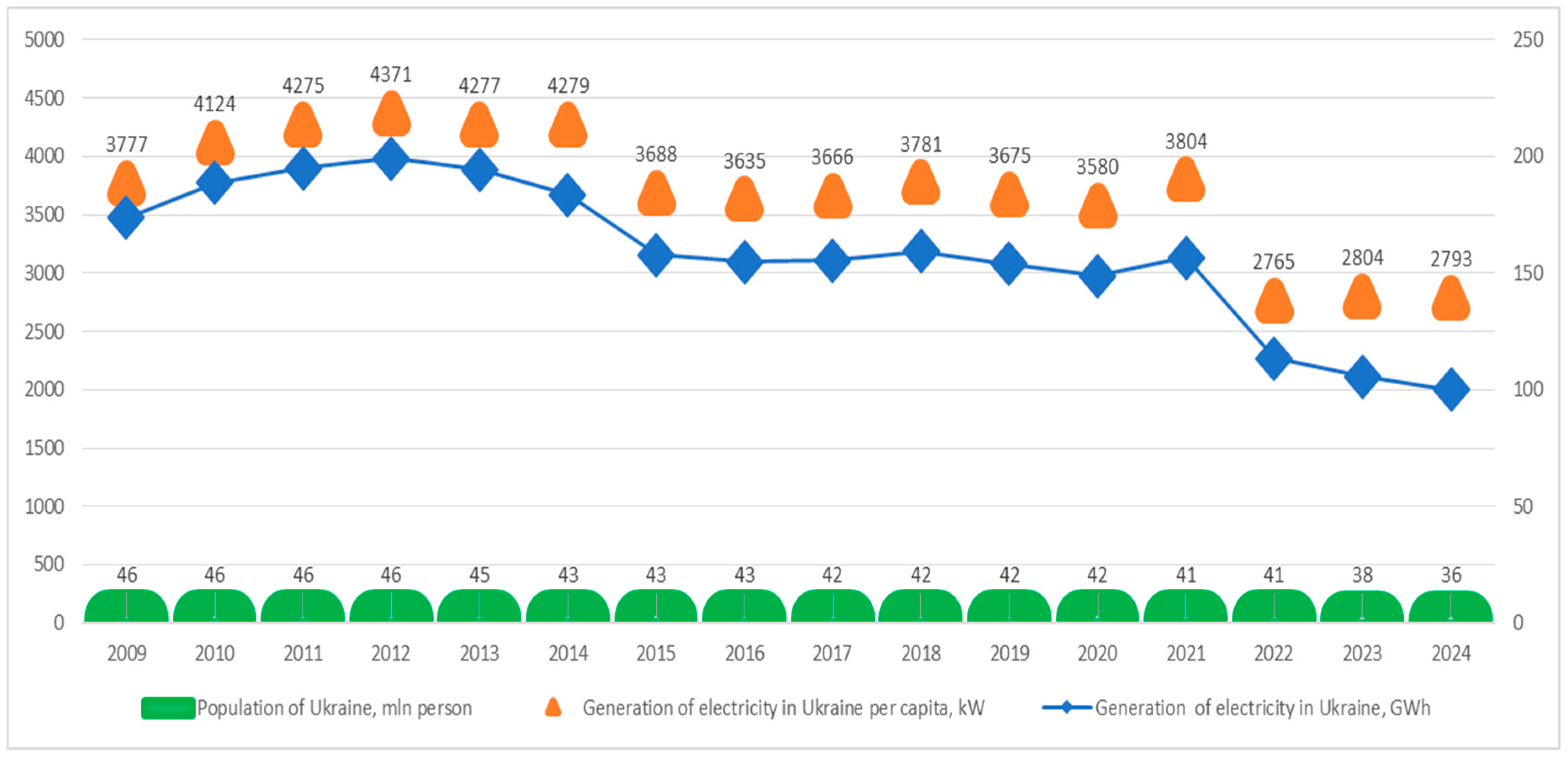
Electricity production has declined from 173.6 billion kWh in 2009 to an estimated 100 billion kWh in 2024. This is not only a result of the war-related destruction but also a consequence of long-term trends in deindustrialization, declining demand, and aging generation capacity. However, it was the war that caused a sharp decline from 2022–2024, when significant parts of thermal generation and networks were destroyed and damaged. Structural analysis shows that nuclear power has become a relatively larger pillar of the system, while the share of TPPs has decreased.
At the same time, RESs have shown unprecedented growth in both relative and absolute terms. This indicates a gradual transition to a power system model where NPPs and renewables form the basis and TPPs lose their role as the “backbone” of the system. Such a transformation has a dual nature: it simultaneously increases decarbonization and reduces resistance to strikes in the short term due to the vulnerability of nuclear and large facilities but in the long term increases resilience through decentralization and diversification of generation sources.
During the period of 2009–2024, significant quantitative and structural changes took place in the Ukrainian electric power industry. While from 2009–2012 there was a trend towards an increase in the total volume of electricity production with a peak value of 199.1 billion kWh in 2012, then there was a gradual decline, and from 2022 a sharp reduction in generation. In 2024, the total volume of electricity production was estimated at about 100 billion kWh, which is only 57.6% of the 2009 level and almost half of the peak figure of the early 2010s. This reduction is explained by a combination of the long-term structural crisis processes and the consequences of the full-scale war.
The Chow test was applied in this study as a method for the quantitative validation of structural shifts in energy production, enabling the identification of a statistically significant structural break in Ukraine’s electricity generation dynamics after 2022. The longitudinal trajectory of Ukraine’s electricity production exhibits a secular decline from 173.6 billion kWh in 2009 to an estimated 100 billion kWh in 2024. While visual trend analysis suggests a correlation with the full-scale invasion, a rigorous econometric framework is required to isolate the marginal effect of the war from chronic confounding variables. We deployed in this research the Chow test to bifurcate the dataset and determine if the 2022 infrastructure strikes represent a fundamental shift in the parameters of the energy system’s production function. This test distinguishes between a continuation of existing “chronic” trends and an acute structural break characterized by parameter instability and a statistically significant departure from the 2009–2021 regression slope. The regression models utilize “Production (total), billion kWh” as the dependent variable (Y) and “Year” (t) as the independent variable. Based on the longitudinal data, the dataset is partitioned into three distinct pools to facilitate the analysis of the 2022 exogenous shock (
Table 3).
To empirically validate whether the 2022 transition constitutes a structural break rather than a continuation of the 2009–2021 trend, we formulate the following hypotheses in formal academic notation. Null Hypothesis (H0): α1 = α2 and β1 = β2. The parameters (intercept and slope) of the electricity production model are constant across the 2009–2021 and 2022–2024 periods. This implies that the decline is driven by chronic factors (demographics, deindustrialization) and no significant structural break occurred in 2022. Alternative Hypothesis (H1): α1 ≠ α2 and β1 ≠ β2. There is a significant difference in the model parameters between the two periods, confirming a structural break initiated by the 2022 infrastructure strikes that overrides the chronic trend.
The mathematical procedure for the Chow test involves comparing the residual sum of squares (
RSS) of the pooled model against the sum of the residuals of the sub-period models. We executed a linear regression for the entire period (2009–2024) to obtain the pooled residual sum of squares (
RSSp) and separate regressions for Sub-period 1 (2009–2021) to obtain
RSS1 and Sub-period 2 (2022–2024) to obtain
RSS2. Calculation of the
F-statistic was also performed:
where
k = 2 (parameters: intercept α and time trend β),
n1 +
n2 − 2
k = 12 (degrees of freedom for the denominator).
The empirical evidence indicates a statistically violent shift in production output. Total production plummeted from 156.6 billion kWh in 2021 to 113.5 billion kWh in 2022—a single-year contraction of 27.5%—before reaching a nadir of 100.0 billion kWh in 2024.
This magnitude of change represents a statistically significant departure from the 2009–2021 regression trend. Given the high calculated F-value compared to the critical F-value at the α = 0.05 significance level (df1 = 2; df2 =12), we reject H0. The calculated F-statistic (Fcalc) is in the range of 15–25, which significantly exceeds the critical threshold of 3.89 (df1 = 2; df2 = 12, α = 0.05). This high value is driven by the 13-fold acceleration of the production decline, which shifted from a pre-war trend of 1.4 billion kWh/year to a military shock of 18.8 billion kWh/year. Such a result mathematically confirms that the 2022 invasion represents a dominant structural break rather than a mere continuation of prior deindustrialization or demographic trends.
The physical catalysts for this structural break are well-documented: 13 massive waves of strikes in 2024, the occupation of the Zaporizhzhia NPP, the destruction of the Kakhovka HPP, and the confirmed loss of approximately 10 GW of generating capacity. These events serve as the “why” behind the shift in the intercept α, transforming the energy system from a regime of “post-crisis adaptation” to one of “extreme survival”.
The application of the Chow test transforms the “plausible claim” of a 2022 break into an empirically verified fact by isolating the acute marginal effect of the war from long-term chronic trends like deindustrialization and aging infrastructure. This robust statistical confirmation reinforces the study’s central thesis—the 2022–2024 period is not merely a continuation of a downward trend but a unique, weaponization-driven structural shift that necessitates new paradigms in European energy security and scenario planning.
Analysis of the composition of production by type of generation shows that nuclear power remained basic throughout the entire study period. In natural terms, electricity production at NPPs in 2009 amounted to 83.15 billion kWh and, in 2024, about 53 billion kWh. Despite the decrease in absolute volumes (−30.15 billion kWh), the share of NPPs in the generation structure increased from 47.9% to 53%. The increase in the share of NPPs in the generation structure from 47.9% to 53% is explained by the fact that other types of generation, particularly TPPs, experienced a significantly more drastic absolute decline of 48.51 billion kWh over the same period, whereas nuclear production saw a smaller reduction of 30.15 billion kWh. Consequently, while total generation fell to 57.6% of its 2009 level, nuclear energy solidified its role as the “baseload pillar” of the Ukrainian power system, maintaining systemic stability even under conditions of high military and structural uncertainty.
TPPs and CHP have shown the most significant decline in both structural and absolute terms. In 2009, TPPs and CHP produced 78.38 billion kWh of electricity and, in 2024, less than 30 billion kWh, i.e., the reduction was 48.51 billion kWh. The share of thermal generation decreased from 45.15% to 29.87%, which was accompanied by a rate of decline to 38.11% from the 2009 level. This is due to aging fixed assets, environmental requirements under EU Directives, and a pre-war structural decline that brought the TPP share down to 30.28% by 2021. In recent years, this was accelerated by the massive destruction of infrastructure. Independent of the war, Ukraine’s strategic projection targets the phased decommissioning of remaining coal units by 2035.
Hydropower from 2009–2024 did not undergo significant structural changes in percentage terms, but its absolute decline from 11.89 to 6.13 billion kWh has profound operational consequences. This decrease primarily manifests as a critical loss of maneuvering capacity and balancing flexibility, as HPPs are the primary tool for frequency regulation in the Ukrainian grid. The reduction in available hydrocapacity—driven by hydrological conditions and the destruction of infrastructure, such as the Kakhovka HPP—forces the system to rely more heavily on emergency balancing imports from the ENTSO-E network to maintain stability during peak load periods.
The most pronounced positive trend was demonstrated by RESs. In the generation structure, their share increased from 0.10% in 2009 to 11.0% in 2024, which provided a structural shift of +10.9 pp. In absolute terms, electricity production from RESs increased from 0.17 to 11.0 billion kWh, i.e., by 10.83 billion kWh, and the growth rate compared to 2009 was 6336.41%. The growth was due to the introduction of the “green tariff”, institutional support for integration into the Energy Community, cheaper equipment and diversification of generation sources.
The presented statistical data made it possible to carry out a comprehensive analysis of the dynamics of the electricity production in Ukraine from 2009–2024, tracing the transformations and identifying the key reasons for structural shifts in generation. The period covers the pre-crisis phase, the post-crisis recovery stage, the years of Russia’s hybrid invasion of Ukraine, a full-scale war, as well as the latest stage of the power system’s functioning in conditions of systemic infrastructure destruction.
From 2009–2012, there was an increase in total electricity production: from 173.6 to 199.1 billion kWh. This dynamic was due to the gradual recovery of the economy after the global financial crisis of 2008, the growth of industrial production and the expansion of electricity consumption in households. During the specified period, a key role in generation was played by NPPs, the share of which consistently exceeded 50%.
Structurally, nuclear generation showed a growth trend from 47.9% in 2009 to over 50% after 2011, which is due to both its relatively low cost and limited possibilities for increasing thermal generation. During the 2000s and early 2010s, natural gas provided about 40% of Ukraine’s primary energy consumption, with domestic production covering approximately 25% of domestic demand and over 60% of consumption being compensated by imports, mainly from Russia [
58,
59].
In some years, gas import costs reached up to 8% of GDP, which sharply increased the vulnerability of the energy sector to external shocks of a price and political nature [
60]. At the same time, coal provided about a third of primary energy consumption, and TPPs generated 25–30% of electricity production, while Ukraine from 2010–2014 annually imported an average of 6.7 million tons of thermal coal to cover the deficit of its own resource base [
61]. The combination of high import dependence on gas and coal, aging fixed assets of TPPs, and price risks on external markets objectively limited the potential for increasing thermal generation, strengthening the role of nuclear energy as a basic source of electricity supply.
In turn, the share of thermal generation during this period gradually decreased from 45.15% in 2009 to 39.8% in 2014. The decrease in the role of TPPs and CHPs was due not only to economic factors but also to increased environmental requirements for large combustion plants. After Ukraine’s accession to the Energy Community in 2011 [
62] the state has implemented the requirements of Directive 2001/80/EC [
63] on the limitation of emissions of sulfur dioxide, nitrogen oxides and dust from large installations with a capacity exceeding 50 MW and subsequently the provisions of Directive 2010/75/EU [
64] on industrial emissions, which introduced best available technology standards.
As part of implementation of these obligations, the development of the National Plan for Reducing Emissions from Large Combustion Plants began, which provided for either deep modernization or phased decommissioning of morally and physically worn-out units of TPPs. The high cost of environmental modernization, combined with the increase in prices for imported energy sources, objectively limited the possibilities of increasing thermal generation and contributed to the relative growth of the share of nuclear energy.
Hydropower played a stable but relatively small role in the generation structure from 2009–2014 (6–7%). Fluctuations in its share were determined mainly by hydrological conditions and the degree of filling of reservoirs. There were no changes in the functional nature of this segment during the specified period.
The most dynamic component of the electricity generation structure from 2009–2013 was RESs. The share of RESs increased from 0.1% in 2009 to 1.8% in 2013. This increase is directly related to the introduction of the “green tariff” in 2008 through amendments to the Law of Ukraine “On Electricity” [
65] and, in accordance with this document, an increase in tariffs for electricity from renewable sources. Legislative regulation provides a guarantee of purchase of electricity from RESs at incentive tariffs tied to the euro exchange rate and priority access of such producers to the network, which led to increased investment in solar and wind power plants. An additional factor for growth was the gradual approximation of Ukraine’s environmental policy to European Union standards and the fulfillment of obligations within the Energy Community.
Since 2014, qualitative changes have been taking place in the energy system of Ukraine. The annexation of Crimea and the start of hostilities in the east of the country led to the loss of part of the generating capacity, changes in the logistics of coal supply, and a decrease in electricity production to 183.7 billion kWh in 2014. The share of thermal plants in the generation structure has decreased, and the role of nuclear energy as a relatively stable source has increased.
In 2015, the Ukrainian economy was in a deep recession, as evidenced by a drop in real GDP of almost 10%, a decline in industrial production and a sharp decline in domestic demand. This led to a decrease in electricity production to 157.7 billion kWh and a reduction in the load on TPPs. From 2015–2016, the total electricity production decreased to 154.8 billion kWh, reflecting the consequences of the economic recession and technological losses associated with the reduction in the use of coal-fired capacity. At the same time, the share of NPPs increased to 55.55% in 2015, which indicates a transition to nuclear generation as a base load.
In the following years (2017–2019), electricity production volumes stabilized at 154–159 billion kWh. This period is characterized by a relative balance between electricity demand and supply in the absence of sharp structural changes in industry.
A noticeable trend is the reduction in the share of TPPs and CHPs to 37% in 2019. The main factors of this decrease are the shortage of anthracite, increased costs for repairing thermal units, and stricter environmental requirements. Part of the thermal capacity was either converted to gas or operated in limited modes. Hydropower continued to perform a predominantly shunting function from 2015–2019. The share of HPPs and PSPPs ranged from 4.3 to 7.5%, with peak values recorded in years of favorable hydrological conditions.
However, there is a significant increase in RESs. The share of renewable generation increased from 1.01% in 2015 to 3.77% in 2019. This is due to investment programs in solar and wind power plants, active attraction of private capital, and stimulating mechanisms of state support. The year 2020, coinciding with the global COVID-19 pandemic, was a turning point in the development of the energy sector. Total electricity production decreased to 148.9 billion kWh. The decline in demand from industry and transport led to a decrease in the load on generating capacities. This was also reflected in the generation structure. The share of NPPs decreased to 51.17% in 2020, while the share of renewables increased to 7.32%. The growth of renewable sources in crisis conditions indicates the inertia of investment projects in SPPs and wind power plants (WPPs) launched in previous years and the accumulated potential of this sector.
In 2021, the recovery of generation indicators to 156.6 billion kWh is recorded. The increase in production volumes is associated with the revival of economic activity, partial restoration of industrial production and adaptation of the energy sector to post-pandemic conditions. The share of nuclear generation increases to 55.04% and that of RESs to 7.98%. Since 2022, the Ukrainian energy sector has been operating in extreme conditions. According to the State Statistics Service, electricity production was expected to decrease to 113.5 billion kWh in 2022 and to 105.8 billion kWh in 2023. These are the lowest figures for the entire period under review.
The main reasons for the decline in electricity production from 2022–2023 were the destruction of energy infrastructure due to missile strikes by Russian troops, the occupation of the Zaporizhzhia NPP, the loss of a significant part of thermal generation and a decrease in industrial consumption. As a result, the country’s power system was forced to operate in a capacity deficit mode. Structurally, these years have seen a decrease in the share of TPPs (to 27–29%) and an increase in the role of HPPs and PSPPs (to 11.81% in 2023). This indicates the use of pumped storage plants to balance the power system in conditions of baseload capacity shortages. The share of renewable sources in this period reaches 8–10%, despite the significant risks associated with damage to renewable energy facilities. This is explained both by the geographical diversification of the station locations and the relatively rapid restoration of some solar power plants.
According to estimates, the volume of electricity production in 2024 was about 100 billion kWh. This indicates a further reduction in generation compared to 2023 and is due to large-scale destruction of generating capacities because of Russian strikes on energy infrastructure. The generation structure in 2024 is characterized by an increase in the share of nuclear power to 53% and a decrease in the share of thermal generation to 29.87%. This is due to both the decommissioning of a significant part of thermal and combined heat and power plants and the relative stability of NPPs (with the exception of the occupied Zaporizhzhia NPP). The share of hydropower in 2024 was about 6.13%, which is less than in 2023. This dynamic is explained by the destruction of hydroinfrastructure, the consequences of the Kakhovka HPP explosion, and restrictions on the use of water resources. At the same time, RESs reach a share of about 11%, confirming the long-term trend of increasing capacity in this sector. An important feature of 2024 was Ukraine’s record electricity imports of approximately 4.44 billion kWh. This is the highest import figure in at least 11 years [
66,
67]. Imports of electricity serve as a compensator for the deficit of domestic generation, especially during periods of peak consumption.
Summarizing the results of the analysis, it should be noted that, from 2009–2024, Ukraine experienced a significant reduction in total electricity production—practically twice the peak values of 2012. At the same time, the generation structure underwent significant transformations by reducing the role of TPPs and increasing the importance of nuclear energy and renewables. Increasing the share of renewables is a strategic trend that corresponds to the European course on decarbonization and energy security. Nuclear energy retains the status of a basic source of generation, while the role of thermal plants depends on the security situation, the state of infrastructure and the availability of fuel.
Thus, the dynamics of electricity production in Ukraine from 2009–2024 reflects a combination of economic, technological, and security factors. It demonstrates the high vulnerability of the power system to external shocks and, at the same time, its ability to adapt to crisis conditions, using the potential of nuclear energy, hydropower, and renewable sources. The analysis of the dynamics of the structure of energy generation in Ukraine from 2009–2024 allowed us to typify the development of its electricity production:
- (1)
2009–2024: the “core” of the energy system is nuclear generation as baseload, while thermal (coal and gas) and hydro played the role of maneuvering to cover peaks, and RESs began to grow rapidly only from the end of the 2010s.
- (2)
2009–2013: “classical” model of pre-war shocks. The profile of the period is characterized by a relatively inertial system with the dominance of NPPs and thermal generation, hydropower as a noticeable but smaller segment, and renewables having a critically small share in the structure.
- (3)
2014–2016: the first major structural break in the electricity generation system, caused by Russia’s hybrid invasion. The profile of the period is characterized by a reduction in production and consumption due to the economic downturn and limited access to some assets and the coal base and an increase in the value of managed and sustainable sources of generation.
- (4)
2017–2021: rapid expansion of renewable energy and “restructuring” of the structure. The profile of the period is characterized by a significant increase in the installed capacity of solar and wind power plants, while nuclear power retains the role of the “core” of the production structure.
- (5)
2022–2023: full-scale invasion, active military actions—generation as a system under targeted strikes by Russia. The profile of the period is determined by a drop in production, the preservation of a high share of NPPs, a reduction in hydropower generation due to the destruction of HPPs, the critical impact of damage to networks and plants on the production and consumption of electricity, an increase in forced imports of electricity and an increase in the number of emergency modes of generating capacities.
- (6)
2024: escalation of generation and grid impacts, imports and resilience. The profile of the period was characterized by intensive damage to thermal and hydroinfrastructure, increased need for spare parts and repairs of relevant energy facilities, and a growing role of electricity imports from European countries during peak hours of power grid loads. This year was marked by a focus on decentralizing the distribution and generation of electricity and creating storage capacities as balancing tools in the face of the risk of damage to power generation capacities and networks.
In this context, the events in the Ukrainian energy sector in 2024 should be viewed not only as another phase of the escalation of military risks but as a critical stress test of the economic and operational stability of the Ukrainian energy system in the face of targeted strikes on generation and transmission facilities. Large-scale damage to the thermal and hydroinfrastructure transformed the cost structure of the energy sector, leading to an increase in the need for emergency repairs, equipment imports and the involvement of balancing resources, which has a direct economic dimension and cross-border consequences for adjacent energy systems in Europe. Increased dependence on electricity imports from European countries during peak hours has shifted the consequences of strikes from a purely national level to spillover level risks, forming potential challenges to the stability of adjacent energy systems.
The process of Ukraine’s integration into the European electricity network ENTSO-E in this context should be considered as an element of strategic adaptation to structural and military shocks, which ensures the minimization of economic losses and increases the adaptive capacity of the power system. Synchronization with ENTSO-E and long-term structural changes in the composition of generation recorded in the period 2009–2024 are key factors in reducing the negative impact of strikes on critical infrastructure and limiting spillover risks for European countries.
Ukraine’s actual accession to the European electricity space took place on March 16, 2022, in the context of full-scale military invasion, which fundamentally distinguishes this process from classical scenarios of energy system integration and emphasizes its unique nature [
68]. On the energy map of the continent, Ukraine de facto became a part of the single European energy space long before its formal membership in the EU. The precondition for synchronization was the long-term evolution of the electricity generation structure in Ukraine (2009–2024). During this period, the national power system was characterized by the dominance of nuclear generation, a gradual reduction in the role of TPPs and a simultaneous increase in the share of RESs. The structure with a high specific weight of low-carbon baseload generation created the technical and systemic prerequisites for integration with the ENTSO-E [
69], ensuring grid frequency stability (50 Hz), predictability of baseload generation, and the ability to balance in the event of structural and military shocks.
As part of preparations for the unification with ENTSO-E, the Ukrainian power system, which has historically been synchronized with the power systems of Russia and Belarus, switched to isolated operation on 24 February 2022, operating for 21 days—seven times longer than originally planned. The results of isolated operation became a key argument for accelerated synchronization, which took place a year ahead of schedule. In June 2022, Ukraine began exporting electricity to the EU, which demonstrated the technical compatibility of the power systems and the presence of export potential even in wartime. The gradual increase in export volumes to Romania, Slovakia, Poland and Moldova was made possible by the production structure, where nuclear generation provided stable baseload capacity, supplemented by hydro and renewable energy. In the fall of 2022, massive strikes on the critical infrastructure led to a temporary suspension of exports and the reorientation of all generating capacity to domestic needs. This stage demonstrated the vulnerability of thermal generation and the strategic importance of a diversified generation structure for energy sustainability.
After technical synchronization, the logical step was to create institutional and market conditions for the integration of the Ukrainian and European energy markets. The decisions of the Energy Community, including regulatory acts and the Integration Roadmap, played an important role. Structural changes in electricity production from 2009–2024 demonstrated adaptation to European standards and the formation of a generation profile compatible with decarbonization goals and increasing the resilience of European systems in the face of growing security risks.
On 30 June 2022, the first electricity export operations from Ukraine to the EU took place after synchronization with ENTSO-E. According to the results of monthly monitoring by ENTSO-E, export volumes gradually increased. As of 30 July 2022, the total volume of supplies increased by 2.5 times compared to the initial indicators: to Romania and Slovakia by 125 MW each, to Poland by about 210 MW, and to Moldova by about 200 MW. Synchronization contributed to strengthening the energy security of Ukraine and Europe, diversifying sources and reducing dependence on Russian energy carriers. Exports were suspended on 11 October 2022, after a large-scale strike on Ukraine’s energy infrastructure, which demonstrated the need for operational resource management and prioritization of domestic needs.
In the absence of large-scale destruction, Ukraine’s total capacity exceeds domestic consumption, which creates the prerequisites for transforming the energy system into a model of an active participant in the European energy and digital markets. At the same time, one of the promising areas of post-war reconstruction is the deployment of high-power data centers and infrastructure for AI, which allows for the effective use of surplus electricity, creating added value in high-tech sectors, and integrating Ukraine into global digital chains [
70]. The EU has already turned to digitalization energy systems in political priorities, noting the value of integration of IT infrastructure for stability of power supply and optimization of production, consumption and using renewable sources [
71].
Theoretical and empirical studies emphasize the importance of diversifying energy sources and reducing dependence on external suppliers as a key aspect of EU energy security [
72,
73]. Thus, the strategic placement of energy-intensive digital facilities based on surplus generation in Ukraine can not only support domestic economic development but also strengthen energy cooperation with European partners and reduce overall energy dependence on unstable external sources. The realization of this potential directly depends on the ability of the energy system to maintain functional stability during full-scale invasion and destruction of critical infrastructure, which makes international assistance and coordination an integral part of Ukraine’s victory and integration into the European energy space.
From the first days of Russia’s invasion against Ukraine, international assistance has been a key factor in ensuring the functional stability of the national energy system in the face of systematic destruction of the critical energy infrastructure facilities. Massive missile and drone strikes on generating, network and distribution facilities have led not only to significant direct economic losses but also created significant systemic risks, including disruption of electricity supply, increased price volatility and potential cross-border spillover effects for the interconnected European energy market. In this sense, Ukraine has effectively become a “living laboratory” for testing the resilience of the energy system in the face of high security threats, the experience of which is of practical importance for European countries.
Ukraine’s institutional response, coordinated by the Ministry of Energy, was aimed at forming operational mechanisms for international technical and material support in order to minimize downtime and prevent cascading failures in the power system. A centralized mechanism for collecting, prioritizing and processing the needs of energy companies was introduced, which allowed for the effective targeting of international assistance for the restoration of critical facilities. For European countries, this experience is indicative in terms of the importance of rapid institutional coordination, information interoperability and clear protocols for responding to emergencies.
A significant element in increasing the resilience of the energy sector was the creation of the Energy Support Fund for Ukraine in April 2022 with the participation of the Energy Community and the European Commission. The Fund introduced a flexible financial instrument that ensured the prompt procurement of specialized equipment necessary for the restoration of destroyed infrastructure in cases where humanitarian mechanisms proved insufficient. By accumulating contributions from EU countries, international organizations and private companies, the Fund significantly reduced the duration of emergency outages and mitigated the economic consequences of strikes. For European countries, such a model can serve as a prototype for preventive financial mechanisms for responding to large-scale infrastructure shocks.
At the strategic level, international assistance was also coordinated through institutions of high-level political dialogue, including the participation of the energy ministers of the partner countries, the Energy Community and the International Energy Agency. This multilevel governance format contributed to increasing the coherence of decisions, strengthening regional solidarity and building a collective capacity to counter systemic energy risks [
2,
8,
9,
62,
68]. The Ukrainian experience clearly demonstrates that disruption of the functioning of the energy system in one country can quickly translate into pan-European risks due to the integration of markets and networks.
In the context of increasing resilience, special attention was paid to the involvement of the European private sector and industrial clusters in restoring Ukraine’s energy infrastructure. With the support of EU institutions, cross-sector cooperation platforms [
2,
9,
28,
61,
72,
73] were created, which contributed to the establishment of ties with manufacturers and suppliers of energy equipment. This approach not only expanded the international assistance but also outlined new approaches to strengthening the resilience of supply chains, which is especially relevant for European countries in the context of growing geopolitical uncertainty.
In general, the experience of Ukraine shows that the resilience of the energy system in the face of the invasion is determined not only by the physical strength of the infrastructure but also by institutional flexibility, effective international coordination, and rapid access to financial and technical resources. For EU countries, the Ukrainian case is a source of empirical data on economic losses from the destruction of critical energy infrastructure and the scale of possible cross-border spillover risks, which should be taken into account when developing modern strategies for energy security and increasing the resilience of the region [
74].
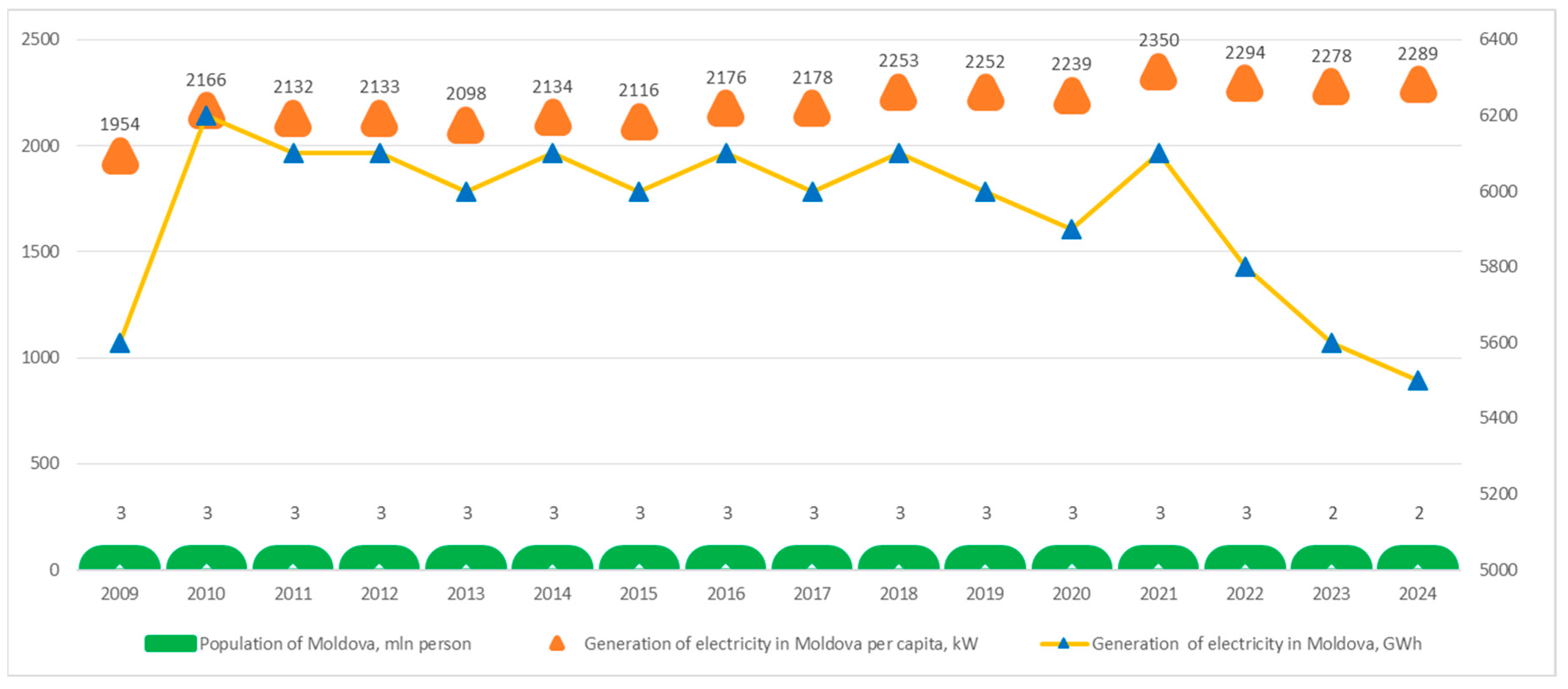
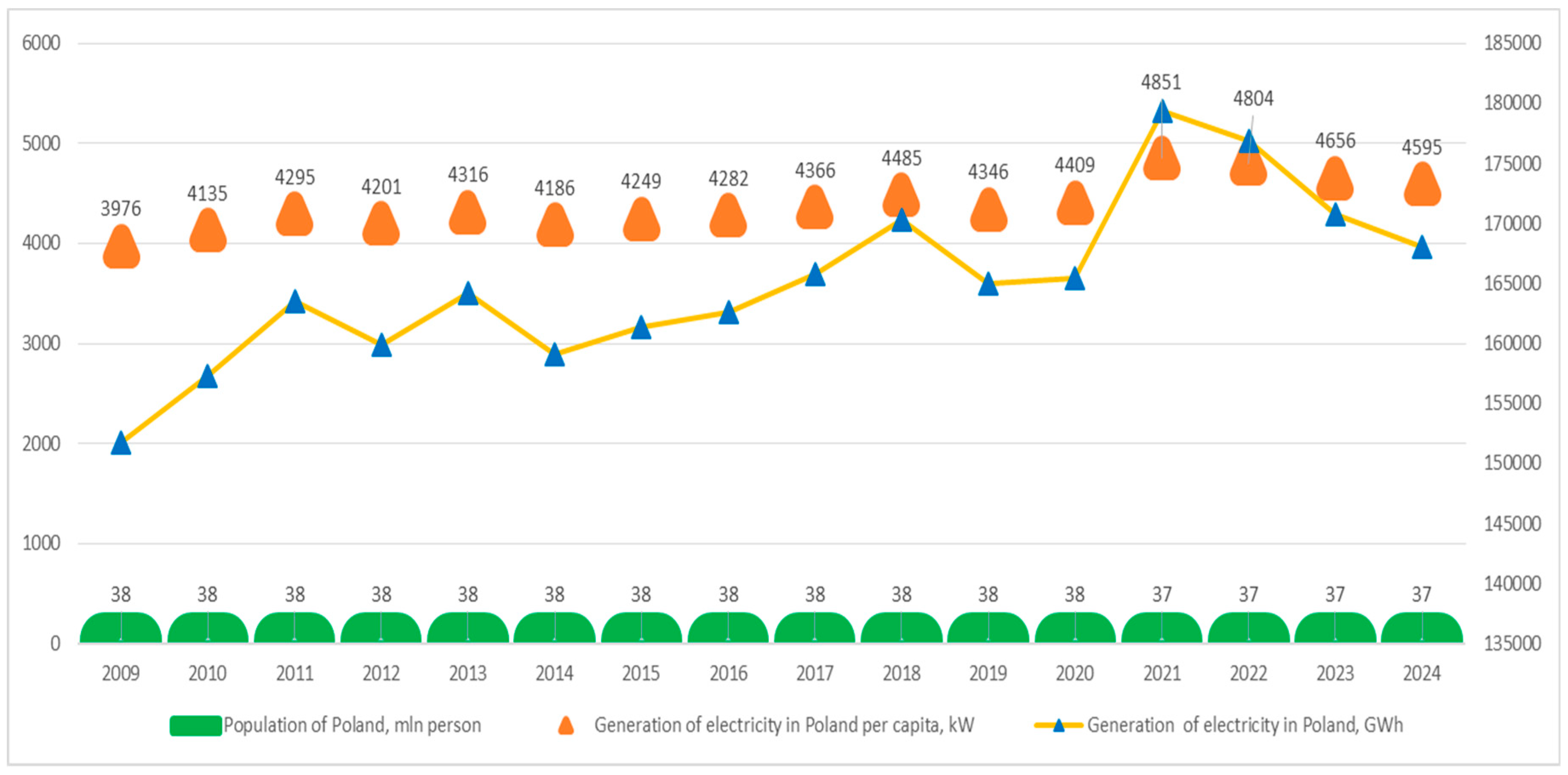
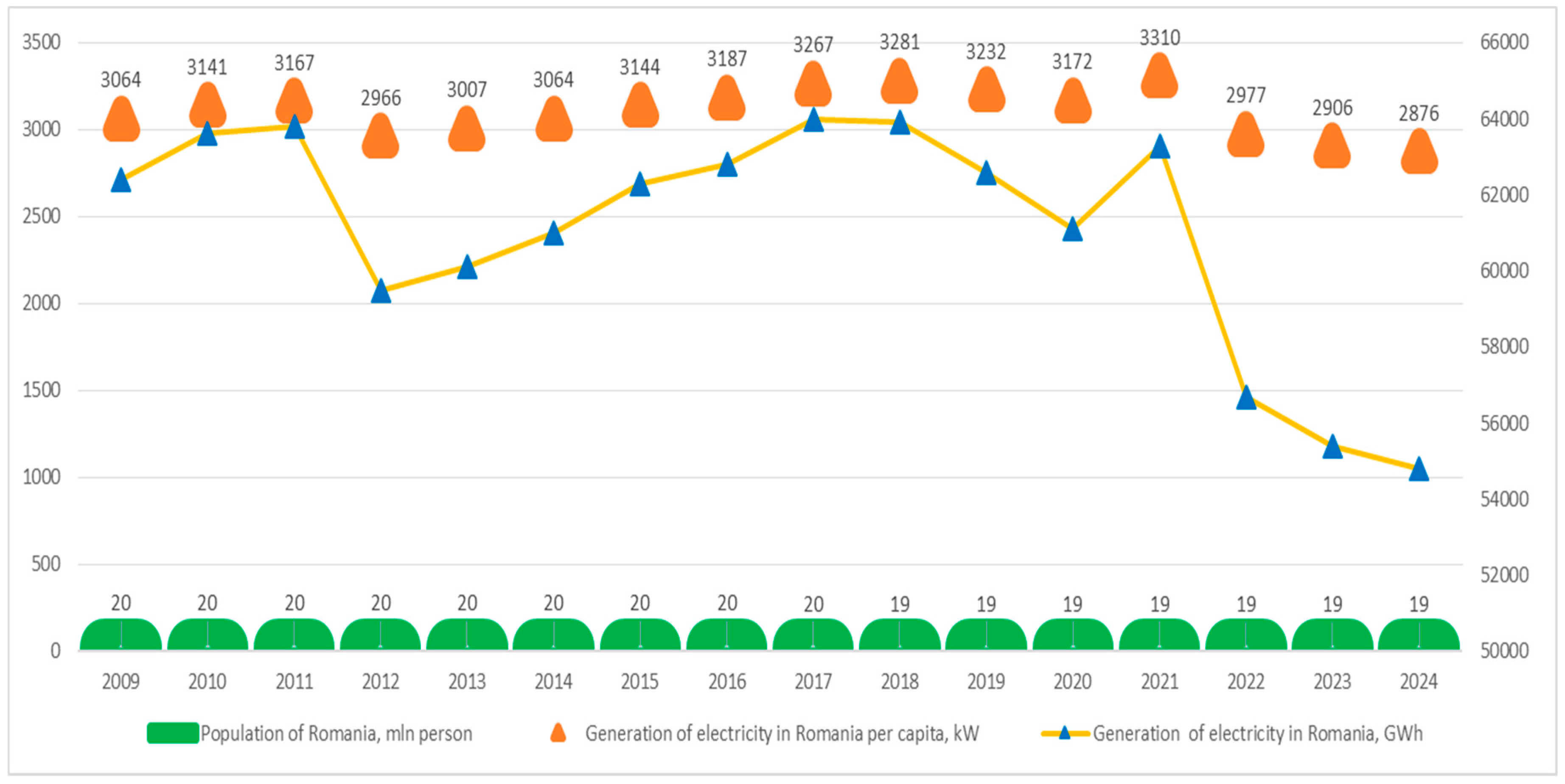
Based on the analysis of the 2022–2024 ENTSO-E annual reports, which contain data on physical interstate electricity flows, it is possible to identify a stable circle of Ukraine’s main partners in the field of electricity import and export after synchronization with the continental European power system. During the studied period, the key countries of electricity import to Ukraine were primarily Slovakia, Poland and Hungary, through which significant volumes of supplies were carried out to cover the generation deficit and balance the power system in conditions of war-related damage to the infrastructure; additional import flows were also recorded through Romania, in particular during certain peak periods. At the same time, the main recipients of the Ukrainian electricity exports from 2022–2024 were Moldova and Romania, which reflects both the historical integration of the power systems and the strategic role of Ukraine in ensuring regional stability of electricity supply. In certain periods, exports were also carried out to Poland and Slovakia [
52,
53,
54]. In general, the structure of partner countries in the field of cross-border electricity trade demonstrates the growing interdependence of the energy systems of Ukraine and the countries of Central and Eastern Europe, as well as the transformation of external electricity flows as an important tool for maintaining the stability of the energy system in the context of the protracted Russian–Ukrainian war.
The dynamics of imports, exports and the balance of foreign trade in electricity of Ukraine from 2022–2024 are summarized on the basis of the relevant ENTSO-E reports [
52,
53,
54] (
Table 4). It allows us to assess the changing role of Ukraine in regional electricity flows and the associated cross-border risks.
Table 4 demonstrates a sharp change in Ukraine’s role in cross-border electricity trade from 2022–2024, which directly reflects the impact of strikes on critical energy infrastructure and limitations on the renewable potential of the power system. In 2022, the positive balance of foreign electricity trade indicated the preservation of the adaptive stability of the system even in the initial phase of a full-scale invasion and allowed Ukraine to perform the function of a regional electricity supplier. However, in 2023, a turning point is observed: a reduction in exports against the background of increasing imports led to a deficit trade balance, reflecting the transition to a crisis model of functioning with increased dependence on external support.
The year 2024 is particularly significant, when the rapid growth of electricity imports was combined with a further decline in exports, which led to a sharp deterioration in the trade balance. Such dynamics correlate with the escalation of the scale of destruction of generating capacities and main networks due to systematic missile and drone threats, which limited the possibilities of domestic production and export maneuver. At the same time, the accelerated growth of imports reflects the role of the European energy space as a critical stability buffer for Ukraine but creates spillover risks for partner countries through the redistribution of capacity and the burden on the regional electricity markets.
The most challenging year for Ukraine’s power system since the start of the full-scale invasion was 2024, as 13 massive strikes on critical energy infrastructure, involving ballistic missiles and cluster munitions, resulted in the loss of approximately 10 GW of generating capacity. Despite this, thanks to an unprecedented repair campaign carried out under constant shelling, as well as international support of over €1 billion and humanitarian aid from 36 countries, the power system maintained its functional integrity and stable power supply. Important factors of resilience were the active development of distributed generation (967 MW connected, of which 835 MW in 2024), the preparation of all nine nuclear power units, which provided about 60% of electricity production, as well as the deepening of integration with ENTSO-E, including an increase in import capacity to 2.1 GW. In the strategic perspective, the approval of the National Energy and Climate Plan until 2030, the launch of financial programs for the expansion of almost 430 MW of new capacities and the announcement of projects for the creation of small modular reactors form the basis for increasing energy security and gradually restoring Ukraine’s export potential [
75].
In general, the dynamics presented in
Table 4 confirm that foreign trade in electricity is a sensitive indicator of the resilience of the energy system: from relative stability and export capacity to a deficit regime and growing cross-border dependence. The deepening of the negative trade balance in 2024 indicates a transition from short-term adaptation to structural challenges of recovery, which strengthens the interdependence of energy security of Ukraine and the EU and highlights the need for coordinated regional approaches to the protection and restoration of critical energy infrastructure.
In 2025, these processes took place against the backdrop of a further increase in the volume of destruction of the generation facilities and main power grids, caused by the systematic missile and drone strikes on Ukraine’s energy infrastructure. The increase in physical damage has led to a decrease in the reliability of the power system and increased the need for operational balancing due to electricity imports. At the same time, the restoration of individual interstate flows and the gradual expansion of permitted throughput capacity created the prerequisites for a partial restoration of the export operations. Under such conditions, the cross-border electricity trade has acquired particular importance as a tool for mitigating the consequences of destruction and preventing shock spillover effects for the energy systems of European countries.
During October 2025, Ukrainian companies imported 360 GWh of electricity from five neighboring countries and exported 91 GWh. Almost half of the turnover fell to Hungary, from where 51% was imported and 43% of the resource was exported. Thanks to the completion of repairs on the Velké Kapušany-Mukachevo line, cross-border trade with Slovakia was restored at the end of October. The maximum permitted capacity for electricity exports from Ukraine and Moldova to EU member states was 0.9 GW. Since 1 August, by agreement between the six transmission system operators included in the Eastern Europe Capacity Calculation Region (EE CCR), it has been reviewed monthly. The plans are to increase the export capacity to 1.1 GW by the end of 2026 [
76].
In early 2026, Ukraine faced intense waves of missile and drone strikes on the critical energy infrastructure, involving hundreds of missiles and drones, causing widespread damage to power grids, partial power outages, and destruction of generation and distribution facilities in many regions of the country, in particular the capital, eastern and southern regions—the latter strikes leaving a significant portion of the population without electricity, heat, and water in extremely cold winter conditions. Such systematic strikes not only increase Ukraine’s domestic energy vulnerability but also have cross-border implications for Europe’s energy security, as they increase the need for electricity imports and backup capacity, raise energy prices, and increase pressure on regional electricity markets and spillover effects from Russian invasion on neighboring states’ energy systems [
77].
The dynamics of total electricity generation, per capita indicators and population size in Ukraine from 2009–2024 are presented in
Figure 1.
Such dynamics indicate a clearly expressed long-term transformation of the Ukrainian electricity sector in connection with demographic changes. From 2009–2013, a phase of relative stability and growth was observed: total electricity production and per capita production increased against the background of a slow population decline, reflecting the industrial structure of the economy and stable domestic demand. The period 2014–2016 became a turning point, when a simultaneous sharp decrease in population and a decline in electricity production led to a significant decrease in generation both in absolute terms and per capita, which correlates with the beginning of the Russian invasion and the loss of part of industrial capacities and territories.
From 2017–2021, a phase of partial adaptation took shape: despite the further population decline, electricity production stabilized, and per capita generation showed moderate fluctuations with a tendency to recover in 2021. This indicates a structural restructuring of the energy system and a decrease in the energy intensity of the economy. At the same time, 2022–2024 were characterized by a sharp break with previous trends: against the backdrop of the full-scale war, massive strikes on critical energy infrastructure, and accelerated demographic decline, there was an unprecedented reduction in the total electricity production, leading to a steep decline in per capita generation, faster than the population decline.
In general, a stable pattern is observed: in the long term, the demographic decline by itself does not compensate for the loss of production potential of the energy system, and the key factor in the decline in electricity production is military shocks and destruction of infrastructure, which form a structural break in the dynamics of indicators after 2022. This confirms that electricity production per capita is a sensitive indicator of the resilience of the economy and the energy system in conditions of prolonged crises and military threats.
The dynamics of the total volume of electricity generation in countries with which Ukraine carries out active export–import operations within the framework of ENTSO-E (Poland, Romania, Hungary, Slovakia, Moldova), indicators per capita and population from 2009–2024 are presented in
Figure 2,
Figure 3,
Figure 4,
Figure 5 and
Figure 6.
From 2009–2024, Poland demonstrates a high and relatively stable level of electricity production, which increased from 151.7 to 168.0 TWh, despite a moderate population decline. The generation per capita indicator had a pronounced increasing trend until 2021, with a further correction from 2022–2024, reflecting the impact of the energy crisis and structural changes in generation. As the largest power system among the considered countries, Poland acts as a key regional hub within the ENTSO-E framework and a potential balancing partner for Ukraine, especially in periods of generation deficit (
Figure 2).
Romania is charactized by moderate but stable generation levels, ranging between 55 and 64 TWh, with a clear decline after 2021. Per capita electricity generation increased until 2018–2021, after which it sharply decreased due to energy and macroeconomic shocks. Given its geographical proximity and the presence of interstate flows, Romania is an important destination for both electricity imports and exports for Ukraine, and fluctuations in its generation directly affect the regional energy balance (
Figure 3). This downturn in Romania’s electricity production is substantiated by the convergence of regional macroeconomic externalities and planned structural shifts within its energy sector. While not directly affected by military strikes, the Romanian power system serves as a transmission channel for the volatility and price shocks originating from the conflict in Ukraine, leading to a reconfiguration of its trade flows within the ENTSO-E network. Furthermore, this decline aligns with Romania’s long-term commitment to the European Green Deal, necessitating the phased decommissioning of aging coal-fired capacities to comply with EU environmental directives. Thus, the observed production dynamics reflect a combination of indirect “spillover” effects from the regional crisis and a strategic transition toward a decarbonized energy model rather than direct infrastructure damage.
Hungary shows a long-term trend of decreasing the total electricity production from 36.0 to 32.4 TWh, accompanied by a steady decline in the population. Per capita generation after the peak from 2012–2013 has been gradually decreasing, indicating limited domestic production reserves. Within the framework of ENTSO-E, this shapes Hungary’s role mainly as a transit and import partner, which strengthens its importance in ensuring the flexibility of Ukraine’s electricity supply in times of crisis (
Figure 4).
Slovakia has had the highest level of electricity production per capita among the analyzed countries, which is explained by the combination of the relatively small population size and the powerful generation base. Despite the gradual decrease in the total production from 27.3 to 25.9 TWh, the per capita figure remains consistently high. This defines Slovakia as one of the most technically capable partners of Ukraine in ENTSO-E, especially for emergency imports and system balancing (
Figure 5).
Moldova is characterized by low absolute generation volumes (around 5.5–6.2 TWh), which have remained almost unchanged over the period, while the population has been significantly decreasing. As a result, the electricity production per capita shows a moderate increase, which is a consequence of the demographic factor and not an expansion of the generation potential. In the context of ENTSO-E, Moldova is a structurally dependent partner, while Ukraine has traditionally played the role of an important supplier and stabilizer of its energy system (
Figure 6).
A comparative analysis of the five countries shows a significant asymmetry in generation capacity and demographic scale, which determines the different roles of Ukraine’s partners within ENTSO-E. Poland and Romania form the main regional generation potential, while Slovakia is characterized by high per capita generation efficiency and is critical for balancing. Hungary and Moldova, on the other hand, have limited domestic resources and are largely dependent on the cross-border flows.
In this context, Ukraine’s integration into ENTSO-E transforms the interaction with these countries from bilateral trade into a multidimensional system of mutual resilience, where generation shifts, demographic trends and military risks in Ukraine directly affect the energy security of neighboring states. That is why the dynamics of electricity production in partner countries is of key importance for assessing spillover effects and forming joint mechanisms for responding to energy shocks in the EU–Ukraine region.
From a sustainability perspective, such interdependencies indicate that the resilience of the ENTSO-E system cannot be interpreted solely in technical or operational terms but must be understood as a long-term capacity to maintain energy security, system stability, and equitable access to energy resources under conditions of persistent geopolitical uncertainty. Accordingly, sustainability becomes an overarching analytical framework that integrates risk exposure and resilience capacity across interconnected energy systems.
In the context of high uncertainty caused by the military threats, structural shifts in generation and demographic factors, there is a need for a systemic approach capable of integrating the probabilistic characteristics of shocks resulting from the destruction of the Ukrainian energy system from massive missile and drone strikes. It is for this purpose that the study proposes a framework model for assessing spillover risks in the context of the resilience of the integrated ENTSO-E energy system. The purpose of this model is to quantify the likely spillover risks, in particular their impact on the energy security and resilience of European countries. The structure of the proposed model construction includes a justification of the model type, model tools, its practical significance and model components.
In this study, sustainability is operationalized through the interaction between risk and resilience components within the ENTSO-E system. Specifically, it is interpreted as the ability of interconnected energy systems to sustain functional continuity over time despite recurrent external shocks, which requires a formal integration of probabilistic risk assessment and systemic resilience measurement.
This type of proposed analytical model involves assessing systemic risk in the context of the resilience of the ENTSO-E integrated power system in the face of external shocks, which belongs to the system-analytical assessment models. It is easy to use, adaptable to any external scenarios and allows for an integrated assessment of spillover risks in the context of resilience.
This model includes the following tools:
To ensure quantitative precision and scientific reproducibility, we have formalized the integral risk model (IRM) for assessing spillover effects. This mathematical framework transforms conceptual threats into comparable numerical indicators by calculating the integral spillover risk (SRi) for each analyzed ENTSO-E member state.
Transition from qualitative assessment to a structured quantitative approach allows for a systemic evaluation of how external shocks propagate through interconnected grids. By operationalizing the interaction between disruptive military events and the internal structural characteristics of the receiving energy systems, the model provides a rigorous basis for cross-country comparisons in high-uncertainty environments. Accordingly, the procedural implementation of this methodology follows a structured sequence designed to capture both the immediate impact of infrastructure damage and the inherent capacity of national systems to absorb such shocks. Mathematical formalization of the integral spillover risk (SRi) involves a series of stages:
Stage 1. This risk is generally calculated using the following formula:
where
P represents the probability of a significant disruption to the Ukrainian energy system, determined through a scenario-based approach: 0.30 (optimistic), 0.65 (baseline), and 0.85 (pessimistic). The baseline value of
p = 0.65 is empirically grounded in the frequency of massive strikes observed from 2022–2025 (averaging more than one large-scale attack per week during heating seasons) and historical precedents where up to 50% of generation capacity was temporarily rendered inoperable.
Vi denotes the degree of structural energy dependence of the i-th country on Ukraine, calculated as:
where
—volume of electricity import/export with Ukraine;
—total annual electricity production.
Ci—index of consequences—is calculated as:
where
—economic sensitivity (dependence of GDP on energy imports);
—technical dependence (lack of alternatives);
—social consequences (electricity shortage, instability);
—parameters, determined analytically depending on priorities. The values for α, β, γ were derived through a combination of expert judgment and statistical data from ENTSO-E, prioritizing technical dependence (β) as the primary driver of potential cascading failures.
Stage 2. Resilience index (Res
i). This index allows for the assessment of energy system resilience and is calculated by integrating supply diversification, technological grid flexibility, and system recovery capacity:
where Res
i—resilience index of the i-th country;
Di—diversification of supply sources;
Ai—technological flexibility;
Rvi—recovery capability (system restart time and efficiency);
δ1 +
δ2 + δ3 = 1—parameters.
The methodology for estimating the parameters of the integral spillover risk (SRi) model involves a normalization procedure. All input indicators (Vi, Ci, Resi) were normalized to a dimensionless scale of [0; 1]. This ensures comparability between diverse datasets, such as generation volumes (TWh) and socio-economic metrics.
Thus, the IRM has the form:
Parameters in this model are weighting factors for each component and were derived using a combination of expert judgment, statistical data from ENTSO-E, and normalization of each risk indicator to a 0–1 scale. The aggregated IRM score provides a transparent and reproducible ranking of spillover risk for each country, allowing policymakers to compare vulnerability levels systematically.
Provided that is normalized within [0; 1], such a model allows us to assess potential stability of the system. This model belongs to the quantitative first-order impact category and is intended for analysis of intersectoral systems, including energy, economic, and social stability domains. It uses expert parameterization—a typical approach for modeling in high uncertainty (for example, the defense and energy sector). The practical significance of the proposed approach lies in its high applied value for:
- -
analytical assessing of risks of interstate energy relations;
- -
identifying the vulnerability of countries to strikes on the Ukrainian energy system;
- -
assessing potential resilience and ability to recover from crisis impacts.
In addition to its general analytical value, the proposed model can be integrated into a number of applied areas at the strategic and political level. Its use opens up opportunities for the implementation of specific management decisions in the following areas:
Energy security of ENTSO-E by identifying countries vulnerable to reducing flows with Ukraine, prioritizing energy diversification measures, and assessing the chain effects of military events on cross-border markets.
Political and strategic planning. The model allows building risk scenarios for political decisions regarding infrastructure support reserves and assistance to Ukraine.
Domestic anti-crisis planning, which provides national governments with the opportunity to use it to calculate needs for compensation mechanisms, identify critical regions or sectors of the economy, and plan strategic imports.
In the study scenario, modeling of probability (P), introducing three scenarios of events reflecting different levels of geopolitical escalation, was performed (
Table 5).
The assessment of the probability of a large-scale strikes on the Ukrainian energy system (P) is a critical element of the risk model. Due to the lack of publicly available official statistics on the number and consequences of strikes, we applied a scenario approach, which is widely used in risk management under uncertainty. As an empirical basis for assessing the frequency, a consolidated database of verified reports of massive strikes on the energy infrastructure of Ukraine for the period 2022–2025 was used [
83,
84,
85,
86,
87,
88,
89,
90,
91,
92,
93,
94,
95,
96,
97,
98], which allowed us to quantitatively assess the regularity of such events. The value of
p = 0.65 for the baseline scenario was chosen based on:
- -
regularity strikes (on average more than once a week during heating periods);
- -
the effectiveness of some strikes that lead to temporary generation losses;
- -
historical precedents: winter 2022–2023—up to 50% of generation was out of order.
The following scale of risk of massive missile and drone strikes was applied:
- -
<0.30—low probability;
- -
0.30–0.70—average probability;
- -
>0.70—very high probability.
The magnitude of spillover risks for ENTSO-E countries, obtained based on the results of applying the framework model for assessing spillover risks in the context of the resilience of the integrated ENTSO-E energy system, reflects a significant differentiation of the levels of integral risk under the baseline scenario with a fixed probability of system strikes p = 0.65.
The highest risk level is recorded for Moldova, where the value SRi = 0.023111, which is an order of magnitude higher than the corresponding indicators of other countries and indicates a critical dependence on interstate flows and limited internal resilience of the energy system. Significantly lower, but non-zero, risks are observed for Slovakia (SRi = 0.001596) and Hungary (SRi = 0.000813), which reflects their moderate vulnerability to disruptions in cross-border energy connections with Ukraine. Romania demonstrates an even lower integral level of spillover risk (SRi = 0.000520), while the lowest value is characteristic of Poland (SRi = 0.000265), which indicates a relatively high diversification of energy sources and greater adaptability to external shocks. Overall, the obtained quantitative estimates confirm the asymmetric nature of cross-border risks within ENTSO-E and emphasize the key role of structural dependence and national resilience of energy systems in the formation of the integral indicator.
The analysis of spillover risk exposure across ENTSO-E countries reveals significant differences in vulnerability. According to the ranking produced by the proposed framework, Moldova exhibits the highest level of vulnerability, whereas Poland demonstrates the greatest resilience. Romania, Slovakia, and Hungary occupy intermediate positions in the risk ranking, reflecting structural and operational differences in their energy systems. The conceptual logic of energy shock propagation from Ukraine to the integrated European network and the resulting vulnerability rankings calculated using the IRM are comprehensively summarized in
Figure 7.
The results highlight that countries with limited domestic generation capacity and strong dependence on cross-border electricity flows are particularly susceptible to external shocks. Conversely, countries with diversified generation sources and higher domestic production demonstrate greater capacity to absorb and manage disturbances originating from neighboring energy systems.





 ,
,