Wastewater Washed Mineral Waste and Sludge Ash Mixtures for Sustainable Construction Applications

 ,
,  , and
, and
Abstract
1. Introduction
2. Materials and Methods
2.1. Materials
2.2. Methods
- Radium equivalent activity (Equation (1)):
- Gamma activity index (Equation (2)):
3. Results and Discussion
3.1. Physical and Permeability Parameters
3.1.1. Granulometric Composition (Fraction Content)
3.1.2. Specific Density
3.1.3. Quantities Characterizing the Limiting States of Compaction
3.1.4. Maximum Dry Density and Optimal Moisture Content
3.1.5. Hydraulic Conductivity
3.2. Mechanical Parameters
3.2.1. Internal Friction Angle and Apparent Cohesion
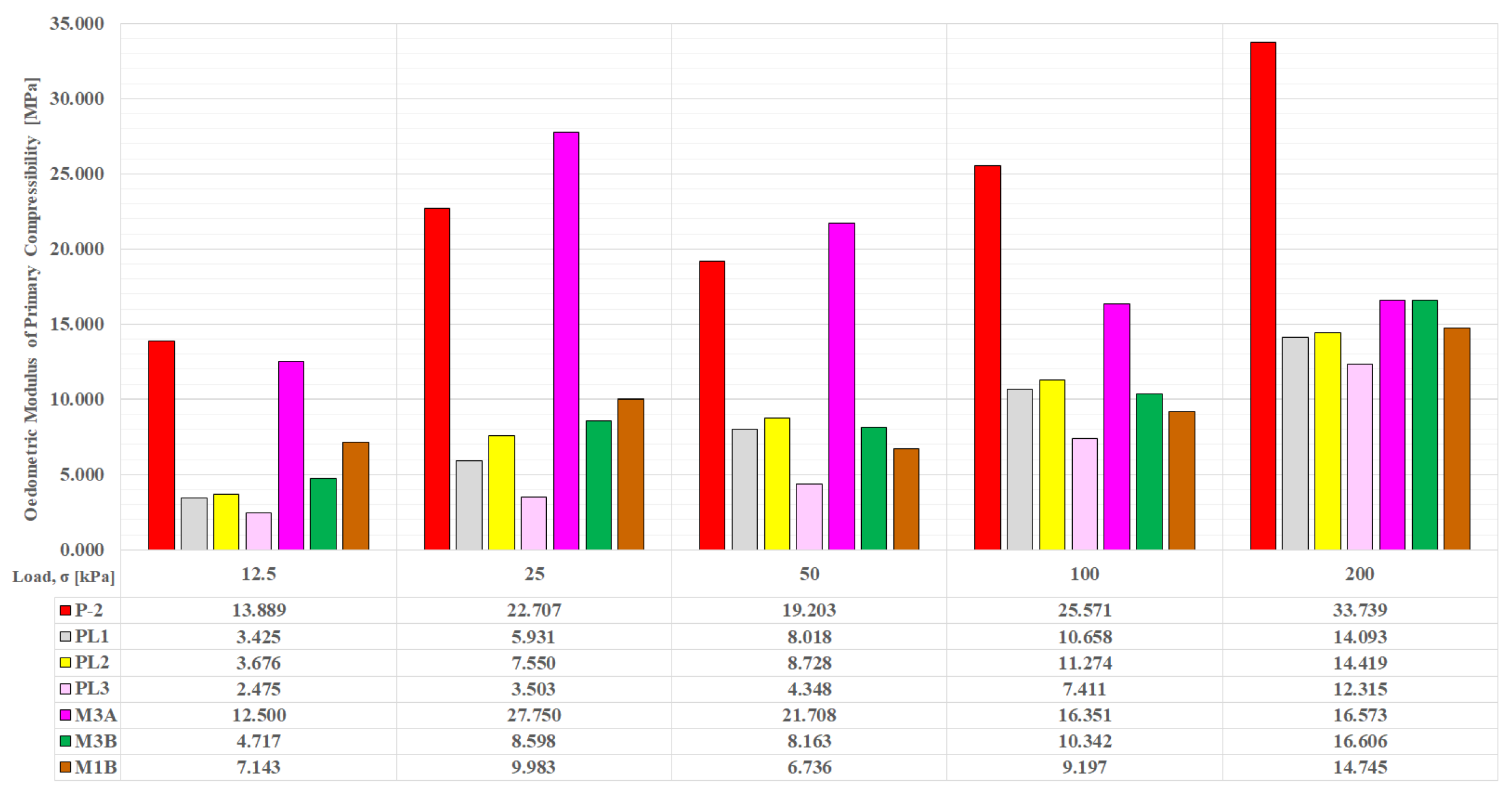
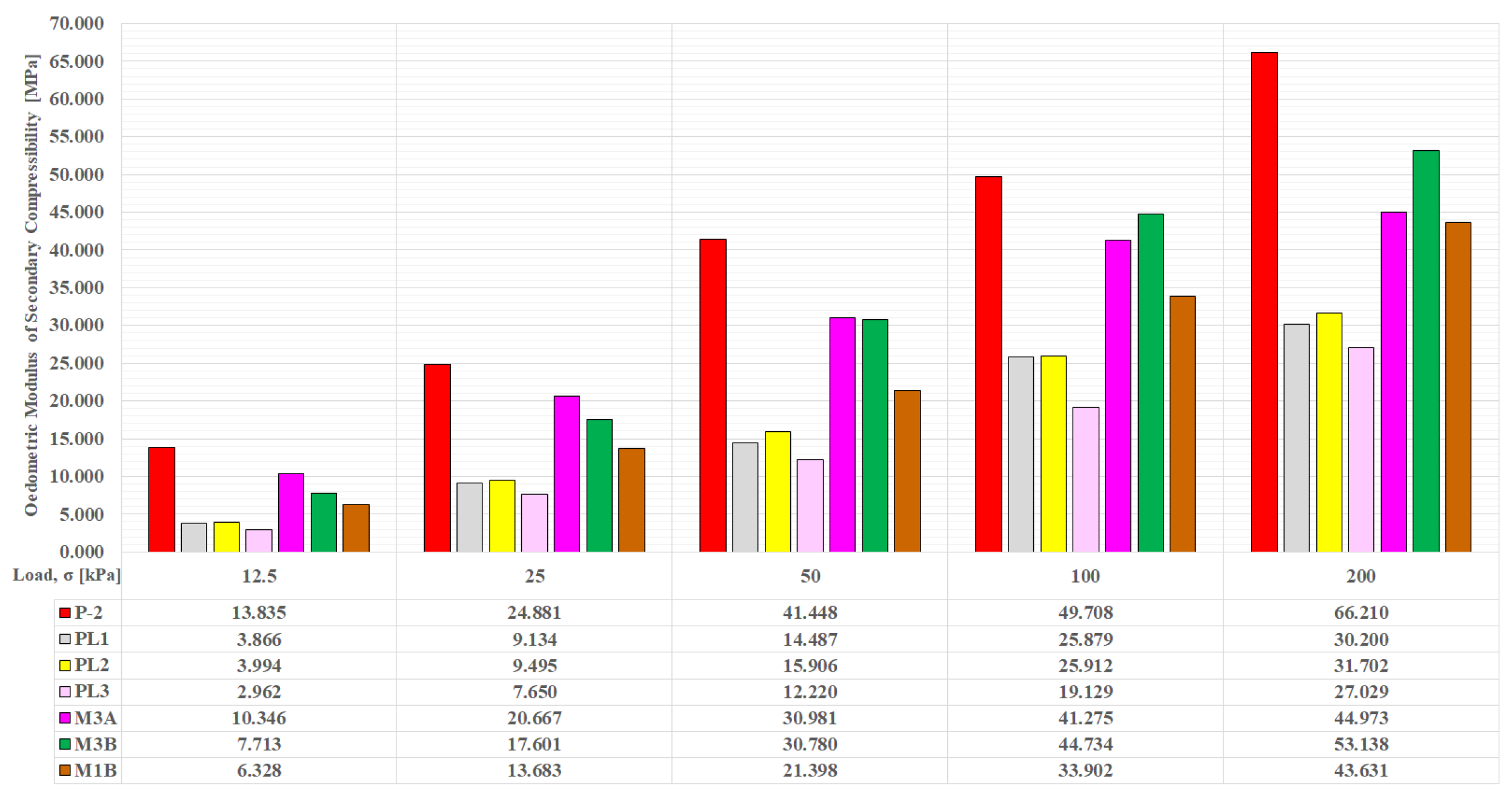
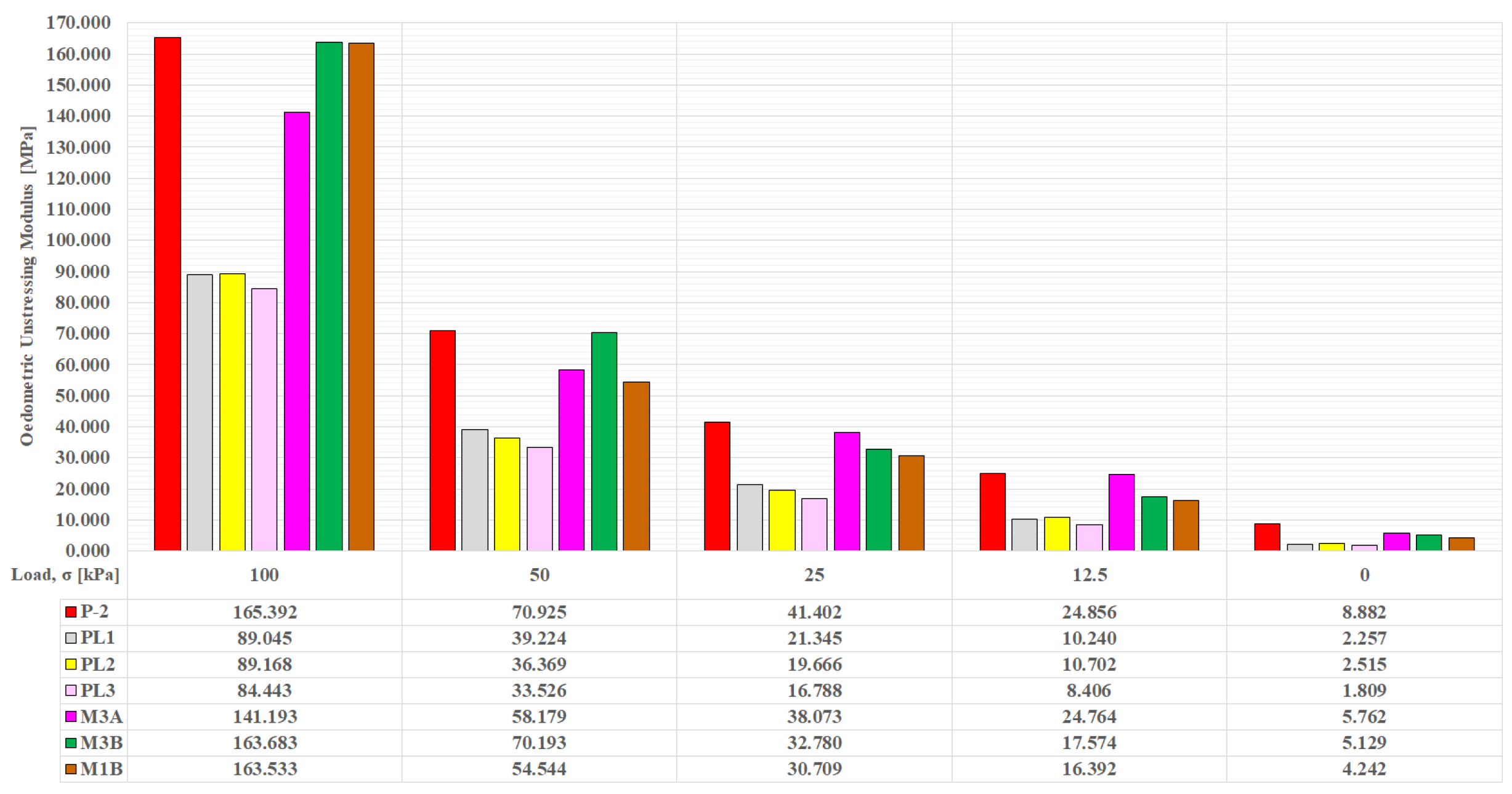
3.2.2. Oedometric Compressibility Modulus
3.3. Radiological Parameters
3.4. Criteria for Selecting Soils for Use in Road and Hydro Engineering Structures
3.5. Economic and Environmental Impact
3.6. Scaling Resource Recovery Technologies
4. Conclusions
Author Contributions
Funding
Institutional Review Board Statement
Informed Consent Statement
Data Availability Statement
Conflicts of Interest
Abbreviations
| EC | European Commission |
| EDS | Energy Dispersive Spectroscopy |
| FAAS | Flame Atomic Absorption Spectrometry |
| HM | Heavy Metal |
| ICP | Inductively Coupled Plasma |
| M1A | Category A Mixture No. 1 |
| M1B | Category B Mixture No. 1 |
| M2B | Category B Mixture No. 2 |
| MW | Mineral Waste (untreated) |
| NORM | Naturally Occurring Radioactive Material |
| P-2 | A sample of Washed Mineral Waste |
| PL1 | Sewage Sludge Ash No. 1 |
| PL2 | Sewage Sludge Ash No. 2 |
| PL3 | Sewage Sludge Ash No. 3 |
| R&D | Research and Development |
| SDG | Sustainable Development Goals |
| SEM | Scanning Electron Microscope |
| SSA | Fly Ash from the Thermal Treatment of Municipal Sewage Sludge |
| TRL | Technology Readiness Level |
| UNSCEAR | United Nations Scientific Committee on the Effects of Atomic Radiation |
| WMW | Washed Mineral Waste (received from the rinsing process of the mineral waste from grit chambers) |
| WMW-SSA | Mixtures of Washed Mineral Waste with Fly Ash from the Thermal Treatment of Municipal Sewage Sludge |
| WRRF | Water Resource Recovery Facilities |
| WWBR | Wastewater Biorefinery |
References
- Guven, H.; Ersahin, M.; Ozgun, H.; Ozturk, I.; Koyuncu, I. Energy and material refineries of future: Wastewater treatment plants. J. Environ. Manag. 2023, 329, 117130. [Google Scholar] [CrossRef] [PubMed]
- Shamshad, J.; Ur Rehman, R. Innovative approaches to sustainable wastewater treatment: A comprehensive exploration of conventional and emerging technologies. Environ. Sci. Adv. 2025, 4, 189–222. [Google Scholar] [CrossRef]
- Shen, X.; Wang, P.; Qiu, S.; Liu, Z.; Guan, J.; He, H. Materials-driven technologies and intelligent control for mineral processing wastewater recovery. Prog. Nat. Sci. 2026, 36, 20–30. [Google Scholar] [CrossRef]
- Bohra, V.; Ahamad, K.U.; Kela, A.; Vaghela, G.; Sharma, A.; Deka, B.J. Energy and resources recovery from wastewater treatment systems. In Clean Energy and Resource Recovery; Elsevier: Amsterdam, The Netherlands, 2022; Volume 2, pp. 17–36. [Google Scholar] [CrossRef]
- Capodaglio, A.G. Urban Wastewater Mining for Circular Resource Recovery: Approaches and Technology Analysis. Water 2023, 15, 3967. [Google Scholar] [CrossRef]
- Twi-Yeboah, N.; Osei, D.; Dontoh, W.H.; Asamoah, G.A.; Baffoe, J.; Danquah, M.K. Enhancing Energy Efficiency and Resource Recovery in Wastewater Treatment Plants. Energies 2024, 17, 3060. [Google Scholar] [CrossRef]
- Smol, M.; Adam, C.; Preisner, M. Circular economy model framework in the European water and wastewater sector. J. Mater. Cycles Waste Manag. 2020, 22, 682–697. [Google Scholar] [CrossRef]
- Obaideen, K.; Shehata, N.; Sayed, E.T.; Abdelkareem, M.A.; Mahmoud, M.S.; Olabi, A.G. The role of wastewater treatment in achieving sustainable development goals (SDGs) and sustainability guideline. Energy Nexus 2022, 7, 100112. [Google Scholar] [CrossRef]
- Garcia, C.; Pérez-Sánchez, M.; Ramos, H.M.; López-Jiménez, P.A.; Sánchez-Romero, F.J. New strategies in wastewater treatment plants to evaluate the achievement of sustainable development goals: A case study. Urban Water J. 2024, 21, 1201–1212. [Google Scholar] [CrossRef]
- Rawat, G.; Dewali, S.; Miglani, R.; Parveen, N.; Siddiqui, U.; Kumar, A.; Bora, S.; Arya, M.; Sharma, N.; Melkani, D.C.; et al. Vital Role of Wastewater Treatment in Sustainable Development Goals for a Cleaner Future. In Biotechnology Innovations for a Sustainable Future: Integrating Clean Energy, Life on the Planet, Clean Water, and Climate; Springer Nature: Singapore, 2026; pp. 1533–1568. [Google Scholar] [CrossRef]
- Kostrzewa, J.; Popielski, P.; Dąbska, A. Review of possibilities of using sandy waste obtained in wastewater treatment plants as an alternative raw material in construction. Mater. Econ. Logist. J. 2023, 3, 25–37. [Google Scholar] [CrossRef]
- Rutkowska, G.; Ogrodnik, P.; Żółtowski, M.; Powęzka, A.; Kucharski, M.; Krejsa, M. Fly Ash from the Thermal Transformation of Sewage Sludge as an Additive to Concrete Resistant to Environmental Influences in Communication Tunnels. Appl. Sci. 2022, 12, 1802. [Google Scholar] [CrossRef]
- Górka, J.; Poproch, D.; Cimochowicz-Rybicka, M.; Łuszczek, B. Characteristics of sand recovered from the municipal wastewater treatment plant. Miner. Resour. Manag. 2023, 39, 109–123. [Google Scholar] [CrossRef]
- Wichowski, P.; Kalenik, M.; Rutkowska, G.; Malarski, M.; Czajkowska, J.; Franus, W. Properties of products obtained in the process of solidification and stabilization of fly ash resulting from thermal treatment of sewage sludge. Cem. Lime Concr. 2023, 28, 389–408. [Google Scholar] [CrossRef]
- Zhuang, S.; Liu, Q.; Sun, K.; Lutter, S.; Chen, R.; Liu, G. Tracking five decades of global sand and gravel stocks and flows in 184 countries. Resour. Conserv. Recycl. 2025, 222, 108460. [Google Scholar] [CrossRef]
- Mattra, M.M.; Sujauddin, M.; Hossain, M.M.; Yu, J.; Liu, X.; Manago, G. Navigating the Sustainability Conundrum of Construction Sand. Sustainability 2025, 17, 8255. [Google Scholar] [CrossRef]
- Smigaj, M.; Walker, D.; Tirivarombo, S.; Moreri, K.; Pringle, C.; McCosh, J.; Mustafa, S.; Jovanovic, N. Local perspectives, regional consequences: The socio-environmental impacts of sand harvesting in southern Africa. Extr. Ind. Soc. 2025, 23, 101631. [Google Scholar] [CrossRef]
- Psyrri, G.; Keiding, J.K.; Kunther, W.; Torres, A.; Hauschild, M.Z.; Ambaye, T.G.; Lima, A.T.M. Abundant resources in an era of scarcity: Systemic aspects of the Global sand and gravel crisis. Resour. Conserv. Recycl. 2026, 225, 108631. [Google Scholar] [CrossRef]
- Kostrzewa, J.; Bogacki, J.; Szarek, Ł.; Komorowska, G.; Falaciński, P.; Wojtkowska, M.; Kaczmarek, Ł.; Popielski, P.; Zaborski, B. Stabilized Wastewater Treatment Plant Washed Mineral Waste and Sewage Sludge Ash Mixtures and Their Potential Use in Construction. Sustainability 2026, 18, 2851. [Google Scholar] [CrossRef]
- Vítěz, T.; Kukla, R.; Trávníček, P. Physical properties of sand from the waste water treatment plants. Acta Univ. Agric. Silvic. Mendel. Brun. 2010, 58, 233–238. [Google Scholar] [CrossRef]
- Wójcicka, K.; Prałat, K.; Baumann-Kaszubska, H.; Pesta, I.; Lis, W. Use of sand from grit chambers from the municipal sewage treatment plant for the production of building materials–turning waste into raw material. Constr. Rev. 2025, 96, 177–181. (In Polish) [Google Scholar] [CrossRef]
- Bieniowski, M.; Bauman-Kaszubska, H.; Kozakiewicz, P. Considerations on the management of sand generated in wastewater treatment plants. Forum Eksploatatora 2020, 3–4, 52–55. [Google Scholar]
- Kostrzewa, J.; Kaczmarek, Ł.; Bogacki, J.; Dąbska, A.; Wojtkowska, M.; Popielski, P. Potential Use of Wastewater Treatment Plant Washed Mineral Waste as Flood Embankment Materials. Materials 2025, 18, 3384. [Google Scholar] [CrossRef]
- Kostrzewa, J.; Bogacki, J.; Popielski, P. Preliminary assessment of the possibility to use washed mineral waste from wastewater treatment plants as a material for flood embankments construction. Water Manag. 2026, 2, 16–23. (In Polish) [Google Scholar] [CrossRef]
- Cieślik, B.M.; Ronda, O.; Grządka, E.; Orzeł, J.; Płotka-Wasylka, J. Comparative Analysis of Laboratory-Made and Industrial-Made Sewage Sludge Ash: Implications for Effective Management Strategy Development. Toxics 2024, 12, 344. [Google Scholar] [CrossRef]
- Borges, N.B.; Campos, J.R.; Pablos, J.M. Characterization of residual sand removed from the grit chambers of a wastewater treatment plant and its use as fine aggregate in the preparation of non-structural concrete. Water Pract. Technol. 2015, 10, 164–171. [Google Scholar] [CrossRef]
- Sun, X.; He, J.; Lv, W.; Wu, S.; Peng, Y.; Peng, Y.; Fei, J.; Wu, Z. Characteristics and Resource Recovery Strategies of Solid Waste in Sewerage Systems. Sustainability 2023, 15, 1662. [Google Scholar] [CrossRef]
- Czop, M.; Petryk, A.; Balcerzak, L.; Jamry, A.; Kopiec, W.; Nowak, K.; Piwowarczyk, M.; Zackiewicz, W. Testing and Evaluation of Physical and Chemical Properties of Waste from Desanding. Inżynieria Miner. 2024, 2, 129–134. [Google Scholar] [CrossRef]
- Czop, M.; Wyczarska-Kokot, J.; Kalka, J.; Kudlek, E.; Balcerzak, L.; Jamry, A.; Kopiec, W.; Nowak, K.; Piwowarczyk, M.; Zackiewicz, W. Possibilities of using waste from wastewater treatment plants to create soil-like materials. Desalin. Water Treat. 2025, 321, 100907. [Google Scholar] [CrossRef]
- Czop, M.; Zajusz-Zubek, E.; Łaźniewska-Piekarczyk, B. Use of Sands from Wastewater Treatment Plants as a Substitute for Natural Aggregate in the Context of a Circular Economy. Sustainability 2025, 17, 5471. [Google Scholar] [CrossRef]
- Łaźniewska-Piekarczyk, B.; Czop, M.J. Reclaimed Municipal Wastewater Sand as a Viable Aggregate in Cement Mortars: Alkaline Treatment, Performance, Assessment, and Circular Construction Applications. Processes 2025, 13, 2463. [Google Scholar] [CrossRef]
- Czapla, A.; Kruszelnicka, I.; Drewnowski, J. Silica sand recovery into wastewater treatment: Circular economy applications in glass fibre reinforced plastic pipe manufacturing. J. Ecol. Eng. 2026, 27, 81–97. [Google Scholar] [CrossRef]
- Kostrzewa, J.; Popielski, P.; Dąbska, A. Geotechnical Properties of Washed Mineral Waste from Grit Chambers and Its Potential Use as Soil Backfill and Road Embankment Materials. Buildings 2024, 14, 766. [Google Scholar] [CrossRef]
- Lynn, C.J.; Dhir, R.K.; Ghataora, G.S.; West, R.P. Sewage sludge ash characteristics and potential for use in concrete. Constr. Build. Mater. 2015, 98, 767–779. [Google Scholar] [CrossRef]
- Smol, M.; Kulczycka, J.; Henclik, A.; Gorazda, K.; Wzorek, Z. The possible use of sewage sludge ash (SSA) in the construction industry as a way towards a circular economy. J. Clean. Prod. 2015, 95, 45–54. [Google Scholar] [CrossRef]
- Chakraborty, S.; Jo, B.W.; Jo, J.H.; Baloch, Z. Effectiveness of sewage sludge ash combined with waste pozzolanic minerals in developing sustainable construction material: An alternative approach for waste management. J. Clean. Prod. 2017, 153, 253–263. [Google Scholar] [CrossRef]
- Nakic, D. Environmental evaluation of concrete with sewage sludge ash based on LCA. Sustain. Prod. Consum. 2018, 16, 193–201. [Google Scholar] [CrossRef]
- Świerczek, L.; Cieślik, B.M.; Konieczka, P. Challenges and opportunities related to the use of sewage sludge ash in cement-based building materials—A review. J. Clean. Prod. 2021, 287, 125054. [Google Scholar] [CrossRef]
- Feldthus, F.B.; Ottosen, L.M.; Bertelsen, I.M.G.; Kirkelund, G.M. Fluxing properties of sewage sludge ash in brick manufacturing: Effect of phosphorus extraction and brick clay composition. Case Stud. Constr. Mater. 2025, 23, e05387. [Google Scholar] [CrossRef]
- Sah, P.K.; Sah, B.K.; Kumar, S.S. Sustainable utilization of sewage sludge ash in stabilizing subgrade soil: An appraisal. Environ. Dev. Sustain. 2025, 27, 12477–12515. [Google Scholar] [CrossRef]
- Bertoldo, N.; Cefis, N.; Blazina, M.; D’anna, A.; Dotelli, G. Exploring the Use of Sewage Sludge Ash in Concrete: Assessing Mechanical Properties and Environmental Impacts. IOP Conf. Ser. Earth Environ. Sci. 2025, 1554, 012091. [Google Scholar] [CrossRef]
- Jiang, J.; Zhou, X.L.; Zheng, Y.T.; Wu, P.; Jiang, G.; Jian, B. Recycling of sewage sludge ash in cold-bonded artificial lightweight aggregate for sustainable lightweight concrete. Sci. Rep. 2025, 15, 27671. [Google Scholar] [CrossRef]
- Joya, M.; Gill, A.S. Sewage sludge ash in concrete: A comprehensive review on properties, performance, and environmental sustainability. Discov. Civ. Eng. 2026, 3, 54. [Google Scholar] [CrossRef]
- Hayder, M.R.; Ziari, H.; Shaban, A.M. Strength and microstructural characteristics of sand soils stabilized with paper sludge Ash-Based geopolymer. Sci. Rep. 2025, 15, 8752. [Google Scholar] [CrossRef] [PubMed]
- Gronba-Chyła, A.; Generowicz, A.; Kwaśnicki, P.; Kochanek, A. Recovery and Recycling of Selected Waste Fractions with a Grain Size Below 10 mm. Sustainability 2025, 17, 1612. [Google Scholar] [CrossRef]
- The European Commission. 2014/955/EU: Commission Decision of 18 December 2014 amending Decision 2000/532/EC on the list of waste pursuant to Directive 2008/98/EC of the European Parliament and the Council Text with EEA relevance. Off. J. Eur. Union 2014, 44–86. [Google Scholar]
- Regulation of the Minister of Climate of 2 January 2020 on the Waste Catalogue. Journal of Laws of the Republic of Poland Item 10/03.01. 2020. Available online: https://isap.sejm.gov.pl/isap.nsf/DocDetails.xsp?id=WDU20200000010 (accessed on 27 April 2026). (In Polish)
- Statistics Poland. Environment. 2024. Available online: https://stat.gov.pl/obszary-tematyczne/srodowisko-energia/srodowisko/ochrona-srodowiska-2024,1,25.html (accessed on 27 April 2026).
- The European Commission. 2003/33/EC: Council Decision of 19 December 2002 establishing criteria and procedures for the acceptance of waste at landfills pursuant to Article 16 of and Annex II to Directive 1999/31/EC. Off. J. Eur. Union 2003, 1–23. [Google Scholar]
- Regulation of the Minister of Economy of 16 July 2015 on Admitting Waste to be Landfilled. Journal of Laws of the Republic of Poland Item 1277/01.09. 2015. Available online: https://isap.sejm.gov.pl/isap.nsf/DocDetails.xsp?id=WDU20150001277 (accessed on 27 April 2026). (In Polish)
- ISO/TS 17892-4:2004; Geotechnical Investigation and Testing—Laboratory Testing of Soil—Part 4: Determination of Particle Size Distribution. International Organization for Standardization: Geneva, Switzerland, 2004.
- Andriulaityte, I.; Valentukeviciene, M.; Zurauskiene, R. Research on the Reusability of Bentonite Waste Materials for Residual Chlorine Removal. Materials 2024, 17, 5647. [Google Scholar] [CrossRef]
- Pisarczyk, S. Filled Soil. In Geotechnical Properties and Methods of Their Testing, 4th ed.; Warsaw University of Technology Publishing House: Warsaw, Poland, 2022. (In Polish) [Google Scholar]
- ISO/TS 17892-3:2004; Geotechnical Investigation and Testing—Laboratory Testing of Soil—Part 3: Determination of Particle Density—Pycnometer Method. International Organization for Standardization: Geneva, Switzerland, 2004.
- PN-B-04481:1988; Construction Soil—Testing of Soil Samples. Polish Committee for Standardization: Warsaw, Poland, 1988. (In Polish)
- Sulewska, M.J.; Tymosiak, D. Analysis of compaction parameters of the exemplary non-cohesive soil determined by Proctor methods and vibrating table tests. Ann. Wars. Univ. Life Sci.–SGGW Land Reclam. 2018, 50, 99–108. [Google Scholar] [CrossRef]
- Park, K.; Kim, J.-H.; Shin, J.; Lee, H.; Nam, B.H. A Study on the Effect of Graphene Oxide on Geotechnical Properties of Soil. Materials 2024, 17, 6199. [Google Scholar] [CrossRef] [PubMed]
- ISO/TS 17892-11:2004; Geotechnical Investigation and Testing—Laboratory Testing of Soil—Part 11: Determination of Permeability by Constant and Falling Head. International Organization for Standardization: Geneva, Switzerland, 2004.
- Wiłun, Z. Outline of Geotechnics, 10th ed.; Transport and Communication Publishers: Warsaw, Poland, 2013. (In Polish) [Google Scholar]
- Dąbska, A. Sands Resistance to Failure Due to Seepage, 1st ed.; Warsaw University of Technology Publishing House: Warsaw, Poland, 2021. (In Polish) [Google Scholar]
- Zabielska-Adamska, K. Hydraulic conductivity of fly ash as a barrier material: Some problems in determination. Environ. Earth Sci. 2020, 79, 321. [Google Scholar] [CrossRef]
- Marschalko, M.; Zięba, Z.; Niemiec, D.; Neuman, D.; Mońka, J.; Dąbrowska, J. Suitability of Engineering-Geological Environment on the Basis of Its Permeability Coefficient: Four Case Studies of Fine-Grained Soils. Materials 2021, 14, 6411. [Google Scholar] [CrossRef] [PubMed]
- ISO/TS 17892-10:2004; Geotechnical Investigation and Testing—Laboratory Testing of Soil—Part 10: Direct Shear Tests. International Organization for Standardization: Geneva, Switzerland, 2004.
- Zabielska-Adamska, K. Sewage Sludge Bottom Ash Characteristics and Potential Application in Road Embankment. Sustainability 2020, 12, 39. [Google Scholar] [CrossRef]
- ISO/TS 17892-5:2004; Geotechnical Investigation and Testing—Laboratory Testing of Soil—Part 5: Incremental Loading Oedometer Test. International Organization for Standardization: Geneva, Switzerland, 2004.
- Vukićević, M.; Marjanović, M.; Pujević, V.; Jocković, S. The Alternatives to Traditional Materials for Subsoil Stabilization and Embankments. Materials 2019, 12, 3018. [Google Scholar] [CrossRef]
- PN-EN ISO 14688-1:2018-05; Geotechnical Investigation and Testing—Identification and Classification of Soil—Part 1: Identification and Description. Polish Committee for Standardization: Warsaw, Poland, 2018. (In Polish)
- PN-EN ISO 14688-2:2018-05; Geotechnical Investigation and Testing—Identification and Classification of Soil—Part 2: Principles for a Classification. Polish Committee for Standardization: Warsaw, Poland, 2018. (In Polish)
- Kolosovska, T.; Bauer, S.K. Evaluation of grit properties at a medium-capacity wastewater treatment plant: A case study. Resour. Conserv. Recycl. Adv. 2022, 14, 200080. [Google Scholar] [CrossRef]
- Morman-Wątor, J.; Pilecka, E. An Analysis of the Use of Mining Waste from Coal Mines in Flood and Road Embankments. Energies 2024, 17, 3303. [Google Scholar] [CrossRef]
- Myślińska, E. Laboratory Testing of Land and Soil, 3rd ed.; University of Warsaw Press: Warsaw, Poland, 2016. (In Polish) [Google Scholar]
- Buca, B. The possibility and advisability of taking into account apparent coherence in geotechnical calculations. Inżynieria Morska 1985, 6, 212–213. [Google Scholar]
- European Commission (EC). Radiation Protection 112: Radiological Protection Principles Concerning the Natural Radioactivity of Building Materials; Directorate-General Environment, Nuclear Safety and Civil Protection: Luxembourg, 1999. [Google Scholar]
- Council Directive 2013/59/Euratom of 5 December 2013 laying down basic safety standards for protection against the dangers arising from exposure to ionising radiation, and repealing Directives 89/618/Euratom, 90/641/Euratom, 96/29/Euratom, 97/43/Euratom and 2003/122/Euratom. Off. J. Eur. Union 2014, L13, 1–73.
- Regulation of the Minister of Environment of 20 April 2007 on the Technical Conditions to Be Met by Hydraulic Structures and Their Location. Journal of Laws of the Republic of Poland Item 579/16.05. 2007. Available online: https://isap.sejm.gov.pl/isap.nsf/DocDetails.xsp?id=WDU20070860579 (accessed on 18 May 2026). (In Polish)
- Treatment of Waste by Waste Category, Hazardousness and Waste Management Operations. Available online: https://ec.europa.eu/eurostat/databrowser/product/page/ENV_WASTRT (accessed on 19 May 2026).
- Sewage Sludge Production and Disposal. Available online: https://ec.europa.eu/eurostat/databrowser/product/page/ENV_WW_SPD (accessed on 19 May 2026).
- Ferrentino, R.; Langone, M.; Fiori, L.; Andreottola, G. Full-Scale Sewage Sludge Reduction Technologies: A Review with a Focus on Energy Consumption. Water 2023, 15, 615. [Google Scholar] [CrossRef]
- Kacprzak, M.; Neczaj, E.; Fijałkowski, K.; Grobelak, A.; Grosser, A.; Worwag, M.; Rorat, A.; Brattebo, H.; Almås, Å.; Singh, B.R. Sewage sludge disposal strategies for sustainable development. Environ. Res. 2017, 156, 39–46. [Google Scholar] [CrossRef] [PubMed]
- Kępniak, M.; Łukowski, P. Multicriteria Analysis of Cement Mortar with Recycled Sand. Sustainability 2024, 16, 1773. [Google Scholar] [CrossRef]
- ISO 16290:2013; Space Systems—Definition of the Technology Readiness Levels (TRLs) and Their Criteria of Assessment. International Organization for Standardization: Geneva, Switzerland, 2013.






| Country (Region) [Reference] | Waste Type Presented in the Reference | Proposed Reuse | Key Findings |
|---|---|---|---|
| Czech Republic (Moravia) [20] | Sewage sand (grit chamber) | Building material (no specific use indicated) | Varied content of organic substances (1.58–68.49%) and total solids (20.03–95.40%). Lack of uniform particle distribution. |
| Brazil (São Carlos) [26] | Residual sand (grit chamber) | Non-structural concrete elements, e.g., sidewalks and curbs (fine aggregate) | The waste washing and drying process reduced organic matter to 1%. Adequate strength was achieved using 70% of the residual sand. |
| Poland (Mazovia) [22] | Waste sand (flushing separator) | Concrete (aggregate), backfill excavations (soil additive) | Organic substance content (0.78–14.44%). The sand fraction content (85.70 to 94.80%). |
| China (Shenzhen) [27] | Sandy waste (grit chamber) | Building material (fine aggregate) | The waste has a low organic content and a high content of heavy metals and sand. The fine aggregates could be recovered through processes such as de-mixing, screening, and sand washing. |
| Poland (Cracow) [13] | Sand (flushing separator) | Concrete (fine aggregate) | Organic matter content (1.8%). The sand fraction content (98%). The leachability tests showed that this raw material has no environmental impact. |
| Poland (Bielsko-Biala, Gliwice) [28] | Desanding waste (flushing separator) | Construction aggregate | Organic matter content (2.17–15.91%). Sand fraction content (57.3–95.2%). Leachability levels of hazardous substances and heavy metals do not pose any potential harm to the natural environment. |
| Poland (Gliwice) [29] | Sand trap content (grit chamber); mixtures of stabilized municipal sewage sludge with sand trap content (2:1, 1:1, 1:2) | Soil-like material | Organic substance content (sand: 1.11%; mixtures: 6.63–13.49%). Heavy metal content after mineralization (sand: not assessed; mixtures: retained for the indicated use). Leachability of harmful substances and heavy metals (sand: retained; mixtures: exceeding permissible values). It was shown that the tested samples can only be used to create soil substrates after being washed or neutralized. |
| Poland [30] | The contents of sand from desanding (grit chamber) | Sub-base layers and other non-structural applications (aggregate) | The organic matter content of the sand (7.8%), and the sand fraction (90.4%). The leachability of harmful substances and heavy metals by the sand is maintained. The substitution of natural sand with waste sand in cement mortar formulations results in a significant reduction in mechanical performance (35% in compressive strength and 38% in flexural strength). |
| Poland [31] | Sand (grit removal systems) | Cement mortars (aggregate) | Alkaline pretreatment with sodium hydroxide (NaOH) enables the effective reuse of WWTP-derived waste sand in cement mortars, achieving mechanical and rheological properties comparable to those of mortars made with conventional sand. The most favorable results were obtained for 0.5% NaOH. |
| Poland [21] | Sand (flushing separator) | Concrete (fine aggregate); geopolymer material | Organic matter content (3.09%). Sand fraction content (94.89%). Uniform-grained sand. Potential use of sand after proper cleaning. |
| Poland [32] | Silica sand | Glass fiber reinforced plastic pipe | The review explores the origins and movement of silica sand within wastewater, and the technologies used for its recovery and purification, characterization techniques, applications in GRP pipe production, policy mechanisms that support circular flows, and areas for future research. |
| Poland (Warsaw) [33] | Washed mineral waste (flushing separator) | Backfill and road embankment material (soil) | Organic substance content (1.06%). Sand fraction content (94.17%). Uniform-grained and frost-unsusceptible soil. Geotechnical properties meet requirements for soil backfills. The application of a road embankment material needs to be proven through field tests (compaction index). |
| Poland (Warsaw) [23] | Washed mineral waste (flushing separator) | Flood embankment material (soil) | Organic substance content (1.01%). Sand fraction content (95.43%). The heavy metal content after mineralization was retained for road applications and, in some cases, for residential applications as well. Geotechnical properties meet requirements for flood embankment material. The application needs to be proven through field tests (compaction index). |
| Poland (Warsaw) [19] | Mixtures of washed mineral waste with municipal sewage sludge ash (90, 70, 50%) | Backfill, road and flood embankment material (soil) | Organic matter content (0.07–0.14%). Sand fraction content (75.90–94.96%). Selected mixtures with a dominant content of washed mineral waste (90 and 70%) retain acceptable heavy metal levels after mineralization and in water extracts. Their suitability for further use should be confirmed by geotechnical studies. |
| Sample | Mass Ratios of Wastes (WMW/SSA) | |||
|---|---|---|---|---|
| WMW (P-2) | SSA (PL1) | SSA (PL2) | SSA (PL3) | |
| M1A | 9 | 1 | 0 | 0 |
| M1B | 27 | 1 | 1 | 1 |
| M2B | 7 | 1 | 1 | 1 |
| No. | Fraction Size [mm] | Percentage Content [%] | ||
|---|---|---|---|---|
| Name | M1A | M1B | M2B | |
| 1. | >4.0 | 0.82 | 2.07 | 1.83 |
| 2. | 2.0–4.0 | 2.49 | 2.99 | 2.11 |
| 3. | 1.0–2.0 | 7.71 | 7.97 | 6.18 |
| 4. | 0.5–1.0 | 27.65 | 27.32 | 21.31 |
| 5. | 0.25–0.5 | 42.86 | 40.00 | 31.48 |
| 6. | 0.125–0.25 | 10.48 | 10.93 | 12.93 |
| 7. | 0.063–0.125 | 3.11 | 3.58 | 9.54 |
| 8. | <0.063 | 4.88 | 5.14 | 14.62 |
| No. | Parameter | Unit | WMW-SSA | WMW 1 | SSA 2 | ||||
|---|---|---|---|---|---|---|---|---|---|
| M1A | M1B | M2B | P-2 | PL1 | PL2 | PL3 | |||
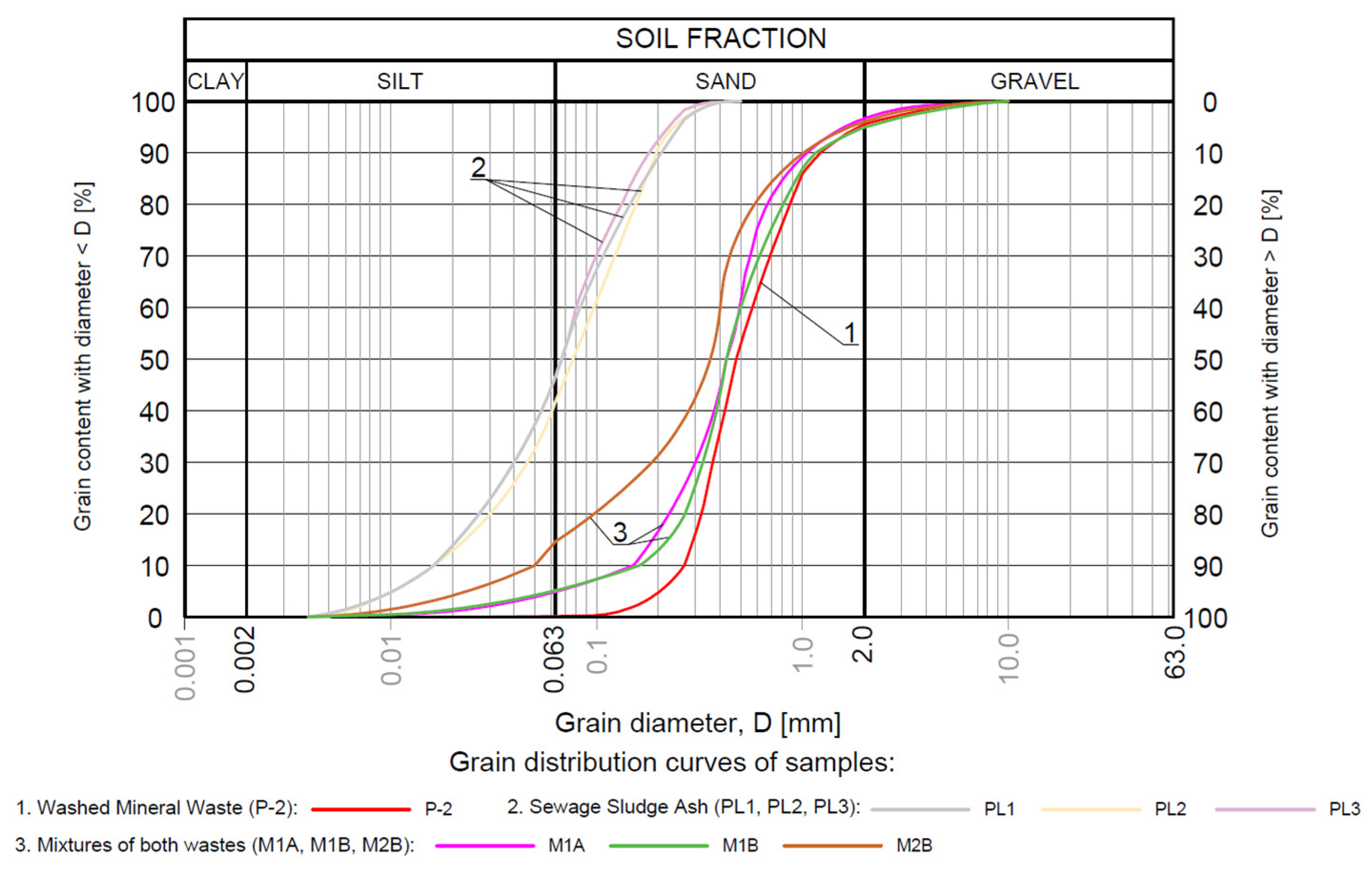
| 1. | Gravel fraction | % | 3.31 | 5.06 | 3.94 | 4.45 | 0.00 | 0.00 | 0.00 |
| 2. | Sand fraction | % | 91.81 | 89.80 | 81.44 | 95.43 | 53.31 | 58.26 | 53.40 |
| 3. | Silt + Clay fraction | % | 4.88 | 5.14 | 14.62 | 0.12 | 46.69 | 41.74 | 46.60 |
| 4. | Effective diameter D60 | mm | 0.490 | 0.500 | 0.400 | 0.550 | 0.081 | 0.098 | 0.080 |
| 5. | Effective diameter D50 | mm | 0.410 | 0.410 | 0.340 | 0.480 | 0.068 | 0.075 | 0.068 |
| 6. | Effective diameter D30 | mm | 0.300 | 0.310 | 0.180 | 0.350 | 0.040 | 0.045 | 0.040 |
| 7. | Effective diameter D10 | mm | 0.140 | 0.150 | 0.050 | 0.250 | 0.015 | 0.015 | 0.015 |
| 8. | Uniformity coefficient CU | - | 3.50 | 3.33 | 8.00 | 2.20 | 5.40 | 6.53 | 5.33 |
| 9. | Curvature coefficient CC | - | 1.31 | 1.28 | 1.62 | 0.89 | 1.32 | 1.38 | 1.33 |
| Parameter | Unit | WMW-SSA | WMW 1 | SSA | ||||
|---|---|---|---|---|---|---|---|---|
| M1A | M1B | M2B | P-2 | PL1 | PL2 | PL3 | ||
| Specific density ρs | g/cm3 | 2.539 | 2.533 | 2.460 | 2.620 | 2.093 | 2.114 | 2.285 |
| No. | Parameter | Unit | WMW-SSA | WMW 1 | SSA | ||||
|---|---|---|---|---|---|---|---|---|---|
| M1A | M1B | M2B | P-2 | PL1 | PL2 | PL3 | |||
| 1. | Dry density corresponds to the state of the loosest possible composition of soil grains ρdmin | g/cm3 | 1.592 | 1.608 | 1.319 | 1.570 | 0.382 | 0.723 | 0.756 |
| 2. | Maximum void ratio emax | - | 0.595 | 0.575 | 0.865 | 0.669 | 4.479 | 1.924 | 2.022 |
| 3. | Maximum porosity nmax | - | 0.373 | 0.365 | 0.464 | 0.401 | 0.817 | 0.658 | 0.669 |
| 4. | Dry density corresponds to the state of the densest possible composition of soil grains ρdmax | g/cm3 | 1.890 | 1.898 | 1.653 | 1.850 | 0.506 | 0.992 | 1.050 |
| 5. | Minimum void ratio emin | - | 0.343 | 0.335 | 0.488 | 0.416 | 3.136 | 1.131 | 1.176 |
| 6. | Minimum porosity nmin | - | 0.256 | 0.251 | 0.328 | 0.294 | 0.758 | 0.531 | 0.540 |
| No. | Parameter | Unit | WMW-SSA | WMW 1 | SSA | ||||
|---|---|---|---|---|---|---|---|---|---|
| M1A | M1B | M2B | P-2 | PL1 | PL2 | PL3 | |||
| 1. | Maximum dry density ρds | g/cm3 | 1.780 | 1.770 | 1.542 | 1.790 | 0.861 | 0.912 | 1.001 |
| 2. | Optimum moisture content wopt | % | 12.86 | 12.54 | 20.25 | 11.95 | 65.45 | 60.80 | 52.40 |
| 3. | Degree of saturation after compaction Sr | - | 0.768 | 0.738 | 0.838 | 0.680 | 0.959 | 0.977 | 0.935 |
| No. | Parameter | Unit | WMW-SSA | WMW 1 | SSA | ||||
|---|---|---|---|---|---|---|---|---|---|
| M1A | M1B | M2B | P-2 | PL1 | PL2 | PL3 | |||
| 1. | Hydraulic conductivity (in apparatus) k10 | m/d | 0.22 | 0.39 | 0.08 | 7.71 | 0.07 | 0.07 | 0.07 |
| 2. | Hydraulic conductivity (Slichter formula) k10 2 | m/d | 0.85/2.92 | 0.92/3.12 | 0.25/0.76 | 4.31/11.97 | 0.35/0.44 | 0.11/0.22 | 0.12/0.23 |
| Sample | Linear Equation | Coefficient of Determination (R2) | Number of Measurements (n) | Internal Friction Angle (Φ) [°] | Apparent Cohesion (cp) [kPa] |
|---|---|---|---|---|---|
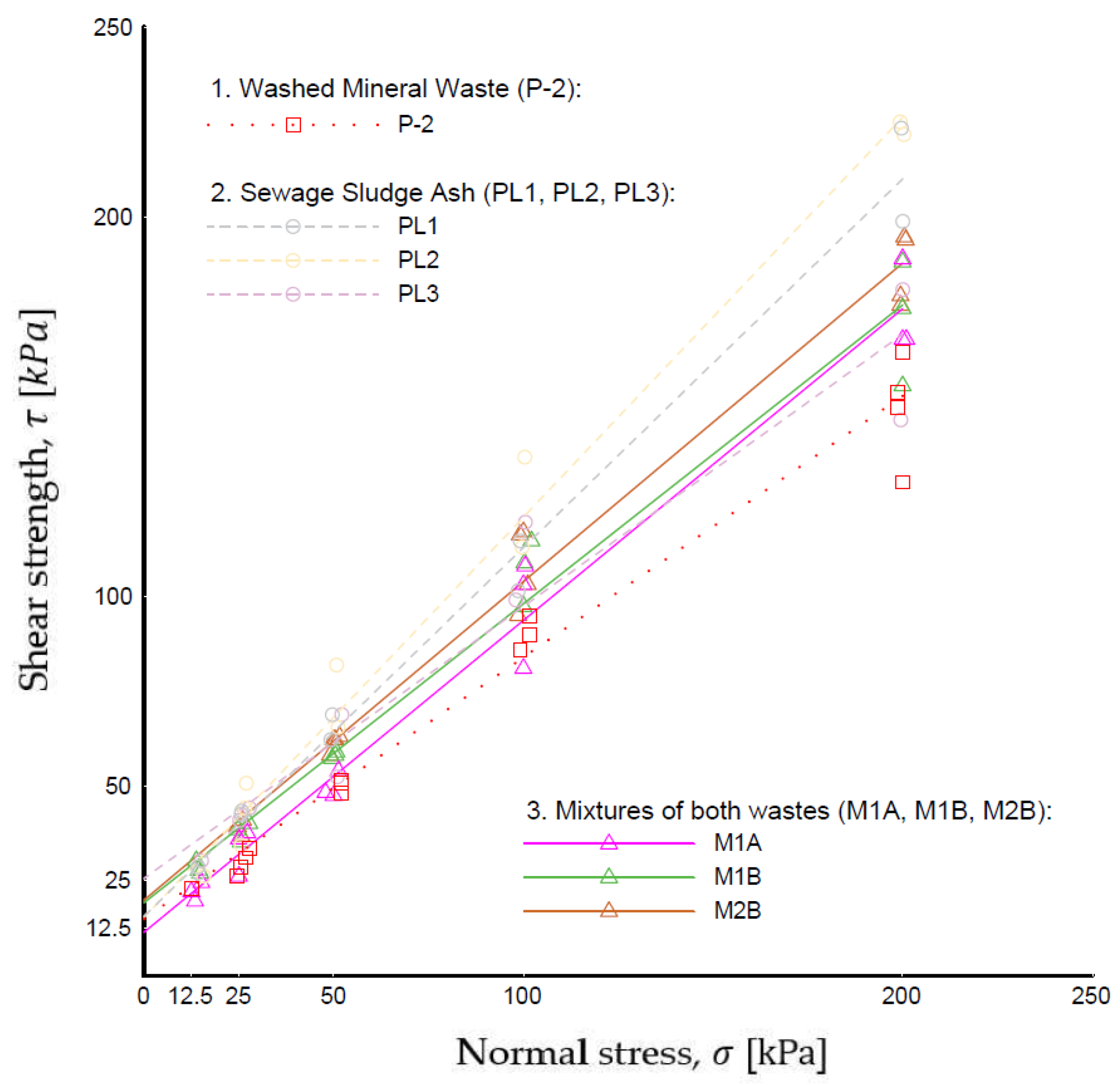
| WMW-SSA (M1A) | τ = 0.8218∙σ + 11.45 | 0.9818 | 15 | 39.5 | 11.45 |
| WMW-SSA (M1B) | τ = 0.7878∙σ + 19.21 | 0.9780 | 15 | 38.4 | 19.21 |
| WMW-SSA (M2B) | τ = 0.8395∙σ + 19.90 | 0.9855 | 15 | 40.1 | 19.90 |
| WMW (P-2) 1 | τ = 0.6893∙σ + 14.98 | 0.9745 | 17 | 34.4 | 14.98 |
| SSA (PL1) | τ = 0.9718∙σ + 15.66 | 0.9893 | 10 | 44.1 | 15.66 |
| SSA (PL2) | τ = 1.0545∙σ + 15.39 | 0.9873 | 11 | 46.4 | 15.39 |
| SSA (PL3) | τ = 0.7173∙σ + 25.62 | 0.9419 | 9 | 35.5 | 25.62 |
| Sample | K-40 | Ra-226 | Th-232 | Cs-137 | Raeq | Iγ |
|---|---|---|---|---|---|---|
| Bq·kg−1 | - | |||||
| WMW (P-2) | 420 ± 105 | 278 ± 70 | 92 ± 20 | <46 | 442 | 1.53 |
| SSA (PL1) | 740 ± 185 | <40 | <30 | 46 ± 15 | 57 | 0.25 |
| SSA (PL2) | 2500 ± 625 | 80 ± 50 | 62 ± 20 | 102 ± 25 | ≈330 | ≈1.13 |
| SSA (PL3) | 812 ± 200 | 840 ± 200 | 97 ± 25 | 116 ± 30 | 1041 | 3.56 |
| Sample | Dominant Microstructural/Chemical Features | Key Granulometric Traits | Heavy Metal Enrichment Pattern | Radiological Signature (K-40, Ra-226, Th-232, Cs-137) | Interpretive Integration (Mechanistic Link) |
|---|---|---|---|---|---|
| WMW (P-2) | Quartz-dominated medium sand; low organic matter; simple mineralogy | 95.4% sand; negligible fines | Very low HM content except natural Ni/Co | Moderate K-40 and Th-232; no U-series elevation | Natural geogenic signature matches quartz-rich sands; absence of fine reactive phases prevents radionuclide accumulation |
| SSA (PL1) | Fine sand with high silt; simple unimodal distribution; low Fe/Al enrichment; limited porous glassy phases | Fine fraction significant but mineralogically simple | Lowest HM concentrations among SSA | Very low Ra-226 and Th-232; moderate K-40; Cs-137 detectable but low | Minimal fine-phase mineral enrichment explains weak U/Th signatures; moderate K-bearing silicates yield mid-range K-40 |
| SSA (PL2) | Bimodal fine fraction; strong agglomeration; abundant aluminosilicate glass; elevated K-rich phases | Fine + mid-size clusters; high surface area | Moderate HM enrichment | Highest K-40 across SSA; moderate Ra-226/Th-232 | K-40 peak results from high K-bearing phases in fine ash; agglomeration increases gamma yield stability |
| SSA (PL3) | Crystalline SSA; high Fe/Al phases; porosity and microcrystals typical of U/Th-bearing matrices | Fine fraction and agglomerates present | Highest HM concentrations (Zn, Pb, Cu, Ni, Co) | Highest Ra-226 and Th-232; moderate K-40 | Crystalline Fe-/Al-rich phases stabilize U/Th progeny; HM enrichment correlates with enriched radionuclides |
| Mechanistic Domain | Empirical Observation (from Full Dataset) | Mechanistic Interpretation | Radiological Expression | Supported by |
|---|---|---|---|---|
| Aluminosilicate glass phases (SSA) | PL2 and PL3 contain abundant amorphous and semi-crystalline aluminosilicates, with higher K, Al, Si proportions | Glassy ash matrices incorporate alkali metals (K), and selectively trap U/Th daughter products in micro-porous domains | Elevated K-40 (PL2); elevated Ra-226 and Th-232 (PL3) | SEM/EDS + radiological data |
| Fine-fraction dominance | SSA samples contain 40–47% silt/superfine ash; PL2 has bimodal 8 µm + 110 µm distribution; PL3 fine fraction strongly present | Fine particles have high surface area, sorption capacity, and high affinity for radionuclides and trace metals | Amplified gamma activity in PL2 (K-40) and PL3 (Ra/Th series) | Particle size distribution + gamma spectroscopy |
| Crystalline Fe/Al-rich microphases | PL3 contains more crystalline domains and Fe oxides (color, microstructure) | Fe/Al phases support incorporation of U/Th decay-chain microphases, stabilizing their presence | Highest Ra-226 and Th-232 in PL3 | SEM + radionuclide fingerprints |
| Heavy metal enrichment as proxy for geochemical reactivity | PL3 shows highest Zn, Pb, Cu, Ni, Co; PL2 moderate; PL1 low; P-2 minimal | HM enrichment correlates with reactive phases capable of concentrating U/Th daughter isotopes | PL3 > PL2 > PL1 radiologically (Ra, Th series) | ICP/FAAS chemical analysis + radiology |
| Ash alkalinity (pH 8.9–9.4) | SSA eluates show elevated pH; mixtures even higher depending on SSA fraction | High pH suppresses solubility and mobility of U/Th radionuclides and heavy metals | Radiological stability (no detectable mobility) | Leaching tests + radiological immobility |
| Quartz-dominated mineral waste (P-2) | P-2 shows 95.4% sand, simple mineralogy, minimal fine fraction, no reactive phases | Lack of reactive silicate or oxide domains reduces radionuclide accumulation capacity | Moderate K-40, natural Th-232, no U-series anomalies | Mineralogy + gamma spectra |
| Purpose | Requirement | |
|---|---|---|
| Trench to frost depth 1 [19,33] | Frost-unsusceptible soil | Particle content (≤0.075 mm): ≤15% Particle content (≤0.02 mm): ≤3% |
| Doubtful soil 2 | Particle content (≤0.075 mm): 15–30% Particle content (≤0.02 mm): ≤3–10% | |
| Installation backfill at least 0.3 m above the top of the pipe or its casing [19] | Sandy soil | Grain size ≤ 20 mm |
| Appropriate value of the compaction index | ≥1.00 (at a depth of 0.00–1.20 m) 0.97 2 (at a depth of more than 1.20 m) | |
| Protective layer of trench backfill [19] | Non-rocky, free of clods and stones, mineral, non-cohesive, and fine- to medium-grained soil | |
| Appropriate value of the compaction index | ≥1.00 (to the ground surface or the required elevation) | |
| Backfill of bridge abutment and retaining structure 3; upper backfill layer 4 [19,33] | Sand (at least medium-grained) Non-cohesive soil 4 Frost-unsusceptible soil 4 | Uniformity coefficient: ≥5 |
| Hydraulic coefficient | ≥10−5 m/s ≥6 × 10⁻⁵ m/s 4 | |
| Appropriate value of the compaction index | ≥1.00 5 | |
| Road embankment 1,6; upper embankment layer in the frost depth 4 [19,33,64] | Appropriate soil Non-cohesive soil 4 Frost-unsusceptible soil 4 | Grain diameter ≤ 200 mm Fraction of sand and gravel: ≥35% Particle content (<0.075 mm): ≤75% Uniformity coefficient: ≥3 7 Uniformity coefficient: ≥5 4 |
| Organic substances content | ≤10% | |
| Maximum dry density of the skeleton | ≥1.0 g/cm3 | |
| Hydraulic coefficient 4 | ≥6 × 10⁻⁵ m/s 4 | |
| Internal friction angle | ≥20° | |
| Frozen soil and soil containing branches, roots, stumps, wood, and plastic waste, as well as materials that may spontaneously combust and those contaminated with harmful chemicals, should be avoided. | ||
| Flood embankment of all classes 8 [19,23] | Mineral or anthropogenic soil (sand) | Clay content < 30% |
| Organic substances content | <2–3% | |
| Chemically uncontaminated materials | No assessment criteria or test method are specified | |
| Moisture content before compaction (non-cohesive soil) | >0.7 × wopt | |
| Appropriate value of the compaction index (non-cohesive soil—fine or medium sand) | ≥0.97 (for Class I–II structures) ≥0.95 (for Class III–IV structures) | |
| Utilizing local soil is highly recommended, as they allow for the structure design and ensure its safety. Frozen soil and soil containing waste, debris, plant residues, tree stumps, and other contaminants of uncontrolled quality should be avoided. | ||
Disclaimer/Publisher’s Note: The statements, opinions and data contained in all publications are solely those of the individual author(s) and contributor(s) and not of MDPI and/or the editor(s). MDPI and/or the editor(s) disclaim responsibility for any injury to people or property resulting from any ideas, methods, instructions or products referred to in the content. |
© 2026 by the authors. Licensee MDPI, Basel, Switzerland. This article is an open access article distributed under the terms and conditions of the Creative Commons Attribution (CC BY) license.
Share and Cite
Kostrzewa, J.; Szyłak-Szydłowski, M.; Łukaszek-Chmielewska, A.; Kaczmarek, Ł.; Popielski, P. Wastewater Washed Mineral Waste and Sludge Ash Mixtures for Sustainable Construction Applications. Sustainability 2026, 18, 6001. https://doi.org/10.3390/su18126001
Kostrzewa J, Szyłak-Szydłowski M, Łukaszek-Chmielewska A, Kaczmarek Ł, Popielski P. Wastewater Washed Mineral Waste and Sludge Ash Mixtures for Sustainable Construction Applications. Sustainability. 2026; 18(12):6001. https://doi.org/10.3390/su18126001
Chicago/Turabian StyleKostrzewa, Jacek, Mirosław Szyłak-Szydłowski, Aneta Łukaszek-Chmielewska, Łukasz Kaczmarek, and Paweł Popielski. 2026. "Wastewater Washed Mineral Waste and Sludge Ash Mixtures for Sustainable Construction Applications" Sustainability 18, no. 12: 6001. https://doi.org/10.3390/su18126001
APA StyleKostrzewa, J., Szyłak-Szydłowski, M., Łukaszek-Chmielewska, A., Kaczmarek, Ł., & Popielski, P. (2026). Wastewater Washed Mineral Waste and Sludge Ash Mixtures for Sustainable Construction Applications. Sustainability, 18(12), 6001. https://doi.org/10.3390/su18126001