1. Introduction
Wetlands are hailed as the ‘kidneys of the Earth’ and are vital ecosystems that underpin biodiversity, maintain ecological balance, and provide cultural services. Wetland parks in the Yangtze River Basin not only possess outstanding ecological value but also embody the profound ecological wisdom and spiritual heritage of Chinese civilization [
1]. Against the backdrop of China’s promotion of ‘cultural confidence’ and ‘capacity building for science communication’ [
2], raising public awareness of wetland conservation has become pivotal to the development of wetland parks.
In recent years, academic research has increasingly focused on the cultural communication value of wetlands, with the research focus gradually expanding from ecological restoration and landscape planning to areas such as cultural services and public perception. At the same time, with the continuous integration of wetland conservation and ecotourism, the public’s demand for science communication has shifted from simple knowledge transfer to immersive, systematic cognitive experiences. Consequently, science education in wetland parks urgently needs to transition from the construction of scattered facilities to a systematic, audience-centred approach.
The science communication system of a wetland park is, in essence, a multidimensional integrated design framework. Its core lies in integrating wetland resources, cultural significance, and communication channels, ensuring the effective transmission of scientific information through the establishment of a comprehensive system. However, current communication practices still generally suffer from issues such as monotonous formats and homogenised content, making it difficult to meet the public’s demand for in-depth experiences. Consequently, the development of a communication system that combines scientific rigour, systematic organisation, and regional characteristics has become an urgent theoretical proposition and practical challenge.
Research on wetland science communication has primarily unfolded along three main lines: Ray et al. [
3] verified the foundational role of scientific data in the development of science communication content through long-term ecological monitoring; Lin et al. [
4] identified shortcomings in the configuration of science communication facilities within wetland parks through empirical analysis; meanwhile, Zhou et al. [
5] and Guo et al. [
6] revealed public preferences regarding wetland science communication content, respectively. These studies have tentatively established a basic paradigm of ‘element extraction—knowledge transformation—design validation’, yet certain limitations remain: research subjects are predominantly concentrated in mature wetlands, with insufficient attention paid to distinctive regions such as the alluvial plains of the lower Yangtze River; there is a lack of systematic exploration regarding the selection and visual transformation of science communication content; and research methods largely rely on qualitative or single-case analyses, failing to establish a design framework suitable for wider application. Although Fang et al. [
7] established an evaluation system, they failed to translate this into actionable design strategies, resulting in a disconnect between knowledge dissemination and audience needs.
The KANO model, originally developed by Noriaki Kano in 1984, has been widely applied to classify user needs into Must-be, One-dimensional, and Attractive attributes across various fields, including product design, service management, and public communication. In the context of science communication, this model has proven effective for evaluating public preferences and guiding content strategy. Similarly, Artificial Intelligence Generated Content (AIGC) has emerged as a powerful tool for visual content creation, enabling rapid prototyping, style-controlled generation, and narrative visualisation. Despite the individual potential of these methods, few studies have integrated the KANO model with AHP and AIGC into a cohesive design framework, particularly in the domain of wetland park science communication.
The Nanjing Longpao Yangtze River Provincial Wetland Park, as the largest wetland along the Yangtze River in Jiangsu Province, is rich in ecological resources and features typical wetland types [
8], making it an ideal case study. The specific objectives of this study are (1) to construct a cultural and ecological resource database for the wetland park; (2) to develop and apply an integrated AHP–KANO model for prioritising design elements and classifying science communication content; (3) to generate a three-module science booklet using AIGC-assisted visualisation; and (4) to validate the proposed design methodology using Fuzzy Comprehensive Evaluation (FCE). By constructing a database of wetland cultural elements, optimising the content selection mechanism, and refining the visual presentation process, the study develops an end-to-end solution adaptable to different wetland types and audience characteristics. This study aims to address the shortcomings of existing designs in terms of regional characteristics, content hierarchy, and communication effectiveness. At the theoretical level, it enriches the methodological framework for wetland science communication; at the practical level, it provides a replicable design paradigm for wetland parks in the Yangtze River Basin, thereby contributing to the enhancement of public awareness of wetland conservation and the effective transmission of cultural values [
9].
2. Materials and Methods
2.1. Integrated Framework for Wetland Park Science Communication Design
This study proposes an integrated design methodology for wetland park science communication systems that combines qualitative content analysis (NVivo v15.0, Lumivero, Denver, CO, USA), the Analytic Hierarchy Process (AHP), the KANO model, Artificial Intelligence Generated Content (AIGC), and Fuzzy Comprehensive Evaluation (FCE). It forms a closed-loop research framework covering needs identification, element quantification, content classification, design implementation, and outcome validation.
The methodology uses qualitative content analysis to capture user needs and core cultural images; applies the AHP model to quantify the importance of design elements and science communication content; employs the KANO model to classify user demand attributes; utilises AIGC to support visual generation; and adopts FCE to validate the design outcomes. These methods work together to overcome the subjectivity and one-sidedness of single-method approaches in science communication design.
Compared with traditional methods, this integrated system has four main advantages:
It ensures comprehensive demand extraction and in-depth exploration of regional features through qualitative analysis.
It uses AHP to calculate indicator weights, providing a scientific basis for demand ranking.
It applies the KANO model to classify demands into basic, expected, and exciting types, supporting differentiated design priority allocation.
It introduces AIGC to assist visual design, improving efficiency and creativity.
It employs FCE to systematically validate design proposals, ensuring reliability and effectiveness.
This model can be flexibly applied to different wetland types, regional cultures, and audience groups. Its interdisciplinary characteristics provide a full-process solution for wetland science communication design, from demand analysis to visual presentation and validation.
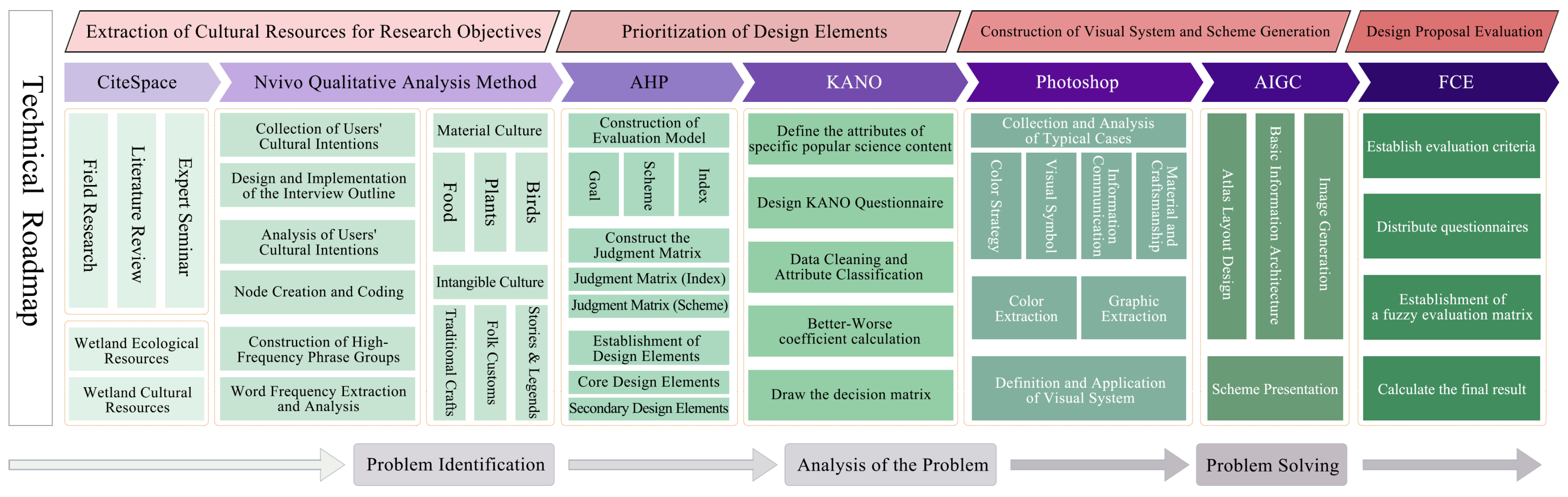
The method includes five key stages (
Figure 1):
Use NVivo to analyse the literature, policies, and visitor feedback, extracting high-frequency cultural images and core science content to build a wetland nature–culture database.
Construct an AHP model, establish a judgement matrix, and quantify the weight of each science communication content to determine design priorities.
Design questionnaires based on AHP weights, then use the KANO model to classify demand attributes and identify core needs of different users.
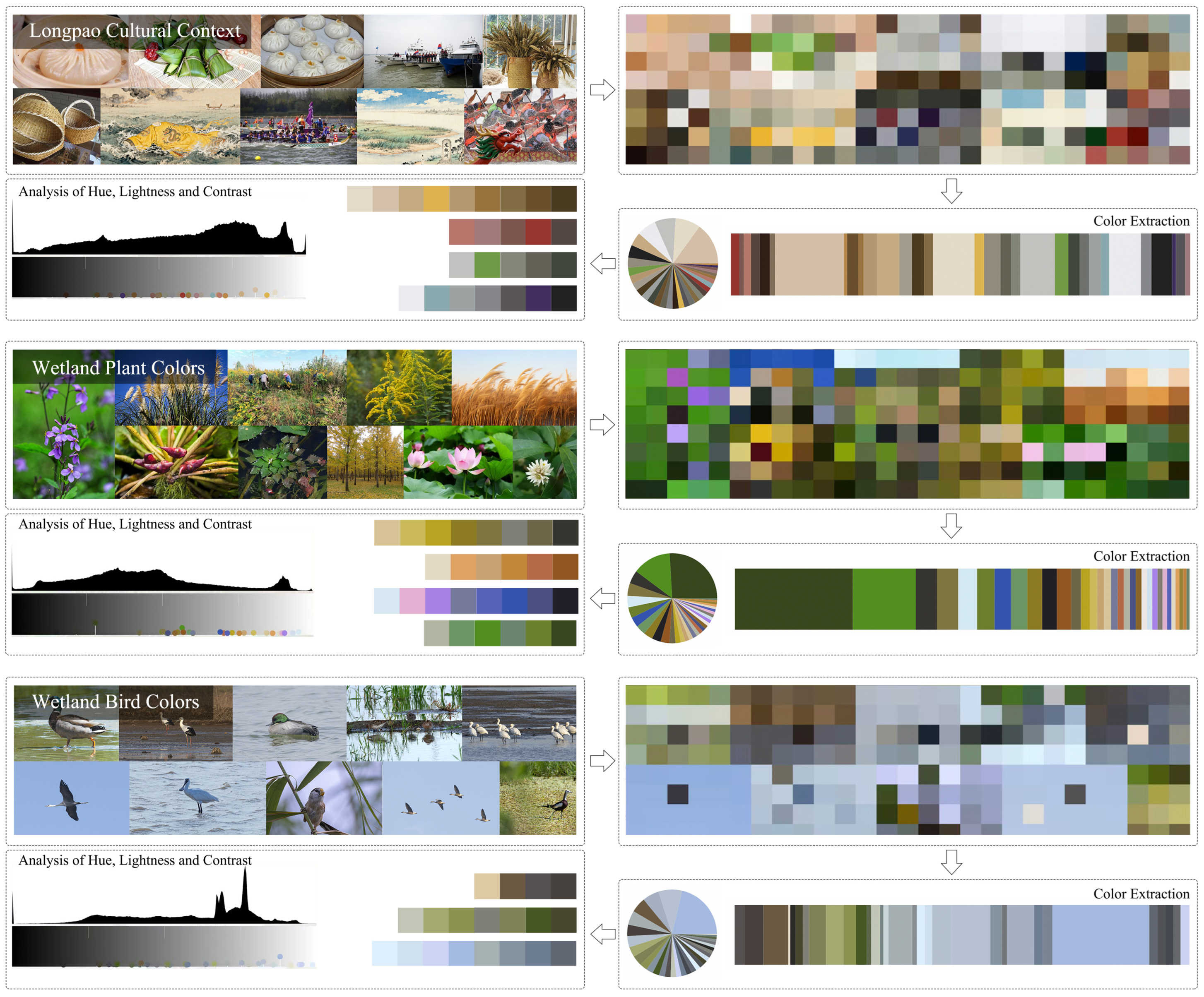
Conduct ecological colour sampling and biological form extraction, and use AIGC to support layout, graphic creation, and information organisation of the popular science booklet, forming a complete design scheme for Nanjing Longpao Yangtze River Provincial Wetland Park.
Using the Fuzzy Comprehensive Evaluation (FCE) to systematically evaluate and validate the design proposals for science popularisation booklets, thereby establishing a complete closed-loop process spanning research, design, evaluation, and optimisation.
The five stages in
Figure 1 follow a logical dependency chain. Stage 1 identifies available resources. Stage 2 determines which resources matter most via AHP weights. Stage 3 classifies how each resource should be presented using KANO attributes. Stage 4 visualises them through AIGC. Stage 5 validates the outcomes with FCE. Each stage answers a question that must be resolved before the next can begin—prioritisation requires an inventory, classification requires priorities, visualisation requires classification, and validation requires a design to test. This sequential logic ensures the pipeline is coherent and actionable.
The following sections explain the application logic, procedures, and contributions of each method within the integrated framework.
2.2. Analytic Hierarchy Process (AHP)
The Analytic Hierarchy Process (AHP) is a multi-criteria decision-making method proposed by Saaty in the 1970s. It determines the weights of various factors by decomposing complex problems into a multi-level structure and integrating qualitative and quantitative analyses [
10]. This method establishes a three-tier structure comprising the ‘objective layer’, ‘criterion layer’, and ‘alternative layer’. Experts construct a judgement matrix through pairwise comparisons using a 1–9 rating scale [
11]. Following normalisation and consistency checks, the weights are calculated and ranked, thereby converting subjective judgements into quantitative results. This effectively reduces the subjectivity of design decisions and has been widely applied in fields such as design research, environmental management, and engineering planning.
In recent years, the application of AHP in the field of spatial planning and design has become increasingly mature. Relevant studies have applied it to multi-objective scheme screening, green infrastructure assessment, and office environment comfort analysis, verifying the method’s effectiveness in integrating multi-source information and expert knowledge for multi-criteria evaluation [
12,
13,
14].
In this study, the standard Saaty 1–9 scale (
Table 1) was strictly adopted to construct all pairwise comparison judgement matrices. Fifteen experts from the fields of landscape design, wetland ecology, cultural heritage, and science communication were invited to independently complete the pairwise comparisons. Data were collected using the ‘Wenjuanxing’ platform (v4.0, Changsha Ranxing Information Technology Co., Ltd., Changsha, China). For each comparison between two criteria or two alternative elements, the expert selected a scale value from 1 to 9 or their reciprocals based on professional judgement. The final judgement matrix was derived by calculating the geometric mean of all expert scores for each pairwise comparison, following the common practice in group AHP decision making. All matrices passed the consistency check (CR < 0.1).
This study applies AHP to prioritise design elements for a wetland park science booklet, following four steps:
Based on the booklet’s purpose and research requirements, construct a three-tier evaluation model comprising objective, criteria, and alternative levels.
Invite experts from diverse disciplines to perform pairwise comparisons of evaluation indicators at the criteria level and cultural elements at the alternative level using standardised scales, forming a judgement matrix.
Normalise the judgment matrix to obtain preliminary weight vectors [
15]:
The pairwise comparison judgment matrix for n elements is structured as
where
and
, following Saaty’s 1–9 scale.
First, normalise the matrix column-wise using
In the formula, denotes the element in row i and column j of the original matrix; denotes the corresponding normalised value.
Next, sum the normalised matrix row-wise to derive the preliminary weight vector:
Finally, normalise the vector to obtain final weights [
16]:
This weight vector represents the relative weights of each element at both the indicator and scheme levels for the Longpao Wetland science booklet.
Perform a consistency check to ensure scientific validity and logical consistency. Calculate the consistency index CI = (λmax − n)/(n − 1), where λmax is the matrix’s largest eigenvalue. Determine the corresponding average random consistency index RI based on matrix order, then compute the consistency ratio CR = CI/RI. Weighted results passing the test are aggregated and ranked.
This method establishes a quantitative system for selecting design elements in science booklets, clarifies core and auxiliary elements, addresses the lack of scientific basis in traditional design selection, and provides quantitative support for structuring science content modules.
2.3. The KANO Model
The KANO Model, proposed by Noriaki Kano in 1984, is a classic tool for analysing user requirement attributes and identifying their hierarchical structure [
17]. It classifies user needs into five types (
Table 2): Must-be (M)—basic attributes whose absence significantly reduces satisfaction; One-dimensional (O)—explicitly expected attributes, where fulfilment positively correlates with satisfaction; Attractive (A)—features that exceed expectations and greatly boost satisfaction; Indifferent (I)—attributes with no notable impact on satisfaction; and Reverse (R)—features users dislike and should be avoided. Combined with the Better–Worse coefficient method, the model quantifies how meeting these needs influences satisfaction, offering precise guidance for content strategy formulation.
In recent years, the KANO model has been widely applied in the field of user needs analysis, particularly in the areas of public services and cultural heritage. Relevant studies have combined it with methods such as the IPA and AHP for use in age-friendly design, resident satisfaction assessments, and innovation in intangible cultural heritage products, thereby validating the model’s effectiveness in needs identification and design optimisation [
18,
19,
20].
This study applies the KANO model to the classification and prioritisation of educational content in the Longpao Wetland science popularisation booklet:
Based on prior qualitative content analysis and AHP factor screening results, a standardised KANO analysis framework was constructed.
For each content item, positive–negative paired questions were designed, and user feedback was collected using a five-point Likert scale.
Demand attributes were categorised according to KANO attribute classification rules, with Irrelevant and Reverse attributes eliminated to retain core demand content.
Better–Worse coefficient calculation and strategy formulation: the Better coefficient (satisfaction increase when a need is met) and Worse coefficient (satisfaction decrease when unmet) were calculated as
ASC values were used to rank content comprehensively. A four-quadrant diagram was constructed based on coefficient results, informing content presentation strategies—foundational frameworks, in-depth expansion, and immersive experiences—for Must-be, One-dimensional, and Attractive attributes, ensuring alignment with user needs.
On this basis, this study combined the results of the KANO model with the weights obtained from AHP to conduct a secondary prioritisation of science popularisation content within the same attribute category. This framework enables the precise stratification of user needs, creating an effective complementarity between the quantitative ranking of AHP and users’ subjective experiences. It overcomes the limitations of traditional AHP—namely, its over-reliance on expert judgement and tendency to become disconnected from actual user needs—thereby ensuring that the design of science popularisation booklets is truly user-centred.
2.4. Artificial Intelligence Generated Content (AIGC)
Artificial Intelligence Generated Content (AIGC) refers to text, images, or other media created by generative AI models. Recent studies have increasingly integrated AIGC into design frameworks to enhance efficiency and creativity, particularly in visual content generation, prompt-based creation, and multi-criteria design validation [
21,
22,
23]. For example, Gao et al. [
24] combined AIGC with AHP and FCE for material design in exhibition spaces, demonstrating the feasibility of integrating AIGC with multi-criteria decision-making methods.
Building on this precedent, this study employs AIGC to support the visual design of the science booklet. The AIGC-assisted design process followed three steps:
Colour system and graphic symbol extraction. Field sampling and image analysis were conducted to extract colour palettes and graphic symbols from the wetland’s ecological and cultural features. These raw materials were then refined into design-ready visual elements.
Prompt engineering and visual generation. Prompt strategies were developed and tailored to each content module. A text-to-image generative model (Midjourney v6.1, Midjourney Inc., San Francisco, CA, USA) was used to produce visual content based on these prompts, while a large language model (ChatGPT-4o, OpenAI, San Francisco, CA, USA) was employed to refine narrative texts for scientific communication.
Post-processing and quality control. All AI-generated outputs were reviewed and polished using image-editing software (Adobe Photoshop v25.0, Adobe Inc., San Jose, CA, USA) to ensure stylistic consistency and scientific accuracy. Final outputs were integrated into a three-module booklet layout.
Detailed design outcomes, including the final colour system, graphic symbols, and booklet layouts, are presented in
Section 3.4 and
Section 3.5.
2.5. Fuzzy Comprehensive Evaluation (FCE)
Fuzzy Comprehensive Evaluation (FCE) is a multi-criteria decision-making method that addresses uncertainty in subjective judgments. In this study, FCE was adopted to validate the design proposals.
The evaluation criteria set was defined based on the criteria derived from the AHP model. This alignment ensures that the validation directly reflects the design priorities identified by the AHP model.
The rating set was operationalised with percentage thresholds based on standard grading practices: Excellent (), Good (), Pass (), Fail (). This five-level categorisation aligns with common rubrics in product design evaluation and educational assessment.
A five-point Likert scale questionnaire was developed and converted to these four grades for FCE input. Participants rated each indicator on the Likert scale, and the responses were mapped to according to the thresholds above.
The FCE procedure followed three steps:
Constructing a fuzzy evaluation matrix from the frequency distribution of ratings, where is the membership value of criterion at the rating level .
Applying the AHP-derived weight vector .
Computing the comprehensive evaluation vector using the weighted average fuzzy synthesis operator:
where
is the membership value for the rating level
. The rating level with the largest
is taken as the final evaluation result.
Detailed validation results, including participant demographics, fuzzy matrices, and final vectors, are presented in
Section 3.6.
3. Results
3.1. Multi-Source Data Collection and Pre-Processing for the Cultural Resources of Longpao Wetland
3.1.1. Inventory of Target Cultural Resources
Based on field surveys and literature review, the cultural and ecological resources of the wetland were first categorised. Nanjing Longpao Yangtze Provincial Wetland Park, located in Liuhe District, covers 2690.95 hectares. As Jiangsu’s largest Yangtze River wetland park, it features a typical alluvial ecosystem and serves as a critical habitat for migratory birds and an ecological barrier for the Nanjing metropolitan area. Based on field surveys and literature review, its cultural resources can be categorised as follows:
The wetland hosts 361 vascular plant species, including nationally protected species such as Ginkgo biloba and Cycas revoluta, alongside controlled invasive plants. Bird resources total 197 species, with 45 rare or endangered species. Ecological restoration efforts have facilitated the return of Class I protected birds like the Baer’s Pochard and Oriental Stork. Notably, the great egret population has increased nearly 50-fold over five years, and the once-extinct Chinese tit reestablished a stable population in 2011, symbolising successful Yangtze River ecological restoration.
- (2)
Cultural Resources
Longpao possesses a regional cultural system integrating history, folk customs, and cuisine. Its name derives from a legend involving Emperor Qianlong. Local intangible cultural heritage includes the ‘Domino Lantern’ and dragon boat racing, reflecting folk beliefs and community spirit. Culinary traditions feature provincial-level heritage ‘Crab Roe Soup Dumplings’ and the Dragon Boat Festival custom of ‘Reed Bamboo Shoots,’ fostering a distinctive reed culture. Additionally, the wetland’s ‘channel-pond-shoreline-island’ ecological restoration model has rehabilitated degraded wetlands and converted former fishing grounds, contributing to Yangtze River protection efforts and being incorporated into national technical regulations in 2023.
3.1.2. User Intent Survey
Following the resource inventory, to align Longpao Wetland’s resources with audience cognitive needs, this study developed a semi-structured interview guide based on preliminary research, exploring emotional connections and cultural memory through legends, folklore, traditional crafts, daily life, and local industries [
25]. The sample consisted of 42.46% local residents, 24.66% tourists, 27.40% wetland workers, and 5.48% community staff, with two days of field interviews forming the basis for qualitative analysis (
Table 3).
Interview transcripts were hierarchically coded using NVivo 15 [
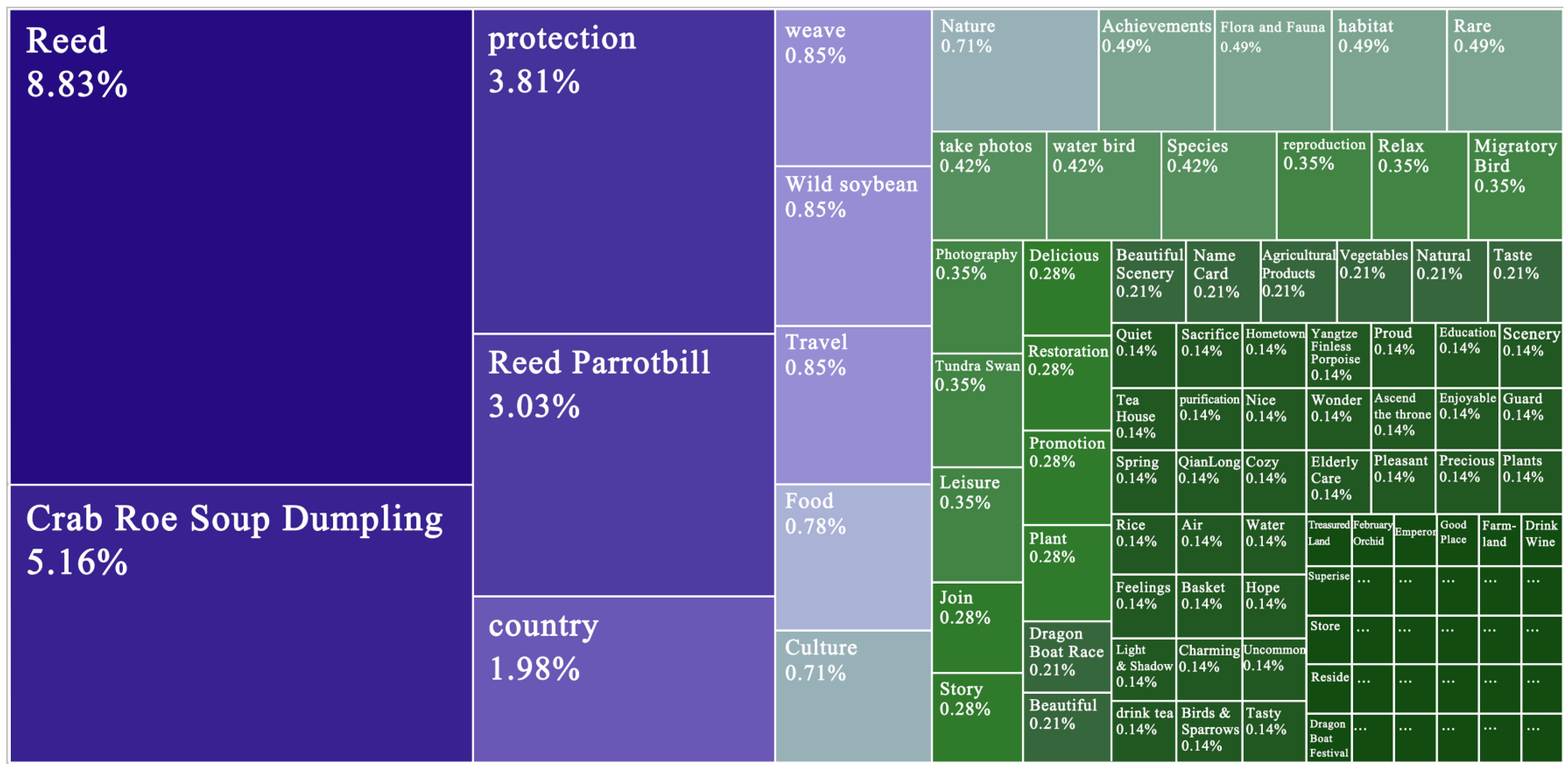
26]: open coding generated free nodes, secondary coding consolidated similar concepts (e.g., ‘dragon robe legend’ and ‘folk proverbs’ grouped under ‘Stories and Legends’), and selective coding built a tree structure, resulting in a system with 4 primary nodes, 8 secondary nodes, and 157 reference points. Automated coding merged semantically similar phrases and filtered stop words, while word frequency analysis revealed high prominence for ‘reed’ (8.83%), ‘soup dumplings’ (5.16%), ‘nationally protected flora and fauna’ (3.81%), and ‘Chinese tit’ (3.03%) (
Figure 2).
Further refinement showed concentrated trends: ‘soup dumplings’ (14.86%) demonstrated the highest recognition in the culinary category, ‘reed’ (12.90%) and ‘Chinese tit’ (15.09%) represented plant and rare bird categories, and ‘nature conservation’ (6.04%) and ‘Qianlong’ (4.08%) reflected the interplay between ecological awareness and historical narratives. These findings outline users’ cultural cognitive structures and provide data support for subsequent module classification and content focus.
3.2. AHP Model Analysis and Prioritisation of Design Elements
Based on the user needs identified above, the Analytic Hierarchy Process (AHP) was employed to construct a scientific evaluation framework for prioritising design elements. By decomposing the decision-making problem into objective, criterion, and alternative levels, a quantifiable model for screening cultural elements has been established [
27].
3.2.1. Hierarchical Model Construction
From the core functions of a science picture book—educational, aesthetic, regional, and emotional—a three-level evaluation model was established. The model’s objective layer (Z) represents the ultimate goal: ‘Selection of Design Elements for the Longpao Wetland Science Popularization Picture Book.’ The criterion layer (A) comprises evaluation indicators for screening cultural elements, established to embody the four core functions of a science picture book: educational, aesthetic, regional, and emotional. Five core indicators were defined: Visual Expressiveness (A1), Educational Value (A2), Regional Uniqueness (A3), Cultural Depth (A4), and Public Emotional Resonance (A5). The proposal layer (B) encompasses six core cultural elements identified through field surveys, a literature analysis, and NVivo word frequency analysis: culinary culture (B1), distinctive flora (B2), rare bird species (B3), traditional crafts (B4), folk customs (B5), and folklore (B6) (
Table 4).
3.2.2. Constructing Judgment Matrix and Weight Analysis
Following the AHP procedure described in
Section 2.2, pairwise comparison judgement matrices were constructed for the indicator layer (A1–A5) and for the alternative elements (B1–B6) under each criterion (A1–A5). The aggregated judgement matrices are presented in the
Supplementary Material. The eigenvectors and local weights for each level were calculated, and the results are summarised in
Table 5a,b. All matrices passed the consistency check [
28] (CR < 0.1), as detailed in
Table 6.
Based on the global weights obtained from AHP (
Table 5b), this study defines design elements with a global weight ≥ 0.20 as core design elements and the remaining elements as secondary design elements. Accordingly, core design elements are B2 Distinctive Plants (0.314) and B3 Rare Bird Species (0.275), which were developed into two independent modules: the ‘Wetland Plant Atlas’ and the ‘Wetland Bird Observation Manual’. The remaining four cultural elements (B1, B4, B5, B6) were consolidated into a single integrated module—the ‘Longpao Cultural Stories Collection’—to preserve regional cultural richness while maintaining a coherent narrative. Within this module, higher-weighted elements (B5, B6) receive more prominent placement, while lower-weighted ones (B1, B4) are presented in condensed formats. This classification directly guided the subsequent design and layout planning.
3.3. Development of the KANO Model and Classification of Popular Science Content Attributes
3.3.1. Access to Science Communication Content
After determining the priority of design elements, the KANO model was further applied to classify user demand attributes for specific science communication content.
Based on the preceding analysis, the content has been organised into three distinctive modules: ‘Wetland Plant Guide,’ ‘Wetland Bird Observation Manual,’ and ‘Longpao Cultural Story Collection.’ To further clarify user preferences for specific science communication content and enhance the scientific rigor and relevance of the booklet’s design, this study developed 20 specific science communication topics based on field investigations and expert interviews. These topics were categorised across three dimensions: ecological foundation, landmark species, and cultural context. A KANO model analysis framework was established (
Table 7).
The Wetland Plant Guide module includes seven core content sections covering reed ecological functions and protected plant identification to assess users’ understanding and interest in plant ecology. The Wetland Bird Observation Manual module features seven bird-related topics centred on iconic species like the Chinese tit and Baer’s pochard, spanning conservation narratives and behavioural interpretations to inform birdwatching guide design. The Longpao Cultural Story Collection module comprises six content items exploring place-name legends and traditional crafts, integrating natural ecology with human history to examine how cultural narratives combine with ecological concepts.
3.3.2. KANO Questionnaire Analysis
To gain a deeper understanding of users’ preferences regarding the content of the Longpao Wetland science popularisation booklet, a questionnaire was designed using the KANO model based on the 20 science popularisation topics identified in the preliminary phase. The survey participants were primarily potential readers aged between 18 and 65, including students, teachers, nature enthusiasts, and local residents. A total of 110 questionnaires were distributed, with 107 valid responses returned, yielding a response rate of 97%. Statistical analysis of the questionnaire data was conducted using SPSS 26.0. Applying the KANO attribute classification method, classification indicators were calculated for each content item.
3.3.3. Content Presentation Strategy Based on Better–Worse Coefficients
Through Better–Worse coefficient calculations, the 20 science topics were classified into four demand attribute categories (
Table 8).
Must-have attributes (M) comprised five items (25%), including foundational content such as ‘The Origin of Dragon Robe Place Names’ and ‘Observations on Nationally Protected Bird Habits’—core components requiring full presentation. Expected attributes (O) included two items (10%), such as ‘The ‘Rediscovery’ of the Chinese Tit’ and ‘Traditional Reed Weaving Techniques,’ whose fulfillment significantly enhances satisfaction. Attractive attributes (A) totaled eight items (40%), covering emotionally resonant content like ‘Fishermen’s Transformation Stories’ and ‘Seasonal Phenology Charts,’ delivering surprise experiences. Indifferent attributes (I) accounted for five items (25%), including ‘Domino Lantern Blessing Culture’ and ‘Wetland Plant Adaptability Analysis,’ which were excluded due to low user sensitivity.
The Better–Worse coefficient method was introduced to quantify impact on satisfaction [
28]. The Better coefficient reflects satisfaction enhancement when a requirement is met (values near 1 indicate greater improvement); the Worse coefficient measures satisfaction decline when unmet (values near −1 signify severe impact) [
29]. Following the standard KANO visualisation practice for four-quadrant mapping, the Worse coefficient is presented as a negative value in
Table 8—the negative sign is a representational convention, not a mathematical result (see
Section 2.3 for the calculation formula).
Based on the KANO algorithm and ASC values, results identified 5 Mandatory, 3 Expected, 7 Attractive, and 5 Indifferent attributes (
Table 9). Essential attributes centre on regional cultural origins and basic ecological understanding, with Worse coefficients below −78%—absence would significantly impair comprehension of Longpao Wetland’s core value, necessitating a foundational framework strategy. Expected attributes encompass flagship species conservation and ecological wisdom transmission, with Better coefficients exceeding 54%, warranting in-depth expansion. Attractive attributes focus on ecological transformation stories and interactive experiences, with Better coefficients ranging from 76% to 86%, demanding immersive experience design.
3.4. Visual System Construction for Longpao Wetland Science Popularisation Booklet
Applying the AIGC-assisted design procedure described in
Section 2.4, the following visual system was constructed based on the AHP-KANO model results. This system extracted 15 core science content items and deconstructed them through colour palettes and visual symbols.
3.4.1. Scientific Extraction and Definition of the Colour System
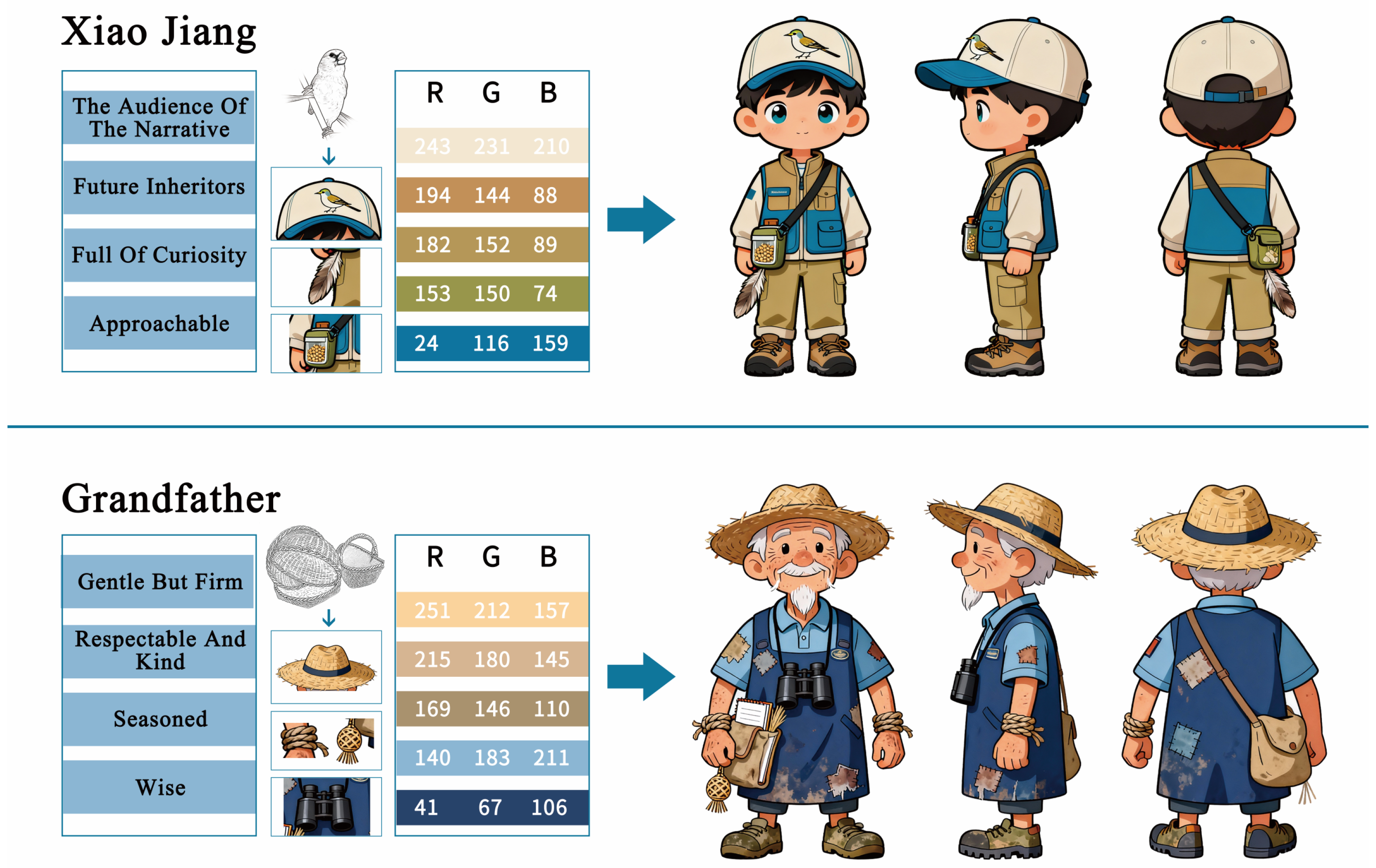
From the wetland’s ecological and cultural features, a scientific colour hierarchy was established through field sampling and image analysis. Three foundational tones were defined: ‘Reed Yellow’ for plant guides, symbolising the ecological backdrop; ‘Riverbank Blue’ for bird observation, reflecting aquatic features; and ‘Earth Ochre’ for cultural narratives, resonating with historical heritage. Colours were further refined by functional attributes—green for protected plants, red for invasive species warnings, and gold to highlight conservation achievements. Systematically integrated using professional tools, this colour standard achieves a balance between scientific clarity and visual aesthetics (
Figure 3).
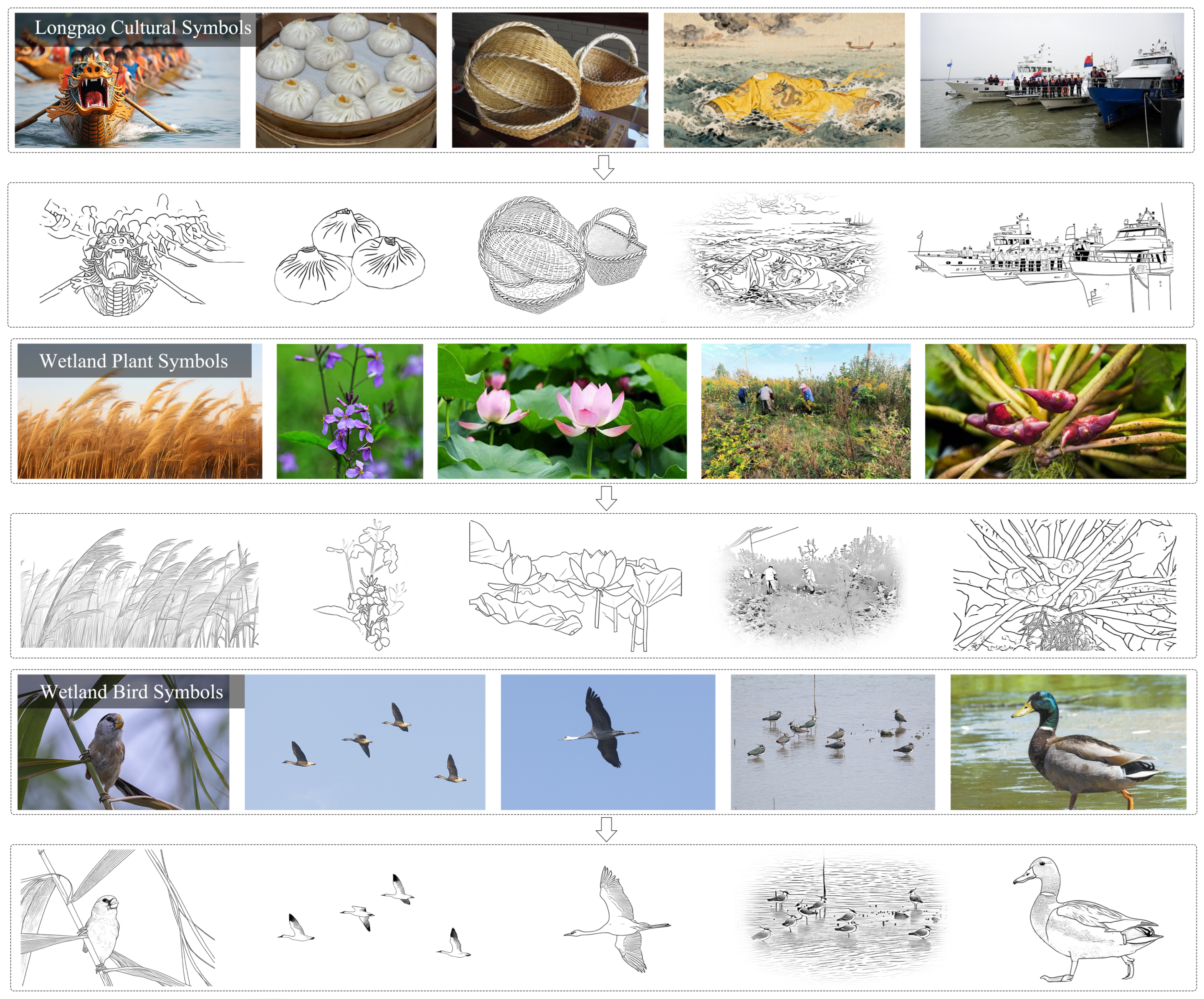
3.4.2. Refining Graphic Symbols and Visual Translation
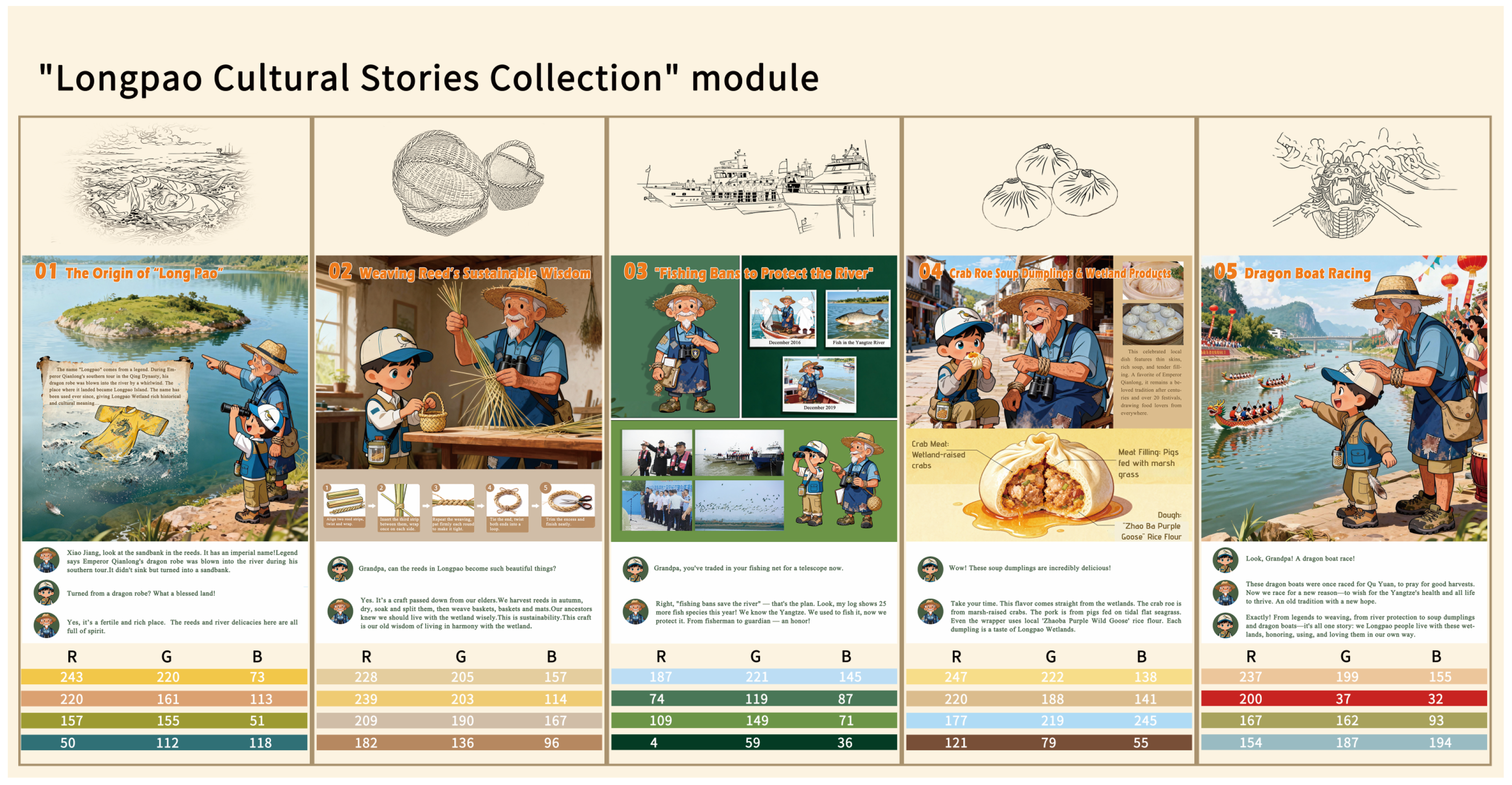
Complementing the colour system, graphic symbols were developed for each module. The Plant Guide employs scientific illustrations and simplified outlines to highlight key plant structures for precise identification. The Bird Observation Handbook emphasises the distinctive silhouettes of protected birds and incorporates contextual symbols to enhance narrative storytelling. The Cultural Narrative module modernises traditional elements—using scroll-and-ink textures for legends, tool decomposition diagrams for crafts, and infographics for conservation practices. This approach maintains stylistic consistency while optimising scientific communication through visualisation techniques (
Figure 4).
3.5. Design Proposal for the Longpao Wetlands Science and Education Brochure
Based on the visual system established above, the three-module science booklet was designed. The design combines scientific knowledge, regional culture, and AIGC-assisted visuals into a user-centred, narrative-driven science booklet across three modules.
3.5.1. Information Architecture, Layout Design, and Character Development
The information architecture and character design were developed around a narrative thread. The brochure follows the narrative thread of dialogues between the protagonist ‘Xiao Jiang’ and his ‘Grandfather,’ structuring three modules: ‘Wetland Plant Guide,’ ‘Wetland Bird Observation Manual,’ and ‘Dragon Robe Cultural Story Collection.’ Xiao Jiang is depicted as a curious young explorer, featuring outdoor attire and nature tools—a Chinese tit-themed baseball cap, folding binoculars, and specimen notebook—with wetland-inspired colours embodying the new generation’s exploratory spirit. Grandfather, a former fisher turned guardian, wears a traditional smock combined with modern patrol insignia. The visual motif of ‘fishing nets transformed into binoculars’ symbolises his identity shift and intergenerational wisdom. Together, they transform knowledge dissemination into an emotional journey of discovery (
Figure 5).
3.5.2. Presentation of the Module Design Proposal
Each module was presented with a distinct layout language. The ‘Dragon Robe Folklore Collection’ module opens with a full-width layout modelled on folded-leaf book binding, evoking an unfolding historical scroll. Story layouts vary: ‘Reed Weaving’ uses a central-focus design with step-by-step illustrations, while ‘Fishing Moratorium and River Conservation’ pairs historical photos with current patrol activities in a two-column comparative format. AIGC tools supported content creation [
30]: ChatGPT refined narratives for science communication, and Midjourney generated visuals using prompts like ‘classical Chinese ink wash aesthetics’ for legends and ‘realistic watercolor style, cross-section view’ for cuisine, with final compositions polished in Photoshop (
Figure 6).
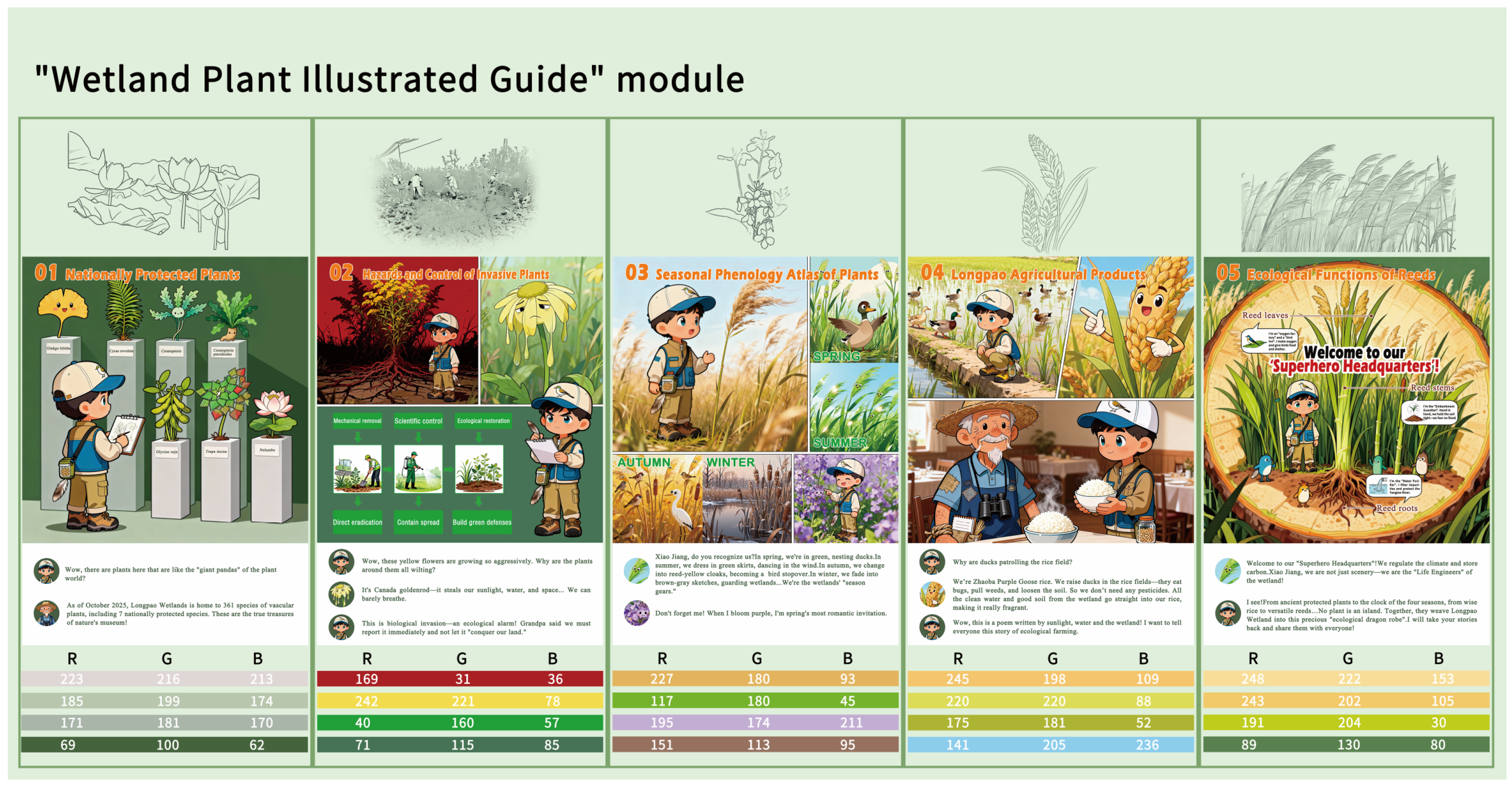
The ‘Wetland Plant Atlas’ module integrates specimen displays with systematic analysis. Protected plants appear as scientific illustrations with anthropomorphic dialogue, while topics like plant phenology and reed functions are shown through cyclical and cross-sectional diagrams. Midjourney prompts emphasised scientific accuracy, using instructions such as ‘highly realistic, botanically accurate scientific illustration’ for plants and dynamic spread patterns for invasive species warnings, later combined with comparison charts (
Figure 7).
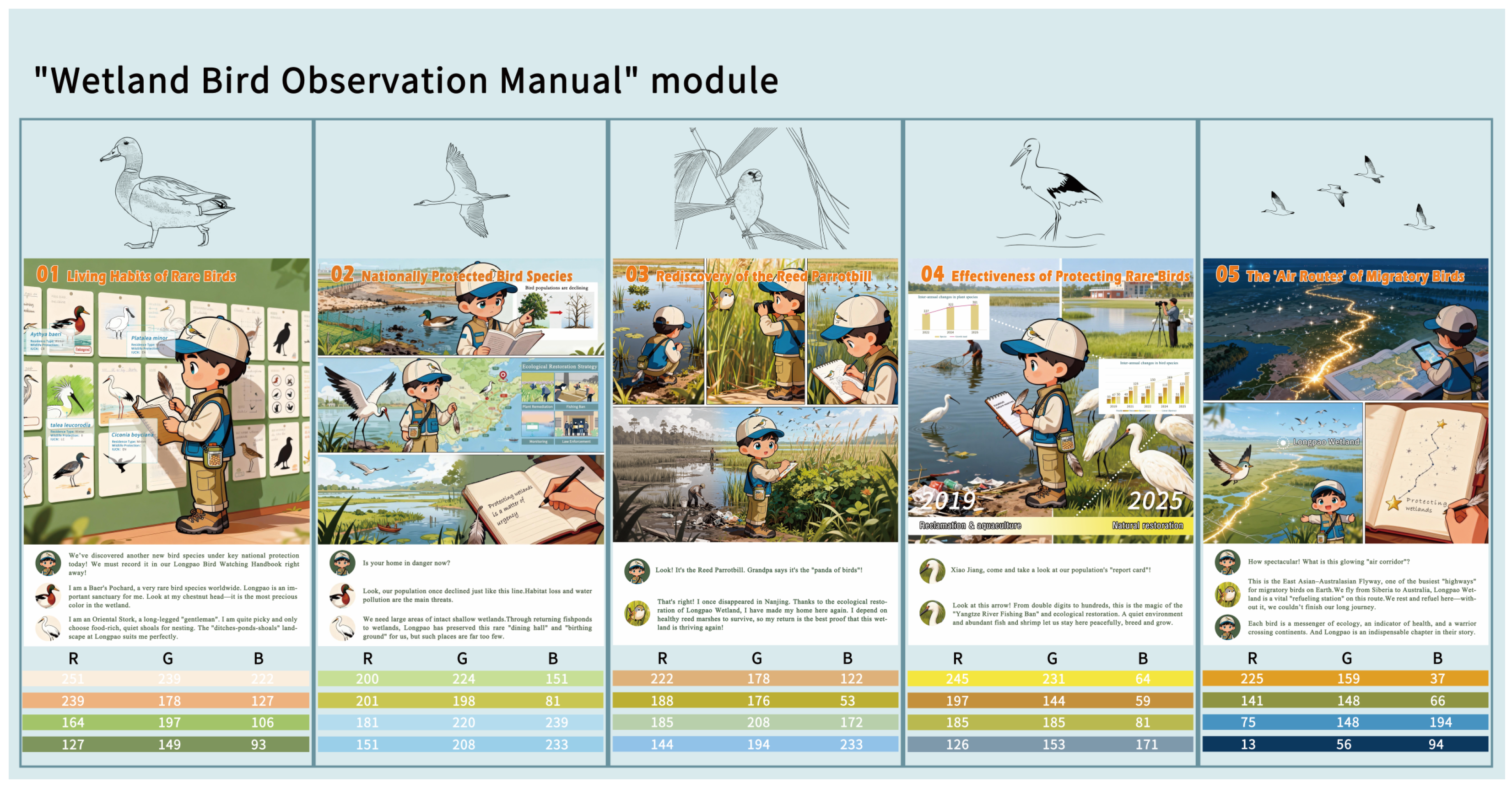
The ‘Wetland Bird Observation Handbook’ module progresses from species identification to broader ecology. The ‘Bird Passport’ section uses unified templates for standard photos and ecological icons, while advanced pages feature sequential illustrations for ‘The Red-flanked Bluetail’s Return’ and interactive maps for ‘Migratory Bird Routes.’ Midjourney generated bird imagery with prompts like ‘side-profile close-up of Baer’s Pochard gliding across clear waters,’ and the Chinese tit was developed as a cartoon character serving as a unifying wetland symbol (
Figure 8).
3.6. Validation of Design Schemes Based on the FCE Method
To quantitatively validate the design proposals, the Fuzzy Comprehensive Evaluation (FCE) method was adopted (see
Section 2.5).
A total of 65 participants—including members of the public with experience of visiting wetland parks or using science popularisation products, wetland conservation staff, science popularisation design researchers, and local residents—were invited to independently evaluate the three brochures. After excluding questionnaires containing logical contradictions or incomplete responses, 60 valid questionnaires were recovered, yielding a response rate of 92.3%.
The five evaluation criteria correspond to the AHP-derived indicators (see
Table 5a):
Visual Appeal,
Educational Value,
Regional Distinctiveness,
Cultural Depth, and
Public Emotional Resonance. The rating set is
, with thresholds defined in
Section 2.5.
The frequency of each rating level under each indicator in the valid questionnaires was statistically analysed, and membership values were calculated to obtain the following fuzzy evaluation matrices R for each module:
(The rows of the matrix correspond sequentially to U1 to U5, and the columns correspond sequentially to ‘Excellent’ to ‘Unsatisfactory’)
Furthermore, the criterion-level weight vector W = {0.091, 0.301, 0.426, 0.136, 0.046} (
Table 5a) was applied. Using the fuzzy synthesis operator
(see
Section 2.5), the comprehensive evaluation vectors
were obtained:
Plant Atlas: B1 = {0.462, 0.386, 0.135, 0.016}
Bird Atlas: B2 = {0.524, 0.345, 0.096, 0.017}
Culture Atlas: B3 = {0.492, 0.379, 0.103, 0.017}
The FCE results confirmed that all three brochures achieved an ‘Excellent’ rating, with membership values of 0.462 (Plant), 0.524 (Bird), and 0.492 (Culture). These scores indicate that the proposed designs not only satisfied the Must-be requirements (e.g., accurate species identification) but also successfully delivered Attractive features (e.g., intergenerational narratives, ecological restoration stories). This alignment between user needs and design outcomes supports the validity of the KANO–AHP–AIGC framework. Among these, the Bird Brochure scored highest (0.524), consistent with its coverage of both One-dimensional and Attractive attributes in the KANO analysis.
In summary, the Nanjing Longpao Wetland Park science popularisation brochures, designed using the AHP-KANO model and AIGC-assisted design, have received high user recognition in terms of visual presentation, educational value, regional characteristics, cultural significance, and emotional resonance. The FCE results validate the scientific rigour and effectiveness of this data-driven design methodology, confirming that the design outcomes meet the public’s multi-layered demands for wetland science communication content. With this, the study has completed a full closed-loop process ranging from needs analysis and content decision making to visual design and proposal validation.
4. Discussion
This study used AHP, the KANO model, and qualitative analysis to design a wetland park education system, tested through the Nanjing Longpao Wetland science booklet. User needs fall into three tiers: essential (regional cultural roots and basic ecology), Expected (flagship species conservation and ecological wisdom), and Attractive (ecological stories and interactive experiences). Essential needs cover basic functions, Expected needs build social recognition and confidence, and Attractive needs foster personal connection and deeper reflection. Unlike past studies that focused essential needs on physical features, this study found wetland users equally value cultural roots, showing the need to blend natural and human perspectives in wetland education.
Quantitatively, the AHP results revealed that Regional Distinctiveness (0.426) and Science Education Value (0.301) dominated decision making, outweighing Visual Expressiveness (0.091) by a factor of 4.7—suggesting that users prioritise authentic local content over aesthetic appeal. The KANO analysis further showed that while Must-be attributes (25%) form the foundation, Attractive attributes (40%) outnumber One-dimensional ones (10%), indicating that users are more motivated by unexpected delights than by fulfilled expectations. The Bird module achieved the highest FCE score (0.524), likely because it uniquely combined both One-dimensional (Chinese Tit rediscovery) and Attractive (migratory bird routes) features, whereas the Plant and Culture modules lacked such hybrid attributes.
- (1)
Comparison with previous studies.
Previous research on wetland science communication has primarily relied on qualitative or single-case analyses, often failing to translate evaluation results into actionable design strategies. In contrast, this study develops an end-to-end solution integrating NVivo qualitative analysis, AHP–KANO quantitative modelling, and AIGC-assisted design, bridging the gap between user needs and tangible design outcomes.
- (2)
Innovations.
Three innovations distinguish this study. First, it establishes a complete methodological loop: NVivo → AHP → KANO → AIGC → FCE. Second, it introduces a dual user–expert weighting mechanism by cross-validating AHP global weights with KANO attribute classification. Third, it provides a reproducible AIGC-assisted visualisation workflow, including prompt engineering strategies for different content types.
- (3)
Practical applications.
The framework can be directly applied to real-world scenarios: any wetland park can follow the same design process to develop science booklets; the demand attribute classification can guide interactive installation design; the modular approach is adaptable to other wetlands; and the AIGC prompt library enables rapid visual prototyping. The resulting brochure has the potential to be published as official educational or promotional material for wetland parks.
Limitations include a sample drawn mostly from local stakeholders, a static booklet with limited interaction, and AI still needing human oversight. Additionally, this study focuses solely on the design of a science brochure for a single wetland park, which may limit the generalisability of the findings.
In addition, recent studies have increasingly recognised the contribution of wetland ecosystems to human physical and mental health [
31,
32]. Wetlands provide multiple health-related ecosystem services, including air and water purification, microclimate regulation, stress reduction, and attention restoration. Building on this emerging evidence, future iterations of the science booklet could incorporate a fourth module on ‘Wetland and Human Health’, exploring topics such as the health benefits of wetland environments, traditional wellness practices associated with wetland resources, and nature-based rehabilitation. This extension would align the brochure with the growing global trend of health-oriented ecotourism and the One Health framework.
Future work should apply and validate the proposed design framework across different types of wetlands, diverse regional cultural contexts, and other science communication systems (e.g., digital displays, interactive installations, mobile applications) to further test its adaptability and robustness.
5. Conclusions
Against the backdrop of comprehensive protection of the Yangtze River and the advancement of ecological civilization, this study takes the Nanjing Longpao Yangtze River Provincial Wetland Park as a case study and develops a data-driven framework for science communication booklet design.
At the theoretical level, this study establishes an interdisciplinary methodological framework integrating qualitative analysis (NVivo), quantitative decision making (AHP–KANO), intelligent visual generation (AIGC), and closed-loop validation (FCE), shifting the design paradigm from experience-driven to data-driven [
33]. At the practical level, the study demonstrates that AIGC technology can rapidly generate stylised visual materials and narrative scenarios, providing an efficient pathway for the visual translation of cultural heritage and natural science popularisation.
Based on the findings, we offer the following recommendations for practitioners developing wetland park science communication materials:
Content first, visuals second. Allocate design resources based on user priorities—ecological authenticity and educational value should guide visual decisions, not the reverse.
Balance the three KANO layers. Ensure all Must-be content is present (non-negotiable), expand One-dimensional content proportionally to its impact, and selectively add Attractive content to create memorable moments.
Use AIGC as a drafting tool, not a final author. AI-generated visuals require expert review for scientific accuracy—especially for species identification and ecological representations.
Adopt the five-stage workflow as a starting point. The sequence (database → weights → classification → visualisation → validation) is transferable to other wetland types and regional contexts.
The research outcomes provide a directly applicable platform for the cultural dissemination and ecological education of the Longpao Wetland, while the methodology holds significant implications for science communication product development in other protected areas. Future work will extend this framework to digital interactive media such as augmented reality and virtual reality, and explore deeper integration of AIGC in immersive science communication experiences.
Supplementary Materials
The following supporting information can be downloaded at:
https://www.mdpi.com/article/10.3390/su18126000/s1, Figure S1: Informed Consent Form (Expert Version); Figure S2: Informed Consent Form (User Version); Figure S3: Complete Collection of Popular Science Atlases; Table S1: Judgment Matrix, Calculation Results and Consistency Test; Table S2: Raw Scoring Table for Criterion Layer (A1–A5) by 15 Experts.
Author Contributions
Conceptualisation, Z.Z. and S.C.; methodology, S.C.; software, S.C.; validation, Q.L., H.Z. and M.X.; formal analysis, S.C.; investigation, W.J.; resources, Z.Z.; data curation, W.J.; writing—original draft preparation, S.C.; writing—review and editing, Z.Z. and Q.L.; visualisation, H.Z.; supervision, Z.Z.; project administration, Z.Z.; funding acquisition, Z.Z. All authors have read and agreed to the published version of the manuscript.
Funding
This work was supported by the [General Projects for Philosophy and Social Sciences Research in Higher Education Institutions in Jiangsu Province #1] under Grant [number 2025SJYB0129]; [The National Social Science Fund of China #2] under Grant [number 22BG110]; and [Jiangsu Province Postgraduate Research and Innovation Programme 2025 #3] under Grant [number KYCX25_1478].
Institutional Review Board Statement
Based on the above, this study does not fall within the scope of the Ethical Review Measures for Life Sciences and Medical Research Involving Humans jointly issued by the National Health Commission, the Ministry of Education, and the Ministry of Science and Technology (Document No. 4 of 2023). Article 3 of this document explicitly states that the measures apply only to “life sciences and medical research involving humans” (available at:
https://www.gov.cn/zhengce/zhengceku/2023-02/28/content_5743658.htm, accessed on 7 June 2026). This study involves only voluntary surveys and interviews, with no collection of sensitive personal data and no potential risk to participants. According to the policies of Nanjing Forestry University and relevant Chinese national regulations, such non-interventional research is exempt from ethical approval.
Informed Consent Statement
Informed consent was obtained from all subjects involved in the study.
Data Availability Statement
No new data were created or analyzed in this study.
Acknowledgments
The author sincerely thanks Zunling Zhu for invaluable academic guidance and consistent support throughout this study. Thanks are also due to classmates and peers for their kind assistance and constructive discussions. Gratitude is extended to all interviewees and questionnaire respondents for their valuable participation and feedback. Finally, the author acknowledges the financial support from the funding bodies. During the preparation of this manuscript, the author(s) used ChatGPT (version GPT-4, OpenAI) to refine narratives for science communication, and Midjourney (version 6, Midjourney, Inc.) to generate visual content. The authors have reviewed and edited all outputs from these tools and take full responsibility for the content of this publication.
Conflicts of Interest
The authors declare no conflicts of interest.
References
- Costanza, R.; d’Arge, R.; De Groot, R.; Farber, S.; Grasso, M.; Hannon, B.; Lirmburg, K.; Naeem, S.; O’Neill, R.V.; Paruelo, J.; et al. The value of the world’s ecosystem services and natural capital. Nature 1997, 387, 253–260. [Google Scholar] [CrossRef]
- Xiao, Y.D. Towards New Era of Innovation Lawzgkxyyk-37-1-101Comments on 2021 Revision of Law of the People’s Republic of China on Science and Technology Progress. Bull. Chin. Acad. Sci. 2022, 37, 101–111. [Google Scholar] [CrossRef]
- Ray, A.M.; Hossack, B.R.; Gould, W.R.; Patla, D.A.; Spear, S.F.; Klaver, R.W.; Peterson, C.R. Multi-species amphibian monitoring across a protected landscape: Critical reflections on 15 years of wetland monitoring in Grand Teton and Yellowstone national parks. Ecol. Indic. 2022, 135, 108519. [Google Scholar] [CrossRef]
- Lin, P.; Chen, L.; Luo, Z. Analysis of tourism experience in Haizhu National Wetland Park based on web text. Sustainability 2022, 14, 3011. [Google Scholar] [CrossRef]
- Zhou, L.; Guan, D.; Huang, X.; Yuan, X.; Zhang, M. Evaluation of the cultural ecosystem services of wetland park. Ecol. Indic. 2020, 114, 106286. [Google Scholar] [CrossRef]
- Guo, R.Z.; Lin, L.; Xu, J.F.; Dai, W.H.; Song, Y.B.; Dong, M. Spatio-temporal characteristics of cultural ecosystem services and their relations to landscape factors in Hangzhou Xixi National Wetland Park, China. Ecol. Indic. 2023, 154, 110910. [Google Scholar] [CrossRef]
- Fang, X.S.; Liu, S.; Chen, W.Z.; Wu, R.Z. An effective method for wetland park health assessment: A case study of the Guangdong Xinhui National Wetland Park in the Pearl River Delta, China. Wetlands 2021, 41, 48. [Google Scholar] [CrossRef]
- Pang, A.P.; Li, C.H. Spatiotemporal Evolution and Driving Mechanism Analysis of Gross Ecosystem Product of the Riverside Wetlands in Nanjing City. Environ. Sci. Surv. 2025, 44, 1–7+21. [Google Scholar] [CrossRef]
- Xie, Z.; Li, W.; Yu, W. Exploring the usage demands of AIGC functions among Chinese researchers: A study based on the KANO model. Inf. Dev. 2025, 41, 766–780. [Google Scholar] [CrossRef]
- Saaty, T.L. The analytic hierarchy process—What it is and how it is used. Math. Model. 1987, 9, 161–176. [Google Scholar] [CrossRef]
- Wang, Z.; Zhou, J.; Zhou, Z.; Li, F. An integrated KANO–AHP–DEMATEL–VIKOR framework for sustainable design decision evaluation of museum cultural and creative products. Sustainability 2025, 17, 10328. [Google Scholar] [CrossRef]
- Liu, H.; Wu, Y.; Xue, T.; Du, Z.; Xu, J.; Jiang, T. Machine learning-assisted parametric analysis and multi-criteria optimization of building performance: A case study on indoor environmental quality and energy efficiency. Energy Convers. Manag. 2026, 349, 120825. [Google Scholar] [CrossRef]
- Arteaga Zambrano, J.A.; Rangel, O.S.A.; Moran, J.E.R.; Mendiola, L.L. Multicriteria evaluation of green infrastructure for public spaces in urban areas: Hydrological functionality and ecosystem services. Environ. Manag. 2025, 75, 3635–3657. [Google Scholar] [CrossRef] [PubMed]
- Li, Z.; Song, G.; Zhang, Q.; Yu, J.; Liu, Y. A combined weighting method to assess indoor environmental sub-factors for human comfort in offices in China’s severe cold regions. Buildings 2025, 15, 3529. [Google Scholar] [CrossRef]
- Fu, L.P.; Guan, Q.J.C.; Suo, D.Z. Research on the Evaluation Index System for the Sustainable Development of Tibetan Buddhist Monastery Tourism. Qinghai Ethn. Stud. 2025, 36, 78–87. [Google Scholar] [CrossRef]
- Zeng, H.; Zhu, J.; Lin, H.; Fan, P.; Qiu, T. Evaluation of Age-Friendly Retrofits for Urban Communities in China Using a Social–Ecological–Technological Systems Framework. Buildings 2024, 14, 2074. [Google Scholar] [CrossRef]
- Kano, N.; Seraku, N.; Takahashi, F.; Tsuji, S. Attractive quality and must-be quality. J. Jpn. Soc. Qual. Control 1984, 14, 39–48. [Google Scholar] [CrossRef]
- Li, J.; Shen, Z.; Chen, Y.; Liu, Y.; Lin, Z.; Fei, N. Research on the age-friendly design of station square based on IPA-Kano model: A case study of Chengdu East Railway Station. J. Asian Archit. Build. Eng. 2026, 25, 1538–1553. [Google Scholar] [CrossRef]
- Wang, Z.; Huang, C.; Diao, Z. A demand-oriented study on residential pilotis satisfaction in Hefei using the KANO-IPA model. Buildings 2026, 16, 311. [Google Scholar] [CrossRef]
- Xu, D.; Gu, C.; Zhao, Z.; Chen, Y. A sustainable innovation framework for traditional woodcarving craftsmanship using artificial intelligence and collaborative design. Sustainability 2026, 18, 1268. [Google Scholar] [CrossRef]
- Wu, Y.N.; Zhang, H.T. A sustainable and resource-efficient AIGC art design framework using an enhanced GAN for performance-optimized computing systems. Appl. Intell. 2026, 56, 275. [Google Scholar] [CrossRef]
- Gao, J.S.; Hu, X.W.; Wu, Z.; Gui, G.X.; Geng, Y.W.; Fan, H.Q.; Zhu, Z.L.; Zhang, Z.F. Design Application of Transparent Wood in Pop-Up Exhibition Spaces Based on AIGC–AHP–FCE Approach. Sustainability 2026, 18, 2169. [Google Scholar] [CrossRef]
- Zhu, L.N.; Xiang, N.Y. A Sustainable Intelligent Design Framework: Integrating AIGC with AHP-QFD-TRIZ for Product Development. Sustainability 2025, 17, 9260. [Google Scholar] [CrossRef]
- Yu, L.; Yang, Y.J. Emotional-Intelligence Symbiosis’: Emotional Projection and Algorithm Adaptation Logic in Human-Machine Interaction among Youth. China Youth Res. 2025, 12, 14–23+70. [Google Scholar] [CrossRef]
- Zhang, A.H.; Liu, W.L.; Lv, S.Q. Digital Intelligence Empowers the Intelligent Design Inheritance of Architectural Genes in the Cai Family Ancient Dwellings. Packag. Eng. 2025, 46, 342–353. [Google Scholar] [CrossRef]
- Cheng, L.; Wang, J.R.; Tang, C.X. Research on the Construction of a Digital Lantern System Based on Kano-AHP and User Behavior Modeling. Print. Digit. Media Technol. Res. 2025, 5, 195–206+249. [Google Scholar] [CrossRef]
- Gao, J. Cultural industry development from entrepreneurship under the background of rural revitalization strategy. Front. Psychol. 2022, 13, 959226. [Google Scholar] [CrossRef] [PubMed]
- Zhang, Y.T.; Zhang, X.J.; Yang, Z.; Zhou, T.H. Research on Walker Design for the Elderly Based on KANO-AHP-TRIZ. Packag. Eng. 2025, 46, 138–147. [Google Scholar] [CrossRef]
- Sohn, J.I.; Woo, S.H.; Kim, T.W. Assessment of logistics service quality using the Kano model in a logistics-triadic relationship. Int. J. Logist. Manag. 2017, 28, 680–698. [Google Scholar] [CrossRef]
- Wang, S.X.; Tao, X.; Ma, H.B.; Li, F.L.; Wu, C.Q. EEG assessment of artificial intelligence-generated content impact on student creative performance and neurophysiological states in product design. Front. Psychol. 2025, 16, 1508383. [Google Scholar] [CrossRef]
- Zhao, J.W.; Wang, Y.W.; Wang, L.Y.; He, T.T. Analysis of Spatio-Temporal Changes and Driving Factors of Wetland Ecosystem Health Based on the AHP-SOM-DPSR Model—A Case Study of Wetlands in the Qin-Mang River. Sustainability 2024, 16, 5753. [Google Scholar] [CrossRef]
- Wu, X.L.; Bu, X.Y.; Dong, S.C.; Ma, Y.S.; Ma, Y.; Ma, Y.R.; Liu, Y.L.; Wang, H.X.; Wang, X.M.; Wang, J.R. The Impact of Restoration and Protection Based on Sustainable Development Goals on Urban Wetland Health: A Case of Yinchuan Plain Urban Wetland Ecosystem, Ningxia, China. Sustainability 2023, 15, 12287. [Google Scholar] [CrossRef]
- Han, L.; Yang, J. The Mechanism, Practical Challenges, and Solutions of Data Elements Empowering Value Creation in Publishing Enterprises. Sci. Publ. 2025, 12, 58–65. [Google Scholar] [CrossRef]
| Disclaimer/Publisher’s Note: The statements, opinions and data contained in all publications are solely those of the individual author(s) and contributor(s) and not of MDPI and/or the editor(s). MDPI and/or the editor(s) disclaim responsibility for any injury to people or property resulting from any ideas, methods, instructions or products referred to in the content. |




 ,
,