Spatiotemporal Dynamics of Landscape Ecological Risk Under Vegetation Loss and Urban Expansion in Dhaka


 ,
,  and
and 
Abstract
1. Introduction
- How have FVC, NTL, land cover, and LERI changed in Dhaka between 2004 and 2024?
- What spatial relationships exist among vegetation condition, urbanization intensity, and Landscape Ecological Risk?
- How does spatial heterogeneity influence the relationship between vegetation loss, urban expansion, and ecological risk across Dhaka?
- How can the identified spatial patterns support planning recommendations for ecological conservation, restoration, and urban growth management?
2. Materials and Methods
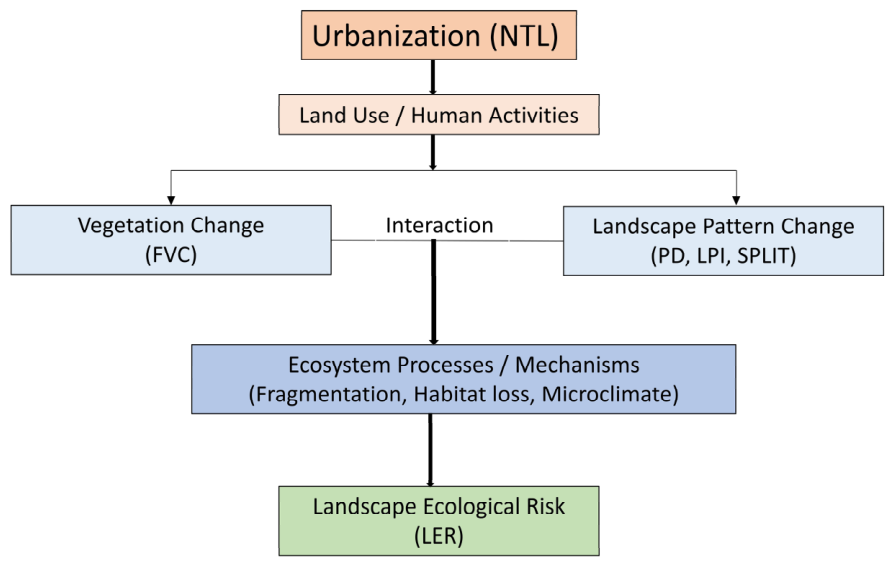
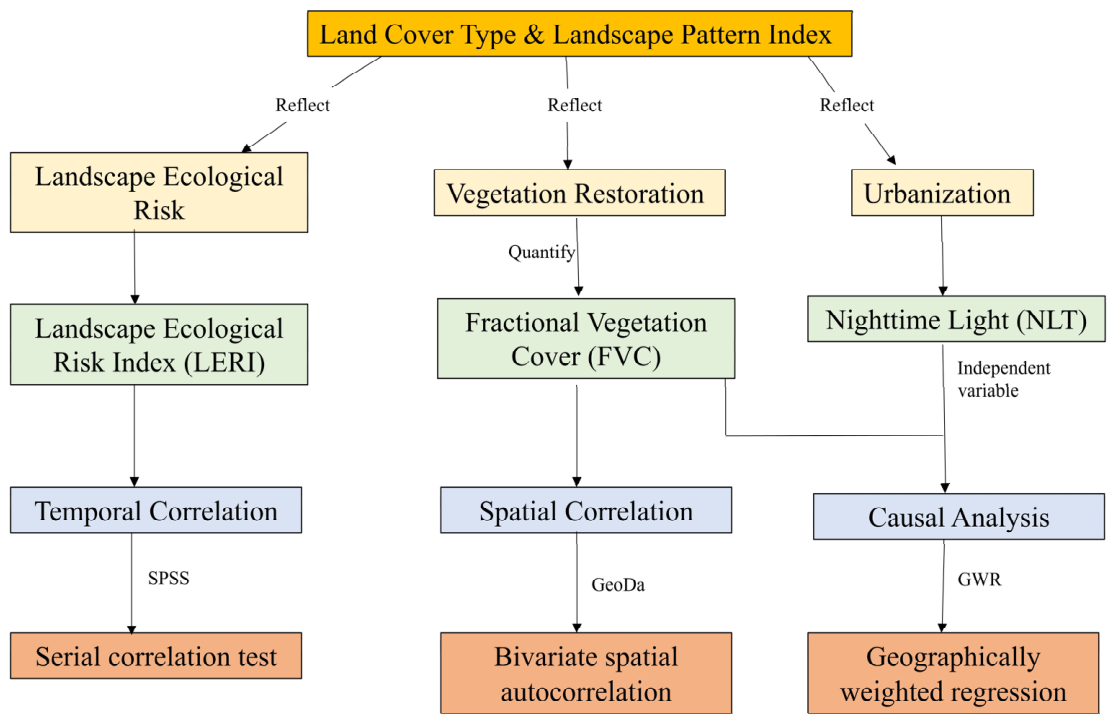
2.1. Conceptual Framework
- (1)
- Direct effects, where increasing anthropogenic pressure intensifies environmental disturbance; and
- (2)
- Indirect effects, where NTL-driven LC change reduces FVC and alters landscape structure, leading to increased fragmentation and ecological instability.
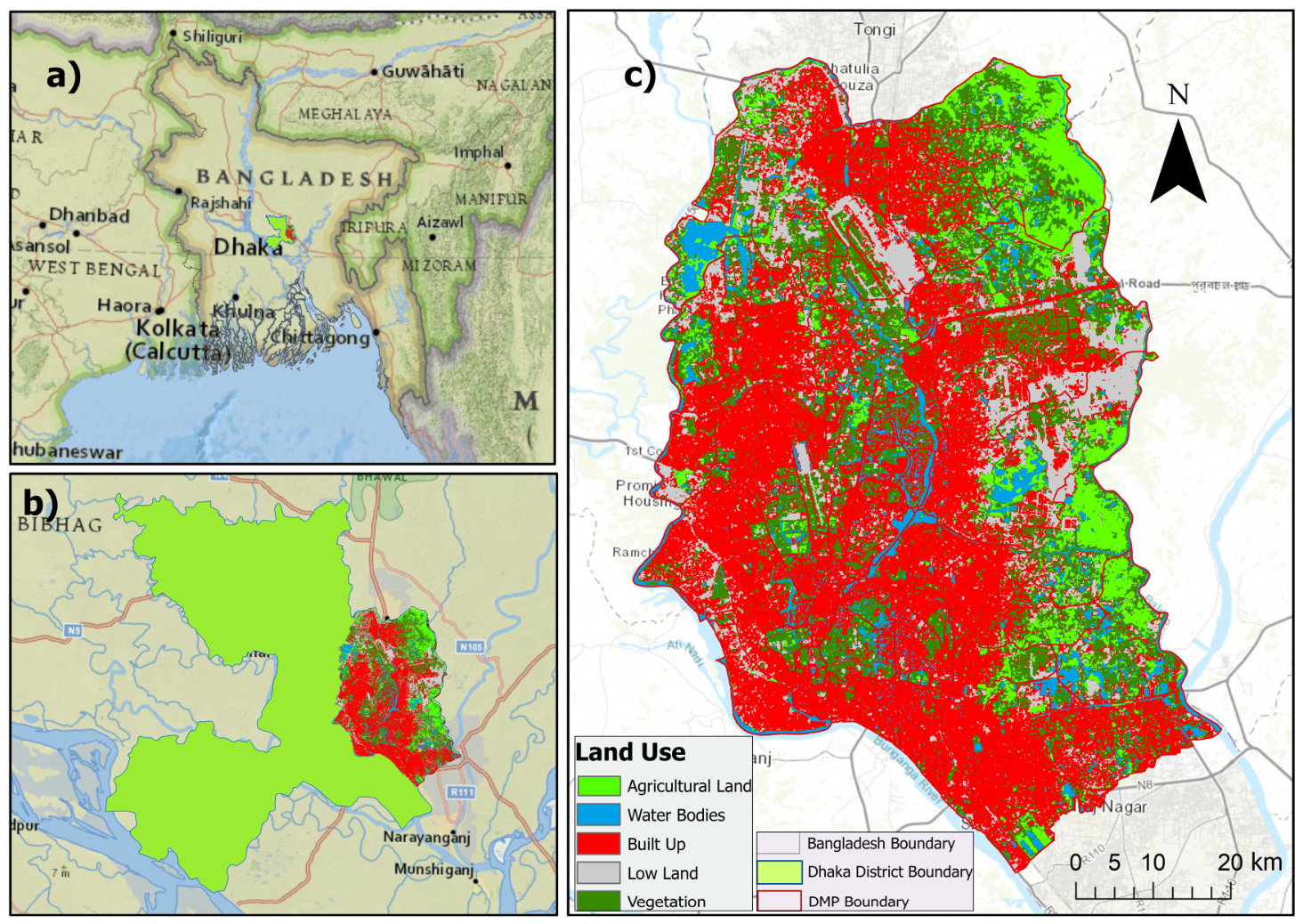
2.2. Study Area
2.3. Data Sources and Preprocessing
2.3.1. Land Cover (LC) Data
2.3.2. Fractional Vegetation Cover (FVC) Data
2.3.3. Nighttime Light Index (NTL) Data
2.4. Methods
2.4.1. Landscape Pattern Change Analysis
2.4.2. Landscape Ecological Risk Assessment
2.4.3. Correlation Analysis Between FVC and LERI
2.4.4. GWR Analysis
3. Results
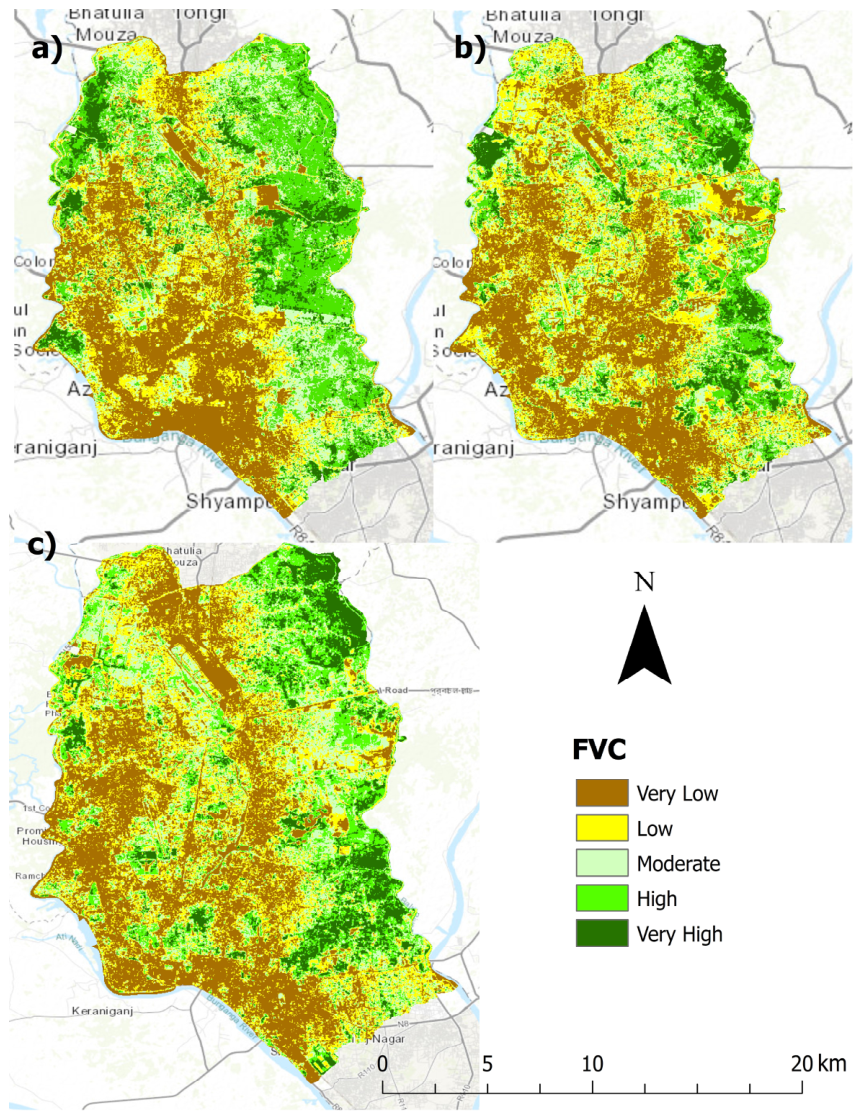
3.1. Vegetation Restoration
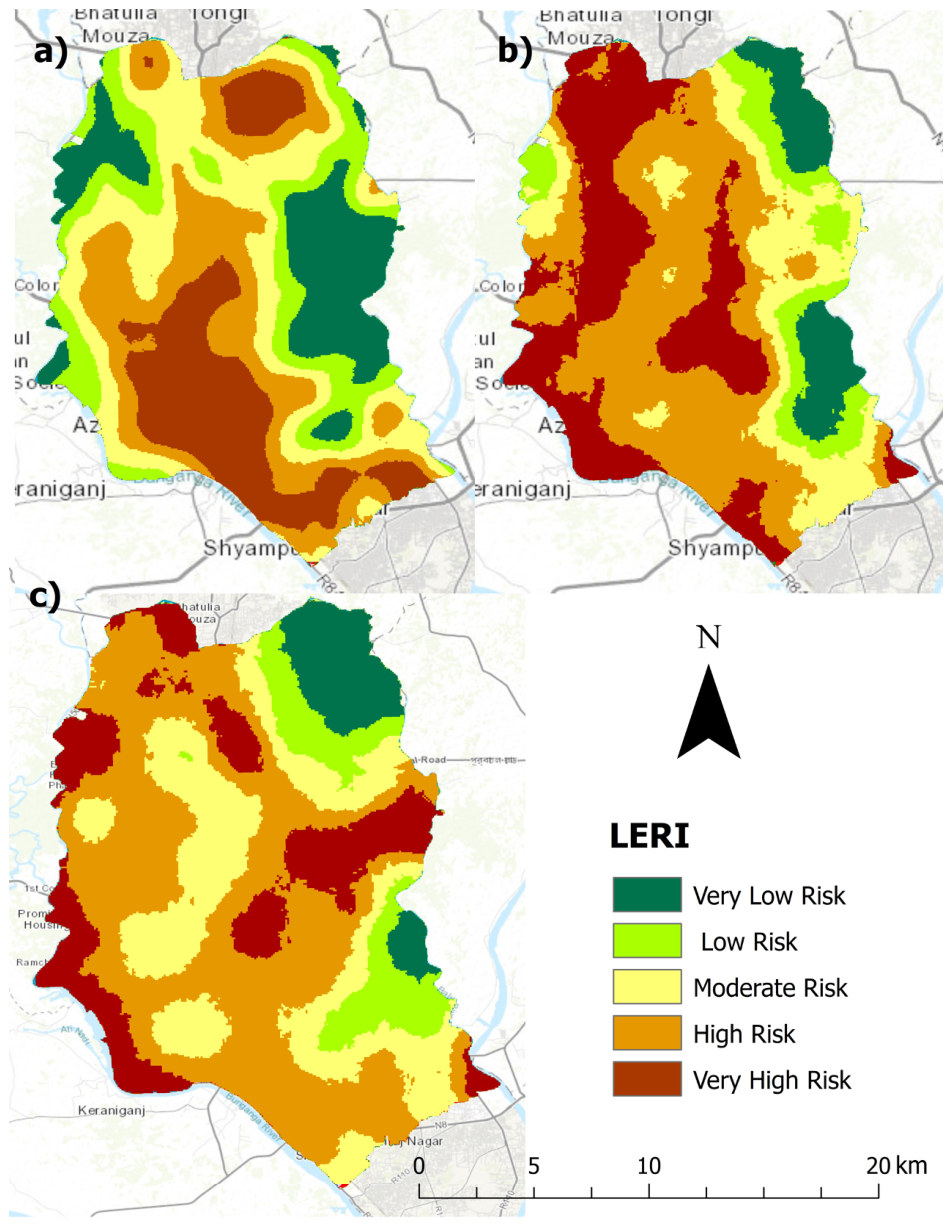
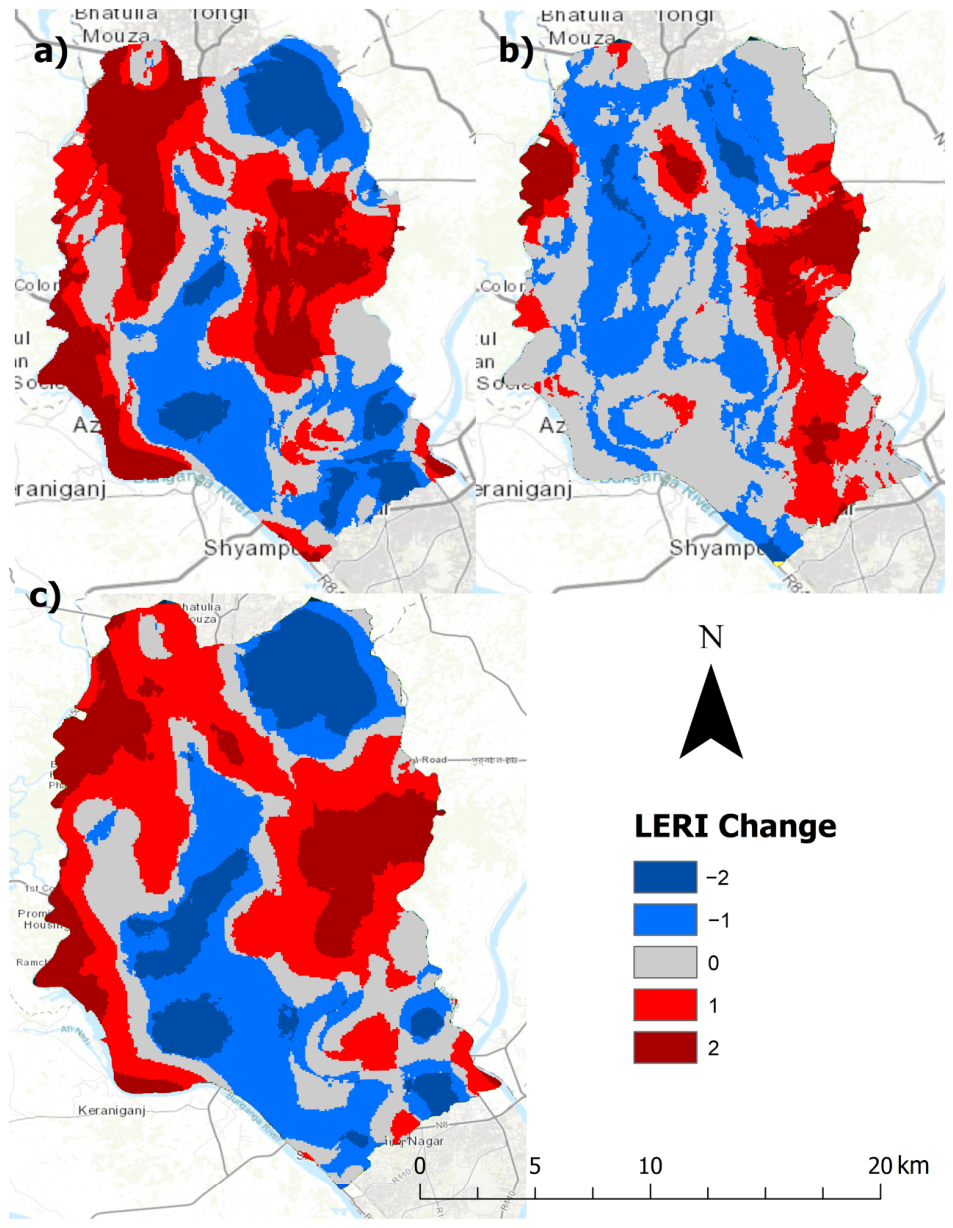
3.2. Landscape Ecological Risk
3.3. LERI Change over Time
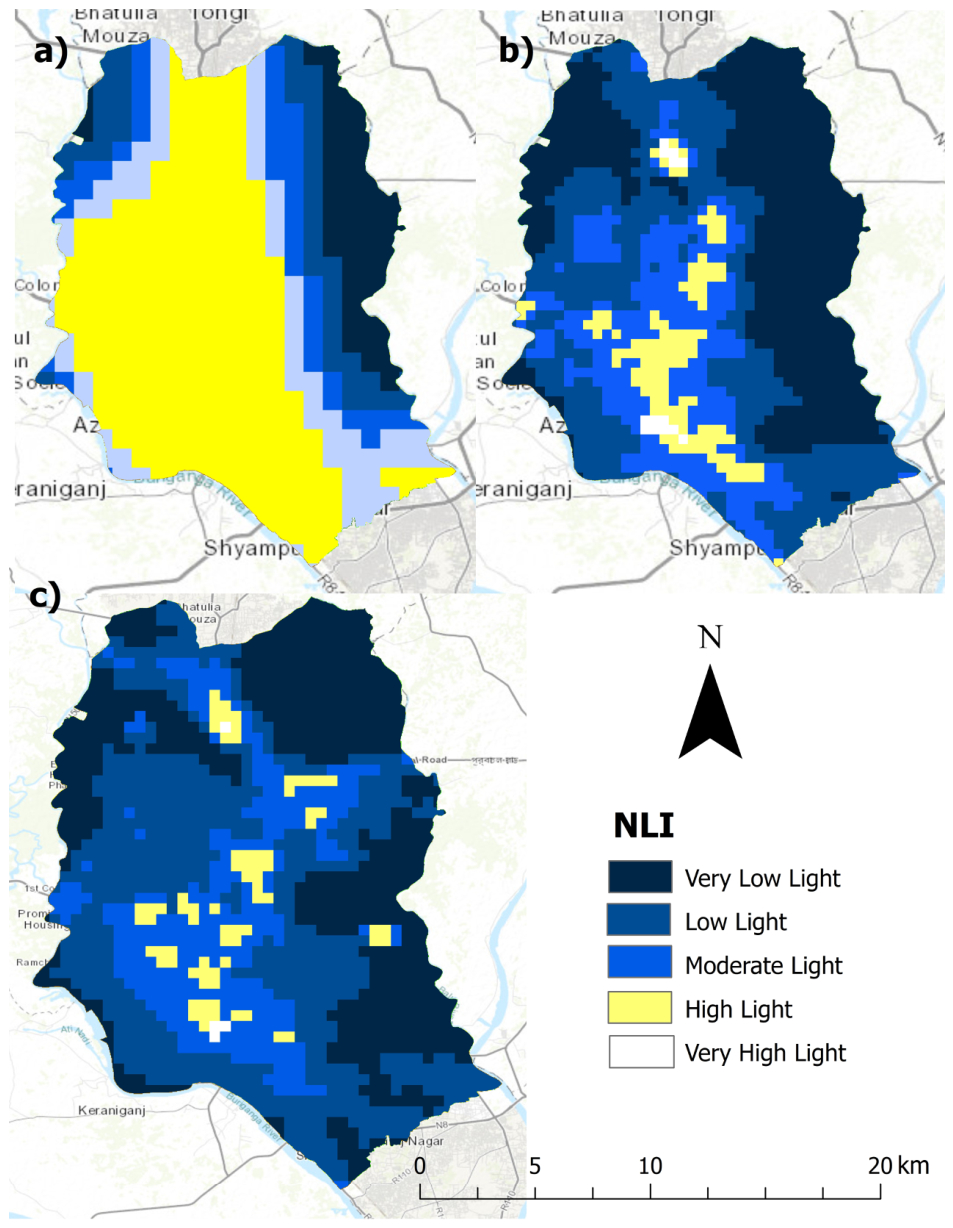
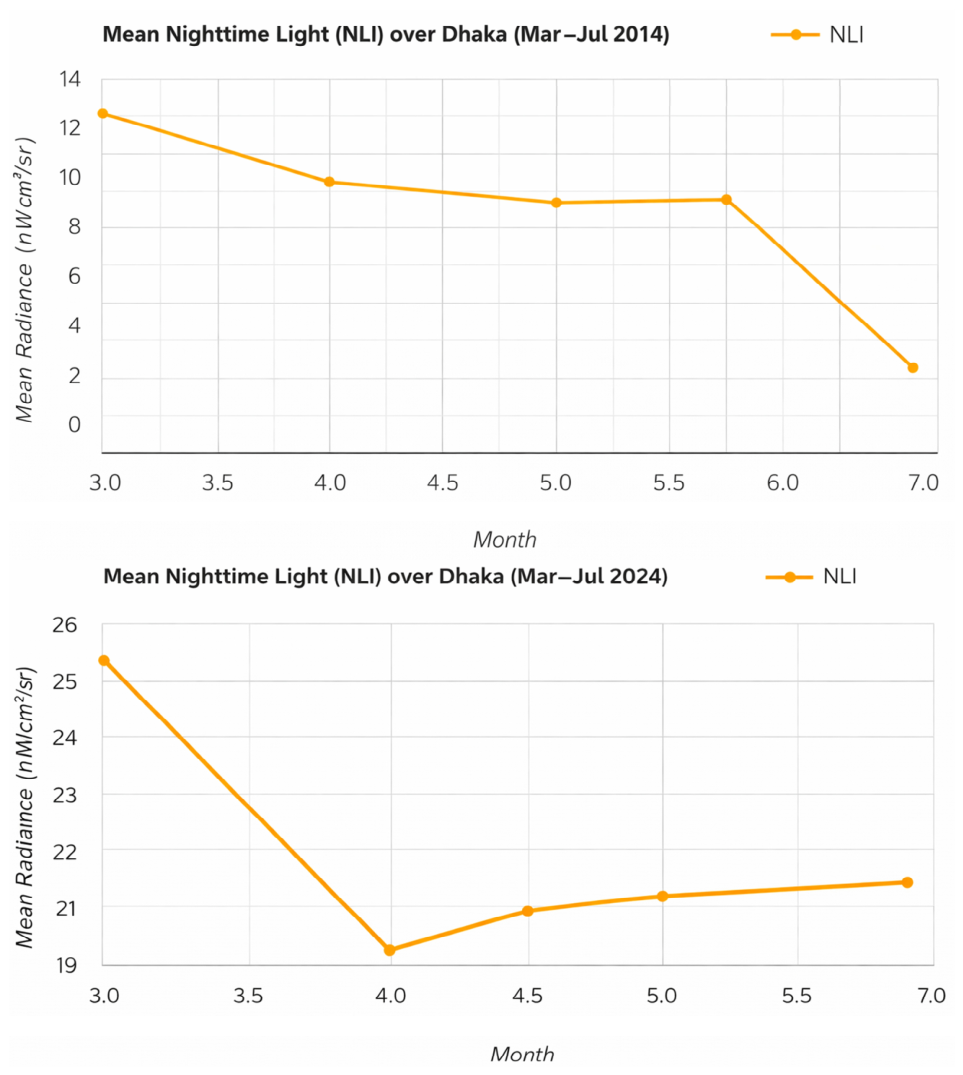
3.4. Nighttime Light Index (NTL)
3.5. Land Cover
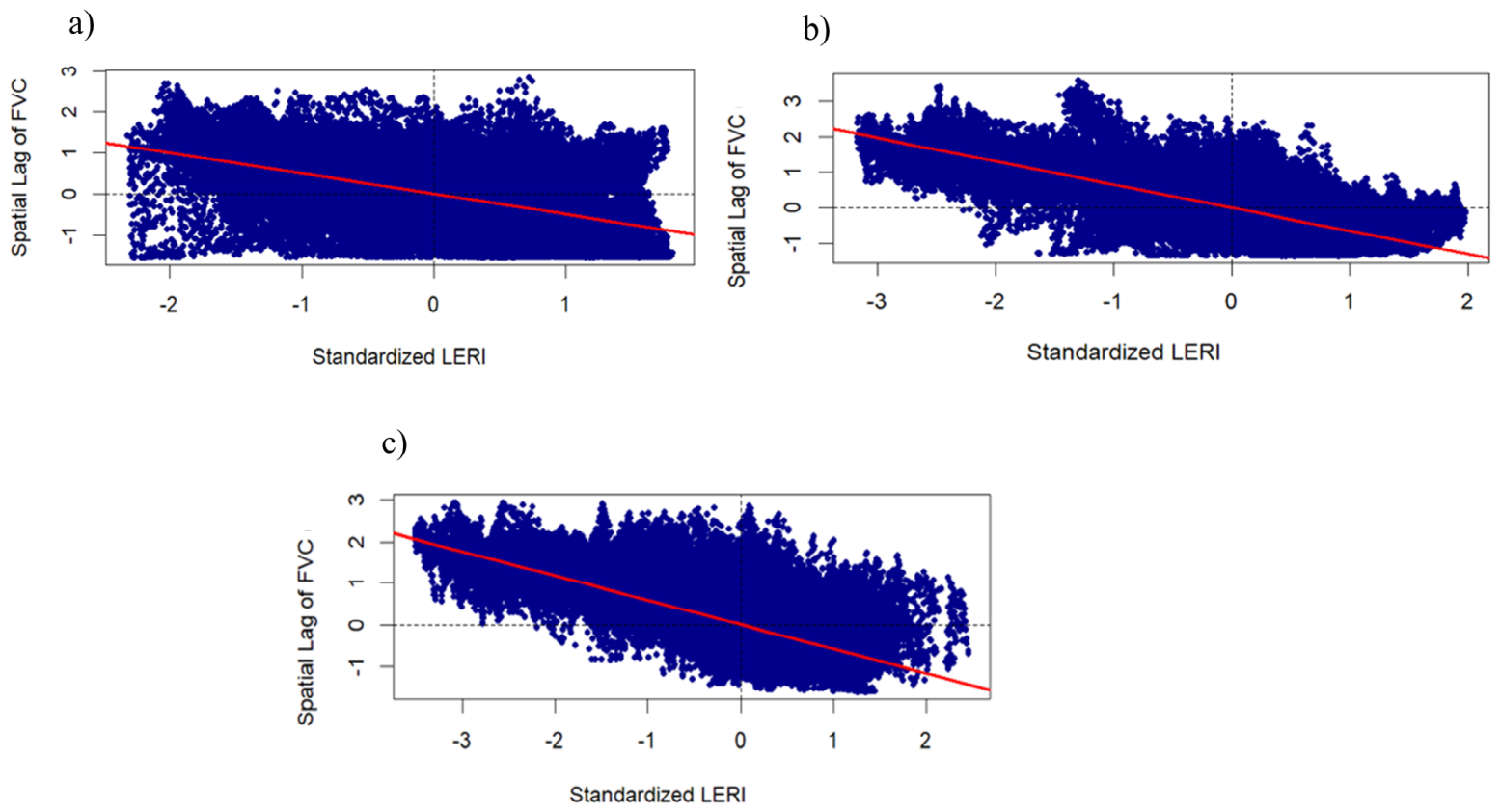
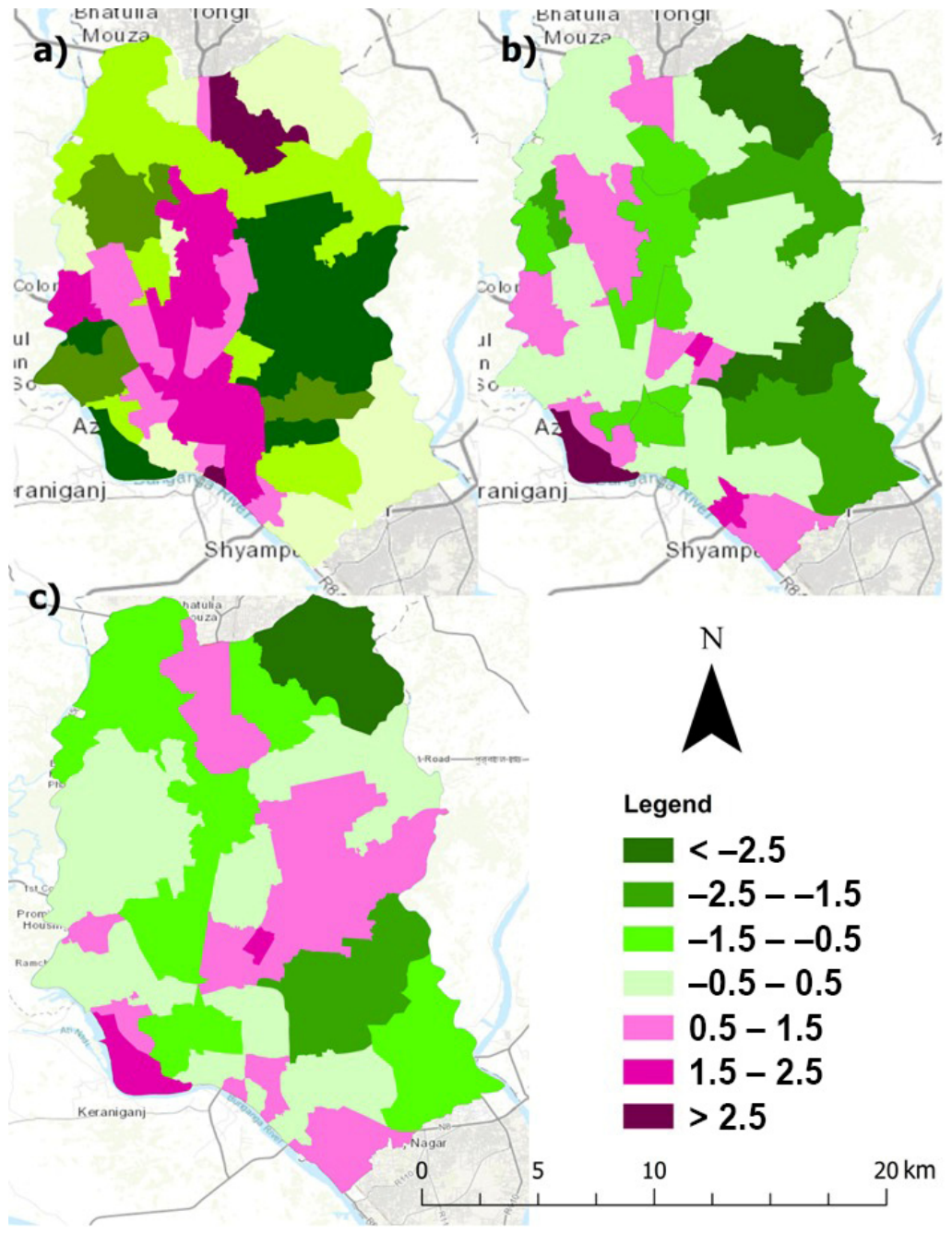
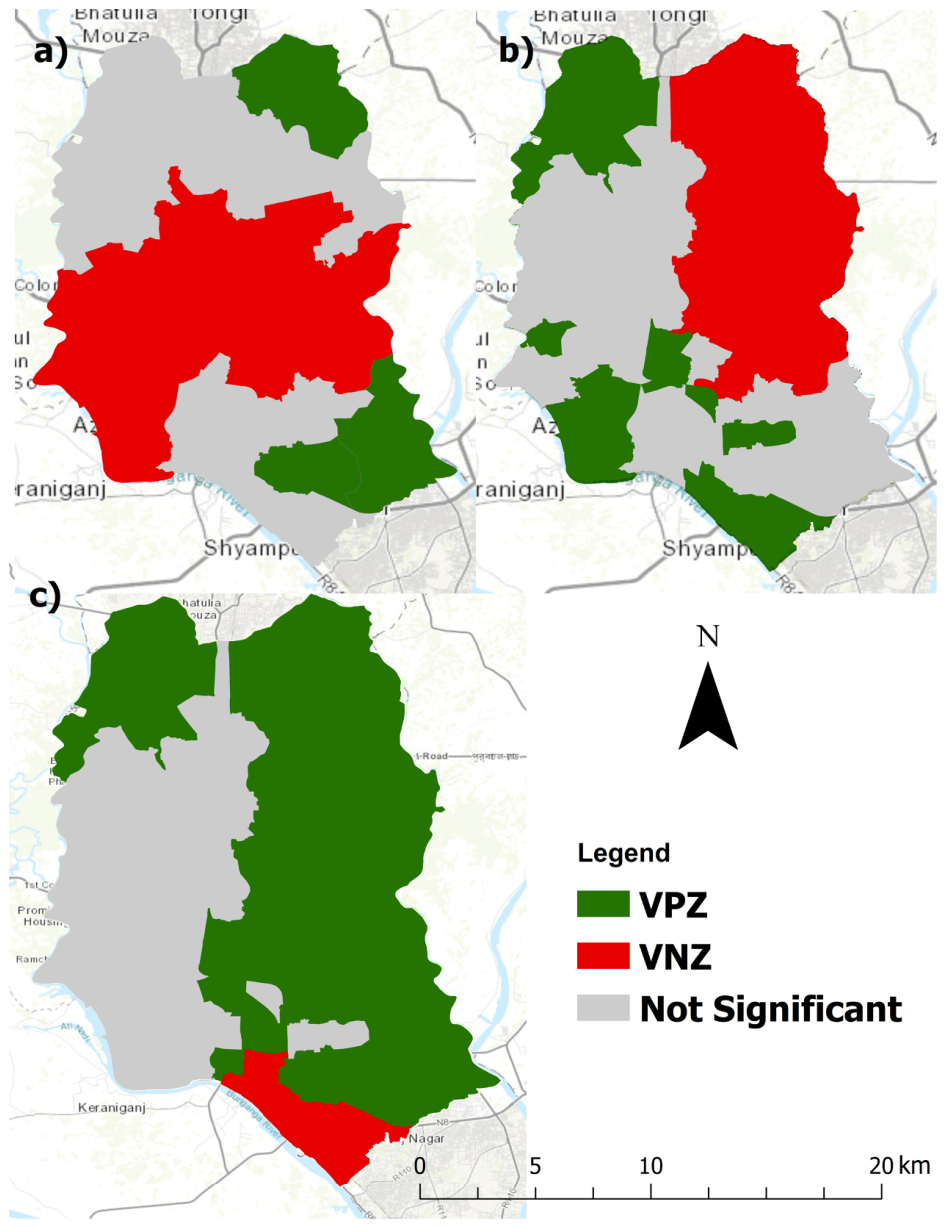
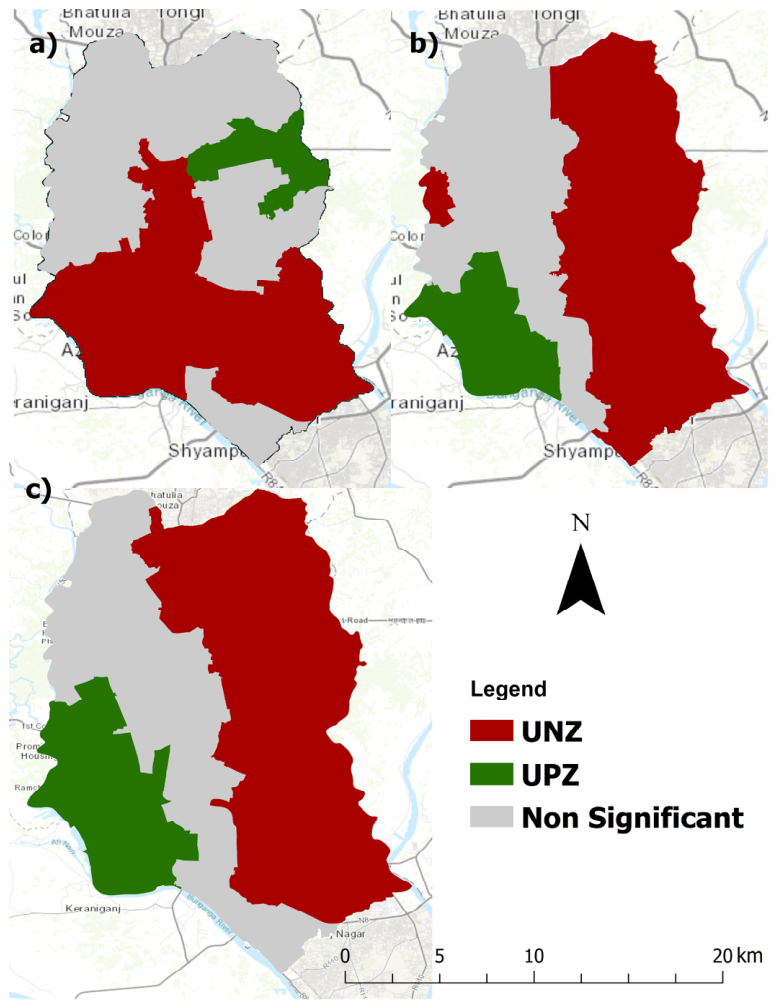
3.6. Local Autocorrelation Analysis Between LERI and FVC
3.7. GWR Model
4. Discussion
4.1. Vegetation Dynamics and Urban Expansion
4.2. Changes in Landscape Ecological Risk
4.3. Nighttime Light Intensification and Urban Growth
4.4. Spatial Relationship FVC and Ecological Risk
4.5. Urban Planning and Ecological Management Implications
4.6. Limitation
5. Spatial Planning Recommendations for Ecological Network Strengthening
6. Conclusions
Author Contributions
Funding
Institutional Review Board Statement
Informed Consent Statement
Data Availability Statement
Acknowledgments
Conflicts of Interest
References
- Hossain, M.J.; Mahmud, M.M.; Islam, S.T. Monitoring Spatiotemporal Changes of Urban Surface Water Based on Satellite Imagery and Google Earth Engine Platform in Dhaka City from 1990 to 2021. Bull. Natl. Res. Cent. 2023, 47, 150. [Google Scholar] [CrossRef]
- Roy, S.K.; Alam, M.T.; Mojumder, P.; Mondal, I.; Kafy, A.-A.; Dutta, M.; Ferdous, M.N.; Al Mamun, M.A.; Mahtab, S.B. Dynamic Assessment and Prediction of Land Use Alterations Influence on Ecosystem Service Value: A Pathway to Environmental Sustainability. Environ. Sustain. Indic. 2024, 21, 100319. [Google Scholar] [CrossRef]
- Saimum, A. Most Populous City: How Dhaka Can Overcome Crisis as It Rises to Top Globally. Prothomalo, 26 November 2025.
- World Bank World Development Indicators: Urban Population Growth (Bangladesh). 2023. Available online: https://www.worldbank.org/ext/en/home (accessed on 24 April 2026).
- Hasan, M.M.; Ferdous, M.T.; Talha, M.; Mojumder, P.; Roy, S.K.; Zim, M.N.F.; Akter, M.M.; Nasher, N.M.R.; Hasher, F.F.B.; Boltižiar, M.; et al. Analyzing Ecological Environmental Quality Trends in Dhaka Through Remote Sensing Based Ecological Index (RSEI). Land 2025, 14, 1258. [Google Scholar] [CrossRef]
- Yin, C.; Pereira, P.; Zhao, W.; Barcelo, D. Natural Climate Solutions. The Way Forward. Geogr. Sustain. 2023, 4, 179–182. [Google Scholar] [CrossRef]
- Yang, N.; Zhang, T.; Li, J.; Feng, P.; Yang, N. Landscape Ecological Risk Assessment and Driving Factors Analysis Based on Optimal Spatial Scales in Luan River Basin, China. Ecol. Indic. 2024, 169, 112821. [Google Scholar] [CrossRef]
- Li, S.; Tu, B.; Zhang, Z.; Wang, L.; Zhang, Z.; Che, X.; Wang, Z. Exploring New Methods for Assessing Landscape Ecological Risk in Key Basin. J. Clean. Prod. 2024, 461, 142633. [Google Scholar] [CrossRef]
- Sapkota, R.P.; Stahl, P.D.; Rijal, K. Restoration Governance: An Integrated Approach towards Sustainably Restoring Degraded Ecosystems. Environ. Dev. 2018, 27, 83–94. [Google Scholar] [CrossRef]
- Strassburg, B.B.N.; Iribarrem, A.; Beyer, H.L.; Cordeiro, C.L.; Crouzeilles, R.; Jakovac, C.C.; Braga Junqueira, A.; Lacerda, E.; Latawiec, A.E.; Balmford, A.; et al. Global Priority Areas for Ecosystem Restoration. Nature 2020, 586, 724–729. [Google Scholar] [CrossRef]
- FU, W.; LÜ, Y.; FU, B.; HU, W. Landscape Ecological Risk Assessment under the Influence of Typical Human Activities in Loess Plateau, Northern Shaanxi. J. Ecol. Rural. Environ. 2019, 35, 290–299. [Google Scholar]
- Han, X.; Yu, J.; Shi, L.; Zhao, X.; Wang, J. Spatiotemporal Evolution of Ecosystem Service Values in an Area Dominated by Vegetation Restoration: Quantification and Mechanisms. Ecol. Indic. 2021, 131, 108191. [Google Scholar] [CrossRef]
- Zhao, Z.; Dai, E. Vegetation Cover Dynamics and Its Constraint Effect on Ecosystem Services on the Qinghai-Tibet Plateau under Ecological Restoration Projects. J. Environ. Manag. 2024, 356, 120535. [Google Scholar] [CrossRef]
- Miah, M.T.; Fariha, J.N.; Kafy, A.-A.; Islam, R.; Biswas, N.; Duti, B.M.; Fattah, M.A.; Alsulamy, S.; Khedher, K.M.; Salem, M.A. Exploring the Nexus between Land Cover Change Dynamics and Spatial Heterogeneity of Demographic Trajectories in Rapidly Growing Ecosystems of South Asian Cities. Ecol. Indic. 2024, 158, 111299. [Google Scholar] [CrossRef]
- Liu, X.; Pei, F.; Wen, Y.; Li, X.; Wang, S.; Wu, C.; Cai, Y.; Wu, J.; Chen, J.; Feng, K. Global Urban Expansion Offsets Climate-Driven Increases in Terrestrial Net Primary Productivity. Nat. Commun. 2019, 10, 5558. [Google Scholar] [CrossRef]
- Zhang, H.; Xue, L.Q.; Wei, G.H.; Dong, Z.; Meng, X. Assessing Vegetation Dynamics and Landscape Ecological Risk on the Mainstream of Tarim River, China. Water 2020, 12, 2156. [Google Scholar] [CrossRef]
- Zeng, C.; Lin, C.; Liang, Y.; Stringer, L.C.; Tian, Z.; Mak, H.W.L.; Fan, X.; Chen, D.; Gao, S.; Yang, S. Unraveling the Complex Relationship between Urbanization and Landscape Ecological Risk: Insights from Chinese Cities. Ecosyst. Health Sustain. 2025, 11, 0448. [Google Scholar] [CrossRef]
- Zarin, T.; Esraz-Ul-Zannat, M. Assessing the Potential Impacts of LULC Change on Urban Air Quality in Dhaka City. Ecol. Indic. 2023, 154, 110746. [Google Scholar] [CrossRef]
- Hassan, M.; Southworth, J. Analyzing Land Cover Change and Urban Growth Trajectories of the Mega-Urban Region of Dhaka Using Remotely Sensed Data and an Ensemble Classifier. Sustainability 2017, 10, 10. [Google Scholar] [CrossRef]
- Nawar, N.; Sorker, R.; Chowdhury, F.J.; Mostafizur Rahman, M. Present Status and Historical Changes of Urban Green Space in Dhaka City, Bangladesh: A Remote Sensing Driven Approach. Environ. Chall. 2022, 6, 100425. [Google Scholar] [CrossRef]
- Hosen, M.I.; Hasan, M.M.; Talha, M.; Akter, M.M.; Nasher, N.M.R. Exploring the Cooling Benefits of Urban Lakes: A Multi-Year Analysis of Dhaka, Bangladesh. HydroResearch 2025, 8, 361–373. [Google Scholar] [CrossRef]
- Zhang, Z.; Wang, Z.; Zhang, X.; Liang, B.; Wang, J. Comprehensive Assessment of Potential Forestation Land in China Considering Factors of Vegetation Resilience and Top Vegetation Succession. Ecol. Indic. 2024, 166, 112476. [Google Scholar] [CrossRef]
- Kamran, M.; Yamamoto, K. Evolution and use of remote sensing in ecological vulnerability assessment: A review. Ecol. Indic. 2023, 148, 110099. [Google Scholar] [CrossRef]
- Fu, B.; Wu, X.; Wang, Z.; Wu, X.; Wang, S. Coupling Human and Natural Systems for Sustainability: Experience from China’s Loess Plateau. Earth Syst. Dynam. 2022, 13, 795–808. [Google Scholar] [CrossRef]
- Viñals, E.; Maneja, R.; Rufí-Salís, M.; Martí, M.; Puy, N. Reviewing Social-Ecological Resilience for Agroforestry Systems under Climate Change Conditions. Sci. Total Environ. 2023, 869, 161763. [Google Scholar] [CrossRef] [PubMed]
- Liu, F.; Dai, E.; Yin, J. A Review of Social–Ecological System Research and Geographical Applications. Sustainability 2023, 15, 6930. [Google Scholar] [CrossRef]
- Gan, L.; Halik, Ü.; Shi, L.; Welp, M. Ecological Risk Assessment and Multi-Scenario Dynamic Prediction of the Arid Oasis Cities in Northwest China from 1990 to 2030. Stoch. Environ. Res. Risk Assess. 2023, 37, 3099–3115. [Google Scholar] [CrossRef]
- Jin, X.; Jin, Y.; Mao, X. Ecological Risk Assessment of Cities on the Tibetan Plateau Based on Land Use/Land Cover Changes—Case Study of Delingha City. Ecol. Indic. 2019, 101, 185–191. [Google Scholar] [CrossRef]
- Yaermaimaiti, A.; Li, X.; Ge, X.; Liu, C. Analysis of Landscape Pattern and Ecological Risk Change Characteristics in Bosten Lake Basin Based on Optimal Scale. Ecol. Indic. 2024, 163, 112120. [Google Scholar] [CrossRef]
- Karimian, H.; Zou, W.; Chen, Y.; Xia, J.; Wang, Z. Landscape Ecological Risk Assessment and Driving Factor Analysis in Dongjiang River Watershed. Chemosphere 2022, 307, 135835. [Google Scholar] [CrossRef]
- Gabriele, M.; Brumana, R.; Previtali, M.; Cazzani, A. A Combined GIS and Remote Sensing Approach for Monitoring Climate Change-Related Land Degradation to Support Landscape Preservation and Planning Tools: The Basilicata Case Study. Appl. Geomat. 2023, 15, 497–532. [Google Scholar] [CrossRef]
- Anees, S.A.; Mehmood, K.; Rehman, A.; Rehman, N.U.; Muhammad, S.; Shahzad, F.; Hussain, K.; Luo, M.; Alarfaj, A.A.; Alharbi, S.A.; et al. Unveiling Fractional Vegetation Cover Dynamics: A Spatiotemporal Analysis Using MODIS NDVI and Machine Learning. Environ. Sustain. Indic. 2024, 24, 100485. [Google Scholar] [CrossRef]
- Lei, X.; Liu, H.; Li, S.; Luo, Q.; Cheng, S.; Hu, G.; Wang, X.; Bai, W. Coupling Coordination Analysis of Urbanization and Ecological Environment in Chengdu-Chongqing Urban Agglomeration. Ecol. Indic. 2024, 161, 111969. [Google Scholar] [CrossRef]
- Zheng, Q.; Seto, K.C.; Zhou, Y.; You, S.; Weng, Q. Nighttime Light Remote Sensing for Urban Applications: Progress, Challenges, and Prospects. ISPRS J. Photogramm. Remote Sens. 2023, 202, 125–141. [Google Scholar] [CrossRef]
- Misty, M.S.; Hoque, M.A.-A.; Mukul, S.A. Assessment of Urban Green Space Dynamics in Dhaka South City Corporation of Bangladesh Using Geospatial Techniques. Land 2024, 13, 1426. [Google Scholar] [CrossRef]
- Alam, I.; Nur, S.M.S.; Mitra, C. Accessibility to Public Open Space of a Densely Populated City: A Case Study of Dhaka, Bangladesh. Comput. Urban Sci. 2025, 5, 23. [Google Scholar] [CrossRef]
- Deng, S.; Zhu, S.; Chen, X.; Liang, J.; Zheng, R. A Multi-Scale Geographically Weighted Regression Approach to Understanding Community-Built Environment Determinants of Cardiovascular Disease: Evidence from Nanning, China. ISPRS Int. J. Geo-Inf. 2025, 14, 362. [Google Scholar] [CrossRef]
- Chen, C.; Zhang, X.; Hu, J.; Hu, B.; Yuan, J.; Xing, Y.; Zhou, D. Landscape Dynamics Driven by Socioeconomic Factors of the Coastal Cities along the Yellow Sea and Bohai Sea over the Last 40 Years. Ecol. Indic. 2025, 179, 114156. [Google Scholar] [CrossRef]
- Wang, X.; Zhu, T.; Jiang, C. Landscape Ecological Risk Based on Optimal Scale and Its Tradeoff/Synergy with Human Activities: A Case Study of the Nanjing Metropolitan Area, China. Ecol. Indic. 2025, 170, 113040. [Google Scholar] [CrossRef]
- Yu, H.; Hu, X.; Yao, L. Vegetation Restoration Reduces Landscape Ecological Risk in the Loess Plateau. Geogr. Sustain. 2025, 6, 100320. [Google Scholar] [CrossRef]
- Wu, D.; Wu, H.; Zhao, X.; Zhou, T.; Tang, B.; Zhao, W.; Jia, K. Evaluation of Spatiotemporal Variations of Global Fractional Vegetation Cover Based on GIMMS NDVI Data from 1982 to 2011. Remote Sens. 2014, 6, 4217–4239. [Google Scholar] [CrossRef]
- Lin, X.; Wang, Z. Landscape Ecological Risk Assessment and Its Driving Factors of Multi-Mountainous City. Ecol. Indic. 2023, 146, 109823. [Google Scholar] [CrossRef]
- Grimm, N.B.; Faeth, S.H.; Golubiewski, N.E.; Redman, C.L.; Wu, J.; Bai, X.; Briggs, J.M. Global Change and the Ecology of Cities. Science 2008, 319, 756–760. [Google Scholar] [CrossRef] [PubMed]
- Peng, J.; Liu, Y.; Wu, J.; Lv, H.; Hu, X. Linking Ecosystem Services and Landscape Patterns to Assess Urban Ecosystem Health: A Case Study in Shenzhen City, China. Landsc. Urban Plan. 2015, 143, 56–68. [Google Scholar] [CrossRef]
- Wang, Z.; Liang, L.; Sun, Z.; Wang, X. Spatiotemporal Differentiation and the Factors Influencing Urbanization and Ecological Environment Synergistic Effects within the Beijing-Tianjin-Hebei Urban Agglomeration. J. Environ. Manag. 2019, 243, 227–239. [Google Scholar] [CrossRef]
- Kamal, A.M.; Midorikawa, S. GIS-Based Geomorphological Mapping Using Remote Sensing Data and Supplementary Geoinformation: A Case Study of the Dhaka City Area, Bangladesh. Int. J. Appl. Earth Obs. Geoinf. 2004, 6, 111–125. [Google Scholar]
- Byomkesh, T.; Nakagoshi, N.; Dewan, A.M. Urbanization and Green Space Dynamics in Greater Dhaka, Bangladesh. Landsc. Ecol. Eng. 2012, 8, 45–58. [Google Scholar] [CrossRef]
- Bangladesh Bureau of Statistics (BBS). Population and Housing Census: National Report, Volume 1; Statistics and Informatics Division, Ministry of Planning, Government of the People’s Republic of Bangladesh: Dhaka, Bangladesh, 2022. Available online: https://pcs.icms.gov.bd/PHCReportNational (accessed on 5 June 2026).
- Yeasmin, T.; Karmaker, S.; Islam, M.S.; Hasan, I.; Rahman, S.; Hasan, M. Prediction of Land Cover Changes in an Urban City of Bangladesh Using Artificial Neural Network-Based Cellular Automata. Urban Lifeline 2025, 3, 7. [Google Scholar] [CrossRef]
- Abdullah, H.M.; Mukti, M.; Miah, M.G.; Karim, M.A.; Tanzir, M.T.; Hossain, M.S. Development at the Cost of Unsustainable Degradation of Wetlands: Unraveling the Dynamics (Historic and Future) of Wetlands in the Megacity Dhaka. World Dev. Sustain. 2024, 4, 100131. [Google Scholar] [CrossRef]
- Elvidge, C.D.; Baugh, K.; Zhizhin, M.; Hsu, F.C.; Et., A. VIIRS Night-Time Lights. Int. J. Remote Sens. 2017, 38, 5860–5879. [Google Scholar] [CrossRef]
- Li, X.; Zhou, Y.; Zhao, M.; Zhao, X. A Harmonized Global Nighttime Light Dataset 1992–2018. Sci. Data 2020, 7, 168. [Google Scholar] [CrossRef]
- Kim, Y.-S.; Kim, M.K.; Fu, N.; Liu, J.; Wang, J.; Srebric, J. Investigating the Impact of Data Normalization Methods on Predicting Electricity Consumption in a Building Using Different Artificial Neural Network Models. Sustain. Cities Soc. 2025, 118, 105570. [Google Scholar] [CrossRef]
- Ellis, E. Land-Use and Land-Cover Change. Available online: http://library.snls.org.sz/Encyclopedia%20of%20the%20Earth/editors.eol.org/eoearth/wiki/Land-use_and_land-cover_changes.html (accessed on 24 April 2026).
- Yang, J.; Huang, X. The 30 m Annual Land Cover Dataset and Its Dynamics in China from 1990 to 2019. Earth Syst. Sci. Data 2021, 13, 3907–3925. [Google Scholar] [CrossRef]
- Kun, J.; Yunjun, Y.; Xiangqin, W.; Shuai, G.; Bo, J.; Xiang, Z. A Review on Fractional Vegetation Cover Estimation Using Remote Sensing. Adv. Earth Sci. 2013, 28, 774. [Google Scholar] [CrossRef]
- Zhao, M.; Zhou, Y.; Li, X.; Cao, W.; He, C.; Yu, B.; Li, X.; Elvidge, C.D.; Cheng, W.; Zhou, C. Applications of Satellite Remote Sensing of Nighttime Light Observations: Advances, Challenges, and Perspectives. Remote Sens. 2019, 11, 1971. [Google Scholar] [CrossRef]
- Liu, D.; Chen, H.; Zhang, H.; Geng, T.; Shi, Q. Spatiotemporal Evolution of Landscape Ecological Risk Based on Geomorphological Regionalization during 1980–2017: A Case Study of Shaanxi Province, China. Sustainability 2020, 12, 941. [Google Scholar] [CrossRef]
- Rahaman, M.A.; Kalam, A.; Al-Mamun, M. Unplanned Urbanization and Health Risks of Dhaka City in Bangladesh: Uncovering the Associations between Urban Environment and Public Health. Front. Public Health 2023, 11, 1269362. [Google Scholar] [CrossRef]
- Li, Q.; Ma, B.; Zhao, L.; Mao, Z.; Luo, L.; Liu, X. Landscape Ecological Risk Evaluation Study under Multi-Scale Grids—A Case Study of Bailong River Basin in Gansu Province, China. Water 2023, 15, 3777. [Google Scholar] [CrossRef]
- McGarigal, K.; Marks, B.J. FRAGSTATS: Spatial Pattern Analysis Program for Quantifying Landscape Structure; General Technical Report PNW-GTR-351; U.S. Department of Agriculture, Forest Service, Pacific Northwest Research Station: Portland, OR, USA, 1995; 122p. [Google Scholar] [CrossRef]
- Cui, L.; Zhao, Y.; Liu, J.; Han, L.; Ao, Y.; Yin, S. Landscape Ecological Risk Assessment in Qinling Mountain. Geol. J. 2018, 53, 342–351. [Google Scholar] [CrossRef]
- Ji, Y.; Bai, Z.; Hui, J. Landscape Ecological Risk Assessment Based on LUCC—A Case Study of Chaoyang County, China. Forests 2021, 12, 1157. [Google Scholar] [CrossRef]
- Xie, G.-D.; Xiao, Y.; Zhen, L.; Lu, C.-X. Study on Ecosystem Services Value of Food Production in China. Chin. J. Eco-Agric. 2005, 13, 10–13. [Google Scholar]
- Mo, W.; Wang, Y.; Zhang, Y.; Zhuang, D. Impacts of Road Network Expansion on Landscape Ecological Risk in a Megacity, China: A Case Study of Beijing. Sci. Total Environ. 2017, 574, 1000–1011. [Google Scholar] [PubMed]
- Du, L.; Dong, C.; Kang, X.; Qian, X.; Gu, L. Spatiotemporal Evolution of Land Cover Changes and Landscape Ecological Risk Assessment in the Yellow River Basin, 2015–2020. J. Environ. Manag. 2023, 332, 117149. [Google Scholar] [CrossRef]
- Liu, L.; Wei, J.; Luo, P.; Zhang, Y.; Wang, Y.; Elbeltagi, A.; Zainol, M.R.R.M.A. A Novel Quantity Assessment of Landscape Ecological Risk Using Human-Nature Driving Mechanism for Sustainable Society. Sci. Total Environ. 2024, 947, 173892. [Google Scholar] [CrossRef] [PubMed]
- Ai, J.; Yu, K.; Zeng, Z.; Yang, L.; Liu, Y.; Liu, J. Assessing the Dynamic Landscape Ecological Risk and Its Driving Forces in an Island City Based on Optimal Spatial Scales: Haitan Island, China. Ecol. Indic. 2022, 137, 108771. [Google Scholar] [CrossRef]
- Zhang, J.; Zheng, S.; Sun, Y.; Yue, H. Landscape Ecological Risk Assessment of an Ecological Area in the Kubuqi Desert Based on Landsat Remote Sensing Data. PLoS ONE 2023, 18, e0294584. [Google Scholar] [CrossRef]
- Li, Y.; Liu, J.; Zhu, Y.; Wu, C. Assessment of Landscape Ecological Risks Driven by Land Use Change Using Multi-Scenario Simulation: A Case Study of Harbin, China. Land 2025, 14, 947. [Google Scholar] [CrossRef]
- Zhang, H.; Wang, Z.; Yang, B.; Chai, J.; Wei, C. Spatial–Temporal Characteristics of Illegal Land Use and Its Driving Factors in China from 2004 to 2017. Int. J. Environ. Res. Public Health 2021, 18, 1336. [Google Scholar] [CrossRef]
- Qi, W.; Deng, Y.; Fu, B. Rural Attraction: The Spatial Pattern and Driving Factors of China’s Rural in-Migration. J. Rural Stud. 2022, 93, 461–470. [Google Scholar] [CrossRef]
- Pang, R.Q.; Teng, F.; Wei, Z. Dynamic Mechanism Analysis of Population Urbanization in Jilin Province Based on Geographical Weighted Regression. Sci. Geogr. Sin. 2014, 34, 1210–1217. [Google Scholar]
- Duan, Z.; Lu, C.; Wang, X.; Tang, X.; Sheng, S. Spatiotemporal Evolution and Multi-Scenario Simulation of Rural Settlements in Liangzhou District: Evidence from an Oasis Region in the Arid Northwest. Land 2025, 14, 2397. [Google Scholar] [CrossRef]
- Liu, S.; Liu, Q.; Zhang, Z.L.; Deng, L. Landscape Ecological Risk and Driving Force Analysis in Red River Basin. Shengtai Xuebao/Acta Ecol. Sin. 2014, 34, 3728–3734. [Google Scholar] [CrossRef]
- Jin, Z.; Wang, C.; Jiao, X.; Yu, S.; Yang, C.; Xie, F.; Miao, Y. Spatiotemporal Pattern and Influencing Factors of Urbanization Quality in County Areas of Shandong Province, China. Ecol. Indic. 2024, 163, 112132. [Google Scholar] [CrossRef]
- Seto, K.C.; Güneralp, B.; Hutyra, L.R. Global Forecasts of Urban Expansion to 2030 and Direct Impacts on Biodiversity and Carbon Pools. Proc. Natl. Acad. Sci. USA 2012, 109, 16083–16088. [Google Scholar] [CrossRef]
- Schneider, A.; Friedl, M.A.; Potere, D. Mapping Global Urban Areas Using MODIS 500-m Data: New Methods and Datasets Based on ‘Urban Ecoregions’. Remote Sens. Environ. 2010, 114, 1733–1746. [Google Scholar] [CrossRef]
- Al-Faisal, A.; Rahman, M.S.; Kafy, A.-A.; Roy, S.; Khan, A.R.; Rahman, M.M. Impact on Land Surface Temperature and Urban Heat Island, Due to Land Use/Land Cover Change in Dhaka Metropolitan Area, Using Remote Sensing and GIS Techniques. In Re-Envisioning Advances in Remote Sensing; CRC Press: Boca Raton, FL, USA, 2022; pp. 69–102. ISBN 978-1-003-22462-4. [Google Scholar]
- Dhole, A.; Kadaverugu, R.; Biniwale, R. Spatio-Temporal Assessment of Landscape Ecological Risk in Godavari River Basin, India Using High-Resolution Land Use Data. J. Indian Soc. Remote Sens. 2026, 54, 1287–1298. [Google Scholar] [CrossRef]
- Gao, H.; Song, W. Assessing the Landscape Ecological Risks of Land-Use Change. Int. J. Environ. Res. Public Health 2022, 19, 13945. [Google Scholar] [CrossRef] [PubMed]
- Liang, J.; He, X.; Zeng, G.; Zhong, M.; Gao, X.; Li, X.; Li, X.; Wu, H.; Feng, C.; Xing, W.; et al. Integrating Priority Areas and Ecological Corridors into National Network for Conservation Planning in China. Sci. Total Environ. 2018, 626, 22–29. [Google Scholar] [CrossRef] [PubMed]
- Yin, J.; Fu, P.; Cheshmehzangi, A.; Li, Z.; Dong, J. Investigating the Changes in Urban Green-Space Patterns with Urban Land-Use Changes: A Case Study in Hangzhou, China. Remote Sens. 2022, 14, 5410. [Google Scholar] [CrossRef]
- Zou, L.; Liu, Y.; Wang, J.; Yang, Y. An Analysis of Land Use Conflict Potentials Based on Ecological-Production-Living Function in the Southeast Coastal Area of China. Ecol. Indic. 2021, 122, 107297. [Google Scholar] [CrossRef]
- Xiao, P.; Xu, J.; Zhao, C. Conflict Identification and Zoning Optimization of “Production-Living-Ecological” Space. Int. J. Environ. Res. Public Health 2022, 19, 7990. [Google Scholar] [CrossRef]
- Zhan, D.; Quan, B.; Liao, J. The Spatiotemporal Evolution and Coupling Coordination of LUCC and Landscape Ecological Risk in Ecologically Vulnerable Areas: A Case Study of the Wanzhou–Dazhou–Kaizhou Region. Sustainability 2025, 17, 4399. [Google Scholar] [CrossRef]
- Peng, X.; Tang, R.; Li, J.; Tang, H.; Guo, Z. Spatiotemporal Dynamics of Landscape Pattern and Vegetation Ecological Quality in Sanjiangyuan National Park. Sustainability 2025, 17, 373. [Google Scholar] [CrossRef]
- Xiong, Y.; Li, Y.; Yang, Y. Landscape Ecological Risk Assessment of Peri-Urban Villages in the Yangtze River Delta Based on Ecosystem Service Values. Sustainability 2025, 17, 7014. [Google Scholar] [CrossRef]
- Zhang, Y.; Li, X.; Liu, S.; Liu, Z.; Li, Y. The Cooling Effects of Greening Strategies Within High-Density Urban Built-Up Areas in Coastal Slope Terrain. Sustainability 2025, 17, 11054. [Google Scholar] [CrossRef]
- Sonet, M.S.; Hasan, M.Y.; Kafy, A.A.; Shobnom, N. Spatiotemporal Analysis of Urban Expansion, Land Use Dynamics, and Thermal Characteristics in a Rapidly Growing Megacity Using Remote Sensing and Machine Learning Techniques. Theor. Appl. Climatol. 2025, 156, 79. [Google Scholar] [CrossRef]
- Li, L.; Carter, J. Exploring the Relationship between Urban Green Infrastructure Connectivity, Size and Multifunctionality: A Systematic Review. Landsc. Ecol. 2025, 40, 61. [Google Scholar] [CrossRef]
- Theodorou, P.; Herbst, S.-C.; Kahnt, B.; Landaverde-González, P.; Baltz, L.M.; Osterman, J.; Paxton, R.J. Urban Fragmentation Leads to Lower Floral Diversity, with Knock-on Impacts on Bee Biodiversity. Sci. Rep. 2020, 10, 21756. [Google Scholar] [CrossRef] [PubMed]
- Chen, C.; Feng, X.; Yao, J.; Xiong, X. Perceived Leisure Service Benefits of Peri-Urban Community Green Spaces: Impact of Visual Environment during Day and Night. Landsc. Urban Plan. 2025, 259, 105338. [Google Scholar] [CrossRef]
- Mondal, B.; Sharma, P.; Kundu, D.; Bansal, S. Spatio-Temporal Assessment of Landscape Ecological Risk and Associated Drivers: A Case Study of Delhi. Environ. Urban. ASIA 2021, 12, S85–S106. [Google Scholar] [CrossRef]
- Wei, Y.; Zhou, P.; Zhang, L.; Zhang, Y. Spatio-Temporal Evolution Analysis of Land Use Change and Landscape Ecological Risks in Rapidly Urbanizing Areas Based on Multi-Situation Simulation—A Case Study of Chengdu Plain. Ecol. Indic. 2024, 166, 112245. [Google Scholar] [CrossRef]



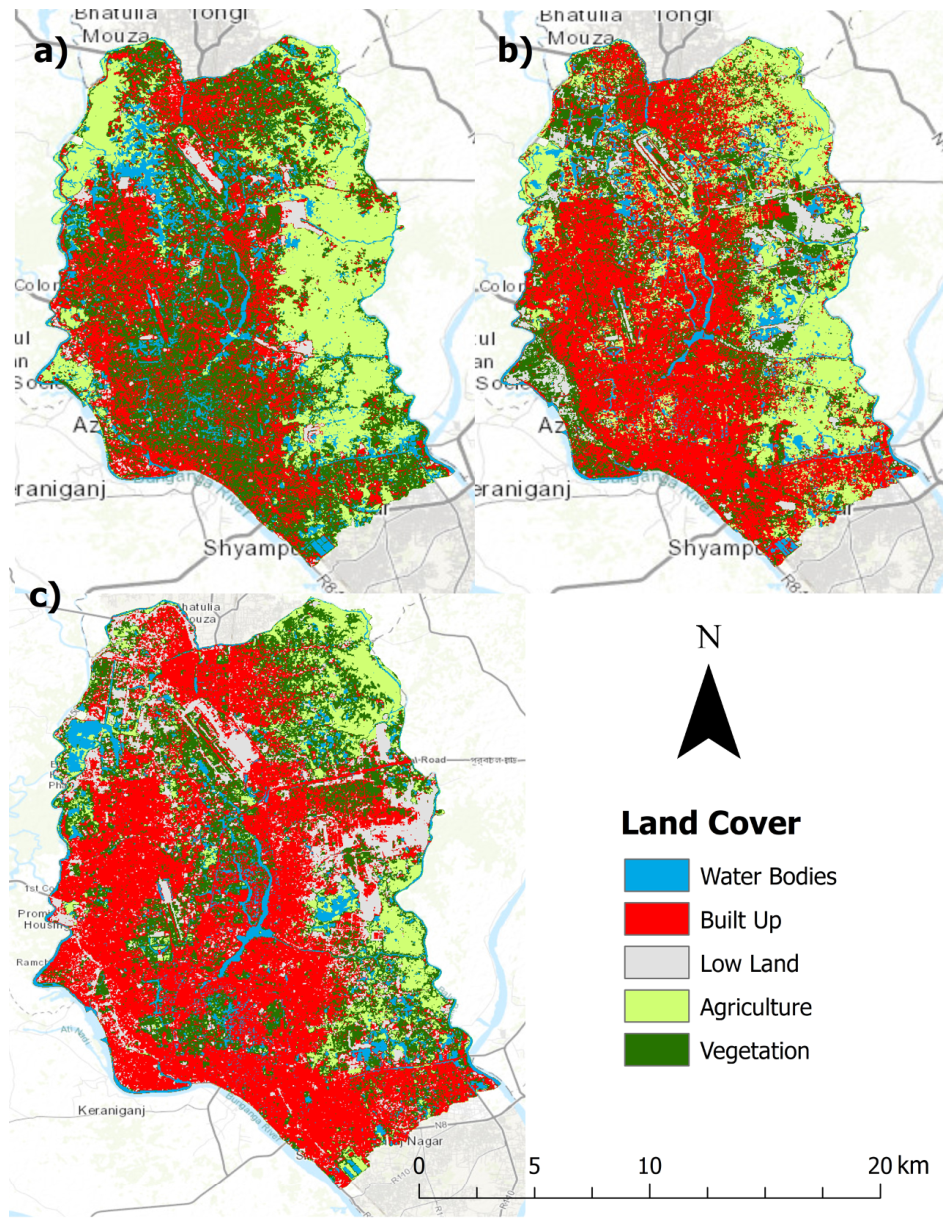
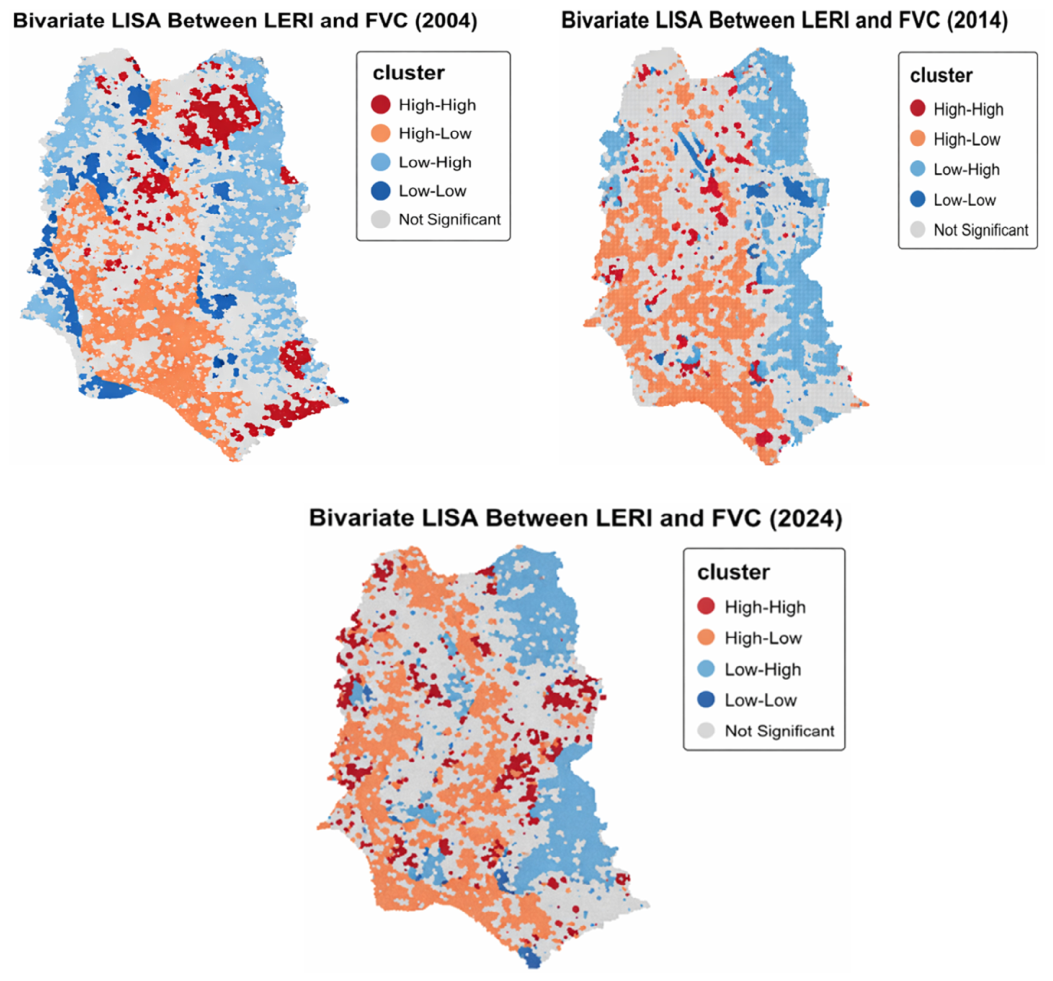


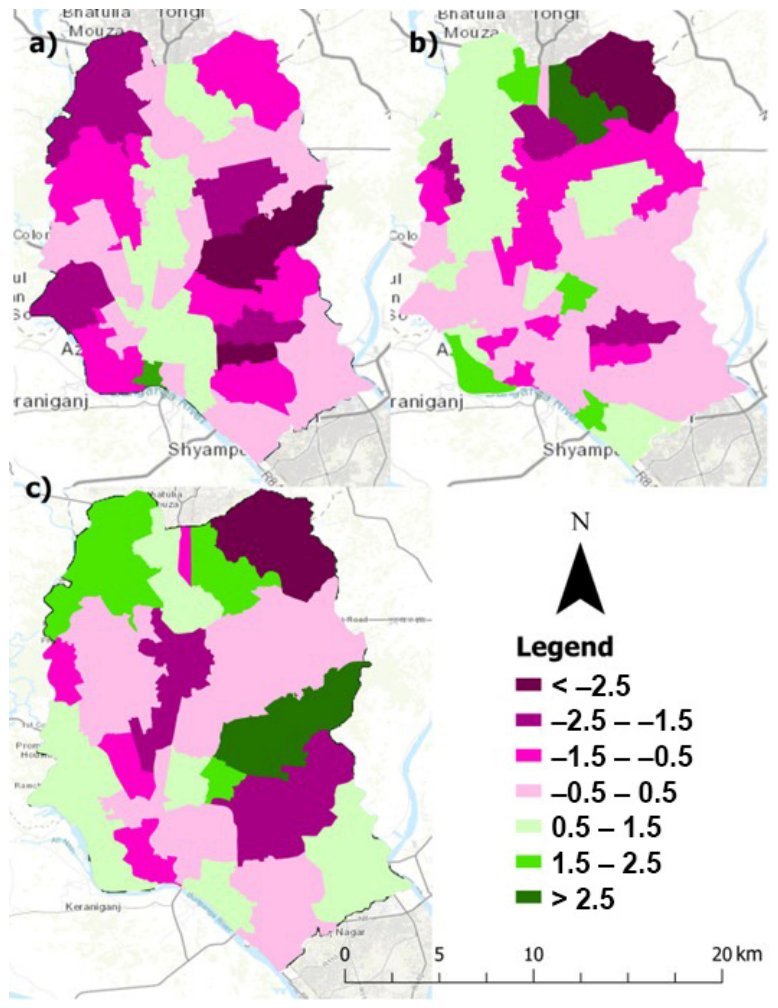


| Variable | Data Source | Dataset | Data Precision | Purpose |
|---|---|---|---|---|
| Fractional Vegetation Cover (FVC) | Landsat 5 (TM) Landsat 8 (OLI) Landsat 9 (OLI-2) | Landsat/LC05/T1_L2 Landsat/LC08/T1_L2 Landsat/LC09/T1_L2 | 30 m | Vegetation Restoration or Degradation |
| Nighttime Light Index (NTL) | NOAA-DMSP-OLS Nighttime Lights Program, USGS, | (NOAA/VIIRS/DNB/ MONTHLY_V1/VCMSLCFG) | 500 m | Urbanization |
| Land Cover (LC) | Landsat Collection 2 Level-2 Surface Reflectance: Landsat 5 TM, Landsat 8 OLI, Landsat 9 OLI-2 | LANDSAT/LT05/C02/T1_L2; LANDSAT/LC08/C02/T1_L2; LANDSAT/LC09/C02/T1_L2 | 30 m | Landscape Pattern |
| Class | Raw Vulnerability (V) | LFi | LFi (Normalize) |
|---|---|---|---|
| Built Up | 5 | 1.00 | 0.40 |
| Agricultural Land | 4 | 0.75 | 0.30 |
| Lowland | 3 | 0.50 | 0.20 |
| Vegetation | 2 | 0.25 | 0.10 |
| Water Bodies | 1 | 0.00 | 0.00 |
| Class | 2004 | 2014 | 2024 |
|---|---|---|---|
| Very Low | 27.93% | 31.81% | 31.02% |
| Low | 18.90% | 24.65% | 23.59% |
| Moderate | 20.70% | 19.59% | 19.34% |
| High | 23.90% | 15.76% | 16.07% |
| Very High | 8.57% | 8.19% | 9.99% |
| Vegetation Change | Area (km2) | Percentage |
|---|---|---|
| Degradation | 104.7 | 34.39% |
| No Change | 110.76 | 36.38% |
| Restoration | 89.01 | 29.23% |
| Class | 2004 (%) | 2014 (%) | 2024 (%) |
|---|---|---|---|
| Very Low | 16.31 | 8.57 | 7.27 |
| Low | 15.35 | 9.16 | 8.71 |
| Moderate | 23.75 | 15.89 | 24.32 |
| High | 24.36 | 38.7 | 42.95 |
| Very High | 20.23 | 27.68 | 16.75 |
| Period | −2 | −1 | 0 | 1 | 2 |
|---|---|---|---|---|---|
| 2004–2014 | 10.08 | 22.64 | 21.86 | 20.71 | 24.71 |
| 2014–2024 | 24.67 | 38.81 | 5.52 | 19.07 | 11.93 |
| 2004–2024 | 13.34 | 22.1 | 20.11 | 29.78 | 14.67 |
| Year | H-H | H-L | L-H | L-L | Not Significant |
|---|---|---|---|---|---|
| 2004 | 9 | 33 | 28 | 6 | 24 |
| 2014 | 11 | 37 | 22 | 7 | 23 |
| 2024 | 13 | 42 | 18 | 7 | 20 |
| Year | VPZ | VNZ | Total |
|---|---|---|---|
| 2004 | 2.88 | 44.37 | 47.25 |
| 2014 | 31.63 | 15.37 | 47 |
| 2024 | 33.98 | 9.49 | 43.47 |
| Year | UPZ | UNZ | Total |
|---|---|---|---|
| 2004 | 6.7 | 43.99 | 50.69 |
| 2014 | 12.36 | 52.46 | 64.82 |
| 2024 | 16.61 | 49.92 | 66.53 |
| Recommendation Zone | Spatial Basis | Main Locations in Dhaka | Planning Objective | Recommended Actions |
|---|---|---|---|---|
| Urban growth management zones | High to very high LERI, low FVC, intense built-up expansion, and relatively high NTL intensity | Mirpur-Pallabi-Mohammadpur; Tejgaon-Ramna-Motijheel; Kamrangirchar-Lalbagh-Shyampur | Limit further ecological degradation in highly urbanized areas | Restrict conversion of remaining green and open land; regulate development in ecologically sensitive sites; promote compact and vertical development; require green infrastructure and minimum urban green-space standards |
| Ecological restoration priority zones | Vegetation degradation, fragmented ecological patches, persistent or increasing ecological risk | Western (Turag), southwestern (Kamrangir Char), and riverbank-adjacent zones. | Restore ecological resilience and ecosystem functions | Urban afforestation; wetland and lowland restoration; greening of degraded open spaces; riverbank rehabilitation; establishment of ecological buffer zones |
| Ecological conservation and connectivity zones | Relatively low ecological risk, comparatively higher or stable vegetation cover, and remaining ecological land | Eastern and northeastern Dhaka, including Badda-Khilgaon-Demra and surrounding peripheral landscapes | Conserve stable ecological landscapes and maintain ecological connectivity | Prevent uncontrolled urban expansion; conserve vegetation, agricultural land, wetlands, and lowlands; designate ecological protection areas; strengthen corridor linkages among remaining habitat patches |
| Managed transition zones | Moderate but increasing ecological risk, expanding peri-urban development, and mixed ecological conditions | Uttarkhan, Dakshinkhan, and adjacent northern peri-urban areas | Prevent future ecological deterioration and guide sustainable urban expansion | Apply planned growth control; maintain remaining green and lowland patches; integrate ecological corridors into new development; enforce environmentally sensitive zoning |
Disclaimer/Publisher’s Note: The statements, opinions and data contained in all publications are solely those of the individual author(s) and contributor(s) and not of MDPI and/or the editor(s). MDPI and/or the editor(s) disclaim responsibility for any injury to people or property resulting from any ideas, methods, instructions or products referred to in the content. |
© 2026 by the authors. Licensee MDPI, Basel, Switzerland. This article is an open access article distributed under the terms and conditions of the Creative Commons Attribution (CC BY) license.
Share and Cite
Akhter, M.; Hasan, M.M.; Gomes, B.S.; Sonia, A.K.; Islam, K.M.; Akter, M.M.; Nasher, N.M.R.; Alkhuraiji, W.S.; Kanetaki, Z.; Zhran, M. Spatiotemporal Dynamics of Landscape Ecological Risk Under Vegetation Loss and Urban Expansion in Dhaka. Sustainability 2026, 18, 5986. https://doi.org/10.3390/su18125986
Akhter M, Hasan MM, Gomes BS, Sonia AK, Islam KM, Akter MM, Nasher NMR, Alkhuraiji WS, Kanetaki Z, Zhran M. Spatiotemporal Dynamics of Landscape Ecological Risk Under Vegetation Loss and Urban Expansion in Dhaka. Sustainability. 2026; 18(12):5986. https://doi.org/10.3390/su18125986
Chicago/Turabian StyleAkhter, Mahzabin, Md. Mahmudul Hasan, Barbara Sneha Gomes, Afroja Khanam Sonia, Khandoker Mariatul Islam, Most. Mitu Akter, N. M. Refat Nasher, Wafa Saleh Alkhuraiji, Zoe Kanetaki, and Mohamed Zhran. 2026. "Spatiotemporal Dynamics of Landscape Ecological Risk Under Vegetation Loss and Urban Expansion in Dhaka" Sustainability 18, no. 12: 5986. https://doi.org/10.3390/su18125986
APA StyleAkhter, M., Hasan, M. M., Gomes, B. S., Sonia, A. K., Islam, K. M., Akter, M. M., Nasher, N. M. R., Alkhuraiji, W. S., Kanetaki, Z., & Zhran, M. (2026). Spatiotemporal Dynamics of Landscape Ecological Risk Under Vegetation Loss and Urban Expansion in Dhaka. Sustainability, 18(12), 5986. https://doi.org/10.3390/su18125986