Article

Business Model Innovation and Sustainable Entrepreneurship: Component-Level Evidence from Multi-Treatment Double/Debiased Machine Learning


by
Wonjoo Yun
College of Business, Hankuk University of Foreign Studies, Seoul 02450, Republic of Korea
Sustainability 2026, 18(12), 5962; https://doi.org/10.3390/su18125962
Submission received: 30 April 2026 / Revised: 2 June 2026 / Accepted: 8 June 2026 / Published: 10 June 2026

Abstract

Sustainable entrepreneurship depends on a firm’s ability to turn opportunities into durable systems of value creation, value proposition, and value capture. Prior studies link business model innovation (BMI) to firm performance, but the evidence is largely correlational and treats BMI as a single aggregate construct, leaving it unclear which component most directly converts business model change into sustainable innovation outcomes. Using firm-level data on 2798 Korean firms from the 2022 Entrepreneurship Survey, this study adopts a progressive empirical design that moves from ordinary least squares (OLS) to Double/Debiased Machine Learning (DML), and from aggregate BMI to a multi-treatment specification of its three components. The findings indicate that aggregate BMI shows a positive baseline association with innovation performance. When the three components are modeled jointly, value proposition emerges as the most consistently and strongly associated component of sales-based innovation performance, whereas value creation and value capture display weaker and more conditional patterns. The value proposition association is stronger in B2C firms. This study advances sustainable entrepreneurship research by identifying customer-facing value articulation as the BMI component most consistently associated with sustained innovation performance under observable-confounder adjustment.

1. Introduction

Sustainable development requires that firms not only introduce new products and technologies but also redesign the underlying systems through which economic value is created, delivered, and captured in ways that remain viable over time [1,2,3]. From this perspective, sustainable entrepreneurship is increasingly understood as the capacity of firms to convert opportunities into durable economic, social, and environmental value rather than as one-off innovation events [4,5,6,7]. Business model innovation (BMI) is central to this conversion process because it reconfigures customer segments, value propositions, partner ecosystems, and revenue and cost structures—organizational levers through which firms sustain innovation outcomes and contribute to broader sustainability goals [8,9,10]. Despite this conceptual centrality, empirical evidence on how BMI translates into sustainable innovation performance remains largely associational and treats BMI as an aggregate construct, leaving open the question of which component of BMI most reliably converts business model change into market-recognized innovation outcomes.
Building on this view, the present study conceptualizes BMI as a multidimensional reconfiguration of how firms create, propose, and capture value [1,3,8,11]. Rather than treating BMI as an aggregate construct, this study distinguishes value creation, value proposition, and value capture as interrelated but analytically separable components [11,12,13], because they may differ in how directly they are translated into market-recognized innovation outcomes [4,5,6,7]. The conversion process may also vary by market context: B2B firms typically rely on resource integration and interfirm coordination, whereas B2C firms depend more on customer recognition, perceived value, and value communication [11,14,15,16,17].
The empirical challenge is twofold. First, firms do not engage in BMI at random. Firms that innovate their business models may already differ from other firms in managerial background, resources, industry conditions, lifecycle stage, technological capability, and exposure to advanced technologies. These factors can influence both BMI adoption and innovation performance, creating a selection problem in conventional regression models [18,19]. Second, aggregate BMI measures may obscure component-level differences among value creation, value proposition, and value capture [8,11,20]. This study addresses both issues by treating overall BMI as a baseline benchmark and estimating component-specific effects after adjusting for observed firm, CEO, industry, lifecycle, and technology-related covariates.
This study uses Double/Debiased Machine Learning (DML) to estimate observable-confounder-adjusted BMI effects in a high-dimensional covariate setting. DML is appropriate when the treatment parameter is low-dimensional but the outcome and treatment-assignment functions are shaped by many observed covariates [21,22]. This feature is important in the present setting because BMI and innovation performance may depend on firm scale, CEO background, lifecycle stage, industry conditions, certification status, and technology-related characteristics, including exposure to digital technologies [23]. Therefore, the use of DML strengthens the empirical design without implying experimental causality.
Using data from 2798 Korean firms, this study employs a progressive empirical design that moves from OLS and DML estimates of overall BMI to component-level models of value creation, value proposition, and value capture [24]. This study contributes to sustainable entrepreneurship and BMI research in three ways. Theoretically, it shows that BMI is not a uniform route to innovation performance: its components differ in how directly they are associated with market-based innovation outcomes, with value proposition emerging as the most consistent component. Methodologically, it shows how multi-treatment DML can be used to examine interdependent BMI components in cross-sectional observational data, while placebo tests, propensity score matching, and sensitivity analyses provide additional robustness without implying experimental causality [21,22]. Practically, it translates the component-level evidence into context-sensitive guidance for managers, highlighting the importance of customer-facing value articulation for firms seeking durable, sustainability-oriented innovation outcomes.
This study proceeds as follows. Section 2 develops the theoretical logic for treating overall BMI as a baseline construct and examining value creation, value proposition, and value capture as component-level mechanisms. Section 3 describes the data, variable operationalization, and progressive empirical strategy. Section 4 reports the OLS and DML results, followed by robustness checks and heterogeneity analyses. Section 5 discusses the implications, limitations, and future research directions.

2. Theoretical Background and Hypotheses

2.1. Business Model Innovation: Value Creation, Value Proposition, and Value Capture

Business model innovation (BMI) explains how firms reconfigure the logic through which they create, deliver, and capture value [1,2,3,8,20]. Unlike product or process innovation, BMI concerns the broader system of activities that connects resources, partners, customers, and revenue mechanisms [12,25]. This systems-level view is important because innovation performance depends not only on what firms develop but also on how firms organize and commercialize value.
This link is particularly important for sustainable entrepreneurship. Sustainable entrepreneurship requires that firms not only identify opportunities under uncertainty but also that they organize those opportunities into viable systems of economic and social value creation [4,5,6,7]. BMI provides one organizational pathway for this transformation by helping firms bring new value to the market and appropriate sufficient returns to sustain further innovation [10,26]. Because this pathway may operate through different value-related activities, BMI needs to be examined as a multidimensional construct.
Building on component-based BMI research, this study distinguishes value creation, value proposition, and value capture as interdependent but analytically separable dimensions [11,26,27]. This distinction is central to the empirical design. If the three components are related in practice, estimating them separately may overstate their independent roles. A multi-treatment specification therefore provides a more rigorous way to examine which component retains an effect when the others are modeled simultaneously. Recent empirical studies further support this component-level view by showing that BMI and related integrative capabilities are associated with firm performance, particularly in SME [28,29].
From a resource-based and dynamic-capabilities perspective, BMI is not simply a descriptive configuration of business activities. It is a reconfiguration mechanism through which firms reorganize resources, routines, partner relationships, and customer interfaces to sustain entrepreneurial opportunities and convert them into market outcomes [30,31,32,33]. Within this mechanism, value creation captures the resource-side logic of BMI because it concerns how firms mobilize capabilities, partners, and operating routines. Value proposition captures the demand-side market-recognition logic because it concerns how customers perceive, understand, and adopt the value embedded in new products and services. Value capture represents the appropriation-side logic because it concerns how firms secure revenue, reduce cost leakage, and retain economic returns from created value. [26,34,35]. This distinction strengthens the link between sustainable entrepreneurship and BMI: entrepreneurial opportunities become sustainable only when firms can configure resources, communicate value, and appropriate returns in a way that supports durable market performance [36].
Value creation captures how firms organize resources, capabilities, partners, and operating routines to generate new offerings [11,37]. Innovations in value creation may include new partnerships, new operating routines, new transaction methods, or more efficient resource combinations. These activities may improve innovation capability by strengthening resource integration and partner coordination, although their effects on sales-based innovation outcomes may be less immediate than customer-facing value proposition activities.
Value proposition is the customer-facing component of BMI. It shapes how firms identify target customers, communicate differentiated benefits, and make new offerings understandable and valuable to the market [12,14]. This component is especially relevant to objective innovation performance because it connects business model change to customer recognition and adoption [11,14,27].
The mechanism linking value proposition to objective innovation performance can be understood as demand-side market conversion. From a demand-side perspective, innovation outcomes depend not only on whether firms develop new products or reconfigure internal resources but also on whether customers perceive the new offering as relevant, distinctive, and adoptable. Value proposition innovation addresses this market-conversion problem by aligning new offerings with customer problems, making differentiated benefits more visible, and improving the efficiency with which value is delivered through customer interfaces and channels. This helps explain why value proposition may be more directly connected to sales from new products and services than value creation or value capture. Value creation strengthens the resource and operational base of innovation, and value capture improves appropriation and revenue logic; however, value proposition is the component that most directly translates these internal changes into customer-recognized value and market adoption [11,27,34,35,38].
Value capture concerns how firms appropriate economic returns from the value they create and deliver [1,11,39]. A firm may generate customer value but fail to benefit from it if revenue mechanisms are weak, cost structures are inefficient, or appropriation mechanisms are poorly designed. BMI in value capture may involve diversifying revenue sources, revising pricing mechanisms, reducing unnecessary costs, or improving cost efficiency [12]. These mechanisms are important for long-term sustainability, although their effects may not always be immediately reflected in sales-based innovation outcomes.
Because value creation, value proposition, and value capture are interdependent, their effects should not be interpreted as isolated managerial actions. Component-level analysis instead estimates whether each dimension retains an independent association with objective innovation performance when the others are modeled simultaneously. This distinction is important because an aggregate BMI index may mask the component through which business model change is most directly converted into market outcomes [8,11,20].
Contextual differences may further shape this conversion process. In B2B markets, innovation often depends on resource integration, technical coordination, and relationship-based exchange. In B2C markets, customer recognition, perceived value, and value communication are more salient [15,16,17]. However, these differences are examined as heterogeneity analyses rather than formal hypotheses, because the primary theoretical focus is the full-sample component-level structure of BMI.

2.2. Innovation Performance

Innovation performance refers to the extent to which firms translate innovation activities into new offerings and market value [40,41]. Prior research distinguishes objective market-based indicators from perceptual assessments of innovation progress because innovation outcomes may appear in different forms [42,43]. This study follows this distinction by treating objective innovation performance as the primary outcome and perceived innovation performance as complementary evidence.
The primary focus rests on objective innovation performance, operationalized as sales generated from new products and services. This indicator provides a rigorous benchmark for market acceptance, ensuring that the analyzed innovation activities have moved beyond internal development to create tangible economic value [40,41]. Despite its rigor, an exclusive reliance on objective measures poses risks, particularly because innovation outcomes often take time to materialize. In industries with gradual adoption or complex regulatory paths, sales-based metrics may understate the immediate organizational benefits of BMI.
Consequently, this study retains perceived innovation performance as a vital complement. This allows the analysis to examine whether BMI components are reflected in managerial perceptions of improved innovation capability and customer interfaces even before they are fully translated into measurable sales [42,43]. To mitigate potential common-method bias, as both BMI and perceived performance are survey-based, these perceptual results are treated primarily as complementary robustness evidence rather than as the primary basis for the main claims. By distinguishing between these two levels, the analysis captures the full spectrum of BMI’s impact—from internal process maturation to realized market success—while explicitly addressing the measurement sensitivities of each. Having established this measurement framework, the analysis next addresses the inherent endogeneity of BMI activities, specifically the challenge of firm self-selection.

2.3. Endogeneity in Entrepreneurship and Innovation Research

A central empirical challenge in entrepreneurship and innovation research is that firms do not adopt business model innovation at random. Firms that engage in BMI may already differ from other firms in managerial background, resource endowments, technological capability, industry conditions, certification status, lifecycle stage, and exposure to emerging technologies. These characteristics may affect both the likelihood of adopting BMI and the level of innovation performance. If they are not adequately addressed, estimated BMI–performance relationships may reflect pre-existing differences between firms rather than the effect of BMI itself [18,19,44,45].
Conventional regression can adjust for observed controls, but it requires researchers to specify how covariates relate to BMI adoption and performance outcomes. This is restrictive when many observed confounders interact in nonlinear or high-dimensional ways. Because entrepreneurship survey data include firm, CEO, industry, lifecycle, certification, and technology-related variables, a more flexible approach is needed to adjust for observable selection without relying solely on a fixed linear specification [18,45].
The challenge is more pronounced in cross-sectional observational data. Panel data can strengthen temporal ordering, and instrumental variable designs can address endogeneity when credible instruments are available. However, large-scale entrepreneurship surveys are often cross-sectional, and credible instruments are difficult to identify. In this setting, researchers should avoid overstating causal claims while still using methods that improve adjustment for observable selection [46,47]. Double/Debiased Machine Learning (DML) is useful for this purpose because it combines flexible nuisance-function estimation with orthogonalization and cross-fitting to estimate low-dimensional treatment parameters in high-dimensional covariate settings [21,22].
The empirical design applies DML to both aggregate and component-level BMI. Overall BMI is used as a baseline treatment, whereas value creation, value proposition, and value capture are modeled simultaneously in the main multi-treatment specification. The primary outcome is objective innovation performance; perceived innovation performance is examined as complementary robustness evidence. The covariate set includes firm-level, CEO-level, industry-level, lifecycle-stage, certification, financial-scale, and technology-related variables. This design estimates BMI effects conditional on observable covariates and allows the study to compare aggregate BMI estimates with component-specific partial effects [23].
The estimates should be read under an observable selection assumption. That is, the analysis adjusts for observed differences among firms but cannot rule out bias from unobserved factors that jointly affect BMI and innovation performance. The multi-treatment specification is useful because BMI components are conceptually distinct but empirically related. Estimating them jointly reduces the risk of attributing the shared effect of BMI to any single component.
The role of DML in this study is not to establish experimental causality. Rather, DML strengthens observational estimation by flexibly adjusting for high-dimensional observed confounders. Unobserved confounding, reverse causality, temporal ordering, and measurement error remain limitations. Accordingly, the results are interpreted as observable-confounder-adjusted associations rather than as definitive causal evidence [21,46,47]. This cautious interpretation is central to the empirical design and guides the development of the hypotheses that follow.

2.4. Hypotheses Development

Prior BMI research suggests that firms can improve innovation performance by redesigning the logic through which they create, deliver, and capture value [1,3,8]. Overall BMI therefore provides a useful baseline for examining whether business model change is associated with market-based innovation outcomes. However, the aggregate BMI construct does not indicate which component of BMI is most directly connected to objective innovation performance [11,20].
Hypothesis 1.
Overall business model innovation is positively associated with objective innovation performance. 
Building on the resource-side, demand-side, and appropriation-side distinction, we expect BMI components to differ in how directly they are connected to objective innovation performance. In an aggregate BMI model, the overall effect of business model innovation may conceal the different mechanisms through which value creation, value proposition, and value capture operate. A joint component-level specification is therefore necessary to examine whether each dimension retains a distinct positive association with objective innovation performance after the other BMI dimensions are modeled simultaneously [11,20,26].
Value creation reflects the resource-side mechanism of BMI. Drawing on the resource-based view and dynamic-capabilities perspective, value creation captures the firm’s ability to mobilize resources, recombine capabilities, coordinate partners, and renew operating routines [20,30,32,37]. These activities can improve innovation performance by increasing the firm’s capacity to develop reliable offerings, integrate external knowledge, and transform entrepreneurial opportunities into operationally feasible products and services. Accordingly, we expect value creation to be positively associated with objective innovation performance.
Value proposition reflects the demand-side market-conversion mechanism of BMI. From a demand-side perspective, innovation outcomes depend not only on what firms develop but also on whether customers recognize the relevance of new offerings, understand their differentiated benefits, and adopt them in market exchange [12,14,27,34,35]. Value proposition translates internal business model change into customer-recognized value by improving customer targeting, value communication, and channel differentiation. Because objective innovation performance is measured as sales from new products and services, value proposition is expected to be the BMI component most directly associated with market-based innovation outcomes.
Value capture reflects the appropriation-side mechanism of BMI. Even when firms create value and communicate it effectively, innovation performance may not be economically sustainable unless firms can capture returns through viable revenue models, pricing mechanisms, cost discipline, and appropriation structures [1,25,26,39]. Value capture therefore contributes to innovation performance by improving the firm’s ability to monetize new offerings and retain economic returns from innovation.
Hypothesis 2.
Value creation, value proposition, and value capture have component-specific associations with objective innovation performance. 
Accordingly, we propose that the three BMI components each have a positive association with objective innovation performance but that their component-specific effects may differ because they operate through distinct resource-side, demand-side, and appropriation-side mechanisms.
Hypothesis 2a.
Value creation is positively associated with objective innovation performance. 
Hypothesis 2b.
Value proposition is positively associated with objective innovation performance. 
Hypothesis 2c.
Value capture is positively associated with objective innovation performance. 
Figure 1 presents the conceptual framework. Overall BMI provides the baseline hypothesis, while value creation, value proposition, and value capture form the component-level structure used to examine differential associations with objective innovation performance. Perceived innovation performance, B2B/B2C differences, and lifecycle-stage differences are examined as supplementary robustness and boundary-condition analyses.

3. Materials and Methods

3.1. Data Source and Sample

This study uses the firm-level dataset of the 2022 Entrepreneurship Survey conducted by the Korea Entrepreneurship Foundation, rather than using primary survey data directly from respondents [24]. The survey is a nationally approved statistical survey in Korea and has been conducted every three years since 2019 to assess entrepreneurship-related conditions among firms. It targets business establishments across Korea and provides detailed information on BMI activities, innovation outcomes, firm characteristics, CEO background, industry conditions, lifecycle stage, technological relevance, and financial indicators. These features make the dataset suitable for examining how BMI is associated with innovation performance while adjusting for observable firm-level, managerial, industry-level, lifecycle-stage, and technology-related covariates.
The unit of analysis is the firm. The analysis focuses on firms whose primary customers are domestic private firms or domestic individual consumers. B2B firms are those serving domestic private firms, whereas B2C firms are those serving domestic individual consumers. Firms whose primary customers were public institutions, overseas markets, or other categories were excluded because these customer-type categories contained too few observations for stable estimation and meaningful comparison [15,16,17]. The restricted B2B/B2C sample contains 2879 firms. Because the main DML specifications require complete information on the relevant treatment, outcome, and covariate variables, observations with missing values on any of these variables were excluded via listwise deletion, yielding 2798 complete-case observations (2.8% dropped) for the primary objective-performance models. Unreported descriptive comparisons indicate that the dropped and retained firms are comparable across firm size and industry distribution.
Although the dataset is cross-sectional, the empirical design incorporates several safeguards to reduce temporal-ordering and endogeneity concerns. Specifically, we include logged total sales in 2019 as a baseline scale control, while objective innovation performance is measured using sales from new products and services over the 2019–2021 period. This design helps adjust for pre-existing firm scale at the earliest point of the performance window, but it does not establish full temporal ordering between BMI activities and innovation outcomes. Furthermore, the DML covariate set was curated to prioritize structural or temporally prior characteristics, such as firm demographics, CEO background, and industry affiliation. Nevertheless, since unobserved confounding and residual feedback effects through managerial learning cannot be entirely ruled out [46,47], our analysis is interpreted under the assumption of selection on observables. Longitudinal designs remain necessary for more robust causal identification.
South Korea provides an informative setting for a component-level study of BMI. As an advanced OECD economy with an extensive entrepreneurship policy infrastructure and high diffusion of digital technologies, South Korea exhibits substantial cross-firm variation in business model activity, which is necessary for estimating component-specific associations. At the same time, institutional and cultural conditions may influence how BMI components translate into innovation outcomes. We therefore distinguish theoretical from statistical generalization. The demand-side market-conversion mechanism examined here—in which value proposition connects business model change to customer recognition and adoption—is derived from general theory and is not intrinsically country-specific. The estimated magnitudes and the exploratory lifecycle patterns, however, may be partly conditioned by the Korean context.

3.2. Variable Operationalization

This section describes the operationalization of the outcome and treatment variables used in the empirical analysis. Table 1 summarizes the main outcomes, BMI treatment variables, robustness measures, heterogeneity variables, and covariates.
Before describing each variable in detail, this section clarifies the four measurement strategies used in the study and the rationale for combining them. First, objective innovation performance is constructed by multiplying three-year sales records (from 2019 to 2021) by the survey-reported share of sales from new products and services, followed by a logarithmic transformation. Second, perceived innovation performance is constructed in three alternative ways—a PCA-based first-component score, an Anderson-style inverse-covariance weighted summary index [48,49], and an unweighted mean—to demonstrate that the perceived-performance results are not driven by a particular aggregation choice. Third, the three BMI component treatments (value creation, value proposition, and value capture) are constructed as formative activity indices because the underlying survey items capture conceptually distinct managerial activities—such as new transaction methods, customer-channel changes, and revenue-source diversification—rather than interchangeable reflective indicators of a single latent construct [50,51,52]. Accordingly, internal-consistency and convergent-validity criteria designed for reflective scales are not directly applicable. Instead, the indices are supported through content and specification validity by mapping survey items to established component-based BMI dimensions. Items within each component are standardized and averaged to form a continuous index, which is then z-standardized so that the DML estimates correspond to one-standard-deviation increments in component-level activity. Fourth, threshold-based binary treatments (median split, top-tercile) are reported only as robustness contrasts to examine whether component effects emerge under high-intensity activity.

3.2.1. Outcome Variables

Objective innovation performance is the primary outcome of this study. Conceptually, this measure differs from invention- or patent-based indicators. Patents can capture inventive output or appropriable technological knowledge, but they do not necessarily indicate whether a new product or service has been adopted by the market. Following innovation measurement guidelines, this study focuses on market-based innovation performance by measuring sales generated from new products and services [53]. Specifically, the measure is constructed by multiplying average firm sales from 2019 to 2021 by the reported share of sales generated from new products and new services, followed by a logarithmic transformation. This sales-based measure captures whether innovation activities are translated into observable market outcomes, although it does not capture all strategic or long-term consequences of innovation [40,41].
Perceived innovation performance is retained as complementary robustness evidence because BMI may affect organizational processes before producing measurable sales. Changes in customer interfaces, partner coordination, operating routines, revenue logic, and managerial assessments may appear before these effects are reflected in sales-based outcomes [42,43]. The perceived-performance measure is constructed using a PCA-based score, with an Anderson-style index and a mean-based measure used for robustness and sensitivity checks [48,49].
Common method bias (CMB) remains a potential concern because the BMI components and perceived innovation performance are survey-based measures [54]. To reduce this concern, objective innovation performance is treated as the primary outcome and is constructed from sales-based information collected separately from the BMI items. Perceived innovation performance is used only as complementary evidence. The CMB diagnostics also suggest that caution is warranted. Harman’s single-factor test shows that the first factor explains 58.62% of the variance among the BMI and perceived-performance items, while full-collinearity VIF diagnostics are mostly below the conservative 3.3 threshold, with value creation slightly exceeding it. These mixed diagnostics indicate that CMB cannot be fully ruled out for survey-based measures, but they also support our decision to base the main conclusions on objective innovation performance rather than perceived performance.

3.2.2. Treatment Variables

BMI is operationalized at both the aggregate and component levels. Overall BMI is calculated as a formative aggregate index and used as the baseline treatment. Component-level BMI is measured through value creation, value proposition, and value capture, following prior research that conceptualizes business models as systems of value creation, delivery, and capture [1,3,11,12,13]. As explained above, these component measures are treated as formative activity indices and are standardized for comparability across models. PCA-based scores, median-split treatments, top-tercile treatments, and partial-item constructions are used as robustness checks. The continuous BMI indices are interpreted as standardized intensity scores rather than as randomized interventions; accordingly, the DML estimates capture how an additional standard-deviation increment in component-level activity is associated with the outcome, after high-dimensional observed covariates are accounted for.

3.2.3. Control Variables and Covariate Set

The covariate set captures observable factors that may influence both BMI and innovation performance. Firm-level covariates include firm age, firm size, capital, baseline sales, CEO, industry classification, lifecycle stage, certification status, and technological relevance. Scale-related variables are log-transformed where appropriate. Baseline sales are included to adjust for pre-existing firm scale, which is particularly important because the objective outcome is sales-based. Certification variables capture formal recognition of venture, innovation, and management innovation status. Industry indicators adjust for sectoral differences in innovation opportunities and market structure. Lifecycle-stage indicators account for differences in firm development conditions. Technology-related indicators capture exposure to Industry 4.0 and related technologies, including artificial intelligence, smart factories, robotics, big data, and cloud computing. CEO-level covariates include CEO gender, age group, prior entrepreneurial experience, and pre-startup background. These variables help adjust for managerial characteristics that may influence both the likelihood of adopting BMI and the capacity to generate innovation outcomes. Some technology-relevance indicators may be jointly determined with BMI rather than purely exogenous; their inclusion is intended to absorb baseline technological exposure rather than to block downstream mediating channels (see Section 5.5 for sensitivity discussion).

3.3. Empirical Strategy and Model Specification

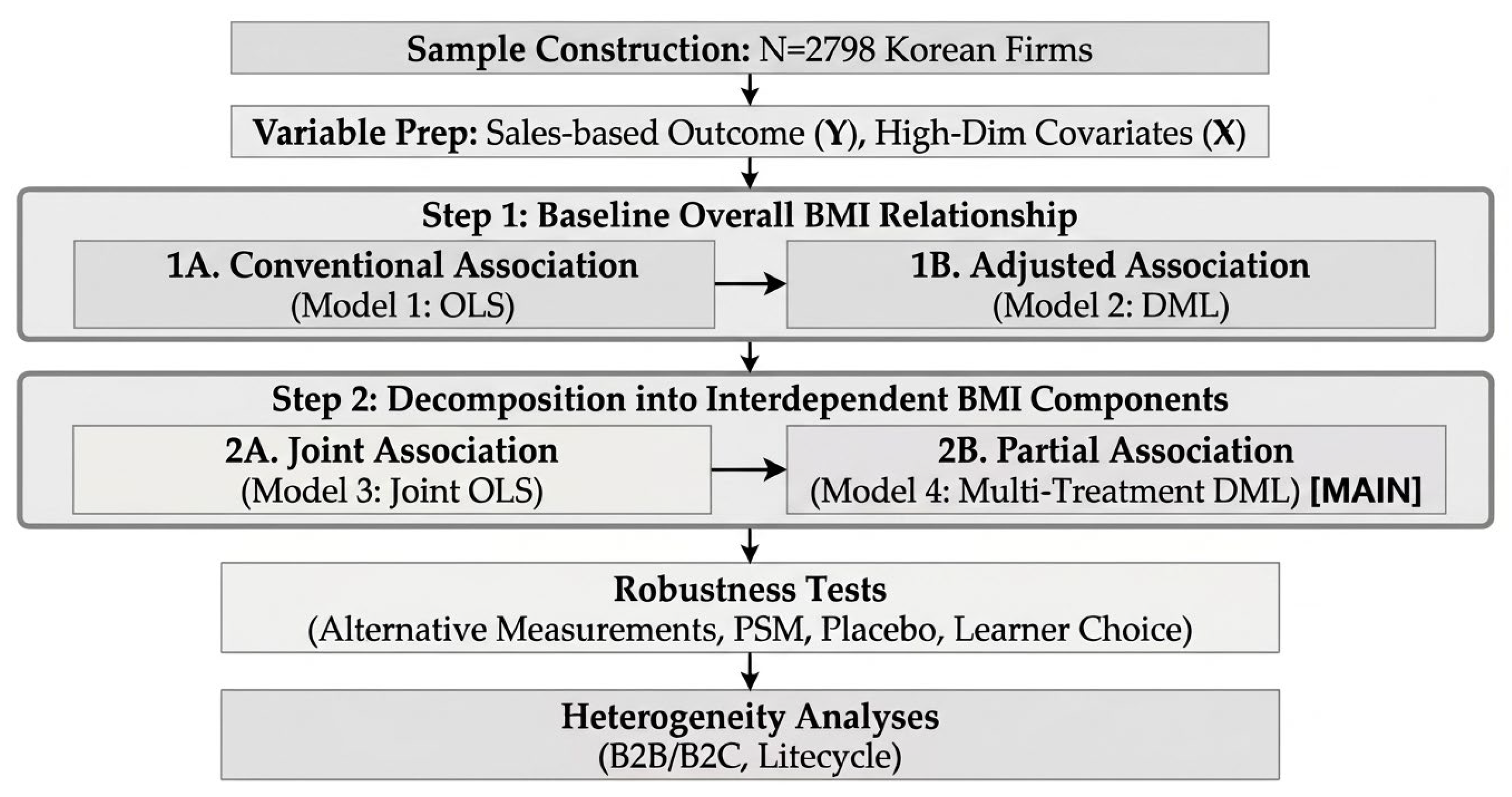
Figure 2 summarizes the methodological scheme of the study. The analysis first constructs outcome, treatment, and covariate measures and then proceeds from aggregate BMI models to component-level models. Models 1 and 2 estimate the overall BMI relationship using OLS and DML, whereas Models 3 and 4 examine value creation, value proposition, and value capture using joint OLS and multi-treatment DML. Robustness checks, including propensity score matching (PSM) comparisons, placebo outcome tests, learner choice, and heterogeneity analyses, are then used to assess whether the main component-level pattern remains stable across alternative assumptions and contexts.
The empirical strategy proceeds in four steps. Model 1 estimates the baseline OLS association between overall BMI and objective innovation performance. Model 2 estimates the corresponding overall BMI effect using partial DML. Model 3 decomposes BMI into value creation, value proposition, and value capture and estimates a joint OLS model. Model 4 is the main specification and estimates the component-specific partial effects of value creation, value proposition, and value capture simultaneously using multi-treatment DML.
The four specifications are designed as a progressive identification and decomposition sequence rather than as independent model alternatives. The first transition, from Model 1 to Model 2, evaluates whether the aggregate BMI relationship remains after flexible adjustment for observed confounders. The second transition, from Model 2 to Model 3, shifts the analysis from aggregate BMI measure to component-level BMI. The third transition, from Model 3 to Model 4, evaluates whether the component-level pattern remains under multi-treatment DML, where value creation, value proposition, and value capture are residualized jointly against the same covariate set. The four models are specified as follows.
Model 1: OLS—Overall BMI
Yi = α + β ZBMIi + Xiγ + εi
Model 2: DML—Overall BMI
Yi = θ ZBMIi + g0(Xi) + εi
Model 3: Joint OLS—BMI components
Yi = α + β1 VCreai + β2 VPropi + β3 VCapi + Xiγ + εi
Model 4: Multi-treatment DML—BMI components (Main Model)
Yi = θ1 VCreai + θ2 VPropi + θ3 VCapi + g0(Xi) + εi
where i indexes firms, Yi denotes objective innovation performance, and ZBMIi denotes standardized overall business model innovation. VCreai, VPropi, and VCapi denote the standardized component-level BMI measures for value creation, value proposition, and value capture, respectively. Xi represents the observed covariate vector, including firm characteristics, financial scale, certification status, CEO characteristics, industry indicators, lifecycle-stage variables, and technology-related indicators. In Models 1 and 3, α is the intercept; β, β1, β2, and β3 are OLS coefficients; γ is the vector of covariate coefficients; and εi is the error term. In Models 2 and 4, θ, θ1, θ2, and θ3 are observable-confounder-adjusted association parameters estimated through DML. The function g0(Xi) captures the high-dimensional relationship between observed covariates and the outcome and is estimated through cross-fitting. The component-level DML estimates in Model 4 should be interpreted as partial associations, because the three BMI components are modeled jointly.
The DML specifications use five-fold cross-fitting with five repeated sample splits [22]. In DML, the nuisance functions capture the relationships between observed covariates and the outcome and those between observed covariates and the treatment variables. Cross-fitting estimates these nuisance functions on one fold of the data and evaluates them on held-out folds, which helps reduce overfitting and regularization bias when estimating the treatment parameters [21,55]. The main models use linear learners for the nuisance functions to keep the baseline DML estimates transparent and comparable with the corresponding OLS specifications. This linear-learner specification is used as a transparent baseline rather than as an assumption that the nuisance functions are strictly linear; more flexible learners are examined in the learner-robustness analysis.
Three additional design considerations underpin the DML specification. First, because the three BMI components are formative activity indices that share substantial variance (pairwise correlations 0.65–0.77; see Section 4.1), the multi-treatment DML estimates are interpreted as partial associations conditional on the other two components. This specification is intentionally conservative: a component is identified as stable only if it retains a positive and statistically significant association after the variance shared with the other two components has been partialled out. The aggregate BMI baseline (Models 1–2) and the threshold-based and PCA-based robustness checks (Section 4.3.) provide complementary evidence on the unconditional component effects. Convergent results across these specifications strengthen the inference that the component-level pattern is not an artifact of within-shared-variance competition alone. Second, overlap was assessed by inspecting the distribution of fitted propensity scores from the cross-fitted nuisance models; no extreme propensities (below 0.02 or above 0.98) were observed, supporting the positivity assumption [21]. Third, all DML estimates were obtained with five-fold cross-fitting and five repetitions; Lasso uses 10-fold cross-validated penalty selection; Random Forest uses 500 trees with default minimum leaf size; Gradient Boosting uses 500 boosting rounds with learning rate 0.05 and maximum depth 3; Stacked Learner combines the three using cross-validated meta-Lasso weights. Random seeds (1–5) were set for reproducibility.
To ensure that the main estimates are not driven by the idiosyncratic properties of a specific predictive model, this study conducts machine-learning learner-robustness analyses. Because DML relies on first-stage auxiliary regressions to partial out high-dimensional confounders, the choice of the underlying learner—such as Lasso, Random Forest, Gradient Boosting, and Stacked Learners—can, in principle, influence the estimated parameters [56]. Re-estimating the multi-treatment DML models across this diverse set of alternative learners therefore tests whether the component-level patterns are algorithm-agnostic and robust across non-parametric functional forms. All analyses are conducted in Stata 19.

4. Results

The results proceed from baseline evidence to component-level and contextual evidence. The analysis first reports descriptive statistics, correlations, and VIF diagnostics to assess the distribution and interdependence of the main variables. It then presents the progressive Model 1–4 comparison, followed by robustness checks and heterogeneity analyses that assess whether the component-level findings are stable across alternative measurements, perceived-performance outcomes, learners, market contexts, and lifecycle stages.

4.1. Descriptive Statistics and Correlations

Before estimating the progressive OLS and DML models, this study examined the distributional properties of the main variables, the bivariate correlations among the BMI measures, and potential multicollinearity among the BMI components. Table 2 summarizes these diagnostics. Panel A reports the descriptive statistics and VIF diagnostics for objective innovation performance, overall BMI, value creation, value proposition, and value capture. Panel B presents the lower-triangle correlation matrix for the same variables.
These diagnostics support the empirical strategy. The high correlations between overall BMI and the component measures are expected because overall BMI is constructed from the same BMI item set. Importantly, overall BMI is not entered simultaneously with the component variables in Models 3 and 4. The correlations among the three components indicate interdependence, while the VIF values suggest that they are not redundant and can be modeled jointly without serious multicollinearity concerns. The analysis therefore proceeds from aggregate BMI models to component-level joint OLS and multi-treatment DML specifications.

4.2. Baseline and Main Models: Progressive Evidence

Table 3 reports the progressive evidence for objective innovation performance. Models 1 and 2 examine overall BMI using OLS and DML, respectively. Models 3 and 4 decompose BMI into value creation, value proposition, and value capture. Model 3 estimates a joint OLS specification, whereas Model 4 estimates the main multi-treatment DML specification. Panel B reports the covariate blocks and variables included in all models.
The progressive results support the central logic of the study. Overall BMI is positive and statistically significant in both baseline models, indicating that the aggregate BMI construct is associated with objective innovation performance. However, the component-level models reveal a more differentiated pattern. Value proposition remains positive and statistically significant in both Model 3 and Model 4, whereas value creation and value capture are positive but less stable. These results suggest that the aggregate BMI effect masks component-level differences. Because all models adjust for the same covariate blocks, the comparison also reduces concern that the component-level pattern is driven by differences in model controls.
The main model provides clear support for H1 and H2b. Overall BMI is positive and significant in the baseline models, and value proposition remains positive and significant when all three BMI components are modeled jointly.
The evidence for Hypothesis 2a (value creation) and Hypothesis 2c (value capture) is conditional rather than null. Both components are consistently positive, and both become statistically significant under the threshold-based specifications and for perceived innovation performance (Table 4). Their weaker continuous full-sample estimates are consistent with two non-competing explanations: theoretically, value creation and value capture relate to sales-based performance more indirectly and with a longer lag than the demand-facing value proposition; methodologically, the multi-treatment estimator conservatively partials out the variance these interdependent components share. The differentiated pattern is thus interpreted as a substantive finding—BMI components are not equidistant from market-based innovation outcomes—rather than as an inconsistency. This pattern suggests that their effects may be less direct or more context-dependent than the value proposition effect. The robustness and heterogeneity analyses below therefore examine whether these components become more visible under alternative measurement, threshold-based, perceived-performance, or subgroup specifications.

4.3. Robustness Checks

Table 4 reports robustness checks for BMI component effects. Panel A examines whether the objective-performance results are sensitive to alternative BMI treatment constructions, including PCA-based scores, median binary treatments, top-tercile treatments, and partial-item BMI indices. These specifications also address concerns about the formative-index construction of the BMI components by testing whether the findings depend on equal-weighted standardized-item aggregation. Panel B reports complementary analyses using perceived innovation performance measured by PCA, Anderson-style, and mean-based outcomes. Panel C reports propensity score matching analyses using median-split BMI treatments.
The robustness results qualify the interpretation of the main model. In Panel A, value proposition remains positive and statistically significant across all BMI treatment measures, suggesting that the main finding is not driven by a specific formative-index construction or a single weighting strategy. Value creation and value capture are less stable in continuous specifications but become significant under median and top-tercile treatments. These threshold-based results should not be interpreted as replacing the continuous main model because they estimate high-versus-low or high-intensity contrasts. Rather, they suggest that value creation and value capture may matter when implemented at sufficiently high levels. In Panel B, all three BMI components are positive and statistically significant across perceived-performance measures, indicating that managers perceive all three components as innovation-related progress.
In Panel C, we report propensity score matching (PSM) estimates using median-split BMI treatments. This specification is directly comparable to the median binary treatment robustness reported in Panel A because both analyses estimate threshold-based high-versus-low treatment contrasts. The PSM analysis therefore provides an additional matched-sample comparison. The kernel-matching results show positive ATT estimates for overall BMI and all three BMI components. In particular, the value proposition result remains positive and stable, reinforcing the main conclusion that value proposition is the BMI component most consistently associated with objective innovation performance. Kernel matching also achieves satisfactory post-matching balance, with the component-level specifications satisfying the conventional covariate-balance thresholds (max-SMD < 0.10). At the same time, these estimates should be interpreted cautiously because median-split treatments reduce the information contained in the original continuous BMI measures. Accordingly, the PSM results are best viewed as threshold-based robustness evidence that complements, rather than replaces, the continuous component-specific estimates from the main multi-treatment DML model.
We also conducted a placebo outcome test using firm founding year as the dependent variable. Because firm founding year is a temporally prior characteristic, current BMI activities should not affect it. Overall BMI, value creation, and value proposition show no statistically significant association with firm founding year (p = 0.734, p = 0.403, and p = 0.418, respectively). Value capture, however, shows a statistically significant placebo association (coef. = −0.052, p = 0.031). These results provide reassuring evidence for the central value proposition finding while indicating that residual selection concerns may remain for value capture. Therefore, the DML estimates should be interpreted as observable-confounder-adjusted component-level evidence rather than conclusive causal evidence.
Table 5 reports the machine-learning learner-robustness results for the multi-treatment DML model. To assess whether the main component-level findings depend on a particular nuisance-function learner, Model 4 is re-estimated using Lasso, Random Forest, Gradient Boosting, and Stacked Learner specifications.
The learner-robustness results reinforce the main component-level interpretation. Across Lasso, Random Forest, Gradient Boosting, and Stacked Learner specifications, value proposition remains positive and statistically significant, with estimates ranging from 0.324 to 0.356, indicating that the finding is not driven by a particular nuisance-function learner. Value creation remains positive but statistically insignificant across all learner specifications. Value capture is also positive across learners, but its statistical significance is learner-dependent, attaining conventional levels only under the Random Forest and Stacked Learner specifications. Overall, these results support the interpretation that value proposition is the most stable BMI component associated with objective innovation performance, whereas value creation and value capture exhibit less stable or more learner-dependent effects in the continuous multi-treatment DML framework.

4.4. Heterogeneity Analyses

Table 6 reports heterogeneity estimates and difference tests for market context and business lifecycle stages. Panel A presents subgroup-specific multi-treatment DML estimates for B2B and B2C firms and for the lifecycle-stage groups. Panel B reports pairwise difference tests between subgroup-specific estimates.
The heterogeneity analysis should be interpreted in two parts. The B2B/B2C analysis provides the clearer boundary-condition evidence. In addition to estimating subgroup-specific effects, we conduct formal difference tests across B2B and B2C firms. These tests show that the value proposition effect is significantly stronger in B2C firms than in B2B firms, whereas the differences for value creation and value capture are not statistically significant. This pattern suggests that customer-facing value articulation is particularly important in consumer-facing markets.
The lifecycle-stage analysis is interpreted as exploratory evidence. In the early-stage subgroup, value proposition shows a negative estimate, while value capture is positive. This result should not be interpreted as evidence that value proposition is harmful for early-stage firms. Because the early-stage subgroup is relatively small (n = 132) and the multi-treatment model estimates component-specific partial effects conditional on the other BMI components, the negative estimate may reflect unstable partial-effect allocation among interdependent BMI dimensions [55]. In the growth stage, value creation appears more salient, whereas in the maturity/decline stages, value proposition is positive and significant. These results suggest a possible lifecycle pattern, but they should be interpreted cautiously.
Overall, the present heterogeneity analysis does not directly estimate institutional moderation because the data are drawn from a single national context. Industry differences are partially addressed through industry fixed effects and technology-related covariates. Future research using cross-country or industry-specific panel data could examine whether institutional environments, industry regimes, or policy conditions moderate the component-level effects of BMI.

5. Discussion

5.1. Summary of Findings

This study treats overall BMI as a baseline construct and shifts the main focus to component-level market conversion. The baseline results reaffirm a central insight of the business model literature: firms compete not only through products and technologies but also through the architecture by which they create, deliver, and capture value [1,3,8]. Overall BMI is positive and significant in both the OLS and DML baseline models, suggesting that firms with higher levels of BMI tend to report stronger sales-based innovation outcomes after observed firm, CEO, industry, lifecycle, and technology-related covariates are adjusted for. This finding is also consistent with sustainable entrepreneurship research, which argues that entrepreneurial initiatives must be organized into viable value-creation systems before they can generate durable performance outcomes [4,5,7]. The main contribution of the study, however, is to show that this aggregate relationship is incomplete unless BMI is decomposed into its constituent components.
The main component-level finding is that value proposition is the most stable BMI component associated with objective innovation performance. In both the joint OLS model and the multi-treatment DML model, value proposition remains positive and statistically significant, whereas value creation and value capture show less stable estimates in the continuous component-level specifications. This finding extends prior work on multidimensional BMI by showing that value creation, value proposition, and value capture are not equally close to sales-based innovation outcomes [11,26,57]. It also reaffirms studies emphasizing the role of customer-facing value articulation in making new offerings recognizable, meaningful, and acceptable to the market [12,14,27]. These findings are consistent with the market-conversion logic developed in the theoretical section. Because objective innovation performance is measured as sales from new products and services, the component closest to the outcome is the one that improves customer recognition, customer fit, value communication, and market adoption. However, because the dataset does not directly measure these intermediate mechanisms, future research should test these pathways using customer-level or longitudinal data.
The robustness results refine this interpretation. Measurement checks show that value proposition remains significant when BMI components are reconstructed using PCA-based scores and partial-item measures, reducing concern that the finding is driven by equal-weighted formative indices. Threshold-based specifications provide additional evidence: value creation and value capture become significant when treatments are defined as median-split or top-tercile contrasts. These results suggest that value creation and value capture may matter when implemented at sufficiently high levels. The perceived-performance results further show that all three BMI components are consistently positive and significant, indicating that managers perceive all three components as innovation-related progress [42,43].
The heterogeneity results extend the main finding without changing its core interpretation. Value proposition is significantly stronger in B2C firms than in B2B firms, providing the clearest boundary-condition evidence [15,16,58]. The lifecycle analysis offers a more exploratory pattern: value capture is more visible in lifecycle stage 1, value creation in lifecycle stage 2, and value proposition in lifecycle stage 3. Collectively, the findings show that BMI is not a uniform strategic activity.

5.2. Theoretical Implications

This study contributes to sustainable entrepreneurship by showing that business model innovation is not a uniform route from opportunity recognition to performance. Sustainable entrepreneurial outcomes depend on how firms configure specific value-related activities and how these activities are converted into market results. The findings identify value proposition as the most stable component associated with objective innovation performance. This suggests that customer-recognized value is central to transforming entrepreneurial initiatives into sales-based innovation outcomes. Value creation and value capture remain relevant, but their effects are more conditional and appear more strongly under high-intensity, perceived-performance, or lifecycle-specific conditions. The findings therefore refine sustainable entrepreneurship research by highlighting the component-level architecture through which opportunities become market outcomes [4,5,6,7,10].
These findings connect to the sustainable business model innovation literature [4,5,7]. Research on sustainable BMI argues that economic, social, and environmental value can be sustained only when reconfigured business models remain viable in the market over time [36,59]. From this perspective, durable market validation is a precondition for, not a substitute for, sustainability outcomes: resource-integration efforts (value creation) and revenue-design efforts (value capture) cannot be sustained unless the underlying offering is recognized and adopted by customers. By identifying value proposition—the articulation of a sustainable value proposition to the market—as the component most consistently associated with market-validated innovation performance, this study specifies one organizational mechanism through which sustainable entrepreneurial opportunities are converted into durable performance. Directly measuring environmental and social value remains an important next step.

5.3. Methodological Implications

Methodologically, this study illustrates how component-level BMI questions can be examined with cross-sectional entrepreneurship survey data without overstating causal claims. The progressive empirical design compares aggregate BMI estimates with component-level estimates and conventional OLS evidence with observable-confounder-adjusted DML evidence [18,19,21,22]. The multi-treatment DML model is useful because value creation, value proposition, and value capture are interdependent; estimating them jointly helps identify which component retains an association with objective innovation performance after the other dimensions and observed covariates are considered. However, the estimates remain conditional on observed covariates and should not be interpreted as experimental causal effects. DML improves adjustment for high-dimensional observed confounders, but it cannot eliminate unobserved confounding, reverse causality, temporal-ordering problems, or measurement error [21,22,46,47].

5.4. Managerial Implications

The findings suggest that managers should not treat BMI as a single, broad innovation initiative. Instead, BMI should be managed as a portfolio of component-specific activities. If the goal is to improve objective innovation performance, managers should give particular attention to value proposition activities. These include redefining target customer segments, clarifying the differentiated benefits of new offerings, testing alternative customer channels, and improving the way customers recognize and evaluate new products and services. Progress can be monitored through indicators such as new customer revenue share, conversion rates from new channels, customer retention, brand recall, and the sales contribution of new products and services.
The findings also suggest that managerial priorities should differ by customer context [58]. B2C-oriented firms should focus on customer-facing value articulation. They should conduct regular customer-discovery exercises, test value messages across channels, refresh brand narratives, and use customer feedback to refine new offerings. On the other hand, B2B-oriented firms should place greater emphasis on value creation activities that support technical reliability, resource integration, and partner coordination. Concrete actions include establishing joint product-development routines with key customers, creating shared technical roadmaps, standardizing partner communication processes, and monitoring indicators such as partner retention, joint development projects, on-time delivery, and customized-solution adoption.
For firms that operate in both B2B and B2C markets, the findings should not be interpreted as requiring a binary choice between value creation and value proposition [15,16,17]. Because the data classify firms by their primary customer type, the B2B/B2C results indicate the firm’s dominant market logic rather than mutually exclusive strategic prescriptions. Hybrid firms should therefore allocate BMI investments according to the revenue share and strategic importance of each customer segment. For B2B-facing segments, managers should prioritize partner integration, technical collaboration, and resource coordination. For B2C-facing segments, they should prioritize customer targeting, value communication, brand positioning, and channel differentiation. Future research using firm-level panel data with disaggregated B2B and B2C revenue shares could examine within-firm BMI portfolio allocation more directly.
The lifecycle results provide additional guidance. Early-stage firms should first strengthen value capture mechanisms, including pricing logic, revenue-source design, cost structure, and reduction of unnecessary cost leakage. Growth-stage firms should focus on value creation by improving operating routines, resource recombination, and partner coordination. Mature/decline-stage firms should prioritize value proposition renewal by identifying adjacent customer groups, refreshing brand positioning, and redesigning customer channels. These recommendations are not intended as universal rules but as context-sensitive priorities that managers can adapt to their firm’s development stage.

5.5. Limitations and Future Research

This study has several limitations that provide directions for future research. First, the analysis relies on cross-sectional observational data. Although DML and the PSM robustness analysis improve adjustment under observable-selection assumptions, they cannot fully address unobserved heterogeneity, reverse causality, or temporal ordering. PSM also estimates threshold-based high-versus-low contrasts rather than continuous component-specific effects. Future research could use panel data, quasi-experimental designs, event-study designs, fixed effects, or valid IV approaches to provide stronger evidence on the dynamic effects of BMI components [46,47].
Second, measurement and common-method concerns remain possible because BMI components and perceived innovation performance are survey-based. The BMI component measures are theoretically grounded formative activity indices, but they are not externally validated using an independent data source. Harman’s single-factor test indicates that the first factor explains 58.62% of the variance, exceeding the conventional 50% threshold, while full-collinearity VIF diagnostics are mostly below 3.3, with value creation slightly above the threshold (VIF = 3.39). We therefore interpret the perceived-performance results cautiously and rely primarily on sales-based objective innovation performance for the main conclusions. Future research could improve measurement validity by externally validating formative BMI indices and linking survey-based BMI measures to administrative records, product-launch data, patent data, customer-level data, or longitudinal evidence.
Third, some technology-relevance indicators (e.g., adoption of artificial intelligence, smart-factory systems, or cloud computing) may be jointly determined with BMI rather than purely exogenous. Their inclusion is intended to absorb baseline technological exposure rather than to block downstream mediating channels. Sensitivity analyses re-estimating the multi-treatment DML model without the technology-relevance block leave the value proposition estimate positive and statistically significant (β = 0.36, SE = 0.10), supporting the conclusion that the main finding is not driven by over-control of the mediating technology variables.
Fourth, the empirical context is limited to Korean firms. Korea provides a useful setting for studying entrepreneurship and innovation, but institutional, policy, and market conditions may influence how BMI components are translated into innovation performance. Future research could replicate the analysis in other institutional contexts, including European and U.S. settings, to assess the external validity of the component-level BMI patterns.
Overall, this study advances sustainable entrepreneurship and business model innovation research by clarifying what BMI contributes, how it can be examined, and how it can be managed. It shows that BMI components are not equally close to market-based innovation outcomes, with value proposition emerging as the most consistent component. It also demonstrates how multi-treatment DML, supplemented by placebo, matching, and sensitivity analyses, can provide cautious observable-confounder-adjusted evidence from cross-sectional data. Finally, it offers context-sensitive implications for managers seeking to convert business model change into durable, sustainability-oriented innovation performance.

Funding

This work was supported by the Hankuk University of Foreign Studies Research Fund.

Institutional Review Board Statement

Not applicable.

Informed Consent Statement

Not applicable.

Data Availability Statement

Restrictions apply to the availability of the data analyzed in this study. The 2022 Entrepreneurship Survey data were obtained from the Korea Entrepreneurship Foundation under Korean statistical regulations and cannot be redistributed by the author. Analytic code supporting the findings is available from the corresponding author upon reasonable request.

Acknowledgments

The author thanks the Korea Entrepreneurship Foundation for providing access to the 2022 Entrepreneurship Survey data.

Conflicts of Interest

The author declares no conflicts of interest.

References

  1. Teece, D.J. Business models, business strategy and innovation. Long Range Plan. 2010, 43, 172–194. [Google Scholar] [CrossRef]
  2. Zott, C.; Amit, R. Business model design: An activity system perspective. Long Range Plan. 2010, 43, 216–226. [Google Scholar] [CrossRef]
  3. Zott, C.; Amit, R.; Massa, L. The business model: Recent developments and future research. J. Manag. 2011, 37, 1019–1042. [Google Scholar] [CrossRef]
  4. Cohen, B.; Winn, M.I. Market imperfections, opportunity and sustainable entrepreneurship. J. Bus. Ventur. 2007, 22, 29–49. [Google Scholar] [CrossRef]
  5. Dean, T.J.; McMullen, J.S. Toward a theory of sustainable entrepreneurship: Reducing environmental degradation through entrepreneurial action. J. Bus. Ventur. 2007, 22, 50–76. [Google Scholar] [CrossRef]
  6. Parrish, B.D. Sustainability-driven entrepreneurship: Principles of organization design. J. Bus. Ventur. 2010, 25, 510–523. [Google Scholar] [CrossRef]
  7. Schaltegger, S.; Wagner, M. Sustainable entrepreneurship and sustainability innovation: Categories and interactions. Bus. Strategy Environ. 2011, 20, 222–237. [Google Scholar] [CrossRef]
  8. Foss, N.J.; Saebi, T. Fifteen years of research on business model innovation: How far have we come, and where should we go? J. Manag. 2017, 43, 200–227. [Google Scholar] [CrossRef]
  9. Schneider, S.; Spieth, P. Business model innovation: Towards an integrated future research agenda. Int. J. Innov. Manag. 2013, 17, 1340001. [Google Scholar] [CrossRef]
  10. Zhang, H.; Sun, X.; Lyu, C. Exploratory orientation, business model innovation and new venture growth. Sustainability 2018, 10, 56. [Google Scholar] [CrossRef]
  11. Clauss, T. Measuring business model innovation: Conceptualization, scale development, and proof of performance. R&D Manag. 2017, 47, 385–403. [Google Scholar]
  12. Osterwalder, A.; Pigneur, Y. Business Model Generation: A Handbook for Visionaries, Game Changers, and Challengers; Wiley: Hoboken, NJ, USA, 2010. [Google Scholar]
  13. Afuah, A. Business Model Innovation: Concepts, Analysis, and Cases; Routledge: New York, NY, USA, 2014. [Google Scholar]
  14. Cavalcante, S.A. Designing business model change. Int. J. Innov. Manag. 2014, 18, 1450018. [Google Scholar] [CrossRef]
  15. Han, S.L. B2B Marketing; Book21: Seoul, Republic of Korea, 2011. (In Korean) [Google Scholar]
  16. Kumar, V.; Raheja, G. Business to business (B2B) and business to consumer (B2C) management. Int. J. Comput. Technol. 2012, 3, 447–451. [Google Scholar]
  17. Webster, F.E., Jr.; Wind, Y. A general model for understanding organizational buying behavior. J. Mark. 1972, 36, 12–19. [Google Scholar] [CrossRef]
  18. Hamilton, B.H.; Nickerson, J.A. Correcting for endogeneity in strategic management research. Strateg. Organ. 2003, 1, 51–78. [Google Scholar] [CrossRef]
  19. Shaver, J.M. Accounting for endogeneity when assessing strategy performance: Does entry mode choice affect FDI survival? Manag. Sci. 1998, 44, 571–585. [Google Scholar] [CrossRef]
  20. Massa, L.; Tucci, C.L.; Afuah, A. A critical assessment of business model research. Acad. Manag. Ann. 2017, 11, 73–104. [Google Scholar] [CrossRef]
  21. Chernozhukov, V.; Chetverikov, D.; Demirer, M.; Duflo, E.; Hansen, C.; Newey, W.; Robins, J. Double/debiased machine learning for treatment and structural parameters. Econom. J. 2018, 21, C1–C68. [Google Scholar] [CrossRef]
  22. Shi, B.; Mao, X.; Yang, M.; Li, B. What, why, and how: An empiricist’s guide to Double/Debiased Machine Learning. Inf. Syst. Res. 2025. [Google Scholar] [CrossRef]
  23. Rymarczyk, J. Technologies, opportunities and challenges of the industrial revolution 4.0: Theoretical considerations. Entrep. Bus. Econ. Rev. 2020, 8, 185–198. [Google Scholar] [CrossRef]
  24. Korea Entrepreneurship Foundation. 2022 Entrepreneurship Survey (Firm): Technical Statistics Report; Korea Entrepreneurship Foundation: Seoul, Republic of Korea, 2022. [Google Scholar]
  25. Chesbrough, H.; Rosenbloom, R.S. The role of the business model in capturing value from innovation: Evidence from Xerox Corporation’s technology spin-off companies. Ind. Corp. Change 2002, 11, 529–555. [Google Scholar] [CrossRef]
  26. Teece, D.J. Business models and dynamic capabilities. Long Range Plan. 2018, 51, 40–49. [Google Scholar] [CrossRef]
  27. Guo, H.; Guo, A.; Ma, H. How business model innovation contributes to digital start-up performance: The role of value proposition innovation. J. Innov. Knowl. 2022, 7, 100188. [Google Scholar] [CrossRef]
  28. Salfore, N.; Ensermu, M.; Kinde, Z. Business model innovation and firm performance: Evidence from manufacturing SMEs. Heliyon 2023, 9, e16384. [Google Scholar] [CrossRef] [PubMed]
  29. Pang, C.; Wang, Q.; Li, Y.; Duan, G. Integrative capability, business model innovation and performance: Contingent effect of business strategy. Eur. J. Innov. Manag. 2019, 22, 541–561. [Google Scholar] [CrossRef]
  30. Barney, J. Firm resources and sustained competitive advantage. J. Manag. 1991, 17, 99–120. [Google Scholar] [CrossRef]
  31. Wernerfelt, B. A resource-based view of the firm. Strateg. Manag. J. 1984, 5, 171–180. [Google Scholar] [CrossRef]
  32. Teece, D.J.; Pisano, G.; Shuen, A. Dynamic capabilities and strategic management. Strateg. Manag. J. 1997, 18, 509–533. [Google Scholar] [CrossRef]
  33. Eisenhardt, K.M.; Martin, J.A. Dynamic capabilities: What are they? Strateg. Manag. J. 2000, 21, 1105–1121. [Google Scholar] [CrossRef]
  34. Priem, R.L. A consumer perspective on value creation. Acad. Manag. Rev. 2007, 32, 219–235. [Google Scholar] [CrossRef]
  35. Adner, R.; Zemsky, P. A demand-based perspective on sustainable competitive advantage. Strateg. Manag. J. 2006, 27, 215–239. [Google Scholar] [CrossRef]
  36. Coffay, M.; Tveterås, R.; Bocken, N.; Bogers, M.L. Sustainable business model innovation, dynamic capabilities, and organizational design: Insights from Norwegian aquaculture. Bus. Strategy Environ. 2024, 33, 5386–5404. [Google Scholar] [CrossRef]
  37. Johnson, M.W.; Christensen, C.M.; Kagermann, H. Reinventing your business model. Harv. Bus. Rev. 2008, 86, 50–59. [Google Scholar]
  38. Menter, M.; Göcke, L.; Zeeb, C.; Clauss, T. Disentangling the complex longitudinal relationships between business model innovation and firm performance. J. Bus. Res. 2023, 168, 114229. [Google Scholar] [CrossRef]
  39. Schneckenberg, D.; Velamuri, V.K.; Comberg, C.; Spieth, P. Business model innovation and decision making: Uncovering mechanisms for coping with uncertainty. R&D Manag. 2017, 47, 404–419. [Google Scholar]
  40. Damanpour, F.; Evan, W.M. Organizational innovation and performance: The problem of organizational lag. Adm. Sci. Q. 1984, 29, 392–409. [Google Scholar] [CrossRef]
  41. Hagedoorn, J.; Cloodt, M. Measuring innovative performance: Is there an advantage in using multiple indicators? Res. Policy 2003, 32, 1365–1379. [Google Scholar] [CrossRef]
  42. Dess, G.G.; Robinson, R.B., Jr. Measuring organizational performance in the absence of objective measures: The case of the privately held firm and conglomerate business unit. Strateg. Manag. J. 1984, 5, 265–273. [Google Scholar] [CrossRef]
  43. Styles, C. Export performance measures in Australia and the United Kingdom. J. Int. Mark. 1998, 6, 12–36. [Google Scholar] [CrossRef]
  44. Antonakis, J.; Bendahan, S.; Jacquart, P.; Lalive, R. On making causal claims: A review and recommendations. Leadersh. Q. 2010, 21, 1086–1120. [Google Scholar] [CrossRef]
  45. Semadeni, M.; Withers, M.C.; Certo, S.T. The perils of endogeneity and instrumental variables in strategy research: Understanding through simulations. Strateg. Manag. J. 2014, 35, 1070–1079. [Google Scholar] [CrossRef]
  46. Angrist, J.D.; Pischke, J.S. Mostly Harmless Econometrics: An Empiricist’s Companion; Princeton University Press: Princeton, NJ, USA, 2009. [Google Scholar]
  47. Wooldridge, J.M. Introductory Econometrics: A Modern Approach, 5th ed.; South-Western Cengage Learning: Boston, MA, USA, 2013. [Google Scholar]
  48. Anderson, M.L. Multiple inference and gender differences in the effects of early intervention: A reevaluation of the Abecedarian, Perry Preschool, and Early Training Projects. J. Am. Stat. Assoc. 2008, 103, 1481–1495. [Google Scholar] [CrossRef]
  49. Schwab, B.; Janzen, S.; Magnan, N.P.; Thompson, W.M. Constructing a summary index using the standardized inverse-covariance weighted average of indicators. Stata J. 2020, 20, 952–964. [Google Scholar] [CrossRef]
  50. Diamantopoulos, A.; Winklhofer, H.M. Index construction with formative indicators: An alternative to scale development. J. Mark. Res. 2001, 38, 269–277. [Google Scholar] [CrossRef]
  51. Jarvis, C.B.; MacKenzie, S.B.; Podsakoff, P.M. A critical review of construct indicators and measurement model misspecification in marketing and consumer research. J. Consum. Res. 2003, 30, 199–218. [Google Scholar] [CrossRef]
  52. Diamantopoulos, A.; Riefler, P.; Roth, K.P. Advancing formative measurement models: A review and directions for future research. J. Bus. Res. 2008, 61, 1203–1218. [Google Scholar] [CrossRef]
  53. OECD/Eurostat. Oslo Manual 2018: Guidelines for Collecting, Reporting and Using Data on Innovation, 4th ed.; OECD Publishing: Paris, France; Eurostat: Luxembourg, 2018. [Google Scholar]
  54. Podsakoff, P.M.; MacKenzie, S.B.; Lee, J.-Y.; Podsakoff, N.P. Common method biases in behavioral research: A critical review of the literature and recommended remedies. J. Appl. Psychol. 2003, 88, 879–903. [Google Scholar] [CrossRef] [PubMed]
  55. Belloni, A.; Chernozhukov, V.; Hansen, C. High-dimensional methods and inference on structural and treatment effects. J. Econ. Perspect. 2014, 28, 29–50. [Google Scholar] [CrossRef]
  56. Athey, S.; Imbens, G.W. Machine learning methods that economists should know about. Annu. Rev. Econ. 2019, 11, 685–725. [Google Scholar] [CrossRef]
  57. Park, Y.; Lee, C.; Yun, W. The relative effects of B2B (vs. B2C) business model innovation on innovation performance. Asia-Pac. J. Bus. Ventur. Entrep. 2023, 18, 159–172. Available online: https://koreascience.or.kr/article/JAKO202307161438827.page (accessed on 7 June 2026).
  58. Autio, E.; Kenney, M.; Mustar, P.; Siegel, D.; Wright, M. Entrepreneurial innovation: The importance of context. Res. Policy 2014, 43, 1097–1108. [Google Scholar] [CrossRef]
  59. Evans, S.; Vladimirova, D.; Holgado, M.; Van Fossen, K.; Yang, M.; Silva, E.A.; Geissdoerfer, M. Business model innovation for sustainability: Towards a unified perspective for creation of sustainable business models. Bus. Strategy Environ. 2017, 26, 597–608. [Google Scholar] [CrossRef]
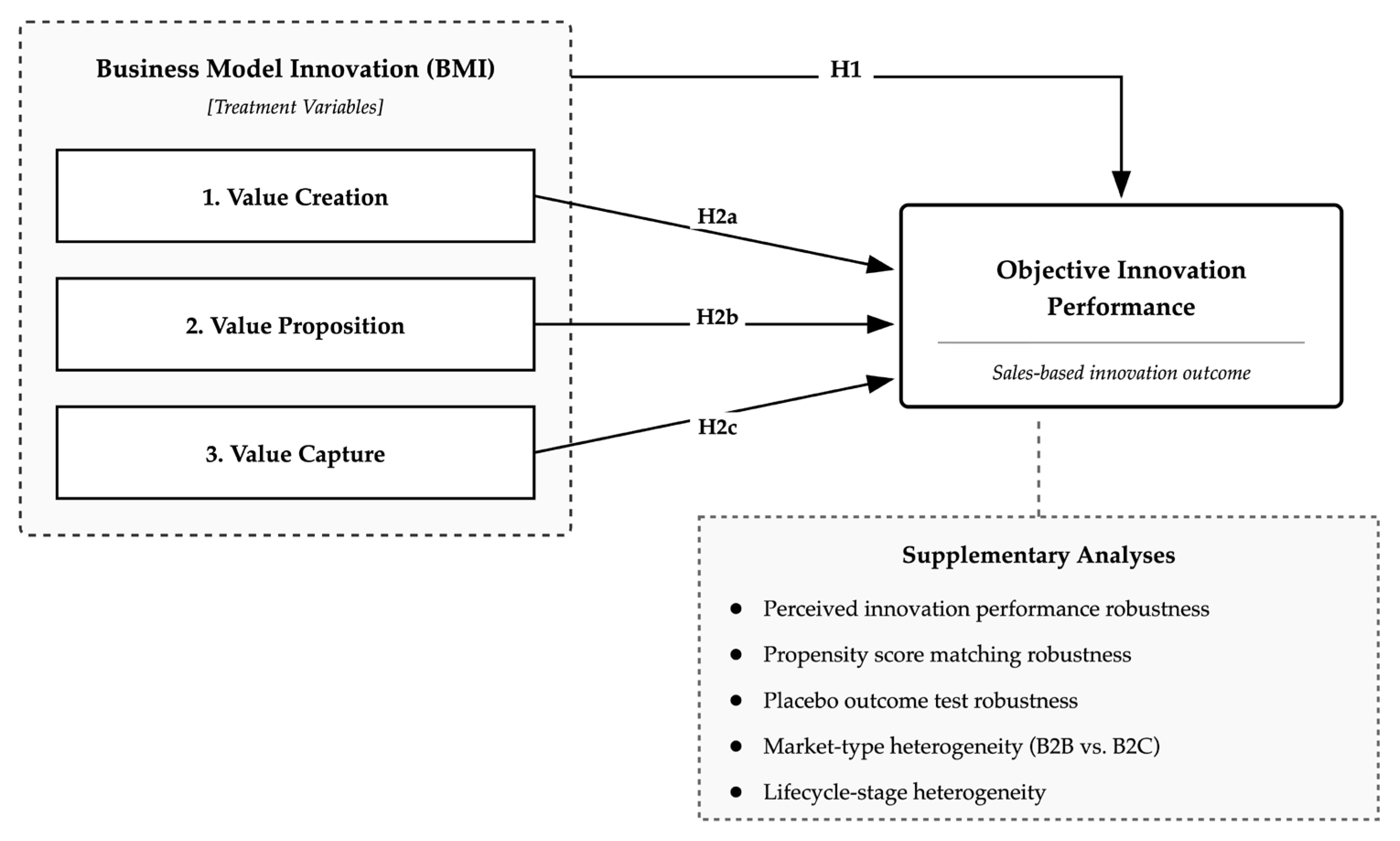
Figure 1. Conceptual framework.
Sustainability 18 05962 g001
Figure 2. Progressive identification and BMI decomposition.
Sustainability 18 05962 g002
Table 1. Variable operationalizations.
CategoryConstructVariableOperationalization
OutcomeObjective
innovation
performance
Objective innovation performanceSales generated from new products and new services. Calculated by multiplying average firm sales from 2019 to 2021 by the reported share of sales from new products and new services, followed by a logarithmic transformation to reduce skewness.
OutcomePerceived
innovation
performance
Perceived PCA
index
First principal component score based on three survey items related to new product and new service development.
OutcomePerceived
innovation
performance
Anderson-style indexStandardized inverse-covariance weighted summary index based on the same perceived innovation performance items.
Baseline
treatment
Business model innovationOverall BMIAggregate formative index based on all BMI items. Used as the baseline construct before component-level analysis.
Component treatmentValue creationValue creation
index
Standardized formative index based on items capturing partner ecosystem formation, new transaction methods, operating routines, and efficient resource combination.
Component treatmentValue propositionValue proposition indexStandardized formative index based on items capturing new customer groups, differentiated value, customer recognition of value, and differentiated customer channels.
Component treatmentValue captureValue capture
index
Standardized formative index based on items capturing revenue-source diversification and reduction of unnecessary cost leakage.
Heterogeneity variableMarket contextB2B/B2CB2B firms: primary customers are domestic private firms. B2C firms: primary customers are domestic individual consumers.
Heterogeneity variableBusiness lifecycle stagesLifecycle stageThree dummy variables distinguishing lifecycle 1 (early), lifecycle 2 (growth), and lifecycle 3 (maturity/decline).
CovariatesFirm, CEO,
industry,
technology
Covariate setFirm age, firm size, capital, baseline sales, certification status, industry indicators, CEO characteristics, growth stage, and technology-related indicators.
PCA = principal component analysis. All main BMI treatment variables are standardized continuous indices. Threshold-based binary treatments are used only for robustness checks. BMI component measures are treated as formative activity indices because each item captures a distinct managerial activity related to value creation, value proposition, or value capture.
Table 2. Descriptive statistics, VIF diagnostics, and correlations.
Panel A. Descriptive statistics and VIF diagnostics
VariableNMeanSDMinMaxVIF
Objective innovation performance27984.8574.6940.00024.635
Overall BMI27980.0030.998−3.8922.313
Value creation2798−0.0021.004−3.4392.2073.674
Value proposition27980.0090.993−3.5222.1652.855
Value capture2798−0.0011.002−3.6941.8162.557
Panel B. Correlation matrix
Variable12345
1. Objective innovation performance1
2. Overall BMI0.282 ***1
3. Value creation0.303 ***0.925 ***1
4. Value proposition0.248 ***0.929 ***0.767 ***1
5. Value capture0.205 ***0.841 ***0.743 ***0.654 ***1
VIF = variance inflation factor. VIF values are reported for BMI component variables included simultaneously in the joint OLS and multi-treatment DML models. *** p < 0.01.
Table 3. Progressive evidence for objective innovation performance.
Panel A. Main estimates
Model 1
OLS
Overall BMI
Model 2
DML
Overall BMI
Model 3
Joint OLS
BMI Components
Model 4
Multi-Treatment DML
BMI Components
Overall BMI0.555 ***0.567 ***
(0.073)(0.074)
Value creation 0.1640.192 *
(0.110)(0.111)
Value proposition 0.347 ***0.343 ***
(0.098)(0.099)
Value capture 0.0980.084
(0.095)(0.097)
N2798279827982798
Cross-fittingNoYesNoYes
K-folds55
Repetitions55
Panel B. Covariate blocks and variables included
Covariate BlockVariables IncludedM1M2M3M4
Firm characteristicsFirm age, firm sizeYesYesYesYes
Financial scaleCapital, baseline salesYesYesYesYes
Certification statusVenture certification, management innovation certification, innovation certificationYesYesYesYes
CEO characteristicsGender, age, prior entrepreneurial experience,
pre-startup background
YesYesYesYes
Industry fixed effectsIndustry dummiesYesYesYesYes
Lifecycle stagesLifecycle 1, lifecycle 2, lifecycle 3YesYesYesYes
Technology relevanceIndustry 4.0 relevance and technology-type indicatorsYesYesYesYes
Robust standard errors are reported in parentheses. DML estimates are interpreted as observable-confounder-adjusted association estimates rather than definitive experimental causal effects. *** p < 0.01, * p < 0.10.
Table 4. Robustness checks for BMI component effects.
Panel A. BMI measurement robustness: objective innovation performance
Robustness SpecificationValue CreationValue PropositionValue CaptureN
PCA-based BMI treatment0.187 *0.350 ***0.0992798
(0.112)(0.101)(0.097)
Median binary BMI treatment0.359 **0.619 ***0.530 ***2798
(0.171)(0.161)(0.175)
Top-tercile BMI treatment0.363 **0.712 ***0.475 ***2798
(0.173)(0.169)(0.173)
Partial-item BMI construction0.186 *0.351 ***0.0772798
(0.111)(0.099)(0.096)
Panel B. Perceived innovation performance robustness
Robustness SpecificationValue CreationValue PropositionValue CaptureN
PCA perceived outcome0.266 ***0.255 ***0.098 ***2798
(0.027)(0.025)(0.022)
Anderson-style perceived outcome0.273 ***0.256 ***0.103 ***2798
(0.027)(0.025)(0.022)
Mean perceived outcome0.335 ***0.329 ***0.127 ***2798
(0.034)(0.031)(0.028)
Panel C. Propensity score matching robustness: objective innovation performance
Treatment: Median SplitATTSE95% CICommon Support NSMD < 0.10
Overall BMI1.0210.221[0.589, 1.453]271896.6%
Value creation0.7800.203[0.382, 1.178]2721100%
Value proposition1.2590.213[0.841, 1.677]2756100%
Value capture0.9220.222[0.486, 1.357]2728100%
N = 2798. For Panels (A, B), robust standard errors are reported in parentheses. Panel C reports kernel matching ATT estimates, standard errors, 95% confidence intervals, common support sample sizes, and balance diagnostics. *** p < 0.01, ** p < 0.05, * p < 0.10.
Table 5. Machine-learning learner-robustness checks for multi-treatment DML estimates.
LearnerValue CreationValue PropositionValue CaptureN
Lasso0.1800.349 ***0.0792798
(0.111)(0.099)(0.097)
Random Forest0.0840.324 ***0.195 **2798
(0.111)(0.104)(0.096)
Gradient Boosting0.1310.356 ***0.1392798
(0.119)(0.101)(0.098)
Stacked Learner0.1000.338 ***0.193 **2798
(0.110)(0.096)(0.095)
The dependent variable is objective innovation performance. All specifications estimate the multi-treatment DML model with value creation, value proposition, and value capture included simultaneously. *** p < 0.01, ** p < 0.05.
Table 6. Heterogeneity analysis and difference tests.
Panel A. Subgroup estimates
Heterogeneity
Dimension
GroupValue CreationValue PropositionValue CaptureN
B2B vs. B2CB2B0.271 **0.1410.0591774
(0.138)(0.118)(0.113)
B2C−0.0440.717 ***0.0871024
(0.187)(0.183)(0.180)
Lifecycle stagesLifecycle 1 (early)0.780−1.955 ***1.226 **132
(0.629)(0.660)(0.532)
Lifecycle 2 (growth)0.610 **0.2130.113659
(0.271)(0.201)(0.272)
Lifecycle 3
(mature/decline)
0.0860.408 ***0.0342007
(0.137)(0.131)(0.113)
Panel B. Difference tests
Heterogeneity
Dimension
ContrastValue CreationValue PropositionValue Capture
B2B vs. B2CB2B − B2C0.315−0.576 ***−0.028
(0.232)(0.218)(0.212)
Lifecycle stagesLifecycle 1 − Lifecycle 20.170−2.168 ***1.114 *
(0.685)(0.690)(0.597)
Lifecycle 1 − Lifecycle 30.694−2.363 ***1.192 **
(0.644)(0.673)(0.544)
Lifecycle 2 − Lifecycle 30.524 *−0.1950.078
(0.304)(0.239)(0.295)
The dependent variable is objective innovation performance. Each subgroup estimate is obtained from a multi-treatment DML model in which value creation, value proposition, and value capture are included simultaneously. Robust standard errors are reported in parentheses. Difference tests compare subgroup-specific estimates using the standard error of the difference, approximated as the square root of the sum of squared subgroup standard errors. *** p < 0.01, ** p < 0.05, * p < 0.10.
Disclaimer/Publisher’s Note: The statements, opinions and data contained in all publications are solely those of the individual author(s) and contributor(s) and not of MDPI and/or the editor(s). MDPI and/or the editor(s) disclaim responsibility for any injury to people or property resulting from any ideas, methods, instructions or products referred to in the content.