Article

Recent Changes in Climate and Land Use in the Canadian Lake Erie and Lake Ontario Basins: Implications for Runoff and Water Quality


Environmental Research and Modelling Directorate, Environment and Climate Change Canada, Burlington, ON L7S 1A1, Canada
*
Author to whom correspondence should be addressed.
Sustainability 2026, 18(12), 5958; https://doi.org/10.3390/su18125958
Submission received: 21 April 2026 / Revised: 5 June 2026 / Accepted: 6 June 2026 / Published: 10 June 2026
(This article belongs to the Special Issue Sustainable Future of Ecohydrology: Climate Change and Land Use)

Abstract

Climate and land-use changes are major drivers of hydrological and water quality dynamics in the Great Lakes Basin. This study investigates recent changes in climate, land use, runoff, and total phosphorus (TP) loading in selected illustrative watersheds within the Canadian Lake Erie Basin and Canadian Lake Ontario Basin during 2009–2022. Results suggest that recent warming and hydroclimatic variability have altered hydrological regimes in southern Ontario, including higher winter temperatures and shifts in seasonal runoff. Land-use changes, including the expansion of row crops and urban areas, have further influenced watershed responses. Variations in TP loading were associated with changes in hydroclimatic conditions and land use. These findings highlight the increasing importance of event-driven nutrient transport under changing hydroclimatic conditions and support adaptive watershed management approaches accounting for seasonal runoff variability and event-driven nutrient transport. This study provides insight into the combined impacts of climate and land-use changes on hydrology and nutrient loading in southern Ontario watersheds. The analysis results enhance understanding of water quality dynamics in the Great Lakes region and support the development of more effective, adaptive, and integrated watershed management strategies under future climate and land-use changes.

1. Introduction

Lake Erie (LE) and Lake Ontario (LO) are two of the five Great Lakes (GL) in North America (Figure 1a). Both lakes are important sources of drinking water, manufacturing, farming, transportation, tourism, recreation, energy production, and ecological sustainability for Canada and the United States (U.S.) in the region. However, the two lakes have been facing environmental challenges, including pollution and algal blooms, due to climate change and economic development in both lakes and their contributing watersheds. As reported by Environment and Climate Change Canada (ECCC) and the U.S. Environmental Protection Agency [1], the total phosphorus (TP) concentrations in the Lake Erie (LE) and Lake Ontario (LO) basins have exceeded established guideline values, including the Great Lakes Water Quality Agreement (GLWQA) threshold of 0.020 mg/L for rivers and streams and the Ontario Provincial Water Quality Objective (PWQO) of 0.015 mg/L for Lake Erie and 0.010 mg/L for Lake Ontario. To tackle these problems, the U.S. and Canada signed the GLWQA in 1972 (updated in 1978, 1987, and 2012) to restore and maintain the chemical, physical, and biological integrity of the GL basin ecosystems. In 2018, ECCC and the Ontario Ministry of the Environment, Conservation and Parks (MECP) released the Canada-Ontario Lake Erie Action Plan (LEAP). Over 120 actions in five categories were identified to reduce phosphorus from Canadian sources [2]. In 2023, ECCC launched the Great Lakes Freshwater Ecosystem Initiative (GLFEI) under the Freshwater Action Plan (FAP) to target the most significant environmental challenges affecting GL water quality and ecosystem health by delivering on Canada’s commitments under the GLWQA [3].
Climate and land-use changes are major drivers of hydrological and water quality dynamics in watersheds, rivers, and lakes [4]. Water quality issues, such as algal blooms and eutrophication, in waterbodies are commonly associated with nutrient loadings from upstream drainage areas. Climate change may increase the frequency and intensity of extreme events, alter evapotranspiration, and affect watershed hydrology and water quality. Land-use changes may also alter watershed processes and significantly affect water quantity and quality. These interactions complicate the interpretation of hydrological and water quality responses. Whitehead et al. [5] studied the potential impacts of climate change on surface water quality. They indicated that changes in temperature and precipitation could affect river flows, nutrient loading, and sediment transport, and thereby impact freshwater habitats in both lake and stream systems.
Agriculture is a major contributor to non-point source (NPS) pollution, which is difficult to manage because of the complex interactions among runoff, climate, and landscape characteristics. Improper agricultural practices, such as excessive plowing and the application of fertilizers, manure, and pesticides, may lead to significant nutrient losses from agricultural fields, creating an unfavorable environment for aquatic ecosystems [6]. Using a coupled land management and water quality model, Bussi et al. [7] assessed the impact of long-term climatic changes on land use and water quality in the Thames River catchment in the United Kingdom. Model results suggested that warming temperatures would shift arable land toward fertilized grassland, reducing nitrate concentrations through increased evapotranspiration and lower runoff, while increasing phosphorus concentrations due to reduced river flow. Cai et al. [8] highlighted the impacts of climate change on water availability and quality, emphasizing the need for adaptive agricultural water management strategies. In addition to land-cover conversion, agricultural management practices, such as fertilizer application intensity, tillage systems, and subsurface drainage, strongly influence phosphorus mobilization and transport in southern Ontario watersheds [9,10]. Expanded row-crop production is commonly associated with greater fertilizer use and tile drainage, which may increase nutrient losses under changing hydroclimatic conditions.
Previous studies in the GL region have documented increasing hydroclimatic variability, changing runoff regimes, and evolving phosphorus transport dynamics associated with agricultural intensification and climate change [11,12,13,14,15,16]. However, fewer studies have evaluated recent combined changes in climate, land use, runoff, and TP loading across both the Canadian Lake Erie Basin (CLEB) and the Canadian Lake Ontario Basin (CLOB) using a consistent comparative framework.
The objectives of this study were to investigate recent climate and land-use variations in the Canadian Lake Erie and Lake Ontario Basins and their implications for water quantity and quality in selected case-study watersheds within the two basins. To perform this investigation, we analyzed the spatial and temporal variation in climate (precipitation and temperature) from 2009 to 2022, land-use patterns from 2011 to 2022, as well as total flow, baseflow, and TP in seven selected illustrative watersheds within the two basins, based on which the interactions between different factors and agricultural adaptation strategies were discussed. The findings from this study will contribute to understanding climate, land-use, flow, and water quality variations in the study area, as well as the development of effective water quality management programs under future climate and land-use change conditions.

2. Materials and Methods

2.1. Study Area

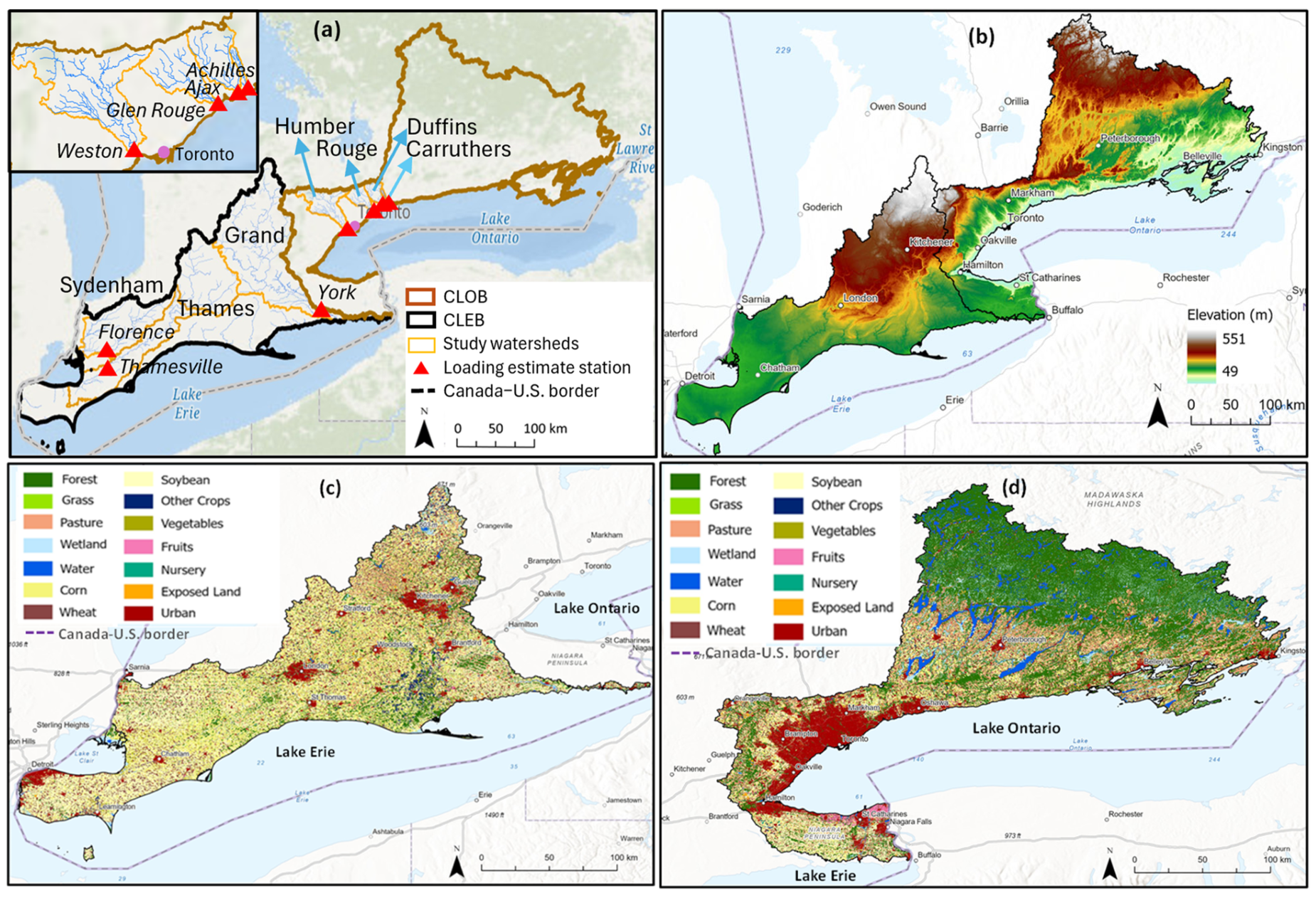
The CLEB covers a drainage area of approximately 19,600 km2 in southern Ontario, Canada (Figure 1a). The basin contains many cities and towns and is one of the major agricultural and industrial regions in the GL basin. The average elevation is approximately 265 m, with values ranging from 169 to 541 m (Figure 1b). The northern part of the basin features a gently rolling topography, characterized by low hills in the upstream area of the Grand River watershed. Based on the AAFC’s 2022 crop inventory data, about 75.8% of the basin is used for agricultural production dominated by corn, soybean, and winter wheat rotations, plus pasture/forage and smaller areas of other crops, vegetables, orchards, and nurseries, making it the most agricultural of all GL basins in Canada. Other land covers include forest (13.0%), urban and developed (7.1%), and wetland and water (3.0%) (Figure 1c). The CLEB has a temperate climate with pronounced seasonal variations. Due to intensive agricultural production, phosphorus loadings from upland crop fields have become a significant concern for lake water quality [2].
The CLOB covers a drainage area of approximately 25,000 km2 in southern Ontario (Figure 1a). The basin has a largely rural landscape, with forest covering most of the northern part. Some industrial areas and urban centers, such as Toronto, Ontario’s largest city, are located along the LO coast (Figure 1d). The average elevation is about 233 m, spanning a range from 49 to 551 m (Figure 1b). Based on the Agriculture and Agri-Food Canada’s (AAFC) 2022 crop inventory data, forest covers about 45.4% of the basin, followed by agriculture (29.5%), wetland and water (8.7%), and urban and developed (15.4%). The CLOB is far less agricultural than the CLEB. Much of its western half is urbanized, while its eastern half retains large tracts of forest and mixed farmland. High agricultural intensity and nutrient loading are concentrated in nearshore sub-basins.
The study area has a humid continental climate with four clear seasons. Precipitation is fairly distributed throughout the year. Temperature has a symmetrical distribution with higher values in summer and lower values in winter. Most runoff occurs during the non-growing season between October and June, with high flows during the snowmelt season. Groundwater-derived baseflow contributes substantially to total streamflow at watershed outlets. Because nutrient export is closely related to runoff, it mostly occurs during the non-growing season, with particularly high loadings during spring snowmelt. During the growing season, high nutrient losses typically occur during heavy storm events [10].

2.2. Data Availability

The spatial data used in this study include the 20 m Digital Elevation Model (DEM) obtained from the Ontario Provincial DEM (https://geohub.lio.gov.on.ca), soil data from the Ontario Ministry of Agriculture, Food and Agribusiness (OMAFA) Soil Survey Complex database (https://geohub.lio.gov.on.ca), and land-use data from the AAFC’s Annual Crop Inventory Database (https://open.canada.ca/en (accessed on 1 May 2024)) for the 2011–2022 period. The gridded daily climate data, including precipitation and temperature, were obtained from ECCC’s Canadian Surface Reanalysis Version 2.1 (CaSR-V2.1) [17] dataset from 1980 to 2018 (https://www.canada.ca/en/environment-climate-change/services/climate-change/canadian-centre-climate-services.html (accessed on 1 May 2024)) at approximately 10 km spatial resolution and hourly temporal resolution across North America.
The CaSR-V2.1 climate dataset was available through 2018. To extend the analysis to 2022, daily precipitation and temperature observations from multiple ECCC meteorological stations located within or adjacent to the CLEB and CLOB were incorporated. Basin-average climate variables for 2019–2022 were estimated using inverse-distance weighting (IDW) interpolation and spatial averaging procedures consistent with the watershed delineation framework used for the CaSR-V2.1 product. To improve continuity between the original CaSR-V2.1 dataset and the extended period, consistency was evaluated by comparing annual and seasonal means, seasonal patterns, and interannual variability between the reanalysis and station-based estimates. The bias of the average annual precipitation over the period 1980–2018 is 1.3% for CLEB and 2.8% for CLOB. For the average annual temperature, the bias is 4.3% for CLEB and 2.1% for CLOB, respectively. The extended series should therefore be interpreted as an approximate extension for recent climate analyses.
Seven illustrative watersheds within the CLEB and CLOB were selected for the analysis of flow and TP variations (Figure 1a). The selected watersheds were chosen to represent dominant land-use and hydrological settings within CLEB and CLOB, with emphasis on highly agricultural watersheds in CLEB and more urbanized watersheds in CLOB. The characteristics of each watershed are provided in Table 1. The Grand, Sydenham, and Thames River watersheds constitute about 67.7% of the CLEB area. The Grand River drains into LE, while the Sydenham and Thames Rivers drain to Lake St. Clair and eventually flow into LE through the Detroit River. The three watersheds are highly cultivated with agricultural land use of 67.4%, 85.9%, and 80.1%, respectively, based on AAFC’s 2022 annual crop inventory data. The Carruthers, Duffins, Humber, and Rouge River watersheds constitute about 5.4% of the CLOB area. The four watersheds are highly urbanized, with urban land cover accounting for 42.0%, 18.1%, 36.3%, and 47.0% of the watershed areas, respectively, based on the AAFC’s 2022 annual crop inventory data (Table 1). Daily flow data at the control stations of each watershed (Table 2) were obtained from the Water Survey of Canada (WSC; https://wateroffice.ec.gc.ca/ (accessed on 1 March 2024)) and the Grand River Conservation Authority (GRCA; https://data.grandriver.ca/downloads-monitoring.html (accessed on 1 March 2024)). Water quality data were obtained from the Ontario Provincial Water Quality Monitoring Network (PWQMN; https://data.ontario.ca) and the Toronto Region Conservation Authority’s (TRCA) Regional Watershed Monitoring Program (RWMP; https://data.trca.ca) at approximately monthly to sub-weekly intervals. In addition, ECCC’s Water Quality Monitoring and Surveillance (WQMS) program provided higher-frequency water quality data for priority GL tributaries.
Because long-term climate, hydrological, water quality, and land-use datasets were not uniformly available across all study basins and variables, analyses were conducted using multiple partially overlapping temporal periods. Long-term climate trends were analyzed using the CaSR-V2.1 dataset (1980–2018) extended to 2022. Runoff and TP loading were evaluated for 2009–2022, and land-use change for 2011–2022, based on data availability. The study, therefore, emphasizes recent watershed changes while using longer-term climate records for regional context.

2.3. Analytical Methods

The temporal variation in precipitation, temperature, and land use within the CLEB and CLOB was quantified using summary statistics, including mean, standard deviation (SD), and coefficient of variation (CV), along with graphical analyses. Boxplots were used to illustrate data distributions and variability. Annual and seasonal precipitation and temperature were calculated for each hydrological year and spatially averaged over each basin to assess temporal patterns. Snowfall was estimated from precipitation on days with mean temperatures below 0 °C. Hydrological years (1 December to 30 November) were used for runoff and TP loading analyses, while seasonal analyses were conducted for winter (December–February), spring (March–May), summer (June–August), and autumn (September–November).
Baseflow separation was conducted using the recursive digital filtering method implemented in the Soil and Water Assessment Tool (SWAT) with a 10-day recession constant [18,19]. This approach was chosen because it is consistent with the SWAT hydrological framework and has been widely applied in watershed-scale hydrological analyses. The objective was to provide a consistent comparison of runoff partitioning among basins rather than an explicit quantification of groundwater contribution.
Total phosphorus (TP) concentrations and loadings were estimated using the Weighted Regressions on Time, Discharge, and Season with a Kalman filter (WRTDS-K). In this approach, the logarithm of concentration is modeled as a function of time, discharge, and season using locally weighted regression [20]. The Kalman filter extends this framework by allowing time-varying coefficients within a state-space formulation, improving the representation of temporal variability and abrupt changes [21]. In WRTDS, the logarithm of concentration C is modeled as:
l n ( C ) = β 0 ( t ) + β 1 ( t ) l n ( Q ) + β 2 ( t ) s i n ( 2 π t ) + β 3 ( t ) c o s ( 2 π t ) + ε
where C is the constituent concentration (mg/L), Q is discharge (m3/s), t is time (decimal years), β0(t), β1(t), and β2(t) are time-varying coefficients estimated using weighted regression, and ε is the residual error. The regression is calibrated locally using weights based on proximity with time, discharge, and season. To capture abrupt changes and short-term variability, WRTDS-K incorporates a Kalman filter for WRTDS in a state-space framework, enabling more flexible, time-varying coefficients [21].
l n ( C t ) = x t β t + ε t
β t = β t 1 + w t
where xt is the vector of predictors, βt is the time-varying parameter vector, εt = N(0, σ2) is the observation error, and wt = N(0, w) is the process noise governing the temporal evolution of coefficients. The Kalman filter enables the model to capture gradual and abrupt changes in water-quality dynamics. WRTDS-K has been applied to analyze nutrient trends (e.g., phosphorus and nitrogen) in rivers, particularly in systems with strong hydrological variability, such as those rivers in the Great Lakes region [22,23].
Temporal trends in precipitation, temperature, streamflow, and TP loads were assessed using the Mann–Kendall (MK) test [24], and trend magnitudes were estimated using Sen’s slope. The MK statistic S is calculated as:
S = i = 1 n 1 j = i + 1 n s g n ( x j x i )
where xi and xj are data values at time steps i and j, and the sign function sgn(xjxi) is defined as 1 if xjxi > 0, 0 if xjxi = 0, and −1 if xjxi < 0.
For time series with n observations, the variance of S is computed as:
V a r ( S ) = n ( n 1 ) ( 2 n + 5 ) p = 1 g t p ( t p 1 ) ( 2 t p + 5 ) 18
where g is the number of tied groups, and p is the number of observations in the p-th group. The standardized test statistic Z is then calculated as:
Z = { S 1 V a r ( S )                   i f   S > 0   0                                         i f   S = 0 S + 1 V a r ( S )                 i f   S < 0
A trend is considered statistically significant when the absolute value of Z exceeds the critical value at the selected confidence level (CL). The magnitude of the trend was estimated using Sen’s slope (SS) estimator:
S S = M e d i a n ( x j x i j i ) ,   j > i
The MK test is a non-parametric approach used to assess monotonic trends in time series without requiring assumptions about the underlying data distribution [25]. A positive Z value indicates an increasing trend, while a negative Z value indicates a decreasing trend. Trends were considered statistically significant at the 95% CL (|Z| > 1.96). Seasonal trends were evaluated by applying the test to seasonal aggregates. To improve the interpretation of recent runoff and TP loading variability (2009–2022), longer-term climate (1980–2018) and runoff (1960–2024) records were also analyzed to provide a broader hydroclimatic context.

3. Results

3.1. Changes in Precipitation and Temperature

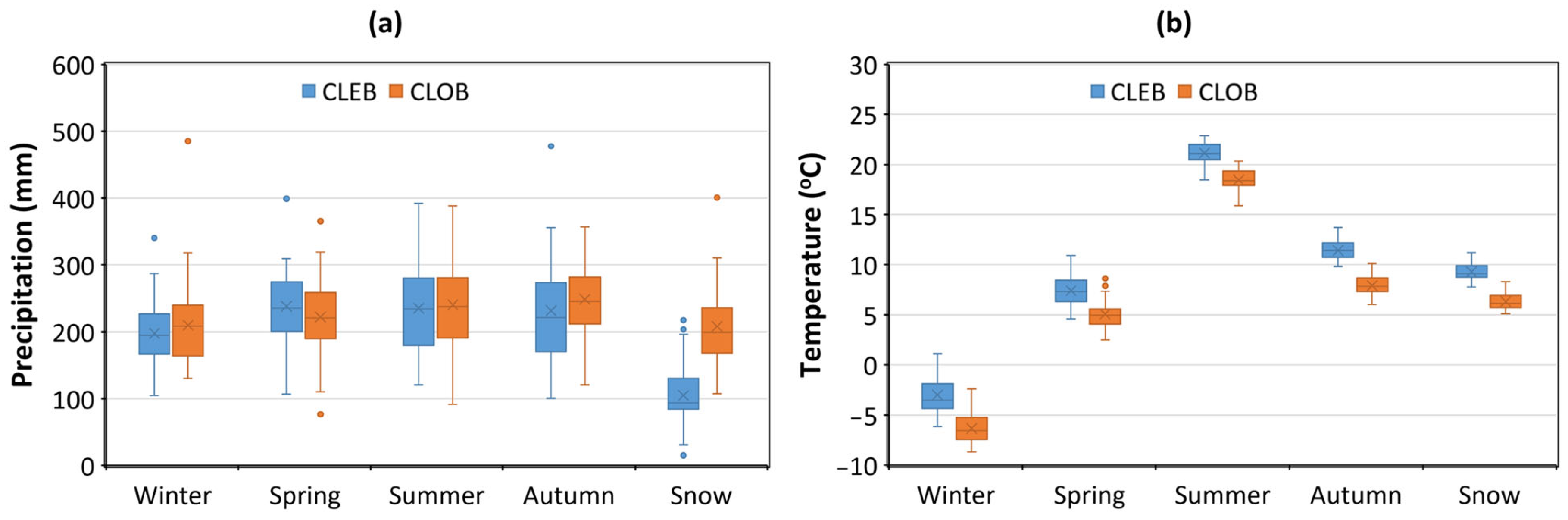
The CaSR-V2.1 gridded projection data from 1980 to 2018 were used to analyze the precipitation and temperature variation in the CLEB and CLOB. Annual and seasonal total precipitation and mean temperature for CLEB and CLOB from 1980 to 2018 are presented in Supplementary Material (SM) Tables S1 and S2, along with summary statistics and MK test results. The average annual precipitation is 903 mm in CLEB and 921 mm in CLOB, with standard deviations of 135 mm and 140 mm, respectively. Seasonal precipitation in CLEB and CLOB is relatively evenly distributed, with winter amounts slightly lower than the other three seasons (Figure 2a). The boxplots indicate substantial temporal variability in seasonal precipitation over the 39 years.
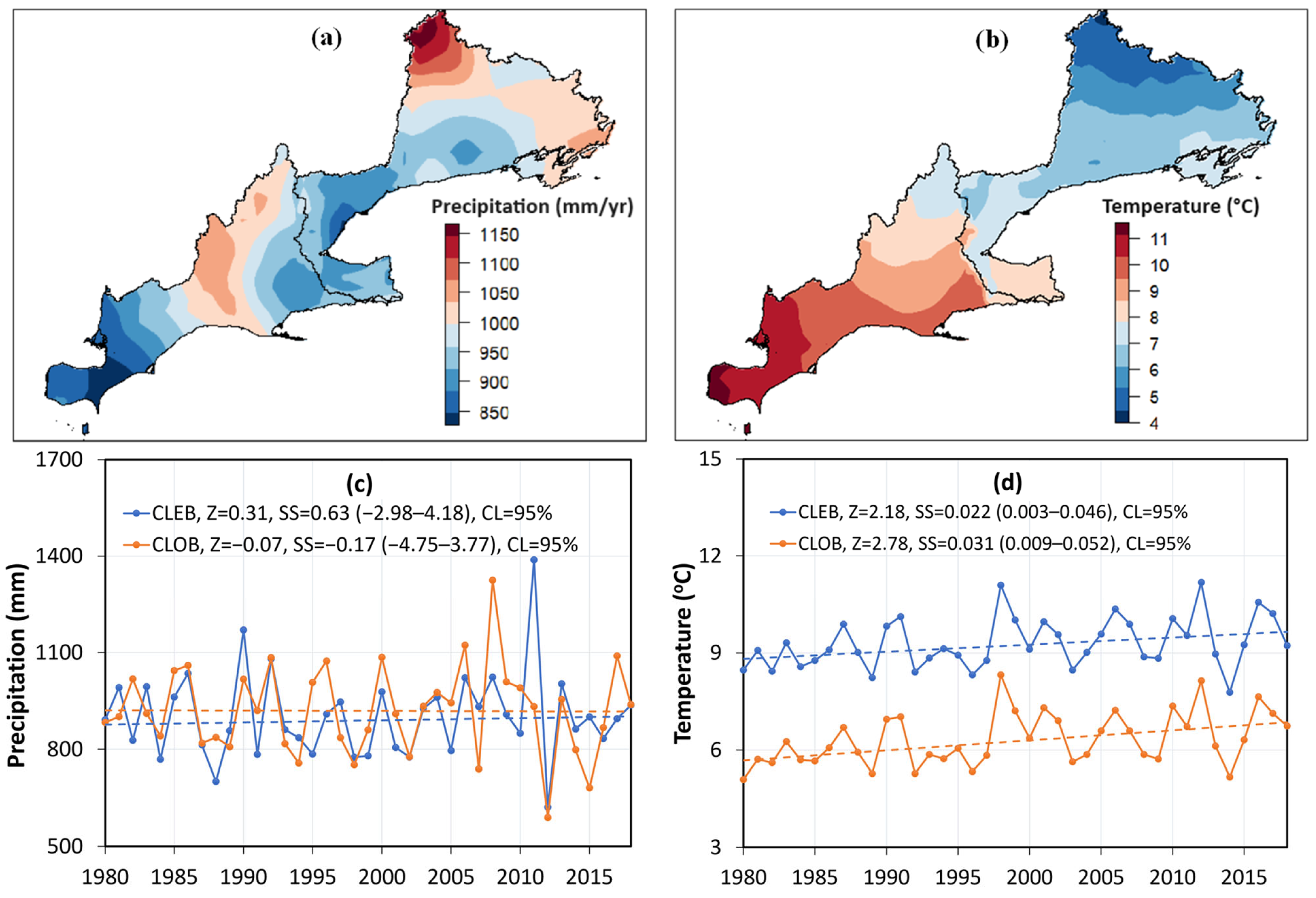
The mean annual temperature is 9.3 °C in CLEB and 6.3 °C in CLOB, with standard deviations of 0.78 °C and 0.81 °C, respectively. Seasonal patterns show that temperatures peak in summer, averaging 21.1 °C in CLEB and 18.5 °C in CLOB, while the lowest temperatures occur in winter, with averages of −3.0 °C and −6.3 °C, respectively (Figure 2b). The higher annual temperature in CLEB, approximately 3.0 °C greater than in CLOB, reflects its more southern geographic location (Figure 1a). Higher precipitation generally occurs in the northern portions of both basins (Figure 3a), which correspond to higher elevations (Figure 1b), and lower precipitation is observed in the southwestern regions of both basins. In contrast, the highest temperatures are found in southwestern CLEB and decrease gradually toward northeastern CLOB (Figure 3b).
Figure 3c,d show the temporal variation in annual precipitation and annual average temperature over CLEB and CLOB from 1980 to 2018. The dashed lines represent the MK trend estimates, with Z values, SS values, and confidence intervals (minimum and maximum SS at the 95% CL) provided in the legends. A minimal increase in annual precipitation (0.63 mm/yr) is observed for CLEB from 1980 to 2018, whereas CLOB shows a minimal decrease (−0.17 mm/yr). However, no statistically significant trends are detected over the period for both basins. Precipitation variability increased after 2007, as is evident for CLOB, with the highest annual precipitation in 2008 and the lowest in 2012 (Figure 3c, SM Table S1). For CLEB, the highest annual precipitation occurred in 2011 and the lowest in 2012. Both CLEB and CLOB have increasing yearly average temperatures at rates of 0.022 and 0.031 °C/yr, respectively, from 1980 to 2018, with a strong statistically significant upward trend for both basins (Figure 3d). The highest annual average temperature occurred in 2012 for CLEB (11.2 °C) and in 1998 for CLOB (8.3 °C) (SM Table S2). The lowest annual average temperature is 7. 8 °C for CLEB in 2014, and 5.1 °C for CLOB in 1980.
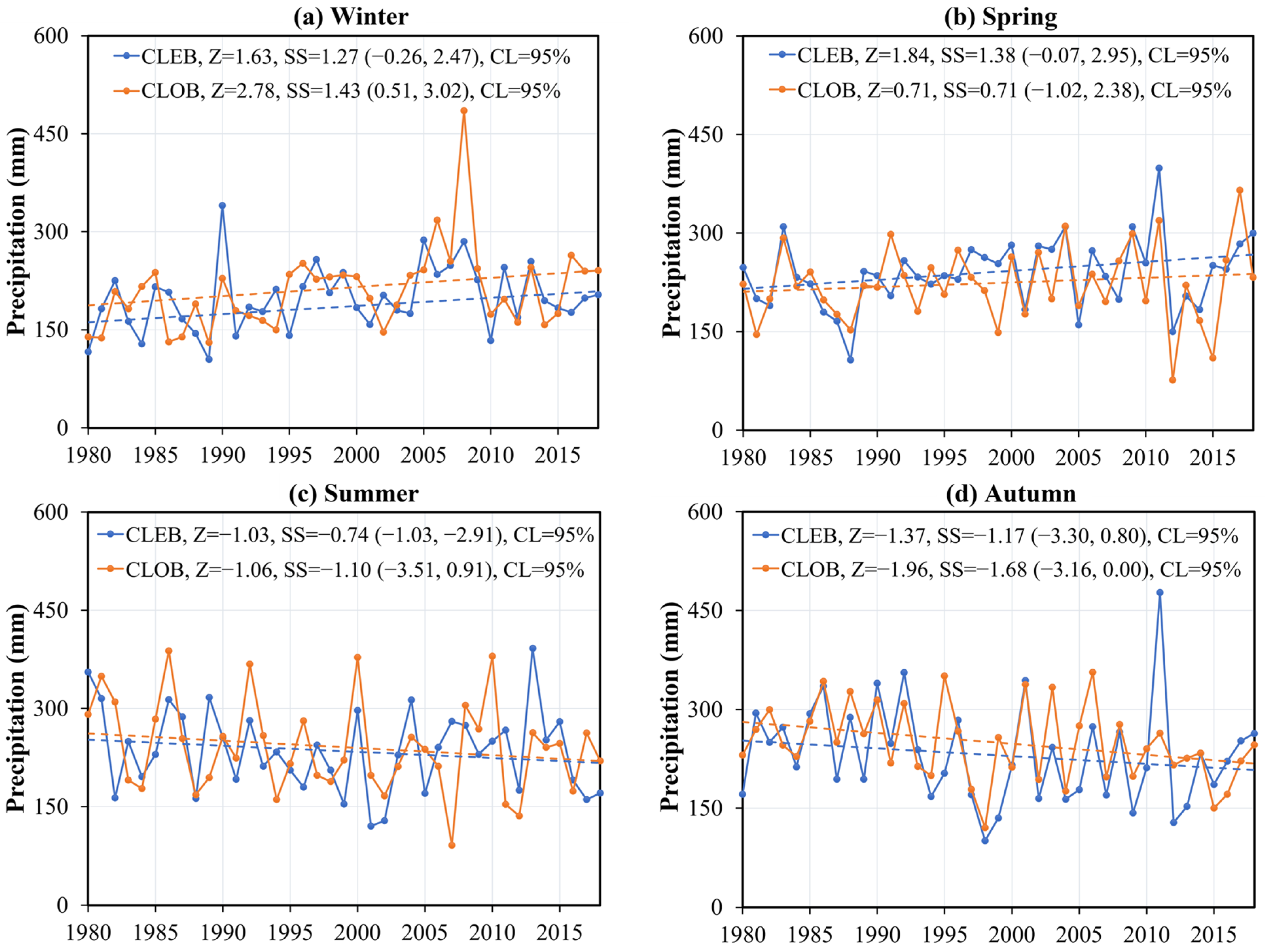
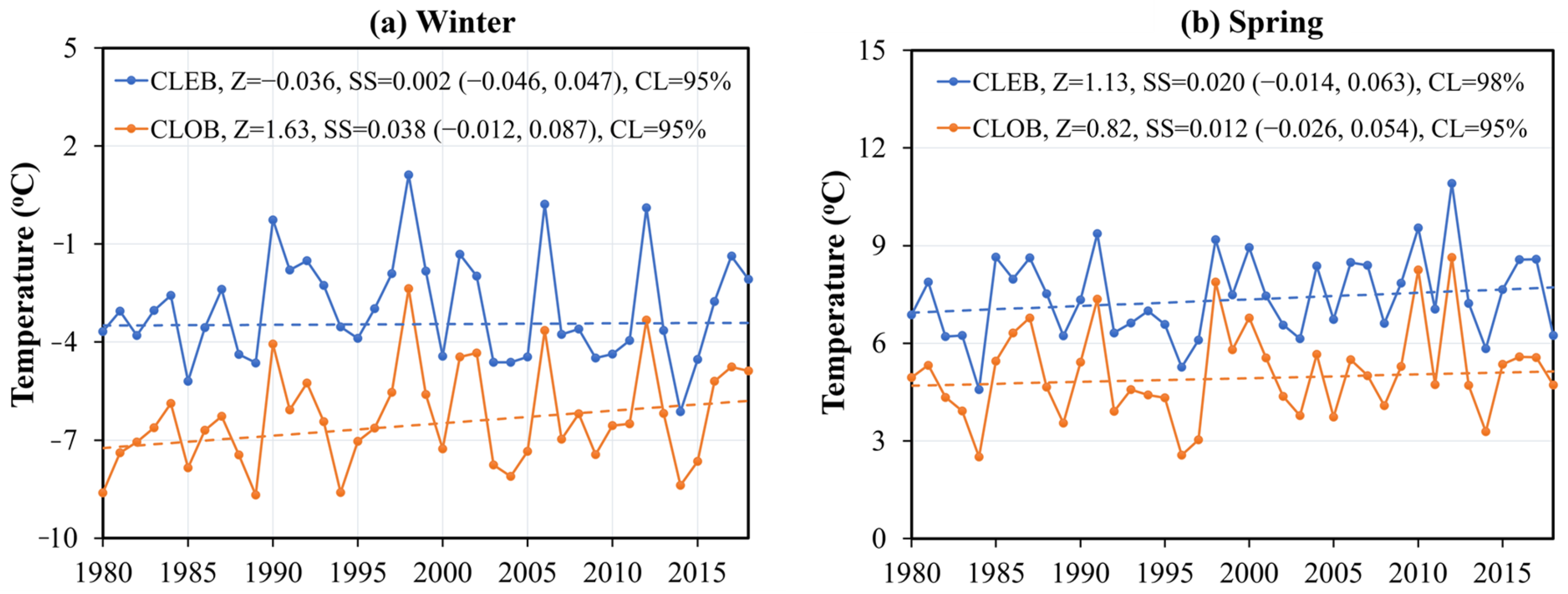
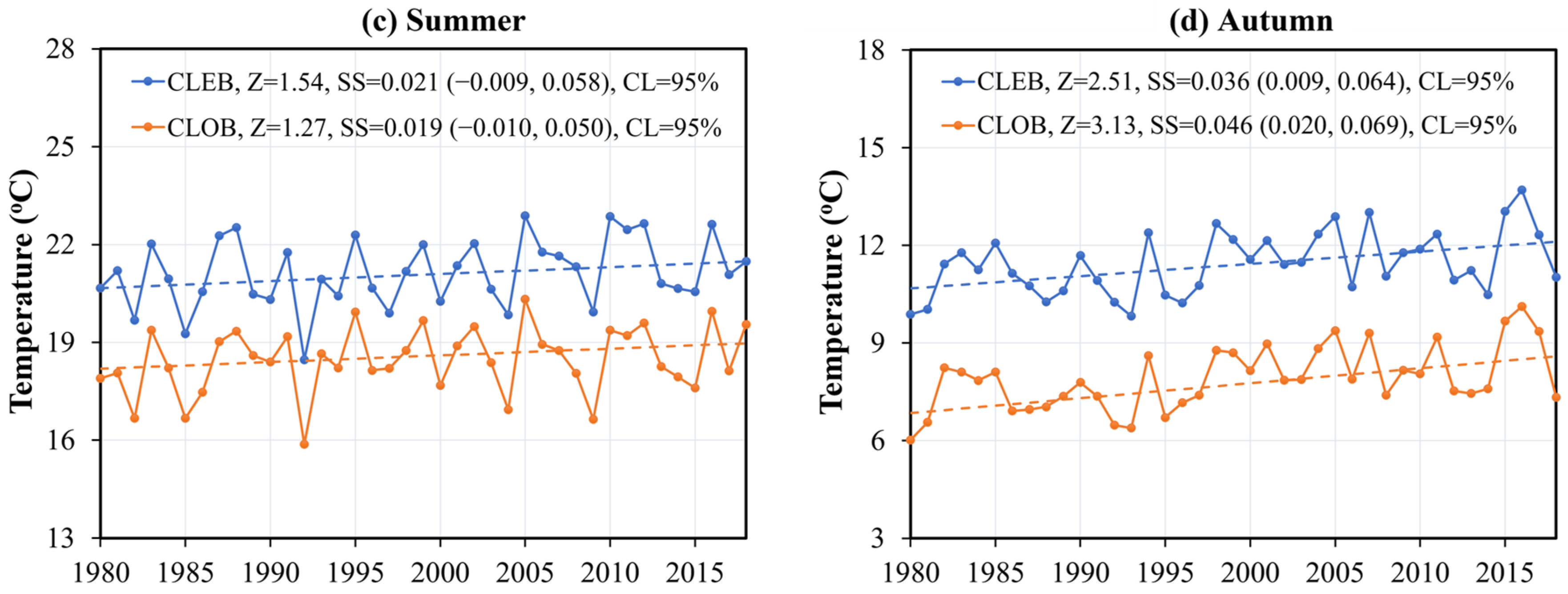
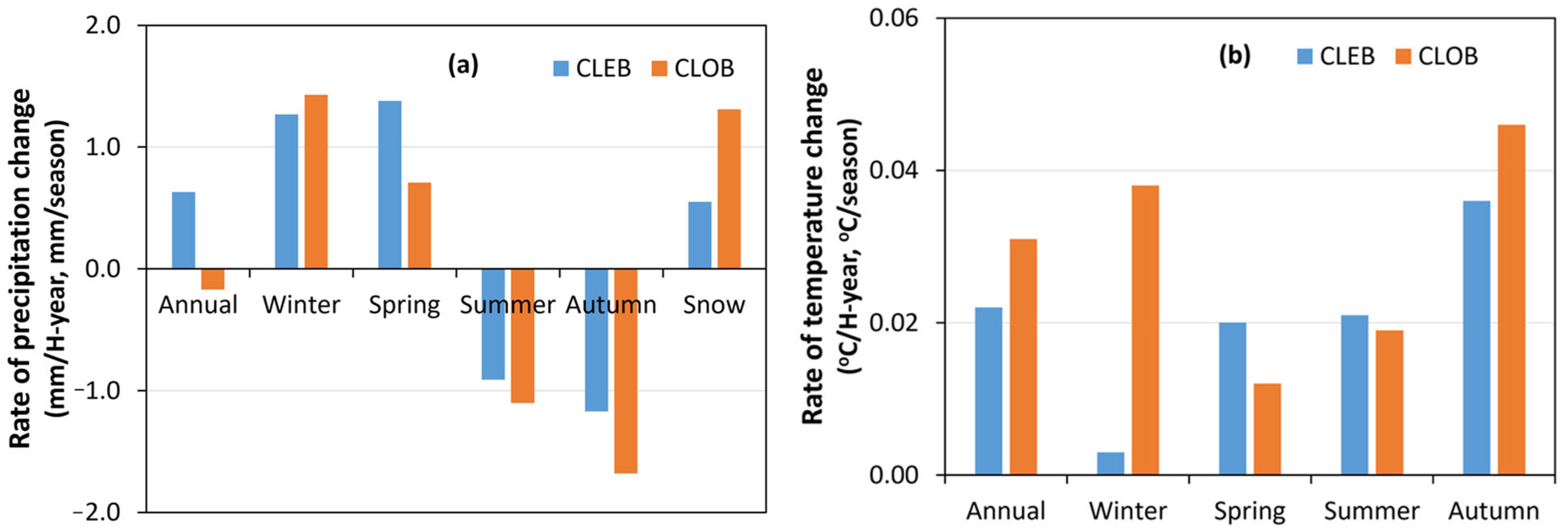
Winter and spring precipitation tend to increase over the analysis period in both basins, while summer and autumn precipitation tend to decrease (Figure 4a). However, these seasonal precipitation trends are not statistically significant except for CLOB in the autumn (Figure 5a–d). In winter, precipitation in CLOB shows a higher rate of increase (1.43 mm/yr) than in CLEB (1.27 mm/yr), whereas in spring, precipitation in CLEB shows a higher rate of increase (1.38 mm/yr) than in CLOB (0.71 mm/yr). Results show that seasonal temperatures increase, on average, from 1980 to 2018 in all four seasons for both CLEB and CLOB (Figure 4b). There is a much larger increase rate in winter temperatures for CLOB compared to CLEB (0.038 vs. 0.002 °C/yr) and a slightly higher increase rate in autumn temperatures (0.046 vs. 0.036 °C/yr). Also, CLEB shows a slightly larger temperature increase in spring (0.020 °C/yr) and summer (0.021 °C/yr) than CLOB (0.012 and 0.019 °C/yr, respectively). Seasonal temperature trends are statistically significant in autumn for both basins (Z = 2.51 for CLEB and Z = 3.13 for CLOB), but not in other seasons (Figure 6a–d).

3.2. Changes in Land-Use and Crop Types

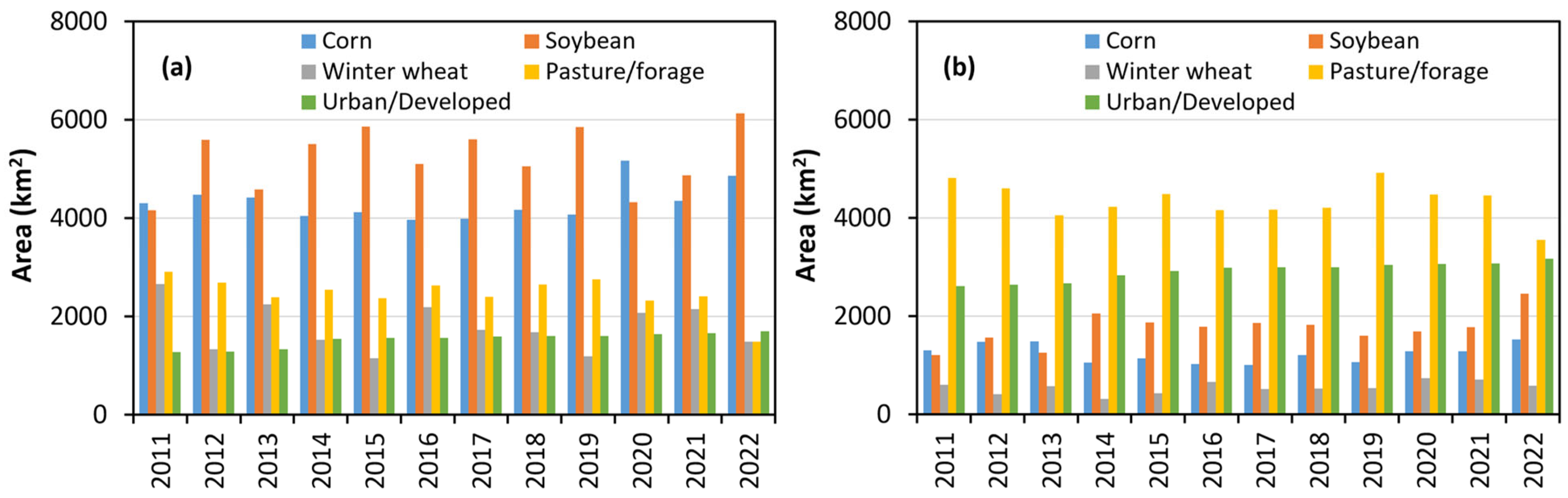
A summary of agricultural and urban/developed areas within CLEB and CLOB, based on AAFC’s annual crop inventory data from 2011 to 2022, is provided in Table 2, together with corresponding summary statistics and MK test results. The observed land-use changes indicate a progressive shift toward more intensive row-crop production systems within both basins. Simultaneous increases in corn and soybean acreage, together with declines in pasture and forage land, suggest reduced dominance of perennial vegetation and increasing reliance on annual row-crop rotations. Observed warming trends may contribute to conditions favorable for expanded corn and soybean production, consistent with previous regional agricultural studies [26].
Positive MK test Z values are found for corn and soybean, while negative Z values are found for pasture/forage in both basins (Table 2), indicating a rising trend in major crop areas and a declining trend in pasture and forage areas over the analysis period. Winter wheat exhibits a slight downward trend in CLEB (Z = −0.62) and a modest upward trend in CLOB (Z = 1.58), while remaining a major crop in both basins (Figure 7a,b). Urban land cover exhibited statistically significant increasing trends in both basins (Z = 4.43–4.46). However, the practical magnitude of change was moderate relative to total basin area, increasing from approximately 1272 to 1692 km2 (33%) in the CLEB and from 2608 to 3165 km2 (21%) in the CLOB over the study period. Although these proportional changes are smaller than the agricultural land cover extent, urban expansion may still have important hydrological implications because impervious surfaces can increase runoff efficiency, reduce infiltration, and enhance hydrological connectivity. These results highlight that statistically significant trends do not necessarily correspond to proportionally large land-cover changes, and their hydrological significance depends on both spatial extent and watershed connectivity.
Results indicate a shift toward row-crop production and urban development, accompanied by declining pasture and forage areas. In southern Ontario, expansion of corn and soybean systems is commonly associated with intensified agricultural management, including higher fertilizer application rates, increased tile drainage, and greater reliance on mechanized tillage systems [27,28]. Although these management factors were not directly quantified in this study, they likely contribute to increased phosphorus availability and transport risk in agricultural landscapes. The shift away from livestock farming is consistent with the observed declines in pasture and forage areas in CLEB and CLOB (Figure 7a,b). Regional warming and longer frost-free periods may also favor heat-loving row crops, stimulating the shift towards row crops [29]. Results indicate expansion of row-crop production and concurrent declines in pasture and forage land across both basins. These land-use and management changes provide important context for interpreting the observed variability in runoff and TP loading discussed in subsequent sections.

3.3. Changes in Runoff and Streamflow

Runoff and streamflow characteristics in seven case-study watersheds were examined to assess hydrological responses to recent climate and land-use changes in CLEB and CLOB. Runoff generation varied considerably among watersheds due to differences in climate, land use, watershed characteristics, and drainage conditions.
In the CLEB watersheds, annual runoff depths are 349, 401, and 442 mm in the Sydenham River, Grand River, and Thames River watersheds (Table 3). These values correspond to runoff coefficients of roughly 0.38–0.46 relative to annual precipitation, indicating that a substantial portion of precipitation contributes to surface and subsurface flow in these agriculture-dominated watersheds. Baseflow contributes a substantial portion of total runoff, approximately 29–44% of annual runoff across the selected CLEB watersheds, underscoring the important role of groundwater in sustaining streamflow. Seasonally, runoff in the selected CLEB watersheds is dominated by spring flows from snowmelt and early spring rainfall. Spring contributes the largest share of annual runoff, while summer runoff is generally lower and associated with higher evapotranspiration (Table 3).
Hydrological conditions in the selected CLOB watersheds exhibit somewhat different characteristics, potentially influenced by higher urbanization levels and steeper topography (Table 1). Annual runoff depths vary from 128 mm in the Rouge River watershed to 445 mm in the Carruthers Creek watershed (Table 3). Highly urbanized watersheds, such as Carruthers, Humber, and Rouge, tend to produce relatively rapid runoff responses during rainfall events due to increased impervious surfaces and reduced infiltration capacity. Nevertheless, baseflow remains an important component of streamflow, particularly in the Duffins River watershed, where baseflow accounts for approximately 43% of annual runoff (Table 3).
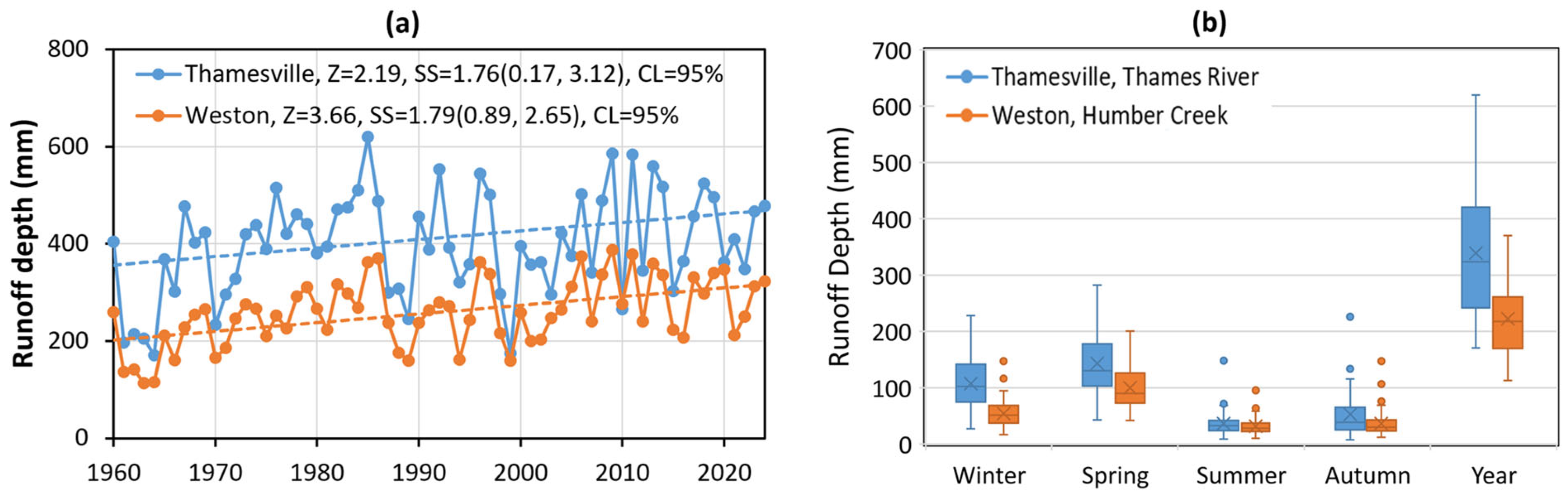
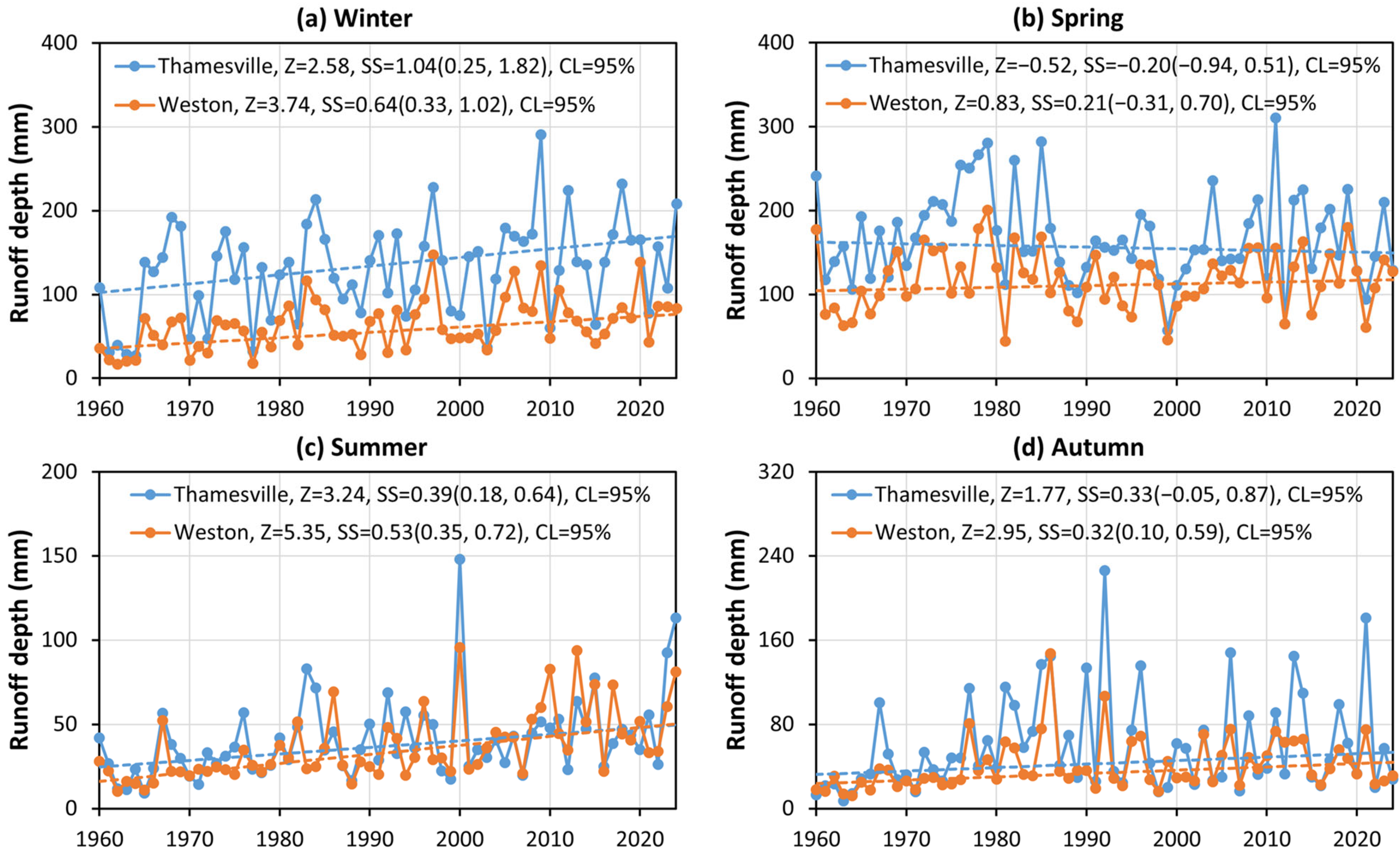
Long-term records at the illustrative stations reveal substantial annual (SM Table S3) and seasonal variability in runoff and streamflow over the 1960–2024 period. As shown in Figure 8a,b and Figure 9a,d, annual and seasonal runoff at both the Thamesville and Weston stations fluctuate considerably from year to year, largely reflecting variations in precipitation and temperature. Despite this variability, a gradual increase in winter and summer runoff has been observed in recent decades (Figure 9a,c).
An apparent increase in winter runoff is observed, with Z values of 2.63 at the Thamesville station on the Thames River and 3.73 at the Weston station on the Humber River. This pattern is consistent with observed regional warming trends and increasing winter precipitation. However, given the strong interannual variability, these trends should be interpreted cautiously. The increase in summer runoff (Z = 3.24 at Thamesville station and Z = 5.35 at Weston station) may be associated with increasing hydroclimatic variability in the GL region [30]. Autumn runoffs at both stations and spring runoff at the Weston station exhibit weak downward tendencies. However, these patterns are not statistically significant (Z < 1.96) and should be interpreted with caution given the short record length. However, spring runoff at the Thamesville station on the Thames River in southern Ontario shows a slight downward trend (SS = −0.19), likely due to increased winter snowmelt, although this trend is not statistically significant (Z = −0.51).

3.4. Changes in TP Loadings

In the illustrative CLEB watersheds (Grand, Sydenham, and Thames), 2009–2022 average annual TP loadings range from 0.49 kg/ha in the Grand River watershed to 0.79 kg/ha in the Thames River watershed, with corresponding mean concentrations of 0.070–0.118 mg/L (Table 4). The Thames River watershed consistently exhibits the highest TP loadings and concentrations among the three, likely due to its high agricultural intensity, point sources, and relatively high runoff depth (Table 2). The Sydenham River watershed shows moderate TP loading but larger variability in concentrations, reflecting its highly agricultural landscape (Table 1) and sensitivity to hydrological fluctuations. The Grand River watershed, although also heavily cultivated, exhibits comparatively lower TP loading, potentially due to differences in watershed characteristics, management practices, and flow regulation.
In the selected CLOB watersheds (Carruthers, Duffins, Humber, and Rouge), average annual TP loadings range from 0.53 kg/ha in the Humber River watershed to 0.67 kg/ha in the Rouge River watershed, with mean concentrations between 0.045 and 0.073 mg/L (Table 4). Compared to the selected CLEB watersheds, these urbanized watersheds generally show lower concentrations but comparable or moderately high unit-area loadings, reflecting the influence of urban runoff, stormwater infrastructure, and impervious surfaces. Notably, the Rouge River watershed exhibits relatively high variability in TP loading, indicating strong sensitivity to storm-driven runoff events and urban hydrological responses.
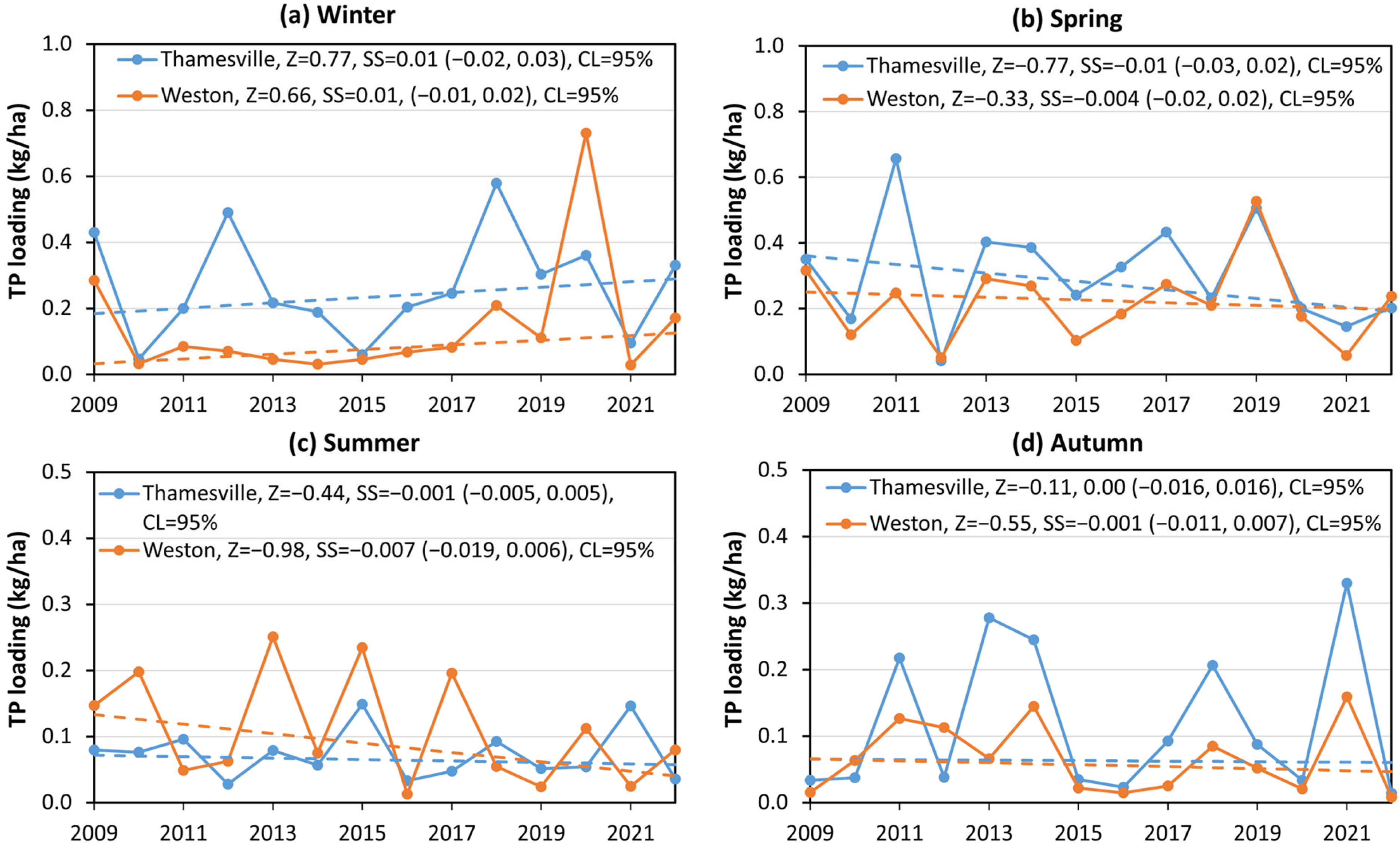
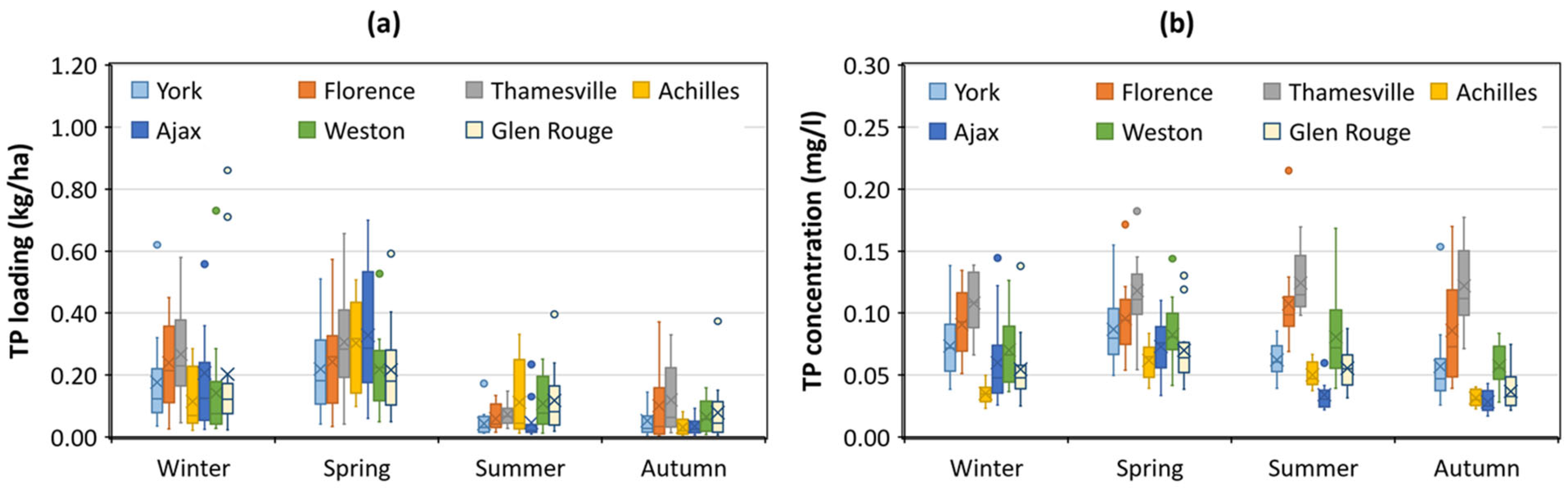
TP loading and concentration showed substantial interannual variability across all watersheds (Figure 10a,b). Wet years generally corresponded to elevated TP loading, while dry years, such as 2010 and 2012, showed substantially lower loadings. For example, annual TP loadings in the Thames River watershed ranged from 0.33 kg/ha in 2010 to 1.11 kg/ha in 2011 (Table 4), reflecting more than a threefold increase between a dry year and a wet year (with annual precipitation of 850 mm and 1388 mm, respectively). Seasonal variation further reveals that spring is the dominant period for TP export across all watersheds (Figure 11a–d). TP loading is highest in spring and lower in summer, with additional contributions during winter events. Autumn shows moderate TP loading, influenced by rainfall events and reduced evapotranspiration following the growing season. Some observed differences between the selected CLEB and CLOB watersheds may partly reflect the intentional selection of predominantly agricultural versus urbanized watersheds rather than purely intrinsic basin-wide differences. Accordingly, comparisons between basins should be interpreted primarily as contrasts between dominant watershed land-use settings under differing hydroclimatic conditions rather than a comprehensive characterization of the entire regional basins.
TP load estimates derived from stations with sub-weekly or bi-weekly monitoring are considered more reliable than those based primarily on monthly sampling intervals. Although WRTDS-K is well suited for unevenly spaced concentration records, interpretation of TP loading trends remains influenced by sampling frequency. In particular, monthly and bi-weekly sampling intervals may underrepresent short-duration storm-event TP peaks, which are important contributors to annual phosphorus export in agricultural watersheds. Consequently, the reported TP trends should be interpreted as indicative of evolving transport conditions rather than precise quantification of event-scale export dynamics.
Temporal variations suggest a potential increase in the contribution of winter TP loads at the Thamesville station on the Thames River and the Weston station on the Humber River in recent years (Figure 11). However, this pattern may be influenced by interannual variability and a limited number of high-flow events. The increasing occurrence of winter runoff events may reflect recent warming trends and increasing winter precipitation, which can enhance nutrient mobilization during the non-growing season. Similarly, episodic increases in summer TP loading are associated with increasing hydroclimatic variability. Overall, TP loading dynamics appear to be strongly influenced by hydrological variability and seasonal runoff patterns. These findings highlight the importance of considering both annual and seasonal nutrient export patterns.

4. Discussion

4.1. Impact of Climate and Land-Use Variations on Runoff and TP Loadings in the Study Area

The present study primarily evaluates temporal patterns and associations among climate conditions, land use, runoff, and TP loading. The results indicate substantial interannual variability in runoff and TP loading across the study watersheds, influenced by the combined effects of climate variability and land-use change. These interactions are particularly evident in the shifting seasonal hydrological regime and the increasing importance of event-driven nutrient transport. Some mechanistic explanations discussed below are intended as literature-supported interpretations rather than processes directly quantified by the analysis.
Recent climate variability and observed warming trends in southern Ontario may be contributing to changes in hydrological conditions and nutrient exports [31]. One notable recent change is the increase in winter temperatures, which may enhance winter and early-spring runoff and increase TP loading. This shift is consistent with the observed increase in winter runoff and variability in seasonal TP loading (Figure 9, Figure 10 and Figure 11), indicating a redistribution of hydrological regimes and nutrient export toward the non-growing season. Increasing hydroclimatic variability may enhance event-driven phosphorus transport through rapid runoff and preferential flow pathways. These events are particularly important in summer and early autumn, when antecedent soil moisture conditions and storm intensity control runoff generation [13,15].
In addition to climatic changes, significant shifts in land use and crop composition have occurred in the study area (SM Table S3), particularly the expansion of row crops (corn and soybeans) and the decline of pasture and forage systems (Figure 7). Row-crop systems in southern Ontario are generally associated with more intensive agronomic management, including higher fertilizer application rates, increased use of subsurface tile drainage, and greater soil disturbance associated with mechanized tillage operations [9,27]. These practices may increase phosphorus availability and hydrological connectivity, thereby enhancing the susceptibility to runoff-driven nutrient losses. However, winter wheat area does not exhibit statistically significant long-term trends, suggesting relative temporal stability in this crop type compared with the more dynamic expansion of corn and soybean systems. This stability may reflect persistent agronomic suitability and established crop rotation practices within the region. The difference between rapidly expanding row-crop systems and relatively stable winter wheat areas suggests that agricultural intensification is driven primarily by shifts toward corn–soybean production rather than broad changes across all crop types in the study area. In contrast, pasture and forage systems provide continuous vegetative cover and enhanced soil structure, promoting infiltration and reducing surface runoff. The shift toward row crops likely increases phosphorus availability and runoff-driven nutrient losses. Previous studies have linked expanded tile drainage systems in southern Ontario to increased hydrological connectivity and dissolved phosphorus transport, which may help explain some of the observed runoff and TP loading patterns [27,28]. These findings also emphasize the importance of interpreting trend statistics within the context of absolute magnitude, spatial extent, and ecohydrological relevance, rather than relying solely on statistical significance.
Previous studies in the Lake Erie region have documented increasing phosphorus surplus and enhanced dissolved phosphorus transport associated with fertilizer management and tile-drained row-crop systems [10,27]. Therefore, the observed land-use changes likely indicate not only shifts in crop composition but also broader agricultural intensification processes affecting nutrient export dynamics. Although urban expansion accounts for a relatively small fraction of the total watershed area, increases in impervious surface cover may exert disproportionately large effects on runoff generation and pollutant transport by enhancing hydrologic connectivity and limiting infiltration. It is important to recognize that land-use change alone does not fully explain the observed variability in TP loading. Nutrient export is also strongly influenced by management practices, including fertilizer application timing and rate, tillage intensity, manure management, and subsurface drainage modifications. Due to the limited availability of long-term watershed-scale management datasets, these factors were not explicitly quantified in the present analysis. Consequently, the relationships identified between land-use change and TP loading should be interpreted as indicative of broader agricultural intensification trends rather than direct causal attribution.
Warming trends, altered runoff regimes, and agricultural intensification may collectively influence hydrological and nutrient-export processes. In particular, increased runoff under changing hydroclimatic conditions may enhance phosphorus mobilization from increasingly intensive agricultural landscapes. This interaction would be especially important in the selected CLEB watersheds, where high agricultural intensity coincides with increasing winter and spring runoff, resulting in elevated TP loading during critical periods for lake eutrophication. In the four urbanized CLOB watersheds, the combination of increased imperviousness and more intense rainfall further amplifies runoff peaks and pollutant transport, demonstrating a similar interaction between land-use change and climate variability. However, because the present study did not include factorial scenario analysis or formal effect-partitioning methods, these interactions cannot be quantitatively classified as additive or synergistic. Future research using scenario-based modeling and attribution approaches is needed to explicitly quantify the relative and combined effects of climate, land-use, and agricultural management.
Although the MK test provides a useful non-parametric approach for detecting monotonic trends, its application to relatively short time series in this study requires careful interpretation. Short records have limited statistical power and are more sensitive to interannual variability and the influence of extreme events, which can bias both the magnitude and significance of detected trends [24]. In hydrological and water quality systems, where runoff and nutrient export are often dominated by episodic high-flow events, a small number of extreme years can disproportionately affect trend estimates [9,20]. Furthermore, seasonal trend analysis is particularly sensitive to record length, as variability within individual seasons can obscure long-term signals [32]. Therefore, the trends identified in this study should be interpreted as indicative of recent conditions rather than definitive long-term changes. Continued monitoring and longer-term datasets are needed to confirm the persistence and direction of these patterns under changing climate and land-use conditions.

4.2. Uncertainties in the Analysis

Several sources of uncertainty should be considered when interpreting the results of this study, arising from data limitations, methodological assumptions, and the relatively short analysis period. The differing temporal windows among climate, runoff, TP loading, and land-use datasets primarily reflect differences in long-term monitoring availability and data continuity across variables and basins. Because the selected watersheds were intentionally chosen to emphasize dominant agricultural and urban land-use conditions, the resulting basin comparisons may partly reflect selection effects rather than a statistically representative characterization of the entire CLEB and CLOB domains. The use of illustrative monitoring stations introduces spatial uncertainty. Although these stations capture integrated watershed responses, they may not fully represent spatial heterogeneity within each watershed, particularly in areas with varying land use, drainage conditions, and management practices. Uncertainties are associated with the climate data used in this study. While the CaSR-V2.1 dataset provides consistent spatial coverage, it may not fully capture localized precipitation and temperature variability. Because the extended climate series integrates both reanalysis-based and station-derived datasets, some methodological inconsistencies and uncertainties may persist, particularly in representing interannual variability and extreme-event characteristics.
The AAFC annual crop inventory data, although widely used, may contain classification errors and temporal inconsistencies, particularly in distinguishing crop types [33]. These uncertainties may affect the interpretation of land-use changes and their linkage to nutrient export. Another source of uncertainty arises from the lack of explicit information on agricultural management, including fertilizer application rates, tillage practices, manure management, and tile drainage modifications. These factors strongly influence phosphorus mobilization and transport, but were not consistently available at the watershed-scale for the full analysis period. As a result, land-use changes were used as indirect indicators of broader agricultural intensification. Baseflow separation was performed using a recursive digital filter method in this study. However, hydrogeological conditions differ substantially between the relatively flat, clay-dominated landscapes of CLEB and the steeper, more heterogeneous watersheds of CLOB. Consequently, the use of a single recession parameter may oversimplify spatial variability in groundwater response characteristics. Given the methodological dependence of hydrograph separation results, interpretation should focus primarily on comparative temporal patterns and watershed-scale contrasts rather than precise quantification of groundwater contributions.
Uncertainty in TP load estimation is primarily related to the sampling frequency of water quality data. TP load estimates for the three CLEB rivers and the Rouge River in CLOB are based on WQMS water quality data, which are sampled more frequently (sub-weekly to bi-weekly) and are more likely to capture conditions during flood events. Water quality data used to estimate TP loading for the Humber River, Duffins River, and Carruthers Creek are sourced from PWQMN/TRCA with a coarser sampling frequency (bi-weekly to monthly). This sampling approach may not adequately capture short-term variability and peak concentrations during storm events. Previous studies using WRTDS/WRTDS-K and related regression-based load estimation methods suggest that annual load uncertainty is commonly on the order of ±10–25% for bi-weekly sampling and ±20–50% for monthly sampling, while storm-event-dominated systems may experience underestimation exceeding 50% when peak flows are not sampled [9,15,20,34], highlighting the sensitivity of load estimates to event representation. Although the WRTDS-K method partially addresses this limitation by incorporating discharge, seasonality, and temporal trends, it relies on statistical relationships derived from discrete samples, which may smooth short-term fluctuations, particularly under extreme flow conditions. The present analysis indicates that stations with monthly sampling intervals likely have greater uncertainty than stations monitored at sub-weekly or bi-weekly frequencies. Therefore, comparisons between basins should be interpreted with caution, particularly for the interannual TP loading variability.
An additional source of uncertainty arises from the use of datasets with differing temporal coverage and methodological origins. The climate analysis combines long-term reanalysis products with shorter-term station-derived extensions, while runoff, TP loading, and land-use analyses rely on shorter observational periods. Consequently, interpretation should emphasize broad regional patterns and recent watershed responses rather than strict temporal consistency across all variables. The relatively short analysis period (2009–2022) limits the statistical power of MK trend detection. Short time series are more sensitive to interannual variability and extreme events, which may influence both the magnitude and significance of detected trends. Therefore, the results should be interpreted as indicative of recent conditions rather than definitive long-term changes. Overall, these uncertainties highlight the need for cautious interpretation, particularly when attributing changes in runoff and TP loading to specific drivers. Future studies could reduce these uncertainties through higher-frequency monitoring, longer-term datasets, improved representation of land management practices, and integrated modeling approaches that better capture spatial and temporal variability.

4.3. Adaptation Strategies

The results of this study indicate that TP loads in both CLEB and CLOB watersheds are strongly influenced by hydrological variability and land-use dynamics, with increasing sensitivity to high-flow conditions under changing climate regimes. Therefore, effective adaptation strategies are needed to improve water quality under the combined pressures of climate change and land-use intensification. In southern Ontario watersheds draining to the GL, particularly those dominated by intensive agriculture, such strategies should target both nutrient source reduction and the limitation of hydrological transport during high-flow conditions.
With increasing hydroclimatic variability, reducing event-driven nutrient loading is increasingly important. This can be achieved through practices that enhance water retention and reduce rapid runoff, such as controlled drainage, riparian buffers, and wetland restoration [35]. These measures help attenuate peak flows and reduce nutrient transport. At the same time, nutrient management strategies must adapt to non-stationary environmental conditions. Traditional approaches based on historical climate patterns may no longer be sufficient, as nutrient losses are increasingly influenced by shifting seasonal dynamics and extreme events. Adaptive nutrient management should therefore emphasize optimizing the timing and placement of fertilizer applications, minimizing excess nutrient inputs, using precision agriculture techniques to align nutrient inputs with crop requirements, and avoiding application before high-risk periods, such as late fall, winter thaw, and early spring [10,31].
Nature-based solutions complement field-scale practices by enhancing nutrient retention in the landscape. Measures such as river and wetland restoration, floodplain reconnection, and low-impact development can reduce both runoff and phosphorus transport while providing additional ecosystem benefits. These approaches are increasingly recognized as effective strategies for mitigating the combined impacts of climate change and land-use pressures in CLEB and CLOB [2,3]. Because nutrient export is strongly influenced by management intensity and land cover, adaptation strategies should prioritize improved fertilizer management, reduced soil disturbance, and drainage-water management in addition to land-cover-based approaches. In addition, effective implementation of adaptation strategies requires strengthened policy and governance frameworks. Shifting toward outcome-based conservation programs, targeting critical source areas, enhancing stakeholder collaboration, and coordinating actions across scales (e.g., from field to watershed) are essential for effective water quality management [2].
Given the uncertainties identified in this study, particularly those related to data limitations and model-based load estimation, adaptive management frameworks are essential for future research. This includes integrating long-term monitoring with modeling approaches, such as process-based models (e.g., SWAT) and statistical models (e.g., WRTDS-K), regularly updating load estimates, and adjusting management strategies according to observed responses. Such approaches are important for sustainable development in highly variable watershed systems. In addition, factorial scenario modeling, attribution analysis, or variance-partitioning approaches shall be applied to better quantify the relative and interactive contributions of climate variability, land-use change, and agricultural management to watershed nutrient dynamics in future studies.

5. Conclusions

This study identified concurrent changes in climate, hydrology, land use, and TP loading across the illustrative CLEB and CLOB watersheds over recent decades. Results indicate increasing winter runoff, shifts in seasonal hydrology, expansion of row-crop agriculture, and elevated TP export risk in several agricultural watersheds. These findings have important implications for nutrient management under the GLWQA and LEAP, suggesting that strategies based primarily on annual or growing-season conditions may underestimate future phosphorus losses under a changing hydroclimatic regime. The results highlight the need for adaptive watershed management approaches that account for climate resilience, seasonal runoff shifts, and hydrological connectivity in agricultural landscapes.
The study also emphasizes the need to enhance watershed monitoring networks to capture the dynamics of event-driven phosphorus loadings. Increased sampling during snowmelt and major runoff events is particularly important in hydrologically responsive agricultural watersheds, where bi-weekly or monthly sampling may substantially underestimate annual TP export. Expanded use of automated event-based monitoring and higher-frequency sampling would improve load estimation and trend detection.
Several uncertainties remain, including the influence of sampling frequency on load estimates, uncertainty associated with baseflow separation methods, and the challenge of separating climate, land-use, and management effects on nutrient export. Future research should incorporate event-scale monitoring, scenario-based modeling, and uncertainty analysis to quantify the interacting effects of hydroclimatic variability, agricultural intensification, and watershed management. Improved integration of long-term monitoring, adaptive management, and process-based analysis will support nutrient reduction efforts and sustainable development in the Great Lakes region under changing climatic and land-use conditions.

Supplementary Materials

The following supporting information can be downloaded at: https://www.mdpi.com/article/10.3390/su18125958/s1, Table S1: Variation of annual and seasonal precipitation and the Mann–Kendall test statistics at the 95% confidence level in the Canadian Lake Erie and Lake Ontario basins over 1980–2018 based on the CaSR-V2.1 gridded climate projection data (mm); Table S2: Variation of average annual and seasonal temperature and the Mann–Kendall test statistics at the 95% confidence level within the Canadian Lake Erie and Lake Ontario basins over 1980-2018 based on CaSR-V2.1 gridded climate projection data (°C); Table S3: Variation of annual total flow and baseflow and the Mann–Kendall test statistics at the 95% confidence level at Thamesville (Thames River, Canadian Lake Erie Basin) and Weston (Humber Creek, Canadian Lake Ontario Basin) stations over 1960–2024.

Author Contributions

Conceptualization, Y.L.; Methodology, Y.L.; Software, P.F.; Validation, P.F., S.T., R.H.M. and Y.R.R.; Formal analysis, Y.L., P.F., S.T. and R.H.M.; Data curation, S.T. and R.H.M.; Writing—original draft, Y.L.; Writing—review & editing, P.F., S.T., R.H.M. and Y.R.R.; Visualization, P.F.; Supervision, Y.L. and Y.R.R.; Project administration, Y.R.R. All authors have read and agreed to the published version of the manuscript.

Funding

This research received no external funding.

Institutional Review Board Statement

Not applicable.

Informed Consent Statement

Not applicable.

Data Availability Statement

The original contributions presented in this study are included in the article. Further inquiries can be directed to the corresponding author.

Acknowledgments

The study is supported by the Great Lakes Freshwater Action Plan of Environment and Climate Change Canada. We thank the Toronto and Region Conservation Authority, the Grand River Conservation Authority, the Upper Thames River Conservation Authority, and the Lower Thames Valley Conservation Authority for providing the hydrological data. We would also like to thank Nigel Van Nieuwenhuizen of the Environmental Research and Modelling Directorate, ECCC, for technical support.

Conflicts of Interest

The authors declare no conflict of interest.

References

  1. ECCC; USEPA. State of the Great Lakes 2017 Technical Report, 2017. Available online: https://binational.net/wp-content/uploads/2017/09/SOGL_2017_Technical_Report-EN.pdf (accessed on 6 November 2025).
  2. ECCC; MECP. Canada-Ontario Lake Erie Action Plan: Partnering on Achieving Phosphorus Loading Reductions to Lake Erie from Canadian Sources, 2018. Available online: https://publications.gc.ca/collections/collection_2018/eccc/En164-54-2018-eng.pdf (accessed on 6 November 2025).
  3. ECCC. The Great Lakes Freshwater Ecosystem Initiative, 2023. Available online: https://www.canada.ca/en/environment-climate-change/services/great-lakes-protection.html (accessed on 26 October 2025).
  4. Murdoch, P.S.; Baron, J.S.; Miller, T.L. Potential effects of climate change on surface-water quality in North America. J. Am. Water Resour. Assoc. 2000, 36, 347–366. [Google Scholar] [CrossRef]
  5. Whitehead, P.G.; Wilby, R.L.; Battarbee, R.W.; Kernan, M.; Wade, A.J. A review of the potential impacts of climate change on surface water quality. Hydrol. Sci. J. 2009, 54, 101–123. [Google Scholar] [CrossRef]
  6. Giri, S.; Qiu, Z. Understanding the relationship of land-uses and water quality in the Twenty-First Century: A review. J. Environ. Manag. 2016, 173, 41–48. [Google Scholar] [CrossRef] [PubMed]
  7. Bussi, G.; Janes, V.; Whitehead, P.G.; Dadson, S.J.; Holman, I.P. Dynamic response of land-use and river nutrient concentration to long-term climatic changes. Sci. Total Environ. 2017, 590, 818–831. [Google Scholar] [CrossRef] [PubMed]
  8. Cai, X.; Zhang, X.; Noe, P.H.; Shafiee-Jood, M. Impacts of climate change on agricultural water management: A review. WIREs Water 2015, 2, 439–455. [Google Scholar] [CrossRef]
  9. King, K.W.; Williams, M.R.; Macrae, M.L.; Fausey, N.R.; Frankenberger, J.; Smith, D.R.; Kleinman, P.J.; Brown, L.C. Phosphorus transport in agricultural subsurface drainage: A review. J. Environ. Qual. 2015, 44, 467–485. [Google Scholar] [CrossRef]
  10. Macrae, M.; Jarvie, H.; Brouwer, R.; Gunn, G.; Reid, K.; Joosse, P.; King, K.; Kleinman, P.; Smith, D.; Williams, M.; et al. One size does not fit all: Toward regional conservation practice guidance to reduce phosphorus loss risk in the Lake Erie watershed. J. Environ. Qual. 2021, 50, 529–546. [Google Scholar] [CrossRef]
  11. Maccoux, M.J.; Dove, A.; Backus, S.M.; Dolan, D.M. Total and soluble reactive phosphorus loadings to Lake Erie: A detailed accounting by year, basin, country, and tributary. J. Gt. Lakes Res. 2016, 42, 1151–1165. [Google Scholar] [CrossRef]
  12. Wazneh, H.; Arain, M.A.; Coulibaly, P. Historical spatial and temporal climate trends in southern Ontario, Canada. J. Appl. Meteorol. Climatol. 2017, 56, 2767–2787. [Google Scholar] [CrossRef]
  13. Kalcic, M.M.; Muenich, R.L.; Basile, S.; Steiner, A.L.; Kirchhoff, C.; Scavia, D. Climate change and nutrient loading in the western Lake Erie basin: Warming can counteract a wetter future. Environ. Sci. Technol. 2019, 53, 7543–7550. [Google Scholar] [CrossRef]
  14. Champagne, O.; Arain, M.A.; Leduc, M.; Coulibaly, P.; McKenzie, S. Future shift in winter streamflow modulated by the internal variability of climate in southern Ontario. Hydrol. Earth Syst. Sci. 2020, 24, 3077–3096. [Google Scholar] [CrossRef]
  15. Williams, M.R.; King, K.W. Changing rainfall patterns over the Western Lake Erie Basin (1975–2017): Effects on tributary discharge and phosphorus load. Water Resour. Res. 2020, 56, e2019WR025985. [Google Scholar] [CrossRef]
  16. Guo, T.; Johnson, L.T.; LaBarge, G.A.; Penn, C.J.; Stumpf, R.P.; Baker, D.B.; Shao, G. Less agricultural phosphorus applied in 2019 led to less dissolved phosphorus transported to Lake Erie. Environ. Sci. Technol. 2021, 55, 283–291. [Google Scholar] [CrossRef]
  17. Gasset, N.; Fortin, V.; Dimitrijevic, M.; Carrera, M.; Bilodeau, B.; Muncaster, R.; Gaborit, E.; Roy, G.; Pentcheva, N.; Bulat, M.; et al. A 10 km North American precipitation and land-surface reanalysis based on the GEM atmospheric model. Hydrol. Earth Syst. Sci. 2021, 25, 4917–4945. [Google Scholar] [CrossRef]
  18. Arnold, J.G.; Allen, P.M. Automated methods for estimating baseflow and groundwater recharge from streamflow records. J. Am. Water Resour. Assoc. 1999, 35, 411–424. [Google Scholar] [CrossRef]
  19. Chen, H.; Teegavarapu, R.S. Relationship between ocean-atmospheric variability and regional baseflow of the continental United States. In Proceedings of the World Environmental and Water Resources Congress 2019: Groundwater, Sustainability, Hydro-Climate/Climate Change, and Environmental Engineering; American Society of Civil Engineers: Reston, VA, USA, 2019; pp. 296–302. [Google Scholar]
  20. Hirsch, R.M.; Moyer, D.L.; Archfield, S.A. Weighted regressions on time, discharge, and season (WRTDS), with an application to Chesapeake Bay River inputs. J. Am. Water Resour. Assoc. 2010, 46, 857–880. [Google Scholar] [CrossRef]
  21. Zhang, Q.; Hirsch, R.M. River water-quality concentration and flux estimation can be improved by accounting for serial correlation through an autoregressive model. Water Resour. Res. 2019, 55, 9705–9723. [Google Scholar] [CrossRef]
  22. Kincaid, D.W.; Diebel, M.W.; Bertke, E.E.; Bonville, D.B.; Koltun, G.F.; Robertson, D.M.; Loken, L.C. Changes in phosphorus concentration and flux from 2011 to 2023 in major US tributaries to the Laurentian Great Lakes. J. Gt. Lakes Res. 2025, 51, 102669. [Google Scholar] [CrossRef]
  23. Graham, M.; Ng, K. Concentrations and loads of metals, nutrients, and organic contaminants entering the St. Lawrence River at Wolfe Island, 2000 to 2019. J. Gt. Lakes Res. 2024, 50, 102340. [Google Scholar] [CrossRef]
  24. Yue, S.; Pilon, P.; Cavadias, G. Power of the Mann–Kendall and Spearman’s rho tests for detecting monotonic trends in hydrological series. J. Hydrol. 2002, 259, 254–271. [Google Scholar] [CrossRef]
  25. Ashraf, M.S.; Ahmad, I.; Khan, N.M.; Zhang, F.; Bilal, A.; Guo, J. Streamflow variations in monthly, seasonal, annual, and extreme values using Mann-Kendall, Spearman’s Rho, and innovative trend analysis. Water Resour. Manag. 2021, 35, 243–261. [Google Scholar] [CrossRef]
  26. Hoffman, A.L.; Kemanian, A.R.; Forest, C.E. The response of maize, sorghum, and soybean yield to growing-phase climate revealed with machine learning. Environ. Res. Lett. 2020, 15, 094013. [Google Scholar] [CrossRef]
  27. Van Staden, T.L.; Van Meter, K.J.; Basu, N.B.; Parsons, C.T.; Akbarzadeh, Z.; Van Cappellen, P. Agricultural phosphorus surplus trajectories for Ontario, Canada (1961–2016), and erosional export risk. Sci. Total Environ. 2022, 818, 151717. [Google Scholar] [CrossRef] [PubMed]
  28. Apostel, A.; Kalcic, M.; Logsdon-Muenich, R.; King, K.; Martin, J.; Scavia, D. A retrospective analysis of climate and land management drivers of nutrient export from the western Lake Erie watershed: 1980–2019. Aquat. Ecosyst. Health Manag. 2025, 28, 95–111. [Google Scholar] [CrossRef]
  29. Wang, Z.; Zhang, T.Q.; Tan, C.S.; Xue, L.; Bukovsky, M.; Qi, Z.M. Modeling impacts of climate change on crop yield and phosphorus loss in a subsurface-drained field of Lake Erie region, Canada. Agric. Syst. 2021, 190, 103110. [Google Scholar] [CrossRef]
  30. Paxton, A.; Schoof, J.T.; Ford, T.W.; Remo, J.W. Extreme precipitation in the Great Lakes region: Trend estimation and relation with large-scale circulation and humidity. Front. Water 2021, 3, 782847. [Google Scholar] [CrossRef]
  31. Eimers, M.C.; Liu, F.; Bontje, J. Land-use, land cover, and climate change in southern Ontario: Implications for nutrient delivery to the lower Great Lakes. In Contaminants of the Great Lakes; Springer: Cham, Switzerland, 2020; pp. 235–249. [Google Scholar]
  32. Burn, D.H.; Elnur, M.A.H. Detection of hydrologic trends and variability. J. Hydrol. 2002, 255, 107–122. [Google Scholar] [CrossRef]
  33. Fisette, T.; Rollin, P.; Aly, Z.; Campbell, L.; Daneshfar, B.; Filyer, P.; Smith, A.; Davidson, A.; Shang, J.; Jarvis, I. AAFC annual crop inventory. In Proceedings of the Second International Conference on Agro-Geoinformatics, Fairfax, VA, USA, 12–16 August 2013; IEEE: Piscataway, NJ, USA, 2013; pp. 270–274. [Google Scholar]
  34. Zhang, G.; Xu, Y.; Xu, M.; Li, Z.; Qin, S. Optimizing Sampling Strategies for Estimating Riverine Nutrient Loads in the Yiluo River Watershed, China. Water 2024, 16, 1506. [Google Scholar] [CrossRef]
  35. Liu, Y.; Yang, W.; Bass, B.; Rao, Y.R. Effectiveness of agricultural BMPs on phosphorus load reduction for the Canadian Lake Erie Basin: A literature review. Environ. Rev. 2025, 33, 1–24. [Google Scholar] [CrossRef]
Figure 1. (a) Location of selected case-study watersheds, (b) topography of CLEB and CLOB, (c) land use in CLEB, and (d) land use in CLOB based on the AAFC 2022 annual crop inventory data.
Sustainability 18 05958 g001
Figure 2. Mean and variability of (a) seasonal precipitation and (b) seasonal temperature in CLEB and CLOB (1980–2018) based on CaSR-V2.1 gridded climate projection data (plot in the figure shows the minimum, 25th percentile, median, 75th percentile, and maximum, and the dots are outliers outside the upper or lower fence).
Sustainability 18 05958 g002
Figure 3. Spatial patterns of (a) mean annual precipitation and (b) mean annual temperature, and temporal variation in (c) annual precipitation and (d) annual temporal across CLEB and CLOB (1980–2018) based on CaSR-V2.1 gridded projection data (Dashed lines in (c,d) are MK Sen’s estimates).
Sustainability 18 05958 g003
Figure 4. Rates of change in annual and seasonal (a) precipitation and (b) temperature in CLEB and CLOB (1980–2018) based on CaSR-V2.1 gridded climate projection data.
Sustainability 18 05958 g004
Figure 5. Changes in seasonal precipitation during (a) winter, (b) spring, (c) summer, and (d) autumn in CLEB and CLOB (1980–2018) based on CaSR-V2.1 gridded climate projection data (Dashed lines are MK Sen’s estimates).
Sustainability 18 05958 g005
Figure 6. Changes in seasonal mean temperature during (a) winter, (b) spring, (c) summer, and (d) autumn in CLEB and CLOB (1980–2018) based on CaSR-V2.1 gridded climate projection data (Dashed lines are MK Sen’s estimates).
Sustainability 18 05958 g006aSustainability 18 05958 g006b
Figure 7. Changes in major crops, pasture/forage, and urban/developed areas in (a) CLEB and (b) CLOB (2011–2022) based on AAFC’s annual crop inventory data.
Sustainability 18 05958 g007
Figure 8. Variation in (a) annual and (b) seasonal runoff depth at the Thamesville (Thames River, CLEB) and Weston (Humber River, CLOB) stations (1960–2024) (Dashed lines in (a) are MK Sen’s estimates. Plot in (b) shows the minimum, 25th percentile, median, 75th percentile, and maximum, and the dots are outliers outside the upper or lower fence).
Sustainability 18 05958 g008
Figure 9. Changes in runoff depth at the Thamesville (Thames River, CLEB) and Weston (Humber River, CLOB) stations during (a) winter, (b) spring, (c) summer, and (d) autumn (1960–2024) (Dashed lines are MK Sen’s estimates).
Sustainability 18 05958 g009
Figure 10. Seasonal mean of (a) TP loadings and (b) concentrations, and their variation ranges at the seven illustrative CLEB and CLOB stations (2009–2022) (Plot in (a,b) shows the minimum, 25th percentile, median, 75th percentile, and maximum, and the dots are outliers outside the upper or lower fence).
Sustainability 18 05958 g010
Figure 11. Changes in seasonal TP loadings at the Thamesville and Weston stations during (a) winter, (b) spring, (c) summer, and (d) autumn (2009 to 2022) (Dashed lines are MK Sen’s estimates).
Sustainability 18 05958 g011
Table 1. Characteristics of the seven illustrative CLEB and CLOB watersheds.
WatershedBasinDrainageElevationMeanMain SoilLand Uses
AreaRangeSlopeTextureAgricultureForestWetlandUrbanWaterOthers
(km2)(m)(%) (%)(%)(%)(%)(%)(%)
GrandCLEB677394.0–5401.55L, SL67.414.83.819.400.833.78
SydenhamCLEB2720171–2990.98C, SICL85.98.340.594.410.150.66
ThamesCLEB5847170–4231.67SIL, CL80.18.590.868.320.501.66
CarruthersCLOB38.159.0–2594.31L, CL, SL38.012.04.0042.00.004.00
DuffinsCLOB28359.0–3975.35L, SL47.526.23.9018.10.353.90
HumberCLOB88570.0–4862.75CL, SL38.918.13.1636.30.563.05
RougeCLOB33164.4–3703.57L, C34.611.13.0147.00.603.61
Note: L = loam; SL = sandy loam; C = clay; SICL = silty clay loam; SIL = silt loam; CL = clay loam.
Table 2. Changes in major crops, pasture/forage, and urban/developed areas (km2) in CLEB and CLOB (2011–2022) based on AAFC’s annual crop inventory data.
YearCanadian LE BasinCanadian LO Basin
CornSoybeanWinter WheatPasture/ForageUrban/
Developed
CornSoybeanWinter WheatPasture/ForageUrban/
Developed
2011430341532658290212721302121060448132608
2012447655911331268812851472156140946022636
2013441345762247238813291483126057440552668
2014403955061520254215381049205731742252833
2015411858591147237015581140186943344872923
2016396550962181262615641028178266441572988
2017398455951723239415891008186251841712991
2018417150501674264515981210182152642072995
2019406858481182275316001061160153149223048
2020516643172071232116341283168873644763061
2021434648702151240316561285177870744593077
2022486161331482147816921521245758735493165
Mean432652161781245915491237174655143442944
SD43674552345169.0185333123367367
CV0.100.140.290.180.0450.150.190.220.0840.12
Z value0.480.75−0.62−1.444.430.211.171.58−0.754.46
Sen’s Slope26.046.7−23.6−40.728.33.3154.217.0−17.548.0
Lower 95% CL−54.4−97.6−134−12317.0−41.4−21.7−9.3−10829.9
Upper 95% CL97.919591.36.6043.752.311042.643.060.9
Table 3. Average precipitation, snowfall, baseflow, and runoff at control stations for the seven illustrative CLEB and CLOB watersheds during hydrological years (2009–2022).
WatershedStationDrainage
Area
Annual
Precipitation
Annual
Snow
Annual
Runoff
Annual
Baseflow
Seasonal Runoff
WinterSpringSummerAutumn
(km2)(mm)(mm)(mm)(mm)(mm)(mm)(mm)(mm)
GrandYork605093018340117710815963.570.4
SydenhamFlorence115092513234910211815432.945.0
ThamesThamesville437096214844216015018047.564.4
CarruthersAchilles26.089113844512110819077.769.5
DuffinsAjax25788914837816386.815868.465.3
HumberWeston80283015529911169.812158.150.2
RougeGlen Rouge21387915512850.342.644.426.615.0
Table 4. Annual TP loading and average concentration (Con.) at control stations across the seven illustrative watersheds in CLEB and CLOB from 2009 to 2022.
YearYork
(Grand)
Florence
(Sydenham)
Thamesville
(Thames)
Achilles
(Carruthers)
Ajax
(Duffins)
Weston
(Humber)
Glen Rouge (Rouge)
LoadCon.LoadCon.LoadCon.LoadCon.LoadCon.LoadCon.LoadCon.
kg/hamg/Lkg/hamg/Lkg/hamg/Lkg/hamg/Lkg/hamg/Lkg/hamg/Lkg/hamg/L
20090.870.0820.830.0971.090.125 1.880.0720.760.0831.580.087
20100.330.0670.330.0700.330.096 0.310.0370.410.0670.570.063
20110.680.0851.080.1531.170.147 0.760.0460.510.0661.160.072
20120.260.0590.460.0810.600.099 0.180.0300.300.0630.410.052
20130.650.0780.660.0880.980.1150.520.0450.510.0390.650.0720.600.054
20140.840.0790.610.0890.880.1180.740.0490.720.0480.520.0680.520.051
20150.260.0620.340.0670.480.1070.580.0470.490.0410.410.0900.410.045
20160.360.0590.410.0800.590.1110.200.0330.410.0420.280.0740.290.039
20170.510.0640.610.0870.820.1280.800.0450.690.0580.580.0790.860.060
20180.470.0661.030.1131.110.1350.670.0440.850.0770.560.0770.570.054
20190.490.0820.760.1110.950.1340.570.0440.710.0620.710.0830.470.049
20200.490.0650.600.0870.650.1090.410.0490.840.0541.040.0801.310.049
20210.300.0710.750.1150.810.131 0.160.0410.270.0560.250.041
20220.390.0620.530.0900.580.099 0.300.0380.500.0590.320.043
Average0.490.0700.640.0950.790.1180.560.0450.630.0490.530.0730.670.054
SD0.200.0090.230.0220.260.0160.190.0050.430.0140.210.0100.410.013
CV0.410.130.360.230.330.140.340.110.680.290.400.140.610.24
Z value−0.99−0.820.0000.82−0.660.38 −0.550.490.0000.055−1.65−2.86
Sen’s Slope−0.021−0.0010.0000.001−0.0100.001−0.0170.000−0.0100.0010.0000.000−0.030−0.003
Lower 95% CL−0.044−0.002−0.040−0.002−0.047−0.002 −0.079−0.002−0.024−0.002−0.101−0.004
Upper 95% CL0.0170.0010.0410.0040.0410.003 0.0510.0030.0400.0020.009−0.001
Disclaimer/Publisher’s Note: The statements, opinions and data contained in all publications are solely those of the individual author(s) and contributor(s) and not of MDPI and/or the editor(s). MDPI and/or the editor(s) disclaim responsibility for any injury to people or property resulting from any ideas, methods, instructions or products referred to in the content.