1. Introduction
Climate-related and compound disasters are increasing in frequency and severity, placing growing pressure on national disaster response systems [
1]. The increased frequency of catastrophic events poses a significant threat to human life, causes substantial economic losses, and hinders the progress of human society. As a result, extensive research has been conducted on the development and implementation of effective disaster response systems [
2]. For example, Fan and Mostafavi [
3] highlighted that disaster response encompasses early warning systems, critical infrastructure, rescue operations, and shelter allocation. Effective risk communication and public education play an important role in enhancing community capacity to respond to disasters [
4]. Gizzi and Potenza have shown that public awareness of disaster risk, including interest in protective measures such as insurance, tends to rise sharply in the aftermath of disaster events, indicating that strategic communication during these critical time windows can meaningfully promote preparedness behaviour [
4]. Also, evidence from community-generated big data further supports this pattern, demonstrating that disaster occurrences serve as key triggers for public engagement with risk reduction measures [
5]. These findings suggest that disaster governance systems should not only respond to crises but also leverage post-disaster heightened awareness to encourage sustained protective action among the public. Wang and Zhang [
6] addressed the issue of resource allocation in disaster scenarios. Alamdar et al. [
7] focused on the acquisition, exchange, and utilization of information from multi-agency sensors in disaster response. Ouyang [
8] investigated the vulnerability and criticality of infrastructure systems.
Furthermore, existing studies have examined disaster response from the perspectives of coordination, infrastructure, information systems, and resource allocation, highlighting the multidimensional nature of disaster response systems. For instance, Chai et al. [
9] proposed a complex systems approach to disaster response. Liu [
10] introduced a layered conceptual framework.
At the same time, disaster response in most countries is government-led and guided by formal response frameworks, strategies, and operational arrangements [
10]. These considerations suggest that national framework and resource allocation are two central factors shaping the performance of local disaster response systems. However, prior studies have often examined these factors separately, while giving limited attention to how they jointly influence public satisfaction with disaster response systems. Against this background, this study examines how national framework and resource allocation shape public satisfaction with Australia’s disaster response system, drawing on evidence from respondents based primarily in South Australia.
Public satisfaction with government-led services has been widely examined in public administration and governance research. The expectancy–disconfirmation model has become a dominant framework in this literature, positing that satisfaction is shaped by whether perceived performance meets or exceeds prior expectations [
11]. Yet its application to disaster response systems remains comparatively limited [
12,
13]. This study is theoretically grounded in procedural and distributive justice frameworks, which hold that people evaluate governance not only on the basis of outcomes received, but also on the fairness of the processes by which decisions are made and resources are distributed [
14,
15]. From this perspective, public satisfaction with disaster response systems is shaped not merely by the scale of resources deployed, but by whether those resources are seen to be allocated fairly, transparently, and with appropriate community input.
Research has further demonstrated that governance quality and perceived fairness in resource distribution are closely associated with public trust in government, which in turn influences how citizens evaluate system performance [
16]. He and Faure have shown that effective post-disaster recovery depends not on any single governance mechanism, but on adaptive combinations of government intervention, insurance systems, and accountability frameworks, as no single instrument alone can adequately address the complexity of disaster compensation and risk prevention [
17]. Yigitcanlar et al. [
18] demonstrated that transparent communication and the timely dissemination of disaster-related information significantly influence public evaluations of emergency management effectiveness, a pattern that is particularly evident in the Australian context. The resilience of post-disaster recovery systems has similarly been linked to adaptive resource allocation and the flexibility of institutional arrangements [
19]. Also, Clemente-Suárez et al. [
20] identified a range of psychosocial stressors associated with the COVID-19 pandemic and documented the widespread inadequacy of existing public mental health services in responding to the scale of psychological impacts generated by the crisis. These findings reflect a broader pattern in the literature, suggesting that mental health remains insufficiently integrated into national disaster response frameworks [
21]. However, these studies have generally addressed individual dimensions of governance in isolation, rather than examining how national frameworks and resource allocation jointly shape public satisfaction. Furthermore, research integrating mental health as an evaluative dimension of disaster governance performance remains limited, particularly in the Australian context. In Australia specifically, recent scholarship has highlighted persistent challenges in disaster governance, including the tendency of formal response frameworks to marginalise community agency and concentrate decision-making within centralised institutional structures [
22]. These dynamics reflect a broader pattern in which community-centred approaches to disaster recovery are widely endorsed in policy but rarely enacted effectively in practice [
23], underscoring the gap between formal governance arrangements and public experience that this study seeks to address. This study addresses these gaps by bringing together national framework, resource allocation, public satisfaction, and mental health concerns within a single empirical investigation.
Australia provides an important context for this inquiry because it is one of the world’s most disaster-prone countries, with recent bushfires, floods, storms, and other climate-related events placing sustained pressure on public disaster response systems [
24,
25]. Since the beginning of 2025, Australia has experienced 92 disaster events, of which 37 remain ongoing, underscoring the scale and persistence of disaster-related challenges confronting national emergency management systems [
26]. The frequent occurrence of disasters and their severe consequences must be a cause of concern for the Australian authorities and researchers.
Therefore, this study investigates public satisfaction with Australia’s disaster response system by examining how national frameworks and resource allocation shape public perceptions of system performance. Drawing on survey data and qualitative analysis, it explores the extent to which governance arrangements and resource distribution influence public evaluations of disaster response effectiveness, while also considering perceptions of how mental health is integrated into the broader response system. In light of the increasing frequency and severity of climate-related disasters, advancing understanding of these relationships is important not only for improving disaster management practice but also for strengthening the long-term resilience and sustainability of public governance systems. Although the study focuses on Australia’s disaster response system, the empirical evidence is drawn primarily from respondents in South Australia and should therefore be interpreted with caution when extended to the national level.
This study makes three main contributions to the literature. First, it develops an integrated analytical perspective that examines national framework, resource allocation, and public satisfaction within a single study, offering a more holistic understanding of disaster response performance. Second, it incorporates mental health into the evaluation of disaster response systems, highlighting an important yet often underexplored dimension of public resilience and governance effectiveness. Third, through a mixed-methods approach, the study combines quantitative evidence with qualitative insights to explain how governance structures and resource allocation practices shape public perceptions of disaster response systems in the Australian context.
2. Methodology
This study employed a mixed-methods design, combining quantitative survey analysis and qualitative content analysis to investigate the relationship between disaster response mechanisms and complex systems in Australia [
27].
2.1. Participants
The study examines perceptions of Australia’s disaster response system using a sample drawn predominantly from South Australia. A total of 184 questionnaires were distributed, 167 were returned, and 161 valid responses were retained for analysis. The study focused on this regional context because it provided practical access to participants within a defined governance setting and enabled the collection of both survey and interview data within the timeframe of the research. South Australia also represents a relevant setting for examining disaster response systems, as it operates within Australia’s broader national disaster governance framework while facing a range of climate-related and compound disaster risks. Participants were recruited from diverse professional and social backgrounds to capture a range of perspectives on disaster response systems. The survey also collected basic demographic and background information, including age, occupation, experience in the field, and country of residence.
Table 1 summarises the key demographic and background characteristics of the study participants, including sampling procedures, inclusion and exclusion criteria, and the extent to which the sample represents the target population. While the study examines Australia’s disaster response system, the findings should be interpreted with caution because the sample was drawn predominantly from South Australia and may not fully represent views across all Australian states and territories.
2.2. Ethical Review and Protocol
All procedures in this study were meticulously designed to adhere to the rigorous standards of the Ethics Committee of the University of Adelaide. The committee approved the investigation protocol (Ethics Approval No. H-2023-103, Project title: Complex Systems of Disaster Response), ensuring the highest level of participant anonymity and privacy. No identifying information was collected, guaranteeing confidentiality throughout the research.
Potential participants were recruited through both online and offline channels. They were informed about the study’s purpose, background, methodology, associated risks, confidentiality and privacy measures, and the time required to complete the questionnaire. Participation was voluntary, and consent was obtained either through a signed offline agreement or by manually clicking a link to the online survey.
The data collected in this study was handled with the utmost care and security. The researcher managed the data collection and storage, storing information on a working computer within The University of Adelaide’s secure account. Research data and related materials were stored on hard drives and S-drives, accessible only to the principal researcher through password-protected credentials on the university’s servers. All data, including recorded remarks, will be stored in an encrypted database for five years and will be accessible only to the researchers involved in this project.
2.3. Questionnaire Design and Coding
The questionnaire was structured into five sections, namely A. Basic Information, B. National Framework, C. Resource Allocation, D. Satisfaction, and E. Case of COVID-19. Section A collected demographic and background information, including age, occupation, experience in the field, and country of residence. In this study, national framework refers to respondents’ perceptions of the government-led coordination mechanisms and institutional arrangements that guide disaster response, including views on government leadership, coordination, and the extent to which psychological wellbeing should be considered in system design. Resource allocation refers to respondents’ perceptions of the adequacy, fairness, and flexibility of the distribution and use of disaster response resources. Satisfaction captures respondents’ overall evaluation of disaster response performance. Section E explored respondents’ perceptions of system performance during COVID-19, including mental health-related concerns. More broadly, the questionnaire focused on whether respondents believed that government should lead disaster response, whether resource allocation was fair and flexible, how satisfied they were with the current disaster response system, and whether mental health was adequately considered in both system design and crisis response. Full questionnaire items are provided in
Appendix A.
The survey included both binary-response items and five-point items. Depending on the question format, participants responded using options such as “yes/no”, “very satisfied” to “not at all satisfied”, “definitely not” to “definitely yes”, or “strongly agree” to “strongly disagree”. For the quantitative analyses, section-based analytical scores were used to represent the main dimensions of the study. National Framework was derived from the closed-ended items in Section B (B1–B3). Resource Allocation was derived from the closed-ended items in Section C, excluding open-text responses. System Satisfaction was represented by the relevant closed-ended items in Section D, and COVID-19-related experience was represented by the relevant closed-ended items in Section E. Open-text responses were not included in the quantitative statistical analyses; instead, they were used to provide qualitative context for interpreting the survey findings. In addition to the closed-ended items, the questionnaire included open-ended questions that allowed respondents to elaborate on their views regarding satisfaction, resource allocation, and perceived weaknesses in disaster response systems. These open-text responses provided qualitative context for interpreting the quantitative findings. It should be noted that mental health in this study was assessed through respondents’ perceptions of psychological impact and system consideration, rather than through standardized clinical mental health scales. These items were intended to capture perceived mental health-related concerns within disaster response systems rather than to provide clinically validated measures of mental health status.
The qualitative component of the study consisted of open-ended survey responses and semi-structured interviews. In total, nine participants took part in online or face to face semi-structured interviews, each lasting approximately 25 min. Interview participants were selected purposively from individuals able to provide informed perspectives on disaster response systems, including respondents with relevant professional, community, or practical experience. This approach was used to capture a range of views relevant to the main analytical dimensions of the study rather than to achieve statistical representativeness. Interviews were recorded with participants’ consent and subsequently transcribed or reviewed in detail for analysis.
The qualitative material was analyzed using qualitative content analysis, which enabled systematic interpretation of recurring themes and patterns in both interview and open-text survey data [
28]. Initial coding was guided deductively by the main analytical dimensions of the study, including national framework, resource allocation, satisfaction, and mental health-related concerns. The coding framework was then refined inductively as additional themes from the data, including transparency, regional inequality, local knowledge, and perceived gaps in resource visibility. Coding and theme refinement were conducted through iterative reading and comparison of responses to identify consistent patterns across participants. Coding was conducted by the lead researcher. To enhance analytical consistency, themes and coding decisions were reviewed and discussed iteratively with the broader research team throughout the analysis process. The qualitative findings were used to contextualize and interpret the quantitative results rather than to generate a separate standalone theory.
2.4. Questionnaire Distribution and Retrieval
In this study, Qualtrics was used for the survey design. The survey link was emailed to participants, who completed it by clicking it. Qualtrics automatically collected the completed questionnaires, improving both the quality and the response rate. A total of 184 surveys were distributed, and 167 were collected. Six of these were voided due to insufficient information and incomplete responses, resulting in 161 valid surveys. The overall validity rate was 96.41%, meeting the minimum sample size requirement for simple random sampling with a 95% confidence level.
2.5. Questionnaire Reliability Test
Cronbach’s Alpha was used to assess the internal consistency of the quantitative rating items in the questionnaire. An overall reliability analysis was conducted in IBM SPSS Statistics v31 for the nine quantitative rating items included in the main survey instrument. As shown in
Table 2, the resulting Cronbach’s alpha was 0.797 (standardized alpha = 0.805), indicating acceptable internal consistency at the questionnaire level. This value should be interpreted as overall questionnaire-level reliability rather than as the reliability of a single homogeneous psychometric scale. Because the analytical dimensions in this study capture related but not fully identical aspects of disaster governance perceptions, the section-based analytical scores used in the correlational and regression analyses should be interpreted as exploratory analytical dimensions aligned with the questionnaire structure. Open-text items were not included in the reliability analysis.
While an overall questionnaire-level reliability coefficient is reported in
Table 2, construct-specific alpha coefficients were not emphasized uniformly because some analytical dimensions were represented by too few items or by conceptually heterogeneous items. For this reason, the main dimensions were treated as section-based exploratory analytical scores rather than as single homogeneous psychometric scales.
3. Results
This study used SPSS to analyze the maximum, minimum, mean, standard error, and variance of the 161 valid survey items. The mean age value is 3.05, indicating that the respondents are primarily in the age range of 36–45 years. The mean value for time in practice is 2.69, suggesting that respondents have between 6 and 20 years of experience. Frequency counts were conducted for items with simple responses (Yes/No). As shown in
Table 3, the means of these items ranged from 1.04 to 1.30, indicating an overall positive evaluation.
Since the variables are binary (1 = Yes, 2 = No), the mean values can be transformed into proportions using p = 2 − Mean. Of these, item adaptive resource allocation has the smallest mean value of 1.04, indicating that 96.3% of the respondents believe that in disaster response, the allocation and use of resources should change as the disaster situation is controlled. Notably, the item resource allocation problem has a mean value of 1.23, suggesting that 77% of the participants believe there is a problem with allocating resources for disaster response systems.
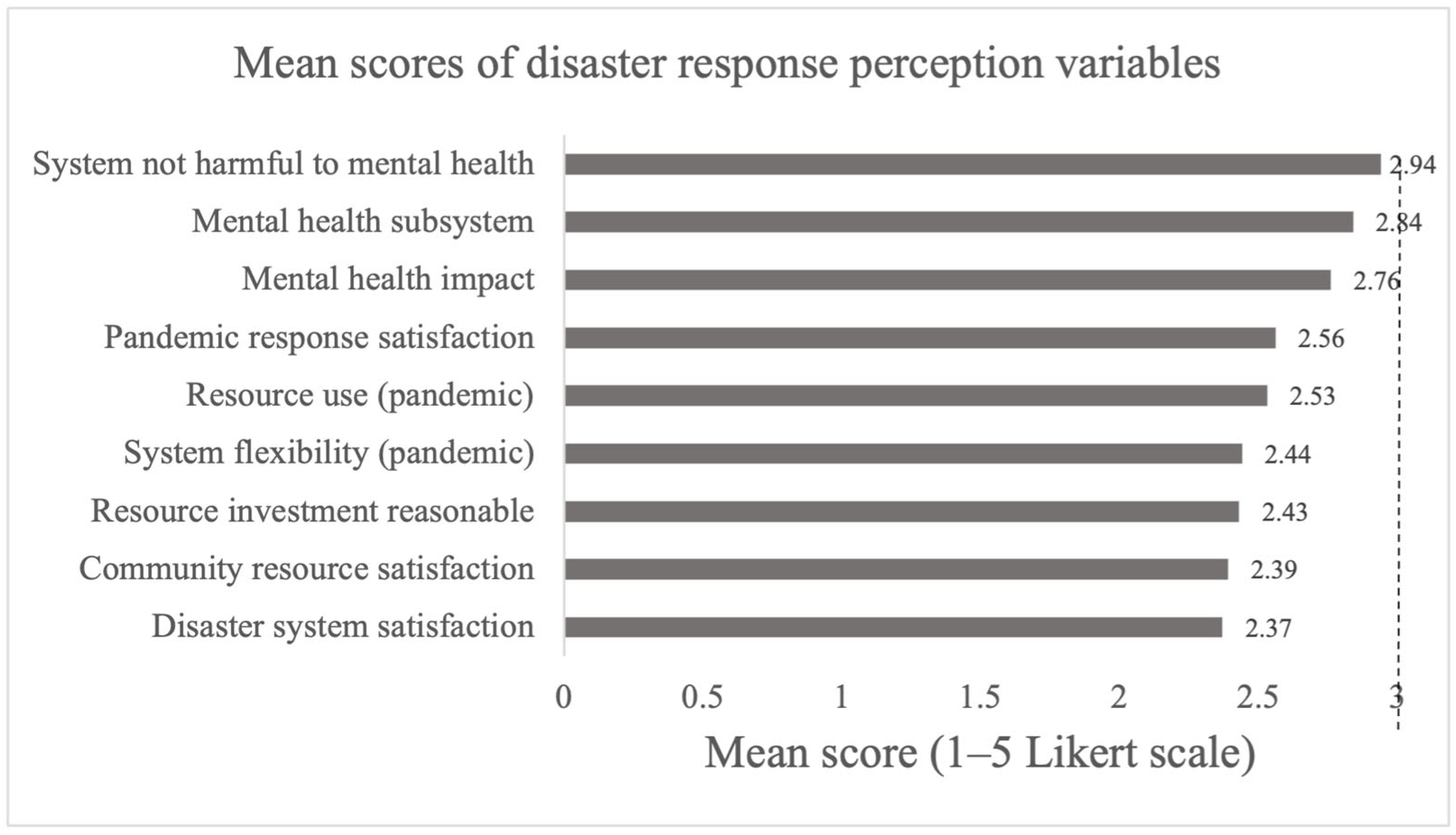
Next, the researcher conducted probability statistics for the other items using a 5-point Likert scale. The mean values of individual items ranged from 2.37 to 2.94, with attitudinal ratings spanning from “Agree/Satisfied” to “Neither Satisfied nor Unsatisfied” (
Table 4). This indicates that respondents are somewhat dissatisfied with the disaster response system, with a variance of between 0.738 and 1.606. The differences in overall satisfaction regarding resource issues in disaster response are influenced by variations in occupation, time in the field, and age.
The item with the most significant variance was Mental health subsystem: “Has your mental health been damaged or affected in response to the pandemic?” This variance primarily stemmed from differences in populations (age and occupation). Other items showed some variation, but not significantly. This suggests that participants of different ages, occupations, and lengths of time in the field generally have consistent feelings about the complex systems of disaster response.
Figure 1 presents the mean scores of key disaster response perception variables, with the dashed line indicating the neutral level (3). All mean scores fall below the neutral level of 3, indicating that respondents did not report strongly positive evaluations of current disaster response arrangements. The lowest mean scores were recorded for disaster system satisfaction (2.37), community resource satisfaction (2.39), and perceived reasonableness of resource investment (2.43), suggesting relatively weak evaluations of overall system performance and resource-related aspects. Although mental health-related items received comparatively higher scores, they remained below the neutral threshold, indicating that respondents did not view mental health integration within disaster response systems particularly positively.
3.1. Descriptive Analysis
The results obtained from the questionnaire revealed a consistent pattern in participants’ responses to questions regarding the state framework. Participants generally agreed (79%) that the government at all levels should be the main initiator and planner of disaster response. Additionally, 91% of respondents concurred that the government should lead strategic constraints and intelligent operations, and 88% believed that the psychological state of citizens should be an essential consideration in developing the national response system.
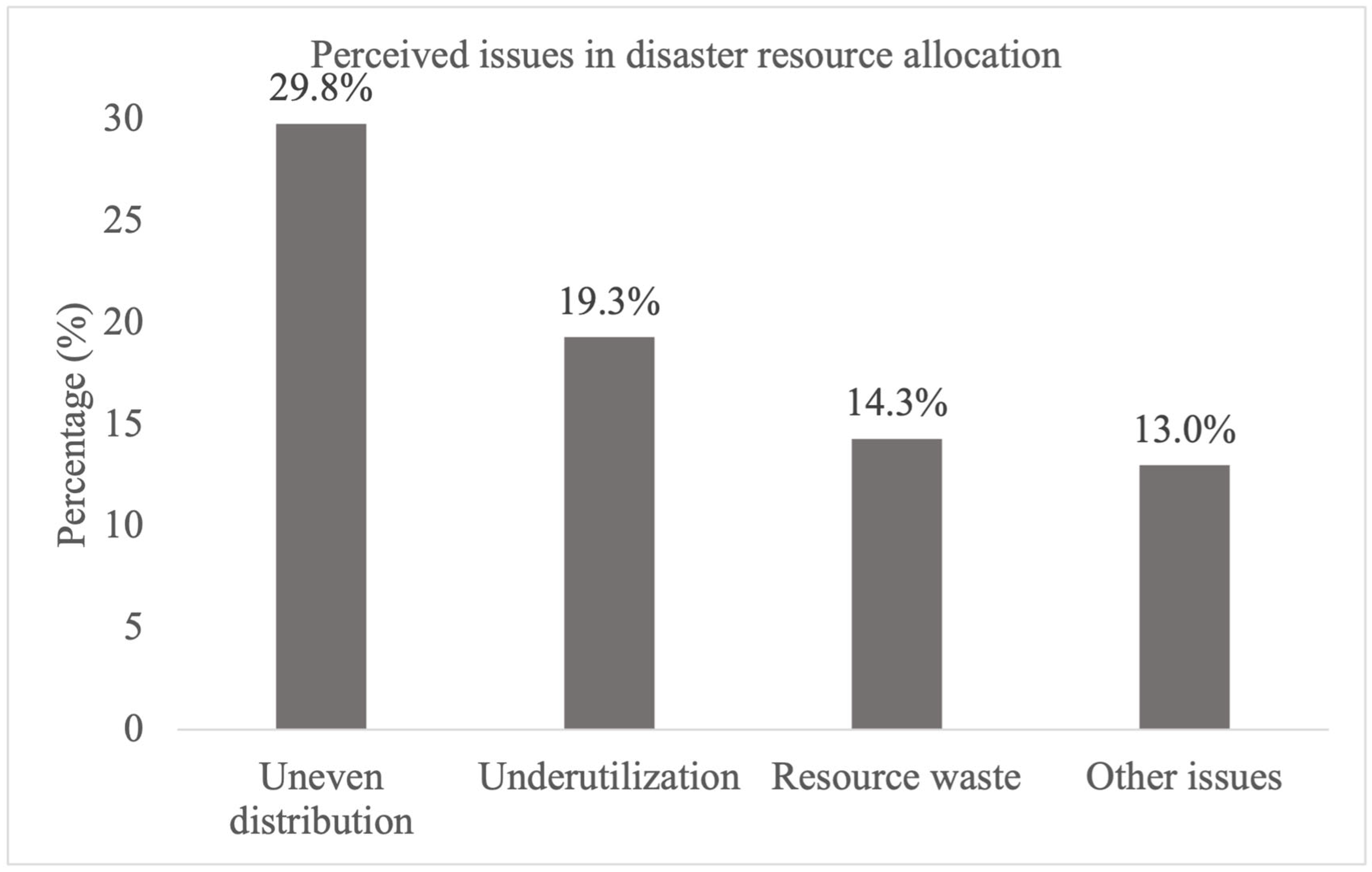
In the Resource Allocation section, the majority of participants (70%) believed that disaster response should be conducted regardless of cost, demonstrating a strong commitment to the cause. Moreover, a vast majority (96.3%) agreed that the allocation and use of resources should be adjusted as the disaster situation is controlled, showing a clear understanding of the dynamic nature of disaster response. However, a significant number of participants (77%) believed that the current disaster response system has issues with resource allocation. Specifically, 29.8% of participants believed that resources are unevenly distributed, 19.3% believed that resources are underutilized, and 14.3% believed that resource wastage occurs (
Figure 2). The remaining 13% of respondents identified other unlisted problems.
In interviews, respondents expressed significant concerns about resource allocation:
“There is a huge problem with resource allocation.”—Interviewee 1
“We know exactly if there is a problem because even I don’t know what the current allocation of resources in the state looks like for disaster response.”—Interviewee 2
“Not enough is allocated to (and, in fact, spent on) the task of preparing rather than responding.”—Interviewee 3
“Unsure as to what resources (and the extent of those resources) we actually have in my community.”—Interviewee 4
“Remote areas and areas with lower socio-economic levels tend to have less access to resource allocation.”—Interviewee 4
“Political and emotional responses often drive our current resource allocations. Resource allocation is often challenging when it comes to really responding to a large disaster or event.”—Interviewee 5
“There could be increased resources and support for local emergency response agencies and community knowledge. This occurs to a degree with Incident Management Teams, but local knowledge is not always taken into account, and community preferences and knowledge are not always recognized.”—Interviewee 6
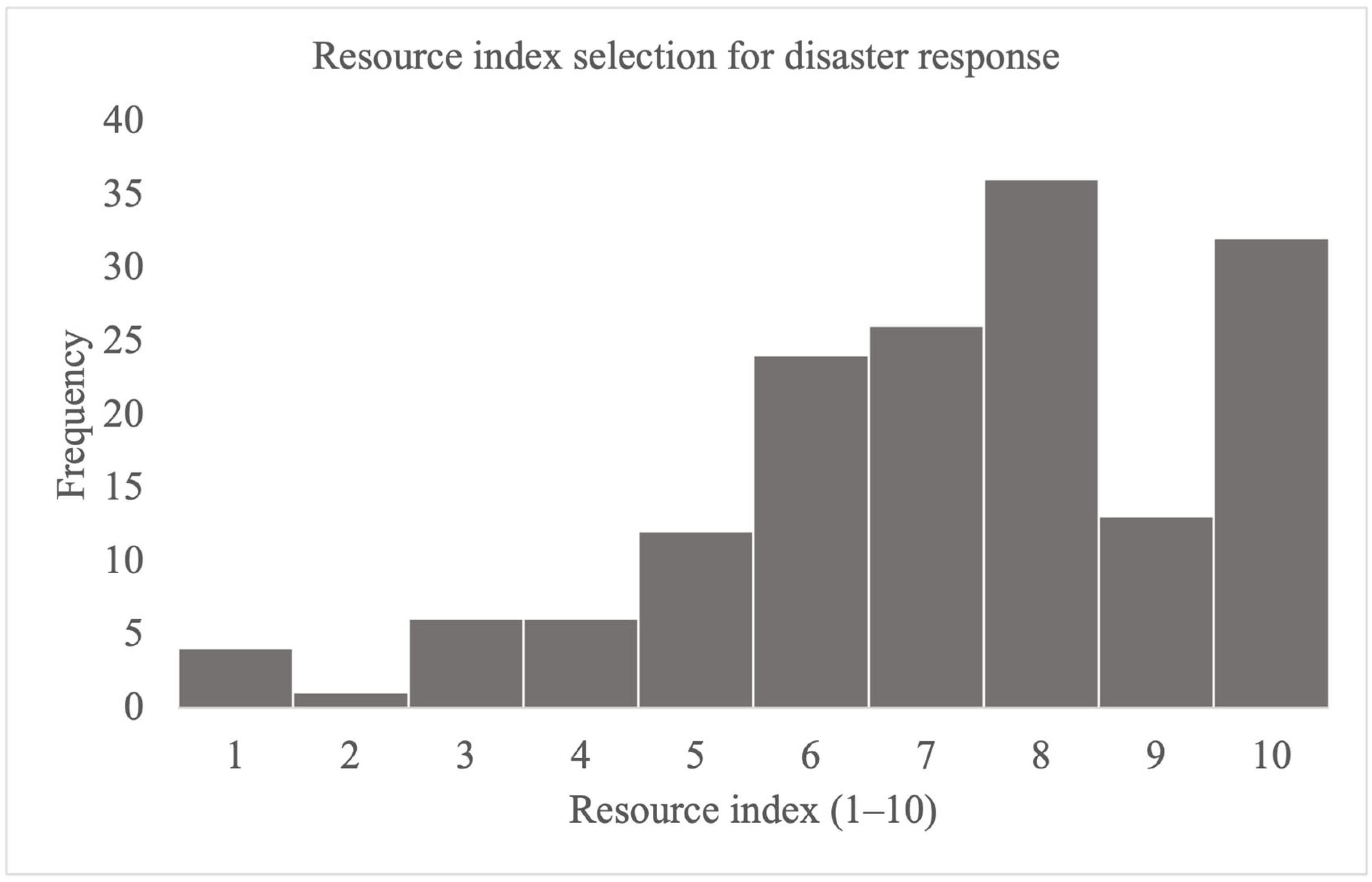
Additionally, many respondents indicated that there is not a single resource issue but rather a combination of problems, including unequal distribution of resources, under-utilization, and waste of resources. To better understand participants’ expectations regarding the level of resource commitment to disaster response, the questionnaire included a resource index ranging from 1 to 10, where 1 represented minimal resource allocation and 10 represented the maximum possible allocation. This item was designed as an exploratory indicator of respondents’ subjective preferences regarding the intensity of resource investment in disaster response, rather than as a standardized measure of resource allocation performance.
As shown in
Figure 3, most participants (81.4%) selected a resource index greater than 5. This indicates that most respondents believe that more than half of the available resources should be devoted to disaster response. Specifically, 19.9% of participants selected the highest value on the scale (Resource Index = 10), indicating support for the maximum level of resource commitment. Overall, these findings suggest that respondents recognized the need for substantial resource investment in disaster response, while also perceiving important weaknesses in the way resources are currently allocated and managed.
3.2. Correlation Analysis
Pearson’s r was used to examine the relationships among the four main analytical dimensions of the study: national framework, resource allocation, satisfaction, and COVID-19-related experience. In the field of disaster response complex systems, the research team employed Pearson’s r to test the relationships among the four investigated aspects: National Framework, Resource Allocation, System Satisfaction, and the Case of COVID-19. As shown in
Table 5, the Pearson correlation analysis examined the relationships among the key study variables, including National Framework, Resource Allocation, System Satisfaction, and COVID-19 response.
First, participant satisfaction with the system had the strongest positive correlation with the COVID-19 response, r (159) = 0.447 **, p < 0.01. This suggests that respondents who evaluated the COVID-19 response more positively also tended to report higher overall system satisfaction.
Second, the practical implications of participants’ satisfaction with the system being more strongly positively correlated with resource allocation, r (159) = 0.311 **, p < 0.01, than with the national framework, r (159) = 0.183 *, p < 0.05, are significant. This suggests that respondents’ perceptions of resource allocation were more closely associated with overall system satisfaction, while the association with the national framework was weaker. Overall, these findings indicate that resource allocation may play a more visible role than the broader governance framework in shaping public evaluations of disaster response performance.
3.3. Regression Analysis
To further investigate the impact of the national framework and resource allocation on satisfaction with the disaster response system, this study conducted a multiple linear regression analysis in SPSS. National framework and resource allocation were entered as independent variables, while system satisfaction was treated as the dependent variable. Although COVID-19-related experience showed the strongest bivariate correlation with system satisfaction, it was not included in the regression model because the purpose of the model was to examine the roles of national framework and resource allocation as general structural predictors of system satisfaction, rather than to estimate the effect of a crisis-specific contextual dimension. In this study, COVID-19-related experience was treated as a contextual dimension used to interpret how public evaluations varied under a specific large-scale crisis, and its relationship with overall satisfaction is discussed further in the Discussion section.
As shown in
Table 6, the regression model was statistically significant and explained a modest proportion of the variance in satisfaction (R
2 = 0.122, adjusted R
2 = 0.110). This indicates that national framework and resource allocation jointly account for 12.2% of the variation in respondents’ satisfaction with the disaster response system. The Durbin–Watson statistic (D.W.) is 1.771. This means that the D.W. test is passed, fulfilling the assumption of the independence of observations.
Table 7 further shows that the regression model was statistically significant (
F (2, 158) = 10.933,
p < 0.001). The notes below the table specify the dependent and predictor variables: resource allocation and the national framework used to test satisfaction with the system.
Table 8 presents the regression coefficients for the model. Holding the other predictor constant, a one-unit increase in national framework was associated with a 0.452-point increase in system satisfaction, while a one-unit increase in resource allocation was associated with a 0.757-point increase. However, the unstandardized coefficient for resource allocation (0.757) was notably larger than that for national framework (0.452), and the standardized coefficient for resource allocation (β = 0.298) was numerically larger than that for national framework (β = 0.159), suggesting a relatively stronger association with system satisfaction, though the difference between the two coefficients was not formally tested and should be interpreted with caution given the modest overall model fit (R
2 = 0.122). This pattern may reflect the possibility that perceptions of resource allocation are more visible and directly experienced by the public during disaster response than broader governance arrangements.
Although the regression model explains only a modest proportion of the variance in system satisfaction, the relative differences between the predictors remain meaningful. In particular, the numerically larger coefficient for resource allocation suggests that respondents may tend to evaluate disaster response systems more on the basis of fairness, adequacy, and flexibility in resource distribution than on broader governance structures, though this pattern should be interpreted as exploratory given the modest variance explained by the model. This may reflect the fact that resource allocation is more directly experienced and more visible to the public during crisis response. By contrast, the national framework may operate at a more institutional level and therefore be less immediately perceptible to respondents.
These findings indicate that strengthening public confidence in disaster response systems requires more than formal governance arrangements. It also requires transparent, responsive, and equitable allocation of resources, as well as greater recognition of mental health-related concerns within disaster governance.
The final regression equation can be expressed as
Equation (1). Regression Equations for Satisfaction with Disaster Response Systems in Australia
where Y is satisfaction with the disaster response system, X
1 is the impact of national frameworks, and X
2 is the impact of resource allocation.
4. Discussion
The findings indicate that respondents in this predominantly South Australian sample reported mixed evaluations of Australia’s disaster response system, but they expressed clear concerns regarding the allocation of resources. Rather than weakening the significance of the study, these patterns highlight the practical value of examining public evaluations of disaster governance, as they reveal where formal disaster response arrangements may fall short in terms of fairness, transparency, and responsiveness. In particular, participants emphasized the need for greater transparency in how resources are distributed and used during disaster response. Qualitative responses further suggested that dissatisfaction was not limited to the amount of resources available, but also related to how fairly, flexibly, and visibly those resources were allocated. This pattern aligns with experimental evidence from Mazepus and van Leeuwen [
14], who found across five countries that governments were perceived as more legitimate when they distributed disaster aid fairly and followed transparent procedures, suggesting that the process of resource allocation, not merely its scale, is central to public evaluations of governance. This helps explain why resource allocation showed a relatively stronger association with system satisfaction than the broader national framework in the regression analysis, as reflected in the numerically larger standardized coefficient (β = 0.298 vs. β = 0.159). This finding is also consistent with Mata et al. [
13], who demonstrated that perceived fairness in resource distribution is closely linked to public trust in government and shapes how citizens evaluate institutional performance more broadly. This pattern of inequitable resource distribution is not unique to Australia. Emrich et al. [
29] found that race/ethnicity and socioeconomic factors systematically predicted disparities in disaster recovery fund allocation in the United States, demonstrating that resource distribution inequities are a persistent structural challenge in disaster governance more broadly. Similarly, de Goër de Herve [
15] argued that justice considerations, including both distributive and procedural fairness, are fundamentally under-addressed in disaster risk management frameworks, further reinforcing the need for more equitable and transparent resource allocation processes.
These findings provide important comparative context for the present study’s finding that Australian respondents perceived significant problems with the fairness and transparency of disaster resource allocation, suggesting that this challenge reflects a wider governance problem rather than being specific to the Australian context. While prior studies have tended to examine resource allocation and governance frameworks as separate factors [
16], the present study contributes to the literature by demonstrating that perceived fairness, flexibility, and visibility of resource allocation emerged as important correlates of public satisfaction in this study, alongside broader formal governance structures.
Furthermore, the qualitative data revealed that respondents were often unaware of how resources were being allocated in their communities, echoing concerns about transparency and local accessibility that Yigitcanlar et al. [
18] identified as persistent challenges in disaster governance contexts. This finding also resonates with broader evidence suggesting that transparency in government operations is a consistent driver of public trust, with cross-national experimental research demonstrating that government transparency significantly shapes public evaluations of institutional trustworthiness [
30,
31], underscoring the importance of making resource allocation processes more visible and accessible to the public during disaster response.
A second important finding concerns the limited integration of mental health within the current disaster response system. This finding is consistent with a broader pattern identified in the literature: despite growing international recognition of the importance of psychosocial wellbeing in disaster governance, mental health and psychosocial support have historically been concentrated in response and recovery phases, with systematic integration into preparedness and risk reduction frameworks remaining limited [
32]. Although respondents were broadly supportive of the system overall, many perceived that mental health remained insufficiently considered, both in system design and in actual crisis response. This concern was particularly evident in responses relating to COVID-19, where a substantial proportion of participants reported negative psychological impacts or viewed mental health support as inadequate. These findings are consistent with those of Clemente-Suárez et al. [
20], who documented the widespread inadequacy of public mental health services in responding to the psychological scale of the COVID-19 crisis, and with Reiriz et al. [
21], who similarly found that mental health support mechanisms within national response frameworks remained insufficient, particularly for vulnerable populations. Evidence from the Australian context further reinforces this pattern; Cowlishaw et al. [
33] found that the compound impact of the COVID-19 pandemic on communities already affected by the Black Summer bushfires exposed significant gaps in long-term mental health support pathways, highlighting the need for multi-component approaches to psychosocial recovery within disaster governance frameworks. Taken together, these findings suggest that disaster response systems should not be evaluated solely in terms of physical protection, logistics, and emergency coordination. While prior studies have examined mental health and disaster governance as largely separate domains [
32], the present study contributes to the literature by treating mental health integration as an evaluative criterion for disaster response performance, and by demonstrating that public perceptions of mental health inadequacy are closely tied to broader dissatisfaction with system design and crisis management, particularly in the context of large-scale compound disasters such as COVID-19.
The results also suggest a gap between general evaluations of the disaster response system and perceptions of its performance during a specific large-scale crisis. Respondents reported lower satisfaction with the COVID-19 response than with the disaster response system more broadly. This discrepancy may indicate that broad institutional confidence does not always translate into equally positive evaluations of system performance in practice. This finding resonates with Chen et al. [
12], whose study of public satisfaction with COVID-19 prevention services found that perceived service adequacy, rather than general institutional trust, was the primary driver of satisfaction evaluations during a crisis. It is also consistent with evidence from Lazarus et al. [
34], whose cross-national survey across 19 countries found that public evaluations of government COVID-19 responses varied substantially and were more strongly associated with perceived performance than with pre-existing levels of institutional trust, suggesting that crisis-specific governance performance plays a critical role in shaping public satisfaction independently of broader institutional confidence. Large-scale crises such as COVID-19 place particular pressure on governance coordination, communication, resource flexibility, and mental health support, thereby exposing weaknesses that may be less visible under normal conditions [
20,
21]. This finding reinforces the importance of testing disaster response systems not only at the level of formal design, but also through their perceived performance in real emergency contexts. While prior studies have largely examined general institutional trust and crisis-specific satisfaction as related but distinct constructs, the present study contributes by demonstrating that this gap is directly observable in public evaluations of Australia’s disaster response system among respondents based primarily in South Australia, and that it is most pronounced in dimensions relating to resource flexibility and mental health support during the COVID-19 response.
From a policy perspective, the findings suggest that strengthening public confidence in disaster response systems requires more than formal governance arrangements alone. Transparent, equitable, and adaptive resource allocation appears especially important for improving public satisfaction [
14,
16]. At the operational level, translating governance priorities into effective resource allocation decisions may also benefit from systematic optimisation approaches. For instance, recent work on infrastructure monitoring has demonstrated how multi-objective optimisation frameworks can enhance deployment efficiency and coverage in disaster risk contexts [
35], pointing to potential directions for operationalising the resource allocation improvements identified in this study. In practical terms, this may involve clearer communication about resource priorities, greater responsiveness to local needs, and stronger recognition of community knowledge in disaster planning and implementation [
18,
22]. These recommendations are consistent with broader calls in the disaster governance literature for multi-level coordination mechanisms that integrate both institutional frameworks and community-level resource management [
36]. In addition, mental health should be more explicitly integrated into disaster governance frameworks, including preparedness planning, crisis communication, and post-disaster support [
32,
33,
37,
38]. Such measures would help improve not only the perceived effectiveness of disaster response systems but also their broader contribution to public resilience and the long-term sustainability of governance systems [
19].
5. Conclusions
This study examined public satisfaction with Australia’s disaster response system by analyzing the roles of national framework and resource allocation within a mixed-methods design, drawing on evidence from a sample based primarily in South Australia. The findings suggest that respondents reported mixed and generally below-neutral evaluations of the overall system, while significant concerns remained regarding the transparency, fairness, and flexibility of resource allocation. These findings are important because they show that public confidence in disaster response systems cannot be inferred simply from the existence of formal governance arrangements; rather, it depends heavily on how governance is experienced in practice, particularly through visible resource allocation and the extent to which psychosocial concerns are addressed. Resource allocation also showed a relatively stronger association with system satisfaction than the broader national framework, as indicated by the numerically larger regression coefficient, highlighting the practical importance of how resources are distributed and experienced during disaster response.
The study further indicates that mental health-related concerns remain insufficiently integrated into current disaster response arrangements, particularly in the context of COVID-19. Overall, the findings underscore the importance of transparent governance, equitable resource allocation, and stronger attention to psychosocial wellbeing in strengthening public confidence in disaster response systems.
These findings carry several practical implications for policymakers and relevant stakeholders. First, for federal and state emergency management agencies, the results suggest that public confidence in disaster response systems is shaped less by the existence of formal governance frameworks than by how visibly and fairly resources are allocated during crises. Policymakers should therefore prioritise the development of publicly accessible resource allocation reporting mechanisms. For example, real-time dashboards or post-disaster expenditure reports that allow communities to see how and where disaster resources are being deployed. Second, for local government and community organisations, the qualitative findings highlight that local knowledge and community preferences are frequently overlooked in resource planning. Stronger consultation mechanisms that incorporate community input into resource prioritisation decisions would help bridge the gap between institutional arrangements and public experience. Third, for national health authorities and disaster management bodies such as the Australian Institute for Disaster Resilience (AIDR), the persistent underrepresentation of mental health in disaster governance frameworks signals a clear need for action. Mental health and psychosocial support should be explicitly embedded in all phases of disaster governance, from preparedness planning and crisis communication to post-disaster recovery, rather than treated as a secondary consideration activated only after physical response needs are met.
Because the empirical sample was based primarily in South Australia, the findings should be interpreted as indicative rather than nationally representative and should be extended to the national level with caution. Future research could expand the geographical scope of the sample and incorporate standardized mental health measures to further examine the relationships between governance, resource allocation, and public satisfaction in disaster response systems.