2.3.1. Upper-Level Model of the Distribution Network
- (1)
Objective Function
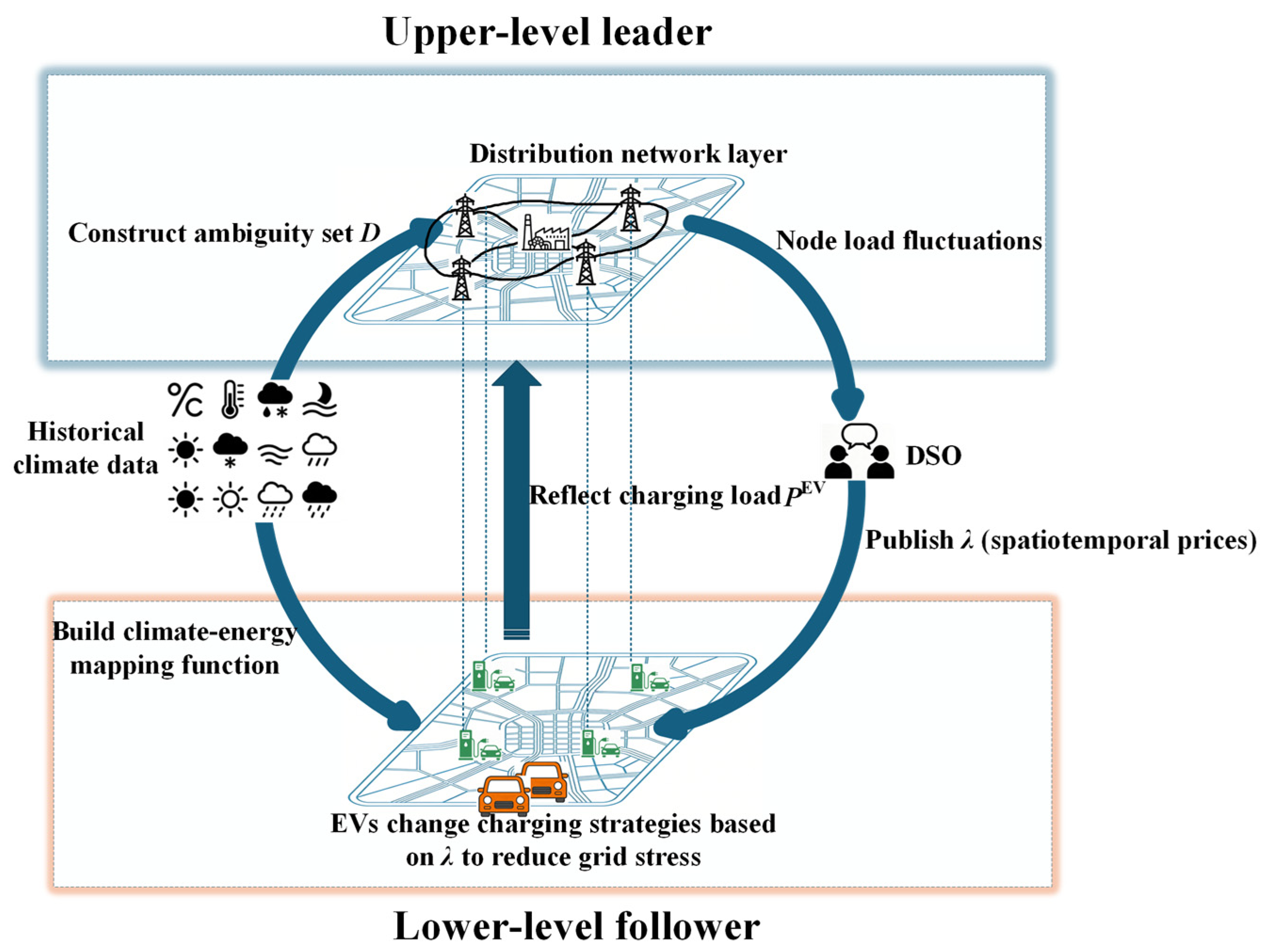
The upper-level model determines spatiotemporal electricity prices to shift charging demand and minimize system operating costs. The problem is formulated as a min–max expected cost problem to ensure cost efficiency under the worst-case climate distribution.
The objective function is given as follows:
where the expected total operating cost
EP consists of three components: the grid purchase cost
Ctgrid, the network loss cost
Ctloss, and the load shedding penalty cost
Ctshed. The detailed formulations of each component are given as follows:
Equation (25) minimizes the expected total cost under the worst-case distribution P ∈ D by optimizing the electricity price λ. Equation (26) represents the grid purchase cost, i.e., the total power purchased by all charging stations Pgrid. Equation (27) gives the network loss cost, determined by the squared branch current l, branch resistance r, and loss coefficient closs. Equation (28) corresponds to the load shedding penalty, where a high penalty coefficient Pshed is imposed on the shed power cP,shed to ensure supply reliability.
It should be noted that the distribution network does not supply conventional loads, and the purchase price from the upstream grid equals the selling price to charging stations (i.e., no price markup). Therefore, the upper-level purchasing cost equals the total purchasing cost of all charging stations, as given in (26).
- (2)
Constraints
To accurately capture the impact of the spatiotemporal distribution of EV charging loads on distribution network operation and to address the uncertainty induced by climate sensitivity, this study adopts a linearized power flow model as the core set of network constraints. The original nonlinear DistFlow model is first presented as follows:
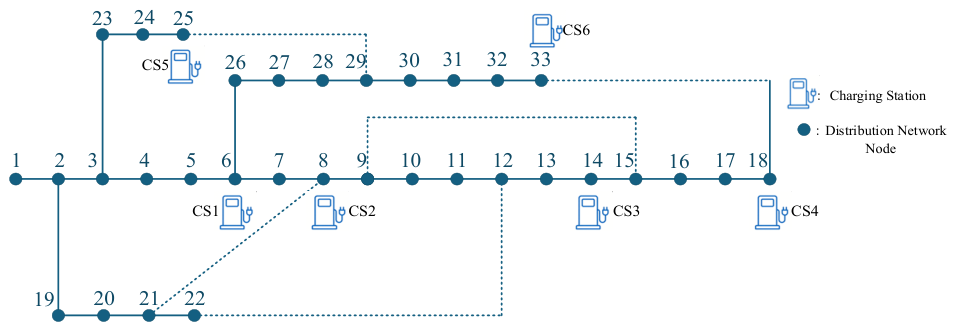
The distribution network is represented by a directed graph Gdn = (Vdn, Adn), where Vdn is the set of buses indexed by j, and Adn is the set of branches indexed by aij from bus i to bus j. Additional indices include charging station k ∈ {1, …, 6}, scenario s ∈ S and time period t ∈ {1, …, 24}. Let Γ−(j) and Γ+(j) be the predecessor and successor sets of node j, respectively. Pij,s,t and Qij,s,t are the active and reactive power flows on aij, Iij,s,t is the current magnitude, and rij and xij are the branch resistance and reactance. and denote the power purchased from the upstream grid, while and are the baseline load forecasts. represents the aggregated EV charging power at node j, determined by lower-level pricing decisions and climate-sensitive demand. Uj,s,t is the voltage magnitude with bounds Umin and Umax, and is the thermal limit of branch aij.
In the original DistFlow model, current, voltage, and power are governed by nonlinear relationships:
The model is accurate but nonconvex and thus computationally challenging. To balance computational efficiency and engineering accuracy, the following linearized approximation is adopted:
Furthermore, for a radial distribution network, the power flow on each branch equals the aggregate load of its downstream nodes. Let
D(
j) denote the set of nodes downstream of node j (i.e., all nodes whose path to the root passes through node
j); then, the active power flow on branch
aij can be expressed as
This recursive relation is implemented via post-order traversal, avoiding iterative computation.
For the voltage, by accumulating (37) along the path from the root node to node
j, an explicit expression for the node voltage is obtained:
where
U0 = 1.0 pu is the root node voltage, and Path (0 →
j) is the set of branches from node 0 to node
j. Considering the high
r/
x ratio in medium- and low-voltage networks and approximating
Q = P·tan
φ, (35) can be simplified as
where
U0,t = 1.0 pu is the root node voltage;
Pbase and
Vbase are the base power and voltage;
α is the aggregate voltage drop coefficient (set to 0.35 in this study);
denotes the total downstream load at node
j;
dj and
dparent(j) are the electrical distances of node
j and its parent node, respectively; Δ
dij is the voltage drop increment along branch (
i,
j); and
κ = tan
φ is the reactive power equivalence coefficient. For the IEEE 33-bus system, the average voltage drop increment is approximately 0.05 pu under typical operating conditions (see also [
34] for related discussions on voltage degradation under high EV penetration).
For network losses, the total active power loss is obtained by summing the resistive losses over all branches:
Under the assumption that the voltage is close to its nominal value, the branch current can be approximated as
Iij,s,t ≈
Pij,s,t/
U0. Combining this with (36), the network loss can be expressed as a function of the root node injection power:
where
ε = 5% is the aggregate network loss coefficient, and
Closs is the loss cost coefficient.
In addition, the spatiotemporal electricity price signals issued by the upper-level distribution network are subject to the following operational constraints:
where
λj,t is the electricity price at node
j and time
t; the price bounds are
= 0.2 and
= 1.0 CNY/kWh; the maximum intertemporal price change Δ
λmax = 0.15;
and
are the average peak and valley prices, respectively; and
δ = 0.25 CNY/kWh is the minimum peak–valley price spread.
2.3.2. Lower-Level Charging Station Model
- (1)
Objective Function
At the lower level, each charging station acts as a price taker, responding to the price
λjk,t set by the DSO to minimize its expected cost under uncertainty. The problem is formulated as a single-stage stochastic program:
The operating cost of each charging station consists of two components: the electricity purchasing cost, determined by the price λjk,t, and the load curtailment penalty cost, weighted by the coefficient ccurt.
It should be noted that battery degradation costs are not considered in the current model, which is a simplified assumption.
- (2)
Constraints
The charging station is subject to power balance, energy storage dynamics (charging/discharging limits, capacity, and state of charge), and grid interaction capacity constraints. The constraints are given as follows:
where
,
, and
denote the grid purchase, discharging, and charging power, respectively,
and
are the EV charging demand and fixed load;
is the curtailed power;
ηch and
ηdis are the charging and discharging efficiencies; Δ
t is the time interval;
is the maximum charging power;
SOCk,s,t is the state of charge;
is the rated storage capacity;
and
are the SOC bounds;
and
are the storage and grid power limits; and
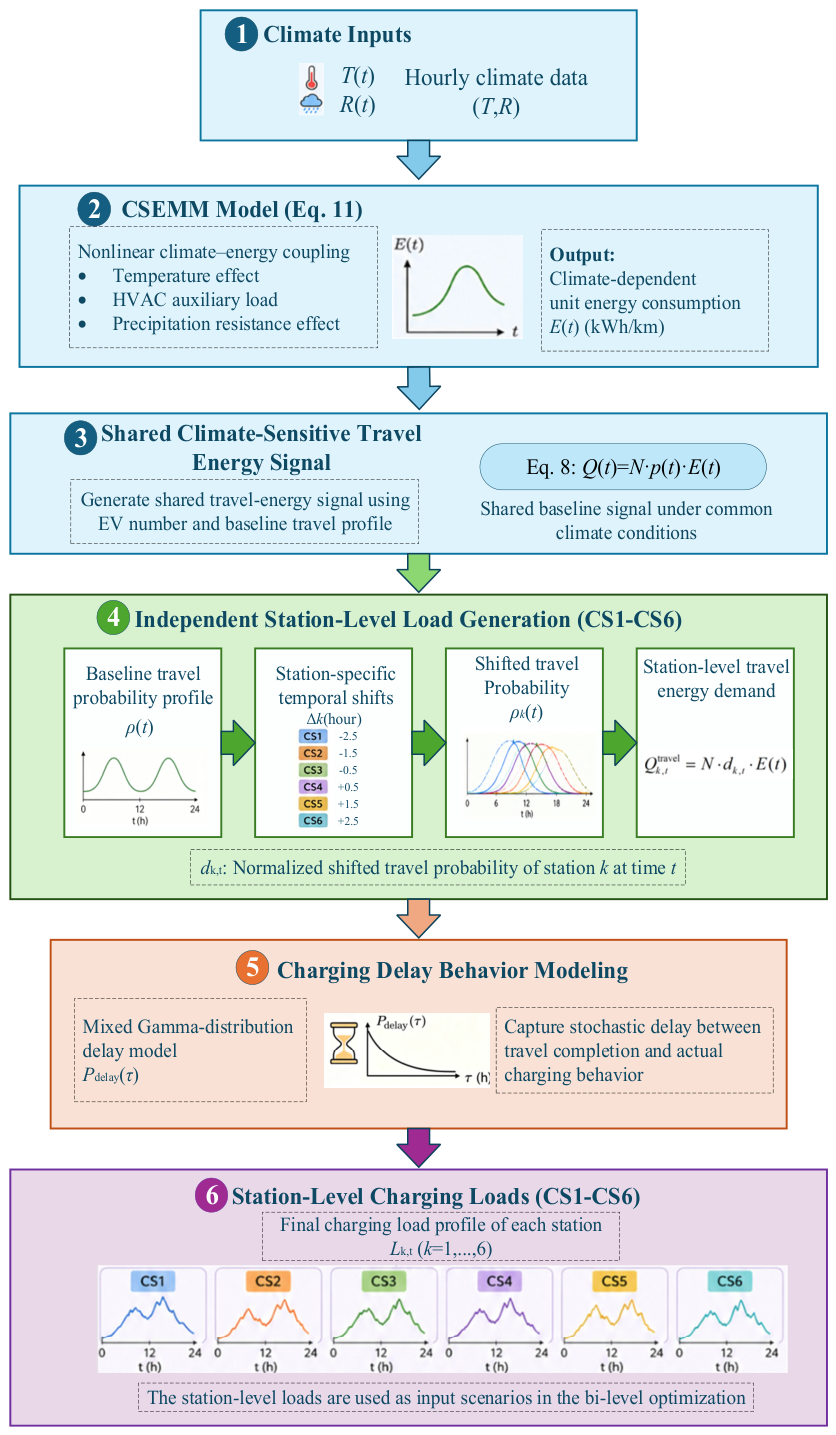
denotes the climate-sensitive charging demand obtained from (11).
2.3.3. Solution Methodology
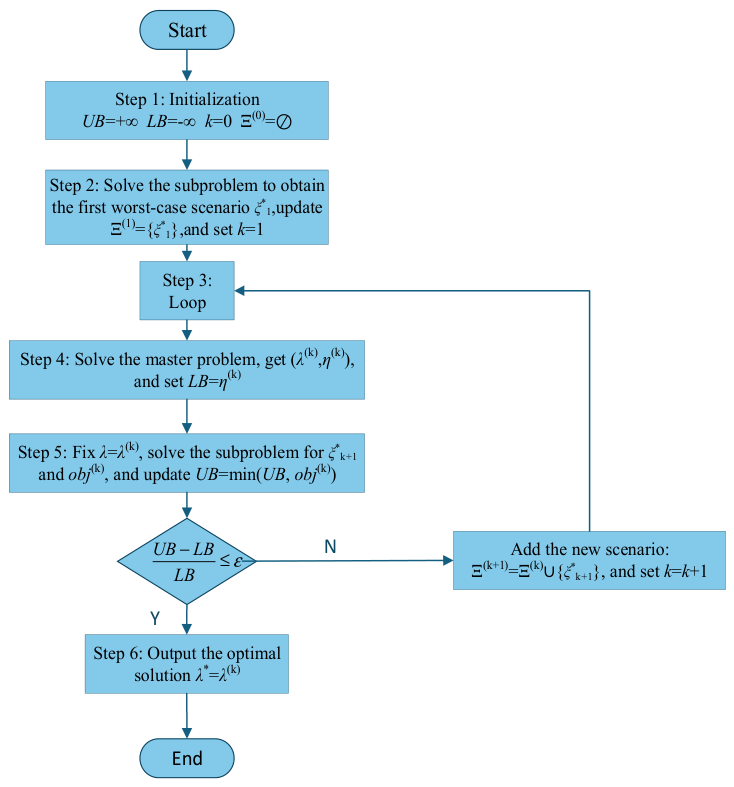
To address the min–max–min structure, a KKT-based C&CG solution framework is proposed: the lower-level problem is reformulated via KKT conditions into a single-level problem, which is then solved iteratively using C&CG to obtain the optimal pricing and operational strategy [
35,
36].
- (1)
Transformation of the Bi-Level Model into an MPEC Problem
The lower-level Lagrangian is constructed as a weighted sum of (42) and (43)–(49). The nonlinear complementary slackness conditions are then linearized [
37]. Taking the charging power constraint as an example, the corresponding complementary slackness condition is given by
where
μ denotes the associated Lagrange multiplier. By introducing a big-M formulation and an auxiliary binary variable
z ∈ {0, 1}, the above nonlinear condition can be linearized as
where
M is sufficiently large. Other complementary slackness conditions are handled analogously. The bi-level model is thus reformulated as a single-level MPEC with linear constraints and integer variables.
- (2)
Distributionally Robust Objective Handling
Master problem: Given a finite set of identified worst-case scenarios Ξ(
k)
= {
, …,
}, where
k denotes the iteration index, the master problem is formulated as a deterministic mixed-integer linear program (MILP):
where
x denotes the distribution network decision variables;
a is the associated cost coefficient vector;
η is an auxiliary variable; Ξ
(k) is the set of worst-case scenarios at iteration
k, with
ξ representing a scenario and
as its probability weight; and
Q(
x,
ξ) is the operating cost obtained from the lower-level problem given
x and
ξ.
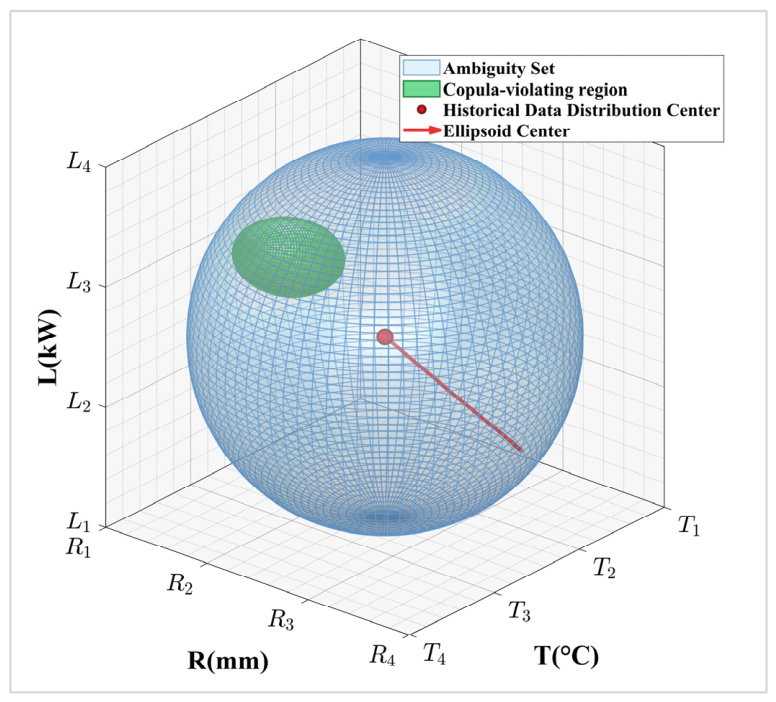
Subproblem: The subproblem seeks the worst-case probability distribution within the ambiguity set
D that maximizes the total system cost. Embedding
D into the lower-level model yields
Since uncertainty is represented by a finite set of
N discrete historical scenarios, the distribution
P ∈
D can be parameterized by scenario probabilities
pi (
i = 1, 2, …,
N). Under this discretization, the Wasserstein constraint is linearized via a joint probability matrix
πij, and the Copula distance constraint can be expressed as linear inequalities in
pi. The subproblem constraints thus reduce to the following linear program:
where
pi denotes the probability weight of scenario
i;
πij is an element of the joint probability matrix, representing the joint probability between the
i-th sample of the empirical distribution
PN and the
j-th sample of distribution
P;
d(
ξi,
ξj) denotes the distance between scenarios
i and
j, defined in this study as the absolute difference in total charging load; and
dC(
,
Cξi) is the Copula distance, computed according to (20)–(23). A detailed proof of the linearity of the Copula constraint in scenario probabilities is provided in
Appendix B.
Based on the above reformulation, the subproblem can be converted into a linear program defined over historical samples. Solving the subproblem yields a worst-case climate scenario
that maximizes the objective value, along with the corresponding optimal value
. This value represents the maximum expected cost under the current decision
λ(k) and thus serves as an upper bound on the optimal value of the original problem, i.e.,