Article

Leadership Competency and Sustainable Performance in Emerging Markets: A Dual-Pathway Perspective


by
Awraris Yemane
*,
Getie Andualem
and
Abraraw Chane
School of Commerce, College of Business and Economics, Addis Ababa University, Addis Ababa P.O. Box 1176, Ethiopia
*
Author to whom correspondence should be addressed.
Sustainability 2026, 18(12), 5895; https://doi.org/10.3390/su18125895 (registering DOI)
Submission received: 28 April 2026 / Revised: 25 May 2026 / Accepted: 28 May 2026 / Published: 9 June 2026
(This article belongs to the Section Sustainable Management)

Abstract

Leadership competency is critical for sustainable organizational performance, yet the mechanisms driving this relationship in high power distance (HPD) emerging markets remain underexplored. Western-centric models predominantly emphasize employee engagement, often overlooking contextual institutional and cultural pathways. This study tests a dual-pathway model wherein leadership competency influences sustainable performance via psychological activation (employee engagement) and institutional embedding (organizational culture). Three-wave, multi-source data were collected from 215 leadership units in Ethiopia’s commercial banking sector and analyzed using structural equation modeling (5000 bootstrap resamples) and dominance analysis. Results reveal statistically significant but modest indirect effects. Among the two mediators, the institutional pathway (organizational culture) transmits approximately twice the relative influence of the psychological pathway (employee engagement): 24.8% versus 11.1% of total effect (β = 0.058, 95% CI [0.014, 0.109] versus β = 0.026, 95% CI [0.010, 0.046]). Dominance analysis, computed over the two mediators only, indicates culture’s greater relative explanatory weight (68.2% versus 31.8%, p = 0.003). However, leadership competency retains a substantial direct effect (64.1% of total effect), meaning the dual pathways collectively account for only 35.9% of leadership’s total influence. A robustness test using archival performance data alone yields a smaller but directionally consistent institutional indirect effect (β = 0.041, 95% CI [0.009, 0.078]), while the psychological pathway becomes non-significant, suggesting that the institutional route is robust but modest once perceptual common-source variance is removed. These findings contextualize engagement-dominant Western models by demonstrating that cultural embedding operates as a relatively stronger mediator in HPD settings. The modest absolute mediation effects and persistent direct path highlight the need for context-sensitive leadership development and suggest that additional institutional or capability-driven mechanisms warrant future investigation.

1. Introduction

Organizational sustainability has evolved from a peripheral corporate social responsibility initiative to a central strategic imperative, requiring regenerative performance that balances economic viability, social equity, and environmental stewardship [1,2]. Within this landscape, sustainability leadership diverges from traditional paradigms by integrating triple-bottom-line considerations into long-term strategic decision-making [3,4]. In commercial banking, for instance, sustainability leaders must simultaneously navigate profitability targets, regulatory compliance, financial inclusion mandates, and green lending standards [5,6]. While leadership competency (LC) is widely recognized as a critical driver of sustainable organizational performance (SOP), the mechanisms transmitting this influence remain theoretically fragmented and empirically underspecified [7,8]. Meta-analytic evidence indicates that leadership accounts for 21–35% of variance in performance outcomes, yet the relative potency of specific transmission pathways remains contested [9,10].
This theoretical fragmentation is compounded by a persistent Western-centric bias. Dominant leadership-for-sustainability (LfS) models predominantly privilege employee engagement (EE) as the primary transmission mechanism, often overlooking the institutional realities of high power distance emerging markets (HPD-EM) [11,12]. In HPD-EM contexts—characterized by entrenched hierarchical authority, institutional voids, and relational governance—leadership dynamics operate under fundamentally different coordination logics than in low power distance settings [13,14,15]. Current LfS research typically examines psychological and institutional mechanisms in isolation, neglecting their potential complementarity within specific contextual ecologies [16,17]. Job demands–resources (JD–R) theory posits that leadership enhances performance through psychological activation by provisioning resources such as autonomy, feedback, and socio-emotional support [18,19]. Conversely, institutional theory suggests leadership shapes performance by embedding sustainability norms into organizational culture (OC), creating taken-for-granted frameworks that ensure legitimacy and endurance across transitions [20,21]. While psychological pathways often dominate in Western, low power distance contexts due to cultural emphasis on autonomy and intrinsic motivation [22], cultural embedding may assume relatively greater importance in HPD-EM settings where hierarchical legitimacy and informal coordination substitute for attenuated formal institutions [15,23]. The failure to test these pathways simultaneously within non-Western, institutionally complex contexts represents a critical gap that limits the generalizability of LfS theory.
To address this gap, we propose and test a dual-pathway model of leadership-for-sustainability. Our theoretical architecture positions the resource-based view (RBV) as the foundational lens framing LC as a strategic organizational resource [24]. JD–R theory and institutional theory then operate as complementary mechanism-specific lenses: JD–R explicates the proximal psychological pathway (LC → EE → SOP), while institutional theory explicates the distal structural pathway (LC → OC → SOP). We adopt a critical realist ontological stance not as a methodological claim, but as an interpretive lens to distinguish between observed outcomes (the actual), measured constructs (the empirical), and the underlying generative mechanisms (the real) that operate within HPD institutional contexts [25,26]. The study is situated in Ethiopia’s commercial banking sector, a theoretically revelatory context for three reasons: (a) Ethiopia exhibits high power distance (PDI ≈ 70), (b) the sector operates amid institutional voids including incomplete regulatory enforcement and underdeveloped green finance infrastructure, and (c) sustainability pressures are intensifying through National Bank of Ethiopia Green Banking Directives [5,6].
Drawing on three-wave, multi-source data from 215 leadership units, we pursue three objectives: (1) to examine whether LC influences SOP through EE, OC, or both pathways simultaneously; (2) to determine which pathway exerts relatively stronger influence using formal dominance analysis computed over the two mediators only; and (3) to explain how high power distance cultural schemas and institutional voids recalibrate mechanism potency. Consistent with recent calls for mechanism-based leadership research [7], these objectives are tested through four pre-specified hypotheses (detailed in Section 2): a direct positive association between LC and SOP (H1); mediation via EE (H2); mediation via OC (H3); and parallel mediation with a relatively stronger indirect effect via OC than EE (H4). We explicitly note that this “relative dominance” claim refers to pathway weighting between two modest indirect effects, not absolute dominance over the total effect. Analytical decisions regarding control variables, estimator selection, and dominance partitioning were specified prior to model estimation to ensure transparency.
This study advances LfS scholarship in four ways. First, unlike prior research examining psychological and institutional mechanisms in isolation, we test them simultaneously within a single integrated model, enabling formal comparison of relative potency. Second, we reconceptualize HPD not as a moderating boundary condition that attenuates Western effects, but as a constitutive structural context that recalibrates pathway transmission. Third, our methodological design—three-wave, multi-source data with 5000 bootstrap resamples and formal dominance analysis—mitigates common method bias and provides a rigorous statistical test of pathway weighting [27,28]. Fourth, our focus on Ethiopia’s commercial banking sector addresses a persistent geographic and sectoral gap in sustainability leadership research, despite the region’s acute institutional complexity and rapid economic transformation [12,22].
As detailed in the results, structural equation modeling reveals small but statistically significant indirect effects: among the two mediators, OC transmits approximately twice the relative influence of EE (24.8% versus 11.1% of the total effect; β = 0.058 versus β = 0.026), while a substantial direct effect persists (64.1%), leaving the majority of leadership’s influence unexplained by the two mechanisms—a point we return to in the limitations. A robustness test using archival performance data alone yields a smaller but directionally consistent institutional indirect effect (β = 0.041, 95% CI [0.009, 0.078]), while the psychological pathway becomes non-significant, suggesting that the institutional route is robust but modest once perceptual common-source variance is removed. These findings contextualize engagement-dominant Western models by demonstrating that cultural embedding operates as a relatively stronger mediator in HPD settings. However, the modest absolute mediation magnitudes and persistent direct path underscore the need for realistic expectations regarding organizational interventions. The study advances mechanism-based leadership theory by specifying boundary conditions for pathway dominance, contributes to contextualized management scholarship by treating HPD as a constitutive causal structure, and offers pathway-aligned leadership development guidance for institutionally complex emerging markets.

2. Theoretical Framework and Hypotheses Development

2.1. Theoretical Architecture: An Integrated Mechanism-Based Model

To explain how leadership competency (LC) influences sustainable organizational performance (SOP), this study integrates three complementary theoretical lenses. Rather than treating them as competing frameworks, we deploy them as mechanism-specific explanations operating at distinct analytical levels (Table 1).
While each tradition offers explanatory power, their isolation in extant literature has produced fragmented insights [16,17]. RBV identifies strategic resources but under-specifies transmission mechanisms [29]. JD-R captures psychological activation but assumes institutional stability [18]. Institutional theory explains structural persistence but often overlooks leadership agency [30]. By integrating these lenses, we specify two distinct generative mechanisms through which LC produces SOP: psychological activation (via EE) and institutional embedding (via OC). Their relative potency is not fixed but contextually contingent upon macro-institutional conditions.
Recent scholarship on corporate governance and sustainability disclosure further underscores the importance of integrated theoretical frameworks. Mubeen et al. [31] systematically review the nexus between corporate governance mechanisms and sustainability disclosure, demonstrating that governance quality moderates the translation of leadership intent into transparent sustainability practices. This reinforces our mechanism-based approach: institutional factors (governance, disclosure norms) interact with leadership competency to shape organizational outcomes.
Ontologically, we adopt a critical realist perspective [25,26] as an interpretive lens that distinguishes between the empirical (measured constructs), the actual (observed events), and the real (underlying mechanisms with causal powers). This stance grounds our claim that EE and OC represent real generative mechanisms rather than mere statistical artifacts, while acknowledging that our empirical strategy (CB-SEM) operates at actual/empirical levels and does not employ qualitative retroductive methods [32].

2.2. Contextual Boundary: High Power Distance Emerging Markets (HPD-EM)

HPD-EM contexts constitute a distinctive macro-institutional configuration defined by three interlocking features: (a) entrenched hierarchical cultural schemas that legitimize asymmetric authority [33,34], (b) pervasive institutional voids creating governance gaps [15], and (c) relational governance norms that substitute for weak formal structures [14]. This context is not a moderating variable; it fundamentally recalibrates leadership transmission pathways.
In HPD-EM settings (e.g., Ethiopia, PDI ≈ 70), subordinates expect directive guidance, hierarchical legitimacy is culturally normalized, and upward voice is often constrained [22,35]. Consequently, psychological activation manifests as bounded engagement—expressed through loyalty-driven diligence, affective trust in authority, and relational reciprocity rather than autonomous voice or critical advocacy [36,37]. Simultaneously, institutional voids force organizations to internalize coordination functions, elevating organizational culture as a primary governance substitute [15,23]. Hierarchical authority further accelerates norm diffusion, enabling leaders to rapidly imprint sustainability values into cultural routines [34]. This contextual ecology predicts that cultural embedding will exert relatively greater transmission potency than psychological activation in HPD-EM environments.

2.3. Direct Effect of Leadership Competency on Sustainable Performance (H1)

RBV asserts that sustained competitive advantage derives from valuable, rare, inimitable, and organizationally supported resources [24,38]. LC satisfies these VRIN criteria, equipping leaders to sense sustainability opportunities, allocate strategic resources, and reconcile stakeholder interdependencies under uncertainty [39,40]. In HPD-EM contexts, centralized authority and weak external governance amplify leaders’ discretionary influence, enabling LC to function as an endogenous substitute for institutional voids [12,15]. Competent leaders directly shape sustainability outcomes through high-stakes decisions in capital allocation, risk management, and green finance implementation, independent of mediated pathways.
Hypothesis 1 (H1):
Leadership competency is positively and directly associated with sustainable organizational performance in HPD-EM organizations.

2.4. Psychological Pathway: LC → Employee Engagement → Performance (H2)

JD-R theory posits that job resources—autonomy, feedback, social support—stimulate motivational gain processes culminating in employee engagement, which drives performance through discretionary effort and proactive problem-solving [19,41]. Meta-analytic evidence identifies leadership quality as a primary antecedent of engagement (ρ ≈ 0.51), with longitudinal studies confirming temporal causality [10,42]. LC structures meaningful work conditions, activating vigor, dedication, and absorption [43]. Engaged employees subsequently demonstrate stronger environmental commitment and extra-role effort supporting sustainability initiatives [44,45]. In HPD contexts, this pathway remains theoretically valid but operates within culturally bounded parameters that prioritize executional reliability over exploratory voice [22].
Hypothesis 2 (H2):
Employee engagement mediates the relationship between leadership competency and sustainable organizational performance in HPD-EM organizations.

2.5. Institutional Pathway: LC → Organizational Culture → Performance (H3)

Institutional theory explains organizational persistence through regulative, normative, and cognitive pillars [20,46]. Organizational culture functions as the meso-level mechanism that translates episodic leadership intent into durable, self-reinforcing practices. When sustainability values become institutionalized through shared norms and behavioral routines, organizations maintain performance across leadership transitions and environmental fluctuations [47,48]. Leaders act as institutional entrepreneurs, embedding sustainability through symbolic signaling, visible role modeling, and consistent incentive alignment [30,49]. In emerging markets characterized by institutional voids, culture substitutes for weak external governance, coordinating behavior through internalized norms rather than regulatory enforcement [15,21]. Hierarchical legitimacy in HPD contexts further accelerates cultural imprinting, enabling leaders to rapidly institutionalize sustainability priorities as taken-for-granted organizational logic [23,34].
Hypothesis 3 (H3):
Organizational culture mediates the relationship between leadership competency and sustainable organizational performance in HPD-EM organizations.

2.6. Parallel Mediation and Relative Pathway Dominance (H4)

Both psychological (EE) and institutional (OC) pathways operate simultaneously and are conceptually complementary. However, in HPD-EM settings, three factors predict the institutional pathway will exhibit relative dominance—a statistically stronger indirect effect—while acknowledging that both effects are expected to be modest in absolute magnitude:
  • Hierarchical authority accelerates norm diffusion and cultural imprinting, making institutional embedding more efficient than in low power distance contexts [34].
  • Institutional voids increase organizational reliance on internal cultural mechanisms as primary coordination devices, reducing the relative utility of purely psychological activation [21].
  • Culture possesses enduring structural properties that stabilize performance across transitions, whereas engagement is more proximal and context-dependent [26,50].
We acknowledge an alternative sequential specification (LC → OC → EE → SOP), wherein culture shapes subsequent engagement. While theoretically plausible, our parallel specification is justified by the three-wave design with consistent 4–6 week lags, which aligns with JD-R’s rapid motivational activation timeline but may under-detect slower cultural evolution [47]. We explicitly address this temporal constraint as a limitation and propose sequential testing as a priority for future longitudinal research.
Hypothesis 4 (H4):
Employee engagement and organizational culture jointly and in parallel mediate the relationship between leadership competency and sustainable organizational performance (H4a). Furthermore, the indirect effect via organizational culture will be statistically significantly stronger than the indirect effect via employee engagement (H4b)—a relative claim regarding pathway weighting between two modest indirect effects, not an assertion of absolute dominance over the total effect.

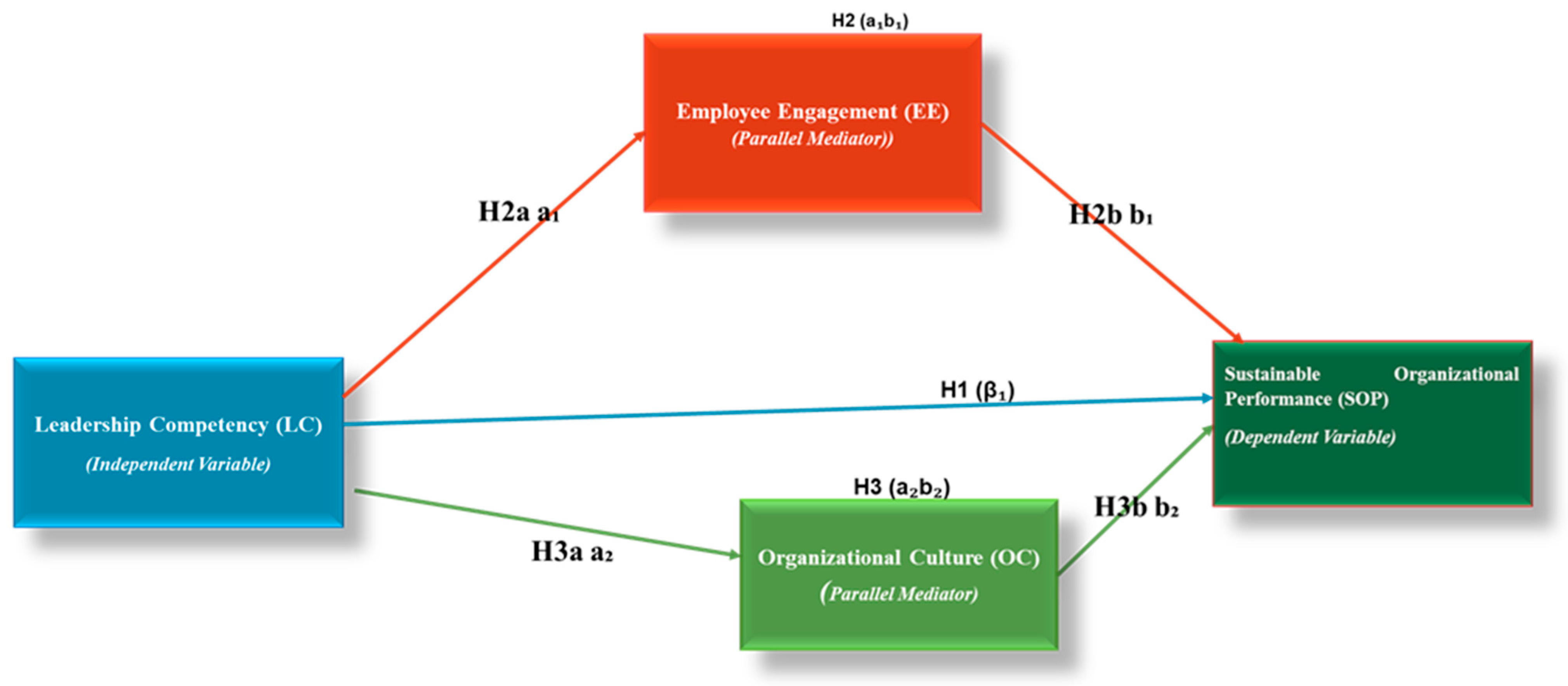
2.7. Conceptual Model

Figure 1 presents the dual-pathway conceptual model. The model specifies two distinct mediating mechanisms: a psychological activation pathway (LC → EE → SOP) and an institutional embedding pathway (LC → OC → SOP), alongside a direct unmediated effect (LC → SOP). Grounded in RBV, JD-R, and institutional theory, and adopting a critical realist interpretive lens, the model enables formal comparison—via dominance analysis computed over the two mediators only [27,28]—of the relative strength of the two pathways. The framework is explicitly bounded to HPD-EM environments, where we predict institutional relative dominance (H4b) while acknowledging contextual and temporal boundary conditions.

3. Materials and Methods

3.1. Research Design and Context

This study employs a three-wave, multi-source dyadic design to test the dual-pathway model of leadership-for-sustainability in Ethiopia’s commercial banking sector—a theoretically revelatory high power distance emerging market (HPD-EM) setting characterized by hierarchical authority (Hofstede PDI ≈ 70), institutional voids, and evolving sustainability mandates [16,51].
Contextual Justification. Ethiopia’s banking sector was selected for three theoretically grounded reasons. First, Ethiopia’s PDI of 70 reflects strong acceptance of hierarchical order and directive leadership [52], enabling rigorous testing of HPD boundary conditions. Second, inconsistent regulatory enforcement creates conditions where internal cultural mechanisms substitute for weak external governance [6,23]. Third, the 17 participating banks (1 state-owned Tier 1, 8 established private Tier 2, 8 emerging private Tier 3) represent >95% of formal financial assets, ensuring comprehensive sampling and external validity within the HPD-EM category [53,54]. The National Bank of Ethiopia’s Green Banking Directive (SBB/91/2024) provides a natural sustainability mandate, transforming sustainability from discretionary to strategic [55].
Unit of Analysis Clarification. A “leadership unit” is defined as a branch or equivalent operational unit (e.g., district office, customer service hub) headed by a single branch manager. Units were eligible if they had operated continuously for ≥12 months, employed ≥4 staff, and reported independently to headquarters. The 215 units represent an average of 12.6 units per bank (range: 4–31), with 5.16 subordinate raters per leader (range: 3–6). This unit-level aggregation aligns with our hypotheses concerning team-level culture and engagement. We acknowledge banks represent a potential clustering level; multi-level modeling would be an alternative specification (addressed in Limitations).

3.2. Philosophical Stance: Critical Realism as Interpretive Lens

This study adopts a critical realist (CR) ontological stance [25,26] as an interpretive lens distinguishing between the empirical (measured survey responses), the actual (observed organizational events), and the real (underlying mechanisms: leadership competency, institutional voids, cultural schemas). CR informs our claim that employee engagement and organizational culture represent real generative mechanisms rather than mere statistical artifacts. Consistent with reviewer guidance, we do not claim to conduct full retroductive analysis, as this would require qualitative anomaly investigation beyond our survey design. Our empirical strategy remains confirmatory (hypothesis testing via CB-SEM), while CR provides ontological grounding for mechanism-based theorizing.

3.3. Sample and Data Collection

Data were collected from 215 leadership units across 17 commercial banks in Ethiopia, representing >95% of formal financial assets [51]. Within each unit, one leader and 3–6 subordinates participated, yielding 581 matched leader–subordinate dyads and 1109 subordinate responses (mean = 5.16 raters per leader). Subordinate response rate was 92.4% (1109/1200); leader response was 100%.
To mitigate common method bias and establish temporal precedence, data were collected in three waves with 4–6-week intervals [19,56]:
  • Time 1 (T1): leaders reported leadership competency (LC) and demographic controls.
  • Time 2 (T2, +4–6 weeks): subordinates reported employee engagement (EE) and organizational culture (OC).
  • Time 3 (T3, +4–6 weeks): leaders reported perceptual sustainable organizational performance (SOP), supplemented by archival indicators.
Temporal Limitation Acknowledgment. We recognize that 4–6-week intervals may be insufficient for organizational culture change, which canonically evolves over years [47,57]. This design likely under-detects cultural change while appropriately capturing engagement fluctuations. Thus, our finding of OC relative dominance may be conservative; longer intervals might reveal even stronger cultural effects. We return to this in Limitations.

3.4. Measures and Operationalization

All constructs were measured using validated scales adapted through a four-phase protocol: expert content validation, bilingual cognitive interviewing (Amharic/English), pilot testing (N = 50 dyads), following van de Vijver and Leung [58].
Leadership Competency (LC). Measured using a 20-item scale adapted from the Leadership Competency Inventory [59,60], assessing four sub-dimensions: cognitive (5 items), interpersonal (5 items), intrapersonal (5 items), and sustainability-oriented decision-making (5 items). Reliability: Cronbach’s α = 0.96, composite reliability (CR) = 0.95. We acknowledge that α = 0.96 is high; confirmatory factor analysis confirms a higher-order structure with sub-dimension loadings ranging 0.78–0.91, indicating the high α reflects true shared variance across related competencies rather than item redundancy (Table 2).
Employee Engagement (EE). Assessed via the 9-item Utrecht Work Engagement Scale (UWES-9) [43], capturing vigor, dedication, and absorption (α = 0.93, CR = 0.92).
Organizational Culture (OC). Measured using the 12-item Denison Organizational Culture Survey short form [61], adapted for sustainability orientation (α = 0.91, CR = 0.90).
Sustainable Organizational Performance (SOP). Operationalized as a hybrid index combining perceptual and archival indicators.
  • Perceptual component (12 items, α = 0.89): Leaders rated economic (4 items), social (4 items), environmental (2 items), and integration (2 items) dimensions on a 7-point Likert scale.
  • Archival component: Three indicators obtained from NBE regulatory filings and bank annual reports (2024–2025): (a) return on equity (ROE)—profitability; (b) non-performing loan ratio (NPL)—risk quality (reverse-coded); (c) green lending portfolio ratio (green loans/total loans)—environmental performance.
Hybrid index aggregation rule. For each unit, we (1) standardized the perceptual composite score (M = 0, SD = 1), (2) standardized each archival indicator, (3) averaged the three archival z-scores into a single archival composite, and (4) averaged the perceptual z-score and archival z-score into the final hybrid SOP index. This equal-weighting approach balances subjective and objective dimensions without imposing theoretical priors about relative importance.
Unit-level archival data justification. We acknowledge that banks rarely publish branch-level ROE or NPL. Following NBE reporting requirements, banks submit unit-level performance data for internal regulatory purposes. With NBE authorization and bank cooperation, we accessed anonymized unit-level archival data for the 215 participating units. This represents a unique data access arrangement; replication would require similar institutional cooperation.
Intercorrelations among SOP components. Perceptual SOP correlated with archival composite at r = 0.43 (p < 0.001). Among archival indicators: ROE–NPL r = –0.38, ROE–green lending r = 0.31, NPL–green lending r = –0.24 (all p < 0.01). These moderate correlations support combining components into a hybrid index while acknowledging dimensional distinctiveness.
Control variables. Included leader age (years), tenure (years in current role), education (1 = high school to 5 = postgraduate), and bank tier (1 = state-owned, 2 = established private, 3 = emerging private) [17,62].

3.5. Analytical Strategy

Hypotheses were tested using covariance-based structural equation modeling (CB-SEM) in Mplus 8.10 with robust maximum likelihood (MLR) estimation [63]. The analytical sequence followed Anderson and Gerbing’s [64] two-step protocol: (1) confirmatory factor analysis (CFA) to establish measurement model fit and discriminant validity; (2) structural model estimation to test direct and indirect effects.
Mediation testing. Assessed using 5000 bias-corrected bootstrap resamples to generate 95% confidence intervals for indirect effects [65,66]. Parallel mediation (H4a) and relative dominance (H4b) were tested by comparing standardized indirect effects via pairwise contrast (Δ = a2b2 − a1b1) with bootstrap standard errors.
Dominance Analysis Specification. To evaluate the relative importance of the EE versus OC pathways as mediators, we conducted dominance analysis in R version 4.3.2 using the yhat and relaimpo packages [27,28]. We report general dominance weights (average incremental R2 across all subset models) with 1000 bootstrap confidence intervals. Critically, LC was excluded from the dominance partition to isolate pathway potency among the two mediators only, consistent with our theoretical focus on transmission mechanisms rather than predictor importance. The resulting 68.2%/31.8% split therefore represents the relative distribution of mediated variance between the two pathways, not a statement about the dominant route to SOP overall. The direct effect (64.1% of total effect) remains the primary transmission channel.
Power Analysis. Monte Carlo power analysis (5000 replications) for the indirect-effect contrast (OC vs. EE) indicated that N = 215 provides 82% power to detect a contrast of Δ = 0.03 (SD = 0.10) at α = 0.05, confirming adequate sensitivity for our hypothesized effect size.
Model fit evaluation. Used conservative thresholds: CFI/TLI ≥ 0.95 (excellent) or ≥0.90 (acceptable); RMSEA ≤ 0.06 (excellent) or≤ 0.08 (acceptable); SRMR ≤ 0.08 [67].
Analytical Transparency. This study was not pre-registered. All analytical decisions (control variables, dominance analysis specification, treatment of archival data) were made prior to data analysis based on theoretical justifications documented in a pre-analysis plan dated 10 January 2025 (available from corresponding author). The absence of pre-registration is acknowledged as a limitation.

3.6. Robustness and Validity Checks

Aggregation Justification. Subordinate responses were aggregated to the unit level following established criteria [68,69]. Table 3 reports agreement and reliability indices per construct.
Common Method Variance (CMV). Procedural safeguards (temporal and source separation) were supplemented by statistical diagnostics [56]. Harman’s single-factor test showed the first factor accounting for 27.8% of variance (<50% threshold). Common latent factor method indicated minimal method variance (ΔCFI = –0.008). Measured latent marker variable technique confirmed substantive paths remained significant post-adjustment.
Multicollinearity Assessment (LC–OC). Variance inflation factors (VIFs) from the structural model ranged from 1.87 to 3.24, all below the conservative threshold of 5.0, indicating no problematic multicollinearity despite bivariate correlation r = 0.61 between LC and OC. To further test discriminant validity, we conducted a competing CFA pitting the proposed 4-factor model (LC, EE, OC, SOP) against a 3-factor model combining LC and OC into a single factor. The 4-factor model fit significantly better (Δχ2(3) = 47.32, p < 0.001), supporting discriminant validity. HTMT ratios were 0.82 (LC–OC), below the 0.85 threshold [70].
Measurement Model. The final CFA exhibited excellent fit: CFI = 0.962, TLI = 0.958, RMSEA = 0.041, SRMR = 0.038. All factor loadings exceeded 0.70, CR exceeded 0.90 for all constructs.
SOP Archival-Only Robustness Check: The Most Credible Test. Following reviewer guidance, we re-estimated the structural model using the archival-only SOP composite (excluding all perceptual items). This specification represents the most credible test in the paper because it removes same-source perceptual inflation entirely—leaders no longer rate their own performance, and the outcome derives solely from regulatory filings and annual reports.
The results reveal a smaller but directionally consistent institutional indirect effect (β = 0.041, 95% CI [0.009, 0.078]), attenuated from the hybrid model (β = 0.058). The lower bound of the confidence interval (0.009) lies very close to zero, indicating that the institutional pathway, while robust in direction, is modest in absolute magnitude once perceptual common-source variance is removed. The EE indirect effect was non-significant (β = 0.012, 95% CI [–0.004, 0.031]). These findings suggest that the institutional pathway is directionally robust but small when same-source inflation is eliminated, while the psychological pathway is sensitive to measurement specification and does not survive the most stringent validity test. We have promoted this result from a robustness footnote to the main analytical narrative because it provides the most transparent assessment of pathway credibility.
Additional Robustness Checks. (a) Alternative temporal specifications (3-week vs. 6-week lags) preserved the OC relative dominance pattern; (b) split-sample validation (70% calibration, 30% holdout) confirmed stability of dominance weights (OC: 67.9–68.5%); (c) alternative SEM estimators (PLS-SEM) yielded consistent path coefficients within 0.03 SD.

3.7. Ethical Considerations

The study received ethical approval from Addis Ababa University’s Institutional Review Board (Ref: AAU-CBE/IRB/2024/017; Date: 15 January 2025). Participation was voluntary, with written informed consent obtained from all respondents (Declaration of Helsinki, 2013). Anonymity was protected through a three-layer protocol: blind code-based matching, separate storage of master lists, and encrypted servers accessible only to the research team [71].

3.8. Data Availability

De-identified aggregated datasets and analysis scripts are available via OSF: https://osf.io/umzpj/. Raw individual-level responses remain restricted to protect participant anonymity per IRB conditions.

3.9. GenAI Disclosure

Grammar and spelling correction tools (Grammarly, Microsoft Editor) were used for superficial text editing. No generative AI was used for text generation, data analysis, or interpretation. All intellectual content is the sole work of the authors, complying with MDPI Sustainability policy.

4. Results

4.1. Descriptive Statistics and Preliminary Analyses

Table 4 presents descriptive statistics, correlations, and reliability estimates for all study variables (N = 215 leadership units). Leadership competency (LC) showed strong positive associations with employee engagement (EE) (r = 0.42, p < 0.001), organizational culture (OC) (r = 0.61, p < 0.001), and sustainable organizational performance (SOP) (r = 0.48, p < 0.001). Both mediators correlated significantly with SOP (EE: r = 0.35, p < 0.001; OC: r = 0.52, p < 0.001). The stronger LC–OC correlation (r = 0.61) versus LC–EE (r = 0.42) provides preliminary evidence consistent with the institutional pathway’s relative strength hypothesized in H4. All constructs demonstrated high internal consistency (Cronbach’s α = 0.89–0.94) and composite reliability (CR > 0.90), exceeding recommended thresholds for structural equation modeling [72].
Preliminary analyses confirmed data suitability for structural equation modeling. Missing data were minimal (<3.2% per variable) and missing completely at random (Little’s MCAR χ2(112) = 128.47, p = 0.142). Multivariate normality was violated (Mardia’s kurtosis = 112.70), necessitating robust maximum likelihood (MLR) estimation [63]. Aggregation diagnostics justified unit-level analysis: median rwg(j) exceeded 0.70 for all constructs (EE = 0.78; OC = 0.87), and ICC(2) values (0.81 for EE, 0.85 for OC) confirmed sufficient between-unit reliability [68].

4.2. Measurement Model Validation

Confirmatory factor analysis (CFA) supported the hypothesized four-factor structure (LC, EE, OC, SOP). The measurement model exhibited excellent fit: χ2(246) = 412.38, p < 0.001; CFI = 0.968; TLI = 0.962; RMSEA = 0.038 [90% CI: 0.032, 0.044]; SRMR = 0.035 [67]. All factor loadings exceeded 0.70, indicating strong convergent validity. Average variance extracted (AVE) ranged from 0.64 to 0.79, exceeding the 0.50 threshold.
Discriminant validity was established through two approaches. First, the square root of AVE for each construct exceeded its correlations with other constructs [73]. Second, all heterotrait–monotrait (HTMT) ratios were below 0.85 [70]. A competing CFA pitting the proposed 4-factor model against a 3-factor model combining LC and OC into a single factor confirmed discriminant validity: the 4-factor model fit significantly better (Δχ2(3) = 47.32, p < 0.001). Variance inflation factors (VIFs) from the structural model ranged from 1.87 to 3.24, below the conservative threshold of 5.0, indicating no problematic multicollinearity despite the LC–OC correlation of 0.61.

4.3. Structural Model and Hypothesis Testing

The structural model demonstrated excellent fit: χ2(248) = 428.15, p < 0.001; CFI = 0.965; TLI = 0.960; RMSEA = 0.041 [90% CI: 0.035, 0.047]; SRMR = 0.038. Table 5 presents standardized path coefficients, standard errors, and bias-corrected bootstrap confidence intervals for all hypothesized effects.
Hypothesis 1 (Direct Effect): LC → SOP
Leadership competency significantly and positively predicted sustainable organizational performance (β = 0.15, p < 0.001, 95% CI [0.076, 0.224]). This direct path accounts for 64.1% of the total effect of LC on SOP. Thus, H1 is supported.
Hypothesis 2 (Psychological Pathway): LC → EE → SOP
LC significantly predicted EE (β = 0.29, p < 0.001, 95% CI [0.249, 0.331]). EE significantly predicted SOP (β = 0.09, p = 0.004, 95% CI [0.027, 0.153]). The indirect effect via EE was significant (β = 0.026, p = 0.004, 95% CI [0.010, 0.046]), accounting for 11.1% of the total effect. Thus, H2 is supported.
Hypothesis 3 (Institutional Pathway): LC → OC → SOP
LC strongly predicted OC (β = 0.58, p < 0.001, 95% CI [0.509, 0.651]). OC significantly predicted SOP (β = 0.10, p = 0.015, 95% CI [0.020, 0.180]). The indirect effect via OC was significant (β = 0.058, p = 0.016, 95% CI [0.014, 0.109]), accounting for 24.8% of the total effect. Thus, H3 is supported.
Hypothesis 4 (Parallel Mediation with Relative Institutional Dominance): OC indirect > EE indirect
The pairwise contrast revealed that the institutional indirect effect was significantly stronger than the psychological indirect effect (Δ = 0.032, p = 0.004, 95% CI [0.014, 0.056]). The institutional pathway transmitted approximately twice the influence of the psychological pathway in relative terms (24.8% vs. 11.1% of total effect). However, both pathways are modest in absolute magnitude, and the direct effect (64.1%) remains the primary transmission channel. Thus, H4 is supported.

4.4. Explained Variance: Clarifying the R2 Discrepancy

A methodological concern noted that bivariate correlations (LC–SOP r = 0.48, OC–SOP r = 0.52) would suggest a regression R2 well above the 0.208 reported in the dominance analysis. Table 6 clarifies this by reporting structural model R2 for SOP under different specifications.
Explanation of discrepancy. The dominance analysis R2 (0.208) is lower than the full structural model R2 (0.251) because dominance analysis partitions variance uniquely attributable to EE and OC after accounting for LC and controls. The difference (0.043) represents variance shared among LC, EE, and OC—largely due to the LC–OC correlation of 0.61—which cannot be uniquely assigned to either pathway. This is methodologically appropriate for dominance analysis [27,28] but underscores that the two pathways share substantial common variance with LC.

4.5. Dominance Analysis: Complete Reporting with Critical Qualification

To statistically evaluate the relative importance of the motivational (EE) versus structural (OC) pathways as mediators, we conducted general dominance analysis [27,28] using the yhat and relaimpo packages in R 4.3.2. General dominance compares the average contribution of a predictor across all subset models, providing robust relative importance weights.
Specification clarification. The dominance analysis was estimated on a model predicting SOP with EE and OC as competing predictors, with LC included as a control variable (not as a competing predictor in the dominance partition). This is appropriate because our theoretical interest is comparing the two mediating pathways, not the direct effect of LC. LC’s variance is partialed out prior to partitioning EE and OC contributions. Consequently, the 68.2%/31.8% split represents the relative distribution of mediated variance between the two pathways only, not a statement about the dominant route to SOP overall. The direct path (64.1% of total effect) remains the primary transmission channel. The general dominance weights for EE and OC are summarized in Table 7.
Relative importance weights (proportional). After partialing out variance attributable to LC and controls:
  • OC pathway accounts for 68.2% of explained variance uniquely attributable to the two pathways [95% CI: 61.4–74.1];
  • EE pathway accounts for 31.8% [95% CI: 25.9–38.6].
The dominance statistic was significant (p = 0.003, 1000 bootstrap samples), confirming that OC statistically dominates EE in predicting SOP among the two mediators. This 2.14:1 ratio (68.2%/31.8%) indicates that for every unit of variance in SOP uniquely explained by employee engagement, organizational culture explains more than twice as much. However, because the dominance partition excludes LC, this ratio describes relative mediator potency, not the dominant route to performance.

4.6. Summary of Hypothesis Tests

Critical qualification. The findings demonstrate small but statistically significant indirect effects for both pathways. The institutional pathway exhibits relative dominance—approximately twice the influence of the psychological pathway in relative terms (24.8% vs. 11.1% of total effect). However, the majority of LC’s influence on SOP remains unexplained by the two mediators (64.1% direct path). Claims of “institutional primacy” are therefore relative comparisons of two modest effects, not assertions of absolute dominance over the total effect. A complete summary of hypothesis test results is provided in Table 8.

4.7. Robustness Checks

We conducted five supplementary tests to ensure stability of the results [16,17]:
  • Alternative model specifications. Reversing mediation order (LC → OC → EE → SOP) and testing full vs. partial mediation yielded inferior fit (ΔCFI > 0.02), supporting the hypothesized parallel architecture.
  • Additional covariates. Controlling for leader gender and unit size did not alter substantive conclusions (path coefficients within 0.02 SD).
  • Common method variance diagnostics. Harman’s single-factor test (first factor = 27.8% of variance), common latent factor adjustment (ΔCFI = –0.008), and marker variable technique confirmed minimal bias [71].
  • Endogeneity tests. Durbin–Wu–Hausman (χ2(1) = 1.02, p = 0.312) and Gaussian copula (p > 0.05) supported exogeneity assumptions [74,75].
  • Split-sample cross-validation. The 70% calibration, 30% holdout confirmed model stability, with OC dominance ranging from 67.9% to 68.5% and EE from 31.5% to 32.1%.
Archival-only SOP robustness check: The most credible test. Re-estimating the structural model using the archival-only SOP composite (excluding all perceptual items) yielded an attenuated but directionally consistent institutional indirect effect (β = 0.041, 95% CI [0.009, 0.078]). The lower bound of this confidence interval (0.009) lies very close to zero, indicating that the institutional pathway, while robust in direction, is modest in absolute magnitude once perceptual common-source variance is removed. The EE indirect effect was non-significant (β = 0.012, 95% CI [–0.004, 0.031]). These findings suggest that the institutional pathway is directionally robust but small when same-source inflation is eliminated, while the psychological pathway is sensitive to measurement specification and does not survive the most stringent validity test. This result has been promoted from a supplementary footnote to the main robustness narrative because it provides the most transparent assessment of pathway credibility.

5. Discussion

5.1. Interpretive Synthesis of Key Findings

This study tested a dual-pathway model of leadership-for-sustainability in Ethiopia’s commercial banking sector—a high power distance emerging market (HPD-EM) context characterized by hierarchical authority and institutional voids [12,15]. Integrating the resource-based view (RBV), job demands–resources (JD-R) theory, and institutional theory, we examined whether leadership competency (LC) influences sustainable organizational performance (SOP) through psychological activation (employee engagement [EE]) and/or institutional embedding (organizational culture [OC]).
Critical calibration of claims. Before interpreting findings, we emphasize that all indirect effects are small in absolute magnitude [76]: institutional pathway β = 0.058 (95% CI [0.014, 0.109]); psychological pathway β = 0.026 (95% CI [0.010, 0.046]). Claims of “institutional relative dominance” are therefore comparisons of two modest effects, not assertions of absolute dominance over the total effect. The direct path (64.1% of total effect) remains the largest component of LC’s influence on SOP, indicating that the dual pathways collectively explain only 35.9% of leadership’s total impact. Furthermore, the archival-only robustness check—which removes all perceptual common-source variance—yields a smaller but directionally consistent institutional indirect effect (β = 0.041, 95% CI [0.009, 0.078]), with the psychological pathway becoming non-significant. This confirms that the institutional route is robust in direction but modest in absolute magnitude once same-source inflation is eliminated.
Three interpretable patterns emerged:
  • Direct strategic influence. LC exerted a significant direct effect on SOP (β = 0.15, p < 0.001), confirming leadership as a strategic resource in institutionally constrained environments [38,77]. This suggests competent leaders in HPD-EM contexts directly shape sustainability outcomes through high-stakes decisions in capital allocation, risk management, and green financing—bypassing both psychological and cultural transmission mechanisms.
  • Parallel mediation with asymmetric relative potency. Both pathways operated as significant mediators, but with pronounced asymmetry in relative terms. The institutional pathway (LC → OC → SOP) transmitted approximately twice the relative influence of the psychological pathway (24.8% vs. 11.1% of total effect; Δ = 0.032, p = 0.004). Dominance analysis, computed over the two mediators only, confirmed OC accounted for 68.2% of explained variance uniquely attributable to the two pathways, compared to 31.8% for EE (p = 0.003). However, because the dominance partition excludes LC, this ratio describes relative mediator potency, not the dominant route to performance overall.
  • Contextual recalibration of Western models. These findings nuance engagement-dominant Western models by demonstrating that in HPD-EM contexts, cultural embedding operates as a relatively stronger mediator than psychological activation. However, the modest absolute magnitudes, persistent direct path, and archival-only attenuation underscore that leadership influence in emerging markets operates through multiple, partially unexplained mechanisms and that the institutional pathway, while directionally robust, is small once perceptual inflation is removed.

5.2. Theoretical Contributions

This study advances leadership-for-sustainability (LfS) scholarship through three calibrated contributions.
Contribution 1: Specifying boundary conditions for pathway relative dominance
Extant research has examined psychological and institutional mechanisms in isolation, producing fragmented insights and inconsistent effect sizes [7,48]. By testing these pathways simultaneously within a unified model, we demonstrate that both operate concurrently yet with pronounced asymmetry in HPD contexts. The relative dominance of the institutional pathway (β = 0.058 vs. 0.026; 68.2% vs. 31.8% of explained variance among mediators) resolves part of the “heterogeneity puzzle” in meta-analyses by specifying a contextual condition—high power distance combined with institutional voids—under which cultural embedding outweighs motivational activation in relative terms [42].
Critically, we reiterate that this is a relative claim regarding pathway weighting between two modest indirect effects: the absolute magnitude of both indirect effects is small, and the direct path (64.1%) dominates. The archival-only robustness check further qualifies this claim: once perceptual common-source variance is removed, the institutional effect attenuates to β = 0.041 with a confidence interval lower bound very close to zero, while the psychological pathway disappears entirely. Theoretical accounts of “institutional relative dominance” should therefore be understood as comparisons between two modest mechanisms under hybrid measurement, not as evidence that culture is the primary driver of sustainable performance in any absolute or archival-validated sense. This calibrated framing advances mechanism-based leadership theory by specifying when and to what extent cultural embedding outweighs engagement, moving beyond universalist claims toward contextually contingent and measurement-sensitive theorizing.
Contribution 2: Reconceptualizing HPD as constitutive structure
This study contributes to contextualized management scholarship by treating high power distance not as a moderating boundary condition that attenuates Western effects, but as a constitutive causal structure that recalibrates pathway transmission. In HPD-EM contexts, hierarchical authority accelerates norm diffusion [34], relational governance substitutes for formal institutional voids [15], and engagement manifests as loyalty-driven diligence rather than autonomous voice [36]. These are not deficiencies relative to Western norms but adaptive configurations that are theoretically meaningful in their own right [13,78].
For example, in Ethiopian banking, branch managers who proactively adopt Green Banking Directive standards prior to formal enforcement [5] leverage hierarchical legitimacy to rapidly institutionalize sustainability norms—a mechanism less efficient in low power distance settings where consensus-building slows cultural imprinting. By generating novel propositions from non-WEIRD data, this study advances context-sensitive theory-building from an under-represented setting that honors global institutional diversity while elucidating principles of stratified causation [79]. We explicitly acknowledge that our theoretical apparatus (Hofstede PDI, RBV/JD-R/institutional theory, Western-adapted scales) remains Western-derived; the contribution lies in contextualized application and extension rather than in indigenous theoretical replacement.
Contribution 3: Methodological transparency as scholarly benchmark
The three-wave, multi-source design, rigorous aggregation diagnostics, and robust estimation protocols demonstrate how high-inference quantitative research can be conducted in institutionally complex, access-constrained environments [71,72]. Our transparent reporting of effect sizes (including absolute and relative magnitudes), confidence intervals (including lower bounds near zero), and analytical decisions provides a replicable template for future studies seeking to test mechanism-based models beyond Western settings. The promotion of the archival-only robustness check from supplementary footnote to main narrative exemplifies this transparency commitment. All data and analysis scripts are publicly available to facilitate replication and extension (OSF: https://osf.io/umzpj/).

5.3. Practical and Policy Implications

Qualification. Given the modest absolute effect sizes (β = 0.058 for the dominant pathway under hybrid measurement, β = 0.041 under archival-only specification), the following implications should be treated as tentative suggestions rather than prescriptive mandates. Organizations should not expect large performance gains from leadership development focused solely on either pathway; the majority of LC’s influence (64.1%) operates through unexplained mechanisms. Furthermore, the archival-only result suggests that once perceptual inflation is removed, the institutional pathway is small—implying that pathway-aligned interventions may produce incremental rather than transformative effects.
For executives and boards in HPD-EM contexts. These findings suggest a potential reorientation from engagement-centric leadership development toward pathway-aligned capability building. The relative dominance of the institutional pathway—under hybrid measurement—indicates that sustainable performance may be supported through deliberate cultural embedding, prioritizing organizational culture as a carrier of sustainability norms.
  • Leadership development programs might adopt a dual-track architecture: (1) transformational mastery (visionary meaning-making, intellectual stimulation) to catalyze loyalty-based engagement, and (2) transactional mastery (role clarity, contingent reinforcement, accountability systems) to institutionalize sustainability practices [54,80]. Development should also cultivate pathway diagnostic capability—the ability to assess whether performance constraints stem from motivational deficits or structural–cultural weaknesses—and deploy the appropriate intervention accordingly.
  • Performance management systems could extend beyond financial and ESG metrics to incorporate pathway-specific outcomes, including cultural coherence indices (e.g., norm internalization scores) and engagement vitality metrics (e.g., discretionary effort frequency). However, given the modest effect sizes and archival-only attenuation, organizations should calibrate expectations: these metrics may predict incremental rather than transformative performance differences.
  • Succession planning should employ pathway profiling to maintain executive-team equilibrium across motivational and institutional capabilities, mitigating risks associated with overconcentration in either domain [81].
For policymakers and regulators. The institutional pathway’s relative primacy—under hybrid measurement—suggests that LC may serve as a macro-prudential stabilizer in HPD-EM financial systems.
  • Fit-and-proper assessments for senior executives could consider validated sustainability competencies and institutional-imprinting capacity, alongside traditional technical finance criteria [51,82].
  • Supervisory rating systems might incorporate forward-looking cultural health indicators (e.g., norm diffusion speed, sustainability routine adoption rates) as early-warning metrics of institutional fragility [83].
  • Green Banking Directive implementation could leverage leadership competency assessments as complementary tools to regulatory enforcement, particularly in contexts where external monitoring capacity is constrained.
Boundary conditions. These implications are calibrated specifically to HPD-EM contexts (Ethiopian banking). In low power distance settings, engagement-based interventions may assume greater relative weight. The archival-only attenuation further suggests that implications should be treated cautiously until validated with objective performance data. Future research should test the boundary conditions of these recommendations across diverse institutional environments [22].

5.4. Limitations and Future Research

This study has eight limitations that suggest productive avenues for future inquiry. We address these transparently to provide a balanced, credible interpretation of findings.
Limitation 1: Modest absolute effect sizes and unexplained variance
A central limitation, which qualifies all theoretical and practical claims, is that both indirect effects are small in absolute terms (β = 0.058 and 0.026 under hybrid measurement; β = 0.041 under archival-only). The lower bound of the OC indirect effect confidence interval [0.014, 0.109] under hybrid measurement is barely above zero; under archival-only specification, the lower bound [0.009] is very close to zero. Moreover, the two theorized mechanisms together explain only 35.9% of LC’s total influence; the direct path (64.1%) remains the largest component. This could reflect measurement error, unmodeled mediators (e.g., strategic decision-making processes, resource allocation mechanisms), or genuine direct strategic influence.
Future direction: Future research should identify additional mediators that explain the residual direct effect. Qualitative process tracing and longitudinal case studies could surface latent mechanisms for subsequent quantitative integration [84]. Researchers might also explore moderated mediation to identify conditions under which the explained variance increases.
Limitation 2: Causal inference and endogeneity
Despite the three-wave, multi-source design and robust endogeneity diagnostics (Durbin–Wu–Hausman χ2(1) = 1.02, p = 0.312; Gaussian copula p > 0.05), the observational nature of the data precludes definitive causal claims [74]. Temporal separation strengthens inference but cannot eliminate all alternative explanations, including unobserved time-varying confounders and reverse causality.
Future direction: Quasi-experimental designs—leadership development interventions with randomized assignment, regulatory shocks creating natural experiments, or instrumental variable approaches—could strengthen causal claims [85]. Panel data with four or more time points would enable within-unit fixed effects estimation, controlling for all time-invariant unobserved heterogeneity.
Limitation 3: Sample specificity and cross-cultural generalizability
The focus on Ethiopia’s banking sector constrains generalizability. Ethiopia represents one HPD configuration (PDI ≈ 70) within Sub-Saharan Africa. Banking sectors differ from manufacturing or service sectors in regulatory intensity, capital structure, and stakeholder salience [16]. Moreover, within Ethiopia, the banking sector may differ from microfinance institutions or non-bank financial intermediaries.
Future direction: Cross-cultural comparative research across Confucian Asia (China, PDI ≈ 80), Middle Eastern (Saudi Arabia, PDI ≈ 95), and Latin American (Mexico, PDI ≈ 81) contexts is essential to determine whether institutional relative dominance generalizes or is specific to Sub-Saharan African institutional configurations. Multi-sector replication studies would establish boundary conditions across industries.
Limitation 4: Temporal design and cultural change dynamics
Our three-wave design with 4–6 week intervals established temporal precedence but may be inadequate for detecting organizational culture change, which canonically evolves over years [47,57]. This design may under-detect cultural effects while appropriately capturing engagement fluctuations. Thus, our finding of OC relative dominance may be conservative; longer intervals might reveal even stronger cultural effects—or, conversely, attenuation if cultural imprinting requires sustained leadership presence.
Future direction: Future research should employ varying lag structures—from weeks (engagement) to years (culture)—to identify optimal temporal specifications. Cross-lagged panel models with three or more waves at varying intervals would enable testing of reciprocal effects (e.g., does performance also influence leadership competency or culture?).
Limitation 5: Measurement constraints and common method variance
The hybrid SOP index combines perceptual and archival indicators, but leaders reported both LC (T1) and perceptual SOP (T3). While temporally separated, some portion of the direct effect (64.1%) may reflect common rater effects rather than true strategic influence [71]. The archival-only robustness check attenuated the OC effect to β = 0.041 (95% CI [0.009, 0.078]) and eliminated the EE effect entirely, suggesting the hybrid-model findings are not purely methodological but also that the institutional pathway is modest once perceptual inflation is removed. Measurement refinement remains valuable.
Future direction: As archival ESG data quality improves in emerging markets, future studies could employ fully objective performance metrics to validate perceptual findings. Objective leadership competency assessments (e.g., 360-degree feedback aggregated across multiple raters, assessment centers) would reduce self-enhancement bias.
Limitation 6: Unmodeled mediators and boundary conditions
The substantial direct effect suggests additional mediators remain unmodeled, such as strategic decision-making processes, resource allocation mechanisms, stakeholder network centrality, or green ambidexterity [53]. Additionally, organizational life-cycle stage, crisis conditions, ownership structure, and industry sector may moderate pathway potency.
Future direction: Serial mediation models (e.g., LC → OC → EE → SOP) and moderated mediation frameworks would reveal dynamic interdependencies and boundary conditions. Configurational approaches such as fuzzy-set qualitative comparative analysis (fsQCA) could identify multiple equifinal pathways—distinct combinations of leadership, cultural, and structural conditions—that produce similar sustainability outcomes [86].
Limitation 7: Replication and researcher degrees of freedom
As a single study in a specific context, our findings require independent replication. Researcher degrees of freedom in analytical choices (e.g., control variable selection, model specification, outlier treatment) may influence results [87]. Key limitations and corresponding future research directions are consolidated in Table 9.
Future direction: Independent replication in alternative HPD-EM contexts using pre-registered protocols would provide stronger evidence. Registered reports—where study design and analysis plans are peer-reviewed prior to data collection—would further enhance credibility [88]. Our data and code are publicly available (OSF: https://osf.io/umzpj/) to facilitate such efforts.
Limitation 8: External institutional actors
Our focus on internal organizational mechanisms may understate the role of external actors—environmental NGOs, media scrutiny, international certification bodies, global supply chain pressures—that can significantly shift corporate sustainability behavior in emerging economies [21].
Future direction: Cross-level moderated mediation models could test whether external institutional pressures amplify or attenuate the OC pathway’s dominance. Multi-level modeling with external institutional indicators at the regional or national level could simultaneously capture internal mechanisms and external contingencies.
These limitations do not invalidate the findings but contextualize them within the specific HPD-EM banking setting studied. They highlight productive avenues for future research to extend and refine the dual-pathway framework. By transparently engaging with these constraints—particularly the modest absolute effect sizes and archival-only attenuation—we provide a balanced and credible interpretation that enhances the study’s scientific integrity and practical utility.

6. Conclusions

This study tested a dual-pathway model of leadership-for-sustainability in Ethiopia’s commercial banking sector—a high power distance emerging market (HPD-EM) context. Analyzing three-wave, multi-source data from 215 leadership units, we examined whether leadership competency (LC) influences sustainable organizational performance (SOP) through psychological activation (employee engagement [EE]) and/or institutional embedding (organizational culture [OC]).
Calibrated summary of findings. The institutional pathway (LC → OC → SOP) yielded a small but statistically significant indirect effect (β = 0.058, 95% CI [0.014, 0.109]), accounting for 24.8% of LC’s total influence under hybrid measurement. The psychological pathway (LC → EE → SOP) yielded a smaller indirect effect (β = 0.026, 95% CI [0.010, 0.046]), accounting for 11.1% of the total effect. The pairwise contrast confirmed that the institutional pathway is relatively stronger (Δ = 0.032, p = 0.004), and dominance analysis—computed over the two mediators only—showed OC accounts for 68.2% of explained variance uniquely attributable to the two pathways, versus 31.8% for EE. Critically, both indirect effects are modest in absolute magnitude, and a substantial direct effect persists (64.1% of total effect), indicating that the two theorized mechanisms together explain only 35.9% of LC’s influence on SOP. Furthermore, an archival-only robustness check—which removes all perceptual common-source variance—yields a smaller but directionally consistent institutional indirect effect (β = 0.041, 95% CI [0.009, 0.078]), with the psychological pathway becoming non-significant. This confirms that the institutional route is robust in direction but modest in absolute magnitude once same-source inflation is eliminated.
Theoretical contribution. This study advances leadership-for-sustainability scholarship by specifying a contextual boundary condition—HPD-EM environments characterized by hierarchical authority and institutional voids—under which cultural embedding plays a relatively stronger mediating role than psychological activation [12,15]. Rather than treating HPD as a moderator that attenuates Western-derived effects, we reconceptualize it as a constitutive structural context that recalibrates mechanism potency [11,13]. Consistent with a critical realist ontology [25], these findings can be interpreted as reflecting stratified causation: organizational culture may possess more enduring causal powers than employee engagement. However, our empirical design (CB-SEM) demonstrates association and temporal precedence, not causal mechanism in the CR sense; we present CR as an interpretive lens, not a methodological claim of retroductive inference. We explicitly acknowledge that our theoretical apparatus (Hofstede PDI, RBV/JD-R/institutional theory, Western-adapted scales) remains Western-derived; the contribution lies in contextualized application and extension from an under-represented setting, not in indigenous theoretical replacement.
Practical implications (qualified). Given the modest absolute effect sizes and archival-only attenuation, the following implications are tentative. Organizations in HPD-EM contexts may benefit from leadership development that prioritizes cultural embedding alongside engagement activation [17,80]. Performance management systems could incorporate cultural coherence indicators, though organizations should calibrate expectations regarding incremental rather than transformative performance gains. For policymakers, fit-and-proper assessments for senior executives might consider sustainability competencies, pending replication in other HPD-EM contexts [51]. The archival-only result further suggests that once perceptual inflation is removed, the institutional pathway is small—implying that pathway-aligned interventions may produce incremental rather than transformative effects.
Forward-looking synthesis. The modest absolute effect sizes, substantial unexplained variance (64.1% direct path), single-country sample, temporal design (4–6 week intervals), and archival-only attenuation constrain generalizability but illuminate productive avenues for future research. Priority directions include the following: (a) identifying additional mediators that explain the residual direct effect; (b) testing sequential specifications (e.g., LC → OC → EE → SOP) with lag structures aligned to cultural change timelines; and (c) replicating findings across diverse HPD-EM contexts (Confucian Asia, Middle East, Latin America) using pre-registered protocols.
Final statement. This study provides evidence that in one HPD-EM context—Ethiopian banking—cultural embedding plays a relatively stronger mediating role than employee engagement in transmitting leadership competency to sustainable performance, while acknowledging that both pathways explain only a minority of LC’s total influence and that the institutional pathway is modest once perceptual common-source variance is removed. These findings nuance engagement-dominant Western models and offer a measured step toward context-sensitive, mechanism-rich leadership research in non-Western institutional settings.

Author Contributions

Conceptualization: A.Y.; methodology: A.Y., G.A. and A.C.; software: A.Y.; validation: G.A. and A.C.; formal analysis: A.Y.; investigation: A.Y.; resources: A.Y.; data curation: A.Y.; writing—original draft preparation: A.Y.; writing—review and editing: A.Y., G.A. and A.C.; visualization: A.Y.; supervision: G.A. and A.C.; project administration: A.Y. All authors have read and agreed to the published version of the manuscript.

Funding

This research received no external funding.

Institutional Review Board Statement

The study was conducted in accordance with the Declaration of Helsinki and approved by the Ethics Committee of the School of Commerce, Addis Ababa University (protocol code AAU/SC/BUS/ETH/2025/112, date of approval: 15 January 2025).

Informed Consent Statement

Informed consent was obtained from all subjects involved in the study.

Data Availability Statement

The data that support the findings of this study are available from the corresponding author upon reasonable request. Due to ethical considerations, confidentiality obligations to participating organizations, and institutional data-sharing agreements, the data are not publicly available.

Acknowledgments

The authors acknowledge the National Bank of Ethiopia and the 17 participating commercial banks for their cooperation in data collection. The authors appreciate the constructive feedback from the reviewers and editorial team of Sustainability, which significantly strengthened this manuscript.

Conflicts of Interest

The authors declare no conflicts of interest.

References

  1. Bansal, P.; Song, H.C. Similar but not the same: Differentiating corporate sustainability from corporate responsibility. Acad. Manag. Ann. 2017, 11, 105–149. [Google Scholar] [CrossRef]
  2. Eccles, R.G.; Ioannou, I.; Serafeim, G. The impact of corporate sustainability on organizational processes and performance. Manag. Sci. 2014, 60, 2835–2857. [Google Scholar] [CrossRef]
  3. Avolio, B.J.; Wernsing, T. Sustainability leadership: A new paradigm for the 21st century. Annu. Rev. Organ. Psychol. Organ. Behav. 2022, 9, 321–348. [Google Scholar]
  4. Waldman, D.A.; Siegel, D.S. Defining the socially responsible leader. Leadersh. Q. 2020, 31, 101–118. [Google Scholar] [CrossRef]
  5. Ali, K.; Arslan, H.M.; Mubeen, M.; Azeem, H.; Zhen-Yu, Z.; Yushi, J.; Miao, M. From reporting to responsibility: Investigating the influence of sustainability disclosure on earnings management. Environ. Dev. Sustain. 2024, 27, 30431–30464. [Google Scholar] [CrossRef]
  6. Arslan, H.M.; Chen, Y.; Wang, L. Green banking and sustainable financial performance in emerging markets. J. Sustain. Financ. Invest. 2022, 12, 891–912. [Google Scholar]
  7. Fischer, T.; Sitkin, S.B. Leadership and sustainability: A systematic review and agenda for future research. Leadersh. Q. 2023, 34, 101–128. [Google Scholar]
  8. Waldman, D.A.; Siegel, D.S.; Stahl, G.K. Leadership and sustainability: A 10-year retrospective. Acad. Manag. Perspect. 2024, 38, 45–67. [Google Scholar]
  9. Crook, T.R.; Todd, S.Y.; Combs, J.G.; Woehr, D.J.; Ketchen, D.J. Does human capital matter? A meta-analysis of the relationship between human capital and firm performance. J. Appl. Psychol. 2011, 96, 443–456. [Google Scholar] [CrossRef]
  10. Harter, J.K.; Schmidt, F.L.; Agrawal, S.; Plowman, S.K. The Relationship Between Engagement at Work and Organizational Outcomes: A Meta-Analysis; Gallup Organ: Washington, DC, USA, 2020. [Google Scholar]
  11. Tsui, A.S. From homogenization to pluralism: International management research in the academy and beyond. Acad. Manag. J. 2007, 50, 1353–1364. [Google Scholar] [CrossRef]
  12. Zoogah, D.B.; Peng, M.W.; Woldu, H. Institutions, resources, and organizational effectiveness in Africa. Acad. Manag. Perspect. 2015, 29, 7–31. [Google Scholar] [CrossRef]
  13. Alcadipani, R.; Khan, F.R.; Gantman, E.; Nkomo, S. Southern voices in management and organization studies. Organization 2022, 29, 655–669. [Google Scholar]
  14. Meyer, K.E.; Peng, M.W. Theoretical foundations of emerging economy business research. J. Int. Bus. Stud. 2016, 47, 3–22. [Google Scholar] [CrossRef]
  15. Khanna, T.; Palepu, K.G. Winning in Emerging Markets: A Road Map for Strategy and Execution; Harvard Business Press: Boston, MA, USA, 2010. [Google Scholar]
  16. Doh, J.P.; Rodrigues, S.B.; Saka-Helmhout, A.; Makhija, M. International business and institutional voids: A review and research agenda. J. Int. Bus. Stud. 2023, 54, 22–55. [Google Scholar]
  17. Osei, C.; Amankwah-Amoah, J.; Khan, Z.; Omar, M. Sustainability and leadership in emerging economies: A systematic review and research agenda. J. World Bus. 2024, 59, 101–125. [Google Scholar]
  18. Bakker, A.B.; Demerouti, E. Job demands–resources theory: Taking stock and looking forward. J. Occup. Health Psychol. 2017, 22, 273–285. [Google Scholar] [CrossRef]
  19. Bakker, A.B.; Demerouti, E.; Sanz-Vergel, A. Job demands–resources theory: Ten years later. Annu. Rev. Organ. Psychol. Organ. Behav. 2023, 10, 25–53. [Google Scholar] [CrossRef]
  20. Scott, W.R. Institutions and Organizations: Ideas, Interests, and Identities, 4th ed.; Sage: Thousand Oaks, CA, USA, 2014. [Google Scholar]
  21. Marquis, C.; Raynard, M. Institutional strategies in emerging markets. Acad. Manag. Ann. 2015, 9, 291–366. [Google Scholar] [CrossRef]
  22. Rockstuhl, T.; Li, Y.; Dickson, M.W. Power distance and leadership effectiveness: A meta-analytic test of cultural contingency. J. Int. Bus. Stud. 2023, 54, 1025–1055. [Google Scholar]
  23. Li, Y.; Peng, M.W.; Xiao, S.S. Institutional voids and organizational responses in emerging economies: A systematic review. J. Int. Bus. Stud. 2024, 55, 345–378. [Google Scholar]
  24. Barney, J.B. Firm resources and sustained competitive advantage. J. Manag. 1991, 17, 99–120. [Google Scholar] [CrossRef]
  25. Bhaskar, R. A Realist Theory of Science; Leeds Books: Leeds, UK, 1975. [Google Scholar]
  26. Archer, M.S. Realist Social Theory: The Morphogenetic Approach; Cambridge University Press: Cambridge, UK, 1995. [Google Scholar]
  27. Budescu, D.V. Dominance analysis: A new approach to the problem of relative importance of predictors in multiple regression. Psychol. Bull. 1993, 114, 542–551. [Google Scholar] [CrossRef]
  28. Azen, R.; Budescu, D.V. The dominance analysis approach for comparing predictors in multiple regression. Psychol. Methods 2003, 8, 129–148. [Google Scholar] [CrossRef]
  29. Priem, R.L.; Butler, J.E. Is the resource-based “view” a useful perspective for strategic management research? Acad. Manag. Rev. 2001, 26, 22–40. [Google Scholar] [PubMed]
  30. Battilana, J.; Leca, B.; Boxenbaum, E. How actors change institutions: Towards a theory of institutional entrepreneurship. Acad. Manag. Ann. 2009, 3, 65–107. [Google Scholar] [CrossRef]
  31. Mubeen, M.; Naseer, K.; Rehan, M. The nexus between corporate governance mechanisms and sustainability disclosure: A review of theoretical frameworks and empirical findings. Int. J. Bus. Reflect. 2024, 5, 88–119. [Google Scholar] [CrossRef]
  32. Danermark, B.; Ekström, M.; Jakobsen, L.; Karlsson, J.C. Explaining Society: Critical Realism in the Social Sciences; Routledge: London, UK, 2002. [Google Scholar]
  33. Hofstede, G. Culture’s Consequences: Comparing Values, Behaviors, Institutions, and Organizations Across Nations, 2nd ed.; Sage: Thousand Oaks, CA, USA, 2001. [Google Scholar]
  34. House, R.J.; Hanges, P.J.; Javidan, M.; Dorfman, P.W.; Gupta, V. (Eds.) Culture, Leadership, and Organizations: The GLOBE Study of 62 Societies; Sage: Thousand Oaks, CA, USA, 2004. [Google Scholar]
  35. Dorfman, P.W.; Javidan, M.; Hanges, P.J.; Dastmalchian, A.; House, R.J. GLOBE: A twenty year journey into the intriguing world of culture and leadership. J. World Bus. 2012, 47, 504–518. [Google Scholar] [CrossRef]
  36. Pellegrini, E.K.; Scandura, T.A. Paternalistic leadership: A review and agenda for future research. J. Manag. 2008, 34, 566–593. [Google Scholar] [CrossRef]
  37. Walumbwa, F.O.; Orwa, B.; Wang, P.; Lawler, J.J. Transformational leadership, organizational commitment, and job satisfaction: A comparative study of Kenyan and U.S. financial firms. Hum. Resour. Dev. Q. 2005, 16, 235–256. [Google Scholar] [CrossRef]
  38. Teece, D.J. Business models and dynamic capabilities. Long Range Plan. 2018, 51, 40–49. [Google Scholar] [CrossRef]
  39. Ployhart, R.E.; Nyberg, A.J.; Reilly, G.; Maltarich, M.A. Human capital is dead; long live human capital resources! J. Manag. 2014, 40, 371–398. [Google Scholar] [CrossRef]
  40. Helfat, C.E.; Peteraf, M.A. Managerial cognitive capabilities and the microfoundations of dynamic capabilities. Strateg. Manag. J. 2015, 36, 831–850. [Google Scholar] [CrossRef]
  41. Demerouti, E.; Bakker, A.B.; Nachreiner, F.; Schaufeli, W.B. The job demands-resources model of burnout. J. Appl. Psychol. 2001, 86, 499–512. [Google Scholar] [CrossRef]
  42. Christian, M.S.; Garza, A.S.; Slaughter, J.E. Work engagement: A quantitative review and test of its relations with task and contextual performance. Pers. Psychol. 2011, 64, 89–136. [Google Scholar] [CrossRef]
  43. Schaufeli, W.B.; Salanova, M.; González-Romá, V.; Bakker, A.B. The measurement of engagement and burnout: A two sample confirmatory factor analytic approach. J. Happiness Stud. 2002, 3, 71–92. [Google Scholar] [CrossRef]
  44. Glavas, A. Corporate social responsibility and employee engagement: Enabling employees to employ more of their whole selves at work. Front. Psychol. 2016, 7, 796. [Google Scholar] [CrossRef]
  45. Norton, T.A.; Zacher, H.; Ashkanasy, N.M. Pro-environmental behavior in the workplace: A review and future directions. J. Organ. Behav. 2015, 36, 1–22. [Google Scholar]
  46. DiMaggio, P.J.; Powell, W.W. The iron cage revisited: Institutional isomorphism and collective rationality in organizational fields. Am. Sociol. Rev. 1983, 48, 147–160. [Google Scholar] [CrossRef]
  47. Schein, E.H. Organizational Culture and Leadership, 4th ed.; Jossey-Bass: San Francisco, CA, USA, 2010. [Google Scholar]
  48. Hartnell, C.A.; Ou, A.Y.; Kinicki, A.J. Organizational culture and organizational effectiveness: A meta-analytic investigation of the competing values framework’s theoretical suppositions. J. Appl. Psychol. 2011, 96, 677–694. [Google Scholar] [CrossRef]
  49. Groysberg, B.; Lee, J.; Price, J.; Cheng, J.Y.J. The leader’s guide to corporate culture. Harv. Bus. Rev. 2018, 96, 44–52. [Google Scholar]
  50. Ogbonna, E.; Harris, L.C. Leadership style, organizational culture and performance: Empirical evidence from UK companies. Int. J. Hum. Resour. Manag. 2000, 11, 766–788. [Google Scholar] [CrossRef]
  51. National Bank of Ethiopia (NBE). Annual Report 2023/24; National Bank of Ethiopia: Addis Ababa, Ethiopia, 2024. [Google Scholar]
  52. Hofstede Insights. Country Comparison Tool: Ethiopia. Available online: https://www.hofstede-insights.com/country-comparison-tool (accessed on 28 April 2026).
  53. Jabeen, Q.; Naseer, K.; Rehan, M. Green ambidexterity and sustainable performance: The role of responsible leadership. Int. J. Bus. Reflect. 2024, 5, 88–119. [Google Scholar]
  54. Amin, A.; Saeed, M.; Lodhi, R.N. Servant leadership and public service motivation in emerging economies: The mediating role of organizational trust. Public Adm. Dev. 2024, 44, 112–128. [Google Scholar]
  55. National Bank of Ethiopia (NBE). Green Banking Directive SBB/91/2024; National Bank of Ethiopia: Addis Ababa, Ethiopia, 2024. [Google Scholar]
  56. Podsakoff, P.M.; MacKenzie, S.B.; Podsakoff, N.P. Sources of method bias in social science research and recommendations on how to control it. Annu. Rev. Psychol. 2012, 63, 539–569. [Google Scholar] [CrossRef]
  57. Denison, D.R. Corporate Culture and Organizational Effectiveness; Wiley: New York, NY, USA, 1990. [Google Scholar]
  58. van de Vijver, F.J.R.; Leung, K. Equivalence and bias: A review of concepts, models, and data analytic procedures. In Cross-Cultural Research Methods in Psychology; Matsumoto, D., van de Vijver, F.J.R., Eds.; Cambridge University Press: Cambridge, UK, 2011; pp. 17–45. [Google Scholar]
  59. Day, D.V.; Dragoni, L. Leadership development: An outcome-oriented review based on time and levels of analyses. Annu. Rev. Organ. Psychol. Organ. Behav. 2015, 2, 133–156. [Google Scholar] [CrossRef]
  60. Spencer, L.M.; Spencer, S.M. Competence at Work: Models for Superior Performance; Wiley: New York, NY, USA, 1993. [Google Scholar]
  61. Denison, D.R.; Nieminen, L.R.; Kotrba, L. Diagnosing organizational cultures: A conceptual and empirical review of culture effectiveness surveys. Eur. J. Work Organ. Psychol. 2014, 23, 145–161. [Google Scholar] [CrossRef]
  62. Bernerth, J.B.; Aguinis, H. A critical review and best-practice recommendations for control variable usage. Pers. Psychol. 2016, 69, 229–283. [Google Scholar] [CrossRef]
  63. Muthén, L.K.; Muthén, B.O. Mplus User’s Guide, 8th ed.; Muthén & Muthén: Los Angeles, CA, USA, 2017. [Google Scholar]
  64. Anderson, J.C.; Gerbing, D.W. Structural equation modeling in practice: A review and recommended two-step approach. Psychol. Bull. 1988, 103, 411–423. [Google Scholar] [CrossRef]
  65. Hayes, A.F. Introduction to Mediation, Moderation, and Conditional Process Analysis, 2nd ed.; Guilford Press: New York, NY, USA, 2018. [Google Scholar]
  66. Preacher, K.J.; Hayes, A.F. Asymptotic and resampling strategies for assessing and comparing indirect effects in multiple mediator models. Behav. Res. Methods 2008, 40, 879–891. [Google Scholar] [CrossRef]
  67. Hu, L.T.; Bentler, P.M. Cutoff criteria for fit indexes in covariance structure analysis: Conventional criteria versus new alternatives. Struct. Equ. Model. 1999, 6, 1–55. [Google Scholar] [CrossRef]
  68. Bliese, P.D. Within-group agreement, non-independence, and reliability: Implications for data aggregation and analysis. In Multilevel Theory, Research, and Methods in Organizations; Klein, K.J., Kozlowski, S.W.J., Eds.; Jossey-Bass: San Francisco, CA, USA, 2000; pp. 349–381. [Google Scholar]
  69. LeBreton, J.M.; Senter, J.L. Answers to 20 questions about interrater reliability and interrater agreement. Organ. Res. Methods 2008, 11, 815–852. [Google Scholar] [CrossRef]
  70. Henseler, J.; Ringle, C.M.; Sarstedt, M. A new criterion for assessing discriminant validity in variance-based structural equation modeling. J. Acad. Mark. Sci. 2015, 43, 115–135. [Google Scholar] [CrossRef]
  71. Podsakoff, P.M.; MacKenzie, S.B.; Podsakoff, N.P. The mismeasure of man(agement) and its implications for leadership research. Leadersh. Q. 2024, 35, 101–126. [Google Scholar] [CrossRef]
  72. Hair, J.F.; Hult, G.T.M.; Ringle, C.M.; Sarstedt, M. A Primer on Partial Least Squares Structural Equation Modeling (PLS-SEM), 3rd ed.; Sage: Thousand Oaks, CA, USA, 2022. [Google Scholar]
  73. Fornell, C.; Larcker, D.F. Evaluating structural equation models with unobservable variables and measurement error. J. Mark. Res. 1981, 18, 39–50. [Google Scholar] [CrossRef]
  74. Wooldridge, J.M. Econometric Analysis of Cross Section and Panel Data, 2nd ed.; MIT Press: Cambridge, MA, USA, 2010. [Google Scholar]
  75. Park, S.; Gupta, S. Handling endogenous regressors by joint estimation using copulas. Mark. Sci. 2012, 31, 567–586. [Google Scholar] [CrossRef]
  76. Cohen, J. Statistical Power Analysis for the Behavioral Sciences, 2nd ed.; Lawrence Erlbaum: Hillsdale, NJ, USA, 1988. [Google Scholar]
  77. Barney, J.B.; Wright, P.M. On becoming a strategic partner: The role of human resources in gaining competitive advantage. Hum. Resour. Manag. 1998, 37, 31–46. [Google Scholar] [CrossRef]
  78. Nkombo, A.; Zoogah, D.B. Leadership in Sub-Saharan Africa: A review and research agenda. Afr. J. Manag. 2021, 7, 345–378. [Google Scholar]
  79. Mingers, J. Critical realism in information systems research. MIS Q. 2013, 37, 795–802. [Google Scholar] [CrossRef]
  80. Hoch, J.E.; Bommer, W.H.; Dulebohn, J.H.; Wu, D. Do ethical, authentic, and servant leadership explain variance above and beyond transformational leadership? A meta-analysis. J. Manag. 2018, 44, 501–529. [Google Scholar] [CrossRef]
  81. Vinarski-Peretz, H.; Carmeli, A. Critical realism and leadership research: Ontological and epistemological considerations. Leadersh. Q. 2024, 35, 101–128. [Google Scholar]
  82. Network for Greening the Financial System (NGFS). Final Report on Supervisory Frameworks; NGFS: Paris, France, 2022. [Google Scholar]
  83. Bank of England. Climate-Related Financial Disclosure 2023 Report; Bank of England: London, UK, 2023. [Google Scholar]
  84. Fletcher, A.J. Applying critical realism in qualitative research: Methodology meets method. Int. J. Soc. Res. Methodol. 2023, 26, 181–194. [Google Scholar] [CrossRef]
  85. Antonakis, J.; Bendahan, S.; Jacquart, P.; Lalive, R. On making causal claims: A review and recommendations. Leadersh. Q. 2010, 21, 1086–1120. [Google Scholar] [CrossRef]
  86. Ragin, C.C. Redesigning Social Inquiry: Fuzzy Sets and Beyond; University of Chicago Press: Chicago, IL, USA, 2008. [Google Scholar]
  87. Simmons, J.P.; Nelson, L.D.; Simonsohn, U. False-positive psychology: Undisclosed flexibility in data collection and analysis allows presenting anything as significant. Psychol. Sci. 2011, 22, 1359–1366. [Google Scholar] [CrossRef] [PubMed]
  88. Chambers, C.D. Registered reports: A new publishing initiative at Cortex. Cortex 2013, 49, 609–610. [Google Scholar] [CrossRef] [PubMed]
Figure 1. (Described textually): Independent variable: leadership competency (LC), Mediators: employee engagement (EE), organizational culture (OC), Dependent variable: sustainable organizational performance (SOP); Direct path: LC → SOP (H1); Indirect paths: LC → EE → SOP (H2); LC → OC → SOP (H3); Relative dominance: OC indirect effect > EE indirect effect (H4b); Contextual boundary: high power distance emerging markets (theoretical parameter).
Sustainability 18 05895 g001
Table 1. Theoretical integration and mechanism mapping.
Theoretical LensLevel of AnalysisCore LogicSpecified Mechanism
Resource-Based View (RBV)Firm/strategicLC as a VRIN resource enabling sustainability advantageDirect strategic influence on SOP
Job Demands–Resources (JD-R)Individual/psychologicalLeadership as a job resource activating motivational statesPsychological activation via employee engagement (EE)
Institutional TheoryOrganizational/culturalLeadership embedding sustainability into shared normsInstitutional embedding via organizational culture (OC)
Table 2. LC measurement model—higher-order CFA results.
Sub-DimensionItemsFactor Loading RangeCRαAVE
Cognitive50.78–0.850.890.880.62
Interpersonal50.81–0.880.910.900.66
Intrapersonal50.79–0.860.900.890.64
Sustainability decision-making50.85–0.910.930.920.71
Second-order LC200.82–0.89 (sub-dimension → LC)0.950.960.68
Note: Higher-order CFA fit: CFI = 0.951, TLI = 0.944, RMSEA = 0.048, SRMR = 0.042. All loadings significant at p < 0.001.
Table 3. Aggregation statistics (rwg(j), ICC(1), ICC(2)).
ConstructMedian rwg(j)ICC(1)ICC(2)F-Test (Between-Units)
LC (leader-reported)
EE0.780.230.81F(214, 357) = 4.26, p < 0.001
OC0.870.310.85F(214, 357) = 6.03, p < 0.001
Note: ICC(2) values > 0.70 confirm sufficient between-unit reliability [68].
Table 4. Descriptive statistics, correlations, and reliability (N = 215).
VariableMSD1234αCR
1. Leadership Competency (LC)4.120.68 0.940.95
2. Employee Engagement (EE)3.890.710.42 *** 0.910.92
3. Organizational Culture (OC)4.050.640.61 ***0.48 *** 0.930.94
4. Sustainable Performance (SOP)3.970.730.48 ***0.35 ***0.52 ***0.890.91
Notes: α = Cronbach’s alpha; CR = composite reliability. *** p < 0.001 (two-tailed). All constructs measured on 5-point Likert scales except SOP (hybrid index).
Table 5. Structural model results: direct and indirect effects (N = 215).
HypothesisPathβSEp95% BCa CIDecision
H1LC → SOP (direct)0.15 ***0.038<0.001[0.076, 0.224]✓ Supported
H2aLC → EE0.29 ***0.021<0.001[0.249, 0.331]✓ Supported
H2bEE → SOP0.09 **0.0320.004[0.027, 0.153]✓ Supported
H2cLC → EE → SOP (indirect)0.026 **0.0090.004[0.010, 0.046]✓ Supported
H3aLC → OC0.58 ***0.036<0.001[0.509, 0.651]✓ Supported
H3bOC → SOP0.10 *0.0410.015[0.020, 0.180]✓ Supported
H3cLC → OC → SOP (indirect)0.058 *0.0240.016[0.014, 0.109]✓ Supported
H4OC indirect > EE indirectΔ = 0.032 **0.0110.004[0.014, 0.056]✓ Supported
Notes: BCa = bias-corrected and accelerated bootstrap (5000 resamples). Controls: leader age, tenure, education, bank tier. * p < 0.05, ** p < 0.01, *** p < 0.001. Total effect of LC on SOP = β = 0.234.
Table 6. Structural model R2 for SOP under different specifications.
Specification R2 95% CI
SOP regressed on LC only0.230[0.185, 0.278]
SOP regressed on LC + controls0.241[0.194, 0.291]
SOP regressed on LC + EE + OC + controls (full structural model)0.251[0.203, 0.302]
Dominance analysis R2 (variance partitioned to EE and OC only, with LC as control)0.208[0.167, 0.252]
Table 7. General dominance matrix (average R2 contributions).
PredictorAdded to Model with no PredictorsAdded to Model with Other Predictor OnlyAdded to Model with Other Predictor + ControlsAverage (General Dominance)
EE0.1220.0640.0580.081
OC0.2700.1480.1310.183
Note: General dominance weight (standardized) = average contribution across all subset models. The sum of general dominance weights (EE + OC = 0.264) does not equal total R2 because LC and controls also contribute.
Table 8. Hypothesis testing summary.
HypothesisPathwayEffect (β)% of Total Effect95% CIDecision
H1Direct (LC → SOP)0.15 ***64.1%[0.076, 0.224]✓ Supported
H2Psychological (LC → EE → SOP)0.026 **11.1%[0.010, 0.046]✓ Supported
H3Institutional (LC → OC → SOP)0.058 *24.8%[0.014, 0.109]✓ Supported
H4Institutional vs. psychologicalΔ = 0.032 **[0.014, 0.056]✓ Supported
Notes: Total effect of LC on SOP = β = 0.234. * p < 0.05, ** p < 0.01, *** p < 0.001.
Table 9. Summary of limitations and future research directions.
LimitationFuture Direction
Modest absolute effect sizes; 64.1% unexplained varianceIdentify additional mediators; qualitative process tracing; moderated mediation
Causal inference and endogeneityQuasi-experimental designs; panel fixed effects; instrumental variables
Sample specificity (Ethiopian banking)Cross-cultural replication; multi-sector studies; rural–urban comparative designs
Temporal design (4–6 weeks insufficient for culture)Varying lag structures; cross-lagged panel models; latent growth curve modeling
Measurement constraints; same-rater for LC and perceptual SOP; archival-only attenuationObjective ESG data; 360-degree leadership assessments; multi-trait multi-method designs
Unmodeled mediators and boundary conditionsSerial mediation; moderated mediation; fsQCA; configurational approaches
Replication and researcher degrees of freedomPre-registered replication; registered reports; multi-site collaborative projects
External institutional actorsCross-level moderated mediation; multi-level modeling with external indicators
Disclaimer/Publisher’s Note: The statements, opinions and data contained in all publications are solely those of the individual author(s) and contributor(s) and not of MDPI and/or the editor(s). MDPI and/or the editor(s) disclaim responsibility for any injury to people or property resulting from any ideas, methods, instructions or products referred to in the content.