Article

Application of Combined Chemical Coagulation and Photo-Electro-Fenton Processes for the Removal of Ammonia Nitrogen from Dairy Wastewater: RSM and ANN Modeling and Optimization


1
Environmental Science Program, College of Natural Resources, University of Idaho, Moscow, ID 83844, USA
2
Department of Chemical and Biological Engineering, University of Idaho, Moscow, ID 83844, USA
3
Department of Soil and Water Systems, Twin Falls Research and Extension Center, University of Idaho, 315 Falls Avenue, Twin Falls, ID 83303, USA
*
Author to whom correspondence should be addressed.
Sustainability 2026, 18(12), 5893; https://doi.org/10.3390/su18125893 (registering DOI)
Submission received: 6 May 2026 / Revised: 26 May 2026 / Accepted: 29 May 2026 / Published: 9 June 2026

Abstract

The dairy industry produces large amounts of dairy wastewater containing ammonia nitrogen (NH3-N). Sustainable treatment technologies are needed which can reduce the environmental pollution caused by NH3-N emissions from dairy wastewater. Chemical coagulation combined with the photo-electro-Fenton (PEF) treatment process has been considered a promising technology that can effectively remove NH3-N from dairy wastewater. In this study, Taguchi design was used first to narrow down the operating factors from five to three. The three most influential factors were then further optimized for an optimum NH3-N removal efficiency using response surface methodology (RSM) coupled with Box–Behnken design. Both RSM and artificial neural network (ANN) models were developed to predict the NH3-N removal efficiency. Under the optimal conditions of 0.51 mM Fe2+, 49.44 mA/cm2 current density, and 118.60 min treatment time, removal of 92.13% NH3-N from dairy wastewater with 90% N2 selectivity was achieved during validation experiments. The ANN model showed a superior predictive performance to the RSM model. The NH3-N degradation rate was calculated at 0.0229 min−1 based on a pseudo-first-order kinetic model. These findings demonstrate the applicability of the integrated chemical coagulation and PEF process for significantly reducing ammonia nitrogen in dairy wastewater.

1. Introduction

The swift growth of the world population and industrial development has caused a rise in the need for dairy products, consequently leading to more intense methods of caring for dairy cows [1]. This booming dairy industry also produces significant amounts of waste, which contains different types of pollutants [2]. Among these pollutants, the availability of nitrogen (N) in the form of ammonia nitrogen (NH3-N) in dairy wastewater is considered as the biggest contributor to global warming potential [3]. Furthermore, emissions of NH3-N from dairy wastewater also result in considerable environmental damage through the eutrophication of surface water sources. A study reported that agricultural air pollution in the US resulted in 17,900 annual deaths, of which 69% were caused by NH3-N aerosols emitted from dairy wastewater [4]. Therefore, it is crucial to process the dairy wastewater encompassing high levels of NH3-N before releasing it into the environment.
Biological approaches are commonly applied to treat dairy wastewater [5,6,7]. However, these methods require extended hydraulic retention times, significant surface area, and a high organic load [2,8]. To overcome these drawbacks, electrochemical advanced oxidation processes (EAOPs) have been introduced in recent decades [9,10,11]. The primary oxidizing agent in these processes is the hydroxyl radical (OH), known as the most potent free radical oxidant due to its elevated standard potential [12]. Presently, electro-Fenton (EF) and photo-electro-Fenton (PEF) processes are becoming more popular due to their shorter treatment times and higher degradability of organic pollutants in wastewater [13,14].
In the EF process, OH emerges from the interaction of hydrogen peroxide (H2O2) and ferrous ions (Fe2+), which effectively breaks down organic compounds [15]. In the modern EF process, instead of adding H2O2 externally, the continuous generation of H2O2 is ensured by supplying oxygen (O2) or compressed air to the carbonaceous cathode, as represented in Equations (1) and (2) [16,17,18].
Fe2+ + H2O2 → Fe3+ + OH + OH
O2 + 2e + 2H+ → H2O2
The effectiveness of the EF process can be heightened when exposed to ultraviolet (UV) radiation through a method referred to as the PEF process. In the presence of UV light, the regeneration rate of Fe2+ accelerates, which elevates the OH concentration and enhances the oxidative capacity of the process. Furthermore, the photocatalytic effect of UV irradiation on H2O2 results in the generation of two OH, as indicated by Equation (3) [12,14].
H2O2 + hv → 2HO.
In the PEF process, UV-A light irradiates the solution, initiating a complex set of reactions. Photons play a role in averting the excessive buildup of Fe (III) species, which can otherwise gradually slow down the decontamination process. This is facilitated by the reductive photolysis of Fe(OH)2+ through Equation (4) [15].
Fe(OH)2+ + hv → Fe2+ + OH
Furthermore, this enhances the restoration of Fe2+ and generates additional amounts of OH. The UV-A photons also have the capability to break down organic intermediates such as Fe(III)-carboxylate complexes, which arise from the breakdown of pollutants as outlined in Equation (5) [19].
Fe(OOCR)2+ + hv → Fe2+ + R + CO2
During the PEF process, the breakdown of organics occurs through both physisorbed radicals M(OH) formed on the surface of the anode (M) and OH generated within the solution from Fenton’s reaction (1) [20]. This produced OH plays a key role in removing NH3-N from solutions with a lower pH [21,22,23]. Studies have shown that the most effective anodes for such EAOPs are non-active thin-film electrodes made of boron-doped diamond (BDD). This is attributed to their significantly higher O2-overpotential compared to other conventional anodes, coupled with the minimal physisorption of BDD(HO) radicals generated by Equation (6), which facilitates the degradation of organic compounds [19,20,24]. Moreover, the kinetics of molecular oxygen reduction at the cathode interface are governed by the physicochemical properties of the cathode material. According to Brillas et al. [14], carbon-based cathode materials, including graphite, carbon PTFE oxygen diffusion, carbon felt, etc., are capable of generating H2O2 through oxygen cathodic reduction with high current efficiency.
BDD + H2O → BDD(OH) + H+ + e
Aluminum sulfate (Al2(SO4)3), also known as alum, is a common and widely used coagulant for wastewater treatment due to its affordability [25]. Alum lowers the pH of the solution during coagulation, which is beneficial when combining chemical coagulation with PEF processes, as Fenton processes are most effective in environments with a pH of approximately three [26,27]. This chemical coagulation process is recognized as essential for eliminating colloidal particles from dairy wastewater; it destabilizes these particles through various mechanisms, resulting in floc formation [26,28]. Previous studies have reported up to 80% nitrogen removal when applying aluminum sulfate-based chemical coagulation [27,29,30]. Hence, chemical coagulation combined with the photo-electro-Fenton process could be an effective treatment approach for ammonia nitrogen removal from dairy wastewater.
The response surface methodology (RSM) comprises a collection of statistical tools employed in the design and optimization of processes. It assesses the interplay among different process parameters to understand their combined impact on a specific response variable under scrutiny. Employing these statistical tools to optimize process variables is crucial for maximizing efficiency and making effective use of time and resources [31,32]. However, studying the impact of five or more operating parameters on target responses concurrently within RSM poses a difficulty due to the significant rise in the number of necessary experiments [33].
The Taguchi model based on grey rational analysis (GRA) addresses this challenge by pinpointing the most influential factors while conducting fewer experimental observations. Consequently, it reduces the number of experiments without compromising the ultimate results [5,34]. Within the GRA-based Taguchi design, crucial process-influencing operating parameters can be determined through GRG, which serve as indicators of the performance index [35].
An artificial neural network (ANN) can anticipate desired process outcomes by adjusting network weights, eliminating the need for precise numerical explanations of the factors affecting process performance. This allows for more effective performance in non-parametric simulations [36,37]. Furthermore, enhanced models created with ANNs typically yield higher coefficients of determination (R2) and reduced values of root mean square error (RMSE) and absolute average deviation (AAD) compared to RSM [38,39]. Therefore, an ANN provides a more effective means of evaluating the connection between inputs and response variables.
To the best of the authors’ knowledge, no studies have utilized the Taguchi-GRA, RSM, and RSM-ANN methods to optimize the removal of NH3–N from dairy wastewater using chemical coagulation coupled with the PEF process. Therefore, the main objective of this research was to assess the optimal conditions for the removal of NH3-N from dairy wastewater by applying this combined treatment approach. Based on a literature review, five operating parameters were evaluated in this study, including the pH, coagulant concentration, treatment time, current density, and Fe2+ concentration. Among these, the three most influential operating parameters were identified using Taguchi-GRA. These key factors were then optimized and their responses predicted through RSM and ANN modeling. A statistical analysis was also conducted to compare the performance of the RSM and ANN models using R2, RMSE, and AAD values. This comparison aimed to evaluate the prediction accuracy and estimation capabilities of these models.

2. Materials and Methods

2.1. Sampling and Analysis

Anaerobically digested dairy wastewater was collected from a commercial dairy in Idaho, USA. The collected wastewater was refrigerated at 4 °C prior to the experiments. The samples obtained from the laboratory experiments were analyzed using a UV–Vis double beam spectrophotometer (DR 5000, HACH, Loveland, CO, USA) over a wavelength range of 300–700 nm. The experiments were conducted in three replicates.
NH3-N was determined using the salicylate method (HACH 10031). Total nitrogen (TN) analysis was carried out via the persulfate digestion method (HACH 10208). Nitrate nitrogen (NO3-N) and nitrite nitrogen (NO2-N) measurements were performed following the dimethylphenol (HACH 10206) and diazotization (HACH 10237) methods, respectively (HACH, Loveland, CO, USA). Total solids (TSs), total suspended solids (TSSs), and total dissolved solids (TDSs) were determined using standard methods [40]. The characteristics of the collected wastewater are presented in Table 1.
The NH3-N removal efficiency and N2 selectivity ( S N 2 ) were determined using Equations (7) and (8) [41].
NH 3 - N   R e m o v a l   E f f i c i e n c y % = ( C N H 3 N   0 C N H 3 N ) C N H 3 N   0 × 100
Selectivity   of   N 2 ,   S N 2 % = 1 C N O 3 N   + C N O 2 N C N H 3 N 0 C N H 3 N × 100
where C N H 3 N 0 is the concentration of NH3-N in the sample before treatment (mg/L), and C N H 3 N , C N O 3 N , and C N O 2 N are the concentrations (mg/L) of NH3-N, NO3-N, and NO2-N, respectively, after treatment time t.

2.2. Experimental Methods

2.2.1. Chemical Coagulation Process

Chemical coagulation experiments were conducted using aluminum sulfate (Al2(SO4)3.18H2O) as a coagulant (Fisher Scientific, Waltham, MA, USA). At the beginning of the process, 500 mL of the collected dairy wastewater was placed in a beaker and different concentrations of coagulant were added according to the experimental design. The mixture of coagulant and dairy wastewater was stirred at 500 revolutions per minute (rpm) for 15 min. Then, the stirring speed was reduced to 100 rpm and maintained for 30 min. The mixture was then allowed to settle for two hours without any agitation.

2.2.2. Photo-Electro-Fenton Process

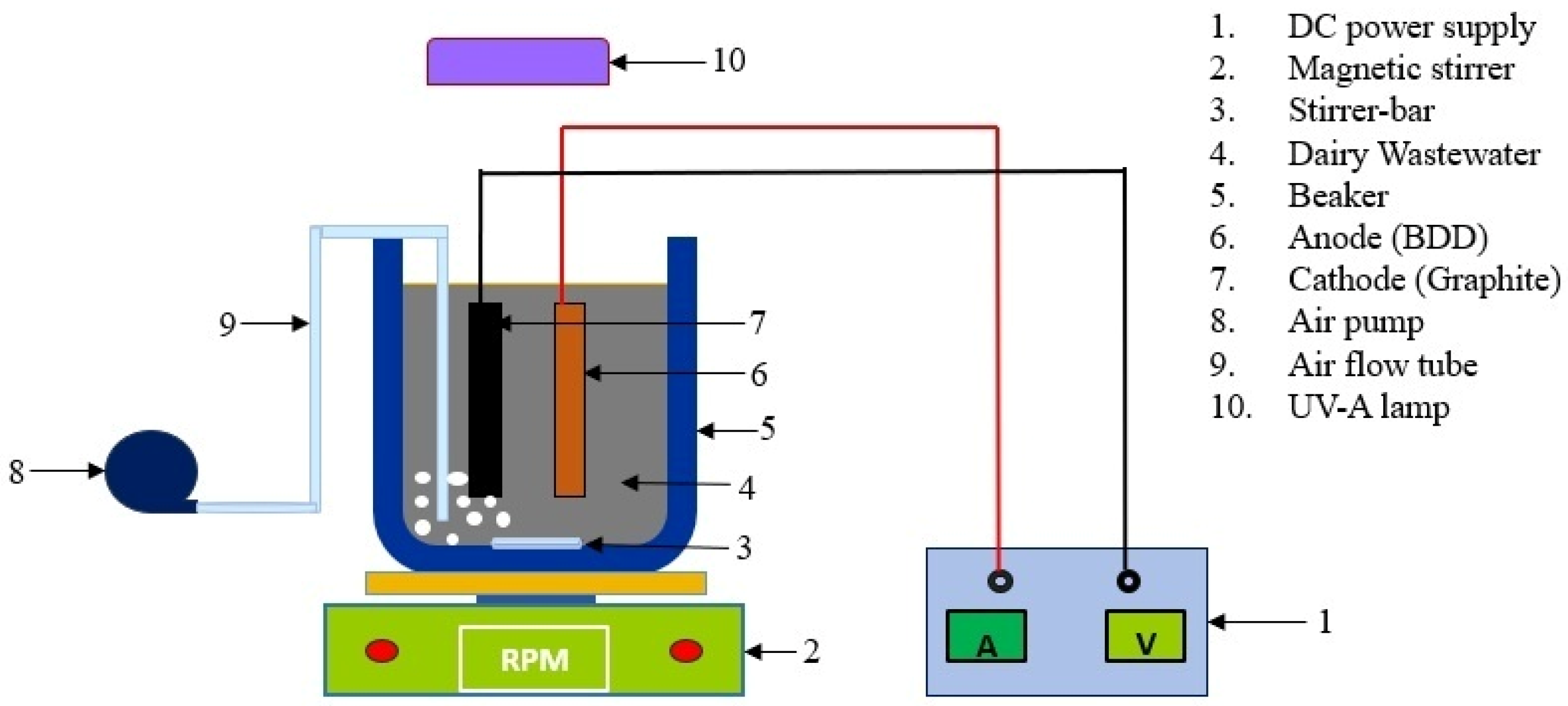
A bench-scale PEF experimental setup is depicted in Figure 1. The primary components included a beaker, a niobium-based boron doped diamond (BDD/Nb) anode (NeoCoat, La Chaux-de-Fonds, Switzerland), a graphite cathode (Sofialxc, Seattle, WA, USA), a DC power unit (Model: PS-305 DM, Dr. Meter, Shenzhen, China), an air pump (Model: 60, Whisper, Shenzhen, China), a magnetic stirrer (Model: SP88857100, Thermo Scientific, Waltham, MA, USA), and a UV-A lamp (Model: UVP 3UV, Analytik Jena, Upland, CA, USA). A graphite plate was used as a cathode in this study because it is inexpensive, readily available, and exhibits a high in situ H2O2 generation capability. Its use also reduces experimental costs and minimizes risks associated with transportation and storage [14]. The working area of both the anode and cathode was 20 cm2, and the gap between them was maintained at 1 cm. During the PEF process, a 300 mL sample from the chemical coagulation-treated mixture was transferred to the beaker for each run. The pH levels of the mixture were adjusted with 1M H2SO4 or 1M NaOH according to the experimental design. Then, a predetermined amount of ferrous sulfate hepta-hydrate (FeSO4.7H2O) (Fisher Scientific, USA) was added to the solution as a Fenton reagent. For electrolyte homogeneity, an agitation speed of 300 rpm was maintained throughout the experiment. A constant air flow of 120 mL/min was supplied to the cathode to produce H2O2 [42]. The UV-A lamp was placed 6 cm above the solution for the photo-electro-Fenton reaction. After completing the treatment process, the treated dairy wastewater was filtered through a 0.45 µm membrane.

2.3. Experimental Design

2.3.1. Taguchi Orthogonal L16 (45) Array-Based Grey Relational Analysis

In this study, the Taguchi orthogonal L16 (45) array-based grey relational analysis (GRA) approach was employed to evaluate the performance of the operating parameters for the removal of NH3-N from dairy wastewater using a combined chemical coagulation with PEF process. The study involved five variables, namely the pH, coagulant concentration, treatment time, current density, and ferrous ion concentration (Fe2+), each varied at four different levels (Table 2). To identify the key factors affecting NH3-N removal efficiency, the experimental results were normalized on a linear scale between 0 to 1 using the Taguchi orthogonal array design. The “larger-the-better” criterion was applied for the normalization process, as shown in Equation (9) [43,44].
X i k = η i k min k   η i k   max k   η i k min k   η i k
where Xi (k) (i ≠ 0) represents the value derived from creating a grey relational, η i k denotes the experimental value for the kth response in the ith experiment, and max k   η i k and min k   η i k are the largest and smallest values for the kth response, respectively.
After that, grey relational coefficients (GRCs) were calculated based on the normalized experimental values, following Equation (10) [35].
ξ i k =   m i n + ρ Δ   m a x Δ o i ( k ) + ρ Δ   m a x
where ξ i k represents the grey relational coefficient, and Δ o i k = X 0 k X i k signifies the deviation sequence which is the difference between the reference sequence ( X 0 k ) and comparability sequence ( X i k ). The deviation sequence in the normalized data revealed the exact values of how the reference sequence differed from the comparability sequence. The value of the reference sequence ( X 0 k ) was considered as 1 for the ideal theoretical condition [5].   m i n and Δ   m a x indicate the lowest and highest values of Δ o i , respectively. ρ refers to the distinguishing coefficient, ranging from 0 to 1, employed to modify the variance of the relational coefficient. In this study, ρ is set at 0.5 to assign uniform weights to each parameter.
Subsequently, the grey relational grade (GRG) was used to elucidate the three most influential independent variables among the five variables by ranking. The GRG of each independent variable at a specific level was assessed using Equation (11) [34].
γ i = 1 n   k = 1 n ξ i ( k )
where γ i refers to the grey relational grade, and n denotes the number of experimental runs corresponding to each specific level.

2.3.2. Response Surface Methodology

In this study, the Taguchi method identified three highly influential independent variables (namely Fe2+, current density, and treatment time), and these variables were subsequently optimized through the application of the Box–Behnken design (BBD) based on response surface methodology (RSM). A three-factor BBD design using Design-expert v-13.0.5 (StatEase, Minneapolis, MN, USA) was applied to identify the optimum NH3-N removal efficiency for the three operational parameters shown in Table 3. The number of experimental runs was determined by the following Equation (12).
N = 2 K ( K 1 ) + C 0
where N indicates the number of experiments, C0 depicts the central point’s number, and K refers to the number of operational parameters.
In this study, with three operational variables, a total of 17 experimental runs were conducted, including five central points. The average values obtained from three independent replications of each experimental run were used for subsequent data analysis. The effectiveness of the developed model and the significance of the regression coefficients were confirmed by conducting analysis of variance (ANOVA). Three-dimensional (3-D) surface plots were utilized to illustrate the interplay between independent variables and their influence on the desired outcomes. Table 3 presents the three most influential operating parameters with coded and real values for optimization.
A second-order quadratic polynomial model was employed to analyze the observed values and discern the impacts of different process parameters, as well as their interactions, on the response. The specific second-order model of this study is presented by Equation (13) [45]:
Y =   β 0 + β 1 A + β 2 B + β 3 C + β 12 A B + β 13 A C + β 23 B C + β 11 A 2 + β 22 B 2 + β 33 C 2 + ε i
where Y indicates the predicted response (NH3-N removal efficiency, %); A, B, and C represent the operational parameters for Fe2+ (mM), current density (mA/cm2), and treatment time (minutes), respectively; β o signifies the intercept coefficient; β 1 β 2 , and β 3 refer to the linear coefficients; β 12 β 13 , and β 23 depict the coefficients of interactions between two variables, and β 11 β 22 , and   β 33 are the coefficients of quadratics, respectively; and ε i is the model error.

2.3.3. Artificial Neural Network

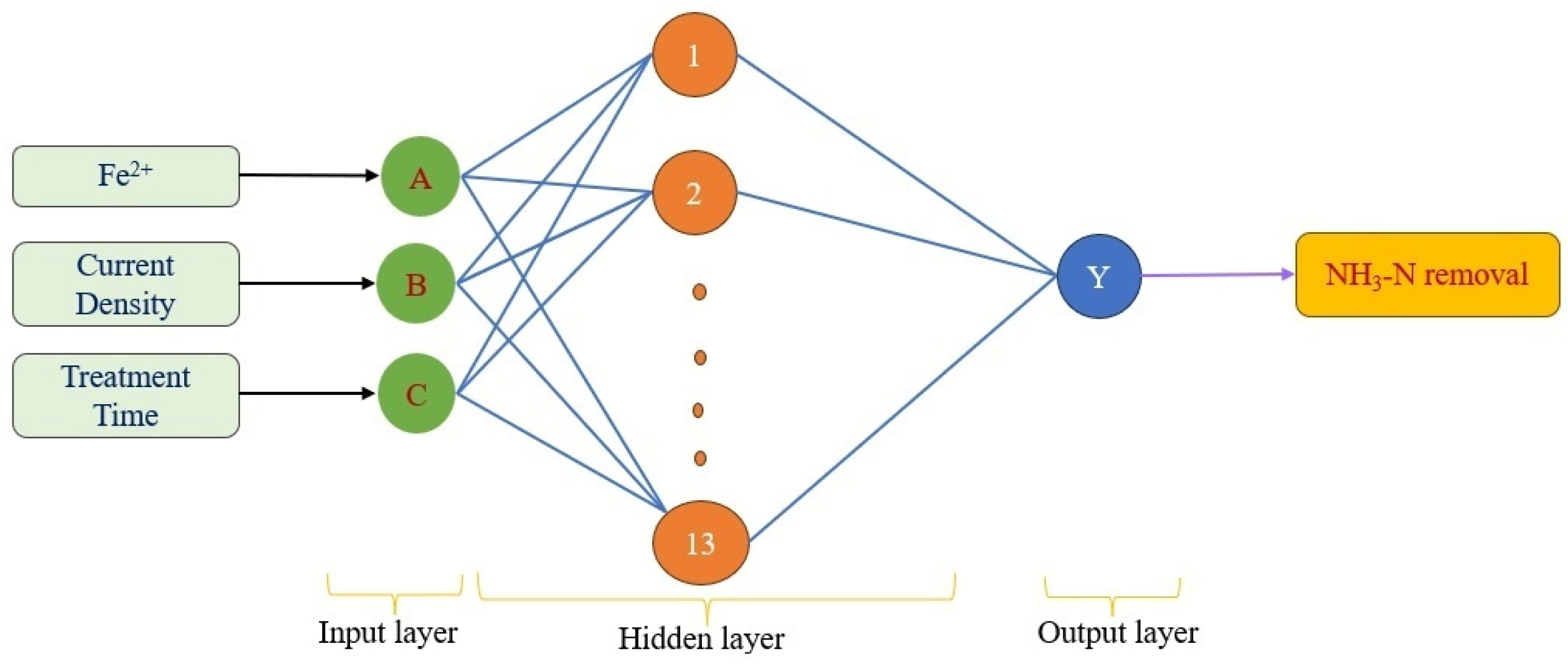
Artificial neural network (ANN) modeling is acknowledged as an advanced artificial intelligence tool in the fields of simulation and optimization, praised for its strong predictive and evaluative performance [36]. This research utilized a feedforward ANN configuration, which includes an input layer, a hidden layer, and an output layer (Figure 2). The input layer contains the three most influential operating parameters, which are connected to the response variable through the hidden and output layers.
An effective ANN structure with the right network configuration is crucial for accurately forecasting the desired response. Additionally, the precision of predictions made by ANN models may be impacted by the number of neurons within the hidden layer [46]. The indiscriminate choice of the number of hidden layer neurons can lead to either overfitting or underfitting of the model [47]. Many studies opt for specific numbers of hidden layer neurons through trial-and-error methods [48]. However, most studies utilizing ANNs commonly employed a hidden layer neuron count within the range of 1 to 20 [26,36]. Increasing the number of hidden layer neurons can enhance process efficiency, yet it increases the risk of model overfitting [39]. Conversely, fewer hidden layer neurons in an ANN may limit the capacity for arbitrary accuracy and representation due to a shortage of degrees of freedom, constraining both the learning ability and approximate accuracy [49,50,51]. Therefore, a feedforward topology of 3:13:1 was selected after training networks with varying numbers of hidden layer neurons from 1 to 20 (Table S1).
In this study, the MATLAB (2023a) Deep Learning Toolbox was employed to construct an ANN model to forecast the removal of NH3-N from dairy wastewater. A feedforward model (FF-ANN) coupled with a backpropagation algorithm (Levenberg–Marquardt) was used to build the model [52]. The average values of 17 experimental runs were divided into three subcategories in terms of training (70%), validation (15%), and testing (15%), respectively. Then the data were normalized to the range of 0.1 to 0.9 using Equation (14) [52].
N o r m a l i z e d   v a l u e   o f   X i = X i M i n i m u m   v a l u e   o f   d a t a M a x i m u m   v a l u e   o f   d a t a M i n i m u m   v a l u e   o f   d a t a   × ( 0.9 0.1 ) + 0.1
The main reason for data normalization was to prevent overtraining and reduce computational complexity. As a transfer function between the input and hidden layers, the hyperbolic tangent sigmoid (tansig) was utilized. Similarly, a linear (purelin) function was employed as the transfer function between the hidden and output layers [26]. The weights were modified until the smallest error between the observed and predicted values for NH3-N removal efficiency was reached [53]. The reliability of the data produced by the ANN model was subsequently confirmed through the validation process. Additionally, a linear regression analysis was conducted to assess the performance of the trained network by comparing the experimental and predicted values [49].

2.4. Comparison Between RSM and ANN Models

To compare the combined chemical coagulation and PEF process models, all the experimental outcomes were utilized for predicting the NH3-N removal efficiency through the RSM and ANN models. Three distinct statistical metrics, namely, the coefficient of determination (R2), root mean square error (RMSE), and average absolute deviation (AAD), were computed using Equations (15)–(17) to assess the efficacy of the developed models [38,39]. It is important to mention that higher values of R2, coupled with lower values of RMSE and AAD, primarily indicate the stronger predictive capability of a model [54].
R 2 = i = 1 n Y a c t u a l Y a c t u a l ¯ Y p r e d i c t e d Y p r e d i c t e d ¯ 2 i = 1 n Y a c t u a l Y a c t u a l ¯ 2   Y p r e d i c t e d Y p r e d i c t e d ¯ 2
R M S E = 1 n   i = 1 n ( Y p r e d i c t e d Y a c t u a l ) 2 1 / 2
A A D = 1 n i = 1 n Y p r e d i c t e d Y a c t u a l Y a c t u a l × 100
where Y p r e d i c t e d is the predicted value, Y a c t u a l signifies the observed values through experiments, the symbol ‘−’ refers to the average values, and n indicates the number of points.

2.5. Kinetic Modeling

Under the optimized conditions, 3 mL treated samples were gathered at 15 min intervals to determine the concentrations of NH3–N, nitrate nitrogen (NO3-N), and nitrite nitrogen (NO2-N). The degradation rate of NH3–N was assessed utilizing a pseudo-first-order kinetic model, as shown in Equations (18) and (19) [55].
d C d t = k [ C ]
l n C t C 0 = k t
where t is the treatment time (min), C0 and Ct bear the values of the initial and final concentrations (mg/L) of NH3–N, respectively, and k is the first-order kinetic coefficient (min−1).

3. Results and Discussion

3.1. Selection of Influential Variables Through Taguchi Based Grey Relational Analysis

In this study, a Taguchi orthogonal array-based grey relational analysis was applied to identify the parameters that had the most significant effect on NH3–N elimination from dairy wastewater (Table 4). The differences between the maximum and minimum GRG values of the five independent variables, namely the pH, coagulant concentration, treatment time, current density, and Fe2+, were 0.094456, 0.046544, 0.438258, 0.148006, and 0.096865, respectively (Table 5). The hierarchy of significance among the operational factors affecting NH3-N removal through the combined chemical coagulation and PEF process was as follows: treatment time > current density > Fe2+ > pH > coagulant concentration. Based on the findings, the three most influential parameters were identified as the treatment time, current density, and Fe2+. These three most influential parameters were further optimized through RSM.
In the chemical coagulation stage, aluminum sulfate primarily targets organic nitrogen. Alum is added to dairy wastewater and dissociates into aluminum ions (Al3+) that destabilize suspended particulates by charge neutralization and trap them in precipitating aluminum hydroxide (Al(OH)3) flocs [25,26,27,28,29,30,31]. This results in the precipitation of the organic fraction with the removal efficiency of total nitrogen, but the direct ammonia removal efficiency is still low because dissolved ammonium is a highly stable monovalent ion that does not precipitate under standard coagulation conditions [27,28,29]. Additionally, alum works best at an acid to neutral pH, which keeps ammonia in its highly soluble ionic form (NH4+) and prevents it from converting to volatile ammonia gas (NH3) as it does at a pH higher than nine [27,30].

3.2. Optimization and Modeling of NH3–N Removal

3.2.1. Response Surface Methodology Modeling

Table 6 presents the findings on NH3-N elimination from dairy wastewater using the BBD-based RSM design. The coefficients of the response and the interactions between the operating parameters are elucidated through a second-order polynomial quadratic model, presented in Equation (20).
NH3-N removal (%) = 73.70 + 3.88A + 6.27B + 20.61C − 2.59AB − 3.32AC − 0.7025BC + 2.21A2 − 2.77B2 − 6.47C2
The multiple regression analysis was applied to determine the coefficients of the response and variables. The effectiveness of the resulting model was assessed through the values of the coefficient of determination (R2), adjusted R2, and predicted R2. The adjusted R2 accounts for the explanatory power of the model by considering both the number of explanatory terms and the number of data points. On the other hand, the predicted R2 determines the model’s ability to forecast responses for new observations [23,49]. In this research, the adjusted R2 (0.998) and predicted R2 (0.997) values were derived using Design-Expert software (version 13.0.5), showing strong consistency (Table 7). Additionally, the R2 value (0.999) signified excellent agreement between the experimental and predicted data.
The validity and effectiveness of the model in accurately predicting NH3-N removal rates were confirmed through analysis of variance (ANOVA), as shown in Table 7. The significance of individual coefficients in the model was further confirmed using Fisher’s F-value and p-value, where a p-value below 0.05 suggested that the terms within the model were significant [56]. The F-value of the model was 787.50 and the p-value below 0.0001 highlighted the statistical significance of the model. The direct impacts of the operating parameters of Fe2+ (A), current density (B), and treatment time (C) were highly significant (p < 0.0001). Similarly, significant results were found (p < 0.05) for the interactive effects of the two parameters Fe2+ and current density (AB), and Fe2+ and treatment time (AC), as well as for the quadratic terms (A2, B2, and C2). This suggests that even slight alterations in the variable values would have an impact on NH3-N removal efficiency [55]. On the other hand, the interaction between the current density and treatment time (BC) did not show a significant effect on NH3-N removal efficiency (p > 0.05).
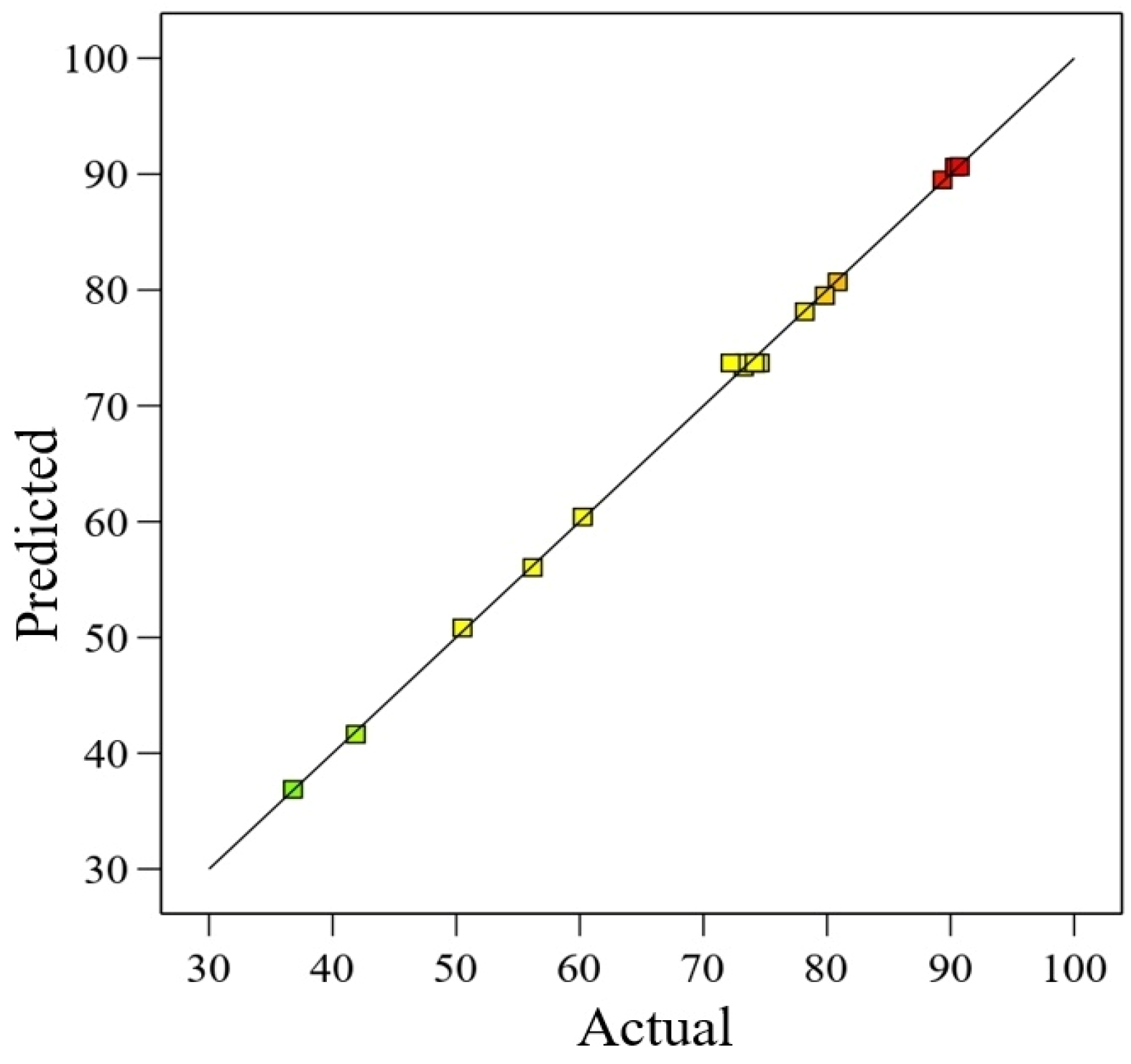
The lack-of-fit value serves as a measure of the comparison between the residual error and pure error in an experimental design. The validity of the model is confirmed with a non-significant lack-of-fit p-value [49,57]. In this study, the non-significant lack-of-fit (p > 0.05) ensured the credibility of the developed model. Furthermore, the adequate precision (AP) value (91.77) was greater than four, indicating a notably high level of precision. This suggested that the model was suitable for effectively monitoring and controlling the design parameters [32]. Additionally, the capacity of the developed quadratic model to fit the data for NH3-N removal was confirmed by a plot of the actual versus predicted values, as shown in Figure 3. The consistent alignment between the actual and predicted values demonstrated the precision of the developed model and its ability to provide reliable predictions of the treatment process [58].
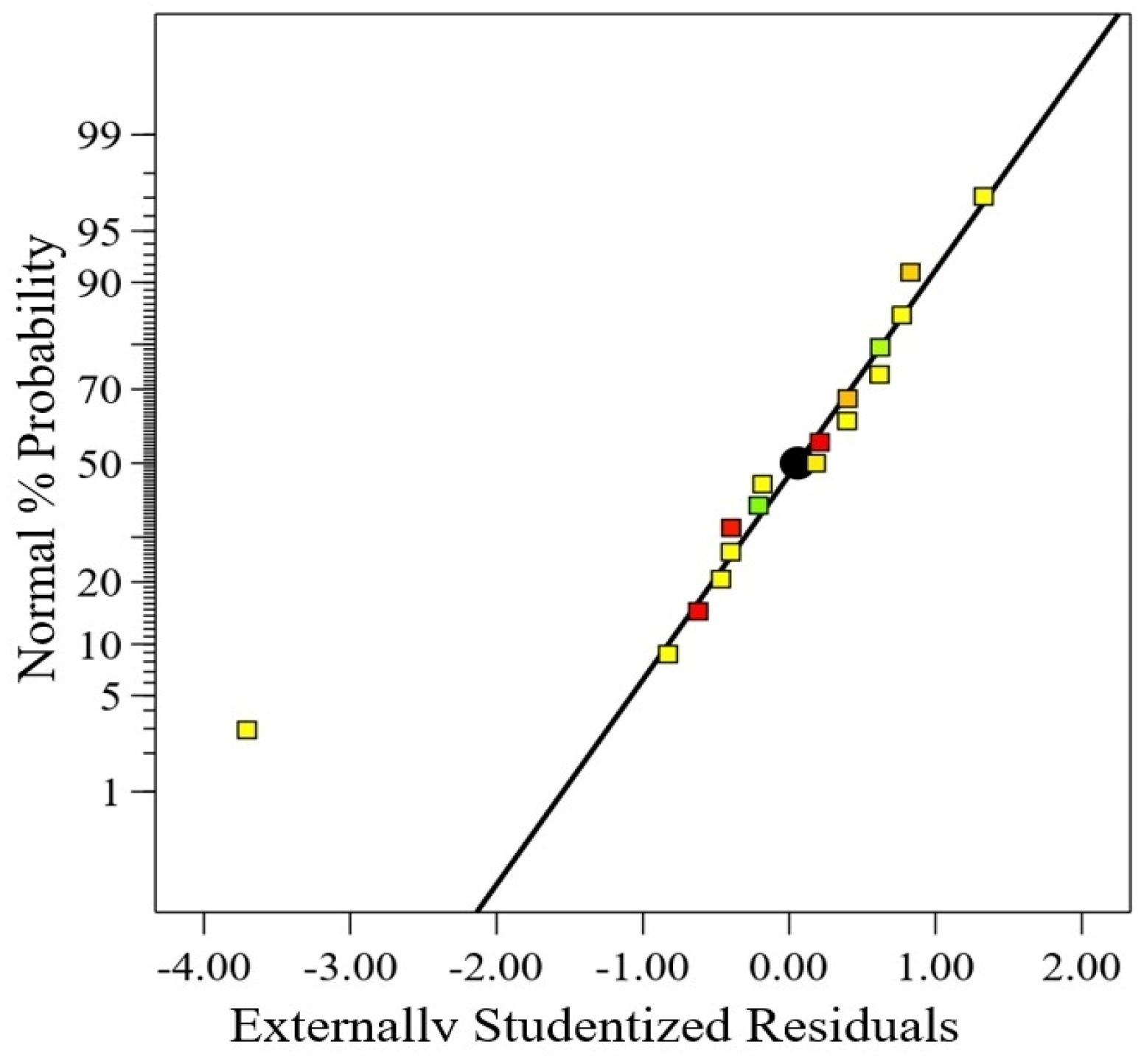
Subsequently, the normal probability plot was employed to assess whether the residuals follow a normal distribution; in such instances, the points on the plot will form a straight line. When the data points on the plot are close to this straight line, it indicates that the data are likely to exhibit a normal distribution [59]. Figure 4 depicts the position of the data points near the straight line, confirming homoscedasticity and conformity to a normal distribution. In summary, the developed quadratic polynomial model could be used to predict the removal efficiency of NH3-N from dairy wastewater through the combined chemical coagulation and PEF process.

3.2.2. The Impact of Independent Variables on NH3–N Removal

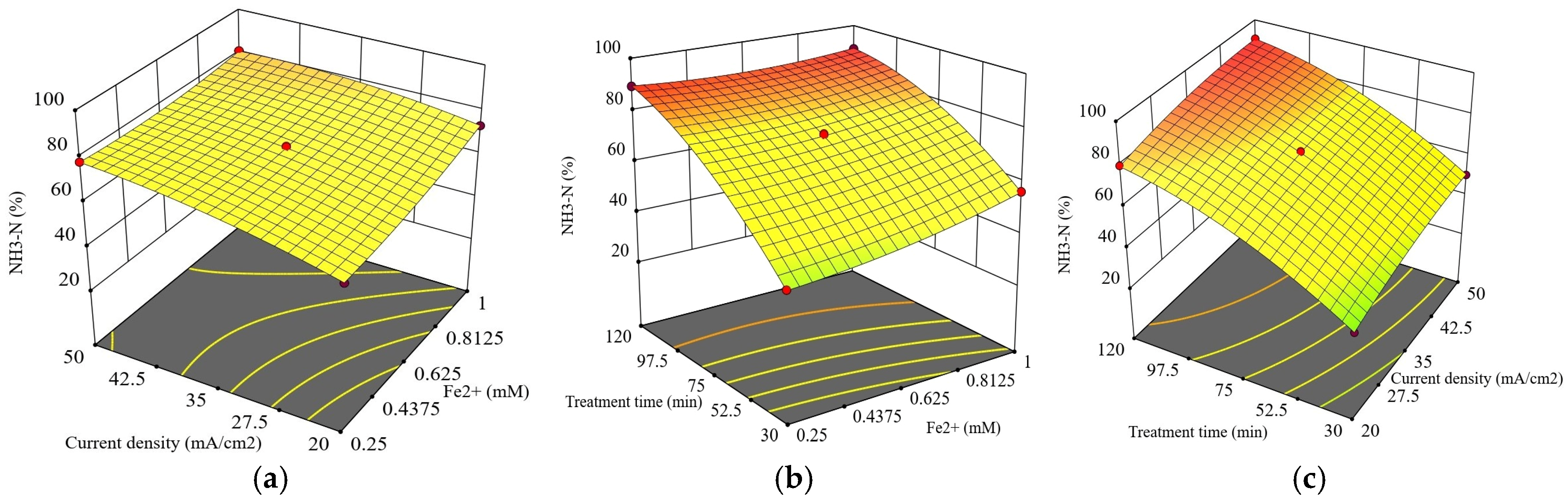
From Table 7, the interactive effects of Fe2+ and current density (AB), and Fe2+ and treatment time (AC) had a significant impact on NH3-N removal efficiency from dairy wastewater (p < 0.05), whereas the interactive effect of current density and treatment time (BC) did not show a significant influence on NH3-N removal (p > 0.05). Figure 5a illustrates the interactive effect of Fe2+ and current density on the NH3-N removal efficiency, while the treatment time was kept constant. An increase in NH3-N degradation, ranging from 76% to 81%, was observed alongside higher Fe2+ concentrations and current density, which ranged from 0.25 to 1.0 mM and 20 to 50 mA/cm2, respectively. Current density and Fe2+ stimulate OH production, which accelerates NH3-N degradation [60]. Increasing the treatment time had a positive impact on NH3-N removal, as it enhanced OH generation in the presence of UV-A [15]. In terms of the interactive effects of Fe2+ and treatment time on NH3-N removal (Figure 5b), up to 92% NH3-N degradation was recorded for 0.25 to 1 mM Fe2+ and 30 to 120 min of treatment time. Similar interactive effects of current density and treatment time were observed (Figure 5c). The 3D surface plots show a continuous upward trend toward the boundaries rather than forming a distinct peak or plateau within the tested region. This indicates that the true optimal conditions likely lie beyond the current upper limits of the variables, suggesting the chosen experimental ranges were too narrow to capture the maximum response.

3.2.3. Artificial Neural Network Modeling

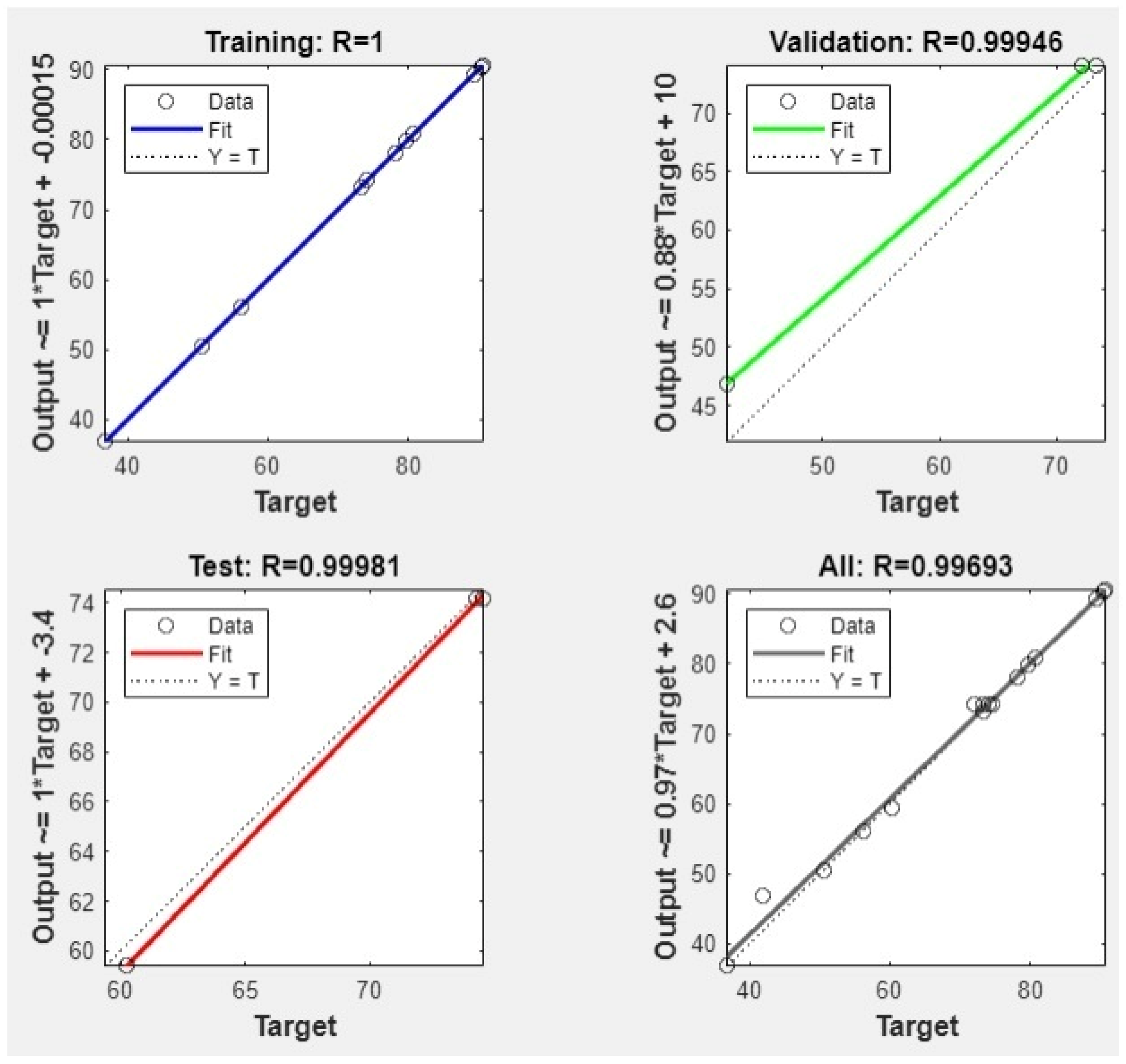
To develop a robust ANN model for predicting NH3-N removal efficiency, several models were designed utilizing Fe2+, current density, and treatment time as inputs and NH3-N removal as the output. Initially, an examination was conducted on the various numbers of neurons within the hidden layer of the ANN, ranging from 1 to 20. The assessment of the optimal configuration for the ANN model depended on achieving the highest correlation coefficient (R) value and minimizing the mean square error (MSE) across all the testing, validation, and training datasets (Table S1). The findings revealed that the highest performance was achieved by a network containing thirteen neurons in the hidden layer. Consequently, a topology of 3:13:1 was adopted for the developed ANN model. Although the ANN model provided a better agreement between the predicted and experimental values than the RSM model, this finding must be interpreted mainly as an improvement in the fitting performance on the available experimental dataset. The small number of experimental runs (17 BBD experiments) may limit the generalization ability of the ANN model, and the possibility of overfitting cannot be completely excluded. To avoid overfitting, the performance of different ANN architectures was tested with the number of neurons in the hidden layer between 1 and 20, and the best topology 3:13:1 was selected based on the highest R and the lowest MSE for the training, validation and testing datasets. However, additional validation of the robustness and predictive generalization of the developed ANN model would be useful with more experimental datasets with larger sample sizes. As illustrated in Figure 6, the R values for the training, validation, and testing datasets in the established ANN model were 1.0000, 0.9995, and 0.9998, respectively. The developed ANN model for predicting NH3-N removal is presented in Equation (21).
NH3-N removal = Purelin {W2 × tansig (W1 × [Fe2+; Current density; Treatment time] + b1) + b2}
where W1 and W2 are the connection weights between the output and hidden layers, and input and hidden layers, respectively; and b1 and b2 denote biases introduced to the hidden and output layer, respectively.
The best linear fit with R2 of the developed ANN model is illustrated in Equations (22) and (23).
y = 1.003x − 0.1286
R2 = 0.9988
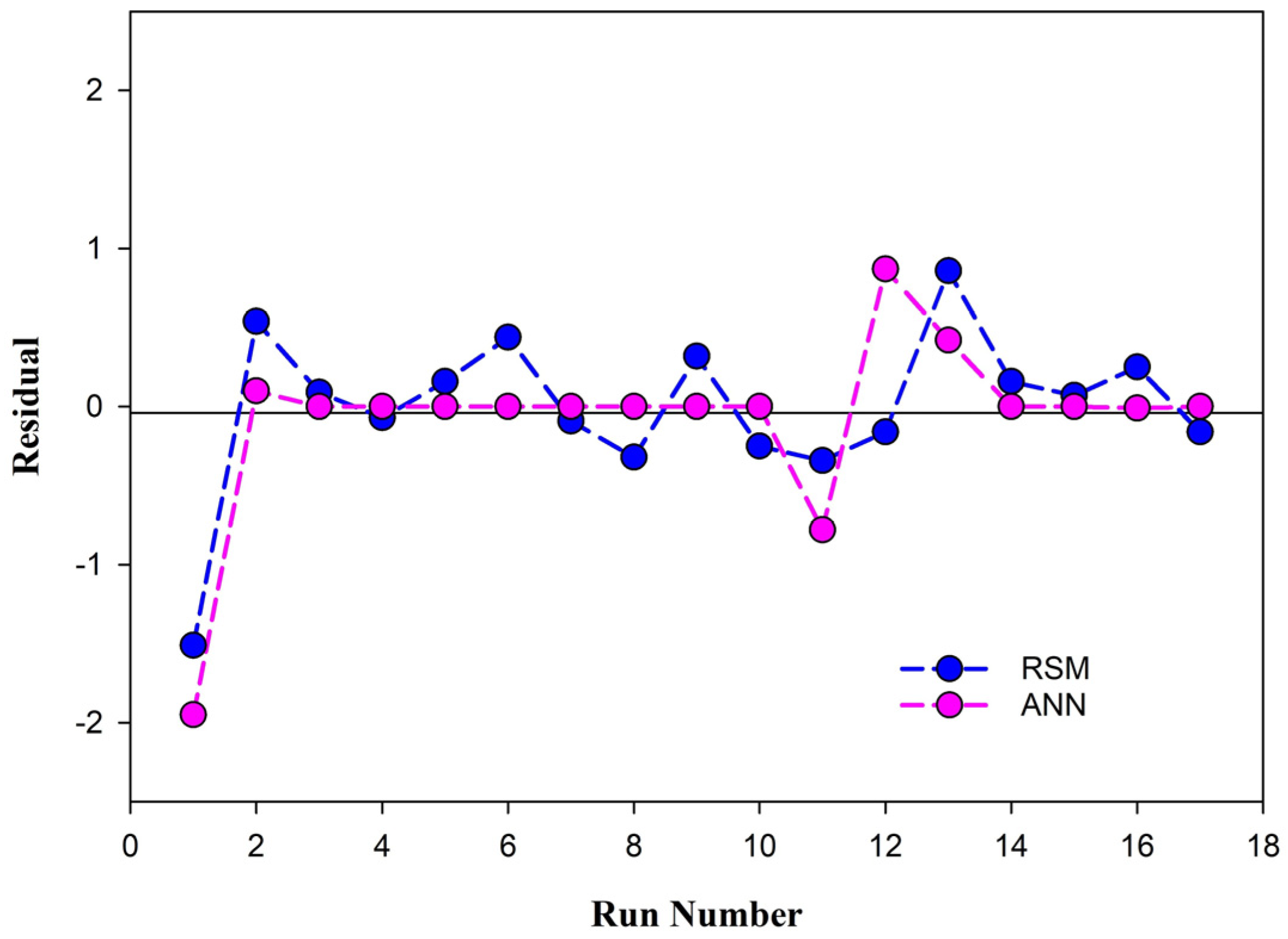
where y is the predicted output value from the ANN model, x is the observed value of the target variable, and 1.003 is the slope of the linear regression line. A slope close to one indicates excellent agreement between the predicted and observed values. Additionally, R2 is the coefficient of determination. The R2 value of 0.9988 validated that the developed ANN model, with a topology of 3:13:1, can account for 99.88% of the variability between the actual and predicted NH3-N removal values. Figure 7 presents the residual errors between the actual and predicted values for all datasets, demonstrating differences between the RSM and ANN models. The residual errors for the ANN model were minimal, whereas those for the RSM model exhibited greater fluctuation and were notably larger. These findings indicated a strong alignment between the experimental values and the ANN predicted values.

3.2.4. Optimization and Validation of the Treatment Approach

The primary aim of process optimization studies is to identify the most efficient values for independent parameters, ensuring optimal operation of the process. Usually, the selection of operational variables involves choosing from the available alternatives to achieve the desired conditions for a particular outcome [49]. In this research, the chosen values for the operational parameters were established as “within the range,” while the target response was set at “maximum.” All parameters and the target response were given equal weighting. From one hundred solutions with diverse levels of operational parameters, the optimized condition was identified as the one exhibiting a maximum desirability value of 1.0. For the optimal operating conditions of 0.51 mM Fe2+, 49.44 mA/cm2 current density, and 118.60 minutes of treatment time, the removal efficiency of NH3-N predicted by RSM and the ANN was 91.16% and 92.15%, respectively (Table 8). These optimized conditions were subsequently experimentally validated in triplicate and found to yield 92.13 ± 0.76% NH3-N removal efficiency from dairy wastewater using a combined chemical coagulation and PEF process. The obtained outcome closely matched the RSM and ANN predicted values, and the average of the experimental data comfortably fell within the 95% confidence interval (CI), as depicted in Table 8. As a result, the validation of both models was considered successful.

3.3. Comparison Between RSM and ANN Modeling

The established RSM and ANN models were compared in terms of predicting NH3-N removal efficiency. As illustrated in Figure 7, the ANN model demonstrated reduced variability and enhanced stability in its residuals when compared to the RSM model. Additionally, a statistical assessment was carried out using R2, RMSE, and ADD values to gauge the fitting of the models [38]. In this study, a higher R2 value and lower RMSE and AAD values signified better predictive capability of the ANN model in comparison to the RSM model (Table 9). The lower difference between the R2 values of the RSM and ANN models can be attributed to the well-structured experimental design and the strong correlation between the selected operational parameters and NH3–N removal efficiency. Since the experimental data exhibited relatively consistent and predictable behavior, both the RSM and ANN models were able to fit the dataset effectively, resulting in closely comparable R2 values. Conversely, the RSM model offered the benefit of providing a regression equation for prediction and illustrating the impact of experimental variables and their interactions on the response, which distinguished it from the ANN model [33,38]. Furthermore, the ANN model exhibited greater adaptability, allowing for the incorporation of new experimental observations to generate an even more reliable model [26,61]. Consequently, the ANN-based model exhibited superior reliability and predictive capability for NH3-N removal from dairy wastewater through the combined chemical coagulation and PEF treatment process.

3.4. Ammonia Removal Mechanism

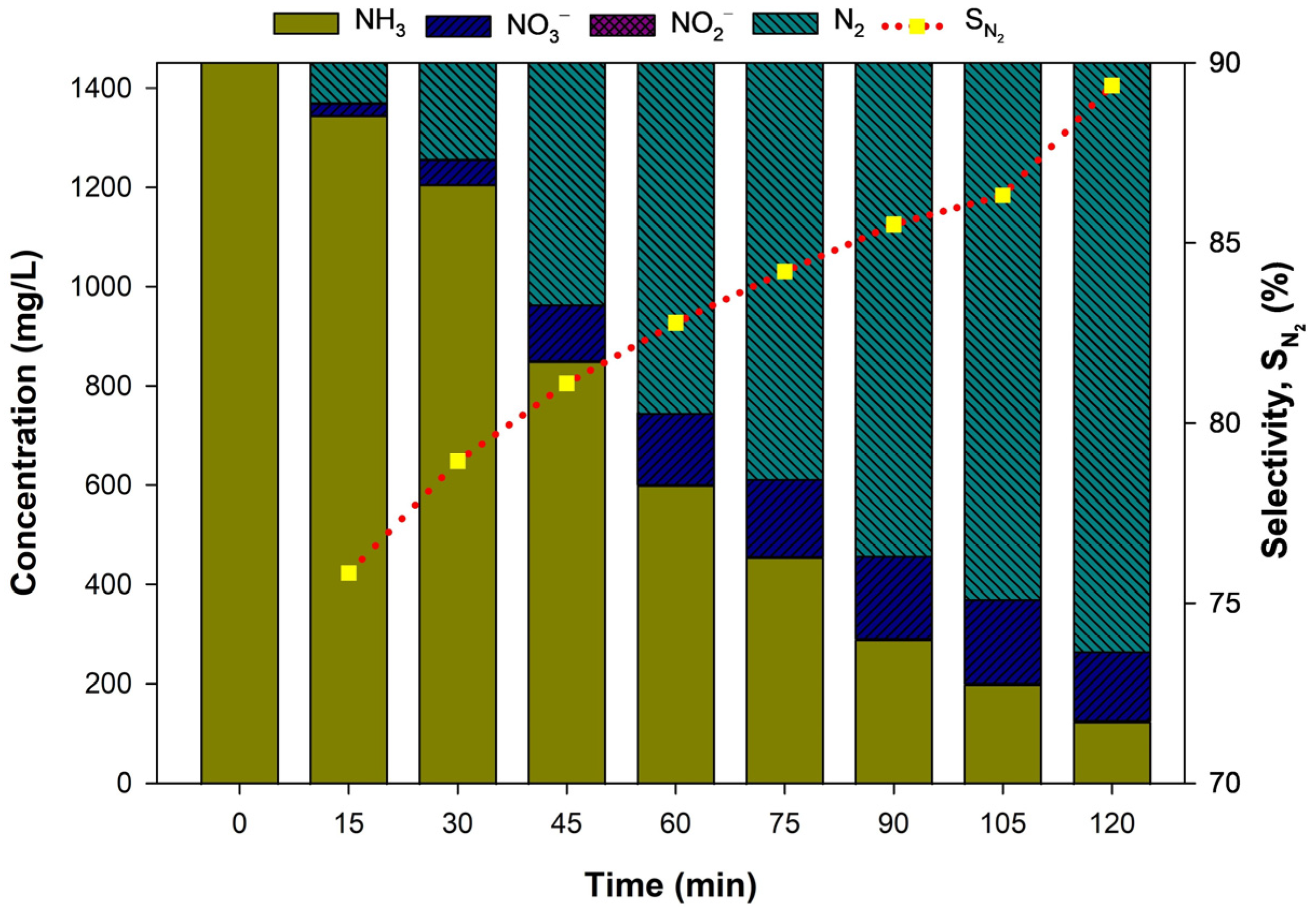
The concentration profiles of ammonia, nitrate, and nitrite under optimal operating conditions at 15 min intervals are illustrated in Figure 8. A substantial amount of nitrogen was released from the sample during the treatment process, primarily in the form of N2 gas. The nitrogen loss was estimated using the overall nitrogen mass balance, as described in Equation (8). During the treatment process, the NH3-N concentration in the samples decreased over time, while the concentrations of NO3, and NO2 and the selectivity of N2 increased. From Figure 8, the concentration of NH3-N decreased by 900 mg/L within the first hour of treatment, demonstrating a nitrogen selectivity of 80%. After two hours of treatment, the nitrogen selectivity rose from 80% to 90% and the NH3-N removal efficiency was found to be 93%. At this point, the concentrations of NO3, and NO2 were identified as 140 mg/L and 0.87 mg/L, respectively.
Ammonia, the most reduced nitrogen species, can undergo a multistep redox process leading to the formation of N2, NO2, or NO3—the most oxidized nitrogen compound [62,63,64]. In basic solutions, NH3 is primarily oxidized to N2 via direct electrochemical reactions following adsorption at the electrode surface, with minimal oxygen evolution. In acidic solutions, NH4+ is partially converted to N2 through OH produced during oxygen evolution, rather than through direct electrochemical oxidation [22,62]. In our study, we applied a wide range of pH (Table 2), so NH3–N was oxidized to N2, NO3, and NO2 by OH and reactive chlorine species (Cl, OCl, and HOCl), as shown in Equations (24) and (25) [23,62,64]. Nitrogen balance analysis revealed that low pH favored N2 formation, whereas high pH promoted the generation of NO3 and NO2 [65]. This trend is consistent with that found by previous studies, indicating that under acidic conditions, NO3 and NO2 are more readily reduced to N2 (Equations (26)–(28)), while alkaline conditions favor the generation of NO3 and NO2 (Equation (28)) [66,67,68].
Sustainability 18 05893 i001
2NH3 + 3HOCl → N2 + 3HCl + 3H2O
NO3 + 3H2O + 5e → 1/2N2 + 6OH
NO2 + 2H2O + 3e → 1/2N2 + 4OH
2NH2OH + 3H2O → NO2 + NO3 +12H+ +10e
Several studies have identified OH as the primary oxidant for ammonia nitrogen removal in various advanced oxidation processes [22,65,69,70,71,72]. Zhang et al. [69] documented that in situ generated OH predominantly oxidized ammonia through successive reactions, yielding NO3 and NO2 as the primary products under a UV-irradiated oxidation process. Huang et al. [72] demonstrated that OH generated via H2O2 photolysis oxidized ammonia to NO2 and subsequently to NO3 in a UV-assisted system. Although the overall ammonia removal improved, the rate gradually decreased due to pH reduction from NO2 and NO3 formation, which lowered the NH3/NH4+ ratio and inhibited further oxidation. Yuzawa et al. [71] observed that under UV irradiation and anoxic conditions, ammonia decomposed into N2 and H2 over TiO2/Pt nanoparticles, with amide radicals (NH2) acting as key intermediates that form hydrazine (N2H4) and diazene (N2H2), which subsequently decompose into N2 and H2. The concentration of NO3 consistently exceeded that of NO2 throughout the reaction, differing from typical photocatalytic behavior. Almomani et al. [70] found that over 80% of ammonia was converted to N2 via the OH produced on NiO and NiO–TiO2 electrodes, while Kim et al. [22] reported efficient OH generation and NH4+ oxidation using RuO2 electrodes at neutral pH. These findings suggest that radicals such as OH, Cl, and Cl2•− play a distinct role in ammonia oxidation, yielding different nitrogen species. Zhang et al. [73] also detected traces of NO3 and NO2, with NO3 being the predominant photo-assisted product of NH3-N oxidation, facilitated by a photo-induced surface plasmon-enhanced nanozyme-Fenton catalyst. All these results suggest that ammonia was mainly oxidized by OH in acidic solutions and removed by direct electron transfer in alkaline solutions [21,72]. Yao et al. [21] identified N2 as the major product formed through the OH-mediated oxidation of ammonia under acidic conditions. As indicated by Equations (26) and (27), the reduction of NO2 and NO3 at the cathode is electrochemically favored under acidic conditions.

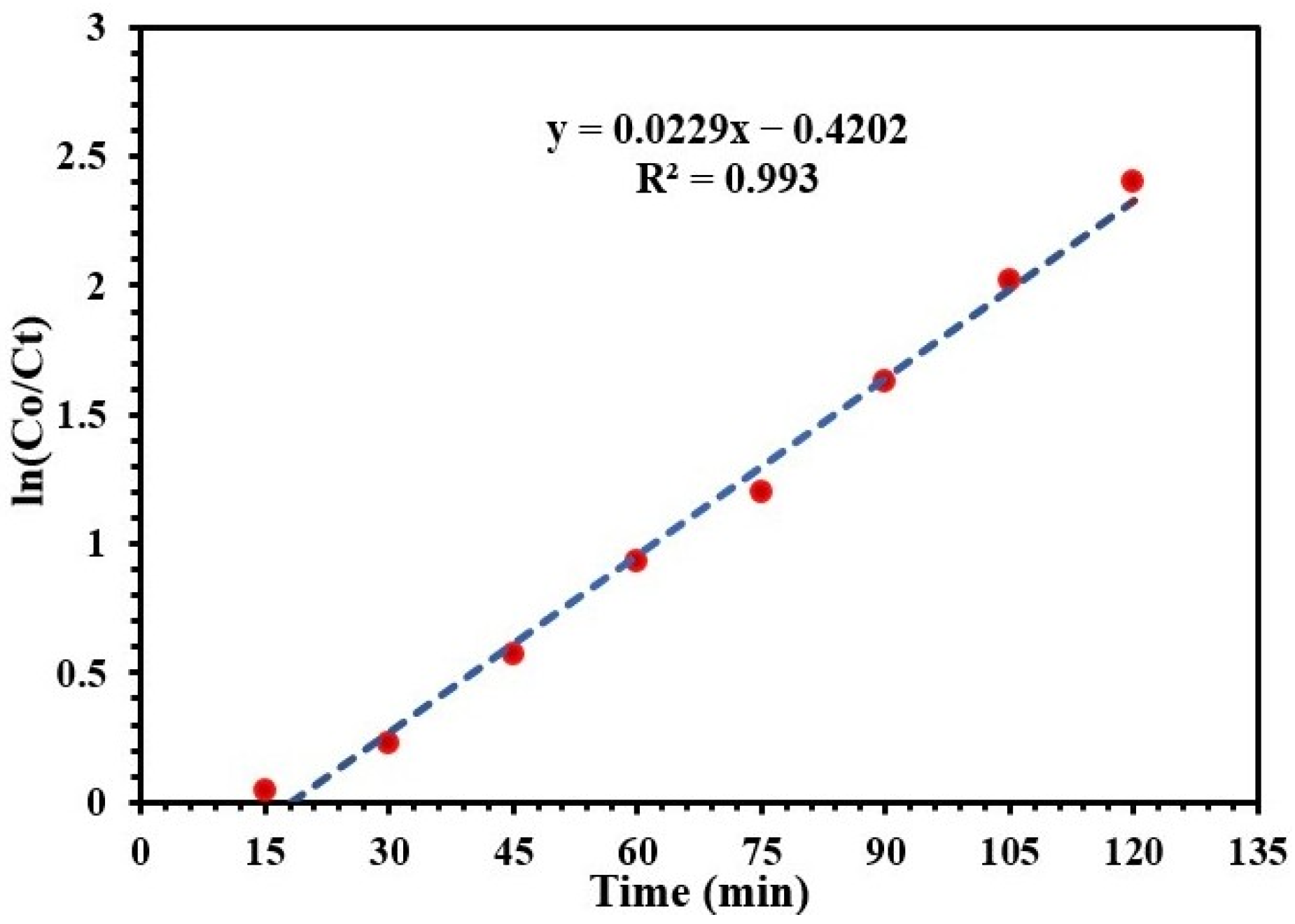
3.5. Kinetic Modeling for NH3-N Degradation

Different kinetic models (zero-, first-, and second-order) were applied to determine the nature of the reaction for NH3-N degradation [74]. Ultimately, the data exhibited the best fit to the pseudo-first-order kinetic model when analyzed using the least-squares method (Figure 9). Under the optimum operational conditions, for a 15 min time interval, the plotted graph (ln (Co/Ct) vs. time) illustrated a high correlation coefficient (R2 = 0.993), and the reaction rate constant was found to be 0.0229 min−1, which outperformed both the zero-order (R2 = 0.943) and second-order (R2 = 0.862) reaction models. This indicates that the pseudo-first-order kinetics can effectively describe the removal of NH3-N from dairy wastewater through the combined chemical coagulation and PEF processes.

4. Conclusions

This study explored the viability of removing NH3-N from dairy wastewater through integrated chemical coagulation and PEF approaches. The effects of five parameters (i.e., treatment time, current density, Fe2+, pH, and coagulant concentration) on NH3-N removal were assessed by Taguchi-GRA, RSM, and an ANN. At first, a GRA-based Taguchi design was applied to find out the three most significant individual variables among the five tested variables, which were later optimized by RSM-BBD. The second-order polynomial quadratic model suggested by RSM exhibited sufficient predictive capability by illustrating the influence of the chosen independent variables on the desired response with a high correlation coefficient (close to one). Under the optimal conditions (Fe2+: 0.51 mM, current density: 49.44 mA/cm2, and treatment time: 118.60 min), the NH3-N removal rate was found to be 92.13% with 90% N2 selectivity, which was very close to the values predicted by both the RSM and ANN models. Furthermore, the statistical comparison of the models using R2, RMSE, and AAD indicated that the ANN model exhibited superior predictive capabilities. The degradation rate of NH3-N followed a pseudo-first-order kinetic model. The presence of NO3-N and NO2-N in the treated solution indicates a limitation of the tested approach. Nevertheless, this study revealed that the combined technology holds promise as a viable option for the efficient removal of NH3-N from dairy wastewater. Further studies should emphasize the large-scale application of this technology. In addition, the energy consumption of the integrated process should be evaluated to understand its techno-economic feasibility.

Supplementary Materials

The following supporting information can be downloaded at: https://www.mdpi.com/article/10.3390/su18125893/s1. Table S1: Feed forward networks with different hidden layer neurons.

Author Contributions

Conceptualization, A.K.D. and L.C.; Methodology, A.K.D. and L.C.; Software, A.K.D.; Validation, S.W., A.K.D. and L.C.; Formal Analysis, A.K.D. and S.W.; Investigation, A.K.D.; Resources, L.C.; Data Curation, A.K.D. and S.W.; Writing—Original Draft Preparation, A.K.D.; Writing—Review and Editing, S.W. and L.C.; Visualization, A.K.D.; Supervision, L.C.; Project Administration, L.C.; Funding Acquisition, L.C. All authors have read and agreed to the published version of the manuscript.

Funding

This work was supported by the USDA National Institute of Food and Agriculture (NIFA), Hatch Project (Project No. IDA01745, Accession No. 7006606), and the USDA NIFA Sustainable Agricultural Systems project (Award No. 2020–69012-31871).

Institutional Review Board Statement

Not applicable.

Informed Consent Statement

Not applicable.

Data Availability Statement

The original contributions presented in this study are included in the article/Supplementary Materials. Further inquiries can be directed to the corresponding author.

Conflicts of Interest

The authors declare that they have no known competing financial interests or personal relationships that could have appeared to influence the work reported in this paper.

References

  1. Grout, L.; Baker, M.G.; French, N.; Hales, S. A review of potential public health impacts associated with the global dairy sector. GeoHealth 2020, 4, e2019GH000213. [Google Scholar] [CrossRef]
  2. Ahmad, T.; Aadil, R.M.; Ahmed, H.; Rahman, U.U.; Soares, B.C.; Souza, S.L.; Pimentel, T.C.; Scudino, H.; Guimarães, J.T.; Esmerino, E.A.; et al. Treatment and utilization of dairy industrial waste: A review. Trends Food Sci. Technol. 2019, 88, 361–372. [Google Scholar] [CrossRef]
  3. USEPA. National Emission Inventory—Ammonia Emissions from Animal Husbandry Operations; US Environmental Protection Agency: Washington, DC, USA, 2004.
  4. Domingo, N.G.G.; Balasubramanian, S.; Thakrar, S.K.; Clark, M.A.; Adams, P.J.; Marshall, J.D.; Muller, N.Z.; Pandis, S.N.; Polasky, S.; Robinson, A.L.; et al. Air quality–related health damages of food. Proc. Natl. Acad. Sci. USA 2021, 118, e2013637118. [Google Scholar] [CrossRef]
  5. Asghar, S.; Chen, L.; He, B.B. Optimization of Simultaneous Nutrients and Chemical Oxygen Demand Removal from Anaerobically Digested Liquid Dairy Manure in a Two-Step Fed Sequencing Batch Reactor System Using Taguchi Method and Grey Relational Analysis. Appl. Biochem. Biotechnol. 2023, 196, 537–557. [Google Scholar] [CrossRef]
  6. Joshiba, G.J.; Kumar, P.S.; Femina, C.C.; Jayashree, E.; Racchana, R.; Sivanesan, S. Critical review on biological treatment strategies of dairy wastewater. Desalin. Water Treat. 2019, 160, 94–109. [Google Scholar] [CrossRef]
  7. Zhao, K.; Wu, Y.W.; Young, S.; Chen, X.J. Biological treatment of dairy wastewater: A mini review. J. Environ. Inf. Lett. 2020, 4, 22–31. [Google Scholar] [CrossRef]
  8. Bhuvaneshwari, S.; Majeed, F.; Jose, E.; Mohan, A. Different treatment methodologies and reactors employed for dairy effluent treatment-A review. J. Water Process Eng. 2022, 46, 102622. [Google Scholar] [CrossRef]
  9. Brillas, E.; Mur, E.; Sauleda, R.; Sànchez, L.; Peral, J.; Domènech, X.; Casado, J. Aniline mineralization by AOP’s: Anodic oxidation, photocatalysis, electro- Fenton and photoelectro-Fenton processes. Appl. Catal. B Environ. 1998, 16, 31–42. [Google Scholar] [CrossRef]
  10. Comninellis, C.; Kapalka, A.; Malato, S.; Parsons, S.A.; Poulios, I.; Mantzavinos, D. Advanced oxidation processes for water treatment: Advances and trends for R&D. J. Chem. Technol. Biotechnol. 2008, 83, 769–776. [Google Scholar] [CrossRef]
  11. Das, A.K.; Chen, L. A Review on Electrochemical Advanced Oxidation Treatment of Dairy Wastewater. Environments 2024, 11, 124. [Google Scholar] [CrossRef]
  12. Sirés, I.; Brillas, E.; Oturan, M.A.; Rodrigo, M.A.; Panizza, M. Electrochemical advanced oxidation processes: Today and tomorrow: A review. Environ. Sci. Pollut. Res. 2014, 21, 8336–8367. [Google Scholar] [CrossRef] [PubMed]
  13. Moreira, F.C.; Boaventura, R.A.; Brillas, E.; Vilar, V.J. Electrochemical advanced oxidation processes: A review on their application to synthetic and real wastewaters. Appl. Catal. B Environ. 2017, 202, 217–261. [Google Scholar] [CrossRef]
  14. Brillas, E.; Sirés, I.; Oturan, M.A. Electro-Fenton process and related electrochemical technologies based on Fenton’s reaction chemistry. Chem. Rev. 2009, 109, 6570–6631. [Google Scholar] [CrossRef]
  15. Brillas, E. A review on the photoelectro-Fenton process as efficient electrochemical advanced oxidation for wastewater remediation. Treatment with UV light, sunlight, and coupling with conventional and other photo- assisted advanced technologies. Chemosphere 2020, 250, 126198. [Google Scholar] [CrossRef]
  16. Brillas, E. A review on the degradation of organic pollutants in waters by UV photoelectro-Fenton and solar photoelectro-Fenton. J. Braz. Chem. Soc. 2014, 25, 393–417. [Google Scholar] [CrossRef]
  17. Brillas, E.; Martínez-Huitle, C.A. Decontamination of wastewaters containing synthetic organic dyes by electrochemical methods. An updated review. Appl. Catal. B Environ. 2015, 166, 603–643. [Google Scholar] [CrossRef]
  18. Bañuelos, J.A.; García-Rodríguez, O.; El-Ghenymy, A.; Rodríguez-Valadez, F.J.; Godínez, L.A.; Brillas, E. Advanced oxidation treatment of malachite green dye using a low cost carbon-felt air-diffusion cathode. J. Environ. Chem. Eng. 2016, 4, 2066–2075. [Google Scholar] [CrossRef]
  19. Brillas, E.; A Garrido, J.; Rodríguez, R.M.; Arias, C.; Cabot, P.L.; Centellas, F. Wastewaters by Electrochemical Advanced Oxidation Processes Using a BDD Anode and Electrogenerated H2O2 with Fe (II) and UVA Light as Catalysts. Port. Electrochim. Acta 2008, 26, 15. [Google Scholar] [CrossRef]
  20. El-Ghenymy, A.; Oturan, N.; Oturan, M.A.; Garrido, J.A.; Cabot, P.L.; Centellas, F.; Rodríguez, R.M.; Brillas, E. Comparative electro-Fenton and UVA photoelectro-Fenton degradation of the antibiotic sulfanilamide using a stirred BDD/air-diffusion tank reactor. Chem. Eng. J. 2013, 234, 115–123. [Google Scholar] [CrossRef]
  21. Yao, J.; Zhou, M.; Wen, D.; Xue, Q.; Wang, J. Electrochemical conversion of ammonia to nitrogen in non-chlorinated aqueous solution by controlling pH value. J. Electroanal. Chem. 2016, 776, 53–58. [Google Scholar] [CrossRef]
  22. Kim, K.W.; Kim, Y.J.; Kim, I.T.; Park, G.I.; Lee, E.H. Electrochemical conversion characteristics of ammonia to nitrogen. Water Res. 2006, 40, 1431–1441. [Google Scholar] [CrossRef]
  23. Meng, G.; Jiang, N.; Wang, Y.; Zhang, H.; Tang, Y.; Lv, Y.; Bai, J. Treatment of coking wastewater in a heterogeneous electro-Fenton system: Optimization of treatment parameters, characterization, and removal mechanism. J. Water Process Eng. 2022, 45, 102482. [Google Scholar] [CrossRef]
  24. Pacheco, M.J.; Santos, V.; Ciríaco, L.; Lopes, A. Electrochemical degradation of aromatic amines on BDD electrodes. J. Hazard. Mater. 2011, 186, 1033–1041. [Google Scholar] [CrossRef]
  25. Aguilar, M.I.; Saez, J.; Llorens, M.; Soler, A.; Ortuno, J.F. Nutrient removal and sludge production in the coagulation– flocculation process. Water Res. 2002, 36, 2910–2919. [Google Scholar] [CrossRef]
  26. Zakeri, H.R.; Yousefi, M.; Mohammadi, A.A.; Baziar, M.; Mojiri, S.A.; Salehnia, S.; Hosseinzadeh, A. Chemical coagulation-electro fenton as a superior combination process for treatment of dairy wastewater: Performance and modelling. Int. J. Environ. Sci. Technol. 2021, 18, 3929–3942. [Google Scholar] [CrossRef]
  27. Lee, W.; Westerhoff, P. Dissolved organic nitrogen removal during water treatment by aluminum sulfate and cationic polymer coagulation. Water Res. 2006, 40, 3767–3774. [Google Scholar] [CrossRef]
  28. Adebayo, I.O.; Olukowi, O.O.; Zhiyuan, Z.; Zhang, Y. Comparisons of coagulation efficiency of conventional aluminium sulfate and enhanced composite aluminium sulfate/polydimethyldiallylammonium chloride coagulants coupled with rapid sand filtration. J. Water Process Eng. 2021, 44, 102322. [Google Scholar] [CrossRef]
  29. Lee, S.H.; Iamchaturapatr, J.; Polprasert, C.; Ahn, K.H. Application of chemical precipitation for piggery wastewater treatment. Water Sci. Technol. 2004, 49, 381–388. [Google Scholar] [CrossRef]
  30. Cheng, W.P.; Chen, P.H.; Yu, R.F.; Ho, W.N. Treating ammonium-rich wastewater with sludge from water treatment plant to produce ammonium alum. Sustain. Environ. Res. 2016, 26, 63–69. [Google Scholar] [CrossRef]
  31. Li, N.; Hu, Y.; Lu, Y.Z.; Zeng, R.J.; Sheng, G.P. Multiple response optimization of the coagulation process for upgrading the quality of effluent from municipal wastewater treatment plant. Sci. Rep. 2016, 6, 26115. [Google Scholar] [CrossRef]
  32. Zhou, X.; Hou, Z.; Lv, L.; Song, J.; Yin, Z. Electro-Fenton with peroxi-coagulation as a feasible pre-treatment for high-strength refractory coke plant wastewater: Parameters optimization, removal behavior and kinetics analysis. Chemosphere 2020, 238, 124649. [Google Scholar] [CrossRef]
  33. Reza, A.; Chen, L. Optimization and modeling of ammonia nitrogen removal from anaerobically digested liquid dairy manure using vacuum thermal stripping process. Sci. Total Environ. 2022, 851, 158321. [Google Scholar] [CrossRef]
  34. Wu, J.G.; Meng, X.Y.; Liu, X.M.; Liu, X.W.; Zheng, Z.X.; Xu, D.Q.; Sheng, G.P.; Yu, H.Q. Life cycle assessment of a wastewater treatment plant focused on material and energy flows. Environ. Manag. 2010, 46, 610–617. [Google Scholar] [CrossRef]
  35. Kuo, Y.; Yang, T.; Huang, G.W. The use of grey relational analysis in solving multiple attribute decision-making problems. Comput. Ind. Eng. 2008, 55, 80–93. [Google Scholar] [CrossRef]
  36. Hosseinzadeh, A.; Najafpoor, A.A.; Jafari, A.J.; Jazani, R.K.; Baziar, M.; Bargozin, H.; Piranloo, F.G. Application of response surface methodology and artificial neural network modeling to assess non-thermal plasma efficiency in simultaneous removal of BTEX from waste gases: Effect of operating parameters and prediction performance. Process Saf. Environ. Prot. 2018, 119, 261–270. [Google Scholar] [CrossRef]
  37. Yu, A.; Liu, Y.; Li, X.; Yang, Y.; Zhou, Z.; Liu, H. Modeling and optimizing of NH4+ removal from stormwater by coal-based granular activated carbon using RSM and ANN coupled with GA. Water 2021, 13, 608. [Google Scholar] [CrossRef]
  38. Geyikçi, F.; Kılıç, E.; Çoruh, S.; Elevli, S. Modelling of lead adsorption from industrial sludge leachate on red mud by using RSM and ANN. Chem. Eng. J. 2012, 183, 53–59. [Google Scholar] [CrossRef]
  39. Cheok, C.Y.; Chin, N.L.; Yusof, Y.A.; Talib, R.A.; Law, C.L. Optimization of total phenolic content extracted from Garcinia mangostana Linn. hull using response surface methodology versus artificial neural network. Ind. Crops Prod. 2012, 40, 247–253. [Google Scholar] [CrossRef]
  40. APHA. Standard Methods for the Examination of Water and Wastewater, 21st ed.; American Public Health Association (APHA): Washington, DC, USA, 2005. [Google Scholar]
  41. Fu, J.; Xiao, D.; Yue, Q.; Geng, L.; Fasan, P.O.; Zhang, N.; Zheng, J.; Chen, B.H. Insights into the reaction mechanism of catalytic wet air oxidation of ammonia over bimetallic Ru–Cu catalyst. Top. Catal. 2018, 61, 1684–1693. [Google Scholar] [CrossRef]
  42. Bensalah, N.; Bedoui, A.; Chellam, S.; Abdel-Wahab, A. Electro-Fenton Treatment of Photographic Processing Wastewater. Clean–Soil Air Water 2013, 41, 635–644. [Google Scholar] [CrossRef]
  43. Osuchukwu, O.A.; Salihi, A.; Abdullahi, I.; Obada, D.O. Taguchi grey relational optimization of sol–gel derived hydroxyapatite from a novel mix of two natural biowastes for biomedical applications. Sci. Rep. 2022, 12, 17968. [Google Scholar] [CrossRef]
  44. Liu, N.M.; Horng, J.T.; Chiang, K.T. The method of grey-fuzzy logic for optimizing multi-response problems during the manufacturing process: A case study of the light guide plate printing process. Int. J. Adv. Manuf. Technol. 2009, 41, 200–210. [Google Scholar] [CrossRef]
  45. Baş, D.; Boyacı, İ.H. Modeling and optimization I: Usability of response surface methodology. J. Food Eng. 2007, 78, 836–845. [Google Scholar] [CrossRef]
  46. Badkar, D.S.; Pandey, K.S.; Buvanashekaran, G. Development of RSM-and ANN-based models to predict and analyze the effects of process parameters of laser-hardened commercially pure titanium on heat input and tensile strength. Int. J. Adv. Manuf. Technol. 2013, 65, 1319–1338. [Google Scholar] [CrossRef]
  47. Kuleyin, A.; Gök, A.; Eroğlu, H.A.; Özkaraova, E.B.; Akbal, F.; Jada, A.; Duply, J. Combining Electro-Fenton and adsorption processes for reclamation of textile industry wastewater and modeling by Artificial neural Networks. J. Electroanal. Chem. 2022, 921, 116652. [Google Scholar] [CrossRef]
  48. Salari, D.; Niaei, A.; Khataee, A.; Zarei, M. Electrochemical treatment of dye solution containing CI Basic Yellow 2 by the peroxi-coagulation method and modeling of experimental results by artificial neural networks. J. Electroanal. Chem. 2009, 629, 117–125. [Google Scholar] [CrossRef]
  49. Reza, A.; Chen, L.; Kruger, K. Microwave irradiated ammonia nitrogen removal from anaerobically digested liquid dairy manure: A response surface methodology and artificial neural network-based optimization and modeling. J. Environ. Chem. Eng. 2022, 10, 108279. [Google Scholar] [CrossRef]
  50. Angeline, A.A.; Asirvatham, L.G.; Hemanth, D.J.; Jayakumar, J.; Wongwises, S. Performance prediction of hybrid thermoelectric generator with high accuracy using artificial neural networks. Sustain. Energy Technol. Assess. 2019, 33, 53–60. [Google Scholar] [CrossRef]
  51. Dil, E.A.; Ghaedi, M.; Asfaram, A.; Mehrabi, F.; Bazrafshan, A.A.; Ghaedi, A.M. Trace determination of safranin O dye using ultrasound assisted dispersive solid-phase micro extraction: Artificial neural network-genetic algorithm and response surface methodology. Ultrason. Sonochem. 2016, 33, 129–140. [Google Scholar] [CrossRef]
  52. Hosseinzadeh, A.; Baziar, M.; Alidadi, H.; Zhou, J.L.; Altaee, A.; Najafpoor, A.A.; Jafarpour, S. Application of artificial neural network and multiple linear regression in modeling nutrient recovery in vermicompost under different conditions. Bioresour. Technol. 2020, 303, 122926. [Google Scholar] [CrossRef]
  53. Alemu, H.Z.; Wu, W.; Zhao, J. Feedforward neural networks with a hidden layer regularization method. Symmetry 2018, 10, 525. [Google Scholar] [CrossRef]
  54. Igwegbe, C.A.; Mohmmadi, L.; Ahmadi, S.; Rahdar, A.; Khadkhodaiy, D.; Dehghani, R.; Rahdar, S. Modeling of adsorption of methylene blue dye on Ho-CaWO4 nanoparticles using response surface methodology (RSM) and artificial neural network (ANN) techniques. MethodsX 2019, 6, 1779–1797. [Google Scholar] [CrossRef]
  55. Aka, R.J.N.; Wu, S.; Mohotti, D.; Bashir, M.A.; Nasir, A. Evaluation of a liquid-phase plasma discharge process for ammonia oxidation in wastewater: Process optimization and kinetic modeling. Water Res. 2022, 224, 119107. [Google Scholar] [CrossRef]
  56. Zhang, Y.; Tian, Z.; Jing, Q.; Chen, Y.; Huang, X. Removal of Cr (VI) by modified diatomite supported NZVI from aqueous solution: Evaluating the effects of removal factors by RSM and understanding the effects of pH. Water Sci. Technol. 2019, 80, 308–316. [Google Scholar] [CrossRef]
  57. Gomez, F.; Sartaj, M. Optimization of field scale biopiles for bioremediation of petroleum hydrocarbon contaminated soil at low temperature conditions by response surface methodology (RSM). Int. Biodeterior. Biodegrad. 2014, 89, 103–109. [Google Scholar] [CrossRef]
  58. Khaleel, G.F.; Ismail, I.; Abbar, A.H. Application of solar photo-electro-Fenton technology to petroleum refinery wastewater degradation: Optimization of operational parameters. Heliyon 2023, 9, 15062. [Google Scholar] [CrossRef]
  59. Das, A.K.; Reza, A.; Chen, L. Optimization of pollutants removal from anaerobically digested dairy wastewater by electro-oxidation process: A response surface methodology modeling and validation. J. Appl. Electrochem. 2024, 54, 2415–2436. [Google Scholar] [CrossRef]
  60. Akkaya, G.K.; Erkan, H.S.; Sekman, E.; Top, S.; Karaman, H.; Bilgili, M.S.; Engin, G.O. Modeling and optimizing Fenton and electro-Fenton processes for dairy wastewater treatment using response surface methodology. Int. J. Environ. Sci. Technol. 2019, 16, 2343–2358. [Google Scholar] [CrossRef]
  61. Hosseinzadeh, A.; Najafpoor, A.A.; Navaei, A.A.; Zhou, J.L.; Altaee, A.; Ramezanian, N.; Dehghan, A.; Bao, T.; Yazdani, M. Improving formaldehyde removal from water and wastewater by fenton, photo-fenton and ozonation/fenton processes through optimization and modeling. Water 2021, 13, 2754. [Google Scholar] [CrossRef]
  62. Kim, K.W.; Kim, Y.J.; Kim, I.T.; Park, G.I.; Lee, E.H. The electrolytic decomposition mechanism of ammonia to nitrogen at an IrO2 anode. Electrochim. Acta 2005, 50, 4356–4364. [Google Scholar] [CrossRef]
  63. Pintar, A.; Batista, J.; Levec, J.; Kajiuchi, T. Kinetics of the catalytic liquid-phase hydrogenation of aqueous nitrate solutions. Appl. Catal. B Environ. 1996, 11, 81–98. [Google Scholar] [CrossRef]
  64. De Vooys, A.C.A.; Koper, M.T.M.; Van Santen, R.A.; Van Veen, J.A.R. The role of adsorbates in the electrochemical oxidation of ammonia on noble and transition metal electrodes. J. Electroanal. Chem. 2001, 506, 127–137. [Google Scholar] [CrossRef]
  65. Ren, G.; Zhou, M.; Zhang, Q.; Xu, X.; Li, Y.; Su, P. A novel stacked flow-through electro-Fenton reactor as decentralized system for the simultaneous removal of pollutants (COD, NH3-N and TP) and disinfection from domestic sewage containing chloride ions. Chem. Eng. J. 2020, 387, 124037. [Google Scholar] [CrossRef]
  66. De Vooys, A.C.A.; Van Santen, R.A.; Van Veen, J.A.R. Electrocatalytic reduction of NO3− on palladium/copper electrodes. J. Mol. Catal. A Chem. 2000, 154, 203–215. [Google Scholar] [CrossRef]
  67. Lacasa, E.; Cañizares, P.; Llanos, J.; Rodrigo, M.A. Removal of nitrates by electrolysis in non-chloride media: Effect of the anode material. Sep. Purif. Technol. 2011, 80, 592–599. [Google Scholar] [CrossRef]
  68. Kapałka, A.; Cally, A.; Neodo, S.; Comninellis, C.; Wächter, M.; Udert, K.M. Electrochemical behavior of ammonia at Ni/Ni (OH)2 electrode. Electrochem. Commun. 2010, 12, 18–21. [Google Scholar] [CrossRef]
  69. Zhang, G.; Ruan, J.; Du, T. Recent advances on photocatalytic and electrochemical oxidation for ammonia treatment from water/wastewater. ACS ES&T Eng. 2020, 1, 310–325. [Google Scholar] [CrossRef]
  70. Almomani, F.; Bhosale, R.; Khraisheh, M.; Kumar, A.; Tawalbeh, M. Electrochemical oxidation of ammonia on nickel oxide nanoparticles. Int. J. Hydrogen Energy 2020, 45, 10398–10408. [Google Scholar] [CrossRef]
  71. Yuzawa, H.; Mori, T.; Itoh, H.; Yoshida, H. Reaction mechanism of ammonia decomposition to nitrogen and hydrogen over metal loaded titanium oxide photocatalyst. J. Phys. Chem. C 2012, 116, 4126–4136. [Google Scholar] [CrossRef]
  72. Huang, L.I.; Li, L.; Dong, W.; Liu, Y.A.N.; Hou, H. Removal of ammonia by OH radical in aqueous phase. Environ. Sci. Technol. 2008, 42, 8070–8075. [Google Scholar] [CrossRef]
  73. Zhang, Q.; Chen, S.; Wang, H. A surface plasmon-enhanced nanozyme-based fenton process for visible-light-driven aqueous ammonia oxidation. Green Chem. 2018, 20, 4067–4074. [Google Scholar] [CrossRef]
  74. Sharma, S.; Simsek, H. Sugar beet industry process wastewater treatment using electrochemical methods and optimization of parameters using response surface methodology. Chemosphere 2020, 238, 124669. [Google Scholar] [CrossRef]
Figure 1. A schematic of the batch-scale photo-electro-Fenton experimental setup used for the removal of NH3-N from dairy wastewater.
Sustainability 18 05893 g001
Figure 2. ANN model architecture used to predict NH3-N removal.
Sustainability 18 05893 g002
Figure 3. Actual versus predicted regression plot for NH3-N removal by RSM.
Sustainability 18 05893 g003
Figure 4. Normal distribution plot of externally studentized residuals for NH3-N removal from dairy wastewater.
Sustainability 18 05893 g004
Figure 5. 3-D surface plots showing the interactive effects of (a) Fe2+ (mM) and current density (mA/cm2), (b) Fe2+ (mM) and treatment time (min), and (c) current density (mA/cm2) and treatment time (min).
Sustainability 18 05893 g005
Figure 6. Regression plots for training, validation, and testing, and all data in the ANN model used for the prediction of NH3-N removal.
Sustainability 18 05893 g006
Figure 7. Distribution of residuals of RSM and ANN models for predicting NH3-N removal.
Sustainability 18 05893 g007
Figure 8. Concentration profiles of NH3, NO2, and NO3 and N2 selectivity at different time periods under optimal operating conditions.
Sustainability 18 05893 g008
Figure 9. Pseudo-first-order kinetic model for NH3-N removal. The data was plotted for the optimal operational conditions of a 15 min time interval.
Sustainability 18 05893 g009
Table 1. Characteristics of the collected dairy wastewater samples used in this experiment.
CharacteristicsUnitAverage ± SD *
Chemical oxygen demand (COD) mg/L9622.67 ± 615.05
Ammonia nitrogen (NH3-N) mg/L1455.17 ± 48.48
Total phosphorus (TP) mg/L169.00 ± 25.06
Orthophosphate (OP) mg/L131.00 ± 11.53
Total nitrogen (TN) mg/L1515.67 ± 126.98
Total Kjeldahl nitrogen (TKN)mg/L1467.67 ± 129.40
Nitrate nitrogen (NO3-N) mg/L27.47 ± 1.48
Nitrite nitrogen (NO2-N) mg/L1.70 ± 0.05
Iron (Fe)mg/L18.57 ± 0.76
Chloride (Cl)mg/L742.33 ± 30.57
Conductivity mS/cm18.87 ± 0.03
Total solids (TSs) %1.19 ± 0.04
Total suspended solids (TSSs)%0.62 ± 0.02
Total dissolved solids (TDSs)%0.56 ± 0.03
pH-8.05 ± 0.02
* SD = Standard deviation.
Table 2. Design of a Taguchi array involving five independent operational variables with four distinct levels.
ParametersLevels
1234
pH3579
Coagulant conc. (mg/L)255075100
Treatment time (min)306090120
Current density (mA/cm2)20304050
Fe2+ (mM)0.250.500.751.00
Table 3. Design of three selected variables using BBD-RSM-based optimization.
ParametersIndicatorCoded and Real Values
−10+1
Fe2+ (mM)A0.250.6251.00
Current density (mA/cm2)B203550
Treatment time (min) C3075120
Table 4. Experimental design utilizing the Taguchi orthogonal array (L16 (45)) alongside the observed responses and grey relational analysis.
Run No.Parameters (Level)Removal of NH3-N
(%)
X i k Δ o i k GRC
pHCoagulant Conc (mg/L)Treatment Time (min)Current Density (mA/cm2)Fe2+ (mM)
13 (1)75 (3)90 (3)40 (3)0.75 (3)86.210.8735070.1264930.798094
25 (2)50 (2)30 (1)50 (4)0.75 (3)66.380.5619110.4380890.532998
33 (1)50 (2)60 (2)30 (2)0.50 (2)72.160.6527340.3472660.590134
47 (3)25 (1)90 (3)50 (4)0.50 (2)88.860.9151480.0848520.854917
57 (3) 75 (3)30 (1)30 (2)1.00 (4)64.880.5383410.4616590.519935
69 (4)25 (1)120 (4)30 (2)0.75 (3)87.360.8915780.1084220.821798
79 (4)50 (2)90 (3)20 (1)1.00 (4)75.360.7030170.2969830.627366
89 (4)75 (3)60 (2)50 (4)0.25 (1)70.860.6323070.3676930.576240
95 (2)25 (1)60 (2)40 (3)1.00 (4)80.210.7792270.2207730.693700
103 (1)25 (1)30 (1)20 (1)0.25 (1)30.620.0000001.0000000.333333
117 (3)100 (4)60 (2)20 (1)0.75 (3)65.650.5504400.449560.526560
127 (3)50 (2)120 (4)40 (3)0.25 (1)88.310.9065050.0934950.842468
139 (4)100 (4)30 (1)40 (3)0.50 (2)48.440.2800130.7199870.409840
145 (2)100 (4)90 (3)30 (2)0.25 (1)80.720.7872410.2127590.701499
153 (1)100 (4)120 (4)50 (4)1.00 (4)94.261.0000000.0000001.000000
165 (2)75 (3)120 (4)20 (1)0.50 (2)90.120.9349470.0650530.884872
X i k : Data normalization; Δ o i k : Deviation sequences; GRC: Grey relational coefficient.
Table 5. Grey relational grade values of the five operational parameters in chronological order.
ParametersLevelsMax–MinRank
1234
pH0.6803900.7032670.6859700.6088110.0944564
Coagulant conc (mg/L)0.6759370.6482410.6947850.6594750.0465445
Treatment time (min)0.4490270.5966580.7454690.8872840.4382581
Current density (mA/cm2)0.5930330.6583410.6860250.7410390.1480062
Fe2+ (mM)0.6133850.6849410.6698620.7102500.0968653
Table 6. BBD-RSM-based experimental design incorporating both the experimental and predicted values of the chosen independent operational parameters for NH3-N removal.
Run No.Variables (Level)Y: NH3-N Removal (%)
A: Fe2+ (mM)B: Current Density (mA/cm2)C: Treatment Time (min)Actual ValuePredicted Value
RSMANN
10.625 (0)35 (0)75 (0)72.1973.7074.14
20.625 (0)35 (0)75 (0)74.2473.7074.14
30.625 (0)50 (+1)120 (+1)90.7390.6490.73
41.000 (+1)20 (−1)75 (0)73.2673.3373.26
51.000 (+1)35 (0)30 (−1)56.1956.0356.19
60.625 (0)35 (0)75 (0)74.1473.7074.14
70.625 (0)20 (−1)30 (−1)36.7936.8836.79
80.625 (0)50 (+1)30 (−1)50.5050.8250.50
90.625 (0)20 (−1)120 (+1)79.8379.5179.83
101.000 (+1)35 (0)120 (+1)90.3690.6190.36
110.625 (0)35 (0)75 (0)73.3673.7074.14
120.250 (−1)20 (−1)75 (0)60.2460.4059.37
130.625 (0)35 (0)75 (0)74.5673.7074.14
141.000 (+1)50 (+1)75 (0)80.8680.7080.86
150.250 (−1)50 (+1)75 (0)78.2078.1378.20
160.250 (−1)35 (0)30 (−1)41.8841.6341.89
170.250 (−1)35 (0)120 (+1)89.3489.5089.34
Table 7. ANOVA results for the second-order polynomial quadratic model.
SourceSum of SquaresDFMean SquareF-Valuep-ValueRemarks
Model4135.899459.54787.50<0.0001*
A (Fe2+)120.201120.20205.99<0.0001*
B (current density)314.631314.63539.17<0.0001*
C (treatment time)3399.0013399.005824.76<0.0001*
AB26.83126.8345.980.0003*
AC44.16144.1675.67<0.0001*
BC1.9711.973.380.1085**
A220.58120.5835.270.0006*
B232.28132.2855.320.0001*
C2176.071176.07301.72<0.0001*
Residual4.0870.5838
Lack of fit0.464330.15480.17100.9107**
Pure error3.6240.9051
R20.999029
Adj. R20.9977
Pred. R20.9968
AP91.77
C.V.%1.09
* Significant. ** Not significant.
Table 8. Predicted and experimental values obtained under optimal conditions for the purpose of model validation.
VariablesOptimum ValuesNH3-N Removal (%)Lower 95% CI
Value
Higher 95% CI Value
Predicted ValuesActual Value
RSMANN
Fe2+ (mM)0.5191.1692.1592.13 ± 0.7689.3292.99
Current density (mA/cm2)49.44
Treatment time (min)118.60
Table 9. Comparison between RSM and ANN models for predicting NH3-N removal efficiency.
ParametersRSMANN
R20.99900.9995
RMSE0.48980.2612
AAD0.00630.0015
Disclaimer/Publisher’s Note: The statements, opinions and data contained in all publications are solely those of the individual author(s) and contributor(s) and not of MDPI and/or the editor(s). MDPI and/or the editor(s) disclaim responsibility for any injury to people or property resulting from any ideas, methods, instructions or products referred to in the content.