1. Introduction
Mining generates large volumes of tailings, which can create long-term geotechnical and environmental liabilities when stored in tailings deposits. Physical instability, erosion, and shallow failures can compromise closure works, vegetation establishment, and long-term land rehabilitation [
1].
In recent years, the transition to sustainable resource management has highlighted the need to rethink the concept of mining tailings, considering them not only as waste but also as potential resources within the framework of the circular economy [
2,
3]. The principles of the circular economy advocate minimizing waste generation, improving resource efficiency, and promoting the recovery and reuse of materials [
4]. In the mining sector, this approach has become increasingly relevant as a strategy to reduce environmental risks while simultaneously generating added value from waste materials [
5,
6].
Physical instability poses a critical barrier to the rehabilitation of mining tailings deposits, as surface failures, erosion, and poor surface integrity can impede vegetation establishment and limit long-term land recovery. In this context, vegetation-based reinforcement can be analyzed from a biogeotechnical perspective, particularly through the contribution of roots to the apparent cohesion and stability of surface slopes. In this study, phytostabilization is used only as the broader conceptual framework. The demonstrated evidence is restricted to the geomechanical contribution of vetiver roots under controlled laboratory and numerical conditions [
7].
Despite its recognized environmental benefits, the application of phytostabilization techniques to mining tailings has been studied primarily from a remediation perspective, with little emphasis on its mechanical contribution to slope stability. In particular, the role of plant root systems in improving shear strength parameters and the overall stability of tailings deposits has not yet been sufficiently quantified [
8].
Previous studies on vegetation in mining-affected substrates have focused primarily on environmental remediation, contaminant tolerance, or erosion control [
9]. In contrast, the quantitative mechanical contribution of root systems to the shear strength parameters of filtered mine tailings is still not sufficiently documented, especially through studies that combine laboratory tests with slope stability models. Although vegetation-based remediation of mine-affected substrates has been widely discussed, the quantitative contribution of root systems to the shear-strength parameters of filtered tailings remains insufficiently documented, particularly when laboratory testing is coupled with slope-stability analysis [
10,
11,
12].
Addressing this gap is crucial to promoting phytostabilization as a viable strategy within sustainable mining and waste valorization systems. Recent studies have highlighted the importance of integrating ecological rehabilitation with engineering approaches to achieve long-term stability and sustainability [
13,
14].
Vetiver is relevant to bioengineering because its dense, fibrous, and predominantly vertical root system can mobilize tensile resistance, interlocking, and anchorage within near-surface soil or tailings layers [
15,
16,
17].
Therefore, this study aims to evaluate the geomechanical potential of vetiver roots to improve the shear-strength response and shallow slope stability of filtered mine tailings under controlled laboratory and numerical modelling conditions. The specific objectives are: (i) to compare the shear strength parameters of tailings without reinforcement and with roots, (ii) to quantify the apparent cohesion contribution associated with vetiver roots, and (iii) to evaluate the influence of predefined root length and orientation scenarios on calculated slope stability [
18].
2. Materials and Methods
2.1. Methodological Framework
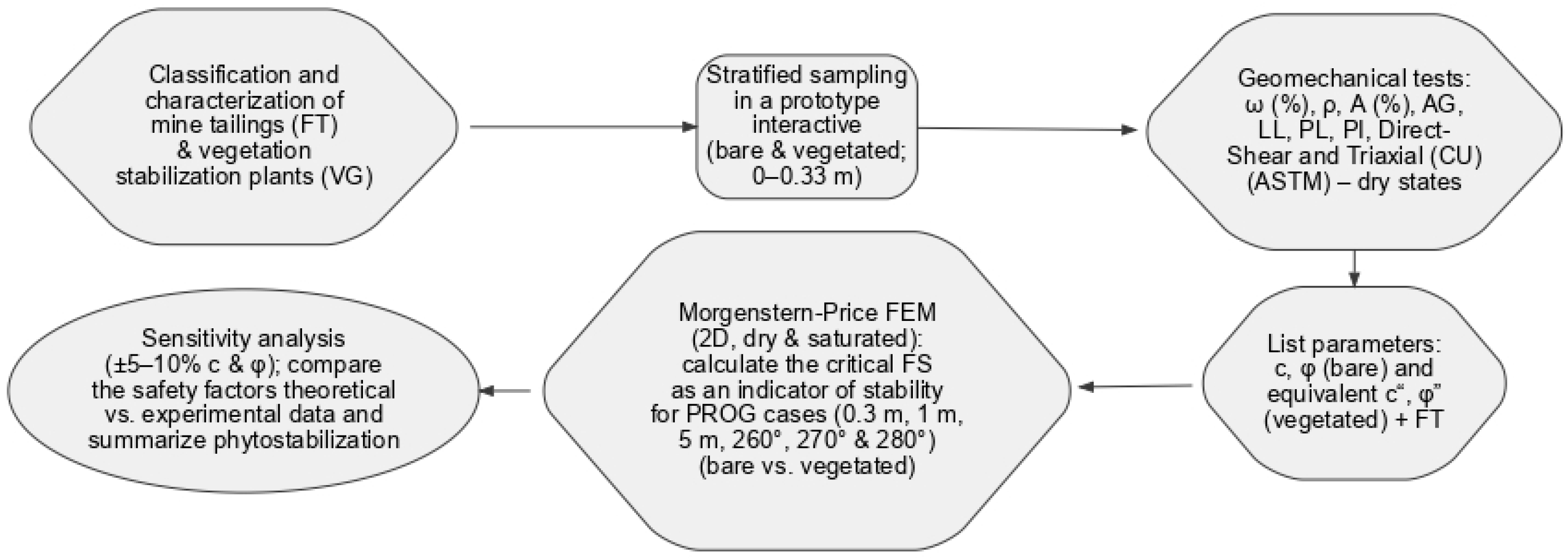
The methodological framework consisted of four sequential stages (
Figure 1). First, filtered mine tailings were physically and mechanically characterized under unreinforced tailings. Second, vetiver plants were established in controlled-growth columns, and intact root and tailings specimens were prepared for laboratory testing. Third, shear strength parameters for unreinforced tailings and root-reinforced tailings were obtained from laboratory tests and interpreted using the Mohr-Coulomb framework. Fourth, the resulting parameters were incorporated into limit equilibrium slope stability analyses to compare unreinforced tailings and root-reinforced tailings conditions under defined slope geometries (FT), root orientation and growth length (PROG) configurations, and predefined water condition assumptions. This framework allows for a direct link between experimental evidence and the numerical stability response.
2.2. Regional Context and Characteristics of the Area
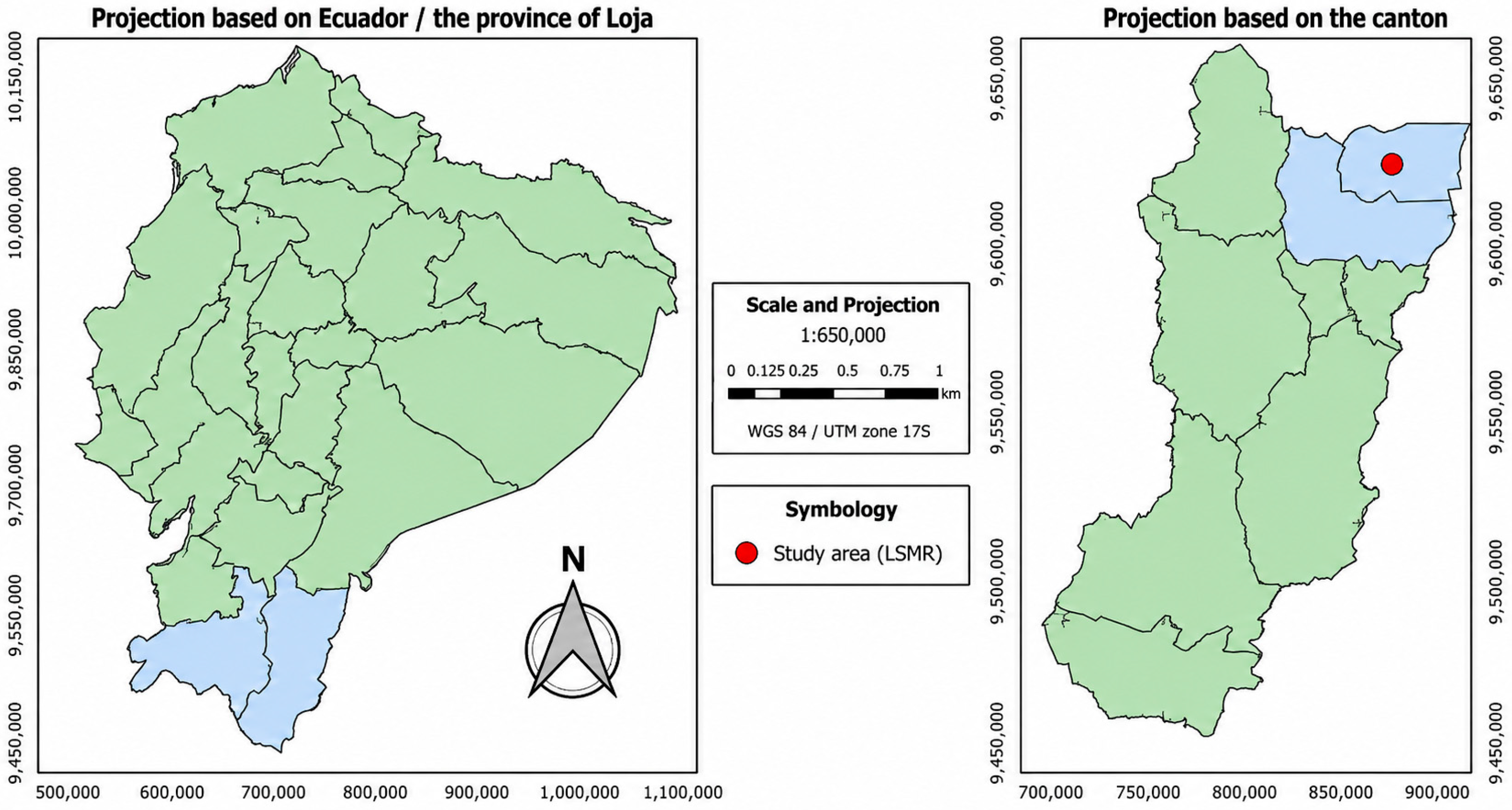
The tailings material was collected near the canton of Yantzaza, Zamora Chinchipe province, southern Ecuador, located in a Jurassic basin with managed lateral faults. The tailings developed before being covered by sediments, and are hosted in volcanic-andesitic rocks and sediments of the Santiago Formation, where the LSMR industries are located. The area has a mountainous terrain with diverse slopes and an irregular configuration. The altitude ranges from 1400 to 2020 m above sea level, and the mining area lies between 1420 and 1630 m above sea level, bordering the Machinaza River. The area features steep slopes between 24% and 50%, with local inclines where the structure crosses eroded deposits [
19,
20].
Figure 2 presents an overview of the regional and local environment.
2.3. Determination of the Characteristics of the Tailings
The behavior of the filtered tailings was evaluated within a dry soil mechanics framework, using representative material sampling, and was classified as a low-plasticity clayey silt (CL) according to the Unified Soil Classification System (USCS) (ASTM D2487-17e1) [
21]. Laboratory tests were performed according to ASTM standards, including moisture content analysis (ASTM D2216) [
22], density and absorption analysis (ASTM C128-25) [
23], particle size analysis by sieving (ASTM E112-13r21) [
24], Atterberg limits (ASTM D4318-17e01) [
25], direct shear tests (ASTM D6528-24) [
26], and triaxial compression tests (ASTM D7181-20) [
27]. The experimentally derived values were subsequently used as input parameters for the slope-stability analyses summarized in
Table 1.
2.4. Characteristic Parameters of Tailings with Vetiver Grass
The biological and biomechanical characteristics of vetiver were compiled to define the root reinforcement parameters used in the experimental and numerical framework. These parameters included the number of roots, root diameter, tensile strength, root-soil contact area, and the assumed root growth pattern. The collected values were not used to demonstrate phytostabilization at the field scale, but rather to support the interpretation of the mechanical interaction between vetiver roots and filtered tailings (
Table 2). Using the compiled and experimental data from the filtered tailings, direct shear tests (ASTM D6528-24) [
26] and triaxial compression tests (ASTM D7181-20) [
27] were performed on specimens with the root system present, in order to compare the mechanical response between the unreinforced tailings and root-reinforced tailings conditions.
The novelty of this study lies in the controlled assessment of vetiver-induced root reinforcement in filtered mine tailings, with emphasis on the contribution of roots to apparent cohesion and slope-stability response, which is valuable within the framework of the International Vetiver Network [
16].
2.5. Experimental Growth Column and Intact Preparation of Root Tailings Specimens
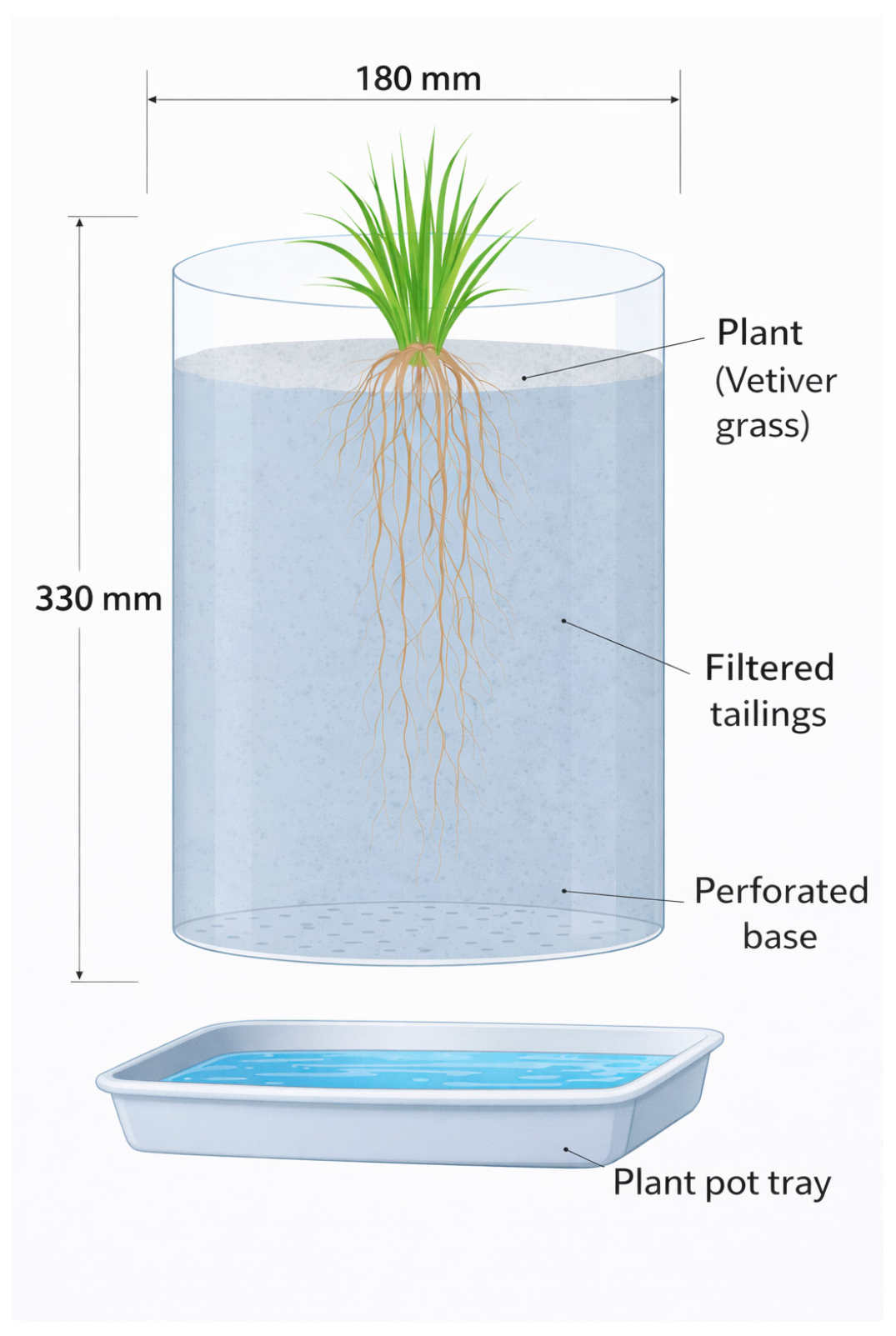
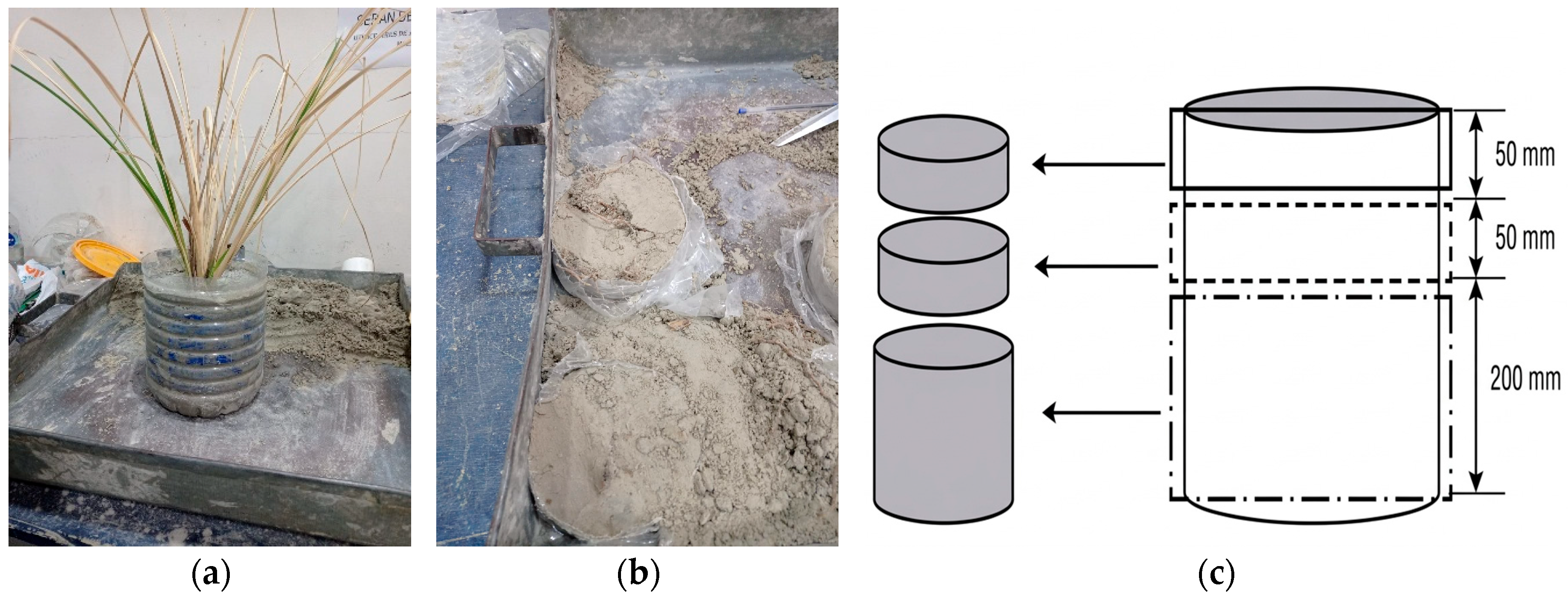
Two polyethylene columns were prepared by cutting the upper section of each container. Each column was 33 cm high and 18 cm in internal diameter. The columns were filled with filtered mine tailings to a height of 20 cm, and drainage holes were made at the base to prevent water accumulation during controlled irrigation (
Figure 3). Drainage wells were integrated into the base of each container, and irrigation was performed using a percentage of the experimentally determined capacity (approximately 1.6% of the volumetric water content) of the tailings’ volumetric moisture content.
The plant material used in this study consisted of commercially cultivated Chrysopogon zizanioides (L.) Roberty (Poaceae), commonly known as vetiver grass. Plant material was obtained from the Municipal Nursery of Loja, Ecuador, on 6 October 2025. The nursery is located at 3°57′25.01″ S, 79°13′03.27″ W and maintains commercially propagated stock under municipal management, including controlled fertilization, propagation, maintenance, and public distribution.
Vetiver was established from cuttings placed directly into the filtered tailings substrate. Chrysopogon zizanioides (L.) Roberty is a non-woody perennial grass of the Poaceae family, native to South and Southeast Asia, recognized for its dense, fibrous root system. It is widely used in tropical and subtropical regions for erosion control, surface stabilization, and rehabilitation of degraded soils.
The material was not collected from wild populations and does not correspond to rare, threatened, or endangered taxa.
Chrysopogon zizanioides is not included in the Appendices of the Convention on International Trade in Endangered Species of Wild Fauna and Flora (CITES) [
34,
35]. The acquisition and use of plant material complied with applicable institutional and national regulations and were conducted in accordance with the principles established by the Convention on Biological Diversity (CBD) regarding the conservation and sustainable use of biological resources [
36].
No genetic modification, molecular characterization, DNA sequencing, or access to protected genetic resources was undertaken as part of this research. The plants were used exclusively in controlled laboratory column experiments designed to evaluate root reinforcement effects and their contribution to the geomechanical stabilization of filtered mine tailings (
Supplementary Materials Figures S1–S4).
Because the study did not involve taxonomic, floristic, phylogenetic, conservation, or biodiversity assessments, no herbarium voucher specimen was required for the research objectives. However, photographic records of the plant material, collection site, and cultivation source were documented and archived by the authors to facilitate future verification of taxonomic identity.
In bioengineering applications, this root architecture may improve the mechanical response of the substrate through anchorage, interlocking, and tensile stress transfer. However, establishment in mine tailings may be constrained by nutrient deficiency, salinity, extreme pH, metal toxicity (Pb, As, Cd, Cr, Cu, and Zn), water stress, and site-specific climatic conditions. In this study, these ecological limitations were not fully quantified; therefore, biological observations are interpreted as preliminary indicators of establishment, rather than as evidence of field-scale phytostabilization [
16,
37,
38,
39,
40,
41,
42,
43,
44,
45].
Two polyethylene columns were prepared for controlled vetiver establishment. Each column was 33 cm high and 18 cm in internal diameter and was filled with filtered mine tailings to a height of 20 cm. Drainage holes were made at the base of each column to prevent water accumulation during controlled irrigation. Vetiver cuttings were placed directly in the tailings substrate. The experiment lasted 30 days. No external fertilizer was added; however, the actual nutrient content of the tailings was not measured. Therefore, the study does not claim plant growth under complete nutrient absence. At the end of the experiment, the observed root length was approximately 37 cm. Root development may have been influenced by the initial cutting length, controlled irrigation, drainage, clayey-silt tailings texture, aeration, local temperature, and short-term plant adaptation. Initial wilting was observed during early establishment, followed by partial foliar regeneration from the second week. These observations indicate preliminary establishment in an unfertilized tailings substrate but do not constitute a complete assessment of nutrient limitation or phytotoxicity.
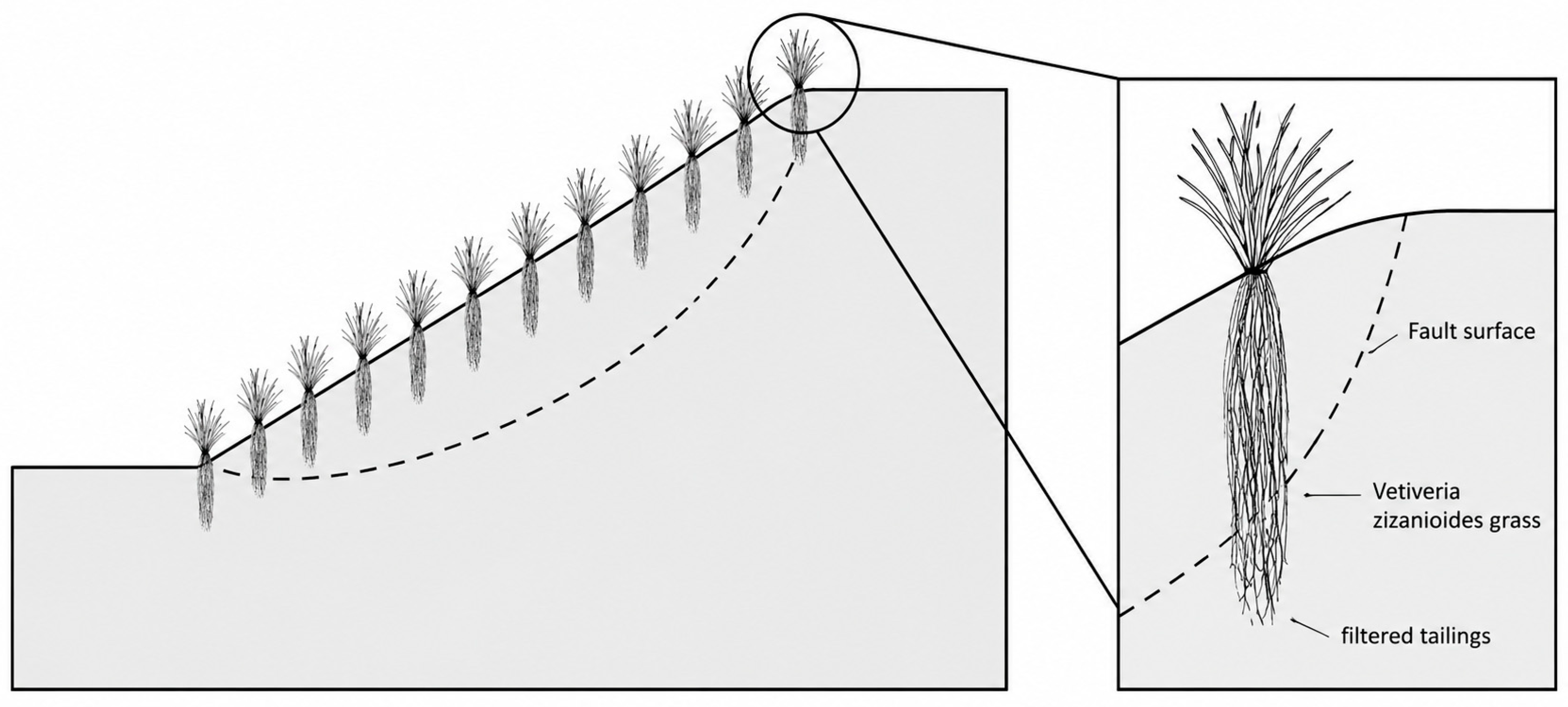
Figure 4 shows the development of the vetiver grass after 30 days, along with the profiling scheme of the test pellets (
Supplementary Materials Figures S1–S4).
2.6. Determination of the Geotechnical Reliability Index
Safety Factor in Bare State Versus Vegetation Cover
Dry stability analyses were performed to isolate the mechanical contribution of the root reinforcement. The pore water pressure adjacent to the proposed sliding sections for the zero scenario was set to zero (no infiltration, evapotranspiration, or suction). Additional scenarios with water conditions were included only as simplified comparative assumptions and should not be interpreted as transient seepage, rainfall infiltration, evapotranspiration, or unsaturated flow simulations. The mechanical characteristics of the sections and the shear strength parameters (c′, φ′) were assigned from the laboratory study of the material structure. Surcharge and seismic actions were not evaluated. The analysis focused on surface translational failures; consequently, the sliding surface record was limited to strata from 0 to 5 m.
The Morgenstern–Price limit-equilibrium method was applied because it satisfies both force and moment equilibrium for general slip surfaces. This method is suitable for evaluating two-dimensional surface stability scenarios in tailings slopes, using shear strength parameters derived from laboratory tests. Within this range, a complete 2D balance analysis generates reliable safety factors suitable for application in project-scale assessments [
46]. The factor of safety (FS) is determined using the Morgenstern-Price limit equilibrium method, which analyzes the equilibrium of forces and moments in individual blocks divided on the surface with a constant force slope between sections λ. For section I, the existing shear strength along the base is
and the safety factor is considered as:
Equations (1) and (2). effective cohesion; effective friction angle; section base length; effective normal force; mobilized base shear stress; constant force inclination between sections.
Where is the mobilized shear demand developed from the joint solution of the global force and moment equilibrium with constant slope of the force between sections λ. In the recent study under dry conditions, the infiltration into the pores along the slip zone is equal to zero, therefore .
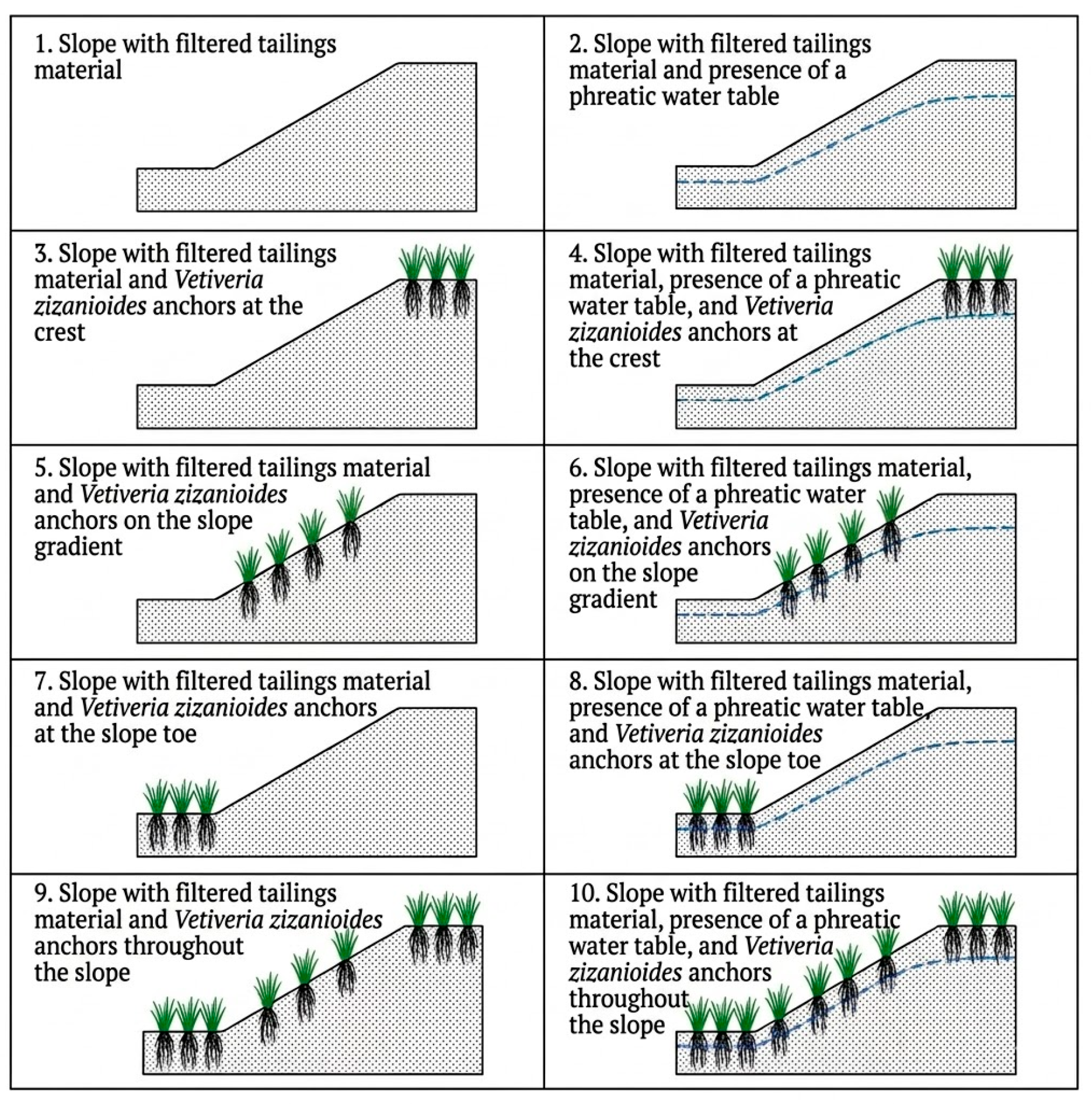
The slope typology (ST) was established with a 3H:1V, 2H:1V, and 1H:1V geometry, reflecting configurations adopted in mining tailings. Reinforcement at the root of the VG acts as a variable that increases effective cohesion and redistributes shear loads under certain conditions. However, it is necessary to understand the mechanical contribution of the root system and its performance in critical situations, which is demonstrated through ongoing quantitative studies in mining deposits in Andean tropical climates.
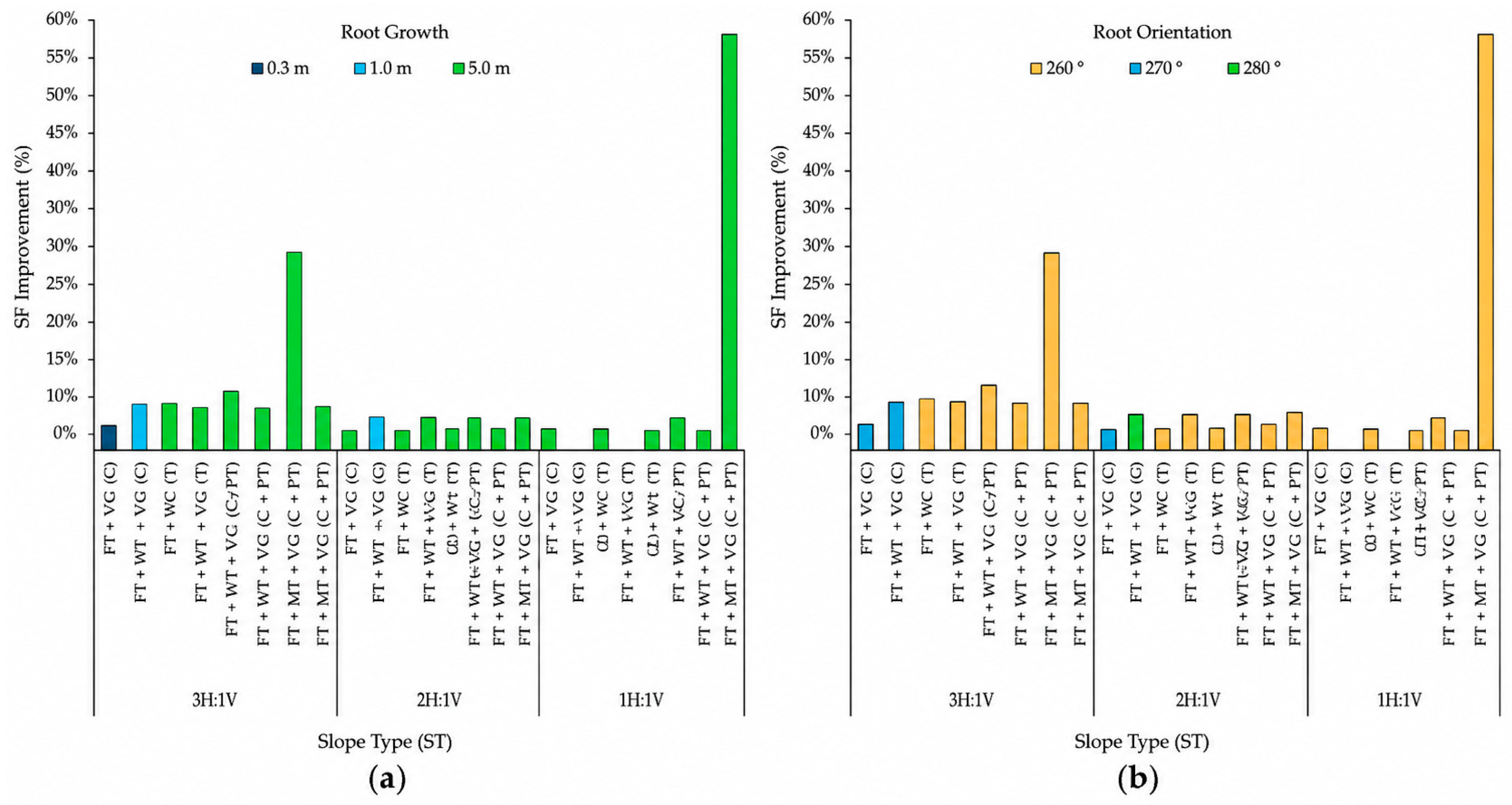
Figure 5 presents the ten numerical scenarios used for each typology to evaluate the influence of the plant’s root configuration, orientation, and growth (PROG): bare FT (starting point) using proposed conditions for depth and direction
, and for plants using experimental
and achieved
values
from direct shear and triaxial compression tests in the root-tailings matrix. The experimentally observed root lengths were limited to approximately 32–37 cm after 30 days and, in the numerical analysis, including 1 m and 5 m, were treated as parametric scenarios based on the potential root development reported in the literature, and not as lengths achieved during the laboratory experiment; simplified water scenarios were not coupled seepage or unsaturated-flow simulations.
Root anchorage increases effective cohesion to apparent cohesion and influences modifications of the friction angle, as observed in the filtered tailings; both configurations are considered in terms of resistance . For each scenario, the critical slip surface is generated from the minimum factor of safety (FS) within the 0 to 5 m margins; the results were classified and related to the quantification of the plant’s mechanical contribution. The scenarios were simulated in both dry and undersaturated conditions. Prototype and laboratory development was carried out in partially wet states, when the pore water pressure present on the proposed slip surface was moderate; this allowed for the analysis of the mechanical effects introduced by the roots (tensile reinforcement and interfacial entanglement) with the hypothesis of integrated hydromechanical consequences in the modeling data (water retention in the tailings, hydraulic conductivity, rainfall forcing/evapotranspiration).
2.7. Sensitivity Analysis
A local sensitivity analysis (one factor at a time) was performed to assess the influence of uncertainty in shear strength parameters on the calculated factor of safety and to determine its effectiveness. Cohesion (c′) and friction angle (
φ′) were varied independently within predefined ranges of ±5% and ±10%, respectively, while the other parameters were held constant for both direct and triaxial shear (UU) [
47,
48]. For each section depth, and for both bare and vegetated approaches, the characteristics were modified independently and modeled using FEM to quantify the resulting variation in the factor of safety using the Morgenstern–Price method [
25,
46,
49].
The objective was not to provide a probabilistic reliability analysis, but rather to examine the robustness of slope stability response to plausible variations in laboratory-obtained strength parameters. Non-physical, numerically determined outputs were noted and reported separately; valid simulation results were not excluded solely because they differed from the baseline.
4. Discussion
Using a parameterized limit-equilibrium framework, this study quantified changes in the factor of safety of filtered-tailings slopes under unreinforced and root-reinforced conditions. The results provide preliminary evidence that vetiver roots can improve the mechanical response of filtered mine tailings under controlled conditions, primarily by increasing apparent cohesion. Therefore, the analysis focuses on the geomechanical implications of root reinforcement, the limitations of the experimental-numerical framework, and the conditions that must be considered before applying phytostabilization at a field scale [
47,
48,
49].
4.1. Influence of the Root System on the Mechanical Properties of Tailings
The results obtained show that the incorporation of vetiver grass induces a significant modification in the shear strength of the filtered tailings, primarily due to an increase in effective cohesion (c′), while the angle of internal friction (φ′) shows only marginal variations. This pattern is consistent with the theory of reinforced soils, where fibrous elements—in this case, the roots—introduce an additional resistant component of a tensile nature, which manifests as apparent cohesion.
The approximate 20–35% increase in c′ confirms that the reinforcement mechanism is controlled by the transfer of tensile stresses from the soil matrix to the root system, as well as by the anchoring and interlocking effects. In contrast, the limited variation in φ′ (<10%) suggests that the granular structure of the tailings does not undergo substantial changes, which is expected in fine-grained CL-type materials where friction is governed by inter-joint contacts and not by fibrous inclusions.
From a constitutive perspective, these results support modeling the root-tailings system using a modified Mohr-Coulomb failure envelope, in which the root contribution can be interpreted as an additional cohesive term dependent on root density, stiffness, and tensile strength. Consequently, the action of a biological agent in the pseudo-cohesive reinforcement mechanism is efficient, especially under low saturation conditions, where the soil-root interaction is not weakened by pore pressure.
4.2. Effect of Slope Stability with Biological Configurations
The comparison between bare and reinforced tailings shows that the incorporation of vetiver generates consistent increases in the factor of safety (FS), although of moderate magnitude (≈1.5–3.5%). However, these increases become significant when analyzed in the context of slopes close to the limit condition (FS ≈ 1.0), especially in more critical configurations such as 1H:1V. On bare slopes, the reduction in FS with increasing slope confirms the material’s high susceptibility to surface failures, especially under saturated conditions. The introduction of the root system modifies this behavior by redistributing shear stresses along the potential slip surface, acting as a distributed reinforcement system. It is important to note that the improvement in FS is not uniform across slope types. In flatter slopes such as 3H:1V, the effect of the reinforcement is less critical because the system already exhibits relatively stable conditions. In contrast, in steeper slopes such as 1H:1V and 2H:1V), the contribution of roots is more significant, as it directly helps to counteract the increased shear forces mobilized. Therefore, root reinforcement using vetiver should be interpreted as a complementary biogeotechnical measure that can improve surface stability under favorable conditions, but it should not be considered an independent stabilization solution for highly unstable slopes or for cases governed by high pore water pressures.
4.3. Relationship Between Root Growth, PROG and Shear Strength
The analysis of growth and orientation of articulated roots (PROG) shows that the efficiency of plant reinforcement depends largely on the geometry of the root system relative to the failure surface. In particular, it is observed that increasing root length (up to 5 m) produces substantial improvements in c′ and φ′, resulting in greater shear strength of the system.
This behavior can be explained by the concept of interception of slip surfaces, where roots act as reinforcing elements that mobilize additional resistance when soil deformation is demanded. The greater the root length, the greater the probability of intersecting with the critical surface, thus increasing the anchoring capacity.
Regarding orientation, the results indicate that angles close to 260–280° maximize mechanical contribution. This suggests that configurations with predominantly vertical components favor shear strength, allowing roots to work under tension in the face of relative displacements between soil blocks.
Similarly, the variability observed in φ′ may be associated with a mechanical entanglement effect induced by the presence of roots, although this mechanism is secondary to cohesive input. Overall, these results confirm that root reinforcement is not isotropic, but rather depends on the root-soil system architecture, which should be considered in advanced numerical modeling.
4.4. Evaluation of Geotechnical Performance According to Slope Type (ST) and PROG
The performance of the stabilization system clearly depends on the interaction between slope type (ST) and root configuration (PROG). The best results are achieved in experimental scenarios with longer root lengths (≈5 m) and optimal orientations (≈260°), where the system reaches stability conditions classified as “SF values”. In geotechnical terms, this indicates that the effectiveness of vegetation reinforcement is controlled by the geometric compatibility between the root system and the slope failure kinematics. On steeper slopes, reducing the distance between plants improves the continuity of the reinforcement, generating an effect similar to a three-dimensional containment mesh. On the other hand, in the pilot growth stages 0.3 m–1 m (experimental), scenario-dependent performance is limited because the roots have not yet developed their full resistance capacity. This highlights the importance of the time factor in stabilization, as the system evolves progressively until it reaches its maximum mechanical potential. These findings suggest that the design of vetiver-based solutions should consider not only the plant species, but also parameters such as planting density, expected root orientation, and establishment time, integrating agronomic and geotechnical criteria into a single design strategy.
4.5. Limitations
This study has several limitations that constrain the interpretation of the results. First, although the geotechnical tests and slope-stability analyses were designed to isolate the mechanical contribution of roots, vetiver establishment required controlled irrigation, which introduced partially saturated conditions in the growth columns. Second, the numerical representation of the root system was simplified; root area ratio, root density, spatial distribution, effective diameter, and anisotropic reinforcement were not directly quantified. Third, the experiment was conducted without external fertilizer addition, but nutrient content was not measured. Fourth, no geochemical or phytotoxicity characterization was performed; therefore, contaminant immobilization, metal tolerance, nutrient limitation, and plant toxicity response remain outside the demonstrated scope of this work. Finally, long-term root death, dormancy, or decay may progressively reduce tensile resistance, reinforcement continuity, and root–tailings interaction. The mechanical contribution of vetiver roots should therefore not be assumed to be permanent without long-term monitoring of plant survival, root renewal, below-ground biomass, and root degradation.
4.6. Reliability and Applicability
These results indicate model robustness within the tested parameter ranges; however, full probabilistic reliability assessment would require a larger dataset. However, its practical implementation requires field-scale validation and a comprehensive assessment of hydraulic, mechanical, biological, and geochemical factors. Moisture variability, root development over time, contaminant bioavailability, nutritional status, and maintenance requirements must be considered before this approach can be evaluated as a reliable phytostabilization strategy. This positions the study of mechanical reinforcement with vetiver grass not as an isolated solution, but as one component within a more complex stabilization system for mining slopes.
Coefficients of variation below 9% and statistical significance (p < 0.01) support the reliability of the results, although it is necessary to consider that the experimental model was developed under controlled conditions and in a dry state (u = 0). Under real conditions, factors such as matric suction, infiltration, and root degradation can modify the system’s response.
4.7. Sustainable Engineering Treatments as a Sustainable Solution
The results obtained under controlled laboratory conditions and numerical simulations suggest that vetiver roots can improve the mechanical behavior of filtered mine tailings, primarily by increasing apparent cohesion. This improvement is attributed to the formation of a root-tailings matrix capable of mobilizing additional tensile strength and interlocking resistance under surface failure conditions.
The experimentation with vetiver grass in mining tailings should be interpreted not only from a geotechnical perspective, but also within a broader sustainability framework. In this context, the present study could contributes to the understanding of nature-based solutions (NbS) as multifunctional strategies capable of simultaneously addressing environmental, technical, and resource efficiency challenges [
52].
From a circular economy perspective, the in situ stabilization of mining tailings represents a shift from conventional linear waste management approaches toward regenerative systems in which waste materials are reintegrated into functional soil layers. Unlike traditional engineering solutions that rely on external materials (e.g., cement, geosynthetics, or structural reinforcements), phytostabilization minimizes the need for additional resources, thereby reducing material consumption and associated environmental burdens [
13,
18].
In quantitative terms, cohesion increased from approximately 6 kPa in unreinforced tailings to values close to 8 kPa in root-reinforced specimens. Likewise, the numerical scenarios showed varying safety factors depending on the slope geometry and assumed water conditions, with values close to the limit equilibrium in critical configurations and higher values under favorable root reinforcement scenarios.
Vegetation can provide additional ecosystem services, such as erosion control, dust reduction, and surface protection. However, contaminant immobilization was not assessed in this study and should not be claimed without geochemical and plant tissue analyses [
53].
However, it is important to recognize that the sustainable performance of the soil-root matrix depends heavily on the context. Factors such as climatic conditions, water availability, long-term root development, and maintenance requirements can influence both its effectiveness and its environmental impact. In particular, the controlled irrigation required during the early stages of growth can introduce trade-offs related to water consumption, especially in semi-arid environments [
13].
Overall, experimental and numerical evidence supports the potential use of vetiver root reinforcement as part of a broader tailings rehabilitation strategy. However, further evidence is needed regarding geochemistry, phytotoxicity, long-term plant survival, and field performance.
4.8. Future Implications and Research Needs
Future research should integrate detailed root-system quantification, geochemical characterization, phytotoxicity indicators, and field-scale monitoring. Priority should be given to root area ratio, root density, root diameter distribution, differentiation between fine and coarse roots, long-term root degradation, survival rate, chlorosis, biomass production, root elongation, and metal accumulation in plant tissues. In addition, life-cycle assessment, cost–benefit analysis, and socio-technical evaluation should be incorporated to determine whether vetiver-induced root reinforcement can evolve from a preliminary geomechanical response into a reliable phytostabilization strategy for mine-tailings rehabilitation.