Moving in the Same Direction: A Shared Path for Sustainable Tourism and Nature-Based Solutions


Abstract
1. Introduction
- (1)
- Can we find shared principles and criteria guiding the actions developed adopting a local turn in tourism approach and the NbS framework and the principles of ecomuseums practices?
- (2)
- Can ecomuseums be considered a form of NbS?
- (3)
- And, in that case, can they become tools for the realization of a local turn in tourism?
2. Theoretical Framework
2.1. Sustainable Tourism and Local Turn in Tourism
2.2. Nature-Based Solutions as a New Framework for International Actions
2.3. Ecomuseums: A Tool for Place-Based Actions for Local Development
3. Materials and Methods
3.1. Shared Principles Between Local Turn in Tourism, NbS, and Ecomuseums
- The key terminologies for localizing tourism [16].
3.1.1. Place-Based Governance
3.1.2. Community Participation and Empowerment
3.1.3. Environmental Sustainability
3.1.4. Education, Learning, and Awareness
3.2. An Application of the Shared Principles to the Analysis of Mediterranean Ecomuseums
- The relationship of these institutions with tourism,
- How they manage the different aspects of place-based governance, community participation and empowerment, environmental sustainability and education, learning and awareness.
4. Results
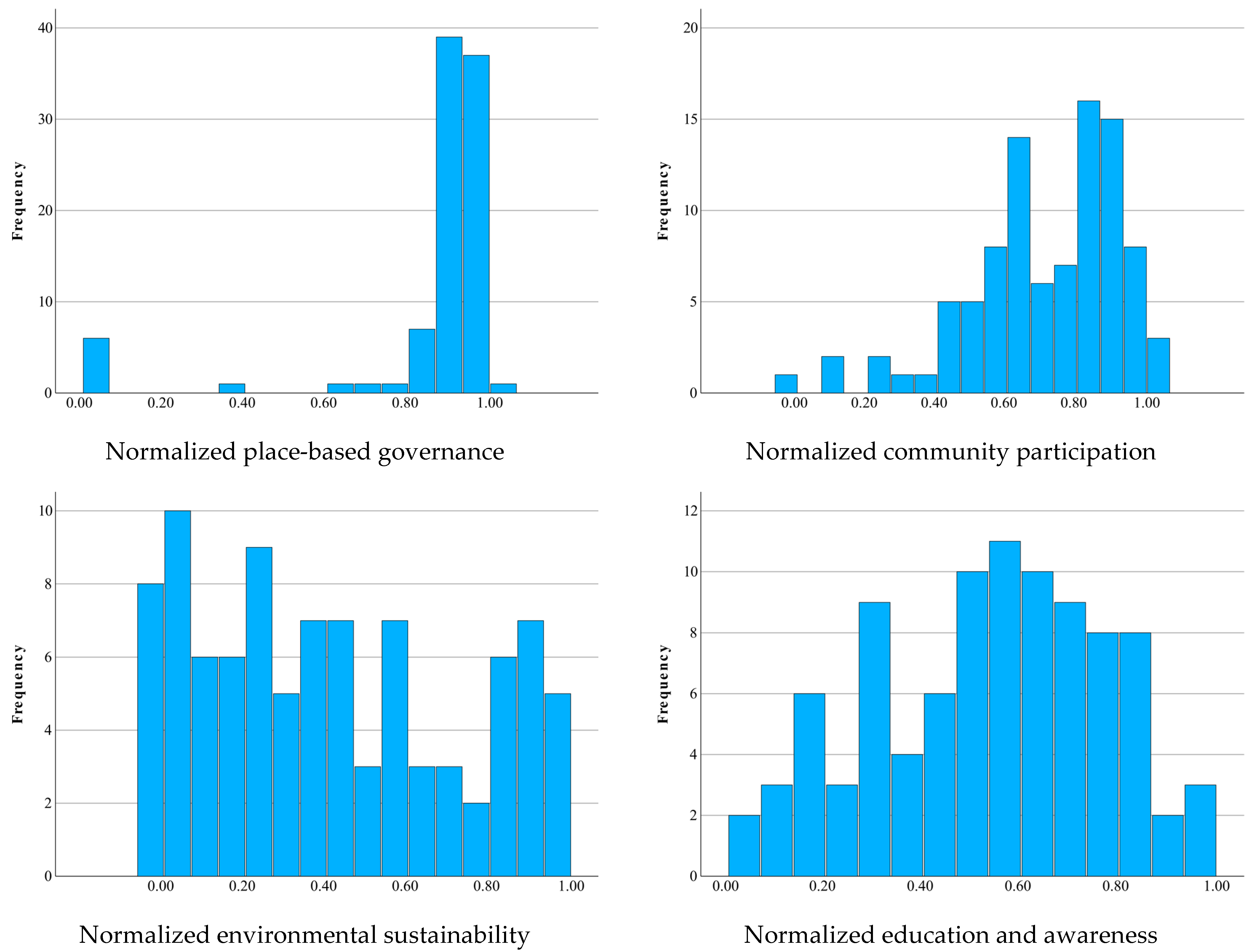
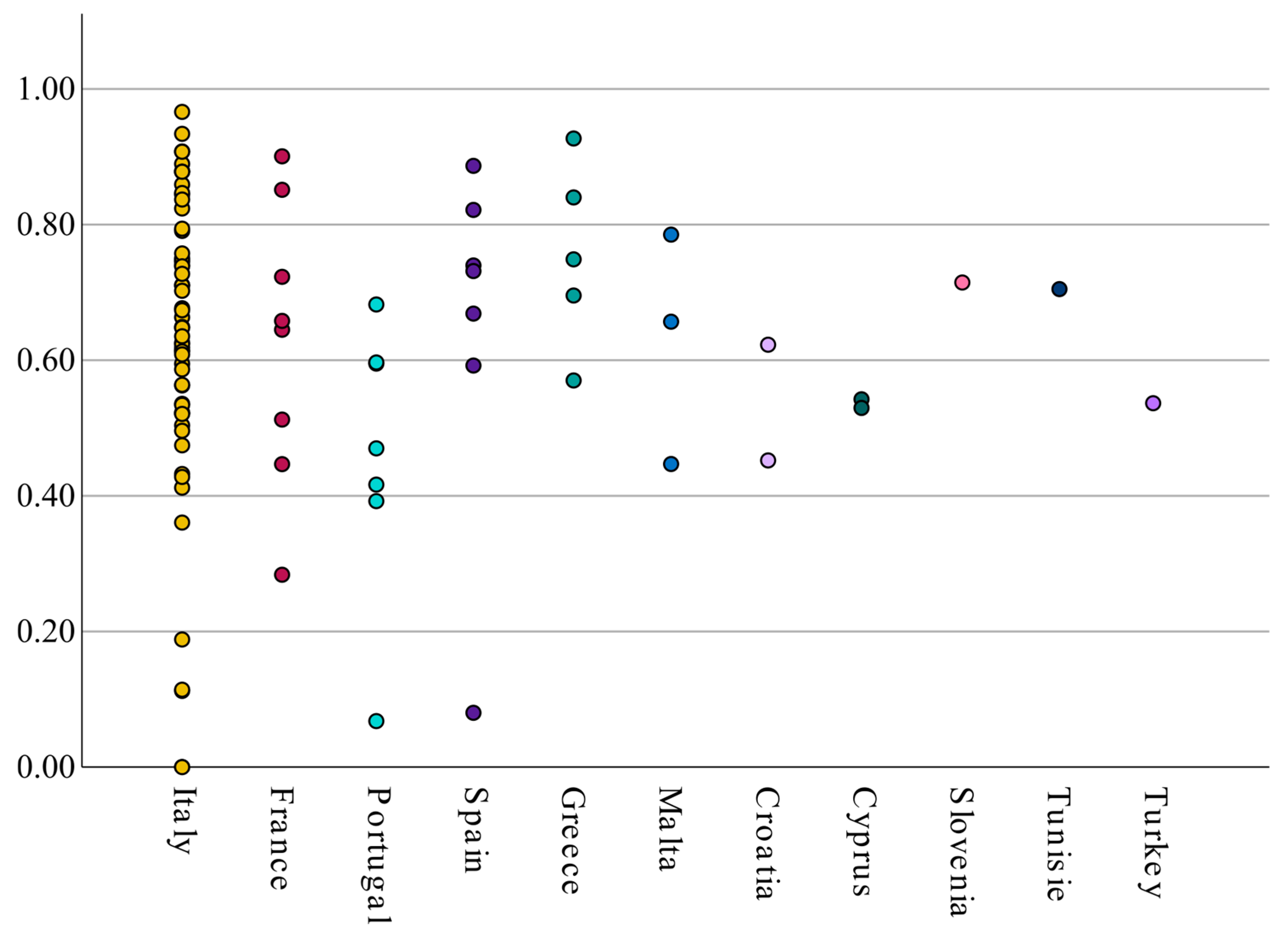
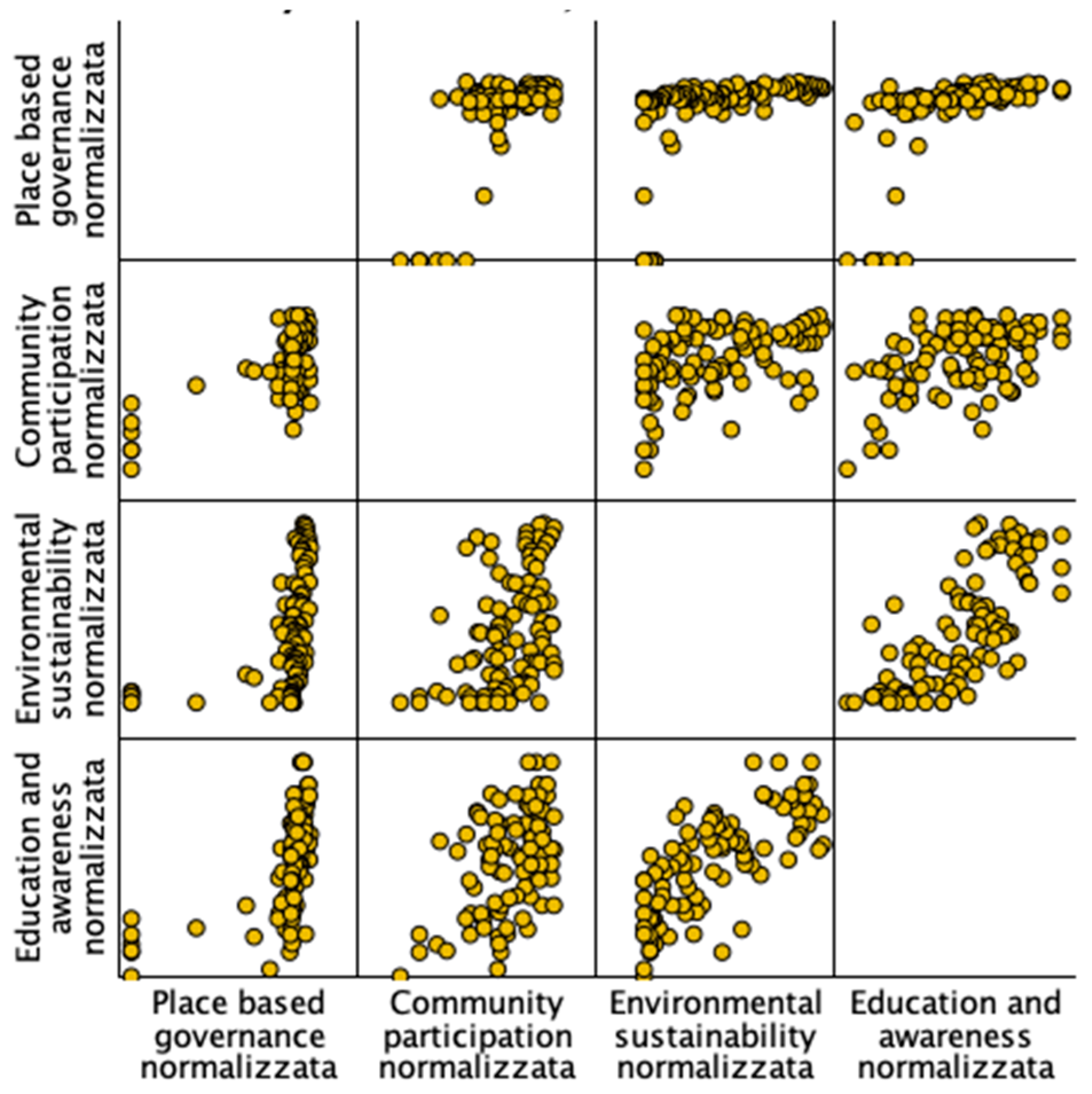
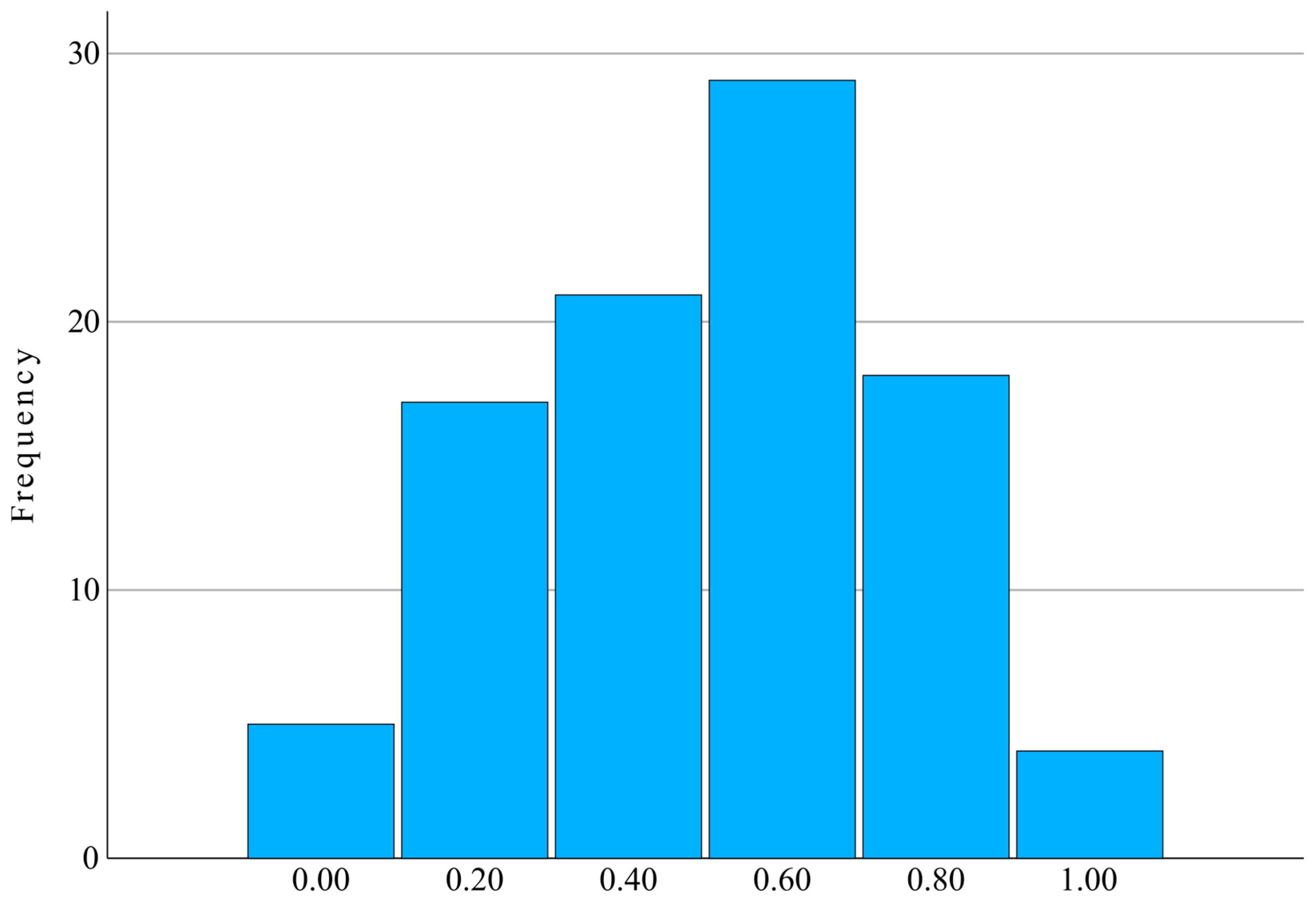
5. Discussion and Conclusions
Author Contributions
Funding
Institutional Review Board Statement
Informed Consent Statement
Data Availability Statement
Conflicts of Interest
Appendix A
| Place-Based Governance | ||
| Item | Measure | |
| 1 | Participatory decision-making process of the institution | Likert |
| 2 | Operation autonomy of the institution | Likert |
| 3 | N° of stakeholder developing activities with | Scale |
| 4 | Activities with local and regional authorities | Dico |
| 5 | Frequency of meeting with Stakeholders | Likert |
| 6 | Participatory governance practices | Likert |
| 7 | Involvement with local community | Scale |
| 8 | Shared management of a common good | Dico |
| 9 | Collaborative management of specific natural areas | Dico |
| 10 | Permanent observatory on biodiversity | Dico |
| 11 | Definition of agreements with other local actors | Dico |
| Place-Based Governance—Component Loading | |
| Dimension 1 | |
| N° of stakeholder developing activities with | 0.956 |
| Frequency of meeting with Stakeholders | 0.947 |
| Participatory governance practices | 0.939 |
| Operation autonomy of the institution | 0.938 |
| Involvement with local community | 0.931 |
| Participatory decision-making process of the institution | 0.918 |
| Activities with local and regional authorities | 0.661 |
| Definition of agreements with other local actors | 0.286 |
| Shared management of a common good | 0.276 |
| Collaborative management of specific natural areas | 0.211 |
| Permanent observatory on biodiversity | 0.180 |
| Community Participation and Empowerment | ||
| Item | Measure | |
| 1 | Purpose: Promote community-based activities | Dico |
| 2 | Purpose: support and enhance local economy | Dico |
| 3 | Number of volunteers | Ordinal |
| 4 | Dependence on volunteer work | Likert |
| 5 | Volunteers as a tool to involve the local community | Likert |
| 6 | Activities with local action groups and cultural associations, citizen committee | Dico |
| 7 | N° of projects promoting active community collab. | Scale |
| 8 | Specially constituted working tables on biodiversity | Dico |
| 9 | Public: Local community | Dico |
| Community Participation and Empowerment—Component Loading | |
| Dimension 1 | |
| N° of projects promoting active community collab. | 0.770 |
| Activities with local action groups and cultural associations, citizen committee | 0.646 |
| Purpose: Promote community-based activities | 0.641 |
| Public: Local community | 0.523 |
| Volunteers as a tool to involve the local community | 0.508 |
| Purpose: support and enhance local economy | 0.490 |
| Dependence on volunteer work | 0.468 |
| Number of volunteers | 0.464 |
| Specially constituted working tables on biodiversity | 0.110 |
| Environmental Sustainability | ||
| Item | Measure | |
| 1 | Purpose: Preserve the local biodiversity | Dico |
| 2 | Online section on biodiversity | Dico |
| 3 | Located in natural park/protected area | Dico |
| 4 | Organizing staff training on biodiversity | Dico |
| 5 | Activities with Protected areas | Dico |
| 6 | Activities with Environmental protection associations | Dico |
| 7 | Project: Citizen science: submission of data on animal or plants | Dico |
| 8 | Project: Collaborative cleaning of natural areas | Dico |
| 9 | Project: Collaborative cleaning of urban areas | Dico |
| 10 | Topic: The conservation of biodiversity | Dico |
| 11 | Topic: The vegetation, gardens and green areas | Dico |
| 12 | Topic: The views of the environment of visitors/tourists/migrants, etc. | Dico |
| 13 | Topic: Exceptional environments (of great value and/or in particular situation of degradation) | Dico |
| 14 | Topic: The value of ecosystems and biodiversity | Dico |
| 15 | Topic: The different types of terrestrial environments | Dico |
| 16 | Topic: The natural characteristics of the local context | Dico |
| 17 | N° of activities on biodiversity | Scale |
| 18 | Promotion of sustainable tourism practices | Dico |
| Environmental Sustainability—Component Loading | |
| Dimension 1 | |
| N° of activities on biodiversity | 0.855 |
| Topic: The conservation of biodiversity | 0.780 |
| Topic: The value of ecosystems and biodiversity | 0.741 |
| Organizing staff training on biodiversity | 0.723 |
| Project: Citizen science: submission of data on animal or plants | 0.707 |
| Activities with Environmental protection associations | 0.696 |
| Online section on biodiversity | 0.685 |
| Activities with Protected areas | 0.650 |
| Purpose: Preserve the local biodiversity | 0.622 |
| Topic: The vegetation, gardens and green areas | 0.559 |
| Topic: Exceptional environments (of great value and/or in particular situation of degradation) | 0.543 |
| Topic: The natural characteristics of the local context | 0.515 |
| Project: Collaborative cleaning of natural areas | 0.453 |
| Topic: The different types of terrestrial environments | 0.446 |
| Topic: The views of the environment of visitors/tourists/migrants, etc. | 0.373 |
| Located in natural park/protected area | 0.331 |
| Project: Collaborative cleaning of urban areas | 0.273 |
| Promotion of sustainable tourism practices | 0.257 |
| Education | ||
| Item | Measure | |
| 1 | Purpose: Offer training/education activities | Dico |
| 2 | Purpose: Organize exhibitions | Dico |
| 3 | Training for staff/volunteers | Dico |
| 4 | Activities with: Museums, archives, libraries, galleries | Dico |
| 5 | Collaborative construction of collections | Dico |
| 6 | Topics: Specific places important to the local community | Dico |
| 7 | Topics: The different perceptions of the landscape by inhabitants | Dico |
| 8 | Permanent/temporary exhibition on biodiversity | Dico |
| 9 | Specific educational activities on biodiversity | Dico |
| 10 | Public: School-age population | Dico |
| Education—Component Loading | |
| Dimension 1 | |
| Specific educational activities on biodiversity | 0.708 |
| Purpose: Offer training/education activities | 0.638 |
| Training for staff/volunteers | 0.623 |
| Public: School-age population | 0.568 |
| Permanent/temporary exhibition on biodiversity | 0.554 |
| Collaborative construction of collections | 0.550 |
| Topics: Specific places important to the local community | 0.449 |
| Topics: The different perceptions of the landscape by inhabitants | 0.432 |
| Activities with: Museums, archives, libraries, galleries | 0.429 |
| Purpose: Organize exhibitions | 0.199 |
Appendix B

References
- Welcome to the Age of the Polycrisis: The Global Risks Report 2023. Podcast Transcript. Available online: https://www.weforum.org/podcasts/radio-davos/episodes/global-risks-report-davos2023/ (accessed on 10 April 2026).
- Mzembe, A.N.; Melissen, F.; Pinteva, S. Is Governance a Driver of Sustainability Transitions? Evidence From Tourism and Urban Socio-Technical Systems. Sustain. Dev. 2026, 34, 2022–2039. [Google Scholar] [CrossRef]
- Battisti, L.; Cuomo, F.; Manganelli, A. Collaborative Governance Arrangements: What Makes Nature-Based Solutions Endure? Territ. Politics Gov. 2025, 13, 1421–1441. [Google Scholar] [CrossRef]
- World Tourism Organization. Fifty Years of Tourism; World Tourism Organization: Madrid, Spain, 2025. [Google Scholar] [CrossRef]
- Davis, P. Ecomuseum Indicators and the ‘21 Principles’. In On Community and Sustainable Museums; Brown, K., Davis, P., Raposo, L., Eds.; EULAC: Hamburg, Germany, 2018; pp. 96–101. [Google Scholar]
- IUCN. Global Standard for Nature-Based Solutions, 1st ed.; IUCN: Gland, Switzerland, 2020. [Google Scholar]
- Laarman, J.G.; Durst, P.B. Nature Travel in the Tropics. J. For. 1987, 85, 43–46. [Google Scholar] [CrossRef]
- Wolf, I.D.; Croft, D.B.; Green, R.J. Nature Conservation and Nature-Based Tourism: A Paradox? Environments 2019, 6, 104. [Google Scholar] [CrossRef]
- Thapa, K.; King, D.; Banhalmi-Zakar, Z.; Diedrich, A. Nature-Based Tourism in Protected Areas: A Systematic Review of Socio-Economic Benefits and Costs to Local People. Int. J. Sustain. Dev. World Ecol. 2022, 29, 625–640. [Google Scholar] [CrossRef]
- Ardoin, N.M.; Wheaton, M.; Bowers, A.W.; Hunt, C.A.; Durham, W.H. Nature-Based Tourism’s Impact on Environmental Knowledge, Attitudes, and Behavior: A Review and Analysis of the Literature and Potential Future Research. J. Sustain. Tour. 2015, 23, 838–858. [Google Scholar] [CrossRef]
- Postma, A.; Cavagnaro, E.; Spruyt, E. Sustainable Tourism 2040. J. Tour. Futures 2017, 3, 13–22. [Google Scholar] [CrossRef]
- Foundation for Environmental Education (FEE). Green Key 2026. Available online: https://www.greenkey.global/ (accessed on 25 May 2026).
- Regulation (EC) No 66/2010 of the European Parliament and of the Council of 25 November 2009 on the EU Ecolabel (Text with EEA Relevance); European Union: Brussels, Belgium, 2009; Volume 27, pp. 1–19.
- International Organization for Standardization (ISO). ISO 14001:2026: Environmental Management Systems—Requirements with Guidance for Use, 3rd ed.; ISO: Geneva, Switzerland, 2026. [Google Scholar]
- Higgins-Desbiolles, F.; Bigby, B.C. A Local Turn in Tourism Studies. Ann. Tour. Res. 2022, 92, 103291. [Google Scholar] [CrossRef]
- Higgins-Desbiolles, F.; Bigby, B.C. Embracing the Local Turn in Tourism to Empower Communities; Channel View Publications: Bristol, UK, 2022. [Google Scholar]
- MacCannell, D. The Tourist: A New Theory of the Leisure Class; University of California Press: Oakland, CA, USA, 1976. [Google Scholar]
- Salazar, N.B. Tourism Imaginaries: A Conceptual Approach. Ann. Tour. Res. 2012, 39, 863–882. [Google Scholar] [CrossRef]
- European Commission Nature-Based Solutions: EU-Funded NbS Research Projects Tackle the Climate and Biodiversity Crises; Publications Office of the European Union: Luxembourg, 2025; ISBN 978-92-95234-73-4.
- UNEA. Nature-Based Solutions for Supporting Sustainable Development (English Version)—Resolution Adopted by the United Nations Environment Assembly on 2 March 2022 [UNEP/EA.5/Res.5]; United Nations Environment Assembly: Nairobi, Kenya, 2022. [Google Scholar]
- European Commission. Towards an EU Research and Innovation Policy Agenda for Nature-Based Solutions & Re-Naturing Cities; Directorate-General for Research and Innovation Climate Action, Environment, Resource Efficiency and Raw Materials: Luxembourg, 2015. [Google Scholar]
- Brondízio, E.S.; Settele, J.; Díaz, S.; Ngo, H.T. (Eds.) IPBES Global Assessment Report on Biodiversity and Ecosystem Services of the Intergovernmental Science-Policy Platform on Biodiversity and Ecosystem Services; IPBES Secretariat: Bonn, Germany, 2019; ISBN 978-3-947851-20-1. Available online: https://files.ipbes.net/ipbes-web-prod-public-files/inline/files/ipbes_global_assessment_report_summary_for_policymakers.pdf (accessed on 20 May 2026).
- Pörtner, H.-O.; Roberts, D.C.; Tignor, M.; Poloczanska, E.S.; Mintenbeck, K.; Alegría, A.; Craig, M.; Langsdorf, S.; Löschke, S.; Möller, V.; et al. (Eds.) IPCC Climate Change 2022: Impacts, Adaptation and Vulnerability. In Contribution of Working Group II to the Sixth Assessment Report of the Intergovernmental Panel on Climate Change; WMO: Geneva, Switzerland, 2022; Available online: https://www.ipcc.ch/report/ar6/wg2/downloads/report/IPCC_AR6_WGII_SummaryVolume.pdf (accessed on 20 May 2026).
- Secretariat of the Convention on Biological Diversity. Kunming-Montreal Global Biodiversity Framework: Decision Adopted by the Conference of the Parties to the Convention on Biological Diversity (Document CBD/COP/DEC/15/4); Secretariat of the Convention on Biological Diversity: Montreal, QC, Canada, 2022; Available online: https://www.cbd.int/doc/decisions/cop-15/cop-15-dec-04-en.pdf (accessed on 25 May 2026).
- European Commission. The European Green Deal; Communication from the Commission to the European Parliament, the European Council, the Council, the European Economic and Social Committee and the Committee of the Regions; COM(2019) 640 Final; European Commission: Brussels, Belgium, 2019; Available online: https://eur-lex.europa.eu/legal-content/EN/TXT/?uri=CELEX:52019DC0640 (accessed on 20 May 2026).
- European Commission. EU Biodiversity Strategy for 2030: Bringing Nature Back into Our Lives. In COM(2020) 380 Final; European Commission: Brussels, Belgium, 2020; Available online: https://www.arc2020.eu/wp-content/uploads/2020/05/Biodiversity-Strategy_draft_200423_ARC2020.pdf (accessed on 20 May 2026).
- European Union. Regulation (EU) 2021/1119 of the European Parliament and of the Council of 30 June 2021 Establishing the Framework for Achieving Climate Neutrality and Amending Regulations (EC) No 401/2009 and (EU) 2018/1999 (‘European Climate Law’); European Union: Brussels, Belgium, 2021; Volume 243, Available online: https://eur-lex.europa.eu/eli/reg/2021/1119/oj/eng (accessed on 20 May 2026).
- European Commission. Forging a Climate-Resilient Europe—The New EU Strategy on Adaptation to Climate Change (COM(2021) 82 Final); European Commission: Brussels, Belgium, 2021; Available online: https://eur-lex.europa.eu/legal-content/EN/TXT/?uri=celex:52021DC0082 (accessed on 20 May 2026).
- European Parliament; Council of the European Union. Regulation (EU) 2024/1991 of the European Parliament and of the Council of 24 June 2024 on Nature Restoration and Amending Regulation (EU) 2022/869; European Union: Brussels, Belgium, 2024; pp. 1–73. Available online: https://eur-lex.europa.eu/eli/reg/2024/1991/oj/eng (accessed on 20 May 2026).
- Eggermont, H.; Balian, E.; Azevedo, J.M.N.; Beumer, V.; Brodin, T.; Claudet, J.; Fady, B.; Grube, M.; Keune, H.; Lamarque, P.; et al. Nature-Based Solutions: New Influence for Environmental Management and Research in Europe. GAIA—Ecol. Perspect. Sci. Soc. 2015, 24, 243–248. [Google Scholar] [CrossRef]
- Davis, P. Ecomuseums: A Sense of Place; Bloomsbury Publishing: London, UK, 2011. [Google Scholar]
- Borrelli, N.; Davis, P. How Culture Shapes Nature: Reflections on Ecomuseum Practices. Nat. Cult. 2012, 7, 31–47. [Google Scholar] [CrossRef]
- de Varine, H. The Origins of the New Museology Concept and of the Ecomuseum Word and Concept in the 1960s and the 1970s. In Communication and Exploration; Davis, P., de Varine, H., Donghai, S., Jinping, Z., Maggi, M., Eds.; Trentino Cultura: Trento, Italy, 2005; pp. 51–55. Available online: https://www.cultura.trentino.it/content/download/490109/18647143/file/10_Atti_Convegno_eng%20Cina%202005.pdf#page=71 (accessed on 20 May 2026).
- de Varine, H.; Garlandini, A.; Mussinelli, E. Ecomuseums and Cultural Landscapes. State of the Art and Future Prospects; Studi e Progetti; Riva, R., Ed.; Maggioli Editore: Santarcangelo di Romagna, Italy, 2017. [Google Scholar]
- De Lorenzo Smit, F. Il Censimento Degli Ecomusei Italiani. In Collana Atlante Natura, Cultura e Territorio. Beni Culturali, Ecomusei e Sviluppo Territoriale; Angelo Pontecorboli Editore: Florence, Italy, 2025; pp. 155–165. [Google Scholar]
- Borrelli, N.; Pigozzi, L.N.; Mura, G. Ecomuseums in the Mediterranean Area and the Promotion of Sustainable Food Systems. Sustainability 2024, 16, 7891. [Google Scholar] [CrossRef]
- Pigozzi, L. Ecomuseum Model for a Bottom-up Heritage Management. The Ecomuseo Casilino Ad Duas Lauros. Cad. Sociomuseol. 2022, 64, 75–84. [Google Scholar] [CrossRef]
- Davis, P. Ecomuseums and the Democratization of Cultural Tourism. Tour. Cult. Commun. 2004, 5, 45–58. [Google Scholar] [CrossRef]
- Belliggiano, A.; Bindi, L.; Ievoli, C. Walking along the Sheeptrack…Rural Tourism, Ecomuseums, and Bio-Cultural Heritage. Sustainability 2021, 13, 8870. [Google Scholar] [CrossRef]
- Borrelli, N.; Mela, A.; Mura, G. Turismo Sostenibilità e Comunità; Ledizioni: Milano, Italy, 2023. [Google Scholar]
- Cohen-Shacham, E.; Walters, G.; Janzen, C.; Maginnis, S. Nature-Based Solutions to Address Global Societal Challenges; IUCN: Gland, Switzerland, 2016; p. 97. [Google Scholar]
- IUCN. Guidance for Using the IUCN Global Standard for Nature-Based Solutions, 1st ed.; IUCN: Gland, Switzerland, 2020. [Google Scholar]
- Borrelli, N.; Corsane, G.; Davis, P.; Maggi, M. Valutare Un Ecomuseo: Come e Perché: Il Metodo MACDAB; Ires: Torino, Italy, 2008. [Google Scholar]
- Freire, P. Pedagogy of the Oppressed; Continuum: New York, NY, USA, 1970; Available online: https://fsi-ebcao.princeton.edu/document/349 (accessed on 20 May 2026).
- Hickel, J. What Does Degrowth Mean? A Few Points of Clarification. Globalizations 2021, 18, 1105–1111. [Google Scholar] [CrossRef]
- Pigozzi, L.; Borrelli, N.; Dal Santo, R. Ecomuseums, the SDGs and Climate Action: The Ecoheritage Project. In Ecomuseums and Climate Change; Borrelli, N., Davis, P., Dal Santo, R., Eds.; Ledizioni: Milano, Italy, 2022. [Google Scholar]
- Castiglioni, B.; Cisani, M. The Complexity of Landscape Ideas and the Issue of Landscape Democracy in School and Non-Formal Education: Exploring Pedagogical Practices in Italy. Landsc. Res. 2022, 47, 142–154. [Google Scholar] [CrossRef]
- Linting, M.; Van Der Kooij, A. Nonlinear Principal Components Analysis With CATPCA: A Tutorial. J. Personal. Assess. 2012, 94, 12–25. [Google Scholar] [CrossRef] [PubMed]
- Linting, M.; Meulman, J.J.; Groenen, P.J.F.; van der Koojj, A.J. Nonlinear Principal Components Analysis: Introduction and Application. Psychol. Methods 2007, 12, 336–358. [Google Scholar] [CrossRef] [PubMed]



| Key Terminologies for Localizing Tourism | NbS Principles (P) and Criteria (C) | Ecomuseums Principles (P) and MACDAB Criteria (C) | |
|---|---|---|---|
| Place-based governance | Principle of subsidiarity in policy and practice The state is an instrument to promote human dignity, protect human rights, and develop the common good. Subsidiarity holds that such functions of government should be performed at the lowest level possible, as long as they can be performed adequately. | (P3) NbS are determined by site-specific natural and cultural contexts that include traditional, local and scientific knowledge. (P8) NbS are an integral part of the overall design of policies, and measures or actions, to address a specific challenge. (C8) NbS are sustainable and mainstreamed within an appropriate jurisdictional context. (C2) Design of NbS is informed by scale (C4) NbS are economically viable. (C7) NbS are managed adaptively, based on evidence. | (P1) Originated and steered by local communities. (P3) Joint ownership and management—double input system. (C1.9) When adopted, strategies, policies and activities involve the local population. The information gathered from the local population has influenced the ecomuseum’s policy. (C2.1) There is a strategic document that has been approved by the local population and encourages the involvement of the main stakeholders in the area (associations, organizations, companies, private individuals). (C2.5) The ecomuseum strategy suggests methodologies to encourage people to take action and build a self-organized network. |
| Community participation and empowerment | Local communities: as the linchpin of the local turn, local communities are more than just a certain group of people associated with a place. Instead, they include the local community, the local ecology (living air, land and waterscapes and more-than-human beings) and all generations pertaining to that place (including future ones). Participatory Action Research (PAR) Recalling Freire’s teaching [44], research in both its formal and informal senses is needed for communities to be guided and informed in their decisions. Appreciative enquiry (AI) Citizen assemblies and participatory budgeting for participatory democracy. Inclusive tourism development approaches All these are tools that the communities can harness to shape their engagement with tourism. | (P4) NbS produces societal benefits in a fair and equitable way in a manner that promotes transparency and broad participation. (C5) NbS are based on inclusive, transparent and empowering governance processes. | (P2) Allow for public participation in a democratic manner. (C1.2) The leaders of the ecomuseum have built social relationships and a wide network of stakeholders in the area, including the local population, researchers, local entrepreneurs and local authorities. (C1.7) The ecomuseum’s leadership has been able to break down the perceived barriers between the local population and the public administration by organizing focus groups or using participatory tools. The local population has been involved in specific projects and activities of the ecomuseum that aim to raise awareness of the need to work with other intermediaries. |
| Environmental sustainability | Hickel’s three Ds [45] These ‘three Ds’—decommodification, de-enclosure and deaccumulation—are the pillars of degrowth and a transition away from a system geared to the accumulation of capital without end. In terms of tourism, such an approach would lead to a focus on supporting tourism for the public good, protecting the commons from privatization and reducing the contribution of tourism to greenhouse gas emissions and other forms of waste, pollution and unsustainability. | (P1) NbS embrace nature conservation norms (and principles). (C3) Biodiversity net-gain. | (P11) Stimulates sustainable development and responsible use of resources. (C 3.8) Good contacts have been established with local and regional voluntary associations that have an explicit interest in issues relating to natural heritage. Their way of acting and interacting is fully understood. |
| Education, learning, and awareness | Critical consciousness for change. In line with what is expressed by Freire [44] it is possible to say that critical consciousness prepares people to change their world and challenge oppressions. Quoting Jackson [13] “We should remain critical of what universities have relegated to the category of “low-status knowledge”, knowledge that can contribute to the vitality of communities. The building of awareness and conscience around such issues is part of the project of critiquing globalization”. | (C5) NbS are based on inclusive, transparent and empowering governance processes. | (C1.4) Volunteers are welcomed and trained in order to make a meaningful contribution to the activities of the ecomuseum. (C1.6) The ecomuseum leadership is working to encourage the local population to visit ecomuseum sites, developing ad hoc programs for specific groups, such as associations or societies, schools, educational institutions and groups of disabled people. Outreach activities have been encouraged, especially with minorities. (C1.10) The local population has learned that the activities of the ecomuseum can be an opportunity to develop new skills. The demand for new skills has been met through the organization of training activities. |
| Variable | Cronbach’s Alpha | % of Variance Accounted for |
|---|---|---|
| Place-based governance | 0.915 | 54% |
| Community participation | 0.699 | 29% |
| Environmental sustainability | 0.892 | 35% |
| Education and awareness | 0.720 | 28% |
| Correlations | Place-Based Governance | Community Participation | Environmental Sustainability | Education and Awareness | |
|---|---|---|---|---|---|
| Community participation | Pearson Correlation | 0.659 ** | |||
| Sig. (2-tailed) | <0.001 | ||||
| N | 94 | ||||
| Environmental sustainability | Pearson Correlation | 0.447 ** | 0.434 ** | ||
| Sig. (2-tailed) | <0.001 | <0.001 | |||
| N | 94 | 94 | |||
| Education and awareness | Pearson Correlation | 0.567 ** | 0.474 ** | 0.725 ** | |
| Sig. (2-tailed) | <0.001 | <0.001 | <0.001 | ||
| N | 94 | 94 | 94 | ||
| Tourism vocation | Pearson Correlation | 0.403 ** | 0.244 * | 0.267 ** | 0.327 ** |
| Sig. (2-tailed) | <0.001 | 0.018 | 0.009 | 0.001 | |
| N | 94 | 94 | 94 | 94 |
Disclaimer/Publisher’s Note: The statements, opinions and data contained in all publications are solely those of the individual author(s) and contributor(s) and not of MDPI and/or the editor(s). MDPI and/or the editor(s) disclaim responsibility for any injury to people or property resulting from any ideas, methods, instructions or products referred to in the content. |
© 2026 by the authors. Licensee MDPI, Basel, Switzerland. This article is an open access article distributed under the terms and conditions of the Creative Commons Attribution (CC BY) license.
Share and Cite
Mura, G.; Catalano, C.; Borrelli, N. Moving in the Same Direction: A Shared Path for Sustainable Tourism and Nature-Based Solutions. Sustainability 2026, 18, 5822. https://doi.org/10.3390/su18125822
Mura G, Catalano C, Borrelli N. Moving in the Same Direction: A Shared Path for Sustainable Tourism and Nature-Based Solutions. Sustainability. 2026; 18(12):5822. https://doi.org/10.3390/su18125822
Chicago/Turabian StyleMura, Giulia, Chiara Catalano, and Nunzia Borrelli. 2026. "Moving in the Same Direction: A Shared Path for Sustainable Tourism and Nature-Based Solutions" Sustainability 18, no. 12: 5822. https://doi.org/10.3390/su18125822
APA StyleMura, G., Catalano, C., & Borrelli, N. (2026). Moving in the Same Direction: A Shared Path for Sustainable Tourism and Nature-Based Solutions. Sustainability, 18(12), 5822. https://doi.org/10.3390/su18125822