1. Introduction
The condition of the pavement surface directly affects how a road performs in terms of safety, comfort, and overall service quality. Within this context, surface roughness is among the most widely used indicators of pavement quality, since it influences vehicle dynamics, ride comfort, operating costs, and the progression of pavement deterioration [
1,
2,
3]. For this reason, monitoring pavement roughness remains a fundamental element within modern pavement management systems.
In practice, roughness has long been measured using specialized survey vehicles equipped with high-precision instruments—such as inertial profilers or laser-based systems—capable of reconstructing the longitudinal road profile. These measurements form the basis for standardized indicators, including the International Roughness Index (IRI), which are widely adopted in pavement performance evaluation and maintenance planning [
4,
5,
6]. However, despite their accuracy, these systems involve high operational costs, require dedicated equipment, and are typically deployed with limited frequency, making continuous monitoring of large road networks difficult [
3,
7].
While most existing research on crowdsensed road monitoring has primarily—such as accelerometers and gyroscopes—has opened up alternative approaches based on mobile crowdsensing [
8,
9]. In this setting, vibration data collected during vehicle motion can be aggregated and processed to infer road surface conditions. Compared with conventional survey systems, these approaches provide clear advantages, particularly in terms of cost, spatial coverage, and the possibility of continuous data acquisition, which makes them suitable for large-scale monitoring applications [
10,
11,
12,
13]. At the same time, crowdsensed monitoring approaches are also affected by several sources of uncertainty, including differences in vehicle dynamics, smartphone positioning, sensor variability, driving conditions, and calibration procedures [
14]. For this reason, aggregation strategies based on multiple observations and users play a fundamental role in mitigating local measurement variability and improving the robustness of the estimated roughness indicators.
The use of smartphone accelerometer data for estimating pavement roughness, as well as for detecting anomalies such as potholes, bumps, and localized defects, has already been explored in several studies [
15,
16,
17]. Among the systems developed within this framework, the SmartRoadSense system represents one of the first large-scale implementations of crowdsensed road monitoring [
18]. SmartRoadSense exploits the sensors embedded in smartphones to collect vibration signals generated during vehicle motion and aggregates these data from multiple users in order to estimate the condition of road segments across extensive road networks. The resulting data are processed through signal-processing techniques and made available as open data describing the roughness level of road sections typically associated with spatial segments of approximately 20 m [
19]. Within the SmartRoadSense framework, pavement roughness is quantified through the Power of Prediction Error (PPE) indicator derived from smartphone accelerometer signals. The PPE indicator has been introduced and validated in previous studies on smartphone-based pavement monitoring [
20].
While most existing research on crowdsensed road monitoring has primarily focused on the estimation of roughness levels or on the detection of pavement anomalies, recent studies have also emphasized the relevance of spatial dependence in pavement roughness analysis [
21]; nevertheless, comparatively less attention has been devoted to analysing the spatial organization of crowdsensed roughness signals along road infrastructures. Pavement condition cannot be interpreted only through the magnitude of roughness values. The way these values change along the alignment is equally relevant, as it gives rise to spatial patterns linked to construction practices, maintenance interventions, traffic loading, and localized deterioration processes [
3,
6].
Focusing only on average values can obscure relevant aspects of pavement condition. The proposed analysis should therefore be interpreted primarily as a functional spatial characterization of pavement roughness conditions rather than as a direct assessment of underlying structural pavement integrity. Considering spatial variability brings out information that would otherwise remain hidden. Segments often exhibit divergent variability patterns despite sharing nearly identical mean roughness values; such discrepancies usually point toward fundamentally different structural states or maintenance requirements. Consequently, integrating spatial correlation with variability analysis yields a far more nuanced diagnostic of pavement health, facilitating intervention strategies that are both more precise and better targeted.
On this basis, the present study focuses on the spatial structure of pavement roughness, using crowdsensed data provided by the SmartRoadSense system. The analysis is conducted on an experimental dataset consisting of 475 observations of the PPE roughness indicator sampled at 20 m intervals, corresponding to approximately 9.5 km of the A3/E45 motorway in the province of Salerno, Italy. A multi-scale analytical framework is adopted in which the roughness sequence is analyzed through: (i) the examination of the spatial roughness profile along the investigated road section; (ii) the evaluation of scale-dependent statistical descriptors such as mean roughness and coefficient of variation across aggregation scales ranging from 20 m to 300 m; and (iii) the investigation of spatial correlation patterns using autocorrelation, spectral analysis, and entropy-based descriptors.
By combining crowdsensed measurements with spatial statistical analysis, consistently with recent crowdsensing-based approaches to infrastructure surface-quality assessment [
22], this work aims to demonstrate that average roughness indicators alone are insufficient to describe pavement condition, and that the spatial structure of roughness provides additional insight into pavement behavior along road infrastructures. The originality of the proposed framework does not lie in the introduction of new individual statistical descriptors, but rather in their coordinated integration within a unified multiscale spatial interpretation framework specifically applied to crowdsensed pavement roughness signals. These observations suggest that pavement roughness should be interpreted as a spatial process characterized by multiscale variability rather than by a single aggregated indicator. In this perspective, the proposed framework may contribute to the development of more scalable and data-driven approaches for sustainable pavement monitoring and infrastructure management. In addition to these descriptors, the present study also explores whether the spatial roughness profile can be partitioned into segments characterized by internally consistent roughness conditions. To this end, a segmentation approach based on Classification and Regression Trees (CART) is adopted. Rather than being used as a predictive tool, CART is here employed to investigate the presence of scale-dependent discontinuities in the spatial signal. Particular attention is given to the sensitivity of the segmentation to the minimum node size, in order to assess whether the resulting partition reflects robust spatial structures or is primarily driven by local-scale variability.
2. Materials, Data, and Methods
2.1. Study Area
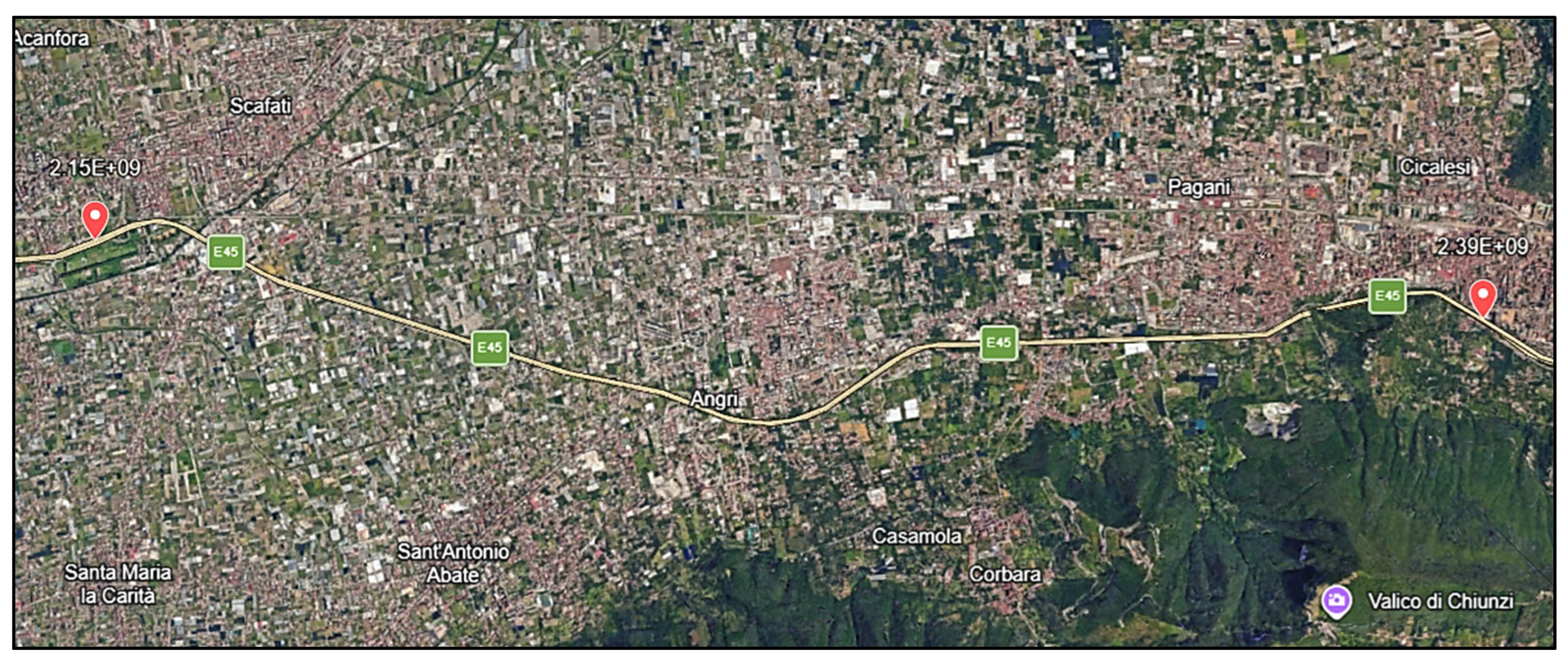
We utilized crowdsensed pavement monitoring data recorded along a section of the A3/E45 motorway in the Italian province of Salerno for this study. Spanning approximately 9.5 km, the analyzed stretch runs from [lat 40.73884812; lon 14.63714682] to [lat 40.74432373; lon 14.51013164]. This road segment is characterized by high traffic volumes and maintenance patterns representative of major interurban networks (
Figure 1).
Our dataset comprises 475 roughness observations sourced from the SmartRoadSense open-data repository (
http://smartroadsense.it (accessed on 3 March 2026)); an example of these data is provided in
Table 1. By linking each observation to a 20 m road segment, we established a uniform spatial sequence across a total alignment of roughly 9480 m.
For every observation, the spatial coordinate represents the curvilinear distance along the road alignment, defined as:
where:
is the spatial sampling step, and:
is the observation index.
Viewed this way, the resulting dataset serves as a spatial signal of pavement roughness, facilitating the application of specialized spatial statistical analysis techniques.
2.2. SmartRoadSense Crowdsensing Dataset
The roughness observations originate from the SmartRoadSense mobile crowdsensing platform, which enables large-scale monitoring of road surface conditions.
In the SmartRoadSense framework, smartphone accelerometers collect vibration signals generated during vehicle motion. These signals are processed through a signal-processing pipeline designed to extract indicators associated with pavement surface irregularities. Measurements collected from multiple vehicles and users are subsequently aggregated in a cloud-based infrastructure, producing roughness estimates associated with individual road segments. Within the SmartRoadSense framework, the aggregation of repeated measurements collected under different operating conditions contributes to mitigating the influence of local variability associated with vehicle characteristics, driving conditions, and isolated anomalous observations at the individual acquisition level.
The SmartRoadSense platform organizes its measurements geographically by following the road network layout provided by OpenStreetMap. By dividing this network into discrete segments—each serving as a roughly 20 m spatial bin—the system calculates roughness values by pooling various crowdsensed data points recorded over time.
This results in a spatially discretized representation of pavement condition, where each data point represents the estimated roughness of an individual road segment. These data are made publicly available through the SmartRoadSense open-data repository and have already been employed in several studies on crowdsensed pavement monitoring [
16,
17,
18,
19,
20].
2.3. Roughness Indicator: Power of Prediction Error (PPE)
Within the SmartRoadSense framework, pavement roughness is quantified through the Power of Prediction Error (PPE) indicator derived from vibration signals measured by smartphone accelerometers. The PPE indicator has been introduced and validated in previous studies on smartphone-based pavement monitoring [
20]. Previous studies have already investigated the relationship between PPE and pavement-condition assessment obtained through smartphone-based monitoring approaches [
20]. Although the PPE indicator is related to pavement roughness conditions, the present study does not assume a direct one-to-one correspondence between PPE values and conventional profilometric indicators such as the International Roughness Index (IRI), since PPE reflects the aggregated dynamic response measured through crowdsensed smartphone-based monitoring. Therefore, in the present work, PPE is not introduced as a new roughness metric but rather adopted as an already established roughness-related indicator within the SmartRoadSense framework.
During vehicle motion, the smartphone accelerometer records the dynamic response of the vehicle induced by the interaction between the tyres and the road surface. The resulting acceleration signal contains contributions related to vehicle dynamics, suspension behavior, driving conditions and pavement surface irregularities. In order to extract information related to pavement roughness, the recorded signal is processed using signal modelling techniques based on Linear Predictive Coding (LPC) [
23].
In LPC modelling, a discrete-time signal
is approximated as a linear combination of its previous samples:
where:
is the prediction order;
are the LPC coefficients;
represents the prediction error (residual) signal.
The predictable component of the signal is mainly associated with smooth vehicle dynamics and low-frequency motion, whereas the residual signal contains irregular vibration components generated by pavement surface discontinuities. The power of the prediction error therefore provides an effective descriptor of pavement-induced vibration.
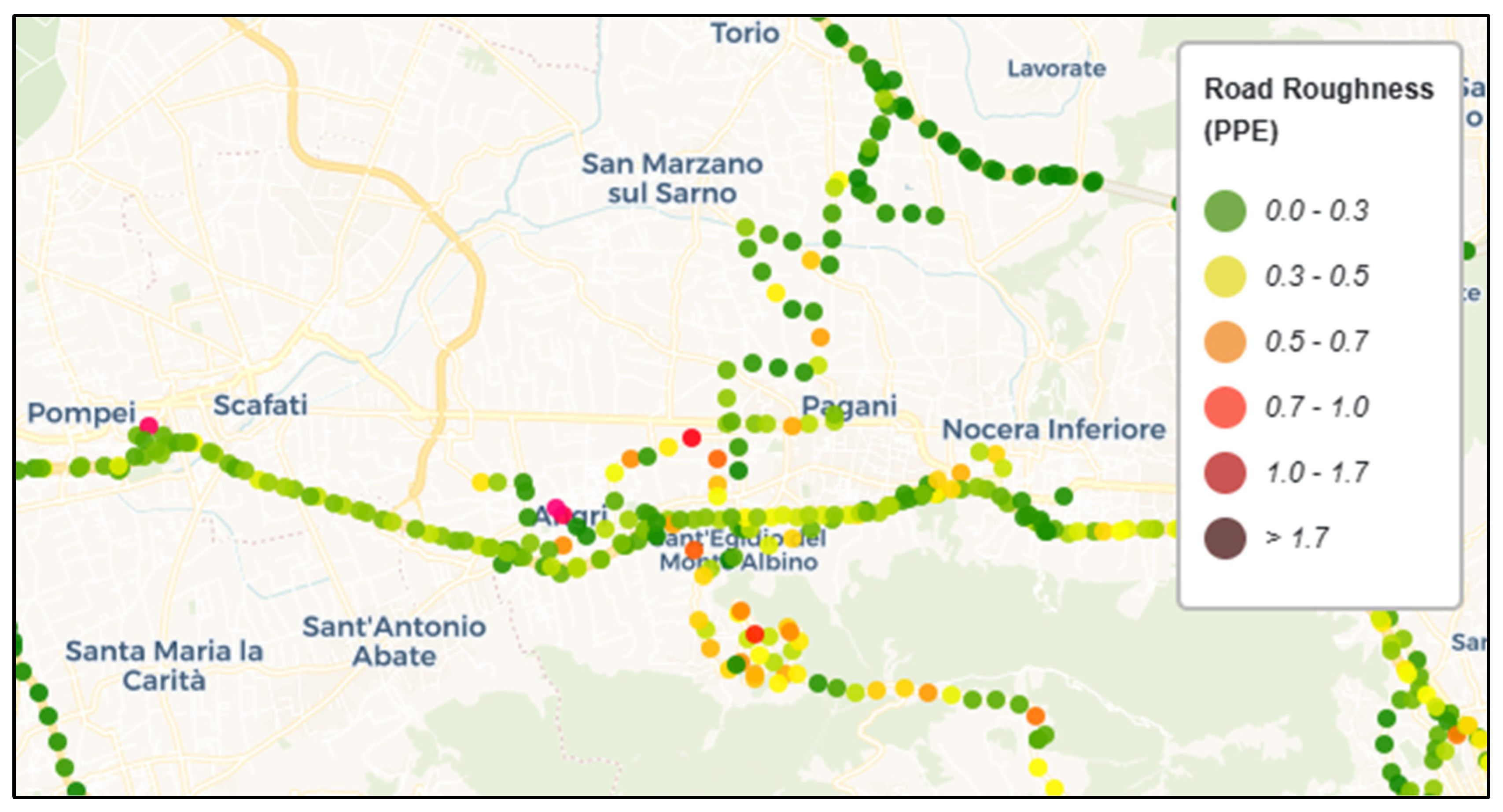
Within the SmartRoadSense processing pipeline, the PPE value is computed from accelerometer signals and subsequently associated with the corresponding road segment. Measurements collected from multiple vehicles and users are geographically mapped onto the road network and aggregated within spatial bins corresponding to individual road segments. The resulting PPE value assigned to each segment therefore represents an aggregated estimate of pavement roughness obtained from multiple crowdsensed observations (
Figure 2).
Although individual measurements may be influenced by factors such as vehicle dynamics, suspension characteristics, driving conditions, smartphone positioning, and sensor variability, the aggregation of observations collected from multiple vehicles and users contributes to mitigating the influence of local measurement variability on the resulting segment-level PPE estimates.
The PPE values released through the SmartRoadSense open-data repository are therefore interpreted in this study as spatial samples of a roughness-related signal along the road alignment, which enables the investigation of its statistical variability and spatial structure.
While previous studies mainly focused on the estimation of roughness levels using PPE [
20], the present work investigates the spatial structure of the PPE signal along road alignment, with the objective of analyzing how pavement roughness varies along the road alignment.
2.4. Spatial Representation of the Roughness Signal
The PPE values provided by the SmartRoadSense dataset can be interpreted as spatial samples of a roughness-related signal along the road alignment. Since each PPE observation is associated with a road segment of approximately constant length, the dataset can be represented as a one-dimensional spatial sequence describing pavement roughness along the curvilinear coordinate of the road.
Let denote the curvilinear distance along the investigated road section. The spatial sampling step is constant and equal to which corresponds to the spatial discretization adopted in the SmartRoadSense open dataset.
Accordingly, the PPE observations are modeled as a spatially sampled signal where the i-th observation’s spatial coordinate is and the analyzed dataset comprises total samples.
Under this representation, the sequence can be interpreted as a spatial signal describing the variation of pavement roughness along the road alignment. This formulation enables the application of statistical and spatial analysis techniques typically used for the study of spatially distributed variables.
The total length of the investigated road section is therefore which corresponds to approximately 9.5 km of motorway infrastructure.
Representing the PPE observations as a spatial signal allows the analysis of roughness variability at different spatial scales. In particular, the signal representation enables the investigation of:
the roughness profile along the road alignment;
the statistical variability of roughness within local road segments;
the spatial correlation structure of the PPE signal.
These aspects are analyzed in the following sections in order to characterize the spatial organization of pavement roughness along the investigated motorway section.
2.5. Window-Based Statistical Descriptors
In order to investigate the spatial variability of pavement roughness along the analyzed road section, the PPE spatial signal introduced in
Section 2.4 is analyzed using statistical descriptors computed over spatial aggregation windows of increasing length.
The spatial sequence is therefore analyzed at different aggregation scales obtained by grouping consecutive observations of the PPE signal. Given the spatial sampling step , each aggregation scale corresponds to a spatial length , where represents the number of consecutive observations included in the aggregation window. In this study, aggregation scales ranging from 20 m to 300 m are considered, corresponding to .
The lower bound of the aggregation range corresponds to the native spatial resolution of the SmartRoadSense dataset, whereas the upper bound was selected in order to investigate local and intermediate spatial scales while avoiding excessive smoothing effects and an excessive reduction in the number of independent aggregation windows available for the statistical analysis.
For each aggregation scale, statistical descriptors are computed in order to characterize the variability of pavement roughness within the corresponding spatial windows. In particular, three statistical descriptors are considered:
Let
denote the sequence of PPE observations within a spatial window containing
samples. The mean PPE value within the window is defined as:
which represents the average roughness level of the corresponding road segment.
The standard deviation is computed as:
and provides a measure of the dispersion of roughness values within the spatial window.
In order to evaluate the relative variability of roughness independently of the absolute roughness level, the coefficient of variation (CV) is also computed as:
The CV represents a normalized indicator of spatial variability and allows comparison between road segments characterized by different average roughness levels.
The computation of these statistical descriptors at different spatial aggregation scales makes it possible to analyze how roughness variability evolves with the observation length. In particular, this approach allows the identification of spatial segments exhibiting similar mean roughness but different variability patterns.
The multi-scale statistical characterization of the PPE signal therefore provides a first quantitative description of roughness variability, which complements the analysis of the spatial roughness profile and prepares the investigation of the spatial correlation structure described in the following section.
2.6. Spatial Correlation Analysis
Beyond the analysis of local statistical descriptors, the spatial structure of pavement roughness can be further investigated by analyzing the spatial correlation properties of the PPE signal. Spatial correlation analysis makes it possible to quantify how roughness values measured at different locations along the road are statistically related as a function of their separation distance [
24].
Let
denote the spatial roughness signal introduced in
Section 2.4. The spatial correlation structure of this signal can be investigated by analyzing pairs of observations separated by a spatial lag
.
To assess the spatial dependence of the PPE signal, we utilize the autocorrelation function (ACF), providing a measure of how roughness values relate to one another over a distance h:
where: h is a given lag,
is the covariance between the observation pair,
is the variance of the PPE signal.
In practice, the empirical autocorrelation function is estimated from the spatial sequence
by considering pairs of observations separated by multiples of the spatial sampling step:
where
is the spatial sampling interval introduced in
Section 2.4.
The autocorrelation function provides information on the persistence of roughness patterns along the road alignment. In the present study, the autocorrelation analysis is primarily used as an exploratory descriptor of the spatial dependence structure of the PPE signal, with the objective of identifying characteristic spatial persistence trends rather than performing formal statistical inference. High autocorrelation values for small spatial lags indicate that neighboring road segments tend to exhibit similar roughness levels, whereas a rapid decay of autocorrelation suggests strong local variability in pavement condition.
Estimating the autocorrelation structure of the PPE signal therefore provides insight into the spatial organization of pavement roughness and the characteristic distances over which roughness patterns persist along the road.
While the window-based statistical descriptors introduced in
Section 2.5 describe the local variability of roughness, the spatial correlation analysis provides complementary information on the spatial dependence between neighboring road segments. This combined approach allows a more comprehensive characterization of pavement condition beyond the use of average roughness indicators alone.
2.7. Entropy-Based Descriptor of Roughness Variability
Beyond the statistical and spatial descriptors discussed in the previous sections, the variability of the roughness signal can also be described using an entropy-based measure. Entropy quantifies the degree of disorder or unpredictability of a signal and is widely used in signal analysis to capture the complexity of measured data.
Let
,
, denote the spatial roughness signal introduced in
Section 2.4. In order to evaluate the statistical distribution of the PPE values, the signal is discretized into
K = 10 equal-width bins, and the probability
associated with the
-th bin is estimated from the relative frequency of observations falling within the corresponding interval. The same discretization strategy is maintained across all aggregation scales in order to ensure consistency and reproducibility in the entropy comparison.
The Shannon entropy of the PPE signal is then defined as:
where
represents the probability associated with the
-th bin and
is the total number of bins used to discretize the PPE distribution [
25].
The entropy value provides a measure of the dispersion and complexity of the roughness signal. Low entropy values indicate that the PPE observations are concentrated within a limited range of values, corresponding to relatively homogeneous pavement conditions. Conversely, higher entropy values indicate a broader distribution of PPE values and therefore a higher degree of variability in pavement roughness.
In the present study, the entropy descriptor is computed from the distribution of aggregated PPE values along the analyzed road section in order to characterize the overall variability of the roughness signal. This measure complements the window-based statistical descriptors and the spatial correlation analysis by providing an additional indicator of the statistical complexity of pavement roughness variations along the road alignment.
2.8. CART-Based Segmentation of the Roughness Signal
In addition to the spatial–statistical descriptors introduced in the previous sections, a segmentation analysis based on Classification and Regression Trees (CART) [
26] is performed in order to investigate whether the roughness signal can be partitioned into spatially homogeneous segments.
The CART algorithm is applied to the spatial roughness signal described in
Section 2.4: the curvilinear distance along the road alignment is used as the independent variable and the corresponding PPE value is treated as the response variable. In this way, the algorithm recursively partitions the spatial domain into subsegments identifying split points that maximize the reduction in within-segment variance of the roughness signal:
where
is the roughness value at spatial position
,
and
are the two subsets generated by the split at position
, and
,
are the corresponding mean roughness values within each subset.
Unlike traditional applications focused on prediction, CART is here used as an exploratory tool to identify potential discontinuities in the spatial organization of pavement roughness. The CART approach was selected because it provides an interpretable hierarchical spatial partitioning of the roughness signal and allows direct investigation of the sensitivity of the segmentation structure to the analysis scale through the minimum node size parameter. The objective of the present study is therefore not formal change-point detection, but rather the exploratory analysis of multiscale spatial organization patterns within the crowdsensed roughness signal. The resulting tree defines a piecewise segmentation of the road profile, where each terminal node corresponds to a spatial segment characterized by relatively homogeneous roughness conditions.
Since the segmentation is strongly influenced by the minimum node size, a sensitivity analysis is performed by varying the minimum parent-node size, while setting the child-node size equal to half of it to maintain a consistent proportional constraint. The analysis considers node sizes ranging from 2 to 10 observations (approximately 40–200 m), together with additional larger values, in order to span both short-range spatial dependence and broader scales.
The objective is not to identify a single optimal tree but to examine how the segmentation structure evolves with the analysis scale in order to assess whether the detected partitions reflect robust spatial features or are primarily driven by local variability. All other algorithm parameters are kept fixed across configurations, so that changes in tree complexity can be directly attributed to variations in the minimum node size.
3. Results of Spatial Structure Analysis of Road Roughness
3.1. Segmentation of the Road Profile
To investigate the spatial organization of road roughness, the road profile is discretized into consecutive spatial observations derived from the SmartRoadSense crowdsensing dataset. The dataset consists of 475 measurements collected along a road stretch with a spatial sampling interval Δs = 20 m. The resulting spatial series covers approximately 9.5 km of road length, providing a sufficiently long profile for the analysis of spatial variability and scale effects. Each observation is associated with a roughness indicator , corresponding to the value of the SmartRoadSense damage index (ppe) measured at the corresponding spatial position.
The resulting sequence:
represents the spatial roughness profile along the analyzed road section. This discrete spatial series provides the basis for the subsequent analysis of scale effects, spatial variability, and structural organization of pavement roughness.
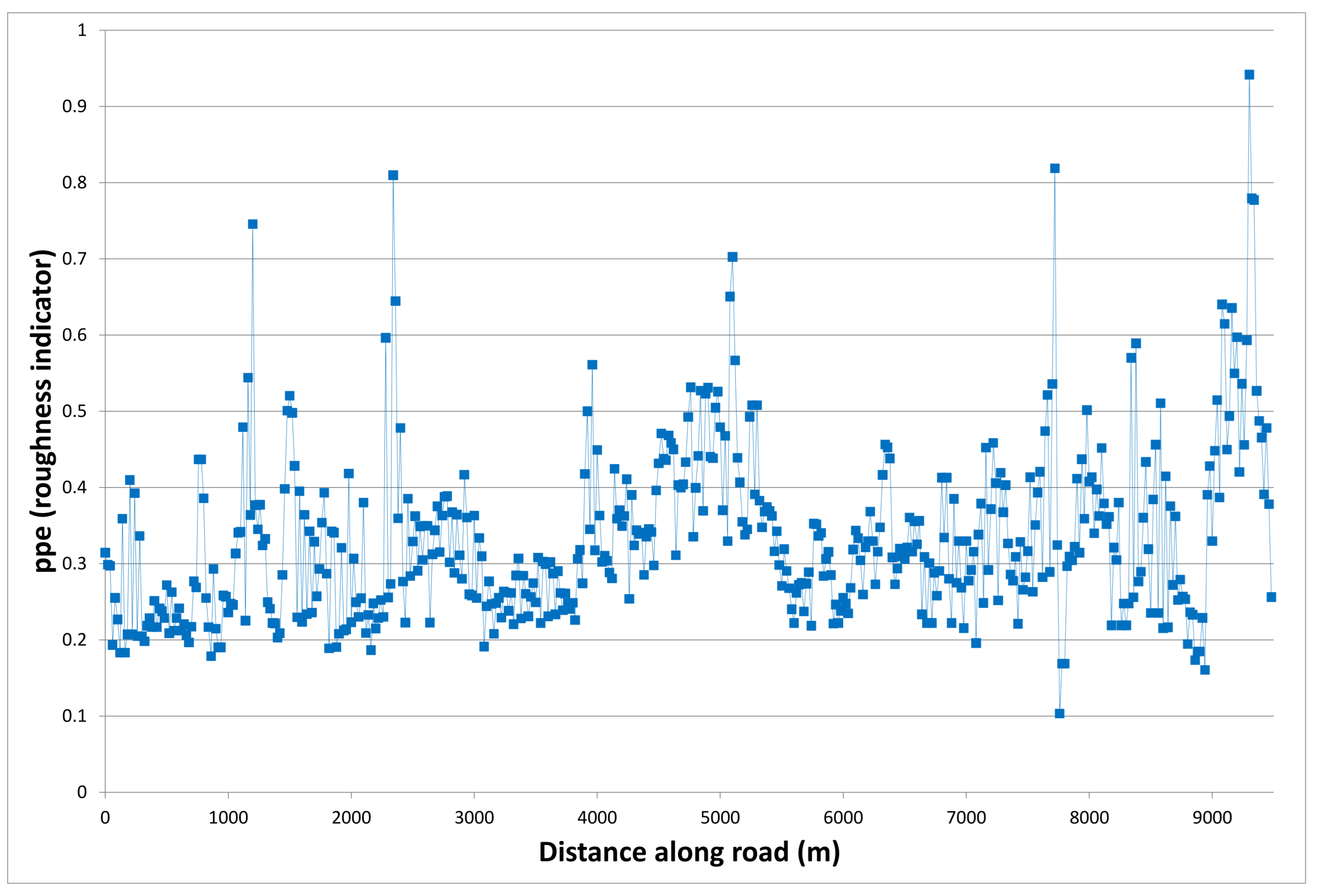
Figure 3 shows the spatial distribution of the roughness indicator along the analyzed road section.
The spatial profile that emerges shows that pavement roughness is unevenly distributed along the analyzed road section, with localized peaks pointing to isolated surface irregularities.
3.2. Scale-Dependent Mean Roughness
To investigate how roughness characteristics depend on the observation scale, the spatial roughness series is analyzed using progressively increasing aggregation lengths. Starting from the base spatial sampling interval Δs = 20 m, larger spatial windows are constructed by grouping consecutive observations of the SmartRoadSense roughness indicator.
For each aggregation scale, the aggregated roughness values are computed over non-overlapping windows according to the procedure described in
Section 2.5:
where
and
represents the number of complete aggregation windows at scale
.
Since the spatial windows do not overlap, each individual observation informs only one aggregated value at any chosen scale.
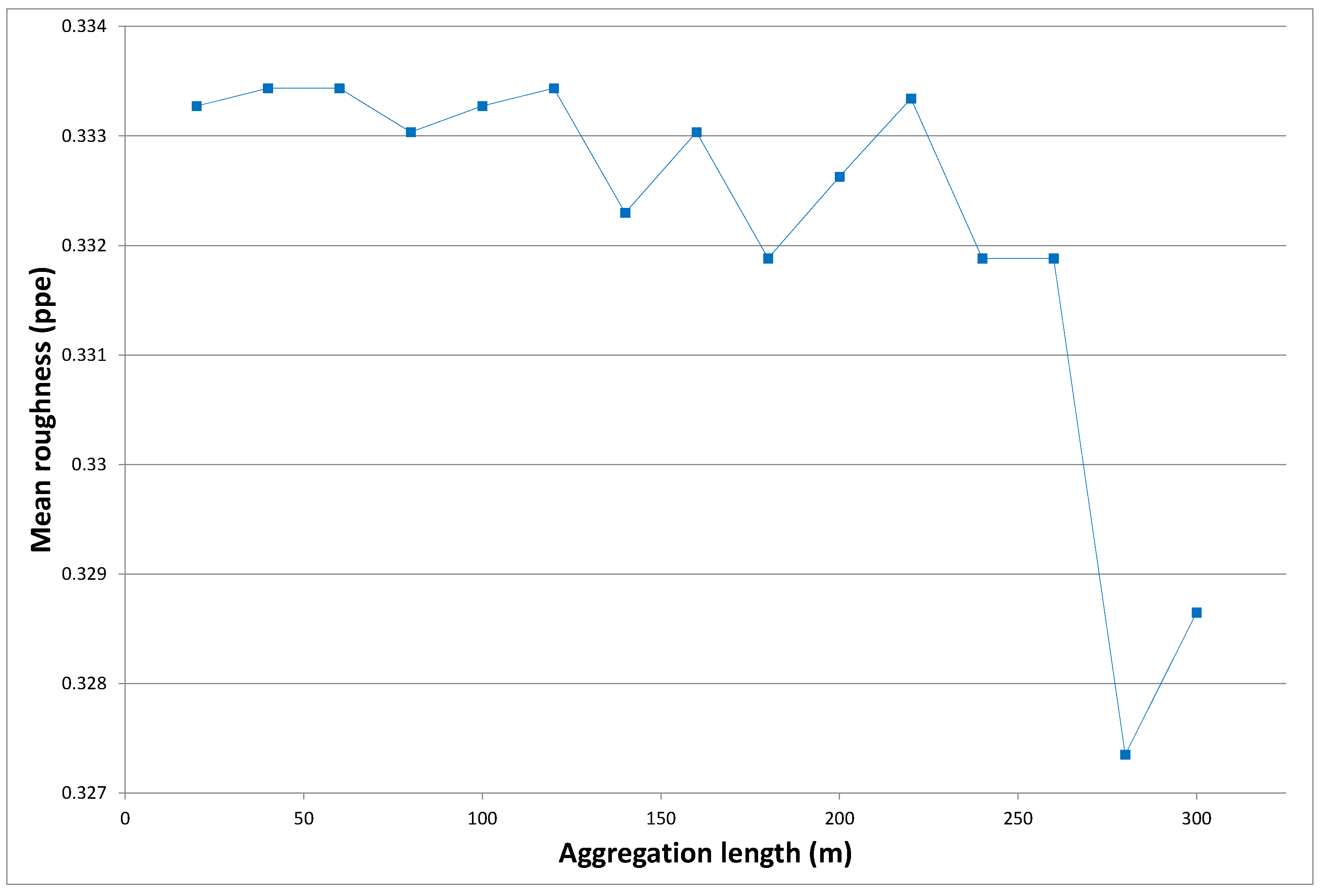
We focused on aggregation lengths between 20 m and 300 m, a range that corresponds to k = 1,…,15. For each scale, the mean of the aggregated roughness series is evaluated to obtain a scale-dependent descriptor of roughness. The relationship between mean roughness and aggregation length is illustrated in
Figure 4.
As shown in
Figure 4, the mean roughness remains nearly constant across the considered aggregation scales, indicating that the average roughness level is largely insensitive to the observation scale within the range analyzed.
3.3. Coefficient of Variation Across Spatial Scales
The evolution of roughness variability with observation scale is assessed by computing the coefficient of variation (CV) for the aggregated roughness values at each spatial scale. The CV expresses dispersion in normalized form, as the ratio between the standard deviation and the mean of the roughness values at a given scale.
For each aggregation level
, the CV is computed as:
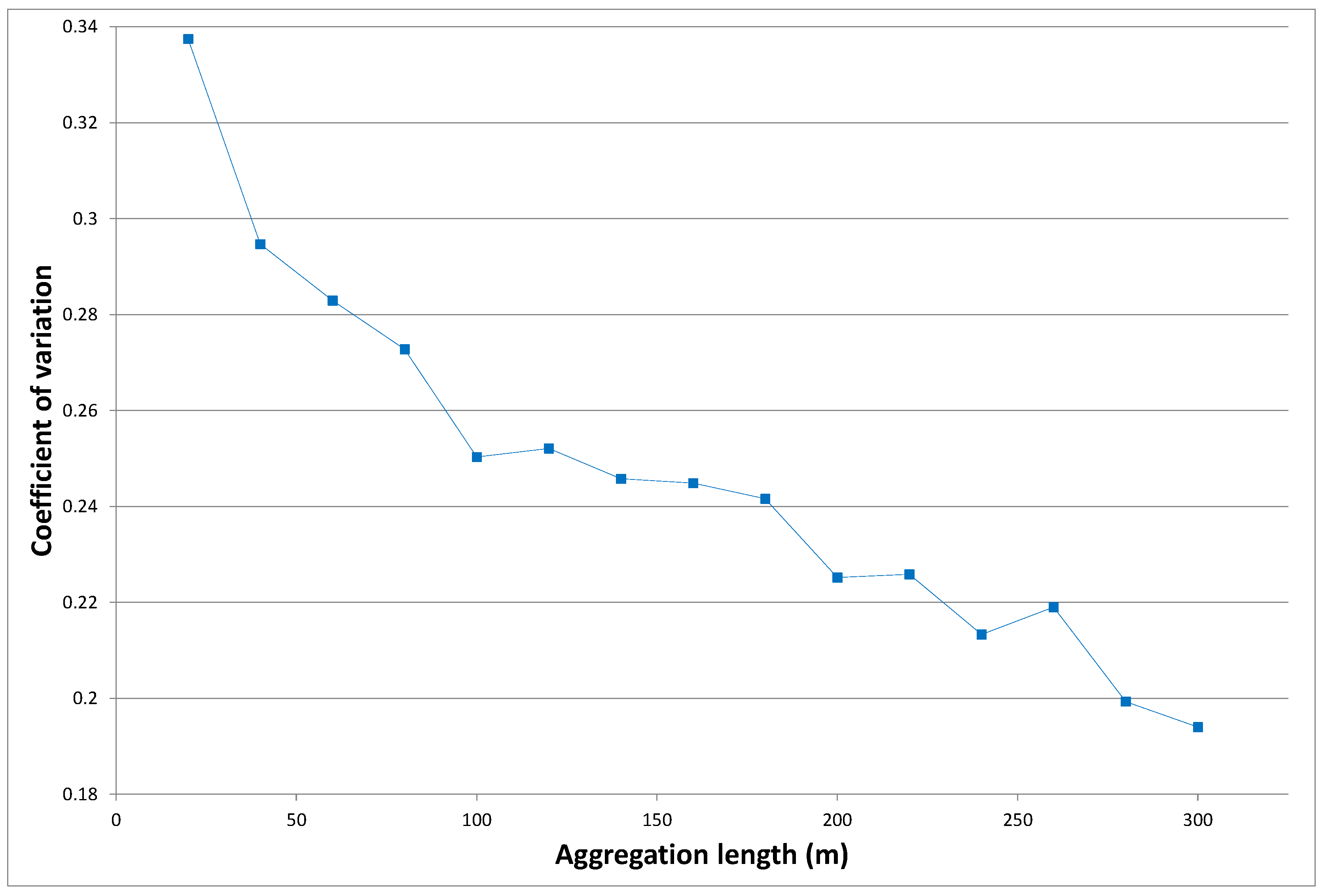
Figure 5 shows the coefficient of variation as a function of the aggregation length.
Figure 5 illustrates a progressive decrease in the coefficient of variation as the aggregation length increases. This behavior reflects the smoothing effect produced by spatial averaging and indicates the presence of pronounced local variability in the roughness profile.
3.4. Spatial Autocorrelation Analysis
To investigate the spatial dependence of road roughness, the autocorrelation function for lag
k is computed according to the formulation introduced in
Section 2.6:
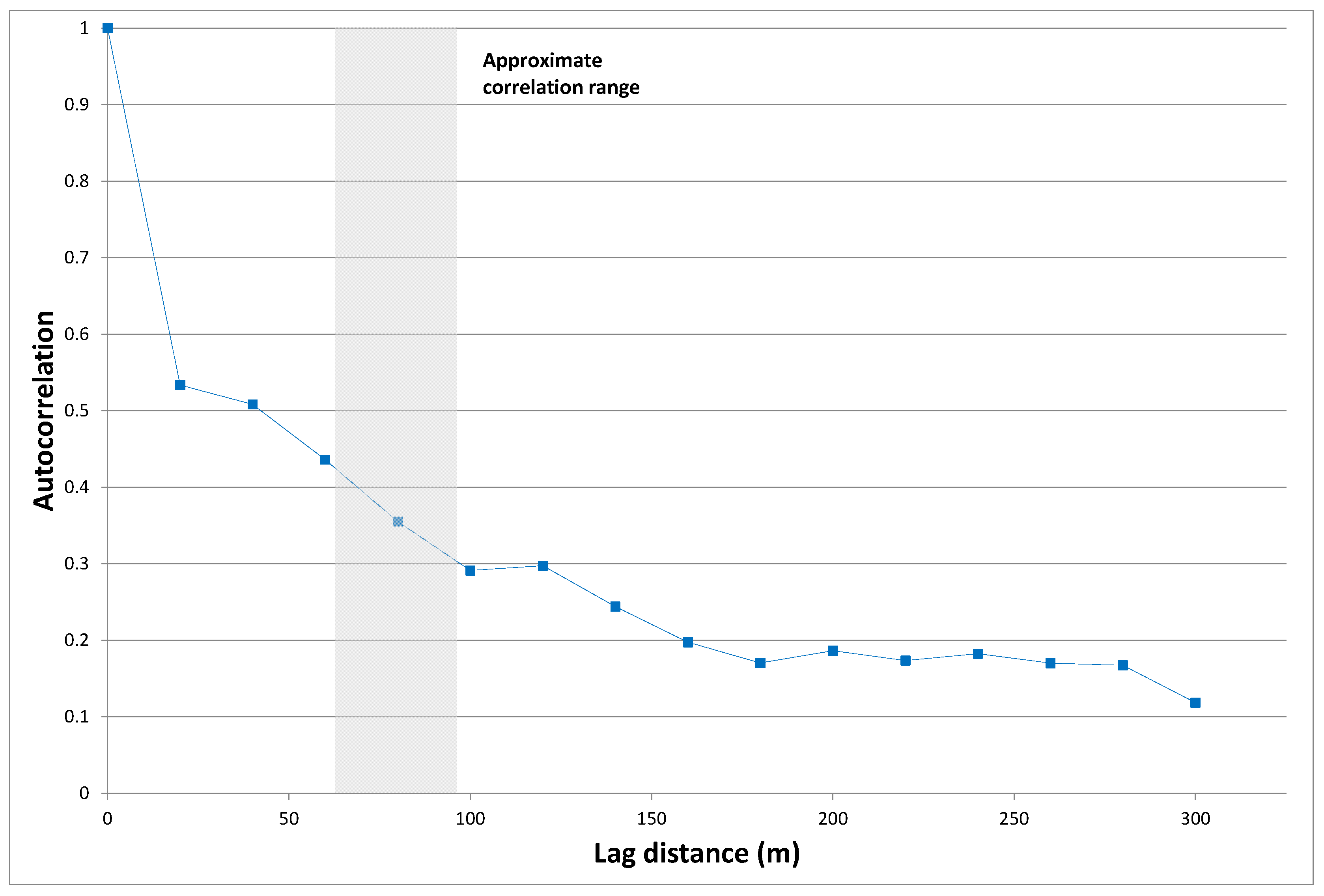
Our evaluation of the autocorrelation function extends to spatial lags of 300 m, which translates to 15 intervals at a Δs = 20 m resolution. The resulting spatial autocorrelation of the roughness series is presented in
Figure 6.
The autocorrelation function rapidly decreases with increasing spatial lag, suggesting that roughness values are mainly correlated over short distances and that long-range spatial dependence is limited. In the present analysis, the characteristic correlation length is qualitatively identified as the spatial range over which the autocorrelation values exhibit a rapid decay toward near-zero levels, which occurs approximately within the 60–100 m interval.
3.5. Power Spectral Density of Roughness Profiles
To investigate the spatial frequency content of the roughness signal, spectral analysis is performed using the power spectral density (PSD). Spectral analysis allows the identification of dominant spatial frequencies associated with the distribution of pavement irregularities.
The power spectral density (PSD) of the detrended roughness series is computed according to the procedure described in
Section 2.6:
The maximum spatial frequency is limited by the Nyquist frequency , while the highest discrete frequency represented in the spectrum is approximately .
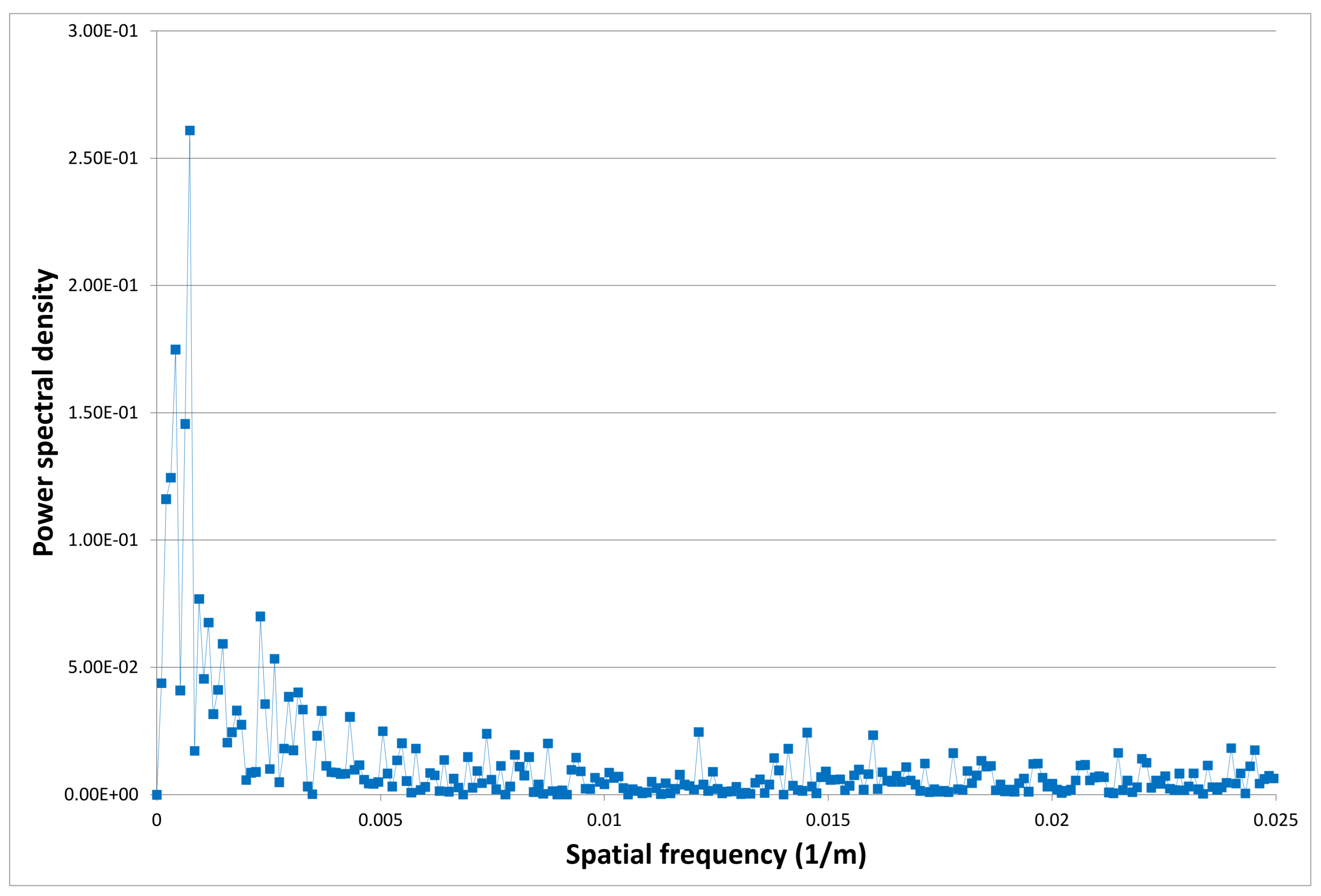
Figure 7 shows the power spectral density of the spatial roughness series.
Within the limitations associated with the finite length and potential non-stationarity of the analyzed spatial series, no clearly dominant spectral peak emerges in the estimated power spectral density. This suggests that pavement roughness variability is distributed across multiple spatial scales rather than being associated with a single characteristic wavelength.
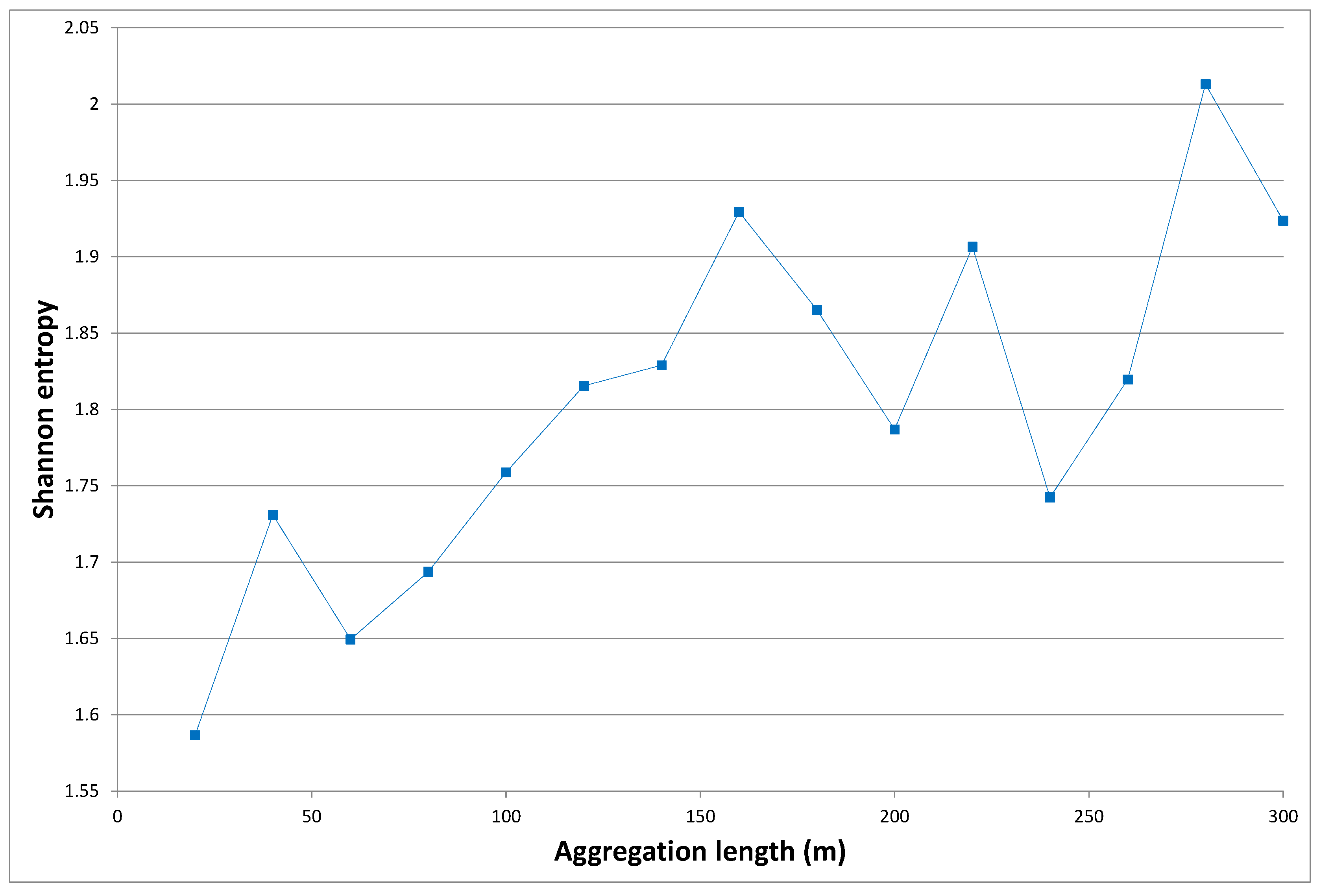
3.6. Entropy-Based Characterization of Roughness Variability
To characterize the complexity of the spatial roughness signal, an entropy-based descriptor is computed from the aggregated roughness series. Entropy provides a quantitative measure of the unpredictability or dispersion of the roughness values.
For each aggregation scale, the Shannon entropy of the aggregated roughness distribution is computed according to the procedure described in
Section 2.7:
Figure 8 shows the entropy of the roughness series as a function of the aggregation length.
The entropy analysis further confirms the scale-dependent statistical complexity of the roughness signal, indicating that the distribution of aggregated roughness values evolves as the observation scale increases.
3.7. CART-Based Segmentation Analysis
To further investigate the spatial organization of pavement roughness, a segmentation analysis based on the CART approach described in
Section 2.8 is performed. The objective is to evaluate whether the roughness signal can be partitioned into spatial segments characterized by relatively homogeneous roughness conditions and to assess the stability of such segmentation with respect to the minimum node size.
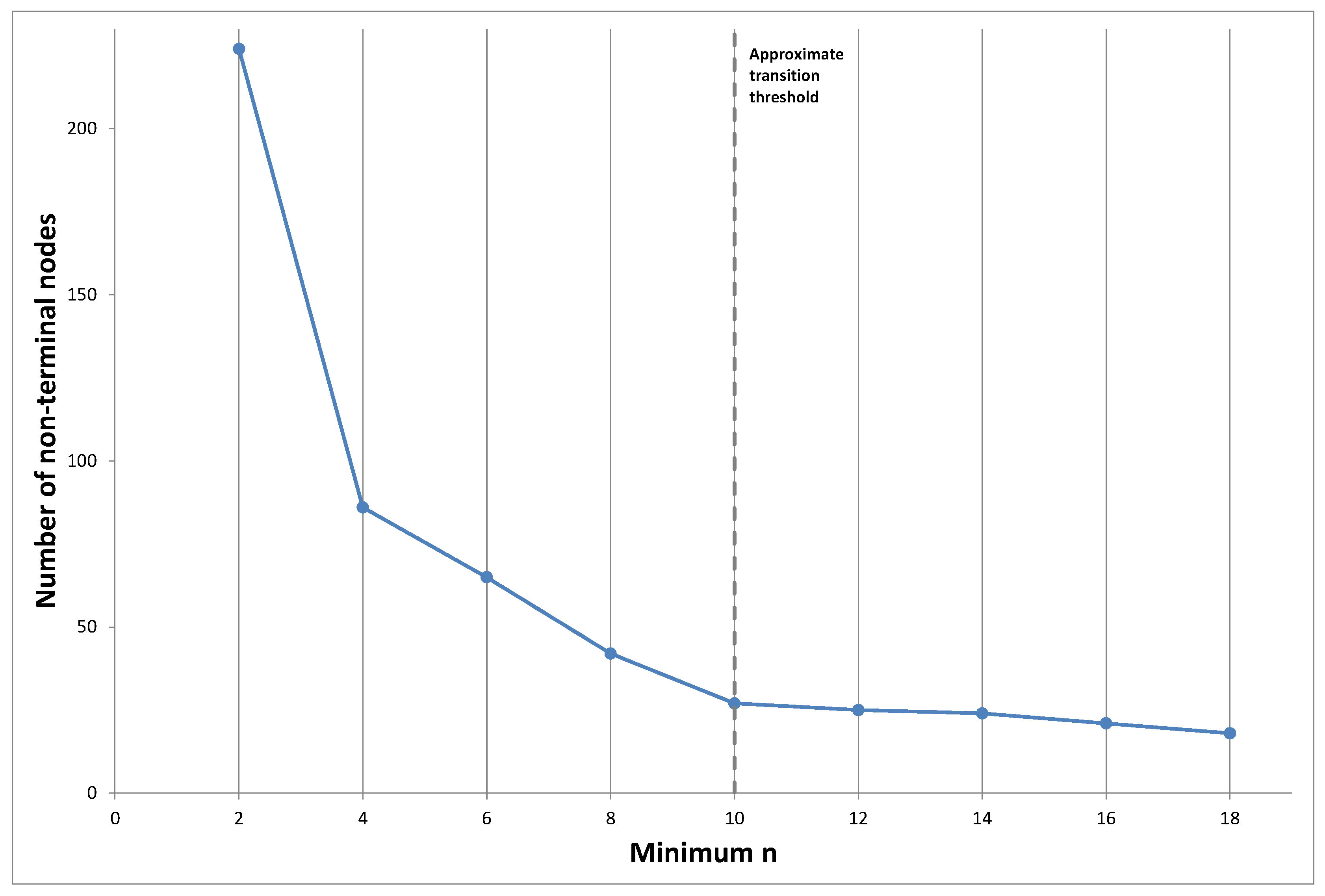
The sensitivity of the segmentation to the minimum node size is summarized in
Table 2.
Table 2 reports the number of non-terminal and terminal nodes obtained for each configuration together with the corresponding indicative spatial scale.
For relatively large minimum node sizes (from 10 to 18 observations), the number of non-terminal nodes decreases gradually indicating that the segmentation remains limited to a relatively small number of major discontinuities in the roughness profile. In this range, the algorithm identifies only the most prominent variations along the road alignment.
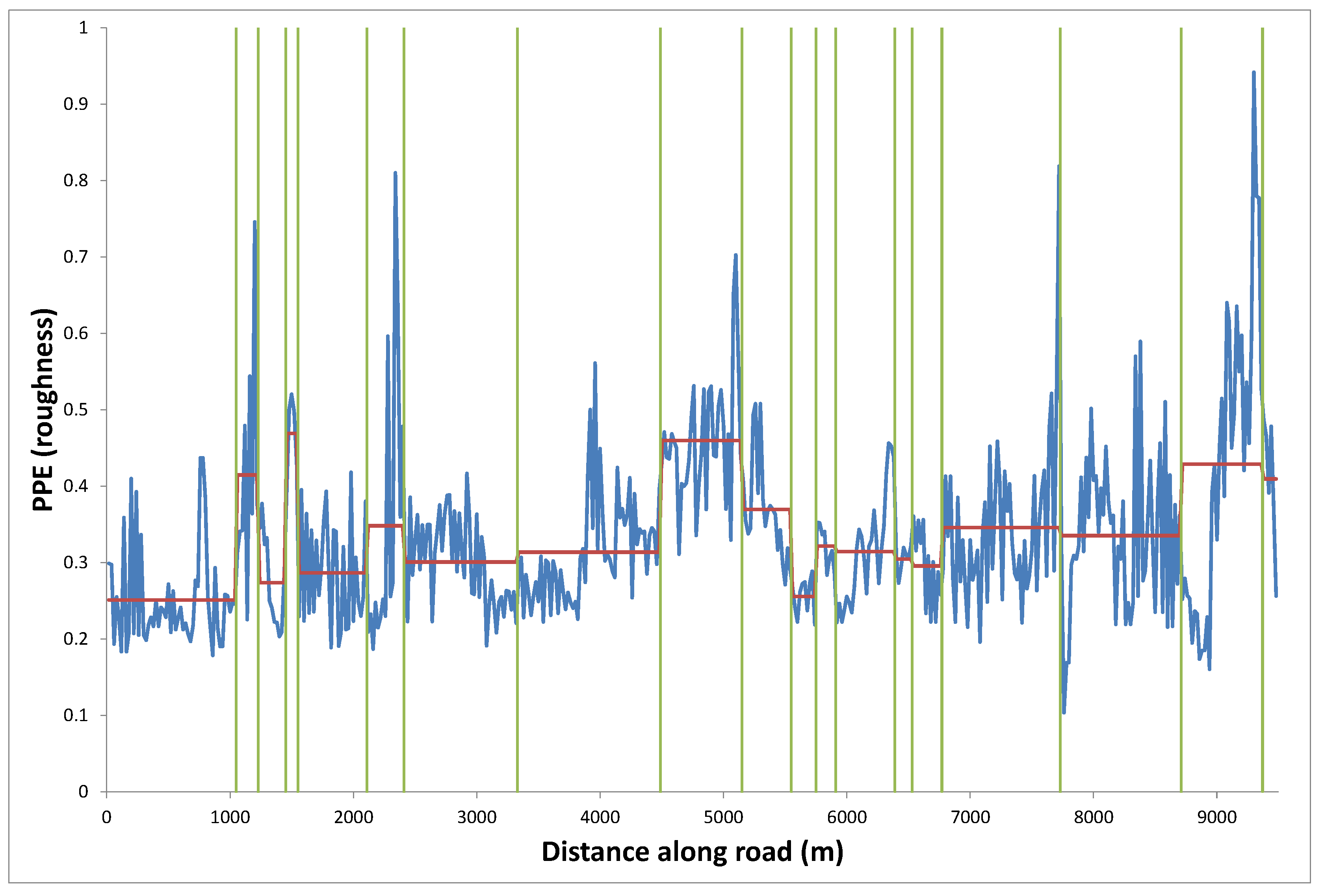
An example of the spatial segmentation obtained for a minimum parent-node size of 10 observations is shown in
Figure 9. The resulting segmentation highlights a limited number of spatially coherent segments, corresponding to the most prominent variations of the roughness signal along the road alignment.
A markedly different behavior is observed when the minimum node size is reduced below 10 observations: the transition from 10 to 8 observations is associated with a sharp increase in the number of non-terminal nodes, rising from 27 to 42. Further reductions in node size led to a rapid growth in tree complexity with 65, 86, and 224 non-terminal nodes obtained for minimum node sizes of 6, 4, and 2 observations respectively.
Figure 10 shows the number of non-terminal nodes obtained from the CART segmentation as a function of the minimum parent-node size.
This abrupt change in growth pattern highlights a scale-dependent segmentation behavior. It should however be noted that part of the increase in segmentation complexity at smaller node sizes is also related to the intrinsic sensitivity of the CART algorithm to local fluctuations. For this reason, the segmentation results are interpreted here in combination with the other spatial–statistical descriptors rather than as an independent proof of underlying physical discontinuities. When larger node sizes are imposed, the resulting segmentation is relatively coarse and captures only large-scale variations. Conversely, as the minimum node size decreases, the algorithm becomes increasingly sensitive to local fluctuations of the roughness signal, producing a highly fragmented partition of the road profile.
The results indicate that the spatial roughness signal does not exhibit a simple hierarchical partitioning structure that remains stable across scales. Instead, the segmentation strongly depends on the analysis scale, with an increasing number of localized discontinuities emerging as the minimum node size approaches shorter spatial scales.
4. Discussion of Spatial–Statistical Descriptors
The analyses carried out in the previous sections offer complementary views of the spatial structure of pavement roughness. Mean roughness, evaluated across different scales, describes how average conditions evolve with increasing observation length, while the coefficient of variation reflects the relative variability of the aggregated roughness values across spatial scales.
Spatial autocorrelation provides insight into the dependence between adjacent segments of the road profile, revealing the presence of correlation structures along the series. Spectral analysis based on the power spectral density, in parallel, highlights the spatial frequency content of the roughness signal and supports the identification of characteristic wavelengths associated with pavement irregularities.
The entropy-based descriptor further captures the statistical complexity of the roughness distribution and how it changes with aggregation scale.
Taken together, these descriptors outline a comprehensive spatial–statistical representation of pavement roughness, integrating information on variability, correlation structure, frequency content, and distributional complexity.
Although crowdsensed measurements may be influenced by factors such as vehicle dynamics, driving behavior and smartphone positioning, the aggregation of multiple observations from different vehicles and users mitigates these effects, allowing the PPE indicator to provide a reliable representation of pavement roughness at the road-segment scale.
For this reason, the present results should be interpreted as a spatial–statistical characterization of the aggregated PPE signal within the SmartRoadSense framework rather than as a direct reconstruction of the physical longitudinal pavement profile.
The results consistently indicate that pavement roughness along the analyzed road section exhibits localized variability, limited spatial correlation, and multiscale statistical characteristics.
The combined interpretation of the autocorrelation and spectral analyses indicates that pavement roughness along the analyzed road section is characterized by short-range spatial correlation and by the absence of a dominant spatial wavelength. This behavior is consistent with a roughness process governed by localized irregularities distributed along the road alignment.
The autocorrelation analysis further suggests that the spatial correlation of pavement roughness decays rapidly with distance, with a characteristic correlation length on the order of 60–100 m. This result indicates that roughness variations along the analyzed motorway section are mainly governed by localized pavement irregularities rather than by long-range spatial structures.
Consistently with this observation, the analysis of scale-dependent statistical descriptors suggests that roughness statistics tend to stabilize for aggregation lengths of approximately 80–100 m, indicating that spatial segments of this order provide a representative description of pavement roughness variability.
The CART-based segmentation offers a complementary perspective on the spatial organization of pavement roughness. While the spatial–statistical descriptors identify a characteristic correlation scale on the order of 60–100 m, the segmentation analysis highlights how the apparent structure of the roughness signal changes depending on the analysis scale imposed by the minimum node size.
In particular, the sensitivity analysis reveals a transition in segmentation behavior when the minimum node size decreases below approximately 10 observations. For larger node sizes, corresponding to spatial lengths on the order of 160–200 m and above, the CART algorithm produces a limited number of segments, capturing only the most prominent variations of the roughness profile. In contrast, when the minimum node size is reduced, the number of detected segments increases rapidly indicating that the signal contains numerous localized irregularities that are not organized into a stable hierarchical structure.
This behavior is consistent with the short-range spatial dependence identified through autocorrelation analysis. The characteristic correlation length of approximately 60–100 m suggests that roughness values are only weakly related beyond relatively short distances. As a consequence, when the segmentation scale approaches or falls below this range, the algorithm becomes increasingly sensitive to local fluctuations, resulting in a fragmented partitioning of the spatial signal.
The combined interpretation of spatial correlation analysis and CART-based segmentation indicates that pavement roughness cannot be described in terms of a single characteristic segmentation scale: the roughness profile exhibits a multiscale organization in which localized irregularities coexist with broader variations, without forming a stable hierarchical partition across scales.
It should also be noted that part of the localized discontinuities detected through the spatial analysis may be associated with standard infrastructural transitions along the motorway alignment—such as bridge approaches, expansion joints, viaduct sections, or localized maintenance interventions—which can generate abrupt variations in the measured roughness signal. From the perspective of functional pavement roughness, however, these localized transitions represent actual components of the experienced vehicle response and therefore contribute to the effective spatial organization of the roughness signal analyzed in the present study.
From a practical standpoint, these findings suggest that segmentation-based approaches to pavement monitoring should be interpreted with caution. The identification of homogeneous segments depends strongly on the spatial scale considered, and different segmentation settings may lead to substantially different representations of the same road section. This reinforces the need to complement segmentation techniques with spatial–statistical descriptors in order to obtain a more robust characterization of pavement condition.
The convergence of the autocorrelation analysis and the scale-dependent statistical descriptors toward a similar characteristic spatial scale (approximately 80–100 m) further supports the interpretation of pavement roughness as a localized multiscale process.
5. Conclusions
The spatial analysis of pavement roughness based on the SmartRoadSense dataset offers several insights into the spatial–statistical organization of road surface irregularities.
Across aggregation scales from 20 m to 300 m, the mean roughness shows little variation. This indicates that, within this range, average conditions are only marginally influenced by the observation scale and reinforces the idea that mean values alone are not sufficient to describe the spatial organization of pavement irregularities.
A different behavior is observed for variability. A systematic decrease in the coefficient of variation is observed as the aggregation length increases, which reflects the smoothing effect associated with the use of larger spatial windows. This behavior highlights the presence of pronounced small-scale variability in the roughness profile.
Autocorrelation analysis indicates that roughness values exhibit only limited correlation beyond short spatial lags, suggesting that pavement irregularities are predominantly governed by localized processes rather than by long-range structures. The rapid decay of the autocorrelation function suggests a characteristic spatial correlation length on the order of 60–100 m, indicating that variability along the analyzed road section is largely governed by localized irregularities.
The CART-based segmentation analysis provides a complementary perspective on this result. The sensitivity of the segmentation to the minimum node size shows that the apparent partitioning of the roughness profile strongly depends on the analysis scale. In particular, a marked increase in segmentation complexity is observed when the minimum node size decreases below approximately 10 observations, indicating that numerous localized irregularities emerge when shorter spatial scales are considered.
Consistently with this observation, the analysis of scale-dependent statistical descriptors suggests that roughness statistics become relatively stable for aggregation lengths of about 80–100 m.
Spectral and entropy analyses further support the multiscale nature of pavement roughness. No single dominant spatial wavelength emerges from the spectral density, while the entropy descriptors show that the statistical complexity of the signal varies with the observation scale. Taken together, these findings indicate that pavement roughness results from a combination of variability, weak spatial correlation, and irregularities acting across multiple scales.
Although the analysis is limited to a specific motorway section and therefore cannot be directly generalized to all road infrastructures and operating conditions, the spatial–statistical behavior observed in the PPE signal is in line with the localized and heterogeneous nature of pavement deterioration processes typically encountered in road infrastructures. The present study should therefore be interpreted primarily as a methodological and exploratory framework for investigating the spatial organization of crowdsensed pavement roughness signals.
The results indicate that pavement roughness cannot be adequately described by a single indicator. From an engineering perspective, the proposed spatial–statistical framework may support pavement monitoring activities by identifying localized variability patterns and spatial persistence scales that are not detectable through average roughness indicators alone. In particular, the correlation range of approximately 60–100 m and the coarser CART segmentation scale of about 160–200 m suggest that maintenance interpretation based only on very short isolated segments may lead to an excessively fragmented representation of pavement condition. These values should not be interpreted as prescriptive intervention thresholds, but rather as indicative spatial scales supporting more coherent and spatially targeted pavement monitoring and prioritization strategies based on crowdsensed monitoring data. A more complete representation requires the joint use of complementary spatial–statistical descriptors, including measures of variability, correlation, spectral content, entropy, and segmentation-based analysis.
The integration of CART-based segmentation further highlights that no single spatial partitioning can be considered intrinsically representative of the roughness structure. Instead, the segmentation outcome varies significantly with the analysis scale reflecting the presence of localized irregularities that do not organize into a stable hierarchical pattern.
These findings support the interpretation of pavement roughness as a multiscale spatial process governed by localized variability, where different analytical approaches provide complementary insights into the spatial organization of pavement condition along road infrastructures.