Article

Development of Deep Learning-Based Technique for Predicting Inflow Rate of Rainwater Pumping Stations

1
Environmental Technology Research Institute, Kangwon National University, 346 Jungang-ro, Samcheok-si 25913, Gangwon-do, Republic of Korea
2
Samcheok University-Industry Cooperation Foundation, Kangwon National University, Samcheok-si 25913, Gangwon-do, Republic of Korea
3
Department of Urban and Environmental and Disaster Management, Graduate School of Disaster Prevention, Kangwon National University, Samcheok-si 25913, Gangwon-do, Republic of Korea
*
Author to whom correspondence should be addressed.
Sustainability 2026, 18(11), 5777; https://doi.org/10.3390/su18115777 (registering DOI)
Submission received: 28 March 2026 / Revised: 28 May 2026 / Accepted: 1 June 2026 / Published: 5 June 2026

Abstract

Efficient operation of rainwater pumping stations is essential for mitigating urban flooding under climate change. This study focuses on the Samcheok Osipcheon watershed, located in Gangwon-do, South Korea, and proposes a deep learning-based inflow prediction framework for the Samcheok-si drainage system using SWMM-simulated datasets. A total of 900 rainfall scenarios were generated and used to train three models: ANN, CNN, and LSTM. All models reproduced inflow hydrographs with high accuracy, but the CNN model showed overfitting with oscillations in the recession limb. The LSTM model demonstrated the best performance, achieving an NSE of 0.97 and a PPE of 3.45%. Based on the predicted inflow, two pump operation strategies were evaluated. The proactive operation considering upstream surcharge conditions, combined with second-level control, reduced peak water levels from 2.585 m to 2.439 m (approximately 5.6%) compared to the conventional operation. In addition, second-level pump operation reduced excessive discharge and stabilized detention basin water levels. The results indicate that the proposed framework can support real-time pump operation, enhance the resilience and sustainability of urban drainage systems, and contribute to sustainable urban flood mitigation.

1. Introduction

Urban flooding has become increasingly frequent and severe due to climate change and rapid urbanization [1,2], leading to substantial social and economic damages in many cities worldwide [3]. Urban areas are typically characterized by a high proportion of impervious surfaces, which significantly accelerate surface runoff and concentrate discharge within short time periods after rainfall events [4,5]. Consequently, urban drainage systems play a crucial role in mitigating flood risks, and the efficient operation of rainwater pumping stations has become an essential component of urban flood management [6,7,8].
In many urban drainage systems, pump station operation is commonly based on predefined water-level thresholds within detention basins [9,10,11]. In this conventional rule-based approach, pumps are sequentially activated when the basin water level exceeds specific thresholds. Although this approach is simple and robust, it often lacks the ability to respond proactively to rapidly changing hydrological conditions during extreme rainfall events. Therefore, accurate prediction of inflow to pumping stations is essential for improving operational efficiency and enabling proactive flood mitigation.
Physics-based hydrological models, such as the U.S. Environmental Protection Agency Storm Water Management Model (EPA-SWMM), have been widely used to simulate urban drainage processes and predict inflow hydrographs [12,13]. These models can represent the hydrological and hydraulic behavior of urban drainage systems with high physical realism. However, they often require substantial computational time and expert knowledge for calibration and parameterization, particularly in complex sewer networks. Under extreme rainfall conditions, where rapid decision-making is required, the computational burden of such models may limit their applicability in real-time flood management.
To address these limitations, recent studies have explored the application of deep learning techniques for hydrological prediction [14]. Although deep learning models require significant computational resources during the training stage, they can generate predictions almost instantaneously once trained. For instance, Kratzert et al. [15] demonstrated the effectiveness of Long Short-Term Memory (LSTM) networks for rainfall–runoff modeling, while Xiang et al. [16] reported improved predictive performance using an LSTM-based sequence-to-sequence framework.
In addition, surrogate modeling approaches have been proposed to approximate computationally intensive hydrological simulations while maintaining acceptable prediction accuracy [17,18]. By combining the physical consistency of process-based models with the computational efficiency of data-driven models, hybrid modeling frameworks have emerged as a promising approach for real-time hydrological prediction and operational decision support.
Furthermore, recent research has highlighted the importance of integrating predictive hydrological models with operational control strategies for urban drainage infrastructure. Proactive pump operation strategies that consider upstream hydraulic conditions, such as sewer surcharge, have been shown to improve flood mitigation performance compared with conventional water-level-based operation [19,20,21]. However, existing studies have rarely integrated deep learning-based inflow prediction with real-time pump operation control under dynamically changing hydrological conditions.
To address this research gap, this study proposes a hybrid framework that integrates hydrological simulations, deep learning–based inflow prediction, and adaptive pump operation strategies. The overall workflow consists of three main components: (1) dataset generation, (2) development of deep learning models for inflow prediction, and (3) real-time pump operation with a second-level (sub-minute) control mechanism. This conceptual overview is provided here to improve clarity, while detailed methodological descriptions are presented in the Section Materials and Methods. This integrated framework is designed to enable proactive and precise control of pumping systems under rapidly varying inflow conditions.
The study is conducted in the Samcheok Osipcheon watershed, located in Gangwon-do, South Korea, where urban flooding is influenced by short-duration, high-intensity rainfall events. Training datasets are generated using hydrological simulations, and three deep learning architectures—Artificial Neural Network (ANN), Convolutional Neural Network (CNN), and Long Short-Term Memory (LSTM)—are applied and compared for inflow prediction.
The main contributions of this study are as follows:
(1)
The development of a hybrid SWMM–deep learning framework for inflow prediction;
(2)
Integration of predictive inflow with proactive pump operation strategies; and
(3)
Introduction of a second-level (sub-minute) pump operation control algorithm to improve operational precision.
The proposed framework provides a robust and computationally efficient decision-support approach for real-time pump operation and urban flood mitigation. The primary methodological contribution of this work is the development of a hybrid SWMM-DL architecture that transcends simple surrogate modeling. Unlike purely data-driven approaches limited by the scarcity of extreme events in historical observations, our framework leverages a simulation-based dataset of 900 diverse scenarios to ensure robust generalizability. Crucially, this work introduces a novel proactive feedback loop—specifically a second-level precision control algorithm—that utilizes these DL-based forecasts to preemptively manage upstream surcharge. By positioning the DL model as an active decision-making component rather than a passive predictor, this study offers a more resilient solution for real-time urban flood mitigation compared to traditional reactive or purely observational data-based systems.

2. Materials and Methods

2.1. Research Framework

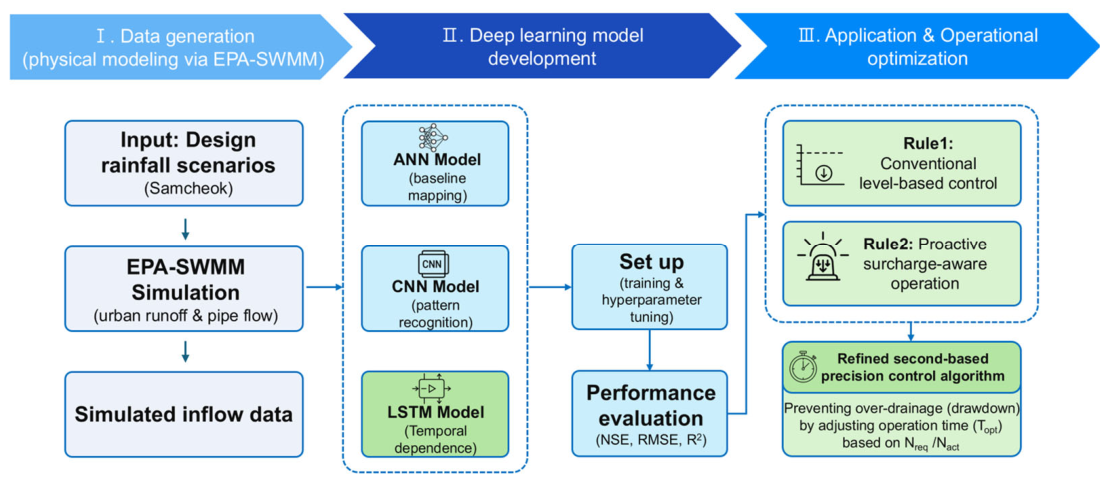
This study proposes a hybrid framework that integrates the hydrological reliability of a physics-based model with the real-time predictive capability of deep learning models for inflow prediction and pump operation. The framework is designed to support real-time decision-making for urban flood mitigation at rainwater pumping stations. As illustrated in Figure 1, the proposed framework consists of three main stages: (1) dataset generation using hydrological simulation, (2) deep learning model development, and (3) operational application with pump control optimization.
In the first stage, a comprehensive training dataset was generated using SWMM. Instead of relying solely on observational data, SWMM was employed to simulate hydraulic responses of the urban drainage system under multiple rainfall scenarios. Through this process, the physical rainfall–runoff mechanisms of the sewer network were embedded into the dataset. The simulated inflow hydrographs were used as target variables for training the deep learning models.
In the second stage, deep learning models were developed to approximate the hydrodynamic behavior of the drainage system. To capture both rainfall pattern features and temporal dependencies, three architectures—ANN, CNN, and LSTM—were implemented and compared. Model training and hyperparameter tuning were conducted to optimize predictive performance. The models were evaluated using multiple statistical metrics to assess both overall accuracy and peak inflow reproduction capability.
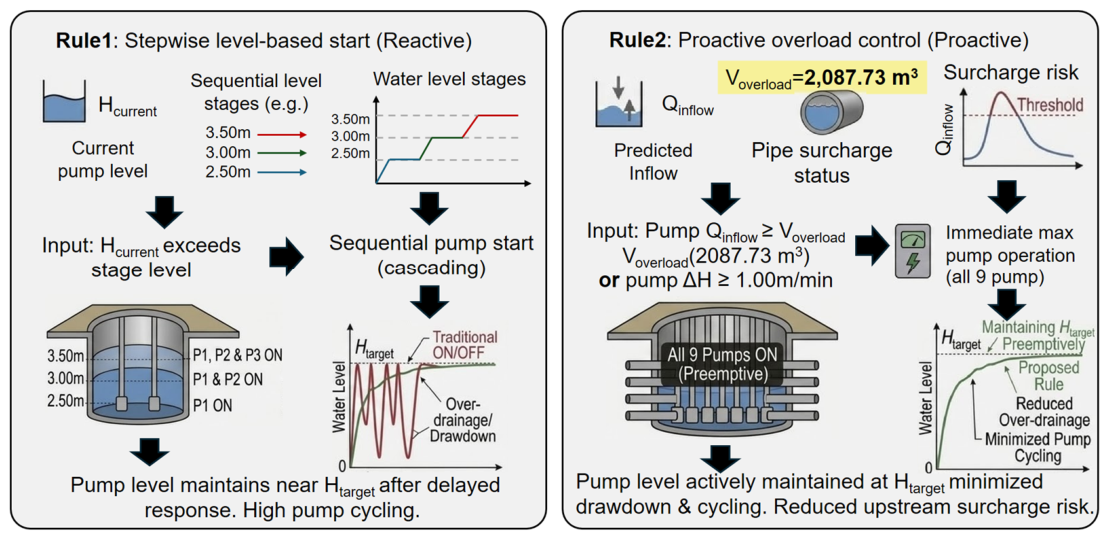
In the third stage, the predicted inflow time series were integrated with pump operation rules to establish an operational application framework. In this study, two pump operation strategies are defined: Rule1, which represents a conventional level-based control strategy based on predefined water-level thresholds, and Rule2, which denotes a proactive control strategy that considers upstream sewer surcharge conditions, as illustrated in Figure 1. The predicted inflow was mapped in real time to these pump operation strategies to determine optimal pump activation timing. In particular, a proactive control algorithm was implemented to detect surcharge conditions in upstream sewer conduits and adjust pump operation accordingly.
To further improve operational precision, a second-level pump operation control algorithm was introduced. Unlike conventional systems operating at fixed one-minute intervals, the proposed method adjusts pump operation duration at the sub-minute scale based on the difference between predicted inflow and pump discharge capacity. This approach enables precise discharge control, reduces excessive pumping, and stabilizes detention basin water levels.
Overall, the proposed framework integrates hydrological simulation, deep learning prediction, and adaptive pump control into a unified workflow, providing a robust and computationally efficient decision-support system for real-time urban flood management.

2.2. Study Area

The study area is located in the Samcheok Osipcheon watershed in Gangwon-do, South Korea. The watershed is characterized by a coastal urban drainage system influenced by short-duration, high-intensity rainfall events. Due to the high proportion of impervious surfaces in the urbanized area, runoff is rapidly concentrated, increasing the risk of urban flooding during extreme rainfall conditions.
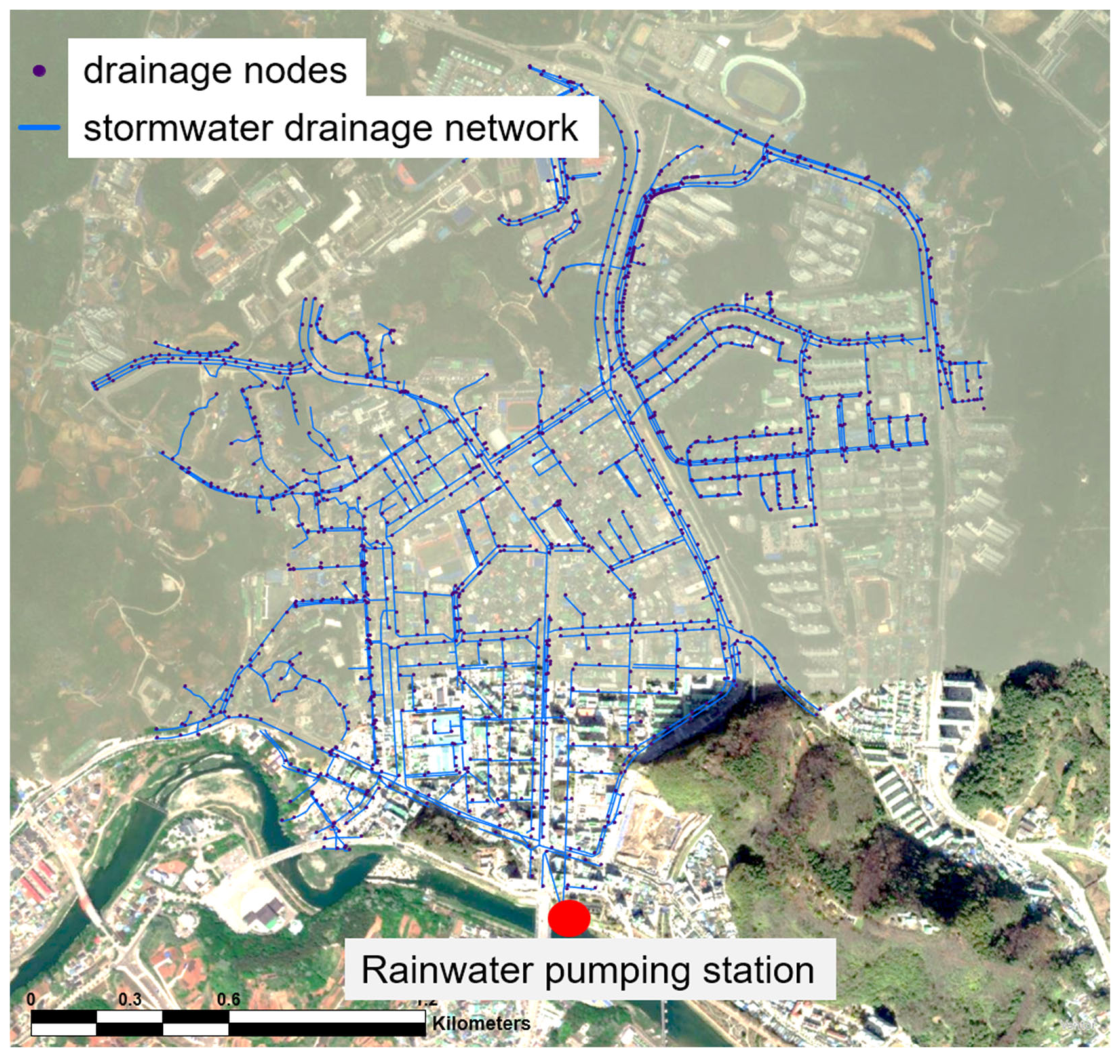
The drainage system includes a rainwater pumping station designed to mitigate flood risk by discharging excess inflow from the detention basin to downstream channels. However, rapid inflow increases during intense rainfall events often challenge the operational efficiency of the pumping system, necessitating improved predictive and control strategies (Figure 2).
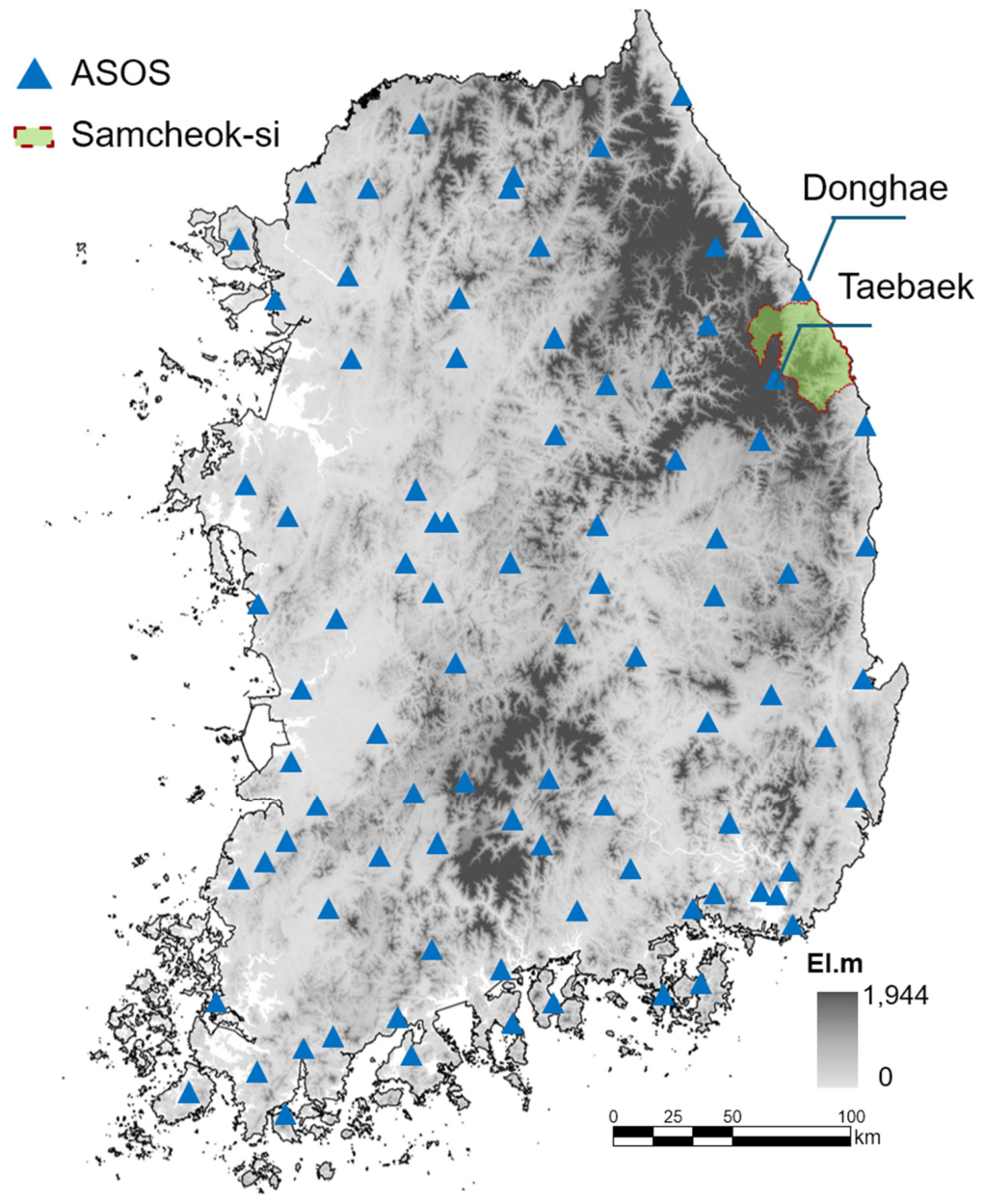
To estimate probabilistic rainfall for different durations, long-term rainfall records with sufficient temporal resolution are required. In the Samcheok Osipcheon watershed, two nearby meteorological stations operated by the Korea Meteorological Administration (KMA)—Donghae and Taebaek—provide long-term rainfall observations.
A Thiessen polygon analysis, which is a spatial interpolation method used to assign weighting factors to rainfall stations based on proximity, indicated that both stations influence the study area. However, the Taebaek station is located in the Taebaek Mountain range and is characterized by different orographic and climatic conditions compared to the coastal watershed. Since the Samcheok Osipcheon watershed is predominantly influenced by coastal meteorological conditions, the use of Taebaek station data was considered less representative.
Therefore, rainfall data from the Donghae station were selected for probabilistic rainfall analysis in this study (Figure 3). Long-term rainfall records from 1973 to 2011 (39 years) were analyzed to extract annual maximum rainfall depths for multiple durations. Based on these data, probabilistic rainfall depths for different durations and return periods were estimated. The probabilistic rainfall depths for various durations and return periods are summarized in Table 1. These results were used as the basis for generating synthetic rainfall scenarios for SWMM simulations and subsequent deep learning model training.

2.3. Training Data Generation Using the Physical Model (SWMM)

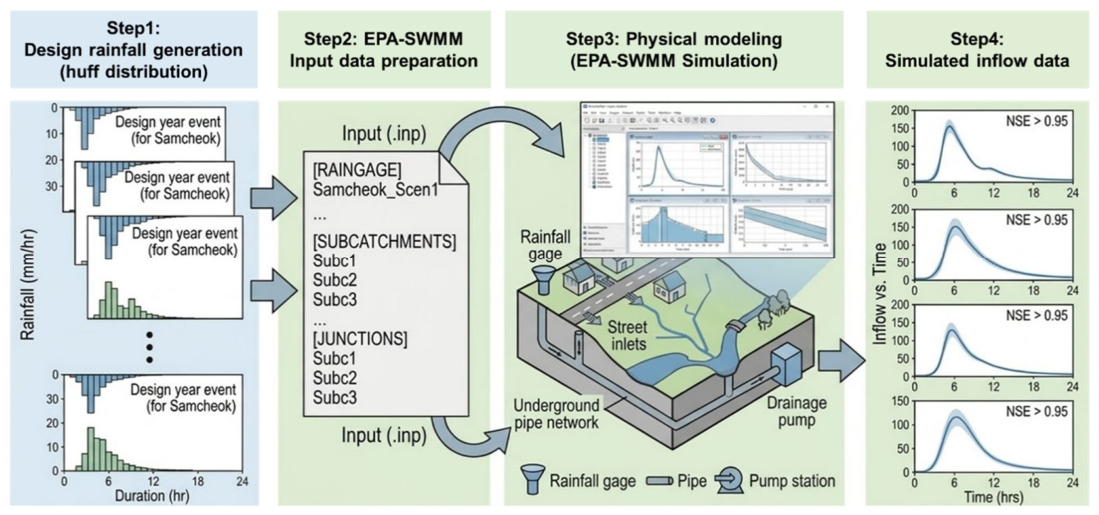
Based on the probabilistic rainfall analysis for the Samcheok region, a design rainfall of 250 mm corresponding to a 200-year return period with a duration of 6 h was selected as the reference rainfall condition. Using this reference, a total of 25 rainfall depths ranging from 10 mm to 250 mm at 10 mm intervals were generated. Each rainfall depth was temporally distributed using the Huff quartile method for the Donghae region, with nine exceedance probabilities ranging from 10% to 90%. Through this process, a total of 900 rainfall events were constructed.
The generated rainfall events were converted into 10 min interval time series and used as input data for the SWMM model of Samcheok-si. Using these inputs, the inflow to the rainwater pumping station was simulated at a 1 min time step over a duration of 480 min. The resulting inflow hydrographs were used as the training dataset for the deep learning models (Figure 4).
A total of 900 inflow time series, each with a duration of 480 min at 1 min intervals, were generated using the SWMM model developed for the urban drainage system of Samcheok-si. The corresponding rainfall events and simulated inflow hydrographs were used as input and target datasets, respectively, for training the deep learning models.
In this study, rainfall time series were used as input variables, while the inflow to the rainwater pumping station simulated by SWMM served as the target variable. Each rainfall event produced a corresponding inflow hydrograph with a temporal resolution of 1 min over 480 min, resulting in a large-scale time-series dataset suitable for deep learning model training.
Three deep learning architectures—ANN, CNN, and LSTM—were applied and compared. These models are widely used in hydrological modeling due to their ability to capture nonlinear relationships and temporal dependencies. ANN is effective for modeling nonlinear relationships, CNN can extract local pattern features from sequential data, and LSTM is particularly suitable for capturing long-term temporal dependencies in time-series data. The dataset was divided into training and validation subsets to evaluate model performance. The characteristics, advantages, and limitations of the deep learning models are summarized in Table 2 [22,23,24,25].
The 1D-CNN was selected to explore its potential in extracting local morphological features from rainfall time series. By treating the sequential data as a one-dimensional grid, the model’s filters can effectively capture intensity gradients and peak patterns that are often smoothed out in recurrent models. This feature extraction process is crucial for detecting the rapid ‘time of concentration’ characteristic of small, highly impervious urban watersheds. Additionally, 1D-CNN was prioritized over deeper LSTMs for its computational agility, which facilitates more rapid updates in a real-time proactive control framework.
To predict the inflow to the rainwater pumping station from rainfall time series, three deep learning architectures—ANN, CNN, and LSTM—were employed in this study. The input data consisted of rainfall time series generated from probabilistic rainfall scenarios, while the target output was the inflow hydrograph simulated by the SWMM model at a 1 min temporal resolution over 480 min.
The ANN model was implemented as a feed-forward neural network composed of an input layer, multiple hidden layers, and an output layer. Nonlinear activation functions were applied to capture the complex nonlinear relationship between rainfall and inflow.
For the CNN model, a one-dimensional convolutional neural network (1D-CNN) architecture was adopted to extract temporal features from the rainfall sequences. Convolutional layers were used to identify local temporal patterns, followed by pooling layers to reduce dimensionality and improve computational efficiency.
The LSTM model was employed to capture long-term temporal dependencies between rainfall and inflow. Due to its gated architecture, LSTM effectively models hydrological time-series data by preserving sequential information and mitigating the vanishing gradient problem, which arises in conventional recurrent neural networks when gradients diminish during backpropagation, thereby limiting their ability to learn long-term dependencies.
The LSTM model used in this study was constructed as a sequential neural network. The input rainfall data were reshaped into a three-dimensional tensor with the shape (N, 36, 1) (N, 36, 1) (N, 36, 1), where NNN denotes the number of rainfall events, 36 is the rainfall input sequence length, and 1 is the number of input features. The target discharge data consisted of 480 time steps for each event. The model consisted of three stacked LSTM layers and one Dense output layer. Each LSTM layer included 36 hidden units. The first and second LSTM layers returned the full sequence output to allow temporal information to be transferred to the subsequent LSTM layer, while the third LSTM layer returned only the final hidden representation. The final Dense layer contained 480 neurons, corresponding to the 480 time steps of the predicted discharge hydrograph. The model did not use bidirectional LSTM layers or dropout layers. The activation function of the LSTM output was ReLU, while the recurrent activation function for the LSTM gates was the default sigmoid function. The Dense output layer used a linear activation function. The model was trained using the Adam optimizer with mean squared error as the loss function.
All models were trained using the rainfall–inflow dataset generated from SWMM simulations. The dataset was divided into training and validation subsets to evaluate model performance and generalization capability. Model training was conducted by minimizing the prediction error between simulated and predicted inflow using a gradient-based optimization algorithm.

2.4. Pump Operation Strategies in Urban Drainage Systems

Based on previous studies, this research proposes a pump operation framework that integrates deep learning–based inflow prediction with adaptive pump control strategies. The Samcheok pumping station, the focus of this study, is equipped with nine identical pumps designed for multi-stage operation. To evaluate the applicability of the proposed framework, two pump operation rules were defined: a conventional level-based control (Rule1) and a proactive surcharge-aware control (Rule2).
Rule1 represents the traditional operation strategy in which pump activation is determined by predefined water level thresholds within the detention basin. To prevent pump cavitation and sediment accumulation, an initial activation level is first defined. During rainfall events, the first of the nine pumps is activated when the basin water level reaches this threshold. As the water level continues to rise, the remaining pumps are sequentially activated at predefined stage levels. In this study, the activation thresholds were set between 2.50 m and 3.50 m, enabling stepwise pump operation.
Maintaining the basin water level near the initial activation level provides additional storage capacity, which helps delay upstream surcharge during rising downstream water levels. However, when the storage capacity of the detention basin is limited, this strategy may result in frequent pump cycling, leading to reduced operational efficiency.
To address this limitation, Rule2 incorporates upstream sewer surcharge conditions into the pump operation strategy. Under normal conditions, Rule2 operates identically to Rule1. However, when surcharge occurs in the upstream sewer network, additional pumps are activated to immediately discharge the incoming inflow, thereby mitigating upstream flooding risks.
In the study area, two major sewer conduits are connected to the detention basin node, with storage capacities of 562.95 m3 (conduit 124,046) and 1524.78 m3 (conduit 124,019), resulting in a total surcharge-related volume of approximately 2087.73 m3. When the inflow exceeds this threshold, or when the rate of water level increase surpasses 1.00 m/min, a rapid inflow condition is identified. Under such conditions, all nine available pumps are immediately activated to maximize discharge capacity.
If the high inflow condition persists, the pumps continue operating at full capacity to maintain the basin water level near the initial activation level, thereby preventing surcharge propagation within the upstream sewer network. The conceptual differences between the reactive level-based operation (Rule1) and the proactive surcharge-based operation (Rule2) are illustrated in Figure 5.

3. Results

3.1. Performance Evaluation of Deep Learning Models

To ensure a robust evaluation and prevent temporal leakage, the dataset was partitioned using an event-based split method. Rather than a random shuffle of individual time steps, entire rainfall-inflow scenarios (events) were preserved as independent units and allocated to training (80%), validation (10%), and test (10%) sets.
The training and validation sets were used for model optimization and hyperparameter tuning, while the independent test set—consisting of 90 entirely unseen scenarios with diverse intensity-duration distributions—was reserved to verify the model’s generalizability. The rainfall intensity time series (Pt) was used as the input variable, while the corresponding SWMM-simulated inflow (Qinflow) served as the target variable. To enable a fair comparison, consistent hyperparameter settings were applied across all architectures, as summarized in the detailed configurations in Table 3.
The final hyperparameters were determined through an iterative manual tuning process to ensure optimal convergence. Sensitivity analysis revealed that while the models generally exhibited stable performance, the learning rate and hidden layer depth were the most critical factors influencing the training efficiency and predictive accuracy.
To ensure each architecture was evaluated at its full potential, the structural hyperparameters were determined through an iterative manual tuning process. While global parameters such as the learning rate (0.001) and batch size (32) were kept constant to provide a consistent training baseline, specific configurations like the number of hidden units, CNN filter dimensions, and LSTM look-back windows were optimized independently. For instance, the 1D-CNN’s kernel size was set to 3 to prioritize the extraction of local rainfall intensity patterns, and the LSTM’s sequence length was optimized to 12 steps, reflecting the characteristic hydrological response time of the urban catchment. These refined settings ensure that the subsequent performance comparison reflects a fair assessment of each optimized model architecture.
For model optimization, the Adam optimizer was employed with a learning rate of 0.001. All models were trained for 500 epochs with a batch size of 32. Mean Squared Error (MSE) was adopted as the loss function to minimize the difference between the SWMM-simulated inflow and the predictions generated by the deep learning models. The MSE loss function is defined as:
M S E = 1 n i = 1 n ( Q i S W M M Q i p r e d ) 2
where Q i S W M M represents the inflow simulated by the SWMM model and Q i p r e d denotes the inflow predicted by the deep learning model.
The predictive performance of the three trained deep learning models—ANN, CNN, and LSTM—was quantitatively evaluated by comparing their predicted inflow hydrographs with the hydrodynamic simulation results obtained from the EPA-SWMM model. The performance metrics, including Root Mean Squared Error (RMSE), Mean Squared Error (MSE), and Mean Absolute Error (MAE), and Peak Percentage Error (PPE) were calculated for both the training and validation datasets. The detailed evaluation results are summarized in Table 4.
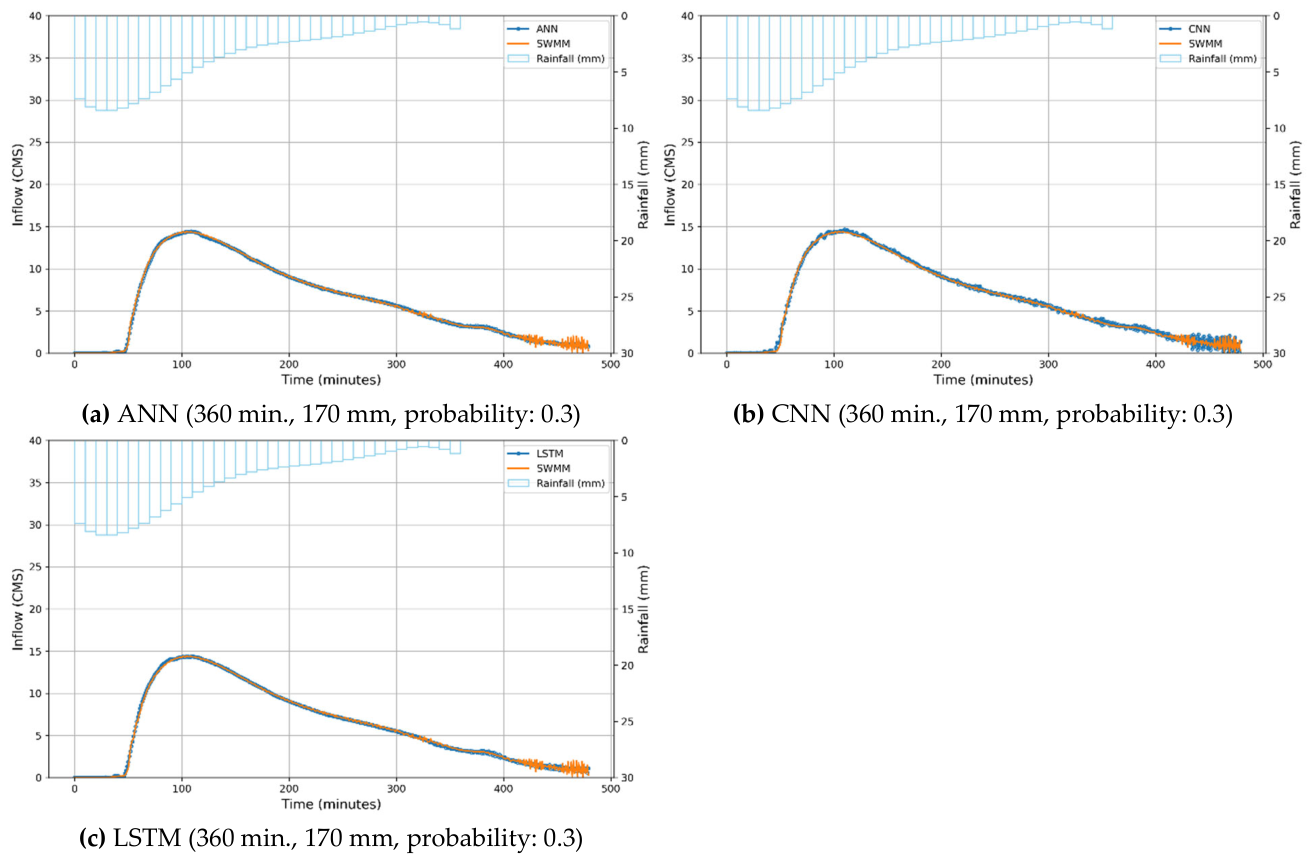
The results indicate that all three architectures achieved relatively high accuracy in reproducing the complex inflow patterns of the Samcheok drainage system. As illustrated in Figure 6, where the rainfall intensity is indicated on the left y-axis (blue histogram) and the predicted inflow is shown on the right y-axis (discharge curves), a closer examination of the learning behavior revealed notable differences among the models.
The CNN model, although showing the highest accuracy during the training phase, exhibited a significant deterioration in performance when applied to the validation dataset. In the hydrograph presented in Figure 6 (right y-axis), the CNN-predicted values showed noticeable oscillations, particularly during the recession limb. This behavior suggests that the CNN model experienced overfitting, limiting its ability to generalize the underlying rainfall–runoff relationships.
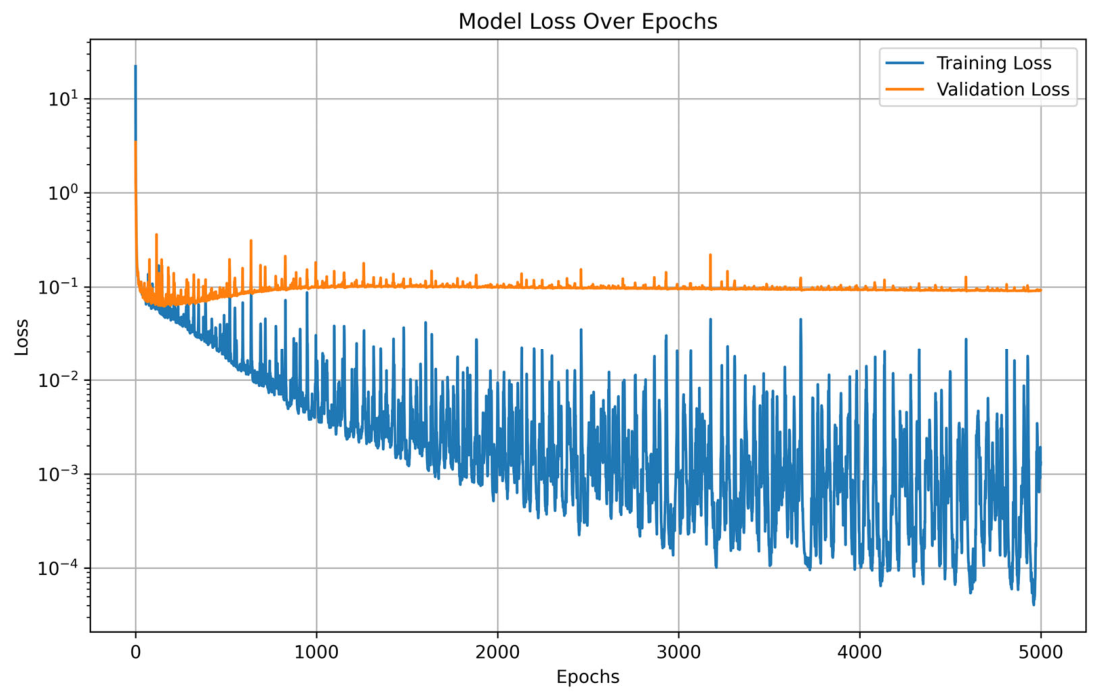
To substantiate the diagnosis of overfitting in the 1D-CNN model, the training and validation loss curves were examined (Figure 7). The results reveal a characteristic divergence between the two curves; the training loss steadily declines toward zero, whereas the validation loss reaches its minimum around the 200th epoch and subsequently plateaus with minor oscillations. This discrepancy confirms that the model began to over-fit the specific patterns of the training scenarios, resulting in the instability observed during the recession limb of the predicted hydrograph. To mitigate this, Dropout regularization (rate = 0.2) was applied to the hidden layers. Although this improved the overall generalizability, the 1D-CNN’s inherent sensitivity to high-frequency local features contributed to its relative lack of smoothness during the receding flow phase compared to the LSTM’s superior temporal consistency.
In contrast, the ANN and LSTM models demonstrated more stable performance, maintaining consistent error metrics across both the training and validation datasets. Among the models, the LSTM architecture showed the best performance in reproducing extreme inflow conditions. When evaluated using the PPE—which focuses on the top 10% of inflow values—the LSTM model achieved the lowest error of 3.45%, slightly outperforming the ANN model (3.52%).
The superior performance of the LSTM model can be attributed to its capability to capture long-term temporal dependencies in hydrological time-series data. Therefore, the LSTM model was selected as the most reliable surrogate model for inflow prediction in this study and was subsequently applied as the core prediction engine for the proactive pump operation strategy discussed in the following section.

3.2. Effect of Second-Level Pump Operation Control

It was observed that the conventional pump operation method based on a fixed one-minute interval can result in excessive discharge. This issue arises because the required number of operating pumps is often calculated as a fractional value, but in practice, the system activates an integer number of pumps, leading to over-discharge. This excessive pumping causes abrupt fluctuations in the detention basin water level, particularly during periods of rapidly changing inflow conditions. Such instability not only reduces operational efficiency but may also lead to unnecessary energy consumption and increased mechanical stress on pumping facilities.
To address this limitation, a second-level pump operation control method was introduced in this study. Instead of operating pumps for a full one-minute interval, the proposed approach adjusts the pump operation duration at the second scale based on the predicted inflow and required discharge capacity. The objective of this section is to evaluate the effectiveness of the second-level control method in reducing excessive discharge and stabilizing detention basin water levels compared to the conventional one-minute operation approach.
Following this concept, the proposed control method was formulated to quantitatively determine the required pump operation. First, the theoretical number of pumps required at time t( N t h e o r y , t ) is calculated based on the predicted inflow ( Q D L ) and the required storage change ( S t ) to reach the target water level:
N t h e o r y , t = Q D L , t ± S t q p
where ∆St (m3) represents the required storage volume change needed to restore the detention basin water level to the target level during the upcoming control interval, and q p denotes the discharge capacity of a single pump unit. In the proposed framework, ∆St is estimated in real time by integrating the residual between the DL-predicted inflow and the current pump discharge capacity over the prediction lead time. This enables the system to proactively determine the volumetric adjustment required to maintain the basin water level within the target range before the peak inflow occurs.
To ensure a conservative safety margin and sufficient discharge capacity, the actual number of operating pumps ( N a c t u a l , t ) is determined by rounding up the theoretical value:
N a c t u a l , t = N t h e o r y , t
Instead of operating N a c t u a l , t pumps continuously for a full one-minute interval, the proposed method optimizes the pump operation duration ( T c , t ) based on the ratio between the theoretical and actual pumping capacity:
T c , t = ( N t h e o r y , t N a c t u a l , t ) × 60 ( s )
By applying this mechanism, the pumping station operates N a c t u a l , t pumps for T c , t seconds and remains idle for the remainder of the one-minute interval ( 60 T c , t ) . This adaptive control strategy enables a more precise balance between inflow and discharge, thereby reducing excessive pumping and stabilizing detention basin water levels.
To ensure the practical applicability of the Rule2-Second strategy, hardware-protective constraints were incorporated into the algorithm. Although the control logic updates pump operation at a sub-minute (second-level) temporal resolution for high-precision control, the physical actuation of the pumps is constrained by a minimum run/stop time (e.g., 300 s) and a water-level deadband. These mechanisms prevent excessive pump switching and potential mechanical damage, ensuring that the control signals remain within safe operational limits of the pump station.
The proposed second-level control algorithm operates as a discrete-time control loop that periodically updates the target storage deviation ( Δ S t ) and recalculates the required pump operation duration. In this study, a one-second temporal resolution was adopted for the control update calculation, while actual pump switching was restricted by the minimum operational time constraints.
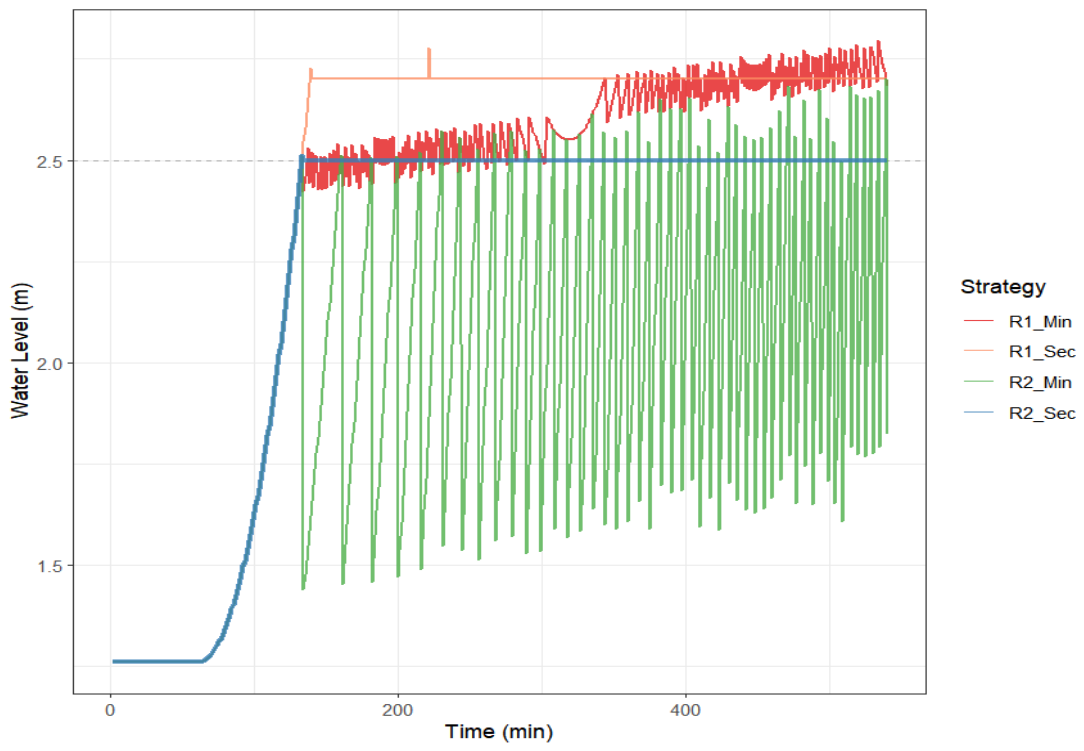
The proposed second-step precision control algorithm demonstrated overwhelming numerical superiority over conventional minute-step methods. According to the hydrograph analysis, the disparity in control precision became prominently evident starting from approximately the 126 min mark, when the inflow rate began to exceed the pipe’s conveyance capacity. The Rule2 Fixed model, which determines operation time on a minute-by-minute basis, recorded a maximum water level deviation of approximately 1.24 m, with rapidly decreased to a minimum of 1.26 m immediately after reaching the target due to excessive drainage from the full-capacity operation. This reflects the inherent physical limitation of discrete minute-step control in maintaining real-time mass balance between inflow and drainage.
In contrast, the proposed Rule2 model, utilizing second-step control, effectively neutralized residuals near the target level by fine-tuning the optimal operation time (Tc) in seconds for each minute. During the surcharge period after the 130 min mark, where the inflow rate remained at the maximum capacity of 2087.73 m3/min., the proposed model maintained an highly stable steady-state condition within an error margin of ±0.01 m relative to the target level of 2.5 m. Consequently, extending the control time resolution from minutes to seconds enabled a reduction in maximum water level deviation by over 99% compared to conventional methods. This result provides a robust engineering foundation for utilizing over 95% of the detention basin’s capacity without increasing the risk of urban flooding (Figure 8).
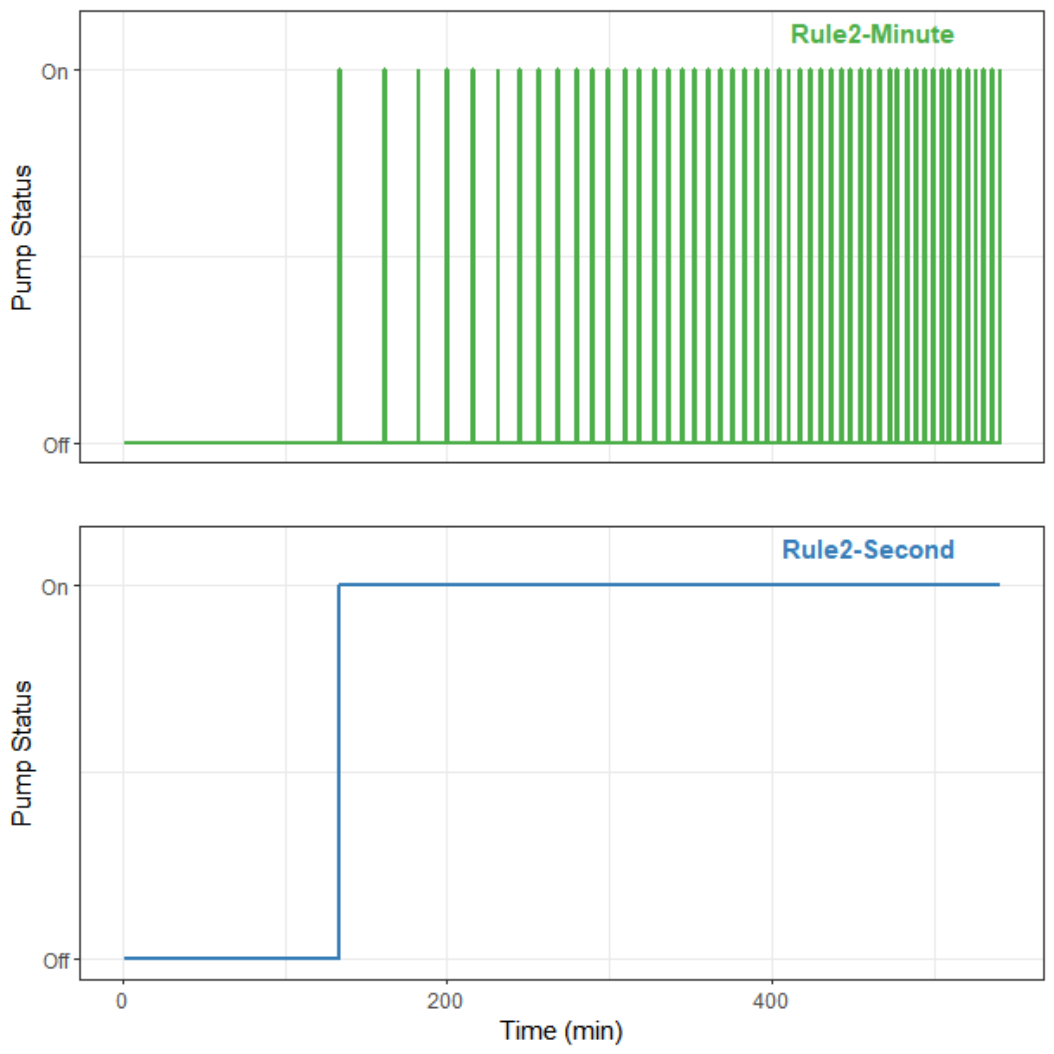
Figure 9 presents the time-series analysis of pump activation signals (On/Off status) according to the control intervals. As shown in Figure 9, the minute-based control strategy (Rule2-Minute) exhibits a distinct ‘hunting’ phenomenon, where the pump frequently switches between On and Off states near the target water level. This is attributed to the control lag at 1 min intervals, which fails to compensate for sub-minute fluctuations, leading to the high-frequency mechanical oscillations observed in Figure 9.
In contrast, the proposed second-level precision control (Rule2-Second) maintains a continuous and stable ‘On’ signal throughout the operational period. By calculating the precise activation duration per second, this method achieves a real-time balance between inflow and discharge without unnecessary switching. This operational stability is the primary driver behind the 99.5% reduction in water level variability (SD from 0.392 m to 0.002 m), proving that the proposed strategy effectively ensures both hydraulic stability and mechanical durability of the pumping system.
The quantitative results of the comparative simulation are summarized in Table 5. Although Rule1 showed relatively lower RMSE and maximum deviation values under the deterministic test condition, its operation remained fundamentally reactive because pump activation depended solely on the current detention basin water level. Under such conditions, the conventional threshold-based operation could maintain relatively stable performance when inflow variability and forecasting uncertainty were limited.
In contrast, Rule2 incorporates LSTM-based inflow forecasting to enable proactive pump operation through pre-emptive drawdown. This predictive control mechanism activates pumps before inflow peaks reach the detention basin, thereby improving operational responsiveness under dynamically changing inflow conditions. Such proactive control becomes particularly advantageous during rapidly varying rainfall and uncertainty scenarios.
In addition to the improvement in predictive control, Table 5 highlights a dramatic enhancement in hydraulic stability under the sub-minute optimized duration mode. Compared with the conventional fixed-interval operation (Rule2-Minute), the proposed Rule2-Second framework reduced the RMSE from 0.684 m to 0.004 m, representing a reduction in water level instability of over 99%. Furthermore, the maximum water level deviation was significantly reduced from 1.240 m to 0.011 m, effectively mitigating the hunting phenomenon commonly observed in threshold-based operations.
In conventional level-based operations, pumps often experience rapid on–off cycles when the water level fluctuates near threshold values. Such repetitive switching can accelerate mechanical wear and reduce operational efficiency. In contrast, the integration of deep learning–based inflow prediction with optimized second-step duration control effectively offsets the residuals between inflow and drainage rates in real-time. This approach not only minimizes unnecessary pump switching by 39% but also ensures a stable hydraulic safety margin, thereby enhancing the long-term structural reliability of the pumping infrastructure.
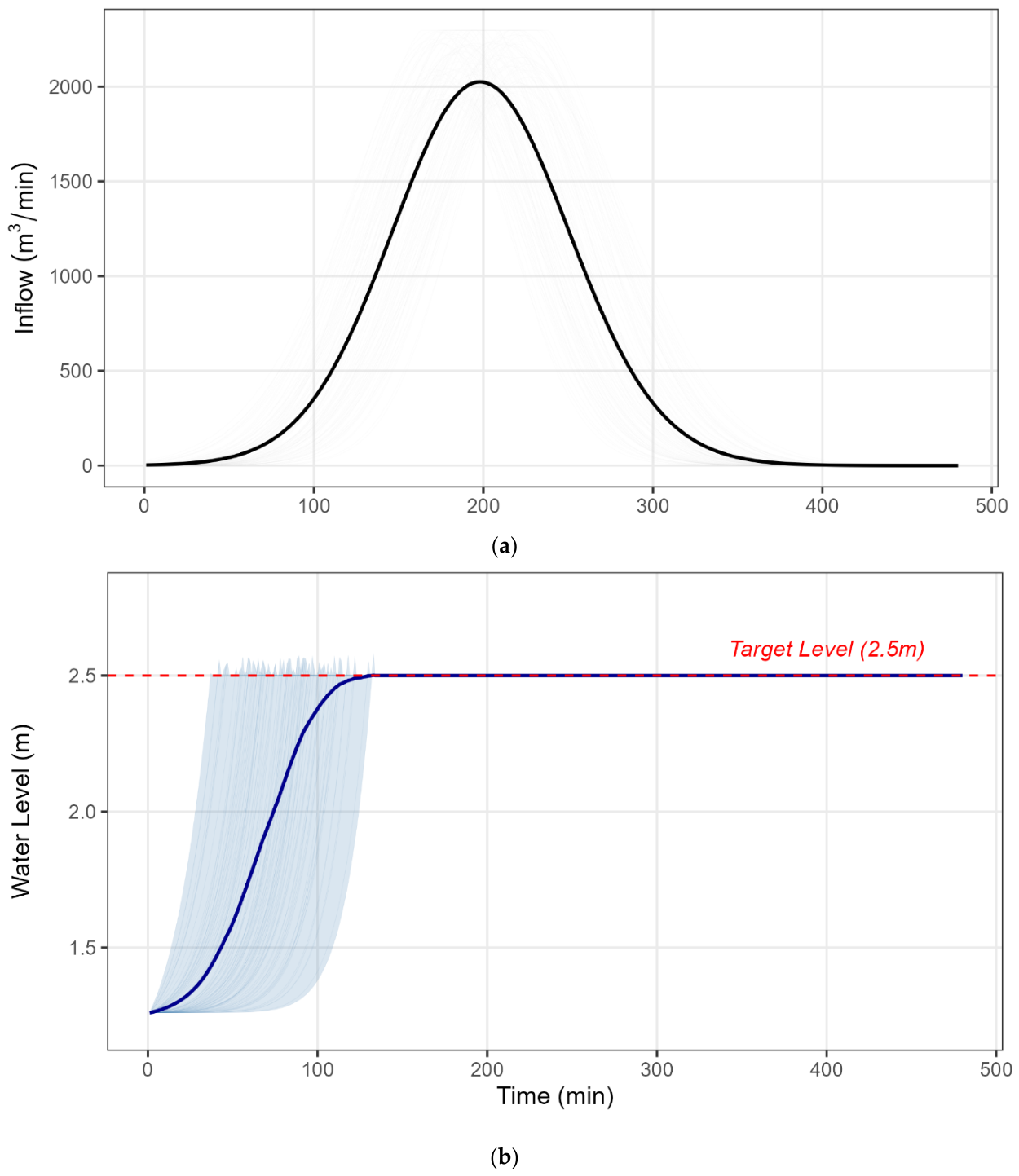
The operation of urban detention basins for flood mitigation is inherently exposed to multi-faceted risks, including meteorological uncertainties and hydrological variability. In particular, the LSTM-based inflow forecasting model employed in this study may involve prediction errors when encountering extreme rainfall events or localized precipitation patterns that deviate from historical training datasets. If the control algorithm is overly optimized for a specific deterministic scenario, it may lead to water level exceedance or hydraulic instability due to rapid pump switching when faced with unforeseen forecast errors. Therefore, a comprehensive uncertainty analysis is indispensable to quantitatively verify the robustness of the proposed second-step precision control, ensuring consistent performance across a wide spectrum of inflow fluctuations. To simulate these uncertainties, a Monte Carlo simulation approach was adopted to generate stochastic inflow scenarios (Figure 10). Moving beyond simple noise injection, the key physical characteristics of the inflow hydrograph—peak intensity and time-to-peak—were defined as random variables. Specifically, 100 independent stochastic hydrograph ensembles were constructed by randomly varying the peak flow magnitude within ±15% and the peak timing within ±30 min relative to the base scenario (light blue lines in Figure 10). These randomized variations encompass both the natural stochasticity of rainfall events and the potential errors of the LSTM forecasting model. Consequently, this provides a rigorous engineering testbed to evaluate whether the proposed framework can reliably maintain the target water level even under extreme and unpredictable inflow conditions.
The quantitative performance metrics derived from 100 stochastic inflow scenarios (Table 6) demonstrate that the proposed second-step control framework (Rule2-Second) significantly outperforms the conventional minute-scale operational strategy (Rule2-Minute) across all evaluation criteria.
In terms of hydraulic precision, the Rule2-Minute approach exhibited substantial deviations from the target level, yielding an average Root Mean Square Error (RMSE) of 0.684 m and a maximum deviation of 1.240 m. These fluctuations stem from the accumulation of residuals between inflow and drainage rates within the fixed 1 min control interval. In contrast, the Rule2-Second framework suppressed the RMSE to 0.004 m and the maximum deviation to 0.011 m, effectively eliminating over 99% of the operational error. These results verify that fine-tuning the control resolution from minutes to seconds is a critical factor in achieving near-perfect target tracking in detention basin operations.
The robustness of the proposed algorithm is further evidenced by its consistent performance under high uncertainty. Despite the randomized variations in peak intensity and timing across the 100 ensembles, the inter-ensemble standard deviation of the water level remained at a very low value of 0.002 m. This stability indicates that the framework can effectively accommodate meteorological and hydrological uncertainties while maintaining hydraulic stability under variable storm conditions. Specifically, the reduction of the settling error to 0.16% demonstrates the model’s capability for stable steady-state regulation. The uncertainty ranges adopted in this study (±15% rainfall intensity and ±30 min peak timing variation) were selected to represent realistic variability in localized storm behavior and potential uncertainty associated with short-term rainfall forecasting and temporal storm pattern shifts in urban drainage systems.
In addition to hydraulic robustness, the integration of second-level duration control also enhanced overall operational efficiency. By mitigating the ‘hunting phenomenon’—the repetitive on-off cycling of pumps near threshold levels—the proposed model reduced the average number of switching events by 23.9%. This improvement not only optimizes energy consumption but also minimizes mechanical wear on the pumping infrastructure, thereby enhancing the long-term structural reliability and maintenance efficiency of urban drainage systems. Notably, even under stochastic perturbation conditions, the proposed Rule2-Second control maintained stable operational performance while consistently reducing unnecessary pump switching events.


4. Discussion

The primary novelty of this study lies in the integration of deep learning-based inflow prediction with a second-level precision control algorithm. Unlike conventional studies that focus primarily on prediction accuracy within 1 min intervals, our framework addresses the practical ‘hunting’ phenomenon—a chronic mechanical challenge in urban pump stations caused by control lags. By bridging the gap between sub-minute hydraulic response and deep learning, this study provides a more viable solution for stable real-time operation.
The results of this study demonstrate that deep learning models can effectively reproduce pump station inflow hydrographs generated by the SWMM model. Among the three architectures evaluated—ANN, CNN, and LSTM—the LSTM model exhibited the most reliable performance, particularly in reproducing peak inflow conditions and maintaining stable accuracy across both training and validation datasets. These findings highlight the importance of capturing temporal dependencies when modeling urban drainage inflow dynamics.
The relatively lower performance of the CNN model during the validation phase suggests that convolution-based architectures may have limitations in representing one-dimensional rainfall–inflow relationships dominated by temporal dynamics. Although CNN models are effective for extracting spatial features from grid-based data, their applicability becomes limited for single-point time-series inputs. The oscillations observed in the recession limb further indicate that the CNN model suffered from overfitting and failed to generalize effectively to unseen conditions.
Specifically, this instability is attributed to the structural characteristics of the 1D-CNN’s receptive field rather than a mere excess of model parameters. While 1D-CNNs are adept at extracting local features and identifying rapid gradients in rainfall-runoff patterns, their fixed-window feature extraction makes them inherently sensitive to high-frequency variations. During the recession limb, where physical dynamics are governed by a gradual and smooth decay, the 1D-CNN’s localized receptive field occasionally misinterpreted minor input variances as structural shifts, resulting in non-physical oscillations. In contrast, the LSTM’s ability to regulate information flow through its gating mechanism provided superior temporal consistency, effectively capturing the long-term dependencies of the catchment’s response. This indicates that for urban flood forecasting, the alignment of the receptive field with both rising and receding limb dynamics is a critical factor for ensuring overall model stability.
The robustness and generalization ability of these models are further supported by the diverse training dataset described in Section 2.3. By utilizing 900 rainfall events covering a wide range of rainfall depths (10 mm to 250 mm) and nine exceedance probabilities for each Huff quartile, the models were exposed to a broad spectrum of temporal rainfall patterns. The consistent NSE performance across unseen scenarios confirms that the LSTM model, in particular, successfully generalized the non-linear rainfall–inflow dynamics rather than merely memorizing training sequences.
In contrast, the LSTM model demonstrated strong capability in capturing the temporal characteristics of rainfall–runoff processes. Its gating mechanism enables the retention of long-term dependencies while mitigating the vanishing gradient problem. This feature is particularly advantageous in urban drainage systems, where inflow responses exhibit rapid and nonlinear variations following rainfall events. The lower PPE achieved by the LSTM model further confirms its robustness in reproducing extreme inflow conditions, which are critical for flood risk management.
Beyond model performance, a key contribution of this study is the integration of deep learning–based inflow prediction with pump operation strategies. Accurate inflow prediction enables proactive operational decision-making, which is essential for reducing urban flood risks. The results show that the proactive pump operation rule (Rule2), which considers upstream sewer surcharge conditions, provides more effective water level control compared to the conventional level-based operation (Rule1). Specifically, the peak water level was reduced from 2.585 m to 2.439 m, corresponding to a reduction of approximately 5.6%. This improvement demonstrates the effectiveness of incorporating predictive information into pump operation strategies.
Another important finding relates to the temporal resolution of pump operation. When pump control was implemented using a fixed one-minute interval, rounding errors in the required number of pumps resulted in excessive discharge and unstable water level fluctuations. To address this issue, the second-level pump operation control method was introduced, allowing pump operation duration to be adjusted within each minute. This approach significantly improved discharge precision and stabilized detention basin water levels by minimizing unnecessary pump operation. Furthermore, while standard metrics such as NSE and PPE provide a robust overall evaluation of model accuracy, they have inherent limitations in quantifying errors related to peak timing. The proposed second-level control framework mitigates this issue by dynamically adjusting pump discharge rates every second. This high-resolution operational capability ensures that the system can respond almost instantaneously to rapid inflow changes, thereby inherently minimizing the temporal lags and timing errors often associated with conventional minute-based control strategies.
These results demonstrate that combining deep learning–based inflow prediction with adaptive pump operation control can substantially enhance the operational efficiency and reliability of urban pumping stations. Regarding the feasibility of real-world deployment, the computational cost of the trained LSTM model is minimal, with an inference latency of only a few milliseconds. This ensures that the framework can be seamlessly integrated into existing operational systems without requiring specialized high-performance hardware, making it highly applicable for practical flood mitigation. Moreover, the computational efficiency of trained deep learning models enables near real-time inflow prediction, making the proposed framework suitable for integration into real-time decision-support systems for urban flood management.
Despite these promising results, several limitations should be acknowledged. First, the training dataset was generated using synthetic rainfall scenarios based on probabilistic analysis, which may not fully capture the variability of real rainfall events. Furthermore, since the training data relies on the physical simulation engine of the SWMM model, there is an inherent risk that structural uncertainties or simulation biases from SWMM could propagate into the deep learning models. While SWMM provides a physically consistent baseline for initial training, this dependence suggests that the model’s performance is bounded by the accuracy of the underlying hydraulic simulation. Second, the proposed framework was applied to a single pump station in Samcheok-si, which may limit the generalizability of the results to other urban drainage systems.
Future research should focus on incorporating real-time rainfall observations and radar-based precipitation forecasts into the prediction framework. In addition, further validation across multiple urban drainage systems with diverse hydrological and infrastructural characteristics is required to enhance the robustness and transferability of the proposed approach.

5. Conclusions

This study proposed a hybrid framework integrating SWMM-based hydrological simulation with deep learning models for inflow prediction and pump operation in urban drainage systems. Among the evaluated architectures—ANN, CNN, and LSTM—the LSTM model provided the most reliable performance, achieving an NSE of 0.97 and a PPE of 3.45%, thereby demonstrating a superior capability in reproducing peak inflow conditions.
The integration of predictive information into pump control significantly enhanced operational effectiveness. The proactive operation rule considering upstream surcharge conditions reduced the peak water level by approximately 5.6% (from 2.585 m to 2.439 m). Furthermore, the proposed second-step precision control drastically improved hydraulic stability. The RMSE was reduced from 0.684 m to 0.004 m, and the maximum deviation decreased from 1.24 m to 0.011 m, representing a 99.4% improvement in target-tracking precision compared to conventional minute-scale operations.
To ensure the reliability of the framework under unpredictable conditions, a Monte Carlo simulation (N = 100) was performed by stochastically varying the peak intensity and timing of inflow hydrographs. Despite these uncertainty scenarios, the proposed model exhibited satisfactory stability within the tested parameter ranges, maintaining a low inter-ensemble standard deviation of 0.002 m. This consistent performance indicates that the model can effectively mitigate the ‘hunting phenomenon’ under the simulated variations in peak intensity and timing. However, it is noted that this evaluation is centered on the scaling of the hydrograph; the model’s robustness against anomalous rainfall patterns, such as bi-modal storm events, remains to be further validated in future studies to ensure broader real-world applicability.
From a sustainability perspective, the framework not only optimized water levels but also reduced the frequency of pump switching by 23.9%. This reduction contributes to higher energy efficiency and an extended operational lifespan of the pumping infrastructure, aligning with low-carbon urban management strategies. In conclusion, the proposed framework serves as a robust, real-time decision-support tool for urban flood mitigation and resilient infrastructure operation. While the LSTM model demonstrated superior predictive performance, its ‘black-box’ nature remains a challenge for full interpretability in operational settings. Future research should therefore focus on integrating Explainable AI (XAI) techniques, such as SHAP, to clarify the complex relationships between hydrological variables and ensure greater reliability for real-time flood management. Furthermore, Future work should focus on incorporating real-time rainfall observations and validating the framework across diverse and complex urban drainage networks.

Author Contributions

Conceptualization, Y.-H.S. and J.H.S.; methodology, Y.-H.S.; writing—original draft preparation, Y.-H.S.; writing—review and editing, J.H.S. and J.P.; validation, J.P.; formal analysis, J.P., G.C. and B.-S.K. All authors have read and agreed to the published version of the manuscript.

Funding

This research was also supported by the National Research Foundation of Korea (RS-2023-00243727), This research was support by a (2022-MOIS63-002(RS-2022-ND641012)) of Cooperative Research Method and Safety Management Technology in National Disaster funded by Ministry of Interior and Safety (MOIS, Korea). And This study was supported by 2024 Research Grant from Kangwon National University.

Institutional Review Board Statement

Not applicable.

Informed Consent Statement

Not applicable.

Data Availability Statement

The data from this study are available from the corresponding author upon reasonable request.

Conflicts of Interest

The authors declare no conflicts of interest.

References

  1. Jin, S.; Wang, L.; Yan, X. Climate change adaptation and disaster risk assessments: A preface. Phys. Chem. Earth Parts A/B/C 2020, 120, 102920. [Google Scholar] [CrossRef]
  2. Chen, X.; Zhang, H.; Chen, W.; Huang, G. Urbanization and climate change impacts on future flood risk in the Pearl River Delta under shared socioeconomic pathways. Sci. Total Environ. 2021, 762, 143144. [Google Scholar] [CrossRef] [PubMed]
  3. World Bank. Cities and Flooding: A Guide to Integrated Urban Flood Risk Management for the 21st Century; World Bank: Washington, DC, USA, 2012. [Google Scholar]
  4. Andreadis, K.M.; Wing, O.E.; Colven, E.; Gleason, C.J.; Bates, P.D.; Brown, C.M. Urbanizing the floodplain: Global changes of imperviousness in flood-prone areas. Environ. Res. Lett. 2022, 17, 104024. [Google Scholar] [CrossRef]
  5. Wang, Y.; Li, C.; Qiao, J.; Hu, Y.; Zhang, Q.; Yin, J.; Slater, L. Meta-analysis of urban non-point source pollution from road and roof runoff across China. Earth’s Future 2025, 13, e2024EF005296. [Google Scholar] [CrossRef]
  6. Zhuan, X.; Xia, X. Optimal operation scheduling of a pumping station with multiple pumps. Appl. Energy 2013, 104, 250–257. [Google Scholar] [CrossRef]
  7. Joo, J.G.; Jeong, I.S.; Kang, S.H. Deep reinforcement learning for multi-objective real-time pump operation in rainwater pumping stations. Water 2024, 16, 3398. [Google Scholar] [CrossRef]
  8. Butler, D.; Davies, J.W. Urban Drainage, 4th ed.; CRC Press: London, UK, 2018. [Google Scholar]
  9. Tabari, H. Climate change impact on flood and extreme precipitation increases with water availability. Sci. Rep. 2020, 10, 13768. [Google Scholar] [CrossRef] [PubMed]
  10. Martel, J.L.; Brissette, F.P.; Lucas-Picher, P.; Troin, M.; Arsenault, R. Climate Change and Rainfall Intensity–Duration–Frequency Curves: Overview of Science and Guidelines for Adaptation. J. Hydrol. Eng. 2021, 26, 03121001. [Google Scholar] [CrossRef]
  11. Song, Y.H.; Park, M.J.; Lee, J.H. Analysis of Urban Inundation Reduction Effect by Early Operation of Drainage Pumping Station. J. Korean Soc. Hazard Mitig. 2014, 14, 267–276. (In Korean) [Google Scholar] [CrossRef]
  12. Rossman, L.A. Storm Water Management Model User’s Manual; Version 5.0; National Risk Management Research Laboratory, U.S. Environmental Protection Agency: Cincinnati, OH, USA, 2010; Volume 276. [Google Scholar]
  13. Beven, K.J. Rainfall-Runoff Modelling: The Primer; John Wiley & Sons: Chichester, UK, 2012. [Google Scholar]
  14. Zhang, D.; Hølland, E.S.; Lindholm, G.; Ratnaweera, H. Hydraulic modeling and deep learning based flow forecasting for optimizing inter catchment wastewater transfer. J. Hydrol. 2019, 567, 792–802. [Google Scholar] [CrossRef]
  15. Kratzert, F.; Klotz, D.; Brenner, C.; Schulz, K.; Herrnegger, M. Rainfall–runoff modelling utilizing Long Short-Term Memory (LSTM) networks. Hydrol. Earth Syst. Sci. 2018, 22, 6005–6022. [Google Scholar] [CrossRef]
  16. Xiang, Z.; Yan, J.; Demir, I. A rainfall–runoff model with LSTM-based sequence-to-sequence learning. Water Resour. Res. 2020, 56, e2019WR025326. [Google Scholar] [CrossRef]
  17. Razavi, S.; Tolson, B.A.; Burn, D.H. Review of surrogate modeling in water resources. Water Resour. Res. 2012, 48, W07401. [Google Scholar] [CrossRef]
  18. Asher, M.J.; Croke, B.F.; Jakeman, A.J.; Peeters, L.J. A review of surrogate models and their application to groundwater modeling. Water Resour. Res. 2015, 51, 5957–5973. [Google Scholar] [CrossRef]
  19. Schütze, M.; Butler, D.; Beck, M.B. Modelling, Simulation and Control of Urban Wastewater Systems; Springer: London, UK, 2004. [Google Scholar]
  20. Lund, N.S.V.; Falk, A.K.V.; Borup, M.; Madsen, H.; Mikkelsen, P.S. Model predictive control of urban drainage systems: A review and perspective towards smart real-time water management. Crit. Rev. Environ. Sci. Technol. 2018, 48, 279–339. [Google Scholar] [CrossRef]
  21. Mosavi, A.; Ozturk, P.; Chau, K.W. Flood prediction using machine learning models: Literature review. Water 2018, 10, 1536. [Google Scholar] [CrossRef]
  22. Haykin, S. Neural Networks: A Comprehensive Foundation, 2nd ed.; Prentice Hall: Upper Saddle River, NJ, USA, 1999. [Google Scholar]
  23. Maier, H.R.; Dandy, G.C. Neural networks for the prediction and forecasting of water resources variables: A review of modelling issues and applications. Environ. Model. Softw. 2000, 15, 101–124. [Google Scholar] [CrossRef]
  24. LeCun, Y.; Bottou, L.; Bengio, Y.; Haffner, P. Gradient-based learning applied to document recognition. Proc. IEEE 1998, 86, 2278–2324. [Google Scholar] [CrossRef]
  25. Hochreiter, S.; Schmidhuber, J. Long short-term memory. Neural Comput. 1997, 9, 1735–1780. [Google Scholar] [CrossRef]
Figure 1. Overall framework of the proposed hybrid inflow prediction and pump operation system for urban drainage pumping stations.
Sustainability 18 05777 g001
Figure 2. SWMM model configuration showing the urban drainage network and the location of the rainwater pumping station in the study area.
Sustainability 18 05777 g002
Figure 3. Location of the study area and distribution of observation stations in South Korea.
Sustainability 18 05777 g003
Figure 4. Workflow of rainfall scenario generation, SWMM simulation, and inflow dataset construction for deep learning model training.
Sustainability 18 05777 g004
Figure 5. Conceptual comparison of conventional level-based pump operation (Rule1) and proactive surcharge-based pump operation (Rule2) (Applied specific thresholds: 2.50 m for early activation and 3.50 m for maximum pump capacity).
Sustainability 18 05777 g005
Figure 6. Deep learning-based inflow prediction results (360 min duration with 0.3 exceedance probability).
Sustainability 18 05777 g006
Figure 7. Training and validation loss curves for the 1D-CNN.
Sustainability 18 05777 g007
Figure 8. Comparison of water level dynamics under different pump operation strategies: conventional level-based control (R1_Min, R1_Sec) and proposed surcharge-aware control (R2_Min, R2_Sec) at both minute-based and second-level precision.
Sustainability 18 05777 g008
Figure 9. Comparison of pump operational signals between Rule2-Minute and Rule2-Second strategies, demonstrating the elimination of the hunting phenomenon through sub-minute precision control.
Sustainability 18 05777 g009
Figure 10. Robustness evaluation of the proposed second-precision control framework under stochastic inflow uncertainty: (a) Inflow scenario; (b) Robust water level control (proposed).
Sustainability 18 05777 g010
Table 1. Probabilistic rainfall depths (mm) for multiple durations and return periods derived from long-term rainfall observations (1973–2011) at the Donghae station.
Duration (min)Return Period (yr)
21020305080100200
6027.845.552.356.261.165.567.774.2
12041.069.380.186.394.1101.2104.5115.1
18052.089.9104.3112.6123.0132.5137151
36074.6127.8148.1159.8174.3187.7194213.8
54091.0153.9177.9191.7208.9224.7232.2255.3
720103.9177.7205.9222.3242.6261.2270297.2
1080129.3226.0263.0284.2310.8335.1346.6382.3
1440146.1258.3301.1325.7356.5384.7398.1439.4
2880177.4305.8354.4382.6417.9450.1465.4512.7
4320197.9341.1396.0427.6467.1503.2519.8572.8
Table 2. Characteristics, applications, advantages, and limitations of the deep learning models used in this study.
ModelApplicationsAdvantagesLimitations
ANNRainfall–runoff modeling, flood forecasting, water quality assessmentSimple structure; effective for nonlinear relationshipsLimited spatiotemporal capability; prone to overfitting
CNNSpatial pattern analysis; LULC classificationEffective feature extraction; reduced overfittingEfficient for grid-like structures (including 1D temporal grids)
LSTMTime-series forecasting (discharge, groundwater, weather)Captures long-term dependencies; robust to vanishing gradientHigh computational cost; low interpretability
Table 3. Selected final hyperparameters after tuning.
HyperparameterANNCNNLSTM
Data Split (%)80:10:1080:10:1080:10:10
Input Layers1 (Rainfall)1 (Rainfall)1 (Rainfall)
Target VariableInflowInflowInflow
Hidden Layers32 (Conv1D) + 1
(Dense)
2 (LSTM) + 1
(Dense)
Activation FunctionReLUReLUTanh/Sigmoid
OptimizerAdamAdamAdam
Loss FunctionMSEMSEMSE
Batch Size323232
Epochs500500500
Learning Rate0.0010.0010.001
Table 4. Performance evaluation metrics of deep learning models.
IndicatorTraining PeriodValidation Period
ANNCNNLSTMANNCNNLSTM
RMSE0.4510.2110.4480.4650.5310.485
MSE0.2150.0470.2110.2310.3040.251
MAE0.1310.0360.1290.1410.1840.146
PPE3.930.613.623.525.183.45
Table 5. Quantitative performance comparison of operational strategies.
Operational StrategyControl PrecisionPeak Water Level (m)RMSE
(m)
Max. Deviation (m)Pump Switching (Events)
Rule1Minute2.5850.4520.82518
Second2.5410.3120.41215
Rule2Minute2.4920.6841.2414
Second2.4390.0040.01111
Table 6. Statistical performance and error analysis of the proposed framework (N = 100).
Evaluation MetricsUnitRule2
(Minute)
Rule2
(Second)
[95% CI]
Reduction
RMSEm0.6840.004
[0.001, 0.007]
99.40
Max. Deviationm1.240.011
[0.008, 0.014]
99.10
SD of Levelm0.3920.002
[0.000, 0.004]
99.50
Settling Error%27.40.16
[0.10, 0.22]
99.40
Avg. SwitchingCount14.210.8
[10.5, 11.1]
23.90
Disclaimer/Publisher’s Note: The statements, opinions and data contained in all publications are solely those of the individual author(s) and contributor(s) and not of MDPI and/or the editor(s). MDPI and/or the editor(s) disclaim responsibility for any injury to people or property resulting from any ideas, methods, instructions or products referred to in the content.