Article

Understanding How Large Language Models Influence Student Motivation and Academic Performance: A Behavioral Framework for Sustainable Education

Department of Educational Studies, Jazan University, Jazan 45142, Saudi Arabia
Sustainability 2026, 18(11), 5759; https://doi.org/10.3390/su18115759 (registering DOI)
Submission received: 24 March 2026 / Revised: 24 April 2026 / Accepted: 27 April 2026 / Published: 5 June 2026
(This article belongs to the Section Sustainable Education and Approaches)

Abstract

Large language models (LLMs) have been widely adopted in educational settings, particularly among university students. However, the behavioral mechanisms through which these systems influence academic outcomes remain insufficiently understood. This study develops and empirically tests a framework explaining how the technological attributes of LLMs—perceived usefulness, ease of use, system reliability, accessibility, and interface design—affect student motivation and personalization, which foster anthropomorphic perception and enhance self-efficacy and academic performance. Data were collected from university students in Saudi Arabia using a structured survey and analyzed through Partial Least Squares Structural Equation Modeling (PLS-SEM). The findings indicate that technological attributes positively influence motivation and personalization, which strengthen anthropomorphism and subsequently improve self-efficacy and academic performance. The results provide practical insights into the effective application of LLMs in higher education and highlight the role of generative AI in supporting sustainable educational practices.

1. Introduction

The rapid advancement of digital technologies has transformed many aspects of society, including education. In particular, the emergence of generative artificial intelligence (Gen-AI), especially large language models (LLMs), has introduced new opportunities and challenges for teaching and learning processes [1,2]. From the peer-review process [3] to the development of novel research ideas [4] and its use in previously critical-thinking tasks such as essay writing, Gen-AI is increasingly recognized as an important tool [5]. Such extensive use of Gen-AI, particularly by students in classroom environments, has been reported to facilitate learning in challenging subjects. Evidence from the existing literature suggests its role in enhancing programming skills [6], mathematical efficacy [7], and progress in other science-related subjects such as physics and chemistry [8]. This evidence has highlighted the role of Gen-AI in improving both student performance [9] and self-efficacy [10]. However, the mechanisms through which such self-efficacy and performance are enhanced through Gen-AI remain insufficiently understood, representing an important gap in the literature with implications for both policy and theory.
For educational administrators and scholars, both performance and self-efficacy are key variables. The literature on education suggests the positive impacts of performance and self-efficacy on broader education-related goals [11,12]. For example, sustained academic performance has been associated with lower dropout rates at advanced levels of education [13]. Similarly, a higher level of self-efficacy also leads to an increase in students’ innovativeness in various academic and non-academic projects [13]. Therefore, due to the positive effects of performance and self-efficacy, both administrators and scholars have attempted to introduce various in-class and out-of-class educational interventions. When looking at these interventions, the role of technology stands out prominently [14]. For example, these interventions can include the introduction of learning management systems (LMS) and the digitalization of various aspects of learning aimed at enhancing the learning experience, which can contribute to both performance and self-efficacy.
From a technological standpoint, various key variables can contribute to the development of self-efficacy and academic performance [15]. Student academic performance is conceptualized here as a student’s ability to consistently perform across academic activities, which include classroom and assessment activities [9,16]. However, the intersection of behavior (usage) and technology attributes plays a significant role [17]. For instance, the technology acceptance theory argues that variables such as the (perceived) ease of use and usefulness of technology are key antecedents of usage and other related benefits [18]. Subsequent empirical studies have examined both ease of use and usefulness, aiming to understand dynamic behavior related to technology [17]. In this regard, the context of Gen-AI within contemporary technology is dynamic and evolving, reflecting its distinctive characteristics and rapid development [19]. Therefore, both ease of use and usefulness may impact various other key behavioral variables that can further enhance academic performance and self-efficacy.
However, given the wide range and quick adoption of Gen-AI tools, such as ChatGPT and others, three key attributes also play a significant role. First, system reliability, which can be referred to as the ability of Gen-AI tools to provide near-accurate responses at any given time, can play a significant role in both the adoption of Gen-AI itself and its effect on performance and self-efficacy [20]. System reliability is deemed important, as the continued performance of Gen-AI tools can enhance their intended educational usage by students [21]. In addition to system reliability, the interface design (web and app) also plays an important role [22]. As a key feature through which end-users interact with Gen-AI systems, the effectiveness of the interface and its design can play a role in the adoption of task-specific usage. Finally, the accessibility of Gen-AI tools also plays a key role. Accessibility is defined as the ability of content generated by Gen-AI to be perceivable, operable, understandable, and robust. Improving the accessibility of Gen-AI content can lead to its effective use by students in various academic and non-academic activities [23].
Apart from the technological attributes of Gen-AI, the literature also highlighted key behavioral aspects, which can link these attributes to student academic performance and self-efficacy. One such key behavioral aspect of Gen-AI is referred to as anthropomorphism [24]. Anthropomorphism is the attribution of human-like characteristics to objects such as a brand, product, or system [25]. The literature increasingly highlights that Gen-AI exhibits anthropomorphic characteristics that actually enable its use in ways that enhance self-efficacy and academic performance [26]. However, increasing anthropomorphism through adding to the technical attributes of Gen-AI (such as ease of use, usefulness, system reliability, accessibility, and interface design) requires a higher degree of personalization [27] and motivation [28]. Personalization can enable anthropomorphism by leading users to perceive the system as more human-like, attributing intentions, emotions, or a social presence based on how well it adapts to their preferences and interaction styles [27]. Similarly, motivation to study, emerging from the use of Gen-AI attributes, can be strengthened through the learning process [28]. When students feel motivated to study through AI’s responsiveness, adaptive explanations, and continuous support, they are more likely to perceive the system as an intelligent, human-like learning partner.
Given such interesting and impactful theoretical assertions regarding the role of the technical attributes of Gen-AI in developing personalization and motivation, which can lead to anthropomorphism and, in turn, enhance self-efficacy and academic performance, the present research aims to provide empirical evidence. Gen-AI is continuously impacting education and related goals such as academic performance and the development of student self-efficacy. However, empirical evidence is clearly lacking in the literature, which could provide a strong basis for further policy-making and strategic use by educational administrators. Furthermore, as debates on the potential consequences of Gen-AI use continue in policy and academic circles, the current research proposes and develops a conceptual framework highlighting the interrelationships between various variables. This framework can contribute to the debate by highlighting how such Gen-AI tools can be useful in enhancing both self-efficacy and academic performance.
The proposed conceptual model attempts to establish a link between technical factors (perceived ease of use, perceived usefulness, system reliability, interface design, and accessibility) associated with the use of Gen-AI and behavioral factors. We propose that motivation and personalization are key immediate outcomes of technical factors associated with Gen-AI. Such an assertion is rooted in the framework postulated by [29], which identifies task and interface as downstream technical factors leading to technology adoption. However, two key conceptual issues emerge. First, there is extensive evidence in educational settings regarding the contribution of personalization and motivation to outcomes. However, Gen-AI is not just another technology being used in an educational context, such as massive online open courses, LMS, and others. Evidence suggests that Gen-AI is a technology embedded within the educational system. This symbiosis between technology and education needs to be explained further. Thus, the literature highlights anthropomorphism as a key variable explaining the integration of Gen-AI into the education context. However, the determination of anthropomorphism raises a second concern: it is not solely the result of technical factors but is more strongly influenced by behavioral factors. Thus, before personalization and motivation mediate between outcomes (self-efficacy and behavior) and technical factors, the introduction of anthropomorphism provides a missing piece in the literature. Our assertions are based on the foundational theory of anthropomorphism, as conceptualized and postulated by [25].
Beyond individual learning outcomes, generative AI systems, particularly large language models (LLMs), are increasingly integrated into higher education to support personalized learning and enhanced instructional practices. Understanding the behavioral mechanisms through which these systems influence students is therefore essential for guiding their effective application in educational environments. This study contributes by examining how the technological attributes of Gen-AI systems translate into motivational and academic performance outcomes.
Furthermore, as debates on the implications of Gen-AI continue in both policy and academic circles, the present study proposes and empirically examines a conceptual framework that explains how the technological attributes of Gen-AI influence student learning outcomes. Our research has employed theoretical insights from established theories and models, including the technology acceptance model [18], motivation and personalization as key factors of technology [29], and models explaining anthropomorphism in this context [25]. From a technology acceptance standpoint, this study examines the technological factors and attributes (such as ease of use, usefulness, system reliability, accessibility, and interface design) that shape motivation, personalization, and anthropomorphism, ultimately affecting student self-efficacy and academic performance. The study uses data collected from university students in Saudi Arabia, providing empirical insights from a rapidly evolving higher education context where generative AI tools are increasingly adopted. This study contributes to the behavioral science literature by explaining how the technological attributes of generative AI influence students’ psychological and behavioral responses in higher education environments.

2. Materials and Methods

2.1. Generative AI

Artificial Intelligence is defined as the ability of machines to outperform humans in tasks that require cognitive abilities, such as reasoning, learning, and problem-solving [30]. Generative AI (Gen-AI) is sub-type of AI powered with natural language-processing (NLP) technology, which enables machines to understand, summarize, and generate human language [31]. ChatGPT (GPT-4 model) became the first publicly available technology product to make AI in general, and generative AI in particular, widely accessible. Prior to the release of ChatGPT (before 30 November 2022), there were discussions regarding the perspective impact of AI across various areas, especially in the job market. However, since its release and the widespread and varying use cases involving AI, the conversation has shifted from speculation to tangible experiences and measurable outcomes [30]. The use of ChatGPT and other applications such as Claude, Gemini, etc., in education has been observed to be more profound. The use of Gen-AI tools in education is not only transforming access to information and knowledge but also assisting educators in creating more personalized and efficient learning experiences [2]. Thus, it is argued that the integration of Gen-AI into education marks a significant step is reshaping traditional education.
The adoption of Gen-AI products such as ChatGPT, Claude, and others also marks an important step regarding the digitization of education and the learning process [2]. It is argued that these tools can provide significant help to society in the democratization of information and knowledge, while at the same time helping to build skills that are widely demanded by industry [32]. However, this widespread and rapid adoption of Gen-AI has led researchers to examine various key attributes related to both the technology and behavior [33]. Consistent with the theory of the technology acceptance model [18], aspects such as perceived usefulness and perceived ease of use are widely perceived in Gen-AI products and services.

2.1.1. Perceived Usefulness

The perceived usefulness of Gen-AI products such as ChatGPT, Claude, and others can be defined as the belief of users (i.e., students) that using such products will contribute to their educational achievement [18]. More specifically, perceived usefulness encompasses the ways in which Gen-AI can contribute to improving learning outcomes, streamlining educational processes, and providing value beyond traditional methods [34]. Therefore, it can be argued that when students perceive Gen-AI tools to be highly useful for their academic and learning activities, their adoption and continued usage increase significantly [35]. The usefulness of Gen-AI can encompasses key learning activities, including brainstorming ideas, drafting essays, understanding complex concepts, and generating immediate feedback that aids in student academic performance [36].
An important aspect of Gen-AI in education is its capacity to provide on-demand assistance that contributes to the personalization of learning activities [37]. The existing literature and theorization support the assertion that Gen-AI personalizes learning through its ability, powered by NLP technology, to break down complicated subjects into more digestible explanations, offer alternative perspectives on topics, and provide virtual and personal tutoring assistants at any point in time [38]. Furthermore, the usefulness of Gen-AI regarding its assisting role in personalized learning for students also contributes to motivation [39,40]. The educational literature argued that student motivation can be predicted by the process through which students begin to solve complex problems and understand complex theoretical and abstract concepts [41]. Gen-AI, due to its NLP technology, can generate definitions and stepwise solutions to problems, which can enhance personalized learning and further contribute to motivation [42]. Thus, it can be hypothesized that:
H1. 
Perceived usefulness has a positive and significant impact on student motivation.
H2. 
Perceived usefulness has a positive and significant impact on the personalization of learning.

2.1.2. Perceived Ease of Use

Perceived ease of use can be described as the experience of using Gen-AI products that require less cognitive effort to perceive their full potential and benefits [18]. In educational contexts, the ease of use of Gen-AI is particularly important, as students tend to possess varying levels of technological literacy and experience [43]. Thus, in general, the ease of use of Gen-AI contributes to its significance as an educational tool [44]. Further, an important aspect of the ease of use of Gen-AI is its conversational attribute, in which Gen-AI tools (using NLP technology) attempt to understand users and provide personalized responses [36]. This intuitive interaction, where users simply type prompts in everyday language and receive coherent responses, has contributed substantially to the rapid adoption of Gen-AI tools across diverse educational demographics [45].
In addition to the attributional aspects of Gen-AI, its perceived ease of use leads to both personalization [46] and motivation [47] among students to continue using it. The prompt, which is the input text entered into a chatbot by a student, does not require any technical knowledge apart from the ability to describe the brief nature of the problem the student wants to discuss with a Gen-AI product like ChatGPT [48]. The response and continued interaction lead to a comprehensive output, which may result in the resolution of a specific problem being faced by the student [49]. Similarly, students’ motivation arises not only from their effective problem-solving abilities while using Gen-AI, but also their exposure to other possible ways to problem-solving, thereby building students’ knowledge and skills. Such personalized learning-driven motivation ultimately contribute to both performance and self-efficacy [40]. Hence, it can be argued that:
H3. 
Perceived ease of use has a positive and significant impact on student motivation.
H4. 
Perceived ease of use has a positive and significant impact on personalization of learning.

2.1.3. Interface Design

The present research describes interface design as the web and mobile application interface of Gen-AI products, which are powered by the internet and enable students to continue using these products [50]. The current study proposes that the effectiveness of the interface design enables continued usage, as well as the personalization of learning and motivation, hence contributing to both performance and self-efficacy [51]. Due to these aspects, the design philosophy adopted by leading Gen-AI products such as ChatGPT, Gemini, and Claude emphasizes simplicity, clarity, user-friendliness, and minimalist interfaces that facilitate smooth conversation with Gen-AI NLP models [52]. Such web interface designs tend to reduce cognitive friction and create an environment where users feel comfortable experimenting and engaging with the technology [53]. Similarly, the visual hierarchy, typography, spacing, and layout of these interfaces are carefully crafted to ensure that users can easily distinguish between their inputs and the Gen-AI responses [54].
Beyond esthetic considerations, the effective interface design of Gen-AI tools also incorporates functional elements that enhance personalization aspects. Key features such as conversational history, the ability to store users’ preferences, and deliberative understanding capabilities powered by NLP technology effectively enhance personalization [55]. Further, many Gen-AI platforms have embedded additional interface elements that are specifically valuable for educational use. Finally, such an integrative, illustrative, and minimalistic interface has also significantly contributed to student motivation to use it for complex problem-solving [56]. The minimalistic interface through which users interact with the Gen-AI products and service reduces cognitive load, enhances usability, and fosters a sense of engagement and confidence, thereby reinforcing students’ intrinsic motivation to explore and learn effectively [57]. Hence, it can be said that:
H5. 
Gen-AI’s interactive web design has a positive and significant impact on student motivation.
H6. 
Gen-AI’s interactive web design has a positive and significant impact on personalization of learning.

2.1.4. System Reliability

System reliability in the context of Gen-AI is defined as the consistency, accuracy, and dependability of Gen-AI products in iteratively producing useful outputs across different use cases [58]. As students have continued to use Gen-AI products in massive numbers, more than 1 billion [59], the uninterrupted production of key outputs (conversational interaction) in response to user inputs has enhanced the perceived system reliability of Gen-AI products [60]. This high perceived system reliability is also the result of an important consideration with regard to the massive resource allocation and consumption of Gen-AI products [61]. Following the introduction of Gen-AI products such as ChatGPT, it has been observed that large numbers of data centers are being built, along with the development of advanced supercomputers and energy generation plants [62]. All these resources are dedicated to ensuring that Gen-AI systems remain reliable in terms of continuous and consistent output. Moreover, a massive amount of research and development is being carried out in NLP technology to enhance accuracy through newer techniques such as Retrieval-Augmented Generation (RAG) [61,62]. Finally, due to the consistency, accuracy, and dependability of Gen-AI products, users (especially students) have adopted ChatGPT and other such products for use in a completely personalized manner [63]. The continuity and accuracy of Gen-AI products have enabled students to employ these tools for their individual needs, preferences, and learning styles [64]. Overall, such reliable interaction, defined by uninterrupted continuity in usage by students, has also enhanced students’ motivation, encouraging sustained engagement and deeper involvement in their learning processes [65]. Hence, it can be said that:
H7. 
Gen-AI’s system reliability has a positive and significant impact on student motivation.
H8. 
Gen-AI’s system reliability has a positive and significant impact on personalization of learning.

2.1.5. Accessibility

The accessibility of Gen-AI tools can be defined as the extent to which these technologies are freely and widely available to diverse populations, including learners, educators, people with physical challenges or disabilities, and those with limited resources and varying degrees of digital literacy [66]. It has been observed that Gen-AI is playing an active role in the democratization of information and knowledge, and increasing accessibility to information systems worldwide [67]. It is evident that almost all Gen-AI platforms provide access to a basic model, which is highly efficient and effective for day-to-day tasks with a moderate degree of complexity, as well as models with limited access designed to solve complex problems and tasks [68]. Such provisions effectively alleviate financial barriers to accessing Gen-AI, enabling students who might lack access to traditional tutoring services to benefit from such services [67]. Furthermore, the multilingual capabilities of these Gen-AI models have also expanded the scope of accessibility for non-English speakers, breaking down language barriers that have historically limited access to quality educational content and resources [69]. Additionally, an interesting aspect of Gen-AI is that this wider range of accessibility has also spurred the personalized use of these tools, which can contribute to performance at both the academic and career levels, as well as to the development of self-efficacy [70]. Access to premium models such as GPT 4.0 and others has enabled students to continue their use to address specific learning and development needs [71]. Correspondingly, such continued access and the resulting benefits in the form of active problem-solving and the understanding of complex problems also lead to student motivation, which can further drive higher performance [65]. Thus, it can be concluded that a higher degree of such access for students has been highly effective and beneficial, promoting its specific personalized context and leading to higher performance [72].
H9. 
Gen-AI’s accessibility has a positive and significant impact on student motivation.
H10. 
Gen-AI’s accessibility has a positive and significant impact on personalization of learning.

2.2. Personalization

Personalization refers to the ability of information systems, such as Generative Artificial Intelligence (Gen-AI), to adapt their features, outputs, and interactions to align with individual users’ preferences, goals, and contextual needs [73]. In educational settings, personalization encompasses the extent to which these systems allow students to tailor content generation, explanations, and learning support according to their unique learning styles, knowledge levels, and task requirements. Since Gen-AI primarily functions as a content-generating information system, personalization also reflects students’ ability to guide the system through prompts, feedback, and iterative refinement to produce outputs that address their specific academic needs, such as customized explanations, examples, summaries, or problem-solving assistance [74]. Thus, personalization captures both the system’s adaptive capabilities and the user-driven modification of generated content to support individualized learning and task completion [73,74]. Personalization, in the context of Gen-AI, entails two key elements. First, it can be argued that due to the higher degree of personalization in Gen-AI system, students have complete control over the type, depth, and breadth of the content being generated. This means that only specific and unique inputs in the form of text can generate corresponding content outputs [75]. Thus, when an input or prompt reflects the attributes of personalized problem characteristics, the resulting Gen-AI output also tends to be highly personalized [76]. Secondly, generated content is also perceived to possess a higher degree of utility. It is evident that Gen-AI output, in the form of content, is generated to satisfy the highly specific needs of the students [77].
Personalization is the direct result of innovative technologies in form of NLP and, more importantly, transformer architectures. However, perceived personalization is the result of the key factors discussed above, including perceived usefulness and ease of use [37,46]. Regarding the advanced NLP technology powering Gen-AI, personalization has also been advanced in the form of anthropomorphism. Such anthropomorphism is due to both the multimodal and conversational nature of Gen-AI products, through which Gen-AI tends to provide personalized context addressing specific needs [78]. Thus, such multimodal and personalized outputs enable students to continue using Gen-AI platforms for a varying nature of educational and academic problems and tasks. Thus, such continued use not only enables students to solve problems and enhance their academic performance but also helps build academic self-efficacy [79].

2.3. Motivation

Motivation in the context of Gen-AI refers to students’ internal drive to use and continue using Gen-AI to support and enhance their academic activities [80]. The literature on the intersection of motivation and information systems has long concluded that motivation plays a pivotal role in student behavior in the educational context [81]. Various motivation theories explain the key reasons behind the internal drive to use technologies such as Gen-AI to improve education. One such key theory is referred to as the self-determination theory (SDT) [82]. SDT argues that student motivation to use Gen-AI technologies in learning is the result of three factors, including autonomy, competence, and relatedness [83]. The ability of Gen-AI to generate on-demand content in response to prompts enables a degree of autonomy in its use, which develops both self-efficacy and academic performance [84]. In terms of competence, Gen-AI tools provide students with instant feedback and tailored explanations that help them build confidence in their abilities and improve their understanding of complex topics [85]. Finally, with regard to relatedness, the interactive and conversational nature of Gen-AI tends to foster a sense of connection and support, making learners feel engaged and that their educational experience is personalized [86]. Thus, based on the assertion of [29], motivation (and personalization) in studying and educational behavior is a direct result of the key technical features and attributes of technology (Gen-AI). It is important to note that the conceptual assertion of motivation by [29] is based on SDT. Further, students’ motivation to continue using Gen-AI tools also leads to the anthropomorphism of products such as ChatGPT. Such anthropomorphism is the product of a situation in which highly motivated students’ continued and uninterrupted engagement tends to build certain human-like characteristics, such as understanding and empathy, as well as the attribution of human-like labels such as personal and virtual assistant [87]. Thus, this perception leads motivated students to interact with Gen-AI more frequently, enabling them to solve complex academic problems that enhance their academic performance and, at the same time, build self-efficacy [88].

2.4. Anthropomorphism

Anthropomorphism refers to the attribution of human-like characteristics, intentions, and behaviors to non-human entities, leading users to perceive such objects as if they were living and human. This concept originates from theology, where societies represented deities in human-like forms, and later gained prominence in marketing, where brands were designed with human personalities and traits to shape consumer perceptions [25,89]. In information systems, particularly with the emergence of chatbots, anthropomorphism has been used to embed human-like interaction, intelligence, and conversational cues into technological interfaces [90]. With the advent of Generative AI systems such as ChatGPT, Claude, and similar tools, anthropomorphism has become more pronounced, as their conversational fluency, contextual understanding, and adaptive responses encourage users to perceive these systems as possessing human-like intelligence and social presence [26].
Our research proposes that the perceived anthropomorphism of Gen-AI products such as ChatGPT in the educational context (in the minds of students) is the result of both personalization and students’ motivation to continue usage [91,92]. The present research theorizes that Gen-AI systems help students to generate outputs (content) tailored to their individual learning needs, preferences, and learning styles. Thus, they create a sense of personalization that can make the interaction feel more human-like [91]. Further, this also helps students to stay motivated to continue their engagement with these tools due to the intelligence, advanced understanding, and empathy of the Gen-AI tools [93]. Thus, such personalization and sustained motivation cultivate stronger perceptions of anthropomorphism, which lead students to improve their performance and self-efficacy by using these tools to solve complex problems [91,93]. Hence, the following hold:
H11. 
Student motivation to use Gen-AI has a positive and significant impact on anthropomorphism.
H12. 
Gen-AI-powered personalized learning has a positive and significant impact on anthropomorphism.

2.5. Student Academic Performance

Student academic performance refers to the extent to which a student demonstrates effective learning behaviors and achieves intended academic outcomes during classroom activities [16]. It reflects not only measurable outcomes such as grades, assessments, knowledge, and skill development, but also behavioral indicators including consistent task completion, clear and confident participation, efficient time management, sustained focus, and independent work habits [9]. Performance is therefore evaluated through both tangible academic results and observable classroom behaviors that contribute to successful learning [9,16]. The current study further conceptualizes student academic performance in terms of enhanced cognitive ability, in which students develop critical thinking and problems-solving skills, together with higher grades and assessment scores [94]. As newer and emerging Gen-AI tools like ChatGPT, Claude, and others have been increasingly used to support learning activities, their impact on academic performance has also been positively enhanced [35]. This research proposes that the higher degree of personalization and motivation offered by Gen-AI tools has led students to undertake personalized learning experiences [95]. Such personalized learning experience are continued with high motivation due to anthropomorphism. This anthropomorphism is fueled by key NLP technologies and transformer architecture that have led to development of both multimodal capabilities as well as the ability to understand and generate human-like language [96]. Therefore, the personalized nature of interaction and conversation has led to the use of Gen-AI in solving specific academic problems and understanding complex concepts, contributing to academic performance [97]. Hence, it can be hypothesized that
H13. 
Gen-AI anthropomorphism has a positive and significant impact on student academic performance.

2.6. Self-Efficacy

Finally, the present research conceptualizes Gen-AI use by students as a mechanism that contributes to the development of students’ self-efficacy [10]. Self-efficacy refers to an individual’s belief in their ability to organize and execute the actions required to achieve specific goals [98]. In educational contexts, it reflects students’ perceived ability to successfully engage in learning tasks, overcome academic challenges, and persist in achieving desired educational outcomes [99]. Accordingly, self-efficacy is understood not only as a cognitive judgment of capability but also as a motivational construct that shapes effort, persistence, and resilience in academic settings. In this study, self-efficacy is therefore conceptualized as a psychological mechanism through which students develop confidence in their learning abilities, supported by both cognitive competence and intrinsic motivation to perform effectively in their educational environment [100]. Thus, it can be argued that the development and use of Gen-AI tools have a strong effect on the development of self-efficacy [101]. Furthermore, this research proposes that the anthropomorphism embedded in Gen-AI arises from the personalized and motivating nature of Gen-AI systems. This anthropomorphism helps students to use these Gen-AI tools in ways that lead to the development of knowledge, skills, confidence and willingness to undertake actions that contribute to both the psychological and motivational nature of self-efficacy [91,92]. Such self-efficacy results in learning experiences that feel supportive and socially engaging, and possess aspects of motivational support [102]. Moreover, if students perceive Gen-AI to be understanding and responsive, they are more likely to develop confidence in their own abilities, which ultimately contributes to improved academic performance. Therefore, it is argued that the personalized nature of their use, together with increasing motivation to solve complex academic problems, is mediated by the anthropomorphism of Gen-AI tools, leading to the development of students’ self-efficacy [100].
H14. 
Gen-AI anthropomorphism has a positive and significant impact on the self-efficacy of students.

2.7. Moderation Variables

Drawing on our theoretical foundations [18,25,29], we postulate that individual and contextual differences may shape the use of Gen-AI systems. The use of these tools in education has increased, partly due to their ability to understand and generate natural language. These capabilities are associated with the anthropomorphism of Gen-AI tools. Accordingly, a key question inspired by the theorization in [18,29] is whether contextual variables, such as gender and education level, are associated with differences in the perception of these Gen-AI tools. Such assertions are grounded in broader theoretical traditions [18], which suggest that technology use may vary across demographic characteristics. Therefore, as argued in this study, the association between anthropomorphizing Gen-AI and outcome variables such as self-efficacy may vary depending on gender and education level. Finally, although the technological features and accessibility of dominant Gen-AI tools such as ChatGPT, Claude, and similar systems appear largely comparable, it is also important to examine whether the type of tool moderates the association between anthropomorphism and student self-efficacy. Exploring this moderation helps determine whether users perceive human-like characteristics similarly across tools, or whether differences in interaction style and design correspond with variations in self-efficacy.

2.8. Proposed Conceptual Framework

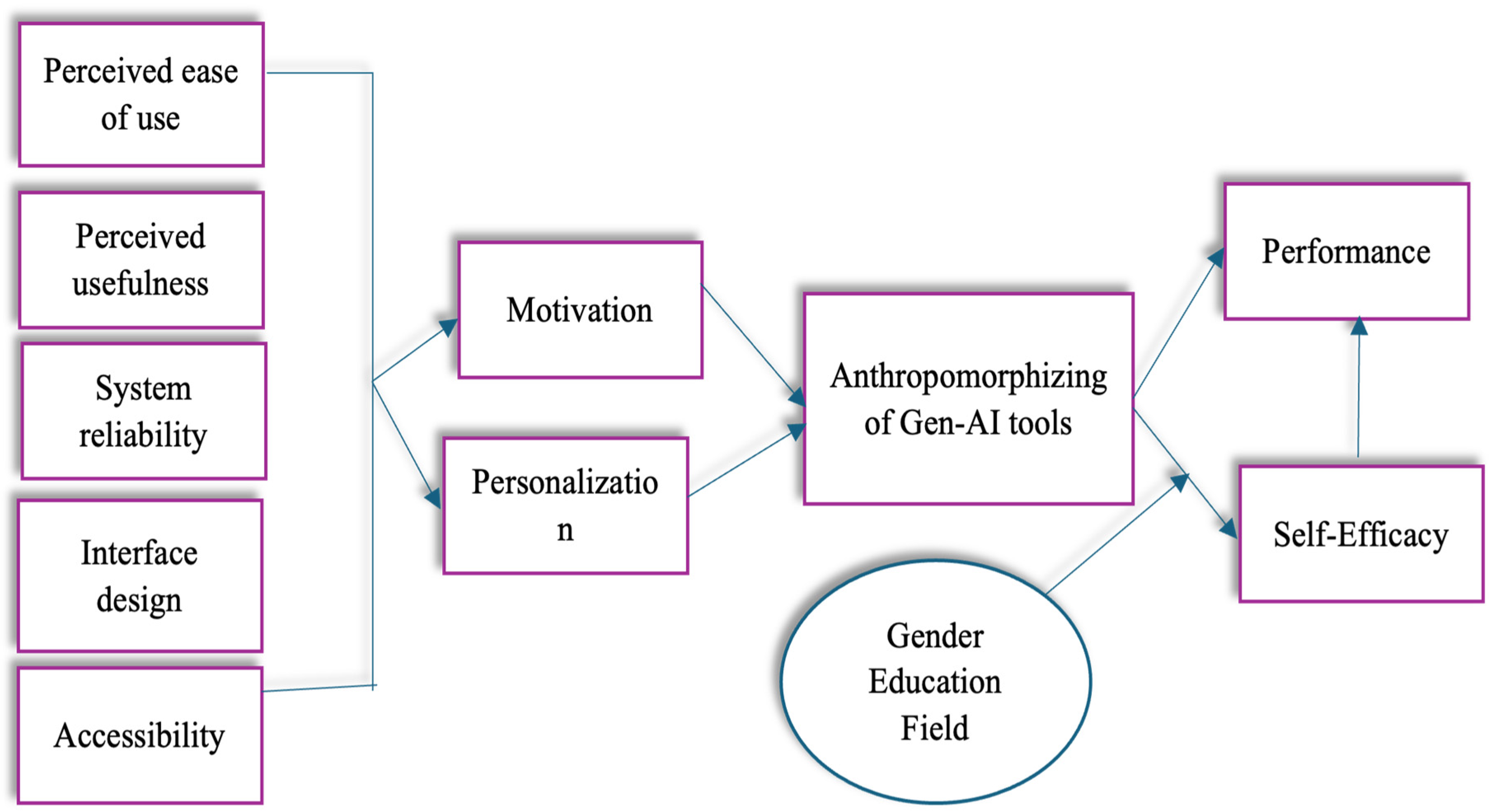
The present research has developed a conceptual framework based on three underpinning theories [18,25,29]. Our research postulates that Gen-AI is a radical and new technology that is integrated into society and, particularly in the educational sector, operates at a symbiotic level. As highlighted in recent studies [1,2,3,4,19], the role of Gen AI is both different and radical. For instance, Gen AI presents an opportunity for students to enhance their mathematical and programming skills [6,7]. Therefore, Gen-AI is clearly distinguishable in multiple aspects. In this regard, two key issues motivated us to develop a serial mediational framework, as depicted in Figure 1. First, while motivation and personalization are well-established behavioral outcomes of technical features, these variables alone do not fully capture the unique human–technology relationship that characterizes Gen-AI’s usage in educational contexts. These characteristics shift user perception from interacting with a tool toward interacting with a quasi-social actor. Therefore, the motivation and personalization triggered by technical factors are expected to foster anthropomorphic perceptions, whereby users attribute human-like intelligence, intentionality, and responsiveness to Gen-AI systems. This sequential process reflects the transition from a functional evaluation of technology to a social–cognitive interpretation of the technology, which cannot be explained through direct mediation alone. Second, anthropomorphism serves as a necessary psychological mechanism translating behavioral engagement into learning-related outcomes. Motivation and personalization may increase usage intensity; however, improvements in self-efficacy and performance depend on whether users perceive the Gen-AI system to be an intelligent collaborator rather or a passive interface. Consequently, anthropomorphism operates as a higher-order interpretive layer that converts behavioral engagement into cognitive and performance outcomes. Accordingly, the proposed serial mediation structure reflects a staged mechanism, where technical factors first shape user motivation and personalization; these behavioral responses then foster anthropomorphic perceptions of Gen-AI; and finally, anthropomorphism enhances self-efficacy and performance.

3. Method

The use of Gen-AI in educational contexts (particularly by students) has increased significantly, which poses challenges for both administrators and policy-makers regarding its possible effects and consequences. The present research, by extending this discussion, proposes and argues that, due to a range of factors, Gen-AI has enabled both personalization and enhanced student motivation to work toward achieving both academic performance and self-efficacy, mediated by perceived anthropomorphism. The role of perceived anthropomorphism is important, as tools such as ChatGPT and others powered by advanced NLP have begun to communicate in a human-like manner. Thus, to examine this proposition, the present study leveraged a quantitative research design by collecting data from students using Gen-AI tools. By leveraging partial least squares structural equation modeling (PLS-SEM) [103], we aimed to illustrate the interplay of key relationships.
The adoption of a quantitative research design based on survey data is widely recognized in contemporary information systems [104] and educational technology research for examining complex behavioral relationships [105]. In particular, the use of PLS-SEM is well established in prior studies due to its suitability for predictive modeling, theory development, and analysis of complex mediation frameworks [103]. This methodological approach is also robust in handling latent constructs, non-normal data distributions, and relatively complex structural models [104]. Furthermore, it has been extensively applied in recent Gen-AI, digital learning, and technology adoption studies, thereby ensuring strong alignment with current scholarly standards and methodological best practices [105,106].

3.1. Research Design and Data Collection Tools

This research employed a quantitative research design by collecting data from students using Gen-AI tools such as ChatGPT, Claude, and others. The quantitative research design is effective as it is consistent with the research aims and objectives. Further, a survey questionnaire was employed using a five-point Likert scale to measure key constructs [107]. The survey questionnaire, based on a five-point Likert scale, is an effective measurement tool, as it allows respondents to express varying levels of agreement and provides reliable data for quantitative analysis [108]. The measures in the data collection instrument (i.e., survey) were developed from previous research and the existing literature.

3.2. Instrument Development

The present research developed the data collection instrument from the literature. Table 1 illustrates the number of items used to measure each construct of the study, as shown in Figure 1, along with the relevant references. Table 1 shows that both perceived usefulness and ease of use consist of six items, adopted from the work of [18], where these constructs were introduced into the information systems literature. Further, we adopted system reliability measurements from [109]. The measures adopted from [105] for system reliability are part of the Service Quality (SERVQUAL) framework. However, their conception of reliability (in the context of service) is consistent with our conceptualization of the reliability of Gen-AI as a system. Thus, the items proposed by [109] helped to measure system reliability as intended. Interface design measures were adopted from [110], and accessibility was adopted from [111]. Additionally, the key constructs of student motivation and personalization were adopted from the studies of [112] and [113], respectively. In this study, motivation captures students’ willingness to engage with Gen-AI for studying, their intention to continue using it in academic tasks, and the extent to which Gen-AI encourages sustained learning efforts. The perceived anthropomorphism measures were adopted from the study of [114]. Finally, student academic performance and self-efficacy were adopted from [115] and [16], respectively.

3.3. Population and Sampling

This study collected data from students enrolled in various universities across the Kingdom of Saudi Arabia. The Saudi Arabian higher education context is particularly relevant, as ongoing national initiatives and strategic reforms are actively modernizing the education sector and promoting the integration of digital and AI-based learning tools. Given the large and geographically dispersed student population across the country, a non-probability convenience sampling technique was employed [116]. This approach is widely used in behavioral and information systems research when access to a fully randomized sampling frame is limited, while still allowing efficient and timely data collection from relevant respondents. Accordingly, a total of 273 valid responses were collected. The prior literature suggests that this sample size is adequate for PLS-SEM-based analysis and is sufficient to support reliable inference and the generalizability of results in similar research contexts [117].

3.4. Data Analysis Techniques

Consistent with the aims and objectives of the study, this research employed PLS-SEM as the key data analysis technique to analyze the data and test the hypotheses [118]. The PLS-SEM technique for data analytics is considered state-of-the-art and is widely employed by interdisciplinary researchers in education and IS. The PLS-SEM measurement model helps to assess the general validity and reliability of the data and instrument, while the structural model helps analyze both directional and indirect hypotheses to infer mediation and moderation effects [119].

3.5. Common Method Bias

The common method bias was examined using Harman’s single-factor test. The results presented in Table 2 indicate that the first factor explains 19.947% of the total variance, which is below the recommended threshold of 50%. The table presented here consists of only five corresponding factors, as the full table will be long and could not fit in the space. This suggests that common method bias is not a significant concern in the current study.

3.6. Ethics Standards

As part of the methodological design of this research involving human participants, we followed the best practices in data collection. Participant consent was obtained before data collection. Participants were informed that the collected data would only be used for academic purposes, and they could withdraw from the study at any point during the survey process. Finally, this study did not collect any personal information that could compromise data integrity.

4. Data Analysis

Given the cross-sectional survey design adopted in this study, the data analysis approach and the results presented in the corresponding subsections are aligned with the study’s aims and objectives. Specifically, PLS-SEM, as a data analytical technique, empowered us to analyze the complex relationships among the latent constructs measured at a single point in time. This method is particularly appropriate for predictive and theory-building research contexts, which are consistent with the objectives of the present study. Accordingly, the interpretation of results is based on associative and predictive relationships among constructs rather than causal inferences.

4.1. Descriptive Analysis

Table 3 presents a descriptive analysis of the study sample. The results suggest that there were more male respondents (68%) than female (32%) respondents. Most respondents belonged to the age groups 17–20 (34.2%) and 21–24 (33.5%), and, interestingly, 28 or older (29.4%). The age data also correspond to the reported educational levels; most participants were enrolled into undergraduate degree (80.9%) and post-graduate degree (19.1%) courses.
In addition to basic demographics, all our participants reported their use of Gen-AI applications. However, regarding the use of such applications, Doing Homework showed the highest report rate, at 33.5%, followed by generating ideas (15.1%), Learning New Skills (16.9%), and using as a Search Engine (21.0%). Further, ChatGPT was reported to be most widely used, by 57.7% of respondents, followed by Claude, by 17.6% respondents, Deep Seek, at 14.3%, and Gemini, at 10.3%. Finally, most respondents (72.1%) reported using the free version of these Gen-AI tools, while the remaining (27.9%) used the paid version.

4.2. Construct Reliability and Validity

The present study used the measurement model to evaluate construct reliability and validity. Table 4 presents the results of Cronbach’s alpha and composite reliability, which indicate satisfactory internal consistency for all constructs, exceeding the recommended benchmark of 0.70 [119,120]. Average variance extracted (AVE) was also examined to assess convergent validity, with most constructs meeting the recommended threshold of 0.50. Although the AVE values for motivation (0.409) and personalization (0.411) are slightly below the recommended threshold of 0.50, their composite reliability values (0.712 and 0.716, respectively) exceed the acceptable level of 0.60. This suggests that convergent validity remains adequate, as AVE values below 0.50 can be considered acceptable when composite reliability exceeds 0.60, consistent with the criteria proposed by [121].

4.3. Item Reliability

The present study assessed item reliability using factor (outer) loadings, which indicate the extent to which each indicator contributes to the variance in its latent construct. Items with outer loadings below the recommended threshold of 0.70 were considered for removal. The elimination process was conducted iteratively, and items were removed only when necessary to achieve acceptable levels of construct reliability and validity, including Average Variance Extracted (AVE), composite reliability, and related criteria. This approach is consistent with commonly accepted practices in PLS-SEM. The final retained items and corresponding construct reliability and validity statistics are reported in Table 4, and Appendix A provides the complete outer loading values for the estimated PLS-SEM model, including the items removed during the refinement process [120].

4.4. Discriminant Validity

The measurement model also enabled the testing of discriminant validity, which assesses the ability of each construct to measure its own and different phenomena. PLS-SEM allows us to measure this using different tests. The present research assessed discriminant validity using the Heterotrait–Monotrait Ratio of Correlation (HTMT) [122]. The results of HTMT, as shown in Table 5, suggest that each construct achieved discriminant validity, as all values are below the acceptable range of 0.90.

4.5. R Square

The variance in the contribution of each exogenous construct to its respective endogenous construct, using R-square, shows the overall model performance in hypothesis testing and estimation. The results as presented in Table 6 show that the dependent constructs of student performance demonstrate a high level of the explained variance (R-square = 0.678) in the model. However, self-efficacy demonstrates the lowest level of variance (R-square = 0.091). Such results are common and interesting as they represent the importance of student performance compared to self-efficacy in regression model estimation. The construct of anthropomorphism reports a moderate level of variance (R-square = 0.478). However, both motivation (R-square = 0.618) and personalization (R-square = 0.609) exhibit a high level of explained variance due to the direct regression of five exogenous constructs in this model [119].

4.6. Assessment of Model Fitness

In the measurement model, this research also assessed model fitness using the Standardized Root Mean Square Residual (SRMR). The SRMR value (see Table 7) for the estimated model is 0.062, which is below the recommended threshold of 0.08. This results clearly indicate an acceptable level of model fitness, demonstrates an adequate overall fit, and confirm the model’s suitability for further interpretation of the structural relationships [119].

4.7. Collinearity Diagnostics

The present research also carried out a collinearity diagnostic of the research instrument using the Variance Inflation Factor (VIF). The results of this assessment are presented in Appendix A. The findings indicate that all VIF values were below the recommended threshold, suggesting the absence of multicollinearity among the constructs. Therefore, collinearity is not a concern in the model, and the estimates derived from the structural model can be considered reliable and unbiased.

4.8. Structural Model and Hypothesis Testing

The current research finally assessed the structural model, which helps us to test the hypotheses of the study, as deduced from the literature. A bootstrapping procedure of 5000 sub-samples was used to estimate the structural model [119]. The results of the structural model are presented in Table 8. The results show that all direct hypotheses and relationships were accepted based on their significant values (p < 0.000). However, all moderating hypotheses and relationships between self-efficacy and the anthropomorphism of gender (p = 0.562), education (p = 0.807), and Gen-AI tools (p = 0.539) were rejected.

4.9. Assessment of Indirect Effect

Table 9 presents the results of the specific indirect effect between the key relationship paths of structural models. The results clearly show that all mediation paths were found to be significant.

5. Discussions

The role of Gen-AI as an emerging technology has significantly influenced society, economics, and politics [30]. Its growing adoption in education has introduced notable changes in instructional practices and learning processes [35]. From ChatGPT being listed as a co-author on certain research papers to students and teachers using it intensively for their respective academic tasks [123], its use presents radical changes in the educational landscape. Although traditional practices of writing essays and checking such essays are being considered obsolete in the age of Gen-AI, this has also given rise to new opportunities to further blur the interdisciplinary boundaries of science, technology, and innovation [124]. Thus, educators from all over the world are arguing for strategies to develop methods for the responsible and effective use of Gen-AI technologies in the educational context [125]. Our research, by complementing such arguments, problematizes the notion that the core of any technology use lies in the maximization of user utility, which, in our case, is theorized to be students’ academic performance and their self-efficacy. As researchers are calling for the effective use of Gen-AI by both students and other users, this research further emphasizes the effective features that any Gen-AI application (in general and in the context of education) should possess [126]. These features include perceived ease of use, perceived usefulness, system reliability, interface design, and accessibility. Further, these features may not directly contribute to utility (in our case, performance and self-efficacy) but are mediated first by personalization and motivation, and second by anthropomorphism. This study’s evidence suggests that this interplay of features (such as perceived ease of use, perceived usefulness, system reliability, interface design, and accessibility), mediated by personalization, motivation, and anthropomorphism, is associated with the key outcome variables of self-efficacy and academic performance. This evidence clearly suggests that the use of Gen-AI in education has an impact on outcome and makes an attempt to build a further research and policy framework that calls for the responsible use of Gen-AI technology in education.

5.1. Motivation and Personalization

Previous studies have argued that both personalization and motivation are key behavioral determinants of continued use and perceived value in any product or technology [127,128]. Our research, by adopting these previous insights, further argues that as Gen-AI technology is radical in nature, further explanation and insight are necessary in this regard. As Gen-AI provides tailored and personalized solutions to students’ queries, it can maximize the perceived value, which we conceptualized in terms of (a) self-efficacy and (b) performance [77]. On the other hand, motivation is also an important behavioral determinant. However, a key question that remains to be answered and understood regards both the quick and continued usage of Gen-AI. It can be argued that the depth and breadth of its use are continuously increasing every day. Motivation and personalization can provide an explanation for this, but this explanation faces a shortcoming. In this regard, we argue for the important role of anthropomorphism. However, before this aspect is discussed, we hypothesize that another important factor exists, rooted in the technological aspect of Gen-AI.
First, the current research hypothesized, based on established theoretical models such as the Technology Acceptance Model (TAM), that the perceived ease of use and perceived usefulness of Gen-AI products and solutions are associated with the development of personalization and motivation [18]. The perceived ease of use concerns the degree to which users understand that Gen-AI can be effectively used with minimal effort. The presented evidence suggests that perceived ease of use is significantly associated with both motivation (β = 0.363, p < 0.001) and personalization (β = 0.471, p < 0.001). The significant and positive association between perceived ease of use and motivation indicates that students find Gen-AI systems simple and effortless to use, which reinforces their motivated to engage with and continue using them [48]. Similarly, the strong association with personalization further indicates that Gen-AI not only instills motivation but also provides highly tailored use cases that lead students to obtain further benefits from its features [49]. Similarly, the role of usefulness relates to the subjective feeling that a system is associated with better performance in educational tasks. Our results indicate that perceived usefulness, like ease of use, has a positive and significant association with motivation (β = 0.411, p < 0.001) and personalization (β = 0.296, p < 0.001). The association of perceived usefulness with motivation [39,40] and personalization [37] implies that students develop an intrinsic belief that Gen-AI improves their performance in tasks, highlighting the practical benefits of the system, including personalized features.
Other key features that played an important role in determining the outcomes include system reliability, interface design, and accessibility. The model of motivation based on SDT, developed by [29], guided this theorization. The present research results indicate that system reliability is also associated with student motivation (β = 0.346, p < 0.001) by developing students’ confidence in Gen-AI’s consistent and accurate performance [64]. Similarly, reliable Gen-AI system performance is also associated with the consistent personalized use of Gen-AI, leading to higher value (β = 0.369, p < 0.001) [63]. Furthermore, the current research also conceptualizes the role of interface design. The research observed that the minimalistic design of Gen-AI products such as ChatGPT, Claude, and others has a significant association with motivation (β = 0.267, p < 0.001) [55]. Similarly, this minimalistic interface design also contributed to and is associated with personalization (β = 0.60, p < 0.001), in which students are able to ask questions tailored to their specific educational problems [56]. Finally, the accessibility of a range of tools has been hypothesized to be associated with both motivation and personalization. Gen-AI is experiencing an expansion of its tools, including multimodal systems, and specifically applications tailored to education, science, and research. Their accessibility was also found to be positively associated with motivation (β = 0.372, p < 0.001) and personalization (β = 0.325, p < 0.001). This effect on motivation suggests that when Gen-AI systems are easy to access over time and across platforms, they encourage frequent and consistent use [65]. Similarly, the influence on personalization indicates that better access enables users to more effectively benefit from personalized features and tailored responses [70].
In conclusion, the responsible and effective use of Gen-AI systems appears to be associated with their key intrinsic features, which are conceptualized as endogenous constructs in this study, linked to motivation and personalization. The present study further suggests that Gen-AI tools differ from traditional information system tools, as they are powered by natural language understanding and generation technologies. These technological capabilities are associated with the long-desired trait of anthropomorphism, whereby technology is perceived as possessing human-like characteristics.

5.2. Anthropomorphism Findings

Anthropomorphism, in a technological context, refers to the process of perceiving technology to be human and a living object [25]. Earlier technological products, such as smart homes, have been examined in similar contexts, with mixed findings. However, one distinguishing feature of Gen-AI lies in its ability to understand and generate human language [129]. The core reason for focusing on anthropomorphism in our research is to postulate that the radical nature of Gen-AI (its natural language understanding and generation abilities) has led to a gap in which motivation and personalization alone may not explain the outcomes of the technology use. One core reason for this is that an innovation of Gen AI is that it is perceived as a human and life-like object. Thus, to fill this research gap, this study hypothesized and found that both motivation (β = 0.386, p < 0.001) and personalization (β = 0.365, p < 0.001) are positively and significantly associated with anthropomorphism. The results related to motivation suggest that higher levels of user motivation are linked with continued engagement with Gen-AI systems, alongside stronger perceptions of Gen-AI as a human-like and socially engaging entity [87]. Similarly, the association with personalization indicates that more tailored and individualized interactions are related to stronger user perceptions of Gen-AI systems as human and life-like [78]. These findings further support the theorization that the perceived human-like characteristics of Gen-AI, reflected through anthropomorphism, are associated with patterns of use that correspond with self-efficacy and student academic performance.

5.3. Outcomes of Usage: Self-Efficacy and Performance

The present research hypothesized and found that anthropomorphizing Gen-AI products and solutions is positively associated with self-efficacy (β = 0.239, p < 0.055). The empirical evidence indicates that users’ perceptions of Gen-AI as human-like are linked with greater confidence in its ability to understand specific problems and generate tailored solutions. The application of solutions generated by Gen-AI products is similarly associated with higher levels of self-efficacy. These findings are consistent with a range of studies reporting associations between Gen-AI use and improved abilities in coding, solving math problems, and related tasks [130,131]. Thus, the present study contributes to the literature by providing additional evidence of a positive association with self-efficacy. Accordingly, as educational systems continue to evolve, Gen-AI, through its anthropomorphic characteristics, appears to be associated with the development of student self-efficacy.
Finally, this study also tested and found significant positive associations of anthropomorphizing Gen-AI products (β = 0.239, p < 0.001) and self-efficacy (β = 0.722, p < 0.001) with student academic performance. The results suggest that the perceived human-like characteristics of Gen-AI are linked with an increase in student academic performance, alongside greater engagement, confidence, and interaction with learning tasks [101]. In addition, the findings indicate a strong positive association between self-efficacy (β = 0.722) and student academic performance. In this context, continued interaction with Gen-AI is associated with the resolution of problems often faced by students, and this resolution corresponds with improved academic performance [97].
This research also assessed the moderating roles of Gen-AI tool types (p = 0.807), gender (p = 0.562), and education level (p = 0.539) in the relationship between anthropomorphizing AI tools and self-efficacy, based on prior arguments regarding differences in self-efficacy across gender, education level, and product types such as ChatGPT, Claude, and others. The non-significant results provide important insights. First, regarding Gen-AI tools, the findings suggest there are no meaningful differences across products in terms of their perceived features, particularly human-like characteristics. Second, despite the widespread accessibility of Gen-AI and its early-stage usage, gender and education level do not significantly moderate this association, indicating that these factors may not play a substantial role in how users engage with or experience Gen-AI.

5.4. Analysis of Mediation

The mediation analysis provides strong evidence that anthropomorphism serves as a central psychological mechanism through which system-related and user-related factors influence both self-efficacy and student performance. First of all, we found a significant indirect and mediating effect of technological attributes on anthropomorphism, with personalization and motivation as key mediators. Finally, anthropomorphism itself plays a significant mediating role in shaping outcomes. Our results show that anthropomorphism mediated the relationship between personalization and self-efficacy (β = 0.087, t = 2.472, p = 0.013), as well as the relationship between motivation and self-efficacy (β = 0.092, p = 0.006). Our results also show that anthropomorphism mediates the relationship between motivation (β = 0.092, p = 0.000) and personalization (β = 0.087, t = 4.399, p < 0.001) with student performance. Finally, we also observed the role of self-efficacy in mediating the relationship between anthropomorphism and student performance (β = 0.173, t = 2.874, p = 0.004). Overall, the findings confirm a robust sequential mediation mechanism in which system quality, usability, and motivational factors first enhance personalization and motivation, which then strengthen anthropomorphism, ultimately improving self-efficacy and student performance.

5.5. Moderation Analysis

Finally, our findings of moderation analysis revealed that gender, education level, and Gen-AI tool type did not significantly influence the association between anthropomorphism and student self-efficacy. These findings suggest that perceptions of human-like characteristics of Gen-AI tools and their association with self-efficacy appear relatively consistent across different user groups and tool categories. This lack of significant moderation may reflect the standardized interaction patterns and comparable capabilities of widely used Gen-AI systems. It also indicates that demographic and contextual differences may play a limited role in shaping how anthropomorphism relates to self-efficacy in educational settings. Overall, the results highlight the robustness of the observed association across gender, educational backgrounds, and Gen-AI tool types.

6. Conclusions

This study provides empirical evidence describing the associations between the technological attributes of generative artificial intelligence, particularly large language models (LLMs), and student motivation, personalization, anthropomorphism, self-efficacy, and academic performance. The findings indicate that perceived usefulness, ease of use, system reliability, accessibility, and interface design are significantly associated with motivation and personalization, which are further linked with anthropomorphic perceptions, self-efficacy, and student academic performance. The results underscore the importance of jointly considering technological attributes and behavioral mechanisms when integrating LLMs into higher education environments. Rather than viewing LLMs solely as content-generation tools, the findings position them as technologies associated with student engagement and academic outcomes through psychological and behavioral pathways. From a practical perspective, the study suggests that educational institutions may benefit from prioritizing system reliability, usability, and accessibility when implementing LLM applications. From a sustainable education perspective, the strategic integration of LLM technologies is associated with adaptive learning experiences, while also corresponding with sustained student engagement and academic development.

6.1. Limitation and Research Directions

This study has several limitations. First, the use of a cross-sectional survey design limits causal inference; future research could adopt longitudinal approaches to better examine the dynamic role of anthropomorphism in shaping self-efficacy and performance. Second, the sample was drawn from university students in Saudi Arabia; replication in different cultural and institutional contexts would improve generalizability. Third, future studies may explore additional technological or psychological constructs that influence motivation, personalization, and anthropomorphism in LLM-based learning environments. Fourth, we adopted the measurement instrument to measure the accessibility of Gen-AI from [111]. They include ease of use as a key aspect of accessibility, which is theoretically justified. However, as we used ease of use separately as a key technological attribute, this measurement may have overlapped. Therefore, future studies should exercise caution when using accessibility together with ease of use, ensuring that the measurement instrument of accessibility is carefully checked and that aspects pertaining to ease of use are removed.

6.2. Theoretical Implications

This study contributes to theory in three ways, although the findings should be interpreted with appropriate caution. First, it extends the technology adoption research by showing that perceived usefulness and ease of use remain relevant in LLM-based learning environments, but their effects operate alongside motivational mechanisms grounded in Self-Determination Theory, particularly when supporting learners’ motivation and personalization. Second, the study incorporates anthropomorphism theory by demonstrating that human-like perceptions of LLMs can shape learning-related psychological processes, such as academic self-efficacy and performance, thereby moving beyond attitudinal explanations of AI use. Third, the findings highlight the importance of domain-specific system attributes in influencing the behavioral and motivational mechanisms within AI-supported learning, contributing to a more nuanced theoretical understanding of how technological characteristics interact with learner psychology in higher education contexts.

6.3. Practical Implications

The present research study contributes to both policy and practice in three different and significant ways. First, as our study finds that Gen-AI can contribute to student performance and self-efficacy, educators can integrate Gen-AI into courses in ways that promote personalization and enhance study-related motivation. Second, universities should prioritize the integration of reliable and accessible Gen-AI tools within institutional platforms to ensure consistent and equitable learning support. Third, course designers should establish clear guidelines for responsible AI use, encouraging students to engage critically with AI-generated outputs, rather than relying on them passively.


Funding

The author gratefully acknowledges the funding of the Deanship of Graduate Studies and Scientific Research, Jazan University, Saudi Arabia.

Institutional Review Board Statement

The study was conducted in accordance with the Declaration of Helsinki, and approved by the Permanent Committee for Scientific Research Ethics at Jazan University (HAPO-10-Z-001) (REC-45/10/1083 and 7 May 2024).

Informed Consent Statement

Informed consent was obtained from all subjects involved in the study.

Data Availability Statement

The original contributions presented in this study are included in the article. Further inquiries can be directed to the corresponding author.

Conflicts of Interest

The author declares no conflict of interest.

Appendix A

Table A1. Items and their factor loading.
Item No.ItemsVIFFactor Loading
System reliability
SR_1When Gen-AI tools promise to do something by a certain time, they do so.1.7310.780
SR_2When I face a study related problem, Gen-AI tools show a sincere interest in solving it.1.8500.792
SR_3The Gen-AI systems are dependable.1.7940.784
SR_4The Gen-AI tools provide their services at the times they promise to do so.1.8640.791
SR_5Gen-AI insists that it provides an error-free response1.7700.799
Accessibility
access_1The Gen-AI tool is always available without downtime or access delays.1.9370.799
access_2The Gen-AI tool is easy to use and requires minimal technical skills.1.7790.754
access_3The system remains stable and operational during teaching and learning activities.1.8380.790
access_4Desired information or assistance can be easily retrieved using the Gen-AI tool.1.9320.805
access_5Logging into the Gen-AI tool is simple and convenient for students and instructors.2.0320.810
access_6The Gen-AI tool is affordable or available at low or no cost to users.1.6700.739
Anthropomorphism
anth_2The Gen-AI tool seems capable of expressing happiness.1.3440.731
anth_5The Gen-AI tool can appear frustrated at times.1.3470.714
anth_7The Gen-AI tool can behave in a respectful manner.1.3700.757
anth_9The Gen-AI tool can act in a caring or empathetic way1.3520.746
Interface Design
i_d_1The web interface of Gen-AI tools I use is appealing visually2.1760.847
i_d_2The web interface of Gen-AI tools I use is pleasant1.8380.791
i_d_3The web interface of Gen-AI tools has a clean design1.8450.755
i_d_4The web interface of Gen-AI tools has a clear design1.8660.818
i_d_5The web interface of Gen-AI tools is user-friendly1.9790.821
Motivation
moti_3I believe I can receive an excellent grade in my class.1.2990.637
moti_5Getting a good grade in class is the most satisfying thing for me right now.1.2230.628
moti_6It is important for me to learn the course material in class.1.2000.601
moti_7The most important thing for me right now is improving my overall grade point average, so my main concern in this class is getting a good grade.1.2780.646
moti_8I’m confident I can understand the most complex material presented by the instructor in the course.1.3040.672
moti_9The most satisfying thing for me in class is trying to understand the content as thoroughly as possible1.2900.653
Perceived ease of use
peou_1Learning to operate Gen-AI tools would be easy for me.1.8880.788
peou_2I would find it easy to get Gen-AI tools to do what I want them to do.1.7590.771
peou_3My interaction with Gen-AI tools would be clear and understandable.1.9250.800
peou_4I would find Gen-AI Tools to be flexible to interact with.1.8080.752
peou_5It would be easy for me to become skillful at using Gen-AI Tools.1.9880.813
peou_6I would find Gen-AI Tools easy to use.2.0140.792
Student academic performance
perf_1I complete my classwork consistently.1.4970.757
perf_5I speak clearly and confidently during activities.1.4030.705
perf_6I take a reasonable amount of time to finish work.1.3320.684
perf_7I stay focused on tasks without reminders.1.4360.732
perf_8I avoid interacting with others during class1.4970.739
Personalization
person_1The responses and suggestions provided by the Gen-AI tool are personalized to my learning needs.1.2480.618
person_2The feedback and content generated by the Gen-AI tools match my current learning goals.1.2700.671
person_3The Gen-AI tool tailors its recommendations and support specifically to me.1.2580.640
person_4The Gen-AI tool’s suggestions and explanations are personalized to my study preferences.1.2840.649
person_5The Gen-AI tool’s responses match my learning style and academic needs.1.2590.652
person_6The Gen-AI tool provides content and support that feel tailored specifically to me.1.2500.617
Perceived usefulness
pu_1Using Gen-AI tools in my studies would enable me to accomplish tasks more quickly1.9730.810
pu_2Using Gen-AI tools would improve my academic performance.2.1590.817
pu_3Using Gen-AI tools in my studies would increase my productivity.1.9000.778
pu_4Using Gen-AI tools would enhance my effectiveness in classroom.1.8730.788
pu_5Using Gen-AI tools would make it easier to do my academic tasks.1.9890.801
pu_6I would find Gen-AI tools useful in my studies.2.0490.793
Self-efficacy
s_eff_1If someone opposes me, I can find means and ways to get what I want by using Gen-AI tools.2.2130.822
s_eff_2It’s easy for me to stay true to my goals and achieve my objectives with the help of Gen-AI tools.2.0280.806
s_eff_3I am confident that I could efficiently face unexpected events by using Gen-AI tools.2.1580.824
s_eff_4Thanks to my wit supported by Gen-AI tools, I know how to handle unforeseen situations.2.0650.802
s_eff_5I can stay calm when facing difficulties because I trust in my coping skills backed by Gen-AI tools.2.0410.804
s_eff_6No matter what comes up, I can usually handle it with the support of Gen-AI tools2.1240.815

References

  1. Christensen, R. Effects of technology integration education on the attitudes of teachers and students. J. Res. Technol. Educ. 2002, 34, 411–433. [Google Scholar] [CrossRef]
  2. Jain, K.K.; Raghuram, J. Gen-AI integration in higher education: Predicting intentions using SEM-ANN approach. Educ. Inf. Technol. 2024, 29, 17169–17209. [Google Scholar] [CrossRef]
  3. Seghier, M.L. AI-powered peer review needs human supervision. J. Inf. Commun. Ethics Soc. 2025, 23, 104–116. [Google Scholar] [CrossRef]
  4. Qiu, Y.; Zhang, H.; Xu, Z.; Li, M.; Song, D.; Wang, Z.; Zhang, K. AI idea bench 2025: AI research idea generation benchmark. arXiv 2025, arXiv:2504.14191. [Google Scholar] [CrossRef]
  5. Uttich, L.; Yee, K.; Giltner, E. The essay is dead (and other thoughts about assessing in the era of AI). In Educational Assessments in the Age of Generative AI; IGI Global Scientific Publishing: Hershey, PA, USA, 2025; pp. 145–178. [Google Scholar]
  6. Cambaz, D.; Zhang, X. Use of AI-driven code generation models in teaching and learning programming: A systematic literature review. In Proceedings of the 55th ACM Technical Symposium on Computer Science Education V. 1, Portland, OR, USA, 20–23 March 2024; pp. 172–178. [Google Scholar]
  7. Yi, L.; Liu, D.; Jiang, T.; Xian, Y. The effectiveness of AI on K-12 students’ mathematics learning: A systematic review and meta-analysis. Int. J. Sci. Math. Educ. 2025, 23, 1105–1126. [Google Scholar] [CrossRef]
  8. Abbas, T.; Javed, U.; Mehmood, F.; Raza, M.; Li, H. ChemGenX: AI in the Chemistry Classroom. In Proceedings of the 2024 International Symposium on Artificial Intelligence for Education, Xi’an, China, 6–8 September 2024; pp. 224–230. [Google Scholar]
  9. Gu, J.; Yan, Z. Effects of GenAI interventions on student academic performance: A meta-analysis. J. Educ. Comput. Res. 2025, 63, 1460–1492. [Google Scholar] [CrossRef]
  10. Peddi, S.; Manoharan, G. Recent Advances in Generative AI and Their Impact on Education: Exploring Self-Efficacy in Learning Environments. EthAIca J. Ethics AI Crit. Anal. 2025, 430, 916502. [Google Scholar] [CrossRef]
  11. Van Dinther, M.; Dochy, F.; Segers, M. Factors affecting students’ self-efficacy in higher education. Educ. Res. Rev. 2011, 6, 95–108. [Google Scholar] [CrossRef]
  12. Richardson, M.; Abraham, C.; Bond, R. Psychological correlates of university students’ academic performance: A systematic review and meta-analysis. Psychol. Bull. 2012, 138, 353. [Google Scholar] [CrossRef]
  13. Cooper, S.Y.; Lucas, W.A. Enhancing self-efficacy for entrepreneurship and innovation: An educational approach. In University Collaboration for Innovation; Brill: Leiden, The Netherlands, 2007; pp. 79–98. [Google Scholar]
  14. Hanham, J.; Lee, C.B.; Teo, T. The influence of technology acceptance, academic self-efficacy, and gender on academic achievement through online tutoring. Comput. Educ. 2021, 172, 104252. [Google Scholar] [CrossRef]
  15. Valverde-Berrocoso, J.; Acevedo-Borrega, J.; Cerezo-Pizarro, M. Educational technology and student performance: A systematic review. Front. Educ. 2022, 7, 916502. [Google Scholar] [CrossRef]
  16. DuPaul, G.J.; Rapport, M.D.; Perriello, L.M. Teacher ratings of academic skills: The development of the Academic Performance Rating Scale. Sch. Psychol. Rev. 1991, 20, 284–300. [Google Scholar] [CrossRef]
  17. Marangunić, N.; Granić, A. Technology acceptance model: A literature review from 1986 to 2013. Univers. Access Inf. Soc. 2015, 14, 81–95. [Google Scholar] [CrossRef]
  18. Davis, F.D. Perceived usefulness, perceived ease of use, and user acceptance of information technology. MIS Q. 1989, 13, 319–340. [Google Scholar] [CrossRef]
  19. Sedkaoui, S.; Benaichouba, R. Generative AI as a transformative force for innovation: A review of opportunities, applications and challenges. Eur. J. Innov. Manag. 2024, 29, 677–701. [Google Scholar] [CrossRef]
  20. Rausand, M.; Hoyland, A. System Reliability Theory: Models, Statistical Methods, and Applications; John Wiley & Sons: Hoboken, NJ, USA, 2003; Volume 396. [Google Scholar]
  21. Thorne, S. Understanding the interplay between trust, reliability, and human factors in the age of generative AI. Int. J. Simul.-Syst. Sci. Technol. 2024, 25, 10.1–10.5. [Google Scholar] [CrossRef]
  22. Muller, M.; Weisz, J.D.; Geyer, W. Mixed initiative generative AI interfaces: An analytic framework for generative AI applications. In Proceedings of the Workshop The Future of Co-Creative Systems-A Workshop on Human-Computer Co-Creativity of the 11th International Conference on Computational Creativity (ICCC 2020), Virtual, 7–11 September 2020; p. 3. [Google Scholar]
  23. Morris, M.R. AI and accessibility. Commun. ACM 2020, 63, 35–37. [Google Scholar] [CrossRef]
  24. Złotowski, J.; Proudfoot, D.; Yogeeswaran, K.; Bartneck, C. Anthropomorphism: Opportunities and challenges in human–robot interaction. Int. J. Soc. Robot. 2015, 7, 347–360. [Google Scholar] [CrossRef]
  25. Epley, N.; Waytz, A.; Cacioppo, J.T. On seeing human: A three-factor theory of anthropomorphism. Psychol. Rev. 2007, 114, 864. [Google Scholar] [CrossRef]
  26. Ji, J.J. Demystify ChatGPT: Anthropomorphism around generative AI. GRACE Glob. Rev. AI Community Ethics 2024, 2, 1–10. [Google Scholar]
  27. Israfılzade, K. The role of generative AI and anthropomorphism in shaping conversational marketing: Creating a matrix for future research. Eurasia Proc. Educ. Soc. Sci. 2023, 32, 132–142. [Google Scholar] [CrossRef]
  28. Lee, K.W.; Tseng, Y.F. Gen AI-Assisted Management Learning: A Perspective on the Alignment of Intrinsic and Extrinsic Motivation. In International Conference on Innovative Technologies and Learning; Springer Nature: Cham, Switzerland, 2025; pp. 340–344. [Google Scholar]
  29. Calvo, R.A.; Peters, D.; Vold, K.; Ryan, R.M. Supporting human autonomy in AI systems: A framework for ethical enquiry. In Ethics of Digital Well-Being: A Multidisciplinary Approach; Springer: Cham, Switzerland, 2020; pp. 31–54. [Google Scholar]
  30. Cazzaniga, M.; Jaumotte, M.F.; Li, L.; Melina, M.G.; Panton, A.J.; Pizzinelli, C.; Rockall, E.J.; Tavares, M.M.M. Gen-AI: Artificial Intelligence and the Future of Work; International Monetary Fund: Washington, DC, USA, 2024. [Google Scholar]
  31. Saha, B. Generative AI for Text Generation: Advances and Applications in Natural Language Processing. J. Comput. Allied Intell. 2025, 3, 77–91. [Google Scholar] [CrossRef]
  32. Wood, D.; Moss, S.H. Evaluating the impact of students’ generative AI use in educational contexts. J. Res. Innov. Teach. Learn. 2024, 17, 152–167. [Google Scholar] [CrossRef]
  33. Delgado-Ruiz, R.; Kim, A.S.; Zhang, H.; Sullivan, D.; Awan, K.H.; Stathopoulou, P.G. Generative Artificial Intelligence (Gen AI) in dental education: Opportunities, cautions, and recommendations. J. Dent. Educ. 2025, 89, 130–136. [Google Scholar] [CrossRef]
  34. Aurangzeb, W.; Kashan, S.; Rehman, Z.U. Investigating technology perceptions among secondary school teachers: A systematic literature review on perceived usefulness and ease of use. Acad. Educ. Soc. Sci. Rev. 2024, 4, 160–173. [Google Scholar] [CrossRef]
  35. Chan, C.K.Y.; Lee, K.K. The AI generation gap: Are Gen Z students more interested in adopting generative AI such as ChatGPT in teaching and learning than their Gen X and millennial generation teachers? Smart Learn. Environ. 2023, 10, 60. [Google Scholar] [CrossRef]
  36. Sallam, M.; Elsayed, W.; Al-Shorbagy, M.; Barakat, M.; El Khatib, S.; Ghach, W.; Alwan, N.; Hallit, S.; Malaeb, D. ChatGPT usage and attitudes are driven by perceptions of usefulness, ease of use, risks, and psycho-social impact: A study among university students in the UAE. Front. Educ. 2024, 9, 1414758. [Google Scholar] [CrossRef]
  37. Chakraborty, D.; Gunasekaran, A.; Subramanian, G. Privacy vs. Personalization: GENAI’s role in technology adoption. J. Comput. Inf. Syst. 2025, 1–18. [Google Scholar] [CrossRef]
  38. Cano, J.R.; Nunez, N.A. Unlocking innovation: How enjoyment drives GenAI use in higher education. Front. Educ. 2024, 9, 1483853. [Google Scholar] [CrossRef]
  39. Dung, N.T.M.; Hieu, P.N.V.; Linh, N.T.; Han, N.T.N.; Trong, H. The impact of students’ using generative AI for learning on self-learning motivation: A study based on self-determination theory. In Proceedings of the The 2nd International Conference: Resiliency by Technology and Design (RTD 2024); Springer Nature: Cham, Switzerland, 2024; pp. 362–382. [Google Scholar]
  40. Huang, X.; Cui, Y.; Jia, D.; Ma, X.; Wang, Z.; Cui, R. Weaving Cognition, Emotion, Service, and Society: Unpacking Chinese Consumers’ Behavioral Intention of GenAI-Supported Clothing Customization Services. Systems 2025, 13, 829. [Google Scholar] [CrossRef]
  41. Hsiao, C.-H.; Tang, K.-Y. Beyond acceptance: An empirical investigation of technological, ethical, social, and individual determinants of GenAI-supported learning in higher education. Educ. Inf. Technol. 2025, 30, 10725–10750. [Google Scholar] [CrossRef]
  42. Li, J.; King, R.B.; Chai, C.S.; Zhai, X.; Lee, V.W.Y. The AI Motivation Scale (AIMS): A Self-Determination Theory Perspective. J. Res. Technol. Educ. 2025. ahead of print. [Google Scholar]
  43. Djulianto, M.V.; Wardhanie, A.P.; Candraningrat, C. The Role of Perceived Usability, Satisfaction, and Customer Trust in Design and Developing User Loyalty Edutech Website. Bus. Financ. J. 2022, 7, 183–194. [Google Scholar] [CrossRef]
  44. Gupta, S.; Bajaj, R.; Das, B.; Kaur, J.; Kapoor, N. Determining students’ behavioural intention towards online learning using EdTech apps applying the UTAUT model: A case study of school students during the COVID-19 pandemic. In Technology-Mediated Learning During the Pandemic; Routledge: New Delhi, India, 2024; pp. 71–88. [Google Scholar]
  45. Morad, M.; Essing, B. User-Perceived Quality of GenAI Chatbots in a Business Context–A Construct Definition. In Proceedings of the International Conference on Human-Computer Interaction, Gothenburg, Sweden, 22–27 June 2025; pp. 368–376. [Google Scholar]
  46. Abdalla, R.A. Examining awareness, social influence, and perceived enjoyment in the TAM framework as determinants of ChatGPT. Personalization as a moderator. J. Open Innov. Technol. Mark. Complex. 2024, 10, 100327. [Google Scholar] [CrossRef]
  47. Fagan, M.H.; Neill, S.; Wooldridge, B.R. Exploring the intention to use computers: An empirical investigation of the role of intrinsic motivation, extrinsic motivation, and perceived ease of use. J. Comput. Inf. Syst. 2008, 48, 31–37. [Google Scholar] [CrossRef]
  48. Mao, W.; Wu, J.; Chen, W.; Gao, C.; Wang, X.; He, X. Reinforced prompt personalization for recommendation with large language models. ACM Trans. Inf. Syst. 2025, 43, 72. [Google Scholar] [CrossRef]
  49. Arar, M.; Voynov, A.; Hertz, A.; Avrahami, O.; Fruchter, S.; Pritch, Y.; Cohen-Or, D.; Shamir, A. Palp: Prompt aligned personalization of text-to-image models. In Proceedings of the SIGGRAPH Asia 2024 Conference Papers, Tokyo, Japan, 3–6 December 2024; pp. 1–11. [Google Scholar]
  50. Costa, A.; Silva, F.; Moreira, J.J. Towards an AI-driven user interface design for web applications. Procedia Comput. Sci. 2024, 237, 179–186. [Google Scholar] [CrossRef]
  51. Bisante, A.; Datla, V.S.V.; Panizzi, E.; Trasciatti, G.; Zeppieri, S. Enhancing interface design with AI: An exploratory study on a CHATGPT-4-based tool for cognitive walkthrough inspired evaluations. In Proceedings of the 2024 International Conference on Advanced Visual Interfaces, Genoa, Italy, 3–7 June 2024; pp. 1–5. [Google Scholar]
  52. Kalving, M.; Colley, A.; Häkkilä, J. Where AI and Design Meet-Designers’ Perceptions of AI Tools. In Proceedings of the 13th Nordic Conference on Human-Computer Interaction, Uppsala, Sweden, 13–16 October 2024; pp. 1–8. [Google Scholar]
  53. Haugeland, J.; Craver, C.F.; Klein, C. Mind Design III: Philosophy, Psychology, and Artificial Intelligence; MIT Press: Cambridge, MA, USA, 2023. [Google Scholar]
  54. York, E. Evaluating chatgpt: Generative AI in UX design and web development pedagogy. In Proceedings of the 41st ACM International Conference on Design of Communication, Orlando, FL, USA, 26–28 October 2023; pp. 197–201. [Google Scholar]
  55. Remountakis, M.; Kotis, K.; Kourtzis, B.; Tsekouras, G.E. ChatGPT and persuasive technologies for the management and delivery of personalized recommendations in hotel hospitality. arXiv 2023, arXiv:2307.14298. [Google Scholar] [CrossRef]
  56. Zhou, L.; Li, J. The impact of ChatGPT on learning motivation: A study based on self-determination theory. Educ. Sci. Manag. 2023, 1, 19–29. [Google Scholar] [CrossRef]
  57. Woo, D.J.; Wang, D.; Guo, K.; Susanto, H. Teaching EFL students to write with ChatGPT: Students’ motivation to learn, cognitive load, and satisfaction with the learning process. Educ. Inf. Technol. 2024, 29, 24963–24990. [Google Scholar] [CrossRef]
  58. Zahedi, F. Reliability of information systems based on the critical success factors—Formulation. Mis Q. 1987, 11, 187–203. [Google Scholar] [CrossRef]
  59. Singh, S. ChatGPT Users Statistics (May 2026)—Growth & Usage Data. Available online: https://www.demandsage.com/chatgpt-statistics/ (accessed on 1 January 2026).
  60. Majeed, A.; Hwang, S.O. Reliability issues of LLMs: ChatGPT a case study. IEEE Reliab. Mag. 2024, 1, 36–46. [Google Scholar] [CrossRef]
  61. Ouyang, T.; MaungMaung, A.; Konishi, K.; Seo, Y.; Echizen, I. Stability analysis of chatgpt-based sentiment analysis in AI quality assurance. Electronics 2024, 13, 5043. [Google Scholar] [CrossRef]
  62. Castillo, A.C. Data Center Infrastructure in the Era of Generative Artificial Intelligence. In Proceedings of the 2025 5th International Conference on Innovative Research in Applied Science, Engineering and Technology (IRASET), Fez, Morocco, 15–16 May 2025; pp. 1–9. [Google Scholar]
  63. Kakaraparthi, N. Scaling Personalization with Generative AI. J. Comput. Sci. Technol. Stud. 2025, 7, 405–416. [Google Scholar] [CrossRef]
  64. Arslan, B.; Lehman, B.; Tenison, C.; Sparks, J.R.; López, A.A.; Gu, L.; Zapata-Rivera, D. Opportunities and Challenges of Using Generative AI to Personalize Educational Assessment. Front. Artif. Intell. 2024, 7, 1460651. [Google Scholar] [CrossRef]
  65. Al-Dokhny, A.; Drwish, A.M.; Hammad, A.M. Can Multimodal Large Language Models Enhance Students’ Performance Benefits? The Role of Task–Technology Fit, AI Device Use Acceptance, and Self-Efficacy. Sustainability 2024, 16, 10780. [Google Scholar] [CrossRef]
  66. Acosta-Vargas, P.; Salvador-Acosta, B.; Novillo-Villegas, S.; Sarantis, D.; Salvador-Ullauri, L. Generative artificial intelligence and web accessibility: Towards an inclusive and sustainable future. Emerg. Sci. J. 2024, 8, 1602–1621. [Google Scholar] [CrossRef]
  67. Khlaif, Z.N.; Alshakhshir, R.; Hamamra, B.; Joma, A. Reimagining Inclusive Education: The Assistive Power of Generative AI in Promoting Accessibility and Equity. Br. J. Vis. Impair. 2025, 02646196251382469. [Google Scholar] [CrossRef]
  68. White, R.W.; Shah, C. Information Access in the Era of Generative AI; Springer: Cham, Switzerland, 2025. [Google Scholar]
  69. Prather, J.; Reeves, B.N.; Denny, P.; Leinonen, J.; MacNeil, S.; Luxton-Reilly, A.; Orvalho, J.; Alipour, A.; Alfageeh, A.; Amarouche, T. Breaking the programming language barrier: Multilingual prompting to empower non-native English learners. In Proceedings of the 27th Australasian Computing Education Conference, Brisbane, QLD, Australia, 12–13 February 2025; pp. 74–84. [Google Scholar]
  70. Mrayhi, S.; Khribi, M.K.; Jemni, M. A Generative AI-Powered Chatbot for Enhancing Accessibility and Personalized Learning in MOOCs. In Proceedings of the 2025 IEEE International Conference on Advanced Learning Technologies (ICALT); IEEE: New York, NY, USA, 2025; pp. 186–190. [Google Scholar]
  71. Xu, Y.; Zhang, J.; Salemi, A.; Hu, X.; Wang, W.; Feng, F.; Zamani, H.; He, X.; Chua, T.-S. Personalized generation in large model era: A survey. In Proceedings of the 63rd Annual Meeting of the Association for Computational Linguistics (Volume 1: Long Papers); Association for Computational Linguistics: Stroudsburg, PA, USA, 2025; pp. 24607–24649. [Google Scholar]
  72. Berg, C.; Omsén, L.; Hansson, H.; Mozelius, P. Students’ AI-generated Images: Impact on Motivation, Learning and, Satisfaction. In Proceedings of the ICAIR 2024, Lisbon, Portugal, 5–6 December 2024; pp. 500–506. [Google Scholar]
  73. Fan, H.; Poole, M.S. What is personalization? Perspectives on the design and implementation of personalization in information systems. J. Organ. Comput. Electron. Commer. 2006, 16, 179–202. [Google Scholar]
  74. Rafieian, O.; Yoganarasimhan, H. AI and Personalization. In Artificial Intelligence in Marketing; Review of Marketing Research; Emerald Publishing Limited: Bingley, UK, 2023; Volume 20, pp. 77–102. [Google Scholar] [CrossRef]
  75. Matz, S.C.; Teeny, J.D.; Vaid, S.S.; Peters, H.; Harari, G.M.; Cerf, M. The potential of generative AI for personalized persuasion at scale. Sci. Rep. 2024, 14, 4692. [Google Scholar] [CrossRef]
  76. Almansour, M.; Alfhaid, F.M. Generative artificial intelligence and the personalization of health professional education: A narrative review. Medicine 2024, 103, e38955. [Google Scholar] [CrossRef]
  77. Khan, S. Role of generative AI for developing personalized content based websites. Int. J. Innov. Sci. Res. Technol. 2023, 8, 1–5. [Google Scholar]
  78. Ochoa, A.; Hernández-Báez, I.; Lara, C.; González, S. Technological Anthropomorphism Affecting Generation Z: Foundation of Human-Machine Interaction for Early Detection of Anxiety and Depression. Int. J. Comb. Optim. Probl. Inform. 2025, 16, 25–44. [Google Scholar] [CrossRef]
  79. Kronemann, B.; Kizgin, H.; Rana, N.; Dwivedi, Y.K. How AI encourages consumers to share their secrets? The role of anthropomorphism, personalisation, and privacy concerns and avenues for future research. Span. J. Mark.—ESIC 2023, 27, 3–19. [Google Scholar] [CrossRef]
  80. Lai, E.R. Motivation: A literature review. Pers. Res. Rep. 2011, 6, 40–41. [Google Scholar]
  81. Larsen, T.J.; Sørebø, A.M.; Sørebø, Ø. The role of task-technology fit as users’ motivation to continue information system use. Comput. Hum. Behav. 2009, 25, 778–784. [Google Scholar] [CrossRef]
  82. Deci, E.L.; Ryan, R.M. The general causality orientations scale: Self-determination in personality. J. Res. Personal. 1985, 19, 109–134. [Google Scholar] [CrossRef]
  83. Chiu, T.K. A classification tool to foster self-regulated learning with generative artificial intelligence by applying self-determination theory: A case of ChatGPT. Educ. Technol. Res. Dev. 2024, 72, 2401–2416. [Google Scholar] [CrossRef]
  84. Teng, M.F. Examining longitudinal development of writing motivation in the GenAI context: A self-determination theory perspective. Learn. Motiv. 2025, 91, 102157. [Google Scholar] [CrossRef]
  85. Li, Y.; Chiu, T.K. The mediating effects of needs satisfaction on the relationship between teacher support and student engagement with generative artificial intelligence (GenAI) chatbots from a self-determination theory (SDT) perspective. Educ. Inf. Technol. 2025, 30, 20051–20070. [Google Scholar] [CrossRef]
  86. Xia, Q.; Chiu, T.K.; Lee, M.; Sanusi, I.T.; Dai, Y.; Chai, C.S. A self-determination theory (SDT) design approach for inclusive and diverse artificial intelligence (AI) education. Comput. Educ. 2022, 189, 104582. [Google Scholar] [CrossRef]
  87. Barbul, M.; Bojescu, I. Generations’ perception towards the interaction with AI. In Proceedings of the BASIQ International Conference, Constanța, Romania, 8–10 June 2023; pp. 8–10. [Google Scholar]
  88. Huang, J.; Mizumoto, A. Examining the effect of generative AI on students’ motivation and writing self-efficacy. Digit. Appl. Linguist. 2024, 1, 102324. [Google Scholar] [CrossRef]
  89. Rauschnabel, P.A.; Ahuvia, A.C. You’re so lovable: Anthropomorphism and brand love. J. Brand Manag. 2014, 21, 372–395. [Google Scholar] [CrossRef]
  90. Salles, A.; Evers, K.; Farisco, M. Anthropomorphism in AI. AJOB Neurosci. 2020, 11, 88–95. [Google Scholar] [CrossRef] [PubMed]
  91. Kumar, A.; Shankar, A.; Behl, A.; Chakraborty, D.; Gundala, R.R. Anthropomorphic generative AI chatbots for enhancing customer engagement, experience and recommendation. J. Consum. Mark. 2025, 42, 472–483. [Google Scholar] [CrossRef]
  92. Li, M.; Suh, A. Anthropomorphism in AI-enabled technology: A literature review. Electron. Mark. 2022, 32, 2245–2275. [Google Scholar] [CrossRef]
  93. Siemon, D.; Elshan, E.; de Vreede, T.; Ebel, P.; de Vreede, G.J. Beyond anthropomorphism: Social presence in human–AI collaboration processes. J. Manag. Stud. 2025, 63, 515–560. [Google Scholar] [CrossRef]
  94. Sun, L.; Zhou, L. Does generative artificial intelligence improve the academic achievement of college students? A meta-analysis. J. Educ. Comput. Res. 2024, 62, 1676–1713. [Google Scholar] [CrossRef]
  95. Udeh, C.G. The role of generative AI in personalized learning for higher education. World J. Adv. Eng. Technol. Sci. 2025, 14, 205–207. [Google Scholar] [CrossRef]
  96. Anderson, J.E.; Nguyen, C.A.; Moreira, G. Generative AI-driven personalization of the Community of Inquiry model: Enhancing individualized learning experiences in digital classrooms. Int. J. Inf. Learn. Technol. 2025, 42, 296–310. [Google Scholar] [CrossRef]
  97. Puvvadi, M.; Arava, S.K.; Santoria, A.; Chennupati, S.S.P.; Puvvadi, H.V. Generative AI for Personalized Learning and Education. In Proceedings of the 2025 7th International Conference on Intelligent Sustainable Systems (ICISS); IEEE: New York, NY, USA, 2025; pp. 1621–1627. [Google Scholar]
  98. Bandura, A. Self-Efficacy: The Exercise of Control; Macmillan: London, UK, 1997. [Google Scholar]
  99. Liang, J.; Wang, L.; Luo, J.; Yan, Y.; Fan, C. The relationship between student interaction with generative artificial intelligence and learning achievement: Serial mediating roles of self-efficacy and cognitive engagement. Front. Psychol. 2023, 14, 1285392. [Google Scholar] [CrossRef]
  100. Lyu, W.; Salam, Z.A. AI-powered personalized learning: Enhancing self-efficacy, motivation, and digital literacy in adult education through expectancy-value theory. Learn. Motiv. 2025, 90, 102129. [Google Scholar] [CrossRef]
  101. Hanayanti, C.S.; Ibrahim, M.M.; Alief, L.; Asmarany, A.I.; Rais, R.; Syofya, H. The Influence of Intrinsic Motivation, Adoption of AI in Learning and Self-Efficacy on Academic Achievement. Edu Cendikia J. Ilm. Kependidikan 2025, 5, 350–356. [Google Scholar] [CrossRef]
  102. Soto, T.J. Perceptions of Healthcare Students and Educators on AI and AR in Immersive Learning: A Phenomenological Study of Empathy and Self-Efficacy Development in Palliative and End of Life Care. Doctoral Dissertation, The University of Texas at El Paso, El Paso, TX, USA, 2025. [Google Scholar]
  103. Hair, J.F., Jr.; Matthews, L.M.; Matthews, R.L.; Sarstedt, M. PLS-SEM or CB-SEM: Updated guidelines on which method to use. Int. J. Multivar. Data Anal. 2017, 1, 107–123. [Google Scholar] [CrossRef]
  104. Sabol, M.; Hair, J.; Cepeda, G.; Roldán, J.L.; Chong, A.Y.L. PLS-SEM in information systems: Seizing the opportunity and marching ahead full speed to adopt methodological updates. Ind. Manag. Data Syst. 2023, 123, 2997–3017. [Google Scholar] [CrossRef]
  105. Nadella, G.S.; Pillai, S.E.V.S. Examining the Indirect Impact of Information and System Quality on the Overall educators’ Use of e-learning tools: A PLS-SEM analysis. In Proceedings of the SoutheastCon 2024, Atlanta, GA, USA, 15–24 March 2024; pp. 360–366. [Google Scholar]
  106. Nadella, G.S.; Meduri, K.; Satish, S.; Maturi, M.H.; Gonaygunta, H. Examining E-learning tools impact using IS-impact model: A comparative PLS-SEM and IPMA case study. J. Open Innov. Technol. Mark. Complex. 2024, 10, 100351. [Google Scholar] [CrossRef]
  107. Nardi, P.M. Doing Survey Research: A Guide to Quantitative Methods; Routledge: London, UK, 2018. [Google Scholar]
  108. Allen, I.E.; Seaman, C.A. Likert scales and data analyses. Qual. Prog. 2007, 40, 64–65. [Google Scholar]
  109. Jiang, J.J.; Klein, G.; Crampton, S.M. A note on SERVQUAL reliability and validity in information system service quality measurement. Decis. Sci. 2000, 31, 725–744. [Google Scholar] [CrossRef]
  110. Baharum, A.; Amirul, S.M.; Yusop, N.M.M.; Halamy, S.; Fabeil, N.F.; Ramli, R.Z. Development of questionnaire to measure user acceptance towards user interface design. In Proceedings of the International Visual Informatics Conference, Bangi, Malaysia, 28–30 November 2017; pp. 531–543. [Google Scholar]
  111. Culnan, M.J. The dimensions of accessibility to online information: Implications for implementing office information systems. ACM Trans. Inf. Syst. (TOIS) 1984, 2, 141–150. [Google Scholar] [CrossRef]
  112. Garcia, T.; Pintrich, P.R. Assessing students’ motivation and learning strategies in the classroom context: The Motivated Strategies for Learning Questionnaire. In Alternatives in Assessment of Achievements, Learning Processes and Prior Knowledge; Springer: Berlin/Heidelberg, Germany, 1996; pp. 319–339. [Google Scholar]
  113. Ho, S.Y.; Bodoff, D. The effects of web personalization on user attitude and behavior: An integration of the elaboration likelihood model and consumer search Theory1. MIS Q. 2014, 38, 497–520. [Google Scholar] [CrossRef]
  114. Moussawi, S.; Koufaris, M. Perceived intelligence and perceived anthropomorphism of personal intelligent agents: Scale development and validation. In Proceedings of the 52nd Hawaii International Conference on System Sciences, Maui, HI, USA, 8–11 January 2019. [Google Scholar]
  115. Morales-García, W.C.; Sairitupa-Sanchez, L.Z.; Morales-García, S.B.; Morales-García, M. Adaptation and psychometric properties of a brief version of the general self-efficacy scale for use with artificial intelligence (GSE-6AI) among university students. Front. Educ. 2024, 9, 1293437. [Google Scholar] [CrossRef]
  116. Golzar, J.; Noor, S.; Tajik, O. Convenience sampling. Int. J. Educ. Lang. Stud. 2022, 1, 72–77. [Google Scholar]
  117. Saunders, M.; Lewis, P.; Thornhill, A. Research Methods for Business Students; Pearson Education: London, UK, 2009. [Google Scholar]
  118. Memon, M.A.; Ramayah, T.; Cheah, J.-H.; Ting, H.; Chuah, F.; Cham, T.H. PLS-SEM Statistical Programs: A Review. J. Appl. Struct. Equ. Model. 2021, 5, i–xiv. [Google Scholar] [CrossRef]
  119. Hair, J.F.; Risher, J.J.; Sarstedt, M.; Ringle, C.M. When to use and how to report the results of PLS-SEM. Eur. Bus. Rev. 2019, 31, 2–24. [Google Scholar] [CrossRef]
  120. Hair, J., Jr.; Hair, J.F., Jr.; Sarstedt, M.; Ringle, C.M.; Gudergan, S.P. Advanced Issues in Partial Least Squares Structural Equation Modeling; Sage Publications: Thousand Oaks, CA, USA, 2024. [Google Scholar]
  121. Fornell, C.; Larcker, D.F. Evaluating structural equation models with unobservable variables and measurement error. J. Mark. Res. 1981, 18, 39–50. [Google Scholar] [CrossRef]
  122. Henseler, J.; Ringle, C.M.; Sarstedt, M. A new criterion for assessing discriminant validity in variance-based structural equation modeling. J. Acad. Mark. Sci. 2015, 43, 115–135. [Google Scholar] [CrossRef]
  123. Polonsky, M.J.; Rotman, J.D. Should artificial intelligent agents be your co-author? Arguments in favour, informed by ChatGPT. Australas. Mark. J. 2023, 31, 91–96. [Google Scholar]
  124. Ng, D.T.K.; Chan, E.K.C.; Lo, C.K. Opportunities, challenges and school strategies for integrating generative AI in education. Comput. Educ. Artif. Intell. 2025, 8, 100373. [Google Scholar] [CrossRef]
  125. Întorsureanu, I.; Oprea, S.-V.; Bâra, A.; Vespan, D. Generative AI in education: Perspectives through an academic lens. Electronics 2025, 14, 1053. [Google Scholar] [CrossRef]
  126. Jurenka, I.; Kunesch, M.; McKee, K.R.; Gillick, D.; Zhu, S.; Wiltberger, S.; Phal, S.M.; Hermann, K.; Kasenberg, D.; Bhoopchand, A. Towards responsible development of generative AI for education: An evaluation-driven approach. arXiv 2024, arXiv:2407.12687. [Google Scholar]
  127. Hanson, A.E.S.; Dracos, M.J. Motivation and technology use during second-language study abroad in the digital age. Can. J. Appl. Linguist. 2016, 19, 64–84. [Google Scholar]
  128. Krishnaraju, V.; Mathew, S.K.; Sugumaran, V. Web personalization for user acceptance of technology: An empirical investigation of E-government services. Inf. Syst. Front. 2016, 18, 579–595. [Google Scholar] [CrossRef]
  129. Spennemann, D.H. ChatGPT and the generation of digitally born “knowledge”: How does a generative AI language model interpret cultural heritage values? Knowledge 2023, 3, 480–512. [Google Scholar] [CrossRef]
  130. Wang, X.; Wei, Y. The Influence of Gen-AI Assisted Learning on Primary School Students’ Math Anxiety: An Intervention Study. Appl. Cogn. Psychol. 2025, 39, e70088. [Google Scholar] [CrossRef]
  131. Becker, B.A.; Denny, P.; Finnie-Ansley, J.; Luxton-Reilly, A.; Prather, J.; Santos, E.A. Programming is hard-or at least it used to be: Educational opportunities and challenges of ai code generation. In Proceedings of the 54th ACM Technical Symposium on Computer Science Education V. 1, Toronto, ON, Canada, 15–18 March 2023; pp. 500–506. [Google Scholar]
Figure 1. Conceptual Framework.
Sustainability 18 05759 g001
Table 1. Instruments of development.
S. NoName of VariablesNo of ItemsReferences
1.Perceived Usefulness6[18]
2.Perceived Ease of Use6[18]
3.System Reliability5[109]
4.Interface Design5[110]
5.Accessibility7[111]
6.Student Motivation9[112]
7.Personalization6[113]
8.Anthropomorphism9[114]
9.Self-Efficacy6[115]
10.Students’ Academic Performance8[16]
Table 2. Common method bias.
Total Variance Explained
ComponentInitial EigenvaluesExtraction Sums of Squared Loadings
Total% of VarianceCumulative %Total% of VarianceCumulative %
113.36419.94719.94713.36419.94719.947
24.9477.38327.330
34.2796.38733.716
43.8075.68139.398
53.4175.09944.497
Table 3. Descriptive analysis of samples.
S. NoVariableValues (%)
Gender
1Male68.0
2Female32.0
Age
117–2034.2
221–2433.5
325–282.9
428 and more29.4
Education Level
1Pursuing undergraduate studies80.9
2Pursuing post-graduate studies19.1
Gen-AI use
1Yes100
1No0
Gen-AI usage
1Doing Homework33.5
2Generating Ideas15.1
3Learning New Skills16.9
4As a Search Engine21.0
Gen-AI tools
1ChatGPT57.7
2Claude17.6
3Deep Seek14.3
4Gemini10.3
Gen-AI Version
1Free72.1
2Paid27.9
Table 4. Construct validity and reliability.
Cronbach’s AlphaComposite ReliabilityAverage Variance Extracted (AVE)
Accessibility0.8740.8780.614
Anthropomorphism0.7210.7230.544
Interface design0.8670.8810.651
Motivation0.7110.7120.409
Perceived ease of use0.8770.8820.618
Perceived usefulness0.8860.8890.637
Personalization0.7140.7160.411
Self-efficacy0.8970.8980.660
Student performance0.7730.7750.524
System reliability0.8490.8520.623
Table 5. HTMT.
Table 5. HTMT.
Gen-AI ToolsAccessibilityAnthropomorphismEducationGenderInterface DesignMotivationPerceived Ease of UsePerceived UsefulnessPersonalizationSelf-EfficacyStudent PerformanceSystem Reliability
Gen-AI tools
Accessibility0.065
Anthropomorphism0.1980.411
Education0.8080.0570.190
Gender0.7950.0510.1910.803
Interface design0.0740.1040.3130.1160.063
Motivation0.2280.4880.8970.2610.2160.346
Perceived ease of use0.2540.0630.4360.2050.1680.0580.413
Perceived usefulness0.0950.0840.4230.0820.0570.1120.5240.087
Personalization0.1810.4240.8820.2210.1660.3440.1910.5560.367
Self-efficacy0.1190.1130.3530.0740.1040.1780.3260.2060.1950.293
Student performance0.2160.2570.5970.2000.1810.2840.6330.2910.4190.5750.146
System reliability0.0580.0770.3530.0320.0410.0970.3870.0760.0790.4220.0960.179
Table 6. Assessment variance contribution.
R-SquareR-Square Adjusted
Anthropomorphism0.4820.478
Motivation0.6180.610
Personalization0.6090.602
Self-efficacy0.0910.067
Student performance0.6780.676
Table 7. Model fitness.
Saturated ModelEstimated Model
SRMR0.0530.062
Table 8. Assessment of structural model.
Co-EfficientStandard DeviationT Statisticsp Values
Accessibility → Motivation 0.3720.03410.8630.000
Accessibility → Personalization0.3250.0359.1850.000
Anthropomorphism → Self-Efficacy0.2390.0842.8390.005
Anthropomorphism → Student Performance0.2390.0356.9120.000
Interface Design → Motivation0.2670.0426.3730.000
Interface Design → Personalization0.2820.0397.2250.000
Motivation → Anthropomorphism0.3860.0596.4980.000
Perceived Ease of Use → Motivation0.3630.03510.4160.000
Perceived Ease of Use → Personalization0.4710.03712.6620.000
Perceived Usefulness → Motivation0.4110.03611.3960.000
Perceived Usefulness → Personalization0.2960.0397.6280.000
Personalization → Anthropomorphism0.3650.0576.4370.000
Self-Efficacy → Student Performance0.7220.02826.1580.000
System Reliability → Motivation0.3460.0389.0780.000
System Reliability → Personalization0.3690.0399.4860.000
Education → Self-Efficacy0.1060.1150.9190.358
Education X Anthropomorphism → Self-Efficacy−0.0780.1270.6140.539
Gen-AI Tools → Self-Efficacy−0.1160.1260.9180.359
Gen-AI Tools X Anthropomorphism → Self-Efficacy0.0330.1360.2450.807
Gender → Self-Efficacy−0.0960.2200.4360.663
Gender X Anthropomorphism → Self-Efficacy0.1220.2100.5800.562
Table 9. Specific indirect effect.
PathCo-EfficientS. Devt-Statp-Value
perceived usefulness → personalization → anthropomorphism0.1080.1084.8340.000
system reliability → personalization → anthropomorphism0.1350.1355.4340.000
anthropomorphism → self-efficacy → student performance0.1730.1732.8740.004
perceived usefulness → motivation → anthropomorphism0.1580.1585.6370.000
system reliability → motivation → anthropomorphism0.1330.1334.9340.000
motivation → anthropomorphism → self-efficacy0.0920.0922.7390.006
motivation → anthropomorphism → student performance0.0920.0924.9250.000
accessibility → personalization → anthropomorphism0.1190.1195.1520.000
interface design → personalization → anthropomorphism0.1030.1034.3490.000
perceived ease of use → personalization → anthropomorphism0.1720.1725.9140.000
accessibility → motivation → anthropomorphism0.1440.1445.4800.000
interface design → motivation → anthropomorphism0.1030.1034.4940.000
perceived ease of use → motivation → anthropomorphism0.1400.1405.3570.000
personalization → anthropomorphism → self-efficacy0.0870.0872.4720.013
personalization → anthropomorphism → student performance0.0870.0874.3990.000
Disclaimer/Publisher’s Note: The statements, opinions and data contained in all publications are solely those of the individual author(s) and contributor(s) and not of MDPI and/or the editor(s). MDPI and/or the editor(s) disclaim responsibility for any injury to people or property resulting from any ideas, methods, instructions or products referred to in the content.