Article

Scenario-Gated Sustainability Readiness for China’s Low-Altitude Economy and Urban Air Mobility

1
China–ASEAN Low-Altitude Economy Research Institute, School of Management, Guilin University of Aerospace Technology, Guilin 541004, China
2
College of Humanities and Development Studies, China Agricultural University, Beijing 100083, China
*
Author to whom correspondence should be addressed.
Sustainability 2026, 18(11), 5756; https://doi.org/10.3390/su18115756 (registering DOI)
Submission received: 7 May 2026 / Revised: 29 May 2026 / Accepted: 3 June 2026 / Published: 5 June 2026

Abstract

China’s low-altitude economy (LAE) is moving from policy experimentation to coordinated industrial deployment, yet existing assessments often treat the LAE as a homogeneous sector or equate aircraft capability with deployment readiness. This study develops a scenario-gated sustainability readiness framework for six representative LAE and urban air mobility (UAM) scenarios in China: emergency medical logistics and disaster response, infrastructure inspection and public-service monitoring, urban instant logistics, airport shuttle and intermodal passenger transfer, urban air taxi, and low-altitude tourism. The proposed framework consists of a scenario layer, an eight-dimensional readiness layer, and a decision layer integrating 0–4 ordinal scoring, evidence-confidence tagging, non-compensatory gate conditions, and readiness classification. The eight dimensions cover mission and demand fit; airspace and traffic controllability; infrastructure and site readiness; digital communication, navigation, surveillance, and data security; vehicle, energy, and environmental performance; weather and route-environment robustness; workforce and organizational readiness; and social acceptance and legal legitimacy. The illustrative application indicates that infrastructure inspection is the only routine scaling candidate; emergency medical logistics and urban instant logistics are suitable for bounded routine operation; airport shuttle and tourism should remain controlled pilot candidates; and open-network urban air taxi is still at the pre-pilot stage. The study contributes a scenario-based deployment logic for sustainable aviation and UAM governance.

1. Introduction

China’s low-altitude economy (LAE) has moved from an emerging industrial concept to a nationally coordinated development agenda. The Report on the Work of the Government 2024 identified the LAE, together with biomanufacturing and commercial spaceflight, as a new growth engine to be actively fostered within China’s effort to build a modern industrial system and accelerate new quality productive forces [1]. This policy elevation has generated strong expectations for aircraft manufacturing, urban demonstrations, route opening, and capital investment. However, the LAE cannot be assessed only by aircraft output, registered enterprises, industrial parks, or demonstration flights. Its sustainable development depends on whether airspace governance, flight safety, infrastructure, digital networks, energy supply, operating organizations, workforce capability, environmental exposure, and public legitimacy can mature together.
This study examines the LAE in the Chinese policy and industrial context. The National Development and Reform Commission (NDRC) issued the Statistical Classification of Low-altitude Economy and Its Core Industries (Trial) to define the concept, scope, and industrial boundary of the LAE, and the classification divides the LAE into low-altitude manufacturing, low-altitude operations, low-altitude infrastructure and information services, and low-altitude supporting services [2]. This policy classification shows that the LAE is wider than aircraft manufacturing, unmanned aircraft services, and urban passenger flight. It includes aircraft and flight operations, as well as infrastructure, communication and navigation, meteorology, logistics, tourism, training, insurance, maintenance, data platforms, and regulatory services. Accordingly, this study treats the LAE as a socio-technical economic system formed through interactions among low-altitude activities, enabling technologies, infrastructure networks, service scenarios, regulatory rules, and public value.
The Chinese policy environment is also becoming more structured. The NDRC has established the Low-Altitude Economy Development Department to formulate and implement LAE development strategies, medium- and long-term plans, policy proposals, and coordination mechanisms for major issues [3]. At the regulatory level, the Interim Regulations on the Administration of Unmanned Aircraft Flights established the principles of safety first, service development, classified management, and coordinated supervision [4]. The Civil Aviation Administration of China (CAAC) issued the Civil Unmanned Aircraft Operation Safety Management Rules (CCAR-92) to specify operational safety requirements for civil unmanned aircraft activities [5]. The Low-altitude Economy Standard System Construction Guide (2025 Edition) further identifies low-altitude aircraft, low-altitude infrastructure, low-altitude air traffic-management, safety regulation, and application scenarios as five core fields for standard construction [6]. These developments indicate that technological expansion must be matched by institutional, operational, and standardization capacity.
Quantitatively, this transition is already visible in aviation statistics and city-level deployment records. By the end of 2025, China had 3.287 million registered drones, 45.3029 million annual drone flight hours, 513 registered general aviation airports, and 46 low-altitude flight service stations covering 23 provincial-level regions [7]. At the city level, Shenzhen reported more than 600,000 drone-delivery flights in 2023, together with 77 newly opened unmanned aerial vehicle routes and 73 new landing and takeoff points [8], while national logistics reporting indicated that China launched more than 140 new low-altitude logistics routes in 2024 and that Phoenix-Wings operated more than 1000 daily flights in the Greater Bay Area [9]. Passenger-oriented UAM has also moved from demonstration toward certification-based market preparation: the EH216-S has obtained type, standard airworthiness, production, and operator-related approvals in China [10]. These developments are matched by market expectations: the CAAC estimated that China’s LAE exceeded RMB 500 billion in 2023 and could reach RMB 2 trillion by 2030 [11].
The practical significance of the LAE lies in its scenario diversity. Low-altitude operations may support emergency medical delivery, disaster response, infrastructure inspection, environmental monitoring, agricultural services, urban instant logistics, low-altitude tourism, airport access, and selected passenger mobility services. These scenarios do not have the same readiness level. A public-service inspection route with bounded exposure may be easier to govern than dense point-to-point passenger mobility. Emergency medical logistics may have high public value, but it still requires robust landing sites, command coordination, weather thresholds, and liability arrangements. Urban instant logistics may be technically feasible in fixed corridors, but repeated commercial overflight may generate noise, privacy, safety, and distributional concerns. Urban air mobility (UAM), especially passenger-oriented UAM, therefore needs to be located within the broader LAE system rather than treated as a synonym for the LAE. The central deployment question is scenario-specific: which LAE scenarios should be scaled earlier, which should remain under bounded routine operation, and which should stay in controlled demonstration or pre-pilot testing?
Existing research provides important evidence for this question, but the evidence remains fragmented. Demand forecasting research in Chengdu shows that UAM may be more competitive over longer travel distances and that shared operations may be more suitable during early deployment, while route design, mode substitution, demand distribution, and integration with existing transport modes strongly influence feasibility [12]. Meteorological research based on three years of Doppler wind lidar observations in Hefei indicates that low-altitude operations are exposed to boundary-layer dynamics, low-level jets, turbulence, vertical wind shear, and mixing-layer variations [13]. Digital infrastructure research emphasizes that the LAE requires integrated sensing and communication, ground-to-air access, spectrum sharing, cooperative sensing, relaying, and artificial-intelligence-enabled network management [14]. Control and air traffic studies further show that dense buildings, wind disturbances, trajectory uncertainty, and disruption recovery are central to safe and resilient low-altitude operations [15,16].
These studies collectively show that LAE readiness cannot be inferred from a single technical indicator. Aircraft performance, flight control, communication coverage, route demand, and policy support are all necessary, but none is sufficient when considered alone. A scenario with clear market demand may remain premature if emergency response, airspace coordination, cybersecurity, workforce training, weather services, or public legitimacy is weak. Conversely, a scenario with modest commercial revenue may deserve earlier deployment if it generates high public value and operates within a controllable risk envelope. This creates a methodological need for a framework that assesses LAE deployment at the scenario level rather than at the level of aircraft types, individual technologies, or general industrial enthusiasm.
Three specific research gaps motivate this study. First, existing LAE and UAM studies provide strong subsystem evidence but rarely integrate policy, technology, infrastructure, environmental, workforce, and social-legitimacy factors into a single scenario-level assessment. Second, prior studies often examine individual technologies, cities, or corridors, which makes it difficult to compare the readiness of emergency, public-service, logistics, passenger-transfer, tourism, and air-taxi scenarios using the same criteria. Third, many readiness discussions rely on additive or technology-centered indicators, whereas sustainable deployment also requires gate conditions that prevent unresolved safety, digital-security, weather, workforce, and legitimacy risks from being compensated by market demand or policy enthusiasm. These gaps motivate a framework that can translate heterogeneous evidence into a transparent deployment sequence for China’s LAE and UAM.
This study addresses that need by developing a scenario-gated sustainability readiness framework for China’s LAE and UAM. The analytical unit is the deployment scenario, defined as a bounded configuration of mission purpose, aircraft operation, route environment, infrastructure condition, digital support, operating organization, regulatory oversight, and affected community. The framework evaluates six representative scenarios across eight dimensions: mission and demand fit; airspace and traffic controllability; infrastructure and site readiness; digital communication, navigation, surveillance, and data security; vehicle, energy, and environmental performance; weather and route-environment robustness; workforce and organizational readiness; and social acceptance and legal legitimacy. It combines ordinal scoring with non-compensatory gate conditions so that unresolved safety, digital, environmental, weather, workforce, or legitimacy risks cannot be offset by market demand alone.
The study asks three research questions. First, which LAE scenarios in China are most ready for sustainable routine deployment? Second, which readiness dimensions function as non-compensatory gates rather than compensable performance indicators? Third, how should China sequence LAE and UAM deployment under sustainability constraints? Applying the framework as an illustrative application, the study suggests that infrastructure inspection and public-service monitoring are closest to routine scaling, emergency medical logistics and urban instant logistics are suitable for bounded routine operation, airport shuttle and low-altitude tourism should remain controlled pilot candidates, and open-network urban air taxi is still at the pre-pilot stage. This scenario-level interpretation preserves the long-term potential of passenger UAM while showing that routine deployment should be sequenced through route-level evidence, auditable corridors, professional workforce, micro-weather services, and public legitimacy.
Accordingly, the novelty of this study lies in integrating scenario differentiation and non-compensatory gate logic into a sustainability readiness framework for China’s LAE and UAM. This paper makes three academic contributions. First, it clarifies the conceptual boundary of China’s LAE by treating it as an integrated socio-technical economic system and by positioning UAM as one transport-oriented application scenario within that system. Second, it develops a scenario-gated readiness framework that connects mission demand, airspace controllability, infrastructure, digital governance, energy and environmental performance, weather robustness, workforce capability, and legal–social legitimacy in one assessment structure. Third, it proposes a differentiated deployment logic for China’s LAE, shifting the policy discussion from broad industrial acceleration to evidence-based, scenario-specific, and accountable scaling.
The remainder of this paper is organized as follows. Section 2 reviews the literature on China’s LAE, scenario applications, airspace operations, infrastructure, communication systems, environmental constraints, workforce readiness, and public legitimacy. Section 3 develops the scenario-gated sustainability readiness assessment framework. Section 4 applies the framework to representative LAE scenarios in China. Section 5 discusses comparative readiness patterns and scenario-specific bottlenecks. Section 6 presents policy implications for sustainable LAE deployment. Section 7 concludes the paper and identifies future research directions.

2. Literature Review

2.1. Policy Boundary and System Definition of LAE

The starting point of LAE research is its policy-defined boundary. In the Chinese context, the LAE is not equivalent to unmanned aerial vehicle (UAV) services, UAM, or electric vertical takeoff and landing (eVTOL) passenger transport. It is a comprehensive economic form generated by low-altitude aviation activities and by the industrial, infrastructural, informational, and service systems that support such activities. The official statistical classification issued by the NDRC divides the LAE into low-altitude manufacturing, low-altitude operations, low-altitude infrastructure and information services, and low-altitude supporting services, while the accompanying policy interpretation stresses the need to clarify the concept, scope, and industrial boundary of the LAE [2,17]. This definition provides the conceptual basis for treating the LAE as a socio-technical industrial system rather than as a single aviation product or mobility service.
This boundary also clarifies the position of UAM in the present study. UAM is a transport-oriented application scenario within the LAE, mainly involving the movement of passengers or cargo in urban and metropolitan spaces. It does not represent the entire LAE system. Emergency rescue, medical logistics, infrastructure inspection, agricultural operation, environmental monitoring, communication relay, low-altitude tourism, training, maintenance, insurance, and data services are also part of the broader LAE system. This distinction is analytically important because these scenarios differ in route density, passenger exposure, operating organization, liability allocation, infrastructure dependence, environmental impact, workforce requirements, and public legitimacy.
Chinese governance research further shows that LAE development is shaped by a tension between market-based allocation of low-altitude resources and traditional administrative control. Legal research on low-altitude franchise rights argues that public-space resources, infrastructure investment, operational rights, safety obligations, and risk allocation require institutional mechanisms capable of linking government regulation and market incentives [18]. Research on UAM regulation similarly emphasizes that legal design must preserve room for technological iteration while applying differentiated access, airspace coordination, and full-cycle safety control to passenger and cargo scenarios [19]. These studies indicate that LAE readiness is not merely a matter of aircraft availability. It also depends on whether operating rights, route responsibilities, emergency authority, data duties, liability, and insurance can be made clear at the scenario level.

2.2. Scenario Applications, Demand Formation, and Public Value

The application literature increasingly shifts attention from aircraft platforms to deployment scenarios. Relevant LAE scenarios include emergency medical logistics, disaster response, infrastructure inspection, public-service monitoring, fixed-route urban logistics, airport shuttle, low-altitude tourism, and urban air taxi. These scenarios have different mission necessities and exposure structures. Infrastructure inspection usually has bounded routes, professional users, and limited passenger exposure. Emergency medical logistics has high public value but requires reliable medical handover, dispatch coordination, weather thresholds, and emergency landing arrangements. Urban logistics may generate clear demand but can also create repeated commercial overflight, noise, privacy, and community-burden concerns. Passenger UAM has stronger service visibility but faces higher requirements for safety, affordability, transfer convenience, and trust.
Demand studies provide useful but incomplete evidence. Advanced air mobility (AAM) demand analysis has identified airport shuttle and air taxi markets as plausible early passenger segments, while the Chengdu demand forecasting study shows that UAM demand depends on modal split, route distance, sharing mode, and integration with existing transport systems [12,20]. Comparative passenger-market research further distinguishes airport-shuttle and city-taxi logics, indicating that early UAM markets may differ by access function, transfer cost, and route structure [21]. Adoption research also shows that UAM is affected by travel time, cost, accessibility, trust, perceived risk, and service quality rather than by technical novelty alone [22]. These findings suggest that early LAE deployment should not be evaluated by aggregate market size. It should be evaluated by mission value, route-level demand, operational controllability, and integration with existing urban systems.
Public value is therefore a separate readiness consideration. A scenario that generates modest revenue may still deserve early deployment if it supports emergency response, infrastructure resilience, medical access, or public-service monitoring. Conversely, a commercially attractive scenario may remain immature if benefits accrue mainly to paying users while risks are distributed to residents under flight paths. This distinction is consistent with UAM overviews that treat air mobility as a system requiring infrastructure, business models, regulation, and public acceptance rather than as a stand-alone aircraft service [23]. For China’s LAE, the key question is whether a scenario can attract demand and whether its demand is socially defensible under the safety, environmental, and governance burdens it creates.

2.3. Airspace, Traffic Management, Weather, and Infrastructure Constraints

Airspace readiness is a core condition for LAE scaling. International UAM research has repeatedly emphasized that dense low-altitude operations need structured airspace, route design, strategic deconfliction, tactical contingency procedures, and integration with existing air traffic management [24]. The Federal Aviation Administration (FAA) Urban Air Mobility Concept of Operations Version 2.0 describes UAM as highly automated cooperative passenger or cargo transport in and around urban areas and links its development to corridors, vertiports, supplemental data providers, and evolving traffic-management roles [25]. These concepts are relevant to China because low-altitude scaling will require a transition from individual flight approval to auditable route networks with operational data, emergency procedures, and corridor-level responsibilities.
Traffic-management research shows why this transition is technically demanding. Lane-based unmanned aircraft system traffic management can reduce the computational complexity of strategic deconfliction by using predefined airway corridors, but it also requires scheduling logic and contingency handling [26]. Three-dimensional UAM traffic assignment research further demonstrates that network structure, flow assignment, congestion, and operational complexity are closely linked [27]. Disruption-recovery research based on chance-constrained optimization adds that uncertainties in waypoint occupancy time, wind, delay, and trajectory deviation must be incorporated into separation management [16]. These studies support a scenario-gated logic: a route may be ready for bounded routine operation only when its conflicts, contingencies, and uncertainty envelopes can be specified and monitored.
Weather and urban microclimate studies add another readiness layer. Doppler wind lidar evidence from Hefei shows that low-altitude operations may encounter low-level jets, turbulent mixing, wind shear, and seasonal boundary-layer variations [13]. A Han River corridor study found that low visibility, wind gusts, and wind shear can become substantial weather barriers to UAM operation and that dense weather observations are needed before demonstration and commercialization [28]. Urban airflow research further suggests that rooftop and street-canyon winds may differ from airport-reference conditions, which matters for vertiports and urban corridors [29]. Path-planning research confirms that wind dynamics can affect energy consumption and safe routing in lower-level airspace [30]. Therefore, weather robustness should be treated as a deployment gate rather than as an auxiliary operational detail.

2.4. Digital Governance, Safety, Energy, and Environmental Performance

Digital readiness is a second system-level constraint. Integrated sensing and communication research argues that the LAE requires ground-to-air access, spectrum sharing, three-dimensional beamforming, cooperative sensing, relaying, and artificial-intelligence-enabled network management [14]. Security research on low-altitude economy networking further shows that aerial communication channels face eavesdropping, unauthorized access, jamming, spoofing, anomalous behavior, and injection attacks, which affect confidentiality, availability, and integrity [31]. Spectrum and airspace resource-management research similarly indicates that UAM communication and flight performance are interdependent because limited frequency resources, signal interference, flight speed, and departure timing must be jointly managed [32]. Digital systems thus cannot be treated as background infrastructure. They are part of the operational safety case.
Autonomous control and data governance also matter at the scenario level. Digital-twin research proposes blockchain-empowered federated learning and edge computing to support dependable and secure UAM digital systems [33]. Urban logistics UAV control research shows that dense buildings, wind disturbances, and communication constraints can reduce path-following reliability unless disturbance rejection and bandwidth efficiency are addressed [15]. These studies reinforce the same point from different technical angles: a scalable LAE needs auditable data flows, reliable command and control, cyber protection, positioning integrity, and emergency fallback mechanisms.
Environmental readiness should also be evaluated beyond the general claim that electric aircraft are cleaner. Battery research for eVTOL applications shows that the climb and takeoff phases place high-power demands on lithium-ion cells and may accelerate performance degradation under repeated high-strain discharge [34]. Related electrolyte-design research further indicates that eVTOL mission profiles require battery systems tailored to distinct power-draw segments rather than generic electric-vehicle assumptions [35]. Aeroacoustic research on multirotor UAM aircraft shows that rotor configuration and propeller interaction can influence thrust, energy efficiency, and tonal noise [36]. These findings suggest that energy and environmental performance depend on mission profile, operating frequency, vehicle architecture, charging strategy, noise exposure, and battery durability. Sustainability claims are therefore weak if they rely only on electric propulsion without route-level and lifecycle evidence.

2.5. Workforce, Social Acceptance, and Research Gap

Workforce readiness is a central but often underestimated condition for LAE deployment. Chinese research on the LAE and new quality productive forces identifies shortages in professional talent, lagging infrastructure and key technologies, and insufficient patient capital as constraints on high-quality development [37]. These constraints are directly connected to deployment readiness. LAE scenarios require trained remote pilots, fleet supervisors, maintenance personnel, vertiport staff, dispatchers, meteorological service personnel, cybersecurity operators, emergency coordinators, compliance officers, and airspace service providers. AAM human-factors research similarly identifies qualifications, roles, responsibilities, human–machine interaction, trust, workload, and standardization as key issues for policy and research [38]. Implementation-barrier research in Germany and the United States further identifies technological, economic, social, environmental, and operational barriers, including affordability, investment uncertainty, user acceptance, autonomous operation, system safety, and cybersecurity [39]. Although these studies are not China-specific, they show that workforce and organizational readiness are system constraints rather than downstream administrative details.
Social acceptance is also scenario-specific. Airport-shuttle service-attribute research shows that fares, in-vehicle travel time, out-of-vehicle travel time, and transfer convenience are more important than ancillary airport services for early UAM acceptance [40]. A study on airport-shuttle UAM across automation levels finds that willingness to use is higher for manned control than for remotely piloted or fully autonomous operation [41]. China-based UAM acceptance research adds that technology belief, perceived risk, and initial trust shape users’ behavioral intention [42]. Scenario-based evidence on drone transportation further shows that usage context influences passive acceptance, with socially valuable missions generally receiving more favorable responses than purely commercial applications [43]. Social sustainability research in Europe reaches a similar conclusion: UAM must be evaluated through distributional exposure, inclusion, public participation, and community acceptance, rather than solely through user demand [44].

2.6. From Scenario-Specific Evidence to Score-Based Policy Prioritization

The preceding subsections show that scenario-specific LAE and UAM research has developed specialized assessment streams. UAM readiness, vertiport planning, and airspace-management studies specify corridor design, site integration, traffic sequencing, separation assurance, and contingency management. Drone logistics and emergency or public-service application studies clarify mission value, path following, route reliability, and disturbance rejection. Public-acceptance studies clarify service attributes, perceived risk, automation-level trust, and the distribution of benefits and burdens. These streams provide the empirical and conceptual basis for the six scenarios and eight readiness dimensions used in this study and create the need to convert heterogeneous readiness evidence into policy prioritization and implementation strategies.
A further methodological stream is especially relevant for connecting assessment to implementation. Performance-based transportation planning in Texas converts multiple transportation indicators into a composite performance score and uses the result to support planning priorities and implementation decisions [45]. An improved TOPSIS evaluation of Wuhan’s urban public transport priority performance similarly shows how multidimensional indicators can be converted into ranked performance diagnostics that identify weak links for targeted intervention [46]. This score-to-strategy logic informs the contribution of the present study: the scenario-gated framework translates LAE and UAM readiness scores into deployment classes, gate conditions, bottleneck identification, and policy sequencing.
The literature therefore establishes a strong evidence base but remains fragmented. Policy studies clarify the industrial boundary of the LAE, demand studies estimate potential users, airspace studies optimize networks, weather studies identify environmental constraints, digital studies address communication and security, battery studies reveal energy limits, and social studies examine acceptance. Yet these streams rarely answer the same practical deployment question: which LAE scenarios in China should be scaled first, under which gate conditions, and with which sustainability safeguards? This paper addresses that gap by using the deployment scenario as the unit of analysis and by integrating mission fit, airspace controllability, infrastructure readiness, digital security, vehicle and environmental performance, weather robustness, workforce readiness, and social legitimacy into one assessment framework. As shown in Table 1, the reviewed literature directly informs the readiness dimensions used in the following sections. The revised table also reports representative sources, methodologies, and study locations or contexts to make the review synthesis more transparent.
The synthesis leads to one analytical requirement. China’s LAE deployment should be evaluated through a multidimensional readiness structure that connects mission value with airspace, infrastructure, digital systems, weather, vehicle performance, workforce, and legitimacy. Section 3 develops this structure and defines the scoring and gate logic used to compare representative LAE scenarios.

3. Materials and Methods

3.1. Research Design and Analytical Unit

This study adopts an evidence-informed, scenario-gated sustainability readiness assessment to evaluate representative deployment scenarios in China’s LAE. The method is a structured comparative assessment designed to identify whether a deployment scenario has sufficient sustainability readiness for routine scaling, bounded routine operation, controlled piloting, or continued pre-pilot preparation. The analytical unit is the deployment scenario rather than an aircraft model, enterprise, city, or single technology. A deployment scenario is defined as a recurrent operational configuration that combines mission purpose, aircraft operation, route environment, infrastructure condition, digital support, operating organization, regulatory oversight, workforce requirement, and affected community.
This design is appropriate for China’s LAE for three reasons. First, the official policy interpretation of the LAE stresses that its concept, scope, and industrial boundary should be clarified before statistical and industrial governance are developed [17]. Second, the national standardization logic organizes the LAE around low-altitude aircraft, infrastructure, air traffic management, safety regulation, and application scenarios [6]. Third, operational safety must be treated as a necessary condition because CCAR-92 regulates civil unmanned aircraft operation as a safety-governed activity [5]. The assessment therefore combines a general risk-management process with an operation-specific risk assessment logic. It identifies the operating context, evaluates risks and enabling conditions, assigns scenario-level readiness scores, and applies non-compensatory gates so that unresolved safety, digital, weather, workforce, or legitimacy weaknesses cannot be hidden by strong market demand [47,48].
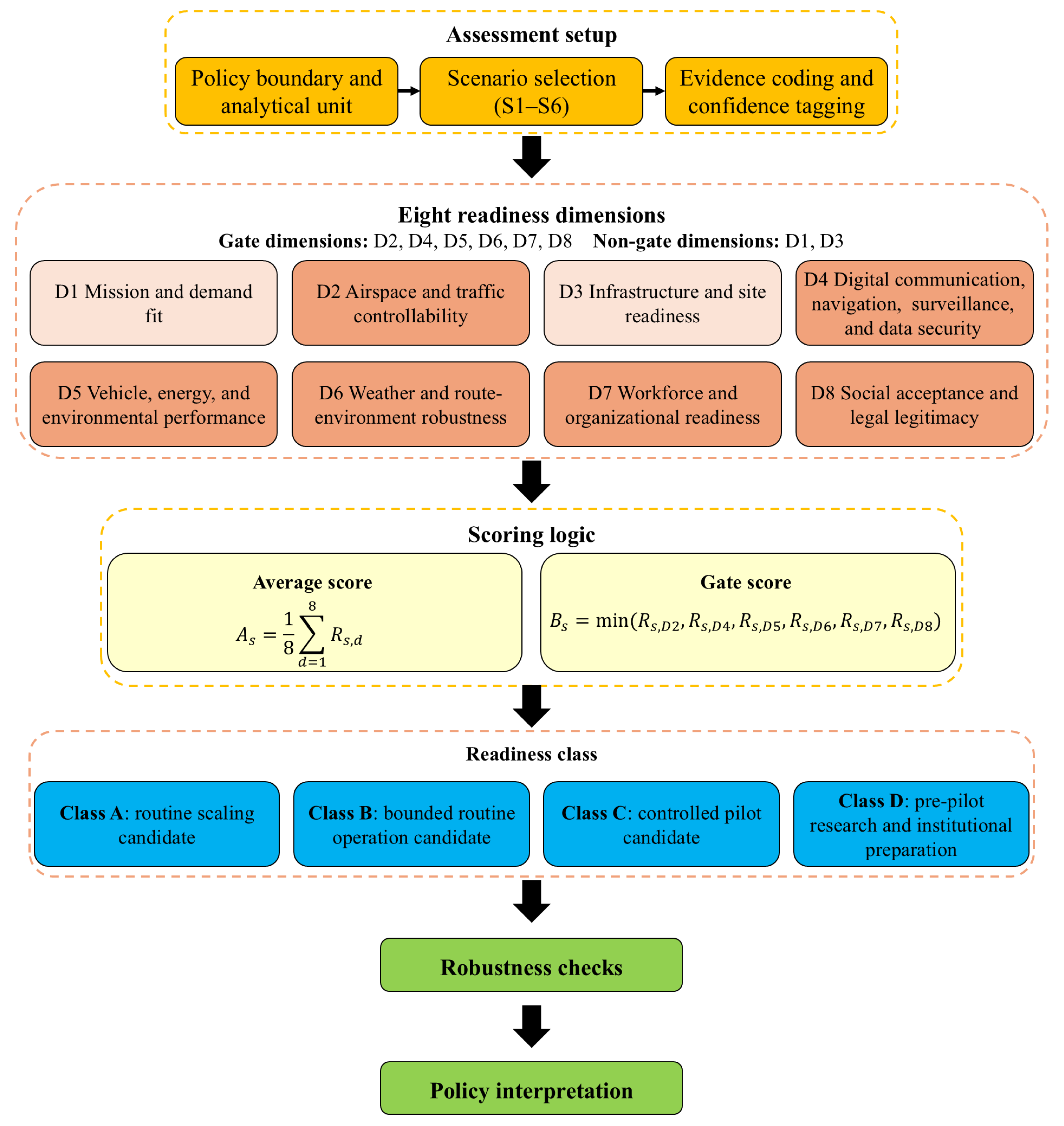
As shown in Figure 1, the framework follows five analytical steps. Step 1 defines the LAE policy boundary. Step 2 selects representative deployment scenarios. Step 3 evaluates each scenario through eight readiness dimensions. Step 4 calculates an average score and a gate score. Step 5 converts the scores into deployment classes and policy implications. This sequence makes the assessment reproducible and prevents the analysis from becoming a general description of industrial development.
The resulting scores should be interpreted as evidence-informed expert judgment supported by literature synthesis and document coding rather than as independent empirical validation. The framework is therefore used here as an illustrative application for transparent scenario comparison. Future validation can be strengthened through inter-rater scoring, expert-panel calibration, and operational datasets such as route-level flight logs, incident records, weather exceedance records, communication-link reliability, complaint records, and cost or emissions data.

3.2. Scenario Selection

The selected scenarios must be representative enough to cover major LAE deployment types, but limited enough to permit transparent comparison. Four selection criteria are used. The first is policy relevance. Each scenario must fall within the official LAE boundary and correspond to a recognized application field. The second is operational representativeness. Each scenario must involve recurrent low-altitude operation rather than a one-time exhibition flight. The third is sustainability relevance. Each scenario must create potential public, economic, environmental, or mobility value while also producing identifiable safety, environmental, workforce, or legitimacy risks. The fourth is evidence availability. Each scenario must be supported by policy documents, peer-reviewed studies, operational demonstrations, or industry information sufficient for structured assessment.
The scenario set was selected through purposive theoretical sampling. S1 represents high-public-value emergency missions in which social benefit is strong but operational conditions can be degraded. S2 represents non-passenger public-service and asset-management operations with comparatively bounded routes and identifiable institutional users. S3 represents high-frequency commercial cargo operation, where repeated overflight changes the sustainability problem from occasional technical feasibility to routine social exposure. S4 and S5 separate passenger UAM into a corridor-based airport-access model and an open-network air-taxi model because they have different route structures, infrastructure requirements, passenger-risk profiles, and community-exposure patterns. S6 represents place-based consumption and regional-development missions in which seasonal demand, scenic-area carrying capacity, and local ecological constraints are central. Together, the six scenarios form a contrastive set across public versus commercial value, cargo versus passenger exposure, fixed-corridor versus flexible-network operation, and professional-user versus general-consumer contexts.
Six scenarios are selected: emergency medical logistics and disaster response (S1), infrastructure inspection and public-service monitoring (S2), urban instant logistics and last-mile delivery (S3), airport shuttle and intermodal passenger transfer (S4), urban air taxi and on-demand passenger mobility (S5), and low-altitude tourism and cultural-consumption flights (S6). Passenger UAM is divided into airport shuttle and urban air taxi because the former is usually corridor-based and intermodal, whereas the latter is more likely to involve open-network mobility, higher passenger exposure, stronger community sensitivity, and more complex airspace interactions. This separation is consistent with passenger-market research that distinguishes airport-shuttle and city-taxi deployment logics [21]. Table 2 defines the six scenarios.
S1 and S2 are public-value scenarios. S3 is a high-frequency commercial cargo scenario. S4 is a bounded passenger scenario connected to existing transport nodes. S5 is the most complex passenger scenario because it assumes more flexible route formation and wider community exposure. S6 is a consumer-experience scenario with regional economic value but clear seasonal, ecological, and public-acceptance constraints. This selection allows the study to compare public-service versus commercial service, cargo versus passenger operation, and bounded corridors versus flexible networks.

3.3. Readiness Dimensions and Scoring Anchors

The framework evaluates each scenario through eight readiness dimensions derived from the literature review, official LAE policy categories, and practical requirements for sustainable low-altitude deployment. Dimension 1 (D1) is mission and demand fit. Dimension 2 (D2) is airspace and traffic controllability. Dimension 3 (D3) is infrastructure and site readiness. Dimension 4 (D4) is digital communication, navigation, surveillance, and data security. Dimension 5 (D5) is vehicle, energy, and environmental performance. Dimension 6 (D6) is weather and route-environment robustness. Dimension 7 (D7) is workforce and organizational readiness. Dimension 8 (D8) is social acceptance and legal legitimacy. Together, these dimensions assess whether a scenario has technical feasibility as well as route controllability, infrastructure support, digital reliability, environmental suitability, weather tolerance, organizational capacity, and institutional legitimacy.
The dimensional structure follows a deployment chain from mission value to operating permission. D1 captures the public or market purpose that justifies operation. D2 and D3 capture the spatial and site conditions needed to organize routes, landing areas, charging or maintenance interfaces, and ground access. D4 captures the digital backbone required for communication, navigation, surveillance, data protection, and operational traceability. D5 and D6 capture physical sustainability constraints, including vehicle-energy performance, emissions and noise, low-altitude weather, obstacles, and route-environment disturbance. D7 captures whether qualified personnel, operating organizations, training systems, emergency procedures, and cross-agency responsibilities are in place. D8 captures the legal and social conditions that allow routine operation, including the legal basis, liability allocation, privacy protection, public acceptance, and non-user legitimacy. In this sense, the eight dimensions function as the minimum deployment conditions that convert aircraft capability into sustainable routine operation.
The eight dimensions deliberately combine technical, organizational, environmental, and institutional conditions. Airspace and traffic controllability are informed by structured-route and lane-based traffic-management concepts, which emphasize cooperative traffic management, corridors, deconfliction, and operational responsibilities [25,26]. Digital readiness follows from secure low-altitude economy networking research, which identifies confidentiality, availability, and integrity as core operational requirements for low-altitude communication systems [31]. Weather robustness is included as an independent dimension because low-altitude routes are sensitive to low visibility, wind shear, wind gusts, urban airflow, and rooftop wind conditions [28,29]. Workforce and legitimacy are also treated as independent dimensions because AAM implementation depends on role allocation, human factors, trust, and community acceptance rather than aircraft capability alone [38,44].
Each dimension is scored on a 0 to 4 ordinal scale. The score represents readiness evidence, not certification approval. Score 0 means that the condition is absent or materially unresolved. Score 1 means that only fragmented concept evidence exists. Score 2 means that limited pilots, partial facilities, or basic procedures exist. Score 3 means that repeated demonstration or bounded routine operation has produced credible evidence, but standardization remains incomplete. Score 4 means that routine operation conditions are substantially established. Table 3 presents the coding questions and anchors.
To clarify operationalization, Table 3 defines the scoring anchors, while Table 4 summarizes the evidence types used for D1 to D8. The coding rule was evidence-maturity-based: absent or materially unresolved evidence supported score 0; concept-level evidence supported score 1; pilot evidence or partial facilities supported score 2; repeated demonstration or bounded routine operation supported score 3; and routine operational records, standardized thresholds, or authorization-grade evidence supported score 4. Table S1 reports the source-level evidence, evidence type, confidence tag, and coding rationale for each scenario-dimension score.
Other researchers can replicate the scoring by applying the same scenario list, eight dimensions, score anchors, and evidence-type categories to a transparent source-level coding ledger. Some judgment remains necessary, but each score should be justified by an anchor, evidence type, confidence tag, and brief rationale. For example, S6-D6 was assigned score 2 because weather and route-environment risks are recognized and pilot restrictions can be specified, while stable route-level micro-weather thresholds and alternate procedures for routine operation remain incomplete.

3.4. Scoring, Gate Logic, Evidence Confidence, and Robustness Checks

For scenario s and dimension d, the readiness score is denoted as R s , d , where R s , d { 0 , 1 , 2 , 3 , 4 } . The average readiness score is calculated as:
A s = 1 8 d = 1 8 R s , d .
The average score is useful for comparison but insufficient for deployment judgment. A high mission score cannot compensate for weak airspace control. Aircraft performance cannot compensate for insufficient data security. Commercial demand cannot compensate for a lack of workforce, weather thresholds, or social legitimacy. Therefore, the framework introduces a gate score. The gate dimensions are D2, D4, D5, D6, D7, and D8. They correspond to airspace controllability, digital and data security, vehicle and environmental performance, weather robustness, workforce readiness, and social acceptance and legal legitimacy. The gate score is calculated as:
B s = m i n ( R s , D 2 , R s , D 4 , R s , D 5 , R s , D 6 , R s , D 7 , R s , D 8 ) .
The framework uses non-compensatory gate logic because selected dimensions represent minimum conditions for safe, accountable, and legitimate operation. Using non-compensatory decision rules for constrained trade-offs is consistent with multiple-criteria decision analysis [49,50]. Table 5 summarizes the gate-selection logic, contextual gate treatment, readiness-class thresholds, and robustness rules.
The class assignment is therefore an authorization-oriented interpretation of the current evidence base rather than a definitive prediction of commercial success [51]. A scenario may receive a higher readiness class only when both its average score and gate score satisfy the relevant thresholds; otherwise, unresolved gate risks keep the scenario in a more cautious class.
Each score is also assigned an evidence-confidence tag, denoted as E s , d , where E s , d { 0 , 1 , 2 , 3 } . A value of 0 indicates insufficient evidence. A value of 1 indicates conceptual, policy, or expert-interpretive evidence. A value of 2 indicates simulation, demonstration, or limited operational evidence. A value of 3 indicates routine operational, regulatory, or repeated route-level evidence. Evidence confidence is not used to change the score mechanically. It is reported to show where results are better supported and where future empirical work is needed. The source-level coding record is reported in Table S1.
Three robustness checks are used. The first applies an alternative gate set that excludes D6 to test whether adding weather as a gate changes the deployment sequence. The second applies a stricter passenger gate in which D3 is included for S4 and S5. The third tests threshold sensitivity by increasing and decreasing the average-score thresholds by 0.25. The robustness checks do not replace the main classification. They indicate whether a scenario is stable, borderline, or sensitive to methodological assumptions. Section 4 reports the scores, evidence confidence, and robustness interpretation for the six scenarios. These robustness checks are deliberately limited. They examine selected gate and threshold changes, while future work should test additional weighting structures, alternative score anchors, and probabilistic or operational-data-based scoring assumptions.

4. Results

4.1. Overall Readiness Distribution

Applying the scenario-gated sustainability readiness framework to the six representative LAE scenarios reveals a differentiated readiness structure. The results do not support a sector-wide scaling logic in which all low-altitude applications are treated as equally mature once aircraft, capital, and local policy support become available. Readiness is concentrated in public-service and asset-management scenarios, whereas passenger-oriented UAM remains constrained by airspace complexity, route-level weather, vertiport integration, passenger safety assurance, automation trust, workforce preparation, and social legitimacy. This pattern is consistent with China’s operating landscape. CAAC statistics show that, by the end of 2025, registered drones across the industry had reached 3.287 million and annual cumulative drone flight hours had reached 45.3029 million [7]. These figures indicate rapid expansion, but uneven scenario readiness.
Table 6 reports the dimension-level score profile, average readiness score, gate score, mean evidence confidence, readiness class, and policy-decision output for each scenario. The final four decision fields identify each scenario’s key bottleneck, priority improvement variable, policy action, and next-step deployment condition, so that the score profile can be translated into authorization and sequencing decisions rather than remaining only a descriptive ranking. Because D6 weather and route-environment robustness is incorporated into the gate dimensions, the gate score reported here is stricter than an average-score interpretation.
To make the scenario-level scoring process auditable, Table 7 links each S1 to S6 dimension score to key supporting sources and the judgment logic used to distinguish adjacent score levels. The table is a condensed version of the source-level coding ledger in Table S1; Table S1 retains the full evidence type, evidence-confidence tag, coding rationale, and source register for each scoring cell.
As shown in Table 6 and Table 8, the results can be read as an illustrative deployment decision sequence. S2 is the only Class A scenario and can proceed to routine scaling under standardized route, data, privacy, and deviation-monitoring rules. S1 and S3 can support bounded routine operation, but their authorization should remain tied to weather, command-link, complaint, workforce, and route-deviation thresholds. S4 and S6 should remain controlled pilots because their passenger or community exposure depends on site interfaces, emergency procedures, weather management, and public communication. S5 remains Class D and should stay in pre-pilot research until gate conditions improve across airspace controllability, infrastructure, vehicle-energy performance, weather robustness, workforce readiness, and legal–social legitimacy.

4.2. Scenario-Level Findings

4.2.1. S1: Emergency Medical Logistics and Disaster Response

S1 receives the highest mission and legitimacy scores because emergency logistics creates visible public value and can be justified even when short-term commercial profitability is limited. The scenario is suitable for medical samples, urgent medicines, automated external defibrillators, disaster supplies, and the transport of emergency materials. Its strongest deployment form is not an open urban network, but predefined or rapidly activated corridors connecting hospitals, laboratories, emergency stations, islands, mountainous areas, and disaster-response nodes. The industry standard General Requirements for Civil Unmanned Aircraft System Logistics Operation, Part 1: Island Scenario shows that logistics operations require specifications for operators, manuals, aircraft systems, operating environments, landing sites, operational control, communication support, navigation, and radio requirements [52]. S1 is nevertheless classified as Class B rather than Class A. Its average score reaches 3.13, but its gate score is held at 2 because emergency value often increases precisely under adverse conditions. Heavy rain, strong wind, low visibility, temporary communication disruption, or damaged ground infrastructure can coincide with urgent demand. Therefore, S1 is a bounded routine operation candidate. It should be scaled through medical corridors with route-level weather thresholds, verified landing alternatives, interagency command rules, and liability allocation.

4.2.2. S2: Infrastructure Inspection and Public-Service Monitoring

S2 obtains the highest overall readiness score and is the only Class A scenario. It includes power-line inspection, pipeline patrol, bridge and highway monitoring, port and waterway inspection, public-facility monitoring, environmental observation, and selected emergency surveillance. Its readiness comes from four structural advantages. First, it is normally non-passenger. Second, many missions follow asset corridors already defined by physical infrastructure. Third, users are usually public agencies, infrastructure operators, or enterprise asset managers. Fourth, aircraft, sensors, and data-processing routines are comparatively mature. The main bottleneck is not aircraft capability but data governance. Inspection missions may collect images of critical infrastructure, private property, traffic flows, construction sites, and environmental conditions. They require clear access control, data retention rules, cybersecurity, and cross-agency authorization. This explains why S2 does not receive a score of 4 on D4 or D8. However, all gate dimensions reach 3 or above. It is therefore the most credible starting point for routine LAE scaling.

4.2.3. S3: Urban Instant Logistics and Last-Mile Delivery

S3 is classified as Class B. This result reflects the coexistence of operational evidence and social-exposure constraints. Urban instant logistics has clear demand in food, retail parcels, pharmaceuticals, and urgent small cargo. Shenzhen municipal information reported that the city surpassed 600,000 drone-delivery flights in 2023 and opened 77 new UAV routes with 73 new takeoff and landing points in that year, showing that routine commercial cargo services have moved beyond symbolic demonstrations in selected urban areas [8]. National logistics evidence also shows a shift from isolated pilot routes to interconnected networks, with more than 140 new low-altitude logistics routes launched in China in 2024 and approximately 90% operating within cities [9]. The Class B result is conservative because high-frequency delivery repeatedly exposes non-users to noise, privacy, visual, battery-charging, landing-site, and scheduling risks. S3 should therefore be treated as bounded fixed-route operation. Its scaling condition is not limited to delivery speed; it must include route caps, operating-hour restrictions, complaint records, noise monitoring, emergency landing rules, and transparent data handling.

4.2.4. S4: Airport Shuttle and Intermodal Passenger Transfer

S4 receives a Class C result. It is the strongest passenger-oriented scenario because it can be structured as a bounded corridor between airports, rail stations, business districts, exhibition centers, and designated vertiports. Compared with open urban air taxi, airport shuttles have clearer origin–destination pairs and stronger hub-integration potential. Service-attribute research shows that fares, in-vehicle time, out-of-vehicle time, and transfer convenience strongly influence acceptance of UAM airport-shuttle services, while automation-level research shows that willingness to use is lower for remotely piloted or fully autonomous UAM than for manned control [40,41]. The Class C result follows from passenger exposure and infrastructure uncertainty. Airport shuttles require certified vehicles, passenger handling, emergency procedures, secure vertiport access, luggage interfaces, acceptable fares, and clear passenger communication. The revised Civil Aviation Law of the People’s Republic of China, adopted in 2025 and effective from 1 July 2026, further strengthens unmanned-aircraft airworthiness requirements and airport safety safeguards [53]. These requirements support the interpretation that S4 should remain a controlled corridor pilot until vertiport integration, airport–airspace coordination, and passenger-safety procedures are demonstrated at route level.

4.2.5. S5: Urban Air Taxi and On-Demand Passenger Mobility

S5 is classified as Class D. This result preserves the long-term potential of passenger UAM while indicating that open-network, on-demand air taxi should remain outside routine scaling under a sustainability-oriented assessment. The scenario combines the highest passenger exposure with the most complex airspace, infrastructure, weather, workforce, insurance, and legitimacy requirements. It assumes flexible point-to-point services, but such flexibility increases the conflict-management burden, vertiport demand, community exposure, and operational uncertainty. China has made visible progress in pilotless passenger eVTOL certification. EHang announced in 2025 that its EH216-S operators had obtained air operator certificates and that the aircraft had obtained type, production, standard airworthiness, and operating certificates for pilotless human-carrying eVTOL aircraft from the CAAC [10]. However, certification progress for one aircraft family or operator does not equal readiness for citywide open-network UAM. Battery studies show that eVTOL mission segments impose demanding power profiles on lithium-ion systems, especially during takeoff and climb, while China-based acceptance evidence indicates that perceived risk and initial trust shape UAM adoption [34,42]. S5 should therefore remain in pre-pilot research, simulation, controlled demonstrations, and institutional preparation.

4.2.6. S6: Low-Altitude Tourism and Cultural-Consumption Flights

S6 receives a Class C result. Low-altitude tourism has clearer near-term market logic than open commuter air taxi because demand can be geographically concentrated, seasonally scheduled, and linked to scenic-area or cultural-consumption management. It can also improve public familiarity with LAE technologies under more controlled conditions than dense urban passenger mobility. It may be appropriate for island sightseeing, scenic corridors, cultural-tourism zones, and short routes where sites, passenger flows, and local supervision can be organized. The scenario nevertheless has three constraints: seasonal and weather-sensitive demand, ecological and cultural-heritage constraints, and non-professional passengers with limited knowledge of flight risk. Aeroacoustics research on multirotor UAM aircraft shows that propeller configuration and spacing can affect thrust, energy efficiency, and tonal noise, which makes noise management a real operating condition rather than a public-relations issue [36]. S6 is therefore suitable for controlled pilots under ecological carrying-capacity limits, route-specific noise caps, passenger briefing requirements, and emergency evacuation procedures.

4.3. Cross-Dimensional Bottlenecks

The dimension-level results show that LAE readiness is constrained less by aircraft availability than by the alignment of aircraft, routes, digital systems, sites, workforce, legal rules, and community exposure. Table 9 summarizes the dominant bottlenecks and deployment posture for each scenario.
Three cross-dimensional patterns deserve emphasis. First, airspace controllability is the central bottleneck for passenger scenarios. Three-dimensional UAM traffic-assignment research shows that network structure, congestion, and operational complexity must be considered together when assigning traffic flows in urban airspace [27]. Second, digital readiness becomes more important as operational frequency increases. Intelligent spectrum and airspace-resource management research shows that frequency use, flight time, departure timing, and airspace resources are interdependent, which is especially relevant for S3, S4, and S5 [32]. Third, implementation bottlenecks are organizational as well as technical. Comparative UAM barrier research identifies technological, economic, social, environmental, and operational barriers, including safety, cybersecurity, affordability, autonomous operation, and public acceptance [39]. These patterns explain why public-service and asset-management scenarios lead the sequence.

4.4. Deployment Sequence and Robustness

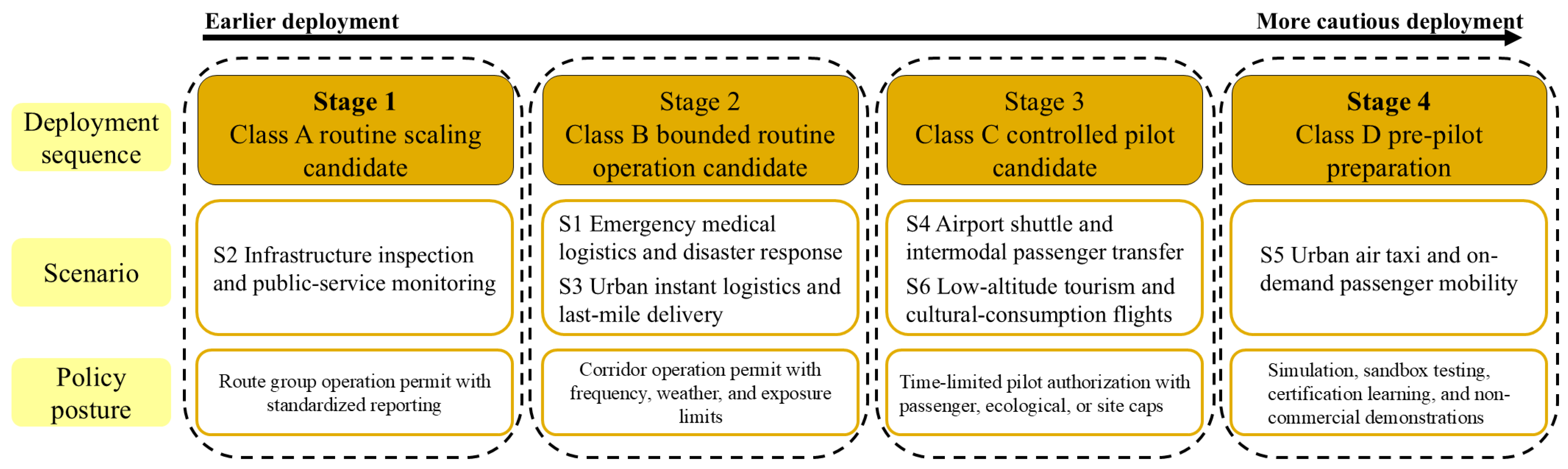
As illustrated in Figure 2, the results support an illustrative staged deployment sequence. Stage 1 should prioritize S2. Infrastructure inspection and public-service monitoring can generate route-level evidence, train operators, refine data governance, and test digital supervision without exposing large passenger populations. Stage 2 should expand S1 and S3 through bounded corridors. These scenarios can test mission urgency, flight frequency, logistics handover, privacy safeguards, noise control, and weather thresholds. Stage 3 should introduce S4 and S6 as controlled pilots. The objective should be evidence generation rather than rapid commercialization. Stage 4 should consider S5 only after gate dimensions improve simultaneously, especially airspace conflict management, vertiport networks, vehicle-energy reliability, meteorology, workforce certification, insurance, liability, and community acceptance.
The deployment sequence is broadly robust under three checks, although several scenarios remain close to class boundaries. First, if D6 is excluded from the gate set, S2 remains Class A, S3 remains Class B, S4 and S6 remain Class C, and S5 remains Class D. S1 moves closer to Class A but still remains below the average-score threshold. Second, if D3 infrastructure readiness is added as a contextual gate for passenger scenarios, S4 remains Class C and S5 remains Class D. This confirms that the classification of passenger UAM rests on a combination of gate dimensions rather than one arbitrary gate dimension. Third, if average-score thresholds are increased or decreased by 0.25, the main sequence remains unchanged, but boundary cases become visible. Under stricter thresholds, S2 moves from Class A to a high-end Class B position and S3 becomes a borderline Class C case. Under more permissive thresholds, S4 and S6 can move upward to Class B, while S5 remains Class D. The main conclusion is therefore stable: China’s LAE should move from public-service and asset-management scenarios toward bounded logistics and only then toward passenger pilots. Open-network air taxi should remain outside near-term routine deployment.

5. Discussion

5.1. Scenario-Gated Scaling Versus Sector-Wide Promotion

The results indicate that China’s LAE should not be governed as a homogeneous sector that moves uniformly from policy promotion to routine deployment. The six scenarios share low-altitude airspace and may rely on overlapping aircraft platforms, but their readiness profiles differ fundamentally. S2 reaches Class A because it combines public or asset-management value, bounded routes, non-passenger operation, and comparatively mature UAV practices. S1 and S3 reach Class B because their mission demand is visible, yet their operation remains constrained by weather thresholds, exposure accumulation, and command reliability. S4 and S6 remain Class C, while S5 remains Class D. This pattern is consistent with socio-technical transition theory, which treats technological change as an interaction among artifacts, users, infrastructure, institutions, and social expectations rather than as the diffusion of a device alone [54].
The implication is that LAE scaling should be scenario-gated. Sector-wide promotion can mobilize investment, manufacturing capacity, and standardization, but it cannot determine which operations should be authorized for routine use. The assessment results indicate that the appropriate governance unit is not the aircraft, the city, or the industrial park, but the route-level deployment scenario. A scenario becomes ready only when mission value, route controllability, digital support, weather envelope, workforce arrangement, environmental burden, and legal–social legitimacy are aligned. This also explains why early success in non-passenger UAV operations should not be treated as direct evidence for passenger UAM. The risk exposure, legitimacy burden, and organizational requirements are materially different.

5.2. Technology Readiness Versus Sustainability Readiness

A second finding is that technology readiness and sustainability readiness are not equivalent. Aircraft certification, prototype flights, and commercial announcements indicate progress in technological subsystems. They do not prove that a deployment scenario can operate safely, repeatedly, affordably, and legitimately in an urban environment. The FAA’s Advanced Air Mobility Implementation Plan focuses on enabling initial operations at selected key sites rather than assuming immediate national-scale deployment, which supports a staged interpretation of AAM maturity [55]. This study reaches the same conclusion from evidence on China’s LAE: routine scaling should depend on accumulated route and corridor evidence rather than on demonstration visibility.
The distinction is most visible in S5. Urban air taxi has high symbolic value because it is associated with novel aircraft, automation, and premium mobility. Yet it scores poorly because its bottlenecks are simultaneous. Open-network passenger service requires dense vertiports, reliable command and control, low-noise aircraft, passenger emergency procedures, a trained workforce, insurance, social acceptance, and real-time airspace coordination. These conditions cannot be averaged into readiness by emphasizing aircraft capability. Conversely, S2 shows that a less conspicuous scenario may be more sustainable because it has lower passenger exposure, clearer users, and more auditable routes. The practical lesson is that LAE sustainability should be evaluated through whether a scenario can operate, rather than only whether an aircraft can fly.

5.3. Corridor-Based Governance and Institutional Legitimacy

The results support corridor-based governance as the transitional form between demonstrations and open-network operation. A corridor is not simply a geometric route. It is a governance unit that links airspace, ground sites, operating rules, communication requirements, weather minima, emergency landing points, data logging, public notice, and liability. This is why S1 and S3 are suitable for bounded routine operation rather than unrestricted scaling. Medical and delivery corridors can accumulate evidence while limiting exposure. Passenger corridors in S4 and S6 can test passenger handling, transfer integration, public communication, and emergency response before wider expansion.
This logic is consistent with the European Union (EU) U-space approach. The EU U-space framework defines airspace zones in which unmanned aircraft operators must use specified services under specific requirements, and the European Union Aviation Safety Agency’s Easy Access Rules for U-space (Regulation (EU) 2021/664) include information security risk requirements with a potential aviation-safety impact [56,57]. For China, the policy lesson is to convert LAE authorization into a corridor-specific evidence process while adapting relevant U-space principles to China’s institutional context. Each corridor should have a defined mission, responsible operator, weather envelope, digital monitoring protocol, emergency response plan, workforce matrix, and public-facing accountability channel. Institutional legitimacy emerges from this auditable chain, not from a general declaration that the LAE is strategically important.

5.4. Workforce Readiness and Public Acceptance as Gate Conditions

The results also show that workforce readiness and social acceptance should be treated as gate conditions. Workforce is not limited to the number of remote pilots. Routine LAE operation requires dispatchers, maintenance personnel, cybersecurity specialists, meteorological support staff, vertiport managers, emergency coordinators, compliance officers, and public-service interface personnel. The same scenario may be technically feasible but operationally immature if these roles are not defined, trained, tested, and recurrently evaluated. This is especially relevant for passenger scenarios, where passengers and affected non-users both expect aviation-grade safety, transparent responsibility, and credible emergency response.
Public acceptance should also be understood as route-specific and two-sided. User willingness is only one part of legitimacy. Non-users under flight paths bear noise, visual disturbance, privacy exposure, and residual safety risk. The Advanced Air Mobility Community Integration Considerations Playbook identifies institutional readiness, equity, community engagement, multimodal integration, workforce readiness, data, interoperable infrastructure, and environmental sustainability as local planning issues [58]. The present results are consistent with that broader view. S2 and S1 have higher legitimacy because their public value is visible. S3, S4, S5, and S6 face stronger legitimacy tests because their benefits and burdens may be distributed unevenly. Therefore, public acceptance should be measured by mission, route, time window, automation level, population exposed, complaint history, and benefit distribution.

5.5. Transferability to Other Countries with Similar Features

Although the empirical assessment focuses on China, the findings can inform countries and metropolitan regions with comparable development conditions, including rapid UAV and eVTOL experimentation, progressive opening of low-altitude airspace, government-led pilot corridors, dense urban airspace, uneven infrastructure maturity, limited route-level operational data, and parallel demands for public-service, logistics, tourism, and passenger-mobility applications. In these settings, the most transferable finding is the sequencing logic. Public-service and asset-monitoring scenarios can advance earlier when exposure is bounded and mission value is clear; medical and logistics corridors can move toward bounded routine operation after route-level safety, digital-link, weather, and workforce evidence has accumulated; passenger mobility can proceed through controlled corridors before open-network services are considered.
The framework can also be applied as a diagnostic template. Other countries can retain the eight dimensions and gate conditions while recalibrating ordinal scores with local evidence on airspace rules, traffic density, vertiport access, communication coverage, battery and noise performance, micro-weather risk, operator qualifications, insurance, privacy, and public acceptance. The adaptation process involves four steps: define local deployment scenarios, replace China-specific evidence with local records, score each scenario–dimension pair under local thresholds, and link authorization to the resulting readiness class. This procedure supports comparative policy learning while preserving the local specificity of airspace institutions, urban morphology, market demand, and social expectations.

5.6. Contributions, Limitations, and Future Research

This study contributes to sustainable aviation and UAM research in three respects. First, it shifts the analytical unit from technology category to deployment scenario. This is necessary because the same aircraft platform may be relatively ready in inspection, conditionally ready in logistics, and premature in passenger mobility. Second, it introduces non-compensatory gate logic into sustainability readiness assessment. Safety, weather, digital security, workforce, and legitimacy cannot be offset by market demand or policy enthusiasm. Third, it connects policy, technology, and workforce in a single framework, thereby responding to the core interdisciplinary concern of sustainable aviation governance.
Five specific limitations should be recognized when interpreting the results. First, the scoring is based on evidence-informed expert judgment, literature synthesis, document coding, and representative case evidence rather than independent empirical validation against external operational outcomes. Future work should compare multiple coders’ scores, estimate inter-rater agreement, and test whether readiness classes correspond to observed safety, reliability, cost, noise, workforce, and acceptance outcomes in operational corridors. Second, the assessment relies on publicly available policy documents, the technical literature, operational demonstrations, certification information, and representative case evidence. Proprietary operator flight logs, insurance claim records, incident records, real-time traffic-management data, and route-level cost records were unavailable. Third, the scores represent scenario-level readiness in the Chinese context, so they should be recalibrated before being used for a specific city, corridor, enterprise, aircraft model, vertiport, or regulatory sandbox. Fourth, the ordinal scale supports cross-scenario comparability while leaving intra-scenario heterogeneity to more detailed local assessments, including route density, micro-weather exposure, population under flight paths, charging capacity, emergency landing coverage, and workforce supply. Fifth, the gate conditions are qualitative non-compensatory constraints at this stage. They identify dimensions that must be satisfied before routine deployment, while future studies need to translate them into authorization thresholds.
Future research should therefore proceed in five directions. First, city-level and corridor-level datasets should integrate route geometry, flight hours, incidents, weather observations, noise exposure, battery and energy records, passenger or customer demand, complaint records, staffing, insurance, and emergency-response outcomes. Second, longitudinal studies should test whether improvements in low-scoring dimensions lead to safer, more reliable, and more legitimate routine operation. Third, quantitative gate thresholds should be developed for micro-weather sensing density, command-and-control link reliability, geofencing accuracy, detect-and-avoid performance, emergency landing coverage, staffing ratios, minimum safe flight hours, and complaint tolerance. Fourth, the framework should be linked with cost, carbon, noise, equity, and safety-performance models so that deployment sequencing reflects both operational readiness and sustainability outcomes. Fifth, comparative applications in other countries should examine whether the scenario-gated logic remains valid under different airspace rules, data availability, public acceptance conditions, and institutional capacities.

6. Policy Implications

6.1. Scenario-Gated Authorization and Corridor Operating Permits

The results imply that China should move from broad application encouragement to scenario-gated authorization. The Implementation Plan for Innovative Application of General Aviation Equipment (2024–2030) already encourages innovative applications of general aviation equipment in emergency rescue, logistics distribution, urban air transport, and other low-altitude scenarios [59]. This study complements that developmental orientation by adding a stricter authorization rule: routine operation should be granted only when a specific route or route group has passed the gate conditions identified in Section 4.
A corridor operating permit should become the regulatory instrument between isolated demonstration and open commercial scaling. It should not be issued merely to an enterprise, an aircraft model, or a city. It should be issued for a defined route or route group, with a specified mission, aircraft type, operating altitude, time window, weather envelope, digital monitoring protocol, emergency landing arrangement, workforce matrix, insurance condition, and public communication channel. This approach converts the readiness classes into operational policy instruments, as summarized in Table 10.

6.2. Public-Value Corridors Before Commercial Passenger Corridors

The first sequencing rule is that public-value corridors should precede commercial passenger corridors. S2 should be the earliest field for routine scaling because it is the only Class A scenario. It can generate operational data, strengthen digital supervision, and train the LAE workforce without exposing large passenger populations. S1 should follow as a Class B mission corridor because it has high public legitimacy. Its expansion, however, should remain conditional on route-level weather thresholds, medical handover procedures, emergency landing alternatives, and cross-agency command protocols.
S3 should also remain Class B rather than being released into unrestricted expansion. Its regulatory problem is not whether delivery can be completed. It is whether repeated overflight, landing concentration, battery charging, noise, privacy exposure, and community complaint accumulation can be kept within an acceptable envelope. S4 and S6 should remain Class C pilots because they introduce passengers and require stronger vertiport, evacuation, insurance, and communication arrangements. S5 should remain Class D. Its policy treatment should be pre-pilot testing, simulation, certification learning, and public deliberation, not routine passenger operation.

6.3. Mandatory System Gates: Micro-Weather, Digital Security, and Evidence Ledgers

The second sequencing rule is that micro-weather, digital security, and evidence ledgers should become mandatory system gates. Local policy has started to move in this direction. The Implementation Plan for Building Low-altitude Flight Service Management Capabilities in Shanghai proposes a city-level low-altitude digital map, a public route network, a comprehensive supervision platform, a flight service center, and supporting communication, navigation, surveillance, and related facilities [60]. This is a useful model, but the results of this study require a more precise route-level condition: each authorized corridor should maintain an evidence ledger.
The evidence ledger should record weather minima, micro-weather observations, command-link reliability, navigation accuracy, surveillance continuity, cybersecurity events, flight hours, aborted missions, deviations, incidents, complaints, insurance events, workforce duty allocation, recurrent training, and non-user exposure. National policies on artificial intelligence in civil aviation and information-communication support for low-altitude infrastructure already emphasize dynamic monitoring, risk warning, intelligent low-altitude management, network security, data security, communication coverage, navigation support, and low-altitude intelligent networked systems [61,62]. This study adds that these capabilities should be attached to route authorization as auditable evidence rather than treated as general background infrastructure.

6.4. Workforce, Insurance, and Public Communication Requirements

The third sequencing rule is that workforce, insurance, and public communication should become explicit authorization conditions. A Class A or Class B permit should include a minimum workforce matrix covering remote pilots, dispatchers, maintenance staff, meteorological support, cybersecurity personnel, emergency coordinators, data-compliance officers, and site managers. For S4, S5, and S6, the matrix should also include passenger handling, vertiport or site management, evacuation coordination, public communication, and passenger risk briefing. Workforce readiness should be verified through recurrent assessment and emergency drills rather than one-time qualification checks.
Insurance should also be scenario-specific. The Implementation Opinions on Promoting the High-quality Development of Low-altitude Insurance requires the construction of a low-altitude insurance system, promotes liability insurance in approval and operational-management processes, and calls for targeted insurance support across logistics, low-altitude traffic, emergency management, medical rescue, tourism, and other scenarios [63]. This study extends that direction by linking insurance to the readiness class. Class A and Class B corridors should have operational liability insurance and incident-reporting obligations. Class C passenger and tourism pilots should have passenger injury, third-party liability, route interruption, and site-operation coverage. Class D air taxi sandboxes should not carry routine paying passengers until insurance pricing, liability allocation, emergency response, and non-user exposure have been tested under realistic conditions.
Public communication should be treated as a safety instrument. Affected residents should know which route is being tested, who operates it, when it flies, what data are collected, how complaints are handled, and which authority can suspend the operation. Each permit should include stop rules. A corridor should be suspended or downgraded when thresholds for accidents, near misses, weather exceedance, command-link failure, cyber events, insurance claims, or complaints are exceeded. In this way, policy support for China’s LAE can remain developmental while becoming evidence-based, reversible, and publicly accountable.

7. Conclusions

This study developed a scenario-gated sustainability readiness framework and applied it illustratively to China’s LAE and UAM at the deployment-scenario level. Taking the results as a framework-based interpretation rather than a definitive prediction, the central conclusion is that the LAE should not be treated as a homogeneous sector that can move uniformly from demonstration to routine scaling. Sustainable deployment depends on the joint maturity of mission and demand fit; airspace and traffic controllability; infrastructure and site readiness; digital communication, navigation, surveillance, and data security; vehicle, energy, and environmental performance; weather and route-environment robustness; workforce and organizational readiness; and social acceptance and legal legitimacy.
The illustrative assessment of six representative scenarios suggests a cautious deployment sequence. S2 is the only routine scaling candidate because it combines bounded routes, non-passenger operation, mature UAV practices, and identifiable public or asset-management value. S1 and S3 are suitable for bounded routine operation, but only under route-level weather thresholds, command protocols, frequency controls, data governance, and complaint monitoring. S4 and S6 should remain controlled pilot candidates because passenger handling, site integration, evacuation procedures, insurance, noise control, and public communication still require further route-level evidence. S5 remains a pre-pilot scenario under the present evidence base because multiple gate conditions are not yet simultaneously satisfied.
The study contributes a scenario-based deployment logic for sustainable aviation governance. It shows that sustainable LAE development should proceed through auditable corridors, mandatory evidence ledgers, workforce matrices, micro-weather services, digital security requirements, scenario-specific insurance, and reversible authorization. This argument shifts the policy focus from aircraft capability and industrial acceleration to verifiable operating conditions. It also clarifies why public-service and asset-management scenarios can generate operational learning before high-frequency commercial logistics and passenger UAM are scaled.
The proposed framework provides a basis for future city-level and corridor-level empirical research, including independent validation through inter-rater comparisons and operational datasets. Further studies should convert the proposed gate dimensions into measurable thresholds and compare route-level safety, carbon, noise, equity, cost, workforce, and acceptance outcomes across cities and operators. The transition from demonstration to deployment should therefore be measured by the accumulation of reliable, auditable, and publicly legitimate operational evidence rather than by the number of announced aircraft, industrial parks, or symbolic flights.


Supplementary Materials

The following supporting information can be downloaded at: https://www.mdpi.com/article/10.3390/su18115756/s1, Table S1: Source-level coding record and supporting evidence register for the scenario-dimension readiness assessment.

Author Contributions

Conceptualization, C.H.C.; methodology, Z.Y., L.T. and C.H.C.; validation, C.H.C.; formal analysis, Z.Y., G.H. and L.T.; data curation, Z.Y. and G.H.; writing—original draft preparation, Z.Y.; writing—review and editing, C.H.C. and P.X.; visualization, G.H.; supervision, C.H.C.; funding acquisition, C.H.C. All authors have read and agreed to the published version of the manuscript.

Funding

This research was funded by the Guangxi Natural Science Foundation, grant number 2026GXNSFHA00640185; the Guangxi Philosophy and Social Science Research Project, grant number 23CYJ021; the National Natural Science Foundation of China, grant numbers W2433112 and 72262008; the ASEAN Talented Young Scientist Program of Guangxi, China, grant numbers ATYSP2023008 and ATYSP2025023; the Research Basic Ability Enhancement Project of Young and Middle-aged Teachers in Guangxi Universities (No. 2025KY0819); the Guilin University of Aerospace Technology (GUAT) Special Research Project on the Strategic Development of Distinctive Interdisciplinary Fields, grant number TS2024511; and Guilin University of Aerospace Technology, grant number KX202207601.

Institutional Review Board Statement

Not applicable.

Informed Consent Statement

Not applicable.

Data Availability Statement

The original contributions presented in this study are included in the article/Supplementary Material. Further inquiries can be directed to the corresponding author.

Acknowledgments

The authors gratefully acknowledge Junzhou Wang, Jianlin Ou, Bingjian Meng, Siwen Yang, and Jiahui Kang for their assistance with the collection and screening of publicly available Chinese advanced air mobility cases under the Undergraduate Innovation and Entrepreneurship Training Program project S202511825008. The authors also thank Xinyi Hou, Xiaoguang Wang, and Yingping Cai for their support in reviewing policy, legal, regulatory, and planning documents related to China’s low-altitude economy and in compiling background materials on the current state of the unmanned aerial vehicle industry chain under project S202511825039. The authors are also grateful to Xiaoyong Zhou, Guomin Chen, and Sitong Liu for their guidance during the early stage of this study, for sharing their expertise on unmanned aircraft and the low-altitude economy, for introducing the authors to domestic and international experts, and for enabling field investigations.

Conflicts of Interest

The authors declare no conflicts of interest.

Abbreviations

AAMadvanced air mobility
ASaverage readiness score for scenario s
BSgate score for scenario s
CAACCivil Aviation Administration of China
CCAR-92Civil Unmanned Aircraft Operation Safety Management Rules
Class Aroutine scaling candidate
Class Bbounded routine operation candidate
Class Ccontrolled pilot candidate
Class Dpre-pilot research and institutional preparation
D1mission and demand fit
D2airspace and traffic controllability
D3infrastructure and site readiness
D4digital communication, navigation, surveillance, and data security
D5vehicle, energy, and environmental performance
D6weather and route-environment robustness
D7workforce and organizational readiness
D8social acceptance and legal legitimacy
Es,devidence-confidence tag for scenario s and dimension d
EUEuropean Union
eVTOLelectric vertical takeoff and landing
FAAFederal Aviation Administration
LAElow-altitude economy
NDRCNational Development and Reform Commission
Rs,dreadiness score for scenario s and dimension d
S1emergency medical logistics and disaster response
S2infrastructure inspection and public-service monitoring
S3urban instant logistics and last-mile delivery
S4airport shuttle and intermodal passenger transfer
S5urban air taxi and on-demand passenger mobility
S6low-altitude tourism and cultural-consumption flights
UAMurban air mobility
UAVunmanned aerial vehicle

References

  1. Li, Q. Report on the Work of the Government 2024; State Council of the People’s Republic of China: Beijing, China, 2024. Available online: https://english.www.gov.cn/news/202403/13/content_WS65f0dfccc6d0868f4e8e5079.html (accessed on 5 May 2026).
  2. National Development and Reform Commission (NDRC). Statistical Classification of Low-Altitude Economy and Its Core Industries (Trial); NDRC: Beijing, China, 2025. Available online: https://www.ndrc.gov.cn/xxgk/zcfb/tz/202512/t20251226_1402669.html (accessed on 5 May 2026). (In Chinese)
  3. National Development and Reform Commission (NDRC). Specific Responsibilities of the Low Altitude Economy Development Department; NDRC: Beijing, China, 2024. Available online: https://www.ndrc.gov.cn/fzggw/jgsj/dks/jtzz/202412/t20241227_1395296.html (accessed on 5 May 2026). (In Chinese)
  4. State Council of the People’s Republic of China; Central Military Commission of the People’s Republic of China. Interim Regulations on the Administration of Unmanned Aircraft Flights; State Council Decree No. 761; State Council of the People’s Republic of China: Beijing, China, 2023. Available online: https://www.caac.gov.cn/XXGK/XXGK/FLFG/202401/t20240115_222642.html (accessed on 5 May 2026). (In Chinese)
  5. Civil Aviation Administration of China (CAAC). Civil Unmanned Aircraft Operation Safety Management Rules; CCAR-92; Ministry of Transport Order No. 1 of 2024; CAAC: Beijing, China, 2024. Available online: https://www.caac.gov.cn/XXGK/XXGK/MHGZ/202401/t20240103_222566.html (accessed on 5 May 2026). (In Chinese)
  6. Ministry of Transport of the People’s Republic of China. Ten Departments Release the Low-Altitude Economy Standard System Construction Guide; Ministry of Transport: Beijing, China, 2026. Available online: https://www.mot.gov.cn/xinwen/jiaotongyaowen/202602/t20260205_4199749.html (accessed on 5 May 2026). (In Chinese)
  7. Civil Aviation Administration of China (CAAC). CAAC Releases Statistical Bulletin of Civil Aviation Industry Development in 2025; CAAC: Beijing, China, 2026. Available online: https://www.caac.gov.cn/English/News/202604/t20260422_230642.html (accessed on 5 May 2026).
  8. Shenzhen Government Online. SZ Secures Top Spot with 600,000 Drone Deliveries; Shenzhen Municipal People’s Government: Shenzhen, China, 2024. Available online: https://www.sz.gov.cn/en_szgov/news/latest/content/post_11104711.html (accessed on 5 May 2026).
  9. People’s Daily Online. Low-Altitude Logistics Takes Off in China; People’s Daily Online: Beijing, China, 2025; Available online: https://en.people.cn/n3/2025/1124/c90000-20394142.html (accessed on 5 May 2026).
  10. EHang Holdings Limited. EHang’s EH216-S eVTOL Operators Obtain Air Operator Certificates; EHang Holdings Limited: Guangzhou, China, 2025; Available online: https://ir.ehang.com/news-releases/news-release-details/ehangs-eh216-s-evtol-operators-obtain-air-operator-certificates/ (accessed on 5 May 2026).
  11. State Council of the People’s Republic of China. China’s Low-Altitude Economy Exceeds 500 Bln Yuan: CAAC; State Council of the People’s Republic of China: Beijing, China, 2024. Available online: https://english.www.gov.cn/archive/statistics/202402/28/content_WS65df262ec6d0868f4e8e46c2.html (accessed on 24 May 2026).
  12. Qu, W.; Huang, J.; Li, C.; Liao, X. A demand forecasting model for urban air mobility in Chengdu, China. Green Energy Intell. Transp. 2024, 3, 100173. [Google Scholar] [CrossRef]
  13. Wei, T.; Wang, M.; Wu, K.; Yuan, J.; Xia, H.; Lolli, S. Characterizing urban planetary boundary layer dynamics using 3-year Doppler wind lidar measurements in a western Yangtze River Delta city, China. Atmos. Meas. Tech. 2025, 18, 1841–1857. [Google Scholar] [CrossRef]
  14. Jiang, Y.; Li, X.; Zhu, G.; Li, H.; Deng, J.; Han, K.; Shen, C.; Shi, Q.; Zhang, R. Integrated sensing and communication for low altitude economy: Opportunities and challenges. IEEE Commun. Mag. 2025, 63, 72–78. [Google Scholar] [CrossRef]
  15. Shao, X.; Du, J.; Xia, Y.; Zhang, Z.; Hou, X.; Debbah, M. Efficient path-following for urban logistics: A fuzzy control strategy for consumer UAVs under disturbance constraints. IEEE Trans. Consum. Electron. 2025, 71, 7117–7128. [Google Scholar] [CrossRef]
  16. Pang, B.; Low, K.H.; Duong, V.N. Chance-constrained UAM traffic flow optimization with fast disruption recovery under uncertain waypoint occupancy time. Transp. Res. Part C Emerg. Technol. 2024, 161, 104547. [Google Scholar] [CrossRef]
  17. National Development and Reform Commission (NDRC); National Bureau of Statistics. Officials from the Low Altitude Economy Development Department of the NDRC and the Department of Statistical Design and Management of the National Bureau of Statistics Answer Journalists’ Questions on the Statistical Classification of Low-Altitude Economy and Its Core Industries (Trial); NDRC: Beijing, China, 2025. Available online: https://www.ndrc.gov.cn/xxgk/jd/jd/202512/t20251226_1402661.html (accessed on 5 May 2026). (In Chinese)
  18. Huang, Y. Institutional translation and power allocation: Legal construction of franchise rights in the low-altitude economy. Dongfang Law 2025, 5, 173–186. (In Chinese) [Google Scholar] [CrossRef]
  19. Huang, L.; Song, Y. Analysis of legal regulation of urban air mobility from the perspective of low-altitude economy. Hunan Soc. Sci. 2025, 5, 113–121. (In Chinese) [Google Scholar]
  20. Goyal, R.; Reiche, C.; Fernando, C.; Cohen, A. Advanced air mobility: Demand analysis and market potential of the airport shuttle and air taxi markets. Sustainability 2021, 13, 7421. [Google Scholar] [CrossRef]
  21. Coppola, P.; De Fabiis, F.; Silvestri, F. Urban Air Mobility (UAM): Airport shuttles or city-taxis? Transp. Policy 2024, 150, 24–34. [Google Scholar] [CrossRef]
  22. Al Haddad, C.; Chaniotakis, E.; Straubinger, A.; Plötner, K.; Antoniou, C. Factors affecting the adoption and use of urban air mobility. Transp. Res. Part A Policy Pract. 2020, 132, 696–712. [Google Scholar] [CrossRef]
  23. Straubinger, A.; Rothfeld, R.; Shamiyeh, M.; Büchter, K.; Kaiser, J.; Plötner, K.O. An overview of current research and developments in urban air mobility. J. Air Transp. Manag. 2020, 87, 101852. [Google Scholar] [CrossRef]
  24. Bauranov, A.; Rakas, J. Designing airspace for urban air mobility: A review of concepts and approaches. Prog. Aerosp. Sci. 2021, 125, 100726. [Google Scholar] [CrossRef]
  25. Federal Aviation Administration (FAA). Urban Air Mobility (UAM) Concept of Operations Version 2.0; FAA: Washington, DC, USA, 2023. Available online: https://www.faa.gov/sites/faa.gov/files/Urban-Air-Mobility-Concept-of-Operations-2.0.pdf (accessed on 5 May 2026).
  26. Sacharny, D.; Henderson, T.C.; Marston, V.V. Lane-based large-scale UAS traffic management. IEEE Trans. Intell. Transp. Syst. 2022, 23, 18835–18844. [Google Scholar] [CrossRef]
  27. Wang, Z.; Delahaye, D.; Farges, J.L.; Alam, S. Complexity optimal air traffic assignment in multi-layer transport network for urban air mobility operations. Transp. Res. Part C Emerg. Technol. 2022, 142, 103776. [Google Scholar] [CrossRef]
  28. Won, W.S.; Kim, Y.M. Weather barriers of urban air mobility (UAM) operations: A case study of the visibility and wind shear around Han-River Corridor. Atmosphere 2023, 33, 413–422. (In Korean) [Google Scholar] [CrossRef]
  29. McTavish, S.; Barber, H.; Wall, A. Validation of rooftop wind measurements in the urban environment: Comparison between wind tunnel results and field data. J. Wind Eng. Ind. Aerodyn. 2026, 269, 106322. [Google Scholar] [CrossRef]
  30. Chan, Y.Y.; Ng, K.K.H.; Lee, C.K.M.; Hsu, L.T.; Keung, K.L. Wind dynamic and energy-efficiency path planning for unmanned aerial vehicles in the lower-level airspace and urban air mobility context. Sustain. Energy Technol. Assess. 2023, 57, 103202. [Google Scholar] [CrossRef]
  31. Cai, L.; Wang, J.; Zhang, R.; Zhang, Y.; Jiang, T.; Niyato, D.; Wang, X.; Jamalipour, A.; Shen, X. Secure physical layer communications for low-altitude economy networking: A survey. IEEE Commun. Surv. Tutor. 2026, 28, 2497–2530. [Google Scholar] [CrossRef]
  32. Apaza, R.D.; Han, R.; Li, H.; Knoblock, E.J. Intelligent spectrum and airspace resource management for urban air mobility using deep reinforcement learning. IEEE Access 2024, 12, 164750–164766. [Google Scholar] [CrossRef]
  33. Nguyen, T.A.; Kaliappan, V.K.; Jeon, S.; Jeon, K.S.; Lee, J.W.; Min, D. Blockchain empowered federated learning with edge computing for digital twin systems in urban air mobility. In Proceedings of the 2021 Asia-Pacific International Symposium on Aerospace Technology (APISAT 2021), Volume 2; Lecture Notes in Electrical Engineering; Springer: Singapore, 2023; Volume 913, pp. 935–950. [Google Scholar] [CrossRef]
  34. Dixit, M.; Bisht, A.; Essehli, R.; Amin, R.; Kweon, C.B.M.; Belharouak, I. Lithium-ion battery power performance assessment for the climb step of an electric vertical takeoff and landing (eVTOL) application. ACS Energy Lett. 2024, 9, 934–940. [Google Scholar] [CrossRef] [PubMed]
  35. Dixit, M.; Bisht, A.; Witherspoon, B.; Essehli, R.; Amin, R.; Duncan, A.; Hines, J.; Kweon, C.B.M.; Belharouak, I. Battery electrolyte design for electric vertical takeoff and landing (eVTOL) platforms. Adv. Energy Mater. 2024, 14, 2400772. [Google Scholar] [CrossRef]
  36. Combey, K.; Elsayed, O.A.; Magrini, A.; Ramirez, F.N.; Wang, S.; Qaissi, K.; Chouiyakh, H.; Pereira, L.T.L.; Ragni, D. Aerodynamic and aeroacoustic interactions in multirotor aircraft for urban air mobility: A review. Phys. Fluids 2026, 38, 011303. [Google Scholar] [CrossRef]
  37. Zhang, Q.; Jiang, Y. “Industry and technology” collaborative development: The new quality productive forces logic and path of high-quality development of the low-altitude economy. Contemp. Econ. Res. 2025, 357, 47–55. (In Chinese) [Google Scholar]
  38. Vempati, L.; Gawron, V.J.; Winter, S.R. Advanced air mobility: Systematic review of human factors’ scientific publications and policy. J. Air Transp. 2024, 32, 22–33. [Google Scholar] [CrossRef]
  39. Sadrani, M.; Adamidis, F.; Garrow, L.A.; Antoniou, C. Challenges in urban air mobility implementation: A comparative analysis of barriers in Germany and the United States. J. Air Transp. Manag. 2025, 126, 102780. [Google Scholar] [CrossRef]
  40. Kwon, Y.; Kim, S.; Yeo, J. Prioritizing service attributes to enhance social acceptance of urban air mobility for airport shuttle. Travel Behav. Soc. 2026, 42, 101135. [Google Scholar] [CrossRef]
  41. Kim, S.; Zhang, K. Willingness to use urban air mobility (UAM) as an airport shuttle across levels of automation. J. Urban Mobil. 2025, 8, 100162. [Google Scholar] [CrossRef]
  42. Yao, E.; Guo, D.; Liu, S.; Zhang, J. The role of technology belief, perceived risk and initial trust in users’ acceptance of urban air mobility: An empirical case in China. Multimodal Transp. 2024, 3, 100169. [Google Scholar] [CrossRef]
  43. Kähler, S.T.; Luna-Rodriguez, A.; Jacobsen, T. Context, aesthetics, and passive acceptance of drone transportation in metropolitan areas: A scenario-based experiment on causal and co-evaluation effects. Results Eng. 2026, 29, 109599. [Google Scholar] [CrossRef]
  44. Biehle, T. Social sustainable urban air mobility in Europe. Sustainability 2022, 14, 9312. [Google Scholar] [CrossRef]
  45. Lee, E.H.; Prozzi, J.; Lewis, P.G.T.; Draper, M.; Kim, B. From scores to strategy: Performance-based transportation planning in Texas. Eval. Program Plan. 2025, 111, 102611. [Google Scholar] [CrossRef] [PubMed]
  46. Zhang, X.; Zhang, Q.; Sun, T.; Zou, Y.; Chen, H. Evaluation of urban public transport priority performance based on the improved TOPSIS method: A case study of Wuhan. Sustain. Cities Soc. 2018, 43, 357–365. [Google Scholar] [CrossRef]
  47. ISO 31000:2018; Risk Management: Guidelines. International Organization for Standardization: Geneva, Switzerland, 2018. Available online: https://www.iso.org/standard/65694.html (accessed on 5 May 2026).
  48. Joint Authorities for Rulemaking on Unmanned Systems. JARUS Guidelines on Specific Operations Risk Assessment (SORA), Version 2.5; Joint Authorities for Rulemaking on Unmanned Systems: 2024. Available online: https://jarus-rpas.org/wp-content/uploads/2024/06/SORA-v2.5-Main-Body-Release-JAR_doc_25.pdf (accessed on 5 May 2026).
  49. Belton, V.; Stewart, T.J. Multiple Criteria Decision Analysis: An Integrated Approach; Kluwer Academic Publishers: Boston, MA, USA, 2002. [Google Scholar] [CrossRef]
  50. Roy, B. Multicriteria Methodology for Decision Aiding; Kluwer Academic Publishers: Dordrecht, The Netherlands, 1996. [Google Scholar]
  51. Goodrich, K.H.; Theodore, C.R. Description of the NASA urban air mobility maturity level (UML) scale. In AIAA Scitech 2021 Forum; AIAA 2021-1627; American Institute of Aeronautics and Astronautics: Reston, VA, USA, 2021. [Google Scholar] [CrossRef]
  52. Civil Aviation Administration of China (CAAC). General Requirements for Civil Unmanned Aircraft System Logistics Operation, Part 1: Island Scenario; MH/T 2014–2023; CAAC: Beijing, China, 2023. Available online: https://www.caac.gov.cn/XXGK/XXGK/BZGF/HYBZ/202310/P020240712328129167226.pdf (accessed on 5 May 2026). (In Chinese)
  53. Standing Committee of the National People’s Congress. Civil Aviation Law of the People’s Republic of China; Standing Committee of the National People’s Congress: Beijing, China, 2025. Available online: https://www.caac.gov.cn/PHONE/XXGK_17/XXGK/FLFG/202512/t20251227_229597.html (accessed on 5 May 2026). (In Chinese)
  54. Geels, F.W. Technological transitions as evolutionary reconfiguration processes: A multi-level perspective and a case-study. Res. Policy 2002, 31, 1257–1274. [Google Scholar] [CrossRef]
  55. Federal Aviation Administration (FAA). Advanced Air Mobility Implementation Plan; FAA: Washington, DC, USA, 2023. Available online: https://www.faa.gov/sites/faa.gov/files/AAM-I28-Implementation-Plan.pdf (accessed on 5 May 2026).
  56. European Commission. Commission Implementing Regulation (EU) 2021/664 of 22 April 2021 on a regulatory framework for the U-space. Off. J. Eur. Union 2021, L 139, 161–183. Available online: https://eur-lex.europa.eu/legal-content/EN/TXT/?uri=CELEX:32021R0664 (accessed on 5 May 2026).
  57. European Union Aviation Safety Agency. Easy Access Rules for U-Space (Regulation (EU) 2021/664); European Union Aviation Safety Agency: Cologne, Germany, 2024; Available online: https://www.easa.europa.eu/en/document-library/easy-access-rules/easy-access-rules-u-space-regulation-eu-2021664 (accessed on 5 May 2026).
  58. Cohen, A.; Hasan, S.; Mendonca, N.L.; Wulff, Y. Advanced Air Mobility Community Integration Considerations Playbook; Institute of Transportation Studies, University of California, Berkeley: Berkeley, CA, USA, 2023; Available online: https://escholarship.org/uc/item/0sc4c717 (accessed on 5 May 2026).
  59. Ministry of Industry and Information Technology; Ministry of Science and Technology; Ministry of Finance; Civil Aviation Administration of China (CAAC). Implementation Plan for Innovative Application of General Aviation Equipment (2024–2030); Ministry of Industry and Information Technology: Beijing, China, 2024. Available online: https://www.gov.cn/zhengce/zhengceku/202403/content_6942115.htm (accessed on 5 May 2026). (In Chinese)
  60. Shanghai Municipal Transportation Commission. Implementation Plan for Building Low-Altitude Flight Service Management Capabilities in Shanghai; Shanghai Municipal Transportation Commission: Shanghai, China, 2024. Available online: https://jtw.sh.gov.cn/zxzfxx/20241122/509e2dac7cc74d16ae4e87c5632b52c2.html (accessed on 5 May 2026). (In Chinese)
  61. Civil Aviation Administration of China (CAAC). Implementation Opinions on Promoting the High-Quality Development of “Artificial Intelligence + Civil Aviation”; CAAC: Beijing, China, 2025. Available online: https://www.caac.gov.cn/XXGK/XXGK/ZCFB/202512/t20251202_229277.html (accessed on 5 May 2026). (In Chinese)
  62. Ministry of Industry and Information Technology; Office of the Central Cyberspace Affairs Commission; Office of the Central Air Traffic Management Commission; National Development and Reform Commission (NDRC); Civil Aviation Administration of China (CAAC). Implementation Opinions on Strengthening Information and Communication Industry Capabilities to Support Low-altitude Infrastructure Development; Ministry of Industry and Information Technology: Beijing, China, 2026. Available online: https://www.miit.gov.cn/zwgk/zcwj/wjfb/yj/art/2026/art_d1cb1667897e4c999a303d110b6691dc.html (accessed on 5 May 2026). (In Chinese)
  63. National Development and Reform Commission (NDRC); National Financial Regulatory Administration; Civil Aviation Administration of China (CAAC). Implementation Opinions on Promoting the High-Quality Development of Low-Altitude Insurance; NDRC: Beijing, China, 2026. Available online: https://www.ndrc.gov.cn/xxgk/zcfb/tz/202602/t20260212_1403717.html (accessed on 5 May 2026). (In Chinese)
Figure 1. Scenario-gated sustainability readiness framework for China’s low-altitude economy (LAE).
Sustainability 18 05756 g001
Figure 2. Scenario-based deployment sequence and policy posture for China’s low-altitude economy (LAE) and urban air mobility (UAM).
Sustainability 18 05756 g002
Table 1. Literature streams, representative sources, methods, locations, and readiness implications for China’s low-altitude economy (LAE) and urban air mobility (UAM).
Literature StreamRepresentative Source(s)Methodology UsedStudy Location/ContextMain EmphasisReadiness Implication for China’s LAERemaining Limitation Addressed by This Study
LAE policy boundary and governanceNDRC and NBS [17]; Huang [18]Policy interpretation; legal-institutional analysisChinaIndustrial classification, legal authority, airspace resource allocation, scenario standardsLAE should be assessed as a socio-technical economic system rather than as a single aircraft or passenger mobility serviceExisting definitions clarify scope but do not provide deployment prioritization logic
Scenario demand and public valueQu et al. [12]; Goyal et al. [20]Four-step/logit demand forecasting; demand and market analysisChengdu, China; United StatesEmergency logistics, urban logistics, airport shuttle, air taxi, tourism, modal split, service attributesDemand and public value differ sharply across scenarios and should not be collapsed into one market indicatorDemand studies rarely integrate safety, workforce, digital governance, environmental exposure, and legitimacy
Airspace, traffic, and infrastructureSacharny et al. [26]; Wang et al. [27]Lane-based UAS traffic management; multi-layer traffic assignment optimizationUnited States; SingaporeCorridors, lanes, vertiports, traffic assignment, separation, disruption recoverySafety controllability depends on route structure, conflict management, contingency rules, and infrastructure responsibilityOptimization research rarely becomes scenario-level deployment guidance
Weather and route environmentWei et al. [13]; Won and Kim [28]Doppler wind lidar observation; corridor weather case studyHefei, China; Seoul, South KoreaBoundary-layer dynamics, low-level jets, wind shear, turbulence, low visibility, urban airflowWeather sensing and route-environment robustness are readiness gates for routine low-altitude operationMeteorological evidence is often separated from policy, workforce, and social readiness
Digital systems and operational safetyJiang et al. [14]; Cai et al. [31]Communications-system review; security-survey synthesisChina and international LAE/UAM networking contextIntegrated sensing and communication, low-altitude economy networking security, spectrum management, digital twins, autonomous control, data integrityCommunication, navigation, surveillance, cybersecurity, and data governance should be independent readiness dimensionsCybersecurity and control research often remains disconnected from mission value and legitimacy
Energy, vehicle, and environmental performanceDixit et al. [34]; Combey et al. [36]Experimental battery assessment; aerodynamic and aeroacoustic reviewUnited States and international eVTOL evidenceBattery power demand, battery degradation, mission profiles, aerodynamic efficiency, aeroacoustics, noiseEnvironmental performance depends on mission profile, vehicle configuration, operating frequency, charging, and noise exposureSustainability claims remain weak when based only on electric propulsion
Workforce, organization, and social legitimacyZhang and Jiang [37]; Kim and Zhang [41]Conceptual political–economic analysis; stated-preference survey with ordered logit modelsChina; South KoreaTalent supply, human factors, organizational roles, public acceptance, trust, automation, community exposureWorkforce capacity and social legitimacy are non-compensatory conditions for passenger and high-frequency commercial scalingWorkforce and acceptance studies need to be linked with deployment sequencing and gate logic
Score-based transport performance and policy prioritizationLee et al. [45]; Zhang et al. [46]Data envelopment analysis; structural entropy-improved TOPSISTexas, United States; Wuhan, ChinaComposite performance scores, subsystem diagnosis, ranking, improvement requirements, implementation prioritiesReadiness scores should be translated into bottlenecks, priority variables, policy actions, and next-step deployment conditionsScore-based transport evaluation rarely addresses LAE/UAM gate conditions or scenario-specific sustainability risks
Table 2. Representative deployment scenarios selected for readiness assessment.
Scenario CodeDeployment ScenarioTypical Operational FormPrimary Sustainability ValueMain Readiness Concern
S1Emergency medical logistics and disaster responseMedical samples, emergency medicines, automated external defibrillators, urgent supplies, and disaster-response materials transported through predefined or rapidly activated corridorsReduced response time, higher emergency resilience, and improved public-service accessibilityAdverse weather, command coordination, medical handover, liability, and emergency landing
S2Infrastructure inspection and public-service monitoringUAV inspection of power lines, pipelines, bridges, highways, ports, waterways, urban facilities, and public-service assetsLower worker exposure, earlier defect detection, lower inspection cost, and stronger asset resilienceData governance, route authorization, privacy protection, cybersecurity, and communication security
S3Urban instant logistics and last-mile deliveryFood, retail parcels, pharmaceuticals, and small cargo delivered through fixed or semi-fixed low-altitude routesDelivery efficiency, reduced ground-traffic pressure, and potential emissions reductionHigh-frequency scheduling, noise, charging, route conflict, and community exposure
S4Airport shuttle and intermodal passenger transferPassenger transport between airports, rail stations, business districts, and designated vertiportsTravel-time saving, improved intermodal connectivity, and a bounded early passenger marketPassenger safety, vertiport integration, transfer convenience, affordability, and automation trust
S5Urban air taxi and on-demand passenger mobilityPoint-to-point or networked passenger services within metropolitan areasNew premium mobility option and potential congestion relief on selected routesHighest exposure to safety, airspace complexity, noise, public acceptance, and workforce readiness
S6Low-altitude tourism and cultural-consumption flightsSightseeing, scenic-area shuttles, cultural-tourism flights, and public-experience routesTourism upgrading, regional consumption, and public familiarity with LAENoise, ecological sensitivity, seasonal demand fluctuation, and non-professional user safety
Note: UAV = unmanned aerial vehicle.
Table 3. Readiness dimensions, coding questions, and scoring anchors.
DimensionCore Coding QuestionScore 0Score 1Score 2Score 3Score 4
D1: Mission and demand fitIs the mission necessary, bounded, and supported by credible demand logic?Mission unclear or demand speculativeConceptual demand onlyPolicy or market logic exists but remains pilot-orientedRepeated demonstration or corridor-level demand evidence existsClear necessity, identifiable users, and stable service-level demand
D2: Airspace and traffic controllabilityCan the scenario be operated with clear routes, separation, contingency handling, and conflict management?No structured airspace logicConceptual route onlyLimited controlled route or demonstration corridorRepeated controlled operation with partial scheduling and contingency rulesRoutine route structure, separation logic, scalable scheduling, and emergency procedures
D3: Infrastructure and site readinessAre takeoff, landing, charging, maintenance, emergency, and ground-interface facilities adequate?No usable infrastructureTemporary or incomplete sitesDemonstration sites or partial facilitiesRepeatedly used sites with incomplete standardizationOperational sites, energy supply, maintenance access, emergency landing, and ground integration
D4: Digital communication, navigation, surveillance, and data securityAre command, communication, sensing, navigation, surveillance, and data security sufficient?No reliable digital supportFragmented communication or monitoringBasic communication and monitoring with incomplete redundancy or cybersecurityRepeated digital support with partial data governanceReliable command and control, surveillance, data traceability, cybersecurity, and platform coordination
D5: Vehicle, energy, and environmental performanceDoes the aircraft match the mission with acceptable energy, safety, noise, and environmental performance?Vehicle not mission-capable or environmental burden unknownPrototype or limited technical evidenceDemonstrated feasibility with unresolved endurance, noise, or thermal issuesMission-capable vehicle with bounded operating evidenceVerified endurance, safety, noise control, maintenance, and environmental performance
D6: Weather and route-environment robustnessCan the scenario operate under local weather, microclimate, obstacle, visibility, and route constraints?Weather and route risks not assessedGeneric weather limits onlyBasic weather thresholds or restricted conditionsRoute-level thresholds and partial alternate proceduresRoute-level meteorology, dispatch thresholds, alternate plans, and adverse-condition procedures
D7: Workforce and organizational readinessAre personnel, training, role allocation, supervision, and emergency coordination adequate?No trained workforce or organizational modelSmall pilot team onlyPilot team exists but routine staffing is incompleteRepeated operation with defined roles and partial recurrent trainingTrained roles, recurrent assessment, maintenance capacity, emergency coordination, and compliance management
D8: Social acceptance and legal legitimacyIs the scenario acceptable to affected communities and supported by liability, insurance, and data rules?No legitimacy basis or high public resistanceConceptual public justification onlyLimited acceptance under controlled conditions with unresolved liability or data issuesVisible public justification and partial liability or insurance arrangementsClear public justification, acceptable overflight burden, transparent liability, insurance, and data governance
Table 4. Evidence types used for scoring each readiness dimension.
DimensionEvidence Types Used
D1: Mission and demand fitPolicy scenario documents; demand forecasts; service-use reports; operational frequency records; public-service needs; user or beneficiary definitions.
D2: Airspace and traffic controllabilityAirspace rules; route authorization records; geofencing or corridor documents; traffic-management rules; separation, conflict-management, contingency, and route-deviation evidence.
D3: Infrastructure and site readinessTakeoff and landing site records; vertiport or landing-point information; charging and energy facilities; maintenance access; emergency landing arrangements; ground-interface conditions.
D4: Digital communication, navigation, surveillance, and data securityCommunication, navigation, and surveillance evidence; command-and-control reliability; platform monitoring; cybersecurity controls; data governance; traceability and privacy evidence.
D5: Vehicle, energy, and environmental performanceVehicle certification or authorization status; endurance and payload evidence; battery and energy performance; maintenance evidence; noise and emissions information; mission-suitability tests.
D6: Weather and route-environment robustnessWeather observations; route-level meteorological thresholds; wind, visibility, turbulence, obstacle, and urban microclimate evidence; dispatch rules; alternate route or contingency procedures.
D7: Workforce and organizational readinessOperator qualification; staffing records; training and recurrent assessment; dispatch, maintenance, cybersecurity, meteorology, emergency coordination, and compliance-management roles.
D8: Social acceptance and legal legitimacyLegal authorization; liability and insurance arrangements; privacy rules; public communication; user-acceptance evidence; complaint and non-user exposure records.
Table 5. Decision logic for gate selection and readiness-class assignment.
Decision ComponentRule AppliedRationale or Implication
Universal gate dimensionsD2, D4, D5, D6, D7, and D8.Weakness can create airspace, command, environmental, weather, workforce, community, liability, or authorization risk that cannot be offset by demand or policy support.
D1: mission and demand fitNon-gate dimension.Mission value and demand inform priority, but they do not authorize deployment when gate conditions remain weak.
D3: infrastructure and site readinessContextual gate for S4 and S5 in the stricter passenger robustness check.Passenger scenarios require vertiport-grade passenger handling, access control, energy supply, maintenance access, evacuation, and ground-interface procedures.
Class AA_s ≥ 3.00 and B_s ≥ 3.Routine scaling candidate.
Class BA_s ≥ 2.50 and B_s ≥ 2.Bounded routine operation candidate.
Class CA_s ≥ 2.00 and B_s ≥ 2.Controlled pilot candidate.
Class DAll remaining cases.Pre-pilot research and institutional preparation.
Evidence confidenceReported separately and not used mechanically to change scores.Shows where findings are better supported and where empirical validation is still needed.
Robustness checksAlternative gate set, stricter passenger gate, and threshold sensitivity.Tests whether the illustrative deployment sequence is stable under selected methodological variations.
Table 6. Scenario-level sustainability readiness scores and policy-decision outputs.
ScenarioScore Profile and ClassKey Bottleneck(s)Priority Improvement VariablePolicy ActionNext-Step Deployment Condition
S1: Emergency medical logistics and disaster responseD1–D8: 4/3/3/3/3/2/3/4; As = 3.13; Bs = 2; confidence = 2.3; Class B.D6 weather robustness and D4 command reliability.Route-level micro-weather thresholds and emergency landing alternatives.Bounded medical-corridor permit with hospital handover and liability protocols.Repeated safe operation under defined weather, command-link, landing, and liability thresholds.
S2: Infrastructure inspection and public-service monitoringD1–D8: 4/3/3/3/4/3/3/3; As = 3.25; Bs = 3; confidence = 2.6; Class A.D4/D8 data governance, privacy, and cross-agency access control.Auditable data ledger, cybersecurity monitoring, and route-deviation reporting.Route-group operating permit for standardized inspection corridors.Routine scaling after privacy, cybersecurity, and deviation thresholds remain stable.
S3: Urban instant logistics and last-mile deliveryD1–D8: 3/2/3/3/3/2/2/2; As = 2.50; Bs = 2; confidence = 2.4; Class B.D2 airspace controllability, D6 weather, and D7 logistics workforce.Fixed-route geofencing, dispatch staffing, landing-site discipline, and complaint monitoring.Frequency-capped corridor permit for bounded logistics routes.Corridor expansion after complaints, link failures, and route deviations remain below thresholds.
S4: Airport shuttle and intermodal passenger transferD1–D8: 3/2/2/2/2/2/2/3; As = 2.25; Bs = 2; confidence = 1.9; Class C.D3 vertiport interface, D5 vehicle-energy performance, and D7 passenger-service workforce.Intermodal transfer nodes, evacuation procedures, passenger handling, and charging reliability.Controlled airport-corridor pilot with passenger-exposure limits.Expansion after passenger handling, charging, evacuation, and contingency drills are validated.
S5: Urban air taxi and on-demand passenger mobilityD1–D8: 2/1/1/2/1/1/1/1; As = 1.25; Bs = 1; confidence = 1.4; Class D.D2, D3, D5, D6, D7, and D8 remain weak gate dimensions.Certified aircraft, structured airspace, vertiport network, automation trust, workforce, insurance, and public legitimacy.Pre-pilot research and sandbox testing only.Demonstration only after certified vehicles, auditable corridors, workforce evidence, and social license improve.
S6: Low-altitude tourism and cultural-consumption flightsD1–D8: 3/2/2/2/3/2/2/2; As = 2.25; Bs = 2; confidence = 2.1; Class C.D2 route controllability, D3 site readiness, D4 digital supervision, D6 weather, and D8 community exposure.Scenic corridor boundaries, noise/privacy rules, emergency procedures, and community feedback loop.Seasonal and site-specific controlled pilot permit.Scaling after scenic-route risk, community feedback, and emergency-response indicators stabilize.
Table 7. Evidence-linked judgment logic for scenario-dimension readiness scores.
ScenarioDimensionScoreKey Source(s)Judgment Logic
S1: Emergency medical logistics and disaster responseD14[1,2]Score 4 rather than 3 because emergency and disaster missions have identifiable beneficiaries and high public-service necessity, rather than only corridor demand evidence.
S1: Emergency medical logistics and disaster responseD23[4,5]Score 3 rather than 2 because classified UAV rules and bounded emergency corridors create controllability; it remains below 4 because dynamic disruption and contingency coordination are condition-sensitive.
S1: Emergency medical logistics and disaster responseD33[52]Score 3 rather than 2 because logistics standards specify operating environments, landing sites, operational control, navigation, and radio support; it remains below 4 because medical handover and alternate emergency sites are not yet system-wide.
S1: Emergency medical logistics and disaster responseD43[14,31]Score 3 rather than 2 because integrated sensing, communication, and secure LAE networking provide a plausible technical base; it remains below 4 because redundant command links and cybersecurity for emergency corridors are uneven.
S1: Emergency medical logistics and disaster responseD53[34,36]Score 3 rather than 2 because small electric cargo missions are technically credible; it remains below 4 because battery stress, repeated missions, and noise remain mission-specific constraints.
S1: Emergency medical logistics and disaster responseD62[13,28]Score 2 rather than 3 because wind shear, low visibility, and micro-weather barriers are documented, while dense operational meteorology and alternate procedures are not yet routine.
S1: Emergency medical logistics and disaster responseD73[37,38]Score 3 rather than 2 because professional emergency and aviation organizations can allocate roles; it remains below 4 because specialized low-altitude dispatch, maintenance, and interagency drills are uneven.
S1: Emergency medical logistics and disaster responseD84[4,5]Score 4 rather than 3 because emergency services have strong public legitimacy and a clearer regulatory safety basis than ordinary commercial passenger or entertainment flights.
S2: Infrastructure inspection and public-service monitoringD14[2,7]Score 4 rather than 3 because asset inspection has stable public or enterprise users, direct resilience value, and extensive UAV operating evidence rather than isolated demand indications.
S2: Infrastructure inspection and public-service monitoringD23[26,27]Score 3 rather than 2 because corridor and lane-based traffic concepts fit fixed asset routes; it remains below 4 because scalable separation and route-deviation procedures remain incomplete.
S2: Infrastructure inspection and public-service monitoringD33[2,6]Score 3 rather than 2 because inspection follows known physical assets and official standardization includes infrastructure and application scenarios; it remains below 4 because site and data interfaces are not standardized across jurisdictions.
S2: Infrastructure inspection and public-service monitoringD43[14,31]Score 3 rather than 2 because sensing, communication, and security evidence exists; it remains below 4 because inspection data governance for critical infrastructure is not yet fully auditable.
S2: Infrastructure inspection and public-service monitoringD54[15,30]Score 4 rather than 3 because mature UAV platforms, sensors, and energy-aware path planning fit non-passenger inspection missions, and residual energy or noise concerns are limited by mission scope.
S2: Infrastructure inspection and public-service monitoringD63[13,29]Score 3 rather than 2 because route-specific observations and urban airflow methods can support thresholds; it remains below 4 because citywide micro-weather coverage is still incomplete.
S2: Infrastructure inspection and public-service monitoringD73[37,38]Score 3 rather than 2 because professional asset owners and service providers can define operational roles; it remains below 4 because recurrent LAE-specific competency matrices are still developing.
S2: Infrastructure inspection and public-service monitoringD83[18,19]Score 3 rather than 2 because public-service and asset-management justification is visible; it remains below 4 because privacy, data access, and critical-infrastructure governance still require clearer public accountability.
S3: Urban instant logistics and last-mile deliveryD13[8,9]Score 3 rather than 2 because Shenzhen and national logistics-route evidence show repeated service experience; it remains below 4 because stable demand is concentrated in selected urban networks.
S3: Urban instant logistics and last-mile deliveryD22[26,27]Score 2 rather than 3 because fixed routes and scheduling evidence exist, yet high-frequency city logistics still lacks scalable conflict management and routine deconfliction.
S3: Urban instant logistics and last-mile deliveryD33[8,9]Score 3 rather than 2 because routes and takeoff or landing points have expanded in practice; it remains below 4 because landing concentration, charging, and handover infrastructure are not standardized.
S3: Urban instant logistics and last-mile deliveryD43[14,32]Score 3 rather than 2 because frequent logistics requires and partially supports CNS and resource-management systems; it remains below 4 because redundancy, spectrum allocation, and data governance remain partial.
S3: Urban instant logistics and last-mile deliveryD53[15,30]Score 3 rather than 2 because logistics UAV control and wind-energy path planning support mission capability; it remains below 4 because battery, payload, and noise performance vary with frequency and urban form.
S3: Urban instant logistics and last-mile deliveryD62[13,28]Score 2 rather than 3 because basic weather thresholds can be applied, but local wind shear and visibility risks are not yet managed through dense route-level meteorology.
S3: Urban instant logistics and last-mile deliveryD72[37,38]Score 2 rather than 3 because pilot teams and delivery operators exist, but routine staffing, maintenance, and recurrent training for large networks remain incomplete.
S3: Urban instant logistics and last-mile deliveryD82[18,42]Score 2 rather than 3 because community exposure, privacy, complaint tolerance, and benefit distribution are unresolved despite visible service value.
S4: Airport shuttle and intermodal passenger transferD13[20,40]Score 3 rather than 2 because airport-shuttle demand and service attributes have empirical support; it remains below 4 because willingness depends on fares, time, and transfer convenience rather than stable routine demand.
S4: Airport shuttle and intermodal passenger transferD22[24,25]Score 2 rather than 3 because corridor concepts exist, but passenger shuttle separation, airport interaction, and contingency handling remain pilot-level rather than repeated operation.
S4: Airport shuttle and intermodal passenger transferD32[40,41]Score 2 rather than 3 because vertiport and transfer requirements are identifiable, but passenger processing, baggage, emergency access, and ground integration remain incomplete.
S4: Airport shuttle and intermodal passenger transferD42[31,32]Score 2 rather than 3 because digital traffic and spectrum-management methods exist, but certified passenger-level redundancy, cybersecurity, and data traceability are not routine.
S4: Airport shuttle and intermodal passenger transferD52[34,35]Score 2 rather than 3 because eVTOL battery and mission-profile research demonstrates feasibility with unresolved endurance, takeoff-load, and lifecycle uncertainties.
S4: Airport shuttle and intermodal passenger transferD62[28,29]Score 2 rather than 3 because corridor weather constraints are known, but airport shuttle routes still need route-level thresholds and alternate procedures.
S4: Airport shuttle and intermodal passenger transferD72[38,39]Score 2 rather than 3 because workforce and implementation barriers have been identified, while passenger-facing staffing and emergency coordination are not repeatedly demonstrated.
S4: Airport shuttle and intermodal passenger transferD83[40,41]Score 3 rather than 2 because airport-shuttle acceptance has empirical evidence; it remains below 4 because automation trust and non-user concerns remain unresolved.
S5: Urban air taxi and on-demand passenger mobilityD12[10,20]Score 2 rather than 3 because certification and market concepts exist, but open-network demand remains pilot-oriented, premium, and insufficiently demonstrated as stable service demand.
S5: Urban air taxi and on-demand passenger mobilityD21[24,27]Score 1 rather than 2 because open-network air taxi lacks mature citywide route, separation, and congestion-management evidence.
S5: Urban air taxi and on-demand passenger mobilityD31[23,24]Score 1 rather than 2 because dense vertiport networks and passenger interchange infrastructure remain conceptual in the Chinese deployment context.
S5: Urban air taxi and on-demand passenger mobilityD42[31,32]Score 2 rather than 3 because digital resource-management concepts exist, but citywide passenger-grade command, surveillance, cybersecurity, and data traceability are not repeatedly demonstrated.
S5: Urban air taxi and on-demand passenger mobilityD51[34,35]Score 1 rather than 2 because eVTOL energy evidence highlights demanding power profiles and unresolved lifecycle performance for routine passenger service.
S5: Urban air taxi and on-demand passenger mobilityD61[13,28]Score 1 rather than 2 because open-network operations would need fine-grained meteorology over many routes, while current evidence remains generic or corridor-specific.
S5: Urban air taxi and on-demand passenger mobilityD71[37,38]Score 1 rather than 2 because future workforce needs are recognized, but trained passenger-UAM roles and recurrent organizational procedures are not operational.
S5: Urban air taxi and on-demand passenger mobilityD81[22,42]Score 1 rather than 2 because acceptance and perceived-risk evidence indicate legitimacy concerns, while liability and non-user acceptance remain unresolved.
S6: Low-altitude tourism and cultural-consumption flightsD13[2,19]Score 3 rather than 2 because tourism is recognized within the LAE application space and has bounded place-based demand; it remains below 4 because seasonality and site-specific demand constrain stability.
S6: Low-altitude tourism and cultural-consumption flightsD22[4,24]Score 2 rather than 3 because scenic corridors can be bounded, but passenger sightseeing still needs controlled airspace and contingency rules before repeated operation.
S6: Low-altitude tourism and cultural-consumption flightsD32[19,23]Score 2 rather than 3 because scenic takeoff sites are feasible, but passenger processing, evacuation, and ecological site management remain partial.
S6: Low-altitude tourism and cultural-consumption flightsD42[31,33]Score 2 rather than 3 because digital-twin and secure-networking concepts can support pilots, but routine site-level cybersecurity and data governance are not yet mature.
S6: Low-altitude tourism and cultural-consumption flightsD53[35,36]Score 3 rather than 2 because passenger sightseeing can use bounded mission profiles and known aircraft performance; it remains below 4 because aeroacoustic and battery constraints require route-specific controls.
S6: Low-altitude tourism and cultural-consumption flightsD62[28,29]Score 2 rather than 3 because tourism routes are seasonal and locally weather-sensitive, and route-level meteorology plus alternate procedures remain incomplete.
S6: Low-altitude tourism and cultural-consumption flightsD72[38,39]Score 2 rather than 3 because pilot teams can support trials, but recurring passenger service needs formal staffing, maintenance, briefing, and emergency-response routines.
S6: Low-altitude tourism and cultural-consumption flightsD82[36,43]Score 2 rather than 3 because public-experience benefits exist, but noise, ecological sensitivity, privacy, and non-user acceptance remain unresolved.
Table 8. Readiness profile and policy action map for six low-altitude economy (LAE) deployment scenarios.
ScenarioClassKey BottleneckPriority VariablePolicy ActionNext Condition
S1: Medical logisticsBD6 weather; D4 commandweather thresholds; landing alternativesbounded medical-corridor permitsafe flights under thresholds
S2: InspectionAD4/D8 data and privacydata ledger; access controlroute-group permitmonitor privacy and route deviations
S3: Instant logisticsBD2 airspace; D6 weather; D7 staffgeofencing; dispatch staffingfrequency-capped corridor permitcomplaints and link failures below thresholds
S4: Airport shuttleCD3 vertiport; D5 energy; D7 service stafftransfer nodes; evacuation drillscontrolled airport-corridor pilotvalidate handling, charging, and contingency drills
S5: Air taxiDweak gates D2/D3/D5/D6/D7/D8certified aircraft; structured airspace; social licensepre-pilot sandbox testingdemonstrate after gates improve
S6: TourismCD2 route control; D3 sites; D6 weather; D8 communityscenic boundaries; noise/privacy rulesseasonal site-specific pilotstable community feedback and emergency response
Table 9. Dominant bottlenecks and deployment posture by scenario.
ScenarioMain Enabling ConditionDominant BottleneckReadiness InterpretationRecommended Deployment Posture
S1: Emergency medical logisticsStrong public value and bounded emergency corridorsWeather robustness and interagency command reliabilityHigh-value but condition-sensitiveBounded routine operation under route-level weather and command thresholds
S2: Infrastructure inspectionMature non-passenger use case and stable asset corridorsData governance and cross-agency access controlMost ready scenarioRoutine scaling with standardized data and corridor rules
S3: Urban instant logisticsCommercial demand and compact infrastructureHigh-frequency exposure, noise, privacy, and community toleranceReady only as fixed-route serviceBounded routine operation with exposure monitoring
S4: Airport shuttleStable passenger corridors and intermodal demandPassenger safety, vertiport integration, affordability, and automation trustPilot-ready but not scale-readyControlled corridor pilots at selected transport hubs
S5: Urban air taxiLong-term mobility potentialMultiple gate failures across airspace, infrastructure, vehicle, workforce, and legitimacyNot ready for routine operationPre-pilot research and institutional preparation
S6: Low-altitude tourismRegional consumption value and controllable scenic routesEcological sensitivity, seasonality, and passenger risk managementPilot-ready in selected areasControlled pilots under ecological and noise caps
Table 10. Policy instruments derived from scenario readiness classes.
Readiness ClassRelevant Scenarios in This StudyMain Authorization FormMinimum Evidence RequirementSuspension or Downgrade Rule
Class A: routine scaling candidateS2: infrastructure inspection and public-service monitoringRoute group operating permit with standardized reportingRepeated operation, stable route control, auditable data governance, and trained operating teamsDowngrade if data security, privacy, or route-deviation thresholds are exceeded
Class B: bounded routine operation candidateS1: emergency medical logistics; S3: urban instant logisticsCorridor operating permit with frequency, weather, and exposure limitsVerified mission value, route-level weather thresholds, emergency landing plans, command-link reliability, and complaint recordsSuspend if weather exceedance, command-link failure, unresolved complaint accumulation, or incident thresholds are exceeded
Class C: controlled pilot candidateS4: airport shuttle; S6: low-altitude tourismTime-limited pilot authorization with passenger, ecological, or site capsPassenger handling plan, vertiport or site safety plan, evacuation procedure, insurance coverage, and public noticeSuspend if passenger safety, noise, ecological, or site-operation thresholds are exceeded
Class D: pre-pilot preparationS5: urban air taxi and on-demand passenger mobilitySimulation, sandbox testing, certification learning, and non-commercial demonstrationsSystem tests for airspace, vertiports, vehicle-energy reliability, workforce, liability, and non-user exposureNo routine paid-passenger operation before multiple gate dimensions satisfy Class C conditions or higher
Disclaimer/Publisher’s Note: The statements, opinions and data contained in all publications are solely those of the individual author(s) and contributor(s) and not of MDPI and/or the editor(s). MDPI and/or the editor(s) disclaim responsibility for any injury to people or property resulting from any ideas, methods, instructions or products referred to in the content.