1. Introduction
The rapid advancement of digital technologies has transformed many aspects of society, including education. In particular, the emergence of generative artificial intelligence (Gen-AI), especially large language models (LLMs), has introduced new opportunities and challenges for teaching and learning processes [
1,
2]. From the peer-review process [
3] to the development of novel research ideas [
4] and its use in previously critical-thinking tasks such as essay writing, Gen-AI is increasingly recognized as an important tool [
5]. Such extensive use of Gen-AI, particularly by students in classroom environments, has been reported to facilitate learning in challenging subjects. Evidence from the existing literature suggests its role in enhancing programming skills [
6], mathematical efficacy [
7], and progress in other science-related subjects such as physics and chemistry [
8]. This evidence has highlighted the role of Gen-AI in improving both student performance [
9] and self-efficacy [
10]. However, the mechanisms through which such self-efficacy and performance are enhanced through Gen-AI remain insufficiently understood, representing an important gap in the literature with implications for both policy and theory.
For educational administrators and scholars, both performance and self-efficacy are key variables. The literature on education suggests the positive impacts of performance and self-efficacy on broader education-related goals [
11,
12]. For example, sustained academic performance has been associated with lower dropout rates at advanced levels of education [
13]. Similarly, a higher level of self-efficacy also leads to an increase in students’ innovativeness in various academic and non-academic projects [
13]. Therefore, due to the positive effects of performance and self-efficacy, both administrators and scholars have attempted to introduce various in-class and out-of-class educational interventions. When looking at these interventions, the role of technology stands out prominently [
14]. For example, these interventions can include the introduction of learning management systems (LMS) and the digitalization of various aspects of learning aimed at enhancing the learning experience, which can contribute to both performance and self-efficacy.
From a technological standpoint, various key variables can contribute to the development of self-efficacy and academic performance [
15]. Student academic performance is conceptualized here as a student’s ability to consistently perform across academic activities, which include classroom and assessment activities [
9,
16]. However, the intersection of behavior (usage) and technology attributes plays a significant role [
17]. For instance, the technology acceptance theory argues that variables such as the (perceived) ease of use and usefulness of technology are key antecedents of usage and other related benefits [
18]. Subsequent empirical studies have examined both ease of use and usefulness, aiming to understand dynamic behavior related to technology [
17]. In this regard, the context of Gen-AI within contemporary technology is dynamic and evolving, reflecting its distinctive characteristics and rapid development [
19]. Therefore, both ease of use and usefulness may impact various other key behavioral variables that can further enhance academic performance and self-efficacy.
However, given the wide range and quick adoption of Gen-AI tools, such as ChatGPT and others, three key attributes also play a significant role. First, system reliability, which can be referred to as the ability of Gen-AI tools to provide near-accurate responses at any given time, can play a significant role in both the adoption of Gen-AI itself and its effect on performance and self-efficacy [
20]. System reliability is deemed important, as the continued performance of Gen-AI tools can enhance their intended educational usage by students [
21]. In addition to system reliability, the interface design (web and app) also plays an important role [
22]. As a key feature through which end-users interact with Gen-AI systems, the effectiveness of the interface and its design can play a role in the adoption of task-specific usage. Finally, the accessibility of Gen-AI tools also plays a key role. Accessibility is defined as the ability of content generated by Gen-AI to be perceivable, operable, understandable, and robust. Improving the accessibility of Gen-AI content can lead to its effective use by students in various academic and non-academic activities [
23].
Apart from the technological attributes of Gen-AI, the literature also highlighted key behavioral aspects, which can link these attributes to student academic performance and self-efficacy. One such key behavioral aspect of Gen-AI is referred to as anthropomorphism [
24]. Anthropomorphism is the attribution of human-like characteristics to objects such as a brand, product, or system [
25]. The literature increasingly highlights that Gen-AI exhibits anthropomorphic characteristics that actually enable its use in ways that enhance self-efficacy and academic performance [
26]. However, increasing anthropomorphism through adding to the technical attributes of Gen-AI (such as ease of use, usefulness, system reliability, accessibility, and interface design) requires a higher degree of personalization [
27] and motivation [
28]. Personalization can enable anthropomorphism by leading users to perceive the system as more human-like, attributing intentions, emotions, or a social presence based on how well it adapts to their preferences and interaction styles [
27]. Similarly, motivation to study, emerging from the use of Gen-AI attributes, can be strengthened through the learning process [
28]. When students feel motivated to study through AI’s responsiveness, adaptive explanations, and continuous support, they are more likely to perceive the system as an intelligent, human-like learning partner.
Given such interesting and impactful theoretical assertions regarding the role of the technical attributes of Gen-AI in developing personalization and motivation, which can lead to anthropomorphism and, in turn, enhance self-efficacy and academic performance, the present research aims to provide empirical evidence. Gen-AI is continuously impacting education and related goals such as academic performance and the development of student self-efficacy. However, empirical evidence is clearly lacking in the literature, which could provide a strong basis for further policy-making and strategic use by educational administrators. Furthermore, as debates on the potential consequences of Gen-AI use continue in policy and academic circles, the current research proposes and develops a conceptual framework highlighting the interrelationships between various variables. This framework can contribute to the debate by highlighting how such Gen-AI tools can be useful in enhancing both self-efficacy and academic performance.
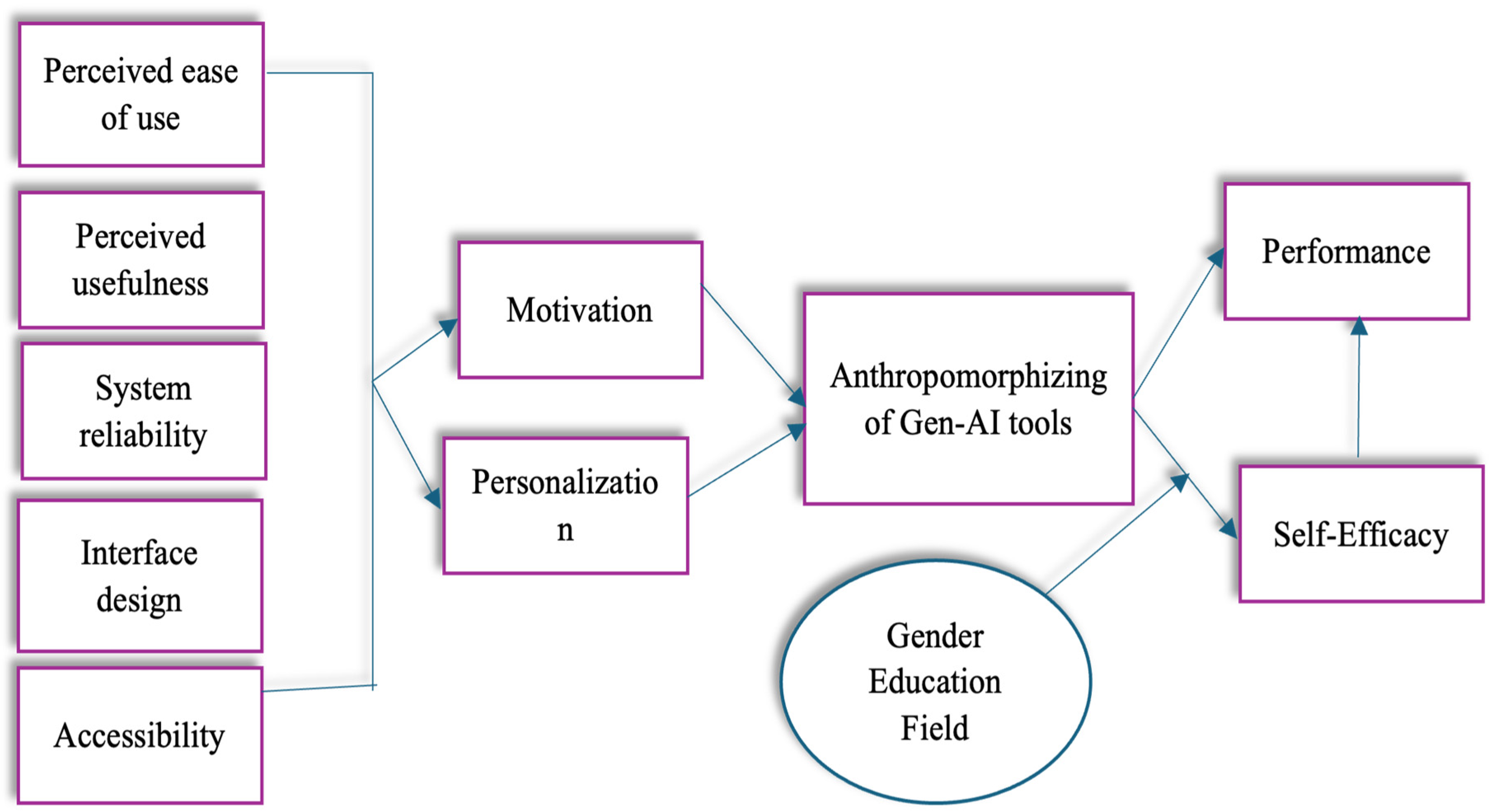
The proposed conceptual model attempts to establish a link between technical factors (perceived ease of use, perceived usefulness, system reliability, interface design, and accessibility) associated with the use of Gen-AI and behavioral factors. We propose that motivation and personalization are key immediate outcomes of technical factors associated with Gen-AI. Such an assertion is rooted in the framework postulated by [
29], which identifies task and interface as downstream technical factors leading to technology adoption. However, two key conceptual issues emerge. First, there is extensive evidence in educational settings regarding the contribution of personalization and motivation to outcomes. However, Gen-AI is not just another technology being used in an educational context, such as massive online open courses, LMS, and others. Evidence suggests that Gen-AI is a technology embedded within the educational system. This symbiosis between technology and education needs to be explained further. Thus, the literature highlights anthropomorphism as a key variable explaining the integration of Gen-AI into the education context. However, the determination of anthropomorphism raises a second concern: it is not solely the result of technical factors but is more strongly influenced by behavioral factors. Thus, before personalization and motivation mediate between outcomes (self-efficacy and behavior) and technical factors, the introduction of anthropomorphism provides a missing piece in the literature. Our assertions are based on the foundational theory of anthropomorphism, as conceptualized and postulated by [
25].
Beyond individual learning outcomes, generative AI systems, particularly large language models (LLMs), are increasingly integrated into higher education to support personalized learning and enhanced instructional practices. Understanding the behavioral mechanisms through which these systems influence students is therefore essential for guiding their effective application in educational environments. This study contributes by examining how the technological attributes of Gen-AI systems translate into motivational and academic performance outcomes.
Furthermore, as debates on the implications of Gen-AI continue in both policy and academic circles, the present study proposes and empirically examines a conceptual framework that explains how the technological attributes of Gen-AI influence student learning outcomes. Our research has employed theoretical insights from established theories and models, including the technology acceptance model [
18], motivation and personalization as key factors of technology [
29], and models explaining anthropomorphism in this context [
25]. From a technology acceptance standpoint, this study examines the technological factors and attributes (such as ease of use, usefulness, system reliability, accessibility, and interface design) that shape motivation, personalization, and anthropomorphism, ultimately affecting student self-efficacy and academic performance. The study uses data collected from university students in Saudi Arabia, providing empirical insights from a rapidly evolving higher education context where generative AI tools are increasingly adopted. This study contributes to the behavioral science literature by explaining how the technological attributes of generative AI influence students’ psychological and behavioral responses in higher education environments.
5. Discussions
The role of Gen-AI as an emerging technology has significantly influenced society, economics, and politics [
30]. Its growing adoption in education has introduced notable changes in instructional practices and learning processes [
35]. From ChatGPT being listed as a co-author on certain research papers to students and teachers using it intensively for their respective academic tasks [
123], its use presents radical changes in the educational landscape. Although traditional practices of writing essays and checking such essays are being considered obsolete in the age of Gen-AI, this has also given rise to new opportunities to further blur the interdisciplinary boundaries of science, technology, and innovation [
124]. Thus, educators from all over the world are arguing for strategies to develop methods for the responsible and effective use of Gen-AI technologies in the educational context [
125]. Our research, by complementing such arguments, problematizes the notion that the core of any technology use lies in the maximization of user utility, which, in our case, is theorized to be students’ academic performance and their self-efficacy. As researchers are calling for the effective use of Gen-AI by both students and other users, this research further emphasizes the effective features that any Gen-AI application (in general and in the context of education) should possess [
126]. These features include perceived ease of use, perceived usefulness, system reliability, interface design, and accessibility. Further, these features may not directly contribute to utility (in our case, performance and self-efficacy) but are mediated first by personalization and motivation, and second by anthropomorphism. This study’s evidence suggests that this interplay of features (such as perceived ease of use, perceived usefulness, system reliability, interface design, and accessibility), mediated by personalization, motivation, and anthropomorphism, is associated with the key outcome variables of self-efficacy and academic performance. This evidence clearly suggests that the use of Gen-AI in education has an impact on outcome and makes an attempt to build a further research and policy framework that calls for the responsible use of Gen-AI technology in education.
5.1. Motivation and Personalization
Previous studies have argued that both personalization and motivation are key behavioral determinants of continued use and perceived value in any product or technology [
127,
128]. Our research, by adopting these previous insights, further argues that as Gen-AI technology is radical in nature, further explanation and insight are necessary in this regard. As Gen-AI provides tailored and personalized solutions to students’ queries, it can maximize the perceived value, which we conceptualized in terms of (a) self-efficacy and (b) performance [
77]. On the other hand, motivation is also an important behavioral determinant. However, a key question that remains to be answered and understood regards both the quick and continued usage of Gen-AI. It can be argued that the depth and breadth of its use are continuously increasing every day. Motivation and personalization can provide an explanation for this, but this explanation faces a shortcoming. In this regard, we argue for the important role of anthropomorphism. However, before this aspect is discussed, we hypothesize that another important factor exists, rooted in the technological aspect of Gen-AI.
First, the current research hypothesized, based on established theoretical models such as the Technology Acceptance Model (TAM), that the perceived ease of use and perceived usefulness of Gen-AI products and solutions are associated with the development of personalization and motivation [
18]. The perceived ease of use concerns the degree to which users understand that Gen-AI can be effectively used with minimal effort. The presented evidence suggests that perceived ease of use is significantly associated with both motivation (β = 0.363,
p < 0.001) and personalization (β = 0.471,
p < 0.001). The significant and positive association between perceived ease of use and motivation indicates that students find Gen-AI systems simple and effortless to use, which reinforces their motivated to engage with and continue using them [
48]. Similarly, the strong association with personalization further indicates that Gen-AI not only instills motivation but also provides highly tailored use cases that lead students to obtain further benefits from its features [
49]. Similarly, the role of usefulness relates to the subjective feeling that a system is associated with better performance in educational tasks. Our results indicate that perceived usefulness, like ease of use, has a positive and significant association with motivation (β = 0.411,
p < 0.001) and personalization (β = 0.296,
p < 0.001). The association of perceived usefulness with motivation [
39,
40] and personalization [
37] implies that students develop an intrinsic belief that Gen-AI improves their performance in tasks, highlighting the practical benefits of the system, including personalized features.
Other key features that played an important role in determining the outcomes include system reliability, interface design, and accessibility. The model of motivation based on SDT, developed by [
29], guided this theorization. The present research results indicate that system reliability is also associated with student motivation (β = 0.346,
p < 0.001) by developing students’ confidence in Gen-AI’s consistent and accurate performance [
64]. Similarly, reliable Gen-AI system performance is also associated with the consistent personalized use of Gen-AI, leading to higher value (β = 0.369,
p < 0.001) [
63]. Furthermore, the current research also conceptualizes the role of interface design. The research observed that the minimalistic design of Gen-AI products such as ChatGPT, Claude, and others has a significant association with motivation (β = 0.267,
p < 0.001) [
55]. Similarly, this minimalistic interface design also contributed to and is associated with personalization (β = 0.60,
p < 0.001), in which students are able to ask questions tailored to their specific educational problems [
56]. Finally, the accessibility of a range of tools has been hypothesized to be associated with both motivation and personalization. Gen-AI is experiencing an expansion of its tools, including multimodal systems, and specifically applications tailored to education, science, and research. Their accessibility was also found to be positively associated with motivation (β = 0.372,
p < 0.001) and personalization (β = 0.325,
p < 0.001). This effect on motivation suggests that when Gen-AI systems are easy to access over time and across platforms, they encourage frequent and consistent use [
65]. Similarly, the influence on personalization indicates that better access enables users to more effectively benefit from personalized features and tailored responses [
70].
In conclusion, the responsible and effective use of Gen-AI systems appears to be associated with their key intrinsic features, which are conceptualized as endogenous constructs in this study, linked to motivation and personalization. The present study further suggests that Gen-AI tools differ from traditional information system tools, as they are powered by natural language understanding and generation technologies. These technological capabilities are associated with the long-desired trait of anthropomorphism, whereby technology is perceived as possessing human-like characteristics.
5.2. Anthropomorphism Findings
Anthropomorphism, in a technological context, refers to the process of perceiving technology to be human and a living object [
25]. Earlier technological products, such as smart homes, have been examined in similar contexts, with mixed findings. However, one distinguishing feature of Gen-AI lies in its ability to understand and generate human language [
129]. The core reason for focusing on anthropomorphism in our research is to postulate that the radical nature of Gen-AI (its natural language understanding and generation abilities) has led to a gap in which motivation and personalization alone may not explain the outcomes of the technology use. One core reason for this is that an innovation of Gen AI is that it is perceived as a human and life-like object. Thus, to fill this research gap, this study hypothesized and found that both motivation (β = 0.386,
p < 0.001) and personalization (β = 0.365,
p < 0.001) are positively and significantly associated with anthropomorphism. The results related to motivation suggest that higher levels of user motivation are linked with continued engagement with Gen-AI systems, alongside stronger perceptions of Gen-AI as a human-like and socially engaging entity [
87]. Similarly, the association with personalization indicates that more tailored and individualized interactions are related to stronger user perceptions of Gen-AI systems as human and life-like [
78]. These findings further support the theorization that the perceived human-like characteristics of Gen-AI, reflected through anthropomorphism, are associated with patterns of use that correspond with self-efficacy and student academic performance.
5.3. Outcomes of Usage: Self-Efficacy and Performance
The present research hypothesized and found that anthropomorphizing Gen-AI products and solutions is positively associated with self-efficacy (β = 0.239,
p < 0.055). The empirical evidence indicates that users’ perceptions of Gen-AI as human-like are linked with greater confidence in its ability to understand specific problems and generate tailored solutions. The application of solutions generated by Gen-AI products is similarly associated with higher levels of self-efficacy. These findings are consistent with a range of studies reporting associations between Gen-AI use and improved abilities in coding, solving math problems, and related tasks [
130,
131]. Thus, the present study contributes to the literature by providing additional evidence of a positive association with self-efficacy. Accordingly, as educational systems continue to evolve, Gen-AI, through its anthropomorphic characteristics, appears to be associated with the development of student self-efficacy.
Finally, this study also tested and found significant positive associations of anthropomorphizing Gen-AI products (β = 0.239,
p < 0.001) and self-efficacy (β = 0.722,
p < 0.001) with student academic performance. The results suggest that the perceived human-like characteristics of Gen-AI are linked with an increase in student academic performance, alongside greater engagement, confidence, and interaction with learning tasks [
101]. In addition, the findings indicate a strong positive association between self-efficacy (β = 0.722) and student academic performance. In this context, continued interaction with Gen-AI is associated with the resolution of problems often faced by students, and this resolution corresponds with improved academic performance [
97].
This research also assessed the moderating roles of Gen-AI tool types (p = 0.807), gender (p = 0.562), and education level (p = 0.539) in the relationship between anthropomorphizing AI tools and self-efficacy, based on prior arguments regarding differences in self-efficacy across gender, education level, and product types such as ChatGPT, Claude, and others. The non-significant results provide important insights. First, regarding Gen-AI tools, the findings suggest there are no meaningful differences across products in terms of their perceived features, particularly human-like characteristics. Second, despite the widespread accessibility of Gen-AI and its early-stage usage, gender and education level do not significantly moderate this association, indicating that these factors may not play a substantial role in how users engage with or experience Gen-AI.
5.4. Analysis of Mediation
The mediation analysis provides strong evidence that anthropomorphism serves as a central psychological mechanism through which system-related and user-related factors influence both self-efficacy and student performance. First of all, we found a significant indirect and mediating effect of technological attributes on anthropomorphism, with personalization and motivation as key mediators. Finally, anthropomorphism itself plays a significant mediating role in shaping outcomes. Our results show that anthropomorphism mediated the relationship between personalization and self-efficacy (β = 0.087, t = 2.472, p = 0.013), as well as the relationship between motivation and self-efficacy (β = 0.092, p = 0.006). Our results also show that anthropomorphism mediates the relationship between motivation (β = 0.092, p = 0.000) and personalization (β = 0.087, t = 4.399, p < 0.001) with student performance. Finally, we also observed the role of self-efficacy in mediating the relationship between anthropomorphism and student performance (β = 0.173, t = 2.874, p = 0.004). Overall, the findings confirm a robust sequential mediation mechanism in which system quality, usability, and motivational factors first enhance personalization and motivation, which then strengthen anthropomorphism, ultimately improving self-efficacy and student performance.
5.5. Moderation Analysis
Finally, our findings of moderation analysis revealed that gender, education level, and Gen-AI tool type did not significantly influence the association between anthropomorphism and student self-efficacy. These findings suggest that perceptions of human-like characteristics of Gen-AI tools and their association with self-efficacy appear relatively consistent across different user groups and tool categories. This lack of significant moderation may reflect the standardized interaction patterns and comparable capabilities of widely used Gen-AI systems. It also indicates that demographic and contextual differences may play a limited role in shaping how anthropomorphism relates to self-efficacy in educational settings. Overall, the results highlight the robustness of the observed association across gender, educational backgrounds, and Gen-AI tool types.
6. Conclusions
This study provides empirical evidence describing the associations between the technological attributes of generative artificial intelligence, particularly large language models (LLMs), and student motivation, personalization, anthropomorphism, self-efficacy, and academic performance. The findings indicate that perceived usefulness, ease of use, system reliability, accessibility, and interface design are significantly associated with motivation and personalization, which are further linked with anthropomorphic perceptions, self-efficacy, and student academic performance. The results underscore the importance of jointly considering technological attributes and behavioral mechanisms when integrating LLMs into higher education environments. Rather than viewing LLMs solely as content-generation tools, the findings position them as technologies associated with student engagement and academic outcomes through psychological and behavioral pathways. From a practical perspective, the study suggests that educational institutions may benefit from prioritizing system reliability, usability, and accessibility when implementing LLM applications. From a sustainable education perspective, the strategic integration of LLM technologies is associated with adaptive learning experiences, while also corresponding with sustained student engagement and academic development.
6.1. Limitation and Research Directions
This study has several limitations. First, the use of a cross-sectional survey design limits causal inference; future research could adopt longitudinal approaches to better examine the dynamic role of anthropomorphism in shaping self-efficacy and performance. Second, the sample was drawn from university students in Saudi Arabia; replication in different cultural and institutional contexts would improve generalizability. Third, future studies may explore additional technological or psychological constructs that influence motivation, personalization, and anthropomorphism in LLM-based learning environments. Fourth, we adopted the measurement instrument to measure the accessibility of Gen-AI from [
111]. They include ease of use as a key aspect of accessibility, which is theoretically justified. However, as we used ease of use separately as a key technological attribute, this measurement may have overlapped. Therefore, future studies should exercise caution when using accessibility together with ease of use, ensuring that the measurement instrument of accessibility is carefully checked and that aspects pertaining to ease of use are removed.
6.2. Theoretical Implications
This study contributes to theory in three ways, although the findings should be interpreted with appropriate caution. First, it extends the technology adoption research by showing that perceived usefulness and ease of use remain relevant in LLM-based learning environments, but their effects operate alongside motivational mechanisms grounded in Self-Determination Theory, particularly when supporting learners’ motivation and personalization. Second, the study incorporates anthropomorphism theory by demonstrating that human-like perceptions of LLMs can shape learning-related psychological processes, such as academic self-efficacy and performance, thereby moving beyond attitudinal explanations of AI use. Third, the findings highlight the importance of domain-specific system attributes in influencing the behavioral and motivational mechanisms within AI-supported learning, contributing to a more nuanced theoretical understanding of how technological characteristics interact with learner psychology in higher education contexts.
6.3. Practical Implications
The present research study contributes to both policy and practice in three different and significant ways. First, as our study finds that Gen-AI can contribute to student performance and self-efficacy, educators can integrate Gen-AI into courses in ways that promote personalization and enhance study-related motivation. Second, universities should prioritize the integration of reliable and accessible Gen-AI tools within institutional platforms to ensure consistent and equitable learning support. Third, course designers should establish clear guidelines for responsible AI use, encouraging students to engage critically with AI-generated outputs, rather than relying on them passively.