1. Introduction
By 2026, China’s economy is shifting from rapid expansion to a focus on higher-quality development, in line with the new development philosophy emphasizing innovation, coordination, green growth, openness, and shared benefits [
1]. In this context, county-level economies, serving as the foundational building blocks of the national economic structure, are critical engines of grassroots innovation, hubs of rural–urban integration, and primary arenas for policy implementation. County-level areas in China are characterized by vast territorial expanses and rich natural endowments, while also functioning as crucial bridges connecting urban centers with rural communities. These areas form the essential foundation for promoting China’s high-quality economic growth. There exists significant disparity among county economies across China [
2]. Jiangsu Province, leveraging its strategic position in the Yangtze River Delta, has developed outstanding county-level economic performance characterized by substantial scale, diverse growth paradigms (e.g., export-oriented, innovation-driven), and a tiered progression framework where Southern Jiangsu leads, Central Jiangsu advances, and Northern Jiangsu accelerates. Elite county clusters, with the “Southern Jiangsu Quartet” as a prime example, have become role models, positioning Jiangsu as an ideal case for investigating high-quality economic development.
The concept of “inclusive finance” was first formally proposed by the United Nations in 2005. With the rapid advancement of digital technologies, the innovative framework of “digital inclusive finance” emerged [
3]. Different from conventional financial inclusion methods, the digital version shifts away from brick-and-mortar branch networks toward digital platforms, thereby bypassing several obstacles in implementation. Digital inclusive finance demonstrates superior characteristics across five key dimensions: pricing mechanisms, product diversity, operational efficiency, service accessibility, and risk management [
4]. By removing geographical barriers, it attains broader coverage with lower costs, faster processing, and easier access for users. This approach successfully tackles obstacles including the lack of banking services for disadvantaged populations and funding difficulties for small businesses [
5]. This innovation not only fosters economic growth in less developed regions but also provides new perspectives for achieving higher-quality economic advancement in wealthier areas.
The impact of digital financial inclusion on fostering high-quality economic growth has been widely examined, with significant focus on geographical disparities. Within China’s context, digital inclusive finance typically contributes to enhanced economic performance, yet this influence varies among the eastern, central, and western regions. A distinct gradient emerges, with a progressive decline from eastern to western areas. Certain studies suggest that digital inclusive finance has a stronger positive effect on economic quality in eastern provinces [
6]. In contrast, other research argues that the central and western regions—where access to financial services falls below the national average—hold greater untapped potential, thereby making the beneficial impact even more substantial [
7]. Examining the operational pathways, multiple elements facilitate digital inclusive finance’s contribution to enhanced economic performance. These include the expansion of consumer spending among households [
8], advancements in technological capabilities [
9,
10], enhancements to entrepreneurial environments [
11], and transformations within industrial frameworks [
12,
13]. Each represents a distinct mechanism through which digital financial inclusion drives economic progress.
Consequently, prior research has established a robust foundation for investigating how digital financial inclusion influences the advancement of high-quality economic growth. This study offers three novel contributions. First, it detects both a favorable effect of digital inclusive finance on county-level economic development and a diminishing marginal returns phenomenon in Jiangsu and similarly developed areas. Second, it incorporates the urban–rural income ratio as a moderating variable, revealing the “double-edged sword” nature of income inequality. Third, it uses a Spatial Durbin Model to quantify spatial spillover effects, demonstrating that digital finance in one county benefits its neighbors. Together, these contributions advance the existing literature beyond linear, non-spatial, and single-mechanism frameworks. Nevertheless, three research gaps call for further exploration. First, there is limited empirical evidence regarding how digital inclusive finance influences high-quality economic development at the county level, especially in developed areas. Second, insufficient attention has been paid to the possible nonlinear and threshold effects that could shape this relationship within county economies. Third, beyond the direct local impact, little is known about the spatial spillover mechanisms through which digital finance affects neighboring counties. In light of these gaps, the present research specifically targets the county-level economies within Jiangsu Province, China. It comprehensively evaluates the direct impacts, intermediary pathways, regulatory factors, regional variations, and spatial spillover effects associated with digital financial inclusion’s role in economic development. The goal is to provide practical and specific recommendations for improving county-level development in Jiangsu Province and other similarly situated areas.
2. Theoretical Analysis and Research Hypotheses
2.1. Direct Effects
The integration of digital and traditional economic sectors has created new opportunities for county-level economic growth. Digital inclusive financial services, distinguished by their extensive reach, affordability, and operational efficiency, serve as a powerful catalyst for promoting sustainable economic advancement at the county level. One significant benefit is the enhancement of consumption patterns among county inhabitants. By offering innovative financial solutions like digital insurance policies and internet-based investment platforms, these services equip local populations with accessible and cost-effective instruments for financial security and wealth accumulation. Such tools empower individuals to make more informed decisions regarding their financial futures, decreasing the need for excessive precautionary savings and encouraging the allocation of present earnings toward immediate consumption and lifestyle improvements. This transformation yields multiple advantages. It not only boosts immediate spending capacity and consumption quality but also contributes to long-term economic stability. By fostering confidence in future financial security, digital finance helps transition county consumer markets from volatile short-term patterns to sustained, balanced growth. Such developments establish crucial groundwork for achieving comprehensive economic progress at the county level [
14].
The regional economy benefits significantly from digital financial inclusion in two key aspects. Firstly, it stimulates innovation and entrepreneurial activities at the county level. This innovative financial approach dramatically reduces financial barriers and initial capital requirements for business startups, making it possible for traditionally underserved populations—including agricultural workers, university graduates, and urban low-income individuals—to obtain essential startup funding and operational capital with greater ease. On the other hand, digital inclusive finance plays a crucial role in boosting overall societal investment in innovation and technological development. Through accurate alignment with the funding requirements of innovative SMEs, tech-savvy farmers, and independent researchers, it effectively drives technological advancements, product improvements, and business model evolution, consequently enhancing the internal drivers for sustainable economic growth in county-level regions [
15]. These observations lead to the formulation of Hypothesis 1.
Hypothesis 1.
The advancement of digital financial inclusion contributes to enhancing the quality-driven growth of county-level economies within Jiangsu Province, China.
2.2. Threshold Effect
Due to its affordability and extensive reach, digital inclusive finance enables the cross-regional distribution of financial resources and technological advancements, thereby promoting economic transformation towards superior quality growth. Nevertheless, the true extent and effectiveness of this mechanism depend not only on its intrinsic features but are also fundamentally limited by the pre-existing structural conditions of the locality. These structural factors encompass infrastructure quality, accumulated human capital, governance frameworks, and the general phase of economic progress, among other critical determinants. Collectively, these components form the external operational environment for digital inclusive finance, with its influence being distinctly shaped and restricted based on regional developmental disparities. In regions lacking robust digital foundations, challenges like poor internet accessibility, limited adoption of mobile devices, and insufficient data processing capabilities emerge as significant barriers. The availability and effectiveness of digital financial services are significantly constrained by inadequate data gathering and analysis capacities. Consequently, the absorption of financial resources and technological advantages becomes challenging, hindering their conversion into tangible advantages. This situation ultimately restricts digital inclusive finance from achieving its complete potential in promoting widespread financial participation. On the other hand, areas with advanced digital systems have already experienced the initial “pioneering advantages” and coverage benefits of digital inclusive finance, leading to a plateau in its impact. At this phase, service approaches tend to become uniform and platform-oriented. To sustain economic expansion, more sophisticated and tailored financial innovations are required, along with stronger connections with industrial networks. As a result, the stimulating influence of digital inclusive finance on economic progress gradually diminishes. The preceding discussion leads to the formulation of Hypothesis 2.
Hypothesis 2.
The development of digital inclusive finance demonstrates a nonlinear relationship with Jiangsu Province’s economic advancement, showing distinct threshold characteristics in its impact on high-quality economic growth.
2.3. Mediating Effect
Emerging as an innovative model that integrates conventional financial services with cutting-edge digital solutions, inclusive digital finance effectively overcomes spatial and operational constraints to direct financial capital with accuracy and efficiency toward the foundation of county-level economic frameworks. This transformative approach to resource distribution stimulates comprehensive improvements in rural industrial configurations, thereby serving as a crucial catalyst for advancing the quality-driven growth of county economies. Structural enhancement in industries generally manifests through two primary pathways: Initially, through the elevation of industrial hierarchy, characterized by increased specialization and enhanced workforce productivity; Secondly, the evolution of industrial structure manifests through the increasing dominance of service industries and the accelerated transition to a service-driven economic model. This structural transformation marks a departure from conventional extensive growth strategies, which were characterized by excessive energy use and poor productivity, toward a more sophisticated development paradigm emphasizing innovation, balanced coordination, environmental sustainability, global integration, and shared prosperity. Fundamentally, industrial upgrading embodies a shift from quantitative growth fueled by resource inputs to qualitative advancement propelled by specialized labor efficiency and technological breakthroughs. It also signifies the movement from a manufacturing-based economy focused on physical goods to a knowledge-intensive economy prioritizing service enhancement and intellectual innovation. Digital inclusive finance plays a pivotal role in enabling this metamorphosis by streamlining capital allocation and information exchange, thereby driving significant progress in both aforementioned aspects of economic transformation.
The transformation of financial resource accessibility into economic growth excellence ultimately contributes to superior economic advancement. Building upon the preceding examination, Hypothesis 3 is formulated as follows:
Hypothesis 3.
Digital financial inclusion facilitates the enhancement of county-level economic performance in Jiangsu Province, China through industrial structure optimization.
2.4. Moderating Effect
The substantial and enduring income disparity between urban and rural areas continues to pose significant challenges to achieving sustainable economic growth in China’s county-level regions. While digital financial inclusion has demonstrated potential in addressing this problem through improved labor market efficiency [
16] and by fostering innovative business activities [
17], its effectiveness in stimulating comprehensive economic advancement at the county level faces notable limitations. Several factors contribute to this situation. In areas with pronounced income inequality, the adoption of digital financial services among rural populations is constrained by both financial constraints and limited technological proficiency, which collectively reduce both the practical ability and willingness to engage with such financial instruments. This situation inevitably restricts the widespread adoption and accessibility of inclusive digital finance solutions. Furthermore, the income gap frequently coexists with significant disparities in essential infrastructure, educational opportunities, and economic structures between urban and rural settings. These structural differences tend to channel digital financial resources toward urban centers, creating barriers to their productive deployment in rural economic activities. Consequently, the potential benefits of these financial innovations for rural development are significantly diminished. The capacity to enhance the restructuring of industrial sectors at the county level and bolster innovative endeavors is significantly influenced by digital financial inclusion. Additionally, substantial income disparities constrain the purchasing power and investment potential of rural populations, diminishing the ability of digital financial services to address internal economic disparities within counties and promote equitable development. As a result, the potential of digital financial inclusion to serve as a catalyst for robust economic progress remains partially unrealized. This discussion leads to the formulation of Hypothesis 4.
Hypothesis 4.
The expanding disparity in urban–rural incomes diminishes the positive impact of digital financial inclusion on fostering sustainable economic advancement in Jiangsu Province’s county-level economies.
2.5. Spatial Effects
The foundational principle of geographical science, often referred to as the First Law, posits that all entities demonstrate interconnectedness, with proximity strengthening these relationships. This theoretical framework finds empirical validation in the spatially varied impacts of digital financial inclusion on county-level economic advancement. Rather than operating in isolated regional cycles, digital inclusive finance functions as an effective conduit, facilitating the organized transfer of capital, digital innovations, and entrepreneurial energy through financial service networks from more developed core areas to adjacent counties. This phenomenon represents a multifaceted mechanism encompassing knowledge diffusion, pattern emulation, and network expansion. In essence, although areas experiencing accelerated digital financial inclusion growth primarily benefit their own economic progress, their inherently inclusive characteristics tend to initially draw populations from surrounding regions who were previously underserved by conventional financial systems. The financial sector experiences negative impacts, which consequently hampers the economic progress of adjacent areas [
18]. Nevertheless, in certain advanced regions, well-established platforms, technological infrastructure, and operational frameworks can efficiently utilize robust network externalities with minimal expenditure. This facilitates considerable enhancement of industrial growth and financial inclusion in nearby counties, creating notable spatial diffusion benefits. Consequently, a development model emerges where “core areas stimulate growth while surrounding regions gain advantages.” Building upon this examination, Hypothesis 5 is formulated.
Hypothesis 5. Digital inclusive finance demonstrates spatial influence in promoting the superior economic growth of Jiangsu Province, China.
3. Data Description and Model Specification
3.1. Variable Description
In contemporary academic research, two predominant methodologies are utilized for assessing high-quality economic development. The initial approach involves developing a unidimensional evaluation framework centered exclusively on total factor productivity as the quantitative benchmark [
19]. Alternatively, scholars frequently adopt a more comprehensive strategy by formulating multi-faceted indicator systems. Considering that high-quality economic development represents a holistic concept with diverse aspects that closely correspond to the fundamental principles of the New Development Concept, the majority of research efforts have focused on creating multi-dimensional evaluation frameworks. These frameworks typically incorporate the five key elements of the New Development Concept: innovation, balanced development, environmental sustainability, international integration, and equitable distribution [
20,
21,
22]. Building upon this foundation, as detailed in
Table 1, the current study employs the entropy weighting technique to evaluate the quality of economic development across county-level administrative units in Jiangsu Province, analyzing performance within these five critical dimensions.
- 2.
Explanatory Variable: Digital Financial Inclusion Level (IFI)
Considering the authoritative status and directional significance of Peking University’s Digital Financial Inclusion Index across various administrative levels in China, this study employs the standardized total index (divided by 100) as the primary independent variable.
- 3.
Mediating Variable: Industrial Structure Upgrading (IS)
The transformation of industrial structures represents the continuous shift in economic resources from conventional sectors—marked by limited value creation and substantial energy demands—toward contemporary industries that demonstrate superior value addition, technological sophistication, and innovation-based expansion. Inclusive digital finance facilitates this transition by improving the effectiveness of resource distribution, whereas industrial structure advancement constitutes both the fundamental essence and principal mechanism for achieving superior economic growth. This measurement is quantified through the proportion of service sector output relative to manufacturing sector output, with higher values reflecting more advanced industrial configurations.
- 4.
Moderating Variable: Urban–Rural Income Gap (URI)
Prior studies indicate that the influence of digital financial inclusion on economic advancement quality exhibits substantial regional variations [
23]. The earnings disparity between urban and rural areas serves as a crucial indicator of economic equilibrium and societal inclusivity, accurately mirroring a region’s developmental progress. This study quantifies this disparity through the proportion of urban to rural residents’ disposable income per capita, with greater values signifying more pronounced income inequality between urban and rural populations.
- 5.
Control Variables
The impact of digital financial inclusion on economic development quality is influenced by various determinants. Drawing upon existing studies [
24,
25,
26], this research incorporates several control variables including Economic Expansion (Gro), Market Scale (MS), Capital Allocation Efficiency (Inv), Foreign Investment Reliance (FDI), and Government Revenue Dependency (Fin).
For measurement purposes: Economic Expansion (Gro) utilizes the regional GDP index scaled down by a factor of 100; Market Scale (MS) employs the logarithmic transformation of population density figures; Capital Allocation Efficiency (Inv) calculates the quotient of regional GDP divided by financial institutions’ year-end loan balances; Foreign Investment Reliance (FDI) derives from the proportion of actual foreign capital utilization relative to regional GDP; and Government Revenue Dependency (Fin) measures the share of general public budget revenue in regional GDP. The statistical characteristics of these variables are detailed in
Table 2.
3.2. Data Sources
Examining the evolution of county-level administrative boundaries in Jiangsu Province during the last ten years, along with variations in functional roles, statistical methodologies, and economic compositions between urban districts and county-level units (including county-level municipalities), this study utilizes panel data covering 40 county-level administrative units in Jiangsu from 2016 through 2023. The assessment of high-quality economic growth employs a comprehensive evaluation framework based on contemporary development theories. The measurement of digital financial inclusion relies on the Digital Financial Inclusion Index developed by Peking University (covering 2014–2023). Additional variable data were sourced from the EPS database and multiple editions of Jiangsu’s statistical yearbooks. Gaps in the dataset were filled using linear estimation techniques, with statistical analysis conducted using Stata 15 software. No missing values exist for any of the key variables, and all statistical analyses were performed using Stata 15.
3.3. Model Specification
To verify the robustness of the model, diagnostic checks were conducted.
Table 3 demonstrates that the probability values for both the F-statistic and Hausman’s test are significantly lower than the 0.05 threshold, resulting in the null hypotheses being dismissed and establishing the suitability of the fixed effects specification.
Consequently, a dual fixed effects framework is employed to examine the immediate impact of digital financial inclusion on the advanced economic growth of county-level regions in Jiangsu.
represents the level of high-quality development of the county economy; represents the level of digital inclusive finance; are the control variables; is the constant term; and are the coefficients to be estimated; represents the individual fixed effects; represents the time fixed effects; is the random error term; i indexes counties (county-level cities) (1 ≤ i ≤ 40), and t indexes years (1 ≤ t ≤ 8). The error term is assumed to follow an independent and identical distribution with a mean of zero and constant variance σ2, i.e., ~N (0, σ2). To address potential within-cluster correlation, this study uses standard errors clustered at the county level in all regressions.
- 2.
Threshold Effect Model
To analyze the nonlinear relationship between digital inclusive finance and the advancement of county-level economies in Jiangsu, a threshold regression model is established. The threshold variable is identical to the core explanatory variable—digital inclusive finance (IFI)—so that the impact of IFI on county economic development can vary once IFI itself surpasses an unknown threshold value π.
represents the indicator function; represents the threshold value to be estimated; is the constant term; , , and are coefficients to be estimated; the other variables are the same as those in Model (1). The existence and number of thresholds are tested via bootstrap with 1000 replications.
- 3.
Mediation Effect Model
A mediation model is developed to explore how industrial structure transformation mediates the relationship between digital financial inclusion and economic progress at the county level in Jiangsu.
represents the mediating variable, namely the level of industrial structure upgrading; and are constant terms; and are coefficients to be estimated; the other variables are consistent with those in Model (1). To formally test the indirect effect, we apply a bootstrap routine with 1000 replications and bias-corrected confidence intervals. The mediation proportion is reported together with the total, direct, and indirect effects.
- 4.
Moderating Effect Model
To investigate the moderating role of income disparities between urban and rural areas in shaping the influence of digital financial inclusion on the economic advancement of county-level regions in Jiangsu, the study employs a moderation analysis framework.
represents the moderating variable, namely the urban–rural income gap; is the constant term; and are the coefficients to be estimated; and the definitions of the other variables are consistent with those in Model (1). Before creating the interaction term, we mean-centered IFI and URI to reduce multicollinearity and facilitate interpretation. Simple slopes were computed at one standard deviation above and below the mean of URI to illustrate the moderating effect.
4. Empirical Testing and Result Analysis
4.1. Benchmark Regression Analysis
An initial examination was performed to assess potential relationships between the dependent and independent variables while preventing analytical distortions from multicollinearity. The correlation analysis revealed a strong positive association between digital financial inclusion indicators and county-level economic advancement metrics, as evidenced in
Table 4 and
Table 5. Additionally, diagnostic checks confirmed the absence of multicollinearity concerns, with all variance inflation factor measurements substantially under the threshold of 5, thereby validating the suitability of proceeding with subsequent statistical evaluations.
The findings presented in
Table 6 demonstrate the immediate impact of digital financial inclusion on economic performance at the county level in Jiangsu Province. As evidenced in both specifications (1) and (2), the positive relationship between digital inclusive finance and superior county-level economic growth remains statistically significant (
p < 0.05), irrespective of control variable inclusion. These results confirm that digital financial services significantly contribute to enhanced economic performance in Jiangsu’s counties, validating our initial hypothesis. The underlying mechanism appears to be that digital financial solutions, characterized by their accessibility, affordability, and operational efficiency, effectively address the geographical limitations and credit barriers inherent in conventional financial systems. Consequently, this activates small-scale economic actors, improves the distribution of resources, and encourages innovative activities, thereby generating essential drivers for sustainable economic advancement.
A closer examination of the control variables indicates that multiple factors play crucial roles in fostering superior economic performance at the county level. Investment efficiency, reliance on foreign capital, and fiscal dependency all demonstrate significant positive correlations with regional economic advancement. Notably, the influence of foreign investment dependence emerges as particularly pronounced. This phenomenon likely stems from Jiangsu province’s distinctive “Sunan development paradigm,” where extensive participation in international production networks allows foreign capital to deliver comprehensive benefits beyond mere financial inputs. Such benefits encompass technological diffusion, advanced management practices, and export-driven expansion, collectively propelling industrial transformation, urban development, and economic prosperity in county regions. This creates a dynamic development cycle characterized by technology acquisition, assimilation, and subsequent innovation.
4.2. Threshold Effect Analysis
The data presented in
Table 7 reveal that among all tested models, solely the single-threshold specification demonstrates statistical significance with a
p-value under the 0.05 threshold. This finding confirms the existence of a single threshold phenomenon in how digital financial inclusion influences the advancement of county-level economic quality within Jiangsu Province. Subsequent analysis, detailed in
Table 8, quantifies this threshold effect by determining its precise value (1.0184) and establishing its 95% confidence boundaries. The narrow range of these confidence limits indicates robust identification of the threshold parameter.
The regression analysis incorporated the threshold parameter to evaluate nonlinear relationships.
Table 9 demonstrates that digital financial inclusion exhibits a statistically significant positive correlation (
p < 0.01) with county-level economic advancement in Jiangsu. The analysis reveals an interesting pattern where the economic benefits display decreasing marginal returns: the growth impact proves more substantial during initial stages of digital financial development, gradually weakening as the threshold value is surpassed. When the threshold is surpassed, the positive influence persists, though its intensity weakens, thereby confirming Hypothesis 2. This phenomenon could stem from digital financial inclusion’s capacity to swiftly address service deficiencies and stimulate fundamental economic components in underdeveloped regions like Northern Jiangsu. Conversely, in more advanced areas such as Southern Jiangsu, the developmental impact transitions from quantitative expansion to qualitative enhancement, necessitating sophisticated systemic reforms and industrial transformation for synergistic advancement, resulting in diminishing marginal returns.
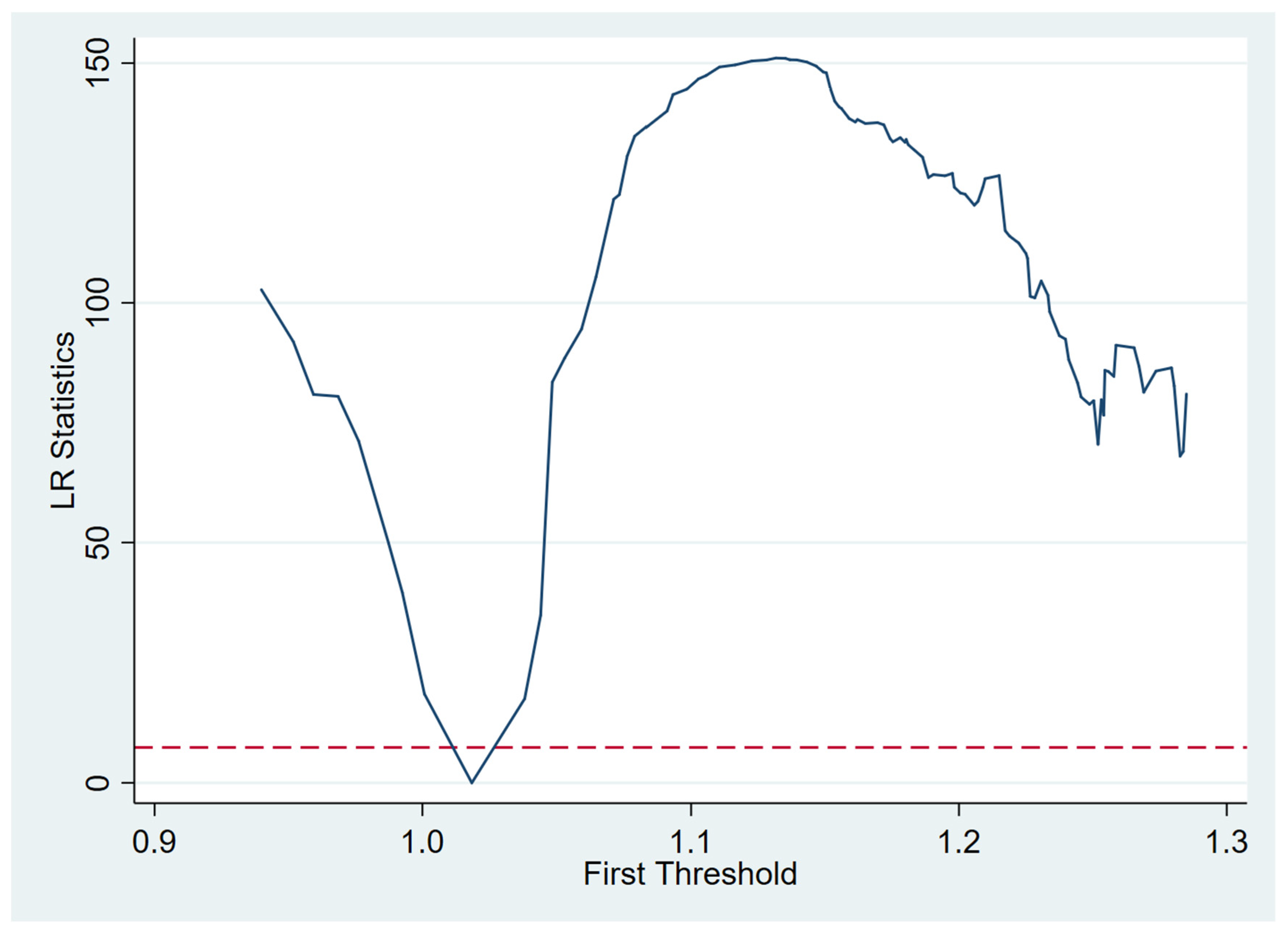
To further validate the estimated threshold, we plot the likelihood ratio (LR) statistics against the candidate threshold values. As depicted in
Figure 1, the LR curve attains its minimum at the estimated threshold of 1.0184, where the LR value approaches zero. The horizontal dashed line indicates the 5% critical value of 7.3523. The LR statistic at the threshold point lies well below this critical line, and the confidence interval—derived from the intersection of the LR curve with the critical line—is narrowly centered around the estimated threshold. This graphical evidence confirms that the threshold is both statistically significant and precisely estimated, supporting the nonlinear pattern reported in
Table 9.
4.3. Mediation Effect Analysis
Because industrial structure upgrading encompasses multiple dimensions, a composite index was developed to capture it more fully. Following the entropy-based composite index method recommended in the literature [
27], this study built an entropy-based measure of industrial structure upgrading using three dimensions—advancement, rationalization, and factor synergy—with six secondary indicators (see
Table 10). The formula for the Theil index is presented below:
where
denote the primary, secondary, and tertiary industries respectively;
denotes the value added of industry
;
denotes the total regional GDP (sum of
over the three industries);
denotes the employment (number of persons) in industry
;
denotes the total regional employment (sum of
).
A three-step mediation analysis was subsequently performed. As reported in
Table 11, Step 1 shows that the core independent variable (IFI) has a significant positive effect on the dependent variable (Dev), with a coefficient of 0.244 (
p < 0.05). Step 2 reveals that IFI also positively affects the mediator (IS), yielding a coefficient of 0.405 (
p < 0.05). In Step 3, when both IFI and IS are entered together, the IFI coefficient drops to 0.198 (
p < 0.05), while the coefficient for IS is significantly positive at 0.114 (
p < 0.01). These findings suggest that IS partially mediates the relationship between IFI and Dev, and that the indirect effect is statistically significant.
Finally, a bootstrap test with 500 replications was performed to examine the indirect effect. As shown in
Table 12, using the entropy-based measure of industrial structure upgrading, the indirect effect was 0.069, with a 95% bias-corrected confidence interval of [0.023, 0.116] that excludes zero (
p = 0.004). The direct effect was 0.384 (
p < 0.001), and the total effect was 0.452 (
p < 0.001), indicating a significant partial mediation. To check the robustness of this finding, we re-measured the mediator using principal component analysis (PCA) and repeated the bootstrap procedure. The indirect effect remained positive and significant (0.033, 95% CI [0.008, 0.059],
p = 0.010), while the direct effect (0.418) and total effect (0.452) stayed largely unchanged. These results confirm that the mediating role of industrial structure upgrading is not driven by any particular measurement approach.
To summarize, the adoption of digital financial inclusion plays a significant role in enhancing the economic growth quality across Jiangsu’s county-level regions partially through its impact on industrial structure upgrading, which is one supported channel among possibly multiple mechanisms, thereby validating Hypothesis 3. This phenomenon can be attributed to how digital financial inclusion facilitates the evolution of Jiangsu’s county-level industrial systems toward technologically advanced, environmentally sustainable, and high-value-added sectors by improving resource distribution efficiency and reducing service access barriers. Such structural transformation represents a plausible mechanism through which regional economies achieve improvements in overall productivity, strengthened economic resilience, and long-term viability, consequently driving superior economic performance at the county level. Other potential channels are left for future research.
4.4. Moderation Effect Analysis
The theoretical framework demonstrates that widening disparities between urban and rural incomes diminish the positive influence of digital financial inclusion on advancing the economic progress of county-level regions in Jiangsu, China. As shown in
Table 13’s moderation analysis, digital financial inclusion exhibits a strong positive correlation (significant at 1%) with superior county economic performance, whereas the urban–rural income disparity shows a marked negative association (significant at 1%). The negative coefficient of their interaction (significant at 5%) further confirms that income inequality between urban and rural areas adversely affects how digital financial inclusion contributes to county economic advancement in Jiangsu. A more subtle explanation involves the “digital divide”: even in a relatively wealthy province such as Jiangsu, rural inhabitants often encounter limitations in digital infrastructure, financial literacy, and smart device access, which restrict their capacity to gain from digital inclusive finance. As a result, the growth of digital finance may disproportionately benefit urban areas, thereby widening—rather than closing—the urban–rural income gap. This dual-edged effect implies that without well-designed policies to close the digital divide, the favorable influence of digital finance on county economies may be considerably undermined by persistent income inequality. These findings provide empirical support for Hypothesis 4.
4.5. Heterogeneity Analysis
Given that the empirical analysis focuses on only 40 county-level units in Jiangsu—a relatively developed province—from 2016 to 2023, we performed a regional heterogeneity analysis by explicitly comparing subsamples from Southern (Sunan), Central (Suzhong), and Northern (Subei) Jiangsu. This allows us to examine whether the impact of digital financial inclusion differs across areas within the same province. Due to notable variations in economic scale, sectoral composition, and policy frameworks across the southern, central, and northern regions of Jiangsu Province, the study categorized the sample into these three zones to examine regional disparities in how digital financial inclusion affects county-level economic advancement. As illustrated in
Table 14, digital inclusive finance demonstrates a substantial positive effect on economic progress in northern Jiangsu’s counties, whereas its influence remains statistically insignificant in the southern and central regions. This heterogeneous pattern suggests that the significant positive impact of digital financial inclusion is not uniform across Jiangsu; it mainly comes from the less-developed Subei region, whereas no significant effects are observed in Sunan or Suzhong. Therefore, the role of digital finance in county-level development in Jiangsu should be understood with consideration of the province’s internal regional differences. This phenomenon likely stems from the economic maturity of southern and central Jiangsu, where conventional financial infrastructures are robust and service availability is already high. Consequently, the incremental benefits provided by digital financial inclusion as a complementary enhancement appear comparatively modest, resulting in negligible observable effects on comprehensive economic growth. By contrast, northern Jiangsu’s relative economic underdevelopment creates greater potential for digital financial solutions to make measurable improvements. The region exhibits relatively underdeveloped financial infrastructure compared to other areas, where conventional financial services may have limited reach and accessibility. Consequently, digital inclusive financial solutions can efficiently address the deficiencies of traditional banking systems, substantially contributing to enhanced economic performance.
- 2.
Heterogeneity Analysis of Modernization Level
The degree of modernization serves as a fundamental indicator for assessing a region’s progress and overall growth compared to conventional social structures, playing a crucial role in examining the differential effects of digital financial inclusion on the superior growth of county-level economies. The “Jiangsu County Modernization Development Level Report (2024)” conducts a thorough assessment of counties (incorporating county-administered cities) within Jiangsu Province, evaluating them through five key aspects: innovative dynamism, living standards, environmental sustainability, coordinated distribution, and protective stability. Accordingly, the leading ten county-level municipalities (Jiangyin, Yixing, Liyang, Changshu, Zhangjiagang, Kunshan, Taicang, Qidong, Yangzhong and Jingjiang) are classified into a cluster denoting advanced modernization status, whereas the other counties constitute a separate group reflecting less developed modernization conditions.
The data presented in
Table 15 reveal that digital financial inclusion exerts a markedly positive influence on regions characterized by lower modernization indices, while its impact remains statistically insignificant in more developed areas. This phenomenon can be attributed to the fact that underdeveloped counties primarily face constraints stemming from inadequate access to fundamental financial services due to historical deficiencies in conventional banking systems. Digital financial inclusion successfully addresses these structural gaps, thereby unlocking considerable developmental opportunities. Conversely, in highly modernized regions, the primary constraints have evolved into shortages of specialized, high-risk investment capital and sophisticated financial instruments that demand tailored solutions and comprehensive ecosystem coordination. The existing standardized approach of digital financial inclusion, designed for mass accessibility, proves inadequate in addressing these advanced requirements, consequently diminishing its effectiveness in such contexts.
6. Spatial Effects of Digital Inclusive Finance on the High-Quality Economic Development of Counties in Jiangsu Province, China
6.1. Spatiotemporal Evolution Pattern of Digital Inclusive Finance and High-Quality Economic Development in Jiangsu Province, China
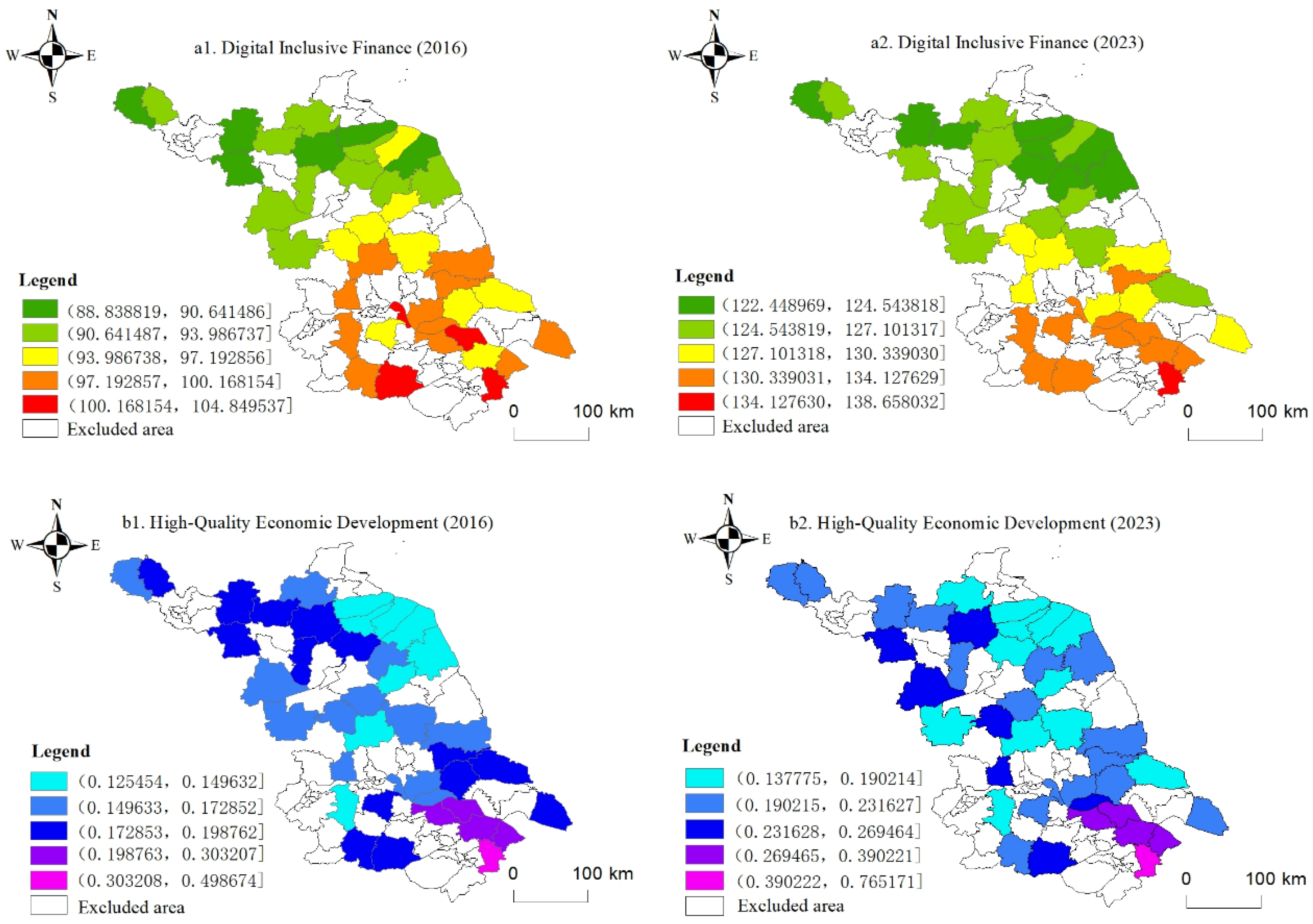
This research investigates the spatial and temporal dynamics of digital financial inclusion and quality economic growth across Jiangsu’s county-level regions. The analysis utilizes two key datasets: Peking University’s Digital Financial Inclusion Index and a county-specific economic development quality index for Jiangsu, both derived through entropy-weighted methodology. Spatial visualization and examination were conducted for 40 selected county-level administrative units (comprising counties and county-level cities) using ArcMap 10.8 software.
Figure 3 presents the progression of digital financial inclusion and superior economic growth across Jiangsu Province, China between 2016 and 2023. During this seven-year period, substantial advancements were observed in both financial technology accessibility and economic performance metrics. Notably, digital financial services demonstrated consistent and considerable expansion throughout the duration. Concurrently, economic development quality exhibited substantial overall enhancement while simultaneously revealing increasing regional disparities-the notable expansion of higher-value zones clearly demonstrates growing spatial differentiation in economic advancement patterns, with developmental momentum showing tendencies toward geographical concentration.
- 2.
Local Spatial Clustering Analysis of Digital Inclusive Finance and High-Quality Economic Development in Jiangsu Province, China
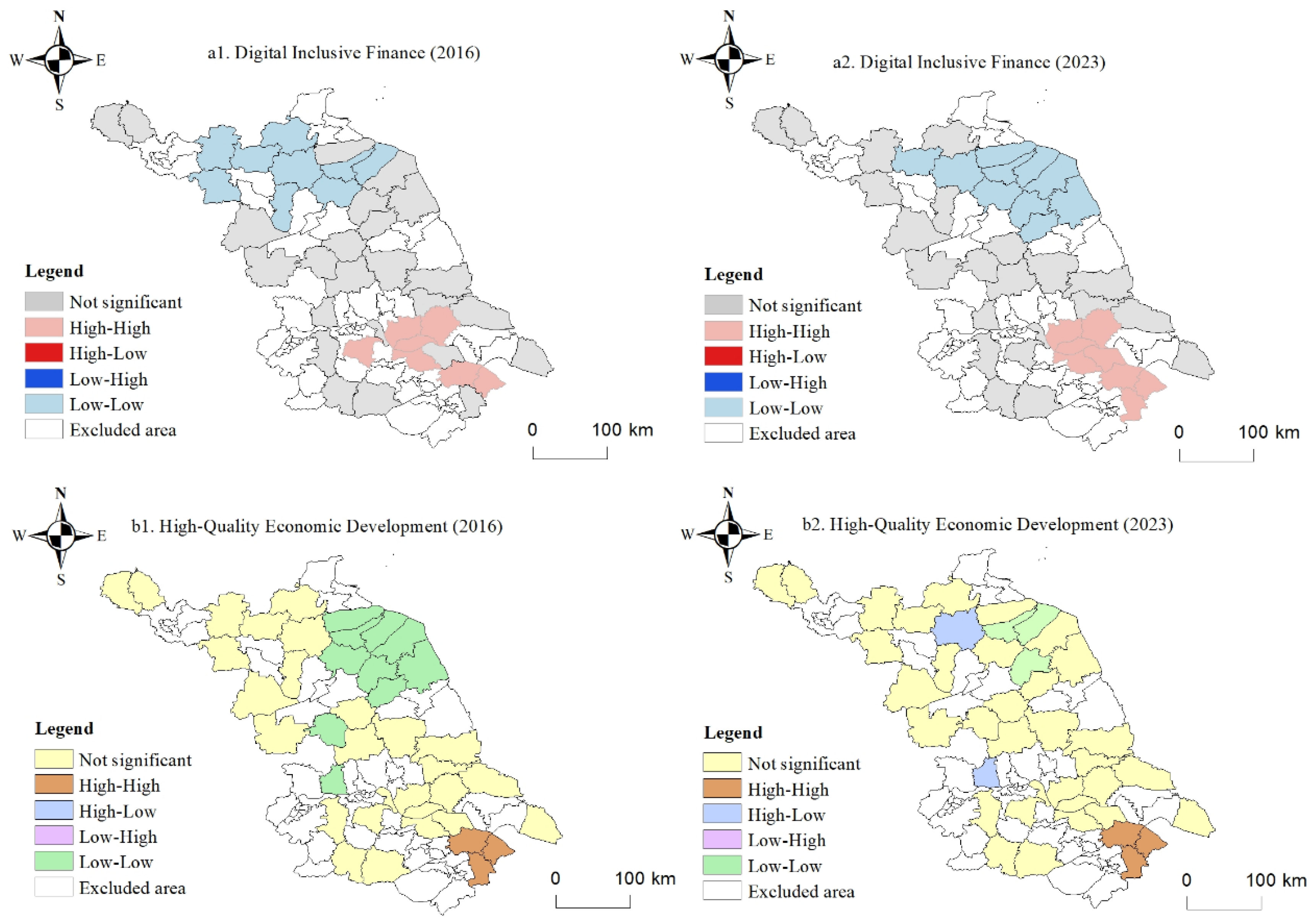
The spatial autocorrelation results presented in
Figure 4 demonstrate the geographical distribution patterns of digital financial inclusion and advanced economic growth across counties in Jiangsu Province during 2016 and 2023. When examining the spatial patterns at fixed time points, a distinct core-periphery configuration emerges for both indicators: regions with superior performance in digital financial services and economic development predominantly coincide, maintaining stable concentrations in southern Jiangsu and the Yangtze River corridor, thereby establishing a robust economic hub. Conversely, areas with inferior performance primarily cluster in certain northern Jiangsu regions, displaying spatial trap characteristics. From a temporal evolution viewpoint, the high-performance clusters of digital financial inclusion have exhibited noticeable spatial expansion and integration tendencies throughout the eight-year observation period, suggesting strengthened spillover effects and developmental influence on neighboring regions. Similarly, the high-performance clusters of advanced economic growth have maintained consistent spatial expansion patterns. The spatial distribution patterns exhibit a strong tendency toward geographical proximity, with their coverage areas closely aligning with regions where digital financial inclusion demonstrates elevated values. This observation provides direct empirical evidence supporting the spatial facilitation role of inclusive digital finance in fostering superior economic growth.
- 3.
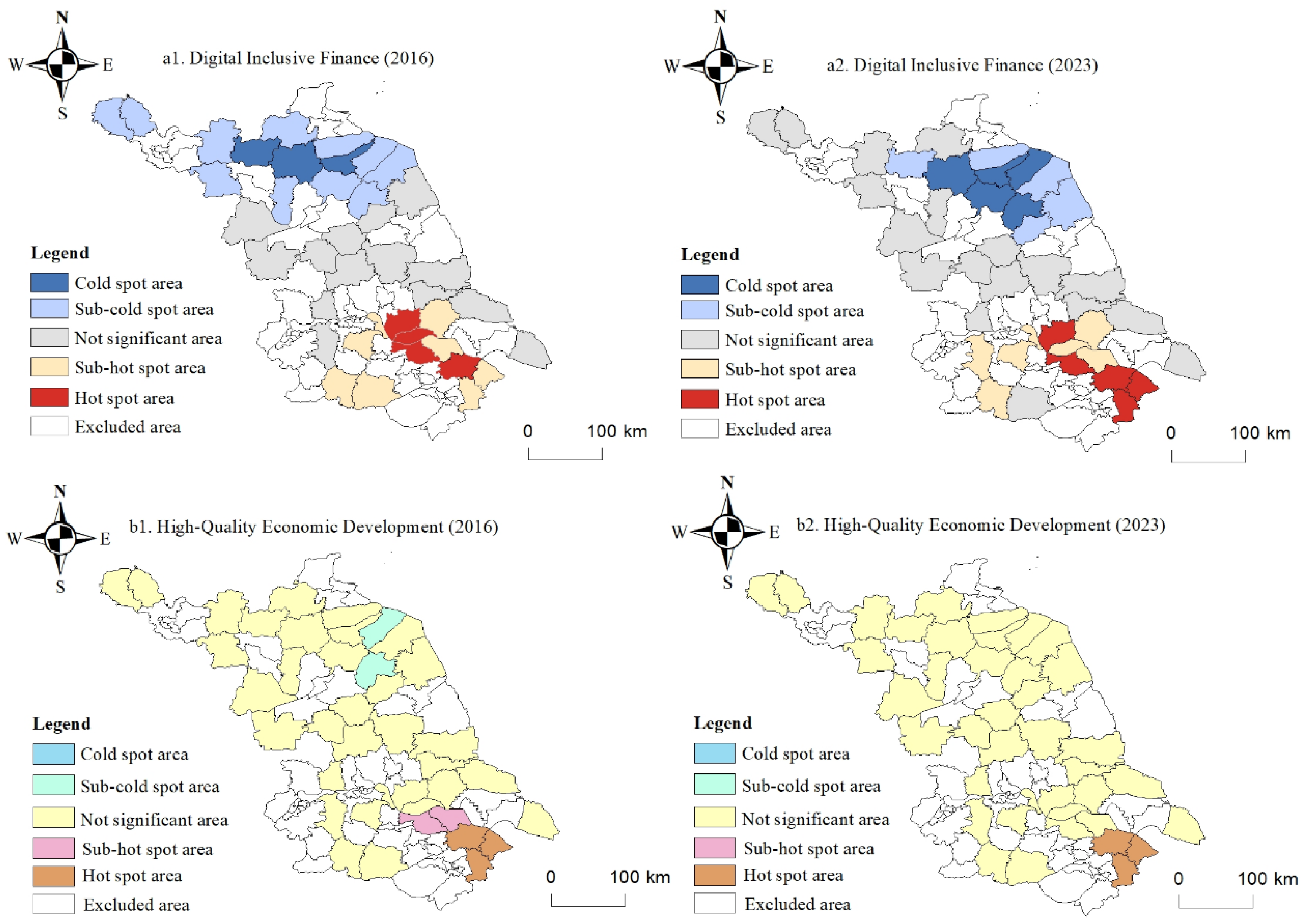
Hot Spot and Cold Spot Analysis of Digital Inclusive Finance and High-Quality Economic Development in Jiangsu Province, China
The spatial distribution analysis presented in
Figure 5 reveals a persistent “north-south divide” between digital financial inclusion and advanced economic growth across Jiangsu’s county-level regions during 2016–2023. When examining the static distribution, the southern districts and Yangtze River corridor maintain consistent clustering as high-intensity zones where these two development indicators converge, establishing a dominant concentration of superior performance. Conversely, the majority of northern Jiangsu territories persistently demonstrate low-intensity characteristics, reflecting comparatively weaker developmental capacities. Regarding temporal changes, the high-intensity zones of digital financial inclusion display spatial expansion and intensity reinforcement throughout the eight-year span, with notable progression toward central Jiangsu, suggesting an increasingly potent influence on adjacent areas. The spatial configuration of high-quality economic development hotspots, nevertheless, has shown consistent patterns with only slight variations. The significant geographical correlation between areas exhibiting high and low values for both indicators offers clear visual confirmation of their interconnectedness and mutual reinforcement. This spatial interdependence between digital financial services and advanced economic growth implies that existing regional inequalities could potentially intensify as a consequence of unequal access to digital infrastructure and capabilities.
6.2. Spatial Model Specification
Before conducting spatial effect analysis, the study employs the global Moran’s I index to assess spatial autocorrelation patterns in digital financial inclusion and county-level economic advancement. Given the research scope is limited to 40 county-level administrative units in Jiangsu Province, China, an inverse distance weighting matrix is adopted as the spatial weighting scheme. This approach better accounts for cross-regional interactions and spillover effects, particularly regarding resource mobility, among non-contiguous geographical areas. The mathematical formulations for both the global Moran’s I statistic and the inverse distance weighting matrix are presented below.
, ; represents the spatial weight matrix; represents the observed values of the county (county-level city); represents the total number of observed counties (county-level cities); refers to the county (or county-level city) (); indicates the distance between the centroids of the two regions. The remaining variables are consistent with those in Model (1). For ease of interpretation, we row-standardize the inverse distance matrix so that each row sums to one.
- 2.
Spatial Econometric Model
Previous research indicates that digital financial inclusion [
31] and superior economic growth [
32] demonstrate notable geographical interdependence among various areas. Consequently, this study employs spatial econometric techniques to examine the geographical impacts of inclusive digital finance on county-level economic advancement. The fundamental formulation can be expressed as:
represents the spatial autocorrelation coefficient of the dependent variable; represents the estimated coefficient of the independent variables; refers to the spatial autocorrelation coefficient of the independent variables; is the spatial error term; indicates the spatial autocorrelation coefficient of the disturbance terms. The remaining variables are consistent with those in Model (1). When and , the model becomes the Spatial Error Model (SEM); when and , it becomes the Spatial Lag Model (SAR); when , it becomes the Spatial Durbin Model (SDM).
To choose the appropriate spatial model, we carry out several diagnostic checks. First, we conduct Lagrange Multiplier (LM) tests for the SAR and SEM specifications, along with their robust versions. Second, we apply the Likelihood Ratio (LR) test to see whether the SDM can be reduced to SAR or SEM. Third, the Hausman test helps decide between fixed effects and random effects; an LR test further checks for time-period fixed effects. Given the relatively small number of spatial units, we also report bias-corrected standard errors for the direct, indirect, and total effects derived from the SDM decomposition. Specifically, the average direct effect measures the influence of IFI in county i on Dev within the same county, while the average indirect (spillover) effect captures the impact of IFI in county i on Dev in neighboring counties.
6.3. Spatial Regression Results
Prior to performing spatial regression analysis, preliminary examinations must be carried out to assess the spatial dependence among variables and determine the most suitable modeling approach. As demonstrated in
Table 20, the calculated Moran’s I indices for digital financial inclusion and quality economic growth exhibit statistically significant positive values at the 99% confidence interval, confirming the presence of spatial interdependence. The outcomes of model specification tests are displayed in
Table 21. Through comprehensive evaluation using Lagrange Multiplier (LM) tests, Hausman specification tests, and Likelihood Ratio (LR) tests, the spatial Durbin model incorporating dual fixed effects emerges as the most appropriate framework for investigating how digital financial inclusion influences the quality-driven economic progress across county-level regions in Jiangsu Province.
Table 22 displays the geographical impacts of digital financial inclusion on county-level economic advancement in Jiangsu Province, China. The first column reveals a statistically significant positive correlation (at the 10% significance level) between digital financial services and regional economic progress. The second column demonstrates that neighboring areas’ digital financial inclusion shows a highly significant positive influence (at the 1% level) on local economic growth through spatial spillover effects. However, the third column shows no significant spatial autocorrelation for county economic development, suggesting Jiangsu’s county economies do not demonstrate substantial self-referential spatial patterns. The notable Moran’s I values presented in
Table 16 confirm the pronounced spatial diffusion effects of digital financial inclusion.
The analysis of spatial effects presented in columns (5) to (7) demonstrates that digital financial inclusion’s influence on county-level economic advancement in Jiangsu exhibits distinct regional patterns. While its direct effect within local jurisdictions remains statistically negligible, the technology produces significant positive externalities that benefit neighboring regions. This spatial diffusion mechanism ultimately creates a pronounced aggregate impact, providing empirical validation for Hypothesis 5 regarding the geographical distribution of financial technology’s developmental benefits.
The observed results can be attributed to the inherent characteristics of digital inclusive finance, which fundamentally represents financial services facilitated by technological advancements. This system inherently demonstrates network effects and geographical permeability. Firstly, the establishment and application of digital financial systems frequently extend beyond jurisdictional limits. Both individuals and businesses in adjacent regions gain immediate advantages by easily accessing sophisticated digital financial solutions from nearby areas, thus experiencing direct positive impacts from external financial resource diffusion. Additionally, digital inclusive finance enhances regional resource allocation effectiveness through multiple mechanisms: facilitating technology transfer, improving information circulation speed, and minimizing transactional expenses. These efficiency gains first emerge at the broader regional level before cascading down to benefit individual counties, creating secondary spatial diffusion impacts that significantly surpass the primary local benefits. The expansion of inclusive financial services can stimulate the emergence of innovative business frameworks and consumer markets at a regional level, with advantages extending to all areas within the economic zone rather than remaining concentrated in specific development locations. As a result, its role in promoting high-quality economic growth is marked by cross-regional cooperative effects, not by localized impacts confined to specific geographic areas.
6.4. Robustness Checks for Spatial Regression
Table 23 shows that the robustness checks confirm the stability of the spatial regression results under different specifications. When bootstrap correction is applied to standard errors, the indirect and total effects of the core variable (IFI) remain positive and statistically significant (indirect: 1.574,
p < 0.05; total: 1.728,
p < 0.05), aligning with the original estimates. Using the alternative queen contiguity weight matrix, IFI’s indirect and total effects are also positive and significant (indirect: 0.411,
p < 0.01; total: 0.492,
p < 0.01), though the magnitudes differ. Other key variables exhibit broadly similar patterns. Hence, the sign and significance of the spillover effects are not driven by the choice of spatial weight matrix or the bootstrap standard error correction, confirming the robustness of our spatial regression findings. Nevertheless, given the modest number of spatial units, results should be interpreted cautiously. The consistency across alternative specifications nevertheless strengthens confidence in our main conclusions.
7. Conclusions and Recommendations
7.1. Summary of Core Findings
This study analyzes empirical data from 40 county-level administrative units in Jiangsu Province covering the period 2016–2023, investigating the multifaceted relationship between digital financial inclusion and county-level economic advancement. As is shown in
Table 24, the research explores direct impacts, intermediary mechanisms, regulatory factors, regional variations, and spatial spillover effects. Key findings reveal: (1) Digital financial inclusion demonstrates a statistically significant positive correlation with economic progress at the county level in Jiangsu. (2) The developmental influence displays nonlinear patterns across different phases, characterized by progressively decreasing marginal returns. (3) Industrial structure optimization serves as a crucial transmission channel through which digital financial inclusion stimulates county economic growth. (4) The beneficial effects are weakened when income disparities between urban and rural areas become more pronounced. (5) The economic enhancement effects of digital financial inclusion exhibit distinct spatial distribution patterns across Jiangsu’s county regions.
The economic landscape of Jiangsu Province demonstrates notable regional disparities in its response to digital financial inclusion. Research findings reveal that less developed regions with lower modernization levels experience substantial economic benefits from digital financial services, whereas more advanced areas show minimal responsiveness. Additionally, spatial analysis indicates a pronounced clustering pattern for both digital financial inclusion and high-quality economic growth across the province. While the direct local influence of digital financial services on county-level economic advancement appears limited, these services create significant positive spillover effects that benefit neighboring regions economically.
7.2. Limitations and Future Research
Upon examining these findings and taking into account the real-world circumstances of county-level economies in Jiangsu Province, several actionable strategies are put forward to enhance the quality-driven growth of such economies both within the province and across the country. First, to harness spatial spillover effects, an inter-county digital finance cooperation mechanism should be established. This includes setting up regional hubs for inclusive digital financial services to direct resources from high-concentration areas toward neighboring underdeveloped counties, thereby turning spatial proximity into a driver of shared growth. Second, a region-specific empowerment strategy is needed. In more developed counties, policies should focus on linking digital finance with technological innovation, high-end manufacturing, and modern services to promote industrial upgrading and efficiency gains. In less developed counties, priority should be given to strengthening digital infrastructure, improving digital literacy, and expanding basic inclusive payment and credit services so as to reduce the digital divide and broaden service coverage. Furthermore, a flexible evaluation system is required to enable a timely shift from quantitative expansion to qualitative improvement when diminishing returns become evident in particular regions. Third, deeper integration between digital financial services and specialized industrial sectors is essential. To close the urban–rural digital and economic gaps, digital financial resources should be aligned with each county’s key industries and supply chains, allowing customized credit and supply chain financing products that directly support industrial transformation. Complementary initiatives—such as rural digital literacy programs and income-boosting measures for farmers—should also be introduced to ensure that rural populations and small- and micro-enterprises can effectively benefit, thereby reducing disparities and reinforcing long-term inclusive growth.
This research presents certain constraints and potential directions for subsequent investigation. First, the geographic scope limited to Jiangsu Province and sample size is 40 county-level units constrain the generalizability of our findings to other regions with different economic structures and development stages. Future work should expand the sample to include provinces at various development levels and employ larger datasets to validate and extend our conclusions. Second, although this study identifies industrial structure upgrading as an intermediary mechanism and provides initial evidence of spatial spillover effects, a more thorough investigation of the concurrent underlying mechanisms and the exact channels of spatial spillover remains lacking. Subsequent research should rigorously examine how digital financial inclusion generates spillovers—for example, through factor mobility (capital, labor, technology), information sharing, industrial chain linkages, or knowledge diffusion. Advanced spatial econometric models could be applied to decompose direct and indirect effects and to identify threshold effects or heterogeneous spillover patterns across different regional settings. Such exploration of mechanisms and spatial pathways will enhance theoretical rigor and policy precision.