Article

Spatiotemporal Change in Winter-Flooded Paddies Reduces CH4-Associated Climate Footprint in China’s Sichuan Basin


Engineering Research Center of Biomass Materials, Ministry of Education, College of Life Sciences and Agri-Forestry, Southwest University of Science and Technology, Mianyang 621010, China
*
Author to whom correspondence should be addressed.
These authors contributed equally to this work.
Sustainability 2026, 18(11), 5754; https://doi.org/10.3390/su18115754 (registering DOI)
Submission received: 31 March 2026 / Revised: 18 May 2026 / Accepted: 20 May 2026 / Published: 5 June 2026

Abstract

As the second most important anthropogenic greenhouse gas (GHG), methane (CH4) has received wide attention in the mitigation of global climate change. China’s Sichuan Basin has been identified as one of the world’s hotspot regions with very high CH4 emission intensity. Winter-flooded paddies are considered as potential significant sources of CH4 emissions among various cropping systems in Sichuan. However, current studies are limited to the field scale, and there is a lack of research conducted over a large spatiotemporal scale. Here, we simulated CH4 emissions from 1980 to 2023 at region scale using the Denitrification–Decomposition (DNDC) model and evaluated the associated climate impact using the radiative forcing-based climate footprint (RFCF) metric. We found that CH4 emissions have recently decreased, from 0.53 billion tonnes in 2019 to 0.28 billion tonnes in 2023, representing a 47.20% reduction. Moreover, the climate footprint peaked in 2019 at 1.25 mW m−2 and decreased to 1.08 mW m−2 in 2023, and the system achieved net zero increase in radiative forcing (RF) in 2020. This means that Sichuan’s winter-flooded paddies no longer contribute to the additional RF in the atmospheric system. Overall, our findings demonstrate that the reduction in CH4 emissions from winter-flooded paddies has been mainly attributed to a reduction in the cropping area and a decrease in average temperature during the rice growth season. These results provide a scientific basis for region-specific CH4 mitigation policies and demonstrate how these spatiotemporal changes in CH4 emissions from winter-flooded paddies in Sichuan can support sustainable agriculture.

1. Introduction

Global warming is becoming increasingly severe. The global average temperature has increased by approximately 1.1 °C from 1850–1900 to 2011–2020, primarily due to greenhouse gas (GHG) emissions from human activities [1]. The Emissions Gap Report 2024, released by the United Nations Environment Programme (UNEP), warns that current actions and policies are projected to result in a global temperature increase of 2.6 to 3.1 °C by the end of this century [2], which conflicts with the ambition of the Paris Agreement to limit global warming. Methane (CH4) is a significant GHG that plays a major role in global warming [3,4]. According to the World Meteorological Organization (WMO), the global concentration of CH4 reached 1934 ppb in 2023, a level that is 265% of pre-industrial levels [5]. Although the atmospheric concentration of CH4 is much lower than that of CO2, it has a higher global warming potential (GWP) and a shorter atmospheric lifetime [1]. Therefore, effectively controlling its emissions can slow the rate of global warming more rapidly compared with controlling long-lived GHGs like CO2 [6,7].
China’s Sichuan Basin has been identified as a hotspot region of CH4 emissions. Satellite observations from the Copernicus Climate Change Service indicated a rising trend in CH4 concentrations over Sichuan, with levels increasing from 1773 ppbv in 2003 to 1868 ppbv in 2018 [8]. Su et al. [9] measured CH4 emissions from rice–fallow (flooded), rice–rapeseed, and maize–wheat cropping systems at field scale, revealing that the rice–fallow system exhibited the highest global warming potential. Consequently, winter-flooded paddies are recognized as significant contributors to CH4 emissions from cropping systems in Sichuan [9,10,11]. Winter-flooded paddies are typical cropping systems in the region, which are characterized by flooding the field during winter fallow periods after the rice harvest to conserve water for the following season. This practice differs from conventional single-cropping rice fields, which are typically drained after harvest. However, over the past decades, the total area of rice paddy fields has decreased from approximately 0.67 million hectares in the early 1990s to around 0.33 million hectares in 2023 [12]. This decrease is primarily attributable to the conversion of winter-flooded paddies to more economically viable and water-conserving rice–upland rotations (e.g., rice–wheat, rice–rapeseed), as continuous winter flooding leads to substantial CH4 emissions without productive land use during the fallow period. Furthermore, there have been significant changes in cultivation management practices, such as rice varieties, straw returning rates, irrigation and nutrient applications [13]. These changes might substantially impact the CH4 emissions from winter-flooded paddies in the Sichuan Basin.
CH4 emissions from winter-flooded paddies can be estimated by three methods (tiers) according to the Intergovernmental Panel on Climate Change (IPCC) [14]. The Tier 1 method estimates CH4 emissions by applying default IPCC emission factors, while the Tier 2 method uses region-specific factors for a more localized assessment. The more precise IPCC Tier 3 method relies on process-based models or in situ measurements to calculate emissions. Many studies use the Tier 1 and Tier 2 methods to estimate CH4 emissions in paddy systems [15,16,17,18]. However, neither of the two methods accurately reflects the influence of local climate, soil, and management practices on CH4 emissions [19]. In-situ measurement methods have a higher level of certainty, but collecting a sufficient number of field observations at a large spatial scale is economically infeasible. Moreover, such in situ measurements cannot adequately reflect temporal dynamics or variations in management practices [20]. Considering the limitation of the mentioned methods, it is necessary to use process-based models to estimate CH4 emissions at a large spatiotemporal scale, such as the Denitrification–Decomposition (DNDC) model, the DAYCENT model, and the CENTURY model [21,22,23,24]. Among them, the DNDC model simulates carbon and nitrogen biogeochemical cycles through interacting modules, including soil climate, plant growth, decomposition, nitrification, denitrification, and fermentation [25]. Input parameters required by the model include climate data, soil properties, and agricultural management practices. Previous studies have shown that the DNDC model has been widely used to examine the potential impacts of management and climate change on agriculture, with effective applications in paddy ecosystems [25,26].
Numerous indicators have been used to evaluate how GHG emissions affect global warming [6]. Among them, the global warming potential (GWP) is a commonly used metric, defined as the time-integrated radiative forcing (RF) of a pulse emission of a given GHG relative to that of CO2, over a specific time horizon (e.g., 20, 100, or 500 years) [1]. A critical limitation of this approach is that the relative importance of different GHGs varies significantly with the chosen time horizon [6,27,28,29]. For example, the 20-year GWP (GWP20) metric establishes equivalence based on cumulative RF over a future 20-year time horizon. The relative importance of different GHGs changes when alternative time horizons or different equivalence criteria are used [6,28,29]. To overcome the shortages of the metric of GWP, a new method named the radiative forcing-based climate footprint (RFCF) has been developed [30]. Built upon the same IPCC-derived equations as the 100-year GWP (GWP100), the RFCF integrates RF from both current and historical emissions, thereby enabling transparent alignment with long-term climate stabilization targets [30]. Furthermore, previous studies indicate that the RFCF metric can estimate RF mitigations and indicate the pathways to reach climate neutrality [30,31,32,33,34,35].
However, beyond quantifying emissions, it remains unclear whether the observed reduction in CH4 from winter-flooded paddies contributes to climate stabilization and aligns with broader agricultural sustainability goals. To date, no study has evaluated whether winter-flooded paddies in a major rice-growing region has reached a net zero increase in radiative forcing. Furthermore, the spatiotemporal drivers of such a transition, specifically the interplay between cropping area reduction, temperature trends, and management changes, have not been resolved at regional scale.
Therefore, this study aims to (i) simulate CH4 emissions from winter-flooded paddies in the Sichuan Basin over decades, (ii) assess their impact on climate change, and (iii) identify the key drivers of emission changes and discuss their implications for sustainable agricultural policy. To achieve these aims, we applied the DNDC model to simulate CH4 emissions from winter-flooded paddies in the Sichuan Basin for 1980–2023, investigated key drivers through a sensitivity analysis, and used the RFCF metric to evaluate the climate footprint. Our findings inform actions to stabilize the contribution of winter-flooded paddies to global radiative forcing.

2. Materials and Methods

2.1. Study Area

China’s Sichuan Basin is located in southwest China, spanning latitudes 26°03′–34°19′ N and longitudes 97°21′–108°33′ E (Figure S1). Winter-flooded paddies are typical cropping systems in the region, where rice is commonly transplanted in May and harvested in September. Sichuan experiences a subtropical monsoon climate. During the rice growth season, the average temperature ranges from 23 to 25 °C, with maximum and minimum temperatures of 26–29 °C and 19–20 °C, respectively (Table S1).

2.2. Validation Data

The DNDC model has been validated using numerous field observation datasets from various regions across China [36,37]. Although the model is continually being improved, it requires recalibration and validation for specific environments. Therefore, we conducted comprehensive literature searches in both the China National Knowledge Infrastructure (CNKI) and Web of Science. The search terms included “rice”, “methane” (or “CH4” or “greenhouse gas”), and “Sichuan” (or “southwest”). A total of 246 papers published up to December 2023 were collected. The inclusion criteria were as follows: (1) CH4 emissions were measured in field experiments using static chambers combined with gas chromatography, (2) complete monitoring of CH4 fluxes throughout the entire rice growth season, (3) documented geographical coordinates of the experimental sites, and (4) detailed records of field management practices. Following this screening, 23 observation datasets met all criteria and were selected for final analysis (Table S2).
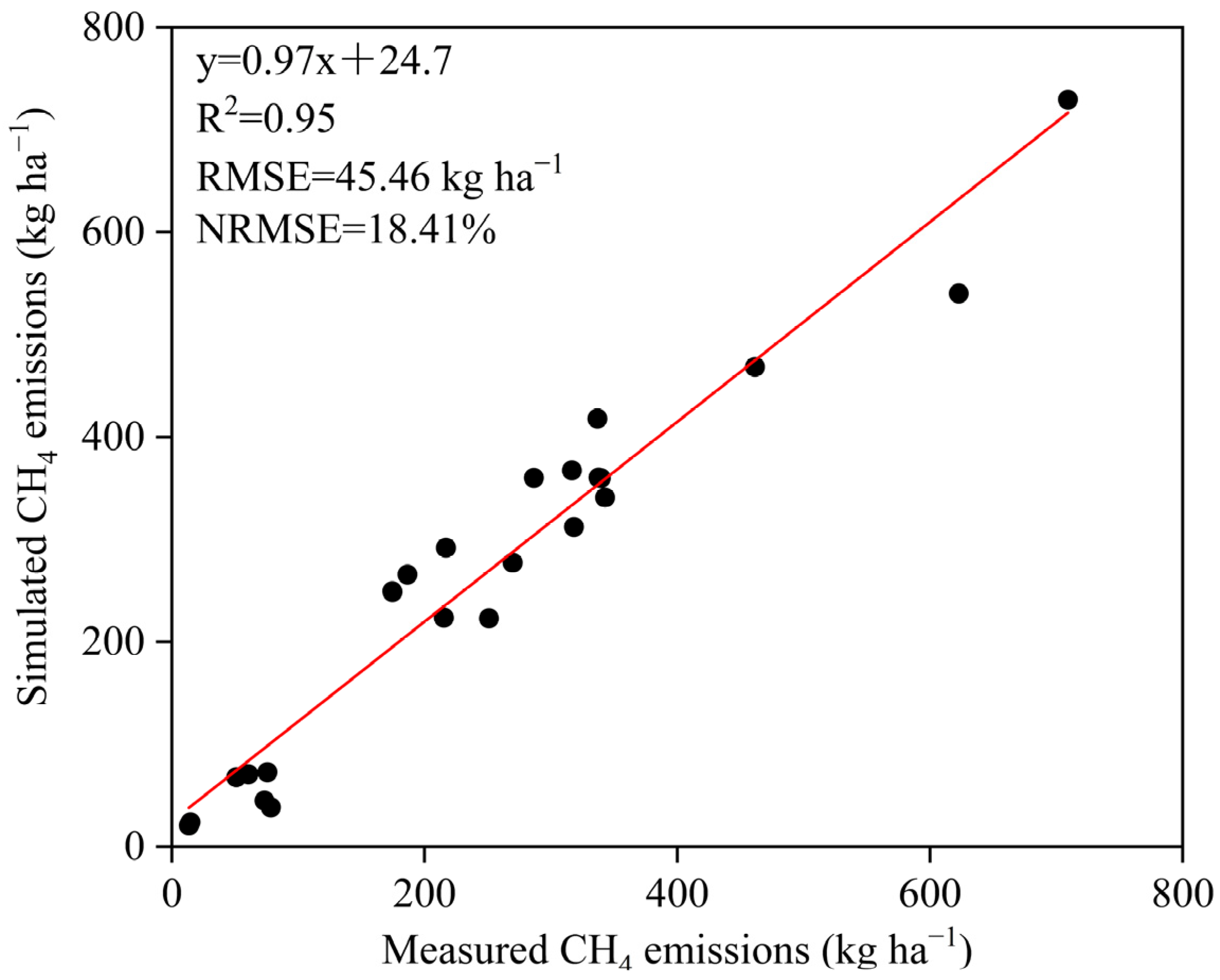
Model accuracies were evaluated on the basis of the coefficient of determination (R2), root mean square error (RMSE), and normalized RMSE (NRMSE). A scatter plot was generated to visualize the agreement between simulated and measured values. The mathematical expressions for the metrics are as shown in Equations (1)–(3).
R 2 = n x y x y 2 / n x 2 x 2 n y 2 y 2
R M S E = [ y x 2 / n ] 0.5
N R M S E = y x 2 / n 0.5 / M m e a n × 100 %
where x is the observed value, y is the simulated value, n is the number of measured values, and Mmean is the average of the measured values. An R2 value closer to 1 indicates a stronger correlation between the simulations and observations. The RMSE quantifies the model prediction error, with smaller values denoting better performance. Similarly, a lower NRMSE value indicates better model predictive performance.

2.3. Input Data

The climate data from 38 meteorological stations across Sichuan during 1980–2023, including daily observations of precipitation, maximum temperature, and minimum temperature, were obtained from the National Meteorological Information Center (NMIC; http://data.cma.cn). The soil data were obtained from the Harmonized World Soil Database v2.0 (HWSD) [38], including soil organic carbon (SOC), pH, clay content, and bulk density. The database provides these properties for both the topsoil (0–30 cm) and subsoil (30–100 cm) layers at a spatial resolution of 1 km. In this study, only the topsoil data were applied.
The national raster datasets of rice harvest area were obtained from the Spatial Production Allocation Model (SPAM-China), which provides 5 arc-minute raster maps in 1980, 1990, 2000, 2010, and 2020 based on county-level harvest area statistics [39]. To obtain an annual raster map of the rice harvest area in Sichuan for the period 1980–2023, we rescaled the SPAM dataset by using the annual provincial statistics of the rice harvest area from 1980 to 2023 following the method from Huang et al. [40]. The data of the rice area for Sichuan province were obtained from the National Bureau of Statistics of China (NBSC). However, as SPAM-China does not distinguish between different rice cropping systems, this information was supplemented with annual 500 m MODIS-based maps from Qiu et al. [41], which classified systems such as single paddy rice, double rice, and other double-cropping systems. Single paddy rice in the study corresponds to the winter-flooded paddy system under focus in this study. As the study only presented the annual datasets during 2015–2021, we developed raster maps of winter-flooded paddy for the decades of the 1980s, 1990s, 2000s, and 2010s based on the 2015 dataset, while the map for the 2020s was based on the 2021 dataset. Crop parameters, including sowing dates and harvest dates, were also obtained from the NMIC. Growth season for each year was calculated based on the sowing and harvest dates. Typical rice varieties from the 1980s to the 2020s were selected, and the maximum yield for each decade was calculated to assess the impact of varietal replacement (Table S3).
In the studied region, rice seedlings were transplanted into the fields in mid-May and harvested in late August or early September [10]. Data on straw returning rates were sourced from Liu [42], with gaps for missing decades filled using data from adjacent decades or regions. The provincial N fertilizer application rates were obtained from the National Agricultural Costs and Returns Compilation. Missing data were estimated using the method introduced by Yu et al. [43]. Since urea and ammonium bicarbonate are commonly applied synthetic nitrogen fertilizers in paddy rice, these were selected to represent synthetic nitrogen fertilizer inputs in the DNDC model. The application of fertilizers followed a schedule based on farmers’ practices.

2.4. Sensitivity Analysis

This study employed the embedded sensitivity analysis of the DNDC model to evaluate the impact of input parameters on the simulation results. The analyzed input parameters included air temperature, precipitation, soil clay content, bulk density, SOC content, soil pH, maximum yield, straw return, and fertilizer amount. Each selected parameter was run 200 times by randomly varying its value within a range of ±25% while keeping the others constant. The influence of parameter variation on the simulated results was measured using a sensitivity index (S) [44], which is calculated as follows
S = O m a x O m i n / O a v g I m a x I m i n / I a v g
where Imax, Imin, and Iavg are the maximum, minimum, and average values of the input parameters, respectively; Omax, Omin, and Oavg are the corresponding maximum, minimum, and average values of the simulated outputs. A positive S value indicates a positive correlation between the parameter and the model output, while a negative value indicates a negative correlation. The absolute value of S reflects the magnitude of the parameter’s influence.

2.5. Pre-Processing and Post-Processing of Spatial Data

To facilitate the efficient application of the DNDC model at a large Spatiotemporal scale, we followed the pre-processing and post-processing approach of Huang et al. [45]. Finally, we identified 670 unique response grid units from the total of 633,004 primary grid units. The approach achieved a significant improvement in the simulation efficiency of the DNDC model by identifying unique response grid units.

2.6. Assessment of Climate Footprint

The radiative forcing-based climate footprint (RFCF) metric was applied to quantify the climate impact of CH4 emissions, expressing the result in milliwatts per square meter (mW m−2). The annual climate footprint, here referred to RFCFCH4_total, quantifies the contribution of current and historical emissions to global radiative forcing and was calculated as follows:
R F C F C H 4 _ t o t a l = R F C F C H 4 _ h i s t o r i c a l + R F C F C H 4 _ c u r r e n t
The RFCFCH4_historical and RFCFCH4_current were calculated using Equation (6)
R F C F C H 4 _ h i s t o r i c a l   o r   R F C F C H 4 _ c u r r e n t = R F C H 4 × E C H 4
where RFCH4 (mW m−2 kg−1) associated with a pulse emission over 100 years was obtained from Luo et al. [31], ECH4 (kg) is the emission amount of CH4. The CO2 equivalent (CO2eq) emissions based on the 100-year global warming potential (GWP100) metric were also calculated for comparison, and were calculated using the following equation
C O 2 e q = E C H 4 × G W P 100
where the GWP100 value for CH4 is 28, which was obtained from the IPCC 6th Assessment Report.

3. Results and Discussion

3.1. DNDC Model Validation

Observed CH4 emissions from prior studies were applied to evaluate the performance of the DNDC model in the Sichuan Basin. We found that the R2 between simulated and measured CH4 emissions was 0.95 (n = 24), the RMSE was 45.46 kg ha−1, and the NRMSE was 18.41% (Figure 1). These evaluation parameters show that the DNDC model could simulate the CH4 emissions of winter-flooded paddies and has a good fit in the studied region.

3.2. CH4 Emissions per Unit Area and Their Driving Factors

CH4 emissions per unit area from winter-flooded paddies in Sichuan increased from 348.78 kg ha−1 in the 1980s to a peak of 603.73 kg ha−1 in the 2010s, with an average growth rate of 73.10% per decade. Then the emissions have trended downward, and the amount in the 2020s was 10.87% lower than that in the 2010s (Table 1).
These changes were driven by combined effects such as climate change, agricultural management, and soil properties. A sensitivity analysis identified several key drivers among the input parameters (Table S4). Air temperature is a key factor which impacts CH4 emissions, primarily by enhancing substrate availability and methanogenic activity [46]. In previous studies, CH4 emissions from paddies in China were projected to increase by 12.6% per 1 °C rise in air temperature [47]. Our data indicate that average temperature during the growth season peaked in the 2000s and has declined since then (Table S1). This subsequent cooling was a major contributor to the CH4 emission decline observed in the 2020s. Higher rice yields also led to increased emissions, largely due to more tillers and more extensive root systems that supply additional organic carbon to methanogenic bacteria [48]. The introduction of new rice varieties was a major driver of yield improvement, accounting for nearly 50% of production growth in all developing countries [49]. Although often overlooked in regional or national GHG inventories [15,36,50], our study demonstrates that varietal replacement in Sichuan over the past 40 years has significantly increased maximum rice yields (Table S3), thereby contributing to rising CH4 emissions (Table 1). Straw returning further promoted emissions through two interconnected mechanisms: as a key exogenous carbon source, it augmented SOC via mineralization and humification, thereby increasing the pool of available carbon for methanogens [46,51]. In this study, both the straw returning rate and maximum yield (attributable to varietal changes) increased from the 1980s to peak in the 2010s (Figure S3). Due to the lack of data for the 2020s, values from the 2010s were applied.
In summary, the observed increase in CH4 emissions per unit area from the 1980s to the 2010s was primarily driven by higher straw returning rate, rising average temperature, and the adoption of higher-yielding rice varieties. In contrast, the emission decline in the 2020s was largely attributable to decreasing temperatures during the rice growth season.

3.3. Spatiotemporal Changes in Cropping Area and Total CH4 Emissions

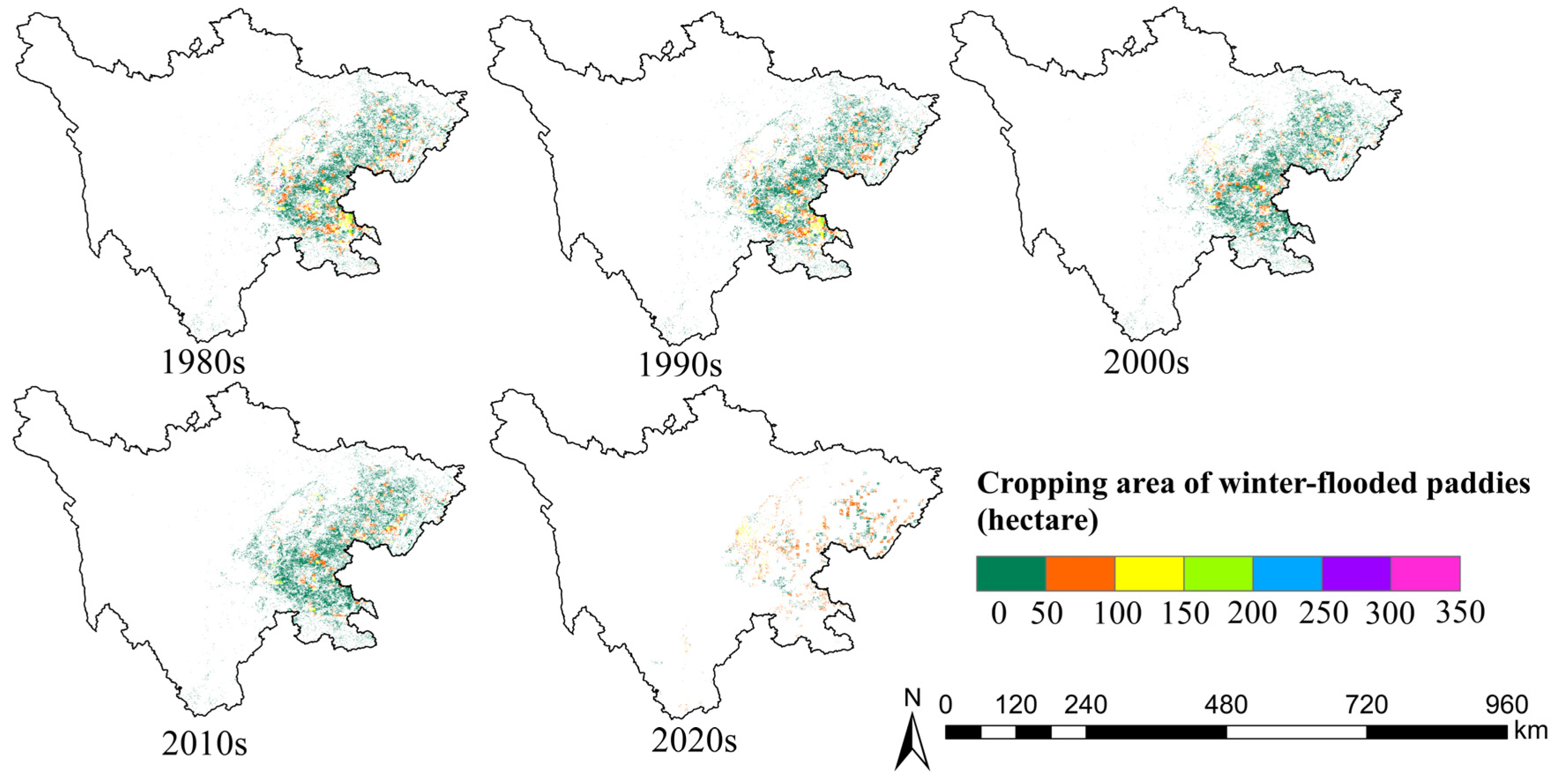
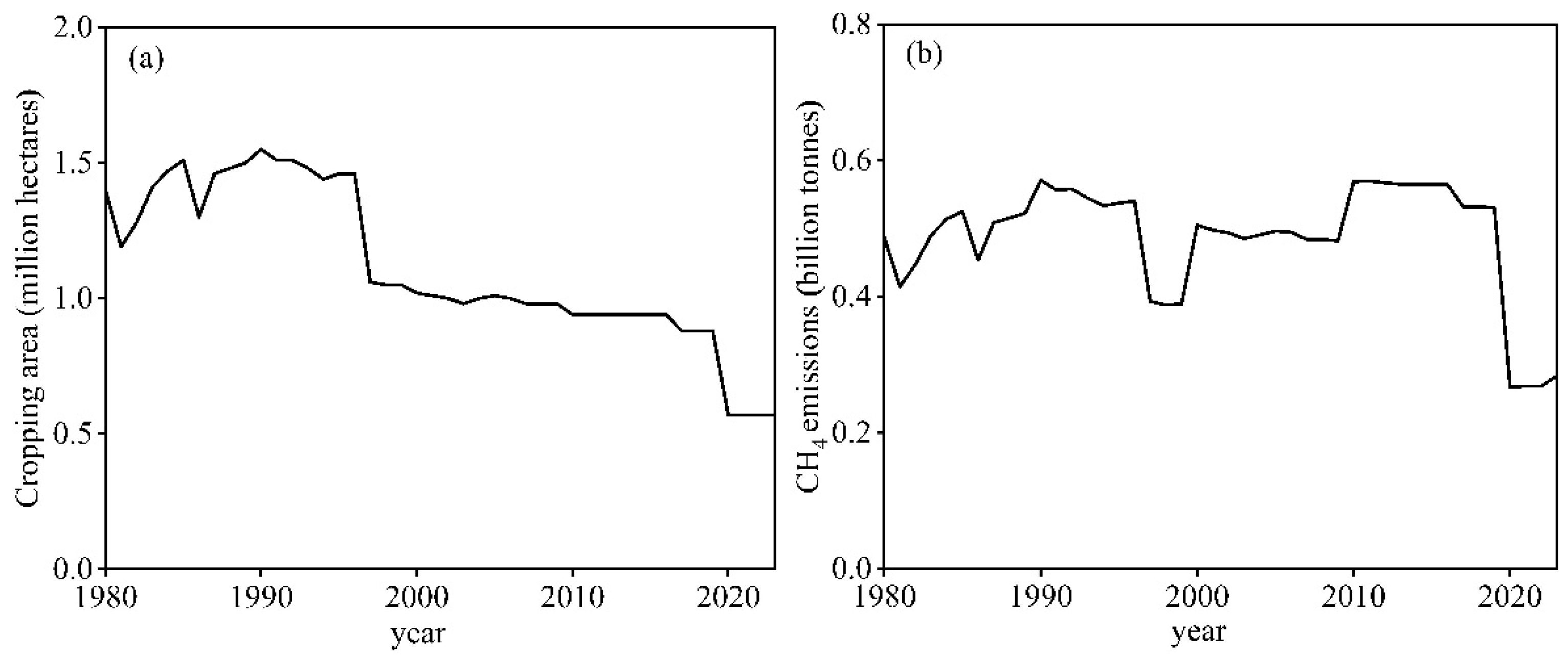
The spatial distribution of winter-flooded paddies in Sichuan from the 1980s to the 2020s is shown in Figure 2. Over the past decades, the cropping area of winter-flooded paddies has shown a declining trend since the 1980s, decreasing from 1.40 to 0.57 million hectares in the 2020s, with an average reduction of 14.83% per decade (Figure 2). The total CH4 emissions from the winter-flooded paddies in Sichuan showed significant fluctuations from 1980 to 2023 (Figure 3b). Specifically, emissions have decreased recently, from 0.53 billion tonnes in 2019 to 0.28 billion tonnes in 2023, representing a reduction of approximately 47.20%. The overall decline in total CH4 emissions from 1980 to 2023 was primarily driven by the long-term reduction in rice cropping area. This finding aligns with previous studies indicating that adjustments in the rice cropping area can lead to reduced GHG emissions [13]. However, a temporary increase in total emissions was observed from the 2000s to the 2010s, despite a modest decline in cropping area. This trend could be attributed to a marked increase in CH4 emission intensity per unit of area during that period (Table 1), likely resulting from changes in rice varieties and higher rates of straw returning.

3.4. Radiative Forcing-Based Climate Footprint (RFCF) and GWP100-Based Assessment

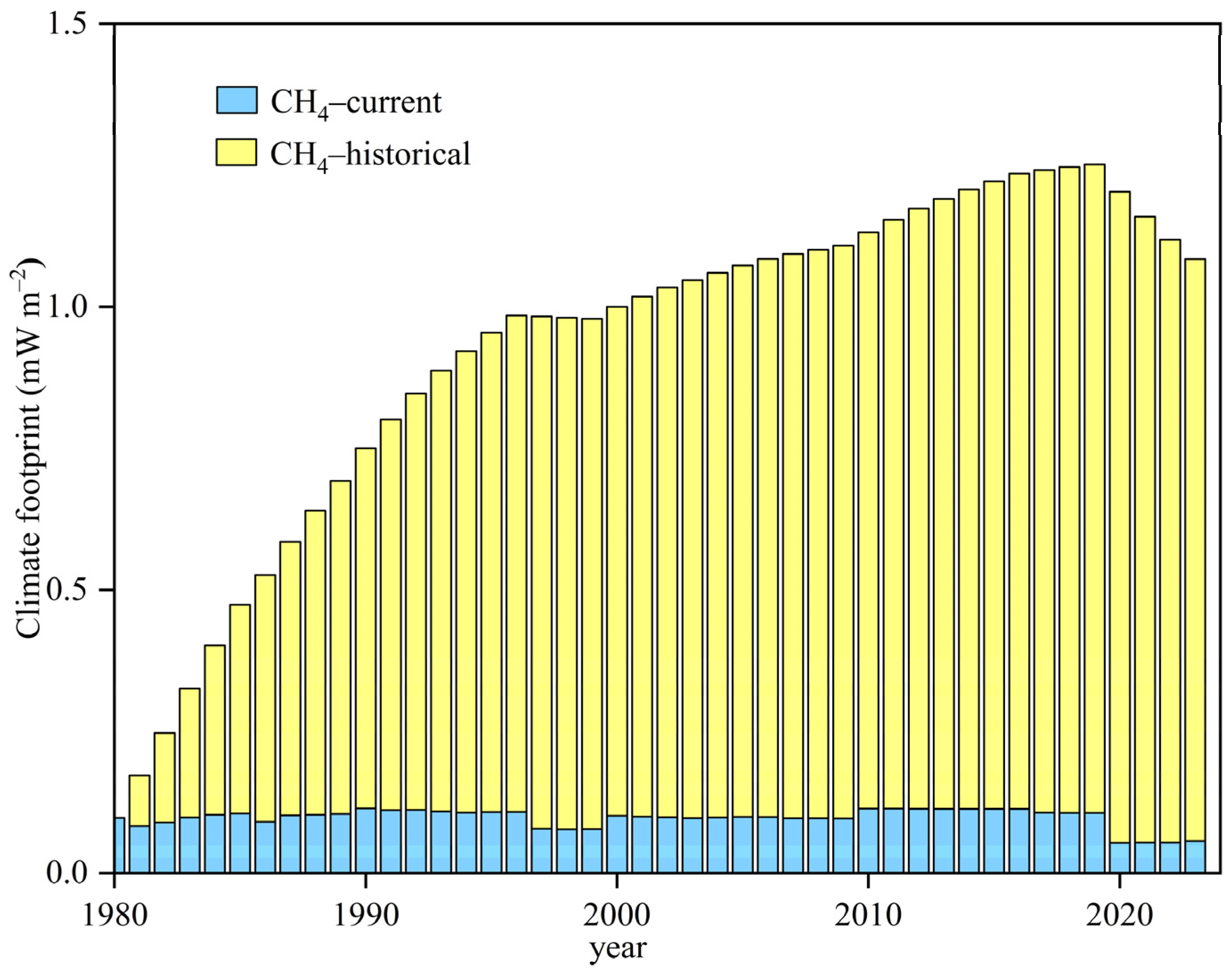
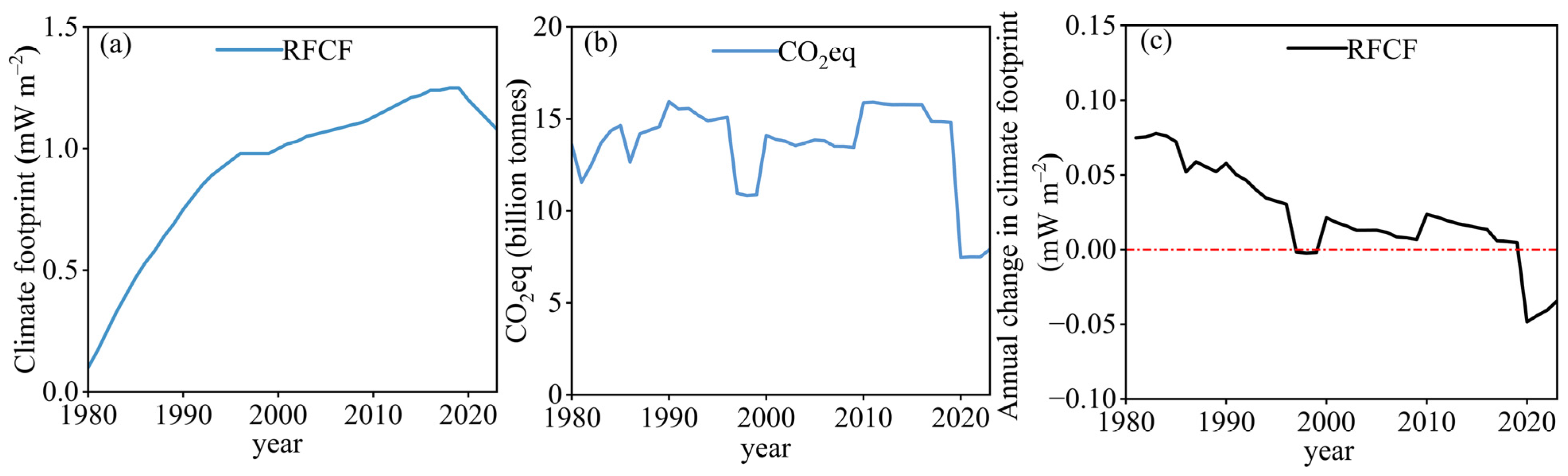
For winter-flooded paddies in Sichuan, the contribution of CH4 emissions to the total climate footprint increased from 0.10 mW m−2 in 1980 to a peak of 1.25 mW m−2 in 2019 (Figure 4). This increase was due to rising annual CH4 emissions and the accumulation of historical emissions in the atmosphere. It then declined to 1.08 mW m−2 in 2023, representing a 13.36% decrease from the 2019 peak (Figure 4). This decline was primarily attributed to the decline in CH4 emissions since 2012, combined with the short atmospheric lifetime (12 years) of historical emissions. Moreover, the winter-flooded paddies achieved a net zero increase in RFCF in 2020 (Figure 5c). The trends derived from the RFCF and GWP100 metrics show a significant divergence. According to the GWP100 metric, the climate impact of CH4 has shown an overall fluctuating trend, which has recently trended upward, in association with an increase in CH4 emissions (Figure 5a,b). This approach requires selecting a time horizon. Using a short time horizon ignores the long-term effects of CO2, while adopting a long one largely ignores the short-term forcing of CH4. In fact, the choice of any specific time horizon implies a systematic underestimation of the longer-term impacts [6]. In contrast, the RFCF metric quantifies the contribution to radiative forcing from both current and historical emissions independently of GWP100 values [30,34]. By analyzing the profile of radiative forcing over time, we can evaluate its trajectory and whether progress is being made in stabilizing the total cumulative radiative forcing. Therefore, the RFCF metric is a neutral, transparent, and comprehensive approach for guiding climate action aimed at climate stabilization.

3.5. Implications and Limitations

This study assessed CH4 emissions and the associated climate impact from winter-flooded paddies in the Sichuan Basin. Previous studies have shown that winter-flooded paddies in Sichuan are a significant source of CH4 emissions [9,10,11]. Here, we found that CH4 emissions from winter-flooded paddies have decreased in recent years, which has been attributed to a reduction in rice cultivation area and the decline in average temperature during the rice-growing season. This finding provides evidence that adjusting cropping structures, such as reducing the area of cropping systems with high emission-intensity, can mitigate climate change. Our analysis shows that CH4 emissions from Sichuan’s winter-flooded paddies reached a net zero increase in RF in 2020, with their climate footprint decreasing from its peak in 2019 to 1.08 mW m−2 in 2023. This demonstrates that Sichuan’s winter-flooded paddies no longer contribute to the further increase in RF in the Earth’s atmospheric system. Given China’s growing awareness of the environmental impacts of agriculture, achieving such a mitigation goal appears increasingly feasible. Our study provides insights for formulating targeted policies. It is recommended to widely apply the climate footprint method to reassess climate actions in paddy rice systems, where CH4 emissions dominate, and to formulate practical and effective policies. These findings have direct implications for sustainable agricultural policy, particularly regarding cropping system optimization and the adoption of RFCF assessment metrics.
Despite the policy-relevant insights from our analysis, we acknowledge the limitations associated with the input data used in this study. Firstly, due to the difficulty in obtaining management data at a high spatial resolution, the management data were primarily obtained from published literature. Missing management data were supplemented using values from adjacent years, which may lead to an overestimation or underestimation of emissions. Secondly, this study did not consider the effects of rising atmospheric CO2 concentrations. Thirdly, the soil property data were obtained from the HWSD v2.0 data. This database combines soil inventories gathered at different times at different scales, which may limit its accuracy in reflecting present soil conditions. Future work should aim to obtain more precise input data to refine the accuracy of CH4 estimates and better inform decision-making.

4. Conclusions

This study simulated CH4 emissions from winter-flooded paddies in the Sichuan Basin over 44 years using the DNDC model. Our analysis revealed that CH4 emissions per unit of area have decreased significantly since their peak in the 2010s. This decrease can be attributed primarily to a decline in the average temperature during the rice growing season. A significant reduction in total CH4 emissions since 2020 is largely attributable to a decrease in the rice cropping area. Furthermore, applying the radiative forcing-based climate footprint (RFCF) method, we found that the climate footprint of winter-flooded paddies reached a net zero increase in radiative forcing (RF) by 2020, indicating a transition to a state that no longer contributes additional RF to the atmospheric system. Our study demonstrates that CH4 emissions from winter-flooded paddies are not the cause of the Sichuan Basin being a CH4 emission hotspot. To identify the actual reasons, a systematic analysis of other emission sources, such as natural gas fields, is required. From a sustainability perspective, this finding demonstrates that targeted changes in cropping area and system management can align agricultural production with climate stabilization goals. To support such policy decisions, we recommend that the RFCF method be widely adopted to inform climate actions for agricultural CH4 emission reduction.

Supplementary Materials

The following supporting information can be downloaded at https://www.mdpi.com/article/10.3390/su18115754/s1, Figure S1: Geographic location of the study area (Sichuan basin boundary in blue, experimental sites as green dots); Figure S2: The polygon layer of the coverage of the 38 meteorological stations; Figure S3: The straw return ratios for rice in Sichuan were analyzed from the 1980s to the 2020s; Table S1: Average, maximum and minimum temperatures during the growth season of winter-flooded paddies in Sichuan (May–August); Table S2: Field CH4 observation data for site validation obtained from the listed references; Table S3: Rice varieties in Sichuan from 1980s to 2020s derived from the literature; Table S4: Sensitivity analysis of the DNDC model. References [52,53,54,55,56] are cited in the Supplementary Materials.

Author Contributions

Conceptualization, X.L., W.X., X.W. and J.H.; Methodology, X.L. and W.X.; Validation, X.L. and W.X.; Writing—original draft, X.L., W.X., X.W. and J.H.; Writing—review & editing, X.L. and J.H.; Visualization, X.L., W.X., X.W. and J.H.; Supervision, J.H.; Project administration, J.H. All authors have read and agreed to the published version of the manuscript.

Funding

This work was funded by the National Key R&D Program of China (grant number 2022YFD2300600), the Natural Science Foundation of Sichuan Province (grant number 2025ZNSFSC0999), and the Doctoral fund of Southwest University of Science and Technology (grant number 25zx7105).

Institutional Review Board Statement

Not applicable.

Informed Consent Statement

Not applicable.

Data Availability Statement

The data presented in this study are available on request from the corresponding author.

Conflicts of Interest

The authors declare no conflict of interest.

References

  1. Intergovernmental Panel on Climate Change (IPCC). The Earth’s Energy Budget, Climate Feedbacks, and Climate Sensitivity. In Climate Change 2021: The Physical Science Basis. Contribution of Working Group I to the Sixth Assessment Report of the Intergovernmental Panel on Climate Change; Masson-Delmotte, V., Zhai, P., Pirani, A., Connors, S.L., Péan, C., Berger, S., Caud, N., Chen, Y., Goldfarb, L., Gomis, M.I., et al., Eds.; Cambridge University Press: Cambridge, UK; New York, NY, USA, 2021; pp. 923–1054. [Google Scholar] [CrossRef]
  2. United Nations Environment Programme (UNEP). Executive summary. In Emissions Gap Report 2024: No More Hot Air … Please! With a Massive Gap Between Rhetoric and Reality, Countries Draft New Climate Commitments; Olhoff, A., Bataille, C., Christensen, J., den Elzen, M., Fransen, T., Grant, N., Blok, K., Kejun, J., Soubeyran, E., Lamb, W., et al., Eds.; United Nations Environment Programme: Nairobi, Kenya, 2024. [Google Scholar] [CrossRef]
  3. Fletcher, S.E.M.; Schaefer, H. Rising methane: A new climate challenge. Science 2019, 364, 932–933. [Google Scholar] [CrossRef]
  4. Saunois, M.; Jackson, R.B.; Bousquet, P.; Poulter, B.; Canadell, J.G. The growing role of methane in anthropogenic climate change. Environ. Res. Lett. 2016, 11, 120207. [Google Scholar] [CrossRef]
  5. World Meteorological Organization (WMO). The State of Greenhouse Gases in the Atmosphere Based on Global Observations Through 2023. Available online: https://library.wmo.int/viewer/68532/download?file=GHG-19_en.pdf&type=pdf&navigator=1 (accessed on 13 November 2025).
  6. Balcombe, P.; Speirs, J.F.; Brandon, N.P.; Hawkes, A.D. Methane emissions: Choosing the right climate metric and time horizon. Environ. Sci.–Proc. Imp. 2018, 20, 1323–1339. [Google Scholar] [CrossRef]
  7. Ocko, I.B.; Sun, T.; Shindell, D.; Oppenheimer, M.; Hristov, A.N.; Pacala, S.W.; Mauzerall, D.L.; Xu, Y.; Hamburg, S.P. Acting rapidly to deploy readily available methane mitigation measures by sector can immediately slow global warming. Environ. Res. Lett. 2021, 16, 054042. [Google Scholar] [CrossRef]
  8. Peng, Y.; Cai, H.; Cai, Z. Analysis of Spatio-temporal Characteristics of Methane in China in 2003~2018. Remote Sens. Technol. Appl. 2024, 39, 841–849. [Google Scholar]
  9. Su, M.; Kuang, F.; Lv, Y.; Shi, X.; Liu, X.; Shen, J.; Zhang, F. Nitrous oxide and methane emissions from paddy soils in southwest China. Geoderma Reg. 2017, 8, 1–11. [Google Scholar] [CrossRef]
  10. Xu, P.; Zhou, W.; Jiang, M.; Shaaban, M.; Zhou, M.; Zhu, B.; Ren, X.; Jiang, Y.; Hu, R. Conversion of winter flooded rice paddy planting to rice-wheat rotation decreased methane emissions during the rice-growing seasons. Soil Till. Res. 2020, 198, 104490. [Google Scholar] [CrossRef]
  11. Yin, X.; Li, Q.; Zhang, X.; Wang, Z.; Li, Q.H.; Wei, L.; Huang, T.; Gao, M. Paddy–Upland Rotation Improves Rice Growth and Reduces Greenhouse Gas Emissions in Winter Paddy Fields. Agronomy 2025, 15, 349. [Google Scholar] [CrossRef]
  12. NBSC (National Bureau of Statistics of China). China Statistical Yearbook. 2024. Available online: https://www.stats.gov.cn/sj/ndsj/ (accessed on 16 September 2025).
  13. Zhang, Y.; Jiang, Y.; Tai, A.P.K.; Feng, J.; Li, Z.; Zhu, X.; Chen, J.; Zhang, J.; Song, Z.; Deng, A.; et al. Contribution of rice variety renewal and agronomic innovations to yield improvement and greenhouse gas mitigation in China. Environ. Res. Lett. 2019, 14, 114020. [Google Scholar] [CrossRef]
  14. Intergovernmental Panel on Climate Change (IPCC). 2006 IPCC Guidelines for National Greenhouse Gas Inventories. Institute for Global Environmental Strategies. Available online: https://www.ipcc-nggip.iges.or.jp/public/2006gl/vol4.html (accessed on 20 October 2025).
  15. Liang, D.; Lu, X.; Zhuang, M.; Shi, G.; Hu, C.; Wang, S.; Hao, J. China’s greenhouse gas emissions for cropping systems from 1978–2016. Sci. Data 2021, 8, 171. [Google Scholar] [CrossRef]
  16. Peng, S.; Piao, S.; Bousquet, P.; Ciais, P.; Li, B.; Lin, X.; Tao, S.; Wang, Z.; Zhang, Y.; Zhou, F. Inventory of anthropogenic methane emissions in mainland China from 1980 to 2010. Atmos. Chem. Phys. 2016, 16, 14545–14562. [Google Scholar] [CrossRef]
  17. Shen, N.; Tan, J.; Wang, W.; Xue, W.; Wang, Y.; Huang, L.; Yan, G.; Song, Y.; Li, L. Long-term changes of methane emissions from rice cultivation during 2000–2060 in China: Trends, driving factors, predictions and policy implications. Environ. Int. 2024, 191, 108958. [Google Scholar] [CrossRef] [PubMed]
  18. Wang, J.; Ciais, P.; Smith, P.; Yan, X.; Kuzyakov, Y.; Liu, S.; Li, T.; Zou, J. The role of rice cultivation in changes in atmospheric methane concentration and the Global Methane Pledge. Glob. Change Biol. 2023, 29, 2776–2789. [Google Scholar] [CrossRef] [PubMed]
  19. Goglio, P.; Smith, W.N.; Grant, B.B.; Desjardins, R.L.; McConkey, B.G.; Campbell, C.A.; Nemecek, T. Accounting for soil carbon changes in agricultural life cycle assessment (LCA): A review. J. Clean. Prod. 2015, 104, 23–39. [Google Scholar] [CrossRef]
  20. Paustian, K.; Lehmann, J.; Ogle, S.; Reay, D.; Robertson, G.P.; Smith, P. Climate-smart soils. Nature 2016, 532, 49–57. [Google Scholar] [CrossRef]
  21. Guo, Y.; Zhang, G.; Abdalla, M.; Kuhnert, M.; Bao, H.; Xu, H.; Ma, J.; Begum, K.; Smith, P. Modelling methane emissions and grain yields for a double-rice system in Southern China with DAYCENT and DNDC models. Geoderma 2023, 431, 116364. [Google Scholar] [CrossRef]
  22. Li, S.; Lu, H.; Li, X.; Shao, Y.; Tang, Y.; Chen, G.; Chen, Z.; Zhu, Z.; Zhu, J.; Tang, L.; et al. Toward Low-Carbon Rice Production in China: Historical Changes, Driving Factors, and Mitigation Potential. Environ. Sci. Technol. 2024, 58, 5772–5783. [Google Scholar] [CrossRef] [PubMed]
  23. Tang, Y.; Qiao, Y.; Wu, Y.; Ma, Y.; Zhao, Y.; Wang, X.; Miao, S. Modeling the effects of crop varieties, fertilizer rates and sowing dates on crop yields, greenhouse gas emissions and margins of rice-wheat rotation system under climate change scenario. Agric. Ecosyst. Environ. 2025, 388, 109665. [Google Scholar] [CrossRef]
  24. Wang, Z.; Zhang, X.; Liu, L.; Wang, S.; Zhao, L.; Wu, X.; Zhang, W.; Huang, X. Inhibition of methane emissions from Chinese rice fields by nitrogen deposition based on the DNDC model. Agric. Syst. 2020, 184, 102919. [Google Scholar] [CrossRef]
  25. Gilhespy, S.L.; Anthony, S.; Cardenas, L.; Chadwick, D.; del Prado, A.; Li, C.; Misselbrook, T.; Rees, R.M.; Salas, W.; Sanz-Cobena, A.; et al. First 20 years of DNDC (DeNitrification DeComposition): Model evolution. Ecol. Model. 2014, 292, 51–62. [Google Scholar] [CrossRef]
  26. Yin, S.; Zhang, X.; Lyu, J.; Zhi, Y.; Chen, F.; Wang, L.; Liu, C.; Zhou, S. Carbon sequestration and emissions mitigation in paddy fields based on the DNDC model: A review. Artif. Intell. Agric. 2020, 4, 140–149. [Google Scholar] [CrossRef]
  27. Collins, W.J.; Frame, D.J.; Fuglestvedt, J.S.; Shine, K.P. Stable climate metrics for emissions of short and long-lived species-combining steps and pulses. Environ. Res. Lett. 2020, 15, 024018. [Google Scholar] [CrossRef]
  28. Levasseur, A.; Cavalett, O.; Fuglestvedt, J.S.; Gasser, T.; Johansson, D.J.A.; Jørgensen, S.V.; Raugei, M.; Reisinger, A.; Schivley, G.; Strømman, A.; et al. Enhancing life cycle impact assessment from climate science: Review of recent findings and recommendations for application to LCA. Ecol. Indic. 2016, 71, 163–174. [Google Scholar] [CrossRef]
  29. Ocko, I.B.; Hamburg, S.P.; Jacob, D.J.; Keith, D.W.; Keohane, N.O.; Oppenheimer, M.; Roy-Mayhew, J.D.; Schrag, D.P.; Pacala, S.W. Unmask temporal trade-offs in climate policy debates. Science 2017, 356, 492–493. [Google Scholar] [CrossRef]
  30. Ridoutt, B.; Huang, J. When Climate Metrics and Climate Stabilization Goals Do Not Align. Environ. Sci. Technol. 2019, 53, 14093–14094. [Google Scholar] [CrossRef]
  31. Luo, X.; Xia, T.; Huang, J.; Xiong, D.; Ridoutt, B. Radiative forcing climate footprints in the agricultural sector: Comparison of models from the IPCC 5th and 6th Assessment Reports. Farming Syst. 2023, 1, 100057. [Google Scholar] [CrossRef]
  32. Luo, X.; Xia, T.; Xiong, W.; Xiong, D.; Huang, J.; Ridoutt, B. Growing contribution to radiative forcing from China’s on-farm nitrous oxide emissions requires more attention. Sci. Total Environ. 2025, 961, 178417. [Google Scholar] [CrossRef]
  33. Ridoutt, B. Pathways toward Climate-Neutral Red Meat Production. Methane 2024, 3, 397–409. [Google Scholar] [CrossRef]
  34. Ridoutt, B. Climate neutral livestock production—A radiative forcing-based climate footprint approach. J. Clean. Prod. 2021, 291, 125260. [Google Scholar] [CrossRef]
  35. Ridoutt, B.; Lehnert, S.A.; Denman, S.; Charmley, E.; Kinley, R.; Dominik, S. Potential GHG emission benefits of Asparagopsis taxiformis feed supplement in Australian beef cattle feedlots. J. Clean. Prod. 2022, 337, 130499. [Google Scholar] [CrossRef]
  36. Cai, Z.; Sawamoto, T.; Li, C.; Kang, G.; Boonjawat, J.; Mosier, A.; Wassmann, R.; Tsuruta, H. Field validation of the DNDC model for greenhouse gas emissions in East Asian cropping systems. Glob. Biogeochem. Cycles 2003, 17, 1107. [Google Scholar] [CrossRef]
  37. Li, C.; Mosier, A.; Wassmann, R.; Cai, Z.; Zheng, X.; Huang, Y.; Tsuruta, H.; Boonjawat, J.; Lantin, R. Modeling greenhouse gas emissions from rice-based production systems: Sensitivity and upscaling. Glob. Biogeochem. Cycles 2004, 18, GB1043. [Google Scholar] [CrossRef]
  38. Nachtergaele, F.; Velthuizen, H.V.; Verelst, L.; Wiberg, D.; Henry, M.; Chiozza, F.; Yigini, Y. Harmonized World Soil Database Version 2.0 [Dataset]; FAO: Rome, Italy; IIASA: Laxenburg, Austria, 2023. [Google Scholar] [CrossRef]
  39. Liu, Z.; Li, Z.G.; Tang, P.; Li, Z.P.; Wu, W.; Yang, P.; You, L.; Tang, H. Change analysis of rice area and production in China during the past three decades. J. Geogr. Sci. 2013, 23, 1005–1018. [Google Scholar] [CrossRef]
  40. Huang, J.; Ridoutt, B.G.; Sun, Z.; Lan, K.; Thorp, K.R.; Wang, X.; Yin, X.; Huang, J.L.; Chen, F.; Scherer, L. Balancing food production within the planetary water boundary. J. Clean. Prod. 2020, 253, 119900. [Google Scholar] [CrossRef]
  41. Qiu, B.; Hu, X.; Chen, C.; Tang, Z.; Yang, P.; Zhu, X.; Yan, C.; Jian, Z. Maps of cropping patterns in China during 2015–2021. Sci. Data 2022, 9, 497. [Google Scholar] [CrossRef]
  42. Liu, X. Study on Nutrients Balance and Requirement in Agricultural Production in China. Master’s Thesis, Chinese Academy of Agricultural Sciences, Beijing, China, 2018. [Google Scholar]
  43. Yu, Z.; Liu, J.; Kattel, G. Historical nitrogen fertilizer use in China from 1952 to 2018. Earth Syst. Sci. Data 2022, 14, 5179–5194. [Google Scholar] [CrossRef]
  44. Zhao, X. Effects of Nitrogen Substitution Ratio on Soil Fertility, Yield Formation and Greenhouse Gas Emission in Rice. Master’s Thesis, Sichuan Agricultural University, Chengdu, China, 2020. [Google Scholar]
  45. Huang, J.; Scherer, L.; Lan, K.; Chen, F.; Thorp, K.R. Advancing the application of a model-independent open-source geospatial tool for national-scale spatiotemporal simulations. Environ. Model. Softw. 2019, 119, 374–378. [Google Scholar] [CrossRef]
  46. Qian, H.; Zhu, X.; Huang, S.; Linquist, B.; Kuzyakov, Y.; Wassmann, R.; Minamikawa, K.; Martinez-Eixarch, M.; Yan, X.; Zhou, F.; et al. Greenhouse gas emissions and mitigation in rice agriculture. Nat. Rev. Earth Environ. 2023, 4, 716–732. [Google Scholar] [CrossRef]
  47. Qian, H.; Zhang, N.; Chen, J.; Chen, C.; Hungate, B.A.; Ruan, J.; Huang, S.; Cheng, K.; Song, Z.; Hou, P.; et al. Unexpected Parabolic Temperature Dependency of CH4 Emissions from Rice Paddies. Environ. Sci. Technol. 2022, 56, 4871–4881. [Google Scholar] [CrossRef] [PubMed]
  48. Wang, Z.; Zhang, X.; Liu, L.; Wang, S.; Zhao, L.; Wu, X.; Zhang, W.; Huang, X. Estimates of methane emissions from Chinese rice fields using the DNDC model. Agric. For. Meteorol. 2021, 303, 108368. [Google Scholar] [CrossRef]
  49. Evenson, R.E.; Gollin, D. Assessing the impact of the Green Revolution, 1960 to 2000. Science 2003, 300, 758–762. [Google Scholar] [CrossRef]
  50. Yan, X.; Cai, Z.; Ohara, T.; Akimoto, H. Methane emission from rice fields in mainland China: Amount and seasonal and spatial distribution. J. Geophys. Res.–Atmos. 2003, 108, 4505. [Google Scholar] [CrossRef]
  51. He, Z.; Cao, H.; Qi, C.; Hu, Q.; Liang, J.; Li, Z. Straw management in paddy fields can reduce greenhouse gas emissions: A global meta-analysis. Field Crops Res. 2024, 306, 109218. [Google Scholar] [CrossRef]
  52. Jiang, C. Study on Emission of Major Greenhouse Gases from Agro-Ecosystems in a Central Sichuan Hilly Area of Southwest China. Ph.D. Thesis, Chinese Academy of Agricultural Sciences, Beijing, China, 2005. [Google Scholar]
  53. Zhou, M.; Zhu, B.; Brüggemann, N. Nitrous oxide and methane emissions from a subtropical rice–rapeseed rotation system in China: A 3-year field case study. Agric. Ecosyst. Environ. 2015, 212, 297–309. [Google Scholar] [CrossRef]
  54. Mo, Y. Effect of Altering Rice-Flooded-Fallow to Rice-Wheat Rotation on Greenhouse Gases Emissions. Master’s Thesis, Huazhong Agricultural University, Wuhan, China, 2014. [Google Scholar]
  55. Zhang, X. Effects of Pig Manure on Greenhouse Gas Emission in Farmland Under Rice-Wheat Rotation for 5 Years. Master’s Thesis, Sichuan Agricultural University, Chengdu, China, 2020. [Google Scholar]
  56. Liu, J.; Huang, X.; Jiang, H. Sustaining yield and mitigating methane emissions from rice production with plastic film mulching technique. Agric. Water Manag. 2021, 245, 106667. [Google Scholar] [CrossRef]
Figure 1. Comparisons between the simulated and measured seasonal CH4 emissions (kg ha−1) at site scale.
Sustainability 18 05754 g001
Figure 2. Changes in the cropping area of winter-flooded paddies from the 1980s to the 2020s.
Sustainability 18 05754 g002
Figure 3. Changes in cropping area (a) and total CH4 emissions (b) from winter-flooded paddies.
Sustainability 18 05754 g003
Figure 4. Radiative forcing-based climate footprint (RFCF) of winter-flooded paddies in the Sichuan Basin.
Sustainability 18 05754 g004
Figure 5. Contributions to climate impact from winter-flooded paddies CH4 emissions. (a) Radiative forcing-based climate footprint (RFCF), (b) CO2eq emissions, and (c) annual change in RFCF.
Sustainability 18 05754 g005
Table 1. CH4 emissions from winter-flooded paddies simulated by the DNDC model.
YearCH4 Emissions (kg ha−1)
1980s348.78
1990s369.24
2000s493.08
2010s603.73
2020s472.48
Note: “1980s” refers to the period 1980–1989, “1990s” to 1990–1999, “2000s” to 2000–2009, “2010s” to 2010–2019, and “2020s” to 2020–2023.
Disclaimer/Publisher’s Note: The statements, opinions and data contained in all publications are solely those of the individual author(s) and contributor(s) and not of MDPI and/or the editor(s). MDPI and/or the editor(s) disclaim responsibility for any injury to people or property resulting from any ideas, methods, instructions or products referred to in the content.