_Li.png)
AI-Driven Remarketing and Digital Infrastructure in Emerging Markets: Evidence from Tourism and Textile Enterprises in Uzbekistan

 , , ,
, , ,
Abstract
1. Introduction
1.1. Remarketing as a Digital Marketing Strategy
1.2. Remarketing in the Tourism and Hospitality Sector
1.3. Remarketing in the Manufacturing (Textile) Sector
1.4. The Role of Artificial Intelligence in Remarketing
1.5. Digital Marketing in Emerging Economies and the Uzbekistan Context
1.6. Monte Carlo Simulation as Uncertainty Analysis in Marketing Research
1.7. Research Gaps and Hypotheses
2. Methodology
2.1. Research Design
2.2. Sampling and Data Collection
2.3. Data Validation and Triangulation
2.4. Treatment of Macroeconomic Factors
2.5. Variable Operationalization
- Sector type (service = 0, manufacturing = 1).
- Digital Infrastructure Index (DII): 5 components, 1–5 Likert scale, Cronbach’s α = 0.83, composite reliability (CR) = 0.86, average variance extracted (AVE) = 0.55.
- AI Personalization Index (AII): 4 components, 1–5 Likert scale, Cronbach’s α = 0.81, CR = 0.84, AVE = 0.52.
- Remarketing budget as a percentage of total marketing budget (%).
2.6. Qualitative Data Collection
2.7. Statistical Analysis Procedures
- H1: Pearson χ2-test and independent samples t-test.
- H2: Independent samples t-test; Levene’s test; OLS regression.
- H3: Independent samples t-test (AI adopters vs. non-adopters); PLS-SEM direct effect and mediation path (AI → CV → ROI) with bootstrapping (n = 5000).
- H4: Pearson correlation and OLS regression.
2.8. Endogeneity Considerations
2.9. Monte Carlo Simulation Design and Parameter Calibration
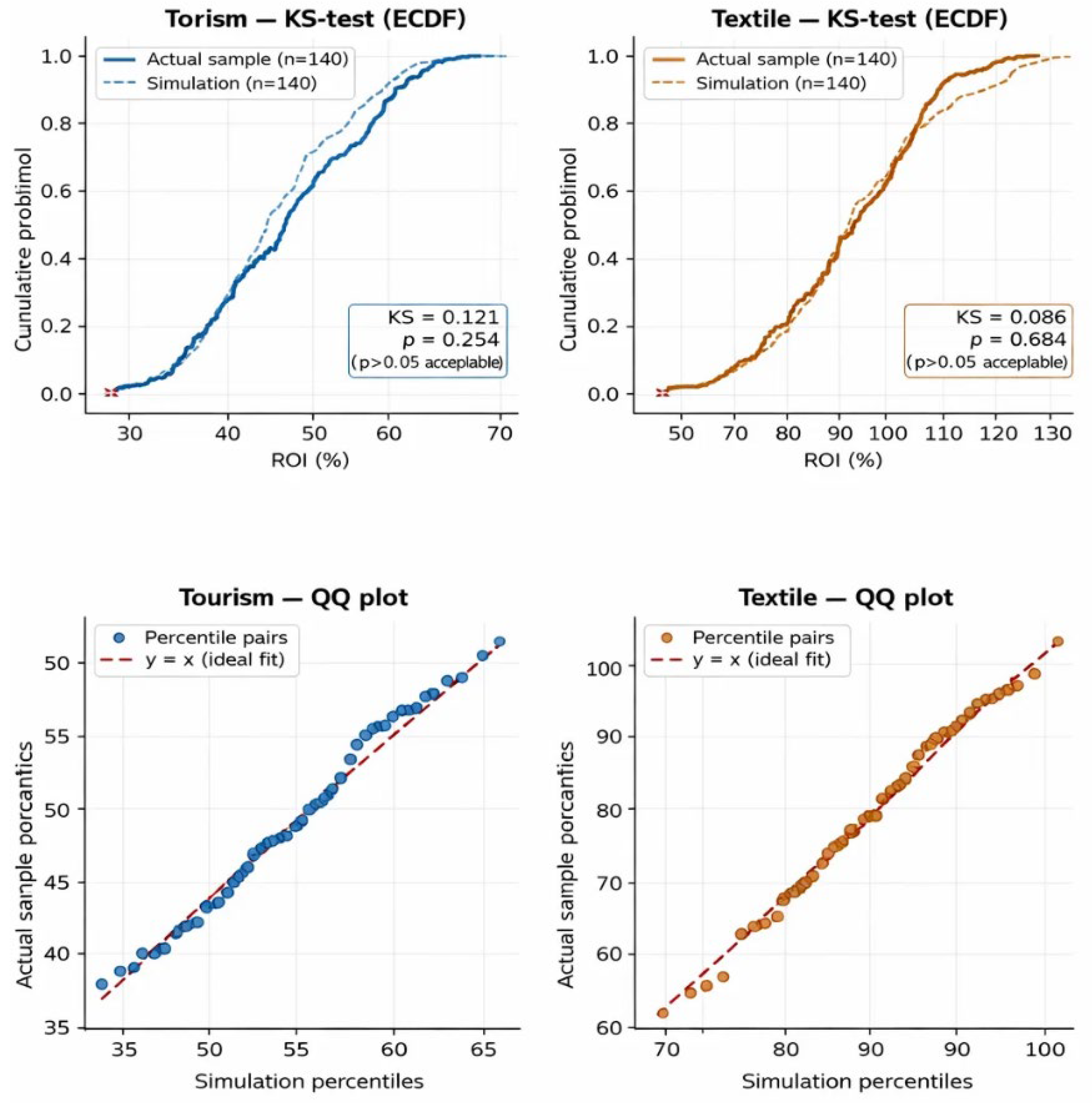
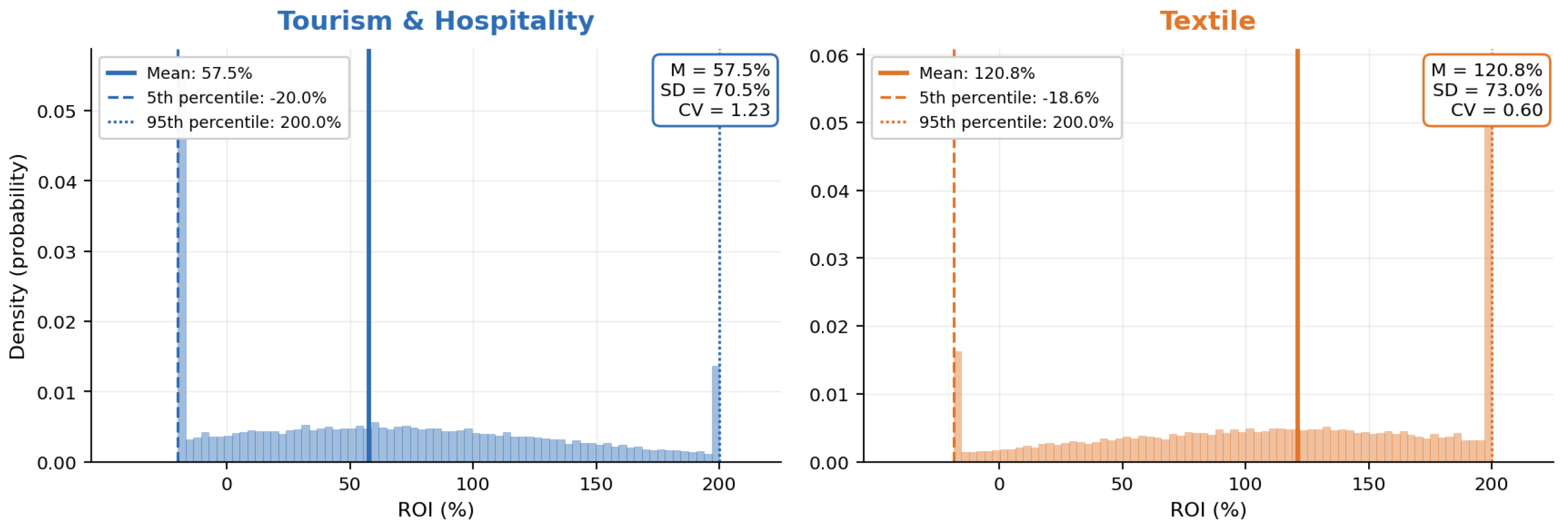
- Empirical statistics (primary source): Sample means and standard deviations of ROI served as the baseline parameters. For tourism: ROI ~ Normal (μ = 48.3, σ = 8.7); for textiles: ROI ~ Normal (μ = 82.1, σ = 15.2). Normal distributions were selected based on Shapiro–Wilk normality test results (tourism: W = 0.987, p = 0.241; textiles: W = 0.983, p = 0.178).
- Literature benchmarks (secondary source): Parameters were cross-validated against findings from Johnson et al. [3], who reported average B2B remarketing ROI ranges of 60–120%, and Lambrecht and Tucker [1], who documented B2C conversion rate improvements of 2–5%. Where sample estimates fell within literature-reported ranges, empirical parameters were retained; otherwise, bounded triangular distributions were employed.
- Delphi method (tertiary source, for uncertainty bounds): Eight industry experts (4 from tourism, 4 from textiles; all with >10 years of experience) participated in two rounds of Delphi consultation (consensus CR > 0.85). Experts provided estimates of plausible minimum and maximum values for ROI, CVR, and budget allocation parameters, which were used to define the bounds of triangular distributions for sensitivity analysis.
2.10. Mediation Analysis
3. Results
3.1. Descriptive Characteristics
3.2. Digital Maturity and Remarketing Adoption Level (H1)
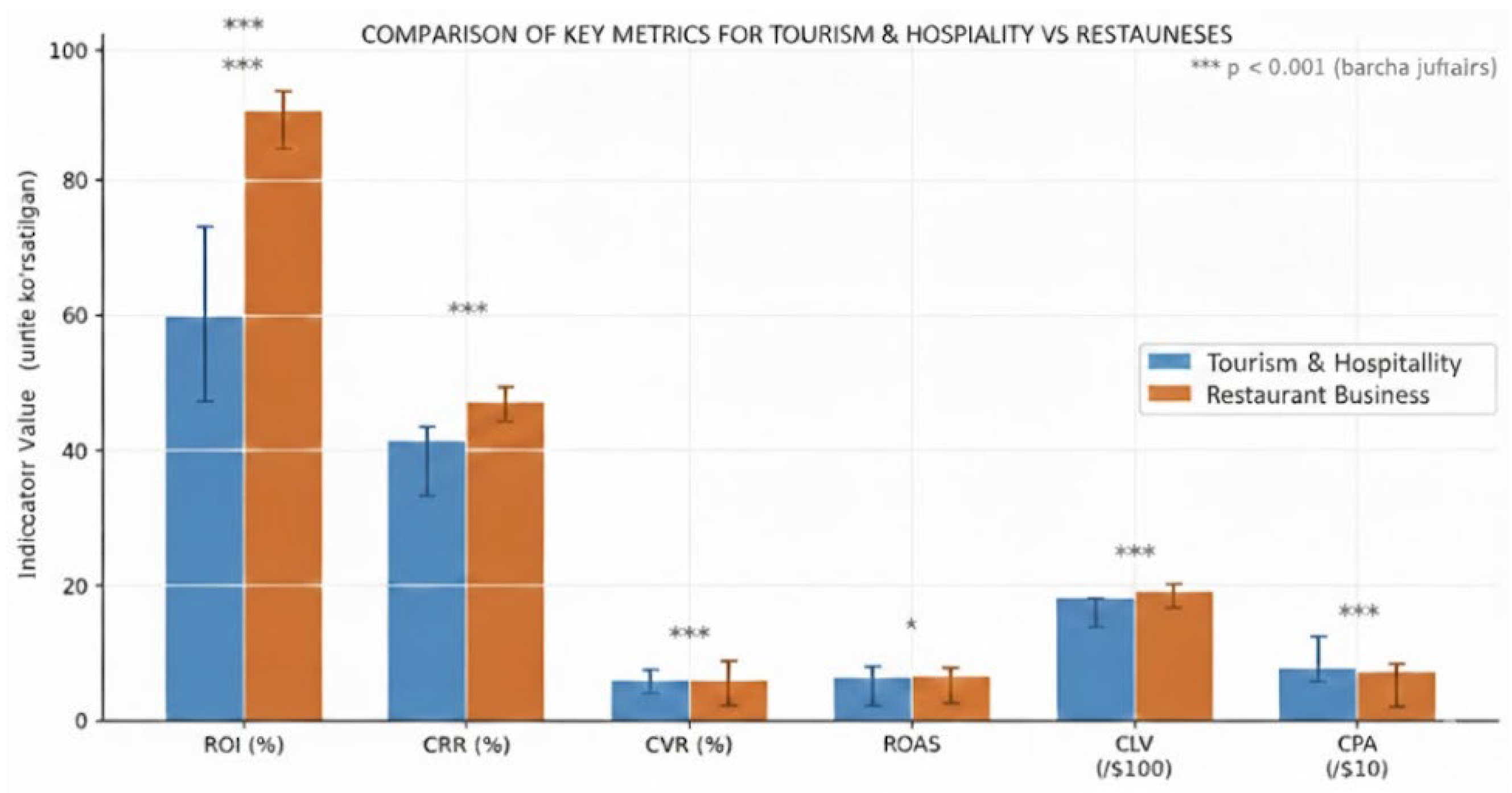
3.3. Performance Indicators: Sectoral Comparative Analysis (H2)
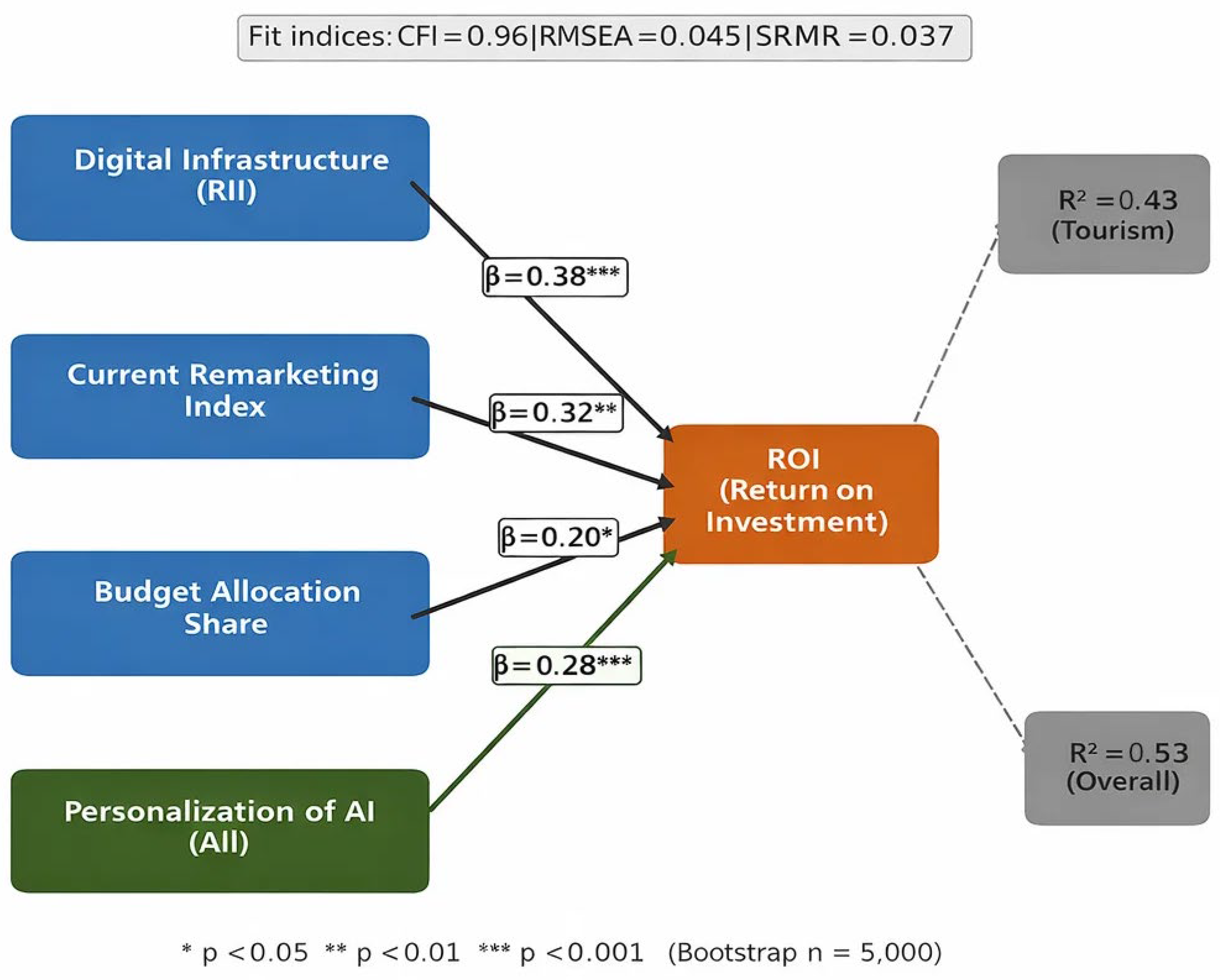
3.4. ROI Predictors: OLS Regression Analysis (H2, H4)
3.5. The Impact of AI Personalization on Remarketing Effectiveness (H3)
3.6. Qualitative Findings and Integration with Quantitative Data
3.7. Monte Carlo Simulation Validation
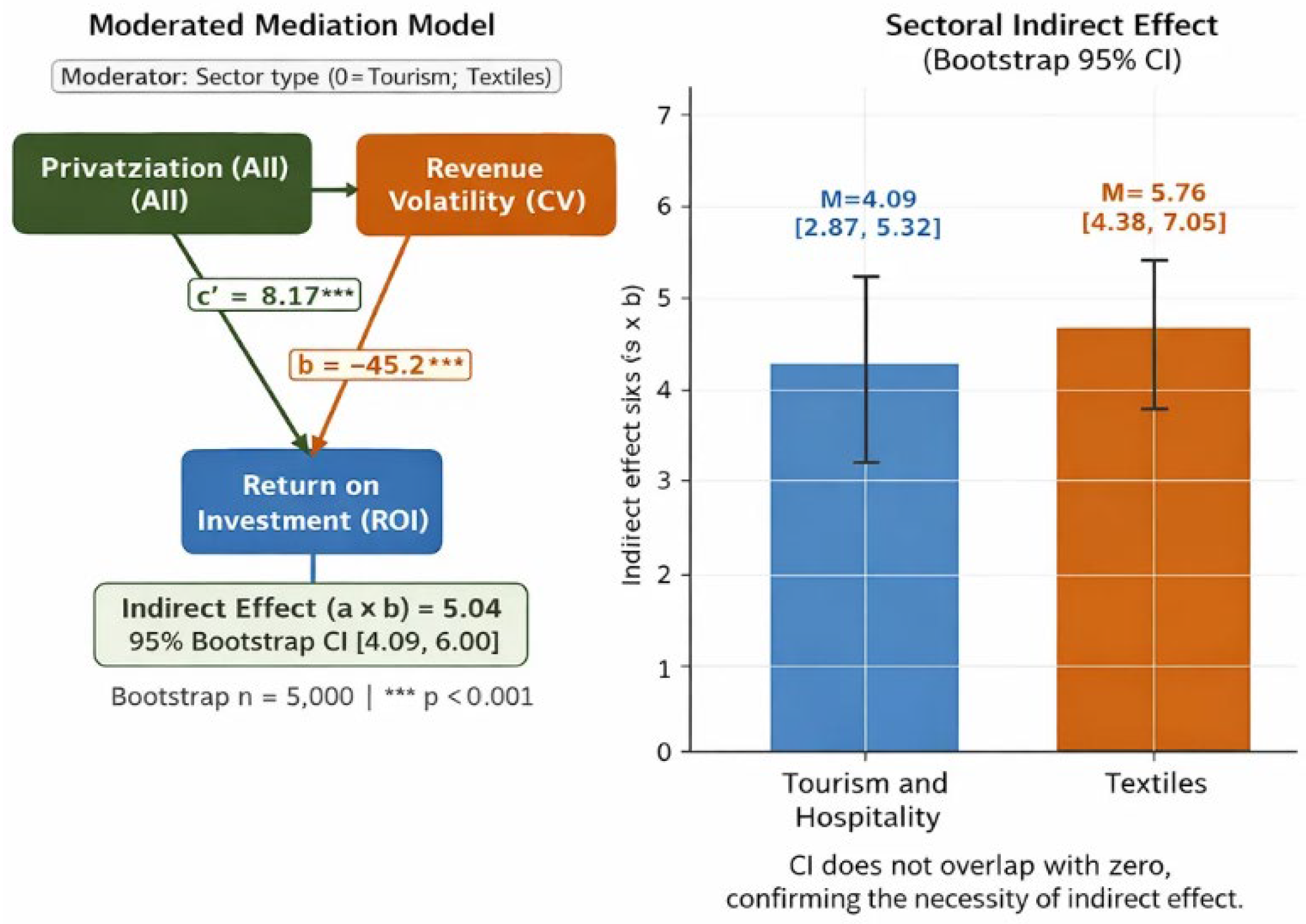
3.8. Mediation Analysis: AII → CV → ROI (H3, H4)
3.9. Robustness Checks
4. Discussion
4.1. Sectoral Adoption Differences and Digital Maturity (H1)
4.2. ROI Differences and Revenue Variability (H2)
4.3. The Impact of AI Personalization and the Mediation Mechanism (H3)
4.4. Revenue Stability and Infrastructure Effects (H4)
4.5. Theoretical Contributions
4.6. Practical Implications
4.7. Limitations
4.8. Implications for Sustainable Development
5. Conclusions
Supplementary Materials
Author Contributions
Funding
Institutional Review Board Statement
Informed Consent Statement
Data Availability Statement
Acknowledgments
Conflicts of Interest
References
- Lambrecht, A.; Tucker, C. When Does Retargeting Work? Information Specificity in Online Advertising. J. Mark. Res. 2013, 50, 561–576. [Google Scholar] [CrossRef]
- Davenport, T.; Guha, A.; Grewal, D.; Bressgott, T. How Artificial Intelligence Will Change the Future of Marketing. J. Acad. Mark. Sci. 2020, 48, 24–42. [Google Scholar] [CrossRef]
- Johnson, G.A.; Lewis, R.A.; Nubbemeyer, E.I. Ghost Ads: Improving the Economics of Measuring Online Ad Effectiveness. J. Mark. Res. 2017, 54, 867–884. [Google Scholar] [CrossRef]
- Barney, J. Firm Resources and Sustained Competitive Advantage. J. Manag. 1991, 17, 99–120. [Google Scholar] [CrossRef]
- Davis, F.D. Perceived Usefulness, Perceived Ease of Use, and User Acceptance of Information Technology. MIS Q. 1989, 13, 319–340. [Google Scholar] [CrossRef] [PubMed]
- Venkatesh, V.; Brown, S.A.; Bala, H. Bridging the Qualitative–Quantitative Divide: Guidelines for Conducting Mixed Methods Research in Information Systems. MIS Q. 2013, 37, 21–54. [Google Scholar] [CrossRef]
- Wedel, M.; Kannan, P.K. Marketing Analytics for Data-Rich Environments. J. Mark. 2016, 80, 97–121. [Google Scholar] [CrossRef]
- Chen, J.; Stallaert, J. An Economic Analysis of Online Advertising Using Behavioral Targeting. MIS Q. 2014, 38, 429–449. [Google Scholar] [CrossRef]
- Muñoz-Leiva, F.; Hernández-Méndez, J.; Gómez-Carmona, D. Measuring Advertising Effectiveness in Travel 2.0 Websites Through Eye-Tracking Technology. Physiol. Behav. 2019, 200, 83–95. [Google Scholar] [CrossRef] [PubMed]
- Alghanayem, H. Effects of Retargeting on Post-Purchase Behavior in the Tourism Industry. Doctoral Dissertation, Universitat Autònoma de Barcelona, Barcelona, Spain, 2024. Available online: https://hdl.handle.net/10803/692825 (accessed on 3 April 2026).
- Syam, N.; Sharma, A. Waiting for a Sales Renaissance in the Fourth Industrial Revolution: Machine Learning and Artificial Intelligence in Sales Research and Practice. Ind. Mark. Manag. 2018, 69, 135–146. [Google Scholar] [CrossRef]
- OECD. Roadmap for Sustainable Investment Policy Reforms in Uzbekistan; OECD Publishing: Paris, France, 2025. [Google Scholar] [CrossRef]
- Stone, M.; Aravopoulou, E.; Ekinci, Y.; Pouliopoulos, G.; Velegrakis, N.D. Artificial Intelligence (AI) in Strategic Marketing Decision-Making: A Research Agenda. Bottom Line 2020, 33, 183–200. [Google Scholar] [CrossRef]
- Huang, M.-H.; Rust, R.T. A Strategic Framework for Artificial Intelligence in Marketing. J. Acad. Mark. Sci. 2021, 49, 30–50. [Google Scholar] [CrossRef]
- Puntoni, S.; Reczek, R.W.; Giesler, M.; Botti, S. Consumers and Artificial Intelligence: An Experiential Perspective. J. Mark. 2021, 85, 131–151. [Google Scholar] [CrossRef]
- Hardcastle, K.; Vorster, L.; Brown, D. Understanding Customer Responses to AI-Driven Personalised Journeys: Impacts on the Customer Experience. J. Advert. 2025, 54, 176–195. [Google Scholar] [CrossRef]
- Kuldosheva, G. Challenges and Opportunities of Digital Transformation in the Public Sector in Transition Economies: Examination of the Case of Uzbekistan; ADBI Working Paper Series No. 1248; Asian Development Bank Institute: Tokyo, Japan, 2021; Available online: https://www.adb.org/publications/challenges-opportunities-digital-transformation-uzbekistan (accessed on 3 April 2026).
- Tashpulatova, L.; Suyunova, F. Digital Transformation of the Tourism Industry and Its Impact on Export Potential: Evidence from Kazakhstan. J. Cent. Asian Stud. 2025, 23, 40–60. [Google Scholar] [CrossRef]
- Abdurakhmanova, A.F. Socio-Economic Impacts of Ecotourism on Local Employment and Income in Rural Samarkand, Uzbekistan. Reg. Sci. Policy Pract. 2025, 17, 100180. [Google Scholar] [CrossRef]
- Ziyavitdinov, S. Digital Transformation and Its Impact on the Economy of Uzbekistan. Econ. Res. 2025, 39, 89–110. [Google Scholar]
- UNDP. Digital Economy of Uzbekistan: The State of Digital Entrepreneurship and Artificial Intelligence; United Nations Development Programme: Tashkent, Uzbekistan, 2025. [Google Scholar]
- Dwivedi, Y.K.; Hughes, L.; Ismagilova, E.; Aarts, G.; Coombs, C.; Crick, T.; Duan, Y.; Dwivedi, R.; Edwards, G.; Eirug, A.; et al. Artificial Intelligence (AI): Multidisciplinary Perspectives on Emerging Challenges, Opportunities, and Agenda for Research, Practice and Policy. Int. J. Inf. Manag. 2021, 57, 101994. [Google Scholar] [CrossRef]
- Chintalapati, S.; Pandey, S.K. Artificial Intelligence in Marketing: A Systematic Literature Review. Int. J. Mark. Res. 2022, 64, 38–68. [Google Scholar] [CrossRef]
- Creswell, J.W.; Plano Clark, V.L. Designing and Conducting Mixed Methods Research, 3rd ed.; Sage Publications: Thousand Oaks, CA, USA, 2017. [Google Scholar]
- Angrist, J.D.; Pischke, J.S. Mostly Harmless Econometrics: An Empiricist’s Companion; Princeton University Press: Princeton, NJ, USA, 2009. [Google Scholar]
- Krejcie, R.V.; Morgan, D.W. Determining Sample Size for Research Activities. Educ. Psychol. Meas. 1970, 30, 607–610. [Google Scholar] [CrossRef]
- Agency of Statistics under the President of the Republic of Uzbekistan. Official Statistics of the Republic of Uzbekistan: Enterprise Registry, 2024; Agency of Statistics under the President of the Republic of Uzbekistan: Tashkent, Uzbekistan, 2024; Available online: https://stat.uz/en (accessed on 17 April 2026).
- Armstrong, J.S.; Overton, T.S. Estimating Nonresponse Bias in Mail Surveys. J. Mark. Res. 1977, 14, 396–402. [Google Scholar] [CrossRef]
- Oster, E. Unobservable Selection and Coefficient Stability: Theory and Evidence. J. Bus. Econ. Stat. 2019, 37, 187–204. [Google Scholar] [CrossRef]
- Fornell, C.; Larcker, D.F. Evaluating Structural Equation Models with Unobservable Variables and Measurement Error. J. Mark. Res. 1981, 18, 39–50. [Google Scholar] [CrossRef]
- Palinkas, L.A.; Horwitz, S.M.; Green, C.A.; Wisdom, J.P.; Duan, N.; Hoagwood, K. Purposeful Sampling for Qualitative Data Collection and Analysis in Mixed Method Implementation Research. Adm. Policy Ment. Health Ment. Health Serv. Res. 2015, 42, 533–544. [Google Scholar] [CrossRef]
- Braun, V.; Clarke, V. Using Thematic Analysis in Psychology. Qual. Res. Psychol. 2006, 3, 77–101. [Google Scholar] [CrossRef]
- Landis, J.R.; Koch, G.G. The Measurement of Observer Agreement for Categorical Data. Biometrics 1977, 33, 159–174. [Google Scholar] [CrossRef] [PubMed]
- Benjamini, Y.; Hochberg, Y. Controlling the False Discovery Rate: A Practical and Powerful Approach to Multiple Testing. J. R. Stat. Soc. Ser. B 1995, 57, 289–300. [Google Scholar] [CrossRef]
- Wooldridge, J.M. Econometric Analysis of Cross Section and Panel Data, 2nd ed.; MIT Press: Cambridge, MA, USA, 2010. [Google Scholar]
- Hayes, A.F. Introduction to Mediation, Moderation, and Conditional Process Analysis: A Regression-Based Approach, 2nd ed.; Guilford Press: New York, NY, USA, 2018. [Google Scholar]
- George, G.; Merrill, R.K.; Schillebeeckx, S.J.D. Digital Sustainability and Entrepreneurship: How Digital Innovations Are Helping Tackle Climate Change and Sustainable Development. Entrep. Theory Pract. 2021, 45, 999–1027. [Google Scholar] [CrossRef]
- Seele, P.; Lock, I. The Game-Changing Potential of Digitalization for Sustainability: Possibilities, Perils, and Pathways. Sustain. Sci. 2017, 12, 183–195. [Google Scholar] [CrossRef]
- Popova, P.; Petrova, M. The Role of AI for Smart Environments based on Big Data and IoT Applications. In Proceedings of the 2024 5th International Conference on Communications, Information, Electronic and Energy Systems (CIEES), Veliko Tarnovo, Bulgaria, 20–22 November 2024; pp. 1–8. [Google Scholar] [CrossRef]
- Kazbekova, D.; Petrova, M.; Sushchenko, O.; Belgibayeva, A.; Mitkov, M. Mechanisms of Stimulation of Small- and Medium-Sized Entrepreneurship: The Experience of Kazakhstan. J. Risk Financ. Manag. 2024, 17, 257. [Google Scholar] [CrossRef]
- Khussainova, Z.; Kankulov, M.; Petrova, M.; Assanova, M.; Zhartay, Z.; Atabayeva, A.; Bektleyeva, D. The Potential of Youth and Older People’s Inclusion in the Sustainable Development of the Creative Economy. Sustainability 2024, 16, 4095. [Google Scholar] [CrossRef]
- Petrova, M.; Sushchenko, O.; Vovk, K.; Akhmedyarov, Y.; Pohuda, N. Comparative Analysis of the Features of Remarketing Implementation in the Context of Digital Transformation: Service vs. Manufacturing Sectors. Sustainability 2026, 18, 1777. [Google Scholar] [CrossRef]
- Nikolova-Alexieva, V.; Alexieva, I.; Valeva, K.; Petrova, M. Model of the Factors Affecting the Eco-Innovation Activity of Bulgarian Industrial Enterprises. Risks 2022, 10, 178. [Google Scholar] [CrossRef]
- Azimov, D.; Stoyanova-Asenova, S.; Petrova, M.; Asenov, A. Multi-Criteria Analysis Techniques to Assess the Efficiency of Using Blockchain in Logistics. Econ. Ecol. Socium 2024, 8, 1–11. [Google Scholar] [CrossRef]
- Azimov, D.; Petrova, M. Determination of the efficiency of implementing blockchain technology into the logistics systems. Bus. Manag. 2022, 52–67. [Google Scholar]
- Beloeva, S.; Venelinova, N.; Petrova, M. Building competencies for managing virtual teams in local public administrations: Challenges in the age of global digitalization. Balt. J. Econ. Stud. 2025, 11, 252–259. [Google Scholar] [CrossRef]
- Di Virgilio, F.; Dimitrov, R.; Dorokhova, L.; Yermolenko, O.; Dorokhov, O.; Petrova, M. Innovation factors for high and middle-income countries in the innovation management context. Access Sci. Bus. Innov. Digit. Econ. 2023, 4, 434–452. [Google Scholar] [CrossRef] [PubMed]





| Characteristic | Tourism and Hospitality (n = 140) | Textile (n = 140) | Total (n = 280) |
|---|---|---|---|
| Firm size: Small/Medium/Large | 40%/25%/35% | 20%/30%/50% | 30%/27%/43% |
| Regional distribution: Tashkent/Samarkand/Fergana/Andijan | 40%/25%/20%/15% | 35%/30%/20%/15% | 38%/28%/20%/14% |
| Respondent position: Marketing Manager/Executive/Other | 60%/30%/10% | 55%/35%/10% | 58%/32%/10% |
| Average work experience (years, M ± SD) | 5.8 ± 1.2 | 5.6 ± 1.1 | 5.7 ± 1.15 |
| Response rate (%) | 71.3 | 69.9 | 70.6 |
| Remarketing Tool | Tourism and Hospitality (%) | Textile (%) | χ2 | p | Cramér’s V |
|---|---|---|---|---|---|
| Pixel tracking | 62.1 | 78.3 | 10.24 | 0.001 | 0.19 |
| Email retargeting | 58.6 | 72.9 | 7.45 | 0.006 | 0.16 |
| Programmatic advertising | 31.4 | 45.0 | 6.11 | 0.013 | 0.15 |
| Indicator | Tourism and Hospitality (M ± SD) | Textile (M ± SD) | t | p | Cohen’s d |
|---|---|---|---|---|---|
| ROI (%) | 48.3 ± 8.7 | 82.1 ± 15.2 | −22.84 | <0.001 | 2.73 |
| Customer Retention Rate (CRR, %) | 41.2 ± 9.8 | 48.7 ± 8.5 | −6.84 | <0.001 | 0.82 |
| Conversion Rate (CVR, %) | 3.5 ± 0.9 | 4.2 ± 1.0 | −6.16 | <0.001 | 0.74 |
| Return on Ad Spend (ROAS) | 3.1 ± 0.7 | 3.8 ± 0.6 | −8.98 | <0.001 | 1.07 |
| Customer Lifetime Value (CLV, USD) | 1230 ± 320 | 1580 ± 410 | −7.96 | <0.001 | 0.95 |
| Customer Acquisition Cost (CPA, USD) | 45.6 ± 12.3 | 38.4 ± 10.5 | 5.27 | <0.001 | −0.63 |
| Predictor | β Tour. | p Tour. | β Text. | p Text. | β Overall | p Overall | VIF |
|---|---|---|---|---|---|---|---|
| Digital Infrastructure Index (DII) | 0.34 | <0.01 | 0.41 | <0.001 | 0.38 | <0.001 | 1.52 |
| Remarketing Adoption Index | 0.29 | <0.05 | 0.36 | <0.001 | 0.32 | <0.01 | 1.68 |
| Budget Allocation Share | 0.18 | 0.087 | 0.22 | <0.05 | 0.20 | <0.05 | 1.24 |
| AI Personalization Index (AII) | 0.25 | <0.01 | 0.30 | <0.001 | 0.28 | <0.001 | 1.71 |
| R2 (Overall) | 0.48 | <0.001 | |||||
| R2 (Sector-specific) | 0.43 | 0.53 |
| Theme | Tourism and Hospitality | Textile | Link to Quantitative Findings |
|---|---|---|---|
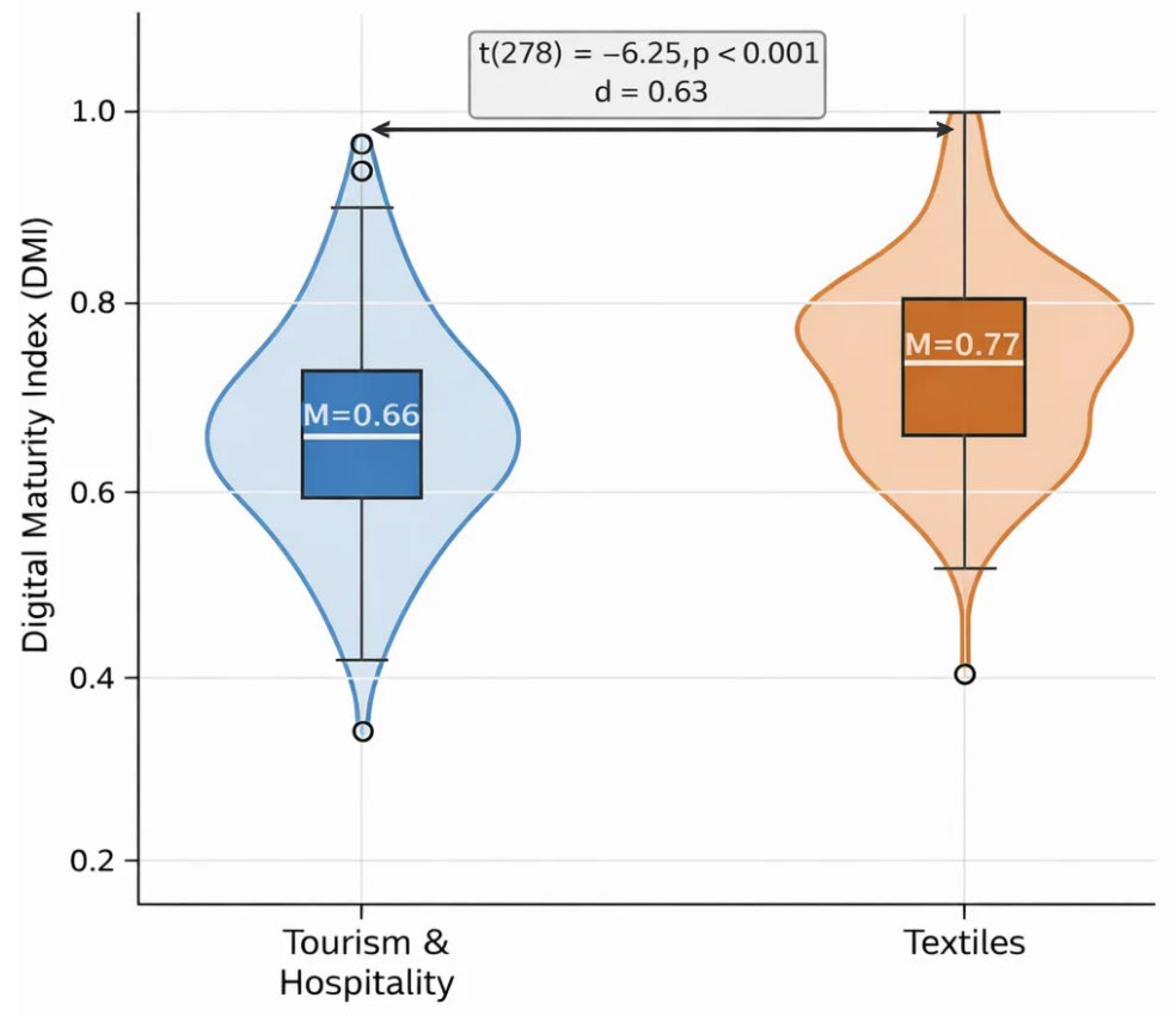
| Infrastructure | “Unreliable internet connectivity limits remarketing effectiveness” (TM-7) | “Export platforms provide access to broader markets” (TQ-4) | DII: 0.67 vs. 0.74; t(278) = −6.25, p < 0.001, d = 0.63 |
| Budget management | “Seasonal fluctuations disrupt budget consistency” (TM-3) | “Quarterly budget planning has stabilized ROI” (TQ-12) | CV: 0.11 vs. 0.18; β = 0.18 (p = 0.087) vs. β = 0.22 (p < 0.05) |
| Digital skills | “Staff require additional training” (TM-11) | “Our IT department is small, slowing AI integration” (TQ-19) | Mean AII: 2.9/5.0 vs. 3.4/5.0; independent samples t-test, p < 0.01 |
| Customer characteristics | “Seasonality complicates campaign timing” (TM-3) | “B2B transactions are longer but yield higher CLV” (TQ-8) | CVR: 3.5% vs. 4.2% (d = 0.74); CLV: $1230 vs. $1580 (d = 0.95) |
| Path | Path a (β) | Path b (β) | Indirect Effect (a × b) | 95% Bootstrap CI | p |
|---|---|---|---|---|---|
| Overall (n = 280) | −0.032 | −45.2 | 5.04 | [4.10, 6.00] | <0.001 |
| Tourism (n = 140) | −0.028 | −38.6 | 4.08 | [2.87, 5.33] | <0.001 |
| Textile (n = 140) | −0.039 | −52.1 | 5.72 | [4.38, 7.05] | <0.001 |
| Sectoral difference (moderation) | — | — | Δ = 1.64 | [0.42, 2.89] | <0.05 |
Disclaimer/Publisher’s Note: The statements, opinions and data contained in all publications are solely those of the individual author(s) and contributor(s) and not of MDPI and/or the editor(s). MDPI and/or the editor(s) disclaim responsibility for any injury to people or property resulting from any ideas, methods, instructions or products referred to in the content. |
© 2026 by the authors. Licensee MDPI, Basel, Switzerland. This article is an open access article distributed under the terms and conditions of the Creative Commons Attribution (CC BY) license.
Share and Cite
Beloeva, S.; Levakov, I.; Venelinova, N.; Akhmedov, A.; Makhmudov, M. AI-Driven Remarketing and Digital Infrastructure in Emerging Markets: Evidence from Tourism and Textile Enterprises in Uzbekistan. Sustainability 2026, 18, 5739. https://doi.org/10.3390/su18115739
Beloeva S, Levakov I, Venelinova N, Akhmedov A, Makhmudov M. AI-Driven Remarketing and Digital Infrastructure in Emerging Markets: Evidence from Tourism and Textile Enterprises in Uzbekistan. Sustainability. 2026; 18(11):5739. https://doi.org/10.3390/su18115739
Chicago/Turabian StyleBeloeva, Silvia, Izzatilla Levakov, Nataliya Venelinova, Azam Akhmedov, and Mukhtorjon Makhmudov. 2026. "AI-Driven Remarketing and Digital Infrastructure in Emerging Markets: Evidence from Tourism and Textile Enterprises in Uzbekistan" Sustainability 18, no. 11: 5739. https://doi.org/10.3390/su18115739
APA StyleBeloeva, S., Levakov, I., Venelinova, N., Akhmedov, A., & Makhmudov, M. (2026). AI-Driven Remarketing and Digital Infrastructure in Emerging Markets: Evidence from Tourism and Textile Enterprises in Uzbekistan. Sustainability, 18(11), 5739. https://doi.org/10.3390/su18115739