1. Introduction
The circular bioeconomy is increasingly regarded as one of the key pathways toward a smarter, more circular, and climate-neutral economy [
1]. Its underlying logic rests on a gradual shift away from fossil resources, including oil, gas, and coal, toward renewable biological resources and bio-based value chains. This transition is closely associated with biotechnology, biomanufacturing, biomass valorization, and the more productive use of organic waste streams. Materials that were previously treated mainly as residues or disposal problems are now increasingly expected to serve as inputs for value creation, resource efficiency, and environmental impact reduction.
However, the transition toward a circular bioeconomy is not only a technological or industrial process. It also depends on whether institutions, firms, and professionals are able to recognize environmental value, assess long-term risks, and distinguish credible sustainability-oriented activity from merely symbolic claims. In the present study, green skills are understood as a combination of knowledge, competencies, values, behavioral orientations, and decision-making capacities that enable individuals and organizations to reduce negative environmental impacts and support sustainable development across economic sectors [
2].
The need for green skills in finance becomes clearer when considered within the broader transformation of financial models under the sustainable development paradigm [
3]. Sustainable development brings together economic, environmental, social, and governance dimensions, while environmental, social, and governance (ESG) principles translate these dimensions into organizational strategy, financial decision-making, risk assessment, disclosure, and accountability. Environmental issues, in this context, are not limited to general ecological awareness. They include climate change mitigation and adaptation, biodiversity-related risks, resource efficiency, pollution reduction, circularity, and other factors that directly influence financial risk evaluation, investment allocation, disclosure practices, and corporate governance.
The movement from traditional finance toward low-carbon finance, climate finance, green finance, socio-environmental finance, and sustainable finance shows that the financial sector is gradually moving beyond a narrow concern with financial returns. Financial professionals are increasingly expected to interpret ESG data, assess climate-related and environmental risks, evaluate sustainability claims, design green financial products, and support credible sustainable finance practices. In this sense, green skills are not an auxiliary element of sustainable finance. They are becoming part of the professional capacity required to make sustainability-oriented financial decisions in a consistent and evidence-based manner.
The relevance of this issue has grown because the greening of finance is no longer only a voluntary or reputational strategy. It is increasingly embedded in regulation, supervisory expectations, disclosure standards, sustainable finance taxonomies, and market practice. Banks and other financial institutions are expected to identify and manage climate-related and environmental risks, collect and interpret non-financial data, disclose sustainability-related information, and demonstrate that ESG-oriented financial decisions are credible rather than merely declarative. This creates a growing demand for professionals who can combine environmental knowledge, analytical competence, regulatory awareness, and sustainability-oriented judgment in day-to-day financial practice.
Such competencies are particularly important in lending, investment, insurance, sustainability reporting, green bond issuance, impact assessment, and the financing of bioeconomy-oriented projects. In these areas, weak evaluation may lead not only to inefficient capital allocation but also to poor environmental outcomes. For example, projects involving biomass valorization, circular agri-food residues, bio-based materials, sustainable bioenergy, and climate-resilient agricultural systems often require an understanding of environmental externalities, life-cycle implications, feedstock sustainability, resource efficiency, and the credibility of sustainability claims. Financial professionals do not implement these technologies directly, but they influence whether such projects receive funding, insurance, investment support, and credible recognition within sustainable finance frameworks.
International reports also emphasize that the green transition requires large-scale workforce reskilling and upskilling [
4]. The alignment of employment, education, financial regulation, and climate policy is therefore becoming a central condition for sustainability transformation. Human capital should not be treated as a secondary issue in this process. On the contrary, sustainable finance and bioeconomy-oriented investment substantially depend on whether financial professionals are able to evaluate environmental risks, assess the credibility of sustainability strategies, and allocate capital toward projects that support long-term ecological and economic resilience.
Without such competencies, sustainable finance risks becoming a formal reporting exercise rather than a substantive mechanism of transition. Financial institutions may expand ESG disclosures and green financial products while lacking the internal expertise needed to verify claims, assess environmental effects, or reduce greenwashing risk. This is particularly important because greenwashing is not only a communication problem. It may also reflect insufficient analytical capacity, weak internal governance, poor sustainability data interpretation, and limited professional ability to connect ESG statements with actual financial decisions.
The United Nations Children’s Fund (UNICEF) (2024) offers a useful Green Skills Framework for understanding the broader structure of green skills [
5]. This framework presents green skills as a multi-layered system that includes green job skills, green life skills, and green transformation skills. At the most applied level, occupational and technical skills are linked to specific professional functions, including engineering, environmental management, finance, information and communication technology (ICT), and project management. At a broader level, transferable green life skills include adaptability, critical thinking, communication, teamwork, leadership, creativity, and problem-solving, all of which support sustainable practices across different work contexts.
At the most advanced level, transformative capacities include systems thinking, interdisciplinary collaboration, political agency, collective action, reflexivity, and the ability to operate under conditions of complexity and uncertainty. The framework is valuable because it shows that green skills cannot be reduced to narrow technical knowledge. They also include broader capabilities required for systemic change. However, because this framework is intentionally general, it does not fully explain which competencies are required in financial institutions or how these competencies are formed among financial professionals. This is the specific gap addressed by the present review.
Despite the growing importance of sustainable finance, the literature on green skills in finance remains conceptually fragmented [
6,
7,
8,
9,
10,
11,
12,
13,
14,
15,
16,
17,
18,
19,
20,
21,
22,
23,
24,
25,
26,
27,
28,
29,
30,
31,
32,
33,
34,
35,
36,
37,
38,
39,
40,
41,
42,
43,
44,
45,
46,
47,
48,
49,
50,
51,
52]. Existing studies often rely on related but not identical constructs, including ESG competencies, sustainability knowledge, green human capital, green capabilities, green training, and green human resource management (green HRM) outcomes. These concepts are relevant, but they are rarely integrated into a clear finance-specific understanding of green skills. Moreover, the existing literature provides limited cross-sector comparison within finance, as previous research often concentrates on banking or on isolated mechanisms such as green HRM and sustainability education, while insurance, investment, asset management, auditing, FinTech, development finance institutions, and other financial subsectors remain less visible.
As a result, it is still insufficiently clear which green skills are specifically required in finance, how these skills are formed, and how they contribute to sustainable financial practice. This gap is especially important in the context of the sustainable bioeconomy. Financial professionals are not expected to replace engineers, environmental scientists, or bioeconomy specialists. Nevertheless, they need sufficient competence to interpret environmental disclosures, evaluate bioeconomy-related investment risks, assess sustainability claims, understand resource-efficiency and life-cycle implications, and distinguish credible green finance instruments from symbolic or misleading sustainability communication.
The present review is theoretically informed by three complementary perspectives: human capital theory, institutional theory, and stakeholder theory [
53,
54,
55]. Human capital theory helps explain green skills as productive professional capabilities that increase the ability of financial-sector employees to interpret sustainability information, evaluate ESG and climate-related risks, and translate environmental knowledge into financial decisions. Institutional theory helps explain why regulatory pressure, disclosure standards, sustainable finance taxonomies, supervisory expectations, and market norms create external demand for these competencies. Stakeholder theory helps interpret why financial institutions require such competencies not only for compliance, but also for maintaining trust among investors, clients, regulators, employees, and society.
Taken together, these perspectives provide the theoretical logic linking sustainable finance transformation, institutional pressure, stakeholder accountability, green skill formation, and bioeconomy-oriented capital allocation. This theoretical positioning is important because the formation of green skills in finance cannot be explained only as an individual learning process. It is also shaped by regulatory requirements, organizational routines, market expectations, professional education, and the need to maintain credibility in front of multiple stakeholders.
This creates a clear need for a systematic review that does more than summarize isolated studies. The present study systematizes and synthesizes the existing literature on green skills in finance for a sustainable bioeconomy, with particular attention to the key skills required and the mechanisms that support their development. Its conceptual contribution lies in clarifying the meaning of green skills in finance by integrating fragmented terminology used in previous studies, including ESG competencies, sustainability knowledge, green human capital, green capabilities, green training, and green HRM-related outcomes, into a finance-specific conceptual framework.
This framework explains how green skills enable financial professionals and institutions to support sustainable finance practices, strengthen ESG credibility, reduce greenwashing risk, and contribute to capital allocation for sustainable bioeconomy transitions. It also helps clarify why green skills should be considered not only as individual competencies, but also as organizational and institutional capacities that connect education, regulation, human resource management, financial decision-making, and sustainability outcomes.
This review also has practical relevance. For financial institutions, green skills need to be embedded in recruitment, training, performance evaluation, risk management, reporting, product development, and governance. For universities and professional education providers, finance curricula should include climate-risk assessment, sustainability reporting, green financial instruments, ESG data analysis, regulatory taxonomies, and bioeconomy-related investment evaluation. For policymakers and regulators, the findings suggest that sustainable finance regulation should be accompanied by human capital development. Disclosure rules, taxonomies, and green finance standards can only function effectively when professionals have the competence to apply them critically and consistently.
The review is guided by two research questions:
Q1: What green skills are required in finance for a sustainable bioeconomy?
Q2: What mechanisms contribute to the formation of green skills in finance for a sustainable bioeconomy?
2. Research Design
This systematic review was conducted in accordance with the PRISMA 2020 guidelines to ensure transparent reporting, reproducibility of the search and selection procedure, and methodological consistency in the synthesis of the literature. The review protocol was not registered, and no separate protocol was prepared before the study. This limitation is acknowledged in the methodological limitations below. The completed PRISMA 2020 checklist is provided in
Supplementary Material Table S1. The review was guided by the following research questions:
Q1: What green skills are required in finance for a sustainable bioeconomy?
Q2: What mechanisms contribute to the formation of green skills in finance for a sustainable bioeconomy?
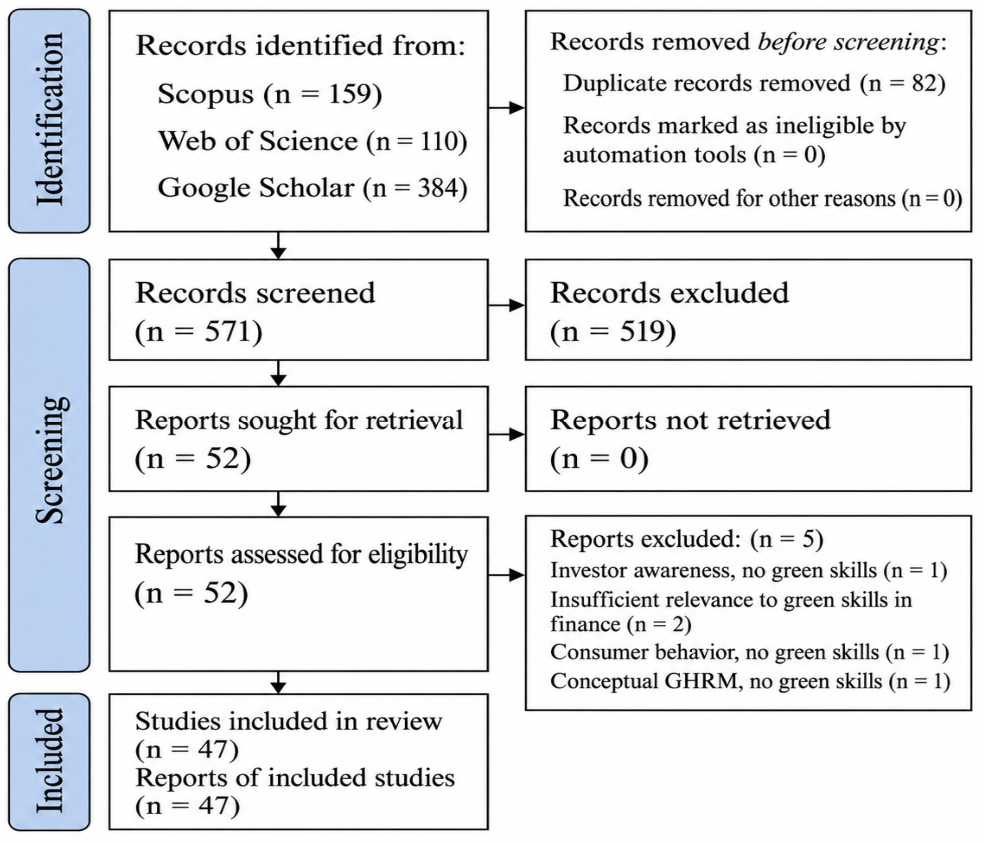
At the initial stage, publications were searched in three sources: Scopus, Web of Science, and Google Scholar. These sources were selected because Scopus and Web of Science provide structured bibliographic indexing and advanced search functions, whereas Google Scholar allows broader coverage of relevant academic publications that may not be fully captured by structured scientometric databases. The final search was completed in March 2026. The search strategy was developed using combinations of terms related to green skills, sustainability competencies, ESG competencies, green training, green human capital, and financial-sector contexts. The stages of the systematic literature review are illustrated in
Figure 1.
The search identified 653 records: 159 from Scopus, 110 from Web of Science, and 384 from Google Scholar. After removing 82 duplicate records, 571 records were screened by title and abstract. Of these, 519 records were excluded because they did not meet the focus of the review. A total of 52 full-text reports were assessed for eligibility, and five reports were excluded for the reasons specified in the PRISMA flow diagram. The final sample included 47 studies.
The following search strings were applied:
Scopus: TITLE-ABS-KEY (“green skill*” OR “green competenc*” OR “sustainability skill*” OR “sustainability competenc*” OR “environmental competenc*” OR “environmental skill*” OR “ESG skill*” OR “ESG competenc*” OR “sustainable skill*” OR “sustainable competenc*” OR “green capabilit*” OR “sustainability capabilit*” OR “environmental capabilit*” OR “ESG capabilit*” OR “green knowledge” OR “sustainability knowledge” OR “environmental knowledge” OR “ESG knowledge” OR “green training” OR “sustainability training” OR “environmental training” OR “ESG training” OR “sustainable training” OR “green human capital” OR “sustainability human capital” OR “environmental human capital” OR “ESG human capital” OR “sustainable human capital”) AND TITLE-ABS-KEY (“financial sector” OR “financial industry” OR “financial service*” OR “financial institution*” OR “financial system” OR “financial market*” OR “bank*” OR “banking sector” OR “banking” OR “insurance” OR “insur*” OR “investment” OR “asset management” OR “capital market*” OR “fintech” OR “green finance” OR “finance” OR “sustainable finance” OR “ESG investing” OR “responsible investment”) AND PUBYEAR > 2009 AND PUBYEAR < 2027 AND (LIMIT-TO (OA,”all”)) AND (LIMIT-TO (DOCTYPE,”ar”)) AND (LIMIT-TO (LANGUAGE,”English”));
Web of Science: TS = ((“green skill*” OR “green competenc*” OR “sustainability skill*” OR “sustainability competenc*” OR “environmental competenc*” OR “environmental skill*” OR “ESG skill*” OR “ESG competenc*” OR “sustainable skill*” OR “sustainable competenc*” OR “green capabilit*” OR “sustainability capabilit*” OR “environmental capabilit*” OR “ESG capabilit*” OR “green knowledge” OR “sustainability knowledge” OR “environmental knowledge” OR “ESG knowledge” OR “green training” OR “sustainability training” OR “environmental training” OR “ESG training” OR “sustainable training” OR “green human capital” OR “sustainability human capital” OR “environmental human capital” OR “ESG human capital” OR “sustainable human capital”) AND (“financial sector” OR “financial industry” OR “financial service*” OR “financial institution*” OR “financial system” OR “financial market*” OR “bank*” OR “banking sector” OR “banking” OR “insurance” OR “insur*” OR “investment” OR “asset management” OR “capital market*” OR “fintech” OR “green finance” OR “finance” OR “sustainable finance” OR “ESG investing” OR “responsible investment”)) AND PY = (2010–2026) AND DT = (Article) AND LA = (English);
Google Scholar: (“green skills” OR “sustainability skills” OR “green competencies”) AND (“financial sector” OR “financial industry” OR “financial field” OR “banking” OR “insurance” OR “green finance”).
The Google Scholar search strategy was deliberately simplified compared with the Scopus and Web of Science searches because Google Scholar does not support the same level of field-specific restrictions, controlled filtering, or advanced query reproducibility. Unlike Scopus and Web of Science, Google Scholar indexes a broader and less structured range of academic materials, including journal articles, working papers, conference materials, institutional publications, and other documents. Therefore, an excessively long Boolean query in Google Scholar would have increased the number of irrelevant records and reduced search precision. A more focused set of core terms was used to balance sensitivity and specificity while preserving relevance to the research questions. The 384 records identified through Google Scholar were screened manually according to the same inclusion and exclusion criteria used for the other sources.
Clearly defined inclusion and exclusion criteria were applied to ensure methodological transparency and reduce the risk of arbitrary selection. Only studies directly focused on green skills, green competencies, green human resource management (green HRM), green training, green human capital, sustainability knowledge, ESG competencies, or closely related concepts within the financial sector were included. The financial-sector context covered banking, investment, insurance, development finance institutions, financial education, financial analysis, auditing, and broader sustainable finance practices. Eligible studies had to contain information relevant to at least one of the research questions, be published in English, be available as full-text publications, and fall within the chronological period from 2010 to March 2026.
The chronological scope was selected because green skills, ESG competencies, and sustainable finance-related human capital began to develop more systematically after 2010, alongside the broader institutionalization of sustainable development, climate policy, ESG disclosure, and green finance. English-language publications were included to ensure consistent interpretation of terminology during screening, data extraction, and thematic coding. Studies unrelated to finance, studies not addressing skills, competencies, training, knowledge, human capital, or organizational mechanisms, publications in languages other than English, works published before 2010, conference proceedings, books, dissertations, reports, presentations, unpublished working papers, non-peer-reviewed publications, and inaccessible full texts were excluded. The inclusion and exclusion criteria are summarized in
Table 1.
The selected publications were imported into Zotero, which was used for reference management, duplicate removal, and organization of bibliographic records. During data cleaning, duplicate records were removed using Zotero’s built-in functionality, while key bibliographic metadata, including title, authors, journal, publication year, and DOI where available, were checked manually. Zotero was used only as a bibliographic management tool and not as an automated screening or decision-making instrument.
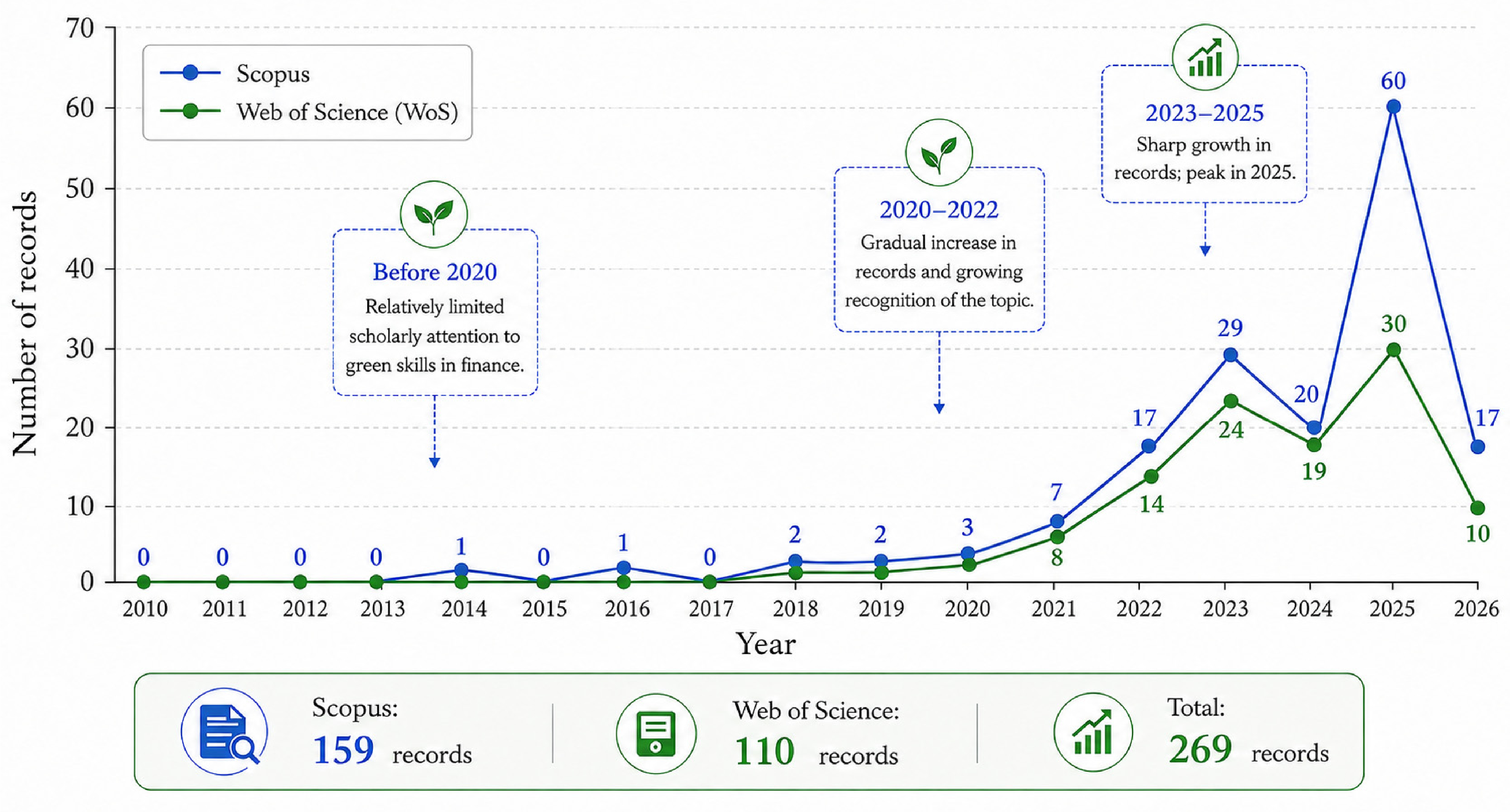
The temporal distribution of records identified through Scopus and Web of Science before final eligibility assessment is presented in
Figure 2.
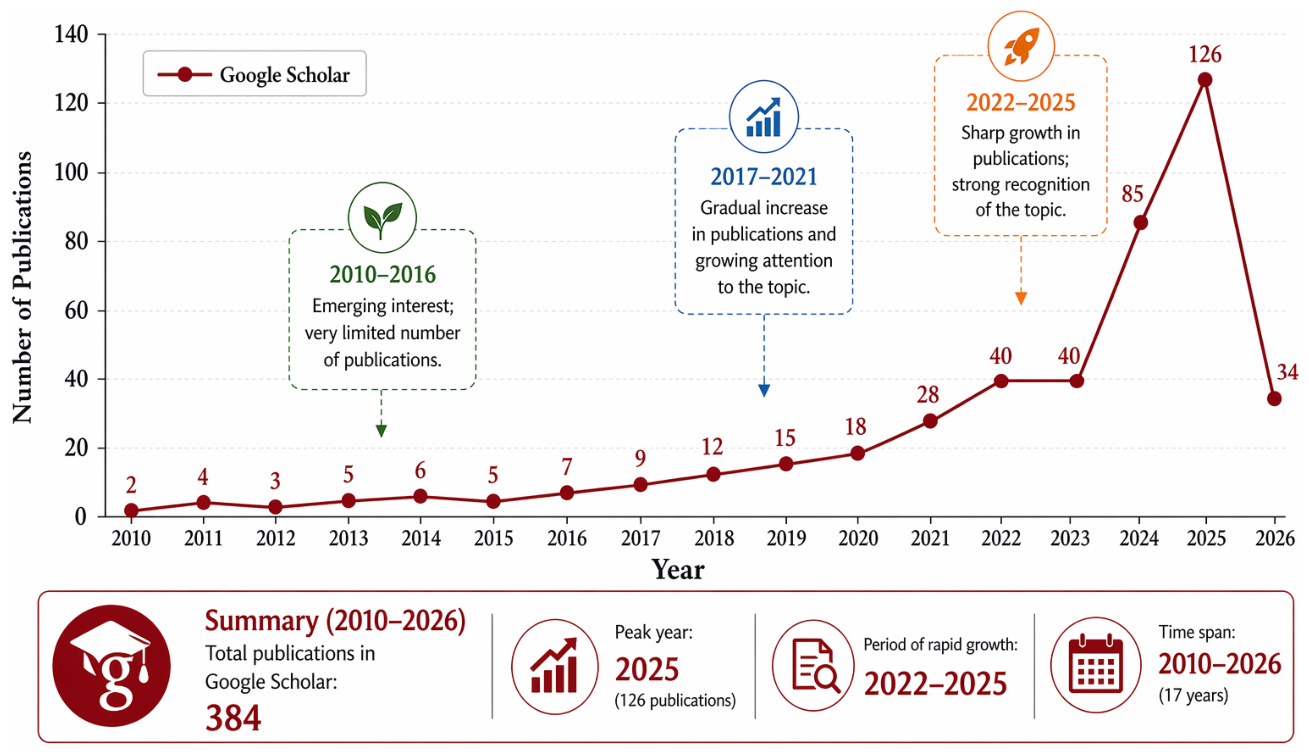
Google Scholar results are reported separately in
Figure 3 because of the broader indexing logic and weaker filtering functions of this source.
In addition, inclusion and exclusion criteria in Google Scholar were applied manually rather than through database filters, which further justifies their separate presentation.
The temporal distribution of Google Scholar records suggests an increase in potentially relevant publications after 2020. However, these records were subject to duplicate removal, title and abstract screening, and full-text eligibility assessment. Therefore,
Figure 3 should be interpreted as a methodological description of the search output rather than as the annual distribution of the final included studies. The lower number of records in 2026 should be interpreted cautiously because the search covered only publications available up to March 2026.
The study selection process was carried out in several stages. First, records were screened by title and abstract to remove publications that did not correspond to the research focus. At this stage, studies were excluded if they addressed sustainable development, ESG, green finance, the green economy, or environmental policy in general but did not include a clear focus on green skills, competencies, training, sustainability knowledge, human capital, or related organizational mechanisms. Studies were also excluded if they discussed green jobs, green HRM, innovation, or sustainability in general business contexts without a clear connection to the financial sector.
Second, full texts were assessed for eligibility according to the predefined inclusion and exclusion criteria presented in
Table 1. The screening and eligibility assessment were performed by three authors. At the initial stage, the reviewers worked independently, and disagreements were resolved through discussion until consensus was reached. Formal intercoder reliability statistics were not calculated; this is acknowledged as a methodological limitation.
Third, the final sample was formed. The final database included 47 journal articles. Although the search covered the period from 2010 to March 2026, the studies that met all eligibility criteria were published between 2018 and March 2026. These articles constituted the analytical corpus used for the qualitative thematic synthesis. No advanced automation tools or artificial intelligence-based screening tools were used for study selection. All screening, eligibility assessment, data extraction, and thematic coding decisions were made manually by the authors.
Data extraction was guided by the research questions and focused on two main outcome domains: the classification of green skills required in finance and the mechanisms contributing to their formation. Not all findings reported in each included study were extracted. Instead, a selective extraction approach was applied, prioritizing information directly relevant to the research objectives. In addition to the main outcome domains, several descriptive variables were extracted to support the synthesis, including publication year, country or region, financial-sector classification, study focus, terminology used for green skills or related constructs, and the main mechanisms of skill formation identified in each study. No assumptions were made about missing or unclear information; when a study did not provide sufficient information for a particular descriptive variable, that information was treated as not reported.
The assignment of studies to specific syntheses was guided by the research questions and the thematic structure of the review. For Q1, studies were classified according to the types of green skills they addressed, including environmental and sustainability knowledge, digital and analytical skills, behavioral and value-oriented skills, and managerial, strategic, and creative skills. For Q2, studies were grouped according to the mechanisms supporting the development of green skills, including education and professional training, green HRM practices, and institutional or regulatory mechanisms. Some studies were assigned to more than one category because they addressed multiple dimensions relevant to the research questions.
Given the qualitative nature of this systematic literature review, no statistical data transformations, quantitative conversions, or effect measures were applied. The review did not aim to estimate effect sizes, compare intervention effects, or conduct a meta-analysis. Therefore, measures such as risk ratios, odds ratios, mean differences, confidence intervals, and statistical heterogeneity indicators were not applicable. Data preparation consisted of cleaning, organizing, and structuring extracted information for qualitative comparison. The extracted data were organized and visualized using Microsoft Excel and Paint.NET (v. 4.3.11). Tables and charts were used to present the distribution of studies by publication year, geographical context, and financial-sector focus. A word cloud was used to visualize recurring keywords, while Google Trends data were used only as contextual evidence of broader public and professional interest in sustainability-related financial concepts. Google Trends data were not included in the systematic review corpus and were not used for study selection, eligibility assessment, or thematic synthesis.
The synthesis of results was based on an iterative qualitative thematic coding procedure. Thematic coding was conducted in three stages. At the first stage, extracted findings from each study were reviewed and assigned preliminary descriptive codes. These codes reflected recurring concepts such as environmental knowledge, ESG competencies, green accounting knowledge, sustainability reporting skills, climate-risk assessment, digital competencies, employee green behavior, green HRM, green training, regulatory awareness, and sustainability-oriented leadership.
At the second stage, similar descriptive codes were grouped into broader analytical categories. For Q1, the coding process resulted in four main categories of green skills: environmental and sustainability knowledge; digital and analytical skills; behavioral and value-oriented skills; and managerial, strategic, and creative skills. For Q2, the codes were grouped into three main mechanisms of green skill formation: education and professional training; green HRM practices; and institutional and regulatory mechanisms.
At the third stage, the thematic structure was validated through repeated comparison across the included studies. Particular attention was paid to borderline cases, especially studies that used related terms such as ESG competencies, sustainability knowledge, green capabilities, green human capital, or green HRM outcomes without explicitly using the term “green skills”. Such studies were included only when their content directly addressed knowledge, abilities, behaviors, competencies, or organizational mechanisms relevant to sustainability-oriented financial practice. This approach allowed the review to capture the substantive content of green skills in finance despite terminological inconsistency in the literature.
A formal risk-of-bias assessment was not conducted because this review did not aim to estimate causal effects or combine quantitative outcomes through meta-analysis. The included studies were heterogeneous in terms of research design, methods, geographical context, sectoral focus, and conceptual framing, which made the application of a single standardized risk-of-bias tool inappropriate. However, study quality and methodological transparency were considered qualitatively during interpretation, particularly when comparing empirical studies, conceptual papers, and sector-specific analyses. Methodological rigor was further supported by predefined eligibility criteria, transparent reporting of search strings, independent screening by three authors, duplicate removal, manual verification of bibliographic metadata, structured data extraction, and iterative thematic validation.
The risk of reporting bias due to missing results was not formally assessed. Similarly, the overall certainty of evidence was not evaluated using standardized tools such as GRADE because the review provides an exploratory qualitative synthesis rather than a statistically weighted assessment of intervention effects or causal relationships. Consequently, the findings should be interpreted as a structured synthesis of conceptual and empirical patterns in the literature rather than as quantitative evidence of causal effects.
Several methodological limitations should be acknowledged. First, the review protocol was not registered, and no separate protocol was prepared before the study. Second, although three authors participated in screening and eligibility assessment, formal intercoder reliability statistics were not calculated. Third, the review was limited to English-language journal articles retrieved from Scopus, Web of Science, and Google Scholar searches, which may have excluded relevant studies published in other languages or formats. Fourth, Google Scholar has broader indexing coverage and weaker filtering functions than Scopus and Web of Science, which required manual screening and may limit exact reproducibility. Fifth, due to the conceptual and methodological heterogeneity of the included studies, no meta-analysis, statistical synthesis, formal risk-of-bias assessment, sensitivity analysis, or certainty-of-evidence assessment was conducted. These limitations were mitigated by transparent reporting of the search strategy, predefined eligibility criteria, independent multi-author screening, structured data extraction, manual verification of bibliographic metadata, and iterative thematic synthesis.
3. Results
3.1. Descriptive Analysis of the Final Dataset
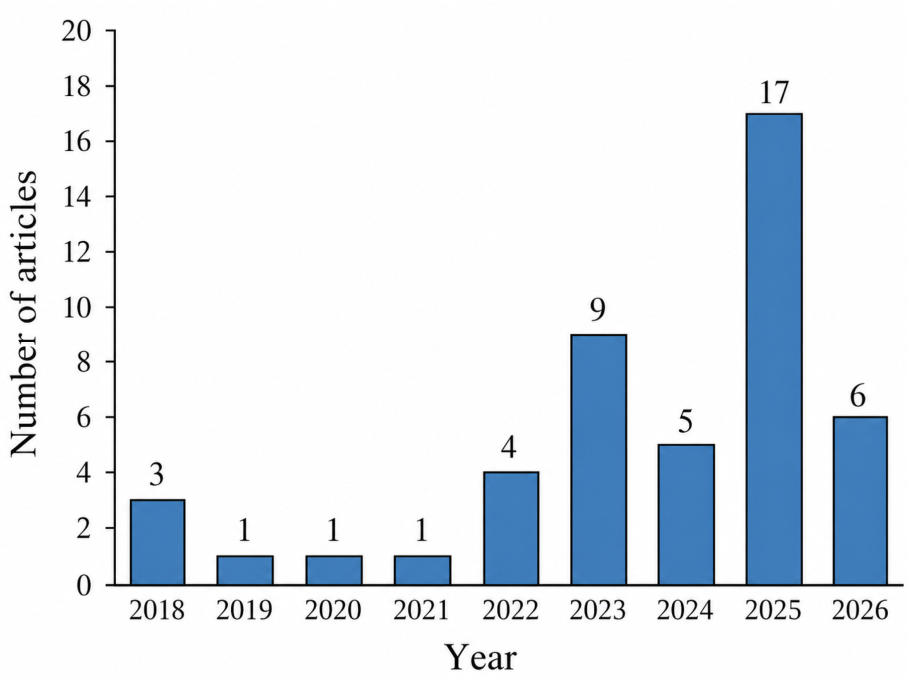
To provide an overview of the final dataset, descriptive statistics of the selected studies were first examined. The annual distribution of articles included in the final sample is presented in
Figure 4.
The annual distribution of the final sample indicates a clear increase in scholarly attention to green skills in finance after 2021. The number of included studies rose from four articles in 2022 to nine in 2023, five in 2024, and seventeen in 2025. The lower number of studies in 2026 should be interpreted cautiously because the search covered only publications available up to March 2026.
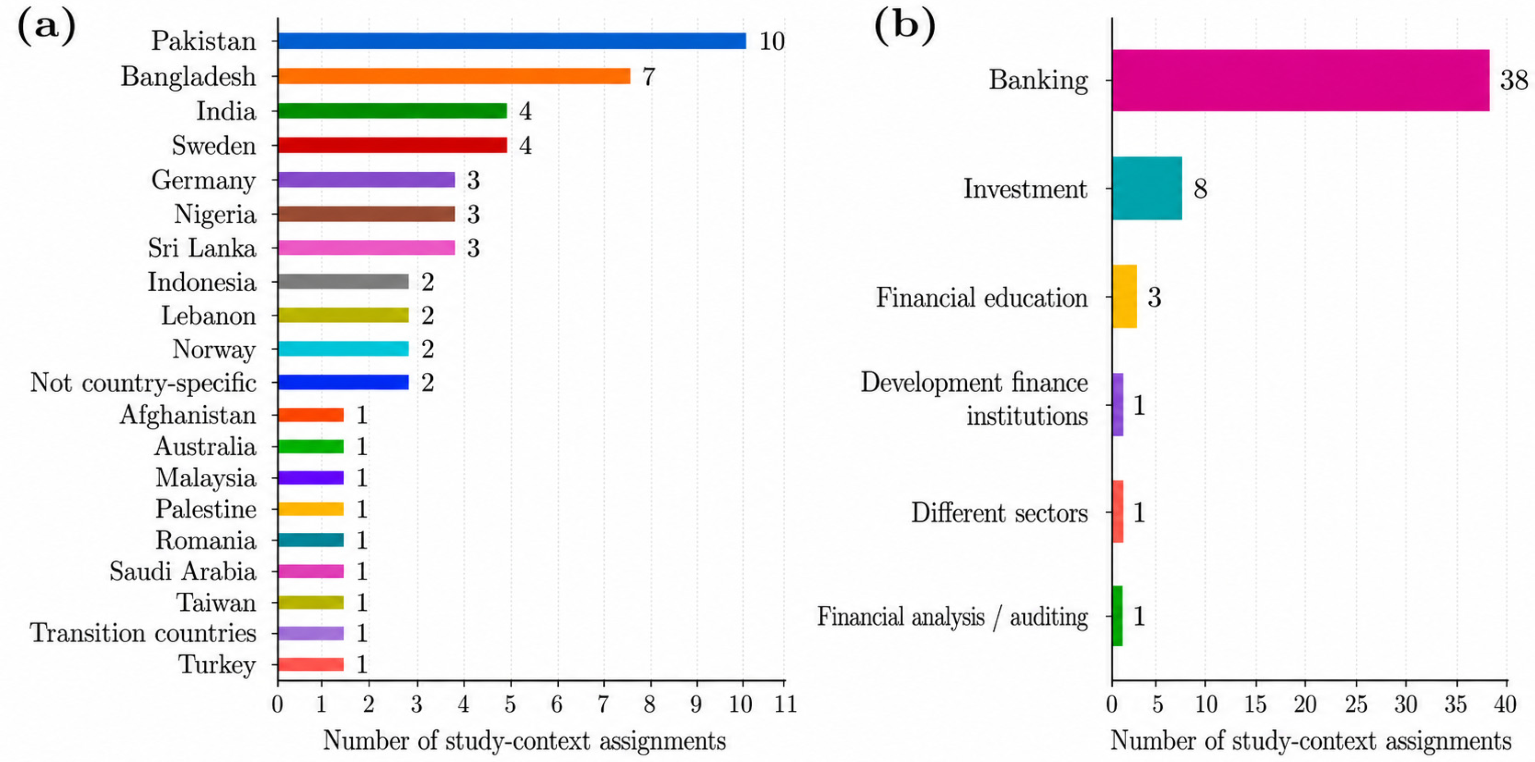
To further characterize the final dataset, the geographical and sectoral distribution of the selected studies was examined (
Figure 5 and
Table 2).
Figure 5 and
Table 2 show that the literature is geographically and sectorally concentrated. The banking sector is the dominant empirical context in studies of green skills and related competencies in finance. Contrary to the expectation that this topic would be concentrated mainly in European or other highly regulated financial markets, a substantial share of the reviewed literature focuses on Asia and developing countries. Developed financial markets are represented more weakly in the final dataset, and studies from countries such as Germany, Australia, Norway, and Sweden tend to focus more on investment, broader financial practice, or cross-sectoral contexts than on banking alone. This pattern suggests that in developed financial systems, sustainability-related competencies may often be embedded within broader ESG, responsible investment, and sustainable finance frameworks rather than explicitly conceptualized as “green skills”.
One possible explanation is that countries are discussed more frequently where the green agenda has entered the financial system through central banks, banking regulators, development finance institutions, or donor-supported sustainability programs. In such contexts, green finance principles are often institutionalized through roadmaps, reporting templates, risk-management requirements, staff training initiatives, and regulatory guidance. Another explanation is that climate-related risks are more politically and economically visible in some regions, which accelerates the movement from abstract sustainability principles toward concrete requirements for risk assessment, product design, green lending, disclosure, and staff capabilities.
It is important to emphasize that a lower number of studies for a particular country does not necessarily indicate lower demand for green skills. According to the World Bank, demand for green skills is high and increasing in high-income countries; between 2022 and 2023, the share of job postings requiring at least one green skill increased by 22.4%, while the growth of green talent was slower [
56]. Within the European Union, for example, the competence agenda in finance is often framed through ESG risk management, sustainable finance disclosure, taxonomy alignment, and climate-related financial supervision rather than through the narrower term “green skills”.
The International Labour Organization emphasizes that the transition to low-carbon and resource-efficient economies has direct implications for skills, occupations, and workforce development [
4]. In regions exposed to high climate vulnerability, including parts of South Asia, financial institutions may face stronger pressure to develop competencies related to climate-risk assessment, sustainable lending, green financial products, and environmental disclosure. This may help explain why South Asian countries occupy a prominent position in the final dataset.
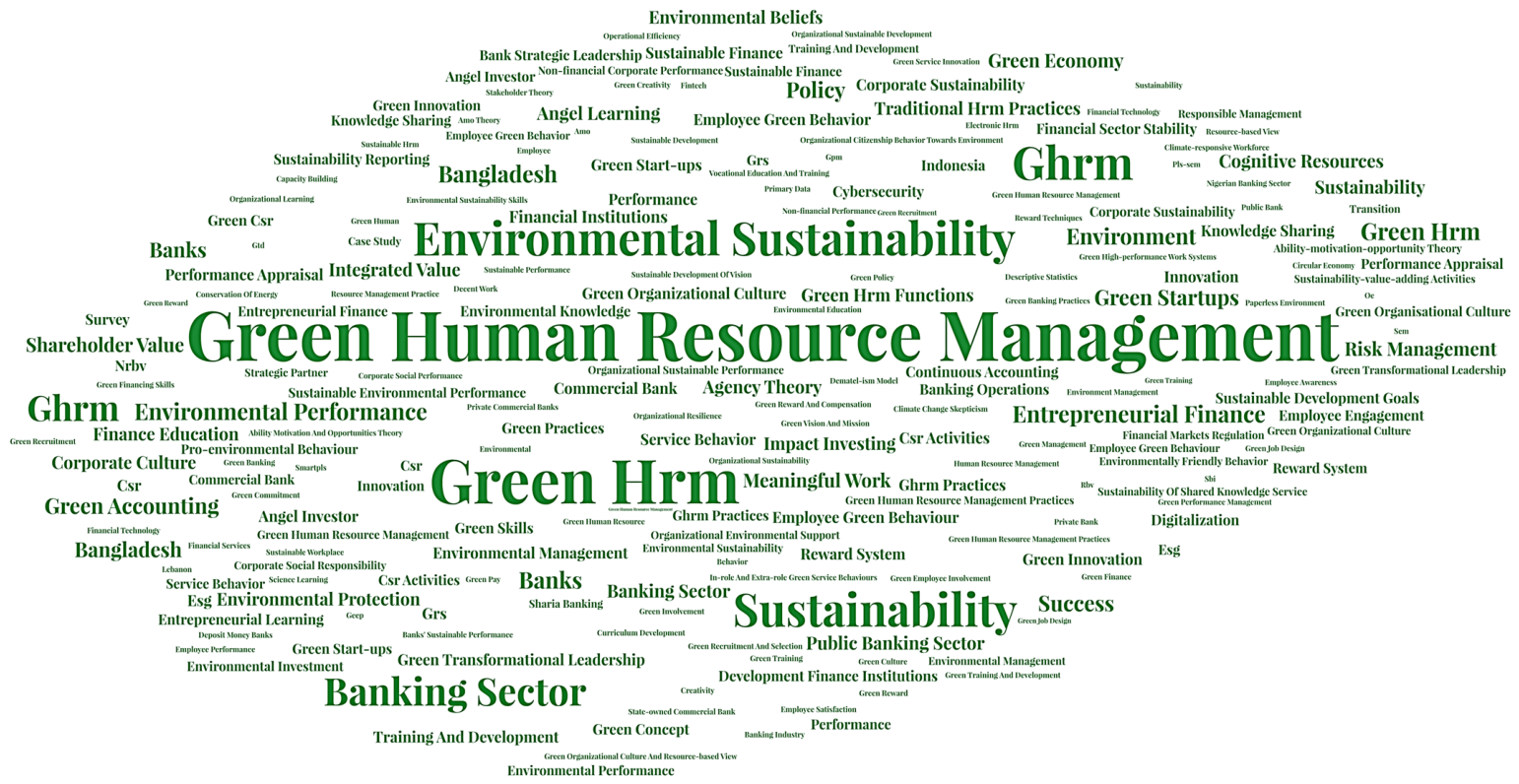
To further explore the thematic structure of the selected studies, a keyword analysis was conducted. The results are visualized as a word cloud in
Figure 6, where the size of each term reflects its frequency in the reviewed publications.
As shown in
Figure 6, the most prominent terms in the reviewed literature are “green human resource management”, “environmental sustainability”, “sustainability”, and “green HRM”. This indicates that much of the existing literature approaches green skills indirectly, through organizational practices and human resource mechanisms rather than through explicit competence frameworks for financial professionals. Frequently recurring concepts such as “environmental performance”, “corporate culture”, and “green accounting” further suggest that current research is largely focused on organizational-level practices, employee behavior, and institutional conditions that support environmental performance in financial organizations.
3.2. Q1: What Green Skills Are Required in Finance for a Sustainable Bioeconomy?
The systematic literature review shows that the term “green skills” is not used consistently in the financial literature. Nevertheless, the reviewed studies describe a multidimensional set of knowledge areas, competencies, analytical capabilities, behavioral orientations, and managerial abilities that can be interpreted as green skills in finance. In many studies, related categories are used instead, including ESG competencies, sustainability knowledge, green human capital, green capabilities, green training, green accounting knowledge, green human resource management, and employee green behavior.
This terminological diversity can be explained by three factors. First, the concept of green skills remains interdisciplinary and has not yet acquired a stable conceptual framework in finance. Second, much of the literature focuses less on skills as such and more on the functional ability of employees and organizations to integrate sustainability into financial practices. Third, some studies examine green skills through broader frameworks, such as sustainable finance, ESG reporting, green HRM, or organizational environmental performance, without explicitly identifying them as a separate category.
Despite this inconsistency, the reviewed studies provide sufficient grounds for interpreting these related constructs as substantively connected to green skills in finance. The absence of the explicit term “green skills” does not indicate the absence of the phenomenon itself. Rather, the literature addresses the knowledge, abilities, attitudes, values, and organizational mechanisms that enable financial professionals and institutions to integrate environmental and sustainability principles into decision-making, risk assessment, reporting, investment, lending, insurance, and governance.
To make this concept analytically usable, this review treats green skills in finance not as a single isolated competence but as a structured system of interrelated domains. Based on the synthesis of the reviewed studies, green skills in finance can be grouped into four categories: environmental and sustainability knowledge; digital and analytical skills; behavioral and value-oriented skills; and managerial, strategic, and creative skills.
3.2.1. Environmental and Sustainability Knowledge
Environmental and sustainability knowledge constitutes the foundational layer of green skills in finance. One banking-sector study distinguishes two competence-related areas: green accounting knowledge and environmental knowledge [
6]. Green accounting knowledge concerns the professional ability to integrate environmental aspects into accounting and banking activities, while environmental knowledge reflects broader awareness of biodiversity, environmental risks, environmental disclosure, and responsible environmental attitudes.
The importance of environmental knowledge is also emphasized in studies on leadership and organizational culture. Environmental knowledge among leaders is described as an important antecedent of green transformational leadership and green behavior [
7]. This means that environmental knowledge is not only a technical competence but also a basis for leadership practices that shape employee behavior and organizational norms.
In green entrepreneurial finance, sustainability knowledge becomes especially important for investment decision-making. The literature shows that many investors lack the expertise required to evaluate green start-ups, their technologies, and their business models [
8]. In this context, relevant green skills include the ability to assess sustainability impacts, understand environmental metrics, interpret sustainability impact assessment tools such as ESG metrics, life cycle assessment (LCA), and sustainable return on investment (SROI), and identify potential greenwashing risks.
The importance of environmental and sustainability knowledge is also visible in financial education. Studies on green finance education indicate that graduates entering sustainability-related roles often lack competencies related to ESG metrics and reporting frameworks, green financial products and markets, climate-related financial risk assessment, relevant regulations and taxonomies, and data analysis for sustainability performance evaluation [
9]. These findings suggest that environmental and sustainability knowledge in finance should not be limited to general awareness. It should include practical understanding of ESG frameworks, regulatory taxonomies, climate risk, disclosure requirements, green accounting, and sustainable financial instruments.
3.2.2. Digital and Analytical Skills
The second major group of green skills is associated with digital and analytical competencies. In the financial sector, these skills are increasingly important because ESG reporting, climate analytics, green finance assessment, sustainability disclosure, and risk modeling depend heavily on data quality, digital systems, and analytical capacity.
Empirical evidence on ESG readiness highlights the role of digital competencies in the ability of financial professionals to apply ESG criteria in financial assessment [
10]. In this context, digitalization includes not only the use of digital tools in reporting and auditing but also the transition to digital sustainability reporting standards and the digital tagging of sustainability data through the European Sustainability Reporting Standards (ESRS) XBRL taxonomy [
10]. This indicates that digital skills have become an integral component of green skills in finance.
Other studies point to the practical role of electronic systems in reducing resource use and improving organizational efficiency. The use of e-payment systems, specialized software, management information systems, and electronic human resource management systems is linked to the transition from paper-based processes to electronic data storage, reporting, and decision support [
11]. Although such practices may appear operational, they also require employees to develop digital literacy, data-handling skills, and the ability to use digital systems for sustainability-related tasks.
The relationship between digitalization, green finance, and sustainability performance is also increasingly emphasized. Existing models link green innovation, corporate social responsibility, employee environmental behavior, and environmental sustainability through the mediating role of green finance, while financial technologies moderate the relationship between green finance and environmental sustainability [
12]. This suggests that green skills in finance increasingly require the ability to work at the intersection of sustainability, data analytics, digital finance, and environmental performance evaluation.
More broadly, digital and analytical green skills are important because they help financial professionals move from declarative ESG language toward evidence-based assessment. These skills support the verification of non-financial data, the interpretation of climate-related information, the assessment of sustainability-linked financial products, and the identification of inconsistencies between reported ESG performance and actual environmental outcomes.
3.2.3. Behavioral and Value-Oriented Skills
A separate layer of green skills is associated not only with technical knowledge but also with environmentally responsible behavior, values, and professional attitudes. In the reviewed literature, this dimension is reflected through categories such as green behavior, environmental responsibility, sustainability mindset, employee green attitudes, green commitment, and pro-environmental behavior. For the financial sector, this means that green skills include not only the ability to work with ESG reporting, green finance instruments, or climate-risk data, but also the willingness to act responsibly and consistently in daily professional practice.
Several studies emphasize that organizational environmental initiatives depend on employee engagement and behavioral alignment with sustainability objectives [
12]. Green skills in finance therefore include cognitive, practical, and normative dimensions: employees need to know what sustainability requires, be able to apply this knowledge, and value environmentally responsible decision-making.
The literature shows that green organizational culture is formed through shared values, beliefs, and practices, and that employees are more likely to demonstrate pro-environmental behavior when environmental norms become routine and expected within the organization [
7]. Leaders who demonstrate environmentally responsible behavior can transmit the value of environmental responsibility through their own example, making leadership behavior an important channel for the formation of employee green behavior [
7].
The reviewed studies describe a broad set of pro-environmental workplace practices, including reduced paper use, double-sided printing, energy-saving behavior, use of natural light, shutting down computers when not in use, waste sorting, reuse of office materials, reduction in plastic packaging, sustainable procurement, and reporting of environmental risks or damage [
14,
15,
16,
17,
18]. In customer-facing financial services, green behavior also includes recommending eco-friendly products, providing information on sustainable practices, encouraging customers to participate in green initiatives, and supporting environmentally responsible service delivery [
16].
An important distinction in the literature is made between in-role and extra-role green behavior [
20]. In-role green behavior refers to environmentally responsible actions that are part of formal job responsibilities, organizational policies, or prescribed procedures. Extra-role green behavior refers to voluntary actions beyond formal duties, such as saving electricity, participating in environmental initiatives, and promoting sustainability within the workplace [
20]. This distinction is important because it shows that green skills are not limited to formal competencies. They also include proactive and value-driven behavior that supports the development of sustainability-oriented financial institutions and, more broadly, a sustainable bioeconomy.
3.2.4. Managerial, Strategic, and Creative Skills
The final group of green skills includes managerial, strategic, and creative capabilities. These skills ensure that environmental and sustainability priorities are integrated into corporate governance, financial policy, organizational development, risk management, and long-term strategic planning. They are particularly important for executives, analysts, risk managers, ESG specialists, investment professionals, auditors, and other actors involved in financial decision-making.
This category includes strategic thinking, forward-looking risk analysis, scenario planning, integrated value assessment, stakeholder-oriented governance, cross-disciplinary collaboration, and the ability to design innovative sustainability solutions. Finance education oriented toward responsible management emphasizes that financial professionals should be prepared to move beyond short-term financial optimization and incorporate environmental and social consequences into financial decisions [
21]. From this perspective, managerial and strategic green skills are needed to connect sustainable finance principles with long-term value creation.
Green creativity is an especially important dimension of this skill group. It includes green creative motivation, green creative thinking, green creative behavior, and green creative outcomes [
22]. Green organizational culture appears to be a key driver of employee green creativity because it strengthens environmental values, encourages sustainability-oriented work practices, and creates an environment in which employees are more willing to propose and implement eco-friendly ideas [
22]. In financial institutions, green creativity can support the development of new green products, sustainability-linked financial services, improved ESG processes, and more innovative approaches to environmental risk management.
Sustainable knowledge sharing also contributes to green skills by strengthening employees’ ability to explore new ideas and apply existing knowledge. In the banking sector, sustainability knowledge sharing has been linked to employee ambidexterity, understood as the ability to explore new opportunities while effectively using existing knowledge [
23]. This is particularly relevant for financial institutions seeking to combine regulatory compliance, innovation, and sustainability-oriented service development.
Overall, the systematic literature review shows that green skills in finance should not be understood as a narrow set of environmental knowledge. Rather, they represent an integrated system of professional competencies that enables financial professionals and institutions to support sustainable finance, ESG credibility, climate-risk management, green innovation, and capital allocation for a sustainable bioeconomy.
To move beyond a purely descriptive classification,
Table 3 compares how the identified green skill domains are positioned across financial-sector functions, what evidence patterns are visible in the reviewed literature, and where the main research gaps remain.
The synthesis in
Table 3 shows that the four skill domains are interdependent rather than separate. Environmental and sustainability knowledge provides the interpretive basis for understanding ESG issues and bioeconomy-related risks. Digital and analytical skills transform this knowledge into usable evidence for reporting, risk assessment, and investment decisions. Behavioral and value-oriented skills influence whether sustainability principles are applied consistently rather than symbolically. Managerial, strategic, and creative skills determine whether green skills remain individual attributes or become embedded in governance, financial products, organizational routines, and long-term capital allocation. The reviewed literature therefore supports a systemic understanding of green skills in finance, but it also reveals that comparative evidence across non-banking financial subsectors remains limited.
3.3. Q2: What Mechanisms Contribute to the Formation of Green Skills in Finance for a Sustainable Bioeconomy?
The first research question identified the main types of green skills required in finance. The second question concerns the mechanisms through which such skills are formed. The reviewed literature shows that the development of green skills depends not only on individual education and employee training but also on organizational practices, institutional pressures, regulatory requirements, and broader market expectations.
3.3.1. Education and Professional Training
Education, training, and professional development are among the most frequently mentioned mechanisms for the formation of green skills. This mechanism includes formal academic education, vocational education, professional certification, corporate learning, workshops, seminars, and continuous learning through practical experience.
Formal education and professional training provide structured mechanisms for acquiring sustainability-specific knowledge [
24]. Formal learning formats, including seminars, workshops, and training programs, are therefore important for transferring high-quality knowledge in fields such as green finance and green investing [
24]. At the same time, the literature shows that the current educational infrastructure remains insufficient in emerging fields such as green investing. Some investors perceive a lack of dedicated educational opportunities for green investment, which suggests that professional training systems still lag behind the practical needs of sustainable finance [
24].
Green competencies among investors are developed not only through prior knowledge but also through continuous engagement in investment activities and interaction with green start-ups [
25]. Value creation in green ventures depends on investors’ ability to provide strategic guidance, mentoring, and access to networks, which requires sustainability-related knowledge and competence developed over time [
25].
Finance education is therefore increasingly viewed as a central mechanism for embedding sustainability into the financial profession. Traditional finance education is insufficient for addressing contemporary sustainability challenges if it remains focused only on short-term financial performance. It needs to be reoriented toward responsible management, long-term value creation, and the integration of environmental and social dimensions into core finance curricula [
21].
The role of education is also emphasized in studies of environmental sustainability and green financing skills among students [
26]. These findings suggest that education functions as an important catalyst for environmental sustainability and green finance competencies, particularly when curricula combine sustainability knowledge with practical financial applications.
3.3.2. Green Human Resource Management
Green human resource management (green HRM) is one of the most prominent mechanisms for developing green skills among employees of financial institutions. In the final dataset, 28 articles, representing 59.6% of the reviewed studies, address green HRM or closely related organizational mechanisms [
11,
14,
16,
17,
19,
20,
27,
28,
29,
30,
31,
32,
33,
34,
35,
36,
37,
38,
39,
40,
41,
42,
43,
44,
45,
46,
47,
48]. This indicates that the existing literature often conceptualizes green skill formation through organizational practices rather than through education alone.
Green HRM institutionalizes environmental priorities within recruitment, selection, training, performance appraisal, compensation, employee involvement, workplace culture, and leadership practices. The reviewed studies show that integrating green HRM values into recruitment, training, performance appraisal, and employee development can help organizations build a sustainability-oriented culture [
43]. Other studies identify additional green HRM functions, including green selection, green compensation, green rewards and pay systems, green employee relations, employee empowerment, green innovation, green job analysis and design, and environmentally oriented HR planning [
27,
38,
39,
41,
46].
Empirical evidence from the banking sector suggests that green HRM can serve as an organizational mechanism for developing green skills and green service behavior [
20]. Green HRM positively influences both in-role and extra-role green service behavior, while green commitment mediates this relationship [
20]. This finding suggests that green skills are not formed only through formal education or technical training but also through organizational practices that embed environmental objectives into daily work routines and employee motivation.
Evidence from private banks in Bangladesh also shows that green HRM can support the development of employees’ green competencies, attitudes, commitment, and behavior through recruitment, training and development, performance appraisal, rewards, employee involvement, and discipline management [
39]. At the same time, the literature reveals an important gap between environmental awareness and full institutionalization. Operational practices such as paperless documentation, online systems, and energy-saving measures are more common than deeper mechanisms such as green performance evaluation, rewards for green innovation, or formal monitoring units. This supports the argument that green skills in finance require not only individual awareness but also a structured organizational system that embeds sustainability into HR policies, workplace culture, and everyday financial-sector practices.
The role of green compensation and reward systems is also important. Green pay and reward techniques influence not only employees but also organizational performance in deposit money banks [
49]. The findings suggest that green rewards may have limited effects on overall employee satisfaction but can stimulate innovation and operational efficiency. This indicates that green reward systems may function primarily as performance- and innovation-enhancing tools rather than as general satisfaction mechanisms. From the perspective of the ability–motivation–opportunity (AMO) model, green compensation can be interpreted as a motivational factor that activates employees’ abilities and encourages the practical application of green skills [
49].
A similar view is reflected in the literature on green high-performance work systems. Such systems combine HRM practices that develop employees’ abilities, motivation, and opportunities to participate in environmental initiatives [
50]. Through training, performance appraisal, participation, and employee engagement, these practices support green skill development and green service innovation. Importantly, their effect is not purely direct; it depends on whether employees work under supportive and fair conditions that allow them to apply sustainability-related knowledge in practice [
50].
3.3.3. Institutional and Regulatory Mechanisms
A third mechanism contributing to the formation of green skills is the external institutional and regulatory environment. This includes government policies, financial supervision, disclosure standards, international principles, professional associations, market expectations, and stakeholder pressure. These mechanisms influence green skills by creating demand for new forms of knowledge, compliance capacity, risk analysis, and sustainability reporting.
In the European context, regulatory and institutional mechanisms are shaped by mandatory requirements such as the EU Taxonomy and the Corporate Sustainability Reporting Directive (CSRD). These frameworks transform ESG reporting and sustainability assessment into legally binding practices and redefine professional expectations in finance [
10]. Empirical evidence shows that familiarity with EU legislation is a strong predictor of ESG integration capacity, which highlights regulatory awareness as a core component of green skills in financial organizations [
10].
However, the effectiveness of regulatory mechanisms depends on the extent to which professionals possess sufficient ESG knowledge and interpretive capacity. Sustainability knowledge underpins both strategic and operational ESG adaptation in banks [
51]. This means that regulatory requirements and green skills are mutually reinforcing. Regulations create demand for green competencies, while the ability to implement regulation presupposes knowledge, analytical capacity, and organizational learning.
In green entrepreneurial finance, regulatory requirements also shape investor competence. Investors recognize sustainability indicators as relevant not only for impact assessment but also for regulatory compliance [
8]. This indicates that regulation indirectly strengthens demand for sustainability-related competencies in financial decision-making.
A broader institutional perspective emphasizes that green skills development depends on the combined roles of international financial institutions, industrial enterprises, educational institutions, and governments [
52]. These actors provide funding, standards, infrastructure, and policy support for green skills training and implementation. The process is influenced by moderating factors such as private-sector engagement, digital literacy, and gender equality. The expected outputs include a skilled green workforce and enhanced industrial resilience, supported by continuous monitoring, feedback, and policy adaptation [
52].
Overall, the development of green skills in finance results from the interaction of multiple mechanisms rather than from a single source. Education provides foundational knowledge, green HRM embeds sustainability into organizational routines, and institutional and regulatory mechanisms create external demand for competence development. This indicates that green skills do not emerge spontaneously; they are formed through a structured and purposeful system of human capital development.
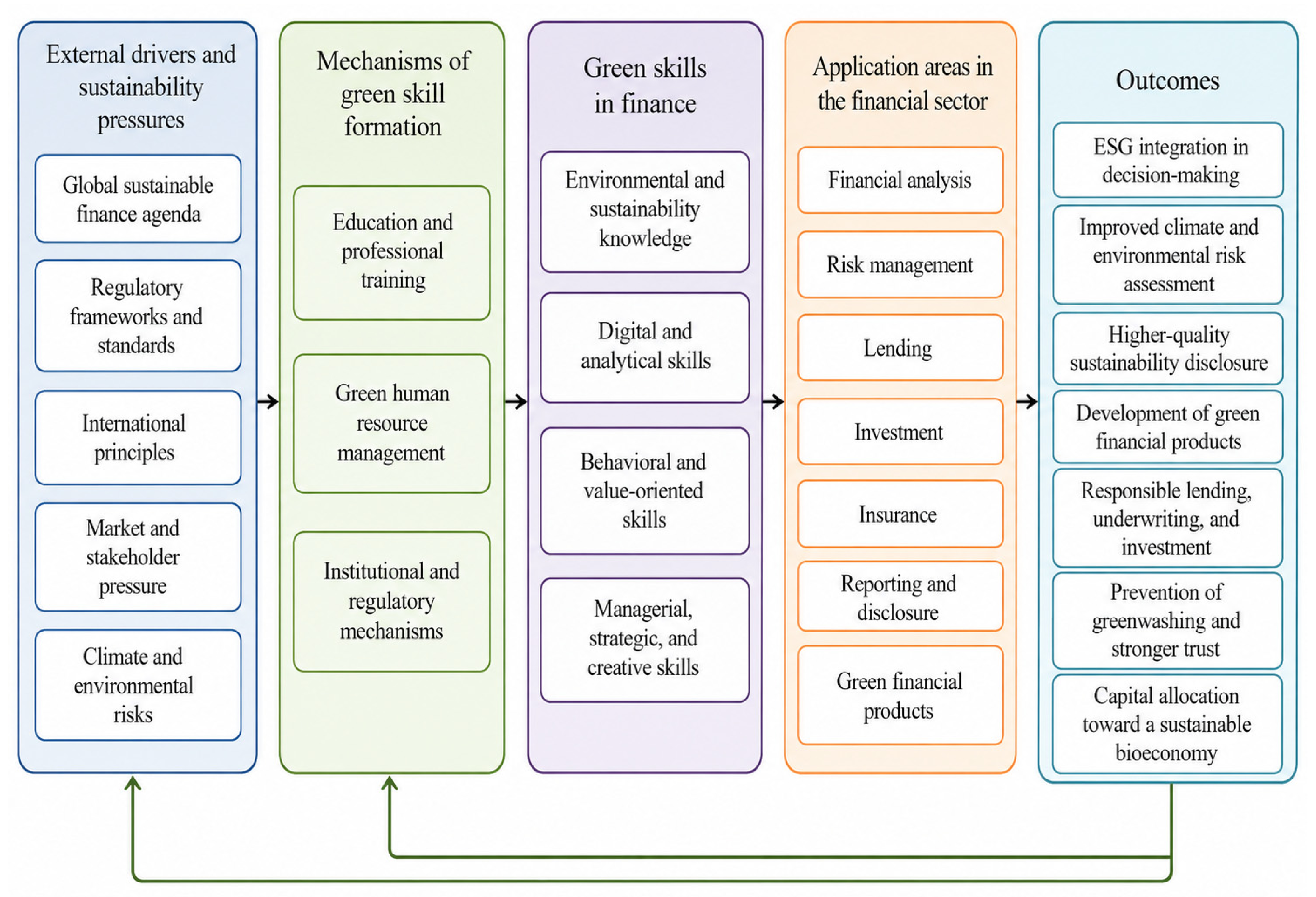
To systematize these findings and overcome the fragmentation of existing approaches, a conceptual model was developed to illustrate the relationships among the key drivers, formation mechanisms, major groups of green skills, and outcomes of their application within the financial sector (
Figure 7).
Figure 7 summarizes the logic identified across the reviewed literature. The development of green skills in finance is not an isolated educational or HR-related process. Rather, it emerges at the intersection of external sustainability pressures, institutional mechanisms, organizational practices, and the practical needs of the financial industry. At the center of the framework is the concept of green skills in finance, which emphasizes the integrative nature of these competencies. Green skills include not only general sustainability knowledge but also the ability to apply such knowledge in financial analysis, risk management, lending, investment, insurance, reporting, and the development of financial products for a sustainable bioeconomy.
The left side of
Figure 7 illustrates the key drivers generating demand for green skills in the financial sector. These include the global sustainable finance agenda, regulatory frameworks and standards, international principles, market and stakeholder pressure, and the growing importance of climate and environmental risks. These factors are strongly interconnected. Climate risks intensify the need for new regulatory requirements; regulation increases demand for ESG reporting and risk analysis; and markets expect financial institutions not only to comply formally with sustainability requirements but also to demonstrate the capacity to make informed and credible decisions during the green transition.
The next block presents the mechanisms through which green skills are formed. Based on the reviewed literature, these mechanisms can be grouped into three categories: education and professional training, green HRM, and institutional and regulatory mechanisms. This logic is important because it demonstrates that green skills do not emerge automatically from new laws, standards, or market expectations. Their development requires educational programs, professional reskilling, corporate learning, employee motivation, organizational culture, and a regulatory environment that establishes competence-related expectations. The literature particularly emphasizes green HRM because recruitment, training, performance evaluation, rewards, corporate culture, and employee engagement are the channels through which abstract sustainability principles become embedded in the everyday operations of financial institutions.
The central block of
Figure 7 systematizes green skills in finance into four major categories. The first category includes environmental and sustainability knowledge, which forms the basis for understanding ESG, climate risks, sustainable finance principles, and green transformation processes. The second category consists of digital and analytical skills, which are increasingly important as financial institutions need to work with ESG data, climate scenarios, non-financial reporting, risk models, and digital analytical tools. The third category includes behavioral and value-oriented skills, because the green transition in finance requires not only technical expertise but also responsibility, ethical judgment, the ability to avoid superficial sustainability claims, and an understanding of the long-term consequences of financial decisions. The fourth category covers managerial, strategic, and creative skills, including green creativity and the ability to integrate sustainability into business models, financial products, risk management, and strategic planning.
The right side of
Figure 7 demonstrates the expected outcomes of green skill development. These include the integration of ESG considerations into financial decision-making, improved assessment of climate and environmental risks, higher-quality reporting and disclosure practices, the development of green financial products, and more responsible lending, underwriting, and investment activities. Particular emphasis is placed on preventing greenwashing and strengthening trust, since the reviewed literature shows that ESG reporting, analytical competence, sustainability knowledge, governance, and professional judgment are necessary for credible sustainability-oriented financial practice [
8,
10,
51]. Overall, green skills are viewed as a critical human and organizational resource without which the financial sector cannot effectively support sustainable development, green transformation, and capital allocation toward a sustainable bioeconomy.
The proposed model has conceptual value because it integrates fragmented findings from previous studies into a coherent framework in which green skills function as an intermediary link between external sustainability pressures, mechanisms of human capital formation, and practical outcomes for financial institutions and society.
Therefore, in this study, green skills in finance are defined as a multidimensional set of professional knowledge, analytical abilities, digital competencies, behavioral attitudes, and strategic capabilities that enable financial-sector employees and institutions to integrate environmental and sustainability considerations into financial decisions, assess ESG and climate-related risks, support credible sustainability disclosure, prevent greenwashing, and contribute to sustainable development and capital allocation for a sustainable bioeconomy.
4. Discussion
The findings of this systematic literature review indicate that research on green skills in finance for a sustainable bioeconomy is still at an early and conceptually fragmented stage. Although the reviewed studies address a broad range of sustainability-related competencies, they rarely use the term “green skills” consistently. Instead, the same underlying phenomenon is frequently discussed through related concepts such as ESG competencies, sustainability knowledge, green human capital, green capabilities, green training, green HRM outcomes, environmental behavior, and sustainability-oriented leadership. This terminological diversity is not merely a linguistic issue. It affects how the field is structured theoretically, how empirical evidence is accumulated, and how green skills can be operationalized, measured, and compared across financial-sector contexts.
The most fundamental gap identified in the review is the absence of a clear and stable definition of green skills in finance. Without conceptual clarity, it remains difficult to determine which competencies are specific to finance, which are transferable across sectors, and which are required for particular financial activities such as lending, underwriting, investment analysis, ESG reporting, auditing, or sustainable product development. This ambiguity also weakens the theoretical development of the field because similar constructs are studied under different labels. As a result, the literature often describes the same competency domain without explicitly recognizing it as part of a broader green skills framework. The definition proposed in this study therefore aims to address this gap by treating green skills in finance as a multidimensional set of environmental knowledge, analytical abilities, digital competencies, behavioral attitudes, and strategic capabilities that enable financial professionals and institutions to integrate sustainability considerations into financial decision-making.
The findings can be interpreted through three complementary theoretical perspectives. From the perspective of human capital theory, green skills represent productive professional capabilities that increase the ability of financial-sector employees to interpret ESG information, evaluate climate-related and environmental risks, assess sustainability claims, and translate environmental knowledge into financial decisions [
53]. From the perspective of institutional theory, the formation of green skills is shaped by regulatory pressure, disclosure standards, sustainable finance taxonomies, supervisory expectations, and market norms that redefine what counts as competent professional practice in finance [
54]. From the perspective of stakeholder theory, green skills are also a mechanism of accountability, because financial institutions need these competencies to maintain credibility and trust among investors, clients, regulators, employees, and society [
55]. Taken together, these perspectives show that green skills in finance are not simply individual attributes. They are human, organizational, and institutional capacities that connect professional learning, regulatory compliance, stakeholder trust, and sustainable capital allocation.
A second major gap concerns the limited availability of robust measurement instruments. At present, green skills in finance are more often discussed as a normative or organizational aspiration than as an empirically measurable construct. This limits the possibility of testing whether green skills contribute to stronger ESG integration, higher-quality sustainability reporting, lower greenwashing risk, improved climate-risk assessment, better green product design, or more responsible capital allocation. Future research should therefore move beyond descriptive identification and develop validated scales, competency indicators, and sector-specific assessment tools. Such tools would make it possible to compare green skills across institutions, countries, financial subsectors, and occupational roles.
The third important limitation of the existing literature is its narrow empirical base. The reviewed studies are strongly concentrated in the banking sector, while other financial subsectors, including insurance, asset management, investment funds, financial auditing, stock exchanges, development finance institutions, and FinTech, remain underrepresented. This concentration may distort the theoretical understanding of green skills by linking them too closely to banking-specific organizational practices, especially green HRM and green service behavior. However, sustainable finance operates through a broader network of actors, and each subsector requires a specific configuration of green skills. Banks require competencies in green lending, client engagement, credit risk assessment, ESG disclosure, and sustainability-linked financial products. Insurers require skills in climate-risk modeling, underwriting, claims management, sustainable insurance product design, and long-term environmental risk evaluation. Investment institutions require competencies in ESG data interpretation, stewardship, portfolio-level sustainability assessment, screening, engagement, and impact evaluation. FinTech firms require skills in digital sustainability analytics, ESG data infrastructure, responsible innovation, and the environmental assessment of digital financial technologies. Therefore, green skills should be understood as a cross-sectoral requirement for the financial system as a whole rather than as a banking-specific issue.
The findings also show that the classification of green, brown, and white skills is relatively clear in general occupational taxonomies such as the European ESCO framework [
57], but becomes less stable when applied to finance. In financial practice, the boundaries between general sustainability awareness, ESG knowledge, technical reporting competence, digital data skills, and strategic decision-making capacity are often blurred. Some studies imply that financial professionals possess green skills if they are familiar with ESG principles or environmental practices [
6,
10]. However, this interpretation is too broad if it is not connected to concrete financial tasks. A finance-specific approach requires a more precise distinction between general environmental knowledge and the ability to apply such knowledge in risk assessment, investment appraisal, reporting, lending, underwriting, auditing, and governance.
The institutional importance of human capital development is also visible in sustainability reporting and disclosure frameworks. ESG regulation and sustainability reporting frameworks increasingly transform sustainability from a voluntary corporate communication practice into a matter of market credibility, regulatory compliance, and long-term resilience [
10,
58,
59,
60]. Although reporting standards do not always use the term “green skills”, they implicitly require organizations to develop relevant knowledge and competence. GRI 404 highlights training and education as important dimensions of human capital development [
59], while climate-related disclosure standards increasingly require organizations to explain transition-related policies, actions, risks, and impacts, which indirectly brings workforce transformation, reskilling, and upskilling into the sustainability reporting agenda [
60]. This suggests that green skills in finance are formed through three interacting pathways: internal organizational strategies and training systems, external reporting and disclosure pressures, and regulatory changes that redefine professional expectations.
The relationship between green skills and greenwashing deserves particular attention. ESG integration, sustainability reporting, and green financial products are now central elements of responsible finance. However, when employees and organizations lack sufficient analytical skills, ESG knowledge, sustainability reporting competence, and professional skepticism, these practices may become symbolic rather than substantive. In this context, green skills perform not only an adaptive function but also a protective function. They help financial professionals evaluate sustainability claims, identify inconsistencies between disclosure and practice, interpret ESG data critically, and distinguish credible green finance from misleading communication.
The DWS Group case illustrates why this issue is important for the financial sector. DWS, a subsidiary of Deutsche Bank, faced regulatory action in relation to ESG-related misstatements and greenwashing-related claims [
61,
62]. In 2023, the U.S. Securities and Exchange Commission charged DWS Investment Management Americas in connection with misstatements regarding its ESG investment process [
61]. In 2025, German prosecutors imposed an additional EUR 25 million fine on DWS in a greenwashing case [
62]. This case shows that greenwashing is not only a communication problem but also a competence and governance problem. If financial professionals lack the ability to interpret ESG standards, verify sustainability claims, assess non-financial disclosures, and critically evaluate the environmental credibility of financial products, ESG may become a marketing instrument rather than a mechanism of sustainable development.
Based on this logic, the relationship between green skills and greenwashing can be formulated as a set of testable propositions for future research. Proposition 1: Financial institutions with higher levels of ESG analytical competence among employees are likely to demonstrate lower greenwashing risk because employees are better able to verify sustainability-related claims and detect inconsistencies between disclosure and practice. Proposition 2: Sustainability reporting skills are likely to reduce greenwashing risk by improving the transparency, accuracy, and evidentiary basis of ESG communication. Proposition 3: Critical evaluation skills and professional skepticism may moderate the relationship between ESG disclosure intensity and greenwashing risk because extensive ESG communication becomes less likely to remain symbolic when employees are able to challenge unsupported sustainability claims. Proposition 4: Green HRM practices may indirectly reduce greenwashing risk by developing employees’ sustainability-related knowledge, motivation, accountability, and ethical awareness. These propositions suggest that green skills should be interpreted not only as a workforce adaptation mechanism but also as a potential internal control mechanism against greenwashing.
Digitalization represents another important dimension of green skills in finance. Digital technologies strengthen the capacity of financial institutions to collect ESG data, process sustainability indicators, model climate risks, improve transparency, and support evidence-based decision-making. Recent evidence suggests that FinTech adoption can improve ESG performance by strengthening transparency, information flows, and stakeholder confidence [
63]. At the same time, digitalization has a dual role. It supports ESG analytics and sustainability reporting, but it may also generate environmental costs through energy consumption, data infrastructure, and the expansion of computationally intensive technologies [
64]. This trade-off remains insufficiently explored in the literature. Digitalization should therefore be interpreted both as an enabling infrastructure for green skills and as a potential source of sustainability-related challenges.
Artificial intelligence further strengthens the importance of digital and analytical green skills. AI applications can improve forecasting accuracy, risk assessment, and financial decision-making in banking platforms [
65]. However, the use of AI in sustainable finance also requires new competencies. Financial professionals must understand how AI-generated outputs are produced, how data quality affects ESG assessment, how algorithmic systems may influence investment and lending decisions, and how digital tools can be used responsibly in sustainability-related contexts. Green skills in finance are therefore increasingly connected to digital literacy, data interpretation, model awareness, and ethical judgment under conditions of uncertainty.
International sustainable finance frameworks confirm that green skills are relevant beyond banking. In the insurance sector, the Principles for Sustainable Insurance call for the integration of ESG issues into risk management, underwriting, product development, claims management, investment activities, recruitment, training, and employee engagement [
66]. This implies that insurance professionals require competencies in climate-risk assessment, ESG-informed underwriting, sustainable insurance product design, and long-term environmental risk evaluation. In investment activities, the Principles for Responsible Investment require investors to incorporate ESG issues into investment analysis and decision-making, act as active owners, request ESG disclosure from investee companies, and report on implementation progress [
67]. This creates demand for skills in ESG data interpretation, sustainability disclosure analysis, portfolio screening, stewardship, engagement, and critical assessment of sustainability claims.
The same argument applies to positive impact finance and broader capital-market infrastructure. The Principles for Positive Impact Finance emphasize the need to identify, monitor, and disclose both positive and negative social, environmental, and economic impacts [
68]. Such requirements presuppose skills in impact assessment, ESG risk analysis, sustainability metrics, materiality assessment, and transparent reporting. Taken together, these frameworks show that green skills are part of the professional infrastructure required to make sustainable finance credible and operational. They are not limited to individual environmental awareness but extend to institutional capacity, governance, verification, and accountability.
The connection between green skills in finance and the sustainable bioeconomy also requires clearer interpretation. The transformation of the bioeconomy is not limited to financial institutions. Contextual studies on digital sustainability, agricultural engineering, organic farming systems, soil-management technologies, and bioresource-related agricultural production illustrate how sustainability-related transitions occur in practice outside the financial sector [
69,
70,
71,
72,
73,
74]. These studies mainly address the technological and production dimensions of the bioeconomy rather than financial competencies. Their relevance to this discussion lies in showing the types of real-sector activities that require credible sustainability assessment, responsible investment, risk evaluation, and capital allocation. Financial professionals do not directly implement agricultural or bioresource technologies, but they influence whether such technologies receive funding, insurance, investment support, and credible sustainability recognition. Therefore, green skills in finance are important because they help translate bioeconomy-related technological and environmental opportunities into credible financial decisions.
This interpretation helps clarify why the bioeconomy dimension matters for a review of green skills in finance. Bioeconomy-oriented projects often involve renewable biological resources, circular value chains, biomass valorization, agricultural innovation, resource-efficiency improvements, and long-term environmental externalities. Evaluating such projects requires more than general ESG awareness. It requires the ability to assess environmental impacts, verify sustainability claims, understand climate and resource-efficiency implications, analyze non-financial disclosure, evaluate transition risks, and distinguish credible green investment opportunities from symbolic or weakly substantiated claims. Green skills in finance therefore act as an enabling condition for capital allocation toward sustainable bioeconomy transitions.
Several limitations of this review should be acknowledged. First, the analysis was limited to publications retrieved from Scopus, Web of Science, and Google Scholar. Relevant studies indexed in other databases or published in other formats may therefore have been excluded. Second, only English-language publications were included, which may have introduced language bias and limited the representation of research from non-English-speaking contexts. Third, the review focused on peer-reviewed journal articles and excluded conference proceedings, dissertations, books, reports, and working papers, although some of these sources may contain relevant practice-oriented insights. Fourth, the qualitative nature of the review involves a degree of interpretive judgment in the classification and synthesis of findings. Fifth, no formal risk-of-bias assessment, meta-analysis, sensitivity analysis, or certainty-of-evidence assessment was conducted because the included studies were heterogeneous in design, scope, method, and conceptual framing. These limitations mean that the findings should be interpreted as a structured qualitative synthesis rather than as statistically weighted evidence of causal relationships.
Despite these limitations, the review provides a clearer conceptual basis for future research. First, future studies should develop and validate measurement instruments for green skills in finance. Second, empirical research should test whether green skills reduce greenwashing risk, improve ESG integration, strengthen climate-risk assessment, and support better sustainability disclosure. Third, future studies should examine how green skills interact with digitalization, AI, ESG data infrastructures, and FinTech. Fourth, research should move beyond banking and investigate insurance, investment, asset management, financial auditing, development finance institutions, and FinTech. Fifth, future work should examine green skills in relation to bioeconomy-oriented finance, including investment appraisal, sustainability verification, risk assessment, insurance, and capital allocation for bioresource-based and circular economy projects. A more systematic, measurable, and sector-sensitive approach would allow the field to move from fragmented terminology toward a coherent theory of green skills in finance.
5. Conclusions
5.1. Main Findings
This article presents a systematic literature review of green skills in the financial sector and their significance for the development of a sustainable bioeconomy. The findings show that scholarly attention to this topic has increased markedly since 2021, reflecting the growing importance of human capital in sustainable finance. At the same time, the field remains insufficiently structured. The reviewed literature is characterized by conceptual fragmentation, uneven geographical coverage, and a strong concentration in the banking sector, while other financial subsectors, including insurance, investment, asset management, financial auditing, development finance institutions, stock exchanges, and FinTech, remain comparatively under-researched.
This review demonstrates that green skills in finance are multidimensional. They include environmental and sustainability knowledge, digital and analytical skills, behavioral and value-oriented skills, and managerial, strategic, and creative capabilities. These skills are rarely examined under a unified conceptual label. Instead, they are usually embedded in related constructs such as ESG competencies, sustainability knowledge, green human capital, green capabilities, green training, green HRM, employee green behavior, and organizational environmental performance. This confirms that the absence of the explicit term “green skills” does not mean that the phenomenon is absent from the literature. Rather, it shows that the field still lacks common terminology and a stable analytical framework.
The findings also show that green skills do not emerge spontaneously. Their formation depends on the interaction of several mechanisms: education and professional training, green human resource management practices, and institutional and regulatory pressures. Education provides the knowledge base, green HRM embeds sustainability into organizational routines and employee behavior, while regulation and disclosure requirements create external demand for ESG competence, climate-risk assessment, sustainability reporting, and credible financial decision-making. In this sense, green skills in finance should be understood as part of a wider human capital development system that connects individual learning, organizational practice, and institutional transformation.
5.2. Theoretical Contribution
The main theoretical contribution of this review lies in clarifying green skills in finance as a finance-specific construct and integrating fragmented terminology into a coherent conceptual framework. The proposed interpretation defines green skills in finance as a multidimensional set of professional knowledge, analytical abilities, digital competencies, behavioral attitudes, and strategic capabilities that enable financial-sector employees and institutions to integrate environmental and sustainability considerations into financial decisions, assess ESG and climate-related risks, support credible sustainability disclosure, prevent greenwashing, and contribute to capital allocation for a sustainable bioeconomy.
This contribution is important because existing studies often discuss related phenomena without connecting them to a broader theory of green skill formation in finance. By synthesizing evidence across green HRM, ESG competencies, sustainability knowledge, green accounting, green behavior, digitalization, professional education, and institutional regulation, this review shows that green skills operate at the intersection of individual competence, organizational capability, and institutional pressure.
This review also strengthens the theoretical positioning of the field by linking green skills in finance to human capital theory, institutional theory, and stakeholder theory. From the perspective of human capital theory, green skills increase the productive capacity of financial professionals by enabling them to interpret sustainability information, evaluate environmental risks, and apply ESG knowledge in financial decision-making. From the perspective of institutional theory, these skills are shaped by regulation, disclosure standards, sustainable finance taxonomies, supervisory expectations, and market norms. From the perspective of stakeholder theory, green skills support accountability, trust, and credibility among investors, clients, regulators, employees, and society. Taken together, these perspectives show that green skills are not simply individual attributes but also organizational and institutional capacities required for credible sustainable finance.
5.3. Managerial and Practical Implications
The findings have several practical implications. For policymakers and regulators, the main implication is that sustainable finance regulation should not be reduced to reporting obligations, taxonomy alignment, or formal ESG compliance. Regulatory frameworks can create demand for green skills, but they cannot by themselves ensure that financial professionals have the competence to apply sustainability requirements critically and consistently. Therefore, sustainable finance regulation should be accompanied by policies that support workforce reskilling, ESG competence development, professional standards, and practical training in climate-risk assessment, sustainability reporting, and green financial products.
For universities and professional education providers, this review indicates a growing need to modernize finance curricula. Traditional finance education remains insufficient if it focuses primarily on short-term financial performance while treating sustainability as an external or optional topic. Finance programs should integrate ESG analytics, climate-risk assessment, sustainability reporting, green financial instruments, sustainable investment appraisal, regulatory taxonomies, digital sustainability data analysis, and bioeconomy-related investment evaluation. Such changes are necessary to prepare financial professionals for a market environment in which sustainability is increasingly embedded in financial analysis, risk management, disclosure, and capital allocation.
For financial institutions, green skills should be treated as a strategic organizational capability rather than as a narrow technical add-on. Banks, insurance companies, investment funds, asset managers, development finance institutions, auditing organizations, and FinTech firms need to embed sustainability-related competencies into recruitment, training, employee development, performance evaluation, leadership, corporate culture, and governance. This is particularly important for improving ESG credibility, preventing greenwashing, strengthening climate-risk assessment, developing green financial products, and supporting responsible capital allocation toward sustainable bioeconomy-oriented projects.
The findings are also relevant for the sustainable bioeconomy. Financial professionals do not directly implement bioeconomy technologies, but they influence whether projects based on renewable biological resources, circular value chains, biomass valorization, resource-efficient agriculture, and bio-based innovation receive funding, insurance, investment support, and credible sustainability recognition. Green skills therefore act as an enabling condition for translating bioeconomy-related environmental and technological opportunities into credible financial decisions.
5.4. Limitations and Future Research
Several limitations should be acknowledged. First, the review protocol was not registered, and no separate protocol was prepared before the study. Second, the review was limited to publications retrieved from Scopus, Web of Science, and Google Scholar, which means that relevant studies indexed in other databases may have been excluded. Third, only English-language peer-reviewed journal articles were included, while conference proceedings, books, dissertations, reports, working papers, and non-English publications were excluded. Fourth, the qualitative nature of the review involved interpretive judgment in the classification and synthesis of findings. Fifth, no formal risk-of-bias assessment, meta-analysis, sensitivity analysis, or certainty-of-evidence assessment was conducted because the included studies were heterogeneous in design, scope, method, geographical context, sectoral focus, and conceptual framing. Therefore, the findings should be interpreted as a structured qualitative synthesis rather than as statistically weighted evidence of causal relationships.
Future research should move in several directions. First, there is a need to develop and validate measurement instruments for green skills in finance. Such instruments should distinguish general sustainability awareness from finance-specific competencies related to ESG assessment, climate-risk analysis, sustainability reporting, investment appraisal, underwriting, auditing, and governance. Second, empirical studies should test whether green skills improve ESG integration, reduce greenwashing risk, strengthen climate-risk assessment, enhance sustainability reporting quality, and support more responsible capital allocation. Third, future research should examine how green skills interact with digitalization, artificial intelligence, ESG data infrastructures, and FinTech, particularly in relation to data quality, algorithmic decision-making, and sustainability verification. Fourth, research should move beyond the banking sector and examine insurance, investment, asset management, financial auditing, development finance institutions, stock exchanges, and other financial intermediaries. Fifth, future work should investigate the role of green skills in bioeconomy-oriented finance, including investment appraisal, sustainability verification, risk assessment, insurance, and capital allocation for bioresource-based and circular economy projects.
Overall, this review shows that green skills in finance are not merely an additional element of sustainable development discourse. They are a necessary professional, organizational, and institutional condition for making sustainable finance credible, operational, and able to support the transition toward a sustainable bioeconomy.



 ,
,