1. Introduction
Educational resource allocation is central to sustainable educational development because it directly affects educational equity, quality improvement, human capital formation, and the long-term resilience of public education systems. As a core issue in educational reform, the allocation of educational resources serves multiple functions, including supporting national development strategies, responding to social demand for quality education, promoting students’ all-round development, and addressing the unbalanced and inadequate development of education [
1]. In recent years, as human capital has become increasingly important for economic growth, social mobility, and sustainable development, many countries have made equitable and high-quality education a strategic priority. This orientation is also consistent with Sustainable Development Goal 4, which emphasizes inclusive and equitable quality education and lifelong learning opportunities for all.
However, educational systems are increasingly confronted with the dual challenge of limited public resources and rising demand for high-quality education. Under these conditions, the traditional development model based primarily on continuous input expansion faces growing fiscal sustainability pressures and is increasingly unable to resolve structural imbalances, inefficient resource use, and weak governance capacity. In particular, when educational needs continue to expand but fiscal resources remain constrained, simply increasing inputs may not necessarily generate corresponding improvements in educational outcomes. Therefore, improving efficiency does not depend solely on increasing educational investment, but also on schools’ capacity to organize, integrate, and effectively transform existing resources into meaningful educational outcomes. This shift reorients educational governance from mere quantitative expansion toward quality improvement, outcome effectiveness, and sustainability. Against the backdrop of high-quality educational development, it has become an urgent and pivotal research agenda to improve the efficiency of educational resource allocation through structural optimization and governance improvement, so as to achieve superior educational outputs with limited educational input [
2].
China provides an important context for examining this issue. As a large developing country with a vast territory, a large population, and pronounced regional disparities in socioeconomic development, China faces persistent challenges in balancing equity, quality, and efficiency in basic education. The financing and governance of basic education in China are characterized by a multi-level responsibility-sharing mechanism involving central, provincial, municipal, and county-level governments. In general, county-level governments assume primary responsibility for schools’ daily operations, staff remuneration, and routine educational expenditures. Municipal governments coordinate resource allocation within their jurisdictions and support the improvement of under-resourced schools. Provincial governments set school operation standards, coordinate major development programs, and support key construction projects. The central government provides transfer payments, earmarked subsidies, and student financial assistance, particularly for less-developed regions, rural areas, and disadvantaged students, to promote greater regional equity. This governance structure reflects a distinctive Chinese pathway for allocating resources in basic education. It is neither a fully centralized model nor a model based entirely on local autonomy. Rather, the central government sets overarching policy directions and equity benchmarks, while local governments allocate resources according to population distribution, fiscal capacity, and educational demand. Through this tiered governance framework, China has gradually developed a basic education financing system that seeks to ensure basic provision, narrow disparities, and balance efficiency and equity. However, the effectiveness of this system depends not only on whether resources are allocated across regions and schools, but also on whether schools can transform these resources into educational outcomes. This makes the school-level efficiency and governance mechanisms of resource use particularly important.
Educational resource allocation efficiency primarily refers to maximizing educational output benefits by rationally allocating human, financial, and material resources given a total input of educational resources. Its core concern is the relationship between combinations of educational inputs and educational outputs, particularly how resources are transformed into educational quality and student development outcomes through school organizational processes. From the perspective of sustainability, resource allocation efficiency is closely associated with the responsible use of public resources, the reduction in waste and redundancy, and the enhancement of long-term educational performance. Research on the efficiency of educational resource allocation can therefore help open the “black box” of educational production and provide empirical evidence to improve educational governance. As educational governance shifts from scale expansion to quality improvement and connotative development, efficiency-oriented research has become increasingly important for understanding how education systems can simultaneously pursue equity, quality, and sustainability. In this study, “educational governance” is used as a multilevel concept. At the macro and regional levels, it refers to the institutional arrangements through which governments and education authorities allocate, coordinate, and regulate educational resources. At the school level, it refers to the internal organizational processes through which schools mobilize, integrate, and transform available resources into educational outcomes. These school-level processes include instructional leadership, teacher motivation, organizational support, teaching-research systems, campus culture, and teacher–student relationships. The macro-regional governance structure provides the institutional and resource context for school operation, whereas school-level governance shapes the actual transformation of educational inputs into student development outcomes.
The importance of this issue is further reinforced by growing competition for public resources. As demands for public spending in health care, social security, infrastructure, and other sectors continue to increase, the allocation of resources among public sectors has become more complex [
3]. Increased government investment in education may imply reduced fiscal space for other public services. Under such circumstances, society has paid increasing attention to the cost-effectiveness of educational investment, while schools and policymakers have become more concerned with whether educational resources are being used efficiently to improve school quality and student development [
4]. Thus, evaluating the level of educational resource allocation efficiency is necessary but insufficient. For sustainable educational governance, it is equally important to understand how high efficiency is achieved.
High resource allocation efficiency is not merely the result of resource abundance. Rather, it is shaped by the interaction among resource endowments, organizational capabilities, institutional arrangements, and the external environment. Different schools may achieve relatively superior educational outputs through different combinations of conditions. In this sense, improving educational resource allocation efficiency is unlikely to follow a single universal pathway. Instead, it may involve multiple configurational pathways embedded in diverse school contexts. This perspective is particularly important for sustainability-oriented educational governance because it shifts attention from simply increasing inputs to identifying how schools organize, activate, and transform existing resources into sustainable educational outcomes.
General senior high school education occupies a critical position in the education system. It connects compulsory education with higher education and plays a key role in talent cultivation, human capital accumulation, and social mobility. Promoting the high-quality and sustainable development of general senior high school education is therefore essential for meeting people’s demand for better education and for strengthening the foundation of national development. Compared with compulsory education, general senior high schools often exhibit greater heterogeneity in regional economic conditions, fiscal support, school traditions, student composition, teacher resources, and governance capacity. Such heterogeneity may lead to considerable differences in school performance even under similar resource input conditions. As a result, “resource scarcity” and “resource inefficiency” may coexist within the same education system. In recent years, the decline of county-level senior high schools has aroused widespread social concern in China. To address this challenge, the Ministry of Education of China released the 14th Five-Year Plan Action Plan for the High-Quality Development of County-Level Regular Senior High Schools in 2021. Official records indicate that China’s county high schools are confronted with inadequate hardware facilities, sustained loss of high-quality teachers, and chronic funding gaps. Meanwhile, irrational resource distribution and rigid administrative mechanisms have further lowered resource utilization efficiency. The juxtaposition of resource scarcity and inefficient use has thus emerged as a mounting regional predicament [
5].
From a policy perspective, improving resource utilization efficiency is an important way to alleviate fiscal pressure and enhance the sustainability of educational development. Policymakers therefore need to understand whether educational resource allocation and school operation have achieved benefit maximization [
6]. This issue is particularly relevant in the senior high school sector, where differentiated school conditions and diverse development demands make resource governance more complex. If resource allocation continues to rely primarily on input expansion or administrative status, it may fail to address inefficiencies caused by resource redundancy, weak internal governance, or limited resource transformation capacity. Therefore, a more sustainable approach requires evidence-based evaluation of resource allocation efficiency and a deeper understanding of the organizational mechanisms that enable schools to achieve high efficiency.
Against this background, focusing on the resource allocation efficiency of general senior high schools has both practical urgency and theoretical significance. Practically, it can provide evidence for reducing inefficient resource use, improving school governance, and promoting more equitable and sustainable educational development. Theoretically, it helps explain why schools with similar or different resource endowments may produce different educational outcomes, and how school-level organizational conditions shape the transformation of educational inputs into outputs. Therefore, scientifically measuring the resource allocation efficiency of general senior high schools and further identifying the conditional configurations that lead to high efficiency can contribute to the literature on educational efficiency, school effectiveness, and sustainable educational resource governance. It can also offer policy implications for shifting educational resource allocation from input expansion toward efficiency improvement, differentiated support, school-level capacity building, and data-driven governance.
Overall, this study responds to the sustainability challenge in education by examining how limited educational resources can be used more effectively to support inclusive, high-quality, and resilient school development. By combining the Slack-Based Measure model with configurational analysis, the study not only evaluates the relative input-output efficiency of general senior high schools, but also explores the organizational pathways through which high efficiency is achieved. This approach extends conventional efficiency analysis by embedding efficiency measurement within a sustainability-oriented governance framework and by linking resource use to educational quality, student development, public accountability, and long-term school improvement. Accordingly, sustainability in this study is operationalized indirectly rather than as a separate sustainability index. Specifically, it shapes the research design in three ways. First, in terms of output measurement, this study incorporates educational outputs related to talent cultivation and student development, rather than relying solely on conventional academic performance indicators. This reflects the sustainability-oriented goal of promoting students’ comprehensive and long-term development. Second, in terms of efficiency evaluation, resource allocation efficiency is used as an indicator of whether schools can transform limited educational inputs into meaningful educational outcomes, thereby reflecting the responsible and effective use of public resources. Third, in terms of mechanism analysis, this study examines the configurational pathways through which schools achieve high efficiency, highlighting that sustainable resource use depends not only on input quantity, but also on internal governance capacity, leadership, organizational coordination, and resource transformation mechanisms.
2. Literature Review
The scientific allocation of educational resources and the continuous improvement of resource utilization efficiency constitute the core cornerstone of high-quality education construction, and also serve as a crucial guarantee for realizing the long-term balanced, coordinated and sustainable development of regional education systems. Over time, the academic community has conducted extensive research on the efficiency of educational resource allocation, gradually forming a research landscape that balances theoretical exploration and empirical testing. At the theoretical level, relevant studies aim to clarify core concepts and deeply analyze theoretical understanding issues such as the internal operational logic, value positions, goal orientations, and methodological frameworks of educational resource allocation from ontological, axiological, and methodological dimensions. At the empirical level, research is typically grounded in input–output analysis to quantitatively measure and comprehensively evaluate the efficiency of educational resource allocation, and to explore the mechanisms influencing efficiency, thereby providing evidence for policy design.
From a developmental trajectory perspective, research in China started later than that in the international academic community. In recent years, alongside profound demographic shifts, increasing public fiscal pressure, and the steady advancement of building a strong education system, enhancing effectiveness and optimizing the allocation of educational resources have become key concerns jointly addressed by Chinese policymakers, the public, and scholars. Existing research has examined educational resource allocation primarily from the perspectives of value orientation [
7], regional disparity [
8], spatiotemporal evolution [
9], demographic adaptation [
10], and policy optimization [
11], with particular attention to the structural characteristics of resource distribution across regions, urban and rural areas, and counties, as well as the factors shaping such patterns. This body of work has provided an important theoretical and empirical foundation for understanding the relationship between equity and efficiency in educational resource allocation and for improving mechanisms of coordinated resource distribution.
At the school level, previous studies concerning educational resource allocation efficiency present the following research characteristics. First, regarding the construction of evaluation frameworks for school resource allocation efficiency, existing studies have typically drawn on human capital theory [
12], public economics [
13], educational production function theory [
14], and organizational governance theory [
15] to explain how educational inputs are transformed through school organizational processes into student learning outcomes, competency development, and broader social returns. Among them, human capital theory emphasizes the long-term value of educational investment for individual capability accumulation and socio-economic development; public economics focuses on the fairness and externality characteristics of education as a quasi-public good; the educational production function theory provides a basic framework for analyzing the relationship between input factors such as teachers, funding, time, and student development outcomes; and organizational governance theory further highlights the impact of internal school management, incentive mechanisms, leadership styles, and organizational culture on resource transformation efficiency [
16]. Particularly with the ongoing development of research on school effectiveness, school improvement, educational accountability, and data-driven decision-making, relevant studies have gradually shifted from merely focusing on the quantity and scale of resources to focusing on how schools can improve the quality of resource utilization through instructional leadership, teacher collaboration, school climate, and performance evaluation [
17]. This line of research indicates that the efficiency of school resource allocation is not only a technical issue of input-output transformation but is also jointly influenced by school organizational capacity, governance mechanisms, and the institutional environment.
Second, in terms of methodology, current research on school resource allocation efficiency has widely adopted both parametric and nonparametric approaches. The parametric approach is mainly represented by stochastic frontier analysis, which requires the specification of a production function [
18]. For example, Salas-Velasco used school-level data from the 2012 Programme for International Student Assessment and applied stochastic frontier analysis to assess the efficiency performance of publicly funded schools in Spain, including both public and semi-public schools [
19]. The nonparametric approach is mainly represented by data envelopment analysis, which can accommodate multiple inputs and outputs and has become a widely used tool for evaluating institutional efficiency. However, the scope, objective, frontier construction, efficiency scores, and overall validity of DEA results are highly sensitive to the selection of input and output indicators [
20]. Therefore, establishing an indicator system that conforms to educational principles and reflects the requirements of high-quality development has become a core issue in evaluating the efficiency of school resource allocation. In particular, alongside the evolving perception of educational quality, some studies have recognized that measuring school outputs merely by quantitative indicators such as enrollment rates, graduate numbers, and academic scores fails to fully capture students’ substantive development. Student academic growth, innovative competence, physical and mental health, and learning engagement have gradually emerged as key dimensions for assessing school educational outputs [
21].
Third, with respect to the determinants of school efficiency, in addition to conventional factors such as teacher quantity and composition, funding levels, facilities, class size, and school size, an increasing number of studies have incorporated school governance, principal leadership, teacher professional development, and organizational culture into the analytical framework in order to explain why similar levels of input may produce different outcomes across schools [
22,
23,
24]. In recent years, digital transformation has exerted a far-reaching influence on the efficiency of school resource allocation and educational equity [
25]. Accordingly, research on empowering optimal resource allocation and promoting educational equity and high-quality development through digital means has become a notable focus [
26]. In examining the determinants of school resource allocation efficiency, traditional econometric methods such as ordinary least squares regression continue to play an important role. However, these methods are primarily designed to estimate the net effects of individual variables and are limited in their ability to capture conjunctural causation, equifinality, and causal asymmetry generated by the interaction of multiple conditions [
27]. In fact, as the field has progressed, some studies have begun to apply qualitative comparative analysis to educational governance and school performance, providing useful explorations of complex causal mechanisms [
28,
29]. Nevertheless, empirical evidence concerning the configurational paths and conditional combinations that deliver high-efficiency school resource allocation is still insufficient and needs further enrichment, especially for regular senior high schools.
Overall, the existing literature has offered systematic analyses of the value orientation, regional patterns, demographic adaptation, and optimization pathways of educational resource allocation at the macro level. On this basis, research attention has gradually extended to the school level, producing a range of studies on theoretical frameworks, efficiency measurement, and influencing factors of school resource allocation efficiency. Nevertheless, several limitations remain as follows.
First, with respect to the unit of analysis, most previous studies have focused on regional scales such as provinces or counties, examining efficiency levels and their determinants at an aggregate level. While such studies are useful for identifying regional disparities and broad developmental trends, they may also generate a problem of macro-level overaggregation. Average efficiency at the provincial or municipal level may obscure substantial heterogeneity in resource allocation efficiency among schools within the same region, making it difficult to identify where efficiency losses actually occur, in what types of schools, across which categories of resources, or at which stages of management. Schools are the direct sites of educational provision and the key organizational units through which educational quality is improved. Core processes such as classroom instruction, teacher engagement, and the enhancement of instructional motivation take place within schools. Whether policy goals, curriculum standards, or reform initiatives can be translated into actual educational practice ultimately depends on schools. In this sense, school quality directly shapes the functioning of the education system and the realization of educational goals. The mechanisms underlying resource allocation efficiency are therefore more likely to manifest at the school level as observable, interpretable organizational processes. Shifting the analytical focus downward to schools can thus enhance both the explanatory power of efficiency evaluation and the policy relevance of its findings.
Second, regarding indicator systems, traditional efficiency assessments have largely relied on output indicators such as the number of graduates, the number of students advancing to higher education, examination results, or progression rates. In a policy context increasingly oriented toward educational quality, such externally oriented and quantity-based output measures are no longer sufficient to capture the goals of high-quality basic education development. There is a pressing need to move toward output measures that place greater emphasis on students’ substantive development and educational gains, including academic value-added, innovation capacity, physical and mental well-being, and inclusive development.
Third, in terms of methodology, the formation of educational resource allocation efficiency is typically characterized by considerable causal complexity, including the joint effects of multiple factors, complementarity or substitutability among conditions, and pathway differences across contexts. Traditional regression analysis, with its focus on the net effect of individual variables, is often ill-suited to address questions that are more directly relevant to educational governance in practice. For example, are there specific combinations of conditions that constitute necessary prerequisites for high efficiency in school resource allocation? Can different schools achieve similarly high efficiency through different combinations of conditions? Answers to such questions are of considerable practical importance.
Against the backdrop of high-quality transformation and sustainable development in education, this study constructs an input–output efficiency evaluation framework for educational resource allocation in general senior high schools. Using empirical data from 882 general senior high schools across 19 prefecture-level cities in Province S, the study first applies the Slack-Based Measure data envelopment analysis model to evaluate the relative efficiency of school resource allocation. It then employs fuzzy-set qualitative comparative analysis to identify the multiple configurational pathways through which schools achieve high resource allocation efficiency. By combining efficiency measurement with configurational analysis, this study aims not only to assess how effectively schools transform educational inputs into student development outcomes, but also to explain how different organizational conditions interact to support efficient and sustainable resource use.
This study addresses the following questions. First, what is the overall level of educational resource allocation efficiency among general senior high schools in Province S, as measured by overall technical efficiency, pure technical efficiency, and scale efficiency? Second, how does resource allocation efficiency vary across regions and school types, including public and private schools, urban and non-urban schools, provincial demonstrative and non-provincial demonstrative schools, and schools under different administrative affiliations? Third, what configurations of organizational conditions are associated with high resource allocation efficiency, and how do these configurations reveal multiple pathways toward efficient and sustainable resource use? The first two questions are addressed using the SBM model, while the third question is examined through fsQCA. This analytical structure helps align the literature review, methodological design, empirical results, and policy discussion.
The marginal contributions of this study are fourfold. First, with respect to output measurement, this study incorporates student academic value-added, innovation capacity development, and physical and mental well-being as educational output indicators. This design moves beyond a narrow focus on examination performance and reflects a more holistic understanding of educational outcomes, which is consistent with the sustainability-oriented goal of promoting inclusive, equitable, and high-quality education. Second, regarding efficiency estimation, this study employs the slacks-based measure model to assess the relative efficiency of general senior high schools. By simultaneously accounting for multiple inputs and outputs, as well as input redundancy and output shortfalls, this approach provides a more precise evaluation of how effectively schools transform limited educational resources into sustainable educational outcomes. Third, in terms of research scope, this study overcomes the limitations of previous studies that have often relied on small samples or restricted regional data by constructing a multidimensional dataset covering 882 general senior high schools. This large-scale empirical design enables a more robust assessment of input–output relationships in educational resource allocation and allows for a systematic examination of regional differences, school heterogeneity, and their links to efficiency performance. Fourth, in terms of mechanism identification, this study adopts a configurational perspective to reveal multiple pathways through which schools achieve high resource allocation efficiency. This approach moves beyond the linear, single-factor assumptions of conventional analyses and explains how different schools can achieve efficient, sustainable resource use through combinations of organizational conditions. Overall, the study provides empirical evidence and theoretical insights for improving sustainable educational resource governance, supporting a policy shift from input expansion toward efficiency improvement, differentiated governance, and school-level capacity building.
3. Data Sources, Indicator Selection and Analytical Methods
3.1. Data Sources
This study focuses on S province, one of China’s most populous and economically dynamic provinces. S province provides a valuable empirical setting for examining sustainable educational resource governance because it combines rapid economic development, a large and mobile population, substantial internal regional disparities, and uneven educational development across the eastern, western, and northern parts of the province. Although a single-province sample cannot fully represent all conditions in China, S province is analytically informative because it contains marked variation in economic development, fiscal capacity, school resources, urban–rural contexts, and governance conditions. These features make it a suitable case for examining how resource allocation efficiency varies across school types and how different organizational configurations contribute to high efficiency.
The data adopted in this study were derived from the 2024 Regular Senior High School Education Quality Monitoring Project of Province S, entrusted and launched by the Department of Education of Province S. This project conducted full-coverage quality monitoring of all regular senior high schools in the province. Data were collected through multiple approaches, including questionnaire surveys targeting multiple groups (all Grade 11 students, teachers, parents, and principals of regular senior high schools), on-site school observations conducted by educational supervisors and teaching researchers, admission examination results of senior high school and college entrance examinations, as well as statistical reports on educational development across regions.
The survey was carried out in June 2024. Its implementation procedures involved the establishment of municipal and county-level working groups, the submission of information on teachers and students, and school-organized online assessments for students. Teachers and students were required to complete all questionnaire items on an online survey platform before final submission. Designed in accordance with the Guidelines for the Quality Evaluation of Regular Senior High School Operation issued by the Ministry of Education of the People’s Republic of China [
30], the questionnaire covered core indicators reflecting educational processes and outcomes, such as students’ learning motivation, home-school-community collaboration, daily living habits, physical and mental health, and innovative competence. It also collected supplementary information on curriculum provision, teaching condition guarantees, and school governance. The official measurement tool was finalized after multiple rounds of expert demonstration, pilot testing, analytical revision and systematic optimization.
Due to the absence of college entrance examination data in some newly built senior high schools, the final valid sample comprised 882 regular senior high schools from 19 prefecture-level cities. Detailed sample distribution is as follows: 676 public schools (76.64%) and 206 private schools (23.36%); 338 urban schools (38.32%) and 544 non-urban schools distributed in counties, towns and rural areas (61.68%). 197 municipal-administered schools (22.34%) and 685 district/county-administered schools (77.66%); 271 provincial-level demonstration senior high schools (30.73%) and 611 non-demonstration senior high schools (69.27%). Among the 676 public schools, 227 are located in urban areas and 449 in non-urban areas. Of the 206 private schools, 111 are situated in urban areas and 95 in non-urban areas.
3.2. Indicator Selection
The level of resource allocation efficiency depends largely on the appropriateness of the input-output configuration. With regard to input indicators, a broad consensus has emerged in the literature that educational resources should be conceptualized across three dimensions: human resources, physical resources, and financial resources [
8]. Drawing on prior studies and taking data availability into account, this study constructs the input indicator system primarily from the dimensions of human and physical resources. Due to data limitations, information on financial investment in general senior high schools was unavailable. However, since educational expenditure in general senior high schools is primarily used for teacher salaries, instructional equipment, and campus improvement, financial inputs are likely to be closely associated with school operating conditions. Therefore, we did not include relevant financial indicators in this study. Human resource indicators include the teacher-student ratio, the proportion of full-time teachers with qualifications above the officially required level, and the proportion of teachers with senior professional titles. These indicators capture the quantity, structure, and quality of a school’s human resources. Specifically, the teacher-student ratio calculated as the number of teachers divided by the number of students-reflects the quantitative allocation of human resources and serves as a fundamental indicator to evaluate the match between teacher supply and student enrollment. The proportion of full-time teachers with qualifications above the required level captures the foundational quality of the teaching workforce; a higher proportion indicates a stronger knowledge base and greater academic preparedness among teachers. Senior professional titles are typically associated with teaching experience, research capacity, and professional leadership, and thus serve as an important marker of instructional quality assurance and the professional level of the teaching staff. Physical resource indicators include the value of teaching equipment per student, the number of books per student, the sports ground area per student, and the number of digital instructional terminals per 100 students. The specific indicators are reported in
Table 1.
With regard to output indicators, this study adopts three core dimensions—academic development, higher-order competencies, and physical and mental well-being—to capture student-centered and substantively meaningful educational outcomes. More specifically, academic development is measured by students’ academic value added; higher-order competencies are measured by students’ creative thinking tendency; and physical and mental well-being are assessed through subjective well-being and physical fitness. Subjective well-being is measured by a single item: “Overall, how satisfied are you with your life at present?” Creative thinking tendency is measured using a 12-item innovation scale. For detailed items of all variable scales mentioned in this study, please refer to the
Appendix A at the end of this paper.
Academic value-added is estimated using a hierarchical linear model, in which students’ National College Entrance Examination scores serve as the dependent variable, junior secondary school entrance examination scores and related control variables are entered as student-level predictors, and schools are treated as Level-2 units. School-level value-added scores are then derived from estimated school random effects or school residual effects, thereby providing a relatively objective estimate of each school’s net contribution to students’ academic growth. Taken together, these indicators provide a more comprehensive picture of students’ growth in terms of knowledge acquisition, competency development, and physical and psychological well-being. They also move beyond the long-standing limitation of assessing educational quality solely through academic achievement, thereby offering a more informative evaluative framework for reorienting educational development from quantitative expansion toward quality enhancement. At the level of indicator aggregation, school-level values are constructed by averaging student-level data.
In this section, it is necessary to briefly illustrate the academic value-added indicators. This study adopts the hierarchical linear model (HLM) to construct a school value-added model for statistical analysis. The school value-added effect model is specified as follows:
The school value-added effect model is a two-level linear model, where Level 1 represents individuals and Level 2 represents schools. A school random intercept model is employed. In Equation (1), refers to the college high school entrance examination score of student i in school j, and denotes the senior high school entrance examination scores that reflect students’ initial academic foundation. stands for the value of the k-th control variable of student i in school j, including gender and family socioeconomic status index. The family socioeconomic status (SES) index serves to reflect students’ family background. We select five indicators from the survey questionnaire: parental occupations, parental highest educational attainment and household book collection. These items are consolidated via principal component factor analysis after dimensionality reduction to form the comprehensive SES index. This is a continuous variable, and larger values correspond to higher family socioeconomic status. is the random intercept, and is the random error term at the individual level. In Equation (2), indicates the average academic performance of school j when all variables are equal to zero. is the random error term at the school level, representing the school value-added effect. Both and are assumed to follow a normal distribution and be mutually independent. Since senior high school entrance examinations are independently designed by each prefecture-level city, while college entrance examination papers are unified provincially, and students choose different elective subjects, this study only adopts compulsory subjects including Chinese, Mathematics and English to ensure score comparability. Regression analysis is conducted separately for 19 prefecture-level cities to obtain the value-added effect of each school. During the estimation of academic value-added effects, samples with missing data were directly excluded. For instance, some students did not take the college entrance examination due to early admission or overseas study arrangements, leading to missing score data, and these cases were therefore removed from the analysis. Given their small proportion in the total sample, such exclusions exert negligible impacts on the empirical results. Moreover, all questionnaires were completed under the organization of participating schools, and the submission system required respondents to fill in all items before confirmation, which substantially reduced missing values in the survey data.
3.3. Analytical Methods
The SBM-DEA stage focuses on the efficiency of school-level resource transformation under regional resource allocation structures, whereas the fsQCA stage focuses on internal school governance conditions that may combine to support the school’s high efficiency.
First, this study adopts the Slack-Based Measure (SBM) model based on input-output indicators to evaluate the resource allocation efficiency of each regular senior high school. Traditional radial DEA models usually measure efficiency based on proportional changes in inputs or outputs, which makes it difficult to effectively address non-zero slack issues such as input redundancy and output shortage, and thus may lead to overestimated efficiency scores. To address this limitation, this paper employs the SBM-DEA model for efficiency evaluation. Constructing efficiency measurement based on slack variables, this model directly incorporates both input and output slacks into the objective function, allowing it to more accurately reflect the actual efficiency level of decision-making units (DMUs) [
19]. The formula is as follows:
In the objective function (Equation (3)), the optimization goal is to minimize the efficiency value ρ∗.
The numerator term captures the efficiency loss caused by input slacks. Here, denotes the slack (excess) of the i-th input, and dividing by the actual input yields the proportion of input redundancy.
The denominator term captures the efficiency loss caused by output slacks. Here, denotes the slack (shortfall) of the r-th output, and dividing by the actual output yields the proportion of output insufficiency.
Therefore, is an efficiency value that comprehensively considers both input redundancy and output insufficiency, with a range of [0, 1].
The constraints (Equation (4)) define the production possibility set:
The first constraint states that the actual input of the decision-making unit equals the weighted sum of inputs of all reference units plus the input slack , reflecting the redundancy on the input side.
The second constraint states that the actual output of the decision-making unit equals the weighted sum of outputs of all reference units minus the output slack , reflecting the insufficiency on the output side.
is the weight coefficient of the reference decision-making unit, and the non-negativity constraints ensure the model satisfies the convexity assumption.
Efficiency Judgment Rules: When , i.e., the DMU is considered efficient; when , the DMU is inefficient and there exists room for improvement.
Second, this study uses the resource allocation efficiency scores of each regular senior high school obtained from the SBM model as the dependent variable, and employs Qualitative Comparative Analysis (QCA) to explore the configurations of antecedent conditions that affect the resource allocation efficiency of regular senior high schools. Qualitative Comparative Analysis (QCA) is a research method that integrates the strengths of both qualitative and quantitative approaches. Its core advantage lies in its ability to effectively analyze the linkage and synergistic effects among multiple conditions, thereby enabling an in-depth exploration of complex causal relationships. Compared with traditional linear regression methods, QCA places greater emphasis on the set-theoretic relationship between “condition configurations and outcomes”, which helps reveal equifinal mechanisms where multiple pathways lead to the same result, and reduces the risk of explanatory bias caused by endogeneity of single variables or omitted variables [
30]. Furthermore, this method is applicable to various sample sizes and has been widely used in diverse empirical contexts. The factors influencing the operational efficiency of regular senior high schools constitute an interdependent and complex system. With its unique case-oriented and configurational thinking, QCA transcends the linear assumptions of conventional methods and provides an effective tool for understanding the complex drivers of resource allocation efficiency in regular senior high schools by analyzing the combined effects of antecedent conditions.
4. Efficiency Analysis Results
4.1. Analysis of Educational Resource Allocation Efficiency in Regular Senior High Schools
This study employs the non-radial Slack-Based Measure model to estimate school-level resource allocation efficiency. Compared with input-oriented or output-oriented models, the non-radial SBM approach avoids potential estimation bias arising from the subjective choice of orientation. Moreover, measuring efficiency using slack variables is better suited to the reality of educational resource allocation, where inputs and outputs often cannot be adjusted in equal proportions. Based on the evaluation index system constructed for general high school resource allocation efficiency, the input and output data were entered into DEA-SOLVER Pro 5.0 for estimation, yielding efficiency scores for 882 general high schools.
Before conducting the SBM-DEA analysis, this study performed several data preprocessing procedures. First, all input and output indicators were checked for missing values, abnormal values, and monotonic relationships. Since DEA requires that all indicators follow a clear input–output logic, all input indicators were defined as resource inputs, while all output indicators were defined as desirable educational outcomes. This study does not include undesirable outputs; therefore, an undesirable-output SBM model was not used. Second, no conventional standardization, such as z-score transformation or min–max normalization, was applied before the DEA estimation. DEA models are unit-invariant and can accommodate indicators measured in different units. Standardizing all variables may change the original proportional relationship between inputs and outputs and may therefore distort efficiency estimates. However, because DEA-Solver Pro 5.0 requires non-negative data, variables with zero values were transformed to ensure computational feasibility. Specifically, a very small constant of 0.0001 was added to variables with values.
The comprehensive technical efficiency, pure technical efficiency, and scale efficiency values for selected schools are reported in
Table 2. Overall, the results suggest that the efficiency of educational resource allocation in general high schools in Province S remains in need of improvement. Both comprehensive technical efficiency and pure technical efficiency are at a medium-to-low level, whereas scale efficiency is comparatively high. This indicates that the main constraints on resource allocation in general high schools in Province S do not primarily stem from school size. Rather, they are more closely related to the ways in which resources are utilized at a given scale, the quality of internal management, and the capacity to transform educational inputs into outputs.
4.1.1. Overall Technical Efficiency of Resource Allocation in Regular Senior High Schools
Overall technical efficiency refers to the efficiency value calculated under the assumption of constant returns to scale (CRS). As a core indicator for measuring the overall school-running efficiency of senior high schools, it comprehensively reflects the input–output performance shaped by multiple factors, including resource investment, internal management, and operating scale. When the overall technical efficiency score equals 1, a school achieves simultaneous optimality in both technical and scale performance, indicating a relatively effective state of resource allocation.
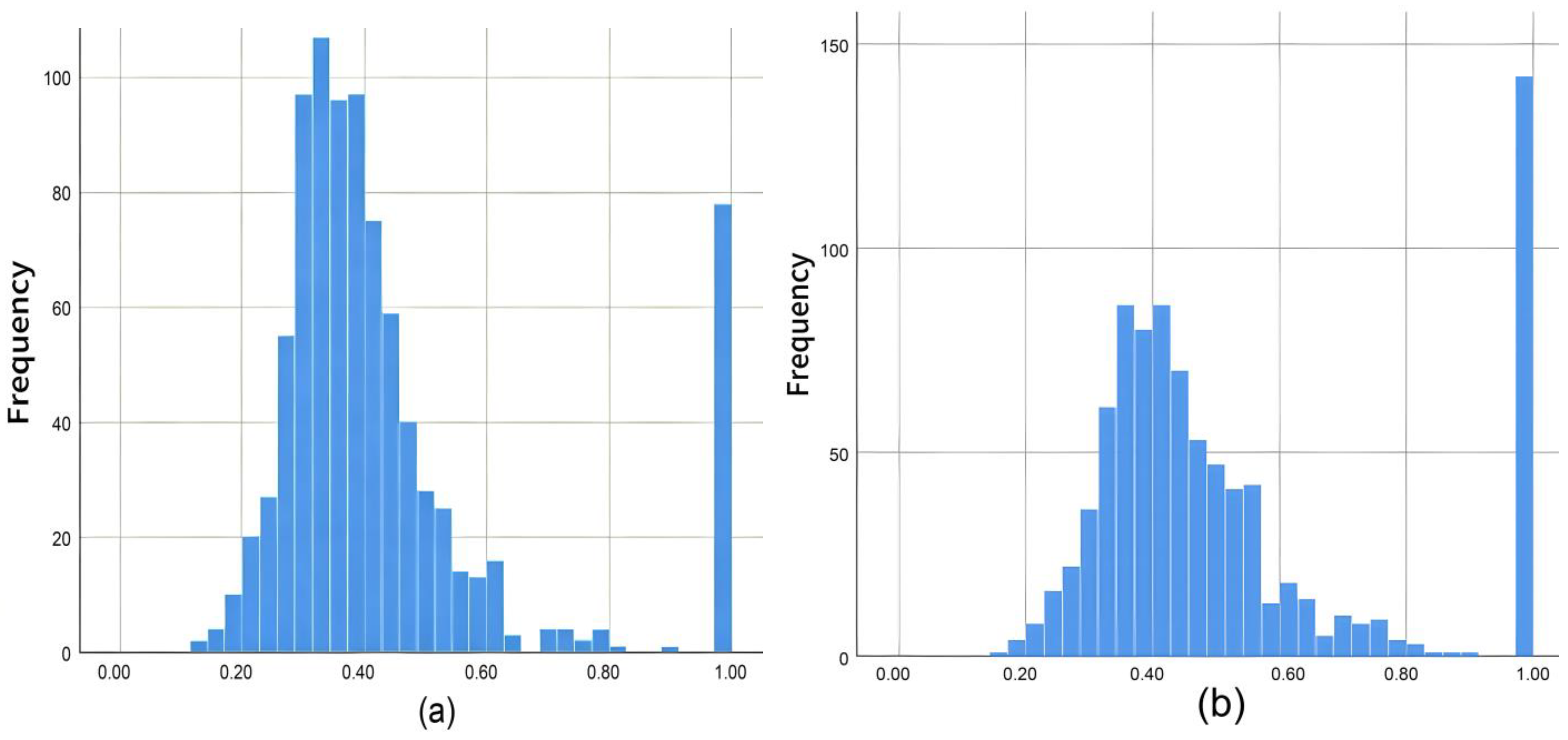
The overall technical efficiency results are presented in
Figure 1. Among the 882 sampled schools, the mean value of overall technical efficiency is 0.437, with a standard deviation of 0.204, suggesting a generally moderately low efficiency level and considerable room for improvement. In terms of efficiency distribution, 516 schools register an overall technical efficiency below 0.4, accounting for 58.5% of the total sample, which means that more than half of the schools operate at an inefficient level. A total of 253 schools fall within the efficiency range of 0.4 to 0.6, occupying 28.7% and demonstrating great potential for efficiency enhancement. The excessively high proportion of low-efficiency schools drags down the overall efficiency across the province. By contrast, high-efficiency schools are scarce: only 80 schools achieve an efficiency score above 0.8, less than 10% of the total. Specifically, merely 78 schools are fully efficient with an efficiency value of 1.0, while the vast majority suffer from varying degrees of efficiency loss. Overall, the resource allocation efficiency of regular senior high schools in Province S exhibits a pattern of bottom concentration and top scarcity, and the overall efficiency remains to be improved.
4.1.2. Pure Technical Efficiency of Resource Allocation in Regular Senior High Schools
Pure technical efficiency denotes the efficiency score estimated under the assumption of variable returns to scale (VRS). Eliminating the interference of scale factors, it reflects a school’s internal management quality, operational efficiency of teaching, and capacity for resource deployment, serving as a crucial indicator for measuring the soft power of school operation. A pure technical efficiency score of 1, the theoretical threshold, signifies optimal resource utilization under the existing operational scale.
The detailed results of pure technical efficiency are illustrated in
Figure 1. Among the 882 sampled schools, the average pure technical efficiency is 0.529, which is higher than the overall technical efficiency but still at a relatively low level. This finding indicates substantial room for improvement in resource arrangement, internal administration, and the transformation of educational inputs into desirable outputs across schools. In terms of distribution, 142 schools achieve a pure technical efficiency value of 1.0, accounting for 16.10% of the total sample. These schools reach a relatively effective state under current scale constraints, efficiently translating educational inputs into high-quality school outcomes and demonstrating superior management and resource allocation capabilities. Meanwhile, 312 schools record a pure technical efficiency below 0.4, accounting for 35.37%, which reveals prominent inefficiencies in educational resource utilization among a considerable number of institutions.
Overall, the pure technical efficiency results demonstrate that regular senior high schools in Province S are characterized by a moderately low level of pure technical efficiency, remarkable inter-school disparities, and a small proportion of high-efficiency units. It further suggests that local senior high schools still possess considerable potential to strengthen internal governance performance and optimize patterns of resource utilization.
4.1.3. Scale Efficiency of Resource Allocation in Regular Senior High Schools
Scale efficiency refers to changes in productive efficiency attributable to variation in the scale of operation. It reflects the degree to which a school’s operational size matches the optimal scale and thus serves as an indicator of scale appropriateness. When the scale efficiency score reaches the theoretical threshold of 1, the school is considered to be operating at the optimal scale, with no resource allocation inefficiency caused by input redundancy or output shortfall.
As shown in
Table 2, the mean scale efficiency of the 882 schools in Province S is 0.843, which is substantially higher than both overall technical efficiency and pure technical efficiency. Its standard deviation is 0.143, the smallest among the three efficiency measures, indicating the lowest degree of dispersion. This suggests that the vast majority of schools in Province S are relatively well aligned with an appropriate scale of operation and that their school size generally falls within a reasonable range. In terms of distribution, 90 schools have a scale efficiency score of 1, accounting for 10.20% of the sample. Although the remaining schools do not operate at the optimal scale, most of their scores are concentrated in the interval from 0.7 to 1.0, indicating only limited deviation from the optimum. As reported in
Table 2, 75% of schools have scale efficiency scores no higher than 0.950, 50% are no higher than 0.876, and 25% are no higher than 0.779.
Taken together, the scale efficiency results indicate that the principal challenge in educational resource allocation among general high schools in Province S does not lie primarily in whether school size is appropriate. Rather, it lies in the insufficient combinative and utilization efficiency of resource elements under a given scale. In other words, the focus of reform in resource allocation for general high schools should gradually shift away from expansion in scale and incremental resource input toward the optimization of internal governance and the improvement of resource use efficiency, so as to facilitate a transition from extensive development to intensive development.
4.2. Comparative Analysis of Resource Allocation Efficiency Among Different Types of Schools
China features prominent urban–rural and regional development imbalances. Taking Province S, the research object of this paper, as an example, there exists a huge economic gap across its prefecture-level cities. In 2024, the per capita GDP of the most economically developed city in the province reached 205,714 yuan, while that of the least developed one was only 39,220 yuan, marking a gap of over five times. Such economic disparities have led to substantial differences in investment in educational resources across regions. In addition, the funding for regular senior high schools is primarily borne by municipal and county governments under provincial overall coordination. Municipal authorities are allowed to adopt differentiated funding sharing and subsidy policies for districts, counties and individual schools, which directly results in discrepancies in per capita educational operating funds and per capita public funds among schools. Influenced by school type, development level, administrative affiliation, school-running history and local fiscal allocation rules, significant gaps in the three types of per capita funding indicators can be observed between urban and county-level high schools, public and private high schools, as well as model high schools and ordinary high schools within the same city. Specifically, provincial and municipal demonstration high schools and public schools in urban areas generally receive higher per capita funding. In contrast, county-level regular high schools and non-demonstration schools suffer from lower total per capita funding, along with insufficient per capita operating funds and public funds. The inter-school imbalance in fund allocation further widens the gaps in school running conditions and resource utilization capacity, and tends to bring about the coexistence of resource scarcity and inefficient resource use within a municipal region.
To further examine heterogeneity in resource allocation efficiency among regular senior high schools in Province S, this study conducts comparative analyses across five dimensions: regional distribution, school hierarchy, urban–rural location, school ownership, and administrative hierarchy. The results are reported in
Table 3. Overall, resource allocation efficiency varies substantially across different types of schools. These differences are particularly evident in overall technical efficiency and pure technical efficiency, while scale efficiency also shows significant variation in several comparisons.
In terms of regional distribution, clear differences are observed among schools located in different sub-regions. The mean overall technical efficiency of schools in the S Provincial Delta is 0.376, which is lower than that of schools in Eastern S Province (0.519), Western S Province (0.489), and Northern S Province (0.443). The overall inter-regional difference is statistically significant. A similar pattern is found for pure technical efficiency: schools in the S Provincial Delta report a mean value of 0.467, compared with 0.628 in Eastern S Province, 0.574 in Western S Province, and 0.525 in Northern S Province. Scale efficiency also differs significantly across regions, although the magnitude of variation is relatively smaller. These results indicate that a higher level of regional economic development does not necessarily translate into higher resource allocation efficiency. Although schools in the S Provincial Delta may have advantages in resource endowment, infrastructure, and external support, larger-scale investment may also be accompanied by input redundancy, resource idleness, or factor mismatch, thereby reducing relative efficiency. By contrast, schools in Eastern, Western, and Northern S Province may operate under more resource-constrained conditions and therefore place greater emphasis on intensive resource use and internal optimization.
With respect to school hierarchy, non-provincial demonstrative senior high schools outperform provincial demonstrative senior high schools in overall technical efficiency, pure technical efficiency, and scale efficiency. The mean overall technical efficiency of non-provincial demonstrative senior high schools is 0.459, significantly higher than the 0.386 observed for provincial demonstrative senior high schools. Their mean pure technical efficiency is also higher, at 0.551 compared with 0.479. In terms of scale efficiency, non-provincial demonstrative senior high schools also show a higher mean value (0.849) than provincial demonstrative senior high schools (0.830). These findings suggest a “resource abundance paradox”: schools with stronger resource endowments and more favorable institutional status do not necessarily achieve higher resource utilization efficiency. This result should not be interpreted as indicating that provincial demonstrative schools have lower absolute educational quality. Rather, it suggests that their larger input scale, richer facilities, broader administrative functions, and more complex organizational structures may reduce the proportional conversion of inputs into outputs. In resource-rich and institutionally privileged schools, additional resources may also generate diminishing marginal returns if they are not fully integrated into teaching improvement and student development. By contrast, non-provincial demonstrative schools may face tighter resource constraints and stronger pressure to use existing resources more selectively. They may therefore concentrate more directly on core instructional activities, teacher deployment, and routine teaching improvement. Their higher efficiency thus reflects a relative input–output advantage rather than overall superiority in school quality. This finding highlights the need to distinguish between resource possession and resource transformation capacity in evaluating school performance.
From the urban–rural perspective, non-urban schools, including town, township, and rural schools, show significantly higher overall technical efficiency and scale efficiency than urban schools. Specifically, the mean overall technical efficiency of non-urban schools is 0.453, compared with 0.411 for urban schools. Their mean scale efficiency is also higher, at 0.855 versus 0.823. Both differences are statistically significant. However, the difference in pure technical efficiency between urban schools (0.514) and non-urban schools (0.538) is not statistically significant. This pattern indicates that the efficiency advantage of non-urban schools is more closely related to scale structure than to clearly superior internal management capacity. Urban schools usually have richer educational resources, but they also tend to face larger student populations, more diverse student needs, more complex facility systems, higher operating costs, and greater coordination burdens. As school size and organizational complexity increase, scale advantages may not necessarily be transformed into proportional educational outputs, leading to possible diseconomies of scale. By contrast, non-urban schools, although often less resource-rich, may operate at a more moderate scale and with clearer resource-use priorities. In some cases, limited resources may encourage schools to focus more intensively on essential teaching activities and to reduce redundant inputs. These qualitative mechanisms help explain why non-urban schools may achieve higher relative efficiency despite weaker absolute resource endowments. Overall, the results suggest that educational resource allocation efficiency depends not only on the quantity of resources available, but also on how effectively schools organize, integrate, and transform existing resources into educational outcomes.
Regarding school ownership, private schools show significantly higher overall technical efficiency and pure technical efficiency than public schools, whereas public schools perform better in scale efficiency. As shown in
Table 3, private schools have a mean overall technical efficiency of 0.488, compared with 0.421 for public schools. Their mean pure technical efficiency is 0.604, higher than the 0.506 observed for public schools. Both differences are statistically significant. In contrast, public schools report a higher mean scale efficiency (0.849) than private schools (0.821). These results indicate that private schools may have certain advantages in internal governance, resource integration, incentive mechanisms, and operational flexibility, which contribute to higher resource use and management efficiency. Public schools, however, may benefit from a more stable institutional system and more mature resource allocation networks, giving them an advantage in scale organization and scale matching. In this sense, the efficiency advantage of private schools is more closely related to mechanism efficiency, whereas the advantage of public schools is more evident in scale efficiency. This finding suggests that resource optimization should take into account institutional differences in organizational incentives, resource mobility, and decision-making flexibility across ownership types.
With respect to administrative hierarchy, no statistically significant differences are found between county-level schools and municipal-level schools in overall technical efficiency, pure technical efficiency, or scale efficiency. Although county-level schools show slightly higher mean values in overall technical efficiency (0.455 vs. 0.431), pure technical efficiency (0.547 vs. 0.524), and scale efficiency (0.846 vs. 0.842), these differences are not statistically significant. This indicates that resource allocation efficiency is not strongly determined by administrative affiliation. Higher-level administrative status does not automatically lead to better resource-use performance. Instead, differences in efficiency are more likely to be associated with schools’ internal governance capacity, resource allocation practices, organizational mechanisms, and the degree of alignment between school scale and resource structure.
In summary,
Table 3 shows clear heterogeneity in resource allocation efficiency across different types of regular senior high schools. However, these differences should not be interpreted as evidence that fewer resources necessarily lead to higher efficiency, nor that resource-rich schools necessarily perform poorly. The SBM model estimates relative efficiency within the sample, reflecting each school’s ability to transform given inputs into outputs. Therefore, the observed differences across school types indicate relative input–output performance under existing resource conditions, rather than absolute differences in educational quality or school effectiveness.
The results in
Table 3 provide empirical support for the argument that improving educational outcomes cannot be achieved solely by increasing resource inputs, which are not fully consistent with the traditional resource-advantage logic. Schools or regions with stronger institutional status or more favorable locations do not always show higher efficiency. The way in which schools organize, utilize, and transform existing resources is equally important. The significant differences across regions, school hierarchy, urban–rural location, and ownership suggest that resource endowment and resource utilization efficiency are not always positively aligned. In particular, the finding that some schools with relatively limited resources achieve higher efficiency indicates that sustainable educational development depends not only on resource abundance, but also on governance capacity, resource integration, and input-output transformation mechanisms.
This result also extends previous research on equity and efficiency in educational resource allocation. While prior studies have often emphasized disparities in resource distribution as a major source of educational inequality, the evidence in
Table 3 suggests that inefficient resource use may coexist with resource concentration. Thus, the challenge of sustainable educational governance is twofold: reducing inequities in resource distribution and improving the efficiency with which existing resources are converted into educational outcomes. This finding supports the argument that policy interventions should move beyond input expansion and place greater emphasis on differentiated governance, performance-based allocation, and school-level capacity building. Accordingly, the following section adopts configurational analysis to further explore the organizational conditions and multiple pathways through which regular senior high schools achieve high resource allocation efficiency.
6. Conclusions, Implications, and Limitations
6.1. Conclusions
Improving the efficiency of educational resource allocation is not only a technical issue of school management but also an essential component of sustainable educational development. Under constraints of limited public resources and rising demand for high-quality education, sustainable school resource governance requires education systems to generate better educational outcomes without relying solely on continuous input expansion. From this perspective, this study examined 882 general senior high schools in Province S, China. It constructed an input–output indicator system to evaluate school-level resource allocation efficiency, employed the slack-based measure (SBM) model to estimate efficiency, and further applied fuzzy-set qualitative comparative analysis (fsQCA) to identify configurational pathways associated with high efficiency. The main findings can be summarized as follows.
First, the SBM results show that the overall resource allocation efficiency of general senior high schools remains relatively low, and the main constraint lies not in inappropriate school scale, but in the insufficient capacity of schools to transform existing resources into educational outcomes. The results show that both overall technical efficiency and pure technical efficiency are at medium-to-low levels, whereas scale efficiency is comparatively high. This indicates that the current challenge in senior high school resource allocation is no longer primarily a matter of insufficient resource input or severe scale mismatch. Rather, it is more closely associated with inadequate resource utilization, weak internal governance, and limited input–output transformation capacity under existing operating scales. Therefore, improving resource allocation efficiency should not depend simply on expanding school size or increasing material inputs. The key lies in enhancing schools’ ability to organize, integrate, activate, and transform existing resources. This finding is closely related to the sustainability agenda in education, as it highlights the need to shift from input-driven expansion toward efficiency-oriented and outcome-based resource governance.
Second, resource allocation efficiency differs significantly across regions, school ownership types, and school tiers, revealing a certain “resource-abundance paradox.” This paradox means that schools with more abundant resources do not necessarily achieve higher resource allocation efficiency, whereas some schools with relatively limited resources may demonstrate stronger capacity to use and transform available resources. The findings indicate that resource endowment and resource allocation efficiency are not automatically aligned. Specifically, non-provincial demonstration high schools outperform provincial demonstration high schools in overall technical efficiency, pure technical efficiency, and scale efficiency. Non-urban schools, including town, township, and rural schools, show significantly higher overall technical efficiency and scale efficiency than urban schools, although no significant urban–rural difference is found in pure technical efficiency. This suggests that the lower efficiency of urban schools may be less related to internal management practices themselves and more associated with scale expansion, excessive resource concentration, and suboptimal scale structure. In addition, private schools show higher overall technical efficiency and pure technical efficiency than public schools, whereas public schools have advantages in scale efficiency. These results suggest that private schools may benefit from more flexible governance structures, incentive mechanisms, and resource integration capacity, while public schools may rely on more stable institutional arrangements and mature allocation networks to achieve better scale matching. By contrast, no significant efficiency difference is found between county- or district-administered schools and municipal- or provincial-administered schools. Overall, these findings show that differences in school resource allocation efficiency are not determined merely by the amount of resources possessed, but are more deeply shaped by internal governance capacity, organizational operation, and the sustainability of resource use. In this sense, the “resource-abundance paradox” reflects the fact that educational resources do not automatically produce educational outcomes; rather, they must be effectively embedded in school organizational processes and transformed through leadership, teaching practices, teacher collaboration, and supportive school environments.
Third, the formation of high resource allocation efficiency in general senior high schools has a clear configurational nature. High efficiency is not driven by any single factor, but by the combined effects of multiple organizational conditions. The fsQCA results identify four configurational pathways leading to high resource allocation efficiency, indicating that there is no single universal model for sustainable school resource governance. Instead, different schools may achieve high efficiency through different combinations of principal instructional leadership, teacher motivation, school support, cultural atmosphere, teacher–student relationships, and teaching-research mechanisms. This reflects the characteristics of conjunctural causation and equifinality. Principal instructional leadership appears recurrently as a core condition in the identified sufficient configurations, but it should not be interpreted as a necessary condition for high resource allocation efficiency. Rather, the results suggest that, within the configurations identified in this study, principal instructional leadership is often combined with other organizational conditions to support resource integration, organizational coordination, and instructional improvement. In essence, resource allocation efficiency depends on how resources are embedded in school organizational processes and transformed into student development outcomes. Therefore, sustainable improvement in school resource allocation requires attention not only to resource supply, but also to the institutional and organizational mechanisms through which resources are effectively used.
6.2. Implications
The findings of this study have important implications for the sustainable governance of educational resources in general senior high schools. In line with the goal of inclusive and quality education emphasized in Sustainable Development Goal 4, resource allocation policies should not only address educational equity through resource distribution, but also promote the efficient and sustainable use of existing resources.
First, a performance-oriented resource allocation mechanism should be established to promote the transition from extensive input expansion to intensive efficiency improvement. The results show that the main problem in current senior high school resource allocation is not insufficient scale efficiency, but relatively low overall technical efficiency and pure technical efficiency. This means that the central policy challenge is no longer simply how to increase educational inputs, but how to improve the educational value generated from existing resources. Educational administrative departments should therefore adjust the logic of resource allocation from “input expansion” to “efficiency enhancement.” In fiscal investment, project approval, and school condition improvement, excessive dependence on hardware expansion and scale enlargement should be reduced in order to avoid repeated construction, resource idleness, and low-return investment. At the same time, resource utilization efficiency, input–output transformation performance, and student development outcomes should be incorporated into school evaluation and educational supervision systems. Such a mechanism would encourage schools to pay greater attention to how resources are used and transformed, rather than merely how many resources are obtained. For schools that already have favorable operating conditions but limited efficiency improvement, policy support should focus more on internal governance optimization, instructional process improvement, and mechanisms for sustainable resource utilization.
Second, differentiated governance and targeted policy support should be strengthened to address inefficient resource allocation under the “resource-abundance paradox.” The results indicate that schools with stronger resource endowments, such as provincial demonstration high schools, urban schools, schools in economically developed areas, and some public schools, do not necessarily demonstrate corresponding efficiency advantages. This suggests that future resource allocation should avoid a simple status-based or hierarchy-based distribution logic. Instead of allocating more resources merely because schools have higher administrative status or stronger existing advantages, policy support should be based on efficiency diagnosis and actual development needs. For urban schools, provincial demonstration high schools, and resource-abundant but efficiency-constrained public schools, policy should focus on internal governance reform, resource coordination, performance accountability, and the prevention of resource redundancy and diminishing marginal returns. For county-level schools, non-demonstration schools, and resource-constrained but relatively efficient schools, their experience in refined management and intensive resource use should be summarized and transformed into scalable governance models. For private schools with relatively high resource utilization efficiency, public policy may draw institutional lessons from their incentive structures, organizational flexibility, and management mechanisms, while also ensuring that efficiency improvement remains consistent with educational equity and public accountability. In this sense, sustainable educational resource governance requires a shift from “allocating resources by status” to “providing support according to efficiency gaps and development problems.”
Third, school-based empowerment mechanisms should be improved to enhance schools’ internal capacity for resource integration and transformation. The configurational analysis shows that high resource allocation efficiency can be achieved through multiple pathways, such as leadership–teacher motivation driven, leadership–organizational support compensatory, leadership–teacher motivation synergistic, and leadership–culture and relationship safeguarding pathways. This implies that a uniform governance model is unlikely to be effective for all schools. Instead, improvement strategies should be adapted to the organizational conditions of different schools. For schools with strong teacher enthusiasm but insufficient institutional support, efforts should be made to strengthen teaching-research systems, improve teacher support mechanisms, and stabilize instructional order, so that individual teacher motivation can be transformed into sustainable organizational capacity. For schools with relatively weak teacher enthusiasm but stronger school support, teacher incentive mechanisms should be improved, non-instructional burdens should be reduced, and professional identity should be enhanced. For schools that rely on positive school culture and strong teacher–student relationships to achieve efficiency, cultural construction and relational governance should be further consolidated to prevent excessive reliance on informal or non-institutionalized factors. For schools with multiple weak conditions, priority should be given to strengthening principal instructional leadership, teacher support, teaching-research mechanisms, and school culture. Thus, the key to sustainable improvement is not to pursue a single “best model,” but to construct resource transformation pathways that fit each school’s organizational context.
Fourth, a data-driven monitoring and decision-making system should be established to improve the sustainability and scientific basis of educational resource governance. Differences in resource allocation efficiency are reflected not only in the amount of resource input, but also in the relationships among resource input, resource use processes, and educational outputs. Therefore, resource governance in general senior high schools should move beyond experience-based decision-making and develop toward evidence-based, dynamic, and refined governance. Educational administrative departments should integrate school operation data, financial input data, and educational quality monitoring data, and establish a resource allocation effectiveness monitoring platform. Such a platform can provide empirical support for funding allocation, project approval, school layout adjustment, and policy optimization. For schools that consistently show resource idleness, inefficient use, or weak educational outputs, early-warning, feedback, and corrective mechanisms should be established. At the school level, regular school-based evaluation should be institutionalized, focusing on teacher allocation, facility and equipment use, curriculum implementation, student learning processes, and student development outcomes. Through a closed-loop governance mechanism of monitoring, diagnosis, feedback, and optimization, the precision, adaptability, and effectiveness of resource allocation can be continuously improved. This will help promote a more sustainable model of educational resource governance, in which limited public resources are used more efficiently to support equitable and high-quality senior high school education.
Fifth, principals should play a more active role in translating resources into instructional improvement and student development. Since principal instructional leadership appears as a core condition across all high-efficiency configurations, principals should not only function as administrative managers, but also as instructional organizers and resource coordinators. They need to align resource allocation with curriculum implementation, teaching improvement, teacher professional development, and student support. In particular, principals should strengthen the link between school resources and classroom processes by improving teaching-research activities, promoting evidence-based instructional decision-making, and encouraging collaboration among teachers. For resource-constrained schools, strong instructional leadership can help prioritize key development tasks and make more intensive use of limited resources. For resource-abundant schools, it can help prevent resource fragmentation, duplication, and inefficient use.
6.3. Limitations
This study has several limitations. First, constrained by data accessibility and statistical standards, the selection of evaluation indicators and the measurement of core variables can be further improved. Most notably, due to the unavailability of school-level direct financial data, direct financial indicators are not incorporated into the evaluation system. Although educational financial inputs are partially reflected via proxy indicators such as teachers’ salaries, teaching equipment and campus infrastructure investment, the exclusion of direct financial indicators may still affect the comprehensive portrayal of school resource allocation. In addition, some latent factors may have been excluded, which could weaken the completeness and analytical depth of the framework. For example, students’ subjective well-being is measured with a single item. As a multidimensional construct—including life satisfaction, emotional experience, sense of belonging, academic pressure, and psychological resilience—it cannot be fully captured by a single indicator, potentially compromising measurement reliability and construct validity. Future research is recommended to use validated multi-item scales to more systematically examine the relationship between student well-being and school resource allocation efficiency.
Second, the sample is drawn from Province S. Although its educational development may reflect certain general features of basic education in China, regions differ in economic foundations, policy contexts, resource endowments, and school operating modes. Accordingly, the findings should be interpreted as evidence relevant to comparable contexts rather than as universally generalizable conclusions.
Third, this study uses cross-sectional data from a single time point, capturing only the static characteristics of resource allocation in a particular period. It cannot reveal dynamic evolution, long-term interactions among conditions, or trends over time. Future studies could employ multi-year panel data to conduct longitudinal analyses of efficiency changes and configurational pathways. Mixed methods—including fieldwork, case studies, and in-depth interviews—would also help uncover micro-level mechanisms of resource transformation and strengthen the rigor, explanatory power, and practical value of the conclusions.
Finally, this study primarily adopts economic and managerial perspectives and does not fully integrate insights from sociological or politico-institutional frameworks, limiting interdisciplinary dialogue. Future research may broaden disciplinary perspectives and develop interdisciplinary analytical frameworks to more comprehensively examine the complex mechanisms and long-term optimization pathways of educational resource allocation efficiency in general senior high schools.