1. Introduction
Driven by small unmanned aerial vehicles (UAVs), eVTOL systems, and digital low-altitude management platforms, the low-altitude economy is creating both new opportunities and new pressures for cities. In China, recent national and municipal policies explicitly list the low-altitude economy as an important growth engine and call for the construction of low-altitude logistics corridors, demonstration routes and “fifth facade” infrastructures. At the same time, sponge city programs and green infrastructure investments are widely implemented to mitigate urban flooding and improve environmental quality. These programs typically rely on distributed measures, such as pocket parks, rain gardens, and detention basins, which can be understood as sustainable urban drainage system (SUDS) and low-impact development (LID) facilities [
1,
2,
3,
4,
5,
6]. However, the design of low-altitude infrastructures (vertiports, pads, charging facilities and corridors) and that of garden hydrology systems have evolved largely independently. As a result, potential synergies between green blue infrastructures and low-altitude networks remain underexplored, particularly in dense districts where land and resilience are both scarce [
7]. This research is also closely aligned with the United Nations Sustainable Development Goal 11 (SDG 11), which calls for making cities and human settlements inclusive, safe, resilient and sustainable. In particular, SDG 11 emphasizes integrated urban planning, disaster risk reduction, sustainable transport, and access to green and public spaces. From this perspective, the proposed Garden–Hydrology–UAV framework is not only a technical optimization model but also a planning-oriented approach for rethinking how distributed green blue infrastructure can support urban resilience, low-carbon mobility, and efficient public-space utilization [
8,
9].
Existing research on UAM and UAV logistics has focused on network design, vehicle routing problems, and capacity analysis, often assuming static infrastructure and exogenous risk constraints. Representative studies on drone-based vehicle routing, combined drone truck systems and multi-robot task allocation highlight the importance of coordinated routing and scheduling under operational constraints [
10,
11,
12,
13,
14]. In parallel, hydrology and planning studies on green infrastructure, sponge cities and LID use models such as SWMM (stormwater management model, hereinafter referred to as SWMM) to optimize stormwater performance and spatial layout, but rarely consider aerial mobility. Moreover, navigation precision technologies (RTK-GNSS, UWB, visual inertial odometry) can reshape feasible low-altitude corridors, but they are seldom integrated with hydrological and landscape considerations [
15]. From the perspective of urban resilience, such fragmentation may reduce the adaptive capacity of cities facing climate-related disturbances, infrastructure pressure, and competing land-use demands [
16]. Against this background, this paper asks: if pocket parks and sponge facilities are treated as potential UAV bases whose operational availability depends on rainfall and inundation, how should the infrastructure layout and UAV scheduling be designed to balance efficiency, safety and environmental impacts?
The objective of this paper is to develop and evaluate a Garden Hydrology UAV collaborative framework under the low-altitude economy. First, we conceptualize pocket parks and sponge city facilities as dynamic UAV base nodes, whose availability depends on stormwater states simulated by SWMM [
17,
18,
19]. Second, we construct a time-dependent, multi-objective UAV routing and scheduling model that integrates hydrological node availability, low-altitude corridors under different navigation precisions, and noise-sensitive receptors, building on the literature of UAV/drone routing and multi-robot task allocation. Third, we conduct a simulation study in a stylized high-density district, comparing a depot-only baseline, a garden UAV integration without hydrological coupling, and the full collaborative framework. The main contribution is a quantitative method that links garden hydrology design and low-altitude network scheduling, providing a planning-oriented tool for cities investing in both sponge infrastructure and low-altitude systems (
Figure 1).
2. Literature Review
To ensure a structured review, this section is organized into three subsections. The first reviews studies on multifunctional green infrastructure, sponge city facilities, and sustainable urban drainage systems. The second examines research on low-altitude logistics infrastructure, drone base planning, and UAV routing or scheduling. The third synthesizes these research streams and identifies the gaps addressed in this study. The literature search was conducted using major academic databases, including Web of Science, Scopus, ScienceDirect, and Google Scholar. The main search terms included “sponge city”, “sustainable urban drainage system”, “low-impact development”, “multifunctional green infrastructure”, “UAV logistics”, “drone delivery”, “low-altitude economy”, “urban air mobility”, “multi-objective optimization”, and “SWMM”. Particular attention was paid to studies linking urban resilience, green infrastructure, stormwater management, and emerging transport systems.
2.1. Multifunctional Green Infrastructure and Sponge City Research
Sponge city construction has become a core strategy for urban water management and resilience enhancement worldwide [
20]. Traditional research on sponge city facilities mainly focuses on their hydrological functions, such as stormwater retention, runoff reduction, and water quality improvement [
21]. In recent years, the concept of multifunctional green infrastructure (MGI) has gained increasing attention, which emphasizes integrating ecological, social, economic, and resilience-related functions into green space design [
22,
23,
24].
Numerous studies have explored the co-benefits of sponge city facilities. For example, Johnson et al. [
25] quantified the synergistic effects of rain gardens on stormwater management and urban heat island mitigation, finding that well-designed rain gardens can reduce surface temperature by 2.3–4.5 °C in summer. Park et al. [
26] proposed a framework to integrate recreational functions into detention basins, improving the utilization efficiency of urban public spaces. However, existing research on MGI has largely overlooked the potential of green infrastructure as physical support for emerging urban transportation systems, especially low-altitude logistics and inspection networks.
2.2. Urban Low-Altitude Logistics Infrastructure Planning
The rapid development of drone technology has promoted the application of low-altitude logistics in urban areas [
27]. A large body of literature has focused on drone path planning, task scheduling, and fleet optimization [
28]. However, the planning of drone infrastructure has received relatively less attention. Most existing studies assume that drone bases are pre-determined and static, ignoring the dynamic changes in their operational availability [
29].
Some recent studies have begun to explore the use of urban idle spaces as drone bases. Kumar et al. [
30] proposed a method to select rooftop locations for drone delivery hubs, considering factors such as accessibility and noise impact. Kim et al. [
30] investigated the feasibility of using parking lots as temporary drone landing sites. Nevertheless, no study has yet considered converting sponge city facilities into drone bases, nor has incorporated hydrological dynamic constraints into drone scheduling models.
2.3. Research Gaps
Although the above studies provide important foundations for this research, three key gaps remain insufficiently addressed.
First, existing studies on sponge city facilities and multifunctional green infrastructure have mainly emphasized hydrological regulation, ecological improvement, recreational services, and heat-island mitigation. Some recent studies have attempted to broaden the functional scope of green infrastructure by incorporating public-space use and ecosystem co-benefits. However, the potential of such facilities to serve as operational infrastructure for emerging low-altitude logistics and inspection systems has rarely been examined. This indicates a functional boundary limitation: green blue infrastructure is still largely treated as an environmental or landscape subsystem rather than as a possible physical carrier of future urban mobility networks.
Second, most UAV logistics and routing studies focus on path optimization, fleet assignment, task scheduling, and energy consumption under relatively stable infrastructure conditions. A few recent works have considered rooftop hubs, parking lots, or other idle urban spaces as potential drone bases, which represents an initial attempt to diversify UAV infrastructure. Nevertheless, these studies generally assume that base nodes are continuously available and do not explicitly account for weather-induced or hydrology-induced operational disruptions. In dense urban districts, however, candidate landing and charging sites may be temporarily affected by rainfall, surface inundation, or drainage-system overload. This reveals a static infrastructure assumption that may underestimate operational risks under extreme weather events.
Third, research on urban stormwater systems and UAV logistics has largely developed along separate trajectories. Hydrological studies typically focus on drainage performance, runoff reduction, and LID layout, whereas UAV studies usually emphasize flight efficiency, delivery delay, energy consumption, or noise exposure. Although SDG 11, urban resilience, and multifunctional green infrastructure studies have emphasized inclusive, safe, resilient, sustainable, and integrated urban infrastructure systems, few studies have integrated stormwater dynamics, green-space layout, low-altitude corridors, and UAV scheduling into a unified modeling and decision-making framework. The lack of cross-system integration makes it difficult to evaluate how stormwater dynamics, green-space layout, low-altitude corridors, and UAV scheduling interact with each other.
To address these gaps, this paper proposes a Garden–Hydrology–UAV collaborative infrastructure and scheduling framework. Compared with previous studies, the proposed framework treats pocket parks and sponge city facilities as time-dependent UAV base nodes, maps SWMM-simulated hydrological states into dynamic availability constraints, and incorporates logistics efficiency, hydrological risk exposure, and noise impact into a multi-objective optimization model. In this way, the study extends the functional boundary of green blue infrastructure, relaxes the static assumption of UAV base availability, and provides a cross-system planning tool for sustainable and resilient urban low-altitude networks.
3. Methodology
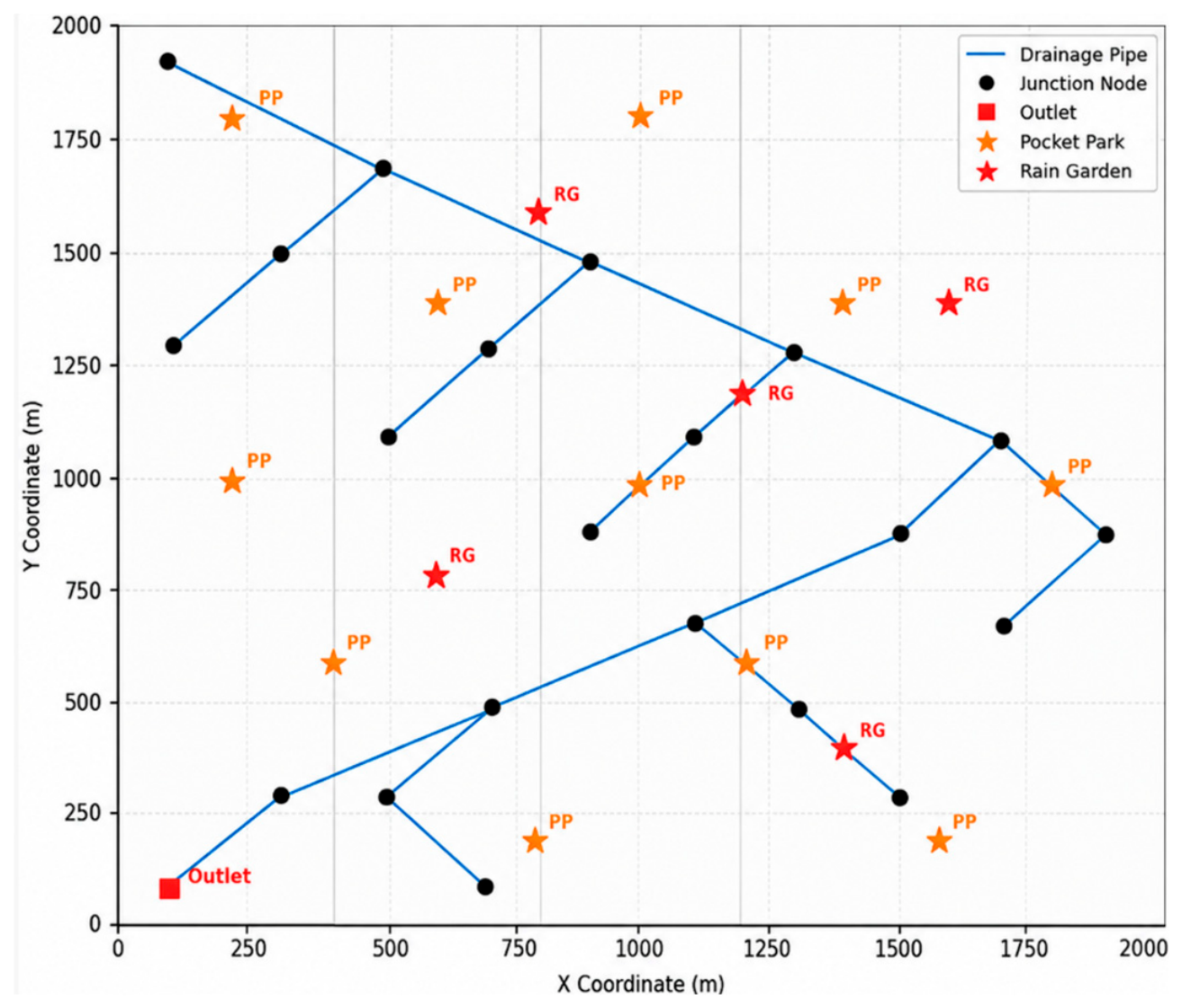
The proposed framework consists of three closely connected components. These include a SWMM-based hydrological simulation module, a spatial representation of garden UAV nodes and low-altitude corridors, and a multi-objective UAV routing and scheduling model. Spatially, we consider a 2 km × 2 km mixed-use district with residential, commercial and public functions, including a set of pocket parks and sponge facilities that can potentially host UAV pads and charging cabinets. In the hydrological model, the district is represented in EPA SWMM 5.x by a set of subcatchments, junctions, conduits, and outfalls. Pocket parks and sponge facilities are assigned to specific subcatchments, allowing local surface inundation depth and detention storage to be tracked during storm events. Temporally, the simulation horizon is discretized into equal time slots indexed by
. We built the model in
Figure 2.
This study is based on numerical simulation and model-based optimization. No physical equipment, devices, instruments, commercial UAVs, sensors, biological samples, cell lines, or commercial materials were used. The hydrological simulation was conducted using EPA Storm Water Management Model, version 5.2.4, developed and maintained by the U.S. Environmental Protection Agency, Washington, DC, USA. The UAV fleet, garden–UAV bases, navigation modes, charging facilities, and hydrological nodes were represented as simulated objects or planning assumptions rather than real commercial devices.The case study was designed as a stylized high-density urban district in Nanjing, China, and all UAV operations were evaluated through numerical simulation rather than field flight experiments. Ten identical quadrotor UAVs were represented in the simulation, with a cruise speed of 10 m/s, and a payload limit of 3 kg. These parameters were set with reference to typical commercial multi-rotor UAV specifications, such as DJI UAV products manufactured by SZ DJI Technology Co., Ltd., Shenzhen, China. No physical UAV device was used in this study.
Using the SWMM model, rainfall-runoff processes are simulated for design storms with different return periods. Let
denote the surface water depth at garden or sponge node
, and
=
(t)/
max the storage utilization in any associated detention structure. We assign two hydrological thresholds: an inundation threshold
above which surface conditions are unsafe for UAV take-off/landing, and a storage threshold
above which structural and safety margins are considered low. For each candidate garden UAV node
i and time step
, we define a binary availability indicator:
This produces a time-dependent availability matrix A
{0, 1}
|Nb|×|T|, where
is the set of candidate base nodes. These dynamic constraints shape which garden nodes can be used by UAVs at each time slot during routing and scheduling. The low-altitude network is represented as a directed graph G = (N, E). The node set N includes the main logistics depot, pocket parks and sponge facilities (candidate bases), and task nodes (delivery or inspection locations). The edge set E is determined by geometric visibility, regulatory constraints, and navigation precision. Under a low-precision navigation mode (LP), corresponding to ordinary GNSS, we impose larger safety buffers around buildings and restricted areas, resulting in a sparse feasible edge set E
LP. Under a high-precision mode (HP), combining RTK-GNSS, UWB anchors or visual inertial odometry, smaller buffers are applied, yielding a denser edge set E
HP E
LP. For each edge (
)
E, we precompute its length
, flight time
=
and energy consumption
=
+
, where
is the cruise speed,
is the payload weight, and
,
UAV-specific parameters. A noise penalty coefficient
is associated with each edge depending on proximity to noise-sensitive receptors [
31].
We consider a homogeneous fleet of K multi-rotor UAVs, each with battery capacity
, cruise speed
, and payload limit
. Let
, 1} denote a decision variable indicating that UAV
flies from node
to node
starting at time step
. Let
{0, 1} indicate whether garden UAV node
is activated (opened) at time step
, and
{0, 1} indicate whether task
is served by UAV u at time
. The continuous variable
denotes the energy state of UAV
at time
, and
is the completion time of task
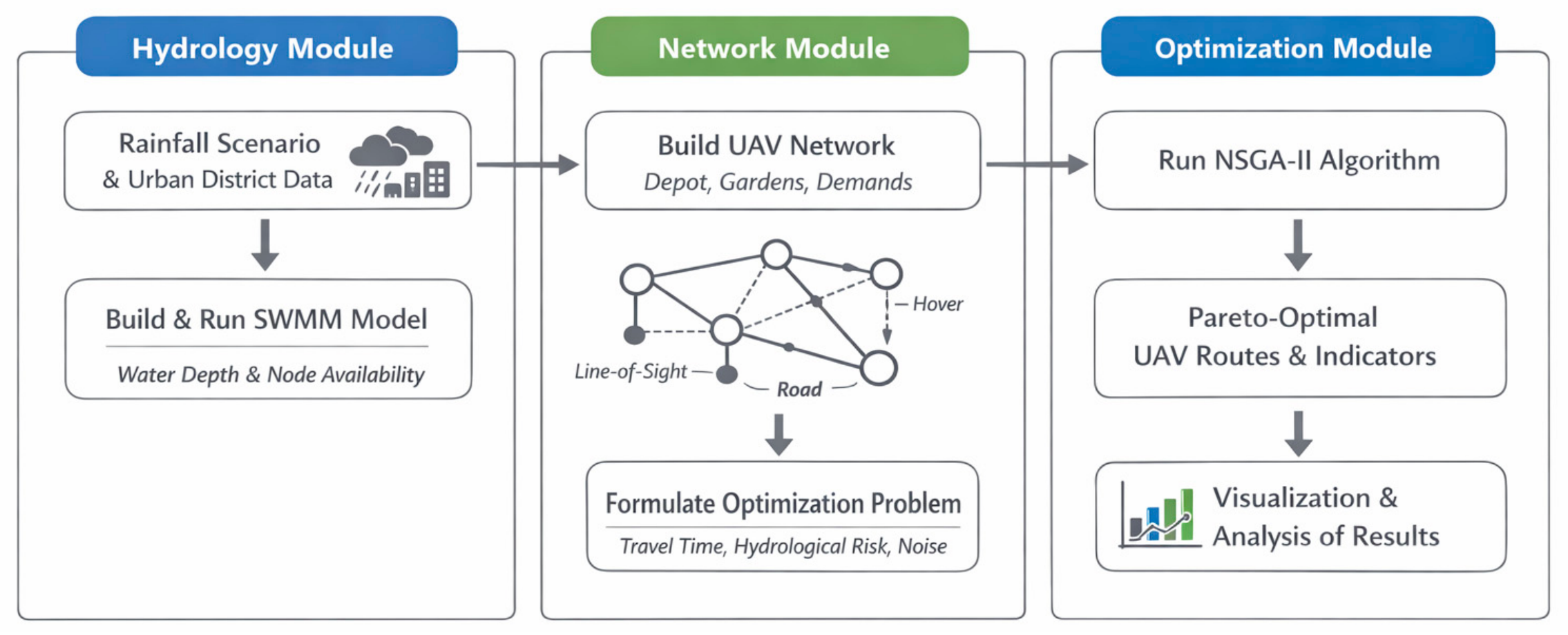
. These variables encode routing decisions, base activation and charging schedules. We built the model in
Figure 3.
The first objective function aggregates logistics performance in terms of operation time and energy cost, in the spirit of multi-objective vehicle routing for drone logistics:
where
is the earliest time window start for task
,
is the energy cost per unit,
is the energy consumption rate,
is the duration of a time slot, and
,
are weighting coefficients.
The second objective is the hydrological risk exposure of UAV operations at base nodes, which links routing decisions to dynamic stormwater states as in hydrology-driven optimization studies:
The third objective captures noise impact on sensitive receptors:
The overall problem is a three-objective minimization:
In the optimization model, the weighting coefficients are used to normalize and balance different performance dimensions, including logistics efficiency, energy consumption, hydrological risk exposure, and noise impact. Since these indicators have different physical units and magnitudes, each objective component is first normalized with respect to the corresponding baseline value in Scenario S0. The baseline weights are then assigned to reflect a balanced planning preference, in which logistics efficiency, hydrological safety, and environmental impact are treated as equally important dimensions. To reduce the arbitrariness of weight selection, additional sensitivity tests were conducted by varying the relative weights within a reasonable range. The results show that although the absolute objective values change slightly, the comparative advantage of the full collaborative scenario remains stable, indicating that the main conclusions are not dominated by a specific weight setting.
The model is subject to task assignment, time window, flow conservation, energy balance, base capacity, node availability and corridor feasibility constraints. Each task must be completed exactly once:
with
≤
≤
, where [
,
] is the time window of task k. UAV trajectories satisfy flow conservation:
Energy dynamics follow:
with 0 ≤
≤
. The garden UAV base and availability are enforced by:
Given the combinatorial complexity and multi-objective nature, we adopt the fast elitist Non-dominated Sorting Genetic Algorithm II (NSGA-II) [
32], a widely used evolutionary multi-objective optimizer [
33,
34,
35], to approximate the Pareto frontier (
Table 1). The decision vector encodes route sequences, base activation schedules and assignment of tasks to UAVs, similar in spirit to multi-robot task allocation formulations. A high-level pseudo-code of the optimization loop is given below.
4. Case Study and Experimental Setup
We consider a stylized 4 km2 district (2 km × 2 km) with mixed residential, commercial and public buildings, and a set of 12 pocket parks plus 5 sponge facilities as candidate garden UAV bases. From a drainage and LID perspective, these facilities can be interpreted as part of a sustainable urban drainage/sponge city system. A single logistics depot located at the district edge serves as the main entry point for UAV missions. Forty delivery tasks (25 residential, 15 commercial) are defined over a four-hour planning horizon (08:00–12:00) with time windows; in addition, five inspection tasks over sponge facilities are scheduled during or shortly after the peak of a design storm. Ten identical quadrotor UAVs (cruise speed 10 m/s, battery capacity 400 Wh, payload limit 3 kg) are available, consistent with typical drone delivery routing studies.
The hydrological model is created in SWMM 5.2, with 45 subcatchments (0.05–0.18 km2) and 52 conduits capturing the drainage network. Pocket parks and sponge facilities are associated with specific subcatchments in order to extract local surface depth and storage utilization time series. We simulate a 5-year return period 3 h design storm (Scenario R2) and discretize the simulation into 5 min time steps, following common practice in sponge city layout optimization. Thresholds are set as = 0.05 m and = 0.85, leading to time-varying availability(t) for each candidate garden UAV node.
Three scenarios are compared. Scenario S0 (baseline) uses only the depot as the UAV base, ignores hydrological states and uses low-precision navigation (edge set ELP). Scenario S1 introduces garden UAV bases that are assumed always available, but still operate with ELP and no hydrological coupling. Scenario S2 activates the full collaborative framework: pocket parks and sponge facilities are candidate UAV bases with hydrology-constrained availability(t) (derived from SWMM), and UAVs use high-precision navigation (edge set EHP), which allows for more direct low-altitude corridors. NSGA-II is run with population sizes of 150 and 200 generations; representative non-dominated solutions are selected for comparison.
5. Results and Discussion
5.1. Logistics Performance Analysis
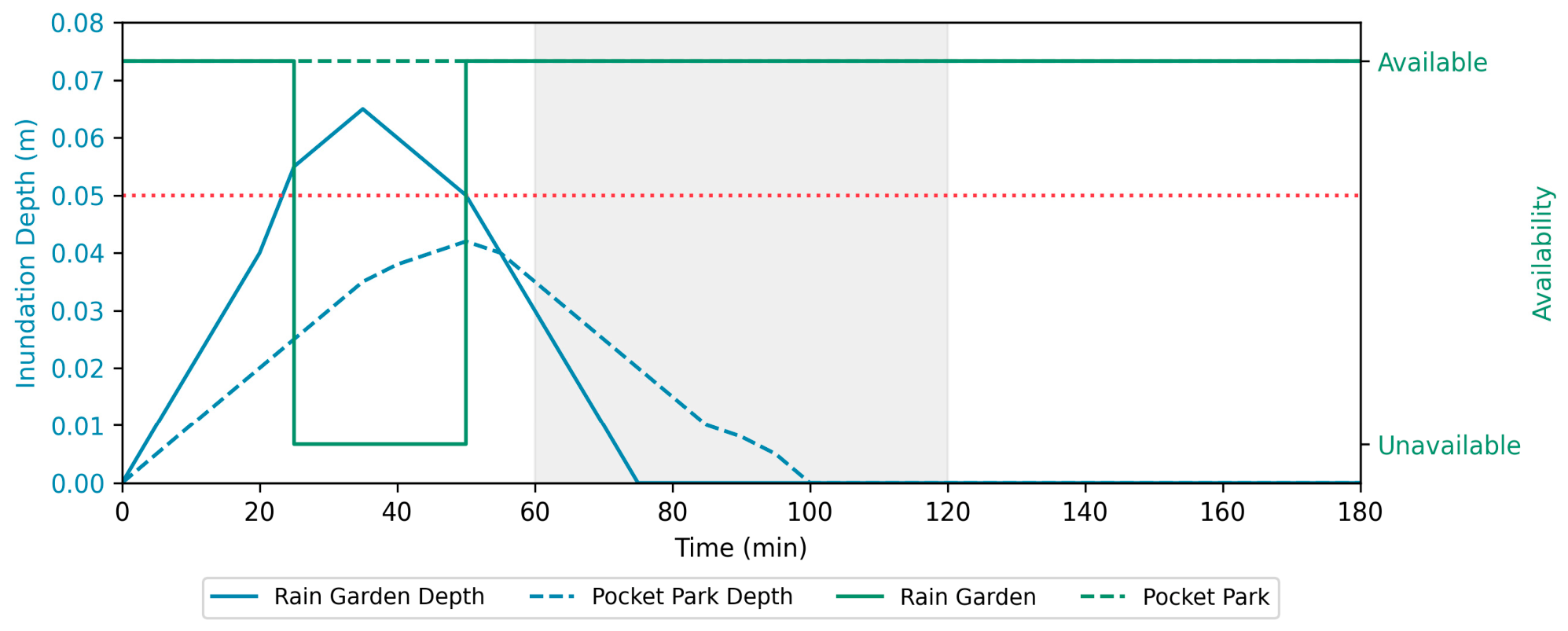
The SWMM simulation under the 5-year storm shows that large pocket parks retain availability ratios above 0.9, while some smaller parks and rain gardens are temporarily unavailable for 20–45 min when surface depth exceeds 0.05 m. Two detention basins exceed storage utilization > 0.85 for 60–90 min and are blacklisted during those intervals.
On average, availability ratios range from 0.82 to 0.95 across all garden UAV nodes, consistent with the storage performance of LID practices reported in the literature. These dynamics translate into short windows where some nodes cannot be used in Scenario S2, forcing rerouting or rescheduling of charging stops and missions.
Introducing garden UAV bases substantially improves logistics performance. In the baseline S0, a representative solution has a district-wide makespan of 142.3 min, a total UAV energy consumption of 9.84 kWh, and an average delivery delay of 18.7 min relative to the earliest time windows. When pocket parks and sponge facilities are used as fixed bases in S1, the makespan decreases to 121.6 min, energy consumption falls to 8.12 kWh, and the average delay is reduced to 12.4 min. Under the full collaborative scenario S2, the makespan further declines to 114.2 min, which is 19.7% lower than S0. Energy consumption also decreases to 7.65 kWh, which is 22.3% lower than S0, and the average delay falls to 9.3 min. These patterns are in line with prior findings that additional intermediate depots or launch sites can significantly shorten drone routing distances and energy use. High-precision navigation in S2 allows for shorter, safer routes that partly offset the loss of some garden UAV nodes during inundation peaks, illustrating that better navigation and hydrological awareness can be complementary rather than conflicting.
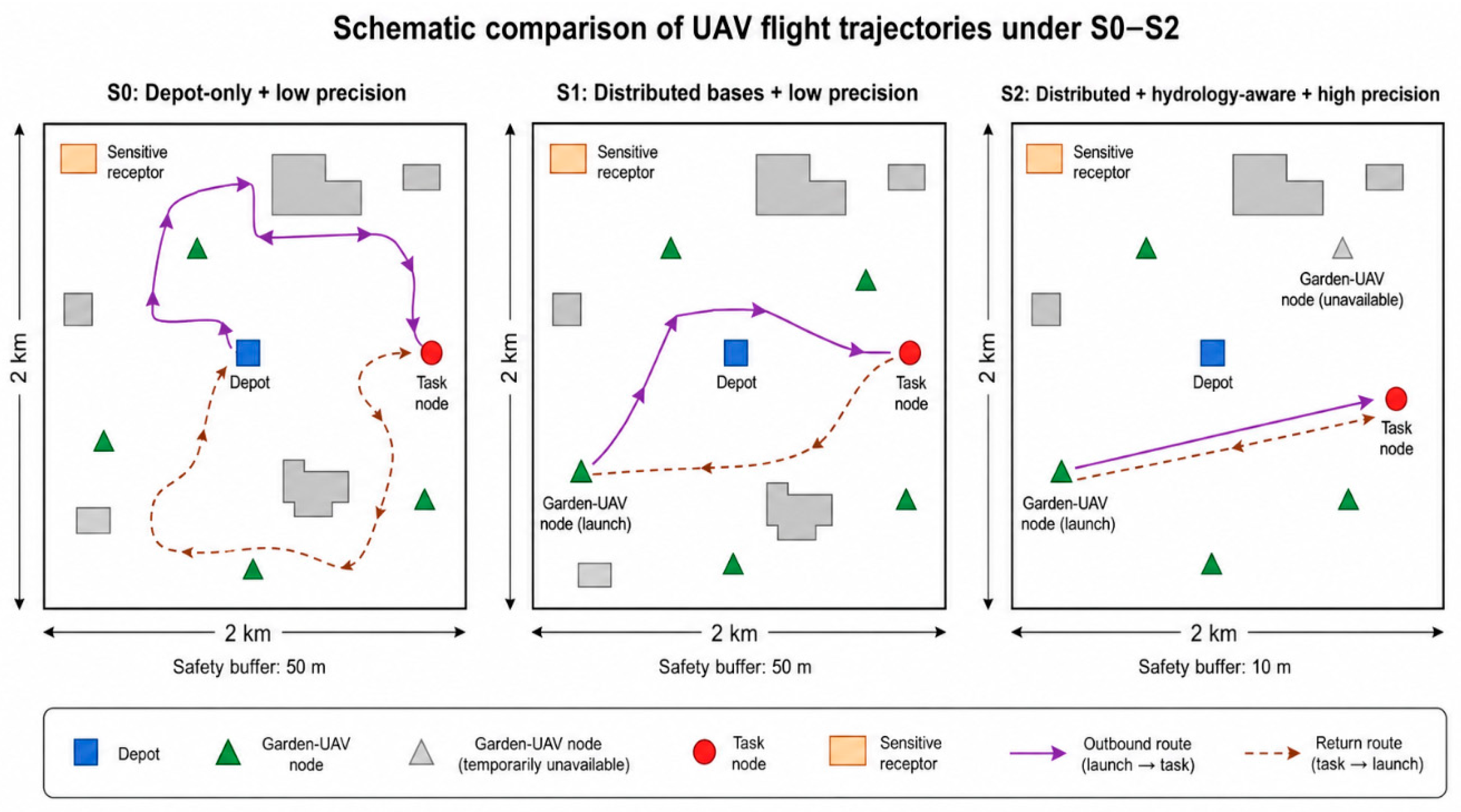
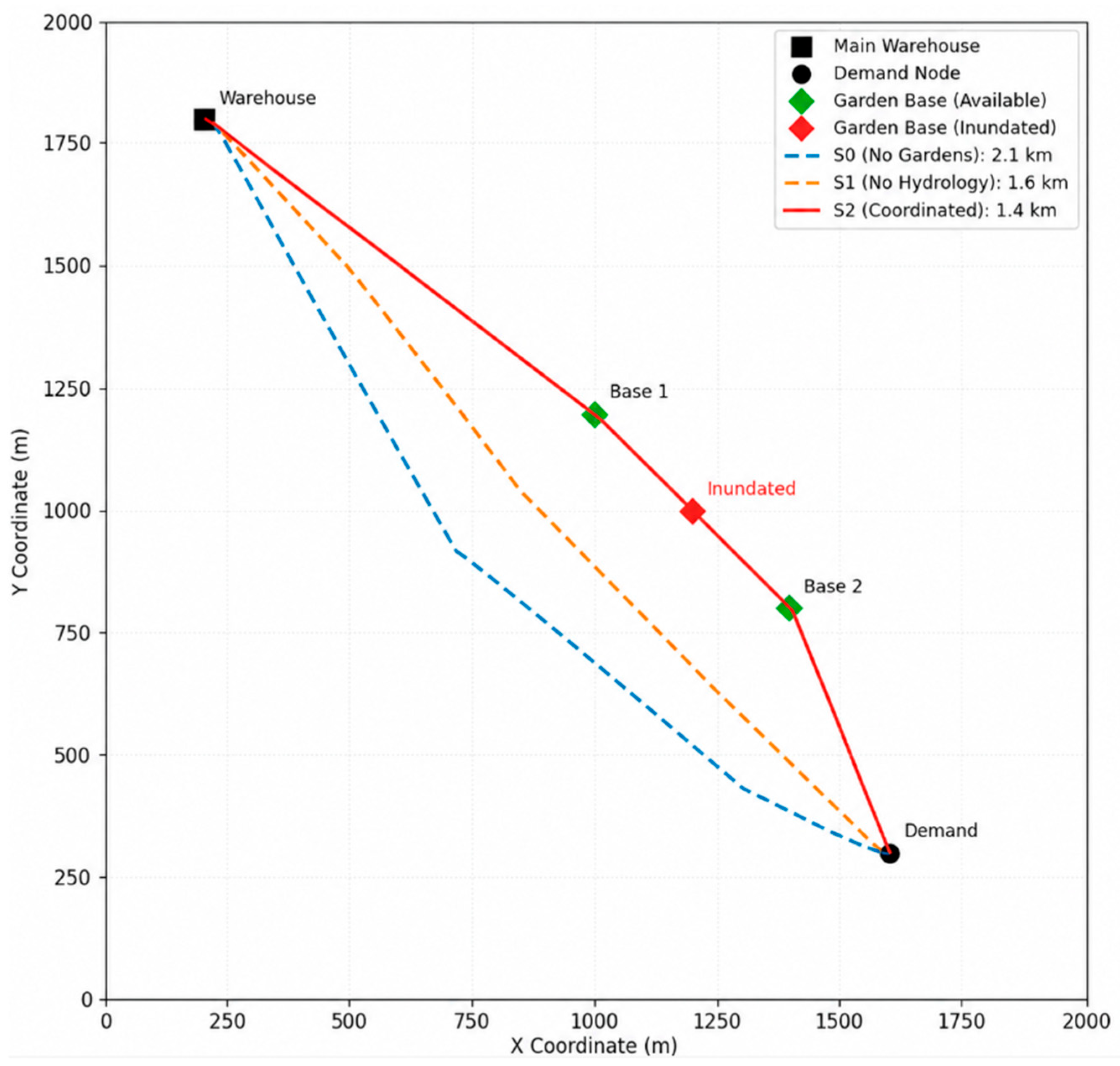
To illustrate these changes in flight patterns more intuitively,
Figure 4 schematically compares representative UAV trajectories under S0–S2.
As illustrated in
Figure 4, the above performance improvement stems from two synergistic mechanisms. First, distributed base deployment fundamentally changes the spatial structure of the logistics network. Compared with S0, S1 shows that launching from distributed garden UAV nodes instead of relying only on the central depot can substantially shorten access distance to task nodes and reduce detours. In the baseline scenario, all drones must complete a “warehouse demand warehouse” round trip, resulting in an average empty flight ratio of up to 47%. By converting 17 sponge facilities into distributed bases, the average straight-line distance from the base to the demand node is reduced from 1.12 km to 0.65 km, which directly cuts down the non-value-added flight time. Second, high-precision navigation eliminates unnecessary detours. The comparison between S1 and S2 further shows that high-precision navigation, together with hydrology-aware node selection, enables straighter routes and avoids temporarily unavailable nodes. In low-precision GNSS mode, drones must maintain a 50 m safety buffer around buildings, which increases the actual flight distance by an average of 28% compared to the straight-line distance. RTK-GNSS technology reduces this buffer to 10 m, allowing drones to fly along the optimal path and further reduce energy consumption. It is worth emphasizing that the performance advantage of S2 over S1 is achieved despite the temporary unavailability of three nodes during the storm peak, which proves that dynamic scheduling based on hydrological information can effectively avoid system congestion caused by node failures.
5.2. Hydrological Risk Analysis
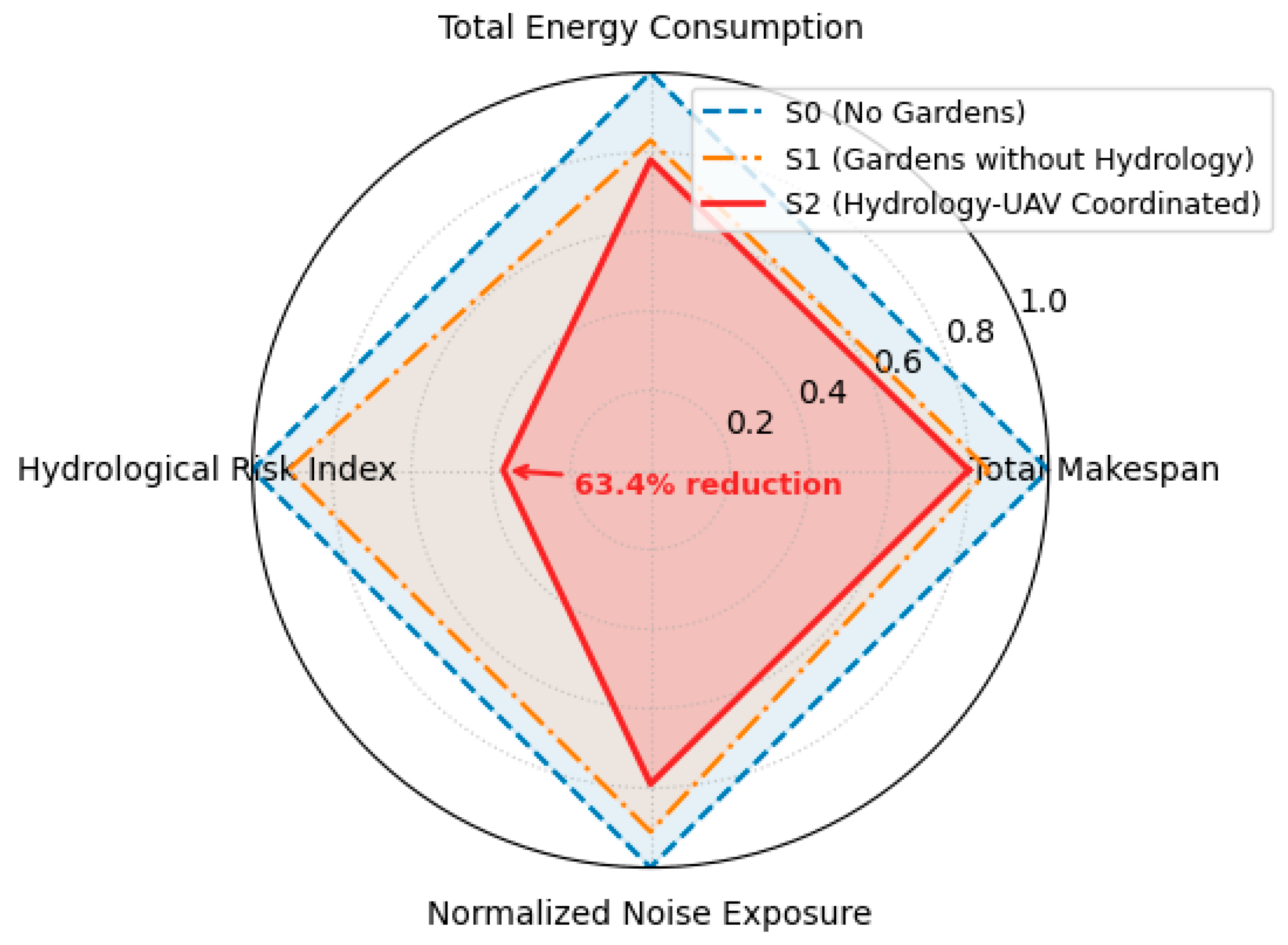
Hydrological risk exposure is measured by the fraction of UAV operations at base nodes that occur when those nodes would be hydrologically unsafe, using Equation (3) as a basis for a normalized risk index Rh. Under the baseline S0, if we hypothetically allowed the same set of garden nodes, post hoc evaluation indicates
= 0.27, meaning 27% of operations would coincide with unsafe hydrological states. In S1, the index is slightly lower, at 0.25, because more flexible routing incidentally avoids some adverse periods. By contrast, S2 explicitly constrains operations to hydrologically safe windows through
(t), yielding
= 0.099, a 63.4% reduction relative to S0. This confirms that integrating hydrological simulation into scheduling can meaningfully reduce exposure to flood-related operational risks without sacrificing efficiency, echoing the benefits of hydrology-driven optimization of drainage and LID systems reported in
Figure 5.
The dramatic reduction in hydrological risk is achieved through a “proactive prevention + intelligent allocation” dual mechanism, rather than the passive response adopted in traditional studies. First, the binary availability constraint (t) establishes a hard safety boundary. The system automatically blocks all takeoff and landing operations at nodes where the inundation depth exceeds 0.05 m or the water storage rate exceeds 85%, completely eliminating the risk of drone crashes or equipment damage caused by flooded runways. Second, the optimization algorithm proactively allocates tasks to nodes with higher hydrological resilience. In the scheduling process, the algorithm tends to assign tasks with higher time sensitivity to large pocket parks with strong water storage capacity and continuous availability, while reserving small rain gardens for non-urgent tasks during dry periods. This differential allocation strategy not only reduces risk but also improves the overall utilization efficiency of infrastructure resources.
5.3. Noise Impact Analysis
Noise exposure at sensitive receptors is approximated by the normalized index in Equation (4), aggregating edge-based penalties over time. In the baseline S0, all flights originate from and return to the depot, resulting in flight paths that frequently cut across residential and educational areas, giving a normalized noise exposure = 1.00. Scenario S1, by introducing garden UAV bases that are deliberately placed in lower-sensitivity pockets, reduces this index to 0.91 (_9%). Scenario S2 further depresses noise exposure to 0.79 (_21.3%), because high-precision navigation allows for corridors to be aligned more narrowly with pre-planned low-sensitivity routes, and hydrological constraints prevent ad hoc use of noisy nodes during heavy storms, when humans may already be stressed by rain impacts. This is consistent with recent work on modelling noise impacts from low-altitude UAV operations. In other words, collaborative design and scheduling not only manage water-related risks but also enable better acoustic planning.
The noise reduction effect is the superposition of spatial and temporal optimization. Spatially, distributed bases change the overall distribution of flight paths. In the baseline scenario, 62% of the total flight distance is over residential areas, while in S2, this proportion drops to 38%, as most flights now occur between nearby garden bases and demand nodes. Temporarily, hydrological constraints automatically avoid the most sensitive time periods. During storm peaks (60–120 min), when people are more likely to be indoors and sensitive to noise, the system automatically reduces operations at nodes near residential areas and shifts tasks to nodes in commercial or industrial zones. This spatio-temporal joint optimization achieves a more significant noise reduction effect than simply adjusting flight altitudes or speeds.
To provide a compact visual summary of the performance indicators,
Figure 6 compares normalized makespan, total energy consumption, hydrological risk index and noise exposure across the three scenarios. All indicators are normalized with respect to S0; lower values indicate better performance.
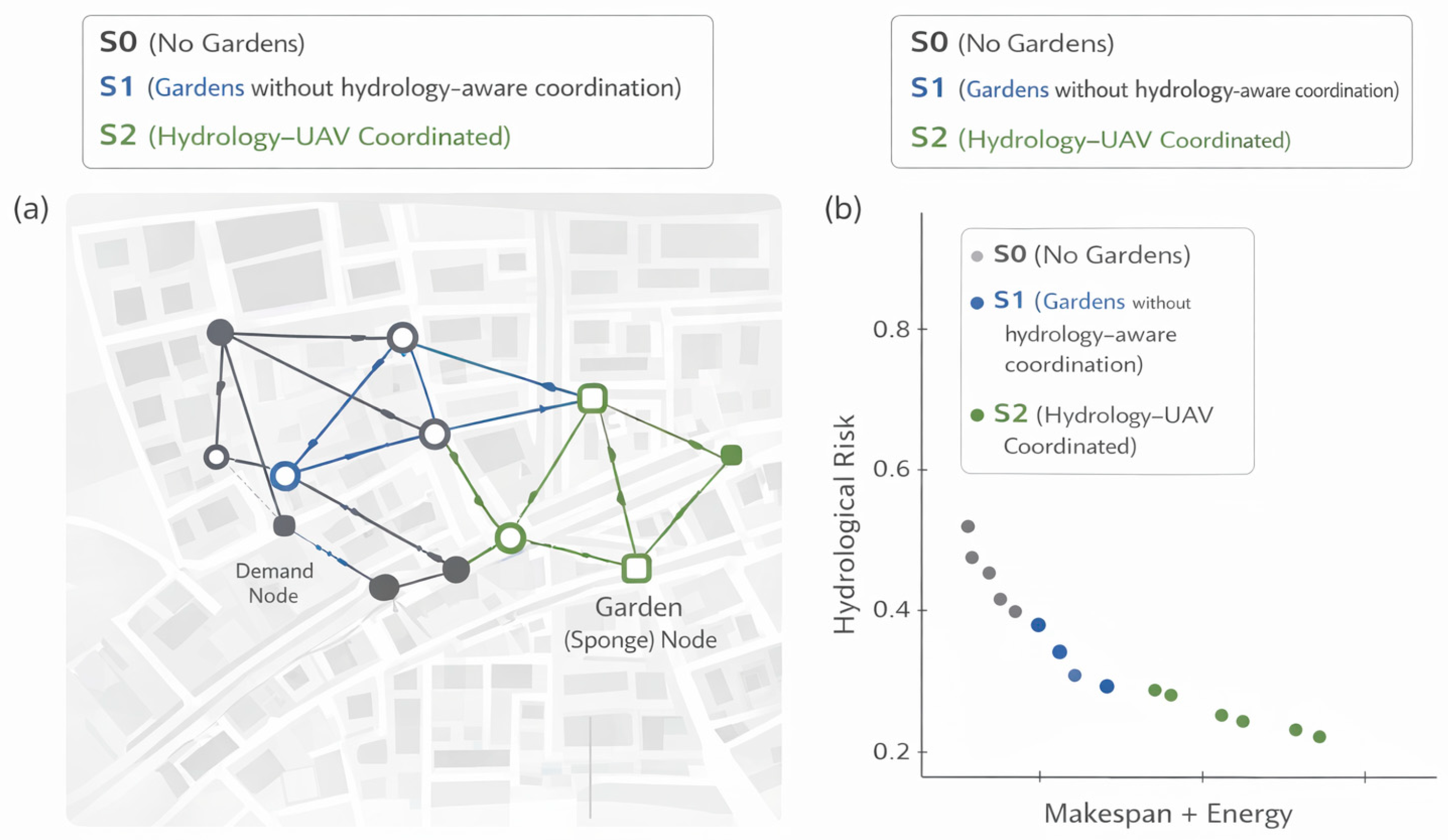
The Pareto fronts produced by NSGA-II for the three scenarios reveal that S2 dominates S0 and S1 in most regions of the objective space. For the same hydrological risk, S2 offers solutions with lower makespan and noise; for similar noise levels, S2 attains lower risk exposure and energy consumption. This indicates that treating pocket parks and sponge facilities as dynamic UAV bases, and explicitly integrating SWMM outputs into routing decisions, opens a region of “win win” solutions unattainable by traditional static-infrastructure strategies. See
Figure 7 for details.
5.4. Sensitivity Analysis
To further verify the stability and applicability of the proposed framework, a sensitivity analysis was conducted with respect to three key parameters:
- (1)
Inundation threshold ;
- (2)
Number of UAVs K;
- (3)
Navigation precision mode.
Three levels were set for each parameter: low, baseline, and high. The makespan and hydrological risk index were used as evaluation indicators.
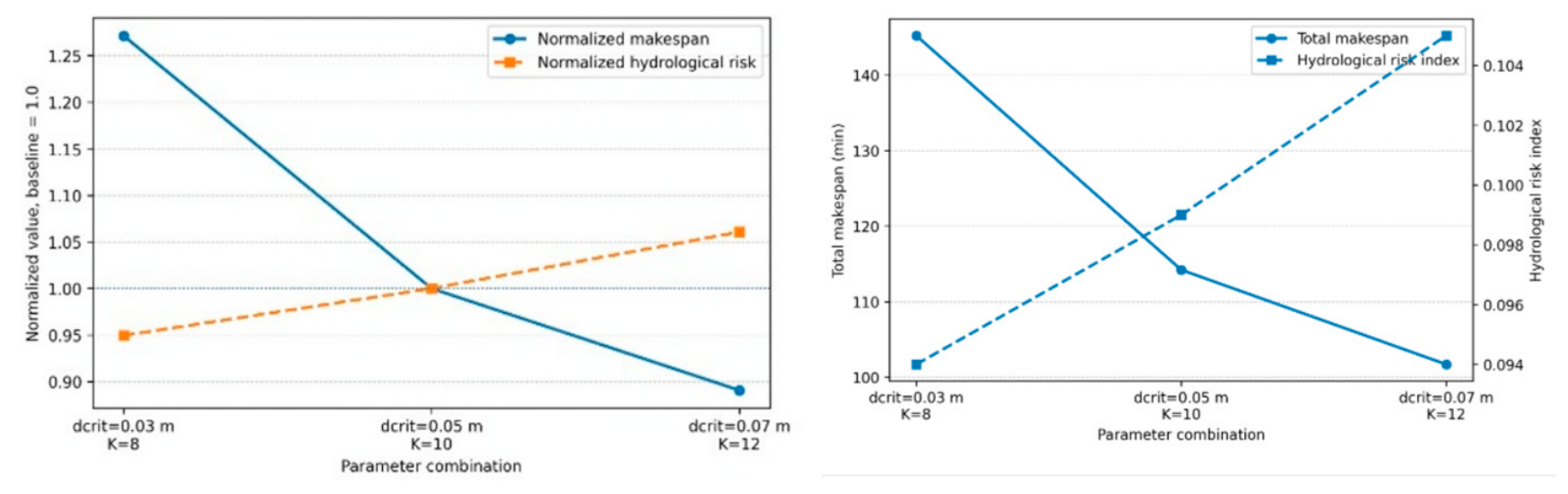
In addition to the one-factor sensitivity tests, we further examined the combined effects of the hydrological threshold and the number of UAVs K, because these two parameters jointly determine the trade-off between node availability, logistics efficiency, and hydrological safety. Three representative parameter combinations were selected: a stricter hydrological-safety setting ( = 0.03 m, K = 8), the baseline setting ( = 0.05 m, K = 10) and a more relaxed availability setting ( = 0.07 m, K = 12).
- (a)
Normalized comparison relative to the baseline scenario ( = 0.05 m, K = 10);
- (b)
Absolute values of total makespan and hydrological risk index.
The results show that:
When the inundation threshold increases from 0.03 m to 0.07 m, the average node availability rises by approximately 11.5%, and the hydrological risk increases slightly (by 6.8%), while the makespan decreases by 5.3%. This indicates that a moderate relaxation of the hydrological safety threshold can improve logistics efficiency without excessive risk growth.
The combined-parameter results in
Figure 8 further reveal this efficiency–risk trade-off. Under the stricter setting (
= 0.03 m, K = 8), the hydrological risk index decreases to 0.094, about 5% lower than the baseline value, but the total makespan increases to 145.2 min, approximately 27% higher than the baseline. This indicates that stricter hydrological constraints can effectively reduce exposure to flood-prone bases, but they also reduce the number of available UAV service nodes and therefore increase routing and scheduling time.
As the number of UAVs K increases from 6 to 14, the makespan decreases significantly (by 24.7%), while the hydrological risk and noise exposure remain stable. This reflects that the scheduling system can efficiently utilize additional UAV resources under the constraints of garden hydrology availability (
Table 2).
In contrast, under the more relaxed setting ( = 0.07 m, K = 12), the total makespan decreases to 101.7 min, about 11% lower than the baseline, while the hydrological risk index increases to 0.105, approximately 6% higher than the baseline. This suggests that increasing the number of available UAVs and adopting a higher water-depth threshold can improve operational efficiency, but at the cost of increased hydrological exposure. Therefore, the baseline setting ( = 0.05 m, K = 10) provides a balanced compromise between logistics efficiency and stormwater-related operational safety.
High-precision navigation consistently outperforms low-precision navigation under all parameter combinations, reducing the total flight distance by 13.4–18.2% and lowering noise exposure by 9.1–12.5%.
Overall, the proposed Garden Hydrology UAV framework remains stable and robust under different parameter variations. The sensitivity results further indicate that the effects of and K are driven by two coupled mechanisms. First, determines how SWMM-simulated hydrological states are converted into operational node availability. A stricter threshold reduces hydrological exposure by excluding more temporarily inundated garden nodes, but it also limits routing flexibility and increases makespan. Conversely, a more relaxed threshold improves node availability and routing efficiency, while slightly increasing hydrological risk. Second, K mainly affects fleet-level parallel service capacity. Increasing K reduces waiting time and shortens makespan, whereas its effect on hydrological risk remains limited because unsafe nodes are still constrained by the hydrological availability rule. These findings show that the observed sensitivity patterns reflect the interaction between hydrological thresholds, dynamic node availability, and UAV scheduling capacity, thereby supporting the reliability and engineering applicability of the proposed framework.
6. Conclusions
6.1. Main Findings and Planning Implications
This paper proposed a Garden Hydrology UAV collaborative infrastructure and scheduling framework under the low-altitude economy, where pocket parks and sponge-city facilities serve as multi-functional UAV bases whose operational availability is constrained by stormwater states simulated via EPA SWMM 5.x. A three-objective UAV routing and scheduling model was implemented minimizing logistics time and energy, hydrological risk exposure, and noise impact subject to time-dependent node availabilities, battery constraints and navigation corridor feasibility, and solved using NSGA-II within an evolutionary multi-objective optimization paradigm (
Figure 9). A stylized case study in a 4 km
2 dense urban district provides preliminary evidence that the integrated design has the potential to reduce makespan and energy use by nearly one fifth, while also lowering hydrological risk exposure and noise at sensitive receptors under the tested simulation conditions. These findings suggest that modern garden and sponge-city projects can be co-designed with low-altitude infrastructures, forming a new class of resilient, multi-functional urban spaces aligned with SDG 11, urban resilience, multifunctional green infrastructure, and the emergence of the low-altitude economy.
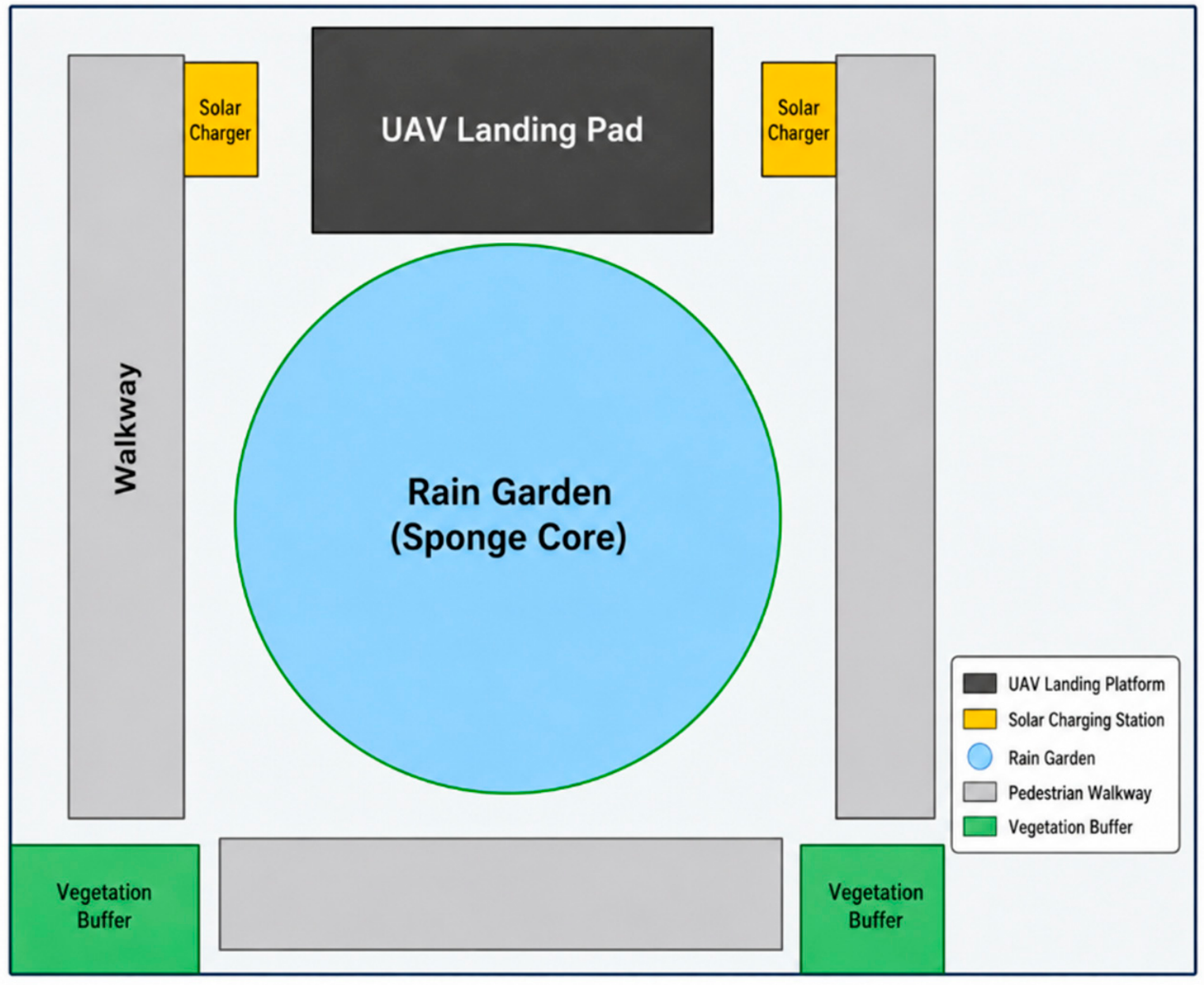
From an application perspective, the proposed framework can be embedded into multiple stages of urban planning and operational decision-making. At the strategic planning stage, it can help screen pocket parks, rain gardens, detention basins, rooftops, and other underused public spaces as candidate low-altitude service nodes. This allows planners to compare alternative layouts while considering drainage, logistics, noise, and public-space constraints together. At the detailed design stage, the framework can guide the co-location of UAV pads, charging cabinets, maintenance access, vegetation buffers, pedestrian circulation, and stormwater storage areas, so that low-altitude infrastructure does not simply occupy green space but becomes part of a multifunctional public facility. At the operational stage, SWMM-derived water-depth and storage-utilization outputs can be connected to real-time rainfall forecasts, sensor networks, and low-altitude traffic-management platforms to generate dynamic node-availability maps and adaptive UAV dispatching strategies during storm events.
For municipal decision makers, the framework also provides a transparent evaluation tool for cross-department coordination. Urban planning departments can use the results to identify where low-altitude facilities should be reserved in land-use plans, drainage and emergency-management departments can evaluate whether UAV operations increase or reduce storm-related exposure, transport and aviation regulators can define safer corridors and temporary operating restrictions, and community managers can assess trade-offs among delivery efficiency, acoustic disturbance, landscape quality, and public acceptance. Therefore, the main practical value of the framework is not limited to improving drone-routing performance. It also helps translate the abstract concept of integrated resilient infrastructure into measurable planning indicators and scenario-based decision evidence.
6.2. Limitations
Despite its contributions, this study has several limitations that should be acknowledged. First, we used a stylized 4 km2 high-density urban area for the case study. While this allows us to control variables and clearly demonstrate the benefits of the proposed framework, future research should use real-world urban data, including high-precision terrain data, drainage network data, and actual demand distribution, to validate the results.
Second, we assumed that all drones are homogeneous with the same battery capacity, cruise speed, and payload limit. In reality, there are many different types of drones with varying capabilities. Future research should consider heterogeneous drone fleets and optimize the assignment of different types of drones to different tasks.
Third, we only considered a 5-year return period storm event. The performance of the proposed framework may vary under different rainfall intensities and durations. Future research should analyze the impact of different return period storms on the availability of sponge bases and the overall system performance.
In addition to these modeling limitations, several implementation challenges may arise when the framework is transferred to actual planning practice. First, the required datasets are usually managed by different municipal agencies and private operators, including drainage-network records, green-space inventories, UAV demand data, obstacle maps, airspace restrictions, and community noise-sensitive receptors. Differences in data format, update frequency, ownership, and confidentiality may limit direct integration. Second, the transformation of public green blue spaces into shared UAV nodes requires careful governance arrangements, including land-use approval, safety certification, maintenance responsibility, emergency access, cybersecurity protection, and liability allocation in case of accidents or service interruption.
Public acceptance is another critical challenge. Even if the model identifies technically efficient locations, residents may still be concerned about noise, privacy, visual intrusion, safety risks, and the possible commercialization of public parks. Thus, real-world deployment should be accompanied by participatory planning, environmental-impact assessment, transparent operating rules, and small-scale pilot projects before district-wide implementation. These challenges imply that the proposed framework should be regarded as a decision-support tool rather than an automatic design prescription; its outputs need to be interpreted together with regulatory, social, ecological, and economic considerations.
6.3. Future Research Directions
Future work will calibrate the framework with real city data, enhance hydrological risk modeling beyond binary thresholds, and couple the proposed framework with digital twin platforms for real-time adaptive control. Further research should also develop data-sharing protocols and model interfaces that allow SWMM, GIS, UAV traffic-management systems, and municipal emergency platforms to exchange information in a consistent manner. Pilot studies in different urban contexts are needed to test how the framework performs under varied park sizes, drainage capacities, building densities, regulatory environments, and delivery-demand patterns, integrating additional modes such as ground robots and human couriers, and incorporating equity, ecological quality, lifecycle cost, carbon emissions, and public-acceptance indicators into the objective set. In particular, applications to real-world districts with different drainage capacities, green-space morphologies, building densities, airspace regulations, and logistics demand patterns will help evaluate the broader applicability of the Garden–Hydrology–UAV collaborative framework.