Sustainable Maintenance 4.0 Enhanced by Digital Twins: A Systematic Literature Review and Conceptual Model Proposal
 , ,
, ,  , , and
Abstract
1. Introduction
2. Materials and Methods
2.1. Methodological Approach
2.2. Systematic Literature Search Methodology
2.3. Analysis Procedures and Software Tools
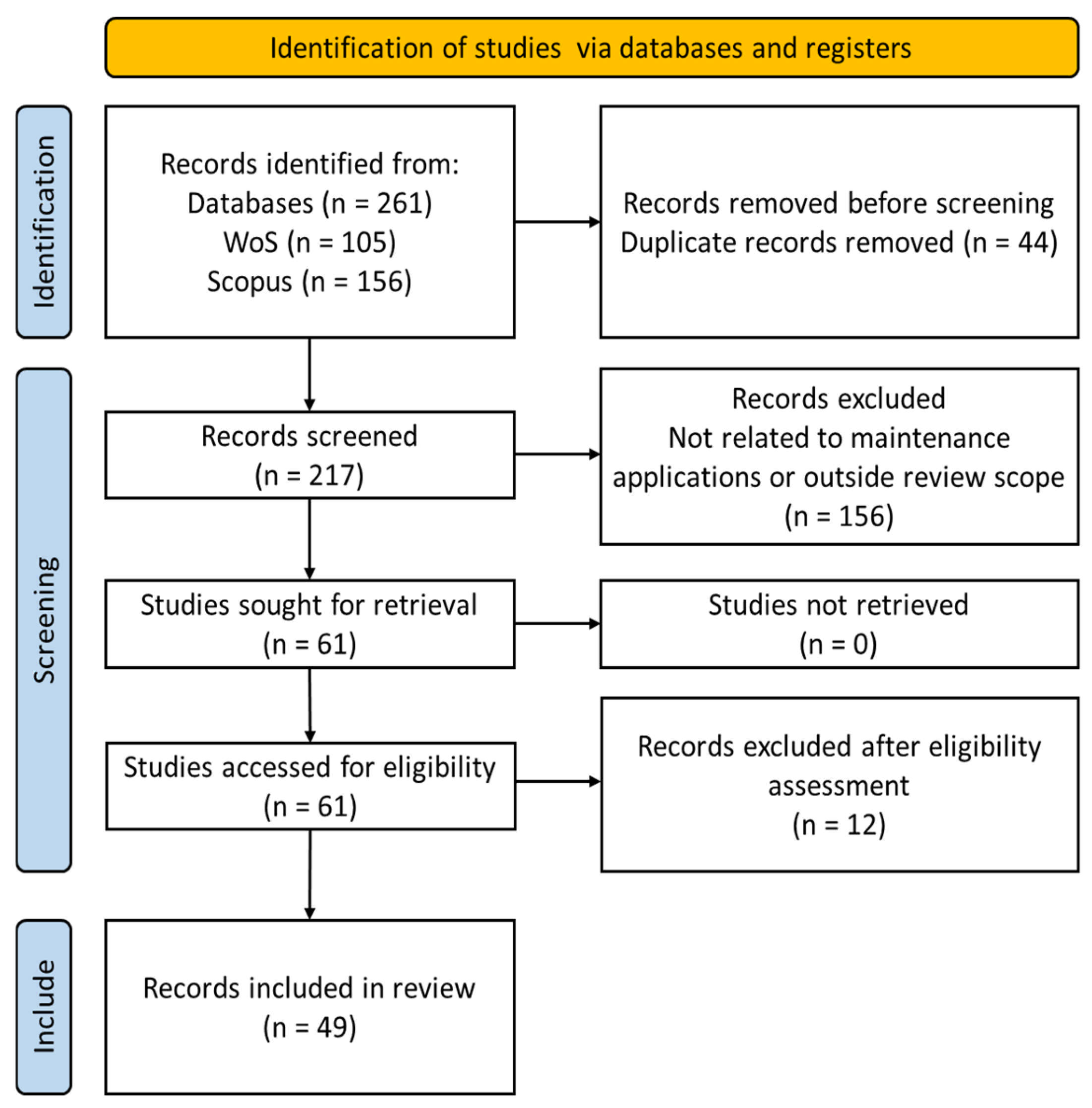
2.4. Document Identification and Eligibility Procedures
2.5. Assessment of the Methodological Robustness of the Included Studies
3. Results
3.1. Characteristics of the Included Studies
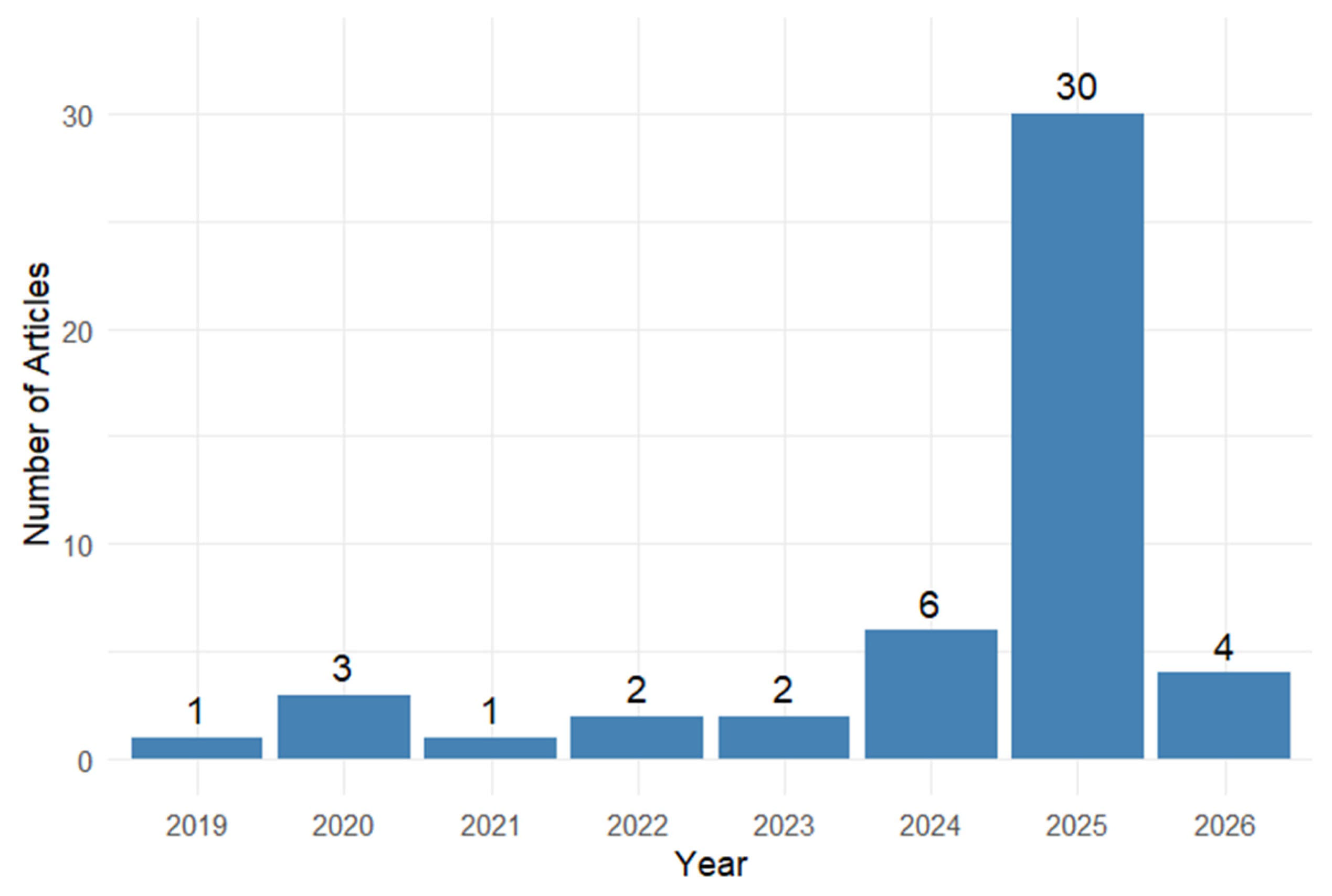
3.2. Publication Trends over Time
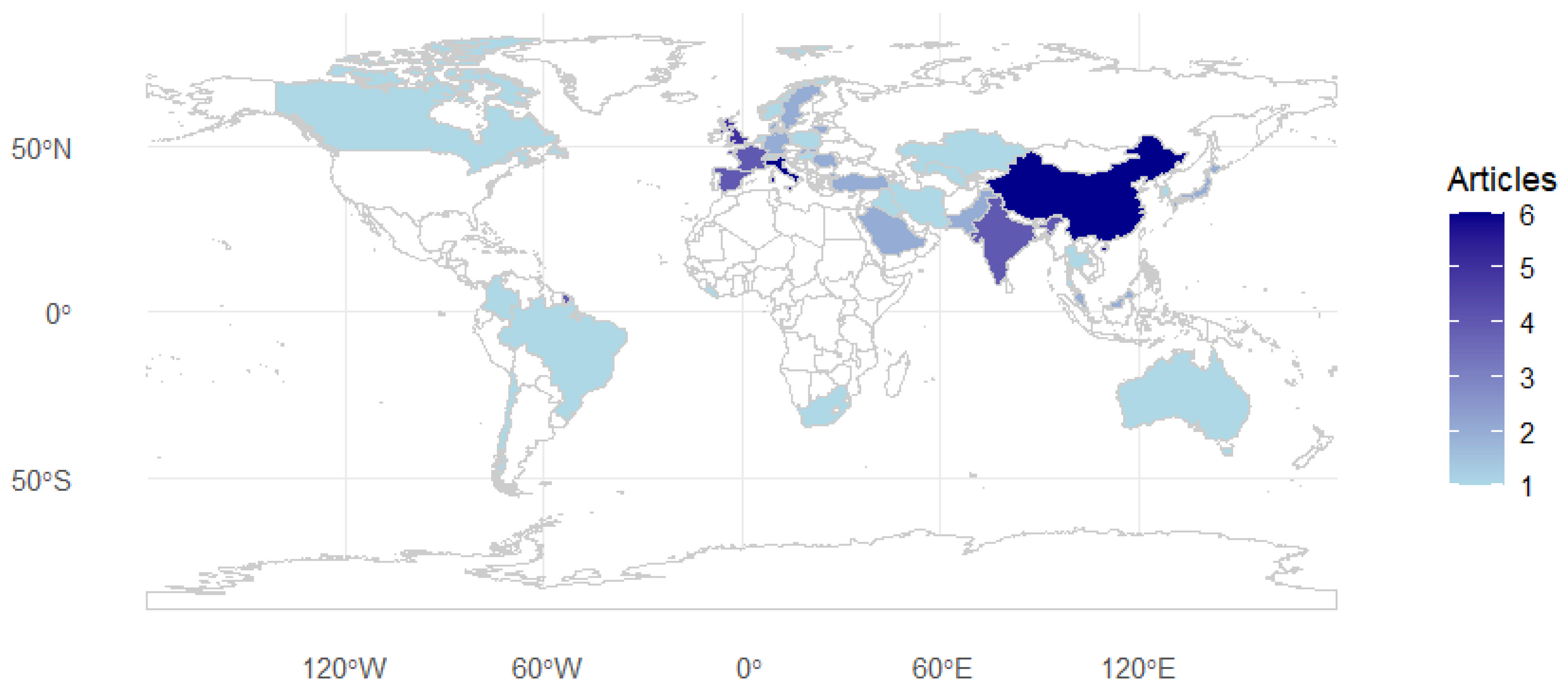
3.3. Distribution by Country
3.4. Typology and Characterization of Identified Publications
3.5. Industrial Sectors Identified
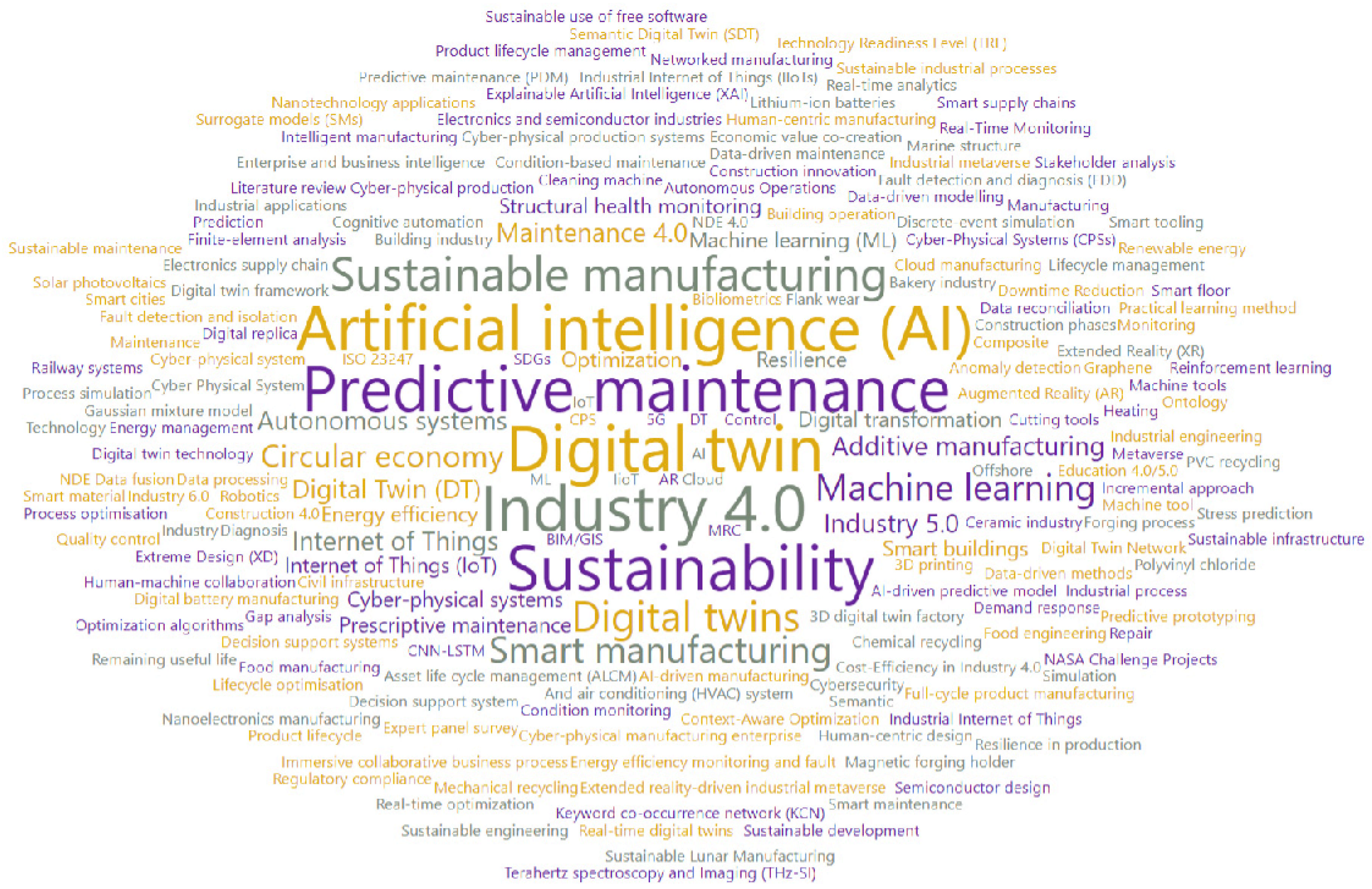
3.6. Keyword Analysis
4. Discussion
4.1. RQ1: How Do DTs, Within the I4.0 Ecosystem, Contribute to Promoting More Sustainable Maintenance Operations, Considering the Economic, Environmental, and Social Dimensions?
4.2. RQ2: How Do DTs Support the Integration and Optimization of Preventive, Predictive, and Corrective Maintenance Strategies for Sustainable Outcomes?
4.3. RQ3: How Can Classic Maintenance Practices and Methodologies Be Integrated with DTs Within the I4.0 Ecosystem to Promote More Sustainable Maintenance Operations?
4.4. RQ4: How Can the Adoption of DTs Within the I4.0 Ecosystem Reduce Resource Consumption and Industrial Waste in Maintenance?
4.5. RQ5: What Are the Main Trade-Offs and Limitations of Applying DTs Within the I4.0 Ecosystem to Promote Sustainable Maintenance Operations?
4.6. RQ6: What Organizational or Capacity-Building Challenges Impact the Effectiveness of DTs in Sustainable Maintenance?
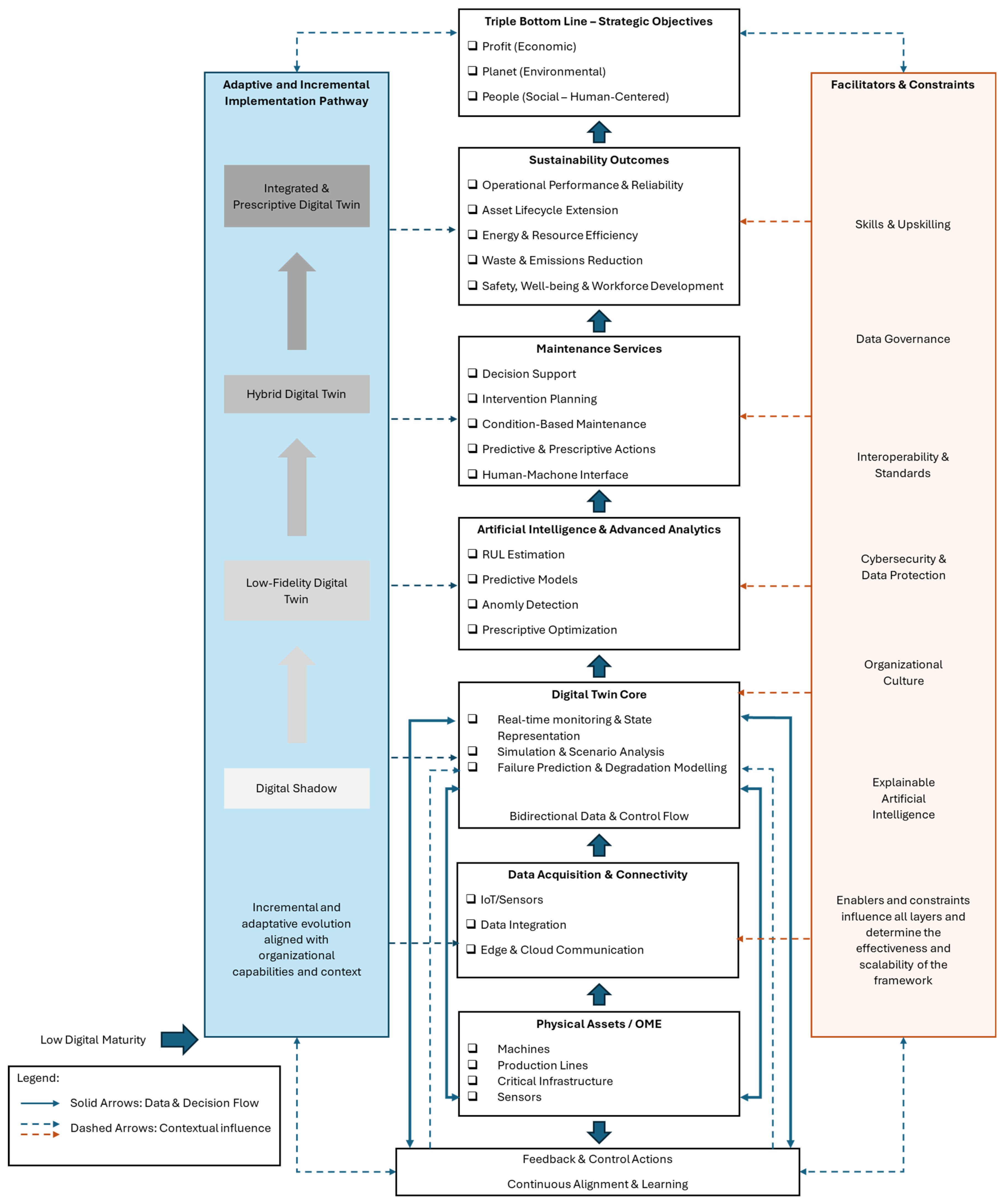
4.7. An Integrative Conceptual Framework for Sustainable Maintenance 4.0 Enhanced by DTs
4.7.1. Pillars of Sustainability and Strategic Objectives
4.7.2. Multilayer Architecture Based on DTs
4.7.3. Adaptive Implementation Pathways
4.7.4. Facilitators, Constraints, and Critical Success Factors
5. Conclusions
Supplementary Materials
Author Contributions
Funding
Institutional Review Board Statement
Informed Consent Statement
Data Availability Statement
Acknowledgments
Conflicts of Interest
Abbreviations
| AI | Artificial Intelligence |
| DTs | Digital Twins |
| I4.0 | Industry 4.0 |
| I5.0 | Industry 5.0 |
| ISO | International Organization for Standardization |
| IoT | Internet of Things |
| JBI | Joanna Briggs Institute |
| ML | Machine Learning |
| OME | Observable Manufacturing Elements |
| PVC | Polyvinyl Chloride |
| PRISMA | Preferred Reporting Items for Systematic Reviews and Meta-Analyses |
| PHM | Prognostics and Health Management |
| RFID | Radio Frequency Identification |
| RUL | Remaining Useful Life |
| RQs | Research Questions |
| SCADA | Supervisory Control and Data Acquisition |
| SLR | Systematic Literature Review |
| TBL | Triple Bottom Line |
| VR | Virtual Reality |
| WoS | Web of Science |
Appendix A

| Reference | Type of Study | Clear Objective | Defined Context | Appropriate Method | Rigorous Data Collection | Coherent Analysis | Relevant Results | Limitations Discussed | Overall Score | Ranking |
|---|---|---|---|---|---|---|---|---|---|---|
| Rashidian et al. [29] | Systematic Literature Review | Yes | Yes | Yes | Yes | Yes | Yes | Yes | 7.0 | High |
| Sivasubramani and Prodromakis [30] | Perspective/Review Article | Yes | Yes | Yes | Partial | Yes | Yes | Yes | 6.5 | High |
| Lwele et al. [31] | Review | Yes | Yes | Yes | Yes | Yes | Yes | Yes | 7.0 | High |
| Filipescu et al. [32] | Technical/Experimental Study | Yes | Yes | Yes | Yes | Yes | Yes | Partial | 6.5 | High |
| Stephen et al. [33] | Mixed-methods review | Yes | Yes | Yes | Yes | Yes | Yes | Yes | 7.0 | High |
| Prasittisopin [34] | Review | Yes | Yes | Yes | Yes | Yes | Yes | Yes | 7.0 | High |
| Hafiz et al. [35] | Review | Yes | Yes | Partial | Partial | Yes | Yes | Yes | 6.0 | Moderate |
| Olayiwola et al. [18] | Review | Yes | Yes | Yes | Yes | Yes | Yes | Yes | 7.0 | High |
| Khan et al. [36] | Literature Review and Framework Proposal | Yes | Yes | Yes | Partial | Yes | Yes | Yes | 6.5 | High |
| Anu et al. [52] | Systematic Review | Yes | Yes | Yes | Yes | Yes | Yes | Yes | 7.0 | High |
| Chatterjee et al. [56] | Quantitative (Operational data analysis) | Yes | Yes | Yes | Yes | Yes | Yes | Yes | 7.0 | High |
| Sucuoglu et al. [49] | Simulation/Prototyping | Yes | Yes | Yes | Yes | Yes | Yes | Yes | 7.0 | High |
| Hodavand et al. [54] | Systematic Review | Yes | Yes | Yes | Yes | Yes | Yes | Yes | 7.0 | High |
| Guitard et al. [55] | Case study/Applied research | Yes | Yes | Yes | Partial | Yes | Yes | Yes | 6.5 | High |
| Kaveh and Alhajj [47] | Review | Yes | Yes | Yes | Yes | Yes | Yes | Yes | 7.0 | High |
| Schutz et al. [60] | Methodological | Yes | Yes | Yes | Partial | Yes | Yes | Yes | 6.5 | High |
| Nsengiyumva et al. [5] | Review | Yes | Yes | Yes | Partial | Yes | Yes | Yes | 6.5 | High |
| Stefko et al. [57] | Qualitative analysis and synthesis | Yes | Yes | Yes | Yes | Yes | Yes | Yes | 7.0 | High |
| Sajadieh and Noh [20] | Review | Yes | Yes | Yes | Yes | Yes | Yes | Yes | 7.0 | High |
| Karanam and Hartman [62] | Review and Case Study | Yes | Yes | Yes | Partial | Yes | Yes | Yes | 6.5 | High |
| Chidara et al. [58] | Systematic Literature Review | Yes | Yes | Yes | Yes | Yes | Yes | Yes | 7.0 | High |
| Manoharan et al. [37] | Critical Review | Yes | Yes | Yes | Yes | Yes | Yes | Yes | 7.0 | High |
| Melesse et al. [50] | Narrative and integrative review | Yes | Yes | Yes | Yes | Yes | Yes | Partial | 6.5 | High |
| Zeynivand et al. [14] | Technical Paper | Yes | Yes | Yes | Yes | Yes | Yes | Yes | 7.0 | High |
| Khan et al. [6] | Development and evaluation of a framework | Yes | Yes | Yes | Yes | Yes | Yes | Yes | 7.0 | High |
| Bozzini et al. [46] | Case Study/Methodology | Yes | Yes | Yes | Yes | Yes | Yes | Yes | 7.0 | High |
| Yasin et al. [45] | Methodological/Experimental Study | Yes | Yes | Yes | Yes | Yes | Yes | Yes | 7.0 | High |
| Cacciuttolo et al. [51] | Review | Yes | Yes | Yes | Yes | Yes | Yes | Yes | 7.0 | High |
| Cho et al. [61] | Research/Framework Development | Yes | Yes | Yes | Partial | Yes | Partial | Yes | 6.0 | Moderate |
| Mukhitdinov et al. [42] | Development and validation of a framework | Yes | Yes | Yes | Yes | Yes | Yes | Yes | 7.0 | High |
| Weerasekara et al. [7] | Review | Yes | Yes | Yes | Yes | Yes | Yes | Yes | 7.0 | High |
| Sun et al. [43] | Review (Bibliometric) | Yes | Yes | Yes | Yes | Yes | Yes | Partial | 6.5 | High |
| Jasiulewicz-Kaczmarek et al. [1] | Literature review | Yes | Yes | Yes | Partial | Yes | Yes | No | 5.5 | Moderate |
| Kherbache et al. [64] | Technical Architecture and Case Study | Yes | Yes | Yes | Partial | Yes | Yes | Partial | 6.0 | Moderate |
| Fernández-Miguel et al. [8] | Case study | Yes | Yes | Yes | Yes | Yes | Yes | Yes | 7.0 | High |
| Khalaj et al. [63] | Experimental/Technical | Yes | Yes | Yes | Partial | Yes | Yes | Yes | 6.5 | High |
| Alvares et al. [65] | Experimental/Technical | Yes | Yes | Yes | Yes | Yes | Yes | Yes | 7.0 | High |
| Briatore and Braggio [15] | Literature Review and Framework Proposal | Yes | Yes | Yes | Yes | Yes | Yes | No | 6.0 | Moderate |
| Hassan et al. [59] | Case study/experimental evaluation | Yes | Yes | Yes | Yes | Yes | Yes | Yes | 7.0 | High |
| Jamwal et al. [53] | Systematic Literature Review | Yes | Yes | Yes | Yes | Yes | Yes | Partial | 6.5 | High |
| Hu et al. [44] | Systematic Review | Yes | Yes | Yes | Yes | Yes | Yes | Yes | 7.0 | High |
| Murtaza et al. [4] | Systematic Review and Case Study | Yes | Yes | Yes | Yes | Yes | Yes | Yes | 7.0 | High |
| Khan et al. [48] | Review Article | Yes | Yes | Yes | Yes | Yes | Yes | Yes | 7.0 | High |
| Ba et al. [17] | Systematic Literature Review | Yes | Yes | Yes | Yes | Yes | Yes | Yes | 7.0 | High |
| Pacheco-Blazquez et al. [41] | Case Study/Methodological Development | Yes | Yes | Yes | Yes | Yes | Yes | Yes | 7.0 | High |
| Chen et al. [2] | Mixed | Yes | Yes | Yes | Yes | Yes | Yes | Yes | 7.0 | High |
| González-Cancelas et al. [38] | Case study/Methodological proposal | Yes | Yes | Yes | Yes | Yes | Yes | Yes | 7.0 | High |
| Fuhrländer-Völker et al. [39] | Framework | Yes | Yes | Yes | Yes | Yes | Yes | Yes | 7.0 | High |
| Kovari [40] | Conceptual framework study | Yes | Yes | Yes | Partial | Yes | Yes | Yes | 6.5 | High |
References
- Jasiulewicz-Kaczmarek, M.; Legutko, S.; Kluk, P. Maintenance 4.0 Technologies–New Opportunities for Sustainability Driven Maintenance. Manag. Prod. Eng. Rev. 2020, 11, 74–87. [Google Scholar] [CrossRef]
- Chen, S.; Bekar, E.T.; Bokrantz, J.; Skoogh, A. AI-Enhanced Digital Twins in Maintenance: Systematic Review, Industrial Challenges, and Bridging Research–Practice Gaps. J. Manuf. Syst. 2025, 82, 678–699. [Google Scholar] [CrossRef]
- Mendes, D.; Gaspar, P.D.; Charrua-Santos, F.; Navas, H. Synergies between Lean and Industry 4.0 for Enhanced Maintenance Management in Sustainable Operations: A Model Proposal. Processes 2023, 11, 2691. [Google Scholar] [CrossRef]
- Murtaza, A.A.; Saher, A.; Zafar, M.H.; Moosavi, S.K.R.; Aftab, M.F.; Sanfilippo, F. Paradigm Shift for Predictive Maintenance and Condition Monitoring from Industry 4.0 to Industry 5.0: A Systematic Review, Challenges and Case Study. Results Eng. 2024, 24, 102935. [Google Scholar] [CrossRef]
- Nsengiyumva, W.; Zhong, S.; Tu, S.-T. NDE 4.0: The Confluence of Cutting-Edge Nondestructive Inspection Practices, Data Fusion Techniques, Artificial Intelligence, and Cyber-Physical Systems for Effective Evaluation of Materials and Structures. Mech. Syst. Signal Process. 2026, 242, 113626. [Google Scholar] [CrossRef]
- Khan, T.; Khan, U.; Khan, A.; Mollan, C.; Morkvenaite-Vilkonciene, I.; Pandey, V. Data-Driven Digital Twin Framework for Predictive Maintenance of Smart Manufacturing Systems. Machines 2025, 13, 481. [Google Scholar] [CrossRef]
- Weerasekara, S.; Lu, Z.; Ozek, B.; Isaacs, J.; Kamarthi, S. Trends in Adopting Industry 4.0 for Asset Life Cycle Management for Sustainability: A Keyword Co-Occurrence Network Review and Analysis. Sustainability 2022, 14, 12233. [Google Scholar] [CrossRef]
- Fernández-Miguel, A.; García-Muiña, F.E.; Ortíz-Marcos, S.; Jiménez-Calzado, M.; Fernández del Hoyo, A.P.; Settembre-Blundo, D. AI-Driven Transformations in Manufacturing: Bridging Industry 4.0, 5.0, and 6.0 in Sustainable Value Chains. Future Internet 2025, 17, 430. [Google Scholar] [CrossRef]
- Stock, T.; Seliger, G. Opportunities of Sustainable Manufacturing in Industry 4.0. Procedia CIRP 2016, 40, 536–541. [Google Scholar] [CrossRef]
- Franciosi, C.; Iung, B.; Miranda, S.; Riemma, S. Maintenance for Sustainability in the Industry 4.0 Context: A Scoping Literature Review. IFAC-PapersOnLine 2018, 51, 903–908. [Google Scholar] [CrossRef]
- Aheleroff, S.; Huang, H.; Xu, X.; Zhong, R.Y. Toward Sustainability and Resilience with Industry 4.0 and Industry 5.0. Front. Manuf. Technol. 2022, 2, 951643. [Google Scholar] [CrossRef]
- Ghaleb, M.; Taghipour, S. Assessing the Impact of Maintenance Practices on Asset’s Sustainability. Reliab. Eng. Syst. Saf. 2022, 228, 108810. [Google Scholar] [CrossRef]
- Cardeal, G.; Höse, K.; Ribeiro, I.; Götze, U. Sustainable Business Models–Canvas for Sustainability, Evaluation Method, and Their Application to Additive Manufacturing in Aircraft Maintenance. Sustainability 2020, 12, 9130. [Google Scholar] [CrossRef]
- Zeynivand, M.; Esmaili, P.; Cristaldi, L.; Gruosso, G. A Novel Approach to Digital Twin-Based Energy Efficiency Monitoring and Failure Analysis in Industrial Applications. J. Manuf. Syst. 2025, 83, 612–625. [Google Scholar] [CrossRef]
- Briatore, F.; Braggio, M. Resilience and Sustainability Plants Improvement through Maintenance 4.0: IoT, Digital Twin and CPS Framework and Implementation Roadmap. IFAC-PapersOnLine 2024, 58, 365–370. [Google Scholar] [CrossRef]
- Aheleroff, S.; Xu, X.; Zhong, R.Y.; Lu, Y. Digital Twin as a Service (DTaaS) in Industry 4.0: An Architecture Reference Model. Adv. Eng. Inform. 2021, 47, 101225. [Google Scholar] [CrossRef]
- Ba, L.; Tangour, F.; El Abbassi, I.; Absi, R. Analysis of Digital Twin Applications in Energy Efficiency: A Systematic Review. Sustainability 2025, 17, 3560. [Google Scholar] [CrossRef]
- Olayiwola, O.; Cali, U.; Elsden, M.; Yadav, P. Enhanced Solar Photovoltaic System Management and Integration: The Digital Twin Concept. Solar 2025, 5, 7. [Google Scholar] [CrossRef]
- Kritzinger, W.; Karner, M.; Traar, G.; Henjes, J.; Sihn, W. Digital Twin in Manufacturing: A Categorical Literature Review and Classification. IFAC-PapersOnLine 2018, 51, 1016–1022. [Google Scholar] [CrossRef]
- Sajadieh, S.M.M.; Noh, S.D. From Simulation to Autonomy: Reviews of the Integration of Artificial Intelligence and Digital Twins. Int. J. Precis. Eng. Manuf. Green Technol. 2025, 12, 1597–1628. [Google Scholar] [CrossRef]
- Farias, L.M.S.; Santos, L.C.; Gohr, C.F.; Rocha, L.O. An ANP-Based Approach for Lean and Green Performance Assessment. Resour. Conserv. Recycl. 2019, 143, 77–89. [Google Scholar] [CrossRef]
- Garza-Reyes, J.A. Lean and Green—A Systematic Review of the State of the Art Literature. J. Clean. Prod. 2015, 102, 18–29. [Google Scholar] [CrossRef]
- Page, M.J.; McKenzie, J.E.; Bossuyt, P.M.; Boutron, I.; Hoffmann, T.C.; Mulrow, C.D.; Shamseer, L.; Tetzlaff, J.M.; Akl, E.A.; Brennan, S.E. The PRISMA 2020 Statement: An Updated Guideline for Reporting Systematic Reviews. BMJ 2021, 372, n71. [Google Scholar] [CrossRef]
- ul Husnain, A.; Mokhtar, N.; Mohamed Shah, N.; Dahari, M.; Iwahashi, M. A Systematic Literature Review (SLR) on Autonomous Path Planning of Unmanned Aerial Vehicles. Drones 2023, 7, 118. [Google Scholar] [CrossRef]
- Marquez-Megias, S.; Ramon-Lopez, A.; Más-Serrano, P.; Diaz-Gonzalez, M.; Candela-Boix, M.R.; Nalda-Molina, R. Evaluation of the Predictive Performance of Population Pharmacokinetic Models of Adalimumab in Patients with Inflammatory Bowel Disease. Pharmaceutics 2021, 13, 1244. [Google Scholar] [CrossRef] [PubMed]
- García-Ramírez, Y.; Fárez, C. Risk Perception Accuracy Among Urban Cyclists: Behavioral and Infrastructural Influences in Loja, Ecuador. Sustainability 2025, 17, 7432. [Google Scholar] [CrossRef]
- Aromataris, E.; Fernandez, R.; Godfrey, C.M.; Holly, C.; Khalil, H.; Tungpunkom, P. Summarizing Systematic Reviews: Methodological Development, Conduct and Reporting of an Umbrella Review Approach. JBI Evid. Implement. 2015, 13, 132–140. [Google Scholar] [CrossRef]
- Paterson, C.; Mckie, A.; Turner, M.; Kaak, V. Barriers and Facilitators Associated with the Implementation of Surgical Safety Checklists: A Qualitative Systematic Review. J. Adv. Nurs. 2024, 80, 465–483. [Google Scholar] [CrossRef]
- Rashidian, S.; Hossain, T.; Volz, K.; Teo, M. Enabling Circularity in Construction: A Technology-Phase Alignment of Construction 4.0 and Circular Economy Principles. Sustain. Prod. Consum. 2025, 60, 245–259. [Google Scholar] [CrossRef]
- Sivasubramani, S.; Prodromakis, T. Reaching New Frontiers in Nanoelectronics through Artificial Intelligence. Front. Nanotechnol. 2025, 7, 1627210. [Google Scholar] [CrossRef]
- Lwele, E.; Shenfield, A.; da Silva, C.E. AI-Based Surrogate Models for the Food and Drink Manufacturing Industry: A Comprehensive Review. Processes 2025, 13, 2929. [Google Scholar] [CrossRef]
- Filipescu, A.; Simion, G.; Ionescu, D.; Filipescu, A. IoT-Cloud, VPN, and Digital Twin-Based Remote Monitoring and Control of a Multifunctional Robotic Cell in the Context of AI, Industry, and Education 4.0 and 5.0. Sensors 2024, 24, 7451. [Google Scholar] [CrossRef]
- Stephen, S.; Aigbavboa, C.; Oke, A.E.; Idowu, A.O.; Adekunle, S. Graphene-Zeolite Smart Flooring as a Catalyst for Digital and Sustainable Transformation in Construction: A Review. Front. Built Environ. 2025, 11, 1640950. [Google Scholar] [CrossRef]
- Prasittisopin, L. How 3D Printing Technology Makes Cities Smarter: A Review, Thematic Analysis, and Perspectives. Smart Cities 2024, 7, 3458–3488. [Google Scholar] [CrossRef]
- Hafiz, M.I.A.H.; Azmi, E.D.S.K.; Azlie, M.I.N.N.; Zaki, M.H.; Mazilan, M.A.H.; Mazuki, M.S.M.; Nor, M.I.N.M.; Ghani, J.A.; Rahmat, M.S.; Khamis, N.K. Application of Artificial Intelligence in Electronics and Semiconductor Industries. J. Kejuruter. 2025, 37, 3245–3253. [Google Scholar] [CrossRef] [PubMed]
- Khan, S.; Farnsworth, M.; McWilliam, R.; Erkoyuncu, J. On the Requirements of Digital Twin-Driven Autonomous Maintenance. Annu. Rev. Control 2020, 50, 13–28. [Google Scholar] [CrossRef]
- Manoharan, A.; Chong, J.J.; Choong, Z.J.; Lambert, S.; Kumar Gupta, R.; Chandra, D.; Jain, A.; Rao, A.; Sharma, A. Optimizing Lithium-Ion Battery Manufacturing with Digitalization and AI-Driven Frameworks. Int. J. Adv. Manuf. Technol. 2025, 142, 1–37. [Google Scholar] [CrossRef]
- González-Cancelas, N.; Martínez Martínez, P.; Vaca-Cabrero, J.; Camarero-Orive, A. Optimization of Port Asset Management Using Digital Twin and BIM/GIS in the Context of Industry 4.0: A Case Study of Spanish Ports. Processes 2025, 13, 705. [Google Scholar] [CrossRef]
- Fuhrländer-Völker, D.; Lindner, M.; von Elling, M.; Frieß, T.; Karnapp, S.; Weigold, M. Method for the Development and Application of Digital Twins in Manufacturing. Prod. Eng. 2025, 19, 959–973. [Google Scholar] [CrossRef]
- Kovari, A. A Framework for Integrating Vision Transformers with Digital Twins in Industry 5.0 Context. Machines 2025, 13, 36. [Google Scholar] [CrossRef]
- Pacheco-Blazquez, R.; Garcia-Espinosa, J.; Di Capua, D.; Pastor Sanchez, A. A Digital Twin for Assessing the Remaining Useful Life of Offshore Wind Turbine Structures. J. Mar. Sci. Eng. 2024, 12, 573. [Google Scholar] [CrossRef]
- Mukhitdinov, O.; Jumanazarov, D.; Khudoynazarov, E.; Safarova, L.; Sakhabayeva, S.; Alsayah, A.M. An Industry 4.0 Framework for the Smart Production Management of Renewable Energy and Water Systems: An Application of AI, IoT, and Digital Twin Technologies. Int. J. Ind. Eng. Manag. 2025, 16, 428–443. [Google Scholar] [CrossRef]
- Sun, X.; Dong, L.; Liu, Z.; Qin, A.; Liu, J.; Zhou, Z.; Yan, X.; Wang, G.; Liu, B.; Zhou, Z. Intelligent Manufacturing of a Bibliometric Review: From Frontier Hotspots to Key Technologies and Applications. Chin. J. Mech. Eng. 2025, 38, 176. [Google Scholar] [CrossRef]
- Hu, W.; Ou, Y.; Liu, H.; Ni, P.; Chang, C. Integrating Digital Twin Technologies for Maintenance 4.0 in the Building Industry: A Review and Conceptual Framework. Build. Environ. 2026, 288, 113997. [Google Scholar] [CrossRef]
- Yasin, S.; Draz, U.; El-Hageen, H.M.; Ali, T.; Alfaifi, Y.H.; Ayaz, M.; Jung, L.T.; Aggoune, E.-H.M. Enhancing Smart Manufacturing: A Tensor-Based Ontology Framework for Predictive Optimization Using Semantic Digital Twin. Ain Shams Eng. J. 2026, 17, 103877. [Google Scholar] [CrossRef]
- Bozzini, M.M.; Menegon, M.; di Loreto, A.; Lunari, G.; Mariani, S.S.; Vallerio, M.; Piazza, L.; Manenti, F. Energy-Efficient Start-up Optimization via Digital Twin for a Vegetable Broth Sterilization Process. J. Food Eng. 2026, 406, 112822. [Google Scholar] [CrossRef]
- Kaveh, H.; Alhajj, R. Advancing Civil Infrastructure with Digital Twins: A Review of Applications and Challenges. J. Civ. Eng. Manag. 2025, 31, 828–842. [Google Scholar] [CrossRef]
- Khan, M.I.; Yasmeen, T.; Khan, M.; Hadi, N.U.; Asif, M.; Farooq, M.; Al-Ghamdi, S.G. Integrating Industry 4.0 for Enhanced Sustainability: Pathways and Prospects. Sustain. Prod. Consum. 2025, 54, 149–189. [Google Scholar] [CrossRef]
- Sucuoglu, H.S.; Aksoy, S.; Demircioglu, P.; Bogrekci, I. Sustainable Design and Lifecycle Prediction of Crusher Blades Through a Digital Replica-Based Predictive Prototyping Framework and Data-Efficient Machine Learning. Sustainability 2025, 17, 7543. [Google Scholar] [CrossRef]
- Melesse, T.Y.; Peer, M.S.; Ramasamy, S.; Sivasubramaniyam, V.; Braggio, M.; Orrù, P.F. Digital Twin for Energy-Intelligent Bakery Operations: Concepts and Applications. Energies 2025, 18, 3660. [Google Scholar] [CrossRef]
- Cacciuttolo, C.; Atencio, E.; Komarizadehasl, S.; Lozano-Galant, J.A. Development of an Advanced Multi-Layer Digital Twin Conceptual Framework for Underground Mining. Sensors 2025, 25, 6650. [Google Scholar] [CrossRef]
- Anu, T.E.; Lu, P.; Alimo, P.K.; Atuobi, H.B.; Akoto, E.T.; Abbew, C.K. Revolutionizing Railway Systems: A Systematic Review of Digital Twin Technologies. High-Speed Railw. 2025, 3, 238–250. [Google Scholar] [CrossRef]
- Jamwal, A.; Agrawal, R.; Sharma, M.; Giallanza, A. Industry 4.0 Technologies for Manufacturing Sustainability: A Systematic Review and Future Research Directions. Appl. Sci. 2021, 11, 5725. [Google Scholar] [CrossRef]
- Hodavand, F.; Ramaji, I.J.; Sadeghi, N. Digital Twin for Fault Detection and Diagnosis of Building Operations: A Systematic Review. Buildings 2023, 13, 1426. [Google Scholar] [CrossRef]
- Guitard, L.; Brissaud, D.; Noël, F. Implementation of a Digital Twin Starting with a Simulator. In Product Lifecycle Management Enabling Smart X. PLM 2020, IFIP Advances in Information and Communication Technology; Nyffenegger, F., Ríos, J., Rivest, L., Bouras, A., Eds.; Springer: Cham, Switzerland, 2020; Volume 594, pp. 139–149. [Google Scholar] [CrossRef]
- Chatterjee, S.; Kliestik, T.; Rowland, Z.; Bugaj, M. Immersive Collaborative Business Process and Extended Reality-Driven Industrial Metaverse Technologies for Economic Value Co-Creation in 3D Digital Twin Factories. Oecon. Copern. 2025, 16, 125–161. [Google Scholar] [CrossRef]
- Stefko, R.; Frajtova-Michalikova, K.; Strakova, J.; Novak, A. Digital Twin-Based Virtual Factory and Cyber-Physical Production Systems, Collaborative Autonomous Robotic and Networked Manufacturing Technologies, and Enterprise and Business Intelligence Algorithms for Industrial Metaverse. Equilibr. Q. J. Econ. Econ. Policy 2025, 20, 389–425. [Google Scholar] [CrossRef]
- Chidara, A.; Cheng, K.; Gallear, D. Engineering Innovations for Polyvinyl Chloride (PVC) Recycling: A Systematic Review of Advances, Challenges, and Future Directions in Circular Economy Integration. Machines 2025, 13, 362. [Google Scholar] [CrossRef]
- Hassan, M.; Svadling, M.; Björsell, N. Experience from Implementing Digital Twins for Maintenance in Industrial Processes. J. Intell. Manuf. 2024, 35, 875–884. [Google Scholar] [CrossRef]
- Schutz, J.; Sauvey, C.; Nițu, E.L.; Gavriluță, A.C. A Practical and Sustainable Approach to Industrial Engineering Discrete-Event Simulation with Free Mathematical and Programming Software. Sustainability 2025, 17, 3973. [Google Scholar] [CrossRef]
- Cho, S.; May, G.; Kiritsis, D. A Semantic-Driven Approach for Industry 4.0. In Proceedings of the 15th International Conference on Distributed Computing in Sensor Systems (DCOSS), Santorini, Greece, 29–31 May 2019; pp. 347–354. [Google Scholar] [CrossRef]
- Karanam, S.A.K.; Hartman, N.W. LUNAR-XDT: An Integrated Framework for Sustainable Lunar Manufacturing Using Digital Twin (DT), Extended Reality (XR), and Extreme Design (XD) Principles. Manuf. Lett. 2025, 44, 1739–1750. [Google Scholar] [CrossRef]
- Khalaj, O.; Jamshidi, M.; Hassas, P.; Mašek, B.; Štadler, C.; Svoboda, J. Digital Twinning of a Magnetic Forging Holder to Enhance Productivity for Industry 4.0 and Metaverse. Processes 2023, 11, 1703. [Google Scholar] [CrossRef]
- Kherbache, M.; Maimour, M.; Rondeau, E. Digital Twin Network for the IIoT Using Eclipse Ditto and Hono. IFAC-PapersOnLine 2022, 55, 37–42. [Google Scholar] [CrossRef]
- Alvares, A.J.; Rodriguez, E.; Figueroa, B. Digital-Twin-Enabled Process Monitoring for a Robotic Additive Manufacturing Cell Using Wire-Based Laser Metal Deposition. Processes 2025, 13, 2335. [Google Scholar] [CrossRef]
- ISO 23247; Automation Systems and Integration—Digital Twin Framework for Manufacturing. ISO: Geneva, Switzerland, 2021.



| Study | Year | Study Type | Sector/Application Context | Key Findings |
|---|---|---|---|---|
| Rashidian et al. [29] | 2025 | SLR | Construction and infrastructure sector; DTs for energy efficiency, predictive maintenance, and operational optimization. | Digitalization supports the transition toward a Circular Economy, with Building Information Modelling, the IoT, AI, and DTs improving lifecycle planning, predictive maintenance, and operational performance. Main barriers include high implementation costs, fragmented stakeholder collaboration, and limited digital expertise. |
| Sivasubramani and Prodromakis [30] | 2025 | Perspective/Review Article | Microelectronics and nanoelectronics; DTs and AI for performance, fault monitoring, and energy efficiency | AI enhances decision-making, innovation, cost reduction, and operational efficiency, while DTs support real-time monitoring and predictive maintenance. However, adoption is constrained by limited model transparency, ethical concerns, and the need for workforce upskilling. |
| Lwele et al. [31] | 2025 | Review | Food and beverage industry; AI-based surrogate models for process optimization, efficiency, and reduced physical prototyping | AI-based surrogate models improve process optimization, operational efficiency, cost reduction, and innovation while reducing the need for physical prototyping. However, challenges remain related to data quality, availability, and limited model interpretability. |
| Filipescu et al. [32] | 2024 | Technical/Experimental Study | Industry and education; robotic cells for remote monitoring, predictive maintenance, operational optimization, and integration with educational processes | The integration of DTs and ML supports intelligent, flexible, and scalable environments through real-time system validation and early failure prediction. These technologies also strengthen the connection between theoretical and practical learning, contributing to workforce preparation for I4.0 and I5.0. |
| Stephen et al. [33] | 2025 | Mixed-methods review | Construction and urban infrastructure; smart floors with advanced materials and digital technologies for monitoring, maintenance, and energy efficiency | Integrating advanced materials with digital technologies in paving systems improves energy performance and may reduce operating costs by 15–25%. These systems support decarbonization and resilient infrastructure, although further validation is needed for large-scale implementation. |
| Prasittisopin [34] | 2024 | Review | Smart cities; urban planning, mobility, and infrastructure with 3D printing and digital technologies for resource optimization and sustainability | 3D printing reduces construction time, labor costs, and material waste while supporting the use of recycled and bio-based materials. The integration of AI, ML, and the IoT enhances predictive maintenance and infrastructure lifespan, although challenges remain related to high costs, scalability, standardization, and interdisciplinary collaboration. |
| Hafiz et al. [35] | 2025 | Review | Electronics and semiconductor industries; AI-driven production optimization, fault detection, performance monitoring, and energy-efficiency enhancement using AI and digital technologies. | The integration of AI in manufacturing improves productivity, defect detection accuracy, and predictive maintenance efficiency, reducing maintenance costs and equipment downtime. However, adoption is constrained by high energy consumption and the limited availability of highly skilled professionals. |
| Olayiwola et al. [18] | 2025 | Review | Solar photovoltaic systems; monitoring, predictive maintenance, and performance optimization using digital technologies | DTs support monitoring and predictive maintenance in photovoltaic systems, improving adaptive maintenance, reliability, safety, and system lifespan. However, their application in the photovoltaic sector remains limited and at an early stage of development. |
| Khan et al. [36] | 2020 | Literature Review and Framework Proposal | Manufacturing and industrial maintenance; autonomous maintenance, equipment monitoring, fault detection, and operational optimization | Autonomous maintenance remains at an early stage, with DTs supporting failure simulation and higher levels of operational autonomy. However, implementation depends on data quality, availability, and context-specific integration of AI, perception systems, and planning strategies. |
| Anu et al. [52] | 2025 | Systematic Review | Railway systems and rail infrastructure; predictive maintenance, operational optimization, safety enhancement, and sustainability improvement using DT technologies. | DTs improve railway infrastructure management through enhanced efficiency, safety, sustainability, and optimized maintenance. However, adoption is limited by data integration challenges, high implementation costs, cybersecurity risks, and the still limited number of practical applications. |
| Chatterjee et al. [56] | 2025 | Quantitative (Operational data analysis) | Industrial factories and manufacturing operations; production optimization, logistics, and value creation using DTs | Three-dimensional DTs and industrial metaverse technologies optimize production and logistics processes through real-time simulation, synthetic data, and automated decision-making, supporting operational efficiency and sustainable business growth. |
| Sucuoglu et al. [49] | 2025 | Simulation/Prototyping | Industrial manufacturing processes; DT-based predictive prototyping, lifecycle prediction, equipment reliability, and energy-efficient process optimization using ML techniques. | Optimized blade geometries reduced maximum stress and deformation while improving energy efficiency and equipment lifespan. ML enabled rapid and highly accurate deformation prediction, supporting virtual prototyping and sustainable manufacturing. |
| Hodavand et al. [54] | 2023 | Systematic Review | Commercial and industrial buildings; heating, ventilation and air conditioning operations, fault detection, energy optimization and predictive maintenance using DTs. | Data-driven methods and DTs improve real-time management, diagnostic accuracy, asset lifecycles, and energy optimization in heating, ventilation, and air conditioning systems. Hybrid and deep learning approaches show strong potential for handling complex and unlabeled data. |
| Guitard et al. [55] | 2020 | Case study/Applied research | Manufacturing industries and intelligent production systems applying DTs for process optimization, predictive maintenance, asset monitoring, and operational efficiency improvement. | DT implementation should be progressive, particularly in small and medium-sized enterprises, with simulators serving as scalable starting points for real-time management. Successful adoption depends on data protection, large-scale data management, and clear intellectual property definitions. |
| Kaveh and Alhajj [47] | 2025 | Review | Civil infrastructure and construction applying DTs for monitoring, maintenance, asset management, and enhancing the efficiency, safety, and sustainability of buildings and engineering works. | DTs improve infrastructure efficiency, safety, and sustainability. However, adoption is constrained by high costs, interoperability limitations, cybersecurity concerns, and organizational barriers, requiring greater data standardization and collaboration among government, academia, and industry. |
| Schutz et al. [60] | 2025 | Methodological | Industrial and production engineering applying simulation and mathematical software to optimize processes, reduce resource waste, and improve energy efficiency across industrial operations. | Open-source software and discrete event simulation reduce costs, resource waste, and energy consumption while supporting collaborative learning and process customization. However, implementation requires advanced technical knowledge. |
| Nsengiyumva et al. [5] | 2026 | Review | Industrial manufacturing. Process optimization, predictive maintenance, and energy efficiency. | Nondestructive Evaluation 4.0 and 5.0 support the transition toward data-driven asset management, human–machine collaboration, and self-learning systems. Standardization, interoperability, and ethical frameworks are essential for trustworthy and effective digitalization. |
| Stefko et al. [57] | 2025 | Qualitative analysis and synthesis | Plants and manufacturing industries using DTs and 3D simulation for predictive maintenance, fault diagnosis, and process optimization. | Three-dimensional simulation, DTs, and predictive maintenance improve big data management, remote fault diagnosis, operational efficiency, and machine precision. These technologies also support virtual product and process development while reducing quality-related risks. |
| Sajadieh and Noh [20] | 2025 | Review | Smart manufacturing and production industries using DTs with AI for autonomous maintenance, process optimization, predictive monitoring, and decision-making. | The integration of AI transforms DTs into autonomous systems capable of self-optimization and proactive decision-making, improving productivity, sustainability, and operational adaptability. Standardization is essential to ensure interoperability and scalability in industrial environments. |
| Karanam and Hartman [62] | 2025 | Review and Case Study | Advanced manufacturing using DTs for automated production, asset monitoring, predictive maintenance, and operational efficiency and sustainability. | The integration of DTs and extended reality improves the autonomy, efficiency, and resilience of lunar operations, reducing operational errors and direct human intervention under extreme environmental conditions. |
| Chidara et al. [58] | 2025 | SLR | Diverse industrial sectors using DTs to optimize operations, monitor assets, and improve energy efficiency and reliability. | The transition toward a Circular Economy is essential for the sustainability of Polyvinyl chloride (PVC), with I4.0 technologies, such as DTs and AI, supporting process optimization, waste reduction, and resource efficiency. However, wider adoption depends on overcoming technical barriers, regulatory harmonization, and investment in smart infrastructure. |
| Manoharan et al. [37] | 2025 | Critical Review | Lithium-ion battery and semiconductor manufacturing using DTs to optimize processes, reduce energy use, minimize waste, and improve operational reliability. | The digitalization of lithium-ion battery manufacturing reduces material waste, energy consumption, and simulation time while improving operational efficiency and cost savings. Successful implementation depends on stakeholder integration and phased digital transformation strategies. |
| Melesse et al. [50] | 2025 | Narrative and integrative review | Baking and food industry using DTs to optimize energy use, enhance equipment reliability, and support preventive and predictive maintenance. | DT technology improves energy efficiency, asset reliability, and operational resilience in bakery operations through proactive and data-driven strategies. However, adoption remains limited by financial and technical constraints, particularly in small and medium-sized enterprises. |
| Zeynivand et al. [14] | 2025 | Technical Paper | Advanced manufacturing. Predictive maintenance and process optimization in automated industrial systems. | The DT accurately replicated the electromechanical behavior of computer numerical control machines, supporting failure prediction, energy optimization, and AI-based diagnostics. Mechanical and electrical failures significantly affected energy consumption, highlighting opportunities for operational optimization. |
| Khan et al. [6] | 2025 | Development and evaluation of a framework | Intelligent manufacturing systems including mechanical and precision production, applying DTs for predictive maintenance and process optimization to improve reliability, efficiency, and sustainability. | Algorithm selection is critical for DT accuracy, with ML models improving surface quality prediction, energy consumption forecasting, and operator decision-making. These approaches support more efficient and sustainable production. |
| Bozzini et al. [46] | 2026 | Case Study/Methodology | Food industry, focusing on sterilization processes, applying DTs to optimize energy use, reduce waste, and improve operational reliability. | DTs show strong potential in the food industry by reducing steam consumption, start-up time, and resource use through optimized preheating strategies. Data reconciliation is essential to improve low-quality industrial data and ensure reliable operational decision-making. |
| Yasin et al. [45] | 2026 | Methodological/Experimental Study | Manufacturing industry, applying DTs for predictive maintenance, process optimization, and operational efficiency in automated and digital processes. | The Semantic DT model improves failure prediction accuracy, reduces unexpected downtime, enhances energy efficiency, and lowers maintenance costs compared to traditional approaches. The framework also supports more resilient and autonomous manufacturing systems. |
| Cacciuttolo et al. [51] | 2025 | Review | Underground mining, using DTs to enhance operational safety, monitor structures, prevent failures, and shift from reactive to predictive management | DT implementation in underground mining enables a shift from reactive to predictive operations, improving safety through structural failure prediction and reduced human exposure to hazardous areas. However, adoption depends on overcoming interoperability, connectivity, and cultural barriers. |
| Cho et al. [61] | 2019 | Research/Framework Development | Advanced manufacturing and automated industrial processes, using semantic DTs to optimize performance, monitor operations, and improve efficiency. | The proposed approach improves real-time data mapping and synchronization between semantic DTs and manufacturing environments, enabling continuous maintenance decisions and supporting sustainable manufacturing. The incremental approach also allows large-scale data analysis without excessive cloud computing demands. |
| Mukhitdinov et al. [42] | 2025 | Development and validation of a framework | Renewable energy and water-management systems in industrial contexts, using DTs and AI to optimize performance, monitor faults, and improve operational efficiency. | The integration of these technologies improves system performance, energy prediction accuracy, production efficiency, and reliability, while reducing operating costs and emissions. DTs support operational optimization, and IoT enables faster fault detection. |
| Weerasekara et al. [7] | 2022 | Review | Lifecycle management of industrial assets, focusing on sustainable maintenance and the use of digital technologies to enable continuous monitoring and operational optimization across industrial sectors. | The literature on sustainable Asset Lifecycle Management has expanded rapidly, showing a shift from traditional mechanical approaches to data-driven and cyber–physical strategies. DTs, IoT, and Big Data are identified as key technologies driving integration and innovation across multiple domains. |
| Sun et al. [43] | 2025 | Review (Bibliometric) | Intelligent manufacturing systems, encompassing industrial sectors with production processes for mechanical equipment and industrial energy systems, focusing on operational optimization, predictive maintenance, and asset sustainability. | Industrial Management is reshaping manufacturing by improving productivity, efficiency, and sustainability, with rapid growth in recent research led by China. Technologies such as Deep Learning and DTs are considered essential for innovation and the transition toward I5.0 and human-centered production systems. |
| Jasiulewicz-Kaczmarek et al. [1] | 2020 | Literature review | Industrial sectors in general, with a focus on asset maintenance, especially on Maintenance 4.0 practices to increase reliability, efficiency, and operational sustainability. | Maintenance 4.0 is increasingly viewed as a driver of competitiveness rather than a cost center, improving asset reliability, efficiency, and sustainable manufacturing through optimized resource use and support for environmental and social objectives. |
| Kherbache et al. [64] | 2022 | Technical Architecture and Case Study | Industrial sectors that use the Industrial IoT for asset monitoring, digital networks, and integration of cognitive services, focusing on predictive maintenance, network diagnostics, and energy optimization. | Optimizing the Industrial IoT through DT Networks enables efficient integration of predictive maintenance, network diagnostics, and energy optimization services. Running complex algorithms at the digital layer reduces energy consumption and improves interoperability between applications. |
| Fernández-Miguel et al. [8] | 2025 | Case study | Industrial applications in advanced manufacturing and supply chains, focusing on predictive maintenance, process optimization, AI integration, and sustainable digital transformation in production systems. | The integration of AI and digital ecosystems improves predictive maintenance, supply chain optimization, and alignment with sustainability frameworks. The literature highlights emerging concepts such as Industry 6.0 as a promoter of resilience and the principles of the circular economy as a support for long-term competitiveness. |
| Khalaj et al. [63] | 2023 | Experimental/Technical | Industrial sector of metal manufacturing, focusing on magnetic forging processes, predictive maintenance, and productivity improvement through the integration of DTs and I4.0 technologies. | DTs reduce development costs, improve performance and maintainability, and support predictive maintenance by identifying failures before downtime occurs. Integration with Metaverse and CPs enhances sustainable productivity, while Finite Element Method simulations reduce reliance on expensive physical experiments. |
| Alvares et al. [65] | 2025 | Experimental/Technical | Additive manufacturing industry focused on robotic metal laser deposition cells, using DTs for process monitoring and predictive maintenance in advanced manufacturing environments. | Architectures based on the ISO 23247 standard [65] improve operational efficiency and reduce unplanned downtime through robust and modular digital manufacturing solutions. The combined use of multiple design technologies and open-source tools, such as message queuing telemetry transport and Node-RED, supports effective digital manufacturing ecosystems. |
| Briatore and Braggio [15] | 2024 | Literature Review and Framework Proposal | Maintenance 4.0 in industrial processes, with applications in the food, automotive, metal-mechanical, and oil and gas sectors. | Maintenance 4.0 reduces operating costs, improves efficiency, and decreases unplanned downtime through enhanced monitoring and resource optimization. A structured six-step roadmap supports gradual and lower-risk adoption, particularly for small and medium-sized enterprises. |
| Hassan et al. [59] | 2024 | Case study/experimental evaluation | Manufacturing and industrial processes, focusing on autonomous maintenance assisted by DTs for machine monitoring and fault prediction, applicable to diverse industrial systems. | DTs effectively support machine health monitoring and early failure prediction, while integration with maintenance records reduces false alarms and improves prediction reliability. Data-driven models are particularly useful for older machines lacking detailed technical specifications. |
| Jamwal et al. [53] | 2021 | SLR | Manufacturing sectors, focusing on industrial sustainability, resource efficiency, and production planning, applying I4.0 technologies to optimize processes and create economic, social, and environmental value. | I4.0 technologies have strong potential to improve resource efficiency, productivity, and sustainability across economic, environmental, and social dimensions. However, practical industrial applications remain limited, highlighting the need for tailored maturity models and implementation roadmaps, particularly for small and medium-sized enterprises. |
| Hu et al. [44] | 2026 | Systematic Review | Industrial processes in factories and production units, focusing on energy efficiency, predictive maintenance, and operational optimization. | The integration of DTs supports a shift from reactive to proactive operations, improving decision-making and operational efficiency. However, the field remains at an early stage, with challenges related to data standardization, performance metrics, and scalability to industrial applications. |
| Murtaza et al. [4] | 2024 | Systematic Review and Case Study | Rail and transport sectors, with a focus on maintenance and management of rail infrastructure. The application involves asset monitoring, optimization of preventive and predictive maintenance, and improvement of safety and operational efficiency. | The transition to I5.0 positions maintenance as a driver of sustainability and cost efficiency through the integration of human expertise and advanced technologies. DT- and ML-based predictive maintenance improves operational performance, reduces downtime, and extends equipment lifespan compared to traditional corrective approaches. |
| Khan et al. [48] | 2025 | Review Article | Industrial sustainability and I4.0 systems; integration of digital technologies to enhance operational efficiency, supply chain transparency, resource optimization, energy efficiency, and circular economy practices. | I4.0 technologies improve supply chain transparency, operational efficiency, and energy performance, supporting circular economy objectives. They also create new digital roles, although risks of workforce displacement and rebound effects highlight the need for integrated technological, cultural, and policy approaches. |
| Ba et al. [17] | 2025 | SLR | The application is designed for the industrial and construction sectors, focusing on energy efficiency and sustainable maintenance. It involves monitoring energy consumption, optimizing processes, and reducing failures in buildings and industrial facilities. | DTs can reduce energy consumption by up to 30% and maintenance costs by 20–30% through predictive strategies, showing strong potential for smart buildings and industrial applications. However, adoption remains limited by high investment costs, cybersecurity concerns, and integration challenges with legacy systems. |
| Pacheco-Blazquez et al. [41] | 2024 | Case Study/Methodological Development | Offshore wind energy sector, focusing on turbine lifecycle monitoring and maintenance management to increase the reliability and sustainability of operations. | DTs improve efficiency and sustainability in offshore installations by reducing unnecessary inspections, optimizing maintenance planning, and supporting reliable lifecycle monitoring and turbine lifespan extension. |
| Chen et al. [2] | 2025 | Mixed | Intelligent manufacturing systems, including the production of mechanical equipment, high-precision processes, and industrial energy systems, with a focus on predictive maintenance and operational optimization. | The literature highlights a gap between controlled academic research and complex industrial practice, with challenges related to workforce readiness, data integration, and scalability. Current applications focus mainly on predictive maintenance, while the proposed five-layer framework integrates physical systems, data transmission, DTs, AI analytics, and maintenance services. |
| González-Cancelas et al. [38] | 2025 | Case study/Methodological proposal | Port asset management and port operations, focusing on optimizing maintenance, monitoring infrastructure, and increasing operational efficiency in ports. | Integrating these technologies improves asset monitoring, maintenance planning, and operational efficiency, while reducing maintenance costs and supporting a shift from reactive to proactive management. The “Frankenstein” strategy proved scalable and economically viable for ports with legacy infrastructure. |
| Fuhrländer-Völker et al. [39] | 2025 | Framework | Industrial manufacturing, including process monitoring and optimization, integration of DTs into production systems, and support for predictive maintenance and operational decision-making in various industrial sectors. | The proposed methodology supports broader DT adoption across industrial contexts by reducing energy costs and enabling accurate real-time monitoring through AI integration. It also facilitates renewable energy use and contributes to carbon emission reduction. |
| Kovari [40] | 2025 | Conceptual framework study | Industry in general, including advanced industrial processes, with the application of DTs for monitoring, predictive maintenance, and optimization of operations, aiming at operational efficiency and sustainability. | The integration of Vision Transformers with DTs improves operational efficiency, predictive maintenance, and cost reduction, while supporting waste reduction and resource optimization. It also enhances human–machine interaction and enables early detection of micro-defects overlooked by traditional methods. |
Disclaimer/Publisher’s Note: The statements, opinions and data contained in all publications are solely those of the individual author(s) and contributor(s) and not of MDPI and/or the editor(s). MDPI and/or the editor(s) disclaim responsibility for any injury to people or property resulting from any ideas, methods, instructions or products referred to in the content. |
© 2026 by the authors. Licensee MDPI, Basel, Switzerland. This article is an open access article distributed under the terms and conditions of the Creative Commons Attribution (CC BY) license.
Share and Cite
Mendes, D.; Alcácer, V.; Ferreira, R.; Terradillos, E.; Costa, O.; Navas, H.V.G. Sustainable Maintenance 4.0 Enhanced by Digital Twins: A Systematic Literature Review and Conceptual Model Proposal. Sustainability 2026, 18, 5718. https://doi.org/10.3390/su18115718
Mendes D, Alcácer V, Ferreira R, Terradillos E, Costa O, Navas HVG. Sustainable Maintenance 4.0 Enhanced by Digital Twins: A Systematic Literature Review and Conceptual Model Proposal. Sustainability. 2026; 18(11):5718. https://doi.org/10.3390/su18115718
Chicago/Turabian StyleMendes, David, Vítor Alcácer, Rui Ferreira, Elena Terradillos, Olga Costa, and Helena V. G. Navas. 2026. "Sustainable Maintenance 4.0 Enhanced by Digital Twins: A Systematic Literature Review and Conceptual Model Proposal" Sustainability 18, no. 11: 5718. https://doi.org/10.3390/su18115718
APA StyleMendes, D., Alcácer, V., Ferreira, R., Terradillos, E., Costa, O., & Navas, H. V. G. (2026). Sustainable Maintenance 4.0 Enhanced by Digital Twins: A Systematic Literature Review and Conceptual Model Proposal. Sustainability, 18(11), 5718. https://doi.org/10.3390/su18115718