Systematic Review

Sustainable Maintenance 4.0 Enhanced by Digital Twins: A Systematic Literature Review and Conceptual Model Proposal

by
David Mendes
1,2,
Vítor Alcácer
1,2,3,
Rui Ferreira
1,2,
Elena Terradillos
1,2,
Olga Costa
1,2 and
Helena V. G. Navas
4,5,*
1
Instituto Politécnico de Setúbal, Escola Superior de Tecnologia de Setúbal, 2910-761 Setúbal, Portugal
2
DICE Lab, Escola Superior de Tecnologia de Setúbal, Instituto Politécnico de Setúbal, 2910-761 Setúbal, Portugal
3
ALGORITMI Centre, Universidade do Minho, 4800-058 Guimarães, Portugal
4
UNIDEMI, Department of Mechanical and Industrial Engineering, NOVA School of Science and Technology, Universidade NOVA de Lisboa, 2829-516 Caparica, Portugal
5
LASI—Intelligent Systems Associate Laboratory, 4800-058 Guimarães, Portugal
*
Author to whom correspondence should be addressed.
Sustainability 2026, 18(11), 5718; https://doi.org/10.3390/su18115718 (registering DOI)
Submission received: 11 April 2026 / Revised: 30 May 2026 / Accepted: 1 June 2026 / Published: 4 June 2026

Abstract

Industrial maintenance has increasingly evolved into a strategic function for improving asset reliability, extending asset lifecycle, and supporting sustainability objectives. However, the literature remains fragmented, with limited integration between digital twins, maintenance practices, and sustainability-oriented decision-making. To address this gap, the study performs a systematic review of 49 publications indexed in Scopus and Web of Science and introduces an integrative conceptual framework for Sustainable Maintenance 4.0. The analysis explores the role of digital twins, as a key enabling technology within the Industry 4.0 landscape, in supporting the shift from reactive and schedule-based maintenance toward predictive and prescriptive strategies. The findings suggest that digital twins can enhance maintenance decision-making, improve asset reliability, and contribute to lifecycle optimization. The reviewed studies also report improvements in operational and energy performance, although these effects vary according to digital maturity, system configuration, and implementation scope. In addition, digital twins may support safer operations and workforce development through data-driven and immersive environments. Despite these benefits, challenges remain, including high investment requirements, interoperability limitations, cybersecurity risks, and the need for interdisciplinary skills. The proposed framework positions digital twins as a mediating element between physical assets, data acquisition, advanced analytics, maintenance services, and sustainability outcomes.

1. Introduction

Industrial maintenance has undergone a significant transformation in recent decades, evolving from predominantly reactive and preventive approaches to data-driven and predictive strategies [1,2,3]. This evolution has been driven by the Industry 4.0 (I4.0) paradigm, which encompasses enabling technologies such as advanced analytics, cyber–physical systems (CPS), the Internet of Things (IoT), and Artificial Intelligence (AI) [4,5]. These technologies have enhanced asset observability, condition monitoring, and decision support capabilities [6,7]. In parallel, industrial systems are increasingly required to operate in a more sustainable manner, driven by environmental constraints, social responsibility, and the growing relevance of Environmental, Social, and Governance criteria [8,9,10]. This transformation is closely aligned with the emerging Industry 5.0 (I5.0) paradigm, which emphasizes resilience, sustainability, and human-centricity [11].
In this context, Sustainable Maintenance has emerged as an important research area, seeking to align maintenance practices with the principles of the Triple Bottom Line (TBL), namely profit, people, and planet [12,13]. Maintenance decisions influence not only operational performance and lifecycle costs, but also energy efficiency, resource utilization, occupational safety, and workforce development [14,15]. Despite this relevance, the existing literature remains fragmented, often addressing digital technologies, maintenance practices, and sustainability outcomes in isolation, without a structured integration of these dimensions [6,14].
Digital twins (DTs) have been increasingly recognized as an enabling technology within the I4.0 ecosystem, supporting advanced maintenance approaches and evolving towards service-oriented architectures such as DTs as a Service [16]. A DT can be understood as a virtual representation of a physical asset, where data typically flows from the physical system to the digital environment [17,18]. More advanced implementations enable bidirectional interaction, in which insights generated in the digital domain support feedback or control mechanisms that influence the physical system [19,20]. In maintenance contexts, DTs are associated with predictive and prescriptive capabilities, fault diagnosis, estimation of remaining useful life (RUL), and improved decision-making processes, while enabling the analysis of operational scenarios and trade-offs between economic, environmental, and social objectives [6,15].
However, despite this potential, the literature does not provide a sufficiently integrated and structured understanding of how DTs contribute to sustainable maintenance. Many studies focus on specific applications or isolated technological aspects, limiting the integration between DT architectures, maintenance functions, and sustainability objectives [2,14]. Sustainability is often treated as an implicit outcome rather than an explicit design and evaluation criterion. Furthermore, factors such as industrial context variability, digital maturity, and organizational capabilities remain insufficiently explored, despite their influence on the scalability and effectiveness of these solutions [2,4]. In the context of the transition to I5.0, the integration of human-centered, resilient, and ethical perspectives into maintenance frameworks also remains limited [4,8].
To overcome these limitations, a systematic literature review (SLR) is carried out to examine the current state of knowledge at the intersection of Sustainable Maintenance, I4.0 technologies, and DTs. The review is guided by the following research questions (RQs):
RQ1: How do DTs, within the I4.0 ecosystem, contribute to promoting more sustainable maintenance operations, considering the economic, environmental, and social dimensions?
RQ2: How do DTs support the integration and optimization of preventive, predictive, and corrective maintenance strategies for sustainable outcomes?
RQ3: How can classic maintenance practices and methodologies be integrated with DTs within the I4.0 ecosystem to promote more sustainable maintenance operations?
RQ4: How can the adoption of DTs within the I4.0 ecosystem reduce resource consumption and industrial waste in maintenance?
RQ5: What are the main trade-offs and limitations of applying DTs within the I4.0 ecosystem to promote sustainable maintenance operations?
RQ6: What organizational or capacity-building challenges impact the effectiveness of DTs in sustainable maintenance?
Based on the synthesis of the reviewed literature, an integrative conceptual framework for Sustainable Maintenance 4.0 is proposed. The framework positions DTs as a mediating element between physical assets, data acquisition, analytical capabilities, maintenance services, and sustainability outcomes. While the individual components of the framework are grounded in the literature, their integration into a unified structure represents a conceptual synthesis that aims to address the fragmentation identified in previous studies.
The main contributions of this research consist of providing a structured synthesis of the literature from a sustainability perspective and proposing a conceptual framework that establishes explicit relationships between DT functionalities, maintenance practices, and TBL outcomes. In addition, the study identifies key enabling factors, constraints, and implementation pathways, thereby contributing to a more coherent and scalable understanding of Sustainable Maintenance 4.0.
The remaining sections are structured as follows: Section 2 describes the methodological approach, including the review protocol, data sources, search strategy, and selection criteria. Section 3 presents the review results, while Section 4 discusses the findings and introduces the conceptual framework. Section 5 concludes the study and identifies future research directions.

2. Materials and Methods

This section outlines the methodological framework adopted for the SLR, detailing the overall approach, the data sources consulted, the search procedures adopted, and the inclusion and exclusion criteria used to select the studies. The procedures used for study selection and data extraction are also described, as well as the bibliometric and qualitative analysis methods applied throughout the study. The computational tools used for data organization and processing are also identified. The methodology was structured to promote scientific consistency, procedural transparency, and reproducibility, in line with the best practices for systematic reviews.

2.1. Methodological Approach

An SLR is a structured, transparent, and reproducible approach that facilitates the synthesis of existing scientific knowledge based on available evidence [21,22]. In this study, an SLR was adopted as the methodological framework to identify, examine, and integrate research addressing the role of DTs in sustainable maintenance within the I4.0 context.
The review followed the Preferred Reporting Items for Systematic Reviews and Meta-Analyses (PRISMA) guidelines [23,24] to ensure methodological rigor, transparency, and reproducibility. The PRISMA framework guided each stage of the review process, from defining the RQs and identifying data sources to designing the search strategy, setting inclusion and exclusion criteria, and conducting study selection, data extraction, and analysis.
This methodology supported the identification of research gaps, the exploration of emerging trends, and the synthesis of evidence regarding the contribution of DTs to maintenance practices aimed at improving reliability, extending asset lifecycles, and promoting sustainability.

2.2. Systematic Literature Search Methodology

The literature search was conducted in March 2026 using the Web of Science (WoS) and Scopus databases, selected because of their broad coverage of peer-reviewed scientific literature in the fields of industrial engineering, maintenance, production systems, sustainability, and technologies associated with I4.0.
The objective was to identify studies addressing the application of DTs in industrial maintenance, with a particular focus on predictive and sustainable maintenance strategies. The following search expression was used: (“digital twin” OR “digital twins”) AND (“predictive maintenance” OR “condition-based maintenance”) AND (“sustainable maintenance” OR “sustainability” OR “sustainable”) AND (“manufacturing” OR “industry 4.0”). The search was consistently applied to the Title, Abstract, and Keywords fields in both databases to ensure reproducibility.
Eligible studies included peer-reviewed journal articles, full conference papers, and review articles written in English and related to industrial applications. The database filters applied in both Scopus and WoS included document type (articles, review articles, and conference papers), language (English), and source-related indexing filters available at the time of data extraction to ensure the inclusion of peer-reviewed publications. The review included literature reviews, empirical studies, conceptual models, methodological frameworks, and case studies. Studies not aligned with the research scope, publications in other languages, duplicate records, studies not indexed in the selected databases, and articles without accessible full text were excluded.
Only the results obtained from this final search were used in the study selection process and PRISMA flowchart, ensuring consistency between the reported methodology and the analyzed dataset. The same search expression and filtering procedure were consistently applied across both databases to improve reproducibility. Preliminary exploratory searches conducted during earlier stages of the study were not considered in the final analysis.
Although the search strategy was intentionally designed to ensure alignment with the research objectives, its focus on combined terms related to DTs, maintenance, sustainability, and I4.0 may have limited the retrieval of earlier foundational studies that did not explicitly include all selected keywords in the title, abstract, or keywords fields. Therefore, the findings should be interpreted considering this scope limitation. Nevertheless, the review incorporates relevant foundational and conceptual contributions identified within the scope of the selected literature.

2.3. Analysis Procedures and Software Tools

The processing, organization, and analysis of the data obtained from the SLR were supported by computational tools, with particular emphasis on the statistical software R, through RStudio Desktop version 2025.09.0 [25,26]. This software was used to structure the bibliographic database, perform descriptive analysis of the selected publications, and support the systematization of the results.
The analysis was conducted using R version 4.5.0, using base functions and specific packages for statistical processing and graphical visualization. This procedure enabled the generation of tables, graphs, and summary representations that supported the interpretation of the results and the identification of patterns and trends in the analyzed literature.
Whenever applicable, descriptive bibliometric indicators were considered in relation to the type of document and source of publication, the frequency and co-occurrence of keywords, as well as the distribution of publications by year, country, and industrial sector. These indicators contributed to characterizing the state of the art and supporting the analysis.
The use of open-source tools contributed to strengthening methodological transparency, traceability of procedures, and reproducibility of the analysis.

2.4. Document Identification and Eligibility Procedures

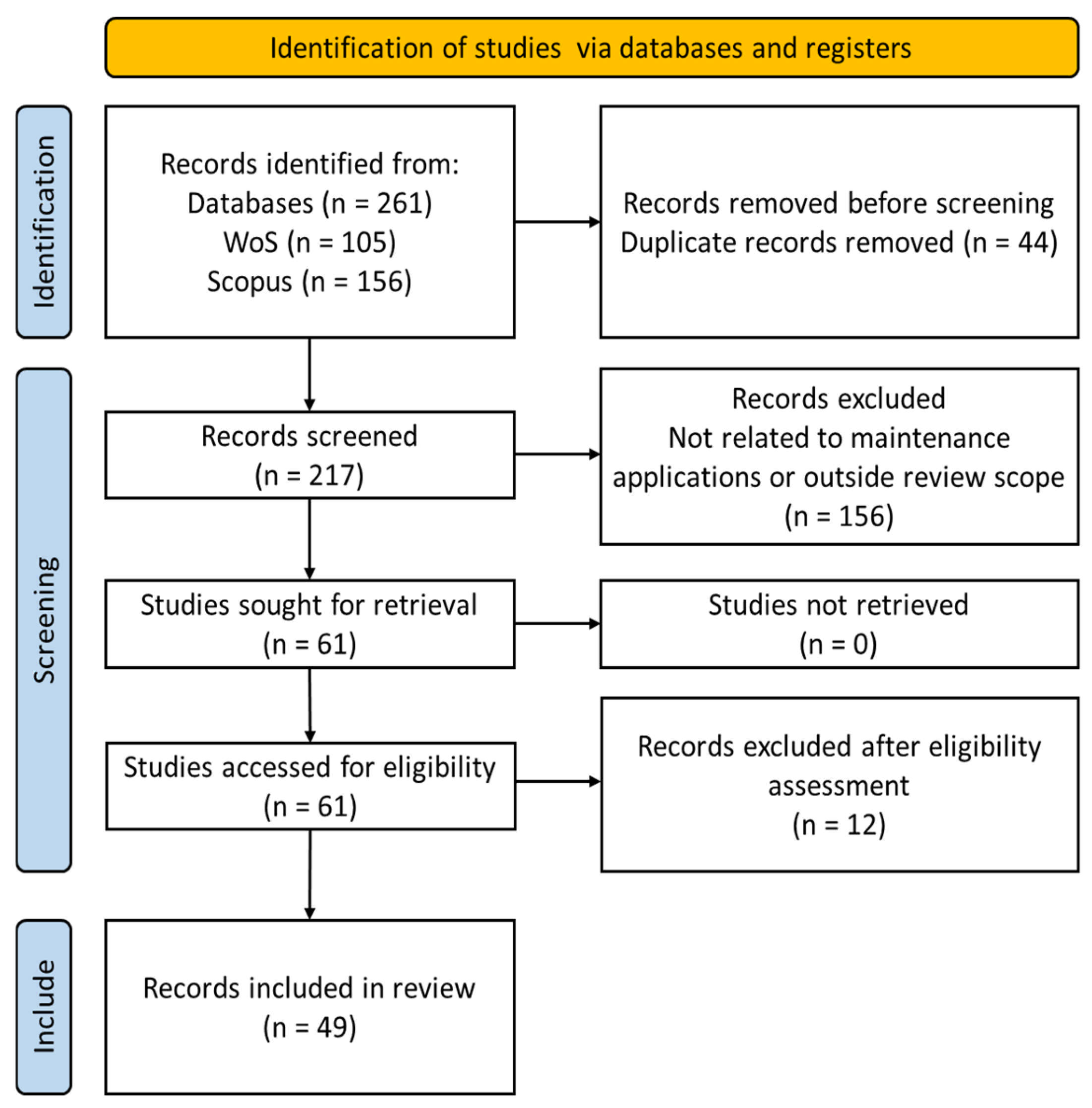
The study selection process followed the PRISMA 2020 guidelines (see Supplementary Materials), as shown in Figure 1. The literature search was conducted in March 2026 using the Scopus and WoS databases, applying a consistent search strategy to the Title, Abstract, and Keywords fields.
The final database search, after applying the predefined filters available in Scopus and WoS at the time of data extraction (document type: journal articles, review articles, and conference papers; language: English; source type; and peer-reviewed publication criteria), identified 156 records in Scopus and 105 records in WoS, resulting in a total of 261 records. Following duplicate identification and removal, 44 duplicate records were removed, resulting in 217 records for screening.
The remaining records were screened based on titles and abstracts. At this stage, 156 records were excluded because they did not address maintenance-related applications or were outside the scope of the review. This process resulted in 61 studies being retained for eligibility assessment.
Subsequently, the eligibility assessment was conducted using titles, abstracts, keywords, context, and study relevance to confirm alignment with the review objectives. To reduce selection bias, the eligibility assessment was independently conducted by two researchers. Any disagreements were resolved through consensus, thereby enhancing the reliability and reproducibility of the selection process. This stage resulted in the exclusion of 12 studies that did not meet the defined criteria.
As a result, 49 studies were retained for full-text analysis, data extraction, and qualitative synthesis, constituting the final sample used to address the RQs.
The complete list of the 49 included studies and their respective publication years is provided in the Supplementary Materials (Table S1), ensuring the transparency and traceability of the dataset used throughout the analysis.
Data extraction was carried out using a structured analysis matrix developed for this study, including bibliographic information and elements relevant to the qualitative synthesis, namely key contributions, sustainability-related results, and identified limitations. Specific maintenance-related indicators, such as reliability, asset lifecycle extension, and decision-making quality, were also considered. Whenever applicable, the study type, application context, and technologies addressed were also recorded.
Data extraction was carried out by one researcher and independently checked by a second researcher to ensure consistency and accuracy. Any discrepancies in the extracted data were resolved through discussion until a consensus was achieved.
The extracted information was organized and systematized into two complementary tables. Table 1, included in the Results Section, summarizes the main characteristics and key findings of the 49 included studies, while Table A1, presented in Appendix A, reports the methodological robustness assessment of these studies. This organization ensures consistency between the PRISMA flowchart, the final set of included studies, and the synthesis of the results.
All bibliographic data were extracted and analyzed based on the metadata available in the records indexed in the Scopus and WoS databases, including publication year, document type, and other associated bibliographic information. The publication year assigned to each study corresponds to the year indexed in the database metadata at the time of data extraction (March 2026). For studies classified as early-access or online-first publications, the indexed publication year available in the databases was adopted to ensure consistency between the bibliometric analysis, Figure 2, and Table S1.

2.5. Assessment of the Methodological Robustness of the Included Studies

Table A1 presents the assessment of the methodological robustness of the 49 studies included in the SLR. The assessment was based on a structured set of criteria derived from the Joanna Briggs Institute (JBI) checklists [27,28] and adapted to enable comparison across different research designs. This evaluation was carried out after the study selection phase and was intended to support the critical interpretation of the evidence, rather than serve as an exclusion criterion.
Given the heterogeneity of the included studies, which comprise systematic reviews, case studies, experimental work, frameworks, and conceptual models, the matrix was adapted to enable cross-sectional application, ensuring comparability through common evaluation criteria.
The selected studies were assessed using seven criteria: clarity of objectives, definition of context, methodological robustness, quality of data collection or empirical evidence, consistency of analysis, relevance of results, and acknowledgement of limitations. Based on this evaluation, each study received an overall score on a scale ranging up to 7 points.
Three levels of methodological quality were defined to facilitate interpretation: scores equal to or above 6.5 were classified as High Quality, scores between 5.5 and 6.0 as Moderate Quality, and scores below 5.5 as Low Quality.
The results show a predominance of studies classified as High Quality, generally reflecting methodological consistency and alignment between objectives, methods, and results. However, this distribution should be interpreted with caution, as the assessment criteria were adapted to accommodate heterogeneous study designs and therefore reflect relative rather than absolute methodological rigor. The distribution of quality levels reflects the heterogeneity of the included studies and avoids overestimating the robustness of the evidence.
The evaluation was conducted independently by two authors, with disagreements resolved by consensus and additional verification by a third author when necessary. This procedure contributed to reinforcing the consistency and reliability of the assessment.
Overall, this approach enabled the integration of quality assessment into the interpretation of the results, supporting a more critical synthesis and reducing the risk of overgeneralization by considering the relative weight of each study.

3. Results

This section presents the results derived from the analysis of the 49 studies included in the SLR. The results are organized to emphasize different dimensions of scientific output, including its temporal evolution, geographical distribution of publications, types of studies and associated research domains, as well as the industrial sectors addressed. In addition, relevant trends are identified through the analysis of keywords extracted from the selected studies. This integrated approach provides a comprehensive overview of the state of the art, with particular emphasis on the application of DTs within the I4.0 ecosystem in the context of sustainable maintenance.

3.1. Characteristics of the Included Studies

The 49 included studies addressed diverse industrial and application contexts, including construction, advanced manufacturing, the food industry, renewable energy, smart cities, transport, mining, rail systems, buildings, and industrial infrastructure. Overall, the reviewed literature was mainly concentrated on the use of DTs and other I4.0 technologies to support predictive maintenance, process optimization, asset monitoring, energy efficiency, operational reliability, and sustainability-oriented decision-making [2,6,29,30,31,32,33,34,35,36,37,38,39,40].
Several studies focused on industrial and manufacturing environments, including smart manufacturing systems, robotic cells, semiconductor and electronics production, lithium-ion battery manufacturing, additive manufacturing, and metal-forming processes [2,6,14,32,35,36,37,38,39,40]. Other studies addressed asset lifecycle management, Maintenance 4.0, sustainable manufacturing, and broader industrial sustainability contexts, highlighting the role of DTs, IoT, AI, Machine Learning (ML), CPS, and data-driven approaches in improving maintenance and operational performance [1,7,8,15,20].
Energy-related applications included photovoltaic systems, offshore wind structures, industrial energy systems, and renewable energy or water-management contexts [17,18,41,42,43,44,45,46]. Construction and infrastructure applications included smart buildings, sustainable pavements, smart cities, civil infrastructure, and port asset management [17,33,34,38,47,48]. Additional application contexts included food production and bakery operations [31,46,49,50], underground mining [51], and rail transport or railway infrastructure [4,52].
The selected studies were conducted across different geographical and industrial contexts, with a stronger concentration in developed countries, particularly the United States, China, Japan, and several European countries, while some studies also considered developing-country contexts [17,44,53,54,55,56,57,58,59,60,61,62,63,64]. The included publications comprised systematic reviews [5,29,52,53,58], narrative and integrative reviews [31,50], critical reviews [37], case studies and applied research [8,38,39,41,46], framework or methodological development studies [2,6,39,40,42,45,61], experimental and simulation-based studies [32,46,49,59,63,65], quantitative analyses of operational data [56], and methodological studies [54,60].
Across the reviewed literature, DTs appeared as a central enabling technology for real-time monitoring, predictive maintenance, failure analysis, process optimization, and energy-efficiency improvement [2,6,14,36,37,45,46]. These applications were frequently combined with complementary approaches such as three-dimensional simulation [49,57], semantic DTs [61], ML [40,42], IoT [7,37], extended reality [62], and mathematical or simulation software [55,60]. Reported benefits included reduced energy consumption [17,29,35,43,46], failure reduction [46,49], improved reliability [37,50], enhanced operational efficiency [6,39], and support for circular economy objectives [17,58].
At the same time, the reviewed studies identified several implementation challenges, including high initial investment costs [17,29,63], limited interoperability [47], cybersecurity and data-management concerns [41,47,64], cultural and organizational barriers [30,51], and the need for workforce training and digital skills development [30,57]. These findings indicate that, although DTs show strong potential for Sustainable Maintenance 4.0, their implementation remains dependent on technological maturity, data quality, organizational readiness, and the ability to integrate DT-based solutions into existing industrial systems.
Table 1 summarizes the main characteristics of the included studies, including publication year, study type, sector/application context, and key findings.

3.2. Publication Trends over Time

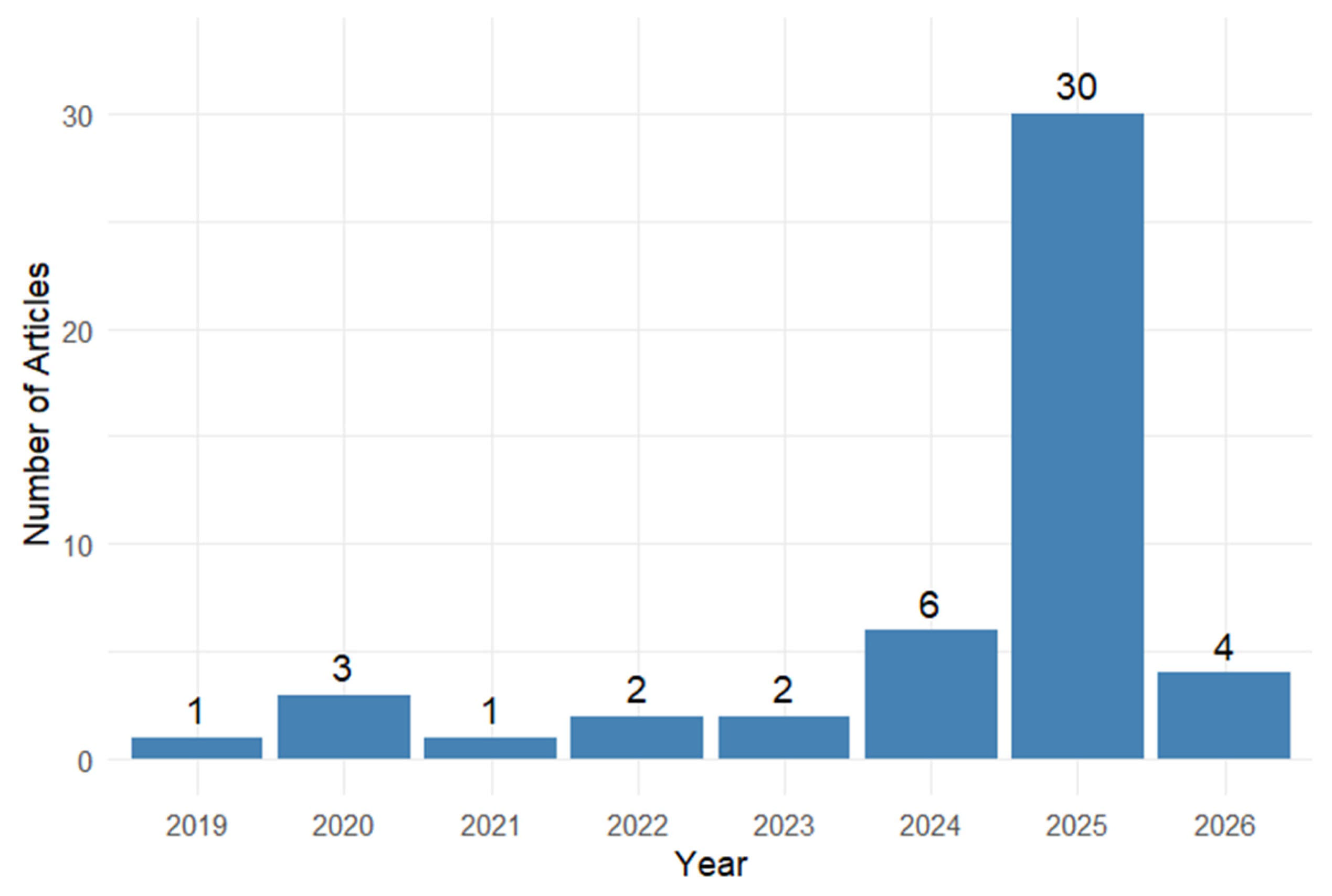
The analysis of the temporal distribution of publications indicates a stronger concentration of studies in recent years. Based on the metadata indexed in Scopus and WoS at the time of data extraction, the year 2025 shows the highest number of included studies, with 30 studies, standing out as the main concentration of scientific production within the analyzed dataset. This is followed by 2024, with six publications, and 2026, with four, according to the publication years indexed in the database records (Figure 2).
In earlier years, lower publication levels are observed, with three studies in 2020, two in 2022 and 2023, and only one in 2019 and 2021. This pattern suggests a stronger concentration of studies in recent years, although with some variation between years, indicating an area that is still undergoing consolidation and expansion.
This concentration in more recent years may also be influenced by the date of data collection, conducted in March 2026, as well as by the growing maturity and adoption of DTs within the I4.0 ecosystem, which has accelerated scientific output in this domain. In cases where studies were classified as early-access or online-first publications, the publication year reported in the database metadata was used to ensure consistency throughout the analysis.
The temporal distribution presented in Figure 2 was revalidated against the final set of 49 included studies. To improve transparency and traceability, the complete list of the included studies and their respective publication years is provided in the Supplementary Materials (Table S1).
Overall, these results reinforce the relevance of the topic under analysis and highlight the growing interest in the application of DTs to predictive and sustainable maintenance practices (Figure 2).

3.3. Distribution by Country

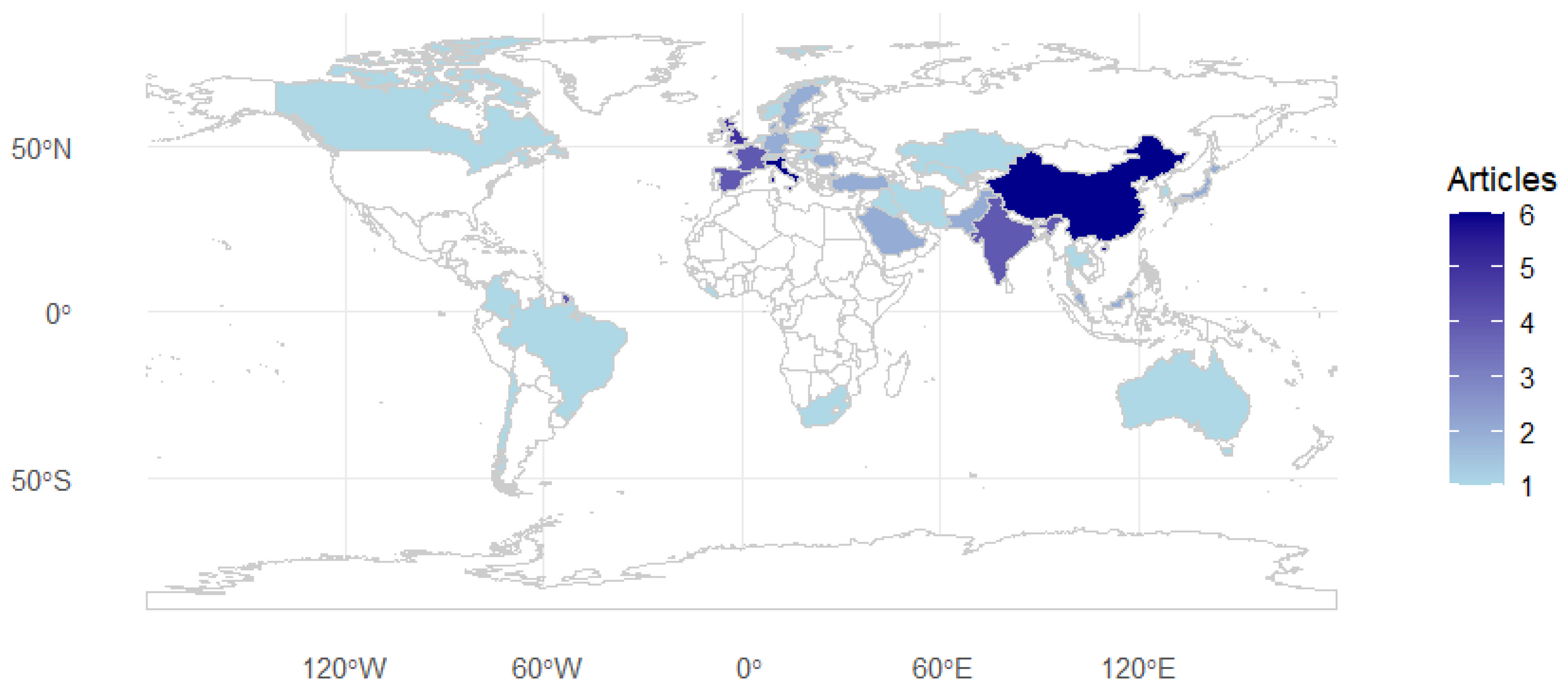
The analysis of the geographical distribution of publications shows a broad and diverse participation of countries, reflecting the global interest in industrial digitalization, DTs, and sustainable maintenance (Figure 3).
The countries with the highest research output are Italy and China, each contributing six studies, followed by the United States of America and England, with five publications each. A second group of countries includes India, Spain, and France, with four studies each, while the Czech Republic has three publications.
Several countries contributed two studies each, including Germany, Denmark, Japan, Lithuania, Malaysia, Pakistan, Romania, Saudi Arabia, Singapore, Slovakia, Sweden, and Turkey. In addition, several other countries contributed one study each, such as Australia, Brazil, Canada, Chile, Colombia, Hungary, Iran, Iraq, Kazakhstan, the Netherlands, Norway, Poland, Scotland, South Africa, Republic of Korea, Switzerland, Thailand, Uzbekistan, and Liberia.
Overall, the results indicate a broad geographical distribution of studies, with contributions from different continents, although with a greater concentration in countries with a higher volume of scientific production in the field of industrial digitalization and technologies associated with I4.0.

3.4. Typology and Characterization of Identified Publications

The analysis of the document typology reveals that the majority of the selected publications correspond to research articles, with 24 studies, followed by review articles, with 20. Four studies were published in conference proceedings and one publication classified as early-access. This distribution indicates that the topic is addressed through both empirical studies and literature reviews.
Regarding research areas, there is a predominance of Engineering, with 33 studies, followed by interdisciplinary areas such as Science, Technology and Other Topics, with 8 studies, and Environmental Sciences and Ecology, with 6. Other areas, such as automation, operations management and computer science, are also represented, although to a lesser extent, while domains such as energy, oceanography and transportation are less represented.
Concerning publishers, the publications are mainly concentrated in journals published by MDPI, with 20 studies, and Elsevier, with 13, followed by Springer Nature, with 5, and Frontiers Media, with 2. Other publication sources were also identified, such as IEEE, academic institutions, and scientific societies.
Regarding journals, Processes and Sustainability are the most represented journals, with four studies each, followed by Machines, with three. IFAC PapersOnLine, Journal of Manufacturing Systems, Sensors, and Sustainable Production and Consumption each contributed two publications. In addition, several specialized journals contribute one study each, covering areas such as energy, construction, nanotechnology, and distributed systems.
Overall, this distribution highlights the multidisciplinary nature of the literature analyzed, with a predominance of technological and engineering approaches, complemented by contributions from areas associated with sustainability and operations management.

3.5. Industrial Sectors Identified

The analysis of the studies reveals that the literature covers a diversity of industrial sectors, focusing on the application of DTs and other enabling technologies for I4.0. This diversity confirms the cross-cutting nature of sustainable maintenance, encompassing multiple application contexts.
In the field of transportation, relevant applications are identified in the aerospace, automotive, and rail sectors, focusing on component monitoring, fault diagnosis, and support for operational reliability throughout the asset lifecycle.
Regarding infrastructure and energy, the studies include applications in smart construction and buildings, as well as the monitoring of energy systems, including both renewable and conventional energy systems, highlighting the relationship between digitalization, efficiency, and operational safety.
In the manufacturing industry, applications are identified in areas such as metallurgy, industrial robotics, and semiconductor fabrication, where reliability and process optimization are particularly relevant. Other sectors, such as food and beverage, mining, maritime, healthcare, and logistics, are also addressed, demonstrating the application of DTs-based solutions in different operational contexts.
In summary, the results indicate that the application of DTs in maintenance has a broad sectoral scope, reinforcing the adaptability of approaches and the transfer of practices between different industries.

3.6. Keyword Analysis

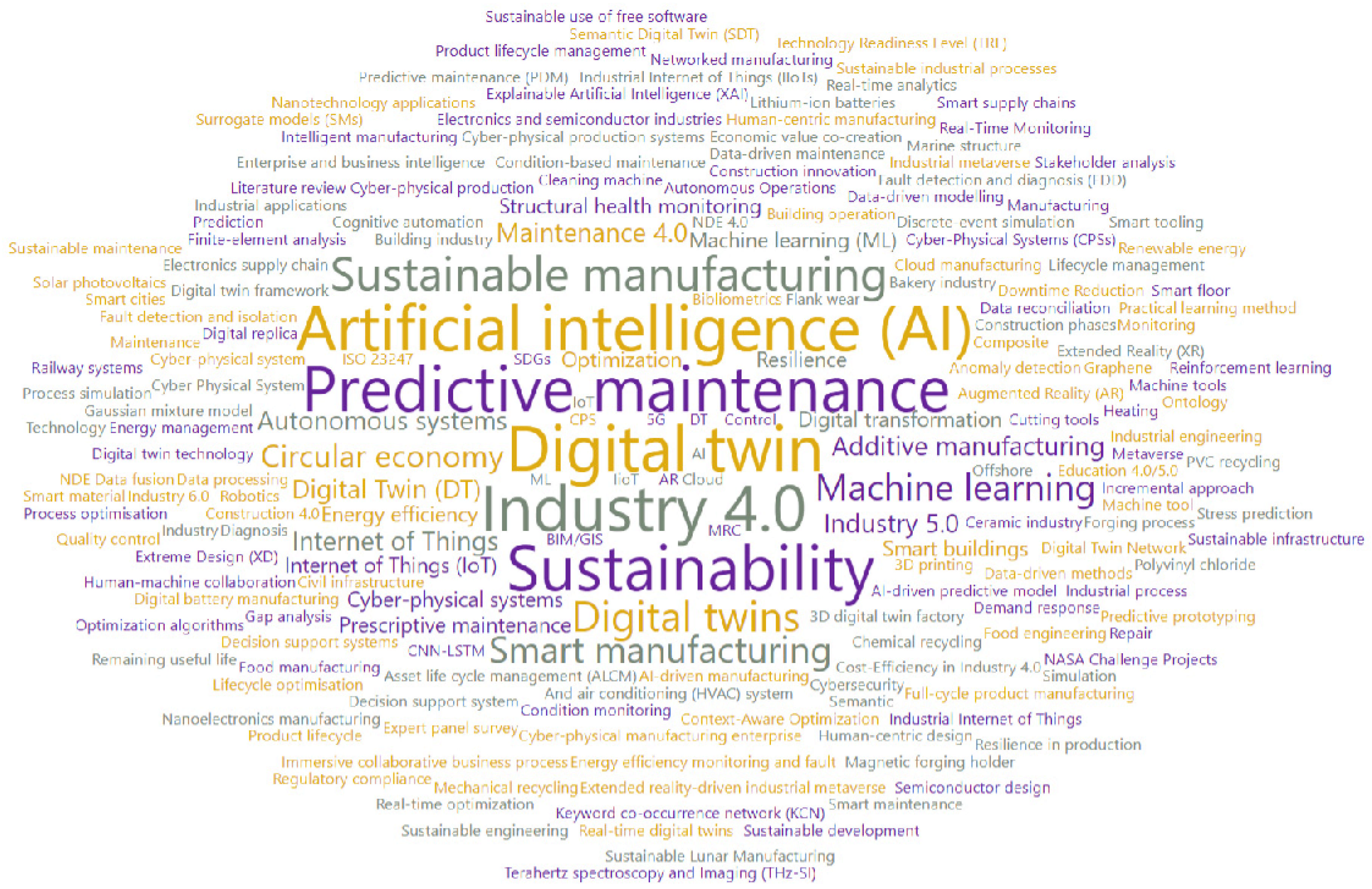
The examination of the 320 keywords provided by the authors reveals a predominance of terms related to digitalization and industrial maintenance, as illustrated in Figure 4. The concept of digital twins stands out as the most frequent, representing 27 occurrences when considering its variations, including digital twin, digital twins, and DT. Next come the terms Predictive Maintenance, with 16 occurrences, Industry 4.0, with 15, Artificial Intelligence, with 10, and Sustainability, also with 10 occurrences.
Other frequently identified terms include Sustainable Manufacturing, Machine Learning, Circular Economy, and Industry 5.0, reflecting the simultaneous presence of concepts associated with digitalization, process optimization, and sustainability. Additionally, keywords such as Maintenance 4.0, Condition-Based Maintenance, and Structural Health Monitoring indicate the presence of applications focused on reliability and asset lifecycle management.
To support the interpretation of the identified patterns, the keywords were grouped into four thematic areas. The first corresponds to digitization and technological architectures, including DTs, IoT, and CPS. The second is associated with maintenance and reliability, encompassing concepts such as predictive maintenance, prescriptive maintenance, and RUL. The third area refers to sustainability, integrating terms such as sustainability, energy efficiency, and circular economy. The fourth area is related to AI and data analysis, including ML, data-driven methods, and optimization.
The co-occurrence analysis enabled the identification of frequent associations between concepts, namely between DTs and predictive maintenance, as well as between AI and sustainability, highlighting the combined use of these approaches in the studies analyzed. On the other hand, terms with unique occurrences are also identified, such as Industry 6.0 and Semantic DT, which indicate emerging themes that remain underexplored.
Overall, these descriptive results indicate that the reviewed literature is recent, geographically dispersed, multidisciplinary, and strongly focused on the intersection between DTs, predictive maintenance, and sustainability. These patterns provide the empirical basis for the thematic and conceptual synthesis developed in Section 4.

4. Discussion

This section critically discusses the results of the SLR, interpreting patterns and relationships in the application of DTs within the I4.0 ecosystem to sustainable maintenance. Organized around the six RQs, the section analyses economic, environmental, and social impacts, as well as the main benefits, limitations, and implementation challenges identified in the literature. An integrative conceptual framework for Sustainable Maintenance 4.0 is also proposed, in which DTs act as mediating elements between physical assets, enabling technologies, maintenance practices, and sustainability outcomes. The framework integrates technical, organizational, and strategic dimensions, offering guidance for progressive implementation according to different levels of digital maturity.
Due to the heterogeneity of the reviewed studies in terms of methodological approaches, industrial contexts, asset types, and reported outcomes, the synthesis presented in this section is primarily qualitative. Therefore, while several studies indicate potential benefits associated with the use of DTs in maintenance, these findings are not directly comparable and should be interpreted as context-dependent evidence rather than universally generalizable results.

4.1. RQ1: How Do DTs, Within the I4.0 Ecosystem, Contribute to Promoting More Sustainable Maintenance Operations, Considering the Economic, Environmental, and Social Dimensions?

Across the reviewed studies, DTs consistently emerge as a central element in promoting more sustainable maintenance operations [1,17]. As an enabling technology within the I4.0 ecosystem, DTs enable the connection between the physical and digital domains, supporting real-time monitoring, simulation of operational scenarios, and decision support throughout the asset lifecycle [5,65].
In the economic dimension (Profit), studies indicate that the use of DTs, supported by enabling technologies such as IoT, AI, and data analytics, promotes a transition from reactive and preventive maintenance strategies towards predictive and proactive approaches [1,4]. This evolution is associated with reduced operating costs, fewer unplanned failures, and extended asset lifecycles [17,48]. Some studies [38,39,45] report cost reductions in specific industrial contexts. However, these results should be interpreted cautiously, as they are derived from heterogeneous case studies and are not directly comparable across different industrial contexts. Additionally, the use of digital simulations prior to physical implementation contributes to reducing errors, design iterations, and lifecycle costs [43,49].
In the environmental dimension (Planet), DTs contribute to optimizing energy and material consumption through continuous monitoring and real-time data analysis [14,50]. This capability enables the identification of inefficiencies and supports the reduction of the carbon footprint associated with industrial operations [5,42]. Studies [5,14,17] also highlight the promotion of practices associated with the circular economy, such as the reuse of components and condition-based replacement of equipment, with impacts on the reduction in emissions, energy consumption, and material waste.
The social dimension (People), although less explored, has gained increasing relevance in the context of the transition to I5.0, which reinforces the centrality of the human factor [4,8]. In this domain, DTs and supporting technologies contribute to increased operational safety through fault prediction, remote monitoring of hazardous environments, and the use of automated or collaborative systems in critical tasks [40,51]. Additionally, improvements in working conditions are identified through the use of immersive technologies, such as augmented reality (AR) and virtual reality (VR), applied to training and human–machine interaction [5,32].
In addition to these direct impacts, the literature also highlights indirect benefits, particularly regarding the reliability of energy systems, environmental quality in buildings, and the resilience of critical infrastructures [18,47].
Overall, the contributions of Sun et al. [43], Sajadieh et al. [20], Nsengiyumva et al. [5], Briatore & Braggio [15], Khan et al. [6], Zeynivand et al. [14] and Yasin et al. [45] indicate that DTs, as a technology integrated into the I4.0 paradigm, play a significant role in promoting sustainable maintenance. This evidence points to the connection between economic, environmental, and social benefits, albeit with varying levels of maturity and analytical depth in the existing literature.

4.2. RQ2: How Do DTs Support the Integration and Optimization of Preventive, Predictive, and Corrective Maintenance Strategies for Sustainable Outcomes?

The reviewed studies indicate that DTs function as an integrating mechanism for balancing preventive, predictive, and corrective maintenance strategies [15]. By integrating heterogeneous data streams within the DT environment, DTs enable the overcoming of limitations associated with traditional models based on fixed intervals or fault response, supporting decision-making based on the actual condition of assets [4,5].
The integration of DTs with maintenance history and real-time data allows for more accurate anticipation of failure modes, contributing to the reduction of dependence on corrective maintenance and the mitigation of unplanned shutdowns [4,5]. The use of ML models and Prognostics and Health Management (PHM) approaches enables the estimation of the RUL of components, supporting the transition from rigid plans to adaptive, evidence-based strategies [45,49]. Additionally, prescriptive approaches can assist in defining the most appropriate maintenance actions and their timing, with implications for operational efficiency [1,15].
Regarding preventive maintenance, DTs support the transition to Condition-Based Maintenance through continuous monitoring of variables such as vibration, temperature, load, and pressure. This capability enables the dynamic adjustment of intervention intervals, reducing unnecessary interventions and optimizing resource utilization [2,4,40]. In parallel, the virtual environment associated with DTs allows the simulation of different operational scenarios, enabling the evaluation of maintenance policies without interfering with the physical system, thereby contributing to waste reduction and improved reliability [17,45].
In this context, predictive maintenance plays a central role in anticipating failures, while preventive maintenance is adjusted based on the actual condition of assets [1,2]. Corrective maintenance tends to be limited to unpredictable situations and is performed with enhanced informational support [4,15]. The integration of sensor-based data streams within DT environments further facilitates the identification of root causes of failures, supporting more targeted interventions and reducing operational impacts [14,41].
Overall, the literature suggests that this balance between different maintenance strategies, supported by DTs, contributes to more efficient and sustainable operations. The ability to extend asset lifecycles and optimize resource utilization highlights the potential of these approaches in aligning operational performance with sustainability goals within the I4.0 context [17,39].

4.3. RQ3: How Can Classic Maintenance Practices and Methodologies Be Integrated with DTs Within the I4.0 Ecosystem to Promote More Sustainable Maintenance Operations?

The literature suggests that the integration between classic maintenance practices and DTs occurs progressively, without directly replacing traditional approaches [36,59]. Consolidated maintenance engineering knowledge is gradually digitalized in cyber–physical environments, preserving the robustness and interpretability of classic methodologies while incorporating monitoring, prediction, and decision support capabilities associated with the I4.0 ecosystem [15].
In this context, DTs function as an integrating element between physical models, operational data, and maintenance practices [20]. Classic reliability, mechanical, thermodynamic, finite element, and mass and energy balance models can be incorporated into multiphysics simulations and updated with data from sensors and the IoT, allowing the dynamic representation of asset behavior throughout the lifecycle [4,5].
The literature also highlights hybrid approaches, such as Physically Informed Neural Networks, Kalman filters, and probabilistic models based on fuzzy logic or Bayesian networks [31,45]. These approaches combine the interpretability of physical models with the predictive capacity of AI, contributing to the reduction in uncertainty, false alarms, and forecasting errors in intelligent maintenance systems [4,5].
From an operational perspective, this integration requires continuous, reliable, and interoperable data, leading to the evolution from periodic inspections to condition monitoring systems and continuous information flows [5,47]. Compatibility between legacy infrastructures and new digital layers is therefore essential. Protocols such as Open Platform Communication-Unified Architecture and reference frameworks such as ISO 23247 [66] allow the articulation of programmable logic controllers, Supervisory Control and Data Acquisition (SCADA), distributed control systems, computerized maintenance management systems, enterprise resource planning, manufacturing execution systems, DTs, and cloud platforms, ensuring operational continuity [17,32,65].
This incremental approach allows classic practices, such as fixed plans, inventory management, failure history analysis, and fleet management, to be enriched with real-time data, promoting decisions based on the actual condition of assets and a more efficient use of resources [45,59]. Despite the increase in automation, the literature emphasizes that the knowledge of technicians and engineers remains essential for validating models, interpreting results, and ensuring organizational acceptance [2,5]. Thus, DTs assume a mediating role between tacit knowledge and automated systems, and may be supported by AR or VR to reduce human error and increase operational safety [32,62].
Finally, Weerasekara et al. [7], Sucuoglu et al. [49], Karanam and Hartman [62], Chidara et al. [58], Zeynivand et al. [14], and Manoharan et al. [37] indicate that this integration contributes to more sustainable operations through the reduction of waste, energy consumption, and premature replacements. Considering the literature analyzed, DTs emerge as a unifying element that transforms traditional methodologies into more adaptive and data-driven systems, without compromising the robustness of classic engineering.

4.4. RQ4: How Can the Adoption of DTs Within the I4.0 Ecosystem Reduce Resource Consumption and Industrial Waste in Maintenance?

The adoption of DTs, supported by technologies from the I4.0 ecosystem, such as the IoT, AI, ML, and advanced simulation, constitutes a relevant mechanism for reducing resource consumption and the generation of industrial waste throughout the asset lifecycle [4,45]. In this context, DTs allow rigid approaches to be replaced by strategies based on the actual condition of assets, failure prediction, and continuous optimization, in alignment with circular economy principles [1,29].
One of the main contributions identified relates to the optimization of energy, water, and raw material consumption [2,42]. Continuous monitoring supported by sensors, the IoT, and DTs enables the identification of inefficient operational states, energy losses, and process deviations [14,50]. Studies conducted by Ba et al. [17], Mukhitdinov et al. [42], Bozzini et al. [46], Melesse et al. [50], and Fuhrländer-Völker et al. [39] indicate that optimization algorithms, reinforcement learning, and multiphysics simulations can contribute to energy efficiency gains in specific industrial contexts. Resource-intensive processes, such as Clean-in-Place, industrial furnaces, ventilation, and refrigeration, may benefit from dynamic adjustments based on real-time data.
Maintenance supported by DTs also contributes to reducing waste associated with the premature replacement of components [1,4]. Failure prediction and RUL estimation allow interventions to be scheduled only when technically justified, avoiding the disposal of components that remain functional [2,59]. This logic applies to industrial machines, structures, batteries, photovoltaic panels, and cutting tools, with potential impact on the reduction of metallic, electronic, and chemical waste [18,49].
In addition, DTs can contribute to reducing defects, rework, and material waste [35,65]. Systems based on AI, computer vision, and Virtual Quality Gates allow nonconformities to be identified at early stages of the production process [5,37]. These approaches support Manufacturing strategies, reducing scrap, energy consumption, and material losses [45,65]. Simulation in DTs also allows process parameters to be validated before physical execution, preventing the waste of materials and tools [20,40].
Process virtualization and logistics optimization constitute another relevant contribution. The use of DTs allows operational scenarios, design configurations, and maintenance strategies to be tested in virtual environments, reducing the need for physical prototyping and resource-intensive experimental testing [14,20]. Complementarily, route optimization, automated guided vehicle movements, load balancing, inventory management, and on-demand production may contribute to reducing energy consumption, emissions, obsolescence, and waste [8,60].
Finally, DTs can support end-of-life asset management, promoting reuse, recycling, and remanufacturing. The mapping of materials, components, and usage history can guide selective disassembly, parts recovery, and material reuse [29,58]. Complementary technologies, such as Radio Frequency Identification (RFID) and lifecycle ontologies, reinforce this capability by enabling the tracking of materials along the value chain [7,17].

4.5. RQ5: What Are the Main Trade-Offs and Limitations of Applying DTs Within the I4.0 Ecosystem to Promote Sustainable Maintenance Operations?

Despite the recognized benefits, the application of DTs in industrial maintenance involves technical, economic, environmental, and organizational trade-offs that condition their implementation and viability in different contexts. These trade-offs result not only from DTs as a technology, but also from their integration with sensors, analytical platforms, digital infrastructures, and legacy systems within the I4.0 ecosystem [5,47,50].
One of the main challenges relates to the initial investment required to implement digital infrastructures, sensing systems, integration platforms, and analytical capabilities. In many cases, the economic and environmental return tends to materialize in the medium and long term, constituting a relevant barrier, particularly for small and medium-sized enterprises [20,50].
Another important trade-off involves the relationship between model fidelity and computational cost. High-fidelity DTs, supported by detailed physical simulations, Finite Element Method, Finite Element Analysis, or advanced deep learning algorithms, offer greater predictive capacity but require high computational and energy resources. To mitigate this limitation, the literature proposes surrogate models, reduced-order models, and hybrid approaches, seeking to balance analytical accuracy and computational efficiency [31,45].
The literature also highlights [5,44] the trade-off between predictive performance and interpretability. Less transparent models, such as deep neural networks, Random Forest, or XGBoost, may present high accuracy but make decisions more difficult to understand and reduce operator trust. In contrast, models based on physical principles offer greater interpretability, although with lower flexibility and scalability, justifying the interest in Explainable AI [2,5,6].
Another relevant limitation concerns the relationship between connectivity and cybersecurity. The intensive integration of DTs with CPS, the IoT, and digital platforms increases real-time visibility and control, but also expands the attack surface and requires additional investments in security, data protection, monitoring, and governance [5,20,50].
From an environmental perspective, Khan et al. [6], Ba et al. [17], Sun et al. [43], Rashidian et al. [29], and Stephen et al. [33] warn of the indirect energy consumption associated with digital infrastructures, data centers, AI model training, and accelerated hardware obsolescence. These effects may reduce part of the expected environmental benefits, especially when they are not assessed through robust lifecycle assessments.
Finally, the adoption of DTs involves organizational and social trade-offs related to technological complexity, the need for specialized skills, interoperability with legacy systems, and the effects of automation on professional profiles. These factors require balanced change management processes capable of aligning technological innovation, organizational acceptance, and the interests of different stakeholders [50,51].

4.6. RQ6: What Organizational or Capacity-Building Challenges Impact the Effectiveness of DTs in Sustainable Maintenance?

The literature identifies several organizational, human, and institutional challenges that condition the effective adoption of DTs in sustainable maintenance, despite their transformative potential [20,51]. These challenges result from the need to articulate operational data, legacy systems, human competencies, and organizational structures capable of supporting evidence-based maintenance decisions [44,52].
One of the main obstacles concerns the scarcity of technical and interdisciplinary skills [4,5]. The implementation of solutions based on DTs requires knowledge of engineering, data science, information technologies, the IoT, and AI, revealing gaps that are particularly evident in small- and medium-sized enterprises [2,50].
In this context, Kovari [40], Prasittisopin [34], Sivasubramani and Prodromakis [30], Fernández-Miguel et al. [8], Nsengiyumva et al. [5], and Murtaza et al. [4] emphasize the need to reconfigure educational systems and promote continuous upskilling and reskilling strategies, fostering interdisciplinary skills and lifelong learning as a condition for mitigating the impacts of automation and ensuring organizational acceptance.
Organizational resistance to change constitutes another relevant challenge, frequently associated with conservative industrial cultures, fears of replacing human roles, lack of strategic leadership, and perceived risk regarding the initial investment [2,51]. These factors may lead to the fragmentation of digital initiatives and the underuse of DT-based solutions [20,52].
Additionally, the lack of interoperability and standardization of data and protocols limits the scalability of DTs, especially in heterogeneous industrial environments [4,5]. This limitation results from the coexistence of legacy systems with new digital platforms and from the fragmentation of information between building information modelling, the IoT, building management systems, SCADA, and DTs [20,54].
The analyzed studies also highlight challenges related to data quality, governance, and reliability, as well as organizational trust in AI-based systems and less transparent models [40,59]. These aspects reinforce the need for validation mechanisms, Explainable AI, and human-in-the-loop approaches, especially in contexts that are critical for safety and regulatory compliance [4,31].
Finally, issues related to cybersecurity, privacy, intellectual property protection, and stakeholder coordination, combined with the absence of consistent public policies and clear regulatory incentives, limit the dissemination of DT-based solutions beyond pilot projects or specialized contexts [2,5,31].
The synthesis of these RQs provides the basis for the development of the integrative conceptual framework presented in Section 4.7.

4.7. An Integrative Conceptual Framework for Sustainable Maintenance 4.0 Enhanced by DTs

This section presents an integrative conceptual framework derived from the synthesis of the reviewed literature and the analysis of the RQs. The framework aims to structure and consolidate existing knowledge on the application of DTs in the domain of sustainable maintenance, providing a coherent representation of the relationships identified between enabling technologies, maintenance practices, and sustainability outcomes. Although the framework is conceptually grounded in the evidence gathered, its empirical validation in real industrial contexts is proposed as a priority direction for future research.
Based on a critical synthesis of the results obtained in RQ1–RQ6, an integrative conceptual model for Sustainable Maintenance 4.0 is proposed, in which DTs assume the role of a mediating element between physical assets, analytical capabilities, maintenance services, and sustainability outcomes. The framework seeks to address the fragmentation identified in the literature, articulating technical and strategic dimensions in alignment with the principles of the TBL and the transition from I4.0 to I5.0.
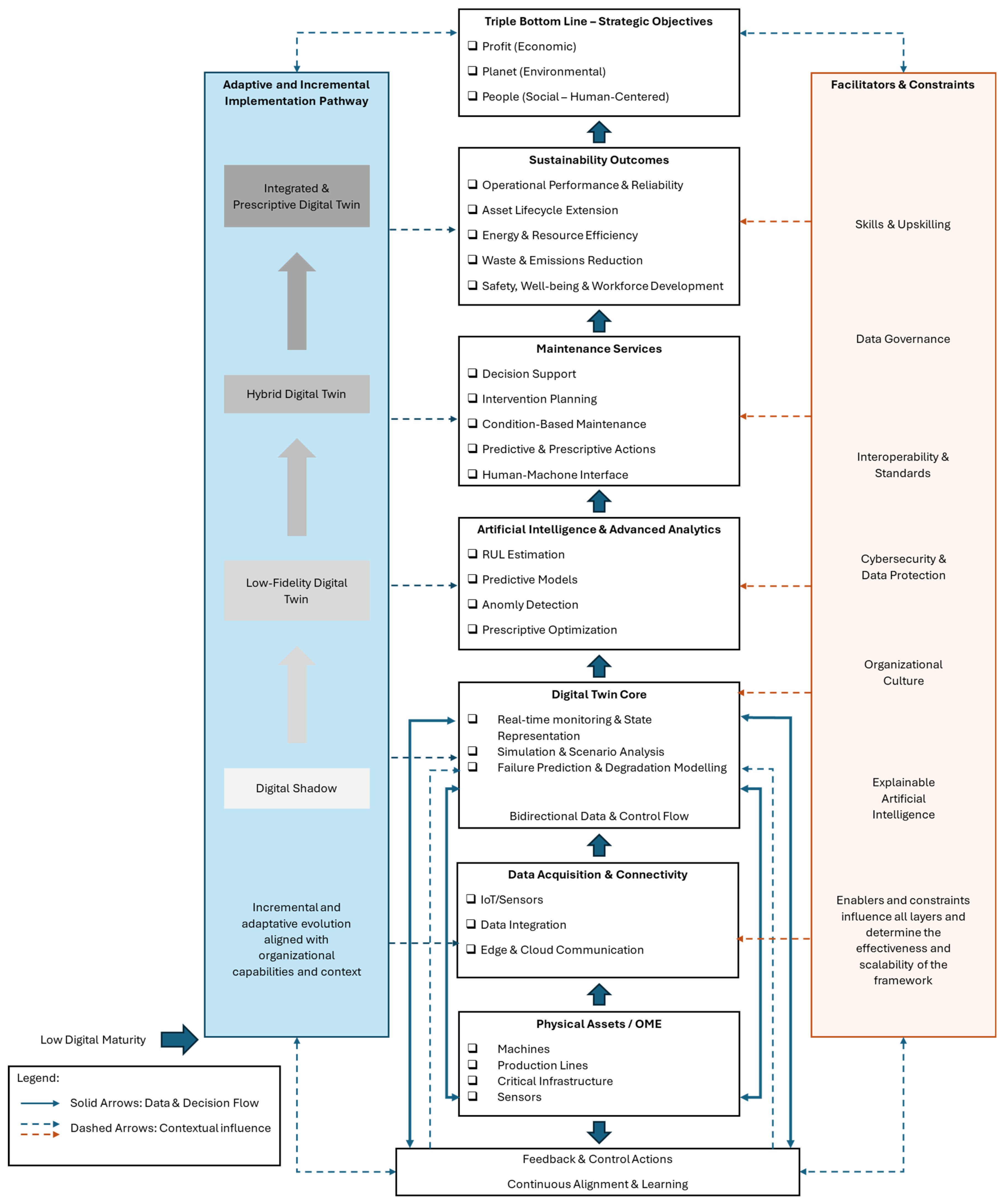
Figure 5 presents a visual synthesis of the proposed model, structuring its main components in an integrated way. The model is organized as a multi-layered architecture, at the center of which the Digital Twin Core plays a central role in articulating the physical system, operational data, analytical mechanisms, and maintenance services, allowing the correlation of technical performance with sustainability results.
The central structure of the figure develops vertically through functional layers interconnected by continuous data and decision flows, represented by solid arrows, while dashed arrows indicate contextual influences across the architecture. At the base of the model are the physical assets/Observable Manufacturing Elements (OME), which include machines, production lines, critical infrastructure, and sensors, representing the observable physical system and the origin of operational data.
The collected data is sent to the data acquisition and connectivity layer, which enables the connection between the physical and digital domains through processes of data integration and communication. At the core of this architecture, the DT component supports two-way data exchange and control between physical and virtual environments, serving as the main hub for analysis, decision-making support, and knowledge integration throughout the entire asset lifecycle.
At the heart of the architecture, the Digital Twin Core acts as the framework’s structuring element, enabling bidirectional data and control interactions between the physical and digital domains. This layer integrates physical and data-driven models, degradation simulations, ontologies, and what-if analysis mechanisms, as well as an asset lifecycle-oriented perspective. In this context, the DT allows for the representation of asset behavior, supports the analysis of different operational scenarios, and consolidates knowledge throughout the asset lifecycle.
Above this layer appears the Artificial Intelligence & Advanced Analytics layer, where data from the DT is processed to detect anomalies, estimate RUL, and support maintenance decisions. The results from this layer directly feed into the maintenance services component, which represents the operationalization of maintenance actions based on the information generated by the system.
At the top of the architecture is the sustainability outcomes layer, which aggregates the impacts resulting from maintenance supported by DTs. These results are directly associated with the strategic objectives represented at the top of Figure 5, corresponding to the TBL, in the economic, environmental, and social (human-centered) dimensions. The relationship between these layers shows that maintenance results contribute to sustainability objectives, while also guiding decisions throughout the system.
Figure 5 also includes two lateral elements that reinforce the evolutionary and systemic nature of the model. On the left side, the Adaptive and Incremental Implementation Pathway represents the progression through different levels of digital maturity, from digital shadow to low-fidelity digital twin, hybrid digital twin, and integrated and prescriptive digital twin, demonstrating that the adoption process occurs gradually and in line with organizational capabilities. On the right side, the Facilitators & Constraints block highlights transversal factors that condition the implementation and effectiveness of the framework, including skills and upskilling, data governance, interoperability and standards, cybersecurity, organizational culture, and explainable AI.
At the bottom of the framework, the Feedback & Control Actions block represents continuous alignment and learning mechanisms, through which sustainability outcomes, operational performance, and contextual constraints inform subsequent decisions and adjustments across the architecture.
Figure 5 should therefore be interpreted as a conceptual map derived from the literature synthesis that articulates physical assets, connectivity, DTs, analytical capabilities, maintenance services, and sustainability outcomes, framed by strategic objectives and evolutionary implementation trajectories. The following subsections delve deeper into these components based on the literature reviewed.

4.7.1. Pillars of Sustainability and Strategic Objectives

In the context of Sustainable Maintenance 4.0, DTs are framed by strategic objectives aligned with the TBL, represented as Profit (economic), Planet (environmental), and People (social–human-centered). The literature suggests that the balanced articulation of these three dimensions is a relevant condition for the sustainability and resilience of industrial systems [1,4,48].
In the economic dimension, maintenance supported by DTs is associated with improved operational performance, namely through the reduction of unplanned downtime, optimization of intervention planning, and extension of asset lifecycles. These effects result from the use of predictive and prescriptive approaches supported by data and models. The literature reports operational cost reductions in some studies and industrial contexts [38,45,48]. However, these results should be interpreted with caution, as they are highly dependent on factors such as the level of digital maturity, the type of assets, and the degree of integration of the solutions.
In the environmental dimension, DTs enable continuous monitoring and analysis of energy and resource consumption, contributing to the identification of operational inefficiencies and process optimization. The literature reports improvements in energy efficiency in specific contexts, as well as reductions in waste and emissions [37,41,42]. Nevertheless, these results are context-dependent and may vary significantly depending on the application domain, system configuration, and implementation maturity. Additionally, these systems support practices associated with the circular economy, including reuse, remanufacturing, and selective replacement of components based on the actual condition of the assets.
In the social (human-centered) dimension, DTs contribute to improving working conditions and operational safety, notably by anticipating critical failures and reducing exposure to hazardous environments. The literature also highlights their role in supporting workforce training and qualification, as well as improving the quality of maintenance decisions [2,8,62]. Although less consolidated than the economic and environmental dimensions, this dimension has gained relevance in the context of I5.0, where the integration between technological systems and human factors takes on greater importance.
In an integrated manner, these three dimensions constitute the strategic objectives that guide the functioning of the framework presented in Figure 5, influencing decisions across the different layers of the architecture and allowing for the evaluation of the contribution of DT-supported maintenance to sustainability outcomes.

4.7.2. Multilayer Architecture Based on DTs

Based on the synthesis of the answers to the RQs, the conceptual framework is structured as a modular and multi-layered architecture, aligned with the representation presented in Figure 5, in which DTs assume the role of integrating element between data, analytical models, and maintenance decisions. This architecture allows for different levels of complexity and technological maturity, evolving from solutions based on digital shadowing to more integrated DTs with prescriptive capabilities.
At the heart of the architecture are the physical assets, or Observable Manufacturing Elements, which include machines, production lines, and infrastructures instrumented with sensors. These elements ensure continuous observability of the operational status by collecting variables such as pressure, vibration, temperature, load, acoustic signals, and energy consumption.
The data acquisition and connectivity layer ensures the continuous collection, integration, and transmission of this data, using technologies from the I4.0 ecosystem, such as the IoT and standardized industrial protocols, including Open Platform Communication-Unified Architecture and Message Queuing Telemetry Transport. The incorporation of edge computing capabilities allows for local pre-processing of information, contributing to the reduction of latency, bandwidth consumption, and energy costs, in line with operational and environmental efficiency objectives.
At the heart of the architecture, as shown in Figure 5, is the Digital Twin Core, which aggregates models based on physical principles, data-driven models, and degradation simulations [16]. This layer should not be understood merely as a static virtual representation, but as a dynamic system that evolves based on real data. The interaction between the physical and digital domains occurs through continuous data flows and feedback mechanisms, in which analyses performed in the virtual environment can inform and support decisions that influence the behavior of the physical asset. In this sense, bidirectionality represents a functional objective of DTs, materialized through cycles of monitoring, analysis, and action. Additionally, the integration of ontologies and standards such as ISO 23247 allows for the semantic structuring of information, facilitating interoperability and the reuse of knowledge throughout the asset lifecycle.
Above this layer, the Artificial Intelligence & Advanced Analytics layer converts data into actionable knowledge. ML models, deep learning techniques, and PHM approaches are employed for anomaly detection, RUL estimation, and to support predictive and prescriptive maintenance strategies. Hybrid approaches, which integrate physical models with data-driven methods, enable a trade-off between predictive performance, interpretability, and computational cost, consistent with the trade-offs reported in the literature [20,31,59].
The maintenance services layer operationalizes these analytical results, translating them into concrete maintenance actions. This layer includes decision support systems, alert generation, and intervention planning, directly contributing to improved asset reliability, extended lifecycle, and quality of maintenance decisions. In conjunction, the human–machine interface, supported by dashboards and immersive technologies such as AR/VR, reinforces a human-centered approach, facilitating interaction between operators and digital systems.
At the top of the architecture, the sustainability outcomes layer consolidates the results obtained at the economic, environmental, and social levels, as defined in the TBL. These results are not merely passive consequences of the system, but integrate feedback loops that influence decisions across the other layers, allowing for the continuous alignment of maintenance practices with sustainability objectives.
Globally, this multi-layered architecture reflects the integration between I4.0 ecosystem technologies and maintenance practices, positioning DTs as a central link between the physical domain, advanced analytics, and sustainability outcomes.

4.7.3. Adaptive Implementation Pathways

The literature reviewed [2,5,11,15] indicates that the adoption of Sustainable Maintenance 4.0 is strongly conditioned by the organizational context, especially by the level of digital maturity, investment capacity, asset complexity, and the availability of technical and analytical skills. In this sense, the implementation of solutions supported by DTs should not be understood as a uniform process, but as an evolutionary trajectory that depends on the specific conditions of each organization.
In line with Figure 5, the proposed framework incorporates adaptive implementation pathways along a digital maturity axis, evolving from digital shadow to low-fidelity digital twin, hybrid digital twin, and integrated and prescriptive digital twin. This representation seeks to highlight that the adoption of DTs occurs incrementally, keeping pace with the progressive development of technological, organizational, and analytical capabilities.
In an initial stage, organizations can resort to less complex digital representations, supported by selective sensing, structured data collection, and basic monitoring mechanisms. These solutions allow for establishing a connection between physical assets and digital environments without requiring an immediate transformation of the entire existing infrastructure. At the same time, they create conditions to improve operational visibility and support maintenance decisions based on the actual condition of the assets.
As digital maturity increases, DTs can evolve in fidelity, functional scope, and analytical capabilities. This progression includes the incorporation of hybrid models, the integration of historical and real-time data from the IoT, and the use of Artificial Intelligence & Advanced Analytics mechanisms to support predictive and prescriptive maintenance. In parallel, greater coordination between maintenance, production, and other operational functions can be observed, contributing to a more integrated approach to asset management.
The literature [2,4,45,55] also suggests that this evolution tends to be accompanied by greater formalization of data governance, enhanced interoperability, adoption of cloud or hybrid architectures, and gradual integration with legacy systems. However, the pace and depth of this progression vary depending on the application context, strategic priorities, and results obtained in previous phases.
In this context, implementation paths should be understood as flexible and phased roadmaps, capable of balancing the level of detail in the models, the effort required for integration, and the expected benefits in the economic, environmental, and social dimensions. The logic underlying the framework is therefore based on a progressive approach, often initiated with critical assets or processes, and subsequently expanded in a modular way as the organization consolidates competencies, confidence, and operational capacity in the digital environment.
The model presented in Figure 5 suggests that the implementation of Sustainable Maintenance 4.0 supported by DTs depends on a gradual evolution across different levels of digital maturity, avoiding rigidly disruptive approaches and favoring adoption trajectories tailored to the characteristics and needs of each organization.

4.7.4. Facilitators, Constraints, and Critical Success Factors

The effectiveness of the proposed conceptual framework depends on a set of facilitating and conditioning factors identified in the responses to RQ5 and RQ6, which directly influence its implementation and performance in different industrial contexts. These elements should be interpreted as transversal dimensions of the model represented in Figure 5, affecting all layers of the architecture, from physical assets to sustainability outcomes.
Among the main constraints, the literature highlights the scarcity of interdisciplinary skills, particularly in organizations with lower digital maturity, the limited interoperability between legacy systems and new digital platforms, the risks associated with cybersecurity and data protection, as well as the initial investment costs and the uncertainty associated with economic return. These factors tend to hinder the consistent integration of DTs into the I4.0 ecosystem and limit the scalability of solutions.
Additionally, challenges are identified related to data quality and governance, organizational trust in AI-based models, and the inherent complexity of integrating multiple technologies and systems. These aspects reinforce the need for structured approaches that ensure consistency, transparency, and reliability throughout the solution lifecycle.
The literature [2,48,65] also points to the adoption of reference standards and architectures, the implementation of robust data governance practices, and the definition of metrics aligned with the TBL as key facilitating and success factors, enabling an integrated assessment of economic, environmental, and social impacts. Promoting continuous upskilling and reskilling strategies is likewise identified as essential to support the digital transition and ensure the effective use of technologies.
In this context, approaches such as human-in-the-loop and Explainable AI assume particular relevance, contributing to increased model transparency, strengthening user trust, and ensuring the integration of human knowledge into decision-making processes. These elements are consistent with the evolution towards human-centered paradigms associated with I5.0, in which technology complements, rather than replaces, human capabilities.
To clarify the distinction between evidence derived from the literature and conceptual extrapolation, it should be noted that the individual components of the proposed framework are supported by the evidence identified in the answers to the research questions (RQ1–RQ6). However, their integration into a unified architecture represents a conceptual synthesis developed by the authors, rather than a directly validated empirical model.
Accordingly, the framework should be interpreted as a guiding structure that organizes available knowledge and proposes relationships between technical components, maintenance practices, and sustainability outcomes. Future research should empirically assess these relationships through case studies, industrial applications, or longitudinal analyses.
The framework may be operationalized through indicators such as asset reliability, lifecycle extension, energy efficiency, resource use, maintenance decision-making quality, and operational safety. Such validation would enable a more systematic assessment of the relationship between DT adoption, maintenance performance, and sustainability outcomes across different levels of digital maturity.
In general terms, the framework consolidates fragmented contributions from the literature on DTs, I4.0 ecosystem technologies, and sustainable maintenance. By positioning DTs as a central link between technical architecture, maintenance services, and TBL objectives, the model provides both a conceptual contribution to research and a structured basis for future empirical validation in industrial contexts.

5. Conclusions

In the current industrial context, maintenance plays a strategic role in ensuring asset availability, integrity, and longevity, while contributing to competitiveness, resilience, and organizational sustainability. Within this context, this study developed an SLR, conducted according to the PRISMA protocol, based on the analysis of 49 studies selected from the WoS and Scopus databases. The objective was to analyze the role of DTs, as an enabling technology within the I4.0 ecosystem, in the transformation of maintenance practices and to propose an integrative conceptual framework for Sustainable Maintenance 4.0.
The evidence analyzed indicates that DTs, in conjunction with other enabling technologies of the I4.0 ecosystem, can support the transition from reactive and preventive strategies to predictive and prescriptive approaches. These approaches contribute to improved maintenance decision-making, enhanced asset reliability, and lifecycle optimization. The reviewed studies also report reductions in maintenance costs, improvements in energy efficiency, reduced material waste, and support for circular economy practices. However, these results should be interpreted with caution, as they depend on the industrial context, level of digital maturity, type of assets, and depth of implementation of the solutions.
The analysis also highlights contributions in the social dimension, particularly in terms of operational safety, reduced exposure to hazardous environments, and support for workforce qualification. In parallel, the findings show that the integration of DTs into Maintenance 4.0 does not imply the replacement of classic maintenance methodologies, but rather their evolution towards hybrid models capable of articulating engineering knowledge, continuous monitoring, simulation, and decision support.
Despite the identified potential, the adoption of these solutions remains constrained by significant challenges, including high initial costs, interoperability limitations with legacy systems, cybersecurity risks, dependence on robust data infrastructures, and a shortage of interdisciplinary skills. Relevant trade-offs were also identified between model fidelity and computational cost, between operational gains and the energy consumption of digital infrastructures, and between predictive performance and model interpretability.
From a theoretical perspective, this study helps to integrate fragmented literature by proposing a conceptual framework that positions DTs as a mediating element between physical assets, connectivity, analytical capabilities, maintenance services, and sustainability outcomes. The framework is distinguished by considering sustainability as an active criterion for guidance and feedback, rather than merely as a final outcome. Nevertheless, the proposed framework should be interpreted as a conceptual synthesis of the reviewed literature, rather than as an empirically validated industrial model.
Although the search strategy was intentionally designed to ensure alignment with the research objectives, some earlier foundational studies may not have been retrieved if they did not explicitly include the selected terminology in the title, abstract, or keywords. Therefore, the findings of this review should be interpreted with caution regarding the completeness of earlier conceptual contributions. Future reviews may benefit from broader search expressions, complementary search procedures, and additional databases to expand the coverage of foundational literature.
From a practical perspective, the proposed framework offers a structured foundation for the progressive implementation of DT-based solutions, ranging from digital shadows to more integrated and prescriptive systems, depending on the digital maturity level of organizations. The main limitations of this study include the predominance of small-scale studies, the absence of comparable metrics, and the scarcity of longitudinal analyses. Future research should further explore the social dimension of sustainable maintenance, develop more interpretable and energy-efficient AI models, strengthen interoperability and standardization practices, and empirically validate the proposed framework across different industrial contexts.

Supplementary Materials

The following supporting information can be downloaded at: https://www.mdpi.com/article/10.3390/su18115718/s1, Table S1: List of the 49 studies included in the systematic literature review and their publication years; Table S2: PRISMA 2020 checklist.

Author Contributions

Conceptualization, D.M., V.A., O.C. and E.T.; methodology, E.T., V.A., O.C. and R.F.; software, D.M., O.C. and R.F.; validation, D.M., V.A., R.F. and H.V.G.N.; formal analysis, D.M., V.A., E.T. and R.F.; investigation, D.M., E.T. and R.F.; resources, V.A., E.T., H.V.G.N., O.C. and R.F.; data curation, D.M., E.T., H.V.G.N. and O.C.; writing—original draft preparation, D.M., E.T., H.V.G.N. and O.C.; writing—review and editing, D.M., E.T., O.C. and R.F.; visualization, D.M., V.A., E.T. and H.V.G.N.; supervision, D.M., V.A., H.V.G.N. and O.C.; project administration, D.M., V.A., H.V.G.N., O.C. and R.F.; All authors have read and agreed to the published version of the manuscript.

Funding

This research received no external funding.

Institutional Review Board Statement

Not applicable.

Informed Consent Statement

Not applicable.

Data Availability Statement

The raw data supporting the conclusions of this article will be made available by the authors on request.

Acknowledgments

The authors sincerely thank the anonymous editors and reviewers for their kind insights and constructive suggestions. The authors also express their gratitude for the support of the Polytechnic Institute of Setúbal, especially the Higher School of Technology of Setúbal. Helena Navas acknowledges Fundação para a Ciência e a Tecnologia, I.P., for its financial support via the project UID/00667: Unidade de Investigação e Desenvolvimento em Engenharia Mecânica e Industrial.

Conflicts of Interest

The authors declare no conflicts of interest.

Abbreviations

The following abbreviations are used in this manuscript:
AIArtificial Intelligence
DTsDigital Twins
I4.0Industry 4.0
I5.0Industry 5.0
ISOInternational Organization for Standardization
IoTInternet of Things
JBIJoanna Briggs Institute
MLMachine Learning
OMEObservable Manufacturing Elements
PVCPolyvinyl Chloride
PRISMAPreferred Reporting Items for Systematic Reviews and Meta-Analyses
PHMPrognostics and Health Management
RFIDRadio Frequency Identification
RULRemaining Useful Life
RQsResearch Questions
SCADASupervisory Control and Data Acquisition
SLRSystematic Literature Review
TBLTriple Bottom Line
VRVirtual Reality
WoSWeb of Science

Appendix A

Table A1 presents the methodological robustness assessment of the 49 studies included in the systematic review, based on criteria adapted from the JBI framework. The table reports the individual evaluations, overall scores, and final classifications assigned to each study.
Table A1. Synthesis of the methodological robustness assessment of the 49 included studies based on adapted JBI criteria. Source: The authors.
ReferenceType of StudyClear ObjectiveDefined ContextAppropriate MethodRigorous Data CollectionCoherent AnalysisRelevant ResultsLimitations DiscussedOverall ScoreRanking
Rashidian et al. [29]Systematic Literature ReviewYesYesYesYesYesYesYes7.0High
Sivasubramani and Prodromakis [30]Perspective/Review ArticleYesYesYesPartialYesYesYes6.5High
Lwele et al. [31]ReviewYesYesYesYesYesYesYes7.0High
Filipescu et al. [32]Technical/Experimental StudyYesYesYesYesYesYesPartial6.5High
Stephen et al. [33]Mixed-methods reviewYesYesYesYesYesYesYes7.0High
Prasittisopin [34]ReviewYesYesYesYesYesYesYes7.0High
Hafiz et al. [35]ReviewYesYesPartialPartialYesYesYes6.0Moderate
Olayiwola et al. [18]ReviewYesYesYesYesYesYesYes7.0High
Khan et al. [36]Literature Review and Framework ProposalYesYesYesPartialYesYesYes6.5High
Anu et al. [52]Systematic ReviewYesYesYesYesYesYesYes7.0High
Chatterjee et al. [56]Quantitative (Operational data analysis)YesYesYesYesYesYesYes7.0High
Sucuoglu et al. [49]Simulation/PrototypingYesYesYesYesYesYesYes7.0High
Hodavand et al. [54]Systematic ReviewYesYesYesYesYesYesYes7.0High
Guitard et al. [55]Case study/Applied researchYesYesYesPartialYesYesYes6.5High
Kaveh and Alhajj [47]ReviewYesYesYesYesYesYesYes7.0High
Schutz et al. [60]MethodologicalYesYesYesPartialYesYesYes6.5High
Nsengiyumva et al. [5]ReviewYesYesYesPartialYesYesYes6.5High
Stefko et al. [57]Qualitative analysis and synthesisYesYesYesYesYesYesYes7.0High
Sajadieh and Noh [20]ReviewYesYesYesYesYesYesYes7.0High
Karanam and Hartman [62]Review and Case StudyYesYesYesPartialYesYesYes6.5High
Chidara et al. [58]Systematic Literature ReviewYesYesYesYesYesYesYes7.0High
Manoharan et al. [37]Critical ReviewYesYesYesYesYesYesYes7.0High
Melesse et al. [50]Narrative and integrative reviewYesYesYesYesYesYesPartial6.5High
Zeynivand et al. [14]Technical PaperYesYesYesYesYesYesYes7.0High
Khan et al. [6]Development and evaluation of a frameworkYesYesYesYesYesYesYes7.0High
Bozzini et al. [46]Case Study/MethodologyYesYesYesYesYesYesYes7.0High
Yasin et al. [45]Methodological/Experimental StudyYesYesYesYesYesYesYes7.0High
Cacciuttolo et al. [51]ReviewYesYesYesYesYesYesYes7.0High
Cho et al. [61]Research/Framework DevelopmentYesYesYesPartialYesPartialYes6.0Moderate
Mukhitdinov et al. [42]Development and validation of a frameworkYesYesYesYesYesYesYes7.0High
Weerasekara et al. [7]ReviewYesYesYesYesYesYesYes7.0High
Sun et al. [43]Review (Bibliometric)YesYesYesYesYesYesPartial6.5High
Jasiulewicz-Kaczmarek et al. [1]Literature reviewYesYesYesPartialYesYesNo5.5Moderate
Kherbache et al. [64]Technical Architecture and Case StudyYesYesYesPartialYesYesPartial6.0Moderate
Fernández-Miguel et al. [8]Case studyYesYesYesYesYesYesYes7.0High
Khalaj et al. [63]Experimental/TechnicalYesYesYesPartialYesYesYes6.5High
Alvares et al. [65]Experimental/TechnicalYesYesYesYesYesYesYes7.0High
Briatore and Braggio [15]Literature Review and Framework ProposalYesYesYesYesYesYesNo6.0Moderate
Hassan et al. [59]Case study/experimental evaluationYesYesYesYesYesYesYes7.0High
Jamwal et al. [53]Systematic Literature ReviewYesYesYesYesYesYesPartial6.5High
Hu et al. [44]Systematic ReviewYesYesYesYesYesYesYes7.0High
Murtaza et al. [4]Systematic Review and Case StudyYesYesYesYesYesYesYes7.0High
Khan et al. [48]Review ArticleYesYesYesYesYesYesYes7.0High
Ba et al. [17]Systematic Literature ReviewYesYesYesYesYesYesYes7.0High
Pacheco-Blazquez et al. [41]Case Study/Methodological DevelopmentYesYesYesYesYesYesYes7.0High
Chen et al. [2]MixedYesYesYesYesYesYesYes7.0High
González-Cancelas et al. [38]Case study/Methodological proposalYesYesYesYesYesYesYes7.0High
Fuhrländer-Völker et al. [39]FrameworkYesYesYesYesYesYesYes7.0High
Kovari [40]Conceptual framework studyYesYesYesPartialYesYesYes6.5High

References

  1. Jasiulewicz-Kaczmarek, M.; Legutko, S.; Kluk, P. Maintenance 4.0 Technologies–New Opportunities for Sustainability Driven Maintenance. Manag. Prod. Eng. Rev. 2020, 11, 74–87. [Google Scholar] [CrossRef]
  2. Chen, S.; Bekar, E.T.; Bokrantz, J.; Skoogh, A. AI-Enhanced Digital Twins in Maintenance: Systematic Review, Industrial Challenges, and Bridging Research–Practice Gaps. J. Manuf. Syst. 2025, 82, 678–699. [Google Scholar] [CrossRef]
  3. Mendes, D.; Gaspar, P.D.; Charrua-Santos, F.; Navas, H. Synergies between Lean and Industry 4.0 for Enhanced Maintenance Management in Sustainable Operations: A Model Proposal. Processes 2023, 11, 2691. [Google Scholar] [CrossRef]
  4. Murtaza, A.A.; Saher, A.; Zafar, M.H.; Moosavi, S.K.R.; Aftab, M.F.; Sanfilippo, F. Paradigm Shift for Predictive Maintenance and Condition Monitoring from Industry 4.0 to Industry 5.0: A Systematic Review, Challenges and Case Study. Results Eng. 2024, 24, 102935. [Google Scholar] [CrossRef]
  5. Nsengiyumva, W.; Zhong, S.; Tu, S.-T. NDE 4.0: The Confluence of Cutting-Edge Nondestructive Inspection Practices, Data Fusion Techniques, Artificial Intelligence, and Cyber-Physical Systems for Effective Evaluation of Materials and Structures. Mech. Syst. Signal Process. 2026, 242, 113626. [Google Scholar] [CrossRef]
  6. Khan, T.; Khan, U.; Khan, A.; Mollan, C.; Morkvenaite-Vilkonciene, I.; Pandey, V. Data-Driven Digital Twin Framework for Predictive Maintenance of Smart Manufacturing Systems. Machines 2025, 13, 481. [Google Scholar] [CrossRef]
  7. Weerasekara, S.; Lu, Z.; Ozek, B.; Isaacs, J.; Kamarthi, S. Trends in Adopting Industry 4.0 for Asset Life Cycle Management for Sustainability: A Keyword Co-Occurrence Network Review and Analysis. Sustainability 2022, 14, 12233. [Google Scholar] [CrossRef]
  8. Fernández-Miguel, A.; García-Muiña, F.E.; Ortíz-Marcos, S.; Jiménez-Calzado, M.; Fernández del Hoyo, A.P.; Settembre-Blundo, D. AI-Driven Transformations in Manufacturing: Bridging Industry 4.0, 5.0, and 6.0 in Sustainable Value Chains. Future Internet 2025, 17, 430. [Google Scholar] [CrossRef]
  9. Stock, T.; Seliger, G. Opportunities of Sustainable Manufacturing in Industry 4.0. Procedia CIRP 2016, 40, 536–541. [Google Scholar] [CrossRef]
  10. Franciosi, C.; Iung, B.; Miranda, S.; Riemma, S. Maintenance for Sustainability in the Industry 4.0 Context: A Scoping Literature Review. IFAC-PapersOnLine 2018, 51, 903–908. [Google Scholar] [CrossRef]
  11. Aheleroff, S.; Huang, H.; Xu, X.; Zhong, R.Y. Toward Sustainability and Resilience with Industry 4.0 and Industry 5.0. Front. Manuf. Technol. 2022, 2, 951643. [Google Scholar] [CrossRef]
  12. Ghaleb, M.; Taghipour, S. Assessing the Impact of Maintenance Practices on Asset’s Sustainability. Reliab. Eng. Syst. Saf. 2022, 228, 108810. [Google Scholar] [CrossRef]
  13. Cardeal, G.; Höse, K.; Ribeiro, I.; Götze, U. Sustainable Business Models–Canvas for Sustainability, Evaluation Method, and Their Application to Additive Manufacturing in Aircraft Maintenance. Sustainability 2020, 12, 9130. [Google Scholar] [CrossRef]
  14. Zeynivand, M.; Esmaili, P.; Cristaldi, L.; Gruosso, G. A Novel Approach to Digital Twin-Based Energy Efficiency Monitoring and Failure Analysis in Industrial Applications. J. Manuf. Syst. 2025, 83, 612–625. [Google Scholar] [CrossRef]
  15. Briatore, F.; Braggio, M. Resilience and Sustainability Plants Improvement through Maintenance 4.0: IoT, Digital Twin and CPS Framework and Implementation Roadmap. IFAC-PapersOnLine 2024, 58, 365–370. [Google Scholar] [CrossRef]
  16. Aheleroff, S.; Xu, X.; Zhong, R.Y.; Lu, Y. Digital Twin as a Service (DTaaS) in Industry 4.0: An Architecture Reference Model. Adv. Eng. Inform. 2021, 47, 101225. [Google Scholar] [CrossRef]
  17. Ba, L.; Tangour, F.; El Abbassi, I.; Absi, R. Analysis of Digital Twin Applications in Energy Efficiency: A Systematic Review. Sustainability 2025, 17, 3560. [Google Scholar] [CrossRef]
  18. Olayiwola, O.; Cali, U.; Elsden, M.; Yadav, P. Enhanced Solar Photovoltaic System Management and Integration: The Digital Twin Concept. Solar 2025, 5, 7. [Google Scholar] [CrossRef]
  19. Kritzinger, W.; Karner, M.; Traar, G.; Henjes, J.; Sihn, W. Digital Twin in Manufacturing: A Categorical Literature Review and Classification. IFAC-PapersOnLine 2018, 51, 1016–1022. [Google Scholar] [CrossRef]
  20. Sajadieh, S.M.M.; Noh, S.D. From Simulation to Autonomy: Reviews of the Integration of Artificial Intelligence and Digital Twins. Int. J. Precis. Eng. Manuf. Green Technol. 2025, 12, 1597–1628. [Google Scholar] [CrossRef]
  21. Farias, L.M.S.; Santos, L.C.; Gohr, C.F.; Rocha, L.O. An ANP-Based Approach for Lean and Green Performance Assessment. Resour. Conserv. Recycl. 2019, 143, 77–89. [Google Scholar] [CrossRef]
  22. Garza-Reyes, J.A. Lean and Green—A Systematic Review of the State of the Art Literature. J. Clean. Prod. 2015, 102, 18–29. [Google Scholar] [CrossRef]
  23. Page, M.J.; McKenzie, J.E.; Bossuyt, P.M.; Boutron, I.; Hoffmann, T.C.; Mulrow, C.D.; Shamseer, L.; Tetzlaff, J.M.; Akl, E.A.; Brennan, S.E. The PRISMA 2020 Statement: An Updated Guideline for Reporting Systematic Reviews. BMJ 2021, 372, n71. [Google Scholar] [CrossRef]
  24. ul Husnain, A.; Mokhtar, N.; Mohamed Shah, N.; Dahari, M.; Iwahashi, M. A Systematic Literature Review (SLR) on Autonomous Path Planning of Unmanned Aerial Vehicles. Drones 2023, 7, 118. [Google Scholar] [CrossRef]
  25. Marquez-Megias, S.; Ramon-Lopez, A.; Más-Serrano, P.; Diaz-Gonzalez, M.; Candela-Boix, M.R.; Nalda-Molina, R. Evaluation of the Predictive Performance of Population Pharmacokinetic Models of Adalimumab in Patients with Inflammatory Bowel Disease. Pharmaceutics 2021, 13, 1244. [Google Scholar] [CrossRef] [PubMed]
  26. García-Ramírez, Y.; Fárez, C. Risk Perception Accuracy Among Urban Cyclists: Behavioral and Infrastructural Influences in Loja, Ecuador. Sustainability 2025, 17, 7432. [Google Scholar] [CrossRef]
  27. Aromataris, E.; Fernandez, R.; Godfrey, C.M.; Holly, C.; Khalil, H.; Tungpunkom, P. Summarizing Systematic Reviews: Methodological Development, Conduct and Reporting of an Umbrella Review Approach. JBI Evid. Implement. 2015, 13, 132–140. [Google Scholar] [CrossRef]
  28. Paterson, C.; Mckie, A.; Turner, M.; Kaak, V. Barriers and Facilitators Associated with the Implementation of Surgical Safety Checklists: A Qualitative Systematic Review. J. Adv. Nurs. 2024, 80, 465–483. [Google Scholar] [CrossRef]
  29. Rashidian, S.; Hossain, T.; Volz, K.; Teo, M. Enabling Circularity in Construction: A Technology-Phase Alignment of Construction 4.0 and Circular Economy Principles. Sustain. Prod. Consum. 2025, 60, 245–259. [Google Scholar] [CrossRef]
  30. Sivasubramani, S.; Prodromakis, T. Reaching New Frontiers in Nanoelectronics through Artificial Intelligence. Front. Nanotechnol. 2025, 7, 1627210. [Google Scholar] [CrossRef]
  31. Lwele, E.; Shenfield, A.; da Silva, C.E. AI-Based Surrogate Models for the Food and Drink Manufacturing Industry: A Comprehensive Review. Processes 2025, 13, 2929. [Google Scholar] [CrossRef]
  32. Filipescu, A.; Simion, G.; Ionescu, D.; Filipescu, A. IoT-Cloud, VPN, and Digital Twin-Based Remote Monitoring and Control of a Multifunctional Robotic Cell in the Context of AI, Industry, and Education 4.0 and 5.0. Sensors 2024, 24, 7451. [Google Scholar] [CrossRef]
  33. Stephen, S.; Aigbavboa, C.; Oke, A.E.; Idowu, A.O.; Adekunle, S. Graphene-Zeolite Smart Flooring as a Catalyst for Digital and Sustainable Transformation in Construction: A Review. Front. Built Environ. 2025, 11, 1640950. [Google Scholar] [CrossRef]
  34. Prasittisopin, L. How 3D Printing Technology Makes Cities Smarter: A Review, Thematic Analysis, and Perspectives. Smart Cities 2024, 7, 3458–3488. [Google Scholar] [CrossRef]
  35. Hafiz, M.I.A.H.; Azmi, E.D.S.K.; Azlie, M.I.N.N.; Zaki, M.H.; Mazilan, M.A.H.; Mazuki, M.S.M.; Nor, M.I.N.M.; Ghani, J.A.; Rahmat, M.S.; Khamis, N.K. Application of Artificial Intelligence in Electronics and Semiconductor Industries. J. Kejuruter. 2025, 37, 3245–3253. [Google Scholar] [CrossRef] [PubMed]
  36. Khan, S.; Farnsworth, M.; McWilliam, R.; Erkoyuncu, J. On the Requirements of Digital Twin-Driven Autonomous Maintenance. Annu. Rev. Control 2020, 50, 13–28. [Google Scholar] [CrossRef]
  37. Manoharan, A.; Chong, J.J.; Choong, Z.J.; Lambert, S.; Kumar Gupta, R.; Chandra, D.; Jain, A.; Rao, A.; Sharma, A. Optimizing Lithium-Ion Battery Manufacturing with Digitalization and AI-Driven Frameworks. Int. J. Adv. Manuf. Technol. 2025, 142, 1–37. [Google Scholar] [CrossRef]
  38. González-Cancelas, N.; Martínez Martínez, P.; Vaca-Cabrero, J.; Camarero-Orive, A. Optimization of Port Asset Management Using Digital Twin and BIM/GIS in the Context of Industry 4.0: A Case Study of Spanish Ports. Processes 2025, 13, 705. [Google Scholar] [CrossRef]
  39. Fuhrländer-Völker, D.; Lindner, M.; von Elling, M.; Frieß, T.; Karnapp, S.; Weigold, M. Method for the Development and Application of Digital Twins in Manufacturing. Prod. Eng. 2025, 19, 959–973. [Google Scholar] [CrossRef]
  40. Kovari, A. A Framework for Integrating Vision Transformers with Digital Twins in Industry 5.0 Context. Machines 2025, 13, 36. [Google Scholar] [CrossRef]
  41. Pacheco-Blazquez, R.; Garcia-Espinosa, J.; Di Capua, D.; Pastor Sanchez, A. A Digital Twin for Assessing the Remaining Useful Life of Offshore Wind Turbine Structures. J. Mar. Sci. Eng. 2024, 12, 573. [Google Scholar] [CrossRef]
  42. Mukhitdinov, O.; Jumanazarov, D.; Khudoynazarov, E.; Safarova, L.; Sakhabayeva, S.; Alsayah, A.M. An Industry 4.0 Framework for the Smart Production Management of Renewable Energy and Water Systems: An Application of AI, IoT, and Digital Twin Technologies. Int. J. Ind. Eng. Manag. 2025, 16, 428–443. [Google Scholar] [CrossRef]
  43. Sun, X.; Dong, L.; Liu, Z.; Qin, A.; Liu, J.; Zhou, Z.; Yan, X.; Wang, G.; Liu, B.; Zhou, Z. Intelligent Manufacturing of a Bibliometric Review: From Frontier Hotspots to Key Technologies and Applications. Chin. J. Mech. Eng. 2025, 38, 176. [Google Scholar] [CrossRef]
  44. Hu, W.; Ou, Y.; Liu, H.; Ni, P.; Chang, C. Integrating Digital Twin Technologies for Maintenance 4.0 in the Building Industry: A Review and Conceptual Framework. Build. Environ. 2026, 288, 113997. [Google Scholar] [CrossRef]
  45. Yasin, S.; Draz, U.; El-Hageen, H.M.; Ali, T.; Alfaifi, Y.H.; Ayaz, M.; Jung, L.T.; Aggoune, E.-H.M. Enhancing Smart Manufacturing: A Tensor-Based Ontology Framework for Predictive Optimization Using Semantic Digital Twin. Ain Shams Eng. J. 2026, 17, 103877. [Google Scholar] [CrossRef]
  46. Bozzini, M.M.; Menegon, M.; di Loreto, A.; Lunari, G.; Mariani, S.S.; Vallerio, M.; Piazza, L.; Manenti, F. Energy-Efficient Start-up Optimization via Digital Twin for a Vegetable Broth Sterilization Process. J. Food Eng. 2026, 406, 112822. [Google Scholar] [CrossRef]
  47. Kaveh, H.; Alhajj, R. Advancing Civil Infrastructure with Digital Twins: A Review of Applications and Challenges. J. Civ. Eng. Manag. 2025, 31, 828–842. [Google Scholar] [CrossRef]
  48. Khan, M.I.; Yasmeen, T.; Khan, M.; Hadi, N.U.; Asif, M.; Farooq, M.; Al-Ghamdi, S.G. Integrating Industry 4.0 for Enhanced Sustainability: Pathways and Prospects. Sustain. Prod. Consum. 2025, 54, 149–189. [Google Scholar] [CrossRef]
  49. Sucuoglu, H.S.; Aksoy, S.; Demircioglu, P.; Bogrekci, I. Sustainable Design and Lifecycle Prediction of Crusher Blades Through a Digital Replica-Based Predictive Prototyping Framework and Data-Efficient Machine Learning. Sustainability 2025, 17, 7543. [Google Scholar] [CrossRef]
  50. Melesse, T.Y.; Peer, M.S.; Ramasamy, S.; Sivasubramaniyam, V.; Braggio, M.; Orrù, P.F. Digital Twin for Energy-Intelligent Bakery Operations: Concepts and Applications. Energies 2025, 18, 3660. [Google Scholar] [CrossRef]
  51. Cacciuttolo, C.; Atencio, E.; Komarizadehasl, S.; Lozano-Galant, J.A. Development of an Advanced Multi-Layer Digital Twin Conceptual Framework for Underground Mining. Sensors 2025, 25, 6650. [Google Scholar] [CrossRef]
  52. Anu, T.E.; Lu, P.; Alimo, P.K.; Atuobi, H.B.; Akoto, E.T.; Abbew, C.K. Revolutionizing Railway Systems: A Systematic Review of Digital Twin Technologies. High-Speed Railw. 2025, 3, 238–250. [Google Scholar] [CrossRef]
  53. Jamwal, A.; Agrawal, R.; Sharma, M.; Giallanza, A. Industry 4.0 Technologies for Manufacturing Sustainability: A Systematic Review and Future Research Directions. Appl. Sci. 2021, 11, 5725. [Google Scholar] [CrossRef]
  54. Hodavand, F.; Ramaji, I.J.; Sadeghi, N. Digital Twin for Fault Detection and Diagnosis of Building Operations: A Systematic Review. Buildings 2023, 13, 1426. [Google Scholar] [CrossRef]
  55. Guitard, L.; Brissaud, D.; Noël, F. Implementation of a Digital Twin Starting with a Simulator. In Product Lifecycle Management Enabling Smart X. PLM 2020, IFIP Advances in Information and Communication Technology; Nyffenegger, F., Ríos, J., Rivest, L., Bouras, A., Eds.; Springer: Cham, Switzerland, 2020; Volume 594, pp. 139–149. [Google Scholar] [CrossRef]
  56. Chatterjee, S.; Kliestik, T.; Rowland, Z.; Bugaj, M. Immersive Collaborative Business Process and Extended Reality-Driven Industrial Metaverse Technologies for Economic Value Co-Creation in 3D Digital Twin Factories. Oecon. Copern. 2025, 16, 125–161. [Google Scholar] [CrossRef]
  57. Stefko, R.; Frajtova-Michalikova, K.; Strakova, J.; Novak, A. Digital Twin-Based Virtual Factory and Cyber-Physical Production Systems, Collaborative Autonomous Robotic and Networked Manufacturing Technologies, and Enterprise and Business Intelligence Algorithms for Industrial Metaverse. Equilibr. Q. J. Econ. Econ. Policy 2025, 20, 389–425. [Google Scholar] [CrossRef]
  58. Chidara, A.; Cheng, K.; Gallear, D. Engineering Innovations for Polyvinyl Chloride (PVC) Recycling: A Systematic Review of Advances, Challenges, and Future Directions in Circular Economy Integration. Machines 2025, 13, 362. [Google Scholar] [CrossRef]
  59. Hassan, M.; Svadling, M.; Björsell, N. Experience from Implementing Digital Twins for Maintenance in Industrial Processes. J. Intell. Manuf. 2024, 35, 875–884. [Google Scholar] [CrossRef]
  60. Schutz, J.; Sauvey, C.; Nițu, E.L.; Gavriluță, A.C. A Practical and Sustainable Approach to Industrial Engineering Discrete-Event Simulation with Free Mathematical and Programming Software. Sustainability 2025, 17, 3973. [Google Scholar] [CrossRef]
  61. Cho, S.; May, G.; Kiritsis, D. A Semantic-Driven Approach for Industry 4.0. In Proceedings of the 15th International Conference on Distributed Computing in Sensor Systems (DCOSS), Santorini, Greece, 29–31 May 2019; pp. 347–354. [Google Scholar] [CrossRef]
  62. Karanam, S.A.K.; Hartman, N.W. LUNAR-XDT: An Integrated Framework for Sustainable Lunar Manufacturing Using Digital Twin (DT), Extended Reality (XR), and Extreme Design (XD) Principles. Manuf. Lett. 2025, 44, 1739–1750. [Google Scholar] [CrossRef]
  63. Khalaj, O.; Jamshidi, M.; Hassas, P.; Mašek, B.; Štadler, C.; Svoboda, J. Digital Twinning of a Magnetic Forging Holder to Enhance Productivity for Industry 4.0 and Metaverse. Processes 2023, 11, 1703. [Google Scholar] [CrossRef]
  64. Kherbache, M.; Maimour, M.; Rondeau, E. Digital Twin Network for the IIoT Using Eclipse Ditto and Hono. IFAC-PapersOnLine 2022, 55, 37–42. [Google Scholar] [CrossRef]
  65. Alvares, A.J.; Rodriguez, E.; Figueroa, B. Digital-Twin-Enabled Process Monitoring for a Robotic Additive Manufacturing Cell Using Wire-Based Laser Metal Deposition. Processes 2025, 13, 2335. [Google Scholar] [CrossRef]
  66. ISO 23247; Automation Systems and Integration—Digital Twin Framework for Manufacturing. ISO: Geneva, Switzerland, 2021.
Figure 1. Study selection flow diagram following PRISMA 2020 guidelines. Source: The authors.
Sustainability 18 05718 g001
Figure 2. Distribution of analyzed studies by year of publication. Source: The authors, based on Scopus and WoS.
Sustainability 18 05718 g002
Figure 3. Geographic distribution of the studies included in the review. Source: The authors, based on Scopus and WoS.
Sustainability 18 05718 g003
Figure 4. Word cloud generated from the keyword dataset of the 49 studies included in the SLR. Source: The authors.
Sustainability 18 05718 g004
Figure 5. Integrative conceptual framework for Sustainable Maintenance 4.0 supported by DTs.
Sustainability 18 05718 g005
Table 1. Main characteristics and key findings of the studies included in the SLR. Source: The authors.
StudyYearStudy TypeSector/Application ContextKey Findings
Rashidian et al. [29]2025SLRConstruction and infrastructure sector; DTs for energy efficiency, predictive maintenance, and operational optimization.Digitalization supports the transition toward a Circular Economy, with Building Information Modelling, the IoT, AI, and DTs improving lifecycle planning, predictive maintenance, and operational performance. Main barriers include high implementation costs, fragmented stakeholder collaboration, and limited digital expertise.
Sivasubramani and Prodromakis [30]2025Perspective/Review ArticleMicroelectronics and nanoelectronics; DTs and AI for performance, fault monitoring, and energy efficiencyAI enhances decision-making, innovation, cost reduction, and operational efficiency, while DTs support real-time monitoring and predictive maintenance. However, adoption is constrained by limited model transparency, ethical concerns, and the need for workforce upskilling.
Lwele et al. [31]2025ReviewFood and beverage industry; AI-based surrogate models for process optimization, efficiency, and reduced physical prototypingAI-based surrogate models improve process optimization, operational efficiency, cost reduction, and innovation while reducing the need for physical prototyping. However, challenges remain related to data quality, availability, and limited model interpretability.
Filipescu et al. [32]2024Technical/Experimental StudyIndustry and education; robotic cells for remote monitoring, predictive maintenance, operational optimization, and integration with educational processesThe integration of DTs and ML supports intelligent, flexible, and scalable environments through real-time system validation and early failure prediction. These technologies also strengthen the connection between theoretical and practical learning, contributing to workforce preparation for I4.0 and I5.0.
Stephen et al. [33]2025Mixed-methods reviewConstruction and urban infrastructure; smart floors with advanced materials and digital technologies for monitoring, maintenance, and energy efficiencyIntegrating advanced materials with digital technologies in paving systems improves energy performance and may reduce operating costs by 15–25%. These systems support decarbonization and resilient infrastructure, although further validation is needed for large-scale implementation.
Prasittisopin [34]2024ReviewSmart cities; urban planning, mobility, and infrastructure with 3D printing and digital technologies for resource optimization and sustainability3D printing reduces construction time, labor costs, and material waste while supporting the use of recycled and bio-based materials. The integration of AI, ML, and the IoT enhances predictive maintenance and infrastructure lifespan, although challenges remain related to high costs, scalability, standardization, and interdisciplinary collaboration.
Hafiz et al. [35]2025ReviewElectronics and semiconductor industries; AI-driven production optimization, fault detection, performance monitoring, and energy-efficiency enhancement using AI and digital technologies.The integration of AI in manufacturing improves productivity, defect detection accuracy, and predictive maintenance efficiency, reducing maintenance costs and equipment downtime. However, adoption is constrained by high energy consumption and the limited availability of highly skilled professionals.
Olayiwola et al. [18]2025ReviewSolar photovoltaic systems; monitoring, predictive maintenance, and performance optimization using digital technologiesDTs support monitoring and predictive maintenance in photovoltaic systems, improving adaptive maintenance, reliability, safety, and system lifespan. However, their application in the photovoltaic sector remains limited and at an early stage of development.
Khan et al. [36]2020Literature Review and Framework ProposalManufacturing and industrial maintenance; autonomous maintenance, equipment monitoring, fault detection, and operational optimizationAutonomous maintenance remains at an early stage, with DTs supporting failure simulation and higher levels of operational autonomy. However, implementation depends on data quality, availability, and context-specific integration of AI, perception systems, and planning strategies.
Anu et al. [52]2025Systematic ReviewRailway systems and rail infrastructure; predictive maintenance, operational optimization, safety enhancement, and sustainability improvement using DT technologies.DTs improve railway infrastructure management through enhanced efficiency, safety, sustainability, and optimized maintenance. However, adoption is limited by data integration challenges, high implementation costs, cybersecurity risks, and the still limited number of practical applications.
Chatterjee et al. [56]2025Quantitative (Operational data analysis)Industrial factories and manufacturing operations; production optimization, logistics, and value creation using DTsThree-dimensional DTs and industrial metaverse technologies optimize production and logistics processes through real-time simulation, synthetic data, and automated decision-making, supporting operational efficiency and sustainable business growth.
Sucuoglu et al. [49]2025Simulation/PrototypingIndustrial manufacturing processes; DT-based predictive prototyping, lifecycle prediction, equipment reliability, and energy-efficient process optimization using ML techniques.Optimized blade geometries reduced maximum stress and deformation while improving energy efficiency and equipment lifespan. ML enabled rapid and highly accurate deformation prediction, supporting virtual prototyping and sustainable manufacturing.
Hodavand et al. [54]2023Systematic ReviewCommercial and industrial buildings; heating, ventilation and air conditioning operations, fault detection, energy optimization and predictive maintenance using DTs.Data-driven methods and DTs improve real-time management, diagnostic accuracy, asset lifecycles, and energy optimization in heating, ventilation, and air conditioning systems. Hybrid and deep learning approaches show strong potential for handling complex and unlabeled data.
Guitard et al. [55]2020Case study/Applied researchManufacturing industries and intelligent production systems applying DTs for process optimization, predictive maintenance, asset monitoring, and operational efficiency improvement.DT implementation should be progressive, particularly in small and medium-sized enterprises, with simulators serving as scalable starting points for real-time management. Successful adoption depends on data protection, large-scale data management, and clear intellectual property definitions.
Kaveh and Alhajj [47]2025ReviewCivil infrastructure and construction applying DTs for monitoring, maintenance, asset management, and enhancing the efficiency, safety, and sustainability of buildings and engineering works.DTs improve infrastructure efficiency, safety, and sustainability. However, adoption is constrained by high costs, interoperability limitations, cybersecurity concerns, and organizational barriers, requiring greater data standardization and collaboration among government, academia, and industry.
Schutz et al. [60]2025MethodologicalIndustrial and production engineering applying simulation and mathematical software to optimize processes, reduce resource waste, and improve energy efficiency across industrial operations.Open-source software and discrete event simulation reduce costs, resource waste, and energy consumption while supporting collaborative learning and process customization. However, implementation requires advanced technical knowledge.
Nsengiyumva et al. [5]2026ReviewIndustrial manufacturing. Process optimization, predictive maintenance, and energy efficiency.Nondestructive Evaluation 4.0 and 5.0 support the transition toward data-driven asset management, human–machine collaboration, and self-learning systems. Standardization, interoperability, and ethical frameworks are essential for trustworthy and effective digitalization.
Stefko et al. [57]2025Qualitative analysis and synthesisPlants and manufacturing industries using DTs and 3D simulation for predictive maintenance, fault diagnosis, and process optimization.Three-dimensional simulation, DTs, and predictive maintenance improve big data management, remote fault diagnosis, operational efficiency, and machine precision. These technologies also support virtual product and process development while reducing quality-related risks.
Sajadieh and Noh [20]2025ReviewSmart manufacturing and production industries using DTs with AI for autonomous maintenance, process optimization, predictive monitoring, and decision-making.The integration of AI transforms DTs into autonomous systems capable of self-optimization and proactive decision-making, improving productivity, sustainability, and operational adaptability. Standardization is essential to ensure interoperability and scalability in industrial environments.
Karanam and Hartman [62]2025Review and Case StudyAdvanced manufacturing using DTs for automated production, asset monitoring, predictive maintenance, and operational efficiency and sustainability.The integration of DTs and extended reality improves the autonomy, efficiency, and resilience of lunar operations, reducing operational errors and direct human intervention under extreme environmental conditions.
Chidara et al. [58]2025SLRDiverse industrial sectors using DTs to optimize operations, monitor assets, and improve energy efficiency and reliability.The transition toward a Circular Economy is essential for the sustainability of Polyvinyl chloride (PVC), with I4.0 technologies, such as DTs and AI, supporting process optimization, waste reduction, and resource efficiency. However, wider adoption depends on overcoming technical barriers, regulatory harmonization, and investment in smart infrastructure.
Manoharan et al. [37]2025Critical ReviewLithium-ion battery and semiconductor manufacturing using DTs to optimize processes, reduce energy use, minimize waste, and improve operational reliability.The digitalization of lithium-ion battery manufacturing reduces material waste, energy consumption, and simulation time while improving operational efficiency and cost savings. Successful implementation depends on stakeholder integration and phased digital transformation strategies.
Melesse et al. [50]2025Narrative and integrative reviewBaking and food industry using DTs to optimize energy use, enhance equipment reliability, and support preventive and predictive maintenance.DT technology improves energy efficiency, asset reliability, and operational resilience in bakery operations through proactive and data-driven strategies. However, adoption remains limited by financial and technical constraints, particularly in small and medium-sized enterprises.
Zeynivand et al. [14]2025Technical PaperAdvanced manufacturing. Predictive maintenance and process optimization in automated industrial systems.The DT accurately replicated the electromechanical behavior of computer numerical control machines, supporting failure prediction, energy optimization, and AI-based diagnostics. Mechanical and electrical failures significantly affected energy consumption, highlighting opportunities for operational optimization.
Khan et al. [6]2025Development and evaluation of a frameworkIntelligent manufacturing systems including mechanical and precision production, applying DTs for predictive maintenance and process optimization to improve reliability, efficiency, and sustainability.Algorithm selection is critical for DT accuracy, with ML models improving surface quality prediction, energy consumption forecasting, and operator decision-making. These approaches support more efficient and sustainable production.
Bozzini et al. [46]2026Case Study/MethodologyFood industry, focusing on sterilization processes, applying DTs to optimize energy use, reduce waste, and improve operational reliability.DTs show strong potential in the food industry by reducing steam consumption, start-up time, and resource use through optimized preheating strategies. Data reconciliation is essential to improve low-quality industrial data and ensure reliable operational decision-making.
Yasin et al. [45]2026Methodological/Experimental StudyManufacturing industry, applying DTs for predictive maintenance, process optimization, and operational efficiency in automated and digital processes.The Semantic DT model improves failure prediction accuracy, reduces unexpected downtime, enhances energy efficiency, and lowers maintenance costs compared to traditional approaches. The framework also supports more resilient and autonomous manufacturing systems.
Cacciuttolo et al. [51]2025ReviewUnderground mining, using DTs to enhance operational safety, monitor structures, prevent failures, and shift from reactive to predictive managementDT implementation in underground mining enables a shift from reactive to predictive operations, improving safety through structural failure prediction and reduced human exposure to hazardous areas. However, adoption depends on overcoming interoperability, connectivity, and cultural barriers.
Cho et al. [61]2019Research/Framework DevelopmentAdvanced manufacturing and automated industrial processes, using semantic DTs to optimize performance, monitor operations, and improve efficiency.The proposed approach improves real-time data mapping and synchronization between semantic DTs and manufacturing environments, enabling continuous maintenance decisions and supporting sustainable manufacturing. The incremental approach also allows large-scale data analysis without excessive cloud computing demands.
Mukhitdinov et al. [42]2025Development and validation of a frameworkRenewable energy and water-management systems in industrial contexts, using DTs and AI to optimize performance, monitor faults, and improve operational efficiency.The integration of these technologies improves system performance, energy prediction accuracy, production efficiency, and reliability, while reducing operating costs and emissions. DTs support operational optimization, and IoT enables faster fault detection.
Weerasekara et al. [7]2022ReviewLifecycle management of industrial assets, focusing on sustainable maintenance and the use of digital technologies to enable continuous monitoring and operational optimization across industrial sectors.The literature on sustainable Asset Lifecycle Management has expanded rapidly, showing a shift from traditional mechanical approaches to data-driven and cyber–physical strategies. DTs, IoT, and Big Data are identified as key technologies driving integration and innovation across multiple domains.
Sun et al. [43]2025Review (Bibliometric)Intelligent manufacturing systems, encompassing industrial sectors with production processes for mechanical equipment and industrial energy systems, focusing on operational optimization, predictive maintenance, and asset sustainability.Industrial Management is reshaping manufacturing by improving productivity, efficiency, and sustainability, with rapid growth in recent research led by China. Technologies such as Deep Learning and DTs are considered essential for innovation and the transition toward I5.0 and human-centered production systems.
Jasiulewicz-Kaczmarek et al. [1]2020Literature reviewIndustrial sectors in general, with a focus on asset maintenance, especially on Maintenance 4.0 practices to increase reliability, efficiency, and operational sustainability.Maintenance 4.0 is increasingly viewed as a driver of competitiveness rather than a cost center, improving asset reliability, efficiency, and sustainable manufacturing through optimized resource use and support for environmental and social objectives.
Kherbache et al. [64]2022Technical Architecture and Case StudyIndustrial sectors that use the Industrial IoT for asset monitoring, digital networks, and integration of cognitive services, focusing on predictive maintenance, network diagnostics, and energy optimization.Optimizing the Industrial IoT through DT Networks enables efficient integration of predictive maintenance, network diagnostics, and energy optimization services. Running complex algorithms at the digital layer reduces energy consumption and improves interoperability between applications.
Fernández-Miguel et al. [8]2025Case studyIndustrial applications in advanced manufacturing and supply chains, focusing on predictive maintenance, process optimization, AI integration, and sustainable digital transformation in production systems.The integration of AI and digital ecosystems improves predictive maintenance, supply chain optimization, and alignment with sustainability frameworks. The literature highlights emerging concepts such as Industry 6.0 as a promoter of resilience and the principles of the circular economy as a support for long-term competitiveness.
Khalaj et al. [63]2023Experimental/TechnicalIndustrial sector of metal manufacturing, focusing on magnetic forging processes, predictive maintenance, and productivity improvement through the integration of DTs and I4.0 technologies.DTs reduce development costs, improve performance and maintainability, and support predictive maintenance by identifying failures before downtime occurs. Integration with Metaverse and CPs enhances sustainable productivity, while Finite Element Method simulations reduce reliance on expensive physical experiments.
Alvares et al. [65]2025Experimental/TechnicalAdditive manufacturing industry focused on robotic metal laser deposition cells, using DTs for process monitoring and predictive maintenance in advanced manufacturing environments.Architectures based on the ISO 23247 standard [65] improve operational efficiency and reduce unplanned downtime through robust and modular digital manufacturing solutions. The combined use of multiple design technologies and open-source tools, such as message queuing telemetry transport and Node-RED, supports effective digital manufacturing ecosystems.
Briatore and Braggio [15]2024Literature Review and Framework ProposalMaintenance 4.0 in industrial processes, with applications in the food, automotive, metal-mechanical, and oil and gas sectors.Maintenance 4.0 reduces operating costs, improves efficiency, and decreases unplanned downtime through enhanced monitoring and resource optimization. A structured six-step roadmap supports gradual and lower-risk adoption, particularly for small and medium-sized enterprises.
Hassan et al. [59]2024Case study/experimental evaluationManufacturing and industrial processes, focusing on autonomous maintenance assisted by DTs for machine monitoring and fault prediction, applicable to diverse industrial systems.DTs effectively support machine health monitoring and early failure prediction, while integration with maintenance records reduces false alarms and improves prediction reliability. Data-driven models are particularly useful for older machines lacking detailed technical specifications.
Jamwal et al. [53]2021SLRManufacturing sectors, focusing on industrial sustainability, resource efficiency, and production planning, applying I4.0 technologies to optimize processes and create economic, social, and environmental value.I4.0 technologies have strong potential to improve resource efficiency, productivity, and sustainability across economic, environmental, and social dimensions. However, practical industrial applications remain limited, highlighting the need for tailored maturity models and implementation roadmaps, particularly for small and medium-sized enterprises.
Hu et al. [44]2026Systematic ReviewIndustrial processes in factories and production units, focusing on energy efficiency, predictive maintenance, and operational optimization.The integration of DTs supports a shift from reactive to proactive operations, improving decision-making and operational efficiency. However, the field remains at an early stage, with challenges related to data standardization, performance metrics, and scalability to industrial applications.
Murtaza et al. [4]2024Systematic Review and Case StudyRail and transport sectors, with a focus on maintenance and management of rail infrastructure. The application involves asset monitoring, optimization of preventive and predictive maintenance, and improvement of safety and operational efficiency.The transition to I5.0 positions maintenance as a driver of sustainability and cost efficiency through the integration of human expertise and advanced technologies. DT- and ML-based predictive maintenance improves operational performance, reduces downtime, and extends equipment lifespan compared to traditional corrective approaches.
Khan et al. [48]2025Review ArticleIndustrial sustainability and I4.0 systems; integration of digital technologies to enhance operational efficiency, supply chain transparency, resource optimization, energy efficiency, and circular economy practices.I4.0 technologies improve supply chain transparency, operational efficiency, and energy performance, supporting circular economy objectives. They also create new digital roles, although risks of workforce displacement and rebound effects highlight the need for integrated technological, cultural, and policy approaches.
Ba et al. [17]2025SLRThe application is designed for the industrial and construction sectors, focusing on energy efficiency and sustainable maintenance. It involves monitoring energy consumption, optimizing processes, and reducing failures in buildings and industrial facilities.DTs can reduce energy consumption by up to 30% and maintenance costs by 20–30% through predictive strategies, showing strong potential for smart buildings and industrial applications. However, adoption remains limited by high investment costs, cybersecurity concerns, and integration challenges with legacy systems.
Pacheco-Blazquez et al. [41]2024Case Study/Methodological DevelopmentOffshore wind energy sector, focusing on turbine lifecycle monitoring and maintenance management to increase the reliability and sustainability of operations.DTs improve efficiency and sustainability in offshore installations by reducing unnecessary inspections, optimizing maintenance planning, and supporting reliable lifecycle monitoring and turbine lifespan extension.
Chen et al. [2]2025MixedIntelligent manufacturing systems, including the production of mechanical equipment, high-precision processes, and industrial energy systems, with a focus on predictive maintenance and operational optimization.The literature highlights a gap between controlled academic research and complex industrial practice, with challenges related to workforce readiness, data integration, and scalability. Current applications focus mainly on predictive maintenance, while the proposed five-layer framework integrates physical systems, data transmission, DTs, AI analytics, and maintenance services.
González-Cancelas et al. [38]2025Case study/Methodological proposalPort asset management and port operations, focusing on optimizing maintenance, monitoring infrastructure, and increasing operational efficiency in ports.Integrating these technologies improves asset monitoring, maintenance planning, and operational efficiency, while reducing maintenance costs and supporting a shift from reactive to proactive management. The “Frankenstein” strategy proved scalable and economically viable for ports with legacy infrastructure.
Fuhrländer-Völker et al. [39]2025FrameworkIndustrial manufacturing, including process monitoring and optimization, integration of DTs into production systems, and support for predictive maintenance and operational decision-making in various industrial sectors.The proposed methodology supports broader DT adoption across industrial contexts by reducing energy costs and enabling accurate real-time monitoring through AI integration. It also facilitates renewable energy use and contributes to carbon emission reduction.
Kovari [40]2025Conceptual framework studyIndustry in general, including advanced industrial processes, with the application of DTs for monitoring, predictive maintenance, and optimization of operations, aiming at operational efficiency and sustainability.The integration of Vision Transformers with DTs improves operational efficiency, predictive maintenance, and cost reduction, while supporting waste reduction and resource optimization. It also enhances human–machine interaction and enables early detection of micro-defects overlooked by traditional methods.
Disclaimer/Publisher’s Note: The statements, opinions and data contained in all publications are solely those of the individual author(s) and contributor(s) and not of MDPI and/or the editor(s). MDPI and/or the editor(s) disclaim responsibility for any injury to people or property resulting from any ideas, methods, instructions or products referred to in the content.